

FEDERAL COURT OF AUSTRALIA
New Image Photographics Pty Ltd v Fair Work Ombudsman [2013] FCA 1385
IN THE FEDERAL COURT OF AUSTRALIA |
|
NEW IMAGE PHOTOGRAPHICS PTY LTD (ACN 010 823 042) First Appellant BRYAN CHARLES BEDINGTON Second Appellant |
|
AND: |
Respondent |
DATE OF ORDER: |
|
WHERE MADE: |
THE COURT ORDERS THAT:
1. The notice of appeal filed 29 May 2013 be dismissed.
2. The notice of cross-appeal filed 19 June 2013 be dismissed.
Note: Entry of orders is dealt with in Rule 39.32 of the Federal Court Rules 2011.
QUEENSLAND DISTRICT REGISTRY |
|
FAIR WORK DIVISION |
QUD 271 of 2013 |
ON APPEAL FROM THE FEDERAL CIRCUIT COURT OF AUSTRALIA |
BETWEEN: |
NEW IMAGE PHOTOGRAPHICS PTY LTD (ACN 010 823 042) First Appellant BRYAN CHARLES BEDINGTON Second Appellant
|
AND: |
FAIR WORK OMBUDSMAN Respondent
|
JUDGE: |
COLLIER J |
DATE: |
17 DECEMBER 2013 |
PLACE: |
BRISBANE |
REASONS FOR JUDGMENT
1 This is an appeal against three decisions of a Federal Magistrate (as his Honour then was). Materially in these proceedings his Honour upheld a claim by the Fair Work Ombudsman against the appellants for underpayments of Ms Gail Keen in respect of both her basic rate of pay and the casual loading to which she was entitled. His Honour found that the first appellant had breached:
section 182(1) of the Workplace Relations Act 1996 (Cth) (“the Act”) (which in defined circumstances guarantees payment of a basic periodic rate of pay for each of the employee’s guaranteed hours);
section 185(1) of the Act (which in defined circumstances guarantees payment of a casual loading that is at least equal to the guaranteed casual loading percentage of that actual basic periodic rate of pay); and
item 5 of Sch 16 of the Fair Work (Transitional Provisions and Consequential Amendments) Act 2009 (Cth) (“Transitional Act”).
2 His Honour found that the second appellant Mr Bedington was involved in the contraventions of the legislation by the first appellant New Image Photographics Pty Ltd (“New Image Photographics”). At relevant times Mr Bedington was the sole director and secretary of New Image Photographics.
3 His Honour ordered that:
pursuant to s 719(6) of the act and s 545 of the Fair Work Act 2009 (Cth) (“Fair Work Act”) the first appellant pay the outstanding underpayments totalling $19,009.68 (being casual loading) and $304.82 (being basic rate) to the estate of Ms Keen; and
interest be paid.
4 Subsequently his Honour ordered pecuniary penalties be imposed on the appellants.
5 The appellants filed a notice of appeal against his Honour’s orders on 29 May 2013. The respondent filed a notice of cross-appeal on 19 June 2013.
6 At the hearing Counsel for the parties informed me that a number of grounds of appeal in both appeals were not pressed.
7 Ultimately, the appellants relied on the following grounds of appeal in their notice of appeal:
1. The Federal Magistrate erred in refusing the applicant leave to file the affidavit of Bryan Charles Bedington sworn 26 March 2013.
2. The Federal magistrate erred in refusing the application for an adjournment made by the Applicants on 26 March 2013.
3. The Federal Magistrate erred in finding that as a matter of law that [sic] the First Applicant was unable to set off the overpayment of ordinary pay against an underpayment of ordinary pay.
4. The Federal Magistrate erred in finding that as a matter of law that the First Applicant was the employer of Ms Gail Keen.
…
…
13. The Federal Magistrate erred in finding that as a matter of law that the contraventions of section 185(2) and 182(1) of the Workplace Relations Act 1996 (Cth) and item 5 of schedule 16 of the Fair Work Act (Transitional Provisions and Consequential Amendments) Act 2009 could not be grouped to be seen as one contravention.
8 The respondent in its cross-appeal now relies on the following grounds of appeal:
1. …
2. …
3. The finding, at paragraphs [44] to [46] of the Reasons of 8 May 2013 that the media releases published by the applicant on 18 April 2012 and 13 June 2012 were misleading by reason of their use of the term “prosecution”, was in error.
4. The finding, at paragraph [48] of the Reasons of 8 May 2013 that in assessing the penalty to be imposed on the respondents the misleading nature of the media releases was to be taken into account as a mitigating factor, was in error because:
a. The finding that the media releases was misleading was not reasonably open;
b. There was no evidence, beyond the mere fact of publication, that the media releases had been widely published or read, or given rise to any prejudice suffered by either respondent, or given rise to any adverse opinions concerning the respondents;
c. There was no proper basis on which the publication of the media releases could be treated as a factor in mitigation of the penalty which the court was otherwise of a mind to impose upon the first respondent;
d. The media release of 13 June 2012 did not in fact refer to the first respondent; and
e. The court’s findings in relation to the mitigating impact of the media releases was reached without the applicant having been afforded any opportunity to respond to the proposition either that the media releases were misleading, or that they in the particular circumstances of this case were of such a nature that they ought be taken into account in mitigation of penalty.
9 Before turning to the grounds of appeal it is useful to consider the background facts, and then the relevant decisions of his Honour the subject of this appeal.
Background facts
10 At [7] of his Honour’s judgment of 2 April 2013 (Fair Work Ombudsman v New Image Photographics Pty Ltd [2013] FMCA 227) the background facts are summarised in some detail. His Honour described these facts as “uncontentious”. It appears that this description is itself not contentious. Accordingly, it is useful to set out the facts as described by his Honour in full:
a. For the purposes of this application, the relevant employment period for Ms Keen was 3 April, 2006 to 2 September, 2009;
b. Over the course of the relevant employment period Ms Keen’s terms and conditions of employment were set by:
(i) from 3 April, 2006 to 1 July, 2009:
1. the Workplace Relations Act 1996 (Cth);
2. the Workplace Relations Regulations 2006 (Cth);
3. a Notional Agreement Preserving the Photographic Employees’ Award State – 2003 (Qld); and
4. the Australian Pay and Classification Scale derived from the Photographic Award NAPSA;
(ii) from 1 July, 2009 to 2 September, 2009:
1. the Fair Work (Transitional Provisions and Consequential Amendments) Act 2009 (Cth);
2. the Fair Work Act 2009 (Cth);
3. the Fair Work Regulations 2009 (Cth); and
4. the Transitional APCS derived from the Photographic Award NAPSA.
c. Ms Keen was employed as a casual employee by [New Image Photographics] for the period 3 April, 2006 to 30 June, 2006;
d. Ms Keen was a casual employee for the entirety of the relevant employment period and therefore entitled to casual loading for the hours worked;
e. Ms Keen was not paid the appropriate casual loading for any of the hours worked by her during the relevant employment period;
f. Initially, when she commenced employment with “New Image”, Ms Keen was employed by [New Image Photographics]. [New Image Photographics] contends that her employment was “transferred” to New Image Beauty Salons Pty Ltd from 1 July, 2006;
g. Ms Keen had a key to the relevant business premises and was usually the first person to arrive at work. She would unlock the door and turn off the security alarms;
h. [New Image Photographics] (or the entity that was Ms Keen’s employer) paid its telemarketing staff according to the number of hours they worked. When they commenced work, they logged on to the business’ computer system. The log-on time was recorded. When they completed their work, or went on breaks, they logged-off the computer system. The “logged-on” hours were, subject to the evidence of Ms Piazza set out below, prima facie the hours for which an employee was entitled to be paid.
i. Ms Keen contracted a terminal illness and passed away in March, 2010.
His Honour’s judgments
11 Relevantly his Honour delivered three judgments in this matter. All three judgments are being challenged.
12 The first judgment of his Honour was delivered on 26 March 2013 (Fair Work Ombudsman v New Image Photographics Pty Ltd (No.3) [2013] FCCA 1016) (“first judgment”). In that judgment his Honour refused an application by New Image Photographics and Mr Bedington for leave to file and read an affidavit sworn by Mr Bedington on 26 March 2013. Grounds 1 and 2 of the appellants’ notice of appeal are referable to findings and reasons of his Honour in the first judgment.
13 The second judgment of his Honour was delivered on 2 April 2013 (Fair Work Ombudsman v New Image Photographics Pty Ltd [2013] FMCA 227) (“second judgment”). In that judgment his Honour made detailed findings as to the liability of New Image Photographics and Mr Bedington, including that they had contravened the Act and the Fair Work Act. Grounds 3 and 4 of the appellants’ notice of appeal are referable to findings and reasons of his Honour in the second judgment.
14 The third judgment of his Honour was delivered on 8 May 2013 (Fair Work Ombudsman v New Image Photographics Pty Ltd (No.2) [2013] FCCA 209) (“third judgment”). In that judgment his Honour made findings as to appropriate pecuniary penalties based on written submissions provided by the parties. Ground 13 of the appellants’ notice of appeal, and grounds 3 and 4 of the respondent’s cross-appeal, are referable to findings and reasons of his Honour in the third judgment.
15 It is useful to examine his Honour’s findings and reasons in the context of specific grounds of appeal and cross-appeal.
Grounds 1 and 2 of the notice of appeal
16 On the first day of the hearing before his Honour the appellants sought leave to file and rely upon an affidavit of Mr Bedington sworn that same day. The affidavit itself was four pages in length. His Honour refused, and also refused to adjourn the hearing to allow the respondent time to be in a position to answer the affidavit.
17 In summary in his affidavit Mr Bedington deposed that:
Annexure BCB 13 to his affidavit was a copy of the “Staff Enquiry” document extracted from the payroll system for Ms Keen showing information imputed into the computer system when she commenced employment, including information about hours and rates of pay.
To transfer the employment of employees from New Image Photographics to New Image Beauty Salons Pty Ltd (“New Image Beauty”) in 2006 he issued a memorandum to all employees advising of his intention and offering them the opportunity to transfer over if they wished. No employees objected to the transfer and the transfer took place as he had stated in his memorandum (annexure BCB 14).
His accountants in the late 1980s advised that the different companies in the business group should operate one bank account because the alternative was too complicated. New accountants engaged in the late 1990s gave similar advice. At the end of each accounting period journal entries were created in the accounts of each of the companies in the group to show their relevant business transactions. Annexure BCB 15 was a copy of journal entries showing wage payments to Ms Keen.
Annexure BCB 16 was a copy of the log in sheets for all employees for 10 separate work periods during 2006-2009.
As a payroll and accounting system from 2006 the appellants operated “Quickbooks”. One of the restrictions with Quickbooks was that it allowed one company name to be inputted for the purpose of creating payslips, which meant that all payslips issued to employees in any company in the appellants’ group bore the imprint “New Image Photographics”.
Annexure BCB 17 was a copy of the tax return for New Image Beauty, showing that New Image Beauty had the liability for paying the wages and superannuation of employees. Payments of wages for employees came from one bank account in the name of New Image Photographics.
New Image Beauty went into administration in 2011 as a result of debts to the Australian Taxation Office. Mr Bedington commenced legal action against the former financial controller of the business in respect of those debts. Annexure BCB 18 was a copy of the amended statement of claim in those proceedings.
New Image Beauty did not have its own letterhead, therefore relevant correspondence was on the letterhead of New Image Photographics.
He was endeavouring to close down the businesses and retire.
18 The annexures to Mr Bedington’s affidavit were also attached.
19 As a general matter the annexures were relatively short in length, with the exception of Annexure BCB 16 which was over 90 pages long.
20 The first judgment of his Honour dealing with these issues was delivered ex tempore. As the reasons are relatively short, it is convenient to set them out in full:
1. This is an application for leave to rely on an affidavit that was sworn by the second respondent, Bryan Charles Bedington this morning.
2. It is worth recounting the history of the matter. The proceedings were commenced in February of 2012 when the applicant filed an application and a statement of claim. It came before the Court on 15 March, 2012 for directions.
3. On that day, the Court ordered that the respondent file and serve a defence in accordance with rule 4.05 of the Federal Magistrates Court Rules 2001 by 4:00pm on 16 April, 2012 and a direction was thereafter made for the applicant to file and serve any reply by 26 April, 2012. There was then to be a mediation to be held on or before 30 June, 2012.
4. Neither respondent ever filed a defence. There is no explanation for the respondents not filing a defence in accordance with the orders made by the Court. Indeed, today the respondents’ legal advisers did not even know the direction had been made.
5. On 12 July, 2012 and after the mediation that had occurred between the parties had come to nothing, the Court made some further directions. The first was for the applicant to file and serve affidavit material upon which he intended to rely by 5 August. The respondents then had to file and serve any affidavit material upon which they intended to rely by 26 August. There was a direction for the filing of an outline of submissions by each of the parties.
6. The matter was adjourned to 18 October for directions, but it was otherwise fixed for trial for 5 November. On 18 November, some further directions were made for the filing and serving of outlines of submission: the applicants by 29 October, the respondents by 2 November and a reply, if any from the applicant by 29 October. There is obviously an error with that last date. The trial, however, had to be adjourned for reasons that had more to do with the Court than anything else and it was adjourned to today.
7. More directions issued on 26 October 2012. No directions were made for the filing and service of any material because the parties, I think on at least three occasions, told the Court that all of their material had been filed. There were directions made for the exchange of outlines of issues of fact and law which have to a greater or lesser extent been complied with.
8. Against that background then, today, on the morning of the trial, the respondents seek leave to rely on a further affidavit of evidence in chief. I am told that the affidavit of evidence goes mainly to two issues in the case.
9. The first is the identity of the relevant employer. That is a significant issue in this case because the respondents say that if there were ever any breaches of the Fair Work Act 2009, it was not committed by New Image Photographics Pty Ltd, but by another company. There is new evidence apparently which goes to a second issue, namely the hours worked by an employee who is one of the central characters in this case and there is some new evidence that goes to a third issue, an issue of record keeping under the Fair Work Act.
10. There is also some other evidence which it is said, “adds to” the earlier evidence given by the first respondent, none of which it is said should take the applicant by surprise and in respect of which the applicant can give instructions, put relevant documents to his witnesses and be ready to commence the trial.
11. In my view, the application ought to be refused. There is no evidence which explains in any way, shape or form the failure of the respondents to place this evidence before the Court before today. The fact that it raises new evidence in relation to the crucial issues in the case on the day of the trial means that the applicant has not been given a proper opportunity to prepare his case.
12. In the course of submissions, I suggested to Mr Pratt on behalf of the applicant that he might stand down, talk to his witnesses, put the relevant matters and documents raised by the new material to them and perhaps even seek an adjournment if that was necessary, but on reflection, that is an inappropriate course. The applicant is here ready to proceed. The applicant is entitled to approach the case on the basis that all of the evidence has been filed.
13. In those circumstances, there is no basis upon which, it seems to me, leave ought to be granted to file the affidavit. The application is refused.
RECORDED: NOT TRANSCRIBED
14. The application for an adjournment is refused. There is still no evidence produced to me to explain the delay in filing what is said to be “crucial” affidavit material. One would have thought that if an adjournment application was to be pursued, there would be some evidential material placed before the Court for granting it. The only reason that appears at the moment is that I have refused the respondents leave to rely on a further affidavit of evidence in chief that ought to have been filed last year.
15. There is no explanation as to why it was not. It is apparently evidence which consists of documents, one of which has been in existence since 2006. In those circumstances, I see no basis to grant an adjournment. The adjournment is refused.
16. I do not propose to enter judgment, in default of the filing of the defences, Mr Pratt.
21 The appellants claim his Honour erred in refusing leave to file Mr Bedington’s affidavit, and following his Honour’s decision concerning that affidavit, in refusing the appellant’s application for an adjournment of the hearing.
22 In relation to the refusal to allow Mr Bedington’s affidavit to be filed, the appellants submit (in summary) as follows:
Annexures BCB 14, BCB 15 and BCB 17 dealt with the identity of the employer, which was a critical issue in the proceedings.
All of the annexures were business records of New Image Photographics and not matters upon which the respondent’s witnesses could comment.
The log in timesheets in BCB 16 were relevant to the evidence of Ms Piazza, a witness for the respondent. His Honour considered that Ms Piazza’s evidence was of particular importance.
Leave was refused on the basis that the affidavit raised new issues in the case and the respondent had not been given a proper opportunity to prepare its case. Such a basis runs contrary to the material before his Honour.
His Honour erred in using the failure to file a “defence” as a factor in his decision when in fact the appellants had filed an affidavit within the time frame set by his directions order.
The circumstances involved proceedings commenced by a regulator and an application for pecuniary penalties. Such circumstances are not ordinary civil proceedings.
23 In relation to the refusal to adjourn the proceedings, the appellants submit (in summary) as follows:
The matter was originally listed for trial before the Court on 5 November 2012. His Honour (by his own motion) adjourned the hearing to 26 March 2013 to be heard over 3 days.
The application for adjournment was refused on the grounds that there was no evidence to explain the delay in filing the affidavit of Mr Bedington.
His Honour denied the appellants procedural fairness in denying them the opportunity to defend the allegations against them. The decision was not based upon any prejudice to the respondent other than the fact that it was ready to proceed.
By refusing the adjournment his Honour did not allow the appellants to present evidence that may have established that New Image Photographics was not the employer of Ms Keen. Had his Honour accepted that evidence, the finding would have operated as a complete defence to the allegations made by the respondent.
Applying the relevant principles in House v The King (1936) 55 CLR 499 and Ahern v Deputy Commissioner of Taxation (Qld) (1987) 76 ALR 137 the failure to grant the adjournment was a denial of natural justice and a miscarriage of justice.
The facts of this case are not akin to those in Aon Risk Services Australia Ltd v Australian National University (2009) 239 CLR 175.
24 In my view both grounds of appeal have not been substantiated. I have formed this view for the following reasons.
Case management issues
25 It is very clear from the transcript of the proceedings before his Honour that:
the affidavit of Mr Bedington was tendered by the appellants on the first day of a three day trial;
the appellants informed his Honour that the affidavit contained new matters which the appellants submitted went to the central issue in the case;
the respondent had not seen any of the material in the affidavit;
the appellants had provided no evidence as to why the affidavit had only come to light on the first day of the trial;
Counsel for the appellants was surprised that no defence had been filed by the appellants, and had no explanation for that failure (transcript BRG166/2012 26 March 2013 p 5 ll 9-17);
the respondent opposed an order granting leave to the appellants to file and serve the affidavit. In particular, Counsel for the respondent informed his Honour:
We would like, for instance, to consider the originals, particularly this mysterious memo that’s been the subject of dispute since about mid 2010 and suddenly surfaces the night before trial …
We have complied with the orders and we’re ready to proceed. It’s just that the late filing of this material, whatever light it might shed, should not be at the cost of ambushing the applicant in these proceedings, which is precisely what it does.
(Transcript BRG166/2012 26 March 2013 p 6 ll 28-37.)
26 Second, it is clear that his Honour had made directions some time prior to the hearing in relation to the filing of evidence by both parties. In particular, his Honour had ordered that the appellants file evidence by 26 August 2012. No application was made by the appellants to vary this order.
27 Third, his Honour recounted in his first judgment that:
More directions issued on 26 October 2012. No directions were made for the filing and service of any material because the parties, I think on at least three occasions, told the Court that all of their material had been filed.
(Emphasis added.)
28 Finally, as the respondent correctly submitted there was no material before his Honour to support the adjournment application.
29 The inherent right of the Court to control its own proceedings is not in dispute. This right, and the importance of the Court managing its workload – including specific aspects of cases before it – was discussed in detail in the well-known case Aon Risk Services. In that case as was summarised by French CJ at [1]:
In November 2006, at the commencement of a four week trial of an action against its insurers and its insurance broker Aon Risk Services Australia Ltd (“Aon”), the Australian National University (“ANU”) settled with the insurers and consent orders were made to give effect to the settlements. ANU then applied for an adjournment of the trial to make substantial amendments to its statement of claim against Aon … The adjournment was granted, the application for amendment was heard two weeks later …
30 The High Court found that the trial judge erred in allowing the adjournment.
31 French CJ observed:
4. Save for the dissenting judgment of Lander J in the Court of Appeal, the history of these proceedings reveals an unduly permissive approach at both trial and appellate level to an application which was made late in the day, was inadequately explained, necessitated the vacation or adjournment of the dates set down for trial, and raised new claims not previously agitated apparently because of a deliberate tactical decision not to do so. In such circumstances, the party making the application bears a heavy burden to show why, under a proper reading of the applicable Rules of Court, leave should be granted.
5. In the proper exercise of the primary judge’s discretion, the applications for adjournment and amendment were not to be considered solely by reference to whether any prejudice to Aon could be compensated by costs. Both the primary judge and the Court of Appeal should have taken into account that, whatever costs are ordered, there is an irreparable element of unfair prejudice in unnecessarily delaying proceedings. Moreover, the time of the court is a publicly funded resource. Inefficiencies in the use of that resource, arising from the vacation or adjournment of trials, are to be taken into account. So too is the need to maintain public confidence in the judicial system. Given its nature, the circumstances in which it was sought, and the lack of a satisfactory explanation for seeking it, the amendment to ANU’s statement of claim should not have been allowed. The discretion of the primary judge miscarried.
32 Further, Gummow, Hayne, Crennan, Kiefel and Bell JJ said:
111. An application for leave to amend a pleading should not be approached on the basis that a party is entitled to raise an arguable claim, subject to payment of costs by way of compensation. There is no such entitlement. All matters relevant to the exercise of the power to permit amendment should be weighed. The fact of substantial delay and wasted costs, the concerns of case management, will assume importance on an application for leave to amend. Statements in J L Holdings which suggest only a limited application for case management do not rest upon a principle which has been carefully worked out in a significant succession of cases. On the contrary, the statements are not consonant with this Court’s earlier recognition of the effects of delay, not only upon the parties to the proceedings in question, but upon the court and other litigants. Such statements should not be applied in the future.
112. A party has the right to bring proceedings. Parties have choices as to what claims are to be made and how they are to be framed. But limits will be placed upon their ability to effect changes to their pleadings, particularly if litigation is advanced. That is why, in seeking the just resolution of the dispute, reference is made to parties having a sufficient opportunity to identify the issues they seek to agitate.
113. In the past it has been left largely to the parties to prepare for trial and to seek the court’s assistance as required. Those times are long gone. The allocation of power, between litigants and the courts arises from tradition and from principle and policy. It is recognised by the courts that the resolution of disputes serves the public as a whole, not merely the parties to the proceedings.
(footnotes omitted.)
33 Mr Bain QC for the appellants strongly submitted that this case was not analogous to Aon Risk Services or other authorities which involved a new case assayed, a forensic choice which was repented of, or a substantial amendment of an existing cause of nature and type such as to affect the case radically. However I do not agree. The evidence the appellants sought to file did, on their own submissions, constitute allegedly critical evidence, but evidence which:
without explanation, they sought to file on the first day of the trial;
was not in fact new, but constituted documents dated several years prior to the hearing;
on the own evidence of the appellants, warranted an adjournment of the trial; and
was filed seven months after the evidence filed by the appellants was ordered closed, and approximately six months after the appellants had informed his Honour that no further evidence was to be filed.
34 The decisions of his Honour in relation to the additional affidavit of Mr Bedington and the adjournment of the trial were exercises of judicial discretion. In the circumstances of this case I consider his Honour was fully justified in refusing to not only permit new and relatively extensive evidence to be filed so as to “ambush” the respondent, but to refuse to adjourn the proceedings and thus disrupt the progress of a three day hearing for no better reason than the unexplained convenience of the appellants. Concern for management of these proceedings and the impact of disruption of the trial on the respondent validated the decisions of his Honour. In my view, Aon Risk Services is squarely applicable to the circumstances of this case.
Cogency of evidence
35 In any event, I am not satisfied on the material before the Court that the evidence sought to be filed would have led unequivocally to a different result at the trial.
A key question before the learned Federal Magistrate concerned the identity of the employer of Ms Keen at relevant times. In submissions at the hearing before me Counsel for the appellants emphasised annexure BCB 14 to Mr Bedington’s affidavit, being the memorandum of 3 May 2006. This document was on the letterhead of New Image Photographics and provided as follows:
Memo
To : All Telemarketing Staff
From : B C Bedington
Re : Change of Employer
3/05/2006
Transfer of Staff from New Image Photographics to New Image Beauty Salons
Management has decided to create a new Marketing Profit centre within the Company accounts to better assess Costs and Returns from the Marketing effort.
Presently our in-field Photographers and Make-up Artists are agents of New Image Beauty Salons.
It is our intention to cease employing Telemarketing Staff through New Image Photographics and offer all Telemarketers a similar position at New Image Beauty Salons.
This change will not effect [sic] your pay and work conditions. The only difference you will see is that the Employer name on your Group Certificate and Sun Super will change from New Image Photographics to New Image Beauty Salons.
What you should do
If you are happy to make the change to New Image Beauty Salons do nothing and we will transfer your employment from New Image Photographics from June 2006.
If you have doubts or would just like to talk about the changes ask Connie or Tracey to make an appointment to speak to me.
Bryan Bedington
Managing Director.
36 However as submitted by the respondent it is unlikely that, had that material been admitted, it would have dictated any particular outcome on its own with respect to the question whether Ms Keen had consented to a transfer of her employment. It is trite that a variation of a contract (including such a fundamental matter as the substitution of the employer in an employment contract) requires the consent of the parties: Sinclair, Scott & Company Limited v Naughton (1929) 43 CLR 310 at 317. Mr Bain QC referred to the 2006 memorandum being “an open Carlill v Carbolic Smokeball Company-type memorandum”. However I do not consider that the outcome can be so simply described when viewed through the prism of the relevant industrial relations legislation and rights imposed on workers by that legislation. As his Honour below observed, the authorities are firm that the consent of the employee to a change of employer may be express or implied, but it must be real and not simply raised by “operation of law”: Denham v Midland Employers Mutual Assurance Ltd [1955] 2 QB 437 at 443, Romero v Auty [2000] VSC 462 at [43], Re C & T Grinter Transport Services Pty Ltd (in liq): ex parte Fitzgerald [2004] FCA 1148 at [20].
37 Further, Counsel for the appellants identified the journal entries in Annexure BCB 15 as being cogent, and in particular as strongly corroborative of any and all of the circumstances that there was a central approach to bookkeeping, that accounting advice had been given, and that there had been the journalising from one company to another. I note, however, that earlier affidavits of Mr Bedington contained detailed payroll records specifically concerning Ms Keen. It is difficult to see if this annexure adds a great deal to that material already before the Court.
Ground 3 of the notice of appeal
38 The appellants in this ground of appeal claimed that his Honour had erred in finding that New Image Photographics was unable to set off the overpayment of ordinary pay against an underpayment of ordinary pay.
39 The term “set-off” was used in the accounting sense by his Honour in the second judgment, in relation to clause 51 of the Statement of Claim which stated:
51. The First Respondent has in part rectified the underpayments by the total payment of $3,000.
Particulars
(a) The First Respondent made the following payments to Mrs Keen:
i. Payment made in the sum of $1,000.00 on 14 November 2009;
ii. Payment made in the sum of $1,000.00 on 26 November 2009; and
iii. Payment made in the sum of $1,000.00 on 3 December 2009.
40 The issue of overpayment was addressed by his Honour in the second judgment in the following terms:
94. I am satisfied that the calculations set out in Schedules 1 and 2 to the statement of claim filed on 20 February, 2012 are correct. They are based upon the hours worked by Ms Keen and paid by the employer.
95. Schedule 1 demonstrates that until 8 October, 2008 Ms Keen was paid above the basic periodic rate of pay to which she was entitled. Given Mr Bedington’s evidence that he set the telemarketer’s rate of pay on what he understood to be the hourly rate of pay under the applicable award, the fact that Ms Keen received a rate above the basic award rate must mean that she was knowingly paid that greater rate. There is, then, no “overpayment” as such.
96. From 8 October, 2008 to 2 September, 2009 Ms Keen was not paid the basic periodic rate of pay to which she was entitled. The underpayment amounts to $304.82. To the extent that the respondents submit that the overpayment of ordinary pay can be set-off against any alleged underpayment of ordinary pay, I reject that proposition, because, in my view, the employer must be taken to have always intended that Ms Keen be paid what she was. There was no mistake of fact or law proved in the evidence that would entitle the respondents to now say that she was not entitled to what it was that she received.
97. Schedules 1 and 2 reveal that Ms Keen was never paid any casual loading to which she was entitled. The underpayment in that regard is $19,009.68.
98. When Mr Bedington became aware that Ms Keen had a terminal illness he says that he instructed the business’ accountant to “gift” her some money. Three payments were made totalling $3,000 to Ms Keen. In the claims between the parties leading up to these proceedings, the $3,000 has been set off or credited to the respondents. In my view that is inappropriate given that the amount paid was a gift.
41 At the hearing of the appeal and in written submissions the appellants submitted, in summary:
Mr Bedington believed that he was paying an amount to Ms Keen in satisfaction of legal obligations for a casual employee who did not work overtime.
The amounts paid to Ms Keen should be applied to legal obligations including payment of casual loading.
The only evidence before his Honour was that amounts were paid to satisfy obligations to Ms Keen as a casual employee.
The investigator took the proper view that it was appropriate and permissible to apply the overpayment of Ms Keen against the gross sum of the basic ordinary rate and what should have been the loading so as to give credit for that.
It would not be seen in any objective sense that the employer meant to make the overpayment as a volunteer.
42 At the hearing Ms Doyle SC for the respondent submitted in summary that:
Textile, Clothing and Footwear Union of Australia v Givoni Pty Ltd [2002] FCA 1406 and Foster v Faulkhead and Faulkhead Nominees Pty Ltd [2005] SAIRC 86 are authorities for the proposition that where there is an excess payment made in respect of ordinary hours of work, the excess cannot be set off against a claim for underpayment of overtime unless at the time of the payment of the excess the employer designates that excess over the amount of the award obligation is paid for the purpose of satisfying any entitlement to overtime payments.
Although the appellants referred the Court to Poletti v Ecob (No 2) (1989) 31 IR 321, that case was distinguishable because the offsetting there arose following an agreement between employer and employee as to additional cash amounts to be paid with respect to some of the hours worked, and the Court gave effect to that explicit agreement.
43 In my view the submissions of the respondent are correct. In this case there was no designation by the employer of any overpayment being referable to the underpayments which had been made, and certainly no agreement to that effect. I note that in Williams v MacMahon Mining Services Pty Ltd (2010) 201 IR 123; [2010] FCA 1321 in the context of an appeal from a Federal Magistrate on a similar question Barker J said:
67. In any event, as the Federal Magistrate found, the Contract does not attempt to make any particular allocation between different types of leave, which it contends have been provided for in advance. It simply asserts the hourly rate is inclusive. In doing so it simply purports to justify the payment of a more generous hourly rate by asserting it is inclusive of any of the nominated benefits. This is a plain attempt to contract out of the payment of those benefits without regard to whether or not they are actually payable at the time of payment of the hourly rate.
68. The intent of the statute is that there will be entitlements in accordance with the AFPCS. If it were open to an employer to make a contract of employment that included terms such as that the subject of consideration here, such a process could no doubt have a real impact on bargaining rights. While it may be correct to say that some attempt has been made in the contract here to pay an additional sum allocated to potential leave entitlements, the effect of such a contractual provision is, in fact, to exclude an entitlement to be paid annual leave and other forms of leave under the Act at the termination of the employment. In those circumstances, s 173 of the WR Act applies to render such a contractual provision of no effect.
69. For that reason, in my view, the Federal Magistrate was correct in the decision he came to and no error is revealed.
44 In my view analogous reasoning is applicable to the circumstances of this case. I accept the submissions of Counsel for the respondent that, for a “set off” of payments to take effect, there must be mutuality in respect of the overpayment and underpayment, designation by the employer of the overpayment as being referable to the underpayment, and consent by the employee to receive the overpayment as setting off such underpayment. None of those factors were present here.
45 In my view ground 3 of the notice of appeal is not substantiated.
Ground 4 of the notice of appeal
46 The appellants claimed that his Honour erred in finding that New Image Photographics was the employer of Ms Keen based on the whole of the circumstances of the matter. In particular the appellants relied on observations of Warren J (as her Honour then was) in Romero:
Ultimately, the whole of the circumstances surrounding the employment relationship including the subsequent conduct of the parties is relevant to the assessment to be made by the court. Of course, documents are relevant but not necessarily determinative. Ultimately the decision rests on the nature of the business in which the relevant employee worked and conversations and conduct at the time of the original engagement of that employee: see Textile Footwear and Clothing Union of Australia v Bellechic Pty Ltd & Ors, unreported judgment of Ryan J of the Federal Court of Australia, 19 November 1998, (1998) 1465 FCA 19.
47 In summary, the appellants submitted as follows:
At an earlier stage the respondent had issued a letter of contravention to New Image Photographics but then rescinded that letter and issued a letter instead to New Image Beauty. Proceedings were only commenced against New Image Photographics after New Image Beauty had become insolvent.
There was evidence before his Honour that New Image Beauty was Ms Keen’s employer, namely:
o an undated letter addressed “To Whom it May Concern” signed by Mr Bedington stating that New Image Beauty was Ms Keen’s employer from 19 July 2002;
o evidence of Mr Bedington stating that from 1 July 2006 all telemarketers were employed by New Image Beauty;
o although the actual money to pay the wages of the telemarketing staff came from a bank account in the name New Image Photographics, the accounts kept by the business show that the wages paid to Ms Keen were journalled back to New Image Beauty;
o the PAYG summaries of Ms Keen annexed to Mr Bedington’s affidavit filed 25 October 2012 refer to New Image Beauty.
48 His Honour dealt with the issue of the identity of Ms Keen’s employer at [100]-[113] of the second judgment. His Honour stated as follows:
The identity of the employer
100. The respondents’ Counsel helpfully referred me to the decision of Collier J in Fair Work Ombudsman v Eastern Colour Pty Ltd [2011] FCA 803 at [75] where her Honour said:
o In circumstances where there are multiple possible employers of a person, the traditional approach of the courts is to endeavour to determine which is the actual employer, by applying principles developed for determining whether there is an employment relationship: Pitcher v Langford (1991) 23 NSWLR 142; Finance Sector Union of Australia v Commonwealth Bank of Australia (2001) FCA 1613 at [60]-[61]. More specifically in In the matter of C & T Grinter Transport Services Pty Ltd (in liq) [2004] FCA 1148 Finn J explained relevant principles as follows:
The principles to be applied in the identification of the employer of an employee where there are two or more possible employers, are reasonably well settled. For present purposes I would note the following:
(1) A contract of service cannot be transferred by one employer to another or novated as between them without the employee’s consent: Nokes v Doncaster Amalgamated Collieries Ltd (1940) AC 1014; Re Coogi Nominees Pty Ltd (Administrators appointed); McCluskey v Karagiosis (2002) 120 IR 147. Questions of estoppel apart: Smith v Blandford Gee Cementation Co Ltd [1970] 3 All ER 154; the employee’s consent must be a real one whether express or implied and is “not to be raised by operation of law”: Denham v Midland Employers Mutual Assurance Ltd [1955] 2 QB 437 at 443.
(2) The totality of the circumstances surrounding the relationships of the various parties including conduct subsequent to the creation of an alleged employment relationship is relevant to the assessment to be made: Romero v Auty (2001) 19 AGLC 206 at [10] and [42]-[44].
(3) Documentation created by one or more of the parties describing or evidencing an apparent employment relationship will be relevant to, but not necessarily determinative of, the true character of that relationship: Pitcher v Langford (1991) 23 NSWLR 142; Marrs Fabrics Pty Ltd & Nathan Wholesale Fabrics Pty Ltd v Whipps (1991) 33 AILR 167. In determining the identity of a disputed employer, the Court is entitled to consider lithe reality of purported contractual arrangements”: Dalgety Farmers Ltd t/a Grazcos v Bruce, NSWCA, 3 August 1995. The documentation may have been brought into existence for other purposes, for example, tax minimisation or the reduction of insurance premiums, without reflecting the reality of the parties relationship: ibid; Pitcher v Langford, at 149; Sharrment Pty Ltd v Official Trustee in Bankruptcy (1988) 18 FCR 449 at 454.
(4) Conversations and conduct at the time of the alleged engagement of the employee is of considerable significance: Romero, at [9]. The beliefs of the employees as to the identity of their employer is admissible and is entitled to weight: Pitcher v Langford.
(5) In cases of the engagement of new employees to work in a business in which a number of separate corporate entities participate otherwise than as partners:
... it was open to those controlling the business to select which company should be the employer provided that the selection was consistent with the financial and administrative organisation of the business and was not otherwise a sham.
101. As the respondents’ Counsel helpfully summarised, the evidence in support of the allegation that the first respondent was the employer at the relevant time is:
a. Mr Bedington’s acknowledgement that originally all employees were employed by New Image Photographics Pty Ltd;
b. The claim form lodged by Ms Keen with the applicant;
c. Letters from a superannuation fund saying that the first respondent was making the contributions;
d. The wages actually paid to Ms Keen were paid from the bank account held by the first respondent;
e. Payslips from 2007 to 2009 that contain the ACN of the first respondent;
f. A letter from Tracey Williamson – (the marketing manager) saying Ms Keen was employed by the first respondent, and
g. An allegation from Ms Piazza.
102. The evidence suggesting New Image Beauty Salons Pty Ltd was the employer is:
a. An undated letter signed by Mr Bedington saying New Image Beauty was the employer;
b. In 2006 Ms Gavin was provided with a memo saying that her employment was to be transferred from Photographics to Beauty;
c. Mr Bedington’s stating from 1 July 2006, all telemarketers were employed by Beauty;
d. That whilst the actual money to pay the wages of the telemarketing staff came from a bank account in the name Photographics (hence the reference on the payslips), the accounts kept show that the wages paid to Ms Keen were journalled back to Beauty.
e. The PAYG summaries for Ms Keen referred Beauty.
103. Other evidence is:
a. A letter from Mr Bedington (undated) saying Beauty was the employer since July 2002, which the respondents submit is likely to be written around the time Ms Keen ceased working, and
b. Ms Gavin and Ms Chambers say that they were employed by both Beauty and Photographic but cannot recall at which time the transfer took place.
104. Here there is no dispute that before 1 July, 2006, the first respondent was Ms Keen’s employer. As I have set out above, as a matter of principle, a contract of service cannot be transferred by one employer to another or novated as between them without the employee’s consent. The employee’s consent must be a real one whether express or implied and is “not to be raised by operation of law” (see the authorities set out above).
105. Mr Bedington gave evidence that Ms Keen’s employment was transferred to New Image Beauty Salons Pty Ltd. There are no documents to suggest that a transfer took place. There is no evidence that Ms Keen was told of the transfer. There is evidence from Ms Gavin that she received a “memo” saying that her employment was to be transferred from the first respondent to New Image Beauty Salons Pty Ltd, but she did not produce the memo as part of her evidence. As I understand the submissions made to me when Counsel for the respondents sought leave to file and rely upon a further affidavit from Mr Bedington at the commencement of the trial, part of the purpose of that was to put the memo into evidence. I refused that in the circumstances I described when I dealt with that application. But that was not the only way it could have been put into evidence. It might have been put in cross-examination to the applicant’s witnesses who had worked at the business. It was not.
106. In any event, there is no evidence that it was given to Ms Keen. There is no evidence that she consented to the transfer or the novation.
107. The documentary evidence is equivocal. For example, Ms Keen’s pay slips from 2007 to 2009 contain the ACN of the first respondent and its name, not that of New Image Beauty Salons Pty Ltd. The payslips also demonstrate that the first respondent was withholding income tax for Ms Keen. Moreover, the identification of the first respondent on the pay slips negatives and inference that might otherwise arise that Ms Keen in some way impliedly consented to a transfer of her employment from the first respondent to New Image Beauty Salons Pty Ltd
108. Yet the relevant PAYG payment summaries were issued in various names, and in particular:
a. New Image Beauty Salons Pty Ltd (2007 PAYG summary);
b. New Image Beauty Saloons (2008 PAYG summary);
c. New Image Beauty Saloons (2009 PAYG summary).
109. Each PAYG summary bore the Australian Business Number of New Image Beauty Salons Pty Ltd.
110. Ms Keen’s wages and superannuation were paid either by or from a bank account controlled by the first respondent. Mr Bedington said that there would then be accounting entries which regularised the situation and which recorded the payments against the accounts of New Image Beauty Salons Pty Ltd. However, no evidence to support those assertions was led from the companies’ accountants, nor were they called to explain the reason for those otherwise curious practices.
111. I accept the applicant’s submission that Mr Bedington’s attempt at explaining away the significance of the payslips was disingenuous. In cross-examination Mr Bedington suggested that the full registered name and ABN being on the payslips issued to Ms Keen on a weekly basis were no more than a clerical mistake brought about by a system said by Mr Bedington to have been recommended by his accountants and which was designed for the purposes of avoiding potential error. However, it seems that the very system Mr Bedington claimed to be implemented for the purpose of avoiding error perpetuated what he says is a most fundamental error – the identity of the employer.
112. Mr Bedington has, on differing occasions represented different things about the identity of Ms Keen’s employer. For example by an undated letter (annexure KTB-4 to Mr Burns affidavit) Mr Bedington represents that Ms Keen was employed by New Image Beauty Salons Pty Ltd and had been so employed since July, 2002. That is entirely inconsistent with the case which is advanced now.
113. Having regard to the unequivocal acknowledgement that the first respondent was Ms Keen’s employer until at least 1 July, 2006, and that there is no evidence that Ms Keen was informed of a transfer of her employment, nor that she consented to that transfer, I find on the balance of probabilities that the first respondent was Ms Keen’s employer over the relevant employment period from 1 July, 2006 to 2 September, 2009.
49 As is apparent from this excerpt from the primary judgment, his Honour closely analysed the evidence before him. The conclusion drawn by his Honour that there was no evidence that Ms Keen was told of the transfer of employer, had received any memorandum informing of her of such transfer, or consented to such transfer, was open to his Honour on the facts. Indeed, it is clear that the evidence of witnesses to which his Honour had regard – in particular Ms Gavin and Ms Chambers – did not enlighten his Honour in respect of these issues.
50 Issues of credit are issues for the finder of fact: Re Minister for Immigration and Multicultural Affairs; ex parte Durairajasingham (2000) 168 ALR 407; [2000] HCA 1 at 423. That his Honour found Mr Bedington’s explanations disingenuous was, in my view, open to his Honour in light of his Honour’s comments that the very system Mr Bedington claimed was implemented for the purpose of avoiding error in fact perpetuated what Mr Bedington said was a most fundamental error, namely the identity of the employer.
51 I am not satisfied that the findings of his Honour in relation to this issue were attended by error.
52 Ground 4 of the notice of appeal is not substantiated.
Ground 13 of the notice of appeal
53 Ground 13 of the notice of appeal relates to the third judgment of his Honour. In particular:
Grouping of contraventions
9. There are two different types of contravention found against the first respondent – non-payment of casual loading and non-payment of basic minimum wages. For each type there are two time periods that are relevant as set out above. Each time the first respondent failed to pay the casual loading to which Ms Keen was entitled, it committed a contravention of the relevant provision – either pursuant to the Workplace Relations Act or the Transitional Act. So too, when it failed to pay the basic rate of pay. The contraventions are numerous.
10. However, by reason of s.719(2) of the Workplace Relations Act, where 2 or more breaches of an applicable provision are committed by the same person and the breaches arose out of a course of conduct by the person, the breaches are to be taken to constitute a single breach of the term. The contraventions in this proceeding are contraventions of an applicable provision for the purposes of s.719(1) of the Act.
11. Applying s.719(1) it is appropriate to treat the contraventions of the requirement to pay casual loading as one contravention and the failure to pay the basic rates of pay as another single contravention.
12. Moreover, it is open to the Court to group separate contraventions together where the contraventions may be said to overlap with each other or involve the potential punishment of the respondent for the same or substantially similar conduct.
13. The applicant accepts that where contraventions have common elements, this should be taken into account in considering an appropriate penalty to ensure that the respondent is not punished more than once for the same or substantially similar conduct.
14. The applicant submits that the contraventions should be grouped into two categories for each respondent:
a. failure to pay casual loading – s.185(2) of the Workplace Relations Act – 3 April 2006 to 30 June 2009 and Item 5 of Schedule 16 of the Transitional Act – 1 July 2009 to September 2009; and
b. failure to pay the guaranteed rate of pay – s.182(1) of the Workplace Relations Act – 8 October 2008 to 1 July 2009 and Item 5 of Schedule 16 of the Transitional Act – 1 July 2009 to September 2009.
15. The respondents submit that the contraventions of the Workplace Relations Act and the Transitional Act should be grouped, however, they suggest that the two types of contraventions have a common element in that they arose from the total hourly rate of pay paid to Ms Keen. The respondent submits that the Court, when considering the grouping should take into account the common elements of those two contraventions and the respondents should not be penalised more than once for the same conduct that arises from a common element or course of conduct. Accordingly, the respondents suggest that the contraventions should be seen as one single contravention.
16. In my view, however, it is appropriate to group the contraventions into two groups – one relating to the failure to pay casual loading and the other relating to the failure to pay the requisite basic rate of pay. They are distinct contraventions of different provisions conferring entitlements upon the relevant employee. It is inappropriate to group them all as one contravention.
17. Adopting those groupings, the maximum penalty for the first respondent is $66,000 and the maximum penalty for the second respondent is $13,200.
54 The appellants claimed that his Honour erred in finding that contraventions of s 182(1) and s 185(2) of the Act and item 5 of Sch 16 of the Transitional Act could not be grouped to be seen as one contravention. In summary they submit that:
It is clear on the evidence that a rate of pay was set for Ms Keen as a casual employee which was intended to meet the legal obligations of the employer.
The contraventions of the employer arose out of that one course of conduct based upon common elements.
His Honour did not explain why it was appropriate to treat the casual loading and the failure to pay the basic rates of pay separately.
Ms Keen’s wages were a unitary sum paid weekly, which was permissible.
His Honour made no comments concerning substantially similar conduct.
Fair Work Ombudsman v Land Choice Pty Ltd [2009] FMCA 1255 upon which the respondent relies is distinguishable because that decision involved annual leave, which rests on quite a different predicate than the ongoing obligation to pay weekly.
55 The importance of a contravener not being punished twice for the same contravention is a clear principle: Pearce v R (1998) 194 CLR 610 at [40]. In the industrial relations context I note in particular the following discussion of Marshall J in McIver v Healey [2008] FCA 425:
Course of conduct
16. Under s 719(2) of the Act, and s 178(2) of the Act as it stood prior to 27 March 2006, where multiple breaches of an award provision arose out of a course of conduct by one person, those breaches, for the purposes of the section, constitute one breach. In Gibbs v Mayor, Councillors and Citizens of City of Altona [1992] FCA 374; (1992) 37 FCR 216 at 223, Gray J held that each separate obligation found in an award should be regarded as a term for the purposes of s 178. The same would now apply to s 719. Gray J went on to say at 233:
The ascertainment of what is a term should not depend on matters of form, such as how the award maker has chosen to designate by numbers or letters the various provisions of an award, but on matters of substance, namely the different obligations which can be spelt out.
17. His Honour then said that he considered each separate obligation imposed by an award to be a “term” for the purposes of s 178. Importantly, he then said at 233:
If the different terms impose cumulative obligations or obligations that substantially overlap, it is possible to take into account the substance of the matter by imposing no penalty, or a nominal penalty, in respect of breaches of some terms, but a substantial penalty in respect of others.
18. I agree, with respect, with the approach of Gray J to the question of “course of conduct” under s 719(2) and the former s 178(2). Tracey J applied the same approach in Kelly v Fitzpatrick [2007] 166 IR 14 at 17. I therefore reject the submission of counsel for Mrs Healey, Mr Green, that there was one single course of conduct which was constituted by Mrs Healey paying a flat rate of pay to her employees instead of the award rate plus loadings and allowances.
56 On the facts of this case, it appears clear that the entitlement to an ordinary rate of pay and the obligation of the employer to pay the ordinary rate of pay were different from the entitlement to a casual loading and the obligation to pay an employee a casual loading.
57 I do not consider that there was substantial overlap between the different entitlements, such that the Court properly should have treated the contravention as a single contravention of the legislation. In this case his Honour treated underpayments of ordinary time, and underpayments of casual loadings to which Ms Keen was entitled, as distinct contraventions of different provisions conferring entitlements upon Ms Keen. In my view the approach adopted by his Honour was correct.
58 Ground of appeal 13 in the notice of appeal is not substantiated.
Grounds of appeal 3 and 4 in the cross-appeal
59 In substance, the respondent in these grounds of cross-appeal contends that, in the third judgment, his Honour should not have taken into account the media releases issued by the respondent on 18 April 2012 and 13 June 2012. In particular, the respondent submits that:
The fact that the appellants received adverse publicity from the media releases was of no moment, as it is part of the educational and informative role of the regulator to make public announcements of this nature.
The respondent did not have an opportunity to respond to the submissions of the appellants prior to his Honour’s judgment being delivered; and
His Honour should not have treated references to “prosecution” cases in the media releases as misleading and in mitigation of the penalties imposed on the appellants.
60 The relevant parts of his Honour’s third judgment are as follows:
42. On 18 April, 2012 and 13 June, 2012 the applicant published the media releases concerning this application.
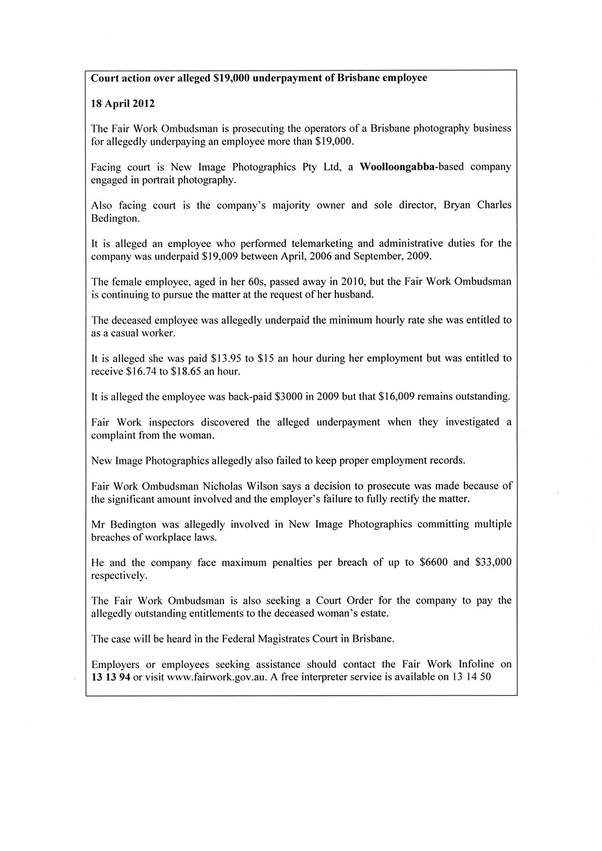
43. The media release of 18 April, 2012 was published less than 2 months after the proceedings had commenced. At the time the release was published the applicant was aware that the position of the respondents was that if there was any shortfall in wages owing to Ms Keen it would be paid. I accept that there is no reference to that proposition whatsoever in the release. Moreover, I accept that the release incorrectly asserted that the applicant was “prosecuting” the respondents. The proceedings commenced by the applicant are for the imposition of a civil penalty. The word “prosecuting” can have different meanings, but in the context in which it was used in the release, the implication arising from it is of some criminality on the part of the respondents. Given the context, that is an inference that is fairly open.
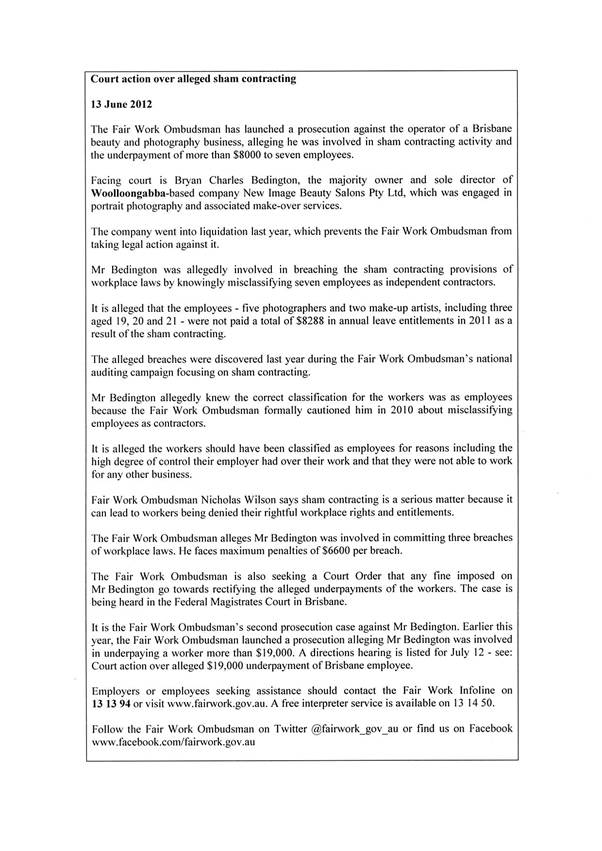
44. The media release of 13 June, 2012 also incorrectly stated that the second respondent was being “prosecuted”. That release stated that:
o It is the Fair Work Ombudsman’s second prosecution case against Mr Bedington. Earlier this year, the Fair Work Ombudsman launched a prosecution alleging Mr Bedington was involved in underpaying a worker more than $19,000.
45. I accept that this statement is misleading. The Fair Work Ombudsman has not prosecuted Mr Bedington as alleged or at all. The release plainly identified the respondents and from where the respondents business was operated.
46. In Fair Work Ombudsman v Revolution Martial Arts Pty Ltd & Anor [2013] FMCA 125 F. Turner FM (as he then was) said:
o The Court finds that the FWO issued a media release on 30 August 2012 (see Exhibit R1) and should have shown greater restraint in the wording of the media release which was calculated to allow identification of the respondents and for them to be subject to public derision and contempt. Mr Millar referred to the judgment of Hansen J in Cousins v Merringtons Pty Ltd & Anor (No 2) [2008] VSC 340 that where a media release is issued:
o ... before the trial “appropriate restraint in tone and content is required” to avoid the defendants suffering damage that would not have occurred had the media release been fair and accurate. The Court finds that it was not necessary for the media release to state the address of RMA or of Mr Auty; that allowed identification of the respondents and for them to be subject to public derision and contempt.
o The Court has regard to the decision in Fair Work Ombudsman v Cleaners New South Wales Pty Ltd [2009] FMCA 683 at [25] that embarrassment from publicity is a penalty in itself. The Court has regard to this in assessing the aggregate penalties to be imposed. In Fair Work Ombudsman v Stewarts Transport & Logistics Pty Ltd & Ors [2010] FMCA 905 at [82] it was accepted that media attention is “no doubt embarrassing”. Ms Carter accepts that some embarrassment may be taken into account in setting penalty (T p.43, l.19).
47. I take into account the misleading nature of the media releases in assessing the penalty to be imposed on the respondents.
61 It is helpful to consider the relevant media releases in their entirety. The Media Release of 18 April 2012 reads as follows:
62 The Media Release of 13 June 2012 provides:
63 Ms Doyle SC for the respondent submitted, in summary, that:
His Honour should have had regard to the status of the respondent as a regulator using the media to disseminate information about its compliance activities.
His Honour’s construction of the term “prosecute” is at odds with the dictionary meaning and with the common usage of the word by lawyers in the context of proceedings for imposition of a civil penalty.
There was no evidence beyond the mere fact of publication as to the impact of the media releases on the appellants.
The media releases were not unfair or incorrect in their account of the proceedings.
64 The imposition of civil penalties imposes an exercise of judicial discretion. In my view the approach taken by the primary judge in respect of penalty was open to his Honour.
65 First, I accept the submission of the respondent that it is within the scope of its duties to publicise its activities, including action taken to promote compliance with the law. The mere publication of a media release informing the public of such activities, notwithstanding that the publicity may be unfavourable to the recipient of the regulator’s attentions, is not reason to mitigate any penalty the Court proposes in respect of contravening conduct. Hansen J in Cousins v Merringtons Pty Ltd (No 2) [2008] VSC 340 at 60 helpfully summarised the rationale for this principle as being:
… a reasonably worded, accurate news release serves a useful purpose; without it the media is left to make their own inquiries and compile their own summaries, which carries a risk of inaccuracy.
(cf O’Loughlin J in Trade Practices Commission v Cue Design Pty Ltd (1996) 85 A Crim R 500 at [25].)
66 Indeed this issue was not disputed by the appellants.
67 It is where publicity is “adverse” in the sense of inaccurate or unfair that the mitigation of penalty may be appropriate. As was explained in Australian Competition & Consumer Commission v Nissan Motor Co (Australia) Pty Ltd (1998) ATPR 41-660:
If a defendant is the subject of media publicity, initiated by the prosecutor, that is inaccurate and on that account the defendant suffers damage that would not have occurred had the media reliance been fair and accurate that is a factor which may go to mitigation of penalty: Eva v Southern Motors Box Hill Pty. Ltd. (1977) 1 ATPR 40-026 at 17,366, 30 FLR 213 at 222-223. However, “adverse” means something more than fair reporting; there must be unfair or incorrect reporting: Trade Practices Commission v Cue Design Pty Ltd & Anor (1996) 18 ATPR 41-475 at 41,836, and ACCC v Nationwide News Pty Ltd and Others (1996) 18 ATPR 41-519 at 42,507.
68 Second, I do not accept the submission of the respondent that his Honour erred because there was no evidence of the impact of the media releases on the appellants. His Honour did not make any findings as to the impact of the media releases on the appellants – he confined his findings to the question whether the use of the word “prosecution” in the context of the media releases was misleading. In any event, I do not accept that there was a need for such evidence before his Honour. The media release was issued for an obvious purpose – for the respondent to inform the media (and through the media, the public) of its activities in relation to the appellants. Inquiries were invited, and specific details of the matter provided, for that purpose. It ill-behoves the respondent to suggest that there was no evidence of impact on the appellants when the very purpose of the media releases was to attract public attention to the appellants’ failings and the respondent’s investigations and commencement of proceedings.
69 Finally, however, I am not persuaded that his Honour’s discretion miscarried when he found that the word “prosecution” was misleading in the circumstances. While Courts use the term “prosecute” to describe pursuance of litigation by entities of the like of the respondent (for example Fair Work Ombudsman v Offshore Marine Services Pty Ltd [2012] FCA 498 at [48]), and while lawyers with expertise in industrial relations may perfectly understand that the proceedings concerned the potential imposition of civil rather than criminal penalties, I accept that the term “prosecution” is generally referable to criminal activity. In the respondent’s Media Releases, there was no qualification of the term “prosecution” to refer to civil proceedings. Indeed, I consider it was open to his Honour to find that the statements in the Media Release of 18 April 2012 that the respondent was “prosecuting the operators of a Brisbane photography business”, and in the Media Release of 13 June 2012 that the respondent had “launched a prosecution against the operator of a Brisbane beauty and photography business”, did suggest criminal activity by the appellants. In finding that these statements were misleading, it was open to his Honour to take the Media Releases into account in mitigation of penalties.
70 In my view grounds 3 and 4 of the cross-appeal are not substantiated.
Conclusion
71 Both the appeal and the cross-appeal are dismissed.
I certify that the preceding seventy-one (71) numbered paragraphs are a true copy of the Reasons for Judgment herein of the Honourable Justice Collier. |
Associate:


