FEDERAL COURT OF AUSTRALIA
Director of Consumer Affairs Victoria v Dimmeys Stores Pty Ltd
[2013] FCA 1371
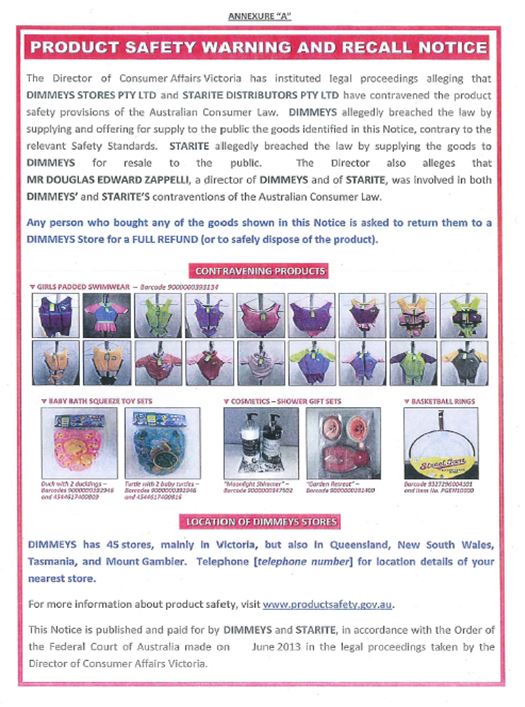
IN THE FEDERAL COURT OF AUSTRALIA | |
DATE OF ORDER: | |
WHERE MADE: |
THE COURT ORDERS THAT:
Injunctions (s 232 ACL and ACL (Vic))
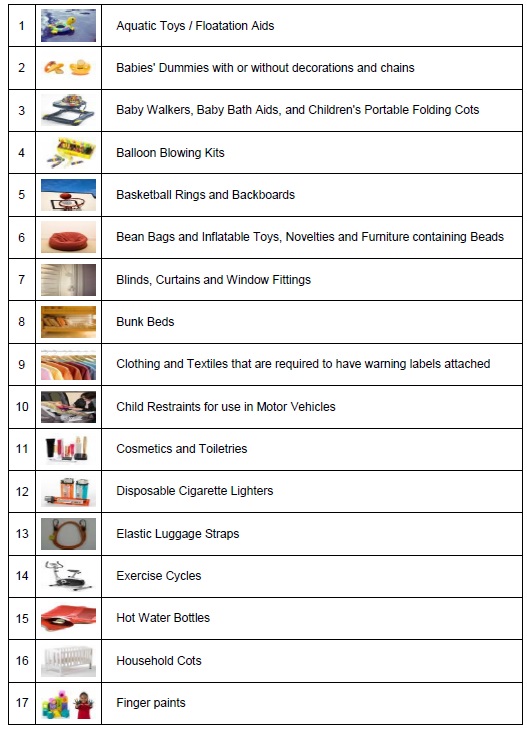
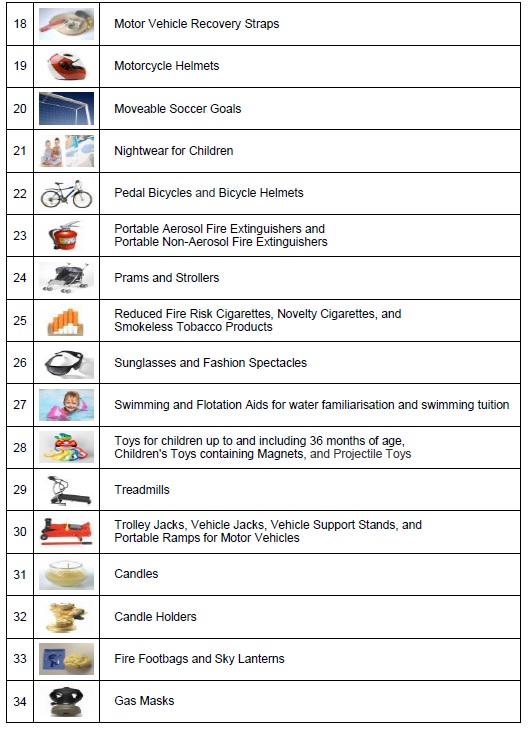
1. Dimmeys Stores Pty Ltd ACN 073 979 781 (“Dimmeys”) and Starite Distributors Pty Ltd ACN 006 233 665 (“Starite”) be restrained, for a period of 6 years from the date of this order, whether by their servants or agents or otherwise, in trade or commerce, in Australia, from carrying on a business of supplying, offering for supply, or having in their possession in, or for the purposes of, trade or commerce, goods which are subject to:
(a) a safety standard for the purposes of Division 1 of Part 3-3;
(b) an interim or permanent ban order for the purposes of Division 2 of Part 3-3; or
(c) an information standard for the purposes of Part 3-4 –
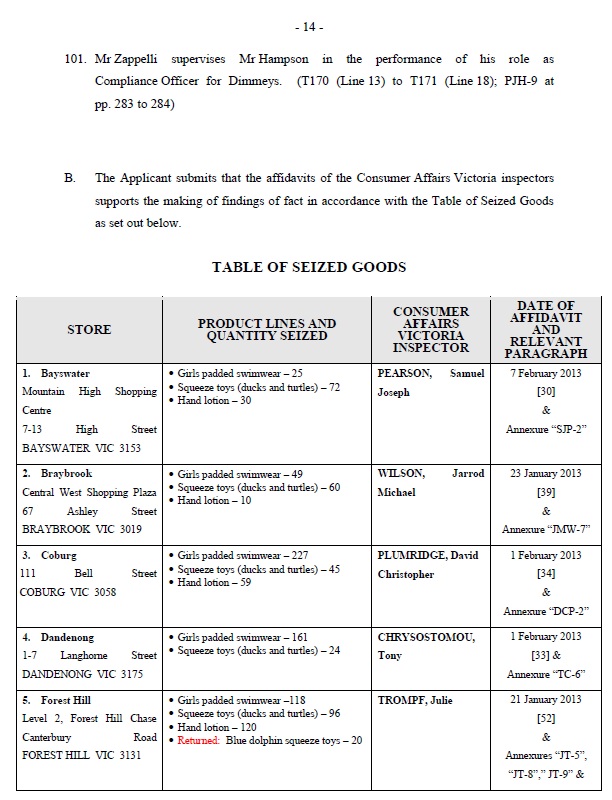
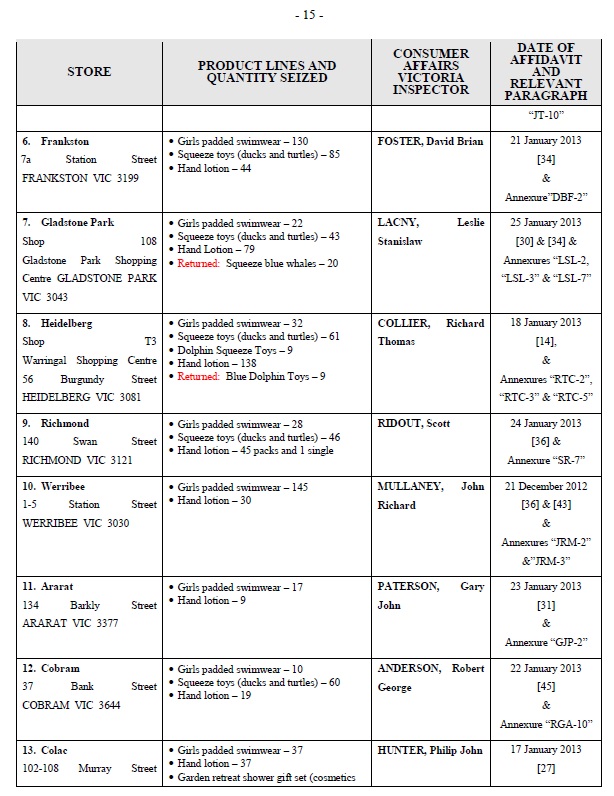
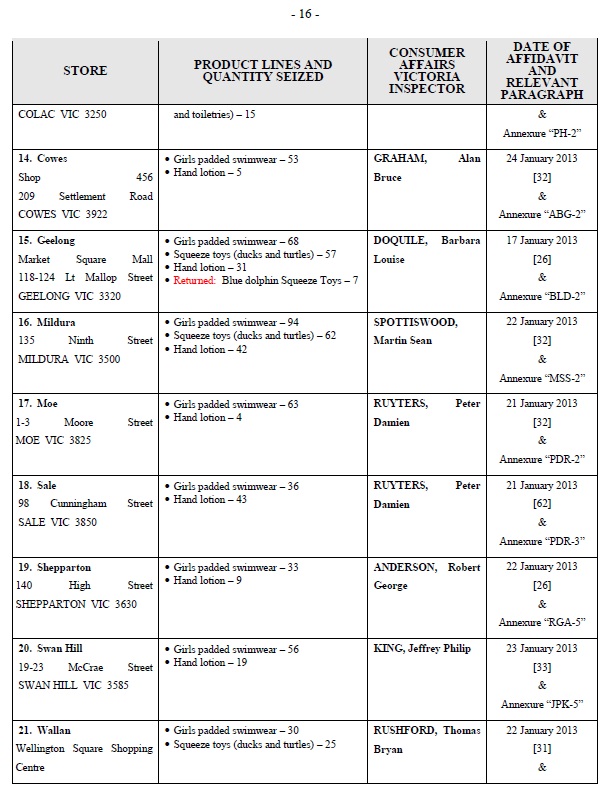
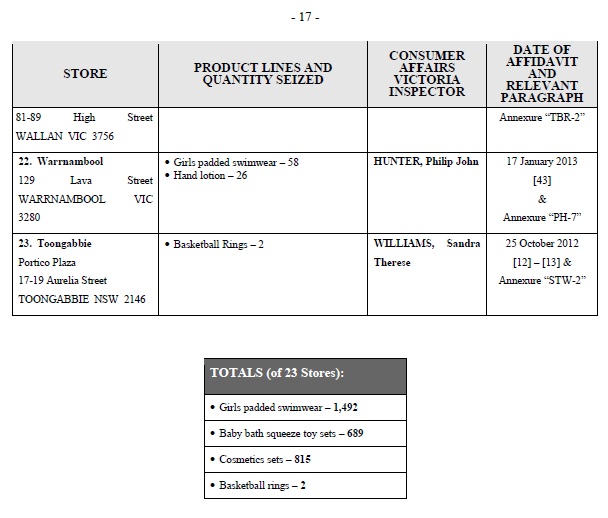
of the Australian Consumer Law, in force at the time of supply, offering to supply or having in its possession in, or for the purposes of, trade or commerce, being goods of the kind listed in Annexure “A” (and whether or not such supply, offer, or possession, is as part of, or incidental to, the carrying on of another business) unless they have first obtained written evidence from a person with accreditation from an accreditation body to test such goods for compliance with the applicable safety or information standard, interim or permanent ban order, that such person has tested a relevant sample of the goods and found that they comply with the relevant safety or information standard, interim or permanent ban order.
2. Douglas Edward Zappelli (“Mr Zappelli”) be restrained, for a period of 6 years, from being in any way, directly or indirectly, knowingly concerned in or party to or otherwise involved in any person (corporation or natural person) carrying on a business of supplying, offering for supply, or having in their possession in, or for the purposes of, trade or commerce, goods which are subject to:
(a) a safety standard for the purposes of Division 1 of Part 3-3;
(b) an interim or permanent ban order for the purposes of Division 2 of Part 3-3; or
(c) an information standard for the purposes of Part 3-4 –
of the Australian Consumer Law, in force at the time of supply, offering to supply or having in its possession in, or for the purposes of, trade or commerce, being goods of the kind listed in Annexure “A” (and whether or not such supply, offer, or possession, is as part of, or incidental to, the carrying on of another business) unless such persons have first obtained written evidence from a person with accreditation from an accreditation body to test such goods for compliance with the applicable safety or information standard, interim or permanent ban order, that a relevant sample of the goods has been tested and found to comply with the relevant safety or information standard, interim or permanent ban order.
Non-Punitive Publication Order (s 246 ACL (Vic)) / Adverse Publicity Order (s 247 ACL (Vic))
3. Dimmeys and Starite each having contravened a provision of Chapter 3 of the ACL (Vic) and Mr Zappelli having been involved in such contraventions of Chapter 3 of the ACL (Vic) by Dimmeys and Starite, cause to be published within 10 days of the date of this Order:
(a) within pages 2 to 40 inclusive of the Herald Sun newspaper in Victoria;
(b) within pages 2 to 15 inclusive of The Age newspaper in Victoria;
(c) within the Early General News section of the Daily Telegraph newspaper in New South Wales; and
(d) within the Early General News section of the Sydney Morning Herald newspaper in New South Wales –
an Important Public Notice in the form and with the content of Annexure “B” to this Order. Each of the Notices:
(i) be a minimum of A4 size;
(ii) use a minimum type size of 12 point Times New Roman or equivalent; and
(iii) be in colour.
4. Dimmeys, having contravened a provision of Chapter 3 of the ACL (Vic) as referred to in this Order, cause to be prominently and conspicuously displayed for a period of 6 months from the date of the Order:
(a) at or near each point of sale (or checkout); and
(b) at or near each customer exit –
in each of its existing or new premises from which it carries on business, solely or jointly, of supplying goods to retailers or as retailers to other purchasers, an Important Public Notice in the form and with the content of Annexure “B” to the Order. Each such Notice:
(i) be a minimum size of 29.7 cm in width by 42 cm in height (A3 size paper);
(ii) use a minimum type size of 12 point Times New Roman or equivalent; and
(iii) be in colour.
5. Dimmeys cause the Important Public Notice to be published on the Internet at the homepage of all websites which are owned, operated or maintained by or on behalf of Dimmeys, including the website accessible via uniform resource located at the web address (URL) www.dimmeys.com.au (“Dimmeys website”) (or if any such URL is replaced or changed, the Internet home page of the corresponding website), for a period of 6 months from the date of the order, and use its best endeavours to ensure that:
(a) the Important Public Notice is to be viewable by clicking through a “click-through” icon located on the Dimmeys website;
(b) the “click-through” icon referred to in the previous sub-paragraph is located in a central position on the page first accessed when the user opens to the home page of the Dimmeys website;
(c) the “click-through” icon must contain the words “PRODUCT SAFETY – IMPORTANT NOTICE ORDERED BY FEDERAL COURT OF AUSTRALIA” (in capital letters and use a minimum type size of 16 point Times New Roman or equivalent), clearly and prominently in red on a contrasting background and the words “Click Here”; and
(d) the Important Public Notice occupies the entire webpage which is accessed via the “click-through” icon referred to above.
6. Dimmeys, having contravened a provision of Chapter 3 of the ACL (Vic), as referred to in this Order, cause to be published in 3 consecutive Dimmeys’ catalogues (in both print and electronic form) issued by or on behalf of Dimmeys following the date of this Order, on the first right-hand page after the cover page, an Important Public Notice in the form and with the content of Annexure “B” to this Order. The Notice:
(a) be a minimum of a full catalogue page in size;
(b) use a minimum type size of 12 point Times New Roman or equivalent; and
(c) be in full colour.
7. Starite cause the Important Public Notice to be published on the Internet at the homepage of all websites which are owned, operated or maintained by or on behalf of Starite, including the website accessible via uniform resource located at the web address (URL) www.starite.com.au (“Starite website”) (or if any such URL is replaced or changed, the Internet home page of the corresponding website), for a period of 6 months from the date of the order, and use its best endeavours to ensure that:
(a) the Important Public Notice is to be viewable by clicking through a “click-through” icon located on the Starite website;
(b) the “click-through” icon referred to in the previous sub-paragraph is located in a central position on the page first accessed when the user opens to the home page of the Starite website;
(c) the “click-through” icon must contain the words “PRODUCT SAFETY – IMPORTANT NOTICE ORDERED BY FEDERAL COURT OF AUSTRALIA” (in capital letters and use a minimum type size of 16 point Times New Roman or equivalent), clearly and prominently in red on a contrasting background and the words “Click Here”; and
(d) the Important Public Notice occupies the entire webpage which is accessed via the “click-through” icon referred to above.
Disqualification Order (s 248 ACL (Vic))
8. Mr Zappelli, having been involved in a contravention of section 106 of the ACL (Vic), be disqualified, for a period of 6 years, from managing corporations. Such disqualification shall commence 30 days after the date of this order.
Pecuniary Penalties (s 224 ACL (Vic))
Dimmeys
9. Dimmeys pay to the State of Victoria a pecuniary penalty in the sum of $3,000,000 in respect of the contraventions of section 106 of the ACL (Vic) as found by the Court in the accompanying reasons for judgment. The penalty payable by Dimmeys is to be paid in instalments as follows:
1. $1,000,000 within 6 months of the date of this order;
2. $1,000,000 within 12 months of the date of this order; and
3. $1,000,000 within 18 months of the date of this order.
Starite
10. Starite pay to the State of Victoria a pecuniary penalty in the sum of $600,000 in respect of the contravention of section 106 of the ACL (Vic) as found by the Court in the accompanying reasons for judgment. The penalty payable by Starite is to be paid within 30 days of the date of this order.
Mr Zappelli
11. Mr Zappelli pay to the State of Victoria a pecuniary penalty in the sum of $120,000 for being directly or indirectly knowingly concerned in, and party to, the contraventions of section 106 of the ACL (Vic) by Dimmeys and Starite. The penalty payable by Mr Zappelli is to be paid within 30 days of the date of this order.
Destruction and disposal of the goods (s 232 ACL and ACL (Vic))
12. Pursuant to section 232(6)(d) of the ACL or ACL (Vic), the Applicant be permitted to destroy and dispose of:
(a) 2,175 items of girls padded swimwear, seized from various Dimmeys stores in Victoria on 6 December 2011;
(b) 735 baby bath squeeze toy sets seized from various Dimmeys stores in Victoria on 6 December 2011;
(c) 995 cosmetic sets seized from various Dimmeys stores in Victoria on 6 December 2011;
(d) 2 basketball rings seized from the Dimmeys store at Toongabbie NSW on 11 December 2011; and
(e) all other girls padded swimwear, baby bath squeeze toy sets and cosmetic sets, otherwise returned to or in Dimmeys possession –
(collectively, “the contravening goods”).
13. Dimmeys, Starite, and Mr Zappelli pay the Applicant the costs of and any costs incidental to the destruction and disposal of the contravening goods. Such payment is to be made by the Respondents to the Applicant within 7 days of a written request by the Applicant to the Respondents, quantifying the costs of, and any costs incidental to, the destruction and disposal of the contravening goods.
Costs
14. Dimmeys, Starite, and Mr Zappelli pay the Applicant’s costs, including any reserved costs.
Note: Entry of orders is dealt with in Rule 39.32 of the Federal Court Rules 2011.
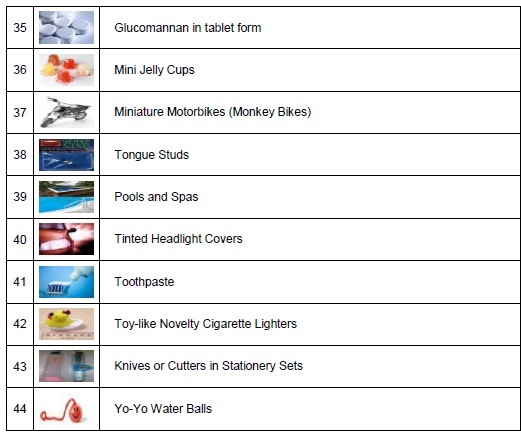
ANNEXURE “A”
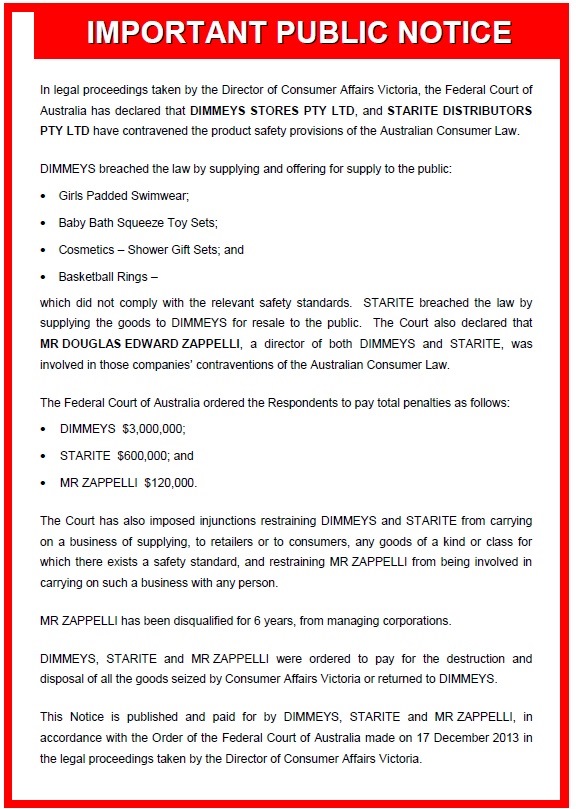
 ANNEXURE “B”
VICTORIA DISTRICT REGISTRY | |
GENERAL DIVISION | VID 959 of 2012 |
BETWEEN: | DIRECTOR OF CONSUMER AFFAIRS VICTORIA Applicant
|
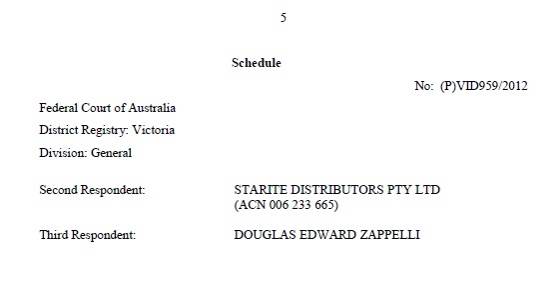
AND: | DIMMEYS STORES PTY LTD (ACN 073 979 781) First Respondent STARITE DISTRIBUTORS PTY LTD (ACN 006 233 665) Second Respondent DOUGLAS EDWARD ZAPPELLI Third Respondent
|
MARSHALL J: | MARSHALL J |
DATE: | 17 DECEMBER 2013 |
PLACE: | MELBOURNE |
REASONS FOR JUDGMENT
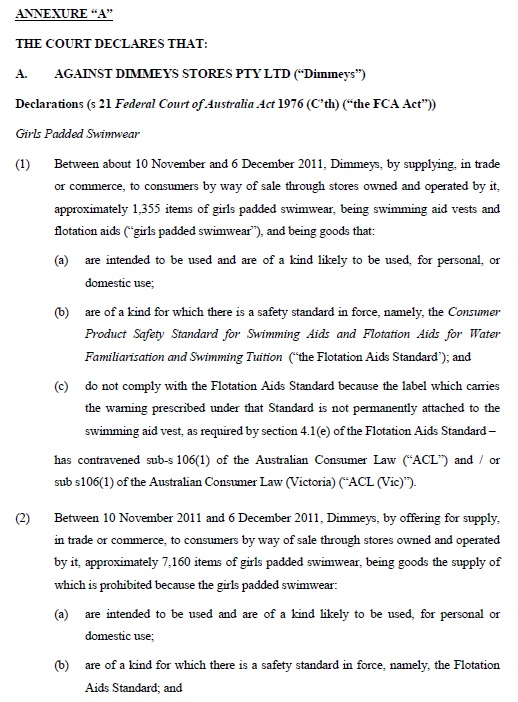
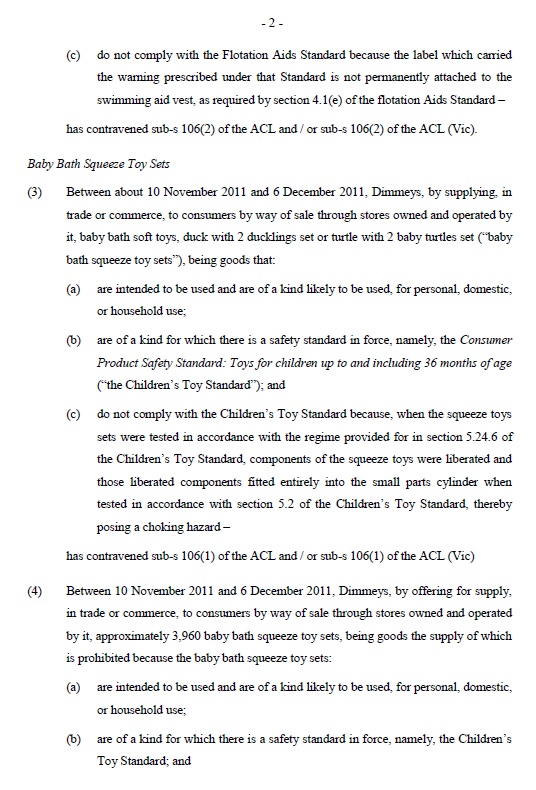
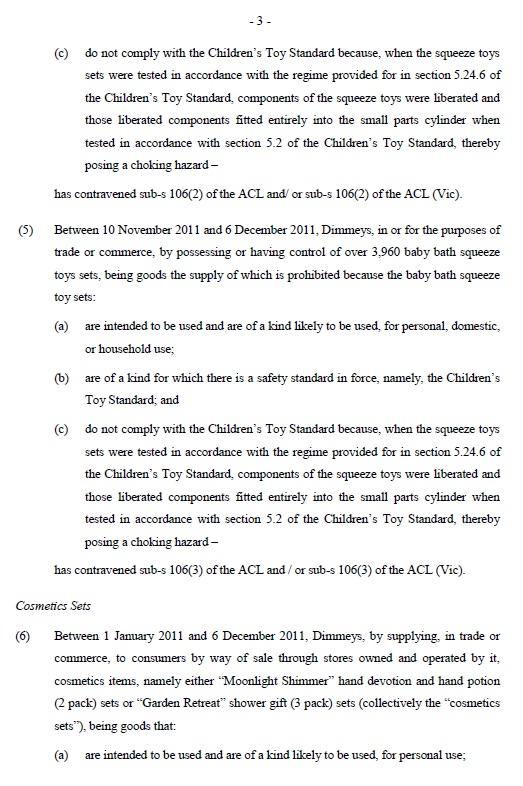
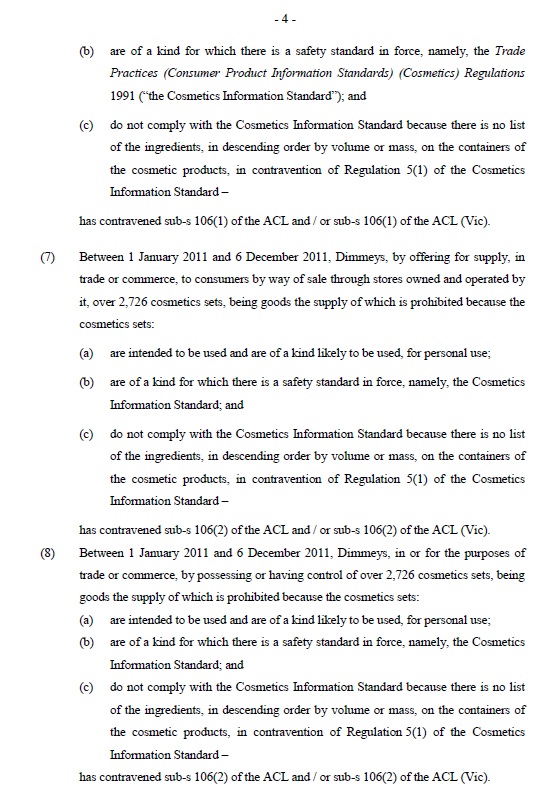
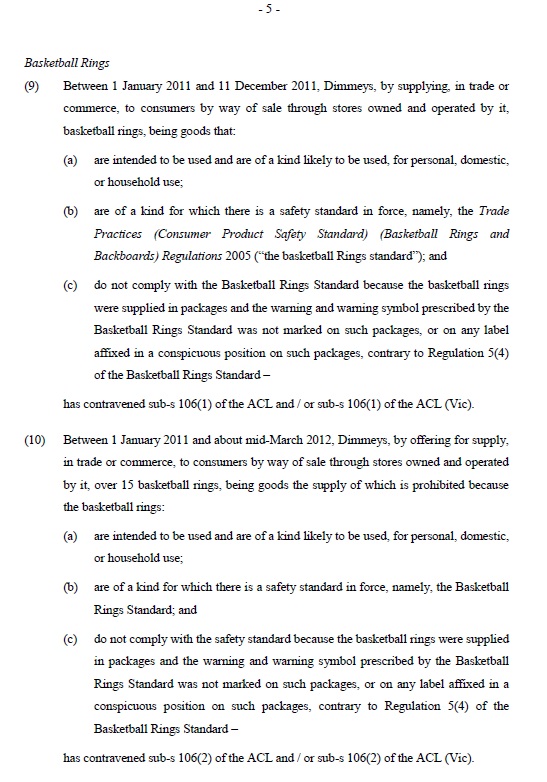
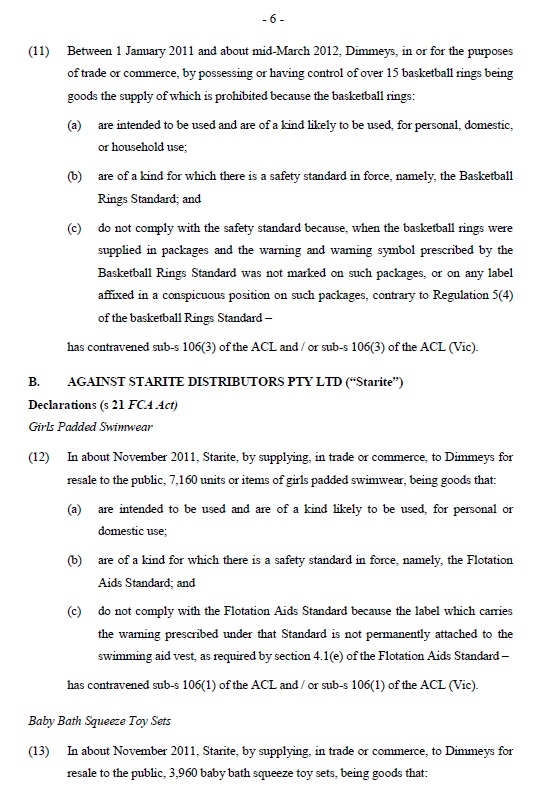
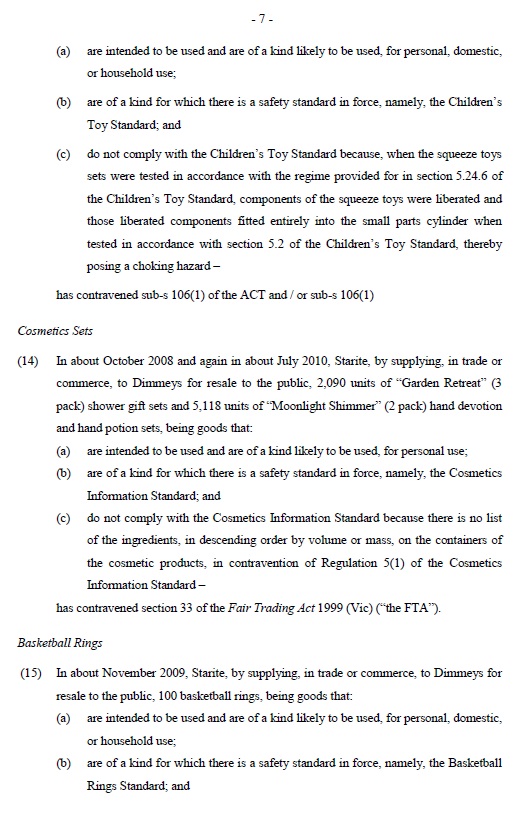
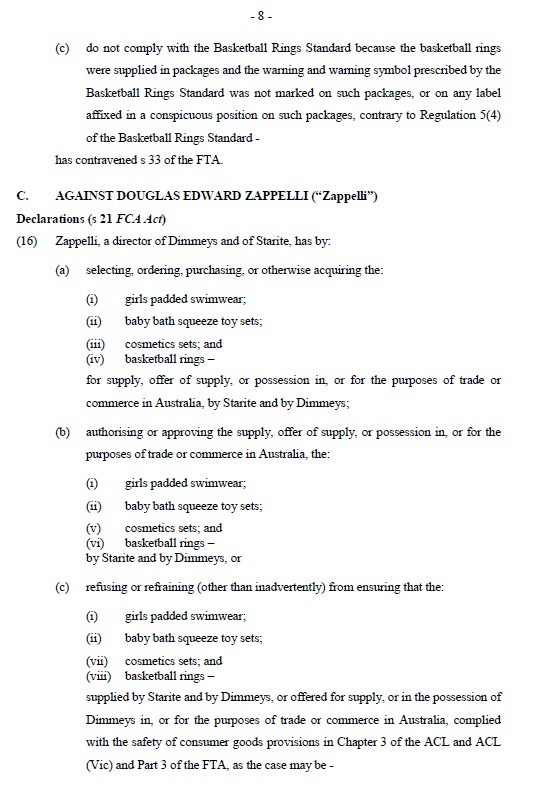
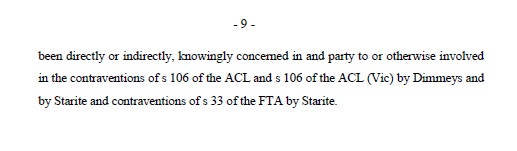
1 On 16 September 2013, the Court made declarations pursuant to s 21 of the Federal Court of Australia Act 1976 (Cth) concerning certain conduct engaged in by the respondents to this proceeding. The respondents did not oppose the making of those declarations. The declarations are annexed to these reasons for judgment and marked ‘Annexure A’.
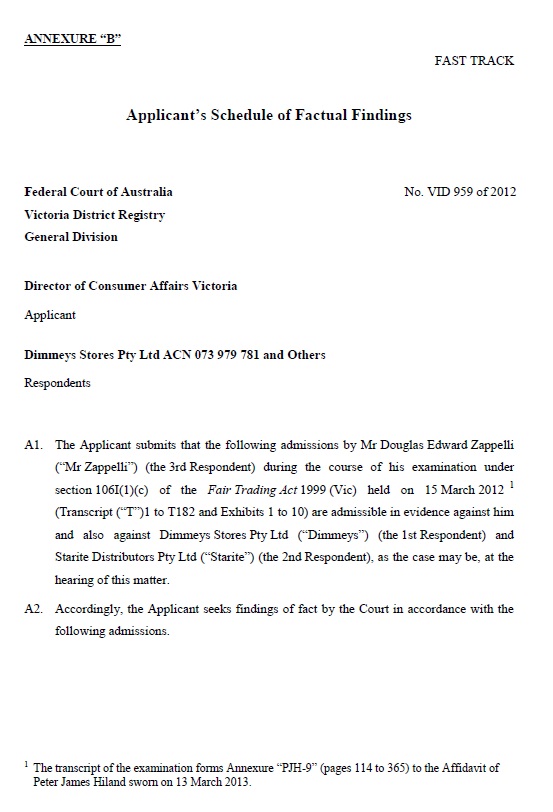
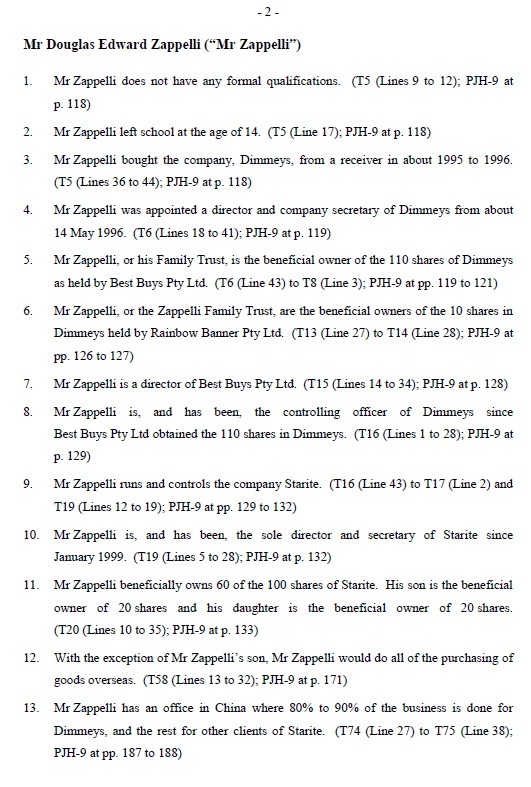
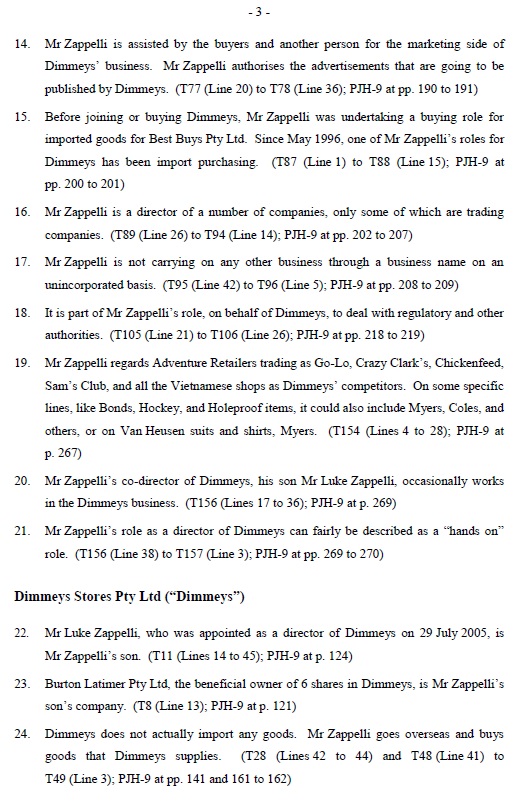
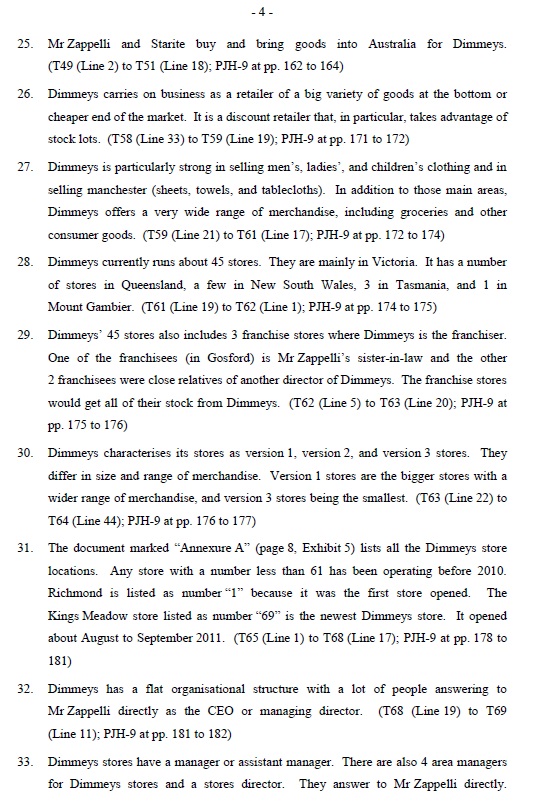
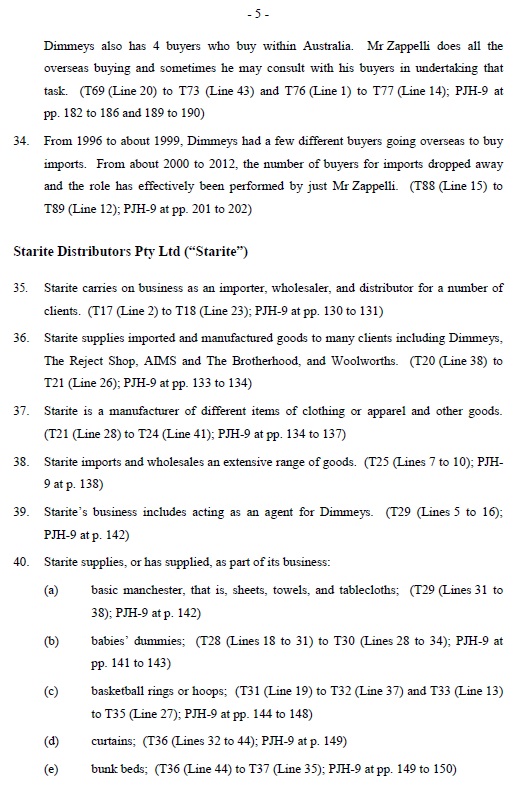
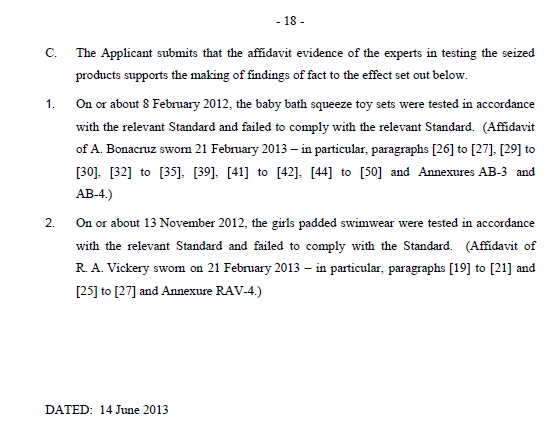
2 Previously, on 14 June 2013, the applicant, Director of Consumer Affairs Victoria (“the Director”) filed a schedule of factual findings which it invited the Court to make. The respondents do not oppose the Court making those findings. It does so. The document entitled “Applicant’s Schedule of Factual Findings” is annexed to these reasons for judgment and marked ‘Annexure B’.
Procedural history
3 The Director commenced this matter as a fast track application on 29 November 2012. In that application, the “nature of the dispute” was said to relate to the supply, offer for supply or possession or control, in or for the purposes of trade or commerce, of:
girls padded swimwear;
baby bath squeeze toy sets;
cosmetic sets; and
basketball rings
by the first and second respondents (“Dimmeys” and “Starite”) which were alleged to constitute contraventions of provisions in the Australian Consumer Law (“ACL”) and its Victorian counterpart, concerning the safety of consumer goods. The Director also alleged that Mr Zappelli, the third respondent, was involved in the contraventions as a director of Dimmeys and the sole director of Starite. References in these reasons for judgment to particular provisions of the ACL should be taken to include a reference to the counterpart provisions in the Australian Consumer Law (Victoria).
4 Each of respondents admitted the contraventions in their fast track response and amended fast track response.
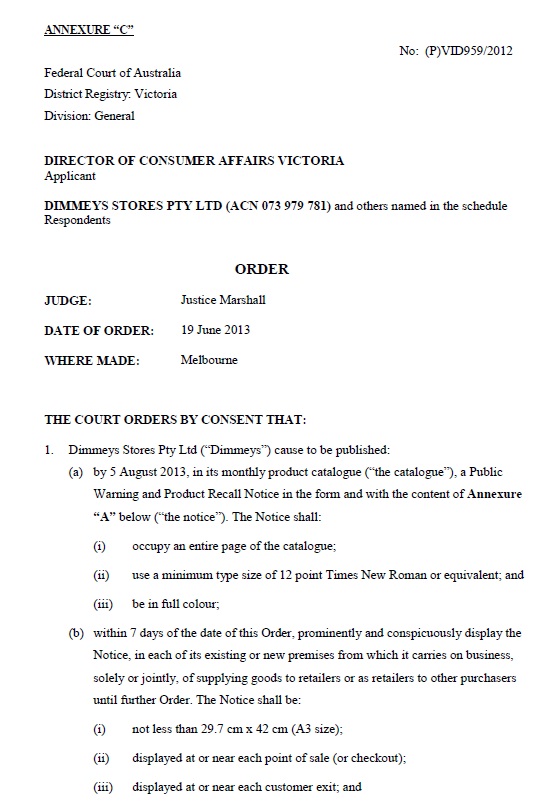
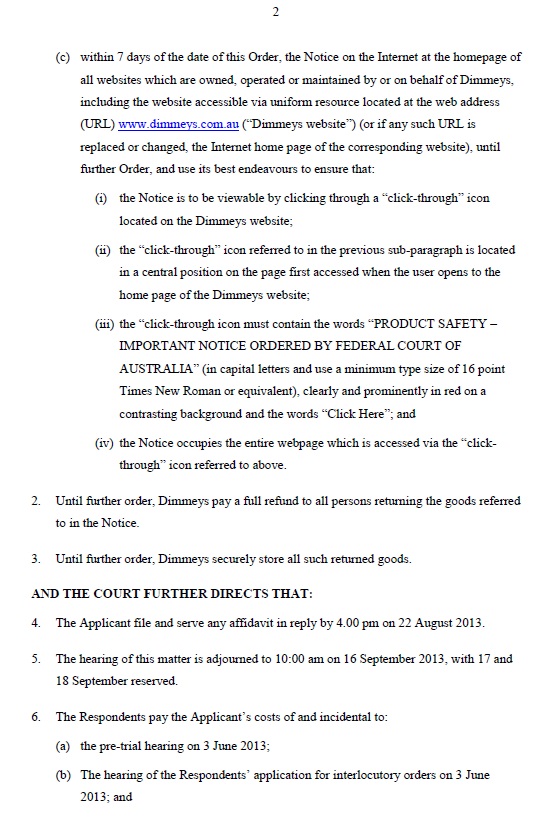
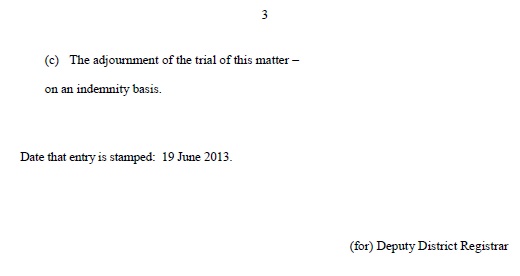
5 On 19 June 2013, the Court made a publication order, by consent, to limit the use by consumers of the categories of goods referred to at [3] above. Annexed to these reasons and marked ‘Annexure C’ is a copy of that consent order.
6 Earlier in June, the respondents challenged the standing of the Director to bring the proceeding. In a judgment published on 21 June 2013, the Court rejected that challenge; see Director of Consumer Affairs Victoria v Dimmeys Stores Pty Ltd (2013) 213 FCR 559 (“the prior judgment”). The proceeding was set down for hearing on 16 September 2013 with 17 and 18 September 2013 in reserve. During that tranche of the hearing, counsel for the parties informed the Court that they were in discussions concerning possible agreement on orders to finalise the proceeding, including agreed penalties, subject to the Court’s approval. On that basis, the declarations at Annexure A were made and the proceeding was adjourned to 19 November 2013. On 19 November 2013, the parties informed the Court that they were unable to reach agreement. They invited the Court to consider the matter in the context of the agreed facts in Annexure B and additional evidence called on 19 November 2013 concerning the financial standing of Dimmeys and Starite and their relationship with each other and Mr Zappelli.
The parties
7 The role of the Director is referred to at [6] and [7] of the prior judgment which should be read in conjunction with these reasons for judgment.
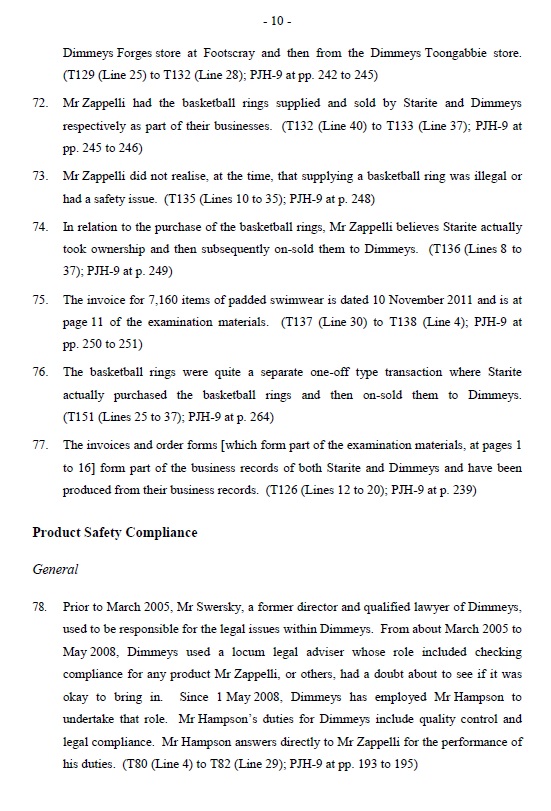
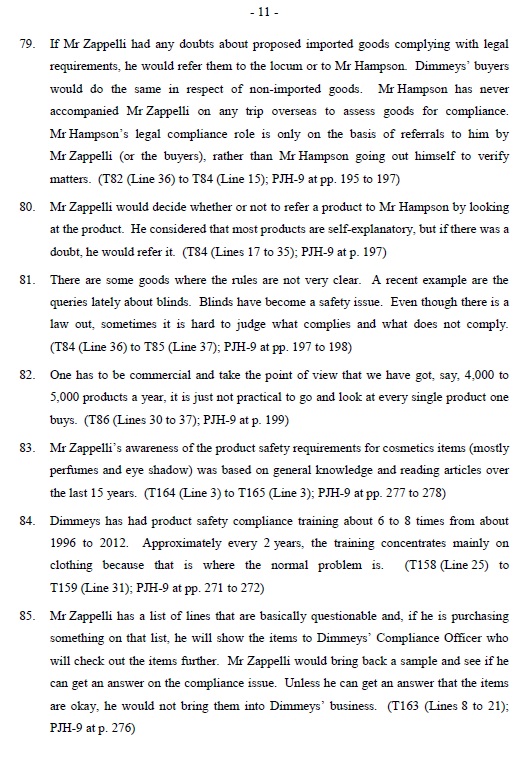
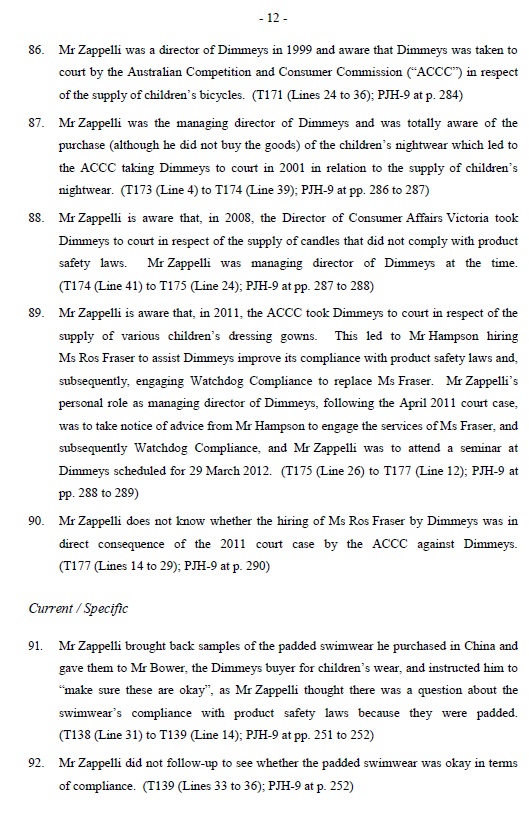
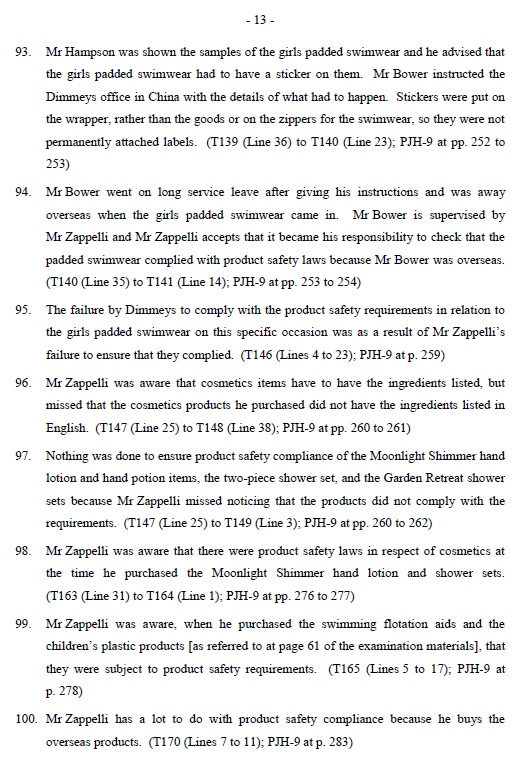
8 Dimmeys is a retail supplier of a large variety of goods, especially goods at discounted prices. It carries on business predominantly in Victoria but has some stores in other states as well. In particular, for current purposes, at all material times, Dimmeys possessed or had control over the four categories of consumer goods referred to at [3] above. It also offered those goods for supply or sale and actually supplied or sold goods of that type.
9 Starite carries on business as a financier and as an importer, wholesaler and distributor of a large variety of goods. It supplies goods to Dimmeys and other retailers and acts as the purchasing agent or wholesaler of goods for Dimmeys and other retailers.
10 Mr Zappelli is the controlling mind of Dimmeys and Starite for all practical purposes. He is responsible for the actions of Dimmeys and Starite relevant to this proceeding.
The legislative context
11 Section 106(1) of the ACL prohibits, in trade or commerce, the supply of consumer goods for which a safety standard is in force, where those goods do not comply with that safety standard. Section 106(2) of the ACL prohibits, in trade or commerce, the offer for supply of consumer goods, the supply of which is prohibited by s 106(1) of the ACL. Section 106(3) of the ACL prohibits (so far as is material to this proceeding) the possession or control of consumer goods the supply of which is prohibited by s 106(1).
The relevant safety standards
12 The girls’ padded swimwear (a shorthand expression for swimming aid vests and flotation aids) did not comply with the Consumer Product Safety Standard for Swimming Aids and Flotation Aids for Water Familiarisation and Swimming Tuition (“the Flotation Aids Standard”).
13 The baby bath squeeze toy sets did not comply with the Consumer Product Safety Standard: Toys for children up to and including 36 months of age (“the Children’s Toy Standard”).
14 The cosmetics sets did not comply with the Trade Practices (Consumer Product Information Standards) (Cosmetics) Regulations 1991 (“the Cosmetics Information Standard”).
Further publication orders
15 In addition to the publication orders made on 19 June 2013 and located at Annexure C to these reasons, the respondents do not oppose the making of further publication orders proposed by the Director. Those orders are contained at paragraphs 3 to 7 of the orders accompanying these reasons for judgment.
Destruction and disposal order
16 The respondents do not oppose the Court making the destruction and disposal order concerning relevant goods seized from Dimmeys stores. An order of that type as sought by the Director is contained at paragraph 12 of the orders accompanying these reasons for judgment.
Costs
17 The respondents do not oppose the costs order as sought by the Director. It is made at paragraph 14 of the orders accompanying these reasons for judgment.
MATTERS REMAINING IN CONTENTION
18 The parties remain at odds concerning the following matters:
the terms of injunctive relief against the respondents;
whether a disqualification order should be made affecting Mr Zappelli; and
the pecuniary penalties which should be imposed on each respondent.
Injunctive relief
19 The Director proposes that the respondents be subject to injunctions under s 232 of the ACL, in effect, restraining them from engaging in conduct of the type which gave rise to the contraventions of the ACL in this proceeding. The respondents did not take any serious issue with the form of those injunctions. It is appropriate that they are made, having regard to the matters contained in Annexures A and B. The injunctions are contained at paragraphs 1-2 of the orders which accompany these reasons for judgment.
Disqualification of Mr Zappelli from managing corporations
20 The Director seeks an order that Mr Zappelli be disqualified, for a period of six years from managing corporations. Counsel for the respondents oppose the making of such an order and submit that the Court should accept an undertaking from Mr Zappelli to cease acting as a director of Dimmeys within 30 days of the date of the Court’s order and not seek to be re-appointed as a director of Dimmeys for a period of six years.
21 The respondents raise no issue about the Court’s power to make a disqualification order but contend that it should not extend wider than Dimmeys because Mr Zappelli is involved in managing corporations which have no relevance to the current matter, such as trustee companies. Counsel for the respondents also refer to the fact that Mr Zappelli’s business interests extend much wider than Dimmeys and that general disqualification would impact on his livelihood.
22 In Australian Competition and Consumer Commission v Halkalia Pty Ltd (No 2) [2012] FCA 535, Tracey J considered the factors which informed the exercise of the Court’s power under a predecessor provision to s 248 of the ACL. At [111], Tracey J said:
The principles which had been developed under the Corporations Act were distilled by Santow J in ASIC v Adler (2002) 42 ACSR 80. One of those principles, namely that banning orders were purely protective in nature and not punitive, was later rejected by the High Court in Rich v ASIC (2004) 220 CLR 129. Otherwise, there is no reason to doubt that these principles will provide useful assistance when the Court is considering opposed applications under s 86E of the Act.
Section 86E of the Trade Practices Act 1974 (Cth) (“TPA”) was the predecessor provision to s 248 of the ACL.
23 In his proposed undertaking, Mr Zappelli appears to concede that six years is an appropriate period for him to take no role in the management of Dimmeys. The real contest concerns whether the disqualification order should be general and not confined to Dimmeys. Therefore, there is no need to consider in depth the criteria governing the exercise of the Court’s powers referred to by Santow J in Adler.
24 The Court notes the submissions of counsel for the Director that there is an administrative process available by which a disqualified person may apply to the Australian Securities and Investments Commission (“ASIC”) to be relieved from the operation of the disqualification in respect of certain companies. That is an avenue by which Mr Zappelli may be permitted to continue to be a director of private family companies and like entities.
25 Under s 206G(1) of the Corporations Act 2001 (Cth), a person who is disqualified from managing corporations may apply to the Court for leave to manage corporations, a particular class of corporations or a particular corporation if the person was not disqualified by ASIC. Under that section, Mr Zappelli would be able to apply, if disqualified in the current proceeding from managing corporations, to manage corporations other than Dimmeys and be granted leave, provided that he demonstrates that such leave is appropriate to be granted in all the circumstances.
26 Given the seriousness of the contraventions in this matter, the Court considers it appropriate to make an order disqualifying Mr Zappelli from managing companies. The Court is particularly concerned about the potential impact of the contraventions on the safety of children and Dimmeys’ prior contravening conduct when controlled by Mr Zappelli (discussed further below). To allow Mr Zappelli time to comply with the order, the disqualification will not commence until 30 days after the publication of the orders accompanying these reasons for judgment. The relevant paragraph of the order will read:
Mr Zappelli, having been involved in a contravention of s 106 of the ACL (Vic) be disqualified, for a period of 6 years, from managing corporations. Such disqualification period shall commence 30 days after the date of this order.
Pecuniary penalties
27 The leading authority dealing with the principles to be considered in assessing the appropriate pecuniary penalty in the circumstances of any particular contravention of the ACL is the judgment of the Full Court in Singtel Optus Pty Ltd v Australian Competition and Consumer Commission (2012) 287 ALR 249. Singtel Optus informs much of the following discussion.
28 In Singtel Optus at [51] and following, the Full Court discussed the need to identify the number of contraventions. In this matter, there are four courses of conduct relating to each product that was acquired, offered for sale and sold without complying with the relevant safety standard. Counsel for the Director submit that there are eight courses of conduct. To that end, counsel contend that while the possession and offering for supply of each type of goods is a single course of conduct, the actual sale is in a different category. There is no good reason to separate the offering for supply from the actual sale which occurs only by reason of a purchaser taking action to buy the goods and not from any positive action by the retailer.
Maximum penalties and courses of conduct
29 The relevant maximum penalties in respect of the courses of conduct are as follows:
For Dimmeys, $4.4 million, being $1.1 million in respect of each type of good referred to at [3] above.
For Starite, $2.2 million, being $1.1 million in respect of its supply of girls padded swimwear and baby bath squeeze toy sets.
For Mr Zappelli, $880,000, for being knowingly concerned in the possession, offering for supply and sale of each of the relevant type of goods. Mr Zappelli’s being knowingly concerned in the supply (or sale) of the girls’ padded swimwear and the baby bath squeeze toys is part of the same course of conduct.
Appropriate penalty - Dimmeys
30 Counsel for the Director submit that the appropriate range of penalty for Dimmeys is $2.86 million to $3.30 million. This figure is based on a contention that Dimmeys was engaged in eight courses of conduct. However, for the purposes of assessing the range, the Director condensed the eight courses of conduct, in effect, into four courses of conduct. Counsel for the respondents submit that the appropriate range of penalty for Dimmeys is $400,000 - $800,000.
31 A penalty at the highest end of the range proposed by counsel for the respondents for Dimmeys is far too low. Dimmeys is a repeat offender. Deterrence is the primary consideration in fixing penalties in matters of this type. Indeed, as counsel for the Director submit, it may be described as the prism through which the Court should observe the other relevant factors referred to in Singtel Optus at [37]. Those factors are:
the size of the contravening company;
the deliberateness of the contravention and the period over which it extended;
whether the contravention arose out of the conduct of senior management of the contravener or at some lower level;
whether the contravener has a corporate culture conducive to compliance with the Act or its successor as evidenced by educational programmes and disciplinary or other corrective measures in response to an acknowledged contravention;
whether the contravener has shown a disposition to co-operate with the authorities responsible for the enforcement of the Act in relation to the contravention;
whether the contravener has engaged in similar conduct in the past;
the financial position of the contravener;
whether the contravening conduct was systematic, deliberate or covert.
32 After taking into account the questions of general and specific deterrence and the matters raised at [37] in Singtel Optus and applying the instinctive synthesis involved in the totality principle, the Court considers that a penalty of $750,000 for each course of conduct is appropriate. The total penalty to be imposed on Dimmeys is $3 million.
33 The Court is satisfied that general deterrence, in the context of the breach of provisions dealing with the safety of products used by children, demands a significant penalty.
34 The most critical factor for current purposes of those identified at [37] in Singtel Optus is:
Whether the contravener has engaged in similar conduct in the past.
35 It would be an understatement to say that Dimmeys has a poor record of compliance with its consumer protection obligations. Cases where Dimmeys’ failure to fulfil its legal duties in that regard are discussed below.
36 On 26 August 1999, in Australian Competition and Consumer Commission v Dimmeys Stores (1999) ATPR 41-716, the Court convicted Dimmeys of breaching s 65C of the TPA by offering bicycles for sale which did not comply with the relevant safety standard. At [11], Weinberg J observed that:
…the offences were not committed wilfully or with any intention to deceive. Their commission was the product of carelessness and lax management. [Emphasis supplied].
37 Justice Weinberg noted the importance of enforcing consumer product safety standards and at [18] referred to Gardam v Splendid Enterprises Pty Ltd (1987) ATPR 40-779 where at 48,503, French J (as his Honour then was) said “the sections of the [TPA] which provide for the declaration of consumer product safety standards and their enforcement are plainly of the highest importance”.
38 At [22], Weinberg J described the conduct of Dimmeys and Starite (which had obtained the goods for Dimmeys) as “simply inexcusable”. At [23], his Honour said:
Mr Zappelli, who acted on behalf of Starite as the importer of the goods into Australia, was not entitled simply to assume that bicycles of this type, purchased in China for next to nothing, would comply with Australian product safety standards merely because he had been told they had been made for the Australian market, and were part of a cancelled order. Dimmeys took no steps to ensure that the bicycles imported by Starite on behalf of Dimmeys complied with any such standards. That was an act of gross irresponsibility on its part. It was a breach of the Act which was separate and distinct from the breaches of the Act committed by Starite [emphasis added].
39 On the question of general deterrence, at [24], Weinberg J said that the imposition of substantial penalties which are well publicised have the ability to “heighten the business community’s awareness of the need to comply with product safety standards and the dire consequences of any failure to do so”.
40 At [26], his Honour said:
The offences committed by Starite and Dimmeys must, in my opinion, be regarded as being extremely serious. The conduct of the defendants has resulted in a significant number of defective bicycles being supplied to children, among the most vulnerable members of our community. The appearance of these bicycles is calculated to entice those who use them into still more danger. It may fairly be said that each of the bicycles supplied was, and is, an accident waiting to happen.
41 There were mitigating circumstances in the matter before Weinberg J. The guilty pleas were entered at the earliest opportunity, Dimmeys (and Starite) co-operated with relevant authorities and Dimmeys took steps to recall the bicycles as soon as their dangerous condition was drawn to its attention. At [38], his Honour said:
In my view, Dimmeys has taken reasonable steps to ensure that the conduct which is the subject of this proceeding is not repeated. I noted the presence of Mr Zappelli on behalf of Starite, and of Mr Swersky on behalf of Dimmeys, in Court during the course of the proceedings. I accept Mr Wheelahan’s submission that each defendant is remorseful for its actions. I propose to take that remorse into account in reducing the penalties which would otherwise have been imposed.
42 Despite the hopes of counsel for Dimmeys and of Weinberg J, the conduct was repeated in respect of other dangerous goods.
43 In March 2001, Drummond J published his reasons for judgment in Australian Competition and Consumer Commission v Dimmeys Stores Pty Ltd [2001] FCA 299. The 2001 matter concerned the sale by Dimmeys of children’s night wear. The clothing did not comply with a safety standard concerning fire hazards.
44 At [27], Drummond J took into account Dimmeys’ co-operation with authorities and the action it took “to minimise the potentially harmful consequences of its conduct”. His Honour also noted “the diminished profitability of Dimmeys in recent times” but observed that “it is apparent that it is able to afford to pay substantial penalties, so that no further reduction in penalty is warranted”.
45 At [37], Drummond J referred to “a systemic management failure throughout [the relevant period]” and “a lack of any serious commitment by Dimmeys’ senior management to implementing procedures likely to ensure compliance with [the TPA]”.
46 On 8 April 2011, Gordon J published reasons for judgment in Australian Competition and Consumer Commission v Dimmeys Stores Pty Ltd [2011] FCA 372. That proceeding concerned children’s dressing gowns which did not comply with a relevant safety standard.
47 At [37], Gordon J described the contravening conduct as “serious”. Her Honour observed at [38] that Mr Zappelli is the “controlling mind of Dimmeys”. At [42], her Honour noted the lack of evidence that the contravening conduct was deliberate, observing that:
There was therefore a critical failure at the warehouse and at the retail level in failing to identify that the garments did not comply with the Standard.
48 At [43], her Honour observed that there was no evidence of any injury or loss or damage but that there was a risk of possible harm which should be taken into account in assessing penalty.
49 At [46], Gordon J said:
Finally, the evidence discloses that since these proceedings were commenced, Dimmeys has admitted the conduct alleged in the Fast Track Statement, fully cooperated with the ACCC, agreed to all forms of relief sought in the Fast Track Application (other than the quantity of the penalty) and thereby reduced the time and expense of the proceeding and saved public time and resources including those of the Court.
50 Justice Gordon, at [48], referred to the matters before Weinberg J in 1999 and Drummond J in 2001 and also to a prior conviction of Dimmeys in the Magistrates’ Court for the supply of candles in breach of a safety standard. At [51], her Honour noted that “(t)he systems in place for ensuring compliance with the consumer safety standards were unsatisfactory.”
51 At [53], her Honour referred to the financial position of Dimmeys as being relevant to penalty but emphasised at [54] that:
…as deterrence is the primary objective of penalties, the financial capacity of a respondent to pay must not prevent the Court from doing its duty even if in some cases, the penalty is so high that the offender will become insolvent…
52 In the 2011 proceeding, Dimmeys submitted that its financial position was precarious. At [58], Gordon J accepted that Dimmeys “as a stand-alone entity, is in financial hardship”. Her Honour went on to say:
However, given the financial support (direct and indirect) that it receives from related entities and individuals including Starite, the beneficiaries of the Dimmeys Unit Trust (of which Dimmeys is the trustee) and Forges of Footscray Properties Pty Ltd, it is not possible on the evidence available to conclude that the imposition of a penalty in or near the range sought by the ACCC would have the “crushing” effect contended for by Dimmeys. That conclusion is fortified by three facts and matters. First, the ACCC proposed that the penalty be paid by instalments. Secondly, as was discussed during the course of argument, no evidence was led by Dimmeys as to the financial position of these and other related entities. Finally, there was no evidence to suggest that the support provided by these entities and individuals in the past would not continue in the near future.
53 At [59], Gordon J noted that Dimmeys had a “Trade Practices Compliance Program” but that it failed to prevent the contraventions.
54 Her Honour referred to the importance of compliance with safety standards, especially those concerning goods designed to be used by children at [63]. Justice Gordon there said:
For those reasons, deterrence (specific and general) must be given significant weight. In the context of Dimmeys, the penalty for specific deterrence must be substantial – this is not the first time: see the 1999 and the 2001 Dimmeys’ Decisions. The only saving grace, if there be one, is that the previous episodes were 10 years ago.
55 Now, some two years later, Dimmeys is back before the Court in respect of similar contraventions.
56 It is beyond doubt that Dimmeys has engaged in similar conduct in the past. It received a stern warning from Gordon J in 2011 but finds itself back before the Court in 2013. Specific and general deterrence demands a high range penalty be imposed on it. Dimmeys’ previous non-compliant conduct accentuates the importance of a high range penalty.
57 Although the size of Dimmeys is a matter of small significance when viewed through the prism of specific and general deterrence in the context of its prior transgressions, it is appropriate to now turn to that issue. Counsel for Dimmeys contend that the penalty not be so high as to be oppressive.
58 Counsel for the Director respond that if the penalty, objectively considered, deserves to be a high one, the Court should not shrink from imposing such a penalty. The Court agrees with the submission of counsel for the Director. It is also consistent with the approach taken by Gordon J in the 2011 proceeding concerning Dimmeys. See also Australian Competition and Consumer Commission v High Adventure Pty Limited [2005] FCAFC 247 where the Full Court said at [11]:
Moreover, as deterrence (especially general deterrence) is the primary purpose lying behind the penalty regime, there inevitably will be cases where the penalty that must be imposed will be higher, perhaps even considerably higher, than the penalty that would otherwise be imposed on a particular offender if one were to have regard only to the circumstances of that offender. In some cases the penalty may be so high that the offender will become insolvent. That possibility must not prevent the Court from doing its duty for otherwise the important object of general deterrence will be undermined.
59 Counsel for the respondents submit that it would not be in the public interest to have a penalty imposed on Dimmeys which is so crushing that it affects its viability. However, they observe that the penalty could be structured so that it can be paid off over time. This submission runs counter to the view of the Full Court in High Adventure and the approach of the Full Court in Singtel Optus. A substantial fine is required to be imposed notwithstanding that it may threaten the viability of Dimmeys. That outcome may be assuaged by permitting payment of the fine by instalments.
60 The limited evidence before the Court on Dimmeys’ financial position shows that it is part of a group of interlocking companies which has Starite at the centre of the web. Mr Zappelli is the controlling mind of Dimmeys and Starite. The better view of the evidence is that Dimmeys is not a wealthy or particularly profitable company but, contrary to the position as it appeared to Gordon J in 2011, it can hardly be described now as a stand-alone company. In reality, Dimmeys is one of Mr Zappelli’s corporate alter egos.
61 The Director accepts that Dimmeys did not deliberately set out to contravene the ACL. Counsel for Dimmeys contend that the contravention arose from mistakes made by persons engaged by Mr Zappelli. Errors of that kind have been claimed going back to the 1999 proceeding before Weinberg J and thereafter. The fact that the conduct arose from incompetence rather than deliberateness is of little weight.
62 The contraventions arose from insufficient action being taken by Mr Zappelli to prevent them occurring. They also appear to have arisen from the actions of buyers. However, Mr Zappelli was responsible for the order and purchase of the non-compliant goods on behalf of Starite and the supply of them to Dimmeys. This factor accentuates the need for a high range penalty and reinforces the importance of the disqualification referred to at [20] to [26] above.
63 The next factor referred to at [37] in Singtel Optus is whether the contravener has a corporate culture conducive to compliance with the ACL. To the extent that Dimmeys has attempted to implement remedial measures over the years, they have not borne fruit. This factor does not assist Dimmeys.
64 Dimmeys has shown a disposition in the past to co-operate with authorities. However, its co-operation was mixed in this proceeding. The unsuccessful application to the Court to dismiss the proceeding based on the standing of the Director did not reveal co-operation but rather an attempt to stultify the proceeding. So much is especially so when one considers that the respondents’ initial fast track response dated 10 January 2013 raised no such impediment to the matter being heard. The same applied to the next fast track response filed on 5 February 2013. The position changed with the filing of an amended fast track response on 13 June 2013, which raised the question of the standing of the Director to commence the proceeding.
65 The above matters complete the range of considerations which the Court has taken into account in assessing that the conduct of Dimmeys in its fifth contravention of provisions of the type as contained in s 106 of the ACL. In particular, the possible effect of its actions on the safety of children demands a high range penalty. A three million dollar penalty is justified in the circumstances. This represents a penalty of $750,000 for each of the four courses of conduct as discussed at [32] above.
Appropriate penalty - Starite
66 The position of Starite differs from that of Dimmeys. It has only one prior contravention, being the subject of the 1999 proceeding before Weinberg J. It is to be penalised for two courses of conduct. The Director submits that a penalty approximately half of that applicable to Dimmeys’ contraventions is appropriate. She submits a range of $660,000 to $880,000 for both contraventions combined or $330,000 to $440,000 in respect of each. Counsel for Starite submit that the range should be between $200,000 and $600,000. It may be observed that there is little difference between the high end of the range submitted by Starite and the low end for the range submitted by the Director.
67 Starite supplied the non-compliant goods to Dimmeys and must take its share of the blame for what ensued. The financial position of Starite, the most profitable corporation in Mr Zappelli’s corporate empire, ensures that it would have no difficulty in paying a moderate range fine without threatening its viability. Its only prior contravention occurred some 15 years ago. Taking into account the issues of general and specific deterrence and the factors referred to in Singtel Optus at [37], the Court considers that a penalty of $300,000 in respect of each course of conduct is appropriate. The total fine which should be imposed on Starite is $600,000.
Appropriate penalty - Mr Zappelli
68 Mr Zappelli was knowingly concerned in the contraventions of Dimmeys and Starite. In respect of each set of contraventions, the Director submits that he should be fined between $44,000 and $55,000. There are four such contraventions by Dimmeys and two by Starite. The total range contended for by the Director was between $264,000 and $330,000. Counsel for the respondents contend for a far lower range of $20,000 to $50,000, given that Mr Zappelli has no prior contraventions.
69 The Court should impose a low range penalty on Mr Zappelli having regard to the effect the disqualification order will have on his capacity to be involved in running Dimmeys and Starite, his lack of any prior transgressions and its possible effect on his livelihood. However, penalties as low as those contended for by his counsel are out of kilter with the conduct involved and do not give due consideration to the purposes of general and specific deterrence. A total penalty of $120,000 is appropriate. This reflects a penalty of $20,000 for each of the six contraventions in respect of which Mr Zappelli was knowingly concerned.
Time to pay penalties
70 One third of the sum payable by Dimmeys should be paid within six months, another within 12 months and the final instalment within 18 months of the making of this order. Starite and Mr Zappelli will have 30 days to pay their penalties.
71 There is no evidence that Starite or Mr Zappelli will have any difficulty paying the fines imposed on each of them in this proceeding. The extended instalment regime will only apply to Dimmeys.
I certify that the preceding seventy-one (71) numbered paragraphs are a true copy of the Reasons for Judgment herein of the Honourable Justice Marshall. |
Associate:
4