FEDERAL COURT OF AUSTRALIA
Australian Consumer and Competition Commission v HP Superstore Pty Ltd [2013] FCA 1317
IN THE FEDERAL COURT OF AUSTRALIA | |
AUSTRALIAN CONSUMER AND COMPETITION COMMISSION Applicant | |
AND: | HP SUPERSTORE PTY LTD (ACN 142 549 308) Respondent |
DATE OF ORDER: | |
WHERE MADE: |
THE COURT ORDERS THAT:
1. The Court declares pursuant to section 21 of the Federal Court of Australia Act 1976 (Cth), that in making the oral statements listed at paragraph 1(a), (b), (d) and (e) of the Originating Application filed on 12 June 2013 in the Proceeding, the Respondent:
(a) made representations in connection with the supply or possible supply of goods or services that were false or misleading and concerned the existence, exclusion or effect of any guarantee, right or remedy available under the consumer guarantee provisions in Division 1 of Part 3-2 the Australian Consumer Law (‘ACL’) being Schedule 2 to the Competition and Consumer Act 2010 (Cth), and other remedies relating to those guarantees in Part 5-4 of the ACL in contravention of section 29(1)(m) of the ACL; and
(b) in doing so, engaged in conduct that was misleading or deceptive or likely to mislead or deceive in contravention of section 18 of the ACL.
2. Pursuant to section 232 of the ACL, the Respondent is restrained (whether by itself, its servants, agents or otherwise howsoever) for a period of three years from the date of these orders from making representations (whether oral or written) to any customer to the effect that:
(a) the Respondent:
(i) does not have any obligation to provide any remedies in relation to goods it supplies;
(ii) does not have an obligation to provide any remedies in relation to goods it supplies unless such goods are returned to it within 14 days after the goods are purchased by the consumer, or a similarly restricted period of time unrelated to the nature of the goods;
(iii) does not have any obligation to provide any remedies in relation to goods it supplies even if the goods are, or are agreed to be, subject to a major fault;
(iv) is not liable to provide remedies to consumers to whom it has supplied goods as only the relevant manufacturer is liable to provide remedies and then only when the relevant goods are, or are agreed to be, subject to a major fault;
(v) does not have any obligation to provide a replacement for goods it supplies regardless of the circumstances and the consumer guarantee provisions of Division 1 of Part 3-2 and the remedies relating to those guarantees in Part 5-4 of the ACL; and
(vi) is not liable to provide remedies to consumers to whom it has supplies goods as only the relevant manufacturer is liable to provide remedies to such consumers; and
(b) the only available option or remedy available to consumers in relation to laptops supplied by the Respondent is to either reformat the laptop or pay an upfront free.
3. Pursuant to sections 224(1)(a)(ii) and 228 of the ACL, the Respondent is to, within 28 days of the date of these Orders, pay to the Commonwealth a pecuniary penalty in respect of the contravention of section 29(1)(m) of the ACL in the amount of $28,000.
4. Pursuant to section 246(2) of the ACL, the Respondent is to, within 28 days of the date of these Orders, prominently display at the point of sale of every product supplied by the Respondent during the operation of a retail sales service undertaken under the name Harvey Norman a copy of the summary of consumer rights under the ACL at Annexure A of the Originating Application for a period of three years.
5. Pursuant to section 246 of the ACL, within 28 days of the date of these Orders or 28 February 2014, whichever is the later (‘the Commencement Date’):
(a) the Respondent is to:
(i) for a period of one year following the Commencement Date, implement its own compliance program to be undertaken by each employee of the Respondent with respect to the rights available to consumers under the ACL including the consumer guarantees in Division 1 of part 3-2 of the ACL and the remedies relating to those guarantees in Part 5-4 of the ACL (‘the Consumer Law Compliance Program’). The Consumer Law Compliance Program must conform to the compliance standards set out in the Australian Standards on Compliance Programs (AS 3806-2006);
(ii) for a period of two years thereafter, participate in a consumer law compliance program to be recommended by subsidiaries of Harvey Norman Holdings Limited to all franchisees trading under the “Harvey Norman ®” name in Australia and made available for the participation of their employees;
(b) the Respondent is to, no later than 14 days after the Commencement Date, serve on the ACCC an affidavit verifying that, in conformity with these Orders, it has displayed the notice referred to at Order 4 above and it has implemented the Consumer Law Compliance Program.
6. Each party to bear their costs of the proceeding and all previous costs orders in the proceeding are to be vacated.
Note: Entry of orders is dealt with in Rule 39.32 of the Federal Court Rules 2011.
VICTORIA DISTRICT REGISTRY | |
GENERAL DIVISION | VID 483 of 2013 |
BETWEEN: | AUSTRALIAN CONSUMER AND COMPETITION COMMISSION Applicant
|
AND: | HP SUPERSTORE PTY LTD (ACN 142 549 308) Respondent
|
JUDGE: | MIDDLETON J |
DATE: | 6 DECEMBER 2013 |
PLACE: | MELBOURNE |
REASONS FOR JUDGMENT
INTRODUCTION
1 The Applicant (‘ACCC’) seeks pecuniary penalties, declaratory and other relief against the Respondent (‘HP Superstore’).
2 HP Superstore is a Harvey Norman franchise selling electrical gods out of a store in Hoppers Crossing, Victoria.
3 HP Superstore admits that in the period between January and March 2012 it engaged in conduct that contravened ss 18 and 29(1)(m) of the Australian Consumer Law (‘ACL’) being Sch 2 to the Competition and Consumer Act 2010 (‘CCA’).
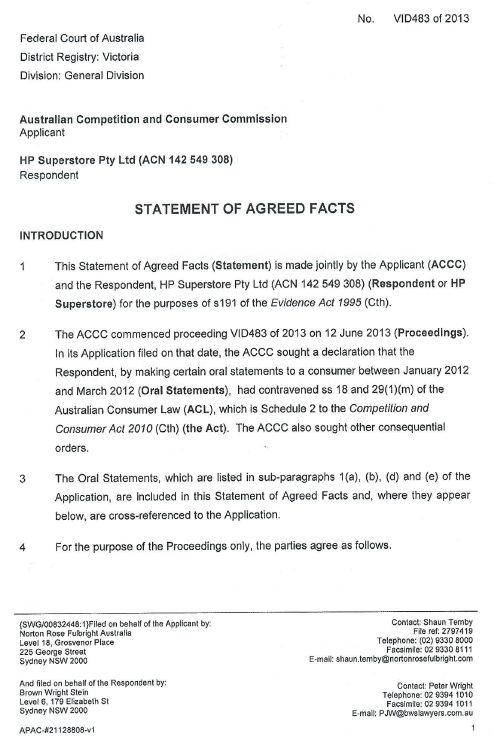
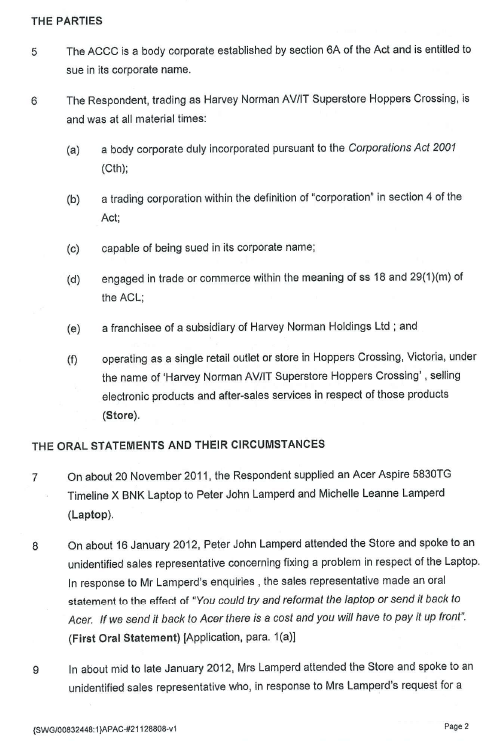
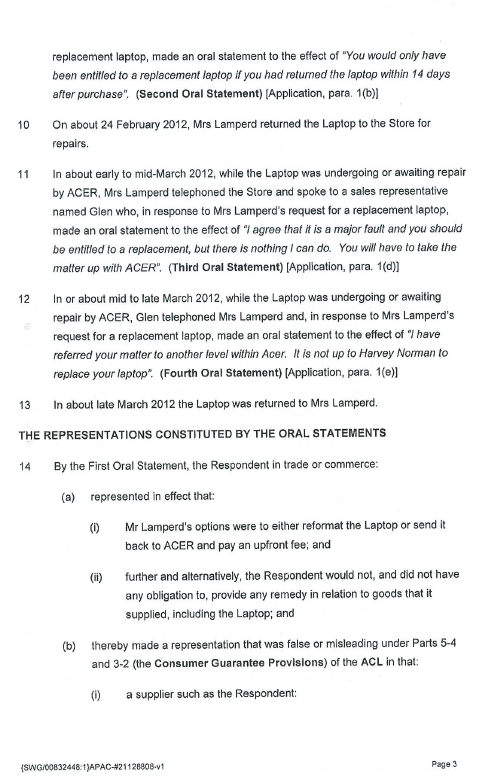
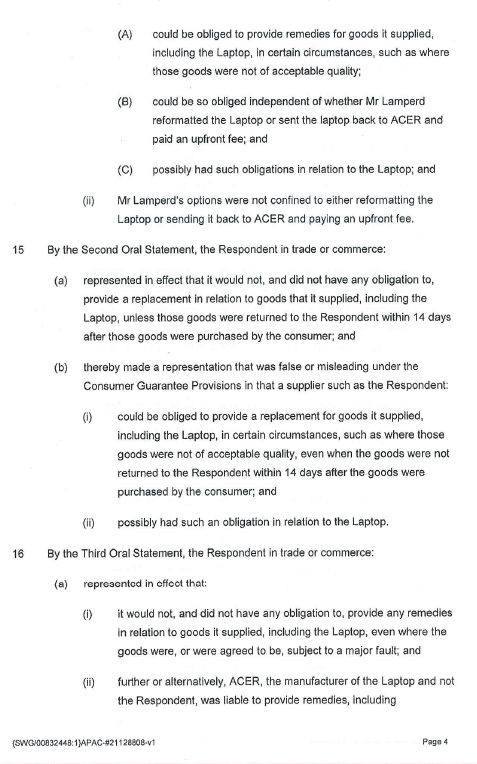
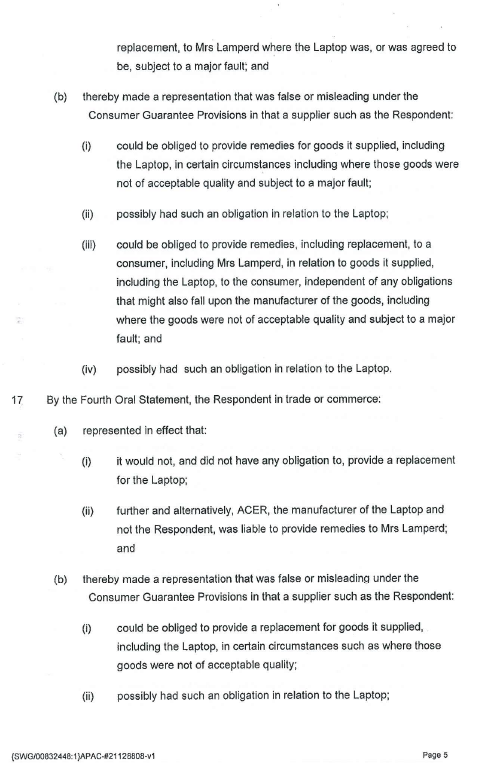
4 HP Superstore made a total of four statements each on separate occasions to a total of two consumers (who had jointly purchased one laptop computer), and by those statements made representations “concerning the existence, exclusion or effect of any warranty, guarantee, right or remedy” within the meaning of those words in s 29(1)(m) of the ACL. The representations, the circumstances in which they were made, and the respects in which they were false or misleading are set out in the Statement of Agreed Facts (‘Agreed Facts’) which I attach to the judgment marked “Annexure A”. HP Superstore admits that, in making each representation, it contravened s 18 and s 29(1)(m) of the ACL.
5 The parties have agreed that the appropriate orders are as follows:
(a) make declarations pursuant to s 21 of the Federal Court of Australia Act 1976 (Cth);
(b) grant injunctive relief pursuant to s 232 of the ACL;
(c) order payment by HP Superstore of a penalty in the amount of $28,000.00 pursuant to s 224 of the ACL;
(d) order that HP Superstore display a copy of the summary of consumer rights under the ACL at the point of sale for three years; and
(e) make orders pursuant to s 246 of the ACL providing for HP Superstore to establish a compliance program.
THE REGULATORY FRAMEWORK
Contraventions
6 The alleged contraventions concern ss 18 and 29(1)(m) of the ACL. Section 18 of the ACL relevantly provides:
(1) A person must not, in trade or commerce, engage in conduct that is misleading or deceptive or is likely to mislead or deceive.
7 Section 29 of the ACL concerns false or misleading representations about goods and services. Section 29(1)(m) provides:
(1) A person must not, in trade or commerce, in connection with the supply or possible supply of goods or services or in connection with the promotion by any means of the supply or use of goods or services:
…
(m) make a false or misleading representation concerning the existence, exclusion or effect of any condition, warranty, guarantee, right or remedy (including a guarantee under Division 1 of Part 3 2);
The consumer guarantee provisions
8 Part 3-2, Div 1, Subdiv A of the ACL provides a number of statutory guarantees in relation to supply of goods to consumers. Among these statutory consumer guarantees s 54 of the ACL provides a guarantee as to acceptable quality of goods. Section 54 relevantly states:
(1) If:
(a) a person supplies, in trade or commerce, goods to a consumer; and
(b) the supply does not occur by way of sale by auction;
there is a guarantee that the goods are of acceptable quality.
(2) Goods are of acceptable quality if they are as:
(a) fit for all the purposes for which goods of that kind are commonly supplied; and
(b) acceptable in appearance and finish; and
(c) free from defects; and
(d) safe; and
(e) durable;
as a reasonable consumer fully acquainted with the state and condition of the goods (including any hidden defects of the goods), would regard as acceptable having regard to the matters in subsection (3).
(3) The matters for the purposes of subsection (2) are:
(a) the nature of the goods; and
(b) the price of the goods (if relevant); and
(c) any statements made about the goods on any packaging or label on the goods; and
(d) any representation made about the goods by the supplier or manufacturer of the goods; and
(e) any other relevant circumstances relating to the supply of the goods.
…
9 In these proceedings, the laptop supplied to the consumers was new. The consumers observed defects in the laptop so as to give rise to a question as to whether the good was in breach of the above guarantee.
10 A consumer can obtain relief for a breach of the consumer guarantees under Pt 5-4 of the ACL. Actions against suppliers of goods are dealt with under Div 1, Subdiv A of that part. Section 259 establishes the actions that the consumer may take and states:
(1) A consumer may take action under this section if:
(a) a person (the supplier) supplies, in trade or commerce, goods to the consumer; and
(b) a guarantee that applies to the supply under Subdivision A of Division 1 of Part 3 2 (other than sections 58 and 59(1)) is not complied with.
(2) If the failure to comply with the guarantee can be remedied and is not a major failure:
(a) the consumer may require the supplier to remedy the failure within a reasonable time; or
(b) if such a requirement is made of the supplier but the supplier refuses or fails to comply with the requirement, or fails to comply with the requirement within a reasonable time-the consumer may:
(i) otherwise have the failure remedied and, by action against the supplier, recover all reasonable costs incurred by the consumer in having the failure so remedied; or
(ii) subject to section 262, notify the supplier that the consumer rejects the goods and of the ground or grounds for the rejection.
(3) If the failure to comply with the guarantee cannot be remedied or is a major failure, the consumer may:
(a) subject to section 262, notify the supplier that the consumer rejects the goods and of the ground or grounds for the rejection; or
(b) by action against the supplier, recover compensation for any reduction in the value of the goods below the price paid or payable by the consumer for the goods.
(4) The consumer may, by action against the supplier, recover damages for any loss or damage suffered by the consumer because of the failure to comply with the guarantee if it was reasonably foreseeable that the consumer would suffer such loss or damage as a result of such a failure.
(5) Subsection (4) does not apply if the failure to comply with the guarantee occurred only because of a cause independent of human control that occurred after the goods left the control of the supplier.
(6) To avoid doubt, subsection (4) applies in addition to subsections (2) and (3).
(7) The consumer may take action under this section whether or not the goods are in their original packaging.
11 Section 260 determines when a failure to comply with a guarantee is a major failure. In this case, it is possible that the problems that the consumer experienced with the laptop were major failures.
12 Where the failure is not a major failure, s 261 outlines the measures that a supplier may take to rectify a failure to comply with a guarantee and relevantly states:
If, under section 259(2)(a), a consumer requires a supplier of goods to remedy a failure to comply with a guarantee referred to in section 259(1)(b), the supplier may comply with the requirement:
(a) if the failure relates to title–by curing any defect in title; or
(b) if the failure does not relate to title–by repairing the goods; or
(c) by replacing the goods with goods of an identical type; or
(d) by refunding:
(i) any money paid by the consumer for the goods; and
(ii) an amount that is equal to the value of any other consideration provided by the consumer for the goods.
13 Section 262 of the ACL provides limits on the consumer’s ability to reject goods under s 259 but none of those limits apply to the representations made by HP Superstore.
14 Where the failure to comply with the guarantee cannot be remedied or is a major failure and the consumer rejects the goods, s 263 sets out what the supplier must do to remedy the failure. Section 263 relevantly states:
(4) The supplier must, in accordance with an election made by the consumer:
(a) refund:
(i) any money paid by the consumer for the goods; and
(ii) an amount that is equal to the value of any other consideration provided by the consumer for the goods; or
(b) replace the rejected goods with goods of the same type, and of similar value, if such goods are reasonably available to the supplier.
PRINCIPLES TO APPLY
15 If the Court is satisfied that the terms of the agreed orders are appropriate, it is in the public interest for the Court to make orders on the terms that are proposed to by the parties so as to encourage parties to assist the ACCC in its investigations and achieve negotiated settlements. The Court has recognised that, in addition to savings in time and costs, there is a public benefit in imposing pecuniary penalties sought by agreement between the parties where appropriate, as parties would not be disposed to reach such agreements were there are unpredictable risks involved.
16 Whether or not a court should accept agreed civil penalties has recently attracted controversy with the Court of Appeal of the Supreme Court of Victoria in ASIC v Ingleby [2013] VSCA 49 criticising the approach taken by the Full Federal Court in NW Frozen Foods v Australian Competition and Consumer Commission (1996) 71 FCR 285 and the Minister for Industry, Tourism and Resources v Mobile Oil Australia [2004] FCAFC 72.
17 I considered the authorities in ACCC v AGL Sales [2013] FCA 1030 [12] - [44]. Relevantly for present purposes I concluded that:
[42] …provided the Court has, as it should, an overall view of the considerations relevant to the making of appropriate orders, being given any indication of an agreed position on penalty can be of assistance. This assistance could be given preferably by the providing of an ‘agreed range’, or by separate submission of the parties. In asking whether an agreed figure falls within the range of penalties reasonably available does not mean the court does not need to consider independently the appropriate penalty. It must do so in order to determine whether the range is in fact appropriate. As no one precise penalty figure is necessarily the only appropriate figure, the court will often consider the matter in terms of a permissible range in arriving at a final penalty. Of course, no agreed position, whether it be to a range or agreed figure, can be binding on the court.
[43] I do not believe, despite the comments made by the various justices in the Victorian Court of Appeal, that the reasoning adopted in NW Frozen Foods and Mobil Oil fetters the power of the court to determine the appropriate penalty. Nevertheless, the comments by the justices of the Court of Appeal are a useful reminder of the onerous responsibility placed upon a court in determining the appropriate orders.
18 In addition, it should be observed that the approach in Mobile Oil Australia [2004] FCAFC 72 and NW Frozen Foods (1996) 71 FCR 285 has recently been applied by this Court: Fair Work Ombudsman v A Dalley Holdings Pty Ltd [2013] FCA 509; Director of the Fair Work Building Industry Inspectorate v CFMEU [2013] FCA 515; ACCC v Hewlett-Packard Australia Pty Ltd [2013] FCA 653. In ACCC v AGL Sales, I accepted that, notwithstanding some criticism of Mobil Oil and NW Frozen Foods by the Victorian Court of Appeal, those decisions of the Full Federal Court remain binding on the Federal Court.
19 With the above in mind, when the parties have agreed on a penalty, the Court must assess if the penalty is appropriate.
20 I now turn to the relief sought and agreed in this proceeding.
DECLARATIONS
21 In this proceeding I am satisfied that:
(a) the proposed declarations relate to conduct that contravenes the ACL and the matters in issue have been identified and particularised by the parties with precision;
(b) it is in the public interest for the ACCC to seek to have the declarations made and for the declarations to be made. There is a real, and not theoretical, legal controversy in this case which is being resolved. The ACCC, as a public regulator under the ACL, has a genuine interest in seeking the declaratory relief; and
(c) HP Superstore is a proper contradictor because it has made admissions for the purposes of these proceedings that it has contravened the ACL and is the subject of the declarations. HP Superstore therefore has an interest in opposing the making of them.
22 Furthermore, the declarations sought are appropriate because they serve to:
(a) record the Court’s disapproval of the contravening conduct;
(b) vindicate the ACCC’s claim that HP Superstore has contravened the ACL;
(c) assist the ACCC to carry out the duties conferred upon it by the CCA;
(d) inform consumers of the dangers arising from HP Superstore’s contravening conduct; and
(e) deter other corporations from contravening the ACL.
23 The proposed declarations contain sufficient indication of how and why the conduct complained of is a contravention of the ACL.
INJUNCTIONS
24 As to the injunctions sought:
(a) the Court has power under s 232 of the ACL to make the orders sought;
(b) the injunctive relief is not vague or imprecise, nor does it require continuing supervision by the Court;
(c) there is no multiplicity of overlapping injunctions that may give rise to confusion about the scope of the obligations being imposed; and
(d) the injunctions are appropriate to deter a repetition of the conduct.
PECUNIARY PENALTIES
25 The parties sought orders imposing a total pecuniary penalty pursuant to s 224 of the ACL on HP Superstore in the sum of $28,000.
26 Section 224(1)(a)(ii) of the ACL relevantly empowers the Court, in respect of contraventions of provisions of Div 1 of Pt 3-1 of the ACL (which includes s 29) to order the contravener to pay such pecuniary penalty in respect of “each act or omission” as the Court determines to be appropriate. No penalties are provided for in the ACL for contraventions of s 18.
27 I recently summarised the factors that the Court is to take into account when assessing penalty in ACCC v AGL Sales as follows:
[51] The ACL requires me to consider the nature and extent of the breaches of the law and any loss or damage suffered as a result of the breach, the circumstances of the breaches of the law, and whether there has been any similar previous conduct: s 224(2).
[52] Furthermore, the case law concerning s 76E of the TPA which preceded s 224 of the ACL established a number of further factors which should be considered (relevant to this proceeding):
(1) The size of the contravening company;
(2) The deliberateness of the contravention and the period over which it extended;
(3) Whether the contravention arose out of the conduct of senior management of the contravener or at a lower level;
(4) Whether the contravener has a corporate culture conducive to compliance with the legislation as evidenced by educational programs and disciplinary or other corrective measures in response to an acknowledged contravention;
(5) Whether the contravener has shown a disposition to cooperate with the authorities responsible for the enforcement of the applicable legislation in relation to the contravention;
(6) Whether the contravener has engaged in similar conduct in the past;
(7) The financial position of the contravener; and
(8) Whether the contravening conduct was systematic, deliberate or covert.
(See eg TPC v CSR Ltd (1991) ATPR ¶41-076 per French J at 52,152-153, NW Frozen Foods at 292-4 and J McPhee & Son (Aust) Pty Ltd v ACCC (2000) 172 ALR 532, [150] ff (Black CJ, Goldberg and Lee JJ))
28 The principal object of a pecuniary penalty is deterrence, as was made clear by the Full Court in Singtel Optus Pty Ltd v ACCC (2012) 287 ALR 249 in considering a penalty under s 76E of the TPA:
There may be room for debate as to the proper place of deterrence in the punishment of some kinds of offences, such as crimes of passion; but in relation to offences of calculation by a corporation where the only punishment is a fine, the punishment must be fixed with a view to ensuring that the penalty is not such as to be regarded by that offender or others as an acceptable cost of doing business.
29 Deterrence has two aspects: specific deterrence in respect of the actual contravener and general deterrence of others who may be disposed to engage in prohibited conduct of a similar kind.
30 In TPC v CSR Ltd (1991) ATPR ¶41-076 at 52,152 French J (as he then was) stated:
The principal, and I think probably the only, object of the penalties imposed by s.76 is to attempt to put a price on contravention that is sufficiently high to deter repetition by the contravener and by others who might be tempted to contravene the [Trade Practices] Act.
31 The Full Court in NW Frozen Foods Pty Ltd made it clear (at 294-295) that:
The Court should not leave room for any impression of weakness in its resolve to impose penalties sufficient to ensure the deterrence, not only of the parties actually before it, but also of others who might be tempted to think that contravention would pay …
32 The facts and admissions establishing the particular conduct that HP Superstore admits gave rise to contraventions of the ACL, together with other matters relevant to penalties, are set out in the Agreed Facts. In support of the proposed penalties, the parties rely on those facts and admissions by HP Superstore.
33 I turn then to consider the salient features to be considered.
Nature, extent and duration of conduct - circumstances in which conduct took place
34 The conduct comprised four oral statements made by two or three different sales representatives of HP Superstore to Mr and Mrs Lamperd in relation to one potentially faulty laptop that had been supplied to them. The conduct occurred over a period of about eight or nine weeks during January to March 2012.
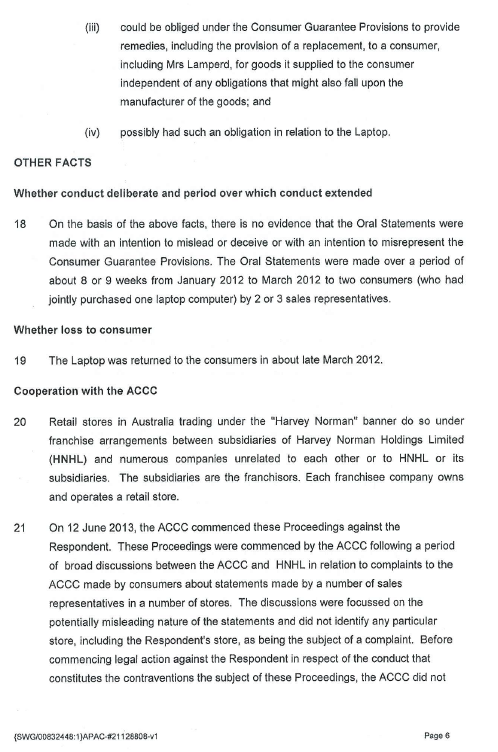
35 There is no indication that the oral statements were made with an intention to mislead or deceive the consumers or to misrepresent the existence, exclusion or effect of any warranty, guarantee, right or remedy.
36 A great number of electrical appliances are bought by consumers from retailers such as HP Superstore in Australia every day. It is not unusual for consumers to return new electrical appliances to retailers on the basis of a fault in the goods or out of a concern that the goods were not of acceptable quality when they purchased them.
37 Processes to ensure that, if goods were not of acceptable quality when sold to consumers, consumers can obtain a remedy for faulty goods represent a cost on the retailer’s business. Retailers may need to incur costs to maintain a culture of compliance with the ACL, including by supervision of staff. An appropriate penalty should take into account the need to deter other retailers from encouraging, permitting or risking similar contraventions of the ACL.
Amount of loss caused
38 There is no evidence of loss or damage to consumer in this proceeding, arising from the contravening conduct of the HP Superstore.
Whether similar prior conduct
39 HP Superstore has not been previously found by a court to have contravened any provision of the ACL or to have engaged in conduct similar to that described in the Agreed Facts.
Involvement of senior employees or management
40 There is no evidence that senior employees or management were involved in the conduct.
41 An appropriate penalty would take into account the need to encourage senior employees and management, both of HP Superstore and other retailers, to prevent contraventions of the ACL.
Size and financial position
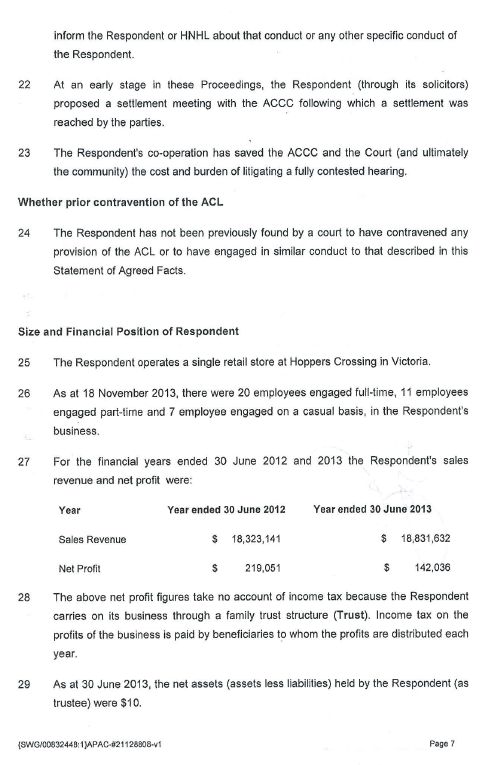
42 The Agreed Facts shows the size and financial position of HP Superstore. The penalty of $28,000 takes proper account of HP Superstore’s size and financial position.
Culture of compliance and corrective measures in response to contravention
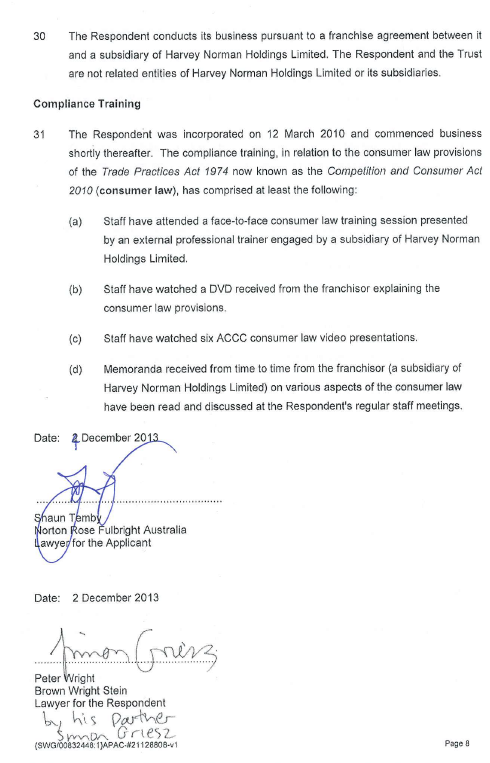
43 The Agreed Facts sets out ACL compliance training engaged in by HP Superstore both before and after the relevant conduct.
44 Regular compliance training assists ongoing staff to keep abreast of changes to the protections offered under the ACL and remind those staff of their obligations under that and other legislation. New staff will always need to be trained.
45 In the circumstances, the Court can take into account the existing compliance measures that HP Superstore has taken, the admitted failure in relation to these proceedings and HP Superstore’s agreement to undertake the compliance training proposed.
Co-operation and contrition/discount
46 The Agreed Facts sets out HP Superstore’s co-operation with ACCC. It is a mitigating factor that HP Superstore is admitting liability without a contested hearing. As a result of this cooperation by HP Superstore, a more complex trial has been avoided. A fully contested trial would have taken longer and, with the potential for appeals, consume large amounts of the Court’s and the ACCC’s time and resources. It is also of significance that the two affected consumers have not had to attend court to give evidence and submit to cross examination.
47 The parties have not sought to state a specified percentage discount for HP Superstore’s co-operation and acknowledgement of liability. However, HP Superstore is entitled to a discount for voluntary acknowledgement of liability and co-operation.
Deterrence
48 A factor relevant to penalty is whether the penalty is of a sufficient magnitude for general deterrence among corporations making representations to consumers about their rights under the consumer guarantee legislation generally, and corporations supplying computer products to consumers specifically.
49 The proposed penalty, together with the other proposed orders, sufficiently deter repetition of the conduct by both HP Superstore and retailers generally.
Maximum penalties and one transaction / one course of conduct principle/totality
50 The maximum penalty for a body corporate for each act or omission that relates to a provision of Div 1 of Pt 3-1 of the ACL, which Division includes s 29, is $1.1 million.
51 Courts are required to pay careful attention to maximum penalties when imposing penalties. This is because, first, the legislature has legislated for them; secondly, because they invite comparison between the worst possible case and the case before the court at the time; and thirdly, because in that regard they provide a yardstick, taken and balanced with all of the other relevant factors.
52 Whether having regard to the ‘one transaction’ or ‘one course of conduct’ principle or the totality principle, the four oral statements in contravention of s 29(1)(m) were made over an eight or nine week period in January 2012 to March 2012 in the course of enquiries made by two consumers about the problems they were having with one laptop computer they had jointly purchased recently from HP Superstore. The four contraventions occurred in one course of conduct.
53 It is appropriate to fix and impose a single penalty for all the contraventions because they effectively arose out a single course of conduct.
Conclusion on appropriate penalty
54 I consider that a pecuniary penalty pursuant to s 224 of the ACL in the sum of $28,000 is appropriate (and within the permissible range) for the contraventions admitted by HP Superstore.
IN STORE NOTICE
55 Compelling a retailer such as HP Superstore to display a notice at the point of sale is useful to ensure that every consumer sees an accurate statement of the rights under the ACL available to them when entering into a consumer transaction with HP Superstore.
56 Such a notice also assists sales representatives to be aware of the consumers’ rights under the ACL.
COMPLIANCE TRAINING
57 Orders for the implementation of a compliance program and audits may be made under s 246 of the ACL (where provision is made expressly).
58 HP Superstore should undertake appropriate ACL compliance programs. The compliance programs are appropriate to the circumstances of HP Superstore and the industry in which it does business.
CONCLUSION
59 For the above reasons, I will make the following orders:
1. The Court declares pursuant to section 21 of the Federal Court of Australia Act 1976 (Cth), that in making the oral statements listed at paragraph 1(a), (b), (d) and (e) of the Originating Application filed on 12 June 2013 in the Proceeding, the Respondent:
(a) made representations in connection with the supply or possible supply of goods or services that were false or misleading and concerned the existence, exclusion or effect of any guarantee, right or remedy available under the consumer guarantee provisions in Division 1 of Part 3-2 the Australian Consumer Law (‘ACL’) being Schedule 2 to the Competition and Consumer Act 2010 (Cth), and other remedies relating to those guarantees in Part 5-4 of the ACL in contravention of section 29(1)(m) of the ACL; and
(b) in doing so, engaged in conduct that was misleading or deceptive or likely to mislead or deceive in contravention of section 18 of the ACL.
2. Pursuant to section 232 of the ACL, the Respondent is restrained (whether by itself, its servants, agents or otherwise howsoever) for a period of three years from the date of these orders from making representations (whether oral or written) to any customer to the effect that:
(a) the Respondent:
(i) does not have any obligation to provide any remedies in relation to goods it supplies;
(ii) does not have an obligation to provide any remedies in relation to goods it supplies unless such goods are returned to it within 14 days after the goods are purchased by the consumer, or a similarly restricted period of time unrelated to the nature of the goods;
(iii) does not have any obligation to provide any remedies in relation to goods it supplies even if the goods are, or are agreed to be, subject to a major fault;
(iv) is not liable to provide remedies to consumers to whom it has supplied goods as only the relevant manufacturer is liable to provide remedies and then only when the relevant goods are, or are agreed to be, subject to a major fault;
(v) does not have any obligation to provide a replacement for goods it supplies regardless of the circumstances and the consumer guarantee provisions of Division 1 of Part 3-2 and/or the remedies relating to those guarantees in Part 5-4 of the ACL; and
(vi) is not liable to provide remedies to consumers to whom it has supplies goods as only the relevant manufacturer is liable to provide remedies to such consumers; and
(b) the only available option or remedy available to consumers in relation to laptops supplied by the Respondent is to either reformat the laptop or pay an upfront free.
3. Pursuant to sections 224(1)(a)(ii) and 228 of the ACL, the Respondent is to, within 28 days of the date of these Orders, pay to the Commonwealth a pecuniary penalty in respect of the contravention of section 29(1)(m) of the ACL in the amount of $28,000.
4. Pursuant to section 246(2) of the ACL, the Respondent is to, within 28 days of the date of these Orders, prominently display at the point of sale of every product supplied by the Respondent during the operation of a retail sales service undertaken under the name Harvey Norman a copy of the summary of consumer rights under the ACL at Annexure A of the Originating Application for a period of three years.
5. Pursuant to section 246 of the ACL, within 28 days of the date of these Orders or 28 February 2014, whichever is the later (‘the Commencement Date’):
(a) the Respondent is to:
(i) for a period of one year following the Commencement Date, implement its own compliance program to be undertaken by each employee of the Respondent with respect to the rights available to consumers under the ACL including the consumer guarantees in Division 1 of part 3-2 of the ACL and the remedies relating to those guarantees in Part 5-4 of the ACL (‘the Consumer Law Compliance Program’). The Consumer Law Compliance Program must conform to the compliance standards set out in the Australian Standards on Compliance Programs (AS 3806-2006);
(ii) for a period of two years thereafter, participate in a consumer law compliance program to be recommended by subsidiaries of Harvey Norman Holdings Limited to all franchisees trading under the “Harvey Norman ®” name in Australia and made available for the participation of their employees;
(b) the Respondent is to, no later than 14 days after the Commencement Date, serve on the ACCC an affidavit verifying that, in conformity with these Orders, it has displayed the notice referred to at Order 4 above and it has implemented the Consumer Law Compliance Program.
6. Each party to bear their costs of the proceeding and all previous costs orders in the proceeding are to be vacated.
I certify that the preceding fifty-nine (59) numbered paragraphs are a true copy of the Reasons for Judgment herein of the Honourable Justice Middleton. |
Associate:
“ANNEXURE A”