FEDERAL COURT OF AUSTRALIA
Australian Consumer and Competition Commission v Salecomp Pty Ltd [2013] FCA 1316
IN THE FEDERAL COURT OF AUSTRALIA | |
AUSTRALIAN CONSUMER AND COMPETITION COMMISSION Applicant | |
AND: | SALECOMP PTY LTD (ACN 094 346 522) Respondent |
DATE OF ORDER: | |
WHERE MADE: |
THE COURT ORDERS THAT:
1. The Court declares, pursuant to section 21 of the Federal Court of Australia Act 1976 (Cth), that in making the oral statements listed at paragraph 1(a) to (f) of the Originating Application filed on 12 June 2013 in the Proceeding, the Respondent:
(a) made representations in connection with the supply or possible supply of goods or services that were false or misleading and concerned the existence, exclusion or effect of any guarantee, right or remedy available under the consumer guarantee provisions in Division 1 of Part 3-2 to the Australian Consumer Law (‘the ACL’) being Schedule 2 to the Competition and Consumer Act 2010 (Cth), and the remedies relating to those guarantees in Part 5-4 of the ACL in contravention of section 29(1)(m) of the ACL; and
(b) in doing so, engaged in conduct that was misleading or deceptive or likely to mislead or deceive in contravention of section 18 of the ACL.
2. Pursuant to section 232 of the ACL, the Respondent is restrained (whether by itself, its servants, agents or otherwise howsoever) for a period of three years from the date of these orders from making representations (whether oral or written) to any customer to the effect:
(a) that the Respondent:
(i) does not have any obligation to provide a replacement or refund in relation to goods it supplies regardless of the circumstances and the consumer guarantee provisions of Division 1 of Part 3-2 and the remedies relating to those guarantees in Part 5-4 of the ACL (with the only available remedy being the remedy of repair);
(ii) does not have any obligation to provide any remedies in relation to goods it supplies that are contrary to its policies;
(iii) does not have any obligation to provide a replacement for goods it supplies until the relevant manufacturer gives permission for that remedy to be provided; and
(b) that the only available remedy to a consumer of goods supplied by the Respondent is to repair the goods.
3. Pursuant to sections 224(1)(a)(ii) and 228 of the ACL, the Respondent is to, within 28 days of the date of these Orders, pay to the Commonwealth a pecuniary penalty in respect of the contravention of section 29(1)(m) of the ACL in the amount of $28,000.
4. Pursuant to section 246(2) of the ACL, the Respondent is to, within 28 days of the date of the date of these Orders, prominently display at the point of sale of every product supplied by the Respondent during the operation of a retail sales service undertaken under the name Harvey Norman a copy of the summary of consumer rights under the ACL at Annexure A of the Originating Application for a period of three years.
5. Pursuant to section 246 of the ACL, within 28 days of the date of these Orders or 28 February 2014, whichever is the later (‘the Commencement Date’):
(a) the Respondent is to:
(i) for a period of one year following the Commencement Date, implement its own compliance program to be undertaken by each employee of the Respondent with respect to the rights available to consumers under the ACL including the consumer guarantees in Division 1 of Part 3-2 of the ACL and the remedies relating to those guarantees in Part 5-4 of the ACL (‘the Consumer Law Compliance Program’). The Consumer Law Compliance Program must conform to the compliance standards set out in the Australian Standards on Compliance Programs (AS 3806-2006);
(ii) for a period of two years thereafter, participate in a consumer law compliance program to be recommended by subsidiaries of Harvey Norman Holdings Limited to all franchisees trading under the “Harvey Norman ®” name in Australia and made available for the participation of their employees; and
(b) the Respondent is to, no later than 14 days after the Commencement Date, serve on the ACCC an affidavit verifying that, in conformity with these Orders, it has displayed the notice referred to at Order 4 above and it has implemented the Consumer Law Compliance Program.
6. Each party is to bear their costs of the proceeding and all previous costs orders in the proceeding are to be vacated.
Note: Entry of orders is dealt with in Rule 39.32 of the Federal Court Rules 2011.
VICTORIA DISTRICT REGISTRY | |
GENERAL DIVISION | VID 482 of 2013 |
BETWEEN: | AUSTRALIAN CONSUMER AND COMPETITION COMMISSION Applicant
|
AND: | SALECOMP PTY LTD (ACN 094 346 522) Respondent
|
JUDGE: | MIDDLETON J |
DATE: | 6 DECEMBER 2013 |
PLACE: | MELBOURNE |
REASONS FOR JUDGMENT
INTRODUCTION
1 The Applicant (‘ACCC’) seeks pecuniary penalties, declaratory and other reflief against the Respondent (‘Salecomp’).
2 Salecomp is a franchise of Harvey Norman operating out of a store in Sale, Victoria.
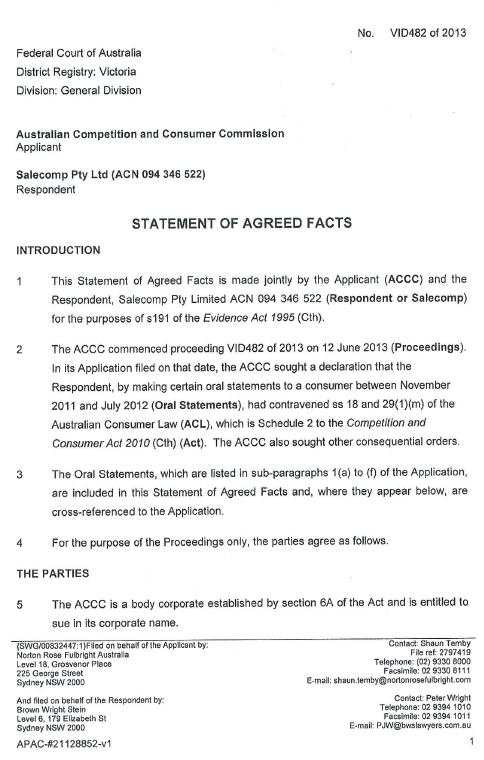
3 Salecomp admits that in the period between November 2011 and July 2012 it engaged in conduct that contravened ss 18 and 29(1)(m) of the Australian Consumer Law (‘ACL’) (being Sch 2 to the Competition and Consumer Act 2010 (Cth) (‘CCA’)). This proceeding raises similar issues and legal principles as those described in my reasons in Australian Competition and Consumer Commission v HP Superstore Pty Ltd [2013] FCA 1317 which I will not repeat.
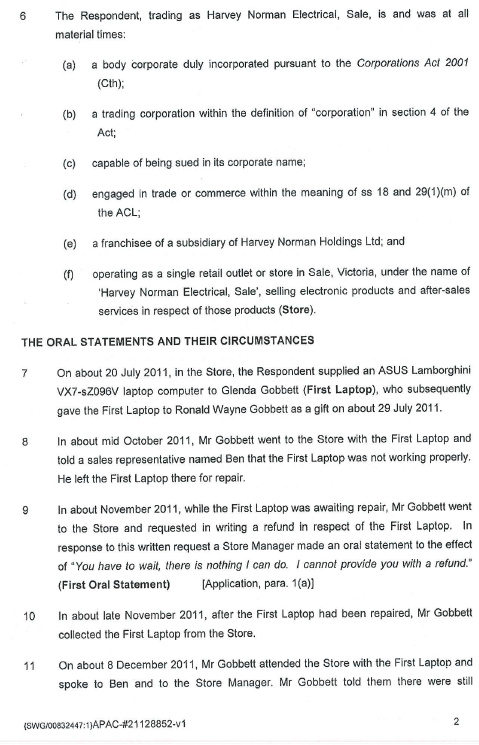
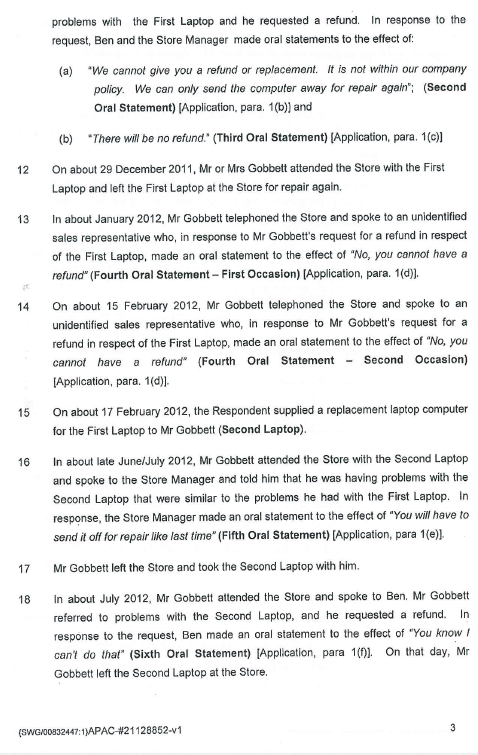
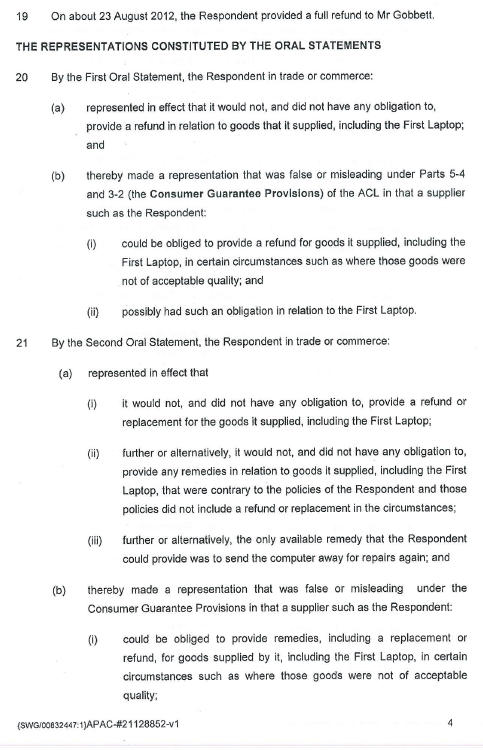
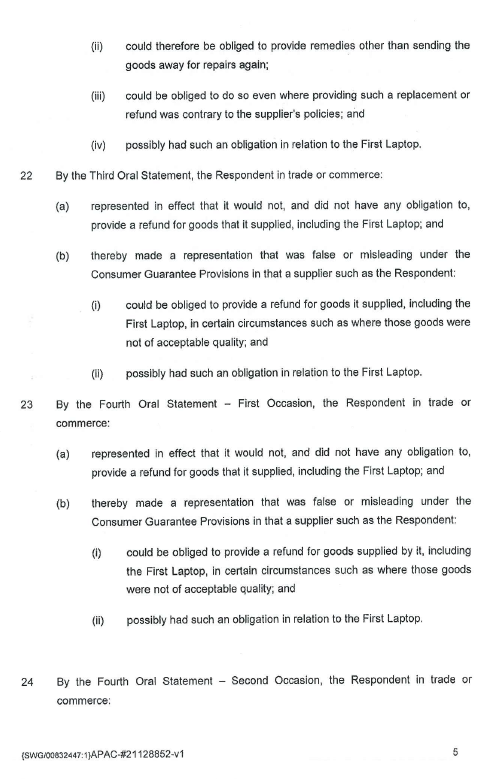
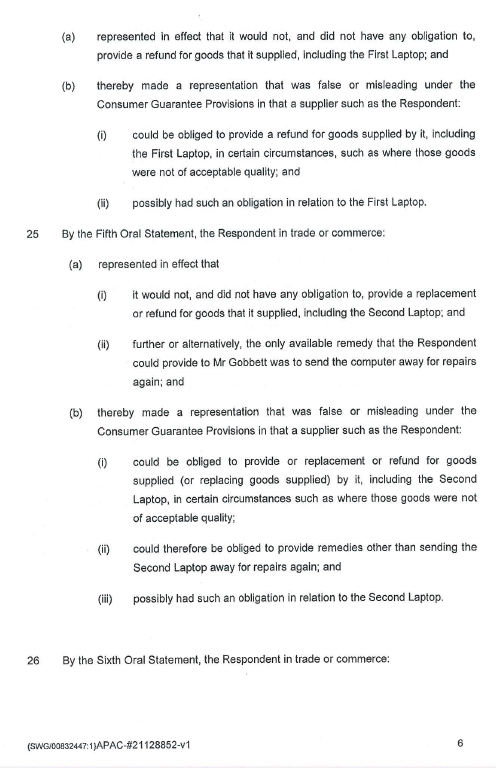
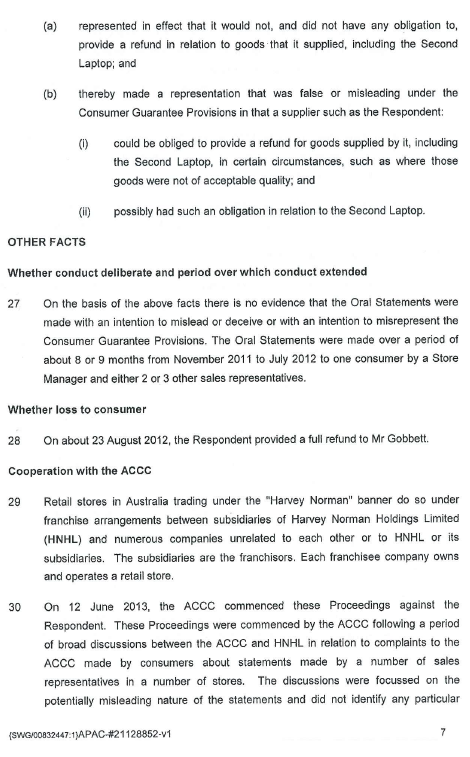
4 Salecomp made a total of seven statements on a total of six separate occasions to a consumer “concerning the existence, exclusion or effect of any warranty, guarantee, right or remedy”, within the meaning of s 29(1)(m) of the ACL. The representations, the circumstances in which they were made and the respects in which they were false or misleading are set out in the Statement of Agreed Facts (‘Agreed Facts’) which I attach to this judgment marked “Annexure A”. Salecomp admits that, in making each representation, it thereby contravened s 18 and s 29(1)(m) of the ACL.
5 The parties have agreed that the appropriate orders are as follows:
(a) make declarations pursuant to section 21 of the Federal Court of Australia Act 1976;
(b) grant injunctive relief pursuant to section 232 of the ACL;
(c) order payment by Salecomp of a pecuniary penalty in the amount of $28,000.00 pursuant to section 224 of the ACL;
(d) order that Salecomp display a copy of the summary of consumer rights under the ACL at the point of sale for three years; and
(e) make orders pursuant to section 246 of the ACL providing for Salecomp to establish a compliance program.
APPLICATION OF LEGAL PRINCIPLES TO THE FACTS
6 The facts and admissions establishing the particular conduct that Salecomp admits gave rise to contraventions of the ACL, together with other matters relevant to penalties, are set out in the Agreed Facts. In support of the proposed penalty, the Parties rely on those facts and admissions by Salecomp.
7 I now turn to consider the salient matters to be considered.
Nature, extent and duration of conduct - circumstances in which conduct took place
Whether conduct deliberate
8 The conduct comprised a total of seven oral statements (five made once and one made twice) by a Store manager and either two or three other sales representatives of Salecomp to Mr Gobbett in relation to a total of two potentially faulty laptops. The first of which had been supplied by Salecomp to Mrs Gobbett and subsequently given to Mr Gobbett as a gift. The second of which had been provided by Salecomp to Mr Gobbett by way of replacement of the first one. The conduct occurred over a period of about eight or nine months from November 2011 to July 2012.
9 There is no indication that the oral statements were made with an intention to mislead or deceive the consumer or to misrepresent the existence, exclusion or effect of any warranty, guarantee, right or remedy.
10 A great number of electrical appliances are bought by consumers from retailers such as Salecomp in Australia every day. It is not unusual for consumers to return new electrical appliances to retailers on the basis of a fault in the goods or out of a concern that the goods were not of acceptable quality when they purchase them.
11 Processes to ensure that, if goods were not of acceptable quality when sold to consumers, consumers can obtain a remedy for faulty goods represent a cost on the retailer’s business. Retailers may need to incur costs to maintain a culture of compliance with the ACL, including by supervision of staff. An appropriate penalty would take into account the need to deter other retailers from encouraging, permitting or risking similar contraventions of the ACL.
Amount of loss caused
12 There is no evidence of loss or to damage the consumer(s) in this proceeding, arising from the contravening conduct of Salecomp.
Whether similar prior conduct
13 Salecomp has not been previously found by a court to have contravened any provision of the ACL or to have engaged in conduct similar to that described in the Agreed Facts.
Involvement of senior employees or management
14 Three of the seven oral statements were made by a Store Manager of Salecomp.
15 An appropriate penalty would take into account the need to encourage senior employees and management, both of Salecomp and other retailers, to prevent contraventions of the ACL.
Size and financial position
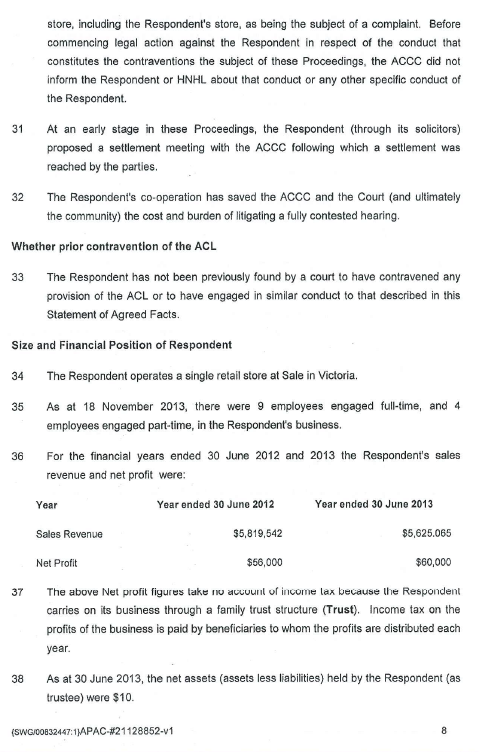
16 The Agreed Facts shows the size and financial position of Salecomp. The penalty of $28,000 takes proper account of Salecomp’s size and financial position.
Culture of compliance and corrective measures in response to contravention
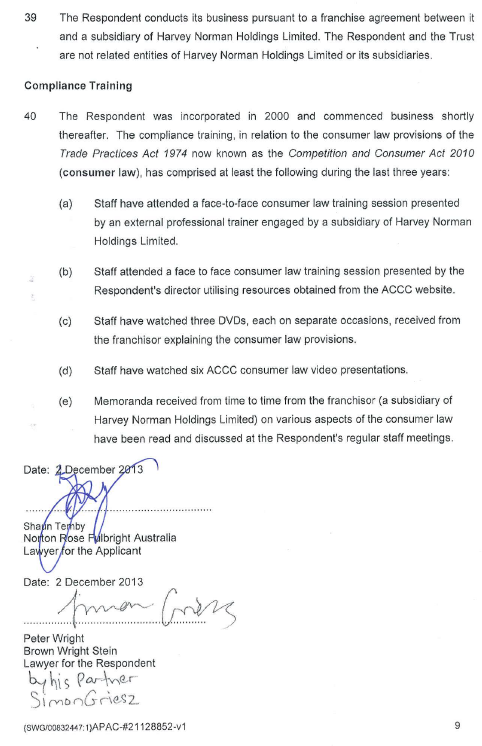
17 The Agreed Facts sets out ACL compliance training engaged in by Salecomp both before and after the relevant conduct.
18 Regular compliance training assists ongoing staff to keep abreast of changes to the protections offered under the ACL and remind those staff of their obligations under that and other legislation. New staff will always need to be trained.
19 In the circumstances, the Court can take into account the existing compliance measures that Salecomp has taken, the admitted failure in relation to these proceedings and Salecomp’s agreement to undertake the compliance training proposed.
Co-operation and contrition/discount
20 The Agreed Facts sets out Salecomp’s co-operation with ACCC. It is a mitigating factor that Salecomp is admitting liability for the contraventions set out in this document without a contested hearing. As a result of this cooperation by Salecomp, a more complex trial has been avoided. A fully contested trial would have required a longer hearing and, with the potential for appeals, consume large amounts of the Court’s and the ACCC’s time and resources. It is also of significance that the two affected consumers have not had to attend court to give evidence and submit to cross examination.
21 The parties have not sought to state a specified percentage discount for Salecomp’s co-operation and acknowledgement of liability. However, Salecomp is entitled to a discount for voluntary acknowledgement of liability and co-operation.
Deterrence
22 A factor relevant to penalty is whether the penalty is of a sufficient magnitude for general deterrence among corporations making representations to consumers about their rights under the consumer guarantee legislation generally, and corporations supplying computer products to consumers specifically.
23 The proposed penalty, together with the other proposed orders, sufficiently deter repetition of the conduct by both Salecomp and retailers generally.
Maximum penalties and one transaction/one course of conduct principle/totality
24 The maximum penalty for a body corporate for each act or omission that relates to a provision of Div 1 of Pt 3-1 of the ACL, which Division includes s 29, is $1.1 million.
25 Courts are required to pay careful attention to maximum penalties when imposing penalties. This is because, first, the legislature has legislated for them; secondly, because they invite comparison between the worst possible case and the case before the court at the time; and thirdly, because in that regard they provide a yardstick, taken and balanced with all of the other relevant factors.
26 The seven oral statements in contravention of s 29(1)(m) were made over a period of eight or nine months from November 2011 to July 2012 in the course of enquiries made by one consumer about the problems he was having with a laptop computer he had purchased from, and a replacement laptop provided by, Salecomp. The seven contraventions occurred in one course of conduct.
27 It is appropriate to fix and impose a single penalty for all the contraventions because they arose out a single course of conduct.
Conclusion on appropriate penalty
28 I consider that a pecuniary penalty pursuant to s 224 of the ACL in the sum of $28,000 is appropriate (and within the permissible range) for the contraventions admitted by Salecomp.
IN STORE NOTICE
29 Compelling a retailer such as Salecomp to display a notice at the point of sale is useful to ensure that every consumer sees an accurate statement of the rights under the ACL available to them when entering into a consumer transaction with Salecomp.
30 Such a notice also assists sales representatives to be aware of the consumers’ rights under the ACL.
COMPLIANCE TRAINING
31 Orders for the implementation of a compliance program and audits may be made under s 246 of the ACL (where provision is made expressly).
32 The parties submit that Salecomp should undertake the ACL compliance programs. The compliance programs are appropriate to the circumstances of Salecomp and the industry in which it does business.
CONCLUSION
33 For the above reasons, I will make the following orders:
1. The Court declares, pursuant to section 21 of the Federal Court of Australia Act 1976 (Cth), that in making the oral statements listed at paragraph 1(a) to (f) of the Originating Application filed on 12 June 2013 in the Proceeding, the Respondent:
(a) made representations in connection with the supply or possible supply of goods or services that were false or misleading and concerned the existence, exclusion or effect of any guarantee, right or remedy available under the consumer guarantee provisions in Division 1 of Part 3-2 to the Australian Consumer Law (‘the ACL’) being Schedule 2 to the Competition and Consumer Act 2010 (Cth), and the remedies relating to those guarantees in Part 5-4 of the ACL in contravention of section 29(1)(m) of the ACL; and
(b) in doing so, engaged in conduct that was misleading or deceptive or likely to mislead or deceive in contravention of section 18 of the ACL.
2. Pursuant to section 232 of the ACL, the Respondent is restrained (whether by itself, its servants, agents or otherwise howsoever) for a period of three years from the date of these orders from making representations (whether oral or written) to any customer to the effect:
(a) that the Respondent:
(i) does not have any obligation to provide a replacement or refund in relation to goods it supplies regardless of the circumstances and the consumer guarantee provisions of Division 1 of Part 3-2 and the remedies relating to those guarantees in Part 5-4 of the ACL (with the only available remedy being the remedy of repair);
(ii) does not have any obligation to provide any remedies in relation to goods it supplies that are contrary to its policies;
(iii) does not have any obligation to provide a replacement for goods it supplies until the relevant manufacturer gives permission for that remedy to be provided; and
(b) that the only available remedy to a consumer of goods supplied by the Respondent is to repair the goods.
3. Pursuant to sections 224(1)(a)(ii) and 228 of the ACL, the Respondent is to, within 28 days of the date of these Orders, pay to the Commonwealth a pecuniary penalty in respect of the contravention of section 29(1)(m) of the ACL in the amount of $28,000.
4. Pursuant to section 246(2) of the ACL, the Respondent is to, within 28 days of the date of the date of these Orders, prominently display at the point of sale of every product supplied by the Respondent during the operation of a retail sales service undertaken under the name Harvey Norman a copy of the summary of consumer rights under the ACL at Annexure A of the Originating Application for a period of three years.
5. Pursuant to section 246 of the ACL, within 28 days of the date of these Orders or 28 February 2014, whichever is the later (‘the Commencement Date’):
(a) the Respondent is to:
(i) for a period of one year following the Commencement Date, implement its own compliance program to be undertaken by each employee of the Respondent with respect to the rights available to consumers under the ACL including the consumer guarantees in Division 1 of Part 3-2 of the ACL and the remedies relating to those guarantees in Part 5-4 of the ACL (‘Consumer Law Compliance Program’). The Consumer Law Compliance Program must conform to the compliance standards set out in the Australian Standards on Compliance Programs (AS 3806-2006);
(ii) for a period of two years thereafter, participate in a consumer law compliance program to be recommended by subsidiaries of Harvey Norman Holdings Limited to all franchisees trading under the “Harvey Norman ®” name in Australia and made available for the participation of their employees; and
(b) the Respondent is to, no later than 14 days after the Commencement Date, serve on the ACCC an affidavit verifying that, in conformity with these Orders, it has displayed the notice referred to at Order 4 above and it has implemented the Consumer Law Compliance Program.
6. Each party is to bear their costs of the proceeding and all previous costs orders in the proceeding are to be vacated.
I certify that the preceding thirty-three (33) numbered paragraphs are a true copy of the Reasons for Judgment herein of the Honourable Justice Middleton. |
Associate:
“ANNEXURE A”