

FEDERAL COURT OF AUSTRALIA
Australian Competition and Consumer Commission v Luv-a-Duck Pty Ltd [2013] FCA 1136
IN THE FEDERAL COURT OF AUSTRALIA | |
AUSTRALIAN COMPETITION AND CONSUMER COMMISSION Applicant | |
AND: | Respondent |
DATE OF ORDER: | |
WHERE MADE: |
BY CONSENT THE COURT DECLARES THAT:
1 Luv-a-Duck, in trade or commerce, by:
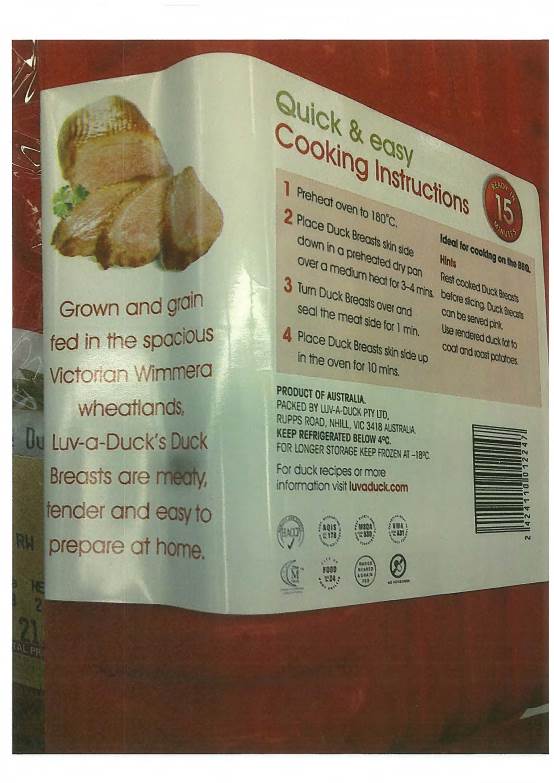
(a) using the words ‘Grown and grain fed in the spacious Victorian Wimmera wheatlands’ and using a logo with the words ‘RANGE REARED & GRAIN FED’ on packaging for its ‘Retail Range’ of Duck Meat Products between about March 2009 and October 2012, as shown in Annexure A;
(b) using the words ‘Grown and grain fed in the spacious Victorian Wimmera wheatlands’ on packaging for its ‘Retail Range’ of Duck Meat Products between about October 2012 and December 2012;
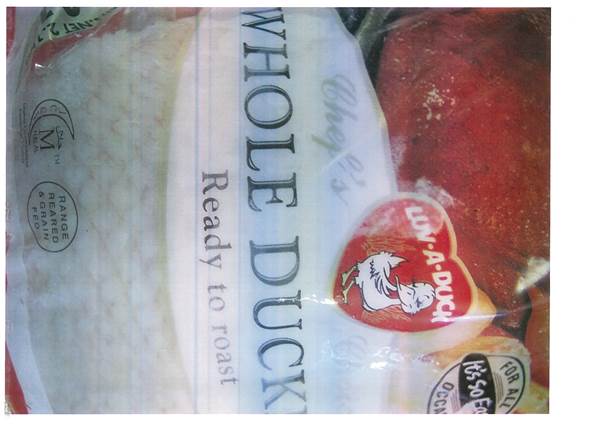
(c) using a logo with the words ‘RANGE REARED & GRAIN FED’ on packaging for its duck carcasses between about 2006 and June 2012, as shown in Annexure B;
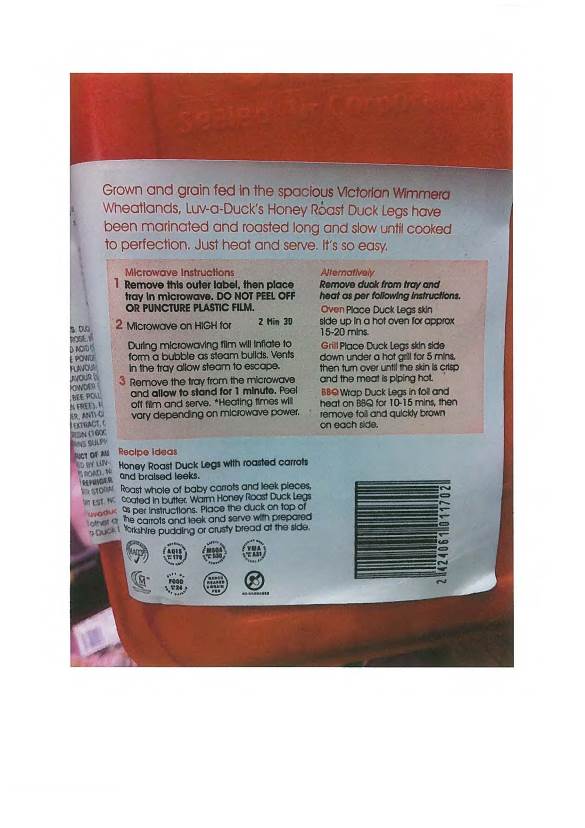
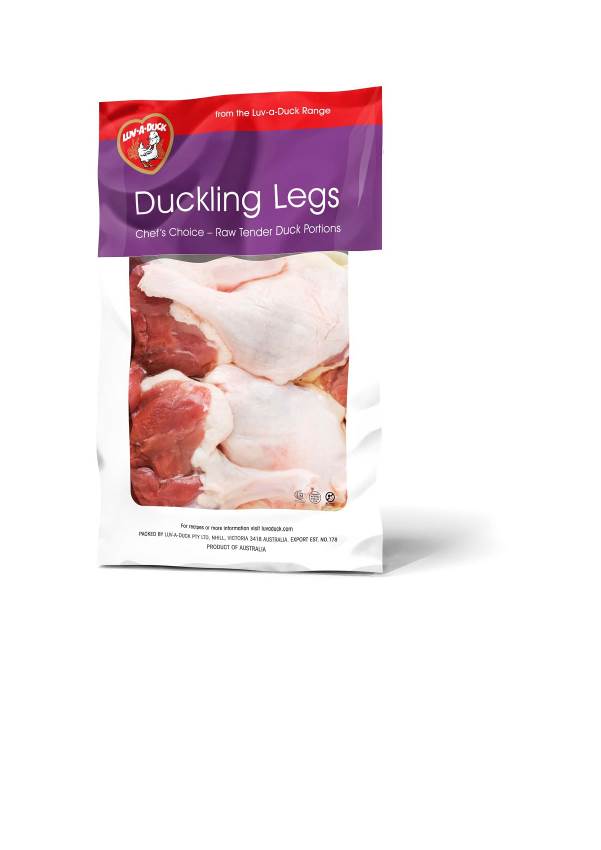
(d) using a logo with the words ‘RANGE REARED & GRAIN FED’ on packaging for its ‘Food Service Range’ of Duck Meat Products between about February 2011 and December 2012, as shown in Annexure C;
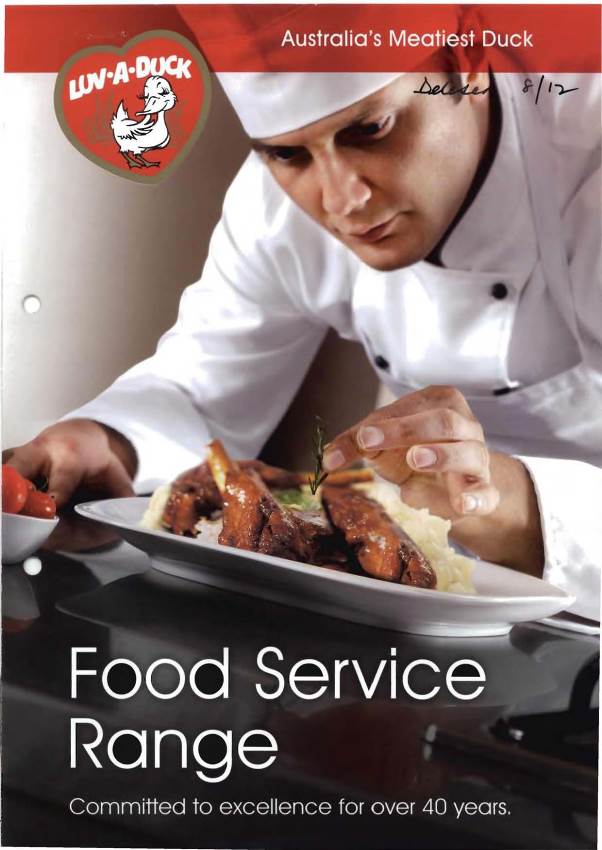
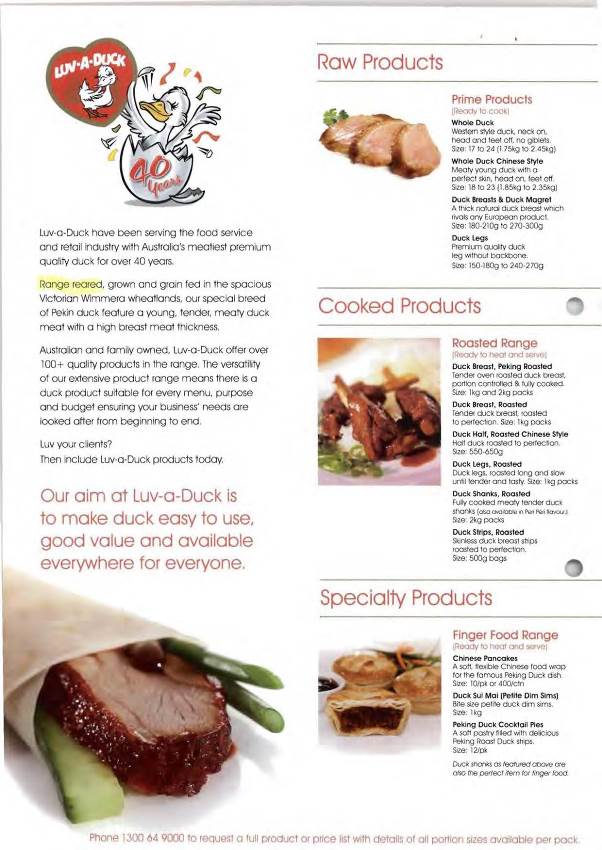
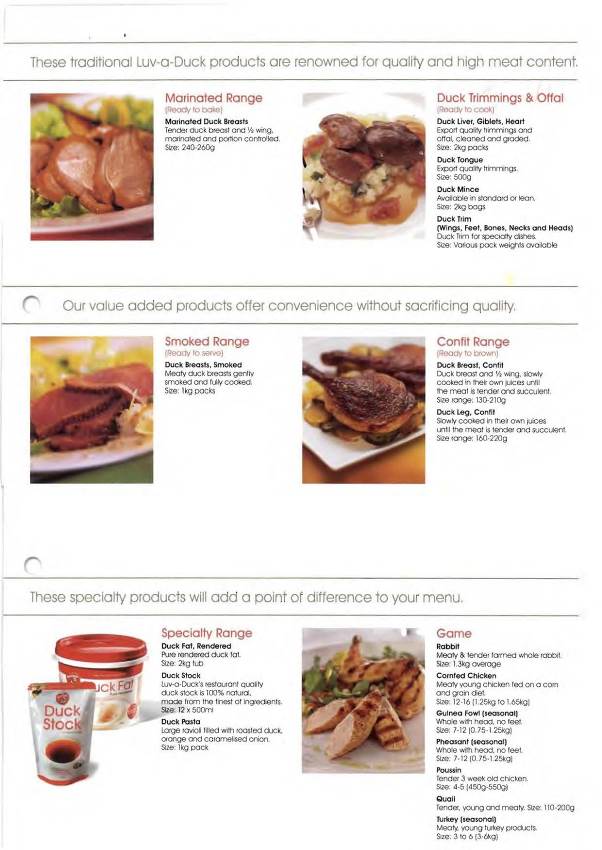
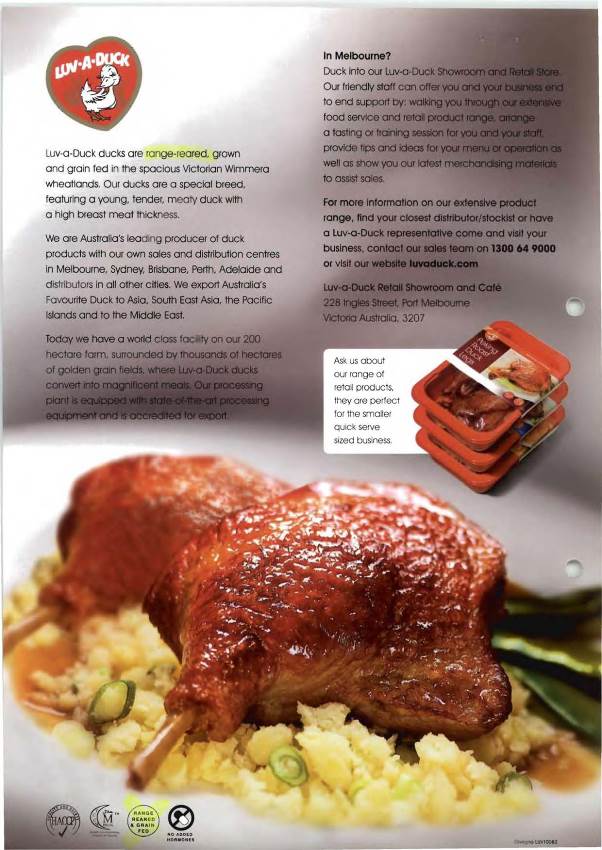
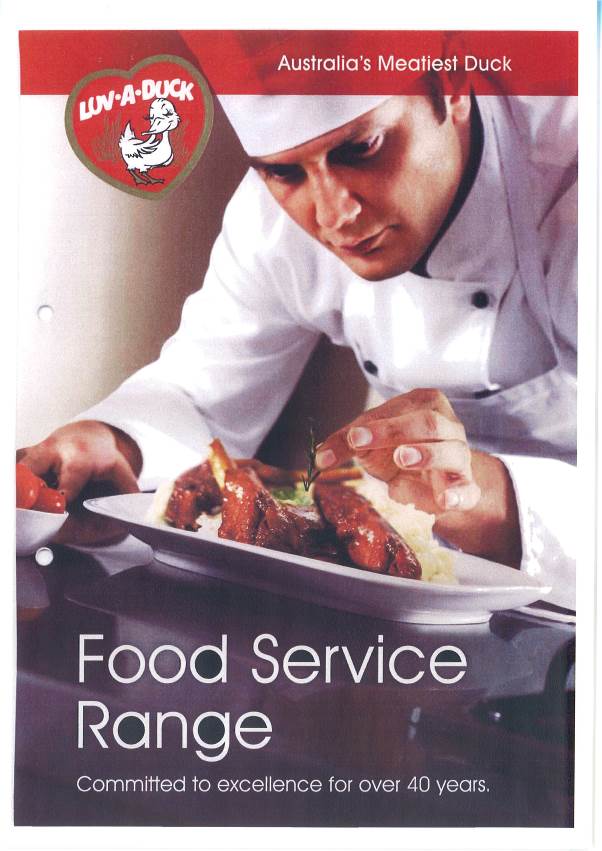
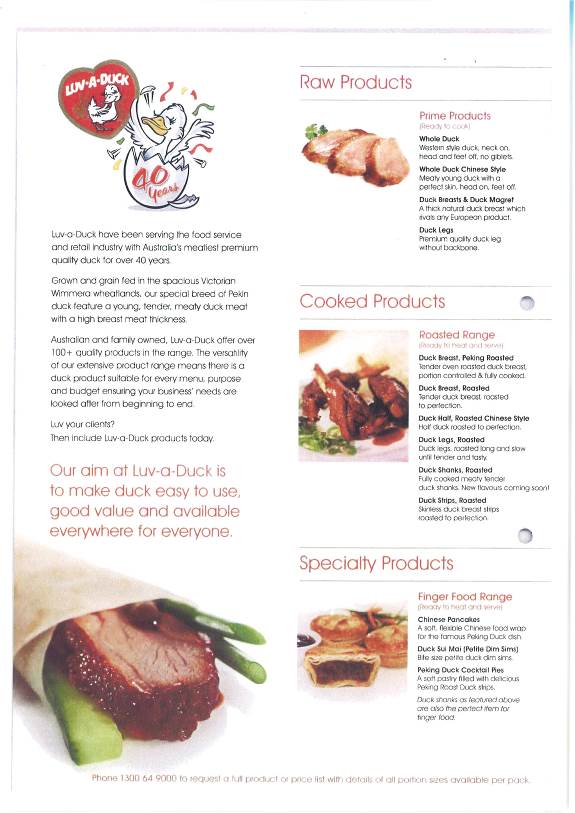
(e) distributing a ‘Food Service’ brochure that included the words ‘Range reared, grown and grain fed in the spacious Victorian Wimmera wheatlands' and a logo with the words 'RANGE REARED AND GRAIN FED' between about September 2010 and August 2012, as shown in Annexure D;
(f) distributing a ‘Food Service’ brochure that included the words ‘GROWN AND GRAIN FED IN THE SPACIOUS VICTORIAN WIMMERA WHEATLANDS’ between about August and November 2012, as shown in Annexure E;
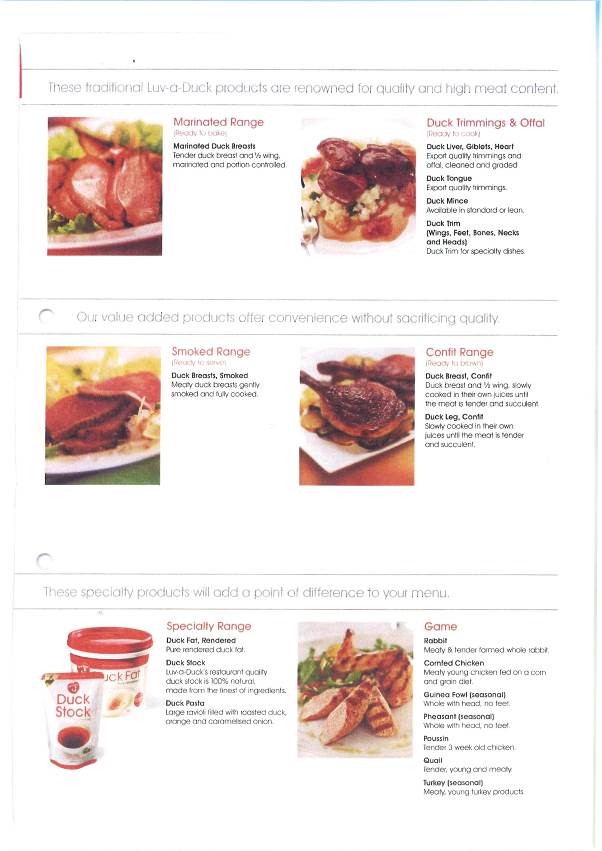
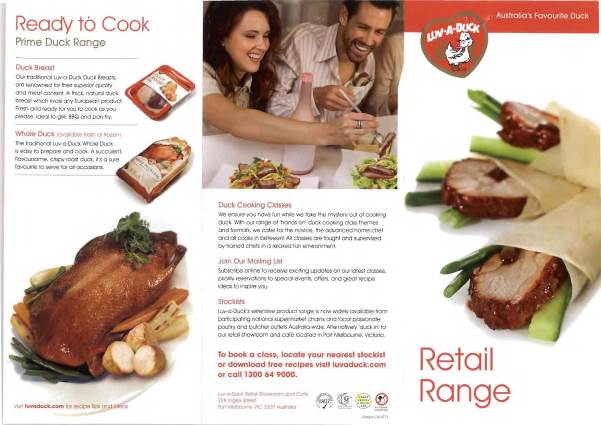
(g) distributing a ‘Retail’ brochure that included a logo with the words ‘RANGE REARED AND GRAIN FED’ between about June 2010 and September 2012, as shown in Annexure F;
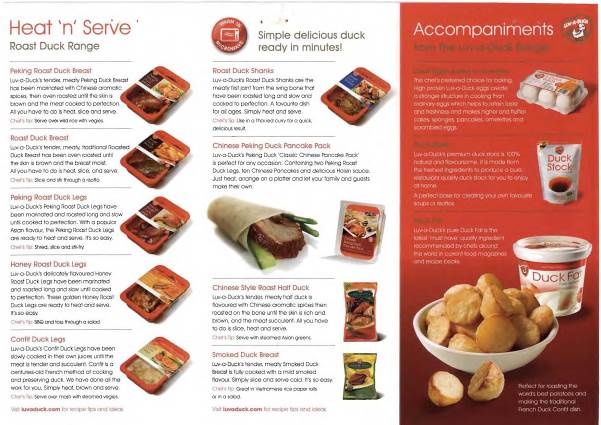
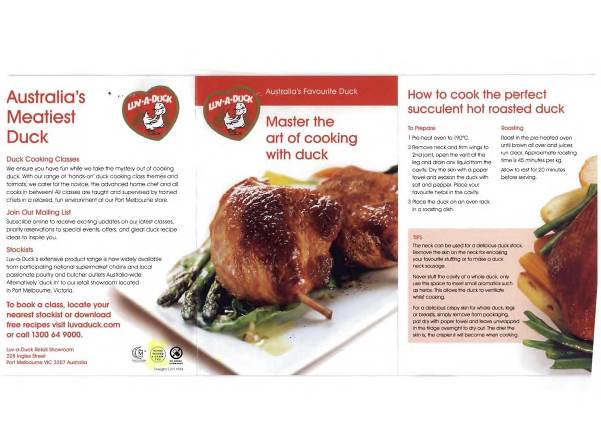
(h) distributing a brochure titled ‘Master the Art of Cooking Duck’ that included a logo with the words ‘RANGE REARED AND GRAIN FED’ between about December 2011 and December 2012 as shown in Annexure G;
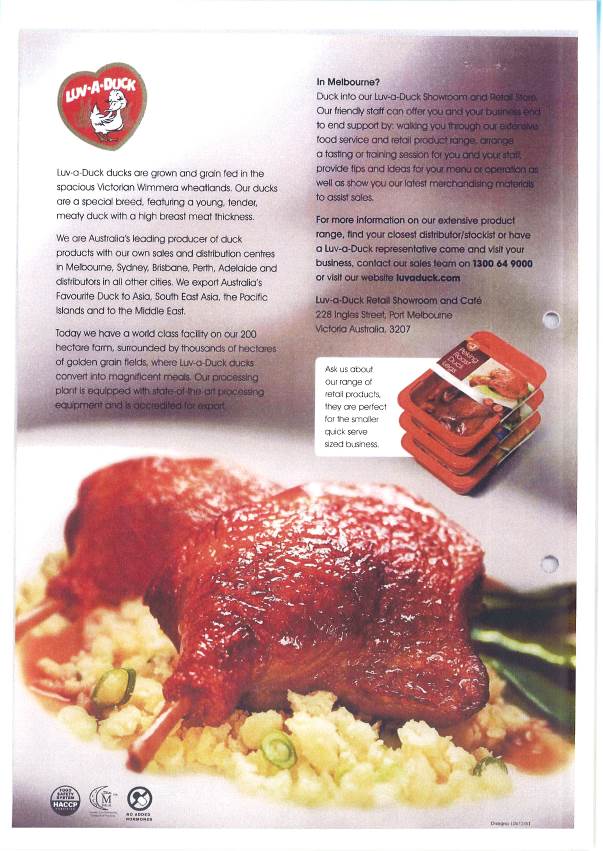
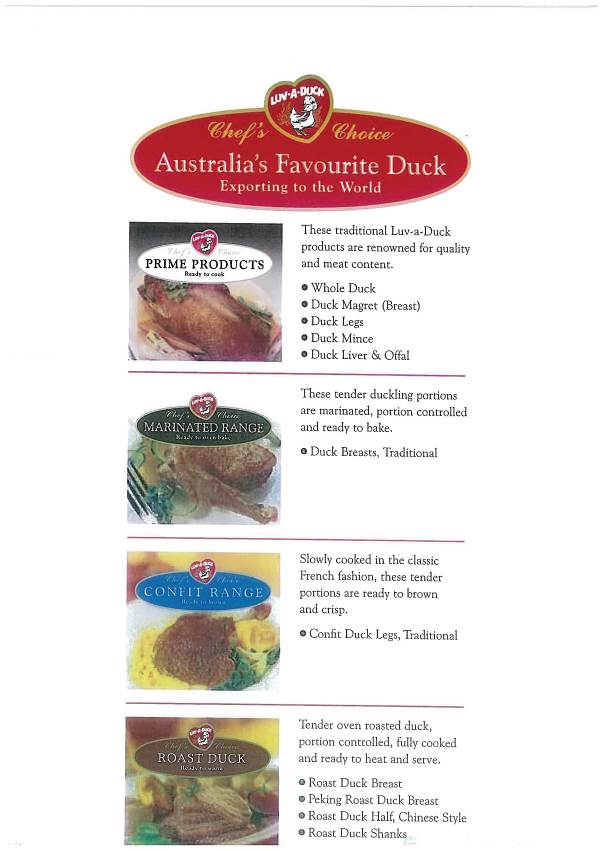
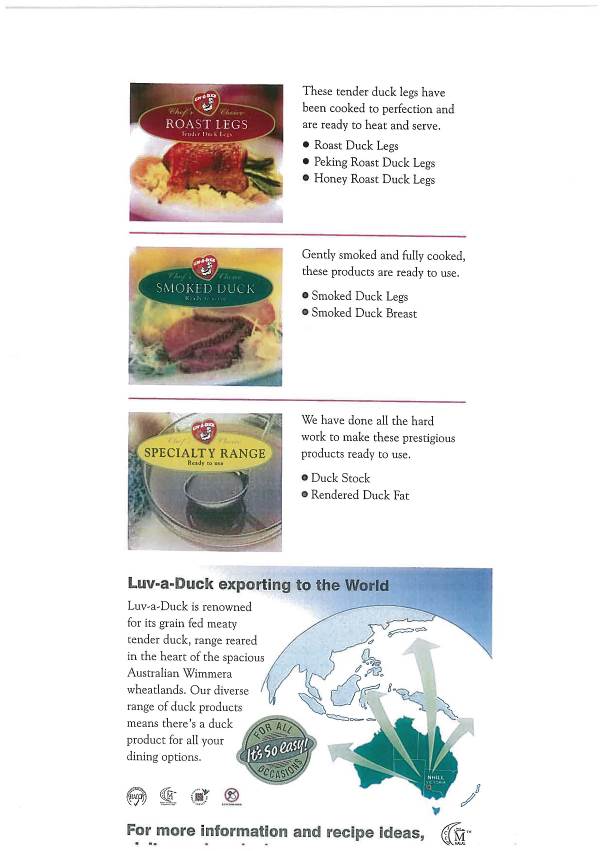
(i) making available for download from its website an ‘Export’ brochure that included the words ‘Luv-a-Duck is renowned for its grain fed meaty tender duck, range reared in the heart of the spacious Australian Wimmera wheatlands’ between about 2006 and November 2012 as shown in Annexure H;
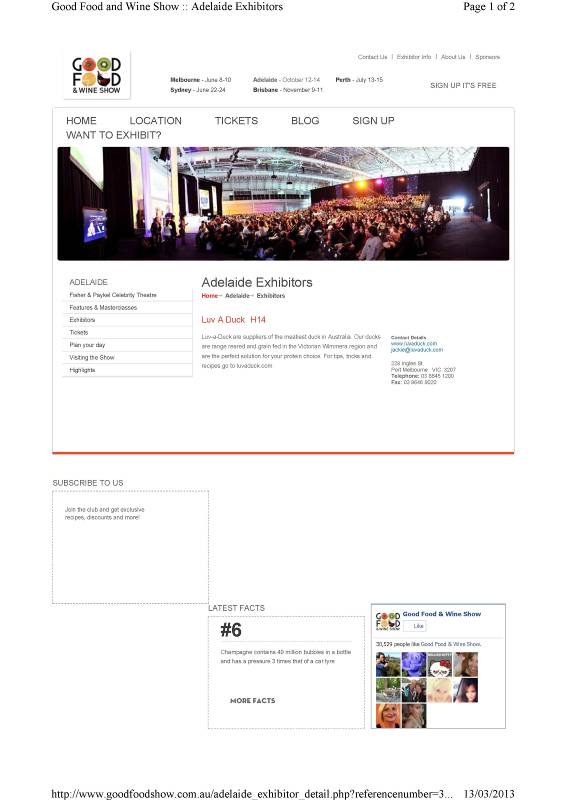
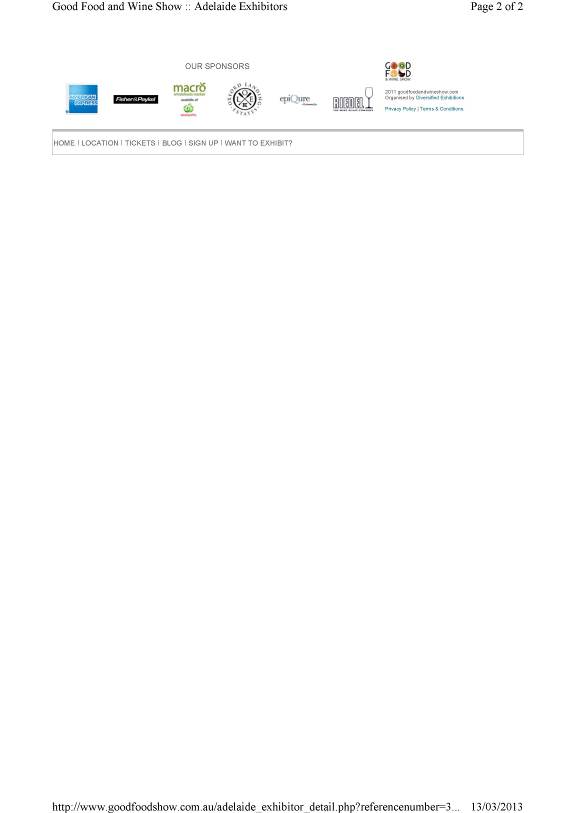
(j) promoting its Duck Meat Products at the ‘Good Food & Wine Show’ in Adelaide between 11 and 13 October 2012 using the words ‘OUR DUCKS ARE RANGE REARED AND GRAIN FED IN THE VICTORIAN WIMMERA REGION’, as shown in Annexure I;
(k) promoting its Duck Meat Products on its website between about June 2006 and November 2012 using the words:
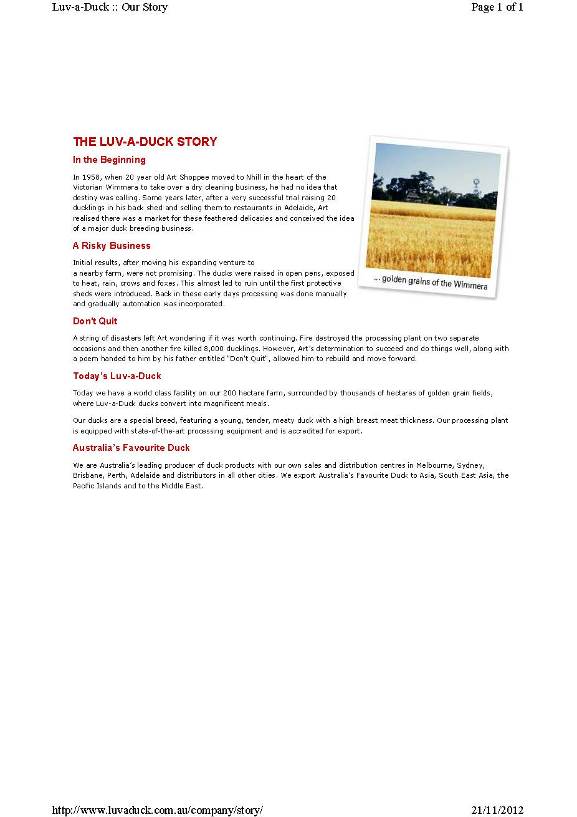
(i) ‘golden grains of the Wimmera’ accompanied by a picture of the Wimmera region;
(ii) 'Today we have a world class facility on our 200 hectare farm, surrounded by thousands of hectares of golden grain fields, where Luv-a-Duck ducks convert into magnificent meals’;
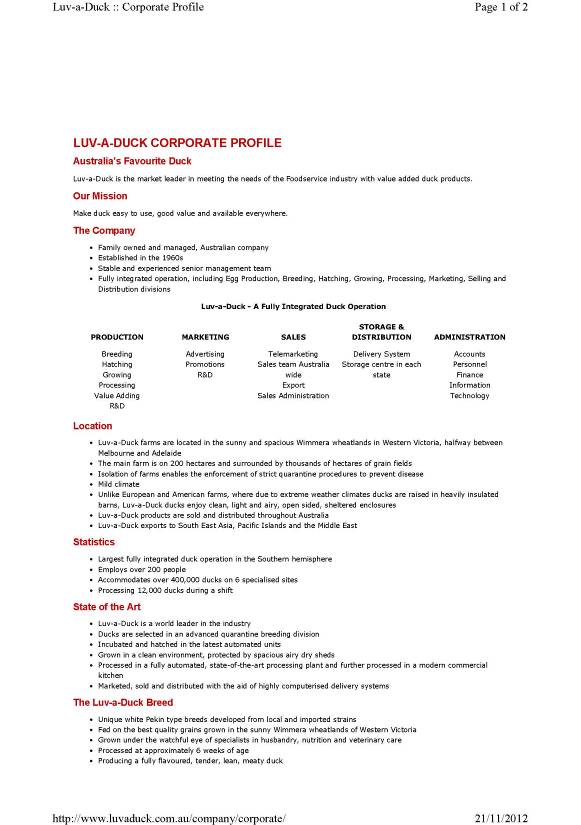
(iii) ‘Luv-a-Duck farms are located in the sunny and spacious Wimmera wheatlands in Western Victoria, halfway between Melbourne and Adelaide’;
(iv) ‘Unlike European and American farms, where due to extreme weather climates ducks are raised in heavily insulated barns, Luv-a-Duck ducks enjoy clean, light and airy, open sided, sheltered enclosures’;
(v) ‘Ducks are housed in large, open sided enclosures with access to natural light and fresh air.’
(vi) 'The farms and processing plant are situated in the sunny and spacious Wimmera wheatlands’;
(vii) 'Where do Luv-a-Duck ducks come from? Nhill, in the sunny Victorian Wimmera region. It is a rural, spacious, pollution free environment.’; and
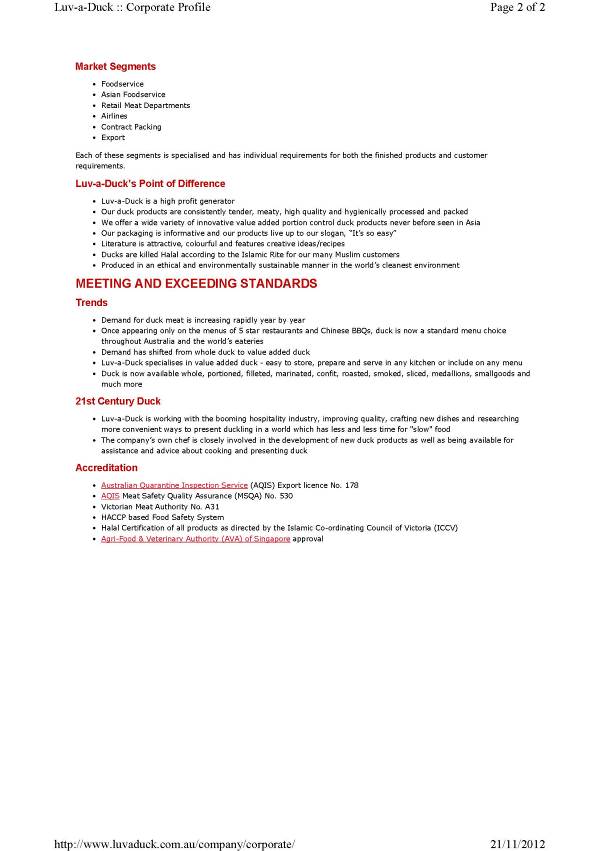
displaying a logo with the words "RANGE REARED AND GRAIN FED" on the export brochure available for download from the website;
as shown in Annexure J;
(l) promoting its Duck Meat Products on its website between November 2012 and June 2013 using the words:
(i) ‘Our ducks are grown in the Victorian Wimmera region, which is renowned as ideal conditions for ducks. It is a rural, spacious, pollution free environment. The ducks are housed in large, open sided enclosure like barns with natural light, fresh air and room to move around and socialise’;
as shown in Annexure K;
Luv-a-Duck represented to the public in Australia in trade or commerce that:
(m) the Duck Meat Products it sells or offers for sale were or will be processed from ducks that spent at least a substantial amount of their time outdoors;
(n) the Duck Meat Products it sells or offers for sale were or will be processed from ducks that were grown in a spacious outdoor environment; and
(o) the Duck Meat Products it sells or offers for sale were or will be of a different quality than duck meat products processed from barn-raised ducks;
when that was not the case, and Luv-a-Duck thereby:
(p) engaged in conduct in trade or commerce that was misleading or deceptive or likely to mislead or deceive, in contravention of:
(i) section 52 of the TPA, for conduct engaged in up to 31 December 2010; and
(ii) section 18 of the ACL, for conduct engaged in from 1 January 2011;
(q) made a representation in trade or commerce, in connection with the supply or possible supply or promotion of the supply of goods, that was false or misleading as to the standard, quality, value and/or history of the goods, in contravention of:
(i) section 53(a) of the TPA, for conduct engaged in up to 31 December 2010; and
(ii) section 29(1)(a) of the ACL, for conduct engaged in from 1 January 2011; and
(r) made a representation in trade or commerce that was liable to mislead the public as to the nature, the manufacturing process, the characteristics, and/or the suitability for purpose of goods, in contravention of:
(i) section 55 of the TPA, for conduct engaged in up to 31 December 2010; and
(ii) section 33 of the ACL, for conduct engaged in from 1 January 2011.
AND BY CONSENT THE COURT ORDERS THAT:
Injunctions
2 Luv-a-Duck be restrained for a period of 3 years from the date of this order, whether by itself, its servants, agents or howsoever otherwise, in connection with the supply or possible supply of, or the promotion by any means of, Duck Meat Products offered for sale, from making any representation, including by using the words ‘grown in the spacious Victorian Wimmera wheatlands’ or ‘range reared’ or modification of those words on any packaging, website, or other promotional material, that:
(a) the Duck Meat Products it sells or offers for sale were or will be processed from ducks that spent at least a substantial amount of their time outdoors;
(b) the Duck Meat Products it sells or offers for sale were or will be processed from ducks that were grown in a spacious outdoor environment; or
(c) the Duck Meat Products it sells or offers for sale were or will be of a different quality than duck meat products processed from barn-raised ducks;
when that is not the case.
Probation order - trade practices compliance
3 Luv-a-Duck must, at its own expense:
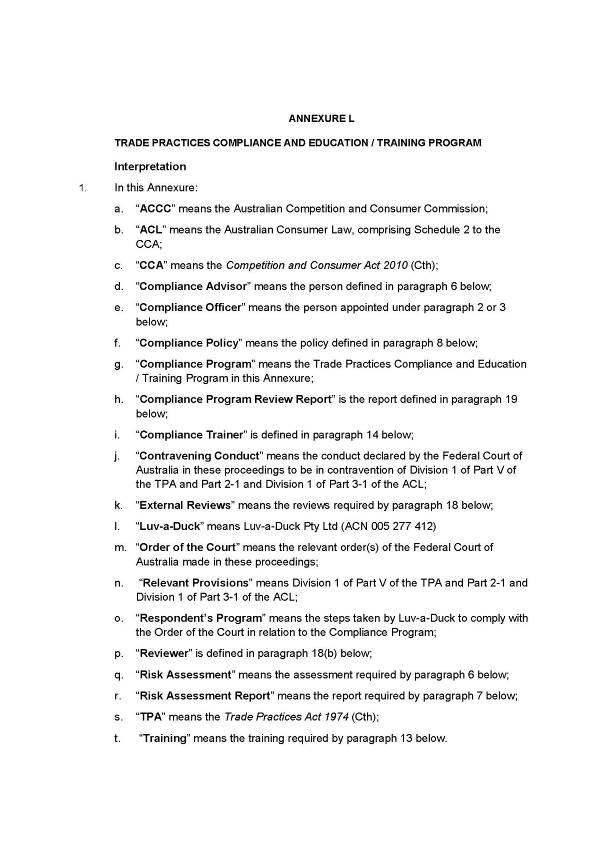
(a) within 3 months of the date of this order, establish a Trade Practices Compliance Program which meets the requirements set out in Annexure L; and
(b) maintain the Trade Practices Compliance Program for a period of 3 years from the date on which it was established.
Publication orders
4 Luv-a-Duck must, at its own expense:
(a) within 14 days of the date of this order send a notice in the form of Annexure M to each customer that it is able to identify from its commercial records as being a customer to whom the representations were made during the two year period prior to the date of this order;
(b) for a period of 90 days, publish on its Australian website homepage located at the URL http://www.luvaduck.com.au (Luv-a-Duck Homepage) and on each of the internal webpages accessible by following the ‘click-through’ icons which appear on the Luv-a-Duck Homepage (Luv-a-Duck Internal Webpages), a notice in the terms and form of Annexure N to this order (Luv-a-Duck Website Notice) and ensure that:
(i) the Luv-a-Duck Website Notice shall be viewable by clicking a ‘click-through’ icon located on the Luv-a-Duck Homepage and each of the Luv-a-Duck Internal Webpages;
(ii) the click-through icon referred to in the previous sub-paragraph (i) shall contain the words ‘click here – False and Misleading Conduct by Luv-a-Duck Pty Ltd – Notice Ordered by Federal Court of Australia’ and that text shall include the following characteristics:
(1) the text shall have the size of 15 points in times new roman font;
(2) the text shall appear in a black typeface on a white background and be centred unless otherwise stated;
(3) the text shall appear in bold; and
(4) the text shall appear at the top of the Luv-a-Duck Homepage and Luv-a-Duck Internal Webpages surrounded by clear space in proportion to 2 centimetres above and below the ‘click-through’ icon on a 22 inch desktop screen; and
(iii) the Luv-a-Duck Website Notice shall occupy the entire webpage that is accessible via the ‘click-through’ icon referred to above;
(c) within 14 days of the date of this order display a notice in the form of Annexure N at the front of each of its business premises viewable to the public, and keep that notice on display for at least 90 days.
Pecuniary penalties
5 On or before 21 November 2013, Luv-a-Duck must pay to the Commonwealth of Australia a pecuniary penalty in the amount of $360,000.
Other Orders
6 On or before 21 November 2013, Luv-a-Duck pay the sum of $15,000 as a contribution to the ACCC's costs of, and incidental to, this proceeding.
7 Confidential schedule 1 to the Statement of Agreed Facts filed by the parties in the proceeding is confidential and may not be disclosed to any person other than to a Judge of the Court, other officers of the Court, the parties and the parties’ legal representatives
Dated: 1 November 2013
Note: Entry of orders is dealt with in Rule 39.32 of the Federal Court Rules 2011.
Annexure A
Annexure A
 Annexure B
 Annexure C
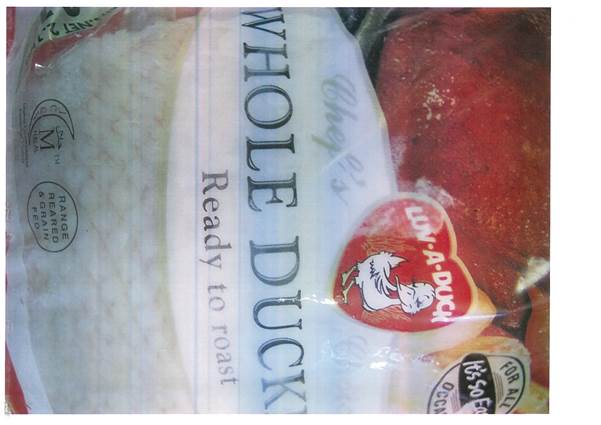 Annexure D
 Annexure D
 Annexure D
 Annexure D
 Annexure E
 Annexure E
  Annexure E Annexure E
 Annexure F
 Annexure G
 Annexure H
 Annexure H
Annexure I
 Annexure I
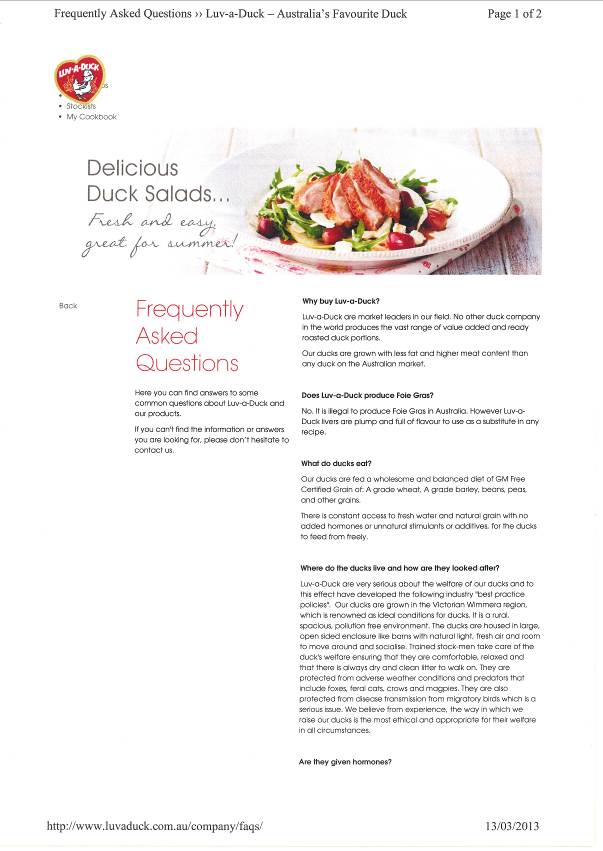
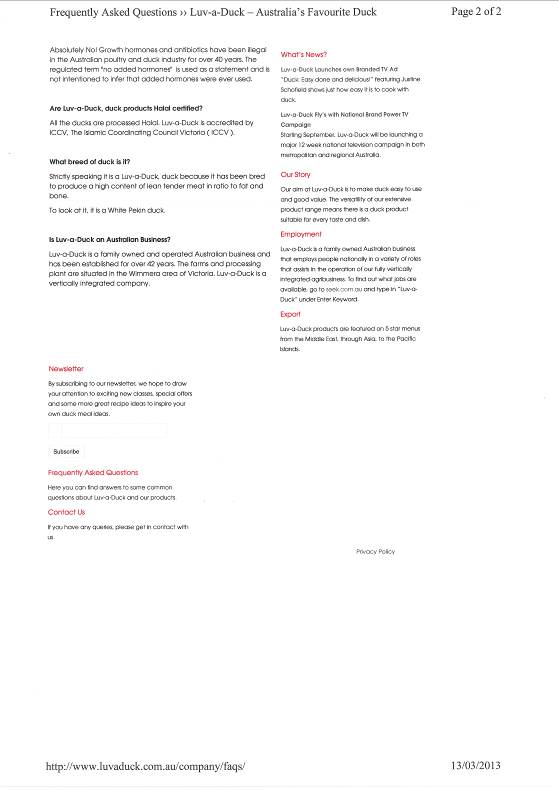
 Annexure J
 Annexure J
 Annexure J
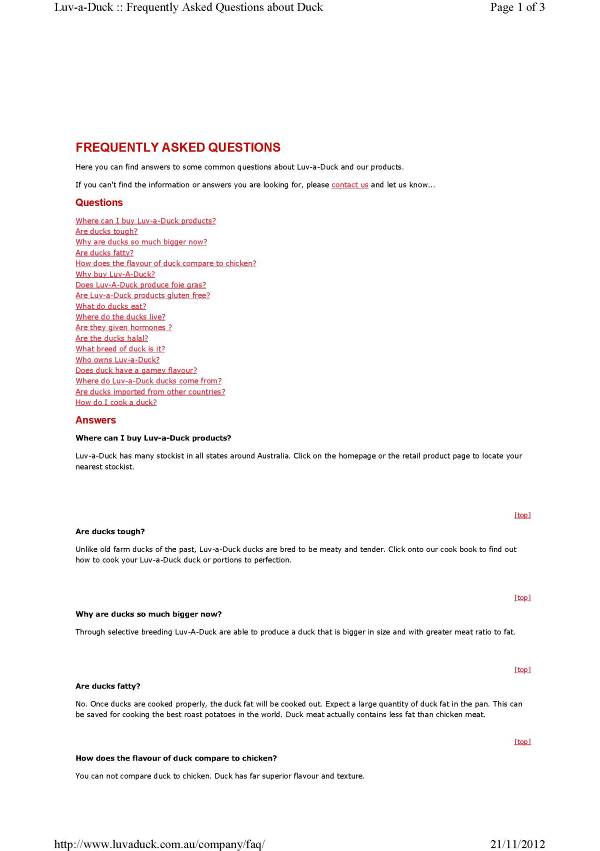
 Annexure K
 Annexure K
 Annexure L
 Annexure L
 Annexure L
 Annexure L
 Annexure L
 Annexure L
 Annexure L
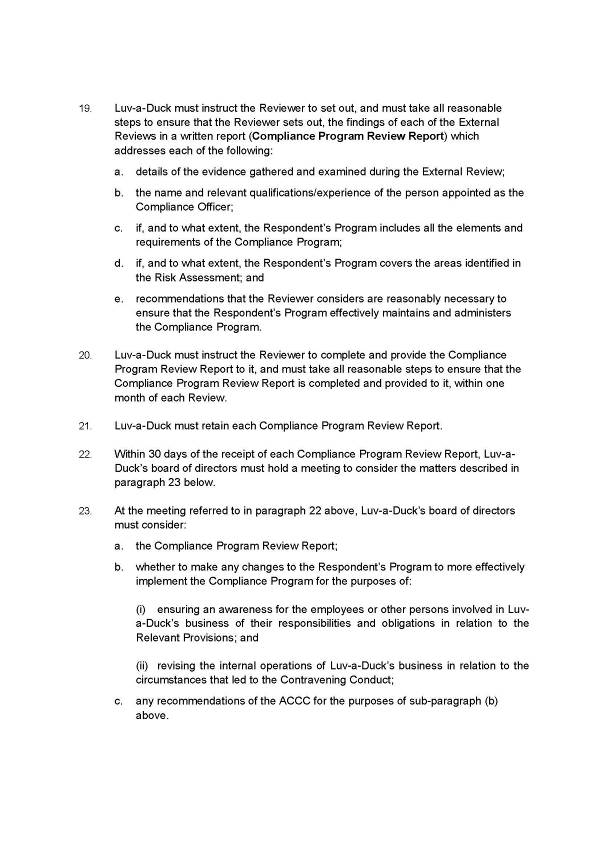 Annexure M
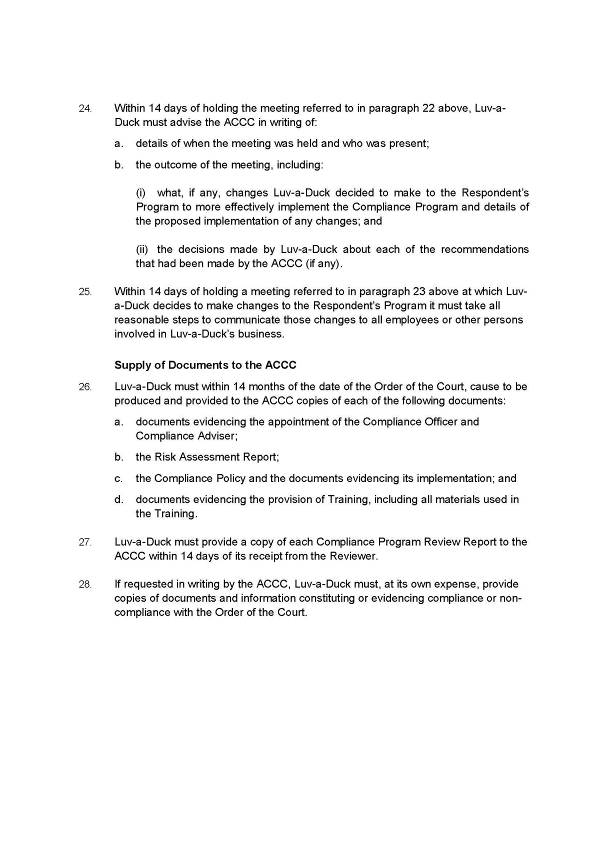 Annexure N
VICTORIA DISTRICT REGISTRY | |
GENERAL DIVISION | VID 200 of 2013 |
BETWEEN: | AUSTRALIAN COMPETITION AND CONSUMER COMMISSION Applicant
|
AND: | LUV-A-DUCK PTY LTD Respondent
|
JUDGE: | DAVIES J |
DATE: | 1 november 2013 |
PLACE: | MELBOURNE |
REASONS FOR JUDGMENT
introduction
1 The respondent (“Luv-a-Duck”) has admitted contraventions of the Australian Consumer Law, being Schedule 2 of the Competition and Consumer Act 2010 (Cth) (“the ACL”) and the Trade Practices Act 1974 (Cth) (“the TPA”) relating to the promotion and sale of its duck meat products. The parties have asked the Court to make orders by consent and rely upon an agreed statement of facts and joint submissions in support.
the contraventions
2 Luv-a-Duck supplies and sells duck meat products to wholesalers, distributors and retailers in Australia. The products are processed from ducks that it grows and slaughters.
3 Luv-a-Duck has admitted that it made the following representations to the public about its duck meat products:
• they were or would be processed from ducks that spent at least a substantial amount of their time outdoors;
• they were or would be processed from ducks that were grown in a spacious outdoor environment; and
• they were or would be of a different quality than duck meat products processed from barn-raised ducks.
4 In fact, the duck meat products that Luv-a-Duck sold or offered for sale:
• were processed from ducks that did not spend any of their time outside of their barn;
• were processed from ducks that were not grown in a spacious outdoor environment; and
• were not of a different quality than duck meat products processed from barn-raised ducks.
5 The representations appeared in packaging, brochures and promotional material and on Luv-a-Duck’s website. The contravening statements are detailed in the agreed statement of facts which is attached to this judgment marked “A”.
6 Luv-a-Duck has admitted that by making the representations, it:
a. engaged in conduct in trade or commerce that was misleading or deceptive or likely to mislead or deceive, in contravention of:
i) s 52 of the TPA, insofar as the conduct occurred before 1 January 2011; and
ii) s 18 of the ACL, insofar as the conduct occurred on or after 1 January 2011;
b. made a representation in trade or commerce, in connection with the supply or possible supply or promotion of the supply of goods, that was false or misleading as to the standard, quality, value and/or history of the goods, in contravention of:
i) s 53(a) of the TPA, insofar as the conduct occurred before 1 January 2011; and
ii) s 29(1)(a) of the ACL, insofar as the conduct occurred on or after 1 January 2011; and
c. made a representation in trade or commerce, that was liable to mislead the public as to the nature, the manufacturing process, the characteristics, and/or the suitability for purpose of goods, in contravention of:
i) s 55 of the TPA, insofar as the conduct occurred before 1 January 2011; and
ii) s 33 of the ACL, insofar as the conduct occurred on or after 1 January 2011.
RELIEF sought by consent
7 The parties have jointly requested that the Court:
• grant declarations of the contraventions by Luv-a-Duck;
• grant injunctions restraining Luv-a-Duck from engaging in similar conduct;
• make an order for the establishment of a compliance program for Luv-a-Duck;
• make an order requiring Luv-a-Duck to publish corrective advertising;
• impose a pecuniary penalty in the amount of $360,000; and
• make an order that Luv-a-Duck contribute $15,000 to the applicant’s (“the ACCC”) costs of the proceeding.
DECLARATIONS
8 The declarations sought by consent are declarations to the effect that Luv-a-Duck contravened the TPA and the ACL by the representations that it made. The Court has the power to make those declarations and they are, in my view, proper and appropriate: s 21 of the Federal Court of Australia Act 1976 (Cth). The declarations serve the public interest by identifying the contravening conduct and recording the Court’s disapproval of that contravening conduct: Tobacco Institute of Australia Ltd v Australian Federation of Consumer Organisations Inc (No 2) (1993) 41 FCR 89 at 100; Australian Competition and Consumer Commission v Chen (2003) 132 FCR 309 at 319; Australian Competition and Consumer Commission v Goldy Motors Pty Ltd [2000] FCA 1885 at [34]; Australian Competition and Consumer Commission v Dataline.net.au Pty Ltd (2006) 236 ALR 665 at 680.
INJUNCTIONS
9 The Court’s power to grant the injunctive relief derives from s 232 of the ACL. The terms of the injunctions would enjoin Luv-a-Duck from making any representation to the effect of the contravening representations for a period of three years from the date of the order. The proposed injunctions are directed at preventing any further occurrence of the contravening conduct and it is appropriate that they should be made: Australian Competition and Consumer Commission v Dermalogica Pty Ltd (2005) 215 ALR 482; ICI Australia Operations Pty Ltd v Trade Practices Commission (1992) 38 FCR 248 at 268.
COMPLIANCE PROGRAM
10 The Court has the power to make an order under s 246 of the ACL that Luv-a-Duck establish and maintain a compliance program. Such an order is appropriate, especially given that Luv-a-Duck has not had a compliance program in place. A compliance program will assist Luv-a-Duck to safeguard against engaging in similar conduct in the future.
corrective notices
11 Three key purposes are served by such kinds of orders: the dispelling of incorrect or false impressions created by the misleading and deceptive conduct; the alerting of consumers to the fact that such conduct has occurred; and aiding enforcement of the primary orders and the prevention of any repetition of the contravening conduct: Medical Benefits Fund of Australia Ltd v Cassidy (2003) 135 FCR 1 at 20-21. Given the long duration of the contravening conduct, I consider that the proposed corrective advertising is an important form of relief, which the Court can order under s 86C of the TPA and s 246 of the ACL.
PECUNIARY penalty
12 The principle reason for imposing a pecuniary penalty for a breach of s 53(a) of the TPA or s 29(1) of the ACL is to deter any repetition of the contravening conduct by the contravener or by others who might be tempted to engage in similar conduct: Trade Practices Commission v CSR Ltd [1991] FCA 521.
13 In the present case the parties have agreed on an appropriate penalty to be imposed. The approach of the Court to agreed penalties has been considered in numerous cases in this Court and is governed by Full Court authority. The Court is not bound to accept the agreed penalty but the Court will not impose a different penalty unless the agreed penalty is outside the range considered by the Court to be appropriate in all the circumstances: NW Frozen Foods Pty Ltd v Australian Competition and Consumer Commission (1996) 71 FCR 285 at 291; Minister for Industry, Tourism and Resources v Mobil Oil Australia [2004] FCAFC 72; cf. Australian Securities and Investments Commission v Ingleby (2013) 93 ACSR 274 where the Victorian Court of Appeal held that this approach impermissibly fettered the discretion of the Court. In Australian Competition and Consumer Commission v AGL Sales Pty Ltd [2013] FCA 1030, Middleton J did not consider the position taken in Ingleby to be much different from that taken in NW Frozen Foods and Mobil Oil, although his Honour noted that the comments by the Court of Appeal are a useful reminder of the onerous responsibility placed upon a Court in determining the appropriate orders. As Middleton J stated at [30] it is critical that the agreed statement of facts sufficiently outlines the facts, breaches of the law and omissions in that regard, otherwise the Court cannot be in a position properly to assess the pecuniary penalty. His Honour continued at [44]:
…A Court will necessarily rely heavily upon the parties, which will include the regulator, to appropriately inform the Court of all relevant matters for deliberation. The parties (and their legal representatives) must be mindful of their responsibilities in this regard. There are risks if the parties do not put all relevant matters before the Court. As the reasoning of the Court of Appeal in Ingleby shows, a Court astute to the task will readily come to appreciate where the agreed facts and admissions do not truly characterise the nature or extent of the contravention or contraventions. Then, as I have indicated, the trial judge can and should insist upon a “fuller and more realistic set of agreed facts” (as indicated by Weinberg J in Ingleby at [45]), or proceed to hear the matter as a contested hearing.
In this Court the principles are clear. The agreed penalty will be appropriate if that penalty is, in the Court’s view, within the permissible range, and there is a clear statement of the matters that relevant for the Court’s consideration.
14 Section 224(2) of the ACL imposes three mandatory considerations in determining the appropriate penalty. They are:
a. the nature and extent of the act or omission and of any loss or damage suffered as a result of the act or omission;
b. the circumstances in which the act or omission took place; and
c. whether the person has previously been found by a Court in proceedings under Chapter 4 or Part 5-2 of the ACL to have engaged in any similar conduct.
A similar provision is found in s 76E(2) of the TPA.
15 Other factors that are relevant in making an assessment of the appropriate level of penalty are:
the size of the contravening company;
the degree of power it has, as evidenced by its market share and ease of entry into the market;
the deliberateness of the contravention and the period over which it extended;
whether the contravention arose out of the conduct of senior management of the contravener or at a lower level;
whether the contravener has a corporate culture conducive to compliance with the legislation as evidenced by educational programs and disciplinary or other corrective measures in response to an acknowledged contravention;
whether the contravener has shown a disposition to cooperate with the authorities responsible for the enforcement of the applicable legislation in relation to the contravention;
whether the contravener has engaged in similar conduct in the past;
the financial position of the contravener; and
whether the contravening conduct was systematic, deliberate or covert: Trade Practices Commission v CSR Ltd; NW Frozen Foods; J McPhee & Son (Aust) Pty Ltd v Australian Competition and Consumer Commission (2000) 172 ALR 532.
16 Luv-a-Duck has admitted that when it made the representations it knew (including by its senior management) the conditions in which the ducks were raised but the company has put unchallenged evidence before the Court to the effect that it was not the intention of Luv-a-Duck to mislead consumers. Ms Sfetkidis, a director of Luv-a-Duck and chairman of Luv-a-Duck’s board of directors, deposed in an affidavit that at no stage did she consider that “range reared” would, or could, be understood by consumers as meaning “free range”, or held any concern that consumers may be misled by that description or the statement that the ducks were “grown and grain fed in the spacious Victorian Wimmera Wheatlands”. She also deposed that Luv-a-Duck did not intend to convey that the ducks were free range and that, had it been appreciated that the words were capable of that representation, the statements would never have been made. The absence of an internal compliance program is perhaps significant.
17 The ACCC has accepted that the contravening conduct was not deliberate, but it did occur over a lengthy period of time in the context where Luv-a-Duck supplies around 40 per cent of the Australian market for duck meat products, selling around 80,000 ducks per week. It is not possible to quantify the loss or damage suffered by others as a result of the contravening conduct, but it is reasonable to infer that the representations conveyed would have been an inducement to consumers to prefer Luv-a-Duck’s products and give Luv-a-Duck a competitive advantage in the industry.
18 Some credit should be given for Luv-a-Duck’s cooperation with the ACCC by admitting the contravening conduct, cooperating with the ACCC and agreeing to remedial action. It is also a mitigating factor that Luv-a-Duck has never been the subject of other complaints by the ACCC or proceedings brought by any third party for misleading and deceptive conduct.
19 The maximum penalty provided for under s 224(3) of the ACL and s 76E(3) of the TPA is $1.1 million in respect of each contravention. The parties have jointly submitted that it is appropriate to consider the contravening conduct as a single course of conduct rather than as a multiplicity of contraventions. As the contraventions relate to the same kinds of representations made each time, and are similar, I consider that it is appropriate to group the contraventions as a single course of conduct and fix a single global amount by way of penalty: SingTel Optus Pty Ltd v Australian Competition and Consumer Commission (2012) 287 ALR 249 at 262. Bromberg J took a similar approach in Australian Competition and Consumer Commission v Pepe’s Ducks Ltd [2013] FCA 570.
20 The parties also referred me to Pepe’s Ducks and other cases for the range of penalty that is appropriate. In Pepe’s Ducks Bromberg J ordered a penalty of $375,000 against the other largest participant in the duck meat industry in Australia for false and misleading misrepresentations as to the standard and quality of duck meat products offered for sale. There were some similarities with this case but there are also differences. There are difficulties in looking to other cases because of differing circumstances and factors and it is unhelpful to embark on a consideration of those differences to ascertain whether they may be a useful guide of the permissible range and appropriate penalty. Each case must be considered with reference to its own facts and circumstances.
21 I am however satisfied that the agreed penalty is within the permissible range. The relevant material that I need to assess the appropriateness of the agreed penalty has been put before me and I consider that the proposed penalty is within the permissible range of penalties for breaches of this kind and is an appropriate penalty. Luv-a-Duck has the financial capacity to pay a substantial penalty but the conduct was not deliberate and there are mitigatory facts to be taken into account. Taking into account those factors, I consider that the penalty is sufficiently high to be a deterrent, whilst acknowledging that Luv-a-Duck has assisted the ACCC by its admissions and cooperation in this proceeding.
Costs
22 Paragraph 6 of the proposed consent orders provides for Luv-a-Duck to pay a contribution of $15,000 towards the ACCC’s costs and I will make that order.
I certify that the preceding twenty-two (22) numbered paragraphs are a true copy of the Reasons for Judgment herein of the Honourable Justice Davies. |
Associate:
“A”
Statement of Agreed Facts
1. This Statement of Agreed Facts (Statement) is made jointly by the Applicant (ACCC) and the Respondent (Luv-a-Duck) for the purposes of section 191 of the Evidence Act 1995 (Cth).
2. This Statement deals with the relevant conduct that is agreed to have principally taken place from about 2006 to 2013 in relation to the promotion by Luv-a-Duck for sale of its duck meat, carcasses and duck fat (Duck Meat Products).
3. The facts stated in this document are agreed for the purpose of these proceedings only and do not constitute any admission outside the context of these proceedings.
4. The ACCC and Luv-a-Duck have reached agreement as to the relevant facts regarding the conduct that gives rise to the contraventions. These facts are set out below. Other agreed facts relevant to the appropriate orders to be made are also set out below.
Parties
5. The ACCC is:
5.1 a body corporate established by section 6A of the Competition and Consumer Act 2010 (Cth) (CCA); and
5.2 entitled to sue in its corporate name.
6. Luv-a-Duck is and was at all material times:
6.1 a company duly incorporated pursuant to the Corporations Act 2001 (Cth);
6.2 able to be sued in its corporate name;
6.3 a trading corporation formed within the limits of Australia; and
6.4 a corporation within the meaning of the CCA and the Trade Practices Act 1974 (Cth), as in force immediately before 1 January 2011 (TPA).
7. Luv-a-Duck has at all material times carried on the business of:
7.1 growing ducks;
7.2 processing, including slaughtering and butchering, ducks; and
7.3 supplying Duck Meat Products to wholesalers, distributors and retailers in Australia.
8. Luv-a-Duck has a market share of about 40% for its Duck Meat Products. A summary of its earnings before and after tax resulting from its sale of Duck Meat Products, for each of the financial years from 2010/2011 to 2012/2013 is set out in CONFIDENTIAL Schedule 1.
9. During 2012, Luv-a-Duck’s sales of ducks in Australia were about 80,000 ducks per week.
10. Luv-a-Duck typically sold the largest volume of its Duck Meat Products to distributors, who on-sold the products to restaurants, caterers, food stores and butcher shops. Luv-a-Duck’s customers, by number, were predominantly supermarkets, Asian restaurants, Asian food stores and distributors to such stores, other restaurants, retail food shops, butcher shops, distributors to such shops and caterers.
Luv-a-Duck’s Conduct
Packaging – ‘Retail Range’
11. From about March 2009 until about October 2012, Luv-a-Duck supplied Duck Meat Products as part of its ‘Retail Range’ of products in packaging displaying:
11.1 the words ‘Grown and grain fed in the spacious Victorian Wimmera wheatlands’; and
11.2 a logo with the words ‘RANGE REARED & GRAIN FED’.
Photographs of samples of this ‘Retail Range’ packaging are attached as Annexure A.
12. From about October 2012 to December 2012, Luv-a-Duck supplied Duck Meat Products as part of its 'Retail Range' of products in packaging displaying the words "GROWN AND GRAIN FED IN THE SPACIOUS VICTORIAN WIMMERA WHEATLANDS" but without the logo.
13. Products packaged in the 'Retail Range' packaging were still available for sale in some retail stores in April 2013, due only to the shelf life of the products, and not to ongoing supply by Luv-a-Duck.
Packaging – Whole Duck bags
14. From about 2006 until about June 2012, Luv-a-Duck supplied duck carcasses in Whole Duck Bag packaging displaying a logo with the words ‘RANGE REARED & GRAIN FED’.
15. Photographs of samples of this Whole Duck Bag packaging are attached as Annexure B.
16. Products packaged in the Whole Duck packaging were still available for sale in some retail stores in January 2013 due only to the shelf life of the products, and not to ongoing supply by Luv-a-Duck.
Packaging – Food Service Range
17. From about February 2011 until about December 2012, Luv-a-Duck supplied Duck Meat Products as part of its ‘Food Service Range’ of products in packaging displaying a logo with the words ‘RANGE REARED & GRAIN FED’.
A photograph of a sample of the Food Service Range packaging is attached as Annexure C.
Brochures
18. From about September 2010 until about August 2012, Luv-a-Duck distributed a ‘Food Service’ brochure to distributors, restaurants and caterers and at fine food shows that included the words ‘Range reared, grown and grain fed in the spacious Victorian Wimmera wheatlands' and included a logo with the words ‘RANGE REARED AND GRAIN FED’.
19. From about August 2012, the brochure did not contain the logo or the words ‘Range Reared’ (Revised Brochure).
20. From about November 2012, Luv-a-Duck ceased distributing the Revised Brochure. Copies of these brochures are attached as Annexures D and E.
21. From about June 2010 until about September 2012, Luv-a-Duck distributed a ‘Retail’ brochure to independent retailers that included a logo with the words ‘RANGE REARED AND GRAIN FED’. A copy of this brochure is attached as Annexure F.
22. From about December 2011 until about December 2012, Luv-a-Duck distributed a brochure titled ‘Master the Art of Cooking Duck’ to independent retailers and at food shows that included a logo with the words ‘RANGE REARED AND GRAIN FED’. A copy of this brochure is attached as Annexure G.
23. From about 2006 until about November 2012, Luv-a-Duck made available for download from its website an ‘Export’ brochure that included the words ‘Luv-a-Duck is renowned for its grain fed meaty tender duck, range reared in the heart of the spacious Australian Wimmera wheatlands’. A copy of this brochure is attached as Annexure H.
Promotion at Adelaide Food Show
24. Luv-a-Duck promoted its Duck Meat Products at the ‘Good Food & Wine Show’ in Adelaide from 11 to 13 October 2012 using the following words as part of its three sentence promotional blurb: ‘Our ducks are range reared and grain fed in the Victorian Wimmera region’. A print-out of a webpage from the Good Food & Wine Show website showing this promotional blurb is attached as Annexure I.
Website
25. From about June 2006, Luv-a-Duck operated a website to promote the sale of its Duck Meat Products at the URL www.luvaduck.com.au (the Website) on which it published or caused to be published:
25.1 from about June 2006 until about November 2012 the words:
25.1.1 ‘golden grains of the Wimmera’ accompanied by a picture of the Wimmera region; and
25.1.2 'Today we have a world class facility on our 200 hectare farm, surrounded by thousands of hectares of golden grain fields, where Luv-a-Duck ducks convert into magnificent meals.’;
25.1.3 ‘Luv-a-Duck farms are located in the sunny and spacious Wimmera wheatlands in Western Victoria, halfway between Melbourne and Adelaide’;
25.1.4 ‘Unlike European and American farms, where due to extreme weather climates ducks are raised in heavily insulated barns, Luv-a-Duck ducks enjoy clean, light and airy, open sided, sheltered enclosures’;
25.1.5 ‘Ducks are housed in large, open sided enclosures with access to natural light and fresh air’;
25.1.6 ‘The farms and processing plant are situated in the sunny and spacious Wimmera wheatlands’;
25.1.7 ‘Where do Luv-a-Duck ducks come from? Nhill, in the sunny Victorian Wimmera region. It is a rural, spacious, pollution free environment’; and
25.1.8 a logo with the words 'RANGE REARED AND GRAIN FED' on the export brochure available for download from the website.
A copy of extracts of the old Website is attached as Annexure J.
25.2 from about November 2012 until June 2013 the words:
25.1.1 ‘Our ducks are grown in the Victorian Wimmera region, which is renowned as ideal conditions for ducks. It is a rural, spacious, pollution free environment. The ducks are housed in large, open sided enclosure like barns with natural light, fresh air and room to move around and socialise’.
25.1.2 from about June 2013 to about 9 September 2013, the word "spacious" was removed from the statement at paragraph 24(b) on the new website, but the remainder of the statement was otherwise the same;
25.1.3 from about 9 September 2013, the statement at paragraph 24(b) was removed from the new website entirely.
An extract of the new Website is attached as Annexure K.
26. During the period from 15 April 2010 until November 2012, there were about 15,000 unique page hits on the home page, about 6,000 unique page hits on the "FAQ" page and about 1,507 unique page hits on the export pages of the old Website.
27. During the period from 27 November 2012 to 31 December 2012, there were 613 unique page hits on the new Website pages.
Quantities of products and brochures supplied during the penalty period
28. Luv-a-Duck supplied its Duck Meat Products in its Retail Range packaging to its customers throughout Australia in the following approximate quantities:
Period | Average monthly volume (kilograms) |
15 April 2010 – 30 June 2010 | 2,199 |
1 July 2010 – 30 June 2011 | 14,041 |
1 July 2011 – 30 June 2012 | 23,295 |
1 July 2012 – 31 Dec 2012 | 33,221 |
29. Luv-a-Duck supplied its Duck Meat Products in its Whole Duck Bag packaging to its customers throughout Australia in the following approximate quantities:
Period | Average monthly volume (kilograms) |
15 April 2010 – 30 June 2010 | 293,899 |
1 July 2010 – 30 June 2011 | 340,074 |
1 July 2011 – 30 June 2012 | 349,746 |
30. Luv-a-Duck supplied its Duck Meat Products in its Food Service packaging to its customers throughout Australia in the following approximate quantities:
Period | Average monthly volume (kilograms) |
February 2011 – 30 June 2011 | 52,967 |
1 July 2011 – 30 June 2012 | 67,940 |
1 July 2012 – 31 Dec 2012 | 83,025 |
31. Luv-a-Duck supplied brochures to its customers throughout Australia in the following quantities:
Brochure | Number of copies |
Food Service | 22,700 |
Retail | 60,000 |
Master the Art of Cooking Duck | 30,000 |
Response to ACCC Correspondence
32. On 21 November 2012 the ACCC wrote to Luv-a-Duck to raise its concerns in relation Luv-a-Duck’s conduct in promoting the sale of its Duck Meat Products.
33. On 27 November 2012 Luv-a-Duck responded and, while it disputed that it had contravened sections 18, 29(1)(a) or 33 of the Australian Consumer Law, it set out the action it was taking to address the ACCC’s concerns, which was to, in effect, cease all of the conduct complained of. Luv-a-Duck did cease all such conduct, save that it acknowledges that some Duck Meat Products with the packaging complained of remained on shop shelves until sold.
34. Further, the ACCC’s letter of 21 November 2012 expressed concerns in relation to Luv-a-Duck’s old website. Luv-a-Duck stated in its response of 27 November 2012:
“We have been constructing a new website over the past 12 months with the assistance of our advertising agency Disegno and are pleased to advise that the new website went live on 26 November 2012 and is formally being launched on 1 December 2012.
The new site does not contain any of the representations, words or phrases which have caused you concern.
We would welcome your assessment of the new site on www.luvaduck.com.”
35. Following the ACCC’s requests for further information on 5 December 2012 and 14 February 2013, Luv-a-Duck provided further details to the ACCC on 17 January 2013 and 18 February 2013.
36. Following service of these proceedings, Luv-a-Duck introduced a Trade Practices Compliance program. The program was designed by Watchdog Compliance.
37. Luv-a-Duck requested a mediation of the proceeding at the earliest opportunity after proceedings were issued. The ACCC agreed.
The Contravening Conduct
38.1 using the packaging referred to in paragraphs 11 to 16 above;
38.2 using the brochures referred to in paragraphs 18 to 23 above;
38.3 promoting its products at the Adelaide Food Show as referred to in paragraph 23 above; and
38.4 using the Website referred to in paragraph 25 above;
39. Luv-a-Duck has in each instance made each of the following representations to the public in Australia in trade or commerce:
39.1 the Duck Meat Products it sold or offered for sale were or would be processed from ducks that spent at least a substantial amount of their time outdoors;
39.2 the Duck Meat Products it sold or offered for sale were or would be processed from ducks that were grown in a spacious outdoor environment;
39.3 the Duck Meat Products it sold or offered for sale were or would be of a different quality than duck meat products processed from barn-raised ducks
(together, the Representations).
40. At all relevant times, the Duck Meat Products that Luv-a-Duck sold or offered for sale:
40.1 were processed from ducks that did not spend any of their time outside of their barn;
40.2 were processed from ducks that were not grown in a spacious outdoor environment; and
40.3 were not of a different quality than duck meat products processed from barn-raised ducks.
41. By making each of the Representations, Luv-a-Duck:
41.1 engaged in conduct in trade or commerce that was misleading or deceptive or likely to mislead or deceive, in contravention of:
41.1.1 section 52 of the TPA, insofar as the conduct occurred before 1 January 2011; and
41.1.2 section 18 of the Australian Consumer Law (ACL), insofar as the conduct occurred on or after 1 January 2011;
41.2 made a representation in trade or commerce, in connection with the supply or possible supply or promotion of the supply of goods, that was false or misleading as to the standard, quality, value and/or history of the goods, in contravention of:
41.2.1 section 53(a) of the TPA, insofar as the conduct occurred before 1 January 2011; and
41.2.2 section 29(1)(a) of the ACL, insofar as the conduct occurred on or after 1 January 2011;
41.3 made a representation in trade or commerce that was liable to mislead the public as to the nature, the manufacturing process, the characteristics, and/or the suitability for purpose of goods, in contravention of:
41.3.1 section 55 of the TPA, insofar as the conduct occurred before 1 January 2011; and
41.3.2 section 33 of the ACL, insofar as the conduct occurred on or after 1 January 2011.
42. When it made each of the Representations referred to in paragraph 38 above, Luv-a-Duck knew (including by its senior management) the conditions in which the ducks were raised.
43. Prior to this proceeding, Luv-a-Duck has never received a complaint from the ACCC or been the subject of proceedings brought by the ACCC. Luv-a-Duck asserts that it has never been the subject of proceedings brought by any third party for misleading or deceptive conduct.


