

Australian Competition and Consumer Commission v Turi Foods Pty Ltd (No 5) [2013] FCA 1109
|
IN THE FEDERAL COURT OF AUSTRALIA |
|
|
DATE OF ORDER: |
|
|
WHERE MADE: |
THE COURT DECLARES THAT:
1. The second respondent (“Baiada”) has in trade or commerce:
(a) engaged in conduct that was misleading and deceptive or was likely to mislead and deceive in contravention of s 52 of the Trade Practices Act (Cth) (“the TPA”) in respect of conduct up to 31 December 2010 and s 18 of the Australian Consumer Law (“ACL”) consisting of Schedule 2 to the Competition and Consumer Act 2010 (Cth) (“the CCA”) in respect of conduct on and after 1 January 2011; and
(b) in connection with the supply and possible supply, and in connection with the promotion of the supply, of processed chicken products branded “Steggles” (“Steggles processed chicken products”) made false representations that those goods had a particular history in contravention of s 53(a) of the TPA in respect of conduct up to 31 December 2010 and s 29(1)(a) of the ACL in respect of conduct on and after 1 January 2011.
by:
(c) publishing, or causing to be published in the following publications and on the dates specified below:
(i) “Retail World” on 23 May 2011 and 20 June 2011;
(ii) “The Retailer” in July 2011;
(iii) “Super Food Ideas” in June 2011;
(iv) “Recipes+” in June and July 2011;
(v) “Good Food” in July 2011; and
(vi) “Good Health” in September 2011,
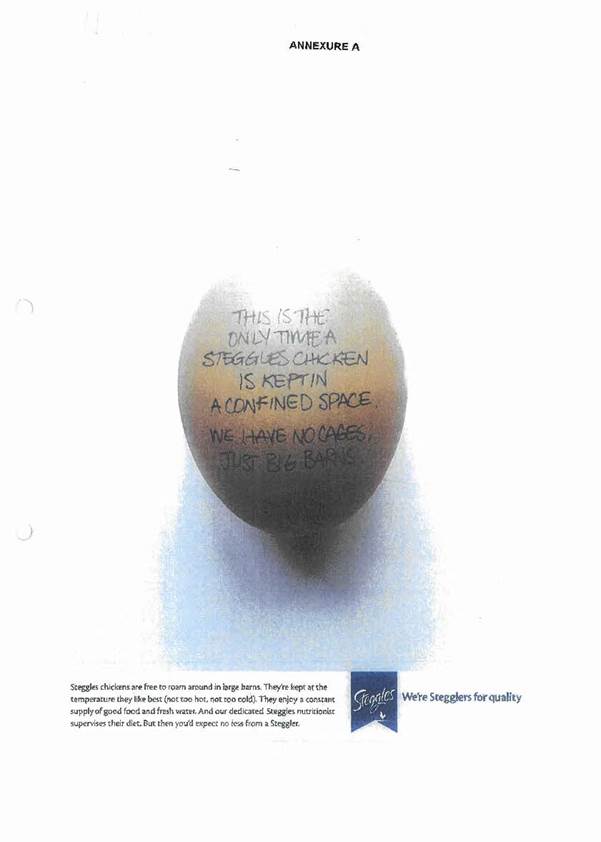
a retail promotional poster, a copy of which is Annexure A to this Order (“Steggles Print Advertisement”), depicting the image of an egg and the statement “free to roam around in large barns” and thereby representing that meat chickens used in the manufacture of Steggles processed chicken products were free to roam around in large barns; and
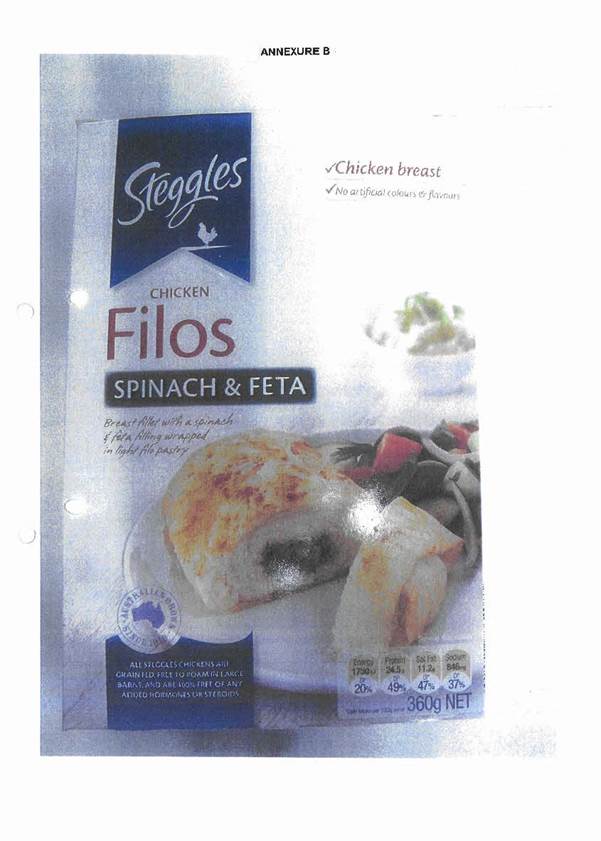
(d) producing or causing to be produced, for the period from in or about August 2009 until September 2011, packaging for Steggles processed chicken products (“Steggles Processed Chicken Packaging”), an example of which is Annexure B to this Order, containing the statement “All Steggles chickens are grain fed, free to roam in large barns, and are 100% free of any added hormones or steroids”, thereby representing that meat chickens are used in the manufacture of Steggles processed chicken products were free to roam around in large barns,
when, in fact, meat chickens used in the manufacture of Steggles processed chicken products were raised or grown in a shed system in which, prior to day 42 of a growth cycle that could be up to 56 days, they were not free to roam around in large barns because they were kept at such stocking densities that they did not have a largely uninhibited ability to move around at will in an aimless manner.
2. The Third Respondent (“Bartter”) has in trade or commerce:
(a) engaged in conduct that was misleading and deceptive or was likely to mislead and deceive, in contravention with s 52 of the TPA in respect of conduct up to 31 December 2010 and s 18 of the ACL in respect of conduct on and after 1 January 2011; and
(b) in connection with the supply and possible supply, and in connection with the promotion of the supply, of which whole meat chickens branded “Steggles” (“Steggles meat chickens”), made false representations that those goods had a particular history in contravention of s 53(a) of the TPA in respect of conduct up to 31 December 2010 and s 29(1)(a) of the ACL in respect of conduct on and after 1 January 2011,
by:
(c) publishing, or causing to be published in the following publications and on the dates specified below:
(i) “Retail World” on 23 May 2011 and 20 June 2011;
(ii) “The Retailer” in July 2011;
(iii) “Super Food Ideas” in June 2011;
(iv) “Recipes+” in June and July 2011;
(v) “Good Food” in July 2011; and
(vi) “Good Health” in September 2011,
the Steggles Print Advertisement, a copy of which is Annexure A to this Order, depicting the image of an egg and statement “free to roam around in large barns” and thereby representing that Steggles meat chickens were free to roam around in large barns; and
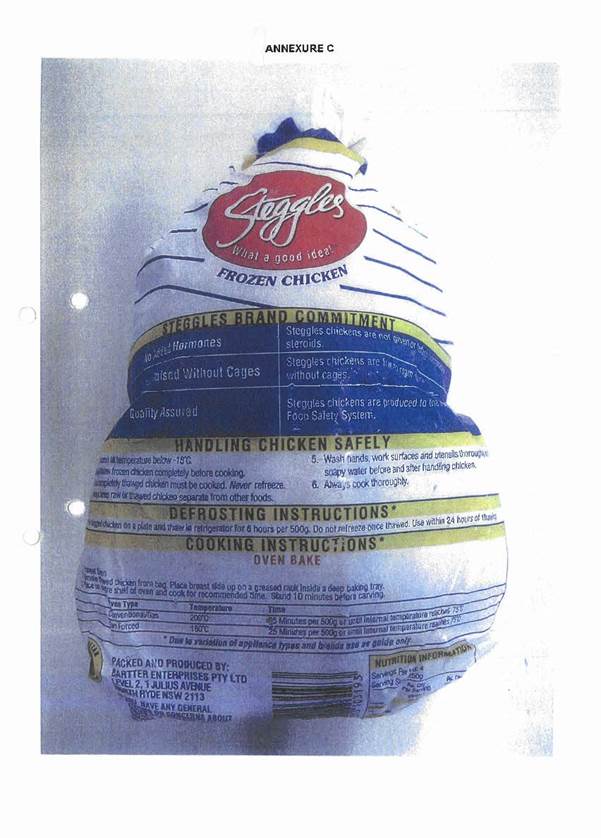
(d) producing or causing to be produced, for the period from in or about August 2009 until September 2011, packaging for Steggles meat chicken (“Steggles Processed Whole Chicken Packaging”), a copy of which is Annexure C to this Order, containing the statement “Barn Raised Without Cages, Steggles Chickens are free to roam in large barns without cages”, thereby representing that Steggles meat chickens were free to roam around in large barns,
when, in fact, Steggles meat chickens were raised or grown in a shed system in which, prior to day 42 of a growth cycle that could be up to 56 days, they were not free to roam around in large barns because they were kept at such stocking densities that they did not have a largely uninhibited ability to move around at will in an aimless manner.
3. The Fourth Respondent (“ACMF”) has in trade or commerce:
(a) engaged in conduct that was misleading and deceptive or was likely to mislead and deceive, on contravention with s 52 of the TPA and s 18 of the ACL; and
(b) in connection with the supply and possible supply, and in connection with the promotion of the supply, of meat chickens made false representations that those goods had a particular history in contravention of s 53(a) of the TPA and s 29(1)(a) of the ACL,
by:
(c) at all material times since in or about May 2008 until September 2011, publishing or causing to be published, on its website at the address
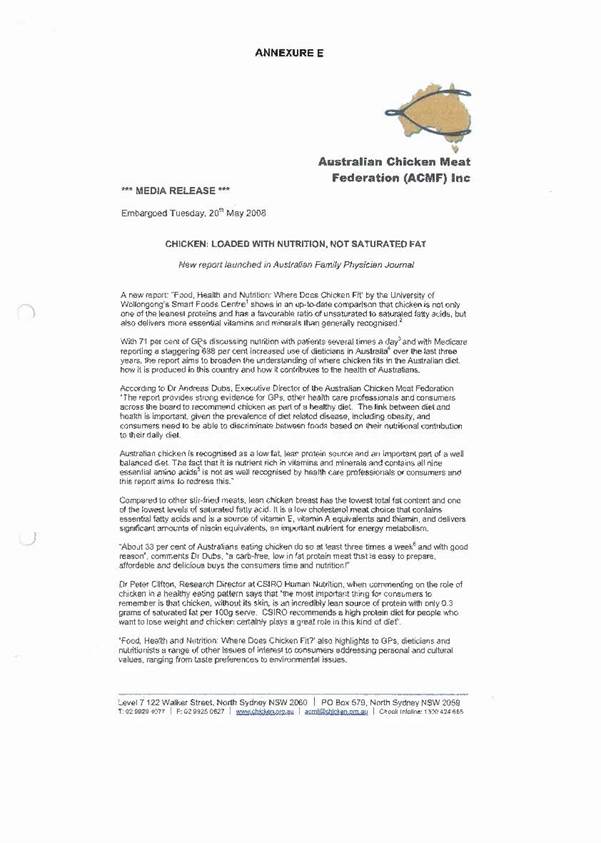
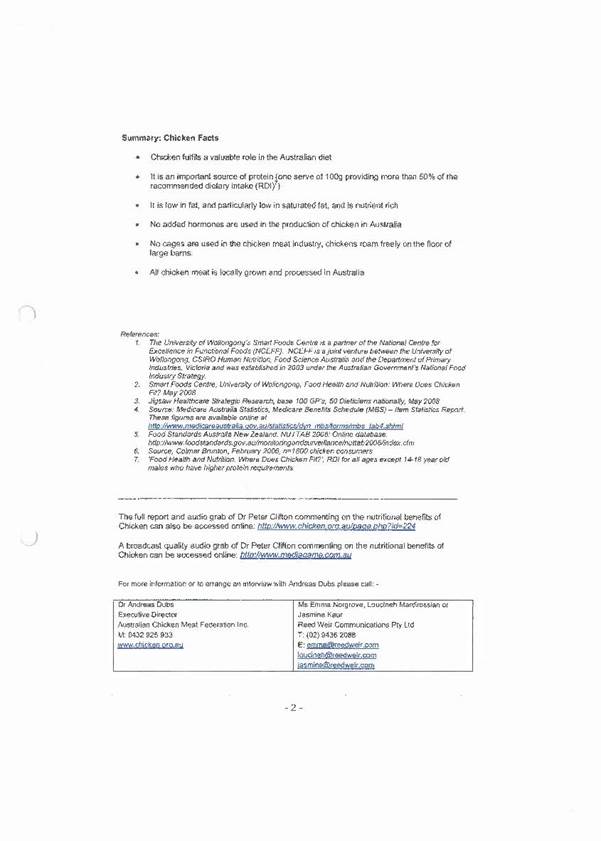
http://www.chicken.org.au (“ACMF Website”), a media release containing the statement “No cages are used in the chicken meat industry, chickens roam freely on the floor of large barns” a print out of which is Annexure E;
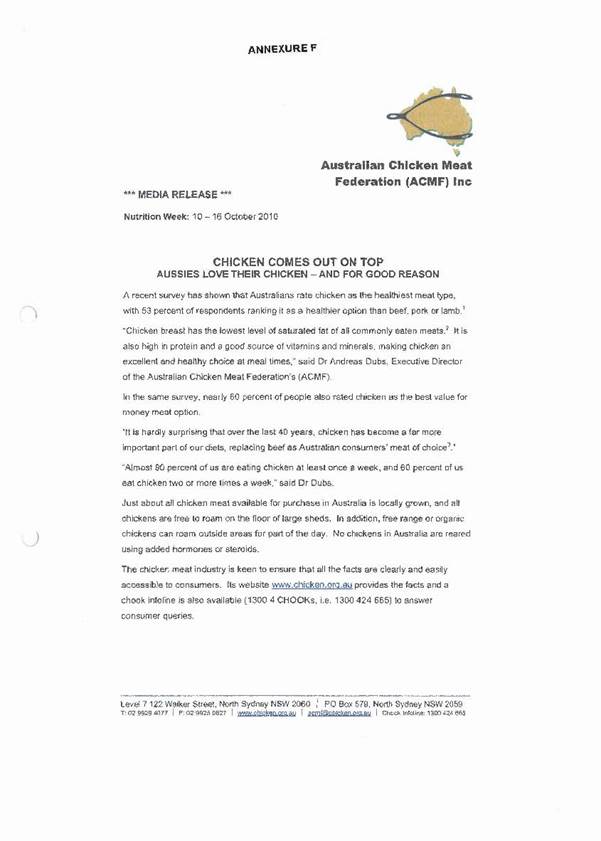
(d) at all material times since in or about October 2010 until September 2011, publishing, or causing to be published, on the ACMF Website a media release containing the statement “Just about all chicken meat available for purchase in Australia is locally grown, and all chickens are free to roam on the floor of large sheds”, a print out of which is Annexure F;
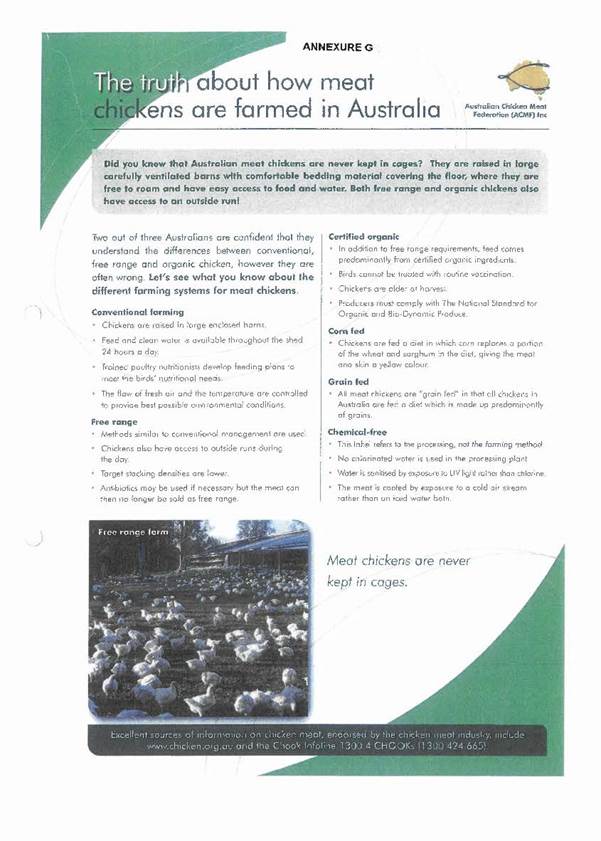
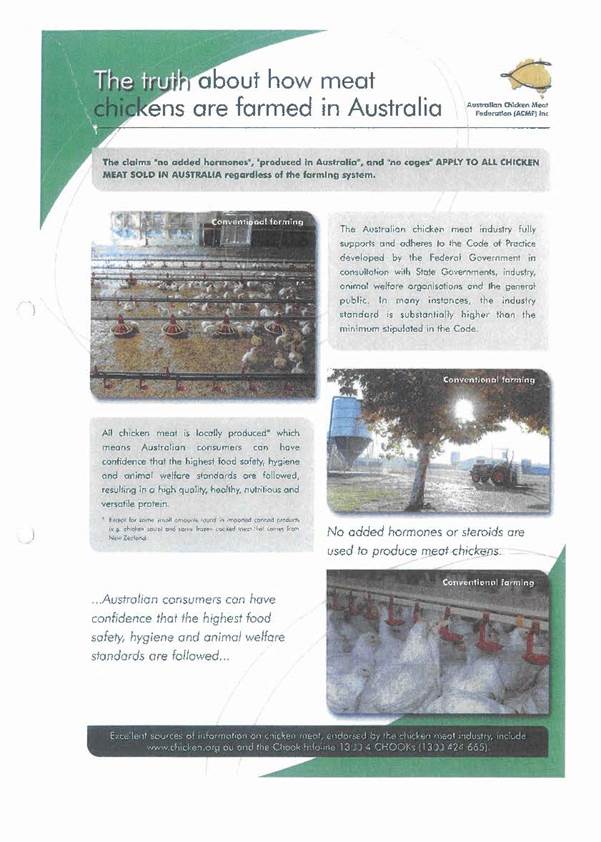
(e) at all material times since in or about September 2010 until September 2011, publishing, or causing to be published, on the ACMF Website a brochure containing the statement “Did you know that Australian meat chickens are never kept in cages? They are raised in large carefully ventilated barns with comfortable bedding material covering the floor, where they are free to roam and have easy access to food and water”, a print out of which is Annexure G;
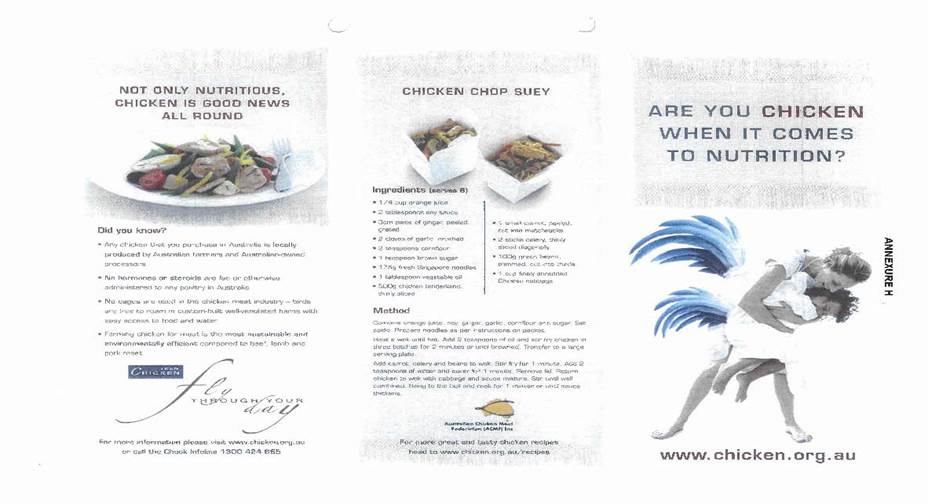
(f) at all material times since in or about December 2010 until September 2011, publishing, or causing to be published on the ACMF Website a brochure containing the statement “No cages are used in the chicken industry – birds are free to roam in custom-built well-ventilated barns with easy access to food and water”, a print out of which is Annexure H.
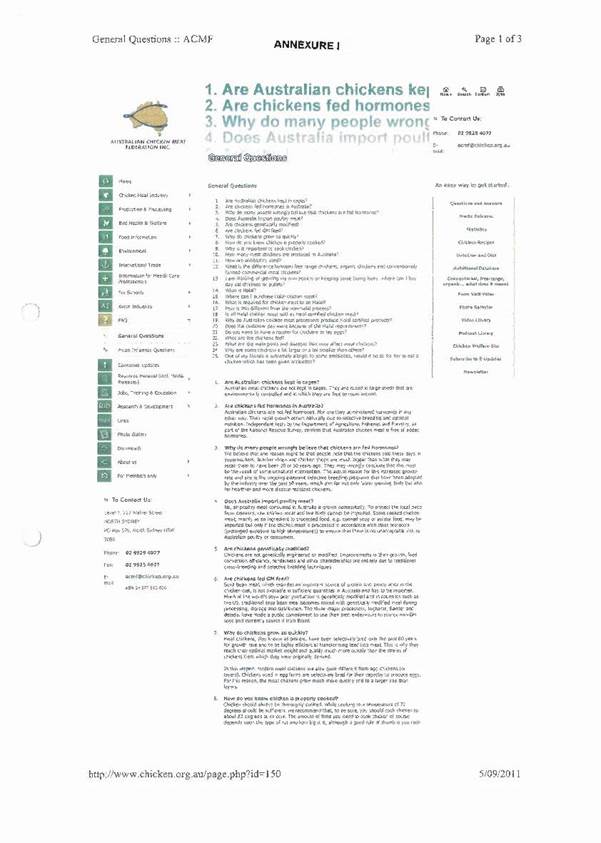
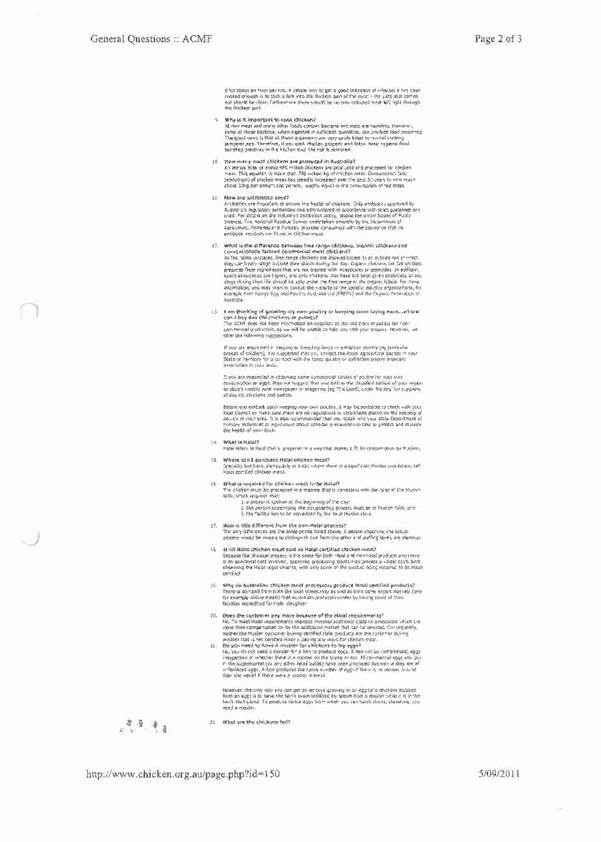
(g) at all material times since in or about March 2011 until September 2011, publishing, or causing to be published, on the ACMF Website a statement “Australian meat chickens are not kept in cages. They are raised in large sheds that are environmentally controlled and in which they are free to roam around”, a print out of which is Annexure I; and
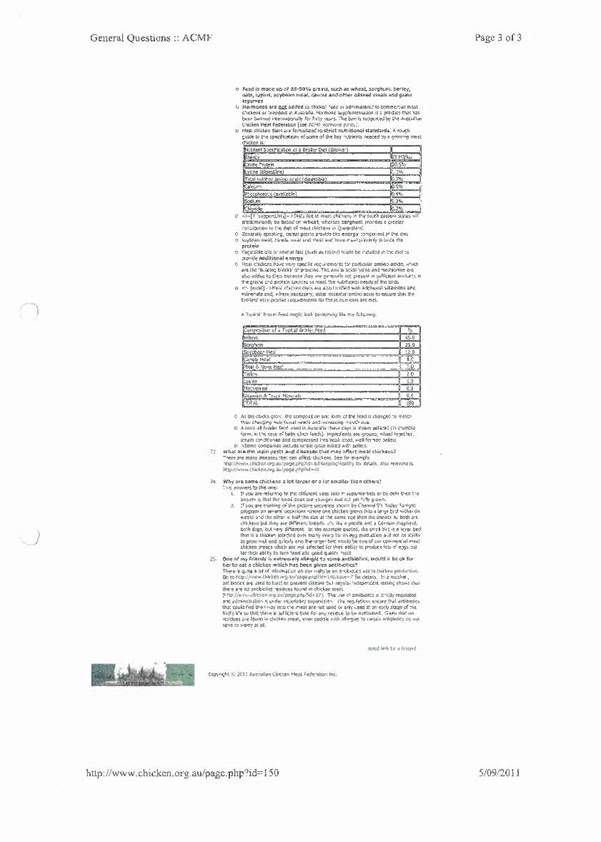
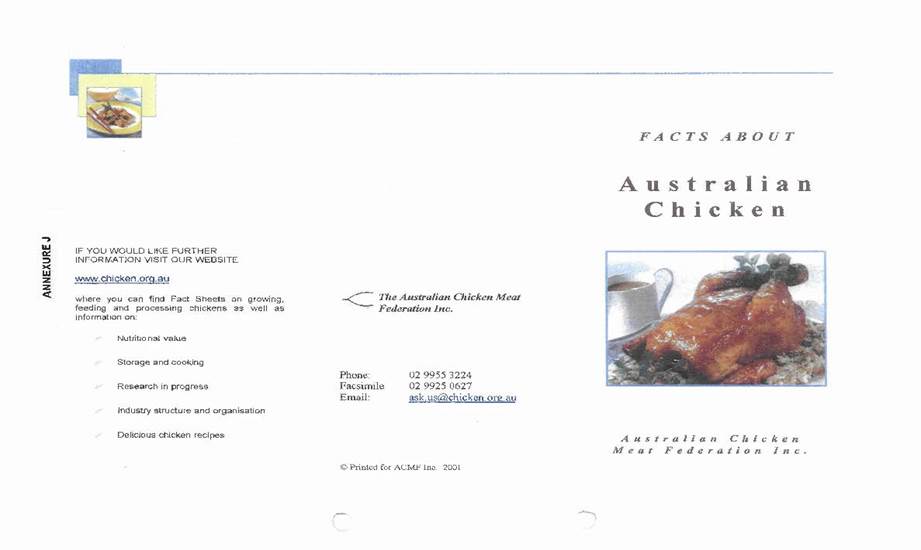
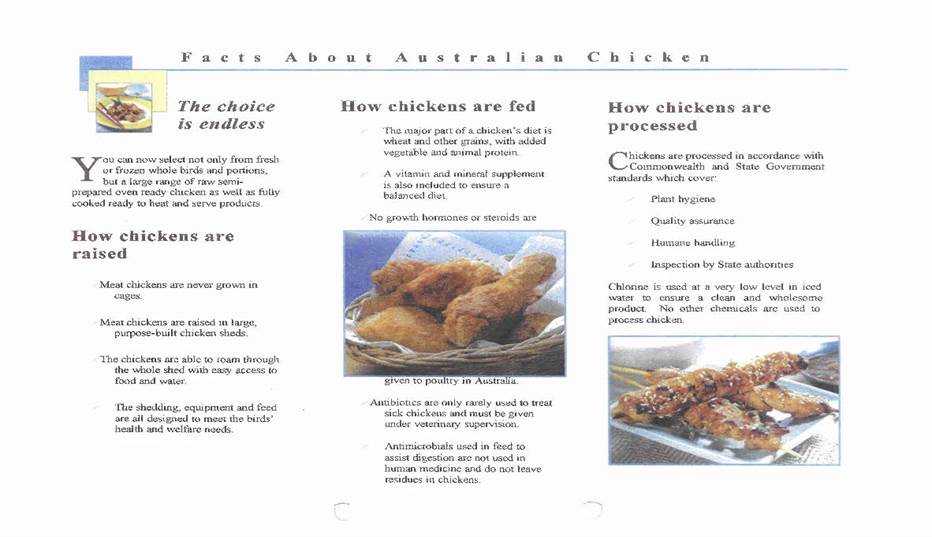
(h) at all material times since in or about March 2011 until September 2011, publishing, or causing to be published, on the ACMF Website a brochure containing the statement that “The chickens are able to roam the whole shed with easy access to food and water”, a print out of which is Annexure J,
thereby representing that all meat chickens raised and grown in a shed system in Australia are raised and grown in large sheds in which the chickens are free to roam around (“ACMF Free to Roam Representation”) when, in fact:
(i) the First Respondent’s meat chickens were raised and grown in a shed system over the course of a growth cycle in which there were periods when they were not free to roam around because they were kept at such stocking densities that they did not have a largely uninhibited ability to move around at will in an aimless manner; and
(j) Steggles meat chickens were raised and grown in a shed system in which they were not, prior to day 42 of a growth cycle that could be up to 56 days, free to roam around in large barns because they were kept in such stocking densities that they did not have a largely uninhibited ability to move around at will in an aimless manner.
AND THE COURT ORDERS THAT:
4. Pursuant to:
(a) s 76E of the TPA, in respect of their conduct from 15 April 2010 until 31 December 2010 in contravention of s 53(a) of the TPA referred to in paragraphs 1(c) and (d) and 2(c) and (d) of this Order; and
(b) s 224 of the ACL, in respect of their conduct from January 2011 in contravention of s 29(1)(a) of the ACL, referred to in the said paragraphs of this Order,
Baiada and Bartter pay to the Commonwealth of Australia a pecuniary penalty in the sum of $400,000.
5. Pursuant to:
(a) s 76E of the TPA, in respect of its conduct from 15 April 2010 until 31 December 2010 in contravention of s 53(a) of the TPA referred to in paragraphs 3(c) to (h) inclusive of this Order; and
(b) s 224 of the ACL, in respect of its conduct from January 2011 in contravention of s 29(1)(a) of the ACL, referred to in the said paragraphs of this Order,
ACMF pay to the Commonwealth of Australia a pecuniary penalty in the sum of $20,000.
6. The ACMF send or cause to be sent, at its expense, within 21 days of the date of the Order of the Court, a letter to each of its members in the form of Annexure K to this Order informing its members of the Court outcome regarding the ACMF Free to Roam Representation and enclosing a copy of the Court’s judgment in the present proceeding.
7. The ACMF take all reasonable steps to ensure that all officers, employees, representatives and agents of the ACMF, whose duties could result in them being concerned with conduct that may contravene Part 2-1 and Division 1 of Part 3-1 of the ACL, receive practical training relating to the ACL within 90 days of the date of this Order, such training to be provided by a suitably qualified compliance professional or legal practitioner with expertise in the ACL.
8. In the event that, within three years of the completion of the practical training programme referred to in the preceding paragraph, the ACMF engages any additional officer, employee representative or agent whose duties could result in him or her being concerned with conduct that may contravene Part 2-1 and Division 1 of Part 3-1 of the ACL, such person receive practical training regarding the ACL within 90 days of commencing his or her duties, such training to be provided by a suitably qualified compliance professional or legal practitioner with expertise in the ACL.
9. The ACMF file and serve on the ACCC within 30 days of the date of this Order an affidavit from its proper officer verifying that it has carried out its obligations under paragraph 6 of this Order.
10. A copy of the reasons for judgment, with the seal of the Court thereon, be retained in the Court for the purposes of s 83 of the TPA and s 137H of the CCA.
AND THE COURT DIRECTS THAT:
11. On or before 6 November 2013 the second and third respondents file written submissions, not exceeding five pages in length, in response to the ACCC’s submission that they should pay its costs of the proceeding and the ACMF’s submission that any costs order against it should be fixed as a proportion of any costs which the Court might order the respondents to pay to the ACCC.
Note: Entry of orders is dealt with in Rule 39.32 of the Federal Court Rules 2011

ANNEXURE K
[Australian Chicken Meat Federation Inc letterhead]
[Date]
[Addressee details]
Dear Sir/Madam
False and Misleading Conduct by Australian Chicken Meat Federation Inc.
The purpose of this letter is to inform you of the decision made by the Federal Court of Australia in proceedings brought by the Australian Competition and Consumer Commission (ACCC) against the Australian Chicken Meat Federation Inc (ACMF), Turi Foods Pty Ltd (trading as La Ionica Poultry), Baiada Poultry Pty Ltd and Bartter Enterprises Pty Ltd (who sell meat chickens and processed chicken products under the Steggles brand).
The ACCC alleged that by publishing statements on the website hosted at www.chicken.org.au that meat chickens produced in Australia are “free to roam” or are allowed to “roam freely”, the ACMF represented that all meat chickens which are produced in a shed system in Australia are raised or grown in large sheds in which the chickens have substantial space available allowing them to roam around freely.
In fact, in Australia, La Ionica and Steggles meat chickens which were not raised or grown under a free range system were:
(i) for La Ionica’s meat chickens, raised and grown in a shed system over the course of a growth cycle in which there were periods when they were not free to roam around; and
(ii) for Steggles meat chickens, raised and grown in a shed system in which they were not, prior to day 42 of a growth cycle that could be up to 56 days, free to roam around in large barns,
because they were kept at such stocking densities that they did not have a largely uninhibited ability to move around at will in an aimless manner.
The Federal Court ordered, amongst other things, that the ACMF send this letter to each of its members informing them of the Court’s decision.
A copy of the judgment of the Federal Court of Australia is enclosed for your information.
Yours sincerely
[insert name of Proper Officer]
Proper Officer
Australian Chicken Meat Federation Inc.
|
VICTORIA DISTRICT REGISTRY |
|
|
GENERAL DIVISION |
VID 974 of 2011 |
|
BETWEEN: |
AUSTRALIAN COMPETITION AND CONSUMER COMMISSION Applicant |
|
AND: |
TURI FOODS PTY LTD (ACN 057 142 971) First Respondent BAIADA POULTRY PTY LTD (ACN 002 925 948) Second Respondent BARTTER ENTERPRISES PTY LIMITED (ACN 000 451 374) Third Respondent AUSTRALIAN CHICKEN MEAT FEDERATION INC (ABN 24 077 883 026) Fourth Respondent |
|
JUDGE: |
TRACEY J |
|
DATE: |
30 OCTOBER 2013 |
|
PLACE: |
MELBOURNE |
REASONS FOR JUDGMENT
1 In Australian Competition and Consumer Commission v Turi Foods (No 4) [2013] FCA 665 (“Turi (No 4)”) I found that the second (“Baiada”), third (“Bartter”) and fourth (“ACMF”) respondents had contravened ss 52 and 53 of the Trade Practices Act 1974 (Cth) (“the TPA”) (in respect of conduct which had taken place prior to 1 January 2011) and ss 18 and 29(1)(a) of the Australian Consumer Law (“the ACL”) which appears as Schedule 2 to the Competition and Consumer Act 2010 (Cth) (“the CCA”) (in respect of conduct on and after 1 January 2011). I rejected claims by the Australian Competition and Consumer Commission (“the ACCC”) that these respondents had also contravened s 55 of the TPA and s 33 of the ACL.
2 The parties subsequently made submissions relating to the relief which should be granted having regard to my findings on liability. I have determined to grant some, but not all, of the relief sought by the ACCC.
3 In Turi (No 4) I found that the respondents had contravened the TPA and the ACL by making public statements that chickens marketed by Baiada and Bartter (and, in the case of ACMF, other producers as well) were “free to roam” in barns or sheds during their growth cycle.
4 The statements appeared on the packaging in which Baiada and Bartter marketed their “Steggles” chicken products, in a print advertisement published in various magazines at the behest of Baiada and Bartter and in various entries on the ACMF’s website. The details of these publications are set out in Turi (No 4) at [47]-[53] as follows:
“[47] The packaging in which Baiada’s processed chicken products are marketed contain a statement that:
‘ALL STEGGLES CHICKENS ARE GRAIN FED, FREE TO ROAM IN LARGE BARNS, AND ARE 100% FREE OF ANY ADDED HORMONES OR STEROIDS.’
[48] The packaging of Bartter’s whole chicken products contains the statements that:
‘Barn Raised Without Cages’ and ‘Steggles chickens are free to roam in large barns without cages.’
[49] as a result of customer surveys Baiada and Bartter became aware, during 2010, that there was a perception in the community that meat chickens were raised in cages. As a result they commissioned an advertising campaign which was designed to dispel this notion. A print advertisement was prepared. It carried a picture of an egg. On the egg was written “THIS IS THE ONLY TIME A STEGGLES CHICKEN IS KEPT IN A CONFINED SPACE”. Under the picture of the egg the following text appeared:
‘Steggles chickens are free to roam around in large barns. They’re kept at the temperature they like best (not too hot, not too cold). They enjoy a constant supply of good food and fresh water. And our dedicated Steggles nutritionist supervises their diet. But then you’d expect no less from a Steggler.’
[50] This print advertisement was placed in various publications between May and September 2011. The publications included the ‘Super Food Idea’, the ‘Recipes Plus’, the ‘Australian Good Food’, the ‘Good Health’, the ‘Retail World’ and the ‘Australian Retailer’ magazines. These magazines had a wide circulation. Research undertaken by the Roy Morgan Research Limited organisation established that the average number of people who read each monthly or bi-monthly issue of four of these magazines in which the print advertisement was published during the year of publication was:
• Super Food Ideas – 880,000;
• Recipes + – 370,000;
• Australian Good Food – 281,000; and
• Good Health – 287,000.
[51] The other two magazines were trade publications which were read by retailers and retail buyers. The evidence did not disclose their circulation levels.
[52] Baiada and Bartter spent approximately $4-5 million dollars on their advertising campaign.
[53] The ACCC also complained about a number of statements which appeared, from time to time, on the Association’s website. The various statements about which complaint is made and the dates between which those statements appeared on the Association’s website are:
• From May 2008 until 14 September 2011 a media release entitled ‘Chicken: Loaded With Nutrition Not Saturated Fat’ appeared. Under a sub-heading
‘Summary: Chicken Facts’ the media release stated:
‘No cages are used in the chicken meat industry, chickens roam freely on the floor of large barns’.
• Between October 2010 and 14 September 2011 another media release appeared entitled ‘Chicken Comes Out on Top, Aussies Love Their Chicken – And For Good Reason’. The release contained the following statement:
‘Just about all chicken meat available for purchase in Australia is locally grown, and all chickens are free to roam on the floor of large sheds.’
• Between September 2010 and 14 September 2011 a brochure appeared entitled ‘The truth about how meat chicken are farmed in Australia’. The brochure contained the following statement:
‘Did you know that Australian meat chickens are never kept in cages? They are raised in large carefully ventilated barns with comfortable bedding material covering the floor, where they are free to roam and have easy access to food and water.’
• Between December 2010 and 14 September 2011 a brochure appeared entitled ‘Are You Chicken When It Comes to Nutrition’. The brochure contained a statement that:
‘No cages are used in the chicken meat industry – birds are free to roam in custom-built well-ventilated barns with easy access to food and water.’
• Between March 2011 and 14 September 2011 an entry headed ‘General Questions’ appeared. It contained the following statement:
‘Australian meat chickens are not kept in cages. They are raised in large sheds that are environmentally controlled and in which they are free to roam around.’
• Between March 2011 and 14 September 2011 a brochure appeared entitled ‘Facts About Australian Chicken’. The brochure contained the following statement:
‘The chickens are able to roam through the whole shed with easy access to food and water.’
The common feature of these statements was that they asserted that chickens raised in barns or sheds were either able to ‘roam freely’, were ‘free to roam’ or ‘able to roam’.”
5 Baiada and Bartter commenced using the packaging referred to in paragraphs [47] and [48] in the judgement in Turi (No 4) in about August 2009.
6 I found (at [114]) that “Baiada and Bartter contravened ss 52 and 53(a) of the [TPA and the equivalent provisions of the ACL] to the extent that the representation that the chickens were ‘free to roam’ in large barns prior to day 42 of their growth cycle was likely to mislead or deceive consumers as to the circumstances in which the processed chickens had been raised or grown or by falsely representing that the chickens had a particular history of being raised or grown in barns in which they were ‘free to roam’.” (Emphasis added).
7 In the course of argument a query arose as to whether this finding should have been confined to the period between the 12th and 42nd days of the chickens’ growth cycle. The possible need for such a qualification was founded on what was said in paragraph [106] of my reasons:
“[106] The evidence and the observations made on the view do not permit relevant conclusions to be reached in respect of each day of the growth cycle. It is, however, possible for judgments to be formed in relation to chickens in sheds at the 12th, 28th, 33rd, 42nd, 49th, 54th and 56th days of the cycle.”
8 It is to be observed that this paragraph relates to evidence and observations arising from the view. There was other evidence, referred to elsewhere in the reasons (see at [17] and [112]), which supported the finding made in paragraph [114].
RELIEF SOUGHT
9 In its amended fast track application the ACCC sought wide ranging relief against Baiada, Bartter and the ACMF. The relief sought was:
Declarations under s 21 of the Federal Court of Australia Act 1976 (Cth);
Injunctions under s 232 of the ACL;
Pecuniary penalties under s 76E of the TPA and s 224 of the ACL;
Orders for publication and disclosure under ss 86C and 86D of the TPA and under ss 246 and 247 of the ACL;
Orders for implementation of compliance programmes under s 86C of the TPA and s 246 of the ACL;
An order that a copy of the sealed reasons for judgment be retained by the Court for the purposes of s 83 of the TPA and s 137H of the CCA; and
Costs.
10 The application for injunctions against the respondents was not pressed.
11 Nor did the ACCC press for orders requiring Baiada and Bartter to implement trade practices compliance programmes or to publish corrective advertisements.
12 The ACCC did not seek orders that the ACMF implement a trade practices compliance programme. Rather it sought an order requiring each of the staff of the ACMF to undergo trade practices compliance training.
13 Although originally seeking an order that the ACMF publish a corrective advertisement in newspapers published in each capital city, the ACCC ultimately only sought an order that a corrective advertisement appear on the ACMF’s website.
DECLARATIONS
14 The Court has the power to make declarations under s 21 of the Federal Court of Australia Act 1976 (Cth). Any declaratory order made in the exercise of this power must be directed to quelling legal controversy between parties. The applicant must have a real interest in obtaining the relief sought: see Ainsworth v Criminal Justice Commission (1992) 175 CLR 564 at 581-2. There must also be a proper contradictor: see Forster v Jododex Australia Pty Ltd (1972) 127 CLR 421 at 437-8.
15 Each of these requirements is satisfied in the present proceeding. A dispute has existed between the parties as to whether or not Baiada, Bartter and the ACMF have engaged in contraventions of ss 52 and 53(a) of the TPA and the equivalent provisions of the ACL. The ACCC is a public body which had power under the ACL to bring enforcement proceedings. Declaratory orders of the kind proposed serve the public interest by making it plain that conduct such as that committed by the respondents contravened the TPA and the ACL: see ACCC v Midland Brick Company Pty Ltd (2004) 207 ALR 329 at 333; Rural Press Limited v Australian Competition and Consumer Commission (2003) 216 CLR 53 at 91.
16 In Forster Gibbs J (with whom McTiernan, Stephen and Mason JJ agreed) adopted Lord Dunedin’s description of a proper contradictor (in Russian Commercial and Industrial Bank v British Bank for Foreign Trade Limited [1921] 2 AC 438 at 448) as “one presently existing who has a true interest to oppose the declaration sought”: see at 437-8. In ACCC v MSY Technology Pty Ltd (No 2) (2011) 279 ALR 609 Perram J added a requirement that the proper contradictor must not only be a party but must argue against the granting of relief: see at [32]. This added requirement would mean that respondents, such as the present, which agree with the ACCC as to the terms of declarations, could not be treated as proper contradictors in respect of any such declaratory relief.
17 In ACCC v Sampson [2011] FCA 1165 at [13]-[15] I explained my reasons for concluding that a respondent who consents to the making of declarations may, nevertheless, be a proper contradictor in the sense described in Forster. I adhere to the views which I there expressed.
18 In the present case Baiada, Bartter and ACMF are each proper contradictors because each has a genuine interest in resisting the grant of relief. That interest is to be distinguished from their willingness, as litigants, to agree that a series of proposed declarations serve to give effect to findings made by the Court at the liability stage of the proceeding. In doing so they have done no more than facilitate the orderly conduct of the proceeding having regard to adverse findings earlier made by the Court.
19 The terms of the proposed declarations, on which all parties are agreed, save as to the pre-day 12 point to which I have referred, reflect the findings which I made in Turi (No 4). They should be made.
PECUNIARY PENALTIES
The legislation
20 The Court’s power to impose pecuniary penalties for contraventions of s 53(a) of the TPA and s 29(1)(a) of the ACL is derived, respectively, from s 76E of the TPA and s 224 of the ACL. These two provisions are in substantially the same terms. It will, therefore, be convenient to refer to the more recent provision.
21 By s 224(1)(a)(ii) of the ACL, the Court is empowered to order a contravener to pay “such pecuniary penalty, in respect of each act or omission … As the court determines to be appropriate.” In fixing an appropriate penalty the Court is required to have regard to “all relevant matters”. Three mandatory considerations are prescribed by s 224(2). They are:
“(a) the nature and extent of the act or omission and of any loss or damage suffered as a result of the act or omission; and
(b) the circumstances in which the act or omission took place; and
(c) whether the person has previously been found by a court in proceedings under Chapter 4 or this Part to have engaged in any similar conduct.”
22 At relevant times the maximum penalty which could be imposed on a body corporate for a contravention of s 29 of the ACL was $1,100,000: see s 224(3) of the ACL and s 4AA of the Crimes Act 1914 (Cth). The same maximum penalty was prescribed under s 76E of the TPA.
The number of contraventions
23 On one view Baiada and Bartter contravened s 29(1)(a) of the ACL each time they caused a Steggles chicken wrapped in packaging containing the impugned representation to be placed on public display and each time an advertisement containing the “free to roam” claim appeared in a magazine. Similarly it could be argued that each of the multiple representations appearing on ACMF’s website constituted a separate contravention. The authorities, however, have cautioned against the adoption of such an analysis and developed principles which temper the severity of such an approach.
24 The relevant principles were drawn together by Middleton J in Australian Competition and Consumer Commission v Telstra Corporation Limited (2010) 188 FCR 238 at [231]-[235] where his Honour said:
“[231] In looking at the contraventions in this proceeding, it is useful to refer to the Trade Practices Commission v Bata Shoe Company of Australia Pty Ltd [1980] ATPR 40-161 at 42,277 where Lockhart J talked in terms of the ‘same episode’ when considering an appropriate penalty:
‘Guidance is given in the field of sentencing for criminal offences by the well-known principle that where several offences are heard together and arise out of the same transaction it is a sound working rule that the sentences imposed for those offences should be made concurrent; it is inappropriate to sentence consecutively when the offences were all really involved in the same episode: see R. v. Duff a decision of the full court of this court, judgment delivered 6 December 1979; R. v. Walsh (1965) 109 Sol. J. Pt. 1 150; R. v. Melville (1956) 73 W.N. (N.S.W.) 579; R. v. Hussain Crim. L.R. 712; R. v. Hally (1965) 58 Q.R. 582 and Re: P.J. Kastercum (1972) 56 Cr. App. R. 298.’
[232] Justice Lockhart considered at 42,277 that the contraventions arose out of:
the one course of conduct in that it was directed to Woolworths and reflected the adherence by the respondent to a policy of engaging in resale price maintenance in relation to Woolworths.
[233] He then said at 42,277:
‘I accept that the contraventions arose out of the one course or pattern of conduct. Although it is necessary to look at each contravention separately, nevertheless consideration must be given to the facts common to each contravention.’
[234] In this way, Lockhart J regarded the seven contraventions as falling into three categories relating to the conversations giving rise to the contraventions, although from ‘one course or pattern’. From there, consideration was given to the facts common to each contravention. However, Lockhart J did not treat the case as involving only one contravention even though arising from ‘one course or pattern’, namely the adherence to a policy of engaging in resale price maintenance in relation to Woolworths.
[235] In the final analysis, in applying the totality principle, the question is one of discretion in coming to the correct, adequate and appropriate penalties. In discussing the totality principle, the majority of the Full Court in Construction, Forestry, Mining and Energy Union v Cahill (2010) 194 IR 461 said at [41]- [42]:
‘As noted above (see [15]), the principle recognises that where there is an interrelationship between the legal and factual elements of two or more offences for which an offender has been charged, the Court must ensure that the offender is not punished twice for the same conduct. In other words, where two offences arise as a result of the same or related conduct that is not a disentitling factor to the application of the single course of conduct principle but a reason why a Court may have regard to that principle, as one of the applicable sentencing principles, to guide it in the exercise of the sentencing discretion: Johnson v The Queen (2004) 205 ALR 346 at [3]-[4] and [34] and Attorney-General v Tichy (1982) 30 SASR 84 at 92-93. It is a tool of analysis (Tichy 30 SASR 84 at 93) which a Court is not compelled to utilise: Royer v Western Australia [2009] WASCA 139 at [21]-[34] and [153]-[156].’
A Court is not compelled to utilise the principle because, as Owen JA said in Royer [2009] WASCA 139 at [28],“[d]iscretionary judgments require the weighing of elements, not the formulation of adjustable rules or benchmarks”. The exercise of the sentencing discretion does not fall to be exercised in a vacuum. It is a matter of judgment to be exercised according to the facts of each case and having regard to conflicting sentencing objectives: see McHugh J in AB v The Queen (1999) 198 CLR 111 at [14]. For the same reasons, and contrary to the appellants’ submissions, even if offences are properly characterised as arising from the one transaction or a single course of conduct, a judge is not obliged to apply concurrent terms if the resulting effective term fails to reflect the degree of criminality involved. Or, in the case of fines, a judge is not obliged to start from the premise that if there is a single course of conduct, the maximum fine is, in the present case, $110,000 for the CFMEU and $22,000 in the case of Mr Mates.’” (Original emphasis).
His Honour continued at [250]-[251]:
“[250] A number of different approaches in this proceeding could be taken to imposing a penalty. The Court could look to each contravention, consider the appropriate penalty taking into account the totality principle, and then apply any appropriate discount. This was the approach submitted by the ACCC. The Court could group together each exchange or each State, or focus on each period of inability to gain access, and view the contraventions included within those groups as appropriately to be treated together for the purpose of assessing the appropriate penalty. Alternatively, the Court could treat the admitted contraventions as all following from the same cause, and with the maximum penalty being $10 million, and then consider the appropriate discount. This is the approach submitted by Telstra. Another approach would be to look at the capped sites and uncapped sites, and treat that as a basis for grouping the contraventions.
[251] There is no scientific approach or arithmetic formula to be applied in determining the appropriate penalty. The circumstances of each contravention need to be looked at, taking into account all the circumstances pertaining to the contravention. I have already indicated what I regard as important and significant considerations, but the other matters I have raised are taken into account.”
25 These passages were quoted with approval by the Full Court in Singtel Optus Pty Ltd v Australian Competition and Consumer Commission (2012) 287 ALR 249 at 262-3 (“Singtel Optus”).
26 Having regard to these principles the ACCC submitted that:
Baiada and Bartter should each be treated as having committed a single contravention of s 29(1)(a) in respect of the course of conduct of marketing their respective packaged products;
Baiada and Bartter should jointly be liable for a single contravention of s 29(1)(a) by promoting the print advertising campaign; and
ACMF should be treated as having committed a single contravention by publishing the series of impugned statements on its website.
27 Baiada and Bartter contended that the representations made during the print advertising campaign and on the packaging of their products should be treated, for these purposes, as a single course of conduct. They supported this contention on the basis that:
all involved promotion of the Steggles brand;
all contained substantially the same impugned representations; and
the representation, wherever published, was directed to the same end: the dispelling of the notion that meat chickens in Australia are raised in cages.
Each of these propositions is uncontroversial.
28 The ACCC relied on the Full Court’s decision in Singtel Optus. In that case the Court found that the placement of advertisements for broadband data plans in 11 different mediums constituted 11 categories of contravention. Although the 11 advertisements formed part of a single campaign, the strategy to which it gave effect was implemented in different ways in the different mediums. There were television commercials, flyers, newspaper advertisements and a billboard advertisement. The Court said (at 262) that it was “simply not the case that the same conduct gave rise to all the contraventions … different conduct was involved in each category of contravention.” The Court treated each of the advertisements as constituting separate contravening conduct because “the content of each message was different” and, in some cases, the advertisements promoted different products.
29 In TPG Internet Pty Ltd v Australian Competition and Consumer Commission (2012) 210 FCR 277 at 295 another Full Court also dealt with impugned advertisements. It distinguished Singtel Optus. It found that the “content of the advertisements across the range of media was broadly the same and the vice complained of and found to be established by the primary judge was essentially the same in each case.” (at 295). The Court identified two contraventions on the part of the respondent by reference to the representation that a service could be purchased for a certain price per month without more and the failure to prominently display a single price in one advertisement.
30 In my view the circumstances of the present case are distinguishable from those considered in Singtel Optus. Although the advertising containing the “free to roam” representation appeared in different places (the print advertising and the packaging), it was substantially the same, impugned, representation which appeared. It was used as part of the same campaign which was designed to disabuse readers of the misconception that Steggles chickens were raised in cages. In these ways the facts of the present case are more akin to those of TPG than to Singtel Optus. See also ACCC v Marksun Australia Pty Ltd [2011] FCA 695 at [71]-[81]; ACCC v EDirect Pty Ltd (in liq) [2012] FCA 976 at [74].
31 As distinct but related entities, Baiada and Bartter both marketed chickens under the Steggles brand. The “free to roam” representation was, as has already been noted, related to chickens marketed under that brand. In this context I note that “Steggles’ chickens were supplied to fast food outlets such as KFC and Red Rooster. This was disclosed on Baiada and Bartter’s website even though the consumers of chicken products sold from the fast food outlets would not have been exposed to the Steggles brand at those outlets.
32 For these reasons, in fixing a penalty for the conduct of Baiada and Bartter, I will proceed on the basis that they have jointly committed a single contravention of the legislation. I doubt, that, from a practical viewpoint, proceeding in this way would materially affect the quantum of any penalty to be imposed: had I accepted that multiple contraventions had occurred, it would still have been necessary to apply the totality principle in settling on a monetary sum.
33 It was common ground that, in publishing the various impugned representations on its website, ACMF engaged in a single course of conduct. I consider that it is appropriate to so treat ACMF’s conduct.
The principles
34 Reference has already been made to the matters which s 224(2) of the ACL requires the Court to take into account in fixing a pecuniary penalty. In Australian Competition and Consumer Commission v Singtel Optus Pty Ltd (No 4) (2011) 282 ALR 246 at [11] Perram J collected a series of additional considerations which have been found to be of assistance by judges called on to impose penalties pursuant to s 76E of the TPA and s 224 of the ACL. These potentially relevant considerations were:
• the size of the contravening company;
• the deliberateness of the contravention and the period over which it extended;
• whether the contravention arose out of the conduct of senior management of the contravener or at some lower level;
• whether the contravener has a corporate culture conducive to compliance with [the ACL] as evidenced by educational programmes and disciplinary or other corrective measures in response to an acknowledged contravention;
• whether the contravener has shown a disposition to cooperate with the authorities responsible for the enforcement of [the ACL] in relation to the contravention;
• whether the contravener has engaged in similar conduct in the past;
• the financial position of the contravener; and
• whether the contravening conduct was systematic, deliberate or covert.
35 The relevance of these factors was accepted by the Full Court in Singtel Optus at 258.
The nature and extent of the contravening conduct – Baiada and Bartter
36 I have explained (above at [4]-[5]) the circumstances in which the impugned representation came to be made, the places where it was published and some estimates of the number of consumers who may have been exposed to the representation.
37 The ACCC stressed:
that the Steggles brand has, for a long time, had high levels of public recognition;
the circulation figures of magazines in which the print advertisements appeared;
the fact that both Baiada and Bartter’s chicken products, marketed under the Steggles brand, are sold nationally by major supermarket chains and independent grocers;
the high level of chicken consumption by Australians;
that, because the written representations on the packaging were exposed at points of sale, it was reasonably likely that the impugned representation “had a direct and immediate impact on consumer purchasing decisions; thereby not only impacting on consumers but also on the products of competitors”; and
that, the contravening conduct had created a false impression as to the conditions under which chicken meat was produced.
38 Baiada and Bartter did not seek to contest many of these matters. They sought, however, to downplay the significance of some of them. They pointed to the fact that Steggles chickens comprise only about 2.5 per cent of the Australian chicken meat market. While accepting the circulation figures for the publications in which the print advertisement appeared, they emphasised that the impugned statement was presented in small font in the bottom left hand corner of the advertisement. The statement appeared on the bottom left hand corner on the front of Baiada’s packaging but was not as prominent as other items including the Steggles trademark. The statement appeared on the back of Bartter’s packaging and again was not prominent. As a result they disputed that the impugned representation was likely to have had a direct and immediate impact on consumer purchasing decisions. I accept this submission insofar as it applies to the representations on the packaging. In order to come to the attention of shoppers it would have been necessary for the shoppers to pick up the chickens from the refrigerated display case and examine the writing on the packaging very closely before noticing the representation. On the other hand potential consumers who read the print advertisements would have been more likely to read the representation once their attention was sufficiently engaged.
39 I also accept Baiada and Bartter’s contention that they were not the authors of the “free to roam” phrasing. They adopted it from industry codes and public statements made by other participants in the industry including ACMF.
The nature and extent of the contravening conduct – ACMF
40 The entries on the ACMF website were intended to be read by the public at large and by industry participants and potential consumers. There was no evidence led which provided any indication of the number of persons who had viewed the publications on the ACMF’s website. It may reasonably be assumed (as the ACCC accepts) that the readers would have been fewer in number than those who saw the Baiada and Bartter publications.
41 The ACMF statements were intended to promote the chicken meat industry. They were not targeted at particular consumers and were in an informational format which did not adopt an advertising style.
The amount of loss or damage caused
42 The ACCC did not adduce evidence that any person had suffered any loss or damage by reason of the publication of the impugned representation. Nor did it lead evidence that consumers had complained about having been misled. Nonetheless the ACCC invited the Court to infer that consumers had been damaged by being deprived of the opportunity to make properly informed purchasing decisions on the assumption that some consumers had been led, by the representations, to purchase Steggles chickens when they would not have otherwise done so. The Court was invited to draw the further inference that Baiada and Bartter had profited, at the expense of their competitors.
43 For the reasons already given I am more ready to infer that readers of the print advertisements were more likely to have been misled than readers of Baiada and Bartter’s product labels and ACMF’s website. It is, however, impossible, on the evidence, to form a judgment about the existence and the extent of losses (if any) attributable to the making of the representations. In particular there was no support in the evidence for a suggestion that Baiada and Bartter’s competitors lost market share during the period which the representations were made. The sales figures for Baiada and Bartter and their competitors remained relatively stable during this period. For these reasons I am not prepared to draw the inference that Baiada and Bartter profited at the expense of their law abiding competitors: cf Australian Competition and Consumer Commission v Pepe’s Ducks Limited [2013] FCA 570 at [31]; Australian Competition and Consumer Commission v Kingisland Meatworks and Cellars Pty Ltd (2013) 99 IPR 548 at [32] and [36].
Previous similar conduct
44 It was common ground that Baiada, Bartter and the ACMF had not been found to have previously engaged in any similar misconduct.
Size of the respondent – Baiada and Bartter
45 Baiada and Bartter are both large companies. Together they are Australia’s largest chicken meat producers. They operate between 250 and 300 farms on which there are a total of about 1,000 sheds in which the chickens are raised. The two companies employ a total of about 4,500 staff. Their Steggles brand is marketed nationwide.
Size of the respondent – ACMF
46 The ACMF is a small organisation with three part-time staff members. It is, however, the peak industry council and, as such, is the representative of many large companies including Baiada and Bartter.
The deliberateness of the contravention
47 The ACCC accepted that, in making the impugned representations, Baiada, Bartter and ACMF did not deliberately contravene the TPA or the ACL. The ACCC did not seek to contend that these respondents acted dishonestly or with the intention of misleading and deceiving consumers.
48 The ACCC did, however, emphasise that the respondents’ objective of disabusing consumers of the idea that meat chickens were raised in cages could have been achieved without resort to the “free to roam” representation. I accept this submission.
49 It is now well established that s 53(a) of the TPA and s 29(1)(a) of the ACL can be contravened “even if [a statement] is not false to the knowledge of the person making the representation”: see authorities collected in Turi (No 4) at [78]. As a result, if a respondent contravenes s 53(a) inadvertently, as the present respondents have done, their inadvertence will not serve as a mitigating factor. Had they been found to have engaged in a deliberate contravention of the provision, this would have been regarded as an aggravating consideration: see ACCC v AirAsia Berhad Company [2012] FCA 1413 at [51].
The period of time over which the conduct extended
50 Some of the impugned representations were published prior to the commencement of s 76E of the TPA on 15 April 2010. Pecuniary penalties may only be imposed in respect of conduct that occurred after that date.
51 The Baiada and Bartter packaging containing the “free to roam” representation were being used on 15 April 2010. Baiada and Bartter removed the representation from all new packaging used after September 2011. It was anticipated that all of the former packaging would be phased out by the end of April 2012. The old packaging was still on display at retail outlets on 14 February 2012.
52 Baiada and Bartter’s print advertisement was published between May and December 2011.
53 The ACMF’s website entries appeared between the various dates set out above at [4]. They were all removed on 14 September 2011.
Involvement of senior management
54 Mr John Camilleri was, at relevant times, the Chairman of the Board of Directors of The Baiada Group. Prior to 30 September 2011 he was the Managing Director of the Baiada Group, the Managing Director of Baiada and a Director of Bartter. He personally approved the form of the print advertisement and he authorised the use of the “free to roam” representation on the Steggles packaging.
55 Dr Andreas Dubs was, at relevant times, the Executive Director of the ACMF. He, and other staff members, were responsible for the creation of the website entries about which complaint was made.
The culture of compliance
56 Baiada and Bartter have trade practice compliance regimes in operation. These were implemented in or around July 2009 when Bartter, and its related companies, was acquired by the Baiada Group. The compliance initiatives implemented included:
Engaging lawyers to develop and implement a training program for Senior Management;
Conducting twice yearly training;
Conducting competency assessments through a computer based assessment program; and
A system whereby all incidents which may have implications for compliance for the CCA are raised and investigated by the Group Human Resources Manager for the Baiada Group.
57 The ACCC tacitly accepts that these arrangements are satisfactory and it does not press for orders that the companies implement a compliance or training programme.
58 The ACMF, on the other hand, does not have an in-house training programme for its employees, all of whom, it has been noted, work part-time for the organisation. The ACMF accepts that those involved in the drafting of publications should undertake a trade practices training course. The extent and regularity of that training is a matter of dispute to which I will return.
Co-operation with the ACCC
59 Each of the respondents asserted that it had been co-operative in its dealings with the ACCC. They had each complied with notices issued under s 155 of the TPA and had provided additional information requested by the ACCC. Baiada and Bartter had also co-operated with the ACCC in arranging for the view.
60 Each of the three respondents chose to defend the proceeding. Each was partially successful in resisting claims made by the ACCC. They were entitled to contest the cases levelled against them. Their determination to do so is not to be treated as unco-operative conduct: cf Australian Competition and Consumer Commission v Global One Mobile Entertainment Limited [2011] FCA 393 at [132] (per Bennett J).
61 No great weight can be attached to a parties’ compliance with s 155 of the TPA. They had a statutory obligation to comply with such notices.
The financial position of the respondents – Baiada and Bartter
62 Baiada and Bartter filed confidential affidavits which disclose that the companies are in receipt of substantial income and are in a strong financial position. Whilst they have a demonstrated capacity to meet any pecuniary penalty falling within the appropriate range, this is not a reason for imposing a higher penalty than would otherwise be imposed. There will be cases in which, in fixing the appropriate range, the requirements of specific deterrence may, nonetheless, dictate that a penalty at that higher end of the range should be imposed where the offender is a company with vast resources: cf ACCC v Leahy Petroleum Pty Ltd (No 3) (2005) 215 ALR 301 at 309. This is not such a case. Baiada and Bartter have not sought to take advantage of their strong financial position to pursue a course of conduct which they knew to be in contravention of the TPA and the ACL. Nor did they adopt the cynical attitude that any penalties which might be incurred were worth the risk and could easily be accommodated within their budgets: cf Singtel Optus at 265.
63 The ACMF has extremely limited resources. Its assets are valued at only about $27,000. Despite this, counsel for ACMF disavowed any suggestion that his client would be unable to meet any penalty on which the Court may settle. This was because its liability was covered by insurance. Again, ACMF’s capacity to pay ought not lead to the imposition of a harsher penalty than would otherwise be appropriate.
Deterrence
64 There can be no doubt that deterrence, both specific and general, loom large in most cases in which pecuniary penalties are sought for contraventions of provisions of the TPA and the ACL. In Trade Practices Commission v CSR Limited (1991) ATPR 41-076 at 52,152 French J identified deterrence as the principal object of pecuniary penalty provisions in consumer protection legislation.
65 I do not consider that it is likely that any of the three respondents will repeat the conduct which has been found to contravene s 53(a) of the TPA and s 29(1)(a) of the ACL. They have not previously contravened the legislation. They took steps to remove the offending statements from material published by them and have not republished the material for more than two years. The need for specific deterrence does not, therefore, weigh heavily.
66 On the other hand general deterrence remains an important consideration. A significant factor in determining the quantum of a penalty in an area such as consumer protection must be the deterrence of others who might, either deliberately or inadvertently, commit a similar contravention. The fixing of a penalty can and should have an educative effect and reflect the relative seriousness of the contravening conduct: see NW Frozen Foods Pty Ltd v ACCC (1996) 71 FCR 285 at 294-5.
Parity principle
67 In publishing the impugned representation the respondents have misled consumers about the manner in which meat chickens are raised in Australia. The representation was not, however, false in respect of all chickens at all stages of their growth cycle. Nor was it deliberate. This cannot, therefore, be regarded as one of the more egregious examples of a contravention of s 53(a) of the TPA and s 29(1)(a) of the ACL. Nonetheless, consumers are entitled to accurate information to inform their purchasing decisions.
68 Baiada and Bartter’s representations related to their Steggles products which formed only a small part of the overall chicken meat market in Australia. The ACMF’s material applied to the whole chicken meat market. To this extent its representations had the potential to have a wider impact.
69 All parties were agreed that the Court should have regard to “the parity principle” in fixing a penalty. That principle holds that “[a]ll other things being equal, similar conduct should be deserving of similar penalties”: see Leahy Petroleum at 311.
70 Baiada and Bartter sought to draw a favourable comparison between their conduct and that of another of the respondents in the present proceeding, Turi Foods Pty Ltd. That company, which had also used the phrase “free to roam” and variants of it on some of its packaging and publications, had earlier settled its dispute with the ACCC on terms which included the imposition of a pecuniary penalty of $100,000: see Australian Competition and Consumer Commission v Turi Foods Pty Ltd (No 2) [2012] FCA 19.
71 Turi Foods marketed chicken meat products under the brand name La Ionica. It has a market share of about 9.5 per cent of all meat chickens sold in Australia. This compares with Baiada and Bartter’s market share of about 36.5 per cent. Although Baiada and Bartter’s share is considerably larger than that of Turi Foods, it is to be borne in mind that only about a fifth of their products are marketed under the Steggles brand.
72 Turi Food’s contravening conduct related to representations made on two posters and on signs attached to some of its delivery trucks.
73 The first poster, dubbed the “health farm” poster, was first printed in June 1998. About 500 copies were distributed to independent retail stores and chicken bars. The poster depicted chickens relaxing on comfortable chairs in open space. Behind them was a large barn with open doors. In small writing underneath the illustration one line read “free to roam in large open sheds – NO CAGES”. Baiada and Bartter rightly submitted that this poster contained the more egregious representation that La Ionica chickens were free to roam in fields outside barns when, in fact, they were raised in a manner similar to Steggles chickens.
74 From November 2004 Turi Foods distributed another poster, referred to as the “Real Difference Poster”. It too was provided to stores and bars. The precise number of copies which were distributed was not in evidence. The poster contained the representation: “Free roaming / No Cages.” It made no mention of barns or sheds. The use of these words was apt to suggest that the chickens had access to areas outside barns.
75 Also in November 2004 Turi Foods attached signs to nine of its delivery trucks. The sign also contained the “Free roaming / No Cages” message. This signage remained on eight of the nine trucks until March 2011.
76 In March 2011 new signage was attached to nine of the trucks. This new signage contained the words “Free to Roam in Barns”. This signage remained on seven of the trucks until September 2011.
77 These four categories of contravention were treated, by the Court, as a single course of conduct for sentencing purposes.
78 Baiada and Bartter also sought to make a favourable comparison between their contraventions and those of the respondent in Pepe’s Ducks. In that case a pecuniary penalty of $375,000 was imposed on the respondent for contraventions of s 53(a) of the TPA and s 29(1)(a) of the ACL. The contraventions involved representations that ducks which had been processed for sale had spent a substantial amount of time outdoors during their growth cycle during which time they had access to water and the opportunity to forage for food. The company also represented that, as a result, the duck meat it marketed was of a different quality from that provided by barn raised ducks. The representations appeared on packaging, truck signage, postings on its website and stationery. The company admitted that its misconduct was deliberate.
79 Comparisons of this kind are of limited assistance. As the Full Court in NW Frozen Foods observed (at 295): “other things are rarely equal where contraventions of the Trade Practices Act are concerned.” These words of caution have present application. The time period during which the Turi Foods contraventions occurred largely preceded the commencement of the penalty provisions in April 2010. The form of Baiada and Bartter’s advertising (the print advertising and the statements on the packaging) ensured that they had the scope to and did, in fact, reach a far wider audience than did Turi Foods’ impugned publications.
80 The period during which the Pepe’s Ducks representations were published also preceded, for the most part, the commencement of the penalty provisions. Furthermore Pepe’s Ducks did not use print advertising of the kind employed by Baiada and Bartter.
81 In this context it must also be borne in mind that the $100,000 penalty, imposed on Turi Foods, was an agreed sum. The Court was called on to decide whether or not to give effect to the parties’ agreement. It did so, in accordance with well-established principles. Although the $100,000 penalty was found to be within the range it was considered to be towards the lower end of that range: see Turi Foods (No 2) at [41].
82 The penalty imposed in the Pepe’s Ducks case was also an agreed penalty which the Court found to be within the permissible range. The trial judge did, however, express the view (at [44]) that the penalty imposed was “moderate”, having regard to “the contraventions involved and the size of the offending company.”
Appropriate penalty
83 In all of the circumstances I consider that the appropriate penalty to be imposed jointly on Baiada and Bartter is $400,000.
84 A penalty of $20,000 should be imposed on the ACMF. General deterrence requires that the penalty be paid: cf NW Frozen Foods at 294-5. I do not consider that payment of the penalty should be suspended even if the Court had power to so order. I doubt that the Court has, in any event, power to make an order suspending the payment of a pecuniary penalty but it is not necessary that I decide the point.
CORRECTIVE ADVERTISING
85 In the course of the penalty hearing the ACCC withdrew its application for orders that Baiada and Bartter publish corrective notices.
86 The ACCC did not press its application that the ACMF publish a corrective notice on its website. It did however seek an order than the ACMF forward a letter, in agreed terms, to each of its members. The ACMF agreed to do so. The order should be made.
TRADE PRACTICES TRAINING – ACMF
87 The ACCC also sought an order that staff of the ACMF undergo trade practices compliance training once a year for three years.
88 The ACMF agreed that such training was appropriate on a one-off basis. It submitted that, having regard to its size and the limited scale of its activities, one comprehensive training course for staff involved in the production of its publications was all that was required. It also pointed to its low asset base and asserted that it had learned appropriate lessons from its involvement in the present proceeding.
89 The ACCC countered that the cost would be relatively modest and was justified, having regard to the potential for legislative change.
90 There may or may not be significant legislative change over the next three year period. In the absence of any significant change there would be little to be gained by requiring the few staff members of ACMF who are involved in preparing its publications to undertake repetitive training each year for three years, even if this could be achieved at minimal cost.
91 In the circumstances I consider that the appropriate order is the one proposed by the ACMF subject to a requirement that any new member of staff who is engaged after the prescribed training has been provided and who is to be involved in the preparation of publications, should undertake the training.
ORDER FOR RETENTION OF SEALED REASONS FOR JUDGMEnt
92 The ACCC sought an order that a copy of these reasons for judgment be sealed and retained by the Court for the purposes of s 83 of the TPA and 137H of the CCA. The order was sought so that any persons affected by the impugned conduct of the three respondents who might wish to take further action would be able to use the findings of fact, made in this proceeding, as prima facie evidence of those facts in any later proceedings they may wish to take.
93 The making of such an order was not opposed. It should be made.
COSTS
94 The ACCC sought its costs of the proceeding.
95 Baiada and Bartter sought an opportunity to make their submissions on costs after the Court had published its reasons relating to relief.
96 The ACMF sought an order that the ACCC’s costs be apportioned between the respondents and that it should not be ordered to pay more than 10 per cent of those costs.
97 Having regard to the position adopted by Baiada and Bartter I consider that a determination of an appropriate order for costs should be deferred until the parties have had the opportunity of considering these reasons. I will make provision for the filing of written submissions relating to costs and will determine the costs issue on the basis of those written submissions unless one of the parties wishes to be heard orally.
|
I certify that the preceding ninety-seven (97) numbered paragraphs are a true copy of the Reasons for Judgment herein of the Honourable Justice Tracey. |
Associate:


