

FEDERAL COURT OF AUSTRALIA
The Change Group International PLC v City Exchange Mart Pty Ltd [2013] FCA 1048
|
IN THE FEDERAL COURT OF AUSTRALIA |
|
|
DATE OF ORDER: |
|
|
WHERE MADE: |
THE COURT ORDERS THAT:
1. The application be dismissed.
2. The applicants pay the respondents’ costs as agreed or taxed.
Note: Entry of orders is dealt with in Rule 39.32 of the Federal Court Rules 2011.
|
NEW SOUTH WALES DISTRICT REGISTRY |
|
|
GENERAL DIVISION |
NSD 618 of 2011 |
|
BETWEEN: |
THE CHANGE GROUP INTERNATIONAL PLC First Applicant THE CHANGE GROUP AUSTRALIA PTY LIMITED ACN 087 042 993 Second Applicant |
|
AND: |
CITY EXCHANGE MART PTY LTD ACN 113 024 203 First Respondent RAO ARIF YASIN Second Respondent INDRAVADAN SHAH Third Respondent |
|
JUDGE: |
EDMONDS J |
|
DATE: |
18 OCTOBER 2013 |
|
PLACE: |
SYDNEY |
REASONS FOR JUDGMENT
Introduction
1 By application filed 12 May 2011, the applicants seek declaratory and injunctive relief against each of the respondents in respect of alleged misleading or deceptive conduct, or conduct that is alleged likely to mislead or deceive, in contravention of the Trade Practices Act 1974 (Cth) (“TP Act”) and/or the Australian Consumer Law (“ACL”) in Sch 2 to the Competition and Consumer Act 2010 (Cth) (“C&C Act”) and in respect of the same conduct as alleged acts of the tort of passing off. The applicants also seek damages or, alternatively, in respect of the alleged acts of passing off, an account of profits.
2 The applicants also seek declaratory relief and damages against each of the second and third respondents for alleged breaches of fiduciary duty and contract in respect of their erstwhile employment by the second applicant or, alternatively, in respect of the alleged breaches of fiduciary duty, an account of profits or equitable compensation.
3 The application as filed included The Travel Group Pty Ltd as fourth respondent, Rao Kashif Yasin as fifth respondent and Vijayalaxmi Alajpur as sixth respondent but the applicants discontinued the proceedings against them by notice of discontinuance filed 5 March 2013, approximately one week before the commencement of the hearing.
Background
The Applicants
4 The first applicant, The Change Group International Plc (“CGI”), was founded in 1992 and by itself and through its subsidiaries provides foreign currency exchange and tourist services in various parts of the world. The corporate group of which it is the ultimate parent company is hereinafter referred to as “The Change Group” or “Change Group”.
5 CGI’s services are provided through its retail units situated in prominent locations in cities and airports throughout Europe (e.g., in London there are retail units located in areas such as Oxford St, Regent St, Piccadilly, Leicester Square and Covent Garden, and in Paris in such areas as the Champs-Elysee, Opera, Rivoli, Saint-Michel and Saint-Germain), the United States of America (e.g., in New York City there are retail units located in Times Square, opposite the Empire State Building and on 42nd Street) and Australasia (e.g., in Sydney there are retail units located at Circular Quay, Opera Quays, Pitt St and George St).
6 The second applicant, The Change Group Australia Pty Limited (“CGA”), is a wholly owned subsidiary of CGI and has been operating in Australia since 2000.
7 As at 1 July 2005 when the impugned conduct in [1] above commenced, CGA had 11 retail units operating in Australia, eight in Sydney and three in Melbourne, all but one of which were stand-alone units:
|
CGA UNITS TRADING AS AT 1 JULY 2005 | |||
|
Commencement Date |
Location |
Closing Date | |
|
1. |
August 2000 |
452 George Street, Sydney |
Still trading |
|
2. |
Late 2001 |
Imperial Arcade, 168 Pitt Street Mall, Sydney |
12/11/2008 |
|
3. |
September 2002 |
Sydney Airport Departures Check-in H |
15/09/2007 |
|
4. |
March 2003 |
115 Pitt Street, Sydney |
Still trading |
|
5. |
December 2003 |
Darling Park Monorail Station, Sussex Street, Sydney |
15/12/2009 |
|
6. |
February 2004 |
79 Oxford Street, Sydney |
1/11/2009 |
|
7. |
July 2004 |
Sydney Airport Departures Check-in G |
1/07/2007 |
|
8. |
August 2004 |
222 Pitt Street, Sydney |
Still trading |
|
9. |
October 2004 |
Midtown Kiosk, 184 Swanston Street, Melbourne |
Still trading |
|
10. |
November 2004 |
167 Swanston Street, Melbourne |
Still trading |
|
11. |
November 2004 |
67 Swanston Street, Melbourne |
Still trading |
The Respondents
8 The second respondent (“Mr Yasin”), and the third respondent (“Mr Shah”) are former employees of CGA and the sole directors and shareholders of the first respondent (“CEM”).
9 CGA employed Mr Yasin from September 2001 until June 2005 and Mr Shah from October 2003 until May 2005. Messrs Yasin and Shah conceived, incorporated and established CEM as a competing foreign currency exchange business that operates through retail units in Sydney, Melbourne and Brisbane.
10 On 1 July 2005 CEM commenced trading from its first retail unit at 636 George Street, Sydney with external signage containing elements which the applicants claim is substantially identical with and deceptively similar to the external signage they use for the retail units through which they carry on their foreign currency exchange businesses.
11 The respondents currently operate 11 retail units, four in Sydney, four in Melbourne, and three in Brisbane, of which eight (those in Sydney and Melbourne) are situated on premises shared with “convenience store” style businesses (sometimes referred to as “implants”), and three (those in Brisbane) are stand-alone retail units. Details of units currently trading and those which have ceased trading are set out below:
|
CEM UNITS CURRENTLY TRADING | ||
|
Opening Date |
Location | |
|
1. |
July 2006 |
37 Pitt St, Sydney |
|
2. |
July 2006 |
419 Pitt St, Sydney |
|
3. |
September 2006 |
228 Flinders St, Melbourne |
|
4. |
November 2006 |
101 Swanston St, Melbourne |
|
5. |
December 2007 |
55 Swanston St, Melbourne |
|
6. |
August 2008 |
217 George St, Brisbane |
|
7. |
November 2009 |
102 Queen St, Brisbane |
|
8. |
December 2009 |
134 Elizabeth St, Melbourne |
|
9. |
Mid 2010 |
13-17 Pitt St, Sydney |
|
10. |
Mid 2010 |
700 George St, Sydney |
|
11. |
October 2010 |
141 Queen St (Shop G-8, Albert Street Mall) Brisbane |
|
CEM UNITS NO LONGER TRADING | ||
|
Opening / Closing Date |
Location | |
|
1. |
July 2005 – Feb 2012 |
636 George St, Sydney |
|
2. |
Jan 2006 – Nov 2009 |
244 Pitt St, Sydney |
|
3. |
Mid 2009 – April 2012 |
614 George St, Sydney |
|
4. |
July 2009 – June 2010 |
523 Phillip St, Gateway Building Sydney |
|
5. |
June 2010 – April 2011 |
127 Oxford St Sydney |
The Pleadings
Statement of Claim
Applicants’ Services and Reputation
12 In their Statement of Claim (“SOC”), the applicants plead that CGI, by itself and through its subsidiaries, including CGA, provides foreign currency exchange and tourist services through retail units situated in Europe, the United States of America and Australasia (SOC [10]); that CGA is, and has been since September 2000, the provider of CGI’s services in Australia and New Zealand (SOC [12]); and that CGI’s retail units have, since 1994, had a uniform design and branding, the features of which include external signage made up of the following elements:
(a) A predominant colour scheme comprising CGI’s corporate blue being Pantone 288 and white;
(b) white capitalised lettering;
(c) uniform font type for lettering thereon;
(d) the capitalised word MONEY in large font;
(e) an arrangement of some words vertically;
(f) an absence of any prominent corporate logo; and
(g) an overall look and feel consistent with the above elements: SOC [13]
(hereinafter referred to as “the pleaded Get-up”).
13 The applicants acknowledge in their particulars to the pleading at SOC [13] that there are a number of retail units (limited to seven) operated by the applicants which do not feature the pleaded Get-up due to planning and landlord restrictions or because they are recently established test marketing units focused on outgoing customers.
14 The applicants plead that the pleaded Get-up is and has been visible and prominent: (a) in the presentation of the applicants’ retail units; and (b) in the applicants’ advertising and promotion of its services: SOC [14]; and that the applicants’ services have been extensively advertised, promoted and supplied: (a) internationally, since 1994; and (b) in Australia, since 2000, under and by reference to the pleaded Get-up: SOC [15].
15 The applicants plead that by reason of the matters set out in SOC [9]–[15], they have established goodwill and reputation in each of the elements of the pleaded Get-up and in any combination of those elements: SOC [16]; and, by reason of matters pleaded in SOC [10]–[16], the advertising, promotion and provision of currency exchange and tourist services in Australia by reference to or incorporating the pleaded Get-up or a combination of its elements, signifies or is likely to signify to persons in Australia that such services are: (a) provided by or on behalf of the applicants; and/or (b) provided with the licence of, the sponsorship or approval of, or in some association with, the applicants: SOC [17].
The Respondents’ Conduct
16 The applicants plead that CEM carries on the business of providing foreign currency exchange and tourist services (although the latter is denied by the respondents) in Australia through retail units: (SOC [18]); and that further or alternatively CEM, Mr Yasin and Mr Shah have jointly or in association with each other conducted the business or businesses of providing foreign currency exchange and tourist services in Australia through retail units: (SOC [19]).
CEM
17 The applicants plead that CEM’s retail units feature external signage which includes the following elements:
(a) A predominant colour scheme comprising blue and white;
(b) white capitalised lettering;
(c) uniform font type for the lettering thereon;
(d) the capitalised word MONEY in large font;
(e) an arrangement of some words vertically;
(f) an absence of any prominent corporate logo; and
(g) an overall look and feel consistent with the above elements: SOC [21].
SOC [21] describes this as “(the CEM Get-up)”, but as was aptly observed by Perram J in Mars Australia Pty Ltd v Sweet Rewards Pty Ltd (2009) 81 IPR 354 at [23]: “[T]he making of an allegation by an applicant that a respondent’s product has a particular get-up, beyond and above it having particular features, serves no purpose”.
18 The applicants plead that CEM’s services are not provided by or with the licence, approval or sponsorship of the applicants: SOC [22]; that CEM does not have the licence, approval or sponsorship of the applicants to use the pleaded Get-up: SOC [23]; and that CEM’s external signage is substantially identical with and deceptively similar to the pleaded Get-up: SOC [24].
19 During the course of the hearing, it was conceded, in cross-examination, first by Dr Zackariya-Marikar, the Chairman of CGI and a director of CGA, and second by Mr Carl Bailey, the General Manager Australasia of CGA, that the CEM retail unit at 141 Queen Street, Brisbane was not substantially identical with, nor deceptively similar to, that of the pleaded Get-up.
TP Act/ACL Claims
20 The applicants plead that by reason of the matters set out in SOC [18], [19] and [21], each of the respondents, or any of them, have represented to persons in Australia, including consumers, that:
(a) their services are the applicants’ services;
(b) their retail units are “branches” of the applicants’ business;
(c) their services are associated with the applicants or the applicants’ services;
(d) their services are provided by or with the licence, sponsorship or approval of the applicants; and
(e) they are CGA or a company associated with the applicants,
(“Representations”): SOC [31], and that each of the Representations is false, misleading or deceptive or likely to mislead or deceive (SOC [35]).
21 Finally under this head, it was pleaded, further or alternatively, to the extent that the conduct referred to in SOC [31] and [33] was carried out by CEM, that each of Mr Yasin and Mr Shah has, within the meaning of s 75B of the TP Act/s 75B of the C&C Act:
(a) Aided, abetted, counselled or procured the contravention of ss 52 and 53 of the TP Act and/or ss 18 and 19 of the ACL;
(b) induced the contraventions referred to in sub-paragraph (a) above;
(c) directly or indirectly been knowingly involved and concerned in or a party to the contraventions referred to in sub-paragraph (a) above: SOC [38].
Passing Off
22 Further or in the alternative, the applicants pleaded that the conduct of each of the respondents referred to in SOC [31]–[35] was carried out with the intention of appropriating and taking advantage of, and so as to appropriate and take advantage of, the applicants’ reputation and goodwill: SOC [39].
23 By reasons of the matters set out in SOC [31]–[35], [37] and [39], it was pleaded that each of CEM, Mr Yasin and Mr Shah has:
(a) Passed off CEM’s services as being the applicants’ services or as being associated with the applicants or the applicants’ services, or having the applicants’ licence, sponsorship or approval when in fact it or he did and does not;
(b) passed itself or himself off as being associated with the applicants or having the applicants’ licence, sponsorship or approval;
(c) is jointly liable for such passing off: SOC [40].
24 Further or alternatively, it was pleaded that, by reason of the matters set out in SOC [18] and [19], to the extent that any of CEM, Mr Yasin or Mr Shah did not itself or himself undertake the acts pleaded in SOC [40], at all material times it or he entered into a common design with the persons who undertook those acts or participated with or induced, directed or procured the persons who undertook those acts to do those acts and, accordingly, is liable for authorising the doing of an act or as a joint tortfeasor : SOC [42].
Fiduciary Duty of Fidelity and Contract
25 It was pleaded that by reason of the conduct of each of Mr Yasin and Mr Shah pleaded in SOC [47], [48] and [51]:
(a) Each of Mr Yasin and Mr Shah has breached his fiduciary duty of fidelity towards CGA; and
(b) each of Mr Yasin and Mr Shah has breached cll 2.1 and 2.5 of his Employment Agreement with CGA: SOC [52].
26 It was further pleaded that by reason of the conduct pleaded in SOC [31]–[34] and SOC [37]–[42], each of Mr Yasin and Mr Shah has breached cl 2.5(3)(a) of his Employment Agreement with CGA: SOC [53].
Relief Sought
27 The applicants claim relief against the respondents on the following bases.
TP Act/ACL claims
28 First, they seek a declaration that each of the respondents has engaged in misleading or deceptive conduct, or conduct that is likely to mislead or deceive, in contravention of ss 52 and 53 of the TP Act and/or ss 18 and 29 of the ACL, by offering and providing its services under or by reference to the pleaded Get-up.
29 Further or alternatively, they seek a declaration that each of Mr Yasin and Mr Shah has:
(a) aided, abetted, counselled or procured CEM to contravene ss 52 and 53 of the TP Act and/or ss 18 and 29 of the ACL; and/or
(b) induced CEM to contravene ss 52 and 53 of the TP Act and/or ss 18 and 29 of the ACL;
(c) been, directly or indirectly, knowingly concerned in, or a party to the contraventions of ss 52 and 53 of the TP Act and/or ss 18 and 29 of the ACL by CEM.
30 They seek an order pursuant to s 80 of the TP Act/C&C Act and/or s 232 of the ACL that each of the respondents be permanently restrained, by themselves, their servants, agents or otherwise, from, in trade or commerce:
(a) making the Representations; and
(b) aiding, abetting, counselling, procuring, inducing or being directly or indirectly knowingly concerned or a party to, the making of the Representations by the other.
31 They seek damages pursuant to s 82 of the TP Act/C&C Act and/or s 236 of the ACL.
Passing off claim
32 They seek a declaration that each of the respondents, or a combination of one or more of them, has engaged in passing off by making the Representations.
33 They seek an order that each of the respondents, by themselves, their servants, their agents or otherwise be restrained from:
(a) passing off their services as being the applicants’ services or as being associated with the applicants or the applicants’ services, or having the applicants’ licence, approval or sponsorship; or
(b) passing off themselves as being associated with the applicants or the applicants’ services, or having the applicants’ licence, approval or sponsorship; or
(c) offering their services under by reference to the pleaded Get-up or any get-up substantially the same as or confusingly similar to the pleaded Get-up.
34 They seek an account of profits and an order for payment of all sums found due upon the taking of that account, or alternatively, damages, in respect of the acts of passing off.
Breach of fiduciary duty claim
35 They seek a declaration that each of Mr Yasin and Mr Shah has breached his fiduciary duty of fidelity not to place himself in a position where his personal interest is in or could be in conflict with his duty to CGA, by engaging in activities directed towards establishing and operating a business or businesses in competition with CGA’s business while serving CGA.
36 As against Mr Yasin and Mr Shah, they seek an account of profits and an order for payment of all sums found to be due upon the taking of that account, or alternatively, damages or equitable compensation.
37 They seek a declaration that each of Mr Yasin and Mr Shah has breached cll 2.1, 2.4 and 2.5(3)(a) of their respective employment agreements with CGA.
38 As against Mr Yasin and Mr Shah, they seek damages for breach of contract.
Defences
39 In their Defences, the respondents in relation to SOC [13]: (a) deny that the applicants’ retail units have since 1994 had a uniform design branding as alleged; (b) say that at all material times staff members employed by the applicants to work at the applicants’ retail units have worn uniforms which display the applicants’ corporate logo; (c) say that the name “The Change Group” and a distinctive “The Change Group logo” is prominently displayed on the back wall of the premises at 167 Swanston Street, Melbourne and on fixed and sliding glass entry doors to those premises; (d) say that at those premises there are two currency boards or “Red Boards”, both of which prominently display at the top “The Change Group” and the applicants’ distinctive corporate logo; and (e) otherwise deny the paragraph.
40 In relation to SOC [21] the respondents say that the premises at 217 George Street, Brisbane are atypical of the retail outlets currently operated by CEM in that: (i) the premises at 217 George Street, Brisbane together with 141 Queen Street Mall, Brisbane and 102 Queen Street Mall, Brisbane are the only premises currently operated by CEM which are stand-alone retail outlets; (ii) all others currently operated by CEM are located in various convenience stores and within shopping malls throughout Australia; (iii) the other retail units operated by CEM have a variety of different colour schemes and arrangement of words; and (iv) each of the premises operated by CEM has prominently displayed at least one currency board or red board with “City Exchange Mart” prominently depicted at the top.
41 Otherwise, generally speaking, the respondents either did not admit the applicants’ pleadings, denied them or did not plead to them.
Commencement of Proceeding
42 An aspect of this case which I have some difficulty comprehending is the apparent apathy and delay on the part of the applicants in taking any steps to protect what was described in their solicitors’ letters to the respondents of 15 April 2011 as: “your flagrant disregard for our clients’ rights under each of the causes of action referred to above ….”, and that such disregard had “caused and continued to cause serious damage to our clients and their reputation”. It was common ground that CEM opened its first retail unit for business on 1 July 2005; and by September of that year, Dr Zackariya-Marikar (“Dr Marikar”), following a conversation with his former wife, Ms Bette Zackariya, subsequent to her visit to Australia, had become aware of that fact and that the retail unit used blue and white signage and other similarities to CGI’s signage. Nothing was done until Dr Marikar visited Australia in early 2006 to observe CEM’s business operations. He was unwell at the time and on his return to London he was diagnosed with cancer. He underwent extensive treatment and was required to take a lesser involvement in the operations side of CGI’s business. He was not able to travel long distances until his illness went into remission in December 2010.
43 These circumstances were proffered as the reason why no proceedings were commenced until May 2011. In cross-examination, Dr Marikar was asked a number of questions going to this matter. The transcript reads (T104/20 – 47):
“The decision making within The Change Group in the period of your illness between 2006 and 2011, you were still involved in the decision-making process in that period. That’s right, isn’t it?---All major decisions were – I got – I wasn’t involved. I was informed or I approved.
And was it your decision to commence these proceedings?---Yes, it was my decision and I had to convince the board of directors and others associated with it.
Was the commencement – I withdraw that. Was the damage that you say you were concerned about that was being done to The Change Group’s image by CEM something that was on your mind in the period between January 2006 and January 2011?---Yes.
What did you do about that concern or the fact that that belief that there was damage being caused?---I – being diagnosed of cancer, sometimes I have a small remission and I used to – I would ask the consultants whether I am capable of travelling to have a first look at it. But I was not cleared to travel long distances until December 2010.
Thank you?---But I will not take a decision about any litigation without me physically viewing the units.
I want to suggest to you that if you genuinely were concerned about the damage that you complain of in this case that is being done to The Change Group’s reputation, you would have done something about this even if it included authorising someone else to perform the investigations?---I wouldn’t give – delegate that decision because this is a very important decision. Litigation is a very, very cumbersome, very difficult, very important decision and I’m the only one who could make that decision. And I wouldn’t take that decision until I have viewed the units personally.”
44 The matter was not taken any further, but I am not satisfied that Dr Marikar’s health problems fully explain why it took nearly six years from the date CEM opened its doors for business at 636 George Street, Sydney until these proceedings were commenced; and do not explain at all why, short of proceedings being commenced, no attempt was made by the applicants, either directly or through their solicitors, to have the respondents desist conduct, on an ever increasing scale, perceived as amounting to contraventions of the applicants’ rights under statutory and common law, and allegedly causing serious damage to the applicants and their reputation. In the years that have elapsed from the time (1 July 2005) CEM opened its first retail unit at 636 George Street, Sydney until the proceeding commenced in May 2011, the number of CGA retail units operating in Australia grew from 12 in number to 25 in number and the number of CEM retail units operating in Sydney, Melbourne and Brisbane had grown from one in number to 14 in number. By his own admission, Dr Marikar was not actively involved in operational decision-making from January 2006 until December 2010 – he was only informed or he approved – and yet on this one matter, no decision could apparently be taken by the Board unless Dr Marikar made the decision. The only conclusion I can infer is that the other members of the Board and the senior executives on the ground were not particularly concerned at either the perceived contraventions of the applicants’ legal rights, nor the damage to the applicants and their reputation that was allegedly being caused, by the respondents’ conduct over a number of years.
The Evidence
Affidavit Evidence
The Applicants’ Lay Evidence
45 The applicants read a number of affidavits from directors or senior executives of CGI and/or CGA:
1. Mr Sacha Zackariya, the son of Dr Zackariya-Marikar and Ms Bette Zackariya who, together with his parents, founded CGI. He is presently the Chief Executive Officer of CGI. He swore two affidavits in chief (Exs 1 and 2), and was cross-examined.
2. Dr Zackariya-Marikar, the Chairman of CGI, swore two affidavits, one in chief and one in reply (Exs 3 and 4), and was cross-examined.
3. Mr Paul Crombie, the General Manager, Western Europe of CGI, who was employed by CGA as its Operations Manager, Melbourne between November 2004 and June 2008, swore two affidavits, one in chief and one in reply (Exs 5 and 6), but was not required for cross-examination.
4. Mr Paul McGowan, the Operations Manager for CGA in Sydney, swore two affidavits, one in chief and one in reply (Exs 7 and 8), and was cross-examined.
5. Ms Bette Zackariya, the former wife of Dr Zackariya-Marikar, and a director of CGI, swore two affidavits, one in chief and one in reply, of which only the first was read (Ex 10), but was not required for cross-examination.
6. Mr Stephen Collins, the Director of Resources at CGI, swore an affidavit in chief (Ex 12), but was not required for cross-examination.
7. Ms Clara Brennan, the Head of Compliance at CGI, swore an affidavit in chief (Ex 13), but was not required for cross-examination.
8. Mr Paul Meehan, the Director of Operational Performance at CGI, swore two affidavits, one in chief and one in reply (Exs 16 and 17), and was cross-examined.
9. Mr Raja Hayat (also known as Sharaz Hayat), the General Manager, Northern Europe, for CGI, swore two affidavits, one in chief and one in reply (Exs 18 and 19), and was cross-examined.
10. Ms Gaik Ong, the Operations Manager for CGA in Melbourne, swore two affidavits, one in chief and one in reply (Exs 22 and 23), but was not required for cross-examination.
11. Mr Carl Bailey, the General Manager Australasia of CGA, swore three affidavits, one in chief and one in reply (Exs 24, 25 and 26), and was cross-examined.
46 The applicants also read the following affidavits from persons outside, but having commercial relationships with, The Change Group:
1. Ms Andrya Chan, an auditor employed by Walker Wayland, Chartered Accountants, New South Wales, a partner of which, Mr Grant Allsopp, was the appointed auditor of CGA, swore an affidavit in chief (Ex 9), and was cross-examined.
2. Mr Glyn Jones, the Managing Director of London Luton Airport, swore an affidavit in chief (Ex 11), but was not required for cross-examination.
3. Mr Roy Smith, the sole director of CIDC Group Pty Ltd, a company providing a complete range of services for the design and construction of interiors and fit-outs in the commercial, retail, corporate, hospitality, healthcare and residential sectors, swore an affidavit in reply (Ex 20), and was cross-examined.
4. Mr Chris Glastras, the Manager of Retail, Policy and Contract at Sydney Airport for the period 2003 to 2008, swore an affidavit in chief (Ex 21), but was not required for cross-examination.
47 Lay evidence filed but not read by the respondents has in part been tendered by the applicants:
1. A redacted version of the affidavit of the second respondent (“Mr Yasin”) affirmed 9 May 2012 (Ex 29).
2. A redacted version of the affidavit of the third respondent (“Mr Shah”) affirmed 9 May 2012 (Ex 30).
3. A further redacted version of the affidavit of Mr Shah (Ex 38).
4. A redacted version of the affidavit of Mr Rhod Webb, sign writer, sworn 8 May 2012 (part of Ex 35).
5. A redacted version of the affidavit of Mr Gary Phillips, sign writer, sworn 4 May 2012 (part of Ex 35).
The Applicants’ Expert Evidence
48 The applicants read the following affidavits by way of expert evidence:
1. Mr John Dorazio, a partner of Walker Wayland, Chartered Accountants, Western Australia, swore an affidavit (Ex 14) attaching a report dated 27 January 2012. He was not required for cross-examination.
2. Mr Jarrod Vassallo, the Senior Strategist at Landor Associates with 10 years’ experience in the Marketing and Branding profession, swore an affidavit (Ex 15) attaching a report dated 12 August 2012. He was cross-examined.
3. Mr Jason Croston, Chartered Accountant, and a director of SRJ Accountants, swore two affidavits, one in chief and one in reply (Exs 32 and 33), attaching reports dated 25 January 2012 and 22 July 2012 respectively. He was cross-examined.
49 The applicants also read the affidavit of Mr Goodwin Cullimore Allen Gower, Chartered Accountant, of GowerJones & Co Pty Ltd (Ex 34) and his report dated 1 June 2012 (save for pages 49–52), which had been filed but not read by the respondents.
The Respondents’ Lay Evidence
50 The respondents filed four affidavits, one by each of Mr Yasin and Mr Shah and one by each of Mr Webb and Mr Phillips, the two sign writers responsible for installing signage at CEM’s retail units in Sydney and Melbourne, but did not read any of them.
The Respondents’ Expert Evidence
51 The respondents read two affidavits sworn by Mr Ermino Putignano, Brand Consultant and former managing director of Future Brand FHA Pty Ltd, one in chief and one in reply (Exs A and B). Exhibit A contains within it Mr Putignano’s report (dated 1 June 2012) and a report dated 11 October 2013 is attached to Ex B (pages 3–25). He was not required for cross-examination.
The Lay Witnesses
52 In this section I do not canvass all the evidence given by lay witnesses in chief, in cross-examination or in re-examination, only such evidence given by those lay witnesses on matters relevant to the resolution of the issues in the proceeding.
Mr Sacha Zackariya
53 Some aspects of Mr Zackariya’s evidence in chief, in particular in Ex 1, are, in my view, telling. One section of Ex 1 is devoted to what is said to be CGI’s unique strategy of locating retail units in busy high street locations and on a multiple basis. He refers to a number of examples – on one street alone in Copenhagen (Stroget), CGI has five retail units; it has three retail units in Times Square; it has two retail units, one opposite the other, at Paris Opera; and in Vienna it has three units on Kartner Strasse. This strategy is not of course, and could not be, part of the pleaded Get-up, but, according to Mr Zackariya, it is a strategy towards which CEM’s conduct, but not its impugned conduct, is directed. For that reason, it is of concern to the applicants. At [29] of Ex 1 Mr Zackariya says:
One of the complaints that CGI makes in this proceeding is that there is a pattern, it believes, of CEM establishing retail units in close proximity to CGI’s retail units, thereby appropriating trade that CGI would otherwise enjoy as part of the application of its corporate strategy of establishing multiple units within particular locations. I have caused to be set out in a schedule the instances to CGI’s knowledge where CEM has established retail units either on the same street or within a block of CGI. A copy of the schedule is at Annexure SZ-6 of the bundle.
54 At [30] to [32] of Ex 1, Mr Zackariya elaborates on this concern by reference to the fact that CGI’s competitors place more emphasis than CGI does on advertising in the print and television media and by way of promotion of sporting teams, whereas CEM has “piggy-backed” CGI’s marketing strategy. He says:
In the course of performing my duties I routinely analyse the strategies and performance of CGI’s competitors. In the course of doing so I have observed that CGI pursues a different strategy to its main competitors in being located in prominent locations to attract custom, and places significance on the prescribed service in its signage and associated look and feel of its retail units as its main form of advertising. On the other hand each of Post Office, Forex Bank, Travelex, UAE and American Express utilise corporate names and logos as brands; in my experience, their units are not generally located in the prominent high rent areas in which CGI operates.
I have observed that CGI’s competitors place more emphasis than CGI does on advertising (in particular) in trade journals, magazines, tourist publications, television advertising, promotion of cricketing/sporting teams and the like.
One concern CGI has in relation to CEM’s conduct in relation to the design of its external signage and its location of units is that it is mirroring CGI’s unique placement of units which enjoys the benefit of an absence of competitors in the same area.
55 In another section of Ex 1, Mr Zackariya refers to that part of CGI’s marketing strategy that places emphasis on attempting to locate retail units within international airports. As at July 2005, CGI was located at the following airports:
(a) Sydney International Airport.
(b) Vienna International Airport.
(c) Tallinn International Airport.
(d) Reykjavik Airport (owned and operated by Islands Banki using CGI get-up under licence).
56 In cross-examination, it was put to Mr Zackariya that The Change Group’s business is directed at the impulse buyer. Initially he rejected this (T50/27), but faced with the content of a document annexed as “SZ-14” to his affidavit (Ex 1) which he described as a codification of “CGI’s Marketing strategy” he was forced to resile from that outright rejection and concede that The Change Group are “marketing ourselves to a large degree to … [the passing, impulse buyer] … but it depends on the location” (T51/39).
57 I was not impressed by Mr Zackariya’s evidence on this point; I got the clear impression he was seeking to disavow reliance on SZ-14 which he himself had put into evidence, or play down its importance. He went on to say: “We have locations which are predominantly geared towards repeat customers” (T51/39–40). He was then asked (T52/33–36) and answered (T52/36–40):
See, this document says that you’re not relying on people to come to us just because you’re The Change group, and you’re not relying on businessmen, women, backpackers, to walk from the other side of town just to come to us. That’s right, isn’t it?---In this document, in 2001, that would be correct. Subsequent to that, what we have in Australia, as you will have no doubt seen from other parts of the affidavits, is that we have a much bigger amount of local customers who regularly frequent us, and if you look at the ratios, you will see that in Australia, we enjoy much higher ratios of sales than other parts of the world.
58 When he was asked where in his affidavit was there evidence about getting more repeat customers in Australia, he could not identify where in his affidavit this evidence was to be found. He said (T52/44–45): “It’s the ration [sic] of sales to purchases”, but did not elaborate and the matter was not pursued in re-examination. My subsequent review of the material in this section does not evidence the ratio of customers who are impulse customers to those that are repeat customers and it certainly does not evidence a greater ratio of repeat business in Australia compared to other parts of the world.
59 Moreover, the suggestion in Mr Zackariya’s evidence in the transcript reproduced in [57] above that SZ-14 is out of date, is not borne out by Mr Bailey’s evidence at [23] of Ex 24 which refers to The Change Group’s “Operations Strategy Manual”, extracts of which are annexed at CB-38. These extracts are pp 3, 4, 6 and 41 of SZ-14.
60 A little later (at T61/41) it was put to Mr Zackariya that there is little repeat business available to The Change Group units from tourists. He responded that if this is a reference to tourists in general, he would have to disagree. He was then taken back to SZ-14 and asked (T62/7–27):
Could I invite you please to have a look at what the author of [the] marketing strategy document said about this at page 1343. Have you got that page?---Yes.
Just read to yourself the first paragraph of that page?---Yes.
You would agree, don’t you, that whoever wrote this document was of the view that there was little repeat business in foreign customers. That’s right, isn’t it?---As written here.
Yes, And I think you have told his Honour already that you are not aware of any document which is being created by the Group which supersedes this document. That’s right, isn’t it?---This particular document, perhaps not, but there’s plenty of other material that supersedes this.
Well, let me just ask you some questions about the importance of this document. Firstly, this is the document that you annexed to your affidavit. That’s right, isn’t it? ---It is.
You did that because you knew it was a document that was important in terms of setting out what the Change Group’s marketing strategy is. That’s right, isn’t it?---Yes.
61 Mr Zackariya was then asked a number of questions as to the use to which the SZ-14 document was put (T62/29–45):
And you know that the use to which this document is put, at least in part, is to train some of the cashiers that are manning your units. That’s right, isn’t it?---No.
Well, one of the things this document does to your knowledge is tells new employees or existing employees something about the business and how to do their job. That’s right, isn’t it?---No.
I will just draw this to your attention. You see, at 1340, [p 3, SZ-14] Mr Zackariya, the second paragraph, can I just invite you to read the second last sentence and the last sentence and by all means, if you need, for context, as a matter of fairness, read the preceding part of the paragraph?---Yes.
Do you agree now that this document, at least in part, is marketed at the cashiers that you are employing?---No.
Well, how do you explain what’s said then in the part that I have just taken you to?
62 Mr Zackariya did not answer this last question, but went on to say (T62/45 – T63/5):
This document is the marketing strategy document, which is a high level training document for people moving into management. The purpose of the document is to help people to understand overall strategies and thoughts and if you notice, the actual document refers repeatedly to a marketing book called The Marketing Plan which was actually designed and written for people who have never done a MBA, don’t have a Bachelors in Business Administration and this is our attempt to help up-skill potential future managers and was written in 2001 and was out and about and present when the – your clients were employed.
63 I do not accept Mr Zackariya’s denial of the proposition that the SZ–14 document was used in part to train staff in the face of the passage which he was asked to read at the end of the second paragraph on p 3; nor in the face of the last three paragraphs on p 22; the last paragraph on p 23 and the third paragraph on p 30.
64 The SZ-14 document is instructive as to the customer market to which The Change Group pitches its foreign exchange services and the strategies it deploys in that market. It is instructive because it is CGI’s own statement made independently of this case and prior to it being commenced. I regard it as having far greater probative value than the evidence given by the directors and senior executives of CGI and CGA on this subject.
(1) At p 3, SZ-14 reads:
Whenever marketing is mentioned what does one immediately think of? Well I am sure the answer is “advertising”. However, when have you ever seen The Change Group on the TV, radio or in the newspapers? Never! So, what is the point of this Manual? Well, The Change Group adopts a different marketing strategy and there is, as you are about to find out, more involved in marketing then [sic] just adverts.
The Change Group actually spends a lot of money on marketing every year. Where? Well we are sitting in our marketing strategy everyday. Yes our branches. They are all situated in very prominent locations, where the rent is extremely high. This is essential to us if we are to fulfil our promises to the customers in our mission statement we must be easily accessible and clearly within sight to our potential customers. Furthermore, to do this our branches must always reflect quality to the passer-by, so our maintenance costs are also high. However, above all you are central to our marketing strategy. Your smart and friendly appearance helps greatly in drawing the passer-by into our branch.
This then takes us to the question: “To whom are we marketing ourselves?” Well our target customers are as follows:-
(i) The pedestrian foreign travellers who are going shopping; and
(ii) The local travelling public.
These are very specific groups and the main phrase to keep in mind here is “The Impulse Buyer”. So, you can now see that to advertise in the traditional sense would be ineffective for our purposes. We want the pedestrian to stop, notice us and come in. Therefore, we are not relying on people to come to us because we are The Change Group or for businessmen/women and backpackers to walk from the other side of town just to come to us.
Of course such customers do exist and they form greater and lesser proportions of our clientele in our different locations around the world. First and foremost, however, is still the passing impulse customer.
(Emphasis added.)
(2) At p 4, SZ-14 relevantly reads:
Where is our Market Place? Well, the book’s definition of a “business jungle” is very suitable for us. Our jungle is the High Street, with all of the tall buildings, the roar of traffic and the chaos on the pavements. There are several thousand tourists roaming through our jungle everyday and the competition could be lurking behind every tree, ready to pounce on our prospective impulse purchaser.
So, why should a customer come to us and not go to the competition? Well The Change Group prides itself as being in the “Non-drip mud” class of the Foreign Exchange Market. This means that we provide a quick, efficient and high quality service all done with a smile. Most people do not want to go to some back street or shoddy outlet and would rather come to us for a professional service.
(Emphasis added.)
(3) At p 6, SZ-14 relevantly reads:
Our market also has “Low Price” and “High Price” levels. The Change Group charges local customers a very low sell price in order to generate repeat business. Whilst charging the foreign customers a high price because we are focused on impulse purchases and know that there will be little repeat business.
So, we have already seen some of our market segments:-
(i) Locals buying foreign notes;
(ii) Foreigners selling foreign notes;
(iii) Impulse one-off buyers;
(iv) Backpackers; and
(v) Businessmen/women.
As we have already seen we have targeted the foreign impulse shopper and the locals going on holiday as our major customers.
(Emphasis added.)
(4) At p 20, SZ-14 reads:
As we have already discussed in the Introduction, The Change Group does not advertise in the traditional way. This chapter should then further clarify why this is the case.
There are two main ways in which a company can communicate with its customers: These are in an impersonal and a personal manner.
Under Impersonal Communication The Change group really only uses point-of-sale displays (i.e. The rate boards and signs for phone cards) and some promotions (i.e. The Buy-back Service).
Our most important form of communication, however, is Personal Communication. This is because we focus on passing trade, meaning we concentrate on direct face-to-face meetings as the major element of our “Communications Mix”.
Nevertheless, the impersonal aspect is still extremely important to us. Potential customers will inspect our rate boards because they have a need for a particular currency that they cannot satisfy without our service. Some customers will already have a figure in mind while others just want to purchase the currency. Therefore, some might shop around and make comparisons before deciding on which company satisfied their needs most fully. On the other hand others will just come in and change if they just happen to be passing your branch and are impressed with its appearance.
This chapter should also have clarified the reason why we do not advertise. Tourists are not often here for a very long time and probably are not going to watch a lot of television or spend hours listening to the radio. So these mediums are of no real use to us. Furthermore, what would be the point of paying lots of money to put up big posters in the heart of our various cities? Firstly, it is often not possible and secondly there is no need because we are all situate centrally so they will most likely pass one of our branches anyway.
As a consequence it is only important for us to make ourselves standout on the High Street by having rate boards outside that catch the shopper’s eye when walking down the road. Then we need a stylish branch appearance in order to bring the customer to the till. It is then and only then, that our skills in personal communication really begin.
(Emphasis added.)
(5) At pp 22–23, SZ-14 relevantly reads:
For The Change Group personal selling is really the only option, although the Internet might, in the future, be a profitable addition. Nevertheless, over the till sales will always be crucial to us.
This then is where your negotiating skills and cashiering expertise come into play. Obviously the customer can and often does just come into the branch and hand over his/her money. These are the easiest and most profitable customers. However, if the customer makes an enquiry you must know what to offer to ensure we get the deal. Therefore, we have to be flexible in terms of commission and exchange rate.
Most companies operate on virtually a “take it or leave it” basis, but we would rather you reduce the commission and still get the deal. After all, a smaller amount of profit is still far better than losing the deal and making no money whatsoever.
Remember, once a deal has been made, the customer may be willing to spend some of his money on our wide range of sundry items. This then further increases company profitability and helps you in reaching your targets and claiming that nice bonus in return.
…
Finally, it is also important to remember that to the customer you are the company. We can have the most fabulous and luxurious branches, but if you appear scruffy, uninterested or rude then we would never get that deal. So, ultimately it is the sales consultant behind the counter who does the deal. The whole back office and international administration exists purely to support the sales consultants in being able to deliver the best service possible to our customers.
(Emphasis added.)
(6) At p 27, SZ-14 relevantly reads:
The Change Group’s “Unique Selling Points” (USP’s) are that we:-
(i) Are open 7 days a week for long hours all year round;
(ii) Have well lit, clean and bright branches with high security and impressive design;
(iii) Display our well recognised logo and brand name which instils confidence in our customers because of our worldwide presence;
(iv) Have multi-lingual, multi-talented friendly staff;
(v) Offer quick transaction time;
(vi) Are located only in premium sites at the potential customer’s finger tips;
(vii) Offer a total package service thanks to our sundry products; and
(viii) Have excellent Special Offers, like the Buy-Back promise.
(Emphasis added.)
65 In re-examination, Mr Zackariya again sought to deflate the importance of the impulse customer when he said (T75/38–41):
We end up negotiating with a substantial number of customers who have gone from bureau to bureau. We end up … serving customers who have seen us elsewhere and seen our get up – our branding – and decide to come to us, so that’s why it’s just not impulse.
Nowhere, however, are the elements of the pleaded Get-up referred to in SZ-14 as a force of attraction to The Change Group’s customer market save perhaps obliquely in the reference to “impressive design” in (ii) of the eight “Unique Selling Points” on p 27 of SZ-14 (see [64(6)] above).
66 Mr Zackariya was asked a number of questions going to the uniformity of the design and branding (including external signage) of various CGA retail units in Australia and conceded that a number of them departed from that uniformity in one or more respects. He conceded that the external signage at CGA’s retail unit at 136 Queen Street, Brisbane, close to one of CEM’s units, was an exception to the uniform design and branding (T55/32); similarly for the units at Darwin: Shop 5, Galleria Complex, Smith Street Mall (T55/36) and Shop 27, Transit Centre, 69 Mitchell Street (T55/41); similarly for the unit at 452 George Street, Sydney (T55/45), although he went on to say that it was not completely different (T56/33); and similarly for the unit at 569 George Street, Sydney (T56/5). He conceded that where a unit was being located within another’s premises or where the owner of the premises had its own reputation – Harrods was used as the exemplifier – it was not always possible to maintain uniformity in external signage (T54/12–41).
67 Mr Zackariya’s evidence was that part of the uniform strategy of design and branding was to de-emphasise the corporate logo (T57/5) – the globe logo with the words “The Change Group” running through the globe (T58/35–36). After initially conceding that the CGA unit at 184 Swanston Street, Melbourne was an example of the pleaded Get-up (T56/46–47), he indicated that it “would actually fail an audit” (T57/14) because of the existence of the corporate logo on the external front of the unit, although he said that its prominence there was diminished because “[i]t’s below the counter, which is not where people are looking” (T58/40–41).
68 Mr Zackariya would not concede that by the time people get up to the point where they were thinking about, and able to, transact – in close proximity to the cashier, their eyes would divert to the rate board. He said: “Some people’s do. It depends on the customer” (T59/4). He could not confirm that the corporate logo appeared at the top of the rate boards in each CGA unit on the east coast of Australia; would not like to use the word “standard” as a description of its use on such rate boards; but conceded that it existed on many (T59/6–36).
69 Mr Zackariya conceded that from the photographs of units he annexed to his affidavits, it could be said that generally speaking CGA does not use either foreign words or foreign symbols (for units of currency) on external signage of those units (T61/15–18).
Dr Zackariya-Marikar
70 There was a good deal of undisputed affidavit evidence concerning CGI’s operations outside Australia prior to establishing CGA’s operation in Sydney in 2000. Ms Bette Zackariya gave evidence that initially, that is, in 1992 and 1993, CGI’s retail units used a “white out of green” colour scheme for their signage; white letters on a green background. In 1993 CGI installed its first retail unit in a “white out of blue” format in Copenhagen, Denmark, although the blue was darker than the intended, and preferred, pantone 288. But the signage employed white capitalised lettering for words (that described the services being offered), uniform font type for the letters and the word MONEY was in especially large font. Two units followed in Helsinki in Finland, in 1994 with similar signage, this time using the preferred blue and utilising vertical signage to make better use of available space. The next unit was opened in Vienna in Austria in 1995. Ms Bette Zackariya’s evidence in this regard was confirmed by Dr Marikar.
71 Dr Marikar’s evidence was that since 1994, CGI’s retail units have, with some exceptions, had uniform design and branding features which include:
(a) The colour scheme of blue and white – the blue being the background colour and the words in white which are capitalised;
(b) the signage contains wording to indicate the services offered by the retail unit and utilises the available space on the external signage to fulfil that descriptive purpose;
(c) (following from (b)) the emphasis is on conveying the message as to the nature of the service and to that end no or next to no space is sacrificed to any other use of wording;
(d) (following on from (c)), no or next to no space is taken up with words or logos that identify CGI/The Change Group because that detracts from CGI’s objective of maximising the identification and promotion of the services offered by the retail unit;
(e) (following on from (d)), CGI’s corporate logo is not ordinarily presented on the external signage – where a globe logo does appear the words MONEY EXCHANGE are used to maintain the descriptive use of words on the retail units;
(f) the font type for the words is in a standard font but the word MONEY is also, relatively speaking, emphasised by larger font; and
(g) some words are arranged vertically, thus allowing even relatively narrow external space to be utilised for the purposes of signage.
72 Dr Marikar prepared a schedule which he annexed to Ex 3 setting out the number of retail units operated by The Change Group in each geographical location in each year since 1992. The following can be extrapolated from that schedule:
(a) As at August 2000, when CGI opened its first retail unit in Australia at 452 George Street, Sydney, The Change Group had 15 retail units operating in London (three), Copenhagen (five), Helsinki (five), New York (one) and San Francisco (one).
(b) As at July 2005, when CEM opened its first retail unit in Sydney at 636 George Street, The Change Group had a further 22 retail units operating in Vienna (one), Copenhagen (one), San Francisco (Pier 39 (one), Tallinn (five), Sydney (three), Melbourne (three), Auckland (five), New York (one) and London (two). The figure for Sydney is inconsistent with the table at [7] above even allowing for the two at Sydney Airport not listed in the schedule.
73 Dr Marikar also noted that on occasions CGI has not been able to utilise its standard external signage in the case of nine retail units due to extraneous factors including landlord requirements and corporate acquisitions. These included:
(a) House of Fraser, 318 Oxford Street, London W1C 1HP (concession within store);
(b) money x 3 branches – (part of an acquisition from Hansa Bank in Estonia, not re-furbished due to introduction of Euro);
(c) Darwin Galleria Complex Shop 5, Galleria Complex, Smith Street Mall, Darwin NT 0800 (part of an acquisition, not yet re-furbished, delay due to lease re-negotiation).
(d) Darwin Transit Centre Shop 27, Transit Centre, 69 Mitchell Street, Darwin NT 0800 (part of an acquisition, not yet re-furbished delay due to lease re-negotiation);
(e) OzChange, Shop 181, 569 George Street, Sydney NSW 2000 (test marketing for a new concept);
(f) NZChange, 238 Queen Street, Auckland (test marketing for a new concept);
(g) ChangeUK, 17 Villiers Street, London WC2N 6NG (this is a test marketing exercise for a new concept).
74 Dr Marikar also attached a schedule to Ex 3 described as a summary of The Change Group’s gross profit both overall and on a geographical basis since 1992, figures which had been extracted from the audited consolidated financial statements of the Group. There were no figures up to the 2002 year. The figures for Australia (excluding New Zealand) were as follows:
2003 Stg 1,082,128
2004 1,639,072
2005 2,958,183
2006 3,356,082
2007 4,478,331
2008 5,428,578
2009 6,243,620
2010 6,014,922
75 In cross-examination, Dr Marikar conceded that in the vast majority of retail units in Australia a consistent feature is the presence in the panel underneath the glass window of the globe logo; and in most cases the globe has the words “Money Exchange” running through it and sometimes the words “The Change Group”, but not often (T97/6–21). He also conceded that on the back wall of the vast majority of units that CGA operates in Australia the globe logo is present (T97/23–26) and that quite a few of them, but not most, have the words “The Change Group” running through it (T98/10–23).
76 In relation to the unit at 102 Queen Street, Brisbane which has the words ‘BUREAU de CHANGE” in bold font on the external front underneath the glass window, Dr Marikar said that he could not say CGA had another unit with exact words like that, and certainly not in Brisbane (T98/42 – 99/9).
77 Dr Marikar conceded that a fact summary of his evidence as to the focus of the external get-up was: “Blue and white, and the general overall look and feel of the unit”; “A clean glass front and open area … an excellent system whereby blue and white lettering is very prominent and it’s a … clean-looking branch which is our image” (T99/11–23).
78 Dr Marikar was cross-examined about the concern he expressed in his affidavit at [54] at the disparate nature and presentation of CEM’s units; that many of CEM’s units downgraded The Change Group’s image in its presentation to the travelling public – he referred to those within convenience stores, one or two in Melbourne within a travel agency or other offices; he stressed that he was not talking about the different colours (other than blue and white) being used, but the general image and cleanliness and presentation of the CEM units (T102/11–40). When asked what are the particular aspects of the inferior presentation that inform his concern he said (T102/45 – 103/7):
If it doesn’t look clean and tidy. We ensure all our units are kept clean and tidy. The way … paperwork is displayed or anything like that, in general … computers were in the wrong place … it hasn’t got the full, clean image which we would spend time and money maintaining.”
79 The transcript then tellingly reads (T103/17–25):
So is it fair to say that when you look at it for the first time, from the street, for example, you might in your experience confuse it for a Change Group unit?---Yes.
But that as you get closer and you see things like the internal presentation and other aspects of the general look and feel you know that it’s not a Change Group unit, is that what you’re saying?---That’s correct. Well, as the chairman of The Change Group I would be more particular in how our units are presented and how our staff is dressed. Staff would – most of they [sic] did not have uniform, that would – but that as an experienced businessman who developed the concept of The Change Group.
Mr Paul McGowan
80 Mr McGowan’s affidavit evidence, in particular Ex 7, was less than satisfactory in certain respects. First, it emerged in cross-examination that various photographs of CEM’s very first unit at 636 George Street, Sydney annexed to Ex 7 which he deposed he had taken on a visit to that unit on or about 5 January 2006 were taken more recently (T118/1–3). When he was shown photographs of the CEM unit at 636 George Street, Sydney that were actually taken in January 2006 he agreed that there had been significant changes in signage and branding from the days when it was first opened as an implant within the City Convenience Store to the time at which the annexed photographs were taken when it had become an implant of the Smile Korea Mart (T118/21–24).
81 When he was asked, following his identification of the correct photographs from January 2006, as to whether he adhered to his evidence that there are similarities between the branding and signage of the CEM unit at 636 George Street, Sydney and CGA units in Sydney of the kind set out in [8] of Ex 7, he said that there were still similarities, however, he went on to say that the similarities disclosed by the correct photographs were less than those disclosed by the photographs annexed to Ex 7 (T119/28–30).
82 Mr McGowan agreed that the photographs to which he had been taken showed that the CEM unit at 636 George Street, Sydney at both January 2006 and later contained a rate board on the top of which the words “City Exchange Mart” appeared (T120/38–40). He agreed that that was a distinction from what generally appears at the top of the rate boards used by CGA because, unlike CEM, what often appears at the top of the CGA rate boards is the globe (T120/44–47). He was then asked whether in his experience people who are using the sort of services that CGA and CEM provide are often very interested in the rates that are being offered and he agreed that they were (T121/9–12). He also agreed that having regard to his experience one of the first things that people look at when going into these units is the rate board (T121/14–16). Moreover, he agreed that the rate board at the CEM unit at 636 George Street, Sydney was part and parcel of the visual presentation of the unit to any customer looking at it from the street (T121/35–38).
83 Secondly, Mr McGowan also corrected, in cross-examination, his reference in [7] of Ex 7 to the CEM unit at 250 Pitt Street, Sydney saying that he intended to refer to the one at 244 Pitt Street, Sydney (T121/40–43). Thirdly, he also accepted that he was mistaken in his affidavit when he said that a photograph annexed to his affidavit was a photograph of 244 Pitt Street, Sydney when it was in fact a photograph of 700 George Street, Sydney (T122/3–6). When asked whether he was able to explain how all these errors occurred in his affidavit, he replied: “ I guess the similarity of all the fonts and the signage looking the same has possibly confused me at the time” (T122/12–13). He did agree, however, that just looking at the correct photograph of the 244 Pitt Street, Sydney premises, the rate board is part of the visual presentation of that unit to anyone who was looking at it from the street (T122/15–17).
Mr Paul Meehan
84 Mr Meehan’s evidence in chief (Ex 16) as to CGI’s strategy in relation to the location of retail units (other than those at airports) on prime high (main) street locations where there is high tourist traffic and multiple units in one area closely followed that of Mr Zackariya. At [27] to [30] of Ex 16 he says:
CGI’s strategy in relation to the location of its other retail units is to place them in prime high (main) street locations where there is high tourist traffic. This is, like the strategy in relation to airports, a key component of CGI’s marketing strategy (the very presence of the unit is like having a billboard sign); the premium rental paid by CGI for such locations is in part justified by that exposure factor. It is otherwise beneficial because CGI’s units are therefore directly available to passing tourists if they be inclined to obtain currency; this is a critical component of CGI’s strategy because, as a [sic] I explain immediately below, it establishes its units in prime (costly) positions as a matter of course.
In the course of performing my duties I keep appraised of the manner and style of operations of CGI’s main competitors, such as Travelex, ICE, Forex, UAE, Lotus, etc. I have surmised from the absence of CGI’s main competitors from the significant or premium locations in which CGI positions its units, that those competitors choose to locate themselves within tourist precincts but not within the heart of them where rents are typically at their highest. By way of example, on the main walking street in Copenhagen called Stroget, CGI has established four retail units. The two nearest competitor branches of Forex are located in the Central train station and near Norreport Station, which are at least several hundred metres from the main walking street. At Annexure PM-4 of the bundle is a map identifying the position of the CGI and competitor retail units.
A further component of CGI’s placement strategy for its retail units is that it will often place multiple units in an area so that customers will at some stage or other in their journey within that tourist precinct, at a time of considering that he or she wants to acquire foreign exchange or use a foreign exchange service, use one of CGI’s units (having already passed one or more of them on his or her journey). By way of example, in addition to the multiple retail units established by CGI along the main walking street in Copenhagen, CGI also has multiple units in the two main walking streets in Helsinki, the main walking streets in Vienna, one of the main tourist precincts in New York City (being Times Square), two of the main tourist precincts in San Francisco (being Pier 39 and Union Square) and in Sydney along the Opera Quays concourse. In each of those locations none of CGI’s major competitors operate.
As part of the operating procedures for CGI’s retail units, sales assistants are directed to negotiate an exchange rate on reasonable sized transactions with customers in the event that the customer does not accept the first rate quoted by the sales assistant. In my experience in circumstances where CGI has multiple retail units within an area, it will often be the case that the following pattern of trade will occur. A prospective customer will come into the first retail unit and seek to negotiate an exchange rate. Upon reaching a particular rate the customer will not conduct a transaction but rather continue along his or her route for the purposes of comparing the negotiated rate at the first unit with rates quoted at further units along the way. One of the benefits of CGI’s multiple unit strategy for any particular location is that in such circumstances, where the other units are also run by CGI, the transaction ends up occurring at CGI’s unit. Often, in my experience, in such a scenario, the sales assistant from CGI’s first retail unit will notify other units along the route of the customer and the rate he or she has negotiated at the first unit; by the second or third unit it becomes apparent to the customer that the rate is being offered by each of the units in a consistent manner and he or she will then conduct the transaction appreciating that all the retail units seem to be part of the same business and are therefore offering the same rate. This is one of the advantages CGI perceives in having consistent branding in the shops of its retail units and locating them nearby each other.
85 In cross-examination, it was put to Mr Meehan that there are either four or five Change Group units in Australia which depart from the fairly standard or uniform get-up he referred to in [15] of Ex 16. He said that he did not think there were four or five, only two or three (T185/43–46).
86 He was taken to a photograph of the CEM unit at 217 George Street, Brisbane bearing date August 2008 annexed to Ex 16 as part of “PM-5”. In [31] of Ex 16, Mr Meehan refers to visiting that unit in October 2009 in the belief that it was a CGA unit. He agreed that it exhibited a number of features, externally visible, which were not part of the uniform Change Group Get-up and that there were features of the uniform Change Group Get-up which were not exhibited by the CEM unit at 217 George Street, Brisbane (T187/24–189/2). Inexplicably, he then denied that was the case (T189/14–17). It was then suggested to him that he could not have been paying very close attention to the CEM unit during his visit in October 2009 to which he responded by, in effect, replicating what he deposed in [31] of Ex 16 (T 189/21–27):
When I first noticed the unit coming across from Brisbane Casino, I was walking towards the unit and it appeared to me that it was a ChangeGroup unit, and then my focus was drawn to the fact the sales consultant wasn’t wearing a uniform, which was my concern. … I moved away to look further back and noticed I was on George Street, which I didn’t know at the time, and that’s when I realised we don’t have a unit on George Street.
Mr Rajah Hayatt
87 In [4(d)] and [4(e)] of Ex 19, Mr Hayatt deposed:
[I]n some circumstances the arrangement of some words vertically is determined by the availability of space. … CGI/CGA goes out of its way to use any available vertical space to emphasise the nature of the services provided by The Change Group business (money exchange). This includes the use of external pillars which in my experience many other businesses would leave without signage.
…[I]n a large number of CGI/CGA retail units a globe with the words The Change Group is displayed on the back wall behind the counter, and there is a globe in relatively small print with the words The Change Group at the top of its rate boards, no corporate identifying logos and words naming the business are prominently displayed. It is the intention of CGI/CGA that the external facia of retail units of CGI/CGA do not display the corporate logo or the name of the business. Rather, the retail units use capitalised words describing the services provided by the business in an attractive colour scheme in a well lit retail unit which is intended to be appealing and give the impression of a professional business to potential customers.
88 In cross-examination, Mr Hayatt was asked whether he was aware of any Change Group outlet or unit in Australia that uses external pillars in the way he described in the last sentence of [4(d)]. He said that he was not aware of the Australian business at all and had not been to any of the Australian branches (T208/19–22).
89 He was asked whether there was any Change Group unit anywhere in the world that uses the words on an external pillar “Bureau de Change”. His response was that so far as he was concerned, there was none (T208/28–31).
90 He was then referred to [4(e)] of Ex 19 and asked whether part of The Change Group strategy in using blue and white in the way that it does is to try and create a clean feel and look for its units. He responded that it was (T210/1–3).
Mr Roy Smith
91 At [23] of Ex 20, Mr Smith deposed:
Also included as part of CGA signage are two unique elements in foreign exchange businesses, namely under the counter signage, being a globe with the words ‘MONEY EXCHANGE’ running through the middle of it, and secondly the use of stainless steel bumper rails, although the latter is no longer used … [T]he signage on the exterior faÇades of CGA’s retail units is descriptive of the services provided by the business. I am aware from my involvement with CGI that this is a deliberate marketing tool, and it is only upon entering the retail unit that a customer will become aware of the signage on the back wall of the retail unit which names the business owner – ‘The Change Group’.
92 It was put to Mr Smith in cross-examination that the under-the-counter signage would be pretty hard to miss by a customer walking up to the counter (T212/45). He agreed (T212/46), but then said (T213/1):
It’s a branding, but, in most cases, people are looking at the counter to see their rates rather than looking at underneath the counter.
93 It was then put to Mr Smith (T213/10–12):
Well, I want to suggest to you that that sort of signage that you make reference to in paragraph 23 is signage that would be obvious to anyone who has entered the unit and who is contemplating a transaction. What do you say about that?
To which he responded (T213/12–13):
In certain circumstances, yes.
94 At T214/21–22, Mr Smith was asked:
What about if you assume the words “City Exchange Mart” are written on the back wall behind where the cashier that you’ve just told his Honour about is sitting?
To which he responded (T214/22–23):
If it was bold enough like the [Change Group] one, they would probably see it…
By way of explanation he went on to say (T214/27–34):
If the signs were in – in the manner that the [Change Group] has what we call, in terms, the hamburger sign, which is the split globe with “The Change Group” through it, then you could probably see it in … that format. But the [Change Group] have always managed to make that extremely bold, and have done that on all occasions and in fact my instructions from London is to always make that particular one – if the wall is large, the sign will be large to – to dictate and say where – who it is.
He was then asked (T214/35–38):
So it’s right to say then, isn’t it, for the [Change Group] units that you’ve just his [sic] Honour about, anyone walking in there couldn’t help but notice the globe, or hamburger as you’ve called it, and any words that are running through it. Is that your opinion?
To which he responded (T214/38):
Yes, that’s right, when you’re up at the counter.
95 Mr Smith was then asked some questions about the use of rate boards in various retail units of CEM. In relation to the rate board in the photographs of the unit at 55 Swanston Street, Melbourne, it was put to him (T215/28–30):
But I am asking you about customers who are contemplating a transaction, and I’m putting to you the proposition that they would be facing directly that rate board. That’s right, isn’t it?
To which he responded (T215/30):
If they were standing there, but, again, I say that … the logo for CEM is not distinct enough to jump out at you like the – like the [Change Group].
96 He was then asked a number of questions about the use of rate boards as part of CEM’s external signage. He agreed that the rate board was part of the external signage of CEM’s unit at 13–17 Pitt Street, Sydney (T216/9); similarly for CEM’s unit at 37 Pitt Street, Sydney (T216/16); similarly for CEM’s unit at 700 George Street, Sydney (T216/42); similarly for CEM’s unit at 217 George Street, Brisbane (T217/13) and Mr Smith agreed that one could see the words “City Exchange Mart” on the glass divider in front of the counter from outside this last-mentioned unit.
97 Mr Smith was then taken to [29] of Ex 20, where he deposed:
An example of the confusion caused by the similarity of the CGA and CEM get-ups concerns an incident I was involved in. I recall that in or about 2011 and also I believe in 2009, I was in Melbourne on business for another client of CIDC and I was walking along Swanston Street. As I am aware of the CGA sites from my involvement in the construction of the CGA units in that street, I noticed a foreign currency retail unit at 55 Swanston Street. I recall I became concerned as I knew I had not been involved in the design and construction of that retail unit, and I was worried that CGA may have used another contractor to design and construct that retail unit. It was only after I returned to Sydney and at some subsequent time spoke with Carl Bailey of CGA that I was informed the retail unit I had observed was in fact a new CEM retail unit at 55 Swanston Street, Melbourne. So far as I was concerned, after walking past the unit at 55 Swanston Street, Melbourne and having a close look at it, I believed it to be a CGA unit. A photograph of the CEM retail unit which I observed on this occasion is at Tab RS-17.
98 He was asked a number of questions seeking an explanation of why he was confused into thinking that the CEM retail unit at 55 Swanston Street, Melbourne was a CGA unit (T218/5–T220/24). During the course of this cross-examination, it became clear that the only matter which caused confusion in Mr Smith’s mind was the use of the colours “white out of blue” (T219/20/45; T220/1) and that he did not notice, nor did he pay regard to, the other distinguishing features, including “the manner in which it was finished” (T220/5), “…until I got up close” (T220/2) to the unit when he realised that it was not a Change Group unit (T220/23). While it was not put to him, or raised in re-examination, this is clearly contrary to what Mr Smith deposes to in the second last sentence of [29] of Ex 20, namely, that even after “having a close look at it, I believed it to be a CGA unit”.
Mr Carl Bailey
99 In cross-examination, Mr Bailey said that there were 16 CGA units currently operating in Australia and that four of the 16 contained departures, at least as to one element or another, from the pleaded Get-up (T260/2–9).
100 Mr Bailey confirmed that the reference to “5 or 6 months” in [61] of Ex 24 was a “slip” and that it should have been “2 or 3 months”.
101 Mr Bailey was referred to [71] of Ex 24 where he deposed:
I first became aware of CEM trading at its retail unit at 636 George Street, Sydney in late 2005. I had a conversation with Rafi Hyder, CGA’s Operations Manager for Sydney at that time, after which I understood that Mr Yasin and Mr Shah were working in a retail unit implant within a convenience store at that address, and that the unit had very similar colouring and the use of capitalised lettering the same as the CGI/CGA units. Shortly after my conversation with Rafi Hyder, I visited the CEM retail unit at 636 George Street, Sydney and observed Mr Yasin and Mr Shah to be sitting behind the counter of the retail unit.
He was taken to a photograph of the premises at 636 George Street, Sydney as they stood on 5 January 2006 (see [5] of Ex 8 and Annexure “PHG2-1” to Ex 8) and asked whether, on the assumption that the photograph accurately depicts the state of those premises in late 2005, he adhered to what he said at [71] of Ex 24 (T264/18–20). The photograph appears below together with a second photograph of the unit taken at the same time from a different perspective:
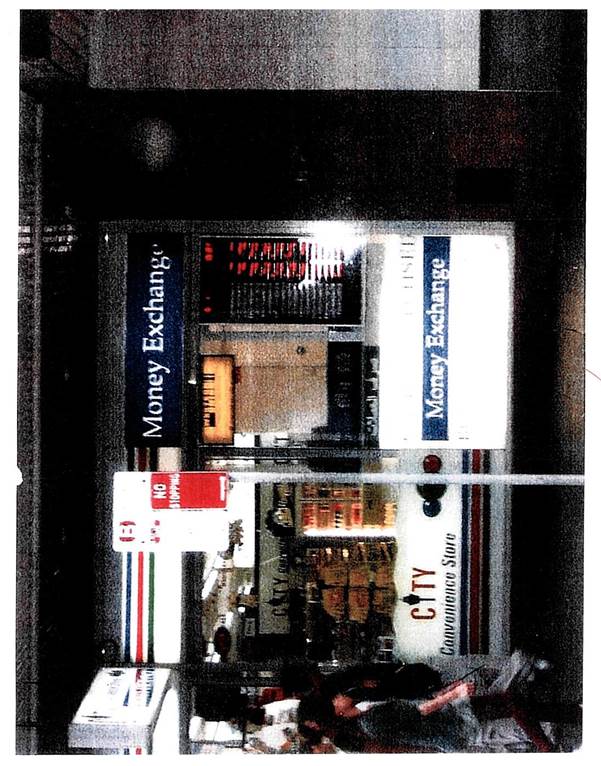
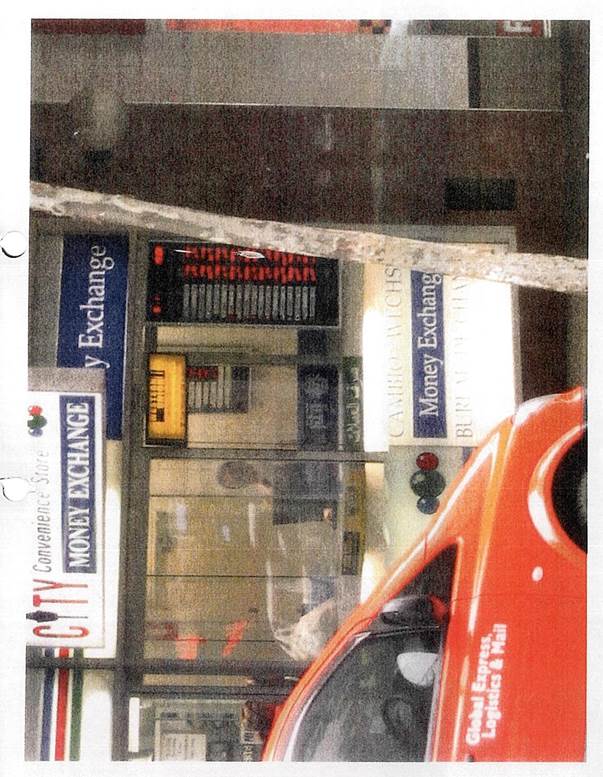
He was then asked a series of questions, his answers to which illustrate the departure of the external signage of CEM’s unit at 636 George Street, Sydney in its early days from the pleaded Get-up (T264/44–T267/18).
102 Ultimately, it was put to him (T267/20):
I want to suggest to you that you didn’t form the view in 2005 that there was any relevant similarity – I withdraw that. In late-2005, I want to suggest to you, you didn’t genuinely believe that the City Exchange Mart unit at 636 George Street had taken, or ripped off the Change Group get-up, did you?---I would say that I strongly believed they were using the elements of our signage - - -
Which element – sorry, I didn’t mean to interrupt you?--- - - - blue signage, the white lettering.
103 Like Mr Smith before him in relation to his confusion over CEM’s unit at 55 Swanston Street, Melbourne – that it was a CGA unit, the only elements of the pleaded Get-up which Mr Bailey could identify in the photograph of CEM’s first unit at 636 George Street, Sydney, as being similar were the blue signage and the white lettering, and even the latter, he conceded, was different because of the absence of capitalised letters or upper case for words such as “MONEY EXCHANGE” (T265/22–24; T266/2–4; T267/34–35). Photographs of CGA’s retail units at 115 and 222 Pitt Street, which were two of the six non-airport retail units operating in Sydney at the time, appear below:
115 Pitt Street, Sydney
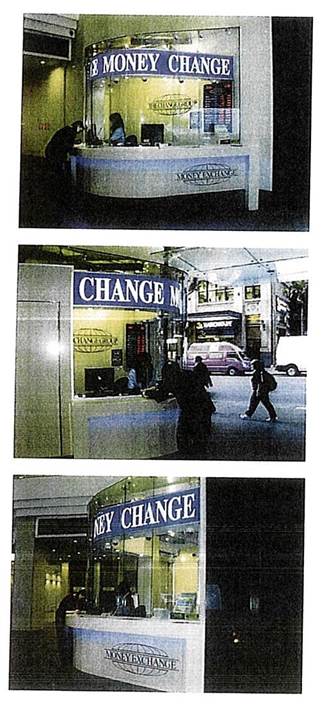
222 Pitt Street, Sydney

104 At [82] of Ex 24, Mr Bailey deposed:
CEM’s second unit to commence operation was located at 244 Pitt Street, Sydney. It is approximately 50 metres from the CGA unit at 220 [sic] Pitt Street, Sydney. Although CEM’s solicitor indicated in a letter to ClarkeKann Lawyers dated 2 August 2010 that the retail unit at [sic] commenced operation in February 2006, it would appear from my review of the transaction listings supplied by CEM that it commenced operation at an earlier time, probably around 3 January 2006. At Annexure CB-26 are a number of CEM’s daily transaction listings for 636 George Street in January 2006 which make reference to money being placed into and being withdrawn from a retail unit identified as 244 Pitt Street. I have highlighted the relevant entries in yellow. I have reviewed records relating to gross profit of CGA (when I prepare budgets for CGA retail units, I do so solely on the basis of gross profits), which indicate that in the 12 month period ending December 2005 CGA at 220 [sic] Pitt Street performed 30% above its forecast budget gross profit for that year of $317,561.00. However, following the commencement of operation of the CEM retail unit at 244 Pitt Street in January 2006, CGA at 220 [sic] Pitt Street performed approximately 21% below its budget of $422,000.00. This is a reduction in gross profit of $62,889.00 year on year. I will hereinafter refer to these reductions in the next paragraph as “a turnaround”. At Annexure CB-27 is an explanation cover page prepared by me together with extracts of relevant financial records.
105 In cross-examination (T268/9–30), it was put to him that, as he knew the CEM unit at 244 Pitt Street, Sydney had closed in 2009, and the 222 Pitt Street, Sydney CGA unit was still operating, in order to be able to make good his point that the CEM unit had an impact on the profit of The Change Group unit, it would have been a good idea to have a look at what happened to The Change Group’s unit’s performance after the CEM unit closed. Mr Bailey agreed but could not explain why he did not do so.
106 Mr Bailey was then taken to [83] of Ex 24, in particular [83(e)] and [83(f)], where he deposed:
83. I have further reviewed CGA’s turnover records for those sites where CEM has opened a retail unit in close proximity to a CGA unit:
…
(e) CGA 121Q (121 Queen Street, Brisbane) and CEM (141 Queen Street, Brisbane) which are approximately 50 metres apart
In the 12 month period ending December 2010 CGA 121Q performed 22% above its budget of $595,028.00. Following the opening of CEM 141 Queen Street in October 2010, in the 12 month period ending December 2011 CGA 121Q performed 39% below its budget of $741,357.00. This a turnaround of $273,484.00. Annexed at CB-32 is an explanation cover page prepared by me together with extracts of relevant financial records.
(f) CGA 136Q (136 Queen Street, Brisbane) and CEM (141 Queen Street, Brisbane) which are approximately 50 metres apart
In the 12 month period ending December 2010 CGA 136Q performed 22% above its budget of $563,813.00. Following the opening of CEM 141 Queen Street in October 2010, in the 12 month period ending December 2011 CGA 136Q performed 42% below its budget of $745,474.00. This is a turnaround of $256,595.00. Annexed at CB-33 is an explanation cover page prepared by me together with extracts of relevant financial records.
107 Mr Bailey was shown and identified photographs of CGA’s premises at 121 and 136 Queen Street, Brisbane and a photograph of CEM’s premises at 141 Queen Street, Brisbane. It was put to him, and he agreed, that assuming his figures representing the decline in profitability of the CGA Queen Street, Brisbane units are accurate, the decline was not caused by any similarity in appearance between CEM’s unit at 141 Queen Street, Brisbane and the CGA Queen Street, Brisbane units (T269/35–39; T270/4–7). He agreed that the decline in profitability must have been caused by something other than the alleged similarity between the get-ups (T269/41–43). He further agreed that the reason he undertook the analysis in [83(e)] and [83(f)] of Ex 24 was because the three units are located in close proximity to one another (T270/10–13); that he thought it was logical to use 141 Queen Street, Brisbane as the comparator (T270/15–16). When asked whether he had considered or analysed any other elements or considerations responsible for the decline in revenue, he said he had not (T270/18–22). He would not agree that it was because the CEM Unit at 141 Queen Street, Brisbane had offered better rates and attracted more customers, but agreed he did not know why the CGA Queen Street, Brisbane units suffered the decline in profitability (T270/25–33).
108 Mr Bailey was then taken to [25(d)] of Ex 26 where he deposed:
Part of the philosophy of CGI/CGA is to use all available external space for signage to provide descriptive words of the services that are provided by the retail unit. Accordingly, as all of the stores are relatively small, the available space for signage is usually not extensive. Therefore if there is vertical space available, which would not allow for horizontal use of words in large type face, words in a vertical manner are used to fill up the space. One of the distinguishing features of the CGA units is that the name of the business (The Change Group) is not predominantly displayed on the external facia of the retail unit. Apart from CEM which similarly does not display its brand name on the external facia signage of its retail units, nearly all other competitors do. The only exception I am aware of to this is recently CEM added the name City Exchange Mart to an external facia pillar outside of its retail unit at 141 Queen Street, Brisbane. A recent photograph of this unit that I caused to be taken on 15 June 2012 is at Annexure CB-121. This is the same unit which is the subject of the photograph at IS-27. The name “City Exchange Mart” does not appear on the left hand column in the photograph at IS-27.
109 He was then asked some questions about the CEM unit at 217 George Street, Brisbane. At T271/7–21 the transcript reads:
Do you recall going up and having a look at this CEM unit at any time?---Yes, I’ve seen it many times.
You know, don’t you, that on the back wall behind where the cashier sits are the words in upper case writing, “City Exchange Mart”, don’t you?---Yes.
And in your experience any customer who was considering conducting a transaction at that unit would generally, at some point before the transaction is completed anyway, look to and engage – look at and engage with the cashier, that's right isn’t it?---They would have to, yes.
Pretty unlikely in your experience of running businesses of this sort that they wouldn’t notice what’s written on the back wall, isn’t it?---No, I wouldn’t say that’s likely, customers primarily are focused on the rates and the money that’s in their purse. I don’t – I don’t know if they would necessarily see the logo on the back wall.
110 It was put to Mr Bailey, and he agreed, that in his experience the customer market is generally both fee driven and rate driven (T271/23–24). He said (T271/27–31):
[C]ustomers can be broken into many groups, people who are not particularly concerned with rates or fees – they just want to do the transaction, there’s a group of people who are generally focused on fees and there’s a group of people who are generally focused on the rates, so it’s a mix of everybody.
Mr Bailey said he could not say that locals as opposed to foreigners were more focused on the fees and rates; nor that foreign tourists were generally not so focused on the fees or rates.
111 Mr Bailey was then asked some questions about customers’ attention to rate boards when they come into a unit as well as the signage on the back wall and underneath panelling of CGA units. The transcript reads (T271/44–T272/30):
Sorry. If I’ve missed that in your evidence, tell me, please. I thought you told his Honour that you would expect that when a customer walked into this unit, they would generally be interested in the rates?---Yes. Yes.
And so that interest would manifest itself in them looking at the rate board; is that right?---Yes.
You know, don’t you, that this rate board in this unit has at all times had up the top the words “City Exchange Mart”, don’t you?---I couldn’t tell you if it was there from the date opened, no, but I have seen that text there, yes.
In terms of the impact of anything that’s on the back wall behind the cashier in an outlet of this style, it’s right to say that The Change Group in its approach is very particular about having, in almost all cases in Australia at least, its globe in the equivalent position; that’s right, isn’t it?---Yes, its corporate logo, yes.
And when you say “its corporate logo”, that globe usually, if not invariably, has running through it the words “The Change Group”; correct?---On the back wall, yes.
On the back wall. The area underneath the glass, the panelling underneath that glass, will usually have the globe and the words “Money Exchange” running through it; correct?---Yes.
Sometimes it will have the globe and “The Change Group” running through it, but that’s rare?---Very rare. I can’t think of any examples of that.
In fact, it’s a breach of the company policy in relation to external signage to have the corporate logo in that position, isn’t it?---I wouldn’t say it’s a breach of the company policy, but like I said, I can’t think of any examples where it is.
But there’s not an instance you can think of, I suggest to you, of The Change Group unit in Australia not having the globe at least in that area underneath the glass panelling; correct?---None that I can think of right now, apart from two Darwin sites and 569 George Street.
112 Mr Bailey confirmed that it was very uncommon for any Change Group site to have on a pillar the words “Bureau de Change” (T272/35–37). He also confirmed that The Change Group has not entered into franchise agreements in his experience with other competitors (T279/10–12). He also confirmed that the CGA unit at 452 George Street, Sydney was the only unit in Australia that displayed Western Union signs as part of its external signage (T279/45–T280/9).
113 Finally, Mr Bailey accepted that in [21] of Ex 25 that his variance calculation for the 2010 financial year of $48,641 is out of character with the variances he calculated for financial years 2006–2009 inclusive, all being within a four figure range (T280/16–41).
The Branding Experts
114 That such opinion evidence is admissible in a proceeding such as this, where allegations of passing off and misleading and deceptive conduct in contravention of the TP Act are made, is not in doubt: Cadbury Schweppes Pty Ltd v Darrell Lea Chocolate Shops Pty Ltd (2007) 159 FCR 397 at [54]. The fact that the opinion is a matter of common knowledge is no longer a bar to its admissibility: s 80 of the Evidence Act 1995 (Cth).
115 On the other hand, the weight to be attached to such evidence is another matter. As was said by way of observation, albeit obiter, by Branson J in Cat Media Pty Ltd v Opti-Healthcare Pty Ltd [2003] FCA 133 at [55]:
… It seems to me that evidence of opinions based on market research and expert appreciation of consumer behaviour will rarely be of assistance in litigation where the Court’s primary concern is with the behaviour to be expected of, and the judgments likely to be made by, ordinary (even if it might be thought, somewhat credulous) members of the community intent on making a relatively modest purchase in a conventional way. I endorse the comment of Beaumont J in Pacific Publications Pty Ltd v IPC Media Pty Ltd [2003] FCA 104 [(2003) 57 IPR 28] at [92] that where a claim is essentially a matter for the Court’s impression, expert views which are merely “impressionistic” can be given no more than nominal weight …
116 In Domain Names Australia Pty Ltd v au Domain Administration Ltd (2004) 139 FCR 215 at [21], a Full Court of this Court cited the above passage with approval and continued (at [22]–[23]):
[22] Consideration of these difficulties shows the practical wisdom of the firm rule that the likelihood of conduct being misleading or deceptive is a question for the tribunal of fact and not for any witness to decide: General Electric Co (USA) v General Electric Co Ltd [1972] 1 WLR 729 at 738 per Lord Diplock, applied in a s 52 context by Gummow J, with whom Black CJ and Lockhart J agreed, in Interlego AG v Croner Trader Pty Ltd (1992) 39 FCR 348 at 387.
[23] Lord Diplock points out in General Electric that a different rule applies in the case of sales not to the general public but in specialised markets concerning persons engaged in a particular trade. In the present case the relevant market is that in which the consumers are business users of domain names. Such users constitute large sections of the public and are not participants in a specialised market in the sense discussed by Lord Diplock.
117 In Interlego AG v Croner Trader Pty Limited (1992) 39 FCR 348 at 387–388, Gummow J also said:
The issue of whether consumers have been or are likely to be deceived was described by Lord Diplock as a “jury question”: General Electric Co (USA) v General Electric Co Ltd [1972] 1 WLR 729; [1972] 2 All ER 507. His Lordship said (at 738; 515):
“[W]here goods are sold to the general public for consumption or domestic use, the question whether such buyers would be likely to be deceived or confused by the use of the trademark is a “jury question”. By that I mean that if the issue had now, as formerly, to be tried by a jury, who as members of the general public would themselves be potential buyers of the goods, they would be required not only to consider any evidence of other members of the public which had been adduced but also to use their own common sense and to consider whether they would themselves be likely to be deceived or confused.
The question does not cease to be a ‘jury question’ when the issue is tried by a judge alone or on appeal by a plurality of judges. The judge’s approach to the question should be the same as that of a jury. He, too, would be a potential buyer of the goods. He should, of course, be alert to the danger of allowing his own idiosyncratic knowledge or temperament to influence his decision, but the whole of his training in the practice of the law should have accustomed him to this, and this should provide the safety which in the case of a jury is provided by their number. That in issues of this kind judges are entitled to give effect to their own opinions as to the likelihood of deception or confusion and, in doing so, are not confined to the evidence of witnesses called at the trial is well established by the decisions of this House itself.”
118 The respondents relied on the opinion of Mr Putignano (Exs A and B), who was not cross-examined, and the applicants relied on the opinion of Mr Vassallo (Ex 15), who was cross-examined. Mr Vassallo’s report annexed “JV-3” to Ex 15 was in response to Mr Putignano’s report (Ex A) and annexure “EP-1” to Ex B was Mr Putignano’s report in reply.
119 I prefer the opinions of Mr Putignano to those of Mr Vassallo. The sources of my preference are to be found in a number of the difficulties I will identify with Mr Vassallo’s opinions later in this section.
Mr Putignano
120 In Section F of Ex A, Mr Putignano summarises his opinion under five headings:
F.1. Material considerations for customers of foreign money exchangers
33. This Section F.1. deals with the question: ‘What are the material considerations for actual or potential customers of foreign money exchange and funds transfer services in Australia?’
34. My observations of City Exchange Mart, The Change Group and other direct competitors listed in paragraph 31(c) reveal that generally foreign money exchangers operate a ‘traditional’ retail services model, with little innovation in terms of external signage, in-store design and layout, digital interaction, segmentation of products or investment in customer retention programs. Overall, with the exception of well-known international and national brands such as American Express, Travelex and Flight Centre, it can be said that operators tend to share a rudimentary and highly generic approach to branding.
35. Based on this, I am of the opinion that the brand identity systems (that is, the key visual elements of the brand) of City Exchange Mart, The Change Group and other direct competitors that have been deliberately emphasised by them are as follows, and in no particular order:
a. The name;
b. The logo (if any);
c. The colours of the external signage;
d. The typography of the external signage;
e. The use of functional descriptors (e.g. 'money exchange'); and
f. The booth layout.
36. These are the elements that are likely to have the greatest impact on the consumer behaviour of potential or actual customers. I conclude that these elements represent the material considerations that are likely to attract and engage customers of foreign money exchange services.
37. In relation to the first and second brand identity element, foreign money exchange brands like City Exchange Mart, UEX and The Change Group do not place an emphasis on the name or logo, whereas brands like American Express, Travelex, Nationwide Foreign Exchange and Travel Money Oz do so to a significantly larger extent.
38. In relation to the third brand identity element, there are several foreign money exchangers that use blue, including City Exchange Mart, The Change Group, UEX and American Express (as well as many financial institutions). Even though the exact shades of blue are not identical, the common use of blue makes this colour quite a generic choice in the sector.
39. In relation to the fourth brand identity element, brands like American Express and Travelex use a typeface that has more personality and is more distinctive than brands like City Exchange Mart, The Change Group and UEX which use typefaces that are considered very common and carry little personality – Times New Roman and Helvetica.
40. In relation to the fifth brand identity element, with the exception of Flight Centre, almost all foreign money exchangers I observed used the words ‘money exchange’ or ‘foreign exchange’. Again, the use of these purely descriptive words makes this brand identity element largely undifferentiated.
41. Therefore, whilst these five brand identity elements present the biggest opportunity to attract and engage customers, its generic and undifferentiated implementation by some brands restricts their brands from standing out.
42. In relation to the sixth brand identity element – the booth layout – there are two broad types: integrated within another store versus standalone. City Exchange Mart and UEX, for instance, are integrated into convenience stores and internet cafes, whereas The Change Group, Nationwide Foreign Exchange and American Express present standalone booths in their own retail store.
43. Other elements such as the typeface, booth design (e.g. ‘bull nose’), orientation of signs, exchange rate board design (e.g. LEDs) and internal lighting appear to be secondary elements of their identity systems. This is because they are even more generic and generally made secondary from a visual point of view so as to not significantly impact consumer behaviour. As such, I conclude that these considerations are less important in attracting and engaging customers.
F.2. The Change Group is a generic brand and it is unlikely to have any brand reputation or goodwill
44. This Section F.2. deals with the question: ‘Does The Change Group enjoy a reputation or goodwill in relation to foreign money exchange and funds transfer services in Australia under the name ‘The Change Group Australia?’
45. My answer to this question is ‘no it does not’ and my reasoning is set out below.
46. From my assessment of the brand identity system described in The Change Group’s affidavits and my observations of some of their stores, I am of the opinion that The Change Group brand lacks distinctiveness for the following reasons:
a. Almost all the key elements of its stores’ look and feel (external signage, colour palette, typeface, key descriptors, booth design and in-store environment) are generic, undifferentiated from the category, and not exclusive to the brand;
b. The only really distinctive element and greatest opportunity for differentiation – The Change Group’s corporate logo – is not significantly and consistently leveraged in the branding and signage, and therefore has little weight in the overall identity system; and
c. The Change Group’s marketing strategy relies more on store locations and pricing than sophisticated branding levers, so it explains The Change Group’s reluctance to emphasise the corporate identity and its generic approach to the external signage.
47. In my opinion, The Change Group’s brand is quite generic and is likely to have little equity in any differentiating or compelling characteristic that would allow itself to stand out or command brand loyalty in the mind of a potential customer.
48. Consequently, I believe The Change Group brand has little reputation or goodwill in relation to the provision of foreign money exchange services.
F.3. The City Exchange Mart is a wholly generic brand and it is also unlikely to have any brand reputation or goodwill
49. This Section F.3. deals with the question: ‘Is the get up used by City Exchange Mart at its outlets likely to lead actual or potential customers into believing that there is some connection or association between City Exchange Mart and The Change Group?’
50. My answer to this question is ‘no, it is not likely’ and my reasoning is set out below.
51. City Exchange Mart is even more generic than The Change Group and borders on being a ‘no-brand’ for the following reasons:
a. It uses very generic and undifferentiated elements as part of its identity system;
b. It shares the same white text on a blue background used by other brands in the money exchange sector and, more broadly, the financial service industry; and
c. It has a haphazard, ad hoc implementation of the elements of its identity system.
52. The generic approach taken by City Exchange Mart is further emphasised by adopting a particular booth layout approach:
a. In almost all cases, the City Exchange Mart offering is physically and visually integrated with the convenience store it shares a tenancy with; and
b. The convenience store brand takes the lead role in the eyes of potential customers and the (generic) foreign money exchange store is positioned as part of the multi-service offering of the convenience store (e.g. like the internet cafe, dry cleaning or ATM services).
53. In addition to the above, City Exchange Mart’s booths display other brands and messages like ‘WESTERN UNION’, ‘Suncorp Bank’ and other descriptors (‘INDIAN’ and ‘PAKISTANI’ currency signs). City Exchange Mart employees do not wear uniforms (unlike The Change Group employees). The end-result of these factors pushes the City Exchange Mart brand to the background and reinforces the haphazard, ad hoc and generic nature of its offering.
54. Looking at all these factors as whole, it appears that City Exchange Mart is even more generic than The Change Group and it borders on being a ‘no-brand’. Its identity system has no ‘ownable’ characteristics that is differentiated or that would emotionally engage consumers of foreign money exchange services. Its appeal to customers seems to entirely rely on location and pricing rather than any deeper, emotional attributes associated to its brand.
55. Consequently, the City Exchange Mart brand is likely to have very low levels of brand equity, and thus, brand reputation and goodwill in relation to foreign money exchange services.
F.4. A generic brand cannot pass-off for another generic brand
56. This Section F.4. deals with the question: ‘Is the identity of the service provider of foreign money exchange and funds transfer services in Australia a material consideration for actual or potential customers?’
57. My answer to this question is ‘yes, the identity is a material consideration unless it is a generic brand’ and my reasoning is set out below.
58. The Change Group and City Exchange Mart brands are both generic; the same reason why they do not stand out amongst the cluttered city streets is the same reason why they do not have any significance in the consumer’s mind.
59. At first blush, it may appear that these two brands are so generic that it may be entirely possible for customers to confuse the two. However, from a brand point of view, this ‘confusion’ does not result in anything meaningful.
60. This is because generic brands carry little, if any, brand equity. And this is a category with lots of generic brands. Generic brands have very little impact or influence on consumer preference and behaviour .
61. So, no matter how much ‘blandness’ these brands have in common with each other, they do not have the ability to occupy a space in the consumer’s mind or push another brand out of that space. This argument would be different for strong brands: strong brands that are similar compete for the same space in a consumer’s mind.
62. I am of the opinion that a consumer is just as likely to go into a City Exchange Mart store as a The Change Group store, or any other generic competitor store for that matter. From a brand point of view, brands that play the generic game cannot claim the protection of passing-off.
F.5 City Exchange Mart is fully transparent about is [sic] own identity when a customer decides whether to embark on a transaction
63. Notwithstanding the fact that these two brands are generic, my observations of the City Exchange Mart stores reveal that the organisation is in fact quite open and transparent about its identity.
64. This occurs at the main point of interaction, namely at the booths where the customer can see the foreign exchange rate board and the rear wall of the booth. At that point, the exchange rate board is in my opinion the single most important information that impacts a customers’ decision to embark on the transaction.
65. The display of ‘CITY EXCHANGE MART’ clearly at the top of all the foreign exchange rate boards and, in some cases, on the back wall of the booths, reveals the organisation’s identity to the customer.
66. For these reasons, I believe that City Exchange Mart is not hiding its identity or leading customers to conclude that it is a The Change Group store. If anything, I believe the effect of the visual identity system is to:
a. At the external interface, remain generic and leverage the convenience store’s convenient location to attract customers; and
b. At the internal interface, when the customer is choosing to transact or not, they are openly displaying their identity at the key customer touch point.
67. Taken together, it is my opinion that a potential customer is not likely to be led into believing that there is some connection or association between City Exchange Mart and The Change Group.
Mr Vassallo
121 Mr Vassallo’s opinions are summarised in Sections H1 to H5 of JV-3 which correspond as far as possible with the questions Mr Putignano addresses in each of sections F1 to F5 of Ex A.
122 There are, in my view, two threshold difficulties with Mr Vassallo’s report. First, after setting out at [33] of his report the visual identity elements of the pleaded Get-up, Mr Vassallo sets out at [34] what he says are “other visual identity elements of the brand”, some of which he identifies – internal lighting, staff uniforms, etc., – and some of which he does not. Insofar as Mr Vassallo expresses opinions later in his report, such as at H2, namely, that CGA is not a “generic brand” and enjoys brand equity and reputation in relation to foreign currency exchange services in Australia under a distinctive get-up, based on, inter alia, these “other visual identity elements of the brand”, it is not of great assistance to the Court in resolving the important issue of whether the applicants had a reputation in the pleaded Get-up in Australia, in particular in Sydney and Melbourne, as at 1 July 2005, when CEM opened its first retail unit at 636 George Street, Sydney.
123 The second threshold difficulty is Mr Vassallo’s concept of “stakeholder” in [38] of his report. That paragraph relevantly reads:
Notwithstanding that CGA’s reputation is of primary importance to the market of consumers of foreign currency exchange services, it is also relevant from a brand identity perspective to other interested parties such as employees and landlords.
That may be correct, but CGA’s brand identity perspective to employees and landlords is totally irrelevant to this proceeding. To the extent that Mr Vassallo’s opinions are conditioned by reference to the perspectives of those other interested parties, it is unsurprising that he parts company in a number of respects with Mr Putignano. Moreover, such opinions are of little assistance to the Court.
124 Section H-1 of Mr Vassallo’s report exhibits a difficultly similar to the first threshold difficulty referred to in [122] above. At [53] he relevantly writes:
In my opinion, Mr Putignano has correctly identified the importance of the visual identity of the brand but has omitted other important considerations (i.e. service quality, exchange rate and commission structure, as well as store location)…
He does the same at [55] and [56]. The difficulty, however, is that none of these “other important considerations” are elements of the pleaded Get-up. One of the most important issues that the Court is required to resolve in this case is whether the applicants have a reputation in the pleaded Get-up in Australia or, put another way, whether the pleaded Get-up has acquired a secondary meaning distinctive of the applicants’ business of providing foreign currency exchange services in Australia. The Court’s task in that regard is not assisted by a theoretical analysis, however sound the premises and reasoning upon which it is formulated, of what elements contribute to a distinctive brand in the abstract.
125 I have already expressed my difficulty with the premises upon which Mr Vassallo relies for his opinion at section H-2 of his report that CGA’s get-up (assuming he means by that the pleaded Get-up) is not a “generic brand” and that CGA enjoys brand equity and reputation in relation to foreign currency exchange services in Australia under that get-up.
126 This is exemplified at [68] of his report where Mr Vassallo refers to four core reasons for his opinion:
(a) CGA has a brand personality – referring to trustworthiness, security, quality and respectability, professionalism, bright lighting, uniformed staff, communication of quality certification achievements and rigorous maintenance of high standards.
(b) CGA maintains high product quality – that CGA has been built using a strong, focused and deliberate marketing orientation with stringent quality control.
(c) CGA does not adopt a generic brand pricing strategy – the positioning of CGA outlets on high streets.
(d) CGA does not adopt a generic brand promotional strategy – CGA has a significant promotion budget, premium positioning on high streets and airports, pursuing and receiving publicly recognised industry awards and accreditation.
127 None of the matters to which he refers under each of the core reasons has anything to do with the pleaded Get-up; if anything, it lends weight to Mr Putignano’s opinion at [47] of his report that The Change Group’s brand is “quite generic”.
128 His concluding paragraph ([86]) under section H-2 reverts to the perspective of “stakeholders”, which includes, of course, interested parties other than consumers of CGA’s services.
129 In section H-3, Mr Vassallo opines at [92], contrary to Mr Putignano in section F-3 of Ex A, that the visual identity elements used by CEM when considered together (on the “visual identity system” or get-up) as they would be by passers-by, would lead people to believe that CEM is associated with CGA’s stores. The matters on which he relies largely reflect the pleaded Get-up, with 1 or 2 being aggregated with another:
(a) Similar blue colour and white text;
(b) similar use of typography;
(c) similar use of words;
(d) similar sign orientation;
(e) the absence of prominent logo; and
(f) the overall look and feel that results.
130 In section H-4, Mr Vassallo at [102] agrees with Mr Putignano’s conclusion contained in section F-4 of his report that the identity of the service provider of foreign money exchange services is a material consideration for actual and potential customers in Australia, and he agrees with Mr Putignano that it is possible for customers to confuse the two brands (but not with Mr Putignano’s qualification that it is because both brands are “so generic” the confusion does not result in “anything meaningful”). He observes that given his conclusion in sections H-2 and H-3 that CGA and CEM are not generic brands, he does not agree that the importance of the identity of the service provider in the circumstances is somehow not germane to consumer behaviour in the way Mr Putignano asserts.
131 Finally, in section H-5, Mr Vassallo at [108] agrees with Mr Putignano that CEM does tend to place its name on its exchange board and sometimes on the back wall of its booths, although disagrees that such placement constitutes “full transparency” about CEM’s identity from either a branding or consumer perspective; especially when the predominant visual elements are so similar to those of CGA.
132 In cross-examination, Mr Vassallo confirmed that his opinions about brand equity and reputation were based on the perspective of stakeholders overall, including landlords and employees, although he conceded that customers and potential customers were the most important or relevant group (T168/27–38).
133 Mr Vassallo was asked to make four assumptions and he was then asked a number of questions based on those four assumptions. I have to say that I found some of his answers to these questions difficult to accept. It seemed to me that he was continually striving to defend the position he maintained in his report that the CGA brand or get-up was not generic and that CGA indeed had brand equity or reputation in the get-up. For example, at T171/21–26 he was asked:
But one of the ways that you test whether a brand has got a reputation is whether the consumers are willing to pay above the market rate to use the particular brand. That’s right, isn’t it?---Not necessarily. It tends to be correct, however there are brands with a massive degree of reputation that take a low price strategy as well, such as – like Aldi supermarkets, for example. So I couldn’t say that reputation is specifically tied up with charging of a higher price.
He was then asked (T171/28–40):
Well, I want to suggest to you that making the assumptions I’ve asked you to make, it’s very likely that the local customer part of the market are just going to go to the place which is within reasonably [sic] proximity to them that has got the lowest price or the best rates. What do you say about that?---I feel that there’s more [at] play than just that. I mean, they want to feel that there was – they’re able to trust the brand of the company that they interact with. They want to feel that it will be a safe and secure transaction, and I feel that CGAs get-up, for example, helps to reinforce these kind of customer needs. I think there would be a spectrum of customers who would care more about low price, so – and then there are others that don’t care so much about that as well.
So is it – sorry?---But a primary price will matter. Price is part of their marketing mix in what they do.
And then a little later he was asked (T172/9–14):
No, I’m asking you for your opinion on whether, if you make the assumption that that part of the market, which is the local part of the market, are motivated by price, whether they’re likely to be influenced by the brand reputation of the [Change Group] in deciding to transact with them? That’s my question?---Yes, I believe that they are definitely influenced by the brand, by the brand equity, by their reputation as embodied in their get-up, for example.
Insofar as his answer suggests a view that a person would walk half way across town to go to a CGA unit to exchange local money into foreign money because of the CGA brand when he could carry out the same transaction closer to his location at the same or a better price, the view defies logic. Not only that, it is totally at odds with The Change Group’s own view of consumer behaviour as manifested in SZ-14.
134 Another example of Mr Vassallo seeking to defend the position he took in his report was in response to the following series of questions (T176/16–27):
Do you agree to the extent that the rate board is in the window of the unit facing the street that that rate board forms part of the visual get-up of the unit?---I don’t think it’s the first thing that consumers really focus on. I think that they – they see the overall get-up, so they see the, you know, the signage and the – sorry – they see the – sorry.
That’s all right?---Yes, sorry, I was just being interrupted. I don’t believe that the get-up – sorry, the rate board forms a primary element to the get-up. I don’t think consumers focus too much on the specific name on the rate board, for instance, I think what they focus on is the overall impression, so you know, the colours used, the look and feel and those elements as a whole, what we call the visual identity system is what matters, and I believe that the rate board was a minor part of that.
A little later he was asked (T176/42–44):
You agree that it’s likely that customers look at the rate board before engaging in the transaction. And if you can’t say, please tell his Honour that?---Well, I think they will look at the exchange rate on the rate board.
A little later he was asked (T178/7–13):
It’s likely that when the customers are at about the verge of entering into the convenience store, that they’re going to see that rate board; do you agree with that?---I think that they would be attracted by the get-up and then they would be confronted predominantly with the staff member. And they – yes, I mean, they will see the rate board there as well, but I believe that it’s the get-up, the overall look and feel from the outside that will draw them in in the first place and the rate board is a secondary consideration.
I cannot accept Mr Vassallo’s view that in a situation where the rate board is in the window of the unit, a customer would enter the unit by reason of the get-up if he was not satisfied with the rate shown on the rate board.
Mr Putignano in Reply
135 Section C of annexure “EP1” to Ex B addresses whether a situation of passing off requires first and foremost a granular analysis of what elements might cause it.
136 Mr Putignano relevantly opines at [10] and [11]:
10. I agree in principle with Mr Vassallo’s holistic interpretation of a brand and its outcome but the analysis should adopt a bottom-up, granular approach through which every relevant element is assessed and compared between CGA and CEM. Failing to so would produce unsubstantiated and ultimately subjective opinions.
11. A granular approach is especially useful in this situation for two reasons:
a. The absence of market research providing a holistic point of view to support the experts’ opinions,
b. The fact that CEM in particular has a highly inconsistent and haphazard approach to its visual identity, and therefore should be assessed on a store-by-store basis before expressing any general opinion.
137 In section E, Mr Putignano opines that store location, service quality and pricing are likely to have impact on consumer behaviour but he does not believe they can be the causes for passing-off.
138 Mr Putignano relevantly opines at [18] and [19]:
18. While my opinion is not anchored in any market research within the currency exchange sector, I agree with Mr Vassallo that store location, pricing, and perhaps to a lesser extent, service are likely to be very important drivers in influencing customer decisions.
19. However, I do not believe that the way they have been adopted by CGA can produce any significant brand differentiation in the customers’ minds and therefore be even hypothetically leveraged for passing-off by someone else, unless someone believes, like Mr Vassallo sometimes seems to (Vallasso [Site Audit]), that CGA has a right to a monopoly on the main streets of Australian cities.
139 Section F opines that The Change Group brand is managed with commitment, consistency and efficiency but that is not enough to be a strong, differentiated brand.
140 Mr Putignano relevantly opines at [24]:
However, the meticulous implementation of manuals and guidelines doesn’t equate to building a strong and distinctive brand, if those guidelines don’t provide original and distinctive design solutions.
141 Section G explains why Mr Putignano is of the opinion that The Change Group brand lacks distinctiveness.
142 Mr Putignano relevantly opines at [39] and [40]:
39. I confirm my opinion that CGA is a brand lacking distinctiveness since almost all the elements of its stores’ look-and-feel are generic, undifferentiated from the category, and not exclusive to the brand.
40. Interestingly the only really distinctive element (and greatest opportunity for differentiation) is the Change Group’s corporate logo, which is however used as a secondary element compared to generic category descriptors, and whose purpose doesn’t seem to be about attracting customers. In fact, in Mr Smith’s affidavit it is explained that “… the signage of the exterior facades of CGA’s retail units is descriptive of the services provided by the business. I am aware from my involvement with CGI that this is a deliberate marketing tool, and it is only upon entering the retail unit that a customer will become aware of the signage on the back wall of the retail unit which names the business owner – ‘The Change Group’” (Smith [23]). Which is to say, that CGA’s name and logo is not meant to leverage any awareness, or reputation or distinctiveness in any overt way, not even in the busy, cluttered main streets of Australian cities.
143 Mr Putignano concludes this section at [48]:
I’ve already stated and provided evidence in point 99 of my 1/6/12 affidavit that white and blue are commonly used in many financial services. Also, capitalized letters are not exclusive to CGA or any other company, nor are general words with a merely descriptive nature.
144 In Section I, Mr Putignano opines that CEM is even more generic than The Change Group.
145 At [61] and [62], Mr Putignano relevantly states:
61. I remain of the opinion that CEM is a highly generic brand, lacking any sort of distinctiveness – it is not trying to copy any other brand, least of all CGA which is also, although to a lesser extent, a brand lacking distinctiveness. In my original report I have extensively explained the rationale behind my opinion. I’d like to recap and elaborate on some key points below.
62. Generally speaking CEM has adopted very generic visual identity solutions: blue and white as its dominant colour combination is very common in financial services and beyond … and its messaging includes generic category descriptors etc.
146 In Section J, Mr Putignano opines that CEM is not a “look alike” brand.
147 In Section K, Mr Putignano opines that if the opening of CEM units has negatively affected The Change Group’s turnover, that does not imply that CEM is passing-off for The Change Group. At [79] and [80], he opines:
79. First of all, the reasons why the CGA stores are underperforming may be related to all sorts of reasons completely independent from whatever CEM does, from external factors (general economic environment, number and spending power of foreign tourists etc.) to factors internal at CGA (pricing strategy, budgeting approach etc.).
80. Secondly, that’s what health and fair competition is all about. Short of claiming a monopoly over the main streets of Australian cities, CGA needs to accept that as more currency exchange options open, their revenue will be increasingly under pressure – whether that competition comes from CEM or from other companies such as generalist bank branches, ATMs or other specialist money exchangers. This is a common pattern that defines how retail works in capitalist economies, typically prompting companies to evolve their modus operandi and making their brands more distinctive to retain their edge.
148 These last-mentioned observations by Mr Putignano are totally consistent with Mr Bailey’s concession in cross-examination at [107] above in relation to the impact of CEM’s premises at 141 Queen Street, Brisbane on CGA’s premises at 121 and 136 Queen Street, Brisbane.
Consideration and Analysis
Passing Off
149 In Reckitt & Colman Products Ltd v Borden Inc [1990] 1 WLR 491, Lord Oliver, in his speech, said (at 499):
[T]his is not a branch of the law in which reference to other cases is of any real assistance except analogically. It has been observed more than once that the questions which arise are, in general, questions of fact … The law of passing off can be summarised in one short general proposition – no man may pass off his goods as those of another. More specifically, it may be expressed in terms of the elements which the plaintiff in such an action has to prove in order to succeed. These are three in number. First, he must establish a goodwill or reputation attached to the goods or services which he supplied in the mind of the purchasing public by association with the identifying ‘get-up’ (whether it consists simply of a brand name or a trade description, or the individual features of labelling or packaging) under which his particular goods or services are offered to the public, such that the get-up is recognised by the public as distinctive specifically of the plaintiff’s goods and services. Secondly, he must demonstrate a misrepresentation by the defendant to the public (whether or not intentional) leading or likely to lead the public to believe that goods or services offered by him are the goods or services of the plaintiff. Whether the public is aware of the plaintiff’s identity as the manufacturer or supplier of the goods or services is immaterial, as long as they are identified with a particular source which is in fact the plaintiff. For example, if the public is accustomed to rely upon a particular brand name in purchasing goods of a particular description, it matters not at all that there is little or no public awareness of the identity of the proprietor of the brand name. Thirdly, he must demonstrate that he suffers or, in a quia timet action, that he is likely to suffer damage by reason of the erroneous belief engendered by the defendant’s misrepresentation that the source of the defendant’s goods or services is the same as the source of those offered by the plaintiff.
150 In ConAgra Inc v McCain Foods (Aust) Pty Ltd (1992) 33 FCR 302, Gummow J, as a member of a Full Court of this Court, referred to what Lord Oliver here said in Reckitt & Colman as formulating “the essential elements in a passing-off action without referring specifically to earlier authority” (at 355) and then observed (at 356):
[T]he law of passing off contains sufficient nooks and crannies to make it difficult to formulate any satisfactory definition in short form. However, “the classical trinity” does serve to emphasise three core concepts in this area of the law. This appeal is concerned with all of them, namely, the geographical requirements for a sufficient reputation, the nature of the interests damaged, and the significance of fraud in the making of the misrepresentation.
The Relevance of Intention
151 Intention is not a necessary ingredient in the cause of passing off or, for that matter, s 52 of the TP Act/s 18 of the ACL, although demonstration of intention to deceive may make it easier to draw an inference that the impugned conduct has been, or in all probability will be, misleading: ConAgra at 344–345 per Lockhart J; Cadbury Schweppes Pty Ltd v Pub Squash Co Pty Ltd [1980] 2 NSWLR 851 at 861B; Campomar Sociedad Limitada v Nike International Limited (2000) 202 CLR 45 at [33].
152 Unsurprisingly in the face of the circumstance that the respondents called no lay evidence, there is no evidence to support a finding that Mr Yasin and Mr Shah intended to misrepresent that CEM or its services were associated or affiliated with the applicants or their services.
153 Indeed, the respondents submitted that the available evidence suggests that there is no such intention. Reference was made to the solicitor for CEM writing to the solicitor for the applicants in September 2011 in the following terms:
The first second and third respondents consider that there is no substance to the allegations made by your clients to the effect that they are attempting to pass themselves off as the applicants.
…
In any event, the first and [sic] third respondents do not wish to associate themselves in anyway with the applicants. Although they do not accept that there is any relevant similarity between the “get up” (as defined in paragraph 13 of the Statement of Claim) of the applicants and the “get up” of the first and [sic] third respondents, in the interests of avoiding unnecessary expense and unrecoverable costs associated with the present proceedings, if your clients agree to discontinue the proceedings with no order as to costs, and release the first and [sic] third respondents in respect of the subject matter of the dispute, then the first to third respondents will change the colour of each of its stores from blue to green by 31 December 2011…
For the avoidance of doubt, we confirm that this is an open letter…”
154 This evidence, the respondents submitted, strongly suggests that CEM, Mr Yasin and Mr Shah did not intend to make any misrepresentation that they are associated with the applicants. The letter shows that after operating their units since July 2005 without complaint, within about four months of proceedings being commenced by the applicants, they were prepared to change the colour of all of their units in order to bring about the conclusion of the litigation. It should be noted that this included the unit at 141 Queen Street, Brisbane, which the applicants now acknowledge looks nothing like the applicants’ units. That letter, it was submitted, is not consistent with CEM, Mr Yasin and Mr Shah intending to make any misrepresentation; it suggests the opposite. In my view, this submission has some traction: see Gummow J in ConAgra at 372 to the affect that fraud in the sense of persistence after notice of the plaintiff’s rights will suffice.
155 A further fact in evidence which, it was submitted, suggests that there was no intention is what occurred at 141 Queen Street, Brisbane: Ex 38 demonstrates that CEM was not at all committed to a particular get-up, and was prepared to change that get-up without any real opposition or difficulty.
156 Against this, the applicants pointed to the failure of Mr Yasin and Mr Shah to give evidence and submitted that they are entitled to a Jones v Dunkel inference on the question of intention.
157 The respondents submitted that this submission should be rejected because it involves a misunderstanding of the principles of Jones v Dunkel (1959) 101 CLR 298 which were relevantly put as follows:
(1) Two inferences pursuant to the rule in Jones v Dunkel can flow from the unexplained failure of a party to call a witness whom that party would be expected to call. One is an inference that the evidence of the absent witness would not assist the case of that party. The other is that the trier of fact may draw an inference unfavourable to that party with greater confidence.
(2) Before a Jones v Dunkel inference can or should be applied, three conditions must be engaged:
(a) The witness not called would be expected to be called by one party – against whom the inference is sought to be drawn;
(b) the witnesses’ evidence would elucidate a particular matter; and
(c) the witnesses’ absence is unexplained.
(3) In the situation of a trial by judge alone, there is no compulsion on a trial judge to draw the inference: Manly Council v Byrne and Anor [2004] NSWCA 123 at [52].
(4) Importantly, as the reasons in Jones v Dunkel make clear, the inferences sought must be available to be drawn on the evidence which has been admitted: at 308 per Kitto J, 312 per Menzies, 320–321 per Windeyer J. The rule cannot “fill gaps [in the evidence] or to convert suspicion into inference”: Jones v Dunkel at 313 per Menzies J. The “strength, or weakness, of the case made out by the evidence actually presented in the case bears on whether inferences should be drawn from other evidence not having been presented”: Manly Council v Byrne at [74] per Campbell JA.
(5) Nor does a Jones v Dunkel inference enable “the trier of fact to infer that the evidence of the absent witness would have been positively adverse to that party”: Australian Securities and Investment Commission v Hellicar [2012] 286 ALR 501 at [232] per Heydon J.
158 The respondents submitted that to the extent Jones v Dunkel might be available to the applicants, the only inference that could be drawn is that the evidence of Mr Yasin and Mr Shah would not have assisted CEM’s case. It would be impermissible to go beyond this to conclude that Mr Yasin and Mr Shah would have given evidence adverse to their case.
159 Finally on this aspect of the evidence, the respondents submitted that Jones v Dunkel does not assist the applicants in this case because the totality of the applicants’ evidence does not enable the Court to draw the inference as to intention that the applicants contend for. Not only does the evidence in the applicants’ case fail to provide a basis on which the Court could draw the relevant inferences against the respondents, it is also clear there are gaps in the applicants’ case in respect of which Jones v Dunkel inferences against the respondents cannot and should not remedy.
160 In my view, the following primary facts are established by the evidence:
(1) Mr Yasin and Mr Shah worked, for nearly four years and two years respectively, in CGA’s retail operations as foreign currency consultants immediately prior to commencing CEM’s operations; and
(2) very shortly after leaving CGA’s employ Mr Yasin and Mr Shah established and commenced to operate CEM’s foreign currency exchange operation from 636 George Street, Sydney.
161 In the absence of Mr Yasin and Mr Shah being called to give evidence, I would infer from the evidence in [160] above that Mr Yasin and Mr Shah deliberately used the blue background with white letters for CEM’s external signage because of their favourable view of the applicants’ get-up and their awareness of the success (to that point in time) of the applicants’ operations in Australia, in particular in Sydney and Melbourne.
162 However, on the evidence in [160] above, I would not be prepared to go further and draw any inference as to Mr Yasin and Mr Shah’s intention in using those signage colours in the way they did. I would not be prepared to make any further inference because deliberate copying does not necessarily indicate an intention to deceive. A notable example is provided by Cadbury Schweppes Pty Ltd v Pub Squash Co Pty Ltd, at 861B-E. As Lockhart J said in ConAgra at 345:
[D]eliberate copying of the plaintiff’s goods does not always evidence an intention to deceive; it may indicate nothing more than realisation that the plaintiff has a useful idea which the defendant can turn to his own advantage, though not intending to pass off his goods as those of the plaintiff.
See, too, Gummow J at 376 and the observation of the High Court in Campomar at [33].
163 Even if I am wrong in my view that the evidence does not enable me, by reason of Mr Yasin and Mr Shah not being called, to infer that they intended, by their use of the signage colours, to pass off CEM’s services as those of the applicants, any finding of such intention will not avail the applicants, in the absence of the applicants establishing that their get-up has a sufficient reputation in Australia, in particular in Sydney and Melbourne, by reason of being recognised by a substantial number of persons as distinctive of the applicants’ foreign currency exchange services. It is to that matter that I now turn.
Reputation
164 In ConAgra, all three members of the Court held that while it was necessary, in order to maintain a passing-off action, for a plaintiff to establish that his goods have a reputation in this country among persons here, whether resident or otherwise, of a sufficient degree to establish that there is a likelihood of deception among consumers and potential consumers and of damage to his reputation, it was not necessary that the plaintiff have a place of business or a business presence in Australia; nor was it necessary that his goods are sold here: Lockhart J at 344; and French J at 376. Gummow J put it in slightly different terms (at 372):
In my view, where the plaintiff, by reason of business operations conducted outside the jurisdiction, has acquired a reputation with a substantial number of persons who would be potential customers were it to commence business within the jurisdiction, the plaintiff has in a real sense a commercial position or advantage which it may turn to account.
165 What their Honours said about acquiring a requisite reputation within the jurisdiction by reason of business operations outside the jurisdiction is not without relevance in the present case because it was not disputed that CGI, since 1994, some six years before CGA opened a retail unit in Sydney, and some 11 years before the impugned conduct of the respondents commenced in Sydney, was carrying on business in Europe through retail units that had a uniform design and branding, the features of which included external signage made up of the elements in the pleaded Get-up (SOC [13]).
166 All three members of the Court in ConAgra were of the view that the primary judge (Hill J) was correct in concluding that the appellant failed to prove the requisite reputation of its “Healthy Choice” product in Australia, namely, among “a substantial number of persons”: Lockhart J at 350; Gummow J at 353; French J at 380. Again, this is not without relevance in the present case, because at the forefront of the respondents’ closing argument is that the applicants have not established that their get-up has a sufficient reputation in Australia, in particular in Sydney, Melbourne and Brisbane, by reason of it being recognised by a substantial number of persons as distinctive of the applicants’ foreign currency exchange services.
167 There is no serious doubt that the relevant date for determining whether a plaintiff has established the requisite reputation for his product or services is the date of commencement of the impugned conduct: Cadbury Schweppes Pty Ltd v Pub Squash Co Pty Ltd at 861G; in the present case, it is 1 July 2005.
Foreign Currency Exchange Transactions and Consumer Behaviour
168 One does not need to be an expert in foreign currency exchange transactions, in branding or in consumer behaviour to understand and conclude that the main force of attraction which leads a person to purchase or sell foreign currency of a particular denomination at one retail unit rather than another is the price (rate) at which it is offered for sale or to purchase and the commission (if any) to be charged on the transaction. This is not to say that the overall look and appearance of the retail unit through which the transaction is to take place may not have some bearing on the decision to transact, but as between two competing retail units of comparable appearance it is the one offering the best price (rate) and charging the least commission that will prevail. Insofar as Mr Vassallo’s evidence suggested to the contrary (see [133] above), I do not accept it. The reason why price (rate) and commission will always prevail over the overall look and appearance of the retail unit through which the transaction is to take place is because the product being bought and sold, short of counterfeit product, is, as between two competing retail units, not only homogeneous but identical in every case. Unlike goods, there is no quality differential, actual or perceived, between the notes being sold or purchased, (or, perhaps more accurately, the rights attaching to such notes – see Travelex Ltd v Commissioner of Taxation (2010) 241 CLR 510 per French CJ and Hayne J at [26]; per Heydon J at [51]) by each competing unit such as to warrant a premium on the one hand or a discount on the other.
169 Moreover, there are other reasons why price (rate) and commission will always prevail over other matters. First, unlike other products, foreign currency is not purchased by an outbound local or sold by an inbound visitor to acquire an end product, but as a means to an end, to acquire a medium of exchange for the acquisition of end products. Quality of the product acquired is therefore not important; only the quantity because the better the price (rate) and the less the commission, the greater the means for the acquisition of end products. Secondly, unlike a transaction involving the purchase of an end product, which takes place because the customer wants to purchase the product and is prepared to do so at the sale price, a transaction involving the sale or purchase of foreign currency takes place not only because the customer wants to sell or purchase the foreign currency, but because he or she perceives, rightly or wrongly, that he needs or has to undertake the transaction; he will be more price conscious because of that perceived need or necessity. So much was conceded by Mr Bailey in cross-examination. To say so is not to concede that, on occasions, some people may not be particularly concerned with rates or fees, because their need or necessity to do the transaction is so urgent, such matters are overtaken by that urgency (see [110] above). But even in those cases, the rate and fee consideration will be relevant, if not critical, to the consummation of the transaction.
170 The matters outlined in [168] and [169] above are intended to do no more than provide a background context in which the issue of reputation has to be considered; they demonstrate that the task of establishing that, as at 1 July 2005, the applicants’ get-up had acquired a sufficient reputation in Australia, in particular in Sydney and Melbourne, by reason of it being recognised by a substantial number of persons as being distinctive of the applicants’ foreign currency exchange services, is difficult, arguably more difficult than in many other get-up cases that have come before the courts.
Applicants’ Submissions on Reputation
171 In their closing written submissions (at [31]), the applicants submitted that the strengthening of the applicants’ reputation after 1 July 2005 may be relevant if the Court were to determine that the impugned conduct commenced not on 1 July 2005 but at some later time in relation to some other retail unit (i.e., other than 636 George Street, Sydney), but that is not the way the applicants’ case was pleaded or argued; and much of the evidence was directed towards the impugned conduct commencing immediately after Mr Yasin and Mr Shah left the employ of CGA and set up CEM’s first retail unit at 636 George Street, Sydney.
172 In Optical 88 Limited v Optical 88 Pty Ltd (No 2) (2010) 275 ALR 526 at [329]–[334], Yates J considered a proposition, said to be based on what Gummow J said in Thai World Import & Export Co Ltd v Shuey Shing Pty Ltd (1989) IPR 289 at 302 and 303, that if a complainant “reinforces” its reputation, such that, between the date of commencement of the impugned conduct and the commencement of proceedings, its reputation is “stronger”, it is entitled to rely on that “stronger” reputation in the proceeding for the purpose of establishing that a contravention has occurred. I agree with what Yates J said in Optical 88 at [333] in rejecting the proposition:
In my view the … proposition cannot be derived (or even discerned) from the proposition discussed by Gummow J in Thai World. If, in the present case, the applicant can establish that, as at the date of commencement of the impugned conduct (August 1993), it had a sufficient reputation to sustain its claim that the first respondent has contravened s 52 of the Trade Practices Act, it does not need to rely on any intervening strengthening of that reputation in the period before the commencement of proceedings, although any strengthening of its reputation may be a matter that is relevant to the question of relief: Nature’s Blend [Pty Ltd v Nestle Australia Ltd (2010) 86 IPR 1] at [13]. If, on the other hand, the applicant cannot establish that, as at the date of commencement of the impugned conduct, it had a sufficient reputation to sustain its claim, I cannot see how any after-acquired reputation can assist it in the face of what would otherwise have been the legitimate commencement and continued conduct of the first respondent’s business.
173 In their closing written submissions at [29] and [32]–[35], the applicants put a number of other propositions in relation to reputation about which there may be no or little argument:
(1) That reputation may reside in get-up as distinct from a trade name has long been recognised by the courts: see e.g., Brock v Terrace Times Pty Ltd (1982) 40 ALR 97; Apand Pty Ltd v Kettel Chip Co Pty Ltd (1994) 52 FCR 474; Parkdale Custom Built Furniture Pty Ltd v Puxu Pty Ltd (1982) 149 CLR 191; R & C Products Pty Ltd (t/a Samuel Taylor) v Sterling Winthrop Pty Ltd (1993) 27 IPR 223; Sterling Winthrop Pty Ltd v R & C Products Pty Ltd (1994) ATPR 41-308; and W D & H O Wills v Philip Morris (1997) 39 IPR 356. The tort protects such things as visual images that become part of the goodwill of the product: Cadbury Schweppes Pty Ltd v The Pub Squash Co Ltd at 858B.
(2) The extent or scope of reputation required is that there be a substantial number of persons who are aware of the plaintiff’s product or service: ConAgra, ibid. The size and extent of the class may vary according to the circumstances of the case: ConAgra at 346 per Lockhart.
(3) It is not necessary for a plaintiff to establish an exclusive reputation in relation to the use of a particular colour, both in passing off and under the TP Act/ACL, trade indicia other than names and logos can become associated with a particular user so that use by another trader can give rise to misleading or deceptive conduct or passing off: Cadbury Schweppes Pty Ltd v Darrell Lea Chocolate Shops Pty Ltd at [97].
(4) Nor is it necessary for a plaintiff in a get-up case to prove that the relevant persons who are likely to be misled can identify or know the name of the trading source, that is, the plaintiff’s actual identity. To show distinctiveness of a product a plaintiff need only show that by reason of get-up or appearance of the product or service consumers regard it as having one source: Powell v Birmingham Vinegar Brewery Co Ltd (1896) 13 RPC 235 applied in Hoath v Connect Internet Services Pty Ltd (2006) 229 ALR 566.
(5) Reputation within the jurisdiction may be proved by a variety of means including, as Lockhart J observed in ConAgra at 343 “by showing constant travel of people between other countries and the forum, and that people within the forum (whether residents there or persons simply visiting there from other countries) are exposed to the goods of the overseas owner”.
174 In support of the applicants’ claim that, as at 1 July 2005, their foreign currency exchange services in Australia, in particular in Sydney and Melbourne, had acquired a sufficient reputation by reason of their get-up being recognised by a substantial number of the public as being distinctive of those services, the applicants relied on the following strands of evidence:
(1) The Change Group’s trading and promotional activities overseas;
(2) “advertising”, by way of expenditure on retail unit locations, in Australia;
(3) turnover and sales figures for the Australian market;
(4) travel patterns in the industry serviced by The Change Group – inbound and outbound travellers; and
(5) expert branding evidence.
175 Reference was made to The Change Group’s number of retail units; annual rents, as de facto advertising; annual sales turnover; and number of employees, both internationally and in Australia. Reference was also made to passenger traffic numbers through airports, both internationally and through Sydney Airport.
176 Reference was made to The Change Group being a market leader, including in Australia, by reference to various indicia such as sales turnover recognised in publicly available industry reports; its placing amongst top foreign currency providers for the ten years in the countries in which it operates; numbers of retail units, and its receipt of corporate awards in recognition of its international performance.
177 It was submitted that The Change Group’s expansive geographical footprint aids familiarity and exposure with its services among local residents and overseas visitors, a matter recognised by the respondents’ own brand expert, Mr Putignano.
178 It was pointed out that The Change Group’s promotional strategy has always revolved around the location of the retail units and the presentation of them as smart and uniform (including their external signage) thereby projecting an image of professionalism, good service and security associated with the business. Some 11 indicia were referred to in support of this, but only one referred to the applicants’ get-up in the context of it being featured in promotional materials, although there was no evidence of what these materials were, apart from those used in tenders and negotiations with prospective landlords, including airports.
179 It was said that a customer has an association with the applicants’ get-up through the quality of the service provided at CGA retail units, but no evidence in support of this association was called from any customer.
180 Reference was also made to the “rigorous brand and reputation-building efforts of The Change Group’s directors and senior managers” in some six areas.
181 On the shoulders of these matters, the applicants submitted that the applicants’ get-up had established a visual identity in the mind of a substantial number of persons in Australia, in particular Sydney and Melbourne, distinctive of its foreign currency exchange services.
The Respondents’ Submissions on Reputation
182 CEM accepted that it is the totality of the applicants’ get-up that must be assessed. It also accepted that at the relevant times the applicants have adopted a reasonable degree of uniformity in their get-up, in that they use a blue and white colour scheme, white capitalised lettering, uniform font and the capitalised use of the word “MONEY”; although CEM did not accept that the arrangement of words vertically is part of the applicants’ get-up and nor did CEM accept that the applicants’ get-up involves the absence of any prominent corporate logo.
183 CEM noted that it is not part of the applicants’ case that they have acquired reputation or goodwill because of the services they have provided or the way in which those services are provided; nor that any such allegation is within SOC [13(g)].
184 CEM submitted that whether words, descriptive or fancy, constitute the whole of a trader’s get-up or words form part of the elements of a get-up, the fundamental question is whether that get-up has acquired a reputation or secondary meaning signifying the services of the trader employing the get-up. The line of cases that relate to descriptive words emphasise the very same principle, noting the difficulty establishing distinctiveness and reputation with general words. They remain relevant in circumstances where the name is one element among other features of the get-up. Furthermore, while the get-up as a whole must be assessed, the applicants’ own evidence highlights that an important feature of their get-up is the generic words “money” or “money exchange”, which they seek to emphasise over their corporate logo. It is appropriate to examine this distinctive feature of the get-up in informing the analysis of the get-up as a whole.
185 In this regard, reference was made to what Stephen J said in Hornsby Building Information Centre Pty Ltd v Sydney Building Information Centre Ltd (1978) 140 CLR 216 where his Honour pointed out that the name adopted by the Sydney Centre consisted of three descriptive words, prefixed by a word of locality. Having adopted such a name, the Sydney Centre could not claim a monopoly in the descriptive words. His Honour said (at 229–230):
There is a price to be paid for the advantages flowing from the possession of an eloquently descriptive trade name. Because it is descriptive it is equally applicable to any business of a like kind, its very descriptiveness ensures that it is not distinctive of any particular business and hence its application to other like businesses will not ordinarily mislead the public. In cases of passing off, where it is the wrongful appropriation of the reputation of another or that of his goods that is in question, a plaintiff which uses descriptive words in its trade name will find that quite small differences in a competitor’s trade name will render the latter immune from action (Office Cleaning Services Ltd. v. Westminster Window and General Cleaners Ltd [(1946) 63 RPC 39 at 42], per Lord Simonds). As his Lordship said [at 43], the possibility of blunders by members of the public will always be present when names consist of descriptive words– ‘So long as descriptive words are used by two traders as part of their respective trade names, it is possible that some members of the public will be confused whatever the differentiating words may be.’ The risk of confusion must be accepted, to do otherwise is to give to one who appropriates to himself descriptive words an unfair monopoly in those words and might even deter others from pursuing the occupation which the words describe.
…
To allow [s 52] of the Trade Practices Act to be used as an instrument for the creation of any monopoly in descriptive names would be to mock the manifest intent of the legislation. Given that a name is no more than merely descriptive of a particular type of business, its use by others who carry on that same type of business does not deceive or mislead as to the nature of the business described.
186 Reference was also made to what Hill J said in Equity Access Pty Ltd v Westpac Banking Corporation (1989) 16 IPR 431 at 448:
Just as the distinction between descriptive and fancy names is not a distinction of law so too it is wrong to see the distinction in black and white terms. The reality is that there is a continuum with at the extremes purely descriptive names at the one end, completely invented names at the other and in between, names that contain ordinary English words that are in some way or other at least partly descriptive. The further along the continuum towards the fancy name one goes, the easier it will be for a plaintiff to establish that the words used are descriptive of the plaintiff’s business. The closer along the continuum one moves towards a merely descriptive name the more a plaintiff will need to show that the name has obtained a secondary meaning, equating it with the products of the plaintiff (if the name admits of this – a purely descriptive name probably will not) and the easier it will be to see a small difference in names as adequate to avoid confusion.
187 CEM submitted that the question of whether the applicants’ get-up has acquired a reputation or secondary meaning in the market place, distinctive of the applicants’ services is to be asked and answered by reference to the “understanding of consumers”, or likely consumers, of the applicants’ services: Kettle Chip Co Pty Ltd v Apand Pty Ltd (1993) 46 FCR 152 at 156.
188 CEM submitted that the applicants had not established, on the evidence on the balance of probabilities, that in Australia, and more particularly, in Sydney, Melbourne and Brisbane, where they operate in competition with CEM, there is a sufficiently substantial number of persons (ConAgra at 346, 350 per Lockhart J; French J at 377) aware of the applicants’ outlets and for whom those aspects of the pleaded Get-up which the applicants are able to prove has acquired a secondary meaning referrable to the applicants’ services and distinctive of those services.
189 CEM accepted that the applicants had adduced a good deal of evidence from their officers and employees about what those officers and employees believe is the reputation of the applicants’ business in Australia. CEM’s position is that much of that evidence is irrelevant, or of little probative value. The absence of any direct traditional advertising in favour of a more diffuse “advertising” strategy reliant on the applicants’ get-up, does not lend weight to an inference that merely through frequent exposure to the applicants’ get-up on retail outlets located in close proximity to one another in busy main streets in capital cities throughout the world, customers have come to associate the applicants’ get-up with its services.
190 CEM pointed out that the applicants proffered no other evidence, whether in the form of testimony, affidavit or survey evidence, that served to answer the question of whether and to what extent the applicants’ get-up has a secondary meaning among the relevant class of people – namely, consumers of foreign currency exchange services.
191 CEM submitted that there is no logical or sensible basis to assume that the volume of business – measured in respect of the Australian market – led to awareness of the applicants’ get-up and associated knowledge of the applicants’ services in circumstances where the evidence points to other factors as the essential ingredients of the applicants’ business success. CEM further submitted that the volume of business world-wide is an even more remote basis on which to assess the goodwill inherent in the applicants’ get-up and affords no basis to assess the question of whether the applicants’ get-up has established a secondary meaning.
192 CEM submitted that the most reliable evidence of the applicants’ goodwill or reputation in the market place is found in its own statements made prior to this proceeding having commenced, namely, SZ-14 (see [56]–[65] above).
Conclusion on Reputation
193 Without any real hesitation or doubt, I have come to the conclusion that the applicants have not established, as at 1 July 2005 or, if it be relevant, at any time since that date up to the date of commencement of this proceeding, that their get-up has acquired a sufficient reputation in Australia, in particular in Sydney and Melbourne, by reason of it being recognised by a substantial number of persons as being distinctive of the applicants’ foreign currency exchange services.
194 None of the matters relied on by the applicants as establishing that such a reputation has been acquired, those set out at [174]–[180] above, either alone or together, lead to that conclusion. First, some of the matters relied on go to the relevant point in time, namely, 1 July 2005; other matters, at least in temporal terms, are not so confined; while yet others are clearly referring to circumstances of recent origin. Secondly, annual sales turnover figures, annual rents paid, numbers of persons employed and other similar financial data may be reflective of a successful business, but they are not necessarily reflective of a reputation attaching to that business by reason of the pleaded Get-up. Indeed, on the evidence, they are reflective (and this was conceded by both Mr Zackariya (see [53] and [54] above) and Mr Meehan (see [84] above)) of a unique marketing strategy of locating retail units on high (main) streets having high tourist traffic and on a multiple or cluster basis; and that strategy has nothing whatsoever to do with the pleaded Get-up. Thirdly, other matters relied on refer to the association a customer has with the applicants’ get-up; it being asserted that the customer relates the get-up to the quality of the service provided at CGA retail units. See, for example, the matter referred to in [179] above, but no evidence of that kind was called from any customer. I accept that “a lot of water had passed under the bridge” from 1 July 2005 until a decision was taken in the first half of 2011 to bring this proceeding, but that is of the applicants own making. This may have impelled recourse to total reliance on the evidence from directors and senior executives of the applicants, especially those involved in the creation and/or management of the applicants’ global operations and the Australian operations as to what secondary meaning the applicants’ get-up has in the mind of consumers in Australia, but if so, it is of limited assistance and of reduced weight in the light of their obvious lack of independence.
195 There can be no doubt that The Change Group’s business, both internationally since 1992 and in Australia since 2000, has been successful in financial terms, but in my view this has everything to do with the marketing strategies deposed to by Mr Zackariya (and referred to in [53]–[55] above) and by Mr Meehan (and referred to at [84] above) and to those same strategies ventilated at greater length (see [64] above) in SZ-14, CGI’s own document made independently of this case; and has little or nothing to do with the applicants’ get-up having acquired a sufficient reputation in Australia, in particular in Sydney and Melbourne, by reason of it being recognised by a substantial number of persons as distinctive of the applicants’ foreign currency exchange services.
196 Nothing was said by Mr Vassallo which would lead me to doubt this conclusion; on the contrary, a number of matters to which he referred such as the positioning of the applicants’ retail units and his focus on the service component of the applicants’ operations, neither of which is part of the pleaded Get-up, reinforce the conclusion. For the reasons I have already referred to, I prefer the evidence of Mr Putignano, who was not required for cross-examination, to that of Mr Vassallo, but the following matters, in particular, are stand- out aspects of Mr Putignano’s evidence:
(1) The use of the colour blue in the currency exchange industry is a generic choice: Ex A [38];
(2) the applicants use of typefaces that are considered very common and carry little personality: Ex A [39];
(3) the applicants use of common, purely descriptive words in their external get-up which is undifferentiated from its competitors: Ex A [40];
(4) the applicants brand lacks distinctiveness because the key elements of their get-up are generic, undifferentiated and not exclusive; the logo is not significantly and consistently leveraged in the branding and signage; and critically, the applicants’ marketing strategy relies on store locations and pricing: Ex A [46];
(5) Mr Putignano’s conclusion is that the applicants’ brand is generic, is likely to have little equity and that it has little reputational goodwill in relation to the provision of foreign currency exchange services: Ex A [47] and [48];
(6) in Ex B [76], Mr Putignano addresses the factors which are likely to motivate customers of the applicants. He posits two scenarios:
(a) either the customer carefully assesses the alternative options at hand and therefore makes a considered decision fully aware of the brand they are using; or
(b) the customer buys based on value and proximity with little or no interest whatsoever in the brand that they use;
(7) Mr Putignano’s analysis is consistent with the applicants own views about its brand: Ex 1, SZ-14 pp 3, 6.
197 In short, I am of the view that the constituent elements, in the success of the applicants’ businesses, both internationally since 1992 and in Australia from 2000, have been:
(1) Its unique marketing strategies as articulated in the evidence, particularly that of Mr Zackariya and Mr Meehan and in its own document (SZ-14), in particular, the location of its retail units on high (main) streets in capital cities having large volumes of local and tourist traffic; the multiple placement of retail units on the same streets or in close proximity; and the location of retail units at international airports, including relevantly Sydney International Airport, with large numbers of inbound and outbound travellers;
(2) the attractive, neat and clean appearances portrayed by its retail units and the personnel manning those units, through the wearing of uniforms, as articulated in the evidence, particularly that of Dr Marikar referred to at [77]–[79] above, and the quality of service provided or offered through such units both in dealing with customers and pricing policies employed in the course of such dealings, as articulated in the evidence, particularly in SZ-14 at pp 4, 14, 20, 22–23 and 27 (see [64(2)–(6)] above)
and that its pleaded Get-up has no or little part in that constituency. Certainly, the evidence does not establish that, as at 1 July 2005 or, if it be relevant, at any time since that date up to the date of commencement of this proceeding, the applicants’ get-up has acquired a sufficient reputation in Australia, in particular in Sydney and Melbourne, by reason of it being recognised by a substantial number of persons as being distinctive of the applicants’ foreign currency exchange services.
198 It follows that, in my view, the applicants’ case on the tort of passing off fails for want of establishing the first of the three requirements referred to by Lord Oliver in the passage from Reckitt & Colman reproduced in [149] above.
TP Act/ACL Claim
199 In ConAgra, Lockhart J, with whom Gummow J at 375 agreed, said at 353:
In my opinion, the failure of the appellant to establish a reputation in Australia for the purposes of the law of passing off must cause it to fail also in its case of contravention of Pt V of the Trade Practices Act as there is not a sufficiently substantial number of people in Australia aware of the appellant’s product. The cases which have considered the question of the nature and extent of the class or classes of people likely to be misled or deceived for the purposes of Pt V of the Trade Practices Act are not fully reconcilable with each other, though the differences between them are in most instances simply ones of expression. See the summary of some of the cases by Hill J in Equity Access Ply Ltd v Westpac Banking Corp (1989) 16 IPR 431 at 440-442. His Honour concluded (at 488) that the threshold under the Trade Practices Act may well be lower than it is for passing off, but that the appeal failed even by applying this lower threshold.
I do not find it necessary to decide whether there is a difference between the tort of passing off and contraventions of Pt V of the Trade Practices Act in the nature or numeracy of the relevant persons likely to be misled or deceived because I agree with his Honour’s finding that on the facts the appellant failed to pass even the lower threshold.
200 In the same case, French J said at 378, 380–381:
Accepting that business activity within the jurisdiction is not a prerequisite for the success of a claim in passing off and that, with or without evidence of fraud, consumer awareness of the applicant’s product, otherwise known as its reputation, is necessary, it is the question of reputation which is central in this case to both Trade Practices Act claim and the claim in passing off.
It was the claim in passing off which dominated his Honour’s reasons for judgment and this was a reflection of the way in which ConAgra presented its case. But as Deane and Fitzgerald JJ said in Taco Co of Australia Inc v Taco Bell Pty Ltd (1982) 2 TPR 48, the cause of action in passing off may provide no basis for wider or more effective relief than a claim for contravention of s 52. Their Honours were considering a situation in which a primary claim was brought under s 52 and the secondary or associated claim in passing off. The learned trial judge in this case acknowledged that observation but pointed out that in the case before him the passing-off claim was that primarily relied upon. Why that should have been so is not clear. The cause of action based upon s 52 and those provisions of the Trade Practices Act providing for awards of damages and injunctive relief do not involve consideration of the respondent’s mental state nor argument (except for its evidentiary implication) about local business activity. Whether the name and/or get-up of a product is misleading or deceptive in the sense contemplated by s 52 depends in this case upon the issues of reputation and similarity. Deceptive similarity having been found, the question is whether there was a relevant public who, being already aware of the existence and name and/or get-up of the ConAgra product, could be deceived by the McCain product.
…
On the Trade Practices Act claim, his Honour adopted what may be in some circumstances a different test for the extent of ConAgra’s product reputation necessary to show misleading or deceptive conduct on the part of McCain. Provided ConAgra could show on the balance of probabilities that “a not insignificant number” of persons knew of the ConAgra product, then it should be entitled to succeed. His Honour said:
“If the number of persons with the necessary knowledge is insignificant, then a fortiori the conduct complained of will not be able to be characterised as conduct that is misleading or deceptive. Once it passes, however, the threshold of insignificance, then there is much to be said for the view that the conduct in question has become misleading.”
But accepting the possibility that the threshold of requisite reputation under the Act is lower than that required to support a claim in passing off, he did not think that ConAgra had satisfied the onus of showing that the number of persons for whom the name “Healthy Choice” and the package design would have the necessary secondary meaning was other than insignificant.
The nature of the question to be asked about McCain’s conduct for the purposes of s 52, Trade Practices Act is to be borne in mind in considering the correctness of the approach taken by his Honour. The question is one of characterisation of the conduct, not of the reactions of consumers or others to that conduct. So where some express representation is made and that representation is demonstrably false, it is not usually necessary to go beyond that finding in order to conclude that it is misleading or deceptive. The case of an obvious puff might be taken as an exception. Where conduct depends upon context or surrounding circumstances to convey a particular meaning, then those factors must be taken into account but only as a way of characterising the conduct. Where the name and get-up of a product are in issue, the question for the purposes of s 52 is whether they are misleading or deceptive in the circumstances. The fact that some members of the relevant public may be aware of a similar product in another country does not affect the characterisation of the conduct if that number is small. The word “insignificant” was used by his Honour to identify the threshold of public awareness below which such conduct is not misleading for the purposes of the section. That word is normative but not for that reason inappropriate. Attention must be paid to the policy of the relevant provision which, as the heading to Pt V and many of its provisions indicate, is one of consumer protection. If the similarity complained of is commercially irrelevant having regard to the number of people who know of it, then it can be concluded that the use of the name and/or get-up complained of is not misleading or deceptive. That is essentially the kind of evaluation which underpinned his Honour’s finding in this case and on the primary facts that he found I am not persuaded that he erred in his approach.
201 In Cadbury Schweppes Pty Ltd v Darrell Lea Chocolate Shops Pty Ltd a Full Court made certain observations on the overlap between the tort of passing off and causes of action arising under Pt V of the TPA from the perspective of what each required to be established, and at [97]–[99] said:
Both in the context of Pt V of the Trade Practices Act and the common law tort of passing off, trade indicia other than names and logos can become associated with a particular trader, such that a use by another trader could give rise to misleading or deceptive conduct or passing off. If particular branding elements used by a trader have been identified in a special way with that trader in the minds of the members of the public, there may be misleading or deceptive conduct by reason of the appropriation of those particular branding elements by another trader.
There is an overlap between causes of action arising under Pt V of the Trade Practices Act and the common law tort of passing off. However, the causes of action have distinct origins and the purposes and interests that both bodies of law primarily protect are contrasting. Passing off protects a right of property in business or goodwill whereas Pt V is concerned with consumer protection. Part V is not restricted by common law principles relating to passing off and provides wider protection than passing off.
Whether or not there is a requirement for some exclusive reputation as an element in the common law tort of passing off, there is no such requirement in relation to Pt V of the Trade Practices Act. The question is not whether an applicant has shown a sufficient reputation in a particular get-up or name. The question is whether the use of the particular get-up or name by an alleged wrongdoer in relation to his product is likely to mislead or deceive persons familiar with the claimant’s product to believe that the two products are associated, having regard to the state of the knowledge of consumers in Australia of the claimant’s product.
202 Interpolating the issue under the TPA/ACL head of claim in the present case into what the Full Court said in the last sentence of this extract from its reasons: the question is whether the use by CEM of its external signage in relation to its foreign currency exchange services is likely to mislead or deceive persons familiar with the applicants’ foreign currency exchange services to believe that the two services are associated, having regard to the state of knowledge of consumers in Australia, in particular in Sydney and Melbourne, of the applicants’ services.
203 In my view, the interpolated question is to be answered in the negative, for the following reasons:
(1) My conclusion under the tort head of claim that the applicants have not established that, as at 1 July 2005 or, if it be relevant, at any time since that date up to the date of commencement of this proceeding, their get-up has acquired a sufficient reputation in Australia, in particular in Sydney and Melbourne, by reason of it being recognised by a substantial number of persons as distinctive of the applicants’ foreign currency exchange services. It follows that CEM’s external signage, even if I was of the view that such external signage was, as pleaded by the applicants at SOC [24], substantially identical with and deceptively similar to the applicants’ get-up which, for the reasons given below, I am not, would not likely mislead or deceive persons in terms of the question as interpolated.
(2) Second, the applicants bear the onus of proving that “a not insignificant number” of persons in the Australian community, in fact or by inference, have been misled or are likely to be misled by CEM’s external signage into believing that CEM’s retail units are CGA’s units or are associated with the applicants: Hansen Beverage Company v Bickfords (Australia) Pty Ltd (2008) 251 ALR 1 at [46] per Tamberlin J, with whom Siopis J agreed. However, the applicants have not called any evidence at all that so much as one consumer has been misled let alone confused, and this is despite the elapse of time from the date that the impugned conduct commenced until the date this proceeding was commenced which has provided the applicants with ample opportunity to garner such evidence in the course of its foreign currency exchange operations in Australia. While such failure will not necessarily be fatal to such a claim in all cases, in the circumstances of this case, in particular the conclusion on reputation referred to in (1) above, this failure to call any such evidence effectively impedes any conclusion that the onus has been satisfied.
(3) Third, again without any real hesitation, I have come to the conclusion that, contrary to the pleadings at SOC [21] and [24], the external signage used by CEM for its retail units from the date of commencement of the impugned conduct, namely, 1 July 2005 – the same date as for passing off (see Optical 88 at [328] and the cases there referred to) – did not contain all the elements pleaded in SOC [21]; nor was CEM’s external signage substantially identical with and deceptively similar to the pleaded Get-up in SOC [13], as pleaded in SOC [24]. My reasons for coming to these conclusions are as follows:
(a) Photographic evidence – the photographs taken of CEM’s first retail unit at 636 George Street, Sydney in its early days and the photographs taken of CGA’s retail units at 115 and 222 Pitt Street, Sydney, two of the six non-airport retail units operating in Sydney at the time (see [102] and [103] above). From these photographs, the following similarities and differences are discernible:
(i) The use of white on blue signage on which the words “Money Exchange” or “MONEY EXCHANGE” appear is common to both CGA and CEM units. The CGA units use a capitalised (upper case) font for all letters in these words whereas only in the overhead awning signage is that font used in connection with CEM’s unit; otherwise, only the first letters of each word are capitalised (upper case) on CEM’s unit;
(ii) CGA’s global “hamburger” logo, with the words “MONEY EXCHANGE” are clearly visible on the lower external portion of each of its units;
(iii) The Change Group’s corporate logo – the global “hamburger” design with the words “THE CHANGE GROUP” running through – are clearly visible on the internal back wall of the 115 Pitt Street, Sydney unit, and visible on the internal back wall of the 222 Pitt Street, Sydney unit;
(iv) CEM’s unit at 636 George Street, Sydney is cluttered with other signage of different colours, different words, foreign words and signage all clearly visible from an external perspective whereas CGA’s units at 115 and 222 Pitt Street, Sydney are completely free of any other signage or colour;
(v) The CEM unit at 636 George Street, Sydney is clearly an “implant” unit within a convenience store whereas the CGA units at 115 and 222 Pitt Street, Sydney are stand-alone units.
(b) The evidence of Dr Marikar, in particular his evidence referred to at [78] and [79] above, that while one might, when one looks at a CEM unit for the first time from the street, be confused into thinking it was a CGA unit, when you get closer so as to appreciate other aspects of its general look and feel, you know that it’s not a Change Group unit.
(c) The evidence of Mr Smith, in particular his evidence referred to at [98] above concerning CEM’s unit at 55 Swanston Street, Melbourne, conceding in cross-examination, contrary to what he deposed in the second last sentence of [29] of Ex 20, that he realised it was not a Change Group unit when he got up close.
(d) The evidence of Mr Bailey, in particular his evidence in cross-examination referred to at [103] above, that the only matters he could identify in the photograph of CEM’s first unit at 636 George Street as being similar to the pleaded Get-up were the blue signage and the white lettering, and even the latter, he conceded, was different because of the absence of capitalised letters or upper case for words such as “MONEY EXCHANGE”/“Money Exchange”.
204 In respect of the evidentiary matters referred to in [203(3)] above, in particular the evidence of Dr Marikar (at (b)) and the evidence of Mr Smith (at (c)), initial confusion, which is dispelled immediately or very soon after the confusion arises, does not support a finding that conduct is misleading or deceptive for the purposes of s 52 of the TPA/s 180 of the ACL. Relevantly, the general principles include that “conduct causing mere confusion or uncertainty in the minds of the public in the sense that they may be caused to wonder whether two products may have come from the same source is not necessarily co-extensive with misleading or deceptive conduct (Equity Access Pty Ltd v Westpac Banking Corporation 16 IPR 431 at 441 per Hill J) and that “[a] transitory or ephemeral impression, if misleading, but which is immediately dispelled, may depending on the circumstances, be of no commercial significance and therefore not misleading conduct within s 52 of the TPA”: Knight v Beyond Properties Pty Ltd (2007) 242 ALR 586 at 598 [54].
205 As the Full Court (French, Tamberlin and Rares JJ) observed (at [58]) in that case:
When characterising a course of conduct as misleading or deceptive, the practical consequences and effect which the conduct is likely to have must be taken into account… [O]ne…momentarily apprehends that there may be some association…but on closer inspection is immediately disabused of that false or confused impression, then it is open to find that the respondents’ conduct is not misleading or deceptive.
206 It follows that, in my view, the applicants’ case on the statutory basis fails for want of discharging the relevant onus of proving that “a not insignificant number of persons in the Australian community, in fact or by inference, have been or are likely to be misled by CEM’s external signage into believing that CEM’s retail units are CGA’s units or are associated with the applicants.
Breaches of Contract and Fiduciary Duty
Background
207 As noted in [9] above, Mr Yasin and Mr Shah were employees of CGA until June and May 2005 respectively.
208 Mr Yasin commenced employment with CGA on 25 September 2001 as a foreign currency sales consultant. His principal responsibility, to begin with, was the purchase and sale of currencies with customers for which he was paid about $12 to $13 per hour. He was subsequently promoted to Trainee Administrator for which he was paid about $15 to $16 per hour. His employment agreement with CGA was in writing and dated 30 September 2001. The terms of his employment agreement with CGA relevantly provided:
2.1 Duties and Liabilities of Employees
You must well and faithfully serve the Employer [CGA] and use your best endeavours to promote the interest and welfare of the Employer.
2.4 Outside Employment
You must not engage or be concerned in any outside employment which is in any way related to the business of the Employer unless you first obtain the consent in writing of the Employer.
2.5 Confidentiality
(1) You must not, during or after the period of your employment with the Employer, except in the proper course of your duties or as permitted by the Employer or as required by law, use for your own benefit or gain, divulge to any person, firm, employer or other organisation whatsoever or use, any trade secret or any Confidential Information belonging to the Employer concerning:
(a) the business or financial arrangements or position of the Employer or any Related Body Corporate; or
(b) without limiting the generality of clause 2.5(1)(a), any computer program, templates, patterns, models or designs created by you during the course of your employment with the Employer; and
(c) any of the dealings, transactions or affairs of the Employer or any Related Body Corporate.
(2) You must, during the period of your employment with the Employer, use your best endeavours to prevent the publication, use or disclosure of any such trade secret or Confidential Information.
(3) Upon the termination of your employment with the Employer, you must not:
(a) Represent yourself as being in any way connected with or interested in the business of the employer; or
(b) at any time without the authority of the Employer, divulge to any person any information in connection with the Employer or any of the businesses or customers or clients of the Employer which you may have acquired during your employment.
209 Mr Shah commenced employment with CGA on 18 October 2003. His principal responsibility was the purchase and sale of currencies with customers for which he was paid about $12 per hour. His employment agreement with CGA was in writing and dated 14 October 2003. The relevant terms of his employment agreement with CGA were the same as those referred to in Mr Yasin’s employment agreement.
Allegations, Admissions and Denials
210 The applicants allege that by reason of the conduct pleaded below, namely:
(1) In or about February 2005, while still in CGA’s employ, each of Mr Yasin and Mr Shah caused CEM to be incorporated: SOC [47];
(2) on dates unknown, each of Mr Yasin and Mr Shah made arrangements, or entered into arrangements with others, for the establishment and operation of a business or businesses to complete with CGA’s business: SOC [48]; and
(3) in or about June 2005, CEM opened its first retail unit trading in foreign exchange at 636 George Street, Sydney: SOC [51]
each of Mr Yasin and Mr Shah has breached cll 2.1 and 2.5 of his employment agreement with CGA and has breached his fiduciary duty of fidelity towards CGA: SOC [52].
211 The applicants also allege that by reason of the conduct pleaded in SOC [31]–[34] (the conduct forming the basis of the TP Act/ACL claim) and SOC [39]–[42] (the conduct forming the basis of the passing-off claim) each of Mr Yasin and Mr Shah has breached cl 2.5(3)(a) of his employment agreement with CGA: SOC [53].
212 Mr Yasin and Mr Shah admitted that they caused CEM to be incorporated while they were employees (T482/6); they also admitted that they made arrangements, or entered into arrangements with others, for the establishment and operation of a business or businesses to compete with CGA’s business (T 482/3–8). They do not admit that CEM opened its first retail unit at 636 George Street, Sydney in June 2005, but do admit CEM opened its doors for trading at 636 George Street, Sydney on 1 July 2005. It was common ground that this was after each of Mr Yasin and Mr Shah had ceased his employment with CGA.
213 While Mr Yasin and Mr Shah deny that their admitted conduct in [209] above gave rise to a breach of cll 2.1 and 2.5 of his employment agreement with CGA and deny that it gave rise to a breach of fiduciary duty of fidelity towards CGA, each admits the scope of the fiduciary duty pleaded.
Breach of Contract
Clause 2.1
214 Clause 2.1 required each of Mr Yasin and Mr Shah to well and faithfully serve CGA and use his best endeavours to promote the interest and welfare of CGA. The conduct complained of in SOC [51], the opening of CEM’s first retail unit trading in foreign exchange at 636 George Street, Sydney, could not constitute a breach of cl 2.1 because it was common ground that this conduct occurred after Mr Yasin and Mr Shah had left the employ of CGA.
215 The conduct complained of in SOC [47], that each of Mr Yasin and Mr Shah caused CEM to be incorporated in or about February 2005 while they were still employed by CGA, without more would not, in my view, constitute such a breach. Such conduct, on its face, is not inconsistent with the “well and faithfully serve” obligation, nor with the “best endeavours to promote the interest and welfare” obligation and while I am not suggesting that such conduct could never be inconsistent with the dual obligations of cl 2.1, it is difficult to envisage the circumstances when it would. Certainly, no evidence was adduced in the present case which would lead to that conclusion.
216 The conduct complained of in SOC [48], that each of Mr Yasin and Mr Shah made arrangements, or entered into arrangements with others, for the establishment and expiration of a business or businesses to compete with CGA’s business, was not pleaded by reference to any time period, whether before, after or both before and after each of Mr Yasin and Mr Shah left the employ of CGA nor, as foreshadowed they would be, were particulars of any material fact provided so as to enable the identity of those arrangements to be known. In the absence of such temporal nexus and material facts, the allegation that by the conduct pleaded in SOC [48] each of Mr Yasin and Mr Shah breached cl 2.1 of his employment agreement must fail.
217 In the present case it was not pleaded, nor was there any evidence, that Mr Yasin or Mr Shah had actively abused an opportunity created by their respective employment such as to found some breach of the duty to faithfully serve the applicants and to promote their interests.
218 As Bryson J explained in Weldon & Co Services Pty Ltd v Harbinson [2000] NSWSC 272 at [26], the circumstances as a whole must be examined to determine the content and scope of a contractual obligation of fidelity, in particular:
[T]he nature of the employer’s business, the position of the employee in it and the actual or potential impact of what the employee does on the employer’s interests. Many skilled workers and manual workers can be regarded has having done all that is required of them if they work according to their ability for stipulated hours; what they do at other times is not their employer's concern.
219 The clerical positions occupied by Mr Yasin and Mr Shah cannot be the basis for imposing obligations on them greater than the obligation to undertake the tasks required by their jobs during their work hours. Pursuing opportunities for advancement even if in competition with their employer (in circumstances where there was no restraint of trade clause in their respective employment agreements) is not a breach of an employee’s duty to serve an employer faithfully. The authorities recognise that the pursuit of a commercial opportunity whilst in employment is not always incompatible with a duty to faithfully serve the employer; it is irrelevant to the applicants’ case in contract that the respondents’ conduct “in a cumulative sense” (T 23/15–20) evidences an intention whilst employed to set up a business of the kind they ultimately did.
220 Moreover, it is no answer to suggest that Mr Yasin and Mr Shah breached their obligation to serve their employer faithfully because they undertook steps during the course of their employment to advance their businesses interests – such as by making phone calls in respect of their business plans to establish a money exchange business – on the employer’s time. As was acknowledged by Mr Bailey in cross-examination, it was not inconsistent with company policies for employees to make personal phone calls so long as the calls did not interfere with the proper operation of the applicants’ business (T 263/40–45).
221 For these reasons, the applicants’ claim that Mr Yasin and Mr Shah breached cl 2.1 of their employment contracts fails.
Clause 2.5
222 Sub-clauses 2.5(1) and (2) relate to the prohibition on the use of trade secrets and “Confidential Information” belonging to the employer during and after the period of employment. “Confidential Information” is defined at cl 9 of the employment agreements between CGA and each of Mr Yasin and Mr Shah to include:
[A]ll information which has been specifically designated as confidential by the Employer and any information which relates to the commercial and financial activities of the Employer, the unauthorised disclosure of which would embarrass, harm or prejudice the Employer. It does not extend to information already in the public domain unless such information arrived there by unauthorised means.
223 Mr Yasin and Mr Shah submitted that the applicants’ case in this respect fails because it is inadequately pleaded and accordingly there is no basis for any such finding against them.
224 In Jack Brabham Engines Ltd v Beare [2010] FCA 872 at [206] Jagot J stated that “fairness demands that the information said to be confidential and the use said to be in breach of the duty be identified with specificity”. Particulars and evidence do not surmount the problem of failure to plead with specificity the confidential information alleged to have been improperly used. Her Honour cited the relevant principles from Creative Brands Pty Ltd v Franklin [2001] VSC 338 at [16]–[23], where Warren J stated (at [18]):
[A]s a general proposition the courts are reluctant to permit a previous employer to use a generally worded claim to stifle the right of an employee to use the skill and experience of that employee sometimes called “know how” as distinct from an ex-employer’s “secrets”.
225 At [22] Warren J relevantly observed:
In my view the subject paragraphs of the statement of claim suffer from the vice that the nature of the confidential information that is the subject of the dispute is not defined at all or certainly not with sufficient specificity. Further, and most importantly, there is a further vice in that the allegation against the defendants with respect to disclosure or use of the subject confidential information is so vague and uncertain that the defendants would not know what case they had to meet. In essence, the claim by the plaintiff against the defendants appears to be one that is tantamount to a complaint that the defendants left their former employer, established their own business and are now competing in a market place against their former employer. That is not sufficient to make out even an arguable case of disclosure of confidential information.
226 The lack of specificity as to the nature of the confidential information and the use made of it such as to ground a claim for breaching a contractual duty of confidentiality under cl 2.5 in the present proceedings is equally lacking in the applicants’ pleading, and Warren J’s observations in respect of the same deficiency in Creative Brands are apposite in the present case. No finding could be made that Mr Yasin and Mr Shah breached their contractual duty of confidentiality under cl 2.5 of their respective employment agreements with CGA.
227 Pleading deficiencies aside, on its proper construction, cl 2.5 does not prevent an employee from using the knowledge he gleaned whilst working for the applicants. An ex-employee is entitled to make full use of the knowledge, skill and experience which as a result of his previous employment have become her or his own: Finn, Fiduciary Obligations (1977), at 149 [338]; Creative Brands at [18] per Warren J.
228 Furthermore, in the present circumstances, the distinction between an employee’s know-how with respect to the running of a foreign exchange business and confidential information is not readily ascertainable. For example, information with respect to the strategy of locating units in clusters on main streets is hardly confidential information in that such a strategy is capable of being deduced from observation. Indeed, a strategy of the kind adopted by the respondents with respect to the location of their retail units on main streets is a logical outcome of the application of sound commercial reasoning in the context of a business directed to, and/or located within another business targeted at, impulse buyers in busy city locations. If the “policy” or “strategy” adopted by competitors is capable of deduction through observation – as Mr Bailey was able to do with respect to the applicants’ competitors (Ex 24 at [35]) – it follows that the applicants’ policy with respect to the location of its stores is equally discernible through independent observation and inquiry. Such information is not confidential information.
229 With respect to the suggestion in Mr Bailey’s affidavit that the applicants’ anti-money laundering policy was, in part, copied by the respondents, Mr Bailey said in his evidence that the material contained in the policy (dated November 2007) summarised the relevant legislation on which it was based, namely, the Anti-Money Laundering And Counter-Terrorism Financing Act 2006 (Cth). Accordingly, such information in the anti-money laundering policy that was based on this legislation cannot be confidential information. In any event it is plain that the applicants’ document was created after Mr Yasin and Mr Shah’s employment came to an end.
230 For these reasons, the applicants’ claim that Mr Yasin and Mr Shah breached cl 2.5 of their respective employment agreements fails.
Clause 2.5(3)(a)
231 The applicants allege that by reason of the conduct forming the basis of the TP Act/ACL and passing-off claims, each of Mr Yasin and Mr Shah has breached cl 2.5(3)(a) of his employment agreement with CGA: that each has represented himself as being in some way connected with or interested in the business of CGA. This allegation falls away with the anterior findings on each of these claims.
Breach of Fiduciary Duty
232 The relevant principles were summarised by Palmer J in Digital Pulse Pty Ltd v Harris (2002) 40 ACSR 487 at [20] to [25] inclusive:
[20] An employee has a duty to act in the interests of the employer with good faith and fidelity. That duty is implied in every contract of employment if it is not otherwise imposed by an express term. In addition, the duty is imposed upon every employee by the law of fiduciaries, the relationship of employer and employee being recognised as a paradigmatic fiduciary relationship.
[21] The obligations imposed by the duty are not coterminous with the employee’s normal working hours: they govern all the activities of the employee, whenever undertaken, which are within the sphere of the employer’s business operations and which could materially affect the employer’s business interests. Whether a particular activity could materially affect the employer’s business interests is a question of fact and degree.
[22] The duty of loyalty requires that an employee not place himself or herself in a position in which the employee’s own interest in a transaction within the sphere of the employer’s business operations conflicts with the employee’s duty to act solely in the employer’s interest in relation to that transaction. A fortiori, an employee may not take for himself or herself an opportunity within the sphere of the employee’s business operations without the employer’s fully informed consent.
[23] When the employment ceases, the employee is free to compete with the employer unless subject to a valid contractual restraint on competition. The employee may take away and utilise the benefit of personal relationships built up with particular customers of the former employer and may solicit any customer whom the employee can recall without the aid of a list taken from the former employer and without deliberate memorisation of a customer list. The employee may not, however, use for his or her own benefit confidential information of the former employer, whether to solicit business from the former employer’s customers or to carry out work for such customers even if unsolicited.
[24] The remedy for breach of the contractual duty of loyalty is damages. The remedy for breach of the fiduciary duty of loyalty is either an account of the profits derived by the employee from the breach or equitable compensation. The employer need not elect between these remedies until the time at which judgment is to be entered.
[25] Where the employee who is in breach of the fiduciary duty of loyalty incorporates a company in order to take the benefits of the breach, then the company itself will be held to have participated in the breach so that it will be liable to the employer to the same extent as the employee.
233 With respect to each of these principles, in particular that referred to in [21] of the extract reproduced in [232] above, it is necessary to bear in mind, as Phillips JA (speaking with the concurrence of Winneke P and Charles JA) pointed out in Edmonds v Donovan (2005) 12 VR 513, that it is unwise to generalise from one case, involving its own particular facts, to another. At 537 [58] his Honour said:
[T]he existence and scope of fiduciary obligations must always be assessed in the particular context in which they are claimed to arise.
234 That is nothing more than what was articulated by Lord Greene, as Master of the Rolls, in Hivac Limited v Park Royal Scientific Instruments Ltd [1946] 1 Ch 169 at 174, nearly 50 years before:
It has been said on many occasions that an employee owes a duty of fidelity to his employer. As a general proposition that is indisputable. The practical difficulty in any given case is to find exactly how far that rather vague duty of fidelity extends. Prima facie it seems to me on considering the authorities and the arguments that it must be a question on the facts of each particular case. I can very well understand that the obligation of fidelity, which is an implied term of the contract, may extend very much further in the case of one class of employee than it does in others. For instance, when you are dealing, as we are dealing here, with mere manual workers whose job is to work five and a half days for their employer at a specific type of work and stop their work when the hour strikes, the obligation of fidelity may be one the operation of which will have a comparatively limited scope. The law would, I think, be jealous of attempting to impose on a manual worker restrictions, the real effect of which would be to prevent him utilizing his spare time. He is paid for five and a half days in the week. The rest of the week is his own, and to impose upon a man, in relation to the rest of the week, some kind of obligation which really would unreasonably tie his hands and prevent him adding to his weekly money during that time would, I think, be very undesirable. On the other hand, if one has employees of a different character, one may very well find that the obligation is of a different nature.
235 The proper analysis, as a matter of principle, is to look at the circumstances as a whole to determine the content and scope of the fiduciary duty of fidelity, as it is to determine the content and scope of the contractual obligation of fidelity under cl 2.1 of the employment agreements.
236 In the context of considering whether the conduct pleaded in SOC [47], [48] and [51] (see [210] above) resulted in each of Mr Yasin and Mr Shah breaching his fiduciary duty of fidelity towards CGA, the following principles are relevant:
(1) First, it is not necessarily a breach of duty for an employee during the course of his or her employment to prepare to compete with it once his or her employment comes to an end: Manildra Laboratories Pty Ltd v Campbell [2009] NSWSC 987 at [77], [78]; and Blackmagic Design Pty Ltd v Overliese (2011) 191 FCR 1 at [102] per Besanko J (with whom Finkelstein and Jacobson JJ agreed).
(2) Secondly, an employee, following termination of employment may exploit general knowledge and know-how built up in the course of that employment, unless that knowledge is truly confidential, in competition with the former employer: Manildra Laboratories at [77], [78]. As to this second principle, McDougall J at [84] referred to the decision of the NSW Court of Appeal in Del Casale v Artedomus (Aust) Pty Ltd (2007) 73 IPR 326 as demonstrating that –
… not all confidential information becoming known to an employee during or by reason of his or her employment will be protected on termination of that employment. Where confidential information acquired by an employee during or in the course of his or her employment becomes part of the general know-how of the employee, or cannot realistically be separated from that know-how, equity will not protect it unless it is of the nature of a secret formula or process, or, more generally, something that is unlikely to be ascertained by independent inquiry or experience.
(3) Thirdly, the mere fact that an employee takes steps, during the term of her or his employment, to leave and set up business in competition with the former employer does not of itself demonstrate a breach of fiduciary obligations. The proper analysis requires “close attention to the individual steps taken, to see whether they demonstrate a breach of obligation. If none of those steps individually involve a breach of any contractual or fiduciary obligation, then collectively they will not do so”: Manildra Laboratories at [81] per McDougall J, relying on Bryson J in Weldon & Co Services [2000] NSWSC 272.
237 In the present case, the steps taken by Mr Yasin and Mr Shah during the course of their employment by the applicants included incorporating a company that was to carry on the foreign currency exchange business. They opened a bank account. There was a suggestion that they took some steps in relation to the fit out of the premises, although the evidence about this is weak.
238 In my view, none of these acts gives rise to a case for a breach of their fiduciary duties to the applicants. This was not a situation where the respondents were taking advantage of and diverting a corporate opportunity that would otherwise have accrued to the benefit of the applicants. In all the circumstances, there is no basis for finding that Mr Yasin and Mr Shah breached any fiduciary obligation owed to the applicants.
239 As with the breach of contract claim, it is no answer to suggest that the respondents breached their fiduciary duties having regard to the “cumulative” (T 23/18) effect of steps taken during employment to set up their rival business. As McDougall J stated, “if this conclusion is to be reached, it will be because some or all of the steps taken involve a breach of duty, not because, collectively, they can be described as ‘preparing to compete’”: Manildra Laboratories at [82].
240 With respect to the legitimate use by an employee of general know-how and knowledge built up in the course of employment, the relevant question is whether any of such knowledge is truly confidential. Although obligations of confidentiality and fiduciary duties are not co-extensive and indeed have been recognised as conceptually distinct and arising from different doctrinal bases (R Meagher, J D Heydon and M Leeming, Meagher, Gummow and Lehane: Equity, Doctrines and Remedies (4th ed, Butterworths LexisNexis, 2002)) at [41–35]), there is some overlap insofar as ascertaining whether the confidential information acquired by an employee will be protected by equity, in particular, with respect to the degree to which the information is publicly available or readily discernible: see McDougall J in Manildra Laboratories at [84] reproduced in [236(2)] above).
241 In my view, the evidence does not disclose that the respondents used any information having the quality of confidential information. Accordingly, there is no basis on which to find the respondents in breach of their fiduciary duties to the applicants.
242 Finally, Mr Yasin and Mr Shah submitted that in any case no finding of breach of the pleaded fiduciary duties can be made having regard to the absence of any pleadings of material facts as to the particular confidential information of CGA alleged to have been disclosed or improperly used and the manner of that improper use. To the extent the pleading makes reference to such matters, SOC [46] makes reference to Mr Yasin and Mr Shah’s “access to documents” as one reason, among others, for the pleaded fiduciary duty described therein (but the paragraph is not relied on to found the breach of fiduciary duty and breach of contract claims: see SOC, [52]). There is no other specific pleading as to the confidential information said to be improperly utilised by the respondents. Warren J’s observations in Creative Brands at [22] regarding the deficiency of pleadings of material facts in respect of a claim for breach of a contractual duty of confidentiality applies, a fortiori, with respect to claims of breach of fiduciary duties, which as a rule of equity, is “exceedingly strict” in application: Hospital Products Ltd v United States Surgical Corporation (1984) 156 CLR 41 at 73 per Gibbs CJ. As was noted in In Dare v Pulham (1982) 148 CLR 658 at 664 per Murphy, Wilson, Brennan, Deane and Dawson JJ, “apart from cases where the parties choose to disregard the pleadings and to fight the case on issues chosen at the trial, the relief which may be granted to a party must be founded on the pleadings”.
Conclusion
243 The application must be dismissed with costs.
|
I certify that the preceding two hundred and forty-three (243) numbered paragraphs are a true copy of the Reasons for Judgment herein of the Honourable Justice Edmonds. |
Associate:


