

FEDERAL COURT OF AUSTRALIA
Esposito v Commonwealth of Australia [2013] FCA 1039
IN THE FEDERAL COURT OF AUSTRALIA | |
| First Applicant MARGARET-ANNE HUTTON Second Applicant DANIEL WALTER MASSAIOLI Third Applicant SAM DE MARIA Fourth Applicant BRIAN GEORGE EDWARD SMITH Fifth Applicant | |
AND: | First Respondent STATE OF NEW SOUTH WALES Second Respondent SHOALHAVEN CITY COUNCIL Third Respondent FOUNDATION FOR NATIONAL PARKS AND WILDLIFE Fourth Respondent |
DATE OF ORDER: | |
WHERE MADE: |
THE COURT ORDERS THAT:
1. The applicants have leave to amend their Amended Originating Application filed on 18 June 2013 by amending paragraphs 3A and 3B thereof in accordance with the draft Further Amended Originating Application which is Attachment A to Reasons for Judgment of Foster J published this day (11 October 2013) (the Reasons).
2. Common question 2 in the Further Amended Originating Application be amended by deleting the words at the end of the question “…in what sum…” and replacing those words with the words “…on what basis…”.
3. The applicants have leave to amend their Statement of Claim filed on 18 June 2013:
(a) By amending paragraphs 1, 2, 3, 4, 5 and 6 thereof in accordance with the draft Amended Statement of Claim which is Attachment B to the Reasons; and
(b) By inserting therein paragraphs 6A and 6B in the terms of paragraphs 6A and 6B of the said draft Amended Statement of Claim.
4. The definition of the group members to whom this proceeding relates be amended so that it reads:
The group members to whom this proceeding relates are:
(a) Those persons or entities who owned a lot in Deposited Plans 8590, 8591, 8770, 8771 and 8772 as at 13 March 2009; and
(b) (i) Who still own that lot and have done so at all times since 13 March 2009; or
(ii) Who owned that lot continuously from 13 March 2009 until transferring it via the voluntary tendering process being managed by the Foundation.
5. All other amendments to their pleadings sought by the applicants on 1 October 2013 and set forth in Attachments A and B to the Reasons be refused.
6. Paragraphs 5 and 7 of the amended Originating Application filed on 18 June 2013 and paragraphs 11, 12, 13 and 14 of the Statement of Claim filed on 18 June 2013 be struck out.
7. By 11.00 am on Tuesday, 15 October 2013, the applicants file and serve a Further Amended Originating Application and an Amended Statement of Claim both of which documents are to include the amendments allowed and directed by orders 1, 2, 3 and 4 above and to delete from the existing pleadings those paragraphs thereof which were struck out by order 6 above.
8. By 5.00 pm on Thursday, 17 October 2013, the respondents file and serve any Amended Defences which they may be advised to make in answer to the Further Amended Originating Application and Amended Statement of Claim to be filed pursuant to order 7 above.
9. Pursuant to ss 33J, 33X(1) and 33Y of the Federal Court of Australia Act 1976 (Cth), as soon as practicable and, in any event, by 16 October 2013, the fourth respondent:
(a) Send by prepaid post a copy of the approved Opt Out Notice and accompanying Explanatory Memorandum to each landholder of privately owned lots within Deposited Plans 8590, 8591, 8770, 8771 and 8772; and
(b) Cause to be published a copy of the approved Opt Out Notice and Explanatory Memorandum on one occasion in The Australian newspaper.
10. Pursuant to s 33J(1) of the Federal Court of Australia Act 1976 (Cth), 25 October 2013 is fixed as the date by which group members may opt out of this proceeding.
11. Copies of the applicants’ Further Amended Originating Application, their Amended Statement of Claim, all Defences filed in answer to those pleadings and all orders made in the proceeding be made available on the Court’s website on the page headed “Court Documents filed in Representative Proceedings”.
12. Pursuant to s 33Y(3)(d) of the Federal Court of Australia Act 1976 (Cth), the applicants pay to the fourth respondent the invoiced cost (inclusive of GST) of the printing and mailing out of the Opt Out Notice and accompanying Explanatory Memorandum to each landholder referred to in order 9(a) above and of the publication of those documents in The Australian newspaper, such payment to be made within fourteen (14) days of service by the fourth respondent upon the applicants’ solicitors of a true copy of the invoice or invoices from the third party provider or providers of the mail out service and of a true copy of the invoice or invoices from The Australian.
13. Pursuant to s 33J of the Federal Court of Australia Act 1976 (Cth), the parties have leave to commence the hearing fixed to commence on 21 October 2013 notwithstanding that that date is before the opt out date (25 October 2013).
14. The costs of and incidental to the directions hearing, case management conference and applications heard on 1 October 2013 be costs in the proceeding.
15. The proceeding and the claim for relief made in par 2 of the Interlocutory Application filed by the fourth respondent on 27 September 2013 be listed for directions on Wednesday, 16 October 2013, at 9.30 am before Foster J.
Note: Entry of orders is dealt with in Rule 39.32 of the Federal Court Rules 2011.
NEW SOUTH WALES DISTRICT REGISTRY | |
GENERAL DIVISION | NSD 924 of 2013 |
BETWEEN: | JUNE YVONNE ESPOSITO First Applicant MARGARET-ANNE HUTTON Second Applicant DANIEL WALTER MASSAIOLI Third Applicant SAM DE MARIA Fourth Applicant BRIAN GEORGE EDWARD SMITH Fifth Applicant
|
AND: | COMMONWEALTH OF AUSTRALIA First Respondent STATE OF NEW SOUTH WALES Second Respondent SHOALHAVEN CITY COUNCIL Third Respondent FOUNDATION FOR NATIONAL PARKS AND WILDLIFE Fourth Respondent
|
JUDGE: | FOSTER J |
DATE: | 11 OCTOBER 2013 |
PLACE: | CANBERRA (VIA VIDEO LINK TO SYDNEY) (HEARD IN SYDNEY) |
REASONS FOR JUDGMENT
1 The applicants, who are five in number, commenced the present proceeding by filing an Originating Application on 24 May 2013. That Originating Application was supported by six affidavits. No Statement of Claim was filed at that time.
2 The applicants’ Originating Application specified that the proceeding had been commenced under Pt IVA of the Federal Court of Australia Act 1976 (Cth) (the FCA Act).
3 The respondents in the proceeding are Commonwealth of Australia (the Commonwealth), the State of New South Wales (the State), Shoalhaven City Council (the Council) and the Foundation for National Parks and Wildlife (the Foundation). The Council has filed a submitting appearance by which it notified that it submitted to any order of the Court save as to costs. To date, the Council has taken the view that it need not be active in the proceeding. In light of recent developments, however, that position may change.
4 The Foundation is an independent not-for-profit organisation, one of the aims of which is to acquire conservation land for the purpose of transferring that land by way of gift to Australia’s publicly-owned national parks and protected areas.
5 In their Originating Application, the applicants claimed interlocutory injunctions restraining the respondent parties from continuing with a program which was, by then, under way for the acquisition of lots in an area within the local government area of the Council called Heritage Estates Worrowing (the estate). The estate is a 180 hectare subdivision comprising approximately 1,220 lots. Each of the applicants owns one or more lots in the estate. The estate has been zoned rural since 1964. That zoning prevents landowners from erecting dwellings on individual allotments of land that are less than 40 hectares.
6 The hearing of the applicants’ claims for interlocutory relief took place on 31 May 2013 before the Duty Judge (Griffiths J). By that time, the applicants had refined their claims for interlocutory relief. By then, the applicants’ claims for interlocutory relief were embodied in an Amended Interlocutory Application filed on 29 May 2013. By then, the applicants’ case was supported by additional affidavit material. In a judgment delivered on 31 May 2013 (Esposito v The Commonwealth [2013] FCA 546), Griffiths J refused to grant any interlocutory relief to the applicants.
7 The determination of the common questions of fact and law specified in the applicants’ Originating Application and all of the individual claims being made by the current applicants (including their claims for pecuniary relief) have been fixed for hearing for three days commencing on 21 October 2013. That fixture was put in place on 19 July 2013. 19 July 2013 was the second occasion when the matter was listed before me for directions and case management.
8 As is common in matters of this type, there have been several interlocutory skirmishes. Most recently, on 1 October 2013, I conducted an extended directions hearing and case management conference designed to deal with all outstanding interlocutory matters prior to commencement of the hearing. Some of those matters were dealt with on 1 October 2013 by orders made on that day. Other matters have been dealt with by orders subsequently made in Chambers.
9 Several issues, however, remain for determination by the Court. They are:
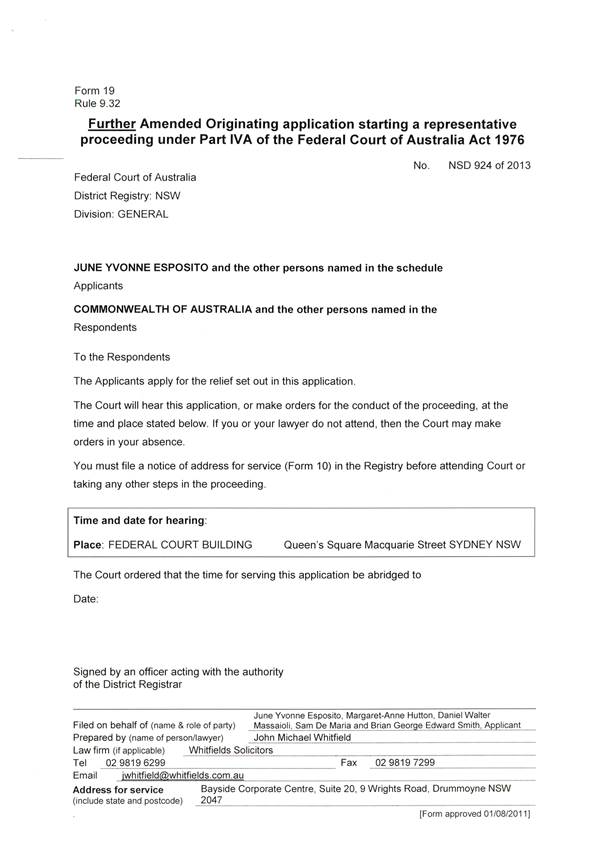
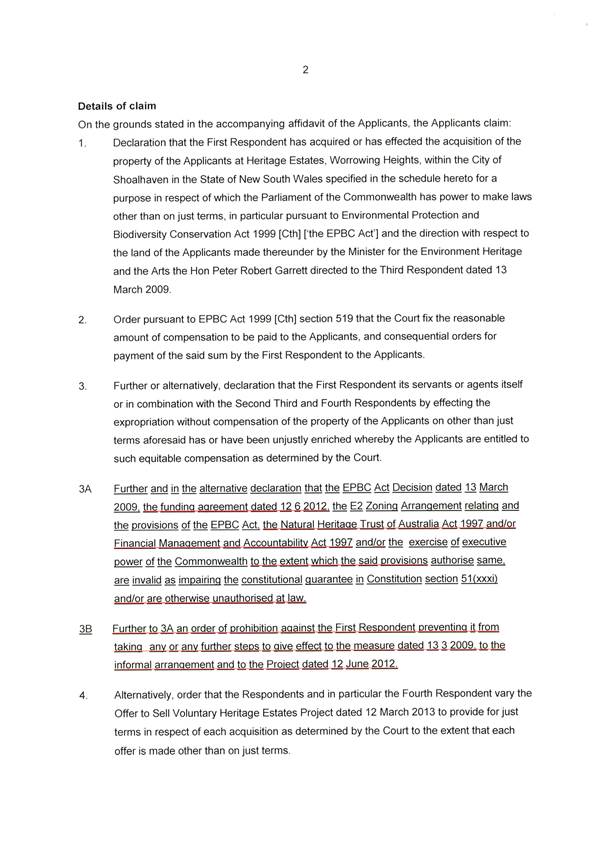
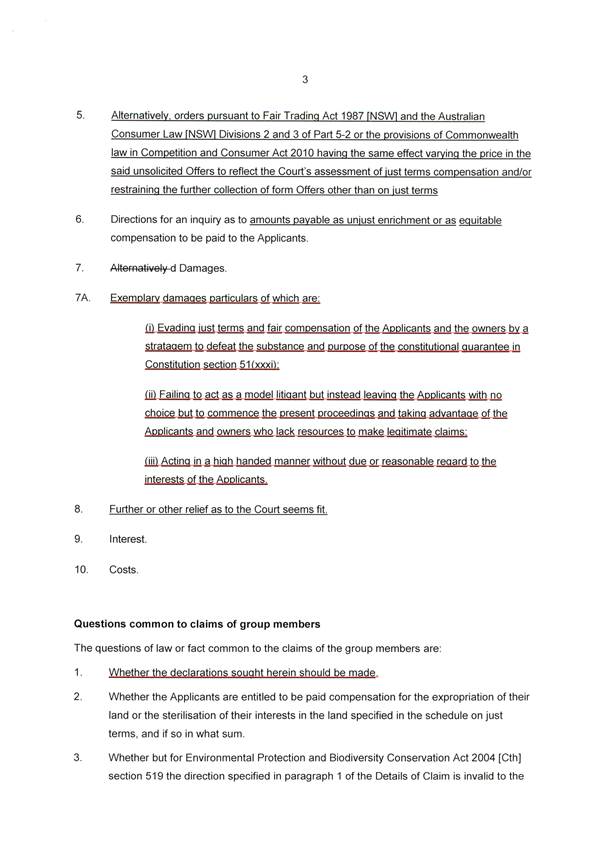
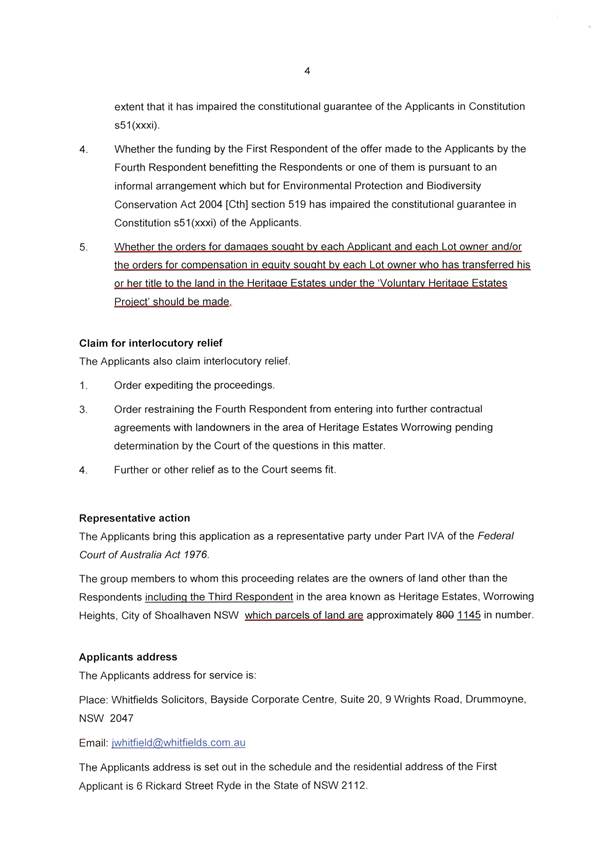
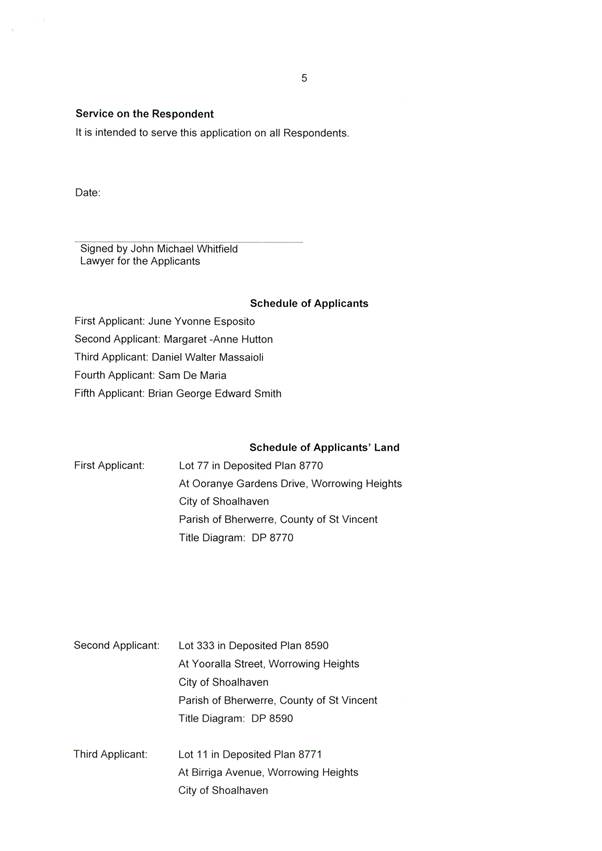
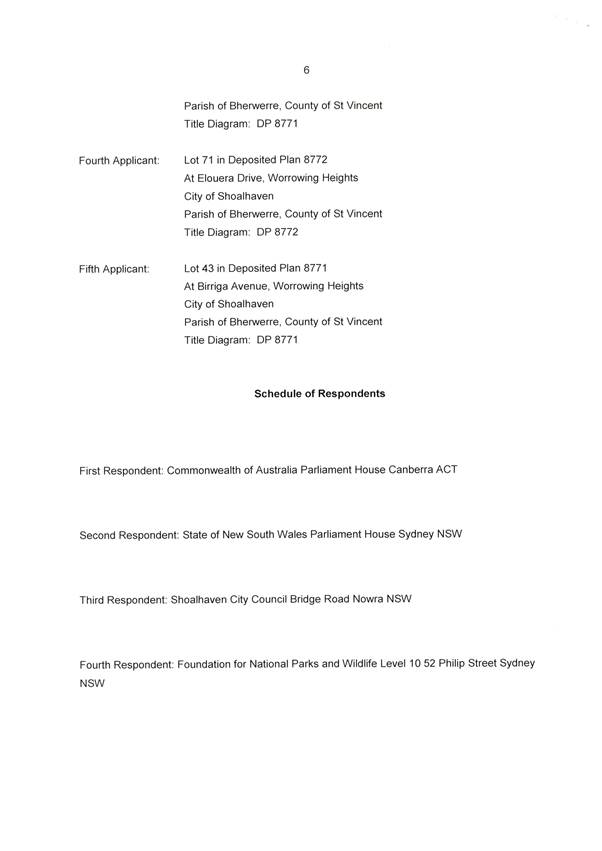
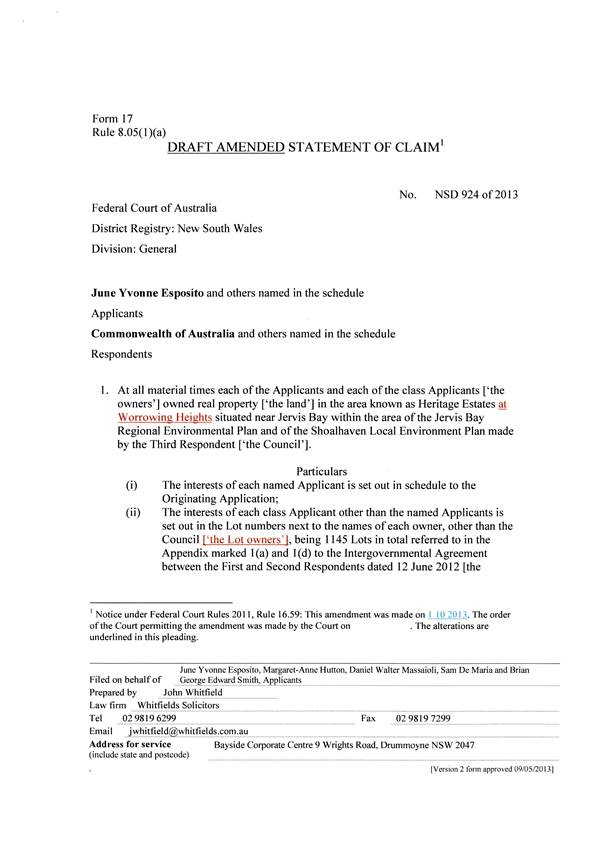
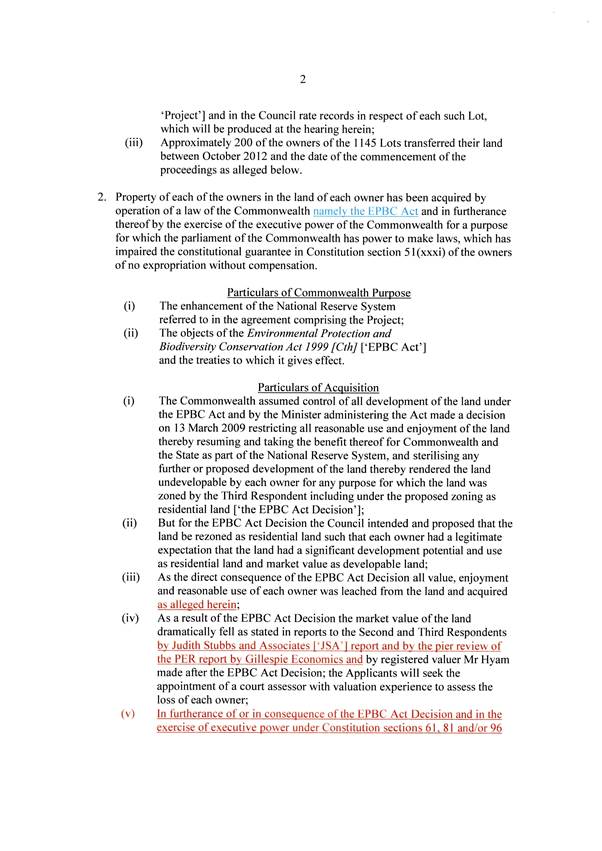
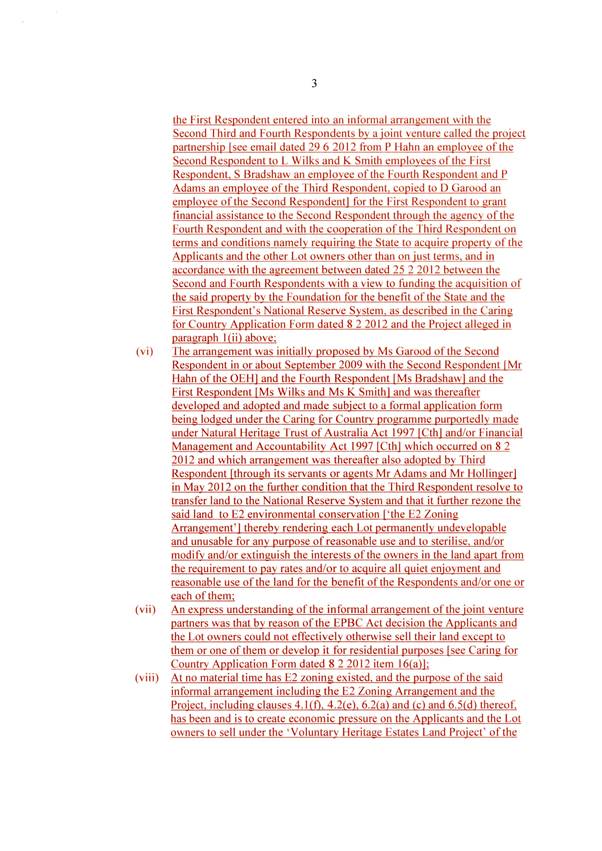
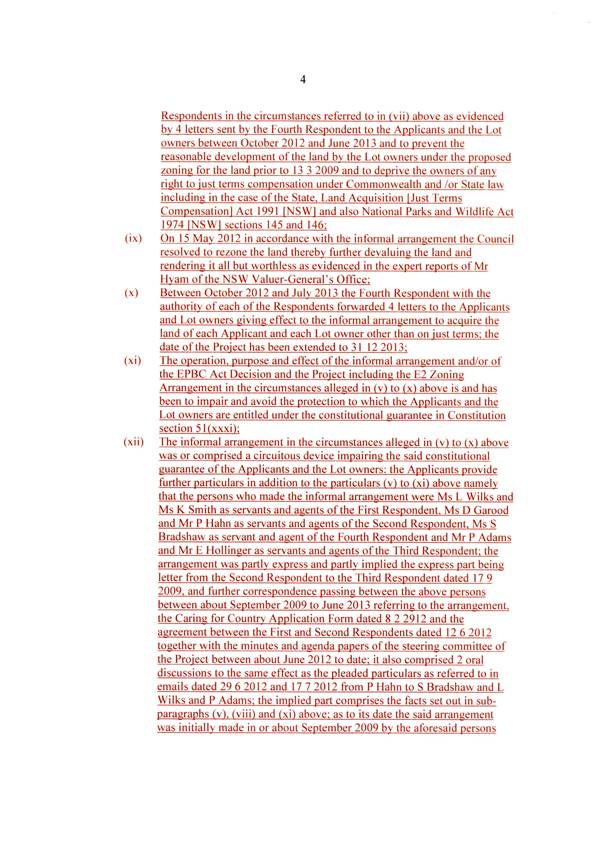
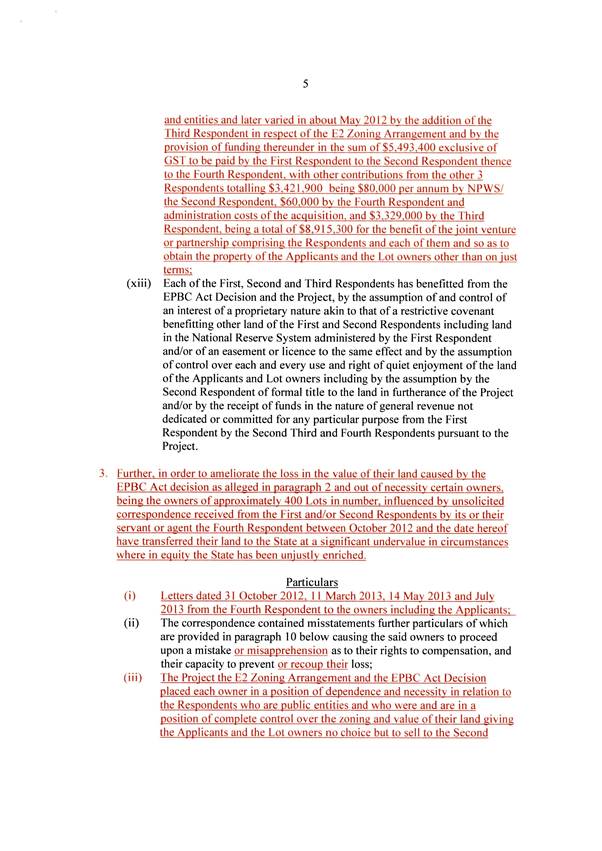
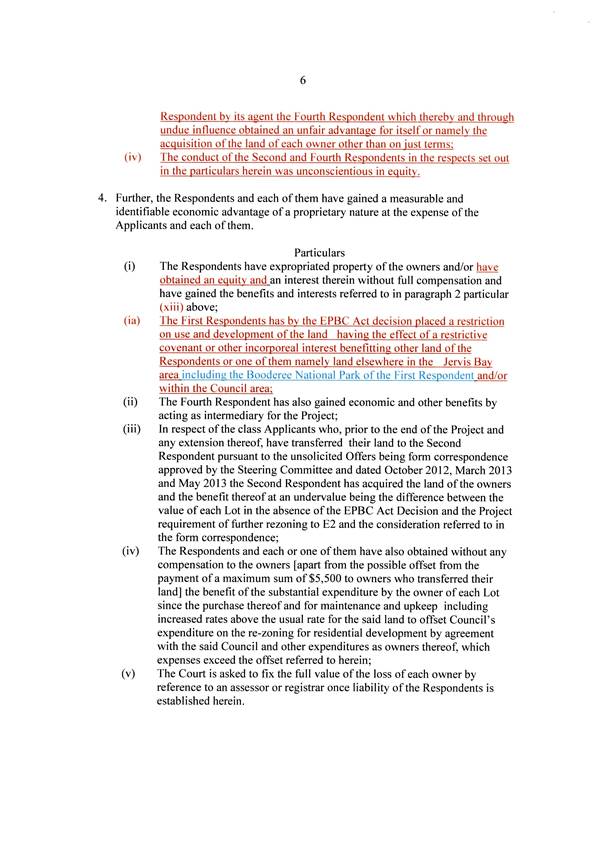
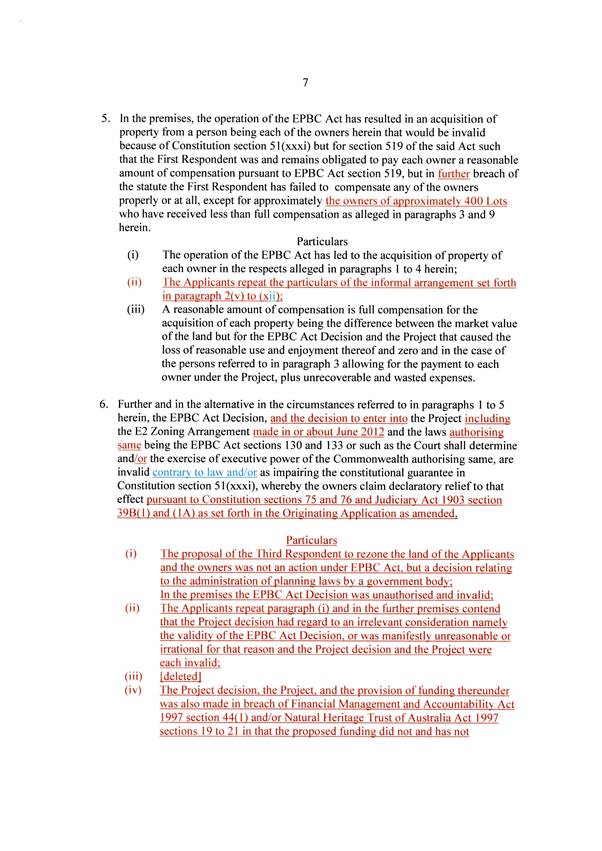
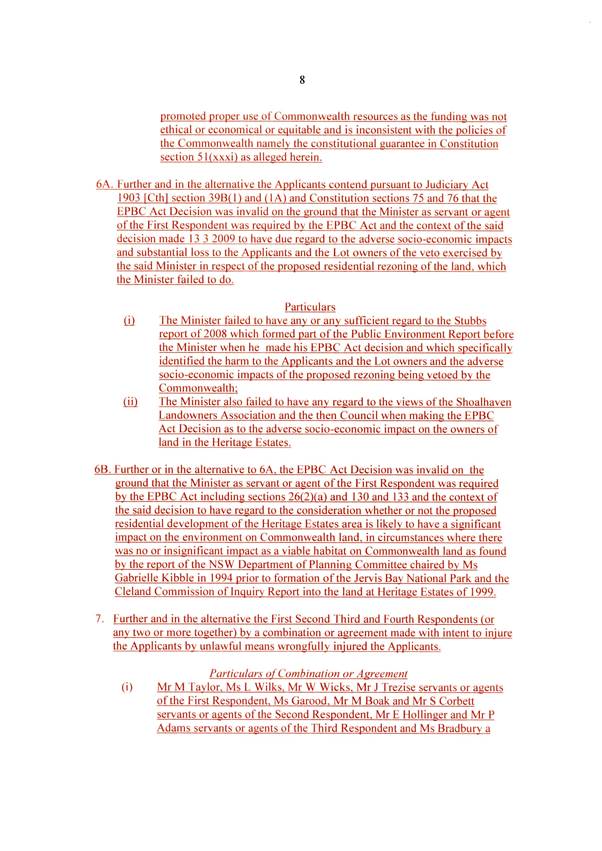
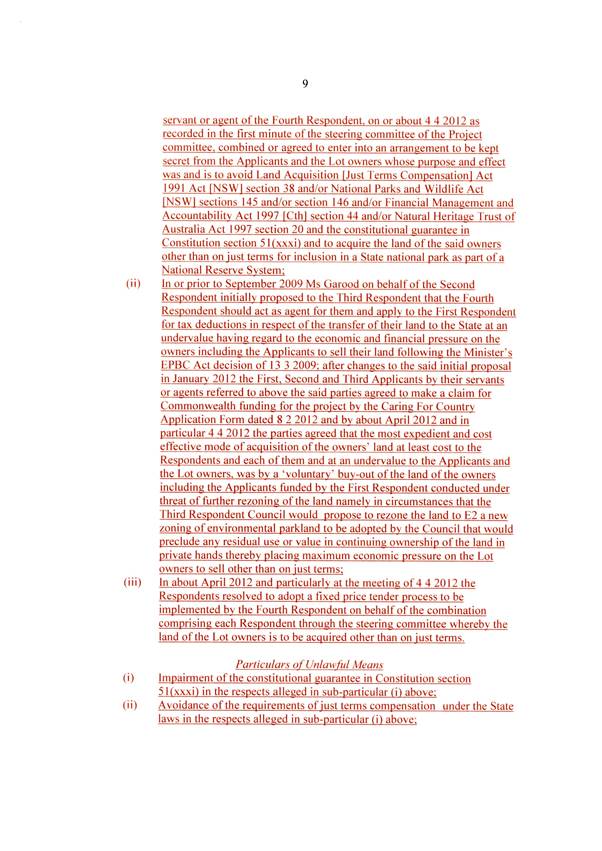
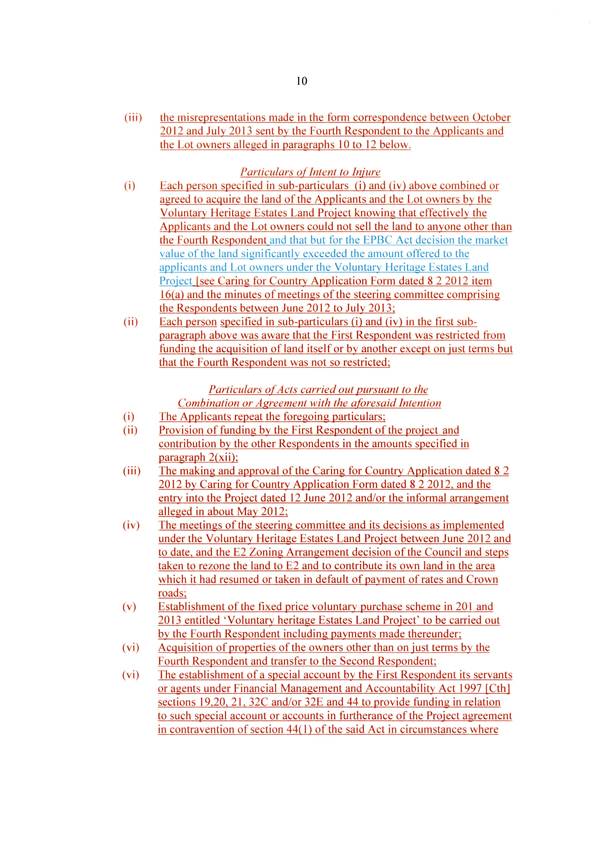
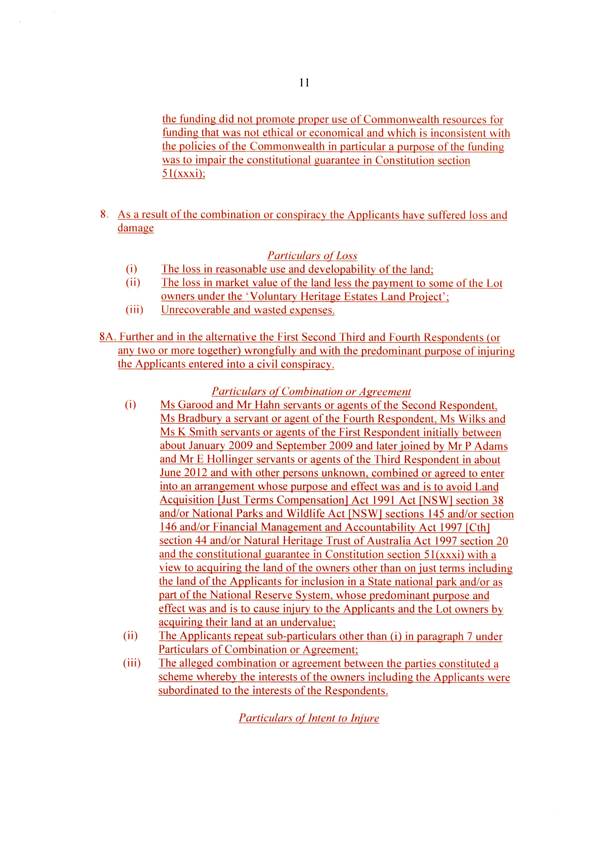
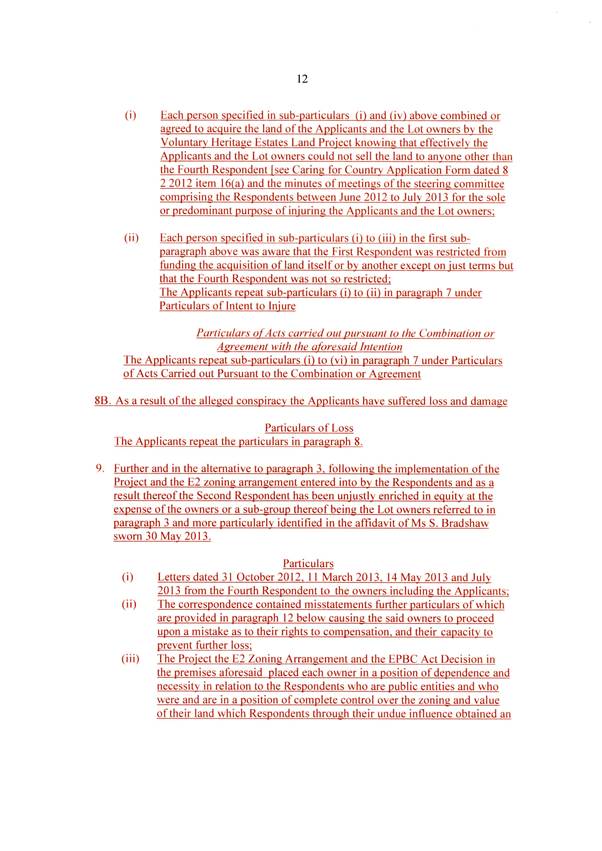
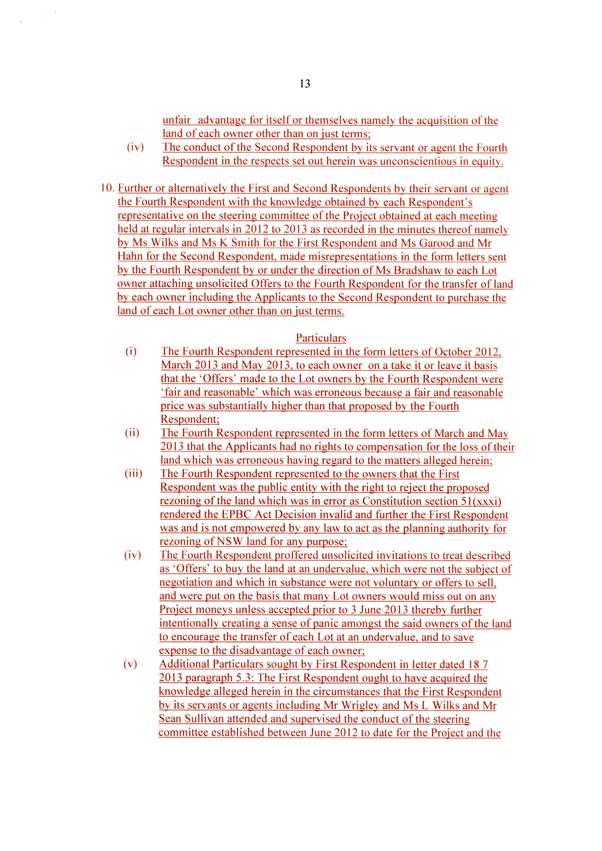
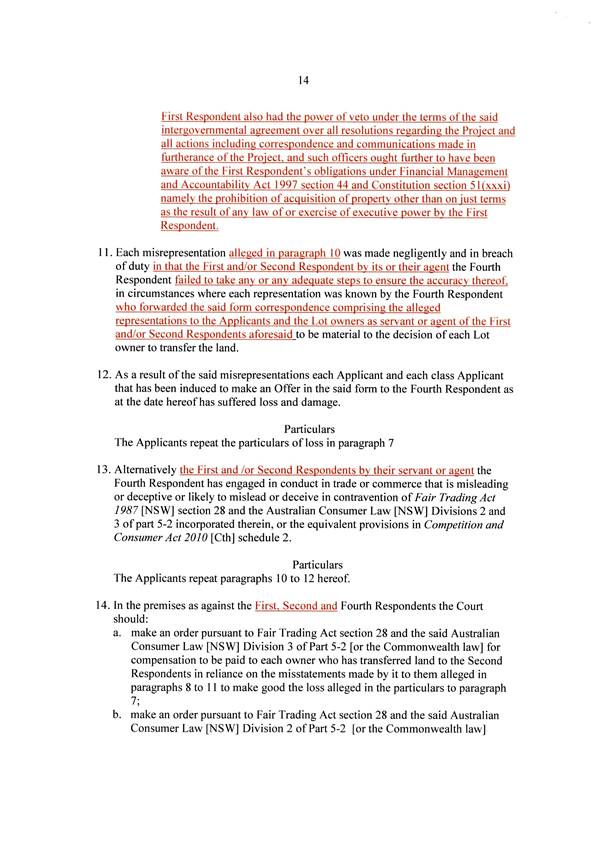
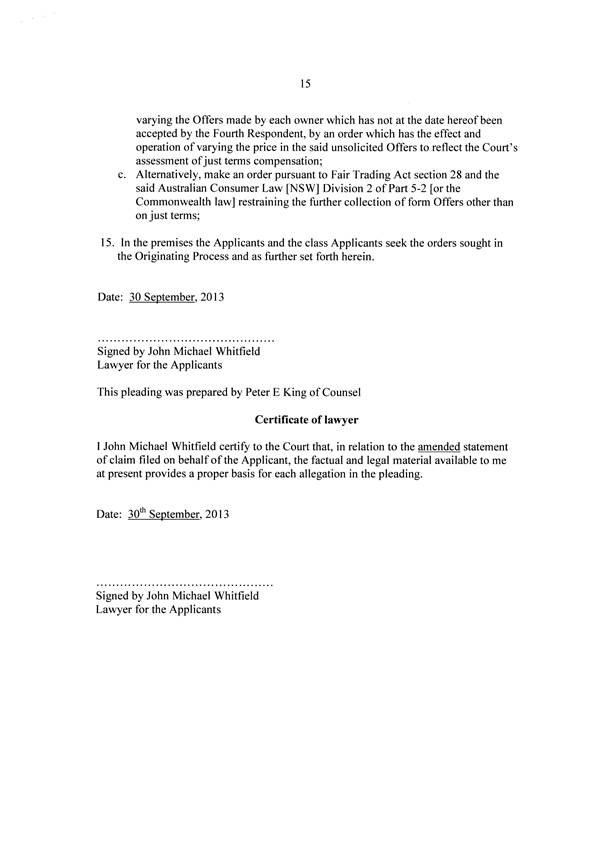
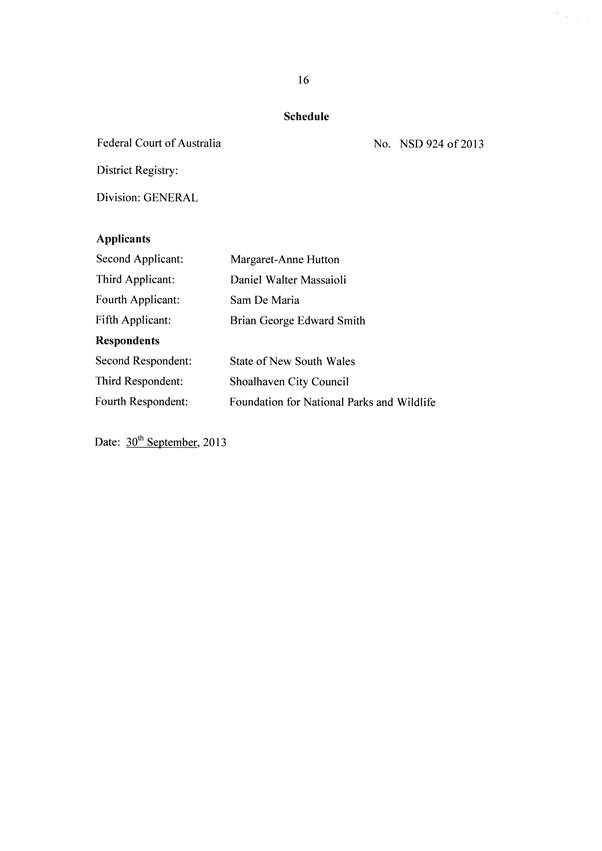
(a) Whether the applicants should be permitted to amend the current version of their Originating Application and Statement of Claim in accordance with proposed amendments which were initially notified on 16 September 2013, pursuant to previous directions made by me, and which have been subsequently amended on two occasions, the last of which was during the course of the hearing on 1 October 2013. The final version of the proposed Further Amended Originating Application and proposed Amended Statement of Claim are attached to these Reasons for Judgment and marked with the letters A and B respectively. In Attachment A, the proposed amendments are underlined in red. In Attachment B, the amendments notified prior to 1 October 2013 appear in red and the additional proposals specified orally by Counsel for the applicants towards the end of the hearing on 1 October 2013 appear in blue. Several of the respondents oppose some of the amendments although no respondent opposes all of them.
(b) Whether an Opt Out Notice should be mailed out and/or advertised and, if so, in what form and in what way. The applicants’ primary position is that no Opt Out Notice should be required. As a fallback, they propound a form of notice with which the respondents do not agree. The respondents propound their own version of the Opt Out Notice.
(c) Whether the respondents should be ordered to provide further discovery to the applicants. Although this application was initially pressed during the hearing on 1 October 2013, the solicitor for the applicants, who argued the discovery application on that occasion on behalf of the applicants, accepted that, as presently formulated, the discovery sought was too extensive and needed to be further refined. For reasons which I will explain in a little more detail below, the applicants ultimately accepted that the question of discovery would need to be revisited in light of the decision which the Court would make in respect of the application to amend the applicants’ Amended Originating Application and Statement of Claim.
(d) Whether the Court should strike out the entire claim against the Foundation and then dismiss the proceeding as against that organisation. To some extent, the disposition of this question will be influenced by the Court’s decision in relation to the applicants’ amendment application.
(e) Whether the Court should require a more precise specification of the relevant class for the purposes of the proceeding and a more precise articulation of the common questions of fact and law to be determined at the upcoming hearing.
10 The questions described at [9(d)] and [9(e)] above were raised by the Foundation in an Interlocutory Application filed by it on 27 September 2013. In that Interlocutory Application, the Foundation sought, as an alternative to an order striking out the entire claim against it, a separate hearing of the applicants’ claim against it. On 1 October 2013, I decided that I would determine the matters described at [9(d)] and [9(e)] above but would defer any further consideration of the Foundation’s application that there be a separate trial.
11 On one or two occasions prior to 1 October 2013, Counsel for the applicants had mentioned that the applicants might seek to administer interrogatories to the respondents. Indeed, the applicants circulated proposed interrogatories to at least some of the respondents during the month of September 2013. In correspondence between the lawyers for the various parties, the respondents resisted being required to answer the interrogatories which had been provided to them. At the hearing before me on 1 October 2013, the applicants did not agitate the question of whether I should now order interrogatories to be administered. I take the applicants’ silence on this question as an abandonment of any desire to administer interrogatories. I shall proceed accordingly.
12 These Reasons for Judgment determine the matters described at [9] above.
The Procedural History
13 The proceeding first came before me as the docket Judge on 4 June 2013. On that occasion, amongst other things, I ordered the applicants to serve a Notice of a Constitutional Matter under s 78B of the Judiciary Act 1903 (Cth) and to file and serve the documents required by the Federal Court Rules 2011 (FCR) as a result of that Notice being served. I also directed that, by 18 June 2013, the applicants file and serve a Statement of Claim and that, by 10 July 2013, the respondents file and serve their Defences. The applicants were to file and serve any Reply by 16 July 2013. In addition, the applicants were ordered to file and serve by 3 July 2013 all evidence in relation to liability upon which they intended to rely at the final hearing.
14 On 18 June 2013, the applicants filed an Amended Originating Application and a Statement of Claim. As at 18 June 2013, the applicants did not have leave to amend their Originating Application. However, no point about this was taken by the respondents and I have proceeded thereafter upon the basis that the Amended Originating Application filed on 18 June 2013 constituted the applicants’ originating process and had been regularly filed. In any event, on 19 July 2013, I granted leave retrospectively to the applicants to file the Amended Originating Application.
15 On 10 July 2013, both the Commonwealth and the State filed Defences to the applicants’ Statement of Claim. On 16 July 2013, the Foundation filed its Defence. Because it has filed a submitting appearance, the Council has not yet filed any Defence.
16 On 19 July 2013, I extended the time for the applicants to file and serve any Reply or Replies to the respondents’ Defences. Those Replies were previously required to be filed by 2 August 2013. I also made additional directions concerning evidence.
17 I pause to note at this point that the applicants have not yet filed any Reply to the respondents’ Defences.
18 On 19 July 2013, the proceeding was adjourned for further directions and case management to 2 September 2013.
19 On 2 September 2013, I dealt with a number of interlocutory applications.
20 First, the Commonwealth applied to strike out various paragraphs of the applicants’ Statement of Claim filed on 18 June 2013. That application was substantially successful. The paragraphs of the Statement of Claim which were struck out upon the application of the Commonwealth were, of course, struck out for the benefit of all respondents.
21 In addition to striking out portions of the applicants’ Statement of Claim, I made a number of directions designed to afford to the applicants one last opportunity to bring forward amendments to their Originating Application and Statement of Claim.
22 I also made orders and directions concerning the filing and service of evidence and the issuing of subpoenas. I also made a number of pre-trial directions.
23 For present purposes, Orders 1 to 10 made on 2 September 2013 are relevant. Those Orders were in the following terms:
THE COURT:
1. GRANTS leave to the fourth respondent to file in Court the affidavit of Monica Helen Allen sworn on 2 September 2013.
2. GRANTS leave to the first respondent to amend its Interlocutory Application dated 30 August 2013 and filed on 2 September 2013 in accordance with the Amended Interlocutory Application dated 2 September 2013, handed up in Court today (2 September 2013) and initialled by Foster J.
3. DISPENSES with service of the said Amended Interlocutory Application.
4. ORDERS that paragraphs 2(v)–(viii), 3, 5(ii) and (iii), 7, 8, 9 and 10 of the applicants’ Statement of Claim filed on 18 June 2013 be struck out.
5. ORDERS that the applicants’ application for leave to amend their Originating Application and Statement of Claim (both of which documents were filed on 18 June 2013) in accordance with the draft documents which comprise Tabs 18 and 19 in Exhibit JMW-2 to the affidavit of John Michael Whitfield sworn on 29 August 2013 and filed herein (pp 43–58 of the said affidavit) be refused.
6. NOTES that the applicants will consider propounding further amendments to their Originating Application and Statement of Claim (both of which were filed on 18 June 2013) in such a manner as they may be advised.
7. ORDERS that, in the event that the applicants wish to apply again to amend their Originating Application and Statement of Claim, the applicants lodge with the Associate to Foster J and serve upon each of the respondents by 16 September 2013 a draft of each of those documents in which all proposed amendments are clearly identified as required by r 16.59(2) of the Federal Court Rules 2011.
8. DIRECTS that, by 23 September 2013, the solicitors for the respondents notify the solicitor for the applicants in writing whether the proposed Amended Originating Application and Proposed Amended Statement of Claim are opposed and, if so, that those solicitors inform that solicitor for the applicants of the substance of the grounds of opposition.
9. ORDERS that, in the event that the proposed Amended Originating Application and Proposed Statement of Claim are opposed, the solicitor for the respondents lodge with the Associate to Foster J by 24 September 2013 the correspondence in which the grounds of opposition are set out.
10. ORDERS that, by 4 September 2013, the respondents notify the solicitor for the applicants in writing:
(a) Whether the categories for discovery set out in the schedule of categories marked as “MFI 2” on 2 September 2013 are agreed; and
(b) If one or more of those categories are not agreed, brief reasons as to why those categories which are not agreed are opposed.
24 On 2 September 2013, I listed the matter for further directions and case management on 1 October 2013. As I have already mentioned, I conducted the directions hearing and case management conference which took place on that day.
25 Between 2 September 2013 and 1 October 2013, subpoenas were issued and answered and other interlocutory steps were taken. I need not address those matters in any detail.
26 The following matters emerge from the above chronology:
(a) The applicants were first directed to file a Statement of Claim on 4 June 2013. That Statement of Claim was to be filed and served by 18 June 2013. That direction was made in circumstances where the applicants had commenced this proceeding on 24 May 2013 and had argued a fully contested interlocutory application a week later. The applicants must be taken to have had a very good idea of the causes of action which they intended to formulate and maintain in this proceeding by no later than May 2013.
(b) On 19 July 2013, the solicitor for the applicants mentioned to the Court, that the applicants might wish to seek discovery from the respondents. This was the first time that the possibility that the applicants might want discovery was raised. On that occasion, I said:
… I expect that you will raise the categories [referring to categories for discovery] with the other side and if they want something from you well and good as well and if there is a difficulty about discovery then just bring it back … and I will deal with it.
…
… If there is a good reason to have it [referring to discovery], I will entertain an application but I expect that the parties will well and truly exhaust the issue as between them before it comes to me.
(c) After extensive argument on 2 September 2013, substantial portions of the Statement of Claim filed by the applicants on 18 June 2013 were struck out and the applicants’ application for leave to amend their Amended Originating Application and their Statement of Claim in accordance with proposed amended documents then being considered by the Court was refused. A detailed regime designed to afford one last chance to the applicants to bring forward a Further Amended Originating Application and an Amended Statement of Claim was put in place. When affording to the applicants a further opportunity to amend, I observed that I was inclined to regard that further opportunity as their last opportunity.
(d) On 2 September 2013, I also made clear to the legal representatives of the applicants that I would not entertain applications concerning discovery and interrogatories until the pleadings had been finalised. Nonetheless, I encouraged the legal representatives of the applicants to approach the legal representatives of the respondents informally with a view to seeing whether those matters could be progressed informally prior to the finalisation of pleadings. I specifically declined to accept that the applicants were entitled to any discovery or answers to interrogatories.
Issue 1: The Applicants’ Amendment Application
27 The current form of the applicants’ originating application is the Amended Originating Application filed on 18 June 2013. The current form of Statement of Claim is the Statement of Claim filed on 18 June 2013 with paragraphs 2(v)–(viii), 3, 5(ii), 5(iii), 7, 8, 9 and 10 struck out.
28 The current form of Originating Application and current form of Statement of Claim can be readily seen from Attachments A and B to these Reasons for Judgment.
29 The proposed amendments are indicated in those Attachments in the manner which I have described at [9(a)] above.
30 The causes of action which the applicants currently plead may be summarised as follows.
31 First, the applicants contend that the Commonwealth effected an acquisition of their property other than on just terms in contravention of the constitutional guarantee in s 51(xxxi) of the Constitution. It is their case that the action of the Commonwealth in imposing a national park over their developable land was sufficient to constitute an acquisition of property requiring just terms. In particular, they argue that, but for a decision made by the Commonwealth Minister administering the Environmental Protection and Biodiversity Conservation Act 1999 (Cth) (the EPBC Act) made on 13 March 2009 (the EPBC Act decision), the Council intended and proposed that all of the land in the estate be rezoned as residential land with the consequence that each landowner within the estate had a legitimate expectation that his or her land had significant development potential and use as residential land with a corresponding market value as developable land. The applicants seek declaratory and pecuniary relief as a result of this alleged acquisition other than on just terms.
32 Second, apparently in the alternative, the applicants seek a declaration that the EPBC Act decision to which I have referred at [31] above and the inter-governmental or informal agreement made in or about July 2011 and associated arrangements be declared invalid.
33 Third, the applicants seek damages or compensation against at least the Commonwealth, the State and the Council (and possibly the Foundation) for negligent misrepresentation and misleading and deceptive conduct in breach of the Australian Consumer Law and cognate State legislation.
34 A substantial plank in the proposed amendments now being advanced by the applicants is the allegation which the applicants wish to make to the effect that the Commonwealth, the State, the Council and the Foundation have collaborated and conspired together to acquire the applicants’ property other than on just terms. The applicants also wish to allege that the respondents made an informal arrangement whose object and purpose was, by circuitous means, to evade the constitutional guarantee binding the Commonwealth and any person who might participate in the Commonwealth’s conduct so as to be an instrument by which property was acquired without appropriate compensation. The applicants rely upon the reasoning of the then Chief Justice of the High Court in PJ Magennis Pty Ltd v Commonwealth (1949) 80 CLR 382 at 401 per Latham CJ.
35 The applicants propose minor amendments to par 1 of the Statement of Claim. Those amendments are not opposed and leave to make them will be granted. In addition, the applicants propose to introduce claims for judicial review of the EPBC Act decision. These claims are pleaded in proposed pars 6A and 6B. These amendments were not seriously opposed. I propose to grant leave to the applicants to include pars 6A and 6B in their Amended Statement of Claim.
36 The first amendments which attracted serious opposition were the proposed amendments to par 2 of the Statement of Claim. In essence, these are the amendments contemplated by subpars (v) to (xii) of par 2.
37 The structure of par 2 is infelicitous. The material facts pleaded are those which are pleaded in the first six lines of par 2. That is, the applicants allege that, by operation of a law of the Commonwealth (viz the EPBC Act) and by the exercise of the executive power of the Commonwealth, the Commonwealth acquired other than on just terms property of the applicants thereby impairing or contravening the constitutional guarantee in s 51(xxxi) of the Constitution. In endeavouring to provide particulars of the relevant acquisition, the applicants refer in particular to the EPBC Act decision and to certain specified consequences of that decision. The applicants allege that, as a result of the EPBC Act decision, the market value of their land fell dramatically. That contention is supported by the expert evidence of a valuer whom the applicants propose to call to give evidence at the hearing.
38 Commencing at subpar (v), the applicants endeavour to add to their contentions concerning the way in which their property was acquired by asserting that the Commonwealth entered into an informal arrangement with the other respondents, the fundamental purpose of which was to require the State to acquire the property of the applicants and the other landowners in the estate other than on just terms and in accordance with an agreement made on 25 February 2012 between the State and the Foundation designed to fund the said acquisition. The applicants contend that, as part of this alleged informal arrangement, the Commonwealth agreed to fund the acquisition through the Caring for Country program and the Council was to rezone land in the estate to 2 Environmental Conservation (called in the proposed pleading “the E2 Zone Arrangement”) in order to render the land in the estate permanently undevelopable and unusable for any purpose other than as part of the National Reserve System.
39 The Commonwealth opposed leave to amend par 2 of the Statement of Claim on pleading grounds. The Commonwealth submitted that the proposed pleading was deficient and thus embarrassing in a technical sense. The Commonwealth submitted that the applicants had failed to identify how and when the alleged informal arrangement was made and had failed to specify its essential terms. In addition, the Commonwealth submitted that the applicant had failed to identify the Commonwealth law or executive action which had effected the acquisition about which complaint is made.
40 Counsel who appeared for the State adopted the submissions made on behalf of the Commonwealth and supplemented those submissions. He submitted that the applicants ought not to be permitted to plead and maintain a case based upon the alleged informal arrangement in circumstances where, as a fundamental integer in another part of their case, they assert that the acquisition of which they complain was effected by the EPBC Act decision and by that decision alone. In addition, he added that, if the applicants wished to plead and to rely upon some alleged informal arrangement, it was incumbent upon them to articulate precisely what it was that this arrangement added to the relevant formal agreements entered into between the State and the Commonwealth (including, in particular, the inter-governmental agreement dated 12 June 2012).
41 The particulars to par 2 make clear (and Counsel for the applicants confirmed in argument) that the applicants intend to endeavour to prove the alleged informal arrangement by the tender of documents coming from the possession of the respondents. They do not intend to call a witness to prove the alleged arrangement. The main documents to be relied upon by the applicants are referred to in the particulars provided in par 2 of the Statement of Claim. The essential terms of the alleged informal agreement can be discerned from the particulars provided. The only criticism of par 2 which has substance, it seems to me, is that the applicants have failed to specify with any particularity the date when the alleged informal arrangement was made. However, the applicants’ case is that the arrangement was a developing one which commenced in 2009 and came to fruition in 2012.
42 It may be that, after all the evidence is in and all submissions have been made, the applicants fail to establish the existence and/or terms of the alleged informal arrangement. But that is not the present question. The question for me at the moment is whether there is sufficient in par 2 of the proposed Amended Statement of Claim to justify allowing the amendment. I think that there is and that the respondents will be able to respond to the allegations without further ado. I pause to note that each of the respondents which has filed a Defence had no difficulty in denying the existence of such an informal arrangement when it was pleaded in the applicants’ original Statement of Claim.
43 For these reasons, I propose to allow the amendments propounded in respect of par 2 of the Statement of Claim.
44 For similar reasons, I propose to allow the amendments to pars 3 and 4 of the Statement of Claim.
45 By the amendments sought to par 6 of the Statement of Claim, the applicants seek to introduce into their pleading a basis for declaring the EPBC Act decision, the E2 Zone Arrangement and the laws authorising the same invalid by reason of the fact that those Acts and statutory provisions effected an acquisition of property other than on just terms in breach of the constitutional guarantee and were otherwise contrary to law. Although the thinking made manifest in par 6 is a little garbled, it seems to me that the applicants are endeavouring to support their claims for declarations that the relevant decisions said to have effected an acquisition were invalid on the basis of contentions embodied in the particulars to par 6. Inelegant though the language may be, I think that there is sufficient in par 6 to justify leave to amend and that the pleaded allegations make sufficiently clear the matters to which the respondents must respond.
46 Paragraphs 7, 7A, 8, 8A and 8B seek to introduce into the proceeding a claim for damages for civil conspiracy.
47 A claim of this nature is a very serious one, should not be lightly made and must be specifically pleaded and particularised (Australian Wool Innovation Ltd v Newkirk [2005] FCA 290 at [59] per Hely J).
48 In Newkirk, at [60]–[64], Hely J said:
60 Conspiracy is the agreement of two or more persons to do an unlawful act, or to do a lawful act by unlawful means. Historically, there are two kinds of conspiracy, the elements of which are distinct:
(1) an ‘unlawful means’ conspiracy in which the participants combine together to perform acts which are themselves unlawful; and
(2) a combination to perform acts which, although not themselves unlawful, are done with the sole or predominant purpose of injuring the claimant.
See Bullen & Leake & Jacob’s Precedents of Pleadings, Vol 2, 15th edn, Sweet & Maxwell, London, 2004, at [50-01]; McKellar v Container Terminal Management Services Ltd (supra) at [135] – [154].
61 Bullen & Leake identifies the necessary elements in an action in conspiracy at [50-01.1]:
‘The claimant must plead and prove the following necessary elements:
(i) a combination or agreement between two or more individuals (required for both types of conspiracy);
(ii) an intent to injure (required for both types of conspiracy but must be shown as the sole or predominant purpose for type (2) above);
(iii) pursuant to which combination or agreement and with that intention certain acts were carried out;
(iv) resulting loss and damage to the claimant.’
62 A conspiracy can be proved without evidence of an express agreement. A court is entitled to have regard to the overt acts pleaded, and to infer from those acts that there was an express agreement to further the common object of the combination. All of those said to be parties to the conspiracy should be sufficiently aware of the surrounding circumstance, and share the same object, for it properly to be said that they are acting in concert.
63 ‘Unlawful means’ includes crimes and tort and breaches of statutory provisions: Trindade & Cane, The Law of Torts in Australia, 3rd edn, Oxford University Press, Melbourne, 1999 at p 230. A person is using unlawful means if they are doing an act which they are not at liberty to commit: Dresna Pty Ltd v Misu Nominees Pty Ltd [2004] FCAFC 169. It is not open to a party to plead as an alternative to a substantive cause of action already pleaded the tort of conspiracy to commit the substantive wrong, nor can there be a common law conspiracy to contravene the TPA outside the form of conspiracy expressly provided for in s 75B(1)(d) of the TPA: McKellar (supra) at [195] and [197]. But the first respondent has not taken any objection to the ASC on this account, hence these matters can be put to one side.
64 The tort requires an intention to injure. As Kiefel and Jacobson JJ observed in Dresna Pty Ltd v Misu Nominees Pty Ltd (supra, at [7]) an agreement to do an unlawful act that results in damage to another party is not the same as a conspiracy to injure that party. In order to prove a conspiracy a claimant must show that the wrongful act complained of was done with a design of injuring the claimant and that it did so. According to their Honours, a conspiracy could be directed not only at a particular individual, but also at a class, in the sense of all members of the class. Their Honours went on to say (at [123]) that the test for an action in conspiracy is: ‘what was the object of those combining when they acted as they did’. They must have acted in order that, not with the result that, the claimant should suffer damage.
49 In proposed par 7, the applicants allege that the respondents wrongfully injured the applicants by a combination or agreement made with intent to injure the applicants by unlawful means. The unlawful means are said to be effecting an acquisition of the applicants’ property in disregard of the constitutional guarantee in s 51(xxxi) of the Constitution and also doing so as a result of misrepresentations made by the Foundation to the applicants and others on behalf of the Commonwealth, the State and the Council.
50 In par 8A, the applicants seek to allege that the respondents wrongfully, and with the predominant purpose of injuring the applicants, entered into a civil conspiracy. This seems to be intended as an allegation that the respondents combined to perform acts which, although not themselves unlawful, were done with the sole or predominant purpose of injuring the applicants.
51 The particulars of intention to injure provided as part of par 8A go no further than an allegation that certain steps were taken by each of the respondents with knowledge that those steps would render the applicants’ land undevelopable.
52 All of the respondents opposed leave being granted to the applicants to plead the tort of conspiracy. They complained that the particulars of the alleged combination or agreement are not sufficient. In addition, they submitted that it is not open to a party to plead as an alternative to a substantive cause of action already pleaded the tort of conspiracy to commit that same substantive wrong. In addition, they argued that there cannot be a common law conspiracy to contravene the Australian Consumer Law and cognate State legislation which provide for statutory relief for misleading and deceptive conduct outside the form of conspiracy expressly provided for in the statutory provisions contained within those enactments which expressly provide for accessorial liability (see McKellar v Container Terminal Management Services Ltd (1999) 165 ALR 409 at 445–446 [195] and [197] per Weinberg J; and Newkirk at [63]).
53 Here, insofar as the allegation of conspiracy sought to be made in par 7 is concerned, reliance is placed upon substantive wrongs pleaded elsewhere in the Statement of Claim (impairment of the constitutional guarantee and breach of the Australian Consumer Law). Counsel for the applicants submitted that a pleading based upon impairment of the constitutional guarantee embodied in s 51(xxxi) of the Constitution was not unlawful means within the relevant principles. I do not agree (see Dresna Pty Ltd v Misu Nominees Pty Ltd [2004] FCAFC 169).
54 I think that the submissions advanced by the respondents in respect of pars 7 and 8 of the proposed Amended Statement of Claim are sound and are fatal to the applicants’ application for leave to amend in order to plead those paragraphs. I refuse leave to amend in the terms of pars 7 and 8.
55 As far as the alleged conspiracy in proposed par 8A is concerned, I think that the pleading is deficient. The allegations as to the making of the alleged combination or agreement are somewhat vague (as I have already noted when dealing with par 2 of the proposed Amended Statement of Claim above) and lack precision. Although, of itself, this may not be fatal, the lack of specificity in the identification of the combination or agreement has contributed to a more fundamental deficiency. The applicants must plead and prove that the alleged combination or agreement and overt acts carried out in giving effect to that agreement were done with a design of injuring the applicants. As Kiefel and Jacobson JJ observed in Dresna Pty Ltd, an agreement to do an unlawful act that results in damage to another party is not the same as a conspiracy to injure that party. So, here, an agreement to do certain acts, even with knowledge of the potential consequences of those acts, is not sufficient to constitute a conspiracy. The agreement must be made with a design of injuring the target of the conspiracy. In my view, in par 8A the applicants do not plead such a design. The pleading is deficient for that reason. I will therefore refuse leave to the applicants to amend their Statement of Claim to include pars 8A and 8B.
56 In par 9 of the proposed Amended Statement of Claim, the applicants seek to propound a case for compensation by reason of alleged unjust enrichment. This case is pleaded only against the State.
57 Counsel for the State objected to leave being granted to the applicants to plead par 9. He submitted that, in order to support pecuniary relief based upon unjust enrichment, it was not sufficient for the applicants to plead and to rely upon a mistake as the basis upon which they transferred or agreed to transfer their landholdings within the estate. He submitted that the applicants were required both to plead and to prove unconscionability in the sense of an unconscientious taking advantage by the State of the alleged mistake.
58 I think that there is sufficient in subpar (iii) of the particulars contained in proposed par 9 to support the unjust enrichment case. I say nothing, of course, about the merits of that case.
59 Paragraph 10 is designed to support the misrepresentation case left standing in pars 11 and 12 of the existing Statement of Claim.
60 By par 10, the applicants allege that the Commonwealth and the State, by their servant or agent, the Foundation, made representations in letters sent by the Foundation to landowners in the estate which were misleading or deceptive or which were made negligently. These letters are alleged to have been sent in 2012 and 2013. The loss alleged to have been suffered by the applicants is pleaded in proposed par 8.
61 Principal among the heads of loss is the loss in value of the land. The applicants have informed the Court that they will prove that loss by calling an expert valuer who will testify that the loss was suffered in March 2009 when the Minister made the EPBC Act decision.
62 During argument, I taxed Counsel for the applicants with the proposition that such a loss could not possibly have been caused by mail outs sent in 2012 and 2013. Counsel did not, with great respect to him, provide a satisfactory answer to this proposition. He did, however, say that the applicants were also claiming wasted expenditure but was unable to specify what that might be.
63 I do not think that I should allow the misrepresentation case to go forward. It is internally inconsistent, as pleaded, and has no real prospects of succeeding. The only relief sought in the proposed pleading based upon the misrepresentation case is financial compensation. As I have said, the loss which the applicants claim in the proceeding, being the diminution in value of their property, was suffered long before any of the alleged representations are said to have been made.
64 Accordingly, I will not allow the amendment to par 10. For this reason, I will also strike out pars 11, 12, 13 and 14 of the existing Statement of Claim since all of those paragraphs are dependent upon par 10.
65 For all of the above reasons, I will allow the amendments propounded in pars 1, 2, 3, 4, 5, 6, 6A and 6B of Attachment B. I refuse leave to amend in respect of proposed pars 7, 8, 8A, 8B, 10, 11, 13 and 14. I will strike out pars 11, 12, 13 and 14 of the current Statement of Claim.
66 Consistent with those rulings, I will allow the amendments to pars 3A and 3B of the Amended Originating Application. I refuse the amendments embodied in par 7A. That amendment could only be brought forward if I were to allow the conspiracy pleadings to stand. I have not done so. Accordingly, that amendment should be refused. I will also strike out pars 5 and 7 of the Amended Originating Application as those claims for relief are no longer supported by any cause of action pleaded in the Statement of Claim.
67 As far as the common questions are concerned, I will consider the amendments sought to those when dealing with Issue 5 below.
68 At the very end of the hearing on 1 October 2013, Counsel for the applicants submitted that the Court should give the applicants a further opportunity to plead their case in the event that I disallowed any of the amendments sought by them on 1 October 2013 or struck out any paragraphs of their existing pleadings.
69 Given the proximity of the commencement of the hearing and the ample opportunities already afforded to the applicants to plead their case, I am not prepared to grant leave to re-plead. The time has come for the applicants to run their case. The Court will not allow the hearing to be delayed by further applications for leave to amend their pleadings.
Issue 2: The Opt Out Notice
70 Until very recently, the applicants were reluctant to agree to the distribution of an Opt Out Notice and accompanying Explanatory Memorandum to members of the relevant class.
71 In my opinion, the Court is obliged to fix an opt out date and to ensure that members of the relevant class are adequately informed of the proceeding in order to enable them to decide whether to opt out of the proceeding or to remain as a member of the relevant class (s 33J of the FCA Act, r 9.34 of the FCR, Form 21 of the Federal Court Forms and par 7 of Practice Note CM17).
72 The State has submitted to the Court a draft Explanatory Memorandum and accompanying Opt Out Notice. The Commonwealth and the Foundation agree with the State’s draft of those documents. The Council has not commented on that draft.
73 The applicants do not agree with the State’s draft. The applicants made available a draft on 1 October 2013. They have made detailed suggestions to improve the State’s draft in a letter from their solicitors to the State dated 4 October 2013.
74 The nub of the applicants’ complaint about the State’s draft is that it does not adequately explain the causes of action being propounded by the applicants in the proceeding.
75 The fact that the causes of action with which the applicants will be permitted to go to trial have only now been finalised has presented obvious difficulties for the draftsman of the Explanatory Memorandum to accompany the Opt Out Notice.
76 I have considered the applicants’ criticisms of the State’s draft. I have amended that draft in order to take account of the applicants’ criticisms and also to take account of the rulings which I intend to make in respect of the applicants’ pleadings.
77 I have attached the State’s draft as amended by me as Attachment C to these Reasons for Judgment.
78 There is a dispute between the applicants and the Commonwealth, the State and the Foundation as to whether a mail out is necessary and, if so, who is to carry out the mail out and who is to pay for it.
79 The applicants argue that a mail out is an unnecessary extravagance and that all that is required is an advertisement in The Australian newspaper. They go on to submit that, if the Court considers a mail out is necessary, their solicitor should carry it out using information contained in the Foundation’s database.
80 The respondents contend that the most efficient way of carrying out a mail out is for the Foundation to perform the task. They argue that, in this way, the confidentiality of the Foundation’s database will be protected. They submit that the mail out should be paid for by the applicants. They estimate the cost to be of the order of $3,000–$3,500.
81 I favour the respondents’ proposals. Time is short and I think that the respondents’ proposals will most likely achieve the object of the exercise in the most efficient and least expensive fashion.
82 I will, therefore, make orders substantially in accordance with the respondents’ proposals. I also intend to require the publication of the Explanatory Memorandum and Opt Out Notice on one occasion in The Australian newspaper.
83 Given that there is very little time remaining before the commencement of the hearing, I propose to fix the opt out date as 25 October 2013, recognising, of course, that this date is after the hearing will have commenced. I propose to grant leave to the parties to commence the hearing pursuant to s 33J(4) of the FCA Act notwithstanding that fact.
Issue 3: Discovery
84 The evidence before me on 1 October 2013 disclosed that, for some time, the applicants’ solicitors have been corresponding with the solicitors for the respondents in an endeavour to secure their agreement to give discovery of certain categories of documents to the applicants. While there has been some measure of agreement and the production of some documents, the solicitors for the respondents have resisted being required to give discovery of documents in most of the categories sought by the applicants’ solicitors.
85 On 1 October 2013, the applicants’ solicitor addressed me as to the categories of documents which he required and as to the justification for his requirement. Counsel for the respondents made submissions in opposition to the applicants’ application.
86 In the end, the applicants’ solicitor requested that I defer ruling on his application for orders for discovery until I have ruled on his clients’ amendment application and in order for him to reconsider the breadth of his requests. I agreed to this course. For the moment, therefore, all questions relating to discovery have been deferred.
Issue 4: The Foundation
87 In light of my decision in relation to the applicants’ pleadings (Issue 1), the only claims for relief against the Foundation are the declaration sought in par 3 of the Originating Application and possibly a claim for pecuniary relief in respect of the applicants’ unjust enrichment case. Given that those claims remain, I am not prepared to dismiss the proceeding as against the Foundation at this stage.
Issue 5: The Class Definition and the Common Questions
88 The definition of the class in the Further Amended Originating Application should be amended so that, in lieu of the present definition, it reads:
The group members to whom this proceeding relates are:
(a) Those persons or entities who owned a lot in Deposited Plans 8590, 8591, 8770, 8771 and 8772 as at 13 March 2009; and
(b) (i) Who still own that lot and have done so at all times since 13 March 2009; or
(ii) Who owned that lot continuously from 13 March 2009 until transferring it via the voluntary tendering process being managed by the Foundation.
89 I propose to order the applicants to make that amendment.
90 The common questions, as presently drafted, should stand. The proposed new questions 1 and 5 are not appropriate. I refuse leave to amend the Originating Application to include those questions.
91 As far as existing question 2 is concerned, I think that the last three words “… in what sum …” should be deleted and replaced with the words “…on what basis…”.
Costs
92 The applicants have had some success in their endeavours to amend their Amended Originating Application and Statement of Claim but have failed to obtain leave to amend as sought by them and have failed to obtain other orders sought by them on 1 October 2013. I think that each party has had some measure of success and some defeats. In any event, the hearing on 1 October 2013 addressed a number of matters which had to be dealt with come what may. I think that the appropriate order for costs is that the parties’ costs of and incidental to the applications and orders made on 1 October 2013 be costs in the proceeding.
Future Conduct
93 I propose to list the proceeding for a further directions hearing and case management conference in the middle of next week. At that time, I will also deal with the Foundation’s application for a separate trial.
I certify that the preceding ninety-three (93) numbered paragraphs are a true copy of the Reasons for Judgment herein of the Honourable Justice Foster. |
Associate:
Attachment A
Attachment B
Attachment C
FEDERAL COURT OF AUSTRALIA
Esposito & Ors v Commonwealth of Australia & Ors
1. Why is this notice important?
A class action has been commenced in the Federal Court of Australia by June Esposito, Margaret-Anne Hutton, Daniel Massaioli, Sam De Maria and Brien Smith against the Commonwealth of Australia (“the Commonwealth”), the State of New South Wales (“the State”), Shoalhaven City Council (“the Council”) and the Foundation for National Parks and Wildlife (“the Foundation”).
The individuals who have commenced the class action are owners of lots within the area known as the Heritage Estates at Worrowing Heights.
The Federal Court has ordered that this notice be published for the information of persons who might be members of the class on whose behalf the action is brought and may be affected by the action. You have been identified as a potential class member. You should read this notice carefully. Any questions you have concerning the matters contained in this notice should not be directed to the court. If there is anything in it that you do not understand, you should seek legal advice.
2. What is a class action?
A class action is an action that is brought by one or more persons (the “Applicants”) on his or her own behalf and on behalf of a group of people (“class members”) against another person or persons (the “Respondents”), where the Applicants and the class members have similar claims against the Respondents.
Class members in a class action are not individually responsible for the legal costs associated with bringing the class action. In a class action, only the Applicants are responsible for the costs.
Class members are bound by any judgment or settlement entered into in the class action unless they have opted out of the proceeding. This means that:
(a) if the class action is successful, class members may be eligible for a share of any settlement moneys or Court-awarded damages,
(b) if the class action is unsuccessful, class members are bound by that result, and
(c) regardless of the outcome of the class action, class members will not be able to pursue their claims against the Respondent in separate legal proceedings unless they have opted out.
3. What is Opt Out?
The Applicant in a class action does not need to seek the consent of class members to commence a class action on their behalf or to identify a specific class member. However, class members can cease to be class members by opting out of the class action. An explanation of how class members are able to opt out is found below in the section headed “How can you opt out of the proceeding?”
4. What is this class action?
The Applicants in this class action are Ms Esposito, Ms Hutton, Mr Massaioli, Mr De Maria and Mr Smith. The Respondents are the Commonwealth, the State, the Council and the Foundation.
The Applicants have commenced this class action on their own behalf and on behalf of all persons who are 'group members' as defined in the proceeding (an explanation of who the group members are is found below the section headed “Are you a class member?”).
As at 7 May 2007, the Council was proposing to rezone certain parts of the Heritage Estates and undertake public infrastructure works so as to permit residential development of up to 730 lots within the Heritage Estates. On 22 June 2007, the Commonwealth determined that the proposed rezoning and public works was likely to have a significant impact on listed threatened species and communities and on Commonwealth land. On this basis, the proposed rezoning and public works required the approval of the Commonwealth Minister for the Environment (the “Minister”) under the Environmental Protection and Biodiversity Conservation Act 2004 (Cth) (the “EPBC Act”). On 13 March 2009, the Minister made a decision under s130 of the EBPC Act to refuse to approve the proposed rezoning and public works (the “Minister’s2009 Decision”).
On 12 June 2012, the Commonwealth and the State entered into an agreement, pursuant to which the Commonwealth agreed to provide funding to the State to support the activities of the Foundation in securing the transfer of lots within the Heritage Estates to the State for addition to the Jervis Bay National Park through a fixed price voluntary tender process. You are likely to have received several items of correspondence from the Foundation inviting you to transfer your land through the voluntary tender process. The funding provided by the Commonwealth under this agreement was conditional upon the Council:
(a) transferring all of the lots it held in the Heritage Estates to the State for addition to the Jervis Bay National Park; and
(b) agreeing to rezone all of the Heritage Estates as an environmental protection zone (E2).
Each of these conditions have been satisfied by the Council and, to date, funds provided by the Commonwealth under the agreement have been (and are being) paid to owners of lots within the Heritage Estates who have chosen to transfer their land under the voluntary tender process being managed by the Foundation.
In this class action, the Applicants claim that the Minister's 2009 Decision (either on its own or when viewed in the context of the provision of funds by the Commonwealth under its agreement with the State) has resulted in an acquisition of property on other than just terms. They also claim that the Commonwealth, the State, the Council and the Foundation entered into an informal arrangement which had the effect of acquiring the land of class members other than on just terms by a circuitous route in contravention of the guarantee in the Constitution that the Commonwealth is not to acquire property other than on just terms. The applicants also claim that the Commonwealth, the State, the Council and the Foundation have been unjustly enriched at the expense of the class members. If these claims are successful, the Applicants say that they (and other class members) are entitled to be paid compensation under s519 of the EPBC Act and under the general law. All of these claims are denied by the Respondents.
5. Are you a class member?
You are a class member if:
(a) you owned a lot in Deposited Plan 8590, 8591, 8770, 8771 or 8772 as at 13 March 2009; and
(b) you still own that lot and have done so at all times since 13 March 2009; or
(c) you owned that lot continuously from 13 March 2009 until transferring it via the voluntary tender process being managed by the Foundation.
If you are unsure whether or not you are a class member, you should seek your own legal advice without delay.
6. Will you be liable for legal costs?
You will not become liable for any legal costs simply by remaining as a class member for the determination of the common questions.
However:
(a) if the preparation or finalisation of your personal claim requires work to be done in relation to issues that are specific to your claim, you may choose to engage lawyers to do that work for you;
(b) if any compensation becomes payable to you as a result of any order, judgment or settlement in the class action, the Court may make an order that some of that compensation be used to help pay a share of the costs which are incurred by the Applicants in running the class action but which are not able to be recovered from the respondents; and
(c) class actions are often settled out of court. If this occurs in the class action, you may be able to claim from the settlement amount without retaining a lawyer.
7. What will happen if you choose to remain a class member?
Unless you opt out, you will be bound by the outcome of the class action. If the class action is successful, you will be entitled to share in the benefit of any order, judgment or settlement in favour of the Applicants and the group members. (In some cases you may have to satisfy certain conditions before your entitlement arises.) If the action is unsuccessful or is not as successful as you might have wished, you will not be able to sue on the same claim in any other proceedings.
8. How can you remain a class member?
If you wish to remain a class member there is nothing you need to do at the present time. The Applicants will continue to bring the proceeding on your behalf up to the point where the Court determines those questions that are common to the claims of the Applicants and the class members.
9. How can you opt out of the class action?
If you do not wish to remain a group member you must opt out of the class action. If you opt out you will not be bound by or entitled to share in the benefit of any order, judgment or settlement in the class action, but you will be at liberty to bring your own claim against the respondent/s, provided that you issue Court proceedings within the time limit applicable to your claim. If you wish to bring your own claim against the respondent/s, you should seek your own legal advice about your claim and the applicable time limit prior to opting out.
If you wish to opt out of the class action you must do so by completing a “Notice of opting out by class member” in the form attached and marked 'A' (being Form 21 of the Court's approved forms), then returning it to the Registrar of the Federal Court of Australia at the address on the form. IMPORTANT: the Notice must reach the Registrar by no later than 25 October 2013, otherwise it will not be effective.
Each class member should fill out a separate form. If you are opting out on behalf of a company or business please provide your name, the name of the company or business and your position within the company or business (e.g. director or partner).
10. Where can you obtain copies of relevant documents?
Copies of relevant documents, including the application, the statement of claim, and the defences, may be obtained by:
(a) inspecting them on the Federal Court website: www.fedcourt.gov.au or
(b) by visiting a District Registry of the Federal Court in Sydney, Canberra, Melbourne, Brisbane, Adelaide, Perth, Hobart or Darwin. The addresses for these registries are available at www.fedcourt.gov.au
Please consider the above matters carefully. If there is anything of which you are unsure, you should seek your own legal advice.
‘A’
Form 21
Rule 9.34
Opt out notice
Federal Court of Australia No. 924 of 2013
District Registry: New South Wales
Division: General
JUNE YVONNE ESPOSITO & ORS
Applicants
COMMONWEALTH OF AUSTRALIA & ORS
Respondents
TO: The Registrar
Federal Court of Australia
Law Courts Building
Queens Square, Sydney
NSW 2000
………………………………………….. (Print Name), a group member in this representative proceeding, give notice under section 33J of the Federal Court of Australia Act 1976, that I am opting out of the representative proceeding.
Date:
Signed by
[Insert name and capacity eg group member / Lawyer for the group member]
Filed on behalf of (name & role of party) | ||||||||
Prepared by (name of person/lawyer) | ||||||||
Law firm (if applicable) | ||||||||
Tel | Fax | |||||||
Address for service (include state and postcode) | ||||||||
. | [Form approved 01/08/2011] | |||||||


