FEDERAL COURT OF AUSTRALIA
Australian Competition and Consumer Commission v AGL Sales Pty Ltd [2013] FCA 1030
|
IN THE FEDERAL COURT OF AUSTRALIA |
|
|
VICTORIA DISTRICT REGISTRY |
|
|
GENERAL DIVISION |
VID 267 of 2012 |
|
BETWEEN: |
AUSTRALIAN COMPETITION AND CONSUMER COMMISSION Applicant |
|
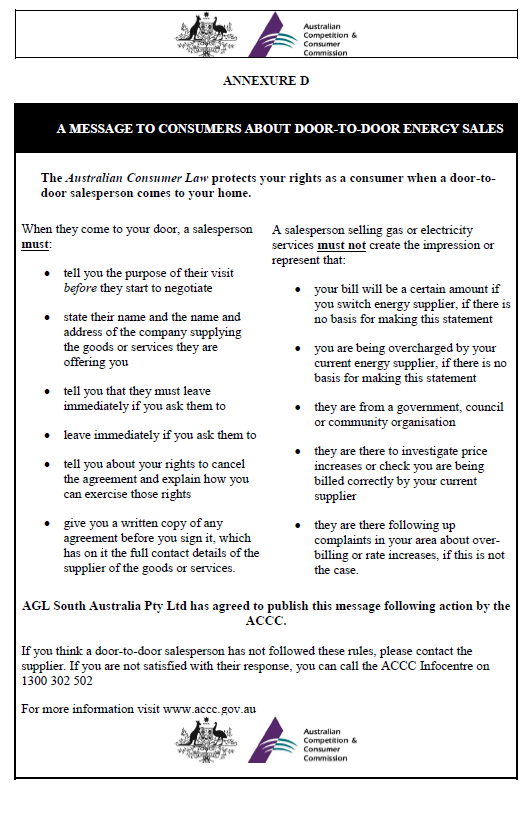
AND: |
AGL SALES PTY LTD (ACN 090 538 337) First Respondent CPM AUSTRALIA PTY LTD (ACN 063 244 824) Second Respondent AGL SOUTH AUSTRALIA PTY LTD (ACN 091 105 092) Third Respondent |
|
JUDGE: |
MIDDLETON J |
|
DATE OF ORDER: |
20 MAY 2013 |
|
WHERE MADE: |
MELBOURNE |
THE COURT DECLARES THAT:
Declarations
1. On 1 September 2011, the Second Respondent (CPM), by conduct of its contracted sales representative, called on a person referred to in the Fast Track Application as 'Mr G' for the purpose of negotiating an unsolicited consumer agreement for the First Respondent, AGL Sales Pty Ltd (AGL) to supply retail electricity and/or retail gas to Mr G and did not as soon as practicable or before starting to negotiate:
1.1. clearly advise Mr G that its purpose was to seek his agreement to a supply of retail electricity and/or retail gas and thereby contravened paragraph 74(a) of the Australian Consumer Law (ACL) (being Schedule 2 to the Competition and Consumer Act 2010 (Cth)(CCA)); and
1.2. clearly advise Mr G that it was obliged to leave the premises immediately on request and thereby contravened paragraph 74(b) of the ACL.
2. On 1 September 2011, CPM, by the conduct of its contracted sales representative, in trade and commerce, represented to Mr G that:
2.1. it was not calling on him to sell anything;
2.2. it was not calling on him to change his retail electricity or retail gas supplier;
2.3. it had a sponsorship, approval or affiliation with an 'Investigation Department';
2.4. it was calling upon Mr G as part of an investigation to check his electricity and gas meters because of a requirement to return money to Mr G;
2.5. Mr G had been overcharged for electricity and/or gas by his then current retail electricity and/or retail gas supplier;
2.6. in order to avoid being overcharged for the supply of retail electricity and/or retail gas, it was necessary for Mr G to obtain retail electricity and/or retail gas from the distributor of those products;
2.7. AGL was the distributor of electricity and/or gas in the Coburg area; and
2.8. if AGL was Mr G's retail electricity supplier his retail electricity bill would be between $100 and $120 per quarter,
when this was not the case, and thereby:
2.9. engaged in conduct which was misleading or deceptive or likely to mislead or deceive in contravention of subsection 18(1) of the ACL;
2.10. in respect of the representation made in connection with the supply or possible supply of goods or services set out in paragraph 2.3 above, made a false and misleading representation that it had a sponsorship, approval or affiliation in contravention of paragraph 29(1)(h) of the ACL;
2.11. in respect of the representation made in connection with the supply or possible supply of goods or services set out in paragraph 2.6 above, made a false and misleading representation that goods or services had performance characteristics or benefits in contravention of paragraph 29(1)(g) of the ACL; and
2.12. in respect of the representation made in connection with the supply or possible supply of goods or services set out in paragraph 2.8 above, made a false and misleading representation with respect to price in contravention of paragraph 29(1)(i) of the ACL.
3. On 1 September 2011, CPM, by conduct of its contracted sales representative, called on Ms Fotini Denny for the purpose of negotiating an unsolicited consumer agreement for AGL to supply retail electricity and/or retail gas to Ms Denny and did not as soon as practicable or before starting to negotiate:
3.1. clearly advise Ms Denny that its purpose was to seek her agreement to a supply of retail electricity and/or retail gas and thereby contravened paragraph 74(a) of the ACL; and
3.2. clearly advise Ms Denny that it was obliged to leave the premises immediately on request and thereby contravened paragraph 74(b) of the ACL.
4. On 1 September 2011, CPM, by conduct of its contracted sales representative, in trade and commerce, represented to Ms Denny that:
4.1. Ms Denny was not required to pay her last bill or bills if she said 'yes' to all the questions asked of her in a subsequent telephone conversation;
4.2. it had a sponsorship, approval or affiliation with the Coburg Investigation Unit; and
4.3. Ms Denny had been over billed for gas and/or electricity by her then current retail gas and/or retail electricity supplier,
when this was not the case, and thereby:
4.4. engaged in conduct which was misleading or deceptive or likely to mislead or deceive in contravention of subsection 18(1) of the ACL; and
4.5. in respect of the representation made in connection with the supply or possible supply of goods or services set out in paragraph 4.2 above, made a false and misleading representation that the person making the representation had a sponsorship, approval or affiliation in contravention of paragraph 29(1)(h) of the ACL.
5. On 1 September 2011, CPM, by conduct of its contracted sales representative, called on Ms Joanna Detsikas for the purpose of negotiating an unsolicited consumer agreement for AGL to supply retail electricity and/or retail gas to Ms Detsikas and did not as soon as practicable or before starting to negotiate:
5.1. clearly advise Ms Detsikas that its purpose was to seek her agreement to a supply of retail electricity and/or retail gas and thereby contravened paragraph 74(a) of the ACL; and
5.2. clearly advise Ms Detsikas that it was obliged to leave the premises immediately on request and thereby contravened paragraph 74(b) of the ACL.
6. On 1 September 2011, CPM, by conduct of its contracted sales representative, in trade and commerce, represented to Ms Detsikas that:
6.1. Ms Detsikas had been overcharged for retail gas and/or retail electricity by her then current supplier; and
6.2. the price AGL would have charged Ms Detsikas for retail gas supplied during her last billing period would have been between $200 and $300 less than the price charged by her then current supplier of retail gas,
when this was not the case, and thereby:
6.3. engaged in conduct which was misleading or deceptive or likely to mislead or deceive in contravention of subsection 18(1) of the ACL; and
6.4. in respect of the representation made in connection with the supply or possible supply of goods or services set out in paragraph 6.2 above, made a false and misleading representation with respect to price in contravention of paragraph 29(1)(i) of the ACL.
7. On 1 September 2011, CPM, by conduct of its contracted sales representative, in trade and commerce, represented to Ms Detsikas that Ms Detsikas was not required to pay her their last retail gas bill when this was not the case, and thereby engaged in conduct which was misleading or deceptive or likely to mislead or deceive in contravention of subsection 18(1) of the ACL.
8. On 3 November 2011, CPM, by conduct of its contracted sales representative, called on Ms Lisa Plant for the purpose of negotiating an unsolicited consumer agreement for the Third Respondent, AGL South Australia Pty Ltd (AGL SA), to supply retail electricity and/or retail gas to Ms Plant and did not:
8.1. as soon as practicable or before starting to negotiate:
8.1.1. clearly advise Ms Plant that its purpose was to seek her agreement to a supply of retail electricity and/or retail gas and thereby contravened paragraph 74(a) of the ACL; and
8.1.2. clearly advise Ms Plant that it was obliged to leave the premises immediately on request and thereby contravened paragraph 74(b) of the ACL.
9. On 3 November 2011, CPM, by conduct of its contracted sales representative, in trade and commerce, represented to Ms Plant that:
9.1. Ms Plant's retail electricity and/or retail gas was supplied by AGL SA; and
9.2. after two years Ms Plant's supplier of retail electricity and/or retail gas reverts back to AGL SA,
when this was not the case, and thereby engaged in conduct which was misleading or deceptive or likely to mislead or deceive in contravention of subsection 18(1) of the ACL.
THE COURT ORDERS BY CONSENT THAT:
Precuniary Penalties
10. CPM is to pay to the Commonwealth of Australia, the amount of $200,000 in respect of the acts or omissions relating to CPM's contraventions of sections 29 and 74 of the ACL in the following instalments:
10.1. $100,000 to be paid within 30 days of the date of making the order;
10.2. $50,000 to be paid within 90 days of the date of making the order; and
10.3. $50,000 to be paid within 120 days of the date of making the order.
Non-punitive Orders
Compliance Program
11. CPM shall at its own expense:
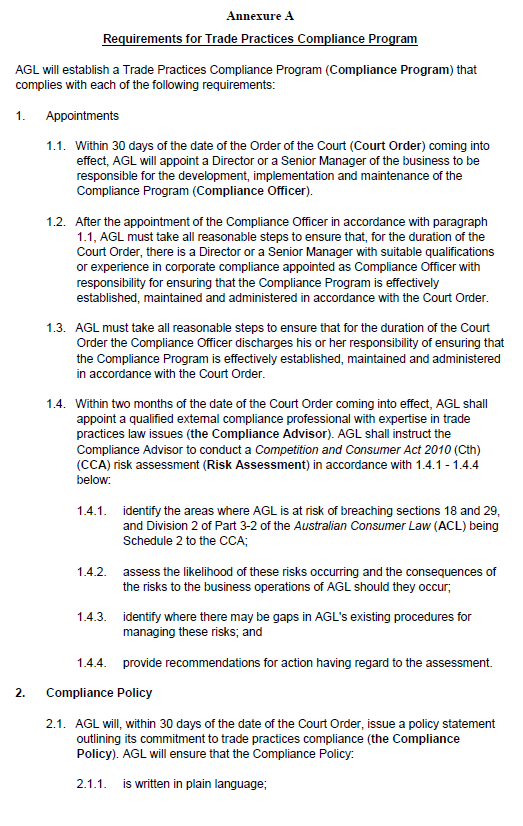
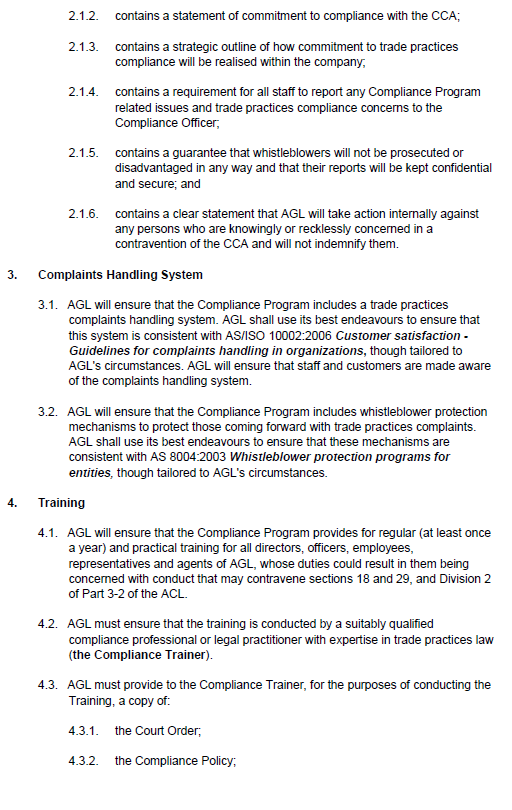
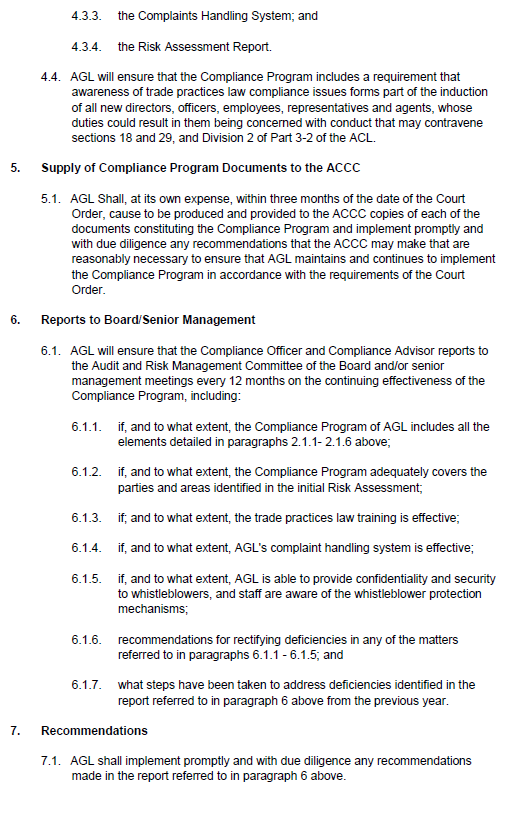
11.1. establish, within three months of the date of this order, a trade practices compliance program which meets the requirements set out in Annexure A to this order and maintain the compliance program for 3 years from the date on which it is established; or
11.2. if it already maintains an existing trade practices compliance program:
11.2.1. within 3 months of the date of this order, review the existing compliance program and make any amendments necessary to ensure that it meets the requirements set out in Annexure A to this order; and
11.2.2. maintain this program for 3 years from the date on which the amendments referred to in paragraph 11.2.1 are made.
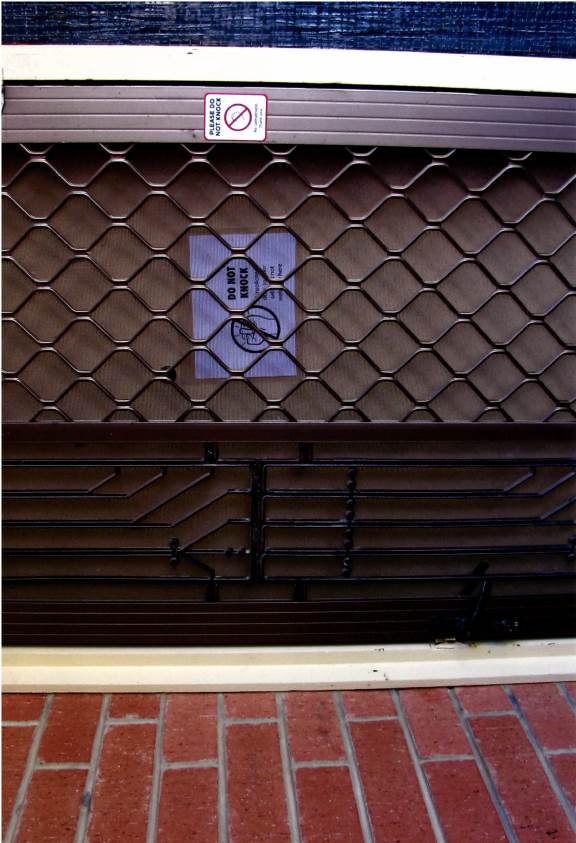
Publication Orders
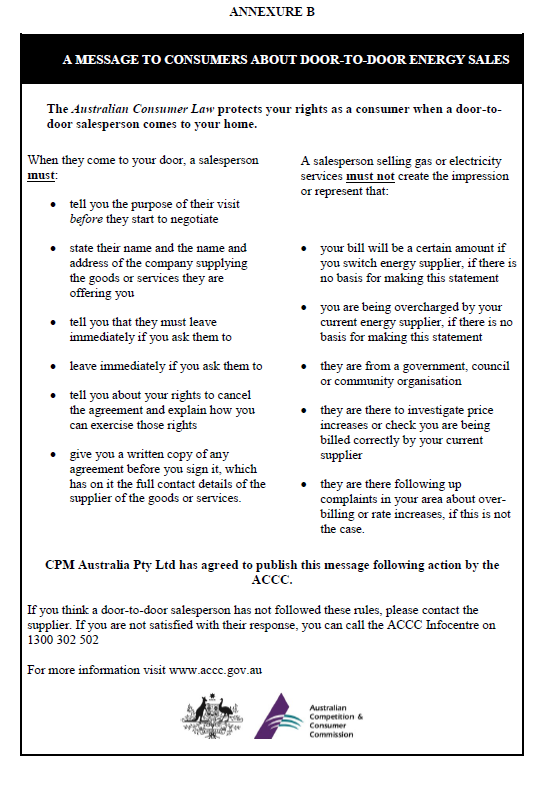
12. CPM is to, at its own expense, within 14 days of the date of this order, cause a notice to be published in a weekday edition of The Herald Sun newspaper which is in the terms and form of Annexure B and complies with the following specifications:
12.1. be placed within the first 10 pages of the newspaper;
12.2. be size at least 20 centimetres by 7 columns in size and/or of a size no less than one half of a page in the newspaper;
12.3. have a banner font of sans serif 12 point, bold;
12.4. have a headline font of 12 point, bold;
12.5. contain in the body of text font that is no less than 11 point size; and
12.6. have ACCC and Commonwealth logos of at least 20 millimetres in height and centered.
Other Orders
13. Within 75 days of the date of this order, CPM shall file and serve on the ACCC an affidavit of its proper officer verifying that it has carried out its obligations under the orders of the Court sought under paragraph 12 above, detailing what it has done, including providing a copy of the corrective advertisement as published in The Herald Sun newspaper.
Costs
14. CPM is to pay to the ACCC, within 30 days of the making of this order by the Court, a contribution to its costs of, and incidental to, this proceeding in the amount of $15,000.
Note: Entry of orders is dealt with in Rule 39.32 of the Federal Court Rules 2011.
|
IN THE FEDERAL COURT OF AUSTRALIA |
|
|
VICTORIA DISTRICT REGISTRY |
|
|
GENERAL DIVISION |
VID 267 of 2012 |
|
BETWEEN: |
AUSTRALIAN COMPETITION AND CONSUMER COMMISSION Applicant |
|
AND: |
AGL SALES PTY LTD (ACN 090 538 337) First Respondent CPM AUSTRALIA PTY LTD (ACN 063 244 824) Second Respondent AGL SOUTH AUSTRALIA PTY LTD (ACN 091 105 092) Third Respondent |
|
JUDGE: |
MIDDLETON J |
|
DATE OF ORDER: |
20 MAY 2013 |
|
WHERE MADE: |
MELBOURNE |
THE COURT DECLARES THAT:
Declarations
1. The First Respondent (AGL) contravened sections 74(a) and 74(b)) of the Australian Consumer Law (ACL) (being Schedule 2 to the Competition and Consumer Act 2010 (Cth)(CCA)) by reason of the following:
1.1. on 1 September 2011, AGL's dealer, C.P.M. Australia Pty Ltd (CPM), by conduct of a sales representative, called on a person, referred to in the Fast Track Application as Mr G, for the purpose of negotiating an unsolicited consumer agreement for AGL to supply retail electricity and/or retail gas to Mr G and did not as soon as practicable or before starting to negotiate:
1.1.1 clearly advise Mr G that its purpose was to seek his agreement to a supply of retail electricity and/or retail gas and thereby contravened paragraph 74(a) of the ACL; and
1.1.2 clearly advise Mr G that it was obliged to leave the premises immediately on request and thereby contravened paragraph 74(b) of the ACL; and
1.2. AGL, as the supplier of the retail electricity and/or retail gas to which the negotiations referred to in 1.1 above related, is by reason of section 77 of the ACL also taken to have contravened paragraphs 74(a) and 74(b) of the ACL.
2. On 1 September 2011, AGL, by the conduct of CPM through a sales representative who called on Mr G, in trade and commerce, represented to Mr G that:
2.1 it was not calling on him to sell anything;
2.2 it was not calling on him to change his retail electricity or retail gas supplier;
2.3 it had a sponsorship, approval or affiliation with an 'Investigation Department';
2.4 it was calling upon Mr G as part of an investigation to check his electricity and gas meters because of a requirement to return money to Mr G;
2.5 Mr G had been overcharged for electricity and/or gas by his then current retail electricity and/or retail gas supplier;
2.6 in order to avoid being overcharged for the supply of retail electricity and/or retail gas, it was necessary for Mr G to obtain retail electricity and/or retail gas from the distributor of those products;
2.7 AGL was the distributor of electricity and/or gas in the Coburg area; and
2.8 if AGL was Mr G's retail electricity supplier his retail electricity bill would be between $100 and $120 per quarter,
when this was not the case, and thereby:
2.9 engaged in conduct which was misleading or deceptive or likely to mislead or deceive in contravention of subsection 18(1) of the ACL;
2.10 in respect of the representation made in connection with the supply or possible supply of goods or services set out in paragraph 2.3 above, made a false and misleading representation that it had a sponsorship, approval or affiliation in contravention of paragraph 29(1)(h) of the ACL;
2.11 in respect of the representation made in connection with the supply or possible supply of goods or services set out in paragraph 2.6 above, made a false and misleading representation that goods or services had performance characteristics or benefits in contravention of paragraph 29(1)(g) of the ACL; and
2.12 in respect of the representation made in connection with the supply or possible supply of goods or services set out in paragraph 2.8 above, made a false and misleading representation with respect to price in contravention of paragraph 29(1)(i) of the ACL.
3. AGL contravened sections 74(a) and 74(b) of the ACL by reason of the following:
3.1 on 1 September 2011, AGL's dealer, CPM, by conduct of a sales representative, called on Ms Fotini Denny for the purpose of negotiating an unsolicited consumer agreement for AGL to supply retail electricity and/or retail gas to Ms Denny and did not as soon as practicable or before starting to negotiate:
3.1.1 clearly advise Ms Denny that its purpose was to seek her agreement to a supply of retail electricity and/or retail gas and thereby contravened paragraph 74(a) of the ACL; and
3.1.2 clearly advise Ms Denny that it was obliged to leave the premises immediately on request and thereby contravened paragraph 74(b) of the ACL; and
3.2 AGL, as the supplier of the retail electricity and/or retail gas to which the negotiations referred to in 3.1 above related, is by reason of section 77 of the ACL also taken to have contravened paragraphs 74(a) and 74(b) of the ACL.
4. On 1 September 2011, AGL, by the conduct of CPM through a sales representative who called upon Ms Denny, in trade and commerce, represented to Ms Denny that:
4.1. Ms Denny was not required to pay her last bill or bills if she said 'yes' to all the questions asked of her in a subsequent telephone conversation;
4.2. it had a sponsorship, approval or affiliation with the Coburg Investigation Unit; and
4.3. Ms Denny had been over billed for gas and/or electricity by her then current retail gas and/or retail electricity supplier,
when this was not the case, and thereby:
4.4. engaged in conduct which was misleading or deceptive or likely to mislead or deceive in contravention of subsection 18(1) of the ACL; and
4.5. in respect of the representation made in connection with the supply or possible supply of goods or services set out in paragraph 4.2 above, made a false and misleading representation that the person making the representation had a sponsorship, approval or affiliation in contravention of paragraph 29(1)(h) of the ACL.
5. AGL contravened sections 74(a) and 74(b) of the ACL by reason of the following:
5.1. on 1 September 2011, AGL's dealer, CPM, by conduct of a sales representative, called on Ms Joanna Detsikas for the purpose of negotiating an unsolicited consumer agreement for AGL to supply retail electricity and/or retail gas to Ms Detsikas and did not as soon as practicable or before starting to negotiate:
5.1.1. clearly advise Ms Detsikas that its purpose was to seek her agreement to a supply of retail electricity and/or retail gas and thereby contravened paragraph 74(a) of the ACL; and
5.1.2. clearly advise Ms Detsikas that it was obliged to leave the premises immediately on request and thereby contravened paragraph 74(b) of the ACL; and
5.2. AGL, as the supplier of the retail electricity and/or retail gas to which the negotiations referred to in 5.1 above related, is by reason of section 77 of the ACL also taken to have contravened paragraphs 74(a) and 74(b) of the ACL.
6. On 1 September 2011, AGL, by the conduct of CPM through a sales representative who called on Ms Detsikas, in trade and commerce, represented to Ms Detsikas that:
6.1. Ms Detsikas had been overcharged for retail gas and/or retail electricity by her then current supplier; and
6.2. the price AGL would have charged Ms Detsikas for retail gas supplied during her last billing period would have been between $200 and $300 less than the price charged by her then current supplier of retail gas,
when this was not the case, and thereby:
6.3. engaged in conduct which was misleading or deceptive or likely to mislead or deceive in contravention of subsection 18(1) of the ACL; and
6.4. in respect of the representation made in connection with the supply or possible supply of goods or services set out in paragraph 6.2 above, made a false and misleading representation with respect to price in contravention of paragraph 29(1)(i) of the ACL.
7. On 1 September 2011, AGL, by the conduct of CPM through a sales representative who called on Ms Detsikas, in trade and commerce, represented to Ms Detsikas that she was not required to pay her last retail gas bill when this was not the case, and thereby engaged in conduct which was misleading or deceptive or likely to mislead or deceive in contravention of subsection 18(1) of the ACL.
8. AGL SA contravened sections 74(a) and 74(b) of the ACL by reason of the following:
8.1. on 3 November 2011, AGL SA's dealer, CPM, by conduct of a sales representative, called on Ms Lisa Plant for the purpose of negotiating an unsolicited consumer agreement for AGL to supply retail electricity and/or retail gas to Ms Plant and did not:
8.1.1. as soon as practicable or before starting to negotiate:
8.1.1.1. clearly advise Ms Plant that its purpose was to seek her agreement to a supply of retail electricity and/or retail gas and thereby contravened paragraph 74(a) of the ACL; and
8.1.1.2. clearly advise Ms Plant that it was obliged to leave the premises immediately on request and thereby contravened paragraph 74(b) of the ACL; and
8.2. AGL SA, as the supplier of the retail electricity and/or retail gas to which the negotiations referred to in 8.1 above related, is by reason of section 77 of the ACL also taken to have contravened paragraphs 74(a) and 74(b).
9. On 3 November 2011, AGL SA, by the conduct of CPM through a sales representative who called on Ms Plant, in trade or commerce, represented to Ms Plant that:
9.1. Ms Plant's retail electricity and/or retail gas was supplied by AGL SA; and
9.2. after two years Ms Plant's supplier of retail electricity and/or retail gas reverts back to AGL SA,
when this was not the case, and thereby engaged in conduct which was misleading or deceptive or likely to mislead or deceive in contravention of subsection 18(1) of the ACL.
THE COURT ORDERS BY CONSENT THAT:
PECUNIARY PENALTIES
10. AGL is to pay to the Commonwealth of Australia, within 30 days of the making of this order by the Court, the amount $1,485,000 in respect of the acts or omissions relating to AGL's contraventions of sections 29 and 74 of the ACL.
11. AGL SA is to pay to the Commonwealth of Australia, within 30 days of the making of this order by the Court, the amount of $70,000 in respect of the acts or omissions relating to AGL SA's contraventions of section 74 of the ACL.
Non-punitive Orders
Compliance Program
12. AGL shall at its own expense:
12.1. establish, within three months of the date of this order, a trade practices compliance program which meets the requirements set out in Annexure A to this order and maintain the compliance program for 3 years from the date on which it is established; or
12.2. if it already maintains an existing trade practices compliance program:
12.2.1. within 3 months of the date of this order, review the existing compliance program and make any amendments necessary to ensure that it meets the requirements set out in Annexure A to this order; and
12.2.2. maintain this program for 3 years from the date on which the amendments referred to in paragraph 12.2.1 are made.
13. AGL SA shall at its own expense:
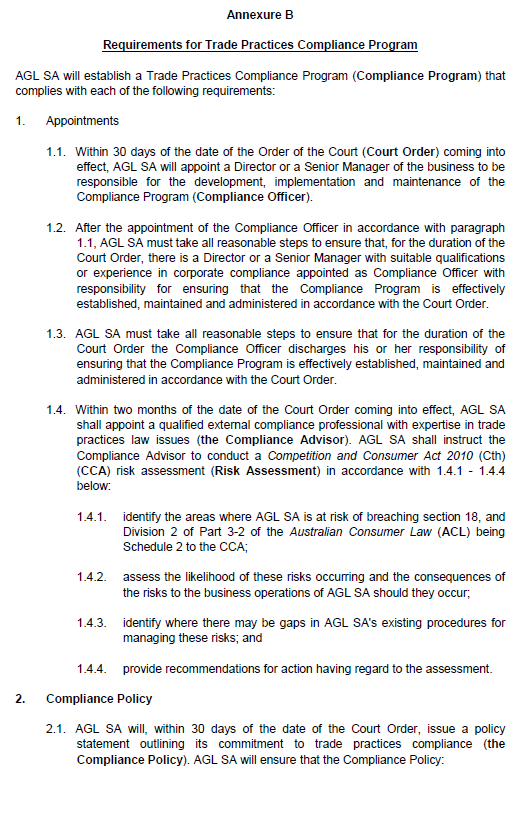
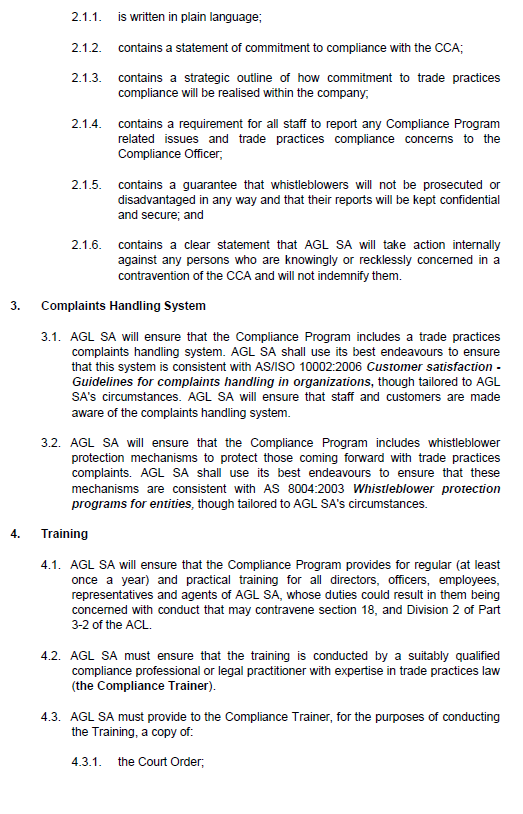
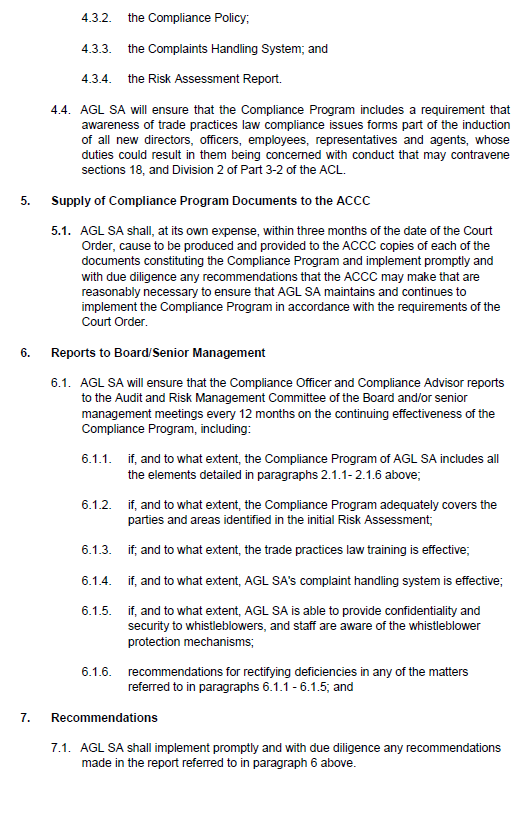
13.1. establish, within three months of the date of this order, a trade practices compliance program which meets the requirements set out in Annexure B to this order and maintain the compliance program for 3 years from the date on which it is established; or
13.2. if it already maintains an existing trade practices compliance program:
13.2.1. within 3 months of the date of this order, review the existing compliance program and make any amendments necessary to ensure that it meets the requirements set out in Annexure B to this order; and
13.2.2. maintain this program for 3 years from the date on which the amendments referred to in paragraph 13.2.1 are made.
Publication Orders
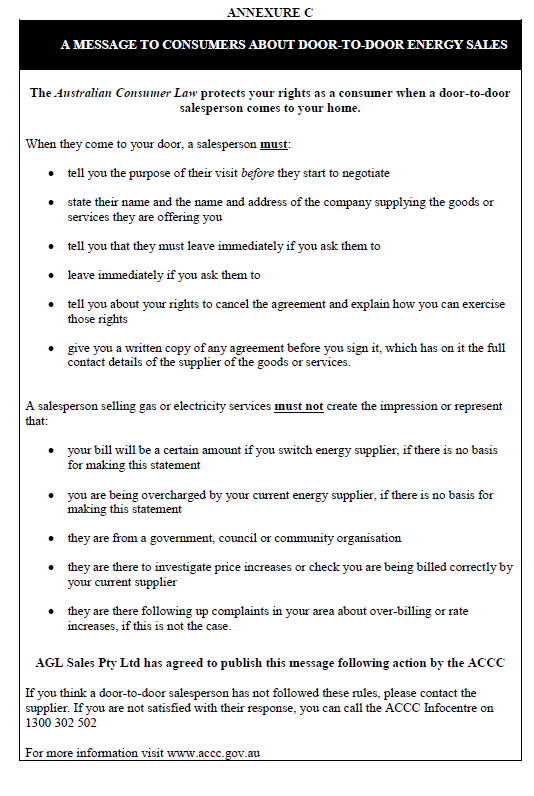
14. AGL is to, within 14 days of the date of this order, cause a notice to be published in a weekday edition of The Age newspaper which is in the terms and form of Annexure C and complies with the following specifications:
14.1. be placed within the first 10 pages of the newspaper;
14.2. be at least 28 centimetres by 5 columns in size and/or of a size no less than one third of a page in the newspaper;
14.3. have a banner font of sans serif 12 point, bold;
14.4. have a headline font of 12 point, bold;
14.5. contain in the body of text font that is no less than 11 point size; and
14.6. have ACCC and Commonwealth logos of at least 20 millimetres in height and centered.
15. AGL SA is to, within 14 days of the date of this order, cause a notice to be published in a weekday edition of The Advertiser newspaper which is in the terms and form of Annexure D and complies with the following specifications:
15.1. be placed within the first 10 pages of the newspaper;
15.2. be at least 20 centimetres by 7 columns in size and/or of a size no less than one half of a page in the newspaper;
15.3. have a banner font of sans serif 12 point, bold;
15.4. have a headline font of 12 point, bold;
15.5. contain in the body of text font that is no less than 11 point size; and
15.6. have ACCC and Commonwealth logos of at least 20 millimetres in height and centred.
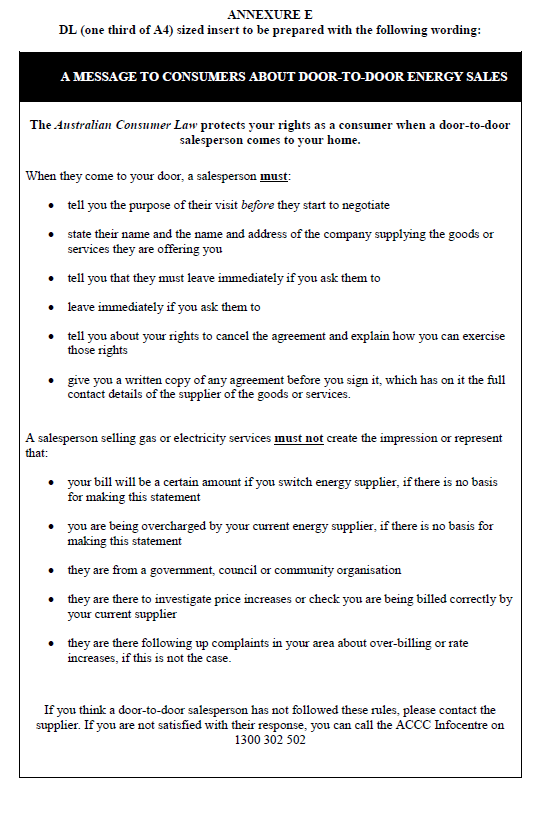
16. AGL is to, at its own expense, within 60 days of the date of this order, cause a DL (one third of A4 size) sized insert in the terms and form of Annexure E to be published and distributed once with each of its customers' bills.
17. AGL SA is to, at its own expense, within 60 days of the date of this order, cause a DL (one third of A4 size) sized insert in the terms and form of Annexure E to be published and distributed once with each of its customers' bills.
OTHER ORDERS
18. Within 75 days of the date of this order, AGL shall file and serve on the ACCC, an affidavit of its proper officer verifying that it has carried out its obligations under the orders of the Court sought under paragraphs 14 and 16 above, detailing what it has done, including:
18.1. in respect of paragraph 14 above, providing a copy of the corrective advertisement as published in The Age newspaper; and
18.2. in respect of paragraph 16 above, providing a copy of one insert as distributed to a customer.
19. Within 45 days of each meeting referred to in paragraph 6.1 of Annexure A, AGL shall file and serve on the ACCC an affidavit of its proper officer verifying that it has carried out its obligations under the orders of the Court, including in respect of the relevant meeting.
20. Within 75 days of the date of this order, AGL SA shall file and serve on the ACCC, an affidavit of its proper officer verifying that it has carried out its obligations under the orders of the Court sought under paragraphs 15 and 17 above, detailing what it has done, including:
20.1. in respect of paragraph 15 above, providing a copy of the corrective advertisement as published in The Advertiser newspaper; and
20.2. in respect of paragraph 17 above, providing a copy of one insert as distributed to a customer.
21. Within 45 days of each meeting referred to in paragraph 6.1 of Annexure B, AGL SA shall file and serve on the ACCC an affidavit of its proper officer verifying that it has carried out its obligations under the orders of the Court, including in respect of the relevant meeting.
COSTS
22. AGL is to pay to the ACCC, within 30 days of the making of this order by the Court, costs of $45,000.
Note: Entry of orders is dealt with in Rule 39.32 of the Federal Court Rules 2011.
|
IN THE FEDERAL COURT OF AUSTRALIA |
|
|
AUSTRALIAN COMPETITION AND CONSUMER COMMISSION Applicant |
|
AND: |
AGL SALES PTY LTD (ACN 090 538 337) First Respondent CPM AUSTRALIA PTY LTD (ACN 063 244 824) Second Respondent AGL SOUTH AUSTRALIA PTY LTD (ACN 091 105 092) Third Respondent |
|
DATE OF ORDER: |
|
|
WHERE MADE: |
THE COURT ORDERS THAT:
1. The proceeding be adjourned to a date to be fixed for further hearing in relation to penalty.
Note: Entry of orders is dealt with in Rule 39.32 of the Federal Court Rules 2011.
|
VICTORIA DISTRICT REGISTRY |
|
|
GENERAL DIVISION |
VID 267 of 2012 |
|
BETWEEN: |
AUSTRALIAN COMPETITION AND CONSUMER COMMISSION Applicant |
|
AND: |
AGL SALES PTY LTD (ACN 090 538 337) First Respondent CPM AUSTRALIA PTY LTD (ACN 063 244 824) Second Respondent AGL SOUTH AUSTRALIA PTY LTD (ACN 091 105 092) Third Respondent |
|
JUDGE: |
MIDDLETON J |
|
DATE: |
11 OCTOBER 2013 |
|
PLACE: |
MELBOURNE |
REASONS FOR JUDGMENT
INTRODUCTION
1 The Australian Competition and Consumer Commission ('the ACCC') as Applicant has sought various forms of relief against the Respondents for alleged breaches of various sections of the Australian Consumer Law ('ACL') being Sch 2 to the Competition and Consumer Act 2010 (Cth). The breaches of the ACL concern the conduct of representatives of the Second Respondent ('CPM') during door-to-door sales calls it made with the aim of securing new customers for the First Respondent ('AGL') and Third Respondent ('AGL SA').
2 The Respondents have admitted certain breaches to the ACL and have agreed with the ACCC as to appropriate orders, which I will outline below. However, the parties remain in dispute as to alleged contraventions of the ACL in relation to whether a request to leave the premises was made, pursuant to s 75(1) of the ACL, by virtue of the presence of a 'Do Not Knock' sticker on one of the consumer's premises.
3 The Court has already made various orders and declarations concerning the admitted breaches of the Respondents, including the penalties to be levied against the Respondents.
4 I now provide the reasons for the making of those orders and declarations.
5 It also remains for me to decide on the matter of whether or not there was a breach of s 75(1) of the ACL.
AGREED FACTS
6 I turn to the agreed position between the parties.
7 AGL and AGL SA are suppliers of retail electricity and retail gas ('retail energy'). They engaged CPM to conduct door-to-door sales calls directed towards securing new customers for AGL in Victoria, and AGL SA in South Australia. During the course of the door-to-door sales activities, the ACCC alleged that there were breaches of the ACL in respect of the representations made by CPM's representatives, and whether a request to leave the premises was made by the presence of a 'Do Not Knock' sticker on one of the consumer's premises.
8 On 9 April 2013, the parties filed an Agreed Statement of Facts and Admissions (which I attach to this judgment marked 'Annexure A'), making the following admissions:
(1) CPM contravened s 29 (false or misleading representations) and s 18 (misleading or deceptive conduct); and ss 74(a) (not clearly disclosing a purpose for the sales call) and 74(b) (not advising that the dealer was obliged to leave immediately on request) when its representatives called on four consumers;
(2) AGL admitted contravening ss 18, 29, 74(a) and 74(b) of the ACL in relation to three of the consumers residing in Victoria; and
(3) AGL SA admitted contravening ss 18, 74(a) and 74(b) of the ACL in relation to one of the consumers residing in South Australia.
9 The liability of AGL and AGL SA for the actions of the CPM's breaches of the ACL arises by virtue of s 77 of the ACL.
10 The events that gave rise to the breaches are detailed in 'Section C' (paragraphs [15] – [46]) of the Agreed Statement of Facts and Admissions. The admissions are detailed in 'Section D' (paragraphs [47] – [58]) of the Agreed Statement of Facts and Admissions.
11 The parties also agreed upon certain orders and the penalties to be levied on the Respondents as a result of the above breaches. They were as follows:
(1) AGL pay $1,485,000 for breaching ss 29 and 74 of the ACL, establish a trade practices compliance program and publish a 'Message to Consumers About Door-to-Door Energy Sales' in The Age newspaper;
(2) CPM pay $200,000 for breaching ss 29 and 74 of the ACL, establish a trade practices compliance program and publish a 'Message to Consumers About Door-to-Door Energy Sales' in The Herald-Sun newspaper; and
(3) AGL SA pay $70,000 for breaching ss 74 of the ACL, establish a trade practices compliance program and publish a 'Message to Consumers About Door-to-Door Energy Sales' in The Advertiser newspaper.
THE IMPOSITION OF AGREED PECUNIARY PENALTIES
12 The parties submitted 'Joint Submissions on Penalty' along with the Agreed Statement of Facts and Admissions. An issue arose as to the appropriateness of the presenting to the Court an agreed figure, particularly in light of the recent decision of the Court of Appeal of the Supreme Court of Victoria in ASIC v Ingleby [2013] VSCA 49 (Weinberg and Harper JJA, Hargrave AJA) ('Ingleby'). For reasons that I will explain below, I do not believe that the decision in Ingleby affects the outcome in the present case, nor my approach to determining the appropriate orders to impose.
13 Ingleby decided that the approach to considering whether pecuniary penalty orders should be made following agreement between the parties adopted by the Full Federal Court in a number of cases (including NW Frozen Foods v Australian Competition and Consumer Commission (1996) 71 FCR 285 and the Minister for Industry, Tourism and Resources v Mobile Oil Australia [2004] FCAFC 72) was incorrect.
14 The parties made a brief submission in this regard that the line of Full Federal Court authority was correct, and in any event was binding upon me in this proceeding.
15 In NW Frozen Foods, the Full Court was required to consider what pecuniary penalty was appropriate for a contravention of Pt IV of the Trade Practices Act 1974 (Cth) ('the TPA'). In that case, the ACCC had reached agreement with the defendant company regarding the various contraventions alleged, and they had together agreed on a statement of facts and proposed penalty submissions to be jointly put before the primary judge.
16 The appeal to the Full Federal Court arose because the primary judge rejected the proposed penalty of $900,000 in substitution for one that was significantly more severe ($1,200,000).
17 The Court held that the proposed penalty was reasonable and Burchett and Kiefel JJ stated that (at 290-291):
Because the fixing of the quantum of a penalty cannot be an exact science, the Court, in such a case, does not ask whether it would without the aid of the parties have arrived at the precise figure they have proposed, but rather whether their proposal can be accepted as fixing an appropriate amount…
A proper figure is one within the permissible range in all the circumstances. The Court will not depart from an agreed figure merely because it might otherwise have been disposed to select some other figure, or except in a clear case.
18 Their Honours further noted (at 291) that there were "important public policy" considerations involved in such an inquiry, namely, that typically, when corporations acknowledge contraventions of consumer protection legislation, it frequently enables lengthy and complex litigation to be avoided. The flow-on effects of such settlements for both the court and the regulator include the freeing up of resources which can then be used to deal with other matters.
19 Their Honours discussed Australian and New Zealand authority which provided unanimous support for this approach. The key points that arose from these authorities included:
There is a strong public interest that litigation should be brought to a conclusion as early as possible.
An appropriate question is whether the agreement reached is broadly in accord with what the court would have done itself, based on the facts available.
The fixing of the quantum of a penalty is not an exact science. It is not achieved by application of a fixed formula. Within a certain range, one precise figure may not be incontestably said to be preferable to another.
20 The joint judgment was clear to point out that "[t]he Court should not leave room for any impression of weakness in its resolve to impose penalties sufficient to ensure the deterrence, not only of the parties actually before it, but also of others who might be tempted to think that contravention would pay, and detection lead merely to a compliance program for the future" (at 294-295). However, working within the parameters of agreed facts and penalties where it is appropriate to do so in all the circumstances does not detract from the Court's functions in this regard.
21 It is relevant to the present case before me that the Court in NW Frozen Foods was satisfied that the agreed statement of facts sufficiently outlined the facts, the breaches of the law and admissions made by the respondent (at 289). It was on that basis that the agreed penalty could be assessed, and the Court held that it was in the permissible range.
22 The approach of the Court in NW Frozen Foods was considered in Mobil Oil.
23 In that case, the Minister for Industry, Tourism and Resources sought relief against Mobile for contraventions of the Petroleum Retail Marketing Sites Act 1980 (Cth), such relief including but not limited to a pecuniary penalty.
24 Mobil agreed that it had contravened certain provisions of the relevant legislation, and the parties proposed that certain types of relief be granted. There was no issue concerning the declaratory or injunctive relief. However, the primary judge did not think it was appropriate to accede to the joint submission on penalty without a further examination of the approach taken in NW Frozen Foods.
25 The matter was then referred to the Full Court pursuant to s 20(1A) of the Federal Court of Australia Act 1976 (Cth) so that a Full Court could examine the approach of NW Frozen Foods.
26 The Full Court looked at the comments from the joint judgment to the effect that the Court "will not depart from an agreed figure merely because it might otherwise have been disposed to select some other figure, or except in a clear case", and noted that (at [48]):
Three points should be made about these comments in the context of the passage as a whole. First, Burchett and Kiefel JJ do not say that the Court is precluded from requesting further information in order to determine whether the agreed penalty is a proper one in the circumstances. In particular, their Honours do not suggest that the Court is bound to act without further inquiry on the statement of facts presented by the parties. Secondly, their Honours do not say that the Court is bound by the penalty proposed by the parties or relieved from the necessity of determining that it is appropriate. They say only that the Court will not depart from the agreed figure merely because it might have selected some other figure, or in a "clear case". Thirdly, as Mr Jackson observed in argument in the present case, it is not entirely clear what Burchett and Kiefel JJ mean by the reference to a "clear case". In context, it appears simply to mean a case where the proposed penalty is outside the range considered by the Court to be appropriate in all the circumstances.
27 The Court considered, at length, the jurisprudence concerning the imposition of agreed pecuniary penalties and concluded that there was nothing in NW Frozen Foods that was inconsistent with any of the following principles (at [57]):
(i) The Court, if it considers that the evidence or information before it is inadequate to form a view as to whether the proposed penalty is appropriate, may request the parties to provide additional evidence or information or verify the information provided. If they do not provide the information or verification requested, the Court may well not be satisfied that the proposed penalty is within the range.
(ii) If the absence of a contradictor inhibits the Court in the performance of its duties under s 76 of the TP Act, s 13 of the Sites Act, or similar legislation, it may seek the assistance of an amicus curiae or of an individual or body prepared to act as an intervenor under FCR, O 6 r 17.
(iii) If the Court is disposed not to impose the penalty proposed by the parties, it may be appropriate, depending on the circumstances, for each of them to be given the opportunity to withdraw consent to the proposed orders and for the matter to proceed as a contested hearing.
28 Accordingly, the Full Court did not consider that the criticisms of NW Frozen Foods warranted a departure from the principles set out therein. It was satisfied that, when properly understood and applied, a court has adequate powers to ensure that it discharges its statutory responsibilities appropriately in civil penalty proceedings involving agreed penalties (at [79]).
29 The Court also made clear, that a court is not bound to accept a proposed pecuniary penalty where the agreed statement of facts to do not support it. In those circumstances the Court (at [70]):
…is free to request more detailed information or to ask that the information, or any aspect of it, be verified on oath or affirmation. In the unlikely event of the parties being unwilling to respond to the Court's request, the Court might well take the view that it is not prepared to act on the agreed material in the manner sought by the parties.
30 It ought to be axiomatic, in light of the decisions in NW Frozen Foods and Mobil Oil, that the agreed statement of facts is central where the court is called to assess an agreed pecuniary penalty, and it is critical that it sufficiently outlines the facts, breaches of the law and admissions in that regard. Otherwise, the court cannot be in a position to properly assess the pecuniary penalty. There is nothing in the Federal Court authorities which binds courts to accept a pecuniary penalty where the agreed statement of facts is inadequate.
31 I now turn to Ingleby.
32 Ingleby concerned the investigation by the Australian Securities and Investments Commission ('ASIC') into the activities of the Australian Wheat Board (AWB) in its dealings with the Iraqi Government under the Oil-for-Food Program. As a result of that investigation, ASIC commenced a number of actions against directors and officers of AWB. Mr Ingleby was the AWB's Chief Financial Officer, and was the subject of one of ASIC's cases. ASIC and Mr Ingleby reached an agreement where he would admit a contravention of s 180(1) of the Corporations Act 2001 (Cth) – that is, he had failed to act with appropriate care and diligence – and consequently pay a $40,000 fine and be disqualified from managing corporations for 15 months.
33 The trial judge thought the pecuniary penalty and disqualification too harsh and refused to accept the settlement agreement.
34 The Court of Appeal unanimously held that NW Frozen Foods and Mobil Oil were bad law (per Weinberg JA at [29], per Harper JA at [99] and Hargrave AJA at [102]) and the court's discretion ought not be fettered by the principle outlined in NW Frozen Foods that the agreed penalty be imposed where it fits within the permissible range.
35 The Court also held that the agreed statement of facts was not sufficient for assessing an appropriate penalty (per Weinberg JA at [33], Harper JA [73], and Hargrave AJA [101]).
36 Justice Weinberg was particularly critical of the judgments in NW Frozen Foods and Mobil Oil.
37 Justice Weinberg made various criticisms of the approach taken in NW Frozen Foods and Mobil Oil. However, his main criticism at [29], was that by adopting that approach trial judges would be impermissibly exercising appellate functions by not arriving at the pecuniary penalty independently, but rather assessing the agreed amount according to whether it falls within the permissible range.
38 I do not need to fully consider this criticism, applying as I do the Full Court decisions binding on me.
39 However, subject to a matter of emphasis, I do not consider the position taken in Ingleby to be much different from that taken by the Full Court, and a solution that could have been taken by the trial judge in Ingleby was to ask the parties to provide additional evidence or information.
40 All the authorities emphasise the essential matters. No court is to act as, or be seen as acting as, a "rubber stamp" – a court must form its own opinion about the penalty, undertaking its constitutional role.
41 In carrying out its constitutional role, statements of agreed fact may, as long as in the circumstances they are adequate, form a sound basis for a court determination as to the appropriate orders to make, including as to penalty.
42 No one suggests a court at first instance in determining a penalty is to undertake an "appellate function" upon being given a range or agreed figure. I accept that there is a danger this may occur if the court becomes blinkered by approaching the determination by reference to an agreed position or agreed penalty. However, provided the Court has, as it should, an overall view of the considerations relevant to the making of appropriate orders, being given any indication of an agreed position on penalty can be of assistance. This assistance could be given preferably by the providing of an 'agreed range', or by separate submission of the parties. In asking whether an agreed figure falls within the range of penalties reasonably available does not mean the court does not need to consider independently the appropriate penalty. It must do so in order to determine whether the range is in fact appropriate. As no one precise penalty figure is necessarily the only appropriate figure, the court will often consider the matter in terms of a permissible range in arriving at a final penalty. Of course, no agreed position, whether it be to a range or agreed figure, can be binding on the court.
43 I do not believe, despite the comments made by the various justices in the Victorian Court of Appeal, that the reasoning adopted in NW Frozen Foods and Mobil Oil fetters the power of the court to determine the appropriate penalty. Nevertheless, the comments by the justices of the Court of Appeal are a useful reminder of the onerous responsibility placed upon a court in determining the appropriate orders.
44 I make one further observation. A court will necessarily rely heavily upon the parties, which will include the regulator, to appropriately inform the court of all relevant matters for deliberation. The parties (and their legal representatives) must be mindful of their responsibilities in this regard. There are risks if the parties do not put all relevant matters before the court. As the reasoning of the Court of Appeal in Ingleby shows, a court astute to the task, will readily come to appreciate where the agreed facts and admissions do not truly characterise the nature or extent of the contravention or contraventions. Then, as I have indicated, the trial judge can and should insist upon a "fuller, and more realistic set of agreed facts" (as indicated by Weinberg J in Ingleby at [45]), or proceed to hear the matter as a contested hearing.
PENALTIES AND OTHER ORDERS
45 I have examined the Agreed Statement of Facts and Admissions and believe that it sets out the facts, breaches and admissions sufficiently for me to assess the pecuniary penalty. I now turn to that task.
The Applicable Law
46 Pecuniary penalties are dealt with in Division 1 of Part 5-2 of the ACL. The Respondents' breaches of the ACL are outlined above and the agreed pecuniary penalties are for contravening s 29 (Pt 3-1) and s 74 (Pt 3-2).
47 Pecuniary penalties may be ordered for breaches of provisions in Part 3-1 and Part 3-2 of the ACL: ss 224(1)(ii) and (iii). It should be noted that they are not available for the breach of s 18 of the ACL. The pecuniary penalties are limited to $1,100,000 for each act in breach of provisions of Pt 3.1 and, $50,000 for each act in breach of the provisions of Pt 3-2: s 224(3).
48 The misconduct gave rise to the following breaches of the ACL which were admitted by the Respondents, and the details of which are contained in 'Section D Admissions' of the Agreed Statement of Facts and Admissions attached to this judgment. However, briefly:
(1) In relation to the pecuniary penalties, the CPM admitted contravening –
(i) s 29 of the ACL five times;
(ii) s 74(a) of the ACL four times; and
(iii) s 74(b) of the ACL four times.
(2) The AGL, by reason of s 77, admitted contravening, in relation to the conduct of the CPM's door-to-door sales representatives in Victoria –
(i) s 29 of the ACL five times;
(ii) s 74(a) of the ACL three times; and
(iii) s 74(b) of the ACL three times.
(3) The AGL SA, by reason of s 77, admitted contravening, in relation to the conduct of the CPM's door-to-door sales representatives in South Australia –
(i) s 74(a) of the ACL once; and
(ii) s 74(b) of the ACL once.
49 Further to the above, the maximum penalty for CPM is: five sets of $1,100,000 for the breach of s 29 of the ACL; four sets of $50,000 for the breach of s 74(a); and four sets of $50,000 for the breach of s 74(b), for a total of $5,900,000. The maximum penalty for the AGL is five sets of $1,100,000 for the breach of s 29 of the ACL; three sets of $50,000 for the breach of s 74(a); and three sets of $50,000 for the breach of s 74(b), for a total of $5,800,000. The maximum penalty for the AGL SA is one set of $50,000 for the breach of s 74(a) of the ACL, and one set of $50,000 for the breach of s 74(b), for a total of $100,000.
50 A person is not liable for more than one pecuniary penalty in respect of the same conduct: s 224(4)(b) of the ACL.
51 The ACL requires me to consider the nature and extent of the breaches of the law and any loss or damage suffered as a result of the breach, the circumstances of the breaches of the law, and whether there has been any similar previous conduct: s 224(2).
52 Furthermore, the case law concerning s 76E of the TPA which preceded s 224 of the ACL established a number of further factors which should be considered (relevant to this proceeding):
(1) The size of the contravening company;
(2) The deliberateness of the contravention and the period over which it extended;
(3) Whether the contravention arose out of the conduct of senior management of the contravener or at a lower level;
(4) Whether the contravener has a corporate culture conducive to compliance with the legislation as evidenced by educational programs and disciplinary or other corrective measures in response to an acknowledged contravention;
(5) Whether the contravener has shown a disposition to cooperate with the authorities responsible for the enforcement of the applicable legislation in relation to the contravention;
(6) Whether the contravener has engaged in similar conduct in the past;
(7) The financial position of the contravener; and
(8) Whether the contravening conduct was systematic, deliberate or covert.
(See eg TPC v CSR Ltd (1991) ATPR ¶41-076 per French J at 52, 152-153, NW Frozen Foods at 292-4 and J McPhee & Son (Aust) Pty Ltd v ACCC (2000) 172 ALR 532, [150] ff (Black CJ, Goldberg and Lee JJ))
Application of the relevant factors to the facts
53 In relation to the above factors, I find that the contravening conduct arose out of the conduct of junior contracted sales representatives of the CPM on behalf of AGL and AGL SA.
54 The statements made by the sales representatives were totally incorrect and deliberately intended to deceive the consumer and hide the real purpose of the sales call, which was to induce the consumer into changing their provider of retail energy to AGL and AGL SA. The sales representatives also failed to advise the consumers that they were required to leave the premises, which were the consumers' homes, upon such a request being made.
55 It is clear that the training the CPM provided to its sales representatives was not sufficient to prevent the offending behaviour. Neither were the disciplinary measures or compliance procedures.
56 Mitigating considerations include the fact that the misconduct occurred only at three premises against four consumers in the context of the parent company of AGL and AGL SA, having approximately 1.62 million customers. Furthermore, the misconduct was unauthorised by the Respondents. There is no evidence of other breaches of the ACL in this regard, and the Respondents have cooperated with the ACCC by admitting the breaches and agreeing to remedial actions.
57 AGL and AGL SA are part of the AGL Energy group of companies and have substantial energy interests in Australia. AGL is the second largest energy retailer in Australia with approximately 27 per cent of energy sales and, as noted above, 1.62 million customers. The size of a parent company is relevant to a subsidiary's capacity to meet a pecuniary penalty (see Schneider Electric (Australia) Pty Limited v ACCC (2003) 127 FCR 170 at [49] per Merkel J ('Schneider Electric)). Total revenue for the holding company of the AGL and AGL SA is approximately $6.96 billion. I have taken into account the financial information (sufficiently provided for this purpose) of each of the Respondents.
58 I have considered the loss and damage caused by the infringing conduct. The parties submitted that while the loss or damage caused to competitors has not been quantified, it can be inferred that the contravening conduct had a detrimental effect on the AGL and AGL SA's competitors as two of the consumers changed energy supplier.
59 I do not believe this factor has a particularly strong bearing on the pecuniary penalties. Unquestionably, if a consumer changes from one energy supplier to another, one suffers a loss as a result of losing a customer while the other enjoys the gain of an additional customer. However, in the present case, it has not been established that the customers changed providers as a result of the infringing conduct. In any event, given the limited scope of the contravention, any detrimental effect on competitors is negligible.
60 Furthermore, the highest the extent of the loss or damage suffered by the consumers could be put is that they suffered inconvenience and an intrusion of privacy. That is not necessarily insignificant. However, it follows from what the Full Federal Court said Singtel Optus Pty Ltd v ACCC (2012) 287 ALR 249 at 264, [58] – [59], that the absence of loss or damage by the consumer is a mitigating factor, that in the present case the loss or damage suffered should not feature prominently in any calculus of an appropriate pecuniary penalty.
61 Lastly, I must consider the totality principle, parity and deterrence.
62 With respect to the totality principle, it is trite law that the total penalty for related offences should not exceed what is proper for the entire contravening conduct involved (see TPC v TNT Australia Pty Ltd (1995) ATPR ¶41-375, ¶40,169; adopted by the Court in ACCC v Australian Safeway Stores Pty Limited (1997) 145 ALR 36 ('Safeway Stores'); ACCC v Rural Press (2001) ATPR 41-833, at [19]; and ACCC v Baxter [2010] FCA 929, at [22] and Singtel Optus Pty Ltd v ACCC (2012) 287 ALR 249 at [54]). Put another way, the totality principle involves a final consideration of the sum of the penalties determined. Goldberg J, in Safeway Stores (at 53) noted that the Court:
must, as an initial step, impose a penalty appropriate for each contravention and then as a check, at the end of the process, consider whether the aggregate is appropriate for the total contravening conduct involved.
63 For the purposes of applying the totality principle, the admissions relating to each consumer are contained in the Agreed Statement of Facts and Admissions.
64 In summary, the following contraventions occurred during each of the sales calls in relation to each consumer:
(1) Mr G: one contravention each of paras 74(a) and 74(b) and three separate contraventions of paras 29(1)(g)-(i) of the ACL;
(2) Ms Denny: one contravention each of paras 74(a) and 74(b), and 29(1)(h) of the ACL;
(3) Ms Detsikas: one contravention each of paras 74(a) and 74(b), and 29(1)(i) of the ACL; and
(4) Ms Plant: one contravention each of paras 74(a) and 74(b).
65 While the contraventions were separate and discrete, this must be balanced against the fact that they occurred during single sales calls.
66 As I said in ACCC v Telstra Corporation Ltd (2010) 188 FCR 238 at [235], the question is one of discretion in coming to the correct, adequate and appropriate penalty.
67 In terms of parity, the general rule is that 'there should not be such an inequality as would suggest that the treatment meted out has not been even-handed' (see NW Frozen Foods at 295).
68 With respect to the prospective capacities to pay of the offending parties the Court has held in Schneider Electric at 174 that:
It does not offend the parity principle to impose on a contravener whose capacity to pay is not in doubt a penalty greater than that imposed on a contravener whose conduct is similar but who could not bear the higher penalty without being subjected to financial hardship...
69 CPM is a substantially smaller operation that AGL and AGL SA, and the penalty ought reflect this. Furthermore, it was AGL and AGL SA who stood most to gain from the contravening conduct as they would gain an additional customer. That is not to say that CPM would not gain either in terms of the consumers contributing to statistics indicating the amount of new consumers gained, for the purpose of marketing to prospective clients, or some performance payment for every new customer signed.
70 Lastly, in relation to deterrence, the pecuniary penalties must be a sufficient deterrent for the kind of behaviour as occurred in this matter – both with respect to the Respondents specifically, and the door-to-door sales industry generally.
71 The suggested and agreed pecuniary penalties are as follows:
(1) $200,000 for the CPM being five sets of $32,000 for the breaches of s 29 of the ACL ($160,000), and eight sets of $5,000 for the breaches of s 74 of the ACL;
(2) $1,485,000 for AGL being five sets of $255,000 for the breaches of s 29 of the ACL ($1,275,000), and six sets of $35,000 for the breaches of s 74 of the ACL ($210,000); and
(3) $70,000 for the AGL SA being two sets of $35,000 for the breaches of s 74 of the ACL.
72 I have reviewed the Agreed Statement of Facts and Admissions and the Joint Submissions on Penalties in light of my comments above. I have considered the maximum penalties available, and the factors referred to above. The differential in the penalties properly reflects the differing financial positions of the Respondents, the difference in responsibilities, and the different number of contraventions. Furthermore, I am content that the penalties act as both a deterrent and are appropriate for the entire contravening conduct. It follows that I am satisfied that the penalties suggested are within the permissible range of penalties for breaches of the kind made by the Respondents and are the appropriate penalties in respect of each Respondent.
73 Other orders were made by the Court, such as publication orders and compliance programme orders, which I considered appropriate. I need say nothing more about these orders, which are now common in proceedings of this type.
SECTION 75(1) OF THE ACL
74 I now turn to the remaining dispute concerning the alleged contravention of s 75 of the ACL.
75 Section 75(1) of the ACL provides that:
A dealer who calls on a person at any premises for the purpose of negotiating an unsolicited consumer agreement, or for any incidental or related purpose, must leave the premises immediately on the request of:
(a) the occupier of the premises, or any person acting with the actual or apparent authority of the occupier; or
(b) the person (the prospective consumer) with whom the negotiations are being conducted.
76 There is no definition in the ACL or the CCA as to what constitutes a "request" for the purposes of s 75 of the ACL.
77 This is a strict liability provision.
78 In ACCC v Neighbourhood Energy & Anor [2012] FCA 1357, Marshall J made orders determining a proceeding by consent in which the respondents had admitted that they had contravened s 75(1) of the ACL by reason of the fact that their sales representatives had called on consumers in two separate instances and did not leave the premises immediately on each of the requests of the occupier, including a request by the display of a visible sign with the words "do not knock". In these circumstances, the Court declared such conduct to have been in contravention of s 75(1) of the ACL. This is the only case in which the meaning of s 75 of the ACL has been considered, but the issue for my determination was not contested in that proceeding.
The evidence
79 In relation to the alleged contravention of s 75 of the ACL, the evidence before the Courts is:
(a) the Affidavit of Ms Lisa Michelle Plant affirmed 1 February 2012; and
(b) the Agreed Statement of Facts and Admissions.
The facts
80 The essential or primary facts are not in dispute.
81 On 27 June 2011, CPM contracted Mr Bhavit Kansagara to conduct door-to-door sales on behalf of AGL SA.
82 On 3 November 2011 between approximately 3pm and 3.30pm, Mr Kansagara attended Ms Plant's premises at 7 Martin Road, Elizabeth East, South Australia ('Ms Plant's premises') and called upon Ms Plant for the purpose of negotiating an unsolicited consumer agreement for the supply of retail energy by AGL SA to Ms Plant.
83 Mr Kansagara did so on behalf of AGL SA at the direction of CPM, where the giving of the direction was within the scope of the authority granted by AGL to CPM, within the meaning of ss 84(2) and 139B(2) of the CCA.
84 Mr Kansagara had not been invited to Ms Plant's premises.
85 At the time, Mr Kansagara arrived at Ms Plant's premises, the main front wooden door was closed, and affixed to that door was a notice ('the Do Not Knock Sign').
86 The Do Not Knock Sign had been affixed to the wooden door in May 2011 by Ms Plant. In her affidavit, Ms Plant gave unchallenged evidence that:
In about May 2011, I placed a 'Do not knock' sign on the front door. It reads 'Do not knock, unsolicited door to door selling not welcome here' and next to that is an image of a hand knocking on a door with a cross through it. The sign is approximately 21cm by 15cm in size and is positioned on the door about 1.25 metres from the ground. The sign is clearly visible through the screen door when it is closed. Now produced and shown to me and marked 'LP1' are photographs of the sign and doors. The photographs show the sign up close with the screen door closed and from a distance of about 1.7m with the screen door closed.
The photographs at LP1 were taken by me on 5 November 2011. The small sticker on the right hand side of the screen door which reads 'please do not knock – no sales people, than you' was placed on the front door after 3 November 2011. Apart from this, there was no change in appearance, position or visibility of the sign or entrance to my home between 3 November 2011 and 1 February 2012.
I put the sign on my door because I do not wish salespeople to knock on my door to try and sell me things. I want them to see the sign and leave without knocking on my door.
87 A copy of LP1 is attached to this judgment marked 'Annexure B'.
88 There was an issue raised by the Respondents regarding the weight to be given to the photographs exhibited to the affidavit of Ms Plant as LP1. Sometimes there is a danger in using photographs on their own as a substitute for the evidence of witnesses or as a reason for rejecting unchallenged and consistent evidence of witnesses – see eg Blacktown City Council v Hocking (2008) NSWCA 144 per Spigelman CJ at [7] to [13] and Tobias JA at [167] to [171] and Angel v Hawkesbury City Council (2008) NSWCA 130 at [71] and [72] per Beazley and Tobias JJA (agreed with by Spigelman CJ, Giles and Campbell JJA). As stated by Lord Reid in C van der Lely NV v Bamfords Ltd (1963) RPC 61 at 71, a judge should look at the photographs by reference to the evidence of the witnesses.
89 I have treated the photographs as useful guides to the depiction of the Do Not Knock Sign. That sign was fully described by Ms Plant, and it is upon that description I have primarily relied. The visibility of the sign was commented upon by Ms Plant expressly. It must also be remembered that it is not in dispute that Mr Kansagara actually knocked on the door upon which that sign was attached, albeit behind a screen door. In these circumstances, I would readily conclude that the Do Not Knock Sign would be observed by the class of person it was directed to, which included Mr Kansagara.
90 Returning then to the primary facts, Mr Kansagara did not leave Ms Plant's premises and instead:
remained on the premises; and
knocked on the front door of the house on Ms Plant's premises.
91 When Ms Plant opened the front wooden door of her house, Mr Kansagara entered into a discussion with Ms Plant directed to making an agreement for the supply by AGL SA of retail energy to Ms Plant.
92 Other undisputed facts relevant for the purposes of s 75 of the ACL include:
Ms Plant was the occupier of the premises;
Ms Plant was a consumer;
CPM was a dealer;
AGL SA was the supplier of the goods and related services to which the relevant agreement related;
93 There was one other significant fact, and that was that Mr Kansagara was instructed as to the operation of the ACL, which included the obligation to leave premises immediately upon request. Mr Kansagara attended refresher training by CPM in October 2011 regarding the ACL, and it appears he accepted at that time that he was fully aware of the ACL effective 1 January 2011 and its impact on sales practices.
Construction of s 75 of the ACL
94 The first issue of contention related to the construction of s 75 of the ACL. The ACCC submitted that s 75 of the ACL should be construed such that a "request" could include a "do not knock" sign displayed on the front door of the premises without the occupier or consumer being present.
95 Section 75 does not expressly provide the manner in which the request must be made. A "request" is an action that can ordinarily be undertaken orally, in writing or by conduct. There is nothing in the wording of s 75 of the ACL that confines the manner in which a request must be made to an oral request.
96 The provision is directed at unsolicited visits by salespersons to consumers in their homes and is designed to protect consumers due to the inherent vulnerability of the relationship. In order for such consumers to receive the benefit of the protections afforded by s 75 of the ACL, it is appropriate that the provision be broadly construed.
97 Section 75(1) contains paras (a) and (b). Undoubtedly, the wording of para (b) makes it plain that it is directed at conduct during the course of a negotiation that has commenced. It suggests a face to face scenario. Even here, the "request" could be made orally, in writing, or by conduct.
98 The wording of para (a) contains no indication that face to face contact is envisaged: it extends to conduct before the negotiation starts, and is intended to ensure that the negotiation does not start at all.
99 The Respondents made a number of contentions on the construction issue. Their first contention was that the phrase "A dealer who calls on a person…" means having actual or face-to-face contact with a person. It was contended that this was consistent with the legislative scheme contained in Subdiv B in Div 2 of Pt 3.2, where there are three primary provisions regulating approaching consumers for the purpose of face-to-face marketing. The first is s 73, which regulates the hours at which persons can be called upon; the second is s 74, which regulates what a dealer must say when calling on a person; and the third is s 75, which regulates when a dealer must leave the premises.
100 The terms of s 74 were said to be significant. This section provides that a dealer who "calls on a person" for the purpose of negotiating an unsolicited consumer agreement must as soon as practicable, and in any event before starting to negotiate, clearly advise the person of certain matters and provide certain information. It was submitted that if the phrase "A dealer who calls on a person…" could refer to a visit to a premises on which a sign alone was present, then s 74 would require the dealer visiting those premises to immediately commence advising "the person" of certain matters, even though there is no person present. It was submitted that it was clear from the context that the phrase "A dealer who calls on a person…" refers to contact with a person. It was then submitted that the phrase may be presumed to have the same meaning in ss 74 and 75, because both sections deal with different requirements arising on the same occasion.
101 It was noted that para 74(b) provides that one of the matters of which the person must be advised is that the dealer is required to immediately leave the premises upon request. That is consistent with a scheme whereby, upon meeting a person face-to-face, the dealer must, as soon as practicable, advise them of certain matters (including that they must leave if requested), and the person can likewise request them to leave.
102 The need for a person to be present was said to be reinforced by s 75, which specifies different consequences depending upon the identity of a person making a request to leave. Section 75(1) refers to a request to leave from a person in one of two categories. The first category is "the occupier of the premises, or any person acting with the actual or apparent authority of the occupier" ('occupier'). The second is "the person ('the prospective consumer') with whom the negotiations are being conducted". By virtue of the operation of s 75(2), if the request is from the prospective consumer then the dealer must not contact that person for at least 30 days for the purpose of negotiating an unsolicited consumer agreement.
103 It is therefore said to be important for the dealer to ascertain the nature or identity of the person making any request to leave. If the request is from a person in neither of the categories identified in s 75(1) then it will not have any effect pursuant to s 75. If the request is from the occupier then the dealer must leave the premises, but can return at any time to call on a person at those premises. If the request is from the prospective consumer, then the dealer cannot contact that person (by any means) for at least 30 days, subject to para 75(3)(b).
104 It was submitted that the 30 day time limit in subs (2) also suggests that a "request" for the purpose of s 75 is an event that takes place at a particular time, from which 30 days can run. It was contended that it is difficult to apply s 75(2) in the case of a sign: the example of a sign on a front gatepost of a house, was given and the difficulty of determining when the sign makes the operative 'request'.
105 It was then submitted that if s 75(2) is only relevant in the case specified in para 75(1)(b), being a request from a person "with whom the negotiations are being conducted", and that this could not apply to a request by a sign, this underscores that the section is concerned with requests by a person who is present. The word "request" appears in the chapeau to s 75(1), and it must be presumed to have the same meaning for the purposes of para 75(1)(a) and para 75(1)(b).
106 The operation of s 75 propounded by the Respondents was also submitted to be consistent with the Explanatory Memorandum of the Trade Practices Amendment (Australian Consumer Law) Bill (No 2) 2010 ('the Explanatory Memorandum'). In Ch 8, on pages 220-221, the following appears:
Disclosing purpose and identity
8.33 A dealer who approaches a person face-to-face must, prior to commencing negotiations:
• clearly advise the person of their purpose of approaching the person and that the dealer must leave immediately on request; and
• provide information about their identity that will be specified in the regulations. [Schedule 1, item 1: Chapter 3, Part 3-2, Division 2, Section 74]
Ceasing to negotiate on request
8.34 A dealer who approaches a person face-to-face at any premises must leave immediately if so requested by the occupier, any person acting with the occupier's authority, or the prospective consumer. This provision is intended to eliminate any margin for dealers to delay their departure for reasons they may later argue were reasonable. [Schedule 1, item 1: Chapter 3, Part 3-2, Division 2, subsection 75(1)]
107 The reference to "approaches a person face-to-face" was submitted to be consistent with the meaning of the terms "A dealer who calls on a person" and "a request" referred to above.
108 It was contended that the approach of the ACCC confuses issues concerning whether there is an implied licence to enter the premises and knock at the premises (which might be relevant to a consideration of whether there has been a trespass) and the particular statutory scheme for a request to leave after the dealer has entered the premises and come into the presence of person. By fastening the prohibition in s 75(1) upon a request to leave rather than upon authority (or lack of authority) to enter, Parliament made the deliberate choice to allow negotiations to be initiated door-to-door but gave consumers the enforceable right to terminate any such negotiations at their premises immediately by requesting the salesperson to leave the premises. The chapeau to the provision refers to a dealer calling on premises and then provides that such a person "must leave the premises immediately on the request". It was contended that the circumstances contemplated by the provision are a dealer having called on premises and then subsequently being requested to leave. It was contended that the scheme of the section is that, having called on a person (ie having had actual contact with a person), there may then be a request to leave.
109 It was finally contended that, given that s 75 is a penal provision, any ambiguity in the construction of s 75 must be resolved in favour of the Respondents.
110 For the reasons which follow, I do not accept that the submissions of the Respondents lead to the conclusion that a request cannot be made by placing the appropriate sign on a door, without any face to face contact between the consumer and the salesperson. Nor does there appear to be any ambiguity in the terms of s 75(1).
111 I should say at the outset that despite the heading to s 75, "Ceasing to negotiate on request", s 75 has a wider operation. Paragraph 75(1)(a) allows, for instance, the occupier of the premises to request the dealer to leave the premises without any negotiations having been commenced. I do not consider the heading constrains the scope of para 75(1)(a).
112 To the extent reliance is placed on the opening phrase of s 75(1): "A dealer who calls on a person at any premises …", and this is said to require "actual or face to face contact with a person (rather than with a door or a sign)", I do not consider this supports the Respondents.
113 The term "call on" is defined in s 2 of the ACL to not include "call by telephone". It otherwise is to be understood in its common and ordinary usage, although the definition itself in s 2 does relate to the negotiating of an unsolicited consumer agreement.
114 The common and ordinary usage of the term "call on" does not support the interpretation submitted by the Respondents. A person may say, for example, that they "called on" a friend at the friend's house, but the friend was not at home. The concept of "calling on" a person at a place does not, in its everyday usage, require "actual" or "face-to-face" contact with a person. To the contrary, the term can be used when no such contact has occurred.
115 Considering the submission of the Respondents concerning the operation of s 74, this provision has no difficulty of operation accepting my approach to construction. If a person is not at home, then, whilst a call is being made, the provision would not apply until contact is actually made with a person. This is provided for by dictating that the statutory obligation imposed on a dealer only arises as soon as practicable, or before starting to negotiate. If a call was made, but no one was at home, then the obligations to advise would simply not arise.
116 Further, the interpretation advanced by the Respondents is inconsistent with the purpose of Div 2 of Pt 3-2 of the ACL (within which s 75 appears). As para 23.52 of the Regulation Impact Statement: The Australian Consumer Law indicates, Div 2 is designed "to promote the operation of fair and efficient markets by providing appropriate consumer protection in situations where the consumer is subject to an added vulnerability or disadvantage due to the nature of the sales process". This objective is achieved by "giving consumers additional rights and protections that are not available in other retail contexts and providing specific obligations for businesses engaged in these sales practices". In its application to door-to-door selling, this reflects the fact that consumers do not have the option of walking away from the sales situation and may feel threatened to agree to an offer simply to put that situation to an end. Another situation may arise where the consumer who may not speak English wishes to place a sign on the door communicating the request to leave. The interpretation of "calling on a person at a premises" advanced by the Respondents narrows the protection afforded by s 75, and restricts the ability of Division 2 to redress the vulnerabilities of and disadvantages to consumers that are inherent in door-to-door sales settings.
117 I also do not consider that any reliance on the Explanatory Memorandum, which refers to a dealer "who approaches a person face-to-face" supports the Respondents.
118 The provisions within Division 2 of Part 3-2 of the ACL address two situations in which unsolicited consumer agreements may arise - telemarketing and door-to-door selling. The reference to a "face-to-face" approach in the Explanatory Memorandum is used in contradistinction to an approach by telephone. I do not consider I should take literally the "face to face" reference. In any event, my function is to interpret the text of the legislation, which in my view does not confine itself in the way suggested by the Respondent.
119 Overall, I consider that the contentions raised by the Respondents relate to potential problems of proof of contravention of certain provisions, rather than limiting the potential operation of para 75(1)(a). As I have said, the provision is not ambiguous.
120 None of the arguments of the Respondents deny that the word "request", in all the provisions mentioned, could not be construed as being a request that can be made orally, in writing, or by conduct.
121 Other difficulties raised by the Respondents (as to when an event (ie the request) takes place, or the identity of the person making the request), are again matters that will need to be proved in any contravention, which may or may not be difficult.
122 As this proceeding demonstrates, and as I will later attempt to show, whether the "request" is made will be a question of fact, and depending on these facts will be a determination of whether a contravention of s 75(1) has occurred.
123 Therefore, in my view, as a matter of construction, a sign could constitute a request, even if the request was not made in the context of face to face contact between the occupier and the dealer.
Application of s 75(1) of the ACL to the facts
124 The question then is whether there was a 'request' on the facts before the Court in this proceeding.
125 For any request to have the effect of constituting a request to leave, contravention of which may give rise to a penalty, it would need to be clear.
126 Whether there was a request to leave will depend upon all of the circumstances of the particular case.
127 I accept that the 'Do Not Knock Sign' does not contain an express request to leave the premises. In fact, the Do Not Knock Sign cannot be taken literally. Moreover, it is not intended to be taken literally. It is a sign that may be read by all people who attend the premises: family members, friends, guests invited to dinner, a neighbour delivering some misdirected mail. It presumably is also directed, to someone about to ring a door bell to get attention.
128 The evidence of Ms Plant is important. The request in this proceeding was not made to the world at large, but was directed to salespersons, who would be expected to go to the front door of Ms Plant's premises upon which the Do Not Knock Sign appeared. The request was directed to salespersons to "leave without knocking on my door". It was an on-going or continuing request directed to all salespersons who came to the door. It could be revoked, by, for instance, removing or covering the sign or by other conduct, including oral representation. This would be a question of fact depending upon the circumstances.
129 I find that that the words "DO NOT KNOCK" were clearly visible on Ms Plant's door. A pictorial depiction of a fist knocking with a line through it was also clearly visible. There is no ambiguity to the message conveyed to a salesperson (to whom they were directed) by these words and images – the message was an unambiguous request to leave the premises, without knocking on Ms Plant's door.
130 To the extent that some letters of the additional words "Unsolicited door-to-door selling not welcome here" were obscured on the Do Not Knock Sign, sufficient portions of those words were visible as to make the message they conveyed clear to any person who was close enough to the sign to knock on the door (as Mr Kansagara was). In any event, it was not necessary that these additional words be visible – the words "DO NOT KNOCK" and the pictorial depiction of the fist constituted an unambiguous request to leave the premises within the meaning of s 75(1).
131 In my view, looking at the matter objectively, the ACCC has established that Mr Kansagara saw the sign, and that he would have understood that it was a request to leave the premises. His only purpose to be at the door was to act as a salesman – if that purpose was denied to him, then what else would he do but leave the premises as he would have understood he was being asked to do. Whilst this is not an instance of an express message using the express words 'leave the premises', the whole context of the sign being addressed to a dealer like Mr Kansagara necessarily involves that message.
132 As cases show in the context of trespass and the withdrawal of an implied licence, the question is one of looking at all the circumstances to determine the message being conveyed. In this context, the question of whether an implied licence to enter premises has been withdrawn is a question of fact: see Lambert v Roberts (1981) 2 All ER 15, 19. It is not necessary for there to be an express or specific request to leave if the occupier or owner makes his or her request clear. It may be that without an express statement to leave, it may be difficult to prove the 'request' being communicated with sufficient clarity to amount to a request to leave. There have been examples where the uttering of mere common expletives has not been regarded as a request to leave, but merely as vulgar abuse: see eg Snook v Mannion (1982) RTR 321; (1982) Crim LR 601, DC and R (Fullard) v Woking Magistrates' Court (2005) EWHC 2922 (Admin) [17] and [22].
133 Therefore, the Do Not Knock Sign conveyed a request for the salesperson to leave Ms Plant's premises for the purposes of s 75(1) of the ACL. By directing the salesperson not to knock and stating that the salesperson was not welcome on the premises, it conveyed a clear direction that the salesperson was not authorised to carry out the purpose for which he had entered the premises and therefore that he should immediately leave the premises. If the occupier of the premises had made similar oral statements to the salesperson, it would have constituted a "request" for the salesperson to leave. No different result should follow by reason of the fact that the statements were contained in a sign displayed on the front door of the premises.
134 It is also implausible to suggest that a salesperson in Mr Kansagara's position would not have understood the Do Not Knock Sign as constituting a request to leave. His training and position as a dealer would have made him alert to the message being conveyed, even if on its own terms the message was not sufficiently clear.
135 I need to address a point concerning the conduct of Ms Plant.
136 At no time did Ms Plant ask Mr Kansagara to leave despite engaging with him in conversation for five minutes upon opening the door.
137 I do not think this impacts on the position. The whole idea of the Do Not Knock Sign was to avoid confronting a salesperson, and being caught in a discussion. Consumers may be vulnerable, or too polite to tell people to leave. Putting an appropriate sign on the door may be the best, or only way, to communicate the request to leave the premises.
138 Upon the request being made, as I have found, the contravention of s 75(1) occurred. It has not been suggested in this proceeding that the 'request' made by the Do Not Knock Sign was revoked so as not to be operative at the time it was communicated to Mr Kansagara upon his knocking on the door.
139 There was other later conduct of Ms Plant, which was the placing of another 'do not knock' sticker on the outside of the security door after the incident the subject of this proceeding. No explanation was given in evidence for this conduct. I make no inference arising from this conduct. I do not, for instance, infer that the original Do Not Knock Sign was not able to be observed, or that Ms Plant was concerned about the obviousness of the original sign. To draw any such inference would be mere conjecture or speculation.
CONCLUSION
140 I propose to order that the proceeding be adjourned to a date to be fixed for further hearing in relation to penalty.
|
I certify that the preceding one hundred and forty (140) numbered paragraph is a true copy of the Reasons for Judgment herein of the Honourable Justice Middleton. |
Associate:
ANNEXURE 'A'
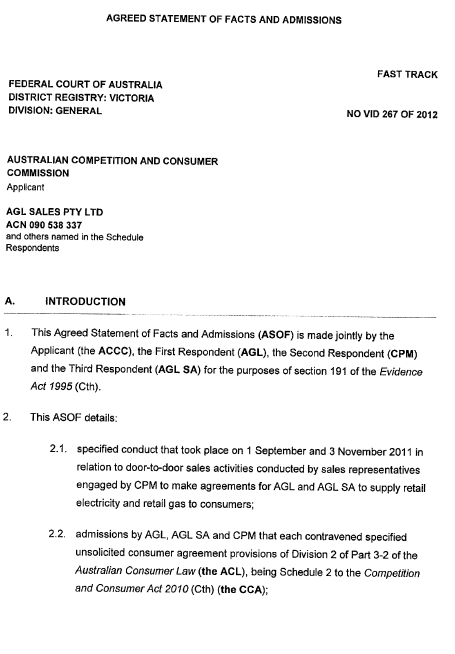
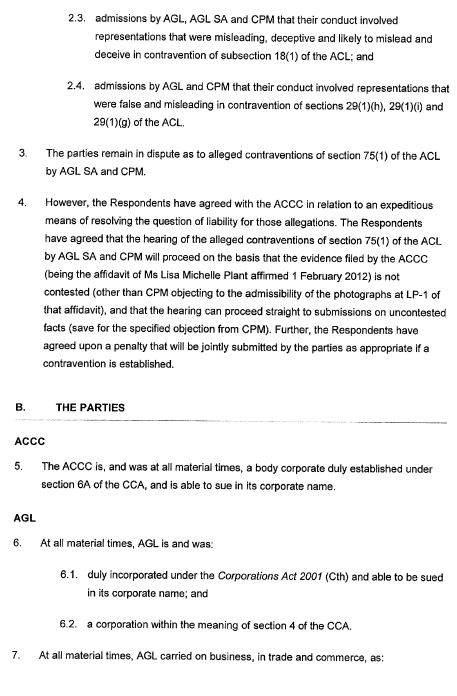
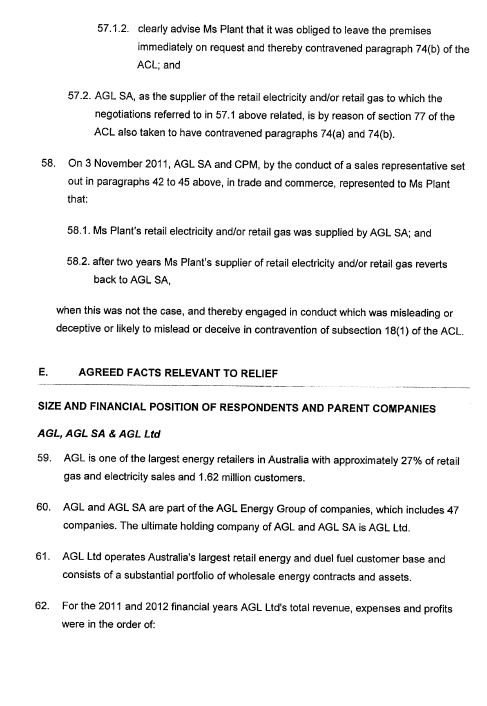
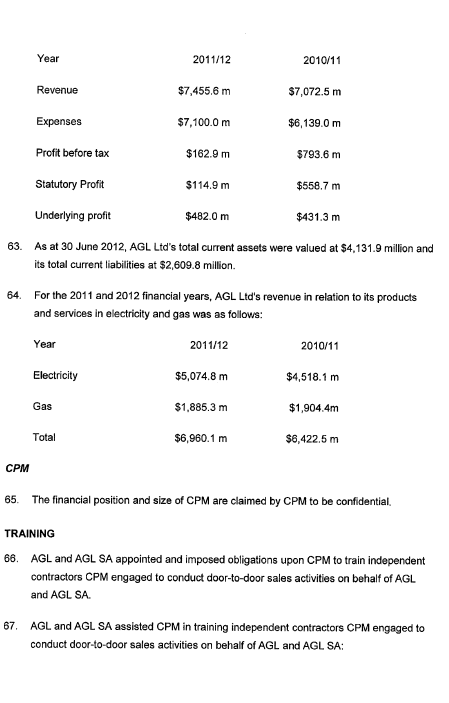
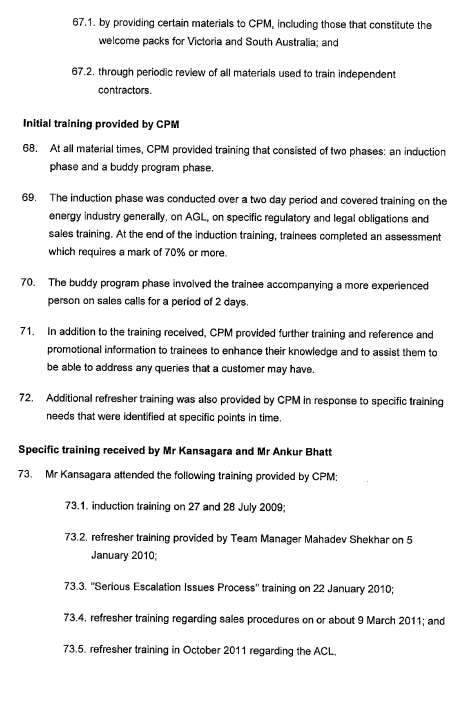
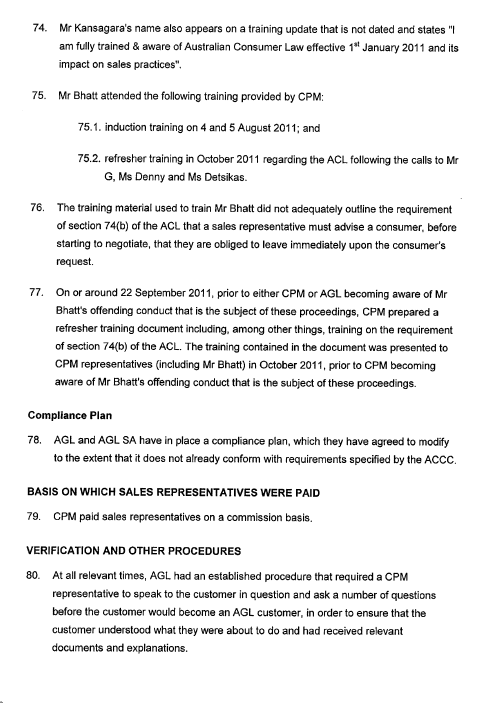
ANNEXURE 'B'