

FEDERAL COURT OF AUSTRALIA
Spanline Weatherstrong Building Systems Pty Ltd v Tabellz Pty Ltd
[2013] FCA 1019
IN THE FEDERAL COURT OF AUSTRALIA | |
SPANLINE WEATHERSTRONG BUILDING SYSTEMS PTY LTD ACN 002 968 087 Applicant |
AND: | TABELLZ PTY LTD ACN 095 855 833 Respondent |
DATE OF ORDER: | |
WHERE MADE: |
THE COURT ORDERS THAT:
1. In the light of these reasons, the parties, on or before 23 October 2013, are to seek to agree appropriate orders, including as to costs, giving effect to these reasons.
2. If the parties are unable to reach agreement pursuant to order 1, each shall provide to my associate its proposed orders and a written outline of submissions not exceeding three pages in length in support of those proposed orders on or before 23 October 2013. The parties should also indicate whether they request a further oral hearing to finalise the orders.
Note: Entry of orders is dealt with in Rule 39.32 of the Federal Court Rules 2011.
NEW SOUTH WALES DISTRICT REGISTRY | |
GENERAL DIVISION | NSD 1206 of 2011 |
BETWEEN: | SPANLINE WEATHERSTRONG BUILDING SYSTEMS PTY LTD ACN 002 968 087 Applicant |
AND: | TABELLZ PTY LTD ACN 095 855 833 Respondent |
REASONS FOR JUDGMENT
1 The applicant (Spanline) seeks declaratory and injunctive relief against the respondent (Tabellz). The proceedings arise against a background in which Tabellz was, until late 2010, a franchisee of Spanline and manufactured and supplied various Spanline products which are used in home improvement projects in the form of patios, roof awnings or covered verandahs, glass and screened enclosures and carports. Spanline’s case, as presented at trial, primarily focuses on Tabellz’s recent conduct in supplying and promoting a steel roof sheet which is visually similar to a steel roof sheet manufactured and sold by Spanline through its franchise network. Spanline argues that its roof sheet is unique and distinctive because of what is describes as its “Double-U” profile. Spanline had a patent for this product but it expired in early August 2001. Spanline alleges that, in manufacturing and promoting its rival steel roof sheet (which is sold under the name “Allform”), Tabellz has engaged in misleading or deceptive conduct contrary to ss 18 and 29 of the Australian Consumer Law (Sch 2 to the Competition and Consumer Act 2010 (Cth)) and has also committed the tort of passing-off. Spanline also raises various claims of breach of contract in respect of both a machine sale agreement and the franchise agreement between Spanline and Tabellz.
2 These reasons for judgment are structured as follows:
background facts | [3] |
(a) Spanline’s business and franchise operations | [4] |
(b) Tabellz’s business operations | [13] |
THE KEY ISSUES | [25] |
THE EVIDENCE SUMMARISED | [30] |
(a) Mr Anthony Way Jnr | [31] |
(b) Ms Lisa Oakley | [59] |
(c) Mr Udo Bucher | [63] |
(d) Mr Philip Catto | [77] |
(e) Mr Ross Brown | [101] |
SUMMARY OF SPANLINE’S SUBMISSIONS | [117] |
(a) Misleading or deceptive conduct | [118] |
(b) Passing off | [127] |
(c) Breach of contract | [129] |
SUMMARY OF TABELLZ’S SUBMISSIONS | [117] |
(a) Misleading or deceptive conduct | [132] |
(b) Passing off | [138] |
(c) Breach of contract | [139] |
CONSIDERATION | [141] |
(a) Misleading or deceptive conduct | [141] |
(i) Puxu | [142] |
(ii) Bodum | [144] |
(iii) Misleading or deceptive conduct – some relevant legal principles | [152] |
(iv) Passing off | [153] |
(b) Tabellz’s structures which include the Double-U roof sheet | [169] |
(c) Tabellz’s advertising and promotional activities | [173] |
(d) Passing off | [179] |
(e) Breach of contract | [182] |
CONCLUSION | [193] |
3 It is convenient at this point to describe in broad terms Spanline’s business and franchise operations, its past relationship with Tabellz when it was a Spanline franchisee and Tabellz’s current business operations.
(a) Spanline’s business and franchise operations
4 Spanline designs, manufactures and sells building systems and products through a network of franchisees and sub-franchisees around Australia. Its current network has 39 franchisees and sub-franchisees nationally. Spanline has operated since about 1985. It was established by Mr Anthony Way Snr and Mr Anthony Way Jnr. Mr Way Jnr (Mr Way) is currently the managing director of Spanline. His father is no longer involved in the Spanline business.
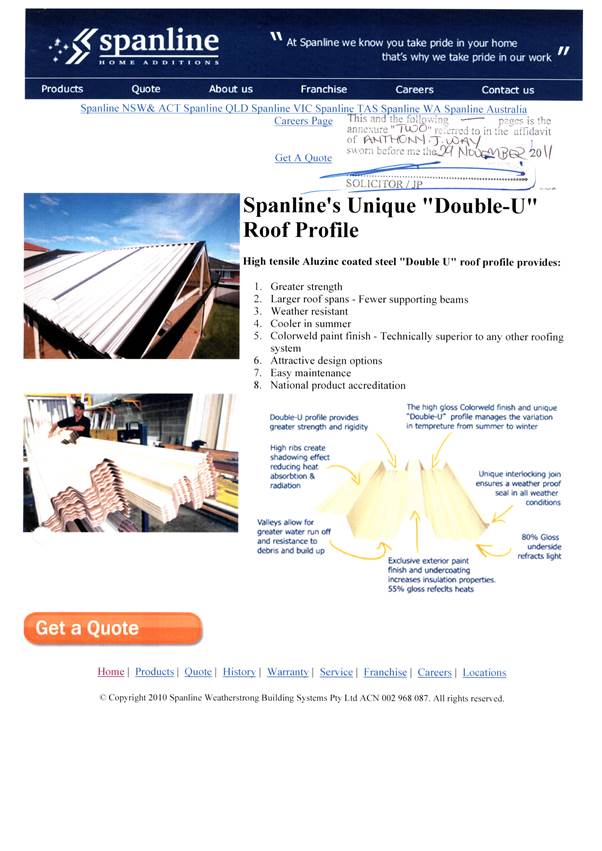
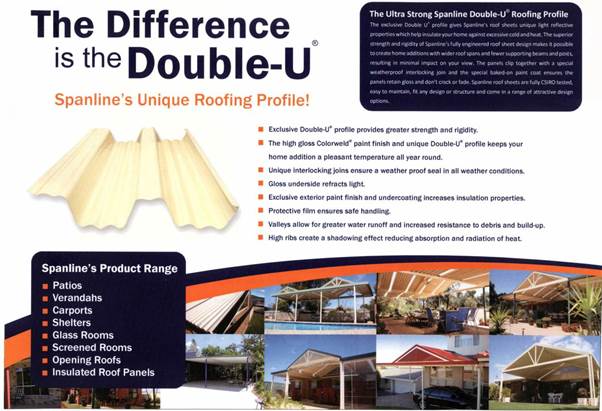
5 Spanline designs, manufactures and sells various products for use in home improvements, including a steel roof sheet product which it says has a unique “Double-U” roof profile. Set out immediately below is an extract from Spanline’s website which describes Spanline’s Double-U roof profile and its features. The reference to “Double-U” is a reference to the shape of the “pans or valleys” on each side of the central riser:
6 Spanline also manufactures and sells through its franchise network other building products, including high tensile steel gutters and beams. Initially, Spanline’s claims against Tabellz concerned both the Double-U roof sheets and Spanline’s steel gutter products. Spanline abandoned its claims in respect of the gutter products at the commencement of the hearing.
7 Spanline’s Double-U steel roof sheets are manufactured by Spanline franchisees using specially designed roof roll forming machines which have been developed and manufactured by Spanline for exclusive use by its franchisees.
8 In simple terms, the manufacturing process involves a Spanline franchisee feeding high tensile steel sheeting (which is supplied by Spanline and other suppliers) into a Double-U roof roll forming machine which the franchisee owns and operates under a franchise agreement with Spanline. The machine produces lengths or spans of the steel roof sheeting product with the Double-U profile. The roof sheets are then sold by the franchisee through its retail outlets, using the Spanline brand name. The product is used, along with other Spanline supplied products – such as beams and gutters – to build home extensions or additions of the type described above. Construction is normally carried out by the Spanline franchisee after the customer has approved a building design. It is rare for Spanline to sell its products other than in circumstances where a Spanline franchisee is responsible for the construction of the project. As will emerge below, this is an important fact in determining the relevant class of consumers of Spanline’s Double-U roof sheets.
9 Spanline claims to be a market leader in the home improvements industry. There are approximately 2,500 personnel involved in its national franchise operations. It says that it has 30 percent of that national market and generates retail sales nationally in excess of $60 million annually. It purchases approximately 1,600 tonnes of steel sheeting a year and completes on average approximately 7,000 home improvement projects annually. It is not clear, however, whether these figures relate only to Spanline’s Double-U steel roof sheets. It is more likely that the figures relate to all of the Spanline’s steel products (which include gutters and beams). Spanline also manufactures and sells other roof sheets which have a different profile, including a product called “Slendek” (which is a roof sheet with a flat deck profile), as well as an insulated roof sheet known as “Climatek”.
10 There are many other manufacturers and/or suppliers of steel roof sheets in Australia. In broad terms, steel roof sheets tend to fall into two general categories. The first category is described as “W” shaped sheets, which reflects the fact that the roof sheet comes in lengths which have the shape of a “W” at the end, with two pans or valleys on each side of a central riser. The width of the valley or pan of “W” shaped roof sheets varies: some, like the Apollo, have wider pans than Spanline’s Double-U roof sheet. “W” shaped roof sheets tend to be stronger than flat deck roof sheets and are generally more capable of tolerating severe weather conditions than those other roof sheets. “W” shaped roof sheets are manufactured and/or supplied by companies such as Hunter Douglas (using the brand “Shademaster”), Apollo, Altec, Stratco (“Universal”) and SpaceSpan (“Classic 333”). One of the key issues in the proceedings is whether Spanline’s Double-U roof profile has a distinctive shape and features which make it stand apart from “W” roof profiles as alleged by Spanline. These matters will be expanded upon below.
11 Roof sheets also come in a flat deck profile, which does not have a “W” shape. Spanline itself manufactures and sells such a product, which is called “Slendek”. Other manufacturers and/or suppliers of flat deck steel roof sheets include Lysaght (“Flatdek”), Apollo, SpaceSpan, Stratco, Stramit and Ausdek.
12 Both Spanline and its individual franchisees or sub-franchisees engage in extensive advertising and promotional activities with a view to encouraging customers to choose Spanline’s products over its competitors. The nature and scope of those activities will be developed below. Spanline claims that its advertising and promotional activities, which have been undertaken over many years, mean that customers are well aware of the features of Spanline’s Double-U roof profile and associate it with the business name, Spanline Australia, and that such customers also recognise it as an exclusive Spanline building product. Spanline claims that the distinctive shape and features of this particular product make the product visually distinctive so that consumers instantly recognise Spanline’s roof product. In other words, Spanline claims that over the last 28 years or so it has developed a substantial reputation and accumulated valuable goodwill in Australia for its Double-U steel roof sheet product which is associated with the business name, Spanline Australia. This claim lies at the heart of Spanline’s complaints of misleading or deceptive conduct and passing off.
(b) Tabellz’s business operations
13 Tabellz was incorporated on 9 February 2001. Its original shareholders and directors were Philip and Gregory Catto, who are brothers. Mr Gregory Catto formerly worked with Spanline. Mr Murray Carter became an additional director of Tabellz in October 2001.
14 In March 2001, an administrator was appointed to a company called Paramount Projects Pty Ltd (Paramount), which, at that time, was Spanline’s franchisee in Penrith. In March 2001, Tabellz commenced discussions with Spanline with a view to Tabellz replacing Paramount as the Spanline franchisee in the Penrith area. Separate discussions were held with the administrator of Paramount to purchase Paramount’s assets, including a roof roll forming machine which was being used by Paramount as a Spanline franchisee to manufacture steel roof sheets with the Double-U profile. After agreement in principle was reached in late March 2001 that Tabellz would become a Spanline franchisee, Tabellz registered the business name “Spanline Home Additions Penrith” and purchased various Paramount assets, including the roof roll forming machine, which also required Spanline’s approval. Although Tabellz commenced trading as Spanline Home Additions Penrith from early April 2001, it was not until 8 February 2002 that the parties entered into a formal franchise agreement. At the same time, Spanline and Tabellz executed a sale of machinery agreement in respect of the roof roll forming machine, which was delivered to Tabellz in May 2001. That machine had a serial number RFSP 1613. It proved to be troublesome and inefficient and was ultimately replaced by Spanline with another roof roll forming machine which had a serial number RFSP 1619 (the 2001 machine). No amendments were made to the sale of machinery agreement despite the fact that the original machine the subject of that agreement was replaced by another machine with a different serial number.
15 In early May 2001, Tabellz relocated its business premises to 1/47 Cassola Place, Penrith.
16 In February 2004, Tabellz was engaged in discussions with a company called Patioland Manufacturing Pty Ltd (Patioland) and also with Spanline for Tabellz to acquire the adjoining franchise area (i.e. Spanline Sydney) from Patioland. In the course of completing the relevant documentation regarding Tabellz’s acquisition of certain assets of Patioland, an administrator was appointed to Patioland in late 2004. In 2004, Spanline purchased from the administrator a second hand roof roll forming machine which Patioland had used to manufacture steel roof sheets with the Spanline Double-U profile while Patioland was a Spanline franchisee (the 2004 machine).
17 Some issues arose in late 2007 regarding Tabellz’s performance as a Spanline franchisee, including in respect of the franchise area previously held by Patioland, noting however that there was no formal franchise agreement in place between Tabellz and Spanline in respect of the area previously franchised to Patioland. Tabellz considered that it had reached an oral agreement with Spanline in mid-2004 that Spanline would enter into franchise arrangements with Tabellz covering at least the Patioland area if not more widely.
18 Tabellz’s Spanline franchise in Penrith expired on 7 February 2007. Tabellz continued to operate as a Spanline franchisee and Spanline did not prevent it from doing so. There were numerous discussions and exchanges between Tabellz and Spanline regarding renewal of the franchise. Those discussions then expanded to include the whole of the Sydney area and Tabellz indicated that it was interested in becoming the Spanline franchisee for the entire Sydney region. In the events that occurred, the parties did not execute a fresh franchise agreement for Penrith nor, indeed, for any other area in Sydney.
19 In early 2010, Spanline informed Tabellz that it proposed to restructure its Sydney franchises, creating four new franchise areas. Spanline offered Tabellz one of those four areas. Tabellz did not accept that offer. It maintained that it had reached an oral agreement with Spanline back in 2004 which was inconsistent with Spanline’s latest offer.
20 On 29 April 2010, Spanline issued Tabellz with a notice of termination of their franchise relationship. The franchise formally terminated on 29 November 2010. In the interim, there were numerous exchanges between Spanline and Tabellz relating to the termination of the franchise, including Spanline’s desire to buy back the 2001 machine under the terms of the franchise agreement and the sale of machinery agreement. There were also numerous discussions and exchanges regarding arrangements for returning Spanline’s intellectual property and transferring telephone numbers in accordance with the franchise agreement. The details of those matters will be developed further below in considering Spanline’s claims of breach of contract.
21 After receiving the notice of termination in late April 2010, the directors of Tabellz decided that, after the franchise ended, the company would continue to operate a business in the building industry. Mr Philip Catto gave evidence of the steps which Tabellz took to modify the 2004 machine which Tabellz had purchased from Patioland. Mr Catto’s evidence was that these modifications, together with other steps taken by Tabellz, were intended to differentiate Tabellz’s steel roof sheets from Spanline’s. Mr Catto gave evidence, which was not challenged, of the timeline and steps taken by Tabellz to modify that and other machines which are not relevant to these proceedings. The modifications to the 2004 machine took approximately three months to implement. The modifications included changes to the shape of the roof sheets. Those changes included altering the ribbing or ridging on the outside and inside walls of the roof sheet, as well as slightly altering the dimension of the sheets. The modifications and upgrade of the 2004 machine were completed in December 2010. The primary change to the roof sheet profile was to the sides of the four walls. The outward facing ribs on the two outside walls were replaced by four inward facing profiles on the outside and inside facing walls, as is reflected in the photograph at [84] below.
22 Mr Catto also gave evidence that Tabellz took other steps with a view to differentiating its product from Spanline’s. To colour its roof sheets, Tabellz elected to use Colorbond® and not Colorweld® as used by Spanline. It also decided to use steel manufactured by BlueScope in Australia and not imported steel as used by Spanline. The total cost of modifying the 2004 machine was $30,000.
23 When its Spanline franchise ended, Tabellz changed its business name to “Allform Home Additions”. As a fully licensed builder it has, since that franchise ended, undertaken a range of residential alterations, additions and extensions as well as commercial work. Part of its business involves manufacturing roof sheeting and guttering, using the 2004 machine which was originally used by Tabellz to produce Spanline’s products while Tabellz was a Spanline franchisee, but subsequently modified with a view to differentiating those products. Tabellz also purchases roof sheeting and guttering from other suppliers, which it uses in some of its building projects.
24 Tabellz and Spanline are plainly competitors. Like Spanline, Tabellz markets and promotes its business and products. It does so by its website, and also by participating in events such as the Sydney Home Show Exhibition in May 2011. It also promotes its business and products in newspapers, including the Blue Mountains Gazette Review. These matters will be developed further below in the context of Spanline’s complaints under the Australian Consumer Law and passing off.
25 The key issues appear to be as follows. First, for the purposes of Spanline’s claims under the Australian Consumer Law, a central question is the likelihood of consumers (i.e. a not insignificant number of persons in the relevant class of consumers) being misled or deceived into believing that the Tabellz steel roof sheets manufactured and sold by it are either:
(a) in fact Spanline’s Double-U roof sheets; or
(b) are manufactured by Tabellz under licence or authority from Spanline.
26 Secondly, in resolving that first question it will be necessary to determine at least the following sub-issues:
(a) the precise identification of the relevant products about which Spanline complains;
(b) the relevant class of consumers;
(c) whether the conduct of Tabellz gives rise to the representations pleaded by Spanline and involves misleading or deceptive conduct;
(d) the extent to which Spanline has developed and acquired a substantial reputation for its Double-U roof profile and whether or not a not insignificant number of people in the relevant class of consumers recognise Spanline’s product because of its distinctive shape and features. In other words does the Spanline Double-U steel roof sheet have an independent get up or secondary meaning in the market; and
(e) the extent to which members of the relevant class of consumers would view the two products as being substantially similar when they are used in a completed home addition or extension, which directs attention to such matters as whether Tabellz has taken sufficient steps to distinguish its product from that of Spanline’s, with the consequence that it is unlikely that a not insignificant number of persons in the relevant class of consumers will be deceived or misled in the manner alleged by Spanline.
27 Thirdly, Spanline’s cause of action for passing off raises the following key issues:
(a) have Spanline’s Double-U steel roof sheets acquired a goodwill or reputation in their own right as products;
(b) has Tabellz’s conduct in all probability caused relevant consumers to believe that Tabellz’s Double-U steel roof sheets are Spanline’s product; and
(c) in consequence of the above, is Spanline likely to suffer injury in its trade or business.
28 Fourthly, Spanline’s claims in contract will require:
(a) construction of the relevant provisions of the franchise agreement and sale of machinery agreement; and
(b) findings of fact to be made with a view to determining whether or not Spanline has established any breach of contract in respect of its allegations concerning the buy back of the 2004 machine, the return of its intellectual property and the transfer of telephone numbers.
29 Fifthly, if any of Spanline’s causes of action are established, questions will arise as to what if any relief should be granted.
30 It is convenient to now outline the parties’ lay and expert evidence.
(a) Mr Anthony Way
31 As noted above, Mr Way is the current managing director of Spanline. He swore two affidavits. His first affidavit describes the history of Spanline’s business and, in particular, its franchise operations. He attached to his affidavit a DVD entitled “Evolution of Spanline”, which is distributed to Spanline franchisees and sub-franchisees and describes how Mr Way and his father established Spanline in 1985 and together they designed the Double-U steel roof sheet profile. Spanline was the first business in Australia to manufacture and supply steel roof sheets as an alternative to roof sheets made from aluminium or some other material. Mr Way did not claim that the DVD is made available to consumers, as opposed to Spanline’s franchisees and sub-franchisees as part of their induction to Spanline’s business. He says that Spanline franchisees are entitled only to sell Spanline designed products which are manufactured either by Spanline itself or by a franchisee using machines which are designed by Spanline, such as the roof rolling machines.
32 Mr Way says that Spanline’s Double-U roof profile is “immediately apparent to the eye” and that that profile distinguishes Spanline’s product from those of its competitors. He says that the “exclusive design and formation of the Double-U profile distinguishes it from all its competitors by the series of radii that [form] the exclusive shape”. Mr Way then referred to what he described as “photographic specification sheets” which Spanline uses throughout Australia to train its design consultants of the significance of comparing the other roofing profiles that are used by various competitors in our industry”. By reference to that document, which was said to be Item 2 to Mr Way’s first affidavit, Mr Way made the observation that “Apollo’s profile is somewhat like the Spanline Double-U profile”, but he then added that he had personally designed the Apollo product and, in his view, it was “significantly different to the Double-U”.
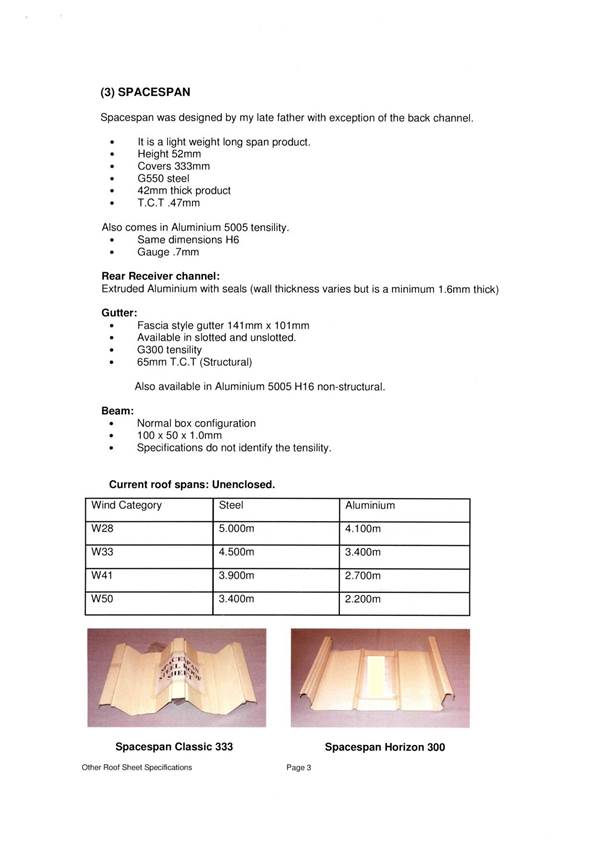
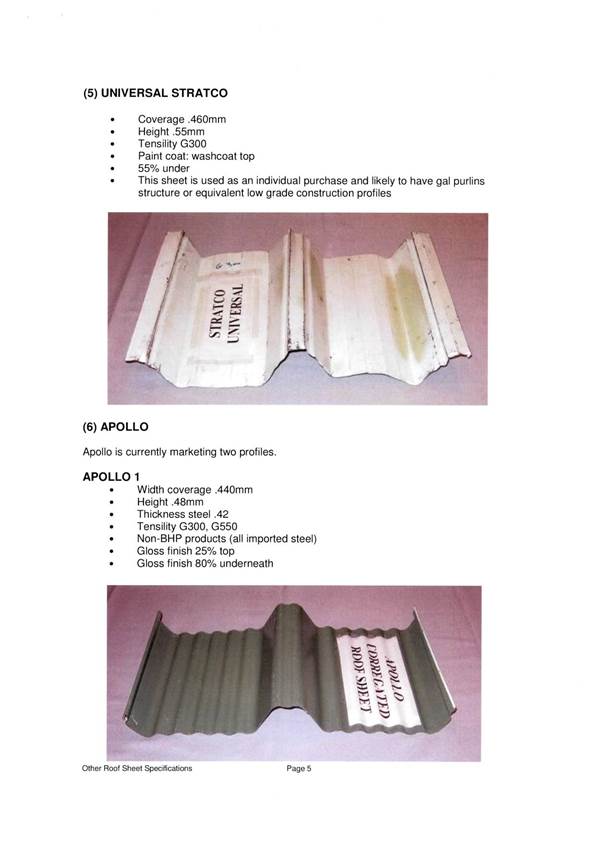
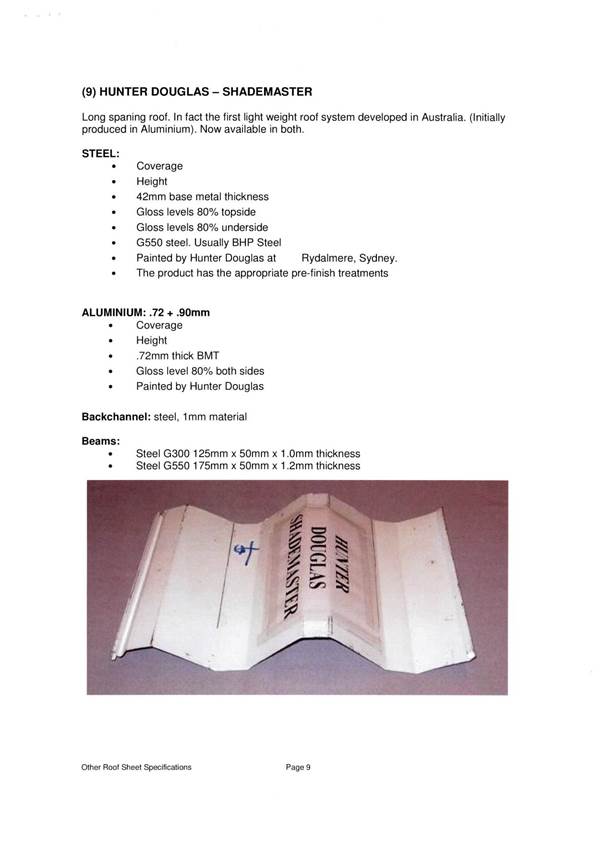
33 In fact, the material annexed in Item 2 to his affidavit did not compare Spanline’s product with competitors’ roofing profiles. Rather it comprised a two page document from Spanline’s website, the first page of which is set out in [5] above and the second page of which describes specifications for three different Spanline roof sheets which apparently use the Double-U profile. It transpired that the document which Mr Way was referring to is a nine page document entitled “Competitors Products Specifications and Comparisons” which is Item 64 to Mr Catto’s affidavit and is part of Exhibit A. That document contains photographs and specifications relating to various roofing products which Spanline apparently considered to be competitors (see further [83] below).
34 Set out below are pages 3, 5 and 9 of that publication, which deal with products which appear to be most visually similar to the profile of Spanline’s individual Double-U roof sheets. The Apollo product appears on page 5 of those extracts. That is the product which Mr Way accepted bears some visual similarities to Spanline’s Double-D roof sheet.
35 Mr Way also gave evidence of his attendance at the Sydney Home Show Exhibition at Darling Harbour between 19-22 May 2011. The Allform Home Additions display included a photograph board which Mr Way said showed Spanline’s products, a claim which is not disputed by Tabellz. Mr Way said that most of the photos had been used in Spanline’s national advertising program. He stated that some of the photographs had also been shown to prospective Spanline customers “thousands of times per week”. Mr Way attached to his affidavit a letter dated 26 May 2011 written by him to his solicitor in which he enclosed the photos he had taken of Allform’s display. In his letter, Mr Way said that “[a]lthough they were displaying a range of alternative products the main focus was on home addition and the array of photographs that specifically displayed Spanline’s exclusive range of products that form their building system”. In circumstances where Tabellz does not dispute that the photos used on its display board were photos of work carried out by it when it was a Spanline franchisee, the relevant question which arises is whether that conduct gives rise to any of the representations pleaded by Spanline and, if so, whether any of those representations were likely to mislead or deceive members of the relevant class of consumers or constitutes passing off, matters which I will deal with below.
36 Mr Way attached to his first affidavit a copy of a photograph which he took in March 2011 at Allform’s business premises in Penrith. The photograph is of a completed carport with roof panelling which appears to have a Double-U profile. The carport is apparently used by Allform for display purposes in the event that a prospective customer wishes to see Allform’s completed work. It might be noted at this point that Allform tendered evidence, which I accept, showing that there was a sticker on a beam below the roof of the carport in the form of the sticker which appears at [87] below. The sticker says: “Proudly Manufactured By ALLFORM Home Additions”.
37 Mr Way also gave evidence of investigations he carried out in relation to Allform’s development applications with the Blue Mountains City Council. He said that he attended the relevant premises and saw a carport which he says includes a Spanline Double-U profile roof. He gave similar evidence in respect of other work carried out by Allform in other local government areas, including Hornsby and Wollondilly.
38 Mr Way also described Spanline’s advertising and promotion activities. I accept that evidence. He said that Spanline uses “a number of product brochures which are made available at point of sale and as mail drop-offs”. The brochures deal with various matters, including Spanline’s capacity to provide various home additions, such as patios, carport, glass and screened enclosures, as well as individual Spanline products such as “Alfresco SlidaSpan” (see [42] below). There are also separate brochures dealing with Spanline’s commitments and warranty.
39 The Spanline brochure dealing with “Patios, Awnings and Verandas” contains numerous photographs of completed structures, some of which appear to use the Spanline Double-U roofing profile although that is not specifically stated in the brochure. However, on the penultimate page of the brochure the following statements appear:
Spanline’s high tensil (sic) steel “Double-U” roofing profile provides an impressive smooth aesthetic look to your patio, verandah or awning. You can enjoy more space and protection with added superior strength to provide maximum spans and coverage.
The “Double-U” profile also provides year round protection against the harsh Australian climate. You’re protected rain, hail or shine.
40 The Spanline brochure dealing with “Carports and Shelters” also contains multiple photographs of completed structures, some of which may involve use of the Spanline Double-U roofing profile. But there is no photograph of any individual spans or close-ups of the roofing sheets used in those photographs. On the penultimate page of the brochure, the following statements appear:
Spanline’s high tensile steel “Double-U” roofing profile provides strength and rigidity allowing for greater spans and fewer posts and beams. Panels clip together with a special interlock contributing to strength and weatherproofing.
41 The Spanline brochure dealing with “Glass and Screened Enclosures” adopts a similar format. It contains numerous photographs of completed projects some of which appear to use the Spanline Double-U roofing profile. The penultimate page contains the following:
Spanline’s high tensile steel “Double-U” roofing profile provides an impressive smooth aesthetic look to your new glass or screened enclosure. You can also enjoy more space and protection as the superior strength and rigidity of the “Double-U” profile allows for maximum span coverage.
42 The subject matter of the Spanline brochure dealing with “Alfresco SlidaSpan” is a roofing system with moveable panels which can be opened either manually or automatically to create a pergola effect. The brochure contains numerous photographs of completed structures and there is a somewhat obscure photograph of a single panel in which emphasis is placed on the “panel seal”. No express claim is made that the particular panel is the Spanline “Double-U” roof panel, but it appears to be so.
43 A separate brochure was tendered by Spanline dealing with its product called “Climatek”, which apparently is an insulated panel supplied by Spanline. It does not appear to use the Spanline Double-U roof profile.
44 A Spanline brochure entitled “A Commitment to Excellence”, which is described as a customer services brochure, contains numerous photographs of completed structures possibly including the Spanline Double-U roof profile, as well as a photograph of a worker stacking individual sheets of that product and a copy of a roof roll forming machine in operation. On a page setting out what Spanline describes as the “features” and “benefits” of its products, there is a reference to the ““Double-U” shape of the product” as a feature, which provides benefits which are described as:
Strength, storm & hail resistant, security. Exclusive to Spanline.
There is a separate reference on the adjoining page to “high tensile steel “Double-U” roofing profile”.
45 In a separate Spanline brochure entitled “Safe Guard Warranty Product Information”, there is a table which is headed “Spanline Branded Products Table” which includes an entry for “Spanline Double-U® Roof Sheet”, as well as various other Double-U roof sheets which are produced by Spanline and are identified as the Ultraspan Double-U® Roof Sheet, Prospan Double-U® Roof Sheet and Ezi-Build Double-U® Roof Sheet. There is also a photograph looking up a completed awning project in conjunction with the promotion of a product called “Blue Clean” which is said to help “enhance the Spanline gloss finish”. On the penultimate page of the brochure there is a photograph of a completed patio which may use the Double-U roofing profile, but no express statement is made to that effect.
46 Mr Way also annexed to his first affidavit examples of brochures which I accept were used in Spanline’s national advertising campaigns dating back to January 2008. 18 brochures were relied upon covering the period January 2008 to August 2011. All the brochures contain multiple photographs of finished structures using various Spanline products, including roofs apparently using the Double-U roof profile. 15 of the 18 brochures make express reference in the text to Spanline’s Double-U roof profile. 6 of the 18 brochures contain a photograph of a separate sample of that product, while 3 of the brochures contain neither any reference to the “Double-U” roof profile nor a photograph of a sample (other than as part of a completed structure). An example of a brochure containing a reference in the text to the product, as well as a photograph of a sample, is the brochure which was used during the national campaign from 9 January to 19 March 2011, page 2 of which is set out immediately below.
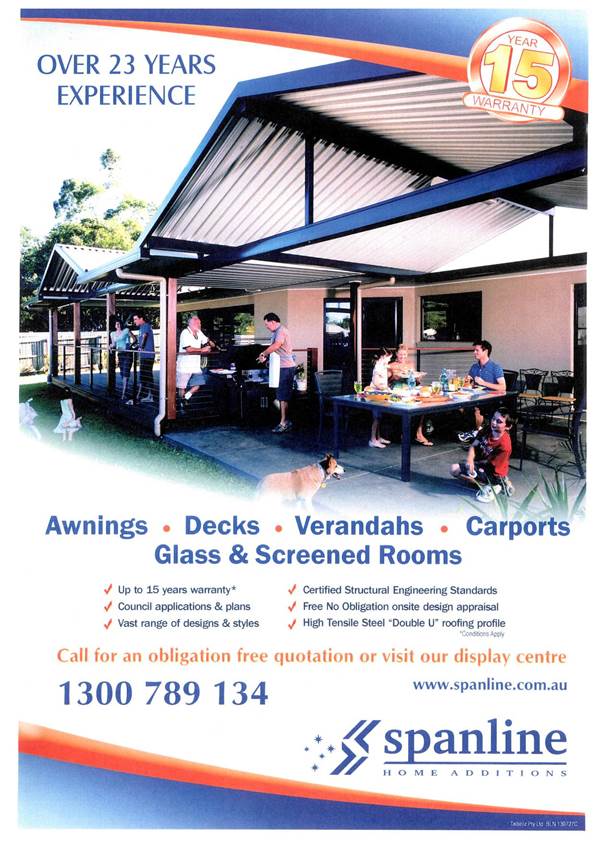
47 Mr Way also annexed examples of artwork which I accept was requested by and delivered to Spanline Penrith when Tabellz held the Spanline franchise for that region. Such artwork was provided to franchisees for use by them in their own local advertising campaigns. He provided nine samples of such artwork, all of which featured photographs of completed projects possibly using Spanline’s Double-U roofing profile. All but two of the examples make express reference to Spanline’s high tensile steel “Double-U” roofing profile. None of the examples contain a close up photograph of a sample of that particular product. The following photograph is generally representative of that artwork.
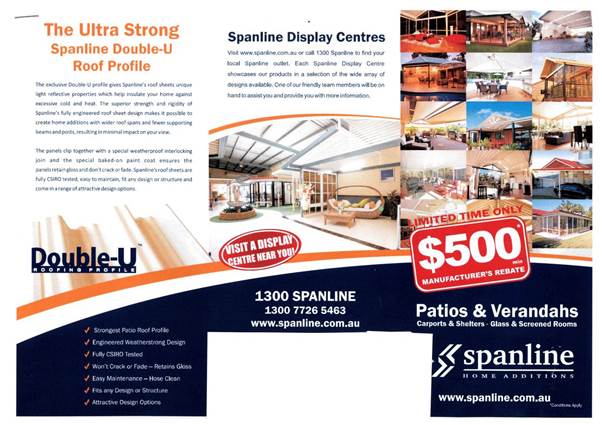
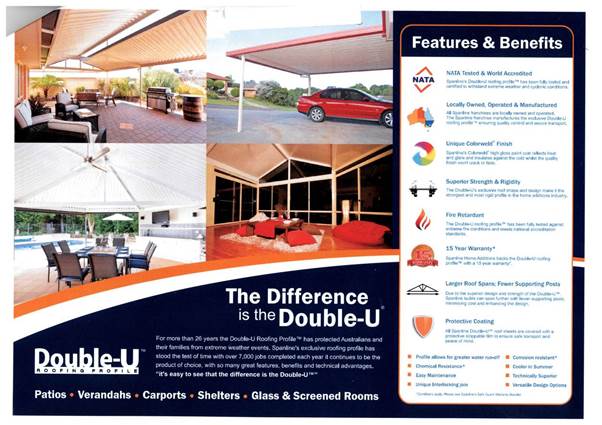
48 Mr Way also attached additional Spanline advertising brochures which I accept were used during the period October 2011 to April 2013. There were eight separate brochures. Each contains multiple photographs of finished projects, some of which possibly include Spanline Double-U roof sheets. There is an express reference to the Spanline Double-U roofing profile in five of the eight brochures. Only two of the eight brochures contain a close-up photograph of a sample of the Double-U roofing profile (those for October 2011 and September 2012). Five of the eight brochures contain no reference to the Double-U roofing profile or any close-up photograph of that product. Set out immediately below is a copy of page 1 of the advertising brochure for October 2011 and below that is a copy of page 2 the advertising brochure for January 2012.
49 Spanline also tendered a screen shot from its website (a copy of which is set out at [5] above). It describes Spanline’s “unique “Double-U” roof profile”, a photograph of a completed roof apparently using those roof sheets, a close up photograph of a sample of that product and a separate photo of a worker stacking those roof sheets.
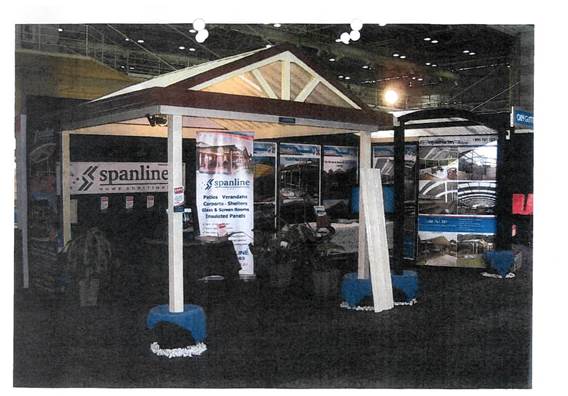
50 A further example of Spanline’s promotion of its Double-U roof sheet is the display which Spanline had at the Sydney Home Show which was held at Darling Harbour in May 2011. Mr Catto annexed to his affidavit a photograph of Spanline’s display, which is depicted in the photograph below and shows that the display included a completed structure using what appears to be the Spanline Double-U roof profile. A sample of that product is also displayed at the front of Spanline’s exhibition.
51 In his affidavit in reply dated 28 August 2012, Mr Way responded to Mr Catto’s affidavit evidence. Key relevant points are as follows.
52 Mr Way dealt at greater length with the discussions which took place between Spanline and Tabellz regarding Spanline’s proposal to restructure the Spanline franchise in Sydney and to create four franchise and sub-franchise areas. In my view it is unnecessary to set out these matters in detail.
53 Mr Way also gave further evidence regarding the nature of the roofing and guttering industry. He described the history of his father’s long involvement in the lightweight patio industries since 1967, which included his design and launch in the early 1970s of the SpaceSpan patio system using all aluminium sections. As noted above, the SpaceSpan product is now available in steel and comes in either a “W” or flat deck profile. In 1985 Mr Way and his father designed and launched the Spanline patio system which is claimed to be the first roofing system in Australia using steel roofing sheets as opposed to aluminium-based materials. In 1995 Mr Way designed and launched the “Apollo patio system”, which design he says “was based on the Spanline Roofing and Patio System and was designed initially to be marketed in the Spanline Group”. Instead, he sold the system to a Brisbane-based company. As noted above, Apollo comes in both a “W” and flat deck profile.
54 Mr Way said that the Way family have been involved in the invention, creation and marketing of the best known roofing systems in Australia and that they are recognised as individual systems with different properties and benefits. Mr Way and his father have invented various other roof sheets, including the Hunter Douglas Shade Master, the SpaceSpan patio system, the Apollo patio system and the Truelock insulated patio system. Mr Way disagreed with any “assumption” that there are similarities within the range of products set out in the document entitled “Competitors Products, Specifications and Comparisons”.
55 Spanline tendered physical samples of various steel roof sheet products, including samples of its product and that of Allform. Photographs of those samples are set out immediately below:
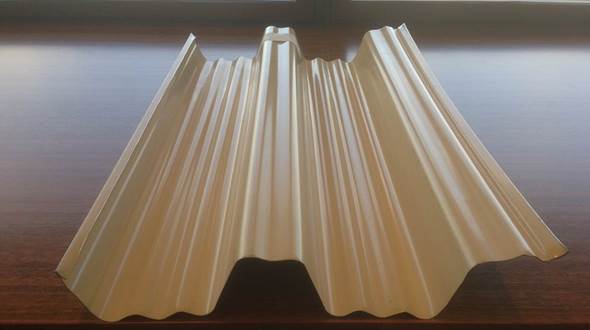 Spanline Double-U roof sheet (Exhibit D)
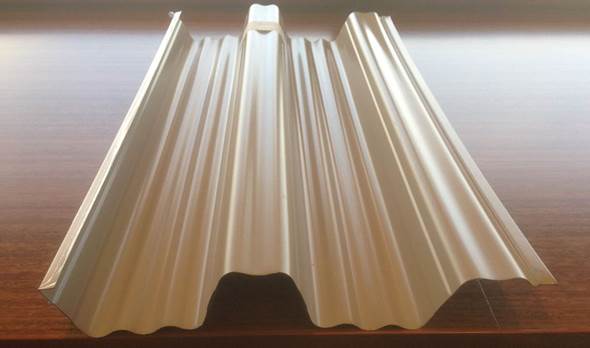
Allform’s roof sheet (Exhibit F)
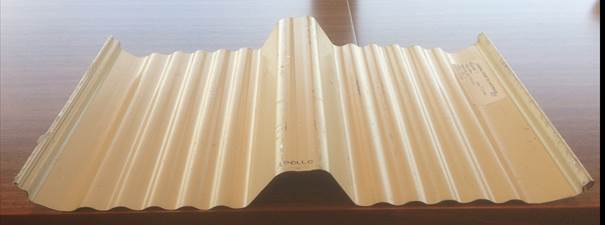 Apollo (Exhibit G)
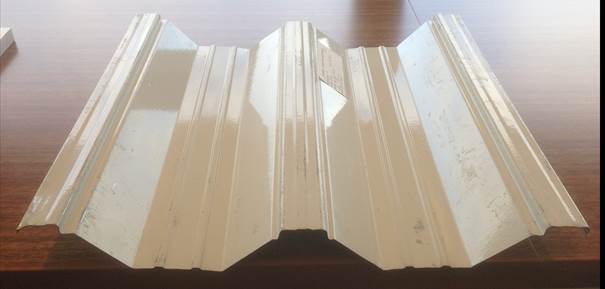 Altec Ausiespace (sic) (Exhibit H)
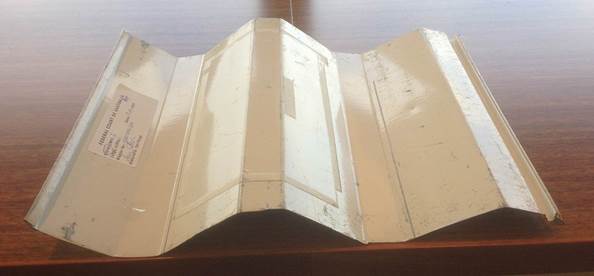
Hunter Douglas Shade Master (Exhibit I)
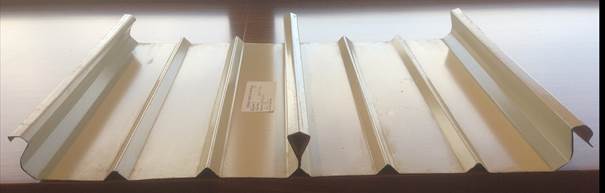
Stratco (Exhibit J)
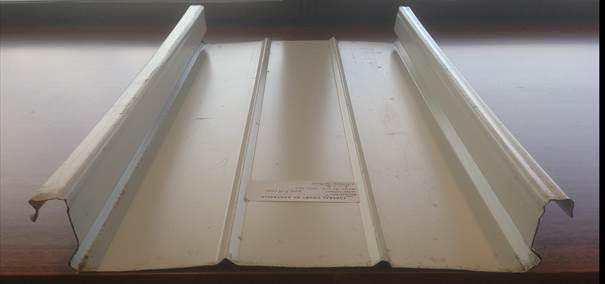
Ausdek (Exhibit K)
56 In cross-examination, Mr Way confirmed that Spanline had not called any consumer evidence to demonstrate, for example, that any consumer was confused between the Spanline and Tabellz products and their source. Likewise, Spanline did not call any franchisee to give evidence that customers had complained that they had been misled or confused about the two products.
57 Mr Way was asked questions about the difference between Colorbond® (a trademark of BlueScope) and Colorweld®, which is the paint applied to Spanline’s products. The Spanline products use aluzinc which he says is very similar to zincalum which is used on BlueScope products. The coating is used to protect the deterioration of the steel from which the roofing panels are made. Mr Way gave evidence that Spanline can match “pretty well” any colour which a consumer wants, but that it uses Colorweld® in its advertising to distinguish Spanline’s product from BlueScope’s trademark. He says that there are 14 basic colours for Colorweld® and that Colorbond® is generally very similar in its colours. Mr Way said that, in his view, consumers are not driven by colour, nor is price an important factor.
58 In cross-examination, Mr Way was asked questions about Spanline’s current franchisees in the Sydney region. Currently there are no Spanline franchisees operating in the Sydney region, however, Mr Way said that Spanline’s Illawarra franchisee, which is based in Albion Park, sometimes sold products into the southern part of Sydney. He said that the Central Coast is served by a Spanline franchisee in Newcastle and that Spanline’s first franchise to the west of Sydney is in Bathurst. He said that approximately 12 months ago the franchise which replaced Tabellz in Penrith (a business using the name Style Master) itself terminated the franchise after having operated for about 12 months. It was put to him that in circumstances where there are no Spanline franchises in Sydney, there is only limited goodwill attaching to Spanline’s products in this area.
(b) Ms Lisa Oakley
59 Ms Oakley is the General Manager of Spanline. She swore an affidavit in the proceedings and was not required for cross-examination. She gave evidence of the termination of Tabellz’s franchise. Ms Oakley also annexed to her affidavit newspaper advertisements in the Blue Mountains Gazette Review for March-April and April-May 2011 which were placed by Tabellz under its new business name, Allform Home Additions. She said that the largest photograph in the advertisements (which is the same in both advertisements) shows Spanline’s Double-U steel roof sheets and another Spanline product called “Spanlite” as Allform products. Ms Oakley said that those products are exclusive to Spanline Australia. Set out immediately below are copies of the advertisements placed by Allform in the March/April 2011 edition of the Blue Mountains Gazette Review which also appeared in the April/May 2011 edition (note the advertisement for Allform at the bottom of the first page and the separate advertisement which appeared in the body of the two editions):
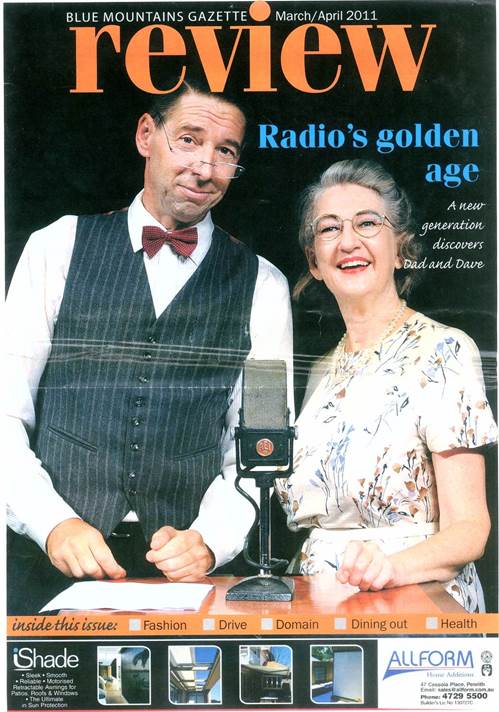
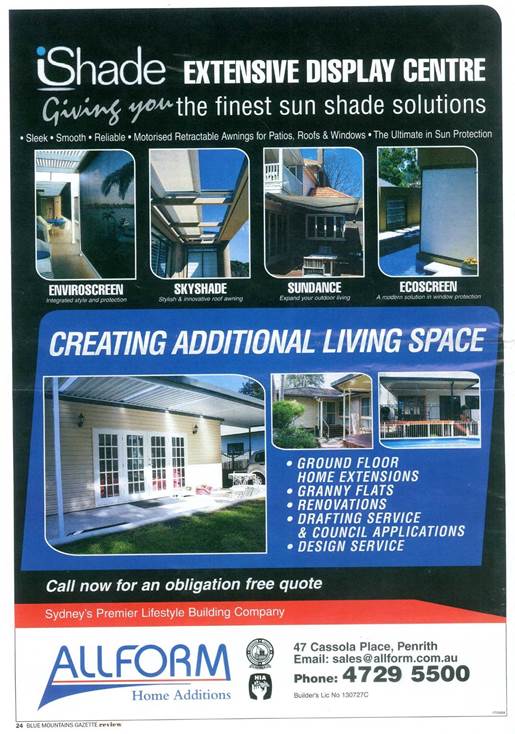
60 The advertisements which appeared in that newspaper in March/April and April/May 2011 comprise four separate advertisements. The advertisements which appeared at the bottom of the front page of both editions promote a product called “iShade” and comprise four small photographs of finished products. Allform’s name and building licence is provided. Ms Oakley complains specifically of the largest photograph, which forms part of the second advertisement appearing inside the two editions. It is a photograph of a completed project under the heading “Creating Additional Living Space”, including the roof which appears similar to the Spanline Double-U profile, but also includes periodic transparent roof sheets which allow light through. Mr Catto confirmed in his evidence that this particular photograph depicts a job done by Tabellz when it was a Spanline franchisee and that it is Spanline’s Double-U steel roof sheet which is shown in the advertisement. He added that the advertisement was not aimed at claiming that the roof sheets were Allform roofing sheets, but was rather intended to promote Allform’s credentials as a builder and, in particular, in providing sunshade solutions, ranging from retractable awnings to window and other screens in order to provide sun protection.
61 Spanline also tendered a copy of the Blue Mountains Gazette Review for August/September 2013, which contained different advertisements placed by Allform. Set out immediately below are copies of those advertisements:
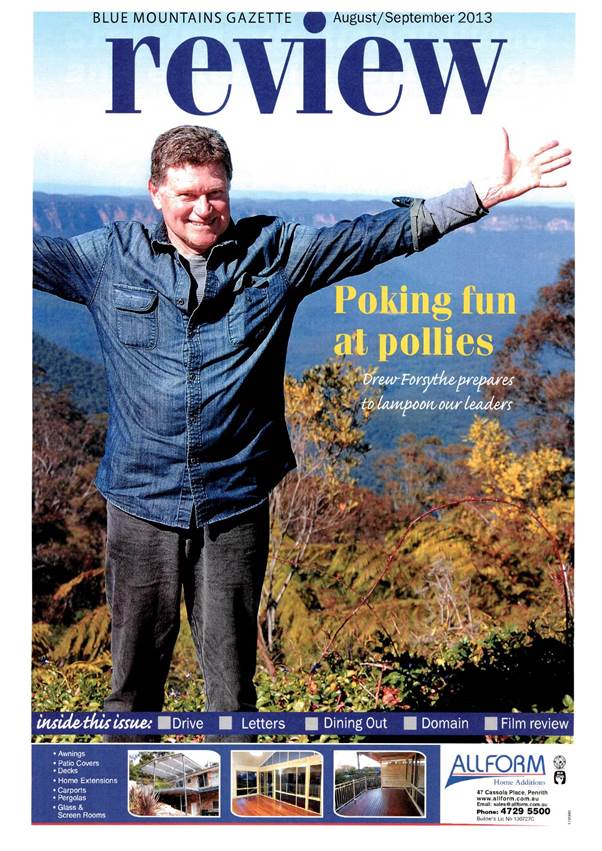
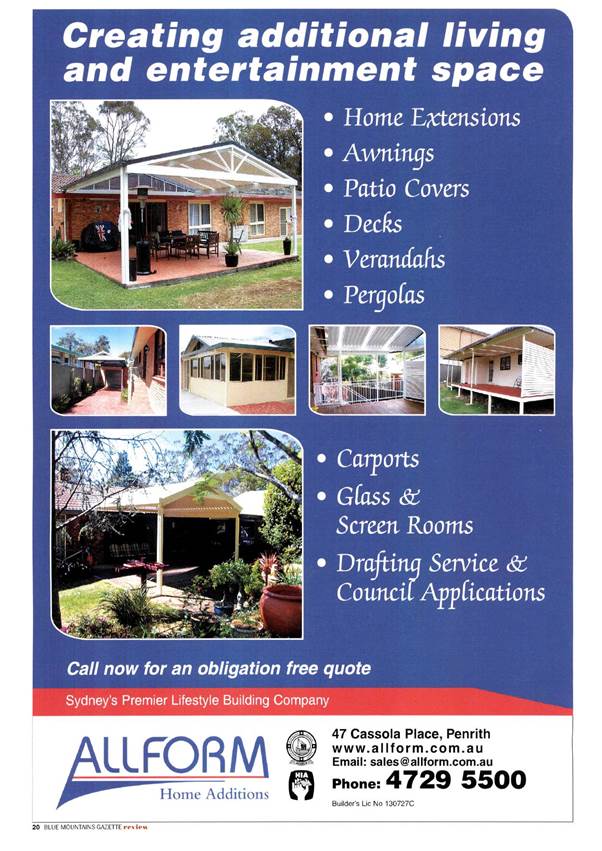
62 It is notable that no express claim is made in any of these advertisements that Allform manufactures any particular product. It is also to be noted that the advertisements include Allform’s builder’s licence details, which provides some support for its submission that the advertisements were designed to promote its building credentials and not any particular individual products. Those matters are dealt with further below.
(c) Mr Udo Bucher
63 Mr Bucher was called as an expert by Spanline. He produced two reports and also contributed to a joint report by the two experts. Mr Bucher has a Diploma of Metallurgy from Wollongong TAFE and a Bachelor of Science Degree from the University of Technology, Sydney. He worked for a total of 34 years with John Lysaght Australia and BHP Steel/BlueScope Steel. He is the managing director of Wolf Industrial Innovation Pty Ltd and manager of intellectual property and business development for Gram Engineering Pty Ltd.
64 The matters upon which Mr Bucher was asked to address in his first report are set out in [7] of that report. They are as follows:
(a) “Give your expert opinion as to the degree of similarity between the product samples being the “(sic) Spanline Australia product and the Tabellz product. Are you confident in your expert opinion that Tabellz is in fact passing off a Spanline Australia product as it’s (sic) own and of its own design”;
(b) “Please provide your expert opinion as to whether a customer when faced with a brochure or metal sample of Tabellz product could be easily deceived or misled by Tabellz products as being from Spanline”;
(c) “Please provide your expert evidence, if possible, that you are aware of the exclusivity of design of Spanline Australia’s roof products in that it was and is and always has been an exclusive, special and unique design both from an engineering point of view and from a cosmetic point of view where the latter is very important at the point of sale”; and
(d) “Please review the FAST TRACK RESPONSE – for which the certificate of Legal Representative is dated 26 September 2011, and comment on claims made in relation to the Spanline products and the Tabellz products in dispute”.
65 It should be noted at this point that several of these questions are not expressed in the sort of neutral and impartial language which is ordinarily expected of instructions to an expert. Rather, they contain several assumptions or assertions which are slanted heavily in Spanline’s favour. The unfortunate wording of the questions raises a serious question as to the weight to be given to Mr Bucher’s evidence.
66 There is a further difficulty with the brief which was provided to Mr Bucher for the purpose of obtaining his expert evidence. To prepare his first report, Mr Bucher was briefed with what were described as samples of the original Spanline Double-U roof profile and the Double-U roof profile manufactured by Tabellz. Accordingly, Mr Bucher was led to believe that the two samples were of the two relevant products, when in fact that was not the case. He was actually provided with samples of Spanline’s product and a sample of the product produced by Allform when it was a Spanline franchisee and prior to it modifying the 2004 machine.
67 In his first report, Mr Bucher described the features of the two products with which he had been briefed. He included in his report a hand drawn sketch to illustrate the profile of the two products. In respect of the Spanline product, he said that when “viewed from the bottom or underside both the primary and the secondary corrugations are very distinctive and create a very unique visual impression”, largely because of the primary and secondary corrugations. He stated that the observer’s impression will be affected by the effect of lighting on the product. Unsurprisingly, he concluded at [14] that “the samples look the same” and that he could not “discern any significant or material differences between the two panels”.
68 Based on his experience, Mr Bucher said that it is common for clients to shop around and compare prices and products etc. Based on his discussions with numerous end users and as a customer himself, Mr Bucher said that customers’ purchasing decisions are significantly influenced by inter alia “aesthetics, perception of product quality, strength, and price”. He said that, based on the two samples with which he had been briefed, a client faced with them would think that the Tabellz product was sourced from Spanline, particularly in the case of clients who “shopped around”. He added that the Tabellz product would create “considerable consumer confusion” and that even a critical observer would be readily confused and be inclined towards the “mistaken conclusion that both products are in fact the same” (which, of course, they were because of the misleading instructions he was given).
69 On the question of his awareness of the “exclusivity of the design of Spanline Australia’s roof products”, Mr Bucher said that he was not aware of any other roofing profile which is the same as Spanline’s and that the Spanline profile “is unique in its visual appearance and impact”. He added that the Spanline design has “high and unique visual interest, and is unique and therefore very recognisable”.
70 It appears that Mr Bucher was then asked to prepare a second report. His second report responds to the report prepared by Tabellz’s expert, Mr Brown, and also addresses the differences between Spanline’s Double-U steel roof sheet with that of Tabellz. Mr Bucher was provided with a true sample of Tabellz’s product after he completed his first report. Mr Bucher said that, after examining Exhibit F (i.e. the correct Tabellz steel roof sheet which is shown in [55] above), his earlier conclusions remained unchanged and that the differences between the two products “are minor in nature”. He added that a person or prospective customer examining the two products “would be easily confused into thinking that one company manufactured all of the samples”. He accepted, however, that there was one difference with Tabellz’s product, namely is the ribbing on the side walls. In his view, that did not change the overall and visually distinctive nature of the Tabellz product relative to Spanline’s. In particular, Mr Bucher disagreed with Mr Brown’s views (Tabellz’s expert) regarding the significance of the ribbing. He also expressed disagreement with Mr Brown’s opinion that both profiles share common features with many other “W” shape roofing profiles, even though they had some common individual elements, such as corrugations etc. In Mr Bucher’s opinion, it is the combination of elements, their size and position with respect to one another and their overall form which makes a design visually distinctive.
71 In response to Mr Brown’s claim that Altec produced a roof sheet which is visually similar to those of Spanline and Tabellz, Mr Bucher said that Altec did not manufacture any roof sheets, with the consequence that, in his view, there was no Altec product to compare with those of Spanline and Tabellz. That view appears to be inconsistent with Mr Way’s evidence that Altec now manufactured steel roof sheets after previously importing them from China. In any event, it might also be noted that Mr Brown was commenting on the visual similarity between a completed roof using the Altec product as depicted in the photograph set out in his report (which is reproduced at [102(h)] below) and a completed Spanline roof.
72 Mr Bucher also disagreed with Mr Brown’s views that other companies produce roof sheets which are visually similar to those of Spanline and Tabellz. Mr Bucher said that the Patioland product is very different from those of Spanline and Tabellz because it does not have upper or lower corrugations etc. He emphasised that the Spanline and Tabellz profiles are more of a Double-U shape, not a “W” shape. As to the other profiles referred to by Mr Brown as being visually similar to those of Spanline and Tabellz, namely Aussiespan, Stratco Spacedek and Apollo, Mr Bucher said that they were not similar to either Spanline or Tabellz’s product. In Mr Bucher’s view, there is no risk of any confusion between any of those products and those of Spanline or Tabellz. He said the only product that exists within the visually similar field occupied by the Spanline profile is that of Tabellz. He added that, while other products have a “W” shape, none could be confused with Spanline or Tabellz from a visual/appearance perspective. In expressing these views in his second report, Mr Bucher primarily focused on the distinguishing features of individual samples of various roof sheets, rather than on their overall appearance in a completed structure, particularly when viewed from below.
73 While agreeing with Mr Brown that appearance is a major criterion in a decision to purchase, Mr Bucher said that the overall patio design is dictated by the owner’s requirements and design, which is largely independent of the roof profile. He added that the overall appearance of the end product is significantly influenced by the roof profile. In his view, the appearance of a profile is an important criterion for a customer in selecting a cladding profile.
74 In cross-examination, Mr Bucher was asked whether there were any other differences between the Spanline and Tabellz products apart from the difference identified by him in his second report, namely the ribbing on the side walls of the Tabellz sheet. He said that another difference was the ribbing on the central riser of the Tabellz product.
75 Mr Bucher was asked why he did not include in his second report diagrams of the two products as he did in the first report (which would have highlighted the existence of the sets of risers as a differentiating factor). He said that the visual differences between the two products were so small that they did not warrant any further diagram. He said that any differences on the central riser were not significant. Although he said he preferred if he had had Exhibit F for his first report, he said he would still describe all three samples as visually similar.
76 When asked to identify the key features of a purchaser’s choice of a roofing product, Mr Bucher said that they were cost, colour and appearance. Mr Bucher was then taken to [8] of his second report in which he opined that a prospective customer would easily be confused into thinking that the one company manufactured all three roof sheet samples with which he had ultimately been briefed. He was asked whether or not the presence of a sticker on the cladding itself would make a difference. He said that it would and that “possibly” it might be the case even if it appeared on a beam. He was also asked whether the fact that the name of the manufacturer appeared on the contract was relevant. Mr Bucher said he doubted it because the decision to purchase the product occurred before the contract was signed.
(d) Mr Philip Catto
77 Mr Catto is the managing director of Tabellz. In his affidavit, he described how Tabellz became a Spanline franchisee and acquired the 2001 machine. In cross-examination, in response to a question as to why Tabellz had become a Spanline franchisee, he said that Tabellz’s decision was based on information provided by Spanline and that the main attractions were Spanline’s engineering, manufacturing, computerised systems and its in-house marketing department. He also accepted that the Double-U design was one of the attractions which drew Tabellz into the franchise but added that it was not the most significant factor: the more significant factors were Spanline’s engineering and computerised systems. The engineering specifications were important, he said, because they could be used to support development applications to local government. Mr Catto also gave extensive evidence in respect of the discussions which took place in 2004 and onwards between Tabellz and Spanline about the possibility of Tabellz extending its franchise area beyond Penrith. In my view, it is unnecessary to set out those matters in detail.
78 On the subject of the termination of Tabellz’s franchise and the negotiations with Spanline concerning the buy back of the 2001 machine, Mr Catto attached various correspondence on the topic. He said that Tabellz has always been willing to have the machine valued but he wanted Spanline to agree on the valuation methodology because the valuer had so requested.
79 Mr Catto described the nature of the roofing and guttering industry. He considered that there is little difference between the manufacturers and/or suppliers in the lightweight building industry because they all need to comply with the same regulations and they use similar products. He added that they all use some form of roofing material which is supported by beams and/or purlins which are in turn supported by posts or brackets.
80 Mr Catto stated that he had found only a few people over the last 10 years who are aware of what roof sheet, if any, Spanline manufacturers and/or supplies. He said that such awareness is usually confined to people who already have a Spanline roof and that, based on his experience as a Spanline franchisee, “most people, when they call seeking to have some work done, usually ask for a Colorbond roof as opposed to a Spanline roof or product”. Based on his discussions with clients, he said that most questions relate to solving immediate requirements, cost and whether it is a Colorbond roof.
81 Mr Catto described the modifications that were made to the 2004 machine. He said that Tabellz did not want to be associated with Spanline and that considerable funds were spent to ensure that the Tabellz and Spanline products were distinguishable.
82 As to Allform’s display at the Sydney Home Show held at Darling Harbour in May 2011, Mr Catto said that there was no intention to confuse the general public and that the photographs were “only samples of the work we had completed under our builder’s licence”.
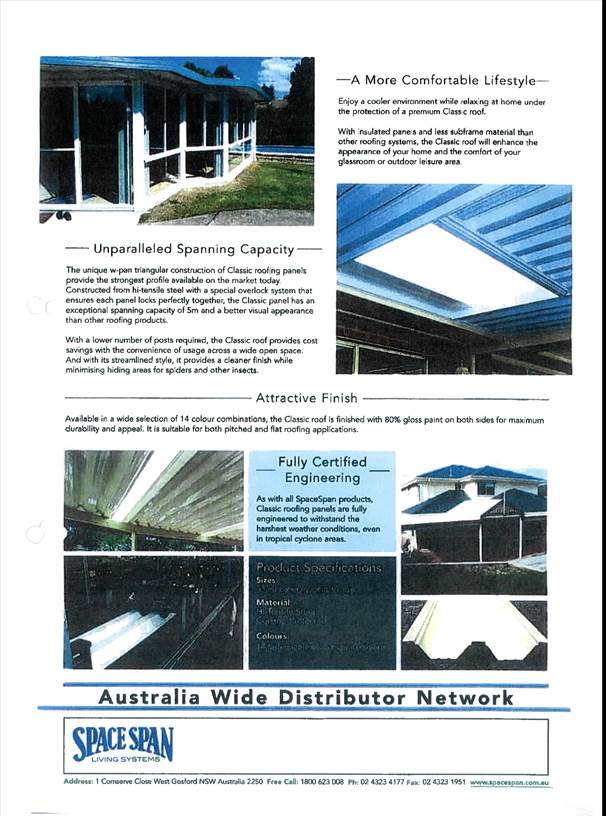
83 Mr Catto also made reference to the document called “Competitors Products Specifications and Comparisons” (see [33] above), which he said was distributed by Spanline to its franchisees at a Spanline conference held at some unspecified date. He said that that document demonstrated that other roof sheets had strong similarities to Spanline’s Double-U profile. He said that this was also evident from current advertising material produced by Spanline’s competitors. He annexed a copy of an advertising brochure produced by SpaceSpan, extracts of which are set out below. Mr Catto said that the photograph of SpaceSpan’s roof sheet, when viewed in isolation or as part of a completed project, was visually similar to Spanline’s Double-U roof profile (see in particular the photographs looking up at the finished roofs).
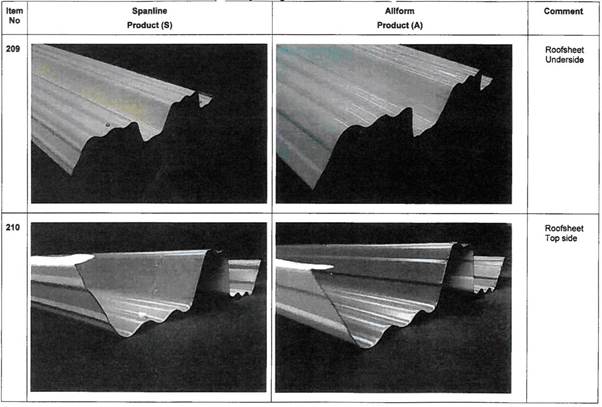
84 Mr Catto also attached to his affidavit the following photograph, which compares Spanline’s Double-U roof sheet with that of Allform (the different ribbing or ridging on the left hand riser and the central riser is evident, although otherwise the two products are visually very similar, apart from their colour).
85 In cross-examination, Mr Catto was asked various questions concerning the preparation of Allform’s engineering specifications dated 2011. He was asked questions about how the document had been prepared. He said that it was prepared by his brother and an engineer, Mr Quinn. He was taken to various extracts from the two manuals which contained substantially identical information. He said that that was not surprising because the results were the product of engineering analysis and one would expect the results to be the same if the input figures were the same. He denied any knowledge of copying from Spanline’s engineering manual, even though he acknowledged that that manual was not returned to Spanline after the franchise was terminated. He also said that while the figures were the result of engineering analysis, he was not an engineer. He said he did not believe that the information had been copied. When asked why Tabellz had not returned Spanline’s manual, he said that he did not want a piecemeal solution to the dispute Tabellz was having with Spanline, but rather an overall solution of which the manuals formed part.
86 In cross-examination, Mr Catto was asked various questions about the photograph Mr Way had taken of the display carport erected by Tabellz at its new premises in Penrith after it ceased to be a Spanline franchisee. Mr Catto said that it was very rare for customers to come to Tabellz’s premises to view a sample of Tabellz’s work: he said that more often, “we go to them”. He did not expand on that concept but I presume that he was referring to such matters as an Allform sales representative calling upon a prospective customer and showing the customer photographs etc of Allform’s work and answering any queries which the customer might have.
87 Mr Catto was asked a series of questions about the sticker and label which Tabellz was attaching to projects completed by Allform from November 2011 onwards, where those projects used Tabellz steel roof sheets. Copies of the sticker and label are set out immediately below, together with a photograph of a beam below the roofing to which the sticker and label are attached:

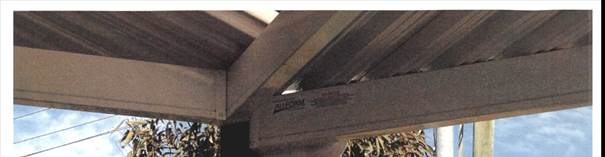
88 When asked why the sticker identifying the product as being manufactured by Allform was placed on the beam and not on the roof sheets themselves, Mr Catto said that if it was placed on the roof sheets, which are corrugated in shape, the sticker could more easily come off. He added that, because the sticker is also accompanied by a warning notice about walking on the roof, it needs to be clearly visible. He said that, in his view, a consumer reading the sticker would not view it as referring solely to the beam, but rather to the overall structure. I agree.
89 Mr Catto denied the proposition put to him in cross-examination that a conscious decision had been made not to put the sticker on the roof sheets because of a desire to capitalise on Spanline’s goodwill. He pointed out that Spanline itself normally places its warning labels on the beams. Mr Catto said that another reason for not putting the sticker or label on the roofing was that it would be aesthetically unpleasing. I accept that evidence.
90 In cross-examination, Mr Catto was asked about the retrospective fitting of stickers to Tabellz projects completed before November 2011. He confirmed that this had been done on legal advice because otherwise visitors observing a newly constructed Allform structure might think that it was similar to a Spanline project. Mr Catto said that Tabellz’s concern was not so much the homeowner, but a visitor who might otherwise be confused.
91 Mr Catto also was shown samples of the Spanline and Tabellz’s product (Exhibits D and F respectively). He agreed that the two sheets fitted together. But he resisted the proposition that they were facsimiles. He accepted that they were “similar”. He also drew attention to the fact that there were differences in the dimensions in terms of the height of the central riser, the width of the spans and the distance from the external edges of the spans to the middle of the central riser. He agreed that the overall shape was very similar and also that the clipping edges were similar, having a male and female edge. He was taken to pages 31 and 32 of Mr Brown’s report which showed diagrams of the two products. The height of the central riser is 2 mm difference, there is a 7 mm difference in the width of the overall span of the sheet and there is a difference of 1 mm and 6 mm respectively from the left and right hand edges to the middle of the central riser. It was put to him that these differences were minor because the two products still fitted together. He said that visually the products were very similar but there were differences in the ridging on both the central riser and on the outside walls. Mr Catto also emphasised that the ridging was created to increase the mechanical strength of the product so as to minimise the number of beams required. In other words, with a stronger roof sheet, there could be more spans and fewer beams. It was put to him that the only difference aesthetically relates to the central riser and that the ridging was only a secondary effect. He said that that is not so because the additional ridging adds to the mechanics and affects the shape of the product. He also said that the modifications made to the 2004 machine were minor compared to a new machine but sufficient changes were made to be able to produce a different product. He said that Allform was “looking to make our own name”.
92 It was then put to him that other manufacturers’ products were not the same as either Spanline or Allform. He was specifically asked to comment on Exhibits H (AussieSpan) and I (Hunter Douglas ShadeMaster). His evidence was to the effect that all those sheets were from the same genus or family, but he accepted that Allform and Spanline were the most similar.
93 He was then asked a series of questions about the Sydney Home Show at Darling Harbour between 19-22 May 2011. He accepted that the Allform display used photographs of work done by Allform when it was a Spanline franchisee and, therefore, showed Spanline roof sheeting. It was put to him that he was using Spanline roofing to promote Allform’s new business. He rejected that and said that they simply used those photos of completed work that Tabellz had done using its building licence. He also said that the photographs displayed to stimulate discussion with clients. He said that also on display were samples of the insulated panels which Allform obtained from other suppliers and sometimes used depending on a client’s need. I accept that evidence.
94 Mr Catto was asked a series of questions about various clauses of the franchise agreement, including clause 14.1.9 and the obligation to cease promoting or advertising Spanline’s products. He said that he was not promoting the Spanline product at the Home Show. It was put to him that Allform was taking advantage of its past association with Spanline to promote its own product. Mr Catto emphasised that the photographs were all taken from a considerable distance and it would not have been possible for an observer to work out what sort of roof sheeting was used because there were no close up photos. I accept that evidence.
95 Mr Catto was also taken to clauses 14.1.3 and 14.1.4 of the franchise agreement regarding transfer of telephone numbers and the return of Spanline’s materials. He said that Tabellz had signed a telephone transfer form when it first became a franchisee and was willing to sign a duplicate form as part of a complete resolution of all the matters in dispute between the parties. As to the return of Spanline’s intellectual property, Mr Catto agreed that there was no condition to the operation of clause 14 which turned on the need to resolve all issues in dispute between the parties. He said that Spanline’s intellectual property was still stored in 10 boxes at Tabellz’s business premises and was available for collection.
96 Mr Catto was then taken to clause 15 of the franchise agreement which deals with the buy back of the 2001 machine and the dispute about having it valued. He agreed that, while Spanline had consented to the valuation being done by Mr Gray, Mr Gray had sought further instructions as to what methodology he should use in valuing the product. It was put to him that clause 15.2 sets out all relevant matters to guide the valuer. He responded that even if that be so the valuer was asking for those instructions and he had tried but failed to get a response from Spanline.
97 Mr Catto was asked to compare the Colorbond® paint colours with Spanline’s Colorweld® colours. When Mr Catto responded that the colours were not all the same, it was put to him that he was resisting the obvious. I find as a fact, however, that while the colours are substantially similar some have subtle and minor variations. It was put to Mr Catto that there was no real difference in the materials used to produce the two types of sheets and that the only differences were in trademark names. He said that the BlueScope product was Australian made and, although he is not an engineer, it had different material strengths.
98 Mr Catto described the process by which customers choose Allform to carry out a home improvement. It normally includes consultation with a prospective client, the production of concept drawings, discussions about price and other relevant matters, leading up to contract execution. In re-examination, Mr Catto expanded upon these matters and said that the process usually involves the client contacting Allform directly and asking Allform to provide a quote. He said that this contact often came through a website dealing with home improvements. He said that the Allform quotation was normally given in writing and often in an email form because people are “time pressured”. Sometimes the quotation is hand delivered. He said the concept drawings were prepared by Allform which were computer drawn and the title page usually had Allform’s name down the left side, as well as the name of the draftsperson.
99 In cross-examination, Mr Catto was asked questions about Allform’s advertisements in the Blue Mountains Gazette Review (see [59]-[61] above). Mr Catto volunteered that the awning above the large photograph on the second page depicting a granny flat extension showed Spanline’s roof sheeting and that the particular project had been done by Tabellz when it was a Spanline franchisee back in 2009. It was then put to him that it was a case of Allform seeking to promote its own business by using Spanline’s product. He said that that was not the intention and that the focus was not on the awning, but rather on promoting the sorts of projects which Allform could do, including granny flats and ground floor extensions etc. which were things he said that Spanline could not do. I accept that evidence, but it remains to consider its relevance.
100 It was put to Mr Catto that Allform was using Spanline as a springboard for their work in building granny flats. He said that that was not the case because it was not the roofing that was the focus of Allform’s advertising but rather Allform’s capacity to do different types of building work, not all of which is done by Spanline. Again, I accept that evidence and will consider its legal relevance below.
(e) Mr Ross Brown
101 Mr Brown was called by Tabellz as an expert. Mr Brown is a practising hydraulic engineer who is engaged on a daily basis in the design of metal roof and gutter systems. He is also a licensed plumber, drainer and gasfitter and has had personal experience in the construction and installation of metal roofing and gutter systems. Mr Brown also has a law degree. He produced a report dated 9 November 2012 and also participated in the experts’ joint report. Mr Brown was instructed to comment on the following questions in his report:
(i) Whether or not in your opinion the roof profile of that of Tabellz is visually similar to or could be said to be the same as Spanlines (sic) Double U Roof profile;
(ii) Whether or not in your opinion the gutter profile of that of Tabellz is visually similar to or could be said to be the same as the Spanlines (sic) gutter profile and whether;
(iii) Whether Tabellz roof and gutter profiles contain Spanline design features, and if so, what are they, and are they features common throughout the gutter and roof industry and not exclusive to Spanline;
(iv) Do the visual characteristics of the design of Spanlines Double U Roof profile roof sheets and the Spanline Gutter profile gutters create a secondary meaning in the minds of members of the relevant public which is associated with the name of Spanline, if so why, or if not, why not and if not what do members of the relevant public consider when purchasing roof sheets and gutters;
(v) In your opinion are Tabellz roof and gutter profiles materially different from the steel roof and gutters manufactured by Spanline, in particular would you kindly create a detailed drawing as is of the respective roof and gutter profiles of Tabellz and Spanline identifying their respective characteristics and features;
(vi) Any other relevant observations you may have as independent expert engineer.
102 The key matters arising from Mr Brown’s report may be summarised as follows:
(a) Mr Brown annexed to his report a series of home improvement brochures published by companies such as Stratco, SpaceSpan, Apollo and Stramit which illustrate what those companies consider to be relevant in selling their products. Mr Brown emphasised that many of those brochures do not show individual building components – such as individual roofing spans – but rather highlight the finished product, including the roof sheeting when it is joined. He said this supported his view that consumers in the relevant class are interested in the overall finished product and not so much the individual components. I agree with that view;
(b) whilst accepting that the roof profiles of the Spanline and Tabellz products are at first glance “somewhat similar in nature”, he added that it is not unusual in the metal roofing industry for manufacturers to produce similar products with minor variations which are said to give a competitive advantage;
(c) at [9.1.3] of his report Mr Brown summarised his opinion that the average purchaser of metal formed home improvements is generally less concerned with the profiles of the individual components and is more concerned with the overall visual aesthetic of a completed home improvement addition. Hence, “it is unlikely that in the majority of circumstances, the majority of end purchasers would be confused by the specific, various elements from a variety of manufacturers utilised in the construction of the final product, simply because the majority of customers are unlikely to be interested in such specific detail”. I agree with and accept that evidence;
(d) at [9.1.4] Mr Brown stated that the “lack of commercial marketing importance of specific component profiles is confirmed by the general lack of specific roofing and gutter profile information in the various manufacturers marketing materials” annexed to his report, as opposed to “the prominence in those materials of completed structures rather than individual components”. I agree;
(e) he stated at [11.1.1] that, while at first glance the two relevant products are “visually similar”, Allform’s product “contains sufficient technical differences to readily distinguish the material from that as produced by Spanline”, by reference to colour, the additional ridges along the centre risers and end walls – which differences were highlighted by him in diagrams set out at the end of his report;
(f) he also stated that the Allform and Spanline roof profiles “share common features of many other “W” shaped roofing profiles used throughout the metal construction, roofing, home improvement and rainwater goods industry” ([11.3.1]) and that the general design features of such “W type” roofing profiles include:
a general “W” appearance, deep wide valleys, substantial ridging through the centre of the profile;
longitudinal ribbing in the base of the valley and top of the ridge; and
longitudinal ribbing on the top of the ridge and, sometimes pressed ribbing along the walls of the ridge;
(g) to demonstrate his view that manufacturers regard the “W” roof profile to be of a generic nature, he set out extracts from various suppliers which make reference to that style of roofing. These suppliers include Altec, Aussie Span and Apollo. Mr Brown set out the following extracts from Altec’s advertising materials in relation to “W” roof profiles:
What is ‘W’ Profile roofing and how does it benefit?
‘W’ profile roofing brands are widely regarded as Australia’s highest cyclone and wind rated roofing systems due to their special ability to resist sagging, leaking, bowing or splitting during severe weather conditions such as storms. This fatigue can be caused by intense wind pressure and the weight of torrential rain. Whilst the manufacturing process of the ‘W; profile brands is far more intricate than ‘Flat Pan’ profile brands, strength, reliability and longevity is greatly enhanced.
…
The ‘W’ Profile roofing system is perfect for all areas that experience storms, and as such, are highly recommenced for South East Queensland and Northern New South Wales. (W33 – W50 wind rated)
Your Altec Design Consultants are the most professional in their field. They are extensively and continuously trained to ensure an excellent result correctly designed and correctly engineered. You will be surprised at just how easily and quickly an Altec Patio Design Consultant will make your desired home improvement come true.
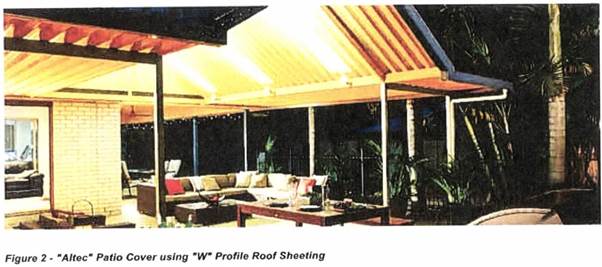
(h) In his report, Mr Brown also set out the following photograph taken from Altec’s brochure which shows a finished Altec structure about which Mr Brown was then cross-examined (see further below at [108]):
(i) Mr Brown also set out the following extract from advertising material produced by Patioland Parramatta, a New South Wales supplier/installer, which describes the merits of “W” style roofing as follows:
Patioland suggest using the W-Pan profile for its Pergolas, aluminium and Apollo patio and custom awnings for the following reasons:
W-Pan profile offers more structural strength and integrity and then (sic) flat profiles. This is because W profiles uses more material more square meter then (sic) flat profiles
W-Pan profile also offers lesser heat absorption then (sic) flat profiles due to the generation of a temperature gradient across the surface;
(j) while Mr Brown accepted that a person with experience in installation of metal roofs might consider that the two products have somewhat similar characteristics, he said that he thought it unlikely that the visual characteristics and similar profiles of the two products would “give rise to a perception by a client or other member of the public not specifically trained or experienced in architecture, building design, or the manufacture or installation of metal roofing… given that the specific nature and profiles of the various components utilised to manufacture the end product are rarely taken into account by the average “mum and dad” householder who tend to be the typical purchaser of these types of products”. I agree with that view;
(k) equally significantly, at [11.4.2] Mr Brown commented that, “given the availability of other similar designs, and the fact that purchasers are generally viewing the material installed from ground level, viewing to above on a prefabricated fully constructed sample installation, usually at the manufacturers or installers display centre, it is further significantly more difficult to comprehend the total picture of the roof profile installed, with the underside of the roof simply looking like a continuous form of roof sheeting. As stated above, clients do not tend to look at these details but rather the overall product as a total package”. I agree with that opinion;
(l) he further states at [11.4.3] that the lack of emphasis on promoting specific profiles indicates the lack of the importance of such matters to clients and that, as a matter of commercial reality, “if clients were significantly interested in this I would expect a greater number of manufacturers to provide commercial material indicating this much more prominently, which on information presently available it is not the majority of instances”. I accept that evidence;
(m) at [11.4.4], Mr Brown identified the following matters, in descending order of importance, as the criteria which he considered are taken into account by purchasers of metal rainwater goods: price; overlook of a completed and finished product; colour; reputation of installer and supplier; geographical location of installer and, rarely, specific profiles of individual components making up the complete product. On the latter point he stated that “only architects, building designers, builders, roofing installers or roof plumbers have any interest in specific profiles of roof sheeting and metal gutters products”. I agree with and accept that evidence; and
(n) in my view, Mr Brown’s conclusion at [11.4.5] is compelling, namely that “it is my own experience that the visual characteristics of the specific roof or gutter profile are generally not considered by an average client lacking general industry knowledge and experience”.
103 Among the materials attached to Mr Brown’s report is a Stratco brochure dealing with verandas, patios, carports and sunroofs, which contains multiple photographs of finished products, but not of any individual building component. The brochure for “SpaceSpan” contains photos of both finished structures and individual spans (see a copy of the same material depicted in [83] above). Stratco’s brochure also contains photos of individual elements of a building structure, including an item described as “Spacedek”, which bears some – but not a strong – similarity to Spanline’s roof sheet. The one-page Apollo brochure has a large photograph of a finished structure and also has a small photograph of two different roof sheets. The Stramit brochures contain photographs of both finished structures and individual roof sheets, none of which appear similar to Spanline’s. Thus although some of the brochures contain photographs of individual roof sheets, much greater prominence is given to photographs of finished structures, the roofs of which all look generally similar to the naked and untrained eye.
104 In his oral evidence, Mr Brown explained his background as a hydraulic engineer and admitted that his expertise related mainly to the design of roofing etc and that he was no expert on aesthetics. He also made clear, however, that he had had experience up until about 10 years ago of actually constructing some of the structures which are relevant to the proceedings.
105 Mr Brown was asked about [9.1.1] and [9.1.3] of his report. He reiterated that, based on his experience, he considered that consumers are driven not by the aesthetics of individual components, but rather by the overall structure. When it was put to him that approximately two-thirds of the structure was the roof sheeting and that that was an important individual item, he said that in his experience the majority of customers were not interested in the roof product and only in the overall look of the finished product. I accept that evidence.
106 When shown physical samples of both the Spanline and Tabellz Double-U roof sheets, Mr Brown immediately identified them correctly by referring to the different ridging which appears on the centre riser and external walls. He said repeatedly that the two products were “very similar” although they were not the same. Various questions were put to him based on a distinction between primary and secondary features. He said that he had never heard of the language of “primary features” in the industry. He described the differences in height, width etc as “slight differences” in terms of the mathematics, which he confirmed he had measured using a micrometer which had a margin of error of .01 mm. He accepted that the angles on the two samples were similar and that they clipped together similarly (along with most other roof cladding products). He said that the central riser was important because it was fairly prominent.
107 Mr Brown confirmed that he had been instructed that there was a clear and prominent identification of the manufacturer on Allform’s relevant structures, but that he had made no independent inquiries himself. He said that the Allform sticker would “look terrible” if it appeared on the roof sheeting itself. When it was put to him that a consumer would think that the sticker referred only to the beam, he quickly said that they would think that it referred to the overall structure. I agree.
108 Mr Brown was then shown Exhibit H (see [55] above), which had been tendered by Spanline on the basis that it was the “Altec Ausiespan” product (sic). Mr Brown said he had never seen the sample before. He said that he had asked Altec for a sample of its product but they had declined to give him one. By reference to figure 2 of his report, which showed a photograph of an Altec patio (see [102(h)] above), it was put to Mr Brown by Spanline’s counsel that the roofing product used there may have been a Spanline Double-U roof sheet. Mr Brown said that that could be so. That question (which I assume was made on instructions) and Mr Brown’s answer highlight how different roof sheets can look alike when viewed in a photograph showing the finished product.
109 I should interpolate at this point that it emerged that Exhibit H was mislabelled by Spanline. Exhibit H is not in fact a sample of any Altec product (and no hard sample, of any such product was in evidence), but is a sample of a steel roof sheet produced by Aussie Span.
110 Mr Brown was then asked various questions about the Apollo product, which is Exhibit G (see [55] above). He accepted that the Apollo sheet was flatter and wider than Spanline’s. He also said that once all the different roof sheets were installed, they all look “pretty much the same”. I agree with that observation.
111 It was put to Mr Brown in cross-examination that a consumer seeing Exhibits D and F in a constructed form would not be able to tell the two apart. His response was to say that he did not think that most consumers would be able to tell any of the competing products apart when a project was constructed. Again, I agree with and accept this evidence.
112 When asked yet again about the significance to consumers of the appearance of roofing in a structure, Mr Brown reiterated that it is the overall structure that matters, not the individual components, consistently with the views he expressed in his report.
113 Mr Brown was then taken to Spanline’s national advertising brochures and the prominence given to the Double-U sheet in photographs in Spanline’s advertising material, such as the October 2011 brochure (see [48] above). He was asked to comment on that in the light of [11.4.3] of his report which suggested that the majority of manufacturers do not promote individual components, but rather the overall look. He said that if Spanline was not within that majority, he did not quite understand why they took that approach because, in his view it was of no particular benefit to them in circumstances where customers were mainly interested in the appearance of the finished structure.
114 Mr Brown was also taken to [11.4.4] of his report and the main criteria in descending order which he felt impacted upon consumer choice, namely price, overall look, colour, reputation of the installer, geography and lastly, specific profiles. He rejected the proposition that, as far as Spanline is concerned, the Double-U product is at the top of the list. He said that that did not accord with his experience. I accept his evidence (see further below).
115 At Tabellz’s request, Mr Way was recalled to deal with the confusion created by Exhibit H (see [109] above). He said that he had instructed his secretary to put the words “Altec Aussie Span” on Exhibit H. He then gave some rather confusing evidence about Altec having imported for some time in the past a roofing product from China, but then manufacturing its own product from a time which he was unable to identify precisely. No explanation was given why he instructed his secretary as he did in circumstances where the sample was not an Altec product.
116 Mr Way then said that figure 2 in Mr Brown’s report (see [102(h)] did not show Spanline’s roofing. That is inconsistent with the question which was put to Mr Brown by Spanline’s counsel. Mr Way said that if further photographs were obtained with different lighting they would show it was not Spanline’s roofing. He emphasised the importance of his expertise and experience in being able to differentiate roof sheets so readily. Mr Way’s evidence underlined the difficulty for a person other than an expert being able to differentiate between different manufacturers’ roof sheets when looking at a photograph of a finished product. In my view, Mr Way cannot be viewed as a member of the relevant class of consumers. Mr Way also confirmed that Spanline was currently in dispute with Altec about its entitlement to represent that it sold Spanline’s roofing product.
SUMMARY OF SPANLINE’S SUBMISSIONS
117 Spanline’s primary submissions may be summarised as follows.
(a) Misleading or deceptive conduct
118 First, Spanline defines the relevant product as its Double-U steel roof sheets in a completed structure, whether it be a patio or a carport etc. This is an important point. Spanline did not argue that the relevant product is the Double-U roof sheet as an individual or stand alone item viewed in isolation from a finished structure of which it forms part.
119 Secondly, Spanline defines the relevant class of consumers as home owners or home builders interested in a home extension or addition such as a patio, roof awning, covered verandah, glass and screened enclosure or a carport, all of which will require a roof. Spanline accepts that the relevant class does not include professional builders because a customer who selects Spanline’s products invariably engages Spanline to carry out the construction and installation of the relevant structure.
120 Thirdly, in support of Spanline’s contention that it has established a reputation, goodwill and secondary meaning in the shape and features of its “Double-U” roof profile, it relies on the following matters:
(a) its distinctive shape and features;
(b) the product has been manufactured since about 1985;
(c) the existence of the extensive franchisee network through which the product is sold exclusively, including Mr Catto’s evidence that that was a significant factor in his decision to become a Spanline franchisee in February 2002;
(d) Spanline has engaged in extensive advertising and promotional activities over many years with the result that customers “are well aware and associate the unique shape and features of its Spanline Australia Double-U roof profile not only with the business, Spanline Australia, but also as an exclusive building product of Spanline; and
(e) Mr Bucher’s expert evidence as to the existence of Spanline’s established reputation.
121 Fourthly, Spanline submits that the Court should reject Mr Brown’s opinion and conclusions to the effect that the Spanline and Allform profiles are similar in appearance to other “W” roof profiles. It submits that Mr Brown misunderstands Spanline’s central proposition that it is the combination of elements in Spanline’s product which makes its shape and features unique and distinctive. Further, Spanline submits that Mr Brown’s expertise is not in the aesthetic design of roof sheeting but in its functional design, particularly in terms of the hydraulic functionality of roof sheeting. Spanline submits that the Court should reject Mr Brown’s evidence that consumers are not interested in particular roofing materials and are primarily concerned about the overall appearance of the completed structure.
122 Fifthly, Spanline submits that, notwithstanding the modifications made to the roof roll forming machine purchased by Tabellz in 2004 and used by it after termination of its Spanline franchise, the Allform roof sheet profile directly incorporates the Spanline Double-U roof sheet profile or is so strikingly similar that there is no difference between them. Spanline points to the fact that the experts were agreed that the two products are “basically visually the same with minor visual differences”. It also relies on Allform’s conduct in May 2011 at the Sydney Home Show when it used photographs of Spanline’s Double-U roof sheets in various structures completed by Tabellz as well Allform’s advertisements in papers such as the Blue Mountains Gazette Review. It says further that the Court should accept Mr Bucher’s evidence that the Tabellz product has all the “primary features” of the Spanline Double-U sheet and that the modifications relied on by Tabellz are only “secondary features” which do not affect the overall unique design and features. Spanline says that Tabellz used the unique design and features of Spanline’s Double-U profile as a “springboard for its new business”.
123 Sixthly, Spanline says that the Court would not accept Allform’s reliance on its modification of the roof sheets (because the modifications are so minor); its use of different colours (because the evidence from Mr Way was that the colours could be matched); nor any difference in the materials used (on the basis that fundamentally they are the same being steel albeit perhaps with different grades). Spanline submits that Tabellz’s practice of affixing a sticker or label on a finished structure which identifies it as having been manufactured by Allform is insufficient to avoid the likelihood of a not insignificant number of persons within the relevant class of consumers being misled or deceived into believing that the roof sheets are Spanline’s.
124 Seventhly, Spanline says that the Double-U roof sheets produced by both it and Tabellz are “completely different to any other roof sheet or cladding product” identified by Tabellz and that they are unique and distinctive products when compared with other roof sheets identified by Mr Bucher and Mr Brown.
125 Eighthly, the matters above are relied upon by Spanline as supporting its claim that Tabellz has breached ss 18 and 29 of the Australian Consumer Law. Spanline says that the appropriate test is whether a not insignificant number of persons within the relevant class of the public would be misled or are likely to be misled by reason of Tabellz’s conduct, citing Peter Bodum A/S v DKSH Australia Pty Ltd (2011) 280 ALR 639 at [209] per Greenwood J (with whom Tracey J agreed) (Bodum).
126 Ninthly, Spanline says that Tabellz’s conduct in constructing structures using Tabellz’s Double-U roof sheets and in advertising and promoting such structures constitutes false representations by Tabellz that:
(a) roof products manufactured and sold by Tabellz incorporating the Double-U roof profile are the same as the roof products manufactured and sold by Spanline using its Double-U roof sheet design;
(b) the roof products manufactured and sold by Tabellz using the Double-U roof profile are the products of Spanline;
(c) those Tabellz’s products are the same quality as roof products manufactured by Spanline; and
(d) Tabellz is entitled or licensed to commission, manufacture, market, offer for sale, sell, distribute or supply roof products containing Spanline’s Double-U roof sheet design.
(b) Passing off
127 In the alternative to its Australian Consumer Law claim, Spanline contends that, by its conduct, Tabellz is liable in the tort of passing off. It says that it needs to establish the following three elements of that tort: reputation, misrepresentation and the likelihood of damage (citing inter alia Powell J’s decision in Fletcher Challenge Ltd v Fletcher Challenge Pty Ltd (1981) 1 NSWLR 196 at 204). It contends that there is no requirement to establish any intention to deceive and that it is sufficient that Tabellz’s conduct is calculated or likely, rather than intended, to deceive. It says further that the relevant question for that purpose is the likely impression on the casual and unwary customer, and that it is no answer that an observant person making a careful examination would not have been deceived.
128 As to the first two of those three elements, Spanline relies upon its submissions in support of its claim under s 18 of the Australian Consumer Law. In support of the third element, it relies on Mr Way’s evidence that Spanline has a franchisee based in the Illawarra which services part of the Sydney region which overlaps with the area in which Allform operates, with the consequence that Spanline is likely to suffer loss of trade as a consequence of Tabellz’s conduct.
(c) Breach of contract
129 In support of its claims concerning breach of the machine sale agreement and franchise agreement, Spanline’s submissions may be summarised as follows:
(a) Tabellz has breached cl 15 of the Franchise Agreement by continuing to possess the 2001 machine and by failing to agree unconditionally to have the machine valued in accordance with that provision; and
(b) Tabellz has breached cll 14.1.3 and 14.1.4 of the franchise agreement by failing to deliver up unconditionally Spanline’s intellectual property (including any Spanline engineering manuals in its possession) and also in failing to transfer the telephone numbers used by Tabellz while it was a Spanline franchisee.
130 Spanline does not seek damages in respect of these alleged breaches of contract. Rather it seeks an order in the nature of specific performance in relation to the sell-back to Spanline of the 2001 machine. Alternatively, it seeks injunctive relief restraining Tabellz from using any Spanline roof form rolling machine in its possession. It also seeks an order in the nature of specific performance requiring Tabellz to deliver up Spanline’s intellectual property as well as transfer the telephone numbers used by Tabellz when it was a Spanline franchisee. Spanline also seeks its costs of the proceedings.
SUMMARY OF TABELLZ’S SUBMISSIONS
131 Tabellz’s primary submissions may be summarised as follows.
(a) Misleading or deceptive conduct
132 First, Tabellz provided the following table which compares the Spanline Double-U roof profile with the Allform roof profile:
Feature | Spanline double-U roof profile | Allform roof profile |
Distinguishing sticker | Nil | Sticker entitled “Proudly Manufactured by Allform” |
Colour | Colorweld range of colours and paint finishes | Bluescope colorbond range of colours |
Material | Aluzinc | Bluescope Zincalume & Colorbond |
Manufacturer’s sticker | Atlas Metal Processors One Steel Coil Coaters Pty Ltd | Bluescope Steel Zincalume |
Walls Centre Riser | Outward facing riding on end risers No profile to centre riser. | No pronounced ridging to end risers. End riser ridging same as centre ridging Additional ridging to centre riser same as end risers. |
Roof span | 4,700mm width 323 mm | 4,800mm width 316mm |
Contract documentation | Spanline identified as contracting party | Allform identified as contracting party |
General “W” appearance | Yes | Yes |
Deep wide valley | Yes | Yes |
Ridged, pressed longitudinal ribbing on the top of ridge | Yes | Yes |
Ribbed, pressed longitudinal ribbing in the base of the valley | Yes | Yes |
133 Secondly, Tabellz submits that both the Spanline and Allform roof profiles exist in a market where there are several other manufacturers of “W type” roofing profiles, including Altec, Lysaght “W” Deck, Stratco, Stramit and Apollo and that each of these “W type” roofing profiles has the following common features:
(a) a general “W” appearance;
(b) deep wide valleys;
(c) substantial ridging through the centre of the profile;
(d) ridged, pressed longitudinal ribbing in the base of the valley and the top of the ridge; and
(e) in some cases, pressed longitudinal ribbing along the walls of the ridge.
134 Thirdly, Tabellz did not contest Spanline’s descriptions of the relevant product and class of consumers (see [118] and [119] above).
135 Fourthly, Tabellz says that a central question is whether Tabellz has done enough to distinguish its roof sheet product from Spanline’s, citing Bodum at [198] per Greenwood J (with whom Tracey J agreed). Tabellz contends that that question should be answered in its favour having regard to the following matters:
(a) the nature and extent of the modifications it made to the Spanline roof forming machine with the consequential different features of the Allform roof profile;
(b) its practice since November 2011 of affixing to a beam in every job utilizing the Allform roof profile a sticker which clearly states that the structure is manufactured by Allform and that similar stickers are being applied retrospectively to jobs completed by Allform prior to November 2011;
(c) account has to be taken of the fact that Spanline and Allform produce their respective roof profiles in a market which includes several other producers of what are said to be similarly designed “W” roof profiles, relying on what Gibbs CJ said in Parkdale Custom Built Furniture Pty Ltd v Puxu Pty Ltd (1982) 149 CLR 191 at 199-200. Tabellz also relies on statements by Mason J at 210-211 of Puxu to the effect that it is reasonable to expect that a consumer who has an interest in the topic will ask for the identity of a manufacturer if the consumer regards that issue as relevant;
(d) the following features of the Allform roof profile render it different from Spanline’s Double-U roof profile:
(i) the Allform roof profile uses the Colorbond range of colours, whereas Spanline only uses Colorweld; or
(ii) the Allform product has unique ridging or ribbing to the central riser and external risers, as is reflected in Mr Brown’s diagram; and
(e) Spanline did not call any evidence from any consumer or franchisee to support its claim that there was a likelihood of consumers in the relevant class being misled or deceived into believing that Tabellz’s product was Spanline’s. This included the effect of Tabellz’s photographic display at the Sydney Home Show. Nor did Spanline call evidence from any consumer who was misled by the photographs into thinking that Allform had some association with Spanline.
136 Consequently, Allform says that these differentiating features, combined with the distinctive Allform sticker, mean that a not insignificant number of ordinary and reasonable members of the relevant class of consumers is or is likely to be misled or deceived into believing that the Allform roof profile is in fact the Spanline product or is a Spanline product produced under licence from Spanline (citing Bodum at [205] per Greenwood J).
137 Finally, Tabellz submits that if, contrary to the above, the Court found that Tabellz’s conduct in displaying those photographs was likely to mislead or deceive, the Court would also take into account the evidence of Tabellz’s subsequent conduct which, it says, would rectify any deception. In this regard, it points to the evidence of Allform providing its quotations on Allform letterhead, the form of its contracts which again include the Allform name, as well as the absence of any evidence that any Allform representative has misrepresented to a consumer in the relevant class in any discussion about the Allform product that it is in some way associated with Spanline’s product.
(b) Passing off
138 Tabellz denies that there is any secondary meaning or reputation in the Spanline Double-U roof profile which is independent of any reputation associated with the name of Spanline. It contends that Bodum is distinguishable because the nature and extent of Bodum’s advertising and promotional activities was far more extensive than Spanline’s and was sufficient to establish a strong secondary reputation beyond Bodum’s name in the particular coffee plunger itself. Further, Tabellz denies any liability in passing off and points to the fact that it markets its goods under its own name and affixes a distinctive sticker to its completed projects (as described above). It also relies on what it says are material differences in the colour and design of its roof profile. Finally, Tabellz submits that if, contrary to the above, the Court was to find that Tabellz’s promotional activities at the Sydney Home Show and in the Blue Mountains Gazette Review amount to passing off, then there is no need for any injunctive relief because there is no evidence to suggest that there is a risk that such conduct would be repeated.
(c) Contract
139 In response to Spanline’s argument that Tabellz is in breach in respect of the buy back of the 2001 roofing machine, Tabellz denies any such breach and say that it has no objection to the machine being bought by Spanline. In emphasises that, in response to a request by the agreed valuer, it asked Spanline to agree a valuation methodology so that the valuation could be carried out and Spanline had declined to do so. In any event, even if Spanline were to establish a breach of contract, Tabellz says that Spanline does not seek damages in respect of any breach and this is an inappropriate case in which to order relief in the nature of specific performance, citing Young CJ in Eq’s decision The Amble Inn Pty Ltd v Ryan [2001] NSWSC 875 at [32]. Tabellz says that the 2001 machine is a unique chattel and that Spanline’s only remedy is in damages, which are not sought. Tabellz also relies on the High Court’s decision in Hall v Busst (1960) 104 CLR 206 in support of its contention that specific performance would not be ordered.
140 As to Spanline’s complaints regarding its intellectual property and the transfer of the telephone numbers it used when it was a Spanline franchisee, Tabellz says that (a) Spanline’s engineering materials are available for collection by Spanline; and (b) when it first became a Spanline franchisee, it provided Spanline with a signed authorisation form for the telephone numbers to be transferred if and when the franchise ceased and that it should not have to provide a fresh authorisation.
CONSIDERATION
(a) Misleading or deceptive conduct
141 In view of the strong reliance placed by the parties on the High Court’s decision in Puxu and the Full Court’s decision in Bodum, it is convenient to spend a little time analysing those decisions and summarising the relevant legal principles they establish.
(i) Puxu
142 Puxu involved proceedings under s 52 of the TPA in relation to the sale of furniture. Since mid-1978 Puxu manufactured and sold under the name “Post and Rail” furniture of distinctive appearance and design, which was known as the “Contour” range. The furniture was advertised widely and had a reputation, but there was no registered design. The appellant manufactured and sold furniture under the name “Parkdale Custom Built Furniture” and, more specifically, under the “Rawhide” range. Parkdale’s furniture closely resembled that made by Puxu. Parkdale’s furniture had sewn into the front of each piece a label about 6.35 cms square which stated that the item was “Parkdale Custom Built Furniture” of the “Rawhide” range. The label could be tucked under the upholstery, when it would not then be visible, and could also easily be removed by cutting it off. Puxu’s furniture bore labels of a similar kind but were smaller in size. Puxu’s s 52 case was dismissed at first instance, but was upheld on appeal to the Full Court. That decision was in turn reversed by the High Court (Gibbs CJ, Mason and Brennan JJ with Murphy J dissenting).
143 Some key relevant points to note from the majority judgments in that decision may be summarised as follows:
(a) while it was accepted that the parties’ respective furniture was virtually identical in appearance such that a prospective purchaser would be likely to be misled into thinking that they were Puxu’s chairs, such a person who read the label could not be deceived or misled because they were properly labelled with Parkdale’s name;
(b) while it is clear that s 52 is not confined to conduct that is intended to mislead or deceive, the relevant issue is to consider the nature of the respondent’s conduct with a view to determining whether that conduct is misleading or deceptive or likely to mislead or deceive reasonably includes reasonable or ordinary members of the relevant class of consumers;
(c) it is reasonable to assume that relevant consumers would take reasonable care of their own interests and, in a case such as this, potential purchasers of a suite of furniture costing about $1,500 would, if acting reasonably, look for a label, brand or mark if they were concerned to buy a suite manufactured by a particular business. As Mason J observed at 209:
In furniture of this price range in the order of $1,500 for a three piece lounge suite one would in the ordinary course expect persons within the admittedly wide range of potential purchasers to exercise somewhat more vigilance than may be the case with the purchase of items of less financial significance having less impact on the appearance of the home…
Mason J then further observed at 211:
… taking into account the importance both financially and aesthetically of the relevant furniture, my conclusion is that a purchaser who considered it important to acquire Post and Rail “Contour” furniture could reasonably be expected to look for and find the label or to take comparable steps, such as inquiring of a salesman, to ensure that furniture from the “Contour” range was being purchased;
(d) in general terms, the sale by one manufacturer of goods which closely resemble those of another manufacturer is not a breach of s 52 if the goods are properly labelled so as to show the name of the manufacturer or the source of the article;
(e) if such a label is then removed by a third party for whose acts the respondent is not responsible, any consequential misleading effect is produced not by the respondent’s conduct, but by that third party;
(f) s 52 is not breached merely because members of the relevant class of consumers would be caused to wonder whether the two products came from the same source; and
(g) as Brennan J concluded at 226, it was not misleading or deceptive conduct for Parkdale merely to manufacture and sell a lounge suite which was either similar to or even identical with Contour’s, because:
Something more was needed to show conduct inducing a mistaken belief that the “Rawhide” suite was manufactured by Puxu, but [the] only additional evidence, the label, showed conduct which was calculated to correct any confusion as to source.
(ii) Bodum
144 Bodum brought proceedings for misleading or deceptive conduct and passing off against a rival manufacturer, DKSH Australia Pty Ltd (DKSH). Since the late 1950s, Bodum manufactured and sold a coffee plunger known as the Bodum Chambord coffee plunger (the Bodum plunger). This product had been advertised and sold in Australia since the mid 1980s. It was an agreed fact that the Bodum plunger was marketed by Bodum with a picture of the plunger featuring prominently on the packaging. It was also agreed that the Bodum plunger was often displayed at retail outlets outside of its packaging. Relying on these and other matters, Bodum argued that it had acquired a reputation in the features and shape of the coffee plunger, which reputation was independent of the trademarks, brands or labels. It argued that this constituted a “secondary reputation” in the product itself and not merely in the particular brand or trademark.
145 The central issue in the case was whether, by advertising and selling its rival Euroline coffee plunger with the features of the Bodum plunger and without adequately labelling or distinguishing it from that product, DKSH falsely represented to Australian consumers that its plunger was in fact the Bodum plunger or, alternatively, that it was made, promoted and sold with the approval of Bodum. Bodum also argued that, by reason of that conduct, DKSH engaged in passing off its Euroline coffee plunger as the Bodum plunger or as a product relevantly sponsored or approved by Bodum, thereby causing damage to Bodum’s goodwill and reputation subsisting in the Bodum plunger.
146 In resisting these claims, DKSH emphasised that:
(a) Bodum’s plunger when offered for sale was always marked or engraved with important additional names, marks or descriptions which were not present in the Euroline coffee plunger;
(b) the packaging for each product was different;
(c) the use of “Euroline” on the packaging differentiated the products; and
(d) the history of other look-alike products to the Bodum plunger must be taken into account in determining whether DKSH’s conduct could be described as misleading or deceptive or likely to mislead or deceive consumers.
147 The primary judge in Bodum ((2010) 84 IPR 542) had noted at [47] that it was a matter for the Court to determine for itself, as a matter of overall impression, the significance of the similarities and dissimilarities between the two relevant products. The primary judge also found that the relevant date for determining passing off was July 2004, when DKSH entered the market.
148 Bodum also relied on a body of advertising material to support its claim of secondary meaning and independent reputation in the shape and features of its product. The advertising material included material demonstrating that the Bodum plunger was often promoted in use and without any packaging.
149 The Full Court closely analysed Bodum’s extensive advertising and promotional material. Greenwood J (with whom Tracey J agreed) accepted the principle that a claim of passing off could arise by reference to the features of a product i.e. its secondary reputation. His Honour also emphasised at [181] that the question is ultimately one of fact as to whether or not a particular product becomes distinctive of, or associated with, a particular trader by reason of the design of the goods even though there is also present labelling or brand names (such as the name Coca Cola, which appears on a classic Coca Cola bottle). Greenwood J held at [197] that, by reference to the historical advertising and promotional material, Bodum had established “a very significant secondary reputation” in the features of its plunger, which representation was not dependant upon the brand “Bodum” appearing on the product – the reputation was secondary or independent of that. It is important to note that the evidence grounding that finding was very strong, as is reflected in the Full Court’s detailed analysis of numerous advertisements in newspapers, pamphlets etc.
150 At [198], Greenwood J described the real question in the proceedings as whether DKSH had done enough to distinguish its product from Bodum’s, having regard to all the relevant differentiating factors between the two products.
151 His Honour then conveniently set out some relevant legal principles applying to both s 52 of the Trade Practices Act 1974 (Cth) (the TPA) (now s 18 of the Australian Consumer Law) and passing off. In doing so his Honour made numerous references to relevant authorities.
(iii) Misleading or deceptive conduct - some relevant legal principles
152 In outline (and omitting case references), the principles as they apply to both s 52 of the TPA and s 18 of the Australian Consumer Law, are as follows:
(i) the operation of s 52 is not constrained by common law principles of passing off which are concerned with the protection of goodwill. Section 52 confers a wider field of protection on consumers than the common law integers relating to passing off;
(ii) s 52 describes standards of conduct which manufacturers and traders must exhibit in their dealings with consumers. The breach of those standards are actionable at the suit of rivals, as well as consumers or a regulator;
(iii) a rival trader can enter the market and copy precisely another’s product (in the absence of infringing intellectual property rights) so long as the rival does not mislead or deceive the public or pretend, by conduct, that its goods are the goods of another;
(iv) whether impugned conduct conveys the making of a representation is a question of fact to be determined having regard to all the contextual circumstances within which something is said or done. Where that conduct involves representations to the public at large (or a section thereof), such as prospective retail buyers of a product, s 52 must be regarded as contemplating the effect of the impugned conduct on reasonable members of the class of prospective buyers;
(v) in ascertaining whether a misconception has arisen or might arise among members of the relevant class, assumptions by persons whose reactions are extreme or fanciful should be disregarded;
(vi) the issue is not whether the impugned conduct simply causes confusion or wonderment, but whether the conduct is or is likely to mislead or deceive;
(vii) in the particular circumstances here, the evidence should be viewed objectively to determine whether the reputation subsisting in the Bodum plunger is such that members of the public (being ordinary or reasonable members of the relevant class excluding those making extreme or fanciful assumptions) would assume that a rival product exhibiting those features, without properly labelling or distinguishing the rival product, was a Bodum product or a product sold with the licence, sponsorship or approval of Bodum;
(viii) the relevant class was prospective retail buyers in the homewares/homewares market and the question is whether a not insignificant number within that class have been misled or deceived or are likely to be so by DKSH’s alleged conduct, whether in fact or by inference; and
(ix) the phrase “a not insignificant number of persons” is taken to be a reference to a not insignificant number of reasonable or ordinary persons in the relevant class. Accordingly, if a not insignificant number of such persons would, or are likely to, be misled or deceived by the impugned conduct, s 52 is contravened.
(iv) Passing off
153 The relevant principles summarised by Greenwood J in Bodum at [211] ff are as follows (again omitting case references):
(i) as the High Court emphasised in Campomar at [108] and [109], the tort protects against injury to the goodwill built up by the applicant’s activities. The injuries are not limited to loss of sales. The tort has developed to deal with new circumstances concerning the deceptive or confusing use of names or other indicia to persuade purchasers or customers to believe that goods have an association, quality or endorsement with those of a rival;
(ii) passing off has the following three elements, namely:
(A) the applicant must establish a goodwill or reputation which attaches to the goods or services which it supplies in the mind of the purchasing public by association with the identifying “get-up” (whether that is simply a brand name or trade description or individual features of labelling or packaging), such that the get-up is recognised by the public as distinctive specifically of the applicant’s goods or services;
(B) the applicant must demonstrate a misrepresentation by the respondent to the public (whether or not intentional) leading or likely to lead the public to believe that the goods or services offered by it are the goods or services of the applicant. Whether the public is aware of the applicant’s identity as the manufacturer or supplier of the goods or services is immaterial, as long as they are identified with a particular source which is in fact the applicant; and
(C) the applicant must demonstrate that it suffers (or is likely to suffer) damage by reason of the erroneous belief engendered by the respondent’s misrepresentation that the source of the respondent’s goods or services is the same as the source of those offered by the applicant; and
(iii) Justice Greenwood emphasised at [213] there is no requirement of an actual or subjective intention to mislead, but such evidence can be of value. His Honour also observed at [214] that a misrepresentation need only be likely to lead the public to believe that the goods are those of the applicant and there is no requirement for actual deception to be proven. Further, at [215], his Honour emphasised that passing off is not made out merely by demonstrating that the rival manufacturer is bound to have copied the featured of its rival’s product. The features of the coffee plunger might, for example, have been copied on the basis that Bodum had a useful idea for a coffee plunger which DKSH could turn to its own advantage without passing off its coffee plunger as Bodum’s and without infringing any intellectual property rights.
154 In upholding the appeal and finding that DKSH contravened s 52 and also passed off its plunger as the Bodum plunger, Greenwood J reasoned as follows:
(a) the evidence established that, as at July 2004, Bodum enjoyed a substantial or significant reputation by reference to the features and shape of its plunger, which features had become distinctive of the product of the manufacturer;
(b) the promotional advertising for Bodum’s plunger over almost 30 years was productive of that reputation and, while the reputation in the features of the Bodum plunger had been reinforced by Bodum’s use of its trademark, that did not diminish the substantial reputation in the aesthetic features of the product itself;
(c) sales of the Bodum plunger were substantial and dwarfed those of DKSH. DKSH had not undertaken any retail advertising of its plunger during 2008 or 2009;
(d) the experts were agreed that, viewed visually, the differences between the two products were small and had only a marginal effect on the overall appearance. The Court itself could, by viewing the two plungers, see that the features were strikingly similar. The differences between them were “small and of marginal effect” and, for all practical purposes, the overall appearance of the two products is the same;
(e) the relevance of the presence of other look-alike products needs to be assessed against such circumstances as whether Bodum had taught consumers to beware of imitations and to look for the original Bodum plunger. Also relevant was the fact that DKSH’s plunger had no branding on the product itself and simply used the word “Pyrex’ on the glass beaker. There was no other differentiating symbol, name or logo on the product; and
(f) having regard to all the relevant matters, DKSH had not distinguished its product from that of Bodum, contrary to the primary judge’s finding. Greenwood J placed particular emphasis on the particular features of the packaging and presentation of the plungers. In particular, his Honour held at [224] that the adoption on the packaging box of a non-distinctive and descriptive trademark such as “Euroline” for a product which, for all practical purposes, embodied all of the features of the Bodum plunger is not sufficient to distinguish the rival product from the distinctive product sought to be copied. All the more so, when the two products are regularly displayed outside of the packaging and in a stand-alone fashion. It would have been a simple matter for DKSH to display its name prominently on the box or on the rival product itself, just as Bodum does. Greenwood J concluded that an inference could be drawn, as at July 2004, that DKSH’s get up of its product was such as to lead consumers to believe (or likely to believe) that when they engage with the rival product they were actually engaging with the Bodum plunger even if they saw the words Euroline on the box. If they did not see the box and were drawn to the DKSH plunger by reason of the distinctive features of the Bodum plunger, the consumer would not see any indication on the product itself that the consumer was not looking at a Bodum plunger, but rather at a DKSH plunger.
155 Emphasising that the question for s 52 purposes is the impression on reasonable or ordinary members of the class of consumers and not sophisticated members of that class, Greenwood J held that it was very likely that such a member of that class would think that the largely indistinguishable product produced by DKSH was either a Bodum product or was in some way sponsored or approved by Bodum. It was insufficient of DKSH to differentiate its product by simply placing the name “Euroline” on the box.
156 Justice Greenwood also held that Puxu did not assist DKSH for reasons given by his Honour at [249]-[252]. This was not a case where the Bodum plunger falls into a category in which no other design for the product would be practicable: there are many different types of coffee plungers. Moreover, Parkdale seemed to accept that the sale by one manufacturer of goods which closely resemble those of another can involve a breach of s 52 if the goods are not properly labelled. The adoption of a label on the packaging for a rival product can avoid a finding of a breach of s 52 or passing off where, in all the contextual circumstances, the rival has distinguished its rival product from the product it closely resembles. Thus the circumstances in which the distinguishing label is adopted and its use must be carefully examined (see [261]). The question remains whether the use of a label on a rival product or its packaging assists in distinguishing that product from the product it closely resembles, whether by features of shape or other distinctive get-up.
157 A critical point to note about Bodum is that, while contraventions were established in that case, they could have been avoided if Euroline had adopted appropriate labelling or other distinguishing features to differentiate its product from that of Bodum’s so as to avoid a false representation being made to potential purchasers that its product was somehow associated with Bodum.
158 Justice Buchanan dissented in Bodum. His Honour was reluctant to disagree with the primary judge’s finding of facts. He also emphasised the observations in Parkdale at 209 that conduct does not breach s 52 merely because members of the public might wonder whether two products come from the same source. Furthermore, his Honour stated that the limitations of s 52 could not be overcome by expanding the tort of passing off because it provides no greater protection than s 52.
159 Justice Buchanan also disagreed with the majority on the issue of secondary meaning in the features of the Bodum plunger. He said that the relevant inquiry is whether it is being made sufficiently clear to a consumer at the point of sale that the product they are about to purchase is not a Bodum plunger and that the primary judge’s findings of fact were open on the evidence. In particular, the fact that the name “Euroline” appeared on the box was an important distinguishing feature, as the primary judge had found.
160 With those general principles in mind and having regard to the evidence and submissions of the parties, I make the following findings.
161 With one qualification, I accept Spanline’s identification of the relevant product and relevant class of consumers, i.e.:
(a) the relevant product is Spanline’s Double-U roof sheets in a completed structure (i.e. not the individual roof sheets when viewed in isolation and not as part of a finished installation); and
(b) as to the relevant class of consumers, it comprises homeowners or home builders who are interested in a home extension or addition requiring a roof (such as a patio, roof awning, covered verandah, glass and screened enclosure or a carport).
162 The qualification relates to the relevant class of consumers. In circumstances where Spanline’s allegations of misleading or deceptive conduct on Tabellz’s part are directed to Tabellz’s conduct in seeking to encourage prospective customers to select its product, it is reasonable to confine the relevant class of consumers to prospective purchasers who reside within the geographical area serviced by Tabellz. That area is primarily focused on Penrith, but should also be extended to include other parts of the Sydney metropolitan area because it is apparent from the evidence relating to various development applications and projects that Tabellz has installed relevant structures in other parts of Sydney.
163 In determining whether Tabellz’s conduct complained of by Spanline is likely to mislead or deceive members of the relevant class, the relevant question is whether a not insignificant number of persons within that class – excluding reactions which are extreme or fanciful – are likely to be misled or deceived by the representations which Spanline alleges arise from that conduct.
164 The conduct and alleged related representations about which Spanline complains are set out in [126] above. The conduct falls into two broad categories, namely:
(c) Tabellz’s conduct in constructing structures using Tabellz’s Double-U steel roof sheets; and
(d) Tabellz’s advertising and promotional activities which display Spanline’s Double-U roof sheets.
165 A central aspect of Spanline’s claims under the Australian Consumer Law (and also its passing off claim) is that, as a result of Spanline’s promotional activities, Spanline has acquired a substantial and exclusive reputation in the visual characteristics of the design of its Double-U roof sheets, such that those visual characteristics have acquired a secondary meaning in the minds of the relevant class of consumers, which secondary meaning is associated with Spanline’s name.
166 I accept that Spanline has an established reputation as the manufacturer and supplier of the Double-U design steel roof sheet. I also accept that Spanline has established a reputation and secondary meaning in the shape and features of its Double-U steel roof profile which is associated with the name of Spanline, at least if and when that profile can be appreciated when viewing those sheets either individually or as part of a finished structure. In my view, it has acquired those reputations because it and its franchisees have engaged in extensive advertising and promotion since the Spanline brand was established in 1985. That advertising has promoted the Spanline brand generally and, more specifically, the Double-U steel roof sheet. The Double-U steel roof sheet has been promoted by Spanline and its franchisees as being unique and exclusive to Spanline. The extensive nature and extent of Spanline’s advertising and promotional materials and activities is described in [38]-[50] above.
167 For the following reasons, however, I do not consider that Spanline has established that Tabellz’s conduct and the alleged related representations contravene ss 18 or 29 of the Australian Consumer Law.
168 It is convenient to deal separately with the different conduct of which Spanline complains.
(b) Tabellz’s structures which include the Double-U roof sheet
169 I do not accept Spanline’s contention that Tabellz’s conduct in building structures using the Tabellz Double-U steel roof sheets produced by the 2004 machine gives rise to the representations alleged by Spanline (see [126] above).
170 First, I accept that there is a strong visual similarity in the roof profiles of finished installations which use either Spanline’s or Tabellz’s Double-U steel roof sheets. That is because the individual sheets, whether viewed separately or as part of a finished structure, are strikingly similar. I do not accept Tabellz’s submission that the two sheets are sufficiently distinguished by the colour, the quality of the steel from which they are made, their different dimensions or the changes to the Tabellz roof sheets as a consequence of the modifications it made to the 2004 machine. While there are some differences in the colour, dimensions and appearance of the sheets (primarily by reference to the different ribbing or ridging which appears on the Tabellz roof sheets), I consider those differences to be minimal and insignificant, at least when viewed through the eyes of a reasonable member of the relevant class of consumers. The same may be said regarding the quality of the steel from which the products are made.
171 Secondly, however, I do not consider that the mere fact that there is such a strong visual similarity in the roof profiles of completed installations gives rise to the representations alleged by Spanline or that Tabellz’s conduct is likely to be misleading or deceiving in the eyes of reasonable members of the relevant consumer class. It is important to note in this context that the relevant test is not whether the impugned conduct is likely to mislead or deceive an expert or experienced professional such as Mr Way. Rather, the central question is whether Tabellz’s conduct in manufacturing and constructing home additions using its Double-U steel roof sheets is likely to mislead or deceive a not insignificant number of reasonable members of the relevant class of consumers in the ways alleged by Spanline. It is also appropriate to emphasise that it is insufficient that impugned conduct simply causes confusion or wonderment on the part of such persons: the issue is whether the impugned conduct is likely to mislead or deceive.
172 Against the background of those basic principles, I consider that Spanline has failed to make good its claims in respect of Tabellz’s conduct in manufacturing and installing home additions using Tabellz’s Double-U steel roof sheets because:
(a) there is insufficient evidence to support a finding that a not insignificant number of prospective purchasers of such a structure are likely, on viewing a completed Tabellz installation, to be misled into thinking that Spanline Double-U roof sheets were used. I accept and agree with Mr Brown’s evidence to the effect that persons who are interested in engaging companies such as Spanline or Tabellz to carry out relevant home additions or extensions are not particularly interested in the roof sheets used in such a structure, but focus on the overall aesthetic appearance of the structure;
(b) furthermore, there is insufficient evidence to support a finding that a not insignificant number of persons in the relevant class are likely, on viewing such a structure, to conclude that the roof sheets are Spanline’s. That is because, as Mr Brown said, when a structure such as a carport or patio is installed, it is difficult for a non-expert to tell what particular type of roof sheeting has been used. For example, noting Mr Way’s evidence that the Apollo roof sheet has a profile which is “somewhat like the Spanline Double-U”, I strongly doubt that a not insignificant number of persons in the relevant class (who are not experts in the field) would be able to differentiate between a finished installation using Apollo roof sheets and one using Spanline’s. Bearing in mind Spanline’s reputation produced by its advertising and promotion over many years, some such persons might wonder about the identity of the manufacturer, but I do not consider that they are likely to be misled or deceived in the relevant sense. The same can be said about non-experts who view a finished structure using Tabellz’s Double-U roof sheets;
(c) in determining whether or not conduct is misleading or deceptive or likely to mislead or deceive a not insignificant number of persons in the relevant consumer class, it is also appropriate to take into account an expectation that such persons will act reasonably and in their own interests in making relevant purchasing decisions. As Puxu clearly establishes, that is particularly so in the case of major or significant purchases. A decision to carry out a home addition or extension fits into that category. The evidence suggests that such projects can cost in the range of $5,000 to $20,000 or more. In my view, persons interested in entering into such transactions who have a particular interest in knowing the identity of the manufacturer of the roof sheets can be expected to make appropriate inquiries. No evidence was adduced to suggest that, upon receiving such an inquiry, Tabellz misrepresented to prospective purchasers that its product was Spanline’s product and not its own. Nor was any evidence led to suggest that any person for whom Tabellz had responsibility would give misleading information to any such inquirer. Any person who approached Tabellz about engaging Tabellz to install such a structure would be exposed to a range of information which reinforces Allform’s separate identity from Spanline. So much is apparent, for example, from Allform’s website, but also by the prominence given to the name Allform on Allform’s documentation and promotional materials; and
(d) the position is even clearer in the case of installations installed by Tabellz since November 2011. I accept Tabellz’s evidence that, since November 2011, it has, as a matter of course, affixed to all relevant installations completed by it a sticker which identifies Allform as the manufacturer. I also accept Tabellz’s evidence that it is progressively affixing such stickers to all installations completed by it prior to that time and after it ceased to be a Spanline franchisee. And although Spanline initially suggested that no such sticker was affixed to the beam immediately below the roof of the display carport at Tabellz’s Penrith business premises, the photographic evidence is to the contrary. Spanline did not dispute those claims. Rather, it submits that the sticker was insufficient to differentiate the two products. I disagree. In my view, the steps taken by Tabellz in this respect clearly show the name of the manufacturer and the source of the finished installation (necessarily including the roof), such that, despite the strong resemblance between a Spanline and a Tabellz installation, reasonable members of the relevant class of consumers are unlikely to be misled or deceived in the manner claimed by Spanline. Anyone who has an interest in the matter will see that the installation is the product of Allform’s manufacture not Spanline. I reject Spanline’s submission that such a sticker would only be effective if it was affixed to the roof sheets themselves. It is notable that Spanline itself affixes warning labels about the danger of walking on the roof not on the roof sheets themselves but also on the adjoining beam. In my view, Tabellz’s stickers are sufficiently prominent to alert interested persons to the manufacturer’s identity. Accordingly, I consider that this case fits comfortably within the relevant principles established in both Puxu and Bodum in this regard.
(c) Tabellz’s advertising and promotional activities
173 Spanline’s pleaded case in respect of Tabellz’s advertising and promotional activities relates to Tabellz displaying in those activities photographs of finished installations which incorporate Tabellz’s Double-U roof sheets. Spanline alleges that, because of the strong similarities between those roof sheets and its own, that conduct gave rise to the representations which are summarised in [126] above. During the course of the hearing, it emerged that some of the photographs about which Spanline complains actually depict Spanline’s Double-U roof sheets. This was because Tabellz used photographs of work carried out by it when it was a Spanline franchisee. The case was conducted on the basis that Spanline was entitled to complain about both types of photograph. Spanline’s complaint is directed to Tabellz’s use of such photographs in its advertising and promotional activities at the May 2011 Sydney Home Show and also in its advertisements in various issues of the Blue Mountains Gazette Review. It is convenient to deal with each of those matters in turn.
174 In my view, Tabellz’s conduct at the Sydney Home Show in displaying photographs of projects it had completed when it was a Spanline franchisee did not give rise to any of the representations alleged by Spanline. Tabellz’s intention in using those photographs is irrelevant for the purposes of ss 18 and 29 of the Australian Consumer Law. I do not consider that such conduct gives rise to any of the representations. Moreover, having regard to the size and obscurity of the relevant photographs and notwithstanding Spanline’s reputation, I strongly doubt that any reasonable member of the relevant consumer class would recognise the roofs in those photographs as using Double-U roof sheets as opposed to some other type of roof sheet, let alone recognise the roof sheets as those of Spanline. Further, in my view, such a person is likely to view the photographs as representing the sort of work which Tabellz was capable of doing, rather than making any representation as to the source or quality of the roof sheets depicted in the photographs. In my view, the use of the photographs as part of Allform’s display at that exhibition did not give rise to any representation that Tabellz was entitled or licensed to manufacture or supply Spanline’s Double-U roof sheets. It is important to note in this context that the relevant photographs are to be assessed not through the eyes of an expert or experienced professional, such as Mr Way, but rather through the eyes of a reasonable member of the relevant class of consumers.
175 It is also important to note that no claim is made, either expressly or impliedly, in any of the photographs that Allform itself manufactures any part of the structures which are depicted. There is scant evidence of the wider context in which the photographs appeared, but it is significant that, in his letter to his solicitor complaining about Tabellz’s conduct, Mr Way said that while Tabellz was “displaying a range of alternative products the main focus was on home addition”. That is consistent with Tabellz holding itself out as capable of building the sorts of structures depicted in those photographs, rather than making any claim, explicitly or implicitly, that it itself manufactured any of the items making up those structures. And while a reasonable member of the relevant class of consumers might infer from the photographs that Allform was able to supply the roof sheets depicted in those photographs, for reasons given above, it is most unlikely that any such person looking at those photographs would be able to identify the particular type of roof sheets which were used. This is because of the quality of the photographs and their emphasis being on the overall installations depicted therein and not on any constituent part, such as the roof sheets.
176 In my view, similar reasoning applies to the various advertisements in the Blue Mountains Gazette Review about which Spanline complains. In particular, I consider that the following features of those advertisements are important:
(a) no claim is made either expressly or impliedly that Tabellz manufactured any of the products depicted in those photographs, although a strong implicit claim is made that Allform either had, or was capable of, installing such structures;
(b) the overall thrust of the advertisements is to promote Allform’s work and competency as a builder, a point which is reinforced by the appearance in the advertisements of its builder’s licence number; and
(c) for reasons given above, I do not consider that members of the relevant class of consumers would identify any of the roofs depicted in those advertisements as Spanline’s. That is simply because the photographs are too small and their subject matters are too general to find that members of the relevant class of consumers would form any view about the likely manufacturer of the depicted roof sheets. Those photographs highlight the overall aesthetics of the completed project. The roof sheets are not particularly distinctive. The point is well illustrated by the fact that Mr Brown, an expert, readily accepted the proposition when it was put to him by Spanline’s counsel that the roof sheeting depicted in the Altec promotional photograph was Spanline’s, when in fact that was not the case. When viewed through the eyes of a reasonable member of the relevant class – and not an expert – the general similarity between most roof sheets which are depicted in such advertising material as part of a completed structure is even stronger.
177 Finally, in respect of all the photographs used by Tabellz about which Spanline complains, it is also relevant to take into account other relevant legal principles described above. They include the expectation that persons who are interested in embarking on a home addition or extension and who have a particular interest in identifying the source of roof sheets used in such a project will undertake relevant inquiries. Secondly, it is insufficient that the impugned conduct simply gives rise to confusion or wonderment: the impugned conduct has to be misleading or deceiving or likely to mislead or deceive.
178 For these reasons I reject Spanline’s case under ss 18 and 29 of the Australian Consumer Law.
(d) Passing off
179 For reasons given above, I accept that Spanline has an established goodwill or secondary reputation in its Double-U steel roof sheets which is associated with the name Spanline in the manner described above.
180 However, I do not accept that any of Tabellz’s conduct about which Spanline complains amounts to a misrepresentation which is likely to lead the public into believing that Tabellz’s Double-U roof sheets are Spanline’s or that Tabellz is entitled to manufacture, sell or supply Spanline’s Double-U steel roof sheets. The reasons for that conclusion are the same as those set out above concerning Spanline’s claims under the Australian Consumer Law and need not be repeated.
181 Moreover, while noting that an actual intention to mislead is not required to establish the tort of passing off (nor for that matter to establish a contravention of ss 18 or 29 of the Australian Consumer Law), evidence of such an intention may contribute to a finding of passing off (see [153(iii)] above). In my view, there is no evidence of any such intention on the part of Tabellz. On the contrary, I accept Mr Catto’s evidence to the effect that Tabellz was keen to distance itself from Spanline once it ceased to be a Spanline franchisee in November 2010. His evidence is supported by the various steps taken by Tabellz with the objective of differentiating itself from Spanline, such as modifying the 2004 machine (albeit that I have found that those modifications by themselves did not in fact achieve that differentiation), its advertising and promotion which gave prominence to its new business name and, acting upon legal advice, its practice of affixing stickers to installations completed by it which identify Allform as the manufacturer. As noted above, that practice applies to all installations completed by Tabellz after November 2011 and is being implemented progressively to installations completed by it up to that time and after it ceased to be a Spanline franchisee.
(e) Breach of contract
182 Although Spanline pleaded breaches of both the machinery sale agreement and the franchise agreement, all the relevant provisions are to be found in the latter agreement. They are in the following terms:
14. Action on Termination
14.1.1 If this agreement is terminated for any reason or on expiration of the Term the Franchisee must immediately:
…
14.1.3 transfer the Franchised Business telephone number to the Franchisor and authorise its carrier to complete the Transfer;
14.1.4 deliver all promotional material, Manuals, stationery, contracts and specifications and other documents using the Business Name or Trade Mark and all other property of the Franchisor to the Franchisor;
…
14.1.7 deliver all unpaid stock and Products to the Franchisor at the Franchisee’s expense;
…
15. Buy Back
On termination of this agreement the Franchisor has an exclusive option to purchase from the Franchisee:
…
15.2 machinery owned by the Franchisee and purchased from the Franchisor at a price agreed between the Franchisee and the Franchisor or failing agreement as determined by a registered valuer appointed by the Franchisor and the Franchisee having regard to:
15.2.1 model, age and condition of the machine;
15.2.2 the cost of repairing the machine,
…
15.2.4 freight and delivery charges to the Franchisor’s nominated destination, and
15.2.5 the reduction of any amount owing to any party for the machine.
183 Clause 1 of the Franchise Agreement contains the following relevant definitions:
1.2 “Business Name” includes “Spanline Australia”, “Spanline Home Additions” and “Spanline Weatherstrong Building Systems” and the business names specified in the Fourth Schedule;
…
1.7 “Franchised Business” means the business of retail sale, installation and trade wholesales conducted by the Franchisee under this Agreement;
…
1.11 “Manuals” include the operation manuals specified in the Second Schedule and the Spanline Weatherstrong Building Systems and related knowhow, manuals, specifications, designs, products and systems as changed from time to time and all copies;
…
1.20 “Trade Marks” include the trade marks, logos, names, designs and artwork specified in the Fourth Schedule and all associated goodwill and rights.
184 As noted above, the dispute between the parties concerning the buy back of the 2001 machine, as well as the transfer of the relevant telephone numbers and delivery up to Spanline of its intellectual property, primarily turns on whether the relevant provisions of the franchise agreement are to be construed as containing the conditions claimed by Tabellz.
185 Dealing first with Spanline’s complaint that Tabellz is in breach of cl 14.1.3, I find that Tabellz is in breach of its contractual obligation under that provision in not providing a fresh authorisation to the relevant telecommunications carrier to facilitate the transfer back to Spanline of the telephone number which was allocated to Tabellz when it was a Spanline Franchisee. I have no reason to doubt that Tabellz provided such an authorisation when it first became a Spanline franchisee but the evidence, scant as it is on this subject, suggests that the telecommunications carrier requires an updated authorisation from Tabellz. On its proper construction, Tabellz’s obligation under cl 14.1.3 is to provide such authorisation as the telecommunications carrier requires in order to complete the transfer. By declining to provide an updated authorisation, Tabellz is in breach of cl 14.1.3. Spanline does not seek damages in respect of this breach. An appropriate order will be made requiring Tabellz to fulfil its contractual obligation.
186 Turning next to the issue whether Tabellz is in breach of cl 14.1.4 of the franchise agreement by not taking appropriate steps physically to deliver to Spanline its intellectual property materials, that issue turns on the proper construction of cl 14.1.4 and, in particular, the meaning of the phrase “deliver all promotional material [etc] to the Franchisor”. In my view, on its proper construction, cl 14.1.4 does not require Tabellz to undertake any steps at its expense to deliver relevant materials to Spanline. Clause 14.1.4 is to be contrasted with the terms of cl 14.1.7, where it is made clear that, in the case of unpaid stock and Spanline’s products (as defined in the franchise agreement), Tabellz must deliver those items to Spanline at Tabellz’s expense. This strongly suggests that Tabellz is to bear the cost of packing and transporting the relevant items to Spanline. In my view, while it is clear that Tabellz is obliged under cl 14.1.4 to deliver relevant items to Spanline, the absence of any requirement that that occur at Tabellz’s expense supports a construction of that provision that it is sufficient that Tabellz “deliver” Spanline’s intellectual property to Spanline by having it available for collection by Spanline at Spanline’s expense. That is the current position. There is no breach of contract.
187 Turning to the issue of Tabellz’s contractual obligations under cl 15 in respect of the buy back by Spanline of the 2001 machine, the relevant question is whether, on its proper construction, cl 15 requires the parties to agree not only on the choice of valuer but also on the method of valuation. The valuer’s task is to determine by the construction of cl 15 of the franchise agreement (see Legal & General Life of Australia Limited v A Hudson Pty Limited (1985) 1 NSWLR 314 at 331 per McHugh JA). There are several possible valuation methodologies which could be used, including assessing the market value or, alternatively, having regard to the fact that there is only one possible purchaser of the machine because of the terms of the franchise agreement, some other methodology which takes into account that reality. In my view, properly construed, cl 15 leaves it to the valuer to determine the most appropriate method of valuing the machine, taking into account the criteria stipulated in cll 15.2.1 and 15.2.2. I do not consider that that clause should be construed on the basis that there is an implied term to the effect that the parties have to agree on the valuation methodology. Having regard to the well established principles governing the matter, I do not consider that such an implied term is necessary to give business efficacy to the contract. Such efficacy is achieved by a construction which requires the parties to agree on the valuer, while leaving it to the professional valuer to determine the most appropriate method of valuation in the light of cll 15.2.1 and 15.2.2.
188 Accordingly, although the agreed valuer has requested the parties to give instructions by consent as to the methodology to be used, Spanline is justified in insisting that the valuation be carried out by reference to the criteria set out in cl 15 and in accordance with a methodology which the valuer considers most appropriate to the task. Spanline does not seek damages in respect of Tabellz’s breach of this provision.
189 Tabellz’s primary submission was that, even if a breach of cl 15 is established, Spanline’s only relief can sound in damages – which it does not seek – and not specific performance, relying on Young CJ in Eq’s decision in The Amble Inn. Young CJ in Eq said at [32] and [33] in that case that:
The plaintiff’s main case was specific performance. The contract involved goods and ordinarily equity does not grant specific performance unless unique chattels are involved. The expression “unique chattel” usually connotes the chattel that one cannot just go back into the market place and buy. Mr Wilson rightly submits that does not strictly apply to this case as new equipment or the replacement equipment would have had to be manufactured. It would seem to me, however, that if one can go out and have the equipment manufactured and installed within a reasonable time, the case is ordinarily one of damages.
The outer limit of what is a unique chattel seems to laid down by the High Court in Dougan v Ley (1946) 71 CLR 142, 151 and Doulton Potteries Limited v Bronotte [1971] 1 NSWLR 591, 599. This case falls outside that.
190 The Amble Inn case involved plant and equipment in a hotel. It was clear that alternate equipment could be bought to replace the existing plant and equipment at the hotel at a cost of about $300,000. Young J regarded that as insufficient to attract specific performance and described that consideration as going only to damages.
191 More recently, in International Advisor Services Pty Ltd v XYYX Pty Ltd [2008] NSWSC 2, Brereton J summarised the relevant principles, with which I respectfully agree, as follows at [41]-[43]:
It is not in doubt that a vendor may obtain specific performance of a contract for sale [Turner v Bladin (1951) 82 CLR 463, 473], including a contract for the sale of a business as a going concern, at least where the goodwill is not dependent upon any personal element but is attached to the premises [Kennedy v Vercoe (1960) 105 CLR 521, 528-9]. The cases which support a vendor’s right to specific performance are explained by Spry and by Meagher, Gummow & Lehane as resting on two bases: first, mutuality — in that if such a contract is specifically enforceable by the purchaser, so it is by the vendor; and secondly, that damages are not an adequate remedy because the vendor is entitled to be divested of the property sold.
Inadequacy of damages as a remedy is a pre-requisite for a decree of specific performance, and not just one of several considerations informing the exercise of the discretion to grant or withhold specific relief, as has recently been restated by the Court of Appeal in Waterways Authority of New South Wales v Coal and Allied (Operations) Pty Ltd [2007] NSWCA 276, [75]-[77], [95]-[97], with reference to the decision of the High Court in Dougan v Ley (1946) 71 CLR 142, and the decision of the House of Lords in Co-operative Insurance Society Ltd v Argyll Stores (Holdings) Ltd [1998] AC 1, 11 . The question is whether relegating the plaintiff to damages would leave it in as favourable a position in all respects as would exist if the defendant’s obligation were specifically performed [Spry, Equitable Remedies, 5th ed, p 59; Harnett v Yielding (1805) 2 Sch & Lef 549, 553; McIntosh v Dalwood (No. 4) (1930) 30 SR (NSW) 415]. In Dougan v Ley, Dixon J said (at 150):
So it became the received doctrine that the foundation of decrees for specific performance was ‘that damages at law would not give the party the compensation to which he was entitled; that is, would not put him in a situation as beneficial to him as if the agreement were specifically performed’ (per Lord Redesdale, Harnett v Yielding).
The court gives specific performance instead of damages, only when it can by that means do more perfect and complete justice’ (per Lord Selborne, Wilson v Northampton and Banbury Junction Railway Co).
In the case of goods or securities obtainable upon the market, damages at law place the disappointed buyer or seller in as good a position as delivery of the articles or receipt of the price because it enables him to go upon the market. But damages at law for the refusal of a vendor of land to go on with the contract might not be a complete remedy to the purchaser, to whom the land might have a special value (Adderley v Dixon), and the vendor’s failure to complete through defect of title left the purchaser without any adequate remedy at law (Flureau v Thornhill; Bain v Fothergill).
Williams J said (at 153):
It is clear that the Court of Equity will not decree specific performance of a contract where a money payment, or in other words damages, will afford an adequate remedy for the breach…
192 Applying those principles here, I do not consider that specific performance should be granted as damages would be an adequate remedy (but they are not sought). While I accept that the category of “unique chattels” or personal goods is not closed (see Meagher, Gummow and Lehane’s, Equity Doctrine and Remedies, 4th Edition at [20-040]), I do not accept that the 2001 machine is a “unique chattel” in the established sense of that concept. Nor do I accept that the 2001 machine has any special value to Spanline. The evidence indicates that an alternative machine can be obtained for a cost of approximately $190,000. Of course, Tabellz is not at liberty to use the 2001 machine without the ongoing relevant constraints imposed by the franchise agreement but I see no evidentiary basis which warrants any relief being given in that respect.
CONCLUSION
193 For these reasons, I reject Spanline’s claims under both the Australian Consumer Law and for passing off. Spanline has succeeded in a relatively minor aspect as far as its claims in breach of contract are concerned.
194 In the light of these reasons, the parties should, within 14 days hereof, seek to agree appropriate orders, including as to costs. If they are unable to reach agreement, each should provide to my associate within that period its proposed orders and a written outline of submissions not exceeding three pages in length in support of those proposed orders. The parties should also indicate whether they request a further hearing to finalise the orders. Otherwise, that will be done on the papers.
| I certify that the preceding one hundred and ninety-four (194) numbered paragraphs are a true copy of the Reasons for Judgment herein of the Honourable Justice Griffiths. |
Associate:


