FEDERAL COURT OF AUSTRALIA
Northern Inland Council for the Environment Inc v Minister for the Environment, Heritage and Water [2013] FCA 993
IN THE FEDERAL COURT OF AUSTRALIA |
|
NORTHERN INLAND COUNCIL FOR THE ENVIRONMENT INC Applicant |
AND: |
MINISTER FOR THE ENVIRONMENT, HERITAGE AND WATER First Respondent ASTON COAL 2 PTY LIMITED ACN 139 472 567 Second Respondent |
DATE OF ORDER: |
|
WHERE MADE: |
THE COURT ORDERS THAT:
1. Subject to the second respondent providing to the court by no later than 5:00 pm on 5 October 2013 an undertaking in revised terms as indicated in [42] of these reasons, the applicant’s interlocutory application filed 23 September 2013 be dismissed.
2. Costs of, and incidental to, the interlocutory application be costs in the cause.
Note: Entry of orders is dealt with in Rule 39.32 of the Federal Court Rules 2011.
NEW SOUTH WALES DISTRICT REGISTRY |
|
GENERAL DIVISION |
NSD 1404 of 2013 |
BETWEEN: |
NORTHERN INLAND COUNCIL FOR THE ENVIRONMENT INC Applicant |
AND: |
MINISTER FOR THE ENVIRONMENT, HERITAGE AND WATER First Respondent ASTON COAL 2 PTY LIMITED ACN 139 472 567 Second Respondent |
JUDGE: |
GRIFFITHS J |
DATE: |
25 SEPTEMBER 2013 |
PLACE: |
SYDNEY |
REASONS FOR JUDGMENT
1 The applicant, Northern Inland Council for the Environment Inc (NICE), seeks an interlocutory injunction to restrain the second respondent (Aston) from carrying out any works pursuant to an approval granted to Aston on 11 February this year (the approval). That approval was granted by the first respondent in the proceedings (the Minister) under ss 130 and 133 of the Environment Protection and Biodiversity Conservation Act 1999 (Cth) (EPBC Act).
2 The approval is subject to certain conditions, about which I will have something more to say shortly. The approval relates to the construction of a large open cut coal mine situated 18 kilometres north east of Boggabri in New South Wales. Aston is keen to commence works in accordance with its approval, in circumstances where that approval was obtained on 11 February this year. Aston has also obtained various other approvals and permissions under State legislation relating to this project. Those approvals include one given under Part 3A, as it then was, of the State’s Environmental Planning and Assessment Act 1979 (NSW).
3 The circumstances in which this application for interlocutory injunctive relief is sought are a little unusual. The applicant seeks to restrain Aston from carrying out any works pursuant to its Commonwealth approval, pending a judgment in related judicial review proceedings which were commenced by NICE earlier this year. Those judicial review proceedings have been brought against both the Minister and Aston. The hearing of NICE’s judicial review application took place last week over a four day period commencing on 16 September before his Honour Cowdroy J. After hearing the application his Honour reserved his judgment.
4 There is no reliable indication as to when his Honour is likely to deliver judgment in that matter, but apparently his Honour indicated to the parties that he had other engagements which would prevent him devoting much time to the matter during the month of October. Noone can be certain as to when judgment will be delivered, but it seems reasonable to assume that it is not going to occur until at least November, and possibly later than that, having regard to the complexity of the issues, as might be reflected in the fact that the hearing of the application occupied four days.
5 The application for interlocutory injunctive relief was filed by the applicant on Monday of this week, being 23 September, and the application was heard by me today. As might perhaps be expected, the parties are broadly agreed on the relevant principles to apply to an application of this sort. Those principles are set out in a series of well known cases which include Beecham Group Ltd v Bristol Laboratories Pty Ltd (1968) 118 CLR 618, Australian Broadcasting Corporation v O’Neill (2006) 227 CLR 57, Castlemaine Tooheys Ltd v South Australia (1986) 161 CLR 148 and a decision of Preston CJ of the NSW Land and Environment Court in Tegra (NSW) Pty Limited v Gundagai Shire Council and Anor (2007) 160 LGERA 1.
6 I also outlined some of the relevant principles in Esposito v The Commonwealth [2013] FCA 546. In simple terms, the relevant questions for determination are: first, does the application for interlocutory relief raise a serious question to be tried? And secondly, where does the balance of convenience lie? In determining the balance of convenience, I respectfully agree with the following criteria which were identified by Preston CJ in the Tegra decision. Those criteria, which are not necessarily exclusive, include matters such as: first, whether irreparable injury will be caused; secondly, whether damages are an adequate remedy; and thirdly, whether an undertaking as to damages is offered and whether it is sufficient. Other relevant considerations include where the status quo lies, the nature of the interlocutory relief sought, the relevant strength of each party’s case, equitable considerations, prejudice to third party rights or interests, the public interest and the time period before a final hearing or, in the circumstances of this case, the likely handing down of a judgment. Having regard to the circumstances presented by NICE’s application, to that list should also be added another relevant criterion, which does not arise in every case but does so here: namely, the adequacy of an undertaking as to damages which is proffered by the non-moving party which may impact upon the court’s assessment of where the balance of convenience lies.
7 In Esposito, I said the following at [43]:
In considering the balance of convenience, the appropriate approach is for the court to assess the inconvenience to the respondents of granting the interlocutory relief sought, on the assumption that ultimately the respondents are successful, and comparing that hypothesis against the inconvenience of refusing the applicants that interlocutory relief, on the assumption that the applicants ultimately succeed.
8 There is, in other words, a requirement to balance the relative impacts on the parties against the two hypotheses just described.
9 Before dealing with the application of those well-known principles relating to the grant of interlocutory injunctive relief to the circumstances here, it is appropriate if I provide some more background detail concerning the Minister’s approval and the related project. The approval relates to an area of land near Maules Creek, and the project is generally referred to as the Maules Creek Coal Project. The proposed open cut coal mine is located near two other open cut coal mines in the area, one known as the Boggabri Coal Mine and the other as the Tarrawonga Coal Mine.
10 The Maules Creek Coal Project is located in part of the land that makes up the Laird State Forest. As a result of various environmental assessments, including some apparently carried out by State authorities, the Commonwealth Minister decided to grant the approval but with certain conditions attached. The conditions which are of particular relevance to this application are conditions 1 and 2, which relate to what is described as the “disturbance areas”, and conditions 9 to 13, which relate to Aston’s obligation to provide what are described as “direct offsets”. The conditions are as follows:
Disturbance areas
1. The person taking the action must not clear more than 544 hectares (ha) of the EPBC listed White Box—Yellow Box—Blakely’s Red Gum Grassy Woodland and Derived Native Grassland critically endangered ecological community within the Maules Creek project area, as identified in Attachment A of these conditions.
2. The person taking the action must not clear more than 1665 ha of habitat for the regent honeyeater (Anthochaera phrygia: formerly Xanthornyza Phrygia), swift parrot (Lathamus discolour) or greater long-eared bat (Nyctophilus corben), within the Maules Creek project area. The 1665 ha of habitat specified includes the 544 ha of the critically endangered ecological community at condition 1.
…
Direct Offsets
9. The person taking the action must register a legally binding conservation covenant over offset areas of no less than:
a. 9,334 ha of an equivalent or better quality of habitat for the regent honeyeater, swift parrot and greater long-eared bat; and
b. 5,532 ha of an equivalent or better quality of the White Box—Yellow Box—Blakely’s Red Gum Grassy Woodland and Derived Native Grassland ecological community.
Note: the 5,532 ha of White Box—Yellow Box—Blakely’s Red Gum Grassy Woodland and Derived Native Grassland ecological community may be included within the 9,334 ha of offset area for the threatened species if it meets the listing criteria for the EPBC-listed critically endangered ecological community as defined in the EPBC listing advice for that community and the requirements of condition 9.
10. The person taking the action must verify through independent review the quantity and condition class of White Box—Yellow Box—Blakely’s Red Gum Grassy Woodland and Derived Native Grassland ecological community and the quantity and quality of habitat for the regent honeyeater, swift parrot and greater long-eared bat within all proposed offset areas including those proposed in the Environmental Assessment, as defined at Attachment C of these conditions, and any additional offsets as required at condition 9. Details of all independently verified offset areas must be submitted to the Minister for approval by 30 December 2013. The findings of the independent review must be published on the proponent’s website.
11. If the independent review finds that the offset areas do not meet the requirements of conditions 9, 12a and 12b, then additional areas must be included in the offset areas until all relevant criteria under these conditions are met.
12. The offset areas must be of an overall equivalent or better quality than the areas being cleared. This means:
a. for White Box—Yellow Box—Blakely’s Red Gum Grassy Woodland and Derived Native Grassland ecological community, offset areas must meet the definition of the ecological community described in the listing advice, and must be of an overall equivalent or better condition class than the areas being cleared, based on the proportion of each condition class represented and other relevant ecological attributes;
b. for the threatened species, the quality of the habitat for the species, taking account of its ecological requirements, must be equivalent to or better than the areas being cleared.
13. The mechanism/s for registering a legally binding covenant must provide protection for the offset areas in perpetuity and be registered within 5 years of the date of this approval.
11 The effect of the conditions may be summarised in broad terms as follows. Conditions 1 and 2, relating to the disturbance areas, authorise the approval holder to take action in the form of carrying out works in areas which include land which is described as disturbance areas. They include up to 544 hectares of the critically endangered ecological community (“CEEC”) which has white box, yellow box and various other flora. Also included in the definition of “disturbance areas” is an area of 1,665 hectares of habitat for three listed threatened species, being the regent honeyeater, swift parrot and greater long-eared bat.
12 Conditions 9 to 13 deal with direct offsets. Condition 9 requires Aston to register a legally binding covenant over what are described as “offset areas”. Those areas are stipulated as being 5,532 hectares of an equivalent or better quality of the CEEC, and 9,334 hectares or an equivalent or better quality of threatened species habitat. Condition 10 requires verification through an independent review of both the quantity and quality of the CEEC and the threatened species habitat within the proposed offset areas and a requirement that such independent review be submitted to the Minister by 30 December this year. Condition 10 also requires that the findings of the independent review be published on the proponent’s website.
13 Condition 11 of the approval provides, in effect, that if the independent review finds that the offset areas do not meet the relevant requirements stipulated elsewhere in the approval, then additional areas must be included in the offset areas until all relevant criteria under the conditions are met. Condition 12 provides that the offset areas must be an overall equivalent or better than the areas being cleared. One of the plain objects of the requirement of independent verification is that that qualitative requirement or obligation is met by the proponent.
14 The interlocutory injunction sought by the applicant would, if granted, prevent Aston from carrying out any works in the disturbance areas pending the handing down of Cowdroy J’s judgment.
15 I turn now to consider the first element required by the established legal principles, namely whether or not the applicant has satisfied me that it has one or more serious questions to be tried. It is common ground that, while an applicant for interlocutory relief needs to establish that it has at least one serious question to be tried, there is no occasion in a hearing of this sort for the court to conduct what Dr Pritchard SC, who appeared with Mr Lenehan for the applicant, described as “a mini trial.” It is also common ground that the strength or weakness of the applicant’s substantive case can be taken into account as part of the weighing exercise when it comes to the balance of convenience.
16 With those general guidelines in mind I turn to consider the four main grounds on which the applicant’s judicial review challenge has been brought. The first ground is to the effect that the Minister took into account an irrelevant consideration in granting the approval. That irrelevant consideration is said to be the alleged leaking by the New South Wales Government of commercially sensitive information relating to the project. There is an issue between the parties as to whether that matter was, in fact, taken into account by the Minister. There is no reference to it in the statement of reasons which was provided by the Minister under s 13 of the Administrative Decisions (Judicial Review) Act 1977 (Cth), but, as Dr Pritchard SC points out, that omission is not conclusive.
17 The applicant relies on various other materials in support of its claim that that matter was taken into account by the Minister. Those materials include a press release, which was published by the Minister on 11 February this year, as well as various media interviews set out in an annexure to a brief outline of submissions which were filed in the court on 22 August 2013 in accordance with directions that were made by Cowdroy J. These materials are as follows:
“Conditional approvals granted for Maules Creek, Boggabri and Gloucester projects”
Media release by the Hon. Tony Burke MP, Minister for Sustainability, Environment, Water, Population and Communities dated 11 February 2013 (STB Tab 35)
“ ‘In each of these three additional approvals there is more work to be concluded before the project can actually proceed’, Mr Burke said.
“ ‘As the conditions make clear where more work, new plans or further modelling needs to take place, then this must be carried out to my satisfaction’”.
…
“It has always been my preference to minimise the number of planning and modelling processes which have to continue after a decision has been made because I want companies to be able to determine whether or not a project will go ahead on the basis of the conditions they see in my decision.
“Unfortunately, the decision of the New South Wales Government to leak commercially sensitive information has caused me to bring these decisions forward today with the remaining work to be resolved directly between the company and myself”.
“Burke says he’s only given Clayton’s approval to new mines” Interview on the ABC’s AM programme with Sabra Lane on 12 February 2013 (STB Tab 36).
“TONY BURKE: I don’t think there’s ever been a set of three approvals that I’ve given with so little knowledge as to whether or not the projects will end up going ahead.
“On this occasion, all three of them, there were significant outstanding issues and in the ordinary course, I would have worked through those before making a decision.
“What I’ve done in this case is, for the areas that are not yet resolved, instead of giving a normal approval and say there are the conditions, I’ve said these further issues need to be worked through to my satisfaction before we know whether the project can actually go ahead”.
…
“SABRA LANE: Why give approval then? It sort of sounds like a Claytons approval kind of thing.
“TONY BURKE: That’s not an unreasonable description of this one.
“Quite simply, the New South Wales Government had started to strategically leak parts of where we were up to with bits of it being reported, not all of it being reported, and effectively we had a situation where market-sensitive information was starting to drip-feed into the market…
“So I took the view that I should make the decisions on all the conditions that were certain of and do all of that publicly. And then for the issues that were still yet to be resolved, put rules around them where unless they’re resolved to my satisfaction, the project can’t go ahead, but to cut New South Wales out of the remainder of the process.
“SABRA LANE: Do you think each of those three projects will go ahead on the balance of probabilities?
“TONY BURKE: I don’t know and I view that as a decision that’s not for me, as to whether the projects actually occur”.
18 Whether or not a matter has been taken into account raises a question of fact. It is not my role in an application for interlocutory injunctive relief to determine that disputed factual issue one way or the other. Aston says, however, in response to this head of review, that even if the matter had been taken into account by the Minister it would not be an irrelevant consideration when regard is had to relevant provisions in the EPBC Act. Those provisions relate to matters such as mandatory considerations which have to be taken into account by the Minister in deciding whether or not to grant an approval, discretionary matters which may be taken into account if the Minister so wishes, as well as a prohibition imposed by s 136(5) of the Act against the Minister taking into account matters which the Minister is not required or permitted by Division 1 of Part 9 to consider. Sub-section 136(5) provides as follows:
…
Minister not to consider other matters
(5) In deciding whether or not to approve the taking of an action, and what conditions to attach to an approval, the Minister must not consider any matters that the Minister is not required or permitted by this Division to consider.
19 It is unnecessary and, indeed, it would be wrong for me to determine whether or not this argument raised by NICE is a winning argument. However, while I accept that the argument does raise a serious question to be tried, I would also add that, on the basis of the limited assessment which I have carried out, I would not regard the argument as a particularly strong one. It is difficult to understand why the Minister would not be entitled to choose the timing of his decision on an application of this sort made to him under the EPBC Act and to tailor appropriate conditions to a favourable decision reflecting the circumstances and state of affairs which exist at the time that the decision was made.
20 The second ground of judicial review raises an argument of uncertainty in terms of the proponent’s capacity to meet the direct offset conditions, which, as I have indicated, are imposed under conditions 9 to 13 of the approval. If I understand NICE’s argument on the uncertainty point correctly it contends that on their proper construction the relevant conditions of the approval do not identify the outer limits of the activities which Aston is entitled to carry out under the approval. The applicant relies on a number of cases in support of its uncertainty argument, including Buzzacott v Minister for Sustainability, Environment, Water, Population and Communities (No 2) (2012) 187 LGERA 161, Lawyers for Forests v Minister for Environment, Heritage and the Arts (2009) 178 FCR 385 and GPT RE Ltd v Belmorgan Property Development Pty Ltd (2008) 72 NSWLR 647.
21 The applicant’s argument seems to be that there is no certainty that the offsetting obligations imposed by those conditions will ever be fulfilled because, for example, there may be insufficient land of an appropriate quantity or quality to enable the conditions to be met. While again I consider that this argument raises a serious question to be tried I do not consider that it is particularly strong. At present I have difficulty in seeing how the applicant’s case on this issue fits within the now reasonably well-established legal meaning of the concept of uncertainty, either at common law or under the relevant provision in the ADJR Act. In any event I do not consider that the argument is hopeless. It raises a serious question to be tried.
22 Similar observations can in my opinion be made in respect of the applicant’s other two grounds of review which both relate – although in different ways – to the question whether the Minister fell into judicial review error in his consideration of the impact of the Maules Creek mine upon a threatened species known as Tylophora linearis. The applicant says that while there are references to that impact in some of the relevant materials, these references should be regarded as a mere advertence to the matter, which fails to rise to an active intellectual engagement with the consideration as required by cases such as the Full Court’s decision in Tickner v Chapman (1995) 57 FCR 541.
23 NICE also says that the Minister failed to take into account an approved conservation advice (as defined in s 266B of the EPBC Act) in respect of that threatened species. It says that this put the Minister in breach of his obligation under s 139(2) of the EPBC Act. The latter argument raises a difficult issue of statutory construction as to whether s 139(2)(b) of that Act involves a jurisdictional fact. I am not persuaded that NICE’s position on that matter or the related question is particularly strong, however, I am content to proceed on the basis that a serious issue is raised.
24 Part of the difficulty confronting NICE’s jurisdictional fact argument is the fact that NICE will need to establish as a threshold matter that as a matter of fact that the relevant threatened species exists on the Maules Creek coal mine site itself, an issue which Aston vigorously denies and claims that there is no evidence to the contrary.
25 To sum up, although I accept that NICE has a series of serious questions to be tried, on the limited assessment that I have conducted, I do not consider that its case is a particularly strong one.
26 On the balance of convenience, one of the main points made by Dr Pritchard SC is the risk of irreparable injury to the environment if the works are to proceed and the applicant is ultimately successful in its judicial review application. That, I accept, is an important matter to be taken into account in weighing the balance of convenience. It is a point which has also concerned Aston because, when the hearing began today, Aston relied upon an affidavit sworn recently by its general counsel which proffered a fresh undertaking. That undertaking is intended to ameliorate the risks of injury to the environment if the clearance works were to occur. I will come back and deal with the adequacy of that undertaking in due course.
27 Another relevant matter in assessing the balance of convenience is whether damages are an adequate remedy – a consideration which I accept has no application in the circumstances of this case.
28 Another relevant matter is whether or not an undertaking as to damages, which is an adequate undertaking, has been proffered. The applicant, as I understand it, proffers such an undertaking but one which is severely limited by its financial situation. Dr Pritchard indicated that the maximum security which the applicant could offer in support of such an undertaking is $3,000. While I accept that the proffering of an undertaking, even one which involves, on one view, inadequate security, is not determinative one way or the other of the balance of convenience assessment, particularly perhaps in environmental cases, my understanding of the authorities is that it nevertheless does remain a relevant consideration which can be taken into account.
29 Dr Pritchard SC drew the court’s attention to the decision of Forrest J in Environment East Gippsland Inc v Vicforests (No. 2) [2009] VSC 421, where there is a lengthy discussion of the principles to apply to the proffering of an undertaking as to damages or security for costs in environmental litigation. At the end of the day, however, each case must turn on its own facts. I have difficulty in accepting that the factual situation in that case is similar to the factual circumstances here. That is because in that case the estimate of the damages which the respondent said it would suffer if interlocutory relief were granted and it was prevented from felling the two coupes of trees in its control, was in the range of $20,000 to $160,000. There was evidence which suggested that the assets of the applicant varied from between $10,000 to $45,000. Those figures are far removed from the financial circumstances of both the applicant here, in terms of its $3,000 maximum security and also the likely damage which the second respondent will sustain if interlocutory relief is granted; a matter to which I will return shortly.
30 I was also addressed on another aspect of the balance of convenience, namely where the status quo lies. It is a matter which does not favour either party. It is true, as Dr Pritchard SC points out, clearance work affecting the disturbance areas has not yet commenced but it is equally valid for the proponent to point out (as it does through Mr Free and Ms Heger who appeared for Aston), that the status quo includes Aston’s entitlement to implement the authority which it has been granted to carry out the Maules Creek Coal Project.
31 Other matters that need to be taken into account include the relative strength of each party’s case. I have said enough to indicate that, while I accept that there is a serious question to be tried, I do not consider that any of the four matters raised by the applicant is particularly compelling or is of such a moment as to tilt the balance of convenience significantly in the applicant’s favour.
32 The issue of delay was also raised by Aston as a matter weighing in its favour. It was a matter which troubled me initially, but on hearing from Dr Pritchard SC I believe that it is a matter that does not add in any significant way to an assessment of the balance of convenience. I accept that delays which have occurred in this matter (which are detailed in a chronology which was handed up by Dr Pritchard SC), include matters which were beyond the applicant’s control. A matter which was of particular concern to me at one point was whether or not the applicant should have initiated the application for interlocutory relief on or around 9 August 2013 when negotiations between the parties to agree an arrangement which obviated the need for interlocutory relief ceased. I was taken to an exchange of correspondence both before and after that date. I do not think I need to set that out here in this judgment. I note that senior counsel who then appeared for Aston in the proceedings before Cowdroy J indicated on the first day of the hearing before his Honour that an application for interlocutory injunction was likely to be made by the applicant, perhaps at the end or on the final day of the proceeding. It seems, therefore, that the second respondent was on notice and anticipated that such an application might be made and, if it were to be made, the timeframe seemed to be either Thursday or Friday of last week.
33 I was also taken to relevant parts of the transcript in which Cowdroy J indicated that he would not wish to be diverted from hearing the substantive application by any application for an interlocutory injunction which might be made and that it would need to be brought before the duty judge. In the events that transpired, the hearing (which originally was expected to take three days), took four days and no application was made on Friday of last week. Rather the application was made on Monday of this week. But, in the circumstances, I would not regard the passage of the weekend as constituting unacceptable delay on the applicant’s part. I also observe that, having regard to the transcript, senior counsel for Aston did not appear to raise any objection to an application being heard within a reasonable timeframe after the matter was first raised before his Honour.
34 The next matter to consider is any prejudice to third parties. Although the applicant does not formally raise this matter in its case, there was reference at various times to the fact that steps needed to be taken before clearance could begin to identify and remove items with Aboriginal heritage or cultural significance. That requirement, which was described as involving an examination of the area to be cleared and the salvaging of any relevant artefacts, arises not from any condition in the approval, but rather from condition 58 of the proponent’s approval obtained under Part 3A of the Environmental Protection and Assessment Act 1979 (NSW). That condition in its terms contemplates the possibility that the relevant salvage operation can be carried out in stages.
35 Evidence was given by Mr Burt, who is the general counsel and company secretary of the proponent and who was not required for cross-examination, that while there had been some interruption to the salvage operations, for reasons which I do not need to describe, those operations had recommenced as at 24 September 2013. Condition 58 expressly contemplates the possibility of staged salvage operations. There is no evidence before me to suggest that those salvage operations give rise to some third party right or interest which would weigh against Aston in terms of the assessment of the balance of convenience. Mr Burt gave evidence, which is unchallenged, that he expected that vegetation clearance associated with the approved construction work would commence in mid to late October 2013, from which an inference might be drawn if it was necessary that the vegetation clearance could be carried out without violation of the obligation imposed upon the proponent by condition 58 of the Part 3A approval.
36 Another matter which is to be taken into account in an application such as this is the public interest. That is a protean concept. The applicant places heavy emphasis on the public interest in environmental protection, an interest which I accept is important in weighing the balance of convenience. Equally, Aston would submit that there is a public interest in it being able to implement an approval which was granted earlier this year and which was granted after extensive environmental inquiries and assessments, not only at Commonwealth level but also at a State level. On balance, I do not consider that either facet of the public interest predominates in this particular matter. On balance, it is a neutral matter.
37 Another relevant consideration for balance of convenience is the time period before the final hearing. As I have already indicated, it is most unlikely that any judgment will be handed down in this matter before November this year, and it may well be that the judgment is not delivered until after November, having regard to the matters already mentioned.
38 That brings me to perhaps the most significant matter in terms of the assessment of the balance of convenience and that is the undertaking which is now proffered by Aston. That undertaking is in the following terms:
The Second Respondent undertakes to the Court that:
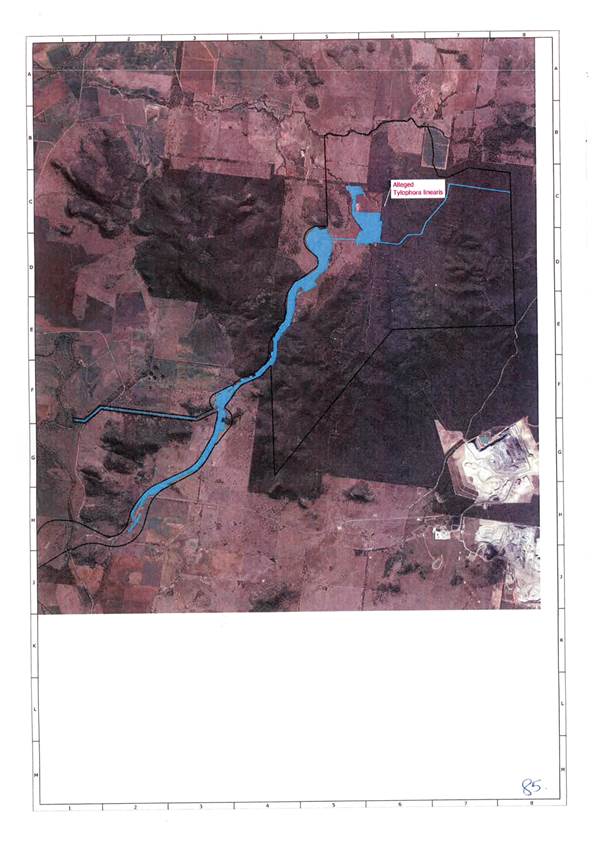
1. Until 4 February 2014 or the delivery of final judgment by Cowdroy J in these proceedings, whichever event occurs earliest, the Second Respondent will confine its clearing of vegetation pursuant to the EPBC Approval to the area shaded blue on the plan which is Appendix 1 to this Undertaking;
2. In the event that
a. In these proceedings the Court determines to the effect that the EPBC Approval was invalidly granted and orders that it be set side; and
b. The Second Respondent does not by 31 December 2014 either:
i. obtain a judgment from the Full Court setting aside the judgment referred to in (a) or;
ii. procure from the First Respondent a new approval pursuant to ss 130(1) and 133 of the EPBC Act for the Maules Creek Coal Mine Project,
it will register a legally binding conservation covenant over offset areas with no less than:
A: 393 ha of an equivalent or better quality of habitat for the regent honeyeater, a swift parrot and greater long-eared bat.
B: 780 ha of an equivalent or better quality of habitat for the White Box—Yellow Box—Blakely’s Red Gum Grassy Woodland and Derived Native Grassland ecological community.
3. The Second Respondent will ensure that the quantum and quality of the offset is verified through independent review by the same independent export ecologist, Ms Allison Martin of Green Loaning Biostudies, who has been approved by the “Department” to carry out the “independent review” required by the EPBC approval.
39 The significant points to note about the undertaking, which have weighed heavily with me in determining that the balance of convenience favours Aston, are as follows. First, the undertaking is to the effect that Aston will confine its vegetation clearance operations pursuant to its approval to an area which is shaded blue on a plan which constitutes appendix 1 to the undertaking and is annexed to these reasons. The proposed disturbance areas which may potentially be affected by works carried out in accordance with the undertaking amounts to some 94.2 hectares in total of CEEC and threatened species habitat land. That area constitutes 5.6% of the total disturbance areas as defined under the approval. It is to be contrasted with an earlier proposal which was put forward by Aston and rejected by the applicant that Aston should be permitted to carry out clearance works in an area which constituted some 12% of the total disturbance areas. The blue area is in fact larger than the 94 hectares just described. The total area is about 250 hectares, but that includes an area of land which is not classified as CEEC or threatened species habitat area.
40 The second feature of the undertaking is the proffering of an additional offset contribution by Aston in the event that it is unsuccessful in the proceedings and does not, by 31 December 2014, either have such a decision reversed on appeal by the a court of this court or otherwise procure a fresh approval under the relevant provisions of the EPBC Act. In other words, Aston’s undertaking seeks to ameliorate the environmental consequences of it proceeding with its initial vegetation clearance activities if it transpires that those activities were not lawfully authorised because its authority was invalid and it is unable to obtain a replacement approval. In those circumstances, Aston undertakes that by no later than 30 June 2015, it will register a legally binding conservation covenant over offset areas of no less than 393 hectares of threatened species habitat land and 780 hectares of CEEC land.
41 There is some criticism by the applicant of the adequacy of that offset by particular reference to whether or not it is appropriate to arrive at those figures in terms of offset areas by using the ratio applied by the Minister in determining the offset obligations under the approval. In circumstances where the land which is proffered as offset land and the area which is shaded blue on the map attached to the undertaking involves land which was also the subject of detailed assessment leading up to the grant of the approval in February this year, I am content to use that ratio as a proxy in assessing the adequacy of the proffered undertaking.
42 Another feature of the undertaking is Aston’s willingness to expose its offset offer to a similar process of independent review and assessment as that which is required under condition 10 of the approval. Aston has indicated to the court that it is willing to amend paragraph 3 of its proffered undertaking to ensure that the independent review report is published on the proponent’s website consistently with condition 10 of the approval. It is also willing to include a time limit in that paragraph.
43 The next and final matter to which I should turn and address as part of the balance of convenience is the hardship or prejudice which would be occasioned to Aston were the interlocutory injunction to be granted. In this respect,. Aston relies upon evidence given by Mr Burt, not only in his affidavit sworn 24 September 2013 but also in an earlier affidavit dated 26 July 2013.
44 In the earlier of those affidavits, Mr Burt describes certain obligations as:
“Take or pay allocation” for throughput of the Project’s coal to export coal terminals.
45 These take or pay allocations, which are said to contain confidentiality clauses, have the effect of obliging the proponent to provide specific tonnages of coal to those terminals and, even if Aston is unable to meet those volume commitments, it is still required to pay the stipulated amounts. It appears that, as matters stand at present, the proponent is incurring a monthly take or pay coal terminal fee under those arrangements of some $2 million. As at 1 January 2015, Mr Burt says, and his evidence is not challenged, that:
The monthly fees associated with the export coal terminals will increase to $4.48 million.
46 Mr Burt also gave unchallenged evidence to the effect that, if the court granted the interlocutory injunction sought by the applicant, which prevented Aston from carrying out the proposed work within the blue shaded area of the plan annexed to Aston’s proffered undertaking, Aston would be unable to meet its contractual obligations to supply coal from the project, which at the moment are due to commence on 1 January 2015.
47 The consequence of that is that any delay occasioned by an interlocutory injunction which impacts upon Aston’s capacity to meet its contractual obligations to supply coal from the project as at 1 January 2015 will result in it incurring a cost of $4.48 million per month. That is a sizable financial prejudice and puts the matter in a very different category from that which was considered by Forrest J in Environment East Gippsland Inc v Vicforests (No. 2) [2009] VSC 421.
48 In my view, that prejudice is sufficient of itself to weigh heavily with the court, when it comes to assessing the hardship caused to the proponent by the grant of an interlocutory injunction. In fact, Aston also claims that it would suffer other prejudices of a commercial nature, which are set out in Mr Burt’s two affidavits. They include the adverse impact of such injunctive relief on the proponent’s obligations to make take or pay payments for the provision of workers’ accommodation for the construction phase of the Maules Creek Coal Project, as well as commitments which are being entered into with the Australian Rail Track Corporation Limited, under a rail services agreement.
49 Mr Burt gave evidence that under that rail services agreement, the Corporation had granted Maules Creek Coal a five million tonne per annum coal allocation for rail freight of coal product from the Maules Creek Coal Project. In return, the proponent is obliged to pay to the Corporation, on a take or pay basis, monthly payments from 1 July 2014. Dr Pritchard SC quite correctly pointed out that there was a lack of detail or particularisation in some of the adverse consequences advanced by Aston. There is some force in those criticisms but, as I have already indicated, it seems to me that the proponent’s prejudice is adequately established by the evidence given by Mr Burt relating to the financial consequences for Aston under the take or pay allocation for the throughput of coal to the Newcastle terminals.
50 Taking all those matters into account, I consider that the balance of convenience is weighed, comfortably, in favour of Aston. In those circumstances, on condition that the proffered undertaking is amended to reflect the revisions that were identified by its counsel before me today, I would dismiss the application for interlocutory relief and order that the costs of, and incidental to, the interlocutory application be costs in the cause.
I certify that the preceding fifty (50) numbered paragraphs are a true copy of the Reasons for Judgment herein of the Honourable Justice Griffiths. |
Associate:
ANNEXURE