

FEDERAL COURT OF AUSTRALIA
Barlaw Pty Ltd v Crouch [2013] FCA 961
| IN THE FEDERAL COURT OF AUSTRALIA | |
| BARLAW PTY LTD TRADING AS BARRAK LAWYERS Appellant | |
| AND: | NICHOLAS CROUCH AS TRUSTEE OF THE ESTATE OF MARK ANTHONY BARTOLO Respondent |
| DATE OF ORDER: | |
| WHERE MADE: |
THE COURT ORDERS THAT:
2. The appellant pay the respondent’s costs of the appeal and the costs of the proceeding below.
3. The respondent have liberty to apply on 7 days’ notice for an order authorising the release to the respondent of any money paid by the appellant to the Registrar by way of security for costs of the appeal.
Note: Entry of orders is dealt with in Rule 39.32 of the Federal Court Rules 2011.
| NEW SOUTH WALES DISTRICT REGISTRY | |
| GENERAL DIVISION | NSD 1387 of 2011 |
| ON APPEAL FROM THE FEDERAL CIRCUIT COURT OF AUSTRALIA |
| BETWEEN: | BARLAW PTY LTD TRADING AS BARRAK LAWYERS Appellant |
| AND: | NICHOLAS CROUCH AS TRUSTEE OF THE ESTATE OF MARK ANTHONY BARTOLO Respondent |
| JUDGE: | NICHOLAS J |
| DATE: | 25 september 2013 |
| PLACE: | SYDNEY |
REASONS FOR JUDGMENT
INTRODUCTION
1 This is an appeal against orders made by a Federal Magistrate in a proceeding (the FMC proceeding) arising out of a dispute between the appellant (Barlaw) and the respondent (Mr Crouch or the trustee) concerning the bankrupt estate of Mark Anthony Bartolo (Mr Bartolo). Barlaw is a creditor of Mr Bartolo’s estate. Mr Crouch is a registered trustee. For a brief period, Mr Crouch was Mr Bartolo’s controlling trustee, and thereafter, his trustee in bankruptcy until he resigned from that office.
2 The primary judge made two orders both of which are appealed against: first, his Honour made an order, pursuant to s 180 of the Bankruptcy Act 1966 (Cth) (the Act), accepting Mr Crouch’s resignation as trustee of Mr Bartolo’s estate; second, his Honour made an order that the application filed 18 January 2011 (being the originating process filed by Barlaw) be dismissed. His Honour did not make any order for costs.
3 I was informed that his Honour determined that it was appropriate that the question of who should pay the costs of the FMC proceeding be addressed after the determination of any appeal. Neither party raised any issue concerning his Honour’s failure to decide the question of costs. Still, it is only in special circumstances that it would be appropriate for a trial judge to hear and determine a proceeding but to defer consideration of costs until after determination of any appeal. This was not an appropriate case in which to take such a course.
4 Barlaw has filed an amended notice of appeal (the notice of appeal) seeking various orders only some of which were sought below. Barlaw also seeks to rely upon what is said to be fresh evidence.
5 Proper consideration of the appeal requires close analysis of the history of the FMC proceeding, the relief claimed, the evidence called and the submissions that were made to the primary judge. I say this because Mr Crouch contends, with justification, that Barlaw has sought to raise various matters that were not argued below, and which it is not open to Barlaw to raise in its appeal.
BACKGROUND TO THE FMC PROCEEDING
6 On 6 August 2010 Barlaw obtained a judgment against Mr Bartolo for $184,511.31 in the District Court of New South Wales. This was the amount owed by Mr Bartolo to Barlaw in respect of unpaid legal fees after allowance was made for a payment by Mr Bartolo to Barlaw on 24 June 2010 in the amount of $44,597.54. The latter payment is of particular relevance because, as will be seen, one of the complaints made by Barlaw against Mr Crouch is that he made a demand for the repayment of that amount on the basis that it was caught by the operation of s 122 of the Act in circumstances where, Barlaw contends, Mr Crouch had no reasonable grounds for believing that the section applied.
7 Barlaw caused a bankruptcy notice to be issued that was served upon Mr Bartolo. The bankruptcy notice was not complied with by Mr Bartolo. The date of the act of bankruptcy was 30 August 2010. Barlaw caused a Creditor’s Petition to be filed on 31 August 2010 returnable before the Federal Magistrate’s Court of Australia (the FMCA) on 6 October 2010. On the day before the return date, Mr Bartolo, then represented by Mr Chenoweth, solicitor, of O’Neill Partners, obtained an ex parte order staying enforcement of the judgment obtained by Barlaw against Mr Bartolo. On 15 October 2010 the notice of motion seeking the stay (or an extension of that which had been granted) was dismissed by Judge Truss. Her Honour also made an order that Mr Bartolo pay the costs of the application on an indemnity basis.
8 In the meantime, the Creditor’s Petition issued by Barlaw had apparently been stood over until 19 October 2010. On 18 October 2010, the day prior to the further return of the Creditor’s Petition, Mr Chenoweth, no doubt acting on Mr Bartolo’s instructions, consulted Mr Crouch about appointing him as controlling trustee of Mr Bartolo’s affairs pursuant to s 188 of the Act. On the same day Mr Bartolo signed an authority appointing Mr Crouch as his controlling trustee. By reason of s 189AAA of the Act, the signing of this authority resulted in a stay of the Creditor’s Petition until the earlier of the conclusion or the adjournment of the creditors’ meeting called pursuant to s 188 of the Act. This led to the Creditor’s Petition being adjourned yet again until 23 November 2010.
9 Mr Bartolo’s Statement of Affairs was prepared and filed on or about 22 October 2010. Mr Barrak, the sole director and shareholder of Barlaw, a solicitor, and the solicitor for Barlaw in the FMC proceeding and in this appeal, obtained a copy of the Statement of Affairs (excluding Part A) on or about that date.
10 The Statement of Affairs disclosed (inter alia) that Mr Bartolo had an interest in two properties. The first of these was a property at Quakers Hill which was jointly owned by Mr Bartolo and his wife, Mrs Bartolo. The Quakers Hill property was said to have been acquired in September 2008 and to be worth $400,000 and subject to a mortgage to the Commonwealth Bank of Australia (CBA) for about $230,000. The second of the two properties was at Schofields, and apparently registered in Mr Bartolo’s sole name. The estimated value of the Schofields property was shown as $1,400,000 with a little over $1,000,000 owing to a mortgagee identified as GE Money.
11 The Statement of Affairs included a list of about a dozen unsecured creditors. Included in this list were the following details of debts allegedly owed by Mr Bartolo to related parties:
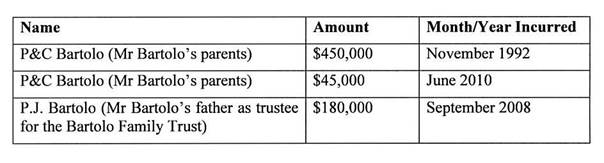
12 Another related party creditor referred to in the Statement of Affairs was Mrs Bartolo ($21,651). Barlaw (trading as Barrak Lawyers) was also shown in the list of unsecured creditors. Apart from the related party debts said to be owed to Mr Bartolo’s parents, Barlaw was the largest unsecured creditor by a substantial margin.
13 It is apparent that Mr Barrak was deeply suspicious of the Statement of Affairs from the moment he first saw it. He sent an email to Mr Crouch on 26 October 2010 indicating that it would be “challenged” by Barlaw.
14 Mr Crouch prepared a report (the Controlling Trustee’s Report) in relation to Mr Bartolo dated 5 November 2010. It appears that Mr Crouch became aware some time before this that Mr Bartolo’s parents, on their own behalf and, in the father’s capacity as trustee of the Bartolo Family Trust, claimed not only that that the various debts were owed to them by Mr Bartolo, but that these debts were secured against both the Schofields property and the Quakers Hill property.
15 There were title searches in evidence before the primary judge indicating that caveats had been filed in respect of both properties by Mr Bartolo’s parents and that a caveat had also been filed on behalf of the Bartolo Family Trust in respect of the Schofields property on or before 22 October 2010. Other evidence indicated that stamp duty on the various caveats was paid on 6 April, 19 May and 9 August 2010. According to these caveats, the relevant estate or interest in land arose out of:
A loan agreement dated 30 November 1992 between Mr and Mrs PJ Bartolo as lender and Mr Bartolo as borrower;
A loan agreement dated 3 September 2008 between Mr PJ Bartolo as trustee of the Bartolo Family Trust as lender and Mr and Mrs Bartolo as borrowers;
A loan agreement dated 24 June 2010 between Mr and Mrs PJ Bartolo as lender and Mr Bartolo as borrower.
16 In the Executive Summary to the Controlling Trustee’s Report Mr Crouch stated:
I have been unable to accurately ascertain the value of the debtors divisible property. The uncertainty is a function of the potential invalidity of 3 related party mortgages and the realisable value of the debtor’s real property.
If the related party mortgages are valid, there is no material divisible property.
If the related party mortgages are invalid, the value of the debtors divisible property is in the range of $0 to $458,424. The variance in this range represents the varied assessments of the estimated realisable value of real property held by the debtor and valuations obtained by my office.
I am not aware of any material antecedent transaction which, if set aside, would result in a return to creditors.
My investigations indicate that there may be little or no equity available on the debtor’s properties after mortgagee debts are considered. The debtor believes that his property valuations, which are higher than the preliminary ones I have obtained, are accurate.
In the event of bankruptcy, the dividend to unsecured creditors is approximately the same as under the proposed PIA except that a further $10,000 shall be available to creditors under the PIA. I do not expect a dividend to unsecured creditors will be paid in either administration, however this conclusion may change as further information is obtained in relation to the value of the debtors real property and the validity of related party charges.
Based on the information currently available, I recommend creditors vote against the proposed PIA.
17 The Controlling Trustee’s Report identified 10 unsecured creditors, including Barrak Lawyers ($184,511) and another law firm, Batterman Battersby Lawyers ($61,752). The total of the unsecured creditors’ debts was shown as $338,122. The Controlling Trustee’s Report also identified various secured creditors including GE Money ($1,026,531) and CBA ($230,090). Mr Bartolo’s parents were shown as secured creditors for $589,461 and for $45,377. Mr Bartolo’s father, as trustee for the Bartolo Family Trust, was shown as a secured creditor for $183,430. In the result, the total amount alleged to be owed to Mr Bartolo’s parents and the Bartolo Family Trust totalled $818,268. These amounts were referred to in the Controlling Trustee’s Report as “disputed related party mortgages”.
18 The Controlling Trustee’s Report identified two possible scenarios. Scenario 1 assumed that the debts to the parents and the family trust were secured. In this scenario, there would be no dividend to creditors under the proposed personal insolvency agreement (the PIA). Scenario 2 assumed that these debts were not secured. In this scenario, depending upon the price obtained for the Schofields property, the distribution to unsecured creditors (which on this scenario would include the $818,268 of debt allegedly owed to the parents and the trust) there would be an amount of between $48,424 and $458,424 available for distribution to unsecured creditors.
19 In the Controlling Trustee’s Report Mr Crouch stated that “[his] preliminary investigations have not revealed any material antecedent transactions.”
20 A creditors’ meeting was held on 19 November 2010. According to the minutes of the creditors’ meeting signed by Mr Crouch, a motion was put to the meeting that would, if carried, have required Mr Bartolo to execute the PIA. The minutes show that no creditor voted in favour of this resolution. Another resolution, to the effect that Mr Bartolo’s property no longer be subject to control under Pt X Div 2 of the Act, was carried.
21 As already mentioned, the Creditor’s Petition filed by Mr Crouch was listed for 23 November 2010. However, on 22 November 2010 Mr Bartolo filed a Debtor’s Petition, and Mr Crouch was appointed trustee of Mr Bartolo’s estate.
22 There followed lengthy and protracted correspondence between Mr Barrak on behalf of Barlaw and Mr Crouch, most of it written by Mr Barrak. His correspondence included numerous requests that he be permitted to examine the proof of debt for each other creditor, that he be provided with a statement pursuant to subs 101(2) of the Act, and that he be provided with a copy of the minutes of the creditors’ meeting held on 19 November 2010.
THE COMMENCEMENT OF THE FMC PROCEEDING
23 Barlaw commenced the FMC proceeding the subject of this appeal by application filed on 18 January 2011. No statement of claim was ever filed, nor was the application ever amended. The final orders sought by Barlaw in the application were as follows:
(1) A declaration that the demand by the Respondent for the Applicant to repay to the Respondent the sum of $44,597.54 pursuant to Section 122 of the Bankruptcy Act 1966 (“the Act”) is contrary to the provisions of Section 122 and is void.
(2) A declaration that the meeting of creditors held on 19 November 2010 was not conducted in accordance with Division 5 of Part IV and Division 2 of Part V of the Act.
(3) Pursuant to Section 104 and 178 of the Act, an Order that the Respondent wrongly admitted certain Proofs of debt including those of the Bankrupt’s parents, wife, brother, and family trust, and that the Respondent’s decision to admit such Proofs of debt is reversed.
(4) Pursuant to Sections 30, 156A, 178, 179 of the Act, an Order that the respondent be removed as the Trustee of the estate of Mark Anthony Bartolo and that David Solomons be appointed as Trustee in his place.
(5) In the alternative to Order (4) above, that the conduct of the Respondent be the subject of enquiry under Section 179 of the Act.
(6) An order that the respondent pay the costs of the applicant as agreed or taxed, on the indemnity basis, and that the respondent not be indemnified from the estate of Mark Anthony Bartolo.
24 Mr Crouch subsequently sought an order that Barlaw file a statement of points of claim but this was resisted by Barlaw and refused by the Federal Magistrate apparently on the basis that Mr Barrak’s affidavits would contain the necessary particulars of the allegations made against Mr Crouch. Mr Barrak’s affidavit of 10 May 2011 is that which was said by counsel for Barlaw to particularise the various complaints made by it against Mr Crouch. Much of the affidavit is highly argumentative and it is certainly not a proper substitute for properly pleaded and particularised points of claim.
THE ALLEGATIONS AGAINST MR CROUCH
25 Mr Barrak’s affidavit of 10 May 2011 sets out 17 complaints which are identified under the following headings:
“Complaint 1 – Questionable Adjournment Of Creditors Meeting”
“Complaint 2 – Failure To Allow [Mr Barrak], As The Major Unsecured Creditor, To Question The Debtor … At The Meeting Of Creditors”
“Complaint 3 – Questionable Behaviour Leading Up To Creditor’s [sic] Meeting”
“Complaint 4 – Differential Treatment Of Creditors / Accepting Proofs of Debt Without Appropriate Evidence”
“Complaint 5 – Failure To Provide A Copy of Minutes of Creditors [sic] Meeting / Different Versions Of Minutes Of Creditors [sic] Meeting”
“Complaint 6 – Failure To Comply With Request Under Section 101 Of The Bankruptcy Act”
“Complaint 7 – Failure To Account / Answer Reasonable Enquiries Of Creditors”
“Complaint 8 – Failure To Acknowledge That Certain Related Creditors Withdrew Their Proofs Unconditionally Such That [Barlaw] Held More Than 25% Of Votes”
“Complaint 9 – Failure To Call A Creditors Meeting Pursuant To Section 64”
“Complaint 10 – Failure To Appropriately Investigate / Examine The Bankrupt’s Affairs In Circumstances Where He Has Been Put On Notice Of Possible Fraud And Failure To Refer The Matter To The Inspector General Or To The Appropriate Authorities”
“Complaint 11 – Failure To Provide A Print Out Of [Mr Crouch’s] WIP”
“Complaint 12 – Provisions Of Contradictory Advice / Perpetual Shifting Of [Mr Crouch’s] Position”
“Complaint 13 – Appointing Mr Bartolo’s Former Solicitors Who are A Creditor As [Mr Crouch’s] Legal Representative”
“Complaint 14 – Attempting To Urgently Dissipate The Assets Against A Background Of [Mr Crouch’s] Appointment As Trustee Being Challenged In Court”
“Complaint 15 – Valuation Shopping”
“Complaint 16 – Demanding [Barlaw] To Re-Pay Moneys In Circumstances Where The Relation-Back Period Does Not Apply”
“Complaint 17 – Failure To Comply With Subpoena Issued By The Federal Magistrates Court”
THE HEARING BEFORE THE PRIMARY JUDGE
26 The hearing before the primary judge took place on 25 and 26 May 2011. The evidence relied upon by Barlaw included two affidavits made by Mr Barrak and two affidavits made by Mr Crouch. Mr Barrak and Mr Crouch were both cross-examined. Other evidence before the primary judge consisted of hundreds of pages of documentary material produced on subpoena which was tendered by Barlaw, much of which evidence has been reproduced in the appeal books.
27 Counsel for each party provided the primary judge with written submissions, and also addressed his Honour orally. It is necessary to examine closely the way in which Barlaw’s case was presented to the primary judge by Barlaw’s counsel.
28 Some weeks before the hearing commenced, Barlaw provided the primary judge with a written submission. Barlaw’s written submission to the primary judge, in explaining why an order for Mr Crouch’s removal as Mr Bartolo’s trustee was required, stated (at para 5):
The essential ground is that Mr Crouch has shown undue partiality to the Bankrupt and alleged creditors closely related to him, to the disadvantage of the other creditors, of whom the applicant is the largest unsecured creditor.
29 After referring to various parts of the affidavit evidence that had been filed, most of which was from Mr Barrak, the written submission concluded (at para 21):
The appropriate order is for Mr Crouch’s removal, with an order that his remuneration as Controlling Trustee and Trustee not be payable from the bankrupt estate, nor his costs of this litigation. Failing this, the Court should give directions for the proper administration of the estate.
30 In his opening submissions to the primary judge, counsel for Barlaw made some observations concerning the first of the declarations sought by his client. Counsel said:
There has been a concession in evidence on the part of the respondent trustee that the demand was not justified and that therefore the demand will not be pressed against the applicant. To settle the matter for good and all, I would seek that a declaration be made in terms of paragraph 1 in any case so that the matter is settled for the future administration of the estate regardless of by whom that administration occurs.
31 Counsel also stated that his client wished to press for an order removing Mr Crouch from his position as trustee of Mr Bartolo’s estate. Counsel said (T 11):
If the court were favourable to that and were to make such an order the greater part of the other particular concerns of the applicant would be met in that there would be a fresh consideration by the new trustee of the gravamen of the case which is the related party claims of the estate, their validity and so forth. So that paragraphs 2 and 3 would probably become a non-event in the event of an order in terms of paragraph 4 being made.
32 He then turned to order 5 as claimed in the originating process whereby Barlaw sought an order for an inquiry pursuant to s 179 of the Act. As to this counsel said (T 11) “[a]s regards paragraph 5, this is in fact the inquiry because all the material circumstances are before the court on affidavit.” Thus, the order for any inquiry sought by Barlaw in its application (order 5) as an alternative to an order for Mr Crouch’s removal (order 4) was never pressed by Barlaw.
33 After counsel for Barlaw opened the case, the primary judge made the following observations which were directed at counsel for Barlaw in particular (T 9):
… there might be benefit in just giving you a short time to take instructions. My position is that if Mr Crouch wishes to tender his resignation to the court I would be minded to accept it, given the unfortunate history of dealings between him in his administration and a major creditor. It’s obvious to me that that rift cannot be healed and I think the best interests of creditors would probably be served by having a new registered trustee take over the administration. The issues then are one of the trustee’s costs and anything incidental. So if you wish to take instructions on that I will give you a short opportunity to do so.
34 The matter was then adjourned for a short time. Shortly afterwards the hearing resumed and counsel for Barlaw informed his Honour that the matter would proceed. The parties then began indicating what evidence they proposed to rely upon. Counsel for Mr Crouch indicated that he had objections to some of Barlaw’s evidence. His Honour proposed that the evidence be “presented provisionally subject to submissions”. Counsel for both parties agreed to this course. His Honour never came to rule upon any of Mr Crouch’s objections to evidence presumably because nothing more was said concerning admissibility in final submissions.
35 Mr Barrak gave evidence, and was cross-examined for about three hours. On the second day of the hearing Mr Crouch gave evidence. In his evidence-in-chief Mr Crouch corrected a number of paragraphs in his affidavits (I mention this because it is a matter raised in Barlaw’s grounds of appeal). Mr Crouch was then cross-examined for approximately two hours.
36 Evidence was also given by Mr O’Brien, an inspector with the Insolvency and Trustee Service Australia (ITSA) for the Inspector General in Bankruptcy, who was called by Mr Crouch. Mr O’Brien was present during the creditors’ meeting held on 19 November 2010 at Mr Crouch’s offices. His recollection was that his superior at ITSA, Mr Findlay, asked him to attend the meeting at Mr Barrak’s request. I will say a little more about Mr O’Brien’s evidence later in these reasons.
37 After Mr O’Brien’s evidence was completed counsel commenced submissions. Counsel for Barlaw began and the following exchange took place before the primary judge (T 167-168):
COUNSEL: … Your Honour, the first, and practically speaking, the only cab off the rank is whether the court having in effect conducted its enquiry into the conduct of the respondent, Mr Crouch, removes him or not. If it were sufficient for the purpose of the making of an order to remove that there had been an irretrievable breakdown of relations between the trustee and a creditor, then the case would be unquestionably made and I would hardly need to speak further.
HIS HONOUR: Yes but I think there’s a difference between what might be a desirable outcome and what justifies enforced removal.
COUNSEL: Yes, well, it is an entirely discretionary decision of course under section 179.
HIS HONOUR: Yes.
COUNSEL: And the respondent is a trustee and is obliged to exercise its fiduciary duties according to the high standards that apply to trustees; the trustee in bankruptcy being no different from any other trustee in general principle but although, albeit, that he has procedures that are to be followed.
HIS HONOUR: But the authorities as I understand it indicate that the available grounds for removal tend to be incidents of impropriety or partiality.
COUNSEL: Yes, well, in the present case, I will deal with impropriety first. I don’t go so far as to say as that there has been dishonest conduct on the part of Mr Crouch. I do go so far as to say that he has shown from since before his appointment as trustee in bankruptcy, indeed from as far as appears from the evidence from the moment on at which he was first requested by the debtor’s representatives to consider appointment as a controlling trustee, a distinct partiality shown by himself towards the debtor, and it really amounts to the same thing in this case, what can be called the related party creditors. To sum up there are some remarkable features of this case. Putting on one side the $1 million mortgage on Schofields property, the largest creditors and the largest group of creditors are these related party creditors; they being the parents, the brother and the wife of the debtor and certain others who are closely connected with him.
From the outset, and certainly from the time of the creditors meeting convened under part 10, all of those persons have proceeded together in the matter as far as appears, and the appointment by all of them of Miss Tracey Bartolo as proxy at that creditors meeting is the chief evidence of that. It is quite evident that there is, in my submission, that there is an attitude of manoeuvre and tactics discernible in the attitude taken by the related party creditors to this insolvency as soon – from the date that it commenced. If it is the case that the parents and wife and brother are genuinely owed these very substantial debts, and the parents being the chief players there, and that moreover that those debts are secured as is asserted, it is extraordinary that they have represented their interests throughout in the way that they have. On the face of it the parents are owed on their final statement of claim before the creditors meeting over $600,000 secured by their son, the greater part of which has been owing, the principal at least, ever since 1992.
38 Counsel for Barlaw went on to submit (T 171) that Mr Crouch should not have accepted appointment as Mr Bartolo’s trustee in bankruptcy. Counsel submitted that apart from “inviting a big argument with Mr Barrak” it was also an unacceptable decision because to that point Mr Crouch had displayed partiality towards one camp over another and continued to do so.
39 During the course of closing submissions, the Federal Magistrate observed that Mr Crouch had not yet called for proofs of debt. Counsel for Barlaw, who accepted this, stated (T 172):
No, he hasn’t called for proof [sic] yet but it seems clear from, at the very least, the implication of his affidavits first and second that his opinion is that the resources of this small estate are not adequate to allow, in the interests of all creditors, a formal calling of proofs of debt and adjudication process because he has come to the conclusion that the ultimate equity available to him, after securities, is not going to be enough to pay any but a very small dividend to creditors. On the assumptions he has made that’s probably a correct conclusion.
But it can’t unfortunately allay the concern that the applicant has that Mr Crouch has, in effect, been manoeuvred to this situation by the very fact of these questionable related party debts that he, Mr Crouch, won’t seriously investigate and question.
40 Counsel for Barlaw addressed the matter of the sale by Mr Crouch of Mr Bartolo’s half share in the Quakers Hill property to Mrs Bartolo. Counsel submitted:
But further than that, that he, Mr Crouch, has been minded to accept as valid to the extent of treating them as the factor that causes him to enter into this contract of sale of the debtor’s half interest in Quakers Hill to Ms Bartolo. Now, your Honour, the situation is this, is exhibit 8, it’s exchanged on 13 May. We’re told that it is a contract on foot. So what’s done is done. My camp were not on notice that contracts had exchanged until yesterday.
41 Counsel then proceeded to explain why, in his submissions, orders should be made restraining Mr Crouch from proceeding with a sale of Mr Bartolo’s half share in the Quakers Hill property to Mrs Bartolo. This was in spite of the fact that no such relief was sought in the application.
42 It will be necessary to return to the matter of the Quakers Hill property later in these reasons. However, the proposition that, in agreeing to sell Mr Bartolo’s half share to Mrs Bartolo on the terms agreed, Mr Crouch was accepting that the claims of the related party creditors were valid is based upon a misconception: viz Mr Bartolo has, or at least had, substantially more than $100,000 worth of equity in the Quakers Hill property even if the related party claims are assumed to be invalid. This view of Mr Bartolo’s equity position in relation to the Quakers Hill property is not supported by the evidence.
THE PRIMARY JUDGE’S REASONS FOR JUDGMENT
43 After referring to various background facts the primary judge observed, quite correctly given what had been put to him, that the essential ground upon which Barlaw sought to have Mr Crouch removed as trustee was that Mr Crouch had “shown an undue partiality to the bankrupt (Mr Bartolo) and creditors said to be closely related to him, to the disadvantage of other creditors …”. Later in his reasons, and after referring to the evidence, particularly the affidavit evidence of Mr Barrak, the primary judge said:
[29] Virtually from the date of the appointment, Mr Barrak, the principal of Barlaw, had grave reservations about the debtor’s conduct. He believed he had information available to him which established that, contrary to statements made in the debtor’s statement of affairs, debts allegedly owed by Mr Bartolo to related parties were not genuine. Further, he apparently believed he had information showing that the debtor had been engaged in conduct whereby assets were disposed of prior to the appointment of the controlling trustee. For reasons which are not known, Mr Barrak did not share that information with Mr Crouch. Further, and notwithstanding the request by the trustee that creditors lodge their statements of claim for the purpose of attending and voting at the creditor’s meeting not less than 24 hours before that meeting, Barlaw did not submit its claim documents until 7.09pm on the evening before the meeting was due to be held. Those documents exceeded 100 pages in length. Mr Crouch asserts that delivery of that material to the trustee’s office at that time, and in such proximity to the creditor’s meeting, caused substantial disruption in the trustee’s preparations for the meeting.
[30] The trustee had been provided with details of the claims to be made by the various related parties. He had spent some time, before 19 November 2010, reviewing that material and, in respect of one aspect of the claims by the debtor’s parents, had sought legal advice. Prior to the meeting commencing Mr Crouch had formed the view that he would admit the related party claims in full although no occasion for formally deciding that question would arise until the meeting was underway [See s.64ZA(8) of the Bankruptcy Act].
[31] As it happened, the trustee was never called upon to formally rule upon the claims of the related parties or to make a decision as to whether they should or should not be admitted for the purposes of voting at the meeting. That is because the statements of claim which had been lodged pursuant to s.64D of the Bankruptcy Act were withdrawn before the question of any ruling arose. Thus, the debtor’s proposal for a PIA failed, and the only resolution, apart from a resolution as to fees, which was passed at the meeting was that the debtor’s affairs no longer be subject to control under Part X of the Bankruptcy Act.
[32] Although there was no decision made by the trustee at the meeting, Mr Barrak formed an adverse view of Mr Crouch’s conduct and in particular of his indication that he was proposing to accept the related party claims. Mr Crouch submits that, viewed objectively, no flaw can be detected in the manner in which he dealt with the claims (both of Barlaw and of the related parties) nor in respect of his, admittedly preliminary, view about those claims. However, in Mr Crouch’s view, one thing is clear; the adverse view formed by Barlaw has infected Mr Barrak’s assessment of every other aspect both of the controlling trusteeship and the bankruptcy administration.
44 The primary judge then noted that Barlaw’s complaints concerning Mr Crouch raised serious allegations of either misconduct or, at the very least, dubious professional practice on his part. His Honour observed that a trustee, in such a case, is compelled to respond, and that in this case the trustee had done so with evidence.
45 The primary judge summarised relevant legal principles at [35]-[39] of his reasons. Neither party suggested that his Honour misstated the applicable principles in any relevant respect. I include for this purpose the primary judge’s discussion of s 179 of the Act and the proposition (set out at [36] of his Honour’s reasons) that a trustee should not be removed upon an application made under that section in the absence of evidence of misconduct. After referring at [37] to Rondo Building Services Pty Ltd v Starkey [2005] FMCA 275, the primary judge said at [39]:
In light of the statutory provisions, and the cases which have considered them, I accept the submission that the application should be determined in accordance with the following general principles:
(a) it is for the applicant to make out a case for removal;
(b) mere dissatisfaction with a decision, or actions, of the trustee or mere assertions of partiality, no matter how stridently put, are not enough to justify removal;
(c) the power to order removal should be exercised in the interests of all those directly concerned in the bankruptcy administration, namely the bankrupt and all creditors.
(d) To justify removal because of bias or lack of independence, actual partiality may not be necessary but there must be reasonable grounds for an apprehension of a lack of independence.
46 The primary judge then made some important findings in relation to Mr Crouch’s conduct. His Honour said (at [40]-[45]):
[40] In the present case, the main complaint of Barlaw is that Mr Crouch has shown undue partiality to the bankrupt and creditors said to be closely related to him to the disadvantage of other creditors including, in particular, Barlaw. Mr Crouch responds that he has treated all persons claiming to be creditors equally, in an obviously hostile situation. Mr Crouch recommended against the PIA and allowed Barlaw to vote as a creditor notwithstanding that he saw deficiencies in respect of its statement of claim at that time.
[41] The meeting of creditors was stood over to allow proofs of debt to be ruled upon in circumstances where it was obvious that such rulings would determine whether the proposed PIA would be adopted. Barlaw had delivered four separate statements of claim very shortly before the meeting of creditors and the acceptance or rejection of some or all of those claims would determine whether Barlaw was able to defeat the proposed PIA. Mr Crouch held discussions with Mr Barrak and Mr Bartolo (and apparently with his wife by telephone) during these adjournments and, in my view, he did the best he could in a difficult and tense situation.
[42] Mr Barrak is concerned that his firm was singled out for criticism by the trustee in relation to its claims of debt. However, other creditors had advised of their claims well prior to the meeting of creditors and information had also been provided by Mr Bartolo. Mr Barrak was the only creditor present in person at the meeting as others were all represented by proxy.
[43] Mr Barrak asserts that related party debts were inflated. Mr Crouch denies that any related party claims were inflated between the time of Barlaw’s lodgement of its statement of claim and the meeting of creditors. On the other hand, it is apparent that Barlaw’s four claims were intended to maximise its asserted debt in order to seek to ensure that the PIA could be defeated.
[44] Mr Barrak is critical of Mr Crouch for not allowing him to question Mr Bartolo at the meeting of creditors. Mr Crouch invited questions but decided that Mr Bartolo should be excused from the meeting because of his physical appearance and concern for his state of health. Mr Crouch was in the best position at the time to determine whether Mr Bartolo was in a fit state of mind and health to be subjected to questioning and I do not accept that Mr Crouch was attempting to shelter Mr Bartolo from questioning.
[45] Mr Barrak asserts that the behaviour of Mr Crouch leading up to the meeting of creditors was questionable in that he allegedly acted in the interests of related party creditors and against the interests of non related creditors. This assertion is reflective of Mr Barrak’s view that the related party claims of debt are bogus. That view was not supported by the oral evidence of Mr O’Brien from ITSA, at least in relation to the claim by Mr Bartolo’s parents. It is fair to say that the statement of affairs lodged by Mr Bartolo was questionable and, indeed, Mr Crouch recommended against the acceptance of the PIA. Mr Crouch sought further and better particulars of a number of claims of debt to enable adjudication of them. Those included claims by the parents of Mr Bartolo and a family trust. Mr Crouch obtained legal advice on the claims of related parties for his own assistance and protection, and not for the benefit of anyone else. It is true that that advice was paid for by Mr Bartolo’s wife but that does not alter the position that the advice was obtained to assist Mr Crouch, not to assist the Bartolos.
47 The finding made at [41] is of considerable significance given the way in which the case was presented to the primary judge. It is apparent that the primary judge rejected Barlaw’s claim that Mr Crouch acted with “undue partiality” or that he preferred the interests of related party creditors to those of other creditors including, in particular, the interests of Barlaw. Rather, his Honour found that Mr Crouch did the best he could in a difficult and tense situation. The primary judge went on to find and conclude:
There was no breach by Mr Crouch of s 101 of the Act. In this regard his Honour found that there had been no proofs of debt lodged or admitted as at 23 November 2010.
The parents of Mr Bartolo withdrew their claims for the purpose of voting at the creditors’ meeting, but it did not follow that they were not entitled to lodge a proof of debt.
His Honour was not satisfied that the matters raised by Barlaw, when considered individually or collectively, warranted the removal of Mr Crouch as trustee by the Court.
THE RELIEF SOUGHT IN THE NOTICE OF APPEAL
48 The principal orders sought by Barlaw in the event that the appeal is allowed and the orders made by the primary judge are set aside are as follows:
An order that, in lieu of accepting Mr Crouch’s resignation, Mr Crouch be removed as trustee of Mr Bartolo’s estate;
Declarations in terms of paras 1 and 2 of the originating application, as set out at [23] above;
An order that Mr Crouch not be indemnified from the bankrupt estate in respect of remuneration as Controlling Trustee and Bankruptcy Trustee, and in respect of legal costs or other expenses incurred in his administration of the estate, including the costs of the proceeding in the Court below;
An order that Mr Crouch provide Barlaw with a full accounting detailing all the bankrupt estate’s funds received, spent and retained;
An order that Mr Crouch, within 14 days, deliver to the Official Trustee the whole of the deposit and settlement proceeds, together with any Estate funds, without deduction, of the sale of the property at 12 Aleppo Street, Quakers Hill. In the event of any such proceeds or part having been spent, Mr Crouch is to refund such proceeds to the estate.
THE GROUNDS OF APPEAL
49 In its original form the notice of appeal raised 67 grounds of appeal. After orders were made requiring Barlaw to file an amended notice of appeal, the number of grounds was reduced to 38. The grounds of appeal, even after amendment, are discursive and argumentative and present the Court with the same kinds of difficulties presented by the notice of appeal in Sydneywide Distributors Pty Ltd v Red Bull Australia Pty Ltd (2002) 55 IPR 354. In that case the Full Court explained why the notice of appeal made it very difficult to identify the discrete issues that arose for determination. Weinberg and Dowsett JJ (with whom Branson J agreed) said (at [49]) that even after amendment:
The so-called grounds remain a confused mixture of challenges to ultimate findings of fact and to intermediate findings, arguments as to whether or not there is evidence to support particular findings and disputes about the weight allegedly attributed by his Honour to various aspects of the evidence.
50 Here the grounds of appeal contain a series of introductory paragraphs that provide no assistance in identifying the particular errors alleged to have been made by the primary judge. For example, his Honour is said to have failed to “consider and/or make determinations on significant aspects of the appellant’s case”, “to provide reasons or sufficient reasons” and to have made determinations which were “not available to him on the evidence and/or were against the weight of the evidence.”
51 The inclusion of these paragraphs and others to like effect has been treated by Barlaw as justification for approaching this appeal as though it was a hearing de novo rather than an appeal, much less an appeal against what is ultimately a discretionary decision the correctness of which is to be assessed by reference to the principles discussed in House v The King (1936) 55 CLR 499.
52 There are three other problems with the notice of appeal that should be mentioned. First, there is no attempt to relate particular grounds of appeal to the relief claimed. Secondly, there is no indication in the notice of appeal which of the relief now claimed was claimed below, and which relief was not claimed below. Thirdly, the grounds of appeal raise issues and arguments that were not raised below.
53 The last of these problems is particularly significant given that the primary judge’s decision not to remove Mr Crouch involved a discretionary judgment. The High Court said in Macedonian Orthodox Community Church St Petka Inc v His Eminence Petar The Diocesan Bishop of The Macedonian Orthodox Diocese of Australia and New Zealand (2008) 237 CLR 66 at [120]-[121]:
[120] … Counsel for the plaintiffs did not demur from the proposition that when a court is invited to make a discretionary decision, to which many factors may be relevant, it is incumbent on parties who contend on appeal that attention was not given to particular matters to demonstrate that the primary judge’s attention was drawn to those matters, at least unless they are fundamental and obvious.
[121] The alternative approach would permit a party to run one case before the primary judge and different cases on however many levels of appeal were open. Where it is said on appeal that a primary judge was in error in not taking into account a particular consideration “expressly”, even though it was not explicitly submitted to the primary judge that it should be, a benevolent construction of the primary judge’s reasons will often reveal, by a process of inference and implication, that the relevant consideration was borne in mind, even though it was not stated in as clear-cut a way as an appellate court, dealing with a hostile submission by one party not put nearly as distinctly, or at all, to the primary judge, might prefer.
54 A number of grounds of appeal complain that the primary judge failed to take particular matters into account. Many of these were not matters to which the primary judge’s attention was directed, at least not expressly, and it is apparent that some of them never even occurred to Barlaw or its counsel until after the primary judge delivered judgment.
55 I begin my consideration of Barlaw’s grounds of appeal with an examination of the contention that the primary judge should have ordered that Mr Crouch be removed as trustee because Mr Crouch was biased. I will then proceed to consider other issues arising in the appeal.
REASONABLE APPREHENSION OF BIAS
56 The submission that Mr Crouch should have been removed from office because his conduct gave rise to a reasonable apprehension of bias is an example of Barlaw seeking to rely in the appeal upon a point not raised below.
57 It will be apparent from what I have already said that the case below as argued for Barlaw was not founded upon any allegation that he should be removed due to a “reasonable apprehension of bias”. Rather, Barlaw’s case below raised serious allegations of actual bias against the trustee, a case which the primary judge emphatically rejected. The first of Barlaw’s grounds of appeal (ground 1) states:
In broad terms, his Honour failed to determine that there existed numerous indicia of a reasonable apprehension of bias on the part of the respondent (Mr Crouch) and that, individually or collectively, they also constituted evidence of a lack of independence on the part of Mr Crouch.
58 It was accepted by counsel for Mr Crouch (who also appeared below) that Barlaw always alleged that Mr Crouch was not independent, that he was unduly partial and that he was actually biased. But counsel for Mr Crouch submitted that Barlaw never advanced a case based upon “apprehended bias” before the primary judge and that this explains why his Honour’s reasons do not include any findings directed to that issue.
59 In its written submissions in reply Barlaw submitted that it did run a case based upon apprehended bias before the primary judge, and it drew attention to the references to “reasonable apprehension” and “potential conflict” in his Honour’s reasons in support of this submission.
60 It is not apparent to me from the transcript of the hearing before the primary judge or, in particular, the written and oral submissions made to his Honour on behalf of Barlaw, that Barlaw relied upon the existence of a reasonable apprehension of bias in seeking to have Mr Crouch removed. On the contrary, the transcript and the written submissions reveal that no such case was put.
61 The references to the expressions “reasonable apprehension” and “potential conflict” in the primary judge’s reasons occur in the context of general discussion of principle: see [37] and [39] of the primary judge’s reasons which may be traced back to a written submission filed on behalf of Mr Crouch several days before the hearing. Viewed in that light, they do not contradict what the transcript and written submissions demonstrate.
62 I am satisfied that no case for the trustee’s removal based upon “reasonable apprehension of bias” was raised by Barlaw before the primary judge. In my view this explains why the primary judge did not make any findings on the issue.
63 The question whether actual bias was relied upon by Barlaw in the appeal was raised with Senior Counsel for Barlaw (who did not appear below) during the early stages of the hearing of the appeal. This was in circumstances where the notice of appeal and Barlaw’s written submissions asserted that the primary judge should have found that the trustee displayed an actual lack of the required independence, and a partiality towards the debtor and his related parties and against Barlaw. The following exchange occurred (T 10-11):
COUNSEL: … Now, we say that’s a statutory – effectively, a statutory test of apprehended bias or bias and your Honour is aware we don’t press a case for actual bias today.
HIS HONOUR: Is that right. No, I wasn’t aware of that. You don’t allege - - -
COUNSEL: We don’t, no.
HIS HONOUR: - - - that the trustee is actually biased.
COUNSEL: No, your Honour. We don’t because we don’t need to, apprehended bias is sufficient.
HIS HONOUR: No. Well, all I want to know is whether you’re pressing a case of actual bias. You’re not.
COUNSEL: No.
HIS HONOUR: Was a case of actual bias put to the learned Federal Magistrate?
COUNSEL: Yes, your Honour.
HIS HONOUR: All right.
COUNSEL: But, as in all cases of bias, the tribunal or the judge can accept the allegation of actual bias and downgrade it, as it were, to apprehended bias, that’s commonly done. - - -
64 There is plainly no error by the primary judge in having failed to consider an argument that was never put to him. The question that arises is whether Barlaw should be given leave to raise in the appeal a case based up on apprehended bias, in spite of it not being raised below.
65 The relevant principle was referred to by the High Court in University of Wollongong v Metwally (No 2) (1985) 59 ALJR 481 at 483 as follows:
It is elementary that a party is bound by the conduct of his case. Except in the most exceptional circumstances, it would be contrary to all principle to allow a party, after a case had been decided against him, to raise a new argument which, whether deliberately or by inadvertence, he failed to put during the hearing when he had an opportunity to do so. It is impossible to regard the court’s answer to question (ii) as intended to be subject to the correctness of the unexpressed assumption that the 1975 Act was valid and, in consequence, to give the answer a merely conditional effect. If it had been suggested that the answer to the question was intended to be only a provisional one the court would not have dealt with the matter. It is quite irrelevant that Mr Metwally was permitted, under the rules of the Court of Appeal, to give the notice of contention which he gave. Those rules could not alter the rights of parties under an order made in this Court and were not intended to do so.
66 This statement was referred to with approval in Coulton v Holcombe (1986) 162 CLR 1 where the High Court observed (at 7) that:
It is fundamental to the due administration of justice that the substantial issues between the parties are ordinarily settled at the trial. If it were not so the main arena for the settlement of disputes would move from the court of first instance to the appellate court, tending to reduce the proceedings in the former court to little more than a preliminary skirmish.
After referring to the powers of an appellate court with respect to amendment, their Honours continued (at 7-8):
In a case where, had the issue been raised in the court below, evidence could have been given which by any possibility could have prevented the point from succeeding, this Court has firmly maintained the principle that the point cannot be taken afterwards: see Suttor v. Gundowda Pty. Ltd [(1950) 81 CLR 418 at p 438]; Bloemen v. The Commonwealth [(1975) 49 ALJR 219]. In O’Brien v. Komesaroff [(1982) 150 CLR 310 at p 319], Mason J., in a judgment in which the other members of the Court concurred, said [footnotes omitted]:
‘In some cases when a question of law is raised for the first time in an ultimate court of appeal, as for example upon the construction of a document, or upon facts either admitted or proved beyond controversy, it is expedient in the interests of justice that the question should be argued and decided (Connecticut Fire Insurance Co. v. Kavanagh; Suttor v. Gundowda Pty. Ltd.; Green v. Sommerville). However, this is not such a case. The facts are not admitted nor are they beyond controversy.
The consequence is that the appellants’ case fails at the threshold. They cannot argue this point on appeal; it was not pleaded by them nor was it made an issue by the conduct of the parties at the trial.’
67 The case of actual bias advanced by Barlaw was to the effect that Mr Crouch did not and would not perform his duties as trustee impartially or without pre-judgment because he favoured the interests of Mr Bartolo and his family ahead of Barlaw and other unsecured creditors. This raised a question of fact that required an investigation of the trustee’s state of mind.
68 A case based upon apprehended bias, if it had been run, would have required the primary judge to determine whether in all the circumstances a fair minded and reasonable observer might have reasonably assumed that the trustee might not bring an impartial and unprejudiced mind to the resolution of questions that he might be called upon to decide in the course of the trustee’s administration of the bankrupt estate.
69 Counsel for Mr Crouch submitted that if the case before the primary judge had raised an allegation of apprehended bias then the evidence which would have been led by him is likely to have been of a significantly wider scope than that which was gathered and directed to allegations of actual bias. As Sheppard J (with whom Wilcox agreed) recognised in Wingate Marketing Pty Limited v Levi Strauss & Co (1994) 49 FCR 89 at 114, it is difficult for counsel, and even more difficult for a judge, to say with any certainty how a case would have been conducted if a point raised for the first time on appeal had been raised below. However, as Sheppard J also observed, in considering such a question “[t]he Court must pay great attention to what counsel say about the matter.”
70 Senior Counsel for Barlaw submitted in reply that in the absence of evidence from Mr Crouch indicating what further evidence he would have called if the point now sought to be raised had been run below then Barlaw should be given leave to rely upon it in the appeal. I reject this submission.
71 In the present case not all the relevant facts were admitted or beyond controversy. In order to obtain the leave it requires, Barlaw must satisfy me that there was no evidence that could have been given which could have prevented the point from succeeding. Barlaw’s submission that it was for Mr Crouch to establish the non-fulfilment of the condition upon which the giving of leave depends reflects a mistaken view of the relevant onus.
72 I do not think it is useful to engage in speculation as to what further evidence might have been called by Mr Crouch had the point been raised below except to say that it would have been open to counsel for Mr Crouch to elicit additional evidence in chief from Mr O’Brien at least as to the general practice of registered trustees in the administration of bankrupt estates including, for example, their requirements for calling creditors’ meetings pursuant to s 64 of the Act in circumstances where there may be some uncertainty as to the validity of any related party claims (see further [149]-[153] below).
73 In all the circumstances, I am not satisfied that it is appropriate to allow Barlaw to raise allegations of “apprehended bias” in circumstances where they were not raised below. Even if I was satisfied that there was no additional evidence that could have been given which may have prevented the point from succeeding (Suttor v Gundownda (1950) 81 CLR 418 at 438) I would have refused Barlaw leave to raise it on the basis that, even if it was accepted, Barlaw would still not be entitled to any of the relief claimed in the appeal, and that it would not be in the interests of justice to permit Barlaw to raise the point in such circumstances: see Branir Pty Ltd v Owston Nominees Pty Ltd (No 2) (2001) 117 FCR 424 at [38]-[39] per Allsop J. I do not think it would have been appropriate to decline to accept Mr Crouch’s resignation, and to have ordered his removal instead unless satisfied that Mr Crouch was guilty of misconduct. The same is true of Barlaw’s application for an order depriving Mr Crouch of his remuneration (see further [162]-[164] below).
ACCEPTANCE OF APPOINTMENT AS TRUSTEE IN BANKRUPTCY
74 Ground 5 of the notice of appeal asserts that the primary judge erred in failing to hold that Mr Crouch’s acceptance of his appointment as Mr Bartolo’s trustee in bankruptcy gave rise to a reasonable apprehension of bias and constituted a lack of independence on M Crouch’s part.
75 The complaint that Mr Crouch’s appointment as trustee may have given rise to a reasonable apprehension of bias may be put aside given what I have already said on that topic. So far as any allegation of misconduct is concerned, Senior Counsel for Barlaw, while describing Mr Crouch’s decision to accept the appointment as “a very bad move”, accepted that Barlaw no longer suggested that Mr Crouch’s acceptance of his appointment as trustee constituted misconduct (T 36).
THE SECTION 122 CLAIM
76 I have already referred to the first of the two declarations sought by Barlaw in the Court below which is set out at [23] above. The primary judge referred in his reasons (at [26]) to the demand made against Barlaw under s 122 of the Act but did not deal in any detail with Barlaw’s submissions in relation to this aspect of the matter or the related claim for declaratory relief. Ground 6 of the notice of appeal asserts that the primary judge erred in failing to consider this claim.
77 On 17 December 2010 Mr Crouch, in his capacity as trustee of Mr Bartolo’s estate, wrote to Barlaw seeking repayment of the amount of $44,597.54 which Mr Bartolo paid to Barlaw on 24 June 2010. In his letter Mr Crouch asserted that the payment was made during the period 6 months preceding the date of bankruptcy. After drawing attention to s 122 of the Act, Mr Crouch indicated that he considered that Barlaw had received an unfair preference. Mr Barrak responded by letter dated 24 December 2010. In his letter Mr Barrak stated that he did not agree with Mr Crouch’s interpretation of s 122, and asserted that the trustee had no entitlement to a refund. There was no further correspondence between the parties concerning the issue.
78 Without further notice to Mr Crouch, Barlaw commenced the FMC proceeding seeking (inter alia) a declaration that the trustee’s demand for repayment was void together with the other relief to which I have referred. A declaration in precisely the same terms is sought by Barlaw in its appeal.
79 At the trial Mr Crouch gave evidence that he had not made any decision to commence a proceeding against Barlaw and that, after reviewing the claim, he was satisfied that the payment to Barlaw was made outside the prescribed period. He also said that he had no intention of making any claim against Barlaw to recover the payment.
80 There was little cross-examination of Mr Crouch on this issue. He was merely asked whether he had made and then retracted the demand for repayment (T 129-130). He readily agreed he had done both these things. It was not suggested to him in cross-examination that he had issued the demand for any improper purpose or that he had otherwise acted improperly or unreasonably in issuing it.
81 On appeal, the evidence concerning the trustee’s demand was relied upon for two purposes. First, it was relied upon in support of the claim to a declaration that the demand was “void”, it being suggested that the primary judge erred in failing to make such a declaration. Secondly, it was relied upon as evidence of misconduct that justified the trustee’s removal from office.
82 It may be accepted that the demand related to a payment that was made outside the prescribed period. It may also be accepted (contrary to the language in which the declaration sought is expressed) that what Barlaw really seeks is a declaration that the relevant payment the subject of the demand was made outside the prescribed period and is therefore not void as against Mr Bartolo’s trustee in bankruptcy.
83 The question that arises is why should the primary judge have made such a declaration? This question never drew a satisfactory answer from Barlaw. Counsel for Barlaw submitted (T 63) only that his client may well face another claim in relation to the same payment in the future and it wanted to be protected against this possibility.
84 In circumstances where there is a genuine controversy concerning legal rights or obligations the Court may in its discretion grant a declaration to quell such a controversy. However, in the present case there is no genuine dispute as to the matters that are said to justify the grant of the declaration sought by Barlaw. The suggestion that such a dispute might arise in the future is in my opinion more theoretical than real. In those circumstances I do not think any declaration is warranted (see Young PW, Declaratory Orders (2nd ed, Butterworths, 1984) at [604]-[605]).
85 The primary judge did not err in failing to grant the first of the declarations sought by Barlaw.
86 As to the submission that by issuing the letter of demand Mr Crouch engaged in misconduct, there are two reasons why I do not consider it open to Barlaw to put this submission on appeal. First, counsel for Barlaw never suggested in submissions to the primary judge that Mr Crouch was guilty of misconduct in issuing the demand. In his oral opening counsel for Barlaw told the primary judge (T 11):
There has been a concession in evidence on the part of the respondent trustee that the demand was not justified and that therefore the demand will not be pressed against the applicant. To settle the matter for good and all, I would seek that a declaration be made in terms of paragraph 1 in any case so that the matter is settled for the future administration of the estate regardless of by whom that administration occurs.
Counsel for Barlaw did not return to the topic in his closing submissions. The second reason is that the issue was not taken up in the cross-examination of Mr Crouch. Thus, while Mr Barrak in his oral evidence suggested that the issue of the letter of demand by the trustee may have been a “try on”, no such suggestion was put to Mr Crouch in cross-examination; nor was it suggested to him that in sending the letter of demand he engaged in misconduct of some description.
CONFLICT OF INTEREST – O’NEILL PARTNERS
87 Grounds 7 and 8 of the notice of appeal concern the engagement of O’Neill Partners, solicitors, by Mr Crouch to perform legal work on Mr Crouch’s behalf initially as controlling trustee and later as trustee in bankruptcy. O’Neill Partners, in particular Mr Chenoweth, also acted for Mr Bartolo and, it is said, for members of Mr Bartolo’s family.
88 The primary judge said Mr Crouch’s appointment of O’Neill Partners to act for him was “unwise”. However, it is clear that his Honour did not consider that it constituted misconduct or evinced bias. Barlaw now contends that the primary judge should have found that it was not only merely unwise, but that it also gave rise to a reasonable apprehension of bias or a lack of independence for Mr Crouch to have engaged O’Neill Partners to act for him. For reasons previously explained it is not open to Barlaw to put this argument on appeal.
SALE OF QUAKERS HILL PROPERTY
89 There are five grounds of appeal (grounds 9-13) concerned with the sale to Mrs Bartolo by Mr Crouch (as Mr Bartolo’s trustee in bankruptcy) of Mr Bartolo’s half share in the Quakers Hill property. Barlaw’s main complaint in relation to this sale concerns its timing and price and what is said to be a lack of adequate reasons from the primary judge to explain his Honour’s finding that the sale was for a fair price and at arm’s length.
90 Ground 9 asserts that the primary judge erred in characterising the sale to Mrs Bartolo as being at a fair price and at arm’s length. As to price, it may be inferred that Barlaw is not contending that the Quakers Hill property was sold to Mrs Bartolo at an over-value, and that the substance of its first complaint is that there was a sale at an under-value. I say “inferred” because nowhere does the notice of appeal complain about his Honour’s failure to make a finding that the sale was at an under-value.
91 Mr Crouch relied upon three valuations of the Quakers Hill property obtained from registered valuers. The first of these (Lunney Watt & Associates) valued the property at $480,000 on a market value basis, and $450,000 on a forced sale basis. The other valuation (John Virtue) valued the property at $510,000 on a market value basis, and $485,000 on a forced sale basis. The third valuation (James M Wood) valued the property at $430,000 on a market value basis, and $390,000 on a forced sale basis. Mr Crouch took the average of the mid-point between these three valuations ($457,000) for the purpose of calculating a sale price.
92 The contract of sale that was entered into between Mr Crouch and Mrs Bartolo provided that the property was to be sold subject to the existing mortgage to CBA. After allowing for the debt to CBA ($230,000) and other expenses and adjustments, Mr Crouch settled upon a sale price of $103,482. Mr Bartolo’s half share property was sold to Mrs Bartolo for $102,228.85. The evidence does not explain the slight difference between these two figures.
93 Barlaw called no valuation evidence of its own. Nor did it put to Mr Crouch in cross-examination that he either knowingly or unknowingly sold the half share in the Quakers Hill property at an under-value. The related proposition (ground 10) that it was somehow inappropriate for Mr Crouch to seek valuations that included a “distressed sale” or “forced sale” valuation was not supported by any evidence. Mr Crouch denied in cross-examination that this was inappropriate and, based upon my reading of the transcript, his evidence on this topic does not appear to have been shaken in cross-examination. Nor was there countervailing evidence from any other witness or potential witness including, in particular, Mr O’Brien and Mr Solomons (a registered trustee who was advising Barlaw). Indeed, in cross-examination Mr Barrak, who maintained that the valuations of the property relied upon by Mr Crouch were not reflective of its true market value, was asked why Barlaw had not led valuation evidence. His answer to that question suggested that Barlaw had obtained valuation evidence of its own but that it had chosen not to rely upon it (T 77). In the circumstances it may be inferred that the valuation evidence obtained by Barlaw would not have assisted its case.
94 Mr Barrak’s contention that Mr Crouch sold the half-share in the Quakers Hill property to Mrs Bartolo at an under-value is not supported by the evidence. In my view, it was open to his Honour to find that the sale was for a fair price especially in circumstances where Mr Crouch, in his capacity as trustee in bankruptcy, was attempting to sell a half share in a residential property co-owned and occupied by the bankrupt’s wife.
95 Nor is there any substance in Barlaw’s related complaints concerning the primary judge’s description of the sale. His Honour’s findings that the sale was at arm’s length and was in the interests of all creditors has not been shown to be affected by error and was in my view open. The suggestion that the sale was not in the interests of all creditors can only pre-suppose, contrary to his Honour’s express finding, that the half interest was sold at less than fair value, or that more might have been obtained for it if Mr Crouch had delayed the sale. The latter possibility was not one that found any support in the evidence aside from Mr Barrak’s conjectures in cross-examination.
96 Grounds 11-13 assert that the primary judge erred in failing to take particular matters into account. I can deal with these grounds quite briefly. The matters which Barlaw claims the primary judge failed to take into account are either irrelevant or immaterial given his Honour’s finding that the sale was at a fair value and in the interests of all creditors. In particular, the contention that Mr Crouch acted, or may have acted, improperly in concluding a contract for sale before the hearing of the FMC proceeding and by not telling Mr Barrak of the sale sooner than Mr Crouch did, does not stand up to scrutiny once it is accepted that Mr Crouch sold the property for fair value.
THE CREDITORS’ MEETING HELD 19 NOVEMBER 2010
97 The second of the two declarations sought below, and again on appeal, is set out at [23] above. There are various grounds of appeal relevant to the conduct of the trustee at the creditors’ meeting held on 19 November 2010. These grounds include grounds 14 and 15 in which it is asserted that the primary judge erred:
In determining that Mr Crouch, by removing Mr Bartolo from the creditors’ meeting, was not attempting to shield him from Mr Barrak’s legitimate questions, and in failing to set out reasons or lawful or adequate reasons for this determination (ground 14).
In failing to determine that if Mr Bartolo was unable for health reasons to remain and answer legitimate questions of Mr Barrak, the proper course was for Mr Crouch to adjourn the meeting until he recovered (ground 15).
98 The primary judge said at [44]:
Mr Barrak is critical of Mr Crouch for not allowing him to question Mr Bartolo at the meeting of creditors. Mr Crouch invited questions but decided that Mr Bartolo should be excused from the meeting because of his physical appearance and concern for his state of health. Mr Crouch was in the best position at the time to determine whether Mr Bartolo was in a fit state of mind and health to be subjected to questioning and I do not accept that Mr Crouch was attempting to shelter Mr Bartolo from questioning.
99 The proposition that the primary judge erred in failing to give adequate reasons for his findings on this matter was not developed in Barlaw’s written or oral submissions and is rejected.
100 The primary judge heard evidence from Mr Barrak, Mr Crouch and Mr O’Brien, all of whom were present at the meeting. Mr Crouch gave evidence that during the course of Mr Barrak’s questioning of Mr Bartolo he observed that Mr Bartolo became extremely agitated, nervous and pale. There was then some discussion during which Mr Bartolo told Mr Crouch that he was “very uncomfortable” and that he was “seeing a psychiatrist”. Mr Crouch also gave evidence that he became extremely concerned about Mr Bartolo’s health and wellbeing and also formed the view that any answers he may give may not be reliable. It is clear from the primary judge’s reasons that he accepted this evidence.
101 The findings made by the primary judge at [44] of his reasons were plainly open. Moreover, given the cross-examination of Mr Crouch on this topic, I think his Honour was fully justified in accepting Mr Crouch’s evidence. It was never suggested to Mr Crouch in cross-examination that his affidavit evidence on this topic was untrue. Nor was it ever suggested to him that he excused Mr Bartolo from the meeting for an improper purpose.
102 On the matter of adjournment, there was a dispute on the evidence before the primary judge as to whether or not Mr Barrak requested that Mr Crouch adjourn the creditors’ meeting. Mr Barrak was said by Barlaw to have given evidence that he requested the trustee adjourn the meeting until Mr Bartolo was able to attend. However, according to his affidavit, Mr Barrak said to the trustee that if Mr Bartolo was not fit to answer Mr Barrak’s questions “then perhaps there should be an adjournment”. In his evidence Mr Crouch denied that Mr Barrak suggested that there should be an adjournment. In fact, Mr Bartolo’s evidence was that he raised the matter by asking Mr Barrak whether he wished to put any request for an adjournment to the meeting, and that Mr Barrak responded in the negative. In cross-examination Mr Crouch was asked whether Mr Barrak asked that the meeting be adjourned to which Mr Crouch said no. His affidavit evidence to the effect that he asked Mr Barrak whether he wanted to put a request for an adjournment to the meeting was not taken up in cross-examination.
103 It is not possible for me to resolve the conflict in the evidence. The failure of the primary judge to do so is most likely explained by the very slight attention that this aspect of the wider dispute was given in both evidence and submissions. Indeed, nothing at all was said about it by counsel for either party in final submissions to the primary judge. In circumstances where the primary judge was not asked to make a finding on this particular issue, there was no error in his Honour failing to do so.
LEGAL ADVICE TO PROTECT RELATED PARTY CREDITORS
104 Ground 16 takes issue with another of the primary judge’s findings of fact. It is asserted that the primary judge erred:
[i]n determining that the legal advice relevant to some related party claims, paid for by Tracey Bartolo (the debtor’s wife), and obtained before those related creditors submitted their proofs of debt in final form, had been for the assistance and protection of Mr Crouch and not anyone else, and in not determining that Mr Crouch’s behaviour leading up to the meeting of creditors was questionable. (Reasons at [45])
105 There are several observations to make in relation to ground 16 and the paragraph of the reasons with which it is concerned. The first is that ground 16 does not challenge the primary judge’s finding that the legal advice referred to was obtained for Mr Crouch’s assistance and protection. Rather, it seems to raise a challenge to what is a distinct finding that the legal advice obtained by Mr Crouch was for his benefit alone. The second is that ground 16 merely asserts that Mr Crouch’s behaviour leading up to the meeting was “questionable”.
106 There were in fact two separate advices obtained by Mr Crouch. One of these related to the enforceability of the securities relied upon by Mr Bartolo’s parents and the Bartolo Family Trust. The solicitors who gave advice on the latter issue made it clear that they assumed, in giving their advice, that the loan agreements relied upon were genuine and that the moneys referred to in the loan agreements had been advanced. On those assumptions the solicitors concluded that the moneys lent were secured.
107 The question whether any moneys advanced by Mr Bartolo’s parents and the Bartolo Family Trust were secured was a matter of considerable significance to Mr Crouch because, as explained in the Controlling Trustee’s Report, if these parties were considered to be secured creditors, there would be no funds available following a sale of the properties in which Mr Bartolo held an interest for distribution to unsecured creditors. The primary judge’s finding that this advice was obtained for Mr Crouch’s benefit, and for his benefit alone, was open. The fact the advice might also have enhanced Mr Bartolo’s parents position, in the sense that it concluded that their securities were enforceable (albeit upon the assumption previously referred to) is in my view of no consequence.
108 The second advice obtained by Mr Crouch related to the question whether Mr Bartolo’s parents and the Bartolo Family Trust might be regarded as having surrendered their securities if they voted at the creditors’ meeting on 19 November 2010 should Mr Bartolo later be made bankrupt. The reasons for obtaining the second advice are not clear from the evidence.
109 The second advice was obtained following a request for funds made by Mr Crouch’s assistant, Ms Neels, to Mr Bartolo. She sent an email to Mr Bartolo and Mr Chenoweth on 10 November 2010. Among other things she said in her email:
Are your parents going to claim to be secured creditors? if so, to vote they either surrender their security or only vote for the shortfall. The shortfall amount will need to be verified. Your parent [sic] should be getting together anything they have to prove the debt and or shortfall now – i.e. proof of payment, evidence of valuation of property to determine shortfall etc.
Or will they claim as unsecured?
The only way to sort this out is to obtain legal advice rather than us speculating over it. To do this the Trustee will require payment of $2,000 to obtain the required legal advice. These funds will need to be paid before we can instruct solicitors for the advice. This is probably an expense that you were not expecting, however legal advice is the only way that we can determine the position definitively.
The advice was eventually obtained, though it was not received by Mr Crouch’s office until 11.37am on 19 November 2010.
110 Although Mr Barrak’s affidavit evidence raised the matter of the second advice directly, Mr Crouch did not explain why he required it. Nor was Mr Crouch asked any questions on this topic in cross-examination.
111 I think the most that can be said in relation to this matter is that the evidence may not have justified a finding by the primary judge that the legal advice received by Mr Crouch on 19 November 2010 was for Mr Crouch’s benefit alone. But it does not follow that the evidence provides a basis for a finding that Mr Crouch obtained the legal advice for the benefit of the related party creditors especially in circumstances where that proposition was never put to Mr Crouch in cross-examination.
PROOFS OF DEBT
112 There are eight separate grounds of appeal (grounds 17-24) set out under the heading “Proofs of Debt”. Most of these raise what I think may fairly be described as quibbles with regard to findings made by the primary judge.
113 Even though many of the eight grounds refer to proofs of debt, it is clear that Mr Crouch never received, admitted or rejected any proofs of debt. The matter of proofs of debt is dealt with in Pt VI Div 1 of the Act and, in particular, s 84. The statements submitted to Mr Crouch before the creditors’ meeting consisted of statements of debt of the kind referred to in s 64D of the Act.
Ground 17
114 Ground 17 asserts that the primary judge erred in drawing the inference that Mr Barrak withheld information from Mr Crouch about the genuineness of the debtor’s related party debts and the debtor’s attempts to dispose of assets.
115 It is not apparent to me that this finding had any bearing upon his Honour’s ultimate decision. In my view, it does not have any significance in deciding whether Mr Crouch should have been removed for misconduct. In any event, the finding was plainly open to the primary judge on the evidence because Mr Barrak accepted in cross-examination that he had documents in his possession said to show that the related party debts were bogus, which he did not make available to Mr Crouch until after he commenced the FMC proceeding.
Ground 18
116 Ground 18 states that the primary judge erred in determining that Mr Crouch had sought and obtained, prior to the creditors’ meeting on 19 November 2010, particulars of the debts claimed by related parties that were adequate or sufficient to make an early or preliminary decision to admit them for the purposes of the meeting.
117 At [30] of the primary judge’s reasons, his Honour made three interrelated findings:
Mr Crouch was provided with details of the claims made by the various related parties.
Prior to 19 November 2010 Mr Crouch spent some time reviewing the material and, in relation to one aspect, sought legal advice.
Mr Crouch formed the view that he would admit the related party claims in full although no occasion for formally deciding upon that matter would arise until the meeting was underway.
Ground 18 mischaracterises these findings. The primary judge did not make any finding in relation to the adequacy or sufficiency of Mr Crouch’s consideration of the related party claims beyond making the three specific findings to which I have referred. Each of these specific findings was open on the evidence.
118 It is clear that the primary judge was not persuaded that Mr Crouch failed to scrutinise the related party debts. Nor am I persuaded that Mr Crouch failed to do so. He gave evidence that he was “sufficiently satisfied” that the creditors described by Mr Barrak as “friendly or related parties” should be admitted for voting purposes at the creditors’ meeting. He also gave evidence that Mr O’Brien of ITSA told him that the related party proofs appeared to be “acceptable”. Mr O’Brien also gave evidence that he told Mr Barrak that he (Mr O’Brien) thought the parents’ claims were genuine (T 160). It was not suggested to Mr O’Brien in cross-examination that this evidence was untrue or that he did not hold the opinion attributed to him.
119 In submissions on the appeal Mr Crouch was criticised for not turning his mind to two particular matters. First, it was submitted that the related party debts may have been statute barred because they were loans repayable on demand that had been made more than six years prior to the creditors’ meeting (Young v Queensland Trustees Limited (1956) 99 CLR 560). Secondly, it was submitted that there may have been no intention to create legal relations given that the loans were made between family members (Balfour v Balfour [1919] 2 KB 571).
120 As to the second of these matters, that there may have been loans between family members, the terms of which had been duly recorded in writing, and yet no intention to create legal relations is hardly a likely possibility, and may be put aside on that basis.
121 As to the possibility that the related party debts might be statute barred, this was another matter not raised before the primary judge, either in cross-examination of Mr Crouch or Mr O’Brien or in any submission to the primary judge. Nor was it ever raised by Mr Barrak in his correspondence with Mr Crouch or in any of his evidence in the FMC proceeding. This is in spite of the fact that in addition to any advice Mr Barrak may have received from counsel on the point, he was apparently being advised by an experienced bankruptcy trustee (Mr David Solomons) who he had apparently retained to advise him in relation to such matters. It is not open to Barlaw to rely upon this matter in the appeal as a basis for criticism of Mr Crouch in circumstances where it was never relied upon below.
Ground 19
122 Ground 19 is in these terms:
In determining that the related party creditors had advised Mr Crouch of their claims prior to the Creditors’ Meeting, and in failing to determine that Mr Crouch singled out Barlaw for criticism in sending its Proof of Debts (“Proofs”) in the early evening prior to the Creditors’ Meeting, when on the evidence, some related party proofs were not received in final form until as late as shortly prior to the Creditor’s [sic] Meeting, well after Barlaw’s proofs. (Reasons at [42])
123 There can be no complaint as to the first sentence of [42] of the primary judge’s reasons (extracted at [46] above) because Mr Barrak certainly complained that Barlaw was singled out for criticism by Mr Crouch in relation to what Mr Barrak mistakenly referred to as Barlaw’s proof of debt. As to the second sentence of [42], Barlaw’s submission is that this was an error in that at least some of the related party creditors lodged documentation with Mr Crouch after Mr Barrak did. Whether or not that is so need not be decided because Mr Barrak’s complaint could be relevant only to the bias case.
124 In any event, the primary judge was correct in observing that Barlaw’s claim was lodged with Mr Crouch late in the sense that Mr Crouch had requested that proxies (including statements of claim and declarations of relationship with the debtor) be lodged with his office 24 hours before attendance at the meeting. The evidence showed that Barlaw lodged four statements of claim with Mr Crouch’s office after hours (at approximately 7.00pm) on the day before the meeting. In total, Barlaw’s four statements of claim ran to about 100 pages. Mr Crouch gave evidence that the creditors’ meeting was delayed (whether it was postponed or adjourned is not entirely clear) for two hours to allow him an opportunity to review Barlaw’s statements of claim. This evidence was not the subject of cross-examination. In the circumstances, it is difficult to see why Mr Crouch’s criticism of Mr Barrak for having failed to submit the statements of claim earlier than he did should be seen as unreasonable or why it should be said to justify a finding of misconduct on Mr Crouch’s part.
Ground 20
125 Ground 20 asserts that the primary judge erred in failing to determine that it was Mr Crouch’s expressed intention, prior to the creditors’ meeting, to admit all of the proofs of debt claimed by the related parties in full, and that this was an indicia that gave rise to a reasonable apprehension of bias generally and/or as against Barlaw’s interests. For reasons previously explained it is not open to Barlaw to argue this ground of appeal.
Ground 21
126 Ground 21 asserts that the primary judge erred in determining that the deficiencies in Barlaw’s proofs of debt as claimed by Mr Crouch could have justified him in not allowing Mr Barrak any vote at the creditors’ meeting.
127 The finding attributed to the primary judge in this ground of appeal was not made by him. At [40] of his reasons the primary judge said:
In the present case, the main complaint of Barlaw is that Mr Crouch has shown undue partiality to the bankrupt and creditors said to be closely related to him to the disadvantage of other creditors including, in particular, Barlaw. Mr Crouch responds that he has treated all persons claiming to be creditors equally, in an obviously hostile situation. Mr Crouch recommended against the PIA and allowed Barlaw to vote as a creditor notwithstanding that he saw deficiencies in respect of its statement of claim at that time.
(emphasis added)
The observations made by the primary judge in the last sentence of this paragraph of his reasons must be viewed in light of the allegations made against Mr Crouch at trial. Mr Barrak’s main allegation against Mr Crouch was that he showed undue partiality and was biased. His Honour’s observations that, first, Mr Crouch recommended against the PIA, and secondly, he permitted Barlaw to vote in spite of perceived deficiencies in Barlaw’s statements of claim were both relevant and justified when viewed in light of Mr Barrak’s main complaint.
Ground 22
128 Ground 22 asserts that the primary judge erred:
[i]n determining that Barlaw had deliberately inflated the amount of its proofs of debt so as to maximise its vote at the Creditor’s [sic] meeting, and in failing to determine instead that it was the Bankrupt and the related party creditors who had attempted to maximise their debts and that some related party proofs were amended from the versions previously faxed to Mr Crouch on the day of the Creditors’ Meeting. (Reasons at [30], [31], [42], [43] and [45])
The primary judge did not find that Barlaw had deliberately inflated the amounts of its proofs of debt so as to maximise its vote. What the primary judge said at [43] of his reasons was:
Mr Barrak asserts that related party debts were inflated. Mr Crouch denies that any related party claims were inflated between the time of Barlaw’s lodgement of its statement of claim and the meeting of creditors. On the other hand, it is apparent that Barlaw’s four claims were intended to maximise its asserted debt in order to seek to ensure that the PIA could be defeated.
(emphasis added)
The finding in the last sentence of this paragraph was open on the evidence. As to the findings which it is suggested that the primary judge wrongly failed to make, I do not see why his Honour was obliged to make any such finding. There can be little doubt that the related party creditors attempted to maximise their claims at least in the sense that they sought to claim all that they were able to claim. Presumably all other creditors, including Barlaw, did the same.
Ground 23
129 Ground 23 states that the primary judge erred:
[i]n finding that the evidence did not establish that the Respondent applied a different and higher standard of vetting Barlaw’s proofs as compared to those of the related party creditors, and that Barlaw’s concerns as to differential standards of treatment of creditors’ claims was based more on the fact of the person or entity who claimed to be a creditor rather than as to the substance of their claims, and in failing to set out reasons or lawful or adequate reasons for these determinations. (Reasons at [48])
This ground raises an allegation that Mr Crouch was actually biased, and failed to act impartially in the way in which he vetted the various statements of claim. It is one of various grounds that must be treated as abandoned given the concession referred to in [63] above.
Ground 24
130 Ground 24 asserts that the primary judge erred in determining that “the rejection of a claim on the basis only that one creditor has asserted that the claim is not valid would not in my view, be justifiable”, and in failing to set out reasons or adequate reasons for this determination. This ground of appeal focuses upon part of a single sentence appearing in the relevant paragraph of the primary judge’s reasons and ignores all that surrounds it. The primary judge said at [48]:
Barlaw has not established that Mr Crouch applied a different standard of vetting creditor statements of claim as between Barlaw and other creditors. The assessment of claims by a trustee prior to a meeting of creditors under Part X of the Bankruptcy Act does not involve a final determination. Unless a claim as disclosed by a creditor is clearly frivolous or baseless or not provable, rejection of a claim on the basis only that one creditor has asserted that the claim is not valid would not, in my view, be justifiable. Mr Crouch was not satisfied that the claims by the parents and the wife of Mr Bartolo were obviously frivolous or concocted or fraudulent. In my view, Mr Barrak’s concern is based more on the fact of who claims to be a creditor of Mr Bartolo rather than the substance of their claims.
131 Read in context, it is clear that the primary judge considered that in spite of Mr Barrak’s contention to the contrary, the related party debts were not clearly frivolous or baseless and that Mr Crouch would not have been justified in rejecting the related party statements of claim on the basis of Mr Barrak’s assertion that the debts were “bogus”. Ground 24 is without merit.
MINUTES OF MEETING
132 Ground 25 asserts that the primary judge erred in failing to determine that Mr Crouch’s conduct in not providing Barlaw with the minutes of the creditors’ meeting and in providing multiple edited versions of the minutes, was an indicia of a reasonable apprehension of bias in favour of Mr Bartolo and his related party creditors and was evidence of a lack of independence.
133 This ground of appeal must be rejected in so far as it suggests that the primary judge should have found that any failure by Mr Crouch to provide Barlaw with a copy of minutes of the creditors’ meeting gave rise to a reasonable apprehension of bias on Mr Crouch’s part (see [73] above). And to the extent that any such failure was evidence that Mr Crouch was actually biased, or that he actually lacked independence, then this ground of appeal must also be taken to have been abandoned (see [63] above).
134 However, there are several other observations to make concerning ground 25 and the way in which it was argued for Barlaw. Barlaw’s written submissions asserted that Mr Crouch “doctored” the minutes of the creditors’ meeting held on 19 November 2010. This submission was put in spite of the fact that at the trial Mr Crouch was not asked a single question about these minutes in cross-examination and without anything being said on the topic by Barlaw’s counsel in his closing submissions to the primary judge.
135 During the course of oral argument the submission that Mr Crouch “doctored” the minutes was withdrawn by Senior Counsel for Barlaw and instead it was submitted that Mr Crouch merely failed to include necessary information in the minutes he supplied with the consequence that the minutes did not comply with the requirements of the Act (T 75-76).
136 The primary judge made a finding that the minutes of meeting signed by Mr Crouch complied with the requirements of s 64Z of the Act. Senior Counsel for Barlaw did not develop his submission that the minutes did not comply with the Act due to “a failure to include necessary information” by reference to the specific requirements of s 64Z. I do not think there is any reason to doubt the correctness of the primary judge’s finding on this point.
SECTION 101
137 Ground 26 asserts that the primary judge erred in determining that there was no breach of s 101 of the Act and in failing to take into account that Mr Crouch provided Barlaw with a statement purporting to be a s 101 statement.
138 Section 101 of the Act was said by Senior Counsel for Barlaw to be “very significant” in this appeal. It provides:
(1) A creditor is entitled to examine at all reasonable times the proofs of debt of other creditors.
(2) The trustee shall, upon request in writing by a creditor who has a provable debt, supply the creditor with a statement in writing containing the names of the creditors who have lodged proofs of debt, the amount claimed by each such creditor and the amount admitted by the trustee in respect of each such creditor.
139 It is apparent from the evidence that Mr Crouch never received any proofs of debt. Senior Counsel for Barlaw ultimately accepted as much (T 50). It follows that the primary judge was right to reject the allegation that Mr Crouch breached s 101 of the Act. The challenge to his Honour’s finding on this point is without merit.
FAILURE TO ANSWER QUESTIONS
140 Ground 27 of the notice of appeal asserts that the primary judge should have found that Mr Crouch’s failure to answer multiple requests for information from Barlaw, said to have been made pursuant to the Act, raised a reasonable apprehension of bias on the part of Mr Crouch. This ground of appeal must be rejected for the reasons previously stated.
WITHDRAWALS OF LARGEST RELATED PROOFS
141 Grounds 28 and 29 of the notice of appeal relate to what are said to be “withdrawals” of the “proofs of debt” of Mr Bartolo’s parents and the Bartolo Family Trust at the creditors’ meeting held on 19 November 2010. These grounds assert that the primary judge erred:
28. In determining that the announced “withdrawal” of the largest related party proofs of debt (Mr Bartolo’s parents and Bartolo Family Trust) at the Creditors’ Meeting, was merely for the purposes of voting at the meeting, and of no effect once the meeting had ended, when this finding was not open to his Honour on the documentary evidence and in failing to set out reasons or lawful or adequate reasons for this determination.
29. In failing to determine that the said withdrawal of the proofs of debt was for all purposes, so that Mr Crouch should in the subsequent Bankruptcy administration have treated the withdrawn claims as no longer pending, in the absence of steps by those creditors to reinstate them, and in misdirecting himself by taking into account the consideration of whether Mr Bartolo’s parents were entitled to lodge a proof of debt in the bankrupt estate, in circumstances where Mr Bartolo’s parents had not lodged any such proof, and Mr Crouch had not called for fresh proofs in the bankruptcy estate.
142 At [52] of his reasons for judgment the primary judge stated:
[52] Barlaw asserts that Mr Crouch failed to acknowledge that certain related creditors withdrew their claims of debt unconditionally such that Barlaw held more than 25 per cent of the votes at the meeting of creditors. This is denied by Mr Crouch. I accept that Mr Bartolo’s parents withdrew their claims for the purpose of voting at the creditors’ meeting but I do not accept that in consequence they were not entitled to lodge any proof of debt with the trustee in the bankrupt estate.
143 Barlaw submitted that the primary judge should not have accepted Mr Crouch’s contention that the related party claims were withdrawn only for the purpose of voting at the creditors’ meeting. Mr Crouch gave evidence concerning the withdrawal of the related party claims at para 17 of his first affidavit which he corrected during the course of his oral evidence in chief (T 104). As amended, this paragraph read:
In my capacity as controlling trustee of the property of Mr Bartolo pursuant to Part X of the Act I did have occasion to consider the claims of creditors for voting purposes at the Meeting of Creditors of 19 November 2010, which considered a Personal Insolvency Agreement (“PIA”) proposal under Part X of the Act (“the PIA Meeting”). Based upon the evidence presented at and prior to the PIA Meeting, I was sufficiently satisfied that the creditors described by Mr Barrak as “friendly or related parties” should be admitted for voting purposes at the PIA Meeting. However in the end, I was not called upon to rule on the proofs of debt of the parents of Mr Bartolo (Patrick and Carmen Bartolo) or of Patrick Bartolo as trustee of the Bartolo Family Trust, as these proofs of debt were withdrawn during the course of the PIA Meeting. I indicated at the PIA Meeting that the acceptance of all creditor claims for a dividend in the PIA was contingent upon creditors approving further investigations. These investigations would only be undertaken if the PIA was accepted by creditors and a dividend was proposed to be paid under the PIA. As a consequence of these proceedings a dividend is unlikely to be paid in this estate.
[The emphasised words were inserted by Mr Crouch in place of the words “prior to the commencement” which appeared in para 17 of the affidavit as sworn.]
144 Although Mr Crouch referred to “proofs of debt”, it is clear for the reasons explained at [113] and [139] above that the related party creditors lodged documents with Mr Crouch in his capacity as controlling trustee that were actually statements of claim of the kind referred to in s 64D of the Act.
145 Mr Crouch’s evidence on this issue, as set out above, was not challenged in cross-examination. The fact that Mr Crouch announced to the meeting that the claims of Mr Bartolo’s parents and the Bartolo Family Trust had been withdrawn was not in issue. The real issue concerned the legal effect of that announcement. Mr Barrak’s position, which he argued for forcefully in his cross-examination, was that these claims were withdrawn unconditionally, with the consequence that Mr and Mrs Bartolo and the Bartolo Family Trust were thereafter not entitled to prove for their debts in Mr Bartolo’s subsequent bankruptcy and were likewise not entitled to vote at any meeting of Mr Bartolo’s creditors arising out of any such bankruptcy.
146 There was no evidence that directly explained why Mr Bartolo’s parents withdrew their claims but the most likely explanation is that they (or at least their proxy Mrs Bartolo) became aware that Barlaw was proposing to challenge the PIA in the event it was accepted. If that was something which they wished to avoid, then it was open to them to either vote against the PIA or to simply abstain from voting. However, rather than take either of those steps, it seems that they instead chose to “withdraw” their statements of claim.
147 I do not accept that by withdrawing their statements of claim and taking no further part in the meeting held on 19 November 2010 (a meeting convened pursuant to Part X of the Act) Mr Bartolo’s parents and the Bartolo Family Trust should be taken to have relinquished their right to lodge proofs of debt in any subsequent bankruptcy or to vote at any creditors’ meeting convened pursuant to s 64 of the Act. It was not suggested by Barlaw that such an outcome resulted from the operation of the provisions of the Act (cf. subs 207(3)) nor was it suggested that there had been an election or waiver by them involving alternative and inconsistent rights (cf. The Commonwealth v Verwayen (1990) 170 CLR 394 at 407-408).
148 In my opinion the primary judge was correct to reject Barlaw’s contention that Mr Bartolo’s parents and the Bartolo Family Trust were precluded from lodging proofs of debt with Mr Bartolo’s trustee in bankruptcy as a result of them having withdrawn their claims during the course of the creditors’ meeting.
SECTION 64 MEETING / BARLAW’S VOTING POWER
149 Mr Barrak requested that Mr Crouch, in his capacity as trustee in bankruptcy, convene a meeting of creditors pursuant to s 64 of the Act. In doing so Mr Barrak contended that Barlaw was a creditor to the value of one-fourth of Mr Bartolo’s creditors and that Mr Crouch was therefore required to convene such a meeting (see subs 64(1)(b)). Mr Crouch was of a different view. He considered that if the related party creditors were taken into account, as he considered they should be, then Barlaw was not entitled to require Mr Crouch to convene a creditors’ meeting unless Barlaw first lodged security for the costs of holding such a meeting.
150 Grounds 30 and 31 of the notice of appeal assert that the primary judge erred:
30. In upholding Mr Crouch’s decision, that because of the size of the related parties’ debts, and despite grounds for doubt about their legitimacy, Barlaw’s voting power was below 25% and it had to provide security for Mr Crouch’s costs if a creditors’ meeting under section 64 of the Act was required, and in failing to set out reasons or lawful or adequate reasons for this determination.
31. In determining that it was unnecessary and inappropriate to address the issue of what was Barlaw’s voting power in isolation, now that Barlaw had brought a general application for removal of Mr Crouch, when the very decision that Barlaw was in a minority had prevented Barlaw from attempting to restrain Mr Crouch’s administration by other means pursuant to the Act, and in failing to set out reasons or lawful or adequate reasons for this determination.
151 The primary judge considered Barlaw’s complaint that Mr Crouch wrongly refused to convene a creditors meeting at [52] and [53] of his reasons.
152 The primary judge said:
[52] Barlaw asserts that Mr Crouch failed to acknowledge that certain related creditors withdrew their claims of debt unconditionally such that Barlaw held more than 25 per cent of the votes at the meeting of creditors. This is denied by Mr Crouch. I accept that Mr Bartolo’s parents withdrew their claims for the purpose of voting at the creditors’ meeting but I do not accept that in consequence they were not entitled to lodge any proof of debt with the trustee in the bankrupt estate.
[53] Barlaw complains of a failure by Mr Crouch to call a creditors’ meeting pursuant to s.64 of the Bankruptcy Act. Mr Crouch holds the view that he was entitled to take into account the claims of Mr Bartolo’s parents and the family trust for determining whether Barlaw was or was not a creditor whose claim exceeded 25 per cent of the creditors’ claims. Mr Crouch believed then, and continues to believe, that Barlaw’s debt does not constitute 25 per cent of the creditors’ claims and accordingly, he has declined to call a meeting under s.64 of the Bankruptcy Act unless security for the costs of the meeting is provided. Upon being notified of that refusal, Barlaw had several options available to it. It could have paid the amount requested by the trustee for the conduct of the meeting (a maximum of $5,000). It could have sought to review the decision pursuant to s.178 of the Bankruptcy Act or conducted further inquiries itself.
153 I fully agree with the primary judge on this matter. Rather than providing security or seeking to review Mr Crouch’s decision not to convene a creditors’ meeting unless such security was given, Barlaw instead sought to have Mr Crouch removed as trustee on the basis that Mr Crouch was actually biased against Barlaw and that his refusal to call a creditors’ meeting unless security was provided was a manifestation of such bias.
INSPECTOR GENERAL
154 Ground 32 asserts that the primary judge erred:
[i]n determining that Mr Crouch had not neglected his duties in failing to appropriately investigate or examine the bankrupt and related party creditors pursuant to the Act, in failing to refer the matter to the Inspector General or other appropriate authorities, and in failing to take into account the evidence provided by Barlaw to Mr Crouch’s office, documents in his own possession, and evidence in Barlaw’s Affidavits and attachments, which indicate instances which should have been further investigated and / or referred to the Inspector General.
155 The primary judge considered Barlaw’s complaint concerning Mr Crouch’s failure to investigate the bankrupt’s affairs at [55]. His Honour said that it was a matter for Mr Crouch to determine what further inquiries or actions were necessary or appropriate in the administration of the bankrupt estate. His Honour was not persuaded that Mr Crouch had neglected his duties.
156 In cross-examination of Mr Crouch it was suggested that he failed to examine the sale by Mr Bartolo of a number of motor vehicles. Mr Crouch denied this. He said that these transactions were examined and that it was concluded that the vehicles were sold for market value. The matter was not pursued further by the cross-examiner, nor was there any other evidence before the primary judge to indicate that this evidence was or might not be true.
157 The related party debts were also referred to in the cross-examination of Mr Crouch. As to any investigations into such debts, Mr Crouch’s evidence made it clear that he believed that further investigations were required, but that it was unlikely that these could occur due to the absence of assets in the estate. Of course, it was open to Barlaw to fund such investigations by Mr Crouch if it wished, but there is no evidence that Barlaw was prepared to provide Mr Crouch with the necessary funds.
158 The conclusion that the primary judge reached at [55] was open to him and has not been shown to be affected by any error.
AMENDMENTS TO AFFIDAVIT IN WITNESS BOX
159 Ground 33 asserts that the primary judge erred in failing to take into account that Mr Crouch made several corrections to his affidavits at the commencement of his oral evidence. I need only say that Mr Crouch was not asked any questions concerning the amendments made to his affidavits and no submissions were made by counsel for Barlaw to the primary judge in relation to them. The ground of appeal, and the submissions made in support of it, are without merit.
OTHER GROUNDS OF APPEAL
160 Other grounds of appeal do not call for any further or separate consideration. I include here grounds 37 and 38 under cover of which Barlaw seeks leave to introduce further evidence that was not adduced at the trial and which is said to establish a reasonable apprehension of bias and a lack of independence on the part of Mr Crouch. The further evidence which Barlaw seeks to adduce consists of correspondence exchanged between Mr Barrak and ITSA in the period 8 August 2011 to 21 February 2012. None of this correspondence was written by or on behalf of Mr Crouch or, as best I can tell, was any of it likely to have been seen by him at the time.
161 Even if the assertions made by Mr Barrak in the correspondence concerning Mr Crouch’s contact with ITSA after his resignation are correct, the further evidence could only be relevant to grounds of appeal no longer pressed (actual bias) or grounds of appeal raising an issue not run below and which Barlaw has been refused leave to rely upon on appeal (reasonable apprehension of bias). The application to call further evidence is therefore refused.
MR CROUCH’S REMUNERATION
162 There are some additional observations to make concerning Barlaw’s application for an order that would have, if it had been made by the primary judge, or made on appeal, deprived Mr Crouch of his entitlement to remuneration. Given that Barlaw failed to establish that Mr Crouch was guilty of misconduct (including, but not limited to, acting, or continuing to act, as trustee of Mr Bartolo’s estate in circumstances where he was actually biased) there is, of course, no occasion for making any such order.
163 However, even if Barlaw had been permitted to argue that Mr Crouch should not have acted, or continued to act, as Mr Bartolo’s trustee in bankruptcy on the basis that his conduct, whether engaged in prior to or following his appointment, may have given rise to a reasonable apprehension of bias, and that Mr Crouch should have resigned or not accepted appointment in the first place, I still do not think an order depriving him of his entitlement to remuneration would be an appropriate order to make.
164 In this regard, Barlaw’s submissions did not explain why it would be appropriate to make such an order simply because a trustee found to be innocent of any misconduct decides to resign due to a perceived conflict of interest or, as Barlaw would put it, because of a reasonable apprehension of bias. Of course, that is not why Mr Crouch resigned, but the point I make is that even if Barlaw had relied upon apprehended bias below, and even if it had been successful on that issue, it does not follow that an order for removal would be appropriate in circumstances where the trustee had already offered to resign, much less an order depriving the trustee of his or her remuneration for work done prior to the Court accepting such resignation.
DISPOSITION
165 The appeal will be dismissed with costs. As I previously mentioned, the primary judge did not consider the question of who should pay the costs of the FMC proceeding. Both Barlaw and Mr Crouch invited me to determine that question.
166 In the FMC proceeding Barlaw alleged that Mr Crouch was unsuitable to act as trustee of Mr Bartolo’s estate because Mr Crouch was biased and had been guilty of misconduct. That case was rejected by the primary judge in a judgment that has been upheld on appeal. I am mindful that Mr Crouch resigned as trustee. However, the reasons for him doing so did not involve any concession on his part that he was biased or that he was guilty of any misconduct. In my view the costs of the FMC proceeding should be paid by Barlaw.
167 Barlaw was previously ordered to lodge security for costs of the appeal by way of cash deposit. So far as I am aware Barlaw lodged security in accordance with that order. As presently advised, I do not see why there should not be an order authorising payment of such security to Mr Crouch forthwith. If Barlaw does not oppose that course then I will make an order in Chambers to that effect. Mr Crouch will have liberty to apply for such an order in the event that Barlaw opposes the release of the security at this stage.
168 There will be orders accordingly.
| I certify that the preceding one hundred and sixty-eight (168) numbered paragraphs are a true copy of the Reasons for Judgment herein of the Honourable Justice Nicholas. |
Associate:


