

FEDERAL COURT OF AUSTRALIA
Bitech Engineering v Garth Living Pty Ltd [2013] FCA 822
| IN THE FEDERAL COURT OF AUSTRALIA | |
| Applicant | |
| AND: | GARTH LIVING PTY LTD (ACN 111 145 432) Respondent |
| DATE OF ORDER: | |
| WHERE MADE: |
THE COURT ORDERS THAT:
1. By 23 August 2013, the applicant’s expert accountant, Martin Paul Langridge, of Deloitte, file and serve a supplementary report verified by affidavit in which he sets out the calculations called for by the Court’s approach to the assessment of damages explained at [75]–[80] of Reasons for Judgment of Foster J published this day (including interest calculated up to and including 30 August 2013).
2. By 26 August 2013, the respondents file and serve a Written Submission of no more than three (3) pages in length in which they identify and explain any errors in the calculations performed by Mr Langridge.
3. Thereafter, the form of final orders to be made be determined on the papers.
Note: Entry of orders is dealt with in Rule 39.32 of the Federal Court Rules 2011.
| IN THE FEDERAL COURT OF AUSTRALIA | |
| NEW SOUTH WALES DISTRICT REGISTRY | |
| GENERAL DIVISION | NSD 43 of 2007 |
| BETWEEN: | BITECH ENGINEERING Applicant |
| AND: | BUNNINGS GROUP LIMITED (ACN 008 672 179) Respondent |
| JUDGE: | FOSTER J |
| DATE OF ORDER: | 14 AUGUST 2013 |
| WHERE MADE: | SYDNEY |
THE COURT ORDERS THAT:
1. By 23 August 2013, the applicant’s expert accountant, Martin Paul Langridge, of Deloitte, file and serve a supplementary report verified by affidavit in which he sets out the calculations called for by the Court’s approach to the assessment of damages explained at [75]–[80] of Reasons for Judgment of Foster J published this day (including interest calculated up to and including 30 August 2013).
2. By 26 August 2013, the respondents file and serve a Written Submission of no more than three (3) pages in length in which they identify and explain any errors in the calculations performed by Mr Langridge.
3. Thereafter, the form of final orders to be made be determined on the papers.
Note: Entry of orders is dealt with in Rule 39.32 of the Federal Court Rules 2011.
| NEW SOUTH WALESDISTRICT REGISTRY | |
| GENERAL DIVISION | NSD 1681 of 2006 |
| BETWEEN: | BITECH ENGINEERING Applicant |
| AND: | GARTH LIVING PTY LTD (ACN 111 145 432) Respondent |
| IN THE FEDERAL COURT OF AUSTRALIA | |
| NEW SOUTH WALES DISTRICT REGISTRY | |
| GENERAL DIVISION | NSD 43 of 2007 |
| BETWEEN: | BITECH ENGINEERING Applicant |
| AND: | BUNNINGS GROUP LIMITED (ACN 008 672 179) Respondent |
| JUDGE: | FOSTER J |
| DATE: | 14 AUGUST 2013 |
| PLACE: | SYDNEY |
REASONS FOR JUDGMENT
1 The applicant is a company incorporated in the Republic of Ireland. It is a member of the Glen Dimplex Group of companies which is one of the world’s leading producers of electric heating appliances. The applicant was the patentee of Australian Patent No 621713 for an invention described in the patent as “Apparatus for simulating flames” (the Patent). The essential object of the invention is to achieve a realistic simulation of flames emanating from a simulated combusting log or coal fire. The Patent had particular application in electric and gas fired domestic room heaters. The applicant applied the invention described in the Patent to the design and manufacture of its Optiflame range of electric heaters. The patentee made twenty claims in the Patent with Claim 1 being the broadest and most important claim. The Patent expired on 9 February 2010.
2 In late 2006, the applicant became aware that certain models of electric flame effect heaters were being sold in Australia by various retailers and suppliers which the applicant believed infringed the Patent. As a result, the applicant instituted five separate proceedings against the suppliers and retailers of the allegedly infringing electric flame effect heaters.
3 I heard together all questions of liability which arose in four of those five sets of proceedings and delivered judgment in those proceedings on 26 November 2009 (Bitech Engineering v Garth Living Pty Ltd (2009) 84 IPR 78). The proceedings which were determined by that judgment were:
(1) Bitech Engineering v Garth Living Pty Ltd (ACN 111 145 432) (Garth Living) andCohen Nominees Pty Limited (ACN 008 526 994); Garth Living v Bitech Engineering –NSD 1681 of 2006;
(2) Bitech Engineering v Bunnings Group Limited (ACN 008 672 179) (Bunnings) –NSD 43 of 2007;
(3) Bitech Engineering v Flameglow Pty Ltd (ACN 117 672 518); Flameglow Pty Ltd (ACN 117 672 518) v Bitech Engineering –NSD 105 of 2007; and
(4) Bitech Engineering v Hotpoint (Aust) Pty Ltd (ACN 082 599 086); Hotpoint(Aust) Pty Ltd (ACN 082 599 086) v Bitech Engineering –NSD 2056 of 2007.
4 The fifth proceeding (Bitech Engineering v The Muir Electrical Company Pty Ltd (ACN 004 453 945) and Barrington-Smith Muir’s Pty Ltd (ACN 101 052 975) – NSD 44 of 2007) was resolved by the parties without the need for a hearing. That proceeding was discontinued in late 2010.
5 The applicant was unsuccessful before me as far as its claims for infringement of the Patent were concerned. All of the claims for revocation of the Patent made by some of the respondents were dismissed. On appeal, the Full Court concluded that Claim 1 of the Patent and the relevant dependent claims (Claims 8 and 20) had been infringed and upheld the appeal (Bitech Engineering v Garth Living Pty Ltd (2010) 86 IPR 468). The Full Court dismissed Garth Living’s Cross-Appeal for revocation of the Patent. The four matters referred to at [3] above were remitted to me by the Full Court for the purpose of dealing with the applicant's claims for damages or, in the alternative, its claims for an account of profits. The Full Court did not grant any injunctive relief to the applicant presumably because, by the time that it delivered its judgment, the Patent had expired. Nor did the Full Court make any orders requiring the delivery up to the applicant of any of the infringing heaters still held by the respondents.
6 Since the four sets of proceedings referred to at [3] above were remitted to me, the applicant has discontinued the whole of the proceeding which it brought against Flameglow Pty Ltd (In Liquidation) and others (NSD 105 of 2007). Flameglow Pty Ltd (In Liquidation) was placed into liquidation in June 2009. The applicant has also discontinued that part of proceeding NSD 1681 of 2006 as comprised its claims against Cohen Nominees Pty Ltd and also discontinued the whole of the proceeding which it brought against Hotpoint (Aust) Pty Ltd (NSD 2056 of 2007).
7 Before me, the only respondents against whom the applicant pressed its claims for pecuniary relief were Garth Living and Bunnings.
8 In May 2011, in the remaining two sets of proceedings (NSD 1681 of 2006 insofar as it concerns Garth Living and NSD 43 of 2007), the applicant sought and was granted leave to amend its Statement of Claim in order to add claims for infringement of the Patent in the case of four models of electric flame effect heaters which had not previously been the subject of the applicant’s claims (as to which see Bitech Engineering v Garth Living Pty Ltd (No 2) [2011] FCA 526).
9 In late 2010, the applicant elected to claim damages in preference to an account of profits. This was its option pursuant to s 122 of the Patents Act 1990 (Cth).
10 The effect of the Full Court’s decision (Bitech Engineering v Garth Living Pty Ltd (2010) 86 IPR 468) when read with my liability decision (Bitech Engineering v Garth Living Pty Ltd (2009) 84 IPR 78) is that Garth Living and Bunnings were both found to have infringed the Patent by importing and selling those models of heaters which were the subject of the applicant’s original claims (the original models). Those models were identified in the evidence as the BH1, BH2, BH4, BH5, BH6, BH7, BH9, BH10and BH12 models. In some cases, additional acts of exploitation occurred. The evidence before me at the liability hearing and also at the damages hearing was that, in April and May 2006, Garth Living and Bunnings had imported a range of models of electric flame effect heaters manufactured in China by one single manufacturer, Ningbo Jiaqing Manufacturing Co (Ningbo), for supply to Bunnings which were then onsold or offered for sale by Bunnings to members of the public. With one exception, this range of heaters bore the model designation “BH”.
11 The additional models of heaters introduced into the applicant’s Statement of Claim by the 2011 amendments to that pleading are the models known as BH3, BH8, BH11 and BH14. At the damages hearing, the applicant abandoned its claims in respect of the BH14 model for reasons which it explained in evidence. By the time the hearing commenced, both Garth Living and Bunnings had conceded that the BH8 and BH11 models infringed the Patent.
12 Although the evidence led at the damages hearing concerning the numbers of the BH models imported by Garth Living and Bunnings into Australia was, to some extent, unsatisfactory, it appears that Garth Living imported only one (or none) of the BH1, BH5, BH6, BH7, BH8 and BH9 models and made no sales of any of those models to Bunnings or anyone else. It also appears that Bunnings itself directly imported quantities of each of those models but did not itself import any of the BH2, BH3, BH4, BH10, BH11 or BH12 models. It made sales to the public of each of those models, having obtained supplies of them from Garth Living.
13 The applicant tendered in evidence at the damages hearing a sample heater which it claimed was an example of a heater possessing all of the relevant features of the BH3 model. The applicant’s expert, Dr Cowling, testified that the model tendered in evidence infringed the Patent. While Garth Living and Bunnings accepted Dr Cowling’s conclusions, they nonetheless declined to admit that the model tendered in evidence as an example of a heater which replicated the relevant features of a Garth Living branded BH3 heater did, in fact, replicate those features. They were therefore responsible for raising as an issue at the hearing the question of whether the applicant had proven on the balance of probabilities that the Garth Living branded BH3 heater infringed the Patent. This was the only live issue on the question of infringement by the time that the damages hearing took place.
14 These Reasons for Judgment determine the applicant’s claims for damages against Garth Living and Bunnings for infringement of the Patent by the importation and sale of the original models in Australia. They also determine the question of whether, by importing and selling the three additional models to which I have referred at [11] above (viz the BH3, BH8 and BH11 models) (the additional models), Garth Living and Bunnings infringed the Patent and, if so, the quantum of damages to be awarded to the applicant for those infringements.
15 The applicant seeks an award of damages which compensates it for the profits which it would have made on sales of its Optiflame electric flame effect heaters had the infringements not occurred. In support of its case on damages, the applicant submitted that:
(a) Comparable models of its Optiflame heaters were available to be sold and were in fact sold in the Australian market throughout the period when the infringing conduct occurred (2006 to 2010);
(b) But for the infringing conduct, additional sales of the applicant’s Optiflame heaters would have been made; and
(c) It would have made its usual profit margin as manufacturer or supplier on those additional sales of Optiflame heaters.
16 The applicant expressly disavowed any claim for damages as distributor or retailer or under other heads of damage such as price erosion or convoyed goods.
17 The applicant adduced a substantial body of evidence in support of its claim. Much of that evidence was not challenged by Garth Living and Bunnings. In particular, the evidentiary foundation for the gross margin figures utilised by the expert accountant called as a witness by the applicant, Mr Langridge, was essentially unchallenged and persuasive. I find that the gross margin figures based upon the evidence led by the applicant and deployed by Mr Langridge in his calculations are an accurate reflection of the gross margins achieved by the applicant in respect of the sale of the particular models to which those margins relate.
18 The applicant made its final submissions by reference to six issues. These issues were:
(a) Did the applicant prove that the sample heater most recently inspected and assessed by Dr Cowling was a heater which replicated all of the relevant features of a Garth Living branded BH3 heater? It was conceded by Garth Living and Bunnings that, if the applicant proved this matter to the satisfaction of the Court, then the BH3 model heater was an infringing article. (Issue 1)
(b) What was the number or volume of the proven infringements?(Issue 2)
(c) What is the relevant counterfactual scenario? (Issue 3)
(d) What sales would the applicant have made had the infringements not occurred?(Issue 4)
(e) What is the quantum of the profit lost in respect of the sales of which it was deprived by reason of the infringements? (Issue 5)
(f) In the event that the Court is minded to order Garth Living and Bunnings to pay a royalty to the applicant in respect of some or all of the infringing sales, what is a reasonable royalty?(Issue 6)
19 I propose to follow the structure of the applicant’s Closing Written Submissions in these Reasons for Judgment, although I intend to deal with Issues 3 and 4 together.
Issue 1—The BH3 Model Heater
20 The question for determination in respect of this issue is whether the applicant has established, on the balance of probabilities, that the Garth Living branded BH3 heater imported and sold by Garth Living to Bunnings had the features of Claim 1 of the Patent and thus infringed the Patent. There was no dispute that Garth Living had imported and sold to Bunnings quantities of the Garth Living branded BH3 heater and that Bunnings had onsold most of those to members of the public (368 out of 400). But, by declining to admit that the sample considered by Dr Cowling was the same as a Garth Living branded BH3 heater, Garth Living and Bunnings put the applicant to proof of the alleged infringement.
21 The applicant abandoned its contention that the BH13 and BH14 model heaters infringed the Patent. It did so because there was present on the screen of both of those models a matt black brick pattern. This pattern was visible to the naked eye. The presence of that pattern meant that little or no reflection of the simulated fuel could be seen on the screen with the consequence that the feature described in the last four lines or so of Claim 1 of the Patent was not present in those models. In the circumstances of this case, the parties agreed that the presence of the matt black brick pattern which I have described on the screen of the BH models was the only feature which distinguished the non-infringing articles from the infringing articles. Thus, the issue of fact which was the key to the determination of the present question was: On the balance of probabilities, was there present on the screen of the Garth Living BH3 model heater the matt black brick pattern which I have described? That question, in turn, fell to be decided by reference to the instruction manual published by Garth Living in respect of its BH3 model heater and other documentary evidence.
22 All of the Garth Living branded heaters were manufactured by a single manufacturer in China, Ningbo. All of the infringing heaters arrived in Australia in April and May 2006,all relevant shipmentshaving left China in March 2006. At 101–102 [99]–[100] in my judgment on liability (Bitech Engineering v Garth Living Pty Ltd (2009) 84 IPR 78), I made findings as to the features and operation of nine of the original models. Those findings were not disturbed on appeal. The apparatus for simulating flames in each of those models was materially the same. The evidence in respect of two of the additional models (the BH8 and BH11 models) was to the same effect.
23 A close inspection of the diagrams and photographs contained in the Garth Living instruction manual for the BH3 model heater does not reveal the presence of the matt black brick pattern which I have described at [21] above on the screen of that model. A comparison between the information contained in that instruction manual and in other relevant documents and the sample heater inspected and assessed by Dr Cowling demonstrates beyond argument that the sample heater which Dr Cowling inspected and assessed for the purposes of the damages hearing before me was, in all relevant respects, the same as the Garth Living branded BH3 model.
24 In addition and in any event, Counsel for Garth Living and Bunnings effectively conceded the point in final address.
25 When the additional models were brought into the proceedings as additional infringing articles, Garth Living and Bunnings raised an issue which turned out to be a red herring.That issue was intended to bring forward yet another reason why the BH3 model heater did not infringe the Patent.The respondents suggested that some of the infringing models contained light emitting diodes (LEDs) as the light source instead of incandescent light bulbs. None of the original models contained LEDs. Despite a faint suggestion that some of the additional models contained LEDs, this suggestion was not made good by any evidence.
26 Mr Hill, a director of Garth Living, who gave evidence at the damages hearing, thought that one of the additional models may have contained a LED but he was not sure.
27 Counsel for Garth Living and Bunnings ultimately conceded that the LED issue had “… essentially … gone nowhere for all concerned” (Transcript 374 ll 23–26).
28 I therefore find that the Garth Living branded BH3 model electric flame effect heater infringed Claims 1, 8 and 20 of the Patent.
29 Given the concessions made by Garth Living and Bunnings (noted at [11] above), given that Garth Living imported heaters in both of the BH8 and BH11 model range and onsold to Bunnings some of the BH11 models and given that Bunnings imported heaters in the BH8 model range and sold a number of those heaters to the public, I also find that Garth Living branded BH8 and BH11 models infringed the Patent and that Garth Living and Bunnings were guilty of infringing conduct in respect of those models.
30 It follows from the above findings and from the liability decisions of the Court that damages are to be assessed upon the basis that all of the original models and all of the additional models infringed the Patent. I shall proceed on that basis.
Issue 2—The Number or Volume of Infringements
31 The applicant sought to establish the number of each model of heater imported into Australia and the number of each model sold here which infringed the patent by tendering importation and sales figures derived from documents produced by each of the respondents. Proof of these numbers was a key element in the applicant’s damages case because its primary contention was that, had the infringing heaters not entered the market, it would have filled the gap left by the infringers with heaters from its Optiflame range and sold 100% of the sales made by the infringers. There were many serious discrepancies revealed by that tender. The discrepancies were not satisfactorily explained. Indeed, they were not explained at all. Mr Hill’s attempts to explain the discrepancies were illogical and not supported by the evidence. I do not accept those explanations.
32 The applicant prepared a table which provided some detail as far as these discrepancies were concerned. I find that table to be accurate. I now reproduce that table without the footnoted references to evidence:
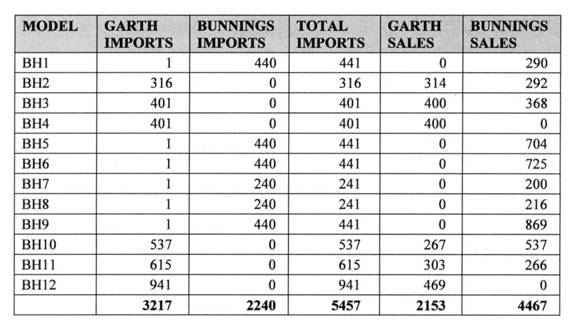
33 The applicant submitted that:
42. Taking a realistic approach, it would not be possible for a company of Bunnings’ size and format, selling thousands of lines of products, to operate with records containing data which are inaccurate to the level set out above [referring to the table set out at [32] above]. In these circumstances, Bitech submits that the most likely explanation is that the disclosure is incomplete, and that where sales are higher there must have been additional imports. Similarly, where imports are higher, there must have been additional sales. For example, on the figures set out above, Bunnings is suggested to have sold none of the four hundred BH4 heaters it received from Garth. Aside from being highly improbable, that is plainly incorrect, because two samples were purchased on behalf of Bitech from Bunnings stores (these were in evidence at the previous hearing) (Ryan #1 30.7.07 Ex. BH4). The same applies to the BH12, where no sales are disclosed yet there was at least one sample of the product in evidence at the initial hearing on liability.
43. As a result of these discrepancies, Mr Langridge quantified the claim on two bases, identified as Assumption A (sales figures) and Assumption B (importation figures). His calculations are provided for each model on each basis. Bitech submits that, as the discrepancies reside in Garth’s and Bunnings’ records, and having regard to the above matters it would be open to the Court to adopt an approach whereby the higher of Assumption A and Assumption B is adopted for each model.
34 The applicant also submitted that, when due regard is paid to the general proposition that, in a case such as the present, damages should be liberally assessed, I should adopt the higher of Assumption A or Assumption B for each model of heater. For reasons which I will explain below, I do not think that that is the correct approach in the present case.
35 The importation and sales figures were used by the applicant to establish the numbers of each model of heater which had infringed the Patent. Those figures were then used by Mr Langridge, the expert accountant called as a witness by the applicant, as the basis for quantifying the number of units of each model in the applicant’s Optiflame range of heaters which could have and would have been sold in Australia had the infringements not occurred. The applicant’s ultimate propositions were that it had the capacity in its business to manufacture and import into Australia sufficient numbers of Optiflame heatersto meet all of the sales of the infringing heaters achieved by Garth Living and Bunnings and that, had the infringements not occurred, it would have done just that. The applicant submitted that I should quantify the applicant’s damages by applying its usual manufacturer’s margin in respect of the comparable Optiflame model of heater to each model of the infringing heaters and to multiply that margin in each case by the number of comparable infringing heaters imported or sold in Australia by Garth Living and Bunnings in each case.
36 The evidence before me established that it was Bunnings which orchestrated the importation of the infringing heaters including those imported by Garth Living and onsold to Bunnings. Garth Living only ever intended to sell the infringing heaters to Bunnings. The only sales which it ever made were to Bunnings. It is fair to say that the only reason that Garth Living imported the infringing heaters was to provision Bunnings with those heaters for the purpose of onselling them to the public. Although Garth Living sold heaters to Bunnings, Bunnings was not the ultimate consumer in respect of those heaters.
37 For these reasons, I think that the relevant starting figures for the purposes of the present assessment are the numbers of units actually sold by each of the respondents rather than the importation figures. It was the sale of units to the public and possibly also the sale of units by Garth Living to Bunnings which deprived the applicant of potential sales of its Optiflame heaters thereby causing it loss and damage. The figures for the number of units sold by Bunnings are the starting point for my assessment of the number of heaters in the Optiflame range which the applicant would have sold had the infringements not occurred. That is to say, those figures represent a fair quantification of the maximum number of Optiflame heaters that could have been sold by the applicant had the infringing products not been available in the market. Those figures are not necessarily equivalent to the number that would have been sold.
38 In the case of the BH2, BH3, BH4, BH11 and BH12 models, Garth Living sold to Bunnings more heaters in each case than Bunnings was able to onsell to the public. None of those models were imported by Bunnings directly. In the case of the BH1, BH5, BH6, BH7, BH8 and BH9 models, Bunnings imported those heaters directly without the intervention of Garth Living. In the case of the BH10 model, Garth Living imported the same number of units as Bunnings onsold to the public (viz 537).
39 In my judgment, the maximum number of units of each model for which each respondent could be held responsible is the number of each model which each respondent was actually able to sell in the relevant period. For the purpose of assessing damages, I do not think that the importation figures are directly relevant. They can, at most, operate as a check on the sales figures.
40 For these reasons, as a starting point in the assessment of damages and without accepting at this stage that sales of this magnitude of its Optiflame heaters could actually have been achieved by the applicant, I propose to proceed upon the basis that the following numbers of units of each model were actually sold in the relevant period by each of Garth Living and Bunnings, namely:
By Garth Living to Bunnings:
| BH2 | – | 314 |
| BH3 | – | 400 |
| BH4 | – | 400 |
| BH10 | – | 267 |
| BH11 | – | 303 |
| BH12 | – | 469 |
By Bunnings to the public:
| BH1 | – | 290 | |
| BH2 | – | 292 | |
| BH3 | – | 368 | |
| BH4 | – | 300 | (estimate) |
| BH5 | – | 704 | |
| BH6 | – | 725 | |
| BH7 | – | 200 | |
| BH8 | – | 216 | |
| BH9 | – | 869 | |
| BH10 | – | 537 | |
| BH11 | – | 266 | |
| BH12 | – | 351 | estimate |
With the exception of the figures in relation to the BH4 and BH12 models, these figures are extracted from the table I set out at [32] above.
41 The conclusions which I have reached at [39]–[40] above recognise that, in the case of some models, the Bunnings sales figures show that a larger number of units was sold to the public by Bunnings than the number which the combined importation figures for Garth Living and Bunnings (the BH5, BH6 and BH9 models) show were imported into Australia and that it is inherently unlikely that none or only one of the BH4 and BH12 models were actually sold by Bunnings. As to the former point, I think that the sales figures are likely to be more reliable. They record sales actually made by a large commercial enterprise such as Bunnings that is part of a group of companies the holding company of which is a publicly listed company whose accounts are audited. As to the latter point, although there is no basis in the evidence for selecting any particular number of units of the BH4 and BH12 models as the number actually sold by Bunnings to the public,I think that adopting an estimated sales figure of 75% of the number of units sold by Garth Living to Bunnings is reasonable because it is very likely that Bunnings would not have purchased some hundreds of units of these models without having a reasonable expectation that it could sell most of them by retail to the public.
42 The approach which I have decided is the appropriate approach engages the calculations performed by Mr Langridge using sales figures (Assumption A) in the case of both Garth Living and Bunnings. I note that Mr Langridge’s calculations do not address the sales by Bunnings to the public of heaters in the BH2, BH3, BH4, BH10, BH11 and BH12 model ranges. Further, in respect of his Assumption A calculations for Garth Living, Mr Langridge assumes that no sales were made by Garth Living in the 2008, 2009 and 2010 calendar years and that only a small number of units (14 in total) were sold by Bunnings to the public in 2010. For these and other reasons, it will be necessary for Mr Langridge to re-work his calculations.
Issues 3 and 4—The Counterfactual and the Applicant’s Lost Sales
43 The applicant submitted (correctly) that the award of damages in the present case should, as far as possible, restore the applicant (as patentee) to the position it would have been in had the infringements not occurred (Pearce v Paul Kingston Pty Ltd (1992) 25 IPR 591 at 592 per Ashley J; General Tire and Rubber Co v Firestone Tyre & Rubber Co Ltd [1976] RPC 197 at 212 per Lord Wilberforce).
44 The applicant went on to submit that, in the present case, two broad possibilities arise. First, had Garth Living and Bunnings not infringed the Patent, they would not have entered the market at all (Scenario 1). Second, Bunnings would nonetheless have entered the market but sourced all or most of its supply of electric heaters from the applicant or the applicant’s former distributor, Hagemeyer Brands Australia Pty Ltd (Hagemeyer)(Scenario 2). The applicant submitted that, on the facts of the present case, there is no basis for a finding that Bunnings could havesourced all of its supply needs from an alternative non-infringing supplier. The other participants in the market almost certainly did not have the capacity to supply appropriate heaters in the quantities ultimately sold by Bunnings to the public. In any event, the respondents did not bring forward evidence that supported such a scenario.
45 I agree with the applicant’s submissions which I have summarised at [43] and [44] above.
46 The applicant submitted that it was open to the Court to find that either scenario postulated by it would have been in play had the infringing conduct not occurred.
47 The applicant seemed to favour Scenario 1 as the most likely but also made detailed submissions in support of Scenario 2.
48 In support of Scenario 2, the applicant endeavoured to demonstrate that Bunnings was not averse to stocking the applicant’s Optiflame range of heaters. It made cogent submissions which debunked the proposition advanced on behalf of the respondents that the unsuccessful trial of the Optiflame heaters at one Bunnings store was a factor in Bunnings’ decision not to stock the applicant’s Optiflame range of heaters for the 2006 winter season. The applicant made good the proposition that Bunnings must have taken steps to order the infringing heaters from China before the trial of samples of the applicant’s heaters at Bunnings’ Vermont store had concluded.
49 Mr Gallus, who was the category manager for tools and electrical products employed by Bunnings in 2005, testified that, when he first approached Mr Hickey of Hagemeyer in late September 2005, Mr Hickey was not as enthusiastic as Bunnings was in relation to the prospect of Bunnings selling Glen Dimplex electric flame effect heaters in Australia and that Mr Hickey appeared to be reluctant to sell to Bunnings. Mr Hickey told Mr Gallus that Glen Dimplex was afraid that selling its heaters through Bunnings might put downward pressure on the retail price of those heaters and thus on its margins. Mr Hickey said that Glen Dimplex had generally sold its heaters in Australia through high-end retailers and not through warehouse style operations or outlets such as those conducted by Bunnings.
50 Mr Gallus said that, by September 2005, Bunnings was keen to introduce into its retail stores a range of electric flame effect heaters for the 2006 heating season (April to September 2006). He accepted that, in order to do that, Bunnings would have had to source an appropriate supplier and place orders by no later than November 2005. Mr Gallus said that, when he met with Mr Hickey, Bunnings was open to the prospect of stocking the applicant’s Optiflame range in its stores.
51 In the end, however, Bunnings did not, in fact, stock the applicant’s electric flame effect heaters in 2006. Concerns about Hagemeyer’s capacity to support the product may have been a factor. Mr Hickey’s attitude may also have been a factor. Mr Gallus’ perception that the applicant’s heaters were too expensive may have been a factor. But, whatever the reason, Bunnings did not proceed to stock the applicant’s products. It chose a different option: The Garth Living option. There was no evidence to suggest that, in taking that course, Bunnings knew that it would be stocking products that infringed the Patent.
52 I accept Mr Gallus’ evidence.
53 I find that, had the Garth Living option not been taken by Bunnings, it would have endeavoured to source suitable electric flame effect heaters from a supplier other than the applicant and that, in the event that it was unable to do so, it would have stayed out of the market. I have reached that conclusion primarily because, when the opportunity arose to attempt to source the applicant’s heaters from Hagemeyer, Bunnings ultimately chose not to do so. It was no doubt put off or offended by Mr Hickey’s attitude and was also obviously concerned that Hagemeyer might not be able to support the products adequately. No doubt, another factor was its perception that it may have been driven to sell the heaters at retail prices which were too high for the price points it had in mind having regard to the large scale open warehouse retail operation which was its general retail delivery format. I therefore propose to adopt the lost profits approach to the assessment of damages reflected in Scenario 1.
54 The applicant supplemented its submission as to the general approach to the assessment of damages for the infringement of a registered patent with the following additional submissions:
(a) Damages should be liberally assessed while recognising that the object is to compensate the patentee not to punish the infringer (General Tire & Rubber Co at 212 per Lord Wilberforce).
(b) The quantum of damages is generally not capable of being determined precisely with mathematical exactness. The Court must often do its best on the evidence before it (Advanced Building Systems Pty Ltd v Ramset Fasteners (Aust) Pty Ltd(2001) 52 IPR 305 at 322 [58] per Hill J).
(c) Although different approaches have been adopted by the courts, depending on the circumstances of the case, the loss of profits approach has often commended itself to courts when the patentee is a manufacturer. In General Tire & Rubber Co, at 212–213, Lord Wilberforce said:
As in the case of any other tort (leaving aside cases where exemplary damages can be given) the object of damages is to compensate for loss or injury. The general rule at any rate in relation to “economic” torts is that the measure of damages is to be, so far as possible, that sum of money which will put the injured party in the same position as he would have been in if he had not sustained the wrong (Livingstone v Rawyards Coal Co (1880) 5 App Cas 25, 39, per Lord Blackburn).
In the case of infringement of a patent, an alternative remedy at the option of the plaintiff exists by way of an account of profits made by the infringer—see Patents Act, 1949, section 60. The respondents did not elect to claim an account of profits, their claim was only for damages. There are two essential principles in valuing that claim: first, that the plaintiffs have the burden of proving their loss: second, that the defendants being wrongdoers, damages should be liberally assessed but that the object is to compensate the plaintiffs and not punish the defendants. (Pneumatic Tyre Co Ltd v Puncture Proof Pneumatic Tyre Co. Ltd. (1899) 16 RPC 209 at page 215.)
These elemental principles have been applied in numerous cases of infringements of patents. Naturally their application varies from case to case. Reported authorities, many of which were cited in argument, may be useful as illustrations of judicial reasoning, but are capable of misleading if decisions on a particular set of facts and observations in judgments leading up to such decisions are later relied upon as establishing a rule of law. Nevertheless I think it useful to refer to some of the main groups of reported cases which exemplify the approaches of courts to typical situations.
1. Many patents of inventions belong to manufacturers, who exploit the invention to make articles or products which they sell at a profit. The benefit of the invention in such cases is realised through the sale of the article or product. In these cases, if the invention is infringed, the effect of the infringement will be to divert sales from the owner of the patent to the infringer. The measure of damages will then normally be the profit which would have been realised by the owner of the patent if the sales had been made by him (see The United Horse-shoe and Nail Co. Ltd. v John Stewart & Co (1880) 13 A.C. 401). An example of this is Boyd v The TootalBroadhurst Lee Co. (1894) 11 RPC 175 where the plaintiff manufacturers proved that a profit of 7/- per spindle would have been made, and settlements of litigation for lesser rates were discarded.
2. Other patents of inventions are exploited through the granting of licences for royalty payments. In these cases, if an infringer uses the invention without a licence the measure of the damages he must pay will be the sums which he would have paid by way of royalty if instead of acting illegally, he had acted legally. The problem, which is that of the present case—the respondents not being manufacturers in the United Kingdom—is to establish the amount of such royalty. The solution to this problem is essentially and exclusively one of evidence, and as the facts capable of being adduced in evidence are necessarily individual, from case to case, the danger is obvious in referring to a particular case and transferring its conclusions to other situations.
This approach was accepted by Ashley J in Pearce v Paul Kingston Pty Ltd and by Hill J in Advanced Building Systems Pty Ltd.
(d) An elaboration of the principle expounded by Lord Wilberforce which I have extracted at subpar (c) above is found in the judgment of Falconer J in Catnic Components Ltd v Hill & Smith Ltd [1983] FSR 512 at 524 where his Lordship said:
[Counsel] for the plaintiffs submitted that it would be consistent with the attitude of the law to an infringer for the law to assume that the plaintiffs would have made, with their patented lintels, those sales made by the defendants with the infringing lintels unless and in so far as the defendants proved the contrary. In a case such as this, where the plaintiffs had been established for a number of years as the market leaders with their patented construction, having available ample production capacity and stocks (except for the temporary steel strike shortage in one part of their range to which I have referred), but never having granted any licence under their patent, and where defendants not previously in business in this field at all, entered the market with the object of doing so at the expense of the plaintiffs and using an infringing version of the plaintiffs’ patented construction, in my judgment that is a proper approach for the court to adopt. (See Lord Wilberforce’s first group of cases in the passage I have cited from the General Tire case.) [Counsel] accepted that if an infringer could show that his customer would have dealt with a lawful competitor of the plaintiffs that would have the effect of reducing the number of sales in respect of which the plaintiffs could claim loss of profit. I would just add to that that a defendant infringer might be able to establish that a plaintiff patentee would not have made an infringing sale for some other reason.
The observations of Falconer J are apt to be applied in the present case.
(e) At [72]–[73], at [75] and at [78] of its Closing Written Submissions, the applicant submitted:
72. In Gerber Garment Technology Inc v Lectra Systems Ltd [1997] RPC 443, theCourt of Appeal upheld the application of a “broad brush” approach incircumstances where the trial judge had held that not every sales would havebeen made by the patentee. The Court held that, rather than attempting toassess what would have happened on the balance of probabilities in respect ofeach sale, it was appropriate to attribute some proportion of the infringer’s salesto the patentee at the patentee's average profit margin (Gerber Garment Technology Inc v Lectra Systems Ltd [1997] RPC 443 at 459-460). Such an approach,with respect, has a great deal to recommend it, particularly in a case such as thepresent where a large number of individual sales was made.
73. Whether or not this is consistent with the “loss of a chance” approach discussedin Sellars v Adelaide Petroleum NL (1992) 179 CLR 332 at 355, as the Court ofAppeal thought, is probably not necessary to determine.
75. Bitech submits that the assessment of damages in this case should be approached, to adapt the language of Falconer J in Catnic Components: (Catnic Components Ltd &Anor v Hill & Smith Ltd [1983] FSR 512 at 521) as a matter which to be decided in the rough – doing the best one can, not attempting to be minutely accurate – having regard to all the circumstances, and saying what upon the whole is the fair thing to do; assessing damages liberally but with the object of compensating Bitech for the loss suffered by it by reason of the infringing sales, as a direct and natural consequence of those infringing sales; and upon the basis that the sale of each infringing heater was an actionable wrong for which Bitech is entitled to compensation.
78. As set out below, Bitech’s primary submission is that a broad approach to the comparators is appropriate. In this regard it must be remembered that the task is not to identify whether a consumer would chose [sic] one product or the other on a side by side comparison. The scenario to be considered is one in which the infringing products are not on sale in Bunnings stores, and never have been, and the Optiflame Heaters are on sale in the outlets in which they were. The question is whether a consumer who in fact purchased a Garth branded heater would, in the counterfactual scenario, have purchased an Optiflame heater.
55 These submissions are correct and I propose to apply the principles upon which they are based to the assessment of the applicant’s damages in the present case.The approach to the assessment of damages which I intend to take in the present case is consistent with the principles to be applied in the assessment of damages for the deprivation of a commercial opportunity explained by the High Court in Malec v JC Hutton Pty Ltd (1990) 169 CLR 638 at 643 per Deane, Gaudron and McHugh JJ and in Sellars v Adelaide Petroleum NL (1994) 179 CLR 332 at 350 per Mason CJ and Dawson, Toohey and Gaudron JJ.
56 The applicant submitted that the evidence supported the following findings. I agree.
57 First, prior to the introduction of the infringing heaters in 2006 into Australia, the applicant had an effective monopoly in the market in Australia for the wholesale sale of electric flame effect heaters.
58 Second, it had the capacity to increase production to meet the quantities of heaters sold by Garth Living and Bunnings if it had had the opportunity to do so. It could have done so without adding to its direct costs.
59 The applicant also submitted that a conclusion to the effect that a consumer who had, in fact, purchased one of the infringing heaters would have purchased a comparable heater from the applicant’s Optiflame range had the infringing heaters not been available for purchase does not require a close correspondence between two particular models in the respective ranges. I agree. The task is to determine the likelihood of the applicant’s product being purchased by that consumer in a market where the infringing products were not available. The applicant submitted that that likelihood was high.
60 The applicant developed this argument at [80]–[83] of its Closing Written Submissions by focussing on the nature of the purchase, the high relative cost of the purchase and the considered nature of the purchase.
61 In the course of its submissions, the applicant addressed the evidence of Dr Harrison, a witness called by the respondents who purported to give expert evidence as to the behaviour of consumers. Dr Harrison expressed his opinions upon the assumption that the infringing heaters were in the market and available for sale and upon the further assumption that the consumer would therefore be confronted with a need to choose between the infringing heaters (and perhaps other products) and the applicant’s Optiflame heaters. These assumptions do not accord with the true assumptions which the Court is required to make viz that the infringing products were not in the market and that the applicant’s Optiflame heaters were available in sufficient quantities to meet the demand reflected in the actual sales of the infringing heaters. For this and other reasons, I found Dr Harrison’s evidence of no utility.
62 Mr Naughton, who is the Managing Director of the applicant, gave detailed evidence identifying the models within the applicant’s Optiflame range which are most comparable to those in the BH range. Mr Hill, in his evidence-in-chief, endeavoured to criticise some of Mr Naughton’s selections. I was impressed with Mr Naughton as a witness. He presented as forthright and intelligent as well as being very knowledgeable about the applicant’s products and those of its competitors. He also presented his opinions in a balanced way recognising that the exercise which he was endeavouring to carry out was not likely to identify precise comparators. Mr Hill was argumentative and gave me the impression that he was being overly critical of Mr Naughton’s opinions when it came to the question of the selection of comparators. On this topic, I prefer the evidence of Mr Naughton.
63 The applicant submitted that it would have made 100% of the sales which Bunnings made by selling its products through its normal sales channels in Australia. It accepted that a modest discount might be appropriate in order to allow for the possibility of third party suppliers picking up some of the sales made by Bunnings.
64 The evidence in the form of the GfK market report demonstrated that:
(a) The total number of electric flame effect heaters sold by retail in Australia (excluding the infringing products) increased dramatically from 18,531 in 2006 to 29,753 in 2007 and thereafter declined in each of the years 2008, 2009 and 2010 with a substantial decline from 2008 to 2009. These figures were based upon information supplied to GfK by the major suppliers. They constitute a reasonable reflection of the sales made in the market in the relevant years.
(b) In 2006, the applicant held just over 85% of the relevant market. In 2009 and 2010, it held just over 50%.
(c) Over the six year period covered by the report, there was a substantial increase in trade branded heaters being sold in the market.
65 It is reasonable to infer from the matters to which I have referred at [64] above that the market for electric fires in 2008 and 2009 had contracted from the state of affairs which obtained in 2007. The market did not recover in 2010. This was probably due to sharp rises in electricity prices in those years and the impact of the Global Financial Crisis upon consumer spending, particularly on non-essential items which sold at a price of some hundreds of dollars per unit.
66 Further, the rapid increase in sales of trade branded heaters in 2007 and 2008 taken together with the fact that significant numbers of trade branded heaters continued to be sold in 2009 and 2010, suggests that the price per heater became an important issue, the trade branded products most likely being cheaper than the products branded with well-known and reputable manufacturers’ names.
67 For reasons which I shall explain below, I do not accept that the applicant would have made 100% of the sales which Bunnings made in each of the relevant years.
Issue 5—The Quantification of the Applicant’s Lost Profits
68 The applicant’s sales revenue, margins and manufacturing costs for each relevant model of Optiflame heater were established by the evidence of Mary Frances Daly and Mark Simon Moore. Mr Naughton’s evidence was also relevant on these topics. None of this evidence was challenged.
69 In my judgment, the introduction of Glen Dimplex International into the supply chain makes no difference to the assessment of damages. In the relevant years, that company passed through to the applicant all revenue received by it and all costs incurred by it. It made very little or no profit of its own.
70 There was little real dispute between Mr Langridge and Mr Wilkinson, the expert accountant called on behalf of Garth Living and Bunnings. Mr Wilkinson suggested that certain costs (sales rebates, commission and distribution costs) had not been taken into account by Mr Langridge when he calculated the applicant’s lost profits. But Mr Wilkinson had no proper evidentiary foundation for suggesting that the applicant had, in fact, incurred such costs. Mr Naughton testified that the applicant had not incurred costs of that type in the relevant years. I accept Mr Naughton’s evidence. Mr Langridge was correct in not bringing such costs to account.
71 The remaining issues between the accounting experts concerned matters which are essentially matters for the Court.
72 Mr Langridge calculated the applicant’s damages by assessing the position of each of Garth Living and Bunnings separately and by applying alternative assumptions to each of them—Assumption A being that the applicant would have sold 100% of the units actually sold by the particular infringer and Assumption B being that the applicant would have sold 100% of the units actually imported into Australia by the particular infringer. He also provided calculations using the higher number of units in the case of each model as between the number of units sold and the number of units imported.
73 In his calculations, Mr Langridge multiplied the gross margin figure generally achieved in respect of each model of heater from the Optiflame range which was comparable to those in the infringing BH range as proven in evidence by Ms Daly and Mr Moore by the number of units that he assessed would have been sold by the applicant had the infringing products not been in the market. The relevant unit numbers were, as I have said, 100% of the heaters sold by the infringers or 100% of the heaters imported by the infringers, as the case may be.
74 It is obvious from what I have already said that Mr Langridge prepared several different calculations designed to assist the Court to quantify the applicant’s damages once it had determined several important matters of principle.
75 I think that the appropriate method for calculating the applicant’s damages in the present case is as follows:
(a) As the maximum number of sales which the applicant could conceivably have lost by reason of the infringing conduct of Garth Living and Bunnings, the Court should determine the number of units of each infringing model actually sold by Bunnings. I prefer the sales figures over the importation figures for the reasons given at [41] above. The Court should ignore the sales made by Garth Living to Bunnings because to a large extent they are subsumed in the retail sales made by Bunnings to members of the public and, in any event, it is the number of retail sales made by Bunnings that most closely reflects the maximum number of sales likely to have been made by the applicant through its established channels had the infringing articles not been in the market. The Court should adopt the estimates which I have made in respect of the BH4 and BH12 models. For these reasons, the figures to be used are those set out under the second dot point in [40] above.
(b) The unit numbers of each model sold should then be broken down into the numbers of each model sold in each calendar year using the breakdown adopted by Mr Langridge in his Assumption A calculations set out in his first report.
(c) The relevant gross margins figure should then be multiplied by the number of units of each comparable BHmodelactually soldby Bunnings in each calendar year.
(d) The lost gross margins for each model for each calendar year should be added together in order to derive the total of the lost gross margins arrived at upon the assumptions specified above.
(e) Any appropriate discounts should then be factored into the calculations.
76 I intend to direct that Mr Langridge perform the necessary calculations in order to give effect to the approach which I have described in subpars (a) to (d) of [75] above.
77 I think that some discount to the figure arrived at in this way is warranted. My reasons are:
(a) Given the state of the market for electric flame effect heaters in Australia in 2006, 2007, 2008, 2009 and 2010, I am of the view that it is unrealistic to conclude that the applicant would have picked up all of the sales made by Bunnings had the infringing heaters not been in the market. A good percentage of those sales would have gone to trade branded products and some third party branded products. According to the GfK report, trade branded and non-infringing heaters held approximately 8.75% of the total market in 2006, approximately 19% of the total market in 2007, approximately 32% of the total market in 2008, approximately 32% of the total market in 2009 and approximately 46% of the total market in 2010. I think that the raw unit numbers set out under the second dot point in [40] above as broken down into calendar years using Mr Langridge’s Assumption A figures should be discounted by 8.75% for sales made in 2006, by 19% for sales made in 2007, by 32% for sales made in 2008 and by 32% for sales made in 2009. In this way, account is taken for the likelihood that some of the infringing sales would have leaked to other non-infringing suppliers.
(b) I think that a further 10% discount should be applied to each of the discounted unit numbers arrived at after applying the discounts specified in subpar (a) above in order to take account of contingencies including consumer perceptions about price and value. The final unit numbers as discounted should then be deployed in the other calculations specified in subpars (a) to (d) of [75] above utilising the assumptions as to margin set out therein.
78 The applicant submitted that I should find both Garth Living and Bunnings jointly and severally liable for the entire damages award. I agree that this is the appropriate approach in the present case. My reasons are:
(a) At 102–103 [104]–[110] of my judgment on liability (Bitech Engineering v Garth Living Pty Ltd (2009) 84 IPR 78), I found that Garth Living had been directly involved in the importation, sale and distribution of all of the original heaters;
(b) At 104 [111] of the same judgment, I said that I would have found that Garth Living and Bunnings had been engaged in a common design directed to the sale of the infringing heaters, had it been necessary to do so. Garth Living admitted the alleged common design in its Defence, in any event;
(c) Similar findings are justified in respect of the additional models; and
(d) At [12] of their Closing Written Submissions, Garth Living and Bunnings conceded that both them should be found to be jointly and severally liable for the whole award of damages.
79 I therefore conclude that Garth Living and Bunnings should be made jointly and severally liable for the whole damages award which I will ultimately make.
80 Interest should be calculated using the methodology explained by Mr Langridge at pars 6.9 and 6.10 of his first report (viz the report annexed to his affidavit affirmed on 25 November 2011). In those paragraphs, Mr Langridge said:
6.9 As instructed (Refer paragraph 1.14), I have calculated interest applying annual interest rates as published in the Federal Court of Australia Harmonised interest rate table (Refer Exhibit L), for the calendar years 2006 to 2011. I have been instructed that only pre-judgement interest rates are to be used for all product models.
6.10 In calculating the applicable interest I have made the following assumptions:
(a) Interest is calculated on the basis that the lost gross margin claimed arose evenly across the year in which it arose
(b) Interest has been calculated on a simple interest basis
(c) The calculations have been performed to 31 October 2011.
81 Interest should be calculated up to and including 30 August 2013.
Issue 6—A Reasonable Royalty to be Paid
82 The applicant submitted that the Court should award damages in the form of a royalty levied in respect of those sales which the Court considers would not have been taken up by the applicant had the infringers not been in the market.
83 The evidence was that the applicant had never granted any licences to any third party under the Patent or under any corresponding patents in other countries and would not have been willing to grant such a licence had it been requested to do so by Garth Living or Bunnings.
84 Heavy reliance was placed by the applicant upon the observations made by Falconer J in Catnic Components Ltd v Hill & Smith Ltd.
85 At 521–522, his Lordship said:
… their claim was only for damages. There are two essential principles in valuing that claim: first, that the plaintiffs have the burden of proving their loss: second, that the defendants being wrongdoers, damages should be liberally assessed but that the object is to compensate the plaintiffs and not punish the defendants. (Pneumatic Tyre Co. Ltd. v. Puncture Proof Pneumatic Tyre Co. Ltd. (1899) 16 R.P.C. 209 at 215.) These elemental principles have been applied in numerous cases of infringements of patents. Naturally their application varies from case to case. Reported authorities, many of which were cited in argument, may be useful as illustrations of judicial reasoning, but are capable of misleading if decisions on a particular set of facts and observations in judgments leading up to such decisions are later relied upon as establishing a rule of law. Nevertheless I think it useful to refer to some of the main groups of reported cases which exemplify the approaches of courts to typical situations.
1. Many patents of inventions belong to manufacturers, who exploit the invention to make articles or products which they sell at a profit. The benefit of the invention in such case is realised through the sale of the article or product. In these cases, if the invention is infringed, the effect of the infringement will be to divert sales from the owner of the patent to the infringer. The measure of damages will then normally be the profit which would have been realised by the owner of the patent if the sales had been made by him (see The United Horse-Shoe and Nail Co. Ltd. v. John Stewart & Co., 13 A.C. 401). An example of this is Boyd v. The TootalBroadhurst Lee Co. (1894) 11R.P.C. 175 where the plaintiff manufacturers proved that a profit of 7/- per spindle would have been made, and settlements of litigation for lesser rates were discarded.
2. Other patents of invention are exploited through the granting of licences for royalty payments. In these cases, if an infringer uses the invention without a licence, the measure of the damages he must pay will be the sums which he would have paid by way of royalty if instead of acting illegally, he had acted legally. The problem, which is that of the present case—the respondents not being manufacturers in the United Kingdom—is to establish the amount of such royalty.”
Leaving aside for the moment, the claim to exemplary damages, I understand from those authorities that I have to approach the assessment of the plaintiffs’ damage—
(a) as a jury sort of question, as a matter which is to be decided in the rough—doing the best one can, not attempting or professing to be minutely accurate—having regard to all the circumstances of the case, and saying what upon the whole is the fair thing to do”;
(b) assessing the damages liberally but with the object of compensating the plaintiffs for the loss suffered by them by reason of the defendants’ sales of the infringing lintels, as a direct and natural consequence of those infringing sales; and
(c) upon the basis that the sale of each infringing lintel was an actionable wrong for which the plaintiffs are entitled to be compensated;
(d) it being immaterial that in the case of any such sale the defendants could have sold a noninfringinglintel instead of the infringing one.
It follows from (c) that if and in so far as any infringing sale should be held not to have been a sale the plaintiffs would have made and, therefore, not compensatable on a loss of profit basis, it should be compensated on a notional royalty basis in the manner propounded by Fletcher Moulton L.J. in the Meters case.
86 After making the observations which I have extracted at [85] above, his Lordship went on to record the arguments advanced by the parties in that case at 524. I have extracted the important passage at [54(d)] above.
87 I have concluded that the applicant would not have made some of the sales which the infringers made because those sales would have been made by other non-infringing suppliers in the market. I have endeavoured to quantify the number of those sales by applying the discounts which I have set out at [77] above. Mr Langridge should be in a position to quantify those numbers by reference to the percentages which I have specified.
88 In the circumstances of the present case, it is those sales which I have concluded would not have been made by the applicant which attract the application of the royalty principle. The royalty principle is applied notionally in the sense that it is quite clear that, in the present case, no licence would ever have been agreed, in fact, with the consequence that actual evidence from Mr Naughton could not be determinative of the rate of royalty to be applied.
89 As Falconer J noticed in Catnick Components Limited v Hill and Smith Limited, in a case where there is no established market rate for the royalty, an assessment must be made by the Court on the basis of what royalty a willing licensee would have been prepared to pay and a willing licensor prepared to accept. I do not think that a rate of royalty which equated to the entire manufacturer’s gross margin derived by the applicant in respect of its comparable Optiflame heaters is an appropriate rate of royalty. Apart from anything else, the result of applying that rate of royalty would lead to a level of compensation in respect of the sales which I have already held the applicant would not have made which equated to reimbursing it for 100% of its lost profit on those sales, a consequence which I have rejected in respect of those sales. The applicant rested its royalty claim on the proposition that I should award 100% of the applicant’s manufacturer’s gross margin by way of a royalty and adduced no other evidence upon which I could sensibly assess the rate of royalty. This was an all or nothing approach. The respondents, on the other hand, did not come to grips with the royalty question at all.
90 The applicant submitted that the Court must do the best it can to assess an appropriate rate of royalty, even if it is a matter of “guess work”. The applicant cited the observations of Hill J at 359 [197] in Advance Building Systems Pty Ltd in support of that proposition.
91 But, in Advance Building Systems Pty Ltd, there was evidence before the Court that went some way to informing the Court of the appropriate rate of royalty. In the present case, there is no such evidence, once the all or nothing approach of the applicant is rejected.
92 Upon the assumption that the principles relied upon by the applicant represent the law in Australia (a matter which I do not have to decide in the present case), I find myself unable sensibly to determine an appropriate rate of royalty in respect of the sales which I have determined that the applicant would not have made. I therefore decline to incorporate in the damages award which I shall make any royalty in respect of sales which the applicant would not have made.
CONCLUSIONs
93 The applicant has had substantial success in its damages case. Costs should follow the event. When I make a final order quantifying the applicant’s damages, I will order the respondents to pay the applicant’s costs of the damages part of the proceedings save for those applications and matters which have already been the subject of an order for costs.
| I certify that the preceding ninety-three (93) numbered paragraphs are a true copy of the Reasons for Judgment herein of the Honourable Justice Foster. |
Associate:


