

FEDERAL COURT OF AUSTRALIA
Reckitt Benckiser Healthcare (UK) Ltd v GlaxoSmithKline Australia Pty Ltd (No 2) [2013] FCA 736
IN THE FEDERAL COURT OF AUSTRALIA | |
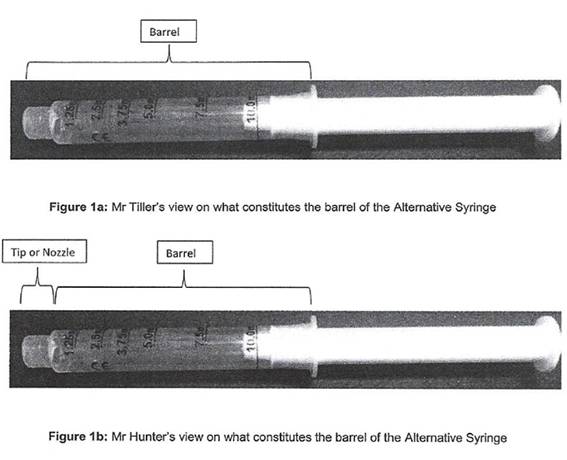
DATE OF ORDER: | |
WHERE MADE: |
IN THESE ORDERS:
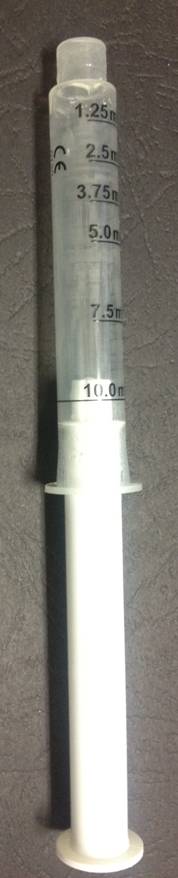
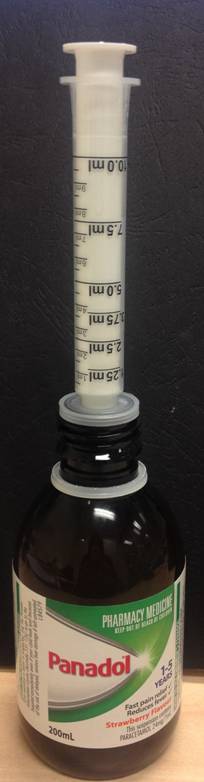
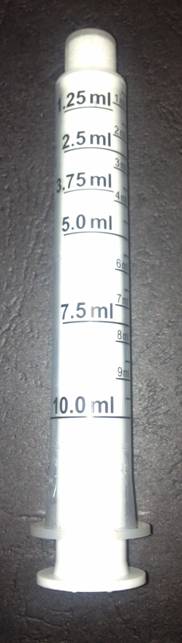
Second Product means Children’s Panadol 1-5 years (of any flavour or size) incorporating the liquid dispensing apparatus, comprising a bottle, a bottle neck liner and a flat-nosed syringe as depicted in Annexure B and Exhibits LMD-1, LMD-2 and LMD-3.
THE COURT ORDERS THAT:
UPON the applicants by their counsel undertaking:
(a) to submit to such order (if any) as the Court may consider to be just for the payment of compensation, to be assessed by the Court or as it may direct, to any person, whether or not a party, adversely affected by the operation of the interlocutory order or undertaking or any continuation (with or without variation) thereof; and
(b) to pay the compensation referred to in (a) to the person there referred to.
THE COURT ORDERS THAT:
1. Pending the determination of the proceeding or further order, the respondent be restrained, whether by itself, its directors, officers, servants or agents or otherwise, from engaging in the following acts within the patent area (as defined in Schedule 1 to the Patents Act 1990 (Cth)), without the licence or authority of the applicants or either of them:
(a) making, hiring, selling or otherwise disposing of or offer to make, sell, hire or otherwise dispose of, use or import or keep any for the purpose of doing any of those things, the Second Product.
2. Costs be reserved.
Note: Entry of orders is dealt with in Rule 39.32 of the Federal Court Rules 2011.
ANNEXURE B
NEW SOUTH WALES DISTRICT REGISTRY | |
GENERAL DIVISION | NSD 734 of 2013 |
BETWEEN: | RECKITT BENCKISER HEALTHCARE (UK) LIMITED First Applicant RECKITT BENCKISER (AUSTRALIA) PTY LIMITED ABN 17 003 2274 655 Second Applicant
|
AND: | GLAXOSMITHKLINE AUSTRALIA PTY LTD ABN 47 100 162 481 Respondent
|
JUDGE: | RARES J |
DATE: | 17 JULY 2013 |
PLACE: | SYDNEY |
REASONS FOR JUDGMENT
(REVISED FROM THE TRANSCRIPT)
1 On 28 May 2013, I granted an interlocutory injunction restraining GlaxoSmithKline Australia Pty Ltd (Glaxo), until further order, from marketing its Panadol children years 1-5 product in a dispensing apparatus consisting of three key parts; a bottle, a bottle neck liner and a flat-nosed syringe: Reckitt Benckiser Healthcare (UK) Ltd v GlaxoSmithKline Australia Pty Ltd [2013] FCA 583 (I will use the same defined terms in these reasons as I used in the earlier ones). I found that Reckitt had established a sufficient prima facie case of infringement of Australian patent 2003283537 which claimed an apparatus consisting of those three parts. The background of the dispute and the general description of the invention are set out in those reasons. Very soon after I made that order, Glaxo advised Reckitt that it proposed to go to market with a new form of syringe to be inserted into a bottle with the bottle neck liner. The bottle neck liner, it is alleged, had the characteristics that I discussed in my previous reasons.
2 The issue in the present application is whether Glaxo should be enjoined, until the trial, from being able to market Children’s Panadol for years 1–5 with the new syringe. Reckitt contends that the new syringe, relevantly, has all the essential integers of the flat-nosed syringe the subject of claim 1 of the patent. In essence, Glaxo contends that the new syringe falls outside that claim because it has a tip or nozzle that fits into the bottle neck liner and a barrel that is wider than the tip.
3 The parties’ expert witnesses made a joint report that clearly identified where they differed. Robert Tiller gave further evidence for Reckitt, in addition to what he had given in the previous hearing, addressing the new syringe. He considered that the nozzle was a part of the syringe’s “barrel” within the meaning of claim 1. In contrast, William Hunter, Glaxo’s expert witness considered that the new syringe consisted of a nozzle and a barrel. The experts illustrated their positions as follows:
4 As can be seen from the above illustrations, Glaxo’s new syringe has what Mr Hunter described and, for convenience in these reasons I will describe as, a “tip” at its distal end before a wider barrel section. The plunger for the new syringe incorporates a prolongation that fits into the tip so as to expel from the tip any liquid that might collect there. It appears to be common ground that the internal seal within the new syringe, that is responsible for allowing the aspiration and dispensation of liquid from the bottle, terminates at a point in the barrel that marks the boundary between the tip and the rest of the plunger.
The patent
5 I described the patent in my earlier reasons in general terms. It is necessary to return to that description to make comprehensible other aspects relevant to the determination of the present issue. The specification in the patent identified the field of the invention as relating to bottle neck liners, bottles, liquid dispensing and apparatus and methods of dispensing liquid. In its introductory description, the patent referred to administration of liquids from many bottles, such as medicine bottles, and clearly contemplated that a principal use of the apparatus would be for dispensing of medicines in an accurate and efficient way. It identified problems of conventional methods used to withdraw liquids from bottles using syringes. It noted that it was difficult to determine accurately the amount of liquid being withdrawn into a syringe in a single operation. It stated that, in addition, micro-organisms on the body of the syringe could be introduced into the medicine when the syringe was dipped directly into the liquid. The introductory section also identified the potential for what I might loosely describe as residue being left on the tip of the syringe after its insertion into a liquid and subsequent removal.
6 The summary of the invention, in the body of the specification, identified that it provided a liquid dispensing apparatus comprising a bottle, a bottle neck liner and a flat-nosed syringe having a plunger and barrel:
“… the barrel terminating at its distal end in a generally flat face and having a diameter corresponding to the diameter of the syringe barrel and being perpendicular to the longitudinal axis of the barrel ...”
7 The description went on to note the significance of the bottle neck liner and inward step that was the subject of my earlier reasons, and the formation of a sleeve with a flared portion into which the distal end of the syringe barrel passed. It stated that when the syringe barrel was inserted into the sleeve, the inward step would prevent the barrel from protruding past the step so that liquid could not flow between the sleeve and the barrel. Thus, it noted that liquid could leave the bottle only via the aperture in the middle of the bottle neck liner to pass into the syringe. The specification then said:
“By “syringe” we mean a syringe comprising a hollow syringe barrel in which is located, or arranged to be located, a reciprocating plunger, the syringe barrel having a dispensing aperture, through which a liquid may be drawn, then discharged.
By “flat-nosed syringe” we mean a syringe whose barrel ends in a generally flat distal end which is perpendicular to the barrel axis, and in which the dispensing aperture is formed. Preferably there is no part of the distal end which extends beyond the bore.
By “sealingly” we mean that under conditions of normal use liquid cannot flow or leak between the respective parts, that is, between the bottle neck and the bottle neck liner, and between the bore and a syringe barrel.” (emphasis added)
8 The specification also contained illustrations including, relevantly, that in figure 4 below.
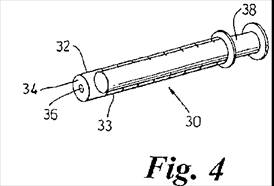
9 Claim 1 was in the following terms:
“A liquid dispensing apparatus comprising a bottle, a bottle neck liner and a flat-nosed syringe having a plunger and a barrel, the barrel terminating at its distal end in a generally flat face having a diameter corresponding to the diameter of the syringe barrel and being perpendicular to the longitudinal axis of the barrel, the bottle having a bottle neck in which is located the bottle neck liner having a cylindrical body sealingly engaged inside the bottle neck such that liquid cannot flow between the bottle neck liner and the bottle neck, the bottle neck liner comprising a sleeve comprising at its lower end an inward step located within the bottle neck, an aperture being defined inwardly of the inward step, wherein the cylindrical body and the sleeve are connected together with a web of material only at the upper end of the cylindrical body and of the sleeve, wherein the sleeve is formed with a flared portion at its upper end into which the distal end of the syringe barrel passes; wherein when the syringe barrel is inserted into the sleeve the inward step prevents the syringe barrel from protruding past the step and liquid cannot flow between the sleeve and the barrel, but can leave the bottle only via the aperture and thence the syringe.” (emphasis added)
The expert evidence
10 Mr Tiller and Mr Hunter, in their joint report, agreed that:
the term “flat-nosed syringe” was not a term of art which was in common general use by design practitioners in the field of medical devices;
the “dispensing aperture” referred to in claim 1 was an orifice at the distal end of the flat-nosed syringe through which liquid could be withdrawn or dispensed;
the barrel axis was the longitudinal axis of the flat-nosed syringe through the centre line of the barrel and that the plunger operated along that axis;
a distal end was the end extremity of something which was the most distant point from a user operating the device;
if a user were operating a flat-nosed syringe via its plunger pull tab, the distal end of the barrel would be the end of the barrel opposite the point where the plunger enters the barrel;
a generally flat distal end is, essentially, a planar face which is positioned at the end of the barrel opposite the point where the plunger enters the barrel;
the term “bore” meant a through hole in an object.
11 Their fundamental area of disagreement was how the term “barrel”, as used in claim 1, should be interpreted in relation to the new syringe. Hence, as their notations in the illustrations of the new syringe in figures 1a and 1b above indicated, Mr Hunter saw the barrel as terminating before the tip, whereas Mr Tiller saw it as incorporating the tip.
12 Mr Hunter considered that Australian standard AS1094-1993, entitled “Medical equipment – Single-use syringes (sterile) for general medical use” (the standard), would be a logical starting point for a person skilled in the art, reading the patent, to understand the terms “barrel” and “nozzle”. Mr Hunter reasoned that the person would see, within that standard, figure 1 describing syringe terms, which appeared there as:
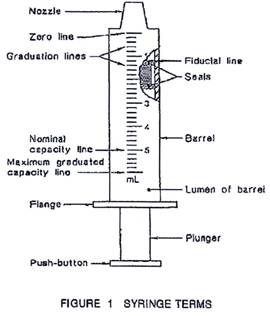
13 Mr Hunter contended that the development of a new single-use, disposable syringe was complex, expensive and a time-consuming matter that would require extensive investment and materials, characterisation, mechanical design, high volume tooling and clinical trials to obtain pre-approvals. He opined that, as a result, medical device designers would not seek to “reinvent the wheel”, but would use an existing single-use syringe as a starting point. He said that syringes of the type described in the standard were highly relevant to the proceedings. He noted that the standard, within its own nomenclature, distinguished in terms between a tip or nozzle on the one hand and a barrel on the other.
Glaxo’s submissions
14 In essence, Glaxo argued that the words “having a diameter corresponding to the diameter of the syringe barrel and being perpendicular to the longitudinal axis of the barrel” in claim 1 defined and limited the invention to one that incorporated, as part of the combination, a syringe with a barrel having a uniform diameter from its distal end to its other end. That characteristic of the barrel, Glaxo contended, was essential because of the natural and ordinary meaning of the words of qualification, to which I have referred, in the patent. It also submitted that the understanding that an addressee skilled in the art at the time claim 1 was made would have had on reading the word “barrel” in claim 1. Accordingly, Glaxo contended, the new syringe did not have a barrel in the specific form of claim 1 because the tip was not part of the barrel and had a different diameter
Consideration
15 In my opinion, for the purposes of ascertaining whether Reckitt has made out a sufficiently strong prima facie case in the sense I explained in my earlier reasons (Reckitt [2013] FCA 583 at [43]), the standard on which Mr Hunter relied is of little weight. It expressly stated in cl 1 that it specified requirements for sterilised single-use Luer-fitting syringes of nominal capacities between 1 and 50 mls individually packed with or without detachable needles for generally medical use. And, the standard also stated that it did not apply to aspiration or irrigation syringes or syringes used in conjunction with syringe pumps. While an addressee skilled in the art would look towards what a useful design for a syringe would be in, among other places, standards, the standard to which Mr Hunter referred clearly did not purport to be exhaustive. There is no reference whatsoever in the patent to a syringe needing to be, or be understood, in terms of that standard or any particular standard. While Mr Hunter’s evidence is of some weight, I am not persuaded that his view is sufficiently strong to displace the view of Mr Tiller that there is no assistance to be gained from the standard.
16 It is obvious enough that the word “barrel” would not bear one of the ordinary English meanings of the term as a wooden cylindrical vessel made of staves hooped together, and having slightly bulging sides and flat, parallel ends (Macquarie Dictionary online sense 1), or a cylindrical wooden vessel, generally bulging in the middle and of greater length than breadth, formed of curved staves bound together by hoops, having flat ends or heads, or a cask (Oxford English Dictionary online sense 1a). On the other hand, the reader skilled in the art would understand the patent to be referring to a cylindrical object, when it used the word “barrel”. So much is clear from the definition of syringe within the patent as comprising a hollow syringe barrel in which there is located, or arranged to be located, a reciprocating plunger. However, the ordinary English meaning of “barrel” does not require the cylindrical shape that it describes to be uniform throughout.
17 Reading the patent as a whole, for the purposes of understanding claim 1 and using the principles identified in Reckitt [2013] FCA 583 at [43]-[47], for present purposes the substance of the invention claimed in claim 1 appears to be the combination consisting of the bottle, the bottle neck liner and the flat-nosed syringe, with the syringe having both a plunger and a barrel, and where the function of the distal end of the syringe is to create the sealing engagement through which liquid may be drawn. However, the question is whether that function is captured by, and delineated expressly in, the terms of claim 1, or whether, as Glaxo contends, claim 1 defines an invention that requires a barrel of uniform diameter at every point so that the new syringe is outside the specific scope of the claim.
18 In Radiation Limited v Galliers & Klaerr Pty Limited (1938) 60 CLR 36 at 51-52 Dixon J said:
“But, on a question of infringement, the issue is not whether the words of the claim can be applied with verbal accuracy or felicity to the article or device alleged to infringe. It is whether the substantial idea disclosed by the specification and made the subject of a definite claim has been taken and embodied in the infringing thing. It is, no doubt, sometimes the case that an inventor explains in his specification steps or methods involving an idea, conception or principle of wider application or of deeper significance than that for which he claims. Sometimes a claim, particularly a claim for a combination, is expressly confined to a particular form of construction or the like, and in such a case it is useless for the patentee to complain that his idea of what he calls his principle has been applied in a different construction or has been expressed by means of a mechanical equivalent of some element which his claims make of the essence of his monopoly. Such cases are well illustrated by the decisions of this court in Walker v. Alemite Corporation [(1933) 49 CLR 643] and Shave v. H. V. McKay Massey Harris Pty. Ltd. [(1935) 52 CLR 701]. But the words of James L.J. in Clark v. Adie [(1875) 10 Ch App 667 at 675] must not be forgotten: “The patent is for the entire combination, but there is, or may be, an essence or substance of the invention underlying the mere accident of form; and that invention, like every other invention, may be pirated by a theft in a disguised or mutilated form, and it will be in every case a question of fact whether the alleged piracy is the same in substance and effect, or is a substantially new or different combination.” Here I think that the defendant has taken the substance of the invention described by the patentee and stated in the first claim of the specification.” (emphasis added)
19 The need for precision in stating a claim and the strictness with which it must be construed when stated were explained by Rich, Dixon, Evatt and McTiernan JJ in Shave v HV McKay Massey Harris Pty Limited (1935) 52 CLR 701 at 709-710 as follows:
“But “it is beyond doubt that an inventor claiming something more than the mere mechanism described is bound to make his intention reasonably clear” (per Tomlin J., British United Shoe Machinery Co. v. Gimson Shoe Machinery Co. [No. 2] [(1928) RPC 137 at 159]). “It is not sufficient for the inventor to discover his gold mine—he must also peg out his claim. Outside the pegs, the gold, if it be there, is free to all. This principle is of vital importance in patent law, though it may be that in some of the earlier cases to be found in the books it was not clearly borne in mind” (per Maugham J., Marconi's Wireless Telegraph Co. v. Phillips Lamps Ltd. [(1933) 50 RPC 287 at 303]).”
20 Reading claim 1, and having regard to the specification as a whole for the purposes of evaluating the prima facie case made out by Reckitt, I think there is a sufficiently strong argument that the words “having a diameter corresponding to the diameter of the syringe barrel and being perpendicular to the longitudinal access of the barrel” would be understood by an addressee skilled in the art at the time of the patent to apply to the distal end of the barrel. The use of the syringe’s distal end was specified at the end of claim 1. The substance of the invention was the apparatus or combination that enabled liquid to be drawn from a bottle by a flat-nosed syringe using the bottle neck liner and its interfacing with the distal end in a way that produced a sufficient seal to enable only liquid to be drawn from the bottle into the body of the syringe, when the generally flat face of the syringe was inserted into the bottle neck liner.
21 I do not think that Glaxo’s argument is sufficiently strong argument for present purposes to warrant a conclusion that what claim 1 of the patent was really doing was delineating all of the requisite characteristics that the syringe had to possess beyond those of its distal end. I am of opinion that the substance of the invention in claim 1 was the combination creating the interface of the distal end of a syringe with the bottle neck liner to produce the sealingly engaged characteristic that was the hallmark of the invention. The way in which the rest of the syringe functioned as a syringe was not an essential integer in itself of the invention, any more than the particular shape of any bottle was. The patent was seeking to draw upon known devices by putting them into a combination that created the uniqueness described in claim 1: Radiation 60 CLR at 51-52; cf: Walker v Alemite Corporation (1933) 49 CLR 643 at 656-657 per Dixon J. The critical feature of the invention, as it seems to me on a prima facie reading for the purposes of considering the strength of Reckitt’s prima facie case, is the description of how to achieve the interaction between the distal end of the syringe and the bottle neck liner.
22 I am satisfied that there is a sufficiently strong prima facie case to suggest that the words of qualification at the commencement of claim 1, read in the context of the patent as a whole, including particularly the concluding words of claim 1, are intended to identify a diameter of the distal end that will ensure the sealing engagement rather than, as Glaxo contended, to define as an essential integer that the whole body of the syringe be of the kind in the preferred embodiment illustrated in figure 4 in the patent. That is not to recognise the fact as Glaxo points out, that the qualification at the beginning of claim 1 uses the word “the diameter” as an apparently single expression. But, I think that for present purposes, it is an unlikely reading of claim 1 that the patentee was claiming only a monopoly that required the syringe to have characteristics of a consistent diameter beyond the diameter of its distal end necessary to make the invention itself work.
23 I am satisfied that Reckitt has established a sufficiently strong prima facie case that the new syringe has all of the essential integers of the syringe the subject of the invention in claim 1 in the way it co-operates with the other parts of the apparatus. Those integers are namely, that there is a generally flat face at the distal end, albeit recognising as Mr Hunter pointed out, that the tip of the new syringe at its internal surface has a frustro-conical shape with a 2.5° (inclusive angle taper). The new syringe has a slight difference in form to the preferred embodiment in figure 4. That is because in one sense two possible barrels can be seen in the shape of the new syringe; one being the tip, the other being the upper portion. But, whatever is above the part of the syringe barrel required to engage with the bottle neck liner is not made essential by claim 1. The invention uses the inward step in the bottle neck liner and its sleeve to enable the insertion of a syringe that has a barrel having a distal end with the specified diameter. When that distal end of the new syringe is inserted, it “sealingly” engages, as defined in the patent, so that liquid can only leave the bottle via the aperture in the inward step. Thus the new syringe has all of the essential integers in claim 1 of the patent.
Conclusion
24 For these reasons I am of opinion that there is a sufficiently strong prima facie case that the new syringe could be found at trial to be an infringement to warrant the grant of interlocutory relief. This case should be able to be brought to trial quickly and efficiently, particularly as the parties have already deployed very considerable resources in dealing with the interlocutory disputes that have come up on the two occasions I have had to deal with them.
25 I limited the issues on this application on the basis that the balance of convenience should be ascertained on the evidence that the parties chose to deploy in their previous argument. Those were namely, on the one hand, the difficulties that Glaxo would face were it required to go to market with its new formula for Panadol Children years 1 to 5 without employing the allegedly infringing product either in its original form or as I have found for the purposes of the prima facie case with the new syringe, and, on the other hand, the potential for damage to the patentee, namely, Reckitt, from having its monopoly infringed were Glaxo ultimately to fail at trial. The difficulties in estimating damages and the impact on each of the parties were explored in detail in the evidence on the previous occasion: Reckitt [2013] FCA 583 [33]-[42], [57]-[59].
26 For the same reasons, having found the present prima facie case made out by Reckitt for the new syringe to be an infringement of its patent to be sufficiently strong, I am satisfied that the balance of convenience warrants the grant of an interlocutory injunction until the matter can be brought to trial.
I certify that the preceding twenty-six (26) numbered paragraphs are a true copy of the Reasons for Judgment herein of the Honourable Justice Rares. |
Associate:


