

FEDERAL COURT OF AUSTRALIA
Ludowyk v Superannuation Complaints Tribunal [2013] FCA 692
IN THE FEDERAL COURT OF AUSTRALIA | |
| Applicant | |
AND: | SUPERANNUATION COMPLAINTS TRIBUNAL Respondent |
DATE OF ORDER: | |
WHERE MADE: |
THE COURT ORDERS THAT:
1. The folder of documents (including the index to that folder) lodged by the applicant with the Court on 1 February 2013 be marked as Exhibit “A”.
2. By 23 July 2013, the applicant file and serve an Amended Originating Application in accordance with the draft Amended Originating Application dated 22 November 2012 handed up in Court by the applicant on 7 December 2012.
3. The applicant’s Amended Originating Application and the whole of the proceeding instituted by means of her Originating Application be dismissed with effect from 24 July 2013.
4. The question of costs be reserved.
5. The respondent have liberty to apply in respect of costs.
6. In the event that the respondent seeks an order for costs, the respondent file and serve by 23 July 2013 a Written Submission of no more than three (3) pages in length in support of the order for costs which it seeks.
7. By 30 July 2013, the applicant file and serve a Written Submission of no more than three (3) pages in length in answer to any Written Submission filed on behalf of the respondent pursuant to Order 6 above.
8. Thereafter the question of costs be decided on the papers.
Note: Entry of orders is dealt with in Rule 39.32 of the Federal Court Rules 2011.
AUSTRALIAN CAPITAL TERRITORY DISTRICT REGISTRY | |
GENERAL DIVISION | ACD 70 of 2012 |
BETWEEN: | PATRICIA ANNE LUDOWYK Applicant
|
AND: | SUPERANNUATION COMPLAINTS TRIBUNAL Respondent
|
JUDGE: | FOSTER J |
DATE: | 16 JULY 2013 |
PLACE: | SYDNEY (via video link to canberra) |
REASONS FOR JUDGMENT
1 From March 1971 until 29 September 1988, the applicant (Ms Ludowyk) was employed by the Commonwealth in its Department of Veterans’ Affairs. During that period, Ms Ludowyk made superannuation contributions to the Commonwealth Superannuation Scheme (CSS) constituted under the Superannuation Act 1976 (Cth) (the 1976 Act).
2 In September 1988, Ms Ludowyk resigned from her employment with the Commonwealth. That resignation took effect on 29 September 1988.
3 In late September 1988 or early October 1988, Ms Ludowyk signed a form styled “Resignation Benefit Application” and submitted that form to the Australian Government Retirement Benefits Office (AGRBO). Completion and submission of that form was required at that time so that, amongst other things, the CSS was informed of the contributor’s resignation from Commonwealth employment and was also informed of the contributor’s election between redeeming the amount of the employee’s contributions as at the date of resignation plus interest or preserving the employee’s superannuation rights for the future.
4 Ms Ludowyk elected to seek a refund of her contributions to the CSS accumulated with interest instead of electing to preserve her superannuation rights. She made that election by ticking the appropriate box at Item 8 on the form and signing where indicated in respect of Item 8. In this way, she applied for a refund of her accumulated contributions plus interest pursuant to s 80 of the 1976 Act. Ms Ludowyk did not take the alternative option of preserving her superannuation rights.
5 As a result of the election which she made, Ms Ludowyk was paid $15,166.43, being the amount of her contributions to the CSS accumulated with interest as at 29 September 1988. In November 1988, she used those funds to assist with the purchase of an investment property located in the A.C.T. which she had decided to acquire jointly with her then husband. She still owns that property.
6 Several years after receiving her superannuation payout, Ms Ludowyk embarked upon a course of action designed to reverse the effect of the choice which she had made in September 1988 to take a refund of her contributions with interest rather than to preserve her superannuation rights. This course of action commenced on 22 September 1996 when Ms Ludowyk wrote to the CSS seeking permission to make a late election to preserve her superannuation rights pursuant to s 157 of the 1976 Act. Section 157(1) of the 1976 Act provided that the Board of the CSS could treat a late election as having been made within time and thus valid if the Board was satisfied in all the circumstances of the case that it was desirable that the late election should be recognised. Under s 137 of the 1976 Act, Ms Ludowyk was required to make her election within 21 days of ceasing to be an employee of the Commonwealth. Thus, at the time when she made her late election, Ms Ludowyk was almost eight (8) years out-of-time.
7 For the past 16 years or so, Ms Ludowyk has pursued with considerable vigour her request that she be permitted to make such a late election. She has assiduously pressed her claim with the CSS and its successor and made two complaints to the Superannuation Complaints Tribunal (the Tribunal).
8 The final decision made in respect of her application to be permitted to make such a late election was made by the Tribunal in July 2012. That decision was communicated to Ms Ludowyk by letter from the Tribunal dated 24 July 2012 (the 24 July letter). By that letter, the Tribunal informed Ms Ludowyk that it had decided to treat her most recent complaint to the Tribunal as having been withdrawn under s 22(3)(d) of the Superannuation (Resolution of Complaints) Act 1993 (Cth) (the Complaints Act) for the reason that the subject matter of the complaint had already been dealt with by the Tribunal when it determined an earlier complaint made to the Tribunal by Ms Ludowyk. The Tribunal said that the subject matter of her most recent complaint had been adequately dealt with in its determination D06-07/137. The Tribunal noted that the remedy which Ms Ludowyk was seeking in her most recent complaint was essentially the same as the remedy which she had sought in her 2006 complaint.
9 In the present proceeding, Ms Ludowyk challenges the decision made by the Tribunal which was communicated to her by the 24 July letter. She claims to be a person aggrieved by that decision. There is no issue about this. She seeks an order that the decision be set aside and that the matter be remitted to the Tribunal to be heard in accordance with law. She also seeks costs against the Tribunal.
10 On 10 October 2012, the Tribunal filed a Notice of Address for Service in this proceeding. At the same time, the Tribunal lodged with the Registry a letter dated 5 October 2012. By that letter, the Tribunal informed the Court that it intended to take a passive role in this proceeding. The Tribunal requested to be excused from further participation. On 29 October 2012, I excused the Tribunal from further participation in this proceeding unless otherwise required by the Court. Consistent with that position, on 24 October 2012, the Tribunal filed a Submitting Notice in which it stated that it submitted to any order which the Court might make in the proceeding but wished to be heard on the question of costs. I intend to respect the contents of that Notice and defer the question of costs.
11 The Tribunal has not actively participated in the proceeding but has been kept informed of the orders and directions made by the Court from time to time. In particular, the Tribunal was informed of Ms Ludowyk’s proposal to amend her Originating Application in accordance with a draft Amended Originating Application dated 22 November 2012 made available to the Court by Ms Ludowyk at the directions hearing held on 7 December 2012 (the draft Amended OA).
12 On 7 December 2012, I gave leave to Ms Ludowyk to amend her Originating Application in accordance with the draft Amended OA and dispensed with service of that document. I adopted that course because, by letter dated 4 December 2012 sent to my Associate, the Tribunal had informed the Court that it had been served with the draft Amended OA on 22 November 2012, as previously directed, and that it did not propose to make any submission in respect of Ms Ludowyk’s application for leave to amend. In any event, the form of the draft Amended OA was an improvement on the Originating Application initially filed by Ms Ludowyk.
13 On 7 December 2012, I informed Ms Ludowyk that it was necessary for her to file the Amended OA with the Registry. She has not done so. She should have filed an Amended OA by no later than 21 December 2012 (see r 8.24(b) of the Federal Court Rules 2011 (FCR)). Nonetheless, between 7 December 2012 and 1 February 2013, she conducted her case upon the basis that the facts, matters and grounds upon which she relies for the relief which she seeks are those which are set out in the draft Amended OA. No doubt the Tribunal has also proceeded upon the basis that Ms Ludowyk relies upon the draft Amended OA.
14 In order to remedy Ms Ludowyk’s default and in order to put the matter on a proper footing, I will order Ms Ludowyk to file and serve by 23 July 2013 an Amended OA in accordance with the draft Amended OA.
15 The Originating Application which Ms Ludowyk filed in order to commence this proceeding is headed: “Originating application for judicial review”. On the top left hand corner of the document, reference is made to Form 66 and r 31.01(1) FCR. That heading and those references are handwritten.
16 Rule 31.01 FCR deals with the way in which applications for judicial review pursuant to s 11(1) of the Administrative Decisions (Judicial Review) Act 1977 (Cth) (the ADJR Act) are to be made. Form 66 is the form prescribed by the FCR for the making of such applications.
17 On the face of the document, therefore, Ms Ludowyk seeks judicial review of the Tribunal’s 24 July 2012 decision pursuant to s 11(1) of the ADJR Act. She may also be intending to rely upon s 39B of the Judiciary Act 1903 (Cth) although the alleged errors of law upon which she relies could not sensibly be characterised as jurisdictional errors. I note that she does not mention either of these statutes in the draft Amended OA. As best as I can tell, Ms Ludowyk seems to rely upon the ADJR Act as the statutory basis for the relief which she seeks. I will deal with her application on that basis.
18 Before moving on to deal with Ms Ludowyk’s Application, I wish to note that, underneath the heading to which I have referred at [15] above and underneath the references to which I have referred in the same paragraph, there is typescript which has been ruled through, presumably by Ms Ludowyk. Underneath the heading, the typescript reads: “Notice of appeal from a Tribunal”. Under the other references, the typescript reads: “Form 75; Rules 33.12(1); 33.34 and 33.40”.
19 Rule 33.34 is the only rule in Div 33.3 FCR. It is the specific rule of Court which governs appeals to this Court from the Tribunal pursuant to s 46 of the Complaints Act. In broad terms, such appeals are to be managed and dealt with in the same way as appeals from the Administrative Appeals Tribunal (the AAT) pursuant to s 44 of the Administrative Appeals Tribunal Act 1975 (Cth) (the AAT Act).
20 The above alterations by hand to the typescript heading of Ms Ludowyk’s Originating Application and other typescript references to the rules of Court suggest that she had initially taken the view that she wished to appeal from the Tribunal’s decision communicated to her by the 24 July letter pursuant to s 46 of the Complaints Act but had changed her mind and ultimately decided to seek judicial review of that decision pursuant to s 11(1) of the ADJR Act.
21 This seems to be the case, notwithstanding that some of the language adopted by Ms Ludowyk on p 1 of her Originating Application suggests that she was, in fact, seeking to appeal from the Tribunal’s decision pursuant to s 46 of the Complaints Act.
22 I think that the heading and form of her amended Originating Application confirm that Ms Ludowyk is seeking judicial review of the Tribunal’s decision communicated to her by the 24 July letter pursuant to s 11(1) of the ADJR Act, notwithstanding that she does not mention the ADJR Act in her Originating Application or in the draft Amended OA.
23 Ms Ludowyk has represented herself at all listings of this proceeding. However, she has received assistance from Counsel from time to time. It is fairly obvious that she has been assisted by Counsel to prepare the written submission filed by her on 1 February 2013 upon which she relies in support of the relief which she claims. In those circumstances, it is disappointing that Ms Ludowyk has not expressly nominated either in her Originating Application or in the draft Amended OA or in her written submission the statutory basis for the judicial review remedy which she seeks. The rules of Court require an applicant to state in his or her Originating Application the statutory provision or provisions under which the relief claimed in that application is claimed, if relief is sought under the provision of one or more Acts (rr 8.01 and 8.03 FCR, Form 15 of the FCR and s 11(1) of the ADJR Act). The Court should not be left to ascertain for itself the statutory basis for the relief sought. This is particularly so in the case of judicial review proceedings. An applicant who relies upon s 5 and s 11 of the ADJR Act as the basis for the relief claimed must specify those sections in his or her Originating Application as the provisions relied upon. Such an applicant should go further and specify which subparagraphs of s 5 are relied upon.
24 When regard is had to Ms Ludowyk’s written submission, it is clear that the only grounds of review now relied upon by her are that the Tribunal’s decision communicated by means of the 24 July letter involved two errors of law within the meaning of s 5(1)(f) of the ADJR Act. I shall deal with her claims for relief on that basis.
25 Section 11(1)(c) of the ADJR Act provides:
11 Manner of making applications
(1) An application to the Federal Court … for an order of review:
…
(c) shall be lodged with a Registry of the court concerned and, in the case of an application in relation to a decision that has been made and the terms of which were recorded in writing and set out in a document that was furnished to the applicant, including such a decision that a person purported to make after the expiration of the period within which it was required to be made, shall be so lodged within the prescribed period or within such further time as the court concerned (whether before or after the expiration of the prescribed period) allows.
26 For the purposes of s 11(1)(c), the prescribed period in the circumstances of the present case is the period commencing on the day on which the decision was made and ending on the 28th day after the day on which the 24 July letter was furnished to Ms Ludowyk (see s 11(3)(b)(iii)).
27 Ms Ludowyk filed an affidavit affirmed by her on 12 September 2012 in which she deposed to the fact that she did not “receive” the 24 July letter until 20 August 2012. When she used the word “receive” in that affidavit, it is clear that she intended to convey that she did not become aware of the 24 July letter until 20 August 2012 because she had not been in Canberra and had not retrieved her mail in the period commencing on 29 July 2012 and ending on 20 August 2012. She said that she had not received the 24 July letter before she left Canberra on 29 July 2012. There was no challenge to any of this evidence.
28 It is therefore Ms Ludowyk’s contention that she commenced the current proceeding within the 28 day period mandated by s 11 of the ADJR Act. She commenced this proceeding on 12 September 2012 which is within the period of 28 days after 20 August 2012.
29 The Tribunal has not suggested that Ms Ludowyk is out-of-time. In those circumstances, I do not need to consider the precise meaning of the word “furnished” in s 11(3)(b)(iii) of the ADJR Act. I am prepared to assume for present purposes that Ms Ludowyk has commenced the current proceeding within time or, alternatively, that, if she has not done so, an extension of time would be granted to her should such an extension be necessary.
30 Section 45 and s 46 of the Complaints Act provide:
45 Notification of appeal rights
If the Tribunal determines a review, the Tribunal must give each party a written notice that includes a statement to the effect that, if the party is dissatisfied with the decision of the Tribunal on a question of law, the party may appeal to the Federal Court under section 46.
Part 7—Appeals
46 Appeals to Federal Court of Australia from determinations of the Tribunal
(1) A party may appeal to the Federal Court, on a question of law, from the determination of the Tribunal.
(2) An appeal by a person under subsection (1) is to be instituted:
(a) not later than the 28th day after the day on which a copy of the determination of the Tribunal is given to the person or within such further period as the Federal Court (whether before or after the end of that day) allows; and
(b) in accordance with rules of court made under the Federal Court of Australia Act 1976.
(3) The Federal Court is to hear and determine the appeal and may make such order as it thinks appropriate.
(4) Without limiting by implication the generality of subsection (3), the orders that may be made by the Federal Court on an appeal include an order affirming or setting aside the determination of the Tribunal and an order remitting the matter to be determined again by the Tribunal in accordance with the directions of the Court.
(5) The Federal Court must not make an order awarding costs against a complainant if the complainant does not defend an appeal instituted by another party to the complaint.
31 Section 46(1) provides a right of “appeal” which is substantially the same as the right of “appeal” provided to a party to a proceeding before the AAT pursuant to s 44(1) of the AAT Act.
32 It is clear that Ms Ludowyk had an entitlement to appeal to this Court, on a question of law, from the determination communicated to her by the Tribunal by means of the 24 July letter. As I have mentioned at [15]–[22] above, Ms Ludowyk appears to have exercised her mind as to whether she would avail herself of that entitlement or whether she would pursue some other remedy eg judicial review based upon s 5(1) and s 11 of the ADJR Act. She has, of course, chosen the latter course.
33 Although it is open to Ms Ludowyk to seek to pursue judicial review remedies rather than to appeal to this Court pursuant to s 46 of the Complaints Act, the course which she has chosen is subject to an overriding discretion reposed in this Court to refuse to grant any remedy pursuant to the ADJR Act by reason of the fact that adequate provision is made by s 46 of the Complaints Act under which she is entitled to seek a review by this Court of the Tribunal’s decision communicated to her by the 24 July letter. The source of this discretion is s 10(2)(b)(ii) of the ADJR Act. In the present case, I have not found it necessary to consider whether relief under the ADJR Act should be withheld in the exercise of the Court’s discretion pursuant to s 10(2)(b)(ii) of that Act.
34 The precise issue which arises for determination in the present proceeding is, therefore, whether this Court should make an order setting aside the Tribunal’s decision communicated to Ms Ludowyk by the 24 July letter because the decision involved one or more errors of law (as to which see s 5(1)(f) and s 11 of the ADJR Act).
The Relevant Facts
35 In this section of these Reasons, I propose to record relevant facts and matters which took place between the date when Ms Ludowyk resigned from her employment with the Commonwealth in 1988 (viz 29 September 1988) and the making of the Tribunal’s decision in July 2012 which is challenged by Ms Ludowyk in this proceeding.
36 On 14 August 1989, Ms Ludowyk commenced a second period of employment with the Commonwealth in a temporary capacity without joining the CSS. In September 1988, she had not intended to resume employment with the Commonwealth.
37 On 8 June 1993, Ms Ludowyk became a permanent employee of the Commonwealth once again. She was then a full-time permanent employee of AusAID. At this point, she was admitted to the Public Service Superannuation Scheme constituted under the Superannuation Act 1990 (Cth).
38 By letter dated 22 September 1996, addressed to the Commissioner of ComSuper, Ms Ludowyk sought to make a late election to preserve her superannuation rights pursuant to s 157(1) of the 1976 Act. In her letter dated 22 September 1996, Ms Ludowyk claimed that she had resumed employment with the Commonwealth within one year of having resigned her employment on 29 September 1988 and had continued to be employed in the Commonwealth Public Service in full-time and part-time capacities ever since. She claimed that she had not appreciated the advantages of preserving her superannuation benefits when she elected not to do so in September 1988.
39 The Commissioner wrote to Ms Ludowyk by letter dated 7 November 1996. In that letter, the Commissioner indicated to Ms Ludowyk that the Commissioner accepted Ms Ludowyk’s letter dated 22 September 1996 as a late election under s 157 of the 1976 Act. The Commissioner enclosed with his letter copies of the relevant sections of the 1976 Act, a copy of the CSS Board of Trustees guidelines and a blank Form S302. The Commissioner requested Ms Ludowyk to respond to those parts of the guidelines which she considered to be relevant to her application.
40 The Commissioner also enquired of the Department of Veterans’ Affairs in order to ascertain whether Ms Ludowyk had, in fact, received any advice or counselling in relation to the choice which she had made in respect of her superannuation benefits in late September 1988.
41 By letter dated 21 November 1996, the Department of Veterans’ Affairs advised the Commissioner that it was difficult to provide answers to the questions asked of it given the lapse of time and the fact that the relevant staff had left the Department. The Department observed that, if Ms Ludowyk had questioned the preservation option outlined in the Form S2R in 1988, she would have been referred to ComSuper for advice.
42 Ms Ludowyk responded to the Commissioner’s letter dated 7 November 1996 with a handwritten letter dated 26 November 1996 with which she enclosed a number of documents. Ms Ludowyk’s letter is dated “26 November 1995” but that date is obviously incorrect. The letter was written in November 1996.
43 In her letter dated 26 November 1996, Ms Ludowyk said:
(a) She left the Department of Veterans’ Affairs in late September 1988 in order to take up an ANU scholarship to complete a PhD.
(b) She was advised that she had an option either to take a lump sum payment at that time or preserve her superannuation rights.
(c) She chose to take the option of redeeming her contributions plus interest so that she could invest that money in real estate. She did in fact use the money to assist in the purchase of an investment property.
(d) In particular, she said:
When I took my superannuation payout, I did not realise the benefits of preserving or the implications of not having substantial superannuation on retirement.
I also did not expect to return to the Public Service after I resigned. I … intend to remain in the PS until retirement.
When I returned to the PS, I was not informed that I could make a late election to have my superannuation benefits preserved. A friend informed me recently that she had been able to preserve her superannuation from her previous service and consequently, I contacted Comsuper immediately.
I would very much appreciate it if you could consider my application favourably. I realise I would have to pay the sum of $15,166.43 (approx) within seven days of receiving notification of receiving acceptance.
44 A delegate of the CSS Board gave a direction under s 157(1) of the 1976 Act in respect of Ms Ludowyk’s application on 27 March 1997. After making reference to the recent correspondence passing between Ms Ludowyk and the CSS, the delegate said the following:
Comparison Against the Guidelines
Relevant extracts from the CSS Board’s late preservation acceptance guidelines, together with discussion in regard·to Ms Ludowyk case follow:
1. Completion of form S2R/S2A, in the absence of any contrary evidence, will be taken as making an informed decision to select a refund and forgo preservation….the expectation is that an applicant who may not have understood the choices available should have made inquiries prior to completing the form S2A/S2R. Failure to have made such inquiries without good reason will be taken as signifying an informed choice ...
In her letter to tho AGRBO (ComSuper) dated 23 September 1988, Ms Ludowyk requested a refund of her superannuation to enable her to invest in a rental property (f25).
The original form S2R completed by Ms Ludowyk on 23 September 1988 is held on her file (f32 & 33). There is no indication on either the form S2R or Ms Ludowyk’s file whether she sought advice from either the AGRBO (ComSuper) or her employing department when she completed·the form and elected to take a refund of her contributions.
In her letter of 26 November 1996 Ms Ludowyk states that she was advised by the Personnel staff in the Department of Veterans’ Affairs that she could “either leave the superannuation in the fund or take it out as a lump sum”. However, on 23 September 1988, she completed a form S2R and elected for a refund of contributions. On the same day she wrote a letter to AGRBO (ComSuper) stating that she required her refund as a soon as possible to purchase a house. As the forms S2R set out in detail the preservation option and invited officers to contact AGRBO (ComSuper) for further information, it is clear that Ms Ludowyk consciously chose the refund option.
2. The Board is also of the view that it is generally desirable to grant a late election in cases where an application has been lodged promptly after an applicant has learned that a case for late election might exist, and where the applicant can provided evidence, where appropriate, that; …
(ii) they were materially misinformed at a relevant time by an authoritative source upon which it was reasonable for them to rely concerning either their options available to them in their circumstances, or the substance of any particular relevant option…”
From the correspondence received from both Ms Ludowyk and the Department of Veterans’Affairs, and bearing in mind the explanatory information on the form S2R, Ms Ludowyk received advice from an authoritative sources [sic] which would have enabled her to make an informed decision when completing the form S2R. Having considered this information she consiously chose the refund option. The form S2R which Ms Ludowyk completed contained in its explanatory notes (at paragraph 15 on page 2) the statement that “AGRBO will provide further details about preservation matters on request” and providing a contact address. Apparently Ms Ludowyk chose not to pursue this avenue.
(vi) they established an interest, through the use to which the refund was put when received by the applicant, in making provision for his or her retirement, eg
- where the funds were invested for long term return or gain (including in real estate or a business venture), as opposed to where the refund was applied to immediate consumption items such as holidays, household goods, or consumer debt reduction. Evidence of such action and that the refund monies remained so invested would lend support to an application.”
Ms Ludowyk has provided evidence to support her claim that, following the receipt of her refund, she purchased an investment property in late 1988, in partnership with her husband. This house was subsequently transferred to her sole ownership as part of their divorce property settlement. Ms Ludowyk still owns the property and it is rented-out.
While the purchase of the residential investment property by Ms Ludowyk’s may be considered a suitable vehicle for the investment of the refund in order to make provision for her eventual retirement, consideration should also be taken of the fact that she was provided with adequate reliable advice, regarding the preservation rights available to her and that she chose the refund option.
Summary
From an assessment of the information presented in this case against the guidelines developed by the CSS Board and considering the overall general circumstances of the case, it is not considered that Ms Ludowyk’s late preservation election should be recognised.
Determination
I, George Patrick HAYES, the occupant of Position Number 2745, Assistant Commissioner, Business Operations Branch, Commonwealth Superannuation Administration (ComSuper) and thereby delegate of the CSS Board of Trustees for the purposes of subsection 157(1) of the Superannuation Act 1976 (the Act), am not satisfied that in all the circumstances of the case it is desirable that the election under subsection 137(1) of the Act, made by Ms Patricia Anne Ludowyk on 22 September 1996 should be recognised.
45 The delegate was of the view that Ms Ludowyk had all the information necessary for her to make an informed decision when completing the Form S2R in September 1988. The delegate concluded that, having considered the information which she had, she had consciously chosen the refund option. She had done so because it suited her plan to use the amount refunded to assist with the purchase of an investment property.
46 I pause to observe that Ms Ludowyk is obviously not a person who is incapable of absorbing information of the kind relevant to the decision which she made in the present case or to assess which option she might take in light of that information. She has a PhD from the ANU and has occupied positions of some significance in the Australian Public Service during her period of employment with that Service. The delegate noted that, in any event, Ms Ludowyk had been provided with adequate and reliable advice in 1988.
47 On 4 June 1998, the Board of Trustees of the CSS affirmed on reconsideration the delegate’s decision of 27 March 1997 to refuse the late election application. The relevant Board Minute noted that, in the opinion of the Reconsideration Advisory Committee, Ms Ludowyk’s application did not meet any of the relevant guidelines. In particular, the Committee recorded its opinion that there was no suggestion in the material provided to it that Ms Ludowyk had been given misleading information. Under s 153AP of the 1976 Act, a decision is to be reconsidered only if there is evidence relevant to the decision that was not previously taken into account by the Board of the CSS in making the decision.
48 By letter dated 6 July 1999 from Ms Ludowyk’s solicitors to the CSS, those solicitors requested pursuant to s 153AM and s 153AP of the 1976 Act reconsideration of the decision made by the Board of the CSS on 4 June 1998. Enclosed with that letter was a submission seeking the reconsideration upon the basis that Ms Ludowyk wished to present further evidence which she claimed should be taken into account. The further evidence comprised Ms Ludowyk’s version of a conversation which she said had occurred with her Departmental personnel officer at the time that she submitted her S2R Form. Ms Ludowyk said that she asked an employee of the Department of Veterans’ Affairs for information concerning the preservation option on her S2R Form. She said that she was told that that option meant that you could either leave the superannuation in the fund or take it out as a lump sum. Apparently, at that point, Ms Ludowyk handed to the relevant personnel officer a previously prepared handwritten note addressed to AGRBO stating that she required the lump sum payment “as soon as possible” because she was intending to use the moneys to purchase a home. The personnel officer responded that purchasing a residence was a good idea as compared with spending the lump sum benefits on a holiday. In the submission accompanying her lawyer’s letter, there is a complaint that the “advice” provided by the personnel officer to Ms Ludowyk in late September 1988 was not adequate and did not allow Ms Ludowyk to make an informed decision as to the best use of her superannuation benefits for her retirement.
49 In the submission accompanying her lawyer’s letter, Ms Ludowyk suggested that, as a result of what she was told by her personnel officer, she came to believe that:
(a) Her superannuation benefits would either not grow, or grow slowly, in value; and
(b) She would forego all employer contributions, resulting in a benefit of much less value.
50 Ms Ludowyk complained that she had not been informed that, if she preserved her benefits, her benefits would grow by reason of her employer’s contribution and from interest earned on invested funds. She complained that she was not advised to seek further information from AGRBO. In her submission, Ms Ludowyk complained that the personnel officer with whom she dealt was not qualified to advise her in relation to superannuation.
51 On 1 August 2000, the CSS Board decided, on reconsideration, to affirm the decision of the Board previously made on 4 June 1998 to confirm on reconsideration the decision taken by the delegate back in March 1997.
52 Under cover of a letter to Ms Ludowyk dated 2 August 2000, the Board provided a Statement of Reasons for its decision.
53 At [16]–[17] of its Statement of Reasons, and after considering Ms Ludowyk’s case in considerable detail, the CSS Board said:
Conclusion
Having considered the new submissions and evidence submitted on Dr Ludowyk’s behalf, the Board was not persuaded that a different finding from the finding made by the previous Committee and the Board should be made under any of the guidelines.
Decision of the Board
From the foregoing considerations, the board remained of the view that grounds of the kind set out in the guidelines did not exist sufficient to justify a direction under subsection 157(1) that Dr Ludowyk’s late election to preserve her rights be treated as though it had been made within the specified time limit. It therefore decided to affirm the decision taken by the Board on reconsideration of a decision taken by a delegate not to accept a late election by Dr Ludowyk to preserve her superannuation rights following her resignation on 22 December 1996.
54 By letter dated 12 September 2005 from Ms Ludowyk to the CSS Board, Ms Ludowyk requested yet a further reconsideration of her case in light of what she described as “new evidence”.
55 Under cover of her letter, she enclosed a copy of an Advice from Counsel retained by her, Mr A Anforth.
56 Mr Anforth’s opinion is, for the most part, an assessment of the relevant case law which he considered ought to be applied to the circumstances of Ms Ludowyk’s case.
57 The so called “new evidence” said to have become available is recorded at [49] of Mr Anforth’s opinion in the following terms:
There is new evidence in the fact that Comsuper had hitherto not taken account of the fact that the set of notes attached to the S2R form contained in fact contained the misleading caption.
58 That remark refers back to [42]–[43] of Mr Anforth’s opinion. Those paragraphs are in the following terms:
The refund/preservation election form signed by Dr Rogers [referring to Ms Ludowyk] is attached and has been extracted from the Comsuper FOI records. The first page is headed “Resignation benefit Application-Refund Information”. It contains notes on refunds and contains the caption:
“This form is to be used by persons who have ceased employment with the Commonwealth and have not attained their minimum retiring age and do not intent [sic] to resume or take up Commonwealth employment in the near future.”
The second page of the form is headed “Preservation Information” and contains notes on preservations.
59 At [45]–[46] of his opinion, Mr Anforth expressed his reasons for his opinion that the notes on the relevant form were misleading. He said:
The caption appears on the page containing the notes on refunds and does not appear on the page containing the notes on preservations. An ordinary reading of the first page of the form, with the caption and the notes on refund (but not reference to preservations) suggests to the uninformed reader that anyone leaving Commonwealth employment and not likely to return to that employment in the near future, should apply for a refund.
The above connotation carried by the caption is wrong at law and positively misleading. The right to the preservation option is not conditional on any intention to return to employment with the APS, whether in the near future or otherwise.
60 At [44] of his opinion, Mr Anforth recorded Ms Ludowyk’s instructions to him to the effect that she did not recall, one way or the other, whether the first two pages of the form containing the two sets of notes referred to at [42]–[43] of his opinion were given to her at the time that she was given the S2R form. She was, and is, therefore, unable to say what she made of the notes or whether she was misled by them.
61 The CSS Board dismissed Ms Ludowyk’s application for reconsideration on 8 March 2006. The Board relied upon s 153AP of the 1976 Act. The Board was not persuaded that there was new evidence which had not previously been taken into account by the Board in making its decision of 1 August 2000. The Board noted that it had written to Ms Ludowyk on 11 October 2005 drawing her attention to the fact that her 12 September 2005 letter did not contain or bring forward new evidence and invited her to consider whether she wished to formally submit that her letter coupled with Mr Anforth’s opinion constituted “new evidence”. The Board recorded that Ms Ludowyk had accepted that invitation by letter dated 20 October 2005. The Board ultimately held that the material relied upon by Ms Ludowyk did not constitute “new evidence”.
62 On 10 April 2006, Ms Ludowyk lodged a complaint with the Tribunal pursuant to s 14(2) of the Complaints Act. Ms Ludowyk described her complaint about the CSS in her Tribunal Complaint Form as:
They will not allow me to buy back my superannuation when I was not given adequate and appropriate information.
She explained this further by saying:
… I consider that I was not given appropriate information, particularly as only a Base Grade Clerk did my exit interview etc and this should have been done by a Personnel Officer.
63 By Determination No D06–07/137 in File No 06–0543 made on 20 April 2007, the Tribunal affirmed the 27 March 1997 decision of the delegate. The delegate’s decision was, of course, the original decision made in respect of Ms Ludowyk’s late election application. All other decisions made after that decision to which I have referred at [47]–[61] above were by way of reconsideration of the delegate’s decision. All of those decisions had affirmed the delegate’s decision.
64 The Tribunal approached Ms Ludowyk’s complaint upon the basis that the decision under review was the delegate’s decision made on 27 March 1997.
65 In its Review Determination Reasons, the Tribunal addressed certain procedural matters, summarised the complaint being made by Ms Ludowyk, referred to the relevant statutory provisions and then set out a brief chronology of the important events. The Tribunal then recorded its understanding of the relevant general principles and the deliberations and submissions of the parties.
66 At [23]–[25], the Tribunal said:
The Tribunal accepts that the Complainant’s decision was not a fully informed one. While the S2R form does alert the reader to the option of choosing a preserved benefit, the information provided by S2R can fairly be described as “basic”. Although there is reference to an “employer component” in paragraph 10 of the form, this reference is part of an explanation of “transfer value”. The role of employer components (or “vesting”) in a preserved benefit is not mentioned. The Tribunal also accepts that advice about the implications of her election was not provided to the Complainant in other ways.
However, the fact that comprehensive advice was not provided by the Trustee does not completely absolve the Complainant from a pro-active role in investigating the options to which she had been alerted. The amount of the refund was a substantial one. It represented nearly 20% of the purchase price of the home which the Complainant bought. Although the Complainant asked Ms N about the preservation option, Ms N was not in a position to provide substantive advice. The Tribunal considers that Ms N’s status would have been apparent to the Complainant. Knowing that the preservation option existed, the Complainant was prepared to make her election on the basis of the information then available to her. The state of the Complainant’s lack of full knowledge of her options and her conduct in making the election weigh against extending the time limit.
The Complainant suggested that the Trustee was under a duty to provide advice about the options available to her. She relies on the fact that she wrote to the Fund’s administrator informing it that she wished to buy a house. The letter does not request advice. On the contrary, the purpose of the letter was to obtain prompt payment of the refund. The Fund’s Administrator could have anticipated that the Complainant would not have been pleased if it had delayed payment to enable financial advice to be provided to her. The letter is not a sound basis for inferring an obligation to provide advice.
67 At [26], the Tribunal addressed Ms Ludowyk’s arguments that the resignation of benefit application form was misleading in the respects which she had previously put to the Board of the CSS. The Tribunal rejected those arguments.
68 At [29]–[31], the Tribunal said:
Some other relevant factors have not been addressed specifically by the parties:
(a) The Complainant had approximately 12 years’ eligible employment at the time she resigned from her employment. She had been covered under the Act since 15 March 1971, when she was about 15 years old. Although she indicated that she had no particular intention of returning to eligible employment when she resigned on 29 September 1988, she commenced working in part time positions within the Commonwealth public sector on 14 August 1989. On 17 September 1992 she became eligible to join the Related Fund and did so. There is no indication that she intends to resign from the public service. She has been a life long public servant, apart from a break of about a year. This is a factor which weighs in favour of the grant of an extension of time.
(b) There was no information before the Tribunal about the amount of the benefit the Complainant would receive if the extension of time was allowed.
(c) The Complainant has had the benefit of the funds since 1988. On her case, it was used to buy a house which has provided income for her. In addition, the property may well have produced a significant capital gain in the period between 1988 and 22 September 1996, the date on which the Complainant first sought a late election.
In summary, the decision under review reflects the fact that the Complainant made a conscious choice to take a cash benefit and not elect to preserve her benefit. The Complainant ought ordinarily to abide the consequences of that decision and comply with the time limit. There are countervailing considerations:
(a) The provision of further information by the Trustee would have enabled the decision to be made on a more informed basis; and
(b) the Complainant is a life long public servant so a late election would have conferred benefits on her reflective of the full period of her service.
The Tribunal considers that, on balance, these factors are not so significant as to make the decision under review unreasonable or unfair.
DETERMINATION OF THE TRIBUNAL
Section 37(6) of the Complaints Act provides that the Tribunal must affirm the decision under review if it is satisfied that its operation, in relation to the Complainant was fair and reasonable in the circumstances. The Tribunal is so satisfied. The Tribunal therefore affirms the decision of the Trustee.
69 Undaunted, by letter dated 23 June 2008, after taking up her case with Senator Sherry, Ms Ludowyk “… submitted a new request for the Board’s decision”. In her letter, she described her request as an “appeal”.
70 On 28 July 2008, Ms Ludowyk retired from employment by the Commonwealth.
71 By letter dated 15 August 2009, Ms Ludowyk again sought further consideration of her case by the Board of the CSS.
72 Ms Ludowyk and the Australian Reward Investment Alliance (ARIA) exchanged correspondence in September and October 2009. ARIA was, by late 2009, managing the CSS and was also the Trustee under that scheme.
73 At its meeting held on 4 May 2010, ARIA considered Ms Ludowyk’s latest requests for reconsideration of her case. In the first paragraph of its Statement of Reasons provided to Ms Ludowyk under cover of its letter dated 5 May 2010, ARIA said:
At its meeting on 4 May 2010 ARIA, as Trustee of the Commonwealth Superannuation Scheme (the CSS), considered the submission and recommendation prepared by the Reconsideration Advisory Committee (the Committee) in relation to a request for reconsideration of a decision taken on 1 August 2000 under subsection 157(1) of the Act to affirm the decision taken by the CSS Board on 4 June 1988 to affirm its previous decision to affirm the decision by a delegate not to direct that the election for preservation of rights made by Patricia Ludowyk on 22 September 1996 be treated as if it had been made within the period allowed under subsection 137(1) of the Act.
74 ARIA then set out its reasons for making that decision.
75 At [23], ARIA said:
The Trustee was satisfied that documentation provided under cover of Dr Ludowyk’s letter dated 18 August 2009 constituted relevant evidence not previously taken into account, for the purposes of section 153AP of the Act. The issue to be determined by the Trustee on reconsideration, therefore, was whether it was satisfied, having regard to its own guidelines and any other matters it considered relevant, that in all the circumstances of Dr Ludowyk’s case it was desirable that her election for preservation of rights made on 22 September 1996 should be recognised as though it was made within the period normally allowed.
76 ARIA then considered in detail Ms Ludowyk’s case by reference to its own guidelines.
77 The following important conclusions were expressed by ARIA:
(a) The fact that Ms Ludowyk did not pursue further information about her options at the time she left the employment of the Commonwealth in September 1988, in the absence of any contrary evidence, can reasonably be taken to indicate that she did not do so because she had already determined that the refund was what she wished to receive (at [32]); and
(b) Ms Ludowyk did not complain that she had been given misleading or incorrect advice but rather her complaint was that she had received no advice (at [36]).
78 At [55]–[59] of its Statement of Reasons, ARIA said:
Conclusion
Dr Ludowyk, in all her letters in support of her requests for late election of preservation, has emphasised the fact that at the time of her resignation in 1988 she elected for a refund of her contributions because she was not advised of the full financial implications of what preservation of superannuation rights meant and the impact it would have on her eventual retirement income. The Trustee observed that it was apparent that a decision had already been made to purchase a property at the time of her resignation on 29 September 1988, the day her exit interview with a staff member from her personnel section was conducted, six days after her benefit application was completed on 23 September 1988 and nine days after her letter of resignation. Therefore, it appeared that the choice of a refund was her preferred option. It also observed that the amount of refund received by Dr Ludowyk was a significant amount and the opportunity existed for her to investigate further the best option for the use of the money prior to her exit interview.
If, as claimed, she genuinely misunderstood the preservation option or wanted further information, this demonstrated a lack of care on her part, given that the information provided to her on the form S2R made it abundantly clear that she could preserve her rights or take a refund of contributions. The Trustee did not, in general terms, consider that a decision to forego preserved superannuation rights in order to have immediate access to contributions can properly be overturned years later, when the applicant was close to retirement age and has had the benefit of the contributions. Dr Ludowyk appeared to be acting with the benefit of hindsight and a change in circumstances, an opportunity denied to other members of the CSS who left their money in the fund until retirement age and had to borrow money, for example, if they wished to purchase a home.
Furthermore, the Trustee was not satisfied that Dr Ludowyk set her refund aside for retirement purposes and had maintained it. It was not satisfied on the basis of evidence provided, that her application for a refund of contributions represented anything other than her preferred choice of benefit option in her circumstances at the time she resigned. It was not satisfied that even if the full implications of the preservation option had been explained to her, that she would have elected to leave her refund in the scheme for at least a further 22 years. The Trustee, in this regard, noted the statement by the Tribunal, paragraph 30, in summing up her case “the decision under review reflects the fact that [Dr Ludowyk] made a conscious choice to take a cash benefit and not elect to preserve her benefit. [Dr Ludowyk] ought ordinarily to abide the consequences of that decision …”. The Tribunal went on to note that the decision made by the trustee not to allow Dr Ludowyk an extension of time in which to make a late election for preservation was not “unreasonable or unfair.” The Trustee finds nothing in subsequent submissions to persuade it otherwise.
Having regard to its duty to ensure equitable treatment of all scheme members, and having considered Dr Ludowyk’s many applications and the available evidence, the Trustee was not persuaded that a different finding from the finding made by the delegate, the Trustee and the Tribunal should be made under subsection 157(1) of the Act and the guidelines.
The Trustee’s decision
Having considered the submission and recommendation of the Reconsideration Advisory Committee, the Trustee resolved to affirm its decision taken on 1 August 2000 under subsection 157(1) of the Act to affirm the decision taken by the CSS Board to affirm its decision on reconsideration of a decision by a delegate not to direct that the election for preservation of rights made by Patricia Ludowyk on 22 September 1996 be treated as if it had been made within the period allowed under subsection 137(1) of the Act.
79 On 3 October 2010, Ms Ludowyk wrote to the CSS Board complaining about the decision made by ARIA on 4 May 2010.
80 On the same day, Ms Ludowyk wrote to the Tribunal. Under cover of that letter, she made a second formal complaint to the Tribunal. On page 4 of her Registration of Complaint form, the following appeared:
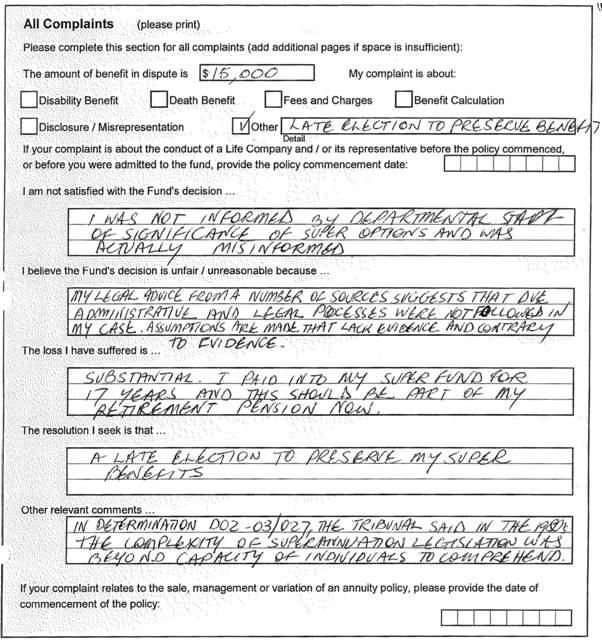
81 On 23 March 2012, the Tribunal sent a letter dated that day to Ms Ludowyk. Omitting formal parts, that letter was in the following terms.
Patricia Anne Ludowyk (nee Rodgers) & Commonwealth Superannuation Scheme
Member No. AGS Nos:23530733 and 70609241
I refer to your complaint against the Commonwealth Superannuation Scheme (‘CSS’) relating to the Trustee’s decision to decline your request for reconsideration of the Trustee’s decision not to accept your late election for preservation of your superannuation rights in respect of your period of membership of the CSS from March 1971 to September 1988.
The Tribunal is currently considering declining to proceed with this complaint. The Tribunal is able to treat complaints as withdrawn under section 22(3)(d) of the Superannuation (Resolution of Complaints) Act 1993 (the SRC Act) if it considers the subject matter of the complaint has already been dealt with by the Tribunal.
The purpose of this letter is to explain why the Tribunal is considering this action and to give you an opportunity to make any comments or provide further information relevant to this consideration.
Previous Complaint 06-0543
The Tribunal notes you lodged a complaint with the Tribunal on 10 April 2006 regarding the Trustee’s decision not to accept your late election for preservation of your superannuation rights and that the Tribunal subsequently affirmed the decision of the Trustee as detailed in its Review Determination No D06-07/137 dated 20 April 2007.
Current Complaint 10-01967
It is noted you subsequently requested the Trustee to reconsider its previous decision and that you lodged another complaint with the Tribunal on 6 October 2010 regarding the Trustee’s decision to uphold its previous decision as detailed above.
Upon review of the file it is the Tribunal’s view that you are seeking the same outcome and that the subject matter of your complaint has already been dealt with by the Tribunal.
Based upon this interpretation, the Tribunal is of the view that this complaint should be withdrawn under section 22(3)(d) of the SRC Act as the subject matter of the complaint has already been dealt with by the Tribunal.
Written Submission
If you wish to make any comment on why you consider that your complaint should not be withdrawn, please provide it to the Tribunal in writing within 21 days of the receipt of this letter. If you do not contact the Tribunal within this period we will assume you do not wish to respond. The Tribunal will make its decision and advise you accordingly.
If you require more time to respond, please contact me (within 21 days) to request an extension. You will need to provide reasons why you require more time so that the Tribunal can consider your request.
Please contact me on 03 8635 5533 if you have any questions (or on 1300 884 114 for the cost of a local call).
82 Ms Ludowyk then sought an extension of time within which to reply to the Tribunal’s letter dated 23 March 2012. The Tribunal gave Ms Ludowyk an extension up to 20 May 2012 and also provided to her all of the information which she had requested from time to time after receipt of the Tribunal’s letter dated 23 March 2012.
83 By letter dated 17 May 2012, Ms Ludowyk responded to the Tribunal’s letter dated 23 March 2012.
84 On 24 July 2012, the Tribunal communicated its decision in relation to Ms Ludowyk’s second complaint. The letter is headed:
SUPERANNUATION (RESOLUTION OF COMPLAINTS) ACT 1993
NOTICE UNDER SECTION 22(4)
OF COMPLAINT HAVING BEEN WITHDRAWN
85 The first three paragraphs of the Tribunal’s letter are in the following terms:
I refer to the Tribunal’s letter of 23 March 2012 concerning your complaint about the actions of the Commonwealth Superannuation Scheme and to your email dated 17 May 2012.
In relation to the matters you raised in your email, the Tribunal remains satisfied that the subject matter of this complaint has been adequately dealt with by the Tribunal in its determination D06-07\137 even if it was not the outcome you were seeking. In addition, the Tribunal notes that the remedy you are seeking is essentially the same as the remedy you sought in your initial complaint.
Consequently, for the reasons above and those explained in the Tribunal’s letter dated 23 March 2012 (a copy of which is enclosed), the Tribunal is treating the complaint as withdrawn under section 22(3)(d) of the Superannuation (Resolution of Complaints) Act 1993 , on the basis that the subject matter of the complaint has already been dealt with by the Tribunal.
Ms Ludowyk’s Submissions
86 Ms Ludowyk made the following submissions:
(a) The Tribunal misconstrued the nature of its review function when it determined Ms Ludowyk’s first complaint on 20 April 2007. It did not carry out a merits review of the delegate’s decision given on 27 March 1997 and the CSS Board’s subsequent reconsiderations of that decision but rather approached its task as if it were conducting judicial review of the delegate’s decision. For this reason, the Tribunal impermissibly introduced into its consideration a test which was akin to the Wednesbury unreasonableness test applied in appropriate cases by courts to applications for judicial review of administrative decisions. The Tribunal failed to undertake its own inquiry into Ms Ludowyk’s original complaint and thus failed to determine that complaint as required by the relevant provisions of the Complaints Act (ss 12, 14(2) and 37). The Tribunal’s failure properly to carry out its statutory review task meant that its decision given on 20 April 2007 was ultra vires.
(b) The Tribunal could not have been satisfied or, alternatively, could not have been reasonably satisfied that the subject matter of Ms Ludowyk’s 2010 complaint had already been adequately dealt with by the Tribunal’s 2007 determination. For that reason, the Tribunal had no basis for deciding to treat the 2010 complaint as if it had been withdrawn under s 21 of the Complaints Act (s 22(3)(d)). Section 22(3)(d) was not engaged because:
(i) The 2007 determination of the Tribunal was ultra vires; and
(ii) The decision of ARIA made on 4 May 2010 which is the subject of the 2010 complaint was based upon new evidence. The Tribunal is therefore required to consider the new evidence and it refused or failed to do so.
87 In the draft Amended OA, Ms Ludowyk raised additional grounds of review which were not pressed in her Written Submissions (Grounds 38–47 failure to take account of relevant considerations and Grounds 48 and 49 failure to provide adequate reasons). As Ms Ludowyk has not seen fit to make any submission in support of these additional grounds, I do not propose to address them.
Consideration
The Relevant Legislative Provisions
88 Sections 11 and 12 of the Complaints Act provide:
11 Tribunal objectives
The Tribunal must, in carrying out its functions or exercising its powers under this Act, pursue the objectives of providing mechanisms for:
(a) the conciliation of complaints; and
(b) if a complaint cannot be resolved by conciliation—the review of the decision or conduct to which the complaint relates;
that are fair, economical, informal and quick.
12 Functions
(1) The functions of the Tribunal are:
(a) to inquire into a complaint and to try to resolve it by conciliation; and
(b) if the complaint cannot be resolved by conciliation—to review the decision or conduct to which the complaint relates;
(c) any functions conferred on the Tribunal by or under any other Act.
(2) In addition to the functions conferred on the Tribunal by a law of the Commonwealth, the Tribunal may perform functions conferred on the Tribunal by a law of a State or Territory, where:
(a) the functions relate to one or more exempt public sector superannuation schemes; and
(b) the schemes are not specified in regulations made for the purposes of section 4A.
89 Section 14(2) of the Complaints Act provides that a person may make a complaint (other than an excluded complaint) to the Tribunal that the relevant decision by a trustee whose decisions are subject to review under the Act is or was unfair or unreasonable. Ms Ludowyk’s complaints are not “excluded complaints” within s 14(2). Her current complaint is that ARIA’s 4 May 2010 decision is unfair or unreasonable because, by that decision, ARIA declined to uphold her late election claim in circumstances where, had it properly considered that claim pursuant to s 157 of the 1976 Act, it would have acceded to it.
90 Section 21 of the Complaints Act provides that a complainant may withdraw a complaint at any time.
91 Section 22 of the Complaints Act provides:
22 Power to treat a complaint as having been withdrawn
(1) If:
(a) a complainant makes a complaint; and
(b) the Tribunal is satisfied, either after having communicated with the complainant, or having made reasonable attempts to contact the complainant and having failed to do so, that the complainant does not intend to proceed with the complaint;
the Tribunal must deal with the complaint as if it had been withdrawn by the complainant under section 21.
(2) If the Tribunal decides to treat a complaint as withdrawn under subsection (1), the Tribunal must give notice in writing to:
(a) if the Tribunal communicated with the complainant—the complainant; and
(b) the other party, or each of the other parties, to the complaint;
of that decision and the reasons for that decision.
(3) The Tribunal may also decide to treat a complaint as if it had been withdrawn under section 21, in the following cases:
(a) if the complaint has been made to the Tribunal and relates to a decision or conduct (other than a decision of a trustee, RSA provider, insurer or other decision maker to pay a disability benefit because of total and permanent disability)—more than 12 months have elapsed since the decision complained of was made or the conduct complained of was undertaken; or
(b) if the complaint has been made to the Tribunal—the Tribunal thinks that the complaint is trivial, vexatious, misconceived or lacking in substance;
(c) if a remedy has been sought from some other body in relation to the subject matter of the complaint—the Tribunal thinks that the subject matter of the complaint has been, or is likely to be, dealt with by that body;
(d) if the subject matter of the complaint has already been dealt with by the Tribunal or by another statutory authority—the Tribunal thinks that the subject matter of the complaint has been adequately dealt with;
(e) if the Tribunal thinks that the subject matter of the complaint could be more effectively or conveniently dealt with by another statutory authority.
(4) If the Tribunal decides to treat a complaint as withdrawn under subsection (3), the Tribunal must give notice in writing of that decision and of the reasons for that decision:
(a) to the complainant; and
(b) to the other party, or each of the other parties, to the complaint.
92 Subsections (4), (5) and (6) of s 37 are in the following terms:
(4) The Tribunal may only exercise its determination making power under subsection (3) for the purpose of placing the complainant as nearly as practicable in such a position that the unfairness, unreasonableness, or both, that the Tribunal has determined to exist in relation to the trustee’s decision that is the subject of the complaint no longer exists.
(5) The Tribunal must not do anything under subsection (3) that would be contrary to law, to the governing rules of the fund concerned and, if a contract of insurance between an insurer and trustee is involved, to the terms of the contract.
(6) The Tribunal must affirm a decision referred to under subsection (3) if it is satisfied that the decision, in its operation in relation to:
(a) the complainant; and
(b) so far as concerns a complaint regarding the payment of a death benefit—any person (other than the complainant, a trustee, insurer or decision-maker) who:
(i) has become a party to the complaint; and
(ii) has an interest in the death benefit or claims to be, or to be entitled to benefits through, a person having an interest in the death benefit;
was fair and reasonable in the circumstances.
93 Section 39 of the Complaints Act provides a mechanism for the reference of questions of law to this Court. Section 46 provides for an appeal to this Court on a question of law. Section 40 requires the Tribunal to give written reasons for its determinations.
94 The Tribunal is obliged to affirm the decision about which complaint is made if it is satisfied that the decision, in its operation in relation to the complainant, was fair and reasonable in the circumstances (s 37(6)). It is required to limit its interference with a reviewable decision to taking such action as is necessary to remove the unfairness or unreasonableness or both from that decision.
The Ultra Vires Point
95 In developing her submissions, Ms Ludowyk refined the first error of law upon which she relies. She submitted that, in carrying out its statutory duty pursuant to s 37 of the Complaints Act, the Tribunal was required to substitute its own view of what was the fair and reasonable decision according to its own value judgments. She submitted that the Tribunal’s task was not to assess the fairness and reasonableness of the decision made by the decision maker in question but rather to consider all of the material in front of the decision maker and possibly even additional material and come to its own view as to what the reasonable decision should be in all the circumstances of the case.
96 I do not agree that the relevant authorities support such an interpretation of s 37 of the Complaints Act. In particular, see Lykogiannis v Retail Employees Superannuation Pty Ltd (2000) 97 FCR 361 at 372–373 [47]–[50] per Mansfield J; National Mutual Life Association of Australasia Ltd v Campbell (2000) 99 FCR 562 at 570–571 [32]–[34] per Black CJ, Emmett and Hely JJ; Retail Employees Superannuation Pty Ltd v Crocker (2001) 48 ATR 359 at 367 per Allsop J (as his Honour then was); and Cameron v Board of Trustees of the State Public Sector Superannuation Scheme (2003) 130 FCR 122 at 129 [25] per Whitlam, Kiefel and Dowsett JJ. The correct approach is captured in the observations by Allsop J in Crocker where his Honour said (48 ATR at 367 [31]):
The tribunal’s task is not to engage in ascertaining generally the rights of the parties, nor is it to engage in some form of judicial review of the decision of the trustee or insurer. Rather it is to form a view, from the perspective of the trustee or insurer, as to whether the decision of either was (recognising the overriding framework given by the governing rules and policy terms, respectively) unfair or unreasonable.
97 It is only if the Tribunal is not satisfied that the decision made by the relevant decision maker was fair and reasonable in the circumstances that the Tribunal is required to consider its options pursuant to subsections (3), (4) and (5) of s 37.
98 In its decision of 20 April 2007, the Tribunal set out its understanding of the requirements of s 137 and s 157 of the 1976 Act. There is no suggestion that the Tribunal misinterpreted those requirements. The Tribunal then set about conducting its review by reference to those principles. The Tribunal looked carefully at Ms Ludowyk’s case and ultimately expressed its conclusion appropriately in terms of s 37(6) of the Complaints Act.
99 In my judgment, the Tribunal did not undertake judicial review of the delegate’s decision. The Tribunal appropriately assessed the fairness and reasonableness of that decision against the evidentiary material presented to it and the submissions made to it. The Tribunal correctly addressed the requisite statutory task. The first step was to decide whether it was satisfied that the delegate’s decision was fair and reasonable in the circumstances. If it was so satisfied, it was obliged to affirm that decision. It was only if it was not so satisfied that other options were required to be considered.
100 Ms Ludowyk has failed to make out her proposition that the Tribunal’s decision of 20 April 2007 was ultra vires the Tribunal in the sense in which she has used that expression.
The New Evidence Point
101 At [17] of ARIA’s Statement of Reasons dated 4 May 2010, under the heading “Request for Reconsideration”, ARIA recorded the following matters:
Request for Reconsideration
On 18 August 2009, Dr Ludowyk submitted another lengthy request for reconsideration on the grounds that the evidence she submitted on 23 June 2008 was in fact new evidence not previously considered. Dr Ludowyk forwarded copies of documents that had already been provided, as well as a copy of an internal SCT file note which was relevant to her case and not previously known to the Trustee. According to Dr Ludowyk, the new evidence comprised:
“i) evidence of a Similar case;
ii) the fact that DVA lost my file and have never provided any Information from my file to ComSuper – therefore ComSuper is basing their case on assumptions – not the facts – and they still can’t find my file;
iii) ask that ComSuper fully consider the fact that a Base Grade Clerk actioned my exit rather than a Personnel Officer as per her signature on the documents;
iv) recognise that there is no proof that anyone other than Ms Nagel actioned my exit;
v) understand that I do not remember being given any notes/pamphlets accompanying the S2R form;
vi) I have not received the relevant material requested (e.g. F155 and other documents which I still haven’t received even from the FOI documents when I requested it);
vii) the inappropriateness of my only next course of action being going to the Federal Court against a bevy of government lawyers with the inability as a citizen to meet these legal costs; and
viii) recognise that it is contrary to model litigant guidelines proclaimed under Section 55Z of the Judiciary Act 1903 for me to not be given all documentation and have to take legal action and for my case not to be considered by an independent reviewer.”
Dr Ludowyk requested that her “case be considered by someone who is independent and without a vested interest.” Dr Ludowyk went on to claim that “the following considerations are important” in her case:
“(a) That I had no knowledge of my right to elect to fully preserve my benefits at the time of resignation
(b) That ComSuper had no interest in telling people of these rights at the time
(c) That ComSuper made no effort to inform Departmental staff of these rights at the time
(d) The fact that a base grade clerk performed my exit interview and did not give me appropriate advice regarding my superannuation
(e) The fact that the CSS (Superannuation Act 1976) was closed on 1 July 1990. There was a wealth of Parliamentary debate over the contingent liability of the Commonwealth arising from the CSS being unsustainable. Late elections simply added to that contingent liability. In the mid to late 1980’s ComSuper determined not to tell anyone anything about late elections in the hope of restraining the liabilities of the CSS.
(f) The fact of the matter is that superannuation rights were a term and condition of the employment of public servants in the 1980’s. An individual public servant’s CSS superannuation entitlement is not dependant on a retrospective view of the Commonwealth as to whether those rights may have been too generous. They are both statutory and contractual in nature. It is poor governance for citizens to be forced into expensive legal battles to get due process.
(g) The fact that similar cases to mine are accepted for late election (eg. Ms Kennedy and others).
Dr Ludowyk’s letter dated 18 August 2009 was accepted as a formal request for reconsideration of the Trustee’s decision and in a letter dated 15 September 2009, she was requested to forward the $150 reconsideration fee.
102 At [23] of its Statement of Reasons, ARIA said that it was satisfied that the material referred to at [17] of its Statement of Reasons constituted relevant evidence not previously taken into account for the purpose of s 153AP of the 1976 Act. For this reason, ARIA embarked upon a fresh reconsideration of Ms Ludowyk’s entire case. To the extent that it considered it relevant, ARIA took into account the contents of Ms Ludowyk’s letter dated 18 August 2009 and the attachments to that letter. That material did not cause ARIA to come to any different conclusion from the conclusions previously reached by the delegate and the Board of the CSS.
103 Subsection (3) of s 22 of the Complaints Act authorises the Tribunal to decide to treat a complaint as if it had been withdrawn in the circumstances set out in the succeeding subparagraphs (a) to (e). The decision is one for the Tribunal, not the Court, although of course the decision may be reviewed. The effect of a decision to treat a complaint as having been withdrawn is to bring the complaint process to an end by deeming the initiating step (the lodgment of the complaint) no longer to be in place.
104 In subparagraph (d) of s 22(3), two concepts are significant. These are:
(a) The meaning of the expression “… the subject matter of the complaint”; and
(b) The requirement that the Tribunal “… think …” that the subject matter of the complaint has “… already adequately been dealt with by the Tribunal”.
105 The expression “subject matter of the complaint” describes something different from the administrative decision specified in s 37 of the Complaints Act. The “subject matter of the complaint” is apt to describe not just the decision about which complaint is made but also the thing or matter which was the subject of that decision. Here, the subject matter of the complaint was Ms Ludowyk’s repeated unsuccessful attempts to procure a decision pursuant to s 157 of the 1976 Act from the relevant statutory trustee from time to time which would have sanctioned as valid her attempt to make a late election to preserve her superannuation benefits as at 29 September 1988 contrary to her conscious and intended decision made at the time to claim a refund of her contributions plus interest. That this is the subject matter of both complaints made to the Tribunal is clear when one compares the two documents lodged with the Tribunal by which each complaint was initiated.
106 The requirement that the Tribunal “…. think …” that the relevant subject matter has already been adequately dealt with by the Tribunal is, in substance, the same as a requirement that the Tribunal be satisfied of that matter. In the present context, the Tribunal would need to be reasonably satisfied of that matter.
107 In the present case, the Tribunal had in its possession ARIA’s Statement of Reasons dated 4 May 2010 and all of the material relied upon by Ms Ludowyk in support of her 2008 and 2009 reconsideration requests made to ARIA. The Tribunal also had access to its own 20 April 2007 determination.
108 In order to come to the conclusion which it did in July 2012 and, more particularly, to be reasonably satisfied that the subject matter of Ms Ludowyk’s 2010 complaint had already been adequately dealt with by the Tribunal’s 20 April 2007 determination, the Tribunal was obliged to identify the subject matter of Ms Ludowyk’s 2007 complaint and to identify the subject matter of Ms Ludowyk’s 2010 complaint and then make an assessment as to whether, having regard to the subject matter of each complaint, the subject matter of the 2010 complaint had been dealt with by the Tribunal’s 20 April 2007 determination. It was then required to consider whether it was satisfied that that subject matter had been adequately (emphasis added) dealt with by the Tribunal in its 20 April 2007 determination. In the present case, the Tribunal alerted Ms Ludowyk to its thinking by its letter dated 23 March 2012. She had a fair and adequate opportunity to address the questions raised by that letter. In fact, she did address those questions.
109 In my judgment, it is for Ms Ludowyk to demonstrate that the Tribunal could not have been reasonably satisfied that, in all the circumstances of the present case, the subject matter of her 2010 complaint had already been adequately dealt with by the Tribunal’s 20 April 2007 determination. In my view, she has failed to make good this proposition.
110 Here, when taking action under s 22(3)(d) of the Complaints Act, the Tribunal was not obliged to set out in the record of its decision the entire history of the matter nor was it obliged specifically to refer to the so-called “new evidence”. Its task was to make a comparative evaluation of the subject matter of each of the two complaints and then to form a view whether the subject matter of the second complaint had been dealt with by its determination of the first complaint. It was then required to consider whether it was satisfied that the Tribunal had adequately dealt with that subject matter in its earlier determination. It could be reasonably satisfied of that matter even if, at the time of the second complaint, new evidence had emerged which had not been available at the time when the first complaint was determined. Of course, the Tribunal would not be bound by ARIA’s view that “new evidence” had emerged. I do not think that it must inevitably follow that the uncovering of new evidence will always lead to a conclusion that the subject matter of the later complaint was not adequately dealt with by the Tribunal’s determination of the earlier complaint. It must be open to the Tribunal to take the view that the new evidence is inconsequential or irrelevant or simply unpersuasive or that the so-called “new evidence” is not “new evidence” at all. It is not always going to be an error of law for the Tribunal to proceed under s 22(3)(d) in circumstances where new evidence has emerged between the date when the first complaint was determined and the date when the subsequent s 22(3)(d) decision was made. Here, the Tribunal concluded that the subject matter of the second complaint had already been dealt with by the Tribunal when it determined the first complaint. The Tribunal also concluded that it was satisfied that the subject matter of the second complaint had been adequately dealt with by the earlier determination. These conclusions were open to the Tribunal and were not affected by any error of law.
111 For the reasons which I have explained at [101]–[110] above, I reject Ms Ludowyk’s second principal submission.
Conclusion
112 Ms Ludowyk has failed to make out either of her attacks on the Tribunal’s decision. Her application must therefore be dismissed.
113 The Tribunal has filed a submitting appearance save as to costs. Because Ms Ludowyk has failed, she is not entitled to any order for costs. I am inclined to think that I should not make an order for costs in favour of the Tribunal. The only costs which it may have incurred were in relation to filing its Submitting Notice and its consideration of the draft Amended OA. However, against the possibility that the Tribunal wishes to claim costs, I propose to reserve the question of costs for a period of fourteen (14) days and to grant to the Tribunal liberty to apply in respect of costs. In the event that the Tribunal seeks an order for costs, it should file a Written Submission of no more than three (3) pages in length by no later than 23 July 2013. Ms Ludowyk should file any answering submission, also of no more than three (3) pages in length, by 30 July 2013. Thereafter, I will deal with the question of costs on the papers.
114 There will be orders accordingly.
I certify that the preceding one hundred and fourteen (114) numbered paragraphs are a true copy of the Reasons for Judgment herein of the Honourable Justice Foster. |
Associate:


