FEDERAL COURT OF AUSTRALIA
Stankovic v The Hills Shire Council [2013] FCA 652
FEDERAL COURT OF AUSTRALIA
Stankovic v The Hills Shire Council [2013] FCA 652
CORRIGENDUM
1. On the second page of the judgment, the Solicitor for the First Respondent should read “Mr M Pearce of The Hills Shire Council”, instead of “Ms M Pearce of The Hills Shire Council”.
2. In paragraph 60 of the Reasons for Judgment, at the beginning of the third sentence, commencing on line 3, replace the word “She” with “Ms Groves”.
3. In paragraph 85(b) of the Reasons for Judgment, replace “$650,000 to Mr Stankovic” with “$150,000 to Mr Stankovic”.
I certify that the preceding three (3) numbered paragraphs are a true copy of the Corrigendum to the Reasons for Judgment herein of the Honourable Justice Foster. |
Associate:
Dated: 8 July 2013
IN THE FEDERAL COURT OF AUSTRALIA | |
DATE OF ORDER: | |
WHERE MADE: |
THE COURT ORDERS THAT:
1. The following Interlocutory Applications made to the Court by the applicant (Milovan Stankovic) be dismissed:
(a) Interlocutory Application (styled “Application in a Case”) filed in Court on 13 March 2013;
(b) Interlocutory Application filed on 3 June 2013; and
(c) Interlocutory Application (styled “Amended Application”) dated 1 June 2013 but not filed whereby the applicant sought to add Giulia Inga as an additional respondent in this proceeding and also claimed other relief.
2. Pursuant to s 31A of the Federal Court of Australia Act 1976 (Cth) and r 26.01 of the Federal Court Rules 2011, the applicant’s Originating Application filed on 12 October 2012 and the whole of this proceeding be dismissed.
3. The applicant pay the respondents’ costs of and incidental to the Interlocutory Applications specified in Order 1 above and their costs of and incidental to this proceeding.
Note: Entry of orders is dealt with in Rule 39.32 of the Federal Court Rules 2011.
NEW SOUTH WALES DISTRICT REGISTRY | |
GENERAL DIVISION | NSD 1571 of 2012 |
BETWEEN: | MILOVAN STANKOVIC Applicant
|
AND: | THE HILLS SHIRE COUNCIL (ABN 25 034 494 656) First Respondent WATSON AND WATSON Second Respondent TERRY GRANT VAN DER VELDE Third Respondent JASON SHANE CRONAN Fourth Respondent CHARLES HOCKEY Fifth Respondent KENT LAWYERS (ABN 38 086 937 738) Sixth Respondent
|
JUDGE: | FOSTER J |
DATE: | 4 JULY 2013 |
PLACE: | canberra (via video link to SYDNEY) (heard in sydney) |
REASONS FOR JUDGMENT
1 Milovan Stankovic, who is the applicant in this proceeding, was made bankrupt on 12 May 2009 by order of the Federal Magistrates Court. He was discharged from that bankruptcy by operation of law on 14 July 2012 (as to which see s 149(1) and s 149(4) of the Bankruptcy Act 1966 (Cth) (the Bankruptcy Act)).
2 By Originating Application filed in this Court on 12 October 2012, Mr Stankovic commenced the present proceeding. In his Originating Application, he sought the following relief:
1. An Order that the bankruptcy NN4889/07 against Mr. Milovan Stankovic be annulled pursuant to section 153B (1) of the Bankruptcy Act 1966 (Cth).
2. An Order for restoration of the property at Lot B, President Road, Kellyville, NSW, 2155 to the Applicant and damages as assessed by the Court.
Or in the alternative
3. From the First, Second, Third, Fourth, Fifth and Sixth Respondents damages totalling $35,000,000 (thirty-five million dollars).
4. Damages as assessed by the Court in relation to pain and suffering and damage to the health of the Applicant caused by the actions of the First, Second, Third, Fourth, Fifth and Sixth Respondents.
5. That the trial of these proceedings be held before a jury pursuant to s 39 of the Federal Court of Australia Act 1976.
3 I have extracted the claims for relief in Mr Stankovic’s Originating Application verbatim without correcting syntax or expression. I understand that the reference in par 1 of that Application to “… bankruptcy NN4889/07 …” is a reference to a bankruptcy notice. All of the respondents in the present proceeding accept that one of the orders which Mr Stankovic is seeking in the present proceeding is an annulment of his bankruptcy. I intend to proceed upon that basis notwithstanding the inelegant form of words chosen by him to articulate that claim for relief.
4 In addition to the claims for relief which I have set out at [2] above, Mr Stankovic sought interlocutory relief in his Originating Application. First, he claimed an interlocutory injunction restraining development of the property at Lot B, President Road, Kellyville, NSW (the property) pending determination of the present proceeding. That property was sold in 2011. That sale was, in effect, supervised by the Family Court of Australia. This first claim for interlocutory relief is hopeless. Second, he sought an interlocutory injunction preventing the enforcement by the fifth respondent (Charles Hockey) of any Garnishee Order against him pending the determination of Mr Stankovic’s claims for final relief. Third, he sought an additional interlocutory injunction restraining the enforcement of any other debts claimed by any of the respondents. As far as I am aware, he did not press any of those claims for interlocutory relief before the previous docket judge or before the Registrar. He certainly did not do so before me.
5 The Hills Shire Council (formerly “The Baulkham Hills Shire Council”) (the Council) is the first respondent in the present proceeding. The Council was the applicant in the bankruptcy proceedings before the Federal Magistrates Court. It was also the applicant in certain proceedings in the Land and Environment Court of New South Wales (the L & E Court) (File No 41243 of 2004) (the L & E Court proceedings) in which Mr Stankovic and his former wife, Milka Stankovic, were respondents. An unpaid debt for costs ordered against Mr Stankovic in those proceedings was the foundation of the bankruptcy notice which gave rise to the relevant act of bankruptcy.
6 Watson and Watson, a firm of solicitors, is the second respondent in the present proceeding. That firm acted for the Council in the bankruptcy proceedings. It represents itself and the third and fourth respondents in the present proceeding.
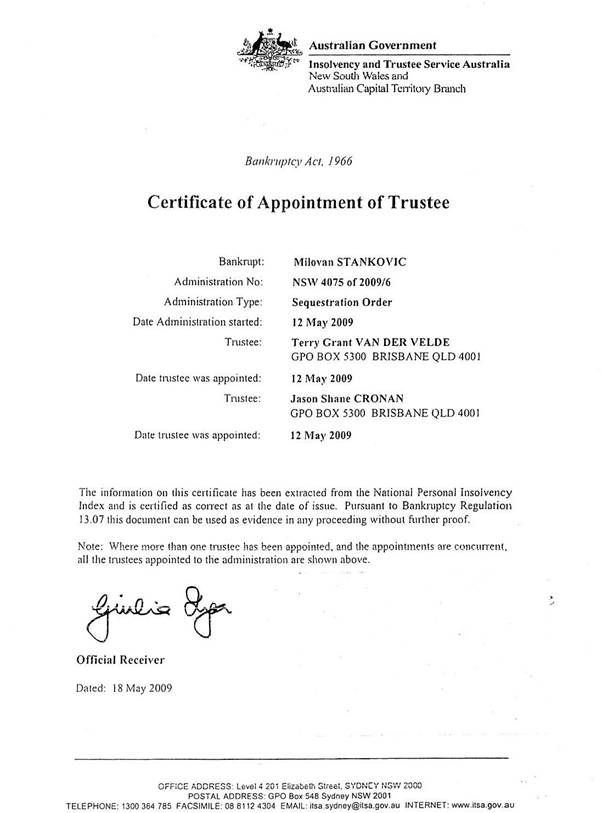
7 The third and fourth respondents (Messrs Van der Velde and Cronan) (the trustees) are the trustees of Mr Stankovic’s bankrupt estate. They were appointed as such by Certificate of Appointment of Trustee dated 18 May 2009. Their appointment took effect on 12 May 2009, the date when the sequestration order was made. I have attached to these Reasons for Judgment as Attachment “A” a copy of the relevant Certificate of Appointment of Trustee.
8 Charles Hockey is a solicitor who represented Mr Stankovic in connection with certain applications in relation to Mr Stankovic’s bankruptcy which Mr Stankovic made in this Court in the period from about 20 May 2009 to mid October 2009.
9 The sixth respondent (Kent Lawyers) (Kent) is a firm of solicitors which had represented Mr Stankovic in connection with various disputes which he had with the Council and in connection with other matters. Kent claimed to be owed a substantial sum of money by way of legal fees and disbursements by May 2009. Kent claimed to be a supporting creditor at the hearing of the Creditor’s Petition pursuant to which Mr Stankovic was made bankrupt.
10 Each of the respondents in the present proceeding has filed an Interlocutory Application in which each of them seeks to have the proceedings summarily dismissed or, alternatively, struck out. The respondents rely upon s 31A of the Federal Court of Australia Act 1976 (Cth) (the Federal Court Act) and r 16.21 and r 26.01 of the Federal Court Rules 2011 (FCR). Although the grounds relied upon vary as between respondents to some extent, each of them contends that the bringing of the present proceeding by Mr Stankovic is an abuse of process. Some of those respondents also contend that Mr Stankovic is prevented from maintaining the present proceeding by reason of the application of the doctrines of res judicata and issue estoppel or extensions of those doctrines. Finally, all respondents submit that Mr Stankovic’s damages claim should not be allowed to stand because his Statement of Claim discloses no reasonable cause of action or, alternatively, because there is no reasonable prospect of Mr Stankovic succeeding in respect of his claim for damages.
11 In its Amended Interlocutory Application filed on 6 March 2013, Kent claims in the alternative to its claims for summary dismissal and strike-out an order for the separate trial of Mr Stankovic’s annulment application. In his Written Submissions, Charles Hockey pressed only his strike-out claim. During oral submissions, Counsel for Mr Hockey changed position and decided to also press Mr Hockey’s claim for summary dismissal. He accepted that, in the event that I dismissed the whole of the proceeding as against Mr Hockey, such dismissal would not prevent Mr Stankovic from later bringing proceedings in the appropriate court against Mr Hockey for damages for breach of his retainer.
12 The relevant dealings between Mr Stankovic and the Council have been ongoing since 2001. Those dealings are at the heart of all of the subsequent events which have now enmeshed the other respondents.
13 These Reasons for Judgment determine all of the Interlocutory Applications filed by the respondents. I shall also deal with an application by Mr Stankovic to stay certain orders made by Emmett J on 14 December 2012 and continued by the Full Court on 3 June 2013 as well as an additional application made by Mr Stankovic to amend further his Originating Application in order to join as an additional respondent the Official Receiver who signed the Certificate of Appointment of Trustee which is Attachment “A” to these Reasons for Judgment.
Mr Stankovic’s Statement of Claim
14 On 12 October 2012, Mr Stankovic filed a Statement of Claim in this proceeding in which he pleaded the causes of action upon which he intends to rely as justifying the relief which he claims. That pleading was prepared by his then legal representative who certified, as he was bound to do, that the factual and legal material available to him at the time of certification provided a proper basis for each allegation in the pleading. I now set out in full and without alteration the text of Mr Stankovic’s Statement of Claim:
1. The Applicant was a joint registered proprietor of property described as Lot B, President Road, Kellyville, NSW 2155, within the boundaries of the Hills Shire Council.
2. The bankruptcy NN4889/07 against Mr. Milovan Stankovic (the bankruptcy) was initiated by the First Respondent using the provisions of the Bankruptcy Act 1966 (Cth) alleging a debt of $22,077.87 arising out of a Court Order from the Land and Environment Court notwithstanding that the said Court had dismissed the action by the First Respondent against the Applicant 16 February 2005.
3. Following an application for sequestration of the Applicant’s estate the matter came on for hearing before Federal Magistrate Raphael on 12 May 2009. At that hearing the Applicant disputed the alleged debt to the First Respondent and Federal Magistrate Raphael stayed action under the proceeding for 21 days.
4. On 25 May 2009, before the expiration of the 21 days, the Applicant paid the disputed debt to the First Respondent in order to set aside or annul the bankruptcy.
5. Notwithstanding payment of the debt within the 21-day period granted by Federal Magistrate Raphael, the Second, Third and Fourth Respondents claimed control of the Applicant’s affairs and had the Third and Fourth Respondents appointed as trustees in bankruptcy. This was a failure to comply with the direction of Federal Magistrate Raphael, in breach of s 30(5)(b) of the Bankruptcy Act, and a clear breach of their obligations as Trustees.
6. It was alleged that the Applicant committed an act of bankruptcy on 30 December 2007 and the Applicant was declared bankrupt on as and from 12 May 2009 and filed a statement of affairs on 13 July 2009. Pursuant to s 149(4) of the Bankruptcy Act he was automatically discharged on 13 July 2012.
7. During the period of Bankruptcy and continuing the Applicant’s estate and affairs were and are under the control of the Third and Fourth Respondents.
8. The Third and Fourth Respondents, while administering the Applicant’s estate, sold the property at Lot B, President Road, Kellyville, 2155, NSW, preventing the Applicant from developing and selling it at an estimated profit of $35,000,000 (thirty-five million dollars).
9. The Applicant filed an application for annulment of the bankruptcy order on 20 May 2009. The Fifth Respondent was engaged as solicitor to act for the Applicant in that application.
10. The Fifth Respondent acted without or against instructions given to him by the Applicant and entered a consent order with Mr. Gourlie, lawyer from Watson and Watson Solicitors, the Second Respondent, acting for the First Respondent, and the Third and Fourth Respondents and with Mr. Orlizki, lawyer on behalf of the Sixth Respondent to withdraw the applicants application to annul the bankruptcy on 2 June 2009 before Registrar Hedge. This was contrary to ss 20 and 21 of the Australian Consumer Law, Competition and Consumer Act 2010: Schedule 2, which prohibit unconscionable conduct in trade or commerce.
11. The Fifth Respondent again acted without or against instructions in entering into a consent order with Mr. Gourlie, lawyer from Watson and Watson Solicitors, the Second Respondent, acting for the First, Third and Fourth Respondents, to withdraw the Applicant’s application to annul the bankruptcy on 13 October 2009 before Registrar Smith. This was contrary to ss 20 and 21 of the Australian Consumer Law, Competition and Consumer Act 2010: Schedule 2, which prohibit unconscionable conduct in trade or commerce.
12. The Applicant had engaged the Sixth Respondent on a contingency fee basis to act for him in relation to the subdivision and development of the property situated described in paragraph one above, and in which the applicant was a joint registered proprietor.
13. Contrary to the fee arrangements made, which were on a contingency basis subject to successful development of the property described in paragraph one above, the Sixth Respondent submitted accounts for payment during the period of bankruptcy notwithstanding this was contrary to the fee agreement and the Applicant was prevented by the Third and Fourth Respondents from disputing or challenging the bill of costs.
14. As a result of the actions of the Respondents both individually and jointly the Applicant has suffered economic loss and damage in the sum of $35,000,000 (thirty-five million dollars) and also has suffered significant and severe health problems.
15. The Applicant seeks annulment of the bankruptcy pursuant to section 153B(1) of the Bankruptcy Act 1996 (Cth).
16. The Applicant seeks restitution and damages.
15 In his Statement of Claim, Mr Stankovic appears to make three broad claims. First, a claim pursuant to s 153B of the Bankruptcy Act for an order annulling his bankruptcy. Second, a claim for damages pursuant to s 20 and s 21 of the Australian Consumer Law (ACL) against all respondents by reason of unconscionable conduct on the part of each of them as alleged in pars 10 and 11 of the Statement of Claim. Third, a claim against Kent for claiming an entitlement to fees and disbursements as against Mr Stankovic in breach of the true arrangement which he contends was a contingency fee arrangement (as to which, see par 13 of the Statement of Claim).
The Relevant Facts
16 The Council commenced the L & E Court proceedings in late 2004. In those proceedings, the Council sought declaratory and injunctive relief against the Stankovics requiring them to clean up the property and to cease keeping pigs there.
17 At a listing in the L & E Court on 24 November 2004, the Council’s claims for relief were listed for hearing on 19 January 2005.
18 On 9 January 2005, the hearing fixed for 19 January 2005 was vacated. On that occasion, the proceedings were adjourned to 16 February 2005 before the Class 4 judge.
19 On 16 February 2005, when the matter was called on before the Class 4 judge, there was no appearance on behalf of the Council. Mr Stankovic appeared on his own behalf (unrepresented). His wife did not appear.
20 The judge who took the list on that day dismissed the L & E Court proceedings “… for want of prosecution”.
21 On 22 February 2005, the Council applied to the L & E Court to have the L & E Court proceedings reinstated.
22 On 4 March 2005, the L & E Court fixed 14 March 2005 as the hearing date for the L & E Court proceedings. Mr Stankovic was present in Court on 4 March 2005. It is not clear from the file index of the L & E Court tendered in evidence before me whether any formal order reinstating the L & E Court proceedings was ever made. Nonetheless, it is clear that the Court and all of the parties thereafter proceeded upon the basis that those proceedings had been reinstated.
23 On 14 March 2005, a judge of the L & E Court (Pain J) heard the L & E Court proceedings. Mr Stankovic again appeared on his own behalf. His wife filed a submitting appearance. On that day, her Honour delivered Reasons for Judgment ex tempore and made final orders (Baulkham Hills Shire Council v Stankovic [2005] NSWLEC 110).
24 Her Honour was called upon to consider whether Mr and Mrs Stankovic should be restrained from keeping pigs at the property and whether they were maintaining a junk yard at the property in breach of the residential zoning applicable to the property. The Council had issued a number of notices and orders to the Stankovics in relation to the storage of building material, second hand items and general rubbish on the property in the period between October 2001 and late 2003. Following further inspections in the first half of 2004, the Council had decided to take action against the Stankovics.
25 At the hearing before Pain J, Mr Stankovic gave oral evidence and made submissions. Her Honour summarised that evidence at [19]–[24] of her Honour’s Reasons for Judgment.
26 At [28]–[31] of her Reasons, her Honour said:
28 The Council has been taking action since 2001 to have building material, second hand items and general rubbish on the property removed. It has issued a number of notices and orders none of which have been complied with by the First Respondent. In relation to the junk yard matter I intend to make the declaration sought in prayer 4, the order sought in prayer 5 and the order for removal in prayer 6 but with some variation to that sought by the Council.
29 I have asked the parties to draw a map of the property showing the location of the bricks and timber brought from Eastwood. I will allow these to remain for 18 months to enable the First Respondent time to make an application to the Council for development consent for the building of a house. The parties are to return to the Court in 18 months to see how the matter has progressed, at which point I will decide whether or not to make an order for removal of these materials. The piles of timber are to be stacked neatly into four piles within two months in order to reduce the visual impact of the site on neighbouring properties.
30 All other second hand and unused items such as old cars and trucks, white goods and general rubbish are to be removed from the property within six months. I have allowed such a lengthy period because of the First Respondent’s numerous medical difficulties as evidenced by the medical report dated 28 October 2004 tendered by the First Respondent. While this report is now some months old I will give the First Respondent the benefit of the doubt and take this into account in allowing such a generous period.
31 While these orders and declarations are sought against the Second Respondent and she is one of the registered proprietors of the land, there is no evidence that she has played any active role in relation to the property and I am not minded to make any orders or declarations in relation to her.
27 Her Honour also decided to grant the injunction sought in relation to the keeping of pigs on the property.
28 At [33] of her Reasons, her Honour said:
For completeness I note that the First Respondent has sent a letter to the Chief Judge dated 9 March 2005 in relation to which I have provided the opportunity for both parties to make submissions. There is no particular matter in the letter that I consider needs to be taken into account in this judgment.
29 At the end of her Reasons for Judgment delivered on 14 March 2005, Pain J invited the Council to provide a final version of the orders required to give effect to her Honour’s Reasons.
30 On 22 March 2005, the L & E Court made the following orders:
1. An Order restraining the First Respondent by himself, his servants, agents or contractors from carrying out or undertaking on the property a use of pig keeping;
2. A declaration that the property is being used as a junk yard in breach of s 76B of the Environmental Planning and Assessment Act 1979;
3. An Order restraining the First Respondent by himself, his servants, agents or contractors from carrying out or undertaking on the property the use of a junk yard;
4. An Order that the First Respondent neatly stack all timber located on the property as at the date of these Orders into stacks at the locations marked “X” identified on the plan at Annexure A to these Orders within two months of the date of these Orders;
5. An Order that the First respondent remove from the property all second hand and unused items such as old cars, white goods, general rubbish and accumulated used building material (with the exception of bricks located on the property as at the date of these Orders and timber identified in locations marked “X” identified on the plan at Annexure A to these Orders) within six months of the date of these Orders;
6. Direct that the issue of the making of an Order concerning the removal of bricks and timber located on the property be stood over before me on Tuesday 19 September 2006;
7. Grant liberty to all parties to apply for further Directions or Orders on 3 days’ prior notice; and
8. Order that the First Respondent pay the Applicant’s costs of the proceedings
31 Mr Stankovic was the first respondent referred to in the orders made by Pain J on 22 March 2005. He was, therefore, the person liable to pay the Council’s costs of the L & E Court proceedings pursuant to Order 8 of those orders.
32 It is not necessary for present purposes to reproduce Annexure “A” to the orders extracted at [30] above and I have not done so.
33 The Council subsequently took steps to have its costs assessed. Those costs were ultimately quantified in the amount of $22,077.87.
34 In 2007 and 2008, Mr Stankovic made applications to the L & E Court in which he sought adjustments to the Orders which Pain J had made on 22 March 2005. Those applications did not concern or touch the costs order which her Honour had made on that occasion.
35 By Notice of Motion filed on 25 November 2008 in the L & E Court proceedings, Mr Stankovic sought to attack the costs order which Pain J had made on 22 March 2005. That application was determined by Reasons for Judgment delivered by Pain J on 19 December 2008 (Baulkham Hills Shire Council v Stankovic (No 5) [2008] NSWLEC 327).
36 After referring to various rules in the Uniform Civil Procedure Rules 2005 (UCPR) (at [3]–[6]), at [7]–[9], her Honour said:
7 The Respondent swore an affidavit dated 24 November 2008 and filed written submissions beforehand, which I have read and taken into account. The affidavit sets out the history of the proceedings in this Court, attaches the numerous judgments handed down by me, refers to two Notices of Intention to Appeal filed, states that he believes these refer to the 2005 orders including the 2005 costs order and also refers to bankruptcy proceedings against him which have been commenced by the Council in the Federal Magistrates Court. He states that he is aware the 2005 order is still enforceable. He also states that it is his belief that the September 2008 judgment has given rise to circumstances that need to be revisited, including the 2005 costs order.
8 The Respondent stated that the Notice of Motion is made, firstly, in reliance on r 36.15 on the basis that the costs order was entered irregularly. The basis for the submission that the order was made irregularly was that the Respondent believed that the proceedings were not then finalised and he did not understand that the costs order was also final. Further, there have been four judgments in this matter and the orders made in March 2005 have been amended significantly so that the costs order should be set aside pending the finalisation of this matter. The Respondent submits that all the previous decisions in the proceedings need to be revisited, including the 2005 costs order. The 2005 orders should not be treated as final orders. Alternatively, as a matter of fairness any costs penalty involved in the 2005 orders should be stayed or set aside pending the final outcome of the proceedings.
9 Reliance was also placed on r 36.16(3), relying on the same grounds.
37 At [10], her Honour recorded the fact that the Council had obtained a judgment by default in the Local Court of New South Wales at Hornsby on 22 August 2007 for the amount of the costs which Pain J had ordered Mr and Mrs Stankovic to pay to the Council by Order 8 made by her on 22 March 2005, which amount had been subsequently assessed in accordance with the cost assessment regime under the UCPR.
38 The Council submitted to Pain J that there was nothing irregular about the costs order which she had made on 22 March 2005, that it had been well and truly perfected and that it was therefore final. The Council also submitted that no appeal had been lodged by any party in relation to that costs order. In previous applications to the L & E Court, there had been no challenge by either Mr Stankovic or his wife to the costs order which Pain J had made on 22 March 2005. The Council went on to submit that the L & E Court proceedings had been finalised with the consequence that there was no residual discretion in the L & E Court to set aside the costs order.
39 At [16]–[27], her Honour set out her reasons for dismissing the application before her in relation to costs. Her Honour held that the costs order was a final order. She noted that Mr Stankovic had never appealed from that order. She held that there had been no irregularity in the making or the entry of that order. She concluded that there was no basis for altering or interfering with the costs order and she declined to do so.
40 On 12 May 2009, Raphael FM heard the Creditor’s Petition in matter No SYG 1333 of 2008. On that occasion, Mr Stankovic again appeared on his own behalf. Mr Ash appeared for the Council. Mr Kent appeared for Kent. He claimed that Kent was a supporting creditor. At the time of the hearing before Raphael FM, Kent had claimed an amount in excess of $246,000 as legal fees and disbursements due to them from Mr Stankovic.
41 On 12 May 2009, Mr Stankovic sought an adjournment of the hearing of the Creditor’s Petition. His Honour refused that application.
42 His Honour then moved on to consider whether a sequestration order should be made against the estate of Mr Stankovic. Ultimately, his Honour made such an order. His Honour gave the following Reasons for Judgment in support of the orders which he made (The Hills Shire Council v Stankovic [2009] FMCA 478):
1. The applicant creditor now seeks a sequestration order against the debtor. The amount of the debt owed is approximately $22,000.00. The debtor resists on two grounds. First he says that he is solvent and second he says that there is other sufficient cause why I should not make the sequestration order. Insofar as his solvency is concerned he puts forward the fact that he owns, at least in part, a piece of land which has a value admitted by the council to be at least $5,000,000.00. I am prepared to accept the evidence given by the debtor that there is only one mortgage on the property of approximately $100,000.00. However, the existence of an asset is not the appropriate test for solvency. It is now well established that the applicant must show an ability to pay his debts as and when they fall due from funds available to him or capable of being made available within a reasonable time; Sarina, Re; Ex parte Wollondilly Shire Council [1980] 43 FLR 163, Sandell v Porter (1966) 115 CLR 666 at [670].
2. The debtor has sworn to the fact that he is an invalid pensioner existing on a pension of approximately $567.90 per fortnight and so it is clear that he has no available moneys with which to pay this debt, other than the land. In this regard he has put forward some evidence that he has received an offer of a line of credit from the ANZ of approximately $500,000.00. As I explained in my decision relating to the grant of the adjournment, the offer from the ANZ Bank that was produced to this court was incomplete and there would appear to be another document which sets out the conditions upon which it is proposed that this loan be given. Because I have so little evidence about the loan I do not believe that I could take it into account to the extent that I would decline to grant the sequestration order to which I believe Mr Ash has established his client is entitled; Cain v White (1933) 48 CLR 639. I note that the land is held in joint names and that Mr Stankovic is awaiting a decision upon a property settlement application with his former wife. The land is unlikely to be sold for some time.
3. However, I am prepared to give Mr Stankovic some assistance. The court is empowered to grant a stay of any sequestration order for a period of a maximum of 21 days. Mr Stankovic has told me that all he needs to do in order to have this loan from the ANZ Bank materialise is to obtain his wife's signature on the documentation and present it to the ANZ Bank. He further tells me that if he receives the payment from the ANZ Bank he will pay, under protest, the Baulkham Hills Shire Council which I understand is now know as “The Hills Shire Council”, and in those circumstances if I am not prepared to dismiss the application for other sufficient cause I would propose to make a sequestration order subject to such a stay.
4. Coming to “other sufficient clause” [sic], the debtor’s submissions in this regard are a combination of his complaint against the council for bringing litigation against him over the hoarding of rubbish upon his land and the fact that as he has a significant asset he would say that the council has not properly sought to recover its debt by a manner other than this particular one. He also argues that he has an appeal on foot against certain decisions of the New South Wales Land and Environment Court. A court in bankruptcy is always reluctant to become too deeply involved in the litigation which parties have had previously and which have resulted in orders that end up being the subject of bankruptcy notices and then petitions. In this particular case, as I understand it, there has been a long running dispute between Mr Stankovic and the council over the land in question. But the matter which impresses me most is the fact that the costs order which is the basis of the petition does not relate to the proceedings which Mr Stankovic is seeking to appeal and that those costs were assessed in 2007 and we are now in 2009. It may well be that even if Mr Stankovic is successful in his appeal, and I understand that he really is making a cross appeal against some appeal from the council in relation to the 2008 litigation, this will not necessarily have the effect of reversing the costs order upon which this petition is based. I am unable to see how raising the matters which include the existence of the appeal, constitutes other sufficient cause for the purposes of s.52(2) of the Bankruptcy Act 1966 (the “Act”). Mr Stankovic has not satisfied me that the council has brought this case for an improper motive, and as I have already said, I am not satisfied that a successful appeal would alter the situation. For that reason I would not dismiss the petition for other sufficient cause.
5. I have heard from Mr Kent, a solicitor and a supporting creditor. Mr Kent claims that he is owed approximately $244,677.00 plus interest on bills of costs rendered to Mr Stankovic between January and July 2008 which Mr Stankovic has not requested be the subject of assessments. These are certainly bills of costs for which Mr Kent could prove in Mr Stankovic's bankruptcy but they are not bills which are yet the subject of any judgment of a court. The existence of this other creditor does reinforce the view I have taken that I should not exercise my discretion to dismiss this petition.
43 His Honour then made the following orders:
THE COURT ORDERS THAT:
1. Pursuant to s.33(1)(b) of the Bankruptcy Act 1966 I amend the name of petitioning creditor to “The Hills Shire Council”.
2. A sequestration order be made against the estate of Milovan Stankovic.
3. All proceedings under this order are stayed for a period of 21 days.
4. The Applicant creditor’s costs (including any reserved costs) be taxed (in accordance with the Federal Magistrates Court (Bankruptcy) Rules 2006) and paid from the estate of the Respondent Debtor in accordance with the Act.
5. Liberty to apply on 2 days notice.
THE COURT NOTES:
i) The date of the act of bankruptcy is 30 December 2007.
ii) A Consent to Act as Trustee has been signed by Mr Terry Grant Van Der Veld and Mr Jason Shane Cronan and has been lodged with the Official Receiver in Sydney.
iii) Under the Bankruptcy Regulations a copy of the sequestration order be given to the Official Receiver in Sydney.
44 After Raphael FM delivered Reasons for Judgment and made orders on 12 May 2009, the following exchange took place between the Federal Magistrate, Mr Ash and Mr Stankovic:
FEDERAL MAGISTRATE: Thank you, Mr Ash, for your assistance. All right. Do you understand, Mr Stankovic? You have told me that you can get this money within a week. You’ve got 21 days. If you can get it within 21 days and you pay them you can come back ---
MR STANKOVIC: As soon as I get it, as I said, your Honour, I will pay in a protest.
FEDERAL MAGISTRATE: You can come back to this Court and you can seek to have the order dismissed. You have to do that. Do you understand that? Just paying him isn’t going to be good enough because there’s this gentleman here who’s got a problem.
MR STANKOVIC: Well, that gentleman have to do proper way.
FEDERAL MAGISTRATE: Yes, well, that may be the case. I’m not going to make up my mind about that.
MR STANKOVIC: Yes, okay.
FEDERAL MAGISTRATE: All right? If you can’t do it in 21 days then you have to talk to your trustee.
MR STANKOVIC: Yes.
MR ASH: Your Honour, might it be I think it appropriate given Mr Stankovic’s lack of representation – either by way of note or by way of order that if Mr Stankovic wishes to relist the matter it must be on notice to the creditor and to the supporting creditor.
FEDERAL MAGISTRATE: Do you understand that?
MR STANKOVIC: I – part of it.
MR ASH: If you want to come back to Court you have to be able to show the Court that you have informed my solicitor and you have informed Mr Kent. Do you understand that?
MR STANKOVIC: I did not receive from Mr Kent anything. I don’t know what I owe him. I don’t know how he come·---
FEDERAL MAGISTRATE: No, whatever your views may be about Mr Kent and his bill, he has put on an appearance in this Court. He’s here. All right?
MR STANKOVIC: Yes.
FEDERAL MAGISTRATE: So you’re going to have to tell him if you want to come back. Otherwise if you don't come back to the Court the bankruptcy - the sequestration order will take effect. Do you understand that?
MR STANKOVIC: Yes, all right.
FEDERAL MAGISTRATE: If you don’t come back here within that three weeks the sequestration order will take effect.
MR STANKOVIC: Yes, your Honour.
FEDERAL MAGISTRATE: Do you understand that?
MR STANKOVIC: Yes, I do, your Honour.
FEDERAL MAGISTRATE: Whether you’ve paid him or you haven’t. Do you understand that?
MR STANKOVIC: Yes, okay, your Honour.
FEDERAL MAGISTRATE: So if you get the money from the ANZ Bank and you pay Mr Ash’s client, you have still got to come back to this Court and ask the Court to dismiss the petition.
MR STANKOVIC: Okay, thank you.
FEDERAL MAGISTRATE: And you must tell Mr Kent. Do you understand that?
MR STANKOVIC: Yes, your Honour.
FEDERAL MAGISTRATE: Not an hour before you come back to the Court but when you are going to the Court. Okay? Do you understand that?
MR STANKOVIC: I didn’t want to do that deliberately, your Honour. That’s just my problems with ---
FEDERAL MAGISTRATE: I’m just telling you, I’m not criticising you.
MR STANKOVIC: Thank you.
FEDERAL MAGISTRATE: All right? You have to tell·– I think we’ll have liberty to apply on two days’ notice.
MR ASH: Thank you, your Honour.
FEDERAL MAGISTRATE: Two days’ notice you have to give him.
MR STANKOVIC: Okay. Thank you, your Honour.
FEDERAL MAGISTRATE: That’s not Saturday and Sunday. Do you understand that?
MR STANKOVIC: I understand that.
FEDERAL MAGISTRATE: All right. Thank you both.
MR ASH: Thank you.
45 I pause to observe that, at T 25, ll 24–27, the Federal Magistrate made clear to Mr Stankovic that paying out the Council would not, on its own, be a sufficient basis for having the sequestration order set aside or stayed. His Honour specifically adverted to the need for Mr Stankovic to deal with Kent and Mr Kent to whom his Honour referred as “…. this gentleman here who’s got a problem”. His Honour also stressed that, if Mr Stankovic wished to attempt to have the sequestration order set aside and the Creditor’s Petition dismissed, he would be required to make an application to the Federal Magistrates Court. Mr Stankovic was told that nothing would happen automatically just because Mr Stankovic paid out the Council.
46 On 18 May 2009, Giulia Inga, the Official Receiver, issued a Certificate of Appointment of Trustee. I have attached to these Reasons for Judgment as Attachment “A” a copy of that certificate.
47 On 20 May 2009, Mr Stankovic filed an Application in the Federal Magistrates Court of Australia (matter No SYG 1223 of 2009) (the first annulment proceeding). The only respondent named in that Application was the Council. The trustees were not initially joined as parties to that proceeding.
48 In his Application filed on 20 May 2009 in the first annulment proceeding, Mr Stankovic claimed the following relief:
A. The Debtor pay to Creditor pay forthwith $22077,87 by bank cheque.
B. The Debtor account and pay by bank cheque the outstanding interest to the Creditor on reciled of the amount within 14 day or recile of the agee amount.
C. The Bankrupt Notice be set aside OR
D. A stay on the orders of 12 May 2009 unless the Debtor has findilgs the Court of Appel between the Debtor and Creditor OR
E. The bankrupt be annulment of the Notice OR
49 In the same Application, he also sought a stay of the orders made by Raphael FM on 12 May 2009 in proceeding NSD 1333 of 2008.
50 In an affidavit sworn on 20 May 2009 in support of the relief sought by him in the first annulment proceeding, Mr Stankovic made clear that he intended to pay the full amount of the debt due to the Council (including interest) and that, upon payment, he wished to have the sequestration order set aside or his bankruptcy annulled.
51 On 25 May 2009, Mr Stankovic paid to the Council the amount of $25,420, being the full amount due to the Council under the costs order made in its favour on 22 March 2005 together with interest thereon. After he was made bankrupt, that payment was disgorged by the Council.
52 After he had paid the Council, Mr Stankovic took steps to have matter No SYG 1333 of 2008 relisted before the Federal Magistrates Court. It was initially listed in that Court on 29 May 2009 and subsequently listed before that Court on 2 June 2009 when the first annulment proceeding was also listed before that Court.
53 In two affidavits sworn on 27 May 2009 and filed in the first annulment proceeding on 28 May 2009, Mr Stankovic made clear that he did not accept liability to Kent in the amount claimed by that firm. He also said that he was solvent and wished to press the claims for relief made by him in the first annulment proceeding.
54 In support of those claims, Mr Stankovic also put on evidence to suggest that he was taking steps to procure sufficient finance to pay all of his debts in full.
55 Matter No SYG 1333 of 2008 came before the Federal Magistrates Court on 29 May 2009 after Mr Stankovic exercised the liberty to apply granted to him by Raphael FM. On that day, Barnes FM ordered that the matter be adjourned to 2 June 2009 so as to be listed at the same time as the first annulment proceeding.
56 In support of the adjournment order which her Honour made, Barnes FM delivered Reasons for Judgment (Baulkham Hills Shire Council v Stankovic [2009] FMCA 529). In her Reasons for Judgment, Barnes FM explained why she was not prepared to extend the stay which had been granted by Raphael FM on 12 May 2009. Her Honour also declined to set aside the Bankruptcy Notice upon which the sequestration order had been based. At [8]–[9], in concluding her Reasons, her Honour said:
8. Based on what has been said to me today by Mr Stankovic, it has not been established that I can or should set aside the orders that were made by Raphael FM. I note that there seems to be no reliance on any of the bases for a Court to set aside orders under r.16.05 of the Federal Magistrates Court Rules.
9. Rather than dismiss the oral application before me today, I consider that the appropriate way to deal with this matter, given the possibility of a connection with the orders Mr Stankovic seeks in matter SYG1223 of 2009 which is before the Court on Tuesday, is to adjourn matter SYG1333 of 2008 to 9.45am on Tuesday, 2 June 2009 before the Registrar. If there are overlapping matters they can be dealt with at the appropriate time in the normal way. I also consider it appropriate to reserve the costs of today.
57 On 2 June 2009, Kent wrote to SV Partners (the partnership in which the trustees were principals) and informed that firm that the amount currently owed to Kent by Mr Stankovic was $268,015.78. The calculations leading to that figure were set out in two schedules attached to that letter.
58 On 2 June 2009, when both matter No SYG 1333 of 2008 and the first annulment proceeding were before the Federal Magistrates Court, orders were made in both matters by consent. On that occasion, Mr Gourlie represented the Council and the trustees, Mr Charles Hockey represented Mr Stankovic and Mr Orlizki represented Kent. With the consent of each of those lawyers, orders were made in matter No SYG 1333 of 2008 in the following terms:
BY CONSENT, THE COURT ORDERS THAT:
1. Any application made (orally) by the Respondent be dismissed.
2. The Respondent to pay the Applicant’s costs of 29 May 2009 and 2 June 2009 as taxed or agreed.
59 On the same day, in the first annulment proceeding, the following orders were also made by consent:
1. Application for annulment be adjourned to 9.45 am on 28 July 2009.
2. Costs of respondent and supporting creditor (Kent Attorneys) be reserved.
60 On 13 July 2009, Mr Stankovic signed a Statement of Affairs in relation to his bankrupt estate. It appears that that document was completed by Ms Groves on or about 15 June 2009 and signed by Mr Stankovic on 13 July 2009. Ms Groves was a financial advisor retained by Mr Stankovic to assist and advise him at that time.
61 The Statement of Affairs made clear that the only substantial asset owned by Mr Stankovic was the property. It also made clear that he held that property jointly with his former wife, Milka. The Statement of Affairs also disclosed debts of $716,458.57.
62 Mr Stankovic’s application for an annulment of his bankruptcy and other relief in the first annulment proceeding was next listed before the Federal Magistrates Court on 28 July 2009. On that occasion, that application was adjourned by consent to 8 September 2009.
63 On 12 August 2009, the trustees delivered a report to creditors. In that report, the trustees summarised Mr Stankovic’s financial position in two broad ways: First, they did so by reference to his estimate of the value of the property ($9 million); and, second, by reference to their estimate (based upon advice) of the value of the property ($2.4 million). In both cases, the summary indicated a substantial surplus of assets over liabilities but no cash flow. Mr Stankovic suggested he had a surplus of approximately $8.2 million and the trustees suggested that the true surplus was more like $1.589 million.
64 The report made crystal clear that the only substantial asset owned by Mr Stankovic was the property and that he had debts totalling approximately $816,000.
65 On 8 September 2009, the first annulment proceeding was adjourned to 9.45 am on 13 October 2009. Costs were reserved. On this occasion, Mr Stankovic was represented by Counsel.
66 On 13 October 2009, by consent, Smith FM dismissed all of Mr Stankovic’s claims for relief made in the first annulment proceeding and made no orders as to costs. On that occasion, the Council and the trustees were represented by Mr Gourlie and Mr Stankovic was represented by Mr Hockey.
67 In 2010, the trustees rejected a Proof of Debt lodged by Kent. The trustees purported to reduce the amount of legal fees and disbursements claimed by that firm against Mr Stankovic’s bankrupt estate. The principals of Kent appealed to this Court in respect of the trustees’ decision. In a judgment delivered on 16 March 2012 (Kent and Orlizki, in the matter of the Bankrupt Estate of Milovan Stankovic [2012] FCA 333), Emmett J held that the trustees should have admitted the proof of debt made by Kent in the full amount of $246,677.68 (exclusive of interest). There was no appeal from that judgment. Part of his Honour’s reasoning was that Mr Stankovic had lost his right to challenge the amount claimed by Kent under the relevant provisions of the Legal Profession Act 2004 (NSW) (LPA) with the consequence that that amount had become due and payable in full.
68 In an earlier application by Mr Stankovic filed on 19 May 2011 (NSD 690 of 2011), Mr Stankovic sought leave to file and serve a Notice of Appeal out of time against the decision and orders made by Raphael FM on 12 May 2009. Emmett J decided that application on 4 May 2012 (Stankovic v The Hills Shire Council (No 3) [2012] FCA 523) (Stankovic No 3).
69 At [5]–[9] of his Reasons in Stankovic No 3, Emmett J said:
5 Those grounds do not make a great deal of sense [referring to the grounds articulated by Mr Stankovic]. The thrust of the complaint by Mr Stankovic appears to be that, although he has substantial assets, those assets are derived from moneys paid to him as compensation for injuries received in the course of his employment. He says that those moneys, and the property that represents the moneys, do not form part of his estate for the purpose of distribution to creditors. While that question has been ventilated from time to time by Mr Stankovic in the course of this proceeding, and in another related proceeding concerning the review of a decision of the Trustees, it is not a matter that was ventilated before the Federal Magistrates Court when the sequestration order was being sought by the Council. Further, it appears that, on 3 May 2012, Mr Stankovic commenced a fresh proceeding in the Court seeking review of decisions of the Trustees in relation to the treatment of property that Mr Stankovic says was acquired with the proceeds of workers compensation payments.
6 Even if Mr Stankovic now has some well-founded complaint about the conduct of the Trustees in relation to exempt assets, that has nothing to do with the question of whether a sequestration order should have been made. The question of what property of Mr Stankovic’s was divisible among his creditors was not raised before the Federal Magistrates Court. There was no error on the part of the Federal Magistrates Court in that regard. It is clear that an appeal based on the grounds specified in the draft notice of appeal could not possibly succeed, and would be doomed to failure. That is a basis for refusing the application for an extension of time.
7 However, in the course of oral submissions today, Mr Stankovic also raised other grounds upon which he complained about the making of the sequestration order. First, he complained that the Federal Magistrates Court took account of contentions advanced on behalf of Kents as a supporting creditor. Raphael FM recorded that Kents claimed a debt of $244,677, together with interest, in respect of bills of costs rendered to Mr Stankovic between January and July 2008. Mr Stankovic had not requested assessments of the bills under the Legal Profession Act 2004 (NSW), as he would have been entitled to do. His Honour observed that those bills represented debts for which Kents were entitled to prove in Mr Stankovic’s bankruptcy, although they were not bills of costs that had yet been made the subject of a judgment of a court. They therefore could not have been the subject of a bankruptcy notice. Mr Stankovic’s complaint about Raphael FM’s reference to Kents is that he now asserts that there was some arrangement that the fees were to be paid only after a property had been sold. That is not a matter that appears to have been put before the Federal Magistrates Court.
8 The second matter complained of by Mr Stankovic in the course of his submissions today concerns the reference made by Raphael FM to evidence advanced by Mr Stankovic that he had received an offer of a line of credit from the ANZ Bank of approximately $500,000. Mr Stankovic submitted to me today that his Honour ought to have adjourned the hearing of the bankruptcy petition to enable those arrangements with the bank to be finalised. However, his Honour observed that the offer from the ANZ Bank was incomplete, and that there appeared to be another document that set out the conditions upon which it was proposed that the loan be given. His Honour considered that he had so little evidence of the loan that he did not believe that he could take it into account to the extent that he would decline to grant a sequestration order.
9 Mr Stankovic apparently contended in the Federal Magistrates Court that the proceeding should be dismissed under s 52(2) of the Bankruptcy Act 1966 (Cth) (the Bankruptcy Act), on the basis that the Court was satisfied that he was able to pay his debts. The reasons of Raphael FM indicate that one of the grounds upon which Mr Stankovic opposed the making of a sequestration order was that he was solvent, by reason of his ownership, at least in part, of a parcel of land that he said was worth at least $5 million, a value that appears to have been conceded by the Council.
70 At [10], Emmett J made several observations about the Reasons for Decision of Raphael FM.
71 At [11]–[18], his Honour said:
11 A third matter raised by Mr Stankovic as a ground for complaint concerns the debt that was owing to the Council, and which formed the basis for a bankruptcy notice upon which the Council’s petition was founded. Raphael FM referred to what, as his Honour understood it, was a long-running dispute between Mr Stankovic and the Council over certain land. It appears that there was an appeal on foot against certain decisions of the New South Wales Land & Environment Court. However, his Honour observed that the costs order that was the basis of the petition did not relate to the proceedings that were the subject of the appeal. His Honour was unable to see how Mr Stankovic’s complaints about the Council, including the existence of the appeal, constituted sufficient cause, for the purposes of s 52(2) of the Bankruptcy Act, for refusing to make a sequestration order. His Honour referred to assertions by Mr Stankovic that the Council had brought the case for an improper motive. His Honour was not satisfied that that assertion had been made out, and was not satisfied that any successful appeal that was then current would alter the situation.
12 In the course of his submissions about the Council today, Mr Stankovic went beyond what appears to have been put to Raphael FM. His submissions involved an assertion that the order for costs that was made by the Land & Environment Court was incompetent, because it was made in a proceeding that had been struck out or dismissed for want of appearance and had not been reinstated. The evidence as to that matter is not entirely clear. Mr Stankovic has tendered an extract from the record of the Land & Environment Court in proceeding 41243 of 2004. Insofar as it is possible to understand that extract, the course of the proceeding that resulted in the costs order appears to be as follows.
13 The proceeding in the Land & Environment Court had been fixed for hearing on 19 January 2005. However, on that day McClellan CJ ordered that the hearing date be vacated and that the proceeding be stood over to 16 February 2005 at 9.15am before a class 4 judge of that Court. On 16 February 2005, the matter was apparently called on before Lloyd J. Mr Stankovic appeared in person, but there was no appearance for the Council. It appears that Lloyd J made an order that the proceeding be dismissed for want of prosecution. There is a further note on the file that, on 22 February 2005, a motion was filed to be listed for 4 March 2005. That appears to have been an ex parte application made to the Land & Environment Court, and the note suggests that Mr Stankovic was to be notified of that application.
14 On 4 March 2005, the Land & Environment Court apparently made an order, although the terms of the order are not clear. At that time, the Council was represented by counsel and Mr Stankovic appeared in person. The parties were directed to approach the Registrar for a hearing date. A note on the file made later on the same day indicates that the hearing of 19 January had been adjourned and that the proceeding would be fixed for hearing on 14 March 2005 before a judge.
15 On 14 March 2005 the proceeding came before Pain J for hearing. Her Honour gave reasons for making orders on that day, which included orders restraining Mr Stankovic from carrying out or undertaking a use of pig keeping on his property. Her Honour also made a declaration that that property was being used as a junkyard, in breach of provisions of the Environment Planning and Assessment Act 1979 (NSW), and made an order restraining Mr Stankovic from carrying out or undertaking the use of a junkyard on the property. The final order made by Pain J was that Mr Stankovic pay the costs of the proceedings. In due course, costs were assessed and judgment was entered for the Council in the Local Court for the amount of the costs taxed and assessed. That is the order that apparently founded the bankruptcy petition.
16 Mr Stankovic’s complaint appears to be that there was no proper reinstatement of the proceeding that had been dismissed by Lloyd J on 16 February 2005. It would be curious for Pain J to have embarked on a hearing, made the orders that I have indicated, and given reasons for those orders, if her Honour had not ordered the reinstatement of the proceeding. In any event, the Land and Environment Court is a superior court of record. The material before me does not support any contention that the order for costs made by the Land & Environment Court was incompetent. In any event, as I have said, that matter was not ventilated before Raphael FM.
17 Even if the proposed notice of appeal raised the additional matters to which I have referred, I am not persuaded that there is any substance at all in those matters. I am not persuaded that there is any prospect that any such ground could succeed, in the event that an extension of time were granted. Any such grant would therefore be futile.
18 In any event, the respondents also oppose the grant of an extension of time by reason of the excessive delay on the part of Mr Stankovic in making the application. No complaint is made about the conduct of the proceeding, once it was commenced on 19 May 2011. The matter was adjourned by consent to enable Mr Stankovic to take steps to obtain access to funds, such access having been denied by orders made by the Family Court of Australia. The complaint is as to the delay between the making of the sequestration order on 12 May 2009 and the filing of the application for an extension of time on 19 May 2011, more than two years later.
72 His Honour concluded his Reasons at [24]–[25] with the following:
24 The delay in this case is extraordinarily long. The length of the delay consolidates the strength of any vested right that the Council has in the judgment that it obtained from the Federal Magistrates Court. The only way in which the question of delay was addressed by Mr Stankovic in his affidavit evidence was to say that he had difficulties in obtaining legal representation and has had financial difficulties over the past few years, during which he has been involved in legal proceedings. He also asserted that he was late because of the conduct and misconduct of the legal profession through all of the courts. He asserted that everything was misconceived by the legal professionals, and that the duty of care and obligation to the courts was ignored. He asserted that, because of that, it took him so long to ascertain that, as he alleges, the case before the Land & Environment Court had not been reinstated. He said that, following the orders of 12 May 2009, it was difficult for him to obtain representation, and that he had on various occasions asked the Trustees for assistance but that the Trustees refused to assist him. Those matters, of course, have no bearing on the question presently before me.
25 I am not persuaded that there is a satisfactory explanation for Mr Stankovic’s delay in applying for an extension of time. Coupled with the complete lack of any merit in the proposed grounds, or any other grounds that have been suggested, I do not consider that it is appropriate to extend the time for filing a notice of appeal from the orders of the Federal Magistrates Court of 12 May 2009. The application for leave to file and serve out of time, filed on 19 May 2011, should be dismissed with costs.
73 There was no appeal from the judgment of Emmett J given on 4 May 2012 refusing leave to Mr Stankovic to file and serve a Notice of Appeal out of time from the orders made by Raphael FM on 12 May 2009.
74 Very recently, Mr Stankovic approached Raphael FM seeking to reopen proceeding SYG 1333 of 2008.
75 On 13 March 2013, Raphael FM dismissed that application with costs (Stankovic v Baulkham Hills Shire Council [2013] FMCA 178).
76 After failing to secure an extension of time within which to appeal from the orders made by Raphael FM on 12 May 2009, Mr Stankovic sought to quarantine a portion of the proceeds of sale of the property as protected monies within the meaning of s 116 of the Bankruptcy Act. For present purposes, it is not necessary to traverse the history of the dealings between Mr Stankovic and the trustees concerning the question of whether or not some part of those proceeds was protected monies.
77 In Reasons for Judgment delivered on 14 December 2012 (Stankovic v Van Der Velde [2012] FCA 1436), Emmett J decided that 30.1% of a portion of those proceeds for sale were protected monies within the meaning of s 116(4) of the Bankruptcy Act. After discussing the competing contentions made by the trustees and Mr Stankovic before him, at [12]–[19], his Honour said:
12 The appropriate approach in order to determine what part of the proceeds of realising the Kellyville Property can fairly be attributed to the Compensation Moneys is pro-rata apportionment. Such an apportionment entails the following steps:
(a) The purchase price for the Kellyville Property, apart from the loan from the Bank, was provided as to $255,826 from the proceeds of the sale of 79 Terry Road, and as to $491,813 from the proceeds of the sale of 77 Terry Road.
(b) $255,825.54 represents 30.10 per cent of $850,000, the total price paid for the Kellyville Property.
(c) Of the $255,825.54 that was provided from the proceeds of the sale of 79 Terry Road, 50 per cent can fairly be attributed to the Compensation Moneys.
(d) Thus, of the total purchase price paid for the Kellyville Property of $850,000, $127,912.82 can fairly be attributable to the Compensation Moneys.
(e) $127,912.82 represents 15.05 per cent of the total purchase price of $850,000 paid for the Kellyville Property.
(f) On that basis, 15.05 per cent of the net proceeds from the realisation of the Kellyville Property can fairly be attributed to the Compensation Moneys.
13 The Trustees have expended time and effort and have incurred costs in realising the one half of the proceeds of the sale of the Kellyville Property that do not belong to Mr Stankovic’s wife. Those costs include the costs of participating in this proceeding in order to determine the entitlement of the respective parties to the proceeds of the realisation of the Kellyville Property. The costs of the Trustees in realising the Kellyville Property and the cost of the Trustees in relation to the determination of that entitlement should be treated as a charge on the one half of the proceeds of the realisation of the Kellyville Property that do not belong to Mr Stankovic’s wife.
14 On 6 March 2012, the Trustees made a decision that no protected money formed part of the outlay for the Kellyville Property so as to require any payment to Mr Stankovic under s 116(4) of the Act. This proceeding was commenced by Mr Stankovic by application filed on 3 May 2012. Mr Stankovic claimed an order that the decision of the Trustees of 6 March 2012 be set aside, a declaration that Mr Stankovic’s interest in the Kellyville Property was purchased substantially with protected money and an order that the proceeds of the sale of the Kellyville Property do not vest in the Trustees and do not constitute property divisible amongst the creditors of Mr Stankovic’s bankrupt estate.
15 The Trustees filed a cross claim in which they sought declarations as to the various entitlements to the proceeds of the realisation of the Kellyville Property. In the course of the argument of the cross-claim, the Trustees conceded that their decision would not have been made had there been provided to the Trustees, as they requested, information concerning the dealings with the properties described above that support the conclusion just reached. The Trustees accept, therefore, that their decision of 6 March 2012 should be set aside.
16 Accordingly, there should be an order that the decision of the Trustees made on 6 March 2012 be set aside. In lieu of that decision, there should be a decision that the proceeds of the realisation of the Kellyville Property be distributed as follows:
• One half of the net proceeds of the realisation of the Kellyville Property should be paid to Mr Stankovic’s wife.
• The Trustees’ costs and remuneration reasonably incurred in realising the Kellyville Property and in conducting the cross-claim in this proceeding should be charged on the other half of the net proceeds of the realisation of the Kellyville Property.
• 30.10 per cent of the balance of the other half of the proceeds of the realisation of the Kellyville Property, after deducting such costs and remuneration, should be paid to Mr Stankovic under s 116(4).
• 69.9 per cent of that balance should be distributed to the unsecured creditors of Mr Stankovic’s bankrupt estate.
There should be declarations accordingly.
17 The determination of the cross-claim has resolved the issues raised by the original application. Mr Stankovic has been partially successful, in that the Trustees’ decision should be set aside. However, he has not been totally successful. In the circumstances, apart from orders and declaration along the lines indicated above, there should be an order that Mr Stankovic’s application and the Trustees’ cross-claim be otherwise dismissed.
18 Had Mr Stankovic provided to the Trustees the information that was provided after the commencement of the proceeding, it is highly unlikely that the decision made by the Trustees on 6 March 2012 would have been made in those terms. There is every reason to conclude that the Trustees would have reached the conclusion reflected in the declarations just proposed. In the circumstances, there should be no order as to the costs of the proceeding or the cross claim.
19 There has been litigation between Mr Stankovic and his wife in the Family Court of Australia. In the course of that litigation, the Trustees apparently gave undertakings to the Family Court not to distribute any part of the estate without the leave of the Family Court or the Federal Court. Subject to the interests of Mr Stankovic’s former wife in relation to the Family Court proceedings being protected, there is no reason why the Trustees should continue to be bound by an undertaking not to administer the bankrupt estate.
78 In the result, his Honour made the following orders on 14 December 2012:
THE COURT:
1. DECLARES, without prejudice to the accrued rights and liabilities of the parties in relation to the pending application by the second cross-respondent for relief under s 79 of the Family Law Act 1975 (Cth), that:
1.1 immediately prior to the sequestration of the estate of the first cross-respondent on 12 May 2009, the first cross-respondent owned an equitable joint interest in the property known as Lot B, President Avenue, Kellyville, New South Wales and being the land in Folio Identifier B/379959 (the Property).
1.2 since settlement of the sale of the Property, the net proceeds of that sale (the Proceeds) have been owned beneficially by the second cross-respondent, as to fifty (50) per cent, by the first cross-respondent, as to fifteen point zero five (15.05) per cent; and by the cross-claimants under s 58 of the Bankruptcy Act 1966 (Cth), as to thirty four point nine five (34.95) per cent.
2. DECLARES that the cross-claimants have a right to a lien over the whole of the fifty (50) per cent of the Proceeds owned by them and the first cross-respondent, to secure the payment of remuneration, costs and expenses reasonably incurred by them in the preservation and realisation of that fifty (50) per cent.
3. NOTES the acknowledgement of the cross-claimants that the said lien does not extend over any of the Proceeds owned by the second cross-respondent; and that the burden of any exercise of the lien is to fall in proportion to the beneficial ownerships of themselves and of the first cross-respondent.
4. ORDERS that the decision of the cross-claimants made on 6 March 2012 in relation to the ownership of the Proceeds be set aside.
5. ORDERS that the undertaking proffered by the cross-claimants on 1 December 2011 to the Family Court of Australia in Appeal Number EAA 150 of 2010 be discharged.
6. ORDERS that the proceeding and the cross claim be otherwise dismissed.
His Honour stayed these orders up to and including 8 February 2013. On 11 February 2013, his Honour refused an application by Mr Stankovic for a further stay.
79 Mr Stankovic appealed from his Honour’s decision. That appeal was heard on 22 May 2013 and determined on 3 June 2013 (Stankovic v Van Der Velde [2013] FCAFC 57).
80 The Full Court dismissed Mr Stankovic’s appeal. At [15]–[19] of their Reasons, the Full Court said:
15 The appeal may not be used as a vehicle for Mr Stankovic to effectively seek an annulment of the sequestration order. The appeal is from a specific determination made by the primary judge upon the foundation that a sequestration order had been validly made against Mr Stankovic’s estate and that all property held by Mr Stankovic at the time he became a bankrupt vested in the Trustees.
16 Those foundational matters are not open to a collateral challenge upon this appeal.
17 The material before us does not establish that Mr Stankovic raised before the primary judge any of the matters upon which he now seeks to rely to challenge the validity of the sequestration order and the appointment of the Trustees. Mr Stankovic contended that he had raised those matters and submitted that the primary judge had erred in not considering them. However, even if we were to take a broad view of Mr Stankovic’s first ground of appeal and presume that the matters now agitated were also agitated at the hearing before the primary judge, we would nevertheless dismiss the appeal. If the primary judge had refused to take into account the matters upon which Mr Stankovic now seeks to rely, he was right to do so. The primary judge was not dealing with a challenge to the validity of either of the sequestration order or the appointment of the Trustees, he was dealing with an application seeking relief pursuant to s 178(1) of the Act.
18 If the matters sought to be agitated by Mr Stankovic are to be agitated, they needed to be the subject of an application made by Mr Stankovic under s 153B(1) of the Act seeking an order annulling the bankruptcy. In fact a proceeding seeking such relief was instituted by Mr Stankovic in October 2012. That proceeding, which raises the same factual matters that Mr Stankovic sought to agitate on the appeal, is listed to be heard for a strike out motion on 5 June 2013 before Foster J.
19 The grounds of appeal raised by Mr Stankovic are unsubstantiated and the matters otherwise sought to be agitated by him are not open to be dealt with on this appeal. It follows that the appeal should be dismissed with costs. Leave for Mr Stankovic to rely upon his affidavits made on 9 and 14 May 2013 should be refused.
81 The Full Court went on to dismiss the intervention application made by Kent.
82 Finally, at [21], the Full Court said:
Late in the hearing, Mr Stankovic made an oral application for a stay of the orders made by the primary judge on 14 December 2012. In circumstances where no distribution of the funds held by the Trustee has been made and none is intended to be made prior to 5 June 2013 (when the s 153B(1) proceeding comes before Foster J), we made an order that the judgment of the primary judge of 14 December 2012 be stayed until 5 pm on 5 June 2013. That order has the intended effect of staying the order made on 14 December 2012 discharging the undertaking proffered by the Trustees on 1 December 2011 to the Family Court of Australia, that they would not distribute any part of Mr Stankovic’s estate without the leave of the Family Court or the Federal Court. Any application by Mr Stankovic to extend any restriction upon the distribution of those funds beyond 5 June 2013 should be made to Foster J on 5 June 2013.
83 Consistent with the Reasons given by the Full Court at [21], the Full Court reimposed the stay granted to Mr Stankovic by Emmett J in respect of the orders which his Honour had made on 14 December 2012 in Stankovic v Van Der Velde up to 5.00 pm on 5 June 2013. On 5 June 2013, I extended that stay once more—on this occasion up to delivery of these Reasons for Judgment.
84 While the above events were taking place, there were proceedings on foot between Mr Stankovic and his former wife, Milka, in the Family Court of Australia. Mrs Stankovic had commenced those proceedings on 27 November 2006.
85 Under the supervision of the Family Court, the property was sold in 2011. There is no suggestion that the sale was other than bona fide for market value. The net proceeds of sale came to $6,700,000 after payment of GST and expenses. The following payments were subsequently made out of those proceeds:
(a) $1,858,396.16 to the trustees.
(b) $150,000 to Mr Stankovic.
(c) $450,000 to Mrs Milka Stankovic.
86 A little over $4 million is held in a controlled moneys account in the name of Mrs Stankovic’s solicitors, under the supervision of the Family Court.
87 As at 7 August 2012, of the $1.8 million paid to the trustees, the trustees still held $1,244,597.37. By the time of the hearings before me on 5 June 2013, that amount had been substantially reduced by reason of the payment of trustees’ remuneration and legal fees incurred in relation to litigation instigated and pressed by Mr Stankovic in 2012 and this year. I was told from the Bar table that it was now unlikely that the trustees would have sufficient funds to pay in full the admitted debts of all creditors without further recourse to the moneys held in the controlled moneys account. In addition, Milka Stankovic has been pressing for the release of further funds to her. As I understand the present position in the Family Court, no final determination as to the appropriate split of the matrimonial property has yet been made.
Consideration
Mr Stankovic’s Contentions
88 On 21 November 2012, the NSW District Registrar made an order that Mr Stankovic file and serve all affidavits upon which he intended to rely in support of his application for an order that his bankruptcy be annulled.
89 Subsequently, the Court ordered Mr Stankovic to file and serve all affidavits upon which he intended to rely at the hearing of the respondents’ Interlocutory Applications for summary dismissal or strike-out.
90 Mr Stankovic filed and served several affidavits sworn by him. Those which he read and relied upon before me were:
(a) Affidavit sworn on 12 November 2012 and filed on the same day.
(b) Affidavit sworn on 3 December 2012 and filed on the same day.
(c) Affidavit sworn on 5 March 2013 and filed on the same day.
(d) Affidavit sworn on 13 March 2013 and filed on the same day.
(e) Affidavit sworn on 1 May 2013 and filed on 2 May 2013.
(f) Affidavit sworn on 9 May 2013 and filed on 10 May 2013.
(g) Affidavit sworn on 3 June 2013 and filed on the same day.
91 The material contained in Mr Stankovic’s affidavits is largely argumentative and, to some extent, irrelevant. Nonetheless, I have had regard to the contents of his affidavits in order to ensure that my appreciation of the relevant facts is both accurate and complete and also to ensure that I have grasped and considered such of his arguments as are relevant to the matters at hand.
92 Mr Stankovic did not file any Written Submission as directed although he did make oral submissions. All of the respondents filed Written Submissions and also addressed me orally.
93 I should also record that, on 11 June 2013, after I had reserved my decision, Mr Stankovic endeavoured to file a Written Submission. He had no permission to do so. I directed Registry staff not to accept the document for filing but rather merely to note its lodgment date. The document has been placed in the Court file. I have not had regard to the contents of this document.
94 On 18 June 2013, Mr Stankovic attempted to file a “Notice of Motion” and a supporting affidavit sworn by him on 17 June 2013 in which he sought against the Council an order for production of documents and a further order in the following terms:
[An order] that his Honour’s Reserved Judgment be set aside so that more evidence can be presented to the Court in the interests of justice.
95 Mr Stankovic had no leave to file these documents. I directed Registry staff not to accept these documents for filing but rather merely to note their lodgment date. These documents have been placed in the Court file. I have not had regard to the contents of these documents.
96 On 3 July 2013, after the parties had been informed that judgment was to be delivered today, Mr Stankovic attempted to file yet a further document. This document is headed “Submission to the Court”, is dated 3 July 2013 and consists of two pages of text and a number of annexures. I dealt with this document in the same was as I dealt with the documents referred to at [93]–[95] above. I have not had regard to the contents of this document.
97 Mr Stankovic’s main contentions may be summarised as follows:
(a) On 16 February 2005, the L & E Court dismissed the L & E Court proceedings. Those proceedings were never reinstated. The orders made by Pain J on 14 March 2005 (including Order 8 being the costs order made against Mr Stankovic) were therefore of no effect and null and void. For these reasons, there was no judgment which could properly found the bankruptcy notice issued against him and no proper basis for the making of the sequestration order against his estate. All events that followed the dismissal of the L & E Court proceedings on 16 February 2005 were of no effect.
(b) On 12 May 2009, Raphael FM stayed all proceedings under the sequestration order made by him on that day for a period of 21 days. The Certificate of Appointment in respect of the trustees dated 18 May 2009 was issued by the Official Receiver within that 21 day stay period. The issue of that Certificate was a proceeding “… under the sequestration order …” within the terms of that order and within the meaning of s 52(3) of the Bankruptcy Act. For that reason, it was a “false” instrument and of no effect.
(c) As at 12 May 2009 and also as at 2 June 2009, Kent was not a creditor of Mr Stankovic because it had rendered fees and disbursements otherwise than in accordance with the operative costs agreement between Mr Stankovic and Kent. Also, Kent had not by then had their fees and disbursements assessed and quantified in accordance with the requirements of the LPA.
(d) When, on 2 June 2009, he agreed to orders in proceeding SYG 1333 of 2008 and the first annulment proceeding and on 13 October 2009 in the first annulment proceeding on behalf of Mr Stankovic, Charles Hockey did so without instructions from Mr Stankovic or by doing so acted contrary to Mr Stankovic’s instructions.
(e) All of the lawyers involved on behalf of the Council, the trustees and Kent have conspired together to defraud Mr Stankovic. The object of this alleged conspiracy was to deprive Mr Stankovic of the property.
(f) Mr Stankovic was solvent at all times from 2004 until 12 May 2009. He was solvent when the sequestration order was made.
(g) When proper regard is had to the matters in subpars (a), (c) and (f), Mr Stankovic should never have been made bankrupt. Furthermore, the conduct of the respondent parties has rendered them liable to him in damages under the ACL. The main allegations summarised above have some prospect of being upheld by the Court at a final hearing. This proceeding should not be summarily terminated.
98 In his Originating Application filed in this proceeding, Mr Stankovic claimed an order that the trial of this proceeding be held before a jury.
99 By Interlocutory Application filed on 13 March 2013, he applied for the same order.
100 On 13 March 2013, I decided to defer consideration of Mr Stankovic’s jury application until after I had determined all other Interlocutory Applications.
101 Notwithstanding that decision, Mr Stankovic contended at the hearing on 5 June 2013 that he was entitled to have the final hearing of the present proceeding held before a jury and that this was yet another reason why the respondents’ Interlocutory Applications should fail.
The Relevant Principles (Annulment)
102 Section 153B of the Bankruptcy Act provides:
153B Annulment by Court
(1) If the Court is satisfied that a sequestration order ought not to have been made or, in the case of a debtor’s petition, that the petition ought not to have been presented or ought not to have been accepted by the Official Receiver, the Court may make an order annulling the bankruptcy.
(2) In the case of a debtor’s petition, the order may be made whether or not the bankrupt was insolvent when the petition was presented.
(3) The trustee must, before the end of the period of 2 days beginning on the day the trustee becomes aware of the order, give to the Official Receiver a written certificate setting out the former bankrupt’s name and bankruptcy number and the date of the annulment.
Penalty: 5 penalty units.
Note: See also section 277B (about infringement notices).
(4) Subsection (3) is an offence of strict liability.
Note: For strict liability, see section 6.1 of the Criminal Code.
103 In Rigg v Baker (2006) 155 FCR 531, French J (as his Honour then was) set out the principles which ordinarily guide the Court’s determination of annulment applications. At 543–544 [59]–[63], his Honour said:
59 The power of the Court to annul a bankruptcy derives from s 153B of the Act. In the case of a bankruptcy created by a sequestration order on a creditor’s petition, the power involves two elements:
1. The Court’s satisfaction that the sequestration order ought not to have been made.
2. The Court’s exercise of a discretion to make an order annulling the bankruptcy.
60 The power to annul a sequestration order is to be distinguished from a power to vary or rescind an order (Cameron v Cole (1944) 68 CLR 571 at 583 per Latham CJ):
‘When an order for sequestration is annulled the debtor, in respect of his property, is restored to the status quo ante, subject to any order which the Court may make under that sub-section.’
By virtue of s 37(2) of the Bankruptcy Act rescission has been abolished as a means of bringing a bankruptcy to an end: Re Gollan; Ex parte Gollan (1992) 40 FCR 38 at 40 (Spender J). Nevertheless the nature of annulment with its restorative consequence invites caution in its application: Cameron v Cole 68 CLR at 583 (Latham CJ); 594 (Starke J).
61 In determining whether a sequestration order ought to have been made the Court may consider “not only the case as disclosed at the time that the order was made, but as it would have been disclosed had all the true facts been before the court on the making of the order”: Re Cook (1946) 13 ABC 245 at 259 (Clyne J); Re Williams (1968) 13 FLR 10 at 23 (Gibbs J). But facts which have come into existence since the making of the order are not relevant to the question whether it ought to have been made: Re Scott [1975] Qd R 125 at 126–127 (Lucas J); Re Frank; Ex parte Piliszky (1987) 16 FCR 396 at 400 (Fisher J); Re Ditford; Ex parte Deputy Commissioner of Taxation (1988) 19 FCR 347 at 350 (Gummow J).
62 The circumstances under which a sequestration order “ought” not to be made were described by Fisher J in Frank (at 403):
‘… a judge “ought” not to have made an order only if he was “bound” not to make the order.’
And further (Frank 16 FCR at 403):
‘In my opinion “ought” in s 154(1)(a) is of imperative significance and an order should not be annulled unless the judge was in the circumstances bound not to make it and even then there is a residual discretion not to annul.’
That proposition was quoted with evident approval by the Full Court in Hudson v Whalen [1999] FCA 189 at [10].
63 In Pollock v Deputy Federal Commissioner of Taxation (Cth) (1994) 94 ATC 4148, Carr J set out five propositions relevant to applications for annulment. They were derived from the judgment of Riley J in Re Calderon (unrep Federal Court of Australia, Riley J, No NSW 573 of 1976, 31 May 1977) as follows (at 4153–4154):
1. It is for the applicant for annulment who alleges, and it is therefore for him to bring himself within the section and satisfy the Court, that the sequestration order ought not to have been made.
2. The Court to whom the application is made seeks to ascertain the actual state of affairs at the time when the sequestration order is made.
3. In order to ascertain that actual state of affairs the Court hearing the application for annulment looks at the facts that were before the Court which made the sequestration order and at any other facts that were not before that Court but are shown on the hearing of the application for annulment to have been in existence when the sequestration order was made.
4. Having considered all the facts so looked at, the Court determines whether on those facts the applicant has satisfied it that the sequestration order ought not to have been made.
5. If it is so satisfied, the Court is not bound to annul the sequestration order but must consider in all the circumstances of the case whether it ought to be annulled.
104 His Honour’s explanation of the relevant principles has been accepted and applied in this Court on many occasions. I propose to apply his Honour’s exposition of those principles in the present case.
The Relevant Principles (Summary Dismissal)
105 Subsections (2), (3), (4) and (5) of s 31A of the Federal Court Act are in the following terms:
31A Summary judgment
…
(2) The Court may give judgment for one party against another in relation to the whole or any part of a proceeding if:
(a) the first party is defending the proceeding or that part of the proceeding; and
(b) the Court is satisfied that the other party has no reasonable prospect of successfully prosecuting the proceeding or that part of the proceeding.
(3) For the purposes of this section, a defence or a proceeding or part of a proceeding need not be:
(a) hopeless; or
(b) bound to fail;
for it to have no reasonable prospect of success.
(4) This section does not limit any powers that the Court has apart from this section.
(5) This section does not apply to criminal proceedings.
106 In Singh v Super City Home Loans Pty Ltd [2011] FCA 646, at [129], I said:
129 In Spencer v The Commonwealth (2010) 241 CLR 118, the High Court considered the meaning and effect of s 31A of the Federal Court Act. The following principles may be gleaned from that decision:
(a) Section 31A authorises summary disposition on a variety of bases (at [22] (p 131) per French CJ and Gummow J). At [22], their Honours also said:
… It will apply to the case in which the pleadings disclose no reasonable cause of action and their deficiency is incurable. It will include the case in which there is unanswerable or unanswered evidence of a fact fatal to the pleaded case and any case which might be propounded by permissible amendment. It will include the class of case in the longstanding category of cases which are “frivolous or vexatious or an abuse of process”. The application of s 31A is not, in terms, limited to those categories.
(b) The power to order summary dismissal pursuant to s 31A is different from the power to strike out defective pleadings pursuant to O 11 r 16 of the Federal Court Rules (at [23] (p 131) per French CJ and Gummow J);
(c) The power to terminate proceedings summarily should be exercised with caution (at [24] (p 131) per French CJ and Gummow J). At [24] (p 131), their Honours also said:
24 The exercise of powers to summarily terminate proceedings must always be attended with caution. That is so whether such disposition is sought on the basis that the pleadings fail to disclose a reasonable cause of action (General Steel Industries Inc v Commissioner for Railways (NSW) (1964) 112 CLR 125 at 128–130 per Barwick CJ) or on the basis that the action is frivolous or vexatious or an abuse of process (Dey v Victorian Railways Commissioners (1949) 78 CLR 62 at 91 per Dixon J). The same applies where such a disposition is sought in a summary judgment application supported by evidence. As to the latter, this Court in Fancourt v Mercantile Credits Ltd said ((1983) 154 CLR 87 at 99. See also Webster v Lampard (1993) 177 CLR 598 at 602–603 per Mason CJ, Deane and Dawson JJ):
“The power to order summary or final judgment is one that should be exercised with great care and should never be exercised unless it is clear that there is no real question to be tried.”
More recently, in Batistatos v Roads and Traffic Authority (NSW) ((2006) 226 CLR 256 at 275 [46]) Gleeson CJ, Gummow, Hayne and Crennan JJ repeated a statement by Gaudron, McHugh, Gummow and Hayne JJ in Agar v Hyde ((2000) 201 CLR 552 at 575–576 [57]) which included the following:
“Ordinarily, a party is not to be denied the opportunity to place his or her case before the court in the ordinary way, and after taking advantage of the usual interlocutory processes. The test to be applied has been expressed in various ways (Dey v Victorian Railways Commissioners (1949) 78 CLR 62 at 91 per Dixon J; General Steel Industries Inc v Commissioner for Railways (NSW) (1964) 112 CLR 125 at 130 per Barwick CJ), but all of the verbal formulae which have been used are intended to describe a high degree of certainty about the ultimate outcome of the proceeding if it were allowed to go to trial in the ordinary way.”
There would seem to be little distinction between those approaches and the requirement of a “real” as distinct from “fanciful” prospect of success contemplated by s 31A (In A v Essex County Council [2010] 3 WLR 509, the criterion of “real prospect of success” was variously equated to whether the plaintiff “could succeed at a trial”, whether there was a “triable issue” and whether there was the “least doubt”: at [44] per Lord Clarke of Stone-cum-Ebony JSC; at 541 [119] per Baroness Hale of Richmond JSC; at 544 [133] per Lord Brown of Eaton-under-Heywood JSC; at 552 [163] per Lord Kerr of Tonaghmore JSC). That proposition, however, is not inconsistent with the proposition that the criterion in s 31A may be satisfied upon grounds wider than those contained in pre-existing Rules of Court authorising summary dispositions.
(d) There must be a high degree of certainty that the applicant/plaintiff cannot succeed if the proceeding is allowed to go to trial in the ordinary way (Batistatos v Roads and Traffic Authority (NSW) (2006) 226 CLR 256 at [46] (p 275) per Gleeson CJ, Gummow, Hayne and Crennan JJ).
(e) At [25]–[26], French CJ and Gummow J also said:
25 Section 31A(2) requires a practical judgment by the Federal Court as to whether the applicant has more than a “fanciful” prospect of success. That may be a judgment of law or of fact, or of mixed law and fact. Where there are factual issues capable of being disputed and in dispute, summary dismissal should not be awarded to the respondent simply because the Court has formed the view that the applicant is unlikely to succeed on the factual issue. Where the success of a proceeding depends upon propositions of law apparently precluded by existing authority, that may not always be the end of the matter. Existing authority may be overruled, qualified or further explained. Summary processes must not be used to stultify the development of the law. But where the success of proceedings is critically dependent upon a proposition of law which would contradict a binding decision of this Court, the court hearing the application under s 31A could justifiably conclude that the proceedings had no reasonable prospect of success.
26 Where an application under s 31A requires consideration of apparently complex questions of fact, then the caution uttered by Lord Hope is relevant (see above at [21]). The importance of those considerations is amplified if the case involves resolution of issues of law and fact, or mixed law and fact.
(f) Section 31A requires that there be “no reasonable prospect of success”. This is a different concept from the concept of “no real prospect of success” (per Hayne, Crennan, Kiefel and Bell JJ at [50]–[51] (pp 138–139));
(g) The statutory admonition is that a proceeding may be found to have no reasonable prospect of successful prosecution even if it is not hopeless or bound to fail (per Hayne, Crennan, Kiefel and Bell JJ at [52] (p 139)). At [52]–[53] (p 139), their Honours went on to say:
52 … it is important to begin by recognising that the combined effect of sub-ss (2) and (3) is that the inquiry required in this case is whether there is a “reasonable” prospect of prosecuting the proceeding, not an inquiry directed to whether a certain and concluded determination could be made that the proceeding would necessarily fail.
53 In this respect, s 31A departs radically from the basis upon which earlier forms of provision permitting the entry of summary judgment have been understood and administered. Those earlier provisions were understood as requiring formation of a certain and concluded determination that a proceeding would necessarily fail. That this was the basis of earlier decisions may be illustrated by reference to two decisions of this Court often cited in connection with questions of summary judgment: Dey v Victorian Railways Commissioners ((1949) 78 CLR 62) and General Steel Industries Inc v Commissioner for Railways (NSW) ((1964) 112 CLR 125).
(h) Section 31A requires a different inquiry to be undertaken from that undertaken under earlier different regimes (per Hayne, Crennan, Kiefel and Bell JJ at [56] (p 140));
(i) The expression “no reasonable prospect” should be understood in the manner explained by Hayne, Crennan, Kiefel and Bell JJ in Spencer as follows (at [58]–[60] (p 141)):
58 How then should the expression “no reasonable prospect” be understood? No paraphrase of the expression can be adopted as a sufficient explanation of its operation, let alone definition of its content. Nor can the expression usefully be understood by the creation of some antinomy intended to capture most or all of the cases in which it cannot be said that there is “no reasonable prospect”. The judicial creation of a lexicon of words or phrases intended to capture the operation of a particular statutory phrase like “no reasonable prospect” is to be avoided. Consideration of the difficulties that bedevilled the proviso to common form criminal appeal statutes (Weiss v The Queen (2005) 224 CLR 300 at 312–318 [31]–[47]), as a result of judicial glossing of the relevant statutory expression, provides the clearest example of the dangers that attend any such attempt.
59 In many cases where a plaintiff has no reasonable prospect of prosecuting a proceeding, the proceeding could be described (with or without the addition of intensifying epithets like “clearly”, “manifestly” or “obviously”) as “frivolous”, “untenable”, “groundless” or “faulty”. But none of those expressions (alone or in combination) should be understood as providing a sufficient chart of the metes and bounds of the power given by s 31A. Nor can the content of the word “reasonable”, in the phrase “no reasonable prospect”, be sufficiently, let alone completely, illuminated by drawing some contrast with what would be a “frivolous”, “untenable”, “groundless” or “faulty” claim.
60 Rather, full weight must be given to the expression as a whole. The Federal Court may exercise power under s 31A if, and only if, satisfied that there is “no reasonable prospect” of success. Of course, it may readily be accepted that the power to dismiss an action summarily is not to be exercised lightly. But the elucidation of what amounts to “no reasonable prospect” can best proceed in the same way as content has been given, through a succession of decided cases, to other generally expressed statutory phrases, such as the phrase “just and equitable” when it is used to identify a ground for winding up a company. At this point in the development of the understanding of the expression and its application, it is sufficient, but important, to emphasise that the evident legislative purpose revealed by the text of the provision will be defeated if its application is read as confined to cases of a kind which fell within earlier, different, procedural regimes.
107 I propose to approach my consideration of the respondents’ summary dismissal application by applying the principles which I summarised in Singh at [129].
The Relevant Rules of Court
108 Rules 16.02, 16.03 and 16.21 FCR provide:
16.02 Content of pleadings—general
(1) A pleading must:
(a) be divided into consecutively numbered paragraphs, each, as far as practicable, dealing with a separate matter; and
(b) be as brief as the nature of the case permits; and
(c) identify the issues that the party wants the Court to resolve; and
(d) state the material facts on which a party relies that are necessary to give the opposing party fair notice of the case to be made against that party at trial, but not the evidence by which the material facts are to be proved; and
(e) state the provisions of any statute relied on; and
(f) state the specific relief sought or claimed.
(2) A pleading must not:
(a) contain any scandalous material; or
(b) contain any frivolous or vexatious material; or
(c) be evasive or ambiguous; or
(d) be likely to cause prejudice, embarrassment or delay in the proceeding; or
(e) fail to disclose a reasonable cause of action or defence or other case appropriate to the nature of the pleading; or
(f) otherwise be an abuse of the process of the Court.
(3) A pleading may raise a point of law.
(4) A party is not entitled to seek any additional relief to the relief that is claimed in the originating application.
(5) A party may plead a fact or matter that has occurred or arisen since the proceeding started.
16.03 Pleading of facts
(1) A party must plead a fact if:
(a) it is necessary to plead it to meet an express denial of the fact pleaded by another party; or
(b) failure to plead the fact may take another party by surprise.
(2) However, a party need not plead a fact if the burden of proving the fact does not lie on that party.
…
16.21 Application to strike out pleadings
(1) A party may apply to the Court for an order that all or part of a pleading be struck out on the ground that the pleading:
(a) contains scandalous material; or
(b) contains frivolous or vexatious material; or
(c) is evasive or ambiguous; or
(d) likely to cause prejudice, embarrassment or delay in the proceeding; or
(e) fails to disclose a reasonable cause of action or defence or other case appropriate to the nature of the pleading; or
(f) is otherwise an abuse of the process of the Court.
(2) A party may apply for an order that the pleading be removed from the Court file if the pleading contains material of a kind mentioned in paragraph (1)(a), (b) or (c) or is otherwise an abuse of the process of the Court.
109 Rule 26.01 FCR is in the following terms:
26.01 Summary judgment
(1) A party may apply to the Court for an order that judgment be given against another party because:
(a) the applicant has no reasonable prospect of successfully prosecuting the proceeding or part of the proceeding; or
(b) the proceeding is frivolous or vexatious; or
(c) no reasonable cause of action is disclosed; or
(d) the proceeding is an abuse of the process of the Court; or
(e) the respondent has no reasonable prospect of successfully defending the proceeding or part of the proceeding.
(2) The application must be accompanied by an affidavit stating:
(a) the grounds of the application; and
(b) the facts and circumstances relied on to support those grounds.
(3) The application and the accompanying affidavit must be served on the party against whom the order is sought at least 14 days before the hearing of the application.
(4) If an order is made under subrule (1) dismissing part of the proceeding, the proceeding may be continued for that part of the proceeding not disposed of by the order.
(5) If an order is made under subrule (1) giving judgment for the applicant against the respondent for the whole or part of the applicant’s claim, a respondent who has a cross-claim against the applicant or some other party may:
(a) continue to prosecute the cross-claim against the applicant or other party; and
(b) apply to the Court for an order staying execution on or enforcement of the judgment until the respondent’s cross-claim is determined.
Note: See also section 31A of the Act.
110 The expressions used in subpars (b), (e) and (f) of r 16.21(1) replicate those which are used in subrules (b), (c) and (d) of r 26.01(1) and should be interpreted in both rules in the same way.
111 Rule 26.01(1)(a) effectively reproduces the text embodied in s 31A of the Federal Court Act. Rule 26.01(1)(c) requires that the causes of action relied upon are so obviously untenable that they could not possibly succeed. Rule 26.01(1)(d) picks up the general principles by which Courts guard against misuse of their processes and procedures.
Discussion and Decision
Annulment
112 Mr Stankovic’s discharge from bankruptcy does not, of itself, bar his application for annulment (Re Oates; Ex parte Deputy Commissioner of Taxation (1987) 17 FCR 402 at 404–405 per Sheppard J).
113 The trustees and Kent both submitted that the orders made by consent on 2 June 2009 in proceeding SYG 1333 of 2008 and the orders made by consent on 13 October 2009 in the first annulment proceeding operate to prevent Mr Stankovic from bringing his current annulment application either because there is relevantly a res judicata or issue estoppel or because of the extended principle explained by Wigram VC in Henderson v Henderson (1843) 67 ER 313 at 319. The other respondents did not make submissions directed to Mr Stankovic’s annulment application. They confined their submissions to their contention that his damages case should be summarily dismissed or struck out.
114 The trustees and Kent also submitted that Mr Stankovic is estopped from bringing and pursuing his present annulment application in the sense discussed in Commonwealth v Verwayen (1990) 170 CLR 394 because he pursued his rights under the Bankruptcy Act to have all or, at least, part of the proceeds of sale of the property declared to be protected moneys under s 116 of that Act which course of action necessarily proceeded upon the assumption that he was bankrupt and upon the additional assumption that the sequestration order had been validly made whereas he was now pursuing a course of action which is founded upon the proposition that the sequestration order ought not to have been made.
115 I do not think that Mr Stankovic is barred, as a matter of law, from now seeking to have his bankruptcy annulled.
116 Although judgments or orders given or made by consent without any prior judicial determination on the merits might, in an appropriate case, constitute res judicata or amount to an issue estoppel in respect of all of the fundamental matters necessarily decided by the giving of that judgment or the making of those orders, in the circumstances of the present case, the dismissal of the first annulment proceeding without more does not carry with it any judicial determination of any particular issue or claim.
117 In any event, I see no reason why a bankrupt should be confined to making only one annulment application. The Bankruptcy Act does not so provide and I am not aware of any authority which supports such a proposition.
118 In any particular case, second and subsequent annulment applications may encounter serious difficulties because of the way in which earlier applications were approached by the bankrupt or because of the reasons given by the Court for rejecting the application. But these are matters to be considered and determined by the Court when it comes to decide the subsequent applications. It may be that eventually a point is reached where making a particular annulment application constitutes an abuse of process because it does no more than attempt to re-litigate matters which have been dealt with in prior applications. I do not think that such a point has been reached in the present case.
119 The pursuit by Mr Stankovic of his protected moneys claim did not constitute an election to pursue a right which was inconsistent with his right to seek an annulment of his bankruptcy. The exercise of both “rights” proceeds upon the assumption that the sequestration order is valid. Although a Court-ordered annulment requires that the Court be satisfied that the sequestration order ought not to have been made, it does not proceed upon the basis that the relevant sequestration order was not validly made. To the contrary, annulment assumes the existence of a valid sequestration order. The existence of a valid bankruptcy is a fundamental prerequisite to the making of an annulment order.
120 I now turn to consider whether Mr Stankovic’s annulment application should be summarily dismissed pursuant to s 31A of the Federal court Act and/or r 26.01 FCR.
121 It must be remembered that, in the present case, that question is to be determined upon the basis that Mr Stankovic has now placed before the Court all of the evidence upon which he intends to rely at the final hearing of his annulment application and also upon the basis that all interested parties (including Mr Stankovic) have had a reasonable opportunity to tender evidence and to make submissions in relation to the question.
122 For Mr Stankovic ultimately to succeed in obtaining an annulment of his bankruptcy, he must satisfy the Court that the sequestration order ought not to have been made and he must persuade the Court to exercise its discretion in his favour.
123 Mr Stankovic relies upon the matters in subpars (a), (c) and (f) of [97] above as the reasons why a sequestration order against his estate ought not to have been made on 12 May 2009. That is, he argues that:
(a) This Court should look behind the costs order made by the L & E Court on 22 March 2005 and the default judgment entered in the Hornsby Local Court in 2007 and conclude that Mr Stankovic was never truly liable to the Council for the amount claimed in the relevant bankruptcy notice.
(b) Kent was not truly a creditor of Mr Stankovic on 12 May 2009 and could not have been substituted on that day as the petitioning creditor in the Creditor’s Petition originally filed by the Council.
(c) In any event, Mr Stankovic was solvent when the sequestration order was made.
124 As to Mr Stankovic’s contention summarised at [123(a)] above, in my judgment, Mr Stankovic has no prospect of establishing at a final hearing of his annulment application that this Court ought to and would look behind the costs order made against him by the L & E Court on 22 March 2005 or that this Court ought to and would look behind the Local Court judgment in 2007 which gave effect to the assessment of those costs in accordance with the relevant assessment processes in operation at the time. My reasons for reaching this conclusion are:
(a) As at 16 February 2005, the date when Lloyd J made the order dismissing the L & E Court proceedings, the operative rules of Court in the L & E Court were the Land and Environment Court Rules 1996. Under those Rules, the Court was given a specific power to dismiss a proceeding in the L & E Court for want of prosecution (see Pt 12.2). In addition, those Rules provided that a judge might, on terms, set aside or vary an order of the Court given or made because the applicant has failed to prosecute the proceedings or has failed to appear at the time and place fixed for the hearing (Pt 15.3(1)). Part 15.3(2) of those Rules provided that any application seeking to engage the provisions of Pt 15.3(1) was required to be made within 28 days of the date upon which the Registrar provided the parties with a copy of the minute required to be made under rule 4. In addition, a very broad general power to set aside or vary an order made by the Court was given to the Court by Pt 15.9 of the Rules. In particular, the Court was empowered to set aside or vary an order if the order was made in the absence of a party, whether or not that party was in default, or if the order was interlocutory.
(b) The order made by Lloyd J dismissing the L & E Court proceeding was interlocutory.
(c) When proper regard is had to the matters referred to in subpars (a) and (b) above, it is clear beyond argument that the L & E Court had ample power to set aside or vary the order for dismissal made by Lloyd J on 16 February 2005, even after that order was entered. It had all of the powers under its Rules which I have described at subpar (a) above and also probably had an inherent power to regulate its own processes in all relevant respects.
(d) The evidence before me does not specifically reveal, one way or the other, whether a judge of the L & E Court actually made an order setting aside the order for dismissal made by Lloyd J. Certainly, Mr Stankovic did not prove that no such order was ever made. However, at all times on and after 22 February 2005, both the L & E Court and the parties to the L & E Court proceedings (including Mr Stankovic) proceeded upon the basis that the order made by Lloyd J on 16 February 2005 had been set aside or was no longer in effect and upon the basis that the substantive application filed by the Council in the L & E Court needed to be heard and determined by that Court. That is why, on 4 March 2005, the L & E Court fixed 14 March 2005 as the hearing date for the Council’s application and that is why Pain J heard and determined that application on 14 March 2005. Mr Stankovic did not take exception to the L & E Court proceeding in this fashion at the time nor did he raise for some considerable time thereafter the contention which he now makes before me to the effect that, at all times on and from 16 February 2005, the L & E Court proceedings were no longer in existence and had been finalised.
(e) Mr Stankovic took steps to attack the costs order made by Pain J by bringing the motion to which I have referred at [35] above. Her Honour disposed of that motion on 19 December 2008. I have discussed her Honour’s reasons at [36]–[39] above.
(f) Mr Stankovic has never appealed or sought leave to appeal from the costs order made against him by Pain J on 22 March 2005 nor has he ever appealed or sought leave to appeal from the order which her Honour made on 19 December 2008 dismissing his application for an order that the L & E Court should set aside that costs order.
(g) Mr Stankovic has never taken any steps to attack or set aside the Local Court judgment giving effect to the quantification of that costs order. That judgment is now impregnable.
(h) Mr Stankovic took no steps to set aside the Bankruptcy Notice issued by the Council based upon the costs order and that Local Court judgment.
125 As to the contention summarised at [123(b)] above, while it is true that Kent had not had its fees and disbursements assessed as at 12 May 2009 and while it is also true that, as at that date, Mr Stankovic may have been able to compel such an assessment, neither of these circumstances leads to the conclusion that Kent was not a creditor of Mr Stankovic as at 12 May 2009. In any event, because the Council had an impregnable judgment for an amount in excess of the relevant threshold amount for bankruptcy purposes as at 12 May 2009 and given that it was the applicant in the Creditor’s Petition, the precise status of Kent as at that date is of no present significance. The simple fact is that the Council was appropriately placed to seek a sequestration order against Mr Stankovic’s estate on that day and was justified in doing so.
126 As to the contention referred to in [123(c)] above, Mr Stankovic has not added to the evidentiary material that was before Raphael FM on 12 May 2009 as to his financial position as at that date. It is, of course, true that, as at 12 May 2009, the value of Mr Stankovic’s assets exceeded by a substantial amount the quantum of his liabilities. Nonetheless, he was unable to establish to the satisfaction of Raphael FM that he was capable of meeting his liabilities as and when they fell due. Raphael FM approached his consideration of the question of solvency in an entirely orthodox and appropriate manner. The conclusion which he reached was certainly open to him and was, in my view, correct in any event. Mr Stankovic has no prospect of establishing to the satisfaction of the Court that the sequestration order ought not to have been made on the ground that he was solvent as at 12 May 2009.
127 For the reasons explained at [121]–[126] above, I have come to the conclusion that Mr Stankovic has no prospect and certainly no reasonable prospect of meeting the threshold requirement for annulment specified in s 153B of the Bankruptcy Act, namely, that the Court would be satisfied at the final hearing that the sequestration order ought not to have been made. That conclusion necessarily leads to the further conclusion that his annulment application has no prospect and certainly no reasonable prospect of succeeding.
128 Strictly speaking, it is not necessary to consider whether the court would, in any event, exercise its discretion in favour of annulment were the application allowed to proceed to a final hearing. Nonetheless, in my judgment, a proper exercise of the Court’s discretion at a final hearing would inevitably result in a refusal of Mr Stankovic’s application.
129 In addition to the matters discussed above in relation to the threshold question, I have the following reasons for coming to this conclusion:
(a) There has been very substantial activity in the administration of the estate over a period in excess of four years. This Court has delivered several judgments clarifying issues in relation to Mr Stankovic’s bankruptcy and the trustees, Mr Stankovic and his former wife have been embroiled and continue to be embroiled in complex proceedings in the Family Court. Milka Stankovic’s claims in that Court have not yet been finally resolved but are likely to lead to further substantial sums being paid to her.
(b) As matters presently stand, the creditors of Mr Stankovic’s bankrupt estate are not likely to receive 100 cents in the dollar. No provision has been made or offered by anyone to ensure that those creditors are paid 100 cents in the dollar. No provision has been made to ensure that the trustees’ outstanding fees are paid in full. Indeed, Mr Stankovic takes the view that he is not liable to Kent at all and that he was never made bankrupt or, to express his contention more precisely, that the sequestration order made against his estate is invalid and of no effect because the costs order made against him by the L & E Court was also invalid and of no effect, it having been made after those proceedings had been dismissed and finalised. Mr Stankovic does not recognise his bankruptcy or the validity of the appointment of the trustees.
(c) Mr Stankovic has repeatedly taken actions and conducted himself upon the basis that his bankruptcy was properly founded. He involved himself in the Kent proof-of-debt appeal proceedings; he brought the s 116 protected moneys proceedings and pursued his appeal rights in those proceedings; he sought leave to appeal out-of-time from the orders made by Raphael FM on 12 May 2009; and, for a very long period of time, he accepted his liability to the Council under the L & E Court costs order which, after all, was the underlying debt which led to his bankruptcy.
(d) In the period between 12 May 2009 and 13 October 2009, Mr Stankovic made an application in proceeding SYG 1333 of 2008 to have the sequestration order set aside and an additional application in the first annulment proceeding to have his bankruptcy annulled. Both of those applications were dismissed by consent with costs. Mr Stankovic now attacks his lawyer for consenting to those orders but that attack does not change the fact that consent was given on his behalf and relied upon by the lawyers for the trustees, the Council and Kent and, of course, by the Court. Mr Stankovic took no steps otherwise to attack the sequestration order until 19 May 2011 when he sought an extension of time within which to appeal from the orders made by Raphael FM on 12 May 2009. This brief chronology shows that Mr Stankovic knew in 2009 of the availability of s 153B as a means of ending his bankruptcy, that he took steps to make an annulment claim at that time and that he abandoned that claim at a time when he was being represented and assisted by lawyers retained by him. He then did nothing until 2011 by which time the administration of his bankrupt estate was well under way. His current annulment application was made 3½ years after the sequestration order was made.
(e) Kent, an interested creditor, opposes annulment.
130 For all of the above reasons, I am of the view that Mr Stankovic has no prospect and certainly no reasonable prospect of obtaining an order for annulment of his bankruptcy at a final hearing. I will therefore dismiss his claim for that relief pursuant to s 31A of the Federal court Act and r 26.01(1)(c) and (d) FCR.
Mr Stankovic’s Current Damages Claims
131 In his Originating Application, Mr Stankovic seeks restoration of the property and damages or, alternatively, damages “… in relation to pain and suffering and damage to the health of [Mr Stankovic] caused by the actions of the [respondents]”.
132 There is no basis upon which Mr Stankovic could obtain an order restoring the property to his ownership. The property was sold pursuant to orders of the Family Court. There is no evidence before me to suggest that the sale was anything but a bona fide sale for market value.
133 Indications of the basis for Mr Stankovic’s alternative damages claim are found in pars 5 and 10–12 of his Statement of Claim.
134 As against all respondents, he seems to contend that they conspired to defraud him and, in particular, to defraud him of the property and were also guilty of unconscionable conduct in trade or commerce within the meaning of s 20 and s 21 of the ACL.
135 As against Watson and Watson and the trustees, he also alleges a breach of s 30(5)(b) of the Bankruptcy Act in that they are said to have taken control of his affairs during the 21 day stay period ordered by Raphael FM.
136 As against Charles Hockey, he wishes to argue that Charles Hockey consented to the dismissal of proceeding SYG 1333 of 2008 and the dismissal of the first annulment proceeding without instructions or contrary to instructions.
137 Finally, he argues as against Kent that he is not indebted to Kent in the amount alleged by it, or at all.
138 Mr Stankovic may have a cause of action against Charles Hockey. Whether he does or not is not at all apparent from the current pleading. Counsel for Charles Hockey has made clear to the Court that, should the current proceeding be dismissed summarily, as requested by the respondent parties, his client would not argue in any future proceeding brought against him by Mr Stankovic for breach of his retainer that such a dismissal would operate as a bar or in any way to prevent Mr Stankovic from suing Charles Hockey in an appropriate court for damages for breach of his retainer. That concession was made in open Court in response to questions from me. It seemed to me at the time that these proceedings should not be kept on foot if the only extant claim allowed to be prosecuted was a claim for professional negligence against Charles Hockey. Such a claim should not be brought in this Court unless appropriately incidental to other valid Federal claims.
139 As far as Mr Stankovic’s separate contentions against Kent are concerned, these are no longer available to him. He has lost his right to have Kent’s fees and disbursements assessed and, as a result of the judgment of Emmett J in Kent and Orlizki, in the matter of the Bankrupt Estate of Milovan Stankovic [2012] FCA 333, the amount claimed by Kent has been admitted in full as a valid debt in Mr Stankovic’s bankruptcy.
140 There is no basis upon which Mr Stankovic should be permitted to allege, as he does, that Watson and Watson and the trustees have breached s 30(5)(b) of the Bankruptcy Act. Even if such a breach could be alleged, no entitlement to damages could flow from it.
141 I now turn to deal with the allegations of conspiracy and unconscionable conduct. These are very serious allegations. The Court will not permit such allegations to be made unless they are specifically pleaded and fully particularised and unless there is some basis for making them. As Mr Stankovic’s pleading currently stands, it is utterly inadequate as a pleading to support such allegations. In addition, there is not a shred of evidence in all the material tendered before me that could conceivably support such allegations. The solicitors for each of the respondents have written to Mr Stankovic seeking particulars by way of clarification of the allegations which he has made. With one exception, he has not responded to that correspondence. The one exception is the letter from Darroll Nelson & Co to Kent dated 1 November 2012. In that response, Mr Nelson set out his instructions as to the terms of Mr Stankovic’s retainer of Kent. For the reasons which I have already explained, the claims of Kent have been satisfactorily established for the purposes of Mr Stankovic’s bankruptcy. The response given by Mr Nelson does not address in any way the serious allegations made in pars 10 and 11 of Mr Stankovic’s Statement of Claim.
142 Mr Stankovic has had every opportunity to put his conspiracy allegations on a proper footing were he truly able to do so. Given that he has been unable to do so and given that the respondents have all strenuously denied Mr Stankovic’s assertions, I propose to summarily dismiss the damages claims made by Mr Stankovic which are based upon allegations of conspiracy and unconscionable conduct.
Conclusions (Summary Dismissal)
143 For all of the above reasons, I propose to dismiss Mr Stankovic’s current Originating Application and the whole of the proceeding instituted thereby.
Mr Stankovic’s Stay Application
144 By Interlocutory Application filed on 3 June 2013, Mr Stankovic seeks a continuation of the stay which was first ordered by Emmett J on 14 December 2012, which was continued by the Full Court on 3 June 2013 and which was continued by me until delivery of these Reasons for Judgment. The continuation of that stay could only be justified if the present proceeding remained on foot. As I propose to dismiss this proceeding in its entirety, there is no basis for granting a further stay. The existing stay will automatically lapse when these Reasons for Judgment are delivered.
145 In his Interlocutory Application filed on 3 June 2013, Mr Stankovic claims an order restraining any development of the property. That claim is hopeless for reasons already given.
146 I propose to dismiss Mr Stankovic’s Interlocutory application fled on 3 June 2013.
Mr Stankovic’s Amendment Application
147 By an Interlocutory Application which has not been filed but which I nonetheless heard on 5 June 2013, Mr Stankovic sought to join as a party Giulia Inga, the Official Receiver in May 2009, for issuing a false document being the Certificate of Appointment which is Attachment “A” to these Reasons. His complaint is that Ms Inga issued that document within the 21 day stay period and thus breached the stay order made by Raphael FM. Mr Stankovic did not articulate any proper basis for joining Ms Inga nor did he explain to me the cause of action which he sought to ventilate against her by joining her as a party to this proceeding.
148 In any event, Mr Stankovic’s complaint against Ms Inga is wholly misconceived.
149 Under s 156A of the Bankruptcy Act, once a registered trustee has, by instrument signed by him or her and filed with the Official Receiver, consented to act as the trustee of the estate of the debtor specified in the instrument in the event that the debtor becomes a bankrupt, that registered trustee becomes, once the debtor becomes a bankrupt, by force of s 156A(3) of the Bankruptcy Act, the trustee of the estate of the bankrupt. In other words, it is not the Certificate of Appointment signed by the Official Receiver which effects the relevant appointment. Rather, it is the operation of s 156A(3) which effects that appointment once the preconditions spelt out earlier in s 156A have been satisfied.
150 By issuing the Certificate of Appointment, Ms Inga did no more than certify that, in the circumstances of the present case, the trustees had become trustees of Mr Stankovic’s bankrupt estate. She did not undertake proceedings under the sequestration order in breach of the order made by Raphael FM. She merely issued a certificate which certified the fact of the appointment of the trustees as trustees of Mr Stankovic’s bankrupt estate, that fact having been brought about by the combination of the making of a sequestration order against his estate and the operation of s 156A of the Bankruptcy Act.
151 Mr Stankovic has no case which he can put against Ms Inga. For that reason, I reject his amendment application.
Mr Stankovic’s Jury Applications
152 In a number of places and on a number of occasions, Mr Stankovic has endeavoured to persuade the Court to make an order that the hearing of the claims raised by him in his Originating Application be held in front of a jury. Because I propose to dismiss the whole of the present proceeding, those applications seeking the empanelling of a jury fall away. However, Mr Stankovic should understand that, contrary to the many contentions that he has advanced from time to time in support of an order that a jury be empanelled, he has no entitlement to a jury and that, in this Court, the question of whether a jury will be empanelled in civil matters is a matter for the discretion of the Court. It would be an extremely rare case where such a step was taken in a bankruptcy matter.
Conclusions
153 I have rejected Mr Stankovic’s amendment application. I regard the claims which he has made in the present proceeding as hopeless or, at the very least, as having no reasonable prospects of success.
154 For those reasons, I propose to dismiss his Originating Application and the whole of the proceedings instituted thereby.
155 His application for a continuation of the present stay and for a jury both must fall with the dismissal of the proceeding.
156 There is no need to consider Kent’s application for an order that the final hearing of Mr Stankovic’s annulment application be heard separately from and before his damages claims.
157 Costs should follow the event. Although the Council sought indemnity costs in its Interlocutory Application filed on 10 December 2012, it did not press that claim at the hearing before me.
158 There will be orders accordingly.
I certify that the preceding one hundred and fifty-eight (158) numbered paragraphs are a true copy of the Reasons for Judgment herein of the Honourable Justice Foster. |
Associate:
Attachment “A”