

FEDERAL COURT OF AUSTRALIA
Specsavers Pty Ltd v Luxottica Retail Australia Pty Ltd [2013] FCA 648
IN THE FEDERAL COURT OF AUSTRALIA | |
| Applicant | |
AND: | LUXOTTICA RETAIL AUSTRALIA PTY LTD Respondent |
DATE OF ORDER: | |
WHERE MADE: |
THE COURT ORDERS THAT:
1. The originating application be dismissed.
2. The applicant pay the respondent’s costs.
Note: Entry of orders is dealt with in Rule 39.32 of the Federal Court Rules 2011.
NEW SOUTH WALES DISTRICT REGISTRY | |
GENERAL DIVISION | NSD 446 of 2013 |
BETWEEN: | SPECSAVERS PTY LTD Applicant
|
AND: | LUXOTTICA RETAIL AUSTRALIA PTY LTD Respondent
|
JUDGE: | GRIFFITHS J |
DATE: | 3 JULY 2013 |
PLACE: | SYDNEY |
REASONS FOR JUDGMENT
Introduction
1 These proceedings involve allegations of misleading and deceptive conduct in the marketing of various products and services in the optical industry. The parties are fierce rivals in that industry. They have been protagonists in previous litigation in this Court relating to conduct concerning other advertising campaigns (including Luxottica Retail Australia Pty Ltd v Specsavers Pty Ltd [2010] FCA 1344 per Katzmann J and Luxottica Retail Australia Pty Ltd v Specsavers Pty Ltd (2010) 267 ALR 721 per Perram J).
2 The applicant claims that the respondent has made various representations which contravene ss 18 and/or 29(1)(a) of the Australian Consumer Law (ACL), which forms Schedule 2 to the Competition and Consumer Act 2010 (Cth) (CCA). The relevant representations were made as part of a marketing campaign (the Accufit Campaign) carried out by the respondent commencing in February 2013, parts of which campaign are ongoing.
3 The representations the subject of complaint are the following statements (which, as will emerge below, were made in various ways as part of the Accufit Campaign):
(a) “Better Frames, Better Lenses, Better Fit, Accufit Exclusive to OPSM”; “Better Frames, Better Lenses, Better Fit”; and “Better Frames, Better Lenses, And The Best Fit You’ve Ever Had” (collectively, the Better Frames, Better Lenses Representations);
(b) “Now available exclusively in all OPSM stores” and “in store at OPSMs everywhere” in connection with the promotion of a glasses-fitting system with the trademark Accufit (the Availability Representation); and
(c) “Once upon a time, fitting your prescription into your lenses involved a ruler, a felt pen and a steady hand. Thanks to the Accufit fit sensor, that’s now obsolete” (the Ruler Representation).
4 The proceedings were commenced on 14 March 2013. The parties agreed that the matter should proceed urgently to a final hearing and the Court was prepared to accommodate that position on the basis of assurances that the hearing would take no more than one day. Accordingly, the final hearing was fixed for 28 March 2013, but a further hearing was then required for closing addresses, which took place on 12 April 2013. By consent, the issue of liability was heard and determined prior to any issue of damages.
Background facts
5 The respondent is part of the Luxottica group of companies (the Luxottica Group), which owns and manufactures frames, lenses, prescription glasses and sunglasses. Luxottica distributes glasses frames, lenses, sunglasses and contact lenses throughout Australia. It owns and operates various retail stores in Australia with the brand or business names OPSM, Sunglass Hut and Bright Eyes. Over the period from late 2012 to early 2013, some other retail stores also owned by Luxottica and known as “Laubman & Pank Stores” have been converted into OPSM brand stores. For convenience I will refer to the respondent hereafter as OPSM.
6 There are currently 351 OPSM stores throughout Australia, 341 of which are corporate stores and 10 of which are franchised. OPSM provides optometry services (eye examinations) and sells optical products, principally prescription glasses, contact lenses and sunglasses. The main optical products supplied are prescription glasses, which consist of a frame and a pair of lenses which conform to a prescription provided by an optometrist for an individual customer’s requirements. OPSM carries approximately 700 different types of frames for prescription glasses and hundreds of different styles of sunglasses. The number of frames offered at a particular OPSM store varies according to the size of the store. The range is between approximately 400 frames for smaller stores and 700 frames for larger stores. OPSM’s main competitor in Australia is a group of companies owned by Specsavers Optical Group Ltd (the Specsavers Group), a company incorporated in the United Kingdom. The applicant is one of the companies in the Specsavers Group.
7 Specsavers commenced operations in the Australian wholesale optical market in January 2007, supplying frames, lenses and complete spectacles to retailers. In February 2008, Specsavers opened its first retail store in Australia. Since that time, it has engaged in the business of providing eye examinations, selling eye care products (including frames, lenses and contact lenses) and providing other optical goods. There are currently 276 Specsavers branded stores throughout Australia, of which 275 are franchisees.
8 There are different types of lenses supplied in Australia. They include:
(a) single vision lenses, which are lenses which have a single vision correction out of the whole lens area and they accordingly can only be used for a single correction (such as distance, intermediate or reading prescriptions);
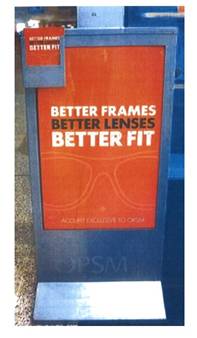
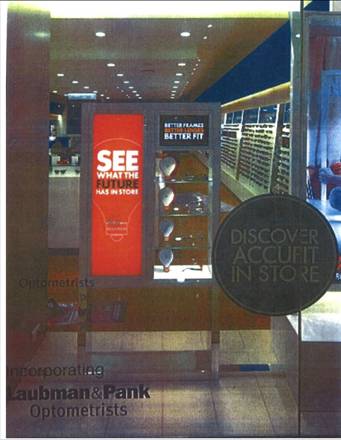
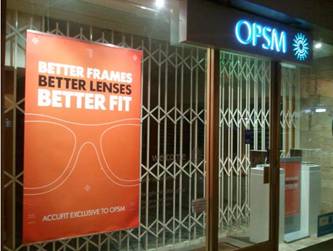
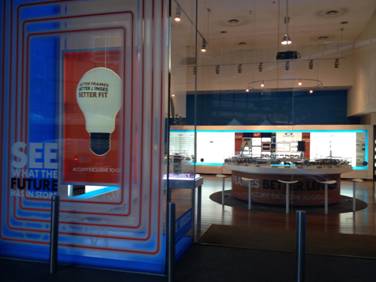
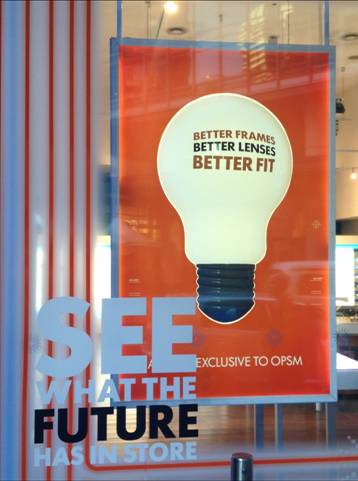
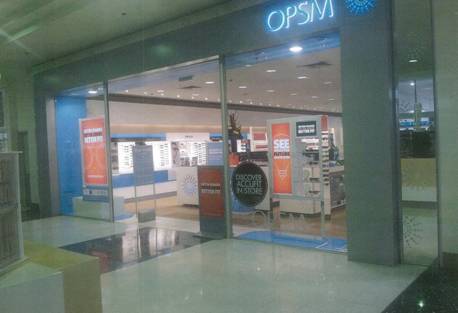
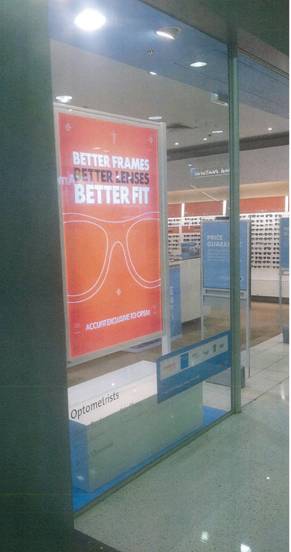
(b) progressives, which are multifocal lenses with no lines, which provide a continuous, gradual change from distance to intermediate to near vision; and
(c) multifocal lenses, which provide more than one focal point or viewing power within the same lens. They include bi-focal lenses which are lenses with a line and provide two fields of vision in two distinct parts of the lens, generally distance and near, and tri-focal lenses.
9 The particular type of lens chosen by a customer is largely determined by a customer’s prescription, which itself reflects a trained optometrist’s assessment after conducting various eye tests to measure the extent and identify the characteristics of a customer’s visual requirements.
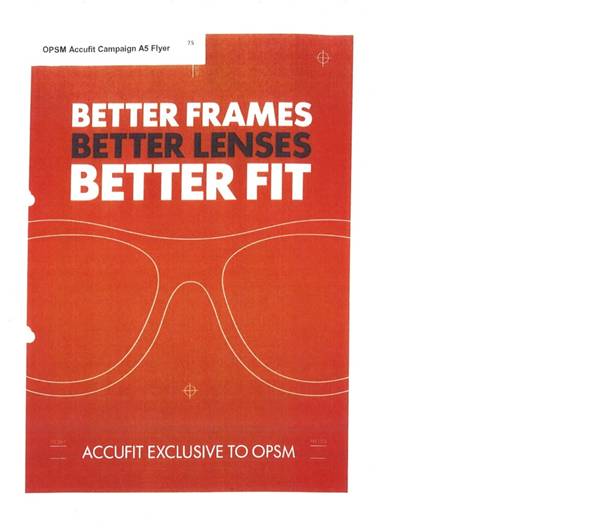
10 There are also a number of different lens options supplied in Australia, including:
(a) high index lenses, which are thinner and lighter than standard lenses. High index lenses are mainly used by customers with a high prescription;
(b) anti-reflective and scratch-resistant coatings to reduce glare and protect from excessive scratching;
(c) sun and ultraviolet tinting, which softens harsh and bright lights;
(d) polarising lenses, to eliminate glare from horizontal surfaces such as roads, water and snow; and
(e) photochromic lenses, which are lenses that adjust and adapt to changing light by tinting to guard against the sun’s rays.
11 It is common ground that a consumer’s selection of frames for purchase may be affected by several factors. Most consumers know that there is a wide range of styles of frames available and the selection of a suitable frame is an important element. In contrast, most consumers know that their prescription is not something within their own control. In choosing a particular frame consumers take into account such matters as the particular use they will make of their glasses, their face shape and colouring, their style of dress and their own personal aesthetics.
The Accufit system
12 Leading up to the commencement of the Accufit Campaign in February 2013, in late 2012 and early 2013 most OPSM stores across Australia installed certain technologies known as the Accufit system.
13 The Accufit system has three primary components which are said to redefine how OPSM customers can chose their prescription glasses, particularly their frames and lenses. According to OPSM’s evidence, the three components are as follows:
(a) Virtual Mirror: When a customer is selecting his or her frames, the customer can try-on multiple pairs of frames and have his or her photograph taken wearing those frames – front on, side view or other position. The customer can then view up to four images side-by-side in a virtual mirror and compare the various frames that he or she tried on. Some customers with impaired eyesight have trouble seeing their selected frames. The virtual mirror allows them to gain a clearer picture of how they look in various frames, as they are able to look at the photographs wearing their current prescription glasses. The virtual mirror also allows a customer to compare various styles of frames and see both front and temple views simultaneously.
(b) Lens Simulator: An OPSM customer can look at a lens simulator to understand the experience of different lenses. The lens simulator is intended to allow a customer to understand the visual effects of different lenses and select which lens is best or better suited to his or her lifestyle.
(c) Fit Sensor: This technology allows an optical dispenser to digitally measure a customer’s pupillary distances (PD), such that the optical centre of the lens is precisely placed within the frame. PD refers to the horizontal distance between the centre of each of the pupils. The Accufit system takes a digital image of a customer wearing their selected frame with a fit sensor attached. The Accufit software then measures the distance between the corneal reflex of both eyes from the digital photo eliminating any head movement from the customer. The fit sensor has five green sensors, 4 temple sensors and one nasal sensor. When the digital image is captured the sensors are detected and provide points of reference needed to measure the PD and frame dimensions to accurately position the optical centre of the lens in front of the pupil. For example, the digital image will indicate the customer’s monocular PD (the distance between the centre of one pupil and the nose) – a measurement which is more accurate than the standard PD measurement as it takes into account those customers who have slightly unequal monocular PDs. The fit sensor has the ability to measure the vertical distance between the pupil and the top of where the frame sits. The fit sensor also has the ability to take into account any pantoscopic tilt (i.e. the angle of the lenses within a particular frame). The measurements calculated by Accufit are electronically transferred to the laboratory eliminating any transcribing errors. This technology is intended to produce a precise measure of the optical centre of the lens (with accuracy to a degree of 0.1 millimetres), taking into account a customer’s selected frame dimensions so as to achieve an optimal fit.
14 The Accufit system was adopted to address certain issues affecting consumers, as identified by OPSM’s market research. One of those issues is that customers cannot see how they look in various frames because of their poor eyesight. The virtual mirror was intended to address this issue by enabling a consumer to see how he or she looks in various frames, making for an easier and better decision in comparing various frames.
15 A further issue identified by OPSM’s market research is that many consumers believe lenses are just a means for optical dispensers to “upsell”. That market research revealed that consumers do not feel that they have an independent choice in lens selection. It also revealed that customers tend to rely on information from an optical dispenser to inform their selection. The lens simulator is intended to help consumers understand the differences between lenses and enables them to make a more informed choice.
16 The digital measurement through the fit sensor is intended to eliminate the possibility of human error in lens measurement and fit and to give customers a greater sense of security that their glasses are being fitted correctly.
17 The Accufit system is delivered through what was described as “advanced technology”. The technologies are used by related stores of the Luxottica Group in both the United States and in New Zealand. In Australia, the software and technologies are subject to an exclusive licence to Luxottica for use only in its OPSM stores. While there are other fitting technologies available within the Australian optical industry (which include pupilometers, lens dispensing tool kits and magic mirrors, some of which are used at Specsavers stores), the three-tiered elements of the Accufit system (and the technologies associated with them) are said by the respondent to be exclusive to OPSM stores within Australia.
The Accufit Campaign
18 Around the time of the week commencing 25 February 2013, OPSM launched an integrated advertising campaign, known as the Accufit Campaign. Detailed instructions were sent to all OPSM store managers about how they should configure their stores and display the relevant merchandising material. The Accufit Campaign had the following marketing components:
(a) television commercials (TVCs): one 30 second TVC and two 15 second TVCs;
(b) a video available on the OPSM website (www.opsm.com.au);
(c) other website and other digital advertising, such as Facebook, YouTube and OPSM mobile optimisation;
(d) visual merchandising (in-store windows, posters and signage inside and outside OPSM stores, display boxes, signage, glasses storage boxes, cards, flyers etc); and
(e) customer relationship materials, including electronic direct marketing.
There are no radio or print media elements in the Accufit Campaign.
19 OPSM intends to continue to use some but not all elements of the Accufit Campaign during the course of 2013.
20 OPSM has also made changes to some elements of the Accufit Campaign since it was launched. For example, the visual merchandising displayed at the front of OPSM stores from around 25 February 2013 was replaced on Wednesday 27 March 2013 with the OPSM Easter Sale campaign. OPSM led evidence, which I accept, that the A5 flyers which include the Ruler Representation would not be displayed after 27 March 2013. Further, the OPSM website was amended on 13 March 2013 to remove any reference to the use of a ruler.
Television advertising
21 On 24 February 2013, OPSM launched the TVCs which form part of the Accufit Campaign. As noted above, there is a 30 second TVC and two 15 second TVCs. There are no references to “Better Frames, Better Lenses, Better Fit” in these TVCs and they are not the subject of complaint in this proceeding. It is convenient, however, to describe the TVCs as they are part of the Accufit Campaign and provide context for the matters which are complained of by the applicant.
22 The respondent claimed (and I accept) that its objective in arranging the TVCs is to publicise that OPSM has a new Accufit system which is intended to change the way customers can purchase glasses with respect to frame selection, lens selection and a more precise fit. The 30 second TVC features a shot of a woman brushing her teeth with a toothbrush, which then turns into an electric one. This is followed by a shot of a man running on a treadmill listening to his CD player, which then turns into a mp3 player. Thereafter, there are shots of a little water pistol becoming a big water gun and a newspaper becoming a tablet. The script (voiceover) of the 30 second TVC is as follows:
Every day, things are getting better.
What’s good enough one day, is even smarter the next.
At OPSM, we’re happy to say that getting glasses has just gotten better too.
Come and see what the future has in-store, or at OPSM.com.au/Accufit.
23 The 15 second TVCs are shorter variations of the 30 second TVC.
24 The voiceover of the TVCs tells a viewer that things (as depicted in the visuals) are getting better and invites the viewer to “Come and see what the future has in-store”. The respondent says that, by directing the viewer’s attention to experience Accufit in-store as well as directing attention to the OPSM website, the TVCs operate to encourage viewers to go to an OPSM store or the OPSM website and discover how the Accufit system works. Viewers can watch the video on the website.
25 The 30 second and 15 second TVCs were launched in metropolitan and regional television stations across Australia on 24 February 2013. They were widely aired by national and regional networks across Australia.
Website and video
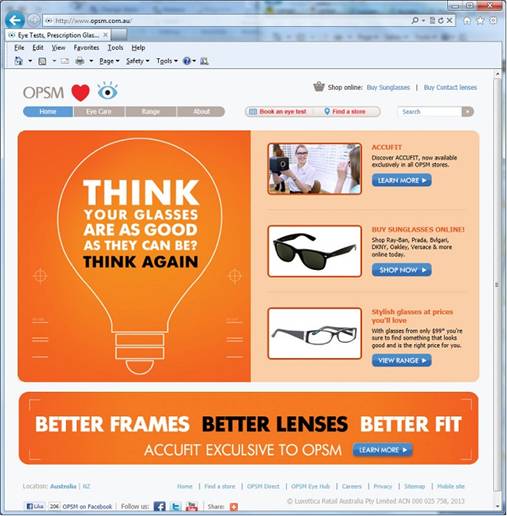
26 The Accufit Campaign also includes the OPSM website (www.opsm.com.au) – both desktop and mobile versions. The website’s home page is set out below:
27 By clicking onto either of the “learn more” hyperlinks on the homepage, a user is automatically redirected to the Accufit landing page of the OPSM website. The Accufit landing page is set out below:
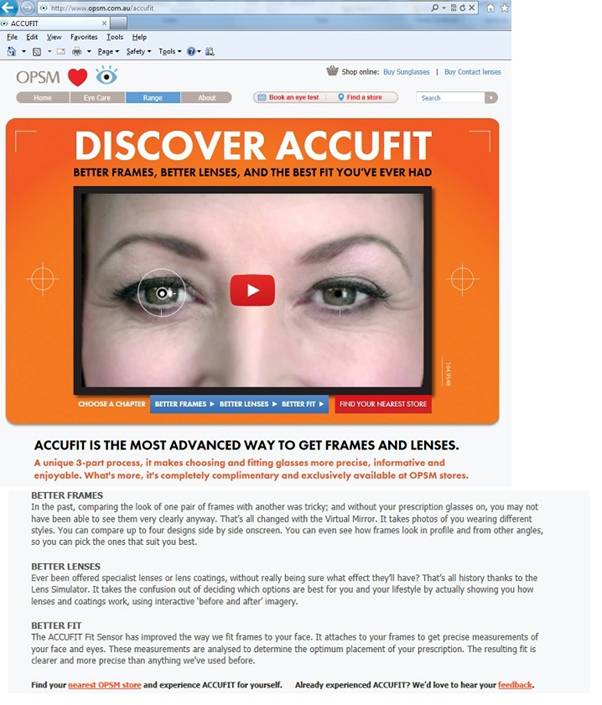
28 The representation “BETTER FRAMES, BETTER LENSES, AND THE BEST FIT YOU’VE EVER HAD” appears on the Accufit landing page. It is to be noted that the landing page contains further material relating to the Accufit system, describing it as “the most advanced way to get frames and lenses”. It further explains that Accufit is: “A unique 3-part process, it makes choosing and fitting glasses more precise, informative and enjoyable. What’s more, it’s complimentary and exclusively available at OPSM stores”. Further information is then provided on the landing page under each of the headings “BETTER FRAMES”, “BETTER LENSES’ and “BETTER FIT”.
29 Below the headline on the landing page there is also an inset streamable video which a consumer can click to watch. The video promotes the Accufit system by describing a woman’s experience in purchasing glasses from OPSM using that system. In the course of the video, a number of statements appear, including “BETTER FRAMES”, “BETTER LENSES”, “ADVANCED FRAMES AND LENSES” and “BETTER FIT”.
30 The video was filmed at the OPSM store at Chatswood Chase in Sydney. The video depicts the same technology and software than have been utilised in OPSM stores in Australia since the commencement of the Accufit Campaign, with some limited exceptions. The appearance of the technology throughout these stores and on the video is identical, but the positioning and number of units is subject to the physical constraints of each individual store.
31 Other aspects of the desktop and mobile websites also prominently advertise Accufit. For example, the homepage of the OPSM website (both desktop and mobile versions) was virtually “taken over” by the Accufit Campaign, as is evident from the screen shot which is included in [26] above.
Other digital and online advertising
32 The Accufit Campaign is also integrated with various other forms of digital and online media, namely:
(a) web banners (which entails embedding an advertisement into a web page, intending to attract traffic to the OPSM website www.opsm.com.au/accufit);
(b) the OPSM Facebook page, where the Accufit system is described and the video described above is also available;
(c) YouTube – another social medium where consumers are able to view the video described above; and
(d) search engine marketing (SEM), which involves the promotion of the www.opsm.com.au/accufit website to increase its visibility in search engines, such as Google.
Front of window and in-store point of sale merchandising material
33 The visual merchandising used in the Accufit Campaign is predominantly orange in colour. The Accufit Campaign includes front of window and in-store visual merchandising in OPSM stores across Australia. It is convenient to describe both those categories of merchandising in turn.
(a) Front of window merchandising material
34 The stated role of this merchandising material is to operate as an invitation to viewers to discover Accufit within the particular OPSM store and to encourage customers to ask about Accufit.
35 The front of window merchandising material used in the Accufit Campaign in a standard OPSM store across Australia generally comprises the following elements:
(a) a large orange window poster with a white silhouette of a glasses frame in the centre of the poster, as well as lines or insignia which are known as “cross-wires” or “hairlines”. The text on the poster states:
BETTER FRAMES
BETTER LENSES
BETTER FIT
ACCUFIT EXCLUSIVE TO OPSM
(a copy of the window poster is included in Schedule 1 of this judgment);
(b) a black circular window disc which was intended to be displayed in all two-windowed OPSM stores. The disc reads “DISCOVER ACCUFIT IN STORE” (a copy of the window disc is included in Schedule 1 of this judgment); and
(c) in suitable stores, a two window display set up (a copy is included in Schedule 1 of this judgment).
36 Other visual merchandising which could be utilised by OPSM stores across Australia (depending on their physical requirements) are light box displays, posters, product display cabinets and wraps, all utilising orange as their predominant, unifying colour – a colour not usually associated with OPSM advertising, but specifically utilised for the Accufit Campaign. Schedule 1 of this judgment includes some further examples of the front of window merchandising material used in the Accufit Campaign.
(b) In-store point of sale merchandising material
37 The in-store visual merchandising for the Accufit Campaign is extensive. Such merchandising includes:
(a) orange header card inserts that are inserted into the back of acrylic headers which are contained in all OPSM stores on frame bays;
(b) orange product display inserts, for example bearing the light globe image with the text “SEE WHAT THE FUTURE HAS IN STORE”;
(c) orange banner strips with three different messages which can be alternated throughout the OPSM store, the messages being:
(i) “ASK ABOUT ACCUFIT IT’S TRULY VISIONARY”;
(ii) “BETTER FRAMES, BETTER LENSES, BETTER FIT, ACCUFIT EXCLUSIVE TO OPSM”;
(iii) “REFRAME HOW YOU SEE THE WORLD. VISIT OUR MOBILE SITE TO FIND OUT MORE opsm.com.au/accufit”;
(d) orange footpath stand poster;
(e) orange pole posters to be wrapped around poles in-store;
(f) an orange dispensing desk decal;
(g) an orange handover tray insert;
(h) an orange comment box and comment pads;
(i) lens promotional holders;
(j) flyers;
(k) orange lanyard inserts; and
(l) screen savers for employees’ computers.
38 Schedule 2 of this judgment contains some examples of in-store point of sale merchandising material used in the Accufit Campaign.
39 The visual merchandising material described above was scheduled to be removed by 27 March 2013, to be replaced with the Easter Sale visual merchandising material. Furthermore, other than continuing the TVCs (which, as noted above, are not challenged in these proceedings) and the internet advertising (i.e. the video on the OPSM website, the YouTube Video and the OPSM Facebook page), OPSM said that it has no current intention to produce any further advertising material bearing the phrase “BETTER FRAMES, BETTER LENSES, BETTER FIT”.
40 The visual merchandising used in the Accufit Campaign varied between OPSM stores. For example, more extensive visual merchandising was utilised in what were described as OPSM’s “two flagship” stores, namely the Eye Hub store in Melbourne and the George Street Sydney store. The visual merchandising for the Accufit Campaign was installed in those stores on or around 25 February 2013 and was scheduled to be used until 27 March 2013. In the Eye Hub store, for example, product plinths were installed which featured decorative light globes in glass boxes. The plinths were “wrapped” in orange bearing the white text “ACCUFIT EXCLUSIVE TO OPSM”. The Eye Hub store also featured a large “billboard” style placard which carried the tagline “BETTER FRAMES, BETTER LENSES, BETTER FIT, ACCUFIT EXCLUSIVE TO OPSM”. The same tagline was also utilised on a large banner which was wrapped around a circular display unit in the George Street store. The black circular discs bearing the words “Discover Accufit In Store” were not displayed in some OPSM stores, including it seems the OPSM store in Collins Street, Melbourne.
Email merchandising
41 On the launch of the Accufit Campaign around 25 February 2013, an email about Accufit was sent to thousands of OPSM’s existing customers. The email had the following relevant content:
At OPSM, the way you get your glasses just got a lot better. We’re proud to introduce the most advanced way to fit your frames and lenses ever.
It’s called ACUFIT it’s exclusive to OPSM stores around the country, and best of all, it’s completely free.
Watch this video to find out more.
42 The email then contained a screen shot which had some similarities to other screen shots in the Accufit Campaign, in the sense that it was set against an orange background, displayed lines which were described as “cross-wires” and “hairlines”, and contained the following words:
DISCOVER ACUFIT
BETTER FRAMES, BETTER LENSES AND THE BEST FIT YOU’VE EVER HAD.
43 The top line of words appeared in white colouring and were in a font several times larger than the second line of words, which appeared in black colour. By clicking onto a link, a customer was able to view the video. Other links were provided to enable a person to make an appointment or to find OPSM store. In the centre of the screen saver was a picture of a shop assistant using the Accufit system with a customer.
44 Other electronic and hard mail communications to existing OPSM customers incorporated the Accufit message, as did emails from Luxottica’s Head Office OPSM marketing team.
45 Overall approximately $3m was spent on the production of the Accufit Campaign.
Were the representations misleading or deceptive?
46 Section 18(1) of the ACL provides that “a person must not, in trade or commerce, engage in conduct that is misleading or deceptive or is likely to mislead or deceive”.
47 Section 29(1)(a) of the ACL provides that:
A person must not, in trade or commerce, in connection with the supply of possible supply of goods or services or in connection with the promotion any means of the supply or use of goods or services:
(a) make a false or misleading representation that goods are of a particular standard, quality, value, grade, composition, style or model or have had a particular history or a particular previous use; or
…
48 It is convenient to summarise the relevant legal principles relating to misleading or deceptive conduct before summarising the parties’ respective arguments.
Outline of relevant legal principles
49 Whether the representations complained of are misleading or deceptive or likely to mislead or deceive requires the application of reasonably well settled principles to the relevant circumstances of the case. There was no significant disagreement between the parties as to the identification and statement of those relevant principles (apart perhaps on the issue whether a trivial error or mistake or conduct which is relatively insignificant attracts liability). In my view, the principles may be outlined as follows:
whether or not conduct is misleading or deceptive is a question of fact to be determined objectively and upon the basis of the impugned conduct being viewed as a whole and in its full context (see Campbell v Backoffice Investments Pty Ltd (2009) 238 CLR 304 at [25] and [102] and Parkdale Custom Built Furniture Pty Ltd v Puxu Pty Ltd (1982) 149 CLR 191 at 199 per Gibbs CJ);
conduct will be likely to mislead or deceive if there is a “real or not remote chance or possibility” of misleading or deceiving regardless of whether it is less or more than 50 per cent (see Global Sportsman Pty Ltd v Mirror Newspapers Ltd (1984) 2 FCR 82 at 87 per Bowen CJ, Lockhart and Fitzgerald JJ);
in the case of advertising or marketing, it is not appropriate to take part of an advertisement and seek to ascertain in isolation the meaning of each of the critical words and phrases, rather the veracity of the message should be measured by reading it in context (Tobacco Institute of Australia Ltd v Australian Federation of Consumer Organisations Inc (1992) 38 FCR 1 at 4 per Sheppard J) and TPG Internet Pty Ltd v Australian Competition and Consumer Commission [2012] FCAFC 190 at [81] and [83]);
where advertising is directed to a class of persons, the question is whether the misconceptions or deceptions are likely to be experienced by the hypothetical ordinary or reasonable member of the class of persons to whom the advertising was directed, but extreme or fanciful assumptions should not be attributed to such a person (Campomar Sociedad, Limitada v Nike International Ltd (2000) 202 CLR 45 at [103] and [105]; Campbell v Backoffice Investments Pty Ltd (2009) 238 CLR 304 at [26] and TPG Internet Pty Ltd v Australian Competition and Consumer Commission [2012] FCAFC 190 at [85]);
if a representation is capable of having more than one meaning, the question whether it is misleading or deceptive is to be tested against each meaning which is reasonably open (Tobacco Institute of Australia Ltd (1998) 38 FCR 1 at 50);
although it is not necessary to establish that persons in the relevant class have actually been misled, the absence of such evidence may, in an appropriate case, be regarded as having some importance (Procter & Gamble Australia Pty Ltd v Energizer Australia Pty Ltd [2011] FCA 1347 at [18] per Bennett J);
comparative advertising can involve particular considerations and it has generally been acknowledged that those who engage in that form of advertising ought take particular care to ensure that the comparisons are accurate (see, for example, Stuart Alexander and Co (Interstate) Pty Ltd v Blenders Pty Ltd (1981) 53 FLR 307 at 310 per Lockhart J; State Government Insurance Commission v JM Insurance Pty Ltd (1984) ATPR 40-465 at 45, 362 per Fisher J; Hoover (Australia) Pty Ltd v Email Ltd (1991) 104 ALR 369 at 375 per Gummow J; Trade Practices Commission v Telstra Corporation Limited (1993) ATPR 41-256 at 41,454 per Hill J and Luxottica Retail Australia Pty Ltd v Specsavers Pty Ltd (2010) 267 ALR 721 at [26] per Perram J);
whether a representation constitutes mere puffery or marketing exaggeration and, consequently, is not actionable turns on the particular facts considered in light of the ordinary incidents and character of commercial behaviour (General Newspapers Pty Ltd v Telstra Corporation (1993) 45 FCR 164 at 178 per Davies and Einfeld JJ and ACCC v Henry Kaye and National Investment Institute Pty Ltd [2004] FCA 1363 at [122] per Kenny J);
a claim will not be regarded as mere puffery if there is a definitive statement as to a characteristic or consequence of the claim (see Jainran Pty Ltd v Boyana [2008] NSWSC 468 at [117] per Bryson AJ; Gillette Australia Pty Ltd v Energizer Australia Pty Ltd [2005] FCA 1647 at [25] per Merkel J and Procter & Gamble Australia Pty Ltd v Energizer Australia Pty Ltd [2011] FCA 1347 at [168] to [172] per Bennett J);
whether or not a particular representation is misleading or deceptive depends on the facts and circumstances of a particular case and questions of fact and degree may arise. This can have the consequence that a representation is not misleading or deceptive where the matter which otherwise would render the representation misleading or deceptive is relatively insignificant in the scheme of things: Australian Competition and Consumer Commission v Lovelock Luke Pty Ltd (1997) 79 FCR 63 at 68 per Lockhart J and Australian Competition and Consumer Commission v Unilever Australia Ltd (1997) 40 IPR 354 at 387-8 per Mansfield J;
a degree of latitude is to be allowed in the case of advertising or marketing and the first impressions conveyed by an advertisement will often most closely approximate the impact of the advertisement on the relevant class of persons (see Telstra Corporation Ltd v Optus Communications Pty Ltd (1996) 36 IPR 515 at 523-4 per Merkel J);
a degree of “robustness” is required in assessing whether advertising is misleading or deceptive: the legislation does not operate for the benefit of those who fail to take care of their own interests (TPG Internet Pty Ltd v Australian Competition and Consumer Commission [2012] FCAFC 190 at [110]); and
a representation may still be misleading or deceptive even if an initial misleading impression created by the representation is subsequently corrected (Trade Practices Commission v Optus Communications Pty Ltd (1996) 64 FCR 326 at 340-341 per Tamberlin J and ACCC v King Island Meatworks and Cellars Pty Ltd [2012] FCA 859 at [41] per Murphy J), but much will depend on the context and circumstances. The qualifying material must be sufficiently prominent or conspicuous to prevent the primary statement from being misleading (TPG Internet Pty Ltd v Australian Competition and Consumer Commission [2012] FCAFC 190 at [83]).
Outline of applicant’s case
50 It is convenient to summarise the applicant’s case by reference to each of the three categories of representations of which it complains.
(a) Better Frames, Better Lenses Representations
51 As noted above, these representations are a collection of three individual representations, the terms of which are set out in [3(a)] above. It is important to note that although the first and second of those individual representations include the words “Better Fit”, the applicant made clear that it did not complain about that particular aspect of the representations. This has important consequences, for reasons which will be discussed below.
52 The applicant submits that in determining whether the Better Frames, Better Lenses Representations are misleading or deceptive, the relevant inquiry is how ordinary or reasonable members of the relevant class of consumers would understand those representations. It identifies the relevant class as wearers and prospective purchasers of prescription glasses. The applicant acknowledges that, because the representations are primarily made in merchandising material at OPSM stores, particularly the front of window displays, as well as on the OPSM home page website, it should be accepted that such persons would not study such material closely, but rather would absorb its general impression or overall thrust.
53 In assessing whether the external point of sale material (examples of which are contained in Schedule 1 to this judgment), is misleading or deceptive or likely to be so the applicant submits that such material is an effective medium of advertising, particularly where it is displayed in a large number of stores at prominent locations. The Court was urged to accept evidence given by the applicant’s expert witness (Dr Downes) to the effect that the window poster in particular is likely to be effective in attracting the attention of many consumers due to its large size, the bright orange colouring and the repetition of the word “BETTER”. Emphasis is also placed on the fact that the respondent’s expert witness (Dr Van Osselaer) agreed with Dr Downes that the text “Better Frames, Better Lenses, Better Fit” displayed on window posters would be seen by many consumers walking or driving past an OPSM store. The applicant contends that the Court should not accept Dr Van Osselaer’s further evidence to the effect that such consumers would not acquire any specific interpretation of the text and would only notice the overriding impact of the warm orange colour scheme.
54 The applicant submits that the messages displayed on other front of window merchandising material was insufficient to dispel the overriding message of “Better Frames, Betters Lenses, Better Fit” conveyed by the external point of sale material. Accordingly, the applicant contends that the overriding message was not dispelled by either:
(a) the small advertisement which appeared alongside the window display containing the words “SEE WHAT THE FUTURE HAS IN STORE”; or
(b) the black window disc containing the words “DISCOVER ACCUFIT IN STORE” (noting also that the black disc was not displayed in all OPSM stores).
55 The applicant submits that the overriding message emerging from the Better Frames, Better Lenses Representations is that OPSM is saying that its frames or lenses or both are of a superior or improved quality (in an engineering or material sense) when compared with either those available at other optical retailers or those previously available at OPSM. It relies on evidence given to this effect by Mr Simon Hawkins, Joint Marketing Director for Specsavers, who said that, relying on his marketing experience (Mr Hawkins has held the position of Joint Marketing Director for Specsavers since July 2009 and, since January 2002, has held various marketing positions with the Specsavers Group overseas), consumers in the relevant class were likely to understand the Better Frames, Better Lenses Representations as referring to things such as the quality of the frames and lenses and the materials used to make them. It is important to note, in this context, that as so formulated the applicant’s case excludes the words “Better Fit” from the conduct complained of, notwithstanding that in fact those words were generally juxtaposed with the terms “Better Frames, Better Lenses”.
56 The applicant also contends that the overriding message from those representations is not diminished by the in-store point of sale merchandising material, examples of which are set out in Schedule 2 to this judgment. The applicant emphasises that, with the exception of information provided on the back of the A5 flyer, there is nothing in that material which explains the Accufit system or invites the customer to ask an OPSM staff member about that system.
57 As to the representations which appeared on the OPSM website (see [26] above), the applicant draws attention to the fact that the banner on the home page also contains the “Better Frames, Better Lenses, Better Fit” message. It adds that, although the landing page (see [27] above) provides a more detailed explanation of the Accufit system, a consumer would not automatically link to the page and, even if they did, may not read the explanation carefully. The applicant adds that, in any event, a subsequent explanation does not cure the initial misleading representation.
58 In support of its claim that members of the relevant class would understand the reference to “Better Frames, Better Lenses” in the sense described in [55] above, the applicant says that:
(a) this meaning is consistent with the ordinary and natural meaning of the words “better”, particularly when used in the context of objects or things such as frames and lenses;
(b) the meaning is also consistent with the message that the Accufit system is new and technologically advanced, which serves to differentiate frames and lenses sold using the Accufit system and those which were or are sold without it; and
(c) the meaning is consistent with the fact that consumers are likely to interpret the phrase “Better Frames, Better Lenses, Better Fit” as three distinct statements.
59 The applicant further contends that the relevant material is not mere puffery. In this context, the applicant says that by suggesting that the representations are supported by the Accufit system, the respondent was suggesting that there was some factual basis for the claims. The applicant also draws attention to the extensive nature of the Accufit Campaign and the fact that it cost the respondent approximately $3m to conduct. Accordingly, it says that the respondent plainly intended consumers to take the claims seriously.
60 The applicant also contends that the use of the word “better” in this context implicitly invites comparison, either to other optical retailers or to frames and lenses previously offered by OPSM.
61 It is at the heart of the applicant’s case in respect of these representations that they would be understood by members of the relevant class to refer to improved or superior frames or lenses. The applicant says that such representations are false or deceptive because the features of the frames and lenses offered by OPSM are not superior or improved to those previously offered by it or other optical retailers, Indeed, the applicant says that the frames and lenses are the same as those previously offered by OPSM and that other optical retailers sell the same or similar frames and lenses to those offered by OPSM. Further, that applicant complains that nothing in the Accufit system makes OPSM’s frames or lenses superior or improved to those previously offered by OPSM or other retailers. It says that the virtual mirror and the lens simulator are simply tools to allow consumers to choose between frames and lenses based on their personal preference.
(b) The Availability Representation
62 There are two apparent aspects to this part of the applicant’s case. The first is a complaint that at least some of the features of the Accufit system (in particular, the virtual mirror and the lens simulator) were not in common use across OPSM stores. To support that claim, the applicant relies on the evidence given by various persons who engaged in what was described as “mystery shopping trips” at OPSM. Their evidence was to the effect that the only feature of Accufit that OPSM employees offered for use was the fit sensor, and the virtual mirror and lens simulator were neither used nor explained.
63 The second aspect of this part of the applicant’s case turns on the fact that the Accufit system was not available in all OPSM stores when the Accufit Campaign began on 25 February 2013. In particular, it points to the respondent’s own evidence, which establishes that the OPSM stores in Tuggeranong, Bankstown and Kalamunda did not offer the Accufit system at that time. The system was installed at the relevant Tuggeranong store on 18 March 2013 and at the other two affected stores on 25 March 2013.
(c) The Ruler Representation
64 The applicant contends that the Ruler Representation is false, misleading or deceptive (or likely to be so) in that it conveyed that optical retailers other than OPSM (including Specsavers) fit glasses using a ruler, a felt pen and a steady hand, in circumstances where other optical retailers use pupilometers to measure a customer’s pupillary distance, as well as various gauges to measure where the customer’s pupils appear in the frames.
65 Although the applicant acknowledges that, on 13 March 2013, OPSM amended the explanatory statement on its website so as to withdraw the Ruler Representation, it complains that the respondent nevertheless continued to distribute the A5 flyers which contain the Ruler Representation on the back page.
66 The applicant also made submissions concerning appropriate relief (apart from damages) if any of its complaints were upheld.
Outline of respondent’s case
67 The respondent’s submissions may be summarised as follows.
68 It complains at the outset that the applicant has not precisely identified the message which it says is conveyed by the relevant representations and amounts to misleading or deceptive conduct.
69 Dealing in turn with each of the three broad categories of representations the subject of the applicant’s complaints, the respondent makes the following submissions:
(a) as to the Better Frames, Better Lenses Representations, the allegation seems to be that OPSM represented that its frames or lenses or both are of a superior or improved quality (in a mechanical or material sense) than those available previously at OPSM or are available at other optical retailers;
(b) as to the Availability Representation, the respondent’s understanding of the applicant’s argument is that this representation required that the whole of the three elements of the “Accufit experience” had to be used with every single customer and that the Accufit system must have been available at every single OPSM branded store at all relevant times; and
(c) as to the Ruler Representation, the respondent describes the applicant’s case as being based on the proposition that the message in the representation is that all optical retailers other than OPSM’s staff use a ruler and a felt pen, today and every day, to measure and fit prescription glasses for customers.
70 The respondent argues that each of those representations has to be viewed as a whole and in its context to determine whether it is misleading or deceptive. It makes the following submissions in relation to each of the three broad categories of representations of which the applicant complains.
(a) The Better Frames, Better Lenses Representations
71 The respondent says that the relevant class of consumers are purchasers or prospective purchasers of (prescription) glasses. (I consider that this is substantially similar to the applicant’s identification of the relevant class as wearers and prospective purchasers of prescription glasses). The respondent says, therefore, that the relevant question is whether or not an insignificant number of persons within that class understand the Better Frames, Better Lenses Representations as saying that OPSM’s frames and lenses are of a superior quality to those of its competitors and/or that OPSM’s frames and lenses are of a superior or improved quality to those previously available at OPSM. If that question is answered affirmatively, the next question is whether either representation is misleading or deceptive.
72 In addressing the first of those questions, the respondent is critical of the expert evidence given by Dr Downes. It says that he gave an unusual form of “hybrid evidence”, comprising his own responses as a wearer of glasses to the advertising in the Accufit Campaign, as well as his expert opinion from a marketing perspective as to whether his personal lay opinion was typical of relevant consumers. The respondent says further that Dr Downes’ evidence is of little or no assistance in circumstances where his first reactions to the relevant material were coloured by the fact that he had been retained (again) by Specsavers for the purpose of the proceedings (Specsavers had engaged Dr Downes as an expert in previous matters). Dr Downes knew that the visit was relevant to a dispute between the parties and that he would be asked to express an opinion as to what he saw there. He was directed to look at any and all point of sale advertising material and to consider it in the manner in which it is likely to be considered by consumers. Accordingly, the respondent submits that the Court should not accept that Dr Downes’ personal and immediate response to the advertisements is the typical reaction of a consumer. Furthermore, the respondent says more generally that Dr Downes’ evidence was “artificially literal” in responding to the words used in the relevant advertising.
73 The respondent urges the Court to prefer the expert evidence of Dr Van Osselaer who did not claim himself to be a typical consumer in the relevant class, but rather expressed opinions based on his expertise in semiotics. His ultimate conclusion was that a consumer would view the phrase “BETTER FRAMES, BETTERS LENSES, BETTER FIT” as one message about the fitting of glasses. His evidence was also to the effect that a more casual observer would be unlikely to acquire any specific interpretation of the text.
74 In substance, the respondent submits that the phrase “BETTER FRAMES, BETTER LENSES, BETTER FIT” is a mere puff. Alternatively, the message conveyed by that phrase to members of the relevant class is a single message about the fitting of glasses, which would be better fitted to a consumer’s needs.
(b) The Availability Representation
75 The respondent submits that the applicant’s original complaint concerning the Availability Representation had either disappeared from the applicant’s case, or, if not, is bound to fail. That is because it says that all the “mystery shoppers” who gave evidence for the respondent did in fact receive at least one aspect of the “Accufit experience” (namely in relation to the fit sensor). Furthermore, it submits that the word “available” in this context cannot mean “compulsory” or “invariably deployed”, but rather means available if needed and if appropriate.
76 As to the second aspect of the applicant’s complaint arising from the respondent’s disclosure that three OPSM stores did not have the Accufit system fully installed as at 25 February 2013, the respondent submits that account needs to be taken of the following matters:
the Accufit system was fully installed and available in all three relevant stores from 25 March 2013;
Ms Spencer, who is the Vice President Marketing for the Luxottica Group, and who was one of the senior executives responsible for the Accufit Campaign, gave evidence of the extensive steps she took to satisfy herself prior to 25 February 2013 that the Accufit technologies were available in every OPSM store across Australia;
once she discovered in the course of preparing her evidence in the proceedings that three OPSM stores did not have the Accufit technologies, steps were immediately taken to rectify the position;
the visual merchandising was not on display in any of the three stores before the Accufit system was installed;
the Accufit system was available in other nearby OPSM stores in two of the three relevant places, hence there was capacity to refer any customer who wanted to use or see Accufit to that other nearby OPSM store; and
there is no evidence that any customer was misled or deceived by the Availability Representation.
(c) The Ruler Representation
77 The respondent submits that the Ruler Representation does not represent that other optical retailers such as Specsavers necessarily or invariably use a ruler, a felt pen and a steady hand to fit prescription glasses. Emphasis is placed on the “fairy-tale like phrase ‘once upon a time’” as reinforcing the fact that reference is being made to the traditional process involved in the fitting of glasses. Far from suggesting that this is in fact the manner in which other optical retailers fit glasses today, the respondent says that the message is to the opposite effect: that that form of measurement has been updated. Finally, the respondent says that even if the relevant words represented that other optical retailers use the ruler method, the applicant has failed to provide evidence that this is not true. It argues that evidence that Specsavers uses pupilometers is insufficient because the possibility remains that other optical retailers may continue to use the ruler method.
78 The respondent also made various submissions regarding relief in the event that a breach of the ACL was established.
Consideration
79 I will deal with each of the three categories of representations complained of in turn.
(a) The Better Frames, Better Lenses Representations
80 Applying the relevant legal principles summarised in [49] above to the Better Frames, Better Lenses Representations, the applicant has failed to persuade me that the relevant representations are misleading or deceptive or are likely to mislead or deceive.
81 The relevant class of consumers to which the representations are directed are wearers (or purchasers) or prospective wearers (or prospective purchasers) of prescription glasses. The relevant question therefore, is whether the phrases used in the Better Frames, Better Lenses Representations were likely to convey the messages which the applicant says they did, namely that:
(a) OPSM’s frames and lenses are of a superior quality than those of its competitors; and/or
(b) OPSM’s frames and lenses are of a superior or improved quality than those which were previously available at OPSM.
82 For the following reasons, I do not accept that it is likely that those messages would be conveyed to a hypothetical ordinary and reasonable member of the relevant class.
83 First, I prefer the evidence of Dr Van Osselaer to that of Dr Downes on this issue. Dr Van Osselaer’s evidence was given dispassionately and authoritatively. He made appropriate qualifications to his views when some of his evidence was tested under a close cross-examination. Generally, however, the views he expressed and explained in his written expert evidence were unshaken in cross-examination. I found him to be an impressive witness.
84 Dr Van Osselaer’s evidence is to the effect that a person reading the relevant representations in their context would view the references to “Better Frames, Better Lenses and Better Fit” as conveying one message about the fitting of glasses. I agree. In my view, when read in their context, that phraseology is not likely to convey to a hypothetical reasonable member of the relevant class that the frames or lenses are made of better material at OPSM (whether compared with frames or lenses available at other optical retailers or previously at OPSM). I accept the respondent’s submission that the message conveyed by the relevant representations to such a person is along the lines of “we’ve got great glasses at OPSM, come in and see” or, alternatively, “we’ve got great-fitting glasses, come in and see”.
85 I do not accept the evidence of Mr Hawkins on this issue. Whilst I do not doubt Mr Hawkins’ extensive marketing experience, I do not regard him personally as typical of a member of the relevant consumer class given his lengthy employment association with Specsavers and his current position as Joint Marketing Director. His loyalty to his employer is a matter which bears upon the weight to be given to his evidence.
86 Secondly, I accept that it is appropriate in this context to distinguish between consumers who see the relevant front of window merchandising material only fleetingly as opposed to those who enter the store. I agree with Dr Van Osselaer’s evidence that a casual observer, such as a busy pedestrian or a passenger in a passing vehicle, is unlikely to gain any specific interpretation or meaning of the text of the relevant representations other than a general message about improvements in the fitting of glasses. In making this finding, I attach particular significance to the formatting of the relevant representations on the front of window merchandising material. As noted above, the key phrases:
BETTER FRAMES
BETTER LENSES
BETTER FIT
appear on both the window poster and window installation in a way which gives greatest prominence to the phrase “BETTER FIT”. That is achieved by:
(i) progressively increasing the size of the font of those three phrase lines, with the biggest font being used for the phrase “BETTER FIT”;
(ii) the selection of colour contrasting, which makes the larger font used for the phrase “BETTER FIT” even more prominent; and
(iii) the positioning of the phrase “BETTER FIT” towards the centre of the merchandising, such that that particular phraseline is most likely to capture the attention of a passer-by.
The prominence of the phrase “BETTER FIT” is then further reinforced by its proximity to the white silhouette of the glasses frame and, perhaps even more so, by the statement “ACCUFIT EXCLUSIVE TO OPSM” (while also noting that that phraseline appears in much smaller font at the bottom of the poster and may not be seen or comprehended by some passers-by).
87 Thirdly, focusing now more closely on a person in the relevant class who is not a mere passer-by but, who either having seen the front of window material or having accessed the OPSM website and proceeds further into that website, an even stronger message is likely to be conveyed that the relevant representations concern improvements in the accuracy of fitting glasses. That is because a person entering an OPSM store or proceeding past the first page of the website would be likely to obtain an enhanced understanding of the word “better”. Under either of those scenarios, the other merchandising material to which such a person is exposed is likely to reinforce and strengthen the overriding message that, because of the Accufit system, a customer can have glasses that fit better, feel more comfortable and work better to correct the wearer’s vision. In other words, they can have better glasses. Thus, even if some aspects of the relevant representations are not properly regarded as puffery, when viewed as a whole and in their relevant context, the message they are likely to convey to a member of the relevant class is that, by using the Accufit system, a consumer can obtain better fitting glasses which, from the consumer’s perspective, are better glasses.
88 Fourthly, I do not accept the applicant’s submission that a member of the relevant class is likely to regard the front of window merchandising material as making comparative claims. Dr Downes gave evidence to the effect that his immediate reaction, as a consumer of prescription glasses himself, was that the orange window poster was making comparative claims and that this would also be the reaction of a hypothetical consumer in the relevant class. I do not accept that evidence. In my view, there is much force in the respondent’s submissions summarised in [72] above concerning the weight to be given to Dr Downes’ evidence on both this matter and more generally having regard to the circumstances surrounding his visit to the Collins Street store. Dr Downes was asked by Specsaver’s solicitors to go to the store and to observe all and any advertising or point of sale material and consider it in the manner in which it is likely to be considered by consumers. He was told that there was a dispute between Specsavers and OPSM and he understood that he was being retained as a witness for Specsavers. The only advertising or merchandising material in the Collins Street Stores related to the Accufit Campaign. A hypothetical member of the relevant class of consumers seeing the merchandising material for the first time would not have the information in mind which Dr Downes must have had when he inspected the store. That information must have coloured to some extent his own first impressions and I do not accept that those impressions ought then to be attributed to a hypothetical member of the relevant class. Even if Dr Downes had not received a detailed briefing about the dispute between the parties prior to his inspection, he plainly was aware of the existence of a dispute and that it must have related to advertising and point of sale material at the store. He was plainly possessed of information which would not be attributed to a hypothetical member of the relevant class. In my view, these matters severely diminish the weight of Dr Downes’ evidence. Dr Van Osselaer’s evidence was of much greater assistance to the Court.
89 I accept and agree with Dr Van Osselaer’s evidence that it is highly unlikely that a relevant consumer would interpret the window poster as making a specific comparative claim comparing the OPSM brand or products to other optical brands or products. Not only is the brand association of the poster weak, but, when viewed in conjunction with the surrounding merchandising material, appears to be designed primarily to entice people into the store, where they can find out more about the subject matter.
90 The applicant placed heavy emphasis on statements made in OPSM’s internal marketing material and by Ms Spencer in her oral evidence that one of the objectives of the Accufit Campaign was to create “a point of difference between OPSM and competitors”. The internal marketing material referred to is a document entitled “Accufit Financial Business Case” which is dated March 2012 and is directed to the proposed purchase of Accufit units for installation in 411 OPSM stores across Australia and New Zealand. One of the stated key assumptions is that installation of the Accufit units would “improve customer traffic and therefore an appointment uplift of +1.0% by creating a point of difference between OPSM and competitors”. I do not consider that that statement establishes that the relevant representations involve comparative claims. The statement is directed to the financial feasibility of proceeding with the installation of Accufit systems in OPSM stores in Australia and New Zealand. The document does not bear directly on the content of the merchandising material. In my view it is too far removed from the particular material complained of by the applicant to support its claim that the representations were comparative.
91 Fifthly, I prefer the evidence of Dr Van Osselaer that the relevant phrases in the Better Frames, Better Lenses Representations have to be looked at in their overall context. That context includes the other visual elements which have the effect of relating the words used to spectacle fitting and to accuracy or precision. These elements include the use of the white silhouetted glasses frame in the centre of the window poster, together with the so-called “cross-wires” and “hairlines” which are symbols of accuracy and precision. These elements are likely to be absorbed by a hypothetical consumer in the relevant class who has a greater opportunity to consider and absorb the merchandising material when compared with the more ephemeral opportunity afforded to a passer-by. I agree with Dr Van Osselaer that the overriding message of accuracy and precision in regard to the fitting of glasses is strengthened even further if a consumer then enters an OPSM store and observes the in-store merchandising material. In my view, having regard to all these matters, the relevant consumer, when viewing the various merchandising material in the context of an OPSM store, is likely to understand the materials as relating to the provision of a better experience with respect to the fitting of glasses, an experience which is facilitated by the Accufit system. Merely because the merchandising material does not make explicit reference to such an “experience” is not determinative. I consider that a reasonable consumer in the relevant class is likely to discern that message from the material as a whole, with its frequent emphasis on the Accufit system (the very terms of which convey the notion of accuracy in fitting).
92 Sixthly, in my view, there is also a fundamental difficulty with this aspect of the applicant’s case, which was alluded to in [51] above. It concerns the fact that, notwithstanding that the words “BETTER FIT” appear in two of the three individual representations which make up the Better Frames, Better Lenses Representations, the applicant makes no complaint that the claim of “BETTER FIT” is misleading or deceptive or likely to mislead or deceive. The difficulty which that presents for the applicant’s case is that the representations need to be viewed as a whole and in their relevant context. An essential part of that context is the fact that two of the three representations complained of in this category include the terms “BETTER FIT”. The third representation complained of is that which appears on the landing page and email, where the expression “BEST FIT” is used in the context of the following larger phrase: “BETTER FRAMES, BETTER LENSES AND THE BEST FIT YOU’VE EVER HAD”. The references to “BETTER FIT” or “BEST FIT” are an important part of the relevant context. They necessarily affect the overall message which the material is likely to convey to a member of the relevant class of consumers. Indeed, as explained above, the references to “BETTER FIT” tend to dominate the message conveyed by such merchandising as the window poster and the window installation. In my view, their presence is likely to send a more prominent message to a member of the relevant class when compared with other statements which also appear on the relevant merchandising. I do not accept the applicant’s submission that a reasonable member of the relevant class is likely to view the window poster as conveying three separate messages. Rather, those messages are comingled with greatest prominence being given to the notion of a “better” or “best” fit.
93 Furthermore, insofar as the landing page and email is concerned, a relevant consumer who reads beyond the catchphrase:
“DISCOVER ACCUFIT
BETTER FRAMES, BETTER LENSES AND THE BEST FIT YOU’VE EVER HAD”
is left in no doubt that reference is being made to how the Accufit system can help the consumer in obtaining better frames, better lenses and a better fit.
94 Seventhly, I also accept the respondent’s submission that it is important to take into account the nature of the relevant class of consumers. Persons who currently wear prescription glasses or are prospective wearers or purchasers of such glasses are well aware that they may choose from a range of frames and lenses and that this invariably occurs after a fitting process. Each of those processes involves time and choice. Such a consumer is unlikely to be surprised to see an optical retailer such as OPSM advertising a better fitting system, better tools for choosing frames or lenses and an overall better fit. This is true not only of a consumer who enters an OPSM store but also of one who clicks through the OPSM website. I accept the respondent’s submission that, when viewed in its context, the use of the term “BETTER” means subjectively better because the Accufit system operates to help a consumer select glasses which are more suited to his or her specific needs.
95 Finally, and in the alternative to the findings set out above, I also accept the respondent’s contention that the representations appearing on the window poster are advertising puffery. That is primarily because the key phrases “BETTER FRAMES, BETTER LENSES, BETTER FIT” are very general and are incapable of being proven correct or incorrect (see Gillette Australia Pty Ltd v Energizer Pty Ltd [2002] FCAFC 223 at [170]). For reasons given in [87] and [88] above I do not consider that it is likely that a relevant consumer would view those phrases as making comparative claims. Rather, in my view, those phrases involve claims which, as Bennett J observed in Procter & Gamble Australia Pty Ltd v Energizer Pty Ltd [2011] FCA 1347 at [172], reasonable consumers are used to and would not regard, by themselves, as making an implicit comparative claim. Nor are they likely to be regarded by a relevant consumer as making a statement of fact in the sense described in Jainran Pty Ltd v Boyana [2008] NSWSC 468.
96 For these reasons, I find that the applicant has failed to make good its claims concerning the Better Frames, Better Lenses Representations.
(b) The Availability Representation
97 Although, as the respondent points out, there may be some doubt whether the applicant presses the original aspect of this complaint, which was directed to the issue whether certain of the features of the Accufit system (namely the virtual mirror and the lens simulator) were not in common use across all OPSM stores, I will proceed on the basis that the allegation is pressed. It must, however, be rejected for the following reasons.
98 I agree with the respondent’s submission that representations to the effect that the Accufit system was available exclusively in all OPSM stores does not mean that the Accufit system is either invariably deployed for all OPSM customers or has to be used by them in a mandatory sense. Moreover, all the “mystery shoppers” who gave evidence on this issue for the applicant were provided with at least one element of the Accufit system, namely the fit sensor. I do not accept that the Availability Representation would is likely to be construed by a member of the relevant class as meaning that he or she had to be provided with all the elements of the Accufit system in every case, irrespective of their individual needs and requirements. Rather, the reference in this context to availability means “if needed and if appropriate”.
99 Turning now to consider the second aspect of the applicant’s case in respect of the Availability Representation, which relates to the fact that for a period of approximately one month the Accufit system was not available in three OPSM stores nationwide, I make the following findings. First, as Ms Spencer acknowledged in her evidence under cross-examination, it was technically false for OPSM to make the Availability Representation prior to 25 March 2013 (by which time the Accufit system had become available in the three relevant stores). Secondly, I do not consider that that admission renders the Availability Representation misleading or deceptive (or likely to be so). The relevant conduct needs to be looked at in its entire context and matters of fact and degree are relevant. As Smart J observed in O’Shea v Sullivan (1994) ATPR 46-124 at 53, 604, s 52 of the Trade Practices Act 1974 (Cth) (which was replaced by s 18 of the ACL) did not subsume the law of negligence and “[n]ot every careless mistake that is made in carrying out a task or a process or service amounts to conduct that is misleading or deceptive or likely to misled or deceive”. I consider that the fact that the Accufit system had not been fully installed in three OPSM stores at the time the Availability Representation was made is relatively insignificant and inconsequential in the scheme of things and, having regard to the following matters, a reasonable member of the relevant class of consumers is unlikely to be misled or deceived:
(a) the Accufit system was fully installed and available in 348 of the total number of 351 OPSM stores throughout Australia;
(b) in two of the three stores where the Accufit system was not installed, there were nearby OPSM stores in the same shopping centres which did have the Accufit system installed and available, thereby enabling any consumer who wished to view or use the system to be referred to the nearby partner store;
(c) in none of the three relevant OPSM stores which did not have the Accufit system as at 25 February 2013 was there any merchandising material on display at that time relating to the Accufit Campaign;
(d) there was no evidence of any consumer who, having seen the Accufit Campaign merchandising material displayed either in some other OPSM or on the OPSM website, visited any of the three relevant stores with an expectation that the Accufit system at those particular stores was available for their use when that was not the case; and
(e) I also accept Ms Spencer’s evidence that she took extensive steps around 25 February 2013 to satisfy herself that the Accufit system was available in every OPSM store across Australia at that time and that the error in respect of the three relevant stores was due to some mistake or misunderstanding and was not part of OPSM’s deliberate design or policy (see the observations of Katzmann J in Luxottica Retail Australia Pty Ltd v Specsavers Pty Ltd [2010] FCA 1344 at [39]). I accept Ms Spencer’s further evidence that she was unaware at the commencement of Accufit Campaign that, contrary to her expectation, not all OPSM stores had installed the Accufit system. She made an honest mistake.
100 In my view, the matters set out immediately above are relevant to the issue of liability (and would also be relevant to the issue of relief were it to arise).
(c) The Ruler Representation
101 For the following reasons, I consider that this complaint should also be rejected.
102 The relevant representation has to be viewed in its proper context and through the eyes of a reasonable member of the relevant class of consumer. I have no doubt that such a person would not read the representation literally, particularly having regard to the introductory phrase “once upon a time”, which gives a fairy-tale character to the representation and reinforces the fact that reference is being made to the traditional process for fitting glasses. There is an obvious element of hyperbole in the representation which gives it the distinct quality of puffery. I do not consider that a member of the relevant class is likely to understand the representation as suggesting that optical retailers, apart from OPSM, presently fit glasses using a ruler, a felt pen and a steady hand. Furthermore, I accept the respondent’s submission that, even if the words were understood that way, the applicant has not adduced evidence that the statement is false in its application to all other optical retailers (i.e. not just Specsavers, in relation to whom there was evidence that it used pupilometers as well as other various gauges to measure the requisite position of a customer’s pupils in glasses frames).
103 I would dismiss all the applicant’s claims and order it to pay the respondent’s costs.
I certify that the preceding one hundred and three (103) numbered paragraphs are a true copy of the Reasons for Judgment herein of the Honourable Justice Griffiths. |
Associate:
SCHEDULE 1
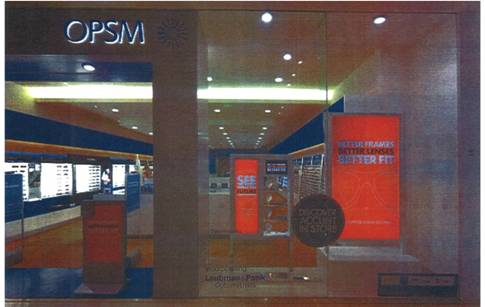
Window Poster, Window Disk and Window Display
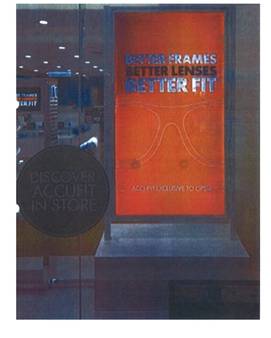
Window Disk and Window Poster
Signboard
Window Display and Window Disk
Window Poster
Window Installation
Window Installation
OPSM Double Fronted Display
Window Poster
SCHEDULE 2

Pole Wrapping Banner

Pole Wrapping Banner
Flyer
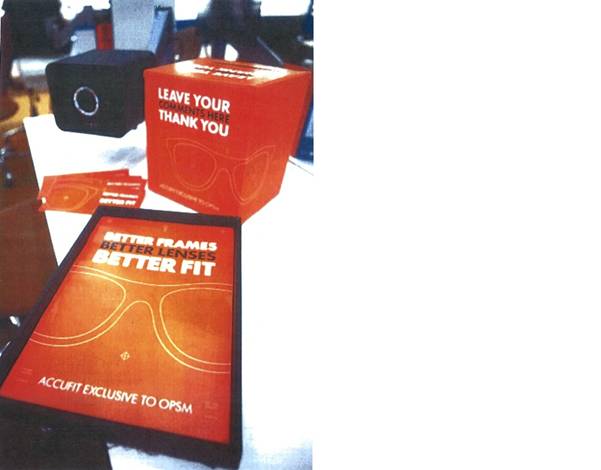
Counter Card, Glasses Handover Tray and Comments Box
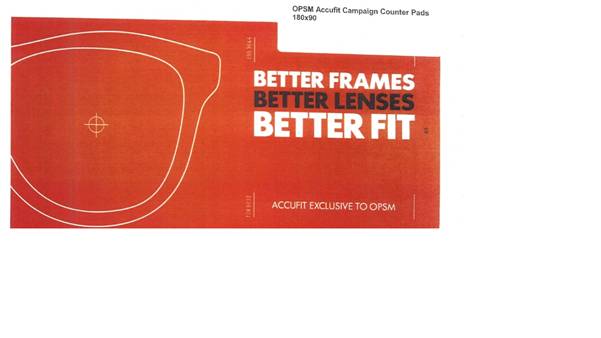 Counter Card
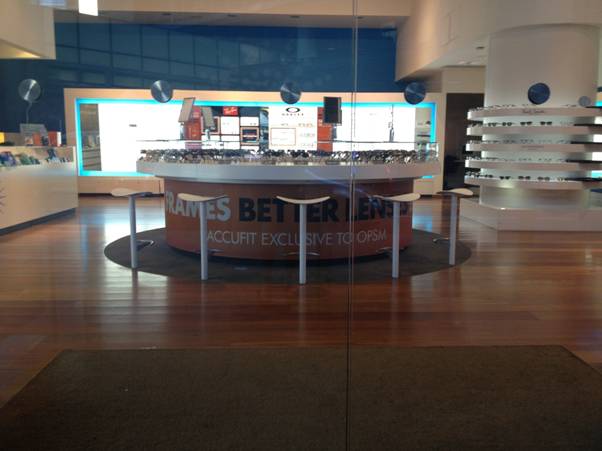
Counter Banner


