FEDERAL COURT OF AUSTRALIA
Foster’s Australia Limited v Cash’s (Australia) Pty Ltd [2013] FCA 527
| Date of last submissions: | 27 August 2012 |
| Place: | Melbourne |
| Division: | GENERAL DIVISION |
| Category: | Catchwords |
| Number of paragraphs: | |
| Solicitor for the Applicant: | Corrs Chambers Westgarth |
| Counsel for the Respondent: | J Garnsey QC with V Beniac-Brooks |
| Solicitor for the Respondent | Arcadia Lawyers |
| IN THE FEDERAL COURT OF AUSTRALIA | |
| FOSTER'S AUSTRALIA LIMITED ACN 004 056 106 (NOW KNOWN AS CUB PTY LTD) Applicant/Cross-Respondent | |
| AND: | CASH'S (AUSTRALIA) PTY LTD ACN 004 275 183 Respondent/Cross-Claimant |
| DATE OF ORDER: | |
| WHERE MADE: |
THE COURT ORDERS THAT:
1. The questions ordered to be separately answered be determined as follows:
Question (a):
Is the respondent/cross-claimant (Cash’s) entitled to an order under s 138 of the Patents Act 1990 (Cth) (‘the Patents Act’) that any of:
(i) Australian Innovation Patent No 2010101451;
(ii) Australian Innovation Patent No 2010101452;
(iii) Australian Innovation Patent No 2010101453; and
(iv) Australian Innovation Patent No 2010101454,
be revoked on the grounds stated in ss 138(3)(a), (d) and/or 138(3)(e) of the Patents Act by reason of the matters set out in paragraphs 3(iA), 3(ii)A and 3(iii) of the Amended Substituted Defence filed on 2 August 2012 (‘the Defence’) and 20(iA), 20(ii), 20(iii) of the Amended Substituted Cross-claim filed on 2 August 2012 (‘the Cross-claim’)?
Answer:
No.
Question (b):
Is Cash’s entitled to an order under s 93 of the Designs Act 2003 (Cth) (‘the Designs Act’) that:
(i) Australian Registered Design No 326865; and/or
(ii) Australian Registered Design No 326895,
be revoked on the grounds stated in ss 93(3)(b) and 93(3)(d) of the Designs Act by reason of the matters set out in paragraphs 6 of the Defence and 21 and 22 of the Cross-claim?
Answer:
No.
2. On or before 4.30 pm on 7 June 2013, the parties file and serve written submissions on costs (such submissions are not to exceed 2 pages).
3. There be a further directions hearing on a date to be fixed.
Note: Entry of orders is dealt with in Rule 39.32 of the Federal Court Rules 2011.
| VICTORIA DISTRICT REGISTRY | |
| GENERAL DIVISION | VID 913 of 2011 |
| BETWEEN: | FOSTER’S AUSTRALIA LIMITED ACN 004 056 106 (NOW KNOWN AS CUB PTY LTD) Applicant/Cross-respondent |
| AND: | CASH'S (AUSTRALIA) PTY LTD ACN 004 275 183 Respondent/Cross-claimant |
| JUDGE: | KENNY J |
| DATE: | 29 MAy 2013 |
| PLACE: | MELBOURNE |
REASONS FOR JUDGMENT
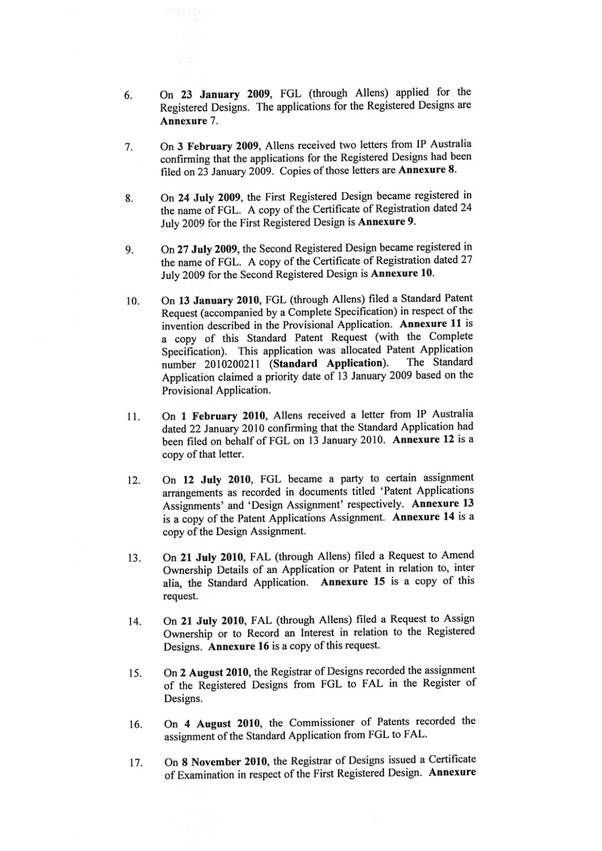
INTRODUCTION
1 In the relevant period, the applicant/cross-respondent (‘FAL’) was a member of the Foster’s Group of companies (‘the Foster’s Group’) – a Group well-known in Australia and commonly associated with beer and wine products. FAL commenced this proceeding by way of an originating application for relief for patent and design infringements against the respondent/cross-claimant (Cash’s). Cash’s responded, in part, that the patents and designs in question were invalid and liable to be revoked. Cash’s asserted that the patents and designs were invalid because the original applications to the Commissioner of Patents (‘the Commissioner’) and the Registrar of Designs (‘the Registrar’) were not made in FAL’s name but in the name of another company in the Foster’s Group and that that company was not entitled to claim ownership of the relevant intellectual property.
2 In order to determine this issue ahead of the other issues raised in the proceeding, the Court ordered that the following questions (‘the preliminary questions’) be heard prior to and separately from all other questions in the proceeding:
(a) Is the respondent/cross-claimant (Cash’s) entitled to an order under s 138 of the Patents Act 1990 (Cth) (‘the Patents Act’) that any of:
(i) Australian Innovation Patent No 2010101451;
(ii) Australian Innovation Patent No 2010101452;
(iii) Australian Innovation Patent No 2010101453; and
(iv) Australian Innovation Patent No 2010101454,
be revoked on the grounds stated in ss 138(3)(a), (d) and/or 138(3)(e) of the Patents Act by reason of the matters set out in paragraphs 3(iA), 3(ii)A and 3(iii) of the Amended Substituted Defence filed on 2 August 2012 (‘the Defence’) and 20(iA), 20(ii), 20(iii) of the Amended Substituted Cross-claim filed on 2 August 2012 (‘the Cross-claim’)?
(b) Is Cash’s entitled to an order under s 93 of the Designs Act 2003 (Cth) (‘the Designs Act’) that:
(i) Australian Registered Design No 326865; and/or
(ii) Australian Registered Design No 326895,
be revoked on the grounds stated in ss 93(3)(b) and 93(3)(d) of the Designs Act by reason of the matters set out in paragraphs 6 of the Defence and 21 and 22 of the Cross-claim?
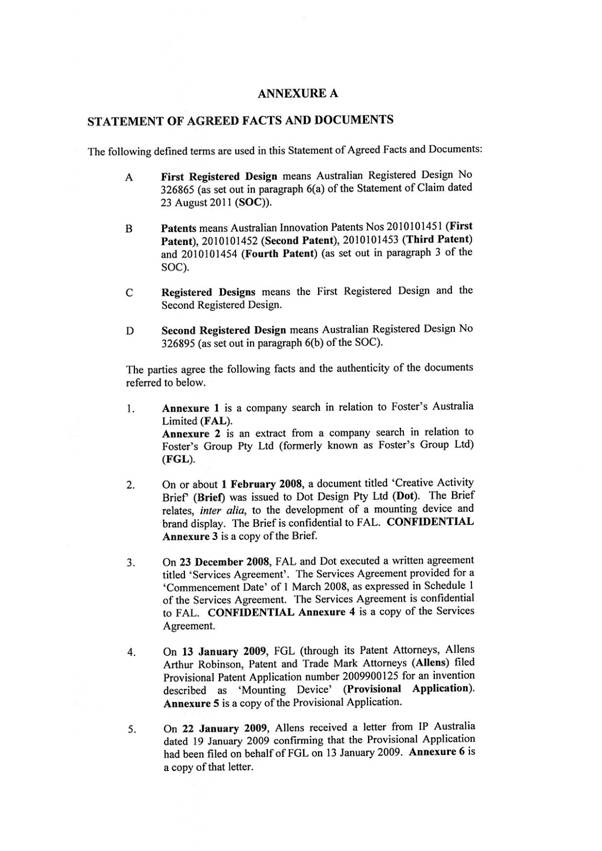
3 At the same time, the Court ordered that the preliminary questions be determined by reference to a Statement of Agreed Facts and Documents (‘SAFD’) and on the evidence adduced by the parties at the hearing of the preliminary questions. The SAFD is set out in annexure ‘A’ to these reasons. The documents referred to in the SAFD were reproduced in an agreed book of documents entitled ‘Documents referred to in Statement of Agreed Facts and Documents’ (‘Agreed Documents’).
4 These reasons concern the answers that the Court would give to these preliminary questions. In summary, for the reasons stated below, I would answer the separate questions:
(a) No; and
(b) No.
THE RELEVANT PLEADINGS
Regarding the Innovation Patents
5 Whilst the relevant pleadings are inelegant, their purport is clear enough. I discuss them briefly below, in order to assist the reader to comprehend the preliminary questions.
6 In paragraphs 3(iA), 3(ii)A and 3(iii) of Cash’s 2 August 2012 Amended Substituted Defence (‘Defence’) and paragraphs 20(iA), 20(ii) and 20(iii) of the 2 August 2012 Amended Substituted Cross-claim (‘Cross-claim’), Cash’s claimed to be entitled to an order under s 138 of Patents Act 1990 (Cth) (‘the Patents Act’) on the grounds stated in paragraphs (a), (d) and (e) of subsection 138(3) of that Act.
7 Thus, in paragraphs 3(iA), 3(ii)A and 3(iii) of the Defence and paragraphs 20(iA), 20(ii) and 20(iii) of the Cross-claim, Cash’s pleaded that the “the Patents … are invalid and liable to be revoked pursuant to”:
(iA) s 138(3)(a) of the Patents Act, by reason of the Applicant, as the patentee recorded on the Register of Patents … not being entitled to the Patents … on the grounds that:
A. the Applicant is not the inventor of the inventions as described in the claims of the subject patents and each of them of the complete Specification of the said patents, within the meaning and for the purposes of s 15(1)(a) of the Patents Act;
B. the Applicant was not, on the grant of the Patents, and each of them, entitled to have the said patents or any of them, assigned to it (Applicant); within the meaning and for the purposes of s 15(1)(b) of the Patents Act[;]
C. the Applicant does not derive title to the invention the subject of the patents and each of them, from the inventor or a person mentioned in s 15(1)(b) of the Patents Act.
…
(ii) A s 138(3)(d) of the Patents Act, by reason of the said Patents, and each of them, insofar as the application for same, as filed on 21 December 2010, purporting to claim a priority date for each of same, of 13 January 2009, that being based on the date of lodgement by Foster’s Group Limited … (FGL) of an application for Australian Standard Patent, being Application No 2009900126, as lodged with the Patents Office by FGL on 13 January 2009, under s 29 of the Patents Act (FGL Parent Application), not being able to be claimed as the priority date for the said patents, and each of them, rather the earliest priority date able to be claimed by the patents is 21 December 2010; …
(iii) s 138(3)(e) of the Patents Act, by reason of the application by FAL (Assignment Request by FAL in respect of the FGL Parent Application) to the Patent Office requesting amendment of the [Register of Patents], in relation to the patent request filed by FGL on 13 January 2009, to record a change in ownership of the Patents, and each of them, from FGL to FAL, having been made in circumstances involving by false suggestion or misrepresentation.
8 In particulars to paragraph 3(iii) of the Defence, Cash’s refers to the particulars to paragraphs 18 to 20 of the Cross-claim and to paragraph 7 of its Particulars of Invalidity. For present purposes, it suffices to refer to the relevant parts of the Cross-claim.
9 Paragraphs 20(iA), 20(ii) and 20(iii) of the Cross-claim allege the invalidity of the Patents pursuant to:
(iA) s 138(3)(a) of the Patents Act, by reason that FAL is not entitled to the Patents, and each of them.
…
…
(ii) s 138(3)(d) of the Patent Act, by reason of the said Patents, and each of them, not being entitled to claim a priority date for each of same of 13 January 2009, rather the earliest priority date is 21 December 2010; and
….
(iii) s 138(3)(e) of the Patents Act, by reason of the application by FAL to the Patent Office requesting amendment of the Patent Register, in relation to the patent request filed by FGL on 13 January 2009, to record a change in ownership of the Patents, and each of them, from FGL to FAL, having been obtained by false suggestion or misrepresentation.
…
Regarding the Registered Designs
10 In paragraph 6 of the Defence and paragraphs 21 and 22 of the Cross-claim, Cash’s effectively claimed to be entitled to an order under s 93 of the Designs Act on the grounds stated in paragraphs (b) and (d) of subsection 93(3) of that Act.
11 Thus, in paragraph 6 of the Defence, Cash’s pleaded that “the Applicant is not entitled to claim ownership of the Registered Designs … and [the] same are invalid and liable to be revoked”. In paragraph 21 of the Cross-claim, Cash’s pleaded that:
The First Registered Design is and has, at all material times, been:
A. an entry wrongly made in the Register of Designs; further or alternatively
B. an entry wrongly remaining on the Register of Designs; and
C. wholly invalid, in that as at the earliest priority date of the application for registered design, as lodged with the Designs Office on 23 January 2009, such application being in the name of FGL, which party was not an entitled person within the meaning of s 5 of the Designs Act, as a person entitled under s 13 of the Act, to be entered in the Register as the registered owner of the subject design, and, hence is liable to be revoked pursuant to s 51 and/or s 52 of the Act.
(Italics are original.)
Cash’s pleading in paragraph 22 of the Cross-claim was identical, save that it related to the Second Registered Design, instead of the First Registered Design.
EVIDENTIARY ISSUES
12 It is convenient to note at this point that, although annexures 3, 4 and 20 to the SAFD were the subject of a confidentiality order prior to the hearing of the preliminary questions, this order was vacated at the hearing when leave was given to substitute redacted versions of annexures 3 and 4. There was no redacted version of annexure 20, which simply ceased to be subject to the earlier confidentiality order.
13 In support of its submissions in answer to the preliminary questions, FAL relied on the affidavits of Owen Malone and Mathew O’Keefe, both sworn on 16 August 2012. Mr O’Keefe made a further affidavit on 22 August 2012. There was no cross-examination of either deponent. Prior to the hearing, FAL sought a confidentiality order in respect of annexures MOK-3 to MOK-11 to Mr O’Keefe’s 16 August 2012 affidavit and in respect of annexure OM-2 to Mr Malone’s affidavit. When leave was given to substitute redacted versions of MOK-3 to MOK-7, FAL did not pursue this application. Further, at the hearing, FAL did not pursue its application for a confidentiality order in respect of OM-2 or MOK 8 to 11.
14 In support of its submissions in answer to the preliminary questions, Cash’s relied on documents reproduced in a folder labelled ‘Respondent’s Book of Additional Documents’ (‘RBAD’). FAL’s objections with respect to documents under tabs 5, 6, 8 and 14-18 were upheld. Documents under tabs 20 and 21 were in the nature of submissions and the parties agreed that they should be treated as such.
15 Cash’s did not rely on the affidavit of Ms Beniac-Brookes sworn on 12 May 2012, which had been filed prior to the hearing of the preliminary questions. A further affidavit of Ms Beniac-Brooks sworn on 13 August 2012 (also reproduced under tab 6 of the RBAD) with annexures and the affidavit of Robert Charles Kelson sworn on 13 August 2012 with annexures (some of which were also reproduced under tab 5 of the RBAD) were the subject of successful objection.
FACTUAL BACKGROUND
The Foster’s Group
16 In the period with which the preliminary questions are concerned, FAL and another company, Foster’s Group Limited (‘FGL’), were both members of the Foster’s Group. As the SAFD indicates, FGL (now called Foster’s Group Pty Ltd) played a significant part in the events with which the preliminary questions are concerned. Since these questions chiefly concern events in the period between the beginning of 2008 and mid-2011 (‘the relevant period’), before the companies in the Foster’s Group were acquired by SABMiller PLC and FAL and FGL changed their names, these reasons refer to these two companies by reference to their former names, as denoted by the abbreviations FAL and FGL.
17 In the relevant period, FGL was the ultimate holding company and the head company within the Foster’s Group. FGL provided corporate services to other members of the Foster’s Group, including company secretarial work, tax management, insurance and public relations. FGL also dealt with legal affairs and intellectual property management.
18 Also in the relevant period, FAL was a wholly-owned subsidiary of FGL and an operating entity within the Foster’s Group. FAL was primarily responsible for the distribution and marketing of the wine and beer products (and associated marketing materials) of the Foster’s Group. At an operational level, the Board of FGL controlled the activities of FAL (and other members of the Foster’s Group). FGL was able to direct FAL to enter into such transactions as FGL saw fit.
19 The majority of the people working for companies within the Foster’s Group on a salaried basis were employed by Foster’s People Pty Ltd (‘FPPL’), which was another company in the Foster’s Group. Many of these people provided services to various corporate members of the Foster’s Group. FPPL was also a wholly-owned subsidiary of FGL.
20 In the relevant period, the Foster’s Group managed the Group’s intellectual property affairs through an in-house intellectual property department (‘IP Department’) headed by Mr Malone. Mr Malone was assisted by Mr O’Keefe, who reported directly to Mr Malone. Both Mr Malone and Mr O’Keefe (employed by FPPL) were authorised to execute agreements on behalf of FAL and FGL in relation to intellectual property matters.
21 The IP Department provided guidance to all members of the Foster’s Group in relation to intellectual property. The terms of Mr O’Keefe’s employment contracts are illustrative of this, providing that:
In your role for Foster’s People [FPPL] you may be required to undertake duties relating to the business of any company in the Foster’s group of companies (Foster’s Group). The Foster’s Group comprises all companies related to Foster’s Group Limited (Foster’s) within the meaning of the Corporations Act 2001.
…
You must:
…
(c) Use your best endeavours to promote and enhance the interests, profitability, growth and reputation of Fosters and the Foster’s Group companies;
(d) Act in the best interests of Foster’s and not intentionally do anything which is or may be harmful to Foster’s or any Foster’s Group company …
22 The IP Department was also subject to a policy statement entitled ‘Intellectual Property Policy – Foster’s Group Ltd’ (‘the Policy’). According to Mr Malone, “[t]his policy was implemented to ensure … the work of the IP department was directed at ensuring … that the intellectual property owned by the members of the Foster’s Group was captured, protected, able to be used effectively and enforced by the Foster’s Group’. The Policy itself stated:
Intellectual property constitutes one of the most valuable assets of the Foster’s Group, underpinning its brands, business operations, commercial relationships and innovations developed within the businesses.
…
Foster’s is committed to “best practice” management of its intellectual property assets to ensure that they are fully secured, controlled and utilised to best effect to support and promote its business objectives.
Specifically, Foster’s policy is to implement a global management approach to its intellectual property assets through centralised management of registrable intellectual property and the provision of advisory services to the Group’s businesses on the control and use of intellectual property generally. This purpose [sic] of this policy is to both ensure appropriate security of intellectual property assets and to extract maximum value from utilisation of these assets in the competition market place.
23 When appropriate, the IP Department also instructed external lawyers and attorneys in relation to intellectual property matters.
24 In the relevant period, within the Foster’s Group, it was common for FAL to be the registered owner of much of the registered intellectual property relating to the Group’s beer business, although other companies within the Foster’s Group frequently used the rights associated with this property.
25 Broadly speaking, whilst the Foster’s Group comprised a number of companies – each performing different work associated with the business of the Foster’s Group – the evidence indicated that the companies within the Group generally acted with the common purpose of progressing the business interests of the Group as a whole.
Service Agreement with Dot Design Pty Ltd
26 On or about 1 February 2008, Dot Design Pty Ltd (‘Dot’) was given a ‘Creative Activity Brief’ (‘the Brief’) relating to the development of a mounting device and brand display. The Brief was said to be funded by a ‘Foster’s national initiative’. The development work by Dot was overseen within the Foster’s Group by Brad Reynolds, an employee of FPPL and identified in the Brief as the “planner”. Mr Reynolds’ employment contracts also contained the terms set out at [21] above. It was common ground that, pursuant to this Brief, officers of Dot created the intellectual property – the inventions and the designs – which are the subject of the innovation patents and registered designs with which this proceeding is primarily concerned.
27 On 23 December 2008, FAL and Dot executed a ‘Services Agreement’ (‘the Services Agreement’), with a commencement date of 1 March 2008. The Services Agreement stated that it “related to the design and manufacture of bar taps and handles”. A table forming part of the agreement was as follows:
Services Agreement
Details
| Parties | Foster’s and the Supplier | ||||
|---|---|---|---|---|---|
| Foster’s | Name | Foster’s Australia Limited | |||
| ABN | 76 004 056 106 | ||||
| Address | 77 Southbank Boulevard, Southbank, Victoria, Australia 3006 | ||||
| Telephone | +61 3 9633 2000 | ||||
| Fax | +61 3 9633 2002 | ||||
| Attention | Company Secretary | ||||
| | |||||
| Supplier | Name | DOT Design Pty Ltd | |||
| ABN | 70 098 839 617 | ||||
| Address | 54 Kellett Street, Potts Point, NSW 2011 | ||||
| Telephone | 02 9361 3655 | ||||
| Fax | 02 9361 3855 | ||||
| Attention: | Emad Ayad | ||||
| | |||||
| Recitals | A | Foster’s is a premium multi-beverage producer in Australia and has requested the Supplier to supply the Services to Foster’s. | |||
| B | The Supplier is a service provider who has agreed to supply the Services to Foster’s. | ||||
| C | The parties have agreed on the terms and conditions of this Agreement | ||||
| Date of Agreement | See signing page | ||||
28 Pursuant to clause 3.1 of the Services Agreement:
Foster’s appoints the Supplier to supply the Services to Foster’s and its Affiliates for the Term and the Supplier accepts such appointment.
The “Services” were defined as “the services to be provided by the Supplier in accordance with this Agreement outlined in Schedule 2”. As FAL said in written submissions dated 21 August 2012:
The Services Agreement related to the provision by Dot of the following services (among others):
The Supplier shall design, manufacture and deliver the Hardware (that is, draught beer tapware and handles, as otherwise described in Part 6 of this Schedule) across the entire Foster’s on-premises draught beer portfolio, to Foster’s satisfaction.
…
Specifically, the Services that the Supplier agrees to provide are:
• Full design, manufacture, product testing and delivery service of the Hardware (one point of interaction)
• Responsibility for design and manufacture Hardware
• Design for tap handles and badges (3 tap handle concepts per brand or as briefed by Foster’s).
29 Dot undertook to “act in good faith and in a manner which is not inconsistent with the maintenance of the business and goodwill of Foster’s”: clause 4.1(g). Dot also warranted that “it and its Representatives have the requisite knowledge, skill and expertise to supply the Services to Foster’s …”: clause 12(a).
30 The Services Agreement contained a number of provisions regarding the ownership of intellectual property, including:
11.2 Ownership
Intellectual Property Rights in all documents, materials and inventions which are generated, created or acquired (excluding under licence from a third party) by the Supplier or its Representatives during the performance of the Services (‘Relevant Intellectual Property Rights’) will belong to and be owned by Foster’s immediately and absolutely for its own use and benefit in any manner it sees fit without any further fee payable to or consent required from the Supplier.
11.3 Assignment
As soon as the Relevant Intellectual Property Rights come into being, the Supplier will assign or transfer, and will make sure its Representatives assign or transfer, all Relevant Intellectual Property Rights to Foster’s and sign off all such documents and do all such things necessary in order to give effect to this clause.
31 Clause 28.1 of the Services Agreement contained numerous definitions, including:
Affiliate means in relation to a person, any person that Controls, is Controlled by or is under common Control with that first mentioned person.
…
Control has the same meaning as given to it in the Corporations Act 2001 (Cth).
…
Intellectual Property Rights includes present and future intellectual property rights pertaining to Confidential Information, copyright, patents, trade or services marks, designs, eligible layouts and circuit layouts (whether registered or unregistered).
…
Representatives of a party means an Affiliate or an employee, agent, officer, director, auditor, adviser, partner, consultant, joint venturer or sub-contractor of that party or an Affiliate, including but not limited to those persons listed in Schedule 6.
32 Clause 28.2 further provides that:
In this Agreement, unless the context otherwise requires:
…
(d) a reference to:
(i) Foster’s includes a reference to its Affiliates;
…
33 The development work relating to the mounting device and badge holder the subject of the proceeding was completed in 2008.
Patent and design applications made by FGL
34 On 13 January 2009, Allens Arthur Robinson, Patent and Trade Mark Attorneys (‘Allens’), filed Provisional Patent Application number 2009900125 for an invention described as ‘Mounting Device’ (‘Provisional Application’) in the name of FGL.
35 On 23 January 2009, Allens applied for Australian Registered Design No 326865 (‘First Registered Design’) and Australian Registered Design No 326895 (‘Second Registered Design’). The First Registered Design and the Second Registered Design are together referred to as the ‘Registered Designs’.
36 On 24 July 2009, the First Registered Design became registered in the name of FGL. On 27 July 2009, the Second Registered Design became registered in the name of FGL.
37 On 13 January 2010, FGL (through Allens) filed a Standard Patent Request (accompanied by a Complete Specification) in respect of the invention described in the Provisional Application. This Standard Patent Request became Patent Application number 2010200211 (‘Standard Application’). The Standard Application claimed a priority date of 13 January 2009 based on the Provisional Application.
38 The circumstances in which FGL, as opposed to FAL, applied for the Registered Designs and filed the Provisional Application and the Standard Application are described principally in the affidavits of Mr O’Keefe. These circumstances were as follows.
39 Subject to Mr Malone’s supervision, Mr O’Keefe was responsible for overseeing the pursuit of the applications by Allens. Mr O’Keefe recalls that he orally instructed Anthony Selleck of Allens to apply for the Registered Designs and to file the Provisional Application in early 2009; and that he did not specify which company within the Foster’s Group should be named as the applicant for the Registered Designs or the Provisional Application.
40 Later, by an email on 13 January 2010, Mr O’Keefe instructed Mr Selleck to file the Standard Application. Although Mr O’Keefe did not state in this email which company within the Foster’s Group should be named as the applicant, the subject line of the email read “Proposed Australian Complete Patent Application For Mounting device in the Name of Foster’s Group Limited – Our ref: 120004034”.
Registered Designs, Provisional Application and the Standard Application
41 Between mid-January 2009 and early January 2010, Mr O’Keefe received documents from IP Australia (via Allens) in relation to the applications for the Registered Designs and the Provisional Application, which noted FGL as the applicant. Mr O’Keefe did not, however, notice that FGL was noted as the applicant for the Registered Designs and the Provisional Application until 13 January 2010 shortly after he had given his instructions to Mr Selleck to file the Standard Application. Late in the afternoon of 13 January 2010, Mr O’Keefe discussed this matter with Mr Malone, who directed him to arrange for the Registered Designs, the Provisional Application and the Standard Application to be assigned to FAL. About 5 o’clock the same day, Mr O’Keefe emailed Mr Selleck (of Allens), stating:
Both technologies appear to have been applied for in the name of our corporate parent company Foster’s Group Limited rather than the operating entity, Foster’s Australia Limited. If that’s the case, please assign everything across to Foster’s Australia Limited. If ever in doubt, please check which legal entity should hold the IP as it’s important for all sorts of boring business reasons.
42 On 15 January 2010, Mr O’Keefe received an email from Mr Selleck, which stated:
I will go over all the design and patent cases we have for Fosters and, if necessary, assign them over to Fosters Australia Ltd or amend the application forms.
43 On 7 July 2010, Mr O’Keefe received a further email from Mr Selleck, which said:
Hi Anthony, re the below, can you advise where we’re at re getting the patents/designs from FGL to FAL? We’re in the midst of tidying everyone up ready for the demerger so there’s a degree of urgency.
44 Shortly thereafter, Mr Selleck provided Mr O’Keefe with two documents, one entitled “Patent Applications Assignment” and the other, “Designs Assignment”. On 12 July 2010, these two documents were executed by FGL and FAL. The Registrar recorded the assignment of the Registered Designs from FGL to FAL in the Register of Designs on 2 August 2010. The Commissioner recorded the assignment of the Standard Patent Application from FGL to FAL on 4 August 2010.
45 Mr Malone deposed (and it may be accepted) that, by reason of the fact that FGL had legal entitlement to control and in fact controlled FAL:
… FGL could have directed FAL to assign all of its rights in and to the Registered Designs, the Provisional Application and the Parent Application to FGL at any time. However, while this course was open to FGL in January 2010, I elected to arrange for the assignments … as this approach was consistent with FAL being the registered owner of such intellectual property rights within the Foster’s Group.
FAL applies for the innovation patents in suit
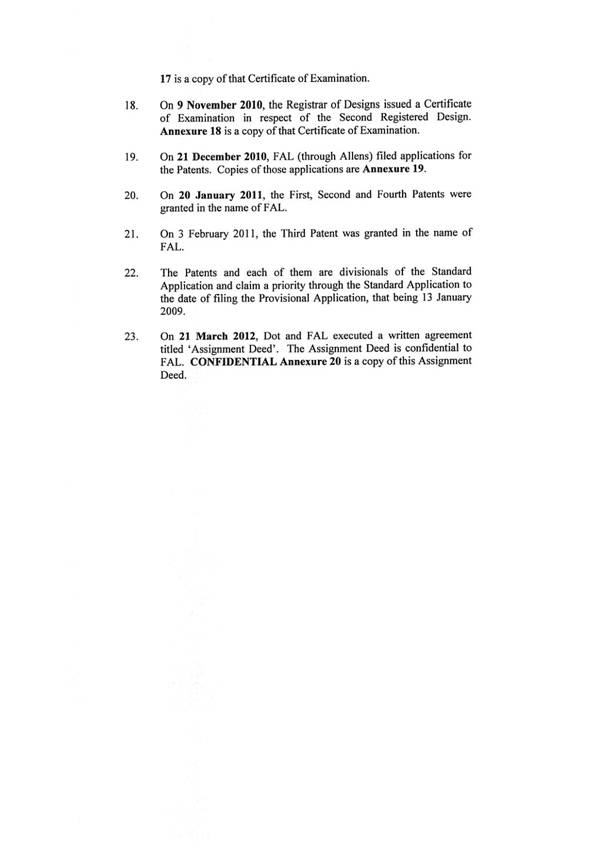
46 On 21 December 2010, FAL (through Allens) filed applications for Australia Innovation Patents Nos. 2010101451 (‘First Patent’), 2010101452 (‘Second Patent’), 2010101453 (‘Third Patent’) and 2010101454 (‘Fourth Patent’). I refer hereafter to the four Patents collectively as ‘the Patents’. The Patents are divisionals of the Standard Application and claim a priority through the Standard Application to the filing date of the Provisional Application (namely, 13 January 2009).
47 On 20 January 2011, the First, Second and Fourth Patents were granted in the name of FAL. On 3 February 2011, the Third Patent was granted in the name of FAL. Each of the Patents has been examined and certified by the Commissioner.
The March 2012 Assignment
48 On 21 March 2012, FAL and Dot entered into a further agreement entitled ‘Assignment Deed’. Under the Assignment Deed, Dot assigned to FAL any residual rights it may have in relation to the intellectual property the subject of the Registered Designs, the Parent Application and the Patents (with effect from the creation of that intellectual property). This is the effect of clause 2(a) and paragraph (d) of the definition of Intellectual Property Rights in clause 1.1 of the Assignment Deed.
49 Clause 2(a) of the Assignment Deed provides:
The Assignor hereby assigns absolutely to the Assignee all of its rights, title and interest, both legal and beneficial, in the Intellectual Property Rights, with effect from the date on which those Intellectual Property Rights came into being.
The definition of Intellectual Property Rights in clause 1.1 of the Assignment Deed states, amongst other things, that ‘Intellectual Property Rights’ means the intellectual property rights in all … designs and inventions which were generated, created or acquired … by the Assignor or its Representatives during the performance of the Services, including:
(d) … all intellectual property rights in relation to and subsisting in:
(i) Australian Patent Application No 2010200211 (“Mounting Device”);
(ii) Australian Innovation Patent No 2010101451 (“Mounting Device”);
(iii) Australian Innovation Patent No 2010101452 (“Mounting Device”);
(iv) Australian Innovation Patent No 2010101453 (“Mounting Device”);
(v) Australian Innovation Patent No 2010101454 (“Mounting Device”);
(vi) Australian Registered Design No 326865 (“Brand Display”);
(vii) Australian Registered Design No 326895 (“Mounting Device”).
“Services” here has the meaning given the word in clause 28.1 of the 23 December 2008 Services Agreement between FAL and Dot: see clause 1.1 of the Assignment Deed.
LEGISLATION - PATENTS
50 Section 29(1) of the Patents Act identifies who may apply for a patent, as follows:
A person may apply for a patent for an invention by filing, in accordance with the regulations, a patent request and such other documents as are prescribed.
51 Section 15(1) of the Patents Act governs who may be granted a patent. It provides:
Subject to this Act, a patent for an invention may only be granted to a person who:
(a) is the inventor; or
(b) would, on the grant of a patent for the invention, be entitled to have the patent assigned to the person; or
(c) derives title to the invention from the inventor or a person mentioned in paragraph (b); or
(d) is the legal representative of a deceased person mentioned in paragraph (a), (b) or (c).
52 Section 138 of the Patents Act concerns applications for the revocation of a patent. It relevantly states:
(1) Subject to subsection (1A), the Minister or any other person may apply to a prescribed court for an order revoking a patent.
…
(3) After hearing the application, the court may, by order, revoke the patent, either wholly or so far as it relates to a claim, on one or more of the following grounds, but on no other ground:
(a) that the patentee is not entitled to the patent;
…
(d) that the patent was obtained by fraud, false suggestion or misrepresentation;
(e) that an amendment of the patent request or the complete specification was made or obtained by fraud, false suggestion or misrepresentation;
…
LEGISLATION - DESIGNS
53 Section 21(1) of the Designs Act concerns who may make a design application. Section 21(1) states:
A person may file an application (a design application) in respect of a design.
54 Section 13 (1) of the Designs Act states who may be registered as the registered proprietor of a design. It states:
A person mentioned in any of the following paragraphs is entitled to be entered on the Register as the registered owner of a design that has not yet been registered:
(a) the person who created the design (the designer);
(b) if the designer created the design in the course of employment, or under a contract, with another person – the other person, unless the designer and the other person have agreed to the contrary;
(c) a person who derives title to the design from a person mentioned in paragraph (a) or (b), or by devolution by will or by operation of law;
(d) a person who would, on registration of the design, be entiled to have the exclusive rights in the design assigned to the person;
(e) the legal personal representative of a deceased person mentioned in paragraph (a), (b), (c) or (d).
55 Section 93 of the Designs Act relates to applications for revocation of the registration of a design. It relevantly provides:
(1) A person may apply to a prescribed court for an order revoking the registration of a design.
…
(3) The grounds on which a court may revoke the registration of the design are:
…
(b) that one or more of the original registered owners was not an entitled person in relation to the design when the design was first registered; or
…
(d) that the registration of the design was obtained by fraud, false suggestion or misrepresentation; ….
(4) In this section:
original registered owner, in relation to a design, means each person entered in the Register as the registered owner at the time the design was first registered.
PARTIES’ SUBMISSIONS
Cash’s submissions regarding the Patents
56 Cash’s submitted that the Provisional Application and the Standard Application were wrongly filed in FGL’s name because “FGL wasn’t entitled to the invention, and short of obtaining an assignment from [Dot] – which it never obtained … – could not become an entitled patentee” under s 15(1) of the Patents Act.
57 The Patent Applications Assignment was, on Cash’s argument, entirely ineffective. At the hearing, counsel for Cash’s submitted that that Cash’s argument “comes down to this”:
[T]hat FAL did not get any rights to make the divisional innovation patent applications from FGL under the 2010 Deed. That is because FGL could not have applied for and obtained the grant of any patent under section 15 of the Patents Act. Eligible person for a grant is defined as someone who qualifies under section 15; FGL never qualified for any of the patents.
The 2010 deed assigned all FGL’s right, title and interest to the patent applications, including the rights to make further applications arising out of the patent applications. FGL had no such rights for divisional applications based on the standard patent application. So FAL could not, by virtue of the deed, obtain any rights to make applications for the innovation patents with, or without, the earlier priority. Any rights it obtained were otherwise presumably under the services agreement.
At the hearing, Cash’s effectively submitted that, for this reason, FAL’s claim to file a divisional application or to claim priority from earlier applications in FGL’s name was misconceived. In written submissions, Cash’s concluded that FGL:
… “could never have derived title to the invention of the Standard Complete Application 2010200211 from the inventor” or from FAL within s 15(1)(b) or (c); and
… was not “entitled to … any rights which it could assign to FAL to confer on FAL the status and rights of an applicant for the Standard Complete Application 2010200211, or of an applicant for any divisional Innovation Patents based on the Standard Complete Application 201020021, let alone with the priority dates of the Standard Complete Application 2010200211”.
Consequently, so Cash’s submitted, FAL “was never entitled to apply for or obtain the grants of the four Innovation Patents”.
58 Referring to Stack v Brisbane City Council (1999) 47 IPR 525 (‘Stack’), 534 [36]-[38], 536 [52] and H Bion Inc v Commissioner of Patents [2010] FCA 539, Cash’s reiterated that registration of the purported assignment could not create rights that did not otherwise exist.
59 Further, Cash’s maintained that the ineffectiveness of the Patent Application Assignment was further evidenced by its inconsistency with the Assignment Deed entered into at a later date between Dot and FAL. At the hearing, counsel for Cash’s relied on this 2012 Assignment Deed “to demonstrate the falsity of the original application and the deed of assignment of 2010” and “as admissions as to the true state of affairs”.
60 Cash’s emphasised the importance of the interests in maintaining the integrity of the Register of Patents, referring to Purex Corporation Limited v Vanguard Trading Company (1965) 112 CLR 532, 533-534 (Kitto J); The Queen v Commissioner of Patents; ex parte Martin (1953) 89 CLR 381, 407-408; Stack, 534 [38] (Cooper J); and Martin and the Miles Martin Pen Coy Ltd v Scrib Ltd (1950) 67 RPC 127, 133.
61 Ultimately, Cash’s argued, the only way in which FAL could have obtained the benefit of the existing Standard Patent Application was through a request by FGL for amendment of the Patent Request for the Standard Patent.
62 As to false suggestion and misrepresentation, Cash’s argued:
The Patent Requests are dated 21 December 2010 and specify [FAL] as Applicant. They each state that FAL is entitled to file the Divisional Applications (the box is checked) pursuant to the provisions of s 79B and as such claiming priority from the Parent No 2010200211 (which was itself based on a Provisional Specification claiming priority from 13 January 2009).
The Respondent (Cash’s) contends that the statements on the Requests of FAL are misrepresentations and false, namely (as was the fact) that
(1) at 21 December 2010, FAL was not entitled to file the Divisional Application, and
(2) FAL was not entitled to claim priority for the Divisional Application from the Parent No 2010200211.
63 Cash’s also relied on the ‘Patent Request: Standard Patent’ form dated 13 January 2010, which included the following statement:
The Applicant identified below requests the grant of a patent to the Nominated Person identified below, for an invention described in the accompanying standard complete specification.
FGL was identified as ‘Applicant’. Referring to regulation 3.1A (and mistakenly to regulation 3.1) of the Patents Regulations 1991 (Cth) (‘the Regulations’), counsel for Cash’s argued that, FGL “didn’t make the original application as just anyone. It made the original application as a person nominated to be entitled to obtain the grant of a patent under section 15.” This was because, by force of the regulation 3.1A, FGL as named applicant was “taken to be” the person nominated to be granted the requested patent, notwithstanding that ‘Leonard Velich’ and ‘Tim Kelly’, of Dot, were named as the actual inventors.
64 Cash’s maintained that FGL acquired no relevant interest under the Services Agreement because it was not a party to that agreement. This meant, so Cash’s submitted, that, in the ‘Patent Request: Standard Patent’ form:
FGL represented to the Commissioner that it (FGL) had title to the invention as described in the complete specification, by reason of it having derived title from the inventors or a person mentioned in s 15(1)(b), and further that it (FGL) had a right to claim priority from Provisional Application 2009900125 (the same misrepresentations as to entitlement were in substance made in the Provisional Specification).
In fact, FGL was not and has never been entitled to the grant of a patent for the invention the subject of Patent Request for the Standard Patent, the alleged Parent No 2010200211, and FGL never derived any title from the inventor or a person mentioned in s 15(1)(b) of the Act. Further, consequently, FGL never had a right to claim priority from Provisional Application 2009900125.
65 Cash’s also argued that the Patent Application Assignment misrepresented:
(1) That FGL as Applicant for a grant of the Standard Patent, the alleged Parent No 2010200211 had rights which it could effectively assign to FAL, and
(2) That FAL would by the assignment be entitled as Applicant to the grant of the Standard Patent, the alleged parent No 2010200211 and to any applications for patents, patents granted thereon arising thereon.
This was because, as at 12 July 2010, FGL did not have any rights that it could assign to FAL; and FAL did not become entitled as applicant to “the grant of the Standard Patent, the alleged Parent No 2010200211 and to any applications for patents … such as the right to apply for divisional Innovation Patents filed pursuant to … s 79B of the Patents Act … whether with the priority date of the Parent or otherwise”.
66 Cash’s also contended that:
[T]he statements on the Requests of FAL are misrepresentations and false because:
(1) at 21 December 2010, FAL was not entitled to file the Divisional Application, and
(2) FAL was not entitled to claim priority for the Divisional Application from the Parent Standard Patent Application No 2010200211.
As counsel for Cash’s put it, FGL “had nothing to assign” but “elected to reassert the title of [FGL] and represent that to the Commissioner as the party entitled to the grant of a patent”. Counsel continued:
[T]hey could have made a request … to amend the patent application without misrepresenting anything to the Commissioner …
…
[This] wasn’t merely to put [FAL] in the position which it was entitled to, had it made the original application. It was to adopt as assignment title from a party which didn’t have any rights. … So that the innovation patent applications would get the priority date of the standard patent and the provisional.
…
[I]f FAL is not entitled to make the divisional application … for innovation patents because the assignment to it of the rights to put it as the applicant for the patent was of no effect whatsoever, then it’s not entitled to the earlier priority date; and if it’s not entitled to the earlier priority date, the complete specification of the original application, having been published … the patent is prior published and invalid.
67 Citing Pfizer Overseas Pharmaceuticals v Eli Lilly and Co (2005) 68 IPR 1, Prestige Group (Australia) Pty Ltd v Dart Industries Inc (1990) 19 IPR 275 (‘Prestige Group’) and ICI Chemicals & Polymers Ltd v Lubrizol Corporation Inc (2000) 181 ALR 635, Cash’s submitted that the claimed misrepresentations were sufficient to amount to false suggestion or misrepresentation upon which the Commissioner relied for the grant of the Patents, because they misled the Commissioner:
as to the entitlement of the Applicant to make the divisional applications and the priority date to which those applications were entailed, and materially contributed to the Commissioner’s decision to grant the Innovation Patents.
68 Relying on numerous authorities, including JMVB Enterprises Pty Ltd (formerly known as A’Van Campers Pty Ltd) v Camoflag Pty Ltd (2005) 67 IPR 68 (‘JMVB Enterprises’), 94 [135]-[136] and the cases there cited, Cash’s submitted that these misrepresentations justified revocation of the Patents on the ground of false suggestion or misrepresentation in s 138(3)(d) of the Patents Act.
69 Cash’s also made a submission as to equitable fraud, with counsel submitting at the hearing that FAL made a “deliberate election … to represent to the Commissioner that FGL had rights under an ineffective deed” on more than one occasion. As counsel for Cash’s described it:
The first was FGL applying in itself, without any right to – any rights from the inventors. The second was the deliberate election to have the register, or rather, the particulars of ownership corrected, and seek to get the original application in the name of FAL based by way of an assignment, which was, so far as conferring any substantive rights, let alone any rights to apply for an innovation patent, ineffective and, we would say, fictitious.
An allegation as to equitable fraud was not the subject of any distinct pleading, although Cash’s submissions on this subject may be regarded as an elaboration of its case under s 138(3)(d) in relation to false suggestion or misrepresentation.
70 In response to FAL’s argument that, by virtue of the Services Agreement, FGL had acquired rights in respect of the invention, Cash’s referred to a related confidentiality agreement and a deed of guarantee to support the proposition that Dot and FAL were the only parties to the Services Agreement that had acquired relevant rights. Cash’s submitted that the Services Agreement could not sensibly be read to confer such rights on the 807 companies that were “Affiliates” within the meaning of the Services Agreement. Cash’s counsel thus submitted that “when one looks at the services agreement … [FGL] did not obtain any relevant rights in respect of the patents or the inventions of the – patent applications or the registered designs”.
71 Cash’s argued that this was not a case for a constructive trust, as FAL at one point suggested (and argued more forcibly in relation to the Registered Designs: see below) because “what FGL and FAL did here, through Mr Malone and Mr O’Keefe, was done with full deliberation and full knowledge, and shows an intent contrary to any constructive trust and any estoppel or implied assignment”. Cash’s also argued that the Court should be reluctant to “recognise interests which make the register inaccurate”.
72 After the hearing, with limited leave, Cash’s filed additional submissions in closing. Since this account of Cash’s submissions is already lengthy, it is undesirable to provide further of these submissions. It suffices to say that these submissions elaborated further on the submissions that Cash’s made at the hearing, including by drawing attention to paragraph 8045 of Ann Dufty and James Lahore, Patents, Trade Marks & Related Rights (LexisNexis Butterworths, Australia, 2006 (loose leaf)) (‘Patents, Trade Marks & Related Rights’), which is discussed below.
Cash’s submissions regarding the registered designs
73 In respect of the Registered Designs, Cash’s submission was that, because the Registered Designs were applied for and registered in the name of FGL, the Registered Designs are liable to be revoked. Cash’s submitted that the rights to the Registered Designs, including the rights to apply for registration and be registered as owner, had always been FAL’s property, by virtue of, amongst other things, clause 11 of the Services Agreement. Accordingly, FGL “has never at any time been entitled to apply for the registration of the Designs or to be or remain on the Designs Register”. Referring to JMVB Enterprises at 102-103 [182]-[187], Cash’s argued that “any purported assignment from FGL to FAL was of an invalid registration and FAL has no rights in respect of that design by virtue of the assignment after the date of registration”.
74 Cash’s referred to the Design Registration Application made on 23 January 2009, by Allens, in which it was said that FGL was “entitled to be entered on the Register as the registered owner of the design(s)”. Cash’s also referred to a letter dated 17 July 2009 from Allens to the Registrar, pursuant to which Allens sought to file a Request for Amendment referring to FGL as “Registered Owner/Applicant(s)”. In written submissions, Cash’s continued:
On the basis of this misinformation which was clearly material to the Registrar’s decision to register, the Designs were registered by the Australian Designs Office. … [T]he registered owner of each was entered as FGL.
By letter dated 21 July 2012 … [Allens], for FGL, sought to assign ownership or record an interest in the subject designs to [FAL]. The Design Assignment dated 12 July 2010 was used as a basis for such a transfer and such an Assignment referred to FGL being the Assignor of the registered designs and having “all right, title and interest” in the subject designs to assign them to FAL. … [T]his was and is untrue.
75 Cash’s argued that, by reason of s 13(1) and (4) of the Designs Act, FGL was never entitled to be entered on the Register of Designs as the registered owner and that the registration was always vulnerable to revocation under s 93(1), (3)(b) and (d) of the Designs Act. Cash’s noted that there was no evidence that Dot had received the prior written consent from FAL, to assign its intellectual property rights to FGL as required by, amongst other things, clause 27.3 of the Services Agreement.
FAL’s submissions regarding the Patents
76 FAL contended that the Patents Act drew a distinction between eligibility to apply for a patent and eligibility to be granted a patent. FAL argued that, by virtue of the Services Agreement and the Patent Applications Assignment, the conduct of FGL in relation to the Provisional Application and the Standard Application, and the conduct of FAL in relation to the Patents, conformed with the scheme created by ss 29(1) and 15(1) of the Patents Act, such that, as at the date of grant, FAL was entitled to the invention and the grant of the Patents.
77 FAL argued, in the alternative, that, if it were necessary for FGL to fall within a category in s 15(1) of the Patents Act in order validly to make the Provisional Application and the Standard Application, then the Court should be satisfied that FGL fell within such a category. This was because:
(a) as at the date of application, FGL could have called for an assignment from FAL because it controlled the conduct of FAL; or
(b) the conduct of the Foster’s Group in relation to the filing of the Provisional Application was sufficient to constitute an equitable or, alternatively, an implied, assignment from FAL to FGL of (at least) any right FAL had to apply for a patent in relation to the invention; or
(c) by virtue of the Services Agreement, FGL itself had rights in respect of the invention on account of terms of clauses 11.2 and 11.3, bearing in mind that FGL was an “Affiliate” as that word was defined in the Services Agreement.
78 Accordingly, so FAL argued, there was no irregularity in FGL filing the Provisional Application and the Standard Application; and it was open to FGL to assign the Provisional Application and the Standard Application to FAL at any time. FAL continued that, in this circumstance, following the assignment, there was no impediment to FAL applying for and being granted the Patents and claiming the priority date of the Provisional Application.
FAL’s submissions regarding the Registered Designs
79 FAL’s submissions with respect to the Registered Designs depended on an argument with respect to the Designs Act that was similar to that concerning the Patents Act. FAL contended that the Designs Act also drew a distinction between eligibility to apply for a design and a person’s eligibility to have that person’s name entered on the Register of Designs as the registered owner of a design. FAL argued that the authorities concerning the Designs Act provided little guidance on the salient issues in this case; and that given the textual similarities between s 93(3)(b) and (d) of the Designs Act and the equivalent provisions in s 138(3) of the Patents Act, the authorities concerning these provisions of the Patents Act provided appropriate assistance.
80 FAL contended that the Registered Designs were properly registered and held in its name on the following bases:
(a) as at the date of registration, FGL could have called for an assignment from FAL of any rights it had in the designs (by reason of the Services Agreement or otherwise) because it controlled the conduct of FAL; or
(b) the conduct of the Foster’s Group in relation to the filing of the applications for the Registered Designs was sufficient to constitute an equitable or, alternatively, an implied, assignment from FAL to FGL of (at least) any right FAL had to apply for the Registered Designs; or
(c) by virtue of the Services Agreement, FGL itself had rights in respect of the designs the subject of the Registered Designs on account of terms of clauses 11.2 and 11.3, bearing in mind that FGL was an “Affiliate” as that word was defined in the Services Agreement; or
(d) FGL held the registration of the design as a constructive trustee for FAL.
81 Accordingly, so FAL argued, there was no irregularity in FGL applying for and being entered on the Register as the registered owner of the Registered Designs; and it was open to FGL to assign the Registered Designs to FAL at any time.
CONSIDERATION
The patents
82 In order to have an affirmative answer on the first separate question, Cash’s must make out its claimed grounds of revocation under s 138(3)(a), (d) or (e) of the Patents Act: see Sigma Pharmaceuticals (Australia) Pty Ltd v Wyeth & Anor (2010) 88 IPR 459 (‘Sigma v Wyeth’) at 608 [588]-[589] (Jagot J) and, on appeal, Sigma Pharmaceuticals (Australia) Pty Ltd v Wyeth [2011] FCAFC 132 at [279] (Yates J, with whom Bennett J and Nicholas J agreed on this issue (at [125]-126]; [133])); JMVB Enterprises at 81 [21] (Emmett, Stone and Bennett JJ); Speedy Gantry Hire Pty Ltd v Preston Erection Pty & Anor (1998) 40 IPR 543 (‘Speedy Gantry’) at 549 (Emmett J).
83 Section 138(3)(a) was at the forefront of Cash’s case, with Cash’s arguing that FAL was “not entitled” to the Patents, within the meaning of that provision; and that the court ought therefore to revoke them.
84 Cash’s also had a related argument that the court should revoked the Patents because each “was obtained by … false suggestion or misrepresentation” within s 138(3)(d) and/or that the “amendment of the patent request … was made or obtained by … false suggestion or misrepresentation within s 138(3)(e) of the Patents Act”.
85 Cash’s arguments with respect to paragraphs (d) and (e) of s 138(3) were essentially the same; and, as indicated, were related to its arguments in respect of s 138(3)(a). It is, therefore, convenient to deal first with Cash’s arguments in respect of s 138(3)(a) of the Patents Act.
FGL’s applications were effective applications for the purposes of the Patents Act
86 As appears from [50] and [51] above, subsections 15(1) and 29(1) of the Patents Act do not stipulate the same criteria for making a patent application and for receiving a grant of patent. Pursuant to s 29(1), any person may apply for a patent “by filing, in accordance with the regulations, a patent request and such other documents as are prescribed”, notwithstanding that, under s 15(1), a patent may only be granted to a person who is the inventor, or would be entitled to an assignment of the patent on grant, or derives title from either of these persons (or, if any of the above are deceased, is their legal representative).
87 In this respect, in its current form, the Patents Act differs from the Patents Act 1952 (Cth) (‘the 1952 Act’). As Ann Dufty and James Lahore, observe in Patents, Trade Marks & Related Rights at [8030] (omitting footnotes):
Prior to the Patents Act 1990, an applicant for a patent had to be entitled to do so, but a different scheme has been adopted under the 1990 Act. Any person can apply for a patent but a patent can only be granted to an “eligible person”. … Notwithstanding the distinction between applicants and eligible persons, the applicant is taken to be the ‘nominated person” to whom the patent is to be granted.
The applicant can be a body of persons, whether incorporated or not, whereas nominated/eligible persons must be legal persons under the Acts Interpretation Act [1901 (Cth) s 22(a)]. More than one person can be joint applicants, and there can be more than one nominated/eligible person.
This scheme has the convenience that a patent application can be promptly and efficiently filed without a need to correctly determine or resolve legal status and entitlement to apply.
(Footnotes omitted.)
The effect of ss 15(1) and 29(1) of the Patents Act is that a person may make a valid application for a patent even though not ultimately eligible for the grant of the patent for which application has been made.
88 FGL filed the Provisional Application and the Standard Application in conformity with s 29(1) of the Patents Act, “by filing, in accordance with the regulations, a patent request and such other documents as are prescribed”. The making of the Provisional Application and the Standard Application did not require FGL to fall within one of the categories in s 15(1) of the Patents Act. For the purposes of making an application, it was sufficient that FGL was a ‘person’ for the purposes of s 29(1). Cash’s did not allege a failure to provide such other documents as were required by s 29 of the Patents Act and the Regulations. There was no further requirement for it to satisfy s 15(1) at the application stage. Further, there was no reason to suppose that FGL’s applications did not meet all relevant statutory requirements: see, for example, Patents Act, s 40. Of course, there are statutory benefits in making an effective application under s 29(1) at the earliest date, providing the statutory requirements are met, because it can determine the priority date of each claim: see Patents Act, s 43.
As at date of grant, FAL was entitled to the invention
89 As already noted, s 15(1) of the Patents Act would permit a grant of patent to the inventor (s 15(1)(a)) or a person who would be entitled to an assignment of the patent on grant (s 15(1)(b)) or to a person deriving title from either of these persons (s 15(1)(c)). (Here, FAL could satisfy s 15(1)(c) (or s 15(1)(b))): see clause 11.3 of the Services Agreement, set out at [30] above). It may reasonably be inferred that, prior to 13 January 2010, Mr O’Keefe either failed to turn his mind to the question, whether, within the Foster’s Group, either FGL or FAL should be named as the person to whom the grant of the Patents was to be made; or, alternatively, whether he had properly instructed Allens as to the proper person to whom the Patents were to be granted. Once Mr O’Keefe identified that FAL was the entity to whom the grant should be made, what was he to do?
90 Section 104(1) of the Patents Act contemplates amendments to patent requests and other relevant documents “for any purpose”, including for “clerical error or an obvious mistake”. As Cash’s said, this was not a case that clearly fell into the latter category. In any event, one can infer that there was a legitimate concern to preserve priority date benefits for the Foster’s Group. In this circumstance, Mr O’Keefe’s instructions to Mr Selleck of Allens to prepare a deed of assignment of rights from FGL to FAL were reasonable.
91 The first question is: what was assigned by the Patent Applications Assignment? The second question is: was the assignment effective?
92 Under clause 1.1 of the Patent Applications Assignment, FGL assigned to FAL:
… all its right, title and interest in and to the Patent Applications and any applications for patents, patents granted thereon or other intellectual property rights arising therefrom including, without limitation, the right to claim a priority date from any of the Patent Applications, the right to sue for any infringement occurring prior to the date of this Agreement and the right to recover damages for that infringement.
The purport of clause 1.1 was clear enough. By clause 1.1, FGL intended to assign to FAL all its interest in the Provisional Application and the Standard Application. Clause 1.1 would accomplish FGL’s purpose providing FGL had an interest in the Provisional Application and the Standard Application that was capable of assignment.
93 On one view, FGL’s interest in the Provisional Application and the Standard Application was clear. Since FGL had made both applications in conformity with s 29(1) of the Patents Act, then, providing the Patents Act contemplated that the right to apply for a patent was assignable, it was competent for FGL to assign its interest in its rights to the Provisional Application and the Standard Application to FAL.
94 As FAL said, the Patents Act apparently contemplates that the benefit of an invention and the right to apply for a patent in respect of it are capable of assignment. Speaking of the 1952 Act, Emmett J held, in Speedy Gantry, that the benefit of an invention and the right to apply for a patent in respect of it were assignable. This much appears from the following passages in Speedy Gantry at 552-553 and 556. At 552-553, his Honour observed that:
It has been suggested that the right to apply for a patent may be a chose in action which is capable of assignment in equity for consideration and at law subject to compliance with certain statutory requirements. …
Section 34(1)(b) of the 1952 Act clearly contemplated the possibility of the assignment of rights relating to the grant of a patent prior to the making of any application for such a grant … However, the nature of the subject matter of such an assignment and the formalities, if any required for such an assignment are by no means clear …
Section 34(1)(b) clearly contemplates that there is something which is capable of assignment. It may be that the subject matter of any assignment contemplated by s 34(1)(b) is nothing more than the right to have a patent granted in respect of an invention. In so far as patents are the creatures of statute, rights in relation to patents, and inchoate rights in relation to inventions which might be the subject of a patent, must depend upon the statute under which their existence is recognised. If the statute treats an invention, or the right to apply for a patent, as something which is capable of assignment, it will be necessary to recognise any juridical act or conduct which might effect such an assignment.
…
If Speedy Gantry were able to demonstrate an agreement between it and Mr Nielsen for the assignment of the invention, or the right to apply for a patent in respect of the invention, being an assignment supported by consideration, that may be sufficient to constitute an assignment in equity. Such an agreement could be written or oral, or might be implied from the conduct of the parties. Nevertheless there must be something which is capable of constituting such an agreement.
95 At 556, his Honour concluded that:
Mr Neilsen’s conduct in causing the application to be lodged in the name of Speedy Gantry, coupled with his signing of the declaration, is consistent only with assignment to Speedy Gantry of the invention and the right to apply for a patent in respect of it. The declaration cannot of itself be an act or conduct effecting assignment because it was brought into existence after the lodging of the application. However, it confirms Mr Neilsen’s intention that Speedy Gantry was his assignee in respect of the invention.
I consider that, having regard to the intention of Messrs Nielsen and Richards that the company of which they were the only directors and shareholders should be the applicant for a patent, Mr Nielsen’s conduct, in causing the application to be made in the name of Speedy Gantry, amounted to the assignment to Speedy Gantry of his invention and of the right to apply for a patent in respect of it. In any event, I am certainly not persuaded, on the balance of probability, that Speedy Gantry was not “the assignee of the actual inventor” within the meaning of s 34(1)(b). …
As his Honour indicated, an assignment of the benefit of an invention and the right to apply for a patent in respect of it might be accomplished expressly (in writing or orally) or might be implied from the conduct of the parties.
96 Emmett J’s analysis (to the extent set out above) was apparently accepted on the appeal: see Preston Erection Pty Ltd & Anor v Speedy Gantry Hire Pty Ltd (1998) 43 IPR 74 at 82 (Wilcox, Heerey and Lindgren JJ).
97 Of course, as already noted, in Speedy Gantry, Emmett J was concerned with the 1952 Act. The terms of s 34(1)(b) of that Act find no direct equivalent in the Patents Act with which this case is concerned. Section 113 of the Patents Act may justify the proposition that the benefit of an invention is assignable before grant; it is less clear that it supports the proposition that the right to apply for a patent in respect of that invention may be assigned at this time. Any doubts on this account are, however, diminished by the subsequent comments of Emmett J with respect to s 15 of the Patents Act, as it currently stands. Thus, in University of British Columbia & Anor v Conor Medsystems, Inc (2006) 155 FCR 391 (‘UBC v Conor Medsystems’) at 400-401 [37]-[39], Emmett J explained:
Section 15 specifies no formalities as being necessary for an applicant to be effectively the assignee of the invention from the inventor. Further, s 15 specifies no formalities as being necessary for the derivation of title to an invention from an inventor or from a person who, on the grant of a patent, would be entitled to have the patent assigned. While an assignment in writing might be preferable, in order to avoid difficulties of proof, an assignment might be effected orally or may even be implied from the conduct of the parties (see Speedy Gantry at 550).
There may be doubt as to whether an invention is itself a species of property. However, whether it is properly to be characterised as property or not is irrelevant. Section 15(1)(b) clearly contemplates the possibility of some juridical act relating to the grant of a patent prior to the grant, which has the consequence that, upon grant, a person would be entitled to an assignment of the patent. Section 15(1) also assumes that, under the general law, a person may demonstrate title to an invention and that that title is capable of disposition or alienation by the inventor to another person, such that that other person can be said to derive title to the invention from the inventor. That suggests that an invention is to be regarded as a form of property capable of assignment, alienation or disposition.
Thus, s 15(1)(c) clearly contemplates that there is something that is capable of assignment, disposition or alienation by the inventor, such that another person has title to it. It may be that the subject matter of such an assignment, alienation or disposition, as contemplated by s 15(1)(c), is nothing more than the right to have a patent granted in respect of an invention. Patents are the creature of statute, and rights in relation to patents, and inchoate rights in relation to inventions that might be the subject of a patent, must depend upon the statute under which their existence is recognised. If the statute treats an invention, or the right to apply for a patent in respect of the invention, as something that is capable of assignment, alienation or disposition, it is necessary to recognise any juridical act or conduct that might give effect to such an assignment, disposition or alienation.
See also UBC v Conor Medsystems at 412 [101] (Bennett J).
98 There is, however, a difficulty in FAL’s reliance on Speedy Gantry and UBC v Conor Medsystems, because each of these authorities apparently assumes that the assignor would have some “right to the benefit of the invention”, in the sense that the assignor would have a right to have a patent granted in respect of an invention. Neither dealt with the circumstances that arguably arises here, where the assignor would have no right to have a patent granted in respect of an invention. As already noted, a patent may only be granted under s 15(1) of the Patents Act to a person who is the inventor, or would be entitled to an assignment of the patent on grant, or derives title from either of these persons (or, if any of the above are deceased, is their legal representative).
99 For present purposes, it may be assumed that FGL fell into none of these categories; and in consequence the question arise as to whether, under the Patents Act, FGL had any interest in the Provisional Application and the Standard Application that was capable of assignment.
100 There are at least four factors that persuade me that FGL had an interest in these applications that was capable of assignment. First, there is the difference, as already noted, between, the 1952 Act and the Patents Act in its current form. As already noted, in contrast to the 1952 Act, a person may make a valid application for a patent even though not eligible for the grant of the patent for which application has been made. Secondly, s 29(1) clearly permitted FGL to apply for the grant of a patent (as it in fact did) “by filing, in accordance with the regulations, a patent request and such other documents as are prescribed”. Thirdly, under the Patents Act, the priority date is referrable to the date of application under s 29(1). Fourthly, if a person (such as FGL) were unable to assign its interest in a patent application because of its ultimate lack of entitlement to the grant of patent, then this would substantially destroy the practical benefit afforded by the amendments to the Patents Act, which made it unnecessary to have an entitlement to a grant of patent in order to make an application. In order for the statutory scheme to operate in a fair and reasonable fashion and to avoid robbing the amendment of its apparent effect, it must be open to an applicant under s 29(1), who is unable to receive the grant under s 15, to assign the interest acquired by virtue of making the application to a person who can receive the grant. It is for this reason that I consider the statement by Dufty and Lahore in Patents, Trade Marks & Related Rights at [8045], upon which Cash’s relied to be unduly broad. Ultimately, as FAL submitted:
The conduct of FGL in relation to the Provisional Application and the Standard Application and the conduct of FAL in relation to the Patents conforms with the scheme created by ss 29(1) and 15(1) of the Patents Act.
101 Accordingly, I would conclude that it was open to FGL to assign its interest in the Provisional Application and the Standard Application to FAL as in fact it did under the Patent Applications Assignment. As at the date of grant, FAL was, therefore, eligible to the grant of the Patents under s 15(1) of the Patents Act. This was because, before any patent was granted to FGL and whilst the application for the Patents was still pending, FGL assigned all its rights in the Provisional Application and the Standard Application to FAL pursuant to the Patent Applications Assignment; and because, by virtue of clause 11.3 of the Services Agreement, FAL had a right to receive the grant by virtue of s 15(1)(c), alternatively s 15(1)(b). FAL was thus entitled to claim the priority date of the Provisional Application based on the assignment of the Provisional Application and the Standard Application from FGL.
102 This conclusion is not, in my view, undermined by the Assignment Deed of 21 March 2012, pursuant to which Dot assigned to FAL any residual rights it may have in relation to the intellectual property, including the Patent Application and the Patents. Cash’s inconsistency point is rejected. The Deed, which had been contemplated by clause 11.3 of the Services Agreement, did not more than ensure that, if any intellectual property had not been assigned earlier, then it was assigned under the Assignment Deed. The Deed is not to be read as an admission that there had been a prior relevant failure: compare Sigma v Wyeth at 608 [589] (Jagot J) and, on appeal, Sigma Pharmaceuticals (Australia) Pty Ltd v Wyeth [2011] FCAFC 132 at [270]-[291] (Yates J).
103 As already stated, it is for Cash’s to make out its claimed grounds of revocation under s 138(3)(a), (d) and (e) of the Patents Act: see Sigma v Wyeth at 608 [588]-[589] (Jagot J) and, on appeal, Sigma Pharmaceuticals (Australia) Pty Ltd v Wyeth [2011] FCAFC 132 at [279] (Yates J, with whom Bennett J and Nicholas J agreed on this point (at [125]-126]; [133])); JMVB Enterprises at 81 [21] (Emmett, Stone and Bennett JJ); Speedy Gantry Hire Pty Ltd v Preston Erection Pty & Anor (1998) 40 IPR 543 (‘Speedy Gantry’) at 549 (Emmett J).
104 For the reasons stated, I would reject Cash’s assertion that FAL was not entitled to the Patents and that, accordingly, the Court should revoke the Patents on the ground set out in s 138(3)(a) of the Patents Act.
105 Having arrived at this conclusion, it is unnecessary to consider the alternative submissions that FAL advanced, with respect to FAL’s entitlement to the Patents.
False suggestion or representation with respect to the Provisional Application and the Standard Application
106 For the reasons set out below, Cash’s contentions regarding false suggestion and misrepresentation should be rejected.
107 False suggestion or misrepresentation does not necessarily involve fraud in the sense of deliberate intent to deceive; on the contrary, the relevant conduct is in the nature of equitable fraud: see Prestige Group at 279 (Lockhart J), 296 (Gummow J). In order to attract the grounds of revocation in s 138(3)(d) and (e) of the Patents Act by reason of false suggestion or misrepresentation, the false suggestion or misrepresentation must have been a “material inducing factor” to the decision of the Commissioner to grant the Patents: see Prestige Group at 279-280 (Lockhart J ) and 296 (Gummow J); also Ranbaxy Australia Pty Ltd v Warner-Lambert Co LLC (2008) 77 IPR 449 at 468 [82]-[83]. In order to establish that the false suggestion or misrepresentation was material, it is unnecessary to show that, without it, the Patents would not have proceeded to grant. Rather, whether or not a false suggestion or misrepresentation is a material inducing factor depends on the circumstances of the case. The inquiry is an objective one as to whether or not it is objectively likely that the false suggestion or misrepresentation materially contributed to the decision to grant the Patents. See further Colin Bodkin, Patent Law in Australia (Lawbook Co, 2008) p 278 [7080], who added (omitting footnotes):
It is not necessary that there be evidence that the Commissioner or the Commissioner’s delegate was in fact misled, but it seems that whether or not the Commissioner elects to take part in revocation proceedings, once sufficiently notified of them, may be a factor for the court to take into account when deciding if there has been a material false suggestion or misrepresentation.
108 In this case, there has been no false suggestion or misrepresentation that was a material factor inducing the grant of the Patents: compare Speedy Gantry at 560; Preston Erection Pty Ltd & Anor v Speedy Gantry Hire Pty Ltd (1998) 43 IPR 74 at 82. The Patents were granted to FAL, having regard to the innovation patent applications made by FAL, which were derived from the Standard Application properly made by FGL under s 29(1) of the Patents Act and subsequently assigned to FAL.
109 Further, the act of completing the form titled ‘Patent Request: Standard Patent’ on 13 January 2010 did not amount to a misrepresentation. This is because what FGL did was correct at the time it completed the form. What FGL did was identify itself as the applicant. FGL, as applicant, did not go on to specify ‘the Nominated Person’ or in any other way specify the person to whom the grant of patent was to be made; and it was not required to do so.
110 Further, the act of completing the form did not become a misrepresentation simply because regulation 3.1A of the Regulations stated that the applicant “is taken to be the nominated person”. The fact that the regulation had this effect did not turn a statement that was true at the time it was made into a misrepresentation simply because regulation 3.1A operated independently to give it an additional effect.
111 Alternatively, if the statement was a misrepresentation, it was not a material factor inducing the grant of patent because the representation had ceased to have effect prior to grant, the Commissioner having been advised by the Request to Amend Ownership Details of 16 July 2010 that the applications were to proceed in the name of FAL not FGL.
112 The conclusion that there was no materially inducing misrepresentation is further supported by the absence of any evidence from the Commissioner that any misrepresentation by FAL or FGL was material in any way to the grant of the Patents. Thus, in Ranbaxy at 468 [83], the Full Court commented that:
Bearing in mind that the grant of a patent is a right in rem, the commissioner could be expected to take a position if a misrepresentation did in fact play a part in the decision to grant a patent and it is a relevant factor that the commissioner chooses not to give evidence … In the absence of such evidence, it is for the court to make a finding, based on the evidence before it. In the absence of explicit evidence that the commissioner, or the commissioner’s delegate, was in fact misled, it may nevertheless be inferred that a representation in fact contributed to the decision to grant a patent, if the representation in fact contributed to the decision to grant a patent, if the representation was objectively likely to contribute to such a decision and the patent was in fact granted …
113 In this case, if there was any misrepresentation, it was not of a kind that, in all the circumstances, would justify an inference that it was be likely to have materially contributed to the Commissioner’s decision to grant the Patents to FAL.
114 For the reasons stated, I would reject Cash’s assertion that the court should revoke the Patents on the grounds set out in s 138(3)(d) and/or (e) of the Patents Act.
115 Accordingly, for the reasons stated, I would answer the first of the separate questions in the negative.
CONSIDERATION
The registered designs
116 As noted, Cash’s invokes s 93(3)(b) and 93(3)(d) of the Designs Act to justify an order revoking the registration of the designs. Section 93(3)(b), which was at the centre of this part of Cash’s case, provides that such an order may be made where the original registered owner (here, FGL) “was not an entitled person in relation to the design when the design was first registered”. Section 93(3)(d) provided that a revocation order may be made on the ground that the registration of a design was “was obtained by … false suggestion or misrepresentation”.
117 Cash’s arguments with respect to paragraphs (b) and (d) of s 93(3) of the Designs Act were related. It is convenient to deal first with Cash’s arguments in respect of s 93(3)(b).
118 First, FAL pointed out that, like the Patents Act, the Designs Act does not equate eligibility to apply for registration with eligibility to be registered. Pursuant to s 21(1), any person may file a design application in respect of a design, providing that that person complies with the prescribed by the regulations. Section 21 expressly provides that “[t]hese are the minimum filing requirements”. Section 21(4) introduces a further requirement that the design application “specify the entitled person … in relation to the designs disclosed in the design application”. As noted earlier, s 13(1) specifies the categories of persons who are entitled to be entered on the Register as the owner of a registered design, including the person who created the design, the employer of the designer (unless there has been a contrary agreement), a person who derives title from either of them, or a person who would, on registration, be entitled to an assignment of the exclusive rights in the design.
119 Kevin Lindgren, James Lahore, and Warwick A Rothnie, Copyright and Designs (LexisNexis Butterworths, Australia, 2004 (loose leaf)) at [69,010] explained (omitting footnotes):
The 2003 [Designs] Act does not address ownership of a design in terms of who may apply for registration. Rather, it deals with it in terms of who is entitled to be entered as owner upon registration of the design.
While the 2003 Act states that “a person” may apply to register a design, the registration may be revoked if one or more of the original registered owners was not an “entitled person”, or a person who was entitled to be registered as an owner was not included among the original registered owners.
Thus, in principle, any person may be named as applicant, provided the entitled person is entered into the register as the owner. In practice however, the named applicant at the time of making the application will usually be the same as the entitled person and it would be a rare circumstance where that would not be the case.
(Emphasis added.)
120 It was therefore open to FGL to complete the form titled ‘Design Application’, naming itself as the applicant.
121 In written submissions filed before the hearing, FAL submitted that “[t]he conduct of the Foster’s Group in relation to the filing of the applications for the Registered Designs is sufficient to constitute an equitable or, alternatively, implied assignment from FAL to FGL of (at least) any right FAL had to apply for the Registered Designs”. FAL specifically drew attention to the fact that the applications for registration were filed by Allens on behalf of FGL pursuant to Mr O’Keefe’s instructions. FAL submitted that both FAL and FGL became bound by the course adopted by their authorised representative causing the applications for the registered designs to be filed on behalf of FGL. Neither FGL nor FAL had any interest in denying FGL’s right to registration and thereby risking the value of the intellectual property.
122 On this analysis, FAL had sufficient awareness of the relevant circumstances, with the result that it could not object to FGL as being the applicant for design registration and was thus estopped from challenging FGL’s right to apply for registration. FAL noted that such an estoppel could operate against third parties, including the Registrar and Cash’s: see, for example, Australian Olympic Committee Inc & Anor v Big Fights & Ors (1999) 46 IPR 53 at 127-128 [297]-[303].
123 An alternative analysis put forward in FAL’s written submissions was that FGL and FAL impliedly agreed to, and became bound by, the course adopted by their authorised representative and, in consequence, FAL impliedly assigned the right to apply for registration to FGL. This analysis drew some support from Emmett J’s approach in Speedy Gantry at 551-556 and, on appeal, Preston Erection Pty Ltd & Anor v Speedy Gantry Hire Pty Ltd (1998) 43 IPR 74 at 82; also UBC v Conor Medsystems at 400-401 [37]-[40].
124 In all the circumstances, there seemed to me a good deal of merit in the proposition that FAL had impliedly assigned its rights in the designs and to obtain registration in respect of them to FGL.
125 Nonetheless, at the hearing, FAL drew back from these submissions. On the designs limb of FAL’s case, its senior counsel submitted that:
There’s two possibilities we effectively say. FGL applies with the full knowledge of FAL and ... FAL allows FGL to do that and one possibility we say … as between themselves for FAL in those circumstances to bring a proceeding against FGL and assert to FGL, FGL didn’t have a right to do that would involve an estoppel.
Senior counsel noted, however, a “potential difficulty” “in the facts because there’s a potential issue as to whether or not there is that sort of knowledge in this case”. The point being made was, of course, that the agreed facts and the evidence strongly indicated that, leaving aside Allens’ people, neither FGL nor FAL knew that FGL, not FAL, had made the registration application; and it is only if Allen’s (or Mr Selleck’s) knowledge as their authorised representatives is attributed to them that the case for implied assignment (or estoppel) can be effectively made out.
126 There was an alternative analysis put forward by FAL at the hearing to the effect that FGL held the registration of the design as a constructive trustee for FAL. In this case, applications for registration of the designs were made by FGL, although FAL, not FGL, was entitled to registration of the designs. FAL had acquired its entitlement under a commercial agreement with Dot. As already noted, the agreed facts and the evidence made it likely that, save for Allen’s, no-one at FAL or FGL (or anyone else acting for them) knew that FGL, rather than FAL, was the applicant for registration. Save for Allen’s, the evidence justifies the conclusion that no representative of either company turned his or her mind to this fact until late on 13 January 2010, when Mr O’Keefe noticed what had occurred.
127 In the circumstances of the case, I would find, if it were necessary to do so, that FGL held the applications for design registration and registration of the designs as constructive trustee for FAL. Both companies were, of course, members of the Foster’s Group; and, as the Policy of the Group stated, intellectual property of this kind was to be devoted to the interests of the Group, specifically by securing it and obtaining “maximum value from utilisation of these assets in the competition market place”. Whilst it was common at this time for FAL to be the registered owner of such intellectual property, other companies within the Group frequently used the rights associated with it. Precisely how it came to be that FGL, rather than FAL, was named as the registration applicant and that this fact went unnoticed until 13 January 2010 was not fully explained by the agreed facts or the evidence. It suffices to say that it appears most likely that a mistake was made when Mr O’Keefe communicated his instructions to Allens to apply for registration; and that Mr O’Keefe failed to notice the mistake prior to this date.
128 In these circumstances, as between FAL and FGL, FGL held its applications for registration and the registrations obtained on 24 July 2009 and 27 July 2009 as constructive trustee for FAL. There can be no fraud on the Registrar or on the public in resolving the matter in this way. The effect of the Designs Assignment, executed on 12 July 2010, was that FGL assigned to FAL all that it held as constructive trustee of the registration application and the designs registration, with the result that FAL held legal and beneficial title in respect of the designs registration. On this analysis, the Designs Register accurately recorded FAL as the registered owner of the designs consequent upon assignment from FGL to FAL.
129 There is authority that would justify the attribution of a constructive trust in the circumstances that have arisen in this case. In Edwards v Liquid Engineering 2003 Pty Ltd (2008) 77 IPR 115 (‘Edwards’) at 131 [65], Gordon J cited Figgins Holdings Pty Ltd v Registrar of Trade Marks (1995) 59 FCR 147 at 149 (‘Figgins’) in support of the proposition that:
[W]here an application for registration is made by other than the true owner, the court may rectify the situation by imposing a constructive trust on the application and subsequent registration from the date on which the application was lodged and additionally or alternatively rectifying the register through substitution of the true owner’s name.
Edwards was concerned with circumstances of a different kind from those in this case, but, as reference to Figgins makes clear, the principle in question is applicable in a range of situations: see also Chang v Registrar of Titles (1976) 137 CLR 177 at 184-185.
130 Furthermore, in the trade marks context, Imagic Inc v Futuretronics (Australia) Pty Ltd (1983) 51 ALR 122 (“Imagic Inc v Futuretronics”) provides a clear illustrations of a case in which the benefit of applications for registration and the registered trade marks was considered capable of being held by the registered owner on constructive trust for the true owner in circumstances where there was nothing in the relief sought that would give rise to a fraud on the Registrar or the public. (See also, for example, Re the Australian Wine Company Limited (1885) 61 LT 427.)
131 As foreshadowed above, however, FAL advanced another argument that, if accepted, would make it unnecessary to rely on constructive trust with respect to design registration applications and registration. The Services Agreement was critical to this argument.
132 At the hearing, FAL withdrew from the position it had taken in written submissions that FGL, as well as FAL, had acquired wide-ranging rights under the Services Agreement in respect of the designs. Rather, FAL drew attention to the terms of clause 11.3, set out at [30] above, which obliged Dot to assign or transfer “the Relevant Intellectual Property Rights” (a term including designs rights) to Foster’s “[a]s soon as [the rights] come into being”. As already noted, the effect of clause 11.3 is informed by clauses 28.1 and 28.2. By virtue of clause 28.2, a reference to ‘Foster’s’ includes a reference to its ‘Affiliates’, which, under clause 28.1, is, in relation to FAL, “any person that Controls, is Controlled by or is under common Control with” FAL. FGL was an Affiliate in relation to FAL, since the Board of FGL controlled the activities of FAL and FGL was able to direct FAL to enter into such transactions as FGL saw fit. As FAL submitted, clause 11.3 apparently contemplated that, at FAL’s choosing, Dot could be required to assign the design rights “[a]s soon as [they] come into being” to an Affiliate such as FGL. This formed the basis of FAL’s submission that, by virtue of clause 11.3 of the Services Agreement, FGL satisfied s 13(1)(d), being “a person who would, on registration of the design, be entitled to have the exclusive rights in the design assigned to that person”.
133 Ultimately, however, I would reject FAL’s argument based on clause 11.3 of the Services Agreement. FGL was able to direct FAL to require Dot to assign the design rights to FGL as clause 11.3 apparently allowed. As a matter of fact, FGL had controlling power; and clause 11.3 apparently provided a means to the end. In the relevant period, however, the agreed facts and the evidence disclosed no entitlement on FGL’s part to have the design rights assigned to it, rather than FAL. It would follow from this that FGL did not satisfy s 13(1)(d) of the Designs Act. Accordingly, I would reject FAL’s argument to the contrary.
134 For the reasons stated, however, this does not mean that Cash’s has established that the designs registration should be revoked on the basis of s 93(3)(b). Rather, for the reasons outlined earlier, I would hold that FGL was a constructive trustee for FAL of the design registration applications and the designs registration until the execution of the Designs Assignment on 12 July 2010. It was thereafter open to FAL to file the form tiled ‘Request to Assign Ownership or to Record an Interest’, as a result of which the Registrar recorded the assignment and FAL became duly registered as the designs owner. As already stated, this involves no fraud on the Registrar or the public. Revocation would, on the other hand, occasion clear injustice and work substantial prejudice to FAL.
135 I would also reject Cash’s submission that the designs registration should be revoked on the basis of s 93(3)(d). There is insufficient evidence that any misrepresentation was a materially inducing factor leading to the registration of the Registered Designs. There was no evidence from Registrar that any misrepresentation by FAL or FGL was material in any way to the registration of the Registered Designs. In any event, where, as I have held, FGL was a constructive trustee for FAL of the design registration applications and the designs registrations until the execution of the Designs Assignment on 12 July 2010, FGL did not misrepresent its entitlement to be registered, since its entitlement was as constructive trustee for FAL.
136 Further, to the extent that there may have been any misrepresentation as to FGL’s entitlement to be entered on the Register as registered owner, this has already been addressed with respect to s 93(3)(b). For the reasons stated at [134], there is no justification for exercising the discretion that s 93(3) confers to revoke the designs registration. Since FGL was a constructive trustee for FAL of the design registration applications and the designs registration, there was no fraud on the Registrar or the public (in the sense used in Imagic Inc v Futuretronics: see [130] above). As already stated, revocation would occasion injustice and work substantial prejudice to FAL.
137 For the reasons stated, Cash’s have not shown an entitlement to an affirmative answer of the second separate question.
DISPOSITION
138 As indicated, for the reasons stated, I would answer ‘no’ to each of the separate questions.
139 I would direct that the parties file written submissions on costs, which are not to exceed 2 pages, within 10 days of the delivery of judgment.
| I certify that the preceding one hundred and thirty-nine (139) numbered paragraphs are a true copy of the Reasons for Judgment herein of the Honourable Justice Kenny. |
Associate: