

FEDERAL COURT OF AUSTRALIA
Construction, Forestry, Mining and Energy Union v McCorkell Constructions Pty Ltd (No 2) [2013] FCA 446
IN THE FEDERAL COURT OF AUSTRALIA | |
CONSTRUCTION, FORESTRY, MINING AND ENERGY UNION Applicant | |
AND: | MCCORKELL CONSTRUCTIONS PTY LTD (ACN 094 764 584) First Respondent STATE OF VICTORIA Second Respondent |
DATE OF ORDER: | 17 May 2013 |
WHERE MADE: |
THE COURT DECLARES THAT:
1. In contravention of s 340(1)(a)(i) of the Fair Work Act 2009 (Cth), the first respondent took adverse action against employees of Eco Recyclers Pty Ltd (“Eco”) by refusing to engage or make use of the services of Eco in relation to demolition works for the new Circus Oz premises, because the employees were entitled to the benefit of the Eco Recyclers P/L T/AS Eco Group and the CFMEU Demolition Enterprise Agreement 2011-2015 (“the Eco Agreement”).
2. In contravention of s 343(1)(a) of the Fair Work Act 2009 (Cth), the second respondent took action against Eco with intent to coerce Eco and its employees to exercise their workplace rights to vary the Eco Agreement.
AND THE COURT ORDERS THAT:
3. On or before 24 May 2013 the parties consult and file with the Court minutes of proposed orders addressing the filing and service of outlines of submissions in relation to the applicant’s claims for the imposition of penalties upon the respondents.
4. The matter be listed for further hearing on a date to be fixed.
Note: Entry of orders is dealt with in Rule 39.32 of the Federal Court Rules 2011.
VICTORIA DISTRICT REGISTRY | |
FAIR WORK DIVISION | VID 10 of 2013 |
BETWEEN: | CONSTRUCTION, FORESTRY, MINING AND ENERGY UNION Applicant
|
AND: | MCCORKELL CONSTRUCTIONS PTY LTD (ACN 094 764 584) First Respondent STATE OF VICTORIA Second Respondent
|
JUDGE: | BROMBERG J |
DATE: | 17 may 2013 |
PLACE: | MELBOURNE |
REASONS FOR JUDGMENT
1 Part 2-4 of the Fair Work Act 2009 (Cth) (“the FW Act”) provides a scheme by which employees may collectively bargain with their employer for collective industrial agreements known as enterprise agreements. Once made, enterprise agreements that are approved by the Fair Work Commission (“the FWC”) are given legal effect by the FW Act. Part 3-1 of the FW Act includes s 340 which, broadly speaking, prohibits the taking of, or threatening of, adverse action by one person because another person has a workplace right. One of the workplace rights protected is the entitlement of a person (such as an employee) to the benefit of an enterprise agreement made under the FW Act. Part 3-1 also includes s 343 which, broadly speaking, prohibits a person from taking action against another with intent to coerce (meaning with intent to negate that person’s choice) to exercise, propose to exercise or not exercise a workplace right. One of the workplace rights protected is the right of an employer and of employees to vary an enterprise agreement made between them.
2 The CFMEU is an organisation of employees registered under the Fair Work (Registered Organisations) Act 2009 (Cth). The CFMEU has members who are employed by Eco Recyclers Pty Ltd (“Eco”) and is entitled to represent their industrial interests. The CFMEU’s standing to bring these proceedings was not in issue at trial. Eco and its employees are covered by an enterprise agreement known as the “Eco Recyclers P/L T/As Eco Group and the CFMEU Demolition Enterprise Agreement 2011-2015” (“the Eco Agreement”).
3 Eco operates a demolition business and is also involved in the recycling of building materials. One of its regular clients is the first respondent, McCorkell Constructions Pty Ltd (“McCorkell”). McCorkell is a medium sized construction company which in mid 2012 tendered for a contract offered by the State of Victoria (“the State”) to carry out refurbishment of a building including the demolition of existing buildings. McCorkell put the demolition work out to tender and Eco was an unsuccessful bidder in that tender process. The reason or reasons that Eco was unsuccessful in its bid is at the heart of this proceeding.
4 The claims made by the CFMEU arise from the alleged application by the State upon Eco and Eco’s employees of industrial relations policies adopted by the State. Those policies are contained in the Victorian Code of Practice for the Building and Construction Industry (“the Code”) and the Implementation Guidelines to the Victorian Code of Practice for the Building and Construction Industry (“the Guidelines”). The Guidelines include provisions which proscribe the inclusion in industrial agreements of provisions dealing with specified matters including provisions dealing with some employee entitlements. The State assessed the Eco Agreement as non-compliant with the Code and Guidelines because it contains provisions dealing with subject matter proscribed by the Guidelines. In its capacity as a purchaser of building and construction services, the State has sought compliance with the requirements of Code and Guidelines from persons tendering and contracting for State Government building and construction work.
5 The CFMEU claims that following the State’s assessment that the Eco Agreement was not compliant with the Code and Guidelines, McCorkell excluded Eco from tendering for the demolition work. Relevantly, the CFMEU says that McCorkell refused to engage or make use of the services of Eco on the demolition work because the employees of Eco were entitled to benefit of the Eco Agreement.
6 For the reasons that follow, I have concluded that the CFMEU has established a contravention of s 340(1)(a)(i) of the FW Act by McCorkell. In arriving at that conclusion I have determined that:
(i) Eco is an “independent contractor” within the meaning of Item 4 of s 342(1) of the FW Act;
(ii) McCorkell and Eco were “proposing to enter into a contract for services” within the meaning of Item 4 of s 342(1) of the FW Act;
(iii) McCorkell refused to engage or make use of the services of Eco; and
(iv) that refusal occurred including because the employees of Eco were entitled to the benefit of the Eco Agreement.
7 In relation to the s 343 claim made by the CFMEU against the State, the CFMEU relies upon communications between the State and Eco as action taken by the State with intent to coerce Eco and its employees to vary the Eco Agreement so that its terms would comply with the Code and Guidelines. A similar claim is made by the CFMEU against McCorkell on the basis of communications between McCorkell and Eco. Both those claims turn on the reason for the taking of the impugned action and the nature of the intent with which it was taken. For the reasons which follow, I have concluded that the CFMEU has established that the State contravened s 343(1) but has failed to establish a contravention of that provision by McCorkell.
8 Lastly, the CFMEU claimed, but has failed to establish, that the State was an accessory to McCorkell’s contravention of s 340(1)(a)(i) of the FW Act.
9 This proceeding was listed for hearing as an expedited trial and heard in conjunction with another proceeding which raised similar issues. My judgment in that proceeding has also been published today as Construction, Forestry, Mining and Energy Union v State of Victoria [2013] FCA 445. Evidence in each matter was received separately. Some of the submissions received addressed legal issues relevant to the determination of both matters. These reasons for judgment have been crafted so that they stand alone and need not be read with the reasons for judgment in the other matter.
the facts
The Code and Guidelines
10 In 1997, the Commonwealth Government, in conjunction with State and Territory Governments, established the National Code of Practice for the Construction Industry (“the National Code”). The National Code was intended to set down general principles that businesses must meet to be eligible for Commonwealth Government funded building and construction work. The National Code expressly sets out “the principles which Commonwealth, State and Territory Governments agree should underpin the future development of the construction industry in Australia”.
11 The National Code acknowledges that the State and Territory Governments will develop their own codes and that the National Code will constitute a set of “core principles” which establish a minimum level of compliance to guide practices and initiatives in each jurisdiction. It was envisaged that State and Territory codes would supplement, but remain consistent with, the core principles set out in the National Code.
12 Relevantly, the industrial relations core principles set down in the National Code include the following:
Awards and Legal obligations relating to employment
All parties must comply with the provisions of applicable:
• awards and workplace arrangements which have been certified, registered or otherwise approved under the relevant industrial relations legislation; and
• legislative requirements.
Workplace Arrangements
Workplace arrangements which reflect the needs of the enterprise are important elements in achieving continuous improvement and best practice.
The content of the workplace arrangements are a matter for the parties to those arrangements, subject to them meeting legislative requirements. However they may encompass:
• improved OHS and rehabilitation practices;
• training and skill formation strategies;
• multi skilling; and
• flexible work practices, for example in relation to working time.
A party must not, directly or indirectly, pressure or coerce another party to enter into, or to vary or to terminate a workplace arrangement. Nor may they pressure or coerce them about the parties to and/or the contents or the form of their workplace arrangements. This does not prevent action sanctioned by relevant industrial relations legislation.
13 As envisaged by the terms of the National Code, in about March 1999, the State of Victoria established the Code. The Code specifically incorporates the National Code and supplements its terms with provisions relating to processes for initiating projects, selecting contractors and consultants, contract administration and enforcement of the Code. On the issue of industrial relations, the Code states only that:
The Industrial Relations elements of the National Code shall apply to all Victorian and Commonwealth Government construction projects.
14 The Code, which has remained in force since 1999 without amendment, applies to all parties involved in “public construction” as defined in s 3 of the Project Development and Construction Management Act 1994 (Vic).
15 Neither the National Code nor the Code are legislative instruments. Both documents set out a range of policies, standards and expectations which the respective governments have adopted.
16 In April 2012 the Code was supplemented by the Guidelines. The Guidelines have no legislative foundation. The Guidelines state that they apply to all public building and construction work that is the subject of an expression of interest or request for tender on or after 1 July 2012. The Guidelines were amended in December 2012. The Guidelines incorporate a range of very specific provisions regulating industrial practices of parties engaged in building and construction activities. In many respects those provisions travel well beyond what was envisaged by the National Code or the Code and, although said to be complimentary, some of the Guidelines’ provisions arguably conflict with the respective codes. In particular, it is difficult to reconcile the aspirations of the National Code and the Code that parties should be free to make their own workplace arrangements with the provisions of the Guidelines which seek to dictate what may or may not be included in such arrangements.
17 In the introduction page, the Guidelines state:
[The Guidelines] have been developed to further assist in the achievement of the objectives of the [Code] and in particular, the industrial relations, OHS&R and workforce reform elements as adopted from the National Code.
These Guidelines reflect the Victorian Government’s commitment to greater flexibility and productivity within the State’s building and construction industry and to ensure that the Victorian Government maximises value for money on its spending on infrastructure projects.
18 The contents of the Guidelines identify that they have been formulated in furtherance of workplace and other industry reform objectives being pursued by the State. Whilst many of the provisions of the Guidelines may be intended to provide value to the State as a purchaser of building and construction services, the stated objectives have a wider purpose. In that respect, the Guidelines may be fairly characterised as a policy initiative of the State to exert influence through capital investment in building and construction to promote conduct by building and construction industry participants consistent with State policies, in particular industrial relations policies.
19 A number of clauses in the Guidelines identify non-compliance with the Code and Guidelines by reference to the content of industrial instruments including enterprise agreements. Some clauses in the Guidelines do so directly by listing subject matters that if included in an industrial agreement, render the agreement non-compliant with the Code and Guidelines. Examples of this can be found in cl 4.4 which prohibits terms that constrain the use of independent contractors and cl 5.5 which prohibits terms considered to restrict the efficient performance of work or productivity improvements. Further, a number of other clauses either require or restrict particular practices. The inclusion in an agreement of provisions permitting prohibited practices or the omission from an agreement of required practices, also results in non-compliance. In these respects, an evident purpose of the Guidelines is to regulate the content of industrial agreements applicable to the building and construction industry in Victoria.
20 The Guidelines are broad in their application. They are said to apply to any party that responds to an invitation for expressions of interest for public building and construction work in Victoria, from the date they first express interest in, or tender for a contract to perform the work. Further, a party required to comply with the Guidelines for public work will also be required to do so in relation to privately funded work, as will the related entities of such a party. “Privately funded building and construction work” is defined in the Guidelines to mean “building and construction work in Victoria that is not public building and construction work”. The term “related entity” is also broadly defined so that the application of the Code and Guidelines extends to any entity “connected with the tenderer” (a term defined to include an entity with the capacity to materially influence a tenderer’s activities).
21 The Guidelines further require that a party to whom the Guidelines apply must “actively ensure compliance… by any party with whom it contracts, or enters into an arrangement, to undertake public building and construction work”.
22 In order to monitor and enforce compliance with the Code and Guidelines, the State has established the Construction Code Compliance Unit (“CCCU”) within the Victorian Department of Treasury and Finance. While the Minister for Finance has overall responsibility for the implementation of the Guidelines, the CCCU is tasked with a range of monitoring and compliance functions including site visits, site inspections and audits.
23 Sanctions for non-compliance with the Guidelines applicable to entities not associated with the State (ie non-governmental entities) include but are not limited to:
• a formal warning that a further breach will lead to severe sanctions;
• referral of a complaint to the relevant industry organisation for assessment against its own professional code of conduct and appropriate action;
• reduction in tendering opportunities at either agency or government-wide level, for example, by exclusion of the breaching party from tendering for government work above a certain value or for a specified period (this sanction may only be imposed by the Minister for Finance in consultation with the responsible Minister);
• reporting of the breach to an appropriate statutory body; and
• publicising the breach and the identity of the party.
24 The legal basis which the State relies upon to require and enforce compliance with the Code and Guidelines is contractual. To that end, the Department of Treasury and Finance has published model clauses and contract documentation (including model tender documents) which require parties to comply with the Code and Guidelines and to undertake to ensure their related entities and subcontractors also comply with the Code and Guidelines (“the Model Clauses”). Certain Model Clauses must be included in tender and contract documentation for building and construction work to which the Code and Guidelines apply. Aspects of these Model Clauses were included in the construction contract between McCorkell and the State for the Circus Oz project. These are described at [48] below.
25 In addition to requiring tendering parties to agree to contractual terms mandating compliance with the Code and Guidelines, the State has made clear through a number of public announcements, that parties that fail to comply with the Code and Guidelines, will be excluded from tendering for State Government funded work. Upon the introduction of the first iteration of the Guidelines in April 2012, the then Premier of Victoria Ted Baillieu stated at a press conference:
[T]he bottom line for the construction industry is that if contractors wish to contract and tender into State Government projects in Victoria, they will have to comply with these guidelines. If contractors don’t comply with these guidelines, then they won’t be working on State Government projects, and we believe that that’s an important step – these guidelines will restore the balance.
26 At that same press conference, the Treasurer for the State of Victoria Robert Clark reiterated the Premier’s comments. After referring to the abolition of the Australian Building and Construction Commissioner and the need to “fill the gap that’s been created by the failures of the Commonwealth Government”, Mr Clark went on to say:
[The Guidelines] are using the Victorian Government’s power and purchasing strength as a major acquirer of building and construction work here in Victoria, to make clear, as the Premier has indicated, that companies that wish to tender to undertake public construction work here in Victoria, have to commit to comply with those Guidelines. And, ultimately, if firms fail to do that, they face the sanction of being restricted or, indeed, ultimately totally excluded from future Victorian Government and public sector construction work.
The role and general activities of the CCCU
27 The role that the CCCU plays in monitoring and enforcing compliance with the Code and Guidelines is central to this case and was the subject of evidence from Ms Cato, the Assistant Director of the CCCU. It was also exemplified by the way in which the CCCU dealt with McCorkell and Eco in relation to the Circuz Oz project as well as the way it dealt with Lend Lease Project Management & Construction (Australia) Pty Limited (“Lend Lease”) in relation to the New Bendigo Hospital project, which was also the subject of some evidence in this proceeding. As to McCorkell and Eco, the evidence is outlined at paragraphs [39]-[43] and [176]-[192] respectively. As to Lend Lease, the evidence was that the CCCU:
undertook a review of Lend Lease’s enterprise agreement made with the CFMEU in September 2013 and identified clauses in the agreement which did not comply with the Code and Guidelines;
informed Lend Lease that it’s enterprise agreement was “seriously non-compliant with the Guidelines” and referred to the statements made by the Premier of Victoria that it was required to comply with the Code and Guidelines if it wished to tender for State Government work;
engaged in consultations with Lend Lease to explain the nature of Lend Lease’s non-compliance with the Code and Guidelines and to discuss possible changes to Lend Lease’s enterprise agreement which may render it compliant;
insisted that any assessment made as to compliance be transparent, clear and consistent with the Guidelines and that the giving of an undertaking as to how non-compliant provisions identified in assessments would be applied was not acceptable to the CCCU as a means of addressing non-compliance; and
communicated to Lend Lease that irrespective of the difficulties involved, if Lend Lease wanted to do State Government work it needed to change its enterprise agreement or enter into a new agreement.
28 It is plain from the evidence of the role of the CCCU that it takes an active part in procuring compliance with what it understands to be the requirements of the Code and Guidelines. It does that through:
the promulgation and dissemination of Model Clauses (including a Compliance Schedule) for inclusion in tender documents issued by the State, which require contracting parties to comply with the Code and Guidelines, to grant rights to the State to monitor and enforce compliance with the Code and Guidelines and to undertake to ensure all subcontractors comply with the Code and Guidelines;
reviewing and amending tender documentation issued by the State to ensure tendering parties are required to comply with the Code and Guidelines;
meeting with prospective contractors for State Government work to advise them of their obligations under the Code and Guidelines;
reviewing draft contracts provided to the CCCU to ensure suppliers of building services to the State are contractually obliged to comply with the Code and Guidelines;
the promulgation and dissemination of a Model Workplace Relations Management Plan for use by parties submitting tenders for State Government work;
reviewing Workplace Relations Management Plans submitted by tendering parties and recommending changes where considered necessary to ensure compliance with the Code and Guidelines;
reviewing workplace agreements of tendering parties to monitor compliance with the Code and Guidelines;
investigating whether non-compliance with the Code and Guidelines has occurred;
recommending sanctions to the Minister for Finance where non-compliance with the Code and Guidelines is identified; and
liaising with key industry stakeholders such as the Master Builders Association of Victoria and State Government departments and agencies to ensure they promote compliance with the Code and Guidelines amongst industry participants.
Eco Recyclers
29 Eco operates a business with two divisions, a demolition and a recycling division. The demolition division is involved in the demolition of buildings including the partial demolition of buildings being refurbished. The recycling division recycles materials obtained from the demolition work engaged in by the demolition division. Eco promotes itself as Australia’s first green demolisher. Whilst a standard demolisher would facilitate the recycling of approximately 75% of a demolished building, Eco recycles through its recycling division some 97% of that material. As at 2012, Eco employed approximately 12 labourers in demolition work including several drivers, as well as about a further 8 recyclers. It also employs a small number of administrative staff.
30 In carrying out its demolition work Eco uses its own equipment comprising excavators, skid steer loaders and trucks. From time to time Eco engages owner/drivers to provide trucks and transport services.
31 As at 2012, Eco mainly dealt with small scale builders and had seven or eight major clients. Eco also dealt with smaller scale residential builders. It had about 20 regular clients in that category.
32 McCorkell has been a regular client of Eco for many years. Mr Sail has worked with McCorkell on many occasions, either through Eco or through a previous wrecking business in which he was a partner. Mr Sail was unable to say with any precision how much of Eco’s demolition work in 2012 was derived from contracts with McCorkell. He described the proportion as “less than half” of Eco’s demolition work for that year. Read in context, Mr Sail’s rather loose description suggests that work provided by McCorkell was significant but not dominant. He described the proportion of Eco’s demolition work in 2012 derived from State Government work or contracts as “more than half” of the demolition work performed. A lot of that work involved work at schools.
McCorkell
33 McCorkell is a medium sized construction company that undertakes construction work on small to medium building sites and often at heritage listed sites. Edward Wilson is a Project Manager with McCorkell. His task is to oversee construction projects for McCorkell. He has delegated authority to enter into contracts on behalf of McCorkell.
The Circus Oz tender process and other facts
34 In mid 2012, McCorkell began preparing its tender for a contract involving the refurbishment of a building intended to become the new premises for Circus Oz (“the Circus Oz project”). The tender for that project was being conducted by the State of Victoria through a firm appointed for that purpose. Part of the work for which McCorkell intended to tender involved the demolition of existing buildings (“the demolition work”). That was work that McCorkell intended to subcontract to a demolition contractor.
35 As part of preparing its own tender, on 6 July 2012 McCorkell sent a request for tender in relation to the demolition work to Eco and other demolition contractors. The request for tender enclosed a large bundle of documentation including drawings and building specifications. The documentation also included an assessment in relation to the type and extent of asbestos and hazardous materials at the Circus Oz project site. The request for tender requested a quotation.
36 On 30 July 2012, Eco provided McCorkell with its quotation. The quoted price for the demolition works for the Circus Oz project was $162,171 ex. GST and $178,388 inc. GST. The quotation identified the scope of the proposed works and included asbestos removal. The quotation also dealt with two other matters, the relevance of which I will later address. The first matter is that the quotation stated that all salvageable items would become the property of Eco. Secondly, the quotation stated that it was valid for a period of 60 days from 30 July 2012.
37 On 1 and 2 August 2012, McCorkell received quotations from other demolition contractors, which are summarised as follows:
Demolition Tech - $188,600 ex. GST [$207,460 inc. GST]. The scope of works did not include removing hazardous material.
De Construct Group - $147,980 ex GST; $162,778 inc. GST. The quotation did not include removal of hazardous material.
38 Quotations from other contractors were sought and received at a later time. I shall return to deal with those. In the meantime, on 2 August 2012, McCorkell submitted its tender for the Circus Oz project.
39 By letter dated 3 October 2012 from the then Premier of Victoria and Minister for the Arts, McCorkell was advised that it was successful in tendering for the works associated with the Circus Oz project. The letter foreshadowed the execution of a contract and stated that the contract would be contingent upon McCorkell providing a Workplace Relations Management Plan (“WRMP”) that “has been fully accepted by the Construction Code Compliance Unit (CCCU)”.
40 The evidence shows that the CCCU was involved in assessing the WRMP that McCorkell was required to submit as part of its bid. On 17 October 2012, Mr Wilson attended a meeting with representatives of the CCCU for the purpose of addressing McCorkell’s WRMP. The meeting was attended by Ms Catherine Cato of the CCCU, who gave evidence at the trial. There was discussion about Code compliance at the meeting. Ms Cato’s evidence was that at a meeting with a prospective contractor like McCorkell, the CCCU would take the prospective contractor through the Guidelines. That occurred with McCorkell and Mr Wilson’s understanding as a result of being “walked through” the Guidelines and from his own reading of the Guidelines, was that Code compliance was significantly related to the content of the workplace agreement of the particular contractor. As a result of his meeting with the CCCU, Mr Wilson formed the view that any workplace agreement made before 1 July 2012 was compliant with the Code. Mr Wilson considered that only agreements made after that time could be non-Code compliant.
41 Mr Wilson’s view was based on what he had been told by the CCCU. The CCCU, according to Ms Cato, would have explained to Mr Wilson that agreements entered into prior to 1 July 2012 were deemed to be compliant with the Code and Guidelines. That is the practice of the CCCU, although the basis for it is not clear. The Guidelines themselves do not support the practice. As I have indicated already, by their terms, the Guidelines state that they apply to all public building and construction work that is subject to an expression of interest or request for tender on or after 1 July 2012. Ms Cato suggested that the practice was based on “government policy”. The existence of the practice and Mr Wilson’s understanding of it explain some of the subsequent conduct of McCorkell including the differential treatment of Eco as compared to other contractors.
42 In the meeting of 17 October 2012, McCorkell’s WRMP was discussed. As a result of that meeting and subsequent communications occurring up until 24 October 2012, McCorkell adjusted terms of the WRMP to deal with shortcomings identified by the CCCU. The shortcomings identified included the way McCorkell proposed to deal with its subcontractors. That matter was discussed with McCorkell in detail, with considerable attention being given to the means of ensuring that subcontractors were Code compliant. As a result of drawing up and then revising the WRMP, and also by reason of the terms of the contract signed by McCorkell, Mr Wilson understood that McCorkell had to be Code compliant and that McCorkell was obligated to ensure that its subcontractors were Code compliant.
43 The WRMP that McCorkell ultimately submitted and which the CCCU approved, noted that the vast majority of the work contracted for would be performed by subcontractors and that McCorkell had strict protocols with regard to the assessment and selection of appropriate subcontractors. It went on to state that subcontractors will be assessed against criteria there specified. One aspect of that criteria was that the current industrial instrument of the contractor complies with the Guidelines. In that respect, McCorkell’s Project Manager was to review the industrial instrument against Appendix 2 of the Model Workplace Relations Management Plan. That Appendix comprises a checklist headed “Industrial Instrument Assessment”. By reference to various clauses in the Guidelines, the checklist identifies some 13 subject matter issues for assessment and in relation to each gives a summary of the requirement created by the Guidelines. Many of the subject matters in relation to which the content of an industrial instrument is to be assessed, deal with what would be readily recognised as employee entitlements such as over award payments, overtime, selection for redundancy, all-in payments, site allowances and dispute settlement processes.
44 On the same day that Mr Wilson met with the CCCU, he also met Mr Sail and another employee of Eco at the Circus Oz project site. Mr Sail was interested to know about Eco’s likelihood of being awarded the demolition work. He was advised by Mr Wilson that McCorkell was yet to consider all the quotes and that it would discuss Eco’s quote after Mr Wilson had considered all quotes. Mr Wilson did not say that Eco’s quote was the cheapest or that Eco was the preferred contractor for the job. However, Mr Sail and Mr Wilson had a “walk through the job”. Mr Sail’s understanding was that Eco had been short-listed for the job. He held that understanding because a walk through is a standard procedure that occurs when a contractor is short-listed for a job. Mr Wilson confirmed that McCorkell did regard Eco as being on the shortlist of tenderers. In his mind, that was because Eco had provided a quote at the time that McCorkell had to submit its tender for the Circus Oz project, Mr Wilson knew that Eco had an understanding of the scope of the works for the demolition subcontract and that Eco was familiar with the project and what it entailed. Furthermore, he had worked with Eco before on previous projects. It was for those reasons that he invited Eco to visit the site and discuss the quote with him. Mr Sail says, and I accept, that he was told that Eco would need to negotiate further on price but that it was in the running for the work. Mr Sail told Mr Wilson that he would have to go back and have a look and see what he could do in relation to price.
45 On 18 October 2012, Mr Sail telephoned Mr Wilson and said that Eco could come down on price. He was told that Mr Wilson wanted to gather all the quotes before discussing another quote from Eco. I am satisfied that at that point in time, Eco was effectively one of McCorkell’s preferred tenderers and a short-listed contender for the demolition work. At that time, both Mr Wilson and Mr Sail expected that Eco would have a further opportunity to quote.
46 On 19 October 2012, McCorkell received two further quotes in relation to the demolition work on the Circus Oz project as follows:
PK Demolition - $138,700 ex GST; $152,570 inc GST. The quotation excluded removal of asbestos/contaminated material.
Rafferty the Wrecker - $147,500 ex GST; [$162,250 inc GST]. The quotation excluded the removal of hazardous materials.
47 On 26 October 2012, the Eco Agreement was approved by the FWC. The approval noted that the Agreement covers the CFMEU in accordance with s 201(2) of the FW Act. By its terms, the Eco Agreement applied to Eco and to Eco’s employees including those engaged in building and construction work in the State of Victoria. The Agreement came into operation on 2 November 2012 and has a nominal expiry date of 31 March 2015.
48 Also on 2 November 2012, McCorkell and the State contracted for McCorkell to construct the works for the Circus Oz project. Clause 57 of the contract specified that McCorkell must comply with and meet any obligations imposed by the Code and Guidelines. It also specified that in relation to McCorkell’s engagement of any building subcontractor or consultant, McCorkell “must ensure” that any contract with such a person “imposes” equivalent obligations to those in cl 57, “including that the subcontractor or consultant must comply with, and meet any obligation imposed by, the Victorian Code and the Victorian Guidelines”. The clause went on to oblige McCorkell to maintain adequate records of compliance with the Code and Guidelines and permit the State (including the CCCU) various access and inspection rights, for the purpose of monitoring and investigating compliance with the Code and Guidelines by McCorkell, its subcontractors, consultants and related entities. McCorkell warranted that at the time of entering the contract neither it nor any of its related entities were the subject of any sanctions in connection with the Code and Guidelines and that if McCorkell did not comply with, or failed to meet its obligations under the Code or Guidelines, a sanction may be imposed against it.
49 On 9 November 2012, Mr Sail rang Mr Wilson. Both Mr Wilson and Mr Sail gave evidence of the conversation. To the extent that their evidence of the conversation differed, I prefer Mr Wilson’s evidence as he had a better recollection of the conversation.
50 Mr Wilson told Mr Sail that if Eco were to be successful in the tender, Eco had to be Code compliant. Mr Sail did not know what that meant. Mr Wilson explained that it had to do with Eco’s workplace agreement with its employees. Mr Sail then told Mr Wilson that Eco had recently signed “the union EBA” and asked Mr Wilson whether he knew if the union EBA was Code compliant or not. Mr Wilson did not know and indicated to Mr Sail that his understanding was that any agreement that had been entered into after 1 July 2012 needed to be checked with the CCCU to see whether it was Code compliant. In his evidence-in-chief, Mr Sail said that in his discussion with Mr Wilson, Mr Wilson mentioned to him that the EBA was not Code compliant and that Eco was unable to tender for the Circus Oz project. He could not remember the specific date on which Mr Wilson told him that. It is probable that this statement was made in the conversation between Mr Sail and Mr Wilson of 12 November 2012 (to which I will shortly turn) and not the 9 November conversation.
51 There is also some ambiguity raised by an answer given in cross-examination by Mr Wilson about his intent when he informed Mr Sail that the Eco Agreement was not Code compliant. That answer is later set out at [273]. That answer also suggests that Mr Wilson told Mr Sail on 9 November 2012 that the Eco Agreement was not Code compliant. There is a tension between that answer and Mr Wilson’s other evidence, which I have accepted, that he did not hold that view during the 9 November 2012 conversation. The answer given by Mr Wilson in relation to his intent is probably not as precise as was intended. It is likely that Mr Wilson did not hold or communicate a view in the conversation on 9 November 2012 that the Eco Agreement was not Code Compliant. I accept Mr Wilson’s evidence that he did not know at that time whether or not the Eco Agreement was Code compliant. There is no suggestion in the evidence that he had seen the Eco Agreement at that time. I find that in the 9 November conversation, Mr Wilson referred to the possibility of the Eco Agreement not being Code compliant because it was an agreement made after 1 July 2012 and told Mr Sail words to the effect that if Eco were to be successful in the tender Eco had to be Code compliant.
52 At 10.29 am on 9 November 2012 and after the conversation between Mr Sail and Mr Wilson, Ms Westhead of Eco emailed Mr Wilson and provided him with the decision of the FWC approving the Eco Agreement and also a copy of the Code. Ms Westhead asked him to explain to Eco the relevant sections which pertain to Eco “being excluded, or ineligible to tender”.
53 At 12.12 pm on 9 November 2012, Mr Wilson emailed Ms Drennan of the CCCU. The email was in the following terms:
We are the Head Contractor for Circus Oz Project and were wondering if you could advise us on whether this recent agreement between the CFMEU and Eco Group (attached) is compliant with the Victorian Code of Practice for the Building and Construction industry before continuing negotiation with them over our demolition package of works. Can you please help us with this?
(Emphasis added.)
54 At 4.48 pm on that day, Ms Drennan of the CCCU emailed Mr Wilson to advise that the CCCU had considered the content of the Eco Agreement. She advised that it was the CCCU’s view that the Agreement was not compliant with the Code and Guidelines. Ms Drennan further advised that Eco should contact the CCCU if it wanted to discuss the matter further.
55 The 9th of November 2012 was a Friday. On the morning of Monday 12 November 2012, Mr Wilson forwarded to Eco the email provided to him by the CCCU and suggested that Eco contact the CCCU to find out the reasons why its agreement was not compliant.
56 On 12 November 2012 and after Mr Wilson had forwarded to Eco the advice provided by the CCCU, Mr Wilson and Mr Sail spoke by phone. They had a fairly brief conversation in which Mr Wilson told Mr Sail that because the email from the CCCU stated that the Eco Agreement was non-compliant, Eco could not continue to tender for the demolition works for the Circus Oz project or Eco could not, at least, be awarded the contract if it was non-compliant.
57 As to Mr Wilson’s intent in relation to what he said to Mr Sail on 12 November 2012, the following evidence was given in Mr Wilson’s examination-in-chief:
All right. And finally, the allegations made against McCorkell that you, as the project manager, excluded or threatened to exclude Eco from the tender process because it was not code compliant. What’s you response to that? --- No, I didn’t threaten to exclude them. That conversation that I had with Toby Sail on 12 November was the last time I spoke to him but it was simply to inform him that if he wasn’t code compliant, then he couldn’t be awarded the project.
58 Mr Wilson was cross-examined in relation to the 12 November 2012 conversation with Mr Sail. The evidence he gave is instructive both as to the question of his intention and also in relation to other matters to which I will shortly turn. Relevantly, the evidence was as follows:
All right. Now, pausing there for a moment. I will take you back to the questions your counsel asked you. He asked you also about a conversation you had with Mr Sail on 12 November, and in evidence you said that you told Mr Sail on that occasion, because of the advice that Eco could not be awarded – because of the advice about non-compliance, Eco could not be awarded the tender. Can I suggest to you that it was also the case that because of the advice you had received from the CCCU, Eco could not continue to bid any further in your tender? --- No, I don’t accept that. I simply informed him that that was the advice we could see written in the email from the CCCU that he was not compliant. I knew that even if he provided another price to me, I wasn’t allowed to contract him to do the work if he was still not compliant. But we didn’t discuss whether he was going to continue to quote the project or not. We just left it unspoken.
Can I put it another way, then, Mr Wilson. Do you accept that it was pointless for Mr Sail to provide a cheaper bid unless he could demonstrate himself to be code-compliant? --- He certainly would have had to have demonstrated that he was code-compliant before I could accept another quote from him, yes.
And can I put two hypotheticals to you arising from that. PK Demolition, you say, provided you with the lowest quote, but if they had not been code-compliant, I take it from the answers you gave earlier you could not and would not have accepted their bid, even if they – even though it was lowest? --- That’s correct. This was, in fact, the first subcontract I was going to award for the project, and I was very conscious of our contractual obligations not to be in breach of the code.
Just to tease that out a little further, if PK Demolition’s quotation, much as it in fact was, was the lowest and therefore represented good value for money, but
nevertheless they had been adjudged non-code-compliant, you would not have accepted it because of your contractual obligations? --- Yes, that’s correct. And it’s obviously a complete hypothetical, but that’s correct.
Can I turn the hypothetical around the other way. If Eco was code-compliant and demonstrated that to you in November, would you have invited them to take up the opportunity to resubmit their bid? --- Yes.
59 On 12 November 2012, Eco requested a meeting with the CCCU and a meeting was held on 13 November 2012. Further communications occurred between Eco and the CCCU and Eco and the CFMEU, the content of which it is not necessary for me to address at present, although the relevant facts will be referred to when I deal with the s 343 claims made by the CFMEU against McCorkell and against the State.
60 It appears Mr Sail contacted the CFMEU to see if the CFMEU could liaise with the CCCU and resolve issues in relation to the non-compliance of the Eco Agreement. It is likely that communication occurred on 13 November 2012.
61 It is sufficient for present purposes to record that I am satisfied that by reason of the position taken by the CCCU that the Eco Agreement was non-compliant and Eco’s understanding that non-compliance meant that it would be excluded from State Government work upon which it heavily relied, Eco sought to address that non-compliance by obtaining the approval of its employees to make a variation to the Eco Agreement and to have it approved by the FWC. This course was pursued so as to remove or amend those clauses in the Agreement which the CCCU regarded as non-compliant.
62 On 21 November 2012, McCorkell informed PK Demolitions that it was the successful tenderer for the demolition work on the Circus Oz project. Prior to that decision being made, a number of further quotes had been received by McCorkell. On 14 November 2012, McCorkell received a quotation from Whelan The Wrecker. The quote was for $119,800 ex GST [$131,780 inc GST]. The quote did not include the removal of hazardous material. A revised quotation was received on 19 November 2012 from PK Demolition. That quote was for $115,000 ext GST and $126,500 inc GST. Removal of asbestos/contaminated material was excluded. On 20 November 2012, another revised quote was received from Rafferty the Wrecker. The quote was for $134,500 ex GST [$147,950 inc GST]. The quote excluded the removal of hazardous materials.
63 Of the six contractors who quoted, four included in their quotations a statement that the quotation remained valid for a period of time, either 60 or 90 days. Mr Sail’s evidence was that a statement to that effect made in quotations was a standard industry practice designed to address the possibility of costs increasing.
the ADVERSE ACTION CLAIM AGAINST MCCORKELL
Relevant statutory provisions
64 The provisions of the FW Act relevant to the allegation of adverse action made against McCorkell are contained in Pt 3-1, which is entitled “General Protections”.
65 The objects of Pt 3-1 are set out in s 336 which is in the following terms:
336 Objects of this Part
(1) The objects of this Part are as follows:
(a) to protect workplace rights;
(b) to protect freedom of association by ensuring that persons are:
(i) free to become, or not become, members of industrial associations; and
(ii) free to be represented, or not represented, by industrial associations; and
(iii) free to participate, or not participate, in lawful industrial activities;
(c) to provide protection from workplace discrimination;
(d) to provide effective relief for persons who have been discriminated against, victimised or otherwise adversely affected as a result of contraventions of this Part.
(2) The protections referred to in subsection (1) are provided to a person (whether an employee, an employer or otherwise).
66 The CFMEU alleges that McCorkell has contravened s 340. That section is as follows:
340 Protection
(1) A person must not take adverse action against another person:
(a) because the other person:
(i) has a workplace right; or
(ii) has, or has not, exercised a workplace right; or
(iii) proposes or proposes not to, or has at any time proposed or proposed not to, exercise a workplace right; or
(b) to prevent the exercise of a workplace right by the other person.
Note: This subsection is a civil remedy provision (see Part 4-1).
(2) A person must not take adverse action against another person (the second person) because a third person has exercised, or proposes or has at any time proposed to exercise, a workplace right for the second person’s benefit, or for the benefit of a class of persons to which the second person belongs.
Note: This subsection is a civil remedy provision (see Part 4-1).
67 Pursuant to s 340, the CFMEU claims that “adverse action” was taken by McCorkell against members of the CFMEU employed by Eco because they have a “workplace right”, namely an entitlement to the benefit of a workplace instrument, being the Eco Agreement.
68 A “workplace right” is defined in s 341(1) as follows:
Meaning of workplace right
(1) A person has a workplace right if the person:
(a) is entitled to the benefit of, or has a role or responsibility under, a workplace law, workplace instrument or order made by an industrial body; or
(b) is able to initiate, or participate in, a process or proceedings under a workplace law or workplace instrument; or
(c) is able to make a complaint or inquiry:
(i) to a person or body having the capacity under a workplace law to seek compliance with that law or a workplace instrument; or
(ii) if the person is an employee—in relation to his or her employment.
69 The dictionary in s 12 of the FW Act contains definitions of “workplace instrument” and “workplace law”. The FW Act itself is a workplace law. An instrument made under or recognised by a workplace law, and concerning the relationships between employers and employees, is a workplace instrument. The parties to these proceedings do not dispute that the Eco Agreement is such an instrument and I find that it is.
70 Section 342(1) contains a table setting out circumstances in which a person takes adverse action against another person for the purposes of s 340. The adverse action relied upon by the CFMEU is that set out in Item 4 of the table as amplified by s 342(2), namely, that McCorkell is a person proposing to enter into a contract for services with Eco, that has refused to engage or make use of the services of Eco or has threatened to refuse to engage or make use of the services of Eco. While this case primarily concerns Item 4, the entire table is extracted below because the interpretation of Item 4 is assisted by a consideration of its terms in their context.
Meaning of adverse action | ||
Item | Column 1 Adverse action is taken by ... | Column 2 if ... |
1 | an employer against an employee | the employer: (a) dismisses the employee; or (b) injures the employee in his or her employment; or (c) alters the position of the employee to the employee’s prejudice; or (d) discriminates between the employee and other employees of the employer. |
2 | a prospective employer against a prospective employee | the prospective employer: (a) refuses to employ the prospective employee; or (b) discriminates against the prospective employee in the terms or conditions on which the prospective employer offers to employ the prospective employee. |
3 | a person (the principal) who has entered into a contract for services with an independent contractor against the independent contractor, or a person employed or engaged by the independent contractor | the principal: (a) terminates the contract; or (b) injures the independent contractor in relation to the terms and conditions of the contract; or (c) alters the position of the independent contractor to the independent contractor’s prejudice; or (d) refuses to make use of, or agree to make use of, services offered by the independent contractor; or (e) refuses to supply, or agree to supply, goods or services to the independent contractor. |
4 | a person (the principal) proposing to enter into a contract for services with an independent contractor against the independent contractor, or a person employed or engaged by the independent contractor | the principal: (a) refuses to engage the independent contractor; or (b) discriminates against the independent contractor in the terms or conditions on which the principal offers to engage the independent contractor; or (c) refuses to make use of, or agree to make use of, services offered by the independent contractor; or (d) refuses to supply, or agree to supply, goods or services to the independent contractor. |
5 | an employee against his or her employer | the employee: (a) ceases work in the service of the employer; or (b) takes industrial action against the employer. |
6 | an independent contractor against a person who has entered into a contract for services with the independent contractor | the independent contractor: (a) ceases work under the contract; or (b) takes industrial action against the person. |
7 | an industrial association, or an officer or member of an industrial association, against a person | the industrial association, or the officer or member of the industrial association: (a) organises or takes industrial action against the person; or (b) takes action that has the effect, directly or indirectly, of prejudicing the person in the person’s employment or prospective employment; or (c) if the person is an independent contractor—takes action that has the effect, directly or indirectly, of prejudicing the independent contractor in relation to a contract for services; or (d) if the person is a member of the association—imposes a penalty, forfeiture or disability of any kind on the member (other than in relation to money legally owed to the association by the member). |
71 Section 342(2) provides:
(2) Adverse action includes:
(a) threatening to take action covered by the table in subsection (1); and
(b) organising such action.
72 The meaning of the terms “independent contractor” and “proposing to enter into a contract for services” as used in Column 1 of Item 4 of the table, are the subject of considerable discussion below.
73 The definition of “adverse action” in the dictionary in s 12 of the FW Act refers to s 342, thereby making it clear that the meaning given in s 342 is applicable to the term “adverse action” when it is used in s 340.
74 Sections 360 and 361 are also important provisions for the operation of Pt 3-1. So far as is relevant, they provide:
360 Multiple reasons for action
For the purposes of this Part, a person takes action for a particular reason if the reasons for the action include that reason.
361 Reason for action to be presumed unless proved otherwise
(1) If:
(a) in an application in relation to a contravention of this Part, it is alleged that a person took, or is taking, action for a particular reason or with a particular intent; and
(b) taking that action for that reason or with that intent would constitute a contravention of this Part;
it is presumed, in proceedings arising from the application, that the action was, or is being, taken for that reason or with that intent, unless the person proves otherwise.
Issues of statutory construction
75 Much of the battleground over which this case was fought involved the construction of key words or phrases found in s 342(1) of the FW Act.
76 The task of statutory construction must focus on the text of the provisions in question, but the meaning of that text requires consideration of the purpose and policy of the provision in the context of the legislation as a whole: Informax International Pty Ltd v Clarius Group Ltd (2012) 207 FCR 298 at [162] (Besanko, Jagot and Bromberg JJ). As French CJ, Gummow, Hayne, Kiefel and Bell JJ said in AB v Western Australia (2011) 244 CLR 390 at [10] (by reference to the observations of Dixon CJ in Commissioner for Railways (NSW) v Agalianos (1955) 92 CLR 390 at 397), the context, general purpose, policy and fairness of a statutory provision are guides to its meaning. Their Honours continued:
The modern approach to statutory interpretation uses "context" in its widest sense, to include the existing state of the law and the mischief to which the legislation is addressed. Judicial decisions which preceded the Act may be relevant in this sense, but the task remains one of the construction of the Act.
[Footnotes omitted.]
77 The objects of Pt 3-1 reveal that the FW Act seeks to protect the rights conferred by the Part and to provide to persons on whom those rights are conferred effective relief from being discriminated against, victimised or otherwise adversely affected by reason of the holding or exercising of those rights. The rights protected under Pt 3-1 are:
the workplace rights conferred by Div 3 (the “workplace rights”);
the rights of association and participation in the industrial activities conferred by Div 4 (the “industrial activities rights”); and
anti-discrimination rights and other protections conferred by Divs 5 and 6.
78 In interpreting a legislative provision, the Court is required to prefer a construction that “would best achieve the purpose or object of the Act” (whether or not that purpose or object is expressly stated in the Act): s 15AA of the Acts Interpretation Act 1901 (Cth).
79 Provisions of the kind contained in Pt 3-1, and in particular those in Div 3 and Div 4, have long been regarded as remedial and beneficial in nature despite their penal aspect: Barclay v Board of Bendigo Regional Institute of Technical and Further Education (2011) 191 FCR 212 at [14]-[17] (Gray and Bromberg JJ); Kelly v Construction, Forestry, Mining and Energy Union (No.3) (1995) 63 IR 119 at 130 (Moore J); Australian Municipal, Administrative, Clerical and Services Union v Greater Dandenong City Council (2000) 101 IR 143 (“Australian Municipal, Administrative, Clerical and Services Union”) at [75] (Madgwick J); National Union of Workers v Qenos Pty Ltd (2001) 108 FCR 90 at [48] (Weinberg J); Construction, Forestry, Mining and Energy Union v Pilbara Iron Co (Services) Pty Ltd (No 3) [2012] FCA 697 at [35] (Katzmann J); and see Waugh v Kippen (1986) 160 CLR 156 at 164–5 (Gibbs CJ, Mason, Wilson and Dawson JJ).
80 Accordingly, the terms of the legislative provisions in question should be given “a fair and liberal interpretation in order that they achieve the Act’s beneficial purposes”: AB v Western Australia at [38] (the Court). The approach that should be taken to the construction questions is one that gives effect to the evident purpose of the legislation and is consistent with its terms: AB v Western Australia at [23] (the Court).
Is Eco an “independent contractor”?
81 McCorkell adopted the submissions of the State both on the question of whether Eco is an “independent contractor” and whether McCorkell was “proposing to enter into a contract for services” with Eco, which is set out in the following section. The State made these submissions in response to the allegation that it was involved in adverse action taken by McCorkell within the meaning of s 550 of the FW Act.
82 The State claims that Eco and its employees do not attract the protection of Item 4 in s 342(1) as Eco is not an “independent contractor” within the meaning of that section. The State contended that the term “independent contractor” has historically been used in contra-distinction to “employee” so as to mean the functional equivalent of an employee in that he, she or it provides services in the form of labour which would otherwise be performed by an employee. For ease of reference I will refer to the meaning contended for by the State as “the confined meaning”. In support of the confined meaning being applied to the term as used in Item 4 of s 342(1), the State relied upon the textual support said to be found in the structure of the table in s 342(1) and in the use of the phrase in other provisions of the FW Act. The State also relied upon the definition of the term “independent contractor” in s 4 of the Independent Contractors Act 2006 (Cth) (“the IC Act”).
83 The CFMEU contended that the term “independent contractor” as used in s 342(1) is not limited to an entity that is the functional equivalent of an employee and extends to a person carrying on the business of a contractor that provides services, irrespective of its scale. It accepted that the term is used in different ways throughout the FW Act and contended that the term takes its meaning from the particular context in which it is employed. The CFMEU submitted that the more confined use of “independent contractor” in the IC Act is mandated by the specific terms of that Act and has nothing to say about the meaning of the term in s 342(1) of the FW Act.
84 To determine whether Eco is an “independent contractor”, it is best to commence by considering the words utilised in the provisions in question. The starting point is s 340 of the FW Act, where the phrase “adverse action” (later amplified by s 342(1)) is used. Section 340 is found in a division headed “Workplace Rights” and bears the heading “Protection”. Section 340(1) prohibits “a person” taking adverse action against “another person” because of the prohibited reasons there identified. The nature or character of the person subjected to the adverse action is unrestricted by any qualifying criteria expressed by s 340. A “person” includes “a body politic or corporate as well as an individual”: s 2C(1) Acts Interpretation Act 1901 (Cth).
85 The term “adverse action” is included in the s 12 dictionary, but the definition merely refers the reader to s 342. Section 342 provides the meaning of “adverse action” in relation to the workplace rights protections dealt with in s 340 and also the industrial activities protections specified by s 346.
86 The expressed purpose of s 342(1) is to set out the “circumstances in which a person takes adverse action against another person”. That is done in a table with two columns. The heading of each column is intended to be read as the introductory words to the text in the column for each of the seven circumstances numbered as Items 1 to 7. For each of the Items, the text of the first column identifies the kind of person adverse action may be taken by (“the first person”) and the kind of person or persons adverse action may be taken against (“the second person or persons”). The second column identifies the kind of action taken by the first person which falls within the description “adverse action”.
87 It is apparent then that the meaning given to “adverse action” serves to confine the application of s 340, including by imposing qualifications upon the kind of person who falls within the protective scope of that section.
88 There is also a further restriction imposed on the kind of person who can take the protective benefit of s 340. Each of the prohibited reasons identified in s 340 depend upon the person against whom adverse action is taken having a “workplace right” as defined by s 341(1). In each case, the workplace right identified by s 341(1) is sourced in a workplace law or workplace instrument, other than for the case referred to in s 341(1)(c)(ii), where the right is sourced in a person’s employment. Only a person who has a workplace right specified by s 341(1) and is a second person referred to in s 342(1), will fall within the protective scope of s 340.
89 The CFMEU alleges McCorkell took adverse action within the meaning of Item 4 of s 342(1). That Item identifies the first person as “a person (the principal)” and the second person as an “independent contractor” or “a person employed or engaged by the independent contractor”. It also identifies the nature of the nexus between the first person and the independent contractor by identifying that there must be a transaction in prospect between them in the nature of a “contract for services”. The first matter which is apparent and is made so by the use of the phrase “contract for services” rather than “contract of services”, is that the relationship in prospect between the first person and the independent contractor is not an employment relationship. That makes it clear that neither the first person nor the independent contractor is an employee and that the relationship in prospect is a commercial relationship in which the independent contractor operates a business.
90 The nature or scale of the business of the independent contractor is not directly addressed but there are some indications given. The reference to a contract for services is suggestive of a business that supplies services rather than a merchant selling goods. That is reinforced in paragraph (c) of Column 2 by the reference to “services offered by the independent contractor”. The business referred to is also a business that may employ or engage others to carry out its activities. That much is apparent from the description of the other second persons whose workplace rights and industrial activities rights fall to be protected, namely, persons employed or engaged by the independent contractor.
91 There is no limit suggested as to the number of persons such a business may employ. The word “engage” when used disjunctively with “employed” suggests that the business of the independent contractor may engage other contractors. That conclusion is supported by the terms of Item 6 of s 342(1), which expressly contemplate that an “independent contractor” is the kind of person who may engage other “independent contractors”.
92 So far, the characteristics of the independent contractor which s 342(1) expressly contemplates, do not sit well with the notion that the independent contractor envisaged by Item 4 is limited to the functional equivalent of an employee. Nor is the State’s characterisation assisted when it is recognised that the s 12 definition of “independent contractor” identifies that the kind of independent contractor contemplated includes a corporate entity.
93 One of the hallmarks of an employee is the personal performance by that individual of the services which the employee has been contracted to provide: Stevens v Brodribb Sawmilling Co Pty Ltd (1986) 160 CLR 16 at 24-26 (Mason J) and 38 (Wilson and Dawson JJ); Neale v Atlas Products (Vic) Pty Ltd (1955) 94 CLR 419 at 425 and 428 (the Court). A limited or an occasional delegation of work to another person may not disqualify the existence of an employment relationship: On Call Interpreters and Translators Agency Pty Ltd v Commissioner of Taxation (No 3) [2011] FCA 366 at [283] (Bromberg J); Ready Mixed Concrete (South East) Limited v Minister for Pensions and National Insurance [1968] 2 QB 497 at 515 (MacKenna J). However, a person substantially providing personal services to another through the use of employees or contractors is not an employee of the other person in relation to the provision of those services. Such a person is not the “functional equivalent” of an employee. Such a person may well be providing services which could be provided directly by employees of the recipient of the services. However, the persons who fit within that description extend to many entities providing the efforts of their employees or contractors, including corporations which hire labour and a wide range of contractors who provide maintenance, cleaning, engineering, building trades, professional and other services. The confined meaning contended for by the State is not given textual support by the characteristics of an “independent contractor” which s 342(1) itself identifies.
94 If the State’s contention is correct, much must turn on the phrase “independent contractor” itself and any particular meaning attached to it in the context of the industrial relations subject matter dealt with by the legislation. For that purpose, and also for the purpose of assisting to identify the mischief to which Item 4 is addressed, it is necessary to turn to and consider the legislative predecessors of s 340 and Pt 3-1.
95 Before doing so, I should say something about the words that constitute the phrase. Whilst a “contractor” can simply mean a person who contracts, in the world of work and commerce, a contractor is likely to be thought of as a person who contracts to furnish supplies or perform work at a certain price or rate: Macquarie Dictionary (5th ed, Macquarie Dictionary Publishers, 2009) p 371. A contractor is not generally thought of as an employee. The term contractor by itself and without any assistance from the word “independent”, sufficiently identifies that the entity in question is not an employee. Nor does contractor necessarily connote something akin to an employee. The operations of a contractor may be small or vast. The labour or other services provided by a contractor may be provided by a single owner/operator or alternatively by many tens if not hundreds of employees. The size or scale of a contractor’s operations is in many contexts suggested by prefixes such as “principal”, “head” or “sub”.
96 I presume that the word “independent” came to be connected with the word “contractor” for the purpose of assisting to draw a legal distinction between a person providing services to another as the other’s servant or agent and a person providing services under an “independent contract”. An example of the use of the term “independent contract” is found in the judgment of Dixon J in Queensland Stations Pty Limited v Federal Commissioner of Taxation (1945) 70 CLR 539 at 552. The phrase “independent contractor” is commonly used in the case law. It is likely that it originates from cases dealing with vicarious liability. At common law, a person is not generally liable for the negligence of an independent contractor: Stevens v Brodribb at 43 (Wilson and Dawson JJ). That proposition can probably be traced back to Quarman v Burnett (1840) 6 M & W 499 [151 ER 509], as McHugh J observed in Scott v Davies (2000) 204 CLR 333 at [37]. As his Honour identified in that passage, although the nomenclature was different at the time Quarman was decided, the defendants in that case were not liable for the acts of “what we now call an independent contractor”.
97 In the discourse about vicarious liability, an independent contractor may be a self-employed individual providing personal services. Alternatively, an independent contractor may also be a substantial corporate entity carrying out work under a contract comprising labour and the provision of materials. There are many examples in the cases in which the term “independent contractor” has been used to refer to entities of that kind: Leichhardt Municipal Council v Montgomery (2007) 230 CLR 22 (a construction company engaged to undertake footpath reconstruction works); Roads and Traffic Authority v Scroop (1998) 28 MVR 233 (a company engaged to resurface a portion of a major highway); Kondis v State Transport Authority (1984) 154 CLR 672 (a company that rented out mobile cranes for use in construction work); Australian Municipal, Administrative, Clerical and Services Union (a company engaged to provide home and community care services involving upwards of 70 employees); Burnie Port Authority v General Jones Pty Ltd (1994) 179 CLR 520 (a company engaged to install additional refrigeration at cold storage facilities owned by a port authority); Murphy v Brentwood District Council [1991] 1 AC 398 (a firm of consulting engineers retained to check the designs and calculations for the construction of 160 homes on a sloping site); S v Secretary, Department of Immigration and Multicultural and Indigenous Affairs (2005) 143 FCR 217 (a company contracted to provide general services at an immigration detention centre).
98 The term independent contractor, in its broad conception, connotes an entity that furnishes supplies or performs work under a contract that does not create a relationship of principal and agent as between the contractor and the person who contracts for the benefit of the services supplied. The word independent serves to emphasise the contractor’s independence from the person for whom the contractor’s services are provided.
99 However, when a term receives constant attention in a particular context it can take on a particular connotation. The term independent contractor seems most often to have been used in the cases, whether dealing with negligence, taxation law, employment or industrial law, to identify a distinction between an employee at common law and a person who is not an employee. Those cases generally involved questions of characterisation, made upon facts involving persons performing roles that are at the juncture between what the common law recognises as an employee on the one hand and an independent contractor on the other. That context called for comparisons to be made between an employee and something closely akin to an employee, but not recognised as such by the common law.
100 The connotation for the term independent contractor which that context encouraged, has entered into common parlance, including because of the increasing trend over the past half century towards self-employment and the need to distinguish the status of the self-employed contractor from that of an employee.
101 It does not matter for current purposes whether the trend to self employment was the consequence of employers seeking to escape obligations imposed by the law in relation to the employment of employees, or whether the trend was the result of genuine decisions made by individuals to provide their labour as self-employed persons. The fact is that the trend became the subject of industrial concern which was ultimately, to some extent, reflected in industrial laws. The loss of the status of an employee for an individual regarded as self-employed, resulted in the loss of access to legislative industrial protections as well as ineligibility to join and be represented by industrial organisations of employees. It is not necessary to chart the history in any great detail. It is sufficient to observe that the industrial contest over the status of individuals who provided labour but who were not recognised as employees by the common law, led to the adoption of deeming provisions in the industrial legislation of some States. Those provisions resulted in the inclusion of a range of persons not recognised by the common law to be employees, within the protective scope of industrial regulation, including by providing such a persons the capacity to join and be represented by unions.
102 These events were referred to in passing in the last major review of Australia’s industrial relations system conducted in 1985. The Report of the Committee of Review on Australian Industrial Relations Law and Systems (“the Hancock Report”) notes that amendments were made to the Conciliation and Arbitration Act 1904 (Cth) (“the C&A Act”) in 1973 and 1974, to enlarge the scope of membership of federal employee organisations to include persons who were not employees but who nevertheless “followed an occupation in the industry concerned otherwise than as employees or employers”. Those amendments were intended to deal with the conflict between federal and state unions, including by reason of a discord in membership as between many federally registered unions and their state based counterparts, which followed the introduction of deeming provisions in the industrial legislation of some States. This conflict was brought to notice in Moore v Doyle (1969) 15 FLR 59 and became the subject of consideration by the Committee of Inquiry on Co-ordinated Industrial Organisations conducted in 1974 by Mr Justice JB Sweeney. As the Hancock Report notes at [7.59] of Volume Two, with the enlarged scope of membership of federal employee organisations brought about by the 1973 and 1974 amendments, some federal organisations amended their rules “to enable them to enrol independent contractors (such as owner-drivers in the transport industry and self-employed persons ‘working on the tools’ in the building industry)”.
103 In 1977, s 132(4) was inserted in the C&A Act. It had the effect of restricting the categories of non-employee members of federal employee organisations to persons deemed to be employees in the State based industrial legislation specified in the provision. Section 132A was also inserted into the C&A Act in 1977. It seems to be the first occasion on which the term “independent contractor” was used in federal industrial legislation. The title to s 132A was “Offences in relation to independent contractors, etc”. The term “independent contractor” was not used in the text of s 132A and instead, the persons the subject of the provision were those that fell within the defined description of “eligible person”. An “eligible person” was a person “engaged in activities in an industry, otherwise than as an employee; and by reason of being so engaged, is, or would, if he were an employee, be eligible to join a [federally registered] organisation”. The evident purpose of s 132A was to protect such persons against discriminatory action or coercion designed to pressure them to join a federally registered union.
104 The workplace rights and industrial activities protections provided by Pt 3-1 of the FW Act can be traced back to s 9(1) of the C&A Act as enacted in 1904. Since 1904, the protective scope of provisions of that kind has been greatly expanded both in relation to the subject matter of the protections and the persons protected. Prior to the repeal of the C&A Act in 1988, s 5 of that Act contained the relevant protections. The provisions were limited in their scope to the conduct of an employer taken against an employee. The protections conferred included action taken by an employer because the employee was entitled to the benefit of an industrial agreement or an award. There was no reference to independent contractors. The position of prospective employees was not dealt with.
105 The C&A Act was replaced by the Industrial Relations Act 1988 (Cth) (“the IR Act”). The relevant protections were then set out in s 334 of the IR Act. Section 334 continued to provide protection in relation to action taken by an employer because an employee was entitled to the benefit of an award or an order of the Australian Industrial Relations Commission. A wide range of other protections from harm at the hands of an employer, not dissimilar to those now found in Pt 3-1, were also in place by that time.
106 There are two notable aspects of the protections as they stood in the IR Act. The first is that their application was extended to independent contractors in amendments made in 1992 by the Industrial Relations Legislation Amendment Act 1992 (Cth). That was done by the enactment of s 334(7A), which for the purposes of the relevant sub-sections of s 334, extended the meaning of “employee” to include an independent contractor and extended the meaning of “employer” to include a person engaging an independent contractor. Section 4(1A) of the IR Act declared that a reference in that Act to an independent contractor was confined to a natural person. The second notable feature is that the protections provided extended to prospective employees and prospective independent contractors.
107 The 1992 amendments also introduced ss 127A-127C into the IR Act. By those amendments, for the first time, federal industrial legislation provided a scheme for the review of contracts made by independent contractors (“the unfair contracts provisions”). The power to conduct such a review and make orders setting aside or varying such contracts (s 127B(1)) was reposed in the federal industrial tribunal then called the Australian Industrial Relations Commission and which is now called the FWC. Section 127A(1) of the IR Act defined the term “contract” and identified the contracts to which ss 127A-127C had application. They were limited to contracts binding on an independent contractor which related to the performance of work by the independent contractor, other than work for private and domestic purposes. A fuller account of those provisions and successor provisions which ultimately found their way into the IC Act is given in Informax at [107]-[155].
108 Amendments were also made in 1992 to the description of the persons who may constitute associations of employees to include “independent contractors who, if they were employees performing work of the kind which they usually perform as independent contractors, would be employees eligible for membership of the association”. A corresponding change was made by the enactment of s 195(1A), which dealt with the membership eligibility rules of organisations of employees. The IR Act also included s 336, a provision like that earlier found in s 132A of the C&A Act, which did not use independent contractor in the text of the provision but was headed “Offences in relation to independent contractors etc”.
109 It seems to me likely that when s 334 of the IR Act was extended by the 1992 amendments to include independent contractors, what Parliament had in mind when it used the term “independent contractor”, was a self-employed individual personally providing his or her labour, or perhaps labour and some equipment, under a contract for services. That confined connotation of independent contractor is apparent from the use of the defined term “employee” to refer to an independent contractor and also from the subject matter dealt with by the text of s 334. There is no hint in those provisions that the fundamental characteristics of an independent contractor of the kind there contemplated, were not characteristics shared by an employee. In fact, the deeming provision used to bring independent contractors within the scope of s 334, denied any possible distinction of that kind being drawn. By limiting the contracts which could be reviewed to those related to the performance of work by the independent contractor, the unfair contracts provisions also used the term independent contractor in its confined sense. As did the membership related provisions to which I have referred.
110 The Workplace Relations and Other Legislation Amendment Act 1996 made substantial changes to the IR Act and renamed it as the Workplace Relations Act 1996 (“the WR Act”). Part XA titled “Freedom of Association” replaced s 334 of the IR Act and further extended the scope of the protections conferred, particularly in relation to conduct by industrial associations against others. Much of what had been contained in s 334 became the subject of ss 298K and 298L of the WR Act. However, the definition of employee no longer included an independent contractor and the conduct prohibited was separated into two sub-sections. Section 298K(1) dealt with employer conduct against an employee and s 298K(2) dealt with conduct by a person against an independent contractor. The prohibited reasons for conduct were spelt out by s 298L(1). An “entitled to the benefit” protection was retained. Of some note is 298L(1)(c)(i) which indentified one of the prohibited reasons as:
(c) in the case of a refusal to engage another person as an independent contractor:
(i) has one or more employees who are not, or do not propose to become, members of an industrial association;
111 By that sub-paragraph, for the first time, the scope of the workplace rights and industrial activity protections dealt with by federal industrial legislation was extended to protect against conduct taken by a person against an independent contractor by reason of the circumstances of the contractor’s employees. The sub-paragraph recognised that independent contractors were persons who may employ employees. That recognition challenged the notion that the term “independent contractor”, when used in the WR Act, necessarily meant a self-employed individual personally providing labour under a contract for services. Some of the provisions of s 298L(1) were suggestive of the confined meaning. For instance, paragraph (m) dealt with “the case of an employee or an independent contractor” who had “absented himself or herself from work without leave”. What started to become apparent with the enactment of s 298L(1)(c)(i) was that the term “independent contractor” began to be used in a manner which required that its meaning be taken from the context given by the particular provision in which it was found.
112 The Workplace Relations and Other Legislation Amendment Act 1997 (Cth) made further changes to the WR Act. In the Minister’s Second Reading speech, the Minister stated that the Bill made a number of technical amendments aimed at clarifying existing provisions and ensuring that they operated in the manner originally intended. The amending legislation did two things of some importance to my consideration. First, it amended the definition in s 4(1A) of “independent contractor” to declare that “except in Part XA” a reference in the WR Act to an independent contractor was confined to a natural person. It also inserted within Pt XA itself s 298B(5), which declared that a reference to an “independent contractor” in that Part or in regulations made for the purposes of that Part, was not confined to a natural person.
113 Those amendments were moved by the Government in the Senate. They were the subject of a Supplementary Explanatory Memorandum. In several passages, the Supplementary Explanatory Memorandum states that the amendments were designed to ensure that freedom of association protections were not limited in their application to non-corporate independent contractors. That was said to “give effect to the Government’s policy intention that the freedom of association provisions apply to all contractors”. When the amendments were introduced in the Senate, Senator Campbell who moved the amendments, echoed the intent expressed by the Supplementary Explanatory Memorandum: Australia, Senate, Debates (1997) Vol S187, p 7933-7934.
114 The WR Act was amended by the Workplace Relations Amendment (Work Choices) Act 2005 (“the WorkChoices amendments”). The ‘freedom of association’ provisions came to be dealt with in Pt 16 of the WR Act. Sections 298K and 298L were essentially replaced by s 792 and s 793 respectively. The latter dealt with the prohibited reasons to which the conduct described in s 792 applied. A refusal to engage another person as an independent contractor because the independent contractor has one or more employees who are not or do not propose to become members of an industrial association, continued as the only prohibited reason focused upon employees of an independent contractor. The provisions continued to identify separately the conduct not to be taken against employees (s 792(1)) and the conduct not to be taken against independent contractors (s 792 (5)).
115 Following the introduction of the WorkChoices amendments, s 4(2) declared that a reference to an “independent contractor” in the WR Act, except in Pts 10 and 16, and in regulations made for the purposes of s 356, was confined to a natural person. As mentioned, Pt 16 of the WR Act contained the ‘freedom of association’ provisions. Part 10 was entitled “Awards”, and insofar as it related to independent contractors, it set out matters (referred to as “non allowable award matters”) that were prohibited from inclusion in awards. Section 356 gave the Minister power to make regulations specifying content that was prohibited from inclusion in workplace agreements.
116 Section 515(g) of Pt 10 of the WR Act post the WorkChoices amendments, prevented the inclusion in any award of “restrictions on the engagement of independent contractors and requirements relating to the conditions of their engagement”. Section 515(h) prohibited similar restrictions in relation to labour hire workers. Pursuant to a regulation making power in s 356, the Workplace Relations Regulations 2006 set out substantially identical prohibitions in relation to the content of workplace agreements.
117 The Supplementary Explanatory Memorandum to the Workplace Relations Amendment (Work Choices) Bill 2005 stated that the amendments to the WR Act to provide that references to an “independent contractor” were not confined to a natural person in Pt 10 and in regulations made under s 356, would have the following effect:
• the prohibition on award terms that restrict the engagement of independent contractors in section [515] would extend to terms restricting the engagement of corporate contractors;
• prohibitions specified in the regulations against agreements containing terms which restrict the engagement of independent contractors would apply to both individual independent contractors and corporate contractors.
118 The apparent legislative policy behind the prohibition on the inclusion in awards or agreements of terms restricting the use of independent contractors, is that enterprises should be free to engage such persons without restriction. It is difficult to discern any legislative intent to confine this protection given to enterprises, to the use of self-employed or individual contractors and not to apply the protection in relation to a wide range of contractors providing services of the kind which could be provided by employees or groups of employees. The protections here dealt with are to be understood as a reaction to restrictions which were commonly found in awards and agreements made in the context of employees and their unions resisting the trend to contracting out or outsourcing. I deal with that trend in more detail later.
119 In my view, the phrase “independent contractor” was not here used in its narrow sense. The juxtaposition in the Supplementary Explanatory Memorandum of “individual independent contractors” and “corporate contractors” supports the conclusion that the term was intended to have a broad meaning.
120 The unfair contracts provisions in the WR Act were removed from that Act when the IC Act was enacted in 2006. Under the IC Act, the capacity for a contract to be reviewed is limited to what is described as a “services contract”. The s 4 definition of “independent contractor” explains that the meaning of that term is not limited to a natural person. However, the terms of s 11 make it clear that where the independent contractor is a body corporate, the unfair contracts provisions only apply to a “services contract” that relates to the performance of work by a director of the corporation or a member of the family of a director. The Explanatory Memorandum to the Independent Contractors Bill 2006 at [55] explains that the limitation in s 11 “contemplates that large bodies corporate would be excluded from accessing this Part as directors would not usually personally perform all or most of the work” under the “services contracts” of such corporations.
121 The legislative survey just undertaken satisfies me that at least until the WR Act was enacted, the term “independent contractor” was consistently used in its confined sense, to mean a self-employed individual personally providing work under a contract. Perhaps the term “individual contractor” or “self-employed contractor” would have been a better descriptor for the kind of person that Parliament had in mind. A wider conception of what was meant by independent contractor for some purposes, first appeared in the WR Act, where corporatised independent contractors employing employees were contemplated as falling within the description.
122 What is notable about the change made in 1996 to the WR Act with the inclusion of s 298L(1)(c)(i), is that for the first time, the provisions addressed what must have been perceived to be a need to protect against action taken by a third party directed at employees of an independent contractor. In that case, the concern was limited to adverse action taken because the employees of the independent contractor were not or did not propose to become members of a union. What I think is telling about the current provisions, is that the concern about action taken by a principal against employees of an independent contractor has been significantly expanded. Not only is non-membership of a union covered, but each and every workplace right and each of the industrial activities protections, now operate in respect of persons employed (or engaged) by an independent contractor. That result is consistent with the observations made in the Explanatory Memorandum to the Bill which became the FW Act at [1336] as follows:
The consolidated protections in Part 3-1 are intended to rationalise, but not diminish existing protections. In some cases, providing general, more rationalised protections has expanded their scope.
123 There is a discernable rationale for the expansion of the protections afforded to employees of independent contractors from action taken by a principal who engages the contractor. It is well known that the trend to self-employment was accompanied by a growing practice by enterprises to contract out or outsource to contractors many of the functions which had formerly been performed internally by a part of an enterprise’s direct workforce. As Owens and Riley point out, throughout the 1980’s and 1990’s the organisational model utilised by business underwent transformation. Many companies resolved to focus on their “core business” and to carve out or outsource non-core functions to separate enterprises that could provide services under contract: Owens R and Riley J, The Law of Work (Oxford University Press, 2007) p 145. The carving out or outsourcing of cleaning, security or maintenance services provide common examples. As a result, there has been a proliferation of employees of contractors working in the workplaces of enterprises involved in outsourcing.
124 In that context, enterprises that engage contractors have a heightened interest in the industrial rights, practices and arrangements made between the contractor and its employees. That is primarily because the employees of contractors commonly work in the same workplace as the direct employees of the principal or with employees of other contractors also engaged by the principal. Additionally, the labour costs of a contractor will often be of significant relevance to the ultimate price paid by the principal. In many situations, those costs may be directly passed on to the principal. As a result, the interests of a principal in the workplace relations arrangements of a contractor may extend to the selection of employees, their terms and conditions of employment and the nature and extent of their union activities. Any or all of those matters have a capacity not only to affect the price paid by the principal, but also the relations between the principal and those of its own employees employed in the same workplace as that in which the independent contractor’s employees work.
125 The terms of the former s 298L(1)(c)(i) of the WR Act show that the mischief sought to be addressed by that provision, was directed against a principal requiring a contractor to have its employees join a union. Items 3 and 4 of s 342(1) go much further in guarding against the conduct of a principal which has an adverse effect on the workplace rights and industrial activities rights of employees of a contractor. It seems to me that this extended protection involves a recognition that contracting arrangements are a fertile area in which workplace rights and other protected activities are at risk of adverse action taken by a third party principal. It is likely that Items 3 and 4 were substantially directed at that mischief.
126 The only mischief that the State identifies to explain why adverse action by a principal against the employees of an independent contractor has been prohibited, if independent contractor is to be given its confined meaning, is the protection of the workplace rights of the owner/operator who is employed by his or her own company from adverse action by a principal. It is possible to conceive of a situation such as that. For instance where adverse action might be taken by a principal against the owner/operator employed by his or her own company because he or she has decided to join a union. However, the possibility of protection is so narrow and the occasion for its use likely to be so rare, that it is difficult to imagine that Items 3 and 4 were enacted for such an inconsequential purpose. It is far more likely that the very significant expansion of protection provided by Items 3 and 4 has been undertaken to guard against the unique power and interest in industrial matters, of principals who engage contractors. With that objective in mind, it is unlikely that “independent contractor” when used in Items 3 and 4 was intended to have a confined meaning.
127 The mischief to which I consider Items 3 and 4 are principally directed, helps also to explain why the draftsperson did not use the word “person” or “employer” instead of “independent contractor”. To have done so would have extended the reach of the provisions beyond the particular arena targeted for regulation.
128 Once that door is stepped through, there is nothing to suggest that Parliament sought to constrain the application of Items 3 or 4 to small rather than large contractors. If Parliament had sought to constrain the scope of those protections to small businesses it could have done so expressly, as it has done in relation to unfair dismissal protections, where unique arrangements have been established for businesses employing fewer than 15 employees: see s 23 and Pt 3-2 of the FW Act. The manner in which the IC Act has limited its protective scope for corporatised independent contractors to small family run corporations is another example of what might have been done, if Parliament’s intent was consonant with that for which the State contends.
129 I should add in relation to the IC Act, that the express restrictions found in s 11 are an obvious point of distinction from the provisions here under consideration and in that context, neither the Explanatory Memorandum nor the observations of Cowdroy J in ATS (Asia Pacific) Pty Ltd v Dun Oir Investments Pty Ltd [2012] FCA 1004 at [43] relied upon by the State, are of much assistance.
130 For all those reasons, I reject the State’s contention that when used in Item 4 of s 342(1) of the FW Act, the phrase “independent contractor” is confined to mean an individual or corporate entity which is the functional equivalent of an employee. In my view, whilst the term includes such a person, it also includes a wide range of contractors who, independently of the person with whom they contract, provide services pursuant to a contract which includes the provision of labour but which may also include the provision of other services. That does not mean that the protective scope of s 340 extends to all such contractors and all of the persons employed or engaged by them in all circumstances. It is only where those persons have a workplace right which is adversely affected by a principal in the manner specified by the table in s 342, that the section is engaged. That requirement provides a requisite nexus with workplace relations which serves to confine the reach of the provision within the reasonable boundaries which must have been contemplated and does so without the need for a confined meaning to be attached to the phrase “independent contractor”.
131 In coming to that view, I have also considered the various provisions of the FW Act which the State pointed to as suggesting an intended ‘equivalence’ between an employee and an independent contractor. I accept that some of those provisions do suggest an equivalence. However, all that the exercise serves to demonstrate is that like its predecessors, the FW Act uses the term “independent contractor” differently in different provisions and that the term takes it’s meaning from the particular context in which it is found. That is apparent, for instance, from the provisions of ss 357-359 which use the term “independent contractor”, but make it clear that the protection proffered is only available to an individual. It is also the case that a narrow conception of an independent contractor is contemplated in relation to provisions dealing with eligibility for union membership and related topics. The confined meaning intended for “independent contractor” in those provisions is a reflection of the predecessor provisions dealing with the composition of unions in the context of the industrial history to which I have referred.
132 As set out earlier, Eco is a demolition and recycling company that usually contracts to undertake demolition works and recycles the by-products of that work. Eco provides services under contract including labour services provided predominantly by its own employees but also on ocassion by contractors which it engages. In my view, where it is proposed that Eco contract with a principal under a contract for services (the meaning of which I will shortly outline), Eco is an “independent contractor” within the meaning of Item 4 of s 342(1).
Did McCorkell propose to enter into a contract for services with Eco?
133 The State contends that the phrase “proposing to enter into a contract” in Item 4 requires that there be certainty of counterparty and at least an intent to enter into a contract for services with a particular contractor. In my view, the State’s contention takes an overly narrow view of the text and evident intent of Item 4.
134 Attention needs to be given to the function of Column 1 of s 342(1) as compared to that of Column 2. The scope of the conduct prohibited by Item 4 is primarily the subject of Column 2. The primary purpose of the first column is to identify the person who is not to engage in the prohibited conduct and the person or persons against whom that conduct is not to be directed.
135 It is necessary also to bear in mind, when interpreting the meaning of “proposing to enter into a contract with an independent contractor”, that the action prohibited includes a threat to refuse to engage the independent contractor and also a threat to “refuse to make use of, or agree to make use of”, services offered by the independent contractor. Threats of that kind are capable of arising very early on in the relations between a principal and a contractor over the prospect of a contract between them. For instance, it is difficult to see why a statement by a principal to prospective tenderers at a meeting at which expressions of interest are sought, that no contractor with a unionised workforce will be further considered, was not intended to be within the purview of the protection given by Item 4. On the State’s construction, neither the contractor nor the employees concerned would have any recourse under Item 4. That result would run counter to the objects of Pt 3-1 set out in s 336, including the protection of freedom of association by ensuring that persons are free to become or not become members of industrial associations. It would also deny the object of providing “effective relief for persons who have been discriminated against, victimised or otherwise adversely affected as a result of contraventions of this Part”. Much of the scope for effective relief suggested by the text of Column 2 of Item 4 would be denuded by the narrow construction for which the State contends.
136 The verb to “propose” has a number of meanings including, relevantly:
1. to put forward (a matter, subject, case, etc.) for consideration, acceptance, or action…
2. to put forward or suggest as something to be done…
…
4. to put before oneself as something to be done; to design; to intend:
Macquarie Dictionary (5th ed, Macquarie Dictionary Publishers, 2009) p 1330.
137 In Employment Advocate v Williamson (2001) 111 FCR 20, having referred to the meaning given to “proposed” in the Macquarie Dictionary, Gray J said at [15]:
The verb can therefore be used in the sense of to make a proposal, ie to put forward for consideration, acceptance or action. Alternatively, it can mean simply to intend or to form a purpose.
138 The construction proffered by the State essentially adopts the latter meaning which would have the effect of construing “proposing to enter into a contract” as “intending to enter into a contract”. The adoption of this narrow connotation for “proposing” has the result of creating a dichotomy between Item 2 and Item 4 of s 342(2). Item 2 of s 342(1) protects a prospective employee from adverse action by a prospective employer. The phrase “prospective employee” is not an expression ordinarily confined to a person that an employer intends to employ. For an employer to say “I am interviewing prospective employees” does not suggest the formation of an intent to employ any particular person. The statement merely suggests that potential employees are being considered.
139 In my view, read in the context of the entirety of Item 4 and with an eye to the objects of the Part, the text in the first column of Item 4 also speaks of the future and to a potential contractor whose engagement is under consideration or in prospect.
140 The only basis the State was able to suggest for the dichotomy between Items 2 and 4 which its preferred construction would create, is that Parliament must have intended that independent contractors be given narrower access to relief than that given to prospective employees. Why that should have been thought necessary is not apparent. The scope of the prohibited conduct dealt with in Item 4 is not narrower than that dealt with in Item 2 and is arguably broader.
141 For reasons that will become clear, the relevant question raised in relation to this issue is whether in early November 2012 and specifically whether on 9 November 2012, McCorkell was a person “proposing” to enter into a contract for services with Eco. I have found that on 17 October 2012, McCorkell regarded Eco as a short-listed tenderer for the demolition work. For the reasons given at [162]-[166], I have also found that at least until 9 November 2012, Eco remained a short-listed tenderer for the demolition contract.
142 As a short-listed tenderer for the contract for the demolition work, Eco was a potential contractor whose engagement was under consideration or in prospect. Accordingly, I conclude that McCorkell was “proposing” (within the meaning of Item 4 of s 342(1) of the FW Act) to enter into a contract with Eco as at 9 November 2012.
143 The ordinary and natural meaning of “contract for services” is not confined to a contract in which the only kind of service contemplated is the provision of labour. All manner of service provision could be dealt with by a contract which, in ordinary parlance, would be described as a contract for services. If “independent contractor” had its confined meaning in s 342(1) of the FW Act, there may be a stronger basis for reading “a contract for services with an independent contractor” as intended to be limited to labour contracts. However, even then, what of the self-employed owner/driver who provides both labour and capital?
144 On the other hand, some nexus with the provision of labour is demanded by the context in which the phrase appears. In the context in which it is utilised by s 342(1), a “contract for services” must be a contract for the provision of human or personal services to a material extent, otherwise the nexus to workplace relations would be lost. However, the provision of labour services need not be all that the contract deals with, otherwise the intended protection of workplace rights and industrial activities would be unavailable simply because the contract dealt with the provision of other services. Many contracts made with either small or large contractors involve both labour and the provision of materials or plant. The cost of the plant to be installed may overshadow the labour costs involved, but the provision of labour may nevertheless be material if not extensive. Indeed, it may involve the utilisation of many more employees of the independent contractor working in the principal’s workplace, than might a labour only contract between the principal and another independent contractor. I cannot discern any basis for thinking that employees in the latter case were targeted for protection, while those in the former are excluded from the remedial scope of s 340.
145 That all suggests that in characterising whether a contract is a “contract for services” for the purposes of Items 3 and 4 of s 342(1), the question is whether the contract made or contemplated is a contract which does or will require the provision of labour services to a material degree, irrespective of what else may be required. That approach takes account of both the text of the provision and its underlying purpose.
146 Eco quoted on the basis that it would be permitted to salvage materials demolished as part of the demolition work. Whilst the evidence suggests that it is not unusual for demolition contractors to contract on that basis, I accept that obtaining salvageable materials was particularly significant for Eco given its recycling operations and the capacity for the recycling of salvaged materials to contribute to Eco’s profit. The State contends that it was an important part of the proposed arrangement that Eco obtained property in salvageable items. The State contends that an arrangement of that kind goes beyond the concept of a “contract for services”. I do not accept that contention. There can be no doubt that the contract for the demolition work which was in prospect was a contract which required the provision of services, predominantly labouring services. The fact that, in addition to the provision of services, the contract in prospect would have permitted Eco to acquire property in materials which it salvaged does not negate the fact that the proposed contract required the provision of services. Given that it would have required the provision of labour services to a material degree, the contract proposed was, in my view, a “contract for services” within the meaning of Item 4 of s 342(1) of the FW Act.
147 I am therefore satisfied that each of the relevant circumstances required by Column 1 of Item 4 have been established and that in that respect as at 9 November 2012, McCorkell was proposing to enter into a contract for services with the independent contractor, namely Eco.
Did McCorkell refuse or threaten to refuse to engage or make use of the services of Eco?
148 The phrase “refuse to employ” as found in the former s 298K(1) of the WR Act, was the subject of judicial consideration by Ryan J in Maritime Union of Australia v Burnie Port Corporation Pty Ltd (2000) 101 IR 435 at 445-446. In that case, Ryan J considered whether a prospective employer had refused to employ a prospective employee because the prospective employee was entitled to the benefit of an industrial agreement. Ryan J determined that a refusal to employ had occurred when the prospective employer decided to employ two other applicants in preference to the prospective employee on whose behalf the claim was brought. In the context of a selection process, Ryan J considered that when a person is passed over for selection there is a refusal to employ.
149 In coming to that view, Ryan J relied upon the judgment of Moore J in Fletcher v Fraser Corporation Australia Limited (1996) 70 IR 117 who at 121, concluded that the expression “refuse to employ” (which appeared in s 334(2) of the IR Act 1988) relates to a refusal by an employer to employ a person for a proscribed reason when employment would or might otherwise occur. The judgment of Ryan J was the subject of an appeal determined in Burnie Port Corporation Pty Ltd v Maritime Union of Australia (2000) 104 FCR 440. The appeal succeeded but on a different issue. On the issue of the prospective employer’s refusal to employ, Wilcox, Kiefel and Merkel JJ were not persuaded that Ryan J had erred in any respect (at [14]).
150 I am satisfied that Eco was passed over or excluded from the tender process from late in the afternoon of 9 November 2012 when Mr Wilson received advice from the CCCU that the Eco Agreement did not comply with the Code and Guidelines. Accordingly, the CFMEU has established that as at that time, McCorkell refused to engage or make use of the services of Eco for the demolition work.
151 A number of contentions were made by McCorkell and the State as to why there was no refusal to engage Eco. Those contentions were relied upon in relation to the question of whether there was in fact a refusal to engage Eco as well as in relation to the question of the reason for McCorkell’s alleged refusal to engage Eco. I deal with those contentions in the following section and need not repeat here the basis upon which those contentions are rejected.
152 The CFMEU also pleaded that McCorkell threatened to refuse to engage or use the services of Eco for the demolition work. However, other than identifying the claim, the CFMEU made no submissions in support of it and I regard that claim as not having been pressed at trial.
Was the refusal because the employees of Eco had a workplace right?
153 The workplace right that the CFMEU relies upon is the right of employees of Eco to the benefits of the Eco Agreement. It is not only the fact of the existence of an enterprise agreement but also the content of an enterprise agreement that may constitute a “workplace right” within the meaning of that expression in s 341(1) of the FW Act. As the CFMEU contended, the proper approach to the words “entitled to the benefit” in s 341(1)(a) is that they protect against conduct motivated by the fact that an industrial instrument or order applies to the person against whom “adverse action” is taken, as well as where the motivation to engage in the “adverse action” arises because of the content of the instrument or order: Greater Dandenong City Council v Australian Municipal, Administrative, Clerical and Services Union (2001) 112 FCR 232 at [80] (Wilcox J); [123]-[131] (Merkel J); and [212] (Finkelstein J).
154 The use in s 340 of the FW Act of the term “because” in the expression “because the other person…has a workplace right” invites attention to the reasons why the decision-maker so acted: Board of Bendigo Regional Institute of Technical and Further Education v Barclay (2012) 86 ALJR 1044 at [101] (Gummow and Hayne JJ). The same point was made in Barclay by French CJ and Crennan J at [44] when their Honours said that the central question is “why was the adverse action taken”.
155 Once an allegation is made that a person has taken action for a particular reason or with a particular intent, s 361 casts the onus on that person to prove otherwise. Section 360 stipulates that for the purposes of a provision like s 340, whilst there may be multiple reasons for a particular action “a person takes action for a particular reason if the reasons for the action include that reason”: Barclay at [101] (Gummow and Hayne JJ). The task of the Court is to assess whether the engagement in the adverse action alleged was a “substantial and operative factor” as to constitute a “reason”, potentially amongst many reasons, for adverse action to be taken against another person: Barclay at [127] (Gummow and Hayne JJ).
156 The High Court in Barclay determined that the reasoning of Mason J in General Motors-Holden’s Pty Ltd v Bowling (1976) 51 ALJR 235 in relation to the predecessor of s 361 remains authoritative: Barclay at [59] (French CJ and Crennan J); and [104] (Gummow and Hayne JJ). In their reasons for judgment Gummow and Hayne JJ set out at [86] what Mason J stated in Bowling in respect of the onus borne by a person against whom an allegation of the taking of adverse action has been made. The passage quoted appears at 241 of Bowling and is as follows:
Section 5(4) imposed the onus on the [employer] of establishing affirmatively that it was not actuated by the reason alleged in the charge. The consequence was that the [employee], in order to succeed, was not bound to adduce evidence that the [employer] was actuated by that reason, a matter peculiarly within the knowledge of the [employer]. The [employee] was entitled to succeed if the evidence was consistent with the hypothesis that the [employer] was so actuated and that hypothesis was not displaced by the [employer]. To hold that, despite the subsection, there is some requirement that the prosecutor brings evidence of this fact is to make an implication which, in my view, is unwarranted and which is at variance with the plain purpose of the provision in throwing on to the [employer] the onus of proving that which lies peculiarly within his own knowledge.
157 Once an allegation is made that the respondent has taken action for a prohibited reason, provided the evidence is consistent with that hypothesis, s 361 creates a presumption that the impugned action was taken for the reason alleged. The onus is then cast on the respondent to prove otherwise: Barclay at [1] (French CJ and Crennan J); Patrick Stevedores Operations No 2 Pty Ltd v Maritime Union of Australia (No 3) (1998) 195 CLR 1 at [123] (Gaudron J); David’s Distribution Pty Ltd v National Union of Workers [1999] FCA 1108 at [109] (Wilcox and Cooper JJ); National Tertiary Education Union v Royal Melbourne Institute of Technology [2013] FCA 451 at [19]-[24] (Gray J).
158 To displace the presumption, the respondent must show that its conduct was not motivated in whole or in part by the prohibited reason: Kelly v CFMEU at 130 (Moore J); Greater Dandenong City Council at [91] (Wilcox J) and [176] (Merkel J); Australian Municipal, Clerical and Services Union at [35] (Madgwick J). Generally, this will be extremely difficult if no direct testimony is given by the decision-maker acting on behalf of the respondent: Barclay at [45] (French CJ and Crennan J); and see Bowling. As Gray J said in National Tertiary Education Union at [20], what the party seeking to rebut the presumption must do is to establish on the balance of probabilities that the alleged improper reason was not a reason for taking the action. A failure to displace the presumption enables the allegation by an applicant of a prohibited reason or purpose to stand as sufficient proof of the fact: David’s Distribution at [109] (Wilcox and Cooper JJ); Australian Municipal, Clerical and Services Union at [37] (Madgwick J); and see R v Hush; Ex parte Davanny (1932) 48 CLR 487 at 507 (Dixon J).
159 By its Amended Statement of Claim, the CFMEU alleged that McCorkell refused to engage Eco for the demolition work because the employees of Eco were entitled to the benefit of the Eco Agreement. To discharge the onus cast by s 361, it was necessary for McCorkell to establish that the entitlement of the employees of Eco to the benefit of the Eco Agreement was not a substantial and operative reason in McCorkell’s decision to refuse to engage or make use of the services of Eco for the demolition work.
160 McCorkell and the State contended that if there was any refusal, it occurred prior to the creation of the workplace rights of Eco’s employees upon which the CFMEU sought to rely, and therefore could not have been because of the existence of those workplace rights.
161 It was contended and I accept, the workplace right relied upon first came into existence on 2 November 2012, when the Eco Agreement commenced its operation. McCorkell and the State contend that by that time, Eco was no longer a participant in the tender process for two reasons. The first is that by 28 September 2012 (60 days after Eco presented its quotation), its quotation was no longer valid. Secondly, they say that by 19 October 2012, McCorkell had decided to focus on PK Demolition and Rafferty the Wrecker as the preferred contractors. The difficulty with these arguments is that they are not supported by Mr Wilson’s evidence.
162 There is no suggestion in the evidence that Mr Wilson had an awareness of, or had given any regard to, the validity period specified in Eco’s quote as an indicator of whether Eco remained a participant in the tender process. Mr Wilson did not give that evidence. Mr Wilson did not say that Eco was excluded from the tender because its quotation had expired. A number of aspects of Mr Wilson’s evidence indicate that well beyond 28 September 2012 and at least until 9 November 2012, Mr Wilson regarded Eco as a participant in the tender process and a contractor McCorkell wanted to negotiate with. As I have found, as at 18 October 2012, both Mr Wilson and Mr Sail were contemplating that Eco would submit a revised quote. The email forwarded by Mr Wilson to the CCCU around midday on 9 November 2012 expressed Mr Wilson’s intent to continue to negotiate with Eco subject to obtaining favourable advice from the CCCU as to Eco’s Code compliance. Additionally, when Mr Wilson spoke to Mr Sail earlier on 9 November 2012, he told Mr Sail that if Eco “were to be successful in the tender” they had to be Code compliant. Clearly, Mr Wilson regarded Eco as a participant in the tender process at that time. There is no doubt that Mr Sail did.
163 Furthermore, Mr Wilson’s position on 12 November 2009 when he spoke with Mr Sail, was that Eco would have to demonstrate that it was Code compliant before he could accept another quote from Eco. He said that if Eco had demonstrated to him in November 2012 that it was Code compliant, he would have invited Eco to take up the opportunity to resubmit its bid.
164 As I have found, revised bids were provided by PK Demolition and by Rafferty the Wrecker on 19 and 20 November 2012. Mr Wilson’s evidence is that those revised bids were invited by him very shortly prior to their receipt, perhaps up to three or four days before. When asked in cross-examination whether PK Demolition and Rafferty the Wrecker were the only two contractors invited to submit a revised bid, Mr Wilson gave the following answer:
Yes, it’s fair to say that I was narrowing in on those two as likely to win the Project.
According to Mr Wilson’s evidence in cross-examination that “narrowing in” occurred in the week commencing 19 or 20 November.
165 That evidence sits uncomfortably with the evidence upon which McCorkell and the State rely to contend that by 19 October 2012, McCorkell’s focus was on PK Demolition and Rafferty the Wrecker, as the preferred contractors for the demolition work. In the affidavit which was tendered as Mr Wilson’s evidence-in-chief, Mr Wilson did say that when he received the quotes from PK Demolition and Rafferty the Wrecker on 19 October 2012, McCorkell decided to focus on PK Demolition and Rafferty the Wrecker as the preferred contractors. However, his evidence in cross-examination suggests that the decision to focus or narrow in on those two contractors was actually taken on or about 19 November and not 19 October 2012. The evidence to which I have earlier referred demonstrating that Eco was regarded as a participant in the tender process as at 9 November 2012 also supports that proposition as does the fact that on 14 November 2012, McCorkell received a quotation from Whelan the Wrecker.
166 For all those reasons, I reject the contention of the State and McCorkell that Eco was excluded as at 28 September 2012 or 19 October 2012. I am satisfied that Eco was regarded by McCorkell as a short-listed participant in the tender process at least until 9 November 2012.
167 The State and McCorkell also contended that if Eco was excluded, it was excluded because its quoted price was higher than that of other tenderers, or some of them. Again, even if I had been satisfied that price was a factor in Mr Wilson’s decision to exclude Eco, that conclusion on its own, does not exclude the possibility that the reason alleged by the CFMEU was not also a significant and operative factor.
168 I am positively satisfied that Eco was, with one reservation, excluded from the tender process in the mind of Mr Wilson from about 5 pm on 9 November 2012 when Mr Wilson saw the email from the CCCU stating that the Eco Agreement was not compliant with the Code and Guidelines. The reason for that exclusion was given by Mr Wilson to Mr Sail in their conversation of 12 November 2012 in which Mr Wilson said Eco could not continue to tender or could not, at least, be awarded the work whilst it was non-compliant. As Mr Wilson said in his evidence he was “very conscious about [McCorkell’s] contractual obligations not to be in breach of the Code”. Mr Wilson confirmed that he would have excluded any tenderer considered to be non-compliant, including the cheapest tenderer PK Demolition. He gave the following evidence:
All right. Move to paragraph 27 of your affidavit. You’ve said here that the reasons for your decision to award the demolition work for the Circus Oz project to PK Demolition and you will state what your reasons were. Can you state to his Honour for the court what you reasons were for awarding the demolition work to PK Demolition? --- Yes, most certainly. The price that – the final price from PK Demolition was far and away the best value quote and the cheapest quote that we received during the tender for demolition on that job. So that was my – the basis for my decision to award it to PK Demolition.
If, in fact, PK Demolition were not code compliant after receiving the lowest price quote from them, was McCorkell about to award a contract to them? --- If they were not code compliant, no, they wouldn’t have got the job either.
169 That evidence and the evidence set out at [58], established that price was a secondary consideration for Mr Wilson. Mr Wilson’s evidence that he wanted to contract with the lowest price bidder and that he primarily looked for the best price, is only reconcilable with his clear evidence that he would not have contracted with a non-compliant tenderer, if that evidence is understood as evincing an intent to contract with the lowest price bidder that was Code compliant and thus eligible to be awarded the contract. I would infer from the evidence that Mr Wilson did not regard Eco as eligible to be awarded the contract as at 5 pm on 9 November 2012 because he had been made aware that the Eco Agreement was not Code compliant. Eco was excluded for reasons including that reason. That finding is further reinforced by Mr Wilson’s evidence set out at [58], that if Eco had demonstrated to him in November that it was Code-compliant, he would have invited Eco to resubmit its bid.
170 McCorkell submitted that if the adverse action was taken, it was taken “because of McCorkell’s contractual obligations to be Code-compliant”. That motivation serves to support the proposition that Mr Wilson may have been actuated including for the prohibited reason alleged by the CFMEU. In any event, it does not serve to discharge the burden cast on McCorkell by s 361 to negate that the prohibited reason relied upon by the CFMEU was a reason for its conduct.
171 The State submitted in closing that Mr Wilson had denied that he refused to award the demolition work to Eco because it was not Code compliant. The State relies on the following evidence given in-chief by Mr Wilson:
All right. I will put to you the specific allegation made against McCorkell in this case that – and I ask you to respond, that McCorkell didn’t award the demolition contract to Eco because it was not code compliant? --- No, it’s more to do with price. The price that Eco demolition had and had provided to us some time ago was far more than the prices I was receiving during the tendering of the package. And primarily I look for the best price before going into negotiations with someone.
172 The answer there given by Mr Wilson does not negate Code compliance as a reason but suggests that exclusion had “more to do with price”. For the reasons I have already given, the answer is only reconcilable with the other evidence given by Mr Wilson on the basis that price was the primary factor in relation to those tenderers considered to be Code compliant. That Code compliance was a reason for Eco being passed over was accepted by Mr Wilson in the evidence set out at [57] above. In the answer there given, whilst Mr Wilson denied that he threatened Eco, he did not deny that he excluded Eco from the tender process. Further he informed Mr Sail on 12 November 2012 that if Eco was not Code compliant it could not be awarded the demolition work. That evidence confirmed that Code compliance was a motivating factor for Eco’s exclusion.
173 The fact that Mr Wilson was motivated to exclude Eco because of Code compliance, is a reason closely associated with the Eco Agreement and the entitlements conferred to employees by that Agreement. Mr Wilson’s evidence of his dealings with the CCCU including as to McCorkell’s WRMP and the “Industrial Instrument Assessment” checklist, raises the suggestion that he would have been aware that non-compliant agreements were likely to be non-compliant because of the inclusion of particular employee entitlements. In the words of Mason J in Bowling, “the evidence was consistent with the hypothesis” that Mr Wilson was actuated by the prohibited reason alleged by the CFMEU. In that context, in order for McCorkell to discharge its onus, it was necessary for Mr Wilson’s evidence to negate that the entitlement of Eco’s employees to the benefit of the Eco Agreement was a substantial and operative factor in his decision. He was never asked whether a reason for Eco not being awarded the work was because Eco’s employees were entitled to the benefit of the Eco Agreement and he gave no such denial.
174 I am not satisfied that the presumption cast by s 361 has been displaced. I am therefore satisfied that McCorkell excluded or passed over Eco as a contender in the tender process and thereby refused to engage or make use of the services of Eco for the demolition work, because the employees of Eco were entitled to the benefit of the Eco Agreement. For those reasons I am satisfied that on 9 November 2012, McCorkell contravened s 340(1)(a)(i) of the FW Act.
the section 343 CLAIMS AGAINST the STATE and MCCORKELL
Additional facts relevant to s 343 claims
175 In addition to the factual findings I have already made, there are additional findings which need to be recorded and which are relevant to the s 343 claims made by the CFMEU against both the State and McCorkell.
176 After the conversation between Mr Wilson and Mr Sail on 12 November 2012 when Mr Wilson advised Mr Sail that Eco could not continue to tender if it was not Code compliant, Ms Ward of Eco requested a meeting with the CCCU. A meeting occurred on 13 November 2012 attended by Mr Sail and Ms Ward from Eco and by Cathy Cato, Karen Stewart and Janine Drennan of the CCCU. That meeting took place at the offices of the CCCU. It followed from the CCCU’s involvement in responding on 9 November 2012 to McCorkell’s query as to whether the Eco Agreement was compliant with the Code and the suggestion in its response that Eco should contact the CCCU if it wished to discuss the matter further. Dealing with McCorkell’s query, was the first occasion upon which Ms Cato had heard of Eco. Her understanding, which I accept, is that the meeting was requested by Eco because Eco had been informed by McCorkell that its Agreement was not compliant with the Code and Guidelines.
177 The meeting commenced with representatives of Eco explaining that they had never heard of the Code or Guidelines. Some explanation of the Code and Guidelines was provided by representatives of the CCCU. Later in the meeting Eco asked the CCCU for information about what it was about the Eco Agreement that was not compliant. They were briefly taken through the provisions which those representing the CCCU regarded as non-compliant with the Code and Guidelines. Eco asked for something in writing. Ms Drennan had with her a chart that had been prepared by the CCCU at an earlier time. The CCCU had been in discussions with the Master Builders Association of Victoria (“MBAV”) since May of 2012 in relation to whether what was referred to as the CFMEU ‘pattern agreement’ complied with the Code. I infer from the evidence that the ‘pattern agreement’ was a template of various clauses that the CFMEU sought to be included in agreements made with employers in the building industry. The evidence suggests that the template contained clauses which the MBAV had been prepared to advise its members to accede to until objection was raised by the CCCU. The MBAV sought the CCCU’s advice as to how the ‘pattern agreement’ might be varied to render it compliant with the Code and Guidelines. The chart which Ms Drennan had at the meeting had been prepared for that purpose and involved an assessment of the CFMEU ‘pattern agreement’ against the Code and Guidelines.
178 The CCCU was of the view that the Eco Agreement was based on the CFMEU ‘pattern agreement’ and that the chart prepared in relation to the ‘pattern agreement’ would therefore indicate the extent of non-compliance by the Eco Agreement with the Code and Guidelines. Accordingly, Ms Drennan provided a copy of the chart (“the Chart”) to Eco at the meeting. The Chart had four columns. The first column identified the clause in the agreement being assessed and the second column identified the subject matter of that clause. The third column was headed “Compliance issue” and in relation to each of the clauses of the agreement being assessed, the commentary gave a short description as to the nature of the non-compliance of the particular clause with the clause in the Guidelines which was then identified in the fourth column. The following are the contents of the third column dealing with compliance issues:
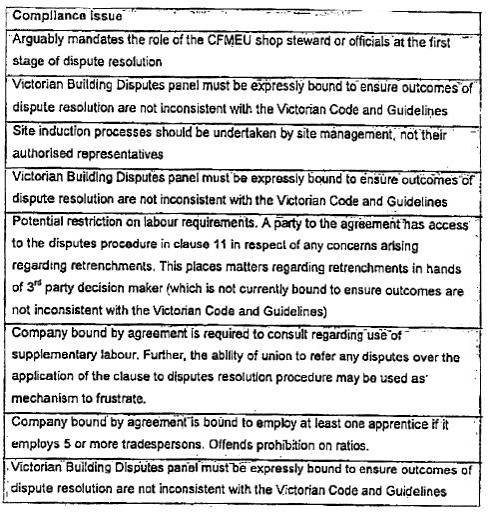
179 The State accepts that the CCCU advised Eco at the meeting that the Eco Agreement did not comply with the Code and Guidelines. Ms Cato accepted that the Chart was a ready reckoner that served as the CCCU’s advice to Eco as to the clauses in the Eco Agreement that rendered that Agreement non-compliant. Ms Cato agreed that the Chart could be used to identify the alternations that needed to be made to the Eco Agreement to render it compliant with the Code and Guidelines. Ms Cato could not recall Eco being told at the meeting that it could render itself compliant by varying the Eco Agreement in accordance with the Chart. Ms Ward had little recollection of what the CCCU had told Eco at the meeting. Mr Sail’s recollection was not much better, although notes taken of the meeting record Mr Sail as saying that Eco was not going to take it lying down because McCorkell was a major client and that Eco would go and talk to the CFMEU.
180 Whilst Ms Cato could not recollect that the CCCU expressly advised Eco at the meeting of 13 November that if it wanted to tender for government work it needed to take steps to vary the Eco Agreement so that it was compliant with the Code and Guidelines, I am satisfied that what was said by the CCCU to Eco was sufficient to communicate that message.
181 Ms Cato is a lawyer with at least 5 years of industrial relations experience. Ms Cato’s understanding was that for a person to obtain State Government work, compliance with the Code and Guidelines was a mandatory criterion. It was also her understanding that from the time that the CCCU advised McCorkell that Eco was not compliant with the Code, for Eco to continue in the tender or win the tender, Eco needed to demonstrate that it was compliant with the Code and Guidelines. Ms Cato agreed that the only way she knew of that Eco could render itself Code and Guidelines compliant was to have the Eco Agreement varied. She accepted that the information about non-compliance provided by the CCCU would have led Eco to understand that it either needed to change the Eco Agreement or “not tender for government work”.
182 I am fortified in my view that the CCCU communicated to Eco that the Eco Agreement needed to be varied if Eco was to be eligible for State Government work, by the conduct of Eco taken immediately after the meeting. After Mr Sail left the meeting with the CCCU, he contacted Mr Wainwright of the CFMEU and told him that the Department of Treasury and Finance had provided Eco with a list of compliance issues. Mr Wainwright asked to see the list. At 2.39 pm Mr Wainwright was provided with the Chart. About an hour later, Eco emailed the MBAV seeking assistance. The email attached a “CCCU document” which I infer was the Chart and sought the assistance of the MBAV to write up a variation proposal based on the “problem clauses” so that the CFMEU could then look at the possibility of a variation to the Eco Agreement.
183 Later in the day on 13 November 2012, Ms Cato spoke with Ms Ward on the telephone. Ms Cato was told by Ms Ward that Eco had been in communication with the MBAV and had communicated with the CFMEU. Ms Cato was told that Eco do quite a lot of demolition work at schools over the summer period and Ms Ward was concerned that having a non-compliant agreement would impact on the work that Eco would be able to do over the summer.
184 At about 1.30 pm on 14 November 2012, Ms Ward emailed Mr Wainwright stating that the MBAV had advised Eco that it would be in the best interests of all parties if the CFMEU liaised directly with the Department of Treasury and Finance on Eco’s behalf to negotiate the rewording of the Eco Agreement.
185 The email forwarded by Ms Ward to Mr Wainwright, was copied to Ms Cato. In responding, Ms Cato acknowledged that Eco had been advised by MBAV to ask the CFMEU to negotiate the rewording of the Eco Agreement and asked for a copy of the MBAV correspondence to that effect. At least from that point in time, I am satisfied that the CCCU was aware that Eco was taking steps to have the Eco Agreement varied so as to deal with the non-compliance issues raised by the CCCU. Ms Cato acknowledged that in her evidence.
186 On 20 November 2012 Ms La Combre, from Human Resources at Eco, emailed Mr Wainwright in relation to the Eco Agreement indicating that she thought that a variation could be attached to the Eco Agreement that the CCCU would be happy with. She noted that Eco had received advice from the MBAV that the CFMEU would not be prepared to alter any wording and asked Mr Wainwright if an alteration to the Eco Agreement was an achievable outcome in the foreseeable future or whether the making of the Eco Agreement had completely restricted Eco from working on Victorian Government sites.
187 On 21 November 2012, Mr Wainwright responded and expressed the CFMEU’s concern regarding the action taken by the CCCU against Eco. He stated that the Eco Agreement met the requirements of the FW Act and complied with the National Code. He stated that the CFMEU could see no reason for the CCCU to oppose Eco working in Victoria and no reason to amend the Eco Agreement. He advised Eco that the negative impact on Eco and the CFMEU’s members was of great concern to the CFMEU and that it was seeking legal advice on the matter.
188 On 27 November 2012, Ms La Combre emailed Ms Cato. She advised that Eco was in the process of applying for a variation of the Eco Agreement and that the MBAV had asked Eco to provide an official letter from the CCCU advising of the non-compliant clauses in the Eco Agreement. Ms La Combre requested such a letter. Later that day, Ms Cato advised Eco that she would be happy to provide such a letter.
189 On 29 November 2012, the MBAV emailed Ms Cato attaching a document containing proposed changes to the CFMEU ‘pattern agreement’ and seeking the position of the CCCU as to whether the proposed amendments would render the agreement compliant with the Code and Guidelines. The email stated that the changes proposed were based on views received from the CCCU on 14 September 2012. I would infer that this was a reference to the advice provided in the Chart. The document attached set out a number of clauses of the CFMEU ‘pattern agreement’ and identified sub-clauses or parts thereof that the MBAV suggested would be struck out.
190 On 30 November 2012, Ms Cato responded attaching a marked up version of the document provided by the MBAV, containing the CCCU’s comments and suggesting some further changes. On 30 November 2012 an updated attachment was provided to Ms Cato for her confirmation that the proposed changes would render the agreement compliant with the Code and Guidelines. On 2 December 2012 Ms Cato confirmed to the MBAV that with all of the proposed variations, the ‘pattern agreement’ would be deemed compliant.
191 On 4 December 2012, Ms Cato emailed Ms La Combre in response to the request made by Eco on 27 November 2012 for a letter from the CCCU. Ms Cato did not provide a letter, but in her email confirmed that the Chart set out the areas where the Eco Agreement did not comply with the Code and Guidelines. Later that day, Ms La Combre responded stating that Eco wanted an “official letter” from the CCCU advising of Eco’s non-compliance.
192 By email of 5 December 2012, Ms Cato responded to Ms La Combre. Ms Cato now advised that an official letter from the CCCU was not required or necessary to make a variation application to the FWC. She emphasised that it was Eco’s responsibility if it wished to achieve compliance with the Guidelines. She said:
It is therefore your choice if you want to vary your agreement. The steps to be taken need to be conducted in accordance with the relevant procedures. These are set out in the Fair Work Act, and the MBAV should be able to advise and assist you in this regard. For instance, there is a requirement to engage with the relevant employees, and potentially the union. You may wish to discuss the benefits of a variation to the agreement. An employee vote will then be required.
Ms Cato ended the communication by stating that whilst the CCCU was happy to continue to provide advice about compliance with the Guidelines, the CCCU did not engage in the procedures involved in varying agreements and suggested that Eco look to the MBAV for that assistance. Ms Cato advised that accordingly, the CCCU would not provide an “official letter”.
193 In early December 2012, Eco sent a message to its employees advising that a vote would be conducted on a variation to the Eco Agreement. The message detailed when and where the vote on the variation would occur. Soon thereafter and on 6 December 2012, Eco included with the payslip provided to employees a memorandum which advised that employees were required to attend to vote for the variation of the Eco Agreement on 14 December 2012. The memorandum stated that Eco had been informed that as a result of signing the Eco Agreement, Eco was no longer compliant with the Code and was not able to perform work on any State Government construction sites. The memorandum stated:
To ensure we can tender for State Government work, and maintain our Demolition Division, we are seeking to vary the working of the CFMEU [sic], so as it will comply with the State Governments [sic] requirements.
194 The memorandum attached the proposed terms of the variation to the Eco Agreement. Employees were informed that the variations were primarily in relation to dispute resolution, recruitment, training and contracting and that their payments and conditions would be maintained.
195 Amongst the employees who received the memorandum was David Burnham, who was employed by Eco as an Asbestos Supervisor/Demolition Foreman. Mr Burnham is an employee representative and in that role represents employees of Eco in dealings with Eco’s management. Mr Burnham is a member of the CFMEU. He understood the memorandum to be stating to employees that if employees did not vote to approve the proposed variations, Eco would not get State Government work and would have to close the demolition division in which he was employed.
196 Mr Burnham attended the meeting on 14 December 2012 along with other Eco employees. Ms Ward also attended, as did a solicitor. Ms Ward ran through the changes that Eco wanted to make to the Eco Agreement. Ms Ward said that the changes would not affect the employees as they were mostly to do with clauses that would not make any difference to them. She said that pay and conditions would not be affected. She encouraged employees to vote for the variation to the Eco Agreement and said that it was important to Eco’s future to allow Eco to quote for State Government work.
197 Mr Burnham was happy with the contents of the Eco Agreement and did not want it changed, but he felt that he did not have a choice. He was of the view that if he did not vote in favour of the variation it would mean that Eco could not win work that is important to its business and that his job would be under threat as Eco would shut down its demolition division. Mr Burnham’s evidence was that he voted in favour of the proposed variations to the Eco Agreement because he felt he had no other option. All employees voted in favour of the proposed variations.
198 On 21 December 2012, the MBAV wrote to the FWC attaching an application for approval to vary the Eco Agreement. The email together with the attachments were copied to Ms Cato.
199 In the communication to the FWC, the MBAV identified the purpose of the proposed variation in the following terms:
The purpose for the variation is so the agreement will be compliant with the Victorian Code of practice for the Building and Construction Industry, the Victorian Construction Code Compliance Unit has advised Eco Group that their current enterprise agreement is not compliant with the Victorian Code and Guidelines. As state government funded work is the bulk of the work completed by Eco Group this poses a serious threat to the financial viability of the business and may result in employees losing their jobs as a consequence of Eco Group being unable to tender for state government funded work. Please find attached an Email from Ms Janine Drennan of the Construction Code Compliance Unit advising the principle contractor of the job that ‘it is the view of the CCCU that the agreement is not compliant with the Victorian Code and Guidelines’. Further to this the CCCU has provided a template of clauses (titled CCCU Document) they believed are in breach of the Code and Guidelines. The CCCU have confirmed that the proposed variations will result in the agreement being code compliant. Should you wish to confirm any of the details surrounding the clauses identified as being non compliant please contact Cathy Cato from the CCCU on 03 8683 2743.
200 By separate correspondence to Mr Wainwright, the CFMEU was advised by the MBAV on the morning of 21 December 2012 that an application for approval to vary the Eco Agreement had been lodged. A copy of the application was provided.
201 A comparison of the proposed variations contained in the application to the FWC with clauses of the Eco Agreement brought to the attention of Eco by the CCCU Chart, shows that each proposed variation is directed to addressing an issue of non-compliance raised by the CCCU.
202 The CFMEU commenced this proceeding on 14 January 2013. The following day, I heard the CFMEU’s application for interlocutory relief including for an order restraining the FWC from approving the proposed variation to the Eco Agreement. My reasons for judgment in that interlocutory application are published as Construction, Forestry, Mining and Energy Union v Eco Recyclers Pty Ltd [2013] FCA 24. Although no orders were made restraining the FWC from dealing with the application lodged by Eco, I made some comments about the efficacy of that course in the light of this Court’s preparedness to deal with this proceeding on an expedited basis.
203 On 7 February 2013, Eco discontinued its application for the FWC’s approval of the proposed variations to the Eco Agreement.
Relevant statutory provisions
204 Like the adverse action protections, the prohibition on coercion under the FW Act is set out in Pt 3-1 which is entitled “General Protections”. The objects of that Part were set out earlier.
205 The CFMEU alleges that both the State and McCorkell have breached s 343(1) of the FW Act, which so far as is relevant, is in the following terms:
(1) A person must not organise or take, or threaten to organise or take, any action against another person with intent to coerce the other person, or a third person, to:
(a) exercise or not exercise, or propose to exercise or not exercise, a workplace right; or
(b) exercise, or propose to exercise, a workplace right in a particular way.
206 The definition of “workplace right” is contained in s 341(1) and persons who have a workplace right include a person who:
(b) is able to initiate, or participate in, a process or proceedings under a workplace law or workplace instrument;
207 Section 341(2) defines “process or proceeding under a workplace law or workplace instrument” as including:
(e) making, varying or terminating an enterprise agreement;
208 The statutory provisions relating to the workplace right to vary an enterprise agreement are set out in Pt 2-4 of the FW Act. Where an enterprise agreement covers a single enterprise, s 207(1) provides that the employer, together with the employees to whom the enterprise agreement applies and employees to whom it will apply following amendment, may jointly vary an enterprise agreement. Under s 208(1) the employer may request that employees approve the proposed variation by voting for it. Under s 209, the variation is taken to be made when a majority of the affected employees who cast a valid vote have approved the variation. Under ss 207(3) and 211, approval must be sought and obtained from the FWC before the variation can take effect.
209 Section 361 also has application in relation to s 343. I have earlier set out that provision and explained its operation.
Did the State take action with intent to coerce or threaten to coerce Eco and its employees?
The case alleged against the State
210 By its Amended Statement of Claim, the CFMEU pleaded that “in or about November 2012, Eco was informed” by the Department of Treasury and Finance that the Eco Agreement was not Code compliant and that compliance with the Code and the Guidelines was necessary in order for Eco to continue to obtain government work. The pleading subsequently characterised the communications of the State made to Eco as a “demand” that Eco comply with the Code and Guidelines, including by procuring a variation to the Eco Agreement as a condition of Eco tendering for and obtaining building and construction work funded by the State or an agency of the State (including the Circus Oz project). The communications were also characterised in the pleading as a “threat” made to Eco that unless Eco complied with the Code and Guidelines, including by procuring a variation to the Eco Agreement, it would be ineligible to tender for or obtain that work. In the context used in the pleading, the word “demand” is to be understood as the communication of a requirement. The word “threat” is to be understood as the communication of an intent or determination to inflict harm. The making of that “demand” and that “threat” was then pleaded as “the action” taken by the State which contravened s 343 of the FW Act. This action was said to contravene the Act because it was unlawful or illegitimate and taken, threatened or organised to be taken by the State with the intention of coercing Eco and Eco’s employees to exercise their workplace right to vary the Eco Agreement to make it compliant with the Code and Guidelines.
211 By its Defence, the State addressed the communications between it and Eco “in or about November 2012” by referring to the meeting of 13 November 2012 and the email of 5 December 2012 from Ms Cato to Ms La Combre. That email was Ms Cato’s response to Eco’s request for an “official letter”. In relation to that response, the State emphasised the comments made by Ms Cato that it was Eco’s responsibility if it wished to achieve compliance with the Guidelines and that it was Eco’s “choice” if it wanted to vary the Eco Agreement.
212 As to the “demand” and “threat” alleged against it and the “action” relied upon by the CFMEU as contravening s 343, the State relied upon the matters I have just referred to and otherwise denied the allegations. The State pleaded that any communications with Eco (or McCorkell) were not intended to coerce Eco to exercise a workplace right to vary the Eco Agreement but were intended to inform Eco that the Eco Agreement did not comply with the Code and Guidelines.
213 An issue arose late in the closing submissions made by the parties as to what action or conduct in contravention of s 343 of the FW Act had been alleged against the State. Counsel for the State contended that the only conduct alleged against the State was the conduct of the State “informing” Eco that it was not Code compliant and that compliance was necessary in order for Eco to continue to obtain government work. It was asserted that it was only “the delivery of the message” that the CFMEU relied upon as the contravening conduct. The State contended that this was the only case it came to meet.
214 I do not accept that the case the State was called upon to defend was as narrow as that. The CFMEU’s pleading made it clear that it was relying upon the content of the message and not simply its delivery. It is apparent from the pleadings that the conduct alleged against the State was that as a condition of tendering for and obtaining building work funded by the State, the State required Eco to comply with the Code and Guidelines by procuring a variation to the Eco Agreement. That the conduct alleged carried with it that requirement is apparent from the paragraphs of the pleading in which the conduct is characterised as a “demand”. The characterisation of the conduct as a “threat” employed a different means of making essentially the same point.
215 The CFMEU also pleaded that the State threatened to take action with intent to coerce Eco but its submissions made no attempt to establish such a contravention. I regard that claim as not having been pressed at trial.
Did the State require compliance with the Code and Guidelines as a condition for tendering for and obtaining State work?
216 The CFMEU bears the onus of establishing the “action” taken by the State which it alleges contravened s 343(1) of the FW Act. Given the nature of the action pleaded by the CFMEU, the CFMEU needs to establish that by the State’s communications to Eco, the State required that, as a condition of tendering for or obtaining State Government work, Eco needed to comply with the Code and Guidelines by procuring a variation to the Eco Agreement.
217 By their terms, the Guidelines apply to all public building and construction work in Victoria which is subject to an expression of interest or request for tender on or after 1 July 2012. The terms of the Guidelines seek to prohibit or restrict the contents of agreements made between contractors and their employees. Prohibited content in an industrial agreement will result in the agreement being regarded as non-compliant with the Code and Guidelines. The manner in which the Guidelines were being applied by the State (through the CCCU and through the contractual obligations the State requires of those who contract with it), demonstrates that contractors and their subcontractors who are bound by industrial agreements assessed by the CCCU as non-compliant with the Code or Guidelines, are considered ineligible to participate in State Government funded projects. Ms Cato acknowledged the position of the CCCU was that a contractor has to comply with the Code and Guidelines to “get State Government work”. That position was also publicly expressed by the former Premier of Victoria and the Minister for Finance.
218 The evidence shows two possible avenues by which exemption from that rule may be available but neither is relevant in this case. The first is that, outside of the terms of the Guidelines, the CCCU has been exempting from compliance contractors whose industrial agreements were made before 1 July 2012. Secondly, the Guidelines refer to a capacity for the Minister for Finance to grant an exemption.
219 I am satisfied on the basis of the findings I have made that:
The CCCU’s position was that for Eco to be eligible to obtain State Government work the Eco Agreement had to be compliant with the Code and Guidelines.
The CCCU assessed the Eco Agreement as non-compliant with the Code and Guidelines for the reasons set out in the Chart.
That assessment and the need for Eco to comply with the Code and Guidelines as a condition of obtaining State Government work was communicated to Eco by the CCCU.
The CCCU understood that the only viable way in which Eco could be assessed as being compliant with the Code and Guidelines, and thus eligible to be awarded State Government work, was for Eco and its employees to take steps to vary the Eco Agreement.
That understanding was communicated to Eco by the CCCU or, at the very least, the CCCU understood that by reason of its assessment of the Eco Agreement and the other information it provided, Eco held that understanding.
By 14 November 2012 the CCCU knew that Eco was taking steps to vary the Eco Agreement.
Eco and its employees took steps to vary the Eco Agreement including by making a variation and by making an application to the FWC for its approval. This was done to address the non-compliance issues raised by the CCCU.
The CCCU was aware of the steps taken by Eco and its employees and the reasons why they were being taken.
220 I am satisfied that, as a condition of Eco being considered eligible to be contracted to provide State Government building work, the State required that Eco comply with the Code and Guidelines by procuring, with its employees, those variations to the Eco Agreement which the State assessed were necessary to be made in order that the Eco Agreement would comply with the Code and Guidelines.
Did the State act with the prohibited intent and for the prohibited reason?
221 Section 343(1) of the FW Act is couched in similar terms to that of s 400 of the WR Act on the repeal of that Act. At an earlier time and for most of its existence that provision was numbered s 170NC(1) of the WR Act. Section 343(1) is, as the Explanatory Memorandum to the Fair Work Bill 2008 explains at [1392], not confined to dealing with coercion in agreement making as its predecessors had been, but “is broader because it protects all workplace rights”.
222 Action of the kind impugned in this case, namely the taking of action with intent to coerce another person to vary an agreement, would have fallen within the protections afforded by s 170NC(1) of the WR Act. The legal principles developed in relation to the operation of s 170NC(1) are applicable to s 343(1), at least insofar as s 343(1) deals with workplace rights concerning agreement making. No party sought to argue to the contrary and my conclusion is consistent with that reached by Logan J in Liquor, Hospitality and Miscellaneous Union v Arnotts Biscuits Ltd (2010) 188 FCR 221 at [62].
223 A useful survey of many of the relevant authorities that construed s 170NC(1) is given by Weinberg J in National Tertiary Education Union v Commonwealth of Australia (2002) 117 FCR 114. That account includes the observation of Merkel J in Seven Network (Operations) Limited v Communications, Electrical, Energy, Information, Postal, Plumbing and Allied Services Union of Australia (2001) 109 FCR 378 at 388, which identified the two elements that need to be established to prove “intent to coerce”. Merkel J said:
The above cases establish that there must be two elements to prove “intent to coerce” under s 170NC(1). First, it needs to be shown that it was intended that pressure be exerted which, in a practical sense, will negate choice. Secondly, the exertion of the pressure must involve conduct that is unlawful, illegitimate or unconscionable.
In National Tertiary Education Union at [103]-[104], Weinberg J added:
The approach to the expression “intent to coerce” taken in each of the authorities set out above makes it clear that what is required is an intent to negate choice, and not merely an intent to influence or to persuade or induce. Coercion implies a high degree of compulsion, at least in a practical sense, and not some lesser form of pressure by which a person is left with a realistic choice as to whether or not to comply.
I am fortified to some degree in my view that this is the correct meaning to ascribe to the expression “intent to coerce” by the observations of Lord Romilly MR in Ellis v Barker (1871) 40 LJ Ch 603. His Lordship accepted that coercion may take an infinite number of forms. However, he noted that the moment that a person who influences another does so by threatening to take away something he then possesses, or by preventing him from obtaining an advantage he would otherwise have obtained, it then becomes coercion and ceases to be persuasion.
224 As Buchanan J said in Construction, Forestry, Mining and Energy Union (NSW Branch) v Alfred (2011) 203 IR 78 at [12], the meaning of “intent to coerce” has become settled.
225 The first question then is whether the State intended that pressure be exerted which, in a practical sense, would negate a relevant choice for Eco or its employees? That can only be answered by first identifying the choice which is said to be negated. In the context of the allegation made and my finding that as a condition of Eco being eligible to be contracted to provide State Government building work, the State required that Eco and its employees take steps to vary the Eco Agreement, the relevant question is whether, in a practical sense, Eco and its employees had no choice but to take those steps. Those steps are the steps which engaged the relevant workplace right in question, namely, the right to vary an enterprise agreement conferred by ss 207-210 of the FW Act.
226 Eco’s reliance on State Government work to sustain its demolition division was substantial. In 2012 more than half of Eco’s demolition work was derived from State Government work. The work available for Eco’s recycling division was reliant upon materials derived from the demolition work of the demolition division. I would have no hesitation in finding that as at December 2012, the prospective loss of business of the magnitude involved if State Government building work became unavailable, would have imposed a high degree of pressure on Eco and those of its employees whose security of employment was reliant upon Eco’s capacity to maintain the same or similar demand for its services. That Eco and its employees in fact took steps to vary the Eco Agreement for the purpose of bringing it into conformity with the State’s requirements is demonstrative of the fact that, in practical terms, they had no realistic choice but to vary their agreement.
227 However, the effect of an alleged contravener’s conduct upon those to whom it is directed is not the question which s 343(1) poses. Section 343(1) is focused upon the intent and reason for action of the alleged contravener and as [1391] of the Explanatory Memorandum to the Fair Work Bill 2008 stated:
The prohibition applies irrespective of whether the action taken to coerce the other person is effective or not.
228 Nevertheless, the actual effect of conduct may be instructive in assessing the foreseeable effect of the conduct. In that way, the actual effect may say something of the intent or purpose of the alleged contravener when the action was taken.
229 As to the question of intent, the CFMEU contended and the State accepts that s 361 places the onus on the State to prove that any action it organised or took was not intended to coerce Eco or its employees to exercise their workplace rights to vary the Eco Agreement. A reverse onus did not apply in relation to s 170NC(1) of the WR Act. But that is not the case for s 343 which, is found in Part 3-1 to which s 361 applies.
230 Section 343(1) is a provision which, in the words of s 361, depends upon action taken “for a particular reason or with a particular intent”. The intent which s 343(1) deals with has two aspects. The first aspect is addressing the nature or character of the intent. The particular intent required is an intent to coerce. The second aspect of the requisite intent is addressing the purpose or reason of the action taken. The purpose or reason for the taking of the action must be to have the other person (or third person) do or not do one of those things specified by paragraphs (a) and (b) of s 343(1). The first aspect may be characterised as a “particular intent” and the second as a “particular reason” within the meaning of those terms in s 361(1).
231 On the facts and allegations made in this case, it seems to me that s 361 imposed on the State an obligation to negate that a substantial and operative reason for the action it took was a desire to have Eco and its employees take steps to vary the Eco Agreement and that any such motivation was not pursued with an intent to negate the choice of Eco and its employees not to take those steps. Further and by reference to the second element which arises from the words “intent to coerce”, the State will need to establish that if it did negate choice, the exertion of the pressure involved was not unlawful, illegitimate or unconscionable.
232 As to the question of its state of mind, the State sought to discharge its onus by calling Ms Cato, the Assistant Director of the CCCU. There may be a real question as to whether the evidence from Ms Cato alone was capable of discharging the State’s onus. The conduct alleged and which I have found occurred, was that of requiring that variations to a contractor’s non-compliant agreement be made as a condition of the contractor being eligible to be awarded State Government building work. That requirement is arguably, at least in part, made by the Guidelines themselves. If that is so, what may have been called for is an examination of the intention of the maker of the Guidelines.
233 However, the CFMEU did not contend that the onus upon the State could not be discharged through the evidence of Ms Cato alone. In that circumstance it is appropriate that I proceed on the basis that the only relevant state of mind inquiry which needs to be made is the reasons and intentions which actuated Ms Cato in her capacity as the most senior officer of the CCCU dealing with Eco.
234 In relation to Ms Cato’s state of mind, the State relied on the following evidence given by Ms Cato following the evidence of her account of the meeting of 13 December 2012 and the various further communications between her and Eco through to 6 December 2012:
In engaging in those communications, what was your intention? --- My intention was to provide a stakeholder with information about its compliance or otherwise, and, you know, to respond to them as best I could within the scope of the role of the unit.
In the claim in this proceeding, the applicant alleges that the State had an intention to coerce, and there are a number of elements that I will have to put to you. So the State had an intention to coerce, firstly Eco; secondly, Eco’s employees, to exercise their workplace right to vary the Eco agreement, or to vary the Eco agreement in a particular way to make it compliant with the Victorian code and guidelines; do you understand that allegation? --- I do.
Yes. What do you say as to that allegation? --- That’s not true.
235 The first answer given by Ms Cato is not capable, of itself, of negating the existence of the intent or reason alleged against the State. It is not evidence which negates, as a reason for Ms Cato’s conduct, a motivation that Eco and its employees should take steps to have the Eco Agreement varied. The answer addresses the nature of the action and not the motivation for it. The provision of information by Ms Cato may have been action motivated by a desire that Eco and its employees should take steps to have the Eco Agreement varied. If the answer is to be understood as dealing with the nature of the intention held, that is whether there was an intent to coerce, I think that at best the answer is ambiguous. An intent to negate choice is not denied.
236 Further, in her first answer the provision of information by Ms Cato is qualified by a reference to her intent to respond “within the scope of the role of the unit”. That begs the question as to what Ms Cato regarded to be the role of the unit. Was it the role of the unit to procure variations to non-complaint agreements by applying economic pressure? The evidence about the role of the CCCU suggests that the unit had that role. It seems to me that, in substance, what Ms Cato’s answer sought to communicate was that her intention was to do her job. But as I have indicated, that merely begs the question as to what her job was and in particular in doing her job in relation to Eco, what actuated her in her role as the agent of the State to do what she did.
237 The second question asked of Ms Cato in the extract above, begins by identifying that there are a number of elements which are then described as a single allegation. It is not clear whether the denial thereafter given, is a denial of each of the rolled up elements or a denial of the whole because one of the elements was regarded by Ms Cato as not being true. In contrast to the first question, the second question asks Ms Cato what the State’s intent was rather than what her own intent was and it does so without identifying the activity alleged against the State by the CFMEU.
238 A further difficulty arises because the questioner has put to the witness the language of the statute (“intent to coerce”) without reference to the accepted meaning to be applied to that language. What the FW Act means by “intent to coerce” has been the subject of extensive judicial deliberation and now has a well settled meaning. Coercion can mean different things in different contexts. Whether the meaning ascribed to the phrase by Ms Cato when she answered the question was the meaning ascribed by s 343(1) is a matter that the evidence does not reveal.
239 Ms Cato’s evidence needed to address the substance of the allegations made against the State. That could have been done quite simply with two questions. Firstly, was a motivating factor in her conduct a desire to have Eco and its employees take steps to vary their Agreement? Secondly, if such a factor was present, was that desire pursued with the intent that, in a practical sense, Eco and its employees would have no choice but to take those steps?
240 I need to determine as a question of fact, whether the action taken was taken for a particular reason and with a particular intent. That assessment is not much assisted by the evidence that the State here relies upon. That is because, in my view, the questions asked of Ms Cato did not really give Ms Cato a proper opportunity to address the facts I need to determine. Given that the State bears the onus of proof, the State must carry the consequences of that failure. Ms Cato’s denials are not irrelevant, but can only take the State’s burden a short distance. Given the considerable evidence which points in the opposite direction, Ms Cato’s denials fall short of discharging the onus imposed by s 361.
241 The evidence of the CCCU’s role supports the conclusion that one of the CCCU’s purposes in carrying out its functions was to procure compliance with the Code and Guidelines including in relation to the industrial agreements of contractors. That in carrying out its activities, the CCCU should desire that industrial agreements be compliant and that industrial parties should take steps to make non-compliant agreements compliant, logically follows from the mandate given to the CCCU and the way in which it was being pursued. It is likely that in carrying out the functions of the CCCU, Ms Cato did so for reasons that were consistent with the CCCU’s purposes.
242 That, in carrying out her role, Ms Cato wanted to see the Eco Agreement varied is also directly supported by the evidence of her dealings with Eco, including the evidence I have relied on to conclude that the State required that the Eco Agreement be varied as a condition of Eco obtaining State Government work.
243 Ms Cato knew that the consequence for Eco and its employees of not having a compliant agreement was that Eco would not be engaged by McCorkell and would be ineligible for other contracts for State Government work. She knew that the only way that situation could be rectified was for Eco and its employees to take steps under the FW Act to have the Eco Agreement varied and approved by the FWC. She knew that Eco was not only aware of those matters but was actively engaged in pursuit of them and had adopted that course because of the position expressed by the CCCU as to the non-compliance of the Eco Agreement. She knew, having been told by Eco on 13 November 2012 that Eco did quite a lot of work on State Government schools.
244 When Ms Cato was cross-examined as to her state of mind, she acknowledged that as a result of the meeting with the CCCU on 13 November 2012, Eco could only have understood that it needed to change the Eco Agreement or not tender for government work.
245 On the basis of what Ms Cato knew, she must have appreciated that it was likely that Eco and its employees would take steps to vary the Eco Agreement as in fact they did. That Eco and its employees would be driven to do so without any realistic alternative, was a foreseeable consequence of the requirement made by the CCCU that the Eco Agreement be varied as a condition of Eco being eligible to carry out State Government work.
246 It was likely that the making and maintaining of that requirement by the CCCU, would have a coercive effect upon Eco and its employees. It is likely that Ms Cato intended to achieve the consequences which were likely to flow from the actions she took.
247 If it had been necessary, I would have been satisfied that the State was motivated to take the action it did, including because it desired that Eco and its employees take steps to vary the Eco Agreement. I would have also been satisfied that the State pursued that course with an intent that, in a practical sense, Eco and its employees would have no choice but to take those steps. I am satisfied (in the words of Mason J in Bowling at 241) that “the evidence [is] consistent with the hypothesis that the [State] was so actuated and that hypothesis was not displaced by the [State]”. Save for the question as to whether the pressure exerted by the State was unlawful or illegitimate, I am not satisfied that the presumption cast by s 361 has been displaced.
248 The CFMEU contended that the pressure exerted by the State involved conduct that was unlawful or illegitimate. The unlawfulness relied upon was the allegation that the State contravened s 340 as an accessory to McCorkell’s contravention. For the reasons later expressed, I have rejected the claim that the State was an accessory and accordingly it is only the allegation of illegitimacy that remains to be considered.
249 The CFMEU contended that the State’s conduct was illegitimate because it constituted an interference in free bargaining.
250 In Hanley v Automotive, Food, Metals, Engineering, Printing and Kindred Industries Union (2000) 100 FCR 530 at [44], Ryan, Moore and Goldberg JJ identified what their Honours called “the plain purpose of s 170NC”. The Full Court said:
That section is found in Pt VIB of the Act which establishes a detailed regime for the creation of certified agreements including procedures for their negotiation, execution and certification. That regime contemplates free bargaining between employers and their employees or organisations of employees and allows the parties to undertake industrial action within a framework created by that Part. It is consistent with the purposes of Pt VIB to treat s 170NC as proscribing conduct which might result in an agreement which is not the product of free bargaining.
251 In Seven Network (Operations) Limited, Merkel J at [35] relied on that passage to observe that the purpose of s 170NC was to proscribe conduct that is intended to prevent “free bargaining”.
252 The regime for collective bargaining and the making of enterprise agreements found in the FW Act is not significantly different to the regime referred to by the Full Court in Hanley. The scheme is somewhat more protective of free bargaining than was the scheme of the WR Act because it encourages bargaining in good faith (s 171 and s 228-233) and that agreements including variations to agreements be “genuinely agreed to” by employees (s 186(2)(a) and s 211(1)(a)). The requirement for the genuine agreement of employees could not be satisfied where an agreement or a variation to an agreement involved duress or coercion.
253 Although, as I have earlier said, the scope of protections provided by s 343(1) is wider than was the case in relation to s 170NC(1), which dealt specifically with agreement making, s 343(1) includes the same ground formerly covered by s 170NC(1). It follows, that given the close resemblance between the bargaining regime considered by the Full Court in Hanley and that which is provided by the FW Act, the plain purpose of s 343(1) when applied in relation to workplace rights associated with the making, varying or termination of enterprise agreements, is that of proscribing conduct which might result in an agreement which is not the product of free bargaining. Conduct of that kind is capable of being characterised as illegitimate.
254 It cannot be the case that any conduct of a third party which imposes pressure on the agreement making of parties to the agreement will be illegitimate as an interference with free bargaining. In my view, the purpose of the impugned conduct and its effect upon the scheme the FW Act prescribes, will be an important consideration. As Merkel J said in Seven Network (Operations) Limited at [41], whether the pressure is illegitimate needs to be considered in the context of the scheme of the Act. Conduct driven by a purpose which is not consonant with or which serves to undermine the purposes of the FW Act is likely to be illegitimate conduct insofar as that conduct serves to defeat the workplace rights sought to be protected by s 343(1).
255 The FW Act permits parties to decide for themselves the content of the enterprise agreements they make within the parameters dictated by the Act. In that respect, the FW Act identifies “permitted matters” (s 172(1)), “unlawful terms” (s 194) and “mandatory terms” (Div 5 of Pt 2-4). Conduct which seeks to dictate different parameters within which industrial parties may agree for themselves the content of their enterprise agreements, serves to undermine the purposes of the FW Act.
256 The Guidelines impose parameters for the allowable content of enterprise agreements different to those provided for by the FW Act. In many respects the differences are stark. The exertion of economic pressure upon industrial parties for the purpose of limiting or restricting their freedom to bargain within the parameters established by the FW Act is, in my view, illegitimate because it serves to defeat the scheme for agreement making prescribed by FW Act.
257 The impugned conduct of the State in this case involved the application of economic pressure on parties to an enterprise agreement and was driven by parameters for bargaining and agreement making contained in the Guidelines. It therefore involved a purpose and effect which served to undermine the scheme of the FW Act. For that reason, it seems to me that the conduct was illegitimate conduct and that the second element required to prove an “intent to coerce” is established.
258 In the light of those findings I am satisfied that in contravention of s 343(1) of the FW Act, the State took action with intent to coerce Eco and its employees to exercise their workplace rights to vary the Eco Agreement.
Did McCorkell act with intent to coerce or threaten to coerce Eco
The case alleged against McCorkell
259 By its Amended Statement of Claim, the CFMEU pleaded that “in or about November 2012”, Eco was informed by McCorkell that McCorkell could not engage Eco, unless the Eco Agreement was made compliant with the Code and Guidelines. That communication was subsequently characterised in the pleading as the making of a “demand” by McCorkell upon Eco that Eco comply with the Code and Guidelines, including by procuring a variation to the Eco Agreement, as a condition of tendering for and obtaining building and construction work on the Circus Oz project. The communications were also characterised as a “threat” made by McCorkell to Eco that unless Eco complied with the Code and Guidelines, including by procuring a variation of the Eco Agreement, Eco would not be eligible to tender for or obtain the work on the Circus Oz project.
260 The making of that “demand” and that “threat” was then pleaded as the “action” taken by McCorkell which contravened s 343 of the FW Act, because it was action that was unlawful or illegitimate action taken, threatened or organised to be taken by McCorkell with the intention of coercing Eco and the employees of Eco to exercise their workplace right to vary the Eco Agreement so as to make it compliant with the Code and Guidelines.
261 It will be apparent that the pleading against McCorkell was structured in a similar way to the s 343 pleading made by the CFMEU against the State. Counsel for McCorkell also sought to rely upon a contention that the only conduct alleged against McCorkell was that McCorkell had “informed” Eco that it could not engage Eco on the Circus Oz project unless the Eco Agreement was made compliant with the Code and Guidelines.
262 For substantially the same reasons as those earlier given, I reject McCorkell’s contention that the only conduct alleged against it was that of “informing”. The CFMEU’s pleading relied upon the content of the message conveyed and not simply upon its delivery. For the same reasons as earlier given the conduct alleged by the CFMEU was that as a condition of tendering for and obtaining the demolition work McCorkell required Eco to vary the Eco Agreement.
263 By its Defence, McCorkell denied that it took any action or made any threat to Eco with the intention of coercing Eco or its employees to exercise their workplace right to vary the Eco Agreement so as to make it compliant with the Code and Guidelines.
264 The CFMEU’s claim that McCorkell threatened to take action with the intention of coercing Eco or its employees was not the subject of submissions. I have treated that claim as not having been pressed at trial
Did McCorkell require compliance with the Code and Guidelines as a condition of Eco tendering for and obtaining demolition work?
265 The CFMEU bears the onus of establishing the “action” taken by McCorkell which it alleges contravened s 343(1) of the FW Act. Given the nature of the action pleaded by the CFMEU, it was necessary for the CFMEU to establish that by McCorkell’s communications to Eco, McCorkell required that, as a condition of tendering for or obtaining the demolition work, Eco had to comply with the Code and Guidelines by procuring a variation to the Eco Agreement.
266 I am satisfied that the CFMEU has established that McCorkell took the action alleged. Mr Wilson was resolute in his understanding that by reason of his contract with the State, he could not engage a non-compliant subcontractor. He told Mr Sail that Eco could not be engaged if its agreement was not Code compliant. Mr Wilson accepted that what he told Mr Sail amounted to saying that unless Eco varied its Agreement it could not succeed in the tender.
Did McCorkell act with the prohibited intent and for the prohibited reason?
267 On the basis of the authorities earlier referred to and adopting the same analysis, the first question on this issue is whether McCorkell intended that pressure be exerted which in a practical sense would negate a relevant choice for Eco. The relevant choice is the same as that identified in the earlier analysis. In the context of the allegation and my finding that as a condition of Eco being eligible to be contracted to perform the demolition work, McCorkell required that Eco take steps to vary the Eco Agreement, the relevant question is whether, in a practical sense, Eco had no choice but to take those steps.
268 The CFMEU has the advantage of the presumption made by s 361 of the FW Act. On the facts and allegations relevant to McCorkell, s 361 imposes on McCorkell an obligation to negate:
(i) that a substantial and operative reason for the action it took was that Eco should take steps to vary the Eco Agreement; and
(ii) that any such motivation was pursued with intent to negate the choice of Eco not to take those steps.
269 On the question of intent and reason, McCorkell sought to discharge its onus through the evidence of Mr Wilson. There was no issue that Mr Wilson was capable of discharging the onus.
270 McCorkell submitted that the claim made under s 343(1) by the CFMEU was based on Mr Wilson’s communication to Mr Sail on 9 November 2012. Each of the questions put to Mr Wilson by his Counsel in relation to Mr Wilson’s state of mind were framed in terms of Mr Wilson’s intent in that conversation. As is apparent, there were two relevant conversations between Mr Wilson and Mr Sail. It is not clear to me why McCorkell’s submission and its questioning of Mr Wilson was premised upon the basis that the “action” being asserted against it was limited to the conversation on 9 November 2012. The relevant pleading alleged that “in or about November 2012”, Mr Sail was informed by a person representing McCorkell that McCorkell could not engage Eco unless the Eco Agreement was made compliant with the Code and Guidelines. If further particulars were provided so as to limit this allegation to the conversation of 9 November 2012, the Court was not informed and I cannot assume that to be the case.
271 It might be said that McCorkell has failed to discharge the onus upon it because Mr Wilson gave no evidence as to his reason or the nature of his intent in relation to the 12 November 2012 conversation. However, I do not consider that it would be appropriate to proceed on that basis. What Mr Wilson said on 9 November 2012 was essentially repeated on 12 November 2012, but on the latter occasion done on an affirmative rather than a prospective basis given that by the 12 November conversation Mr Wilson understood that the Eco Agreement was not compliant with the Code and Guidelines. Additionally, the answers given by Mr Wilson as to his state of mind contain some confusion as to which of the two conversations Mr Wilson was addressing. It seems to me that Mr Wilson’s state of mind was likely to be the same across both conversations and his evidence of his state of mind should be understood as applicable to both.
272 As to Mr Wilson’s state of mind, McCorkell relied upon the following evidence:
Can I just return to your conversation with Mr Sail on the 9th. What was your intention behind what you said to him in that conversation on the 9 November? --- My intention was to inform him of our contractual obligations, that is, not to enter into a subcontract with any subcontractor that’s not code-compliant. So I needed to inform him of that, and that was my intention for telling him.
All right. I’m going to put to you what’s alleged in this proceeding for your response. What do you say about the allegation that, by virtue of that conversation that you’ve just given evidence about with Mr Sail on 9 November, which included the statement that Eco had to be code-compliant to win the tender, that you intended to coerce Eco to vary their agreement to make it code-compliant? --- Yes, it’s absolutely false. I didn’t coerce – coerce them to vary their agreement at all.
Did you have that intention? --- No, no intention whatsoever.
273 The CFMEU relied upon the following evidence:
Now, Mr Wheelahan your counsel also put to you further matters arising from the 9 November conversation, and he asked you about intention arising from that. He asked you whether your intention was to coerce Mr Sail and, through him, Eco to seek to vary its agreement and you said no. But can I put this to you, Mr Wilson. You told Mr Sail in that conversation that the advice was he wasn’t code-compliant and that he needed to be code-compliant to be awarded the work. You agree with that much? --- Yes, I agree that he couldn’t have been awarded the work if he wasn’t code-compliant.
And you agree that you told him it had something to do with his workplace relations agreement? --- Yes.
Can I suggest to you, Mr Wilson, that that amounts to you saying to Mr Sail that, “Unless you vary your agreement, you cannot succeed in the tender”? --- Yes.
274 The answer given in examination-in-chief tends to suffer from some of the same difficulties as that which attended Ms Cato’s evidence. The question was put in terms of the language of the statute. However the question in this instance was more simple and clear, and it identified the conduct alleged to have been carried out with a coercive intent.
275 The answer Mr Wilson gave does not negate as a reason for his conduct that he was motivated by a desire to have Eco take steps to vary the Eco Agreement. For him to have said that he did not intend to coerce Eco to vary its Agreement does not exclude the existence of a desire that a variation should occur. The answer speaks to the nature of the intent and not necessarily to the reason for the conduct.
276 Mr Wilson regarded Eco as a short-listed tenderer and thus a contractor that he may wish to contract with. He said he would have given Eco an opportunity to resubmit its bid if it could demonstrate it was Code compliant. That evidence sufficiently raises the prospect that Mr Wilson would have liked to have seen the Eco Agreement varied so that Eco could remain a prospective contractor. In the absence of a denial, McCorkell has not established that its conduct was not in whole or in part motivated by a desire to see Eco vary the Eco Agreement.
277 However, I come to a different conclusion as to the nature of Mr Wilson’s intent. It is one thing for Mr Wilson to want to see Eco take steps to vary its agreement but quite another for him to hold an intention to negate Eco’s capacity not to take such steps. Whilst the evidence suggests that Mr Wilson may have desired that Eco take steps to give itself the opportunity to be awarded the demolition work, there is no evidence at all which suggests that to maintain that opportunity, Mr Wilson intended to apply pressure upon Eco. The evidence does not suggest that Mr Wilson wanted to force Eco to do anything at all. Mr Wilson had other options and the level of his interest in seeing the Eco Agreement varied so that it was Code compliant was unlikely to generate any intent to apply pressure on Eco.
278 In that context, Mr Wilson’s evidence that he had no intention whatsoever to coerce Eco to vary its agreement may be understood as a denial of any intent to pressure Eco at all. Whilst I hold some reservation about the manner in which Mr Wilson addressed the fact that I need to decide, I am satisfied that the answer given (in the context of the other available evidence) sufficiently discharged the onus upon McCorkell on the question of whether it held an intent to coerce. For those reasons, I have concluded that McCorkell did not contravene s 343(1) of the FW Act.
Was the State involved in any contravention of section 340 by McCorkell?
279 Section 550(1) of the FW Act provides that a person who is involved in a contravention of a civil remedy provision is taken to have contravened that provision. Section 550 is in the following terms:
(1) A person who is involved in a contravention of a civil remedy provision is taken to have contravened that provision.
(2) A person is involved in a contravention of a civil remedy provision if, and only if, the person:
(a) has aided, abetted, counselled or procured the contravention; or
(b) has induced the contravention, whether by threats or promises or otherwise; or
(c) has been in any way, by act or omission, directly or indirectly, knowingly concerned in or party to the contravention; or
(d) has conspired with others to effect the contravention.
280 The CFMEU alleged that the State was involved in the contravention by McCorkell of s 340. If that is so, then by reason of s 550(1) the State itself has contravened that provision.
281 The State denied that the CFMEU had established any such contravention. The State contended and the CFMEU accepted, that in establishing a contravention of s 550, an applicant was not assisted by the reversal of onus provided by s 361. Section 361 operates in respect of a contravention of Part 3-1 but only where, in relation to such a contravention, it is alleged that the contravening action was or is being taken (or was threatened) for a particular reason or with the particular intent. While s 550(1) requires intentional conduct, it does not specify a particular reason or intent that must accompany the conduct and therefore s 361 can be of no assistance to an applicant seeking to establish its breach.
282 In relation to its allegation that the State was an accessory to McCorkell’s contravention of s 340, the CFMEU relied upon each of the paragraphs of s 550(2) which define the term “involved in” found in s 550(1).
283 The nature of the liability imposed by s 550(1) (in the context of the meaning of “involved in” set out in s 550(2)), was explained by Tamberlin, Gyles and Gilmour JJ in Construction, Forestry, Mining and Energy Union v Clarke (2007) 164 IR 299 at [26] as follows:
Regardless of the precise words of the accessorial provision, such liability depends upon the accessory associating himself or herself with the contravening conduct - the accessory should be linked in purpose with the perpetrators (per Gibbs CJ in Giorgianni v The Queen (1985) 156 CLR 473 at 479-480; see also Mason J at 493 and Wilson, Deane and Dawson JJ at 500). The words “party to, or concerned in” reflect that concept. The accessory must be implicated or involved in the contravention (Ashbury v Reid [1961] WAR 49 at 51; R v Tannous (1987) 10 NSWLR 303 per Lee J at 307E-308D (agreed with by Street CJ at 304 and Finlay J at 310)) or, as put by Kenny J in Emwest Products Pty Ltd v Automotive, Food, Metals, Engineering, Printing and Kindred Industries Union (2002) 117 FCR 588 at [34], must participate in, or assent to, the contravention.
284 In Yorke v Lucas (1985) 158 CLR 661, the High Court considered the requirements of what was then s 75B of the Trade Practices Act 1974 (Cth). The terms of the former s 75B are the same as those found in s 550(2) of the FW Act. There are a wide range of elements identified by the four sub-paragraphs of s 550(2). Each of those elements were considered by the majority in Yorke, although some only in passing. The majority held that all of the elements required intentional participation by an accessory in the primary contravention and that it was necessary to prove that the accessory had knowledge of the essential elements of the primary contravention (see at 667 and 670).
285 Relying on Yorke, the State contended that proof of intent requires proof of knowledge of the elements of the contravention. The State contended that the evidence did not support findings that the State knew:
that McCorkell was proposing to enter into a contract for services with Eco; or
that McCorkell had refused to engage Eco or refused to make use of, or agree to make use of the services of Eco; or
that McCorkell had threatened to refuse to engage or make use of the services of Eco; or
that McCorkell refused or threatened to refuse to engage Eco because of the existence of a workplace right.
286 I agree that the CFMEU has failed to establish that the State knew that McCorkell refused or threatened to refuse to engage Eco because of the existence of a workplace right. However, I disagree as to the first three matters relied upon by the State. The contents of the email forwarded to the State by Mr Wilson of 9 November 2012, the State’s assessment of the Eco Agreement and its communication to McCorkell that the Agreement was non-compliant, together with the State’s knowledge of McCorkell’s contractual obligations to not engage a non-compliant subcontractor, are sufficient to establish that the State had knowledge of each of the first three matters identified.
287 As for McCorkell’s reason for taking the action it took, the State contended and I accept that an essential element of any contravention of s 340 is that the adverse action be taken for a prohibited reason. In this case, I have found that a reason for McCorkell’s refusal to engage or use the services of Eco was the entitlement of Eco’s employees to the benefit of the Eco Agreement. The State contended and I accept that the CFMEU has failed to establish that the State knew that McCorkell’s conduct was motivated by that prohibited reason.
288 The CFMEU contended that whilst it is necessary to prove that the accessory knew what the principal contravener was doing, an accessory cannot know what the other person is feeling or thinking. It argued that whilst it was necessary for an accessory to have knowledge of the essential elements of a contravention, it was not necessary for an accessory to have knowledge of the principal contravener’s motive for the contravention.
289 That submission must be wrong where a particular motive is a necessary element of the contravention. For instance, a person who assisted in the dismissal of an employee carried out by a contravener because of the employee’s race, could not be an accessory to the discriminatory conduct in the absence of having assisted knowing that the contravener’s conduct was motivated by race. Without that knowledge, it could not be said that the alleged accessory is “linked in purpose with the perpetrators”.
290 An accessory will often know the principal perpetrator’s motive because the perpetrator will have revealed it. Alternatively, an accessory may know the perpetrator’s motive because their conduct is so intertwined, that the motive of one will be the obvious motive of the other.
291 It may well have been possible in this case, to impute to the State knowledge of McCorkell’s motive by reason of the close association between its conduct and that of McCorkell. However, the difficulty for the CFMEU is that neither its pleadings nor the case it ran, engaged with the need to establish that the State had knowledge of McCorkell’s prohibited reason. The CFMEU must therefore fail in its allegation that the State was an accessory to McCorkell’s breach of s 340.
relief
292 In light of the findings I have made, I will make a declaration that in contravention of s 340(1)(a)(i) of the FW Act, McCorkell took adverse action against employees of Eco by refusing to engage or make use of the services of Eco because those employees were entitled to the benefit of the Eco Agreement. I will also make a declaration that the State has contravened s 343(1)(a) of the FW Act by taking action against Eco with intent to coerce Eco and its employees to exercise their workplace right to vary the Eco Agreement.
293 That leaves for further hearing and determination the orders sought by the CFMEU that penalties be imposed in relation to the contraventions which have been established. To facilitate the penalty hearing, I will direct the parties to consult and file with the Court minutes of proposed orders which address the filing and service of written submissions in advance of that hearing.
I certify that the preceding two hundred and ninety-three (293) numbered paragraphs are a true copy of the Reasons for Judgment herein of the Honourable Justice Bromberg. |
Associate:


