FEDERAL COURT OF AUSTRALIA
Richards v Macquarie Bank Limited (No 4) [2013] FCA 438
FEDERAL COURT OF AUSTRALIA
Richards v Macquarie Bank Limited (No 4) [2013] FCA 438
CORRIGENDUM
1. On the cover sheet, the Date of hearing has been replaced with “2 May 2013”
I certify that the preceding one (1) numbered paragraph is a true copy of the Corrigendum to the Reasons for Judgment herein of the Honourable Justice Logan. |
Associate:
Dated: 3 October 2018
FEDERAL COURT OF AUSTRALIA
Richards v Macquarie Bank Limited (No 4) [2013] FCA 438
CORRIGENDUM
1. In paragraph 1 of the Reasons for Judgment, in the third sentence, the words “Tracy Evelyn” should read “Tracey Eveleen”.
2. In paragraph 2 of the Reasons for Judgment, in the fourth sentence, the word “alias” should read “alia”.
3. In paragraph 5 of the Reasons for Judgment, in the second sentence, the word “In” should read “It”.
4. In paragraph 6 of the Reasons for Judgment, in the second sentence, the word “acquainted” should read “equated”.
5. In paragraph 8(b) of the Reasons for Judgment, the word “of” should be inserted between “breaches” and “contract” and therefore should read “alleged breaches of contract”.
6. In paragraph 18 of the Reasons for Judgment, in the third last sentence, the following words should be added “in the class action.” after the words “had been made” and therefore should read “submissions had been made in the class action.”. The word “and” should be deleted. The following words should be added “had been” between “Judgment” and “reserved” and the words “in the ASIC proceeding” should be inserted after the word “reserved”. Therefore the two amended sentences should read “The trial phase had reached the point where submissions had been made in the class action. Judgment had been reserved in the ASIC proceeding.”.
7. In paragraph 26 of the Reasons for Judgment, in the third last sentence, the word “profit” should read “proffered”.
8. In paragraph 30 of the Reasons for Judgment, in the second last sentence, the word “that” should be inserted between “than” and “about” and therefore should read “than that about”.
I certify that the preceding eight (8) numbered paragraphs are a true copy of the Corrigendum to the Reasons for Judgment herein of the Honourable Justice Logan. |
Associate:
Dated: 14 May 2013
IN THE FEDERAL COURT OF AUSTRALIA | |
DATE OF ORDER: | |
WHERE MADE: |
THE COURT ORDERS THAT:
1. Pursuant to ss 33V and 33ZF of the Federal Court of Australia Act 1976 (Cth) (Act), the settlement of the proceeding between the applicant and the respondent be approved on the terms set out:
(a) the deed of settlement which is confidential exhibit BRI-A to the affidavit of Brett Richard Imlay sworn 25 March 2013 (Deed); and
(b) the Settlement Distribution Scheme which is confidential exhibit BRI-E to the affidavit of Brett Richard Imlay sworn 29 April 2013 (sixth affidavit) (Scheme), subject to:
(i) the replacement of “(NDF-FCA)” with “NDF” in the formula at clause 48(e) and the deletion of the FCA definition in that sub-clause;
(ii) the addition of the words “or applied in reduction of their margin loan balance” after the words “Macquarie margin loans” in line two of sub-clause 31(a); and
(iii) the insertion of the words “subject to clause 46”, after the words “Levitt Robinson will” in the penultimate line of clause 47.
2. The applicant be authorised nunc pro tunc on behalf of the Group Members to enter into and to give effect to the Deed and the transactions contemplated by it, for and on behalf of the Group Members.
3. The whole of the proceedings be dismissed.
4. Any orders as to costs previously made in the proceedings be vacated.
5. Each party bear its own costs of the proceedings.
6. Pursuant to ss 33V(2) and 33ZF of the Act:
(a) the amount of $5,898,725.90 (inclusive of GST) be approved as the Applicant’s Costs to be distributed in accordance with cl 24-25 of the Scheme;
(b) an amount of up to $479,803.24 (inclusive of GST) be approved as the Approval Costs to be distributed in accordance with cl 26 of the Scheme;
(c) an amount of up to $1,860,267 (inclusive of GST) be approved as the Administration Costs to be distributed in accordance with cl 27 of the Scheme; and
(d) the administrator appointed under cl 13 of the Scheme (Administrator) is granted leave to apply to the Court for approval of any Administration Costs in addition to the $1,860,267 proposed to be distributed under the Scheme.
7. Pursuant to ss 33V and 33ZF of the Act, liberty is granted to the Administrator to apply to the Court in connection with the Scheme including for any order, approval or guidance of the kind contemplated by the Scheme.
8. Pursuant to ss 37AF and 33ZF of the Act, the exhibits marked as Confidential Exhibits BRI-A, BRI-B, BRI-C, BRI-D and BRI-E not be published to any person other than the applicant (or her legal advisers) without leave of the Court and be sealed on the Court file in envelopes marked “Not to be opened except by leave of the Court or a Judge”.
9. Pursuant to ss 37AF and 33ZF of the Act, the exhibit marked as Confidential Exhibit MGM-2 not be published to any person other than the respondent (or its legal advisers) without leave of the Court and be sealed on the Court file in envelopes marked “Not to be opened except by leave of the Court or a Judge”.
10. Pursuant to ss 33ZB and 33ZF of the Act, the persons affected and bound by orders 1 to 5 be the applicant, the respondent and the group members.
11. None of the orders made in this proceeding under s 37AF of the Act shall prevent any person from publishing the whole or any part of these reasons for judgment.
Note: Entry of orders is dealt with in Rule 39.32 of the Federal Court Rules 2011
QUEENSLAND DISTRICT REGISTRY | |
GENERAL DIVISION | QUD 590 of 2010 |
BETWEEN: | TRACEY RICHARDS Applicant |
AND: | MACQUARIE BANK LIMITED ABN 46 008 583 542 First Respondent STORM FINANCIAL LIMITED (IN LIQUIDATION) ACN 064 804 691 Second Respondent AUSTRALIAN SECURITIES AND INVESTMENTS COMMISSION Intervener |
JUDGE: | LOGAN J |
DATE: | 3 MAY 2013 |
PLACE: | BRISBANE |
REASONS FOR JUDGMENT
1 The substantive proceeding is what Pt IVA of the Federal Court of Australia Act 1976 (Cth) (Federal Court of Australia Act) terms a “representative proceeding”, but which is colloquially known as a “class action”. The parties to the proceeding are Mrs Tracy Evelyn Richards as applicant, Macquarie Bank Limited (Macquarie) as first respondent, and Storm Financial Limited (in Liquidation) (Receivers and Managers Appointed) (Storm Financial) as the other respondent. Mrs Richards is the representative of a group who might be described as those, who on advice from Storm Financial, borrowed money in the form of margin loans from Macquarie, and then used that money to invest in one or more of nine managed investment schemes in the period between 15 February 2005 and about 31 October 2008.
2 On the evidence, there are about 1050 members of that group. That a degree of imprecision may attend, precisely who and how many constitute a group in a representative proceeding is contemplated by s 33H of the Federal Court of Australia Act. That is because, though s 33H(1) requires inter alias that the originating proceeding “describe or otherwise identify the group members to whom the proceeding relates”, s 33H(2) goes on to provide that “in describing or otherwise identifying group members for the purposes of subsection (1), it is not necessary to name, or specify the number of, the group members”.
3 The application before the Court is for the approval of the settlement of the substantive proceeding as between Mrs Richards and Macquarie. That application is made pursuant to s 33V of the Federal Court of Australia Act which provides:
Settlement and discontinuance – representative proceedings
(1) A representative proceeding may not be settled or discontinued without the approval of the Court.
(2) If the Court gives such an approval, it may make such orders as are just with respect to the distribution of any money paid under a settlement or paid into the Court.
4 Upon the making of the application for approval of a settlement reached between those parties, the Australian Securities and Investments Commission exercised a right conferred on the commission under the Corporations Act 2001 (Cth) (Corporations Act) to intervene in a proceeding under that Act. I shall make reference to the role played by the Commission and to issues subsequently raised in the course of these reasons for judgment.
5 Section 33V of the Federal Court of Australia Act forms part of the statutory scheme in Pt IVA in that Act in respect of representative proceedings. In enshrines a value judgment by Parliament that it should be part of that statutory scheme that there be an independent judicial scrutiny of certain decisions of a party, or the parties, to a representative proceeding which may have ramifications for the representative group. The purpose of the section, which has been said to be an obvious one (Australian Competition and Consumer Commission v Chats House Investments Pty Ltd (1996) 71 FCR 250 at 258), is that it is:
… appropriate for the Court to be satisfied that any settlement or discontinuance of representative proceedings has been undertaken in the interests of the group members as a whole, and not just the interests of the applicant and the respondent.
6 Perhaps it is also obvious, but it is also worth making explicit in any event, that the interests of the group members are not to be acquainted with those of their lawyers. Thus, for example, the Court must have regard to the provision, if any, for payment of costs in any compromise, not just to ensure that the members of the group are not burdened by unreasonable legal costs, but also so as to measure the net sum to be left for division amongst group members, even allowing for costs which may be regarded as reasonable.
7 The conferring of this type of responsibility on a court is not unusual. In some cases the role is best described as protective for example, when the court is charged with the responsibility of deciding whether or not to sanction the compromise of a proceeding involving a claim by a person under a legal disability, such as an infant or someone not of full mental capacity. There are protective characteristics to the exercise of the jurisdiction under s 33V in the sense that the Court does have to take into account the interests of group members as a whole, not all of whom will be legally represented before the Court at the time when application is made for the approval of a settlement. Other aspects of the jurisdiction conferred by s 33V might more be aptly described as that of an independent scrutineer. Another example of where Parliament has considered it appropriate to provide for judicial scrutiny is in respect of recoveries in liquidations (see s 564 of the Corporations Act). In each instance, it is essential firmly to bear in mind that the jurisdiction exercised by the court must necessarily be exercised by reference to the statutory provision conferring the particular jurisdiction, the context in which that provision appears in the statute concerned, and the subject matter, scope and purpose of the Act concerned.
8 Notoriously, the collapse of Storm Financial has caused a great deal of angst to a great many people. Angst is one thing; whether or not that angst sounds in a compensatory claim against others, materially here Macquarie, is quite another. In this instance liability on the part of Macquarie has been said to sound in three broad ways:
(a) breaches of the Corporations Act relating to an alleged unlawful operation of a managed investment scheme by Macquarie;
(b) alleged breaches contract, and alleged unconscionable conduct, by Macquarie towards its margin borrowers; and
(c) an allegation that Macquarie was a linked credit provider of Storm Financial, and thereby vicariously liable for Storm Financial’s breaches of contract and misrepresentations pursuant to s 73 of what was at the time known as the Trade Practices Act 1974 (Cth).
9 It is important to record that, though the terms of the deed of settlement are, understandably and hardly unusually, confidential, it is no part of the settlement reached between the parties that there is any admission of any liability on the part of Macquarie. Axiomatically, it is no part of the Court’s role in determining an application under s 33V of the Federal Court of Australia Act, to make any binding determination at all as to the merits of the claims made by the applicant in the substantive proceeding. The Court’s role is as is apparent from the recitation of s 33V to decide whether or not to approve a settlement.
10 In relation to the Court’s role a number of pronouncements have been made by judges in earlier cases. Two in particular commend themselves to me. In Williams v FAI Home Security Pty Ltd (No 4) (2000) 180 ALR 459 at [19], Goldberg J observed:
Ordinarily, the task of a court upon an application such as this, is to determine whether the proposed settlement or compromise is fair and reasonable, having regard to the claims made on behalf of the group members who will be bound by the settlement. Ordinarily in such circumstances the court will take into account the amount offered to each group member, the prospects of success in the proceeding, the likelihood of the group members obtaining judgment for an amount significantly in excess of the settlement offer, the terms of any advice received from counsel and from any independent expert in relation to the issues which arise in the proceeding, the likely duration and cost of the proceeding if continued to judgment, and the attitude of the group members to the settlement.
11 In Darwalla Milling Company Pty Ltd v F Hoffman-La Roche Limited (No 2) (2006) 236 ALR 322 at [50], Jessup J observed:
It is not, I consider, the court’s function under section 33 of the Federal Court Act, to second-guess the applicants’ advisers as to the answer to the question whether the applicants ought to have accepted the respondents’ offer: the court’s function is, relevantly, confined to the question whether the settlement was fair and reasonable. There will rarely, if ever, be a case in which there is a unique outcome which should be regarded as the only fair and reasonable one. In settlement negotiations, some parties, and some advisers, tend to be more risk-adverse than others. There is nothing unreasonable involved in either such position and, under section 33V, the court should, up to a point at least, take the applicants and their advisers as it finds them. Neither should the court consider that it knows more about the group members’ businesses than the applicants, or more than the actual risks of litigation than their advisers. So long as the agreed settlement falls within the range of fair and useful outcomes, taking everything into account, it should be regarded as qualifying for approval under section 33V.
12 Sentiments voiced in these and other cases in respect of considerations relevant to the determination of an application under s 33V have been set out in a necessarily non-exhaustive way in para 11.2 of the Court’s practice note, CM17.
13 In this instance and uniquely, I have the benefit of opinions separately furnished by senior and junior counsel who act on behalf of Mrs Richards and Macquarie respectively in the substantive proceeding.
14 It is necessary to say “uniquely” because those opinions have been separately furnished and without collusion by counsel. In other words, each represents the discrete opinion of counsel who have a duty not just to the party they represent but also to the Court in the context of an application such as this. Neither, necessarily, has seen the other’s opinion. Neither, for that matter and also necessarily, has counsel for ASIC, from whom I also have the benefit of considered submissions, seen those opinions preferred on behalf of either Mrs Richards, or Macquarie respectively.
15 It is necessarily the case, given that there are extant proceedings involving related or at least overlapping facts as between the Commission and Macquarie, that Macquarie would withhold from the ASIC the opinion which it has furnished, and it is a very candid opinion indeed, in relation to its prospects in the current substantive proceeding. There is a like degree of candour in the opinion which has been furnished on behalf of Mrs Richards. It is also apparent that that opinion has taken into account not just her interests but also those of the group as a whole.
16 It is also, I consider, necessary for me to record, because not to do so might be thought to be less than candid on my part, that senior counsel for Mrs Richards and Macquarie are well known to me both from my time in practice at the Bar, and as a judicial officer, as counsel of good repute and well experienced. I cannot and do not ignore that in determining the weight which I give to those opinions in deciding whether or not to approve the compromise. These are not the opinions of rank amateurs; quite the reverse. Those opinions, for all that, are not binding upon me. It is necessary for me separately to form my own view, as Parliament expects by conferring the jurisdiction, as to whether the settlement reached is fair and reasonable.
17 It is on that note that it is, appropriate to make reference to the intervention which ASIC made in this proceeding. Interventions of that kind are, as was acknowledged on behalf of ASIC, unusual. In a case where, as I have observed at the outset, much angst has been occasioned by a corporate collapse, and much angst amongst a class which one might term retail as opposed to institutional investors, it is entirely appropriate that there be an intervention by ASIC, particularly given that not all members of the class will, as I have said, be legally represented. There was no criticism, and it is a mark of the professionalism of those representing Mrs Richards and Macquarie, of the Commission’s intervention in the proceeding. Rather, in keeping with the duty which each has to their respective clients and to the Court the representatives for Mrs Richards and Macquarie engaged closely with particular issues raised by ASIC.
18 For all that, it is to be remembered that the Commission has not been a party to the litigation from its outset. What it is entailed in that is that the Commission has not had the benefit of the observation, as the proceedings evolved through interlocutory and trial phases, of the highs and lows of the respective cases of the parties. Neither has the Commission participated in no less than two mediations, conducted by very experienced persons indeed, directed towards the possible settlement of the litigation. All of that experience has informed the opinions furnished on behalf of Mrs Richards and Macquarie. The settlement has been reached at a late stage in the proceedings. The trial phase had reached the point where submissions had been made and judgment reserved. There could be no doubt against that background that each of the opinions furnished was furnished against the best possible background as to the strengths and weaknesses of the respective cases.
19 That settlement was reached at a late stage has also had ramifications, of course, in relation to the legal costs which I am asked to take into account as reasonable in the context of approving the settlement. There are though other ramifications of litigation which has been pressed to that stage before settlement. To my mind, it demonstrates a very determined applicant and, in turn, representative group, particularly those who have chosen to commit funds in that regard, as well as a no less determined respondent in Macquarie.
20 It was put to me in submissions that an appeal was likely in the event of an outcome one way or the other in the substantive proceeding. Having regard to the determination which I have mentioned, as well as to the amount at stake (in the order of $282 million), there is no doubt at all in my mind that an appeal one way or the other, and perhaps also a cross-appeal, was, to say the least, highly likely. It was also put, that the issues in the proceeding were such not only that one might expect, having regard to the amount of money at stake, but also having regard to the very issues themselves, a special leave application to the High Court was in prospect; with that I agree.
21 This has a particular resonance in the context of an application now to approve a settlement. That resonance is this. To adopt an Australian idiom, “A bird in the hand is worth two in the bush.”
22 Faced with the prospect of a judgment, which might be reserved for quite some time, as I well know from my own experience, as well as the prospect of an appeal to a Full Court of this Court and a special leave application, and, possibly also, a grant of special leave and a consequential appeal to the High Court, it was no mere hyperbole on the part of both those acting for Mrs Richards as well as Macquarie, that it could be until 2016 before there was any final resolution of this case in the event that it went through to ultimate appellate determination.
23 Of course, if the bird is a sparrow, and what is in prospect, is, perhaps, a plump quail, then one might be prepared to wait and see what emerged from the bush. To that though, it has to be said that nothing might emerge at all. And hindsight might leave one wishing that one had taken that sparrow after all. Such factors have well and truly been very much at large in the opinions which I have received from counsel acting for Mrs Richards, in particular, and, also, it must be said, for Macquarie.
24 The settlement deed itself, is a confidential document. That it is, I have observed, is hardly unusual. It is necessary to make some reference to particular features of the compromise to give colour to the opinion, ultimately voiced by me, as to whether the settlement should be approved.
25 The settlement deed makes provision for administration, related costs of administration, a pro rata distribution, a payment of a funder’s premium, (35%), and costs. It contains a formula for the assessment of loss based on a restitution remodel. That has been adopted because, so it is put in submissions, and accurately, in my view, of recognition of the difficulty in a case such as this in assessing individual claims for damages.
26 The overall settlement sum is $82.5 million. That represents about 30.57% of the total contributions of group members. On the calculations of the parties, and I am using “parties” here to refer to Mrs Richards and Macquarie rather than also to the intervener, that will see a return of about 42% of the equity contributions of those who have co-funded the litigation, taking into account the funder’s premium that I have mentioned and a return of about 17.602% to those members of the representative group who have not contributed. ASIC has also in its submissions made profit calculations as to returns. These differ slightly from those profit by the parties but not in any way which would cause me to doubt the approach taken or the worth of the calculations resultant from the submissions made on behalf of the parties.
27 Both s 33V itself as well as s 33ZF of the Federal Court of Australia Act confer ample power on the Court to approve what one might describe as a differential settlement, in other words, a settlement which provides different outcomes within the representative group according to whether or not there has been a contribution towards the funding of the litigation.
28 It was put on behalf of Mrs Richards and Macquarie that there were two broad issues which fell for determination. One was whether the overall settlement could be regarded as fair and reasonable; the other was whether, even if that were so, the internal distribution was fair and reasonable. These do seem to me to be the two broad issues which I must confront.
29 As to the overall settlement and taking into account, in particular, the opinions from those acting on behalf of Mrs Richards and Macquarie, my view is quite firmly that this is a fair and reasonable settlement. This was most definitely not litigation without risk. It is quite apparent to me that there has been a keen appreciation on the part of each of the parties to the substantive litigation that that is so in forming a view, for their own quite separate interests, that this is a case which warranted settlement in the terms before the Court. That is so also taking into account the certainty of outcome that brings, as opposed to the uncertainty which must necessarily attend letting this case proceed to judgment, appeal and perhaps also ultimate appeal.
30 It has been said in many applications such as the present, that there is an interest in the settlement of litigation. I do take that into account but I also take into account that settlement is not an end in itself. Under our system of justice, people are, or at least should be (and it is necessary to ensure that court fees are not so high as to preclude that) able to seek the determination of disputes if they wish by an independent judicial officer. Parties should not be forced to settle, in other words. Here, it is quite apparent that each side had funding sufficient fully to prosecute their cases. This is not a forced settlement; rather, it is one which has been made, as I have observed, with a very keen eye indeed, to the risks of litigation and the strengths and weaknesses of the particular cases. I say no more than about whether or not the overall settlement is fair and reasonable.
31 In many ways, the more difficult question to resolve is whether or not, even regarding the overall amount as fair and reasonable, the internal distribution of that sum is fair and reasonable. When I refer to that sum, that sum must necessarily be one exclusive of administration costs and also legal expenses. The administration costs strike me as both necessary and reasonable. So too do the legal costs. In that regard, and appropriately, I have the benefit of the opinion of an independent expert in relation to those costs. That expert has particularly taken into account sentiments which I voiced in Wide Bay Conservation Council Inc v Burnett Water Pty Ltd (No 9) (2011) 194 FCR 250 as to the vices which can attend time-costing. Those sentiments were voiced in the context of party and party, as opposed to solicitor client costs but, as the expert recognised, they have just as much resonance with costs of the latter type, in terms of vices which can attend time-costing. That expert’s opinion also does not bind me but, having regard to its contents, I am well satisfied that the legal expenses concerned are reasonable.
32 What then of the division of the proceeds, the net proceeds amongst the representative group? At first blush one might say that something other than equal distribution cannot be fair. On reflection, one might also have very long pause for thought indeed in that regard. It was put on behalf of the Commission that there was an arbitrariness about the selection of 35% as a premium. Counsel for Mrs Richards conceded that “arbitrary” might be used as descriptor but only in a very particular way, in the sense that in the end a percentage figure was selected. What was not conceded was that it was a figure plucked from the air, as it were; it most plainly was not. It was informed, so it was submitted on behalf of Mrs Richards, by reference to the range of premiums which one sees afforded to litigation funders in respect of class actions.
33 It was also informed, or at least supported, so it was submitted on behalf of Mrs Richards, by approaches which the Court adopts to creditors who contribute to recoveries made by liquidators. That particular aspect was developed further in submissions on behalf of Macquarie. There are, and this was submitted on behalf of ASIC, matters which can be said against the use of premiums given to litigation funders as a touchstone. A litigation funder assumes a risk as to costs; those who contribute in this instance do not assume such a risk. As against that, a litigation funder is able to lay off risks by choosing to fund litigation in a number of cases which have a range of prospects as to success. Thus, a litigation funder is able to deploy many eggs in many baskets.
34 Those who contributed towards the costs of Mrs Richards, the lead applicant in the substantive proceeding here, were certainly able by their collective will and manifestation of that will by contribution to fund a case which would be very difficult indeed for any one person to fund. In that sense, there has been a spreading of the burden of litigation. For all that, each of those who have contributed have put an egg in but one basket; the substantive proceeding here. Each person who has contributed has faced a very real risk indeed of throwing good money after what they may well consider, with angst, to be bad. It is instructive in that regard to consider approaches which the Court has taken to rewarding creditors who choose to contribute to litigation undertaken by a liquidator, so as to recover moneys owed to a company in liquidation in the course of the winding up of that company.
35 There is a very helpful summary of authority on that subject in the submissions made on behalf of Macquarie which were in that regard adopted by Mrs Richards’ representatives. Solely by way of example, I propose to refer to a particular case in which the Court was, under s 564 of the Corporations Act asked to approve a particular outcome for creditors who had contributed funds. The case concerned is Lombe, in the matter of Babcock & Brown Limited (In Liquidation) [2012] FCA 107. In that case, Emmett J came to order, pursuant to s 564 of the Corporations Act, that:
(a) The creditors of Babcock & Brown Limited (In Liquidiation) ACN 108 614 955 (BBL) who indemnified the liquidators of [that company] by contributing funds to the Liquidators in response to a funding request made by the Liquidators on 12 August 2009 (Contributing Creditors) each be entitled to receive:
(i) repayment of the amount of their individual contribution (Reimbursement); and
(ii) payment of an additional amount being 10 times the total amount of their individual contribution (Uplift);
but subject to a maximum amount equal to the amount of that Contributing Creditor’s entitlement in the winding up;
36 His Honour further ordered that:
(b) The reimbursement and uplift payable to each contributing creditor be paid in priority to the claims of all other unsecured or subordinated creditors of BBL except for those claims which properly fall under s 556(1) of the Act.
37 When one turns to his Honour’s reasons for judgment as to why such an uplift was allowed to contributing creditors, one finds that the company concerned was at the time worthless. In other words, the liquidator had no funds available to him. His Honour observed at para 18:
Having regard to the minimal funds available to the Liquidator at the commencement of the liquidation, it was not possible to conduct thorough investigations regarding the collapse of the company.
His Honour also then made reference to the inadequacy of the records of that company, and then to the report which the liquidators had made to creditors which in turn had sounded in the call for contributions by creditors with, ultimately as it turned out, recoveries in the course of the winding up. There is a similarity in this case in the sense that, as I have mentioned, it is very unlikely indeed that any one applicant would have had sufficient resources unless, to use a term of some currency, that applicant was “fabulously wealthy” to prosecute a case against Macquarie. Even success by one particular applicant would not necessarily have bound Macquarie to settle with all of those who constitute the representative group.
38 As I understood the submissions on behalf of the ASIC, there was no gainsaying with the concept of a premium itself, but rather with the amount of that premium. Other approaches by other judges in other contexts were referred to in that regard. My task, though, is to decide whether this approach is fair and reasonable. It is nothing to the point whether, confronted with the particular conundrum faced by those advising the applicants and the respondents, I might have promoted yet another solution as to how to recognise the quite real sacrifice made by those who contributed. The long and the short of it is that the approach taken by way of recognising that contribution in the form of a premium does not strike me as either idiosyncratic or unreasonable. It does give apt recognition to the very real risk which those who contributed assumed by putting their money forward in the hope that there might be, at least, some recovery from Macquarie.
39 That though is not the end of matters. Quite properly, the Commission raised for consideration whether or not it could be said that all of the group had notice or at least sufficient notice that there was a premium, or the prospect of some better return, if there were a contribution made towards the recovery proceeding. As to that, and as was acknowledged on behalf of those acting for Mrs Richards, there was not a reference to the prospect of a premium if contribution were made in the initial round of advertising.
40 That said and having regard to the evidence before me, the existence of the proceeding, who to contact in terms of those acting for the lead applicant, Mrs Richards, and, in turn, the prospect of a greater return were hardly secret. There is evidence before me of very considerable publicity indeed as to the existence of the proceeding and also readily publicly accessible material, touching on the prospect of a premium. It is a counsel of perfection and it may well warrant consideration in terms of a revision to practice note CM17 that, especially in a case in a representative proceeding which has an opt out quality, there is desirably, insofar as contributions are to be sought, a reference to the prospect of a premium. It is very hard though to adopt a one-size fits all approach in that regard.
41 I am indebted to ASIC, in particular, for raising this as a consideration. It has been addressed by evidence put on by the parties to the substantive proceeding sufficiently to persuade me that notice of the prospect of a premium has been given in a way which is inherently likely to have come to the attention of those who were interested in following the proceeding, interested enough to make obvious inquiry. Further, procedural perfection is not an end in itself. When all is said and done, I have to be satisfied that the outcome in terms of internal division as part of the overall settlement is fair and reasonable. As I have observed, the existence of premiums for those who fund litigation of this kind is not at all unusual. The end result is that I regard the internal allocation as between funding and non-funding members of the group as fair and reasonable.
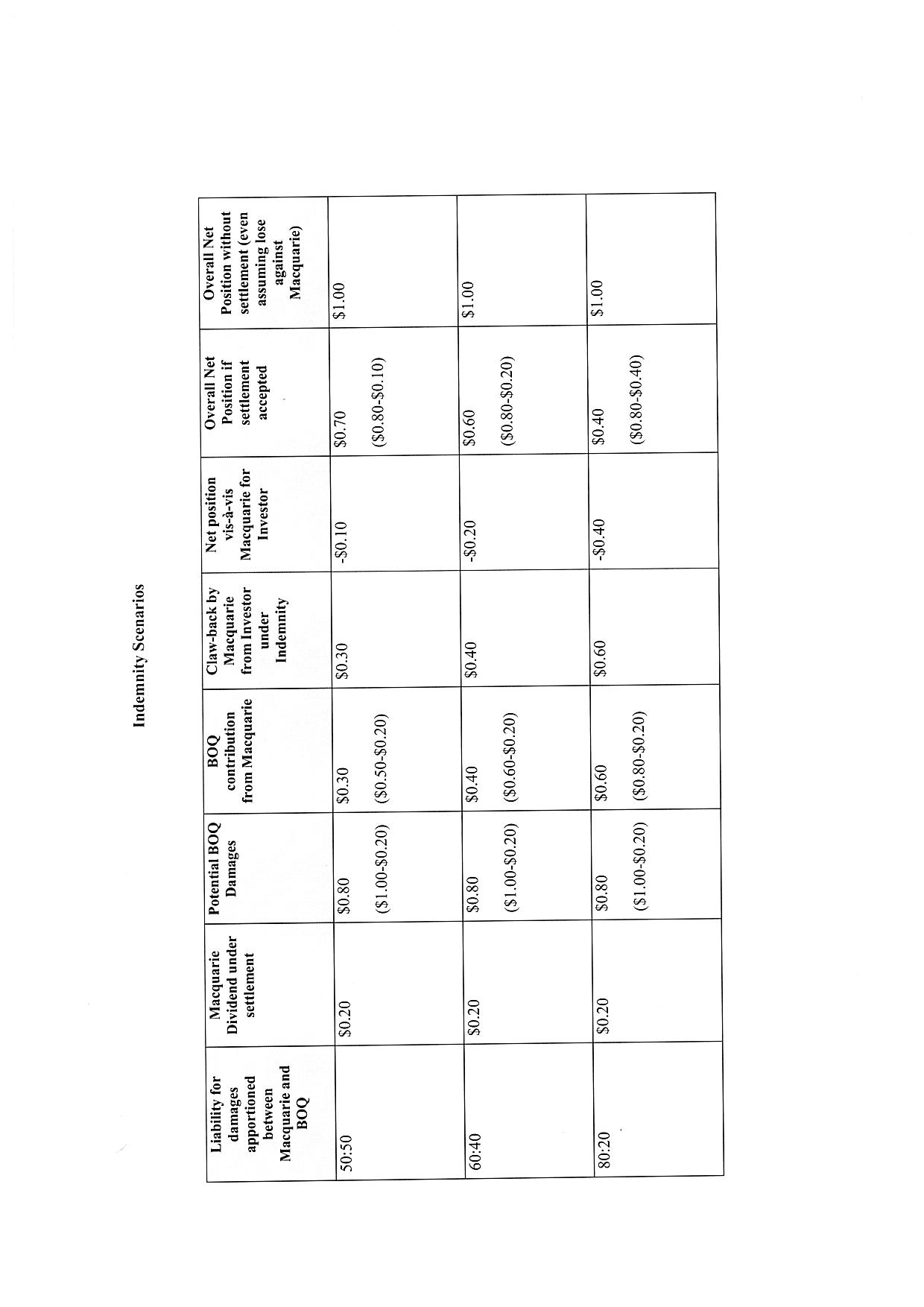
42 Also raised for consideration by ASIC, again properly, was a feature of the settlement which is it necessary to highlight. That is provision by way of indemnity to Macquarie by members of the representative group. A convenient way of describing how theoretically that indemnity might result is by annexing a table which formed part of the submissions made on behalf of ASIC. That annexure will form part of these reasons for judgment.
43 It was put on behalf of Macquarie that it was only be expected that Macquarie would seek such an indemnity. I respectfully agree. It is necessary firmly to bear in mind that the settlement I am asked to approve is one made as between Mrs Richards and through her, the representative group and Macquarie. It is not just the interests of Mrs Richards and the representative group I must consider in deciding whether the settlement is fair and reasonable but also those of Macquarie.
44 I have no doubt at all that it was reasonable for Macquarie, which is not a charity, to seek the indemnity which forms a feature of the settlement deed. I have used the descriptor “theoretical” in relation to the outcome which could occur and as is described usefully in the table in the ASIC submissions because contribution by another lender from Macquarie is not a feature of existing litigation. That does not preclude completely the prospect that contribution might be sought. Nonetheless, the prospect that Macquarie would be joined is one which one might have expected would have come to pass already. The settlement will preclude double recovery by members of the representative group from any orders which might otherwise have been made in proceedings separately instituted by the Commission against Macquarie. There is nothing unfair about preclusion of double recoveries.
45 Overall then, the settlement strikes me as one which, viewed both in a global sense as well as in terms of its internal operation, is one which is fair and reasonable. It is necessary to record also a particular approach taken by the parties to the substantive proceedings in light of submissions made by the Commission with respect to the wording of the deed of settlement and to the construction of that deed. It is a measure of the good faith which attended the promotion of this settlement for the Court’s approval that confidentiality in relation to the terms of the deed was waived in relation to the use for the purposes of this proceeding only by ASIC of that deed. In other words, the Commission’s advisers were permitted by the parties to look at a document which would usually be confidential to the parties to the substantive proceeding.
46 Having done that, and again in keeping with a role which one might expect to be undertaken by a body such as ASIC if it were permitted such access (and it has no right in that regard) submissions were made as to the construction of the deed. That, in turn, led the parties to the substantive proceeding to promote that the deed should be construed or, at least, take effect as if (and it is necessary to record these particular aspects):
(a) clause 7(b)(ii) were amended to read “amounts referable to losses directly arising from a margin loan or the investment of its proceeds”; and
(b) the following words were added to the end of clause 9(b)(iii) “concerning a matter which is the subject of a release under clause 6.1”.
47 It was submitted, and there is a reasonable basis for the submission, that the deed could be read as if those words were there anyway. In other words, it was a construction that was open. It was also put on behalf of Macquarie that the making of a formal amendment to the deed to record such very variation, at least for the purpose of clarity, would require very considerable internal decision-making process indeed.
48 It is sufficient, in my opinion, given that I regard the construction, in any event, as open to proceed on the basis that each party to the substantive proceeding has promoted and relied upon the deed as if it read or took effect in the manner that I have set out. In other words, each party is relying on that for the purpose of promoting approval of their settlement. I regard it as sufficient if that particular reliance is recorded in these reasons for judgment with the consequence that the approval will be a result of that reliance. For that reason, I do not propose to include in the orders made today, para 12 of the draft. Save as just indicated and with the correction of an incorrect reference to statute which was recorded in submissions, there will be orders in terms of the draft.
49 I particularly wish to record my appreciation to counsel for the parties to the substantive proceeding and ASIC for the considerable assistance offered to the Court in the bringing to, as it proves, approval of settlement of what can only be regarded as difficult and complex litigation.
I certify that the preceding forty-nine (49) numbered paragraphs are a true copy of the Reasons for Judgment herein of the Honourable Justice Logan. |
Associate:
ANNEXURE