

FEDERAL COURT OF AUSTRALIA
Ananda Marga Pracaraka Samgha Ltd v Tomar (No 6) [2013] FCA 284
| IN THE FEDERAL COURT OF AUSTRALIA | |
| DATE OF ORDER: | |
| WHERE MADE: |
THE COURT ORDERS THAT:
1. The parties are directed to confer and in the event of agreement file and serve on or before 4.00pm on 24 April 2013 joint proposed minutes of orders (including as to costs) reflecting the reasons for judgment published on 3 April 2013 in relation to:
a. the plaintiffs’ amended application dated 16 April 2012; and
b. the defendants’ further amended cross claim dated 4 November 2011 (save in relation to the relief sought pursuant to s 461(1)(k) of the Corporations Act 2001 (Cth) referred to in paragraph C(2) of the prayer for relief).
2. In the event that the parties cannot agree as to the appropriate minutes of orders, each party shall file and serve on or before 4.00pm on 24 April 2013 proposed minutes of orders together with written submissions (not to exceed 10 pages) in support.
3. The parties are directed to confer and in the event of agreement shall on or before 4.00pm on 24 April 2013 file a minute proposing a maximum number of three experts to prepare the report referred to in paragraph 620 of the reasons for judgment, together with a brief statement of the experts’ qualifications and estimated fees and costs.
4. In the event the parties are unable to reach the agreement referred to in order 3, each party is directed to file and serve on or before 4.00pm on 24 April 2013 a minute proposing a maximum number of two experts together with a brief statement of the experts’ qualifications and estimated fees and costs.
5. The further hearing of the proceeding is adjourned to a date to be fixed.
Note: Entry of orders is dealt with in Rule 39.32 of the Federal Court Rules 2011.
| VICTORIA DISTRICT REGISTRY | |
| GENERAL DIVISION | VID 208 of 2010 |
| BETWEEN: | ANANDA MARGA PRACARAKA SAMGHA LTD (ACN 003 193 897) First Plaintiff DEVENDHRAN VADIVELOO PILLAY Second Plaintiff PRABANJAMURTHI PILLAI Third Plaintiff |
| AND: | SUNIL KUMAR SINGH TOMAR First Defendant CLAUDIA ALISTER Second Defendant RICHARD PFEIFFER Third Defendant TIWARI DAYASHANKAR Fourth Defendant PAUL ALISTER Fifth Defendant DIETER DAMBIEC Sixth Defendant JAKE KARLYLE Seventh Defendant LUKE DEACON Eighth Defendant MIRAI DEACON Ninth Defendant MICHAEL TOWSEY Tenth Defendant DHARANENDRAN PARTHY Eleventh Defendant |
| JUDGE: | DODDS-STREETON J |
| DATE: | 3 APRIL 2013 |
| PLACE: | MELBOURNE |
REASONS FOR JUDGMENT
introduction
1 In this proceeding the parties are in dispute over the identity of the members and directors, the construction of the constitution and the control and future disposition of the first plaintiff, Ananda Marga Pracaraka Samgha Ltd (“the company”). The company is a company limited by guarantee incorporated in 1986, which has, as a principal object, “to propagate the philosophy, the ideals and practice of Ananda Marga which is an autonomous religion, faith and social system…”
2 All parties (save for the company) and many of the witnesses were followers of Ananda Marga, which originated in India, where significant conflict and divisions occurred in late 2002 or early 2003.
3 It was common ground that the company has substantial assets (with an estimated value of approximately $20 million) and an annual income of about $1 million. It engages in charitable activities and conducts a substantial business enterprise, including a number of schools, yoga and meditation courses, festivals and retreats. It sponsors visa applications by Ananda Marga monks and nuns. It is a recipient of government grants and charitable donations and has considerable outgoings, including the payment of teachers’ salaries, workers’ compensation, public liability insurance and mortgage instalments.
4 The company did not play an active role in the litigation, although formally a plaintiff. See Ananda Marga Pracaraka Samgha Ltd v Tomar (No 2) [2010] FCA 1342.
5 The second and third plaintiffs, Devendhran Vadiveloo Pillay and Prabanjamurthi Pillai (for convenience, “the plaintiffs”) contended that there are eight members of the company, being themselves, Claudia Alister, Sunil Kumar Singh Tomar, Karl Robins, Arati Nayak, Colm Largey and David Tanner, who were admitted according to the procedures expressly prescribed for membership in the company’s articles of association; and that there are five directors (Messrs Pillay and Pillai, Ms Alister, Dr Tomar and Ms Nayak), who were elected pursuant to the procedures prescribed by the articles and have not been removed by any valid resolution or lawful means under the company’s constitution, the Corporations Act 2001 (Cth) (“the Act”) or otherwise.
6 For convenience, in these reasons, I shall refer to the register of members comprising the following persons (whom the plaintiffs identify as members) as “the plaintiffs’ register”:
(1) Mr Pillay
(2) Mr Pillai
(3) Ms Nayak
(4) Mr Tanner
(5) Mr Largey
(6) Mr Robins
(7) Dr Tomar
(8) Ms Alister
7 The defendants contended that they are all members of the company and that the first defendant, Dr Tomar and second defendant, Ms Alister are directors. They deny that the persons on the plaintiffs’ register (save for Dr Tomar and Ms Alister) are members. For convenience, I shall refer to the register of members comprising the following persons (whom the defendants identify as members) as “the defendants’ register”:
(1) Mr Pfeiffer
(2) Mr Tiwari
(3) Mr Alister
(4) Mr Dambiec
(5) Mr Karlyle
(6) Mr Deacon
(7) Ms Deacon
(8) Mr Towsey
(9) Mr Parthy
(10) Dr Tomar
(11) Ms Alister
8 The defendants also contended that the company may have additional members to those on either the plaintiffs’ or the defendants’ register, as the evidence established that members who were previously assumed to have resigned in the past had not in fact done so.
9 The articles provide that a director of the company must be a member, and if a person ceases to be a member, he or she is disqualified from holding office as a director. The directors are elected by the members. Accordingly, a determination of the identity of the members is crucial to the control of the company.
10 Although the parties agreed that Dr Tomar and Ms Alister are members and directors of the company, the identity of all other members and directors of the company was in dispute.
11 The defendants conceded that:
(a) save for Dr Tomar and Ms Alister, the persons on the defendants’ register did not obtain membership of the company by following the procedures expressly prescribed for that purpose in the articles; and
(b) the alleged loss of membership by persons on the plaintiffs’ register did not depend on any express provision of the constitution.
12 Rather, the defendants maintained that, save for Dr Tomar and Ms Alister, the persons on the defendants’ register acquired membership of the company when and because they became members of certain committees which the defendants allege are sub-committees or advisory boards of the company within the meaning of art 49 or 50, or are otherwise committees in the wider Ananda Marga organisation, membership of which confers, by convention, membership of the company. Alternatively, the defendants alleged that the relevant persons became members of the company pursuant to membership agreements executed by Dr Tomar and Ms Alister on behalf of the company on various dates between 7 and 25 February 2010.
13 Up to the time of trial, the defendants alleged that Messrs Pillay and Pillai were removed as directors at a members’ meeting of the company convened by Dr Tomar and held on 20 March 2010, and, more fundamentally, that the membership of all persons on the plaintiffs’ register was terminated pursuant to implied terms of the constitution. That position shifted at trial when the defendants disavowed reliance on the proceedings at the meeting on 20 March 2010 and no longer contended that it was a valid meeting of the company. They also abandoned their allegation that there were implied terms of the constitution, pursuant to which most of the persons on the plaintiffs’ register ceased to be members. Instead, as I understood their argument (which shifted during the course of the trial) the defendants alleged that those persons lost their membership of the company because it was fundamentally incompatible with the object in cl 2(a) of the memorandum that the company “propagate the philosophy, the ideals and practice of Ananda Marga…”.
14 The defendants did not dispute that the persons on the plaintiffs’ register (save for Messrs Tanner and Largey) had obtained membership by the process set out in the articles, of a written application, a proposer and seconder, acceptance by the board and payment of a subscription. The defendants disputed, however, that Messrs Tanner and Largey had ever become members of the company, contending at trial (although they did not plead) that the meeting of the company’s committee (that is, the board) on 17 March 2010 (in which the membership of Messrs Tanner and Largey was approved) was invalidated by unreasonably short notice and an inadequate description of the business to be transacted.
15 The defendants’ allegation that the membership of persons on the plaintiffs’ register was contrary to the objects of the company (and thus had been or should be terminated) overlapped with their alternative claims based on oppression under s 232 of the Act and winding up on the just and equitable ground under s 461(1)(k) of the Act. It depended on a series of cascading and at points highly elusive and shifting propositions, all of which were essential elements of the defendants’ case.
16 As I understood their case, the defendants alleged:
(1) First, that Ananda Marga is a hierarchical, authoritarian religion with a global “chain of command” prescribed by the scriptural writings of its Founder, including, importantly, a highly revered text known as Carya Carya, within which particular high office holders (most significantly, the General Secretary and the Purodha Pramukha) exercise absolute authority over “members” of Ananda Marga, and are empowered, inter alia, to:
(a) issue directives or orders to a monastic follower of Ananda Marga, including orders to transfer from one country to another (“posting orders”) on disobedience of which (subject to appeal) the follower will lose his or her status as a monk or nun, religious titles and “good standing as a member of Ananda Marga”; and
(b) authoritatively declare that a non-monastic follower of Ananda Marga is suspended from representing or discharging official functions in the Ananda Marga religion or organisational system, upon which a lay “member” of Ananda Marga will lose “good standing”.
(2) Secondly, that the powers attaching to the positions of supreme authority (the Purodha Pramukha and the General Secretary) within both the unincorporated Ananda Marga organisation in India referred to in Carya Carya and an associated society in West Bengal registered under the West Bengal Societies Registration Act 1961 (India) (“the West Bengali Society”) currently vest in one and the same person, Acarya Dhruvananda Avadhuta (“Dhruvananda”), who heads an Ananda Marga administration based in Ranchi, India, and is the validly elected or appointed General Secretary of both the unincorporated organisation and the West Bengali Society, and is also the Acting Purodha Pramukha.
(3) Thirdly, that Dhruvananda had exercised his legitimate authority to:
(a) direct valid posting orders to all those members of the company on the plaintiffs’ register who were monks or nuns of Ananda Marga (save for Dr Tomar) requiring them to transfer from Australia to another geographical region of the world, which they disobeyed, and from which they failed to appeal successfully or at all;
(b) direct letters to the lay members of the company on the plaintiffs’ register who have supported the plaintiffs in this litigation, declaring that they were suspended from “representing, Ananda Marga”, having any position in Ananda Marga in the Suva Sector or “any entitlement to hold assets or to exercise authority over assets or the property” of the organisation in the Suva Sector; and
(c) declared his approval of decisions of relevant boards within the unincorporated Ananda Marga organisation in India to cancel the spiritual titles of, among others, Mr Pillay, Ms Nayak, Mr Largey and Mr Robins.
(4) Fourthly, that the company was incorporated with the intention and for the purpose of embodying, in the form of an Australian corporation, the scripturally prescribed hierarchical organisation of the Ananda Marga religion based in India.
(5) Fifthly, that having lost their good standing as members of the Ananda Marga religion and organisation by reason of the matters in paragraph 16(3), none of the persons on the plaintiffs’ register could, consistently with the company’s objects, maintain (or acquire) membership of the company, which embodied and was the vehicle of the legitimate Indian religious organisation in Australia.
17 Alternatively, the defendants alleged that if the persons on the plaintiffs’ register who had lost their good standing as members of Ananda Marga were not, on a proper construction of the company’s constitution, consequently deprived of membership of the company, their continuing membership (and, where applicable, directorship) nevertheless constituted oppression pursuant to s 232 of the Act, the primary relief for which should include orders for their removal.
18 The defendants’ oppression case, as pleaded, was based solely on the continued membership of the persons on the plaintiffs’ register who had allegedly lost their good standing in Ananda Marga due to disobedience of posting orders, deprivation of spiritual titles and (or alternatively) declarations of suspension. The defendants alleged that the membership of (or control by) such persons would be contrary to the subscribers’ intention and members’ legitimate expectation that the affairs of the company would be conducted consistently with the rules and practices of Ananda Marga, and would be contrary to the sole purpose of the company’s incorporation as a vehicle for Ananda Marga in Australia. No other conduct or circumstance constituting oppression was pleaded. The pleaded oppression claim thus largely coincided with the challenge to the membership of those on the plaintiffs’ register. It was also wholly contingent upon the defendants’ failure to establish that the membership of those on the plaintiffs’ register had terminated.
19 At trial, the defendants also relied on Dr Tomar’s evidence that Mr Pillay withheld certain financial information and held company meetings on short notice to support the oppression claim.
20 The defendants sought winding up of the company as alternative relief for oppression under s 233(1)(a) of the Act and on the just and equitable ground pursuant to s 461(1)(k) of the Act. They did not, however, plead material facts or particularise a separate case for winding up the company on the just and equitable ground. During the course of the trial, the defendants sought to cross-examine Mr Pillay about possible misconduct in relation to two sales of corporate property in 2008 and 2009 respectively, which I permitted only in relation to credit, as it was neither relevant to the defendants’ pleaded case which the plaintiffs had prepared to meet, nor included in the defendants’ written submissions. The defendants also cross-examined Mr Pillai and Ms Nayak about contraventions of requirements of the Act. In final submissions, the defendants contended that if their case on membership failed, the evidence of the company’s and the directors’ contraventions of the Act over a lengthy period of time (although not pleaded) together with “deadlock” and failure of the company’s substratum, constituted grounds for winding up.
21 The plaintiffs contended that the persons on the plaintiffs’ register all acquired membership through the prescribed process of application but acknowledged that Mr Largey’s application form was not signed by the proposer and seconder, as required by the articles. They sought an order under s 1322(4) of the Act that Mr Largey’s application was not invalidated by reason of the omission.
22 The plaintiffs submitted that the articles provided clear and exhaustive rules for the acquisition and termination of membership of the company. Further, they submitted that the memorandum was not ambiguous and the articles and memorandum, whether separately or together, did not expressly or implicitly require a company member to be a follower of Ananda Marga who maintained good standing in the wider Ananda Marga organisation.
23 In the plaintiffs’ submission, fulfilment of the company’s primary object of propagating the philosophy, the ideals and practice of Ananda Marga was not incompatible with, and might even be assisted by, professionally qualified members or directors who were not adherents of Ananda Marga. Similarly, the object did not require a person’s membership to be terminated because he or she never had or lost “good standing” as a member of Ananda Marga. The plaintiffs further submitted that the company had consistently pursued and fulfilled its objects and the defendants did not allege otherwise.
24 The plaintiffs denied, moreover, that the relevant persons on the plaintiffs’ register had lost good standing in Ananda Marga (in so far as that concept had meaning) on the bases alleged or at all. The plaintiffs contended, in that context, that the Ananda Marga unincorporated organisation under Carya Carya, while hierarchical, was neither autocratic nor dictatorial, but rather, pluralistic, multi-dimensional and consultative. Further, neither Carya Carya nor the West Bengali Society’s constitution (which had, in any event, no apparent application to those on the plaintiffs’ register) vested power in the General Secretary or Purodha Pramukha unilaterally to make posting orders. Nor did Carya Carya or the constitution demand unquestioning obedience to posting orders or empower the General Secretary or the Purodha Pramukha to punish those on the plaintiffs’ register for disobedience or for supporting the plaintiffs in the litigation by deprivation of their spiritual titles or declarations of suspension.
25 The plaintiffs further contended that even if Carya Carya and the West Bengali Society’s constitution conferred such powers on the General Secretary or the Purodha Pramukha, Dhruvananda was not the legitimate General Secretary or Acting Purodha Pramukha and could not exercise their powers.
26 The plaintiffs denied that the first and second defendants had suffered or would suffer oppression because those on the plaintiffs’ register were members of the company or due to denial of access to information, short notice of meetings or being consistently outvoted by a majority “bloc”. The plaintiffs also denied that the continuing membership of those on the plaintiffs’ register would cause deadlock, defeat the members’ legitimate expectations or cause the corporate substratum to fail.
27 The plaintiffs conceded that the company and its officers had failed in numerous instances to comply with statutory requirements and obligations over the last decade. They acknowledged that management of procedural matters had been amateurish and the company’s record keeping was deficient. They nevertheless submitted that they had not been fairly notified of, and had no reasonable opportunity to respond to, a claim to winding up based on contraventions or misconduct in relation to corporate transactions. The plaintiffs submitted that, more significantly, there was no evidence of serious misconduct, dishonesty or financial mismanagement. Much of the non-compliance was in the past and was essentially procedural or technical in nature. While past company secretaries were most directly responsible for the contraventions, all the directors, including Dr Tomar and Ms Alister, shared the responsibility. Further, the plaintiffs acknowledged the deficiencies and had taken steps to address them. They submitted that in such circumstances, winding up or a referral to the Australian Securities and Investments Commission (“ASIC”) was not warranted.
28 For the reasons that follow, I concluded that the defendants did not establish their case on the membership and directorate of the company or oppression. Nor were the defendants’ principal grounds for winding up on the just and equitable ground established. Further, while the acknowledged contraventions are a matter of serious concern, particularly in a public company with extensive operations and assets, I considered that if satisfactory evidence is provided of appropriate measures to comply with outstanding statutory obligations and prevent recurrence of the contraventions, winding up would be an unduly drastic remedy.
29 I was satisfied that the persons identified by the plaintiffs were legitimate members and directors of the company and that an order under s 1322(4) of the Act should be made in relation to the formal deficiencies in Mr Largey’s application for membership.
witnesses
30 The plaintiffs relied on the following affidavits and witness statements:
(1) the affidavit of Prabanjamurthi Pillai sworn on 23 April 2010;
(2) the affidavit of David Tanner sworn on 23 April 2010 (but only paragraph 3);
(3) the affidavit of Arati Nayak sworn on 27 April 2010;
(4) the affidavit of Devendhran Vadiveloo Pillay sworn on 20 January 2012;
(5) the expert witness statement of Professor Sohail Inyatullah dated 21 March 2012 and affirmed on 17 April 2012;
(6) the witness statement of Marie Satya Anne Tanner dated 21 March 2012 and affirmed on 17 April 2012;
(7) the witness statement of Arati Nayak affirmed on 16 April 2012;
(8) the witness statement of Acarya Bhaveshananda Avadhuta affirmed on 13 April 2012;
(9) the witness statement of Shamilla Ajodha affirmed on 16 April 2012;
(10) the witness statement of Nityashuddh Anand dated 13 April 2012;
(11) the witness statement of Colm Largey affirmed on 16 April 2012;
(12) the reply witness statement of Devendhran Vadiveloo Pillay signed 4 April 2012;
(13) the reply witness statement of Prabanjamurthi Pillai affirmed on 16 April 2012; and
(14) the reply witness statement of David Tanner affirmed on 16 April 2012.
31 The plaintiffs relied on written submissions dated 21 March 2012 and 20 April 2012.
32 The defendants relied on the following affidavits and witness statements:
(1) the expert witness statement of Professor Lorne Dawson affirmed on 27 March 2012;
(2) the witness statement of Dr Sunil Tomar affirmed on 27 March 2012;
(3) the witness statement of Dr Ramesh Kohli affirmed on 2 April 2012;
(4) the witness statement of Acarya Svarupananda Avadhuta affirmed on 3 April 2012;
(5) the expert witness statement of Kumar Kappadath affirmed on 5 April 2012;
(6) the affidavit of Robert Clifford sworn on 13 April 2012; and
(7) the affidavit of Murray Baird affirmed on 22 April 2012.
33 The defendants relied on written submissions dated 21 March 2012 and 20 April 2012.
34 The following witnesses were cross-examined:
(1) Nityashuddh Anand;
(2) Acarya Bhaveshananda Avadhuta;
(3) David Tanner;
(4) Prabanjamurthi Pillai;
(5) Colm Largey;
(6) Shamilla Ajodha;
(7) Arati Nayak;
(8) Professor Sohail Inyatullah;
(9) Marie Satya Anne Tanner;
(10) Dr Sunil Tomar;
(11) Dr Ramesh Kohli;
(12) Acarya Svarupananda Avadhuta;
(13) Professor Lorne Dawson; and
(14) Kumar Kappadath.
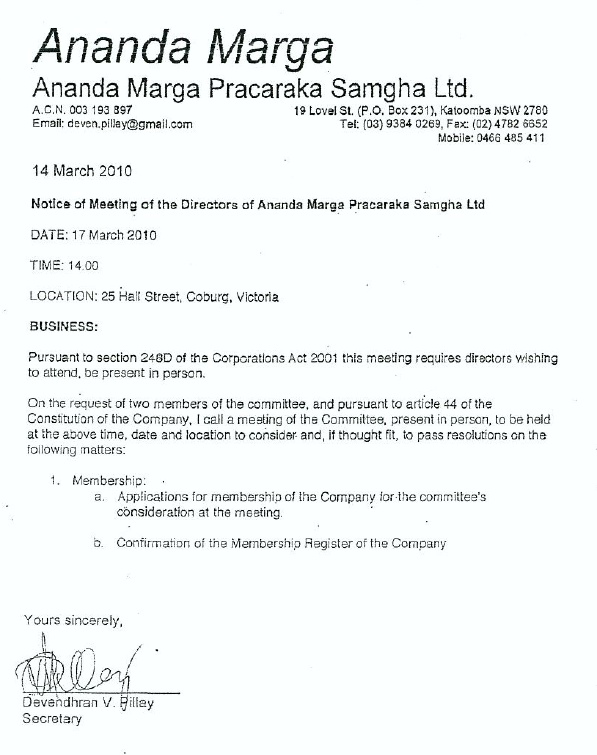
35 Many of the parties and witnesses had multiple religious titles and lengthy or alternative names. In these reasons, for convenience, I frequently use a single name and omit religious titles.
36 The expert witnesses, Professor Dawson, Professor Inyatullah, Squadron Leader Tanner and Mr Kappadath, were conscientious and direct witnesses. Professor Dawson’s relevant expertise was, however, ultimately very limited and he made a considerable number of significant concessions and qualifications. Mr Kappadath had expertise in Indian law but his evidence was subject to the limitations of the material provided to him. Further, for reasons stated below, it was necessary to qualify significantly some of Mr Kappadath’s conclusions.
37 Messrs Tanner, Largey and Pillai and Ms Adjodha and Ms Nayak, who gave evidence for the plaintiffs, were, in my opinion, candid, direct and reliable witnesses, whose testimony I accepted.
38 Mr Pillay and Dr Tomar were the principal lay witnesses for the plaintiffs and the defendants respectively. In my opinion, Mr Pillay was a conscientious, reliable and honest witness, who responded directly to questions, made appropriate concessions and was prepared to admit matters adverse to his case. I accepted Mr Pillay’s evidence.
39 Dr Tomar, in contrast, was not an impressive witness. As noted in detail below, he was frequently evasive or argumentative, and at some points implausibly professed a lack of recollection. While Dr Tomar initially made some significant admissions adverse to his case, he subsequently attempted unconvincingly to retract them. Dr Tomar maintained inconsistent assertions, at points clearly recognising the company’s status as a separate legal entity while at other times professing to recognise no distinction between the company and the wider Ananda Marga movement.
40 Dr Tomar was the only defendant who gave evidence, although he acknowledged that most defendants were available to do so and some were present in court during the hearing. Dr Tomar stated that he chose not to call Dhruvananda to give evidence on behalf of the defendants.
41 Acarya Nityashuddhananda Avadhuta and Acarya Bhaveshananda Avadhuta, who gave evidence for the plaintiffs, were, in my opinion, direct and credible witnesses.
42 Dr Kohli, who gave evidence for the defendants, testified clearly, but in cross-examination was discursive and frequently evasive. Dr Kohli was reluctant to concede matters adverse to the defendants’ case, and, as discussed below, did not present as a candid witness.
43 Acarya Svarupananda Avadhuta, who gave evidence for the defendants, was a very unsatisfactory witness. He had difficulties with hearing, reading and with understanding English, and after he had testified for some time, ultimately required an interpreter. Allowing for those problems, which were apparently beyond his control, Mr Svarupananda appeared evasive, argumentative and unable or unwilling to understand or to answer questions directly. I therefore accorded his evidence little weight.
44 Due to the time that has elapsed since the hearing of this matter and the publication of these reasons, I record that I formed and maintained my opinion of the above witnesses at the time of trial.
background facts
What is Ananda Marga?
45 It was common ground that Ananda Marga Pracaraka Samgha was founded in India in 1955 by Prabhat Ranjan Sarkar, who is known to adherents (and referred to in these reasons) as “the Founder”. “Ananda Marga” means “the Path of Bliss”, “Pracaraka” indicates “propagation” and “Samgha” denotes an organisation. Ananda Marga is described in the company’s memorandum as amended as “an autonomous religion, faith and social system based upon the teachings of the Founder and Preceptor of Ananda Marga, Shri PR Sarkar also known as Shrii Shrii Anandamurti”.
46 It was also common ground that the Founder of Ananda Marga wrote prolifically and published over 260 works, including a seminal, three-part text or scripture known as “Carya Carya”, which was first published in India in April 1956. (The first English edition of Carya Carya Part I was published in 1962).
47 Carya Carya Part I commences with “The Supreme Command” which states, inter alia:
Those who perform sadhana twice a day regularly… their liberation is a sure guarantee. Therefore every Ananda Margi will have to perform sadhana twice a day invariably; verily is this the command of the Lord. … It is the bounden duty of every Ananda Margi to endeavour to bring all to the path of bliss.
48 Part I of Carya Carya otherwise deals, broadly speaking, with ritual and conduct (including ceremonies for naming infants, marriage, initiation in yoga and appropriate dress) and “social punishment”. It also prescribes a bureaucratic organisation (including boards, committees and their members and officers) relevant to this case.
49 Carya Carya Part II deals with moral precepts and instructions. Carya Carya Part III deals with yoga and meditation.
50 It was common ground that an elaborate, multi-tiered organisation based on Carya Carya was established in India during the Founder’s lifetime. The organisation includes a large number of committees and boards expressly referred to in Carya Carya Part I, which exercise different authority and perform different functions at a number of descending levels. The highest governing bodies based in India include a legislative-like body called the Central Committee, which is elected every five years by the purodhas (persons of the highest spiritual rank) of Ananda Marga, and a Central Executive Committee, the members of which are appointed from Central Committee members by a President. The President is typically also the head purodha (known as the Purodha Pramukha) and may appoint three persons from outside the Central Committee, which also has a five year term.
51 The organisation has 42 departments which operate under, and the heads of which are drawn from, the Central Executive Committee. Each of the 42 departments has a board, which may be either an ACB (general board) or named after the department involved.
52 Carya Carya Part I also refers to a body called the Central Purodha Board, which, in the event of any complicated problem or serious controversy, makes “supreme” decisions which are binding on “the Society” or Ananda Marga followers. The decisions of the four-member Central Purodha Board are arrived at by majority vote. If the votes are evenly split, the Chairperson, who is the Purodha Pramukha (the highest ranking office holder in the Ananda Marga organisation) has the casting vote. The Purodha Pramukha, who holds office for life, is elected by the purodhas. The purodhas also elect the other three members of the Central Purodha Board who ordinarily hold office for five years. The Founder, who was the original Purodha Pramukha, held that office until his death in 1990.
53 According to Carya Carya, the Purodha Pramukha’s powers include appointing the Central Executive Committee and casting a decisive vote in the case of a split in the Central Purodha Board. The Purodha Pramukha also confirms the decisions of the Central Acarya Board, the Central Tattvika Board and the Avadhuta/ika Avadhuta Board, (discussed below).
54 Ananda Marga has both monastic and non-monastic followers. Monks and nuns undergo a course of training which culminates in an examination and lay adherents may undergo initiation in a process of meditation known as “Sadhana.”
55 Adherents of Ananda Marga may acquire the spiritual ranks or titles of purodha, tattvika, acarya or avadhuta. While both monks and nuns and non-monastic “wholetimers” (full time workers) may acquire spiritual titles, certain titles are reserved for monastic adherents.
56 In addition to the Central Purodha Board, Carya Carya also refers to a Central Acarya Board, consisting of eight members elected by the acaryas, which decides “all rules and regulations, punishment, discipline and everything else regarding acarya/as”, subject to the Purodha Pramukha’s final approval. A Central Tattvika Board, comprising 12 persons elected by the tattvikas, decides on the punishment of and all matters regarding tattvikas, subject to final approval by the Purodha Pramukha. An Avadhuta/ika and Avadhuta Board, comprising four persons elected by the Avadhuta/ikas, decides on the punishment of and all matters regarding Avadhuta/ikas, subject to the final approval of the Purodha Pramukha.
57 Chapter 30 of the Carya Carya deals with “social punishment”. It provides that “anybody having committed an antisocial act will have to undergo a severe fast or punishment of any other type prescribed by an acarya for the atonement of the sin”.
58 Chapter 30 further provides that any allegation against the conduct of an Ananda Margi is to be brought to the notice of the person’s acarya/as or, if that acarya/as is absent, to another acarya/as with relevant responsibility. If the latter is not readily available the accusation should be taken to either of two other office holders, who will form a tribunal of acarya/as. If the tribunal finds that the allegation is made out the accused can appeal to another office holder, who will form another tribunal of acarya/as, from which the accused, if unsatisfied, may (with that tribunal’s permission) appeal to the General Secretary of the Samgha. The decision of the General Secretary or a tribunal he appoints is taken to be final.
59 Chapter 30 of Carya Carya provides that where a “family acarya” is accused, a tribunal appointed by the secretary of the Central Acarya Board will decide the punishment. In the case of a non-acarya “wholetimer”, a tribunal appointed by the head of the relevant wing of Ananda Marga will decide the punishment. In the case of a “wholetimer” who is an acarya, the punishment is decided by a tribunal appointed by the secretary of the Central Acarya Board or the head of the relevant wing. In the case of a “wing-head”, the General Secretary of the Samgha or an appointed tribunal will decide the punishment.
60 In summary, Carya Carya identifies the General Secretary as the person to whom a lay follower may (with a tribunal’s permission and at the accused’s option) appeal, and who is the decision-maker only in the case of a wing-head. Further, social punishment is imposed for an “antisocial act”, which is not defined.
61 While the Purodha Pramukha has the decisive power in the case of a split vote of the Central Purodha Board, it is only in relation to “any complicated problem or serious controversy in Ananda Marga”.
62 Carya Carya Part II contains mandatory duties of Ananda Marga, which include charitable deeds, charitable thoughts and care of others. It contains rules about society, including service to others. It also contains a series of rules or precepts including “The Fifteen Rules of Behaviour” or “Shilas” on which the defendants relied, as follows:
(1) Forgiveness.
(2) Magnanimity of mind.
(3) Perpetual restraint on behaviour and temper.
(4) Readiness to sacrifice everything of individual life for Ideology.
(5) All-round self-restraint.
(6) Sweet and smiling behaviour.
(7) Moral courage.
(8) Setting an example by individual conduct before asking anybody to do the same.
(9) Keeping aloof from criticizing others, condemning others, mudslinging and all sorts of groupism.
(10) Strict adherence to the principles of Yama and Niyama.
(11) Due to carelessness, if any mistake has been committed unknowingly or unconsciously, one must admit it immediately and ask for punishment.
(12) Even while dealing with a person of inimical nature, one must keep oneself free from hatred, anger and vanity.
(13) Keeping oneself aloof from talkativeness.
(14) Obedience to the structural code of discipline.
(15) Sense of responsibility.
63 The Fourteen Point Conduct Rules for Wholetime Workers, on which the defendants also relied, include the following rules:
2 No logic, no reasoning but the compliance of order.
3 You will have to reach at the appointed time when you have been called for, without fail, if you are not dead.
64 There is also a parallel structure throughout the world to the Ananda Marga organisation in India, as Ananda Marga is organised into nine geographical sectors. The Ananda Marga sector incorporating Australia is known as the Suva Sector. The structure of each geographical sector replicates that of the organisation in India, with a Sectorial Executive Committee (“SEC”), a Sectorial Secretary, 42 departments and 42 boards. Ideally, each sector should include further tiers of 42 boards at descending regional and diocesan levels, albeit in practice there may not be enough persons to establish them. Each department in the sectors has a secretary or head, who is a member of the SEC.
65 The evidence established that the elaborate organisation described in Carya Carya and known as Ananda Marga Pracaraka Samgha (frequently contracted to “AMPS”) is not incorporated and has no legal personality separate from that of the persons from time to time involved or holding office in it.
66 While the defendants designated the unincorporated organisation which operates in India, “AMPS Central”, that designation was not derived from Carya Carya or established by any other formal document.
67 The West Bengali Society, also known as Ananda Marga Pracaraka Samgha (which, confusingly, was also frequently referred to as “AMPS”), was first registered in Bihar, India in 1955. It was subsequently registered in West Bengal in 1964 pursuant to West Bengali legislation. Although the registered West Bengali Society is not referred to in Carya Carya, it was not disputed that the Founder approved its constitution. While the West Bengali Society is not a corporation, the West Bengali Act under which it is registered confers characteristic features of legal personality, such as perpetual succession, the capacity to hold property through its governing body and to sue and be sued.
68 The West Bengali Society has, under its constitution, a governing body known as a Central Committee, consisting of between 10 and 15 members (including the Founder during his lifetime and another foundation member), together with the persons elected by the members of the Society, whose membership qualifications include initiation into “Sadhana”, being 18 years old or over and following the principles of social and spiritual conduct laid down in Carya Carya. The office-bearers include a President, General Secretary and Treasurer who are elected by the governing body from amongst themselves.
69 The governing body has management powers and its decisions are made by a majority vote. The President has a casting vote, the power to nominate members of the Executive Committee, to exercise the powers of the committees established under the regulations and to advise the Society on all points of disputes.
70 The General Secretary is (subject to the provisions of the West Bengali Act, the relevant regulations and the control of the governing body) empowered, inter alia, to convene meetings, issue notices, maintain minutes books, function as head of the Executive Committee, appoint various secretaries, and bring and defend litigation on behalf of the Society. The General Secretary may also (with the approval of the President) remove or suspend members of the Society for violation of the code of conduct, orders or directions.
71 In 1972, the Founder sent a missionary and Sectorial Secretary to Australia in the Sydney Sector (now called the Suva Sector) to propagate and teach Ananda Marga.
72 On 1 October 1974, an unincorporated association known as Ananda Marga Pracaraka Samgha (NSW) was established in New South Wales. In 1974 and 1978, Ananda Marga associations were also registered in Western Australia and South Australia.
73 In 1981, Mr Pillai became an Ananda Marga follower.
74 On 17 September 1984, with the approval of the Founder, amendments to the constitution of the West Bengali Society in India were made and registered.
75 On 25 November 1986, the company was registered in New South Wales. Between 1986 and 1989, it was also registered in Victoria, Queensland and Western Australia.
76 In 1988, Mr Pillay became an Ananda Marga monk.
77 On 21 October 1990, the Founder of Ananda Marga died and was succeeded as Purodha Pramukha by Acarya Shraddhananda Avadhuta.
78 In 1991, Dr Tomar commenced training as an Ananda Marga monk, which he completed in 1994.
79 In 1992, the constitution of the company was amended to refer to various Ananda Marga texts, including Carya Carya Parts I, II and III.
80 On 3 and 4 June 1995, the Central Committee of the unincorporated AMPS organisation in India passed as definitive the current sixth edition of Carya Carya Part I.
81 In around mid-1997, Mr Pillay was posted to work as the Melbourne Regional Secretary of AMPS and assumed his position in 1998. On 4 November 1998, by a posting order of the General Secretary of AMPS, Mr Pillay also became the Sectorial Inpro Secretary, Sectorial Farpro Secretary, Sectorial Eco-viability Secretary, Sectorial AMURT-coordinator and Sectorial Construction Secretary of the Suva Sector.
82 From August 1999 to February 2001, Dr Kohli held office as the General Secretary of “AMPS”.
83 On 14 September 2000, the company’s trade mark “ANANDA MARGA” was registered by the Registrar of Trade Marks.
84 On 16 September 2000, Dr Tomar arrived in Australia.
85 On 7 February 2001, Dhruvananda was elected General Secretary of the unincorporated organisation in India. The validity of his election on that occasion was undisputed.
86 On 7 May 2001, Messrs Pillai and Robins and Ms Alister became members and directors of the company.
87 In 2001, Mr Robins became the secretary of the company.
88 On 25 November 2002, Ms Nayak became a member and director of the company.
89 In 2003, Mr Pillay became the Public Relations Secretary (which includes the office of Legal Secretary) of AMPS in the Suva Sector.
90 On 13 August 2003, Mr Pillay became a member and director of the company.
91 On 3 October 2003, Dr Tomar became a member and director of the company.
92 It was common ground that during the life of the Founder and for about a decade thereafter, Ananda Marga had a unified organisation and administrative structure. Broadly speaking, the organisation, bodies, committees and boards under Carya Carya, discussed above, functioned (although there was, for example, no Central Committee until after the Founder’s death). The adherents of Ananda Marga were not in dispute over the legitimacy of any Ananda Marga body, committee, organisation or office holder in India or elsewhere.
93 Following a series of incidents, from late 2002 to 2003 disputes and divisions appeared in the unincorporated Ananda Marga organisation in India. From 2003, the validity of the election of office holders in the West Bengali Society was also disputed and different claimants for the offices of General Secretary and President in that body appeared. Competing Ananda Marga administrations based in Ranchi and Kolkata (Calcutta) India began to emerge.
94 In September 2003, following an election of the Central Committee in the unincorporated Ananda Marga organisation in India, Dhruvananda expelled 15 people from the governing committee of the West Bengali Society and the Central Committee of the unincorporated body. Dhruvananda also cancelled the religious titles of about 30 supporters of the 15 people. The validity of the expulsions and cancellation of religious titles was challenged on the ground of denial of natural justice.
95 On 11 July 2004, Mr Pillai became the President of the company.
96 On 9 July 2004 at an Ananda Marga retreat, the meeting of lay members and local wholetimers in the Suva Sector, in response to the divisions that had emerged in Ananda Marga, passed the following resolution:
We the undersigned respectfully request that the SEC, the ACB and the National Board accept the following:
That we will not participate in or support any sectarian activity within Ananda Marga Pracaraka Samgha in or outside the sector;
That henceforth all instructions from Central authorities will be carefully scrutinised by all the appropriate sectorial bodies;
That only those central instructions which are deemed to be in the greater universal interest of the organisation and of the sector be recognised and follows;
We clearly and unequivocally stress that this action does not give recognition or credence to any break away group or parallel organisation or structure and it is not motivated by any group’s sentiment.
97 At the same retreat, members of the monastic order (including Dr Tomar and Mr Pillay) passed a separate resolution (“Suva Sector resolution”) to the same effect, as follows:
We do not participate in or support any sectarian activity within Ananda Marga Pracaraka Samgha in or outside the sector;
Henceforth all instructions from Central authorities will be carefully scrutinised by our sector’s administration, and only those deemed to be in the greater universal interest of the organisation and of the sector, shall be recognised and followed;
We clearly and unequivocally stress that this action does not give recognition or credence to any break away group or parallel organisation or structure and it is not motivated by any group’s sentiment;
This decision will stand until - in the opinion of the majority of margiis, LFT and WT workers of Suva sector - a satisfactory process is in place for:
(i) the depoliticisation of the organisation;
(ii) reclaiming the trust in and respect for the structure;
(iii) establishment of a fair and transparent administration;
(iv) ensuring that the organisation does actually reflect the aims and values of the mission of Ananda Marga.
98 On 11 July 2004, the company at a special general meeting unanimously resolved that the board would offer its support for the Suva Sector resolution, as follows:
Mr Pillai proposed that the board offer its support for the Suva Sector resolution of 9 July 2004, which was read out during the meeting. Mr Pillay seconded the motion which was passed unanimously.
99 On 16 July 2004, the SEC passed the Suva Sector resolution.
100 In 2005, Mr Pillay helped to formulate a proposal to resolve the conflict in Ananda Marga through the Central Purodha Board. He arranged a conference of Ananda Marga wholetimers from both “camps” to discuss unity, which was ultimately unsuccessful. The Ranchi administration expelled 15 persons who attended the conference.
101 In November 2007, two elections for the Ananda Marga Central Committee were held. First, an election was held in Ranchi to which only 21 purodhas were invited. By that time, a considerable number of persons had been either expelled from offices to which they were elected in the uncontroversial 2002 election or had been deprived of their Ananda Marga spiritual titles. Secondly, an election was held at Kolkata, to which many more purodhas (including those aligned to either Ranchi or Kolkata or who were unaligned) were invited.
102 In the two elections in November 2007, two different Central Committees were elected and subsequently two rival Ananda Marga administrations, both claiming legitimacy under Carya Carya, were formed and operated from Ranchi and Kolkata respectively. Each denied the legitimacy of the other administration.
103 The validity of the elections and appointments conducted by the Ranchi administration was challenged in various Indian courts on grounds including the lack of the requisite quorum and the illegitimate reduction of the electorates by the expulsions. The litigation, which is discussed in more detail below, is continuing and remains unresolved.
104 The rival administrations in India continue to assert competing claims to legitimacy and sole authority in Ananda Marga under Carya Carya and related writings and precepts. Some adherents of Ananda Marga worldwide recognise either the Ranchi or the Kolkata (now incorporated in the Unity) administration, while others profess allegiance to neither, or have only recently aligned with a particular administration.
105 At the commencement of this litigation, most persons on the plaintiffs’ register and some witnesses for the plaintiffs did not recognise either the Ranchi or Kolkata administration. Broadly speaking, they now recognise the “Unity” administration, which incorporated the Kolkata administration and is based in Kolkata. Dr Tomar and the majority of the defendants’ witnesses recognised the Ranchi administration. The alignment of the second to eleventh defendants cannot be known with certainty, as they did not give evidence.
106 The defendants contend that Dhruvananda, who heads the Ranchi administration, is the Acting Purodha Pramukha and the General Secretary of the West Bengali Society and the unincorporated organisation. The plaintiffs contend that Bhaveshananda, who belongs to the Unity administration, is currently the legitimate General Secretary of the West Bengali Society and the unincorporated organisation.
107 On 30 October 2005, by a posting order of Dhruvananda as the General Secretary of AMPS Central, Mr Pillay was posted as Regional Secretary, Dar Essalam, in the Nairobi Sector.
108 On 5 December 2005, by a posting order of Dhruvananda as the General Secretary of AMPS Central, Dr Tomar was appointed as Sectorial Secretary of the Suva Sector of AMPS.
109 On 4 June 2006, a group of Ananda Marga followers known as the Bali Margiis made a declaration (“Bali Margiis Declaration”) that they did not “accept the group-ism and disunity in the organisation … [or] recognise / accept the legitimacy of both administrations”. They further declared that any “order, transfer, posting etc” from any existing administration would not be accepted. The declaration was stated to continue in effect until there was only one united and inclusive organisation of Ananda Marga.
110 In April 2008, the SEC resolved to accept Mr Pillay as acting Sectorial Secretary of the Suva Sector, subject to review in six months. The SEC also passed the following resolution:
SEC hereby reasserts the Suva Sector Resolution of 9 July 2004 and furthermore we hereby declare a moratorium on all postings directed upon us from outside the sector.
111 By letters to Mr Pillay dated 8 July 2008, 11 September 2008 and 23 September 2008, Dhruvananda, as the General Secretary of AMPS Central, asserted that Mr Pillay had disobeyed the order posting him to the Nairobi Sector and asked why he should not be subject to disciplinary action.
112 By a letter to Dr Tomar dated 28 September 2008, Dhruvananda, as the General Secretary of AMPS Central, stated that Mr Pillay’s Tattvikaship, Acaryaship and Avadhutaship were suspended with effect from 30 September 2008.
113 On 15 October 2008, Acarya Shraddhananda Avadhuta died. On 28 October 2008 the Ranchi administration held an election at which Acarya Vishvadevananda Avadhuta was elected Purodha Pramukha.
114 On 3 December 2009, Mr Pillai was elected President of the company.
115 Immediately prior to 20 March 2010, all relevant parties accepted that the company had five directors (Messrs Pillay and Pillai and Ms Nayak, Ms Alister and Dr Tomar). There had previously been seven acknowledged directors, one of whom (Mr John Crowe) had died and one of whom (Mr Robins) had recently retired. At that time, it was assumed that all members were also directors and that the directorate and the membership completely coincided. At trial, however, it was not disputed that Mr Robins, when resigning as a director, took no steps to resign as a member. Further, on the basis of evidence at trial, the defendants asserted that the membership of other persons who were formerly directors of the company may not have terminated as had previously been assumed.
116 Following the resignation of Mr Robins as a director on 19 February 2010, Mr Pillay, who had been an additional secretary since 3 October 2003, became the sole company secretary. He then assumed responsibility for maintaining the company’s register of members, which was hitherto handled by Mr Robins and prior to Mr Robins’ incumbency by his predecessor, Robert Green, from April 1999 to May 2001.
117 In March 2010, Mr Pillay, a resident of Victoria, visited the company’s registered office in Katoomba, New South Wales and searched for its documents and records relating to membership and directors. The only register of members he found was in a red bound notebook. It consisted of only five handwritten names entered between 1986 and 1992.
118 Mr Pillay, having spoken to Mr Robins, updated the register of members to reflect his understanding of the company’s current membership, based on ASIC returns, the available documents (including minutes of meetings) and information from the previous secretaries. He was unable to locate any minutes of committee meetings or general meetings for the period from 1992 to 2000 (although subsequently, additional minutes were located). The updated membership register compiled by Mr Pillay is discussed further below.
119 In early 2010, Dr Tomar, assisted by Ms Alister, drew up a different membership register for the company, which included persons based on their membership of various Ananda Marga boards and committees. He completed the register on 25 February 2010.
120 On 25 February 2010, Dr Tomar caused notices of a general meeting to be held in Queensland on 20 March 2010 to be sent to persons on the defendants’ register and to Mr Pillay, Mr Pillai and Ms Nayak.
121 By an email to Mr Pillay dated 26 February 2010, Dr Tomar stated that he did not consent to conducting a committee meeting proposed for 1 March 2010 electronically. Dr Tomar attached a Notice of General Meeting for 20 March 2010 to vote on resolutions to remove Mr Pillay and Mr Pillai as directors of the company and to appoint Dr Tomar as President and Mr Pfeiffer as a director.
122 When Mr Pillay requested a copy of the register of members Dr Tomar had sent with the notice of meeting, Dr Tomar did not respond.
123 On 11 or 12 March 2010, Mr Pillay wrote to persons on his updated members’ register whose subscriptions were overdue advising them to contact him urgently, as the matter would be addressed by a committee meeting on 17 March 2010.
124 On 14 March 2010, Mr Pillay called a meeting of the committee for 17 March 2010 to deal with new applications for membership and to confirm his updated membership register.
125 The notice of meeting was as follows:
126 Two directors, Dr Tomar and Ms Alister, contended that the notice of the committee meeting for 17 March 2010 was inadequate.
127 The email of Cooper Grace Ward (solicitors then acting on behalf of Dr Tomar and Ms Alister) dated 16 March 2010 alleged that there was no reasonable notice, as Dr Tomar and Ms Alister received the notice of meeting on the evening of 14 March 2010, Ms Alister was in India and committee meetings were ordinarily by teleconference with 14 days notice. The email asserted that the notice did not clearly and fully state the nature of the business to be transacted or include the names of the applicants, their proposers and seconders.
128 On 17 March 2010, Mr Pillay, by email, maintained that the notice was valid and stated that although Dr Tomar had revoked his consent to a committee meeting by telephone the other directors would be happy if Dr Tomar and Ms Alister changed their minds and participated by telephone.
129 At the meeting on 17 March 2010, which Dr Tomar and Ms Alister did not attend, the committee (comprising Messrs Pillay and Pillai and Ms Nayak) admitted Messrs Largey and Tanner to membership and approved the register of members drawn up by Mr Pillay. Shortly after the meeting Mr Pillay added the names of Messrs Largey and Tanner to the register of members.
130 At the general meeting on 20 March 2010 called by Dr Tomar all the defendants attended either in person or by proxy. Among other things, resolutions were passed to remove Messrs Pillay and Pillai as directors.
131 The general meeting also resolved to appoint Dr Tomar as the President of the company, Mr Pfeiffer (the third defendant) as a director and Mr Tiwari (the fourth defendant), as company secretary. (The meeting of 20 March 2010 is discussed in detail in Ananda Marga Pracaraka Samgha Ltd v Tomar (No 2) [2010] FCA 1342].)
132 The company and Messrs Pillay and Pillai issued this proceeding on 29 March 2010. They challenged the validity of the proceedings at the meeting on 20 March 2010 and their consequent removal from office on a number of bases, including short notice, exclusion of legitimate members from the meeting, failure to comply with the requirement in art 19 of the company’s articles that the President preside and the attendance and voting by persons who were not legitimate members of the company.
133 On 31 March 2010, considering that there was a serious question to be tried and that the balance of convenience favoured the maintenance of the status quo, I injoined the defendants from, inter alia, calling meetings, operating company bank accounts and dealing with company properties. The plaintiffs, including the company, also undertook to observe a number of similar restrictions.
134 On 3 June 2010, pleadings were ordered (see Ananda Marga Pracaraka Samgha (ACN 003 193 897) v Tomar [2010] FCA 565) and the parties’ respective positions subsequently crystallised. The pleadings and the further affidavits filed in the proceeding disclosed a fundamental and far-reaching dispute about the identity of the members and the directors of the company and the proper bases for determining those questions. The pleadings are discussed in, inter alia, Ananda Marga Pracaraka Samgha v Tomar (No 5) [2012] FCA 390.
135 On 3 December 2010, I granted the plaintiffs’ application to restrain the defendants from, inter alia, affixing or copying the company seal, collecting or diverting the company’s mail, using the company’s “mela” (festival) contact list, redirecting traffic from the company’s websites and interfering with or varying the company’s business or contracts (see Ananda Marga Pracaraka Samgha v Tomar (No 2) [2010] FCA 1324).
136 On 13 December 2010, I made the following orders for the interim management of the company pending the hearing and determination of the proceeding:
Until the hearing and determination of the proceeding or further order:
1. The parties shall not take any steps to add or remove any director or member of the company, or to alter the constitution of the company, as existing immediately prior to 20 March 2010, and shall not call or hold any meeting in relation to any such addition, removal or alteration.
2. The directors holding office immediately prior to 20 March 2010, being the second plaintiff (Devendhran Vadiveloo Pillay), the third plaintiff (Prabanjamurthi Pillai), the first defendant (Sunil Kumar Singh Tomar), the second defendant (Claudia Alister) and Arati Nayak, shall be taken to remain and shall be registered as the directors of the company.
3. Subject to the orders made and undertakings given on 31 March 2010 and the orders made on 3 December 2010, the power to manage the company shall vest in the Board and, in the absence of agreement, questions shall be determined by a majority of the directors. No single director shall have authority to exercise the management power unless it is delegated by a majority of the directors.
4. At least 7 days’ notice, accompanied by an agenda including a copy of the terms of any proposed resolution, shall be given of a directors’ meeting.
5. Directors’ meetings shall occur in person unless all directors unanimously agree otherwise.
6. The reasonable costs of directors’ attendance at directors’ meetings shall be paid by the company.
7. Subject to any entitlement the company may have to withhold information and/or documents from the defendants upon the grounds set out in paragraphs 6 and 7 of the plaintiffs’ submissions in reply dated 10 December 2010, and provided that nothing in this order shall entitle the defendants to redirect the company's mail in breach of paragraph 3(d) of the orders made on 3 December 2010, each of Devendhran Vadiveloo Pillay, Prabanjamurthi Pillai, Sunil Kumar Singh Tomar and Arati Nayak and Claudia Alister shall be entitled lawfully to receive information relating to the company, including financial records.
137 At a meeting on 17 January 2011, Mr Pillay was appointed Managing Director of the company.
138 Between 11 September and 13 September 2011, Dr Tomar received letters from the Secretaries of the Central Tattvika Board, Central Acarya Board and Avadhuta Board containing copies of their decisions to cancel the spiritual titles of Messrs Pillay, Largey and Robins and Ms Nayak and Ms Ajodha. On 19 September 2011, Dhruvananda, as the Acting Purodha Pramukha, approved those decisions.
The company’s constitution
139 The company was registered in New South Wales on 25 November 1986, as a company limited by guarantee. The company’s memorandum stated, inter alia, that:
2. The objects for which the company is established are:
a. To propagate the ideals, the philosophy and practice of ANANDA MARGA.
b. To carry out the objectives of the company through discourses, open addresses, personal contacts and through the medium of literature and such other means as may assist in the fulfilment of the objectives of “the company”.
c. To work for the development of a universal society and the welfare of all human beings through:
i. Social service.
ii. Relief work among suffering humanity.
iii. Primary, secondary and tertiary schools and pre-school facilities such as kindergartens and child-minding centres.
iv. Encouraging literacy and artistic faculties.
v. Homes for the aged and physically and mentally handicapped.
vi. Hospitals and other medical services.
vii. Spiritual, moral and cultural upliftment.
viii. Development of integrated human personalities embracing all spheres of life, social, individual and married.
ix. And such other means as may assist in the fulfilment of the above objectives.
d. To exert and expend all its resources for the purpose of expansion of the company, social services, and universal and world unity.
e. To provide all the above types of services without any form of discrimination based on race, religion or sex.
f. To hold or arrange competitions and provide or contribute towards the provision or (sic) prizes, awards and distinctions therewith.
g. To subscribe to, become a member of and cooperate with or amalgamate with any other registered or exempted charity whether incorporated or not, whose objects are similar to those of the company.
…
(k) To appoint, employ, remove or suspend such managers, clerks, secretaries, servants, workers and other persons as may be necessary or convenient for the purposes of the company.
140 In 1992, the memorandum was amended to amend the objects as follows:
1. Clause 2(a) be amended by deleting the full stop after the words "Ananda Marga" and adding the words "which is an autonomous religion, faith and social system based upon the teachings of the Founder and Preceptor of Ananda Marga, Shri P.R. Sarkar, also known as Shrii Shrii Anandamurtii. The religious doctrine, faith, moral canons and creed of Ananda Marga being contained in the scriptures given by the Founder including but not limited to: The Supreme Command, Ananda Sutram, Guide to Human Conduct, Subhasita Samgraha and Ananda Marga Carya Carya I, II and III. The Articles of Faith, and religious doctrines of Ananda Marga are:
i. The belief in One, Infinite, Supreme Entity which in the Sanskrit language is referred to as Parama Purusa.
ii. The belief that through the twice daily practice of Ananda Marga meditation the Supreme, Infinite Being may be fully and personally realised by the individual.
iii. Meditation and hence realisation of the Supreme, Infinite Being is dependent upon the proper application of cardinal moral principles (Yama and Niyama) in the individual's life.
iv. It is a duty of the highest order to encourage all persons to practice Ananda Marga meditation and to follow a life of virtuous and righteous conduct.
v. Engaging in selfless, humanitarian service dedicated to the relief of human suffering whether it be physical, mental, or spiritual is indispensable in the individual's progress toward the realisation of the Supreme, Infinite Entity".
2. Clause 2(c) be amended by deleting clause 2(c)(ix) and inserting after clause 2(c)(viii) the following words:
"(ix) Conducting the religious functions of Ananda Marga including collective meditation services, marriages, baby namings, funerals, and religious holidays.
(x) Providing for the training, ordination and ongoing maintenance of religious ministers of Ananda Marga for the purposes of instruction and guidance of members in the doctrines, faith, and practices of Ananda Marga.
(xi) And such other means as may assist in the fulfillment of the above objectives."
…
4. That clause 3 be amended by adding at the end of the clause after the words "any share of profits he/she may receive in respect of such payment." the following words:
"Provided further that nothing herein shall prevent the company from fulfilling its fiduciary, equitable and legal duties and obligations in relation to property and any income therefrom that it holds as custodian trustee or otherwise on trust for any person, association, institution, venture or enterprise, whether incorporated or unincorporated."
…
141 The company’s articles relevantly state:
MEMBERSHIP
3. The subscribers to the memorandum of association and such other persons as the Committee shall admit to membership in accordance with these articles shall be members of the company.
4. Every applicant for membership of the company (other than the subscribers to the Memorandum of Association) shall be proposed by one and seconded by another member of the company to both of whom the applicant shall be personally known. The application for membership shall be made in writing, signed by the applicant and his proposer and seconder and should be in such form as the Committee from time to time prescribes.
5. At the next meeting of the Committee after the receipt of any application for membership, such application shall be considered by the Committee, who shall thereupon determine upon the admission or rejection of the applicant. In no case shall the Committee be required to give any reason for the rejection of an applicant.
6. When an applicant has been accepted for membership the Secretary shall forthwith sent to the applicant written notice of his acceptance and a request for payment of his entrance fee and first annual subscription. Upon payment of his entrance fee and first annual subscription the applicant shall become a member of the company, provided nevertheless that if such payment be not made within two calendar months after the date of the notice, the Committee may in its discretion cancel its acceptance of the applicant for membership of the company.
7. The entrance fee and annual subscription payable by members of the company shall be such as the company in general meeting shall from time to time prescribe, provided that until the company shall otherwise resolve the entrance fee shall be $5.00 and the annual subscription shall be $5.00.
8. All annual subscriptions shall become due and payable in advance on the 1st day of July in every year.
CESSATION OF MEMBERSHIP
9. If the subscription of a member shall remain unpaid for a period of two calendar months after it become due then the member may after notice of the default shall have been sent to him by the secretary or Honorary Treasurer be debarred by resolution of the Committee from all privileges of membership provided that the Committee may reinstate the member on payment of all arrears if the Committee thinks fit to do so.
10. A member may at any time by giving notice in writing to the Secretary resign his membership of the Company but shall continue liable for any annual subscription and all arrears due and unpaid at the date of his resignation and for all other moneys paid by him to the company and in addition for any sum not exceeding 5 dollars for which he is liable as a member of the company under clause 6 of the memorandum of association of the company.
11. If any member shall wilfully refuse or neglect to comply with the provisions of the memorandum or articles of association of the company or shall be guilty of any conduct which in the opinion of the Committee is un-becoming of a member or prejudicial to the interest of the company the Committee shall have power by resolution to censure fine suspend or expel the member from the company.
Provided that at least one week before the meeting of the Committee at which such a resolution is passed the member shall have had notice of such meeting and of what is alleged against him and of the intended resolution and that he shall at such meeting and before the passing of such resolution have had an opportunity of giving or in writing any explanation or defence he may think fit and provided further that any such member may by notice in writing lodged with the Secretary at least twenty-four hours before the time for holding the meeting at which the resolution is to be considered by the Committee, elect to have the question dealt with by the company in general meeting and in that event an extra-ordinary general meeting of the company shall be called for the purpose and if at the meeting such a resolution be passed by a majority of two-thirds of those present and voting (such a vote to be taken by ballot) the member concerned shall be punished accordingly and in the case of a resolution for his expulsion the member shall be expelled.
…
38. The office of a member of the Committee shall become vacant if the member-
(a) becomes bankrupt or makes any arrangements or composition with his creditors generally.
(b) becomes prohibited from being a director of a company by reason of any order made under the Code;
(c) ceases to be a member of the Committee by operation of Section 226 of the Code;
(d) becomes of unsound mind or a person whose person or estate is liable to be dealt in any way under the law relating to mental health;
(e) resigns his office by notice in writing to the Company;
(f) for more than six months is absent without permission of the Committee from meetings of the Committee held during that period;
(g) holds any office of profit under the Company;
(h) ceases to be a member of the company; or
(i) is directly or indirectly interested in any contract or proposed contract with the company. Provided always that nothing in this paragraph shall affect the operation of clause 3 of the memorandum of association of the Company.
…
49 The Committee may delegate any of its powers and or functions (not being duties imposed on the Committee as the directors of the company by the Code or the general law) to one or more sub-committees consisting of such member or members of the company as the Committee thinks fit. Any sub-committee so formed shall conform to any regulation that may be imposed by the Committee and subject thereto shall have the power to co-opt any member or members of the company and all members of such sub-committee shall have one vote.
50 The Committee may appoint one or more advisory boards consisting of such member or members of the Committee as the Committee thinks fit. Such advisory boards shall act in an advisory capacity only. They shall conform to any regulations that may be imposed by the Committee and subject thereto shall have power to co-opt any member or members of the company and all members of such advisory boards shall have one vote.
cONSTRUCTION OF THE constitution
The defendants’ contentions
142 The defendants’ case on membership, oppression and winding up all depended at least in part on their construction of the company’s objects.
143 In their further amended cross-claim filed 4 November 2011, the defendants alleged that the articles and memorandum contained the following implied terms:
10. In the alternative, it is an implied term of the Articles and the Memorandum that:
(a) a person shall not be or remain a member of the company if that person is not a member of Ananda Marga in good standing (being a member of Ananda Marga who is in compliance with the rules and practices of Ananda Marga as pleaded in paragraphs 4, 5, 7, 8 and 23(c) of this cross-claim);
(b) a person shall not be or remain a director of the company if that person is not a member of Ananda Marga in good standing (being a member of Ananda Marga who is in compliance with the rules and practices of Ananda Marga as pleaded in paragraphs 4, 5, 7, 8 and 23(c) of this cross-claim);
(c) a person shall not be or remain a Company Secretary of the company if that person is not a member of Ananda Marga in good standing (being a member of Ananda Marga who is in compliance with the rules and practices of Ananda Marga as pleaded in paragraphs 4, 5, 7, 8 and 23(c) of this cross-claim);
(d) the assets of the company shall not be used in a manner that is contrary to or inconsistent with the lawful directions of AMPS Central or contrary to the disciplines and directives of AMPS Central; and
(e) the directors of the company shall not treat the assets of the company as if they were beneficially owned by the company or as if they were available to satisfy the personal wishes or financial interests of the directors themselves.
144 Neither the memorandum nor the articles contain an express term that:
(a) a member of the company must be a “member” or follower of Ananda Marga, whether in good standing or at all;
(b) a person’s membership of the company will terminate if he or she loses “good standing” as a member of Ananda Marga. (There is no reference to the latter concept nor any indication of its meaning);
(c) members of the company must obey the orders of, or remain in good standing with, any authority or office holder within the Ananda Marga religion or global organisation; and
(d) the company itself must use its assets consistently with the disciplines and directives of AMPS Central. (There is no reference to AMPS Central or to any requirement that the company comply with its directives or those of any other external authority.)
145 When requested to formulate a term which would precisely and coherently express their submissions on the conditions for acquiring and losing membership of the company, the defendants abandoned the allegation of the implied terms.
146 The construction of the constitution remained relevant to the defendants’ allegations of oppression and winding up on the just and equitable ground, which were expanded during the course of the trial. The defendants contended that the membership of those on the plaintiffs’ register (save for Dr Tomar, Ms Alister and possibly Mr Robins) would defeat the legitimate expectations of members or constitute a failure of the company’s substratum.
147 They submitted that when the company was formed the Ananda Marga religion was united under the supreme authority of the then living Founder. In Carya Carya the Founder prescribed an elaborate hierarchical bureaucracy which imposed on Ananda Marga followers throughout the world, by “a global chain of command”, an absolute duty of obedience to relevant authorities.
148 Accordingly, the defendants submitted that the company was formed and was intended by the incorporators and subsequent members to operate subject to the “global chain of command” as a body within the wider Ananda Marga organisation.
149 The defendants submitted that all “members” of Ananda Marga were subject to the authority of their superiors or the relevant body in the legitimate Ananda Marga organisation, and if punished for disobedience or suspended (as had occurred in this case), they could no longer be members of or hold office in an Ananda Marga entity such as the company.
150 The defendants submitted that this followed because the company could not fulfil its objects or the members’ legitimate expectations, and the substratum would necessarily fail, if members or directors were personally not in good standing with the duly-constituted global authority of Ananda Marga.
151 The defendants conceded that it was unnecessary to be an Ananda Marga monk or nun in order to be or remain a member of the company. They accepted that lay followers could be members. In their pleadings, the defendants alleged that it was necessary to be “a member of Ananda Marga in good standing” in order to be a member of the company. They nevertheless appeared to concede that there was no “membership” or formal process by which followers of Ananda Marga became or were recognised as “members”. Further, the defendants’ senior counsel at one point accepted that a person who was not a follower of Ananda Marga could be a member of the company and submitted that only control by non-followers or by members not in good standing was precluded. While the defendants identified the disobedience of posting orders and subsequent loss of religious titles as a basis for losing membership of the company, such circumstances applied only in the case of monks and nuns. The defendants did not precisely articulate what misconduct by lay followers on the plaintiffs’ register justified the termination of their membership of the company. Senior counsel for the defendants in his closing address suggested that in the case of both monastic and lay followers, membership was terminated essentially because they became “persona non grata” with the legitimate authorities. He conceded that the defendants could not identify the precise point at which they alleged that membership of the company was terminated due to loss of good standing in Ananda Marga. It was also unclear how such termination of membership would be notified to third parties.
152 The alleged pre-condition for maintaining membership of the company, which was not itself express, thus depended on nebulous concepts, the specific content of which depended on an elaborate cascade of unstated assumptions and further non-express terms, which the defendants themselves failed consistently to elucidate. A significant degree of circularity also attended the defendants’ case. Their alternative oppression and winding up claims arose only on failure of their membership claim based on construction of the corporate constitution, but the allegations of departure from the members’ legitimate expectations, failure of the substratum and breach of the constitution depended largely on the same allegations and evidence. The prospect that the oppression and winding up claims would succeed if the claim based on the breach of the constitution did not, was accordingly slight.
Principles of Construction
153 Courts traditionally showed marked reluctance to imply terms or rely on extrinsic evidence when construing a company’s memorandum and articles which, unlike ordinary contracts, were public documents on which third parties might rely.
154 A number of authorities held that the distinct features of the statutory contract constituted by the articles precluded the implication of a term from extrinsic circumstances, rectification on the ground of mistake or a construction based on an understanding or arrangement which was not recorded in the memorandum and articles of a listed company (Egyptian Salt and Soda Co Ltd v Port Said Salt Association Ltd [1931] AC 677; Simon v HPM Industries Pty Ltd (1989) 15 ACLR 427; Bratton Seymour Service Co Ltd v Oxborough [1992] 13 BCLC 693).
155 In Lion Nathan Australia Pty Ltd v Coopers Brewery Ltd (2006) 156 FCR 1 (“Lion Nathan”), the Full Federal Court considered whether the general principles of contractual construction applied to corporate constitutions and, in particular, whether regard could properly be had to surrounding circumstances.
156 In Codelfa Construction Pty Ltd v State Rail Authority (NSW) (1982) 149 CLR 337 at 352; 41 ALR 367 at 347 (“Codelfa”), Mason J stated that:
the true rule is that evidence of surrounding circumstances is admissible to assist in the interpretation of the contract if the language is ambiguous or susceptible of more than one meaning. But it is not admissible to contradict the language of the contract when it has a plain meaning.
157 In Lion Nathan, the Full Court accepted that as the primary judge held, Mason J’s approach in Codelfa had given way to the High Court’s endorsement in Pacific Carriers Ltd v BNP Paribas (2004) 218 CLR 45; 208 ALR 213; [2004] HCA 35 (“Pacific Carriers”) of a broader view, underpinned by the recognition that all meaning is contextual.
158 In Lion Nathan, the Full Court dismissed an appeal from the decision of the primary judge, who held that a pre-emptive rights regime in a company’s articles was not intended to, and did not, apply to a share buy-back. The primary judge considered that the broader approach to construction endorsed in Pacific Carriers was not restricted to commercial contracts but also applied, albeit with significant qualifications, to the deemed contract of the corporate constitution. The primary judge took into account the surrounding circumstances, including the form of the articles before and after amendment, explanatory materials prepared for the extraordinary general meeting that voted for amendment and the static, closely-held nature of the company’s membership.
159 Each member of the Full Court delivered a separate judgment. All concluded, however, that while there was no longer an absolute prohibition on admitting evidence of extrinsic circumstances when construing a company’s constitution, the latter was not an ordinary contract and different considerations applied.
160 Weinberg J acknowledged that because there were still powerful reasons for restraint in using surrounding circumstances to construe a corporate constitution, the ordinary rules of contractual construction should be applied with great caution.
161 His Honour recognised that the statutory contract under s 140 of the Act remained very different from an ordinary contract. It was a:
deemed contract, created by statute, without the normal elements of a contract having to be established, and without the usual defences being available to a defendant. Unlike ordinary contracts, it cannot be rectified, the rationale for that prohibition being so that third parties can be confident in relying upon it (at [57]).
162 Weinberg J noted that a corporate constitution was, by its nature, more likely than an ordinary contract to be read and relied upon by a third party. His Honour therefore considered that surrounding circumstances likely to be well known to relevant third parties were “very much part of that context” (at [59]), which was always relevant. His Honour concluded that while the primary judge properly had regard to surrounding circumstances which were well known to or readily ascertainable by relevant third parties (at [66]), he should not have considered an explanatory note and other material of which a third party was unlikely to be aware (at [73]).
163 Weinberg J also observed that a third party would ordinarily be more likely to rely specifically on the language of a corporate constitution than that of an ordinary contract (at [60]).
164 Kenny J stated at [123]-[124]:
Lion Nathan has not persuaded me that the principles for construction as stated in Pacific Carriers and Toll have no application to corporate constitutions. It is true that the constitution of a company is a commercial contract, with special characteristics. A corporate constitution has what I have called a public dimension. It serves a public purpose and third parties will rely on it from time to time. It is not merely a private record of a private bargain; rather, a corporate constitution has statutory force: cf Re Blue Arrow plc [1987] BCLC 585 at 590 per Vinelott J. Whilst these considerations cannot be disregarded, they do not, it seems to me, provide a sufficient justification to remove corporate constitutions entirely from the range of commercial documents governed by the principles for construction outlined in Pacific Carriers and Toll.
A court can and should take account of the special characteristics of a company’s constitution, both generally and specifically, in the manner in which it applies these general principles. That is to say, it may be proper to place greater store by the constitutive text in construing a company’s constitution as opposed to a private contract: cf Stanham v National Trust of Australia (NSW) (1989) 15 ACLR 87 at 91 per Young J. Further, in accordance with these general principles, reference is properly made to the surrounding circumstances, although the range of these circumstances may be more limited in this context than as regards some other commercial documents. In particular, the special or public dimension of a corporate constitution may sometimes constrain the ambit of the matters to which a court has regard.
165 Lander J stated at [225]-[226]:
A company’s constitution is a contract of an unusual kind. In particular, the contract can be altered without the agreement of all of the contracting parties. The constitution cannot be rectified even if it does not accord with the concurrent intention of the signing parties at the time they signed. Further, the contracting parties vary from time to time as shareholders come and go, so the contract binds the owners of shares for the time being: Bailey v New South Wales Medical Defence Union Ltd (1995) 184 CLR 399 at 435-436.
However, his Honour was right, in my opinion, to accept the submission made by counsel that the rules of construction that apply in relation to contracts were applied with caution to the construction of a corporate constitution.
166 Lander J noted that ss 124 and 125 of the Act had modified the memorandum’s historical role in informing third parties of the limits of the company’s activities and powers (at [231]).
167 Lander J stated at [232]:
The constitution should be construed so as to give the document business efficacy. A construction which would make the constitution unworkable should be avoided if possible: Rayfield v Hands [1960] Ch 1.
168 Lander J affirmed that courts should proceed warily before implying a term, but stated that a corporate constitution should not be construed narrowly or pedantically (at [244]).
169 In Lion Nathan, the Full Court considered that Pacific Carriers and Toll (FGCT) Pty Ltd v Alphapharm Pty Ltd (2004) 219 CLR 165; 211 ALR 342; [2004] HCA 52 (“Toll”) indicated that the admission of extrinsic circumstances was no longer restricted to resolving an obvious ambiguity.
170 In Western Export Services Inc v Jireh International Pty Ltd [2011] HCA 45 (“Western Export”), however, Gummow, Heydon and Bell JJ, in refusing an application for special leave, stated (at [3]-[5]) that:
[3] Acceptance of the applicant’s submission, clearly would require reconsideration by this court of what was said in Codelfa Construction Pty Ltd v State Rail Authority of NSW by Mason J, with the concurrence of Stephen J and Wilson J, to be the “true rule” as to the admission of evidence of surrounding circumstances. Until this court embarks upon that exercise and disapproves or revises what was said in Codelfa, intermediate appellate courts are bound to follow that precedent. The same is true of primary judges, notwithstanding what may appear to have been said by intermediate appellate courts.
[4] The position of Codelfa, as a binding authority, was made clear in the joint reasons of five Justices in Royal Botanic Gardens and Domain Trust v South Sydney City Council and it should not have been necessary to reiterate the point here.
[5] We do not read anything said in this court in Pacific Carriers Ltd v BNP Paribas; Toll (FGCT) Pty Ltd v Alphapharm Pty Ltd; Wilkie v Gordian Runoff Ltd and International Air Transport Association v Ansett Australia Holdings Ltd as operating inconsistently with what was said by Mason J in the passage in Codelfa to which we have referred.
Whether evidence of surrounding circumstances admissible
171 On the basis of Western Export, in construing the company’s constitution, it would be permissible to have regard to extrinsic evidence only in the case of an obvious ambiguity or where the language is susceptible of more than one meaning, and even then, subject to the restraint and very great caution its special nature demands. In the present case, the language and meaning of the articles are plain and disclose no ambiguity. While the language of the memorandum is not ambiguous, it includes terms the meaning of which can be ascertained only by reference to external evidence. The first object of the company in cl 2(a) is to propagate the ideals, philosophy and practice of Ananda Marga. The 1992 amendment to cl 2(a) describes Ananda Marga as a religion, faith and social system based on the teachings of a nominated person, the religious doctrine, faith, moral canons and creed of which are contained in the Founder’s works, a number of which are specified.
172 In order to determine whether the conduct or circumstances alleged in this case breach the corporate objects, constitute oppression because the legitimate expectations of members are defeated or demand winding up on the just and equitable ground, it is, in my view, necessary to consider evidence on the nature, ideals, philosophy, practice, organisation and relevant texts of Ananda Marga.
The nature of Ananda Marga
173 The parties advanced divergent views and evidence of the nature and essential features of Ananda Marga, which, translated into English, means “the path or way of bliss”. They differed on whether it is a religion, as opposed to a socio-spiritual movement, system or philosophy. The parties also differed over whether Ananda Marga is fundamentally hierarchical and autocratic in nature or pluralistic, consultative and primarily focused on spiritual development rather than authority and control.
174 Ananda Marga was described as a religion by many of the defendants’ witnesses and in the company’s memorandum. Dr Kohli, for example, described Ananda Marga as “a religion” and referred to “authoritative religious literature”. Mr Svarupananda also described Ananda Marga as “a religion”. It was common ground that Ananda Marga is recognised as a religion for the purposes of stamp duty, income tax, immigration and other legislation.
175 The plaintiffs’ witnesses, however, rejected the description of Ananda Marga as a religion. They contended that, consistently with the Founder’s writings and teachings, Ananda Marga is not a religion even if classified as such for some legal, administrative and taxation purposes. Further, the plaintiffs’ witnesses testified that the organisational hierarchy was subordinate to other core personal and spiritual values. It did not operate “vertically” or autocratically. Nor were decisions made arbitrarily without consultation, review or appeal.
176 Both the plaintiffs and the defendants called expert evidence on those questions.
Expert evidence on Ananda Marga
177 Professor Lorne Dawson, a Full Professor in the Department of Sociology and Religious Studies at the University of Waterloo, Ontario, Canada, prepared an expert report on behalf of the defendants. He had previously given expert evidence in litigation involving Ananda Marga in the United States of America.
178 Professor Dawson deposed that he had read, understood and complied with the Federal Court of Australia Practice Note CM7. At trial, shortly prior to Professor Dawson’s scheduled testimony by videolink from Canada, the plaintiffs objected to his giving evidence at all, alleging that he had no relevant expertise. The deadline for objections to evidence had long passed and I permitted Professor Dawson to give evidence.
179 Professor Dawson concluded that based on his assessment of Ananda Marga as an Indian new religious movement and his examination of its founding documents in India and Australia, there was strong evidence that Ananda Marga was a hierarchical religion and that the hierarchical aspect was essential to its character. Professor Dawson identified the organisational structure as one of the clearest indicators of the religion’s hierarchical character, because in his view the Purodha Pramukha and his delegate, the General Secretary, had ultimate authority over almost all aspects of the religion, including the right to transfer officials from one sector to another by posting orders and to revoke or cancel the spiritual titles of “members of [Ananda Marga]”.
180 Professor Dawson stated that although the full organisation and administration of Ananda Marga as a global movement appeared underdeveloped, the autonomy asserted by the Suva Sector resolution ran contrary to the general nature and tenor of Ananda Marga’s established constitutional order.
181 In his report, Professor Dawson did not define “Ananda Marga” but assumed that it was a religion (a term he did not define). His conclusion that Ananda Marga is a hierarchical religion, in which hierarchical structure was an intrinsic feature, was based on the following three considerations:
(A) the general nature of the group, from a sociological perspective;
(B) the statements of some of the few scholars who have studied the group in some detail;
(C) the organizational structure and practices of the group as delineated in the founding documents of the group, the Caryacarya and the original Constitution created in India in 1964.
182 Professor Dawson referred to the following “key insights” relevant to determining, from a sociological perspective, whether Ananda Marga was a hierarchical religion:
• [Ananda Marga] is a new religious movement.
• [Ananda Marga] is similar in nature to many other Indian-based new religious movements that have spread to many parts of the world.
• At the heart of its system of yogic and devotional beliefs and practices is the principle of devotion to the guru.
• This means [Ananda Marga] is a classic instance of a group based on charismatic authority.
• As such [Ananda Marga] is bound to be a very hierarchical, with a strong organizational focus on the authority of the ultimate leader.
• Such groups are notoriously prone to problems of succession, schism, and institutionalization, related to the routinization of charisma.
• The conflict between Ananda Marga Pracaraka Samgha Ltd & Others (Plaintiffs) v. Sunil Kumar Singh Tomar & Others (Defendants) should be understood in the context of what we know about some of the specific problems of religious institutionalization, which can be prolonged and are typical of most new religions.
• In addition, however, consideration must be given to specific features of [Ananda Marga]. Its founder and long-time leader, Prabhat Ranjan Sarkar, purposefully initiated the process of institutionalization at a very early point, while seeking to maintain the charismatic authority associated with a traditional yogic group. This situation provided a double impetus for creating a hierarchical organizational structure.
183 Professor Dawson asserted that Ananda Marga belonged to a class of Indian-based new religious movements that had attracted followers in Australia and elsewhere throughout the world by establishing an organisational presence outside India to recruit new members. Professor Dawson stated that most transplanted Indian new religious movements were based on forms of yoga, often in combination with forms of Bhatki (devotional orientations and practices). Professor Dawson did not, however, define a new religious movement or explain the basis on which he thus classified Ananda Marga.
184 While Professor Dawson did not, in terms, identify Ananda Marga as a Hindu system of spiritual education or related to Hinduism, he asserted that new religious movements in such systems were very strongly based on the acceptance of the charismatic authority of a new guru (that is, a teacher with a high level of enlightenment who guides spiritual development).
185 Professor Dawson asserted that in a guru’s relationship of charismatic authority with followers, ideally, “the locus of power is the person”. The focus on charismatic forms of authority was, he said, widely recognised as a key defining feature of new religious movements and “[c]onsequently, there can be little doubt that the notion is applicable to [Ananda Marga], and it should play an important role in understanding the organizational structure of the group”.
186 Professor Dawson asserted that Ananda Marga is “a guru based group” or a group “based on [a] charismatic [form] of authority” with near absolute power vested in the Founder, followed by that of chosen designates and subordinates whose authority depended on “derived charisma”. He did not, however, state a factual basis for that assertion.
187 Professor Dawson referred to academic studies of the charismatic bond and the “routinization of charisma”. He observed that charismatic forms of authority and the governing structures based on them were intrinsically precarious and unstable, as the illusion of a deep personal bond between the charismatic leader and followers became increasingly unsustainable with time, expansion and delegation. The original focus on religious values could change with institutionalisation and the bureaucratic structure could become dysfunctional.
188 Professor Dawson stated that when a charismatic leader died, groups commonly experienced “the pangs of succession conflicts”. He stated:
It is clear to me that [Ananda Marga] represents another prime example of this latter state of affairs. Since the death of Prabhat Ranjan Sarkar (Sri Sri Anandamurti) in 1990 there has been some contention over who is his legitimate successor and at least one, possibly two schismatic groups have emerged, questioning the authority of the Ananda Marga Pracaraka Samgha (AMPS) organization currently located in Ranchi, India.
189 Professor Dawson discussed commentary on the institutionalisation of religious movements and the mixed motivations and struggles for control of assets to which it eventually led.
190 Professor Dawson stated that for about four decades, Ananda Marga was under the direct leadership of the Founder who initiated the process of institutionalisation at a very early point, “as demonstrated by the detailed instructions given in the Carya Carya, the first and foundational ‘social treatise’ and ‘code’ of [Ananda Marga] written in 1956, ‘almost immediately after the Ananda Marga mission was founded’”.
191 Professor Dawson concluded that as Ananda Marga paradoxically reflected both a charismatic and a bureaucratic rationale, it was a “hybrid reality” of “institutionalized charismatic authority”.
192 Professor Dawson acknowledged that the academic literature on Ananda Marga was sparse, as the group had received minimal attention. He identified only three “more substantial” academic studies on Ananda Marga. He placed little weight on the first article as the author was of unknown expertise and relied on a combination of hearsay and readings of the Founder’s writings.
193 The second article, by Dr Helen Crovetto, (published in Nova Religio, a reputable scholarly journal) indicated that Ananda Marga had a highly “centralised authoritarian organisation structure”.
194 The third article, by Dr Raphael Voix, stated that Ananda Marga had a “highly bureaucratised structure” which was probably inspired by the model of the Indian Railway system in which both the Founder and his father had worked as clerks.
195 Professor Dawson also relied on evidence from Ananda Marga’s “founding documents”, stating that “all one needs to do is read the Carya Carya, the primary social treatise of [Ananda Marga] to be convinced it aspires to be a totalistic organization”. Professor Dawson referred to Carya Carya’s specific ritual instructions for every aspect of life. He observed that it was difficult to imagine how such a rigorous, complicated system of social, moral and ritual prescriptions and proscriptions could be enforced without hierarchy and authority.
196 Professor Dawson asserted that the organisational structure in Carya Carya Part I was reflected in, or similar to, the West Bengali Society’s constitution and later operating documents of the movement. He inferred that five years after the Founder’s death, members of the Suva Sector could not consider Carya Carya’s prescriptions to be optional, but must abide by its lines of authority.
197 Professor Dawson stated that the Founder wrote Carya Carya as a founding document and probably exercised control over the content of the West Bengali Society’s constitution. The texts evidenced the Founder’s efforts to institutionalise the movement and preserve the charismatic leader’s ultimate authority in the position of the Purodha Pramukha. In Professor Dawson’s view, the Founder would not have permitted sub-groups to ignore the authority of the Purodha Pramukha or the executive committee, as organisational independence was contrary to his intentions.
198 Professor Dawson observed that the West Bengali Society’s constitution did not exactly correspond with the organisational features discussed in Carya Carya, but showed “close harmony”. He saw both documents as dating from a very early, formative period in the institutionalisation of the Ananda Marga movement.
199 Professor Dawson stated Carya Carya proposed that the “membership” of Ananda Marga (which he did not define) should form various organisational committees. He stated:
Above all of these tiered committees is a body that is clearly assigned ultimate authority and responsibility for the administration of AM: the Central Committee (Chapter 39 (1)).
200 Professor Dawson described the purodhas’ election of Central Committees and the Purodha Pramukha’s selection of the Central Executive Committee members from the Central Committee. He stated that the structure, which was replicated in each geographically smaller unit, was “indicative of the hierarchical character of Ananda Marga…throughout the world”. Professor Dawson concluded that “at each stage the ultimate authority of the AMPS, and more specifically the [authority of the] Purodha Pramukha or President is preserved”.
201 Professor Dawson stated that while the constitution of the West Bengali Society was ambiguous about the selection of the President, he clearly exercised near absolute control over the administration of Ananda Marga. Further, the General Secretary had the power to appoint or transfer any other officials of Ananda Marga as he deemed just or necessary and could suspend or remove any member.
202 In cross-examination, Professor Dawson acknowledged that his expertise lay in sociology and he lacked any legal expertise. He conceded that he was not, and had never held himself out as, an expert on Ananda Marga, its doctrines or teachings. He agreed that he had never studied or published on Ananda Marga.
203 Professor Dawson had read the witness statements of Squadron Leader Tanner and Professor Inyatullah. He conceded that the latter was “undoubtedly very well-informed and knowledgeable” about the philosophy and doctrinal, religious or spiritual positions of the Founder, although he showed no sociological understanding of the organisation.
204 Professor Dawson acknowledged that his conclusions were based on other bodies of knowledge, rather than on an “in depth knowledge of AM”. He judged Ananda Marga to be a hierarchical religion from a sociological perspective in the context of “a more general sense of Indian religiosity” and new religious movements.
205 Professor Dawson agreed that his conclusion about the hierarchical nature of Ananda Marga depended on his assumptions that it was a new, Indian, guru-centred religion based on charismatic authority. As stated above, however, he did not provide a factual basis for those assumptions and conceded that he had no direct knowledge of Ananda Marga.
206 Professor Dawson relied principally on his reading of the West Bengali Society’s constitution and Carya Carya and the articles of Dr Voix and Dr Crovetto. While he acknowledged that the Founder had published 264 works, Professor Dawson had read only the West Bengali Society’s constitution and Carya Carya.
207 Professor Dawson at one point conceded that he was unaware that the Founder described Ananda Marga as a socio-spiritual system rather than a religion. Subsequently, Professor Dawson stated that he would have read about the Founder’s views, but they would not have altered his conclusions, due to the caution with which sociologists approached the perspective of a religion’s “insiders”.
208 Professor Dawson nevertheless agreed that the Founder’s criticism of religious institutions and descriptions of Ananda Marga were relevant to determining whether Ananda Marga had a hierarchical nature. He conceded that the statements in his report required qualification.
209 Professor Dawson acknowledged that “nobody knows exactly what a religion is”. He stated, however, that, given what he had seen of Ananda Marga, “I don’t believe there’s reason for necessarily assuming it’s not a religion”. Professor Dawson was unable to expand on Ananda Marga’s religious characteristics as “I’ve not read their elaborate text”.
210 Professor Dawson stated that Carya Carya covered a diverse array of subjects. In cross-examination, he could not recall the text in detail, including whether Carya Carya empowered the General Secretary to make posting orders or to deprive followers of their spiritual titles.
211 He also conceded that not all faiths with very prescriptive lifestyle requirements had a hierarchy with an omnipotent authority figure at its apex. Accordingly, Professor Dawson acknowledged that his view that the ritual prescriptions in Carya Carya bespoke a hierarchy with a single ultimate authority was probably unduly influenced by his studies of new religious movements.
212 Professor Dawson was reluctant to concede the dangers of generalising from knowledge of one faith to another but conceded that comparative judgments required some knowledge of the religions being compared. He agreed that if a religion included both hierarchical and non-hierarchical groups he could not conclude that it was hierarchical.
213 Professor Dawson had no view on the identity of the legitimate General Secretary in Ananda Marga. He was aware that two rival Ananda Marga administrations had emerged in Ranchi and Kolkata, but could not judge which group or office holder was legitimate and expressed no opinion on the validity of the posting orders in this case. Professor Dawson stated that to a sociologist of religion the split in Ananda Marga was unsurprising.
214 Professor Dawson explained that although his knowledge of Ananda Marga was limited and depended principally on the two foundational documents and the Crovetto and Voix articles, he considered it hierarchical because it focussed on a guru who, in Indian religions, had almost complete and ultimate authority; and because in the constitution and Carya Carya, the ultimate authority for almost all issues was the Purodha Pramukha or his delegate, the General Secretary. In Professor Dawson’s view, the combined power of all committees resided in the President or the Purodha Pramukha, as opposed to a more congregational form of organisation operating autonomously.
215 Professor Inyatullah and Squadron Leader Tanner gave expert evidence on behalf of the plaintiffs. The defendants objected to their competence to give such evidence on grounds including lack of relevant expertise and lack of independence as both were apparently devotees of Ananda Marga and partisan in relation to the litigation. Those objections were not upheld. See Ananda Marga Pracaraka Samgha v Tomar (No 4) [2012] FCA 385 (“Ananda Marga (No 4)”).
216 Professor Inyatullah deposed that he had read, understood and complied with the Federal Court Practice Note CM7. He had expertise in political science but was also a student of the Founder (PR Sarkar). He had published extensively in the field of sociology of religion. He obtained a PhD on PR Sarkar from the University of Hawaii, had written three books directly on PR Sarkar and had published at least nine refereed articles in journals of sociology of religion. He had described the Founder’s theories in four encyclopaedias and taught the Founder’s work in hundreds of workshops, courses and keynote lectures over a period of 30 years. The basis of Professor Inyatullah’s relevant expertise is discussed in detail in Ananda Marga (No 4).
217 In his report, Professor Inyatullah criticised Professor Dawson’s assertion that Ananda Marga was “foundationally hierarchical”. Professor Inyatullah stated that Professor Dawson’s literature review referred to fewer than 3% of the Founder’s books (apparently four of 261 books) and was thus inadequate. Further, Professor Dawson ignored the Founder’s rejection of religion and relied on the dated structural theory of Weber to analyse Ananda Marga.
218 Professor Inyatullah stated that the Founder’s approach, properly understood, was considerably broader than Professor Dawson allowed. While Ananda Marga involved an organisation with rules and regulations, it also focused on individual, inner spiritual development and the creation of strong leaders.
219 Further, according to the Founder’s writings, the legitimacy of any structure was based on rationality, serving humanity and inner spiritual practice. The autonomy expressed in the Suva Sector resolution was accordingly within the Founder’s vision.
220 Professor Inyatullah denied that the Founder demanded blind faith and unreasoning obedience. Instead, he taught that hierarchy must be challenged if it became “dominator based” and an end rather than a means.
221 Professor Inyatullah stated that the Founder recognised the role of the intellect, challenged “vertical” structures and saw Ananda Marga as a multi-dimensional rather than merely hierarchical organisation. The pyramidical organisation was not an end in itself. It was accompanied by a spiritual system of yoga and meditative practices with a devotion to guru. Accordingly, there was more to Ananda Marga than codes or rules.
222 Professor Inyatullah stated that Professor Dawson erred in concluding that the Founder created the position of Purodha Pramukha to institutionalise his “charismatic authority”. That conclusion ignored the Founder’s wider notions and the democratic impulses built into the structure.
223 Professor Inyatullah stated “[Ananda Marga] like most organisations has hierarchical dimensions but it is far more than that”.
224 Professor Inyatullah stated that although Ananda Marga monks and nuns could not properly oppose Ananda Marga’s “core mission” of self-realisation and service to humanity, consistently with the Founder’s focus on challenging dogma, they could reject posting orders sent by the Ranchi faction.
225 In cross-examination, Professor Inyatullah acknowledged that he had discussed drafts of his reports with a number of colleagues and included a statement drafted by one Liila Hass in his ultimate report. He had also corresponded with Professor Dawson prior to receiving the Expert Guidelines. Nevertheless, he stated that “I stand by the final version”.
226 Professor Inyatullah conceded that Weber (on whom Professor Dawson relied) was a seminal sociologist but maintained that he wrote in the early twentieth century, since when “things have moved along”.
227 Professor Inyatullah did not deny that elements of the organisation described in Carya Carya were distinctly hierarchical and conceded that “any organisation has hierarchy in it”.
228 Professor Inyatullah agreed that the 15 shilas and conduct rules in Ananda Marga were hierarchical and that obedience to discipline was required. He nevertheless maintained that Ananda Marga “has more than [hierarchy]” and stated that the Founder made clear that to practise meditation twice a day and serve humanity was the core, which the structural code of discipline merely assisted.
229 Professor Inyatullah did not regard Ananda Marga as a religion. He acknowledged that a case could be made for a religious characterisation but stated that many followers would not accept it, because the Founder repudiated religion due to its fundamentally dogmatic nature and described Ananda Marga as a socio-spiritual movement.
230 Squadron Leader Marie Tanner, a practitioner and post-graduate level student of Ananda Marga, also gave expert evidence on behalf of the plaintiffs, disputing the views of Professor Dawson. Squadron Leader Tanner is an Engineering Officer and military pilot with a number of formal academic qualifications unrelated to Ananda Marga. She had practised Tantra Yoga for eight years and formally studied Ananda Marga under Professor Inyatullah and Dr Marcus Bussey. The basis of Squadron Leader Tanner’s relevant expertise is discussed in more detail in Ananda Marga (No 4).
231 Squadron Leader Tanner deposed that she had read, understood and complied with the Federal Court Practice Note CM7.
232 As a practitioner of Ananda Marga who had extensively studied the Founder, Squadron Leader Tanner maintained that the Founder’s writings demonstrated that he saw Ananda Marga as a set of practices, such as meditation, yoga, ethical behaviour and altruistic services to help establish human progress towards infinite bliss.
233 Squadron Leader Tanner asserted that, based on the Founder’s writings, Ananda Marga was not merely hierarchical and did not require automatic obedience in all circumstances. Rather, the Founder’s writings demonstrated that while appreciating a “vertical paradigm”, he also encouraged its disruption and did not intend to create an authoritarian, hierarchical structure or another religion.
234 Squadron Leader Tanner stated that in the Founder’s work (to which she extensively referred) he was highly critical of religion, from which he clearly distinguished Ananda Marga. The Founder established Ananda Marga to promote human progress through practices known as Tantra (such as meditation, yoga, ethical behaviour and altruistic service). He considered that religion caused repression and division.
235 Squadron Leader Tanner stated that the Founder did not posit Ananda Marga as “vertically” hierarchical. Rather, his concept of the organisation had “strong horizontal requirements” with coordinated, rather than subordinated, cooperation. Parallel structures and advisory committees ensured that decisions were not made autocratically.
236 Squadron Leader Tanner deposed that the Founder required obedience to “the structural code of discipline” but not blind obedience. Only orders that were not dogmatic, exploitative, corrupt or detracted from human progress (dharma) were to be obeyed. The Founder encouraged rationality and resistance to defective doctrines of higher authority. Squadron Leader Tanner therefore considered that the 2004 Suva Sector resolution was consistent with the Founder’s views.
237 Squadron Leader Tanner summarised her views as follows:
35 Based on the evidence provided above it is my firm opinion that Sarkar did not intend for Ananda Marga to be a religion nor act from a traditional hierarchical paradigm. He criticised religion and made a distinction between Ananda Marga, its practices and purpose versus religion. Furthermore he designed a vertical organising hierarchy that was simultaneously horizontal, based on grassroots structures and egalitarian relationships. He expected discipline and obedience but not without neohumanist rationality, and certainly not where there is dogma, exploitation and corruption. Sarkar gave specific criteria for Purodhas within Ananda Marga and warned of the consequences of not choosing leaders wisely. Furthermore he encouraged everybody to become leaders (Sadvipras) by developing oneself and actively rooting out exploitation by striking at the source of unhealthy power structures so that all human beings can reach their physical, mental and spiritual potential. In my opinion the Suva Sector resolution of 2004 acted on this principle, and was in accordance with Sarkar’s teachings.
238 In cross-examination, Squadron Leader Tanner confirmed that she had known Mr Pillay since about 2003 or 2004 and had seen a statement prepared by Professor Dawson for use in an unrelated proceeding. After being requested to give expert evidence in this case, she also received copies of the pleadings and Professor Dawson’s witness statement.
239 Squadron Leader Tanner stated that she did not specifically support Mr Pillay in the present litigation and was not a worker in Ananda Marga. She stated that she did not have allegiance to either Ananda Marga “camp” in India. Rather, her allegiance was to the Founder and his teachings.
240 Squadron Leader Tanner stated that although obedience to discipline was important in Ananda Marga, whether one must “obey first, and reason afterwards” (as stated in the 14 Point Rules) depended on context. It was unduly narrow to see Ananda Marga as only hierarchical and requiring unquestioning obedience to authority in all circumstances.
241 Squadron Leader Tanner did not dispute that there was a vertical, organising hierarchy in Ananda Marga, but added that it was accompanied by a horizontal component.
Conclusion on expert evidence on Ananda Marga
242 Professor Inyatullah presented as a rational, sensible witness who made appropriate concessions. He undoubtedly had a broad, extensive and detailed knowledge of the Founder’s writings and teachings.
243 While Professor Inyatullah acknowledged that he was a “student of Sarkar” and had discussed his report with colleagues who proofread it and made suggestions, I was satisfied that Professor Inyatullah’s opinions were his own, and had not, in essence, changed in the iterations of the drafts. They were clearly supported by reference to the Founder’s writings.
244 I accepted that as Professor Inyatullah testified, while Ananda Marga’s organisational structure had elements of hierarchy, it was neither “the whole picture” nor the most important aspect of the Founder’s teachings. Rather, it was subordinate to, and intended to assist the core values of meditation and serving humanity. It was also tempered by the Founder’s clear rejection of blind unreasoning obedience.
245 Squadron Leader Tanner was a direct, knowledgeable and credible witness. As Professor Dawson acknowledged, her curriculum vitae and report revealed “an intensive study of Ananda Marga” which qualified her to express a valuable perspective. I accepted as persuasive her testimony that it was over-simplistic to view Ananda Marga, in so far as it reflected the Founder’s views, as a one-dimensional, “vertical” and autocratic hierarchy in which blind obedience was owed to a supreme authority on pain of “loss of good standing” or disaffiliation.
246 Professor Inyatullah appeared to espouse the ideals of Ananda Marga and Squadron Leader Tanner was a committed practitioner. While neither witness had any direct interest in the litigation and each, unsurprisingly, had views supportive of the plaintiffs’ case, I considered that both witnesses avoided advocacy and fulfilled their obligation to assist the court.
247 Clearly, some followers of Ananda Marga recognise it as a religion, and it is described as such in the company’s constitution. Its texts in evidence referred to spiritual matters and a higher being. The company also holds itself out to various authorities as propagating a religion. Equally clearly, however, some followers of Ananda Marga reject that description, based on the writings of the Founder.
248 The question of what constitutes a religion was addressed very fleetingly by Professor Dawson alone, who acknowledged great uncertainty among experts on that question. In the absence of any relevant expert evidence, authorities or submissions, I am unable to determine whether Ananda Marga is a religion.
249 Whatever the correct classification of Ananda Marga, I was not persuaded that its defining hallmark is a hierarchical and authoritarian organisation which always requires unquestioning obedience of followers. While Professor Dawson emphasised the hierarchical and authoritarian aspects, he was, as he frankly conceded, not only not an expert on Ananda Marga but had almost no direct knowledge of it. Even his knowledge of its texts, on which his discussion was largely based, was extremely limited, as he referred to only a couple of the Founder’s many works. It also seemed that Professor Dawson had, at points, confused the position of the General Secretary under the constitution of the West Bengali Society with the position of the General Secretary in the unincorporated organisation under Carya Carya. He had made no study of Ananda Marga and had no knowledge or experience of how it was practised or of its evolution following the publication of the very early foundational texts on which he relied. He did not claim personally to have studied the views, beliefs and practices of even a small number of followers. Professor Dawson’s comparisons were vitiated by his relatively narrow and derivative knowledge of Ananda Marga, whether in the Founder’s wider writings or as practised. Further, Professor Dawson failed to explain many of his important assumptions.
250 Ultimately, Professor Dawson’s expertise in the sociology of religion was of limited relevance to the issues in dispute. In contrast, a number of other bona fide and knowledgeable followers of Ananda Marga, including the expert witnesses, Professor Inyatullah, Squadron Leader Tanner, and lay witnesses such as Messrs Pillay and Pillai and Ms Nayak, gave credible and persuasive evidence that Ananda Marga, as they practised it, and as conceived of in the Founder’s scriptures and writings, was more than a hierarchical organisation, was not consistently dictatorial or authoritarian in its practical operation, allowed scope for rational dissent or challenge to superiors and primarily emphasised spiritual, humanitarian and personal development goals. The vast number of tribunals, committees and boards and confirmation and appeal processes within the organisation under Carya Carya, which would be unnecessary to a merely autocratic system, fortified the conclusion that in practice, hierarchy and autocratic authority are subordinate in the wider context of Ananda Marga’s other significant core values.
251 Accordingly, the defendants did not establish that Ananda Marga was a religion or a predominantly or merely hierarchical organisation described in Carya Carya, in which unquestioning obedience was an overriding core value which always outweighed all other considerations. They did not establish that disobedience of an order or a decree would result in a “loss of good standing” (a term which was not in Carya Carya or any other text in evidence). Similarly, the defendants did not establish that the Suva Sector resolution could not, consistently with the core values of Ananda Marga, be passed and acted upon by bona fide followers.
Whether Dhruvananda is the General Secretary of the legitimate Ananda Marga organisation under Carya Carya who may issue posting orders, punish disobedience and disqualify followers from membership of the company
252 The evidence did not establish that unquestioning obedience to all commands of even duly constituted bodies or officers of the unincorporated organisation in India was an overriding core value or an essential commitment of all bona fide followers of Ananda Marga or was necessarily encompassed in its “religious doctrine, faith, moral canons and creed … contained in the scriptures given by the Founder…” as stated in cl 2(a) of the company’s memorandum as amended. Moreover, as discussed below, I was not persuaded that the corporate object of propagating the creed thus described would require members and directors personally to observe such obedience.
253 So to find in itself disposes of the defendants’ challenge to the membership of those on the plaintiffs’ register and significant elements of the related contingent claims of oppression and winding up.
254 Much evidence and argument were, however, directed to establishing which of the rival Ananda Marga administrations and office holders in India were legitimate, the scope of authority of such office holders and whether in this case, it had been duly exercised against persons on the plaintiffs’ register. In recognition of the evidence and submissions, and in case my earlier conclusions are wrong, I address those questions.
255 The defendants’ witnesses maintained, in essence, that the Ranchi administration was legitimate and that Dhruvananda was the Acting Purodha Pramukha and the General Secretary of both the unincorporated Ananda Marga organisation in India and the West Bengali Society. They testified that as General Secretary, he was empowered to make posting orders that must be obeyed immediately without question and that disobedience could result in loss of spiritual titles and good standing in Ananda Marga.
256 The defendants accordingly submitted that because the monastic followers on the plaintiffs’ register had received and disobeyed posting orders from Dhruvananda, they had lost their spiritual titles and good standing in Ananda Marga.
257 The plaintiffs’ witnesses testified that the Ranchi administration was not the legitimate administration of Ananda Marga, and that Bhaveshananda, rather than Dhruvananda, was the General Secretary. The plaintiffs submitted that, in any event, neither the General Secretary nor the Purodha Pramukha had power under Carya Carya unilaterally to make posting orders. Further, unquestioning obedience to posting orders was not necessary in all circumstances. The plaintiffs submitted that there was no basis for officers of the unincorporated organisation to punish the lay persons in this case and neither the lay nor monastic persons were subject to discipline by the West Bengali Society. If, however, the persons on the plaintiffs’ register were guilty of misconduct, Carya Carya prescribed a specific process for discipline and punishment of the different ranks of followers which had not been followed.
The disputes in India
258 Dr Kohli, a long-standing follower and renunciant monk of Ananda Marga, gave evidence for the defendants on the above questions. Dr Kohli is currently the head trainer of an Ananda Marga training seminary for monks and nuns in Sweden. He holds the ranks and titles of tattvika, acarya, avadhuta and purodha.
259 Dr Kohli deposed that since 1993, he has been a member of the Central Committee of AMPS, was General Secretary of AMPS between 1999 and February 2001 and served on the Central Purodha Board from 1995 to 2000.
260 Dr Kohli deposed that AMPS was a pyramidical hierarchy with the Purodha Pramukha at its apex, uniting the spiritual and social aspects. Structurally, the President was the head of the AMPS organisation and the General Secretary was the executive head. The Purodha Pramukha was the chair of the Central Purodha Board, which was the “highest central board of AMPS”. The Purodha Pramukha was also the Chair of the Central Committee unless he decided otherwise. The General Secretary chaired the Central Executive Committee which was the highest administrative body in AMPS.
261 Dr Kohli deposed that the current Purodha Pramukha (Vishvadevananda) and the current General Secretary of AMPS (Dhruvananda) were elected or appointed according to the requirements of the Carya Carya and the constitution of the West Bengali Society. Dr Kohli stated that he had participated in all relevant elections, including those of the boards.
262 Dr Kohli deposed that the General Secretary, assisted by an Establishment Committee, gave posting orders to monks and nuns, who must follow the rules and directions of Ananda Marga which prescribe discipline in all affairs. A posting was effective immediately and monks and nuns must move to their next assignment at once. If no replacement had arrived they must relinquish their responsibilities to the Sectorial Secretary.
263 Dr Kohli deposed that prospective monks or nuns could only be certified with the authority of AMPS Central and conduct rules were fundamental to their training and working lives. Organisational discipline required that each monk and nun adhere to conduct rules, including:
Rule 14 of the “Fifteen Rules of Behaviour”: “obedience to the structural code of discipline”; and
Rules 2 and 3 of the “Fourteen Point Rules for Wholetime Workers”: “No logic, no reason, but the compliance of order” and “You will have to reach at the appointed time when you have been called, without fail”.
264 Dr Kohli deposed that directors of the company were also expected to follow the rules and regulations of Ananda Marga, as illustrated by the resignation of a former director, Robert Green, when he was posted to Africa.
265 Dr Kohli deposed that on a visit to Australia in July 1999, he inspected the Ananda Marga regions, including the Melbourne Regional Office headed by Mr Pillay, with whom he signed a joint report referring to the company’s properties and bank accounts. He deposed that he was able to direct Mr Pillay about financial transactions. He was satisfied that in Australia, the boards, committees and the legal vehicle of the company (which was the legal embodiment of AMPS in Australia in the Suva Sector) were working under the AMPS organisation.
266 Dr Kohli deposed that in accordance with Carya Carya “[a]ll departments and sections of Ananda Marga … have boards from central to village level to materialise their respective programmes”. He explained that such boards assisted with a department’s programs and projects and must comply with the rules and regulations of Ananda Marga.
267 Dr Kohli deposed that following the death of the Founder, the Central Committee passed a resolution memorialising conventions and provisions practised during his life which were implemented by the company’s memorandum. One such convention required followers, whether spiritual teachers or laypersons, to be of “good standing” in order to serve as a director, officer or member of an AMPS legal entity. He reiterated that the General Secretary had administrative power to determine who was of “good standing”.
268 In cross-examination, Dr Kohli acknowledged that the decisions of the Central Purodha Board were supreme only in complicated matters, in accordance with Chapter 40 of the Carya Carya.
269 Dr Kohli conceded that as monks and nuns must resist evil they could disobey an order in some circumstances, but maintained that posting orders should be challenged only through “the proper channels”. He conceded that accused persons would remain in “good standing” throughout the hearing process, unless the General Secretary adopted a different view.
270 When taken to an email chain dated 27 November 2006 in which he expressed concerns about, inter alia, mala fides posting orders in Ananda Marga, Dr Kohli denied that it expressed his own views. He stated that “I was articulating his [the correspondent’s] concerns”.
271 Dr Kohli at some points acknowledged no difference between the West Bengali Society and the global Ananda Marga organisation, maintaining that the former was merely the legal embodiment of the latter, and provided “day to day administration”.
272 Dr Kohli testified that all members of the West Bengali Society were purodhas who elected its governing body and the same body of purodhas also elected the organisation’s Central Committee. He nevertheless conceded various distinctions between the unincorporated organisation and the West Bengali Society. He ultimately accepted that the membership of the West Bengali Society was not restricted to purodhas and that its members must pay an annual subscription. Dr Kohli also agreed that the West Bengali Act limited membership of the governing body to a maximum of 15 persons, while the Central Committee under Carya Carya could have between 15 to 60 members. Dr Kohli conceded that the West Bengali Society’s governing body elected the General Secretary, while the General Secretary of AMPS Central was appointed by the Purodha Pramukha.
273 Dr Kohli stated that the governing body of the West Bengali Society was a “sub-set” of the Central Committee, and that important office holders in Ananda Marga should be elected by purodhas. He ultimately conceded, however, that membership of a board of the Ananda Marga unincorporated organisation in India did not automatically confer membership of the West Bengali Society.
274 Dr Kohli conceded that he was neither listed as General Secretary in the returns of the West Bengali Society for 2000 and 2001 nor included on its register of members. Dr Kohli explained that he was deported from India in 2000 and Dhruvananda assumed his responsibilities.
275 Dr Kohli conceded that failure to support the Ranchi group did not in itself contravene Carya Carya but stated that the organisation did not tolerate indiscipline. Dr Kohli acknowledged that if the Central Executive Committee received the Suva Sector resolution but did not respond, that signified that it had no objections.
276 While Dr Kohli acknowledged that spiritual titles in Ananda Marga were conferred and removed by responsible boards (subject to the approval of the Purodha Pramukha), he asserted that a convention also permitted the General Secretary to suspend spiritual titles. He stated:
Suspension can take place by general secretary, but the removal takes place only by the board … It’s not mentioned here [Carya Carya], but that is the procedure … because general secretary is administering that organisation, so this is the convention which has been followed.
277 Dr Kohli observed that Chapter 30 of the Carya Carya described only the procedure for dealing with allegations of social disobedience by non-monastic followers. He asserted that organisational disobedience by monastic followers was distinct and could be dealt with internally in accordance with organisational directives, subject to affording natural justice.
278 Dr Kohli testified that monks and nuns were instructed about the organisational structure, including the General Secretary’s power to make posting orders. Although he could point to no written rule, Dr Kohli maintained that it was implicit in the procedural orders, which, as they comprised 38 volumes, he did not produce.
279 Dr Kohli was at points reluctant or evasive. He maintained, implausibly given his in depth knowledge of Carya Carya, that he was unaware of whether chapter 30 contained the only reference to a supreme decision and appeared unwilling to concede other points about the content of Carya Carya.
280 While Dr Kohli deposed that he had participated in all elections, he acknowledged in cross-examination that he was deported from India in 2000 and had not been personally present at various relevant meetings or elections.
281 I was not persuaded by Dr Kohli’s assertions that his email of November 2006 merely articulated the concerns of his correspondent and that organisational discipline was regulated by implied or alternative rules and practices not mentioned in Carya Carya.
Acarya Svarupananda Avadhuta
282 Acarya Svarupananda Avadhuta, who gave evidence on behalf of the defendants, deposed that he was the Acting General Secretary, Central Education Relief and Welfare Section (“ERAWS”) Secretary and a member of both the Central Committee and Central Executive Committee of Ananda Marga.
283 Mr Svarupananda deposed that the Ananda Marga religion was governed by the administration in Ranchi, known as “AMPS Central”, but conceded in cross-examination that “AMPS Central” was not directly mentioned in Carya Carya. Mr Svarupananda made clear that he did not recognise the Kolkata administration as part of the Ananda Marga organisation or Bhaveshananda as its General Secretary.
284 Mr Svarupananda deposed that Ananda Marga’s ecclesiastical structure was consistent with Carya Carya Part I, with monks and nuns responsible for the daily and overall management of the organisation. He stated that the Founder created a hierarchical system of governance requiring each Sector to report to the AMPS Central level. The Purodha Pramukha was the head of the Ananda Marga religion and organisation, the Central Committee was its highest policy making body and the Central Executive Committee was responsible for administering its daily affairs.
285 Mr Svarupananda deposed that Dhruvananda was the General Secretary and responsible for the organisational administration. In cross-examination, he conceded that the position of General Secretary was mentioned only in chapter 30 of Carya Carya.
286 Mr Svarupananda deposed that legal entities were registered in various jurisdictions for convenience to carry out the aims of Ananda Marga. He asserted that the company was the legal embodiment of Ananda Marga in the Suva Sector. Similarly, the West Bengali Society was created for “conducting general business and affairs and carrying out duties” for Ananda Marga in India. Mr Svarupananda deposed that the governing body of the West Bengali Society consisted of Central Committee members from the unincorporated organisation.
287 Mr Svarupananda deposed that as monks and nuns could only receive religious certification from AMPS Central in India, the legally registered entities throughout the world depended on it to supply religious workers. The hierarchical relationship between the company and the central administration thus arose naturally.
288 Mr Svarupananda deposed that officers or members of legally registered entities like the company must be of “good standing”, which the General Secretary could determine. Mr Svarupananda conceded that “good standing” was not expressly referred to in the company’s articles or memorandum, but stated that its “spirit is there”.
289 Mr Svarupananda deposed that it was a rule and practice of Ananda Marga that once reposted, a religious worker must move on to the next assignment. He asserted that although posting orders referred to “being relieved”, the addressee must immediately comply and pass the responsibilities on to the “supervising authority” if a replacement were not available.
290 Mr Svarupananda deposed that Mr Pillay’s failure to obey or appeal from the posting order from Dhruvananda on 30 October 2005 was contrary to the structure of Ananda Marga, its conduct rules, Carya Carya and the core teachings of the Founder.
291 Mr Svarupananda deposed that as Messrs Pillay, Largey and Robins and Ms Nayak and Ms Ajodha had not appealed from or complained of the decisions of the Central Tattvika, Acarya and Avadhuta boards to suspend and cancel their religious titles, they were not eligible to be directors of the company. He deposed that according to a rule of the “Rules Regarding Ex-wholetimers of Ananda Marga Pracaraka Samgha”, on loss of religious titles, a person must relinquish his duties and return to his country of origin.
292 In cross-examination, Mr Svarupananda asserted that only monks, nuns or “strong followers” of Ananda Marga could be appointed to important posts in legally registered entities such as the company.
293 Mr Svarupananda deposed that the Suva Sector resolution and the proposals of the “Effecting Change” group were contrary to the organisational structure and conventions of Ananda Marga. He conceded that the Central office had received the Suva Sector resolution but stated that it could not override a decision of the General Secretary or the Central Executive Committee.
294 Mr Svarupananda deposed that according to AMPS Central Mr Pillay and his supporters were not in good standing, but Dr Tomar, Messrs Pfeiffer, Alister, Parthy, Diambec, Karlyle, Tiwari, Towsey and Deacon and Ms Deacon and Ms Alister were. As such, Mr Pillay and his supporters could not properly serve as directors of the company.
295 In cross-examination, Mr Svarupananda denied that he had discussed with Dr Kohli or anyone else in the Ranchi administration, any dissatisfaction about the legitimacy and transparency of the Purodha Pramukha’s decisions, the expulsion of wholetimers, the indiscriminate “bad faith” posting of workers or the dysfunctional state of the current General Secretary.
296 Mr Svarupananda asserted that the meeting of the West Bengali Society called by a two thirds majority in 2003, on which the plaintiffs relied, was illegal as by an unwritten convention, a meeting could only be called by the General Secretary with the approval of the Purodha Pramukha, which had not occurred.
Ac Bhaveshananda Avt
297 Mr Bhaveshananda gave evidence on behalf of the plaintiffs. He deposed that he was General Secretary of the West Bengali Society and of the AMPS administration at Kolkata, which had the support of 525 of the 875 Ananda Marga monks and nuns worldwide.
298 Mr Bhaveshananda deposed that Dhruvananda was validly elected as General Secretary of the West Bengali Society for 2001 but failed to hold the necessary annual election when his term was due to expire in October 2001. In November 2001, Dhruvananda removed the then Purodha Pramukha to Ranchi, claiming that the latter had appointed him General Secretary of the West Bengali Society, thus obviating the need for any elections.
299 Mr Bhaveshananda deposed that in 2003, over two thirds of the members of the West Bengali Society requisitioned an election under the Society’s constitution but as the General Secretary did not comply, a special general meeting was held at which Mr Bhaveshananda was elected President and other persons were elected General Secretary and Treasurer. Mr Bhaveshananda deposed that in 2011 he was elected General Secretary of the West Bengali Society.
300 Mr Bhaveshananda deposed that in 2007 and 2012 elections for the Central Committee were held to which, contrary to Carya Carya, the majority of purodhas were not invited, as 17 out of 59 had been expelled by Dhruvananda in 2003.
301 Mr Bhaveshananda deposed that accordingly, after 2007, no valid election of the Central Committee or valid appointment of the Central Executive Committee had occurred, so Dhruvananda was not the legitimate General Secretary of the organisation under Carya Carya.
302 In cross-examination, Mr Bhaveshananda agreed that the General Secretary of Ananda Marga was like a Chief Executive Officer, with oversight of the administration of Ananda Marga throughout the world.
303 Mr Bhaveshananda acknowledged that since August 2003, there had been litigation in India involving about 20 proceedings between the rival Ranchi and Kolkata administrations, each of which claimed legal and ecclesiastical leadership of Ananda Marga worldwide.
304 Mr Bhaveshananda agreed that the election of the General Secretary of the West Bengali Society was a subject of controversy and the litigation was currently continuing in the Indian courts. The issues had not yet been finally determined.
305 Nityashuddh Anand, a follower of Ananda Marga since 1964, gave evidence on behalf of the plaintiffs. Mr Nityashuddh deposed that he is the Sectorial Secretary for the Cairo Sector, who was first appointed in 2005 by the Ranchi administration and again appointed by the “new administration” in 2007. Mr Nityashuddh deposed that he was a member of the Central Purodha Board from 1988 to 1994.
306 Mr Nityashuddh deposed that he remained supportive of the “Ranchi faction” for some time after the split in the Ananda Marga organisation in August 2003.
307 He deposed that in February 2006, Svarupananda Avadhuta claimed that he had been appointed President of the Central Committee by the Purodha Pramukha, contrary to a resolution that the Purodha Board should appoint the President, as the Purodha Pramukha was senile.
308 Mr Nityashuddh denied that it was a rule and practice of Ananda Marga that followers must obey a command of the General Secretary, who was subordinate to the Central Purodha Board. Rather, under Carya Carya, the Purodha Pramukha acted in consultation with the Central Purodha Board and could act without consultation only in very limited circumstances. The Purodha Pramukha had a casting vote on the Central Purodha Board only if the votes were equal. Moreover, the Central Purodha Board’s decisions were supreme only in limited circumstances. Carya Carya prescribed a range of different bodies, including boards, committees and departments, all of which had limitations on their power.
309 Mr Nityashuddh deposed that Carya Carya did not refer to “AMPS Central”, which was not a governing body.
310 Mr Nityashuddh deposed that Dhruvananda was not the General Secretary, as he had invalidly expelled a large number of margis and purodhas, so that the Central Committee at Ranchi had no quorum in October 2007 when it appointed an Election Management Body. Further, the election of the Central Committee in 2007 in Ranchi was held without giving notice to purodhas who had been expelled (18), suspended without due process (14), or who did not support Ranchi. Thus, only 21 purodhas, including Mr Nityashuddh, were present when the Central Committee (including Dhruvananda) was purportedly elected.
311 Mr Nityashuddh deposed that Dhruvananda’s claim to be General Secretary rested on the invalid election held in 2007. As a former senior member of the “Ranchi faction”, Mr Nityashuddh was aware that no further elections had been held.
312 In November 2007, Mr Nityashuddh participated in an election conducted by the Kolkata/Unity administration for the Central Committee, for which notice was given to all purodhas, including those supporting Ranchi.
313 Mr Nityashuddh deposed that, contrary to Dr Kohli’s claims, Ac Vishvadevandana Avt was not the legitimate Purodha Pramukha, as the 2008 election conducted by the Ranchi faction for the Purodha Pramukha was invalid due to the expulsion and suspension of purodhas.
314 Mr Nityashuddh denied that it was a rule or practice of Ananda Marga that Ananda Marga monks and nuns must go wherever they are posted by the General Secretary. The General Secretary had no overriding power and was only one member of the Establishment Committee which decided on posting orders and submitted them to the President for approval. Nor was a posting order immediately effective in all circumstances. There was no fixed punishment for non-compliance with a “tour program”.
315 Mr Nityashuddh maintained that there was no notion of “good standing” in Carya Carya and no scriptural basis for prohibiting a person who disobeyed the orders of the General Secretary from serving as a company director. To the contrary, Mr Nityashuddh considered that a person whose spiritual titles had been removed could continue to serve on a board of an Ananda Marga company.
316 Mr Nityashuddh deposed that the General Secretary could be challenged by submission to the President, who had greater authority. As there had been no legitimate President in Ananda Marga since the death of the Purodha Pramukha in 2008, no President had approved the posting orders to Messrs Pillay, Largey and Robins and Ms Nayak or Ms Ajodha. Similarly, the General Secretary’s purported suspension of Messrs Pillai and Tanner, who were neither “wholetimers” nor “family acaryas”, was not in accordance with the steps prescribed by Carya Carya.
317 In cross-examination, Mr Nityashuddh agreed that the rules of conduct and the fourteenth Shila were “rules of practice of Ananda Marga”.
318 Mr Nityashuddh acknowledged that there was continuing, unresolved litigation in the Indian courts in relation to the legitimacy of the Ananda Marga elections and rival administrations.
319 Mr Nityashuddh described Ananda Marga as a philosophy rather than a religion, but conceded that it had sacred scriptures and was based on spirituality.
Whether prescribed processes followed for discipline and removal of titles of those on the plaintiffs’ register
320 Colm Largey, who is an Ananda Marga monk, deposed:
2. The defendants allege that my titles were removed from me in 2010. The process for removing titles is governing part by Carya Carya and partly by the document titled Manual on Tribunal (attachment SAS8). The manual provides that the process will involve natural justice.
3. The process that was followed in relation to me is set out in the statement of Ac Svarupananda and the attachments thereto. The allegation made against me, as I understand it, is that I was among the supporters of the second and third plaintiffs. I was not told of any other allegation than that set out in the letter of 26 April 2010.
4. There was, to my knowledge, no tribunal appointed to investigate the matter in accordance with manual. There appear to be no terms of reference in relation to any tribunal dealing with this matter. The terms of reference determine the scope and ambit of the inquiry.
5. I was not informed of the date of the tribunal hearing. I was not informed of the place of the tribunal hearing. If the place was at Ranchi, it would not have been a neutral place as required under clause 7 as I feared returning to Ranchi due to the concerns I had for my safety. I was not told of the evidence that would be called against me. I was not given a copy of the findings. I was not given the terms of reference.
6. I do not accept that Ac Dhruvananda had the power to make the posting order relating to me in 2010 for the reasons set out in the reply statements of the second plaintiff.
321 In cross-examination, Mr Largey deposed that on receiving the posting order from Dhruvananda he responded by letter disputing Dhruvananda’s authority.
322 Devendhran Vadiveloo Pillay is and was since 1982 a follower of Ananda Marga. He became a monk in 1988 and arrived in Australia in 1998. He became a member and director of the company on 13 August 2003.
323 Mr Pillay deposed:
Current posting orders
189. The General Secretary of AMPS, Ac Bhaveshanda, has made posting orders relating to various dadas and didis in the Suva Sector. Attached to this statement and marked DVP 34 are a copies of the most recent posting orders relating to myself, Colm Largey, Karl Robins, Arati Nayak, and Shamilla Ajodha.
Suva Sector resolution concerning 2010 posting orders
190. After I received the posting purportedly made by Dada Dhruvananda, the SEC held a teleconference in which the purported orders concerning Didi Ananda Ashesa, Didi Ananda Shamita and Dadas Giridevananda, Jitendrananda and me were scrutinised and were rejected. The consensus of the meeting was that the purported orders had been made in retaliation for acting to in protection of Ananda Marga Suva Sector. This was consistent with the retaliatory suspension and expulsion orders that had been issued by Ac. Dhruvananda Avt. In 2003, 2006, 2007 and other times against any dada or didi who were considered to be opposing the Ranchi Faction
Removal of titles: Tattvika, Acarya, Avadhuta
…
192. It is alleged that Dada Dhruvananda in 2010 as General Secretary cancelled my titles. I do not accept that this was a valid removal of my titles for the following reasons. First, as the Legal Secretary of AMPS Suva from about January 2003 I am aware that in September 2003 there was a meeting of AMPS, the entity registered in India, that removed Dada Dhruvananda as General Secretary. He has not been the General Secretary since that time.
194. Third, in accordance with Carya Carya if Dada Dhruvananda has a complaint he is required to make it in writing to the various boards. Spiritual titles are very important. This is the approach to the removal of titles that has been followed for many decades under Ananda Marga. Such complaint should be provided to me. Once that complaint is made then it is mandatory for the respective boards to constitute a tribunal and undertake an investigation. As part of the investigation one of members of the Boards contacts me. I have seen no evidence that the tribunal was constituted and any investigation done. I was not contacted by any of the members of the boards to provide my response. Dada Dhruvananda then proceeds to “permanently cancel” my title. No power is given to him by Carya Carya to do so.
195. Fourth, any purported expulsion by the General Secretary would require consideration by the Purodha Pramukha. There is currently no Purodha Pramukha. The Purodha Pramukha died in 2008. No-one has been selected to replace him. In violation of Carya Carya, Dada Dhruvananda purports to be both the acting Purodha Pramukha and the General Secretary and then considers his own decision. The consideration that must be given is to ensure that the tribunal has been setup or carried out its functions, and deliberated on the matter. There is no evidence that he checked these things or that the boards have carried out their functions and deliberated on the matter.
196. Sixth, one of our conduct rules, point number 14 of 15 shiilas state: “Obedience to the structural code of discipline”. The word “the” implies a single structure giving instructions. Since 2003 there have been at least two people who purport to hold the position of General Secretary and two governing bodies claiming to represent Ananda Marga Central. I have been in regular contact with one of the bodies who have indicated that they recognise me as continuing to hold my titles and continuing in the service of Ananda Marga in Suva Sector.
324 Ms Shamilla Ajodha, a follower and nun of Ananda Marga since 1986, gave evidence on behalf of the plaintiffs. Ms Ajodha was a member of the Women’s Welfare Department, which is responsible for coordinating various activities for female followers.
325 Ms Ajodha deposed that, due, inter alia, to fear for her personal safety, she did not obey an order allegedly made by Dhruvananda on or about 26 July 2010 requiring her to return to Ranchi.
326 She deposed that in her experience, the posting of nuns was decided by the Central Women’s Welfare Secretary in consultation with the heads of the different trades of the Women’s Welfare Department, subject to final approval by the President.
327 Ms Ajodha deposed that she felt responsible under Carya Carya to take steps to unify the Ananda Marga organisation and had participated in meetings abroad to that end.
328 In cross-examination, Ms Ajodha conceded that in the past she obeyed a posting order signed by the General Secretary to work in the New York Sector and moved to Australia when instructed to do so. Further, her Acarya training was completed in India under the auspices of the Ananda Marga central office and she was certified by the Central Acarya Board and the central office to work as an Ananda Marga nun.
329 Ms Ajodha nevertheless accepted that Mr Bhaveshananda, rather than Dhruvananda, was Ananda Marga’s General Secretary, as the former was “working towards reunification”.
330 Ms Arati Nayak, a nun of Ananda Marga, deposed that she has been the Suva Sector’s Sectorial Women’s Welfare Secretary since 2001, belonged to the Women’s Welfare Department and had been a member and director of the company since November 2002.
331 Ms Nayak deposed that posting orders, while conveyed by the General Secretary, were made by all members of the Establishment Committee (which included the General Secretary). She deposed that when nuns were posted, the Central Women’s Welfare Secretary arranged a chain of postings with the relevant sub-department to ensure “smooth transfer”. Once finalised, the Central Women’s Welfare Secretary met with the Establishment Committee to ratify the postings.
332 Ms Nayak knew of no power under Carya Carya or any procedural order in the General Secretary to make binding posting orders without a prior decision of the Establishment Committee and approval from the President. She deposed that Ananda Marga’s most senior nun (to whom she reported) had prohibited Ananda Marga nuns from being supervised by male workers or obeying improper orders.
333 Ms Nayak deposed that she was not aware that posting orders had been made concerning her in 2008 and January 2009 until they were discovered by the defendants in this litigation. On or around 26 April 2010, she received a posting order from Dr Tomar purporting to remove her from her current posting, which the SEC rejected.
334 Ms Nayak deposed that when Dhruvananda cancelled her religious titles, she was not accorded the procedure set out in Carya Carya, no tribunal was assembled and no one contacted her or presented written charges. She therefore did not accept the suspension and cancellation of her religious titles.
335 In cross-examination Ms Nayak agreed that in January 2005 she had recognised Dhruvananda as General Secretary who was entitled to question her conduct as a company director. She conceded that she was not in good standing with the Ranchi administration.
336 Ms Nayak stated that she believed that the company could properly send money to either rival administration in India, depending on the affiliation of the monks or nuns who were receiving it.
337 Mr Pillai, a non-monastic follower of Ananda Marga, had served as a director of the company since 7 May 2001. He deposed that although an Ananda Margi, he was not a “wholetimer” or a family acarya and as such, his punishment under Carya Carya Part I would require an allegation in writing, brought to the notice of the relevant acarya or the acarya’s alternative, followed by one of two other office holders, and ultimately, a tribunal.
338 Mr Pillay deposed that none of the prescribed steps had occurred in his case. Rather, he became aware of Dhruvananda’s letter dated 26 April 2010, stating that he had been suspended from representing or holding any position in Ananda Marga only when Dr Tomar filed it in this litigation.
339 Mr Tanner, a long-standing non-monastic follower of Ananda Marga deposed:
3. I understand that punishment against me is governed by Carya Carya. I understand that the first step under chapter 30 (2) is for an allegation to be made. I understand that the next step under chapter 30 (2) if for the allegation to be submitted in writing (Chapter 30, final point). No allegation was ever made against me. Nor was one submitted in writing. I understand there is a letter over the name of Ac Dhruvananda Avt dated 26 April 2010 (attachment SKST 43). It makes no allegation against me. It then declares that I am suspended from any status I have as representing AMPS or holding any position in AMPS.
4. The allegation must be brought to the notice of the acarya. I understand the acarya here means the person who initiated me. I was initiated by Ac Abhidevananda Avt. He lives in the United States. He has never contacted me about the matter.
5. I understand that in that initiating acarya's absence, the matter must be brought to the attention of the acarya who has taken responsibility for my guidance. In my case this is Ac Pranakrnsananda Avt. He has never contacted me about the matter.
6. I understand that the next step would be to bring the matter to the attention of the upabhukti pradhana. No such person exists in Australia. Alternatively it can be brought to the attention of the general bhukti Pradhana. I live in Toowomba. Until 2012, when I became the bhukti pradahna, there was no bhukti pradahna for my area.
7. The next step is to constitute a tribunal. There was no tribunal that ever investigated any allegation against me.
8. I understand from Chapter 30 of Carya Carya that the General Secretary's only has a role if there is an appeal against the decision of the tribunal to the bhukti pradhana and then to another tribunal and then to the General Secretary.
Decisions of Indian Courts
340 Kumar Kappadath, a barrister at the Victorian Bar who is admitted to practise law in India gave expert evidence on the effect of a number of decisions and orders of Indian courts concerning disputes within Ananda Marga. Mr Kappadath deposed that he had read and complied with Practice Note CM7.
341 Mr Kappadath deposed that in his opinion, Dhruvananda is currently recognised under the Indian decisions as the duly appointed General Secretary of the West Bengali Society and the duly appointed Acting Purodha Pramukha. He deposed that although litigation is pending, under Indian law acts performed by such officers are considered valid unless subsequently set aside.
342 Mr Kappadath deposed that he had read the pleadings in this case and the summaries of the judgments and orders made in the Indian cases. He assumed that the summaries and orders were up to date and had not been varied or amended.
343 Mr Kappadath discussed the role of interlocutory injunctions in Indian law and observed that while they were primarily intended to preserve the status quo, due to the typical length of time to trial in India, in practical terms cases could be won or lost at the interlocutory stage and the refusal of injunctive relief could be equivalent to a final determination.
344 In cross-examination, Mr Kappadath stated that India is a federation of 28 States and seven Territories. The Supreme Court of India is at the apex of the legal system. Each State has a High Court (broadly equivalent to the State Supreme Courts in Australia) below which are Courts of District and Sessions Judge and below those, Sub-Judges (for civil cases) and Magistrates (for criminal cases). Each Indian State has its own laws and there are also federal laws.
345 Mr Kappadath agreed that the West Bengal Act conferred aspects of legal personality on the West Bengali Society upon registration.
346 Mr Kappadath affirmed that, as stated in Halsbury’s Laws of India (vol 7, Civil Procedure, New Dehli edition, 2002), two types of injunctions may be granted in India prior to the trial of a proceeding. First, an “ad interim injunction”, which is typically granted for a short period pending determination of the substantive injunction application. Secondly, a temporary, interlocutory or interim injunction (the terminology is interchangeable) which is typically granted until trial or further order. The two forms of injunction are equivalent, respectively, to the interim and interlocutory injunctions made by Australian courts.
347 Mr Kappadath referred to a folder comprising copies of 19 decisions of a number of different courts in India. Many of the copies were difficult to read or even illegible (although retyped copies of some nine decisions were provided at the conclusion of the trial). Further, in some instances, the full title of the case was missing, so it was not possible to identify the parties and hence their relationship, if any, to the parties or persons relevant to the present case. The relationship of the decisions to each other and the circumstances giving rise to the various applications were, as Mr Kappadath stated, not consistently clear.
348 Mr Kappadath was cross-examined on a number of the decisions, as discussed below.
349 In Ananda Marga Pracaraka Samgha & Ors v Acarya Raghunath Prasad & Ors (Unreported, Court of the Civil Judge (Senior Division) Purulia, West Bengal Title Suit No 305 of 2003, 18 March 2006), the Court of the Civil Judge (Senior Division) (name illegible) in the district of Purulia in West Bengal considered a dispute between two groups each claiming to control the West Bengali Society. On 18 March 2006, the court refused the plaintiffs’ application for a temporary injunction to restrain the defendants from acting as the President and General Secretary on two bases: first, because it would, in effect, constitute the final relief sought in the substantive application, and secondly, because the relief sought had “no legal importance”, as the defendants no longer held the posts of President and General Secretary.
350 The plaintiffs, who were identified as Acarya Bhaveshananda Avadhuta (whom the plaintiffs in this proceeding identify as the legitimate President and General Secretary of the West Bengali Society) and others, appealed to the District Court of Purulia. The respondents to the appeal were Acarya Raghunath Prasad and Acarya Dhruvananda Avadhuta (whom the defendants in this proceeding identify as the legitimate General Secretary of the West Bengali Society).
351 The court (Judge Chatterjee) declined to grant an injunction as there was no specific allegation against the defendants in relation to the functioning or administration of the Samgha (or “organisation”). None the less, to avoid further litigation and ensure the smooth functioning of the Samgha the court ordered the defendants to invite nominees of the appellants to meetings and to consult them in all matters (including financial issues) concerning the smooth functioning of the Samgha.
352 On appeal from the above decision, the Calcutta High Court on 25 September 2006 ordered Dhruvananda and Raghunath (as the governing body of the Samgha) to refrain from incurring capital expenditure during the “pendency of the revisional application” without the court’s leave, although day-to-day operating and maintenance expenses could be incurred. Judge Chatterjee’s order requiring the body to co-opt five members from “the plaintiffs’ faction” was “stayed during the pendency of this revisional application”.
353 In February 2011, Mandal J of the Calcutta High Court found that the plaintiffs had established a prima facie case, might suffer irreparable loss in the absence of an injunction and the balance of convenience favoured them. Mandal J ordered the parties to maintain the status quo with respect to the property of the West Bengali Society, and set aside the primary judge’s order that the Society co-opt five members from the plaintiffs’ “faction”. As appears from the reasons, the plaintiffs (Acarya Bhaveshananda Avadhuta and others) contended that the defendants had sold properties of the Samgha through an appointed attorney and were attempting to sell more properties without their consent.
354 On 9 October 2007, the Court of the Civil Judge (Senior Division) in Purulia (Kolkata) determined that the plaintiff, Acarya Artapremananda Avadhuta, had established a prima facie case for an ad interim injunction against the first defendant, Dhruvananda, restraining him from taking any action on orders (which were apparently already made) for the expulsion or suspension of the plaintiff and other purodhas and margis of the Ananda Marga organisation until 13 November 2007. The Court refused the plaintiff’s application for another ad interim injunction to restrain the defendants from holding an election of the Central Committee of Ananda Marga “for becoming a deadlock in the administration”. It observed that the election could be held if the defendants informed all 59 purodhas and the Purodha Pramukha and allowed all purodhas to participate and cast their votes freely.
355 Mr Kappadath was initially unsure whether the above decision related to an application for a representative order. He ultimately agreed that the court apparently gave the plaintiff leave in the nature of a representative order to sue on behalf of other Margis for the benefit of all.
356 By a series of subsequent orders, the ad interim injunction granted on 9 October 2007 was extended until the “disposal of the temporary injunction petition”. Mr Kappadath agreed that there was no appeal from or variation of the decision to extend the injunction until the case was concluded.
357 On 29 October 2007, Mukherjee J of the High Court of Calcutta granted leave to those described as “the opposite parties” to hold elections for the Central Committee for the term 2007 to 2012, but ordered the parties not to give effect to the result without leave of the court. The court’s order was expressed to apply for only two weeks after the re-opening of the court after the long vacation, with liberty to apply for an extension. The parties referred to in the court’s order were not, however, named on the document tendered in evidence.
358 Mr Kappadath agreed that such orders were apparently still on foot.
359 Subsequently, the High Court of Calcutta refused an application for prerogative relief in respect of the refusal on 9 October 2007 to restrain the holding of the meeting, apparently because it was appellable. Mr Kappadath observed that although the application was refused, “in the interregnum there was an interim order by the High Court”.
360 On 17 February 2009, Soumitra Pal J of the High Court of West Bengal pursuant to the West Bengal Societies Registration Act ordered the Registrar of Firms, Societies and Non-Trading Corporations to accept the annual returns filed by the competing groups of parties (being Bhaveshananda and others as plaintiffs and Dhruvananda and others as respondents) for the year 2007-2008 and onwards, until the disposal of the suits pending in the District Courts of Purulia. His Honour stated that the order was:
without prejudice to the rights and contentions of the writ petitioners and added respondents and subject to such orders that may be passed in the said suits. It is also made clear that such filing of returns or other returns shall not create any right or equity in favour of the writ petitioners and the added respondents. It is further made clear that any observation made in this order shall not be taken to be as comments on the merits of the pending suits.
361 Accordingly, each competing group was held entitled to file annual returns for the West Bengali Society. There was no evidence of an appeal from the decision.
362 Mr Kappadath stated that as a matter of Indian law, a reference to “the opposite parties” did not include a reference to the petitioner, thus indicating that the petitioner was not authorised to hold elections, but due to the obscurity and lack of identifying details, I was unable to draw any conclusion on that question.
363 In cross-examination, Mr Kappadath agreed that:
(a) no final judgments had been delivered in any of the proceedings and a number of disputes between the competing administrations of Ananda Marga were awaiting trial in India; and
(b) in summarising the effect of the interim judgments and orders in India the courts have:
(i) recognised that each of the two competing Ananda Marga administrations are entitled to run their organisations and file annual returns with the Registrar;
(ii) ordered that the West Bengali Society maintain the status quo and not expend large capital amounts without the court’s consent; and
(iii) restrained Dhruvananda from expelling Margis from the unincorporated Ananda Marga organisation.
Conclusion on legitimacy of Ananda Marga organisation, office holders, posting orders and discipline
364 The evidence did not enable me to determine which, if any, Ananda Marga committees, boards, bodies or office holders in India are validly constituted, elected or appointed pursuant to Carya Carya. The evidence of the facts necessary to such determinations, including the basis for and circumstances of the expulsions and deprivations of title, the giving of notice for and the conduct of elections, the making of appointments and the identities of persons involved, was incomplete. There was no detailed chronology of relevant events. The evidence was sketchy, largely indirect and largely unsupported by documentation, depending principally on hearsay and assertion by persons unqualified in Indian law. While Mr Kappadath had relevant expertise, the nature of his evidence was limited. Indeed, the body of law governing disputes within the unincorporated organisation in India was not identified.
365 Given those deficiencies, while the testimony of the plaintiffs’ witnesses was in my view more credible and consistent, I was unable to draw firm conclusions on complex matters involving a series of events, elections, appointments and processes governed by Indian law, on which a large volume of complex litigation is currently pending before various courts in India.
366 The decisions of Indian courts, while not binding on this court, command due regard. In this case, however, due to the many obscurities, lack of context and absence of comprehensively stated facts, it was not possible consistently to ascertain the mutual relationship of the different cases and their final effect as a body of decisions. Indeed, the defendants’ expert witness conceded ignorance of their genesis and relationship inter se.
367 Due to such uncertainties, the Indian decisions are of limited assistance, but at least clearly demonstrate that there is a complex, continuing dispute about the legitimate members and office holders of the West Bengali Society and the unincorporated organisation which has not been resolved by the Indian courts. I accept that as Mr Kappadath testified, upon the refusal of interlocutory relief restraining Dhruvananda from acting in the relevant offices, his incumbency and acts would be valid despite the pending litigation unless subsequently held otherwise. I do not, however, accept that it would follow from the preservation of the status quo in relation to Dhruvananda’s incumbency that Indian courts recognise him as “duly appointed” to the offices in question. To the contrary, the Indian decisions establish that there has been no determination on the merits of whether, according to the applicable West Bengali and other relevant Indian law, Dhruvananda is the legitimate holder of the relevant positions and authority in the West Bengali Society or the unincorporated Ananda Marga organisation. I also observe that in the decision of 18 March 2006, interlocutory relief was refused because, inter alia, the defendants (apparently including Dhruvananda) no longer held the posts of President and General Secretary. The interim decisions also demonstrate that Dhruvananda’s exercise of the powers attached to the positions has been in some respects restrained and the claims and prima facie case of the competing administration was recognised to some extent. Short of a determination of the competing claims on the merits, however, the Indian decisions are of limited significance to the present case.
368 For the purposes of this case, it is unnecessary to determine whether the Ranchi or Unity administration is the legitimate unincorporated organisation or whether Dhruvananda or Bhaveshananda is the legitimate General Secretary of the unincorporated organisation or the West Bengali Society.
369 The defendants bore the onus of establishing their cross-claim on the balance of probabilities. They did not establish that Dhruvananda is, in any permanent, substantial or reasoned sense, recognised by Indian law to hold the office and authority on which the defendants’ case depends. Further, the evidence not only failed to establish that, independently of Indian law, Dhruvananda is the valid holder of the relevant positions according to the requirements of Carya Carya, but cast considerable doubt on the legitimacy of his claim to office. As the plaintiffs submitted:
70 As in Australia, for any interlocutory order to be granted the Plaintiffs must first establish a prima facie case. In TS 305/2003 Bhavesananda and the Plaintiffs alleged that they were the duly elected governing body and Dhruvananda and the former governing body were not. The fact that the court was satisfied that the Plaintiffs had established a prima facie case that the newly governing body was duly elected is proved by the circumstance that some interlocutory relief restraining the use of property was granted. In the most recent decision in that matter the court affirmed that a prima facie case had been established by the Plaintiffs. The extant order in TS 305 of 2003 is that both Dhruvananda and Bhaveshananda (and their associated interests) are to maintain the status quo with regards to the properties of the society until the disposal of the suit.
71 The decisions as explained by Mr Kappadath support the conclusion that Bhaveshananda and the Plaintiffs have established a prima facie case that Dhruvananda is not the General Secretary of the society and that temporary relief has been refused, in part, because Dhruvananda is no longer the General Secretary of the society. This conclusion is fortified by the finding that Bhaveshananda and Viitamonanda may file the annual returns with the Registrar stating the names of the elected officers of the society.
370 Nor did the defendants establish that Ranchi is the legitimate administration.
371 In contrast to the General Secretary of the unincorporated organisation under Carya Carya, the General Secretary of the West Bengali Society has extensive powers, including to remove members for violation of “the code of conduct”. While the Founder approved its constitution, and Dr Kohli appeared to maintain, unpersuasively, that by an undocumented convention it effectively coincided with the Ananda Marga Central Committee, the West Bengali Society is not mentioned in Carya Carya and is clearly a separate entity established under the laws of West Bengal.
372 The defendants relied on the powers of the General Secretary of the West Bengali Society in their pleadings and much evidence was directed to those questions. There was, however, no basis in Carya Carya for any officer of the West Bengali Society to exercise authority over Ananda Marga followers in Australia. Nor was a convention to that effect, whether binding on the persons on the plaintiffs’ register or otherwise, established.
373 Further, having read the relevant sections of Carya Carya and having heard evidence on the Ananda Marga unincorporated organisation from persons involved in it, I was not persuaded that Carya Carya empowers the General Secretary or the Purodha Pramukha (whether validly holding office or not) unilaterally to make posting orders or to decide on punishment of those who disobey, whether by cancelling their religious titles or otherwise. The sole reference in Carya Carya to the General Secretary of the unincorporated organisation in India appeared in chapter 30, in which the General Secretary has a possible role in an appeal against social punishment. Further, the Purodha Pramukha’s powers are not at large, but exercisable in defined contexts. They do not constitute the Purodha Pramukha an omnipotent autocrat.
374 Nor was I persuaded that cancellation of religious titles, even if validly effected, would necessarily entail a loss of good standing in Ananda Marga, such as to disqualify the deprived person of the capacity to hold office in local companies established to assist Ananda Marga.
375 I was not persuaded that it is a rule and practice of Ananda Marga that posting orders must, in all circumstances, be immediately and unquestioningly obeyed, where, for example, a replacement may be unavailable, or where the addressee believes that the order was not made bona fide by valid authority. Further, the plaintiffs established that the Suva Sector resolution was consistent with Ananda Marga core values, that those operating in the Suva Sector and holding office in the company were entitled to follow it, and that the directors had observed it for some years without apparent dissension.
376 Accordingly, in my view, it was not established that the failure of persons on the plaintiffs’ register to obey posting orders constituted a breach of rules and practices of Ananda Marga which warranted punishment.
377 Moreover, the defendants did not clearly articulate the nature of the offences or misconduct of those persons on the plaintiffs’ register who did not receive posting orders and were described in the defendants’ pleadings as “the supporting parties”, or the precise basis on which they were allegedly subject to punishment or discipline under Carya Carya. In final address, senior counsel for the defendants submitted that, in essence, it sufficed that such persons became persona non grata with the legitimate authority.
378 Carya Carya prescribes a comprehensive detailed process for determination of accusations, punishment and discipline in all matters pertaining to the various spiritual ranks and lay followers in Ananda Marga. The defendants’ principal complaint was the alleged breach of the precepts and rules of Carya Carya, but they also inconsistently contended that, as Dr Kohli and Mr Svarupananda testified, the disciplinary processes prescribed in Carya Carya were displaced by unwritten conventions contained in other texts not in evidence, under which followers were liable to unregulated “administrative punishment”. The testimony to that effect was, in my view, unpersuasive. While I was not satisfied that punishment of the persons on the plaintiffs’ register was warranted under Carya Carya, there was uncontradicted evidence that the processes applicable to each person under Carya Carya had not been followed.
379 Finally, if, contrary to the above, the evidence established that Dhruvananda was the legitimate General Secretary and Acting Purodha Pramukha, who was empowered under Carya Carya to punish the relevant persons for disobedience of posting orders or other conduct, I was not persuaded that their continuing membership of the company would be contrary to its objects, the legitimate expectations of members or in breach of an implied term of the constitution.
Construction of the constitution
380 The memorandum and articles are to be read together and as a whole. The constitution constitutes an unusual contract which is more likely than ordinary contracts to be read by third parties, who would be more likely to rely specifically on the language. A construction which gives the constitution business efficacy and is admissible on the language should be preferred (see Lion Nathan at [232]).
381 In the present case, the company’s articles expressly and clearly set out an exhaustive regime for admission to membership both for the subscribers to the memorandum and all subsequent members. The prescribed process is a conventional one of proposal and seconding by two existing members to whom the applicant is known, an application in writing in a prescribed form and consideration, admission and a written acknowledgment of acceptance by the committee.
382 The articles also contain a regime for the cessation of membership. Under art 9, a member whose subscription is two months overdue may, if the committee so resolves, be suspended from all privileges of membership after notice of default. The privileges can be subsequently reinstated if the board so resolves.
383 Under art 10, a member may resign by giving notice in writing, but remains liable for any annual subscription, all arrears due and unpaid at the date of resignation and other moneys paid to him by the company.
384 Under art 11, a member who wilfully refuses or neglects to comply with the provisions of the memorandum or articles or is guilty of conduct which in the opinion of the committee is unbecoming of a member or prejudicial to the interests of the company may be fined, suspended or expelled. Article 11 prescribes that the member must be given notice and an opportunity to explain or to have the matter dealt with by the company in general meeting.
385 Article 30 provides that committee members and directors must be members of the company. Article 38 sets out circumstances by which a committee member will vacate office, including, inter alia, bankruptcy, prohibition from being a director under the Code, resignation, being of unsound mind or ceasing to be a member of the company.
386 The articles were not altered when the memorandum was amended in 1992 by expanding the objects clause.
387 As stated above, the defendants declined to articulate a precise term reflecting their arguments under this head. The defendants formally abandoned the alleged implied terms and, in my opinion, there is no basis for implying a provision which is inconsistent with the unambiguous and apparently comprehensive regime in the articles for the acquisition, maintenance and cessation of membership.
388 The defendants’ fundamental contention (whether cast as an implied term or otherwise) was that it was incompatible with the company’s objects for a person to remain a member if he or she had disobeyed or had become persona non grata with the General Secretary of the Indian-based unincorporated organisation or the West Bengali Society.
389 The company’s objects clause does not refer at all to the unincorporated Ananda Marga organisation, the West Bengali Society, the General Secretary or any other external officer. In contrast to Gregor v British-Israel World Federation (NSW) (2002) 41 ACSR 641 (“British-Israel”) (discussed below) there is no requirement that the company cooperate or be affiliated with, any “umbrella” body or authority. There is no express requirement that the acquisition or maintenance of membership is conditional on obedience to, or the approval of, any such external office holder or body. The defendants submitted, in essence, that such a requirement was indirectly incorporated into the constitution by the reference (in the description of Ananda Marga in cl 2(a) of the memorandum as amended) to Carya Carya, where the unincorporated Ananda Marga organisation and its officers are described.
390 The company’s first object, in cl 2(a), is the propagation of the ideals, the philosophy and practice of Ananda Marga. According to the Shorter Oxford English Dictionary, “to propagate” means “to cause to grow in numbers or amount; extend the bounds of; spread (esp. an idea, practice, etc) from place to place”. The term thus suggests proselytising or missionary activities by the company, which is fortified by the reference in cl 2(b) to carrying out the objectives through discourses, open addresses, personal contacts and literature.
391 While neither the memorandum nor the articles expressly so require, the defendants submitted that for the company to propagate the practice of Ananda Marga, it was necessary for all members personally to practise it, including by obedience to the rules and hierarchy established by Carya Carya.
392 In their final address, the defendants supported that proposition by reference to authorities on charitable trusts for religious purposes. Most particularly, they contended that such authorities established that in hierarchical religions or denominations:
(a) compliance with the lawful directions of the governors, such as bishops, was fundamental; and
(b) a corporate trustee’s breach of a fundamental rule of the religion constituted grounds for dismissal and replacement of the trustee.
393 The defendants conceded that the company in the present case was not a trust, but contended that it was analogous to the religious trust in Bentley v Anglican Synod of the Diocese of New Westminster (2010) 326 D.L.R. (4th) 280 (“Bentley”). In Bentley, the appellants (four dissenting parishes within the Anglican Church of Canada) disagreed with the General Synod’s pronouncement (approved by the Diocesan Synod and put into effect by the Bishop) that same sex blessings were not in conflict with the core doctrine of the church.
394 The Diocese was incorporated under legislation and the Synod held property on trust for the use of the Church of England in Canada. The appellants principally claimed, on the basis of implied trusts and cy-prÈs, that despite their dissent from the General Synod’s pronouncement, they were entitled to continue to use the church buildings and related assets for their worship.
395 The primary judge had rejected the appellants’ principal claim, holding that the Synod’s pronouncement involved no breach of trust, as the blessing of same sex unions did not violate the core or fundamental doctrine of the Anglican Church in Canada.
396 The British Columbia Court of Appeal dismissed the appeal from the decision of the primary judge.
397 The Court of Appeal held that the purpose of the trusts on which the appellant parish corporations held the buildings and other assets was to further Anglican ministry in accordance with Anglican doctrine, on which the General Synod had the final word.
398 Newbury JA, who delivered the judgment of the court, observed that the church organisation was highly structured and obviously episcopal (at [12]). His Honour concluded that there was little authority to support the notion that internal disagreement on a doctrinal issue could support a cy-prÈs claim (at [72]).
399 Newbury JA observed that the appellants did not, in terms, allege that the Bishop’s policy constituted a break from fundamental aspects of the Anglican faith. He doubted that had they done so, “Anglican worship or ‘Anglicanism’ can be separated in Canada from the notion of the [Anglican Church of Canada]’s episcopal authority”. The Anglican Church of Canada was a “quintessentially hierarchical body” the members of which had subscribed to government by bishops (at [74]).
400 The defendants in the present case also relied on General Assembly of the Free Church of Scotland v Overtoun [1904] AC 515 (“Free Church”) an early decision in which a small numerical minority (“the Wee Frees”) in the Free Church of Scotland objected to its union with the Presbyterian Church. The minority asserted that the Free Church had no power to change its original doctrines or to unite with a church which did not confess them. The House of Lords, by a majority, held that as the Free Church property was no longer being used to further its original doctrine, the unification was invalid and the property was held in breach of trust.
401 As observed by Newbury JA in Bentley, the reasons of the House of Lords majority in the Free Church case “seem to look back at least to the 19th Century rather than forward, and the result of the judgment was famously lopsided and impractical, giving a tiny minority of the Church some 800 churches, three universities and over £1 million. Eventually it was redressed by legislation. On a more theoretical level, Free Church does not allow for the institution in question to adopt changes in doctrine, or at least fundamental doctrine (except perhaps with the unanimous approval of its members)” (at [66]).
402 The defendants submitted on the basis of the above authorities that in this case, if persons who were not approved by the Ranchi administration remained members of the company, it was comparable to purporting to propagate the Roman Catholic faith with an avowed atheist or “an Anglican or Baptist” using all the forms of Roman Catholicism and presiding at mass.
403 The defendants further submitted that the mere identity of the person “who is antithetical to what we say is Ananda Marga undermines the very [idea of] propagation” and drew an analogy between AMPS Central in Ananda Marga and the Vatican in Roman Catholicism.
404 In my view, such analogies were not supported by the terms of the constitution or the evidence. As discussed above, the evidence did not establish that Ananda Marga was predominantly a hierarchical religion with an organisation equivalent to the Vatican and an omnipotent supreme authority. Nor did it establish that Dhruvananda was a legitimate office holder who had given valid commands, obedience to which was fundamental to Ananda Marga.
405 Further, the content and tenor of cls 2(d) and (e) of the constitution are non-sectarian in tone and require the provision of services to all persons without discrimination based on race, religion or sex.
406 The items in cls (2)(c)(i)-(ix) are also generally expressed and have no obvious or necessary link to Ananda Marga. Prefaced by the words, “work towards a development of a universal society and the welfare of all human beings through”, cl 2(c) then specifies, inter alia, the provision of social services, relief work, homes for the aged and handicapped, hospitals and other medical services and spiritual, moral and cultural upliftment.
407 The amendment of cl 2(a) did not change its essential stated object, (being the propagation of the ideals, the philosophy and practice of Ananda Marga). Rather, it amplified the description of Ananda Marga, stating that it is “a religion, faith and social system” based on teachings of the Founder. The amendment adds that the religious faith, moral canons and creed are found in scriptures given by the Founder, including but not limited to several nominated works. The words “religious faith, moral canons and creed” (contained in works including “Carya Carya”) do not, in my view, incorporate by reference everything contained in Carya Carya. Clause 2(a) as amended, also sets out the “Articles of faith and religious doctrines”, which include belief in a supreme entity and in the practice of Ananda Marga, meditation and a duty to relieve human suffering, none of which suggests a hierarchy or organisation.
408 In my view, the reference to Carya Carya does not indirectly import a reference to the unincorporated Ananda Marga organisation and require the company’s obedience to the nominated authorities for which, among other things, it provides. Carya Carya includes many other subjects which are more aptly described as creeds, doctrines and ideals. Carya Carya is itself but one of many writings of the Founder, several more of which are referred to in cl 2(a) as amended. When read in the context of the memorandum and articles as a whole, particularly with the caution and consideration of third parties necessary when construing a corporate constitution, cl 2(a) does not impose an implicit requirement that members or directors of the company be “members” of Ananda Marga (in so far as that concept has meaning) or in “good standing” with office holders of an external unincorporated Ananda Marga organisation, merely because its description of Ananda Marga refers to a text where such an organisation is set out.
409 The amendment to cl 2(c) introduced a means of “working towards a universal society”, being the conduct of Ananda Marga religious functions, including marriages, funerals and collective meditation services (cl 2(c)(ix)) and providing for the training, and maintaining of religious ministers to instruct and guide members in the doctrine, faith and practice of Ananda Marga. Clause 2(c) specifies particular services to be provided as a means of fulfilling the object of working for the development of a universal society and the welfare of all human beings. Although the performance of religious ceremonies and training of ministers are required, it is unnecessary that the company’s members or directors personally carry out those activities. The company’s objects include the hiring of staff necessary or convenient for its purposes.
410 The company’s objects do not, in my opinion, embody the alleged unstated fundamental condition of membership of the company, particularly given the detailed and comprehensive membership provisions in the articles.
Oppression under Section 232 of the act
411 The defendants alternatively alleged that the continuing membership of persons on the plaintiffs’ register amounted to oppression under s 232 of the Act, which does not depend on illegality or a breach of the corporate constitution.
412 The statutory oppression provision is broad in scope. It applies to both acts and omissions and extends to proposed conduct. Relief may be granted under s 232 where, in the conduct of the company’s affairs (which are widely defined in s 53) an actual or proposed act or omission by or on behalf of the company or a resolution or proposed resolution of members (or a class thereof) is:
(d) contrary to the interests of the members as a whole; or
(e) oppressive to, unfairly prejudicial to or unfairly discriminatory against, a member or members, whether in that capacity or any other capacity.
413 The weight of authority indicates that s 232(d) and (e) constitute separate grounds for relief and that the elements of s 232(e) should be viewed as a compound concept.
414 Section 234 of the Act specifies the persons who have standing to apply for relief under s 232 of the Act. As I have found (for reasons set out in detail below) that the third to eleventh defendants are not and, have never been members of the company, they have no standing to bring an action for oppression. I have found that Dr Tomar and Ms Alister are, however, members who accordingly have standing.
415 Section 232 of the Act typically applies where a minority shareholder has been excluded from management, shut out of meetings and information, denied dividends or denied participation or employment by the company contrary to legitimate expectations.
416 Despite the breadth of the oppression provision, it is clear that there must be proof of oppressive or unfairly prejudicial conduct. Section 232 does not afford a remedy for “no fault divorce” (Re a Company (No 00709 of 1992); O’Neill v Phillips [1999] 2 All ER 961; [1999] 1 WLR 1092 at 1104) where irreconcilable differences between members have arisen without attributable blame (Re a Company (No 007623 of 1984) (1986) 2 BCC 99, 191).
417 While a sufficiently serious single act or omission might constitute oppression, a minor isolated incident is unlikely to attract relief. Further, mismanagement or poor management does not, in itself, constitute oppression (Shirim Pty Ltd v Fesena Pty Ltd (2000) 35 ACSR 221 at 233).
418 In a non-commercial company such as that in the present case, fairness and conversely, unfairness, are to be assessed from the vantage of a hypothetical reasonable observer associated with the relevant company. Unfairness may arise even where it involves a valid exercise of legal power within the constitution if it may fairly be considered as outside the parties’ contemplation when they became members (Re Wondoflex Textiles Pty Ltd [1951] VLR 458 at 467). The notion of the parties’ legitimate expectations, on which the defendants rely in this case, depends on that recognition. The notion of an understanding or expectation which imposes an equitable restraint on the exercise of legal rights is not, however, universally endorsed.
Whether company intended as a vehicle of Ananda Marga organisation
419 The defendants pleaded that the subscribers intended the company to be the embodiment of Ananda Marga and that incoming members had a legitimate expectation that the company’s affairs would be conducted consistently with Ananda Marga’s “rules and practices”.
420 The defendants relied particularly on the evidence of Robert Clifford, an Ananda Marga monk who was posted to the Suva Sector during 1984 to work primarily in Australia. Mr Clifford, who provided a witness statement and affidavit on behalf of the defendants, was involved in the incorporation of the company. His evidence of the reasons for its formation was, by the agreement of the parties, tendered solely as evidence of his own understanding. It was not tendered as evidence of the understanding of any other person or “for the purpose of construing the Memorandum and articles of [the Company]”. Mr Clifford was not cross-examined.
421 Mr Clifford stated that in 1984, he became a trustee of the existing unincorporated charitable and religious institution called Ananda Marga Pracaraka Samgha (NSW) which was, since 1 October 1974, registered under the abbreviated name “Ananda Marga” under the Charitable Collections Act 1934-41 (NSW).
422 Mr Clifford stated that in 1984, the trustees and committees of the NSW trust purchased a property at Katoomba which was the Sectorial Office of “AMPS” in the Suva Sector, and later became the registered office of the company.
423 Mr Clifford stated that as a trustee, he followed the rules and practices of the Ananda Marga religion as determined by the Founder (who was then still living) and obeyed his instructions.
424 Mr Clifford stated that the Founder’s instructions were conveyed to him through the General Secretary of “AMPS”. In his witness statement, Mr Clifford referred to both “AMPS”, of which the Founder was the President, and “AMPS Central”, which “had its practical administrative expression through the Central Executive Committee”, but neither defined nor consistently distinguished between those entities.
425 Mr Clifford stated that he was instrumental in forming the company in 1986. He subscribed to the memorandum and agreed to the articles. Mr Clifford stated:
AMPS Ltd was in other participating States. Between 1986 and 1987 I registered the company in Victoria and Queensland. In 1989 I registered the company in Western Australia. AMPS had property and projects in those States which were then under individual names.
426 Mr Clifford deposed:
23. The reasons for forming the company were:
(a) To further the work of AMPS in Australia and to better implement the projects and programs of AMPS.
(b) AMPS Ltd would be the Australian chapter of AMPS under its governing body of AMPS (Central) as the parent organisation, following on from the NSW state based Constitution.
(c) AMPS Ltd would be the successor to the unincorporated and incorporated associations in New South Wales, Victoria, Western Australia and South Australia, and most work in Australia would be conducted through AMPS Ltd.
(d) Land held for AMPS in individuals names in New South Wales, Queensland, Western Australia and Tasmania would be transferred to AMPS Ltd.
(e) The Companies (New South Wales) Code 1982 was enacted as part of the national scheme of legislation providing for company registration.
(f) Even though initially registered in New South Wales, AMPS Ltd could act as an Australia wide registration for AMPS.
(g) Other associations were obtaining the benefits of registration as a company limited by guarantee and it was decided to obtain similar benefits and advantages for AMPS by forming AMPS Ltd.
(h) The vehicle of AMPS Ltd enabled property and financial assets to be held by one entity rather than by different State associations.
(i) One annual audit and financial report would be required which was simpler than several State based financial reports.
(j) AMPS Ltd could open bank accounts for each branch or department or section of the organisation of AMPS.
(k) AMPS Ltd could get Department of Immigration visas for monks and nuns of Ananda Marga.
427 Mr Clifford deposed that the company served the same charitable intentions and charitable purpose as the pre-existing unincorporated association.
428 Mr Clifford further deposed that the company “embodied AMPS representing the same organisation that [the Founder] had founded”. He believed that the Founder had “directed the formal registration of AMPS in each country” and “[o]nce the company was established it was managed in accordance with the rules and practices of AMPS so as to achieve the purposes of AMPS as established by [the Founder]”.
429 Mr Clifford deposed that “the company’s projects and lands were managed by officers attached to a department of AMPS” and the directors delegated the committee’s powers and functions to persons on sub-committees and boards related to the active departments of AMPS in Australia. Mr Clifford deposed that “[a]rticles 49 and 50 of the Articles of Association allowed for this”.
430 Mr Clifford further deposed at [36]:
36. As the Sectorial Office Secretary at the time, I was involved in oversight of these boards and committees of the departments and branches. I also ensured that there was reporting to AMPS Central and arranged for persons to travel to India for reporting, and followed the instructions from the General Secretary.
431 Mr Clifford deposed that the company was registered “to give AMPS a legal vehicle in Australia so that it could work under the law of NSW across Australia”. Mr Clifford stated that at the time, he worked under the authority of AMPS Central and the Ananda Marga mission in Australia, which “entails propagating spirituality and carrying out social service work”.
432 Mr Clifford deposed that as the company was “formed as part of … AMPS as established by [the Founder] and governed by AMPS Central” and “for propagating the ideals, philosophy and practices of the Ananda Marga religion, I intended that the company…would operate according to the principles given by [the Founder], which is via the organisation and structures which form part of the doctrines of Ananda Marga. In particular Caryacarya Parts I, II and III”.
433 Mr Clifford deposed that the company depended on AMPS Central for religious ministers and training monks and nuns. He deposed that the company established bank accounts, the signatories of which were authorised officers of the company. The company paid dues to AMPS Central and representatives of AMPS Central visited Australia after its incorporation.
434 Mr Clifford served as a director and company secretary of AMPS until 29 June 1991, after which he was transferred overseas.
435 Dr Tomar, although he did not become an office holder of the company until 2003, deposed that it “has since 1986 been used as a principal vehicle to carry out the work of AMPS in Australia” and is a company “established at the direction of AMPS Central to facilitate the activities of AMPS in Australia”.
436 Dr Tomar, under the heading “AMPS Central as parent body of [the company]”, deposed that the names of the departments of AMPS Central were the same as for each of the nine sectors of AMPS throughout the world and “in the same way there is AMPS Central, below it AMPS Suva Sector and AMPS Ltd for carrying out the activities of AMPS in Australia. Dr Tomar stated that on 6 July 1999 the company forwarded a letter of the General Secretary to the Registrar of Trade Marks stating that AMPS Central was its parent, following which the company obtained registration of the mark “ANANDA MARGA” for specified services.
437 Dr Kohli testified that Ananda Marga organisations such as the company were registered throughout the world for convenience, to embody by legal means the Ananda Marga organisation in a particular jurisdiction. He asserted that because Carya Carya provided that every committee of Ananda Marga is “subordinate to the Central Committee” the officers and members of the company in Australia were subordinate to the AMPS Central administration in India, which was thus the parent of the Australian company.
438 Dr Kohli stated that as General Secretary he gave directions to the Sectorial Secretary of Suva Sector (then Samir Paul) as his subordinate, which would be implemented through the company. Dr Kohli also referred to the General Secretary’s letter to the Registrar of Trade Marks in Australia in support of the company’s application to register the name “ANANDA MARGA” as a trade mark.
439 Dr Kohli deposed that as General Secretary, he wrote to the Australian Consulate in India and the Australian High Commission in support of visa applications by monks and nuns posted to Australia. He referred to organisational charts attached to the letters of support which accorded with his understanding of the organisation’s structure.
440 In contrast, Mr Pillay denied that “a global chain of command” was an essential element of Ananda Marga by which, as a follower and in his capacity as a director of the company, he was required to obey the General Secretary or others in the unincorporated organisation. Mr Pillay stated that Carya Carya did not prescribe such a global chain of command and made only passing reference to “sectors”.
441 Mr Pillay deposed:
158. In response to paragraphs 6 of Mr Tomar’s statement: Carya Carya does not establish a ‘global chain of command’. Carya Carya only mentions sectors on two occasions. The first mention is in Chapter 35. It refers to a bhukti pradahna, an elected post in Chapter 34. Currently in Melbourne the bhukti pradahna is Dr Naveen Singh. He has held that elected position since 2006. He was reelected in 2009 and 2012.
159. The second mention of a sector is in chapter 38. It refers to the officer with the highest level of functioning co-operatives in a sector. There are no functioning co-operatives in Australia.
442 Mr Pillay denied that people acquired membership of the company because they belonged to various committees and boards in the Ananda Marga Suva Sector.
443 He deposed that the various departments and committees of the unincorporated organisation in India were not boards of the West Bengali Society and a person did not attain membership of the Society by serving on the boards or committees. Similarly, the many persons serving on boards and committees in the Suva Sector of AMPS did not thereby acquire membership of the company or vote or participate in its affairs.
444 Mr Pillay denied that monks and nuns became members (whether ex officio or otherwise) of the company when posted to departments in the Suva Sector.
445 Mr Pillay deposed that the various committees or boards on which the defendants relied were in fact all committees of the SEC in the Suva Sector, which was an unincorporated body and had no legal agreement with the company. There was no document evidencing the relationship between the SEC (which was not mentioned in Carya Carya) and the company.
446 Mr Pillay denied that Dr Tomar was Sectorial Secretary of the SEC although he had been the acting Sectorial Secretary for a few years on the basis that he honoured the Suva Sector resolution. Mr Pillay deposed that Dr Tomar was replaced on 2 October 2007. In January 2009, the SEC resolved to appoint Niitiishananda as Acting Sectorial Secretary.
447 In cross-examination, Mr Pillay stated that the SEC could not expend the company’s funds. The SEC had no bank account and the company’s accounts could be accessed only by the company. Nevertheless, Mr Pillay acknowledged that Ananda Marga monks and nuns at a local level had access to the company’s funds, which they could expend with supervision.
448 Mr Pillay stated that there was an overlap between the company’s committee and the SEC as several people were members of both and Mr Robins was the finance secretary within the AMPS structure. The SEC made recommendations to the company. Mr Pillay stated that the close relationship between the SEC and the company served the company’s objects but made clear that the company did not automatically accept recommendations, including to appoint persons who were posted to the company’s committee. He acknowledged that the SEC concerned itself in matters involving the company’s property and conducted transactions for the company, but stated that ultimately, the committee made the decisions about the company’s property.
449 Mr Pillay acknowledged that under an informal agreement with the SEC, the company delegated the SEC “a role” in relation to the applications for permanent residence and visas.
450 The third plaintiff, Mr Pillai, acknowledged that the company allowed the SEC at least some control over the company and agreed that, broadly speaking, the chart referred to in paragraph 439 above reflected the organisation of the company. Mr Pillai did not agree that the SEC made decisions about the company’s property but acknowledged that it contributed to such decisions.
Conclusion on whether company intended as embodiment of Ananda Marga
451 The defendants’ allegations that the company was established solely for, acted as a mere vehicle for carrying out the activities of or was a corporate embodiment of the “parent” unincorporated organisation in India were not made out.
452 Although Messrs Pillay and Pillai conceded that there was an overlap between the persons on the SEC and the company’s committee, and that the SEC was involved in some company transactions, in my opinion the evidence did not establish that the company was intended to be directed by the unincorporated organisation in India or, more accurately (given the latter’s lack of independent personality), any particular person or persons involved in it. The evidence established recommendations and involvement by and cooperation with the wider Ananda Marga organisation, but not that the company was run as a mere instrument of an external body. There was no evidence of an expectation or arrangement that the unincorporated organisation in India was empowered to make or participate in the decisions of the board or voting in the general meeting. The directors could not, consistently with their statutory and general law duties, wholly surrender their decision-making and management powers to an external body or persons, whether based in Australia or some other country.
453 Nor is the unincorporated Ananda Marga organisation in India “a parent” of the company under the Act or in any other relevant sense.
454 Section 46 of the Act states:
46 What is a subsidiary
A body corporate (in this section called the first body) is a subsidiary of another body corporate if, and only if:
(a) the other body:
(i) controls the composition of the first body’s board; or
(ii) is in a position to cast, or control the casting of, more than one-half of the maximum number of votes that might be cast at a general meeting of the first body; or
(iii) holds more than one-half of the issued share capital of the first body (excluding any part of that issued share capital that carries no right to participate beyond a specified amount in a distribution of either profits or capital); or
(b) the first body is a subsidiary of a subsidiary of the other body.
455 The evidence does not establish that the unincorporated organisation had any legal or de facto entitlement to control the composition of the company’s board or over half the maximum number of votes that might be cast at general meetings. Nor did it hold any issued share capital in the company (which, as a company limited by guarantee, has no shares). More fundamentally, the postulated “parent” organisation is not a body corporate and has no legal identity other than that of the persons who from time to time comprise it.
456 In contrast to British-Israel, there is no requirement in the company’s constitution that it “co-operate with” or obey an umbrella organisation.
457 Mr Clifford’s evidence was of very limited relevance as, by agreement, it was restricted to his own understanding of the reasons for forming the company and was not to be considered in construing the memorandum and articles.
458 Senior counsel for the defendants in final address nevertheless stated that they relied on Mr Clifford’s evidence. If and to the extent that such reliance depended on a distinction between, on the one hand, the reasons for formation of the company and, on the other hand, the intentions of subscribers or the legitimate expectation of members, Mr Clifford’s evidence remained of little weight.
459 Mr Clifford’s evidence was very imprecise and central terms were not defined. He referred to, but did not define, “AMPS”, “AMPS Central” and the “rules and practices” of Ananda Marga. If and in so far as Mr Clifford’s vague statement that the directors delegated the committee’s powers and functions to persons on sub-committees and boards “related to the active departments of AMPS in Australia” suggested that such sub-committees and boards were boards of the company, his belief that the articles permitted delegation to persons who were not members of the company was mistaken.
460 To the extent that Mr Clifford suggested that the company’s committee wholly delegated its management powers to unnamed monks and nuns, such delegation would be inconsistent with the directors’ duties in Australian law, under which, as Mr Clifford recognised, the company was intended to operate.
461 Mr Clifford stated that he intended the company to operate according to the principles given by the Founder, particularly as contained in Carya Carya, and that the company was in fact managed in accordance with “the rules and practices of AMPS”. As Mr Clifford offered no precise explanation of what he meant by the rules and practices of “AMPS” or the doctrines of Ananda Marga in Carya Carya, such statements beg the important questions in dispute in this case. Therefore, even if Mr Clifford’s evidence were not subject to the agreed limitation, it would be of little assistance to the defendants.
462 It was not disputed that the company was established at the instance of persons in the Indian organisation to give effect to aims and to carry out activities which they and incorporators accepted as the legitimate aims and activities of Ananda Marga.
463 I was not, however, persuaded that the incorporators intended the company to carry out its objects and activities otherwise than consistently with Australian corporations and other applicable law; or intended the directors and members to act as mere ministerial instruments to implement the decisions of unidentified authorities in the Indian-based unincorporated organisation.
464 The defendants did not establish the existence of a legitimate expectation that control of the company’s affairs (including the identity of its membership and directors) would be vested in, or depended on, the approval of persons or bodies in the unincorporated organisation of Ananda Marga.
Further amended cross-claim on plaintiffs’ membership and associated oppression not established
465 Accordingly, the defendants did not establish their claim of oppression on the ground that the membership of those on the plaintiffs’ register who had incurred the disapproval of the administration based in Ranchi (even if it be the legitimate administration) was a departure from the intention of subscribers or contrary to the legitimate expectation of members.
466 The defendants did not allege that the plaintiffs had engaged in conduct characteristic of oppression, such as misuse of company funds or assets, diversion of the company’s business or excessive or unauthorised payments.
467 Nevertheless, in support of both the oppression claim and winding up on the just and equitable ground, Dr Tomar deposed that despite numerous requests during the interim management regime under the orders made 13 December 2010, Mr Pillay failed to provide timely or adequate information including about the financial statements and the proceeds of sales of two company properties in Western Australia in 2008 and 2009 respectively. Dr Tomar also deposed that Mr Pillay failed to give seven days’ notice of a committee meeting in January 2011, as the interim management regime required. Mr Pillay conceded that he had failed to provide the paper trail of the property transactions to the board, as their completion was delayed awaiting a land tax exemption and he was distracted by the demands of the litigation. Prior to trial, Dr Tomar and Ms Alister did not complain of breach of the orders made on 13 December 2010. I was not persuaded that the plaintiffs persistently failed to hold meetings as requested or that Mr Pillay deliberately withheld information (financial or otherwise) he possessed from Dr Tomar or Ms Alister. There was no evidence that the plaintiffs, either prior to or during the interim management regime, attempted to exclude Dr Tomar or Ms Alister from management of the company. Indeed, by Dr Tomar’s admitted conduct in relation to the meeting on 20 March 2010 he, rather than the plaintiffs, attempted improperly to exclude others.
the third to eleventh defendants did not acquire membership of the company
468 The defendants did not dispute that the third to eleventh defendants had not followed the admission process prescribed by the articles, but alleged that they nevertheless became members by reason of their membership of certain committees or boards which were sub-committees or advisory boards of the company under arts 49 and 50 of the company’s articles.
469 The defendants also alleged that under an unwritten convention invariably adopted and followed since the establishment of the company, all persons who held positions in a number of committees, departments or offices in the Suva Sector of Ananda Marga were ex officio members of the company. The defendants alleged that the plaintiffs were accordingly estopped by convention from denying the membership status of persons who attained it through the membership of Ananda Marga boards, committees or relevant Suva Sector positions.
470 The defendants also alleged that the third to eleventh defendants signed membership agreements between 7 and 25 February 2010 (which were signed by Dr Tomar and Ms Alister as directors) and paid their membership fees.
471 The defendants alleged that the third to eleventh defendants were all members of company sub-committees or advisory boards known as the Advisory Committee and Working Board (the General ACB), the AMURT Committee or the Land Committee.
472 The defendants alleged that the company established:
(a) the Advisory Committee and Working Board by October 1999, the status of which was confirmed by a deed poll executed by Dr Tomar and Ms Alister on 1 and 3 January 2010 respectively;
(b) the AMURT Committee on 6 May 2008, confirmed by a declaration on 1 February 2010; and
(c) the Land Committee, confirmed by a declaration executed by Dr Tomar on 1 February 2010.
473 In my opinion, the third to eleventh defendants did not acquire membership of the company, whether by the means alleged or at all.
474 Dr Tomar deposed that since 1999, the company had a committee called the Advisory Committee and Working Board of the General Department (General ACB) which “had been operating in Australia for a long time”. Although “there was no clear documentation to record properly who was on the General ACB”, Dr Tomar stated that he knew who was on the current committee, as he “sat with and contacted [them] for many years”.
475 Dr Tomar deposed that under Carya Carya, as he was Sectorial Secretary, he was also chair and secretary of the General ACB, and decided who sat on it.
476 Dr Tomar deposed that the company also had a Land Committee and an Ananda Marga Universal Relief Team (or AMURT) Committee. As Sectorial Secretary, by the rules of “AMPS” under Carya Carya, he was the chair of both those committees and determined their membership.
477 Dr Tomar deposed that throughout his time as a director of the company up to February 2010, the company’s membership records were kept very informally and its lists of boards and committees were out of date.
478 Accordingly, in early 2010 (assisted by Ms Alister) he identified the members of the company by reference to “who was involved in the various committees and boards which had been set up under arts 49 and 50 of the company’s articles of association”, as follows:
100. By going through that exercise, I concluded as follows:
(a) John Crowe was a director of the Company from 10 August 2003 to 14 July 2009. He was a member of the General ACB from at least 10 August 2003 until his death on or about 14 July 2009.
(b) Prabanjamurthi Pillai was a director of the Company from 7 May 2001 to 20 March 2010. He was a member of the General ACB from at least 7 May 2001 to 1 January 2010.
(c) Liila Haas was a member of the General ACB from 3 October 2003 to 1 January 2010. She was co-opted on the General ACB by William John Franklin who was the Acting Sectorial Secretary on 3 October 2003 (when I also became a director of the Company).
(d) Bruce Dyer was a member of the General ACB from at least 30 October 1999 to 1 January 2010.
(e) Henrietta Earles was a member of the General ACB from at least 30 October 1999 and resigned at a meeting of the General ACB on 6 January 2006.
(f) Paul Alister has been a member of the General ACB since at least 30 October 1999.
(g) Dieter Dambiec has been a member of the General ACB for nearly the full period since 30 October 1999.
(h) Dharanendran Parthy has been a member of the General ACB since at least 30 October 1999.
(i) Richard Pfeiffer has been a member of the General ACB since at least 30 October 1999.
(j) Jake Karlyle has been a member of the General ACB since 10 August 2003. He was coopted to the General ACB by William John Franklin on or about 10 August 2003 when William John Franklin was the Acting Sectorial Secretary (from at least 10 August 2003 to 4 July 2004).
(k) Claudia Alister has been a director of the Company since 7 May 2001. She also represents the interests of the women laypersons of Ananda Marga Pracaraka Samgha and Ananda Marga generally.
(l) Dayashankar Tiwari has been a member of the AMURT Committee since at least 1 February 2010, but working as AMURT Secretary since at least 6 May 2008.
(m) Luke Deacon has been a member of the Land Committee since at least 1 February 2010.
(n) Mirai Deacon has been a member of the Land Committee since at least 1 February 2010.
(o) Michael Towsey has been a member of the Land Committee since at least 1 February 2010.
479 Dr Tomar further deposed:
101. Between 7 February 2010 and 25 February 2010 Claudia Alister and I, on behalf of the Company, executed membership agreements with Richard Pfeiffer, Paul Alister, Dharanendran Parthy, Dayashankar Tiwari, Dieter Dambiec, Jake Karlyle, Claudia Alister, Luke Deacon, Mirai Deacon, Michael Towsey and myself. As 8 of the 11 persons were all prior members application forms were not required from them. The membership agreements for Luke Deacon, Mirai Deacon and Michael Towsey had with them their membership application forms and were handled together. Now shown to me and marked "SKST-21" is a bundle of documents containing true copies of those membership agreements.
102. Between 5 February 2010 and 29 March 2010, the above members paid their entrance fee and annual membership fees for all years that they had been members of the Company. Now shown to me and marked "SKST-22" is a copy of a ledger of the Company showing the payments, copies of the Company's bank account statements showing receipt of the payments, and copies of proofs of payment received by me from the members.
103. All the above persons have paid their annual subscriptions to AMPS Ltd to 30 June 2010, 2011 and 2012.
104. Around 25 February 2010, I completed the membership register on behalf of the Company. Claudia Alister and I signed the register as directors. Now shown to me and marked "SKST-23" is a true copy of the register as at 25 February 2010. The register was then sent to Dayashankar Tiwari at the registered office of the Company. No register of members was being maintained before this date by Mr Pillay or Mr Robins as secretaries of the Company.
480 Dr Tomar deposed that any monk or nun who was posted by AMPS Central became “an ex officio officer of the company by virtue of being posted by AMPS Central and holding office in AMPS Central holding office in AMPS Suva Sector”, so that the company’s membership reflected its workings as a religious institution, as represented to the Australian public and governments.
481 Dr Tomar deposed that he planned to continue updating records of the company in accordance with “the AMPS structure and system”. In consultation with the General Secretary of AMPS (Dhruvananda) he settled on the members of the SEC in the Suva Sector and considered that “the proper members of the [SEC] were entitled to be on the register of members of [the company]”.
482 Dr Tomar deposed that the company sponsored Ananda Marga religious workers for visa, residence and migration purposes. In 2000, when he was posted, it “operated as part of the global AMPS structure and in accordance with the directions of AMPS Central” in ensuring sponsorship of his visa application.
483 Further, Dr Tomar deposed that the company was recognised as a religious institution under relevant Migration Regulations and when sponsoring religious workers it informed the Department of Immigration that it accepted “AMPS Central” as its parent body and the governing body of the Ananda Marga religion. The company thus had a “constitutional affiliation with AMPS Central”.
484 Dr Tomar deposed that the Australian Taxation Office recognised the company as an income tax exempt charitable entity and it had exemptions from stamp duties in various states on a similar basis. It depended on its affiliation to AMPS Central to obtain a ministry.
485 In cross-examination, Dr Tomar maintained that Messrs Pfeiffer, Tiwari, Dambiec, Karlyle, Towsey, Parthy and Alister and Mr and Mrs Deacon, who attended the 20 March 2010 meeting in person or by proxy, were members of the company, because “they were ACB members… [and] ACB is part of the company. The Immigration Department we mention”.
486 Dr Tomar conceded that members of committees of the two Ananda Marga schools in Australia would not be members of the company, as “only those who practise Ananda Marga meditation…can be a member”. That is, only those who “get Ananda Marga initiation” and follow Ananda Marga “canon [rules] of conduct … [and] follow 16 point” could satisfy the criteria for membership. When I subsequently questioned him, Dr Tomar stated that he was referring to “membership” of the wider Ananda Marga belief system, rather than the company.
487 Dr Tomar identified as true company records certain minutes of the company which identified the members and directors of the company exhaustively, yet included none of the disputed persons on the defendants’ register at dates when, according to Dr Tomar, they were members.
488 Dr Tomar was unable to point to any document or record of the company which recognised or noted that any of the relevant persons was a member at any time.
489 Dr Tomar was, in my view, evasive, including when asked if the other defendants were his supporters. He asserted repeatedly that the relevant persons were members of the company because they were “sitting with me in ACB meetings since 2002” and, it would appear, sat on the ACB even prior to that time.
490 When asked why longstanding members relied on agreements executed in February 2010, Dr Tomar explained that they were previously undocumented members on “just informal basis”.
491 Dr Tomar was not an impressive or candid witness and was not consistently responsive to questions. He had some difficulty with English, tended to speak quickly and lowered his voice. Even allowing for those difficulties, Dr Tomar tended to answer questions indirectly and discursively. He was in many instances self-serving and selective. While Dr Tomar made a number of frank admissions, he subsequently attempted to qualify them.
492 In cross-examination, Dr Tomar agreed that as a member and director of the company since 2003, he knew Messrs Pillay and Pillai, Ms Alister and Ms Nayak. He acknowledged that they had been members and directors for many years. Dr Tomar agreed that as at January 2010 he believed that the members and directors of the company were himself, Ms Alister and Ms Nayak and Messrs Pillay and Pillai. Dr Tomar did not dispute that Mr Robins was a member and director of the company from May 2001 until his resignation in 2010. Dr Tomar stated “my understanding was those who were director they were member once they are not, they are no more director, no member”.
493 Dr Tomar also acknowledged that he knew Messrs Largey and Tanner, who were Ananda Marga followers. He denied or did not recall that they became members of the company in mid-February 2010.
494 Dr Tomar agreed that he gave notice of the meeting on 20 March 2010 to persons who were not members of the company and admitted those persons. Dr Tomar stated “I made member according to Ananda Marga System”. He agreed that he arranged to post security guards at the premises, who excluded Mr Largey and Mr Tanner, as Dr Tomar was not at the meeting where they were admitted to membership and did not know they were members.
495 Dr Tomar admitted that many people who were not members of the company voted at the 20 March 2010 meeting on the resolutions to remove Messrs Pillay and Pillai as directors.
496 In cross-examination, Dr Tomar several times acknowledged that the persons he invited were not members of the company. He agreed that the meeting on 20 March 2010 was not a valid members’ meeting, but said that he organised it “according to Ananda Marga system…”.
497 Dr Tomar agreed that all the works referred to in the company’s memorandum were principal scriptural works of Ananda Marga. He agreed that the company had propagated the ideals, philosophy and practices of Ananda Marga throughout all the years of his presence in Australia, from at least 2003.
498 Dr Tomar stated that in 2004 and 2005, he was responsible for inspecting operations of AMPS in the Suva Sector and reporting to the Sectorial Secretary. He stated that he made no distinction between the AMPS organisation and the company.
499 Dr Tomar conceded that he was aware that his duties as a director precluded involvement in the unjustified removal of officers, making false representations to ASIC, holding invalid meetings and misappropriating corporate assets.
500 Dr Tomar acknowledged that he knew that it was a breach of his director’s duties to hold the meeting purporting to remove Messrs Pillay and Pillai as directors and to advise ASIC accordingly. He also conceded that he knew that his actions and the purported appointment of Mr Pfeiffer as a director were invalid.
501 Dr Tomar subsequently retracted his earlier, repeated acknowledgments that the persons invited to the 20 March 2010 meeting were not members of the company and asserted that he had merely conceded that they were not directors (members of “the legal board”).
502 I was not persuaded that Dr Tomar drew or intended the distinction he subsequently asserted. On several occasions, he expressly reiterated assent to the clear proposition that the relevant persons were not members. Far from distinguishing between members and directors, he at one point made clear that he considered that there was a complete coincidence between the members of the company and the members of the committee (board).
503 Dr Tomar also acknowledged that Ms Alister and Mr Dambiec cancelled the company’s 2010 “mela” (a festival to raise funds and promote Ananda Marga) and diverted traffic from the company website. He agreed that he discussed that conduct with Ms Alister and did not try to prevent it, although Ms Alister would have desisted had he instructed her to do so. Dr Tomar stated that he was not sure of his legal obligations in that regard.
504 Dr Tomar conceded that he was aware that Ms Alister and Mr Tiwari diverted company mail in late 2010. He advanced justifications for that conduct and was extremely evasive when asked if he did anything to prevent it.
505 Dr Tomar confirmed that Dhruvananda and other defendants would be available to give evidence, but he had decided not to ask Dhruvananda to attend.
506 Dr Tomar was argumentative and defensive at points. When cross-examined on whether, shortly after 20 March 2010, he and Messrs Tiwari and Pfeiffer attempted to remove Ms Nayak as a signatory from the account of the Women’s Welfare Department at the Westpac Bank in Brisbane and substitute themselves as signatories, Dr Tomar stated that he could not recall and did not remember the amount in the account, although it was “big” ($200,000 to $300,000). Dr Tomar ultimately agreed that he attempted to prevent Ms Nayak from operating the account and stated “I just acted to protect the money”.
507 In re-examination, when asked whether he believed that he had acted properly in relation to the meeting on 20 March 2010, Dr Tomar did not answer directly. When asked whether he believed that he behaved correctly in advising ASIC of the removal of Messrs Pillay and Pillai, Dr Tomar stated “I was not sure actually”.
508 When asked whether he and Ms Alister had the company’s authority to draw up membership agreements for each disputed person, Dr Tomar initially stated that he was unsure, then stated that he could not say anything about it. He then acknowledged that he knew that the other three directors would not agree, so he did not discuss the issue with them. He regarded the three directors as “taking the company away” from the “main organisation” of AMPS.
509 There was no evidence that the company resolved, whether formally or informally, to establish sub-committees, whether known as the ACB, AMURT, Land Committee or otherwise.
510 Rather, the resolution to establish the predecessor of the ACB stated that it was made “under the Sectorial Executive Committee” and the resolutions establishing the ACB in the Suva Sector were, on Mr Pillay’s uncontradicted evidence, made by the SEC rather than the company. Mr Pillay testified that the SEC dealt with resolutions made by the ACB.
511 A sub-committee under art 49 exercises delegated powers of the board, and a valid delegation could occur only upon the resolution of the board. It was neither alleged nor established that the SEC itself was a sub-committee of the company or that its members were members of the company.
512 Ultimately, as I understood his testimony, Dr Tomar did not assert that the relevant committees were sub-committees or boards created by the company, save to the extent that he maintained that there was no effective distinction between the company and the wider Ananda Marga organisation.
513 While the defendants pleaded that Dr Tomar and Ms Alister executed a deed poll and declarations, there was no evidence to prove those documents or that they were made with due authority.
514 Further, the evidence established that there was no AMURT Committee but rather a company (AMURT Ltd). There was no evidence to establish that a Land Committee was formed. As the defendants alleged that it was formed only as late as February 2010, its impact on the membership would, in any event, be minimal.
515 The defendants relied on a document entitled “Ananda Marga Pracaraka Samgha Ltd – Organisational Chart as at 24 June 2005/5 August 2005” apparently as evidence that the relevant committees were sub-committees or advisory boards of the company.
516 Under the heading “The Non-Monastic Structure”, the chart stated that
[l]ay practitioners or followers of Ananda Marga come within the non-monastic structure. …Ten senior margiis (followers of Ananda Marga) together with three monks, three nuns and the Sectorial Secretary for the General Sectorial level ACB (Advisory Committees and Working Boards). The Sectorial level General ACB deliberates issues concerning the entire Suva Sector (Australia and the South Pacific). …On successively lower levels down to the village level ACBs consisting of both lay followers and monastics constitute our board and committee structure.
517 In cross-examination, Mr Pillay agreed that over the years a similar chart was provided to Australian immigration authorities to “describe” the company, but maintained that it represented the unincorporated Ananda Marga organisation which showed “broadly the positions in Ananda Marga and to demonstrate which of the [areas] … are occupied by people who are temporary residents and permanent residents”. While Mr Pillai in cross-examination, appeared to accept that the chart reflected the organisation of the company, I was not persuaded that it identified company committees or boards. Both Messrs Pillay and Pillai conceded that the SEC was involved in or contributed to the company’s decisions or transactions, but denied that the board merely obeyed the SEC’s instructions. Their evidence, which I accept, was that the SEC would recommend appointments to the board of the company, but acceptance was not automatic.
518 The evidence did not, in any event, establish that any of the committees or boards were sub-committees or advisory boards of the company established pursuant to art 49 or 50.
519 There was no evidence to suggest that any of the persons who were allegedly members of the relevant committees or boards had ever been acknowledged as members of the company, received notices of or attended members’ meetings, paid subscriptions, represented the company or played any role in its affairs. To the contrary, Ms Nayak gave uncontradicted evidence that she knew the defendants personally and had never once seen Messrs Pfeiffer, Dambiec, Karlyle, Towsey, Parthy, Alister, Deacon, Tiwari or Ms Deacon (none of whom gave evidence) in attendance at a general meeting.
520 I was satisfied that all relevant parties, including Dr Tomar, believed, and (until the present dispute) proceeded on the basis that, the directors were the only members of the company.
521 Moreover, if, contrary to the above, the relevant committees were sub-committees or boards of the company established under art 49 or 50, membership of those bodies would not confer membership of the company.
522 Membership of the company is a precondition of membership of the sub-committees or boards established under art 49 or 50 and the exercise of their powers or functions by persons who lacked that status would not qualify them for office. Rather, it would constitute a breach of the articles. While the defendants alleged estoppel by convention, they did not allege, and there was no evidence to establish, the essential element of reliance. No cogent submissions were advanced to support the operation of such an estoppel in the context of determining membership of a public company limited by guarantee, the effects of which extend beyond the members inter se to outsiders and the public at large.
523 The inconveniences and confusion which would flow from the adoption of the contrary view were manifest, as the evidence indicated that there were multiple boards in the Ananda Marga unincorporated organisation operating at a number of different levels in the Suva Sector alone, and if membership of the company were acquired by membership of or participation on such boards, the membership of the company would comprise a potentially enormous fluctuating body of persons whose identity, date of commencement and date of cessation would be unknown to and unascertainable by outsiders and external agents dealing with the company. No basis on which such persons would be liable pursuant to guarantees of the company’s liabilities was advanced.
524 Moreover, the commencement, maintenance and termination of membership of the company would be governed by circumstances different from, and contrary to, those prescribed by the articles.
525 The membership agreements executed by Dr Tomar and Ms Alister in relation to the disputed persons on the defendants’ register were executed purportedly on the company’s behalf, but without the authority of the committee. The management powers of the company are vested in the committee collectively. The committee did not delegate its power to admit members to Dr Tomar or Ms Alister, and as individual directors or two members of the committee acting together, they had neither actual nor ostensible authority to execute the agreements, which have not been ratified by the board. Accordingly, the agreements are ineffective.
526 In my opinion, the third to eleventh defendants are not, and were not at any time, members of the company.
The persons on the plaintiffs’ register are members of the company
527 Messrs Pillay, Pillai, Largey and Tanner and Ms Nayak all deposed in detail to their applications for membership of the company. The defendants did not dispute that Messrs Pillay and Pillai and Ms Nayak complied with the procedures prescribed in the articles for acquiring membership of the company and indeed, Dr Tomar accepted that prior to February 2010 at least, they were members of the company.
528 Rather, the defendants relied on arguments (which, for reasons stated above, I have rejected) to contend that the membership of Messrs Pillay and Pillai and Ms Nayak was or should be terminated.
529 Similarly, there was uncontradicted evidence that Mr Robins complied with the prescribed procedures for acquiring membership. Although it was assumed prior to trial that he had resigned as both a director and a member, the defendants did not dispute the plaintiffs’ contention that Mr Robins did not in fact resign as a member. They advanced no basis on which his membership was terminated.
530 The evidence established that Messrs Tanner and Largey applied for membership in accordance with the articles (save for an irregularity in Mr Largey’s case) and were admitted to membership at the committee meeting on 17 March 2010.
531 Mr Pillay, who served as a director of the company since August 2003, was the additional (alternate) secretary to Mr Robins. When Mr Robins, who had been the secretary since May 2001, resigned on 19 February 2010, Mr Pillay became the sole company secretary. He assumed that role during the emergence of the dispute that led to this litigation. On about 17 January 2011, Mr Pillay assumed the role of managing director.
532 Mr Pillay deposed:
Apart from myself and Mr Pillai, the following persons were members of AMPS Ltd as at 20 March 2010:
(1) Arati Nayak;
(2) Colm Largey;
(3) David Tanner;
(4) Karl Robbins;
(5) Sunil Tomar, the first Defendant;
(6) Claudia Alister, the second Defendant;
In saying that the foregoing people are members of the company, I rely on my knowledge gained as a member of the Committee since 2003, my perusal of the Minutes of all meetings of the AMPS Ltd between May 2000 and 23 March 2010 and by reference to the historical list of Directors for the AMPS Ltd for the period 1996 to February 2010.
533 Mr Pillay deposed that in early March 2010, shortly after becoming the sole secretary responsible for keeping, among other things, the company’s register of members, he conducted a search and review of records and documents at the company’s registered office at Katoomba. He located a red book with a “members list” which contained only five handwritten members’ names entered between 1986 and 1992 as follows:
(1) Kerry Robinson
(2) George Pathos
(3) David Hanson
(4) Ah Tee Chia
(5) Kerrie Pimm
534 The out-of-date “red book” was the only form of members’ register Mr Pillay located. In order to produce an updated register, he spoke to Messrs Robins and Green (who had been the secretary immediately prior to Mr Robins), checked the records he obtained from Mr Robins and consulted annual company returns held by ASIC in a search of ASIC records. Mr Pillay located minutes of meetings between 2000 and 2010, but was initially unable to locate any minutes for the period from 1992 to 2000 (some of which he produced during the course of the trial). He compiled an updated register on the basis that (as confirmed by Messrs Robins and Green) the directors and members were one and the same. He produced the updated membership list up to 17 March 2010 showing 28 names, 15 of which were listed as suspended, resigned or removed. Mr Robins informed Mr Pillay that only seven people had paid their annual subscription (or more accurately, Mr Robins had paid on their behalf).
535 On 14 March 2010, Mr Pillay called a committee meeting for 17 March 2010 to deal, inter alia, with new applications for membership of the company and to confirm the membership register.
536 At the 17 March 2010 meeting, as the minutes recorded:
6.1 Applications for membership were accepted from Mr. David Tanner and Mr. Colm Largey.
6.2 Mr Colm Largey application was proposed by Devendhran Pillay, seconded by Mr. Pillai. Ms Nayak proposed a motion to approve Mr. Colm Largey’s application. The motion was approved.
6.3 Mr David Tanner was proposed by Devendhran Pillay, seconded by Mr. Pillai. Ms Nayak proposed a motion to approve Mr. David Tanner’s application. The motion was approved.
6.4 Membership Register:
a. Ms Arati Nayak moved that we accept the membership register that reflects a total general membership of eight persons including the two new members from resolution 2 and 3 above.
The motion was seconded by Devendhran Pillay and was passed.
537 Resolution 4 was the sole resolution to terminate the memberships of those with overdue subscriptions.
538 The evidence establishes that although the membership of Messrs Pillay and Pillai and Ms Nayak, Dr Tomar and Ms Alister was for many years undisputed and all parties consistently acted on the assumption of such membership (on which the office of director depended), the register of members was either not kept up to date from as long ago as 1992, or any updated version of the register was not stored securely. Nevertheless, the company secretaries (on the assumption that membership and the directorate coincided) notified ASIC of relevant changes.
539 Ms Nayak deposed that at the meeting on 17 March 2010 applications for membership were accepted from Messrs Largey and Tanner and a register of members prepared by Mr Pillay for the general meeting called for 20 March 2010 was confirmed. Ms Nayak deposed that the register of members accorded with her knowledge of company records and the company’s practice that persons were only accepted as members if they also agreed to serve as directors.
540 Section 231 of the Act provides:
231 Membership of a company
A person is a member of a company if they:
(a) are a member of the company on its registration; or
(b) agree to become a member of the company after its registration and their name is entered on the register of members; or
(c) become a member of the company under section 167 (membership arising from conversion of a company from one limited by guarantee to one limited by shares).
541 Section 169(1) of the Act provides:
(1) The register of members must contain the following information about each member:
(a) the member’s name and address;
(b) the date on which the entry of the member’s name in the register is made.
542 Section 168(1) of the Act relevantly provides:
(1) A company or registered scheme must set up and maintain:
(a) a register of members (see section 169); and
…
Note 1A: See also section 672DA (register of relevant interests in listed company or registered scheme).
Note 2: The registers may be kept on computer (see section 1306).
543 In Kopilovic v Gatley (2005) 53 ACSR 64, EM Heenan J set out a detailed analysis of relevant authorities on the status of membership of a company. His Honour concluded that although the status of a member of a company is not acquired until the applicant’s name has been recorded on the register of members, a person entitled to be entered who has “not in fact been so registered at any particular time but who subsequently became registered” would retrospectively acquire membership from the date on which the person should have been registered (at [48]).
544 EM Heenan J stated at [49]:
[49] The litigation in Federal Commissioner of Taxation v Patcorp Investments Ltd, above, involved an appeal from the issue of certain income tax assessments made by the Federal Commissioner. The appeal was heard at first instance by Mason J and then a further appeal was taken from his Honour’s decision to the Full Court of the High Court. That affirmed the decision of his Honour in the first appeal. In his judgment in the first appeal Mason J said at 271–2:
Although the word “shareholder” ordinarily signifies a person who is registered as the holder of shares (see Avon Downs Pty Ltd v FCT (1949) 78 CLR 353 at pp 363–5), the word “member” may be wide enough to include a subscriber to the memorandum who is a person whose name is not entered in the register of members (Companies Act 1961, s 16). The provisions of s 151(1) with respect to keeping of the register of members indicate that a person’s character as a member is initially ascertained by reference to circumstances dehors the register.
The requirement in s 151 that there should be entered in the register “(b) the date at which the name of each person was entered in the register as a member” in my view refers, not to the date on which the entry was physically made, but to the date on which he should have been entered in the register as a member, that is, in the case of a subscriber to the memorandum, the date on which he subscribed and, in the case of a transferee, the date on which the directors approved the transfer, or resolved that it be registered. It is the duty of the officers of a company to give effect promptly to the company’s obligation to enter the names of its members in the register. The statutory provision is to be read accordingly as authorising, indeed requiring, the entry in the register of the date when the directors approved, or directed the registration of, the transfer to the transferee.
545 Accordingly, while entry on the register of members is a pre-condition of membership, at some time prior to 17 March 2010, Messrs Pillay, Pillai and Robins and Ms Nayak, Dr Tomar and Ms Alister were entered on the register of members, thus fulfilling the requirement in s 231 of the Act. Messrs Tanner and Largey were entered as members on or soon after 17 March 2010.
546 The defendants did not allege in their pleadings, but contended at trial, that the committee meeting on 17 March 2010 and the proceedings thereat were invalid, due to inadequate notice and an inadequate statement of the business to be transacted.
547 In my opinion, those submissions were unpersuasive.
548 It is well established that a director is entitled to notice of a board meeting, which must be either as prescribed by the constitution or otherwise “fair and reasonable” (Toole v Flexihire Pty Ltd (1991) 6 ACSR 455 (“Toole”) at 461). That approach is reflected in the replaceable rule in s 248C of the Act, which provides:
248C Calling directors’ meetings (replaceable rule see section 135)
A directors’ meeting may be called by a director giving reasonable notice individually to every other director.
Note: A director who has appointed an alternate director may ask for the notice to be sent to the alternate director (see subsection 201K(2)).
549 In the absence of any requirement in the company’s constitution, it is unnecessary to specify the business to be transacted at the meeting in the notice of meeting (Toole at 461; Dhami v Martin (2010) 79 ACSR 121; [2010] NSWSC 770 at [47]).
550 In the present case, it was not disputed, and the defendants’ solicitors expressly stated, that the company’s committee meetings were customarily held by teleconference as the participants lived in different States.
551 Section 248D of the Act (which is not a replaceable rule) provides:
248D Use of technology
A directors’ meeting may be called or held using any technology consented to by all the directors. The consent may be a standing one. A director may only withdraw their consent within a reasonable period before the meeting.
552 Dr Tomar gave no direct evidence on why the notice of the meeting on 17 March 2010 was unreasonably short given the availability of telephone conferencing, which was the usual mode of conducting meetings. He merely referred to the letter of his solicitors.
553 Ms Alister, although (according to Dr Tomar) available to do so, did not give evidence. Although she was said to be in India on 17 March 2010, there was nothing to indicate why that would render the period of notice unreasonable.
554 In the circumstances, in my view, the period of notice was not unreasonable. To the extent that it be relevant, Dr Tomar’s withdrawal of consent to use technology was unexplained and it is unclear whether and if so why Ms Alister withdrew her consent. Further, while it was unnecessary to specify the proposed business, the statement of business sufficiently indicated its nature. Accordingly, the proceedings at the meeting on 17 March 2010 were not invalidated.
555 The committee’s resolution on 17 March 2010 to admit Messrs Largey and Tanner was (subject to the irregularity in the former’s application form, which may be addressed pursuant to s 1322(4)) of the Act validly made and their names were added to the register of members.
556 Further, while the entry of the relevant persons on the register of members does not depend on an express resolution of the board (but rather on the board’s resolution to admit the relevant member, of which the subsequent entry on the register is a ministerial consequence), the committee’s approval of the register as updated by Mr Pillay on 17 March 2010 addressed the uncertainty arising from the preceding failure adequately to maintain or secure such a register.
557 In my opinion, Messrs Pillay, Pillai, Robins, Largey and Tanner, and Ms Nayak, Dr Tomar, and Ms Alister are members of the company.
Are there other members of the company?
558 The defendants did not in terms allege but at trial contended that a number of people who had ceased to pay their subscriptions or participate in the company’s affairs but had not resigned, remained members of the company. The defendants submitted that the termination of their membership at the committee meeting on 17 March 2010 was ineffective because insufficient notice was given to the persons affected and the resolution was not in accordance with art 9 of the company’s articles of association.
559 Under the heading “cessation of membership”, art 9 provides that the committee may, by resolution, debar from all privileges of membership those members whose subscriptions remain unpaid for a period of two calendar months after they became due. A person so debarred may be reinstated upon payment of all arrears.
560 It is a precondition of such debarment that the secretary or treasurer send the relevant member notice of default. No period of notice is prescribed and the affected member is not entitled to participate in the committee meeting at which his or her position is considered.
561 Mr Pillay deposed to how a number of persons were removed from his updated register on 17 March 2010. On 11 or 12 March 2010, Mr Pillay wrote to Mohammed Sakur Ansari, Henry Swan, Kenneth Nels Svensen, Christopher Woods, Sureshkumar Shivdasdjar Singh, Kakoli Roffe, Sarva Dutta, Samir Paul, George Pathos, David Hanson and Ranu Das, who were all behind with their subscriptions.
562 The letters stated:
This is to inform you that your subscription for Ananda Marga Pracaraka Samgha remains unpaid. Please contact me urgently to bring this up to date.
Please be advised that the committee will address the matter of unpaid subscriptions in the next committee meeting.
563 Mr Pillay posted the letters himself to each person’s last known address. In cross-examination, he acknowledged that the Australia Post customer receipts for the letters were stamped 12 March 2010.
564 Mr Pillay stated that he received letters marked “Back to sender” or similar on various days leading up to the meeting. He was extensively cross-examined on when the returned letters were received. At trial, Mr Pillay produced six returned envelopes of the registered mail he had posted to Ranu Das, David Hanson, Kakoli Roffe, Sarva Dutta, George Pathos and Henry Swan.
565 Mr Pillay sent the letter to Kakoli Roffe at the address of the Women’s Department School, although he knew at the time that she did not live there. He could not recall whether he researched where Kakoli Roffe lived prior to sending the letter. The two letters he sent to the school were physically handed back to him by a nun.
566 Mr Pillay sent three letters to the Ananda Marga registered office at 19 Lovel Street, Katoomba. He did not know the addressees, Sarva Dutta, George Pathos and Henry Swan, and was aware that they did not live at the address, which was shown in the records kept by ASIC. He did no further research at the time, but believed that someone living at the Katoomba office would know who and where the addressees were. Mr Largey, who resided at the Katoomba office, returned the three letters to him by post. They bore a date stamp of 16 March 2010, apparently applied by Australia Post.
567 Mr Pillay initially testified that the letters he produced were originals, but then conceded that they had never been folded and that some were copies. He did not have copies of all the letters he had sent. Initially, Mr Pillay stated that he was uncertain whether he received some returned letters after the meeting, but ultimately maintained that (save for the two letters handed to him from the Fitzroy School) he did not receive them back before the 17 March 2010 meeting. If his letters were returned to sender or the addressees did not respond, Mr Pillay listed them as removed.
568 As the defendants submitted, the notice informing the relevant members, while on the corporate letterhead, did not specifically identify the company or state the quantum of subscriptions which remained unpaid. The resolution passed at the 17 March 2010 meeting did not, in terms, debar the relevant party from all privileges of membership in accordance with art 9.
569 Nevertheless, the addressees had played no part in the company’s affairs for some time. Their membership was universally assumed to have terminated long ago. They had not been accorded, or attempted to exercise, any privileges of membership for years. Their communication with the company had long since ceased, and many, who were entirely unknown to the secretary, had failed to provide the company with any current address. By the time of trial, none of the persons to whom notices were directed had contacted Mr Pillay. There was no indication that they sought to maintain the privileges or status of a member of the company.
570 In the circumstances, where no period of notice is specified in art 9 and the relevant member has no right of appearance at the committee meeting, I am not persuaded that the resolution passed at the committee meeting on 17 March 2010 to accept as accurate a membership register on which the relevant persons did not appear as current members was invalidated due to insufficient notice.
571 Nor, in my view, did the form of the resolution invalidate it. The effect of the resolution was to remove the affected persons as members, but art 9 contemplates that result. Debarment from all membership privileges amounts to a cessation of membership. A “reinstatement” of the member is accordingly required should the committee so exercise its discretion. In my opinion, the committee could properly approve the updated membership list as accurate, albeit persons thereby removed as members might seek reinstatement on payment of arrears.
whether company should be wound up on the just and equitable ground
572 At trial, the defendants submitted that if they were unsuccessful in their contentions on membership and oppression, the company should be wound up pursuant to s 461(1)(k) of the Act on a number of bases, some of which were also advanced to support winding up or other relief sought for oppression. In support of an order for winding up under s 461(1)(k), the defendants also relied on numerous ongoing failures by the company and its directors to comply with the requirements of the Act which had emerged from the evidence, including the failure to keep an updated and accurate members’ register, the failure consistently to take or preserve minutes of meetings, the signing of returns to ASIC containing inaccuracies by Messrs Robins, Pillay or Pillai or Ms Nayak or others, and the failure to hold annual general meetings as and when required.
573 Section 467 of the Act provides:
467 Court’s powers on hearing application
(1) Subject to subsection (2) and section 467A, on hearing a winding up application the Court may:
(a) dismiss the application with or without costs, even if a ground has been proved on which the Court may order the company to be wound up on the application; or
(b) adjourn the hearing conditionally or unconditionally; or
(c) make any interim or other order that it thinks fit.
(2) The Court must not refuse to make a winding up order merely because:
(a) the total amount secured by one or more security interests in the property of the company is equal to or greater than the value of the property subject to the interest (or interests); or
(b) the company has no property.
(3) The Court may, on the application coming on for hearing or at any time at the request of the applicant, the company or any person who has given notice of intention to appear on the hearing of the application:
(a) direct that any notices be given or any steps be taken before or after the hearing of the application; and
(b) dispense with any notices being given or steps being taken that are required by this Act, or by the rules, or by any prior order of the Court; and
(c) direct that oral evidence be taken on the application or any matter relating to the application; and
(d) direct a speedy hearing or trial of the application or of any issue or matter; and
(e) allow the application to be amended or withdrawn; and
(f) give such directions as to the proceedings as the Court thinks fit.
(4) Where the application is made by members as contributories on the ground that it is just and equitable that the company should be wound up or that the directors have acted in a manner that appears to be unfair or unjust to other members, the Court, if it is of the opinion that:
(a) the applicants are entitled to relief either by winding up the company or by some other means; and
(b) in the absence of any other remedy it would be just and equitable that the company should be wound up;
must make a winding up order unless it is also of the opinion that some other remedy is available to the applicants and that they are acting unreasonably in seeking to have the company wound up instead of pursuing that other remedy.
(5) Notwithstanding any rule of law to the contrary, the Court must not refuse to make an order for winding up on the application of a contributory on the ground that, if the order were made, no property of the company would be available for distribution among the contributories.
(7) At any time after the filing of a winding up application and before a winding up order has been made, the company or any creditor or contributory may, where any action or other civil proceeding against the company is pending, apply to the Court to stay or restrain further proceedings in the action or proceeding, and the Court may stay or restrain the proceedings accordingly on such terms as it thinks fit.
574 The particular non-compliances on which the defendants relied were set out in their written submissions as follows:
a. Failing to maintain a register of members as required by s 168 of the Corporations Act;
b. In breach of s 250N(2) of the Corporations Act, failing to hold Annual General Meetings at all in respect of the years ending 31st January 2001, 2002, 2003, 2004, 2005 and 2008;
c. Filing returns with ASIC falsely stating that Annual General Meetings had been held;
d. Holding an Annual General Meeting for the year ended 31st January 2006:
i. Which was not held within 5 months of the end of its financial year as required by s 250N(2) of the Corporations Act;
ii. At which the directors did not lay before the meeting the financial report as required by s 317 of the Corporations Act;
iii. At which the directors did not lay before the meeting the directors’ report as required by s 317 of the Corporations Act;
iv. At which the directors did not lay before the meeting the auditor’s report as required by s 317 of the Corporations Act.
e. Holding an Annual General Meeting for the year ended 31st January 2007:
i. Which was not held within 5 months of the end of its financial year as required by s 250N(2) of the Corporations Act;
ii At which the directors did not lay before the meeting the financial report as required by s 317 of the Corporations Act;
iii. At which the directors did not lay before the meeting the directors’ report as required by s 317 of the Corporations Act;
iv. At which the directors did not lay before the meeting the auditor’s report as required by s 317 of the Corporations Act.
f. Holding an Annual General Meeting for the year ended 31st January 2008:
i. Which was not held within 5 months of the end of its financial year as required by s 250N(2) of the Corporations Act;
ii. At which the directors did not lay before the meeting the financial report as required by s 317 of the Corporations Act;
iii. At which the directors did not lay before the meeting the directors’ report as required by s 317 of the Corporations Act;
iv. At which the directors did not lay before the meeting the auditor’s report as required by s 317 of the Corporations Act.
g. Holding an Annual General Meeting for the year ended 31st January 2009:
i. Which was not held within 5 months of the end of its financial year as required by s 250N(2) of the Corporations Act;
ii. At which the directors did not lay before the meeting the financial report as required by s 317 of the Corporations Act;
iii. At which the directors did not lay before the meeting the directors’ report as required by s 317 of the Corporations Act;
iv. At which the directors did not lay before the meeting the auditor’s report as required by s 317 of the Corporations Act.
h. Failing in any year to make a directors’ report in accordance with a resolution of directors, as required by s 298(2) of the Corporations Act.
i. Filing returns with ASIC for each financial year falsely stating that the directors’ report was made in accordance with a resolution of directors;
j. Filing returns with ASIC for each financial year falsely stating that the directors’ report was signed in accordance with a resolution of directors;
k. Failing in any year to file returns with ASIC within 4 months of the end of the financial year as required by s 319(3) of the Corporations Act.
575 The defendants submitted that:
8. The first consequence of this sustained non-compliance is that the records of the company cannot be relied upon in relation to the questions before the Court, particularly the question of membership.
9. The non-compliance gives rise to the overwhelming conclusion that the company, under the control of the Second and Third Plaintiffs, is dysfunctional.
…
113. Notice of an AGM is fundamental to the functioning of a company, particularly as AGMs should be the meetings at which directors and office bearers are elected. There is no application under s 1322(4) of the Corporations Act to declare such meetings valid retrospectively. Such a declaration could not validly be granted in any event in the absence of notice to the persons affected thereby. The criteria set out in s 1322(6) of the Corporations Act are not capable of being made out, even if such an application were to be made.
114. The effect of this is that there has been no properly constituted AGM for a period of 10 years.
115. It is in any event clear that at no AGM have the accounts of the company for the appropriate year been considered, and in many cases accounts were not considered at all. Directors’ reports were never considered.
576 The defendants submitted that the evidence also established that major decisions about the company’s finances were taken by persons who were not members of and did not report to the board, and that the company informed authorities that Ananda Marga was a religion although a majority of directors believed the contrary.
577 The defendants also submitted that the company should be wound up because it was practically impossible for it to carry out its activities due to “the bifurcation” of the committee, which could not be remedied by a resolution of the members. The defendants submitted that the substratum of the company had failed, as it was formed to embody the Australian expression of a single Ananda Marga organisation. A split in the wider organisation and divided allegiance was not contemplated, but two administrations in India now claimed legitimacy and the company’s members were split over which administration it should recognise.
578 The defendants submitted that there was uncertainty as to who the members of the company are and the legally recognised Ananda Marga administration in India did not wish the company to continue to operate under its present control. There was also oppression by those controlling the company, constituted by the exclusion of Dr Tomar and Ms Alister from management and the continuing service of persons stripped of their spiritual titles.
579 The defendants submitted that conduct of the company would necessarily be affected by the fact that those on the plaintiffs’ register recognised a different administration from Dr Tomar and Ms Alister. The identity of the body to which the company paid dues was an important matter, which should be determined in accordance with the objects.
580 Further, the defendants submitted that the company’s sponsorship of workers to enter Australia under Australian migration laws would also be affected. The composition of the committee, which was traditionally affected by the posting of wholetimers into and outside the country would be influenced by the recognition of one administration rather than the other. If half the committee recognised posting orders from Kolkata, and the other half recognised orders from Ranchi, there would be uncertainty and conflict as to the committee members.
581 The defendants submitted that the company’s rights to its trade mark registered on the basis of representations by AMPS Central could be jeopardised if the controlling directors of the company no longer recognised AMPS Central.
582 The defendants submitted that the present case was closely analogous to British-Israel. In that case, divisions arose in an Australian company limited by guarantee, an object of which was to cooperate with a London-based body as the “headquarters” organisation of the British-Israel movement (a Christian group holding that Anglo Saxon Celts were descended from the lost 10 tribes of Israel). The London body had rights to surplus assets on the company’s winding up. The company described itself as “a branch” of the London body, although it was not in fact a subsidiary.
583 Following disagreement over the conduct of the company’s affairs, the members split into two factions with opposing views, headed by Mr Gregor and Mr Palmer respectively.
584 The Palmer group purported to expel the Gregor group (which froze the company’s bank accounts) and both groups claimed to be the legitimate board of the company. The London body, which opposed the Palmer group’s control, withdrew its affiliation. Mr Gregor, supported by the London body, applied to wind the company up on the just and equitable ground.
585 Austin J discussed the authorities on the just and equitable ground including Ebrahimi v Westbourne Galleries Ltd [1973] AC 360 (“Ebrahimi”); (1972) 2 All ER 492 and International Hospitality Concepts Pty Ltd v National Marketing Concepts Inc (No 2) (1994) 13 ACSR 368 where Young J identified (at 371) the following three categories:
• where initially it is, or later becomes, impossible to achieve the objects for which the company was formed;
• where it has become impossible to carry on the business of the company; or
• where there has been serious fraud, misconduct or oppression in regard to the affairs of the company.
586 Austin J (at [137]) identified the following four complaints on which the plaintiffs in British-Israel relied:
(1) oppression by those controlling the defendant in the expulsion of the first plaintiff, and other members, as directors and members of the defendant;
(2) practical impossibility of carrying on the activities of the defendant resulting from a bifurcation in the board of the defendant, which cannot be remedied by resolution of members;
(3) failure on the part of those controlling the defendant to comply with statutory requirements and with the provisions of the constitution of the defendant;
(4) the wish of the UK Federation, as the parent body of the defendant, that the defendant would not continue to operate under its present control and be wound up.
587 Austin J observed that the case was one of bitter conflict rather than oppression of one group by the other. The competing factions were “more finely balanced” and the attempts at exclusion by the Palmer group had not succeeded (at [138]).
588 His Honour nevertheless accepted that it was practically impossible for the company to carry on its activities due to the bifurcated board. The vote of the general meeting could not remedy the paralysis because the company’s membership records were in “an irretrievable mess” (at [139]) and the register could not be accurately resurrected. Readmission of members would involve an exercise of discretion by the board, and was thus impossibly difficult, as the board members would be tempted to admit supporters and exclude opponents (at [140]).
589 His Honour stated that there remained “a company the board of which comprises bitterly opposed factions who clearly cannot work together and make sensible decisions for the future of the company” (at [141]). Austin J observed that it would only be possible for the board to make decisions if the ascendant group exercised its authority ruthlessly, yet the voting power in turn depended on an election by members whose identity could not be ascertained (at [142]).
590 His Honour also found that, as the plaintiffs alleged, the company had contravened a number of statutory requirements. It had failed to prepare the annual financial report and directors’ report for the year ended 30 June 2000, and had not had the financial report audited, contrary to the requirements of ss 292 and 301 of the Act. It had failed to send reports to members contrary to s 314 and had failed to lay the financial report, the directors’ report and the auditor’s report before an annual general meeting, contrary to s 317 of the Act (at [144]).
591 Austin J found that although such contraventions could provide grounds for winding up, they did not warrant such a drastic remedy, given the nature of the company and the fact that the Gregor group had also contravened provisions of the company’s constitution (at [145]). Accordingly, save for the more fundamental problems, his Honour would have considered the contraventions soluable by some lesser remedy.
592 Austin J found that winding up was warranted, because the membership could not be ascertained and the board was thus irretrievably bifurcated. Further, the London body, which had a legitimate interest and a significant role to play in the company’s affairs, supported the application to wind the company up. The London body also had the religious credentials to decide on accreditation of a new body to carry on the work of the British-Israel movement in New South Wales (at [149]).
593 His Honour concluded that there was a strong case for winding up the company. The plaintiffs had acted reasonably by proposing various means to resolve the deadlock so that the company could continue to operate, but the defendants had responded negatively to those sensible proposals (at [158]). Accordingly, as the grounds were established, no other remedy was available and the plaintiffs were not acting unreasonably in pursuing winding up, Austin J concluded that winding up was appropriate.
594 Despite some general similarities, in my opinion, the present case is distinguishable from British-Israel in significant respects.
595 In contrast to the plaintiffs in British-Israel, the defendants in this case sought winding up only contingently, should their membership claims fail. The claim to winding up on the just and equitable ground, particularly in so far as it depended on alleged contraventions, was neither properly pleaded nor, in my view, clearly notified to the plaintiffs prior to the trial. The defendants did not comply with the formal requirements of an application for winding up, such as filing the consent to act of a liquidator and giving notice of and advertising the application in accordance with s 465A of the Act.
596 The committee in this case is not deadlocked. Nor, in contrast to British-Israel, does the evidence establish the existence of two entrenched factions that cannot work together to conduct the company’s affairs. While at the commencement of the litigation Dr Tomar (and probably Ms Alister although there was no evidence to that effect) supported the Ranchi administration, Messrs Pillay and Pillai and Ms Nayak were unaligned to any administration. They (and Messrs Tanner and Largey) only relatively recently determined to support the Unity administration.
597 The schism in Ananda Marga occurred about seven years prior to Dr Tomar’s convening of the meeting on 20 March 2010, which precipitated this litigation, yet up to that time, the committee functioned for years without any obvious divisions or dissension, apparently pursuant to the Suva Sector resolution. For a lengthy period, voting was frequently unanimous. The voting pattern did not bespeak the existence of entrenched “camps” or blocs.
598 Accordingly, the schism in Ananda Marga long predated and cannot fully explain the present division in the board of the company.
599 The company also functioned effectively for many years unaffected by the split in India pursuant to the Suva Sector resolution. Dr Tomar acknowledged that notwithstanding the schism the company had continued to fulfil its objects up to the time of the litigation.
600 The board has not been deadlocked in the past, is not currently deadlocked under the interim regime and there is no evidence that it will be deadlocked in future. While a minority of the directors currently support the Ranchi administration, the company has endorsed and observed the Suva Sector resolution. There is nothing to suggest that the other directors would consistently vote against the minority who support Ranchi on the basis of their different allegiance.
601 Mr Pillai denied that he would always vote with Mr Pillay. It was not put to Ms Nayak that she would vote with Mr Pillay as a matter of course. Ms Nayak testified that the company sent money to whatever administration was chosen by the different nuns in the Suva Sector. She denied that the split in Ananda Marga was an obstacle to running the company.
602 Mr Tanner is not a member of the committee and had no firm intention to join it. Although Mr Pillay approached Mr Tanner to become a member, there was no evidence that Mr Tanner would blindly vote with him. Mr Tanner had relatively recently recognised the Unity administration. He stated that the split had had an impact in Australia “as a result of this case”.
603 Mr Largey is not a director of the company and was not recruited by Mr Pillay. Mr Largey testified that the company did not know where people sent their subscriptions. It was not put to Mr Largey that he would always vote with Mr Pillay.
604 I accept that as the plaintiffs’ witnesses testified, the company has in the past and can in the future accommodate the existence of the rival administrations and the lack of uniform allegiance by board members. The company currently makes payments on behalf of monks and nuns to the administration of their choice.
605 Accordingly, while the litigation may have entrenched personal differences and a breakdown in trust, the split in Ananda Marga and the related differing allegiances by committee members do not render it practically impossible for the company to carry out its legitimate activities.
606 The defendants did not allege serious misconduct or dishonesty by the plaintiffs or indeed any other party. They did not allege that the plaintiffs had dissipated or misapplied company assets or breached their directors’ duties in any other respect. They did not allege that the company had failed properly to carry out its legitimate activities in pursuit of the corporate objects. Indeed, their primary claim was that the company should continue under the defendants’ control.
607 The just and equitable ground confers a wide discretionary power. In Ebrahimi, Lord Cross reasoned that if a breakdown in trust and confidence is apparently due to the misconduct of the applicant, winding up will not be ordered if the other parties oppose it. While subsequent courts have rejected the notion that such misconduct by the petitioner is an absolute bar (Morgan v 45 Flers Avenue Pty Ltd (1986) 10 ACLR 692; 5 ACLC 222), it remains a significant factor relevant to the exercise of the court’s discretion.
608 The only breaches of directors’ duties clearly established on the evidence were those admitted by Dr Tomar. The plaintiffs’ additional allegations against Dr Tomar, Ms Alister and others considered in Ananda Marga Pracaraka Samgha Ltd v Tomar (No 2) [2010] FCA 1342 were not pursued or finally determined.
609 While the defendants asserted that the evidence established that persons in the wider Ananda Marga organisation made financial or other decisions for the company without reporting to the committee, their principal contention was that such persons were members of the company. The defendant directors clearly acquiesced in the relevant conduct.
610 Messrs Pillay and Pillai did not deny that committees and persons within the wider Ananda Marga organisation participated in company affairs in pursuit of the corporate objects. I accept, however, that as they testified, such entities accounted to the committee, which made the final decisions and that the company’s accounts were audited.
611 Access to the company’s funds or bank accounts by persons in Ananda Marga with no formal role in the company may be imprudent or poor practice, but not unexpected, given the nature of the company. While the evidence of the nature and extent of such arrangements was unclear, they were clearly endorsed by all directors and were not alleged to constitute a breach or contravention of any duty or provision.
612 I was not persuaded that the failure to provide Dr Tomar with specified financial information under the interim regime amounted to oppression or a basis for winding up under s 461(1)(k).
613 Nor was I persuaded that the specified directors’ belief that Ananda Marga is not a religion was, whether alone or in combination with other matters, a form of misrepresentation or a basis for winding up.
614 Nevertheless, it is clear that for a number of years, the company and various directors failed to comply with statutory obligations and did not institute any adequate policies or procedures for ensuring compliance in formal and procedural matters or appropriate record keeping and retention of records.
615 Some of the deficiencies were of a relatively formal nature, as I accept, that as Mr Pillay testified, the committee members met generally twice a year and as issues arose, including by teleconference. While formally identified annual general meetings were not held as required, in substance the committee and the board consisted of the same people.
616 Previous secretaries bore particular responsibility for many of the more procedural contraventions, many of which were in the past. The committee collectively, including the defendant directors, also bore responsibility. As in British-Israel, the nature of the company rendered such contraventions explicable, although unacceptable. I was satisfied that Mr Pillay, on becoming the sole secretary, attempted to rectify the deficiencies, including of record keeping, and was clearly conscious of the urgent need to professionalise the company’s management and procedures.
617 The evidence did not permit me to determine whether there was a failure consistently to take minutes and to update the members’ register, a failure to keep such records secure, or a combination of both deficiencies. I accept, however, that Mr Pillay was able to reconstruct a members’ register which accurately reflects the company’s membership. In contrast to British-Israel, there is no irretrievable mess. The members of the company have been ascertained.
Conclusion
618 In my opinion, the plaintiffs have established their entitlement to relief broadly in the terms sought in their amended application dated 16 April 2012.
619 The defendants’ allegations made by the further amended cross-claim dated 4 November 2011, including in relation to membership of the company, breach of objects, oppression, failure of the substratum and the practical impossibility of achieving the company’s objects or carrying on its business were not established. Nevertheless, while dishonesty or serious misconduct was neither alleged nor established, the court cannot overlook the long-standing pattern of multiple contraventions and lack of adequate procedures to ensure compliance with statutory requirements, which emerged on the evidence at trial, particularly given the company’s nature and scale of operation. I am not, however, at this stage persuaded that the company should be wound up on the just and equitable ground pursuant to s 461(1)(k) of the Act. While the matter is not without difficulty, I consider that the deficiencies exposed by the evidence may be addressed by means other than winding up (which is a drastic remedy of last resort) or a referral to ASIC.
620 Accordingly, I propose to defer determination of the application under s 461(1)(k) for a short period in order that the court may receive evidence in the form of a report to the court by an appropriately qualified independent expert (such as a relevantly experienced senior legal practitioner or liquidator) on whether, and to what extent, in his or her opinion:
(a) the company and the directors have, from 13 December 2010 (subject to the requirements of the interim regime established by the orders made on 13 December 2010) complied with all applicable statutory requirements in relation to meetings, keeping minutes, financial reports and audit, the lodging of returns and the keeping of books and records; and
(b) the company has taken or is implementing satisfactory measures and procedures to ensure future compliance with statutory obligations and requirements and appropriate standards of governance, whether by the retention of an appropriately qualified person or staff to assist and advise the committee and/or training for the directors and secretary or otherwise.
621 I shall invite submissions on the form of orders reflecting these reasons in relation to the amended application dated 16 April 2012 and (save for the application for relief under s 461(1)(k) of the Act) the further amended cross-claim dated 4 November 2011.
| I certify that the preceding six hundred and twenty-one (621) numbered paragraphs are a true copy of the Reasons for Judgment herein of the Honourable Justice Dodds-Streeton. |
Associate:


