FEDERAL COURT OF AUSTRALIA
Ezekiel-Hart v Law Society of the Australian Capital Territory [2013] FCA 257
|
IN THE FEDERAL COURT OF AUSTRALIA |
|
|
Applicant | |
|
AND: |
THE LAW SOCIETY OF THE AUSTRALIAN CAPITAL TERRITORY First Respondent ROBERT REIS Second Respondent LARRY KING Third Respondent ROD BARNETT Fourth Respondent |
|
DATE OF ORDER: |
|
|
WHERE MADE: |
THE COURT ORDERS THAT:
1. The applicant’s application to amend his Statement of Claim filed on 26 November 2012, notified on 4 March 2013, be dismissed.
2. The proceeding be wholly dismissed.
3. The respondents’ Interlocutory Application filed on 13 December 2012 otherwise be dismissed.
4. The applicant pay the respondents’ costs of and incidental to this proceeding on an indemnity basis.
Note: Entry of orders is dealt with in Rule 39.32 of the Federal Court Rules 2011.
|
AUSTRALIAN CAPITAL TERRITORY DISTRICT REGISTRY |
|
|
GENERAL DIVISION |
ACD 86 of 2012 |
|
BETWEEN: |
EMMANUEL TAM. EZEKIEL-HART Applicant |
|
AND: |
THE LAW SOCIETY OF THE AUSTRALIAN CAPITAL TERRITORY First Respondent ROBERT REIS Second Respondent LARRY KING Third Respondent ROD BARNETT Fourth Respondent |
|
JUDGE: |
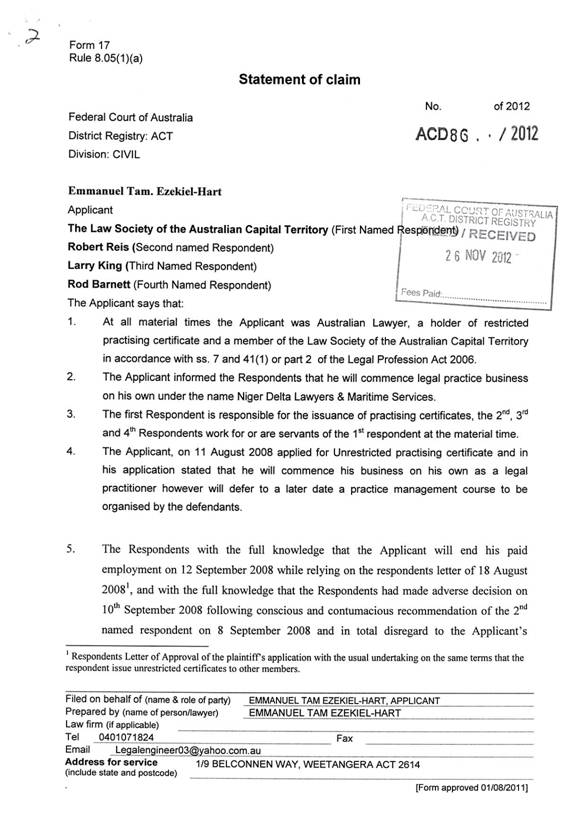
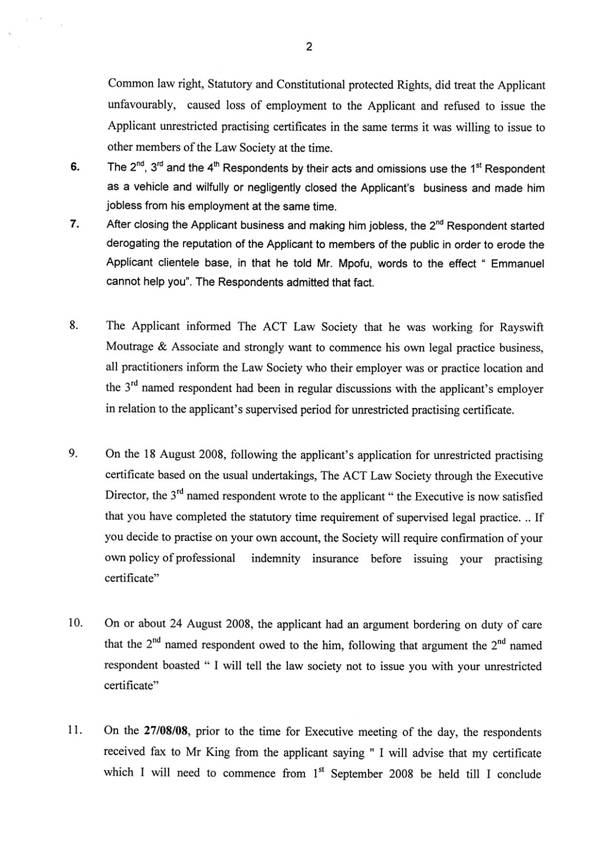
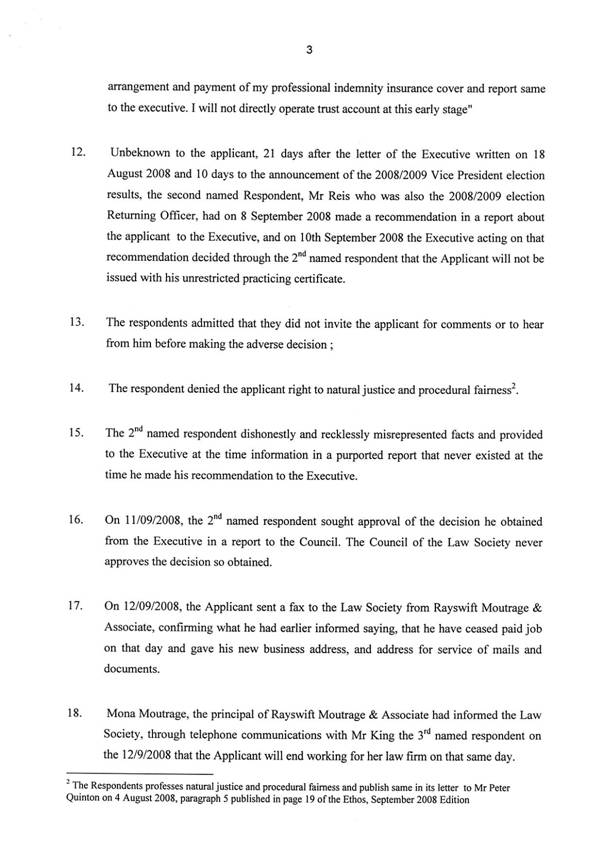
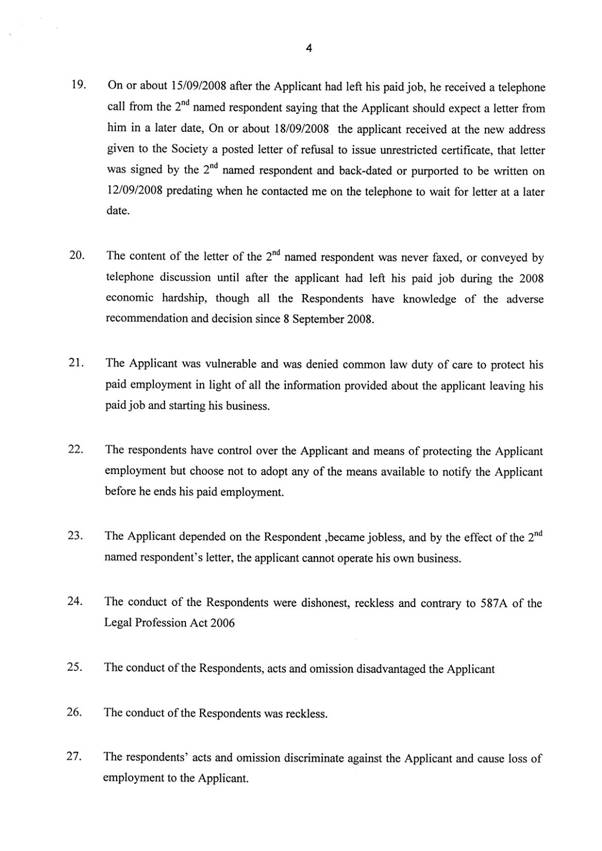
FOSTER J |
|
DATE: |
25 MARCH 2013 |
|
PLACE: |
SYDNEY (via video link to canberra) (HEARD IN CANBERRA) |
REASONS FOR JUDGMENT
1 Emmanuel Tam. Ezekiel-Hart is a solicitor admitted to practise in the Australian Capital Territory.
2 On 26 November 2012, Mr Ezekiel-Hart filed an Originating Application in this Court in which he sought the following relief:
Details of claim
On the grounds stated in the statement of claim, accompanying affidavit or other document prescribed by the Rules, the Applicant claims:
1. damages for loss of employment caused by the respondents reckless acts and omissions and breach of duty of care owed to the Applicants
2. damages for loss of reputation caused by the respondents acts or omissions arising from loss of employment and business
3. damages for loss of business caused by respondent reckless and dishonest acts and omission.
4. damages for loss of income caused by respondent failure to observe duty of care and reckless acts and omissions of the respondents
5. damages for detriment suffered due to ill health caused by acts and or omissions of the respondent and failure to take care and warn the Applicant before loss of employment and business.
6. exemplary, aggravated and special damages for knowingly or negligently adopt acts or omissions and reckless as to hardship the loss of employment will cause the Applicant and failure to investigate the 2nd Respondent recommendation before causing the Applicant to loss employment and business. In light of the Respondents expertise and knowledge, the Respondents deliberately deny the Applicant procedural fairness and natural justice to inflict hardship unexpectedly to the Applicant by causing him to loss employment and business at the same time and become helpless and fall sick as a result of unexpected simultaneous loss of business and employment.
7. damages for breach of common law duty of care, breach of section 117 of the Commonwealth Constitution, Section 8 of the Discrimination ACT 1991 (ACT), Civil Law (Wrongs) Act 2002 ch 4(ACT), s.9 Racial Discrimination Act 1975 (Cth) and other statutes named in the statement of claim.
8. any other Orders or damages that the court deemed appropriate in the interest of justice. The Respondents acts and omissions causing loss and damages to Applicant’s health, business and employment cannot be demonstrably justified.
Claim for interlocutory relief
The Applicant also claims interlocutory relief.
1. The Respondents or their agents be restrained from any acts or omissions that may directly or indirectly cancel the unrestricted practising certificate of the Applicant pending the determination of this application.
2. The Respondent be restrained from bullying or threatening withdrawal of the unrestricted practising certificate of the Applicant
3 The causes of action relied upon by Mr Ezekiel-Hart as supporting those claims for relief were pleaded in a Statement of Claim dated 23 November 2012 which was filed at the same time as Mr Ezekiel-Hart’s Originating Application. I shall discuss those causes of action in a little more detail later in these Reasons for Judgment.
4 In 2002, the applicant graduated from the University of Tasmania with a law degree. Shortly thereafter, he moved to Canberra. In 2003, he was admitted as a solicitor in the Australian Capital Territory.
5 In 2008, the applicant decided to establish his own law firm. In order to practise on his own account, the applicant was required to hold a current unrestricted practising certificate. By letter dated 11 August 2008 sent to the Law Society of the Australian Capital Territory (the Law Society), which is the first respondent in this proceeding, the applicant applied for an unrestricted practising certificate. In the period from about 2003 until August 2008, the applicant had worked as an employed solicitor with a restricted practising certificate.
6 In September 2008, the Law Society refused to issue an unrestricted practising certificate to the applicant until such time as he had satisfactorily completed the Society’s Practice Management Course. The applicant had enrolled in the July/August 2008 Practice Management Course but had failed to complete that course to the satisfaction of the Law Society. The applicant contends that he should have been assessed as having passed that course but was unfairly prevented from doing so by those who ran the course.
7 The applicant believes that he was denied a pass in the July/August 2008 Practice Management Course and then denied an unrestricted practising certificate for the 2008–2009 Practice Year because certain individuals (officers and employees of the Law Society) conspired to prevent him from being given an unrestricted practising certificate and otherwise acted unlawfully for the purpose of denying to him his legitimate entitlement to such a practising certificate. He has sued those individuals whom he holds responsible for what occurred: The second respondent (Mr Reis), who was employed by the Law Society as its Professional Standards Director; the third respondent (Mr King), who was employed by the Law Society as its Executive Director; and the fourth respondent (Mr Barnett), who was the Law Society’s President at the relevant time.
8 In 2009, and again in 2011, the applicant brought actions in the Supreme Court of the Australian Capital Territory claiming damages, interest and costs against the Law Society and against Messrs Reis, King and Barnett on account of the grievances to which I have adverted in [7] above. I shall refer to these matters collectively as “the applicant’s fundamental complaint”.
9 The 2011 proceeding in the ACT Supreme Court substantially replicated the 2009 proceeding in that Court. Each of those proceedings was summarily terminated by the Supreme Court.
10 In the present proceeding, the applicant relies upon the same essential facts and substantially the same claims and causes of action which he has twice sought to litigate in the ACT Supreme Court.
11 The respondents have applied to this Court to have the present proceeding summarily terminated. By an Interlocutory Application filed on 13 December 2012 (the respondents’ Interlocutory Application), the respondents seek the following relief:
1. An order pursuant to rule 16.21(1) that the whole of the Originating application dated 26 November 2012 and filed 26 November 2012 and the whole of the Statement of claim dated 23 November 2012 and filed 26 November 2012 in these proceedings be struck out.
2. An order pursuant to rule 26.01(1) that there be judgment for the Respondents and each of them against the Applicant, and that the proceedings be dismissed in their entirety.
3. An order pursuant to rule 6.02 that the Applicant must not start or continue any other proceeding in the Court against the Respondents or any of them without the leave of the Court.
4. Further, or in the alternative, an order that the proceedings be stayed until such time as the Applicant has paid the costs which are owing by him to the Respondents in respect of all outstanding costs orders made by the Supreme Court of the Australian Capital Territory against the Applicant and in favour of the Respondents.
5. An order that the Applicant pay the Respondents’ costs of these proceedings on an indemnity basis.
6. Such further or other order as the Court thinks fit.
12 I listed the respondents’ Interlocutory Application for hearing before me on 7 February 2013. Prior to that day, Mr Ezekiel-Hart had sent an email to my Chambers in which he set out some difficulties he expected to have on 7 February 2013 were he required on that occasion to meet the claims for relief made by the respondents in their Interlocutory Application. On 7 February 2013, the respondents served a brief Written Submission upon Mr Ezekiel-Hart in support of their claim that the whole of the proceeding should be summarily dismissed.
13 In order to ensure that Mr Ezekiel-Hart had a fair and reasonable opportunity to deal with the respondents’ Interlocutory Application, and with the submissions made in support of it, on 7 February 2013, I required Counsel for the respondents to make all oral submissions-in-chief that he intended to make in support of the orders sought by the respondents in their Interlocutory Application. I then made directions for the filing and service of Written Submissions by Mr Ezekiel-Hart in answer to the respondents’ Written Submissions dated 7 February 2013 and their oral submissions made on that day. I also made a direction concerning Written Submissions in Reply by the respondents. The hearing of the respondents’ Interlocutory Application was then adjourned to 5 March 2013. On that day, the hearing of that Application was completed.
14 On 4 March 2013, the day before the resumed hearing, Mr Ezekiel-Hart notified the Court and the respondents that he intended to seek the leave of the Court to amend his Statement of Claim “… to include in paragraphs 25 and 26 respectively the following paragraphs 59 and 60 respectively.”
59. The Law Society and others’ (the Respondents) conducts, acts or omission was deceptive, misleading and unconscionable in all circumstances and contrary to sections 4, 18, 22, 21, 20 and 151(1)(m) of the Australian Consumer Law, Schedule 2 of the Competition and Consumer Act 2010, sections 7 and 11 of the Fair Trading (Australian Consumer Law) Act 1992
60 The respondents conducts, acts, or omission was contrary to section 98(1)(c) and (d) of the Competition and Consumer Act 2010 in that the plaintiff/applicant was treated less favourably and in terms disadvantageous to the plaintiff, and the Respondents did act in a manner to coerce and harass the plaintiff contrary to section 168 of the Australian Consumer Law, Schedule 2 of the Competition and Consumer Act 2010, sections 7 and 11 of the Fair Trading (Australian Consumer Law) Act 1992
15 At the hearing on 5 March 2013, Mr Ezekiel-Hart sought the leave of the Court to amend his Statement of Claim in the manner described at [14] above. I deferred consideration of Mr Ezekiel-Hart’s amendment application and informed the parties that I would determine that application at the same time as I determined the respondents’ Interlocutory Application.
16 These Reasons for Judgment determine the respondents’ Interlocutory Application and the applicant’s application to amend his Statement of Claim.
The Applicant’s Proceedings in the act Supreme Court
The 2009 Proceeding
17 The first proceeding which Mr Ezekiel-Hart brought concerning his failure to obtain an unrestricted practising certificate for the 2008–2009 Practice Year was proceeding number SC 303 of 2009 (the 2009 proceeding). That proceeding was commenced by the filing of an Originating Claim on 17 March 2009.
18 In that proceeding, Mr Ezekiel-Hart was the plaintiff and the respondents in the present proceeding were the defendants.
19 The Originating Claim was accompanied by a Statement of Claim.
20 Neither the Originating Claim nor the Statement of Claim contained a clear and precise articulation of the facts and matters relied upon by Mr Ezekiel-Hart in support of the claims for relief made in the 2009 proceeding nor did those documents reveal to a reader of them the causes of action upon which he intended to rely.
21 Nonetheless, the pleading did rely upon Mr Ezekiel-Hart’s fundamental complaint as well as other matters. By way of amplification of that complaint, Mr Ezekiel-Hart pleaded that, on a date before 12 September 2008 (which was later discovered to be 10 September 2008), knowing that Mr Ezekiel-Hart planned to leave his job with Ray Swift Moutrage and Associates, lawyers, on 12 September 2008, in order immediately thereafter to commence practising on his own account, the Law Society decided to refuse to grant an unrestricted practising certificate to him and deliberately delayed informing him of that decision until some days after 12 September 2008, by which time he had already left his job and entered into financial commitments associated with his new practice. Mr Ezekiel-Hart claimed that the Law Society’s decision to refuse to grant him an unrestricted practising certificate had been actuated by malice and had been brought about at the instigation of Mr Reis and Mr King. He claimed that he had been given a mark below the relevant pass mark in the Practice Management Course conducted in July/August 2008 although his performance had warranted a pass mark.
22 In a number of paragraphs at the end of his Statement of Claim, Mr Ezekiel-Hart referred to the Crimes Act 1900 (ACT), the Human Rights Act 2004 (ACT) (the Human Rights Act) and the Discrimination Act 1991 (ACT) (the Discrimination Act). His references to those statutes were incoherent. It is difficult, if not impossible, to understand the significance of those references to the case which Mr Ezekiel-Hart was seeking to litigate.
23 On 31 August 2009, Higgins CJ struck out Mr Ezekiel-Hart’s Originating Claim and then immediately dismissed the whole of the 2009 proceeding. His Honour also gave judgment for the defendants and ordered Mr Ezekiel-Hart to pay their costs of the proceeding. These orders were all made in the absence of Mr Ezekiel-Hart. He had attended earlier listings of the proceeding but was not present in court when Higgins CJ made the orders to which I have referred. No reasons for making these orders were given, either on 31 August 2009, or subsequently.
24 Mr Ezekiel-Hart attempted to appeal from the orders made by Higgins CJ on 31 August 2009 by filing a Notice of Appeal.
25 On 19 March 2010, Gray P dismissed Mr Ezekiel-Hart’s appeal as incompetent (Ezekiel-Hart v The Law Society of the Australian Capital Territory (2010) 173 ACTR 15, [2010] ALMD 5512). In Reasons for Judgment delivered in support of the orders which he made, Gray P held that the orders made by Higgins CJ on 31 August 2009 were interlocutory. For that reason, leave to appeal from those orders was required before an appeal could be filed. Mr Ezekiel-Hart had not sought leave to appeal prior to filing his Notice of Appeal thus rendering his appeal incompetent.
26 On 30 September 2010, the High Court refused special leave to appeal from that decision.
27 Accordingly, the 2009 proceeding was summarily terminated and all avenues of appeal from the decision to terminate that proceeding were exhausted.
The 2011 Proceeding
28 On 7 September 2011, Mr Ezekiel-Hart commenced a fresh proceeding in the ACT Supreme Court (No SC 640 of 2011) (the 2011 proceeding). In that proceeding, he was the sole plaintiff. The defendants were the Law Society and the other persons who were the defendants in the 2009 proceeding. There were no other parties.
29 The Statement of Claim in the 2011 proceeding relied upon the plaintiff’s fundamental complaint amplified in much the same way as it had been in the 2009 proceeding. In addition, Mr Ezekiel-Hart pleaded certain other facts, matters and circumstances which he presumably relied upon as aggravating circumstances going to the intention of the individuals who made the relevant decision on the part of the Law Society. He also addressed certain later events. The causes of action upon which he seemed to rely were causes of action in negligence and in breach of fiduciary duty.
30 On 13 October 2011, Mr Ezekiel-Hart obtained default judgment against the defendants. On 21 November 2011, the Registrar of the ACT Supreme Court set aside that default judgment. On 1 December 2011, Mr Ezekiel-Hart appealed the Registrar’s orders. On 12 December 2011, the defendants filed an Application that the whole of the 2011 proceeding be struck out and then dismissed.
31 Mr Ezekiel-Hart’s appeal and the respondents’ summary dismissal application were both heard by Refshauge J (Ezekiel-Hart v Law Society (ACT) [2012] ACTSC 103).
32 On 29 June 2012, his Honour dismissed Mr Ezekiel-Hart’s appeal. His Honour also struck out the Statement of Claim and dismissed the 2011 proceeding generally. In addition, his Honour made an order for costs against Mr Ezekiel-Hart.
33 On 16 July 2012, Mr Ezekiel-Hart appealed from the decision of Refshauge J. On 26 October 2012, a judge of appeal dismissed his appeal as incompetent. Her Honour also made an order for costs against Mr Ezekiel-Hart.
34 In his Reasons for Judgment, Refshauge J said (inter alia):
(a) Section 587A of the Legal Profession Act 2006 (ACT) (the LPA) was a complete answer to Mr Ezekiel-Hart’s claims. In the 2011 proceeding, Mr Ezekiel-Hart had not alleged that any of the defendants had acted dishonestly or recklessly.
(b) The Law Society did not owe any duty of care to Mr Ezekiel-Hart.
(c) The other statutory causes of action apparently relied upon by Mr Ezekiel-Hart were misconceived and of no utility.
(d) The bringing of the 2011 proceeding was an abuse of process.
The Applicant’s Case in this Court
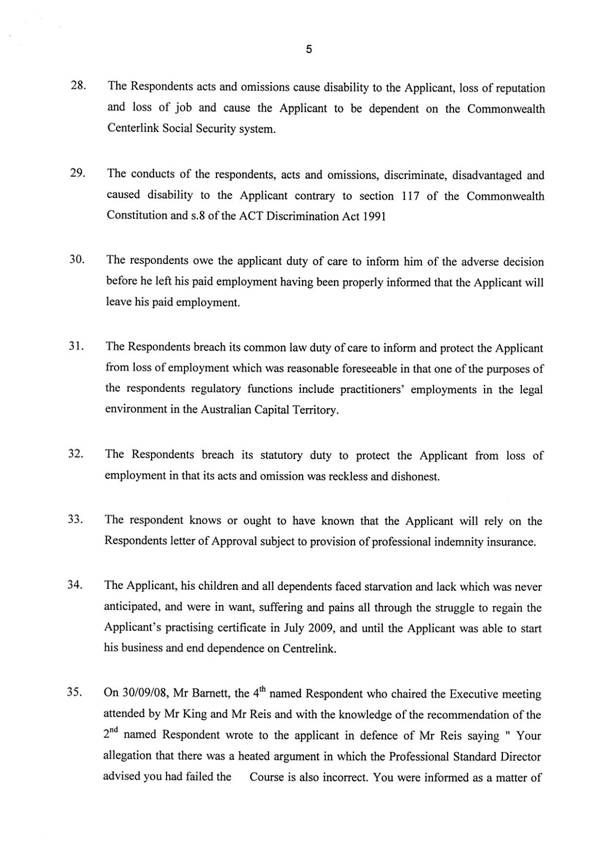
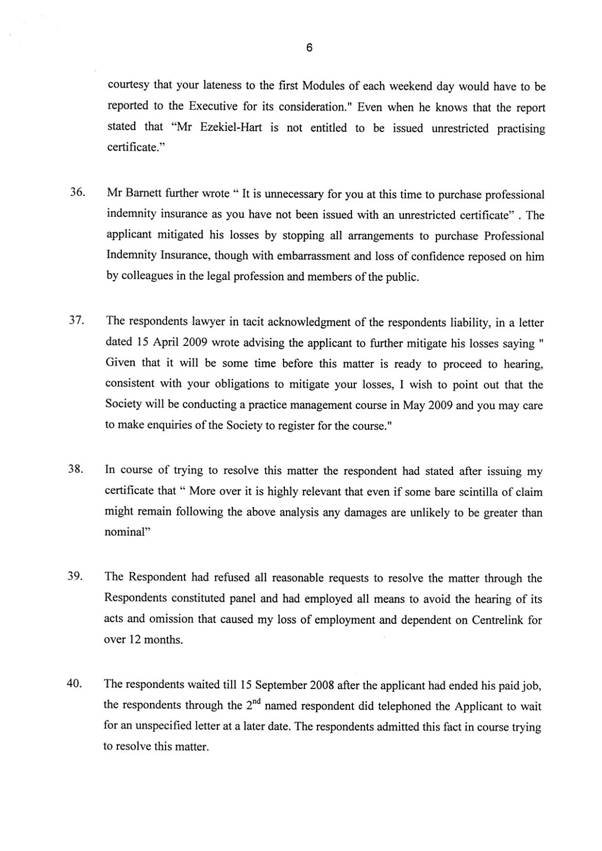
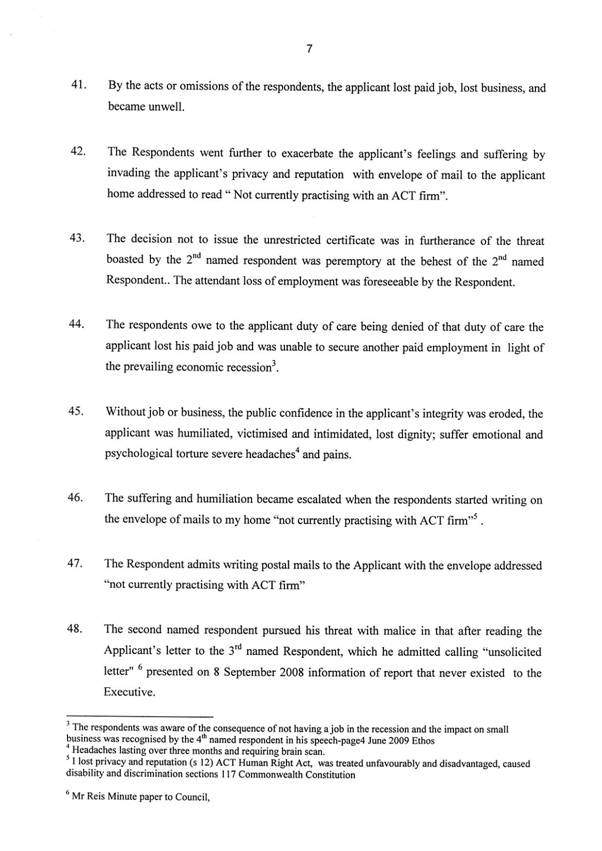
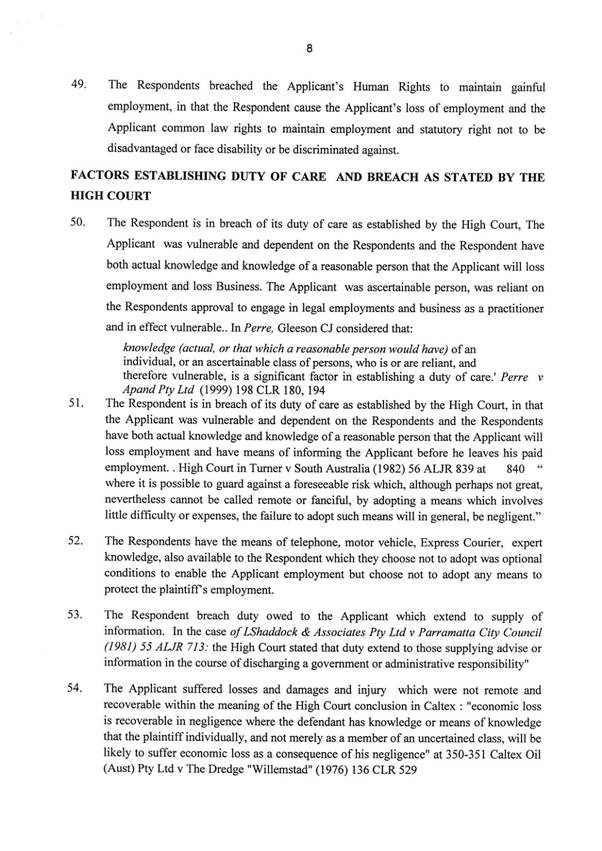
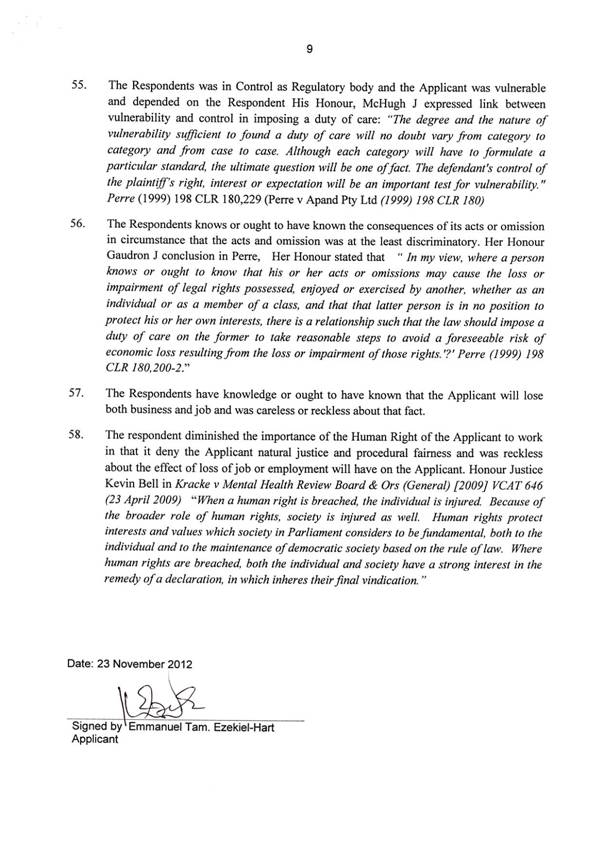
35 In this Court, Mr Ezekiel-Hart seeks the relief which I have set out at [2] above. He supports his claims for that relief by pleading the facts and matters upon which he relies in his Statement of Claim filed on 26 November 2012. I have attached as Attachment A to these Reasons for Judgment a copy of that Statement of Claim.
36 It will be readily apparent from a perusal of that Statement of Claim that Mr Ezekiel-Hart has again pursued his fundamental complaint amplified in much the same way as it had been amplified in the 2009 proceeding and in the 2011 proceeding.
37 In addition, he has alleged that Mr Reis acted dishonestly and recklessly. He has not provided any particulars of that allegation. It seems to me that Mr Ezekiel-Hart has merely made that allegation in order to defeat an argument based upon s 587A of the LPA Act which was one of the matters relied upon by Refshauge J in his Reasons for Judgment to which I have referred at [30]–[34] above as justifying the summary dismissal of the 2011 proceeding. Section 587A does not, of itself, provide a cause of action in favour of an aggrieved person. Rather, it provides an immunity to officers and employees of the Law Society provided that they do not act dishonestly or recklessly.
38 In the circumstances of the present case, given the history of the proceedings between Mr Ezekiel-Hart and the respondents, should it become relevant, I would not permit Mr Ezekiel-Hart to make an allegation of dishonesty or recklessness against Mr Reis without providing detailed particulars of that allegation.
39 The primary cause of action relied upon by Mr Ezekiel-Hart in this Court is, once again, the tort of negligence. In the amendments to his Statement of Claim which Mr Ezekiel-Hart seeks, he also wishes to pray in aid certain statutory causes of action for misleading and deceptive conduct and unconscionable conduct. However, as is the case with his allegation with Mr Reis, no particulars of these matters have been provided.
The Respondents’ Submissions
40 The respondents submitted that the Court should summarily dismiss the present proceeding because the bringing of the present proceeding is an abuse of the processes of this Court in that it is nothing more nor less than an impermissible attempt to relitigate claims which have been finally determined and exhausted in the ACT Supreme Court or, in the alternative, is an abuse of process because no reasonable cause of action is disclosed in the pleadings relied upon by Mr Ezekiel-Hart. This latter contention engages r 16.21(1)(f) of the Federal Court Rules 2011, which provides that a party may apply to the Court for an order that all or part of a pleading be struck out on the ground that the pleading is “… an abuse of the process of the Court”.
41 Counsel for the respondents addressed detailed submissions to the question of whether or not the essence of the case sought to be made by Mr Ezekiel-Hart in each of the 2009 proceeding, the 2011 proceeding and the proceeding in this Court was the same.
42 To my mind, there is no doubt that the essence of the case sought to be made on each of the three occasions is the same. It is based upon the same facts, although, on occasion, certain other facts and matters are also relied upon. Similarly, although new causes of action are sought to be relied upon by Mr Ezekiel-Hart, the invocation of different labels to describe the same essential complaint does not change the nature of that complaint.
43 The respondents also seek an order that Mr Ezekiel-Hart be declared a vexatious litigant. This claim was not pressed too seriously at the hearing.
Mr Ezekiel-Hart’s Submissions
44 Mr Ezekiel-Hart filed a lengthy Written Submission on 26 February 2013. That Submission is in the Court file.
45 The Written Submission filed by Mr Ezekiel-Hart traverses in considerable detail the dealings between him and the Law Society viewed from his perspective. It is a mixture of evidentiary material and submissions. It is not necessary to refer to the Submission in detail. It is largely directed to the question of whether or not the Law Society owed Mr Ezekiel-Hart a duty of care and, if so, the nature of the damage which he claims to have suffered as a result of the breach of that duty of care by the Law Society.
46 In his Submissions to this Court, Mr Ezekiel-Hart contended that the orders of Higgins CJ which his Honour made on 31 August 2009 were made without reasons. Apparently, it is suggested that, for that reason, those orders should be ignored. Second, Mr Ezekiel-Hart suggested that Refshauge J was biased against him and, in any event, misunderstood the relevant principles when he made the orders which he made on 29 June 2012.
47 In the oral submissions which Mr Ezekiel-Hart made to the Court on 5 March 2013, he again concentrated on his version of events in an endeavour to justify his ultimate proposition that he had an arguable cause of action in negligence against the respondents which he ought to be entitled to pursue in this Court.
Consideration
48 The Application before me proceeded upon the basis that the case pleaded in this Court by Mr Ezekiel-Hart (including his proposed amendments) constituted his best effort at articulating the causes of action upon which he would wish to go to trial. In addition, certain documents were tendered in evidence. Exhibit 4 comprised an extract from the Minutes of the Executive Meeting of the Law Society held on 10 September 2008. I set out that extract in full:
Extract from MINUTES OF THE EXECUTIVE MEETING OF
THE LAW SOCIETY OF THE AUSTRALIAN CAPITAL TERRITORY
HELD AT THE SOCIETY’S OFFICE, 3RD FLOOR, 11 LONDON CIRCUIT,
CANBERRA ON WEDNESDAY, 10 SEPTEMBER 2008 AT 4.30PM
Emmanuel Tamunobarabinye Ezekiel-Hart – Minute from the Professional Standards Director dated 8 September 2008 refers. Executive agreed with the recommendation that Mr Ezekiel-Hart be required to repeat the next available Practice Management Course on the basis that he has failed to satisfy the requirements of the course. Executive further agreed that Mr Ezekiel-Hart should not be issued with an unrestricted practising certificate until he has satisfactorily completed the Practice Management Course.
49 It appears that the relevant sequence of events was:
(a) On 11 August 2008, Mr Ezekiel-Hart applied for an unrestricted practising certificate.
(b) On 18 August 2008, the Law Society responded to his application. In that response, the Law Society indicated that it was satisfied that he had completed the statutory time requirement of supervised legal practice. The Law Society mentioned that he would need to organise appropriate professional indemnity insurance.
(c) In July and August 2008, the Law Society conducted a Legal Practice Management Workshop. Mr Ezekiel-Hart attended some of the sessions in that Workshop.
(d) By Minute dated 8 September 2008, Mr Reis recommended that Mr Ezekiel-Hart be required to repeat the next available Practice Management Course because he had failed to satisfy the requirements of the July/August 2008 course.
(e) On 10 September 2008, the Executive resolved to accept Mr Reis’ recommendation.
(f) Thereafter, the dealings between the Law Society and Mr Ezekiel-Hart became more acrimonious.
(g) On 12 September 2008, the Law Society wrote to Mr Ezekiel-Hart explaining why it had refused to issue an unrestricted practising certificate to him. In essence, the Law Society said that Mr Ezekiel-Hart had failed to submit his business plan in a timely fashion and that, in any event, that plan did not satisfy the Law Society’s requirements. The Law Society also said that he had failed to complete the course questionnaire to a satisfactory standard and had failed to complete one of the modules comprising the business plan. Finally, it was suggested that he had attended at least one session late.
50 In its letter dated 12 September 2008, the Law Society drew Mr Ezekiel-Hart’s attention to the fact that he had a right of appeal pursuant to the LPA (as to which see s 81). The exercise of that right of appeal required an application to the ACT Supreme Court.
51 Supervision generally of lawyers in the ACT rests with the ACT Supreme Court. This Court has no general supervisory or disciplinary function in respect of ACT lawyers. No doubt, this is why Mr Ezekiel-Hart chose to ventilate his complaints in the ACT Supreme Court when he instituted the 2009 proceeding and subsequently commenced the 2011 proceeding.
52 There is no doubt that Mr Ezekiel-Hart is seeking to litigate in this Court claims for relief and grievances which have been twice dismissed in the ACT Supreme Court. Furthermore, in the case of the 2009 proceeding, all possible appeals have now been exhausted. In the case of the 2011 proceeding, one level of appeal has been availed of. Mr Ezekiel-Hart did not try to take that matter to the High Court.
53 This Court, like other superior courts, has an implied incidental power to prevent abuse of its processes. One such abuse is to invoke the procedures of the Court to attempt to relitigate controversies which have already been decided by the Court. This principle is not confined to circumstances where the prior determination is one made by this Court. It would be an abuse of the processes of this Court for a party to bring proceedings in this Court in order to relitigate controversies which have already been decided by a Supreme Court of a State or Territory in Australia or, for that matter, a State District or County Court.
54 In Spalla v St George Motor Finance Ltd (No 6) [2004] FCA 1699, French J (when a Judge of this Court) outlined the relevant principles. At [59]–[70], his Honour said:
59 The Federal Court, like every Court of Justice, has an implied incidental power to prevent abuse of its processes. There are many ways in which the processes of a court may be abused. One form of such abuse is to invoke the procedures of the court to attempt to relitigate controversies which have already been decided by the court. The court may be protected against such use of its procedures by the doctrines of res judicata and issue estoppel and their analogical extension to issues which ought reasonably to have been litigated in original proceedings as enunciated in Henderson v Henderson (1843) 3 Hare 100; 67 ER 313 and Port of Melbourne Authority v Anshun Pty Ltd (1981) 147 CLR 589.
60 The protection afforded the administration of justice by the general concept of abuse of process in this context subsumes that afforded by the specific doctrines of res judicata, issue estoppel and their Anshun extension. In Reichel v Magrath [1889] 14 App Cas 665 a vicar who had resigned from his benefice and failed in proceedings for a declaration that his resignation was void and that he was still in office. His successor brought proceedings for a declaration that he was vicar and claimed associated injunctive relief. The former vicar sought to defend the proceedings on the basis that he retained the benefice. His defence was struck out. The decision to strike it out was upheld in the Court of Appeal and in the House of Lords where Lord Halsbury said (at 668):
‘My Lords, I think it would be a scandal to the administration of justice if, the same question having been disposed of by one case, the litigant were to be permitted by changing the form of the proceedings to set up the same case again.’
And further:
‘I believe there must be an inherent jurisdiction in every Court of Justice to prevent such an abuse of its procedure and I therefore think that this appeal must likewise be dismissed.’
The other Law Lords agreed.
61 Reichel v Magrath was decided upon abuse of process grounds. It was not based upon any finding of res judicata or issue estoppel although as observed in Spencer, Bower and Turner, ‘Res Judicata’, 3rd Edition (Butterworths 1996) at 444:
‘It would appear that the issue was res judicata, because the earlier decision was in rem, and the plaintiff was a privy of the successful parties, but this has not affected the vitality of the principle applied by the House.’
Commenting upon an argument that Reichel v Magrath could have been decided upon res judicata grounds on the basis that the first decision was in rem, Handley JA said in Rippon v Chilcotin Pty Ltd (2001) 53 NSWLR 198 (at 202):
‘... the availability of a narrow ground for decision does not displace the actual ratio if the court decides the case on a wider basis.’
And as his Honour noted, Reichel v Magrath has been followed in Walton v Gardiner (1993) 177 CLR 378 (at 393) and Rogers v R (1994) 181 CLR 251 (at 287-288).
62 The breadth of abuse of process protection against attempted relitigation was considered in Walton v Gardiner per Mason CJ, Deane and Dawson JJ (at 393):
‘... proceedings before a court should be stayed as an abuse of process if, notwithstanding that the circumstances do not give rise to an estoppel, their continuance would be unjustifiably vexatious and oppressive for the reason that it is sought to litigate anew a case which has already been disposed of by earlier proceedings.’
Their Honours cited Reichel v Magrath and Connelly v Director of Public Prosecutions [1964] AC 1254 at 1361-1362. They also adopted and approved the description of the relevant jurisdiction of superior courts given by Lord Diplock in Hunter v Chief Constable of the West Midland Police [1982] AC 529 (at 536):
‘... the inherent power which any court of justice must possess to prevent misuse of its procedure in a way which, although not inconsistent with the literal application of its procedural rules, would nevertheless be manifestly unfair to a party to litigation before it, or would otherwise bring the administration of justice into disrepute among right-thinking people.’
The category of ‘right-thinking people’ is elusive. However the passage may be taken as emphasising that the task of the judge in such a case is evaluative.
63 In Rogers v R, a majority of the High Court, comprising Mason CJ, Deane and Gaudron JJ, held that the tender of records of interview at a criminal trial which records had been rejected as involuntary at another trial on other charges, would be an abuse of process. Mason CJ said (at 255):
‘The concept of abuse of process is not confined to cases in which the purpose of the moving party is to achieve some foreign or ulterior object, in that it is not that party’s genuine purpose to obtain the relief sought in the second proceedings. The circumstances in which abuse of process may arise are extremely varied and it would be unwise to limit those circumstances to fixed categories. Likewise, it would be a mistake to treat the discussion in judgments of particular circumstances as necessarily confining the concept of abuse of process.’
64 The doctrines of res judicata and issue estoppel can be regarded as serving a public policy which protects against abuse of process by supporting the finality of judicial dispositions of particular controversies. Those doctrines establish the most precisely defined circumstances in which relitigation will be identified and barred. Anshun introduced an evaluative element based upon what a litigant could reasonably have been expected to do in earlier proceedings. In that case, which involved an attempt to litigant as a plaintiff, a matter which could have been raised in the defence in earlier proceedings, the majority, Gibbs CJ, Mason and Aicken JJ, said (at 602):
‘In this situation we would prefer to say that there will be no estoppel unless it appears that the matter relied upon as a defence in the second action was so relevant to the subject matter of the first action that it would have been unreasonable not to rely on it.’
65 The application of that principle requires the evaluative judgment whether it would have been ‘reasonable’ to have raised in the first proceedings the matter now raised in the second. That represents a development of the principle expressed by Wigram VC in Henderson v Henderson (at 319):
‘..., in litigation, requires the parties to that litigation to bring forward their whole case, and will not (except under special circumstances) permit the same parties to open the same subject of litigation in respect of matter which might have been brought forward as part of the subject in contest, but which was not brought forward, only because they have, from negligence, inadvertence, or even accident, omitted part of their case.’
As the Full Federal Court said in Bryant v Commonwealth Bank of Australia (1995) 57 FCR 287 (at 295), the principle is allied to, but not co-extensive with, res judicata and issue estoppel. The Court applied the approach of the New South Wales Court of Appeal in Rahme v Commonwealth Bank of Australia (unreported, Court of Appeal, NSW, 20 December 1991) that the effect of Anshun is to apply the Henderson principle to a second proceeding where ‘it was unreasonable for the party asserting the cause of action in that second proceeding to refrain from raising it in the earlier proceeding against the same opponent party’. The unreasonableness criterion was also applied in Ling v The Commonwealth (1996) 68 FCR 180 at 195 (Sundberg J, Wilcox and Whitlam JJ agreeing).
66 The doctrines of res judicata, issue estoppel and Anshun do not exhaust the circumstances in which a proceeding may be regarded as amounting to an abuse of process by way of attempted relitigation of a dispute already judicially determined. As another Full Court said in Coffey v Secretary, Department of Social Security (1999) 86 FCR 434 (at 443):
‘An attempt to litigate in the Court a dispute or issue which has been resolved in earlier litigation in another court or tribunal may constitute an abuse of process even though the earlier proceeding did not give rise to a res judicata or issue estoppel: see Sea Culture International v Scoles (1991) 32 FCR 275 at 279 and Walton v Gardiner (1993) 177 CLR 378 at 393-394. Whether it does depends on the facts of the particular case.’
67 The considerations of public policy which underlie res judicata and issue estoppel help to define the scope of abuse of process by relitigation generally. As Lord Hoffman said in Arthur JS Hall & Co v Simons [2000] 3 WLR 543 at 572, the underlying policies are that a defendant should not be troubled twice for the same reason and that there is ‘a general public interest in the same issue not being litigated over again’. Lord Hoffman observed that the second rationale could be used to justify the extension of the rules of issue estoppel to cases in which the parties are not the same but the circumstances are such as to bring the parties within the spirit of the rule. In that regard he referred to Reichel v Magrath and Hunter v Chief Constable of the West Midland Police.
68 In Johnson v Gore Wood & Co [2002] 2 AC 1 (at 31), Lord Bingham referred to what he called ‘Henderson v Henderson abuse of process’ as separate and distinct from cause of action estoppel and issue estoppel although having much in common with them:
‘The underlying public interest is the same: that there should be finality in litigation and that a party should not be twice vexed in the same matter. This public interest is reinforced by the current emphasis on efficiency and economy in the conduct of litigation, in the interests of the parties and the public as a whole. The bringing of a claim or the raising of a defence in later proceedings may, without more, amount to abuse if the court is satisfied (the onus being on the party alleging abuse) that the claim or defence should have been raised in the earlier proceedings if it was to be raised at all.’
The judgment required in such cases was described by Lord Bingham as (at 31):
‘... a broad, merits-based judgment which takes account of the public and private interests involved and also takes account of all the facts of the case, focussing attention on the crucial question whether, in all the circumstances, a party is misusing or abusing the process of the court by seeking to raise before it the issue which could have been raised before. As one cannot comprehensively list all possible forms of abuse, so one cannot formulate any hard and fast rule to determine whether, on given facts, abuse is to be found or not.’
The other Law Lords agreed with Lord Bingham on the abuse of process question.
69 The public interest considerations underlying the power of courts to stay or dismiss the proceedings for abuse of process extend to preventing the waste of judicial resources and their use for purposes unrelated to the determination of genuine disputes. They include the necessity of maintaining confidence in, and respect for, the authority of the courts – Sea Culture International v Scoles (1991) 32 FCR 275 (at 279 French J); Djaigween v Douglas (1994) 48 FCR 535 (at 545 Carr J).
70 The power to strike out a statement of claim or to dismiss an application as an abuse of process is to be exercised sparingly and upon an examination of the relevant circumstances of the particular case before the Court. As Giles CJ said in State Bank of New South Wales Ltd v Stenhouse Ltd (1997) Aust Torts Reports 81-423 (at 64, 089):
‘... whether proceedings are, or an aspect of proceedings is, an abuse of process because a party seeks to relitigate a issue already decided depends very much on the particular circumstances. The guiding considerations are oppression and unfairness to the other party to the litigation and concern for the integrity of the system of administration of justice...’
His Honour set out a non-exhaustive list of matters relevant to the determination whether there was an abuse of process in connection with the issue to be litigated in the second proceedings. These factors were:
‘(a) the importance of the issue in and to the earlier proceedings, including whether it is an evidentiary issue or an ultimate issue;
(b) the opportunity available and taken to fully litigate the issue;
(c) the terms and finality of the finding as to the issue;
(d) the identity between the relevant issues in the two proceedings;
(e) any plea of fresh evidence, including the nature and significance of the evidence and the reason why it was not part of the earlier proceedings; all part of –
(f) the extent of the oppression and unfairness to the other party if the issue is relitigated and the impact of the relitigation upon the principle of finality of judicial determination and public confidence in the administration of justice; and
(g) an overall balancing of justice to the alleged abuser against the matters supportive of abuse of process.’
These considerations offer a non-exhaustive guide and an indication of the nature of the Court’s task in such cases. It is now necessary to turn to that task.
55 His Honour’s exposition of the relevant principles is apt to be applied in the present case.
56 In Spalla, it was necessary for his Honour to analyse in some detail the claims made in the proceeding before him in order to ascertain whether they were caught by the abuse of process principles which his Honour explained in the passages which I have extracted at [54] above.
57 In the present case, the task is much simpler. Mr Ezekiel-Hart is the moving party (either the plaintiff or the applicant) in all three sets of proceedings. The Law Society and the other individuals named in the proceeding in this Court are the only parties named as defendant parties in the 2009 proceeding and the 2011 proceeding. There is, thus, a complete identity of parties across all three sets of proceedings.
58 In addition, there is no difference in substance between the case sought to be made in each of the proceedings brought by Mr Ezekiel-Hart in the ACT Supreme Court and the case which he seeks now to make in this Court. The present case is a much clearer case than was Spalla or Reichel v Magrath (1889) 14 App Cas 665 at 666.
59 The substance of the decision made by Higgins CJ on 31 August 2009 was that Mr Ezekiel-Hart’s proceeding should be dismissed because the pleadings which he had filed disclosed no reasonable cause of action. Refshauge J dismissed the 2011 proceeding for a number of reasons. Those reasons included, once again, that the pleadings filed in the 2011 proceeding did not disclose a reasonable cause of action.
60 Although there has been no trial in the ACT Supreme Court of the case which Mr Ezekiel-Hart seeks to have determined, that Court has nonetheless determined that his fundamental complaint does not give rise to any arguable cause of action. That is the matter which has been twice determined against him. Given that I have come to the conclusion that the case which he seeks to litigate in this Court is, in substance, the same case, it follows that the ACT Supreme Court has twice determined that the case which Mr Ezekiel-Hart seeks to litigate in this Court has no prospects of success.
61 In my judgment, although there has been no trial “on the merits”, the principles explained by French J in Spalla apply with equal force in the circumstances of the present case. It is an abuse of the processes of this Court for Mr Ezekiel-Hart to engage this Court’s jurisdiction for the purpose of relitigating a case which the ACT Supreme Court has twice held ought to be summarily dismissed because it has no prospect of succeeding.
62 For these reasons, I propose to dismiss the whole of the present proceeding as an abuse of the process of this Court.
63 I have not found it necessary to decide whether, in fact, the Law Society owed Mr Ezekiel-Hart a duty of care, as he alleges. In the view I take of the case, it is not necessary for me to do so.
64 The amendments to his Statement of Claim which Mr Ezekiel-Hart seeks leave to make do not improve his case. The additional causes of action which he wishes to introduce into the present case are based upon the same material facts as the causes of action already pleaded. No additional facts and matters are intended to be relied upon. I would refuse leave to Mr Ezekiel-Hart to amend his Statement of Claim in the terms notified on 4 March 2013. I do so because the proposed amendments do not overcome the fundamental fact that the present proceeding is an abuse of process. Even if Mr Ezekiel-Hart could overcome the abuse of process point and thus persuade me to entertain his amendment application, I would nonetheless refuse that application. The pleading in its amended form does not contain any arguable basis for relief based upon any of the statutory causes of action sought to be relied upon.
65 At this point in time, I am not prepared to make an order declaring Mr Ezekiel-Hart to be a vexatious litigant. However, that position may change, should Mr Ezekiel-Hart bring a fresh proceeding in this Court based upon the same facts and matters or substantially the same facts and matters as have been relied upon by him in the present proceeding.
Conclusions
66 For all of the above reasons, I will order that the whole of the present proceeding be dismissed. There is no reason why costs should not follow the event.
67 The respondents seek an order that their costs should be paid on an indemnity basis. I think that the respondents are entitled to have their costs assessed on that basis. The present case should never have been brought. It was bound to fail. In those circumstances, an indemnity costs order is warranted.
68 There will be orders accordingly.
|
I certify that the preceding sixty-eight (68) numbered paragraphs are a true copy of the Reasons for Judgment herein of the Honourable Justice Foster. |
Associate:
Attachment A
A