

FEDERAL COURT OF AUSTRALIA
Dynamite Games Pty Limited v Aruze Gaming Australia Pty Limited [2013] FCA 163
IN THE FEDERAL COURT OF AUSTRALIA | |
DATE OF ORDER: | |
WHERE MADE: |
THE COURT ORDERS THAT:
1. The application be dismissed with costs.
2. The applicant pay the respondents’ costs of the application.
3. Australian Standard Patent No 2004281073 be revoked.
4. Australian Innovation Patent No 2009101338 be revoked.
5. The cross-respondent pay the cross-claimants’ costs of the cross-claim.
Note: Entry of orders is dealt with in Rule 39.32 of the Federal Court Rules 2011.
NEW SOUTH WALES DISTRICT REGISTRY | |
GENERAL DIVISION | NSD 719 of 2010 |
BETWEEN: | DYNAMITE GAMES PTY LIMITED (ACN 102 269 732) Applicant
|
AND: | ARUZE GAMING AUSTRALIA PTY LIMITED (ACN 002 907 851) First Respondent ARUZE GAMING AMERICA, INC Second Respondent
|
AND BETWEEN: | ARUZE GAMING AUSTRALIA PTY LIMITED (ACN 002 907 851) First Cross-Claimant ARUZE GAMING AMERICA, INC Second Cross-Claimant |
AND: | DYNAMITE GAMES PTY LIMITED (ACN 102 269 732) Cross-Respondent |
JUDGE: | EMMETT J |
DATE: | 4 march 2013 |
PLACE: | SYDNEY |
REASONS FOR JUDGMENT
[1] | |
THE CLAIMED INVENTION | [5] |
The Specification | [6] |
The Relevant Claims | [30] |
WITNESSES | [38] |
PRIOR ART | [54] |
Clarke | [55] |
Okada | [60] |
Stupak | [64] |
Shuster | [66] |
Futurity Bell | [76] |
Money Back | [77] |
Cashcade | [80] |
Scatter Rug | [83] |
VALIDITY OF THE PATENTS | [90] |
Inventive Step/Innovative Step | [95] |
Common General Knowledge | [103] |
Specific Claims of the Standard Patent | [114] |
Specific Claims of the Innovation Patent | [145] |
Conclusion as to Inventive/Innovative Step | [150] |
Manner of Manufacture | [151] |
Lack of Novelty | [173] |
Other Grounds of Invalidity | [186] |
INFRINGEMENT | [187] |
CONCLUSION | [220] |
APPENDIX 1: CLAIMS OF THE STANDARD PATENT | [221] |
APPENDIX 2: CLAIMS OF THE INNOVATION PATENT | [222] |
APPENDIX 3: PARTIES’ TABLES CONCERNING NOVELTY | [223] |
INTRODUCTION
1 This proceeding is concerned with Australian standard patent No. 2004281073 (the Standard Patent) and Australian innovation patent No. 2009101338 (the Innovation Patent). The Innovation Patent is a divisional patent of the Standard Patent. The claimed invention of both Patents is for “gaming apparatus and systems”.
2 The applicant, Dynamite Games Pty Limited (Dynamite), is registered as the owner of both the Standard Patent and the Innovation Patent (together, the Patents). Dynamite claims that the first respondent, Aruze Gaming Australia Pty Limited (Aruze Australia), and the second respondent, Aruze Gaming America, Inc (Aruze America), have infringed both of the Patents and threaten to continue to do so. Aruze Australia and Aruze America (together, Aruze) deny that there has been, or will be, any infringement.
3 Aruze have also filed a cross-claim seeking revocation of both of the Patents on the basis that the invention as claimed in each of the claims of the Patents is not a patentable invention within the meaning of s 18 of the Patents Act 1990 (Cth) (the Act). They contend that none of the claims is for a manner of manufacture, that the claimed invention is not novel and that the claimed invention does not involve an inventive step or an innovative step. They also contend that the claims of the Patents are not clear and succinct and that the claims are not fairly based on the matter described in the body of the respective specifications.
4 The claimed priority date of the Standard Patent is 17 October 2003. There is no dispute about that date. Since the Innovation Patent was filed as a divisional application of the Standard Patent, it claims the same priority. There is no dispute about its entitlement to that priority. However, since it is a divisional application, its entitlement to the priority date of the Standard Patent requires that the Innovation Patent cannot be construed so as to claim anything not fairly based on the Specification of the Standard Patent.
5 It is desirable to describe the claimed invention. That will entail reference to the complete specification of the Standard Patent (the Specification), as well as the claims alleged to have been infringed.
6 The Specification states that the claimed invention relates to electronic gaming machines and to networked gaming systems, such as internet-based gaming systems. It says that gaming machines have been a popular form of entertainment for many years and that their popularity has been enhanced by the advent of electronic gaming machines and computer-based gaming systems, such as are provided over the internet. Many types of games may be played, including standard slot machine-type games with spinning reels, poker machines, keno, bingo, blackjack, roulette, pachinko, and the like. A player will typically place a bet, press a button or pull a lever to begin a game. The player will win or lose, based upon the gaming machine’s play algorithm and random number generator.
7 The Specification says that an aim of the claimed invention is to provide gaming apparatus having novel features for enhancing gameplay interest. The Specification states that, viewed from one aspect, the claimed invention provides gaming apparatus, including:
a component for monitoring game play;
a component for monitoring the occurrence of a game event; and
an event guarantee component for guaranteeing that a game event will trigger within a set amount of gameplay, such component to include:
a trigger component for triggering a game event when the set guarantee gameplay amount is reached without the monitored event having been triggered; and
an indicator component for indicating the amount of gameplay remaining to be played before a guaranteed game event will trigger.
8 The Specification states that gameplay measurement can be based on:
the number of games played, such as the number of spins of a slot machine or the number of hands of a card game played; or
the amount of bets laid, such as the amount of credits laid, the amount of lines or hands played; or
some other parameter indicative of an amount of gameplay.
A game event may be of any suitable kind: it may be a type of win event or a type of feature event.
9 A win event may relate to a win of a particular amount, such as a set amount. Alternatively, a win event could relate to a win under a particular circumstance, such as a flush or the like at poker, or a set combination of slot machine reel symbols. A win event could also relate to a jackpot, which could be, for example, a stand-alone or linked jackpot system. The jackpot win could be of a fixed or progressive kind.
10 A feature event could relate to the occurrence of a particularly valuable play element, such as a wild card or wild symbol. A feature event could further relate to a bonus or extra event that provides some added benefit to the player. For example, it could be a free play scenario, a re-spin, a pick‘n’win, or a game play that returns higher than usual wins. It may be a second-screen type feature, which may involve a play that is extraneous to a main or basic game. The feature event could be a luck or skills based feature.
11 The Specification asserts that the claimed invention provides a way of increasing the interest of a game. It says that the claimed invention provides a guarantee feature that can be of benefit to a gaming machine operator, in that it promotes the use of the operator’s machine, and can be of benefit to players, who can thereby know that an event of benefit to the player will certainly occur within an indicated amount of gameplay.
12 The monitored event and the guaranteed event are preferably the same type of event, so that a player knows that, for example, if a “4 of a kind” does not occur normally within a set time, it will definitely occur at the end of the set amount of gameplay. Alternatively, for example, the player knows that a free game will definitely occur by a set amount of gameplay and will possibly occur beforehand. However, the monitored event and the guaranteed event do not have to be the same event and a specific event need not be specified. For example, the monitored event and the guaranteed event may be one of a number of possible events, such that, for example, if none of the possible events occurs within a set amount of gameplay, then one of a number of those or other events will be triggered to occur.
13 The indicator component of the claimed invention is of particular relevance in relation to the allegation of infringement of the Patents. The Specification states that the indicator component may take any suitable form. It may be a numerical display that provides a countdown from an initial gameplay amount. Alternatively, it may take the form of a gauge, for example, with a pointer and a scale. It may specify the specific event that is guaranteed or the type of event that is guaranteed. The amount of gameplay required for the guarantee to trigger may be determined in any suitable manner. It may, for example, be a set amount or it may be determined randomly within a set range. It may be varied in accordance with gameplay. For example, it may be dependent on the winnings or bets taken over a preceding period of play. Preferably, the guarantee gameplay amount will be reset when a monitored event occurs during normal play or when the guaranteed event occurs. The indicator will then be reset to an initial gameplay amount. When reset, the guaranteed event may take a different form from that of the previous guarantee. That may be determined randomly or in accordance with a preset sequence or may vary based on previous gameplay.
14 Preferably, the apparatus of the claimed invention will include a component for determining the play parameters for the guarantee feature. Thus, when a bonus game or the like is triggered, the play parameters may, for example, be the number of lines or hands played and the amount bet on each line or hand. When a win event is triggered, the play parameters may be the amount paid out or the win type. The play parameters may be determined based on a player’s play history, and may be an average of a player’s play parameters over time.
15 In one preferred embodiment of the claimed invention, the gaming system may provide more than one guarantee feature, and may include more than one event guarantee indicator. Thus, one indicator may display the amount of gameplay remaining until one event is guaranteed to trigger, and another indicator may indicate the amount of gameplay remaining until another event is guaranteed to trigger. More than two guarantee features may also be used. Such guarantee features may be reset independently or together.
16 The Specification asserts that the claimed invention may be applied to any suitable type of gaming system or platform. It can apply to stand-alone gaming apparatus, for example, electronic gaming machines, such as video gaming machines, as well as gaming machines that are linked together by means of a network such as an intranet. It can also apply to gaming systems provided through computing or other electronic devices, such as personal computers, mobile telephones, digital televisions, and over the internet or other communications networks.
17 The Specification asserts that the claimed invention may be applied to gaming apparatus that plays any suitable game, for example, slot machine-type games, poker, keno, blackjack, bingo, roulette, pachinko, and the like. When part of a network, the guarantee feature of a particular gaming device may be based on gameplay only of that particular device or may be based on the gameplay of other linked devices as well. The Specification asserts that the claimed invention extends to central controls or servers and to remote terminals or clients that are configured to carry out the feature guarantee of the claimed invention.
18 The Specification then describes six further aspects of the claimed invention. Five of those further aspects described refer to the indicator component in different, but similar, language, as follows:
a guarantee indicator component for providing a guarantee indicator that indicates the amount of gameplay that must occur before the guaranteed event is triggered;
a method of operating gaming apparatus including the step of indicating the amount of guarantee gameplay remaining before a guaranteed event is triggered;
an indicator component of an event guarantee component for indicating the amount of gameplay remaining to be played before a guaranteed game event will trigger;
a guarantee feature for indicating to a user the amount of gameplay remaining before the guarantee feature is triggered; and
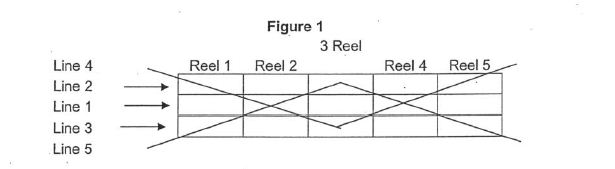
an indicator means, as part of an event guarantee means, for indicating the amount of gameplay remaining to be played before a guaranteed game event will trigger.
19 The Specification then describes embodiments by reference to accompanying drawings. Figure 1 describes an electronic gaming machine that includes various standard components, such as:
• a controller for controlling the operation of the machine and the games run on it;
• a coin, token or card input for receiving bets;
• a coin, token or card output for paying out winnings; and
• a display for displaying game screens, and player inputs allowing player interaction.
Player inputs may include buttons, which may be provided as part of the display using a touch-screen. The machine may be a stand-alone machine, or may be networked with other machines or a control centre, by means of a suitable communications network, in order to play networked games such as a linked jackpot.
20 In use, the machine will display an initial gaming screen on the display. A player will insert coins, tokens or a payment card into the machine and will press a button to initiate play. How matters then proceed will depend upon the type of game being played. For example, in a slot machine-type game, the machine will display virtual reels of symbols, and will spin and stop those reels in various win and lose symbol combinations on a payline, in accordance with the machine’s gaming algorithm and random number generator. Alternatively, in a poker-type game, a player will receive a number of cards with which to play for a winning hand. The player may interact with the machine by means of buttons, so as to spin or hold reels, or to obtain and throw away cards. Whatever game is played, a common element will be win events, such as particular symbol or card combinations, which pay a prize or jackpot.
21 The Specification states that, in order to increase interest, a game will often include feature events that may or may not relate directly to the game being played. Such feature events generally provide a bonus of some sort. The feature events may include, for example, one or more free games, a re-spin, which is similar to a free game but with one or more reels held, a pick‘n’win, the chance to play for higher winnings, and the like. The feature events may be luck or skills based. The feature events may be provided as second-screen features that display on a new screen and may be extraneous to the basic game.
22 The win events and feature events can be arranged to occur randomly or under a particular set of circumstances, such as a set symbol or card combination. They may also occur due to an accumulation of circumstances across a number of games.
23 The Specification states that, in accordance with one embodiment of the claimed invention, the machine includes an event guarantee component, such as within the gaming algorithm. The event guarantee component monitors one or more game events to determine whether they are triggered or not, and guarantees that a particular game event, or at least one of a number of possible game events, will trigger within a set amount of gameplay, if the standard conditions for triggering of the monitored game event or events are not met within that period of play. The machine generates a guarantee indicator on the display that indicates to a player the guarantee count, being the amount of gameplay remaining before the guaranteed event will be triggered. The guarantee indicator may, for example, be a numerical countdown or a virtual gauge or the like, on the display. Gameplay may be measured by a measurement of user interaction with the gaming apparatus. For example, it may be based on the number of games played or the amount of bets wagered.
24 The Specification asserts that, in accordance with that embodiment, a guarantee feature is provided by which a player or potential player will know the maximum amount of gameplay that can occur before at least one event is triggered. That amount will decrease as play continues. A player or a potential player will know that, even if the player does not achieve the standard conditions for a monitored game event, a guaranteed game event will trigger at the end of the guarantee count.
25 In another embodiment of the claimed invention, the monitored event and the guaranteed feature event are the same event, such that a player knows that if the player does not achieve the event normally, the player will achieve it within the guarantee count. However, the monitored event and the guaranteed event do not need to be the same event.
26 In another embodiment, the indicator will count down from an initial number that may represent the number of games that must be played before an event is guaranteed to trigger, or the remaining bet value that must be placed before an event is guaranteed to trigger. If a monitored event occurs before the guarantee count is finished, the count is reset. Thus, if a player triggers an event prior to the end of the guarantee count, the guarantee count is restarted. The event or events guaranteed may be changed at each reset, either randomly or in a set sequence or depending on game play. The drawings depict a screen that includes a guarantee indicator in the form of a numerical display, for example, of a countdown from an initial number of spins.
27 Figure 3 shows an embodiment of the claimed invention in which a pair of guarantee indicators is provided. In that embodiment, one guarantee indicator relates to a feature event and the other relates to a winning event. The monitored event is the same as the guaranteed event. The figures 105 and 76 appear on the depiction of the two indicators in Figure 3. One indicator relates to a free game feature, which will definitely occur within 105 spins, if not earlier. The other indicator relates to a “5 of a kind” win, which will definitely occur within 76 games, if not earlier. In the embodiment depicted in Figure 3, the guarantee indicators also display the play parameters under which the guarantee events will occur. For the first indicator, the free game will play using 20 lines at a bet of 5 credits per line. For the second indicator, the five of a kind will be awarded at 3 credits per line. Those details are depicted in the drawing.
28 The Specification provides that the play parameters may be chosen in any desired manner and may be fixed or may be randomly generated within certain ranges. It says that, in a preferred embodiment, the play parameters are determined based on a player’s play history. Thus, the number of lines played or the amounts bet may be averages of the lines played and bets placed over a number of the player’s previous games. In such a case, the guaranteed play parameters displayed may vary with play. The credits required for the play parameters are preferably not deducted from a player’s stake. That is to say, the guaranteed event is a free event. However, it would also be possible to deduct the bet amounts from the player’s stake. In that case, the guaranteed event may pay out at higher odds to give the event a bonus aspect.
29 The Specification states that the guarantee indicator could be a gauge, such as a pointer on a scale. The indicator need not be displayed on the screen and can be displayed separately or may form a physical gauge or the like. The guarantee indicator need not always relate to the same game event and can change to the monitoring of a different game event depending, for example, on the state of play.
30 Dynamite has confined its allegations of infringement to some only of the claims of the Standard Patent and the Innovation Patent. It alleges infringement of claims 6, 9, 12, 13, 14, 18, 20, 21, 23, 26 and 27 of the Standard Patent and claims 4 and 5 of the Innovation Patent. However, since some of those claims are dependent upon earlier claims, it may be necessary to examine claims other than those in relation to which infringement is alleged.
31 There are 7 independent claims of the Standard Patent of a total of 38 claims. Claims 1, 31, 33, 34, 36, 37 and 38 of the Standard Patent are independent claims. Although, as a matter of language, there are 7 independent claims of the Standard Patent, it is apparent that claim 31 is in the same terms as claim 1, except that it is for other apparently inconsequential variations described below. Claim 34 is for gaming software, including components described in the same terms as claim 1. Claim 37 is for an electronic game in which a bet is placed, game events occur and wins are returned, and gameplay and game events are monitored, and includes a guarantee features, wherein if a monitored event does not occur within a predetermined amount of gameplay, a guaranteed event is triggered. The integers of claim 37 otherwise coincide with those of claim 1. Claim 38 is identical to claim 1, except that components are described as means. Thus, in substance, there are 3 independent claims, being claims 1, 33 and 36.
32 There is one independent claim of the Innovation Patent of a total of 5 claims, being claim 1, which is expressed more generally than claim 1 of the Standard Patent. Specifically, claim 1 of the Innovation Patent lacks the integer of an indicator component.
33 The claims of the Standard Patent are set out in Appendix 1 to these reasons. The claims of the Innovation Patent are set out in Appendix 2 to these reasons. It will be necessary to consider all of those claims in the context of the validity of the Patents, although no allegation is made of infringement of any of the independent claims of either of the Patents.
34 Claim 1 of the Standard Patent is for a gaming apparatus that includes:
a component for monitoring game play;
a component for monitoring the occurrence of a game event; and
a component for guaranteeing that a game event will trigger within a set amount of gameplay, being an event guarantee component that includes:
a trigger component for triggering a game event when the set guarantee gameplay amount is reached without the monitored event having been triggered; and
an indicator component for indicating the amount of gameplay remaining to be played before a guaranteed game event will trigger.
Thus, there are three parts of claim 1, each described as a component. The third component, the event guarantee component, itself has two parts, being the trigger component and the indicator component.
35 Claim 33 is for a method of operating gaming apparatus that includes the following 4 steps:
monitoring gameplay;
monitoring the occurrence of a game event;
triggering a guaranteed event if the monitored event does not occur within a set amount of gameplay; and
indicating the amount of guarantee gameplay remaining before a guaranteed event is triggered.
Step one of the method of claim 33 corresponds with the first component of the gaming apparatus of claim 1. Step 2 of the method of claim 33 corresponds with the second component of the gaming apparatus of claim 1. Step 3 of claim 33 corresponds with the first sub-component of the third component of the gaming apparatus of claim 1. Step 4 of the method of claim 33 corresponds with the second sub-component of the third component of the gaming apparatus of claim 1.
36 Claim 31 is in the same terms as claim 1, except that it is for a gaming system, rather than a gaming apparatus, and, instead of describing an event guarantee component that includes a trigger component and an indicator component, it describes an event guarantee component in the same terms as the trigger component of claim 1, and describes a guarantee indicator component in the same terms as those describing the indicator component of claim 1.
37 Claim 36 is for apparatus including:
a gameplay monitor for monitoring player interactions with the apparatus;
an event monitor for monitoring the occurrence of a game event; and
a guarantee feature for:
triggering a gaming event if the monitored event has not occurred within a set amount of gameplay; and
indicating to a player the amount of gameplay remaining before the guarantee feature is triggered.
Thus, there is a correspondence between the three components of the gaming apparatus of claim 1 and the three components of the gaming apparatus of claim 36.
38 Each of the parties relied on affidavit evidence by several witnesses. Only some of the witnesses were cross-examined. I did not form any adverse view of any of the witnesses who were cross-examined. I consider that each of them endeavoured to respond honestly and without undue prevarication to the questions put by cross-examiners. The principal witnesses were Mr Peter Hilton Causley, Mr Keiran Daley, Mr Scott Christopher Olive, Mr Serguei Antonov, Mr Moosad Sreedharan, Ms Lynne Cheryl Oldfield and Mr Paul Howard Delfabbro.
39 Mr Daley gave evidence on behalf of Aruze. Mr Daley has been involved in the gaming industry since 1974. Between 1974 and 1980, he worked for the New South Wales gaming machine regulator, then known as the Chief Secretary’s Department. In 1980, he was appointed general manager of Fortune Coin Pty Limited, which was the first company to offer video spinning reel poker machines in New South Wales. In that position, he organised a marketing plan, trained salesmen and prepared a library of mathematical game models to be submitted for government approval and subsequent sale. Between 1980 and 1985, Mr Daley was product research manager for Ainsworth Industries, a predecessor of Aristocrat Leisure Industries Limited (Aristocrat). In that role, he undertook game design for gaming machines.
40 In 1986, Mr Daley joined IGT (Australia) Pty Limited (IGT) as general manager, group operations. In that role, he was responsible for game design, which included the development of statistical and mathematical models of games produced and marketed by IGT. In 1992, he was appointed as managing director of IGT and in 1995 was appointed as executive chairman, a position he held until the end of 1996 when he retired. As managing director and executive chairman, Mr Daley continued to take an active role in overseeing the design of gaming machine games. While employed by IGT, Mr Daley followed developments in the gaming machine industry in the United States, through IGT’s United States parent. Part of his review included United States patents that were filed in relation to gaming machine inventions.
41 Mr Daley was a founding director of the Australian Gaming Machine Manufacturers Association. That association is a not-for-profit industry body established in 1990 by the major Australian gaming machine manufacturers. Mr Daley held the position of chairman of the association in 1995 and remained in that position until the end of 1996. Each year, the association hosts one of the world’s largest gaming exposition conferences at Darling Harbour in Sydney.
42 After he retired in 1996, Mr Daley continued to keep up with developments in the gaming machine industry. He continues today to search websites of the United States Patent and Trademark Office and IP Australia for patents relating to gaming machines and systems. He downloads and reads patents from those offices, having acquired experience in reading patents relating to gaming machines and systems.
43 Mr Olive also gave evidence on behalf of Aruze. Between 1997 and 2007, Mr Olive was involved in gaming design at Aristocrat, in which he was actively involved in creation, development, patenting and submission of games for electronic gaming machines. He was employed in a variety of game designer roles including game designer, mathematician, senior game designer, principal game designer, head of game studio and creative director. Since 2007, Mr Olive has been a director and principal of True Blue Gaming Pty Limited (True Blue), a wholly owned subsidiary of Aruze America that creates gaming machine content for Aruze America. He was also an executive director of Aruze Australia. True Blue has had no involvement in the development, manufacture or supply of Aruze’s games that are alleged to constitute infringement of the Patents. During the course of his career, Mr Olive has been named as inventor in many patents for games and devices used for electronic gaming machines. He has also been the designer of many successful electronic gaming machines in Australia.
44 Mr Olive said that the first step in designing a game is to have a creative idea, such as a mathematical gaming feature or game functionality, or perhaps an idea for a theme. Once the game designer has the initial idea, the game designer works on the mathematical model of the game. That involves development of the specific rules of the game, that is, deciding how the game is going to play and function. Once the rules of the game have been decided, the probability calculations of each winning combination applicable in the game, that is, the win frequency, need to be worked out. Where gaming machines are operated in a regulated environment, the probability calculations are restricted as each game must provide a specific minimum theoretical return to the player. The play table is then developed. That is dependent on the game probability calculations and is also directly influenced by any required theoretical return to the player in a regulated environment.
45 Mr Olive said that in 2003, and even today, the vast majority of games in electronic gaming machines in Australia had a free game feature. As a game designer, Mr Olive considered that, when playing a game, most players were focused on winning the free game feature. There are more major prizes than the free game feature, but players know that those major prizes are won rarely and so do not continue to play a machine solely aiming to win them. Mr Olive said that, while smaller prizes along the way are important to the player and increase game interest, it is the free game feature for which players mainly aim.
46 In addition, Aruze relied on the evidence of Mr Antonov. Mr Antonov obtained the degree of Master of Science in computer engineering at the University of Steel and Alloys, Moscow, in 1989. He is currently a senior software engineer employed by IGT. He has had 22 years of professional experience in software and hardware design, with 15 years of experience in the gaming industry. He has assisted IGT in the United States in software architecture design of an advanced video platform that is currently the main gaming machine sold by IGT throughout the world. His experience also includes design and implementation of various tools for gaming designers, game artists and game software engineers.
47 Mr Antonov described the hardware elements and software elements, including game software, commonly found in electronic gaming machines in Australia. He described the processes by which electronic gaming machines in Australia typically execute a game, monitor gameplay and evaluate wins and gameplay generally and the processes by which such machines indicate gameplay status, such as wins, and the status of metered events to the player.
48 Ms Oldfield gave evidence on behalf of Dynamite on questions concerning validity. Ms Oldfield is an independent consultant who provides case by case services to participants in the gaming industry. Up until late 2009, she held various roles in the gaming industry, including as a game designer and IP manager. Ms Oldfield has a Bachelor of Science from the University of Sydney, majoring in pure mathematics and mathematical statistics in 1975. From 1977 to 1984, she held various positions with the New South Wales government, including in the poker machine division of the New South Wales Treasury. In that role, Ms Oldfield reviewed applications by manufacturers for approval of gaming machines and checked the mathematics of games and made recommendations to the Minister regarding the approval of games. In 1985, Ms Oldfield commenced working as a game designer at Aristocrat. She was the only qualified mathematician working at Aristocrat in game design at that time. In 1989, Ms Oldfield became a full-time employee and moved to Aristocrat’s marketing department. In that role, she was involved in the marketing of all machine products going to markets outside New South Wales clubs.
49 Ms Oldfield joined IGT in 1995 and was the head of game design until 1997. From 2002 to 2005, Ms Oldfield worked at Ainsworth Game Technology Limited, where she was a game design manager. The commercial focus there was specialised products for the Russian and Mexican markets and other products sold to Australia, Asia and Europe. Ms Oldfield was also responsible for the trademarks and patents and reviewing competitor activity in those areas. From 2005 to 2009, Ms Oldfield returned to work at Aristocrat as research and development games IP manager.
50 Ms Oldfield explained that what may seem like small variations in game design can be critical factors to the success of a game design. Creating a new feature or introducing a variation to an existing feature type, which distinguishes one game design from others in the market, is difficult, and it is the aspiration of all game designers to achieve that and for their game design to create the desired following in the market.
51 Dynamite relied on the evidence of Mr Causley in relation to the question of infringement. Mr Causley has a Bachelor of Science degree in pure mathematics, organic chemistry and statistics from the University of New England and he has a graduate management qualification from the Australian Graduate School of Management. Mr Causley has had experience in the gaming industry since 1993 and is very familiar with the operation and development of electronic gaming machines. From 1994 to 1996, Mr Causley was employed as game designer by Aristocrat. In that role, his principal duties were to create and design the mathematical content for gambling games in electronic gaming machines. From 1996 to 1997, he was employed as a games specialist at Aristocrat in the United States. In that role, his duties were to obtain the acceptance of multi-line electronic gaming machines by United States regulators and testing facilities. That required him to have a thorough understanding of regulations relevant to the gaming industry.
52 From 1998 to 2002, Mr Causley was product manager for bonusing games at Aristocrat. Bonusing games are electronic gaming machines where players play a premium to play a game. His duties were to oversee the development, launch and global product rollout of a range of electronic gaming machines. From 2002 to 2004, Mr Causley was employed as the marketing manager of jackpot products for Aristocrat. His principal duties were related to the marketing and product management of a particular portfolio of electronic gaming machines. Mr Causley is currently managing director and co-founder of Lightning Box, a third-party content supplier to the gaming industry. Lightning Box specialises in gaming machine mathematics and the design of low denomination video slot electronic gaming machines.
53 Aruze relied on the evidence of Mr Moosad Sreedharan, who has indicated that he should be referred to as Mr Moosad. Mr Moosad is the senior vice-president of technical compliance for Australia and Asia Pacific at BMM Compliance, where he has been since 1992. He is responsible for the testing of gaming equipment, casino systems and jackpot systems. He is a member of the Australian National Standards working party and the author of a number of technical standards and protocols. He is licensed by gambling regulators in Victoria, New South Wales and Tasmania. Aruze also relied on the evidence of Mr Daley in relation to the construction of the claims relevant to the question of infringement.
54 The prior art relied on by Aruze for lack of novelty consisted of United States Patent Numbers 4,669,731 (Clarke), 5,178,390 (Okada), 5,695,402 (Stupak) and 6,270,409 (Shuster), together with Aristocrat’s Cashcade system, the Mills Futurity Bell slot machine and publications relating to it, the Money Back poker machine of Pacific Poker Machines Pty Limited and the Scatter Rug poker machine of IGT. I will say something briefly about the prior art relied on by Aruze. Some of the prior art is relevant to the questions of common general knowledge.
55 The date of Clarke is 2 June 1987. The inventor named is George Clarke of Hornsby, Australia. Clarke states that a principal object of the claimed invention is to provide a slot machine that is adapted to pay out coins when consecutive lost games take place. Another object is said to be the provision of a slot machine in which the number of consecutive lost games taking place is shown to the player. A further object is said to be the provision of a slot machine that is adapted to pay out as many coins as the number of coins spent for consecutive lost games and the provision of a slot machine in which the number of coins spent for consecutive lost games is shown to the player.
56 Clarke states that a slot machine in accordance with the claimed invention comprises a game counter for counting up lost games in which there is no occurrence of a prize-winning combination of symbols, means for resetting the game counter to its initial value, usually zero, when there is a prize-winning combination of symbols in any game, means for paying out coins of the number corresponding to prize-winning combinations of symbols that have occurred in a game, and means for actuating the coin payout means when a predetermined number of consecutive lost games take place, so as to pay back coins spent for the lost games.
57 The distinctive feature of the claimed invention is said to lie in the fact that the game counter includes an indicator for visibly showing the counted value to the player. Thus, in the event of consecutive lost games, the player can play games with a special interest, even though there is no occurrence of a prize-winning combination of symbols in a game. In addition, when a predetermined number of consecutive lost games take place, the player can “get the feeling of satisfaction of getting a special prize”, which is different in kind from that of winning games.
58 While the player is consecutively losing games, the number of coins spent for each lost game is added to the total number of coins spent for previous consecutive lost games. The resulting total number of coins is indicated in the coin indicator, as well as the number of consecutive lost games in the game indicator at the end of every lost game. In the event that a predetermined number of lost games consecutively take place, the slot machine pays out as many coins as the number corresponding to the number indicated in the coin indicator. However, at any time when the player gets a win in a game before the predetermined number of consecutive lost games, the coin and game indicators are reset to zero at once.
59 When the predetermined number of consecutive games has been lost, the whole number of coins having been spent from the lost games is paid out. Such a special coin payout can be considered either as the compensation to the player who is consecutively losing games or as itself a type of win. Clarke states that, in view of that consideration, it may be attractive to pay out a part of or more than the whole number of coins spent for the predetermined number of consecutive lost games.
60 Okada states that the object of the claimed invention is to provide a game machine that can hold the player’s interest in the game even when the bet value has totalled a large sum. To achieve that and other objects, the invention provides a game machine, especially a slot machine, wherein a value is bet on a game and a prize is awarded for a hit obtained. In addition, an insurance premium value is set, in addition to the value to be bet on each game, so as to generate an insurance signal for effecting an insurance period. While the insurance signal is maintained, the values that have been bet on games are accumulated. When the accumulated value reaches a predetermined amount, a predetermined value of insurance is paid out and, at the same time, the insurance signal is terminated. The insurance signal may be terminated if a big hit occurs.
61 By indicating that the insurance signal is maintained, and by displaying the values that have been bet during the insurance period, the player can expect the payment of insurance when playing games, in addition to the winning of prizes. In the case of a slot machine, wherein the value to be bet on each game is predetermined at a constant amount, it is possible to count the number of games that are played during the insurance period, so as to pay out an insured amount when the number of games reaches a predetermined number. Under the invention, even if the player loses many games, and thus obtains a lesser prize, the player may be compensated for a part of that loss by receiving the insurance. Therefore, Okada claims, an unskilled player can enjoy the games without anxiety about losing a large amount of money.
62 Claim 1 of Okada is for a game machine comprising means to bet on a game before starting a game, and means to award a first predetermined value as a prize for a hit game, the game machine comprising:
a first signal generator for generating a first signal based on a premium that is in addition to the bet on each game;
means for selectively setting that premium at the option of the player;
means for accumulating bets on games in response to the first signal;
a second signal generator for generating a second signal when the value accumulated in the accumulating means reaches a second predetermined value;
means for awarding to the player a third predetermined value as insurance in response to the second signal; and
means for clearing and inactivating the accumulating means in response to the second signal.
63 When the insurance stake is made, the machine functions include the following operations:
a game counter is activated, which accumulates the number of games played and a climax count is set at a predetermined number;
a guarantee event is triggered when the predetermined count is reached;
the count is based on the value of coins bet;
the count is reset whenever the climax count is reached and the guaranteed event occurs or a predetermined hit category event occurs; and
an indicator light is activated, which displays the count in an LED display.
64 Stupak refers to the existence of a need for a game in which players are rewarded for both winning and losing play. The claimed invention provides for a gaming machine and a method of gameplay. The gaming machine preferably comprises a slot or video-poker machine, which includes an indicator for indicating the number of successive losing game results, and which pays a player a very large, or preferably maximum jackpot amount when a predetermined number of successive games are losing games.
65 The method of play disclosed in Stupak is for a player to place a bet and activate the machine. If the result of the game is a predetermined winning combination, the player receives a winning payout. If the result of the game is a predetermined losing combination, the indicator indicates a loss, or increments the number of successive losses shown if the loss is a successive loss. If the result of a game is the last loss of a predetermined number of successive losses, such as ten, the player is paid a large jackpot amount by the machine. The central processing unit monitors game functions, such as bets made, play outcomes and prize payments. When a losing play outcome occurs, an indicator light is lit. If successive losing game outcomes occur, an additional light is illuminated. All lights are turned off immediately following a win outcome. The loss outcome indicator may be implemented as a row of lights or as a numeric gauge, as illustrated in a figure in the specification.
66 Shuster states that the claimed invention is directed to a gaming method and apparatus wherein the participants are guaranteed to win a minimum amount after a fixed period of time or a predetermined number of games. Preferred embodiments of the invention include the steps of determining the parameters for the minimum win and controlling the gaming device. The step of determining the parameters for the minimum win includes the steps of determining the win interval and the minimum guaranteed award amount for achieving the win interval. The win interval is said to be the amount of plays or the amount of accumulative wager that must be placed prior to a guaranteed award being paid. In instances where the number of games in the win interval are played, and the player fails to win, the guaranteed award will be paid.
67 Shuster states that, once the win interval and the amounts for winning are determined, the gaming apparatus is configured. Thus, for example, if the gaming apparatus is a slot machine, the slot machine is pre-programmed with the win interval and the payout schedule. Accordingly, during play, the slot machine will recognise when a pay condition is achieved. One feature of embodiments of the claimed invention is the guarantee to win a minimum amount after a predetermined number of games. Another feature of preferred embodiments of the claimed invention is that the predetermined number of games or amount of time that must elapse prior to winning is displayed. An advantage of that feature is said to be that players are informed in advance of the amount of play that must occur prior to the opportunity to win.
68 Shuster states that preferred embodiments of the invention are directed to a method and apparatus for gaming, wherein the participant is guaranteed to win a minimum amount after the establishment of the win interval, such as, for example, a predetermined number of games or a predetermined accumulated wager. One of the drawings that form part of Shuster is an illustrative schematic of a preferred embodiment of a gaming method played on a slot machine, wherein the slot machine includes a counter. The player initiates a game by inserting a required minimum number of tokens into the slot machine and actuating a lever or pressing a button or any other suitable means for initiating play. At the beginning of play, the counter is set at zero. When a payout is made to the player, the counter remains at zero and the slot machine is ready for continued play. If the reels do not produce a winning combination at the cessation of the spin, the counter in the slot machine is incremented by one.
69 The player then has the option of continuing to play or terminating play. If the player terminates the play, the counter remains at one and the player receives no further payment. As the counter remains at one, the win interval has commenced and a new player can continue to play that win interval. The play continues until the counter reaches a preset number or the player spins a winning combination. If the counter reaches the preset number, which represents a fixed number of successive games, the slot machine notifies the player that the win interval has been achieved and that the next actuation of the lever will result in a forced win. More specifically, the next activation of the lever will initiate the continuous re-spinning of the reels until a winning combination results.
70 Shuster contains a table of a preferred embodiment of a particular combination of wins, the odds of those combinations being achieved and the award amount for each particular win. The table is only one example of a determination of the award schedule. The award schedule is determined by the owner or operator of the machine. The choice of the first guaranteed award amount is determined, in part, on the odds of winning. The first guaranteed award amount is pre-set to allow the machine owner or operator the ability to maintain a desired level of odds for winning.
71 Shuster states that, in one preferred embodiment, a counter, coupled to a controller, such as a computer, is placed within the slot machine, wherein the controller sends a signal to the counter indicating whether the minimum wager has been placed. The counter increments each time the minimum required number of coins or tokens are played and the player’s spin does not result in a winning combination of symbols. In another preferred embodiment, the slot machine automatically spins once to produce a winning combination, which is randomly chosen, such as, for example, by a random generator that only contains winning combinations. After the forced win is achieved, the counter resets to zero.
72 Shuster states subsequently that, once the game parameters are determined, the slot machine, or series of slot machines, are equipped with counters, or other means for tracking the win interval, and a next play indicator for advancing play to the next play level. Typically, the win interval, the win awards for a given combination and odds of winning particular combination for each play level are posted on the outside of the machine for the players.
73 Claim 10 of Shuster is for a gaming machine as described comprising, amongst other things, means for defining a win interval, wherein the win interval includes the number of games to be played by the gaming participant and a minimum amount of credits to be inserted per game, a counter, and means for automatically initiating repeated spins of the reels without intervention by the player after the win interval has been achieved, wherein the repeated spins of the reels are continued until a combination belonging to the set of combinations of winning symbols appears on one of the repeated spins.
74 Claim 12 of Shuster is for a gaming machine as claimed in claim 10, wherein the counter is configured to determine the win interval, wherein the win interval is set at a predetermined value that is calculated by the summation of the total number of wins and losses of a plurality of games played, wherein the number of wins is no greater than a predetermined value.
75 Claim 13 of Shuster is for a gaming device for providing a gaming participant with games of chance for wagered stakes, the gaming device having a counter configured to count each game played, wherein the gaming device has a set of winning combinations and a corresponding set of award amounts containing at least one award amount for each winning combination, and wherein the gaming device is configured to perform the steps of:
setting the counter to zero;
selecting a win interval, wherein the win interval comprises a number of games to be played by the gaming participant and a minimum amount of wager per game;
incrementing the counter upon the playing of a game in which the player has wagered the minimum amount of wager and no winning combination is achieved;
notifying the player when the counter has incremented to the win interval; and
providing the player with the option of advancing to a subsequent play level or receiving at least the minimum award amount.
76 Games that monitor the outcome of multiple plays in order to determine the operation of a bonus feature are known as metamorphic games. The Futurity Bell slot machine was a very early metamorphic game from 1936. The metamorphic feature of the game was that it monitored losing games and displayed the cumulative total of losing games on a counter on the upper part of the cabinet. If a player played ten consecutive losing games, the machine would pay to the player a prize equal to the whole of the money staked during the ten consecutive losing games and the counter was reset. When the sequence of losing plays started, a pointer at the top of the machine moved by one and pointed to the numeral one on a special dial. If a losing game immediately followed, the pointer would move from 1 to 2. If a prize-winning game occurred, the machine reset the sequence count back to zero and the pointer moved correspondingly.
77 Money Back was probably the first metamorphic gaming machine game in Australia. It was marketed as a microprocessor-controlled machine. The game could be played with one to five coins wagered per play. Game outcomes were determined by reference to one designated play line. Money Back required that the machine’s microprocessor would monitor the state of the series of games played by the player and the amount wagered over that series. During the operation of the sequence, the machine separately displayed the current length of the sequence and the current value of the sequence.
78 Money Back had a feature constituted as follows:
If a play outcome did not involve a prize being awarded, a first visible count meter was increased by one to show the number of games played since the last win. At the same time, a second visible meter was increased by the number of coins played since the last win.
In the event of a win, both visible meters were reset to zero.
If the first visible count meter reached 13, indicating thirteen games in unbroken sequence, the number of coins shown in the second visible meter would be paid to the player. Both meters were then reset to zero at the start of the next play.
The first visible meter indicated to the player how many games remained before the trigger of the Money Back feature. Money Back was based on the invention of Clarke. For example, Clarke gives the number thirteen as an example of a predetermined number of losing plays that would result in a payout.
79 The poker machine specification and approval of the Money Back game in the New South Wales regulatory authority records the Money Back feature as follows:
If 13 consecutive non-paying combinations occur, the total amount invested by the player for those 13 plays is paid back to the player by being added to the credit meter. Less than 13 consecutive non-paying combinations do not entitle the player to the “Money Back” feature. The number of plays since the last payout is shown on a 2 digit LED counter indentified [sic] as “Games played since last win”, and on a row of numbers on the upper panel. The cumulative amount of credits played since the last payout is similarly shown on another 2 digit LED counter identified as “Coins played since last win”.
80 Progressive jackpots were a significant development in the gaming machine industry in New South Wales in the mid to late 1980s. The first development was the invention by Mr Boris Frankovic, for which Australian Patent 589158 was granted. The Cashcade system introduced by Aristocrat was an application of the invention of that patent.
81 Cashcade operated as follows:
The Cashcade controller was set with minimum and maximum money values.
The controller randomly selected a money value between the minimum and maximum values that would trigger the payment of the bonus jackpot selected value , which was not displayed.
Each time a machine that was linked to the Cashcade controller was played, it sent a proportion of the amount of the value played to the controller. That amount was then added to an incrementing value for comparison with the amount selected between the minimum and maximum.
The Cashcade bonus jackpot sign displayed the incremental total of the contributions by machines linked to the Cashcade system.
The incremental total bonus jackpot was displayed on the overhead Cashcade bonus jackpot sign.
When the incremental total bonus reached the selected value, the machine that contributed the increment that took the incremental total bonus to the selected value was awarded the bonus jackpot.
82 The distinguishing feature of Cashcade was that the bonus jackpot was guaranteed to be won when the accumulated money value achieved a randomly chosen value between the fixed minimum and maximum. The players could see the accumulated total increase each time a linked machine was played. The Cashcade system was “deterministic” in that, as play occurred and the incrementing value of the proportion sent to the controller approached the win value, a win was guaranteed to occur when the two values were equal. That is to say, a win was determined to occur within a set range of units wagered.
83 Mr Daley designed Scatter Rug when he worked for IGT. The game was marketed in 1987 as a microprocessor-controlled game with five spinning reels and the facility of being played on one to five different play lines.
84 Play line refers to a line of symbols in a reel game on which a player can bet. The line might be a line of symbols appearing horizontally across a row of all the reels. It might be a diagonal line across each of the reels. It might be in some combination across the reels using one symbol from each of the reels. A reel is a series of symbols forming part of an ordered loop, as visible on the electronic display of a gaming machine.
85 Spinning reel games display play outcomes in a visible picture. Within that visible picture pay lines, pay patterns of symbols and “scatter” are evaluated by the game process. On a five reel three line display, several pay lines can be predefined as shown in the following figure:
In the above illustration, five linear pay lines are defined. If a player chooses to play all five lines, any win combination of symbols on any of the pay lines will qualify for a win. On the other hand, if a player chooses to play on only one line, a win combination of symbols on the other lines will not win.
86 In Scatter Rug, gameplay outcomes were determined by use of a random number generator embedded in the controlling software. The game included a series feature that could build to a climax point when certain gameplay events occurred in any one gameplay. The series was continuously available. The gameplay events included:
any two Scatter Rug symbols;
any three Scatter Rug symbols;
any four Scatter Rug symbols; or
five Scatter Rug symbols.
When any of the set of outcomes occurred, a counter counted it. If four such events occurred in succession, an award was paid equal to the amount staked in the completed series. If any one of the set of outcomes failed to occur in a gameplay, the series accumulation was reset to zero.
87 The cumulative counter operated in two parts as follows:
the accumulated amount of the amount bet on each successful event outcome and the number of sequential eligible outcomes were displayed after each gameplay on a display visible to a player; and
when any two or more Scatter Rug symbols did not appear anywhere in the window, the two accumulations were cancelled and the indicators reset to zero.
88 The game could be played on one, two, three, four or five different lines, according to the player’s preference. Each line required an additional coin to be staked.
89 Scatter Rug was approved by the New South Wales regulatory authority on 28 July 1987 for use in New South Wales. The game specification issued by the regulatory authority, in setting out the rules of the game, stated that it is a multi-line game with the following features:
in the event of any two or more Scatter Rug symbols appearing scattered anywhere in the window, one of four sequence lights will be illuminated;
if all four sequence lights are illuminated in four games in a row, the total money staked for those four games will be paid to the player;
when any two or more Scatter Rug symbols do not occur, all lights in the series are turned off;
after payment on account of all four lights being illuminated, the lights remain on until the beginning of the next play, when all are turned off; and
the series is continuously available.
90 Section 18(1) of the Act relevantly provides that an invention is a patentable invention for the purposes of a standard patent if the invention, so far as claimed in any claim:
(a) is a manner of manufacture; and
(b) when compared with the prior art base as it existed before the priority date of that claim:
(i) is novel; and
(ii) involves an inventive step.
91 Under s 18(1A), an invention is a patentable invention for the purposes of an innovation patent if the invention, so far as claimed in any claim:
(a) is a manner of manufacture; and
(b) when compared with the prior art base as it existed before the priority date of that claim:
(i) is novel; and
(ii) involves an innovative step.
92 Section 7 provides, relevantly, that an invention is to be taken to be novel when compared with the prior art base unless it is not novel in the light of any one of certain kinds of prior art information. Under s 7(2), an invention is to be taken to involve an inventive step when compared with the prior art base unless the invention would have been obvious to a person skilled in the relevant art in light of the common general knowledge as it existed in the patent area before the priority date of the relevant claim. Under s 7(3), the information for the purposes of s 7(2) is any single piece of prior art information or combination of any 2 or more pieces thereof, being information that a person skilled in the relevant art could, before the priority date of the relevant claim, be reasonably expected to have ascertained, understood and regarded as relevant. Under s 7(4), an invention is to be taken to involve an innovative step when compared with the prior art base unless the invention would, to a person skilled in the relevant art, in the light of the common general knowledge as it existed in the patent area before the priority date of the relevant claim, only vary from the prior art information in ways that make no substantial contribution to the working of the invention.
93 Under s 40, a complete specification must describe the invention fully, including the best method known to the applicant of performing the invention and must end with a claim or claims defining the invention. The claim or claims must be clear and succinct and fairly based on the matter described in the specification.
94 As indicated above, there are several grounds upon which it is contended that the claimed invention does not satisfy the requirements just summarised. It is desirable to deal with each separately. In light of the conclusion I have reached in relation to the lack of inventive or innovative step, it is not strictly necessary to consider other grounds of invalidity. However, I propose to say something about the questions raised in relation to manner of manufacture and lack of novelty.
Inventive Step/Innovative Step
95 For there to be an inventive step, there must be some difficulty overcome or some barrier crossed. The question is whether the claimed invention would have been obvious to a non-inventive worker in the field, equipped with the common general knowledge in that field, without regard to documents in existence but not part of common general knowledge (Lockwood Security Products Pty Limited v Doric Products Pty Limited (2007) 235 CLR 173 at [51]-[56]) (Lockwood).
96 In determining whether a claimed invention involves an innovative step, the Court must consider and, where necessary, identify the invention, so far as claimed in any claim, the person skilled in the relevant art and the common general knowledge as it existed in Australia before the priority date. The Court must then ask whether the claimed invention only varied from the kinds of information referred to in s 7(5) in ways that make no substantial contribution to the working of the invention. The person skilled in the art must identify and assess the variations between the invention as claimed in each claim and the prior art and determine whether or not those variations make a substantial contribution to the working of the invention as claimed in each claim. Substantial contribution in the context of s 7(4) means real or of substance. Section 7(4) contemplates that, in performing that task, a person skilled in the art has certain background knowledge that that person uses in identifying and assessing such variations (Dura-Post (Aust) Pty Limited v Delnorth Pty Limited (2009) 177 FCR 239 at [54], [74]).
97 In order to establish lack of inventive step, it is necessary to identify properly and to prove precisely what is said to constitute the common general knowledge. The impugned invention must be compared with the prior art base to determine whether there is an inventive step. There is no onus on a patentee to prove an inventive step. Dynamite contends that Aruze has failed to identify the step that is said to lack inventiveness. It complains that there is no reasoned comparison between the claimed invention and the common general knowledge to determine whether the claimed invention would have been obvious, in the light of common general knowledge, to a person skilled in the art.
98 Dynamite accepts that obviousness may be established by combining the common general knowledge with information of the kind referred to in s 7(3) of the Act. It says, however, that information of the kind referred to in s 7(3) is not information that forms part of the common general knowledge. Dynamite contends that establishing obviousness by means of s 7(3) imposes a high evidentiary onus on a party impugning a standard patent on that ground. It is necessary to establish, by appropriate evidence, not only the common general knowledge, but also that a person skilled in the relevant art could reasonably be expected to have ascertained, understood, and regarded as relevant, the information referred to in s 7(3) and to have combined that information with the common general knowledge in order to achieve the invention.
99 Dynamite asserts that Aruze led no evidence in relation to those matters. More particularly, it says that Aruze has not adduced evidence to prove that the documents relied on by Aruze constituted information referred to in s 7(3). It says that there is no evidence to support a conclusion that any particular patent would have been ascertained, understood and regarded as relevant by the relevant skilled addressee.
100 Dynamite also advances the proposition that patents are extremely numerous in the gaming industry, as exemplified by the large number of patents applied for by Aristocrat before the priority date. In that regard, Dynamite suggests that seemingly small differences between competing games may be important and that small differences between a claimed invention and the information against which inventiveness is assessed are, in the circumstances, sufficient for inventive step.
101 In considering inventive step, all that is required to maintain validity is that there be no more than a scintilla of invention (Lockwood at [52]). The question of whether an invention is obvious is a matter of fact. The evidentiary burden of establishing obviousness is to be borne by the party impugning the validity of the patent. The essential point is whether the evidence, as a whole, supports the inventiveness of what is claimed (Lockwood at [51]).
102 Dynamite contends that the question is whether the person skilled in the art, in all of the circumstances, which include a knowledge of all relevant prior art, would be led directly, as a matter of course, in designing a gaming apparatus, to try an event guarantee component as described in Claim 1 (Aktiebolaget Hassle v Alphapharm Pty Limited (2002) 212 CLR 411). Such a formulation, however, is somewhat inapt in the case of the design of a gaming machine. That question may be appropriate where a chemical compound is being sought that might have a particular effect. The question in the present case is better formulated as whether the event guarantee component described in the Specification and Claim 1 was obvious to try in order to produce an enhancement of gameplay interest.
103 Common general knowledge is the background knowledge and experience that is available to all those in the relevant field who are considering the making of new products or the making of improvements in old products (Minnesota Mining and Manufacturing Co v Beiersdorf (Australia) Limited (1980) 144 CLR 253 at 292). Common general knowledge is the technical background of the skilled worker in the relevant art or area (ICI Chemicals and Polymers Limited v Lubrizol Corp Inc (1999) 45 IPR 577 at [112]).
104 It is necessary to establish common general knowledge by appropriate evidence. Evidence that consists of generalised and sweeping statements of opinion or recollection, unsupported by secondary materials such as text books, trade journals and technical publications, should be treated with caution and given little weight. Dynamite contends that Aruze’s evidence of common general knowledge is inadequate. However, Dynamite accepts that certain matters in evidence were common general knowledge at the relevant priority date.
105 The operation of gaming machines requires various events occurring in relation to the game being played to be monitored. Electronic gaming machines controlled by microprocessors, which emerged in the late 1970s, are particularly adapted to monitoring a range of events, such as the number of lines played, the amount bet per line, the play outcome, the player’s credit level and the like. Electronic gaming machines consisted of:
hardware, such as a central processing unit, random access memory (RAM), non-volatile memory, a video controller, a cathode ray tube or liquid crystal display, cash handling devices, speakers and a button panel; and
software, including an operating system, secure random number generator and the game itself, which consists of various components.
Each game component reports its state to the operating system and the operating system monitors and registered all game events, such as credits bet, game outcomes, credits won, and free games triggered or won. Once the features of a game have been chosen by a game designer, the embodiment of that game in a gaming apparatus having the necessary hardware and software required is effectively a well-known mechanical and electronic exercise.
106 As at the priority date, all game designers aspired to achieve new features or variations that distinguished one game design from others in the market. The job of a game designer was to invent games that would be more attractive to players than the games of other manufacturers. It was well known, in that context, for games to offer bonus features. As at the priority date, in October 2003, the vast majority of gaming machines had one or more bonus features. Some of those had been in use for a long time.
107 As indicated above, Money Back was operated in Australia from the mid 1980s. In the event of a thirteen play losing sequence, Money Back guaranteed to the player the amount wagered over those thirteen plays. Progress towards the target was indicated in a display on the machine, as was the amount bet during the losing sequence. Those displays were reset to zero, and the sequence terminated, if the player received a win. Money Back was featured on daytime television and a lot of Money Back machines were sold. Money Back formed part of the common general knowledge.
108 The Cashcade system was marketed in Australia by Aristocrat in the late 1980s and was part of common general knowledge at the priority date. The Cashcade controller was set with minimum and maximum money values, which were displayed to the player. The controller then randomly determined a value within the range. Each time a machine linked to the controller was played it sent a proportion of the value played to the controller. The Cashcade bonus jackpot sign displayed the incremental total and, when it reached the randomly selected figure, the jackpot was awarded to the player who had contributed the increment to reach the winning amount.
109 Game designers in Australia at the priority date were aware of the applicable gaming machine standards applied by the relevant regulator. The Australian/New Zealand Gaming Machine National Standard (the Standard) was applied in Australia as at the priority date. The contents of the Standard were background knowledge available to all in the trade in considering the making of new games, or the making of improvements to old games. The Standard addressed matters such as the events to be monitored by the machine, games triggering a free game feature and any subsequent free games and second-screen bonus features and the requirements for metamorphic games.
110 According to the Standard, metamorphic games must display to the player sufficient information to indicate the current status towards the triggering of the next metamorphosis of the game. For example, if the game collects tokens towards a feature, the number of tokens missing or the total number required to trigger the metamorphosis must be indicated, along with the number of totals collected at that point. In the case of token accumulation games, the artwork on the machine must clearly show a description of how many tokens are required to trigger the feature and an indication of how many tokens are currently accumulated. Those requirements meant that the player must be informed how much token accumulating game play remained before the guaranteed feature was triggered.
111 The Standard also addresses a broad range of features commonly in use in Australia, including token accumulations, free games, re-spins, held reels, bonus prizes and metamorphic sequences. A bonus prize is, according to the Standard, a feature where additional amounts may be won and possibly multiplied. The Standard defines a game as a set of rules that a gaming machine follows. Game characteristics such as the conditions for triggering guaranteed events and the display of progress towards that trigger are rules of the game and concepts expressly contemplated in the Standard.
112 Aruze contends that it was well known to game designers as at the priority date that bonus features of gaming machines could be influenced by parameters applied in the ordinary run of play. In the case of multipliers, which are applied to a win amount to increase the player’s win, they were generally calculated by averaging the play parameters from the main game. In support of that assertion, Aruze points to a game called Two-up from the 1980s, which triggered a free game bonus called “Hold and Spin” if a certain non-paying combination was obtained, and Dolphin Treasure, from about 1994, which offered fifteen free games if certain combinations of scattered treasure symbols were obtained. Aruze also relies on a metamorphic game called Scatter Rug as being part the common general knowledge. In that game, if one of a range of scattered rug symbol combinations was obtained, one of four lights on the machine was illuminated. Consecutive plays resulting in the relevant combinations caused the other lights to illuminate and, if all four lights were illuminated following a four play sequence of obtaining the relevant combinations, the player was guaranteed the total of the wager made over the four game sequence. If a play occurred whereby the combination did not appear, all illuminated lights were extinguished and the sequence was cancelled. Notwithstanding Dynamite’s contention to the contrary, I am satisfied by the evidence of Mr Daley that each of Scatter Rug, Two-up and Dolphin Treasure was part of common general knowledge. The games were available in Australia prior to the priority date and I am satisfied that game designers were familiar with the products of their competitors.
113 Aruze contended that game designers in Australia as at the priority date were working in an international field. It says that game designers in Australia as at the priority date studied Australian and United States patents as part of their review of developments in the industry. While there is evidence that game designers visited sites in the United States and Europe and that manufacturers in Australia exported machines to other parts of the world, Dynamite does not accept that game designers in Australia studied Australian or United States patents. I am not persuaded on the evidence that there was any general practice among game designers in Australia as at the priority date of studying Australian or United States patents.
Specific Claims of the Standard Patent
114 Claim 1 is for gaming apparatus having components for monitoring gameplay and the occurrence of game events and for guaranteeing that a game event will trigger within a set amount of gameplay. Money Back and Cashcade were both part of the common general knowledge. The Standard prescribed the rules for metamorphic games and token accumulation games, including that the number of tokens accumulated and the number needed to trigger a bonus feature be displayed. Thus, not only was each integer of claim 1 within the common general knowledge, but the combination was also part of the common general knowledge. Any gaming apparatus will have components for monitoring gameplay and the occurrence of game events. Guaranteed events in the nature of awards, where other events, such as wins, did not occur, were part of the common general knowledge. Similarly, indicator requirements were part of the common general knowledge. The idea that a gaming apparatus could be designed to enhance player interest by guaranteeing an award to a player if another event did not occur within a set time was known to a person of ordinary skill in the art. The Standard required that there be an indication to players how far a metamorphic sequence had progressed and the total number of games in the sequence. That is to say, the Standard required that games indicate to players the amount of gameplay remaining before the guaranteed event occurred.
115 Claim 2 is for the apparatus of claim 1, wherein gameplay is measured based on the number of plays of a game or on the amount bet on a game. Number of games and amount of wagers are obvious measurements of gameplay. Various other possibilities are raised by the subsequent dependant claims. All are well-known matters of designer choice. The Patents do not say anything to the skilled addressee about how to implement such choices. That is assumed to be within the common general knowledge.
116 Claim 3 is for the apparatus of claim 1 or claim 2, wherein the monitored event and the guaranteed game event are the same event. The whole basis of the “recover your losses” games is that, if the monitored event, such as a win, does not occur, the player is guaranteed a win. There is nothing inventive in choosing to make the monitored event and the guaranteed event the same kind of win. The game designer must ensure that the mathematics of such a configuration is sound. However, there is nothing in the Specification to indicate how to achieve that. It is assumed to be common general knowledge.
117 Claim 4 restricts the apparatus of the preceding claims to provide that the monitored event or guaranteed event is a prize win. A prize win, or a win of credits, is the most obvious game outcome of interest to a player.
118 Claim 5 restricts the apparatus to provide that the prize win is a win of a certain value or a win based on a particular set of circumstances. That reflects two obvious alternatives: either the prize win will be of a certain value or it will be based on a particular set of circumstances, such as receiving back the amount wagered over the losing sequence, as under Money Back. Neither is inventive.
119 Claim 6 is for the apparatus of claim 1 or claim 2, wherein the monitored event or guaranteed event is a feature event. The Standard includes bonus prizes in its list of features. That indicates that prize wins and feature events are not mutually exclusive. In any event, feature events other than prize wins were plainly part of the common general knowledge and were used to enhance player interest as at the priority date.
120 Claim 7 is for the apparatus of claim 6, wherein the feature event is the appearance of one or more particular symbols. The use of particular symbols to characterise a game feature was well known before the priority date. Dolphin Treasure is an example.
121 Claim 8 is for the apparatus of claim 6, wherein the feature event is the appearance of a wild feature. The glossary of terms and abbreviations in the Standard states that a substitute symbol acts like a wild card. The Standard is quite prescriptive as to the use of substitute, or wild, symbols, which were clearly a well-known feature of gaming machines before the priority date.
122 Claim 9 is for the apparatus of claim 6, with the restriction that the feature event is one of an extraneous game from a main game, a bonus game, a free play, a re-spin, or a high payout game. Each of those features is addressed in the Standard.
123 Claim 10 is for the apparatus of any preceding claim, wherein the monitored event is an event from a set of monitored events. In games where the monitored event is a winning outcome, that requirement will always be satisfied because, by definition, each game would have a set of winning outcomes. Money Back is an example. Such games do not involve an inventive step.
124 Claim 11 is for the apparatus of any preceding claim, wherein the guaranteed event is an event from a set of possible guarantee events. Where the guaranteed event is something other than a fixed payout, that requirement will be satisfied. There is no inventiveness involved in that.
125 Claim 12 is the apparatus of any preceding claim, subject to the requirement that the monitored event is normally triggered randomly. Randomness is at the heart of gaming machine operation. Monitored events such as winning events and the determination of prizes must be exclusively a consequence of the outcome of a computer-based random number generator, in conjunction with the prevailing payout table and rules of the game, as provided in the Standard.
126 Claim 13 is for the apparatus of any one of claims 1 to 11, wherein the monitored event is normally triggered based on a particular set of game circumstances. Winning outcomes are triggered by particular game circumstances, such as the combination of symbols displayed. That requirement will therefore always be satisfied where a win is the monitored event.
127 Claim 14 is for the apparatus of any preceding claim, wherein the event guarantee component includes a reset component for resetting the guarantee gameplay amount if the monitored event is triggered before the guarantee gameplay amount is reached. That requirement appears to be inherent in claim 1. That is to say, the guaranteed event is only triggered if the monitored event has not occurred within the set amount of gameplay. Money Back, which was part of the common general knowledge, is an example of that feature.
128 Claim 15 is for the apparatus of any preceding claim, wherein the event guarantee component includes a reset component for resetting the guaranteed event or events when a guaranteed event is triggered or when a monitored event is triggered normally. There is nothing inventive in the variation.
129 Claim 16 is for the apparatus of any preceding claim, wherein the indicator component displays the type of event that will be triggered by the guarantee component. That is no more than a matter of design choice. The Standard requires that the player be informed of the guaranteed event that will be triggered. How that information is incorporated into the indicator component is a matter of aesthetic choice and not invention.
130 Claim 17 is for the apparatus of any preceding claim, wherein the indicator component displays a numerical countdown of the remaining guarantee gameplay amount. There is nothing inventive in a numerical countdown, which is an obvious means of indicating.
131 Claim 18 is for the apparatus of any one of claims 1 to 16, wherein the indicator component displays a gauge having a scale on which the remaining guarantee gameplay amount is indicated. The Standard requires that the number of tokens missing or the total number of tokens required must be indicated, along with the total number of tokens collected at any point. There is nothing inventive in giving effect to that rule by way of a numerical countdown or a gauge having a scale.
132 Claim 19 is for the apparatus of any preceding claim, wherein the indicator component displays play parameters that will apply when a guaranteed event is triggered. The Standard requires that rules applying to free games be displayed. How that information might be incorporated into the indicator component is a matter of aesthetic choice and not a matter of invention.
133 Claim 20 is for the apparatus of any preceding claim, wherein play parameters for the guaranteed event are determined from play parameters existing during normal play. The Specification gives the amount of the award for the particular winning combination constituting the win event as an example of a play parameter of a win event. The rate of pay of an award during a feature event is also an example of a play parameter. The Specification states that preferably the apparatus includes a component for determining the play parameters for the guarantee feature. Thus, the Specification says, when a bonus game or the like is triggered, the play parameters may be, for example, the number of lines or hands played and the amount bet on each line or hand. When a win event is triggered, the play parameters may be the amount paid out or the win type.
134 Thus, the expression play parameter, assuming it has any specific meaning, is very broad. In relation to a win event, namely, paying out a prize, it seems to mean no more than the amount paid out. The Specification also states that in the embodiment shown in figure 3, one guarantee indicator relates to a feature event, while the other relates to a win event, and the monitored event is the same as the guaranteed event. Thus, the indicator relates to a free game feature that will definitely occur within 105 spins, if not earlier, while the other indicator relates to a five of a kind win, which will definitely occur within 76 games, if not earlier. As indicated above, they are the particulars that appear in figure 3. That indicates that the second feature would be described as a win event. Shortly after referring to guarantee indicators, the Specification states that the guarantee indicators also display the play parameters under which the guaranteed events will occur. Thus, for the free game of one indicator, the free game will play using 20 lines at a bet of 5 credits per line, while the five of a kind will be awarded at 3 credits per line. That also tends to confirm that, at least in a win event, the play parameter is simply how much is paid out.
135 The Specification then goes on to say that the play parameters may be chosen in any desired manner, and may be fixed or may be randomly generated within certain ranges. It says that, in a preferred embodiment, the play parameters are determined based on a user play history. Thus, the number of lines played or the amounts bet may be averages of the lines played and bets placed over a number of the player’s previous games. The guaranteed play parameters displayed may vary with the play. I accept Aruze’s contention that it was common at the priority date for the parameters of the future event to be determined by the parameters applying during normal play. In Dolphin Treasure, the bets staked and lines played in the free spin feature were set by the game that triggered the feature.
136 Claim 21 is for the apparatus of any preceding claim, wherein play parameters for the guaranteed event are determined from an average of play parameters existing during normal play. The phrase “play parameters existing during normal play” comprehends the existing listing of payouts for winning combinations in normal play. Thus, a payout in connection with the guaranteed event that is determined from an average of listed payouts for winning combinations during normal play would be captured by the claim. Multiple features were routinely calculated from the average of the play parameters existing during normal play.
137 Claim 22 is for the apparatus of any one of claims 1 to 19, wherein play parameters for the guaranteed event are determined randomly. All of the prior art determines play parameters for the guaranteed event randomly, in the sense that it is a matter of design choice for the game designer, and not dictated by any particular formula, subject to ensuring an adequate pay return. The mathematics must accommodate the design choice. However, the Specification does not indicate to the skilled reader the mathematics for such a game. It is assumed to be common general knowledge.
138 Claim 23 and claim 24 are for the apparatus of any preceding claim. In one case the guarantee gameplay amount must be played before the guaranteed event is determined randomly. In the other case, the guarantee gameplay amount is set to a predetermined value. The two requirements are no more than designer choice. Mathematics must accommodate the choice if the guarantee game play amount is to be determined randomly. The Specification does not indicate to the skilled reader the mathematics for such a game. It is assumed to be common general knowledge. In the second case, the mathematics will be far simpler than a random guarantee gameplay amount. Money Back, and its sequence of 13 losses, was part of common general knowledge.
139 Claim 25 is for the apparatus of any preceding claim, wherein two or more game events are separately guaranteed and wherein the indicator means provides two or more indicators, one for each guaranteed event. That is again a matter of designer choice. The mathematics must accommodate the choice. Once again, the Specification does not indicate to the skilled reader the mathematics for such a game. It is assumed to be common general knowledge.
140 Claim 26 is for the apparatus of any preceding claim, wherein the game run by the gaming apparatus is from a group consisting of a slot machine game, poker, keno, bingo, blackjack, roulette or pachinko. There is nothing inventive in choosing any of those games, all of which were well-known as at the priority date.
141 Claim 27 is for the apparatus of any preceding claim, wherein the apparatus is an electronic gaming machine. Electronic gaming machines were well-known at the priority date and there is nothing inventive in specifying an electronic gaming machine as the relevant apparatus.
142 Claim 28 is for the apparatus of any preceding claim, wherein the apparatus includes a central control and a plurality of remote devices in communication with the central control. Claim 29 is for the apparatus of any preceding claim wherein the apparatus includes a network of electronic devices. Claim 30 is for the apparatus of claim 28 or 29 wherein the guarantee gameplay amount is based on combined gameplay for a plurality of such devices. Linked progressive machines were common general knowledge at the priority date. Cashcade is an example and was part of the common general knowledge.
143 Claims 30, 31, 32, 33, 34, 35, 36 and 38 are variations of claim 1. The observations made above in relation to Claim 1 apply equally to those claims.
144 Claim 37 is for an electronic game in which a bet is placed, game events occur and wins are returned, and gameplay and game events are monitored, and includes a guarantee feature, wherein if a monitored event does not occur within a predetermined amount of gameplay, a guaranteed event is triggered. Electronic gaming machines were well known at the priority date. The integers of claim 37 otherwise coincide with those of claim 1.
Specific Claims of the Innovation Patent
145 Claim 1 is for an electronic gaming machine in which a bet is placed, game events occur and wins are returned, and gameplay and game events are monitored, and includes a guarantee feature, wherein if a monitored game event does not occur within a predetermined amount of gameplay, a guaranteed game event is triggered. Claim 1 does not appear to vary from the prior art. If there is any variation, it does not appear to make any substantial contribution to the working of the invention. There is no innovative step.
146 Claim 2 is for an electronic gaming machine according to claim 1, further including a display depicting a virtual gauge for indicating an amount of gameplay remaining to be played before the guaranteed game event will trigger. The same comment applies as are made in relation to claim 1.
147 Claim 3 is for an electronic gaming machine according to claim 1 or claim 2, wherein the amount of gameplay is determined randomly within a set range. The precise manner in which the machine calculates the amount of gameplay, that is to say randomly or by calculation according to specific parameters, makes no substantial contribution to the way the claimed machine works. It is a matter of arbitrary choice.
148 Claim 4 is for an electronic gaming machine according to any one of the preceding claims, wherein the guaranteed game event is a feature event that includes the provision of a bonus and one or more free games. The particular kind of feature event that is guaranteed makes no substantial contribution to the way the claimed machine works. Again, it is a matter of arbitrary choice.
149 Claim 5 is for an electronic gaming machine according to claim 4, wherein at least one of the free games is capable of including a wild symbol. The claim simply requires that the free games or one of them be capable of including a wild feature. Any machine that has a capacity to have any symbols on the reels, and to have a pay table that pays awards according to specified combinations of such symbols, satisfies that aspect of the claim. That makes no substantial contribution to the way the claimed machine works. It is no more than a matter of arbitrary choice. The claim does not require that the wild symbol be included in any free game, only that it be capable of inclusion. Given that the wild symbol might not occur, its presence does not make a substantial contribution to the working of the claimed invention.
Conclusion as to Inventive/Innovative Step
150 I do not consider that the claims of the Standard Patent involve any inventive step. They do no more than represent the application of existing ideas. There is no barrier crossed. Further, the claims of the Innovation Patent do not vary from the prior art in any way that makes a substantial contribution to the working of the claimed invention. I accept the contention of Aruze that the features of the claims of both of the Patents were all matters of common general knowledge, including in combination, before the priority date. The claimed invention of the Patents does not satisfy the requirement for an inventive step or an innovative step.
151 The relevant question to be considered in relation to whether a claimed invention discloses a manner of manufacture within the meaning of s 18 of the Act is whether the claimed invention is a proper subject of letters patent according to the principles that have been developed for the application of s 6 of the Statute of Monopolies 1623 (Imp) (21 Jac 1 c 3) (Statute of Monopolies). Business, commercial and financial schemes are not considered to be patentable. Similarly, methods of calculation, theoretical schemes and abstract plans are not patentable as inventions. There must be more than a mere method or a mere idea or a mere desideratum.
152 The task for the Court in considering whether a claimed invention is patentable involves consideration of concepts that have evolved and are still evolving. The question of whether the claimed invention is a proper subject of letters patent according to the principles that have been developed in the application of s 6 of the Statute of Monopolies is to be answered bearing in mind that the term manufacture has applications beyond limits suggested by its etymology and that any attempt at precise definition of manufacture in s 6 is bound to fail (Ccom Pty Limited v Jiejing Pty Limited (1994) 51 FCR 260 at 289) (Ccom)..
153 The central question is whether the claimed invention of a specification falls within the category of inventions to which, by definition, the application of the Act is confined. The definition is exclusive. That is to say, a claimed invention will not be a patentable invention unless it is a manner or manufacture within the meaning of s 6 of the Statute of Monopolies. Section 6 of the Statute of Monopolies provided that the declarations of invalidity contained in its preceding provisions are not to extend to any letters patent and grants of privilege thereafter to be made of the sole working or making of any manner of new manufactures to the true and first inventor and inventors of such manufactures.
154 The Act, like its predecessors, the Patents Acts 1952-1955 (Cth) and the Patents Act 1903 (Cth), and corresponding statutes of the United Kingdom, defines the word invention, not by direct explication in modern day language, but by reference to the established ambit of s 6 of the Statute of Monopolies. Thus, invention is defined by s 3 and Schedule 1 of the Act as meaning:
any manner of new manufacture the subject of letters patent and grant of privilege within s 6 of the Statue of Monopolies, and includes an alleged invention.
155 The definition of invention calls for an enquiry into the scope of the permissible subject matter of letters patent and grants of privilege protected by s 6 of the Statute of Monopolies. It is an enquiry into the breadth of the concept that the law has developed by its consideration of the text and purpose of the Statute of Monopolies. All that is nowadays understood by the word invention, as used in patent law, was comprehended in the phrase new manufactures in s 6 of the Statute of Monopolies. Manufacture, in the Act, is not intended to reduce a question of patentability to a question of verbal interpretation. Rather, it is the general title to the whole category under which all grants of patents that may be made in accordance with the developed principles of patent law are to be subsumed (National Research Development Corporation v Commissioner of Patents (1959) 102 CLR 252 at 269) (NRDC).
156 It is erroneous to consider whether a given process or product is a manner or kind of manufacture. Such an approach would tend to limit one’s thinking by reference to the idea of making tangible goods by hand or by machine, since manufacture, a word in everyday speech, generally conveys that idea. The real question is whether the claimed invention is a proper subject of letters patent, according to the principles that have been developed for the application of s 6 of the Statute of Monopolies. The word manufacture has always admitted of applications beyond the limits that its etymology would suggest. A widening conception of the notion of manufacture has been a characteristic of the growth of patent law (NRDC at 269-270).
157 In order for a process to fall within the limits of patentability that the context of the Statute of Monopolies has supplied, the process must offer some advantage that is material, in the sense that the process belongs to a useful art, as distinct from a fine art: its value to the community must be in the field of economic endeavour. Thus, methods of surgery and other processes of treating the human body may well lie outside the concept of invention, because the whole subject matter is conceived as essentially non-economic (NRDC at 275).
158 Manner of manufacture must be construed as including the practice of making, as well as the means of making, and the product of making. Thus, although an inventor may use no newly devised mechanism to produce a new substance, he may nevertheless, by providing some new and useful effect, appropriate for himself a monopoly in such improved result by covering the mode or manner by means of which that result is secured. In that regard, product in relation to a process is only something in which the new and useful effect may be observed. The something need not be a thing, in the sense of an article: it may be any physical phenomenon in which the effect, be it creation or merely alteration, may be observed. A method or process will be a manner of manufacture if it results in the production of some vendible product or improves or restores a vendible product to its former condition, or has the effect of preserving from deterioration some vendible product to which it is applied, provided that the word product is understood as covering every end produced and the word vendible is treated as pointing only the requirement of utility in practical affairs (NRDC at 276 and 271). The effect produced by a claimed invention must exhibit two essential qualities before it will be regarded as a vendible product within those principles. It will be a product if it consists in an artificially created state of affairs and the product will be vendible if it is economic (NRDC at 277).
159 One must not take a narrow and confined view of the product produced by a method. If a method is regarded purely as the conception of an idea, the product of such a method may be merely intellectual information. The method will then not be patentable. If, however, in practice, the method results in a new machine or process, or an old machine giving a new and improved result, that fact should be regarded as the product, or the result, of using the method and cannot be disregarded in considering whether the method is patentable. If the bare method or idea is also clothed by an applicant in his specification with a practical garment, in the shape of apparatus enabling the method or idea to be realised and practised, it should not be regarded as a mere naked conception, because it finds a practical embodiment in the apparatus. It is then a manner of new manufacture for the purpose of s 6 of the Statute of Monopolies (Burroughs Corporation (Perkin’s) Application [1974] RPC 147 at 158).
160 A new use of an algorithm may be a patentable invention. Even if there is nothing new about the mathematics of a claimed invention, if the application of the mathematics to computers and, in particular, to the production of a particular result by the computer, and that result is a commercially useful effect in computer graphics, there may be a patentable invention. While a mathematical equation may not be patentable in isolation, when a process is devised that incorporates a more efficient solution of the equation, there may be a patentable invention. When a claim recites a mathematical formula, or scientific principle or phenomenon of nature, it is necessary to enquiry into whether the claim is seeking patent protection for that formula in the abstract. A mathematical formula as such is not accorded the protection of the Act. However, if the claim is not for a mathematical formula in the abstract, but rather a way of using the mathematical formula in a process for producing particular products, there may be a patentable invention (International Business Machines Corporation v Commissioner of Patents (1991) 33 FCR 218 at 226).
161 The phrase any manner of new manufactures has been interpreted in such a way as to contain within it distinct principles or doctrines concerned with patentability. They include the necessity for a manner of manufacture itself, for novelty, and for inventiveness. Objections such as lack of utility may have been derived from the prohibition upon manufactures that are “generally inconvenient”. Others, such as obtaining by false suggestion, were derived from the general law attending the writ of scire facias to recall Crown grants and the Chancery jurisdiction in respect of fraudulent grants. The grounds of revocation were capable of development by the common law and did so develop. Particular grounds of invalidity, derived from the case law, were added to the patent legislation. Thus, lack of inventiveness, as distinguished from anticipation, obtained a distinct statutory recognition only in the 20th century. As that development continued, the phrase of manner of new manufactures came to represent the residuum of the central concept of invention. The structure of s 18(1) emphasises that the grounds of novelty, inventive step, utility and secret use are each excised from any general body of case law that previously developed the phrase manner of new manufactures. That is made clear by the reference in s 18(1)(a) to manner of manufacture rather than to manner of new manufactures (Ccom at 290).
162 Thus, manner of manufacture, novelty, inventiveness and utility are stated as distinct requirements of a patentable invention. The criterion of manner of manufacture requires a decision as to what properly and currently falls within the scope of the patent system. In so far as manufacture suggests a vendible product, it is to be understood as covering every end produced or artificially created state of affairs that is of utility in practical affairs and whose significance thus is economic (Ccom at 291).
163 A method of calculation, or a process of mathematical operations, including ways of solving mathematical problems, business, commercial and financial schemes, schemes of operation and printed sheets, cards, tickets or the like, which are mere records of intelligence, do not constitute patentable inventions. A distinction must be drawn between the discovery of laws or principles of nature and the application of such laws or principles to produce a particular practical and useful result. The discovery of such laws or principles is not of the kind that should secure a monopoly on all future practical applications of such laws or principles. Such a course would lead to endless difficulties and tend to prevent the rapid strides to improvement by which the existence of patent law has been marked (Ccom at 292).
164 A method involving the operation or control of a computer, such that it is programmed in a particular way to operate in accordance with the inventor’s method, may well be patentable, because more than intellectual information is involved, since the method is involved in the program and in the apparatus in physical form (Ccom at 292). Computer programs that have the effect of controlling computers to operate in a particular way, such as by producing the representation of a curve, where such programs are embodied in physical form, are properly the subject matter of the grant of a patent: an application of a law of nature or mathematical formula to a known structure or process may well be deserving of patent protection (Ccom at 293).
165 A product of a method is something in which a new and useful effect may be observed. For claimed computer programs, it is necessary to look to the application of the program to produce a practical and useful result, so that more than intellectual information is involved. The method of a claimed invention will not be patentable if it does not produce an artificial state of affairs, in the sense of a concrete, tangible, physical or observable effect. Even if there is not a physically observable end result, in the sense of a tangible product, a claimed invention may be patentable if it involves an application of an inventive method, where part of the invention is the application and operation of the method in a physical device. In such a case, an artificial state of affairs may be produced, being a state of affairs created by the application or effect of the claimed method. A physical effect, in the sense of a concrete effect or phenomenon or manifestation or transformation, is required. It is sufficient if there is a component that was physically affected or a change in state or information in part of a machine. They can all be regarded as physical effects. However, if the claimed invention is a mere scheme, an abstract idea, or mere intellectual information, there will be no patentable invention (Grant v Commissioner of Patents (2006) 154 FCR 62 at 70).
166 An invention will often involve three processes. First, the problem to be solved or the difficulties to be overcome are defined. The general principle to be applied in solving that problem or overcoming those difficulties is then chosen. Finally, the particular means to be used is described. Merit in any one of those three processes, or the whole combined, may support inventiveness. Distinctions between the idea or concept or principle informing an invention, on the one hand, and the means of carrying it out or embodying it in a manner of new manufacture, on the other, have long been recognised. Thus, invention may lie in the idea, it may lie in the way it is carried out, or it may lie in the combination of the two. An idea of itself cannot be patented. An idea that is part of an inventive step must end in a new method of manufacture. When an idea is incorporated into means for carrying out the idea, the idea itself can be taken into account when considering validity. Inventiveness may repose largely in the idea. It is almost inevitable that the subject matter of an invention that involves an improvement to a known combination will be described as an idea or as a concept. Invention may lie in the idea of taking a particular step. Accordingly, there may be an inventive step in having an insight that, although simple, genuinely requires an active insight rather than a mere development and application of existing ideas (Lockwood at [59]-[60]).
167 Dynamite contends that the inventive concept, or the inventive step, to achieve the object of providing a gaming apparatus having novel features for enhancing game play interest, is the provision of an event guarantee component, combined with other components or features that will guarantee the occurrence of an event of benefit to the player within a set amount of gameplay, at the end of the set amount of gameplay as the guaranteed game event, or possibly earlier, as the monitored event, and also an indicator component to indicate the amount of gameplay remaining before a guaranteed game event will definitely occur. The Specification contains a detailed description of preferred embodiments of the claimed invention by reference to an electronic gaming machine. Further refinements and examples are described in the Specification. Thus, claim 1 is for a gaming apparatus that includes a number of components as described above.
168 While Dynamite accepts that an idea of itself cannot be patented, it contends that the idea that is the main part of the inventive step of the claimed invention is the idea of providing a guaranteed event of benefit to the player within a set amount of gameplay, which may be triggered during the set amount of gameplay, as the monitored event, or if not at the end of the set amount of gameplay, as the guaranteed game event, and indicating to the player the amount of gameplay remaining before that event is triggered. That is said to be a novel way of maintaining player interest. Dynamite contends that it is not simply the idea that is described and claimed, but a gaming apparatus having specific components by which that idea will be implemented. Thus, Dynamite says, the inventive concept or idea ends in a method of manufacture. The inventive concept, Dynamite says is:
monitoring gameplay and game events;
guaranteeing the triggering of features in the event that they may not have occurred within a set amount of gameplay;
indicating the amount of gameplay remaining before the guaranteed feature is triggered; and
resetting indicators in the event the guaranteed feature having been triggered.
Dynamite says that the manner of manufacture that results from the implementation of that idea is the gaming apparatus with the various components described in the claims.
169 Aruze contends, on the other hand, that neither the Specification nor the specification of the Innovation Patent teaches the relevant skilled addressee how to implement the claimed invention. In modern electronic gaming machines, features of the claimed type are typically implemented in the software that runs the games. The skilled addressee must be assumed, as a matter of common general knowledge, to be able to, or to have access to programmers who can, write source code to give effect to such features. The claimed invention is essentially no more than a concept. That is significant in the context of the manner of manufacture, as well as lack of innovative step as grounds of invalidity.
170 The language of the Specification and the drawings contained in the Specification emphasise the conceptual nature of the claimed invention. Thus, the Specification asserts that the claimed invention may be applied to any suitable type of gaming system or platform and may be applied to gaming apparatus that plays any suitable game and that parameters may be chosen in any desired manner. The indicator component may take any suitable form. The amount of gameplay required for the guarantee to trigger may be determined in any suitable manner. Such lack of prescription indicates that the claimed invention is no more than a concept.
171 Accordingly, Aruze asserts, the claims of both of the Patents amount to no more than a mere idea as to the rules of a game. Claiming a game that guarantees the occurrence of an event in the absence of a monitored event occurring within a set amount of play, and that indicates the amount of play remaining until the guarantee is triggered, is simply claiming intellectual information. Neither of the Patents suggests that the claimed invention lies in the use of a particular computer program to bring about a desired result. Rather, on one view, the Patents give no indication as to how the idea is to be implemented. An absence of any teaching as to how to implement the claimed invention might suggest that the claims of the Patents merely describe the use of known products, being gaming machines and their components, gaming systems and gaming software, for which their known properties make them suitable, namely, implementing the rules of the game (Commissioner of Patents v Microcell Limited (1959) 102 CLR 232).
172 I have some doubt as to whether the first requirement of s 18 has been satisfied in relation to the claimed invention of the Patents. However, as I have said, it is not necessary for me to form a final view as to that question. Nevertheless, the observations made above in relation to manner of manufacture reinforce my conclusion that there is no inventive step or innovative step involved.
173 Dynamite contends that Clarke and Money Back do no more than disclose the return to the player of the stake in the event of a predetermined number of losses. It says that the essential integers of the relevant claims of the Patents are not disclosed. The occurrence that is triggered after the sequence of losses is a prize win. Dynamite accepts that that could be covered by claim 4, but not claim 6 nor claim 9, of the Standard Patent and not claim 4 of the Innovation Patent. Claim 4 of the Innovation Patent is for an electronic gaming machine wherein the guaranteed game event is a feature event that includes the provision of a bonus and one or more free games. Dynamite says that neither Clarke nor Money Back satisfies that requirement, because there is a simply a repayment and it is not a feature event that includes the provision of one or more free games: it is not a feature event at all. In particular, it is not within claim 9 of the Standard Patent, under which a feature event is an extraneous game from the main game, a bonus game, a free play, a re-spin or a high payout game.
174 Dynamite contends that a counter that counts losses does not indicate the amount of gameplay remaining to be played. Rather, it says, it indicates the amount of consecutive games played that have been lost. It says that the phrase “indicating the amount of gameplay remaining” is clear. However, if it is known what number of losing games is necessary before there is a payout, the number of games remaining is obvious as a matter of elementary mathematics.
175 Dynamite accepts that Shuster describes a gaming machine wherein, after a predetermined number of successive losses, the player can force a win by pressing a button that will re-spin the wheels to pay a prize. It accepts that that is a feature. It says, however, that Shuster does not have the integers of the relevant claims of the Patents. First, the event that will interrupt the sequence towards the predetermined number of losing games is an ordinary prize win, so that it is necessary to have a successive number of losses. Dynamite says that that is not a game event as that phrase should be understood. Thus, it says, that is not a game event guaranteed by the event guarantee component referred to in the relevant part of claim 1. Further, Dynamite says, Shuster does not provide for an indicator component indicating the amount of gameplay remaining before the guaranteed game event will trigger. However, there is nothing in the language of the claims that would exclude an ordinary prize win as a game event. Dynamite also asserts that Shuster does not provide for a component indicating the amount of gameplay remaining before the guaranteed game event will trigger. The same response can be made as is made above at [174].
176 Aruze also contends that the prior art anticipates claim 21 of the Standard Patent. Claim 21 is for the apparatus of any preceding claim, wherein play parameters for the guaranteed event are determined from an average of play parameters existing during normal play. Aruze Australia has manufactured and supplied in Australia some nine gaming machines that are alleged to infringe the Patents (the Impugned Products). In the Impugned Products there is a multiplier. Mr Causley had thought that the multiplier applied to the Rescue Spin feature of the Impugned Products was calculated from the average of credits bet during the main game. He accepted in cross-examination that he had not done any calculations and did not know whether the calculation of the multiplier involved an average. The multiplier in the Rescue Spin feature is determined randomly through the use of a weighted table, not by calculating the average of credits bet. However, there is only a very small probability, something like 0.0001 per cent, of it not being based upon the average of bets that occurred during play parameters. Dynamite asserts that that is so insignificant that it can be ignored. It says that the multiplier for the guaranteed event is determined from an average of play parameters existing during normal play in 99.999 per cent of cases.
177 Aruze contends that there is a potential ambiguity in the use of the word “existing” in claim 21. It is not entirely clear, but it may be captured in Shuster, in so far as the table for a preferred embodiment of a particular combination of wins includes the odds of the combinations being achieved.
178 Dynamite rejects Cashcade as an anticipation of claim 6 of the Standard Patent. It says that the award under Cashcade is a prize win, being a jackpot amount. That, it says, is not a feature. Further, Dynamite says, there is no indicator component indicating the amount of gameplay remaining. Rather, only an incrementing jackpot amount was displayed to players. In addition, it says, there was no monitored event within the structure of claim 1 of the Standard Patent. When the incrementing jackpot announced reached the undisclosed jackpot level, the jackpot was paid to the player on the machine that added the final incremented amount. The only event that occurs is the final event and there is no monitored event that can occur sooner to interrupt the progress towards that guaranteed game event, but nevertheless afford the player an event of benefit.
179 Shuster refers to a “win interval”. Thus, where the number of games in the win interval is played and the player fails to win, the guarantee award will be paid. That is to say, Aruze says, the apparatus monitors game outcomes: if there is no win in the relevant period, the guaranteed award or event is triggered. Thus, the claim of Shuster is that players will remain more interested in the game and will participate longer, as they will be assured of recouping some, if not all, of their wagered amount.
180 Similarly, Aruze says, Clarke summarises the benefit of the claimed invention as being that, in the event of consecutive lost games, the player can play games with a special interest, even though there is no occurrence of a prize-winning combination of symbols in a game. Shuster refers to the possibility that a player could play for an extended period of time and not win: since most players desire to win, the longer the time played without a win, the less likely it is that the game will maintain the player’s interest.
181 In a preferred embodiment disclosed in Shuster, the predetermined number of games or amount of time that must be played is displayed to the player, making the player more likely to participate. The player will have advance knowledge of the win time. Thus, a preferred embodiment includes a counter that counts losing games as part of the “win interval”. The combination of a counter and the display of the win interval means that the gameplay remaining before the guaranteed event will be triggered is indicated to the player. Further, if a winning combination is achieved, the win interval and the counter are reset. Once the win interval is achieved, the player is notified and the next spin results in a forced win, so that the reels spin until a winning combination is achieved. That, Aruze says, is a particularly valuable free spin feature.
182 Claim 12 of Shuster deals with the determination of the win interval by reference to the summation of the total number of wins and losses of a plurality of games played, wherein the number of wins is no greater than a predetermined value. The total number of wins and losses will be random, so the calculation of the win interval will be determined randomly in that context.
183 Aruze says that, under the Cashcade system, if a player is responsible for contributing the final bet to take the progressive total to the randomly selected number, that player is guaranteed to win the jackpot. That is to say, a player need only keep playing in order to win. The monitored event that will reset progress towards the guaranteed event is a winning contribution made by another player linked to the same controller. While the precise amount remaining to be bet in order to trigger the jackpot is not communicated to the players, the minimum and maximum amounts are described, as is the progressive total. Thus, the player has an approximate idea that the trigger point is coming and that, if the player keeps betting, it will get closer.
184 Aruze prepared tables of the claims of the Standard Patent and the Innovation Patent in which it indicated the specific parts of the prior art that were said to anticipate relevant claims. Dynamite indicated its responses in further tables. The tables showing the references and the responses are reproduced in Appendix 3.
185 On the basis of that material, I would have been disposed to conclude that Aruze has established that the claims relied on by Dynamite are anticipated by the prior art relied on by Aruze. However, having regard to the conclusion that I have reached concerning the lack of an inventive step and innovative step in relation to the Patents, it is not necessary to address the very detailed analysis contained in the tables.
186 Aruze also contended that Dynamite’s construction of “indicator that indicates the amount of gameplay that must occur before the guaranteed event is triggered”, so as to bring the Impugned Products within the relevant claims, demonstrates lack of clarity in the claims themselves. There were also other allegations of lack of clarity in relation to the terms win event and feature event as distinct types of game event and the references to game play. Finally, Aruze contended that if the relevant claims encompass an indicator of the type present in the Impugned Products, such claims are not fairly based on the material disclosed in the Specification. In the light of the conclusions reached above, it is not necessary to deal with those grounds of invalidity.
187 It is not strictly necessary to deal with the question of infringement. However, I propose to say something about a question of construction of the claims of the Standard Patent, which occupied a significant part of the hearing concerning infringement.
188 The Impugned Products have the following titles:
Rock You Queen;
Showgirl;
San Guo Shi Dai;
Giant Panda;
The Last Emperor;
Big Challenge Mammoth;
Wild Hunters Tiger;
Saber Toothed Tiger; and
Shen Long
189 Each of the Impugned Products has a rescue spin feature. The rescue spin feature operates in the same way in each of the Impugned Products. The rescue spin feature has a number of elements as follows:
For a player to be eligible to win the rescue spin feature, the player must play all lines available in the game. Depending on the Impugned Product, a player can play up to 50 lines or five reels. Playing five reels is referred to as playing zone 5. For each of the Impugned Products, the player must be playing all 50 lines or zone 5 to be eligible to trigger the rescue spin feature (eligible game).
The rescue spin feature is triggered after a randomly picked number of games have been played during an eligible game. The number of games is randomly selected when the first eligible game is played. While the number selected is random, it is picked from a set range of games advertised in the game rules for the relevant Impugned Product.
There is an onscreen meter that shows the player how close the player is to triggering the rescue spin feature. The onscreen meter consists of a yellow-coloured horizontal bar. The horizontal bar gradually becomes coloured blue, from left to right, as the player draws closer to a sign at the far right end that states “FULL”. Once the bar is completely coloured blue and the onscreen meter shows “FULL”, the rescue spin feature is triggered.
In addition to the rescue spin feature, each of the Impugned Products has an additional feature peculiar to that Impugned Product. If that additional feature is triggered during gameplay, the progress of the change of colour of the horizontal bar from yellow to blue towards the “FULL” sign is cancelled, such that it appears completely yellow again, and the meter is reset.
The rescue spin feature awards a win of a combination of credits and free games to the player. The combination varies for each Impugned Product.
The win comprising the rescue spin feature, and all wins awarded during the play of the free games awarded as part of the rescue spin feature, are multiplied by a multiplier. The multiplier is referred to in the rules as a rescue spin multiplier.
Increasing the credits bet per line in the eligible game increases the available multipliers. The multiplier varies for each Impugned Product.
All free games won under the rescue spin feature must be played on zone 5 or 50 lines. The amount that is bet per line or zone in those free games is one credit.
190 Section 13 of the Act relevantly provides that a patent gives the patentee the exclusive rights, during the term of the patent, to exploit the invention and to authorise another person to exploit the invention. Aruze Australia admits that it has engaged in the manufacture and supply of the Impugned Products. Aruze America admits that it has authorised, within the meaning of s 13 of the Act, the conduct of Aruze Australia that is alleged to constitute infringement of the Patents. Dynamite alleges that the conduct of Aruze Australia and Aruze America in relation to the Impugned Products involves infringement of claims 6, 9, 12, 13, 14, 18, 20, 21, 23, 26 and 27 of the Standard Patent and claims 4 and 5 of the Innovation Patent. Each of them denies that its conduct constitutes infringement of the Patents.
191 In order to determine whether there has been infringement of a claim of a patent, it is necessary to determine any dispute between the parties as to what the claim means. While any claim must be construed in the context of the specification as a whole, the words of a claim should not be narrowed or expanded by adding glosses drawn from other parts of the specification. Thus, if a claim is clear and unambiguous, it is not to be varied, qualified or made obscure by statements found in other parts of the specification. On the other hand, reference may be made to the body of the specification in order to understand the context in which words have been used in a claim. Further, it is permissible to refer to the body of the specification to explain the background of the claims, to ascertain the meaning of technical terms and to resolve ambiguities in the meaning of the claims.
192 It is permissible to read down the words of a claim to reflect how a person skilled in the art would understand it in a practical and commonsense way. However, it is not permissible to limit the clear words of a claim simply because a person skilled in the art would be likely to apply the words only in a limited range of all the situations that they describe. While claims should be given a purposive construction, they should not be construed as extending or going beyond the definition of the technical matter for which the patentee seeks protection in the claims. The question is what a person skilled in the art would have understood the patentee to be using the language of the claim to mean. The notional addressee of a patent is a person skilled in the art to which the patent relates. Such a person is expected to read the specification on the assumption that its purpose is both to describe and to demarcate an invention. The addressee will have the common general knowledge of the art.
193 The principal issue of construction that arises is whether the rescue spin feature of each of the Impugned Products satisfies the relevant integers common to each of the claims alleged to be infringed. The question turns upon the integer in the relevant claims consisting of the following:
An indicator component for indicating the amount of gameplay remaining to be played before a guaranteed game event will trigger.
The dispute centres on whether the words “for indicating the amount of game play remaining” require the indicator component to indicate the precise number of games remaining, a specific numeric datum, or whether the Standard Patent as a whole discloses that the relevant integer is an indicator that provides an indication of gameplay remaining, but not necessarily the precise number of games remaining. Dynamite contends for the latter construction.
194 All of the claims of the Standard Patent that are alleged to be infringed are dependent upon claim 1 of the Standard Patent. The relevant integer is the event guarantee component, consisting of an indicator component for indicating the amount of gameplay remaining to be played before a guaranteed game event will trigger.
195 In a gaming apparatus in which the reward of the guaranteed event depends on the satisfaction of the precise conditions giving rise to that occurrence, such as a precise number of spins or hands or a precise amount of bets, the indicator component must be the component that indicates that amount of gameplay remaining. It would not serve that function if it did not indicate or identify the amount of gameplay remaining. It clearly would not serve that function if it did not identify the number of spins or the plays remaining or the amount of bets needed in order to trigger the guarantee
196 There is no limitation as to the form of the indicator component. Thus, for example, an instruction on a machine that, within 13 unsuccessful spins, a reward will be paid, coupled with an indicator identifying the progressive number of unsuccessful spins, would be covered by that sub-integer. Further, an indicator that does not indicate the amount of any playing of the game on the machine that remains before the guaranteed event will occur would not be covered by the claim.
197 There will be no infringement of any of the claims of the Standard Patent that are dependent on claim 1 unless the progress bar of the Impugned Products is an indicator component for indicating the amount of gameplay remaining to be played before a guaranteed game event will trigger. That requires examination of the operation of the rescue spin feature of the Impugned Products.
198 The player of one of the Impugned Products is told that the rescue spin feature will be triggered after a randomly selected number of games has been played. The player is told what the range is, but not the randomly selected number. The player therefore does not know the target for which the player is aiming. Further, if a previous player on a particular machine has been playing 50 lines or zone 5 without achieving a rescue spin, and thereby resetting the progress bar, a subsequent player will see the progress bar partially formed. However, the subsequent player will not know how many games were played by the previous player.
199 Even if the progress bar has been reset, a player will still not know the target for which the player is aiming. It is convenient to explain that proposition by reference to an example that was the subject of evidence and submission. The example assumed that the number randomly selected to trigger a rescue spin was 300. Upon the selection of that number by the machine, the machine creates 10 blocks of 30 spins. It also generates a random number in each of the first 9 blocks to identify when the next portion of the progress bar is to be filled. The 10th portion will always be filled on the last spin, namely, the 300th spin. Thus, it is possible that the progress bar will be filled on the first spin, as well as on the last spin, of any particular block. The block in question will change from yellow to blue when the randomly chosen spin in that block occurs. Thus, it will be possible that a particular portion of the progress bar will be filled by the first spin of the block for that portion and the successive portion will be filled by the last spin of the next block. Accordingly, the player would need to wait 59 spins for there to be a change in the progress bar.
200 For example, the first spin of the second block, being the 31st spin, would cause the second portion of the progress bar to change from yellow to blue. However, if the last spin of the next block were randomly chosen, being the 90th spin of block 3, the progress bar will not change from yellow to blue until the last spin of the third clock. Thus, the player would be waiting 59 spins for the bar to move. Alternatively, the last spin of the second block and the first spin of the third block might have been randomly chosen. In that case, two portions of the progress bar would change from yellow to blue on successive spins. Although the last block will always be filled on the last spin, being 300th in the example, if the ninth portion were full on the first spin of the ninth block, namely the 241st spin, the player would need to wait for 59 spins for the rescue spin to be triggered. That would be 19.6 per cent of all spins, while the bar, nine portions of which would be blue after the 241st spin, would suggest that only 10 per cent remain.
201 There was no evidence that players routinely count how many spins they have made. Even if a player did, the player would not know how many games remained at any time before the rescue spin was triggered. That is to say, as indicated above, a player will not know the number of spins for which the player is aiming. A player will never know the player’s current position or the target. Coupled with the randomised and inconsistent movement of the progress bar, those factors lead to the conclusion that the progress bar does not, as a matter of fact, indicate the amount of gameplay remaining.
202 There is nothing inherent in the ordinary English meaning of indicate to suggest that the relevant integer would be satisfied by an inaccurate device such as the progress bar of the Impugned Product. The word can mean to imply, to point out, to show or make known, to state or express, especially briefly or in a general way (Macquarie Dictionary, 5th edition, 2009). The language of the Specification referred to above makes clear that the indicator component can be a numerical countdown or a virtual gauge.
203 Claim 1 is for a gaming apparatus that would include any gaming machine. It is not limited to electronic gaming machines and includes machines that operate with mechanical reels. Gaming apparatus also includes an apparatus that is linked to other similar machines, as is confirmed by the statement at the beginning of the Specification that the claimed invention relates to network gaming systems. The apparatus is to include a component for monitoring game play. A monitoring component of some sort is a feature of all gaming machines. All gaming machines operate on the concept of a player operating the machine to cause physical reels to spin or electronic symbols to spin notionally or electronic displays to select playing cards notionally. The object is that the resulting selection of symbols or cards will match one of the outcomes identified in a predetermined schedule of rewards or pay table, by reference to the appearance of the symbols or cards in a single line or scattered across numerous different actual or notional lines. Thus, any gaming machine must be able to monitor the outcome of any operation of the machine by the player in order to determine whether the resulting display produces a winning or losing result for the player.
204 In addition, all gaming machines operate on the basis that the price for operating the machine is the investment of an amount of money, namely, a bet. The number of operations or spins to which a player is entitled is determined by reference to the amount of the bet. The amount of the bet is often recorded as a credit in a display on the machine. Thus, all gaming machines monitor the number of spins or operations of a machine to ensure that the player only operates the machine as many times as is permitted in accordance with the amount of the bet, being the price paid.
205 The term gameplay is important for the purposes of the question of construction that is raised. The term has no accepted special meaning. It has two elements being game and play. In light of the terms of the Specification and the claims, each operation, or spin, of a machine can fairly be regarded as a play of the machine. Further, each machine permits the playing of a game. Only one game is played on any machine. The game is the attempt at matching of symbols or cards in accordance with the predetermined schedule of awards or pay table. The same game is being played, regardless of the number of lines bet by the player. The game element in the term gameplay must refer to the game being played on the machine, being the attempt to match symbols or cards reflected in the pay table or schedule of awards. Thus, gameplay refers to playing the game of the gaming machine generally, at any level of betting or in any zone. It is clear enough from the reference in the Specification to the fact that a player will typically place a bet, press a button or pull a lever to begin a game, and will win or lose based upon the gaming machine’s play algorithm and random number generator, that game in gameplay refers to the one game being played on particular gaming machine.
206 Further, it is clear that the term gameplay must be something that is capable of measurement. Thus, the Specification states that gameplay measurement can be based on, for example, the number of games played, or the amount of bets laid, or some other parameter indicative of an amount of gameplay. Number of games played may be the number of spins of the machine or the number of hands of a card game played. The amount of bets laid may be the amount of credits laid or the amount of lines or hands played. The Specification also states that gameplay may be measured by, for example, a measurement of player interaction with the apparatus. For example, it may be based on the number of games played or the amount of bets wagered.
207 The only examples of gameplay cited in the Specification are capable of precise measurements. Indeed, they are all matters that, by their nature, require precise measurement. For example, a player needs to know how much he has bet, exactly how many credits remain, exactly how many spins or hands to which the player is entitled and exactly how many lines the player has bet. All of those are matters that the machine measures exactly and, indeed, must measure exactly. They are all matters that the player must know exactly. In that context, the word indicative in the phrase parameter indicative of an amount of gameplay can only mean specifying, or identifying, or some similar term.
208 The next integer is a component for monitoring the occurrence of a game event. The term game event is not a technical one. As a matter of ordinary English, it refers to any event in the game being played on the machine. The key event in any game is the appearance of symbols or cards resulting from the operation of the machine. That event will determine the response of the machine. That is to say, the machine will either recognise the event as one that results in no benefit to the player or that results in a benefit to the player. The former is a loss. The latter will be a benefit, such as a credit or a free spin or some other consequence. There is nothing in the Specification or claim 1 that would require the term game event to be limited to some particular outcome or some particular type of outcome. Further, there is nothing in the language to require the expression to be limited to a single type of game event.
209 As indicated, the critical integer is that the apparatus is to include an event guarantee component for guaranteeing that a game event will trigger within a set amount of gameplay. That refers back to the terms game event and gameplay discussed above. There are two sub-integers within the event guarantee component. The first is a trigger component and the second is an indicator component.
210 The reference to a set amount of gameplay requires that there be a set amount of playing of the game generally. That is to say, an amount of playing of the game is set irrespective of the betting level or zone at which the game is being played. Assuming gameplay comprehends the number of spins of the machine, the element will be satisfied if the machine provides that, in the event of a certain number of spins on the machine without a win of any type, the player is guaranteed an event, such as a payment of any type. Thus, the element would capture a “count your losses” feature, which was well known in the art before the priority date. In Money Back, the apparatus had a component that guaranteed that, if there were 13 spins or plays without a win, the player was paid a certain number of credits. The apparatus monitored any win event. There is no limit on what might constitute a game event.
211 The phrase set amount of gameplay must refer to a specific amount of gameplay. Whether the gameplay consist of spins, hands, plays or bets, it must be a precise number in each case. Otherwise, the apparatus could not monitor what the amount of gameplay had been reached. The requirement that the amount of gameplay be set emphasises that precision is required. However, there is nothing to indicate the process by which the amount of gameplay is selected. It captures any amount of gameplay that is set as the amount that can be measured for the purposes of triggering the event guarantee component. The process by which the operator or owner of the gaming machines sets the amount of gameplay is irrelevant to the working of the machine. The owner or operator could set the amount randomly or by precise mathematical calculation. The key for the machine is whether the amount, however it is set, is reached. The reference to monitored event must be a reference to the event that is being monitored. That must cover any type of event, including a loss.
212 When claim 1 refers to the set guarantee gameplay amount having been reached without the monitored event having been triggered, the term triggered must simply mean occurring: claim 1 thus refers to the set guarantee gameplay amount having been reached without the monitored event occurring. That is to say, it would cover the situation where a monitored event, such as a loss, has not occurred.
213 In the Specification, gameplay measurement is identified by reference to specific numerical data, such as number of games played and amount of bets laid. The claimed invention is said to be of benefit to players who can know that an event of benefit to the player will indeed occur within an indicated amount of gameplay. Thus, the benefit to the player mentioned in the Specification relates to a degree of certainty in the indicated amount. The role of the indicator component is to provide that certainty. The Specification makes clear that the indicator may take any suitable form. The examples given, of countdown and a pointer with scale, would indicate the games remaining with precision. The particular embodiment of the indicator in the drawings that are part of the Specification is of a numerical display that counts down. There is no disclosure of a non-specific inaccurate type of indicator. Further, even if the integer does not require that the indicator component must indicate the precise amount of gameplay remaining, the inconsistent and randomised operation of the progress bar of the Impugned Products does not indicate the amount of gameplay remaining.
214 In addition, the set amount of play in the Impugned Products is not a set amount of gameplay. Rather, it is a set amount of playing the game at a certain level of betting. That is not a set amount of playing the game on the machine. In particular, there is no requirement that a player can only play zone 5 or 50 lines. The amount of gameplay of the Impugned Products could be massive before any guaranteed element was triggered. That is the consequence of the possibility that a player can switch in and out of zone 5 or 50 lines at any time. That is an additional reason why there is no indicator component that satisfies the relevant integer.
215 Dynamite contends that, while the progress bar does not enable the player to see clearly the number of games until the rescue spin is triggered, the progressive diminution of the amount of yellow on the progress bar, being the amount or quantity remaining, by 10 per cent at least at the end of the number of games in a particular block, provides an indication of progress towards triggering the rescue spin. Therefore, Dynamite says, it is an indication of the amount of gameplay remaining before the game event will trigger. Thus, upon completion of the specified games for each block, 30 games in the example referred to above, the progress bar will have moved 10 per cent. Thus, after 30 games, 10 per cent will be blue, and 90 per cent will be yellow, after 60 games, 20 per cent will be blue and 80 per cent will be yellow. After 150 games, 50 per cent will be blue and 50 per cent will be yellow. After 270 games, 90 per cent will be blue and 10 per cent will be yellow. After 300 games, the whole progress bar will be blue.
216 Dynamite says that, on the plain meaning of the indicator component integer, read in the context of the Specification, the progress bar of the Impugned Products provides to the player an indication of the amount of gameplay remaining. It says that, properly construed, there is no requirement that the specific number of games or a specific amount of bets should be revealed to the player and that all that is required is an indication of the amount or quantity remaining. Dynamite says that that is provided by the progress bar of the Impugned Product.
217 Dynamite draws attention to the fact that the first claim that introduces a numerical countdown is claim 17. Thus, it says, claim 1, upon which claim 6 is dependent, is wider and does not require a specific number to be disclosed. Similarly, Dynamite says, claim 1 is wider than claim 18, which is for a gauge having a scale. Thus, a numerical countdown is introduced for the first time in claim 17, which is for the apparatus of any preceding claim, wherein the indicator component displays a numerical countdown of the remaining guarantee gameplay amount. An indicator in the form of a gauge with a scale is introduced for the first time in claim 18, which is for an apparatus of any one of claims 1 to 16, wherein the indicator component displays a gauge having a scale on which the remaining guarantee gameplay amount is indicated. Claims 17 and 18 demonstrate, Dynamite says, that all that is required, in context, is that there be a component that merely gives some indication of gameplay remaining, not necessarily stating precisely the amount of gameplay remaining.
218 In the alternative, Dynamite says that, if there is a requirement for precise accuracy, there is still infringement because the progress bar of the Impugned Product will inevitably display, as a matter of precise accuracy, the amount of gameplay remaining at the end of the number of games in each block. Thus, in the example of 300 games, it would be precisely accurate after 30 games, 60 games, 90 games, 270 games and 300 games, for example. Dynamite says that when there is an accurate display of the precise percentage of games remaining, there is infringement.
219 That contention must be rejected. An analogue clock that has stopped will show precisely the correct time twice in each period of 24 hours. However, an observer of the clock will have no idea whatsoever of the actual time of day by looking at the clock. I would be disposed to conclude that, even if the Patents are valid, there would be no infringement of any of the claims of the Standard Patent relied on by Dynamite.
220 It follows from the conclusions I have expressed above that the proceeding brought by Dynamite should be dismissed with costs. However, Aruze are entitled to succeed on their cross-claim. There should be orders that the Standard Patent and the Innovation Patent be revoked. Dynamite should pay Aruze’s costs of the cross claim.
APPENDIX 1: Claims of the Standard Patent
221 The claims of the Standard Patent are as follows:
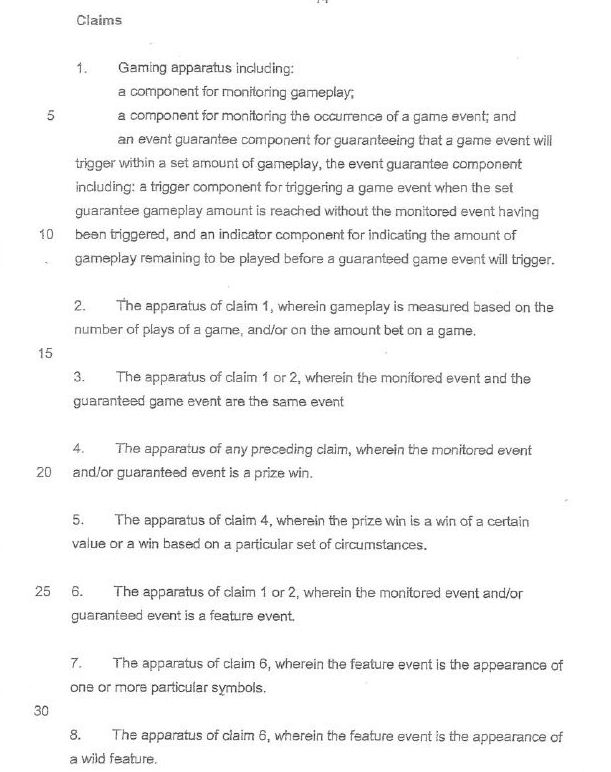
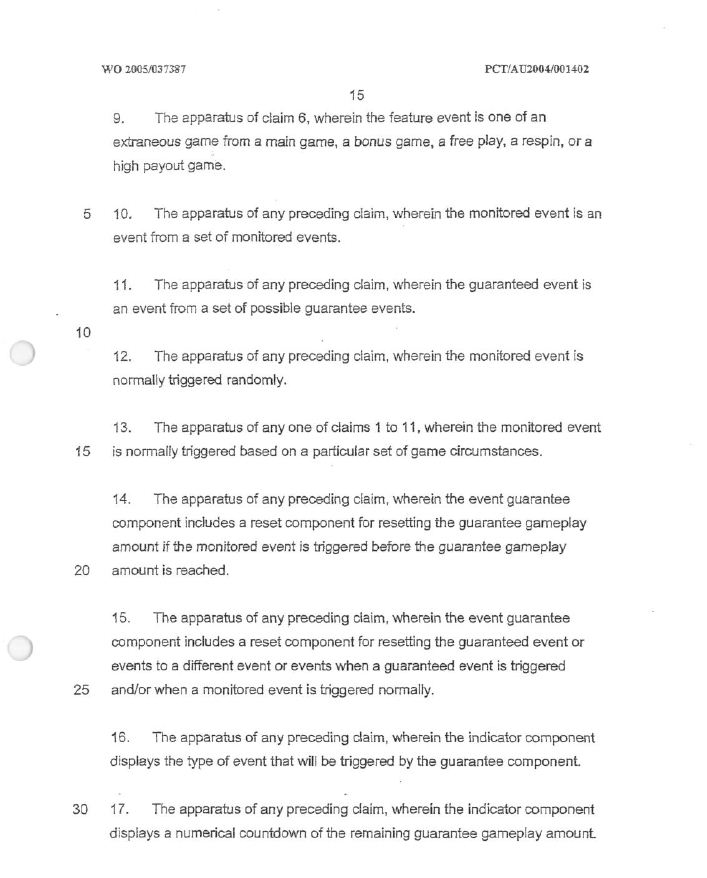
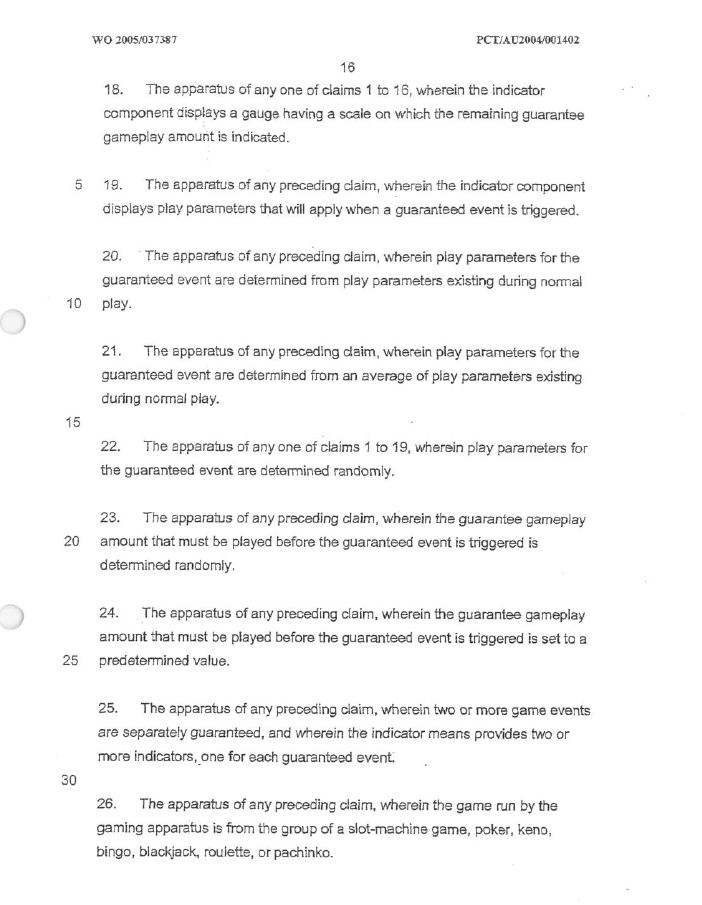
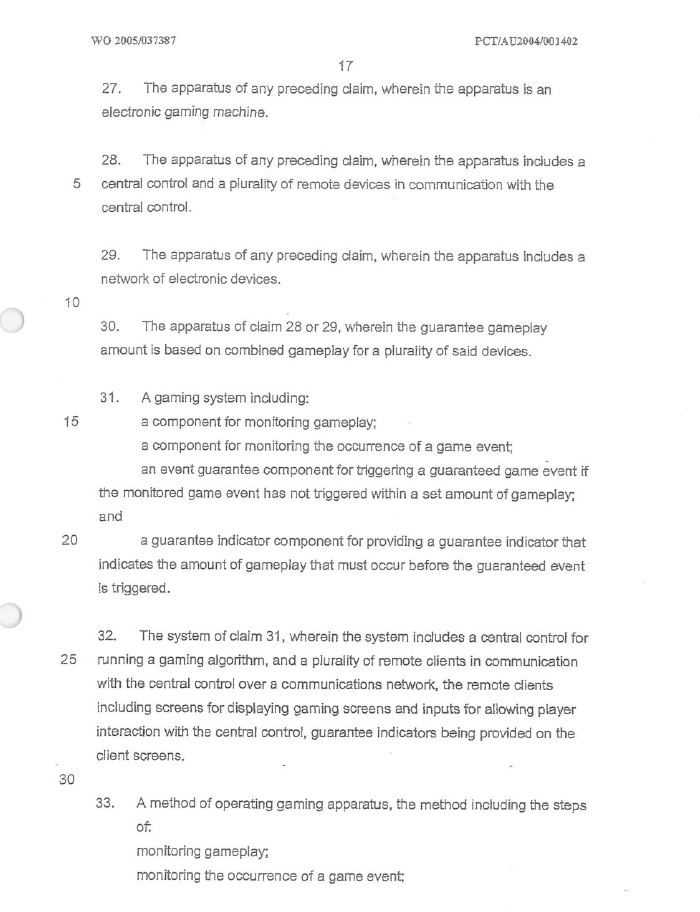
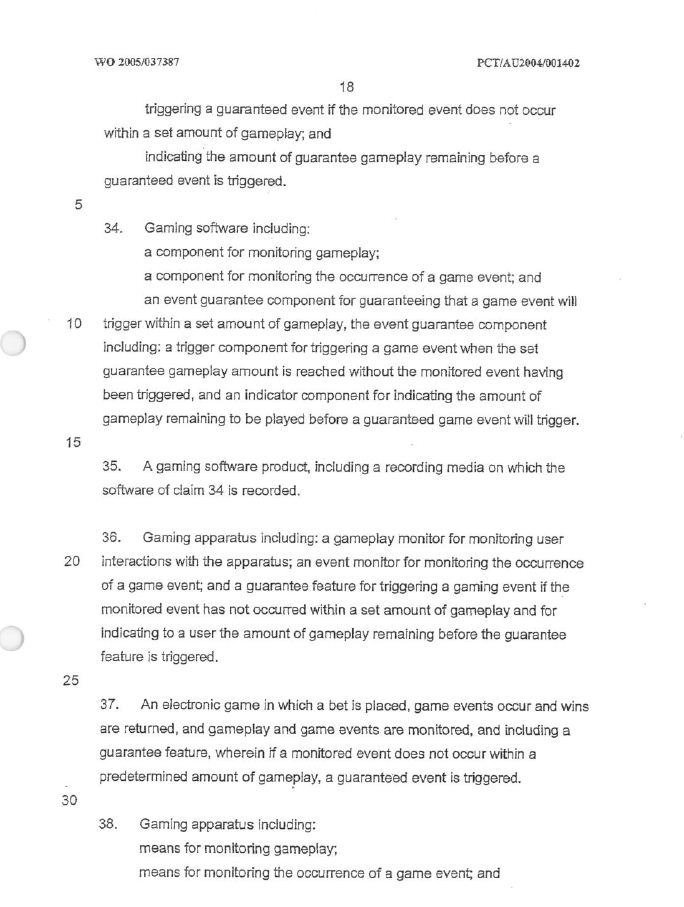
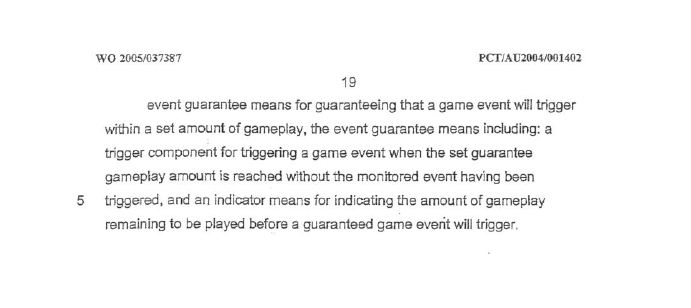
APPENDIX 2: Claims of the Innovation Patent
222 The claims of the Innovation Patent are as follows:
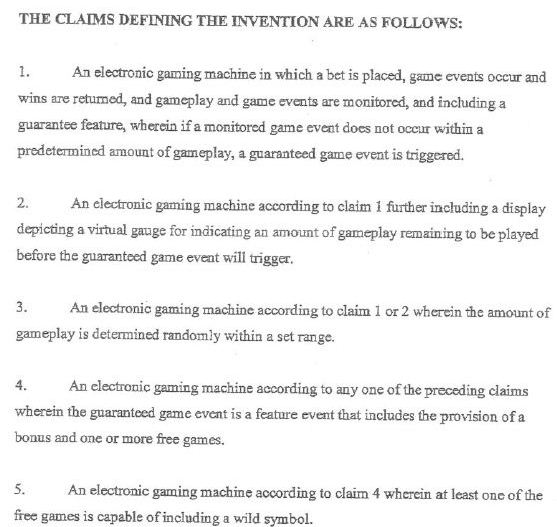
APPENDIX 3: PARTIES’ TABLES CONCERNING NOVELTY
223 The table of novelty references provided by the respondents and the applicant’s response is as follows:
Table of Claims Standard Patent 20044281073
Claim No | Integers | Allegedly infringed? | Respondent’s Anticipation Submissions | Applicant’s Novelty Submissions |
1 | Gaming apparatus including: a component for monitoring gameplay; a component for monitoring the occurrence of a game event; and an event guarantee component for guaranteeing that a game event will trigger within a set amount of gameplay, the event guarantee component including: a trigger component for triggering a game event when the set guarantee gameplay amount is reached without the monitored event having been triggered, and an indicator component for indicating the amount of gameplay remaining to be played before a guaranteed game event will trigger. | No | Clarke col 1:55 - 2:10 col 2:53 – 3:13 col 4:23-31 Okada col 2:11-40 col 3:5-35 col 3:54 – 4:12 col 4:37-65 col 5:20-25 Stupak Abstract col 1:5-8 col 1:55 – 2:6 col 2:34-48 col 3:5-54 col 5:12-20 Shuster Abstract col 2:17-47 col 2:57-62 col 3:30 – 4:36 col 6:38-48 col 9:50-53 claim 10 Money Back Ex KD1 paras 130-134. Futurity Bell Ex KD1 paras 122-124 Scatter Rug Ex KD1 paras 138-146 Cashcade (on Dynamite’s construction of indicator component) Ex KD1 para 68 Oldfield XXN T 252:1-11 | Clarke The event in Clarke that interrupts the count is an ordinary prize win (col 3:11-13), which is not a “game event” and therefore cannot be a “monitored event” (ACS 53-56 & 70). Clarke’s indicator component displays an ascending count of lost games (col 2:60-66), which is not an indication of the amount of gameplay remaining (ACS 71-72). Okada Okada’s indicator component displays an ascending count of coins inserted within the insurance period (col 3: 25-28), which is not an indication of the amount of gameplay remaining (ACS 71-72). Stupak The event in Stupak that interrupts the count is an ordinary prize win (col 3:18-27), which is not a “game event” and therefore cannot be a “monitored event” (ACS 53-56 & 70). Shuster The event in Shuster that interrupts the count is an ordinary prize win (col 4:7-13; T203/24-26), which is not a “game event” and therefore cannot be a “monitored event” (ACS 53-56 & 70). Shuster’s indicator component displays an ascending count of lost games (col 3:40-67), which is not an indication of the amount of gameplay remaining (ACS 71-72). Money Back See comments as for Clarke above. Futurity Bell The event in Futurity Bell that interrupts the count is an ordinary prize win, which is not a “game event” and therefore cannot be a “monitored event” (ACS 53-56 & 70). Scatter Rug The event in Scatter Rug that interrupts the count is the non-appearance of a rug symbol, which is not a “game event” that is “of benefit to the player” (standard patent specification page 2:16) and therefore cannot be a “monitored event” (ACS 54). There is no game event (such as a win event or a feature event - specification 2:33) that is triggered by the non-appearance of the rug symbol. (T198/31-39) Cashcade The event in Cashcade that interrupts the count (the monitored event) is the awarding of the jackpot to the player of another machine that added the final increment. It is not a “game event” because it is of no benefit to the player of the machine that did not win and therefore cannot be a “monitored event” (ACS 54 & 90). Further if this is a monitored event, if it does not happen, there is no guaranteed game event delivered to the player (the jackpot win is not guaranteed to this player). In Cashcade the jackpot is awarded when the jackpot amount is incremented over a ‘mystery value’ that is not known to the players. The players know the upper limit of the range, however the mystery value may be significantly lower than the upper limit. Hence, the display in Cashcade of the incrementing current value of the jackpot does not provide an indication of “the amount of gameplay remaining to be played before a guaranteed game event will trigger” because the jackpot will trigger when the mystery value is reached rather than when the end of the range is reached (ACS 89). |
2 | The apparatus of claim 1, wherein gameplay is measured based on the number of plays of a game, and/or on the amount bet on a game. | No | Number of plays: Clarke col 1:57 col 3:5-10 Okada col 2:29-34 Stupak col 1:57-62 col 2:43-49 Shuster col 2:19-20 Money Back Ex KD1 paras 130-134. Futurity Bell Ex KD1 paras 122-124 Scatter Rug Ex KD1 paras 138-146 Amount bet: Okada col 2:19-21 Shuster col 3:34-35 Cashcade Ex KD1 para 68 | Since claim 1 is not anticipated, claim 2 is not anticipated by any of the prior art relied upon by the Respondents. |
3 | The apparatus of claim 1 or 2, wherein the monitored event and the guaranteed game event are the same event | No | Shuster – the monitored event is a winning combination. The guaranteed event is forced win being free spins until a winning combination is achieved: col 4:14-27. | Since claim 1 is not anticipated, claim 3 is not anticipated by any of the prior art relied upon by the Respondents. |
4 | The apparatus of any preceding claim, wherein the monitored event and/or guaranteed event is a prize win. | No | Clarke The special coin payout can be considered as a type of win. It may payout more than the number of coins bet col 4:23-31 Okada col 3:12-16 Stupak col 1:60-62 Shuster col 2:30-32 Futurity Bell Ex KD1 paras 122-124 Scatter Rug Ex KD1 paras 138-146 Cashcade Ex KD1 para 68 | Since claim 1 is not anticipated, claim 4 is not anticipated by any of the prior art relied upon by the Respondents. |
5 | The apparatus of claim 4, wherein the prize win is a win of a certain value or a win based on a particular set of circumstances. | No | Clarke Guaranteed event is prize win of certain value being the number of coins bet in the losing sequence. col 3:5-10 Okada Where prize win is the monitored event, “a win of a certain value is the “big hit”: col 1:47-55 col 4:62-65 Where prize win in the guaranteed event, “a win of certain value” is “the predetermined value of insurance” or “a predetermined number of coins, eg 200 coins”: col 2 lines 20-21 col 3:14-16. Stupak Particular set of circumstances: col 2:4-6 col 2:45-48 col 3:40-48 Certain value col 3:49-54 Shuster Particular set of circumstances col 4:14-36. Money Back Guaranteed event is prize win of certain value being the number of coins bet in the losing sequence. Ex KD1, para 133 Futurity Bell Guaranteed event is prize win of certain value being the number of coins bet in the losing sequence Ex KD1, para 122(a) Scatter Rug Guaranteed event is prize win of certain value being the number of coins bet in the four game sequence in which scattered rug symbols were obtained. Ex KD1 para 142. Cashcade The prize win was of the certain value selected randomly by the controller within the publicized range. Ex KD1 para 68. | Since claim 1 is not anticipated, claim 5 is not anticipated by any of the prior art relied upon by the Respondents. |
6 | The apparatus of claim 1 or 2, wherein the monitored event and/or guaranteed event is a feature event. | Yes | Clarke Win of, or exceeding, total coins bet over losing sequence is a feature event col 3:5-10 col 4:28-31 ACS 75 Okada Feature events include high payout games. The monitored event, “the big hit” “includes not only a hit for which at once a high value is paid out, but also a hit from which it becomes possible to play out a number of privileged or bonus games in which the probability of obtaining big hits is exceptionally high”: col 1:51-55 Stupak Feature is high payout game col 1:60-62 col 2: 45-48 col 3:49-54 Shuster Feature event is free spins until winning combination results col 4: 21-36 Money Back Win of total coins bet over losing sequence is a feature event Ex KD1, para 133 Futurity Bell Win of total coins bet over losing sequence is a feature event Ex KD1, para 122(a) Scatter Rug Win of total coins bet over sequence of scatters is a feature event Ex KD1 para 142 Cashcade The win of a bonus jackpot comprising proportions of the bets from multiple linked machines is a feature event. The monitored event is any win from a series of possible winning combinations on the machine Ex KD1, para 68 | Clarke Clarke does not disclose claim 1 and therefore does not disclose claim 6. Clarke also does not disclose the additional integer of claim 6 because Clarke lacks a “monitored event” (see above re claim 1) and Clarke’s “guaranteed event” is a prize win returning spent coins (col 4: 23-31; T199/31-39), which is not a “feature event” (ACS 48-52). Okada Okada does not disclose claim 1 and therefore does not disclose claim 6. Also, Okada does not disclose the additional integer of claim 6. A feature event is distinct from a win event. Both the insurance payment and the "big hit" are win events (T200/26-36). There is no feature event (ACS 75)
Stupak Stupak does not disclose claim 1 and therefore does not disclose claim 6. Also Stupak does not disclose the additional integer of claim 6. Stupak also does not disclose awarding a “high payout game” to the player at col 1:60-62, col 2: 45-48 or col 3:49-54. Rather, at 1:60-62 Stupak discloses paying the player a “maximum jackpot amount”, at col 2: 45-48 Stupak discloses paying a “special jackpot amount” and at col 3:49-54 Stupak discloses paying the player a “jackpot amount” such as from 100 times to 5000 times the amount bet. This is a payment and does not involve the play of an additional “high payout game”. Hence Stupak’s “guaranteed event” is a prize win, which is not a “feature event” (ACS 48-52; 78). Both the jackpot and the event that may interrupt the sequence are prize wins (T202/41-46) – neither is a feature event. Shuster Shuster does not disclose claim 1 and therefore does not disclose claim 6. Money Back See comments re Clarke. Futurity Bell Futurity Bell does not disclose claim 1 and therefore does not disclose claim 6. Also it does not disclose the additional integer of claim 6. The event that is triggered upon 10 consecutive losses is a prize win, which is not a feature event (ACS 48-52;84) Scatter Rug Scatter Rug does not disclose claim 1 and therefore does not disclose claim 6. Also it does not disclose the additional integer of claim 6. The event that is triggered upon completion of the sequence is a prize win, which is not a feature event (ACS 48-52; 65; T198/25-30). Cashcade Cashcade does not disclose claim 1 and therefore does not disclose claim 6. Also it does not disclose the additional integer of claim 6. The event that is triggered when the mystery value is reached is a prize win, which is not a feature event (ACS 48-52; 88). |
7 | The apparatus of claim 6, wherein the feature event is the appearance of one or more particular symbols. | No | Shuster Feature event is free spins until winning combination results Col 4: 21-36. A winning combination involves the appearance of one or more particular symbols. See also claim 19: col 14:19-25 | Since claim 1 (and claim 6) is not anticipated, claim 7 is not anticipated by any of the prior art relied upon by the Respondents. |
8 | The apparatus of claim 6, wherein the feature event is the appearance of a wild feature. | No | Shuster The nature of the symbols which can represent winning combinations and the combinations which can be recognized by the award schedule are unconfined regardless of whether the play is during the course of the free game or in normal play. col 3:54-58 col 8:47-63 | Since claim 1 (and claim 6) is not anticipated, claim 8 is not anticipated by any of the prior art relied upon by the Respondents. |
9 | The apparatus of claim 6, wherein the feature event is one of an extraneous game from a main game, a bonus game, a free play, a re-spin, or a high payout game. | Yes | Shuster Feature event is free spins until winning combination results Col 4:21-36 Okada Feature events include high payout games. The monitored event, “the big hit” “includes not only a hit for which at once a high value is paid out, but also a hit from which it becomes possible to play out a number of privileged or bonus games in which the probability of obtaining big hits is exceptionally high”: col 1:51-55 | Shuster Shuster does not disclose claim 1 and therefore does not disclose claim 9. Okada Okada does not disclose claim 1 or the feature in claim 6, and does not anticipate claim 9. It does not disclose a feature event at all. The passage relied upon (col 1:51-55) is a description of the prior art under "Background to the Invention". The "big hit" in the Okada invention that might interrupt the sequence towards the insurance payout is the payment of a "predetermined large number of coins" which paid out for the big hit (col 5:25-34). This is not a feature event and certainly not one of the feature events defined in claim 9. |
10 | The apparatus of any preceding claim, wherein the monitored event is an event from a set of monitored events. | No | Clarke The monitored event is any win from a series of possible winning combinations on the machine col 2: 43-46 Okada col 4:5-12 col 5:27-30 Stupak Monitored event is a “predetermined winning combination” col 1:65 Shuster The monitored event is a combination determined by the controller to be a winning combination col 3:56-60. The gaming device has a set of winning combinations: claim 13, col 13: 12-13 Money Back The monitored event is any win from a series of possible winning combinations on the machine Ex KD1, para 133 Futurity Bell The monitored event is any win from a series of possible winning combinations on the machine Ex KD1, para 122 | Since claim 1 is not anticipated, claim 10 is not anticipated by any of the prior art relied upon by the Respondents. Also, when dependent upon claim 6 this claim is not anticipated. The Respondents' novelty table does not allege that Clarke, Stupak, Money Back and Futurity Bell anticipate claim 9, so when claim 10 is dependent upon 9 it is certainly not anticipated by these documents. For reasons stated above Okada and Shuster do not anticipate claims 6 and 9, so when this claim is dependent upon 6 and 9 it is also not anticipated by these documents. |
11 | The apparatus of any preceding claim, wherein the guaranteed event is an event from a set of possible guarantee events. | No | Clarke The set of possible guaranteed events ranged from payment amounting to 13 times the minimum bet to 13 times the maximum bet col 2:46-54 Stupak Col 3:49-53 Shuster Guaranteed feature event is free spins until winning combination results. Participant is paid preset amount of award based upon the resulting winning combination Col 4:21-36 Money Back The set of possible guaranteed events ranged from payment amounting to 13 times the minimum bet to 13 times the maximum bet Ex KD1, para 133 | Since claim 1 is not anticipated, claim 11 is not anticipated by any of the prior art relied upon by the Respondents. Also, when dependent upon claim 6 this claim is not anticipated. Further, it is not alleged that Clarke, Stupak, Money Back and Futurity Bell anticipate claim 9, so when claim 10 is dependent upon 9 it is certainly not anticipated. For reasons stated above Okada and Shuster do not anticipate claims 6 and 9, so when this claim is dependent upon 6 and 9 it is also not anticipated by these documents. |
12 | The apparatus of any preceding claim, wherein the monitored event is normally triggered randomly. | Yes | Clarke The reels stop so as to make winning combinations on a random basis col 2: 36-41. Okada col 3:66 – 4:4 Stupak col 1:12-24 col 3:63-col 4:3 col 4:46-65 Shuster Games of chance played by selecting random combinations, col 14:23-24. Money Back As would be expected, game outcomes were random – see Ex KD1 attachment 9 CB p 885 para 8. Scatter Rug Game play outcomes were determined by use of a random number generator embedded in the controlling software Ex KD1, para 139. | Clarke Clarke does not disclose claim 1 and therefore does not disclose claim 12. Also, it does not anticipate claims 6 and 9, so when this claim is dependent upon 6 and 9 it is not anticipated. Clarke also does not disclose the additional integer of claim 12 because Clarke lacks a “monitored event” (see above re claim 1). Okada Okada does not disclose claim 1 and therefore does not disclose claim 12. Also, it does not anticipate claims 6 and 9, so when this claim is dependent upon 6 and 9 it is not anticipated. Stupak Stupak does not disclose claim 1 and therefore does not disclose claim 12 (ACS 77-79). Also, it does not anticipate claims 6 and 9, so when this claim is dependent upon 6 and 9 it is not anticipated. Shuster Shuster does not disclose claim 1 and therefore does not disclose claim 12. Also, it does not anticipate claims 6 and 9, so when this claim is dependent upon 6 and 9 it is not anticipated. (see above re claim 1). Money Back See comments re Clarke. Scatter Rug Shuster does not disclose claim 1 and therefore does not disclose claim 12. Also, it does not anticipate claims 6 and 9, so when this claim is dependent upon 6 and 9 it is not anticipated. |
13 | The apparatus of any one of claims 1 to 11, wherein the monitored event is normally triggered based on a particular set of game circumstances. | Yes | Clarke Winning outcomes are triggered by particular game circumstances, being the combination of symbols displayed col 2:42-50 Okada col 3:66 – 4:4 Stupak The monitored event is a win such as by receiving a predetermined winning combination of indicia: col 2: 39-41. Shuster The monitored event is a combination determined by the controller to be a winning combination col 3:56-60. The gaming device has a set of winning combinations: claim 13, col 13: 12-13 Winning combinations represent a particular set of game circumstances | Clarke Clarke does not disclose claim 1 and therefore does not disclose claim 13. Also, it does not anticipate claims 6 and 9, so when this claim is dependent upon 6 and 9 it is not anticipated. Okada Okada does not disclose claim 1 and therefore does not disclose claim 13. Also, it does not anticipate claims 6 and 9, so when this claim is dependent upon 6 and 9 it is not anticipated. Stupak Stupak does not disclose claim 1 and therefore does not disclose claim 13. Also, it does not anticipate claims 6 and 9, so when this claim is dependent upon 6 and 9 it is not anticipated. Shuster Shuster does not disclose claim 1 and therefore does not disclose claim 13. Also, it does not anticipate claims 6 and 9, so when this claim is dependent upon 6 and 9 it is not anticipated. |
14 | The apparatus of any preceding claim, wherein the event guarantee component includes a reset component for resetting the guarantee gameplay amount if the monitored event is triggered before the guarantee gameplay amount is reached. | Yes | Clarke col 2:55-59 Okada col 4:57-65 Stupak col 3:66 – 4:3 Shuster New win interval commences col 5:30-37. | Clarke Clarke does not disclose claim 1 and therefore does not disclose claim 14. Also, it does not anticipate claims 6 and 9, so when this claim is dependent upon 6 and 9 it is not anticipated. Okada Okada does not disclose claim 1 and therefore does not disclose claim 14. Also, it does not anticipate claims 6 and 9, so when this claim is dependent upon 6 and 9 it is not anticipated. Stupak Stupak does not disclose claim 1 and therefore does not disclose claim 14. Also, it does not anticipate claims 6 and 9, so when this claim is dependent upon 6 and 9 it is not anticipated. Shuster Shuster does not disclose claim 1 and therefore does not disclose claim 14. Also, it does not anticipate claims 6 and 9, so when this claim is dependent upon 6 and 9 it is not anticipated. |
15 | The apparatus of any preceding claim, wherein the event guarantee component includes a reset component for resetting the guaranteed event or events to a different event or events when a guaranteed event is triggered and/or when a monitored event is triggered normally. | No | Shuster Player has option to foregoing guaranteed award and progressing to next level of play col 2:33-34 col 7:48-50 col 9:6-10. | Since claim 1 is not anticipated, claim 15 is not anticipated by any of the prior art relied upon by the Respondents. |
16 | The apparatus of any preceding claim, wherein the indicator component displays the type of event that will be triggered by the guarantee component. | No | Shuster col 2:57-62 col 9:50-53 | Since claim 1 is not anticipated, claim 16 is not anticipated by any of the prior art relied upon by the Respondents. |
17 | The apparatus of any preceding claim, wherein the indicator component displays a numerical countdown of the remaining guarantee gameplay amount. | No | Stupak Fig 2, col 4:26-30 Shuster “…the predetermined number of games or amount of time that must elapse prior to winning is displayed” Col 2:58-60 Futurity Bell Large dial with pointer Ex KD1, Attachment 7 Scatter Rug There were four lights which lit in turn as long as the sequence continued Ex KD1, para 144 | Since claim 1 is not anticipated, claim 17 is not anticipated by any of the prior art relied upon by the Respondents. Also, the documents do not anticipate claims 6 and 9, so when this claim is dependent upon 6 and 9 it is not anticipated. |
18 | The apparatus of any one of claims 1 to 16, wherein the indicator component displays a gauge having a scale on which the remaining guarantee gameplay amount is indicated. [To the extent that prior publications disclose a counter or other indicator of the amount of gameplay, they anticipate a virtual gauge display showing the amount of gameplay remaining. There is no difference in the nature or effect of such disclosures or teachings. They both serve exactly the same purpose.] | Yes | Generally see claim 1 Eg Shuster Stupak Fig 3, col 4:32-38. Futurity Bell Large dial with pointer Ex KD1, Attachment 7 | The documents do not anticipate claims 1, 6 or 9, so when this claim is dependent upon claims 1, 6 or 9 it is not anticipated. Shuster Shuster does not disclose claim 1 and therefore does not disclose claim 18. In addition to not providing an indication of the amount of gameplay remaining, Shuster’s counter 36 is not a “gauge having a scale” because it is numeric. Stupak Stupak does not disclose claim 1 and therefore does not disclose claim 18. Futurity Bell Futurity Bell does not disclose claim 1 and therefore does not disclose claim 18. |
19 | The apparatus of any preceding claim, wherein the indicator component displays play parameters that will apply when a guaranteed event is triggered. | No | Shuster col 2:57-62 col 9:50-53 Clarke The player knows how many coins will be paid if the sequence is completed col 1:67-2:5 Money Back The second meter counted the number of coins bet since the last win which would reflect the size of the payout on the guaranteed event once it was triggered Ex KD1, para 133(a)(ii) | Since claim 1 is not anticipated, claim 19 is not anticipated by any of the prior art relied upon by the Respondents. Also, the documents do not anticipate claims 6 and 9, so when this claim is dependent upon 6 and 9 it is not anticipated. |
20 | The apparatus of any preceding claim, wherein play parameters for the guaranteed event are determined from play parameters existing during normal play. [Note that by reference to p10 lines 10-15 and 31-34 of the specification (P2511), an example of a “play parameter” of a “win event” is the amount of the award for the particular winning combination constituting the win event. An example of a play parameter for a “feature event” is also the rate of pay of an award during a feature event.] | Yes | Stupak The jackpot is a multiple of the amount bet: col 3:49-54 Shuster The guaranteed event is a “feature event” consisting of a free spin pursuant to which a winning combination being a winning combination for the purposes of normal play, is guaranteed. The “first guaranteed award amount” is the amount to be paid for the guaranteed winning combination on the free spin. The first guaranteed amount is determined by reference to play parameters of normal play, namely the amount of the award for the winning combination in normal play: “The determination of the first guaranteed award amount is based, in part, on the award schedule for the winning amount.” col 5:48-67 col 6:19-28 col 6:47-col 7:5 Money Back The size of the guaranteed event depended upon the amount bet during the losing sequence. Ex KD1, para 133 | The documents do not anticipate claims 1, 6 and 9, so when this claim is dependent upon 1, 6 or 9 it is not anticipated. Stupak Stupak does not disclose claim 1 and therefore does not disclose claim 20. When claim 20 depends from claim 6, Stupak additionally lacks a “feature event”. Shuster Shuster does not disclose claim 1 and therefore does not disclose claim 20. Money Back Money Back does not disclose claim 1 and therefore does not disclose claim 20. When claim 20 depends from claim 6, Money Back additionally lacks a “feature event”. |
21 | The apparatus of any preceding claim, wherein play parameters for the guaranteed event are determined from an average of play parameters existing during normal play. [Note that “play parameters existing during normal play” comprehend the existing listing of payouts for winning combinations in normal play. Thus a payout in connection with the guaranteed event which is determined from an average of listed payouts for winning combinations during normal play is captured by this claim.] | Yes | Shuster The guaranteed event is a free spin which guarantees the payment of a first guaranteed award amount. “…the award for each winning combination is based on the odds of achieving a particular winning combination.” col 5:54-55 Table 1 showing odds of winning combination AAA for three coins played of 16.67% with an award amount paid of 3 coins. Col 6:1-8 “The choice of the first guaranteed award amount is further determined, in part, on the odds of winning Indeed, the first guaranteed award amount is preset to allow the machine owner, gaming director, or operator the ability to maintain a desired level of odds for winning. In preferred embodiments, the first guaranteed award amount is set higher than the minimum amount paid by the award schedule. Thus, for example, if the winning combination having the highest odds pays three coins, the first guaranteed award amount is minimally set at three coins.” col 6:23-28 That is to say, the minimum three coins is determined by reference to the odds of winning the AAA combination which itself represents the average of returns to a player based on normal play of the machine over time. Money Back Because the size of the guaranteed event depended upon the amount bet during the losing sequence, the higher the average amount bet the higher the payout on the triggering of the guaranteed event. Ex KD1, para 133 | Shuster Shuster does not disclose claim 1 and therefore does not disclose claim 21. Further, the Applicant relies upon the matters raised in the course of oral closing submissions (T 380/28-46) which is responsive to the Respondents Table of Claims Standard Patent 20044281073. Play parameters for the guaranteed event are not determined from an average of play parameters existing during normal play. The award for a winning combination is based upon the odds of achieving the combination. The odds, as exemplified in Table 1, are predetermined odds. Money Back Money Back does not disclose claim 1. KD1, para 133 does not disclose that Money Back performs any averaging. Rather, the number of coins paid out after 13 losses is simply the addition of the number of coins inserted during the 13 losing games. Also, Money Back does not anticipate claims 6 and 9, so when this claim is dependent upon 6 and 9 it is not anticipated. |
22 | The apparatus of any one of claims 1 to 19, wherein play parameters for the guaranteed event are determined randomly. [This claim simply specifies that the play parameters be determined randomly. All of he prior art determines play parameters for the guaranteed event randomly in the sense that it is a matter of design choice for the game supplier not dictated by any particular formula, subject to ensuring an adequate pay return] | No | See claim 1 Eg Shuster | Since claim 1 is not anticipated, claim 22 is not anticipated by any of the prior art relied upon by the Respondents. Also, the documents do not anticipate claims 6 and 9, so when this claim is dependent upon 6 and 9 it is not anticipated. |
23 | The apparatus of any preceding claim, wherein the guarantee gameplay amount that must be played before the guaranteed event is triggered is determined randomly. | Yes | Shuster claim 12: col 13:3-8. Because the total number of wins and losses of a plurality of games will be randomly occurring numbers, a calculation based on these will be random. Cashcade | Shuster Shuster does not disclose claim 1 and therefore does not disclose claim 23. Claim 12 of Shuster discloses setting the win interval to a predetermined value, which is based on a summation of the results of a plurality of games, subject to a minimum number of wins. This is not a random determination of the guarantee gameplay amount. Cashcade Cashcade does not disclose claim 1 and therefore does not disclose claim 23. In Cashcade, if the “guarantee gameplay amount” is construed as the amount of gameplay between the start of the range and the mystery value, then the Cashcade indicator does not provide an indication of the “amount of gameplay remaining” because it does not identify the ‘mystery value’. Also, the documents do not anticipate claims 6 and 9, so when this claim is dependent upon 6 and 9 it is not anticipated. |
24 | The apparatus of any preceding claim, wherein the guarantee gameplay amount that must be played before the guaranteed event is triggered is set to a predetermined value. | No | Okada col 2:20 col 3:12-16 col 5:47-56 Stupak Predetermined number of successive games are losing games col 1:61-2. Shuster Fixed period of time or predetermined number of games col 2:17-20 col 2:42-44 Money Back Gameplay amount fixed as a 13 game losing sequence. The size of the guaranteed event depended upon the amount bet during the losing sequence. Ex KD1, para 133 Futurity Bell Gameplay amount fixed as a 10 game losing sequence. Ex KD1 para 122(a) Scatter Rug The guaranteed gameplay amount was set at four games in which scattered rug combinations were achieved. Ex KD1 para 141-142. | Since claim 1 is not anticipated, claim 24 is not anticipated by any of the prior art relied upon by the Respondents. Also, the documents do not anticipate claims 6 and 9, so when this claim is dependent upon 6 and 9 it is not anticipated. |
25 | The apparatus of any preceding claim, wherein two or more game events are separately guaranteed, and wherein the indicator means provides two or more indicators, one for each guaranteed event. | No | ||
26 | The apparatus of any preceding claim, wherein the game run by the gaming apparatus is from the group of a slot-machine game, poker, keno, bingo, blackjack, roulette, or pachinko. | Yes | Clarke col 1:55-56 Okada col 1:7 col 2:12-13 Stupak col 1:58 Shuster Slot machine col 3:42 Money Back Money Back was slot machine (reel strip) game - see Ex KD1 attachment 9 CB p 879 Futurity Bell Slot machine Ex KD1 para 122 | Clarke The Applicant accepts that Clarke discloses the additional integer of claim 26 (but not that it is anticipated when dependent on any of the other preceding claims). Okada The Applicant accepts that Okada discloses the additional integer of claim 26 (but not that it is anticipated when dependent on any of the other preceding claims). Stupak The Applicant accepts that Stupak discloses the additional integer of claim 26 (but not that it is anticipated when dependent on any of the other preceding claims). Shuster The Applicant accepts that Shuster discloses the additional integer of claim 26 (but not that it is anticipated when dependent on any of the other preceding claims). Money Back See comments for Clarke above. Futurity Bell The Applicant accepts that Futurity Bell discloses the additional integer of claim 26 (but not that it is anticipated when dependent on any of the other preceding claims). Also, the documents do not anticipate claims 6 and 9, so when this claim is dependent upon 6 and 9 it is not anticipated. |
27 | The apparatus of any preceding claim, wherein the apparatus is an electronic gaming machine. | Yes | Clarke col 3:14-16 Okada col 6:24-26 Stupak CPU col 3:5 Shuster Controller is a computer col 9:14-15 Money Back A microprocessor controlled machine Ex KD1, para 130 | Clarke The Applicant accepts that Clarke discloses the additional integer of claim 27 (but not that it is anticipated when dependent on any of the other preceding claims). Okada The Applicant accepts that Okada discloses the additional integer of claim 27 (but not that it is anticipated when dependent on any of the other preceding claims). Stupak The Applicant accepts that Stupak discloses the additional integer of claim 27 (but not that it is anticipated when dependent on any of the other preceding claims). Shuster The Applicant accepts that Shuster discloses the additional integer of claim 27 (but not that it is anticipated when dependent on any of the other preceding claims). Money Back See comments for Clarke above. Also, the documents do not anticipate claims 6 and 9, so when this claim is dependent upon 6 and 9 it is not anticipated. |
28 | The apparatus of any preceding claim, wherein the apparatus includes a central control and a plurality of remote devices in communication with the central control. | No | Shuster Participating slot machines are connected col 10:19-24. Cashcade | Shuster While one preferred embodiment of Cashcade discloses that the participating gaming machines are connected to a simple, progressive jackpot, it does not disclose that there is a central control. Cashcade Cashcade does not disclose an apparatus with a central control. Also, the documents do not anticipate claims 6 and 9, so when this claim is dependent upon 6 and 9 it is not anticipated. |
29 | The apparatus of any preceding claim, wherein the apparatus includes a network of electronic devices. | No | Shuster Participating slot machines are connected col 10:19-24. Cashcade Ex KD1 para 68 | Shuster The Applicant accepts that Shuster discloses the additional integer of claim 29 (but not that it is anticipated when dependent on any of the other preceding claims). Cashcade The Applicant accepts that Cashcade discloses the additional integer of claim 29 (but not that it is anticipated when dependent on any of the other preceding claims). Also, the documents do not anticipate claims 6 and 9, so when this claim is dependent upon 6 and 9 it is not anticipated. |
30 | The apparatus of claim 28 or 29, wherein the guarantee gameplay amount is based on combined gameplay for a plurality of said devices | No | Cashcade Ex KD1 para 68 Shuster col 10:19-32 | Cashcade Cashcade does not anticipate claim 28 and it does not disclose guaranteed gameplay amount within the meaning of the claims Shuster Shuster does not anticipate claim 28 and it does not anticipate that the guarantee gameplay amount is based on combined gameplay of a plurality of devices. Rather, it is the jackpot in Shuster that increases as all the players place wagers. Also, the documents do not anticipate claims 6 and 9, so when this claim is dependent upon 6 and 9 it is not anticipated. |
31 | A gaming system including: a component for monitoring gameplay; a component for monitoring the occurrence of a game event; an event guarantee component for triggering a guaranteed game event if the monitored game event has not triggered within a set amount of gameplay; and a guarantee indicator component for providing a guarantee indicator that indicates the amount of gameplay that must occur before the guaranteed event is triggered. | No | See claim 1 | Since claim 1 is not anticipated, claim 31 is not anticipated by any of the prior art relied upon by the Respondents. |
32 | The system of claim 31, wherein the system includes a central control for running a gaming algorithm, and a plurality of remote clients in communication with the central control over a communications network, the remote clients including screens for displaying gaming screens and inputs for allowing player interaction with the central control, guarantee indicators being provided on the client screens. | No | Shuster Participating slot machines are connected col 10:19-24. Cashcade Ex KD1, para 68 | Shuster While one preferred embodiment of Cashcade discloses that the participating gaming machines are connected to a simple, progressive jackpot, it does not disclose that there is a central control. Cashcade Cashcade does not disclose an apparatus with a central control. |
33 | A method of operating gaming apparatus, the method including the steps of: monitoring gameplay; monitoring the occurrence of a game event; triggering a guaranteed event if the monitored event does not occur within a set amount of gameplay; and indicating the amount of guarantee gameplay remaining before a guaranteed event is triggered. | No | See claim 1 | Since claim 1 is not anticipated, claim 33 is not anticipated by any of the prior art relied upon by the Respondents. |
34 | Gaming software including: a component for monitoring gameplay; a component for monitoring the occurrence of a game event; and an event guarantee component for guaranteeing that a game event will trigger within a set amount of gameplay, the event guarantee component including: a trigger component for triggering a game event when the set guarantee gameplay amount is reached without the monitored event having been triggered, and an indicator component for indicating the amount of gameplay remaining to be played before a guaranteed game event will trigger. | No | See claim 1 except Futurity Bell. | Since claim 1 is not anticipated, claim 34 is not anticipated by any of the prior art relied upon by the Respondents. |
35 | A gaming software product, including a recording media on which the software of claim 34 is recorded. | No | See claim 34 | Since claim 1 is not anticipated, claim 35 is not anticipated by any of the prior art relied upon by the Respondents. |
36 | Gaming apparatus including: a gameplay monitor for monitoring user interactions with the apparatus; an event monitor for monitoring the occurrence of a game event; and a guarantee feature for triggering a gaming event if the monitored event has not occurred within a set amount of gameplay and for indicating to a user the amount of gameplay remaining before the guarantee feature is triggered. | No | See claim 1 | Since claim 1 is not anticipated, claim 36 is not anticipated by any of the prior art relied upon by the Respondents. |
37 | An electronic game in which a bet is placed, game events occur and wins are returned, and gameplay and game events are monitored, and including a guarantee feature, wherein if a monitored event does not occur within a predetermined amount of gameplay, a guaranteed event is triggered. | No | See claim 27 | Clarke The Applicant accepts that Clarke discloses the additional integer of claim 27 (but not that it is anticipated when dependent on any of the other preceding claims). Okada The Applicant accepts that Okada discloses the additional integer of claim 27 (but not that it is anticipated when dependent on any of the other preceding claims). Stupak The Applicant accepts that Stupak discloses the additional integer of claim 27 (but not that it is anticipated when dependent on any of the other preceding claims). Shuster The Applicant accepts that Shuster discloses the additional integer of claim 27 (but not that it is anticipated when dependent on any of the other preceding claims). Money Back See comments for Clarke above. |
38 | Gaming apparatus including: means for monitoring gameplay; means for monitoring the occurrence of a game event; and event guarantee means for guaranteeing that a game event will trigger within a set amount of gameplay, the event guarantee means including: a trigger component for triggering a game event when the set guarantee gameplay amount is reached without the monitored event having been triggered, and an indicator means for indicating the amount of gameplay remaining to be played before a guaranteed game event will trigger. | No | See claim 1 | Since claim 1 is not anticipated, claim 38 is not anticipated by any of the prior art relied upon by the Respondents. |
Table of Claims in Innovation Patent 2009101338
Claim No | Integers | Allegedly infringed? | Respondent’s Anticipation Submissions | Applicant’s Novelty Submissions |
1 | An electronic gaming machine in which a bet is placed, game events occur and wins are returned, and gameplay and game events are monitored, and including a guarantee feature, wherein if a monitored game event does not occur within a predetermined amount of gameplay, a guaranteed game event is triggered. | No | See claims 1, 27 and 37 of the Standard Patent. Eg Shuster | Shuster The event in Shuster that interrupts the count is an ordinary prize win (col 4:7-13), which is not a “monitored game event” (ACS 53-56 & 70). |
2 | An electronic gaming machine according to claim 1 further including a display depicting a virtual gauge for indicating an amount of gameplay remaining to be played before the guaranteed game event will trigger. | No | See claims 1, 27 of the Standard Patent. Eg Shuster | Shuster Shuster does not disclose claim 1 and therefore does not disclose claim 2. Shuster’s indicator component 36 displays an ascending numeric count of lost games (col 3:40-67), which is not an indication of the amount of gameplay remaining (ACS 71-72) and also is not a “virtual gauge” depicted on a display. |
3 | An electronic gaming machine according to claim 1 or 2 wherein the amount of gameplay is determined randomly within a set range. | No | Shuster claim 12: col 13:3-8. Because the total number of wins and losses of a plurality of games will be randomly occurring numbers, a calculation based on these will be random. Cashcade Ex KD1, para 68(b) | Shuster Shuster does not disclose claim 1 and therefore does not disclose claim 3. Claim 12 of Shuster discloses setting the win interval to a predetermined value, which is based on a summation of the results of a plurality of games, subject to a minimum number of wins. This is not a random determination of the guarantee gameplay amount. Cashcade Cashcade does not disclose claims 1 and 2 and therefore does not disclose claim 3. |
4 | An electronic gaming machine according to any one of the preceding claims wherein the guaranteed game event is a feature event that includes the provision of a bonus and one or more free games. | Yes | Shuster The guaranteed game event is a feature event consisting of free spins until winning combination results Col 4: 21-36 | Shuster Shuster does not disclose claim 1 and therefore does not disclose claim 4. Also, because it does not disclose the integers of claims 2 and 3, when this claim is dependent upon 2 and 3 it is not anticipated. |
5 | An electronic gaming machine according to claim 4 wherein at least one of the free games is capable of including a wild symbol. [Note that this claim simply requires that the free games or one of them be capable of including a wild feature. Any machine which has a capacity to have any symbols on the reels and to have a pay table which pays awards according to specified combinations of such symbols, satisfies this aspect of the claim. The pay table can treat any symbol as a “wild symbol”.] | Yes | Shuster The nature of the symbols which can represent winning combinations and the combinations which can be recognized by the award schedule are unconfined regardless of whether the play is during the course of the free game or in normal play. Hence the integer is satisfied. col 3:54-58 col 8:47-63 | Shuster Shuster does not disclose claim 1 and therefore does not disclose claim 5. This claim simply requires at least one of the free games to be capable of forming a combination that includes a wild symbol. The use of “wild symbols” is not disclosed in Shuster at all. Also, because it does not disclose the integers of claims 2, 3 and 4, when this claim is dependent upon claim 4 it is not anticipated. |
I certify that the preceding two hundred and twenty three (223) numbered paragraphs are a true copy of the Reasons for Judgment herein of the Honourable Justice Emmett. |
Associate:


