FEDERAL COURT OF AUSTRALIA
Hopkins v AECOM Australia Pty Ltd (No 2) [2013] FCA 115
FEDERAL COURT OF AUSTRALIA
Hopkins v AECOM Australia Pty Ltd (No 2) [2013] FCA 115
CORRIGENDUM
1. In the appearances, “Mr I Jackson SC” should read “Mr I Jackman SC”.
I certify that the preceding one (1) numbered paragraph is a true copy of the Corrigendum to the Reasons for Judgment herein of the Honourable Justice Nicholas. |
Associate:
Dated: 28 February 2013
IN THE FEDERAL COURT OF AUSTRALIA | |
BETWEEN: | STEPHEN HOPKINS AS TRUSTEE FOR THE HOPKINS SUPERANNUATION FUND First Applicant KIM DENISE HOPKINS AS TRUSTEE FOR THE HOPKINS SUPERANNUATION FUND Second Applicant
|
AND: | AECOM AUSTRALIA PTY LTD (ACN 093 846 925) (FORMERLY KNOWN AS MAUNSELL AUSTRALIA PTY LTD) First Respondent RiverCity Motorway Management Limited (Administrators appointed) (ACN 117 343 361) Second Respondent RiverCity Motorway Services Pty Limited (Administrators appointed) (Receivers and Managers appointed) (ACN 117 139 992) Third Respondent
|
DATE OF ORDER: | |
WHERE MADE: |
THE COURT DIRECTS THAT:
1. The parties’ legal representatives confer with a view to reaching agreement on a proposed form of order that takes account of the views expressed in these reasons for judgment.
Note: Entry of orders is dealt with in Rule 39.32 of the Federal Court Rules 2011
NEW SOUTH WALES DISTRICT REGISTRY | |
GENERAL DIVISION | NSD 757 of 2012 |
BETWEEN: | STEPHEN HOPKINS AS TRUSTEE FOR THE HOPKINS SUPERANNUATION FUND First Applicant KIM DENISE HOPKINS AS TRUSTEE FOR THE HOPKINS SUPERANNUATION FUND Second Applicant
|
AND: | AECOM AUSTRALIA PTY LTD (ACN 093 846 925) (FORMERLY KNOWN AS MAUNSELL AUSTRALIA PTY LTD) First Respondent RiverCity Motorway Management Limited (Administrators appointed) (ACN 117 343 361) Second Respondent RiverCity Motorway Services Pty Limited (Administrators appointed) (Receivers and Managers appointed) (ACN 117 139 992) Third Respondent
|
JUDGE: | NICHOLAS J |
DATE: | 22 february 2013 |
PLACE: | SYDNEY |
REASONS FOR JUDGMENT
BACKGROUND
1 The first respondent in this proceeding seeks an order pursuant to s 33ZF or s 37P of the Federal Court of Australia Act 1976 (Cth) (the Act) that the applicants issue a questionnaire to the group members. The first respondent’s application is opposed by the applicants.
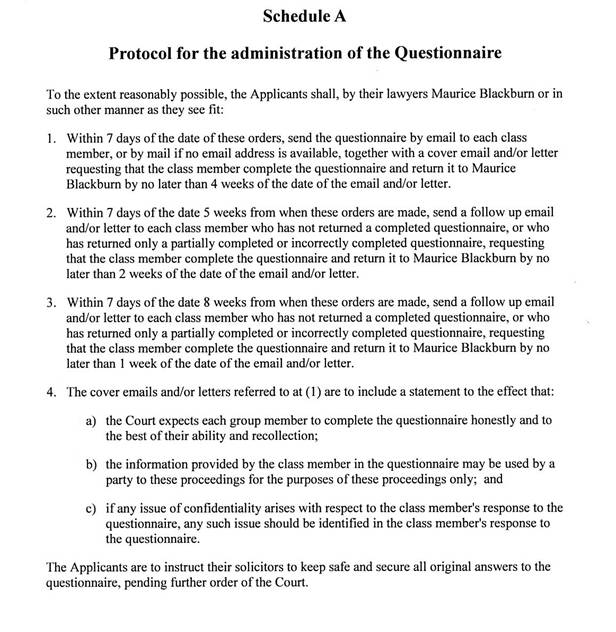
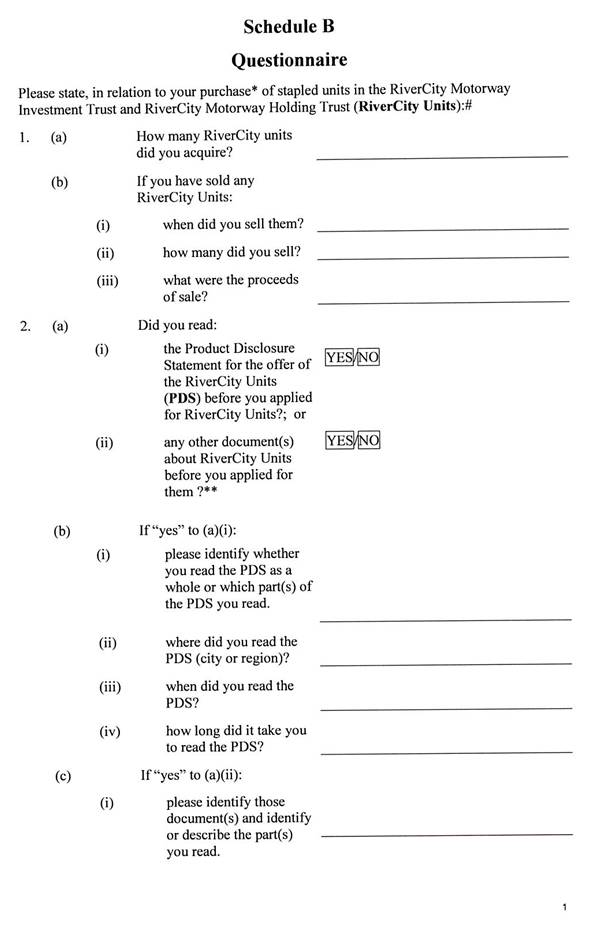
2 The questionnaire the subject of the proposed order was initially in the form attached to the relevant interlocutory application. During the course of argument, the form of the questionnaire was revised somewhat. The first respondent has also put forward a protocol for the administration of the proposed questionnaire. Copies of the proposed protocol and the proposed questionnaire appear in Schedules A and B respectively to these reasons.
3 In a previous interlocutory judgment I provided a broad outline of the nature of this proceeding (Hopkins v AECOM Australia Pty Ltd [2012] FCA 1204 at paras [3]-[5]). As I there explained, the proceeding was brought by the applicants as a representative proceeding under Part IVA of the Act on their own behalf and on behalf of a group of other persons who:
acquired an interest in stapled units in the RiverCity Motorway Investment Trust and the RiverCity Motorway Holding Trust (the Stapled Units) on or about 4 August 2006;
suffered loss or damage because of the conduct of the first respondent pleaded in the amended statement of claim; and
had entered into a litigation funding agreement with IMF (Australia) Ltd (IMF).
According to evidence from Mr Slade, the solicitor for the applicants, there are 656 persons who have entered into a litigation funding agreement with IMF who are potentially within the group. Mr Slade pointed out that they are potential group members in the sense that not all of the 656 may have suffered loss or damage because of the conduct of the first respondent as pleaded in the amended statement of claim. I accept that the relevant class is closed in the sense that it is only those who have entered into an agreement with IMF who are capable of satisfying one of the relevant criteria by which the class is defined.
4 The applicants allege they suffered loss and damage as a result of the inclusion of traffic forecasts prepared by the first respondent in a product disclosure statement (the PDS) lodged with the Australian Securities and Investments Commission (ASIC) on or about 21 June 2006 and issued on or about that date. The applicants allege that the first respondent consented to the inclusion of these traffic forecasts in the PDS. The applicants allege (inter alia) that the first respondent had no reasonable basis for making the traffic forecasts referred to in the PDS. I expect that there will be extensive expert evidence from both sides in relation to the latter allegation.
5 The causes of action pleaded in the amended statement of claim as against the first respondent are twofold. First, the applicants rely upon a statutory claim under s 1022B(2) of the Corporations Act 2001 (Cth) (the Corporations Act). Second, the applicants rely on a common law claim for negligence.
6 The proceeding is still in its early stages procedurally. The pleadings have closed, but discovery in this and related proceedings has not been completed. None of the parties has yet commenced to file written evidence. There is also a distinct possibility that one or more of the existing respondents may seek to cross claim against other parties. I should add, for completeness, that there is no mediation scheduled, and I would not ordinarily expect mediation to take place until some time after the parties had filed their written evidence.
7 There are a number of alternative ways in which the applicants have pleaded their case against the first respondent. One of these is pleaded in a way that would, if otherwise sustainable, obviate the need for group members to prove that they relied (at least directly) on the traffic forecasts included in the PDS. However, this is true of only one of the ways in which the applicants’ case has been pleaded. I therefore propose to deal with the interlocutory application on the footing that, in all probability, it will be necessary for each of the relevant group members to establish his or her reliance upon the PDS and the traffic forecasts contained in it.
RELEVANT STATUTORY PROVISIONS
8 Section 37M of the Act provides:
(1) The overarching purpose of the civil practice and procedure provisions is to facilitate the just resolution of disputes:
(a) according to law; and
(b) as quickly, inexpensively and efficiently as possible.
(2) Without limiting the generality of subsection (1), the overarching purpose includes the following objectives:
(a) the just determination of all proceedings before the Court;
(b) the efficient use of the judicial and administrative resources available for the purposes of the Court;
(c) the efficient disposal of the Court’s overall caseload;
(d) the disposal of all proceedings in a timely manner;
(e) the resolution of disputes at a cost that is proportionate to the importance and complexity of the matters in dispute.
(3) The civil practice and procedure provisions must be interpreted and applied, and any power conferred or duty imposed by them (including the power to make Rules of Court) must be exercised or carried out, in the way that best promotes the overarching purpose.
(4) The civil practice and procedure provisions are the following, so far as they apply in relation to civil proceedings:
(a) the Rules of Court made under this Act;
(b) any other provision made by or under this Act or any other Act with respect to the practice and procedure of the Court.
9 Section 33ZF(1) of the Act provides:
In any proceeding (including an appeal) conducted under this Part, the Court may, of its own motion or on application by a party or a group member, make any order the Court thinks appropriate or necessary to ensure that justice is done in the proceeding.
10 Section 37P(2) of the Act provides that “[t]he Court or a Judge may give directions about the practice and procedure to be followed in relation to the proceeding, or any part of the proceeding.”
THE PROPOSED QUESTIONNAIRE
11 The individual questions in the proposed questionnaire fall into the following categories:
Category | Questions |
1. | Questions that seek information as to how many Stapled Units were acquired by group members, and when and how many Stapled Units were sold by them (Q1(a)-(b)) |
2. | Questions that seek an indication as to whether group members read the PDS before acquiring the Stapled Units, when and where they did so, what parts of it they read, and how long it took them to do so (Q2(a)(i), (b)(i)-(iv)) |
3. | Questions that seek an indication as to what other documents group members read before applying for the Stapled Units, when and where they read such documents, what parts of them they read, and how long it took them to do so (Q2(a)(ii)), 2(c)(i)-(iv)) |
4. | Questions seeking information identifying any financial adviser who may have advised group members about investments generally, and about their investment in the Stapled Units including details of any written or oral advice that was provided by any such financial adviser (Q3(a)-(b)) |
THE FIRST RESPONDENT’S SUBMISSIONS
12 In support of the order it now seeks, the first respondent submitted that the Court has ample power to make orders for the administration of the questionnaire to group members. It drew attention not only to the broad language of s 33ZF and s 37P of the Act, but also both the Second Reading Speech to the Federal Court of Australia Amendment Bill 1991 (Commonwealth, Parliamentary Debates, House of Representatives, 14 November 1991) (the Second Reading Speech) and an Australian Law Reform Commission Report entitled Grouped Proceedings in the Federal Court (Report 46, 1988) (the ALRC Report).
13 The Second Reading Speech explained the rationale for the introduction of a scheme intended to enable the bringing of representative proceedings. The Minster said (at p 3174):
The Bill gives the Federal Court an efficient and effective procedure to deal with multiple claims. Such a procedure is needed for two purposes. The first is to provide a real remedy where, although many people are affected and the total amount at issue is significant, each person’s loss is small and not economically viable to recover in individual actions. It will thus give access to the courts to those in the community who have been effectively denied justice because of the high cost of taking action.
The second purpose of the Bill is to deal efficiently with the situation where the damages sought by each claimant are large enough to justify individual actions and a large number of persons wish to sue the respondent. The new procedure will mean that groups of persons, whether they be shareholders or investors, or people pursuing consumer claims, will be able to obtain redress and do so more cheaply and efficiently than would be the case with individual actions.
14 The ALRC Report, which preceded the Bill, anticipated that orders for particulars and discovery could be made against group members in appropriate cases. The ALRC said (at para 166):
A respondent may wish to obtain discovery against a group member of documents or things which are not in the possession or control of the principal applicant or to obtain further and better particulars directly from a group member. If such steps are permitted as of right in every case, the advantages of the principal applicant conducting group members’ proceedings will be undermined. Equally, fairness to respondents and group members indicates that the taking of such steps should be permitted where appropriate. If the Court’s leave is required before such steps could be taken, then the merits could be weighed by the Court in each case.
15 The first respondent referred me to various authorities in support of its position on this application including, in particular, McMullin v ICI Australia Operations Pty Ltd (No 6) (1988) 84 FCR 1; King v AG Australia Holdings Ltd (formerly GIO Australia Holdings Ltd) [2002] FCA 1560; Meaden v Bell Potter Securities Ltd [2011] FCA 136; Regent Holdings Pty Ltd (as trustee for the V L Halliday Investment Trust) v Victoria [2012] VSCA 221; and National Australia Bank Limited v Pathway Investments Pty Ltd (2012) 265 FLR 247. I will say something about these authorities later in these reasons.
16 The first respondent pointed to the following matters which, counsel submitted, favoured the making of the order sought at this time:
The responses to the questionnaires may assist the first respondent to identify financial advisers who provided financial advice to group members. These financial advisers may need to be joined as parties by way of cross-claims for contribution. At the very least their involvement may give rise to the need for the first respondent to plead proportionate liability defences arising out of such involvement. Early identification of facts relevant to such defences and cross-claims was said to be conducive to good case management and would secure the objectives of s 37M of the Act.
Group members’ recollections may fade especially in relation to the subject matter of questions 2(a) and (b). The first respondent drew my attention to the fact that the proceeding was not commenced until about 6 years after the allotment of the Stapled Units occurred.
At a more general level, the provision of the information sought will assist in the refinement of the issues in dispute, efficient case management and may also facilitate a resolution of the proceeding earlier than might otherwise be the case.
17 It was accepted by counsel for the first respondent during the course of the argument that it would not have been negligent for a financial adviser merely to have recommended to group members that they invest in the Stapled Units. Precisely what potential liability a financial adviser may have to a group member as a result of the group member investing in the Stapled Units was not made clear in argument. However, I am prepared to assume for the purposes of argument that a financial adviser who advised an individual group member to invest in the Stapled Units imprudently (eg. without adequate diversification or with borrowed funds) might be liable for loss suffered as a result of the group member relying upon such advice.
18 It was suggested in the first respondent’s written submissions that the first respondent may suffer prejudice if it is unable to join financial advisers as parties to the proceeding before there had been any initial trial of the common issues. In this regard, the first respondent’s written submissions included a somewhat oblique reference to potential limitation problems in the following terms:
24. Section 33ZE of the Act suspends limitation periods for group members concerning claims made by a group member in the proceedings. It does not suspend the running of time for cross claims that may be brought by the respondent or to claims by a group member against third parties who are not respondents to the proceedings.
25. The Applicants commenced these proceedings just prior to 6 years after the PDS was issued in June 2006. To wait an indefinite period of time to identify potential concurrent wrongdoers or persons who may be the subject of a cross claim for contribution is, in the circumstances, unjust. As Wilcox J held in McMullin v ICI Australia Operations Pty Ltd (No 6) (1998) 156 ALR 257 at 260:
I think an order fixing a date by which claimants must identify themselves is capable of falling within s 33ZF(1). The criterion “justice is done”, involves consideration of the position of all parties. An order preventing unfairness to a particular party may be necessary to ensure justice is done in the proceeding.
Here the first respondent does not seek an order “closing the class”. What I take from the first respondent’s reference to Wilcox J’s decision in McMullin is that the orders sought should in this case be made in order to avoid unfairness to the first respondent.
19 In oral submissions it was accepted by counsel for the first respondent, correctly in my view, that any proportionate liability defence under any applicable State or Territory legislation that may be open to the first respondent to rely upon in the case of any particular group member would not be defeated by the passage of time. However, it was submitted that such a defence is not available in relation to the statutory cause of action relied upon by the applicants and that the first respondent will instead be left to proceed by way of cross-claim for contribution against potential concurrent wrongdoers.
CONSIDERATION
20 The authorities to which the first respondent referred me make clear that the Court has ample power to make the order sought. The question for me is whether, in the exercise of my discretion, I should make such an order. I am not satisfied that it would be in the interests of justice for me to do so at this stage of the proceeding in relation to all group members. However, as will be seen, I think it is desirable that the questionnaire be administered to group members who were either resident or based in Victoria or Tasmania in or about June, July or August 2006. I will explain why I have come to this view.
Category 1
21 In my view the information referred to in category 1 is not required for the purposes of the just or efficient conduct of this proceeding at this stage. The first respondent has filed a defence denying that it has any liability to the applicants (and, a fortiori, the group members) on the basis that it had reasonable grounds to make the traffic forecasts included in the PDS. Whether or not the first respondent lacked reasonable grounds, as the applicants contend, is a central issue in this proceeding and in the related proceedings and will be the subject of an initial trial. In my view, the just and efficient management of this proceeding and the related proceedings will be best served by having this issue (“the reasonable grounds issue”) resolved at an initial trial as soon as is reasonably practicable. Allowing the first respondent to question all group members about the matters to which the questionnaire is directed so early in the proceeding is likely to create an unnecessary distraction that will not assist in the preparation for a hearing of the reasonable grounds issue or any other issues that may be appropriate for determination at an initial trial. It will also require the applicants’ solicitors to incur substantial costs that might never need to be incurred depending upon the outcome of the initial trial.
22 As to the possibility of mediation, it seems to me that the proceeding is not yet even close to the point at which an order requiring the parties to mediate their dispute would ordinarily be made. Nor has any party suggested to me that there would be any purpose served in requiring the parties to mediate before the written evidence to be relied upon at an initial trial has been filed.
Categories 2 and 3
23 As to categories 2 and 3, I am not persuaded that it is either necessary or desirable that all group members be required to answer questions aimed at eliciting the information encompassed by these categories at this stage of the proceeding. If the reasonable grounds issue is determined in the applicants’ favour, it may then be necessary for group members to submit evidence which provides at least some of the information encompassed by categories 2 and 3. But at this stage of the proceeding there does not seem to me to be any real justification for requiring all group members to provide such information.
24 Prima facie, the 656 group members (who are not actual parties) should not be required to take any step in the proceeding unless some good reason exists for requiring them to do so having regard to the stage that the proceeding has now reached. As Finkelstein J observed in P Dawson Nominees Pty Ltd v Brookfield Multiplex Limited (No 2) [2010] FCA 176 at paras [16]-[17]:
16 Although there is a power to make the orders sought under s 33ZF(1), it is another matter whether that power should be exercised. The starting point is that the class actions regime under Part IVA of the Federal Court Act is designed to require little or no active involvement by group members. A group member is a group member principally for the limited purposes of taking the benefit, or suffering the burden, of findings on common questions (ie questions that are common to the claim brought by the named applicant and claims that may be pressed by group members). In an action where money relief may be sought by a group member, the group member will generally only be required to provide specifics about the quantum of his or her claim after the common questions have been resolved and that may be in a separate action.
17 Given the intent of the class action regime, there must be some compelling reason demonstrated before a court will order group members to go beyond their otherwise essentially passive role.
25 Subject to what is said below concerning the category 4 questions, and a particular sub-class of the group that requires special consideration, I do not think there is sufficient reason to require group members to respond to the questionnaire at this stage of the proceeding.
Category 4
26 This brings me to the possibility of cross-claims being raised based upon the involvement of group members’ financial advisers in the group members’ decisions to acquire interests in the Stapled Units.
27 The first respondent appears to be correct in its contention that a claim made under s 1022B(2) of the Corporations Act is not an apportionable claim for the purposes of Pt 7.10, Div 2A of the Corporations Act. Section 1041L(1) of the Corporations Act refers to a claim for damages under s 1041I, but not a claim for damages under s 1022B(2). In the present case, the applicants do not rely upon s 1041I of the Corporations Act. Further, it is doubtful whether Pt IV of the Civil Liability Act 2002 (NSW) or comparable legislation of the other States and Territories would apply to a claim for damages under s 1022B(2) of the Corporations Act. Such legislation could only apply if it had been “picked up” for this purpose by s 79 of the Judiciary Act 1903 (Cth): see Dartberg Pty Ltd v Wealthcare Financial Planning Pty Ltd (2007) 164 FCR 450 at paras [20]-[36] (Middleton J).
28 In those circumstances, the first respondent’s argument seems to be that it is in the interests of the just and efficient management of the proceeding that it be given access to information it says it needs in order to consider the possibility of bringing cross-claims for contribution against financial advisers who may have had some involvement in the decision by group members to invest in the Stapled Units. And it is in this context that the first respondent’s submissions seem to suggest that any claims for contribution that may be available to it might become statute barred with the passage of time and before the first respondent can obtain access to the information needed to consider and formulate such claims.
29 One difficulty I have with the first respondent’s argument is that the possibility of cross-claims being filed against the group members’ financial advisers is completely speculative. In addition, it is doubtful whether the information sought, even if provided by group members, could itself provide any proper basis for the bringing of such a cross-claim. Assuming that a group member acknowledged in response to the questionnaire that he or she had received advice from a financial adviser to acquire Stapled Units, the question of whether or not a proper basis for filing any such cross-claim existed is not something that could be determined simply on the basis of the responses provided. That question could only be decided after there had been some analysis of the group member’s individual circumstances and the basis upon which any advice to the group member had been given and received.
30 There are other difficulties with the first respondent’s argument in so far as it is suggested that the first respondent may have claims for contribution available to it which will become statute barred with the passage of time.
31 A claim under s 1022B(2) of the Corporations Act is not a claim in tort. A claim under s 5(1)(c) of the Law Reform (Miscellaneous Provisions) Act 1946 (NSW) (the NSW Act) will only arise where the person seeking contribution and the person from whom it is sought is each a “tortfeasor” liable in respect of the same damage. This is equally true of the contribution legislation in Queensland, Western Australia and the Northern Territory: see s 6(c) Law Reform Act 1995 (Qld), s 7(c) Law Reform (Contributory Negligence and Tortfeasors’ Contribution) Act 1947 (WA) and s 12(4) Law Reform (Miscellaneous Provisions) Act 1956 (NT). The comparable legislation in the Australian Capital Territory is expressed in slightly wider terms but is not materially different for present purposes: see s 19 (in particular the definition of “wrong”) and s 21 of the Civil Law (Wrongs) Act 2002 (ACT).
32 The contribution legislation in force in Victoria, South Australia and Tasmania is expressed in terms that may extend to liability arising under s 1022B(2) of the Corporations Act: see s 23A and s 23B of the Wrongs Act 1958 (Vic), s 4 and s 6 of the Law Reform (Contributory Negligence and Apportionment of Liability) Act 2001 (SA) and s 2 and s 3(1)(c) of the Wrongs Act 1954 (Tas). That being so, it is necessary to say something about the applicable limitation provisions in each of those jurisdictions.
33 Under Victorian legislation, the relevant limitation period is prescribed by s 24(4) of the Wrongs Act 1958 (Vic). Section 24(4) relevantly provides:
… where under section 23B any person becomes entitled to a right to recover contribution in respect of any damage from any other person, proceedings to recover contribution by virtue of that right may be commenced by the first-mentioned person–
(a) at any time within the period–
(i) within which the action against the first-mentioned person might have been commenced; or
(ii) within the period of twelve months after the writ in the action against the first-mentioned person was served on him–
whichever is the longer; or
(b) where another person liable in respect of that damage, within the period within which the action against him might have been commenced or within twelve months after the writ in the action was served on him, serves a writ on the first-mentioned person seeking to recover contribution in respect of that damage from the first-mentioned person–at any time within the period of six months after that writ is so served.
34 If it is assumed that the cause of action under s 1022B(2) of the Corporations Act arose on or about 4 August 2006 when group members acquired their interests in the Stapled Units, and that the originating process (which was issued on 31 May 2012) was served upon the first respondent in or about June 2012 (as seems likely) then, by virtue of s 24(4)(a), the relevant limitation period will not expire until in or about June 2013.
35 In Tasmania, the relevant limitation period is fixed by s 3(5) and (6) of the Wrongs Act 1954 (Tas). Section 3(5) and (6) provide:
(5) Notwithstanding any provisions of any enactment requiring notice of damage or injury to be given, or notice of an intended action to be given, or limiting the time within which an action may be brought, proceedings for contribution under this section may, although notice of damage or injury, or notice of an intended action, as the case may be, has not been given, or the time so limited has expired, be commenced at any time within the period of twelve months (or within such extended period as may be allowed pursuant to subsection (6) of this section) after the writ in the original action was served on the person seeking to recover contribution.
(6) A judge, magistrate or any other person constituting or presiding over a court of competent jurisdiction, on the application of a person seeking to recover contribution under this section, may, in his discretion and subject to such conditions (if any) as he may impose, extend the period within which proceedings for recovery of contribution shall be commenced, notwithstanding that the period prescribed in subsection (5) of this section may have expired, if he is satisfied that the person from whom contribution is sought to be recovered will not be prejudiced in his defence by reason of the extension.
36 It follows that the relevant limitation period established under the Tasmanian legislation will also expire in or about June 2013, but that this may be extended by a court exercising the power conferred by s 3(6) in an appropriate case.
37 In South Australia, the relevant provisions are found in s 6(3) and (4) of the Law Reform (Contributory Negligence and Apportionment of Liability) Act 2001 (SA). Section 6(3) and (4) provide:
(3) An action for contribution may be brought–
(a) by way of third party proceedings, or proceedings between the parties, in an action in which damages are sought from the person entitled to contribution; or
(b) by way of a separate action brought within the relevant time limit against the person from whom contribution is sought.
(4) The relevant time limit is the longer of the following–
(a) the period within which the person who suffered the harm could have brought an action against the person from whom contribution is sought;
(b) 2 years after the damages payable by the person entitled to contribution are finally determined.
38 It seems that there is no danger of the limitation period prescribed by the South Australian legislation expiring until 2 years after the amount of any damages payable to a group member is finally determined.
39 Against that background, I can see that there is a real possibility that the first respondent might be prejudiced if it was not able to bring cross-claims for contribution against the financial advisers of group members who were resident or based in Victoria or Tasmania at the time they decided to invest in the Stapled Units. Were it not for the possibility of such cross-claims becoming statute barred in the near future, I would not require the applicants’ solicitors to issue the questionnaire to any of the group members. However, to guard against the possibility of prejudice to the first respondent as a result of an applicable limitation period expiring, I am presently minded to make an order requiring the applicants’ solicitors to take reasonable steps to ascertain which group members were either resident or based in Victoria or Tasmania in or about June, July or August 2006 and to submit the questionnaire to any such group member in accordance with the protocol proposed by the first respondent. Although what I propose seems to me to be the best way forward in the circumstances, I am open to considering other approaches aimed at addressing the problem that has been identified.
40 Since group members who were resident or based in Victoria or Tasmania in June, July or August 2006 will be expected to respond to at least some questions, I do not see any serious difficulty in having the questionnaire cover various topics, even if not directly related to the involvement of financial advisers. But there are some questions that should be removed from the proposed questionnaire on the basis that they travel beyond what I think group members should have to provide at this stage of the proceeding. In this regard, I think that questions 2(a)(ii), 2(b)(iv), 2(c)(i)-(iv) and 3(a) should be deleted.
DISPOSITION
41 I will simply direct that the parties’ legal representatives confer with a view to reaching agreement on a proposed form of order that takes account of the views expressed in these reasons.
I certify that the preceding forty-one (41) numbered paragraphs are a true copy of the Reasons for Judgment herein of the Honourable Justice Nicholas. |
Associate: