FEDERAL COURT OF AUSTRALIA
Webuildem Pty Ltd v Arab Bank Australia Limited [2013] FCA 37
IN THE FEDERAL COURT OF AUSTRALIA | |
WEBUILDEM PTY LTD (ACN 102 786 621) Applicant | |
AND: | ARAB BANK AUSTRALIA LIMITED (ABN 37 002 950 745) Respondent |
DATE OF ORDER: | |
WHERE MADE: |
THE COURT ORDERS THAT:
1. The Originating Application filed by the applicant on 30 July 2012 and all claims made therein and in the applicant’s Statement of Claim be dismissed.
2. The applicant pay the respondent’s costs of and incidental to this proceeding (including its costs of and incidental to its Interlocutory Application filed herein on 20 August 2012) on an indemnity basis.
Note: Entry of orders is dealt with in Rule 39.32 of the Federal Court Rules 2011.
NEW SOUTH WALES DISTRICT REGISTRY | |
GENERAL DIVISION | NSD 1065 of 2012 |
BETWEEN: | WEBUILDEM PTY LTD (ACN 102 786 621) Applicant
|
AND: | ARAB BANK AUSTRALIA LIMITED (ABN 37 002 950 745) Respondent
|
JUDGE: | FOSTER J |
DATE: | 31 JANUARY 2013 |
PLACE: | SYDNEY |
REASONS FOR JUDGMENT
1 The applicant (Webuildem) commenced this proceeding on 30 July 2012 by the filing of an Originating Application and a Statement of Claim. In this proceeding, Webuildem claims against the respondent (the bank) a declaration, damages pursuant to s 236 of the Australian Consumer Law (ACL) and costs.
2 On 20 August 2012, the bank filed an Interlocutory Application by which it seeks an order pursuant to r 26.01 of the Federal Court Rules 2011 (FCR) that the whole of this proceeding be summarily dismissed or, alternatively, an order pursuant to r 16.21(1)(f) FCR that Webuildem’s Originating Application and Statement of Claim both be struck out as constituting an abuse of the process of the Court. The bank also seeks costs against Webuildem on an indemnity basis. These Reasons for Judgment determine the bank’s Interlocutory Application.
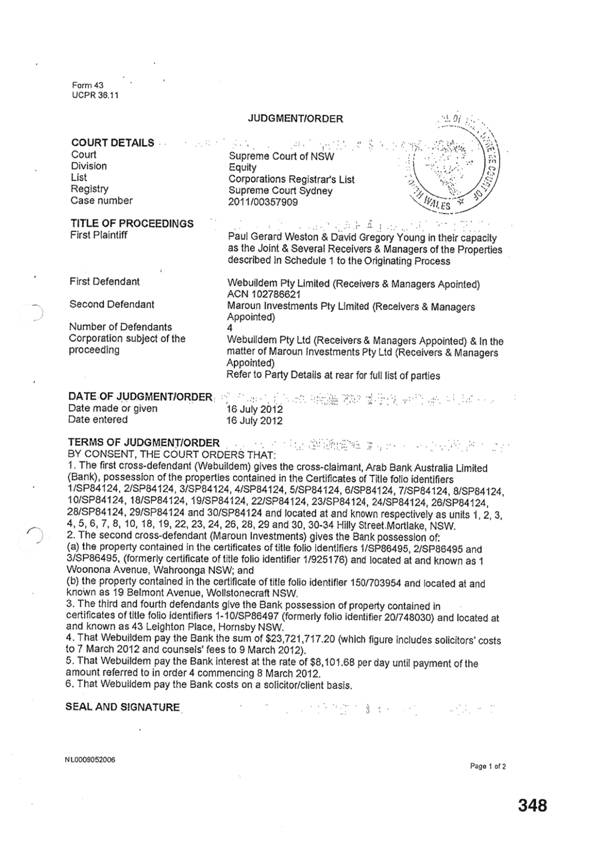
3 The basis upon which the bank claims to be entitled to the relief which it seeks in its Interlocutory Application is quite simple: The bank contends that Webuildem is now precluded from making any of the claims which it seeks to litigate in the present proceeding because all of those claims were raised by Webuildem by way of Cross-Claim in proceedings brought by the receivers and managers of certain properties, as plaintiffs, against Webuildem and others, as defendants, in the Supreme Court of New South Wales (the Supreme Court proceedings) and were finally determined by that Court when, on 16 July 2012, it entered final orders in those proceedings (the 16 July 2012 orders). Those orders were made to give effect to a settlement of the Supreme Court proceedings reached earlier in 2012, namely, on 7 March 2012.
The Steps Taken in the Supreme Court Proceedings
4 There is no dispute between the parties as to the nature of the Supreme Court proceedings, the issues raised therein or the terms upon which they were compromised. The single issue between the parties is: What was the effect of the settlement and of the 16 July 2012 orders made pursuant to that settlement. What follows in this section of these Reasons for Judgment is, I trust, an uncontroversial account of the relevant facts, matters and circumstances.
5 By letter of offer dated 12 March 2008 (the first loan facility) the bank agreed to lend to Webuildem the sum of $10 million. These funds were to be used to acquire the properties known as 30–34 Hilly Street, Mortlake, NSW (the Mortlake properties). By a second letter of offer dated 19 June 2008 (the second loan facility), the bank agreed to lend to Webuildem $28 million. This loan was to be used to construct a residential apartment building on the Mortlake properties.
6 The second loan facility replaced the first loan facility.
7 The first loan facility was secured by, amongst other things:
(a) A registered first mortgage over the Mortlake properties (the Mortlake mortgage);
(b) A registered first mortgage over the property known as 1 Woonona Avenue, Wahroonga, NSW, owned by Maroun Investments Pty Limited (the Wahroonga mortgage);
(c) A registered first mortgage over the property known as 43 Leighton Place, Hornsby, NSW owned by George Maroun Rahme and Nouha Rahme (the Hornsby mortgage); and
(d) An unregistered first ranking mortgage over the property known as 1 William Street, Double Bay, NSW.
8 The second loan facility was secured by, amongst other things, the Mortlake mortgage, the Wahroonga mortgage, the Hornsby mortgage and a registered first mortgage over the property known as 19 Belmont Avenue, Wollstonecraft, NSW, owned by Maroun Investments Pty Limited (the Wollstonecraft mortgage) (together called the securities).
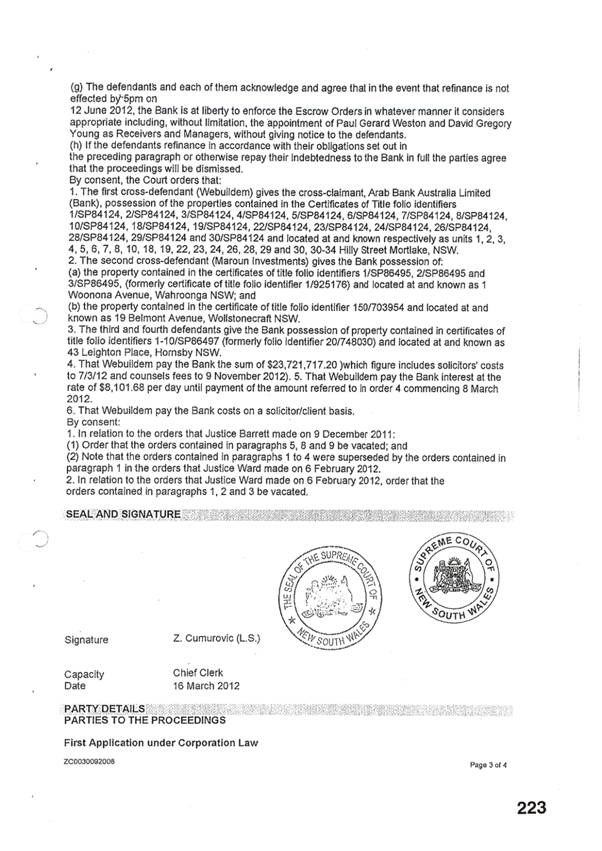
9 Webuildem and Maroun Investments Pty Limited were corporations controlled by GM and N Rahme.
10 The terms of the second loan facility were subsequently varied on several occasions.
11 The second loan facility was replaced by a third loan facility for $28 million made available to Webuildem by letter of offer dated 26 August 2010 (the third loan facility). The third loan facility was secured by (amongst other things) the securities.
12 The third loan facility was replaced by a fourth loan facility for $24,489,000 made available to Webuildem by letter of offer dated 2 March 2011 (the final loan facility). This facility was also secured by (amongst other things) the securities. The amount of the final loan facility was repayable on 14 August 2011.
13 Webuildem did not repay to the bank the moneys advanced to it pursuant to the final loan facility by the due date of 14 August 2011. That failure was an event of default under the final loan facility and under the securities.
14 On 30 August 2011, the bank appointed Paul Gerard Weston and David Gregory Young (the receivers) as joint and several receivers and managers over each of the properties secured by the securities.
15 On 9 November 2011, the receivers commenced the Supreme Court proceedings. The receivers were the only plaintiffs in those proceedings. The Originating Process was filed in the Equity Division (Corporations List) of the Supreme Court of New South Wales (No 357909 of 2011). The defendants were Webuildem (first defendant), Maroun Investments Pty Limited (second defendant), GM Rahme (third defendant) and N Rahme (fourth defendant).
16 The bank was not a party to the Supreme Court proceedings when those proceedings were commenced.
17 In the Supreme Court proceedings, the receivers sought declarations to the effect that they had been validly appointed and that they had all of the powers and functions of receivers and managers appointed under the various mortgages which comprised the securities. They also sought possession of the properties mortgaged under the securities, delivery up of certain books and records kept by Webuildem in relation to those properties and costs.
18 The hearing of the receivers’ claims was initially fixed for 6 December 2011 before Barrett J.
19 On the morning of 6 December 2011, the defendants served upon the solicitor for the bank a draft Interlocutory Process and an affidavit affirmed that day to which was exhibited a large number of documents. Service of those documents at that time resulted in an adjournment of the hearing of the receivers’ claims and a rescheduling of the hearing of those claims.
20 On 22 December 2011, pursuant to leave granted by Barrett J on 9 December 2011, the defendants filed an Interlocutory Process (the defendants’ Cross-Claim). In substance, that process was a Cross-Claim against the receivers and the bank. The bank was joined as a cross-defendant in the proceeding by that process.
21 In December 2011, r 2.2(1)(b) of the Supreme Court (Corporations) Rules 1999 (NSW) provided:
(1) Unless these Rules otherwise provide, a person must make an application required or permitted by the Corporations Act to be made to the Court:
…
(b) in any other case [referring to the case where a proceeding has already been commenced in the Court] and whether interlocutory relief or final relief is claimed—by filing an interlocutory process.
22 Rule 2.2(4) provided that an interlocutory process must be in accordance with Form 3 of the forms incorporated in the Supreme Court (Corporations) Rules, state the statutory provisions relied upon and specify the relief sought.
23 In their Cross-Claim, the defendants relied upon s 912A and s 1324 of the Corporations Act 2001 (Cth) and upon ss 4, 18, 232, 236 and 243 of the ACL and s 42 of the Fair Trading Act 1987 (NSW).
24 If the defendants wanted to litigate in the Supreme Court proceedings the substantive case which they had pleaded in their Cross-Claim, they had to do so by way of an interlocutory process. That requirement, being merely procedural, could not and did not change the nature of the relief which they sought.
25 There is no doubt that the relief claimed by the defendants in their Cross-Claim was final relief. In particular, the damages claims made by Webuildem in that Cross-Claim were claims for final relief.
26 On 27 January 2012, the receivers and the bank filed Points of Defence in answer to the defendants’ Cross-Claim. On the same day, the bank also filed an Interlocutory Process by which it claimed against Webuildem judgment for the outstanding debt, interest and costs, and against the other cross-defendants possession of the properties mortgaged under the securities and costs. These claims made by the bank were also claims for final relief. On 15 February 2012, the defendants filed Points of Defence in answer to the bank’s Interlocutory Process. In that pleading, amongst other things, they raised by way of defence the same matters as they had pleaded in the defendants’ Cross-Claim.
27 On 9 December 2011, all of the claims foreshadowed by the bank and made by the receivers as well as the defendants’ claims against the bank and the receivers ultimately made in their Cross-Claim were fixed for final hearing on 7 March 2012. On the same day, other orders were made in order to facilitate access to the properties mortgaged under the securities and to ready the matter for hearing.
28 The defendants filed several affidavits in support of the claims made by them in the defendants’ Cross-Claim and in support of their defences to the claims made against them by the bank and by the receivers. Those affidavits were:
(a) Affidavit of Jacob Rebek affirmed on 6 December 2011;
(b) Affidavit of Jacob Rebek affirmed on 31 January 2012;
(c) Affidavit of Maroun George Rahme affirmed on 31 January 2012; and
(d) Affidavit of Maroun George Rahme affirmed on 7 March 2012.
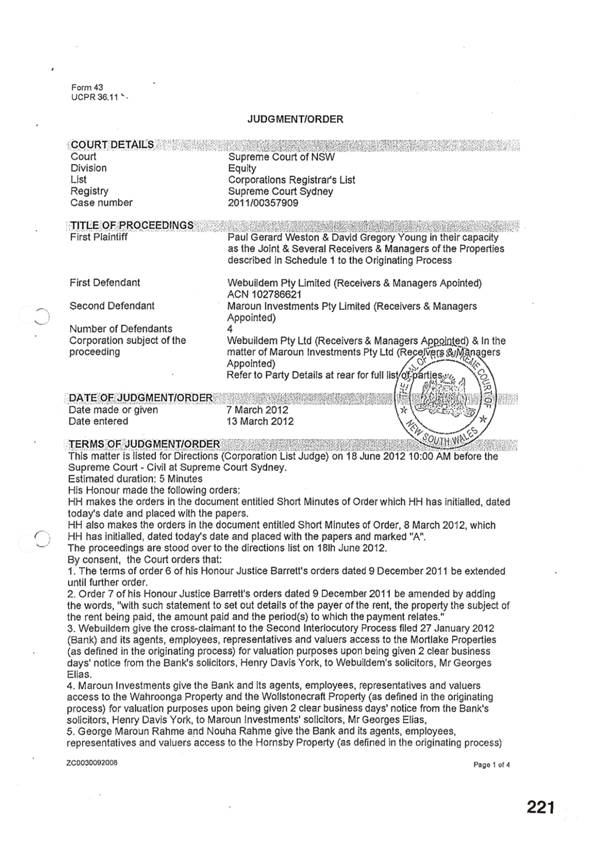
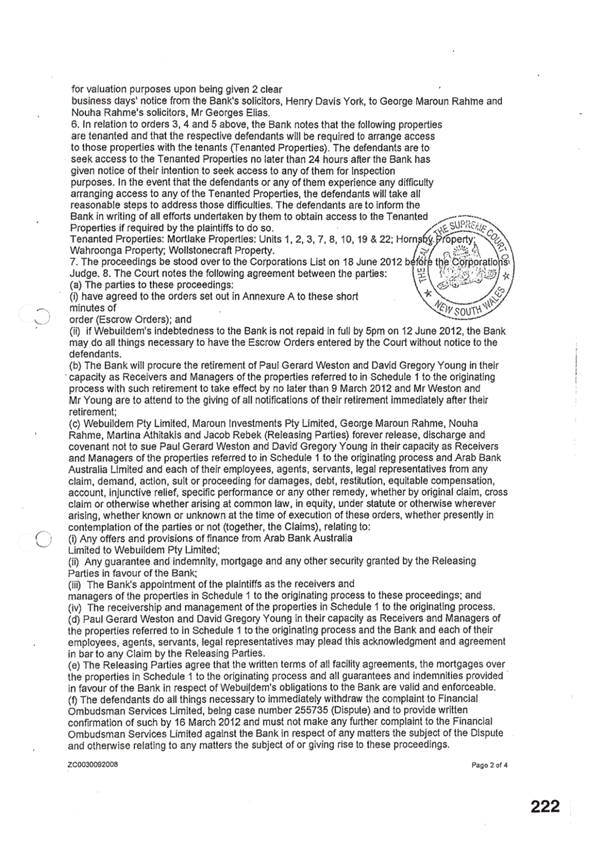
29 On 7 March 2012, the hearing of the Supreme Court proceedings commenced. On that day, after extensive negotiations among the parties, the proceedings were settled in principle. The parties and some of the legal representatives then signed Short Minutes of Consent Orders dated 7 March 2012. That document recorded the terms of the settlement reached among the parties. Attached to these Reasons for Judgment as Attachment “A” is a true copy of orders made by the Supreme Court on 8 March 2012 (incorrectly shown as having been made on 7 March 2012) and entered on 13 March 2012. These orders recorded and gave effect to the in principle settlement reached on 7 March 2012. The material set out in the paragraphs numbered 1 to 6 on the last page of Attachment “A” constitutes Annexure “A” to the Supreme Court orders which annexure is described as the “Escrow Orders” in paragraphs 8(a)(i), 8(a)(ii) and 8(g) on page 2 of those orders. Unfortunately, when the orders were entered, certain headings appearing in the agreed Short Minutes of Order prepared and signed by the parties were omitted. However, there can be no dispute as to the terms of the Escrow Orders when regard is had to the agreed Short Minutes of Order dated 7 March 2012.
30 The terms set out in subpars 8(a)(ii) and 8(g) were fundamental components of the settlement reached on 7 March 2012 among the parties to the Supreme Court proceedings. They provided that, if Webuildem’s indebtedness to the bank was not repaid in full by 5.00 pm on 12 June 2012, the bank was at liberty to do all things necessary to have the Escrow Orders entered by the Court and then enforced without notice to the defendants.
31 On 12 June 2012, the defendants filed a second Interlocutory Process. By that process, they sought orders setting aside the settlement agreement reached on 7 March 2012 and the orders made on 8 March 2012. Alternatively, they sought a temporary stay of those orders until further order. They also claimed declaratory relief in relation to the correct amount due from Webuildem to the bank as at June 2012.
32 On 27 June 2012, Black J delivered Reasons for Judgment in respect of the defendants’ Interlocutory Process filed on 12 June 2012 (Re Webuildem Pty Ltd [2012] NSWSC 708). On the same day, his Honour made an order dismissing that process. His Honour stayed the operation of that order up to 4.00 pm on 4 July 2012. After 4 July 2012, the bank was to be free to enter and to enforce the Escrow Orders set out in Annexure “A” to the orders made by the Supreme Court on 8 March 2012.
33 On 11 July 2012, the New South Wales Court of Appeal dismissed an application by the defendants for leave to appeal from the judgment of Black J given on 27 June 2012 (Webuildem Pty Limited v Arab Bank Australia Ltd [2012] NSWCA 242). In the course of his reasons for Judgment in the Court of Appeal, Barrett JA observed that the stay application which had been decided by Black J was interlocutory and that there had been no application by the defendants for final orders seeking to set aside the settlement agreement reached with the bank on 7 March 2012 and embodied in the orders made on 8 March 2012. His Honour also remarked (at [25]) that, were the defendants to make such an application, they would confront “… very formidable obstacles”. Allsop ACJ agreed with Barrett JA.
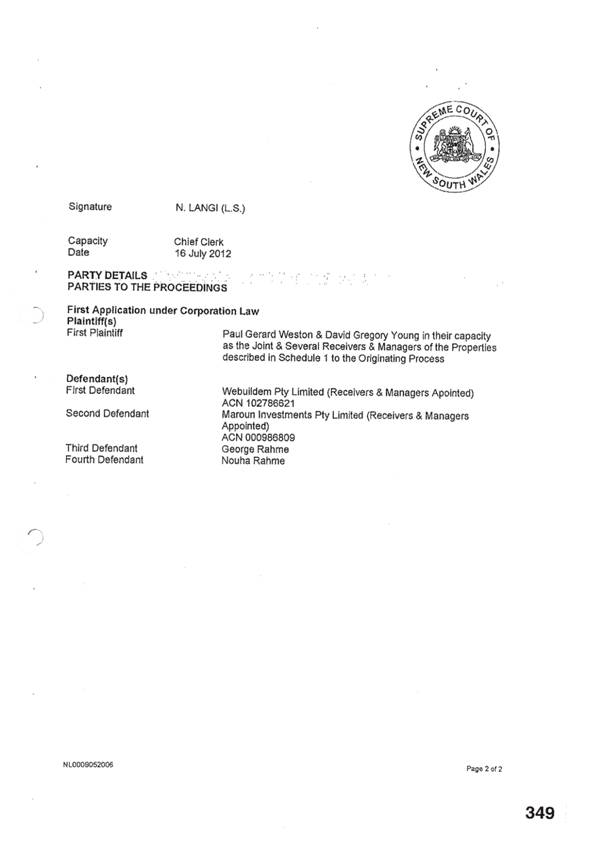
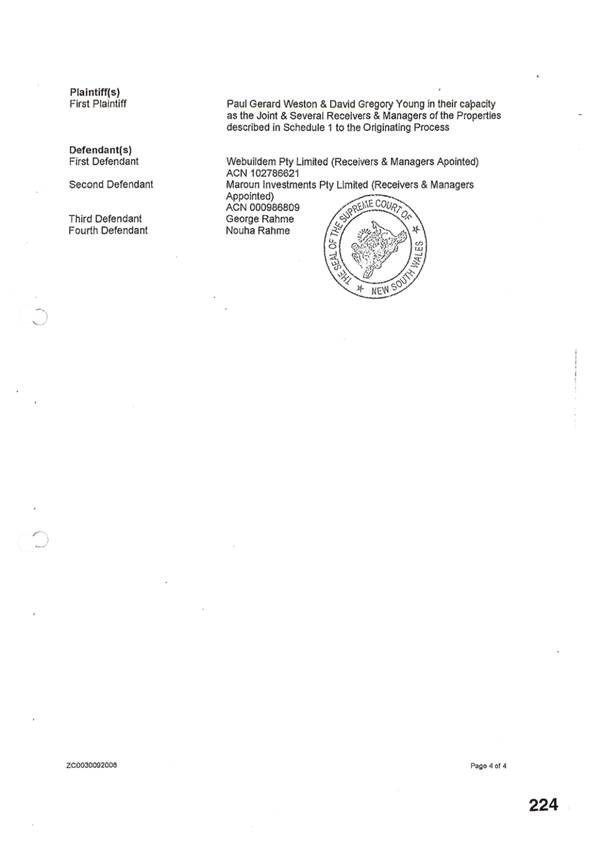
34 On 16 July 2012, the Escrow Orders were entered by the Supreme Court of New South Wales. I have attached as Attachment “B” to these Reasons for Judgment a true copy of the 16 July 2012 orders.
The Bank’s Letter of Demand
35 By letter dated 7 August 2012, from the solicitors for the bank to the solicitors for Webuildem, the bank’s solicitors explained in considerable detail why the present proceeding was an abuse of process, was bound to fail and ought to be summarily dismissed. After reciting the history of the Supreme Court proceedings and recording the important events which occurred in those proceedings, the bank’s solicitors said:
The First and Second Interlocutory Processes and the corresponding Points of Defence record that, without limitation, the following issues were in dispute and were for determination by the Court at the hearing on 7 March 2012:
(a) the quantum of the debt owed to the Bank by the applicant and secured by the mortgages over relevant properties;
(b) whether the Bank had overcharged interest on the amount owed to the Bank by the applicant; and
(c) whether the Defendants, including the applicant, were entitled to any relief in respect of the various misrepresentations alleged against the Bank.
A number of affidavits were filed and served in support of each side’s case.
The Bank and the Receivers relied upon the following evidence:
(a) the affidavit of Jason Lloyd Porter sworn 8 November 2011 and Exhibit JLP1 to Mr Porter’s affidavit;
(b) the affidavit of Robert William Duff sworn 28 February 2012;
(c) the affidavit of Ran Tao affirmed 28 February 2012 and Exhibit RT2 to Mr Tao’s affidavit;
(d) the second affidavit of Mr Porter sworn 29 February 2012; and
(e) the affidavit of Mark John Sykes sworn 1 March 2012 and Exhibit MS1 to Mr Sykes’ affidavit.
The Defendants relied upon the following evidence:
(a) the affidavit of Jacob Rebek affirmed 6 December 2011 and the folder of exhibits to Mr Rebek’s affidavit;
(b) the affidavit of Maroun George Rahme affirmed 31 January 2012 and the exhibits to Mr Rahme's affidavit;
(c) the second affidavit of Mr Rebek affirmed 31 January 2012 and the exhibits to Mr Rebek’s affidavit;
(d) the second affidavit of Maroun George Rahme affirmed 7 March 2012 and the exhibits to Mr Rahme’s affidavit.
If you are otherwise unable to access a copy of the above affidavits, please contact our office to arrange a time for you to inspect and photocopy the affidavits (at reasonable cost).
The Supreme Court Proceedings were listed for hearing before Hammerschlag J commencing 7 March 2012. Both parties were represented by Senior Counsel, junior counsel and solicitors.
After a full day of negotiations, the Supreme Court Proceedings were settled in accordance with a document titled “Short Minutes of Order”. We enclose the Short Minutes of Order as signed by the parties’ legal representatives, and the Court’s sealed copy of the orders.
By further Interlocutory Process filed 12 June 2012, the Defendants sought to stay the entry of orders agreed between the parties on 7 March 2012 finalising the Supreme Court Proceedings. The interlocutory process was heard by Black J on 22 June 2012 and his Honour delivered Judgment dismissing the Interlocutory Process on 27 June 2012. A copy of the judgment is enclosed with this letter. The Defendants then filed a Summons Seeking Leave to Appeal Justice Black’s decision (NSW Court of Appeal proceedings no. 2012/207040). The Summons Seeking Leave to Appeal was heard on 11 July 2012 before Allsop ACJ and Barrett JA. Their Honours dismissed the Summons and delivered separate ex tempore reasons (which, at the time of this letter, remain unpublished).
On 16 July 2012, the orders agreed between the parties on 7 March 2012 were entered. Those orders resolved with finality all controversies upon which the parties had joined issue in the Supreme Court Proceedings.
2. The Proceedings
It is apparent from the history of the Supreme Court Proceedings set out above that the originating application and statement of claim filed in the Proceedings constitute a bald attempt by the applicant to re-litigate issues determined in the Supreme Court Proceedings.
It is trite law that the doctrine of res judicata will prevent a party from litigating a cause of action determined in an earlier proceeding and, likewise, that a party will be estopped from litigating issues that were determined in earlier proceedings. These doctrines apply to consent orders which give judicial sanction and coercive authority to agreements between parties (see, by way of example, Chamberlain v Deputy Commissioner of Taxation (1988) 164 CLR 502 at 508).
The relevant cause of action having merged in the judgment obtained by the Bank and entered on 16 July 2012, it is not competent for the applicant to bring the Proceedings in respect of the same cause of action. To the extent that prayer 1 of the originating application seeks to circumvent the agreement between the parties it is misconceived. Having already obtained judgment on the cause of action and issues pleaded in the statement of claim, the Bank has no need to call in aid the releases evidenced by paragraphs 8(c) and (d) of the Short Minutes of Order agreed on 7 March 2012. In any event, we are of the view that there is no jurisdictional basis for the Court to make the declaration sought and on 7 August 2012 we separately wrote to you in this regard.
The Proceedings accordingly constitute an abuse of process and the statement of claim is liable to be struck out pursuant to r 16.21 of the Federal Court Rules 2011 and summary judgment entered in favour of the Bank pursuant to r 26.01.
3. Offer
In order to prevent any further costs being incurred in respect of the Proceedings, the Bank will consent to orders in the following form:
(a) The applicant’s originating application and statement of claim be dismissed.
(b) No order as to costs with the intent that each party bears its own costs.
The above offer is open for acceptance until 4.00pm on 14 August 2012, at which time the offer lapses and is no longer open for acceptance.
The offer is a significant compromise by the Bank in circumstances where the Bank has been put to the expense of obtaining legal advice to consider the applicant’s claim and to respond to it.
We confirm that this offer is made in accordance with the principles in Calderbank v Calderbank [1976] Fam 93 and section 131(2)(h) of the Evidence Act (Cth).
In the event that this offer is not accepted and the Bank obtains a judgment in the Proceedings no less favourable to it than this offer, the Bank intends to produce this letter to the Court in relation to the question of costs. The Bank will seek an order that the applicant pay its costs of the Proceedings on an indemnity basis from the date of this letter (and without prejudice to the Bank’s right to otherwise seek costs on an indemnity basis for all of its costs of and incidental to the Proceedings)
In circumstances where the Proceedings have no prospects of success and constitute a clear abuse of process, the Bank reserves its right, in light of the matters set out in this letter, to seek an order pursuant to s 43 of the Federal Court of Australia Act 1976 (Cth) that the applicant’s legal representatives pay the Bank’s costs of the Proceedings on an indemnity basis.
The Bank reserves its rights generally.
The Defendants’ Case in the Supreme Court
36 In their Cross-Claim, the defendants pleaded that, in about late February or early March 2008, in the course of the negotiations which took place between the bank and Webuildem, representatives of the bank made false representations to Mr Rahme and others in contravention of s 4 and s 18 of the ACL and s 42 of the Fair Trading Act 1987 (NSW) which representations induced Webuildem to enter into the first, second, third and final loan facilities and which induced the defendants to provide the securities. It was alleged that, as a result, Webuildem suffered loss and damage. Webuildem claimed damages pursuant to s 236 of the ACL.
37 In addition, the defendants alleged that the bank failed to comply with s 57 of the Real Property Act 1900 (NSW) and s 38 and s 111 of the Conveyancing Act 1919 (NSW) and otherwise breached various terms of the loan facilities and the securities.
38 The false representations which the defendants (including Webuildem) pleaded were made to Webuildem are set out in paragraphs 8 and 41 of the defendants’ Cross-Claim. Those paragraphs were in the following terms:
8. In the course of the negotiations between the First Cross Claimant and the Third Cross Defendant, on or about late February early March 2008 and from time to time, the Third Cross Defendant by its employees and/or agents, represented to the First Cross Claimant:
(a) That the Third Cross Defendant will provide favourable and better finance conditions than the other lenders that the First Cross Claimant had obtained finance facilities offers from;
(b) That the length of the loan facilities to be advanced by the Third Cross Defendant to the First Cross Claimant would be for at least 24 months period;
(c) That once the construction of the Mortlake property is completed the Third Cross Defendant will refinance the loans facilities of the First Cross Claimant to a lower and cheaper facilities rate;
(d) That the Third Cross Defendant will provide long term finance at a lower and cheaper facilities rate once the construction of the Mortlake property is completed;
(e) That the Third Cross Defendant would be assisting, facilitating and extending the loans facilities in the event that the First Cross Claimant requires additional time for construction and the sale of the properties;
Particulars (a)–(e):
Oral/written and implied Representations made by representatives/employees of the Third Cross Defendant including but not limited to Robert Duff, James Wakim and Joe Rizk, representatives of the Third Cross Defendant.
(f) That interest rate on the loans facilities sought by the First Cross Claimant would be 9.30%.
Particulars:
Indicative Letter of Offer dated 3 March 2008 from the Arab Bank Australia Ltd to Webuildem Pty Ltd.
(g) In relation to current and future dealings that there are no requirements for the sales of properties during the construction period;
Particulars:
Indicative Letter of Offer dated 3 March 2008 from the Arab Bank Australia Ltd to Webuildem Pty Ltd.
(h) In relation to current and future matters the duration of the loan facilities would be 18 months;
Particulars:
Indicative Letter of Offer dated 3 March 2008 from the Arab Bank Australia Ltd to Webuildem Pty Ltd.
(i) That it would provide accurate and correct monthly bank loans statements in relation to current and future matters;
Particulars:
Implied/Written including Clause 28.5 of the Arab Bank Australia Limited General Terms for Commercial Products dated March 2006.
(j) That the establishment fee for the loans facilities would be $60,000.00;
Particulars:
Indicative Letter of Offer dated 3 March 2008 from the Arab Bank Australia Ltd to Webuildem Pty Ltd.
(k) In relation to current and future dealings that the Top up security would not be requested unless the balance owing under customer’s loan account exceeds the loan to security percentage of the value the bank places on the property secured by the securities;
Particulars:
Clause 14.1 of the Arab Bank Australia Limited General Terms for Commercial Products dated March 2006.
(l) That the loan agreement would be extended beyond 14 August 2011.
Particulars:
Representations include ones made on or about July 2011 by the Arab Bank Australia Ltd to the First, Second, Third and Fourth Cross Claimants and Mr. Maroun George Rahme.
(m) That the Third Cross Defendant would comply with statutory requirements in particular section 111 of the Conveyancing Act 1919 (NSW);
(n) That the Third Cross Defendant would comply with statutory requirements in particular Section 57 of the Real Property Act 1900 (NSW) in relation to notices;
(o) That the Third Cross Defendant would be bound and comply with contractual obligations governing any disputes/complaints between the Third Cross Defendant and the First Cross Claimant;
Particulars:
Implied/Written including Clause 40 of the Arab Bank Australia Limited General Terms for Commercial Products dated March 2006 and the 2004 Banking Code which applies to the loans facilities provided to the First Cross Claimant.
(p) That the Third Cross Defendant as a member of the Financial Ombudsman Service represented that it is bound by the Terms of Reference of the Financial Ombudsman Service and shall not take any enforcements or recovery actions in contravention of Clause 13 of the Terms of Reference;
Particulars:
Implied/Written including Letters from Henry Davis York Lawyers indicating that the Third Cross Defendant is not taking any enforcements and recovery actions.
…
41. In the course of the negotiations between the First Cross Claimant and the Third Cross Defendant, on or about late February early March 2008 and from time to time, the Third Cross Defendant by its employees and/or agents, represented to the First Cross Claimant:
a) That the Third Cross Defendant would be bound and comply with contractual obligations governing any disputes/complaints between the Third Cross Defendant and the First Cross Claimant;
Particulars:
Written including Clause 40 of the Arab Bank Australia Limited General Terms for Commercial Products dated March 2006 and the 2004 Banking Code which applies to the loans facilities provided to the First Cross Claimant.
b) That the Third Cross Defendant as a member of the Financial Ombudsman Service represented that it is bound by the Terms of Reference of the Financial Ombudsman Service and shall not take any enforcements or recovery actions in contravention of Clause 13 of the Terms of Reference;
Particulars:
Implied/Written including Letters from Henry Davis York Lawyers indicating that the Third Cross Defendant is not taking any enforcements and recovery actions.
Webuildem’s Case in this Court
39 In its Originating Application filed in this Court, Webuildem claimed a declaration in the following terms:
A declaration that as between the Plaintiff and the Defendant the agreement evidenced in paragraph 8(c) and (d) of the Consent Orders signed by the parties on 7 March 2012 and made by the Supreme Court of New South Wales Equity Division on 8 March 2012 In the matter of Webuildem Pty Ltd (receivers and managers appointed) and In the matter of Maroun Investments Pty Ltd (receivers and managers appointed [2012] NSWSC 708 (being case number 2011/357909) may not be pleaded in bar to the Plaintiff’s claim in these proceedings.
40 Paragraph 8(c) and par 8(d) of the orders made in the Supreme Court proceedings on 8 March 2012 contain the terms of the releases given by the defendants in those proceedings in favour of the receivers and the bank and a statement as to the effect of those releases.
41 In this Court, Webuildem also claims damages pursuant to s 236 of the ACL and costs. The heads of damage claimed in this Court are specified in subpars (a) to (k) of par 2 of its Originating Application. Those subparagraphs are identical to subpars (a) to (k) of par 1 of the prayers for relief set out in the defendants’ Cross-Claim. Thus, the damages claimed by Webuildem in the Supreme Court proceedings and the damages claimed by it in the present proceeding are identical.
42 Paragraph 3 of Webuildem’s Statement of Claim in the present proceeding is in identical terms to par 7 of the defendants’ Cross-Claim.
43 Subparagraphs (a) to (l) of par 4 of Webuildem’s Statement of Claim in the present proceeding are in substantially the same terms as subpars (a) to (l) of par 8 of the defendants’ Cross-Claim. In this Court, Webuildem has not relied upon allegations to the same effect as those pleaded in par 41 of the defendants’ Cross-Claim.
44 The allegations of falsity, reliance and damage made by Webuildem in pars 5, 6, 7, 9 and 10 in its Statement of Claim filed in this Court mirror the allegations made by the defendants in pars 9, 10, 11, 12 and 13 of the defendants’ Cross-Claim.
45 In pars 11 to 13 of its Statement of Claim filed in this Court, Webuildem pleads:
(a) The appointment of the receivers;
(b) The commencement of the Supreme Court proceedings; and
(c) The making of orders by the Supreme Court by consent on 8 March 2012, with specific reference to the releases set out in subpar (c) and subpar (d) of par 8 of those orders, as to which see p 2 of Attachment “A”.
46 Then, in par 14 and par 15, Webuildem pleads the following:
14. (a) So much of the Supreme Court Agreement as is evidenced by paragraphs 8(c) and (d) of the Consent Orders is in its terms and in its context unjust and unconscionable; alternatively
(b) The Respondent has failed to comply with express and implied terms of the Supreme Court Agreement
15. The Applicant seeks a declaration in the form of Order 1 set out in the accompanying Application.
47 No particulars of the allegations made in par 14 of the Statement of Claim are provided.
Consideration
48 In the Supreme Court proceedings, the bank put in issue whether any of the misrepresentations alleged in the defendants’ Cross-Claim had been made by it. In the case of those representations which were said to have been made orally, the bank denied making them. As far as any representations were said to be written or partly written, the bank contested the interpretation placed upon the relevant documents by the defendants. There is, therefore, no doubt that the entire damages case advanced by Webuildem in the Supreme Court proceedings based upon misleading and deceptive conduct alleged to have been engaged in by the bank vis-à-vis the defendants was challenged and put in issue by the bank in those proceedings.
49 There is also no doubt that the damages case sought to be litigated in this Court in the present proceeding is precisely the same damages case which was pleaded and contested in the Supreme Court proceedings. Counsel for Webuildem conceded as much. In both proceedings, Webuildem seeks damages for contraventions by the bank of s 4 and s 18 of the ACL based upon precisely the same pleaded facts. While it is true that Webuildem and the other defendants raised additional matters in the Supreme Court proceedings, the misleading and deceptive conduct case in each set of proceedings based upon misrepresentations allegedly made by officers of the bank to Mr Rahme and others during the course of negotiations in February and March 2008 in connection with the loans which were ultimately made by the bank to Webuildem and secured by the securities, is precisely the same in each proceeding. In addition, the substance of that case as pleaded in the defendants’ Cross-Claim was picked up and repeated in the defendants’ Points of Defence filed in the Supreme Court proceedings in answer to the bank’s claims for judgment in debt and for possession of the properties secured by the securities which the bank made in the Interlocutory Process filed by it in the Supreme Court proceedings on 27 January 2012. Presumably, Webuildem intended to plead its damages as a set-off against the bank’s claim in debt.
50 The settlement agreement among the parties to the Supreme Court proceedings which is primarily reflected in par 8 of the orders made on 8 March 2012 (including the terms of the Escrow Orders) resolved all issues in dispute between Webuildem and the bank in those proceedings. The substance of that agreement was:
(a) Webuildem was to be given more time to repay its debt to the bank. The revised deadline was 12 June 2012.
(b) The bank was to procure the immediate retirement of the receivers.
(c) All of the defendants released the bank and the receivers from all claims. The releases are expressed in very wide terms and cover more than the claims made in the Supreme Court proceedings.
(d) The defendants acknowledged that all of the loan facility agreements and all of the securities were valid and enforceable.
(e) The defendants promised to withdraw their complaints about the bank which they had made to Financial Ombudsman Services Limited and not to make any further complaint to that organisation in relation to their dealings with the bank.
(f) If the defendants refinanced by 12 June 2012 and Webuildem repaid its debt to the bank in full by that date, the Supreme Court proceedings would be dismissed in their entirety. If not, the Escrow Orders would be made if the bank chose to have them made and thereafter those orders would be available to be enforced by the bank. No further consent to these steps was required from any of the defendants. But, come what may, the whole of the proceedings would be dealt with by a final judgment.
51 At the hearing before me, the bank submitted that:
(a) The settlement agreement made on 7 March 2012 and reflected in the orders of 8 March 2012 resolved all matters in dispute between the parties. It was and is valid and enforceable. By that agreement, Webuildem substituted the benefits which it obtained under the settlement agreement for any relief to which it may have been entitled based upon the causes of action pleaded in the defendants’ Cross-Claim.
(b) Alternatively, the 16 July 2012 orders constituted a binding judicial determination of the issues raised by the defendants in their Cross-Claim in the Supreme Court proceedings which determination precluded them, or any of them, from seeking to raise the same or substantially the same issues in any subsequent proceedings. The principle of res judicata holds good in respect of judgments by consent. A judgment by consent has conclusive effect upon the issues determined by it (see Chamberlain v Deputy Commissioner of Taxation (1988) 164 CLR 502 at 508; and Isaacs v Ocean Accident & Guarantee Corporation Ltd (1958) 58 SR (NSW) 69 at 75).
(c) The present proceeding is an abuse of process because it constitutes an attempt by Webuildem to re-litigate a dispute which has already been judicially determined.
(d) The claim for a declaration is misconceived. No basis for the making of the declaration has been advanced. In any event, the whole of the settlement agreement has now merged in the 16 July 2012 orders.
52 Webuildem submitted:
(a) The defendants’ Cross-Claim was not a pleading by which the defendants claimed final relief.
(b) It remained open to Webuildem to take steps to set aside or to rescind the settlement agreement and the consent orders subsequently made on 8 March 2012 and on 16 July 2012. There was no res judicata in the present case.
53 As I have already said (at [25] above), the defendants’ Cross-Claim was, in substance, a claim for final relief. By that document, Webuildem sought damages under s 236 of the ACL and other relief directed to relieving the defendants from liability under the securities. Had Webuildem succeeded in obtaining a judgment or an order for payment of damages and interest, relief of that kind would have finally determined Webuildem’s claims for pecuniary relief. The mere fact that the defendants’ Cross-Claim was styled “Interlocutory Process” does not change the character of the claims made or the relief sought based upon those claims. The position is put beyond argument when the terms of r 2.2(1)(b) of the Supreme Court (Corporations) Rules are taken into account. Webuildem’s positive claims were also relied upon by it in its Points of Defence filed in answer to the bank’s claims.
54 What then is the legal effect of the settlement agreement, the orders made on 8 March 2012 and the 16 July 2012 orders?
55 The settlement agreement embodied in the orders made by the Supreme Court on 8 March 2012 comprised three broad elements.
56 These broad elements were:
(a) The procedural orders and directions designed to keep the proceedings on foot and within the control of the Court up to 18 June 2012 (pars 1, 2 and 7). 18 June 2012 was after the critical “make or break date” of 12 June 2012. These orders and directions were spent by 12 June 2012.
(b) The access directions (pars 3, 4, 5 and 6). These too had run their course by 12 June 2012.
(c) The compromise itself (par 8 and Annexure “A” viz the Escrow Orders). The substance of the compromise is set out at [50] above. The Escrow orders, once made and entered, gave possession to the bank of all of the properties mortgaged under the securities and a money judgment comprising the full amount of Webuildem’s debt to the bank, interest and costs. Those orders also specified the daily amount of interest to be paid between 8 March 2012 and the date when the bank received payment in full of the debt and costs.
57 The settlement agreement was embodied in Short Minutes of Order dated 7 March 2012. This document was signed by Senior Counsel for the defendants and by Mr Rahme personally. On its face, that agreement appears to have been binding on Webuildem and enforceable against it. As at the date of the hearing before me and, as far as I am aware, as at the date of the publication of these Reasons for Judgment, no court of competent jurisdiction has made an order setting aside or rescinding that agreement. Nor indeed has any of the defendants in the Supreme Court proceedings made a substantive claim for such relief in such a court.
58 Upon their true construction, the orders made by the Supreme Court on 8 March 2012 relevantly provided that:
(a) Webuildem agreed that, in the event that Webuildem failed to repay in full its debt to the bank by 12 June 2012, the Escrow Orders could be made and entered at the instigation of the bank without the need for any further consent from any of the defendants and without the need to give any of them notice of the bank’s intention to take those steps; and
(b) All matters in dispute between the bank and the defendants were resolved upon the terms set out therein. Webuildem exchanged any entitlement which it had to the relief that it had pleaded in the defendants’ Cross-Claim and relied upon in its Points of Defence filed in the Supreme Court proceedings for the benefits it secured under the settlement agreement. The bank did likewise. It exchanged its entitlement to rely upon the existing 12 June 2012 deadline and thus to have judgment immediately, for the basket of benefits it secured under the settlement agreement.
59 The bank obtained a number of benefits in return for extending the date by which its debt had to be repaid in full. These were:
(a) Certainty of outcome. Either it would get its money or have a smooth pathway to judgment in its own name. That judgment would give to the bank everything to which it could possibly have been entitled in the case assuming that it secured complete victory.
(b) A comprehensive release from all relevant claims both present and future.
(c) The withdrawal of the defendants’ complaint to Financial Ombudsman Services Limited.
(d) Protection for the receivers.
(e) Renunciation by the defendants of all possible future challenges to the bank’s loan documents and the securities.
60 After 8 March 2012, neither the bank nor any of the defendants retained any of the rights reflected in the causes of action and claims for relief made by them in the Supreme Court proceedings up to that point in time.
61 Subsequently, in the events which happened, the settlement agreement was perfected by the making and entry of the 16 July 2012 orders. The parties’ respective rights sought to be vindicated by them in the Supreme Court proceedings merged in the judgment and orders specified in the 16 July 2012 orders. At that point, those rights had lost their independent existence (Chamberlain v Deputy Commissioner of Taxation 164 CLR 502 at 508 per Deane, Toohey and Gaudron JJ).
62 The judgment and orders entered by means of the 16 July 2012 orders constitute a decision pronounced by the Supreme Court by consent, being a court which plainly had jurisdiction over the causes of action and the parties in the Supreme Court proceedings, which disposed once and for all of the fundamental matters decided by the entry of those orders so that, except on appeal, those matters cannot be re-litigated between Webuildem and the other defendants, on the one hand, and the bank, on the other hand. The 16 July 2012 orders constitute a res judicata as between the bank and the defendants. (See Chapter 1 of Spencer, Bower and Handley, Res Judicata, (4th edn, LexisNexis, 2009); Jackson v Goldsmith (1950) 81 CLR 446 at 466 per Fullagar J; and Blair v Curran (1939) 62 CLR 464 at 531–532 per Dixon J.)
63 It does not matter that the 16 July 2012 orders were made and entered by consent without any prior judicial determination of the relevant issues on the merits. The principle of res judicata holds good in respect of judgments by consent (Chamberlain v Deputy Commissioner of Taxation 164 CLR 502 at 508 per Deane, Toohey and Gaudron JJ; and Isaacs v Ocean Accident & Guarantee Corporation Ltd 58 SR (NSW) 69 at 75 per Street CJ and Roper CJ in Eq).
64 The 16 July 2012 orders determined the following issues on a final basis:
(a) The quantum of the debt owed by Webuildem to the bank;
(b) Whether the bank had overcharged interest on the amount owed by Webuildem to the bank; and
(c) Whether Webuildem was entitled to any relief (including relief by way of damages) as a result of allegedly acting in reliance upon various misrepresentations made by officers of the bank to its executives.
65 The 16 July 2012 orders had the effect summarised at [64] above notwithstanding that they did not include an express order dismissing the first defendants’ Cross-Claim.
66 None of the issues or matters described in [64] above can now be re-litigated in this Court.
67 I now turn to address the declaration sought by Webuildem in the present proceeding.
68 The only material relied upon by Webuildem to support that declaration is found in pars 11 to 14 of its Statement of Claim. In par 14, Webuildem makes general unparticularised assertions to the effect that the releases given by the defendants in the Supreme Court proceedings in the settlement agreement were unjust and unconscionable and (possibly) should not be enforced because the bank is in breach of the settlement agreement in some unarticulated respect.
69 These claims cannot stand in this form. Furthermore, there is no evidence before me that could conceivably support a substantive attack on the settlement agreement or the releases given by the defendants as part of that agreement. Webuildem has had every opportunity to bring forward such an attack before now and has not done so. I conclude that it is unable to do so.
70 For all of the above reasons, Webuildem is precluded from seeking to re-litigate in this Court the claims made by it in the Supreme Court proceedings and ought not be permitted to press its claim for the declaration which it seeks in the present proceeding.
71 I am satisfied that Webuildem’s Originating Application should be dismissed. The dismissal which I will order is founded upon the proposition that the 16 July 2012 orders are res judicata in respect of the claims now being sought to be made. That dismissal is also justified under r 26.01(1)(a), (b), (c) and (d) FCR because the claims now made cannot succeed and constitute an abuse of the process of the Court.
72 Finally, and in any event, the bringing and maintenance of the present proceeding by Webuildem is an abuse of the process of the Court because it is, and always was, doomed to fail (see the discussion in Spalla v St George Motor Finance Ltd (No 6) [2004] FCA 1699 at [58]–[70] per French J).
73 There is no need to consider whether Webuildem’s Originating Application and Statement of Claim should be struck out under r 16.21(1)(f) FCR.
74 I therefore propose to dismiss Webuildem’s Originating Application.
75 Costs should follow the event.
76 The present proceeding should never have been brought. In light of that fact and in light of the terms of the letter of demand dated 7 August 2012 sent by the bank’s solicitors to Webuildem’s lawyers, the bank’s costs should be paid on an indemnity basis.
77 During oral argument, Counsel for Webuildem made application for an order that I transfer the present proceeding to the Supreme Court. This was a fallback position designed to keep Webuildem’s case on foot. Such a transfer would achieve nothing. The difficulties standing in the way of Webuildem’s attempt to re-litigate the claims which it made in the Supreme Court would remain. I decline to make an order for transfer.
78 There will be orders accordingly.
I certify that the preceding seventy-eight (78) numbered paragraphs are a true copy of the Reasons for Judgment herein of the Honourable Justice Foster. |
Associate:
Attachment “A”
 Attachment “B”