

FEDERAL COURT OF AUSTRALIA
Cantarella Bros Pty Limited v Modena Trading Pty Limited [2013] FCA 8
Citation: | Cantarella Bros Pty Limited v Modena Trading Pty Limited [2013] FCA 8 |
Parties: | CANTARELLA BROS PTY LIMITED ACN 000 095 607 v MODENA TRADING PTY LIMITED ACN 140 018 015 |
File number: | NSD 113 of 2011 |
Judge: | EMMETT J |
Date of judgment: | 13 February 2013 |
Catchwords: | TRADE MARKS – validity – whether signs Cinque Stelle and Oro used in relation to coffee products as trade marks indicating a badge of origin or as mere descriptors – whether signs capable of distinguishing the goods under s 41 of the Trade Marks Act 1995 (Cth) TRADE MARKS – defence to infringement under s 122(1)(b)(i) of the Trade Marks Act 1995 (Cth) – whether signs not used as trade marks – whether signs used in good faith to indicate kind, quality or characteristics of the goods |
Legislation: | Australian Competition and Consumer Act 1974 (Cth) ss 52, 53(c) Australian Consumer Law ss 18, 29 Trade Marks Act 1995 (Cth) ss 27, 31, 33, 41, 41(6)(b), 57, 58, 74, 88(1)(a), 92(3), 92(4)(b)(i), 100, 120, 122(1)(b)(i) Trade Practices Act 1974 (Cth) ss 52, 53(c) |
Cases cited: | Aldi Stores Limited Partnership v Frito-Lay Trading GmbH (2001) 190 ALR 185 Cantarella Bros Pty Limited v Sunbeam Corporation Limited [2007] ATMO 3 Caterpillar Loader Hire (Holdings) Pty Limited v Caterpillar Tractor Co (1983) 43 ALR 511 E & J Gallo Winery v Lion Nathan Australia Pty Limited (2010) 241 CLR 144 FH Faulding & Co Limited v Imperial Chemical Industries of Australia & New Zealand Limited (1965) 112 CLR 537 Howard Auto-Cultivators Limited v Webb Industries Pty Limited (1946) 72 CLR 175 Johnson and Johnson Australia Pty Limited v Sterling Pharmaceuticals Pty Limited (1991) 30 FCR 326 Mark Foys Limited v Davies Coop and Company Limited (1956) 95 CLR 190 New South Wales Dairy Corporation v Murray Goulburn Co-operative Company Limited (1989) 86 ALR 549 Re Ocean Spray Cranberries Inc (1999) 46 IPR 601 Shell Co of Australia Limited v Esso Standard Oil (Australia) Limited (1963) 109 CLR 407 Time Warner Entertainment Company, LP v Stepsam Investments Pty Limited (2003) 134 FCR 51 |
Date of hearing: | 17 – 20 September 2012 |
Place: | Sydney |
Division: | GENERAL DIVISION |
Category: | Catchwords |
Number of paragraphs: | 202 |
Counsel for the applicant: | AJ Bannon SC with M Green |
Solicitor for the applicant: | Clayton Utz |
Counsel for the respondent: | IM Jackman SC with CL Cochrane |
Solicitor for the respondent: | Corrs Chambers Westgarth |
IN THE FEDERAL COURT OF AUSTRALIA | |
NEW SOUTH WALES DISTRICT REGISTRY | |
GENERAL DIVISION | NSD 113 of 2011 |
BETWEEN: | CANTARELLA BROS PTY LIMITED ACN 000 095 607 Applicant |
AND: | MODENA TRADING PTY LIMITED ACN 140 018 015 Respondent |
JUDGE: | EMMETT J |
DATE OF ORDER: | 13 february 2013 |
WHERE MADE: | SYDNEY |
THE COURT ORDERS THAT:
1. The applicant file and serve proposed short minutes of order reflecting these reasons no later than 19 February 2013.
2. The parties file any further written submissions they wish to make as to costs no later than 19 February 2013.
3. The proceeding be listed for the purpose of making orders on 21 February 2013.
Note: Entry of orders is dealt with in Rule 39.32 of the Federal Court Rules 2011.
NEW SOUTH WALES DISTRICT REGISTRY | |
GENERAL DIVISION | NSD 113 of 2011 |
BETWEEN: | CANTARELLA BROS PTY LIMITED ACN 000 095 607 Applicant
|
AND: | MODENA TRADING PTY LIMITED ACN 140 018 015 Respondent
|
JUDGE: | EMMETT J |
DATE: | 13 february 2013 |
PLACE: | SYDNEY |
REASONS FOR JUDGMENT
[1] | |
[6] | |
[13] | |
[14] | |
[22] | |
[26] | |
[34] | |
[35] | |
[44] | |
[60] | |
[69] | |
Meaning and Use of Oro, Cinque Stelle and Five Star in Australia | [83] |
[101] | |
[102] | |
[119] | |
[122] | |
[130] | |
[132] | |
[145] | |
[177] | |
[188] | |
[196] | |
APPENDIX 1 | [199] |
APPENDIX 2 | [200] |
APPENDIX 3 | [201] |
APPENDIX 4 | [202] |
1 This proceeding is concerned with the validity of two trade marks registered in relation to coffee and related products, including ground coffee, roasted coffee beans and coffee-related goods (coffee products) and alleged infringement of those trade marks. It is also concerned with alleged misleading and deceptive conduct and passing off in relation to coffee products. The dispute turns on the use of the words Cinque Stelle and Oro in relation to coffee products.
2 The applicant, Cantarella Bros Pty Limited (Cantarella), is registered as the owner of Australian trade marks 829098 and 878231 (the Trade Marks). Both of the Trade Marks are registered for goods in class 30, which includes coffee products. Trade Mark 829098, in respect of Oro (the Oro Mark), was filed on 24 March 2000 and Trade Mark 878231, in respect of Cinque Stelle (the Cinque Stelle Mark), was filed on 6 June 2001. Copies of the certificates of registration in respect of the Trade Marks are respectively set out in Appendix 1 and Appendix 2 to these reasons.
3 The respondent, Modena Trading Pty Limited (Modena), is incorporated in Australia. Modena imports into Australia coffee products supplied by Caffè Molinari SpA (Molinari). Molinari is incorporated in Italy and produces coffee products. Products of Molinari imported into Australia by Modena have had the words Cinque Stelle and the word Oro on their packaging. Further, Modena has used the words Cinque Stelle and the word Oro in connection with its marketing of coffee products in Australia.
4 By its application filed on 10 February 2011, Cantarella claims declarations that Modena has infringed the Trade Marks, that it has contravened provisions of the Trade Practices Act 1974 (Cth) (the Trade Practices Act) and the Australian Consumer Law (the Australian Consumer Law) and that it has passed off its coffee products as products originating from Cantarella. Cantarella also claims injunctions restraining further such conduct by Modena and damages. The Australian Consumer Law, which replaced Part V of the Trade Practices Act, is contained in the second schedule to the Trade Practices Act, which is now known as the Competition and Consumer Act 1974 (Cth) (Competition and Consumer Act).
5 Modena denies that any conduct on its part constituted infringement of the Trade Marks, contravention of the Trade Practices Act or the Australian Consumer Law or passing off. Further, by its amended cross-claim filed on 22 December 2011, Modena claims orders that the Register of Trade Marks (the Register) kept under the Trade Marks Act 1995 (Cth) (the Trade Marks Act) be rectified by cancelling the registration or, alternatively, that the Registrar of Trade Marks (the Registrar) remove the Trade Marks from the Register.
6 In its statement of claim filed on 10 February 2011 (the Statement of Claim), Cantarella makes allegations of infringement that may be summarised as follows:
Cantarella is the registered owner of the Trade Marks;
since 1996, Cantarella has used the Oro Mark in Australia as a trade mark and has become established in the minds of Australian distributors and consumers as the sole source of supply of coffee products bearing the Oro Mark;
since 2000, Cantarella has used the Cinque Stelle Mark in Australia as a trade mark and has become established in the minds of Australian distributors and consumers as the sole source of supply of coffee products bearing the Cinque Stelle Mark;
from September 2010 at the latest, Modena has, in Australia, in trade and commerce, sold, offered for sale, advertised and promoted and otherwise distributed coffee products under and by reference to the signs Cinque Stelle and Oro without the consent of Cantarella;
the sign Oro used by Modena is substantially identical with or deceptively similar to the Oro Mark;
the sign Cinque Stelle used by Modena is substantially identical with or deceptively similar to the Cinque Stelle Mark;
by reason of the above matters, Modena has infringed the Trade Marks within the meaning of s 120(1) and 120(2) of the Trade Marks Act; and
by reason of that infringement, Cantarella has suffered loss and damage and will continue to suffer loss and damage unless Modena is restrained from continuing to infringe the Trade Marks.
7 The allegations made in the Statement of Claim concerning contravention of the Trade Practices Act and Australian Consumer Law may be summarised as follows:
Cantarella, or its predecessors in business, have traded in Australia continuously since 1947 and have, since then, been involved in the importation, distribution, marketing, advertising and promotion, offering for sale and sale of coffee products, mineral water, cheese and various gourmet Italian food and beverage products;
since 1958, Cantarella has continuously made substantial sales of ground coffee and roasted coffee beans in Australia and internationally;
since 1996 at the latest, Cantarella has sold and offered for sale, promoted, advertised and otherwise distributed coffee products in Australia using the Oro Mark;
since 2000 at the latest, Cantarella has sold and offered for sale, promoted, advertised and otherwise distributed coffee products in Australia using the Cinque Stelle Mark;
by reason of the above matters, Cantarella had, and has had, at all material times, an extensive and valuable goodwill and reputation in Australia and elsewhere in the Oro Mark and the Cinque Stelle Mark;
by selling and offering for sale, promoting, advertising for sale and otherwise distributing coffee products using the signs Oro and Cinque Stelle, or either of them, Modena has represented that:
the coffee products sold by Modena under those signs or either of them are products produced or sold by Cantarella or, alternatively, are products produced and sold with the authority or approval of Cantarella;
the coffee products sold by Modena under those signs or either of them are the same as the coffee products sold by Cantarella under the Trade Marks;
the coffee products sold by Modena under those signs or either of them are products that have the same taste as the coffee products sold by Cantarella under the Trade Marks;
the coffee products sold by Modena under those signs or either of them are products that are of the same quality as the coffee products sold by Cantarella under the Trade Marks;
Modena is a company within the Cantarella group of companies; and
Modena is an authorised distributor of Cantarella products in Australia.
each of those representations was made in trade or commerce to consumers in Australia and is misleading and deceptive, or likely to mislead and deceive, in contravention of s 52 of the Trade Practices Act, s 18 of the Australian Consumer Law, s 53(c) of the Trade Practices Act and s 29 of the Australian Consumer Law, or one or other of those provisions; and
as a result of the above matters, Cantarella has suffered and will continue to suffer loss and damage.
8 Finally, the allegations in the Statement of Claim in relation to passing off may be summarised as follows:
Cantarella had, and has had, at all material times, an extensive and valuable goodwill and reputation in Australia and elsewhere in the Oro Mark and the Cinque Stelle Mark;
by selling and offering for sale, promoting, advertising for sale and otherwise distributing coffee products using the signs Oro and Cinque Stelle or either of them, Modena has made the false or misleading representations referred to in paragraph [7];
in the circumstances, Modena has passed off coffee products labelled Cinque Stelle or Oro or Cinque Stelle and Oro as products belonging to Cantarella;
as a result of those matters, Cantarella has suffered and will continue to suffer loss and damage.
9 In its amended defence and cross-claim of 22 December 2011 (the Cross- Claim), Modena effectively puts in issue all of the allegations made in the Statement of Claim, other than the actual registration of the Trade Marks. In addition, Modena says that its use of Oro and Cinque Stelle in relation to Molinari products does not constitute use of either of those signs as a trade mark and amounts to the use of each sign in good faith to indicate the characteristics of the coffee products in relation to which each sign is used. Modena says that, by reason of those matters and s 122(1)(b)(i) of the Trade Marks Act, it has not infringed either of the Trade Marks.
10 The substantive allegations made in the Cross-Claim may be summarised as follows:
Modena is an aggrieved person within the meaning of s 88(1) of the Trade Marks Act, by reason of the allegations made and the relief sought against it in this proceeding;
each of the Marks is liable to be cancelled under s 88(1)(a) of the Trade Marks Act on the ground that it is not inherently adapted to distinguish, and does not in fact distinguish, Cantarella’s goods, in respect of which that Trade Mark is registered, from the goods of other persons;
each of the Trade Marks is liable to be cancelled under s 92(4)(b)(i) of the Trade Marks Act by reason of the fact that Cantarella has not used either of the Trade Marks as a trade mark in relation to any of the goods for which each of the Trade Marks is registered at any time during the continuous period of three years ending one month before 3 March 2011, when the Cross-Claim was first filed by Modena.
11 By the Cross-Claim, Modena seeks an order under s 88(1)(a) of the Trade Marks Act that the Register be rectified by cancelling the registration of each of the Trade Marks or an order under s 92(3) directing the Registrar to remove each of the Trade Marks. In its reply and defence to the Cross-Claim, Cantarella in effect puts in issue the substantive allegations made in the Cross-Claim.
12 The issues raised in the proceeding may be stated as follows:
whether the Trade Marks are liable to be cancelled because they are not capable of distinguishing Cantarella’s goods;
whether the Trade Marks are liable to be cancelled or removed because Cantarella has not used them as trade marks and, in relation to the Cinque Stelle Mark, because Cantarella has not used it in the form in which it appears on the Register;
whether Modena has used a sign that is substantially identical with, or substantially similar to, the Cinque Stelle Mark in the form in which it appears on the Register;
whether Modena has a defence to the allegation of infringement because it has not been using Oro or Cinque Stelle as trade marks;
whether Modena has a defence to the allegation of infringement because it has used and is using Oro and Cinque Stelle in good faith to indicate the kind, quality or other characteristic of its products;
whether Modena’s sale in Australia of the coffee products of Molinari, the packaging of which includes Cinque Stelle and Oro, conveys representations of the kind described in s 29 of the Australian Consumer Law, representations that the Molinari products are associated with Cantarella’s coffee products or have the same source or origin as Cantarella’s coffee products, or representations that the Molinari products are the same as, have the same taste as or are of the same quality as, Cantarella’s coffee products;
if Modena’s sale in Australia of the Molinari coffee products conveys the representation that they are the same as, have the same taste as or are of the same quality as Cantarella’s products, whether Molinari’s coffee products are inferior in quality, as an objective matter, to Cantarella’s coffee products.
13 It is desirable first to say something about the statutory framework within which Cantarella’s principal claims are made against Modena and within which Modena makes its claims of invalidity. That will involve consideration of the Trade Marks Act as well as the Trade Practices Act and the Australian Consumer Law.
14 Under s 27 of the Trade Marks Act, a person may apply for the registration of a trade mark in respect of goods if the person claims to be the owner of the trade mark and the person is using, or intends to use, the trade mark in relation to the goods. Under s 31, the Registrar must examine and report on whether the application has been made in accordance with the Trade Marks Act and whether there are grounds for rejecting it. Under s 33, the Registrar must, after the examination, accept the application, unless satisfied that the application has not been made in accordance with the Trade Marks Act or that there are grounds for rejecting the application.
15 Under s 41(2), an application for the registration of a trade mark must be rejected if the trade mark is not capable of distinguishing the applicant’s goods in respect of which the trade mark is sought to be registered (designated goods) from the goods of other persons. Under s 41(3), in deciding that question, the Registrar must first take into account the extent to which the trade mark is inherently adapted to distinguish the designated goods from the goods of other persons. If the Registrar is unable to decide the question, s 41(4) requires the Registrar to follow one of two courses.
16 Under s 41(5), the first course is to be followed if the Registrar finds that the trade mark is to some extent inherently adapted to distinguish the designated goods from the goods of other persons, but is unable to decide, on that basis alone, that the trade mark is capable of so distinguishing the designated goods. In that case, the Registrar is to consider whether, because of the combined effect of the extent to which the trade mark is inherently adapted to distinguish the designated goods, the use or intended use of the trade mark by the applicant, and any other circumstances, the trade mark does or will distinguish the designated goods as being those of the applicant. If the Registrar is then satisfied that the trade mark does or will so distinguish the designated goods, the trade mark is taken to be capable of distinguishing the applicant’s goods from the goods of other persons. If the Registrar is not satisfied that the trade mark does or will so distinguish the designated goods, the trade mark is taken not to be capable of distinguishing the applicant’s goods from the goods of other persons.
17 Under s 41(6), the alternative course is to be followed if the Registrar finds that the trade mark is not to any extent inherently adapted to distinguish the designated goods from the goods of other persons. Under s 41(6)(a), if the applicant establishes that, because of the extent to which the applicant has used the trade mark before the filing date of its application, the trade mark does distinguish the designated goods as being those of the applicant, then the trade mark is taken to be capable of distinguishing the designated goods from the goods of other persons. Under s 41(6)(b), if the applicant does not establish that the trade mark distinguishes the designated goods as being those of the applicant, the trade mark is taken to be not to be capable of distinguishing the designated goods from the goods of other persons.
18 Under s 57 of the Trade Marks Act, the registration of a trade mark may be opposed, relevantly, on any of the grounds on which an application for the registration of a trade mark may be rejected. Under s 58, the registration of a trade mark may also be opposed on the ground that the applicant is not the owner of the trade mark.
19 Section 74 provides that an applicant for the registration of a trade mark, or the registered owner of a registered trade mark, may, by notice in writing given to the Registrar, disclaim any exclusive right to use, or authorise the use of, a specified part of the trade mark. The Registrar must, on registering the trade mark or on receiving notice of the disclaimer, whichever is later, enter the particulars of the disclaimer in the Register.
20 Section 88 of the Trade Marks Act relevantly provides that the Court may, on the application of an aggrieved person, or of the Registrar, order that the Register be rectified by cancelling the registration of a trade mark. An application may be made on any of the grounds on which the registration of the trade mark could have been opposed. In addition, under s 92, a person may apply to the Registrar to have a registered trade mark removed from the Register. Such an application may be made on the ground that the trade mark has remained registered for a continuous period of three years and, at no time during that period, the person who was then the registered owner used the trade mark in Australia or used the trade mark in good faith in Australia in relation to the goods to which the application relates. Under s 100, it is for the opponent in any opposed application to rebut any allegation that the trade mark has not, at any time during the period of three years before the day on which the opposed application was filed, been used, or been used in good faith, by its registered owner in relation to the relevant goods.
21 Finally, s 120 of the Trade Marks Act provides that a person infringes a registered trade mark if the person uses, as a trade mark, a sign that is substantially identical with, or deceptively similar to, the registered trade mark in relation to goods in respect of which the trade mark is registered, or in relation to goods of the same description as that of goods in respect of which the trade mark is registered. However, under s 122(1)(b)(i), in spite of s 120, a person does not infringe a registered trade mark when the person uses a sign in good faith to indicate the kind, quality, quantity, intended purpose, value, geographical origin, or some other characteristic, of goods.
Trade Practices Act and Australian Consumer Law
22 The provisions of Pt V of the Trade Practices Act were replaced by the Australian Consumer Law. The Australian Consumer Law is contained in Schedule 2 to the Competition and Consumer Act. The Australian Consumer Law came into operation on 1 January 2011, when Pt V of the Trade Practices Act ceased to operate. The conduct of Modena in question in this proceeding spans the periods during which s 52 of the Trade Practices Act and s 18 of the Australian Consumer Law have been in effect.
23 The effect of s 52 of the Trade Practices Act was to prohibit a corporation from engaging, in trade or commerce, in conduct that was misleading or deceptive or was likely to mislead or deceive. The effect of s 18 of the Australian Consumer Law is to prohibit any person from engaging, in trade or commerce, in conduct that is misleading or deceptive or is likely to mislead or deceive.
24 Section 53(c) of the Trade Practices Act provided that a corporation must not, in trade or commerce, in connection with the supply or possible supply of goods or in connection with the promotion by any means of the supply or use of goods, represent that goods or services have sponsorship, approval, performance characteristics, accessories, uses or benefits that they do not have. Section 29 of the Australian Consumer Law contains a corresponding prohibition on conduct by any person.
25 Section 82 of the Trade Practices Act provided that a person who suffers loss or damage by conduct of another person that was done in contravention of a provision of Pt V may recover the amount of the loss or damage by action against that other person. Section 236 of the Australian Consumer Law contains a similar provision in respect of contraventions of the Australian Consumer Law.
26 A newly coined word may be registered as a trade mark, notwithstanding that it may be traced to a foreign source or that it may contain a covert and skilful allusion to the character or quality of the goods (Howard Auto-Cultivators Limited v Webb Industries Pty Limited (1946) 72 CLR 175 at 181) (Howard Auto-Cultivators). A combination of two English words is not an invented word, even though that combination has not been in use before. A mere variation in orthography or termination of a word would not be sufficient to constitute an invented word if, to the eye or ear, the same idea would be conveyed by the word in its ordinary form (Howard Auto-Cultivators at 182). A word cannot fairly be called an invented word if it is so nearly like a known word in spelling or sound as to be an obvious imitation of it and is in substance that word, although spelt or sounded a little differently (Howard Auto-Cultivators at 182). To be an invented word, a word must not only be newly coined, in the sense of not being already current in the English language, but must be such as not to convey any meaning to ordinary educated English speakers. It must be a word that has no meaning or no obvious meaning, until one has been assigned to it. A word will not be an invented word if, although not a word current in the English language, it is a word that would convey an obvious meaning, as might happen if the word is, due to a jingle or the presence of some element in it, one that suggests an obvious meaning to a hearer who is an English speaker (Howard Autocultivators at 183).
27 It is an erroneous approach to assume that a word or a phrase conveys a meaning either to people in general or to a particular class of persons and then, on that assumption, to inquire precisely what that meaning is. To institute a search for a meaning is likely to suggest that, in ordinary English speech, the word or words in question do not possess a connotation sufficiently definite to amount to a direct reference to the character or quality of particular goods. Once one asks the question as to what is the meaning of words, and a search for meaning is begun, a process of analysis by exclusion of alternatives begins. The fallacy of asking what is the meaning of a particular phrase used as a mark lies in the assumption that the words are intended to convey some definite meaning, together with the further assumption that the meaning has reference to particular goods. The assumption is fallacious because it overlooks the fact that language is not always used to convey an idea. Many uses of words are purely emotive and a word may be employed for no purpose but to evoke in the reader or hearer some feeling, mood or mental attitude. Advertising is often full of meaningless but emotive expressions supposedly capable of inducing a generally favourable inclination in the almost subconscious thought of the passing hearer or hasty reader. Words put forward as trade marks are very likely to be chosen in the same way (Mark Foy’s Limited v Davies Coop and Company Limited (1956) 95 CLR 190 at 194) (Mark Foy’s).
28 Where a trader advertises particular words and emphasises those words in relation to the trader’s own goods for the purpose of indicating a connection in the course of trade between the goods and itself, consumers are being invited to purchase goods of the trader that are to be distinguished from the goods of other traders partly because they are described with those words. Once it is found that a trader’s sign or mark is used as a trade mark, the fact that that trader makes it clear that the commercial origin of the goods indicated by that sign or mark is some business other than that of the owner of a registered trade mark, avails the first trader nothing, since infringement consists in using the mark as a trade mark, that is to say, as indicating origin. If one trader uses the words of another trader’s trade mark as indicating origin, it is nevertheless an infringement, notwithstanding that the first trader always adds his own name (Mark Foy’s at 204-5). The question to be asked in order to test whether a word is adapted to distinguish one trader’s goods from the goods of all others is whether the word is one that other traders are likely, in the ordinary course of their businesses, and without any improper motive, to desire to use upon or in connection with their goods (FH Faulding & Co Limited v Imperial Chemical Industries of Australia & New Zealand Limited (1965) 112 CLR 537 at 555).
29 There will be an infringement if the use of a particular sign or mark in relation to goods or services denotes that the goods or services originate from the owner of a registered trade mark or that the owner of the registered trade mark has some connection with the goods or services. There will be infringement if implication of the use of a particular word in relation to the provision of the service of hiring indicates that the goods being hired come from the owner of the registered trade mark and that the hiring services have some link or association with the registered owner. Once it is accepted that the mark used by an alleged infringer denotes the origin of the services as being linked with the owner of a registered trade mark, it follows that the alleged infringer’s mark is substantially identical with or deceptively similar to the registered trade marks (Caterpillar Loader Hire (Holdings) Pty Ltd v Caterpillar Tractor Co (1983) 43 ALR 511 at 526) (Caterpillar). There will be infringement if the use of a word by an alleged infringer is for the purpose, and has the effect, of conveying to persons dealing with the alleged infringer that the services provided have a connection with the registered proprietor of the relevant trade mark (Caterpillar at 535-6).
30 In determining whether one mark is deceptively similar to another mark, the impression based on recollection, which may be imperfect, of the second mark that persons of ordinary intelligence and memory would have, is compared with the impression such persons would get from the first mark. The deceptiveness flows not only from the degree of similarity itself between the two marks, but also from the effect of that similarity, considered in relation to the circumstances of the goods, the prospective purchasers and the market covered by the monopoly attached to the registered trade mark. The essential comparison in an infringement suit is between the marks involved. The Court does not look to the totality of the conduct of the alleged infringer in the same way as in a passing off suit. Thus, it would not be to the point that an alleged infringer has added other material to the trade mark (New South Wales Dairy Corporation v Murray Goulburn Co-operative Company Limited (1989) 86 ALR 549 at 589).
31 Where the issue is infringement, a pivotal question is whether the use complained of is use as a trade mark. The answer requires an understanding of the purpose and nature of the impugned use. The nature of the impugned use may be considered in the light of a usage common in the relevant trade. Where the mark is a word mark, the relevant context includes a consideration of the way in which the word is being displayed in relation to the goods and advertisements about which complaint is made. Where the trade mark used by the alleged infringer comprises ordinary English words, that circumstance may be taken into account in determining whether the use in question is not a trade mark use but a description of the goods. Language is not always used to convey a single clear idea. A mark may have a descriptive element but still serve as a badge of origin. However, where the issue is one of infringement by use of a word mark, the fundamental question is whether those to whom that impugned use is directed are being invited to purchase the alleged infringer’s goods that are to be distinguished from the goods of other traders partly because they are described by the words in question. It is to put the matter too widely, and an illegitimate attempt to expand the exclusive rights given by trade mark legislation to something akin to a literary copyright, to say that there is a trade mark use if the alleged infringer applies the mark to packaging the goods so as to refer to those goods (Johnson and Johnson Australia Pty Limited v Sterling Pharmaceuticals Pty Limited (1991) 30 FCR 326 at 347-348) (Johnson and Johnson).
32 A sign is used as a trade mark if it distinguishes the user’s goods from those of other traders, so that the sign functions as a badge of origin of the user’s goods. A trade mark use of a sign indicates a connection, in the course of trade, between the goods and the user. In determining whether the sign functions as a badge of origin, context will be all-important. That context includes a consideration of the way in which the word is displayed in relation to the goods or in advertisements about which complaint is made. Where the sign is an invented word or invented combination of words, it will usually be easy to conclude that use on packaging, or on the goods themselves, is a trade mark use. However, some invented words might themselves, while not yet having entered into the English language, suggest a meaning, so that a particular use may not be a trade mark use. Where the word or combination of words has a clear meaning in ordinary use, the question is more difficult, since the word or combination of words may either have taken on a secondary meaning, indicating the origin of the goods, or may simply convey an ordinary meaning, namely, a message other than the trade origin of the goods. There is no true dichotomy between words capable of being used as a badge of origin and words that are descriptive (Aldi Stores Limited Partnership v Frito-Lay Trading GmbH (2001) 190 ALR 185 at 190-1) (Aldi).
33 The question is whether, in the setting on the package on which the relevant words appear, those words are being used to indicate a connection in the course of trade between the person using those words and the contents of the package. The question is whether the words appear as a mark for distinguishing, in the course of trade, the product of a particular trader from the products of other traders. While particular words are capable of describing the contents of a package, they may do more than that. It is possible that two trade marks are used, one a generic word used over a product range and the other used as a badge of origin in respect of a particular product (Aldi at 191). Prominence is one factor that suggests trade mark use. Where the words in question appear in letters that are very large and distinctive in form and in a prominent position across the face of packaging, it is difficult to see that the purpose and role of the words on the packaging are adequately accounted for as informing prospective buyers as to the nature of the contents of the packaging. Where there is, in more modest and restrained regular print, below the large and distinctive form of the words in question, words that are indubitably descriptive of the contents, the large and distinctive writing is more likely to be the name of the particular product contained in the packaging, rather than a descriptor of the product (Aldi at 197).
THE COFFEE BUSINESS IN AUSTRALIA
34 It is necessary to say something about the supply of coffee products in Australia, in order to put the present dispute into context. I shall then say something about Cantarella, Molinari and Modena. It will also be necessary to say something about the meaning and use in Australia of Cinque Stelle and Oro.
35 The assessment of coffee beans includes a process known as coffee cupping. Coffee cupping involves taking a small sample from a batch, roasting and grinding the sample and making espresso coffee with a coffee machine. A sensory analysis is then performed involving smelling the sample to assess the fragrance and aroma and slurping and spitting out the espresso coffee to assess its strength and intensity, as well as its sweetness, bitterness, body, acidity, aftertaste and balance.
36 There are different types of raw coffee beans, which differ according to their country of origin, their grade (determined according to size, shape and density) and their bean type, being arabica or robusta. Arabica beans are larger than robusta beans, are grown at higher altitudes and are oblique in shape, whereas robusta beans have a round shape. Arabica beans produce a mild yet well-rounded flavour, in comparison with the more bitter and astringent taste of robusta beans. Robusta beans contain twice the caffeine of arabica beans. Arabica beans are more expensive than robusta beans and beans from certain origins are more expensive that beans from other origins.
37 A coffee roaster may elect to roast coffee from a single origin, of a particular grade or of a particular type. More commonly, a coffee roaster may decide to create a blend, being a mixture of different varieties of coffee beans. A coffee blend is created by the coffee roaster to produce a preferred flavour profile. When selecting the raw coffee beans to use in roasting, a coffee roaster will be influenced by the cost of the beans and the ability to produce a consistent blend. Coffee is a seasonal product and coffee roasters tend to source raw coffee beans that have the same quality all year round in order to ensure consistency in their final products. The quality and flavour profile of the coffee product produced by a coffee roaster are determined by the roasting techniques and processes employed and the amount of time for which, and temperature at which, the coffee is roasted.
38 In the mid 1970’s, there were only two or three multi-national companies roasting coffee in Australia and a handful of small family-run roasting operations. The raw green coffee beans used were only ever sourced from three or four different origins and the blends offered to Australian consumers were always made up of different combinations of those beans. There are now some 350 coffee roasters in Australia, who source high quality coffee beans from a multitude of countries and regions.
39 Since the 1980’s, there has been a move towards a pure coffee culture in Australia. Australians drink predominantly instant coffee. However, there has been enormous growth in the pure coffee and café culture. The burgeoning café industry in Australia is indicative of that growth. Increasing numbers of consumers order espresso or café-style coffee produced by espresso machines.
40 Australian coffee roasters have come to prefer arabica beans in their blends or beans from a single origin. The market in Australia has shifted away from the more acidic and bitter coffees, which have a distinct harsh aftertaste. Consumers now prefer a richer, fuller-bodied coffee, with a pleasant aftertaste.
41 Coffee roasters in Australia endeavour to source high quality raw coffee beans from an array of origins to set themselves apart from the rest of the market. In recent years, the price for raw coffee has increased significantly. Despite high prices, Australian coffee roasters place great emphasis on quality as the most important means of differentiating their coffee products in the marketplace, such that price has become a secondary factor. Australian coffee consumers consider that arabica beans are superior to robusta beans, so coffee is regularly promoted in Australia as being made entirely from arabica beans.
42 The Australian pure coffee market includes various imported coffee products that are roasted and packaged overseas and sold in Australia. Imported coffee products, especially from Europe, generally lack the freshness that local coffee roasters require, by reason of the delay between the roasting and arrival in Australia.
43 Various imported coffee products originate in Italy. The Italian brands of coffee have a higher percentage of lower grade coffee bean and robusta beans, in order to reduce the cost. Because robusta beans are half the cost of arabica beans, the use of robusta beans significantly lowers production costs. A distinctive feature of Italian coffee is great acidity and a more astringent taste, as a consequence of using robusta beans and lower grade coffee beans.
44 In 1947, Mr Orazio Cantarella and Mr Carmelo Cantarella formed a partnership for the purpose of importing Italian foodstuffs into Australia and selling them by retail. The goods included coffee, mineral water, pasta, cheese, olive oil and other Italian foodstuffs. Subsequently, the partnership was incorporated as Cantarella. Cantarella is now a distributor in Australia of a wide variety of foods. Each product sold by Cantarella is sold under a brand name owned by Cantarella or under exclusive distribution arrangements. The business of Cantarella has been built around the development and promotion of each of its brands.
45 In 1958, Cantarella began to import raw coffee beans from all over the world and then to roast, grind and package coffee products, under the trade mark Vittoria. Cantarella describes Vittoria as its “house trade mark”. The coffee business has expanded since 1958 and Cantarella now promotes and sells coffee using the following registered trade marks:
Vittoria
Aurora
Delta
Chicco D’Oro
Cinque Stelle
Oro
Each of those trade marks is used by Cantarella in Australia and in other countries and they are registered in many of those countries. The first four trade marks are described by Cantarella as house marks, while Cinque Stelle and Oro are used on, and in relation to, specific blends of coffee.
46 All blends of coffee sold by Cantarella under the mark Vittoria and some coffee sold under the mark Aurora contain 100 per cent arabica beans. Coffee products sold by Cantarella under the marks Delta and Chicco D’Oro, and some sold under the mark Aurora, contain a blend of arabica and robusta beans.
47 Cantarella offers coffee training courses to its customers. Cinque Stelle and Oro branded coffee is used in the courses. In the courses, students study the origin and history of coffee, the differences between arabica beans and robusta beans, the extraction times for different styles of coffee and the ways of making them. The courses are taught at the Vittoria Coffee College, which is a nationally registered training organisation. Its course on preparing and serving espresso coffee leads to a full certificate qualification in hospitality operations.
48 Cantarella employs sales representatives who are provided with promotional and product information. Sales representatives are instructed to observe and report on advertising and sales activities of competitors.
49 Cinque Stelle branded coffee is made only from arabica beans. It is marked, advertised, promoted and offered for sale as Cantarella’s premium coffee blend. It was designed and created for quality dining establishments. It is not sold to supermarkets but is made available to all food service customers.
50 Cantarella began using the Oro Mark in approximately 1996. In about 2000, Cantarella repositioned Oro branded coffee as a new offering to its food service customers. The new offering was part of three products sold under the marks Oro, Cinque Stelle and Nero. Oro branded coffee is made entirely from arabica beans.
51 Cinque Stelle branded coffee was first marketed in 2000. Since that time, it has been promoted on Cantarella’s websites and through various forms of print advertising and sponsored articles, as well as through direct marketing campaigns to food service providers. It has been featured at various promotional events and on menus and product labels at such promotional events. Since Cinque Stelle branded coffee was launched, it has been sold to fine dining restaurants and esteemed food service establishments. In 2011, Cantarella gained the business of Qantas, and Cinque Stelle branded coffee is served on first class flights and in the Qantas Chairman’s Lounges in domestic and international airports.
52 From about March 2003 to about June 2007, Cinque Stelle branded coffee was supplied in a canister with a colour scheme of blue and silver. The canister acted as a coffee holding unit attached to the top of a coffee grinder. Since about December 2005, Cantarella has made available to its customers promotional Cinque Stelle canisters in the same colour scheme, for display purposes only.
53 In the financial year ended 30 June 2010, Cinque Stelle branded coffee was sold directly to approximately 298 food service customers, including cafés, restaurants, hotels and distributors who also on-sell the product to food service customers. Cinque Stelle branded coffee is also sold through Cantarella’s sales representatives, who are assisted by promotional material such as presentations, flyers and newsletters. From 2000, when Cinque Stelle branded products were first marketed, to March 2011, Cantarella sold approximately 403,618 kilograms of coffee in both canisters and bags. That equates to approximately 57.66 million cups of coffee.
54 In the year ended 30 June 2010, the food service channel was the largest purchaser of Oro branded coffee. Cantarella sold approximately 476,873 units. Oro branded coffee has been Cantarella’s most popular food service product since the year ended 30 June 2007. In the year ended 30 June 2010, Oro branded coffee was sold to approximately 1,654 food service customers.
55 In about May 2003, Cantarella began selling Oro branded coffee through supermarkets. The coffee was produced with a fine grind so as to be suitable for domestic espresso machines. Oro branded coffee is now available in both ground coffee and bean packs and can be purchased through various supermarket outlets. In the year ended 30 June 2010, Cantarella sold 237,391 units of Oro branded coffee to the supermarket channel. Oro branded coffee is available in over 3,000 supermarket stores throughout Australia. The largest retailers of Oro branded coffee are Woolworths, Coles and IGA.
56 From about March 2003 to about June 2007, Oro branded coffee was supplied in a canister with a gold and black colour scheme. The canister acted as a coffee holding unit attached on the top of a coffee grinder. From around December 2005, Cantarella made available to its customers promotional Oro canisters that have a similar colour scheme and are for display purposes only.
57 Cantarella promotes Oro branded coffee on its websites and through a wide variety of media, including print and television advertisements, sponsored articles and in-store promotions. From July 2010, Cantarella has run a television advertising campaign featuring the actor Al Pacino. One of the advertisements, shot in black and white, features Oro branded coffee packs in colour. Oro branded products are promoted using a variety of other mediums, such as food service brochures and other promotional materials, point of sale signage, windbreaks and catalogues. The Oro brand has also been featured at various promotional events. From 2000 to March 2011, Cantarella has sold approximately 3,578,867 kilograms of Oro branded coffee in both canisters and bags. That equates to 511.27 million cups of coffee.
58 Menus used in many restaurants in New South Wales, Victoria and Queensland identify the coffee served in those restaurants by reference to the Cinque Stelle Mark, for example, “Cinque Stelle by Vittoria” or “Vittoria Cinque Stelle”. The Qantas first class in-flight menu shows Cinque Stelle coffee as the coffee provided by Qantas. Qantas first class lounge menus also show Cinque Stelle coffee as the coffee provided in the lounges. Coffee is supplied to Qantas first class and Qantas Chairman’s Lounges in one kilogram packs of Cinque Stelle branded coffee beans.
59 Since June 2002, the French tourism board has held events in Sydney for the purpose of promoting French cuisine and French cooking. Cantarella has been one of the sponsors of those events. At each of the events, Cinque Stelle branded coffee has been served. The menus at those events referred to Cinque Stelle coffee.
60 Molinari is based in Modena, a province in central northern Italy with a population of about 185,000. Molinari produces coffee products, hot chocolate and vinegar. Molinari has produced its Caffè Molinari Oro blend continuously since 1965. It has also produced its Caffè Molinari Espresso and Caffè Molinari Classico blends continuously since that time.
61 In 1993, Molinari undertook a special engineering project intended to create a more effective container for preserving coffee. The project was conducted in conjunction with the Department of Chemistry at Modena University. The project resulted in the creation of three kilogram containers, which preserve coffee more effectively than traditional packaging, such as vacuum packaging, non-airtight tins or packs with single direction valves.
62 In 1997, Molinari introduced a new blend of coffee to be sold in the specially engineered tins. The blend was made from 80 per cent arabica beans and 20 per cent robusta beans. Molinari called the coffee Caffè Molinari Cinque Stelle. Since its introduction, Molinari has promoted Caffè Molinari Cinque Stelle as its premium blend. The blend costs the most to produce and is the most expensive to buy. In 2004, Molinari introduced Caffè Molinari Cinque Stelle 100 per cent Arabica. The Caffè Molinari Cinque Stelle 100 per cent Arabica is made entirely from arabica beans.
63 Since 2008, Molinari has manufactured its coffee products from premises just outside Modena, where it has facilities for receiving and storing raw materials, roasting, grinding and storing roasted coffee, packing, receiving and storing packaging, administration and product dispatch. Molinari’s manufacturing processes for the development, roasting and packaging of coffee have been quality certified by Det Norske Veritas Italia SRL, a classification society.
64 Molinari’s blending process involves a tasting stage, during which individual lots of raw coffee are graded in terms of their aroma, body, acidity and bitterness. The blend, once developed, is also graded in terms of the same criteria.
65 Molinari employs 53 people and uses some 80 commission agents to sell its products in Italy. In 2010, Molinari produced 1,600,000 kilograms of coffee and generated approximately €18,000,000 in revenue. Within Italy, Molinari has three distribution lines. The first line is to hotels, restaurants and catering. The second is the retail or mass distribution line in grocery stores. The third line is vending machines. Molinari has traditionally focussed on coffee for the first line, namely, hotels, restaurants and catering. In 2010, 57 per cent of Molinari’s sales within Italy were in that line, 28 per cent in the retail line and 15 per cent in the vending machine line.
66 Molinari began exporting coffee products in 1994. It now exports products to more than 50 countries, including Russia, Greece, Sweden, England, Saudi Arabia, Albania, Serbia, Korea, Bulgaria and Australia. In 2010, its exports constituted 54 per cent of its sales.
67 Molinari began exporting products to Australia in about July 1996. In the period from July 1996 to March 2001, CNS Coffee Machines Services Pty Limited, formally known as Saeco Australia Pty Limited, distributed Molinari products in Australia. From December 1999 to April 2002, a business known as Coffee Supplies Australia, located in Western Australia, also distributed Molinari coffee products in Australia, including Caffè Molinari Oro. From May 2000 to July 2001, Russo Pty Limited also distributed Molinari products in Australia, including Caffè Molinari Oro and Caffè Molinari Cinque Stelle. In about January 2001, Espresso Group Pty Limited began distributing Molinari products in Australia, including Caffè Molinari Oro and Caffè Molinari Cinque Stelle blends. In about March 2003, Molinari entered into a distribution agreement with Espresso Group Pty Limited, by which Espresso Group Pty Limited agreed to distribute Molinari products in Australia, including Caffè Molinari Oro and Caffè Molinari Cinque Stelle. Espresso Group Pty Limited distributed Molinari products in Australia under that agreement until about November 2009.
68 Molinari records, on the packaging it uses for Caffè Molinari Cinque Stelle, Caffè Molinari Cinque Stelle 100 per cent Arabica and Caffè Molinari Oro products, the date on which the coffee is packaged. Each package bears a code enabling the date to be determined from the code.
69 Modena is owned and operated by Mr Ian Pagent and his daughter, Ms Amanda Pagent. Mr Pagent is a director of Modena. Through a company called Livist Pty Limited, Mr Pagent and his wife own 75 per cent of the share capital. Through a company called Amanda Pagent Investments Pty Limited, Amanda Pagent owns the balance of the share capital of Modena.
70 Mr Pagent has had extensive business experience. Thus, he was the managing director of companies that operated car dealerships in Sydney and Melbourne, for the high end of the motor car market. He has worked in the motor car business since 1988. At different times during the period 1988 to 2002, Mr Pagent had substantial indirect interests in companies that operated car dealerships in Parramatta, Surry Hills and Rockdale in New South Wales and Southbank and South Yarra in Victoria. Mr Pagent was the managing director of those companies. From 1994 at latest, Cantarella regularly purchased cars from some of those dealerships and, as a consequence, Mr Pagent became acquainted with Mr Les Schirato, the chief executive officer of Cantarella.
71 The car dealerships operated lounges at which complimentary coffee was served to customers. From about 1995, Mr Pagent directed those responsible for managing the lounges to supply Cantarella’s Vittoria coffee. Mr Pagent said that he did that because Cantarella was a good client and because Mr Pagent had come to regard Mr Schirato as a friend.
72 In about November 1997, one of the companies of which Mr Pagent was managing director established a restaurant and car dealership at Surry Hills under the name MG Garage. The restaurant was recognised in the Sydney Morning Herald’s Good Food Guide (Good Food Guide) as Sydney’s best new restaurant in 1999 and was awarded three hats, an accolade reserved for restaurants that receive the highest scores from critics. The MG Garage restaurant was recognised in the Good Food Guide for 2000 as Sydney’s best restaurant and was awarded three hats in each of 2000, 2001, 2002, 2003 and 2004. Mr Pagent directed those responsible for running the MG Garage restaurant to serve Cantarella’s Vittoria coffee. MG Garage served Vittoria coffee from the day that it opened.
73 In about July 1998, one of the companies in which Mr Pagent held an interest established a restaurant called Fuel Bistro in Surry Hills, next door to MG Garage. The Fuel Bistro restaurant was more casual than the MG Garage restaurant and was occasionally awarded one hat in the Good Food Guide. Mr Pagent directed those responsible for running Fuel Bistro to serve Cantarella’s Vittoria coffee from the day the restaurant opened.
74 Mr Pagent says that he directed that Cantarella’s Vittoria coffee be served in the MG Garage and the Fuel Bistro restaurants because Cantarella was a good client and he considered Mr Schirato a friend. He said that he wanted to help Mr Schirato’s business. Vittoria Cinque Stelle coffee was served at the MG Garage restaurant from some time after 2000. Vittoria Oro coffee was served at the Fuel Bistro restaurant from some time after 2000. Mr Pagent does not recall precisely when those coffees began to be served at those restaurants. Mr Pagent did not specifically direct those responsible for running the restaurants to supply the Vittoria Oro blend or the Vittoria Cinque Stelle blend. Having regard to the commercial relationship between Mr Pagent’s companies and Cantarella, and Mr Pagent’s friendship with Mr Schirato, Mr Pagent was content to have the restaurants serve whatever coffee Cantarella recommended. Mr Pagent was content for Cantarella to publicise the fact that the MG Garage and Fuel Bistro restaurants served Vittoria coffee.
75 In 2002, Mr Pagent sold his interests in the companies that operated the car dealerships, except for the company that operated the MG Garage restaurant. In about June 2002, Mr Pagent and one of his daughters had some preliminary discussions with Mr Schirato about a proposal of his daughter’s to establish a coffee business in London that might distribute Cantarella’s Vittoria coffee in the United Kingdom. Mr Pagent understood that Vittoria coffee products had not previously been sold in the United Kingdom. The discussions between Cantarella and Mr Pagent came to nothing.
76 Stella Imports Pty Limited is owned by Mr Pagent, his wife and his daughter Jessica. Mr Pagent’s association with Molinari began in about April 2003, when Stella Imports Pty Limited commenced distributing Caffè Molinari products in the United Kingdom. Caffè Molinari products had not been distributed in the United Kingdom before that time. From April 2003 to December 2007, Stella Imports Pty Limited distributed Caffè Molinari products to restaurants, bars, cafés, hotels and businesses in the United Kingdom, in the form of blends that included Caffè Molinari Cinque Stelle, Caffè Molinari Espresso, Caffè Molinari Classico and Caffè Molinari Oro. It did not sell directly to the public. The business of Stella Imports Pty Limited was a start-up business and, by the time Mr Pagent sold his interest in the company in December 2007, it had established a customer base of approximately 400 in the United Kingdom and Northern Ireland. Mr Pagent returned to Australia from the United Kingdom in about December 2005 to concentrate on other business interests.
77 In about November 2009, Molinari entered into a distribution agreement with Modena, under which Molinari appointed Modena as its exclusive distributor in Australia for a period of 6 years. During the period December 2009 to May 2010, Molinari supplied various coffee products to Modena for distribution in Australia. The products included various products using the name Caffè Molinari Cinque Stelle and Caffè Molinari Oro, as well as other products.
78 From May 2010 to June 2011, Molinari supplied various coffee blends to Modena in packaging that contained the words Caffè Molinari Oro, Caffè Molinari Platino and Caffè Molinari Rosso, as well as Caffè Molinari Cinque Stelle. Since June 2011, Molinari has been supplying its Caffè Molinari Qualita Oro, Caffè Molinari Qualità Platino and Caffè Molinari Qualità Rosso blends to Modena.
79 Modena has seven employees. The sale of Caffè Molinari products generates a turnover of approximately $140,000 per month. Modena generally sells Caffè Molinari products to cafés, bars and restaurants in Australia. The products are available for sale directly to the public, but such sales consist of less than 1 per cent of the total sales.
80 Shortly after Modena’s appointment as exclusive distributor of Molinari’s products in Australia, Molinari made some changes to its product lines, including the Caffè Molinari Oro, Caffè Molinari Espresso and Caffè Molinari Classico blends. Modena began distributing those blends in the new packaging in August 2010.
81 Molinari also introduced new products, including a new line of capsules for offices and a new retail line called Caffè Molinari Essenza. Since about mid-2010, Modena has carried a small quantity of the Caffè Molinari Essenza products, but it has not sold any products within that range. Also, since about mid-2010, Modena has carried a small quantity of capsules, but has sold only one box.
82 In 2011, Molinari amended the packaging of its products again and Modena commenced distribution of those newly packaged products. It ceased distributing the Caffè Molinari blend in the original packaging. The first shipment of the newly packaged products arrived in July 2011. On the packaging for the Caffè Molinari Oro product, the word Qualità was added, such that it refers to qualità oro, rather than merely to oro.
Meaning and Use of Oro, Cinque Stelle and Five Star in Australia
83 When a foreign word is used as a trade mark, the Registrar requires that a translation of the word be included on the Register. There is such a translation in relation to the Cinque Stelle Mark. The entry in the Register states that the English translation is “five star”. However, Cinque Stelle means “five stars” in Italian. Thus, it appears that the application erroneously referred to “Stelle” as a singular noun.
84 The word cinque appears in the Macquarie Dictionary (5th edition, 2009), and in the New Shorter Oxford English Dictionary (3rd edition, 1993), as meaning the five at dice or cards. The phrase Cinque Stelle does not appear in either dictionary. The etymology for cinque in both dictionaries is said to be French rather than Italian. Clearly enough, however, the word in both languages comes from the Latin quinque, meaning five.
85 While the registration of the Cinque Stelle Mark is endorsed with a statement as to the English translation of the phrase, the registration in respect of the Oro Mark contains no such statement. That could possibly suggest that those who prepared the application for registration of the Oro Mark did not understand the word to be an Italian word. There is no evidence as to that matter one way or the other. There is no translation in the Register in relation to the Oro Mark. Nevertheless, the proceeding has been conducted on the basis that Oro is an Italian word.
86 Oro is regularly referred to in advertising material as meaning gold. However, some suggestion was made in the course of the hearing that Oro is not necessarily restricted to that meaning, notwithstanding that Cantarella itself says on its packaging that Oro is Italian for gold. According to an Italian dictionary published in 1988 by R C S Rizzoli Libri S.p.a. of Milan, the word in Italian for the metal gold is òro. The grave accent indicates that the first syllable is a long vowel, indicating its etymological descent from the Latin aurum, meaning gold. There is no suggestion in any of the evidence that oro, when used in relation to coffee, is represented with a grave accent on the first vowel.
87 According to the Italian dictionary, oro, without a grave accent, may mean “I pray” or “I beg”. There is no evidence that oro, when used in connection with coffee products, is intended to signify any such meaning. Indeed, in many instances of the use of Oro in Australia in relation to coffee products, d’oro is used to signify golden or of gold or, perhaps, of gold quality.
88 Neither the word oro nor the word stelle appears in either the Macquarie Dictionary or the New Shorter Oxford English Dictionary. The word stellar, meaning pertaining to the stars, a star or the nature of a star, appears in both. Clearly enough, the words stellar in English and stelle in Italian are etymologically related to the Latin stella, meaning a star.
89 The phrase five star is defined in the Macquarie Dictionary, relevantly, as an adjective meaning of excellent quality, a meaning derived from the highest ranking in the system of grading hotels, restaurants and the like. The phrase is defined in the New Shorter Oxford English Dictionary as a grading indicating the highest quality.
90 Modena attaches significance to the fact that the phrase Five Star is commonly used in business names in Australia. The White Pages telephone directory for business names in New South Wales showed 155 businesses with Five Star in their names. The Yellow Pages telephone directory showed 1,500 businesses that included the words Five Star in their names. There is very substantial diversity in the nature of the businesses carried on using those words in their names.
91 The word gold is defined in the Macquarie Dictionary as meaning, apart from the precious yellow metal, something likened to gold in brightness or preciousness or, colloquially, as meaning fantastic or wonderful. Clearly enough, gold quality may be seen as of the highest quality.
92 Against that background, Modena draws attention to the frequent use in Australia of oro in relation to coffee products as an indication of coffee of the highest quality. All of the coffees described below, in respect of which oro is included in sales and distribution materials and on packaging, can be bought at various places in Australia. Sometimes, oro is accompanied by the word qualità. That, for example, is the way in which oro is now used on the Caffè Molinari products sold by Modena in Australia. Another usage of oro is as d’oro.
93 Lavazza Qualità Oro coffee is distributed in Australia by Valcorp Fine Foods. Lavazza Qualità Oro coffee is available at Woolworths and Coles supermarkets. The Coles and Woolworths online shopping sites depict bags of Lavazza Qualità Oro coffee beans and Lavazza Qualità Oro ground coffee. A website for Lavazza coffee describes Qualità Oro and Lavazza Qualità Oro as “the iconic product that made Lavazza famous worldwide”. It asserts that Qualità Oro was the first product to be imported to Australia by the founders of Valcorp Fine Foods in 1955.
94 Caffè Incas Oro coffee is available on the online store of Casa Italia Gourmet Food and Wines. Casa Italia Gourmet Food and Wines, according to its website, specialises in the wholesale of exclusively imported Italian products. The website asserts that its aim was to share with Australians the foods that the proprietors grew up with in Italy. It states that Casa Italia Gourmet Food and Wines primarily sells by wholesale to delicatessens, supermarkets, restaurants and cafés.
95 Coffee Mio Brazil Oro is distributed in Australia by Coffee Mio Pty Limited, whose website identifies distributors of its products in all States and Territories. Coffee Mio Pty Limited also supplies Coffee Mio Mio D’Oro. Both of those products can be bought from Coffee Mio Pty Limited.
96 Caffè Trombetta Oro coffee is distributed in Australia by Caffè Trombetta Aust Pty Limited. Caffè Mauro Oro coffee is distributed in Australia by Caffè D’Italia Pty Limited. Café El Mundo Oro is distributed in Australia by Crown Coffee International Pty Limited, which trades as Casa & Bottega. La Zamba Oro coffee is distributed in Australia by Global Coffee Solutions Pty Ltd. Costa D’oro coffee is distributed in Australia by a trading unit of the Boswell Trust. Crema D’oro is a brand of coffee, as well as a brand of tea, distributed in Australia by Thompson Management Consulting Pty Limited, which trades as Crema D’oro, and by St George Small Goods Pty Limited. Primo Caffè Tazza D’oro is produced in Australia by Primo Products Pty Limited and is distributed by Jaybedee Pty Limited, which trades as JB Distributors. Caffè Aurora Medaglia D’oro coffee is roasted, blended and packed in Australia by Cosmo Foods Pty Limited. A selection of blends of Medaglia D’oro coffee beans is available in Australia at bars and coffee shops. Medaglia D’oro coffee blends, in the form of ground coffee, coffee beans and instant coffee, are available at Woolworths and Coles supermarkets and on their online facilities.
97 Delta Chicco D’oro coffee is roasted, blended and packed in Australia by Cosmo Foods Pty Limited. It is available at Woolworths and Coles supermarkets and on their online facilities. Piazza D’oro coffee is roasted and packed in Australia by Douwe Egberts Coffee Systems – Australia, part of the Sara Lee Group. It is distributed at restaurants and cafés around Australia.
98 El Premio D’oro Premium coffee beans are available in Australia online. Miscela D’oro coffee is distributed in Australia by Cadonite Pty Limited. Miscela D’oro is available in several blends, being Grand Aroma, Decaffeinato, Grand Crema, Gusto Classico, Gusto Ricco, Gusto Espresso and Espresso.
99 Mokador Oro coffee is available online. Caffè Carmado Espresso Oro is distributed in Australia by P & T Basile Pty Limited, trading as Basile Imports, which operates in New South Wales, South Australia, Western Australia and Queensland. Caffé Per Bar Goccia D’oro coffee is available in Australia through Arte Antica International Pty Limited, trading as Coffee n’ Coffee. Caffè Guglielmo Espresso Oro coffee is distributed in Australia by Gulli Food Distributors Pty Limited.
100 Caffè Guglielmo Bar 5 Stelle coffee is distributed in Australia by Gulli Food Distributors. Santos Five Star Espresso coffee is distributed in Australia by Santos Coffee Company Pty Limited. Santos Mocha Five Star Espresso is also distributed in Australia by Santos Coffee Company Pty Limited. Coffee Works distributes online a blend of coffee called Five Star. Stellarosa Five Star coffee is distributed in Australia at Stellarosa cafés, which operate from numerous locations in Queensland. Casini Six Star coffee is distributed in Australia by Prestige Products online. Five Star Day coffee is distributed in Brisbane by a business trading as Cup Coffee. Information about those products is published on the internet on various websites.
101 Modena contends that neither Oro nor Cinque Stelle is inherently adapted to distinguish Cantarella’s coffee products from coffee products of other traders, notwithstanding that they may well distinguish goods within Cantarella’s own range, from other goods in that range. Modena contends that both Cinque Stelle and Oro are used by both Cantarella and by Molinari to describe the character or quality of goods. Modena also contends that the registration of the Cinque Stelle Mark is for a specific form of script of the words Cinque Stelle and that Cantarella has never used the words Cinque Stelle depicted in the script specified in the Register. Finally, Modena contends that each of the Trade Marks is liable to be removed, under s 92(3) of the Trade Marks Act, by reason of non-use, on the basis that neither Cinque Stelle nor Oro has been used as a trade mark.
102 Modena contends that the English translation of the Trade Marks, namely, Five Stars and Gold, would not be capable of distinguishing the goods of Cantarella from the goods of other persons, that there are many people in Australia who understand the meaning of Cinque Stelle and Oro in English and that, accordingly, Cinque Stelle and Oro are not capable of distinguishing Cantarella’s products from the products of others. Modena says that, while the words in question are Italian, if an objection would exist to registration of the English translations, the same objection would exist to any foreign language equivalent of the words. Modena says, in effect, that Oro and Cinque Stelle are laudatory terms, and therefore descriptive, rather than indicating a connection in the course of trade between Cantarella and the products in question.
103 Alternatively, Modena also relies on the evidence summarised above for the proposition that there is significant and extensive use of Oro on the packaging of coffee products by persons other than Cantarella, thus indicating that Oro is not inherently adapted to distinguish the Italian-style coffee products of Cantarella. Modena says that Oro and Cinque Stelle are words that other traders might, without improper motive, want to use as varietal indicators on their Italian-style coffee products. It says that a broad range of businesses use five star or 5 star in their business names. The word oro is used extensively in relation to coffee by other traders. Accordingly, traders such as Modena should be free to use gold and five star, and the Italian translations of those words.
104 Modena accepts that use of a particular mark in connection with another mark does not preclude a conclusion that both marks are being used as trade marks. However, it says, use of Oro and Cinque Stelle, in combination with the trade mark Vittoria, result in the conclusion that Oro and Cinque Stelle have not acquired a distinctiveness of their own. Modena contends that the words were not distinctive at their respective filing dates and are therefore not capable of distinguishing Cantarella’s coffee products from the products of other traders.
105 If, contrary to Modena’s contentions, Oro and Cinque Stelle are, to some extent, inherently adapted to distinguish the products of Cantarella from the products of other traders, it is necessary to consider, under s 41(5) of the Trade Marks Act, the extent to which Oro and Cinque Stelle are inherently adapted to distinguish Cantarella’s products, and the use or intended use of Oro and Cinque Stelle by Cantarella, as well as any other circumstances.
106 Modena says that the evidence demonstrates that Oro and Cinque Stelle are commonplace words in marketing generally and are commonplace words in the marketing of Italian-style coffee in Australia. Molinari was using the words before Cantarella and has used them continuously in Italy since 1996 and 1998 respectively. Therefore, Modena says, s 41(5) simply cannot have any application.
107 A trade mark with a very low level of inherent adaptation to distinguish will require correspondingly high levels of use as a trade mark and other circumstances in order to permit registration (Time Warner Entertainment Company, LP v Stepsam Investments Pty Limited (2003) 134 FCR 51). For common, descriptive or laudatory words, even extensive use is unlikely to be sufficient (Re Ocean Spray Cranberries Inc (1999) 46 IPR 601 at [24]). The test must lie in the probability of ordinary persons understanding the words, in their application to the goods, as describing, indicating or calling to mind either their nature or some attribute they possess (Mark Foy’s at 195).
108 There must be a sufficient degree of distinctiveness to counterbalance the descriptive character of a word. A word that is prima facie descriptive may become distinctive in connection with particular goods but yet retain its descriptive meaning. However, the word must, to become distinctive, have a new and secondary meaning different from the descriptive one, and thus cease to be purely descriptive. Distinctive means that the mark distinguishes the registered proprietor’s goods from others of the same type in that market. However, distinctive does not mean that the goods must specifically identify the registered proprietor as the source of the goods. What is important is that a significant number of consumers in the relevant market identify the registered proprietor’s goods as coming from one trade source (Johnson & Johnson at 335-336).
109 Next, Modena says that there is insufficient evidence to support the conclusion that the Trade Marks had been used as trade marks, or were intended to be used as trade marks, so as to have acquired the requisite capacity to distinguish Cantarella’s goods. Modena relies on the fact that Oro and Cinque Stelle have always been used by Cantarella in conjunction with the mark Vittoria, which is the effective badge of origin of Cantarella’s goods. It says that any distinctiveness in terms of trade origin of Cantarella’s goods comes not from Oro and Cinque Stelle but from Vittoria.
110 Cantarella filed its application for the Oro Mark in March 2000 and its application for the Cinque Stelle Mark in June 2001. In mid 2000, Cantarella began promoting for sale and selling to food service customers a “Special Bar Line” of products, which included Vittoria Oro and Vittoria Cinque Stelle products. Modena says that the relevant community had not, by reason of Cantarella’s use of Oro and Cinque Stelle, prior to the date of those applications, been educated to see those words as an indicator of the origin of particular goods. Modena says that, therefore, Oro and Cinque Stelle are to be taken, by the operation of s 41(6)(b), not to be capable of distinguishing Cantarella’s coffee products. That is to say, the extent of use by Cantarella before the filing dates does not assist Cantarella in establishing that they distinguish the goods of Cantarella from the goods of other persons.
111 I would be disposed to conclude, for the reasons advanced by Modena, that Five Stars and Gold would not be distinctive and, therefore, could not have been registered by Cantarella in 2000 and 2001. However, that is not the question. The question is whether Cinque Stelle and Oro were validly registered.
112 The adoption of a three-step test has been suggested in relation to marks consisting of words in a foreign language. First, it is necessary to determine whether the foreign language is well-known in Australia. Secondly, it is necessary to determine whether the translation provided is the most common meaning attributed to the word. Finally, it is necessary to determine whether that common meaning has an inherent capacity to distinguish, applying the tests required by s 41 (see Cantarella Bros Pty Ltd v Sunbeam Corporation Limited [2007] ATMO 3 at [21]).
113 Such a test may be a useful approach. However, I am by no means persuaded that it is necessarily the only approach. Some words in foreign languages may be well-known in Australia, even if the language itself is not well-known. On the other hand, the mere fact that a language is well-known in Australia does not mean that every word in that foreign language should be taken to be well-known in Australia. Even if a particular language may be understood by many Australians, it does not follow that all words in that language would be understood by all English-speaking persons in Australia who have some familiarity with the foreign language. I consider that the question is whether the particular words that are intended to constitute the trade mark are sufficiently well understood in Australia. That does not depend upon whether a particular language is well-known in Australia. Specifically, the question is not whether Italian is understood by many persons in Australia, but whether Cinque Stelle and Oro are commonly understood in Australia as meaning five stars and gold respectively.
114 Modena attaches considerable significance to the fact that there are many Italian speakers in Australia. It is desirable to say something about the evidence as to that matter. Modena also relies on use of the words Cinque Stelle and Oro by other suppliers and distributors of coffee products in Australia. It is desirable therefore to say something about the evidence of that usage.
115 The Census conducted in 2006 by the Australian Bureau of Statistics indicated that, on 8 August 2006, there were 199,123 people living in Australia who identified themselves as having been born in Italy. It also shows that, on that day, 852,417 people living in Australia identified themselves as having Italian ancestry, either alone or in combination with other ancestry. Italian was the fifth most common ancestry identified, after Australian, English, Irish and Scottish. The 2006 Census also indicated that, as at 8 August 2006, 316,685 people living in Australia spoke Italian at home, making Italian the second most utilised language in Australia, after English. On 8 August 2006, 49,232 Italian-speaking persons living in Australia rated their ability to speak English as not well or not at all and 263,064 Italian-speaking persons living in Australia rated their ability to speak English well or very well.
116 The Census conducted in 2001 indicated that, on 7 August 2001, there were 218,718 people living in Australia who identified themselves as having being born in Italy and 353,605 people living in Australia who spoke Italian at home. On that day, 48,197 Italian-speaking persons living in Australia rated their ability to speak English as not well or not at all and 132,199 such persons rated their ability to speak English well or very well.
117 It may be clear enough to an Italian speaker that Cinque Stelle signifies five stars and that Oro signifies some connection with gold. However, neither Cinque Stelle nor Oro means anything in English. While an educated English speaker, with some knowledge of Romance languages, or Latin, may well be able to deduce those meanings, I am not persuaded that any more than a very small minority of English-speaking people in Australia would understand the allusions made by Cinque Stelle and Oro. Modena relies on the census evidence summarised above in support of its proposition that there are sufficient numbers of Italian speakers in Australia to render the common meaning of Cinque Stelle and Oro sufficiently well understood in Australia. I am not persuaded, on the material before me, that the Italian language is so widely spread that the conclusion should be drawn that Cinque Stelle and Oro would be generally understood in Australia as having those meanings.
118 I consider that both Cinque Stelle and Oro are sufficiently inherently adapted to distinguish goods of Cantarella from goods of other persons. That is to say, the Italian words are not so obvious to ordinary English speaking persons in Australia that Cinque Stelle and Oro have a specific meaning. I am satisfied that Cinque Stelle and Oro are capable of distinguishing Cantarella’s goods from the goods of other persons. Accordingly, Modena has not established a basis for cancelling either of the Trade Marks under s 88 of the Trade Marks Act.
119 The type of the Cinque Stelle Mark is stated in the Register to be “fancy” (see Appendix 3). The entry in the Register states that the type of the Oro Mark is “word” (see Appendix 4). The Cinque Stelle Mark is depicted in bold Times New Roman script. The Oro Mark is depicted in a different script, which appears to be Arial Narrow. There was no evidence that either of those scripts is unusual or out of the ordinary.
120 Modena contends that, in those circumstances, the Cinque Stelle Mark is limited to the particular script shown in the Register. However, Modena has been unable to point to any statutory significance flowing from the fact that the Cinque Stelle Mark is described as “fancy”.
121 One possible explanation for the difference in the recording of the type of the two Trade Marks is that a translation is given for Cinque Stelle but not for Oro. Thus, the reference to “fancy” may be a reference to the fact that Cinque Stelle is in a foreign language. There is no disclaimer contained in the application for registration or in the Register in relation to Cinque Stelle. I consider that the registration is for Cinque Stelle, irrespective of the script in which the phrase appears, and is not limited to the particular script depicted in the certificate of registration. Accordingly, Modena has not established a basis for removal of the Cinque Stelle Mark from the Register under s 92, by reason of non-use.
122 Modena says that Cantarella has not established that it has used Oro and Cinque Stelle as trade marks. Section 17 relevantly provides that a trade mark is a sign used, or intended to be used, to distinguish goods dealt with or provided in the course of trade by a person from goods so dealt with or provided by any other person. In assessing whether something functions as a trade mark, the task is to obtain an understanding of the purpose and nature of the use, in order to see whether the mark is being used to distinguish the goods from the goods of others (Shell Co of Australia Limited v Esso Standard Oil (Australia) Limited (1963) 109 CLR 407 at 422-6) (Shell). The question is whether, viewed objectively, Oro or Cinque Stelle is being used to distinguish Cantarella’s goods from those of other traders. It is necessary to consider the relevant mark as it presents itself to buyers or potential buyers of the registered proprietor’s product, to form a view about what it is meant to connote (Shell at 425).
123 Modena contends that Cantarella has not used Oro and Cinque Stelle to distinguish its goods from those of other traders. Rather, its use and intention has always been to use Oro and Cinque Stelle in conjunction with a number of get up elements, together with the Vittoria trade mark, not Oro or Cinque Stelle alone. Thus, Oro and Cinque Stelle have been used and are being used to distinguish between products within Cantarella’s own range. Modena says that it is the mark Vittoria that has been, and is being, used by Cantarella as a trade mark. Cantarella describes Vittoria as a house mark, while Oro and Cinque Stelle, it says, are trade marks used on and in relation to specific blends of coffee. Modena says that Vittoria and other marks used by Cantarella are Cantarella’s house marks and that Cinque Stelle and Oro are used in relation to specific blends of coffee to distinguish different Vittoria products of Cantarella and not to distinguish Cantarella’s products from those of other traders.
124 Similarly, Modena contends that the Trade Marks are invalid because they are not used as trade marks. Under s 17, use as a trade mark involves, relevantly, the mark being used to distinguish goods provided by one person from goods dealt with or provided by any other person. It is not use of a trade mark to use a name to distinguish products within one trader’s own range. Thus, Modena points to other traders who use the same words but do not use the Vittoria mark, which is Cantarella’s true badge of origin.
125 Dozens of coffee distributors in Australia use Oro to denote products within their ranges or to denote their own house brand. Modena says that, in the light of the common usage in the trade, it is difficult to see how Cantarella’s use of Oro, or Cinque Stelle, could ever be taken as conveying a distinction between the goods of Cantarella, on the one hand, and the goods of all other traders who use Oro or Cinque Stelle, on the other. The only really distinguishing feature, Modena says, is the word Vittoria, which is invariably used in connection with both Oro and Cinque Stelle by Cantarella.
126 Modena says that, if Woolworths or Coles advertisements simply referred to Oro or Cinque Stelle, that would be a futile attempt to draw attention to Cantarella’s products, as distinct from the coffee products being sold by dozens of other traders. Modena points to Woolworths advertisements that show, for example, Lavazza Qualità Oro, as well as Vittoria Coffee Oro. Modena says that it would be futile for anyone to advertise Oro coffee as Cantarella’s without also drawing attention to Vittoria, which is the sign that distinguishes its coffee from Lavazza and from any of the dozens of Italian-style coffees distributed in Australia.
127 Further, Modena says, Cantarella’s own practice emphasises the point. An advertisement published by Cantarella is headed “Enjoy restaurant blends at home”. The advertisement says:
If you appreciate premium quality coffee, you can now enjoy the blends Vittoria created especially for Australia’s finest restaurants in both beans and ground.
That is followed by pictures of Cantarella coffee with a description as follows:
One of Vittoria’s premium blends, Mountain Grown, is a blend of high altitude premium Arabica beans.
Beside that is a description of the Oro blend as follows:
Vittoria’s Oro blend was developed especially for restaurants and is now available.
128 Modena points to cups supplied by Cantarella that have the Vittoria mark on the cup on the left hand side and then a detailed description of the blends. Under Oro appears the Vittoria Oro blend, distinguished from the Lavazza Piazza D’oro blend. Thus, Modena says, Oro and Cinque Stelle are not being used as trade marks. Rather, they are being used to distinguish specific blends of coffee from other blends of coffee sold by Cantarella under the mark Vittoria.
129 Cantarella uses Cinque Stelle and Oro almost invariably in conjunction with its trade mark Vittoria. However, I am not persuaded that that conjunctive use indicates that Cinque Stelle and Oro are used only to distinguish different categories of products of Cantarella. The usage described above indicates that they have been used, and are being used, as trade marks. Modena has not established a basis upon which the Trade Marks should be removed from the Register under s 92 of the Trade Marks Act.
INFRINGEMENT OF THE TRADE MARKS
130 Cantarella’s complaint is that, since November 2009, Modena has offered for sale, and sold, in Australia, coffee products in packaging containing the words Cinque Stelle. It says that Modena has used the words to distinguish Modena’s goods and that the prominent use of Cinque Stelle on the front of the packaging, together with a prominent appearance under the words Caffè Molinari, in its own distinct script, identifies Cinque Stelle as a sub-brand. Thus, Cantarella contends, Cinque Stelle is being used by Modena as a trade mark. It accepts that Caffè Molinari is also a trade mark, but contends that that does not mean that Cinque Stelle is not also being used as a trade mark. Cantarella also contends that Oro was being used as a trade mark. The prominence given to the word and the size of the lettering in which it appeared on the packaging, it says, identify the word as a trade mark used, in part, to distinguish the products of Modena.
131 Modena, on the other hand, denies that the words are used as trade marks. Further, it says, it is entitled to a defence under s 122 of the Trade Marks Act. It is desirable to deal separately with those issues.
Modena’s Use of Cinque Stelle and Oro
132 Cantarella complains about the use of the Trade Marks both on packaging and on the pages of Modena’s website. The evidence includes many examples of the packaging of Molinari’s products, as well as prints of pages of the website. Invoices issued by Modena for coffee products sold by it refer to “Arabica, Cinque Stelle” and “Cinque Stelle, Oro”.
133 One example of packaging is a bag containing 1 kg of coffee beans. On the back of the packaging there is text. Halfway down, Cinque Stelle is used without translation, indicating, according to Cantarella, that the words are used as a trade mark. The text is as follows:
Cinque Stelle is a coffee bar line specially [sic] for those wishing to serve coffee with unmistakable aroma in the Caffè Molinari tradition. The reasons for choosing Cinque Stelle are [that] the way the blends are selected guarantees the constant quality of the product, our processing and packaging methods ensure that the coffee is fresher [and] the production process meets the standards of the company’s quality management systems. [Emphasis added]
That use of Cinque Stelle appears to be as a badge of origin. The statement is that the particular coffee product has undergone a particular selection process in accordance with Molinari’s standards and that that distinguishes the product.
134 On the Modena website, there is prominent use of Cinque Stelle, not only in images of packaging of coffee products, but in numerous other places as well. For example, the following appears:
Enjoy Italy’s finest coffee with Cinque Stelle, our five star guarantee of premium quality
….
The blends carrying the Cinque Stelle name are the pinnacle of our craft, bringing together selected Arabica and Robusta beans from plantations around the world, then blending and roasting them to perfection for an exceptional coffee experience.
…
Try Cinque Stelle in a range of blends, including 100% Arabica, Oro, Espresso, Rosso and Decaffeinated.
135 On another page of the website there is a reference to Oro as follows:
For those who are used to the best, Oro, Italian for gold, is an exquisite blend of select Arabica and Robusta beans. Enjoy Oro for a full body, rich crema and unmistakable aroma.
A further reference to Oro defines a particular blend or brand of the product to distinguish it from others.
136 On the Modena coffee website, Cinque Stelle appears on each page next to Caffè Molinari. That indicates that Cinque Stelle is not simply being used to describe particular goods, but as a badge of origin.
137 Mr Pagent had difficulty explaining how the same words Cinque Stelle could apply to two different coffees, one made 100 per cent from arabica beans and the other being a blend of different beans. One explanation was that Cinque Stelle was the coffee bar line, meaning coffee that is only sold in coffee bars. Another was that Cinque Stelle described coffee that came in the specially designed tins. Neither explanation is at all compelling.
138 Cinque Stelle also appears, in conjunction with Caffè Molinari, on mugs and sugar products shown on the website. The fact that the words appear on such other products suggests that Cinque Stelle is a sub-brand, or a brand used in combination with Caffè Molinari. Clearly enough, Cinque Stelle is being used to indicate origin. At the bottom of a page of the website, Cinque Stelle is used in conjunction with the words “our premium blend”. Thus, more sober language is used to describe the premium blend, as distinct from the use of Cinque Stelle as the mark of origin. The distinction is significant in indicating that Cinque Stelle is being used as a badge of origin.
139 On another page of the website, Cinque Stelle appears prominently on its own, as well as being used in cursive script in conjunction with Caffè Molinari at the top of the page. Apart from the use in conjunction with Caffè Molinari, Cinque Stelle is used twice on its own on the same page, once in cursive script with five red stars and the other in an upright script. Underneath the upright script the following appears:
Enjoy Italy’s finest coffee with Cinque Stelle, our five star guarantee of premium quality.
Thus, the name Cinque Stelle provides that guarantee. It is an indication of the company or people who provide the product: it is their badge of selection. The following words then appear:
The blends carrying the Cinque Stelle name are the pinnacle of our craft.
That suggests that Cinque Stelle has an inherent capacity to distinguish. Modena and Molinari are not using the words in a way that describes their products. They are using Cinque Stelle as a badge of origin. To that extent, Cinque Stelle is being used as a trade mark.
140 Another page of the website also uses Cinque Stelle in conjunction with Caffè Molinari. However, alongside a photograph of a container bearing both Caffè Molinari and Cinque Stelle, Cinque Stelle appears separately with six different products, each described as Cinque Stelle.
141 Another page of the website, also headed with Caffè Molinari Cinque Stelle in distinctive script, shows cups of coffee with Oro standing alone. Oro is very prominent and clearly does not describe any quality of the product. Underneath the word, the following words appear:
For those who are used to the best, Oro (Italian for gold) is an exquisite blend of select Arabica and Robusta beans. Enjoy Oro for a full body, rich crema and unmistakable aroma.
Thus, the statement that Oro is Italian for gold says nothing other than by way of background information. Oro is being said to be a particular brand and the name of one of the products offered by Modena.
142 Another page is headed with the words Caffè Molinari Cinque Stelle in distinctive script. The page consists of a photograph of a package of coffee beans containing the words Caffè Molinari and Cinque Stelle in distinctive script. The package has the word Platino. The writing beside the photograph describes “Cinque Stelle Whole Beans Platino 1 kg flow bag”. Another similar page describes a product as Rosso, with the description “Cinque Stelle Whole Beans Rosso 1 kg flow bag”. Another similar page describes Oro products. There is a reference to “Cinque Stelle Whole Beans Oro 1 kg flow bag”. Those pages suggest that Cinque Stelle is a name or sub-brand of a product, as is the name Oro. A similar use of Oro appears on another page showing a photograph of a gold-coloured package, rather than the black packages of the earlier pages. There is a reference to “Cinque Stelle Whole Beans Oro 1 kg flow bag”. In the case of each of the Oro pages, there are references to other Oro packs, such as “Oro Whole Beans 500 gm flow bag” and “Oro Single Shot Pods 18 pack”. On those two pages, and the packages themselves, Oro appears with prominence.
143 Another page of the website describes café merchandise and supplies. It contains a photograph of a cup bearing Caffè Molinari and Cinque Stelle. Another page shows a photograph of a paper table napkin dispenser bearing Caffè Molinari and Cinque Stelle. On one side of the dispenser, only Cinque Stelle appears. Another product is a clock bearing Caffè Molinari and Cinque Stelle. Another page of the website shows a photograph of sugar sachets, also bearing Caffè Molinari and Cinque Stelle. All of those promotional items are calculated to promote the Caffè Molinari coffee range. Another example is a signboard designed to be placed outside a restaurant or café. The signboard again bears the same Caffè Molinari and Cinque Stelle representations. More significantly, Cinque Stelle appears in very prominent script vertically down the side of the board. Apart from the photograph of the signboard on the website, there is also evidence of the signboard in actual use outside a restaurant or coffee shop, being used to advertise the menu offered by the coffee shop.
144 It is clear that Modena has used Cinque Stelle and Oro, albeit in a particular script, in relation to coffee products within the class in respect of which the Trade Marks are registered in the name of Cantarella. I consider that, absent any defence under s 122 of the Trade Marks Act, that use by Modena has been an infringement of the Cinque Stelle Mark and Oro Mark.
145 Section 120(1) makes clear that a person infringes a trade mark only by using a sign as a trade mark. That requires, relevantly, that the sign be used to distinguish goods dealt with by one person from goods dealt with by others. That is to say, its use must be use as a badge of origin (see E & J Gallo Winery v Lion Nathan Australia Pty Limited (2010) 241 CLR 144 at [41]-[43]). Modena contends that it does not use Oro or Cinque Stelle in that way. Rather, Modena says, it uses Oro and Cinque Stelle to distinguish between different products in the Caffè Molinari range. It says that, therefore, it does not use the signs as trade marks.
146 In addition, Modena contends that Oro and Cinque Stelle are references to the kind, quality or characteristics of its coffee products, denoting a degree of excellence in the goods. Accordingly, there is no infringement because the words are being used in good faith to indicate the kind, quality or some other characteristic of the Caffè Molinari products.
147 For the last 18 months, Oro has not been used by Modena on its own. Since June 2011, Oro has only been used in conjunction with the word Qualità. Cantarella makes no complaint about the use of Oro in that way. Modena asserts that there is no evidence that it has any intention of using Oro in the future otherwise than in conjunction with the word Qualità, having gone to the effort of changing the packaging at some expense. Modena says that there is no evidence of a threat to return to the former packaging.
148 In relation to the use of Cinque Stelle, the phrase has been removed from the front of the packaging. On the back of the packaging, some Italian appears, together with an English translation. The English translation begins by saying that Cinque Stelle is the coffee bar line. Modena says that that is not a use as a trade mark but is indicating a characteristic of the particular goods, namely, that they are the coffee bar line, as distinct from the consumer line.
149 Cinque Stelle was the name given to coffee produced by Molinari when the specially engineered tins were created. The phrase is referable to more than one blend. One is said to be 100 per cent arabica and the other is said to be a blend of 80 per cent arabica and 20 per cent robusta. Thus, Cinque Stelle is referable to a range of blends that are available as Molinari’s coffee bar line, as distinct from its consumer line.
150 Mr Pagent accepted that Cinque Stelle has been applied to two blends and not just one blend. He went on to say, however, that Cinque Stelle distinguishes between coffee that is presented in the particular packaging from the coffees that are presented in other packaging by Molinari. Mr Pagent said that his advice from Molinari was that the beans that go into the coffees presented in that particular packaging are of the very highest grade that is made available by Molinari. Mr Pagent accepted that a selection process is involved and that it is saying that, if one sees Cinque Stelle, one can be assured that Molinari has engaged in a selection process and that the coffee is at the highest level of its selection.
151 Thus, Modena says, Cinque Stelle denotes a selection of the highest quality beans that Molinari sells in its range. They are the products that are available in the coffee bar range, as distinct from the ordinary consumer or retail range. Thus, it says, Cinque Stelle is not being used as a trade mark. Rather, it is being used to distinguish within the range of Molinari coffee products.
152 Further, Modena says, even if Cinque Stelle is being used as a trade mark, it does not infringe because Cinque Stelle is being used in good faith to indicate kind, quality or other characteristics. The defence afforded by s 122(1)(b) requires that the use be in good faith. It is necessary, therefore, to say something about Mr Pagent’s evidence as to his state of mind in that regard. Cantarella contends that Mr Pagent should not be regarded as a witness on whose evidence the Court should place any reliance, except in so far as it is contrary to the interests of Modena.
153 In November 2009, when Modena entered into the distribution agreement with Molinari, Mr Pagent was aware that Cantarella was supplying coffee blends in Australia under the names Vittoria Oro and Vittoria Cinque Stelle. He says, however, that he did not intend to make use of any goodwill of Cantarella attaching to the signs Oro and Cinque Stelle. He says that that did not cross his mind. He said that at no time since November 2009 did he hold the view that, in distributing Caffè Molinari Cinque Stelle products or Caffè Molinari Oro products, Modena was benefitting from goodwill of Cantarella attaching to the signs Oro or Cinque Stelle.
154 Mr Pagent also said that he was not aware in November 2009 that Oro and Cinque Stelle were registered trade marks of Cantarella. He asserts that he did not become aware of that until he read a letter of demand of 8 September 2010, which was sent on behalf of Cantarella before the commencement of this proceeding.
155 At all times from November 2009, all Caffè Molinari products available for distribution by Modena prominently displayed the name Caffè Molinari. In November 2009, Mr Pagent believed that Caffè Molinari Cinque Stelle products and Caffè Molinari Oro products had been distributed in Australia since 2001. He was not aware of any complaint by Cantarella in that regard.
156 Mr Pagent asserted that, in November 2009, he did not consider that consumers would confuse, or even possibly confuse, Caffè Molinari Cinque Stelle products with Vittoria Cinque Stelle products or Caffè Molinari Oro products with Vittoria Oro products. He also asserted that, at no time since November 2009, had he held the view that consumers would confuse, or even possibly confuse them. Apart from the allegations made in this proceeding, no one ever suggested to him that anyone had confused Caffè Molinari Cinque Stelle products with Vittoria Cinque Stelle products or Caffè Molinari Oro products with Vittoria Oro products.
157 The packaging of Molinari coffee products distributed by Modena in Australia has always prominently displayed the name Caffè Molinari. Mr Pagent understood that the packaging of Cantarella’s products has always prominently displayed the name Vittoria. Mr Pagent said that at all times from November 2009 he had believed that Molinari and Modena have used Oro and Cinque Stelle to describe the quality and characteristics of certain coffee products or blends within the Molinari range.
158 As I have said, Mr Pagent directed that customers in the lounges attached to the car dealership showrooms be supplied with Cantarella’s coffee. In addition, in late 1997, Mr Pagent established the extremely highly regarded restaurant known as MG garage. The MG Garage restaurant served Vittoria Cinque Stelle coffee and Vittoria Oro coffee purchased from Cantarella. Mr Pagent said that he directed that action because Mr Schirato was someone whom he considered to be a good customer of his car dealerships and a good friend.
159 Cantarella asserts that Mr Pagent’s evidence was misleading, in so far as he refused to accept that any part, let alone a significant part, of his reason for choosing Vittoria coffee was the high quality of the coffee. Cantarella characterises his evidence as descending to a farcical level in attempting to cling to the proposition that he thought the Vittoria coffee was “merely adequate”. He initially resisted the proposition that he was aware of the content of advertising by Cantarella to the effect that the MG Garage restaurant chose Vittoria coffee because of its high quality. In the face of the improbability of him not being aware of the advertising, Mr Pagent ultimately conceded that he was aware of it. The advertising included a public statement by the chef of the MG Garage restaurant that Vittoria coffee had been chosen because of its outstanding quality. That, Cantarella says, is inconsistent with the reason advanced by Mr Pagent in evidence. Mr Pagent gave evidence that, as the owner of an upmarket restaurant, he did not care if its potential customers were misled. Cantarella asserts that, in circumstances where the question of the relevant merits of Vittoria coffee and Caffè Molinari coffee was an issue, the inference should be drawn that Mr Pagent was prepared to tailor his evidence to advance Modena’s case.
160 Modena asserts that Mr Pagent’s credibility is not in issue, because no effective attack was made on his evidence of good faith, which is the one issue to which his credibility might go. Rather, Modena says, the attack was made on a number of collateral issues, and the closest that Cantarella came to an attack on Mr Pagent’s evidence of good faith was on his evidence as to his awareness of the registration of the Trade Marks.
161 Modena asserts that the brand of coffee served in a sophisticated restaurant, such as MG Garage, will not make any difference to the impression made on customers by the restaurant, provided that the coffee is of an adequate standard for such a restaurant. Mr Pagent asserted that he overcame the preference of his own kitchen staff, which was for another brand, and insisted on Vittoria coffee, as a sign of his friendship towards Mr Schirato.
162 Modena emphasises that the public statement about the Vittoria coffee served in the MG Garage restaurant was made by the chef of the restaurant, not by Mr Pagent himself. It says that the statement was apparently made for the purpose of Cantarella’s publicity. It says that Mr Pagent was consistently of the view that his preference for Vittoria coffee was because of his friendship, against a background where he regarded the coffee as adequate.
163 Mr Pagent accepted that it is highly likely that the MG Garage restaurant received the Cinque Stelle product soon after it became available. Cantarella says that, in circumstances where the product became available in 2000, the MG Garage restaurant must have served the product from 2000. Mr Pagent’s attempt to suggest otherwise, Cantarella says, does him no credit.
164 Cantarella asserts that Mr Pagent’s assertion that the MG Garage restaurant did not commence to acquire Cinque Stelle coffee from Cantarella until sometime after 2000 has no basis other than his conscious desire to push back the commencement of Cantarella’s use of Cinque Stelle in relation to coffee products, until a date after the application for registration of the Cinque Stelle Mark. Modena’s response is that Mr Pagent’s memory was a perfectly adequate basis for the assertion. In any event, Cantarella was still describing Cinque Stelle as a new product in 2001 and 2002. Therefore, Modena says, it is reasonable to conclude that the MG Garage restaurant started serving Cinque Stelle coffee after 2000.
165 In 2003, Modena put a business proposal to Cantarella, whereby Modena would distribute Vittoria products in the United Kingdom. The proposal referred to Cinque Stelle coffee. Cantarella contends that, when faced with the fact that the only coffee mentioned in the business proposal was Cinque Stelle, Mr Pagent blamed his daughter for the reference to Cinque Stelle. Cantarella describes that as another example of unsatisfactory evidence given by Mr Pagent and says that his refusal to accept that Cinque Stelle was a key focus of his plans to distribute coffee in the United Kingdom was implausible, in the light of the reference to it in the business proposal, given his familiarity with the product and that the stated aim of the business proposal was to provide the best coffee to top end restaurants and other establishments.
166 Modena’s response is that that assertion goes well beyond anything that was put to Mr Pagent in cross-examination. It says that Mr Pagent accepted responsibility where it was due and drew attention to the fact that his own involvement had certain limitations and that he was not the only person involved. That, it says, is perfectly normal plausible evidence of the ordinary course of commercial affairs.
167 Cantarella asserts that the fact that Mr Pagent himself suggested a clause for the proposed distribution agreement relating to trade marks and trade names indicates that he was focussed on that issue. It says that Mr Pagent’s refusal to accept that he regarded Cinque Stelle as one of Cantarella’s trade names or marks for the purpose of the draft distribution agreement is fanciful. Mr Pagent asserted that the clause was simply boilerplate that he had copied from motor vehicle distributorship agreements that he had used as precedents for the purposes of drafting the business proposal. The draft distribution agreement required the relevant trade marks to be identified and Mr Pagent asked for them to be identified. However, they were never identified. All that was identified was the trade mark Vittoria.
168 Cantarella asserts that Mr Pagent ultimately conceded in cross-examination that Cinque Stelle was a name used by Cantarella in part to distinguish its product. Modena says, however, that the question put in cross-examination misfired. It says that the relevant question and answer related to distinguishing one Cantarella product from another Cantarella product, rather than distinguishing Cantarella’s products from those of its competing traders. The question, it says, did not grapple with that distinction. Modena says that Mr Pagent’s evidence was quite clear that Cinque Stelle was being used both by Cantarella and by Modena as an internal distinction between blends.
169 Cantarella says that Mr Pagent’s evidence that he did not realise that Cantarella had trade mark registrations for either of the Trade Marks is implausible. Cantarella says that Mr Pagent, an experienced businessman about to invest heavily in a new business in Australia with Molinari, was familiar with the products of one of his principal competitors, so familiar with them that he had tried to distribute them. He was familiar with Cantarella’s use of both Oro and Cinque Stelle.
170 Cantarella says that it is implausible, in those circumstances, that Mr Pagent would not have looked closer at his future competition, seeing the symbol ® next to Oro and Cinque Stelle. It says that it is implausible that he would not have appreciated its significance. It says that Mr Pagent’s evidence that he did not know what that symbol meant is simply not credible, in circumstances where he was planning to sell products from the Caffè Molinari range bearing the same names.
171 Mr Pagent suggested in evidence that he had never seen such a symbol anywhere. He subsequently backtracked on that assertion and made what Cantarella characterised as a last-ditch stand on a self-proclaimed position of staggering commercial ignorance. It is likely that Mr Pagent must have known, or at least guessed at, the significance of the symbol. The appearance of the symbol in Modena’s own signage and order form next to the Caffè Molinari name underlines the implausibility of Mr Pagent’s evidence that he was ignorant of the significance of the symbol.
172 Modena’s response is that evidence given by Mr Pagent concerning mistakes on the website indicates that he does not have an eye for detail and therefore may not have noticed the symbol. Modena says that Mr Pagent made proper concessions when matters were pointed out to him. When the mistake on the website was pointed out to him, he freely conceded it was an error. Cantarella contends that Mr Pagent’s attempts to explain what he intended or understood to be intended by the use of Oro and Cinque Stelle on the website reflected the implausibility of his position. Thus, he said that the purpose, on one of the pages of the website, was to say that Modena has a blend called Cinque Stelle and to distinguish it from other pages in the website that describe other blends. He also said that Cinque Stelle was describing the uniqueness of the can. On another occasion, he said that it distinguishes them because other blends are in packets and the Cinque Stelle blend is in tin cans.
173 Mr Pagent also said the website distinguished between the quality of coffee that is presented in one form of packaging from that of coffees that are in the other Molinari blends. When asked what quality it was distinguishing or identifying, Mr Pagent said that his advice from Molinari was that the blends that go into these coffees are the very highest grade Molinari makes available. He said that there is an element of selection process and there is also an element of the highest quality within the Molinari offering of blends.
174 When asked what his intention was in using Cinque Stelle on a particular page in relation to Oro coffee, Mr Pagent said that the website was prepared at the time when Molinari had sought to distinguish between what they call their retail products and their coffee bar products. He said that, in Italy, Molinari wanted to distinguish between the two, because people who bought coffee from bars or restaurants did not want to drink the coffee that was available in supermarkets and at retail outlets. Molinari took the decision to change the packaging of certain of their blends and to put Cinque Stelle on all of the bags of beans, to suggest that they were products that were sold at coffee bars and restaurants but not sold at retail: Cinque Stelle was used not just as it had previously been, as a blend distinguisher, but was now used as a line delineator as well. Mr Pagent said that Molinari made the decision as a distributor and that Modena took the coffee that Molinari was making. When it was pointed out in cross-examination that Cinque Stelle was used at the top of each page of Modena’s website, Mr Pagent responded that it should not have been at the top of the page and that it should not be on the retail pages.
175 Modena points out that, in the course of the cross-examination of Mr Pagent, it was common ground that Cinque Stelle denoted a selection by Molinari of beans of the highest quality. Modena says that that was a significant item of agreement, in the course of what it described as an “unnecessarily robust” cross-examination of a witness in matters that, as it turned out, do not have any relevance. Modena says that there is no reason, if his evidence be relevant, why the Court should not accept Mr Pagent as a witness of reliability and credibility. It says that his demeanour and his readiness to make concessions when appropriate indicated that he was a witness of credibility.
176 I am not persuaded by Mr Pagent’s evidence that he believed that Cinque Stelle and Oro were being used on the Molinari products simply as an indication of quality. Further, the use of Cinque Stelle, particularly on the Modena website, indicates that that was not his understanding. It may be that it did not intend to make deliberate use of any goodwill arising from Cantarella’s use of Cinque Stelle and Oro. Nevertheless, I am not persuaded that Modena is entitled to the defence afforded by s 122. I am satisfied that the use by Modena of Cinque Stelle and Oro is use of those signs as trade marks.
MISLEADING CONDUCT AND PASSING OFF
177 Cantarella claims that it has built up a significant reputation, both in Cinque Stelle and Oro. It accepts that its product is not sold to the public but it is regularly referred to on menus. It says that the evidence indicates that people refer to Cantarella’s coffee as Cinque Stelle and want to buy it. It claims that it has a reputation in the minds of a substantial number of consumers as a particular source. It says that, therefore, there is a real risk that, in a bar serving Caffè Molinari coffee, a consumer may acquire coffee branded Cinque Stelle thinking it is the same coffee as the Vittoria coffee sold by Cantarella. Cantarella says that the addition of the words Caffè Molinari is not sufficient to inform the public that the coffee being offered as Cinque Stelle does not come from the same source as the Vittoria Cinque Stelle coffee. It says that the consumer would not necessarily know that the coffees bearing Cinque Stelle do not come from the same source.
178 Modena accepts that its coffee products are not the same as Cantarella’s coffee products. It also accepts that its coffee products do not have the same taste as Cantarella’s products. Modena asserts that no two coffee blends taste the same. However, Modena does not accept that Cantarella’s products are better, or taste better, than the Molinari products distributed by it.
179 Mr Andrew Mackay is the General Manager of Cofi-Com Trading Pty Limited (Cofi-Com), which is a leading Australian supplier of raw coffee beans to coffee roasters in Australia, New Zealand and the South East Asian and Pacific regions. Mr Mackay has had considerable experience in the coffee industry since 1975. Mr Mackay has been responsible for supplying raw coffee beans to coffee roasters in Australia, cupping and testing raw coffee beans and plantation management. Mr Mackay’s responsibilities as the General Manager of Cofi-Com include sourcing raw coffee beans from coffee plantations around the world for resale to coffee roasters, dealing with customers of Cofi-Com, cupping raw coffee beans that Cofi-Com proposes to source for its coffee roaster clients, providing consulting services to clients on the blending of raw coffee beans and conducting analyses of the finished roasted coffee products of clients.
180 Consulting services provided by Cofi-Com involve the use of Mr Mackay’s experience in the understanding of flavours and unique characteristics of different types of raw coffee beans and advising clients how to bring those flavours together to create a coffee blend to match the clients’ preference, marketing objectives and cost parameters. Analysis of clients’ finished roasted coffee product involves providing an analysis of the characteristics and structure of the finished roasted coffee product and conducting cupping. Cofi-Com currently sources approximately 40% of the green coffee beans supplied to coffee roasters in Australia who produce roast and ground coffee, as distinct from instant coffee. Cofi-Com sources raw green coffee beans from more then 25 countries.
181 The Australian Coffee Traders Association (ACTA) is a not-for-profit organisation that represents the Australian coffee industry. Mr Mackay was appointed to the committee of ACTA in 2004 and was its chairman from the end of 2005 until the end of 2007. ACTA is the representative body and voice of the coffee industry. The members of ACTA make up the majority of Australian coffee roasters. The roles of ACTA include addressing industry issues in the media, such as coffee cartels, green bean pricing and commentary on fair trade coffee, addressing industry issues with government authorities and offering a platform for networking.
182 The Royal Agricultural Society of New South Wales holds a coffee competition at its Royal Easter Show and has done so each year since 1988. The Royal Easter Show coffee competition is endorsed and supported by ACTA and ACTA provides the judges for the competition. Mr Mackay has been a judge at the competition each year since its commencement. Since 2006, he has been the head judge.
183 An exhibitor in the Royal Easter Show coffee competition may enter only coffee that has been roasted in Australia, regardless of the origin of the beans. Further, the coffee to be judged must be available for commercial sale. Each exhibit is assessed according to specified criteria, such as visual appearance, aroma (comprising criteria such as complexity and freshness) and taste (comprising criteria such as acidity, sweetness, bitterness, freshness, aftertaste, balance and mouth-feel). No judge is permitted to be associated with or employed by any of the entrants. The coffee is judged on a blind basis, in that the judges are unaware of the brand or roaster of the coffee being judged.
184 Mr Mackay was asked by Cantarella to conduct tests on Vittoria coffee beans and Molinari coffee beans. He was asked to consider the following three matters relating to the coffee beans:
Whether one could tell by sight and handling whether the beans were arabica or robusta.
The roast level of the beans.
The taste when each sample was cupped as an espresso and as a cappuccino using full cream milk, specifying the crema, body, flavour, acidity and bitterness.
185 Mr Mackay’s conclusion was that there was a marked difference between the Vittoria coffee product and the Molinari coffee products. He considered that the Vittoria coffees maintained their freshness and that clearly superior coffee had been used in the blends as compared with the Molinari products. While he expected that the Vittoria coffee blends would be positioned at the top end of the coffee market and would command a premium price, he did not consider that the Molinari product was of the same quality.
186 Mr Mackay undertook tests in his consideration of those matters. He said that he approached the testing in a manner similar to the manner in which he would conduct testing for the Royal Easter Show coffee competition. However, there were significant differences. In particular, notwithstanding that he accepted that it was fundamental to the integrity of the testing for the Royal Easter Show coffee competition that the testing is blind, he did not undertake blind testing for the purpose of considering the matters that he was asked by Cantarella to consider. Mr Mackay also accepted that he has a commercial interest in the success of Cantarella and, specifically, has had a close association with Mr Schirato. In all of the circumstances, I do not attach any significance to the results of Mr Mackay’s testing of the Vittoria beans and the Molinari beans. I am not persuaded by the evidence that Cantarella’s products are better than the Molinari products distributed by Modena.
187 Notwithstanding that I have concluded Modena’s use of Cinque Stelle and Oro constitute infringement of the Trade Marks, I do not consider that that use gives rise to the representations alleged to constitute contravention of the Trade Practices Act and the Australian Consumer Law. The use of Cinque Stelle and Oro has not occurred, except in conjunction with the use of the words Caffè Molinari. The inclusion of the references to Caffè Molinari is sufficient to rebut any suggestion that any of the alleged representations arises simply from the use of Cinque Stelle or Oro in connection with coffee products. Further, while I am persuaded that the Trade Marks are valid and that Cinque Stelle and Oro are used as trade marks, I am not persuaded that there is a separate goodwill in relation to those signs. I do not understand Cantarella to have pressed its claim of passing off independently of its claim of infringement of the Trade Marks and contravention of the Trade Practices Act and the Australian Consumer Law. I do not consider that Cantarella has made out its allegation of passing off.
188 In light of the conclusions that I have reached concerning infringement of the Trade Marks, Cantarella is entitled to injunctions restraining future infringement. While there is no evidence that Modena is currently using the word Oro otherwise than in conjunction with the word qualità, no undertaking has been proffered by Modena that it would not in the future use Oro otherwise than in conjunction with the word qualità. While I consider that it is unlikely that such a use would occur, in circumstances where there was previously infringement and there has been no undertaking as to future conduct, I consider that it is appropriate that orders be made restraining infringing use of both of the Trade Marks.
189 Cantarella also seeks damages in respect of past infringement. Cantarella says that a reasonable royalty would be a basis for assessing damage for the use of the Trade Marks by Modena. It invites the Court to assess damages for infringement of the Trade Marks, despite the fact that doing so would, on the state of the evidence, require guesswork and a degree of speculation.
190 Cantarella contends that Modena has enjoyed a benefit from being able to sell products bearing Cinque Stelle and Oro, one of which is that it has been able to sell Caffè Molinari products without incurring the expense of removing the infringing marks or reworking the packaging. Thus, where the packaging was changed to include the word qualità in conjunction with Oro, costs of $15,000 were incurred. Mr Pagent accepted that it would be nowhere near as easy to remove Cinque Stelle from the Caffè Molinari tins and that merely placing a sticker on the tins would not be appropriate due to the nature of the product.
191 Cantarella contends that 5 per cent would be a reasonable royalty to be charged on total sales effected by Modena, on the basis that all products were sold under or by reference to Cinque Stelle, regardless of whether that name appeared on the product. However, no basis was advanced on behalf of Cantarella for the adoption of a royalty of 5 per cent. There is no evidence of a market rate that would be appropriate, either in respect of a trade mark whose validity is unchallenged or for a trade mark that is invariably used in conjunction with other trade marks of Cantarella, such as Vittoria.
192 Further, Modena contends that any market rate royalty would need to be heavily discounted, by reason of the risk that a court might conclude that the registration of the Trade Marks was invalid, coupled with the fact that, even if valid, the capacity of the Trade Marks to distinguish the goods of Cantarella from the goods of other traders is of a borderline nature. Commercial people would have regard to those matters in negotiating the royalty that they would be prepared to pay.
193 Mr Daniel Abrahams, Cantarella’s in-house legal counsel and general manager of sales and marketing, asserted, without objection, that Cantarella has in place a system of granting a licence for the use of its trade marks. It is common ground that no such licence has ever been afforded to Modena in respect of the Trade Marks. However, there was no evidence as to the terms of any licence that Cantarella might have been prepared to grant to Modena. No attempt was made to elicit from Mr Pagent any evidence as to whether he would have been willing to enter into a licence agreement that involved the payment of a royalty in respect of the use of the Trade Marks.
194 Cantarella also contends that there has been a loss of reputation in having the exclusivity of the Cinque Stelle Mark applied to a product that is of a different taste, in circumstances where Cantarella has generated massive sales on the basis of the taste of its Cinque Stelle brand. However, there is no evidence of any loss of reputation by way of lost sales or dilution of the Cinque Stelle Mark. I am not persuaded by the evidence that Cantarella has suffered any loss of reputation by reason of the use of Cinque Stelle in relation to products sold in Australia by Modena.
195 On the state of the evidence, I am not persuaded that Cantarella has suffered any loss or damage by reason of infringement of the Trade Marks. No claim for an account has been pressed by Cantarella. I consider that the only relief that is appropriate is the grant of orders restraining the infringement of the Trade Marks in the future.
196 It follows from the findings and conclusions set out above that Cantarella is entitled to orders restraining future infringement of the Trade Marks by Modena. The proceeding should be otherwise dismissed. It also follows from the above findings and conclusions that the Cross-Claim should be dismissed.
197 While Cantarella has not been successful in its claim for damages or in relation to its claim of contravention of the Trade Practices Act or the Australian Consumer Law, it has been substantially successful in the proceeding. It follows, in my view that it should have an order for costs in its favour. However, I will afford the parties the opportunity of making further submissions as to the appropriate orders for costs.
198 Cantarella should bring in short minutes of orders to give effect to my conclusions. The orders would include declarations concerning infringement and injunctions restraining future infringement.
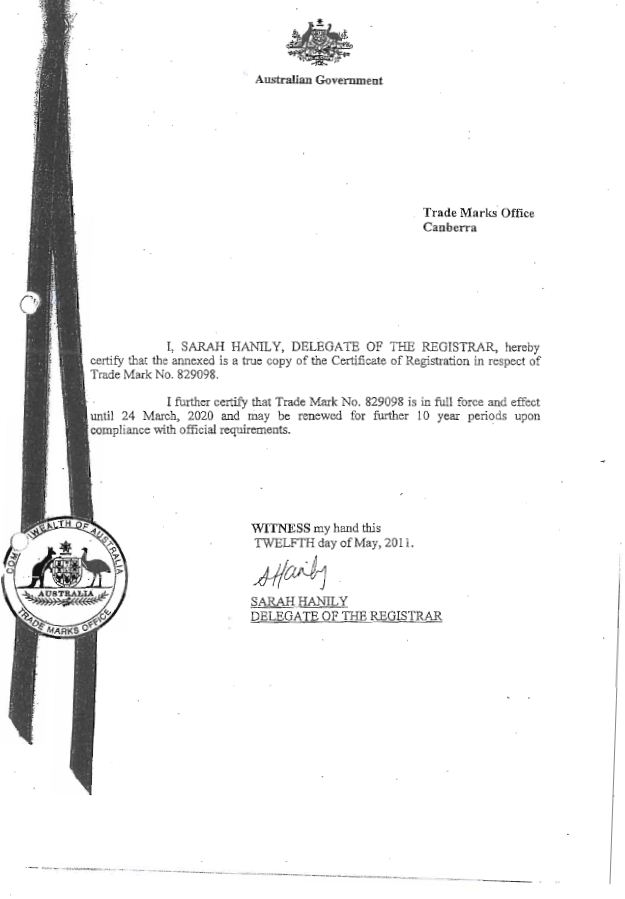
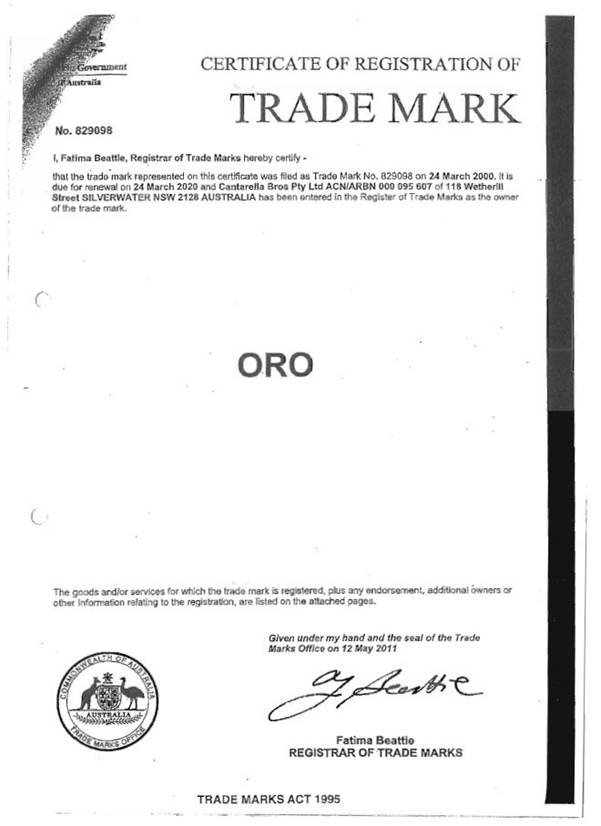
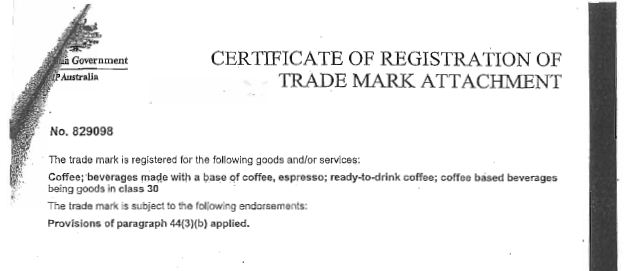
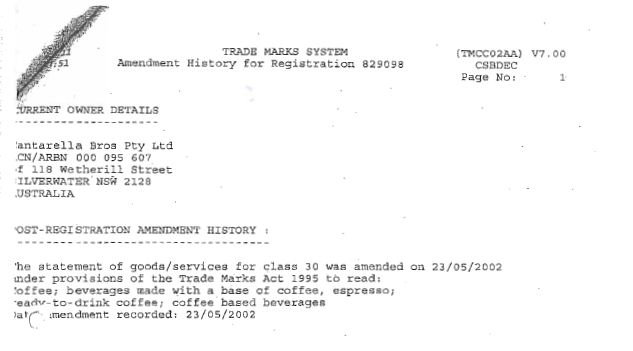
200 APPENDIX 2
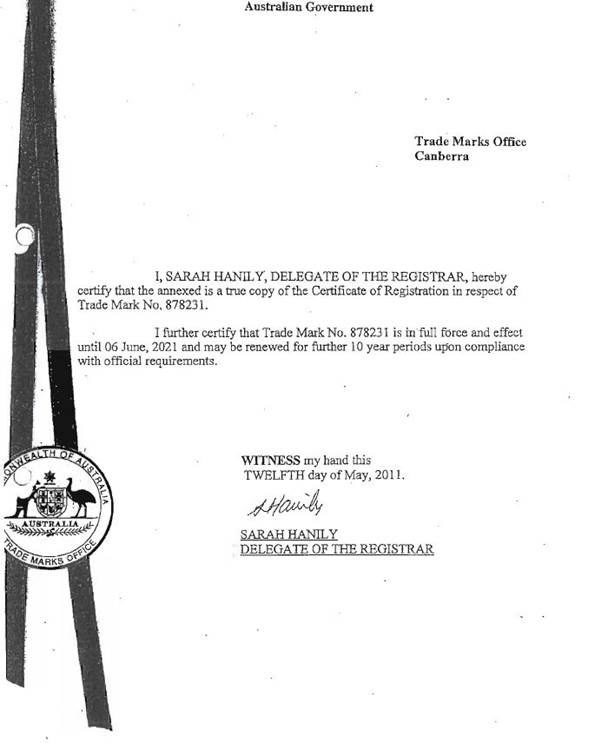
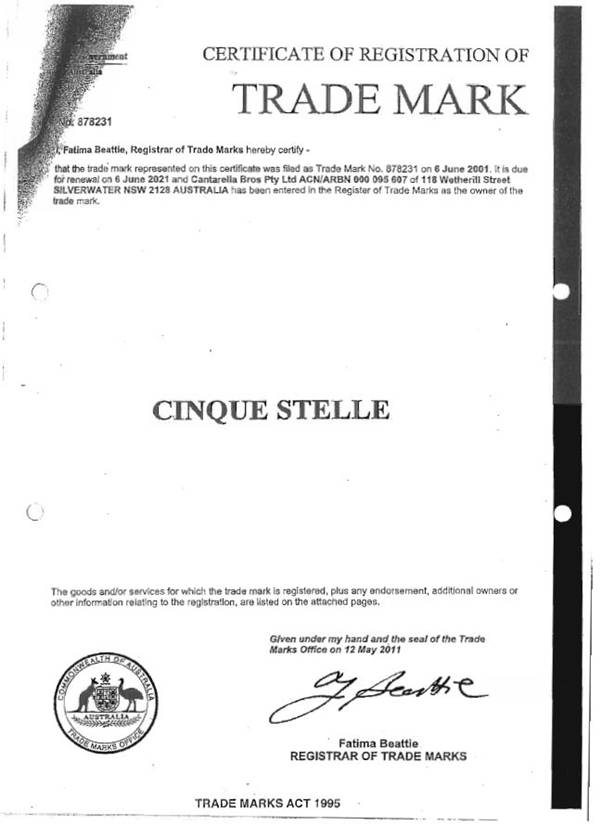
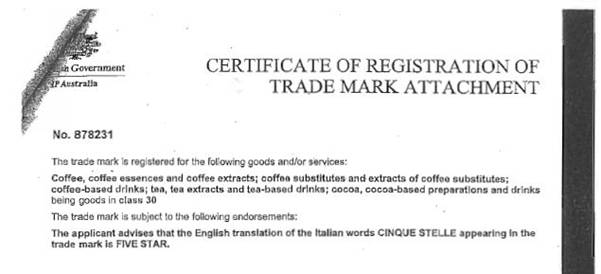
201 APPENDIX 3
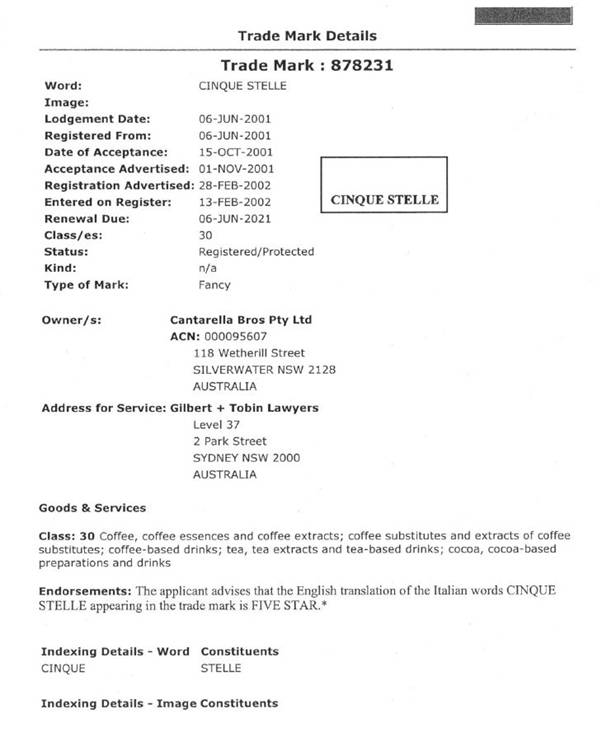
202 APPENDIX 4
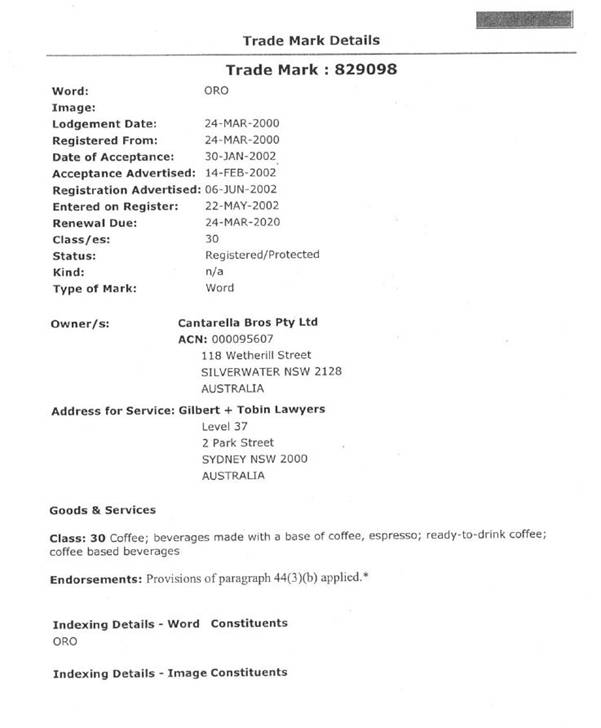
I certify that the preceding two hundred and two (202) numbered paragraphs are a true copy of the Reasons for Judgment herein of the Honourable Justice Emmett. |
Associate:
Dated: 13 February 2013


