

FEDERAL COURT OF AUSTRALIA
Embertec Pty Limited v Energy Efficient Technologies Pty Limited [2013] FCA 2
IN THE FEDERAL COURT OF AUSTRALIA | |
DATE OF ORDER: | |
WHERE MADE: |
THE COURT ORDERS THAT:
1. The applicant’s application for interlocutory injunctive relief made by Interlocutory Application filed on 10 October 2012 be dismissed.
2. The applicant pay the respondents’ costs of and incidental to the said Interlocutory Application.
Note: Entry of orders is dealt with in Rule 39.32 of the Federal Court Rules 2011.
NEW SOUTH WALES DISTRICT REGISTRY | |
GENERAL DIVISION | NSD 1167 of 2012 |
BETWEEN: | EMBERTEC PTY LIMITED (ACN 110 367 809) Applicant
|
AND: | ENERGY EFFICIENT TECHNOLOGIES PTY LIMITED (ACN 123 181 439) First Respondent STAVROS PAPPAS Second Respondent
|
AND BETWEEN: | ENERGY EFFICIENT TECHNOLOGIES PTY LIMITED (ACN 123 181 439) Cross-Claimant |
AND: | EMBERTEC PTY LIMITED (ACN 110 367 809) Cross-Respondent |
JUDGE: | FOSTER J |
DATE: | 4 JANUARY 2013 |
PLACE: | SYDNEY |
REASONS FOR JUDGMENT
1 This proceeding was commenced on 14 August 2012 when the applicant (Embertec) approached the Duty Judge and sought leave to file on that day a Fast Track Application and a Fast Track Statement. In the first version of its pleadings, Embertec alleged that the first respondent, Energy Efficient Technologies Pty Limited (EETECH), at the direction of the second respondent (Mr Pappas), who is the principal of EETECH:
(a) Made representations in connection with the promotion and supply of its products that were:
(i) Misleading and deceptive, in contravention of s 18 of the Australian Consumer Law; and
(ii) False, in contravention of s 29(1)(g) and s 29(1)(h) of the Australian Consumer Law;
(b) Infringed Embertec’s copyright;
(c) Infringed Embertec’s trade mark; and
(d) Passed off Embertec’s products as its own.
2 It is not necessary for present purposes to explain in any detail the facts, matters and circumstances relied upon by Embertec in support of the claims for relief initially made by it.
3 Embertec and EETECH are competitors in the market for the sale and supply of standby power controllers (SPCs). Their businesses are concentrated in the State of Victoria.
4 SPCs are devices which are connected to household electrical appliances and which, by the deployment of an appropriate timing device, automatically switch off those appliances and any other appliances connected to them even when they are in standby mode.
5 In circumstances which I shall explain in more detail later in these Reasons, throughout 2012, Embertec was energetically pursuing the registration of an innovation patent which it hoped would, once certified, enable it to pursue EETECH for patent infringement. Embertec believed that EETECH had reverse engineered and copied its SPCs. No claim for patent infringement was or could have been included in the Fast Track Application filed on 14 August 2012 because no relevant Australian patent had been certified prior to that date.
6 When the proceeding was returned before the Court on 21 August 2012, EETECH gave interlocutory undertakings to the Court which were to subsist until the determination of the proceeding or until further order of the Court. Those interlocutory undertakings addressed all of the complaints then being agitated by Embertec and satisfied Embertec in relation to those complaints. A further interlocutory undertaking was given to the Court on 20 September 2012.
7 On 22 August 2012, Australian Innovation Patent No AU2012100197 (the 197 patent) was certified. In light of the certification of the 197 patent, Embertec notified EETECH and Mr Pappas that it intended to seek the leave of the Court to amend its pleadings in order to include therein a claim for infringement of the 197 patent. It also indicated that it intended to seek urgent interlocutory relief in respect of that alleged patent infringement.
8 The foreshadowed application was first listed before me on 10 October 2012 at which time I made orders removing the matter from the Fast Track, granting leave to Embertec to amend its pleadings so as to include a claim for infringement of the 197 patent, programming Embertec’s Application for Interlocutory Relief for hearing and fixing that Application for hearing before me on 15 and 16 November 2012.
9 These Reasons for Judgment determine Embertec’s claim for an interlocutory injunction pending the final hearing of this proceeding restraining EETECH and Mr Pappas from infringing the 197 patent. The precise order sought is to be found in the Interlocutory Application filed on 10 October 2012. Embertec seeks to restrain EETECH from importing, selling, supplying or dealing in EETECH’s SPC and any other device which has substantially the same features and functionality as that SPC.
Some Background Matters
10 EETECH carries on business, principally in Victoria, in direct competition with Embertec. EETECH supplies to installers for installation in residential properties, and also itself installs in such premises, a SPC called the “EETECH SMART Power Board AV” (EETECH power board). Embertec supplies two very similar products known respectively as the “Embertec Smart Switch AV” and the “Embertec Smart Switch PC” (Embertec power boards).
11 It is Embertec’s case that the conduct of EETECH in importing into Australia and in supplying here the EETECH power board constitutes an infringement of the 197 patent. EETECH does not dispute that it has imported into Australia EETECH power boards manufactured in China nor does it dispute that it has supplied those boards to installers and consumers in Victoria. It contends that its conduct does not constitute infringement of the 197 patent. EETECH’s arguments in support of this contention are based upon s 163 of the Patents Act 1990 (Cth) (the Patents Act). Alternatively, it argues that the 197 patent is invalid for a number of reasons. EETECH resists interlocutory relief in respect of the alleged infringement of the 197 patent. It says that:
(a) Embertec is unlikely to succeed at trial on its patent infringement case;
(b) The 197 patent is invalid and should be revoked;
(c) EETECH has not infringed the patent (s 163);
(d) The balance of convenience and justice is weighted strongly against the grant of any injunction; and
(e) Damages are, in any event, an adequate remedy if infringement is ultimately established.
12 The outcome of Embertec’s Interlocutory Application will have very significant ramifications for all parties involved in this proceeding.
13 Both Embertec and EETECH are anxious to continue to take commercial advantage of the opportunities presented to them and to others by the Victorian Energy Efficiency Target Scheme (the VEET scheme). The VEET scheme is a scheme established by the Victorian State Government by legislation and by regulation which is designed to encourage through financial incentives the widespread installation into residential properties in Victoria of various energy saving devices. The purpose of the scheme is to make energy efficiency improvements more affordable and to put in place ways and means of reducing greenhouse gas emissions.
14 Both parties agree that, as more and more SPCs are installed, a saturation point for the supply of such products will be reached. At that point, it will be commercially unviable for suppliers to seek out new households in which to install SPCs. Both parties agree that the saturation point for the Victorian market for the installation of SPCs will be reached very soon. Embertec suggests that that point will be reached about now. EETECH estimates that the saturation point will be reached in about March this year.
15 There is, at present, no other established scheme similar to the VEET scheme elsewhere in Australia. The government of the Australian Capital Territory presently has a similar scheme under consideration. It intends to establish that scheme early this year. Whether, and, if so, when, such a scheme will be introduced into the ACT is presently a matter of speculation.
16 It did seem to me, when the matter first came into my docket, that the most efficient and cost effective way of determining the disputes amongst the parties to the present proceeding was to fix the whole of the proceeding for an early final hearing. Embertec declined that invitation. It did so because it was of the opinion that the parties could not be ready for an early final hearing in sufficient time for the Court to grant injunctive relief prior to the saturation of the Victorian market. Embertec wished to take such steps as were immediately available to it to prevent the ongoing supply of the EETECH power board to consumers in Victoria.
17 At the hearing of Embertec’s Interlocutory Application, each side of the record read lengthy affidavits and tendered a number of documents, mostly without objection. There was no cross-examination of any witness. The hearing proceeded largely by way of very detailed arguments, both written and oral, with very little disputation as to the facts.
The Relevant Principles (Interlocutory Injunctions)
18 In Samsung Electronics Co Ltd v Apple Inc (2011) 286 ALR 257 at 271–279 [44]–[74], the Full Court explained the source of the power of this Court to grant injunctive relief in patent cases and the principles upon which it would consider doing so on an interlocutory basis. A particular feature of that case was the fact that the grant or refusal of interlocutory relief would have had the practical effect of putting an end to the proceeding. That feature is also present in the instant case. The High Court refused special leave in Apple Inc v Samsung Electronics Co Ltd [2011] HCATrans 341, stating that it saw insufficient prospects of success on the part of Apple demonstrating error on the part of the Full Court. The High Court also remarked that the Full Court’s detailed consideration of Apple’s case weighed against the grant of special leave.
19 I shall endeavour to extract the important points of principle from the passages in Samsung Electronics Co Ltd v Apple Inc to which I have referred at [18] above. In doing so, I do not intend to alter or dilute in any way the judgment of the Full Court. Rather, I intend to apply it. The matters which I particularly wish to emphasise are:
(a) Where the source of the Court’s power to grant an injunction is a specific provision in a statute (as is the case here), the term “injunction” takes its context from the provisions of the particular statute in question (at 271–272 [46]–[47);
(b) Section 122 of the Patents Act empowers the Court to restrain an infringement of an Australian registered patent subject to such terms, if any, as the Court thinks fit (at 272 [48]);
(c) Where the merits and the question of convenience are fairly evenly balanced, there will be no injustice in requiring the party seeking relief to demonstrate good prospects of success before imposing almost certain prejudice on the other side (at 272–273 [49]–[51] esp at [51]);
(d) Where an interlocutory injunction is sought in respect of private rights, it is necessary to identify the legal or equitable rights which are to be determined at the trial and in respect of which final relief is sought (at 272 [52]);
(e) As Mason ACJ said in Castlemaine Tooheys Ltd v South Australia (1986) 161 CLR 148 at 153:
… In order to secure such an injunction the plaintiff must show (1) that there is a serious question to be tried or that the plaintiff has made out a prima facie case, in the sense that if the evidence remains as it is there is a probability that at the trial of the action the plaintiff will be held entitled to relief; (2) that he will suffer irreparable injury for which damages will not be an adequate compensation unless an injunction is granted; and (3) that the balance of convenience favours the granting of an injunction.
(f) The Court’s task of assessing the balance of convenience and justice requires the Court to determine whether the inconvenience or injury which the plaintiff would be likely to suffer if an injunction were refused outweighs or is outweighed by the injury which the defendant would suffer if an injunction were granted (at 273–274 [55] and the passages cited therein from Beecham Group Ltd v Bristol Laboratories Pty Ltd (1968) 118 CLR 618 (Beecham)).
(g) The question of whether or not the plaintiff must show that he will suffer irreparable harm if no injunction is granted is one of the matters which will ordinarily need to be addressed in the Court’s consideration of the balance of convenience and justice (at 276 [61]).
20 At 276–279 [62]–[74], the Full Court discussed the balance of convenience and justice and the relationship between the basket of considerations relevant to the Court’s assessment of that matter and the need for a plaintiff to establish a prima facie case or serious question to be tried. The observations of the Full Court in those passages are of particular relevance to the present case. The Court said:
62 The assessment of harm to the plaintiff, if there is no injunction, and the assessment of prejudice or harm to the defendant, if an injunction is granted, is at the heart of the basket of discretionary considerations which must be addressed and weighed as part of the court’s consideration of the balance of convenience and justice. The question of whether damages will be an adequate remedy for the alleged infringement of the plaintiff’s rights will always need to be considered when the court has an application for interlocutory injunctive relief before it. It may or may not be determinative in any given case. That question involves an assessment by the court as to whether the plaintiff would, in all material respects, be in as good a position if he were confined to his damages remedy, as he would be in if an injunction were granted: see the discussion of this aspect in I C F Spry, The Principles of Equitable Remedies, 8th ed, Lawbook Co, New South Wales, 2010, pp 383–9; pp 397–9; and pp 457–62.
63 The interaction between the court’s assessment of the likely harm to the plaintiff, if no injunction is granted, and its assessment of the adequacy of damages as a remedy, will always be an important factor in the court’s determination of where the balance of convenience and justice lies. To elevate these matters into a separate and antecedent inquiry as part of a requirement in every case that the plaintiff establish “irreparable injury” is, in our judgment, to adopt too rigid an approach. These matters are best left to be considered as part of the court’s assessment of the balance of convenience and justice even though they will inevitably fall to be considered in most cases and will almost always be important considerations to be taken into account.
64 Gleeson CJ also observed in Lenah Game Meats (at [18]), that, where there is little or no room for argument about the legal basis of the applicant’s claimed private right, the court will be more easily persuaded at an interlocutory stage that a prima facie case has been established. The court will then move on to consider discretionary considerations, including the balance of convenience and justice. But, as his Honour also observed at [18]:
18 The extent to which it is necessary, or appropriate, to examine the legal merits of a plaintiff’s claim for final relief, in determining whether to grant an interlocutory injunction, will depend upon the circumstances of the case. There is no inflexible rule.
65 The resolution of the question of where the balance of convenience and justice lies requires the court to exercise a discretion.
66 In exercising that discretion, the court is required to assess and compare the prejudice and hardship likely to be suffered by the defendant, third persons and the public generally if an injunction is granted, with that which is likely to be suffered by the plaintiff if no injunction is granted. In determining this question, the court must make an assessment of the likelihood that the final relief (if granted) will adequately compensate the plaintiff for the continuing breaches which will have occurred between the date of the interlocutory hearing and the date when final relief might be expected to be granted.
67 As Sundberg J observed in Sigma Pharmaceuticals (Aust) Pty Ltd v Wyeth (2009) 81 IPR 339; [2009] FCA 595 at [15] (Sigma Pharmaceuticals), when considering whether to grant an interlocutory injunction, the issue of whether the plaintiff has made out a prima facie case and whether the balance of convenience and justice favours the grant of an injunction are related inquiries. The question of whether there is a serious question or a prima facie case should not be considered in isolation from the balance of convenience. The apparent strength of the parties’ substantive cases will often be an important consideration to be weighed in the balance: Tidy Tea Ltd v Unilever Australia Ltd (1995) 32 IPR 405 (Tidy Tea) at [416] per Burchett J; Aktiebolaget Hassle v Biochemie Australia Pty Ltd (2003) 57 IPR 1; [2003] FCA 496 at [31] per Sackville J; Hexal Australia Pty Ltd v Roche Therapeutics Inc (2005) 66 IPR 325; [2005] FCA 1218 at [18] per Stone J; and Castlemaine Tooheys at CLR 154; ALR 558 per Mason ACJ.
68 It may also be necessary to consider and evaluate the impact that the grant or refusal of an injunction will have or is likely to have on third persons and the public generally.
69 In Patrick at [65] and [66], Brennan CJ and McHugh, Gummow, Kirby and Hayne JJ, in a joint judgment, expressly adopted a passage from Spry, 1997, pp 402–3, which may be summarised as follows:
(a) in assessing the balance of convenience in an interlocutory injunction application, the interests of the public and third persons are relevant and have more or less weight according to other material circumstances;
(b) whether those interests tend to favour the grant or the refusal of an injunction in any given case depends upon the circumstances of that case; and
(c) hardship visited upon third persons or the public generally by the grant of an interlocutory injunction will rarely be decisive.
70 In order to address the balance of convenience and justice in the present case, it is necessary to consider the nature and strength of Apple’s case and the circumstances in which Samsung decided to compete with Apple by importing the Galaxy Tab 10.1 into Australia and by promoting and selling that device in this country.
71 Furthermore, there are some kinds of case where, for the purpose of assessing where the balance of convenience and justice lies, it is desirable that the court:
… evaluate the strength of the plaintiff’s case for final relief
Per McLelland J in Kolback Securities Ltd v Epoch Mining NL (1987) 8 NSWLR 533 at 536A–D (Kolback Securities).
72 Lord Diplock considered the point in NWL Ltd v Woods [1979] 3 All ER 614 at 625, and emphasised that the rule concerning a serious issue to be tried propounded in American Cyanamid was not developed in the context of a case where the grant of a interlocutory injunction would, in effect, finally determine the matter at hand in favour of whichever party was successful in the application because there would be nothing left on which it was in the unsuccessful party’s interest to proceed to trial.
73 Diplock LJ continued (at 626):
Where … the grant or refusal of the interlocutory injunction will have the practical effect of putting an end to the action because the harm that will have been already caused to the losing party by its grant or its refusal is complete and of a kind for which money cannot constitute any worthwhile recompense, the degree of likelihood that the plaintiff would have succeeded in establishing his right to an injunction if the action had gone to trial is a factor to be brought into the balance by the judge in weighing the risks that injustice may result from his deciding the application one way rather than the other.
74 In Kolback Securities, McLelland J said (at 536):
… although normally the Court “does not undertake a preliminary trial, and give or withhold interlocutory relief upon a forecast as to the ultimate result of the case” (Beecham Group Ltd v Bristol Laboratories Pty Ltd (1968) 118 CLR 618 at 622; [1968] ALR 469 at 470), there are some kinds of case in which for the purpose of seeing where lies the balance of convenience (or more specifically “the balance of the risk of doing an injustice” — see per May LJ in Cayne v Global Natural Resources plc [1984] 1 All ER 225 at 237, cf per Brennan J in Brayson Motors Pty Ltd v FCT (1983) 46 ALR 279 at 285; 57 ALJR 288 at 292), it is desirable for the Court to evaluate the strength of the plaintiff’s case for final relief: see eg, Brayson Motors Pty Ltd v FCT (at ALR 285; ALJR 292); Castlemaine-Tooheys Ltd v South Australia at 682; 559. One class of case to which this applies is where the decision to grant or refuse an interlocutory injunction will in a practical sense determine the substance of the matter in issue …
See also: O’Neill at [72] per Gummow and Hayne JJ; Australian Competition and Consumer Commission v Allphones Retail Pty Ltd (No 2) (2009) 253 ALR 324; [2009] FCA 17 at [27]–[31] per Foster J; Yara Australia Pty Ltd v Burrup Holdings Ltd (2010) 80 ACSR 641; [2010] FCA 1273 at [79]–[85] per Barker J.
Prima Facie Case
Relevant Principles (Construction of Patents)
21 The leading authority in this Court as to the principles to be applied when the Court is construing a patent is Jupiters Ltd v Neurizon Pty Ltd (2005) 222 ALR 155 (Jupiters). In that case, at 168–169 [67] and [68], the Full Court said:
67 There is no real dispute between the parties as to the principles of construction to be applied in this matter although there is some difference in emphasis. It suffices for present purposes to refer to the following:
(i) the proper construction of a specification is a matter of law: Décor Corp Pty Ltd v Dart Industries Inc (1988) 13 IPR 385 at 400;
(ii) a patent specification should be given a purposive, not a purely literal, construction: Flexible Steel Lacing Company v Beltreco Ltd (2000) 49 IPR 331; [2000] FCA 890 at [81] (Flexible Steel Lacing); and it is not to be read in the abstract but is to be construed in the light of the common general knowledge and the art before the priority date: Kimberley-Clark Australia Pty Ltd v Arico Trading International Pty Ltd (2001) 207 CLR 1; 177 ALR 4609; 50 IPR 513; [2001] HCA 8 at [24];
(iii) the words used in a specification are to be given the meaning which the normal person skilled in the art would attach to them, having regard to his or her own general knowledge and to what is disclosed in the body of the specification: Décor Corp Pty Ltd at 391;
(iv) while the claims are to be construed in the context of the specification as a whole, it is not legitimate to narrow or expand the boundaries of monopoly as fixed by the words of a claim by adding to those words glosses drawn from other parts of the specification, although terms in the claim which are unclear may be defined by reference to the body of the specification: Kimberley-Clark v Arico at [15]; Welch Perrin & Co Pty Ltd v Worrel (1961) 106 CLR 588 at 610; Interlego AG v Toltoys Pty Ltd (1973) 130 CLR 461 at 478; the body of a specification cannot be used to change a clear claim for one subject matter into a claim for another and different subject matter: Electric & Musical Industries Ltd v Lissen Ltd [1938] 4 All ER 221 at 224–5; (1938) 56 RPC 23 at 39;
(v) experts can give evidence on the meaning which those skilled in the art would give to technical or scientific terms and phrases and on unusual or special meanings to be given by skilled addressees to words which might otherwise bear their ordinary meaning: Sartas No 1 Pty Ltd v Koukourou & Partners Pty Ltd (1994) 30 IPR 479 at 485-6 (Sartas No 1 Pty Ltd); the court is to place itself in the position of some person acquainted with the surrounding circumstances as to the state of the art and manufacture at the time (Kimberley-Clark v Arico at [24]); and
(vi) it is for the court, not for any witness however expert, to construe the specification; Sartas No 1 Pty Ltd, at 485-486.
68 We may add that the area of invention with which this proceeding is concerned is a particularly narrow one. It is one in which business rivals are striving to invent around the patented inventions of others and within narrow regulatory limits. In such a context it is, in our view, important to recognise that claims made for an invention may need to be formulated narrowly to avoid invalidity. While accepting the primacy of purposive construction in interpreting patents, such a construction may well provide little by way of illumination where, as here, the inventive context is a cramped one. It is not appropriate to take a claim carefully drawn to avoid invalidity and then permit a wider “purposive” construction of it for infringement purposes: Grove Hill Pty Ltd v Great Western Corp Pty Ltd (2002) 55 IPR 257; [2002] FCAFC 183 at [311].
22 In Ranbaxy Australia Pty Ltd v Warner-Lambert Company LLC (No 2) (2006) 71 IPR 46 at 61–62 [62]–[64], Young J distilled from a number of authorities a set of principles which his Honour held should ordinarily guide the construction of patents. The observations which his Honour made in that case are reminiscent of the statements made by the Full Court in Jupiters although, to some extent, his Honour helpfully supplemented the statements made in Jupiters. I need not set out here the remarks which his Honour made. However, I intend to adopt and apply the principles which His Honour correctly and succinctly captured in the passages to which I have referred.
23 In Welch Perrin & Co Pty Ltd v Worrel (1961) 106 CLR 588, a Full Court of the High Court (Dixon CJ, Kitto and Windeyer JJ), said (at 609):
Most of the argument before us centred upon the construction of the specification and, as in every patent case, it is necessary to determine from it what exactly is the invention it describes and for which a monopoly is claimed, before proceeding to consider objections to the validity of particular claims: Electrical and Musical Industries Ltd. v. Lissen Ltd [(1938) 56 RPC 23, at p 39].
24 At 610, the Court said:
If it is impossible to ascertain what the invention is from a fair reading of the specification as a whole, that, of course, is an end of the matter. But this objection is not established by reading the specification in the abstract. It must be construed in the light of the common knowledge in the art before the priority date. The general principles governing the construction of specifications are well known, and no lengthy reference to them is necessary. It is, however, fitting that we remind ourselves of the criterion to be applied when it is said that a specification is ambiguous. For, as the Chief Justice pointed out in Martin v. Scribal [(1954) 92 CLR 17, at p 59], referring to Lord Parker’s remarks in National Colour Kinematograph Co. Ltd. v. Bioschemes Ltd [(1915) 32 RPC 256], we are not construing a written instrument operating inter partes, but a public instrument which must, if it is to be valid, define a monopoly in such a way that it is not reasonably capable of being misunderstood. Nevertheless, it is to be remembered that any purely verbal or grammatical question that can be resolved according to ordinary rules for the construction of written documents, does not, once it has been resolved, leave uncertain the ambit of the monopoly claimed (see Kauzal v. Lee [(1936) 58 CLR 670, at p 685]). The specification must be read as a whole. But it is a whole made up of several parts, and those parts have different functions. Courts have often insisted that it is not legitimate to narrow or expand the boundaries of monopoly as fixed by the words of a claim by adding to those words glosses drawn from other parts of the specification. Similarly, if a claim be clear it is not to be made obscure simply because obscurities can be found in particular sentences in other parts of the document.
25 The Court then moved to consider in some detail the patent in dispute in that case. After setting out the objects of that patent, the Court said (at 612):
At this point in a modern specification one might expect to find a general description of what the inventor asserts his invention consists of, commonly called a "consistory clause". This, however, is not an essential part of the body of a specification. It is not required by the Act. Its purpose may be quite well met by the claims themselves: United Shoe Machinery Corporation’s Application [(1939) 57 RPC 71]. Indeed, the usual practice in England is now to use in the consistory clause the wording of the broadest of the claims: see Mr. Blanco White’s book, Patents for Inventions 2nd ed. (1955) p. 34n. The present Australian Act expressly requires the claim or claims to define the invention: s. 40. In a patent for a combination, such as this is, the most important function of the body of the specification is to show what are the mechanical means which, operating together, produce the result claimed; and how they so operate.
26 In deciding whether a patent has been infringed, the Court is obliged to adopt a common sense construction of the claims in the patent, having regard to the prior knowledge as at the priority date, and, having done so, to determine whether the alleged infringer has taken all of the essential features or integers of the patentee’s claims as determined by that construction (Populin v HB Nominees Pty Ltd (1982) 59 FLR 37 at 40–41, (1982) 41 ALR 471 at 475).
The Construction of the Patent
27 The 197 patent is a divisional of Australian Patent Application 2010256278 (the parent application) which was filed on 3 June 2010 as PCT/AU2010/00691. The 197 patent was certified on 22 August 2012. The parent application claims priority from provisional application AU200902532 filed on 3 June 2009. Accordingly, the 197 patent claims a priority date of 3 June 2009. The 197 patent was filed on 24 February 2012. The 197 patent is an innovation patent (as to which see s 62 of the Patents Act). Infringement proceedings in respect of an innovation patent cannot be started unless the patent has been certified.
The Specification
28 The technical field of the invention is described on p 1 at ll 4–7 of the Specification as follows:
This invention relates to aspects of the monitoring of electrical power supply to electrical equipment. In particular, the invention is concerned with monitoring of electrical power supply with a view to reducing unnecessary power consumption and resulting in energy saving.
29 As submitted by Embertec, the field of the invention concerns the control, monitoring and reduction of energy consumption, particularly in household appliances and, more particularly, those which have an “ON” and a “STANDBY” state, since appliances will continue to use power when in the standby state. The invention saves energy by switching off these appliances after a specified period of time. At p 1 ll 11 to p 2 l 1, the Specification contains various references to prior art. At p 1 l 27 to p 2 l 1, the following is said:
The International Applications disclose inventions where electrical devices are connected to single mains supply electrical outlet, and the current flow through and voltage across at least one of the electrical devices is monitored in order to determine a functional state of that device. Depending on the nature of the functional state of the device and the nature of the other electrical devices, the supply of power to any or all of the other electrical devices can be shut off, so that not all electrical devices are powered in situations where power to them is unnecessary.
30 At p 2 ll 3–10, the Specification continues:
The present invention is predicated upon the concept that energy saving capability of such energy saving devices as those in the International Applications may be enhanced by monitoring and, in some embodiments, by networking a plurality of such energy saving devices.
Although energy saving devices such as those in the International Applications may autonomously maximise energy savings at their individual level, it is believed that the addition of networking capability can provide advantages not available before now.
31 The invention is broadly described on p 2 l 14 to p 3 l 1 in the following terms
In a broad form, the present invention provides an energy saving device including:
an electrical input, adapted to connect to a power supply;
an electrical output, adapted to connect to an electrical device;
a switch means, adapted to selectively connect said electrical output to said electrical input;
a sensor means, adapted to wirelessly sense activity of a user-operated remote control device, and thereby control said switch means.
Preferably, the device further includes an alert means, adapted to provide an alert signal to a user after a predetermined period of time, prior to operation of said switch means.
Also preferably, said alert means is adapted to provide an audible and/or visual signal.
Preferably, the device includes a plurality of electrical outputs, each adapted to be selectively connected to the electrical input by said switch means. Also preferably, said sensor means senses IR, RF or any other wireless signal activity.
32 At p 4 ll 9–20 of the Specification, the following is said:
The system and method of the invention may be used at various levels - for example, to monitor and optionally control power consumption of a group of electrical devices, such as a group of audio/visual entertainment devices.
At a higher level, monitoring (and, optionally, control) may take place of many electrical devices within a home or office, for example.
At an even higher level, monitoring (and, optionally, control) may take place in a centralized facility, such as an electrical utility or agency, with the aim of remote monitoring and optionally controlling energy saving function for individual outlets. Examples of this are setting idle power threshold limits, “active standby” timeout periods, time-of-day usage based on tariffs, and so on.
33 The two functional states of the electrical appliance to be monitored and perhaps controlled are the “ON” and the “STANDBY” state (see the passage at p 7 ll 4–5).
34 At pp 4–26 of the Specification, various embodiments of the invention are discussed, including by reference to drawings (Figures 1 to 12).
35 Figure 1 depicts an energy saving device with an alert means feature. It is discussed at p 12 l 10 to p 13 l 1 in the following terms:
Figure 1 shows several types of interfaces, some or all of which may be used, as desired.
Radio frequency communications interface 58 enables the processing of bidirectional wireless RF communications between energy saving device 12 and other devices, through a wireless network connection 59. As shown in Figure 1, standard communication methods and protocols such as low interference potential device running a proprietary protocol, Zigbee, Z-wave, lnsteon, Bluetooth and WiFi may be used for this purpose.
Serial communications interface 60 enables the processing of bi-directional wire-linked communication between energy saving device 12 and other devices, via a wired network connection 62. Standard communications methods and protocol such as RS-485 or CAN bus based networks may be used for this purpose.
User interface 70 in this embodiment includes LCD or LED indicators 64, beeper 66 and pushbuttons and keypad 68. LCD (liquid crystal display) and/or LED indicators output data from monitored power consumption and provide an indication of status to the use. Status can include power application, power switching and fault status. Indicators 64 can also host user interface menus for reporting and control to allow optimisation of energy saving capability.
Beeper 66 is present to provide an audible output to indicate faults or status change conditions, such as imminent powering down of connected mains powered equipment.
36 Similar features are depicted in Figures 2 and 10.
37 The invention provides for the individual user to control and optimize energy saving functions. Thus, the time periods before the alert is given and the power is turned off may be either built into the device or customized by the user according to individual preferences. These ideas are reflected in the text of the Specification at p 23 ll 14–18 in the following terms:
Local control via a device front panel, hand-held device, etc, can allow a user to control and optimize energy savings function for individual outlets, e.g. by setting idle power threshold levels, “active standby” timeout periods, etc. This can allow users to maximize energy saving, whilst preserving maximum user convenience for particular equipment configurations and usage scenarios.
The Claims
38 The patent ends with five claims. These are:
1. An energy saving device including:
an electrical input, adapted to connect to a power supply;
an electrical output, adapted to connect to an electrical device of the type which, when connected to a power supply has an ‘ON’ state and a ‘STANDBY’ state;
a switch means, adapted to selectively connect said electrical output to said electrical input; and
a sensor means, adapted to wirelessly sense activity of a user-operated remote control device;
wherein, in use, said switch means operates to disconnect said electrical output from said electrical input:
(i) when said electrical device remains in said ‘ON’ state, and, the absence of sensed activity is detected by said sensor for a predetermined timeout period; or,
(ii) when said electrical appliance remains in said ‘STANDBY’ state for a predetermined standby period.
2. An energy saving device as claimed in claim 1, further including:
an alert means, adapted to provide an alert signal to a user after a predetermined period of time, prior to operation of said switch means.
3. An energy saving device as claimed in claim 2, wherein said alert means is adapted to provide an audible and/or visual signal.
4. An energy saving device as claimed in any one of claims 1 to 3, including a plurality of electrical outputs, each adapted to be selectively connected to the electrical input by said switch means.
5. An energy saving device as claimed in any one of claims 1 to 4, wherein said sensor means senses IR, RF or any other wireless signal activity.
39 Embertec contends that EETECH has infringed all five claims.
40 Embertec called evidence from Anthony John Cowle, a patent attorney, who said that he had examined the EETECH power board and compared that device with each of the five claims made in the 197 patent for the purpose of assessing infringement. He also examined the user manual for the EETECH power board.
41 Mr Cowle identified six integers in claim 1. He then examined the EETECH power board and its user manual in order to ascertain whether all of those integers are present in the EETECH power board. Mr Cowle concluded that they were.
42 Mr Cowle also conducted a similar comparison between each of claims 2 to 5 in the 197 patent and the EETECH power board and concluded that the device incorporated all of the features of each of those claims.
43 For present purposes, it is not necessary to describe in detail the reasons which Mr Cowle gave for the conclusions which he reached. Senior Counsel for EETECH accepted that, at this stage of the proceeding, the Court should proceed upon the basis that Mr Cowle’s opinions are correct.
44 Embertec also called evidence from George Georgevits, a Consulting Engineer with significant experience in communications systems.
45 At pars 7 to 19 of his affidavit, Mr Georgevits said:
7. I was asked what my understanding was of the invention described in the 197 patent. I have drawn a functional block diagram which I have reproduced as Annexure B which illustrates my understanding of the invention described in the 197 patent.
8. To assist in understanding the purpose of the invention described in the 197 patent, it is important to differentiate the three possible states of many mains powered appliances.
9. These three states are the ON state, the STANDBY state (or sleep mode) and the OFF state, this last state being where the mains power supplying the appliance has been disconnected and the appliance is not drawing any power at all.
10. I understand the 197 patent to be describing an energy saving device which saves energy by switching OFF devices deemed to be not in use.
11. It does this for devices which are turned ON by sensing the absence of user remote control activity for a predetermined period of time, and for devices which are in STANDBY state, by switching them OFF after a predetermined period of time.
12. I have drawn a flow chart which describes how a device built in accordance with the 197 patent would be likely to work. Annexed and marked C is a copy of that flowchart.
13. It is evident to me from reading the 197 patent specifications (and would have been evident to me in mid-2009) that in order for the energy saving device to function as claimed, it must be capable of sensing the current being drawn from each of the controlled outlets, since the magnitude of the current drawn by each appliance indicates whether it is in the ‘ON’ or ‘STANDBY’ state. I note that the 197 patent specification refers to the energy saving device being able to detect functional states of a connected appliance by sensing the value of current flow and voltage, see p6 lines 1-5. At p7, lines 1 to 5 it is clear that the sensed current flow is used to determine the state of the electrical device connected to the controlled outlet. This functionality is indicated in Annexure C.
14. The switching function is accomplished by a switch means device which is controlled by a microcontroller unit (microcontroller). In my experience the use of a microcontroller would be the most practical way to implement this function. I also see references to the use of a microcontroller in the specifications of the 197 patent, for example at p21 line 26 and p22 lines 13 to 16.
15. The energy saving device includes a sensor which senses signals from a user remote. These signals may be infra red or RF or some other form of wireless communication. The sensor provides an input signal to the microcontroller. Sensors are not suitable for driving relays directly. In this application, the microcontroller reads the input signal from the sensor via one of its input ports.
16. In terms of the utility of the energy saving device, it is useful to give the user of such a device a warning that the controlled appliance is about to be switched OFF.
17. To this end, the energy saving device also includes a timer function. It also may have the capability to alert the user under certain predetermined conditions that it is going to switch the controlled appliance OFF. This alert may be audio or visual.
18. The energy saving device also may have the capability of selectively switching OFF a number of controlled appliances.
19. I have been asked to review the features of the claims of the 197 patent and to comment on where these are disclosed in the specification of the 197 patent. In so doing I have read the claims of the 197 patent in light of the description in the body of the specification and where relevant, set out the passages in the body of the specification which disclose the features of the claims. In my opinion the features of the device as defined in each of the claims and can be found in the description in the body of the specification of the 197 patent.
46 The only annexure to Mr Georgevits’ affidavit which I have reproduced is Annexure C. I set it out below:
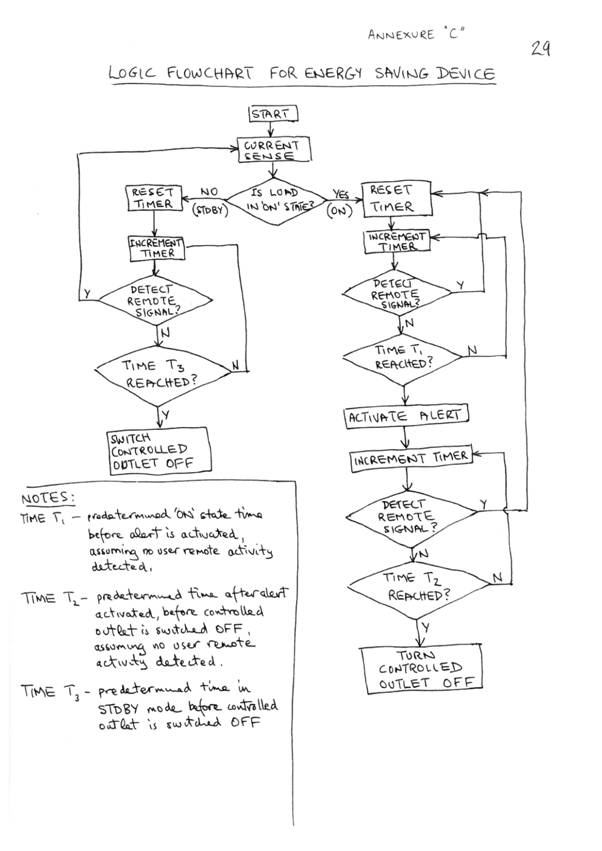
47 In the flowchart which is Annexure B to Mr Georgevits’ affidavit, Mr Georgevits did not depict a state or power sensor. Thus, the flowchart did not include a monitoring means which is the first critical integer of the invention.
48 At par 13 of his affidavit, Mr Georgevits addressed this point. In Annexure C to his affidavit, he depicts a state sensor. He does so immediately after the start of the logic flowchart which is Annexure C.
49 There is an issue between the parties as to whether the claims in the 197 patent include an activity sensor means. EETECH says that they do not. Embertec contends that they do.
The VEET Scheme
50 The VEET scheme provides for persons to be approved as “Accredited Persons” and for accredited persons to engage in the installation of approved products as “Prescribed Activities”. One such Prescribed Activity is the installation of SPCs where the devices meet criteria specified in Schedule 29B to the Victorian Energy Efficiency Target Regulations 2008 (Vic) (VEET Regulations) (s 15 of the Victorian Energy Efficiency Target Act 2007 (Vic) (VEET Act) and reg 6(1)(x) of the VEET Regulations).
51 Installation of approved power saving products by an Accredited Person is free to consumer households. Upon installation, a household assigns to the Accredited Person a number of Victorian Energy Efficiency Certificates (VEECS) which are applicable to the products installed. VEECS are tradeable and valuable.
52 The number of VEECS created as a result of the installation of a SPC is a function of the device’s ability to reduce greenhouse gas emissions. Each VEEC represents a tonne of greenhouse gas abated. The capacity of a device to achieve greenhouse gas reduction is measured by assigning the product an “abatement factor”. Embertec’s power boards have been approved in the VEET scheme. They have abatement scores of 4.1 and 2.33 respectively.
53 On 8 May 2012, EETECH was approved as an Accredited Person. The EETECH power board is approved by the Essential Services Commission of Victoria (ESCV) as an SPC device within the meaning of the VEET Regulations. The EETECH power board has an abatement score of 3.56.
54 VEECS are currently trading at around $20.00 each.
55 Embertec sells its product to Accredited Persons who then install those products in residential properties. Under contractual arrangements between Embertec and certain Accredited Persons, the Accredited Persons sell to Embertec, at predetermined prices, the VEECS that are thereby created. In this way, Embertec generates revenue from two sources:
(1) Sales of its products; and
(2) Acquiring VEECS as a result of the installation of its product.
As at the date of the hearing, approximately 95% of Embertec’s total revenue came from these activities in Victoria.
56 Subject to certain exceptions that are not presently relevant, once a VEEC has been created for a prescribed activity involved in the installation of a product in residential premises, a VEEC must not be created in respect of any other prescribed activity of the same class in those residential premises. This is known as the “once-only rule”.
57 The once-only rule is the main reason why the market will eventually become saturated.
Infringement
58 As I have already mentioned, EETECH currently imports EETECH power boards into Australia which have been manufactured in China. It installs those power boards directly in eligible Victorian households and engages subcontractors to do likewise. Subject to its argument based upon s 163 of the Patents Act and subject to its contentions that the 197 patent is invalid, EETECH accepts that the importation, sale and dealing in the EETECH power board would constitute an infringement of the 197 patent.
59 If s 163 is engaged, there is no infringement.
60 The ESCV specifically approved the EETECH power board for supply and installation under the VEET scheme on 8 June 2012.
61 EETECH submitted that the ESCV was an authority of the State of Victoria. In support of that submission, EETECH submitted:
The Essential Services Commission (ESC) is responsible for the administration of the VEET Act and the VEET Scheme established under it. It is equipped with powers to do so. It approves products which meet energy saving criteria, such as are designed to achieve the objects of the VEET Act and Scheme. It is “impressed with the stamp of government”. Section 9 of the Electrical Services Commission Act 2009 provides that it represents the Crown. It is given powers of direction and control to achieve the objects of the VEET Act and Scheme on behalf of the State. It is not subject to the direction or control of the Minister (s 12 ESC Act) but must report to the Minister on the performance of the VEET Scheme and make an annual report of operations under Part 7 of the Financial Management Act 1994 (s 7(3)(iv) of the VEET Act).
62 The test of whether an authority is an authority of the State was explained by Cooper J in Stack v Brisbane City Council (1995) 59 FCR 71 at 77 and at 84. At 78, his Honour said:
The primary focus is on government and the function of government. The BCC will be an “authority of a State” if its functions are “impressed with the stamp of government” or if it has been given by the State the power to director control the affairs of others on behalf of the State. The role and involvement of the executive, through the Governor in Council or the appropriate Minister, is also a relevant factor.
In determining whether the BCC satisfies the test, no one consideration is necessarily decisive. It is a question of fact and degree in the circumstances and which depends on the structure, powers and functions of the BCC and the context of the statutory description which is to be satisfied. A detailed examination of the statutory scheme by which the BCC is created and within which it operates is necessary.
63 A critical factor in Stack v Brisbane City Council in favour of a conclusion that the BCC was an authority of the State of Queensland was the fact that, to some extent, it was controlled by the relevant Minister. That is not the case here. Nonetheless, the purposes of the VEET Act and scheme are clearly purposes of the State and, by appropriate legislation, have been entrusted to the ESCV. In my judgment, the ESCV is more likely than not to be an authority of the State of Victoria.
64 In addition to giving written approval of EETECH’s power board, the ESCV has authorised EETECH to install and retain other Accredited Persons to install that power board. That approval is predicated upon compliance with the criteria specified in Schedule 29B to the VEET Regulations. Those criteria call for all of the features of the claims made in the 197 patent other than the alert means specified in claims 2 and 3. The alert means are probably not called for because they serve no energy saving function.
65 The activities authorised by the ESCV’s approval given to EETECH are for the purpose of, and have the effect of achieving the objects of, the VEET Act and scheme for which the ESCV is responsible. The question remains, however, whether those activities are for the services of the ESCV and the State of Victoria.
66 The expression “for the services of the State of Victoria” (or, more precisely, “for the services of the Crown”) was considered by Cooper J in Stack v Brisbane City Council at 84–88. The core principle which his Honour distilled from the relevant authorities is that an act is done “to the services of the Crown” if it is done for the purpose of performing a duty or exercising a power which was imposed upon or invested in the executive government by statute or by prerogative.
67 EETECH submitted that it should be inferred from the fact that the authority of the ESCV was given to the installation of the EETECH power board that the installation of that power board by EETECH and its contractors is necessary for the proper provision of ESCV and the State of Victoria of the services constituted by the VEET Act and scheme. EETECH also submitted that it was not necessary that the relevant State authority had knowledge of the fact that those it had authorised would infringe a registered patent.
68 Embertec countered these submissions in a number of ways. First, it submitted that the approval given by the ESCV to EETECH in respect of its power board did not purport to be an authorisation under s 163 of the Patents Act. Embertec submitted that a valid authorisation under s 163 must make reference to the section and to the specific terms of the section. Second, the exploitation of the EETECH power board is for the benefit of EETECH and not “for the services of the State of Victoria”. Third, EETECH has a choice whether or nor to exploit the 197 patent in providing the goods or services contracted for. It is not required by any such contract to do so. Fourth, there is no contract between the ESCV and EETECH let alone a contract which requires EETECH to install any particular type or any particular number of SPCs in Victoria.
69 I think that Embertec’s submissions in relation to the potential operation of s 163 are correct. The nub of the matter is that the ESCV has simply not required EETECH, by any approval or contract, to infringe the 197 patent.
Invalidity
70 EETECH has set out its contentions concerning invalidity at pars 17 to 19.4 of its Amended Statement of Cross-Claim filed on 30 October 2012. Those paragraphs are in the following terms:
17 The Cross-respondent is the registered owner of Australian Innovation Patent Numbers:
17.1. 2012100197 (the 197 Patent) entitled ‘Power Sensor’ which was certified on 22 August 2012; and
17.2. 2012100624 (the 624 Patent) entitled ‘Power Monitoring System’, which was certified on 28 August 2012.
18 The 197 Patent and each of its claims is invalid on the following grounds.
18.1. The claims do not claim a patentable invention within the meaning of section 18(1A)(a) because:
18.1.1. no interaction is required between the sensor means and any other means of the claim:
a) To determine whether the electrical device is in the “on” state;
b) To determine whether the electrical appliance is in the “standby” state;
c) To determine whether the electrical appliance remains in the standby state for a pre-determined standby period;
d) To cause the energy saving device to function in the manner required in paragraphs (i) and (ii) of the claims.
18.1.2. the claims, accordingly, are to a mere collocation of elements.
18.2 The claims do not define the invention in that:
18.2.1 the sensor means of the claims are not capable of determining:
a) Whether the electrical device is in the “on” state:
b) Whether the electrical appliance is in the “standby” state: or
c) Whether the electrical appliance remains in the standby state for a pre-determined standby period; and
18.2.2 It is unclear by what means any such determination is made.
18.2A None of the claims is fairly based on the matter described in the specification because:
18. 2A.1 the sensor means described in the specification operate to control the switch means, whereas no such operation is requited by the claims; and
18.2A.2 the claims do not secure the promised advantage of the specification which is an enhancement of energy saving by networking a plurality of energy saving devices. None of the claims requires a networking of a plurality of energy saving devices.
18.3. Claims 2 and 3 are not fairly based on the matter described in the specification in that:
18.3.1. the only real and reasonably clear disclosure of the provision of an alert, such as by use of a beeper or light, is as part of the output means or the system for monitoring power consumption referred to as “a first aspect of the invention” on page 3 of the specification. That is a different form of the alleged invention from that claimed in the 197 Patent; and
18.3.2. there is no disclosure in the specification of an alert signal being provided “after a predetermined period of time.
18.3A Further or alternatively to paragraph 18.3:
18.3A.1 Claims 2 and 3 are not fairly based on the matter described in the parent specification (2010256278) in that:
(a) the only reference in that specification to an alert, such as by a beeper or a light is by way of description of the data output means referred to at page 3, line 15 of the 197 patent in relation to the “first aspect of the invention” described on that page; and
(b) there is no disclosure of an alert signal being provided “after a predetermined period of time”.
18.3A.2 Accordingly, the earliest priority date of claims 2 and 3 is the date of filing of the 197 application, namely 24 February 2012.
18.3A.3 Claims 2 and 3 are not novel when compared with the prior art base as it existed before the priority date of those claims by reason of the installation in Victoria since at least as early as August 2011 of the Embertec EmberPlug AV.
18.3B None of the claims is novel when compared with the prior art base as it existed before the priority date of the claims.
Particulars
18.4A.1 US2002/0135474 (Published 26 September 2002)
See Annexure A for particulars
18.4 Further, claim 1 and claims 4 and 5 (insofar as dependent on claim 1) are not novel when compared with the prior art base as it existed before the priority date of those claims.
Particulars
18.4.1 EP2051379 (published 22 April 2009)
18.4.2 US7520783 (published 15 February 2007)
18.4.3 US7504745 (published 17 March 2009)
See Annexure A for particulars
18.5 Claims 2 and 3 and claims 4 and 5 (insofar as dependent on claims 2 and 3) do not involve an innovative step when compared with the prior art base as it existed before the priority date of those claims.
Particulars
18.5.1 The prior art base included the published patents referred to in paragraph 18.4 above;
18.5.2 The alert means of claims 2 and 3 make no substantial (or any) contribution to an energy-saving device. No energy-saving function is disclosed for them in the specification. They are merely for user convenience.
18.6 None of the claims is useful for the reason set out in paragraph 18.2A.2.
19 The 624 Patent and each of its claims is invalid on the following grounds:
19.1 The claims do not claim a patentable invention within the meaning of section 18(1A)(a) because:
19.1.1 No interaction is required between the sensor means at line 9 of the claims and the electrical disconnection in the last feature of the claims;
19.1.2 The claims, accordingly, are to a mere collocation of elements.
19.2 The claims do not define the invention in that:
19.2.1 It is not clear whether any and what period of time is required for the device to be in a selected state before it is electrically disconnected;
19.2.2 It is not clear what is the meaning of the “selected state” and the “operational state” of the device or what is the relationship between them; and
19.2.3 The meaning of the expression “during at least some time when no user is present and using the device” is unclear.
19.3 Claims 1, 2 and 3 are not novel when compared with the prior art base as it existed before the priority date of those claims.
Particulars
19.3.1 US7404745 (published 17 March 2009)
See Annexure B for particulars
19.1 Claim 4 does not involve an innovative step when compared with the prior art base as it existed before the priority date of the claim.
Particulars
19.4.1 The prior art base included US 7594745; and
19.4.2 The warning means of claim 4 make no substantial (or any) contribution to an energy-saving device. No energy-saving function is disclosed for those means in the specification. They are merely for user convenience.
71 The parties devoted a considerable amount of time to the question of whether the 197 patent was invalid.
Mere Collocation of Elements
72 Section 18(1A)(a) of the Patents Act provides that an invention is a patentable invention for the purposes of an innovation patent if the invention, so far as claimed in any claim, is a manner of manufacture within the meaning of s 6 of the Statute of Monopolies 1623 (21 Jac I, c 3). Section 18(1A) also addresses other matters which are not presently relevant.
73 In the case at hand, EETECH submitted that the 197 patent was a mere collocation of elements and lacked sufficient definition to qualify as a patentable invention pursuant to s 18(1A) of the Patents Act. In support of this contention, Senior Counsel for EETECH submitted that:
(a) When regard is had to the features of the invention specified on p 3 of the Specification, the essential features of the device include the ability of the monitoring means to sense a state of the controlled electrical appliances (eg, on, standby or off). The power is switched in response to that sensed state. For that purpose, data is put out relating to the monitored power consumption.
(b) A second feature of the invention as described on p 3 at l 22ff is that it provides for a method of monitoring power consumption having essentially the same features as were described on the same page between ll 17 and 20.
(c) The advantages of monitoring are set out from p 4 l 22.
(d) The state or power sensor of the device is described at p 6. The sensed states are described at p 7 l 4.
(e) The means for communicating with the energy saving device are described at p 7 l 15. The data output means of the monitoring device are described at p 7 l 19 and also later in the Specification at p 12 l 25 to p 13 l 1. At p 13 l 7, a sensor interface is described by reference to Figure 1 as follows:
Sensor interface 72 and 73 in this embodiment provides an interface for wired connection of an external sensor module (not shown) including a remote control IR sensor for IR remote control activity sensing in audio-visual applications. A push button pad or keypad for user control or a passive IR (PIR) detector, proximity sensor or pressure mat for user presence sensing. The purpose of this is to enable automatic power reduction or power increase to electrical devices, such as in audio-visual equipment, if power can be reduced depending on user activity and/or user absence.
(f) The description on p 13 extracted at subpar (e) above is a different form of sensor from the state or power sensor. It could only provide an additional method enabling automatic power reduction in the device of the first aspect of the invention because that device depends upon the sensing of the state of the controlled electrical devices.
(g) Claim 1 has the following features:
(i) The switching means operates in one or other (not both) of the cases referred to in (i) and (ii) of the claim;
(ii) There is no state or power sensor. The activity sensor is incapable of determining either the state referred to in (i) and (ii) or the period for which the device remains in standby under (ii); and
(iii) The sensor means has no role to play in the switching operation of (ii). It has a role to play only in the operation of (i).
(h) There is no role for the sensor in the function set out in (ii) of claim 1. There is, accordingly, no working relationship between the sensor means and that function. Paragraph (ii) is an essential feature of claim 1. Therefore, claim 1 is a mere collocation. There is no functional relationship between the various features described in claim 1. The difficulties posed by the manner of manufacture objection invalidates all claims, not just claim 1.
(i) EETECH submitted that Annexure C to Mr Georgevits’ affidavit shows detection of a remote signal as a step in the logic of both arms of the logic flowchart. Detection of a remote signal has no place in the left hand (standby) arm of the flowchart. Not only is it not claimed in the 197 patent to have any such role but it is unnecessary. The incremental timer alone suffices. Indeed, if a signal were detected, it would signify that the device was no longer in standby. The sensor could, accordingly, play no part in the power saving switching off of the controlled device. No means are included for the necessary sensing of the state of the controlled electrical devices, nor of the period for which the electrical device remains in standby for the purposes of (ii).
74 Embertec responded to these contentions by challenging the proposition that, in claim 1, the use of the word “or” between (i) and (ii) means that the switching means “operates in one or other (not both)” of the cases referred to in (i) or (ii). Embertec submitted that the switch means will turn off the power to an appliance when either state applies. Embertec’s construction was supported by Mr Georgevits. Embertec submitted that it does not matter that the sensor only detects the first of two potential triggers: It is an integral part of the claimed combination and interacts with the other elements as part of the overall device.
75 The facts of this case are very different from Smith & Nephew Pty Ltd v Wake Forest University Health Sciences (2009) 82 IPR 467. Nonetheless, the contentions advanced by EETECH have some merit. However, as previously advised, I think the construction advanced on behalf of Embertec provides a more satisfactory explanation of the terms of claim 1.
Lack of Fair Basis
76 This ground relies upon s 40(3) of the Patents Act. EETECH submitted that the lack of a role for the sensor to play in the switching of (ii) in claim 1 is inconsistent with the disclosure of the broadest form of the invention on p 2 of the Specification. At ll 19–20 on p 2, the sensor means is adapted to wirelessly sense activity of a user operated remote control device and thereby control the switch means. Senior Counsel for EETECH went on to submit that the lack of such a limitation in claim 1 means that it and all dependent claims also lack fair basis.
77 Embertec answered this contention by extensively relying upon the affidavit evidence of Mr Georgevits. In substance, Mr Georgevits opined that the term “active standby” in the 197 patent refers to the capability of electrical equipment to be placed either in an on state or in a standby state. He concluded that the energy saving device of the patent discloses to him that the invention has the capability to monitor the passage of time and to perform actions on the controlled outputs, including to turn off appliances which are in the standby state, based on the elapsed time in the standby state. This is the essence of feature 7 in claim 1. Mr Georgevits testified that he understands claim 1 of the 197 patent to require that the energy saving device be capable of performing both functions, that is to say, the function of disconnecting the appliance from the ON state if there is no detected remote control activity within a certain predetermined time and the function of disconnecting the appliance from the STANDBY state, if the appliance is in the standby state and remains so for a predetermined time. Mr Georgevits concluded that the device must be capable of performing both functions, although the function that is carried out by the device is determined by the sensed state of the controlled appliance.
78 Unaided by the evidence of Mr Georgevits, I see considerable force in the submissions made on behalf of EETECH in relation to this aspect of its fair basis complaints. At the present time, I do not know what the final landscape of the evidence directed to this point will be. However, although the evidence of Mr Georgevits endeavours to make sense of claim 1, I think that it is strongly arguable that claim 1 lacks a fair basis for the reason submitted by Senior Counsel for EETECH. It should be noted that this particular point affects all dependent claims.
79 EETECH advanced a second point in support of its lack of fair basis ground. It was submitted on behalf of EETECH that the absence of monitoring means in claim 1 produces disconformity between the claims made in claim 1 and the description of the invention in the Specification. The only alert means described in the body of the Specification (that is, other than in the newly introduced statement of the “broad form” of the invention on p 2) is part of the data output means related to the monitored power consumption. For this reason, so it was submitted, claims 2 and 3 are not fairly based.
Lack of Novelty
80 It was submitted on behalf of EETECH that the 197 patent was anticipated by US patent 2002/0135474.
81 This allegation gives rise to a contest between the evidence of Mr Georgevits and the evidence of Mr Freund, an expert called on behalf of EETECH. That contest cannot be resolved at the present time, notwithstanding that Senior Counsel for EETECH urged that I should accept the opinions of Mr Freund over those of Mr Georgevits.
82 It was also submitted that the claims were anticipated by US patent 7,520,783. There was also a very lively dispute as to the correct interpretation of the evidence given by Mr Georgevits in relation to this point.
83 There is enough material in the submissions made by Senior Counsel for EETECH, supported as they were by the evidence of Mr Freund, for me to conclude that EETECH has an arguable case for invalidity on the ground of lack of novelty. However, as matters presently stand, I do not think that I can assess the strength of that case and expressly decline to do so.
Conclusions (Prima Facie Case)
84 As presently advised, I do not think that I should accord any weight to EETECH’s argument based upon s 163 of the Patents Act. For that reason, subject to my views as to its case for invalidity, Embertec has established a prima facie case, or serious question to be tried of infringement of the 197 patent by EETECH. However, EETECH has reasonably strong arguments that the 197 patent is invalid based upon the lack of fair basis grounds. It has an arguable case in respect of its other grounds for invalidity. EETECH’s case for invalidity is presently of insufficient weight to overcome altogether the impact of Embertec’s prima facie case of infringement.
85 For these reasons, Embertec has established a prima facie case of infringement but, nonetheless, EETECH has established a prima facie case of invalidity of the 197 patent, that case being reasonably strong insofar as some of the grounds relied upon are concerned.
Balance of Convenience and Justice
Alleged Deception by EETECH
86 Embertec submitted that EETECH had Embertec’s business and products squarely in its sights when it launched the EETECH power board. It went on to submit that the EETECH power board was deliberately and knowingly copied from the Embertec Smart Switch AV product. It argued that the Court may have regard to these matters when assessing the balance of convenience and justice. Particular emphasis was placed upon the infringements of copyright pleaded and relied upon by Embertec.
87 At the hearing before me, Embertec tendered a bundle of documents (Exhibit A) in an endeavour to make good its allegations that EETECH had reverse engineered and copied Embertec’s power boards. EETECH explained the contents of Exhibit A by reading and relying upon a further affidavit of Mr Aganezov sworn on 15 November 2012. In that affidavit, Mr Aganezov specifically denied taking any physical examples of any Embertec or Kambrook product to China. He had previously denied reverse engineering those products. In his affidavit sworn on 25 October 2012, Mr Aganezov gave a detailed account of the steps he took to develop the EETECH power board.
88 On the evidence filed so far in the proceeding, there is a substantial issue of fact as to whether EETECH is guilty of the deliberate copying alleged by Embertec. The evidence filed so far has not been tested at all. At this stage, it would be wrong in principle for me to make any findings about this hotly contested issue. For that reason, I do not propose to take it into account in any way.
Other Factors
89 Embertec submitted that, if its application for an interlocutory injunction is refused, it will suffer:
(a) Lost sales that would have been made to EETECH (including by way of licence fee);
(b) Ongoing and increasing loss of market share;
(c) Loss of opportunity to sell, at least to some extent, to Accredited Persons;
(d) Loss of opportunity to acquire VEECS from Accredited Persons;
(e) Exposure to damages under supply contracts;
(f) Lost opportunity to enter new markets; and
(g) Damage to reputation.
90 Factors (a) to (f) are the inevitable consequence of competition, including especially legitimate competition. Provided that the alleged infringer has sufficient resources to meet any award of monetary compensation, they are all able to be adequately compensated by an award of damages.
91 Factor (g) is not so straightforward. Mr Gelonese, who is the CEO of Embertec, said that Embertec had entered into contracts with several energy retailers under which it has agreed to supply specified numbers of VEECS at agreed prices within agreed timeframes. Under those contracts, Embertec will be held liable for liquidated damages in the event that it fails to deliver those VEECS within the specified timeframes. In fact, however, to date, even with EETECH in the market, Embertec has met all of its obligations under these contracts.
92 It seems to me that any shortfall in Embertec’s capacity to deliver VEECS which it has contracted to deliver can be made up by purchases in the market. Losses of this type would be recoverable as part of any final award of damages in favour of Embertec in any event. Moreover, as matters presently stand, it is a matter of speculation whether there is likely to be any actual shortfall.
93 It is difficult to see Embertec suffering any reputational harm if its claim for an injunction is refused. The reputation of its SPCs and its installers will continue as is—dependent, as it must be, on the quality of its products and services.
94 Further, Embertec has continued to enter into VEEC supply contracts with energy retailers in the face of competition from EETECH. In any event, it already hedges its exposure to energy retailers.
95 It seems fairly clear to me that Embertec will not suffer any irreparable harm if its claim for an injunction is refused and that, in the end, damages will be an adequate remedy.
96 EETECH, on the other hand, will be forced to cease to trade if an injunction is granted. The effect upon is business will be catastrophic and probably permanent. EETECH will be liable in damages to its suppliers, installers and energy retailers.
97 EETECH has been in the market since late May or early June 2012. It was engaged in selling and installing its power boards for approximately three months before the 197 patent was certified. It has now been operating for more than seven months. In that time, EETECH rapidly built up a substantial market share in the Victorian market for the sale of SPCs. EETECH’s market share at the end of August 2012 was greater than all of the other suppliers combined (not including Embertec). Its share at that point was approaching three quarters of Embertec’s market share. It is currently deriving very substantial and consistent cash flows from its business. If enjoined, it stands to lose several million dollars in revenue in respect of the period from now until the end of March 2013.
98 EETECH is authorised by the ESCV to sell and to install its EETECH power board in Victoria. It may well frustrate the obviously desirable objectives of the VEET scheme if EETECH is enjoined. It is not at all certain that Embertec would pick up the entire shortfall. The residents of Victoria may well be harmed if an injunction is granted.
99 The true status quo will be preserved if the injunction is refused. The contestants can battle it out in the market and, if it transpires that Embertec was correct in its contentions concerning infringement of the 197 patent by EETECH and the validity of that patent, Embertec will be awarded a substantial monetary judgment which almost certainly will adequately compensate it for the losses suffered by it as a result of the infringement. After all, the market only has a month or two of significant commercial opportunity left in it. There is no compelling reason to restrain EETECH for a month or two when it has been very active in the market for more than seven months.
100 This is not a case where EETECH ran the gauntlet with its “eyes wide open” and thereby took its chances as to whether it would be enjoined. It set about establishing itself and its business at a time when there was no relevant registered patent. By the time that the 197 patent was certified, EETECH was well and truly firmly established in the Victorian market. It has become even more so in the few months since certification.
101 In my judgment, the balance of convenience, even without taking into account the relative strengths of the parties’ cases, strongly favours the refusal of the claimed injunction. When consideration is also given to the fact that some of the grounds in support of invalidity have reasonably strong prospects, the conclusion that the injunction should be refused becomes even more obvious. This is so even though, in my judgment, Embertec’s case for infringement, absent any consideration of EETECH’s invalidity case, is quite strong.
Conclusion
102 For all of the above reasons, I refuse Embertec’s application for interlocutory injunctive relief.
103 EETECH has effectively won the day. Embertec’s patent case is only one part of a much bigger case. I think that I should deal with the costs of Embertec’s interlocutory application now, rather than leave the question of costs until some later point in time. I think that costs should follow the event.
104 I will therefore order Embertec to pay EETECH’s costs of and incidental to Embertec’s claim for interlocutory injunctive relief made by its Interlocutory Application filed on 10 October 2012 and determined by these Reasons for Judgment.
105 There will be orders accordingly.
I certify that the preceding one hundred and five (105) numbered paragraphs are a true copy of the Reasons for Judgment herein of the Honourable Justice Foster. |
Associate:


