FEDERAL COURT OF AUSTRALIA
McCullough v Australian Human Rights Commission [2012] FCA 1470
IN THE FEDERAL COURT OF AUSTRALIA | |
| Applicant | |
AND: | AUSTRALIAN HUMAN RIGHTS COMMISSION First Respondent COMMONWEALTH OF AUSTRALIA Second Respondent |
DATE OF ORDER: | |
WHERE MADE: |
THE COURT ORDERS THAT:
1. The application is dismissed.
2. The applicant pay the costs of the second respondent as taxed if not agreed.
Note: Entry of orders is dealt with in Rule 39.32 of the Federal Court Rules 2011.
AUSTRALIAN CAPITAL TERRITORY DISTRICT REGISTRY | |
GENERAL DIVISION | ACD 4 of 2012 |
BETWEEN: | NANCY-LOUISE MCCULLOUGH Applicant
|
AND: | AUSTRALIAN HUMAN RIGHTS COMMISSION First Respondent COMMONWEALTH OF AUSTRALIA Second Respondent
|
JUDGE: | BUCHANAN J |
DATE: | 21 DECEMBER 2012 |
PLACE: | SYDNEY (VIA VIDEO LINK TO CANBERRA) |
REASONS FOR JUDGMENT
1 The applicant has made ample use of the facilities provided to lodge complaints about the conduct of government agencies. However, she seems little satisfied with the responses she has received from the various bodies charged with dealing with those complaints. Now she has made an application to this Court under the Administrative Decisions (Judicial Review) Act 1977 (Cth) (“the ADJR Act”) to review two decisions of the Australian Human Rights Commission (“AHRC”).
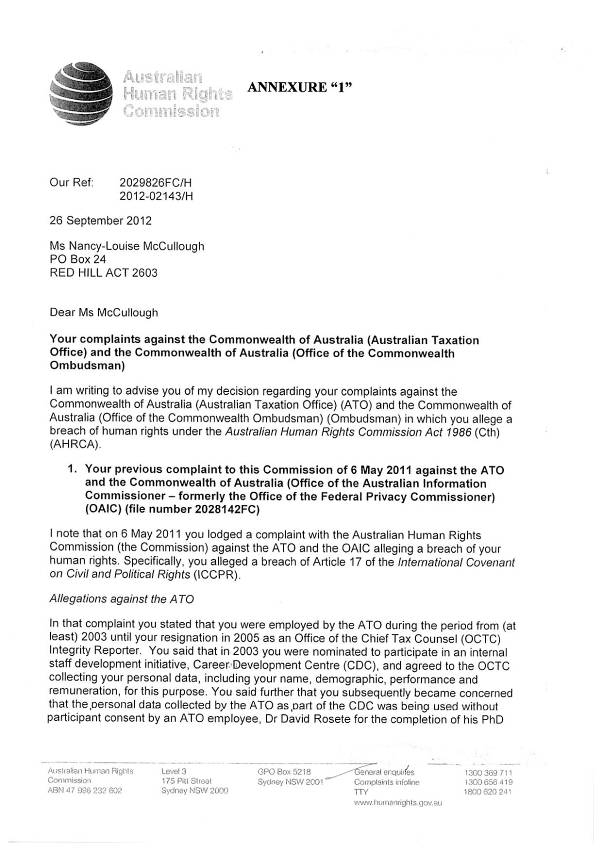
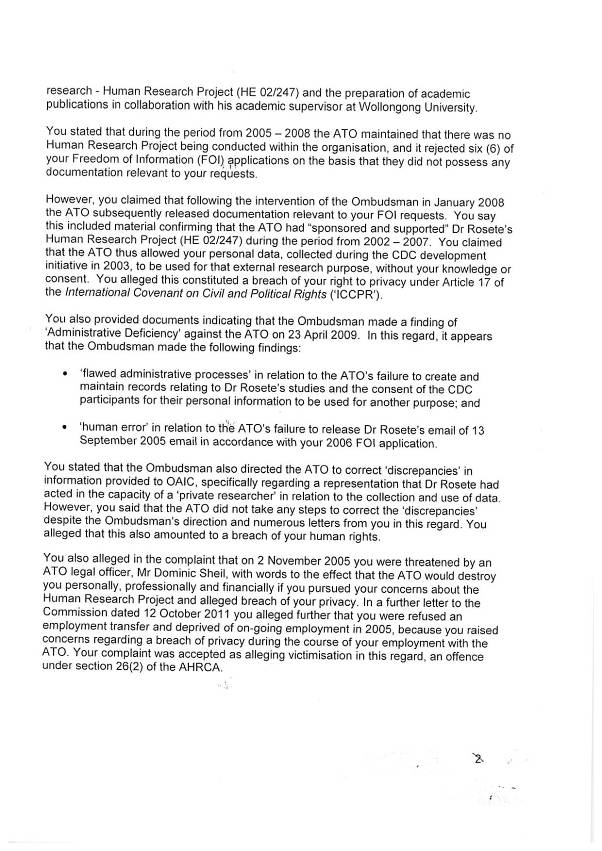
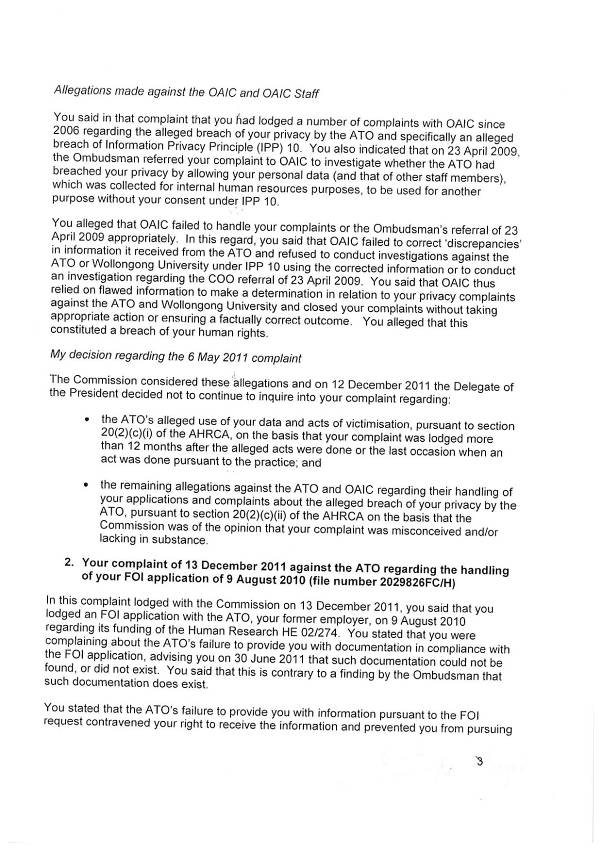
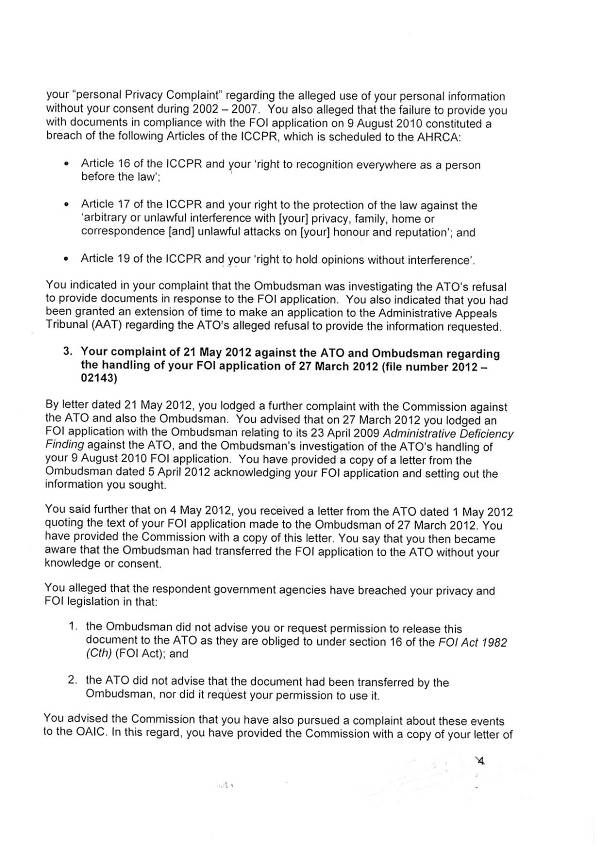
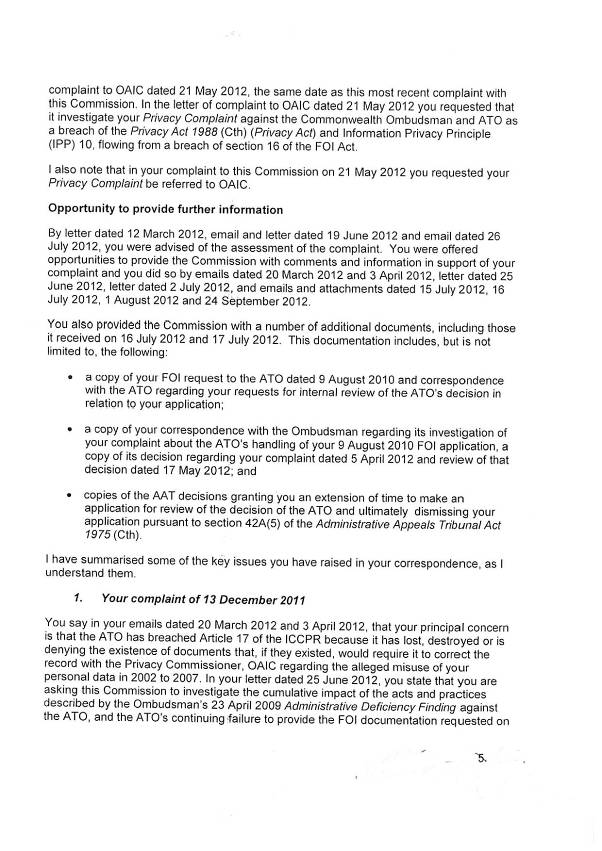
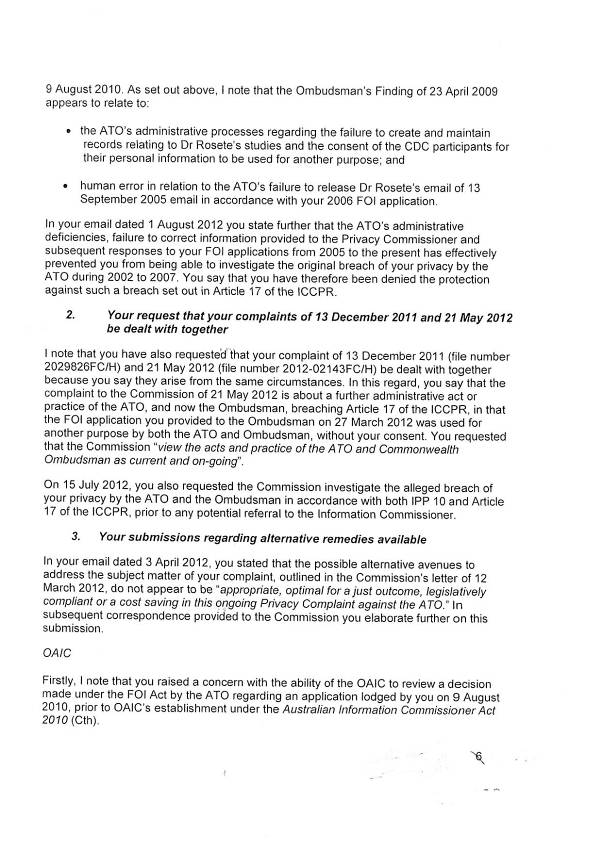
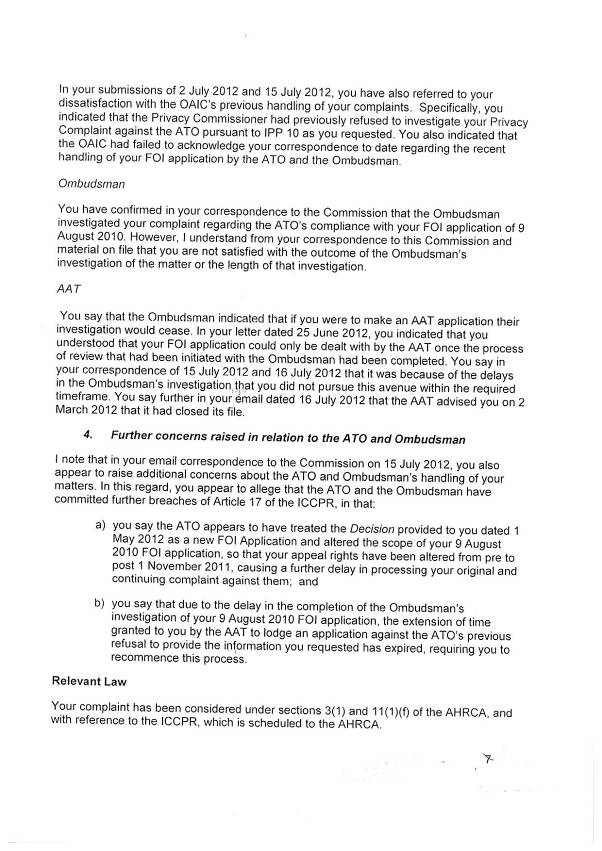
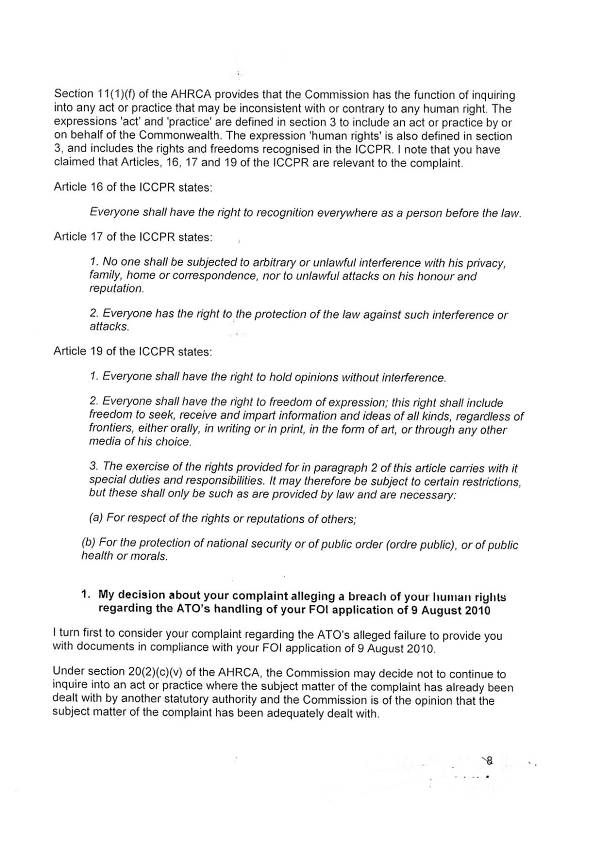
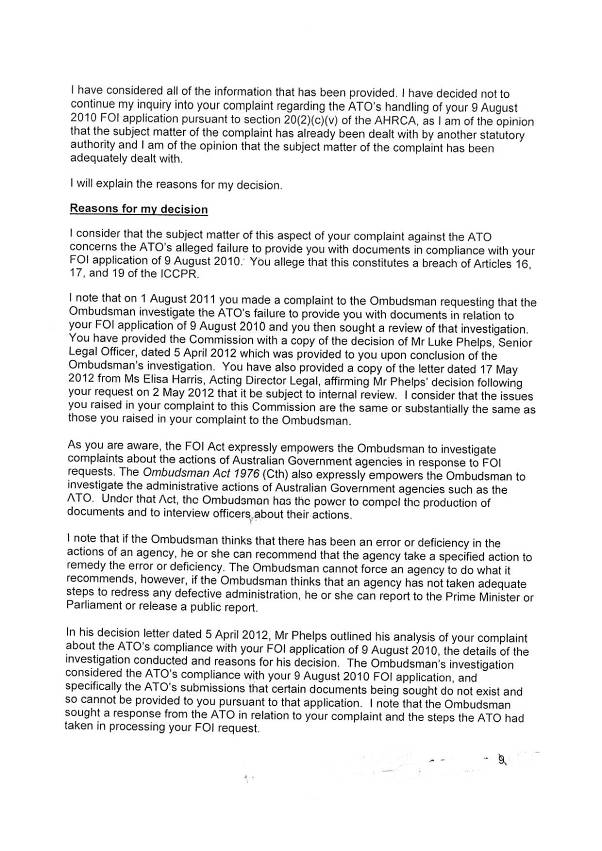
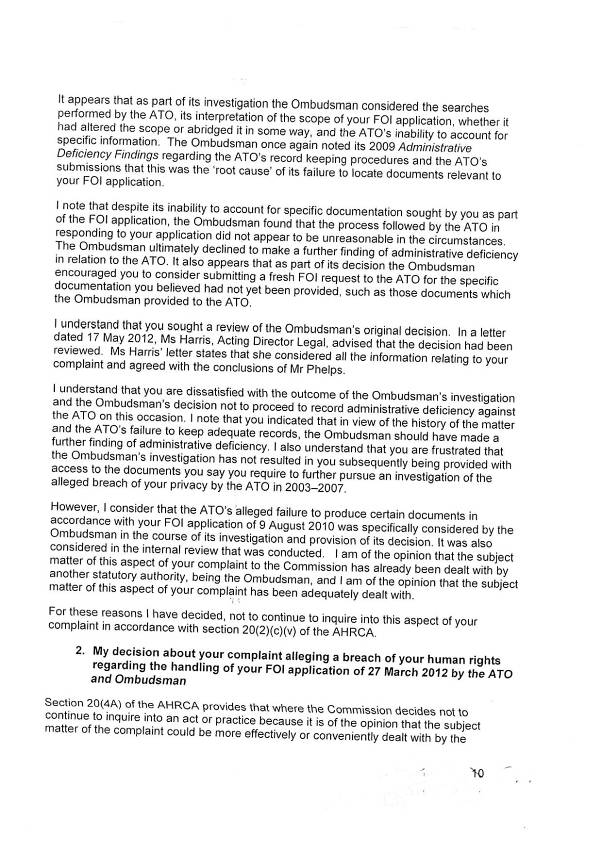
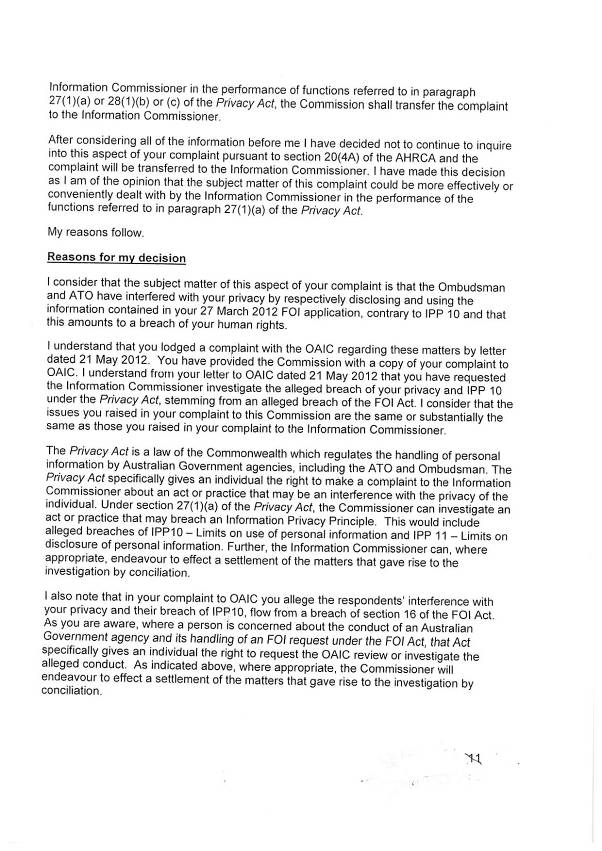
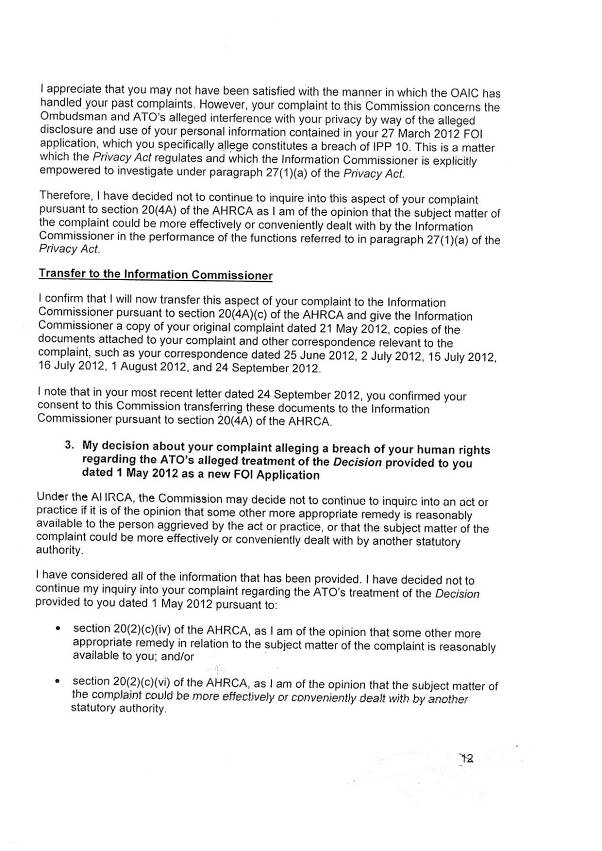
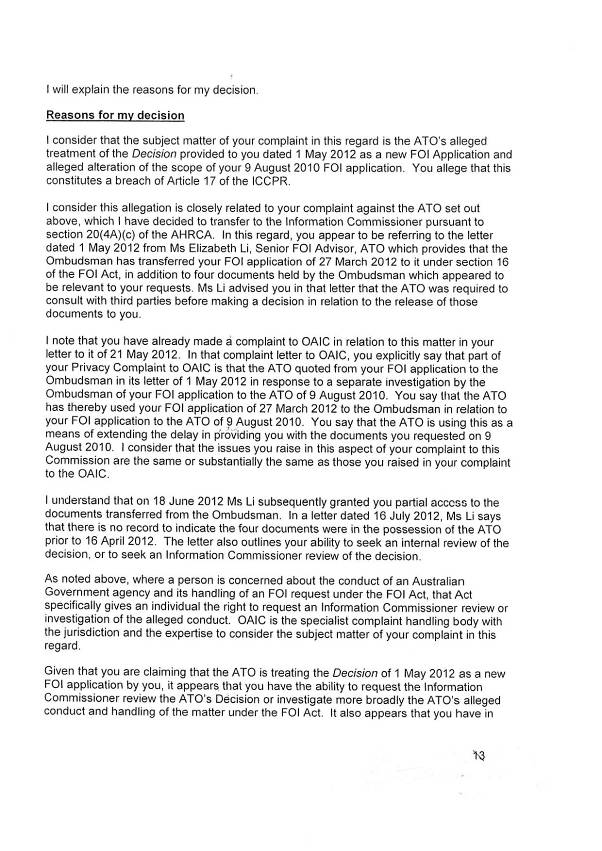
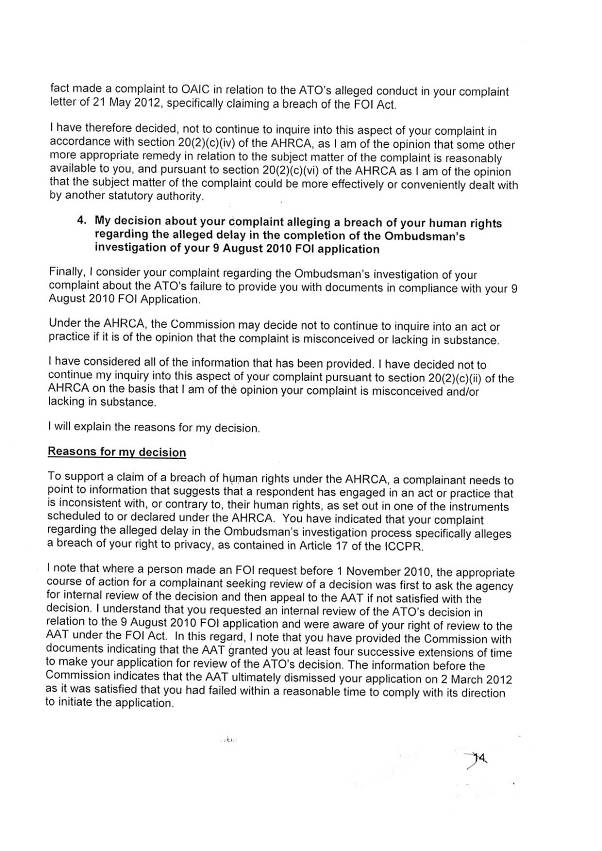
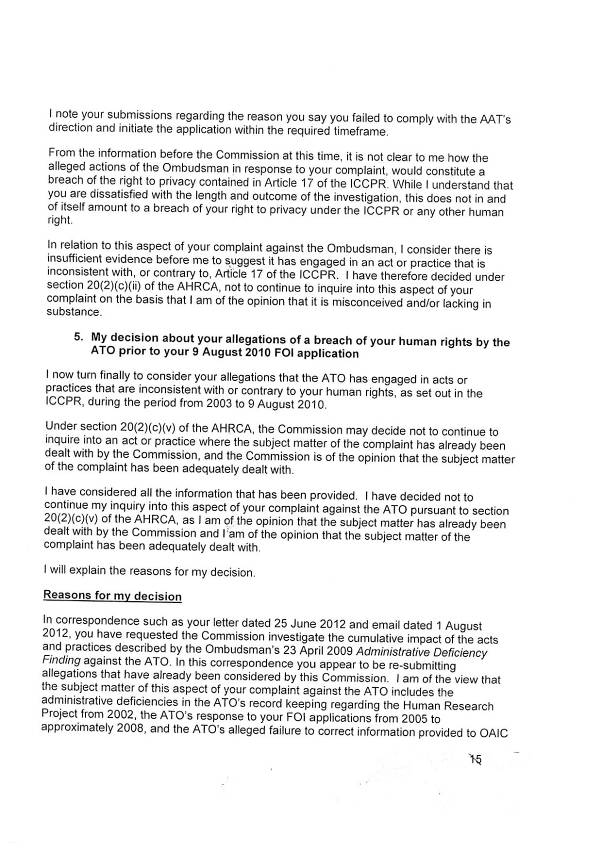
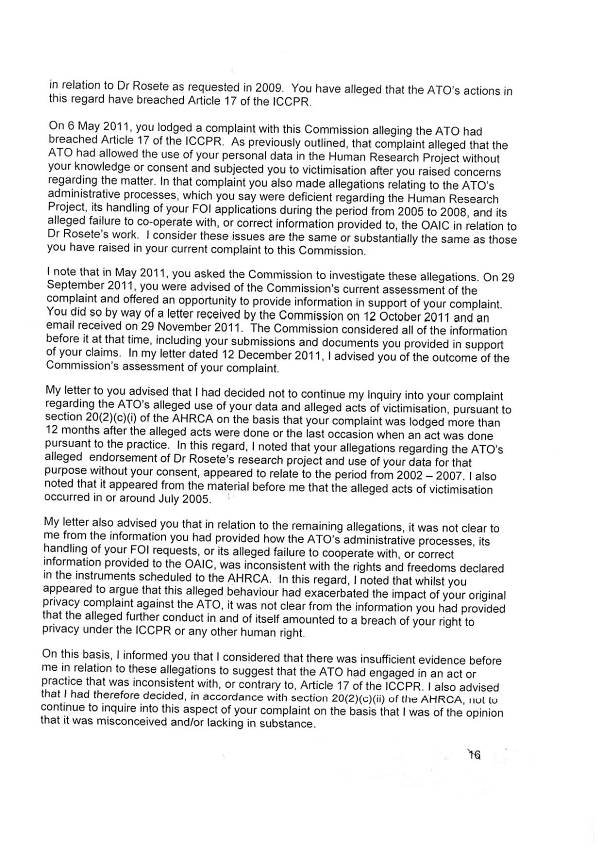
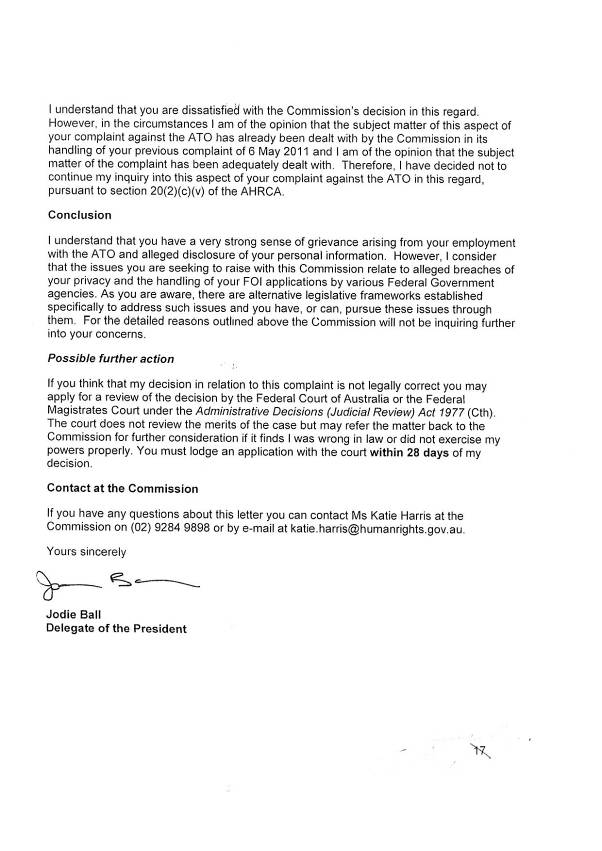
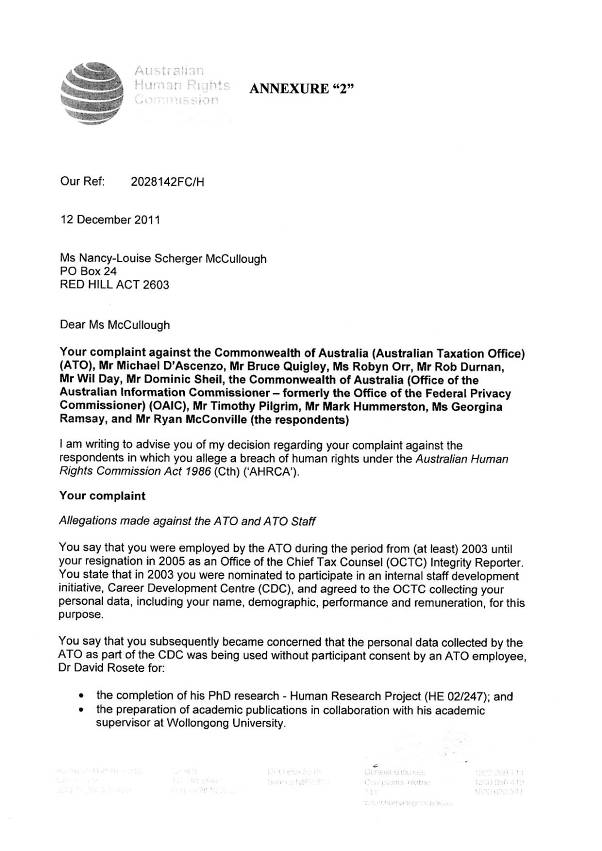
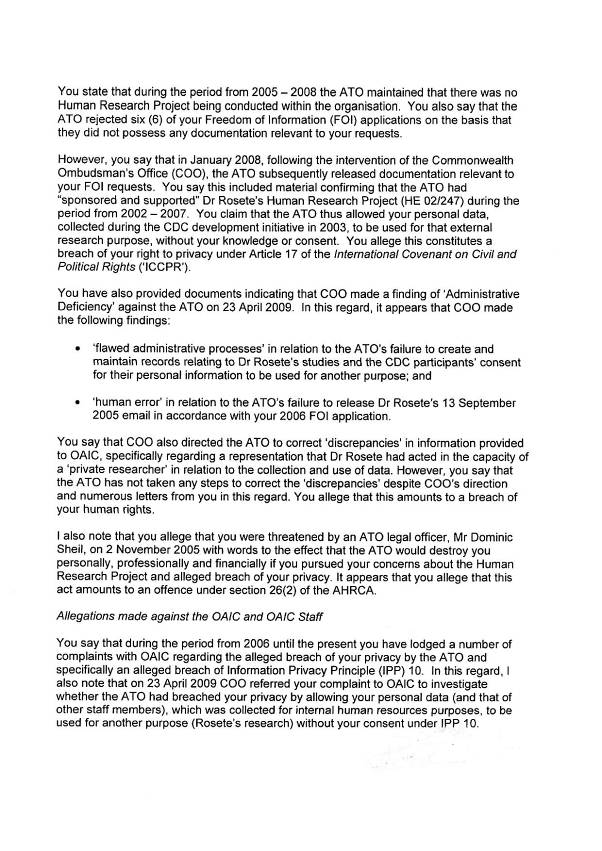
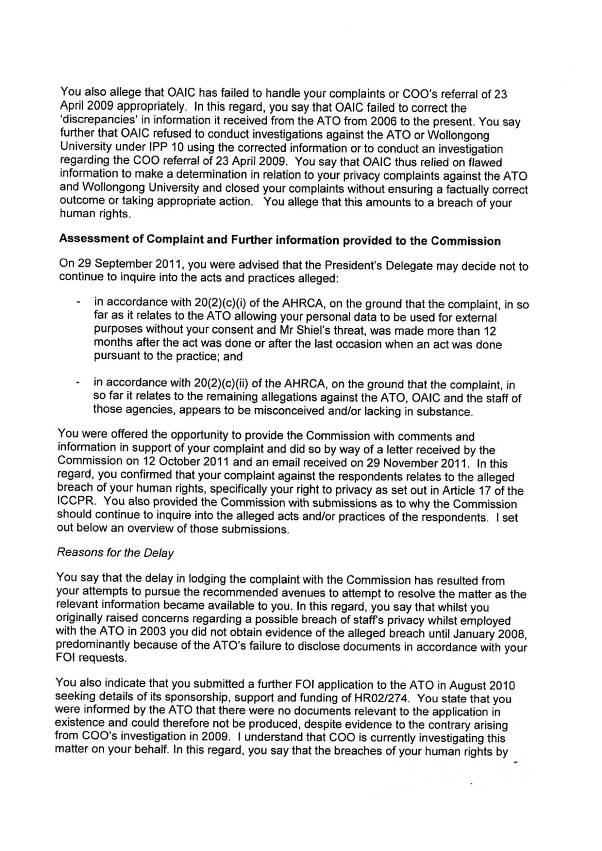
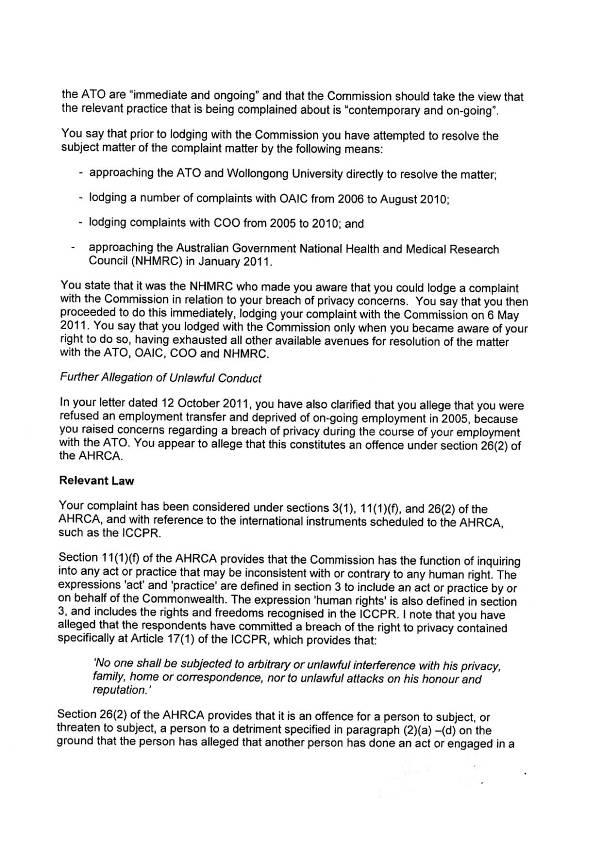
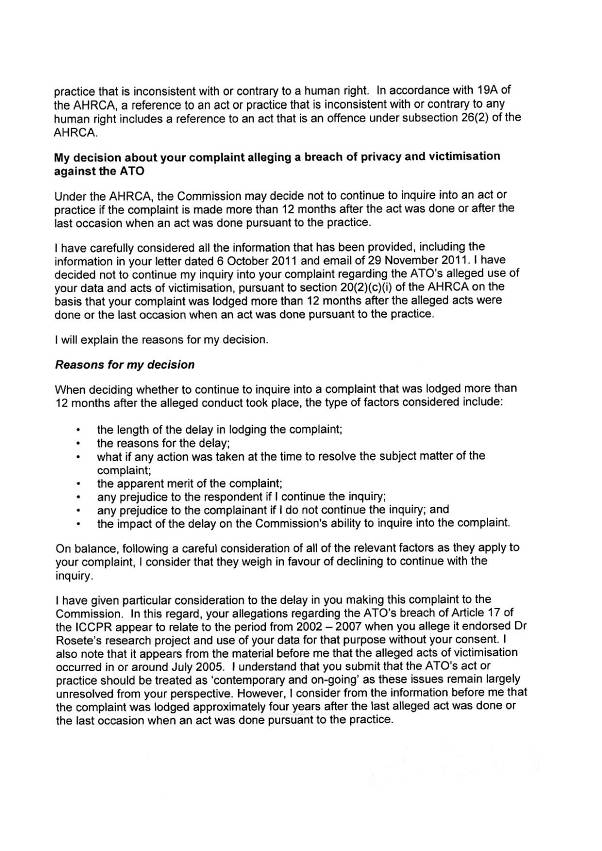
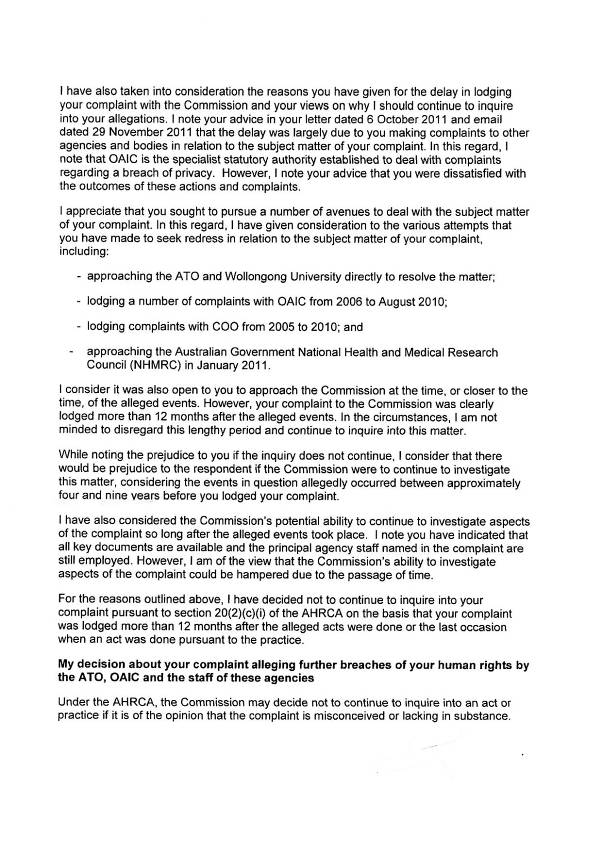
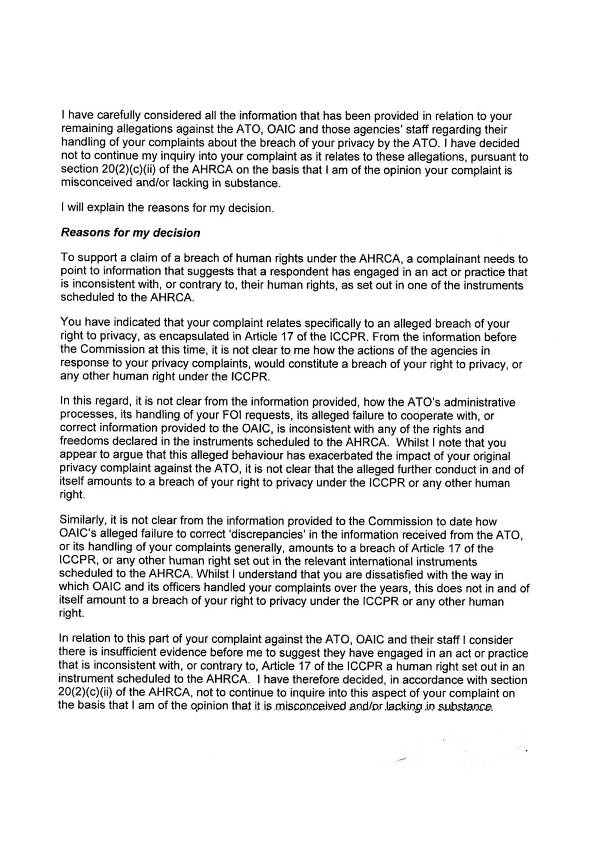
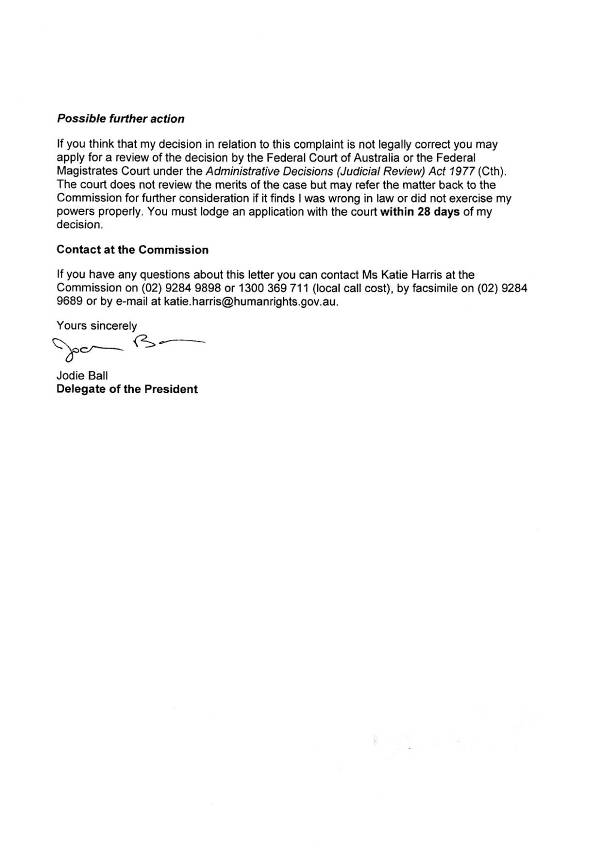
2 The decisions under challenge are dated 12 December 2011 and 26 September 2012. It was agreed that both decisions should be considered together. It is a feature of the applicant’s complaints that they involve a high level of complexity and raise a considerable variety of permutations and combinations. I will make an attempt to grapple with the central elements of the complaints, so far as that is necessary, but I have decided to attach the two decisions as Annexures 1 and 2, to avoid the need for extended and incomplete discussion of them.
3 The power which this Court has to entertain the present application arises from s 5 of the ADJR Act, which provides as follows:
(1) A person who is aggrieved by a decision to which this Act applies that is made after the commencement of this Act may apply to the Federal Court or the Federal Magistrates Court for an order of review in respect of the decision on any one or more of the following grounds:
(a) that a breach of the rules of natural justice occurred in connection with the making of the decision;
(b) that procedures that were required by law to be observed in connection with the making of the decision were not observed;
(c) that the person who purported to make the decision did not have jurisdiction to make the decision;
(d) that the decision was not authorized by the enactment in pursuance of which it was purported to be made;
(e) that the making of the decision was an improper exercise of the power conferred by the enactment in pursuance of which it was purported to be made;
(f) that the decision involved an error of law, whether or not the error appears on the record of the decision;
(g) that the decision was induced or affected by fraud;
(h) that there was no evidence or other material to justify the making of the decision;
(j) that the decision was otherwise contrary to law.
(2) The reference in paragraph (1)(e) to an improper exercise of a power shall be construed as including a reference to:
(a) taking an irrelevant consideration into account in the exercise of a power;
(b) failing to take a relevant consideration into account in the exercise of a power;
(c) an exercise of a power for a purpose other than a purpose for which the power is conferred;
(d) an exercise of a discretionary power in bad faith;
(e) an exercise of a personal discretionary power at the direction or behest of another person;
(f) an exercise of a discretionary power in accordance with a rule or policy without regard to the merits of the particular case;
(g) an exercise of a power that is so unreasonable that no reasonable person could have so exercised the power;
(h) an exercise of a power in such a way that the result of the exercise of the power is uncertain; and
(j) any other exercise of a power in a way that constitutes abuse of the power.
(3) The ground specified in paragraph (1)(h) shall not be taken to be made out unless:
(a) the person who made the decision was required by law to reach that decision only if a particular matter was established, and there was no evidence or other material (including facts of which he or she was entitled to take notice) from which he or she could reasonably be satisfied that the matter was established; or
(b) the person who made the decision based the decision on the existence of a particular fact, and that fact did not exist.
4 In the present proceedings the onus lies on the applicant to identify with adequate clarity and precision a ground of review arising under the ADJR Act and a satisfactory foundation for any argument that such a ground of review has been established. As will be seen from the discussion which follows, in my view, she has not done so.
5 The background to these matters appears, from the applicant’s submissions, to be as follows. In 1998 she transferred to Canberra. From (at least) 2003 to 2005 she worked in the Australian Taxation Office (“ATO”). In March 2003 she nominated to participate in an internal career development programme. Unknown to her, information she provided was furnished, as part of other information of a similar kind about other employees, to a PhD student at the University of Wollongong (also an ATO officer) for use in a research thesis. The applicant’s opposition to use of the information she had provided led to a variety of approaches to various authorities in an effort, apparently, to find out more about the use of the information. Her dissatisfaction with the responses led to pursuit of complaints about the administrative processes in the ATO, and later the investigative procedures in the bodies to whom she made complaints. Thus it is, in the present case, that the focus of attention is on perceived and asserted deficiencies in the way the AHRC investigated her complaints to it, which in turn were substantially concerned with complaints about other bodies.
6 The same background is identified with greater precision in the written submissions for the second respondent as follows:
3. The Applicant was employed with the ATO from about 2003 to 2005.
4. The Applicant contends that during this time, the ATO allowed human resource information to be used as part of external research conducted by Dr Rosete, a member of the Department of Psychology within the University of Wollongong.
5. In about 2006 the applicant lodged a complaint with the Privacy Commissioner about the purported release of personal information in breach of the Privacy Act 1988 (Privacy Act). The Privacy Commissioner subsequently refused to investigate.
6. In August 2007 the applicant lodged a complaint with the Commonwealth Ombudsman alleging that the ATO had failed to provide the Applicant with documents following repeated requests made under the Freedom of Information Act 1982 (FOI Act). The documents sought after in these requests related to the research conducted by Dr Rosete with staff members of the ATO.
7. The Commonwealth Ombudsman commenced an investigation on or about 4 December 2007.
8. On 23 April 2009 the Commonwealth Ombudsman determined that there were ‘administrative deficiencies’ in relation to the ATO’s failure to create and maintain records relating to Dr Rosete’s studies support, participants’ consent forms for such studies and failure to release a document under the FOI Act. The Ombudsman also transferred part of the complaint to the Privacy Commissioner.
9. On 5 August 2010 the applicant lodged a further complaint with the Privacy Commissioner. The Privacy Commissioner again refused to conduct an investigation into possible breaches of the Privacy Act.
10. On 14 December 2010 the applicant lodged a further complaint with the Commonwealth Ombudsman about various aspects of the Privacy Commissioner’s decision not to investigate her complaint.
11. On 6 May 2011 the applicant lodged a complaint with the Commission [the AHRC]. The complaint encompassed the alleged misuse of human resource information by the ATO (during the period of the applicant’s employment in 2003), a threat from an ATO officer in November 2005, the failure of the ATO to implement the Ombudsman’s ‘administrative deficiencies’ findings about the former’s handling of the FOI requests (following the Ombudsman’s decision of 23 April 2009) and the Privacy Commissioner’s failure to investigate the applicant’s complaint of breaches of the Privacy Act by the ATO and Dr Rosete (following the referral from the Ombudsman on 23 April 2009).
12. On 11 May 2011 the Commission wrote to the applicant confirming receipt of the complaint and advising that it had been referred by the President to the Complaints Handling Section of the Commission.
13. The Commission commenced an investigation by examining the material which the applicant had provided. On 29 September 2011 the Commission wrote to the applicant setting out its preliminary view that it would not continue its inquiry into her complaints. The letter sets out the reasons for the Commission’s preliminary view that:
13.1. in respect of the complaint about the ATO’s alleged misuse of human resource information (and a complaint about a threat from an ATO officer in November 2005) – the complaint was lodged greater than 12 months after the alleged act occurred;
13.2. in respect of the ATO’s alleged failure to implement the findings of the Commonwealth Ombudsman, the ATO’s handling of the applicant’s FOI requests and the Privacy Commissioner failure to investigate – these complaints were otherwise misconceived or lacking in substance.
14. The correspondence invited a response from the Applicant about these issues prior to the Commission making a final decision. At page 4 of this letter under the heading ‘Possible next steps’, the Commission indicated that, on the basis of information obtained to date, that it may not continue to inquire into the acts and practices alleged by the applicant on the grounds that some aspects of the complaints:
14.1. were lodged greater than 12 months after the alleged act occurred
14.2 were otherwise misconceived or lacking in substance.
15. The applicant accepted this invitation and responded by letter on 12 October 2011 and email on 29 November 2011.
16. On 12 December 2011, the Commission decided not to continue to inquire into the applicant’s complaint under s 20 of the Act and gave reasons for that decision. The grounds on which that decision was made were consistent with those set out in the letter of 29 September 2011.
7 That history dealt with events up to the first decision of 12 December 2011. Subsequently, the applicant made further complaints to the AHRC, arising from the same background, which led to the decision of 26 September 2012.
8 At the foundation of the applicant’s complaints are two main issues: one concerns her privacy and the other concerns the charge of maladministration within the ATO. The applicant initially pursued those two streams of complaint with the (then) Privacy Commissioner and the Commonwealth Ombudsman (“the Ombudsman”), respectively.
9 The applicant had some limited success before the Ombudsman, who identified some administrative deficiencies in the approach taken by the ATO. The Privacy Commissioner, now the Office of the Australian Information Commissioner, however has either dismissed the applicant’s complaints, or declined to further pursue them, on a number of occasions. Sometimes that has been done in response to direct complaints to it by the applicant; sometimes after referral to it by, for example, the Ombudsman.
10 None of those decisions are reviewable in the present proceedings. They represent a long history of consideration of the applicant’s grievances and a long history of conclusions that (apart from some identified administrative deficiencies in the ATO) they are without substance.
11 Those are the same matters in respect of which the applicant attempted to engage the attention of the AHRC. In part her complaints to the AHRC represented further attempts to achieve a reference to the Office of the Australian Information Commissioner of matters that had previously been raised with that Office, but which, according to the applicant, had not been properly investigated.
12 The proceedings in this Court, and some of the relief sought, are directed in part to the same end.
13 It will be seen from the decision of 12 December 2011 that it:
(a) in part decided that some complaints concerned events some years before the complaints were made. The delegate decided, in the exercise of her discretion, for reasons which were explained, not to continue to investigate those complaints;
(b) in part decided that the complaints lacked substance, or were misconceived. The delegate decided, in the exercise of her discretion, for reasons which were explained, not to further investigate those aspects of the complaints.
14 The decision of 26 September 2012:
(a) decided that some matters complained of had been adequately dealt with by the Ombudsman;
(b) decided that some matters complained of could more effectively or conveniently be dealt with by the Office of the Australian Information Commissioner under s 27(1)(a) of the Privacy Act 1988 (Cth);
(c) decided that some other matters could more conveniently be dealt with by another statutory authority;
(d) decided that some complaints were misconceived and/or lacking in substance;
(e) decided that further complaints had already been adequately dealt with by the AHRC.
15 Detailed reasons and explanations were given in each of the letters to the applicant conveying the decision of the delegate.
16 The orders which are sought from the Court are:
1. That the AHRC Decisions dated the 12 December 2011 and 26 September 2012 be set aside;
2. That the AHRC proceed to investigate my Human Rights Complaints lodged on the 6 May 2011, 13 December 2011 and 21 May 2012 lawfully and expeditiously;
3. That the AHRC treat my Human Rights Complaints dated the 6 May 2011, the 13 December 2011 and the 21 May 2012, which arise out of the same or substantially same circumstances or subject, as a single inquiry in relation to these Complaints;
4. That in accord with Section 20(4A), 20(4B) and (5) the AHRC refer my Privacy Complaints against the ATO and the COO in accord with IPP 10 to the Privacy Commissioner to be lawfully and expeditiously investigated; and
5. That the ATO errors in information provided to the Privacy Commissioner from 2006 to the present be corrected in accord with the COO Administrative Deficiency Finding on the 23 April 2009, and that the COO Section 6(4A) Privacy Commissioner Referral be investigated in accord with IPP10.
6. Alternatively, that:
a. (i) the AHRC Decision dated the 12 December 2011 and 26 September 2012 be set aside; and that,
b. (ii) my privacy breach claims that the ATO during the 2002 to 2007 Human Research my staff performance data was ‘used’ for another purpose without my consent, and following the 27 March 2012 both the COO and the ATO, have breached the FOI Act and my privacy as set out in the Human Rights Complaints dated the 6 May 2011, the 13 December 2011 and the 21 May 2012, should be regarded as arising from the same circumstances (AHRC Section 46PF(2)), and ‘--- be taken to the Federal Court for determination’.
7. No Orders for cost be made by the Court so that I am as the applicant ‘--- not prejudiced as to costs’ by the choice of the Commonwealth to join, although the first respondent had resolved to submit to proceedings (Federal Court of Australia, New South Wales District Registry: Heougur Applicant and Human Rights and Equal Opportunity Commission, Second Respondent, Commonwealth of Australia, Second Respondent: Gyles J, 11 December 2007, Sydney) (Annexure “6”).
17 The grounds of the present application appear to be that:
a) the applicant’s complaints were misinterpreted and/or misunderstood;
b) the applicant was denied an adequate opportunity to respond to certain “assumptions” made by the AHRC;
c) the AHRC did not act, as required, within some statutory deadlines;
d) the AHRC made legal errors.
18 These assertions appear to relate to the applicant’s understanding or view about what the AHRC should have done, how it should have conducted its inquiries or what views it should have formed.
19 The discretion invoked by the delegate to discontinue the inquiries which had been commenced arises under s 20(2) of the Australian Human Rights Commission Act 1986 (Cth) (“the AHRC Act”) which provides, relevantly:
20(2) The Commission may decide not to inquire into an act or practice, or, if the Commission has commenced to inquire into an act or practice, may decide not to continue to inquire into the act or practice, if:
…
(c) in a case where a complaint has been made to the Commission in relation to the act or practice:
(i) the complaint was made more than 12 months after the act was done or after the last occasion when an act was done pursuant to the practice; or
(ii) the Commission is of the opinion that the complaint is frivolous, vexatious, misconceived or lacking in substance; or
(iii) where some other remedy has been sought in relation to the subject matter of the complaint – the Commission is of the opinion that the subject matter of the complaint has been adequately dealt with; or
(iv) the Commission is of the opinion that some other more appropriate remedy in relation to the subject matter of the complaint is reasonably available to the person aggrieved by the act or practice; or
(v) where the subject matter of the complaint has already been dealt with by the Commission or by another statutory authority – the Commission is of the opinion that the subject matter of the complaint has been adequately dealt with; or
(vi) the Commission is of the opinion that the subject matter of the complaint could be more effectively or conveniently dealt with by another statutory authority; or
(vii) the Commission is satisfied that the complaint has been settled or resolved.
20 In particular, the delegate relied, for various aspects of the complaints, on s 20(2)(c)(i), (ii), (iv), (v) and (vi). In addition, the delegate decided to transfer one matter to the Office of the Australian Information Commissioner in accordance with s 20(4A) which provides:
20(4A) Where:
(a) a complaint has been made to the Commission in relation to an act or practice; and
(b) because the Commission is of the opinion that the subject-matter of the complaint could be more effectively or conveniently dealt with by the Information Commissioner in the performance of the functions referred to in paragraph 27(1)(a) or 28(1)(b) or (c) of the Privacy Act 1988, the Commission decides not to inquire, or not to continue to inquire, into that act or practice;
the Commission shall:
(c) transfer the complaint to the Information Commissioner;
(d) forthwith give notice in writing to the complainant stating that the complaint has been so transferred; and
(e) give to the Information Commissioner any information or documents that relate to the complaint and are in the possession, or under the control, of the Commission.
21 Things have moved a long way from the applicant’s original concerns expressed about the research thesis. The applicant now seems to have embarked on some general campaign seeking vindication of an alleged or asserted right to administrative efficiency. She said, in her original complaint to the AHRC:
Since I am personally and professionally committed to resolving the issues I have raised focussing on verifiable fact, this has required me to investigate my concerns over an extended period within a challenging legislative framework at significant cost to me as an individual.
22 The proceedings in this Court are not adapted particularly to giving effect to the pursuit of some of these matters for their own sake. To obtain relief in the present proceedings the applicant needs to demonstrate legal error in a context where some useful purpose will be achieved by the particular orders a litigant might seek.
23 During the course of oral submissions, I took the opportunity to explore with the applicant the basis for her original complaint, from which all of her subsequent procedural complaints proceeded. It appears that while she was at the ATO, that body supported some research by Dr David Rosete (as he now is) who was involved in a research program being conducted by the University of Wollongong. The research program involved a comparison of the results of psychological testing carried out by Dr Rosete with information obtained by the ATO as part of its own performance management arrangements. The psychological testing carried out by Dr Rosete was voluntary. It provided the material for the relevant comparison. Neither the psychological testing nor any other aspect of Dr Rosete’s research protocols involved the applicant, who ceased her participation without becoming involved in any of it. It seems to me to be very doubtful that information concerning the applicant was in fact used in the research or in papers published in connection with it. When these matters were drawn to her attention, the applicant accepted that her personal information was not used in the final paper produced by Dr Rosete. Nevertheless, the applicant emphasised that data had been collected by the ATO for the purpose of the research, and that information relating to her had been included in the data obtained and provided to Dr Rosete. The applicant also appeared to complain about retention (by the researchers) of the (unused) material referring to her, which had been provided by the ATO. The material appears to have been retained because the applicant requested that it not be destroyed, as it otherwise would have been.
24 Although it does not affect the legal issues which potentially arise under the present application, the chain of events commenced by the applicant’s protest about use of her personal information seems to be based on a misunderstanding about something which does not affect her interests directly. The complaints about various suggested examples of maladministration, or of inadequate investigation, made thereafter appear to have been pursued for their own sake. They are justified by the applicant, it would seem, on the basis that she has a sufficient interest and right in ensuring “ethical human research”. That suggested interest, it seems to me, provides a flimsy foundation for the multitude of requests and complaints with which she has burdened many governmental agencies over a period of some years. More particularly, it does not provide a safe and reliable foundation for any suggestion that her “human rights” have been infringed.
25 In any event, the complaints to the AHRC appear to have been dealt with patiently, thoroughly and without legal error that I can detect.
26 The applicant’s complaint which was dealt with in the decision of 12 December 2011 related to four issues:
(a) a complaint that data collected by the ATO had been used for Dr Rosete’s research papers, contrary to her right to privacy;
(b) the ATO’s processes which led to the infringement of her privacy were flawed;
(c) she had been threatened in November 2005 after her employment with the ATO had ended, because of her pursuit of the issue;
(d) the Office of the Australian Information Commissioner had failed to properly investigate the matter after she complained to that Office.
27 Matters (a) and (c) predated the complaint made to the AHRC by some years and have no ongoing currency. As to the other matters, the delegate of the AHRC could not identify what role of the AHRC might be engaged by the applicant’s particular complaints. Accordingly, the delegate used the discretions in s 20(2)(c)(i) and (ii) to refrain from further inquiry into any of the matters. Those decisions were carefully explained.
28 In keeping with her apparent desire to correct procedural imperfection where she sees it, the applicant complained, however, in the present proceedings that the AHRC had breached the requirements of the AHRC Act in the way in which her complaint was handled, regardless of the foundation for the complaint itself. Thus, she complained that the AHRC had failed within two months, contrary to s 20(3) of the AHRC Act, to either terminate her complaint or inquire into it. The complaint has no substance. The applicant has managed to obtain a lot of information and documents under the Freedom of Information Act 1982 (Cth) (“the FOI Act”). There was also a good deal of correspondence passing between the AHRC and the applicant. On 11 May 2011, within days of her first complaint to the AHRC being made, the applicant was informed that her complaint had been referred to the Complaints Handling Section. In due course (apparently during July 2011) it was allocated to a particular officer, who thereafter was in telephone contact with the applicant, and exchanged correspondence with her. Ultimately, the complaint was the subject of the decision on 12 December 2011 that it not be the subject of continuing inquiry. The applicant was promptly notified. The applicant, in my view, has misrepresented some of these factual events in her submissions to this Court, which I reject on this issue.
29 The real obstacle for the applicant, so far as the first decision is concerned, is that there was no satisfactory identification of any matter that the AHRC should inquire into. That difficulty remains. No submission was advanced which pointed to any error of understanding, or in the exercise of discretion, by the AHRC in its first decision.
30 Not satisfied with the decision of 12 December 2011, the applicant immediately lodged another complaint, and then a further one. These were dealt with by the decision of 26 September 2012. On this occasion, the delegate formed the view that some matters were not matters for the AHRC, but for the Office of the Australian Information Commissioner. These matters were transferred to that Office by the AHRC. Otherwise, again there was no satisfactory identification of an outstanding issue which required investigation by the AHRC. Nor has any been identified in the present proceedings.
31 The matters dealt with in the decision of 26 September 2012 appear sufficiently from it. What follows is a very brief summary. The delegate first made reference to the earlier complaint of 6 May 2011 and the decision of 12 December 2011 which addressed that complaint. Then there was a reference to two further complaints by the applicant, on 13 December 2011 and 21 May 2012. The first matter then addressed concerned a complaint about an FOI request. That matter was dealt with twice within the Ombudsman’s Office, before being made the subject of a complaint to the AHRC. The second matter also concerned a complaint about the handling of a FOI request and the response of the ATO to a FOI application transferred to it by the Ombudsman. The delegate decided to transfer that complaint to the Office of the Australian Information Commissioner as it concerned a privacy issue. The applicant had informed the AHRC that she had pursued the complaint with the Office of the Australian Information Commissioner directly. The third matter concerned an allegation of delay by the Ombudsman in dealing with an aspect of a complaint to it. The fourth matter concerned an allegation against the ATO based on the cumulative impact of various alleged deficiencies asserted against the ATO. The AHRC took the view that the substance of this complaint had already been addressed by it.
32 In my view there is no substance in any complaint by the applicant (if this is what is intended) that the delegate, in either decision under attack, misunderstood or failed to address the nature or substance of the applicant’s complaints. Neither is there any substance in the applicant’s suggestion that she was somehow denied an opportunity to fully expose those complaints for consideration. That much appears sufficiently, in my view, from the detailed and patient analysis and explanation in the two decisions. The applicant’s assertion of inadequate investigation by the AHRC itself cannot deflect attention from the fact that, in substance and reality, her complaints were comprehensively addressed and explanations were given for each of the discretionary decisions made by the delegate. The applicant appears not to fully appreciate that, although she had a right to bring her complaints, and although she no doubt wished them to be pursued to a greater extent, she had no legal right to insist on the exercise of the delegate’s discretion in any particular way. It was, after all, a discretion which was being exercised in each case.
33 The proceedings in this Court are in no better position. None of the applicant’s complaints arising under the ADJR Act appear to me to have any substance whatsoever. The proceedings represent an extension of the applicant’s desire for administrative excellence, measured according to her satisfaction with the results. However, they suffer from the same basic defect, that a safe foundation for the exercise of the Court’s power has not been identified. Instead, what the applicant seeks is a further round of administrative investigations into alleged procedural deficiencies about matters arising long ago in the ATO.
34 No legal error made by the delegate has been identified which would provide a sufficient foundation for an order that the AHRC reconsider the discretionary decisions conveyed to the applicant in the letters of 12 December 2011 and 26 September 2012. On the contrary, the applicant was afforded a very thorough explanation by the delegate of the legal foundation for each of the decisions made. The fact that the applicant may disagree with the delegate’s explanation does not serve to identify any legal error. Nor was legal error otherwise identified.
35 None of the grounds for relief arising under the ADJR Act have been established by the applicant. Accordingly, the application will be dismissed.
36 The Commonwealth has sought its costs. The applicant resists an order for costs against her on various bases.
37 On 23 April 2012 the AHRC filed a submitting notice with the Court indicating that it would submit to the jurisdiction of the Court save as to costs, and, therefore, would not take an active part in the proceedings. The applicant was advised accordingly. It was explained to the applicant that the AHRC would confine its participation to resisting any costs order sought against it. However, on 11 May 2012 the Commonwealth was joined as a party, and has since that time acted as a contradictor. The order that the Commonwealth be joined is stated to have been made by consent, but I give no particular weight to that as it is inevitable that the Commonwealth would have been allowed to be joined in the absence of any other contradictor.
38 I am satisfied that the Commonwealth did not, at any time, offer to forego its costs. On the contrary, material attached by the applicant to her amended application indicates that it was made clear to the applicant that the Commonwealth would seek costs if the matter was pursued.
39 The applicant relies on a judgment of Gyles J in Ugur v Human Rights and Equal Opportunity Commission [2007] FCA 2066. In that judgment Gyles J admitted the Commonwealth as a party in a similar kind of proceeding. His Honour said, after indicating why there was clear power to make the order:
In my opinion, the application for joinder must succeed. However, it should be done on terms that the applicant is not prejudiced as to costs and I, or whoever is managing this case, will ensure that that is honoured.
40 That order, and those comments, were made at the time of joinder. The comments no doubt had regard to the particular facts of that case. They were clearly not intended to indicate some general exemption to applicants from paying costs when the Commonwealth was entitled to be joined as a party. Cases where the Commonwealth, or another party, is granted leave to appear as an intervener may raise different issues, but that is not this case. The Commonwealth appears in the present case as a party with all the rights of a party.
41 Litigation in this Court commits the use of public resources. Those public resources are not as freely available as might generally be thought. It also puts other parties to expense and inconvenience. Although the Court will be astute to ensure that unnecessary practical injustice is not visited upon a litigant with a justifiable sense of grievance, and a respectable case against the Executive Government, that does not mean that the Court is available at the unrestricted instance of litigants so that their grievances may simply be pursued to the bitter end. Although costs are not awarded to punish a losing litigant, they are not withheld from a successful party just so that a losing litigant suffers no disadvantage from having their day in court.
42 In the present case, I can see no reason in principle why the applicant should have an indemnity against the ordinary hazards of litigation. She insisted on maintaining her case, as she was entitled to do. She has had her day in court, and others have been put to expense and inconvenience as a result. She has lost the case. The ordinary principles apply. She must pay the costs of the successful active party.
43 The application will be dismissed with costs.
I certify that the preceding forty-three (43) numbered paragraphs are a true copy of the Reasons for Judgment herein of the Honourable Justice Buchanan. |
Associate: