

FEDERAL COURT OF AUSTRALIA
Graham on behalf of the Ngadju People v State of Western Australia
[2012] FCA 1455
|
IN THE FEDERAL COURT OF AUSTRALIA |
|
|
JOHN WALTER GRAHAM AND OTHERS ON BEHALF OF THE NGADJU PEOPLE Applicants | |
|
AND: |
STATE OF WESTERN AUSTRALIA AND OTHERS Respondent |
|
DATE OF ORDER: |
|
|
WHERE MADE: |
THE COURT ORDERS THAT:
|
IN THE FEDERAL COURT OF AUSTRALIA |
|
|
JOHN WALTER GRAHAM AND OTHERS ON BEHALF OF THE NGADJU PEOPLE Applicants | |
|
AND: |
STATE OF WESTERN AUSTRALIA AND OTHERS Respondent |
|
DATE OF ORDER: |
|
|
WHERE MADE: |
THE COURT ORDERS THAT:
The separate question is answered as follows:
But for any question of extinguishment of native title by acts carried out pursuant to the authority of the legislature to which Divisions 2, 2A, 2B or 3 of Part 2 of the Native Title Act 1993(Cth) or the Titles Validation and Native Title (Effect of Past Acts) Act 1995 (WA) applies, and the determination of matters required by s. 225(c), (d) and (e) of the Native Title Act 1993 (Cth):
(i) Does native title exist in relation to land and waters in the area of the Ngadju Trial Area proceeding?
Answer to (i):
Yes. Native title exists in relation to the land and waters within the area of the Ngadju Trial Area proceeding.
(ii) If the answer to (i) above is in the affirmative, who are the persons or each group of persons holding the common or group rights comprising the native title?
Answer to (ii):
The Ngadju people are the persons holding the common or group rights comprising the native title.
(iii) What is the nature and extent of the native title rights and interests in relation to that area?
Answer to (iii):
(a) In relation to all of the land and waters above the high watermark of the foreshore of the coastline including rivers, streams and estuaries that are not affected by the ebb and flow of the tides, the native title rights and interests that are possessed under the traditional laws and customs are the right to possession, occupation, use and enjoyment to the exclusion of all others;
(b) In relation to the land and waters of the sea, including rivers, streams and estuaries that are affected by the ebb and flow of the tides, the native title rights and interests that are possessed under the traditional laws and customs are:
(i) the right to hunt and fish (excluding commercial fishing), to gather and use the natural resources of the area, such as food and medicinal plants and trees, timber and ochre and to have access to and use of potable water;
(ii) the right to live, to camp, to erect shelters and other structures and to travel over and visit;
(iii) the right to do the following activities:
engage in cultural activities;
conduct rituals or ceremonies;
hold meetings; and
teach the physical and spiritual attributes of places and areas of importance on or in the land and waters;
(iv) the right to have access to, maintain and protect, places and areas of importance on or in the land and waters, including Dreaming sites, waterholes and ceremony grounds;
(v) the right to share or exchange subsistence and other traditional resources obtained on or from the land and waters.
Note: Entry of orders is dealt with in Rule 39.32 of the Federal Court Rules 2011.
|
WESTERN AUSTRALIA DISTRICT REGISTRY |
|
|
GENERAL DIVISION |
WAD 6020 of 1998 |
|
BETWEEN: |
JOHN WALTER GRAHAM AND OTHERS ON BEHALF OF THE NGADJU PEOPLE Applicants
|
|
AND: |
STATE OF WESTERN AUSTRALIA AND OTHERS Respondent
|
|
JUDGE: |
MARSHALL J |
|
DATE: |
21 DECEMBER 2012 |
|
PLACE: |
MELBOURNE |
REASONS FOR JUDGMENT
Introduction
1 The substantive application in this proceeding is one for a determination of native title in accordance with s 13(1)(a) of the Native Title Act 1993 (Cth) (“the Act”). The claim is made on behalf of the Ngadju people in respect of that part of south-eastern Western Australia which includes the areas around Norseman and Balladonia (“the trial area”). More specific identification of the Ngadju people and the trial area is contained later in these reasons. The application has its origins in two claims made in 1998 on behalf of the Ngadju people. Those claims were consolidated. The trial area has a small overlap with another claim, being WAD 6216 of 1998 (“the Kalamaia Kabu(d)n claim”).
The separate question
2 On 9 December 2011, the Court ordered pursuant to s 67(2) of the Act, that the part of the Ngadju claim area that does not overlap with the Kalamaia Kabu(d)n claim be referred to as the “Ngadju Trial Area proceeding”. The Court also ordered (as amended on 24 September 2012, to correct a slip in wording) that there be a determination of a separate question, being:
But for any question of extinguishment of native title by acts carried out pursuant to the authority of the legislature to which Divisions 2, 2A, 2B or 3 of Part 2 of the Native Title Act 1993 (Cth) or the Titles Validation and Native Title (Effect of Past Acts) Act 1995 (WA) applies, and the determination of matters required by s 225(c), (d) and (e) of the Native Title Act 1993 (Cth);
(i) does native title exist in relation to land and waters in the area of the Ngadju Trial Area proceeding?;
(ii) if the answer to (i) above is in the affirmative, who are the persons or each group of persons holding the common or group rights comprising the native title?; and
(iii) what is the nature and extent of the native title rights and interests in relation to the area?
3 These reasons for judgment deal with the issues posed by the separate question. The most significant and contentious issue is that raised in (i) above, concerning the existence or otherwise of native title in the trial area. A map showing the boundary of the Ngadju native title claim is attached to this judgment and marked Appendix A. The notes as to the currency of overlap areas should be particularly observed.
does native title exist in relation to the land and waters in the area of the ngadju trial area proceeding?
The legal framework
4 A determination of native title is a creature of the Act and requires an examination of its relevant provisions; see Members of the Yorta Yorta Aboriginal Community v State of Victoria (2002) 214 CLR 422 (“Yorta Yorta”) at [32], per Gleeson CJ, Gummow and Hayne JJ. The framing of the separate question seeks that the Court address the matters referred to in the opening words of s 225 of the Act and in s 225(1)(a) and (b).
5 Section 225 of the Act provides:
Determination of native title
A determination of native title is a determination whether or not native title exists in relation to a particular area (the determination area) of land or waters and, if it does exist, a determination of:
(a) who the persons, or each group of persons, holding the common or group rights comprising the native title are; and
(b) the nature and extent of the native title rights and interests in relation to the determination area; and
(c) the nature and extent of any other interests in relation to the determination area; and
(d) the relationship between the rights and interests in paragraphs (b) and (c) (taking into account the effect of this Act); and
(e) to the extent that the land or waters in the determination area are not covered by a non-exclusive agricultural lease or a non-exclusive pastoral lease - whether the native title rights and interests confer possession, occupation, use and enjoyment of that land or waters on the native title holders to the exclusion of all others.
Note: The determination may deal with the matters in paragraphs (c) and (d) by referring to a particular kind or particular kinds of non-native title interests.
6 Section 223 of the Act defines “native title” and “native title rights and interests”. Those expressions are defined to mean:
[T]he communal group or individual rights and interests of Aboriginal peoples…in relation to land or waters, where:
(a) the rights and interests are possessed under the traditional laws acknowledged, and the traditional customs observed, by the Aboriginal peoples…; and
(b) the Aboriginal peoples…by those laws and customs, have a connection with the land or waters; and
(c) the rights and interests are recognised by the common law of Australia.
As Gleeson CJ, Gummow and Hayne JJ said in Yorta Yorta at [33], “all elements of the definition of native title must be given effect”.
Society – general considerations
7 In Northern Territory of Australia v Alyawarr, Kaytetye, Warumungu, Wakaya Native Title Claim Group (2005) 145 FCR 442 at [78], a Full Court of this Court set out what a determination of native title requires. The central question is:
…whether the persons said to be native title holders are members of a society or community which has existed from sovereignty to the present time as a group, united by its acknowledgement of the laws and customs under which the native title rights and interests claimed are said to be possessed.
8 The Full Court went on to say that an examination of that central question involves “two inquiries”:
1. whether such a society exists today; and
2. whether such a society has existed since sovereignty.
9 Importantly, also at [78] in Alyawarr, the Full Court said:
The concept of a “society” in existence since sovereignty as the repository of traditional laws and customs in existence since that time derives from the reasoning in Yorta Yorta. The relevant ordinary meaning of society is “a body of people forming a community or living under the same government” – Shorter Oxford English Dictionary. It does not require arcane construction. It is not a word which appears in the NT Act. It is a conceptual tool for use in its application. It does not introduce, into the judgments required by the NT Act, technical, jurisprudential or social scientific criteria for the classification of groups or aggregations of people as “societies”. The introduction of such elements would potentially involve the application of criteria for the determination of native title rights and interests foreign to the language of the NT Act and confining its application in a way not warranted by its language or stated purposes.
Ngadju society
10 Subject to one qualification later discussed, it does not appear to be a matter of real dispute that, as at sovereignty, the Ngadju trial area was occupied by the Ngadju people who acknowledged and observed a common body of laws and customs under which they possessed rights and interests, at least in parts of the area.
11 In the applicants’ second further amended statement of facts and contentions (“points of claim”), the claim group is described as “comprised of Ngadju people, also referred to as the Marlpa people…”.
12 The Ngadju people are described, at [4] of the points of claim, as those persons who are:
i the biological descendants of Belang (Bilanj, @ Jinny) [f], Minnie [f] and Tuumi [m], Karitjabana [m] and Ngilinj [f], Kakaanj [f], Mary Kuuban (Kuubanj) [f], Djurdilj [m] and Djalbulj [f] Djaruptjal [m] and Tjupu [f], Diamond [m] and Lucy [f], Linesman Jacob [m], Wicker (Wika) [m], Peter Flynn [m], Maggie [f] and Jumbo [m], Hettie Annie Dimer [f], Polly Raylinya [f] and
ii those persons adopted by the biological descendants in accordance with Ngadju tradition and custom. (Adoption, under Ngadju tradition and custom, refers to the situation where a child is ‘grown up’ by a relative or someone without a biological relationship, either because they have been ‘gifted’ to them, or left in their care, as the biological parents are not in a position to care for them. This applies regardless of whether or not the child has been formally adopted under the non-Aboriginal legal system).
13 The Court notes that the State, in its written submissions filed on 15 August 2012, queries whether the descendants of Hettie Dimer should be part of the applicant group. At [11] of its submissions, the State says that there is “some doubt as to whether in reality the identity of the group is not more nuanced, open to negotiation or dynamic”. To deal with this submission is akin to wrestling with smoke. The State makes no positive submission that the descendents of Hettie Dimer should not form part of the applicant group. The identity of the claimant group is a matter for it, and is based on the relationships within that group and the manner in which members recognise and associate with one another.
14 Although Ngadju society may be described as set out in the points of claim, it is important to recall the following observation of Brennan J in Mabo v The State of Queensland (No 2) (1992) 175 CLR 1 at 61:
The incidents of a particular native title relating to inheritance, the transmission or acquisition of rights and interests on death or marriage, the transfer of rights and interests in land and the grouping of persons to possess rights and interests in land are matters to be determined by the laws and customs of the indigenous inhabitants, provided those laws and customs are not so repugnant to natural justice, equity and good conscience that judicial sanctions under the new regime must be withheld...Of course in time the laws and customs of any people will change and the rights and interests of the members of the people among themselves will change too. But so long as the people remain as an identifiable community, the members of whom are identified by one another as members of that community living under its laws and customs, the communal native title survives to be enjoyed by the members according to the rights and interests to which they are respectively entitled under the traditionally based laws and customs, as currently acknowledged and observed.
15 It is claimed that native title exists in the trial area and is held by members of a single Ngadju society in common “albeit there is an intramural allocation of rights amongst various groups and individuals within the Ngadju community”.
16 The British Crown acquired legal sovereignty in the trial area in 1829 with the establishment of the Swan River Colony. However, white settlers did not come into sustained contact with indigenous people in the trial area until the 1870s or 1880s and even later in eastern parts. Prior to the 1870s, there had been limited contact between indigenous people and white explorers in the trial area. Doctor Kingsley Palmer, an anthropologist called by the applicants, gave evidence that sovereignty took effect in the area around 1870.
17 Professor Basil Sansom, an anthropologist called by the State of Western Australia (“the State”) gave the following evidence:
I agree that there was a Ngadju people on Ngadju country at the time of sovereignty and that Ngadju people on Ngadju country at the time of sovereignty possessed rights and interests throughout the whole of their country.
18 Professor Sansom added the following:
My difficulty with the application area is the difficulty that relates to the status of Kalarku country. The question is whether that Kalarku country was always part of an expanded Ngadju country or whether it was a country of a separate group and then the Ngadju, in subsequent moments, succeeded to that land. So with my reservation about the Kalarku…I would agree that there was a Ngadju people on the country at sovereignty and having rights and interests which would have given them rights in the land which they occupy.
19 Doctor Palmer responded that “the Ngadju/Marlpa people would have included a number of sub-groups, including the Kalarku”.
20 The one qualification to the absence of dispute referred to at [10] above, relates to whether the Kalarku people were a sub-group of the Ngadju people, or a different people altogether. That is a matter to which the Court now turns.
The Kalarku issue
21 Doctor Palmer, in his expert report filed on 30 July 2009, discusses linguistic studies of the Ngadju language and its dialects. Doctor Palmer refers to the work of Mr Carl George von Brandenstein who worked in the Norseman region in 1969 and 1970. Mr Brandenstein described the language he found spoken there as “Ngadjumaja”. At [106] of his July 2009 report, Doctor Palmer says:
Brandenstein listed six dialects of what he considered to be a single language which he identified as the ‘Dundas Shire (DS) dialects’. He described the ‘Kallaargu’ as one of these but found all speakers to be ‘extinct’. He commented, ‘It will now be difficult to extract the different dialect components of the DS-dialects (1-6) from the mixed language now called Ngadju’. …Brandenstein, then, considered the term Ngadju as a word denoting a number of different, but closely related, dialects.
22 The State refers to field notes of Professor Norman Tindale of 1 June 1939, where Professor Tindale is said to identify the Kalarku as a separate and distinct group from the Ngadju. Professor Tindale came to this view after discussions with a man called Joe Diamond. There are no other records to reveal any other sources Professor Tindale may have had. Professor Tindale’s field notes are relied on by Professor Sansom, in his evidence to the Court.
23 I accept the submission of Counsel for the applicants that, properly understood, Professor Sansom’s evidence supports a finding that, at sovereignty, the Ngadju and the Kalarku were part of a single society. In his concurrent evidence with Doctor Palmer, Professor Sansom referred to the work of Professor Tindale and referred to “Kalarku speakers” and “Ngadju speakers” as “recognisable sub-species within that one language”. Professor Sansom referred to the work of Professor Tindale in the following way:
Tindale designates Kalarku as a tribe, and he also assigns to them their own varietal language which he distinguishes from other languages round about.
So he gives them a language, and for him they’re a tribe, and he meets a representative of these tribes on the verge of extinction, the people are just about finished. So that’s a sort of historical moment for Tindale. I agree that von Brandenstein tells us that the local languages are dialects of the same language but von Brandenstein does say they are dialects. In other words, they are recognisable sub-species within that one language, so Kalarku speakers would be distinguishable from Ngadju speakers, and the very definition of dialect is mutual comprehensibility; its all within the same language so there would be mutual comprehensibility and usually linguistic similarity reached a cultural similarity and I agree with my colleague when he says that there is a sameness here. And I would be very surprised if the Kalarku law differed from that of the Ngadju, but we don’t have any indications that it did, and we don’t have any indications that it was similar, because we know so little about them in fact.
24 It is critical in the above evidence of Professor Sansom that he acknowledges that “it’s all within the same language” and that he agrees with Doctor Palmer that “there is a sameness here”.
25 Professor Sansom also refers, in his evidence, to the work of Ms Daisy Bates, an ethnographer. Ms Bates had described an area as including the lands of the Ngadju and the Kalarku. She referred to the Ngadju and the Kalarku, as Professor Sansom noted, as “a single cultural entity”.
26 Professor Sansom agreed with Counsel for the applicants that he understood a “single cultural entity” to mean that the two groups “would have had the same laws and customs”. Professor Sansom also agreed with the statement that:
…there is some evidence to support the proposition that the Ngadju and the Kalarku acknowledged and observed the same laws and customs.
27 Professor Sansom conceded that there would have been “a considerable degree of interaction between the two groups”. Later, Professor Sansom said:
…the dialectical similarity would indicate cultural similarity; they probably shared parts of one another’s ranges. In other words, these people would have been in intimate contact with one another and I think that in the old days there would have been a law of succession.
28 Further support for the proposition that the Kalarku were a sub-group of the Ngadju people is found in the evidence of Ngadju elder, Mr Sonny Graham. In preservation evidence given in December 2004, Mr Sonny Graham, under cross-examination by Counsel for the State, referred to the Fraser Range and the Kalarku people as “sub-groups of the same group”. Fraser Range is an area covered by the Ngadju claim. As Mr Sonny Graham explained, certain Ngadju elders were “custodians” for that area. Later in his evidence, Mr Sonny Graham referred to the area around Lake Cowan as an area for which the Kalarku people had responsibility, according to his father. The following exchange then took place:
MR WATERS: That’s the Kalarku people up there?
SONNY GRAHAM: Kalarku, yes.
MR WATERS: Are they – are they, as you see it, Marlpa people?
SONNY GRAHAM: Yes, same thing, yes.
29 When asked, in further cross-examination, about the things in common between Israelite Bay people (Ngadju) and the Lake Cowan people (Kalarku), Mr Sonny Graham said that they spoke the same language, had regular meetings and ceremonies together and “had relatives both ways”. Mr Sonny Graham referred to “ceremonies and law” as matters which “united those people”.
30 Doctor Palmer notes at [198] of his July 2009 report, that:
The claimants…consider the Ngadju country and the Kalarku country to comprise an area which they associate with the single claimant community.
31 The better view of the evidence on this topic is that the Kalarku group was a sub-group of the Ngadju people. Upon the extinction of the Kalarku, Ngadju family groups succeeded to their lands. This does not mean that the Ngadju claim cannot encompass the former Kalarku lands. As French J (as his Honour was) said in Sampi v Western Australia [2005] FCA 777 at [1079]:
The origin of the term ‘connection’ in the native title context…is to be found in the judgment of Brennan J in Mabo. One of the rules for the recognition of native title rights and interests there set down was that the group said to hold native title must show a continuing connection with the land in question. The emphasis of the collocation ‘continuing connection’ may have been on continuity rather than connection and intended to exclude the case where the land had been abandoned. Abandonment, which his Honour, elsewhere in the judgment, subsumed in the concept of extinguishment, is not a necessary consequence of physical absence which may be forced by colonising or other non-indigenous activities or circumstances. Physical presence is plainly relevant to connection in this sense but not necessary to establish it. The use of connection in the sense which emphasises continuity of association under traditional law and custom fits best with its origins in the Mabo judgment and has work to do in the definition of native title rights and interests. Approached in this way, the connection requirement involves the continuing internal and external assertion by the group of its traditional relationship to the country defined by its laws and customs and which may be expressed by its physical presence there or otherwise. Applying that construction to the present case, the evidence establishes the necessary connection at the communal level. This is so notwithstanding that particular estates may have fallen vacant or people moved around within the claim area to live in convenient centres. There was sufficient evidence of ongoing visitation and the assertion of the relevant relationship to country by Aboriginal witnesses to establish that the requisite connection of the Bardi people, as a whole, exists.
See also Western Australia v Sebastian (2008) 173 FCR 1 at [104], where it was held that it was open to find that one group had succeeded to the lands of another whose numbers had reduced “in accordance with the common traditional laws and customs of the two clans”.
32 Having regard to the foregoing, I am firmly of the view that any areas in the Ngadju claim area which were formerly occupied by the now extinct Kalarku people have been succeeded to by the Ngadju people, being people who were very closely related to the Kalarku people. They shared a language albeit a different dialect, laws and customs including ceremonies. Ngadju society and Kalarku society were, in essence, one society under the broader umbrella of Ngadju society. Professor Sansom’s alleged difficulty with the status of Kalarku country is really only a tentative reservation, when one takes account of the entire evidence on the issue.
33 Finally, as Counsel for the applicants point out in their reply submissions, as the Kalarku were part of pre-sovereignty Ngadju society, issues of succession do not arise. There was but one Ngadju society at that time. Kalarku society was a sub-set of Ngadju society.
Does Ngadju society exist today?
34 In its written submissions the State accepts that, at least in parts of the Ngadju trial area, there has been a continuous recognition of certain persons as Ngadju “both by self-identification and by community recognition”. The State also says that “the core membership of the Applicant group, being a matter of biological fact, does not now appear to be the subject of any real dispute”.
35 At [37] of its submissions, the State accepts that:
there has been a practice among the Ngadju people of hunting, fishing and foraging for food, food preparation and medicinal use of foods which has continued through to the present; and
there is a sense of Ngadju identity arising from laws and customs.
However, the State asserts that the above matters are “not a sufficient factual foundation for a finding as to the continuous existence of a vital society…”.
36 The State raises as matters of concern, the following questions:
has the applicant group established that members of it have followed the laws and customs “propounded in the applicants’ case”?
if so, can the laws and customs be characterised as “normative” in the sense described in s 223(1) of the Act as interpreted in Yorta Yorta? and
assuming an answer of “yes” to both questions above, are the laws and customs “traditional” within the meaning of the s 223(1) of the Act?
37 At [41] of its written submissions, the State says:
The State sees the Applicant’s (sic) case on these issues as resting largely (although not entirely) on the premise that what are said to be the laws and customs today should be taken as determinative of the laws and customs that existed at sovereignty: that by drawing inferences as to the past from what is asserted or shown to be the present state of affairs, continuity in the acknowledgment and observance of law and custom can be taken to have been demonstrated. The State’s position is that the evidence does not support the drawing of inferences concerning the conditions at sovereignty from evidence of contemporary conditions and that the response to each of these issues must be “no”.
38 The applicants’ Counsel referred the Court to the concurrent evidence of the expert anthropologists as being inconsistent with these contentions of the State.
What were the rights and interests of the Ngadju people at sovereignty?
39 The expert anthropologists were agreed as follows:
At sovereignty, the rights and interests possessed by the Ngadju and Kalarku people in the application area are likely to have included the rights and interests which are listed in the Second Further Amended Statement of Facts and Contentions, section 6.
40 These rights and interests are, subject to exceptions stated in the points of claim:
(i) the right to hunt and fish, to gather and use the natural resources of the area, such as food and medicinal plants and trees, timber and ochre and to have access to and use of potable water on or in the claim area;
(ii) the right to live on the claim area, to camp, to erect shelters and other structures and to travel over and visit any part of the area;
(iii) the right to do the following activities on the claim area:
engage in cultural activities
conduct rituals or ceremonies
hold meetings; and
teach the physical and spiritual attributes of places and areas of importance on or in the land and waters.
(iv) the right to have access to, maintain, and protect, places and areas of importance on or in the land and waters, including Dreaming sites, waterholes and ceremony grounds;
(v) the right to share or exchange subsistence and other traditional resources obtained on or from the land and waters.
Are the rights and interests possessed by the Ngadju today rights and interests possessed under traditional laws acknowledged and traditional customs observed by the Ngadju people?
Introductory observations
41 This question is raised because of s 223(1)(a) of the Act. The State submits that the answer to the question should be “no”. It contends that “there is not a sufficient factual foundation for a finding as to the continuous existence of a vital society for the making of a determination of native title rights and interests”.
42 The State says, in effect, that the evidence does not reveal continuity of acknowledgement and observance by the Ngadju of a body of traditional laws and customs in and by which the applicant group is united. In its written submissions the State at [41] says:
….the evidence does not support the drawing of inferences concerning the conditions at sovereignty from evidence of contemporary conditions…
43 The State says that applicant group has not continuously followed the laws and customs “propounded in the Applicants’ case”. It also says that the laws and customs cannot be characterised as “normative” in the sense described by the High Court in Yorta Yorta. Last, it says that the laws and customs are not “traditional” within the meaning of s 223(1) of the Act.
44 In dealing with the above submission, the Court must keep in mind the observations of Gleeson CJ, Gummow and Hayne JJ in Yorta Yorta at [46] where their Honours said:
A traditional law and custom is one which has been passed from generation to generation of a society, usually by word of mouth and common practice. But in the context of the Native Title Act, “traditional” carries with it two other elements in its meaning. First, it conveys an understanding of the age of the traditions: the origins of the content of the law or custom concerned are to be found in the normative rules of the Aboriginal and Torres Strait Islander societies that existed before the assertion of sovereignty by the British Crown. It is only those normative rules that are “traditional” laws and customs.
45 Further at [47], their Honours said:
…the reference to rights and interests…possessed under traditional laws acknowledged and traditional customs observed by the peoples concerned, requires that the normative system under which the rights and interests are possessed (the traditional laws and customs) is a system that has had a continuous existence and vitality since sovereignty. If that normative system has not existed throughout that period, the rights and interests which owe their existence to that system will have ceased to exist. And any later attempt to revive adherence to the tenets of that former system cannot and will not reconstitute the traditional laws and customs out of which rights and interests must spring if they are to fall within the definition of native title.
46 When considering evidence about the traditional laws and customs of the Ngadju people, the Court will give priority to evidence of the Ngadju witnesses about such matters; see Sampi v Western Australia [2005] FCA 777 at [48] and on appeal at (2010) 266 ALR 537 at [57] where the Full Court said:
We agree with the primary judge’s view…that this Aboriginal testimony is of the highest importance in a determination of the evidence of native title.
47 The applicants submit, at [31] of their written submissions, that:
The Aboriginal evidence about their contemporary laws and customs provides the Court with a firm basis on which to infer that there has been continuity in the acknowledgement and observance of Ngadju laws and customs from a time before sovereignty.
48 As the applicants say at [84] of their written submissions:
The question in a given case whether s 223(1)(a) is satisfied presents a question of fact. It requires not only the identification of the laws and customs said to be traditional laws and customs but, no less importantly, the identification of rights and interests in relation to land or waters which are possessed under those laws and customs. This is a separate inquiry to that required by s 223(1)(b), although both may well depend upon the same evidence.
49 It also must be borne in mind that continuity of traditional laws and customs is not an absolute concept. As Gleeson CJ, Gummow and Hayne JJ said in Yorta Yorta at [83]:
…demonstrating some change to, or adaptation of, traditional law or custom or some interruption of enjoyment or exercise of native title rights or interests in the period between the Crown asserting sovereignty and the present will not necessarily be fatal to a native title claim. Yet both change, and interruption in exercise, may, in a particular case, take on considerable significance in deciding the issues presented by an application for determination of native title. The relevant criterion to be applied in deciding the significance of change to, or adaptation of, traditional law or custom is readily stated (though its application to particular facts may well be difficult). The key question is whether the law and custom can still be seen to be traditional law and traditional custom. Is the change or adaptation of such a kind that it can no longer be said that the rights or interests asserted are possessed under the traditional laws acknowledged and the traditional customs observed by the relevant peoples when that expression is understood in the sense earlier identified?
50 Doctor Palmer gave evidence that he agreed with the following proposition:
Although there have over time been changes to the traditional laws and customs of the Ngadju people, the Ngadju people continue to possess the rights and interests listed in the [points of claim] under laws and customs which find their origin in the laws and customs which existed at the time of sovereignty.
51 Doctor Palmer also deals with the above issue in his July 2009 report. At [702], he concludes as follows:
The law and custom by which rights to country are now legitimated and asserted show some adaptation from the system which is likely to have been in evidence at the time of sovereignty. The system that I have described is, however, based upon customary principles – being descent and knowledge which is a concomitant of seniority. Sansom (2004, 467 and p. 171(g)) is of the view that the claimants’ ways of avowing connection with the claim area are based on laws and customs which are, ‘a new way for connecting with country and a new way in which country comes to be delimited and defined as country of a Ngadju tribal estate’. I disagree. I do so because the ethnography I consider shows, by my reading, that the principles that continue to underpin the admitted changes remain essentially customary. I have shown that their customary nature is likely also to have been in evidence (so we may reasonably suppose) at the time of sovereignty.
52 Professor Sansom gave evidence that he agreed with the following proposition:
The Ngadju possess the rights and interests referred to in the [points of claim] under present day laws and customs that differ from but may be inferred to have developed from laws and customs that existed at the time of sovereignty.
53 Professor Sansom’s evidence is consistent with the view that the normative system under which the rights and interests are possessed has continued since sovereignty albeit in a form which has developed over time. This development, as the evidence of the Ngadju witnesses and of Doctor Palmer shows, is not so significant that it can no longer be said that the rights or interests asserted are possessed under traditional laws acknowledged and traditional customs observed by the Ngadju. It is to that evidence of the traditional laws and customs as developed over time which the Court now turns.
Traditional laws and customs
54 In the points of claim at [12], the applicants contend that:
[t]he traditional laws acknowledged and the traditional customs observed by the Ngadju people include:
(a) a land-owning system comprising both recognition of multiple local attachments to land and sea within Ngadju country as well as acknowledgment of communal responsibility for Ngadju country;
(b) a kinship system involving knowledge and use of Ngadju kinship terms, emphasising common ancestral and familial interconnectedness;
(c) knowledge and use of Ngadju language;
(d) a fundamental belief in the spirituality of the land through the Dreaming and other spiritual presences;
(e) a belief in and respect for a body of teaching and ritual practices known as the Law;
(f) knowledge of and respect for the strictures associated with particular religious knowledge on the basis of gender and seniority;
(g) a system of authority within the Ngadju people which is legitimated by reference to age and to knowledge;
(h) knowledge of mythic beings and telling of narratives that relate to them and acknowledgment of duty to protect places associated with such travels;
(i) knowledge of the association of particular natural specie with particular areas and groups of Ngadju people;
(j) defining association with and sense of belonging to Ngadju country by reference to a family and descent from common ancestors;
(k) belief in spirits including spirits associated with sites in Ngadju country and concomitant respect and care for such places;
(l) knowledge and/or use of natural resources found in the claim area, including plants, animals, birds, water, ochre and marine resources;
(m) looking after Ngadju country and places within it; and
(n) maintaining restrictions on information about spiritual aspects of Ngadju country and cultural knowledge relating to plants, animals, marine life and other natural resources.
55 At [13] of the points of claim, the applicants say:
[t]he laws and customs of the Ngadju people outlined in paragraph 12 are rooted in the normative rules of the Aboriginal society that existed in the claim area before the assertion of sovereignty and have been passed from generation to generation to the present Ngadju claim group.
56 At [14] of the points of claim, the following is said:
[t]he acknowledgement and observance of those laws and customs…has continued substantially uninterrupted since sovereignty.
A land owning system comprising both recognition of multiple local attachments to land and sea as well as the acknowledgement of communal responsibility for country
57 In his July 2009 report, Doctor Palmer deals with the question of the acquisition of rights and interests in country. At [326] of that report, he says:
Based on the information provided to me by the claimants, rights to country are gained by descent. Adoption is considered to afford the adopted person the same rights with respect to descent as those applying to a birth child. Lines of descent are traced through either the mother or the father.
58 At [327], Doctor Palmer says:
Place of birth would not appear to provide a strong basis for the assertion of rights to country. However, being born in ancestral country is regarded as endorsing and enhancing rights gained via descent.
59 Doctor Palmer found a system of “cognatic descent” based on customary principles. At [330], Doctor Palmer says:
Ancestors are identified by the claimants as having ‘come from’ or ‘belonged to’ certain areas, often defined by reference to a topographic feature or named place. These locales can be termed ‘home areas’. Knowledge of these home areas informs the claimants’ views as to the places of origin of their forebears. Based on my understanding of the data considered above, I am of the view that these places provide a focus for the claimants’ identification with country today.
This aspect of the expert report was reinforced by oral evidence given by Doctor Palmer during a concurrent evidence session with Professor Sansom. Further, at [332] of his report, Doctor Palmer referred to “the claimants’ views of their affiliations to these local areas [being] founded upon customary principles” (emphasis added).
60 At p 56 of the report, Doctor Palmer sets out a table dealing with Ngadju land areas as discussed with elders (table 3.1). That table is as follows:
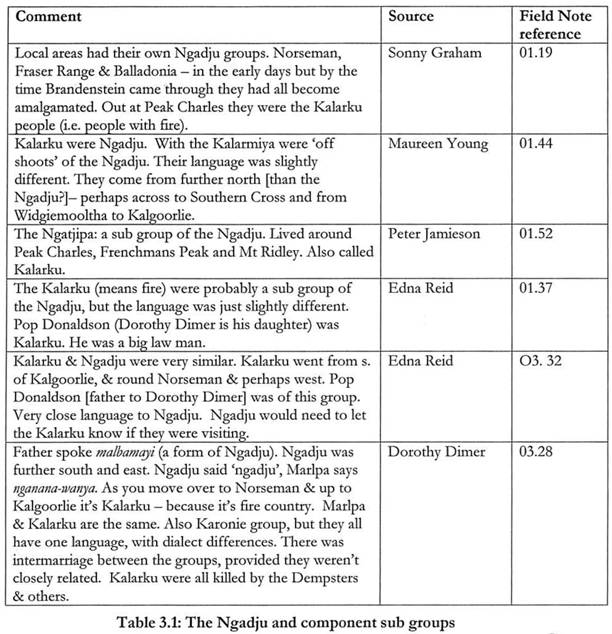
61 In his March 2012 responsive report, Doctor Palmer observes at [70] that he and Professor Sansom agree that there exists amongst the Ngadju people, areas for which individuals are responsible. Doctor Palmer considers that the so-called “home areas” or “estates” are examples of customary formation amongst present day Ngadju people which reflect the system of land holding that might reasonably be supposed to have existed at sovereignty.
62 Doctor Palmer also refers to Ngadju people exercising rights across larger areas of country than their local areas as a consequence of kinship relationships. This assertion of rights beyond home areas is founded on customary principles.
63 That the traditional land-owing system is reflected in current practices is evident from the conclusions of Doctor Palmer at [702] of his July 2009 report, which is set out at [51] above.
64 Professor Sansom noted in his oral concurrent evidence that with fewer Ngadju people existing today than at sovereignty “there would be fewer people and larger estates, larger family groups today…”. In response, Doctor Palmer pointed to p 167 of his July 2009 report, where he referred to modern day evidence of families being associated with areas based on information passed down through the generations by elders. Whilst under cross-examination in the concurrent evidence, Professor Sansom conceded to the effect that the rights and interests in land asserted by Ngadju today are the same rights and interests as asserted in pre-sovereignty times.
65 The State submits that:
There is no direct way in which a comparison can be made between how current practices relate with that which may be supposed to have been in operation at the time of sovereignty.
Insofar as the above submission refers to land holdings, it appears to be based on the suggestion that totemic estates were in existence in the period 1912 to 1936, when observed by Ms Bates. It is suggested that, in these estates, Aboriginal people lived and moved in small groups named after animals or flora, each associated with its own country and water. This submission is based on a report of Professor Sansom.
66 Doctor Palmer takes issue with the suggestion that the so-called “totemic principle” is no longer operative. Indeed, Doctor Palmer’s July 2009 report is full of examples of Ngadju people claiming attachment to locales and totemic affiliations. An example is the use of place names being derived from totems. Doctor Palmer referred to elders telling him that different areas had different totems associated with them. There still exists a belief in the claimants of a totemic relationship between themselves and the natural world. This was clear from the evidence provided to the Court by elders Mr Danny Graham, Mr Aaron Rule and Mrs Valma Schultz in the June 2009 preservation evidence.
67 I am not satisfied that any lessened influence, over time, of totems being associated with areas means that the pre-sovereignty land owning system has altered to any significant extent since sovereignty.
Kinship
68 The Ngadju people have, from the time of sovereignty to the present day, observed a kinship system involving knowledge and use of Ngadju kinship terms and emphasising common ancestral and familial interconnectedness. Evidence to support the above proposition is contained in the July 2009 report of Doctor Palmer. There is no evidence to the contrary.
69 Doctor Palmer reported that elders to whom he spoke “considered that a knowledge of proper kinship appellations and an appreciation of the relationships that underpin them are an important and continuing part of Ngadju culture”. Doctor Palmer was not challenged on that view. Doctor Palmer referred to the use of various prefixes such as “aunty” and “uncle”, “bro” and “cousin” as terms of respect. Doctor Palmer referred to the use of these and other terms instead of actual names. To support his views, Doctor Palmer used tables to illustrate kinship terms noted by Ms Bates and Mr Brandenstein and compared them to those he observed being used in conversations with elders.
70 The State’s response to these findings was two-fold. The first response was to say that the Aboriginal witnesses did not use such terms in their oral evidence. I do not accept this criticism. It may have been out of context, in respect of the question asked, for the witnesses to have done so. More importantly, none of the witnesses were challenged on the point. Second, the State highlighted the part of Doctor Palmer’s July 2009 report where he referred to one aspect of kinship reference that had no current use. However, the State’s reference to the relevant paragraph of Doctor Palmer’s report stops after the first sentence. The full paragraph is set out below:
Comparison with the Brandenstein terms shows that discriminations between members of the second ascending generation were once a part of the kin system. This would now not appear to be the case. However, the term puyu is used for FF as well as for cousins and brothers which is a classificatory feature that Maureen Young noted, as I have set out at [506] above. Father and father’s brother are classed together as are (from Brandenstein) fm and z.
71 Further, the first point raised by the State is at odds with material contained in witness statements of indigenous witnesses. These witness statements are evidence. The fact that such matters were not dealt with in oral evidence, which includes cross-examination, is indicative of the fact that they were not in dispute. The taking of such an obscure point by the State is at odds with its role as a model litigant and is inconsistent with its duties under s 37M and s 37N of the Federal Court of Australia Act 1976 (Cth).
72 Reference to the kinship system and use of kinship terms is made in the witness statement of Mr Rule Wicker at [108] to [111]. Mr Rule Wicker also gave oral evidence at t/s p 1534-1535 about children becoming part of the Ngadju by adoption. Paragraph [195] of the State’s submissions downplays the significance of the adoption issue, albeit in a way which does not persuade the Court that it is a practice which has changed since sovereignty.
Language
73 Part of the traditional customs observed by the Ngadju is the use of Ngadju language. It goes without saying that the language of the colonial power is used more frequently today by the Ngadju than at the time of sovereignty, but the evidence shows the use of Ngadju as a living language. Many of the Ngadju witnesses gave evidence of their ability to speak it.
74 In his witness statement, Mr Rule Wicker says that he grew up speaking Ngadju because his parents spoke it. He says he sometimes speaks it with family.
75 Mr Leslie Schultz gave evidence that he speaks Ngadju. He said that it is important to continue the culture and language in Ngadju areas. Mr Leslie Schultz talks to the spirits in Ngadju. He used Ngadju words in his oral evidence such as tjarta (eagle), tjula (emu), ngarda (white people) and tjintu (the sun).
76 Mr James Schultz, in his witness statement, said that he can speak Ngadju.
77 Mr Justin Graham says that there is a Ngadju story about the manarn (tawny frog-mouthed owl). Under cross-examination, Mr Justin Graham referred to tjeraridjal, being honey collected from ants.
78 Mrs Phyllis Wicker gave evidence, in her witness statement, about the importance of language in Ngadju’s culture. She says that it helps Ngadju people to connect with and understand their ancestors and country. Mrs Wicker’s father and other older people taught her the language. She now passes it on to her children and grandchildren. She knows many Ngadju words and is able to converse in Ngadju. Mrs Wicker continues to use the language in conversations with elders and family, including her great-grandchildren.
79 Mr Adrian Schultz is a Ngadju speaker who is involved in setting up a program for teaching Ngadju language to school children. He says he learnt the language by listening to older people speak it while he was growing up.
80 Mr Stephen Rule is a Ngadju speaker. He teaches the Ngadju language to children in Norseman. He grew up speaking Ngadju and learnt to speak it with his parents and the old people. Mr Stephen Rule referred in his evidence to the Ngadju word marlpa for men, ngunaarn for women and kadja for child.
81 Mr Aaron Rule, in his witness statement, says he speaks a bit of the language after being taught by his grandmother.
82 Mr Danny Graham says that his father and uncle spoke the language fluently and taught him many words, especially those referring to plants or animals. Mr Graham says it was important to pass on the language to his children and grandchildren.
83 Mrs Dorothy Dimer gave oral evidence about the Ngadju language and referred to some words such as jinga meaning “devil”.
84 Mr Ollan Dimer (deceased) referred, in his oral evidence, to places where Ngadju is spoken, including Fraser Range and Norseman.
85 Mr Johnny Graham gave evidence that when he was growing up he spoke a bit of Ngadju. He says he learnt it from his parents and older people. He says that when he was at the Norseman mission he was not permitted to speak the language. After he left the mission, he learnt some more Ngadju from the old people. He participated in a workshop on the Ngadju language. He is able to converse in Ngadju.
86 Mr Sonny Graham says that he can speak Ngadju, having learnt it from his grandmother and his uncle. He referred to different dialects of Ngadju, saying that Balladonia people speak a different dialect to Fraser Range people but that they can understand each other.
87 Mr Sonny Graham acknowledges that, with the passage of time, the number of fluent Ngadju speakers is not large. He says that young people know many words but are not fluent in conversation. That is a matter that is being attempted to be remedied, with teaching of the younger generation. In his oral evidence, Mr Sonny Graham said that it is important for Ngadju people to know their own language.
88 Mr Jack Schultz says that at the Norseman mission, Ngadju were forbidden to speak their native language. He gave evidence of the use of some Ngadju words. He says that language is still important in Ngadju culture but that fewer people speak it now. He says that he was brought up with it, but that it was suppressed at the mission.
89 The overwhelming body of evidence before the Court supports the proposition that language remains an important aspect of Ngadju culture, as it was pre-sovereignty. The declining number of fluent speakers does not deny this proposition. The decline was no doubt contributed to by the repressive policy of the Norseman mission, but the language was not totally suppressed. Its recent resurgence is not so much a revival, as a product of the current more tolerant environment which permits the language to be spoken freely.
90 The submissions of the State on this topic descend unhelpfully to “nit picking”. For example, the State refers to the evidence of Mr Stephen Rule about being unsure of the meaning of “Buldania” despite it being an area his family spoke for.
91 The contention that Ngadju is a language which has ceased to be part of the customs of the Ngadju people is rejected. On the contrary, language is a custom which has current vitality. The fact that some Ngadju do not speak the language does not mean that it is not a current custom; it simply means that it is not as widespread as before. It would be surprising to find otherwise, given the suppression of the language after sovereignty.
A fundamental belief in the spirituality of the land through the Dreaming and other spiritual presences
92 Doctor Palmer gave evidence about this topic in his July 2009 report. He was not challenged on any material aspect of that evidence whilst giving his concurrent evidence.
93 At [494] and [495] of the report, Doctor Palmer says:
The claimants are of the view that rights to Ngadju country are gained through descent (being born a Ngadju person) and activated or commanded by reference to knowledge of Ngadju country. According to this way of thinking, descent alone is insufficient to qualify a man or woman as one with the right to ‘speak for country’. Rather, realisation of these rights is a matter of descent (cognation) plus land-based and, in my view, spiritual, knowledge. According to the accounts I have considered above, neither is dependent upon ritual induction. Those who have been initiated may acquire status but do not thereby gain knowledge of Ngadju country.
Based on my knowledge and experience of Aboriginal religious belief and practice elsewhere in Australia, I think it likely that formerly Ngadju ritual inductions would have provided initiates with esoteric knowledge relevant to their country. Thus the manner whereby all knowledge of country is now gained (from senior members of the community) outside of any ritual context is likely a departure from customary practice. This stated, the system continues to operate in my view according to customary principles. Rights to country are gained via descent; rights to country are exercised through command of knowledge which comes with age and experience. It is my concluded view that this was ever the case.
94 I accept the submission of the applicants that Doctor Palmer acknowledges their beliefs in the spirit world as being a significant part of their culture and representing a continuation of customary belief. In other words, the beliefs are pre-sovereignty beliefs which have current relevance.
95 Mrs Phyllis Wicker says, at [29] of her witness statement:
I get my rights in Ngadju country through my Dad and his ancestors because my Mum was Nyungar. These ancestors are in the land and they make it safe for me to be in it. If you are not Ngadju, or you have not been raised up as a Ngadju by a Ngadju family with ancestors from the land, bad things can happen to you.
At [30], Mrs Wicker says:
You have also got to follow the Ngadju way when you are out on Ngadju country. That is how my Dad brought me up. If you do not, the spirits of the ancestors might get mad and you might get punished…
96 At [20] of his witness statement, in reference to his now deceased uncle, Mr Aaron Rule says:
Uncle Kevin always said that it was very important for him to take his family out to Marlpa country so the old ancestors would know them and know that they have been there. Those old ancestors are in the land as spirits. Uncle Kevin taught me that all new people to the country need to be introduced to those spirits. To do this, we will light a fire, put gum tree leaves on the fire and smoke them. This gets the bad feelings out and lets them have good feelings about the spirits.
97 Mr Aaron Rule went on to say that he takes his children “out on [his] country”. He said “you can hear the old people crying when you do this and you can feel all the hairs on your neck stand up”. In reference to funerals and burials, Mr Rule says at [110] of his statement that “(t)he spirits of the old people are in the land…”.
98 Mrs Valma Schultz says at [95] of her witness statement:
The spirits of our old people are all around us in the land. They congregate at rock holes as well as lakes and hills. There are also jingas or bad spirits around that we have got to be careful of. We must not speak of jingas at night as they might harm us.
99 In reference to a place where white settlers massacred Ngadju people, Mrs Schultz says at [91] of her witness statement:
We had to be respectful of the massacre site at Fraser Range. When kids play, the spirits come and play so we do not let the kids play around those areas. Also, the sun was coming down and spirits show themselves more at night. If we know there is a burial place nearby we clear out at night.
100 Mr John Walter (“Danny”) Graham gave evidence that spirits of the deceased return to the land. At [367] to [369] of his witness statement, Mr Graham says:
Spirits will go back to where they lived when they were alive. If you want to protect yourself from them you can grab a handful of sand and throw it at them and call out “I’m Didla Graham’s son” and say the names of our ancestors. I always do this if I get that feeling out in the bush. Your smell will be in the sand and the spirits will smell it and say you are right to be there. If you are a stranger and not from the area they will keep tormenting you.
I also teach the kids that you have to call out to the spirits. I tell them it might be your aunty or your uncle and you have to tell them who you are. They will leave you alone, they will not hurt you if it is your country.
My dad’s spirit is still around and I still call out to his spirit.
101 Doctor Palmer referred to the continued importance to the Ngadju of their beliefs about “their countryside”. At [412] of his July 2009 report, Doctor Palmer says that these beliefs:
…relate to the reported presence and deeds of spiritual beings, variously described, that may influence the way the countryside is approached or the manner whereby activity should be conducted. One corpus of knowledge relates to named spirits that may be encountered at places within the application area.
102 At [413] Doctor Palmer refers to claimants telling him that the Ngadju countryside contains spirit beings which are treated with respect.
103 I am satisfied that Ngadju people, at sovereignty, believed in the spirituality of their land through the Dreaming and other spiritual presences and that this fundamental belief has continued to the present day. However, the question of Dreaming requires extra treatment in these reasons.
Dreaming
104 The State, in its written submissions at [176], acknowledges the importance of Dreaming stories to the Ngadju people. At [179], the State submits:
There has been some loss of knowledge amongst the claimant group that does not sit comfortably with the notion that passing on of Dreaming stories is an important matter of law or custom, and which has not been explained. Stephen Rule (an elder for his family) was aware of a story (or stories) for the Buladania (sic) and Balladonia area but he does not know those stories or anyone who does other than to say “someone else will know that story of that area in the family”. The Rule family is said to speak for Buldania and Balladonia.
105 In the preceding paragraph of its submissions, the State criticised the lack of detail known to applicant witnesses about certain Dreaming stories. There is scant support for such quibbles. I accept the reply submission for the applicants that:
There was a significant amount of evidence given by the claimants about Dreaming stories associated with the Ngadju application area and about the importance of the places associated with those Dreaming stories.
106 Doctor Palmer deals in detail with narratives taken from claimants about Dreaming stories at [436] to [442] of his July 2009 report. Further evidence about Dreaming stories comes from testimony taken from Ngadju witnesses in 2012.
107 The State’s criticism of the current Ngadju knowledge of Dreaming stories is unsupported by the evidence of its own anthropological expert, Professor Sansom. Professor Sansom agreed, in oral evidence, that there had been a significant amount of evidence given about Dreaming stories and Dreaming sites in the Ngadju application area. He said that he did not question the truthfulness of those people who have spoken of the importance of these Dreaming stories and sites to the Ngadju people.
108 Professor Sansom was then asked if it would be reasonable to infer that these stories about Dreamings and Dreaming places derive from pre-sovereignty customary law and practice. He added “in an attenuated form”. Nonetheless, Professor Sansom agreed with the proposition that:
…we have a lot which is there today in terms of the laws and customs under which the Ngadju people assert that they possess rights and interests in land, and the rules in terms of how they behave on that land which it’s clearly reasonable to infer would have been in place in this area pre-sovereignty.
What Professor Sansom considered lacking was the “totemic connection” from pre-sovereignty times. By this, Professor Sansom meant that the importance of totem groups had changed over time. That is a matter to which some attention has been directed above and to which these reasons will soon return in due course. The important point for current consideration is that the State’s expert anthropologist does not support its criticism with respect to Dreaming stories. I am satisfied that Dreaming stories have always been important to Ngadju people, are important to Ngadju people and will be important to Ngadju people in the future as part of their traditional customs.
The totemic reservation
109 In his concurrent evidence, at t/s 1837, Professor Sansom agreed with Doctor Palmer that the Ngadju people are today a people united in and by their acknowledgement and observance of a body of law and customs. However, Professor Sansom confirmed his opinion that there has been a “significant shift” in Ngadju law and custom, particularly in relation to rights and interests in land. This was the focus of Professor Sansom’s responsive report. At t/s 1838, Professor Sansom was asked:
MR HUGHSTON: And in coming to the conclusions that you do in relation to what you describe as a significant shift in law and custom in relation to the way in which people acquire rights and interests in land, you primarily rely upon the work of Daisy Bates?
PROF SANSOM: Yes.
110 Professor Sansom conceded that Ms Bates studied a larger area which included the Ngadju area. He conceded that he had no regard to Aboriginal evidence in forming that view but concentrated on a work of Ms Bates called the “Balladonia Statement”.
111 Professor Sansom conceded that Ms Bates was not an anthropologist and that an eminent anthropologist called Radcliffe-Brown had a low opinion of her work and of Ms Bates, personally. Professor Sansom also conceded that Ms Bates “remains a controversial figure and that the reliability of her ethnography is subject to debate”.
112 At [84] of his July 2009 report, Doctor Palmer describes Ms Bates as a person who “believed in the pre-eminence of the British and the inferiority of other races, particularly those that were not white-skinned”. At [86] of the report, Doctor Palmer says, and I accept, that “based on the nature of her materials and the sort of researcher she was, it is my view that there are strong grounds to treat [Ms] Bates with some caution”.
113 Professor Sansom agreed that the work of Ms Bates must be treated with caution and he added “approached interpretatively”. He added that she was “a perjurer and a liar”. Professor Sansom also conceded that Ms Bates collected very little material that was relevant to the Ngadju claim area. Professor Sansom acknowledged that the “Balladonia Statement” was “acquired from what [Ms Bates] described as a few natives she caught at Esperance”, in what was a “brief encounter”.
114 Professor Sansom relies on a footnote to an edited version in 1912 of a manuscript of Ms Bates called “Native Tribes of Western Australia” to suggest that the indigenous people discussed had “birth totems”. Professor Sansom conceded that this was the observation of the editor (Ms Isabelle White) and not of Ms Bates herself. He acknowledged that so much was “interpretative gloss”.
115 The ensuing cross-examination of Professor Sansom elicited the following points:
after collecting genealogies, Ms Bates could find no distinct rule as to descent being patrilineal or matrilineal. There was no strict rule that one follows the father or the mother.
Ms Bates refers to father’s or mother’s animal-named area rather than father’s or mother’s country. But that is still a way of saying one follows the father’s area or the mother’s area.
116 Ms Bates then sets out exceptions saying:
Mother’s brothers will sometimes decide the division of their sister’s children, and a child may be given some special district as a mark of favour, that is, if a wild fruit man is visiting an opossum district, and a child is born to him in that district, or has already been born but has not been entered into its own area, it will be formally entered into the opossum division and, if a girl, probably be promised to one of the opossum men, or if a boy, he will belong to the opossum men for initiation when his time arrives.
117 Professor Sansom acknowledged that Bates did not say there was an automatic entitlement, if you were born in an area, to have rights in that area and acquire its totem.
118 Mr Hughston then put the following to Professor Sansom:
MR HUGHSTON: Do you accept that what Bates is saying, in effect, is that you know she’s not really sure about this information she’s passing on, the information that she’s acquired from those few natives that she’s caught at Esperance?
PROF SANSOM: She expressed a sentiment that she would like to check that data and with more people.
MR HUGHSTON: Alright. And there’s no evidence that she did?
PROF SANSOM: No.
MR HUGHSTON: So it was, if you like, a provisional statement by Daisy Bates?
PROF SANSOM: She says so herself.
119 It defies rational analysis that the State would take issue with the continuation of Ngadju practices dealing with inheritance of interests in country, based on such unreliable material. I prefer the analysis of Dr Palmer in his responsive report dated March 2012. I set out, for ease of reference, as Appendix B to these reasons paragraphs [42] to [61] of that responsive report, which comprehensively answer the red herring raised by the State’s reliance on Ms Bates’s tentative and poorly researched “Balladonia Statement”. At Appendix C, the full text of the “Balladonia Statement” is set out.
Law
120 At paragraph 12(e) of the points of claim the applicants refer to “a belief in and respect for a body of teaching and ritual practices known as the law”. The State says that such belief and respect has not continued to the present day, because “the fundamental ritual and teaching has ceased”. The State then submits that:
…the evidence shows that Law Business encompasses more than just male initiation ceremonies or places: it embraces and influences questions of knowledge, authority, the formation of and connections to Dreamings, places and the land and everything on it.
121 The State alleges that there has been a loss of “the Law”. At [214] of its written submissions, the State says:
…the dissociation of the contemporary Ngadju group from the Law represents a significant change in relation to a matter central to the question as to whether there has been continuity and vitality of traditional laws and customs that might be the foundation of Ngadju society.
122 At [215], the State acknowledges that:
(t)he Law is undoubtedly multi-faceted and involves more than circumcision, and men’s rituals associated with initiation.
123 In his concurrent evidence, Doctor Palmer conceded that sacred objects such as “boards” are no longer used and that the cessation of such use and of “initiatory rituals of circumcision would have represented a major cessation of customary practice”. However, Doctor Palmer went on to emphasise that the Law involved much more than those practices which had ceased. Doctor Palmer said:
The Dreaming is the originating force behind the normative system which can then be called “law” and its practice, or part of its practice, is in ritual but also in daily observance. So, certain actions could be characterised as being the law in that sense.
124 In his concurrent evidence, Doctor Palmer made it clear that abandonment of men’s initiation ceremonies did not amount to an abandonment of the Law. In any event, as Doctor Palmer said:
…there are amongst the claimants those who continue to practise law, and their role and position is still understood to be significant, as indeed are all the lawmen….I think it’s not altogether a fair reflection of the ethnography or the evidence that you’ve heard to say that the law’s completely finished amongst the Ngadju because the facts of the matter speak differently to that. But I would also add that although these people have been initiated outside of Ngadju country, there is clear evidence in the ethnography that…it was common and still, indeed, is [common] for people to be taken elsewhere to be subject to initiatory rituals.
125 The Court then asked Doctor Palmer the following question and he answered accordingly:
HIS HONOUR: And to the extent that lawmen had a special role, say pre-1949, would it be correct to take the view that the evidence is suggesting that perhaps elders have that role now?
DR PALMER: Absolutely, your Honour. So, you know, the principal applicant in this claim Johnny Graham is a man who by his own admission has not been through the law, though his grandson…has. He is recognised as being an elder senior man with authority who is highly regarded for his knowledge and his understanding of – of his own culture.
126 In this regard, the evidence of Doctor Palmer in his July 2009 report is important. At [558], Doctor Palmer says (and in this respect was unchallenged):
The claimants subscribe to a system where authority is engendered by cultural knowledge and age. Based on a consideration of the ethnography discussed in the preceding paragraphs, the current system of the exercise of authority would appear to show, in these respects, continuity with past practice. The modification to the practice relates to the locus of knowledge. In the past this would appear to have lain within the ritual sphere and to have derived its authority from competence in religious belief and esoteric teaching. The account I have provided shows a departure from this arrangement, as the majority of the claimants do not participate in ritual practices. However, claimants regard cultural knowledge as something to which they have gained access, via pathways other than ritual induction. Moreover, some younger claimants have been initiated and are therefore, potentially at least, in the process of gaining access to arcane teachings.
127 Importantly, Doctor Palmer then says:
My conclusion is then this. The exercise of authority appears founded upon customary qualifications of age and knowledge. The manner whereby some knowledge is gained is now not the same as it was in times past. However, the acquisition of cultural knowledge remains the fundamental qualification for the exercise of authority, along with the maturity of years that facilitates its realisation.
128 Albeit in a modified form, resulting from colonial usurpation and (in the case of Fraser Range) massacres of the indigenous population, the Ngadju continue to the present day to believe in and respect a body of teaching and ritual practices known as the Law.
129 In any event, as Counsel for the applicants submit at [202] to [206] of their reply submissions:
The definition of “native title” or “native title rights and interests” in s.223(1) simply refers to those laws and customs under which Aboriginal people or Torres Strait Islanders possess rights and interests in relation to and have a connection with, land or waters; it does not refer to initiatory rituals or other ceremonial practices. The definition has its genesis in the High Court’s decision in Mabo v Queensland (No.2) (1992) 175 CLR 1 (“Mabo (No. 2)”). As the High Court explained in Yorta Yorta HC at [75]-[76]:
Native title, for present purposes, is what is defined and described in s.223(1) of the Native Title Act. Mabo (No.2) decided that certain rights and interests relating to land, and rooted in traditional law and custom, survived the Crown’s acquisition of sovereignty and radical title in Australia. It was this native title that was then ‘recognised and protected’ in accordance with the Native Title Act and which, thereafter, was not able to be extinguished contrary to that Act.
The Native Title Act, when read as a whole, does not seek to create some new species of right or interest in relation to land or waters which it then calls native title. Rather, the Act has as one of its main objects ‘to provide for the recognition and protection of native title’…
The traditional laws and customs of the Torres Strait Islander people which the High Court found in Mabo (No.2) gave rise to the possession of (native title) rights and interests in the Meriam Islands, were devoid of any spiritual content. There is no reference in any of the judgments in Mabo (No.2) to any religious ritual or ceremony, or indeed any overarching spiritual connection with the land. The common law did not require religious ritual or ceremony and nor does the definition in s.223(1).
In Akiba on behalf of the Torres Straight Islanders of the Regional Seas Claim Group v State of Queensland (No 2) [2010] FCA 643, a native title case involving Torres Strait Islanders, Finn J noted at [172] that:
The question whether much of what has been advanced by the Applicant as laws and customs amounts at best to no more than ‘observable patterns of behaviour’ has been put in issue primarily by the State. A factor of which account needs to be taken in considering this is the distinctive context in which this issue arises. Unlike mainland Aboriginal cases, there is little in the laws and customs relied upon that has any informing spiritual dimension at all: cf Ward FC at [242]. Much appears simply utilitarian; much seems prosaic. As Mr Hiley QC put it, ‘The absence of the spiritual element … is almost probably unique to this case.’ Yet, it needs to be recognised that normative beliefs can be held about ordinary behaviour, as the fierce dispute over how properly to open soft-boiled eggs in Swift’s Gulliver’s Travels suggests.
The Court noted that the Torres Strait people are a people for whom headhunting formerly “occupied a place of central importance in their cultural and religious life” (quoting from the evidence of Professor Beckett). Post-sovereignty, the missionaries suppressed all non-Christian cults and practices, including headhunting. It was not suggested in that case that the Torres Strait Islanders had thereby lost their traditional (native title) rights and interests in their islands and the surrounding seas.
Bearing in mind firstly that the NTA owes its genesis to the Mabo (No.2) decision, which involved Torres Strait Islanders and bearing mind also that the definition of “native title” and of “native title rights and interests” in s.223(1) applies equally to Aboriginal people as well as to Torres Strait Islanders, there is no justification for reading into that definition a requirement that Aboriginal people (but not Torres Strait Islanders) must have continued to observe all pre-sovereignty esoteric rituals or ceremonies. As the Full Court stated in Sampi FFC, the laws and customs to which s.223(1) is directed are the laws and customs under which people possess rights and interests in and have a connection with, the land and waters of the application area (at [51]). It was those laws and customs which the High Court in Mabo (No.2) recognised gave rise to native title rights and interests at common law.
Religious knowledge based on gender and seniority
130 This topic is effectively subsumed and was treated in written submissions as being subsumed within the topic of continuation of a belief in and respect for the body of teaching, discussed under the last heading. It is also dealt with to some extent in the topic below.
A system of authority within the Ngadju people which is legitimated (sic) by reference to age and to knowledge
131 The State acknowledges, at [182] of its written submissions, that the evidence demonstrates that Ngadju people respect their elders and that elders have a role in sorting out problems and giving instructions which must be complied with. The State does not take issue with the continuation of such a system of authority but rather, surprisingly, seeks to focus on a difference of opinion amongst some elders as to the status of lawmen vis-À-vis elders.
132 The evidence discloses the existence of a system of authority within Ngadju society based on seniority, which has continued to the present day. So much is not in any material contest.
“Mythic beings” and telling of narratives that relate to them
133 The parties do not appear to be in any dispute as to the belief by Ngadju people to the present day of mythical beings known as “featherfoots”.
134 Doctor Palmer deals conclusively with this topic at [426] to [432] of his July 2009 report as follows:
Claimants told me of their belief in tjinakapi or featherfoots. These are understood to be real people, but are able to travel as spirits. They are potentially dangerous and need to be encountered with caution. Rollick Dimer told me that he, ‘knew about featherfoots’ that could ‘come through’. He said he always kept a gun to protect himself from them. Sonny Graham confirmed his belief in these beings and told me a story about one that had ‘come through’ from Yalata community in South Australia.
Maureen Young told me at Horse Rock (site 16) that featherfoots continued to live in the country at sites which were associated with mythic beings that were celebrated in desert ritual practice. She thought that the featherfoots might be protecting these places by their spiritual presence. Maureen Young and Mervyn Nine made a similar, if more oblique comment in relation to Putjapinya (site 8) as I reported above. Norma McKenzie and Roslyn Farmer reported that there were, ‘featherfoots round the place – you never saw them’. Rather you would hear a ‘whirring’ noise’ which sounded like something being swung. Then you would, ‘keep out of the way’ and leave the area. Their father had left food out for the featherfoots.
Eddie McKenzie and Johnny Graham provided further details of the nature of featherfoots. They told me that featherfoots are commissioned to kill. This is usually because of a revenge to be exacted. For example if a man took another’s promised wife, he would be likely to have a featherfoot come after him. Featherfoots kill a victim leaving no detectable trace of the fatal wound. Eddie and Johnny provided examples of cases where a person was killed but medical doctors were unable to find a cause of death.
They explained to me that a featherfoot is ‘an ordinary man’, but one that can ‘travel in the wind’ and is thereby able to traverse large distances in a very short time. Featherfoots usually come from areas to the north of Ngadju country. The featherfoot has a distinctive and very unpleasant smell, which is one way by which he can be recognised. Other warnings of the presence of a featherfoot were the calling of the mopoke or boobook owl (tawny frog mouth) and the rolling of a stone into the camp, seemingly for no reason.
Provided you assist and do not hinder a featherfoot they will do you no harm. Consequently, they told me, it is wise to leave food and a billy of tea out for them. Eddie McKenzie confirmed his sister’s report that his father had done this sometimes and next morning the food and tea were always gone.
Johnny told me that he had seen a featherfoot in Norseman a few days prior to our discussion. He was disguised as a European Australian and was travelling north. Johnny thus indicated that featherfoots were very much a part of the contemporary Ngadju reality. The discussions about featherfoots, reported here, were undertaken in private and with caution. Those with whom I spoke were concerned that by talking about a featherfoot one might materialise. In collecting these data I was mindful of the high seriousness with which those to whom I spoke regarded the subject. I am of the view that claimants do not easily or freely discuss these matters as they regard them as potentially physically and spiritually dangerous.
This view was confirmed by the statements provided to the Court in May 2009. For example Phyllis Wicker provided brief comment on ‘people with special powers’ but added that she was, ‘not allowed to talk about them and I do not want to’. Refusing to name them she called them the “FF” people’. Valma Schultz stated that she was ‘very uncomfortable talking about them’ [featherfoots] and confirmed they were notable for the bad smell and that they threw rocks at people. Aaron Rule similarly stated that he was ‘not supposed to talk about them’. Danny Graham provided a fuller account but was also of the view that they should not be discussed.
135 Further at [704], Doctor Palmer says:
While esoteric ritual practice is not a part of the life experiences of the majority of claimants, the date I have considered in this report show that some public performances continue to constitute a part of the Ngadju ritual experience. In addition, my field data show that beliefs in the spirit world (including featherfoots) remain a significant part of Ngadju culture. I have shown that there is evidence to support the conclusion that this represents a continuing customary credo.
Duty to protect places associated with travels
136 The above duty is found in current Ngadju practice as it was as at the time of sovereignty. Doctor Palmer deals comprehensively and authoritatively with this topic in his July 2009 report at [356] to [363]. That evidence is uncontradicted. It is set out below:
The right to protect places of importance was characterised as a duty by those with whom I worked. Claimants told me that they regard this as an important part of their responsibilities as community members. For example, Maureen Young commented to me as follows when we visited Picnic Rock (site 42), west of Norseman.
We do the best we can to take care of the land and to maintain the traditional and the cultural way of doing things and hoping that our young people will learn from it.
On the same field trip, Mervyn Nine, who was brought up by Maureen Young, told me that he had accompanied us because he wanted to, ‘look at the country because the old people came here’. He added that he wished to look after the country for the next generation.
Another duty of a landowner is to care for the rock holes and make sure they are kept clean and can be replenished with water after rain. The small rock holes should be kept covered with a flat slab of rock to prevent undue evaporation and to stop camels and other large animals from taking the water, while still allowing access by smaller game, birds and emus. Maureen Young explained to me on a visit to Yariyimi (site 67) how she exercised her duties with respect to the place, when she would, ‘check the rock hole, and see that it is nice and clear, that the fresh water is there’. As a consequence, she knew, ‘that we can always get our water resource from it, so I make sure that it is always kept clean’.
Witness statements provided to the Court in May 2009 support these data, proving additional examples of the claimant’s (sic) concern to care for their country and protect it from damage. For example, Danny Graham stated,
We cover rock holes with stones to keep the water in them and to stop the animals falling in. We also put sticks in them, so if birds fall in they have something to climb out on. Dreaming sites and places are still important and must be protected. This is what my Dad taught me. Every rock hole is important to the Marlpas and must be protected.
Witness statement (2009) Danny Graham, 222-224.
Phyllis Wicker also spoke of a responsibility to clean out rock holes as well as to protect areas of spiritual significance in Ngadju country. Phyllis stated,
Caring for Ngadju country and our sites is important. We have to do it as it is our responsibility to the old people and to the country. We do this by making sure heritage surveys are done before the land is cleared and make sure important sites are protected.
Ollan Dimer made comment on the former practice of burning the countryside. It was his view that this was now not practiced often, due to pastoral and government regulation. Ollan stated, ‘But since the Whiteman took over they weren’t allowed to make fires there, burn any more’. Ollan Dimer explained that in the past it had been the practice to burn the country. When visiting the coastal areas round Toolinna (site 56) he remarked to me that the bush was much denser than it had been when he lived in the region as a boy and attributed this change to the lack of burning. Later he told me how in times past Ngadju people would burn in the cooler months to encourage the growth of kutal, a plant with a tuberous root which he likened to a sweet potato and the ngatjun bushes, which produced a fruit like a little banana.
Witness statements provided to the Court in May 2009 indicate that the practice of burning does continue. For example, Danny Graham stated that he continued to burn the country to encourage regrowth and that he was teaching his children to do this. Valma Schultz stated that burning the country was done by her brother-in-law, Les Schultz, a man who traces Ngadju ancestry.
Dorothy Dimer told me that she had worked on surveys to identify important areas prior to development activity taking place. She stated that she considered it was her job to ensure that culturally significant places were protected. Snowy Dimer also made mention of surveys saying that it was the responsibility of the older and more knowledgeable people to be ‘out [there] first’. Sonny Graham reported that he had ‘helped out a bit’ on site clearance work, but usually left it to others living in Norseman who were closer to the area in question. He saw it as his right and duty to protect the country. Similarly, Norma McKenzie and Roslyn Farmer told me that protecting places was an important duty that they should exercise. In this they had to both ‘look after’ and protect the countryside. Johnny Graham told me he had driven to Fraser Range from Norseman the day prior to our interview, to check up on some drilling that he had heard was being done in the area. He saw this as a part of his duty to protect the countryside.
In my first report I also noted that claimants have taken part in site clearance surveys. For example, claimants Johnny Graham and Jack Schultz took part in a site clearance exercise on the Eyre Highway. Ngadju claimants have been involved in other site clearance work at Fraser Range (Macintyre Dobson and Associates Pty Ltd 1994), areas south east of Kambalda (de Gand 1997), Johnston Lakes (Hovingham et al et al 1998, 8, 12) as well as for a gas pipe line running from Kambalda to Esperance (de Gand, 2002, 27-30). It is my assumption that this involvement with looking after and protecting country continues. Claimants gave evidence in support of this to the court in 2004.
Knowledge of the association of particular natural species with particular areas and groups of Ngadju people
137 Doctor Palmer conducted field work on this topic. It is described in his July 2009 report. This topic was not a controversial one in the parties’ submissions. Doctor Palmer refers to data about natural species in his report. He then says, at [652] to [654]:
These data point to the senior claimants having a familiarity with the names and identity of these plants and that this continues to be a part of their cultural knowledge. I had limited opportunities to witness the collection of these vegetable foods. Fruits can only be harvested in season so this too limited opportunities for collection during my periods of field work. I did observe some claimants collecting bush foods. For example Maureen Young and Mervyn Nin picked quandongs, during a field visit to areas round Norseman. Johnny Graham told me that he continues to go out shooting as well as collecting quandongs and other fruit for jam. Other claimants confirmed that they continued to gather bush foods.
Some claimants considered that the collection of bush foods was not as prevalent as it had been in the past. Lurlene Rogers and Dianne Clinch told me that they accessed bush resources with greater regularity when they were younger and were living on station properties. Snowy Dimer told me that he found it difficult to get out into the bush since he lived in Coolgardie and had an invalid wife for whom he cared. On the other hand, Sonny Graham told me that he goes out into the country, taking his grandchildren. Danny Graham told me that he goes out into the bush, ‘every chance I get into Ngadju country’.
The continuity of use of the country was demonstrated in the witness statements provided to the Court in May 2009. These contain additional data which illustrate the claimants’ knowledge and use of vegetable food resources in Ngadju country. For example, Danny Graham spoke of quandong and bush honey as well as other plants he did not name. Stephen Rule spoke of the ngadjun bush, mallee hen’s eggs, tjungkatjungka (a yam, also noted by Aaron Rule), wild onions, tomatoes and quandongs. Phyllis Wicker listed bush onion, yams, quandong, tjungkatjungka and honey. Valma Schultz described her use of the quandong or thumpuri. Stephen Rule spoke to the court at this time of the collection of tjungkatjungka and witchetty grub casing collected by his grandchildren and presented to the Court during the hearing.
I find those observations compelling.
Defining association with and sense of belonging to Ngadju country by reference to a family and descent from common ancestors
138 This topic overlaps with paragraph 12(b) of the points of claim concerning the kinship system. Nonetheless, it is true that the evidence disclosed an association and sense of belonging by reference to parents, grandparents and great grandparents, as part of current Ngadju identity.
139 For example, Mr Rule Wicker, in his witness statement, said that he learnt about Ngadju country growing up by listening to old peoples’ stories and that he passes on such knowledge to his children and grandchildren. He gave oral evidence about going out onto Ngadju country with his nephew and his daughter. His daughter is adopted but is still Ngadju by virtue of such adoption.
140 Mr Leslie Schultz gave oral evidence that having Ngadju bloodlines makes you Ngadju. None of this evidence (and much more like it) is in any material contest.
141 At [708] of his July 2009 report, Doctor Palmer deals with the topic of “continuing of ancestral connection” in the following way:
I have relied on Tindale’s genealogical materials in my consideration of the genealogical account relevant to the claimants. I found that while one set of ancestors (forebears of Peter Flynn) probably originated from outside of the claim area, descendents of this group may trace ancestry to matrikin who originated from the Fraser Range area. For the rest, the Tindale data show that ancestors originated within the claim area, from country which included Israelite Bay, Toolinna, Balladonia and Fraser Range. Calculated birth dates show that they were born after sovereignty, but the majority before sustained contact in the region. I think it reasonable to conclude then that their ancestors would have been in occupation of much the same country at the time of legal sovereignty.
142 The above is undisputed.
Other aspects of the points of claim
143 Paragraph 12(k) to (n) of the points of claim are as follows:
(k) belief in spirits including spirits associated with sites in Ngadju country and concomitant respect and care for such places;
(l) knowledge and/or use of natural resources found in the claim area, including plants, animals, birds, water, ochre and marine resources;
(m) looking after Ngadju country and places within it; and
(n) maintaining restrictions on information about spiritual aspects of Ngadju country and cultural knowledge relating to plants, animals, marine life and other natural resources.
144 The above topics essentially repeat topics already covered above. To the extent that this is not so, no issue of material controversy arises.
Conclusion
145 The above evidence shows that native title exists in the Ngadju trial application area and is held by the members of the Ngadju community in common. Although different families are allocated special rights to “speak for” certain areas of the country, there is nonetheless, one Ngadju people.
146 The above evidence also shows that, albeit with some modification such as the absence of men’s initiation ceremonies on Ngadju land, the laws and customs of the Ngadju people have been passed from generation to generation from sovereignty until the present. These laws and customs, while not unaffected by sovereignty, have continued substantially uninterrupted to the present day.
147 The submission of the State that the Ngadju people have abandoned any normative system under which their laws and customs were previously observed and acknowledged is rejected. It finds no support in the evidence before the Court. It is also inconsistent with the views of Doctor Palmer, as identified above, in several significant respects.
the answer to the separate question
148 The answer to the separate question is, in substance, that native title exists in the trial area. It is held by the Ngadju people in common. The extent of native title is reflected in the rights and interests set out in the order pages accompanying these reasons for judgment.
concerns of wafic
149 The Court notes that Western Australian Fishing Industry Council (“WAFIC”) raised a concern that any recognition of native title in the trial area should not extend to commercial fishing activity. The applicants, through their Counsel at the directions hearing on 24 September 2012, said that they were content for their proposed order to be amended to make it clear that any recognition of native title in waters (including for example, Lake Cowan) not include a right to commercial exploitation.
extinguishment issue
150 Having answered the separate question in the way the Court has, it will now be necessary to deal with the issue of extinguishment. The parties have previously indicated to the Court that once the separate question was determined, they might be able to agree on a timetable leading to a hearing/determination on extinguishment or even resolve the issue themselves. In the meantime, the Court will order that the matter be listed for a further directions hearing at 2.15 pm (EST) on 17 January 2013 to ascertain whether the parties seek a variation of the orders now in place. Some of the deadlines in previous orders on this topic have passed.
|
I certify that the preceding one hundred and fifty (150) numbered paragraphs are a true copy of the Reasons for Judgment herein of the Honourable Justice Marshall. |
Associate:
Appendix A
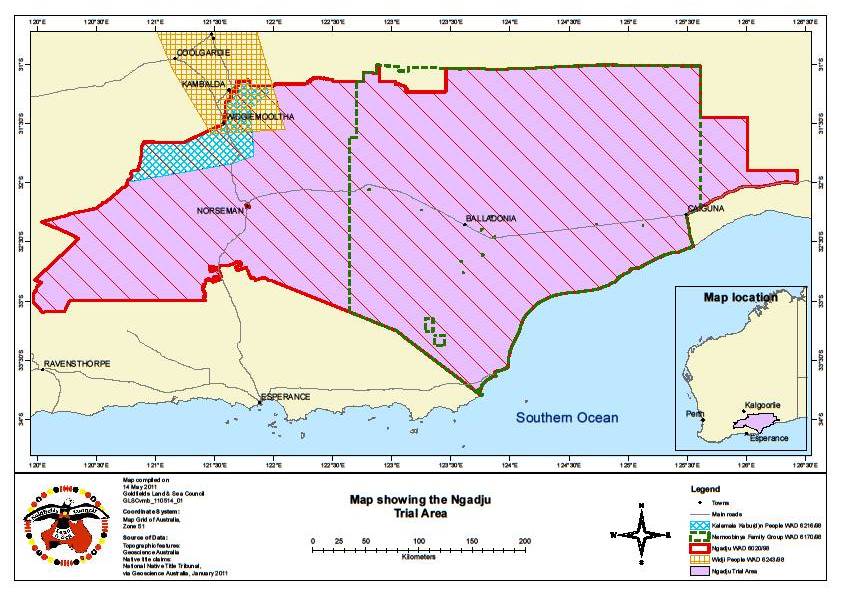 Note: Blue crossed area indicates the only current overlap.
Yellow crossed area indicated a former overlap that is no longer current.
Appendix B
BIRTH TOTEMISM
The ‘Balladonia statement’
42. One product of Professor Sansom’s assertions of common cultural characteristics between the Western Desert and the Ngadju is that the latter shared the former’s propensity to exhibit birth totemism. In his 2012 report Professor Sansom identifies a passage from Bates as her ‘Balladonia statement’ (185). Professor Sansom writes that in the passage in question, ‘Bates wrote that kinship at Balladonia was reckoned in all lines (and, therefore, was cognatic)’ (185). It was unclear to me to which passage Professor Sansom is referring as he provides no cross-reference to guide the reader to the originating text. He provides a clue, writing that I cite this extract in paragraph 259 of my report (185). There I reproduce a passage from Bates’s folio 12/289 in which she discusses the, ‘various tribes composing the Jinyila nation’ (ibid). This does not appear to accord with Professor Sansom’s reference. I assume then that Professor Sansom has made an error in his cross referencing to my report.
43. There is a second clue in the same paragraph (185). Professor Sansom adds that I rely on the ‘Balladonia statement’ when ‘asserting the historical continuity to the system of cognation in Ngadju country’ (185) and cross references this to paragraph 328 of my report. At this reference (328 of my 2009 report) I refer the reader to an earlier paragraph of my report (Palmer 2009, 208) where I cite a passage from Bates which I consider to be consistent with the rule of cognation. So the Bates’s passage Professor Sansom is considering is the one I cite (in part) in my paragraph 208. I am then able to identify the location of this in Professor Sansom’s 2012 report and find it at paragraph 52, which reproduces paragraph 99 of his 2004 report. This is taken from White’s edited version of Bates’s manuscripts (Bates 1985, 87-8). I make the assumption that this quotation is what Professor Sansom later calls, the ‘Balladonia Statement’.
44. The text, as reproduced from Bates’s manuscript by White is as follows:
In the pedigrees collected there was no distinct rule as to descent, Children may follow their father’s or mother’s animal named area, according to the importance of such area. Mother’s brothers will sometimes decide the division of their sister’s children, and a child may be given some special district as a mark of favour, that is, if a wild fruit man is visiting an opossum district, and a child is born to him in that district, or has already been born but has not been entered into its own area, it will be formally entered into the opossum division and will, if a girl, probably be promised to one of the opossum men, or if a boy, he will belong to the opossum men for initiation when his time arrives.
Bates 1985, 87-88, footnote by editor, I.White.
45. Professor Sansom cites this passage (52) as he did in his earlier report (Professor Sansom 2004, 99). In my further report of 2009 I made the following comment with respect to this way of thinking.
Professor Sansom states that he accepts and endorses the conclusion that, ‘these people had birth totems; that is a child was given the totem associated with its place of birth’ (White 1985, 112). He states further that ‘birth-totemism is indeed the system of totemic affiliation for the majority of the Western Desert peoples’ (Professor Sansom 2004, 101). He cites Cane (2002) and Hamilton and vachon (1986) in support of this view (ibid). He adds that, ‘the people to whom Daisy bates attributes both birth-totemism and multiple potential affiliations to country have distinguishing social and cultural institutions that are similar to or the same as those found among people of the Western Desert cultural bloc’ (Professor Sansom 2004, 101).
46. Professor Sansom judges White’s observation (in the footnote 16) to be ‘an important observation’ which he accepts and endorses (53).
47. Professor Sansom extrapolates on the White footnote to conclude that the people of the area in question (north of Esperance and running eastward through Fraser Range, Balladonia and towards and perhaps beyond the Hampton Plains) had birth totems, having multiple pathways to country.
In this way, she discovered a system of cognation distinguished also by recognition of birth-totemism, which gave each individual a personal and distinguishing tie to a totem place. The tie to the place of one’s birth-totem is a tie or connection to a site in country that is a tie or connection not based on descent. Recruitment to descent group and country is thus based on mixed criteria (as among people of the Western Desert cultural bloc). Classically there were two forms of connection.
48. Professor Sansom has written that the, ‘Western Desert ethnography can be treated as indicative of trends that would have characterised the normative system of the Ngadju when it still retained most elements of its classic expression’ (Professor Sansom 2004, 210; cf. Palmer 2009, 213). My understanding of this statement was that Professor Sansom held the view that there had been a substantial change in Ngadju local organisation as it had lost aspects of its customary content; in this case birth or conception totemism. The significance of Western Desert ethnography to the Ngadju is a continuing theme in Professor Sansom’s 2012 report (e.g. 54, 55 and 62). So too is his opinion that the Ngadju have suffered cultural loss. Professor Sansom states (185-189) that the loss of birth totemism is both a ‘shift’ and a ‘loss of personal and special totemic connection’ (187) and consequently there is now no ‘essential mediating spirit’ (ibid). It seems to me that a ‘loss’ of a cultural attribute, particularly if it is judged ‘essential’ is rather more than a ‘shift’. In my view, based on my reading of these accounts, Professor Sansom is identifying what for him is to be judged a substantial discontinuity. This interpretation is further supported by Professor Sansom’s identifying a lack of contemporary birth totemism amongst the Ngadju as one of the many examples of what he terms ‘Ngadju exceptionalism’, that is, an absence in the contemporary account that does not accord with what is to be expected. I return to Professor Sansom’s discussion of ‘exceptionalism’ in the following chapter of this report.
49. Professor Sansom’s conclusion that loss of Ngadju birth totemism is evidence of a discontinuity relies on a set of inter-related propositions. These can be summaries as follows:
In times past Ngadju had birth totems;
Bates said the Ngadju had birth totems;
The Ngadju were like the Western Desert which had birth totems;
Amongst the Ngadju birth totemism is now gone;
There is a lack of continuity of customary belief and practice.
50. The initial proposition (‘the Ngadju had birth totemism’) relies then on the second and third propositions together as the basis for its veracity. In my view there are good reasons to question whether the data support such a conclusion and its present-day consequences relating to discontinuity and loss. I have already discussed the applicability of the western Desert to the Ngadju above... I concluded, as I did in my further report (2009, 230) that while the Western Desert culture may be helpful to an understanding of some aspects of Ngadju culture, its usefulness is limited and it should not be used to determine prior cultural practices by close analogue, as Professor Sansom would have it (Palmer 2009, 223-230). I stated my reasons for concluding that Bates’s materials on totemism and local organisation were unsatisfactory and therefore could provide little comfort for developing a concluded view (Ibid, 231-273).
51. This brings us back to the passage cited by Professor Sansom that Bates wrote in relation to her discussion of ‘marriage laws’ and which I cited above in paragraph 44. I have reproduced the relevant pages in my possession from the Bates’s manuscripts which provided the basis for the final text that White redacted to compile her edited version of Bates’s ‘Native Tribes of Western Australia’ (White 1985). These pages are Appendix A-4 to this report. This extract has original page numbers (see Palmer 2009, 80-81) but appears incomplete. While folios 5/94 to 5/102 are sequential, my copies then jump to 5/106, so pages 5/103-105 are apparently missing. While working on this material I annotated the text in some places to identify the relevant location in White 1985 as well as clarifying some lettering or numbers which were unclear in my copy. Bates also appears to have added comment in her own hand.
52. My qualifications regarding the degree to which this reference is helpful in an attempt to establish that the Ngadju had birth totems is based on three considerations: applicability, reliability and interpretability.
Applicability
53. Bates may have been writing of an area ‘north of Esperance and running eastward through Fraser Range, Balladonia and towards and perhaps beyond the Hampton Plains’ (Bates 1985, 86). However, White indicates in her footnote 16 (see paragraph 45 above) that the area being discussed by Bates was west of the Desert cultures, which would place it north of the application area (White 1985, 112, footnote 16). The field data used by Bates and upon which she appears to have based her conclusions are genealogies. These are taken from ‘Drollinya’ (Toolinna rockhole, site 5712; 8/96), Thomas River (8/97) and Balladonia (5/99). Her field data and discussion relating to circumcision (5/101) support a conclusion that she was examining aspects of an interface between south western or Noongar culture and Ngadju, rather than any aspect of Western Desert culture.
54. While I consider there to be enough evidence to relate two of Bates’s genealogies to the Ngadju claim area, it remains unclear whether her general comment relating to the descent of totems and marriage laws related to the Ngadju, the noongar or to both. Bates does not make any reference to desert cultures either explicitly or implicitly.
Reliability
55. Bates states that she gained her information from, ‘the few natives from those districts who were interrogated’ at which point White, her editor, inserts in square brackets ‘see introduction’, but gives no page number. This is possibly a reference to White’s short biographic account of Bates in her Introduction. There White reports that Bates visited Esperance, ‘and as far north as the Goldfields’ in the period 1907-08 (White 1985,6). However, Bates’s own explanation of her Balladonia materials was that she got them while at Esperance, where she, ‘caught a couple of natives from that district’ (Bates 1985, 12). It seems more unlikely then that Bates ever visited Fraser Range or Balladonia as Professor Sansom appears to imply (80). By Bates’s own admission the statement she made ‘cannot be certified’ (Bates 1985, 86). Her statements in this regard are then, in my view, provisional, generally drawn and should not be relied upon.
56. I have set down my reasons for treating the Bates material with caution in my further report (Palmer 2009, 84-86, 203-207). I note that Professor Sansom has not responded to these criticism of the potential reliability of Bates’s work (ibid, 205-6). I am in agreement with Mr Wood who does not consider that Bates provided ‘a succinct, complete and invaluable statement’ about how people in this area gained rights to land (Wood 2010, 64) as Professor Sansom has stated (Sansom 2004, 197; cf 2012, 83 and 86).
Interpretability
57. In my view Professor Sansom’s conclusions in his paragraph 54 (cited in paragraph 47 above) are something of a leap from the material discussed in his paragraph 53. While I do not discount it as being a possible interpretation of the text, I am not convinced that it is the most obvious. My reasons for reaching this conclusion are based on a consideration of the originating text, not merely that part of it reproduced by White in her edited version of the Bates’s manuscript.
58. An examination of the Bates materials demonstrates the enormity of the editing job done by White in reproducing the text which is now available to Professor Sansom. What it also shows is that some of the detail is lost and the emphasis of Bates’s account diminished. Folio 8/96 for example shows that Bates was interested in ‘laws of marriage’ which she relates to totemic exogamy or endogamy. Her genealogies show that a person could marry a person of the same totem but there is no rule in this regard as in the genealogy provided at this reference the parents were totemically endogamous, the children all exogamous (ibid). Some children obtained their father’s totem, some their mother’s totem. This and her other genealogical materials led Bates to conclude that, ‘no distinct rule as to descent is followed’ (ibid, 5/106). She appears to be of the view that the totem is derived from the ‘animal names area’ or from a natural species common to the region (ibid, 5/101). The data she presents are poorly developed and it remains uncertain as to what Bates was recording. In this then I agree with Mr Wood who rightly concludes that Bates ‘was long on listing her informants’ totems in great detail but short on how they acquired them’ (Wood 2010, 65).
59. Bates’s account of the derivation of totemism is notably bereft of reference to birth. The general principle appears to be cognatic descent: ‘Children may follow their father’s or mother’s animal named area, according to the importance of such area’ (Bates 1985, 87). A totem then is a matter of descent, not place of birth. Alternatively, a totem may be bestowed by a mother’s brother but no reason is provided by Bates to explain the choice. Another explanation offered by Bates is that a totem may be given, ‘as a mark of favour’. Bates gives an illustrative example, saying that a person of the ‘wild fruit totem’ might visit a ‘possum district’ where a son is born to him, ‘or has already been born but has not been entered into its own area’, and the son gains the possum totem. The relevance of birth is then limited to just one of four examples (descent, bestowal, birth, father visiting). This is not a system that has birth at its heart. In the genealogies that I discuss above, most totems appear to have been gained via descent, from either parent, rather than by some other principle. In short then, my reading of the text does not support the conclusion that Bates was describing ‘birth totemism’ as White (in my view) erroneously concluded and as Professor Sansom would also have it.
60. In my view it is not possible to interpret with any certainty what was the system Bates described. It is for these reasons that I am of the view that Bates’s material needs to be treated with caution (Palmer 2009, 84-86) and why I concluded that admitting Bates’s material to an assessment of customary practices needs to be done with substantial qualification (ibid, 264-271; 2010, 84-86).
61. Professor Sansom does not share my reservations. He proposes that these data from Bates are evidence of the existence of a fundamental birth totemism, such that it was in earlier times ‘regarded as important’ (186). I can see no justification from the tests studied for reaching this conclusion beyond the footnote of Bates’s editor, White, which I discuss above (see paragraph 30). Professor Sansom, on the basis of this assumption then speculates that the Ngadju system now bereft of this aspect of its former cultural fundamentals has lost the ‘essential mediating spirit’ (188). Mr Wood is of the view that for the areas discussed here personal birth or conception totems cannot be verified from Bates’s materials, although he does not rule out the possibility (Wood 2010, 67). In this Wood and I are in agreement.
Appendix C
The Balladonia statement
In her Native Tribes of Western Australia, Daisy Bates groups together those people living north of Esperance, eastward through the Fraser Range to Balladonia and on beyond to Hampton Plains, as a single cultural entity. (The area covered would include the lands of both the Ngadju and the Kalaaku.) She then makes an important set of observations, beginning by referring to the family trees she had collected from people who belonged to this zone:
‘In the pedigrees collected there was no distinct rule as to descent. Children may follow their father’s or mother’s animal named area, according to the importance of such area. Mother’s brothers will sometimes decide the division of their sister’s children, and a child may be given some special district as a mark of favour, that is, if a wild fruit man is visiting an opossum district, and a child is born to him in that district, or has already been born but has not been entered into its own area, it will be formally entered into the opossum division and, if a girl, probably be promised to one of the opossum men, or if a boy, he will belong to the opossum men for initiation when his time arrives.’ (Bates 1985:87-8)
But for any question of extinguishment of native title by acts carried out pursuant to the authority of the legislature to which Divisions 2, 2A, 2B or 3 of Part 2 of the Native Title Act 1993(Cth) or the Titles Validation and Native Title (Effect of Past Acts) Act 1995 (WA) applies, and the determination of matters required by s. 225(c), (d) and (e) of the Native Title Act 1993 (Cth):
(i) Does native title exist in relation to land and waters in the area of the Ngadju Trial Area proceeding?
Answer to (i):
Yes. Native title exists in relation to the land and waters within the area of the Ngadju Trial Area proceeding.
(ii) If the answer to (i) above is in the affirmative, who are the persons or each group of persons holding the common or group rights comprising the native title?
Answer to (ii):
The Ngadju people are the persons holding the common or group rights comprising the native title.
(iii) What is the nature and extent of the native title rights and interests in relation to that area?
Answer to (iii):
(a) In relation to all of the land and waters above the high watermark of the foreshore of the coastline including rivers, streams and estuaries that are not affected by the ebb and flow of the tides, the native title rights and interests that are possessed under the traditional laws and customs are the right to possession, occupation, use and enjoyment to the exclusion of all others;
(b) In relation to the land and waters of the sea, including rivers, streams and estuaries that are affected by the ebb and flow of the tides, the native title rights and interests that are possessed under the traditional laws and customs are:
(i) the right to hunt and fish (excluding commercial fishing), to gather and use the natural resources of the area, such as food and medicinal plants and trees, timber and ochre and to have access to and use of potable water;
(ii) the right to live, to camp, to erect shelters and other structures and to travel over and visit;
(iii) the right to do the following activities:
engage in cultural activities;
conduct rituals or ceremonies;
hold meetings; and
teach the physical and spiritual attributes of places and areas of importance on or in the land and waters;
(iv) the right to have access to, maintain and protect, places and areas of importance on or in the land and waters, including Dreaming sites, waterholes and ceremony grounds;
(v) the right to share or exchange subsistence and other traditional resources obtained on or from the land and waters.
Note: Entry of orders is dealt with in Rule 39.32 of the Federal Court Rules 2011.
|
WESTERN AUSTRALIA DISTRICT REGISTRY |
|
|
GENERAL DIVISION |
WAD 6020 of 1998 |
|
BETWEEN: |
JOHN WALTER GRAHAM AND OTHERS ON BEHALF OF THE NGADJU PEOPLE Applicants
|
|
AND: |
STATE OF WESTERN AUSTRALIA AND OTHERS Respondent
|
|
JUDGE: |
MARSHALL J |
|
DATE: |
21 DECEMBER 2012 |
|
PLACE: |
MELBOURNE |
REASONS FOR JUDGMENT
introduction
1 The substantive application in this proceeding is one for a determination of native title in accordance with s 13(1)(a) of the Native Title Act 1993 (Cth) (“the Act”). The claim is made on behalf of the Ngadju people in respect of that part of south-eastern Western Australia which includes the areas around Norseman and Balladonia (“the trial area”). More specific identification of the Ngadju people and the trial area is contained later in these reasons. The application has its origins in two claims made in 1998 on behalf of the Ngadju people. Those claims were consolidated. The trial area has a small overlap with another claim, being WAD 6216 of 1998 (“the Kalamaia Kabu(d)n claim”).
The separate question
2 On 9 December 2011, the Court ordered pursuant to s 67(2) of the Act, that the part of the Ngadju claim area that does not overlap with the Kalamaia Kabu(d)n claim be referred to as the “Ngadju Trial Area proceeding”. The Court also ordered (as amended on 24 September 2012, to correct a slip in wording) that there be a determination of a separate question, being:
But for any question of extinguishment of native title by acts carried out pursuant to the authority of the legislature to which Divisions 2, 2A, 2B or 3 of Part 2 of the Native Title Act 1993 (Cth) or the Titles Validation and Native Title (Effect of Past Acts) Act 1995 (WA) applies, and the determination of matters required by s 225(c), (d) and (e) of the Native Title Act 1993 (Cth);
(i) does native title exist in relation to land and waters in the area of the Ngadju Trial Area proceeding?;
(ii) if the answer to (i) above is in the affirmative, who are the persons or each group of persons holding the common or group rights comprising the native title?; and
(iii) what is the nature and extent of the native title rights and interests in relation to the area?
3 These reasons for judgment deal with the issues posed by the separate question. The most significant and contentious issue is that raised in (i) above, concerning the existence or otherwise of native title in the trial area. A map showing the boundary of the Ngadju native title claim is attached to this judgment and marked Appendix A. The notes as to the currency of overlap areas should be particularly observed.
does native title exist in relation to the land and waters in the area of the ngadju trial area proceeding?
The legal framework
4 A determination of native title is a creature of the Act and requires an examination of its relevant provisions; see Members of the Yorta Yorta Aboriginal Community v State of Victoria (2002) 214 CLR 422 (“Yorta Yorta”) at [32], per Gleeson CJ, Gummow and Hayne JJ. The framing of the separate question seeks that the Court address the matters referred to in the opening words of s 225 of the Act and in s 225(1)(a) and (b).
5 Section 225 of the Act provides:
Determination of native title
A determination of native title is a determination whether or not native title exists in relation to a particular area (the determination area) of land or waters and, if it does exist, a determination of:
(a) who the persons, or each group of persons, holding the common or group rights comprising the native title are; and
(b) the nature and extent of the native title rights and interests in relation to the determination area; and
(c) the nature and extent of any other interests in relation to the determination area; and
(d) the relationship between the rights and interests in paragraphs (b) and (c) (taking into account the effect of this Act); and
(e) to the extent that the land or waters in the determination area are not covered by a non-exclusive agricultural lease or a non-exclusive pastoral lease - whether the native title rights and interests confer possession, occupation, use and enjoyment of that land or waters on the native title holders to the exclusion of all others.
Note: The determination may deal with the matters in paragraphs (c) and (d) by referring to a particular kind or particular kinds of non-native title interests.
6 Section 223 of the Act defines “native title” and “native title rights and interests”. Those expressions are defined to mean:
[T]he communal group or individual rights and interests of Aboriginal peoples…in relation to land or waters, where:
(a) the rights and interests are possessed under the traditional laws acknowledged, and the traditional customs observed, by the Aboriginal peoples…; and
(b) the Aboriginal peoples…by those laws and customs, have a connection with the land or waters; and
(c) the rights and interests are recognised by the common law of Australia.
As Gleeson CJ, Gummow and Hayne JJ said in Yorta Yorta at [33], “all elements of the definition of native title must be given effect”.
Society – general considerations
7 In Northern Territory of Australia v Alyawarr, Kaytetye, Warumungu, Wakaya Native Title Claim Group (2005) 145 FCR 442 at [78], a Full Court of this Court set out what a determination of native title requires. The central question is:
…whether the persons said to be native title holders are members of a society or community which has existed from sovereignty to the present time as a group, united by its acknowledgement of the laws and customs under which the native title rights and interests claimed are said to be possessed.
8 The Full Court went on to say that an examination of that central question involves “two inquiries”:
1. whether such a society exists today; and
2. whether such a society has existed since sovereignty.
9 Importantly, also at [78] in Alyawarr, the Full Court said:
The concept of a “society” in existence since sovereignty as the repository of traditional laws and customs in existence since that time derives from the reasoning in Yorta Yorta. The relevant ordinary meaning of society is “a body of people forming a community or living under the same government” – Shorter Oxford English Dictionary. It does not require arcane construction. It is not a word which appears in the NT Act. It is a conceptual tool for use in its application. It does not introduce, into the judgments required by the NT Act, technical, jurisprudential or social scientific criteria for the classification of groups or aggregations of people as “societies”. The introduction of such elements would potentially involve the application of criteria for the determination of native title rights and interests foreign to the language of the NT Act and confining its application in a way not warranted by its language or stated purposes.
Ngadju society
10 Subject to one qualification later discussed, it does not appear to be a matter of real dispute that, as at sovereignty, the Ngadju trial area was occupied by the Ngadju people who acknowledged and observed a common body of laws and customs under which they possessed rights and interests, at least in parts of the area.
11 In the applicants’ second further amended statement of facts and contentions (“points of claim”), the claim group is described as “comprised of Ngadju people, also referred to as the Marlpa people…”.
12 The Ngadju people are described, at [4] of the points of claim, as those persons who are:
i the biological descendants of Belang (Bilanj, @ Jinny) [f], Minnie [f] and Tuumi [m], Karitjabana [m] and Ngilinj [f], Kakaanj [f], Mary Kuuban (Kuubanj) [f], Djurdilj [m] and Djalbulj [f] Djaruptjal [m] and Tjupu [f], Diamond [m] and Lucy [f], Linesman Jacob [m], Wicker (Wika) [m], Peter Flynn [m], Maggie [f] and Jumbo [m], Hettie Annie Dimer [f], Polly Raylinya [f] and
ii those persons adopted by the biological descendants in accordance with Ngadju tradition and custom. (Adoption, under Ngadju tradition and custom, refers to the situation where a child is ‘grown up’ by a relative or someone without a biological relationship, either because they have been ‘gifted’ to them, or left in their care, as the biological parents are not in a position to care for them. This applies regardless of whether or not the child has been formally adopted under the non-Aboriginal legal system).
13 The Court notes that the State, in its written submissions filed on 15 August 2012, queries whether the descendants of Hettie Dimer should be part of the applicant group. At [11] of its submissions, the State says that there is “some doubt as to whether in reality the identity of the group is not more nuanced, open to negotiation or dynamic”. To deal with this submission is akin to wrestling with smoke. The State makes no positive submission that the descendents of Hettie Dimer should not form part of the applicant group. The identity of the claimant group is a matter for it, and is based on the relationships within that group and the manner in which members recognise and associate with one another.
14 Although Ngadju society may be described as set out in the points of claim, it is important to recall the following observation of Brennan J in Mabo v The State of Queensland (No 2) (1992) 175 CLR 1 at 61:
The incidents of a particular native title relating to inheritance, the transmission or acquisition of rights and interests on death or marriage, the transfer of rights and interests in land and the grouping of persons to possess rights and interests in land are matters to be determined by the laws and customs of the indigenous inhabitants, provided those laws and customs are not so repugnant to natural justice, equity and good conscience that judicial sanctions under the new regime must be withheld...Of course in time the laws and customs of any people will change and the rights and interests of the members of the people among themselves will change too. But so long as the people remain as an identifiable community, the members of whom are identified by one another as members of that community living under its laws and customs, the communal native title survives to be enjoyed by the members according to the rights and interests to which they are respectively entitled under the traditionally based laws and customs, as currently acknowledged and observed.
15 It is claimed that native title exists in the trial area and is held by members of a single Ngadju society in common “albeit there is an intramural allocation of rights amongst various groups and individuals within the Ngadju community”.
16 The British Crown acquired legal sovereignty in the trial area in 1829 with the establishment of the Swan River Colony. However, white settlers did not come into sustained contact with indigenous people in the trial area until the 1870s or 1880s and even later in eastern parts. Prior to the 1870s, there had been limited contact between indigenous people and white explorers in the trial area. Doctor Kingsley Palmer, an anthropologist called by the applicants, gave evidence that sovereignty took effect in the area around 1870.
17 Professor Basil Sansom, an anthropologist called by the State of Western Australia (“the State”) gave the following evidence:
I agree that there was a Ngadju people on Ngadju country at the time of sovereignty and that Ngadju people on Ngadju country at the time of sovereignty possessed rights and interests throughout the whole of their country.
18 Professor Sansom added the following:
My difficulty with the application area is the difficulty that relates to the status of Kalarku country. The question is whether that Kalarku country was always part of an expanded Ngadju country or whether it was a country of a separate group and then the Ngadju, in subsequent moments, succeeded to that land. So with my reservation about the Kalarku…I would agree that there was a Ngadju people on the country at sovereignty and having rights and interests which would have given them rights in the land which they occupy.
19 Doctor Palmer responded that “the Ngadju/Marlpa people would have included a number of sub-groups, including the Kalarku”.
20 The one qualification to the absence of dispute referred to at [10] above, relates to whether the Kalarku people were a sub-group of the Ngadju people, or a different people altogether. That is a matter to which the Court now turns.
The Kalarku issue
21 Doctor Palmer, in his expert report filed on 30 July 2009, discusses linguistic studies of the Ngadju language and its dialects. Doctor Palmer refers to the work of Mr Carl George von Brandenstein who worked in the Norseman region in 1969 and 1970. Mr Brandenstein described the language he found spoken there as “Ngadjumaja”. At [106] of his July 2009 report, Doctor Palmer says:
Brandenstein listed six dialects of what he considered to be a single language which he identified as the ‘Dundas Shire (DS) dialects’. He described the ‘Kallaargu’ as one of these but found all speakers to be ‘extinct’. He commented, ‘It will now be difficult to extract the different dialect components of the DS-dialects (1-6) from the mixed language now called Ngadju’. …Brandenstein, then, considered the term Ngadju as a word denoting a number of different, but closely related, dialects.
22 The State refers to field notes of Professor Norman Tindale of 1 June 1939, where Professor Tindale is said to identify the Kalarku as a separate and distinct group from the Ngadju. Professor Tindale came to this view after discussions with a man called Joe Diamond. There are no other records to reveal any other sources Professor Tindale may have had. Professor Tindale’s field notes are relied on by Professor Sansom, in his evidence to the Court.
23 I accept the submission of Counsel for the applicants that, properly understood, Professor Sansom’s evidence supports a finding that, at sovereignty, the Ngadju and the Kalarku were part of a single society. In his concurrent evidence with Doctor Palmer, Professor Sansom referred to the work of Professor Tindale and referred to “Kalarku speakers” and “Ngadju speakers” as “recognisable sub-species within that one language”. Professor Sansom referred to the work of Professor Tindale in the following way:
Tindale designates Kalarku as a tribe, and he also assigns to them their own varietal language which he distinguishes from other languages round about.
So he gives them a language, and for him they’re a tribe, and he meets a representative of these tribes on the verge of extinction, the people are just about finished. So that’s a sort of historical moment for Tindale. I agree that von Brandenstein tells us that the local languages are dialects of the same language but von Brandenstein does say they are dialects. In other words, they are recognisable sub-species within that one language, so Kalarku speakers would be distinguishable from Ngadju speakers, and the very definition of dialect is mutual comprehensibility; its all within the same language so there would be mutual comprehensibility and usually linguistic similarity reached a cultural similarity and I agree with my colleague when he says that there is a sameness here. And I would be very surprised if the Kalarku law differed from that of the Ngadju, but we don’t have any indications that it did, and we don’t have any indications that it was similar, because we know so little about them in fact.
24 It is critical in the above evidence of Professor Sansom that he acknowledges that “it’s all within the same language” and that he agrees with Doctor Palmer that “there is a sameness here”.
25 Professor Sansom also refers, in his evidence, to the work of Ms Daisy Bates, an ethnographer. Ms Bates had described an area as including the lands of the Ngadju and the Kalarku. She referred to the Ngadju and the Kalarku, as Professor Sansom noted, as “a single cultural entity”.
26 Professor Sansom agreed with Counsel for the applicants that he understood a “single cultural entity” to mean that the two groups “would have had the same laws and customs”. Professor Sansom also agreed with the statement that:
…there is some evidence to support the proposition that the Ngadju and the Kalarku acknowledged and observed the same laws and customs.
27 Professor Sansom conceded that there would have been “a considerable degree of interaction between the two groups”. Later, Professor Sansom said:
…the dialectical similarity would indicate cultural similarity; they probably shared parts of one another’s ranges. In other words, these people would have been in intimate contact with one another and I think that in the old days there would have been a law of succession.
28 Further support for the proposition that the Kalarku were a sub-group of the Ngadju people is found in the evidence of Ngadju elder, Mr Sonny Graham. In preservation evidence given in December 2004, Mr Sonny Graham, under cross-examination by Counsel for the State, referred to the Fraser Range and the Kalarku people as “sub-groups of the same group”. Fraser Range is an area covered by the Ngadju claim. As Mr Sonny Graham explained, certain Ngadju elders were “custodians” for that area. Later in his evidence, Mr Sonny Graham referred to the area around Lake Cowan as an area for which the Kalarku people had responsibility, according to his father. The following exchange then took place:
MR WATERS: That’s the Kalarku people up there?
SONNY GRAHAM: Kalarku, yes.
MR WATERS: Are they – are they, as you see it, Marlpa people?
SONNY GRAHAM: Yes, same thing, yes.
29 When asked, in further cross-examination, about the things in common between Israelite Bay people (Ngadju) and the Lake Cowan people (Kalarku), Mr Sonny Graham said that they spoke the same language, had regular meetings and ceremonies together and “had relatives both ways”. Mr Sonny Graham referred to “ceremonies and law” as matters which “united those people”.
30 Doctor Palmer notes at [198] of his July 2009 report, that:
The claimants…consider the Ngadju country and the Kalarku country to comprise an area which they associate with the single claimant community.
31 The better view of the evidence on this topic is that the Kalarku group was a sub-group of the Ngadju people. Upon the extinction of the Kalarku, Ngadju family groups succeeded to their lands. This does not mean that the Ngadju claim cannot encompass the former Kalarku lands. As French J (as his Honour was) said in Sampi v Western Australia [2005] FCA 777 at [1079]:
The origin of the term ‘connection’ in the native title context…is to be found in the judgment of Brennan J in Mabo. One of the rules for the recognition of native title rights and interests there set down was that the group said to hold native title must show a continuing connection with the land in question. The emphasis of the collocation ‘continuing connection’ may have been on continuity rather than connection and intended to exclude the case where the land had been abandoned. Abandonment, which his Honour, elsewhere in the judgment, subsumed in the concept of extinguishment, is not a necessary consequence of physical absence which may be forced by colonising or other non-indigenous activities or circumstances. Physical presence is plainly relevant to connection in this sense but not necessary to establish it. The use of connection in the sense which emphasises continuity of association under traditional law and custom fits best with its origins in the Mabo judgment and has work to do in the definition of native title rights and interests. Approached in this way, the connection requirement involves the continuing internal and external assertion by the group of its traditional relationship to the country defined by its laws and customs and which may be expressed by its physical presence there or otherwise. Applying that construction to the present case, the evidence establishes the necessary connection at the communal level. This is so notwithstanding that particular estates may have fallen vacant or people moved around within the claim area to live in convenient centres. There was sufficient evidence of ongoing visitation and the assertion of the relevant relationship to country by Aboriginal witnesses to establish that the requisite connection of the Bardi people, as a whole, exists.
See also Western Australia v Sebastian (2008) 173 FCR 1 at [104], where it was held that it was open to find that one group had succeeded to the lands of another whose numbers had reduced “in accordance with the common traditional laws and customs of the two clans”.
32 Having regard to the foregoing, I am firmly of the view that any areas in the Ngadju claim area which were formerly occupied by the now extinct Kalarku people have been succeeded to by the Ngadju people, being people who were very closely related to the Kalarku people. They shared a language albeit a different dialect, laws and customs including ceremonies. Ngadju society and Kalarku society were, in essence, one society under the broader umbrella of Ngadju society. Professor Sansom’s alleged difficulty with the status of Kalarku country is really only a tentative reservation, when one takes account of the entire evidence on the issue.
33 Finally, as Counsel for the applicants point out in their reply submissions, as the Kalarku were part of pre-sovereignty Ngadju society, issues of succession do not arise. There was but one Ngadju society at that time. Kalarku society was a sub-set of Ngadju society.
Does Ngadju society exist today?
34 In its written submissions the State accepts that, at least in parts of the Ngadju trial area, there has been a continuous recognition of certain persons as Ngadju “both by self-identification and by community recognition”. The State also says that “the core membership of the Applicant group, being a matter of biological fact, does not now appear to be the subject of any real dispute”.
35 At [37] of its submissions, the State accepts that:
there has been a practice among the Ngadju people of hunting, fishing and foraging for food, food preparation and medicinal use of foods which has continued through to the present; and
there is a sense of Ngadju identity arising from laws and customs.
However, the State asserts that the above matters are “not a sufficient factual foundation for a finding as to the continuous existence of a vital society…”.
36 The State raises as matters of concern, the following questions:
has the applicant group established that members of it have followed the laws and customs “propounded in the applicants’ case”?
if so, can the laws and customs be characterised as “normative” in the sense described in s 223(1) of the Act as interpreted in Yorta Yorta? and
assuming an answer of “yes” to both questions above, are the laws and customs “traditional” within the meaning of the s 223(1) of the Act?
37 At [41] of its written submissions, the State says:
The State sees the Applicant’s (sic) case on these issues as resting largely (although not entirely) on the premise that what are said to be the laws and customs today should be taken as determinative of the laws and customs that existed at sovereignty: that by drawing inferences as to the past from what is asserted or shown to be the present state of affairs, continuity in the acknowledgment and observance of law and custom can be taken to have been demonstrated. The State’s position is that the evidence does not support the drawing of inferences concerning the conditions at sovereignty from evidence of contemporary conditions and that the response to each of these issues must be “no”.
38 The applicants’ Counsel referred the Court to the concurrent evidence of the expert anthropologists as being inconsistent with these contentions of the State.
What were the rights and interests of the Ngadju people at sovereignty?
39 The expert anthropologists were agreed as follows:
At sovereignty, the rights and interests possessed by the Ngadju and Kalarku people in the application area are likely to have included the rights and interests which are listed in the Second Further Amended Statement of Facts and Contentions, section 6.
40 These rights and interests are, subject to exceptions stated in the points of claim:
(i) the right to hunt and fish, to gather and use the natural resources of the area, such as food and medicinal plants and trees, timber and ochre and to have access to and use of potable water on or in the claim area;
(ii) the right to live on the claim area, to camp, to erect shelters and other structures and to travel over and visit any part of the area;
(iii) the right to do the following activities on the claim area:
engage in cultural activities
conduct rituals or ceremonies
hold meetings; and
teach the physical and spiritual attributes of places and areas of importance on or in the land and waters.
(iv) the right to have access to, maintain, and protect, places and areas of importance on or in the land and waters, including Dreaming sites, waterholes and ceremony grounds;
(v) the right to share or exchange subsistence and other traditional resources obtained on or from the land and waters.
Are the rights and interests possessed by the Ngadju today rights and interests possessed under traditional laws acknowledged and traditional customs observed by the Ngadju people?
Introductory observations
41 This question is raised because of s 223(1)(a) of the Act. The State submits that the answer to the question should be “no”. It contends that “there is not a sufficient factual foundation for a finding as to the continuous existence of a vital society for the making of a determination of native title rights and interests”.
42 The State says, in effect, that the evidence does not reveal continuity of acknowledgement and observance by the Ngadju of a body of traditional laws and customs in and by which the applicant group is united. In its written submissions the State at [41] says:
….the evidence does not support the drawing of inferences concerning the conditions at sovereignty from evidence of contemporary conditions…
43 The State says that applicant group has not continuously followed the laws and customs “propounded in the Applicants’ case”. It also says that the laws and customs cannot be characterised as “normative” in the sense described by the High Court in Yorta Yorta. Last, it says that the laws and customs are not “traditional” within the meaning of s 223(1) of the Act.
44 In dealing with the above submission, the Court must keep in mind the observations of Gleeson CJ, Gummow and Hayne JJ in Yorta Yorta at [46] where their Honours said:
A traditional law and custom is one which has been passed from generation to generation of a society, usually by word of mouth and common practice. But in the context of the Native Title Act, “traditional” carries with it two other elements in its meaning. First, it conveys an understanding of the age of the traditions: the origins of the content of the law or custom concerned are to be found in the normative rules of the Aboriginal and Torres Strait Islander societies that existed before the assertion of sovereignty by the British Crown. It is only those normative rules that are “traditional” laws and customs.
45 Further at [47], their Honours said:
…the reference to rights and interests…possessed under traditional laws acknowledged and traditional customs observed by the peoples concerned, requires that the normative system under which the rights and interests are possessed (the traditional laws and customs) is a system that has had a continuous existence and vitality since sovereignty. If that normative system has not existed throughout that period, the rights and interests which owe their existence to that system will have ceased to exist. And any later attempt to revive adherence to the tenets of that former system cannot and will not reconstitute the traditional laws and customs out of which rights and interests must spring if they are to fall within the definition of native title.
46 When considering evidence about the traditional laws and customs of the Ngadju people, the Court will give priority to evidence of the Ngadju witnesses about such matters; see Sampi v Western Australia [2005] FCA 777 at [48] and on appeal at (2010) 266 ALR 537 at [57] where the Full Court said:
We agree with the primary judge’s view…that this Aboriginal testimony is of the highest importance in a determination of the evidence of native title.
47 The applicants submit, at [31] of their written submissions, that:
The Aboriginal evidence about their contemporary laws and customs provides the Court with a firm basis on which to infer that there has been continuity in the acknowledgement and observance of Ngadju laws and customs from a time before sovereignty.
48 As the applicants say at [84] of their written submissions:
The question in a given case whether s 223(1)(a) is satisfied presents a question of fact. It requires not only the identification of the laws and customs said to be traditional laws and customs but, no less importantly, the identification of rights and interests in relation to land or waters which are possessed under those laws and customs. This is a separate inquiry to that required by s 223(1)(b), although both may well depend upon the same evidence.
49 It also must be borne in mind that continuity of traditional laws and customs is not an absolute concept. As Gleeson CJ, Gummow and Hayne JJ said in Yorta Yorta at [83]:
…demonstrating some change to, or adaptation of, traditional law or custom or some interruption of enjoyment or exercise of native title rights or interests in the period between the Crown asserting sovereignty and the present will not necessarily be fatal to a native title claim. Yet both change, and interruption in exercise, may, in a particular case, take on considerable significance in deciding the issues presented by an application for determination of native title. The relevant criterion to be applied in deciding the significance of change to, or adaptation of, traditional law or custom is readily stated (though its application to particular facts may well be difficult). The key question is whether the law and custom can still be seen to be traditional law and traditional custom. Is the change or adaptation of such a kind that it can no longer be said that the rights or interests asserted are possessed under the traditional laws acknowledged and the traditional customs observed by the relevant peoples when that expression is understood in the sense earlier identified?
50 Doctor Palmer gave evidence that he agreed with the following proposition:
Although there have over time been changes to the traditional laws and customs of the Ngadju people, the Ngadju people continue to possess the rights and interests listed in the [points of claim] under laws and customs which find their origin in the laws and customs which existed at the time of sovereignty.
51 Doctor Palmer also deals with the above issue in his July 2009 report. At [702], he concludes as follows:
The law and custom by which rights to country are now legitimated and asserted show some adaptation from the system which is likely to have been in evidence at the time of sovereignty. The system that I have described is, however, based upon customary principles – being descent and knowledge which is a concomitant of seniority. Sansom (2004, 467 and p. 171(g)) is of the view that the claimants’ ways of avowing connection with the claim area are based on laws and customs which are, ‘a new way for connecting with country and a new way in which country comes to be delimited and defined as country of a Ngadju tribal estate’. I disagree. I do so because the ethnography I consider shows, by my reading, that the principles that continue to underpin the admitted changes remain essentially customary. I have shown that their customary nature is likely also to have been in evidence (so we may reasonably suppose) at the time of sovereignty.
52 Professor Sansom gave evidence that he agreed with the following proposition:
The Ngadju possess the rights and interests referred to in the [points of claim] under present day laws and customs that differ from but may be inferred to have developed from laws and customs that existed at the time of sovereignty.
53 Professor Sansom’s evidence is consistent with the view that the normative system under which the rights and interests are possessed has continued since sovereignty albeit in a form which has developed over time. This development, as the evidence of the Ngadju witnesses and of Doctor Palmer shows, is not so significant that it can no longer be said that the rights or interests asserted are possessed under traditional laws acknowledged and traditional customs observed by the Ngadju. It is to that evidence of the traditional laws and customs as developed over time which the Court now turns.
Traditional laws and customs
54 In the points of claim at [12], the applicants contend that:
[t]he traditional laws acknowledged and the traditional customs observed by the Ngadju people include:
(a) a land-owning system comprising both recognition of multiple local attachments to land and sea within Ngadju country as well as acknowledgment of communal responsibility for Ngadju country;
(b) a kinship system involving knowledge and use of Ngadju kinship terms, emphasising common ancestral and familial interconnectedness;
(c) knowledge and use of Ngadju language;
(d) a fundamental belief in the spirituality of the land through the Dreaming and other spiritual presences;
(e) a belief in and respect for a body of teaching and ritual practices known as the Law;
(f) knowledge of and respect for the strictures associated with particular religious knowledge on the basis of gender and seniority;
(g) a system of authority within the Ngadju people which is legitimated by reference to age and to knowledge;
(h) knowledge of mythic beings and telling of narratives that relate to them and acknowledgment of duty to protect places associated with such travels;
(i) knowledge of the association of particular natural specie with particular areas and groups of Ngadju people;
(j) defining association with and sense of belonging to Ngadju country by reference to a family and descent from common ancestors;
(k) belief in spirits including spirits associated with sites in Ngadju country and concomitant respect and care for such places;
(l) knowledge and/or use of natural resources found in the claim area, including plants, animals, birds, water, ochre and marine resources;
(m) looking after Ngadju country and places within it; and
(n) maintaining restrictions on information about spiritual aspects of Ngadju country and cultural knowledge relating to plants, animals, marine life and other natural resources.
55 At [13] of the points of claim, the applicants say:
[t]he laws and customs of the Ngadju people outlined in paragraph 12 are rooted in the normative rules of the Aboriginal society that existed in the claim area before the assertion of sovereignty and have been passed from generation to generation to the present Ngadju claim group.
56 At [14] of the points of claim, the following is said:
[t]he acknowledgement and observance of those laws and customs…has continued substantially uninterrupted since sovereignty.
A land owning system comprising both recognition of multiple local attachments to land and sea as well as the acknowledgement of communal responsibility for country
57 In his July 2009 report, Doctor Palmer deals with the question of the acquisition of rights and interests in country. At [326] of that report, he says:
Based on the information provided to me by the claimants, rights to country are gained by descent. Adoption is considered to afford the adopted person the same rights with respect to descent as those applying to a birth child. Lines of descent are traced through either the mother or the father.
58 At [327], Doctor Palmer says:
Place of birth would not appear to provide a strong basis for the assertion of rights to country. However, being born in ancestral country is regarded as endorsing and enhancing rights gained via descent.
59 Doctor Palmer found a system of “cognatic descent” based on customary principles. At [330], Doctor Palmer says:
Ancestors are identified by the claimants as having ‘come from’ or ‘belonged to’ certain areas, often defined by reference to a topographic feature or named place. These locales can be termed ‘home areas’. Knowledge of these home areas informs the claimants’ views as to the places of origin of their forebears. Based on my understanding of the data considered above, I am of the view that these places provide a focus for the claimants’ identification with country today.
This aspect of the expert report was reinforced by oral evidence given by Doctor Palmer during a concurrent evidence session with Professor Sansom. Further, at [332] of his report, Doctor Palmer referred to “the claimants’ views of their affiliations to these local areas [being] founded upon customary principles” (emphasis added).
60 At p 56 of the report, Doctor Palmer sets out a table dealing with Ngadju land areas as discussed with elders (table 3.1). That table is as follows:
61 In his March 2012 responsive report, Doctor Palmer observes at [70] that he and Professor Sansom agree that there exists amongst the Ngadju people, areas for which individuals are responsible. Doctor Palmer considers that the so-called “home areas” or “estates” are examples of customary formation amongst present day Ngadju people which reflect the system of land holding that might reasonably be supposed to have existed at sovereignty.
62 Doctor Palmer also refers to Ngadju people exercising rights across larger areas of country than their local areas as a consequence of kinship relationships. This assertion of rights beyond home areas is founded on customary principles.
63 That the traditional land-owing system is reflected in current practices is evident from the conclusions of Doctor Palmer at [702] of his July 2009 report, which is set out at [51] above.
64 Professor Sansom noted in his oral concurrent evidence that with fewer Ngadju people existing today than at sovereignty “there would be fewer people and larger estates, larger family groups today…”. In response, Doctor Palmer pointed to p 167 of his July 2009 report, where he referred to modern day evidence of families being associated with areas based on information passed down through the generations by elders. Whilst under cross-examination in the concurrent evidence, Professor Sansom conceded to the effect that the rights and interests in land asserted by Ngadju today are the same rights and interests as asserted in pre-sovereignty times.
65 The State submits that:
There is no direct way in which a comparison can be made between how current practices relate with that which may be supposed to have been in operation at the time of sovereignty.
Insofar as the above submission refers to land holdings, it appears to be based on the suggestion that totemic estates were in existence in the period 1912 to 1936, when observed by Ms Bates. It is suggested that, in these estates, Aboriginal people lived and moved in small groups named after animals or flora, each associated with its own country and water. This submission is based on a report of Professor Sansom.
66 Doctor Palmer takes issue with the suggestion that the so-called “totemic principle” is no longer operative. Indeed, Doctor Palmer’s July 2009 report is full of examples of Ngadju people claiming attachment to locales and totemic affiliations. An example is the use of place names being derived from totems. Doctor Palmer referred to elders telling him that different areas had different totems associated with them. There still exists a belief in the claimants of a totemic relationship between themselves and the natural world. This was clear from the evidence provided to the Court by elders Mr Danny Graham, Mr Aaron Rule and Mrs Valma Schultz in the June 2009 preservation evidence.
67 I am not satisfied that any lessened influence, over time, of totems being associated with areas means that the pre-sovereignty land owning system has altered to any significant extent since sovereignty.
Kinship
68 The Ngadju people have, from the time of sovereignty to the present day, observed a kinship system involving knowledge and use of Ngadju kinship terms and emphasising common ancestral and familial interconnectedness. Evidence to support the above proposition is contained in the July 2009 report of Doctor Palmer. There is no evidence to the contrary.
69 Doctor Palmer reported that elders to whom he spoke “considered that a knowledge of proper kinship appellations and an appreciation of the relationships that underpin them are an important and continuing part of Ngadju culture”. Doctor Palmer was not challenged on that view. Doctor Palmer referred to the use of various prefixes such as “aunty” and “uncle”, “bro” and “cousin” as terms of respect. Doctor Palmer referred to the use of these and other terms instead of actual names. To support his views, Doctor Palmer used tables to illustrate kinship terms noted by Ms Bates and Mr Brandenstein and compared them to those he observed being used in conversations with elders.
70 The State’s response to these findings was two-fold. The first response was to say that the Aboriginal witnesses did not use such terms in their oral evidence. I do not accept this criticism. It may have been out of context, in respect of the question asked, for the witnesses to have done so. More importantly, none of the witnesses were challenged on the point. Second, the State highlighted the part of Doctor Palmer’s July 2009 report where he referred to one aspect of kinship reference that had no current use. However, the State’s reference to the relevant paragraph of Doctor Palmer’s report stops after the first sentence. The full paragraph is set out below:
Comparison with the Brandenstein terms shows that discriminations between members of the second ascending generation were once a part of the kin system. This would now not appear to be the case. However, the term puyu is used for FF as well as for cousins and brothers which is a classificatory feature that Maureen Young noted, as I have set out at [506] above. Father and father’s brother are classed together as are (from Brandenstein) fm and z.
71 Further, the first point raised by the State is at odds with material contained in witness statements of indigenous witnesses. These witness statements are evidence. The fact that such matters were not dealt with in oral evidence, which includes cross-examination, is indicative of the fact that they were not in dispute. The taking of such an obscure point by the State is at odds with its role as a model litigant and is inconsistent with its duties under s 37M and s 37N of the Federal Court of Australia Act 1976 (Cth).
72 Reference to the kinship system and use of kinship terms is made in the witness statement of Mr Rule Wicker at [108] to [111]. Mr Rule Wicker also gave oral evidence at t/s p 1534-1535 about children becoming part of the Ngadju by adoption. Paragraph [195] of the State’s submissions downplays the significance of the adoption issue, albeit in a way which does not persuade the Court that it is a practice which has changed since sovereignty.
Language
73 Part of the traditional customs observed by the Ngadju is the use of Ngadju language. It goes without saying that the language of the colonial power is used more frequently today by the Ngadju than at the time of sovereignty, but the evidence shows the use of Ngadju as a living language. Many of the Ngadju witnesses gave evidence of their ability to speak it.
74 In his witness statement, Mr Rule Wicker says that he grew up speaking Ngadju because his parents spoke it. He says he sometimes speaks it with family.
75 Mr Leslie Schultz gave evidence that he speaks Ngadju. He said that it is important to continue the culture and language in Ngadju areas. Mr Leslie Schultz talks to the spirits in Ngadju. He used Ngadju words in his oral evidence such as tjarta (eagle), tjula (emu), ngarda (white people) and tjintu (the sun).
76 Mr James Schultz, in his witness statement, said that he can speak Ngadju.
77 Mr Justin Graham says that there is a Ngadju story about the manarn (tawny frog-mouthed owl). Under cross-examination, Mr Justin Graham referred to tjeraridjal, being honey collected from ants.
78 Mrs Phyllis Wicker gave evidence, in her witness statement, about the importance of language in Ngadju’s culture. She says that it helps Ngadju people to connect with and understand their ancestors and country. Mrs Wicker’s father and other older people taught her the language. She now passes it on to her children and grandchildren. She knows many Ngadju words and is able to converse in Ngadju. Mrs Wicker continues to use the language in conversations with elders and family, including her great-grandchildren.
79 Mr Adrian Schultz is a Ngadju speaker who is involved in setting up a program for teaching Ngadju language to school children. He says he learnt the language by listening to older people speak it while he was growing up.
80 Mr Stephen Rule is a Ngadju speaker. He teaches the Ngadju language to children in Norseman. He grew up speaking Ngadju and learnt to speak it with his parents and the old people. Mr Stephen Rule referred in his evidence to the Ngadju word marlpa for men, ngunaarn for women and kadja for child.
81 Mr Aaron Rule, in his witness statement, says he speaks a bit of the language after being taught by his grandmother.
82 Mr Danny Graham says that his father and uncle spoke the language fluently and taught him many words, especially those referring to plants or animals. Mr Graham says it was important to pass on the language to his children and grandchildren.
83 Mrs Dorothy Dimer gave oral evidence about the Ngadju language and referred to some words such as jinga meaning “devil”.
84 Mr Ollan Dimer (deceased) referred, in his oral evidence, to places where Ngadju is spoken, including Fraser Range and Norseman.
85 Mr Johnny Graham gave evidence that when he was growing up he spoke a bit of Ngadju. He says he learnt it from his parents and older people. He says that when he was at the Norseman mission he was not permitted to speak the language. After he left the mission, he learnt some more Ngadju from the old people. He participated in a workshop on the Ngadju language. He is able to converse in Ngadju.
86 Mr Sonny Graham says that he can speak Ngadju, having learnt it from his grandmother and his uncle. He referred to different dialects of Ngadju, saying that Balladonia people speak a different dialect to Fraser Range people but that they can understand each other.
87 Mr Sonny Graham acknowledges that, with the passage of time, the number of fluent Ngadju speakers is not large. He says that young people know many words but are not fluent in conversation. That is a matter that is being attempted to be remedied, with teaching of the younger generation. In his oral evidence, Mr Sonny Graham said that it is important for Ngadju people to know their own language.
88 Mr Jack Schultz says that at the Norseman mission, Ngadju were forbidden to speak their native language. He gave evidence of the use of some Ngadju words. He says that language is still important in Ngadju culture but that fewer people speak it now. He says that he was brought up with it, but that it was suppressed at the mission.
89 The overwhelming body of evidence before the Court supports the proposition that language remains an important aspect of Ngadju culture, as it was pre-sovereignty. The declining number of fluent speakers does not deny this proposition. The decline was no doubt contributed to by the repressive policy of the Norseman mission, but the language was not totally suppressed. Its recent resurgence is not so much a revival, as a product of the current more tolerant environment which permits the language to be spoken freely.
90 The submissions of the State on this topic descend unhelpfully to “nit picking”. For example, the State refers to the evidence of Mr Stephen Rule about being unsure of the meaning of “Buldania” despite it being an area his family spoke for.
91 The contention that Ngadju is a language which has ceased to be part of the customs of the Ngadju people is rejected. On the contrary, language is a custom which has current vitality. The fact that some Ngadju do not speak the language does not mean that it is not a current custom; it simply means that it is not as widespread as before. It would be surprising to find otherwise, given the suppression of the language after sovereignty.
A fundamental belief in the spirituality of the land through the Dreaming and other spiritual presences
92 Doctor Palmer gave evidence about this topic in his July 2009 report. He was not challenged on any material aspect of that evidence whilst giving his concurrent evidence.
93 At [494] and [495] of the report, Doctor Palmer says:
The claimants are of the view that rights to Ngadju country are gained through descent (being born a Ngadju person) and activated or commanded by reference to knowledge of Ngadju country. According to this way of thinking, descent alone is insufficient to qualify a man or woman as one with the right to ‘speak for country’. Rather, realisation of these rights is a matter of descent (cognation) plus land-based and, in my view, spiritual, knowledge. According to the accounts I have considered above, neither is dependent upon ritual induction. Those who have been initiated may acquire status but do not thereby gain knowledge of Ngadju country.
Based on my knowledge and experience of Aboriginal religious belief and practice elsewhere in Australia, I think it likely that formerly Ngadju ritual inductions would have provided initiates with esoteric knowledge relevant to their country. Thus the manner whereby all knowledge of country is now gained (from senior members of the community) outside of any ritual context is likely a departure from customary practice. This stated, the system continues to operate in my view according to customary principles. Rights to country are gained via descent; rights to country are exercised through command of knowledge which comes with age and experience. It is my concluded view that this was ever the case.
94 I accept the submission of the applicants that Doctor Palmer acknowledges their beliefs in the spirit world as being a significant part of their culture and representing a continuation of customary belief. In other words, the beliefs are pre-sovereignty beliefs which have current relevance.
95 Mrs Phyllis Wicker says, at [29] of her witness statement:
I get my rights in Ngadju country through my Dad and his ancestors because my Mum was Nyungar. These ancestors are in the land and they make it safe for me to be in it. If you are not Ngadju, or you have not been raised up as a Ngadju by a Ngadju family with ancestors from the land, bad things can happen to you.
At [30], Mrs Wicker says:
You have also got to follow the Ngadju way when you are out on Ngadju country. That is how my Dad brought me up. If you do not, the spirits of the ancestors might get mad and you might get punished…
96 At [20] of his witness statement, in reference to his now deceased uncle, Mr Aaron Rule says:
Uncle Kevin always said that it was very important for him to take his family out to Marlpa country so the old ancestors would know them and know that they have been there. Those old ancestors are in the land as spirits. Uncle Kevin taught me that all new people to the country need to be introduced to those spirits. To do this, we will light a fire, put gum tree leaves on the fire and smoke them. This gets the bad feelings out and lets them have good feelings about the spirits.
97 Mr Aaron Rule went on to say that he takes his children “out on [his] country”. He said “you can hear the old people crying when you do this and you can feel all the hairs on your neck stand up”. In reference to funerals and burials, Mr Rule says at [110] of his statement that “(t)he spirits of the old people are in the land…”.
98 Mrs Valma Schultz says at [95] of her witness statement:
The spirits of our old people are all around us in the land. They congregate at rock holes as well as lakes and hills. There are also jingas or bad spirits around that we have got to be careful of. We must not speak of jingas at night as they might harm us.
99 In reference to a place where white settlers massacred Ngadju people, Mrs Schultz says at [91] of her witness statement:
We had to be respectful of the massacre site at Fraser Range. When kids play, the spirits come and play so we do not let the kids play around those areas. Also, the sun was coming down and spirits show themselves more at night. If we know there is a burial place nearby we clear out at night.
100 Mr John Walter (“Danny”) Graham gave evidence that spirits of the deceased return to the land. At [367] to [369] of his witness statement, Mr Graham says:
Spirits will go back to where they lived when they were alive. If you want to protect yourself from them you can grab a handful of sand and throw it at them and call out “I’m Didla Graham’s son” and say the names of our ancestors. I always do this if I get that feeling out in the bush. Your smell will be in the sand and the spirits will smell it and say you are right to be there. If you are a stranger and not from the area they will keep tormenting you.
I also teach the kids that you have to call out to the spirits. I tell them it might be your aunty or your uncle and you have to tell them who you are. They will leave you alone, they will not hurt you if it is your country.
My dad’s spirit is still around and I still call out to his spirit.
101 Doctor Palmer referred to the continued importance to the Ngadju of their beliefs about “their countryside”. At [412] of his July 2009 report, Doctor Palmer says that these beliefs:
…relate to the reported presence and deeds of spiritual beings, variously described, that may influence the way the countryside is approached or the manner whereby activity should be conducted. One corpus of knowledge relates to named spirits that may be encountered at places within the application area.
102 At [413] Doctor Palmer refers to claimants telling him that the Ngadju countryside contains spirit beings which are treated with respect.
103 I am satisfied that Ngadju people, at sovereignty, believed in the spirituality of their land through the Dreaming and other spiritual presences and that this fundamental belief has continued to the present day. However, the question of Dreaming requires extra treatment in these reasons.
Dreaming
104 The State, in its written submissions at [176], acknowledges the importance of Dreaming stories to the Ngadju people. At [179], the State submits:
There has been some loss of knowledge amongst the claimant group that does not sit comfortably with the notion that passing on of Dreaming stories is an important matter of law or custom, and which has not been explained. Stephen Rule (an elder for his family) was aware of a story (or stories) for the Buladania (sic) and Balladonia area but he does not know those stories or anyone who does other than to say “someone else will know that story of that area in the family”. The Rule family is said to speak for Buldania and Balladonia.
105 In the preceding paragraph of its submissions, the State criticised the lack of detail known to applicant witnesses about certain Dreaming stories. There is scant support for such quibbles. I accept the reply submission for the applicants that:
There was a significant amount of evidence given by the claimants about Dreaming stories associated with the Ngadju application area and about the importance of the places associated with those Dreaming stories.
106 Doctor Palmer deals in detail with narratives taken from claimants about Dreaming stories at [436] to [442] of his July 2009 report. Further evidence about Dreaming stories comes from testimony taken from Ngadju witnesses in 2012.
107 The State’s criticism of the current Ngadju knowledge of Dreaming stories is unsupported by the evidence of its own anthropological expert, Professor Sansom. Professor Sansom agreed, in oral evidence, that there had been a significant amount of evidence given about Dreaming stories and Dreaming sites in the Ngadju application area. He said that he did not question the truthfulness of those people who have spoken of the importance of these Dreaming stories and sites to the Ngadju people.
108 Professor Sansom was then asked if it would be reasonable to infer that these stories about Dreamings and Dreaming places derive from pre-sovereignty customary law and practice. He added “in an attenuated form”. Nonetheless, Professor Sansom agreed with the proposition that:
…we have a lot which is there today in terms of the laws and customs under which the Ngadju people assert that they possess rights and interests in land, and the rules in terms of how they behave on that land which it’s clearly reasonable to infer would have been in place in this area pre-sovereignty.
What Professor Sansom considered lacking was the “totemic connection” from pre-sovereignty times. By this, Professor Sansom meant that the importance of totem groups had changed over time. That is a matter to which some attention has been directed above and to which these reasons will soon return in due course. The important point for current consideration is that the State’s expert anthropologist does not support its criticism with respect to Dreaming stories. I am satisfied that Dreaming stories have always been important to Ngadju people, are important to Ngadju people and will be important to Ngadju people in the future as part of their traditional customs.
The totemic reservation
109 In his concurrent evidence, at t/s 1837, Professor Sansom agreed with Doctor Palmer that the Ngadju people are today a people united in and by their acknowledgement and observance of a body of law and customs. However, Professor Sansom confirmed his opinion that there has been a “significant shift” in Ngadju law and custom, particularly in relation to rights and interests in land. This was the focus of Professor Sansom’s responsive report. At t/s 1838, Professor Sansom was asked:
MR HUGHSTON: And in coming to the conclusions that you do in relation to what you describe as a significant shift in law and custom in relation to the way in which people acquire rights and interests in land, you primarily rely upon the work of Daisy Bates?
PROF SANSOM: Yes.
110 Professor Sansom conceded that Ms Bates studied a larger area which included the Ngadju area. He conceded that he had no regard to Aboriginal evidence in forming that view but concentrated on a work of Ms Bates called the “Balladonia Statement”.
111 Professor Sansom conceded that Ms Bates was not an anthropologist and that an eminent anthropologist called Radcliffe-Brown had a low opinion of her work and of Ms Bates, personally. Professor Sansom also conceded that Ms Bates “remains a controversial figure and that the reliability of her ethnography is subject to debate”.
112 At [84] of his July 2009 report, Doctor Palmer describes Ms Bates as a person who “believed in the pre-eminence of the British and the inferiority of other races, particularly those that were not white-skinned”. At [86] of the report, Doctor Palmer says, and I accept, that “based on the nature of her materials and the sort of researcher she was, it is my view that there are strong grounds to treat [Ms] Bates with some caution”.
113 Professor Sansom agreed that the work of Ms Bates must be treated with caution and he added “approached interpretatively”. He added that she was “a perjurer and a liar”. Professor Sansom also conceded that Ms Bates collected very little material that was relevant to the Ngadju claim area. Professor Sansom acknowledged that the “Balladonia Statement” was “acquired from what [Ms Bates] described as a few natives she caught at Esperance”, in what was a “brief encounter”.
114 Professor Sansom relies on a footnote to an edited version in 1912 of a manuscript of Ms Bates called “Native Tribes of Western Australia” to suggest that the indigenous people discussed had “birth totems”. Professor Sansom conceded that this was the observation of the editor (Ms Isabelle White) and not of Ms Bates herself. He acknowledged that so much was “interpretative gloss”.
115 The ensuing cross-examination of Professor Sansom elicited the following points:
after collecting genealogies, Ms Bates could find no distinct rule as to descent being patrilineal or matrilineal. There was no strict rule that one follows the father or the mother.
Ms Bates refers to father’s or mother’s animal-named area rather than father’s or mother’s country. But that is still a way of saying one follows the father’s area or the mother’s area.
116 Ms Bates then sets out exceptions saying:
Mother’s brothers will sometimes decide the division of their sister’s children, and a child may be given some special district as a mark of favour, that is, if a wild fruit man is visiting an opossum district, and a child is born to him in that district, or has already been born but has not been entered into its own area, it will be formally entered into the opossum division and, if a girl, probably be promised to one of the opossum men, or if a boy, he will belong to the opossum men for initiation when his time arrives.
117 Professor Sansom acknowledged that Bates did not say there was an automatic entitlement, if you were born in an area, to have rights in that area and acquire its totem.
118 Mr Hughston then put the following to Professor Sansom:
MR HUGHSTON: Do you accept that what Bates is saying, in effect, is that you know she’s not really sure about this information she’s passing on, the information that she’s acquired from those few natives that she’s caught at Esperance?
PROF SANSOM: She expressed a sentiment that she would like to check that data and with more people.
MR HUGHSTON: Alright. And there’s no evidence that she did?
PROF SANSOM: No.
MR HUGHSTON: So it was, if you like, a provisional statement by Daisy Bates?
PROF SANSOM: She says so herself.
119 It defies rational analysis that the State would take issue with the continuation of Ngadju practices dealing with inheritance of interests in country, based on such unreliable material. I prefer the analysis of Dr Palmer in his responsive report dated March 2012. I set out, for ease of reference, as Appendix B to these reasons paragraphs [42] to [61] of that responsive report, which comprehensively answer the red herring raised by the State’s reliance on Ms Bates’s tentative and poorly researched “Balladonia Statement”. At Appendix C, the full text of the “Balladonia Statement” is set out.
Law
120 At paragraph 12(e) of the points of claim the applicants refer to “a belief in and respect for a body of teaching and ritual practices known as the law”. The State says that such belief and respect has not continued to the present day, because “the fundamental ritual and teaching has ceased”. The State then submits that:
…the evidence shows that Law Business encompasses more than just male initiation ceremonies or places: it embraces and influences questions of knowledge, authority, the formation of and connections to Dreamings, places and the land and everything on it.
121 The State alleges that there has been a loss of “the Law”. At [214] of its written submissions, the State says:
…the dissociation of the contemporary Ngadju group from the Law represents a significant change in relation to a matter central to the question as to whether there has been continuity and vitality of traditional laws and customs that might be the foundation of Ngadju society.
122 At [215], the State acknowledges that:
(t)he Law is undoubtedly multi-faceted and involves more than circumcision, and men’s rituals associated with initiation.
123 In his concurrent evidence, Doctor Palmer conceded that sacred objects such as “boards” are no longer used and that the cessation of such use and of “initiatory rituals of circumcision would have represented a major cessation of customary practice”. However, Doctor Palmer went on to emphasise that the Law involved much more than those practices which had ceased. Doctor Palmer said:
The Dreaming is the originating force behind the normative system which can then be called “law” and its practice, or part of its practice, is in ritual but also in daily observance. So, certain actions could be characterised as being the law in that sense.
124 In his concurrent evidence, Doctor Palmer made it clear that abandonment of men’s initiation ceremonies did not amount to an abandonment of the Law. In any event, as Doctor Palmer said:
…there are amongst the claimants those who continue to practise law, and their role and position is still understood to be significant, as indeed are all the lawmen….I think it’s not altogether a fair reflection of the ethnography or the evidence that you’ve heard to say that the law’s completely finished amongst the Ngadju because the facts of the matter speak differently to that. But I would also add that although these people have been initiated outside of Ngadju country, there is clear evidence in the ethnography that…it was common and still, indeed, is [common] for people to be taken elsewhere to be subject to initiatory rituals.
125 The Court then asked Doctor Palmer the following question and he answered accordingly:
HIS HONOUR: And to the extent that lawmen had a special role, say pre-1949, would it be correct to take the view that the evidence is suggesting that perhaps elders have that role now?
DR PALMER: Absolutely, your Honour. So, you know, the principal applicant in this claim Johnny Graham is a man who by his own admission has not been through the law, though his grandson…has. He is recognised as being an elder senior man with authority who is highly regarded for his knowledge and his understanding of – of his own culture.
126 In this regard, the evidence of Doctor Palmer in his July 2009 report is important. At [558], Doctor Palmer says (and in this respect was unchallenged):
The claimants subscribe to a system where authority is engendered by cultural knowledge and age. Based on a consideration of the ethnography discussed in the preceding paragraphs, the current system of the exercise of authority would appear to show, in these respects, continuity with past practice. The modification to the practice relates to the locus of knowledge. In the past this would appear to have lain within the ritual sphere and to have derived its authority from competence in religious belief and esoteric teaching. The account I have provided shows a departure from this arrangement, as the majority of the claimants do not participate in ritual practices. However, claimants regard cultural knowledge as something to which they have gained access, via pathways other than ritual induction. Moreover, some younger claimants have been initiated and are therefore, potentially at least, in the process of gaining access to arcane teachings.
127 Importantly, Doctor Palmer then says:
My conclusion is then this. The exercise of authority appears founded upon customary qualifications of age and knowledge. The manner whereby some knowledge is gained is now not the same as it was in times past. However, the acquisition of cultural knowledge remains the fundamental qualification for the exercise of authority, along with the maturity of years that facilitates its realisation.
128 Albeit in a modified form, resulting from colonial usurpation and (in the case of Fraser Range) massacres of the indigenous population, the Ngadju continue to the present day to believe in and respect a body of teaching and ritual practices known as the Law.
129 In any event, as Counsel for the applicants submit at [202] to [206] of their reply submissions:
The definition of “native title” or “native title rights and interests” in s.223(1) simply refers to those laws and customs under which Aboriginal people or Torres Strait Islanders possess rights and interests in relation to and have a connection with, land or waters; it does not refer to initiatory rituals or other ceremonial practices. The definition has its genesis in the High Court’s decision in Mabo v Queensland (No.2) (1992) 175 CLR 1 (“Mabo (No. 2)”). As the High Court explained in Yorta Yorta HC at [75]-[76]:
Native title, for present purposes, is what is defined and described in s.223(1) of the Native Title Act. Mabo (No.2) decided that certain rights and interests relating to land, and rooted in traditional law and custom, survived the Crown’s acquisition of sovereignty and radical title in Australia. It was this native title that was then ‘recognised and protected’ in accordance with the Native Title Act and which, thereafter, was not able to be extinguished contrary to that Act.
The Native Title Act, when read as a whole, does not seek to create some new species of right or interest in relation to land or waters which it then calls native title. Rather, the Act has as one of its main objects ‘to provide for the recognition and protection of native title’…
The traditional laws and customs of the Torres Strait Islander people which the High Court found in Mabo (No.2) gave rise to the possession of (native title) rights and interests in the Meriam Islands, were devoid of any spiritual content. There is no reference in any of the judgments in Mabo (No.2) to any religious ritual or ceremony, or indeed any overarching spiritual connection with the land. The common law did not require religious ritual or ceremony and nor does the definition in s.223(1).
In Akiba on behalf of the Torres Straight Islanders of the Regional Seas Claim Group v State of Queensland (No 2) [2010] FCA 643, a native title case involving Torres Strait Islanders, Finn J noted at [172] that:
The question whether much of what has been advanced by the Applicant as laws and customs amounts at best to no more than ‘observable patterns of behaviour’ has been put in issue primarily by the State. A factor of which account needs to be taken in considering this is the distinctive context in which this issue arises. Unlike mainland Aboriginal cases, there is little in the laws and customs relied upon that has any informing spiritual dimension at all: cf Ward FC at [242]. Much appears simply utilitarian; much seems prosaic. As Mr Hiley QC put it, ‘The absence of the spiritual element … is almost probably unique to this case.’ Yet, it needs to be recognised that normative beliefs can be held about ordinary behaviour, as the fierce dispute over how properly to open soft-boiled eggs in Swift’s Gulliver’s Travels suggests.
The Court noted that the Torres Strait people are a people for whom headhunting formerly “occupied a place of central importance in their cultural and religious life” (quoting from the evidence of Professor Beckett). Post-sovereignty, the missionaries suppressed all non-Christian cults and practices, including headhunting. It was not suggested in that case that the Torres Strait Islanders had thereby lost their traditional (native title) rights and interests in their islands and the surrounding seas.
Bearing in mind firstly that the NTA owes its genesis to the Mabo (No.2) decision, which involved Torres Strait Islanders and bearing mind also that the definition of “native title” and of “native title rights and interests” in s.223(1) applies equally to Aboriginal people as well as to Torres Strait Islanders, there is no justification for reading into that definition a requirement that Aboriginal people (but not Torres Strait Islanders) must have continued to observe all pre-sovereignty esoteric rituals or ceremonies. As the Full Court stated in Sampi FFC, the laws and customs to which s.223(1) is directed are the laws and customs under which people possess rights and interests in and have a connection with, the land and waters of the application area (at [51]). It was those laws and customs which the High Court in Mabo (No.2) recognised gave rise to native title rights and interests at common law.
Religious knowledge based on gender and seniority
130 This topic is effectively subsumed and was treated in written submissions as being subsumed within the topic of continuation of a belief in and respect for the body of teaching, discussed under the last heading. It is also dealt with to some extent in the topic below.
A system of authority within the Ngadju people which is legitimated (sic) by reference to age and to knowledge
131 The State acknowledges, at [182] of its written submissions, that the evidence demonstrates that Ngadju people respect their elders and that elders have a role in sorting out problems and giving instructions which must be complied with. The State does not take issue with the continuation of such a system of authority but rather, surprisingly, seeks to focus on a difference of opinion amongst some elders as to the status of lawmen vis-À-vis elders.
132 The evidence discloses the existence of a system of authority within Ngadju society based on seniority, which has continued to the present day. So much is not in any material contest.
“Mythic beings” and telling of narratives that relate to them
133 The parties do not appear to be in any dispute as to the belief by Ngadju people to the present day of mythical beings known as “featherfoots”.
134 Doctor Palmer deals conclusively with this topic at [426] to [432] of his July 2009 report as follows:
Claimants told me of their belief in tjinakapi or featherfoots. These are understood to be real people, but are able to travel as spirits. They are potentially dangerous and need to be encountered with caution. Rollick Dimer told me that he, ‘knew about featherfoots’ that could ‘come through’. He said he always kept a gun to protect himself from them. Sonny Graham confirmed his belief in these beings and told me a story about one that had ‘come through’ from Yalata community in South Australia.
Maureen Young told me at Horse Rock (site 16) that featherfoots continued to live in the country at sites which were associated with mythic beings that were celebrated in desert ritual practice. She thought that the featherfoots might be protecting these places by their spiritual presence. Maureen Young and Mervyn Nine made a similar, if more oblique comment in relation to Putjapinya (site 8) as I reported above. Norma McKenzie and Roslyn Farmer reported that there were, ‘featherfoots round the place – you never saw them’. Rather you would hear a ‘whirring’ noise’ which sounded like something being swung. Then you would, ‘keep out of the way’ and leave the area. Their father had left food out for the featherfoots.
Eddie McKenzie and Johnny Graham provided further details of the nature of featherfoots. They told me that featherfoots are commissioned to kill. This is usually because of a revenge to be exacted. For example if a man took another’s promised wife, he would be likely to have a featherfoot come after him. Featherfoots kill a victim leaving no detectable trace of the fatal wound. Eddie and Johnny provided examples of cases where a person was killed but medical doctors were unable to find a cause of death.
They explained to me that a featherfoot is ‘an ordinary man’, but one that can ‘travel in the wind’ and is thereby able to traverse large distances in a very short time. Featherfoots usually come from areas to the north of Ngadju country. The featherfoot has a distinctive and very unpleasant smell, which is one way by which he can be recognised. Other warnings of the presence of a featherfoot were the calling of the mopoke or boobook owl (tawny frog mouth) and the rolling of a stone into the camp, seemingly for no reason.
Provided you assist and do not hinder a featherfoot they will do you no harm. Consequently, they told me, it is wise to leave food and a billy of tea out for them. Eddie McKenzie confirmed his sister’s report that his father had done this sometimes and next morning the food and tea were always gone.
Johnny told me that he had seen a featherfoot in Norseman a few days prior to our discussion. He was disguised as a European Australian and was travelling north. Johnny thus indicated that featherfoots were very much a part of the contemporary Ngadju reality. The discussions about featherfoots, reported here, were undertaken in private and with caution. Those with whom I spoke were concerned that by talking about a featherfoot one might materialise. In collecting these data I was mindful of the high seriousness with which those to whom I spoke regarded the subject. I am of the view that claimants do not easily or freely discuss these matters as they regard them as potentially physically and spiritually dangerous.
This view was confirmed by the statements provided to the Court in May 2009. For example Phyllis Wicker provided brief comment on ‘people with special powers’ but added that she was, ‘not allowed to talk about them and I do not want to’. Refusing to name them she called them the “FF” people’. Valma Schultz stated that she was ‘very uncomfortable talking about them’ [featherfoots] and confirmed they were notable for the bad smell and that they threw rocks at people. Aaron Rule similarly stated that he was ‘not supposed to talk about them’. Danny Graham provided a fuller account but was also of the view that they should not be discussed.
135 Further at [704], Doctor Palmer says:
While esoteric ritual practice is not a part of the life experiences of the majority of claimants, the date I have considered in this report show that some public performances continue to constitute a part of the Ngadju ritual experience. In addition, my field data show that beliefs in the spirit world (including featherfoots) remain a significant part of Ngadju culture. I have shown that there is evidence to support the conclusion that this represents a continuing customary credo.
Duty to protect places associated with travels
136 The above duty is found in current Ngadju practice as it was as at the time of sovereignty. Doctor Palmer deals comprehensively and authoritatively with this topic in his July 2009 report at [356] to [363]. That evidence is uncontradicted. It is set out below:
The right to protect places of importance was characterised as a duty by those with whom I worked. Claimants told me that they regard this as an important part of their responsibilities as community members. For example, Maureen Young commented to me as follows when we visited Picnic Rock (site 42), west of Norseman.
We do the best we can to take care of the land and to maintain the traditional and the cultural way of doing things and hoping that our young people will learn from it.
On the same field trip, Mervyn Nine, who was brought up by Maureen Young, told me that he had accompanied us because he wanted to, ‘look at the country because the old people came here’. He added that he wished to look after the country for the next generation.
Another duty of a landowner is to care for the rock holes and make sure they are kept clean and can be replenished with water after rain. The small rock holes should be kept covered with a flat slab of rock to prevent undue evaporation and to stop camels and other large animals from taking the water, while still allowing access by smaller game, birds and emus. Maureen Young explained to me on a visit to Yariyimi (site 67) how she exercised her duties with respect to the place, when she would, ‘check the rock hole, and see that it is nice and clear, that the fresh water is there’. As a consequence, she knew, ‘that we can always get our water resource from it, so I make sure that it is always kept clean’.
Witness statements provided to the Court in May 2009 support these data, proving additional examples of the claimant’s (sic) concern to care for their country and protect it from damage. For example, Danny Graham stated,
We cover rock holes with stones to keep the water in them and to stop the animals falling in. We also put sticks in them, so if birds fall in they have something to climb out on. Dreaming sites and places are still important and must be protected. This is what my Dad taught me. Every rock hole is important to the Marlpas and must be protected.
Witness statement (2009) Danny Graham, 222-224.
Phyllis Wicker also spoke of a responsibility to clean out rock holes as well as to protect areas of spiritual significance in Ngadju country. Phyllis stated,
Caring for Ngadju country and our sites is important. We have to do it as it is our responsibility to the old people and to the country. We do this by making sure heritage surveys are done before the land is cleared and make sure important sites are protected.
Ollan Dimer made comment on the former practice of burning the countryside. It was his view that this was now not practiced often, due to pastoral and government regulation. Ollan stated, ‘But since the Whiteman took over they weren’t allowed to make fires there, burn any more’. Ollan Dimer explained that in the past it had been the practice to burn the country. When visiting the coastal areas round Toolinna (site 56) he remarked to me that the bush was much denser than it had been when he lived in the region as a boy and attributed this change to the lack of burning. Later he told me how in times past Ngadju people would burn in the cooler months to encourage the growth of kutal, a plant with a tuberous root which he likened to a sweet potato and the ngatjun bushes, which produced a fruit like a little banana.
Witness statements provided to the Court in May 2009 indicate that the practice of burning does continue. For example, Danny Graham stated that he continued to burn the country to encourage regrowth and that he was teaching his children to do this. Valma Schultz stated that burning the country was done by her brother-in-law, Les Schultz, a man who traces Ngadju ancestry.
Dorothy Dimer told me that she had worked on surveys to identify important areas prior to development activity taking place. She stated that she considered it was her job to ensure that culturally significant places were protected. Snowy Dimer also made mention of surveys saying that it was the responsibility of the older and more knowledgeable people to be ‘out [there] first’. Sonny Graham reported that he had ‘helped out a bit’ on site clearance work, but usually left it to others living in Norseman who were closer to the area in question. He saw it as his right and duty to protect the country. Similarly, Norma McKenzie and Roslyn Farmer told me that protecting places was an important duty that they should exercise. In this they had to both ‘look after’ and protect the countryside. Johnny Graham told me he had driven to Fraser Range from Norseman the day prior to our interview, to check up on some drilling that he had heard was being done in the area. He saw this as a part of his duty to protect the countryside.
In my first report I also noted that claimants have taken part in site clearance surveys. For example, claimants Johnny Graham and Jack Schultz took part in a site clearance exercise on the Eyre Highway. Ngadju claimants have been involved in other site clearance work at Fraser Range (Macintyre Dobson and Associates Pty Ltd 1994), areas south east of Kambalda (de Gand 1997), Johnston Lakes (Hovingham et al et al 1998, 8, 12) as well as for a gas pipe line running from Kambalda to Esperance (de Gand, 2002, 27-30). It is my assumption that this involvement with looking after and protecting country continues. Claimants gave evidence in support of this to the court in 2004.
Knowledge of the association of particular natural species with particular areas and groups of Ngadju people
137 Doctor Palmer conducted field work on this topic. It is described in his July 2009 report. This topic was not a controversial one in the parties’ submissions. Doctor Palmer refers to data about natural species in his report. He then says, at [652] to [654]:
These data point to the senior claimants having a familiarity with the names and identity of these plants and that this continues to be a part of their cultural knowledge. I had limited opportunities to witness the collection of these vegetable foods. Fruits can only be harvested in season so this too limited opportunities for collection during my periods of field work. I did observe some claimants collecting bush foods. For example Maureen Young and Mervyn Nin picked quandongs, during a field visit to areas round Norseman. Johnny Graham told me that he continues to go out shooting as well as collecting quandongs and other fruit for jam. Other claimants confirmed that they continued to gather bush foods.
Some claimants considered that the collection of bush foods was not as prevalent as it had been in the past. Lurlene Rogers and Dianne Clinch told me that they accessed bush resources with greater regularity when they were younger and were living on station properties. Snowy Dimer told me that he found it difficult to get out into the bush since he lived in Coolgardie and had an invalid wife for whom he cared. On the other hand, Sonny Graham told me that he goes out into the country, taking his grandchildren. Danny Graham told me that he goes out into the bush, ‘every chance I get into Ngadju country’.
The continuity of use of the country was demonstrated in the witness statements provided to the Court in May 2009. These contain additional data which illustrate the claimants’ knowledge and use of vegetable food resources in Ngadju country. For example, Danny Graham spoke of quandong and bush honey as well as other plants he did not name. Stephen Rule spoke of the ngadjun bush, mallee hen’s eggs, tjungkatjungka (a yam, also noted by Aaron Rule), wild onions, tomatoes and quandongs. Phyllis Wicker listed bush onion, yams, quandong, tjungkatjungka and honey. Valma Schultz described her use of the quandong or thumpuri. Stephen Rule spoke to the court at this time of the collection of tjungkatjungka and witchetty grub casing collected by his grandchildren and presented to the Court during the hearing.
I find those observations compelling.
Defining association with and sense of belonging to Ngadju country by reference to a family and descent from common ancestors
138 This topic overlaps with paragraph 12(b) of the points of claim concerning the kinship system. Nonetheless, it is true that the evidence disclosed an association and sense of belonging by reference to parents, grandparents and great grandparents, as part of current Ngadju identity.
139 For example, Mr Rule Wicker, in his witness statement, said that he learnt about Ngadju country growing up by listening to old peoples’ stories and that he passes on such knowledge to his children and grandchildren. He gave oral evidence about going out onto Ngadju country with his nephew and his daughter. His daughter is adopted but is still Ngadju by virtue of such adoption.
140 Mr Leslie Schultz gave oral evidence that having Ngadju bloodlines makes you Ngadju. None of this evidence (and much more like it) is in any material contest.
141 At [708] of his July 2009 report, Doctor Palmer deals with the topic of “continuing of ancestral connection” in the following way:
I have relied on Tindale’s genealogical materials in my consideration of the genealogical account relevant to the claimants. I found that while one set of ancestors (forebears of Peter Flynn) probably originated from outside of the claim area, descendents of this group may trace ancestry to matrikin who originated from the Fraser Range area. For the rest, the Tindale data show that ancestors originated within the claim area, from country which included Israelite Bay, Toolinna, Balladonia and Fraser Range. Calculated birth dates show that they were born after sovereignty, but the majority before sustained contact in the region. I think it reasonable to conclude then that their ancestors would have been in occupation of much the same country at the time of legal sovereignty.
142 The above is undisputed.
Other aspects of the points of claim
143 Paragraph 12(k) to (n) of the points of claim are as follows:
(k) belief in spirits including spirits associated with sites in Ngadju country and concomitant respect and care for such places;
(l) knowledge and/or use of natural resources found in the claim area, including plants, animals, birds, water, ochre and marine resources;
(m) looking after Ngadju country and places within it; and
(n) maintaining restrictions on information about spiritual aspects of Ngadju country and cultural knowledge relating to plants, animals, marine life and other natural resources.
144 The above topics essentially repeat topics already covered above. To the extent that this is not so, no issue of material controversy arises.
Conclusion
145 The above evidence shows that native title exists in the Ngadju trial application area and is held by the members of the Ngadju community in common. Although different families are allocated special rights to “speak for” certain areas of the country, there is nonetheless, one Ngadju people.
146 The above evidence also shows that, albeit with some modification such as the absence of men’s initiation ceremonies on Ngadju land, the laws and customs of the Ngadju people have been passed from generation to generation from sovereignty until the present. These laws and customs, while not unaffected by sovereignty, have continued substantially uninterrupted to the present day.
147 The submission of the State that the Ngadju people have abandoned any normative system under which their laws and customs were previously observed and acknowledged is rejected. It finds no support in the evidence before the Court. It is also inconsistent with the views of Doctor Palmer, as identified above, in several significant respects.
the answer to the separate question
148 The answer to the separate question is, in substance, that native title exists in the trial area. It is held by the Ngadju people in common. The extent of native title is reflected in the rights and interests set out in the order pages accompanying these reasons for judgment.
concerns of wafic
149 The Court notes that Western Australian Fishing Industry Council (“WAFIC”) raised a concern that any recognition of native title in the trial area should not extend to commercial fishing activity. The applicants, through their Counsel at the directions hearing on 24 September 2012, said that they were content for their proposed order to be amended to make it clear that any recognition of native title in waters (including for example, Lake Cowan) not include a right to commercial exploitation.
extinguishment issue
150 Having answered the separate question in the way the Court has, it will now be necessary to deal with the issue of extinguishment. The parties have previously indicated to the Court that once the separate question was determined, they might be able to agree on a timetable leading to a hearing/determination on extinguishment or even resolve the issue themselves. In the meantime, the Court will order that the matter be listed for a further directions hearing at 2.15 pm (EST) on 17 January 2013 to ascertain whether the parties seek a variation of the orders now in place. Some of the deadlines in previous orders on this topic have passed.
|
I certify that the preceding one hundred and fifty (150) numbered paragraphs are a true copy of the Reasons for Judgment herein of the Honourable Justice Marshall. |
Associate:
Appendix A
Note: Blue crossed area indicates the only current overlap.
Yellow crossed area indicated a former overlap that is no longer current.
Appendix B
BIRTH TOTEMISM
The ‘Balladonia statement’
42. One product of Professor Sansom’s assertions of common cultural characteristics between the Western Desert and the Ngadju is that the latter shared the former’s propensity to exhibit birth totemism. In his 2012 report Professor Sansom identifies a passage from Bates as her ‘Balladonia statement’ (185). Professor Sansom writes that in the passage in question, ‘Bates wrote that kinship at Balladonia was reckoned in all lines (and, therefore, was cognatic)’ (185). It was unclear to me to which passage Professor Sansom is referring as he provides no cross-reference to guide the reader to the originating text. He provides a clue, writing that I cite this extract in paragraph 259 of my report (185). There I reproduce a passage from Bates’s folio 12/289 in which she discusses the, ‘various tribes composing the Jinyila nation’ (ibid). This does not appear to accord with Professor Sansom’s reference. I assume then that Professor Sansom has made an error in his cross referencing to my report.
43. There is a second clue in the same paragraph (185). Professor Sansom adds that I rely on the ‘Balladonia statement’ when ‘asserting the historical continuity to the system of cognation in Ngadju country’ (185) and cross references this to paragraph 328 of my report. At this reference (328 of my 2009 report) I refer the reader to an earlier paragraph of my report (Palmer 2009, 208) where I cite a passage from Bates which I consider to be consistent with the rule of cognation. So the Bates’s passage Professor Sansom is considering is the one I cite (in part) in my paragraph 208. I am then able to identify the location of this in Professor Sansom’s 2012 report and find it at paragraph 52, which reproduces paragraph 99 of his 2004 report. This is taken from White’s edited version of Bates’s manuscripts (Bates 1985, 87-8). I make the assumption that this quotation is what Professor Sansom later calls, the ‘Balladonia Statement’.
44. The text, as reproduced from Bates’s manuscript by White is as follows:
In the pedigrees collected there was no distinct rule as to descent, Children may follow their father’s or mother’s animal named area, according to the importance of such area. Mother’s brothers will sometimes decide the division of their sister’s children, and a child may be given some special district as a mark of favour, that is, if a wild fruit man is visiting an opossum district, and a child is born to him in that district, or has already been born but has not been entered into its own area, it will be formally entered into the opossum division and will, if a girl, probably be promised to one of the opossum men, or if a boy, he will belong to the opossum men for initiation when his time arrives.
Bates 1985, 87-88, footnote by editor, I.White.
45. Professor Sansom cites this passage (52) as he did in his earlier report (Professor Sansom 2004, 99). In my further report of 2009 I made the following comment with respect to this way of thinking.
Professor Sansom states that he accepts and endorses the conclusion that, ‘these people had birth totems; that is a child was given the totem associated with its place of birth’ (White 1985, 112). He states further that ‘birth-totemism is indeed the system of totemic affiliation for the majority of the Western Desert peoples’ (Professor Sansom 2004, 101). He cites Cane (2002) and Hamilton and vachon (1986) in support of this view (ibid). He adds that, ‘the people to whom Daisy bates attributes both birth-totemism and multiple potential affiliations to country have distinguishing social and cultural institutions that are similar to or the same as those found among people of the Western Desert cultural bloc’ (Professor Sansom 2004, 101).
46. Professor Sansom judges White’s observation (in the footnote 16) to be ‘an important observation’ which he accepts and endorses (53).
47. Professor Sansom extrapolates on the White footnote to conclude that the people of the area in question (north of Esperance and running eastward through Fraser Range, Balladonia and towards and perhaps beyond the Hampton Plains) had birth totems, having multiple pathways to country.
In this way, she discovered a system of cognation distinguished also by recognition of birth-totemism, which gave each individual a personal and distinguishing tie to a totem place. The tie to the place of one’s birth-totem is a tie or connection to a site in country that is a tie or connection not based on descent. Recruitment to descent group and country is thus based on mixed criteria (as among people of the Western Desert cultural bloc). Classically there were two forms of connection.
48. Professor Sansom has written that the, ‘Western Desert ethnography can be treated as indicative of trends that would have characterised the normative system of the Ngadju when it still retained most elements of its classic expression’ (Professor Sansom 2004, 210; cf. Palmer 2009, 213). My understanding of this statement was that Professor Sansom held the view that there had been a substantial change in Ngadju local organisation as it had lost aspects of its customary content; in this case birth or conception totemism. The significance of Western Desert ethnography to the Ngadju is a continuing theme in Professor Sansom’s 2012 report (e.g. 54, 55 and 62). So too is his opinion that the Ngadju have suffered cultural loss. Professor Sansom states (185-189) that the loss of birth totemism is both a ‘shift’ and a ‘loss of personal and special totemic connection’ (187) and consequently there is now no ‘essential mediating spirit’ (ibid). It seems to me that a ‘loss’ of a cultural attribute, particularly if it is judged ‘essential’ is rather more than a ‘shift’. In my view, based on my reading of these accounts, Professor Sansom is identifying what for him is to be judged a substantial discontinuity. This interpretation is further supported by Professor Sansom’s identifying a lack of contemporary birth totemism amongst the Ngadju as one of the many examples of what he terms ‘Ngadju exceptionalism’, that is, an absence in the contemporary account that does not accord with what is to be expected. I return to Professor Sansom’s discussion of ‘exceptionalism’ in the following chapter of this report.
49. Professor Sansom’s conclusion that loss of Ngadju birth totemism is evidence of a discontinuity relies on a set of inter-related propositions. These can be summaries as follows:
In times past Ngadju had birth totems;
Bates said the Ngadju had birth totems;
The Ngadju were like the Western Desert which had birth totems;
Amongst the Ngadju birth totemism is now gone;
There is a lack of continuity of customary belief and practice.
50. The initial proposition (‘the Ngadju had birth totemism’) relies then on the second and third propositions together as the basis for its veracity. In my view there are good reasons to question whether the data support such a conclusion and its present-day consequences relating to discontinuity and loss. I have already discussed the applicability of the western Desert to the Ngadju above... I concluded, as I did in my further report (2009, 230) that while the Western Desert culture may be helpful to an understanding of some aspects of Ngadju culture, its usefulness is limited and it should not be used to determine prior cultural practices by close analogue, as Professor Sansom would have it (Palmer 2009, 223-230). I stated my reasons for concluding that Bates’s materials on totemism and local organisation were unsatisfactory and therefore could provide little comfort for developing a concluded view (Ibid, 231-273).
51. This brings us back to the passage cited by Professor Sansom that Bates wrote in relation to her discussion of ‘marriage laws’ and which I cited above in paragraph 44. I have reproduced the relevant pages in my possession from the Bates’s manuscripts which provided the basis for the final text that White redacted to compile her edited version of Bates’s ‘Native Tribes of Western Australia’ (White 1985). These pages are Appendix A-4 to this report. This extract has original page numbers (see Palmer 2009, 80-81) but appears incomplete. While folios 5/94 to 5/102 are sequential, my copies then jump to 5/106, so pages 5/103-105 are apparently missing. While working on this material I annotated the text in some places to identify the relevant location in White 1985 as well as clarifying some lettering or numbers which were unclear in my copy. Bates also appears to have added comment in her own hand.
52. My qualifications regarding the degree to which this reference is helpful in an attempt to establish that the Ngadju had birth totems is based on three considerations: applicability, reliability and interpretability.
Applicability
53. Bates may have been writing of an area ‘north of Esperance and running eastward through Fraser Range, Balladonia and towards and perhaps beyond the Hampton Plains’ (Bates 1985, 86). However, White indicates in her footnote 16 (see paragraph 45 above) that the area being discussed by Bates was west of the Desert cultures, which would place it north of the application area (White 1985, 112, footnote 16). The field data used by Bates and upon which she appears to have based her conclusions are genealogies. These are taken from ‘Drollinya’ (Toolinna rockhole, site 5712; 8/96), Thomas River (8/97) and Balladonia (5/99). Her field data and discussion relating to circumcision (5/101) support a conclusion that she was examining aspects of an interface between south western or Noongar culture and Ngadju, rather than any aspect of Western Desert culture.
54. While I consider there to be enough evidence to relate two of Bates’s genealogies to the Ngadju claim area, it remains unclear whether her general comment relating to the descent of totems and marriage laws related to the Ngadju, the noongar or to both. Bates does not make any reference to desert cultures either explicitly or implicitly.
Reliability
55. Bates states that she gained her information from, ‘the few natives from those districts who were interrogated’ at which point White, her editor, inserts in square brackets ‘see introduction’, but gives no page number. This is possibly a reference to White’s short biographic account of Bates in her Introduction. There White reports that Bates visited Esperance, ‘and as far north as the Goldfields’ in the period 1907-08 (White 1985,6). However, Bates’s own explanation of her Balladonia materials was that she got them while at Esperance, where she, ‘caught a couple of natives from that district’ (Bates 1985, 12). It seems more unlikely then that Bates ever visited Fraser Range or Balladonia as Professor Sansom appears to imply (80). By Bates’s own admission the statement she made ‘cannot be certified’ (Bates 1985, 86). Her statements in this regard are then, in my view, provisional, generally drawn and should not be relied upon.
56. I have set down my reasons for treating the Bates material with caution in my further report (Palmer 2009, 84-86, 203-207). I note that Professor Sansom has not responded to these criticism of the potential reliability of Bates’s work (ibid, 205-6). I am in agreement with Mr Wood who does not consider that Bates provided ‘a succinct, complete and invaluable statement’ about how people in this area gained rights to land (Wood 2010, 64) as Professor Sansom has stated (Sansom 2004, 197; cf 2012, 83 and 86).
Interpretability
57. In my view Professor Sansom’s conclusions in his paragraph 54 (cited in paragraph 47 above) are something of a leap from the material discussed in his paragraph 53. While I do not discount it as being a possible interpretation of the text, I am not convinced that it is the most obvious. My reasons for reaching this conclusion are based on a consideration of the originating text, not merely that part of it reproduced by White in her edited version of the Bates’s manuscript.
58. An examination of the Bates materials demonstrates the enormity of the editing job done by White in reproducing the text which is now available to Professor Sansom. What it also shows is that some of the detail is lost and the emphasis of Bates’s account diminished. Folio 8/96 for example shows that Bates was interested in ‘laws of marriage’ which she relates to totemic exogamy or endogamy. Her genealogies show that a person could marry a person of the same totem but there is no rule in this regard as in the genealogy provided at this reference the parents were totemically endogamous, the children all exogamous (ibid). Some children obtained their father’s totem, some their mother’s totem. This and her other genealogical materials led Bates to conclude that, ‘no distinct rule as to descent is followed’ (ibid, 5/106). She appears to be of the view that the totem is derived from the ‘animal names area’ or from a natural species common to the region (ibid, 5/101). The data she presents are poorly developed and it remains uncertain as to what Bates was recording. In this then I agree with Mr Wood who rightly concludes that Bates ‘was long on listing her informants’ totems in great detail but short on how they acquired them’ (Wood 2010, 65).
59. Bates’s account of the derivation of totemism is notably bereft of reference to birth. The general principle appears to be cognatic descent: ‘Children may follow their father’s or mother’s animal named area, according to the importance of such area’ (Bates 1985, 87). A totem then is a matter of descent, not place of birth. Alternatively, a totem may be bestowed by a mother’s brother but no reason is provided by Bates to explain the choice. Another explanation offered by Bates is that a totem may be given, ‘as a mark of favour’. Bates gives an illustrative example, saying that a person of the ‘wild fruit totem’ might visit a ‘possum district’ where a son is born to him, ‘or has already been born but has not been entered into its own area’, and the son gains the possum totem. The relevance of birth is then limited to just one of four examples (descent, bestowal, birth, father visiting). This is not a system that has birth at its heart. In the genealogies that I discuss above, most totems appear to have been gained via descent, from either parent, rather than by some other principle. In short then, my reading of the text does not support the conclusion that Bates was describing ‘birth totemism’ as White (in my view) erroneously concluded and as Professor Sansom would also have it.
60. In my view it is not possible to interpret with any certainty what was the system Bates described. It is for these reasons that I am of the view that Bates’s material needs to be treated with caution (Palmer 2009, 84-86) and why I concluded that admitting Bates’s material to an assessment of customary practices needs to be done with substantial qualification (ibid, 264-271; 2010, 84-86).
61. Professor Sansom does not share my reservations. He proposes that these data from Bates are evidence of the existence of a fundamental birth totemism, such that it was in earlier times ‘regarded as important’ (186). I can see no justification from the tests studied for reaching this conclusion beyond the footnote of Bates’s editor, White, which I discuss above (see paragraph 30). Professor Sansom, on the basis of this assumption then speculates that the Ngadju system now bereft of this aspect of its former cultural fundamentals has lost the ‘essential mediating spirit’ (188). Mr Wood is of the view that for the areas discussed here personal birth or conception totems cannot be verified from Bates’s materials, although he does not rule out the possibility (Wood 2010, 67). In this Wood and I are in agreement.
Appendix C
The Balladonia statement
In her Native Tribes of Western Australia, Daisy Bates groups together those people living north of Esperance, eastward through the Fraser Range to Balladonia and on beyond to Hampton Plains, as a single cultural entity. (The area covered would include the lands of both the Ngadju and the Kalaaku.) She then makes an important set of observations, beginning by referring to the family trees she had collected from people who belonged to this zone:
‘In the pedigrees collected there was no distinct rule as to descent. Children may follow their father’s or mother’s animal named area, according to the importance of such area. Mother’s brothers will sometimes decide the division of their sister’s children, and a child may be given some special district as a mark of favour, that is, if a wild fruit man is visiting an opossum district, and a child is born to him in that district, or has already been born but has not been entered into its own area, it will be formally entered into the opossum division and, if a girl, probably be promised to one of the opossum men, or if a boy, he will belong to the opossum men for initiation when his time arrives.’ (Bates 1985:87-8)


