

FEDERAL COURT OF AUSTRALIA
Seafolly Pty Ltd v Madden [2012] FCA 1346
IN THE FEDERAL COURT OF AUSTRALIA | |
SEAFOLLY PTY LTD (ACN 001 537 748) Applicant | |
AND: | Respondent |
DATE OF ORDER: | |
WHERE MADE: |
THE COURT DECLARES THAT:
1. The Respondent has, in trade or commerce:
1.1 Engaged in conduct that was misleading and deceptive and was likely to mislead or deceive, in contravention of ss 52 of the Trade Practices Act 1974 (Cth) (“the Act”); and
1.2 In connection with the supply and possible supply, and in connection with the promotion of the supply of swimwear, made false representations that those goods were of a particular style or model in contravention of s 53(a) of the Act;
by:
1.3 On or before 2 September 2010, publishing or causing to be published on her Facebook page an album under the heading “The most sincere form of flattery?” containing 7 photos of models wearing Seafolly garments (“the Seafolly Photographs”) under each of which the Respondent inserted the name of one of her garments followed by a question mark;
1.4 On or before 2 September 2010, updating or causing to be updated her Facebook page, and in the album under the heading “The most sincere form of flattery?”, posting 8 photographs of models wearing White Sands garments (“White Sands Photographs”) alongside the Seafolly Photographs with each pair of photos bearing the captions “White Sands as seen at RAFW in May – Seafolly September 2010” or “White Sands 2009 – Seafolly 2010”;
1.5 On 2 and 3 September 2010, publishing or causing to be published comments on her personal Facebook page and the White Sands Facebook page the comments set out at [10] – [12] and [23] of the reasons below;
1.6 On or before 2 September 2010, sending or causing to be sent an email from the email address wholesale@whitesandaustralia.com to the recipients set out at paragraph [13] of the reasons below with the subject line “The most sincere form of flattery?” followed by the words “Is it just us, or has Seafolly taken a little to (sic) much ‘inspiration’ from White Sands?” with the White Sands Photographs alongside the Seafolly photographs attached, with each pair of photos bearing the captions “White Sands as seen at RAFW in May – Seafolly September 2010” or “White Sands 2009 – Seafolly 2010”;
and thereby representing:
1.7 that the Applicant copied the Respondent’s garments designs depicted in the White Sands Photographs;
1.8 that the Applicant was not the creator of the Seafolly swimwear designs depicted in the Seafolly Photographs; and
1.9 that the Applicant had used underhanded means to obtain photographs of White Sands swimwear and copied the White Sands garments in order to create the Seafolly garments from those photographs;
collectively, “the Representations”, when, in fact:
1.10 Seafolly did not copy the garments;
1.11 The Seafolly garments were original designs created by employees of Seafolly and created without reference to the White Sands garments; and
1.12 Seafolly did not use underhanded means to obtain photographs of the White Sands garments and did not create the Seafolly garments using such photographs.
THE COURT ORDERS THAT:
2. The Respondent pay the Applicant damages in the sum of $25,000 pursuant to s 82(1) of the Act for damage suffered by the Applicant caused by the conduct of the Respondent.
3. The Respondent, whether by herself, servants or howsoever otherwise, in trade or commerce, be restrained from:
4. reproducing or authorising the reproduction of the Seafolly Photographs without the consent of Seafolly; and
5. making the Representations or any other statements or claims similar to the Representations to third parties or aiding, abetting, counselling or procuring the making of the Representations or any other statements or claims similar to the Representations to third parties.
The Respondent pay the Applicant’s costs of the application.
The cross-claim be dismissed with costs.
Note: Entry of orders is dealt with in Rule 39.32 of the Federal Court Rules 2011
VICTORIA DISTRICT REGISTRY | |
GENERAL DIVISION | VID 764 of 2010 |
BETWEEN: | SEAFOLLY PTY LTD (ACN 001 537 748) Applicant
|
AND: | LEAH MADDEN Respondent
|
JUDGE: | TRACEY J |
DATE: | 29 November 2012 |
PLACE: | MELBOURNE |
REASONS FOR JUDGMENT
1 Since the commencement of uniform defamation laws in Australia, companies with ten or more employees have been unable to prosecute proceedings for defamation. This case illustrates the difficulties now confronted by such companies when their commercial reputations are called into question.
2 The applicant (“Seafolly”) alleges that the respondent, Ms Leah Madden, has made a number of serious and false allegations against it. These allegations relate to the provenance of designs of ladies’ swimwear marketed by Seafolly. Put simply, Seafolly claims that Ms Madden has made public statements which suggest wrongly that Seafolly has copied some of her designs.
THE BACKGROUND FACTS
3 The genesis of the present dispute can be traced back to 1 September 2010 although it was influenced by Ms Madden’s perception of events which had occurred earlier in that year.
4 On 1 September 2010, Ms Madden saw a copy of the September/October edition of a magazine called “The Gold Coast Panache”. The front cover was dominated by a picture of a well known model, Samantha Harris, who was, at the time, an “ambassador” for Seafolly. Ms Madden claimed that her immediate thought was that Ms Harris was wearing one of her (Ms Madden’s) creations known as the ‘High Society Bikini’. On turning to an inside page, however, Ms Madden discovered that Ms Harris was wearing a Seafolly ‘Goddess’ bikini. Ms Madden considered that the Seafolly garment was remarkably similar to her own design.
5 Ms Madden recalled that, earlier in the year, she had some dealings with Ms Julie McLaren. Ms McLaren had become an employee of Seafolly in about 2001. In her role as an Account Manager she had handled the account for the retail outlets conducted by Sunburn Company Pty Ltd (“Sunburn”). In 2009 Seafolly had acquired a 68% interest in Sunburn. Shortly afterwards Ms McLaren was employed as a buyer by Sunburn.
6 In May 2010, the Rosemount Australian Fashion Week (“RAFW”) was held. This event was one of the premier occasions for the promotion of swimwear for the forthcoming season. It was attended by designers, wholesalers and retailers. It provided the opportunity for designers to market their ranges to retail chains.
7 On 6 May 2010, Ms McLaren attended a pre-arranged buying appointment with Ms Madden at a Sydney hotel. They met in a suite. Ms Madden showed Ms McLaren samples of her White Sands swimwear range. Some of the garments were worn by a model who was present. Ms McLaren took some photographs on her Blackberry phone. On the following day Ms McLaren attended a ramp presentation of the White Sands range. Again she took some photographs on her Blackberry phone.
8 During their meeting Ms McLaren told Ms Madden that she liked some of the garments which she had seen but budgetary constraints were likely to make the placing of any orders difficult. Despite some follow-up contact by e-mail from Ms Madden, Ms McLaren placed no orders for White Sands products. Nor did she respond to the e-mails.
9 In July 2010, a major international swimwear show took place in Miami in the United States. Both Seafolly and White Sands ranges were on display. Each company had a booth or a stand at the show. As Ms Madden passed the Seafolly stand she saw Ms McLaren wearing a Seafolly badge. Ms McLaren explained that, because she had previously worked for Seafolly, she had been asked to help out at the Miami show. Her attendance in Miami had been paid for by Seafolly.
10 On 1 and 2 September 2010, Ms Madden posted on her personal Facebook page an album of photos under the heading “The most sincere form of flattery?” This caption was featured on each page of the album. On the front page of the album appeared seven photographs of Seafolly garments. Each of these photographs was taken from Seafolly's 2010 catalogue or from Seafolly's website or both. There was a caption below the photographs which stated “Why allowing 'buyers' to photograph your collection at RAFW can be a bad idea”. Below this caption were the following comments, among others, from Ms Madden (Facebook user name “Leah Madden” or “White Sands Swimwear Australia”) and other Facebook users:
“Leah Madden Seriously, almost an entire line-line ripoff of my Shipwrecked collection.
…
Leah Madden I know, the buyer from 'sunburn' (who, as it turns out, works for seafolly) Came to my suite at RAFW and photographed every one of these styles.
Yvonne Yeo Nasty! Shame on 'em! Won't be buying Seafolly. WHITESANDS all the way. X
Danielle Maree Bourke seafolly own everything! sunburn, miraclesuit and gottex and they used to own jets but sold it recently! and unfortunately they do rip off everyone, they have copied a design 2 chillies has been doing for years! a little frilly triangle, its so bad!
Leah Madden Ripping off is always going to happen, but sending in a dummy 'buyer' to get photos is super sneaky!
…
Susan Gallagher Disgusting! How people look at themselves in the mirror is beyond me. You do what you do Leah and forget them. They don’t (sic) run their businesses with style and class not to mention principles and ethics ..... Maria is right it will bite them in the bum one day ..... how bout you post a list of your stockists so I can email it to my friends list ;)
Zoe Emma Teasey well that is why you are always a step ahead! Take it as a compliment for now and NEVER allow them to come to another one of your shows with a camera!:)
11 Under the comments appeared a larger version of each of the seven photographs which depicted Seafolly garments. Under each Ms Madden inserted the name of one of her garments followed by a question mark. Ms Madden said that she wrote these names because she considered that they were her styles which she considered looked similar to the particular Seafolly costume. The successive photos had written below them:
Noemi?
Eshter?
Nelly?
Shelly?
Sylvia?
Anne?
Gracie?
Below the photograph titled “Anne?” the following comments appeared:
“White Sands Swimwear Australia Lucy and Holly!! These are the ripoffs Seafolly did! Jeeze, you girls. We have them in Black, in store now:)
White Sands Swimwear Australia Even the lazer (sic) cut ruffle is a perfect copy!!! Gemma hand drew lace that (sic) for this style!”
12 Some time prior to 2.51 pm on 2 September 2010, Ms Madden updated her personal Facebook page and posted the eight White Sands Photographs alongside the Seafolly Photographs referred to in paragraph [11] above. Each set of photographs bore the caption “White Sands as seen at RAFW in May - Seafolly September 2010” or “White Sands 2009 - Seafolly 2010”. Ms Madden posted the following further comments on her Facebook page:
• “Why allowing 'buyers' to photograph your collection at RAFW can be a bad idea”;
and, on her White Sands Facebook page:
• “It wasn't a photographer. I had a private showing with a 'buyer' who came with a digital camera and took photos. As it turned out, that 'buyer' was Julie McLaren from Seafolly:( She also requested a seat at the show for her boss, Anth ...”
It will be convenient, in these reasons, to refer to the Facebook postings which have been described in this and the preceding paragraph as “Ms Madden’s Facebook postings.” At the relevant time, Ms Madden had 518 “friends” on her personal Facebook page.
13 At 2:00 pm on 2 September 2010, Ms Madden sent an e-mail from wholesale@whitesandsaustralia.com to:
a journalist from the Sunday Telegraph newspaper;
journalists from the "Pedestrian TV" fashion industry publication;
the fashion industry publication "Ragtrader";
the publishing company "Focal Attractions";
the “Gold Coast Bulletin";
writer@socialistmedia.com; and
her public relations agent Danijela Terzic.
14 At 2.48 pm Ms Madden also sent a copy of this e-mail to the Daily Telegraph/Sunday Telegraph newspaper.
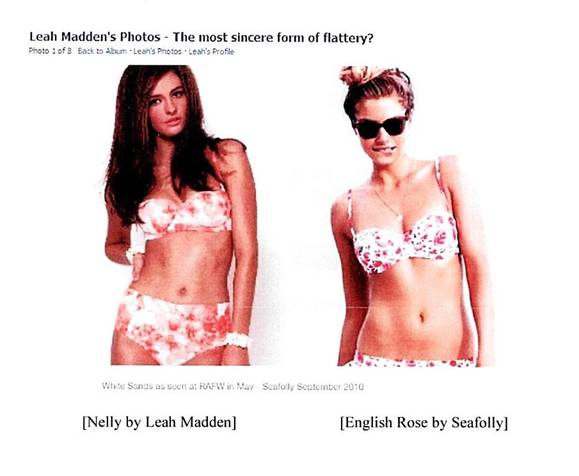
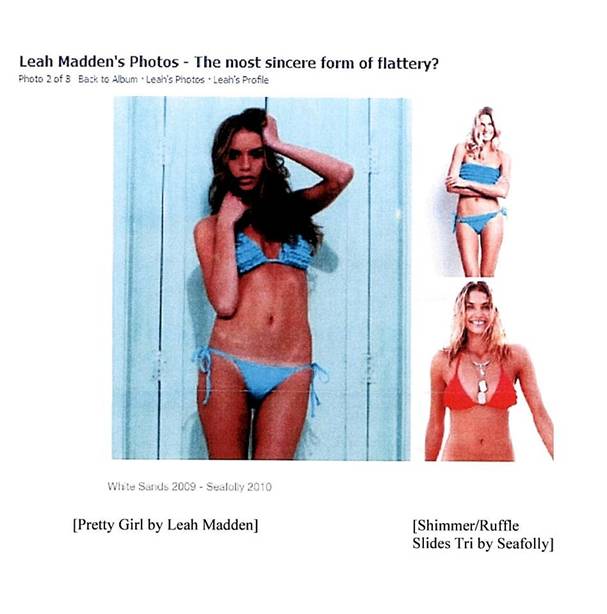
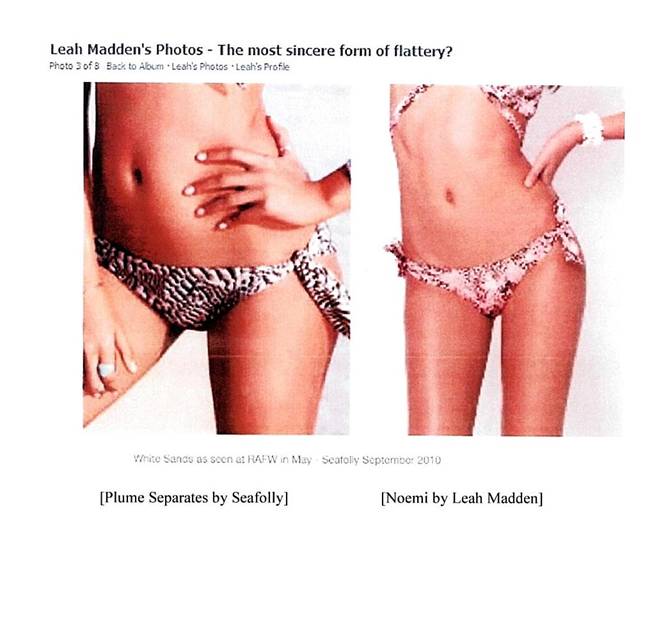
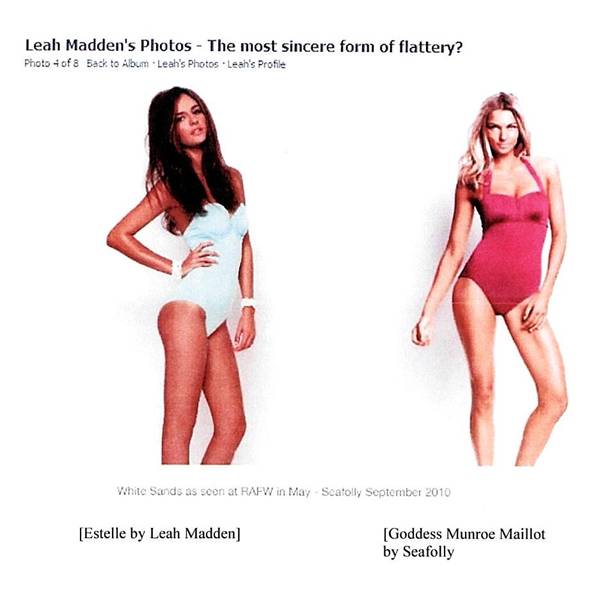
15 The e-mail had the subject line “The most sincere form of flattery?” followed by the following words: “Is it just us, or has Seafolly taken a little to (sic) much ‘inspiration’ from White Sands?”. Attached to the e-mail were eight photographs depicting a model wearing “White Sands” garments alongside a number of the Seafolly photographs. Each photograph bore the caption “White Sands as seen at RAFW in May - Seafolly September 2010” or “White Sands 2009 - Seafolly 2010”. These pages appeared in identical layout to those in Ms Madden’s Facebook postings, as follows (with the names of the various creations and their creator added):
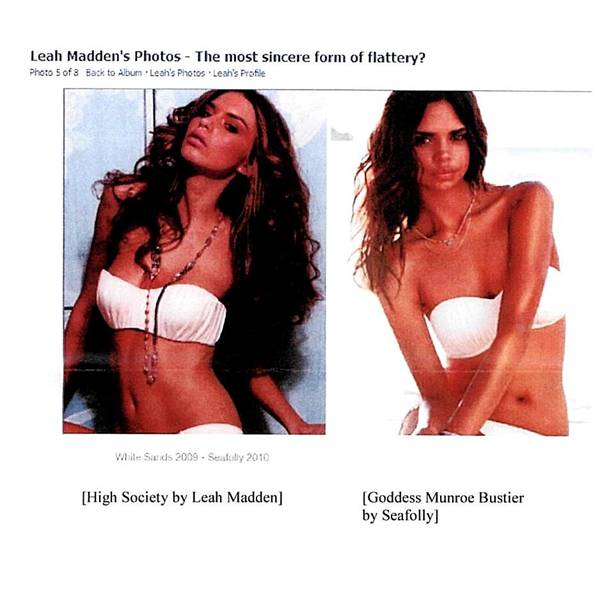
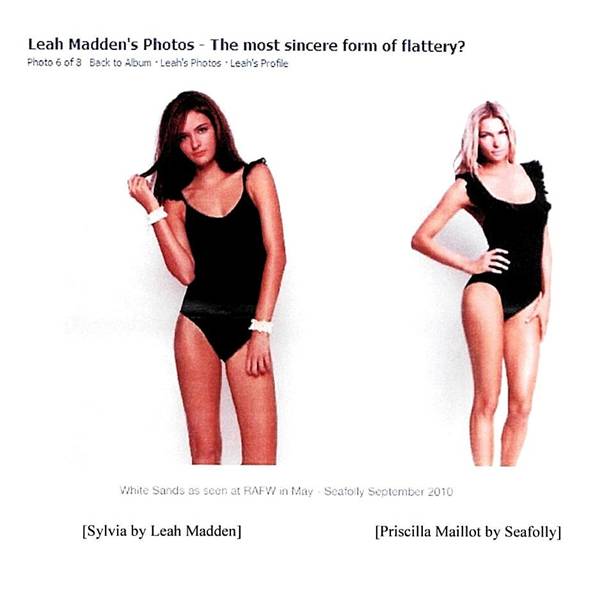
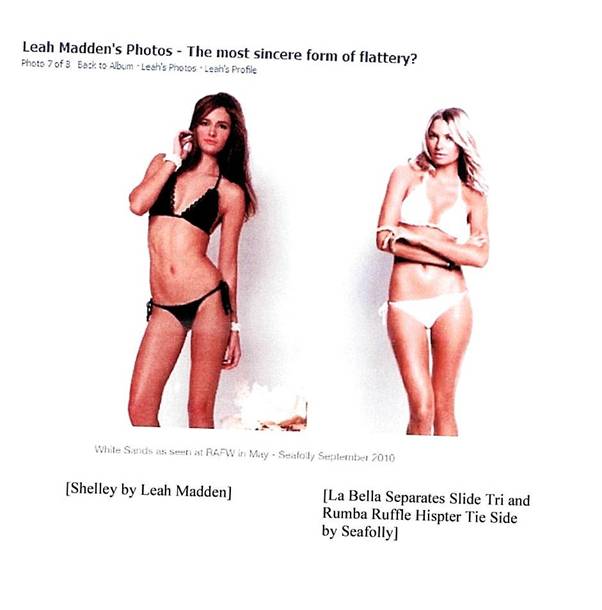
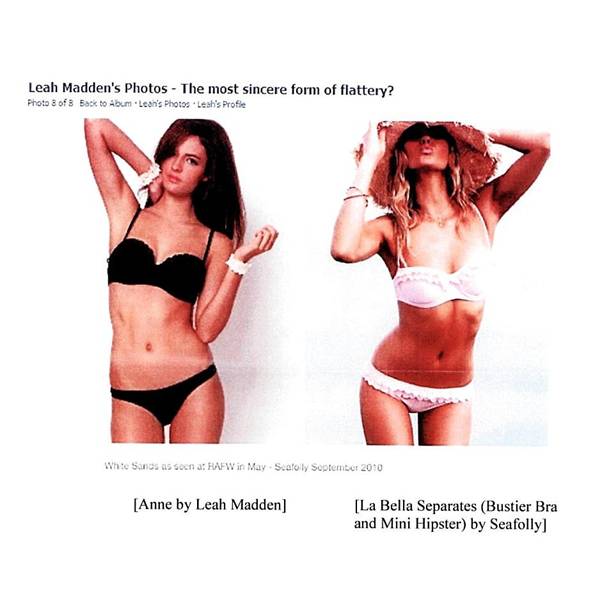
I will refer to the e-mail containing these photographs and statements as “the 2 September e-mail.”
16 In the afternoon of 2 September 2010, the online publication “Pedestrian TV” published an article titled White Sands Swimwear Calls Seafolly Plagiarists. This article was circulated to Seafolly's media relations agency by means of an e-mail from Pedestrian Daily News to Alex Losung sent at 4.53 pm on 2 September 2010 listing the headlines of the “Daily Pedestrian” news for 2 September 2010. One of the Daily Pedestrian headlines listed in the email was titled WHITE SANDS SWIMWEAR ACCUSE SEAFOLLY OF COPYING.
17 Following the dissemination of the e-mail, the publication of the statements on Ms Madden’s personal and White Sands Facebook pages and the publication of the Pedestrian TV article, Seafolly's media relations agency Torstar Communications received a substantial number of telephone calls and e-mails about Ms Madden’s statements.
18 At 5.26 pm on 2 September 2010, a fashion industry publication "Ragtrader" forwarded the e-mail to Torstar Communications, which then forwarded it to Seafolly. Seafolly was told by its media relations agent that "Ragtrader" was going to run a story on the allegations made by Ms Madden against Seafolly and that Seafolly had until 7:00 pm on 2 September 2011 to submit a statement to Ragtrader before it published its story, and that Daily Pedestrian was also going to run a story on the allegations made by Ms Madden against Seafolly.
19 On the evening of 2 September 2010, Seafolly issued a press release about the allegation (“Seafolly’s first press release”). The press release was sent to Pedestrian TV and Ragtrader. It read, in part:
“Earlier today Seafolly became aware that Leah Madden of White Sands Swimwear has made allegations on her facebook page that Seafolly has copied 7 of her swimwear designs. Ms Madden has posted on her facebook page reproductions of photographs from Seafolly’s catalogue showing the Seafolly garments which she claims are copies of swimwear garments designed by White Sands Swimwear. Seafolly has also become aware that Ms Madden has sent e-mails to media outlets attaching Seafolly’s photographs together with photographs of the White Sands Swimwear garments making these allegations of copying.
Seafolly denies these claims and says that they are completely false and without foundation and says that the claims have been made maliciously to injure Seafolly. Seafolly will be taking immediate action to cause Ms Madden to withdraw these allegations. Seafolly notes that many of the designs which Ms Madden claims Seafolly has copied were released into the marketplace by Seafolly before White Sands Swimwear released its relevant swimwear garment. Seafolly also says that the other designs which Seafolly is alleged to have copied were substantially progressed in development prior to White Sands Swimwear releasing it (sic) relevant swimwear garments into the market place.”
The press release was authorised by Mr Anthony Halas, the Chief Executive Officer of Seafolly.
20 At about 7:00 pm, Ms Madden took down the postings on her website.
21 Later that evening, the fashion publication Ragtrader published an article entitled “EXCLUSIVE Seafolly v White Sands: Swim labels at arms”. Shortly prior to the release of the Ragtrader article, Ragtrader contacted Ms Madden and advised her that Ragtrader had received a statement by Seafolly's lawyers.
22 At 7.24 pm on 2 September 2010, Seafolly's solicitors filed a copyright complaint notification with Facebook in respect to the Seafolly Photographs posted by Ms Madden seeking the removal of that content from Facebook. On 3 September 2010, Facebook sent Seafolly's solicitors an e-mail confirming that it had removed the relevant content from Facebook.
23 On or before 3 September 2010, Ms Madden posted a number of comments on the White Sands Australia Swimwear Facebook page. They were:
• “Thank you for your kind support, FYI, It wasn't US that said Plagiarist!” followed by a link to Pedestrian TV article “White Sands Swimwear Calls Seafolly Plagiarists” and one of the Seafolly Photographs next to one of the White Sands Photographs; and
• “…It wasn’t a photographer. I had a private showing with a ‘buyer’ who came with a digital camera and took photos. As it turned out, that ‘buyer’ was Julie McLaren from Seafolly :(She also requested a seat at the show for her boss, Anth ...”. [This comment was posted in response to a message from Zoe Emma Teasey asking “Did a photographer really come to your showing?”]; and
• “White Sands Australia says: ‘bullies be gone and take your bully tactics with you! We tiny little fledgling designers will not be taken advantage of!’”
I will refer to this publication as “the White Sands Facebook posting.” At the relevant time, White Sands had 3,535 “friends” on its Facebook page.
24 During the morning of 3 September 2010, Ms Madden told a journalist from Ragtrader that she could quote Ms Madden as saying that “I am also not claiming outright copying, just questioning the issue of similarity, in light of the fact that they requested the viewing earlier in the year”.
25 On 3 September 2010, Seafolly, through its solicitors, sent a letter of demand to Ms Madden. It alleged infringement of Seafolly’s legal rights and demanded that Ms Madden remove the allegedly offending material from her website and that of Seafolly, provide a written apology acknowledging that the representations appearing in the e-mails were false and provide an undertaking not to republish such statements.
26 Ms Madden responded to the letter of demand on the same day by e-mail to Seafolly's solicitors. Ms Madden stated:
“It would be really helpful if you could indicate where any representative of White Sands has claimed ‘copying’. I realise that others have said this, but am not aware of this word being used by anyone from White Sands. Are you referring to ‘The most sincere form of flattery?’ as this is a question, not a statement.
Any comments made or questions posed, on my personal facebook page were personal, not for publication, and were removed yesterday, as were all images.
I will forward your email to my solicitor, whom I am sure will be in contact if he believes it is necessary.”
27 Ms Madden then sent a further e-mail to Melinda Oliver of Ragtrader on 3 September 2010 which stated:
“I really need to clarify that White Sands has at no stage accused Seafolly of ‘repeatedly ripping of’ (sic) designs. Those words did not come from me or anyone on my team. Which is why earlier today I gave the the (sic) quote ‘I am not claiming outright copying, just questioning the issue of similarity, in light of the fact that they requested the viewing earlier in the year.’
I did not offer those words to inflame the situation.
The comparisons have been made, and can not be undone, but at no stage has
anyone of my team claimed plagiarism. Wherever possible would you please clarify
this, as I am sure Seafolly would appreciate it as much as I would.”
28 On 3 September 2010, Ragtrader published a further article about this dispute on its website, titled “EXCLUSIVE White Sands speaks out”.
29 Ms Madden has discovered Facebook messages on a confidential basis that she sent and received on 3 September 2010, and in the early morning of 4 September 2010. The messages passed between Ms Madden’s White Sands Facebook account and Ms Zoe Teasey’s personal Facebook account. The first message, sent at 9:31 am on 3 September, was sent to Ms Teasey by Ms Madden. It said:
“Can you do me a massive favour, and ask me on facebook if a seafolly staff member DID pose as a buyer to photograph the collection? At least then I can get it out there in a legitimate forum!”
Ms Teasey replied in the following terms:
“Yes on this account or on your personal account?
What is your PR saying? Maybe they should issue a press release ASAP and have something printed!
…
No it is fine I will post something!”
Ms Madden then sent a message to Charles Kelly at 12:47 am on 4 September in similar terms as follows:
“help!
Can you do me a massive favour and pose the question about seafolly posing as buyers and photographing the collection?
I have told them I won’t make a statement, but I really need to get that part out there!
Hopefully seafolly will be forced to answer that question at some stage. They have very conveniently ignored that point.”
Mr Kelly immediately responded in terms that suggest he had done so:
“FINALLY they posted my comments (twice – idiots), but I think I made the point clear.”
30 Ms Madden did not comply with Seafolly's demands, and on Monday 6 September 2010, Seafolly issued this proceeding seeking urgent injunctive relief. Ms Madden ultimately consented to an interim order restraining her from:
reproducing or authorising the reproduction of Seafolly’s photographs without the consent of Seafolly; and
making the allegations about copying or aiding, abetting, counselling or procuring the making of such allegations.
31 Between 8 and 13 September 2010, Seafolly issued a second press release (“Seafolly’s second press release”). This press release was sent to journalists from Pedestrian TV, The Age, and the Gold Coast Bulletin. It contained the following passages:
“On Thursday 2 September 2010 Seafolly became aware that Ms Madden made allegations on her facebook page that Seafolly copied 8 of her swimwear designs. Ms Madden claimed that Seafolly copied these designs after a buyer from Sunburn (a company partly owned by Seafolly) attended a White Sands Fashion Show in May 2010 and saw the White Sands swimwear on display. Ms Madden posted on her facebook page (without Seafolly’s consent) reproductions of photographs from Seafolly’s catalogue showing the Seafolly garments next to White Sands garments. In addition, Seafolly has become aware that Ms Madden sent emails to media outlets attaching these photographic comparisons and making false allegations of copying.
Seafolly denies these claims and says that they are completely false and without foundation. Seafolly says that these claims have been made maliciously to injure Seafolly and its business. Five of the designs which Ms Madden claims Seafolly has copied were released into the market place by Seafolly in March 2010. One of the designs was released into the marketplace by Seafolly in March 2009. The remaining two designs which Seafolly is alleged to have copied were substantially progressed in development prior to White Sands Swimwear showing these swimwear products to the market. White Sands Swimwear held their fashion parade in May 2010 and as the Seafolly garments alleged to be copies of the White Sands Swimwear garments were either already released to market or nearly completely designed, it is impossible that Seafolly copied the White Sands Swimwear that was on display during this parade.
To clarify further media reports, a Sunburn swimwear buyer attended the White Sands RAFW parade in May 2010. Sunburn is a multi-brand swimwear chain that is partly owned by Seafolly. The Sunburn buyer attended many swimwear brand showings during this time with the intention to purchase product for the Sunburn stores in 2010. Ms Madden was aware that Sunburn is partly owned by Seafolly. During the viewing of the range in May 2010 photographs were taken on a blackberry device by the Sunburn buyer. Taking photographs by buyers is standard practice for the use of referencing when placing orders. These photos were not downloaded. Any allegations that the Sunburn buyer showed photographs of the White Sands garments to employees at Seafolly is totally false.”
The press release ended by advising that the present proceeding had been issued.
CAUSES OF ACTION
32 Seafolly’s Further Amended Statement of Claim pleaded causes of action:
For misleading and deceptive conduct;
In injurious falsehood; and
For copyright infringement.
33 Ms Madden cross-claimed against Seafolly. Her claims were for defamation and misleading and deceptive conduct. Both were founded on the statements in Seafolly’s press releases that she had made her various allegations against Seafolly with the malicious intent of damaging Seafolly.
MISLEADING AND DECEPTIVE CONDUCT – ss 52 and 53 (a) of the trade practices act and their state counterparts
34 Seafolly complained that various statements appearing on Ms Madden’s personal Facebook page, the White Sands Australia Facebook page and in the e-mail sent by Ms Madden to various press outlets (see above at [10]–[12], [23] and [15] respectively) falsely represented that Seafolly:
Had copied Ms Madden’s swimwear designs which appeared in the photographs appearing above at [15];
Seafolly was not the creator of the original “Seafolly” swimwear designs depicted in the various adjoining photographs and that it had copied the White Sands garments; and
Seafolly had used underhanded means (in the taking of photographs by Ms McLaren) to obtain pictures of the White Sands garments and then copied the White Sands garments to create the Seafolly garments from those photographs.
35 These representations were said to have been made in trade or commerce and were misleading and deceptive or likely to mislead or deceive members of the public and consumers of clothing accessories in Australia and were false and misleading. The representations were said to be false and misleading in that:
Seafolly did not copy the White Sands garments;
The Seafolly garments were original designs created by employees of Seafolly and created without reference to the White Sands garments; and
Seafolly did not use underhanded means to obtain photographs of the White Sands garments and did not create the Seafolly garments using such photographs.
36 Ms Madden’s defences to these allegations were multi-layered. She denied that the statements about which complaint is made can fairly be understood as alleging that Seafolly had copied garments which she had created: the statements amounted to no more than expression of her genuinely held opinion as distinct from statements of fact. The Facebook postings were only “up” for a short time (about 30 hours) before they were taken down by Ms Madden. Alternatively, she sought to distinguish between the approach taken on the two Facebook pages and that adopted when she contacted the media outlets. Any allegations of copying were only to be found in the Facebook pages which were only accessible by her “friends”. The e-mail went no further than to raise questions and invite the reader to form his or her own conclusions. Ms Madden further contended that she had not made any of the statements “in trade or commerce”.
The legislation
37 In its amended statement of claim, Seafolly relied on ss 38 and 40 of the Fair Trading Act 1989 (Qld) (“the FT Act”). Those provisions relevantly provided that:
“38 A person shall not, in trade or commerce, engage in conduct that is misleading or deceptive or is likely to mislead or deceive.
…
40 A person shall not, in trade or commerce, in connection with the supply or possible supply of goods or services or in connection with the promotion by any means of the supply or use of goods or services –
(a) falsely represent that goods are of a particular standard, quality, value, grade, composition, style or model or have had particular history or particular previous use …”
38 On the first day of the hearing, Seafolly applied to amend its pleadings so that it could also place reliance on ss 42 and 44(a) of the Fair Trading act 1987 (NSW) (“the NSW FT Act”) and ss 52 and 53(a) of the Trade Practices Act 1974 (Cth) (“the TP Act”). Subject to one important exception, these provisions were in substantially the same terms as those appearing in ss 38 and 40(a) of the FT Act. That exception is that ss 52 and 53(a) of the TP Act applied to corporations rather than persons. Given that Ms Madden was not a corporation Seafolly sought to rely on the extended operation of ss 52 and 53(a) which was provided for in s 6(3) of the TP Act. That provision caught conduct which involved the use of telegraphic or telephonic services by an individual. The same facts were relied on by Seafolly to support its claims under the NSW FT Act and the TP Act. In the absence of any prejudice to Ms Madden, leave was granted.
39 All of these provisions have subsequently been repealed and replaced by other, similarly worded provisions in the Australian Consumer Law (“ACL”) with effect from 1 January 2011, which appears as Schedule 2 to the Competition and Consumer Act 2010 (Cth). Sections 38 and 40 of the FT Act, sections 42 and 44(a) of the NSW FT Act and sections 52 and 53(a) of the TP Act were all respectively replaced by ss 18 and 29 of the ACL. The transitional provisions in each case provided that the former provisions continued to apply to conduct which occurred prior to the commencement of the new legislation. It will, therefore, be convenient, in these reasons, to continue to refer to the superseded legislation. I will deal first with Seafolly’s claims pursuant to the TP Act. My findings in relation to its state counterparts are set out below at [108]-[109].
The relevant legal principles
40 The principles which govern the application of s 52 of the TP Act are now well established. Relevantly they were conveniently summarised by Weinberg J in CPA Australia Ltd v Dunn (2007) 74 IPR 495 at 500-1 as follows:
“[26] … When determining whether particular conduct was, or is, likely to mislead or deceive it is unnecessary to prove that anyone was actually misled or deceived: Parkdale Custom Built Furniture Pty Ltd v Puxu Pty Ltd (1982) 149 CLR 191 at 198; 42 ALR 1 at 7; 1A IPR 684 at 691. However, evidence that particular individuals have been misled or deceived is admissible, and may be persuasive: Global Sportsman Pty Ltd v Mirror Newspapers Pty Ltd (1984) 2 FCR 82 at 87; 55 ALR 25 at 30 (Global Sportsman). The test is objective, and the court must determine the question for itself: Taco Co Australia Inc v Taco Bell Pty Ltd (1982) 42 ALR 177 at 202. Finally, conduct is likely to mislead or deceive if there is a real and not remote possibility that it will do so. It is not necessary to establish that the degree of likelihood exceeds 50%: Global Sportsman at CLR (sic) 87; ALR 30.
[27] It is clear that regard must be had to the relevant conduct as a whole, and in context. See generally Campomar Sociedad Limitada v Nike International Ltd (2000) 202 CLR 45; 169 ALR 677; 45 IPR 481; [2000] HCA 12. The question whether a representation made by a person to the public, or a section of it, would be likely to mislead or deceive must be answered without regard to whether that person intends to mislead or deceive. It is not a question of whether, if the person makes these representations, he or she would be acting honestly and reasonably. It is simply a question of whether potential members of the class to whom the representations are to be addressed (which include the astute and the gullible, the intelligent and the not so intelligent, and the well educated and the poorly educated) are at serious risk of being misled or deceived: see .au Domain Administration Ltd v Domain Names Australia Pty Ltd (2004) 207 ALR 521; 61 IPR 81; [2004] FCA 424 at [12]-[15] and National Exchange Pty Ltd v Australian Securities and Investments Commission (2004) 61 IPR 420; 49 ACSR 369; [2004] FCAFC 90 (National Exchange).
[28] Statements that are capable of more than one meaning may be misleading or deceptive provided that the meaning for which the applicant contends is one that would be reasonable open, and might be drawn by a significant number of those to whom the representation is made. In the same way, a statement may contain a representation that is implied, rather than express. That is why a statement that is literally true can be misleading or deceptive: National Exchange at [48]-[52].”
41 A similar approach has been taken to the construction and application of s 53(a). This paragraph will be contravened if “a representation is in fact not correct … even if it is not false to the knowledge of the person making the representation”: see Given v CV Holland (Holdings) Pty Ltd (1977) 29 FLR 212 at 217. As is the case in relation to s 52, the question of whether a particular statement is misleading is one of fact which is to be determined having regard to the context in which the statement is made and all of the surrounding circumstances. The Court must determine what a reasonable person who is a member of the class to which the representation was directed would reasonably understand it to convey: see Taco Co, supra; Henderson v Pioneer Homes Pty Ltd (No 3) (1980) 43 FLR 276 at 288. Any false representation must be made “in connection with the supply or possible supply of goods or services”. An immediate causal nexus is not required: see Our Town FM Pty Ltd v Australian Broadcasting Tribunal (1987) 16 FCR 465 at 479-80. Rather, there needs to be “a substantial relation, in a practical business sense” between the representation and, relevantly, the supply of goods: cf Berry v Federal Commissioner of Taxation (1953) 89 CLR 653 at 658-9.
Were the statements misleading, deceptive or false?
42 It was not disputed that, if Ms Madden’s statements conveyed the meanings for which Seafolly contended above at [34], they would have been likely to mislead or deceive their readers and were false.
43 In opening Ms Madden’s case senior counsel advised the Court that Ms Madden did not contend that Seafolly had copied her designs. This concession was understandable having regard to the state of the evidence. It was undisputed that six of the eight Seafolly designs which appeared in the Facebook postings and the e-mail (Shimmer/Frill Me, English Rose, Goddess Munroe Maillot, Priscilla Maillot and La Bella Separates (both variants)) were released to the wholesale market no later than March 2010. The development of the other two designs (Goddess Munroe Bustier and Plume Separates) was well advanced in May 2010 and completed shortly thereafter. They were part of a photography “shoot” in June 2010 and released to the wholesale market the following month. In each case the release dates were preceded by design and development work by Seafolly employees. In some instances the items depicted were of Seafolly products which had been on the market for many years but which had been rebadged or reissued. The Shimmer garment, for example, was strikingly similar to an earlier Seafolly product which was marketed as “Frill Me Ruffles Slide Tri” which had first been created in December 2008. It in turn, had been based on an earlier Seafolly product named “Samba Halter Bikini” which had been created in June 2004.
44 Nor did Ms Madden seek to make good a claim that Ms McLaren had attended the private showing and runway event in May 2010 for the purpose of photographing part of Ms Madden’s range or that the photographs taken on these occasions by Ms McLaren were subsequently used by Seafolly to copy the White Sands garments.
45 Ms McLaren was subject to a lengthy cross-examination. At no point was it suggested to her that she had lied in denying these allegations. Her evidence was that she took photographs on her Blackberry machine to assist her in determining whether to place orders for particular designs and that she never downloaded any of the photographs which she took.
46 Ms McLaren impressed me as a truthful witness. She was a good historian who had a clear recollection of relevant events. When giving evidence about related matters she was prepared to make concessions which were not necessarily in Seafolly’s interests. I accept her evidence.
47 It is surprising that, despite her counsel’s statement that she did not contend that Seafolly had copied her designs, Ms Madden, under cross-examination and having heard all of the evidence called by Seafolly, declared that she did not know whether or not Seafolly had so acted.
48 The issue in dispute was whether the impugned statements could fairly be understood as conveying the representations about which Seafolly complained. It is, therefore, necessary to examine the language employed by Ms Madden (read in context), with a view to determining whether the persons to whom her statements were addressed were at risk of being misled or deceived.
49 As already noted the statements which Seafolly contends constitute false representations (which have been identified above at [34]) are to be found on the Facebook pages and in the 2 September e-mail (see above at [10]–[12], [23] and [15] respectively).
50 Upon seeing the photographs in the “Gold Coast Panache” on 1 September 2010, Ms Madden was struck by what she considered to be the similarity between the Seafolly garment being worn by the model and one of her own creations. She made some further comparisons between garments in her range and those in the Seafolly catalogue. She noted what she considered to be a “close similarity” between her garments and Seafolly’s products. She came to the conclusion that Seafolly had copied her designs. So much is evident from statements made in her Facebook posting and the White Sands Facebook posting.
51 Ms Madden’s Facebook postings on 1 and 2 September 2010 contained an album of photographs of Seafolly garments. The heading (which was used repeatedly) was “The most sincere form of flattery?”. This was an evident reference to the well known phrase “imitation is the sincerest form of flattery” which, according to the Oxford dictionary, conveys the meaning that “copying someone or something is an implicit way of paying them a compliment.” The allegation of copying was reinforced by the caption below the photographs which read “why allowing ‘buyers’ to photograph your collection at RAWF can be a bad idea.” This was plainly a reference to Ms McLaren taking photographs at the private showing and the runway show. Ms Madden’s own comments about there having been “almost an entire line-line ripoff (sic)” and that rip offs were “always going to happen, but sending in a dummy ‘buyer’ to get photos is super sneaky!” confirm the allegation of copying.
52 While these statements were made to a limited audience of Ms Madden’s Facebook “friends”, the responses clearly show that these representations were understood by the readers as asserting that Seafolly had engaged in the alleged unethical practices.
53 This impression is reinforced by the additions to the site which occurred on 2 September 2010 in which photographs of Ms Madden’s garments were placed alongside the Seafolly photographs which were said to show the allegedly copied costumes. Under each pair of photographs Ms Madden wrote either “White Sands as seen at RAFW in May – Seafolly September 2010” or “White Sands 2009 – Seafolly 2010.”
54 The 2 September e-mail had as its subject line “The most sincere form of flattery?”. This question was followed by another: “Is it just us, or has Seafolly taken a little to (sic) much ‘inspiration’ from White Sands?” There were attached to the e-mail the eight pairs of photographs with the captions which had appeared on Ms Madden’s Facebook postings.
55 The e-mail was sent to various media outlets. The e-mail led to some articles being published in a number of trade journals. As is evident from the terms of those articles (see above at [16] and [21]), the journalists who prepared them clearly understood the 2 September e-mail to contain allegations of copying, made by Ms Madden, against Seafolly. So too did the readers of the articles.
56 Responses from readers of the Ragtrader article included:
“This sort of thing is happening ALL the time. Large corporations no longer have ‘designers’ but ‘product developers’ that source indie designs, copy and mass produce them.”.
“Isn’t it the designer who should be threatening legal action? How sad that a big brand can photograph a small designers (sic) collection, produce several styles that are almost identical, then threaten the designer with legal action for pointing out the similarities!”.
“Surely it doesn’t take an expert to see this goes far beyond coincidence? You may be able to overlook the similarities if there were only a few – but I’ve seen some more comparisons on another website, and there are so many of them! Then when you take into consideration the fact that someone working for Seafolly posed as a buyer for another company to enable them to take detailed photographs of the White Sands collection many months before Seafolly released their collection, it all starts to look very suspect indeed. I’d like to see how Seafolly explain their way out of what essentially amounts to an act of taking spy photographs?”. (Emphasis added).
“Yeah right Seafolly – you really expect us to believe this garbage? The similarities alone may by some freak occurrence actually have been a coincidence, the photocopying of White Sands’ line by a Seafolly employee may have been harmless – but put the two together and a foul smell starts to emerge. If, as they dubiously claim, Seafolly had already progressed with their own ‘designs’, WHY did they continue in the same direction upon discovering that White Sands had released an almost identical line. A rat isn’t all I smell.”
57 Similarly negative views were formed by readers of the Pedestrian TV online publication. Their comments included:
“I heard about this too. Apparently someone from Seafolly went to fashion week pretending to be a buyer for Sunburn and photographed all of the bikinis. So it sounds like more than a coincidence that so many are similar.”
“I’m no expert in swimwear design, and I think you may be able to overlook the similarities if there were only a few – but there are so many of them! Once you factor in the fact that someone working for Seafolly posed as a buyer for another company to enable them to take detailed photographs of the White Sands collection many months before Seafolly released their collection, it all starts to look very suspect indeed. (Emphasis added).
“White Sands has every right to make this statement, their work has been copied and someone is going to take the credit and make money for their creations. Quite embarrassing on Seafolly’s behalf I think.” (Emphasis added).
“Seafolly is shocked? They sent in a ‘buyer’ to photograph the collection, produce some very similar designs, yet are still shocked that the question has been posed? They made a pretty long statement about claims, but have avoided the one key claim. Did they send in a staff member pretending to be a buyer or not?” (Emphasis added).
58 The White Sands Facebook posting which was made on 3 September 2010 sought to distance Ms Madden from one of the media headlines which referred to Seafolly being “plagiarists” by implying that this conclusion had been reached by the publication as a result of its own comparison of the pairs of photographs but without Ms Madden having used the word. Her posting did, however, specifically name Ms McLaren as the “buyer” who had come to her show with a digital camera and taken photographs of her garments. Ms Madden also accused Seafolly of being a bully which had employed “bully tactics”.
59 The common feature of the representations which are impugned by Seafolly is that each claims that Seafolly had copied costume designs created by Ms Madden and marketed them as Seafolly products. This copying had been possible, in part at least, because Seafolly had access to the photographs which had been taken by Ms McLaren in order to facilitate the deception. When read in context, each of the statements about which Seafolly complained was false and was likely to mislead and deceive their readers.
60 I have concluded that, when Ms Madden published her various statements, she believed, erroneously, that Seafolly had copied her garments. Her choice of language was intended to and did convey to her readers that such copying had, as a matter of fact, occurred.
Were the statements mere expressions of opinion?
61 Ms Madden contended that the reasonable reader of the Facebook postings and the e-mail would have understood that she was expressing no more than an opinion about the similarity between the pairs of depicted garments. This similarity had led her to “her conclusion as to Seafolly’s conduct.” Although that “conduct” was not expressly stipulated, this could, in the context, only be understood as being a reference to copying.
62 Ms Madden rightly submitted that each of the three publications had to be examined separately and discrete decisions made as to whether the relevant statutory provisions had been contravened. Although many of the submissions made by her on the application of these provisions were common to all of the publications, she drew a distinction, in the present context, between the Facebook postings and the e-mail. She submitted that it was even clearer, from the phrasing of the 2 September e-mail, that she was expressing an opinion. This was because she did no more than pose the question in each case: “The most sincere form of flattery?” and leave it to the reader to make comparisons and draw his or her own conclusions. The question was unaccompanied by comments such as, “almost an entire line-line ripoff”, “sending in a dummy ‘buyer’ to get photos is super sneaky”, and “bullies be gone and take your bully tactics with you!”, which appeared in the Facebook postings.
63 Ms Madden further submitted that a statement of opinion could not be held to be misleading or deceptive (or likely to be so) if it was honestly held by her. She honestly believed that the copying had occurred. She was struck by the similarity in the design of the various pairs of costumes. Her suspicions were reinforced by her recollection of certain events which had occurred earlier in the year. They were:
Ms McLaren had approached her in her (Ms McLaren’s) capacity as a buyer for Sunburn and had assured her that Seafolly and Sunburn were separate entities notwithstanding Seafolly’s majority shareholding in Sunburn.
Ms McLaren had expressed great interest in the White Sands range and had taken photographs at the private showing and the runway show. Despite this no orders had been forthcoming from Sunburn.
Not long afterwards, Ms Madden had encountered Ms McLaren working on the Seafolly stand at the Florida show and wearing a Seafolly badge.
64 The distinction between statements of fact and statements of opinion has long been recognised by courts called on to apply s 52 of the TP Act. In an oft-cited passage in their joint judgment in Global Sportsman Pty Ltd v Mirror Newspapers Pty Ltd (1984) 2 FCR 82 at 88, Bowen CJ, Lockhart and Fitzgerald JJ said that:
“A statement which involves the state of mind of the maker ordinarily conveys the meaning (expressly or by implication) that the maker of the statement had a particular state of mind when the statement was made and, commonly at least, that there was basis for that state of mind. If the meaning contained in or conveyed by the statement is false in that or in any other respect, the making of the statement will have contravened s 52(1) of the Act … [T]he incorrectness of an opinion (assuming that can be established) does not of itself establish that the opinion was not held by the person who expressed it or that it lacked any, or any adequate, foundation.
The applicants argued that, nevertheless, the statement of an incorrect opinion is misleading or deceptive or likely to mislead or deceive merely because it misinforms or likely to misinform. An expression of opinion which is identifiable as such conveys no more than that the opinion expressed is held and perhaps there is basis for the opinion. At least if those conditions are met an expression of opinion, however erroneous, misrepresents nothing.” (Emphasis added).
65 The line between statements of fact and statements of opinion is often difficult to draw. Guidance is provided by the observations of members of the Court in later cases. In Tobacco Institute of Australia Ltd v Australian Federation of Consumer Organisations Inc (1992) 38 FCR 1, Hill J (with whom Foster J agreed on this point) said (at 46-7) that:
“No case will afford a guide to any other case, since it must essentially be a question of fact whether a particular formulation of words expresses merely an opinion or a statement of fact. However, two observations may be made. First, the subjective purpose or motivation of the maker of the statement will not be of much significance. It is the readers’ perception of the maker’s intention which will ordinarily be the significant matter. The question will generally be resolved by looking to the persons to whom the statement was directed and asking whether any members of that class of persons would reasonably understand the statement to be one of fact or opinion.
Where, as here, the statement is directed to the public at large, it must be borne in mind that the class of persons will include the intelligent and the less intelligent, the informed and the less informed. The fact that some members of the class may perceive the statement as one of opinion will not avail a respondent if a not insignificant class of persons could reasonably be expected to perceive it as a statement of fact.
Secondly, a statement will most usually be seen as a statement of fact if it is one which can be measured against an objective criterion. Thus, generally, where no objective criterion exists, so that of necessity what is said must depend upon judgment or opinion, the statement will be seen not as a statement of fact but as one of opinion.”
66 In Industrial Equity Limited v North Broken Hill Holdings Limited (1986) 9 FCR 385 at 392-3, Burchett J emphasised that the necessary judgment had to be formed in the context in which the relevant statements were made. Like Hill J, his Honour considered that, where statements “assert some matter of physical observation”, it is more likely that the statement will be treated as one of fact. His Honour also contemplated (at 393) that the expressing of an opinion could contravene s 52(1) if that opinion was not “honestly made”: see Orion Pet Products Pty Ltd v Royal Society for the Prevention of Cruelty to Animals (Vic) Inc (2002) 120 FCR 191 at 213 [124] and the cases there cited. An opinion will not be treated as being honestly held if it is formed with reckless indifference to the true position and no serious attempt has been made to ascertain the true position: see Bateman v Slatyer (1987) 71 ALR 553 at 559. The expression of an opinion which is not “honestly held” will be indicative of malice: cf Harbour Radio Pty Limited v Trad (2012) 86 ALJR 1256 at 1263-4 .
67 In my view, when read in context, the statements would not have been understood by the class of persons to whom they were directed as mere expressions of Ms Madden’s opinions. My reasons for so concluding appear above at [50]-[59].
68 Even if it could be said that the readers of the impugned statements would have understood them to be expressions of Ms Madden’s opinions, she was reckless in forming them. Ms Madden acted precipitately. Her first Facebook postings occurred within hours of her seeing the photographs in the Gold Coast Panache. She then made a visual comparison of some of her designs and some Seafolly garments. This comparison was based on the photographs which appear above at [15]. As can be seen from those photographs, there are varying degrees of similarity between the paired sets of garments. Before posting her views she failed to take a number of steps which would have elicited facts inconsistent with the notion that any copying of her garments had occurred. She could, for example, have made enquiries of retailers to establish when the Seafolly garments were placed on the market. She could have attended a retail outlet and examined some, at least, of the Seafolly garments. She could have made enquiries of Seafolly with a view to ascertaining when the costumes which she considered had been copied had been designed and released to the market. She might also have paused to consider whether her creations which she thought had been copied had been on display at the private viewing and parade which Ms McLaren had attended in May 2010.
69 Had some or all of these prudent steps been taken, Ms Madden would have become aware that:
Six of the eight Seafolly garments had been on the market prior to May 2010. The other two were going through design stages and were released in July 2010.
The dates which she placed under the various photographs of Seafolly products which suggested that six of the costumes had been released to the market in September 2010 and that another two had been placed in the market that year (in each case after the allegedly copied White Sands garment had gone to market) were wrong. I do not accept Ms Madden’s submission that her references to “September 2010” under the photographs were intended to convey no more than that these Seafolly costumes had first come to her attention in September 2010. Had that been her intention there would have been no need to insert the references to May 2010 under her garments. Furthermore, the other two sets of photographs had under them “White Sands 2009 – Seafolly 2010.” Ms Madden’s evident intention was to suggest to the reader that her garments were in the market place before the comparator Seafolly garments.
A comparison of the actual garments would have disclosed varying degrees of design difference. So much was conceded by Ms Madden in her evidence. She agreed, for example, that her High Society Bandeau top was “narrower at the front” and “much deeper” than the comparator Seafolly Goddess Monroe Bustier, that there were “a lot of differences” between the print used on her White Sands Nelly costume and that used on Seafolly’s English Rose design and that her Shelley bikini pant was “much more brief” than that which formed part of the Seafolly La Bella equivalent.
Her failure to take those steps (or some of them) was not merely careless. It resulted from her conviction that copying had occurred and her determination to expose what she saw as Seafolly’s misconduct. Her resolve was such that she was prepared to and did make the statements not caring whether they were true or false.
70 Ms Madden made her allegations against a competitor. The nature of the allegations were such that they would, to her knowledge have had the potential to harm Seafolly’s reputation. This knowledge should have caused her to adopt a cautious approach. The 2 September e-mail was, however, sent to both industry publications and to some daily newspapers which, it might have been expected, would have reported the allegations to a wider audience which included Seafolly’s customers or potential customers.
71 Despite being warned by Seafolly that her allegations lacked foundation, Ms Madden persisted. She was determined to make her point about copying and, in particular, that this had been possible because of the photographing of her range by Ms McLaren. Seafolly’s warning was conveyed by its solicitor’s letter on 3 September 2010. Within hours, Ms Madden was engaged in soliciting what she hoped would appear to be questions from disinterested parties which would enable her to reiterate her charges about photography for copying purposes. The parties to whom she turned were, in fact, personal friends. She asked both for “a massive favour”: see above at [29]. Again, she did not pause to ascertain the true facts before acting.
72 Even if, contrary to my view, each of the impugned statements made by Ms Madden constituted no more than the expression of opinions held by her, this defence fails because she was reckless in giving public expression to them and there was no adequate foundation for any of them.
73 I therefore find that, if s 52 of the TP Act applied to Ms Madden and her impugned statements were made in trade or commerce (issues to which I will shortly turn), she contravened s 52 of the TP Act in making those statements.
Contravention of s 53(a)
74 There is a substantial overlap between ss 52 and 53(a) of the TP Act. Both apply to conduct engaged in by a corporation in trade or commerce, in connection with the promotion or supply of goods or services. Section 53(a) differs from s 52 in that the impugned representation must be “false” and, relevantly, assert that the goods concerned are of a particular “style or model”.
75 In my view Ms Madden also contravened s 53(a). Each of her impugned representations was false and they suggested that the eight depicted Seafolly garments were not of the style and model advertised and marketed by Seafolly as having been designed by it. Rather, she asserted, wrongly, that they were copies of White Sands’ styles and models.
Did ss 52 and 53(a) of the Trade Practices Act apply to Ms Madden?
76 Ms Madden submitted that she, as a natural person, could not be held to have contravened ss 52 and 53(a) of the TP Act because they only regulated the conduct of corporations.
77 Section 6(3) of the TP Act provided that the provisions of Part V of the Act also have the effect that they would have if:
“(a) those provisions … were …. confined in their operation to engaging in conduct to the extent to which the conduct involves the use of postal, telegraphic or telephonic services … and
(b) a reference in those provisions to a corporation included a reference to a person not being a corporation.”
78 Seafolly contended that, in making the Facebook postings and sending the e-mail, Ms Madden had used telephonic services. The term “telephonic services” is not defined in the TP Act. It is, no doubt, intended to bear the same meaning as attaches to it in s 51(v) of the Constitution. In Australian Competition and Competition Commission v Hughes [2002] FCA 270 Allsop J dealt with representations which appeared on an internet web-site. His Honour held that relief was available under the TP Act, in part because of the provisions of s 6(3) as access to the internet involved the use of telephonic services: see at [77]; Dataflow Computer Services Pty Ltd v Goodman (1999) 168 ALR 169 at 171 and cf CPA Australia Ltd v Dunn (2007) 74 IPR 495; Australian Competition and Consumer Commission v Chen (2003) 132 FCR 309.
79 Each of the impugned publications was promulgated using the internet. Access to that facility involved the use of telephonic services. As a result I accept that Ms Madden is liable for contraventions of ss 52 and 53(a) because of the extended operation of those provisions as prescribed by s 6(3) of the TP Act.
“In trade or commerce”?
80 It is necessary for Seafolly to establish that Ms Madden’s impugned conduct occurred “in trade or commerce”. Ms Madden denied that, in making the Facebook postings and sending the 2 September e-mail, she was engaged in trade or commerce.
81 The reach of provisions such as ss 52 and 53(a) of the TP Act is limited by the use of the preposition “in”. In Concrete Constructions (NSW) Pty Ltd v Nelson (1990) 169 CLR 594 at 604, Mason CJ, Deane, Dawson and Gaudron JJ said that:
“What the section is concerned with is the conduct of a corporation towards persons, be they consumers or not, with whom it (or those whose interests it represents or is seeking to promote) has or may have dealings in the course of those activities or transactions which, of their nature, bear a trading or commercial character. Such conduct includes, of course, promotional activities in relation to, or for the purposes of, the supply of goods or services to actual or potential consumers, be they identified persons or merely an unidentifiable section of the public.”
82 As a result, a person who is not an industry participant but who acts as a commentator on industry matters, is unlikely to be held to have published his or her views “in trade or commerce”: see, for example, Robin Pty Ltd v Canberra International Airport Pty Ltd (1999) 179 ALR 449. On the other hand, the making of statements which are intended to have an impact on trading or commercial activities, even if made by a person not engaged in the relevant industry, may bear the necessary trading or commercial character: see, for example, Fire Watch Australia Pty Ltd v Country Fire Authority (1999) 93 FCR 520.
83 In the present case, Ms Madden was the principal of White Sands, a trade competitor of Seafolly. Her statements related to the manner in which Seafolly conducted its business. She alleged that Seafolly had engaged in conduct which was improper to the detriment of her own business. She thereby sought to influence the attitudes of customers and potential customers of Seafolly. In these circumstances, I consider that her statements were made “in trade or commerce”.
Damage
84 Seafolly alleged that it suffered damage to its reputation and economic loss as a result of the publication of the Facebook postings and the e-mail.
85 I will deal first with the economic loss claim.
86 The applicant is one of a number of companies which constitute the Seafolly group. The marketing of the Seafolly brand internationally constituted 90 percent of the group’s business. Seventy percent of that business was conducted in Australia. The applicant conducts a significant part of the group’s business in Australia.
87 The evidence established that Seafolly enjoyed a substantial and favourable reputation and that Ms Madden’s statement had the potential, if accepted by third parties, to undermine that reputation. The evidence, however, stopped well short of showing that any loss of sales or other business losses had resulted from the publications on the website and the e-mail. Mr Anthony Halas expressed apprehension that members of the public might have formed negative views of Seafolly’s business ethics, calling into question the exclusivity of its designs and thereby damaging Seafolly’s reputation. This could, in turn, lead to a disinclination to purchase Seafolly garments. In a rather melodramatic passage in his evidence Mr Halas said:
“[t]he problem we have in this day of internet, where things go viral, and no amount of – once these things are released into the public space, no amount of logical reasoning actually matters any more. See, I couldn’t win. Once she put that up there, I was finished anyway. See, it was – the damage had been done …”
In fact, Seafolly’s business was anything but “finished”. Its sales and profitability were, on its own figures, wholly unaffected by what occurred. As a result, Mr Halas was not able to point to any adverse commercial impact on Seafolly’s business resulting from the making of Ms Madden’s statements.
88 Seafolly tendered its financial accounts for the relevant financial year as a confidential exhibit. Those accounts showed no diminution of profitability. There was no evidence of a downturn in sales, even for a short period, in the wake of the publications. On the contrary, Seafolly’s sales figures and profitability have been on an upward trajectory both before and since Ms Madden’s publications.
89 This does not mean that Seafolly is left without redress under the TP Act. Compensation is available for damage to a corporation’s reputation.
90 Section 82(1) provided that a person who suffers loss or damage by conduct of another person that was done in contravention of Part V, (which includes ss 52 and 53(a)) may recover damages for any loss occasioned by the contravention. Section 87(1) provided that, if a contravention of Part V of the Act is established, the Court may make orders compensating the victim. Both provisions require the victim to have suffered loss and damage by reason of the contravening conduct. As the Full Court said in Enzed Holdings Ltd v Wynthea Pty Ltd (1984) 57 ALR 167 at 183:
“The principle is clear. If the court finds damage has occurred it must do its best to quantify the loss even if a degree of speculation and guess work is involved … We emphasize, however, that the principle applies only when the court finds that loss or damage has occurred. It is not enough for a plaintiff merely to show wrongful conduct by the defendant.”
91 Damage to the commercial reputation of a corporation may be compensated for under s 82(1): see Brabazon v Western Mail Limited (1985) 8 FCR 122 at 129; Flamingo Park Pty Ltd v Dolly Dolly Creation Pty Ltd (1986) 65 ALR 500 at 525.
92 In FAI General Insurance Company Ltd v RAIA Insurance Brokers Ltd (1992) 108 ALR 479 such an award was made against a broker who had disparaged an insurance policy proffered by the applicant.
93 In Nixon v Slater and Gordon (2000) 175 ALR 15 two surgeons were held to have been defamed by the publication, by the respondent, of booklets relating to medical malpractice litigation which featured their photographs. The surgeons also pursued a cause of action under s 52 of the TP Act. Merkel J found that the respondent had contravened s 52. His Honour awarded damages under s 82 of the TP Act which he calculated on the same basis as he had done in determining the measure of damages for defamation.
94 In Cryeng Pty Ltd v Loyola [2011] FCA 956, Stone J dealt with misleading and deceptive representations to the effect that the applicant was about to go out of business and that it would be replaced, as manufacturer of particular goods, by another company. The evidence called relating to the damage caused to the applicant’s reputation by the representations was described by her Honour as “flimsy”: see at [99], She was, nonetheless, prepared to award damages for the loss of the applicant’s reputation under s 82.
95 As was the case in Cryeng, the evidence of damage to Seafolly’s reputation in the present proceeding is sparse. The evidence did establish that Seafolly had a strong and positive image in the swimwear industry and that that reputation was important to it in a highly competitive environment. Any damage does not, however, appear to have been significant or ongoing.
96 In attempting to quantify loss it is relevant, as Wilcox J held in Typing Centre of NSW Pty Ltd v Northern Business College Ltd (1989) 13 IPR 627 at 641, to have regard to “the nature of the statements made by the respondents and to the manner and extent of their publication.” The two Facebook postings were accessible to the “friends” of the sites for less than two days. The numbers of people with access to the pages was relatively small. The same cannot be said of the 2 September e-mail to trade and general press outlets. The contents of this e-mail had the potential to be widely published. In the event it does not appear that they were. They excited interest in the trade publications but do not seem to have led to any significant publicity in the mainstream press. As I have already found the allegations made by Ms Madden were a serious assault on Seafolly’s business integrity.
97 It is, I consider, appropriate to award Seafolly limited damages under s 82 of the TP Act. Doing the best that I can on the limited available evidence I consider that an amount of $25,000 would be appropriate.
Injunctions
98 Seafolly submitted that, if it was successful in establishing contraventions of ss 52 and 53(a) of the TP Act, the Court should restrain Ms Madden from reproducing or authorising the reproduction of the photographs of the Seafolly swimwear depicted above at [15] without the consent of Seafolly and from making the representations recorded above at [34] or other claims to like effect.
99 Section 80(1) of the TP Act empowered the Court to grant an injunction on such terms as it considered to be appropriate if it was satisfied that a person had engaged, or was proposing to engage, in conduct that constituted or would constitute a contravention of a provision of Part V. Section 80(4) provided that:
“(4) The power of the Court to grant an injunction restraining a person from engaging in conduct may be exercised:
(a) whether or not it appears to the Court that the person intends to engage again, or to continue to engage, in conduct of that kind;
(b) whether or not the person has previously engaged in conduct of that kind; and
(c) whether or not there is an imminent danger of substantial damage to any person if the first-mentioned person engages in conduct of that kind.”
Because this proceeding was commenced before 1 January 2011, s 80 of the TP Act is deemed to continue to apply and the proceeding is deemed to be taken under the ACL: see Trade Practices Amendment (Australian Consumer Law) Act (No 2) 2010 (Cth), Schedule 7, Item 7. In any event, s 232 of the ACL is in substantially the same terms as the former s 80.
100 As Gummow J pointed out in ICI Australia Operations Pty Ltd v Trade Practices Commission (1992) 38 FCR 248 at 266-7, the statutory power, which is conferred by s 80(1), is, in a number of respects, available in a wider range of circumstances than are equitable injunctions.
101 The statutory and equitable powers are both designed to prevent a repetition of contravening conduct. Although s 80(4) renders it unnecessary for an applicant to demonstrate that the commission, continuance or repetition of contravening conduct is threatened or apprehended it is, nonetheless, necessary for the Court to be satisfied that the injunction will serve a purpose: see Australian Competition and Consumer Commission v Dataline.Net.Au Pty Ltd (in liq) (2007) 161 FCR 513. In Dataline the Full Court said (at 543-4) that:
“Many contraventions simply will not justify injunctive relief. We doubt whether unintentional misconduct in contravention of s 52 would lead to such relief. An isolated intentional breach may also not warrant it. Conduct which occurred many years before the enforcement proceedings may not do so, especially if the offender has not recently infringed the law, or is no longer in a position where contravention is likely. These are obvious cases, but they raise questions as to the relevant factors in considering whether to grant such relief. The discretion is at large. It is for the relevant applicant to demonstrate that the injunction will serve a purpose. That purpose may involve the protection of the public interest or private rights.”
102 The contraventions of the TP Act by Ms Madden occurred in September 2010. There was some limited evidence about her having made similar statements in the early part of 2011. Although s 80(4) relieves Seafolly of the need to establish that it is likely that Ms Madden will continue to make such statements, I would not have been inclined to accede to Seafolly’s application for an injunction, were it not for the position adopted by Ms Madden at trial. Despite having instructed her counsel that she did not maintain that Seafolly had copied her garments and despite having heard the uncontradicted evidence which supported that concession, she refused to deny that she continued to harbour such a belief. There is, in my view, a possibility that Ms Madden will, in future, repeat her allegations, notwithstanding the publication of these reasons. I consider that Seafolly is entitled to an injunction to protect itself from any further public utterances alleging that it copied White Sands creations.
103 Such an injunction will also serve the public interest in ensuring that consumers of swimwear are not misled into thinking that Seafolly garments are copied from another designer’s range.
Declarations
104 Seafolly’s application sought a declaration that Ms Madden had engaged in misleading and deceptive conduct.
105 The Court has power, pursuant to s 21(1) of the Federal Court of Australia Act 1976 (Cth), to grant binding declarations of right. This is a wide discretionary power which may be exercised when there is utility in doing so: see Ainsworth v Criminal Justice Commission (1992) 175 CLR 564 at 581-2. A declaration that a provision of the TP Act such as ss 52 and 53(a) has been contravened may be made because it protects the right of the public not to be misled or deceived by misrepresentations: see Tobacco Institute of Australia Ltd v Australian Federation of Consumer Organisations Inc (No 2) (1993) 41 FCR 89 at 98, 110.
106 A declaration of the kind sought by Seafolly would serve a number of useful purposes. It would identify conduct that constitutes a contravention of the consumer protection provisions of the TP Act which continue to apply under the Australian Consumer Law. This would have an educative effect. Such a declaration would also identify the bases on which the granting of injunctions and the award of damages are founded. It would serve the additional purpose of marking the Court’s disapproval of Ms Madden’s conduct.
107 These considerations, in my view, warrant the making of a declaration that Ms Madden has contravened ss 52 and 53(a) of the TP Act by making her impugned statements.
The FT Act and the NSW FT Act
108 Sections 38 and 40 of the FT Act and ss 42 and 44(a) of the NSW FT Act appear in largely the same terms as ss 52 and 53(a) of the TP Act respectively. Seafolly relied on the same facts to support its claims under all three sets of provisions.
109 In light of my findings set out above as to Ms Madden’s liability under ss 52 and 53(a) of the TP Act, it is not necessary for me to deal with Seafolly’s respective claims under the relevant provisions of the FT Act and NSW FT Act.
INJURIOUS FALSEHOOD
110 Seafolly also sought to establish a cause of action against Ms Madden for injurious falsehood. Although they are similar in some respects, the elements of this tort differ from those required to make good a claim of defamation. The differences were explained by Weinberg J in Orion Pet Products Pty Ltd v Royal Society for the Prevention of Cruelty to Animals (Vic) Inc (2002) 120 FCR 191 at 223:
“In some respects, this tort bears a marked resemblance to defamation. Both involve a false and harmful imputation concerning the plaintiff which is made to a third party. They differ, however, in that the law of defamation protects interests in personal reputation while injurious falsehood protects interests in the disposability of a person’s property, products or business. Defamation is generally actionable without proof of damage. Falsehood is presumed and liability is strict. In an action for injurious falsehood, the plaintiff must prove that he sustained actual economic loss, that the offending statement was false, and that it was made with intent to cause injury without lawful justification. The requisite state of mind is often described as malice.”
111 The elements of the tort of injurious falsehood, to which Weinberg J made reference, were stipulated by Gummow J in Palmer Bruyn and Parker Pty Limited v Parsons (2001) 208 CLR 388 at 404 to be:
“(1) a false statement of or concerning the plaintiff’s goods or business; (2) publication of that statement by the defendant to a third person; (3) malice on the part of the defendant; and (4) proof by the plaintiff of actual damage (which may include a general loss of business) suffered as a result of the statement.”
See also: Ratcliffe v Evans [1892] 2 QB 524 at 527-8; Hall-Gibbs Mercantile Agency Limited v Dun (1910) 12 CLR 84 at 95; Sungravure Pty Ltd v Middle Eastern Airlines Airliaban SAL (1975) 134 CLR 1 at 13, 16, 21-2.
112 For reasons which I have already given in dealing with the misrepresentation issues, the first three elements of the tort have been established. Ms Madden falsely stated that Seafolly had copied her designs and had sent Ms McLaren to photograph her garments. The statements were published to a number of third parties and Ms Madden acted maliciously.
113 Seafolly’s principal difficulty in making good this aspect of its case is its inability to adduce evidence which established any actual damage caused to Seafolly’s business which could be attributed to Ms Madden’s false statements. In the absence of such evidence the tort cannot be made out: Ratcliffe v Evans at 528; Palmer Bryun at 404, 432. As Kirby J explained in Palmer Bruyn (at 432), damage was the gist of the action for injurious falsehood and a plaintiff bore the onus of establishing that the impugned publication caused it actual damage. His Honour continued:
“The [plaintiff] was not entitled to general damages for loss of reputation or the hurt felt by its officers. Actual damage, in the form of pecuniary loss, was necessary, although this could include damage such as a general downturn in profits, if that were established by evidence.”
114 Whilst Seafolly’s reputation has suffered as a result of the statements made by Ms Madden, it has not, as I have already explained, been able to point to any pecuniary loss arising from those publications.
115 Seafolly has failed to make good its claim of injurious falsehood.
COPYRIGHT CLAIMS
116 Seafolly made a number of claims of copyright infringement against Ms Madden. These claims related to the photographs of the Seafolly garments being worn by models, which are shown above at [15]. The photographs had been taken by a photographer engaged by Seafolly, Mr Max Doyle. Seafolly contended that Mr Doyle had assigned copyright in the photographs to Seafolly by deeds of assignment dated 6 September 2010 and 29 March 2011.
117 The copyright claims were founded on provisions of the Copyright Act 1968 (Cth) (“the Copyright Act”). It was not disputed that the photographs were artistic works in which copyright could subsist pursuant to s 32 of the Copyright Act. Nor was it disputed that Mr Doyle was a “qualified person” for the purposes of s 32(1).
118 Seafolly’s principal claim was that Ms Madden had infringed its copyright in the photographs contrary to s 36 of the Copyright Act. That section provides that copyright in an artistic work is infringed by a person who, not being the owner of the copyright, and without the license of the owner of the copyright, does in Australia, or authorises the doing in Australia of, any act compromised in the copyright. By s 31 of the Copyright Act a copyright owner enjoys exclusive rights to reproduce an artistic work or communicate that work to the public. Seafolly complained that Ms Madden had reproduced the photographs and communicated them to the public.
119 Ms Madden admitted having acted in this way but sought to defend her position by pleading that she had published the photographs for the purpose of criticism or review (see s 41 of the Copyright Act) and that such communication as had taken place was properly to be regarded as de minimus.
120 Seafolly can only succeed in its copyright claim if it was the owner of the copyright at relevant times. The effect of ss 115 and 119 of the Copyright Act is that the only person who is competent to bring an action for infringement of copyright is the owner of the copyright or an exclusive licensee thereof: see Enzed Holdings Limited v Wynthea Pty Ltd (1984) 57 ALR 167 at 180-1; Taypar Pty ltd v Santic (1989) 21 FCR 485 at 491.
121 Seafolly sought to rely on a deed of assignment from the photographer Mr Max Doyle to it. The copy of the deed of assignment which was in evidence was undated. Seafolly’s solicitor deposed that it had been entered into on 6 September 2009. This cannot be correct. The photographs were taken by Mr Doyle during two separate photo shoots in 2010. The first occurred between 22 April and 27 April; the second between 6 June and 9 June. Mr Doyle deposed that he had assigned copyright in the photographs to Seafolly on 6 September 2010 and 29 March 2011. Mr Doyle also assigned his right to sue for past infringements of copyright in the photographs.
122 At the time at which Ms Madden published her Facebook postings and the 2 September e-mail, copyright in the photographs of the Seafolly garments which appear above at [15] remained with Mr Doyle. They were not assigned to Seafolly until 6 September 2010 at the earliest. Seafolly is, as a result, unable to maintain that it was the holder of the copyright at relevant times. What it does seek to do is to assert rights under the assignment of Mr Doyle’s right to sue for past infringements. The assignment of this right, however, does not entitle Seafolly to pursue a damages claim by it for copyright infringement. All it permits is for Seafolly to sue for copyright infringements suffered by Mr Doyle. No evidence was called to establish that Mr Doyle suffered any damage as a result of the publication of the photographs which he had taken earlier in 2011.
123 Seafolly sought general damages of $500,000 pursuant to s 115(2) of the Copyright Act and additional damages of $500,000 pursuant to s 115(4). The general damages were sought for damage to Seafolly’s reputation. The additional damages were sought because of certain aggravated features of Ms Madden’s conduct which was said to have attended the contraventions. These included the flagrancy of the infringement and benefits said to have been derived by Ms Madden from her conduct.
124 Had it been necessary to consider the award of damages I would have regarded the quantum of these claims by Seafolly as grossly excessive in the circumstances. The photographs were only displayed on the Facebook pages for a short time and there is no evidence that any actual damage flowed from their use.
THE CROSS-CLAIMS – DEFAMATION AND MISLEADING AND DECEPTIVE CONDUCT
125 Both these cross-claims, made by Ms Madden, relate to a phrase which appeared in each of the two press releases issued by Seafolly. The relevant parts of these press releases appear above at [19] and [31]. Both press releases contained the allegation that Ms Madden’s statements about Seafolly copying her garments had “been made maliciously to injure Seafolly …”.
126 Ms Madden alleged that this accusation conveyed the defamatory imputation “that [she] has knowingly made false claims that her competitor, [Seafolly], has copied some of her swimwear designs, with the malicious intent of damaging [Seafolly].” She further alleged that, in distributing these press releases to media outlets, Seafolly either knew or intended that they would be republished and that Seafolly was, as a result, liable for republications which had appeared in the Ragtrader magazine and in the Sydney Morning Herald and Age newspapers. Ms Madden also contended that, when Seafolly published each of the press releases, it knew that the defamatory imputation was false or that Seafolly was recklessly indifferent to its truth or falsity.
127 Seafolly pleaded a series of defences. They were as follows:
The statements were not defamatory of Ms Madden;
If they were, the defence of justification was available on the basis that the publications were substantially true; the statements attributed to Ms Madden had been made maliciously.
The related defence of contextual truth.
The defence of fair comment was available; Seafolly was doing no more than expressing its opinion that Ms Madden’s allegations were malicious and made for the purpose of injuring Seafolly.
The defence of qualified privilege was also available; Seafolly had been entitled to respond to the serious allegations made against it by Ms Madden and, in doing so, had expressed its honestly held views as to Ms Madden’s conduct.
128 Ms Madden’s related cross-claim was that the press releases contained representations by Seafolly, in trade and commerce, that Ms Madden had knowingly made false claims about the copying of her swimwear designs by Seafolly with the malicious intent of damaging Seafolly, and that these representations were false.
Were the statements defamatotry?
129 Ms Madden relied on the natural and ordinary meaning of the words used in the press releases. A defamatory statement is one which has the tendency to lower a person in the estimation of others. Such a statement is calculated to bring the person to whom it is directed into “hatred, ridicule or contempt”: see Parmiter v Coupland (1840) 151 ER 340 at 341-2. The tendency of the statement to produce this response is to be assessed objectively through the reaction of “ordinary decent folk in the community, taken in general”: see Gardiner v John Fairfax & Sons Pty Ltd (1942) 42 SR NSW 171 at 172. More recently, a broader test has been propounded. In a series of cases the High Court has adopted the general test of “whether the published matter is likely to lead an ordinary reasonable person to think the less of a plaintiff”: see Mirror Newspapers Limited v World Hosts Pty Ltd (1979) 141 CLR 632 at 638-9; Chakravarti v Advertiser Newspapers Limited (1998) 193 CLR 519 at 545; Radio 2UE Sydney Pty Ltd v Chesterton (2009) 238 CLR 460 at 467.
130 When read separately, and in the context of the releases as a whole, Seafolly’s statements would have clearly conveyed to the ordinary and reasonable reader the imputations pleaded by Ms Madden. Those imputations were defamatory of Ms Madden. They asserted that she had acted in a malicious way in order to harm Seafolly’s commercial interests.
Justification
131 In its defence to the cross-claim, Seafolly pleaded Polly Peck (Polly Peck Holdings Plc v Trelford [1986] 1 QB 1000) and contextual truth defences. It pleaded that the imputations advanced by Ms Madden were true in substance and in fact. It also contended that the press releases each “carried the additional imputations that [Ms Madden] made false claims of copying by [Seafolly] which were recklessly indifferent to the truth of such allegations and did so with the malicious intent of damaging [Seafolly]” and that such additional imputations were also true in substance and in fact.
132 In pleading its additional imputation, Seafolly sought to rely on the principle expounded in David Syme and Co Ltd v Hore-Lacy (2000) 1 VR 667, that such defences are permissible provided that the meanings attributed to the relevant statement by the respondent are not substantially different from the meanings contended for by the applicant and are no more injurious or serious than those to which they respond.
133 Ms Madden did not seek to suggest that the additional imputation could not be relied upon.
134 She contended that Seafolly had failed to establish that she had acted maliciously.
135 Seafolly responded that it had a proper basis for asserting that she had done so. That basis was her reckless indifference to the truth. Particulars of the truth of the two meanings were provided.
136 I have already dealt with this issue. I have found that Ms Madden did act maliciously in the sense recognised by the authorities: see above at [68]-[72]. She did so in circumstances where she must be taken reasonably to have known (or been blind to the issue) that her statements would be damaging to Seafolly’s commercial reputation. What was said by Seafolly was substantially true.
137 I, therefore, uphold Seafolly’s defence of justification.
Fair Comment
138 Seafolly contended that the press releases responded to the articles which had appeared in the trade publications. The matter of whether or not Seafolly was copying the White Sands designs was one of public interest. The allegations that Ms Madden had acted maliciously to damage Seafolly represented the honestly held views of Mr Halas at the time at which he authorised distribution of the press releases. His views were based on his knowledge of the true position relating to the design and marketing of the Seafolly garments which had appeared as an attachment to Ms Madden’s 2 September e-mail to media outlets.
139 Ms Madden submitted that Seafolly had failed to make good the common law defence of fair comment or the statutory defence of honest opinion because the impugned statements had been presented as statements of fact rather than the expression of opinions.
140 Ms Madden sought to contrast the statements which she had made and those appearing in the press releases. She contended that the press releases did not refer to any facts which might support the relevant imputations. Where she had published photographs and referred to events which supported her allegations, Seafolly had done no more than make “bare” statements about Ms Madden’s motives for making her allegations of copying.
141 This defence only protects statements in the nature of comment and not of fact: see Radio 2UE Sydney Pty Ltd v Parker (1992) 29 NSWLR 448. It is necessary that the language employed by the defendant conveys with reasonable clarity that an opinion is being expressed.
142 The relevant parts of Seafolly’s press releases do not manifest an intention merely to comment on Ms Madden’s allegations. Rather the statements make allegations of fact: she had acted maliciously for the purpose of damaging Seafolly’s commercial interests. The statements are not, therefore, protected by the defence of fair comment.
Qualified Privilege
143 Seafolly contended that it was seeking to vindicate itself against an attack made on it by Ms Madden.
144 Ms Madden accepted that the publication by her of the Facebook postings and the e-mail gave rise to a privileged occasion which entitled Seafolly to rebut the accusation of copying. She also accepted that some form of response by Seafolly was fairly warranted. She complained, however, that any response must be relevant and proportionate.
145 The principles which underpin this defence were explained by Dixon J in Penton v Calwell (1945) 70 CLR 219 at 233-4 as follows:
“The foundation of the privilege is the necessity of allowing the party attacked free scope to place his case before the body whose judgment the attacking party has sought to affect. In this instance, it is assumed to be the entire public. The purpose is to prevent the charges operating to his prejudice. It may be conceded that to impugn the truth of the charges contained in the attack and even the general veracity of the attacker may be a proper exercise of the privilege, if it be commensurate with the occasion. If that is a question submitted to or an argument used before the body to whom the attacker has appealed and it is done bona fide for the purpose of vindication, the law will not allow the liability of the party attacked to depend on the truth or otherwise of defamatory statements he so makes by way of defence.”
146 Speaking of this passage in Trad Gummow, Hayne and Bell JJ said (at 1266) that:
“In this passage it is the phrase ‘and it is done bona fide’ which indicates the distinct role of malice to defeat what otherwise would be a good plea. The phrase ‘be commensurate with’ reflects what was said by Earl Lorbeurn in Adam v Ward.”
147 What Earl Loreburn had said in Adam v Ward [1917] AC 309 at 320-1 was that “the fact that an occasion is privileged does not necessarily protect all that is said or written on that occasion” and that anything “not relevant and pertinent to the discharge of the duty … or the safeguarding of the interest which creates the privilege will not be protected”.
148 Seafolly made the statements in its press releases in response to attacks made on it by Ms Madden. It sought to defend itself from the allegations, made by her, which it knew to be untrue. In replying, Seafolly impugned both the veracity and motivation of Ms Madden. Its allegation was that Ms Madden had acted maliciously in order to damage its business. Seafolly’s response, in my opinion, was commensurate with the serious allegations which had been levelled against it. Seafolly did not, itself, act maliciously.
149 Seafolly has, therefore, made good its defence of qualified privilege.
150 It follows that Ms Madden’s cross-claim for defamation must fail.
TP Act claims
151 Seafolly’s claim that Ms Madden’s statements about it having copied her garments being made maliciously for the purpose of injuring Seafolly were true and were not apt to mislead.
152 Accordingly, Ms Madden’s cross-claim under the TP Act also fails.
CONCLUSION
153 In bringing this proceeding, Seafolly was concerned not only to protect its corporate reputation. It was also concerned for the reputation of its employees; false allegations had been specifically made against Ms McLaren and there were implicit suggestions that the designers of Seafolly’s creations had not relied on their own ingenuity but had chosen instead to copy designs which had been created by Ms Madden.
154 Seafolly has been substantially successful in vindicating its reputation. It should have the costs of its application.
155 Ms Madden’s cross-claims should be dismissed with costs.
I certify that the preceding one hundred and fifty-five (155) numbered paragraphs are a true copy of the Reasons for Judgment herein of the Honourable Justice Tracey. |
Associate:


