

FEDERAL COURT OF AUSTRALIA
QBE Insurance (Australia) Limited, in the matter of QBE Insurance (Australia) Limited (No 2) [2012] FCA 1172
IN THE FEDERAL COURT OF AUSTRALIA | |
IN THE MATTER OF QBE INSURANCE (AUSTRALIA) LIMITED (ACN 003 191 035)
QBE INSURANCE (AUSTRALIA) LIMITED (ACN 003 191 035) Applicant | |
DATE OF ORDER: | |
WHERE MADE: |
THE COURT ORDERS THAT:
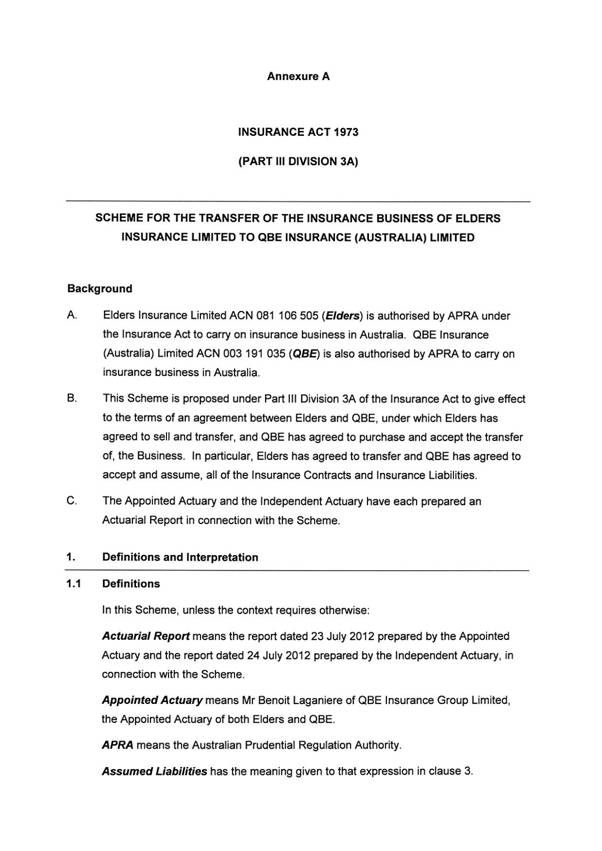
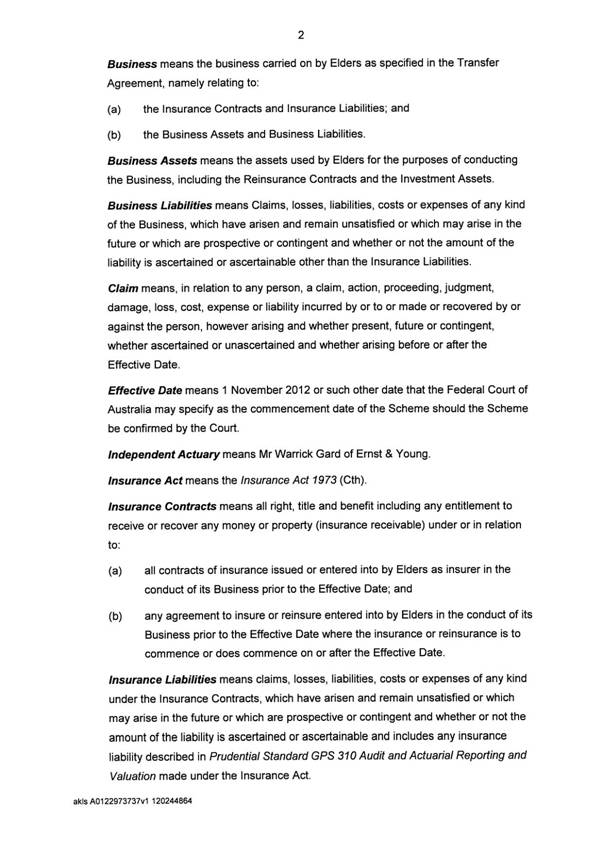
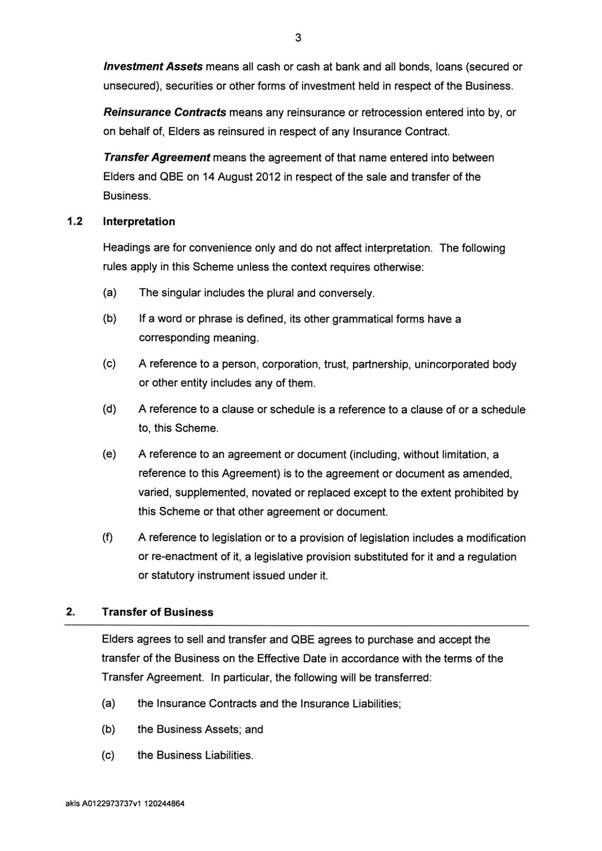
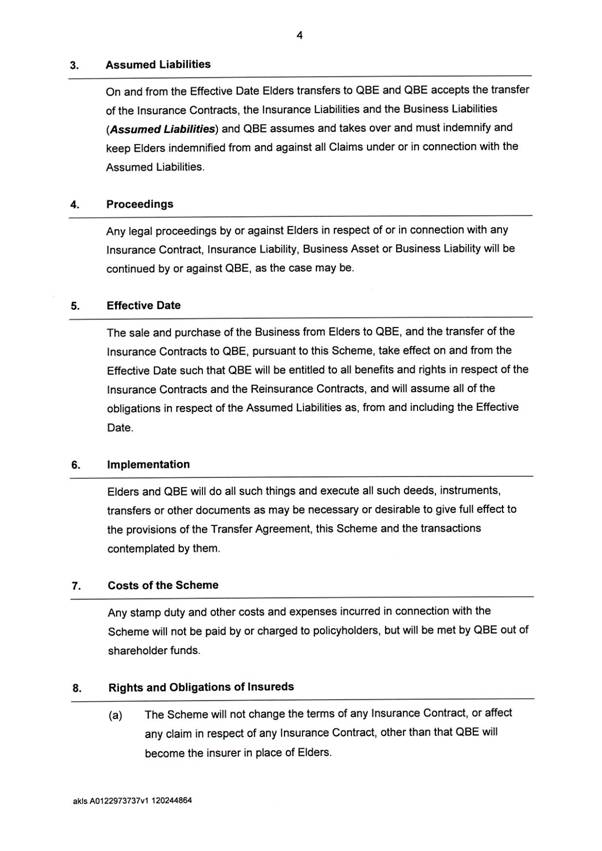
1. Pursuant to s 17F(1) of the Insurance Act 1973 (Cth), the scheme for the transfer of the insurance business of Elders Insurance Limited (Elders) to QBE Insurance (Australia) Limited (QBE) in the form of Annexure A to these orders (the Scheme) be confirmed without modification.
2. Pursuant to s 17F(2) of the Insurance Act 1973 (Cth), all of Elders' reinsurance that responds to any policy transferred pursuant to the Scheme (other than reinsurance provided by QBE), and all rights and obligations attaching to such reinsurance, be transferred to QBE.
3. The Applicant pay the costs of the Australian Prudential Regulation Authority as agreed or, if agreement cannot be reached, as assessed.
4. These orders be entered forthwith.
Note: Settlement and entry of orders is dealt with in Rule 39.32 of the Federal Court Rules 2011.
NEW SOUTH WALES DISTRICT REGISTRY | |
GENERAL DIVISION | NSD 1056 of 2012 |
IN THE MATTER OF QBE INSURANCE (AUSTRALIA) LIMITED (ACN 003 191 035) | |
QBE INSURANCE (AUSTRALIA) LIMITED Applicant
| |
|
JUDGE: | YATES J |
DATE: | 19 OCTOBER 2012 |
PLACE: | SYDNEY |
REASONS FOR JUDGMENT
1 This is an application under Div 3A of Pt III of the Insurance Act 1973 (Cth) (the Act) for confirmation of a scheme to give effect to an agreement between Elders Insurance Limited (EIL) and QBE Insurance (Australia) Limited (QIA) for the transfer of EIL’s insurance business to QIA.
Background
2 EIL and QIA are each authorised by the Australian Prudential Regulation Authority (APRA) to carry on insurance business in Australia.
3 EIL was established in 1997 as part of the Elders Limited Group (the Elders Group). The Elders Group supplies a wide range of products and services throughout a network of branches and franchises in rural and regional Australia. The Elders Group had distributed general insurance products for over 100 years. EIL was established to expand that business by underwriting general insurance policies.
4 QIA is a member of the QBE Group. Its immediate parent is QBE Holdings (AAP) Pty Limited (QBE (AAP)).
5 On 30 September 2009 QBE (AAP) acquired all of the shares in EIL from the Elders Group. As part of that acquisition, the Elders Group general insurance distribution business was transferred to Elders Insurance (Underwriting Agency) Pty Limited (EUA), which is 75% owned by the QBE Group and 25% owned by the Elders Group. EUA currently has 129 franchise agents. These agents distribute policies for EIL and QIA under a distribution agreement. EUA also undertakes claims administration for EIL and QIA under that agreement.
6 Following the acquisition of EIL in 2009, the QBE Group has been progressively transitioning the underwriting of EIL’s policies to QIA. EIL has entered into reinsurance agreements which have effectively transferred the economic risk of EIL’s insurance business to QIA and QIA’s reinsurers, although EIL has remained the underwriter on the policies it has issued. There has also been a gradual change from EIL to QIA as the underwriter of new and renewing policies.
7 The scheme will effect a transfer of EIL’s presently remaining insurance liabilities to QIA. These liabilities include:
(a) current Farm Insurance; Crop Insurance; Marine Insurance; Public Liability Insurance; Professional Indemnity Insurance; Wool in Transit and Livestock in Transit policies; and
(b) all EIL policies that have expired or will expire before the effective date of the scheme (1 November 2012).
8 In general terms it has been estimated that this transfer will increase QIA’s total liabilities by $144.4 million. However, as an offset, QIA will gain assets estimated to be of the same value. Thus the proposed transfer will have no impact on QIA’s net assets.
9 The present application can be seen to be the final stage of an internal restructure of the QBE Group’s insurance business where the business of one subsidiary of QBE (AAP) is transferred to another to achieve a reduction in the number of general insurers within the QBE Group that are operating and regulated in Australia. The aim of the restructure is to improve capital efficiency. Should the scheme be confirmed by the Court, it is the intention of the QBE Group to seek to have EIL’s authorisation under s 12 of the Act revoked.
The scheme
10 The scheme provides, specifically, for the transfer of the following defined assets and liabilities:
(a) the Insurance Contracts and the Insurance Liabilities;
(b) the Business Assets; and
(c) the Business Liabilities.
11 Subject to the Court’s approval, it is proposed that the transfer will take effect on 1 November 2012. At that date, QIA will also take over and indemnify EIL against all Claims (as defined) under or in connection with the liabilities it will have assumed in respect of the Insurance Contracts, the Insurance Liabilities and the Business Liabilities. The Business Assets to be transferred by the scheme include reinsurance contracts entered into by or on behalf of EIL as reinsured.
12 The scheme will not change the terms of any insurance contracts or affect any claim in respect of any insurance contract, other than that QIA will become the insurer in place of EIL. Policyholders will continue to have the same rights and obligations under or in respect of their contracts of insurance or claims thereunder, but with QIA as the insurer. Policyholders are not required to take any action before or as a result of the scheme and the costs and expenses incurred in connection with this scheme will not be paid by or charged to policyholders, but will be met by QIA out of shareholder funds.
The relevant legislative framework
13 The legislative framework under which, relevantly, the present application is made is to be found in ss 17A to 17G of the Act.
14 Section 17B(1) provides that no part of the insurance business of a general insurer may be transferred to another general insurer, or amalgamated with the business of another general insurer, except under a scheme confirmed by the Court. Section 17C sets out the steps to be taken before an application for confirmation of the scheme can be made. In effect this requires those steps to be taken prior to the time at which the Court is moved for the order of confirmation: Re Armstrong Jones Life Assurance Limited (1997) 74 FCR 160 at 163; Re Insurance Australia Ltd (2004) 139 FCR 450 at [30]-[37]. It is not necessary for me to detail those steps for the purpose of providing these reasons. They are conveniently summarised in Re Westport Insurance Corporation (No 2) (2010) 181 FCR 530 at [29].
15 One step that is required is the giving of an approved summary of the scheme to every holder of a policy affected by a scheme: s 17C(2)(c). This has been taken to mean the holder of a policy to be transferred under the scheme: Re Westport at [48]. Section 17C(5) provides that the Court may dispense with the need for compliance with this requirement in relation to a particular scheme if it is satisfied that, because of the nature of the scheme or the circumstances attending its preparation, it is not necessary that the requirement be complied with.
16 In the present case orders were made by Emmett J on 7 September 2012 dispensing with this requirement, provided that QIA caused (a) a copy of the summary of the scheme, approved by APRA, to be sent by pre-paid post to certain identified categories of EIL’s policyholders; (b) copies of certain documents to be made available on EIL’s website; and (c) a copy of the notice of intention to apply to the Court to be published in specifically identified newspapers: see QBE Insurance Australia Limited, in the matter of QBE Insurance Australia Limited [2012] FCA 1127.
17 Section 17F(1A) of the Act provides that, in deciding whether to confirm a scheme (with or without modifications), the Court must have regard to:
(a) the interests of the policyholders of a body corporate affected by the scheme;
(b) any report filed with the Court under s 62ZI of the Act; and
(c) any other matter the Court considers relevant.
18 In the present case, no report under s 62ZI has been filed.
19 Section 17F(2) provides that the Court may make such orders as it thinks fit in relation to reinsurance. In the present case QIA seeks an order that all of EIL’s reinsurance that responds to any policy transferred pursuant to the scheme (other than that provided internally within the QBE Group), and all rights and obligations attaching to such reinsurance, be transferred to QIA. I will return to that question.
20 Section 17G provides that when a scheme is confirmed, it becomes binding on all persons and has effect in spite of anything in the constitution of any body corporate affected by the scheme.
21 Section 17E(3) provides that APRA is entitled to be heard on an application for confirmation.
The role of APRA
22 APRA plays a significant role in the process of the confirmation of schemes under Div 3A of Pt III of the Act. That role has been discussed in Re Royal & Sun Alliance Life Assurance Ltd (2000) 104 FCR 37 at [23]-[28] and in a number of succeeding cases in terms which need not be repeated in these reasons. It is sufficient to note that its role has been described as “something of a watchdog in relation to transfers …”: Colonial Portfolio Services Ltd v Australian Prudential Regulation Authority (2000) 11 ANZ Insurance Cases ¶90-103 at [28]. APRA is entitled to be heard on an application for confirmation and is intimately involved in approving steps to be taken under the Act in relation to applications for confirmation. It can be taken that the interests of policyholders are likely to be attended to by it on their behalf: see the corresponding observation in Re Armstrong Jones at 163 with respect to the then regulator, the Insurance and Superannuation Commissioner.
23 APRA has appeared in the present application. It has been supportive of the transfer contemplated by the scheme and has raised no objection to the scheme being confirmed by the Court.
The actuarial reports
24 In general terms, the question of the interests of policyholders affected by the scheme is informed principally but not exclusively by actuarial evidence: In the Application of Commonwealth Insurance Holdings Ltd and The Colonial Mutual Life Assurance Society Ltd [2007] FCA 1012 at [14]; HDI-Gerling Australia Insurance Company Pty Limited, in the matter of HDI-Gerling Australia Insurance Company Pty Limited (ABN 16 069 085 196) (No 2) [2010] FCA 669 at [25]. In In the Application of Budget Insurance Company Limited and Auto & General Insurance Company Limited [2008] FCA 636 at [34] Flick J referred to the fact that the independence of actuaries and, in particular, the responsibilities placed on the approved actuary, “are matters upon which this Court can rightly place considerable reliance when exercising the discretion conferred by s 17F”.
25 The appointed actuary for both EIL and QIA, Benoit Laganiere, has made a written report on the scheme. His report is based on data obtained from EIL’s and QIA’s APRA balance sheets as at 31 March 2012. Mr Laganiere has expressed the opinion that the interests of policyholders of both EIL and QIA will remain adequately protected under the scheme, acknowledging that QIA will retain solvency coverage above APRA’s minimum capital requirement and QIA’s own risk appetite level.
26 In that connection Mr Laganiere noted that, based on the data as at 31 March 2012, the pre-transfer solvency coverage ratio for EIL’s policyholders is 3.50 and for QIA’s policyholders is 1.48. Following the proposed transfer the solvency coverage ratio for QIA’s policyholders will be 1.47. Thus the transfer would see the solvency coverage for EIL’s policyholders decrease from 3.50 to 1.47. However, the significance of that decrease should be seen in light of the following matters noted by Mr Laganiere. First, EIL’s apparently high solvency coverage is mainly due to the fact that QIA provides EIL with large statutory capital relief via comprehensive reinsurance coverage which effectively removes the bulk of EIL’s underwriting risk from its balance sheet. Secondly, as one of QBE (AAP)’s subsidiaries, EIL’s management could, at any time with APRA’s consent, seek to reduce the excess capital it holds by a dividend payment to its parent, so as to reduce EIL’s solvency coverage to a level closer to its minimum capital requirement. Thirdly, by transferring into QIA, EIL’s policyholders will gain access to (a) a larger prudential margin and capital base in the event of any significant adverse runoff development, (b) a more diversified risk pool, and (c) an ongoing insurance business with expected annual profits significantly in excess of the total claims liabilities of EIL.
27 Apart from the capital protection advantages to which I have referred, Mr Laganiere also considered the following matters to be relevant to his opinion:
EIL’s policyholders will have their policies and claims managed under the same practice and philosophy as before the transfer.
Policy terms and conditions will remain unchanged.
28 Mr Laganiere updated his report by recourse to data available from EIL’s and QIA’s returns to APRA for 30 June 2012. This data revealed that EIL’s pre-transfer solvency coverage ratio improved from 3.50 to 4.99. QIA’s pre-transfer solvency coverage ratio decreased marginally from 1.48 to 1.42. Based on this data, the solvency coverage ratio for QIA’s policyholders following the transfer will be 1.44. Mr Laganiere’s evidence was that this data did not lead him to change the conclusions and opinions expressed in his initial report. He also reviewed the management accounts prepared for EIL and QIA for August 2012. Once again his evidence was that the data in those accounts did not lead him to change the conclusions and opinions expressed in his initial report.
29 APRA has required an independent actuarial report on the scheme to be provided: see s 17D(1) of the Act. To that end, a report has been prepared by Warrick Gard, a partner in Ernst & Young. Once again, that report is based on data obtained from EIL’s and QIA’s APRA balance sheets as at 31 March 2012. Mr Gard has expressed the opinion that the transfer will not have a materially detrimental impact on the policyholders of either EIL or QIA.
30 His reasons for that opinion may be summarised as follows:
There is a benefit to EIL’s policyholders that will arise from being part of an insurer with significantly more net assets (ie $1,665.6 million compared to $89.7 million).
Although EIL’s solvency coverage ratio (as at 31 March 2012) is 3.50, compared to the estimated solvency coverage ratio for QIA at 1.47, EIL’s solvency coverage ratio is high due to the reinsurance arrangements between QIA and EIL which reinsure the majority of EIL’s underwriting risk. If the transfer does not proceed, EIL could pursue a reduction of its capital through payment of dividends, subject to APRA’s approval, to a level that is sufficient to achieve its target coverage ratio of 1.50.
The post-transfer solvency coverage ratio of 1.47 still offers EIL’s policyholders substantial protection due to the benefits arising from being part of an insurer with significantly higher net assets and a significantly larger capital base.
There is a benefit to EIL’s policyholders that arises from being part of an insurer with far higher diversification benefits. QIA has a more diversified risk pool that comes from having non-correlated claims experience. This potentially means that despite having a lower solvency coverage ratio, QIA may have a lower probability of breaching the target solvency coverage ratio.
There is no material detrimental impact to QIA’s policyholders from a capital perspective arising from the transfer due to the size of QIA’s capital base and the value of EIL’s insurance liabilities that will be assumed by QIA following the transfer.
EUA undertakes claims administration for policies distributed by it and underwritten by both EIL and QIA. This will continue after the proposed transfer. Therefore there will be no impact on the management of claims following the transfer.
31 It can be seen that these reasons are very similar to those on which Mr Laganiere’s opinions and conclusions were based.
32 Mr Gard reviewed his report having regard to EIL’s and QIA’s returns to APRA for the period ending 30 June 2012 and their management accounts for July and August 2012. His evidence was that the information provided by these data – noting the change in the respective solvency coverage ratios – did not lead him to change any of the conclusions or opinions expressed in his initial report.
33 As counsel for QIA submitted, the cases illustrate that the diminution in the solvency coverage of one of the parties to a scheme is not a unique circumstance when an application is made to the Court to confirm a scheme. In a number of cases the Court has confirmed a scheme on the basis that the financial interests of the policyholders have been adequately protected notwithstanding that a consequence of the implementation of the scheme is a reduction in excess capital or a reduced solvency coverage ratio for policyholders affected by the scheme. Some of these cases are collected in SCOR Switzerland Ltd (ACN 098 315 176), in the matter of SCOR Switzerland Ltd (ACN 098 315 176) [2009] FCA 1114 at [27]. In that case Lindgren J observed (at [28]) that, in those cases, there was actuarial evidence before the Court to the effect that the solvency coverage ratio of the transferee following implementation of the scheme would remain above APRA’s minimum requirements. That is the position in the present case.
EIL’s reinsurance arrangements
34 Mr Laganiere’s report reveals that since 1 July 2010 QIA has effectively reinsured almost all of EIL’s gross exposure. Outside of QIA, 11 external (or outward) reinsurers have been identified. All of the policies that form part of this reinsurance are governed by Australian law. In respect of these, 93% of EIL’s external coverage is with Swiss Re and Munich Re.
35 Since 14 August 2012 novation deeds have been sent to the external reinsurers in respect of the reinsurance contracts entered into between EIL and the relevant reinsurer. The evidence shows that, of the 11 reinsurers to whom a novation deed was sent, six have returned an executed deed to QIA. Including QIA, this represents 99.74% of EIL’s reinsurance recoverables. At the hearing I was informed that, on that morning, a further executed novation deed had been received by QIA.
36 The evidence shows that, as at 31 March 2012, the reinsurance recoverable in respect of those reinsurers who have not as yet returned an executed novation deed is less than $40,000. I consider that amount to be, in the circumstances, de minimis. I should add that there is evidence that each of the external reinsurers has been informed of the application to the Court for confirmation of the scheme which includes, as one of its terms, that EIL’s reinsurance contracts be transferred to QIA. No reinsurer has raised any objection to the scheme.
Procedural requirements
37 I have referred to the fact that s 17C of the Act sets out the steps to be taken before an application for confirmation of the scheme can be made. That provision incorporates the prudential standards made by APRA under s 32 of the Act. The relevant standard is Prudential Standard GPS 410 (the Standard).
38 A significant body of evidence has been placed before the Court dealing with the steps taken by QIA to comply with s 17C and the Standard as well as the orders made on 7 September 2012. I am satisfied on the basis of that evidence, assisted by submissions made by QIA and APRA, that the necessary procedural steps, as modified by the orders made on 7 September 2012, have been complied with.
Opposition
39 Only one person can be taken to have voiced opposition to the scheme. This was by a claimant under an EIL personal insurance policy in respect of damage to her property at Moruya in March 2009. Without descending to the detail of the evidence, it is sufficient for me to note that her apparent opposition to the scheme was based on the fact that the claim she had made under her policy was declined on the basis that the loss she claimed fell within an exclusion to the policy. The claim underwent internal review, unsuccessfully, and was subsequently the subject matter of an application to the Financial Ombudsman Service (FOS). The FOS closed its file after the claimant failed to respond to its correspondence or to contact it in relation to her claim.
40 I am satisfied that the claimant has not articulated any proper objection to the scheme.
Discretion
41 As I have noted, in deciding whether to confirm a scheme the Court must have regard to the interests of the policyholders of a body corporate affected by the scheme. This means not only those policyholders whose policies are to be transferred under the scheme but also QIA’s Australian policyholders: Re Westport at [48]-[49]. As will be apparent from the summaries provided above, each of the actuarial reports in evidence shows that the interests of the EIL policyholders whose policies are to be transferred and QIA’s policyholders have been considered.
42 I have been provided with detailed written submissions by counsel appearing for QIA. These submissions have been marked for identification: see MFI 1. QIA submits that the Court should make orders confirming the scheme, for the following reasons.
43 First, the actuarial evidence demonstrates that the interests of the policyholders of EIL and QIA will not be detrimentally affected by the implementation of the scheme. In particular, both actuaries acknowledge that, although there will be a reduction in the solvency coverage ratio if the transfer is implemented, this will not have a detrimental impact on the relevant policyholders because QIA will retain solvency coverage above APRA’s minimum requirements and QIA’s internal capital management plan, and there will be a benefit to EIL policyholders because QIA has available to it a larger prudential margin and capital base, as well as a more diversified risk pool.
44 Secondly, the scheme will not effect any change to the terms and conditions of the policies that are the subject of the proposed transfer other than that QIA and not EIL will be the insurer.
45 Thirdly, EIL’s policyholders will have their policies and claims managed under the same administration regime as before the transfer: see [5] above.
46 Fourthly, in light of the transitioning that has been ongoing in relation to EIL’s insurance business since it was acquired in 2009, the scheme can be seen to be one effecting an alignment of the legal position with practical reality: see [6] and [7] above.
47 Fifthly, the majority of EIL’s reinsurance has already been ceded to QIA. Most of EIL’s external reinsurance has been novated to QIA. In any event, the scheme itself provides for the transfer of all external EIL reinsurance contracts to QIA. I also refer to the observations I have made in that regard in [36] above.
48 Sixthly, QIA has satisfied the procedural requirements imposed upon it with respect to confirmation of the scheme. The evidence also shows that the QBE Group has disseminated information concerning the scheme to agents engaged by EIL and established a dedicated telephone line and email to address policyholder queries.
49 Seventhly, the evidence shows that no properly based opposition has been notified in respect of the confirmation of the scheme.
50 Eighthly, APRA has expressed no objection to the Court confirming the scheme.
51 I accept these submissions. I am satisfied that, on this basis, it is appropriate in all the circumstances that the scheme be confirmed, without modification: see s 17F(1)(a).
Disposition
52 Orders should be made as proposed by QIA for confirmation of the scheme, as well as the ancillary orders it seeks.
53 In that connection, QIA seeks an additional order pursuant to s 17F(2) that all of EIL’s reinsurance that responds to any policy transferred pursuant to the scheme (other than reinsurance provided by QIA), and all rights and obligations attaching to such reinsurance, be transferred to QIA. There is precedent for the making of such an order: see American Home Assurance Company, in the matter of American Home Assurance Company (No 2) [2011] FCA 316 at [28]-[30]; Re Insurance Australia Ltd at [80]. In light of the observations I have made in [36] above, I am satisfied that an order in those terms should be made.
I certify that the preceding fifty-three (53) numbered paragraphs are a true copy of the Reasons for Judgment herein of the Honourable Justice Yates. |
Associate:


