FEDERAL COURT OF AUSTRALIA
Australian Competition and Consumer Commission v EDirect Pty Ltd [2012] FCA 1045
IN THE FEDERAL COURT OF AUSTRALIA | |
AUSTRALIAN COMPETITION AND CONSUMER COMMISSION Applicant | |
AND: | EDIRECT PTY LTD ACN 108 532 083 Respondent |
DATE OF ORDER: | |
WHERE MADE: |
THE COURT ORDERS THAT:
1. The originating application filed 18 August 2010 be dismissed.
Note: Entry of orders is dealt with in Rule 39.32 of the Federal Court Rules 2011.
NORTHERN TERRITORY DISTRICT REGISTRY | |
GENERAL DIVISION | NTD 28 of 2010 |
BETWEEN: | AUSTRALIAN COMPETITION AND CONSUMER COMMISSION Applicant
|
AND: | EDIRECT PTY LTD ACN 108 532 083 Respondent
|
JUDGE: | REEVES J |
DATE: | 21 September 2012 |
PLACE: | BRISBANE (HEARD IN DARWIN) |
REASONS FOR JUDGMENT
Introduction
1 In these proceedings the Australian Competition and Consumer Commission (ACCC) seeks various declaratory orders against EDirect Pty Ltd (EDirect), trading as VIPtel. Those declaratory orders are primarily directed to the sales method EDirect’s telemarketers employed in marketing its mobile telephone services to its customers in Australia during 2009. In employing that sales method, the ACCC claims that EDirect has contravened ss 52 (misleading or deceptive conduct) and 51AB (unconscionable conduct) of the Trade Practices Act 1974 (Cth) (TPA).
2 While the TPA was, from 1 January 2011, replaced by the Competition and Consumer Act 2010 (Cth), under Item 6 of Sch 7 to the Trade Practices Amendment (Australian Consumer Law) Act (No. 2) 2010 (Cth), the TPA as in force immediately before 1 January 2011 continues to apply to acts or omissions that occurred before that date.
3 Initially, the ACCC also sought injunctions, reparative orders and costs against EDirect (paras 12 to 24 inclusive of the ACCC’s originating application). However, those claims for relief were abandoned after EDirect was placed in liquidation in August 2011. Before proceeding to identify the issues that arise from the pleadings in these proceedings, I will briefly essay some of the factual background to the proceedings and some aspects of the procedural history that are particularly relevant to some of the matters that have to be determined.
Factual background
4 From at least 29 May 2009, EDirect, trading as VIPtel, carried on business in Australia supplying mobile telephone services and related equipment to its customers. It is not in dispute that EDirect’s services and goods were of a kind ordinarily acquired for personal, domestic, or household use within the terms of s 51AB(5) of the TPA.
5 During the period mentioned above, EDirect used a particular form of sales method to conduct and promote its business. The basic details of that sales method are as follows: EDirect used a call centre located in Delhi, India to make telemarketing calls to potential customers in Australia. It offered those potential customers bonuses to enter into mobile telephone contracts with it. The bonuses were either a 26 inch LCD television, a 32 inch LCD television, a mobile telephone or a 7 inch laptop computer. If a customer agreed to enter into a mobile telephone contract, EDirect supplied him or her with a mobile telephone and/or SIM card, together with a quantity of written materials. As well, EDirect proceeded to deduct the monthly access fee and any additional charges from that customer’s bank account acting under a direct debit service agreement it also entered into with that customer.
6 When making a telemarketing call to a potential customer, EDirect provided each telemarketer with a particular script and instructed the telemarketer to follow it. Among other things, that script included an introductory statement to the following effect:
... I got your number from your (Relation) (Referrer’s Name), because I offered him/her [a mobile phone or contract bonus goods] and she loved the [mobile phone or contract bonus goods] and she loved the calling plan ... but she couldn’t take advantage of it because she’s stuck in a contract (or state reason). But she thought it would be a great fit for you, so she gave me your name and number and she asked me to give you a call and tell you about it.
7 As well, each telemarketer told the potential customer that he or she had pre-approved credit for a mobile telephone service plan.
8 Most of EDirect’s telemarketing calls were divided into three components: a sales component; a verification component; and a referral component. A different telemarketer usually conducted each component. The sales component was directed to identifying a suitable mobile telephone plan for the particular customer and obtaining various details from that customer, including his or her full name, address, bank account number and Bank State Branch (BSB) number. The verification component was directed to obtaining the customer’s consent to enter into a mobile telephone service contract and to enter into a direct debit service agreement to authorise the deduction from the customer’s bank account of the minimum monthly access fee and any additional charges under the mobile telephone service contract. The referral component was directed to obtaining the name and telephone numbers of friends or family of the customer who EDirect could contact to ply their mobile telephone services.
9 EDirect recorded portions of the telemarketing calls it made to its potential customers so that it had a record of the oral contracts it had entered into with those customers. Because such contracts were usually made during the verification component of the telemarketing calls, it was that portion of the calls that was recorded. In the course of the investigations the ACCC conducted leading up to the commencement of these proceedings, it served on EDirect a notice under s 155 of the TPA. In response to the notice, the ACCC obtained approximately 3,000 such recordings from EDirect. Those recordings related specifically to the two periods 29 May to 12 June 2009 and 21 October to 4 November 2009 covered by the s 155 notice. From those recordings, the ACCC identified eight customers whose dealings with EDirect caused it particular concern. The relevant details of those customers are set out in the ACCC’s statement of claim and form the basis of its unconscionable conduct claims against EDirect involving those eight individuals: see at [109] and following below.
Procedural history
10 These proceedings were commenced in August 2010. The originating application was accompanied by a lengthy (52 page) statement of claim. In late August 2010, HWL Ebsworth Lawyers (Ebsworths) filed a notice of appearance on behalf of EDirect. Some days later, Ebsworths filed an interim undertaking in the following terms:
EDirect Pty Ltd ACN 108 532 083 (“EDirect”) undertakes to this Honourable Court (on a without admissions basis) that:
1. EDirect will not, in the course of selling or offering for sale any goods or services in Australia, without giving at least 7 days’ written notice to the Applicant:
1.1. represent, expressly or impliedly, in telemarketing calls that an identified person has given an endorsement or approval in respect of the goods or services when that person either has not given an endorsement or approval or has not done so in the terms represented;
1.2. represent, expressly or impliedly, in telemarketing calls that it has some previous knowledge of, association with, or dealings with, the call recipient which led to EDirect making an assessment of the call recipient’s eligibility for credit approval, when in fact there is no such previous knowledge, association or dealings; and
1.3. enter into a contract or agreement by or over the telephone for the supply of goods or services unless the relevant telemarketer certifies, in a record maintained by EDirect and which will be produced to the Applicant within 7 days of request for same, that to the best of the telemarketer’s belief:
1.3.1. the terms of the proposed agreement were clearly and accurately explained to the call recipient; and
1.3.2 he or she had no reason to believe from his or her discussions with the call recipient that the call recipient did not wish to enter into the agreement, that the call recipient did not fully comprehend the terms of the agreement or that the call recipient did riot fully comprehend the consequences of entering into the agreement.
Albeit that it is made on a “without admissions basis”, this undertaking is in substantially the same form as the interlocutory relief sought in the ACCC’s originating application (paras 25 and 26).
11 In late 2010, Ebsworths filed a defence to the ACCC’s statement of claim. That defence made a number of admissions, including admissions of a varied form of the two misleading or deceptive representations the ACCC alleged EDirect had made to its potential customers. However, that defence also denied various allegations in the ACCC’s statement of claim, specifically the allegations that involved EDirect’s sales method being used in a way that was unconscionable in contravention of s 51AB of the TPA and those that alleged EDirect’s dealings with the eight individual customers were unconscionable in contravention of the same provision. The details of those admissions and denials will be illuminated when I come to consider the pleadings in these proceedings in more detail below.
12 In late January 2011, the ACCC filed eight affidavits upon which it wished to rely. One of those affidavits was an affidavit by Ms Vaughan, who was the Assistant Director of the ACCC in the Darwin region. That affidavit had annexed to it a large volume of material, including the scripts of the sales component of the telemarketing calls between EDirect’s telemarketers and its potential customers as described above. It is important to note that these scripts are the only evidence of what occurred in the sales component of those calls: there are no actual recordings of that component of any of the calls. The other seven affidavits included affidavits by five of the eight individual customers referred to above. These were primarily directed to the verification component of the telemarketing calls, but they do include some evidence about the other two components, viz the sales component and the referral component.
13 In mid-March 2011, this proceeding was set down for trial on 18 April 2011. At the same time, trial programming orders were made to achieve that trial date. In early April 2011, Ebsworths filed a notice of withdrawal as lawyers on behalf of EDirect. By that time, no further affidavits or other materials had been filed by either the ACCC or EDirect. At about the same time (on 5 April 2011), Receivers and Managers were appointed to EDirect. Shortly thereafter, one of the Receivers and Managers, Mr Smith, wrote to the Australian Government Solicitor, which was acting for the ACCC, and stated: “Please be advised that the company ceased to trade at the date of my appointment and that we do not intend to defend the above proceedings.” Consistent with this statement, EDirect did not file a notice appointing other lawyers, nor did it appear at the trial of these proceedings on 18 April 2011.
14 Some months after the trial, the Commissioner of Taxation commenced winding up proceedings against EDirect. A winding up order was made on the Commissioner’s application on 18 August 2011. The ACCC subsequently applied for and obtained the necessary leave under s 471B of the Corporations Act 2001 (Cth) to continue these proceedings notwithstanding the intervention of EDirect’s winding up proceedings. That leave was granted on the ACCC’s undertaking that:
… it will not take any step to enforce against the respondent any order for the payment of any amount of money, whether by way of penalty, costs or otherwise, without the further leave of the Court …
EDirect was absent at the trial
15 Since the trial of these proceedings occurred before the commencement of the new Rules on 1 August 2011, the former Federal Court Rules (Rules) continue to apply: see Rule 1.04 of the Federal Court Rules 2011. Order 32 r 2(1) of the Rules provided that:
(1) If, when a proceeding is called on for trial, any party is absent, the Court may:
(a) order that the trial be not had unless the proceeding is again set down for trial, or unless such other steps are taken as the Court may direct;
(b) adjourn the trial;
(c) if the party absent is an applicant or cross-claimant dismiss the action or the cross-claim; or
(d) proceed with the trial generally or so far as concerns any claim for relief in the proceeding.
16 This Rule was not specifically adverted to by counsel, or by myself, after EDirect’s non-appearance and absence was duly recorded at the outset of the trial of these proceedings. As a consequence, the trial effectively proceeded by default in accordance with O 32 r 2(1)(d) above. The ACCC’s counsel proceeded to identify the affidavit material upon which it relied to establish its claims to the relief set out in the originating application and thereafter he made a number of submissions directed to establishing those claims. I should record that the abandonment of various parts of that relief (see at [3] above) did not occur until more than six months after the trial of these proceedings. Since O 32 r 2(1)(d) was followed de facto at the trial of these proceedings, I consider the only sensible course is to proceed to determine this matter on the basis of that rule.
17 In Microsoft Corporation v TYN Electronics Pty Ltd (in liq) (2004) 63 IPR 137; [2004] FCA 1307 (Microsoft), Stone J made a number of helpful observations about the operation of O 32 r 2(1)(d). They were as follows (at [6]–[7]):
6. An election to proceed with the trial generally under O 32 r 2(1)(d) imposes a particular burden on the court in ensuring that justice is done to both parties. The court must investigate the merits of the claims made: Applicant A184 of 2003 v Minister for Immigration and Multicultural and Indigenous Affairs (2004) 210 ALR 543; [2004] FCA 1076 at [89]. However, the court is not required to act as advocate for the absent party: Re Jorgenson; Ex parte HG & R Nominees Pty Ltd [1999] FCA 1023; BC 9904222 at [2].
7. In the absence of the respondent, an applicant has the burden of proving the claims made in so far as they are not admitted, for example, on the pleadings or by a failure to dispute a fact specified in a notice to admit facts issued under O 18 r 2 of the Federal Court Rules. In doing so it is necessary for the applicant to call sufficient admissible evidence to discharge the evidentiary burden raised by the pleadings: MY Distributors Pty Ltd v Omaq Pty Ltd (1992) 36 FCR 578. In making its case, the applicant must be confined strictly to the claims made in the pleadings: Barker v Furlong [1891] 2 Ch 172 at 179. An applicant who has proved those claims is entitled to the relief claimed (so long as it is appropriate to the claims) and ‘to such other relief as is incidental thereto’: Stone v Smith (1887) 35 Ch D 188 at 189. It follows that an applicant whose evidence does not support the claims made, either in whole or in part, will to that extent be unsuccessful.
I respectfully agree with these observations and, accordingly, I propose to apply them in determining the issues in this matter.
Declaratory relief and discretionary factors
18 However, there is an added consideration in these proceedings. That is that the ACCC is seeking declaratory relief. In Australian Competition and Consumer Commission v EDirect Pty. Ltd. (in liq) [2012] FCA 976 (EDirect (No 1)), I concluded that, when a court is dealing with, what I described as, “public interest litigation”:
(a) declaratory orders can be made based on “the admissions of the parties, whether deemed admissions, or agreed facts under s 191 of the Evidence Act, or otherwise, and the Court is not required to be satisfied by evidence before making such declaratory orders”: see EDirect (No 1) at [39]; and
(b) however, since declaratory relief is discretionary in nature, “a court must therefore have regard to any pertinent discretionary factors”.
In this matter, those discretionary factors would include those factors identified in EDirect (No 1) at [49]–[51] and [55].
19 In EDirect (No 1), I proceeded under O 35A r 3(2)(c) of the Rules based upon the deemed admission of the facts pleaded in the statement of claim. Here, the situation is somewhat different. EDirect has admitted certain of the facts pleaded in the ACCC’s statement of claim in its defence and denied others. Then, apparently because it was placed in receivership, and later liquidation, it decided to take no further part in these proceedings. However, this withdrawal does not affect the admissions EDirect had already made in its defence. Further, since it had an interest to oppose the relief the ACCC was seeking and, in fact, it initially did so, this withdrawal does not negate EDirect’s role as a proper contradictor: see EDirect (No 1) at [49]–[51]. However, that does not remove from consideration the discretionary considerations attaching to this proper contradictor factor. Those considerations were mentioned in passing in EDirect (No 1) (at [49]–[51]). They were also identified in Corporate Affairs Commission of NSW v Transphere Pty Ltd (1988) 15 NSWLR 596 (Transphere) at 605, per Young J as follows:
There are two main reasons for this principle [that there should be a proper contradictor]. The first is that unless there is some res judicata against a person who is interested in asserting the contrary to the declaration, there is no practical reason for making it. The second reason is that unless the court has the assistance in presentation of both legal submissions and evidence of matters of fact, it will not be in a position to make a solemn pronouncement.
Both reasons go to the court’s discretion rather than being matters which affect jurisdiction. In an appropriate case the court may make a declaration notwithstanding that there is no proper contradictor: Territory Insurance Office v Kerin (1986) 84 FLR 1; … Secondly it is quite clear that where the interests of justice so dictate, the court can make a declaration notwithstanding the fact that the defendants who are vitally interested, have not given the court any assistance at all.
(Emphasis added)
20 In light of my decision in EDirect (No 1), it is appropriate to add this about the decision in Transphere. Elsewhere in his reasons, Young J followed the established rule which I considered in some detail in EDirect (No 1) and decided not to follow: see EDirect (No 1) at [21]–[39], the effect of which is summarised at [18] above. However, I do not consider this, or anything said in EDirect (No 1), or said by the Full Court in Australian Competition and Consumer Commission v MSY Technology Pty Ltd [2012] FCAFC 56 (see EDirect (No 1) at [49]–[51]), affects his Honour’s observations in Transphere about the discretionary considerations associated with this proper contradictor factor. I will return to some specific aspects of these discretionary factors below.
Four issues arise
21 As I have already noted above, the ACCC has alleged that EDirect contravened ss 52 and 51AB of the TPA. In its statement of claim, it alleged those contraventions occurred when EDirect engaged in the following conduct:
Section 52
(a) by making the referral representation (see at [6] above), it engaged in misleading or deceptive conduct;
(b) by making the approved credit representation (see at [7] above), it engaged in misleading or deceptive conduct;
Section 51AB
(c) by employing the sales method it did in the telemarketing calls it made to the potential customers whose calls were recorded in the approximately 3,000 recordings described above, it engaged in a system of conduct that was unconscionable in relation to those customers as a group of persons;
(d) by entering into the mobile telephone contracts and the direct debit service agreements it did with each of the eight individual customers described in the statement of claim:
(i) in circumstances where it employed the same telemarketing sales method as described in (c) above; and/or
(ii) in circumstances where it employed a telemarketing sales approach in relation to each individual customer as pleaded in the statement of claim;
it engaged in conduct that was unconscionable
22 In broad terms, these allegations of contravention of the TPA describe the four issues (in the case of (d), two sub-issues) that arise for determination in this matter. I will therefore proceed to address them in this order below.
The referral representation
The ACCC’s statement of claim on the referral representation
23 The referral representation is pleaded in the ACCC’s statement of claim in the following terms (at para 7):
7. At all times from 29 May 2009, in most telemarketing calls, telemarketers represented to potential customers that a friend or family member of the potential customer (“alleged referrer”) had received the contract bonus goods and “loved the [contract bonus goods] and … loved the calling plan” (“the referral representation”).
(Emphasis in original)
24 In the next paragraph (para 8), the ACCC pleaded that: “The referral representation was made to potential customers in accordance with scripts which EDirect provided to its telemarketers and instructed them to use verbatim.” Then the ACCC set out the particulars of the relevant part of those scripts. They are set out at [6] above and do not require reiteration here.
25 Thereafter, the ACCC pleaded the falsity of the referral representation in the following terms (para 9):
9. At the time the referral representation was made:
9.1. the alleged referrer had not, in the usual course, used the words attributed to them in the referral representation;
9.2. the alleged referrer had not, in the usual course, received the contract bonus goods; and
9.3. the alleged referrer had not, in the usual course, given the approval described in the referral representation
26 Finally, the ACCC alleged (in para 10) that by engaging in the conduct set out in the above three paragraphs, EDirect engaged in conduct that was misleading or deceptive or likely to mislead or deceive in contravention of s 52 of the Act.
EDirect’s defence on the referral representation
27 In its defence, EDirect denied it had made the referral representation. It did so in the following terms (para 7):
[EDirect]
7.1 says that in most telemarketing calls, telemarketers stated that the referrer had been “offered” the bonus goods;
7.2 denies that in most telemarketing calls, telemarketers stated the referrer had “received” the bonus goods;
7.3 otherwise admits the allegations insofar as they concern the period 29 May 2009 to 6 August 2010;
7.4 says that the conduct alleged in the paragraph ceased on and from 7 August 2010; and
7.5 otherwise denies the allegations contained in paragraph 7.
28 Otherwise, EDirect admitted the allegations in para 8 of the statement of claim (see at [24] above) and did not admit the allegations of falsity in para 9 thereof (see at [25] above). Finally, in respect of the allegations of contravention of s 52 of the TPA, EDirect said that (at para 10):
[EDirect]
10.1 repeats paragraphs 7, 8 and 9 of the Defence; and
10.2 says that the conduct it has admitted in paragraphs 7, 8 and 9 of the Defence amounts to conduct in trade and commerce which is misleading and deceptive or conduct likely to be misleading and deceptive in contravention of s 52 of the Act;
10.3 otherwise denies the allegations contained in the paragraph.
The evidence on the referral representation
29 As has already been noted in the procedural history to these proceedings above (at [12]), the scripts of the sales component of the telemarketing calls are the only evidence of what occurred in that component of those calls. There is no actual recording of the sales component of any of the calls. Furthermore, none of the seven individuals who made affidavits gives any relevant evidence about what happened in the sales component of his or her telemarketing call. At most, they mention who it was that the telemarketer had said had referred EDirect to them and that the referrer concerned had used words such as “it was a good deal” to describe EDirect’s mobile telephone plan. More significantly still, there is no evidence before me from any of the “alleged referrers” described in para 9 of the statement of claim (see [25] above) to the effect that (in the terms pleaded in that paragraph): they had not “used the words attributed to them in the referral representation”; they had not “received the contract bonus goods”; and they had not “given the approval described in the referral representation”.
The ACCC’s contentions on the referral representation
30 In his outline of written submissions on behalf of the ACCC, Mr Burnside QC submitted that:
The evidence of the referral representation is found in the scripts [annexed to Ms Vaughan’s affidavit].
The express aspect of the referral representation is admitted in paragraph 10.2 of the defence. It is apparent from the terms of the scripts that the express aspect of the referral representation was made.
The issue is whether or not the referral representation included an implied representation that the referrer had received the bonus goods. The ACCC submits that it is obvious from the words used in the opening paragraph of the scripts that the caller is implying the referrer had in fact received the bonus goods when that was not the case.
Some principles on conduct involving a misleading or deceptive representation and implied representations
31 Before turning to consider these contentions, it is appropriate to set out some of the principles relating to the assessment whether conduct is misleading or deceptive and when it is that an implied representation arises. The question whether conduct amounts to a representation is “a question of fact to be decided by considering what [was] said and done against the background of all surrounding circumstances”: Campomar Sociedad, Limitada v Nike International Limited (2000) 202 CLR 45; [2000] HCA 12 (Campomar) at [100], referring to the observations of Deane and Fitzgerald JJ in Taco Company of Australia Inc v Taco Bell Pty Ltd (1982) 42 ALR 177 (Taco) at 202. This means that where, as here, the conduct complained of solely consists of words, “it would not be right to select some words only and to ignore others which provided the context which gave meaning to the particular words”: Parkdale Custom Built Furniture Proprietary Limited v Puxu Proprietary Limited (1982) 149 CLR 191 (Parkdale) at 199 per Gibbs CJ. This case is also confined by the circumstances in which the words consisting of the referral representation and the approved credit representation were spoken. These circumstances were described in Campomar (at [100]), where the Court continued to quote, with approval, the following observations of Deane and Fitzgerald JJ’s in Taco:
In some cases, such as an express untrue representation made only to identified individuals, the process of deciding that question of fact may be direct and uncomplicated. In other cases, the process will be more complicated and call for the assistance of certain guidelines upon the path to decision.
32 French CJ made a similar observation in Campbell v Backoffice Investments Pty Ltd (2009) 238 CLR 304; [2009] HCA 25 (Campbell) (at [26]) as follows:
This Court has drawn a practical distinction between the approach to characterisation of conduct as misleading or deceptive when the public is involved, on the one hand, and where the conduct occurs in dealings between individuals on the other. In the former case, the sufficiency of the connection between the conduct and the misleading or deception of prospective purchasers “is to be approached at a level of abstraction not present where the case is one involving an express untrue representation allegedly made only to identified individuals”. Where the conduct is directed to members of a class in a general sense, then the characterisation enquiry is to be made with respect to a hypothetical individual “isolate[d] by some criterion” as a “representative member of that class”. In the case of an individual it is not necessary that he or she be reconstructed into a hypothetical, “ordinary” person. Characterisation may proceed by reference to the circumstances and context of the questioned conduct. The state of knowledge of the person to whom the conduct is directed may be relevant, at least in so far as it relates to the content and circumstances of the conduct.
(Footnotes omitted)
33 The characterisation to which these observations was directed was the tendency to lead a person into error. French CJ made this point in the immediately preceding paragraph of Campbell (at [25]) as follows: “Characterisation is a task that generally requires consideration of whether the impugned conduct viewed as a whole has a tendency to lead a person into error ...”. Finally, his Honour added that this test was “necessarily objective”: see Campbell at [25] referring to Parkdale at 198.
34 However, there is an additional factor involved where, as here, one is dealing with implied representations. With implied representations, the critical question is not what words the telemarketers actually used, when speaking to the potential customers – it is not in dispute that they are recorded in the scripts EDirect instructed its telemarketers to use. Instead, the critical question is whether the words that were actually used gave rise to the implied representations pleaded in the ACCC’s statement of claim. So, the question becomes: “whether what was actually said or done [by the representor], in all the relevant circumstances, conveyed something more such that it lead [the representee] into error”: see my decision in Bennett v Elysium Noosa Pty Ltd (in liq) (2012) 202 FCR 202; [2012] FCA 211 at [40] and the cases there considered. Thus, the question here is whether what EDirect’s telemarketers actually said to the potential customers, in all the relevant circumstances, conveyed something more to them about the referral, or the credit approval, such that they were led into error. I will now turn to apply these principles in relation to these alleged contraventions of s 52 of the TPA.
The referral representation is not established
35 In my view, none of the ACCC’s contentions on the referral representation (at [30] above) has merit. First, the apposite part of the scripts which contains the referral is pleaded in para 8 of the statement of claim (see at [6] and [24] above) and admitted by EDirect (see [28] above). When that is analysed, it will be immediately apparent that the wording of the scripts differs in a critical respect from the form of the alleged referral representation. The former has the telemarketer saying “I got your number from … because I offered him/her a [mobile phone or contract bonus goods] …”. However, the latter alleges that the telemarketer represented that the alleged referrer “had received the contract bonus goods …” (emphasis added).
36 To attempt to establish that the alleged referral representation was expressly made in the latter form, the ACCC has relied upon two matters. First, the admission that it says is contained in para 10.2 of EDirect’s defence and, secondly, that the referral representation is evidenced by the content of the scripts. The second can be disposed of at once. As is pointed out immediately above, the scripts clearly show that EDirect’s telemarketers were instructed to use the words “I offered him/her a mobile phone or contract bonus goods”. They do not support the ACCC’s claim that they provide evidence that EDirect’s telemarketers were instructed to say that the alleged referrer “had received the contract bonus goods”.
37 The first matter also has no merit. This is so because a fair and reasonable analysis of EDirect’s defence shows that it made no such admission but, to the contrary, it made the point (above) about the critical difference between the wording of the scripts and the form of the alleged referral representation. To begin that analysis, it is quite apparent that the admission in para 10.2 of EDirect’s defence (see at [28] above) is qualified by the introductory words: “the conduct [EDirect] has admitted in paragraphs 7, 8 and 9 of the Defence”. Then, when one goes to those paragraphs of EDirect’s defence, it becomes readily apparent that the only unqualified admission made in them is that in para 8, which admits the ACCC’s allegation about the wording of the scripts. That supports EDirect’s position because it leads inexorably back to the critical difference between the wording of the scripts and the form of the alleged referral representation highlighted above.
38 Furthermore, the same point emerges from the pleading in para 7 of EDirect’s defence (see at [27] above). It is true that para 7.3 appears to contain an admission, but when one looks carefully, that admission is qualified by the opening word “otherwise” which leads, in turn, to para 7.1, which pleads that the “telemarketers stated that the referrer had been ‘offered’ the bonus goods”. That, in turn, links to the correlated denial in para 7.2 that the “telemarketers stated the referrer had ‘received’ the bonus goods”. So, while the wording of para 10.2 of EDirect’s defence is somewhat ambiguous in that it appears to admit that the conduct that it has admitted in the other paragraphs (7, 8 and 9) described was misleading and deceptive, when one makes a fair and reasonable analysis of those paragraphs it becomes apparent that there is no conduct described in them (whether admitted or otherwise) that could be said to be misleading or deceptive. In reaching this conclusion, I have kept in mind the observations of Stone J in Microsoft of the balance I need to achieve between not acting as an advocate for EDirect, but at the same time ensuring that justice is done between the parties (see at [17]7 above). For these reasons, I consider the ACCC has failed to establish that the express aspect of the referral representation was made.
39 This would be sufficient to dispose of this first issue. However, it is convenient to briefly mention two other reasons why I consider the ACCC has failed on this issue. First, as appears from the ACCC’s written submissions (at [30] above), it seeks to rely upon an implied representation that each alleged referrer had “received” the bonus goods. However, no such implied representation is pleaded in the ACCC’s statement of claim. As Stone J observed in Microsoft, where one is proceeding under O 32 r 2(1)(d), the ACCC is “confined strictly to the claims made in the pleadings” (see at [17]7 above).
40 Secondly, and perhaps more significantly, there is no evidence before me to establish what the alleged referrers said, or did, as outlined at [29] above. Thus the ACCC has failed to adduce any evidence to prove the allegations of falsity of the referral representation as pleaded in para 9 of the statement of claim. It is to be noted that those allegations are “not admitted” by para 9 of EDirect’s defence (see at [28] above).
41 For these reasons, I do not consider the ACCC has established this first alleged contravention of the TPA. As I understand the structure of the relief sought in the ACCC’s originating application, this conclusion affects the declaration sought in para 1. Accordingly, that declaration will not be made.
The approved credit representation
The ACCC’s statement of claim on the approved credit representation
42 The approved credit representation is pleaded in the ACCC’s statement of claim in the following terms (at para 11):
11. At all times from 29 May 2009, EDirect has, in,telemarketing calls, represented to potential customers that:
11.1. each potential customer had pre-approved credit for a mobile telephone service plan;
11.2. EDirect had taken some steps to assess and approve the potential customer’s eligibility for credit for a mobile telephone service plan;
11.3. EDirect had some previous knowledge of, or dealings or association with, the potential customer leading to EDirect assessing and approving, or obtaining approval in respect of, the customer’s eligibility for the credit (“the approved credit representation”); and
11.4. each potential customer could afford a mobile telephone service plan.
Particulars
The approved credit representation was made to potential customers in accordance with the VIPtel Agent Script Dialer and VIPtel Agent Script Referral scripts, copies of which are available for inspection, which were provided by EDirect to its telemarketers and which they were instructed to use verbatim.
The representation pleaded at subparagraph 11.1 is express.
To the extent that the representation pleaded at subparagraph 11.1 is express, the Applicant relies on the text in the VIPtel Agent Script Dialer and VIPtel Agent Script Referral scripts.
The representations pleaded at subparagraphs 11.2, 11.3 and 11.4 are implied.
To the extent that the representations pleaded at subparagraphs 11.2, 11.3 and 11.4 are implied, the Applicant relies on the natural inference to be drawn from the words contained in the VIPtel Agent Script Dialer and VIPtel Agent Script Referral scripts.
(Emphasis in original)
43 The alleged falsity of the approved credit representation is pleaded in the ACCC’s statement of claim in the following terms (at para 12):
12. At all times from 29 May 2009, when making the approved credit representation, it was in fact the case that:
12.1. EDirect had not undertaken an assessment of any potential customer’s eligibility for credit;
12.2. EDirect had not undertaken or arranged credit checks for any potential customers;
12.3. in the usual course, EDirect had no previous association with the potential customer and had not obtained any information from them which would have led EDirect to undertake an assessment of the potential customer’s eligibility for credit; and
12.4. EDirect had no information with which to make a reasonable assessment as to whether the potential customer could afford a mobile telephone service plan or whether any particular mobile telephone service plan was suitable to the potential customer’s needs or income.
44 The ACCC then alleges (at para 13) that by engaging in the conduct set out in the two paragraphs above, “EDirect [had], in trade and commerce, engaged in conduct that [was] misleading or deceptive or likely to mislead or deceive, in contravention of section 52 of the Act”.
EDirect’s defence on the approved credit representation
45 In its defence, EDirect admitted the first of the four representations that the ACCC alleged comprised the approved credit representation, but it denied the balance thereof. That means it admitted that (para 11):
11. At all times from 29 May 2009, EDirect has, in telemarketing calls, represented to potential customers that:
11.1. each potential customer had pre-approved credit for a mobile telephone service plan;
46 Further, in relation to this issue, in its defence EDirect asserted that:
11.5 … in most telemarketing calls, immediately following the statement referred to in paragraph 11.1 of the Statement of Claim, the telemarketer went on to make the statement “The best part is that there’s no credit check and you’re guaranteed credit approval regardless of your credit history”;
11.6 … any conduct of the kind alleged in paragraph 11 ceased on and from 5 February 2010;
Finally, EDirect’s defence (in para 11.7) otherwise denied the allegations contained in paragraph 11 of the ACCC’s statement of claim (set out at [42] above). Given the express admissions and denials above and the fact that the balance of para 11 is comprised of particulars, it is difficult to identify any allegation to which this general denial is directed.
47 As to the alleged falsity of the approved credit representation, EDirect generally repeated para 11 of its defence (above) and otherwise admitted all the allegations in paras 12.1 to 12.3 inclusive of the ACCC’s statement of claim (set out at [43] above). Further, in relation to para 12.4 of the ACCC’s statement of claim, it stated (in para 12.5):
… the information from which EDirect could make a reasonable assessment as to whether the potential customer could afford a mobile telephone service plan, or whether any particular mobile telephone service plan was suitable to the potential customer’s needs or income, included the customer’s agreement to enter into a mobile telephone service plan and otherwise denie[d] the allegations contained in paragraph 12.4 …
Finally, EDirect concluded this section of its defence with a general denial in similar form to para 11.7 of its defence (see at [46] above) to which the same observations about purpose above would apply.
48 As to the allegations of contravention of s 52 of the TPA, EDirect’s defence was in the following terms (in para 13):
13. [EDirect]:
13.1 repeats paragraphs 11 and 12 of the Defence; and
13.2 says that the conduct it has admitted in paragraphs 11 and 12 of the Defence amounts to conduct in trade and commerce which is misleading and deceptive or conduct likely to be misleading and deceptive in contravention of s.52 of the Act;
13.3 otherwise denies the allegations contained in the paragraph.
The evidence on the approved credit representation
49 As is the case with the referral representation, the only evidence as to what occurred during the sales component of each of the telemarketing calls (which component included the parts of those calls when the approved credit representation was allegedly made) are the scripts EDirect instructed its telemarketers to use. However, the position in relation to the alleged falsity of the approved credit representation is quite different to that with the referral representation. This is so because, as compared to its non-admissions (see at [28] above), EDirect has essentially admitted (with some qualifying assertions of fact) the allegations the ACCC relies upon to demonstrate the falsity of the approved credit representation (see at [48] above).
The ACCC’s contentions on the approved credit representation
50 On this issue, Mr Burnside submitted:
The evidence of the approved credit representation is found in the scripts.
The express aspect of the approved credit representation is admitted in paragraph 11.1 of the defence. It is apparent from the terms of the scripts that the express aspect of the approved credit representation was made. The respondent also admits (at paras 12 – 12.2 and 12.4 of its defence) that no steps were taken to conduct credit checks or assess eligibility for credit.
In issue is whether the approved credit representation included the implied representations, as pleaded at paragraphs 11.2, 11.3 and 11.4 of the statement of claim.
These implied representations arise out of the wording of the scripts. It is submitted the words “your credit has been approved” implies that there had been a credit check conducted, or some steps had been taken to assess the customers’ eligibility for credit prior to the telemarketing call, when in fact that was not the case.
It is reasonable to consider that the words “no credit check” would suggest to consumers that EDirect’s policy was that a credit check was usually required but, when heard in conjunction with the earlier “your credit has been approved” statement, that in this customer’s case, it is not required.
The approved credit representation is not established
51 Unlike with the referral representation, on this approved credit representation the ACCC has adopted verbatim, as the express component of the representation, the wording of the telemarketing scripts. Specifically, that each customer was told that he or she “had a pre-approved credit for a mobile telephone service plan”. Consistent with its approach to the referral representation, EDirect has admitted that the telemarketing scripts record what it was that its telemarketers said to each potential customer about this approved credit representation. EDirect has done that by admitting the allegations in para 11.1 of the statement of claim (see at [42] above) which are almost identical to the express component of the ACCC’s alleged approved credit representation above. Further, unlike with the referral representation, the implied components of this approved credit representation are expressly pleaded in the particulars to para 11 of the ACCC’s statement of claim. Thus, as can be seen from the ACCC’s submissions (at [50] above), the only issue to be determined on this approved credit representation is whether the implied representations pleaded in paras 11.2 to 11.4 (inclusive) of the ACCC’s statement of claim arise “by natural inference” from the wording of the scripts EDirect instructed its telemarketers to use.
52 On this implied component, the ACCC submitted that the words “your credit has been approved” implied that a credit check had been conducted, or at least some steps had been taken to assess the customer’s credit rating, prior to the telemarketer’s call. Further, it submitted that the words in the succeeding sentence that: “The best part is there’s NO CREDIT CHECK and you’re guaranteed credit approval regardless of your previous history” (emphasis in original), implied the credit check that was usually required was not required in that particular customer’s case. For its part, in its defence, EDirect relied upon the same words to deny that these implied aspects of the approved credit representation arise. It also claimed it could make a reasonable assessment whether a potential customer could afford a mobile telephone service plan by (among other things) the fact that the particular customer agreed to enter into such a plan.
53 Before turning to assess whether the implied components of this approved credit representation arise, it is appropriate to briefly recapitulate some of the principles bearing on this assessment as set out at [31]–[34] above. First, it is necessary to consider all of the words spoken by the EDirect telemarketer to the potential customer as recorded in the relevant part of the scripts. Secondly, the sales component of the telemarketing calls all occurred during a telephone conversation between two individuals – the telemarketer and the potential customer – so the assessment is confined to that circumstance and context. Thirdly, the assessment is directed to whether the words EDirect’s telemarketers said to the potential customers had a tendency to lead them into error. And, finally, when it comes to the implied representations, the critical question is whether what EDirect’s telemarketers actually said to the potential customers, in all the relevant circumstances, conveyed something more to them about the credit approval such that they were led into error.
54 While it is not particularly clear from the ACCC’s statement of claim, or its submissions, it would appear it claims that the relevant error into which EDirect’s potential customers were led was the belief that some assessment had been made of their credit standing when, in fact, no such assessment had been undertaken, nor was there any information available to it so that such an assessment could have been made. Since this is the only form of error that reasonably emerges from the ACCC’s statement of claim, particularly the implied representations pleaded in paras 11.2 to 11.4 and the allegations of falsity pleaded in para 12 (see at [43] and [44] above respectively), I will therefore proceed to determine this issue on that basis.
55 For the reasons that follow, I do not consider the ACCC has made out its case on this representation. First, the words “your credit has been approved” do, as the ACCC submits, imply that some prior credit assessment, or check, had been undertaken by EDirect. However, those words were almost immediately followed by the words “The best part is there’s NO CREDIT CHECK and you’re guaranteed credit approval regardless of your previous history”. On their face, these words make it relatively clear that no credit check had been, or was to be, carried out by EDirect and the potential customer’s past credit history was immaterial. Furthermore, when one takes into account the context in which the words were spoken and all the relevant circumstances, including the fact that all of these statements about “credit” occurred quite close together in the introductory part of the telephone conversation between the telemarketer and the potential customer, I consider that they had the effect of conveying to the potential customer that his or her credit standing was immaterial, in the sense that it did not present any impediment to him or her entering into a mobile telephone service plan with EDirect. Conversely, I do not consider the combined effect of those statements was to convey the impression that there had been a prior credit assessment, or check, undertaken. Finally, on this issue, I consider it is significant that a potential customer’s credit standing was, in fact, ultimately immaterial because each customer who entered into a mobile telephone service plan also entered into a direct debit service agreement whereby all amounts falling due to EDirect were automatically deducted from that customer’s bank account. Thus, no occasion for the provision of credit ever arose.
56 So, taking into account all the words spoken by EDirect’s telemarketers in the context of all the relevant circumstances, I do not consider the ACCC has established that the implied component of this representation pleaded in para 11.2 to 11.4 of its statement of claim arises as a natural inference from the words spoken by EDirect’ telemarketers. Since this approved credit representation, as pleaded, is founded on the combined effect of the express and implied components of the representation, the ACCC has necessarily failed to establish its case on this issue.
57 However, before leaving this issue, it is necessary for me to deal with the “admission” that is apparently contained in para 13.2 of EDirect’s defence (see at [48] above). There, EDirect appears to have made an admission that the conduct it has admitted in paras 11 and 12 of its defence amounts to misleading and deceptive conduct in contravention of s 52 of the TPA. The difficulty, however, I have with this “admission” is that, when it is properly analysed, para 13.2 does not in fact make any admission of a contravention of the TPA. That is so because the ACCC has pleaded this approved credit representation as a composite representation comprising the express words spoken as pleaded in para 11.1, and the implied representations pleaded in paras 11.2 to 11.4 (inclusive). In its defence, EDirect has admitted the express component of this composite representation and denied all the implied components. It follows that the apparent admission in para 13.2 of EDirect’s defence has been negated by its denial of the crucial implied components of the composite approved credit representation.
58 Bearing in mind the strictures outlined by Stone J in Microsoft that my role in this instance is to ensure that justice is done to both parties, that the merits of the ACCC’s claims are properly investigated and that the ACCC must be confined strictly to the claims made in the pleadings, notwithstanding the apparent “admission” contained in para 13.2 of EDirect’s defence, I do not consider that the ACCC has established that the approved credit representation involved a contravention of the TPA as alleged in its statement of claim. As I understand the structure of the relief sought in the ACCC’s originating application, this conclusion affects the declaration sought in para 2. Accordingly, that declaration will not be made.
Unconscionable conduct – system of conduct
Unconscionable conduct – relevant legislative provisions
59 Having disposed of the two misleading or deceptive conduct issues (see at [21](a) and (b) above), it is necessary next to turn to the two unconscionable conduct issues (see at [21](c) and (d) above). On both this issue (system of conduct affecting an unnamed group of persons) and the next issue (conduct affecting eight individuals), the ACCC relies upon s 51AB of the TPA. That section relevantly provides:
(1) A corporation shall not, in trade or commerce, in connection with the supply or possible supply of goods or services to a person, engage in conduct that is, in all the circumstances, unconscionable.
(2) Without in any way limiting the matters to which the court may have regard for the purpose of determining whether a corporation has contravened subsection (1) in connection with the supply or possible supply of goods or services to a person (in this subsection referred to as the consumer), the court may have regard to:
(a) the relative strengths of the bargaining positions of the corporation and the consumer;
(b) whether, as a result of conduct engaged in by the corporation, the consumer was required to comply with conditions that were not reasonably necessary for the protection of the legitimate interests of the corporation;
(c) whether the consumer was able to understand any documents relating to the supply or possible supply of the goods or services;
(d) whether any undue influence or pressure was exerted on, or any unfair tactics were used against, the consumer or a person acting on behalf of the consumer by the corporation or a person acting on behalf of the corporation in relation to the supply or possible supply of the goods or services; and
(e) the amount for which, and the circumstances under which, the consumer could have acquired identical or equivalent goods or services from a person other than the corporation.
(Emphasis in original)
60 As already noted above (at [4]), there is no dispute in this matter that EDirect’s services were of a kind ordinarily acquired for personal, domestic, or household use.
Unconscionable conduct – some principles
61 Before turning to consider the questions raised by the pleadings on this issue, it is convenient to set out some principles on unconscionable conduct. To begin with, the unconscionable conduct proscribed by s 51AB is not limited by reference to specific equitable doctrines as the unconscionable conduct proscribed by s 51AA is: see Australian Competition and Consumer Commission v C G Berbatis Holdings Pty Ltd (No 2) (2000) 96 FCR 491; [2000] FCA 2 (Berbatis) at [24] per French J; Australian Competition and Consumer Commission v Simply No-Knead (Franchising) Pty Ltd (2000) 104 FCR 253; [2000] FCA 1365 at [30]–[36] (and particularly the conclusion at [36]) per Sundberg J and Australian Competition and Consumer Commission v Radio Rentals Ltd (2005) 146 FCR 292; [2005] FCA 1133 (Radio Rentals) at [24] per Finn J.
62 As well as not being confined by equitable doctrines, French J observed in Berbatis that the categories of unconscionable conduct will never be closed. His Honour said (at [25]):
The categories of unconscionable conduct for the purposes of ss 51AB and 51AC will never be closed albeit the circumstances of the application of the standard prescribed in each of them is confined by the language of each section.
63 There has been a number of judicial expositions of the meaning of the expression “unconscionable conduct”. The following is a sample. In Australian Competition and Consumer Commission v Lux Pty Ltd [2004] FCA 926 at [98], RD Nicholson J described its meaning in these terms:
The word unconscionable is not a term of art. … It bears its ordinary meaning of ‘showing no regard for conscience, irreconcilable with what is right or reasonable’. What is required is ‘serious misconduct or something clearly unfair or unreasonable’. It will be relevant whether advantage is taken of an innocent party who, though not deprived of an independent and voluntary will, is unable to make a worthwhile judgement as to what is in his or her best interests.
(Case references omitted)
64 In Radio Rentals (at [24]), Finn J explained it in these terms:
… There is, in my view, no reason not to give the term its ordinary possible meanings in the context of a supply or possible supply of goods or services. These have been expressed, variously, as “serious misconduct [or] something clearly unfair or unreasonable”; “showing no regard for conscience; irreconcilable with what is right or reasonable”; or, simply, conduct that is “unfair”.
(Case references omitted)
65 And finally, in Australian Competition and Consumer Commission v Keshow [2005] FCA 558 (Keshow) at [97], Mansfield J observed:
The term ‘unconscionable’ is not defined in the TP Act. Apart from the guidance given by s 51AB(2), its scope would appear to flow from its ordinary meaning of ‘showing no regard for conscience, irreconcilable with what is right or reasonable’.
(Case references omitted)
66 In Bigwood R, Exploitative Contracts (Oxford University Press, 2003) (at 248), the author set out a catalogue of the terms used to describe unconscionable conduct by reference to authorities as follows:
In order to warrant a judgment of ‘unconscionability’ in this area, courts have sometimes emphasized the need for the process of advantage-taking, when taken as a whole, and after ‘real … consideration and judgment’, to be ‘shocking’, ‘reprehensible’, or ‘towards the extreme end of the scale [of unreasonable behaviour] and not merely ‘morally unfair’ or ‘unreasonable’. There must, it has been said, be ‘real’ unfairness.
(Footnotes omitted)
67 Of some relevance in this case, the question whether a respondent needs to have some knowledge of the other parties’ disadvantage was addressed by Finn J in Radio Rentals at [18]–[22]. His Honour expressed his conclusion at [21] in these terms:
While the courts subsequently have resorted to various formulae to encapsulate the knowledge falling short of actual knowledge which will nonetheless be sufficient, sight must not be lost of what is the subject of the required knowledge (be it actual or something less). It is knowledge of a particular state of affairs which itself embodies a judgment as to the disabled party’s ability to conserve his or her own affairs in the parties’ dealing. It is that state of affairs which is to be “sufficiently evident” to the stronger party. If that person does not actually know of that state of affairs and is not “wilfully ignorant” of it (in the sense that he or she is intent on not knowing it despite what is evident to him or her: cf Owen and Gutch v Homan (1853) 4 HL Cas 997 at 1035), that person must at least be aware of circumstances that would cause him or her or a reasonable person in his or her position to suspect from what is evident that that state of affairs may exist.
68 On a related aspect as to whether the aggregate information derived by a number of different corporate employees can be attributed as the knowledge, or state of mind, of a corporation, his Honour said (at [199]) that:
The third matter relates to the problem of attributing knowledge or a state of mind to a corporation in light of what might be inferred from aggregating information derived from a multiplicity of discrete transactions and dealings involving corporate employees who adventitiously participated in some of those matters without suspecting in any way that anything is out of the ordinary. To permit such aggregation in circumstances such as the present for the purposes of attributing a particular state of mind to a company as a prelude to a finding of unconscionable conduct can only “eviscerate” unconscionable conduct of its meaning: cf Stern v McArthur (1988) 165 CLR 489 at 503. For the purposes of the unconscionable dealings doctrine it would result in a company being held guilty of exploitation or victimisation of another without any officer or agent of that company having any suspicion, or any reason to suspect, at all that the company was so acting. In the case of s 51AB, the company would be held to have acted unreasonably or clearly unfairly, without having reason to appreciate it was so acting.
69 To similar effect, see Krakowski v Eurolynx Properties Limited (1995) 183 CLR 563 at 582–3 per Brennan, Deane, Gaudron and McHugh JJ and Westpac Banking Corporation v The Bell Group Ltd (in liq) (No 3) [2012] WASCA 157 at [2179]–[2200] per Drummond AJA. While these observations are primarily directed to the acquisition of knowledge, I consider they are helpful in this case in determining whether the conduct of a number of employees in a series of discrete transactions can be aggregated to prove EDirect had designed and employed a particular system of conduct.
70 The three sample cases above all dealt with unconscionable conduct involving an individual, or a small group of individuals in the case of Keshow. However, in Australian Securities and Investments Commission v National Exchange Pty Ltd (2005) 148 FCR 132; [2005] FCAFC 226 (National Exchange), the Full Court made it clear it is not necessary to identify a specific individual, but instead unconscionable conduct can involve systematic conduct directed to a group of unnamed persons with common characteristics. The Court said at [30]: “There is no foundation in the language or purpose of s 12CC to impose limitations from the unwritten law, such as the necessity to identify a specific or particular person.” It is appropriate to interpolate that the section the Full Court was dealing with in National Exchange – s 12CC of the Australian Securities and Investments Commission Act 2001 (Cth) – corresponds to s 51AB of the TPA.
71 Further, the Court said (at [33]):
In a case where the discrepancy in price and value is great, as in the present case, and the conduct is systematically and directly focused on vulnerable but unnamed members, some of whom who (sic) can be expected to accept the offers, such conduct can reasonably be described as being against good conscience. The targeted offerees in this case could reasonably be expected to include persons who are unacquainted with share values, inexperienced in trading their interests, lacking in commercial experience and some of whom act inadvertently and are elderly.
(Emphasis added)
72 Finally, on the question whether a system of conduct may amount to unconscionable conduct, it is pertinent to note that the Legislature has recently acted to state what its view is. It has done that by inserting subsection (4) to s 21 of the Australian Competition Law, at Sch 2 of the Competition and Consumer Act 2010 (Cth) (previously s 51AB of the TPA). Thus, s 21(4)(b) of Sch 2 now states:
(4) It is the intention of the Parliament that:
…
(b) this section is capable of applying to a system of conduct or pattern of behaviour, whether or not a particular individual is identified as having been disadvantaged by the conduct or behaviour; and
73 Since this expression of intention by the Legislature largely reflects what the Full Court said in National Exchange, it is unnecessary to consider whether it has retrospective effect.
The ACCC’s statement of claim on the system of conduct unconscionability
74 The system of conduct the ACCC relies upon to establish this contravention of the TPA is set out in para 15 of its statement of claim. That paragraph is quite lengthy, but nonetheless it is appropriate to set it out in full. It is as follows:
15. At all times from 29 May 2009, EDirect in the promotion and supply of its products engaged in the following conduct:
15.1. undertook by itself and through its telemarketers, a series of specific steps as described in paragraph 5 above;
15.2. made the referral representation in the circumstances set out in paragraph 9 above;
15.3. made the approved credit representation in the circumstances set out in paragraph 12 above;
15.4. conveyed information in a manner which made it difficult for potential customers to understand and created a sense of confusion by:
15.4.1. often using two or three different telemarketers during a telemarketing call;
15.4.2. referring to numerous complex contractual terms without explaining them during the sales and verification components of telemarketing calls;
15.4.3. providing potential customers with conflicting information regarding the date on which the first payment of the minimum monthly access fee would be deducted from their account;
15.4.4. speaking very quickly in accented, and often heavily accented, English;
15.4.5. speaking over potential customers during telemarketing calls;
15.4.6. avoiding directly answering potential customers’ questions in relation to the terms and conditions of the mobile phone contract; and
15.4.7. keeping potential customers on the telephone for an unreasonable length of time and on some occasions for over an hour;
15.5. in the verification component of the telemarketing call:
15.5.1. combining many complex legal and/or technical concepts in a single statement without explaining them;
15.5.2. requiring affirmation from the customer at the end of the statement;
15.5.3. ending the statement with words such as “okay?” “alright?”, “right?” and/or “yes?” in a manner designed to obtain a positive affirmation from the potential customer; and
15.5.4. giving customers a lengthy description of the mobile telephone contract including its main terms and possible permutations, including cost, call charges, cooling off rights and obligations on termination after telling potential customers to only answer “yes” or “no” to indicate their consent to enter into the mobile phone contract;
15.6. created a sense of urgency and pressure which discouraged potential customers from asking questions and increased the likelihood that potential customers would accept the offer of the mobile phone contract by:
15.6.1. speaking quickly;
15.6.2. persuading potential customers to continue with telemarketing calls after they expressed hesitation or reluctance;
15.6.3. refusing to allow potential customers to take time to consider the terms and conditions of the mobile phone contract; and
15.6.4. requiring potential customers to consent to the mobile phone contract during the verification component of telemarketing calls before they had an opportunity to consider the terms and conditions of the mobile phone contract and whether the mobile phone contract and the SIM card or mobile phone suited them;
15.7. used the high pressure, relentless sales process described in paragraphs 15.4,15.5 and 15.6 which was likely to be tolerated for a longer period of time by persons who were, due to their financial circumstances, illness, infirmity, isolation or other disabilities:
15.7.1. more vulnerable to its sales methods;
15.7.2. less assertive of their right to terminate a telephone call;
15.7.3. more conciliatory or likely to please; and
15.7.4. likely to require more time or assistance to understand complex technical, legal and/or financial matters;
than it would be tolerated by more robust individuals;
15.8. framed questions to be asked during telemarketing calls in such a way that they would elicit positive answers indicating that potential customers consented to the terms and conditions of the mobile phone contract and direct debit service agreement and which was likely to secure improperly obtained consent from a significant number of persons;
15.9. required potential customers to consent to the mobile phone contract and direct debit service agreement during telemarketing calls when they had not been given any documents setting out the terms and conditions of those agreements;
15.10. failed to give potential customers time to properly digest the offer;
15.11. failed to give potential customers an opportunity to consider whether the mobile telephone service plan suited them or they could afford it;
15.12. failed to give potential customers an opportunity to obtain advice as to the appropriateness and affordability for them of the proposed mobile telephone service plan and the mobile phone contract;
15.13. failed to have in place any mechanism to identify improperly obtained consent to enter into mobile phone contracts or, in the alternative, was prepared to accept improperly obtained consent to mobile phone contracts;
15.14. was aware that some potential customers may have had a disability and took no, or no proper, steps to ensure that those persons fully understood the terms of the mobile phone contract or direct debit service agreement; and
Particulars
The VIP Mobile Verification and All in One Verification scripts which were provided by EDirect to its telemarketers, and which they were directed to use verbatim, provided that when telemarketers identified a potential customer was on a disability pension as a result of an intellectual disability, or if the telemarketers were unsure or confused about whether a potential customer had an intellectual disability, the telemarketer was to ask the following question:
“Do you have the legal authority to make your own financial decisions?
If NO continue and dispose as IDP sale. If YES continue.”
Copies of the VIP Mobile Verification and All in One Verification scripts are available for inspection.
15.15. knew, believed or could reasonably foresee that the sales method it employed would be more likely to secure consent to the mobile phone contract and direct debit service agreement from persons who received a disability pension or were unable to understand financial and/or legal matters quickly or in any depth, including persons who could reasonably be expected to be particularly vulnerable to its sales methods due to their financial circumstances, illness, infirmity, isolation or some other disability.
Particulars
EDirect’s knowledge is to be inferred from the following matters:
EDirect created and approved the scripts;
EDirect provided the scripts to its telemarketers and instructed its telemarketers to use the scripts verbatim; and
The telemarketing calls were made to customers’ home or mobile telephone numbers when it was more likely that persons who were not working would be available.
75 Paragraph 15.1 (above), in turn, relies upon “a series of specific steps” described in para 5 of the statement of claim. Paragraph 5 describes the sales methods EDirect used to conduct and promote its business activities. It is also quite lengthy but, again, it is appropriate to set it out in full. It is as follows:
5. At all times from at least 29 May 2009, EDirect has used the following sales methods to conduct and promote the business:
5.1. identifying potential customers by:
5.1.1. obtaining their contact details from data service providers and telephone directories;
5.1.2. obtaining from potential customers whom it contacts in the manner described in paragraph 5.2 below, persons it makes telemarketing calls to, the names and telephone numbers of their family and friends; and
5.1.3. checking telephone numbers against the Do Not Call Register maintained by the Australian Communications and Media Authority and its own “Do Not Call” list;
5.2. making telephone marketing calls to potential customers in Australia from a call centre in India (“the telemarketing calls”);
5.3. making telemarketing calls between 9am and 8pm on weekdays, and between 9am and 5pm on Saturdays, to the residential and/or mobile telephone numbers of potential customers, for the purpose of inducing them to enter into oral contracts for the provision of mobile telephone services;
5.4. in most cases, dividing the telemarketing calls into sales, verification and referral components;
5.4.1. the sales component is conducted by a telemarketing representative of EDirect (“telemarketer A”). The purpose of the sales component is to identify a mobile plan for the customer and obtain the customer’s address, full name, Medicare number, bank account number and BSB number or credit card details, and one other form of identification (“the personal information”). Telemarketer A then transfers the customer to the verification department;
5.4.2. the verification component is conducted by a telemarketing representative of EDirect in the verification department (“telemarketer B”). The verification component is recorded by EDirect. The purpose of the verification component is to obtain and record the customer’s consent to:
5.4.2.1. enter into a mobile telephone service contract with EDirect pursuant to which the customer would receive mobile telephone services for 24 months using the Optus network and a mobile telephone and/or SIM card in return for paying a minimum monthly access fee (“the mobile phone contract”): and
5.4.2.2. enter into a verbal direct debit service agreement with EDirect and M2 and which authorises them to deduct the minimum monthly access fee plus any additional charges payable under the mobile phone contract from the customer’s bank account (“the direct debit service agreement”);
and to verify the personal information.
5.4.3. the referral component is conducted by either telemarketer A or a third telemarketing representative of EDirect (“telemarketer C”). The purpose of the referral component is to obtain from the customer the names and telephone numbers of friends or family members to enable EDirect to make telephone calls to those persons for the purposes of inducing the potential customers to enter into oral contracts for the provision of mobile telephone services.
The sales, verification and referral components of a telemarketing call, or calls, to a potential customer collectively constitute and are hereafter referred to as a “telemarketing call” and telemarketers A, B and C (if any) as “telemarketers”.
5.5. providing the telemarketers with scripts to use in the telemarketing calls and directing them to use the scripts verbatim:
Particulars
The applicant relies on the VIPtel scripts provided by EDirect on 17 November 2009 in response to a request by the Applicant dated 14 October 2009.
The scripts included versions of:
All-in-one Verification;
VIP Mobile Verification Script;
VIPtel Agent Script Dialer;
VIPtel Agent Script Referral; and
Referral Scheme.
5.6. during the sales component, advising potential customers that they have pre-approved credit for a mobile telephone service plan;
5.7. during the sales component, advising potential customers that they will receive additional bonus goods being either a 26” LCD television, 32” LCD television, a mobile phone or a 7” laptop if they enter into the contract (“the contract bonus goods”);
5.8. during the verification component, seeking to obtain each potential customer’s consent to:
5.8.1. enter into the mobile phone contract; and
5.8.2. enter into the direct debit service agreement;
5.9. during the sales and verification components, obtaining each customer’s BSB number and bank account number, or credit card details, for the purposes of directly debiting from that account or credit card the monthly access fees and any additional charges pursuant to the direct debit service agreement;
5.10. if a customer enters into the mobile phone contract, arranging for a package containing a:
5.10.1. mobile telephone and/or SIM card;
5.10.2. 95 page booklet including the full terms and conditions of the mobile phone contract and the direct debit service agreement;
5.10.3. one page cancellation notice;
5.10.4. 20 page “Lifestyle” booklet; and
5.10.5. Consumer Service Agreement,
(“the package”), to be delivered to the customer’s nominated delivery address within 2 to 12 days from the date of the verification component of the telemarketing call;
5.11. during the referral component, offering the customer a 26” LCD television, 32” LCD television, 15” LCD television with a built-in DVD player or 7” laptop (“the referral bonus goods”) if they provide the telemarketer with the names and telephone numbers of their family or friends and if no less than four of those persons referred agree to enter into a mobile phone contract and the customer and those four persons pay their first bill on time;
5.12. on a date either:
5.12.1. between the conclusion of the telemarketing call and the date of delivery of the package; or
5.12.2. after the delivery of the package,
deducting the monthly access fee from the customer’s bank account pursuant to the direct debit service agreement; and
5.13. advising customers:
5.13.1. verbally during the telemarketing call; and
5.13.2. in documents included in the package,
that they have a 14 day cooling-off period from the date they receive the package.
(Emphasis in original)
76 There are two other paragraphs of the ACCC’s statement of claim that relate to this issue. They are paras 16 and 17 as follows:
16. At all material times from 29 May 2009, the sales method by which EDirect promoted and supplied mobile telephone services to customers in Australia:
16.1. consisted of steps designed, scripted and taken so as to:
16.1.1. unduly influence or pressure potential customers;
16.1.2. place the potential customer in a weaker bargaining position than EDirect and take advantage of the potential customer's lesser bargaining power; and
16.1.3. unfairly fail to disclose relevant information to potential customers;
16.2. was a system, by the use of speed and often incomprehensible, or barely comprehensible, speech, the framing of questions to elicit positive responses from potential customers and the persistence of the telemarketers, which was intended to take advantage of the politeness, commercial inexperience and susceptibility to high pressure and misleading sales tactics, of persons who, by virtue of the matters pleaded in paragraph 15.7 above, did not, or were unable to, terminate a telemarketing call, reject an offer of the mobile phone contract and direct debit service agreement or withhold their consent to such an offer; and
16.3. was designed to ensure that a maximum number of such potential customers entered into mobile phone contracts and direct debit service agreements with EDirect during telemarketing calls without having an opportunity to fully consider and understand the terms and conditions of those contracts.
Particulars of paragraphs 15 and 16
The Applicant relies upon the recordings of the verification components of the telemarketing calls which were provided by EDirect to the Applicant on 30 June 2009 in response to a request from the Applicant on 12 June 2009 and provided by EDirect to the Applicant on 20 November 2009 in response to a request from the Applicant on 14 October 2009.
And the Applicant relies upon the scripts referred to in paragraph 5.5.
And the Applicant relies upon the pleading in paragraphs 18 to 66 both inclusive.
17. In the circumstances, by engaging in the conduct set out in paragraphs 15 and 16 above, EDirect has, in trade or commerce, in connection with the supply or possible supply of goods and services to potential customers, engaged in conduct that is, in all the circumstances, unconscionable, in contravention of section 51AB of the Act.
EDirect’s defence on the system of conduct unconscionability
77 Dealing first with para 5 of the ACCC’s statement of claim, in its defence EDirect admitted all of the allegations in paras 5.1 to 5.5 inclusive, 5.8 and 5.9, and 5.11 to 5.13 (inclusive). These paragraphs contain a series of uncontroversial details about EDirect’s telemarketing calls.
78 Of the remaining three sub-paragraphs – 5.6, 5.7 and 5.10 – EDirect:
(a) admitted the allegations in sub-para 5.6 insofar as they related to the period 29 May 2009 to 4 February 2010 and stated that that conduct ceased from 5 February 2010. Otherwise, EDirect denied the allegations contained in 5.6. Since the allegations in this sub-paragraph largely correspond to the ACCC’s earlier allegations about the pre-approved credit representation, it appears that this denial is intended to adopt the similar denials EDirect made in relation to that representation: see at [45]–[48] above;
(b) admitted the allegations in sub-para 5.7, but it added two assertions:
(i) that it informed each customer of the conditions required in order to claim the “bonus goods”;
(ii) that its offer of the “bonus goods” was also subject to each customer “paying either their first four or five bills on time”.
In sub-para 5.7.3, EDirect pleaded that it “otherwise does not admit the allegations contained in para 5.7”. In view of the admissions and assertions described in the immediately preceding paragraphs, it is difficult to identify the allegations to which this non-admission could relate; and
(c) admitted four of the five sub-paragraphs of para 5.10, that is 5.10.1, 5.10.3, 5.10.4 and 5.10.5. In relation to the allegations contained in sub-para 5.10.2, it admitted the allegations insofar as they related to the period 29 May 2009 to 24 March 2010 and stated that that conduct ceased on and from 25 March 2010. However, in para 5.10.2.3, it pleaded that it “otherwise denies the allegations contained in [para 5.10]”. Again, given the admissions and assertions described in the immediately preceding paragraph, it is difficult to identify the allegations to which this denial is directed.
79 So, in summary, in relation to the sales methods pleaded by the ACCC in para 5 of its statement of claim, subject to: the limitations as to time pleaded in sub-paras 5.6 and 5.10 of EDirect’s defence; the apparent denial of the contravening component of the pre-approved credit representation; and the assertions that the potential customers were told about the conditions that applied in order to claim the “bonus goods” and that such claims involved an additional condition that they were to pay the first four or five bills on time; EDirect has admitted the substance of the allegations contained in that paragraph.
80 However, EDirect took a far more combative approach in relation to the allegations contained in para 15 of the ACCC’s statement of claim. Its only direct admissions of any of those allegations were as follows – going to largely uncontroversial details of EDirect’s telemarketing calls:
(a) in sub-para 15.4.1 about using two or three different telemarketers during a telemarketing call;
(b) in sub-para 15.4.4 about speaking very quickly in accented and often heavily accented English; and
(c) in sub-para 15.5.3 about ending statements with words such as “okay?”, “alright?”, “right?” and/or “yes?” in a manner designed to obtain a positive affirmation from the potential customer.
81 Nonetheless, EDirect did make some indirect admissions in relation to some of those allegations. It did that by adopting and repeating some of the admissions it made in relation to the allegations in para 5 above which, again, went to largely uncontroversial details of EDirect’s telemarketing calls. They were as follows, in sub-paras 15.13, 15.14 and 15.15, it indirectly adopted the admissions:
(a) in sub-para 5.4.2 of the ACCC’s statement of claim about the details of the verification component of each telemarketing call;
(b) in sub-para 5.8 of the ACCC’s statement of claim about the consent obtained from each potential customer – to enter into a mobile telephone contract and to enter into a direct debit service agreement – during the verification component of each telemarketing call; and
(c) in sub-para 5.13 of the ACCC’s statement of claim, to the effect that it advised customers that they had a 14 day cooling off period from the date they received their package.
82 Otherwise, EDirect denied the allegations contained in para 15 of the ACCC’s statement of claim and added two assertions as follows:
(a) in sub-para 15.5.5 to the effect that “the purpose of the verification component of the telemarketing call [was] to re-confirm the terms of the offer made during the sales component of the telemarketing call in order to ensure that the potential customer [understood], and consent[ed] to, a mobile phone contract”; and
(b) in sub-para 15.14.2 to the effect that it “did not permit a person which [it] believed to have an intellectual disability to enter a mobile phone contract or direct debit service agreement”.
Issues arising from pleadings on the system of conduct unconscionability
83 Paragraph 17 of the ACCC’s statement of claim (see at [76] above) relies on “the conduct set out in paragraphs 15 and 16 above”. If the ACCC intended to rely on the combined effect of all the conduct set out in those paragraphs, it would confront an immediate difficulty. That is, it has failed to make out its case on two parts of that conduct: the referral representation (para 15.2 referring to para 9 of the statement of claim) and the approved credit representation (para 15.3 referring to para 12 of the statement of claim).
84 However, it seems to me that the crux of this aspect of the ACCC’s unconscionable conduct case is contained in paras 15.7 and 16.2 of its statement of claim: “[EDirect] used the high pressure relentless sales process described in paras 15.4, 15.5 and 15.6 …” (para 15.7), or the “high pressure and misleading sales tactics … pleaded in paragraph 15.7” (para 16.2) in a way that was intended to take advantage, unfairly, of a group of potential customers who were, for various reasons, particularly susceptible to it. If I am correct in this assessment, it is apparent that the conduct described in paras 15.2 and 15.3 is not relied upon as a critical part of this aspect of the ACCC’s unconscionable conduct case. I will therefore proceed to deal with this aspect of the ACCC’s unconscionability case on that basis.
85 There are some other aspects of the pleading in paras 15 and 16 of the ACCC’s statement of claim that should be mentioned. First, the features of the sales process described in paras 15.4 to 15.6 inclusive appear to be reiterated in similar terms in paras 15.8 to 15.13 inclusive. Secondly, taken together, those paragraphs appear to describe the details of the “high pressure relentless sales process” referred to in para 15.7 and, in turn, the “high pressure misleading sales tactics” referred to in para 16.2. These latter two paragraphs then proceed to describe the likely effects of that sales process or tactics on a particular group of potential customers who were vulnerable or susceptible to it. Thirdly, para 15.7 also appears to describe the circumstances, conditions, or disabilities, that made that group of potential customers more vulnerable or susceptible to that kind of sales process. Fourthly, in paras 16.2 and 16.3, this sales process is described as a system that was intended and designed, respectively, to have that effect on that group of potential customers. Fifthly and finally, paras 15.14 and 15.15 contain details of EDirect’s alleged knowledge of that group of potential customers’ disabilities (para 15.14), or that some members of that group were likely to be disability pensioners, or that variously, because of their “financial circumstances, illness, infirmity, isolation or some other disability”, some members were likely to be vulnerable or susceptible to EDirect’s sales process (para 15.15). Further, in the particulars to para 15.14, the question in the telemarketers’ scripts is relied upon: “Do you have the legal authority to make your own financial decisions? If NO continue and dispose as IDP sale. If YES continue.” In the particulars to para 15.15, the ACCC relies upon the content and use of the telemarketers scripts and the fact that the “telemarketing calls were made to customers’ home or mobile telephone numbers when it was more likely that persons who were not working would be available”.
86 From this analysis of paras 15 and 16, it is apparent that sub-paras 15.7 and 16.2 contain the allegations that are pivotal to this issue, viz that EDirect designed a high pressure sales system and employed that system on a particular group of its potential customers who were, for various reasons, likely to be vulnerable or susceptible to it. Furthermore, sub-paras 15.4 to 15.6 inclusive describe the critical details of EDirect’s sales process that combined to make it the high pressure sales system in question. It follows that to succeed on this issue, the ACCC must prove, as the first step, that EDirect indeed designed and operated that high pressure sales system as pleaded in those paragraphs.
The ACCC’s contentions on the system of conduct
87 In his written outline of submissions, Mr Burnside summarised this aspect of EDirect’s unconscionable conduct case in these terms:
The sales method employed by the respondent consisted of steps which were designed and scripted to pressure potential customers who, by virtue of their commercial inexperience and susceptibility to high pressure sales tactics, disability or inability to understand financial or legal matters quickly or in any depth, were unable to terminate the telemarketing call or reject an offer of a contract, and was also designed to ensure that the maximum number of those consumers entered into the contracts during the telemarketing call without having the opportunity to fully consider and understand the terms of the contracts.
(Emphasis added)
88 Relying on what the Full Court said in National Exchange (see at [70]–[71] above), Mr Burnside submitted that it was not necessary for a particular individual to be identified to make out this type of unconscionable conduct. Instead, he submitted EDirect employed a high pressure sales system that was directed to an unnamed group or class of persons that could be expected to include members who were vulnerable or susceptible to EDirect’s sales process in the way described in the ACCC’s statement of claim.
Evidence on the system of conduct
89 In the particulars to para 16 of its statement of claim (see at [76] above), the ACCC identified three pieces of evidence upon which it relied to prove the allegations comprising this aspect of its unconscionable conduct case. They are: the scripts of the telemarketing calls EDirect made to its potential customers; the 3,000 (approximately) call recordings of the verification component of the telemarketing calls; and the matters pleaded in paras 18 to 66 of its statement of claim. The latter involve the allegations of unconscionable conduct affecting the eight individuals, which are dealt with in the next, and final, issue (see at [109] and following below).
The ACCC has failed to prove the high pressure sales system
90 As I observed in my analysis of the pleadings above (at [86]), as the first step in establishing its case on this issue the ACCC must prove that EDirect designed and operated a “high pressure sales” system. If it does not establish this first step, it will be unnecessary to consider the next step, which is the effect this high pressure sales system had on the unnamed group of vulnerable or susceptible customers. As in any civil proceeding, the ACCC must establish this system on the balance of probabilities.
91 By its ordinary meaning, a system is “an assemblage or combination of things or parts forming a complex or unitary whole; … a co-ordinated body of methods, or a complex scheme or plan of procedure”: Macquarie Dictionary. To similar effect, Dixon CJ said of the word “scheme” that it “connotes a plan or purpose which is coherent and has some unity of conception”: see Australian Consolidated Press Limited v Australian Newsprint Mills Holdings Limited (1960) 105 CLR 473 at 479. Thus, at this first step, the ACCC has to prove that the critical features of EDirect’s sales process described in paras 15 and 16 of its statement of claim occurred in a combination such as to constitute a scheme or system. It will not be sufficient for it to prove that each of those features is present in a number of EDirect’s telemarketing calls. Rather, it has to show that the critical features are present in combination in a sufficient number of those calls that it was more likely than not that EDirect had designed and operated that combination as a “high pressure sales” system.
92 As I observed at [69] above, I consider the ACCC may prove this system by aggregating the presence of those critical features in the multiplicity of discrete dealings that involved the 3,000 (approximately) calls the whole group of EDirect telemarketers made to potential customers. However, before going to the recordings of those telemarketing calls, it is appropriate to deal with the first item of evidence the ACCC relies upon to prove this system, viz the scripts of those calls. When one turns to the sales component of those scripts, it is clear – indeed it appears to be common ground – that they do go to establish most, if not all, of the uncontroversial details of that component of the telemarketing calls as pleaded in paras 5 and 15 of the ACCC’s statement of claim. Those paragraphs describe the sales method used by EDirect to conduct and promote its business as described at the outset of these reasons (see at [5]–[9]) above. It is not, therefore, surprising to find that all of those allegations were admitted by EDirect in its defence. So, to this extent, I consider the ACCC has established that EDirect operated a system in the sales component of its telemarketing calls.
93 Further, since the scripts were prepared by EDirect and provided to its telemarketers to be used during the telemarketing calls, it can be inferred that it was EDirect, and not some other entity, that designed that system. However, without any recordings of the sales component of those telemarketing calls, there is no direct evidence to prove that this system constituted the high pressure sales system pleaded in paras 15 and 16 of the ACCC’s statement of claim.
94 Despite this, I consider some of the pleaded features of that high pressure sales system could be inferred from the contents of the sales component of the telemarketing scripts. That would include, for example, the allegation that the telemarketers referred to “numerous complex contractual terms without explaining them” (para 15.4.2 of the statement of claim) and the allegation that the verification component of the telemarketing call combined “many complex legal and/or technical concepts in a single statement without explaining them” (para 15.5.1 of the statement of claim). Those features could be inferred from the following statements in the sales component of the telemarketing script:
As I mentioned earlier, you are also approved for unlimited calls and texts, and if you choose that plan the monthly fee is $129 and one month access fee is due before delivery which is adjusted in your future bills, or you can stay with (selected plan) and there will be no payment before delivery
Which is best for you?
or
… as I mentioned earlier, the mode of payment is direct debit, and your first bill and worth of usage will be calculated on a prorated basis, and in order to ensure that our debit system is compatible with your bank’s debit system we’ll take one month’s access fee in advance from your bank account/credit card, which is [Access_Fee] and that amount will be adjusted in your future bills, okay?
(Emphasis and errors in original)
These inferences would then go some way to proving the “confusion” alleged in para 15.4. However, by itself, I do not consider that confusion is sufficient to prove the “high pressure relentless sales” system or the “high pressure and misleading sales” system detailed in paras 15.5 and 15.6, upon which the central allegations in para 15.7 and, in turn, para 16.2, are based. In other words, this is as far as the ACCC can take it in relying upon inferences to prove the existence of the requisite system from the scripts.
95 In particular, I do not consider it is possible to infer the following important features of that system from the contents of the telemarketing scripts: the allegation that the telemarketers “[spoke] over potential customers during telemarketing calls” (para 15.4.4); the allegation that the telemarketers avoided “directly answering potential customers’ questions in relation to the terms and conditions of the mobile phone contract” (para 15.4.6); and the allegation that the telemarketers kept “potential customers on the telephone for an unreasonable length of time and on some occasions for over an hour” (para 15.4.7). More significantly, insofar as they relate to the sales component of the telemarketing calls, there is no evidence from which one could infer the critical allegation that a sense of “urgency and pressure” (see para 15.6) was created during that component of the telemarketing calls. Since there is no other evidence that goes to prove these critical features of the alleged high pressure sales system during the sales component of the telemarketing calls, it must follow that the ACCC has failed to prove that this aspect of the system of conduct existed.
96 However, this conclusion does not dispose of the ACCC’s case on this issue. This is so because the allegations in the pivotal paragraphs of the ACCC’s statement of claim (15.4 to 15.6, 15.7 and 16.2) are plainly not confined to the sales component of the telemarketing calls. In other words, if the alleged high pressure sales system could be established from the verification component of the telemarketing calls, the ACCC could still succeed on this issue. And, fortuitously for the ACCC, with the verification component of the telemarketing calls, it can rely upon the direct evidence it has adduced in the form of the 3,000 (approximately) recordings of those calls to establish the critical features of that system. Before considering whether the ACCC has succeeded in doing this, it is necessary to describe the provenance of that evidence and how the ACCC endeavoured to employ it to prove these critical features of EDirect’s high pressure sales system.
97 As is noted above (see at [9]), the ACCC obtained those recordings from EDirect after serving a notice under s 155 of the TPA on it. Ms Vaughan disclosed in her first affidavit that the 2,927 recordings concerned were downloaded in one batch from a website to which EDirect directed the ACCC and allowed it access. She annexed to her affidavit two CDs containing those downloaded recordings. There are 391.4 hours of recordings on these two CDs. Ms Vaughan also arranged for transcripts to be prepared of 10 of the individual recordings, three of which transcripts she annexed to her affidavit. It is unclear from her affidavit how, or why, she selected those three transcripts. Nonetheless, attached to these reasons as Schedule A is the first of those three transcripts with the personal details deleted. While it is clear from this transcript that there were some communication difficulties between the EDirect telemarketer and the customer “Kaye”, it is almost impossible to assess whether a “sense of confusion” existed during that telemarketing call, much less whether a “sense of urgency and pressure” existed amounting to a high pressure and relentless sales system. In referring to the phrase “sense of confusion”, I have assumed that the ACCC intended to allege that the sense of confusion which is mentioned within the introductory words to para 15.4 applied equally to both the sales component (details in para 15.4) and the verification component (details in para 15.5) of the telemarketing calls.
98 To endeavour to prove the alleged high pressure sales system, Ms Vaughan arranged to conduct an analysis of those 2,927 recordings. She described that analysis in her second affidavit. There, she gave evidence that she, and five other officers of the ACCC, “randomly listened to and noted features of [the] telemarketing call recordings”. She said that the calls concerned were:
… chosen randomly in that the recordings are identified only by a sequence of numbers constituting their file name that appeared to reveal no relationship to any characteristics of the said recordings, for example, the dates on which they were recorded, or the location of the person called.
99 Next, Ms Vaughan said that the features of each of the recordings, as noted by the five ACCC officers and herself, were compiled on Excel spreadsheets. Schedule B to these reasons is an example of one of those spreadsheets. Ms Vaughan said that she “conducted spot checks of entries [the other five ACCC] officers made in each of their Excel spreadsheets by listening to the relevant recordings and comparing the recordings to the notes made regarding their features”. From these spot checks, Ms Vaughan opined that she “considered the ACCC officers’ notes to be an accurate reflection of the recordings’ features”. Finally, Ms Vaughan said she instructed one of the ACCC officers, a Ms Le'Roy, to compile the Excel spreadsheets into one document.
100 I interpolate that, although it is not apparent from the face of Ms Vaughan’s affidavit, at the trial of these proceedings, Mr Burnside informed me that 300 of the 2,927 recordings were randomly selected for analysis by the ACCC officers.
101 Ms Le'Roy also made an affidavit in these proceedings. In it she described how she compiled the Excel spreadsheets referred to in Ms Vaughan’s affidavit and “then manually tallied the presence of … the characteristics listed on the left hand side of [each spreadsheet] into [another] spreadsheet using the Microsoft Excel program”. She then calculated the percentage occurrence of each of the call characteristics using the same program. Finally, she annexed to her affidavit a document setting out the results of that compilation. That document is Schedule C to these reasons.
102 So, the question is: does the ACCC analysis described above go to prove the critical features of EDirect’s alleged high pressure sales system? In answering that question, the first thing to be noted is that, whereas the spreadsheet (Schedule B) contains no correlation between the items described in the left hand column of that Schedule and any of the critical features of EDirect’s sales system pleaded in the apposite parts of paras 15 and 16 of the ACCC’s statement of claim, Ms Le'Roy appears to have made that correlation in her compilation (Schedule C), at least to the extent that she has nominated 11 call characteristics and, in relation to each characteristic, identified either a paragraph, or a number of paragraphs, which she has described as “relevant statement of claim paragraph(s)”. It is not apparent, however, from the evidence of either Ms Vaughan, or Ms Le'Roy, that any of the other ACCC officers made the same correlation such that the primary factual assessment reflected in Schedule B is directed to the same characteristics pleaded in the relevant paragraphs of the statement of claim as set out in Schedule C. This is particularly so with those call characteristics in Schedule C that involve a question of degree where that is not apparent from the primary factual data recorded in Schedule B. For example, the second item on Schedule B merely states “accent” whereas the only obvious corresponding call characteristic in Schedule C is: “telemarketer has heavily accented speech” (emphasis added). Similar observations may be made about the items “yes/ok”, or “length of call”, in Schedule B when compared to the corresponding call characteristic: “telemarketer consistently prompts for affirmative responses”, or “customer kept on telephone for an unreasonable length of time (> 10 minutes used as benchmark for purposes of this table)”, respectively, in Schedule C. In my view, all these matters seriously undermine the validity of the ACCC’s analysis.
103 Next, I have similar concerns about the validity of the primary assessment undertaken by the ACCC officers. Mr Burnside arranged to play approximately a dozen individual recordings at the trial. They included three of the individuals described later in the ACCC’s statement of claim: Customer 3492172 (pleaded at paras 35 to 41); Customer Z36013910 (pleaded at paras 48 to 53) and Customer O31591120 (pleaded at paras 54 to 59). Listening to those recordings the difficulty the ACCC officers must have had in assessing whether some of the nominated items in Schedule B was apparent during a particular recording became clear. That is particularly so, in my view, with those items that involved value judgments such as: “speed”, “avoid direct answers” or, most significantly, “urgency/pressure”.
104 More importantly, even if all these deficiencies could be overcome, I consider Ms Le'Roy’s compilation is quite equivocal in demonstrating whether EDirect’s sales process created the “sense of confusion”, or the “sense of urgency and pressure”, that is foundational to the ACCC’s allegation that EDirect operated a high pressure relentless sales system. The first difficulty I have with Ms Le'Roy’s compilation is that the “sense of confusion” that is said in sub-para 15.4 to have been created during the verification component of the telemarketing calls, does not appear as a discrete call characteristic in Schedule C or, for that matter, a discrete item in Schedule B. Thus while all of the sub-paragraphs of para 15.4 are mentioned in Schedule B, the atmosphere of “confusion” that is said, in the introductory words to that paragraph, to emerge from the combination of the facts alleged in its sub-paragraphs, has not been separately analysed in either Schedule.
105 And, this equivocation becomes even more pronounced when it comes to the allegation in para 15.6 that “a sense of urgency and pressure” was created by EDirect’s sales process. Unlike with the “sense of confusion” which is the central focus of para 15.4, there is a discrete item in Schedule B: “urgency/pressure”; and a corresponding call characteristic in Schedule C: “telemarketer builds sense of urgency or pressure to close the sale”. I do not need to repeat my observations about the deficiencies that exist with the correlation (if any) between these items/characteristics. However, even if those deficiencies are put to one side, I do not consider this evidence proves the existence of the high pressure sales system which is at the heart of the system of conduct that is described in paras 15.4 to 15.6, upon which the central allegations in para 15.7 and, in turn, para 16.2 of the ACCC’s statement of claim depend. This is so for at least two reasons.
106 First, the only call characteristic in Schedule C that mentions para 15.6, also includes five other paragraphs of the statement of claim: paras 15.7, 15.9, 15.10, 15.11 and 15.12. It follows that the sense of urgency or pressure that is described in para 15.6 has also not been separately assessed in Schedule C. Secondly, and perhaps most critically, the proportion of recordings showing this urgency/pressure call characteristic, even with these five other sub-paragraphs included, is only 13%. Presumably that figure would be lower if those five paragraphs were to be excluded. Furthermore, many of the other call characteristics that prima facie involve creating a sense of urgency or pressure (as distinct from confusion, which is dealt with above) also represent a relatively low proportion of the entire recordings. For example:
(a) telemarketer speaks over the customer: 19%
(b) more than one telemarketer used to persuade customer: 4%
(c) customer kept on the telephone for an unreasonable length of time, viz > 10 minutes: 27%.
107 It is true, as Mr Burnside submitted, that the ACCC does not need to show that EDirect employed the system of conduct in question in the majority of the 3,000 recordings, but only in a “significant number” or “a non-trivial number over the period”. However, focusing on the number of telemarketing calls tends, in my view, to distract from the fundamental issue. That is, as stated above (at [91]), whether the ACCC has shown that the critical features of EDirect’s sales system as pleaded in its statement of claim were present in combination in a sufficient proportion, or number, of the recordings such that it has proved, on the balance of probabilities, that the high pressure and relentless system which is central to this issue, existed as a fact. Because of the deficiencies in the ACCC’s analysis I have outlined above, I do not consider that analysis proves that fact. It follows that I do not consider that the ACCC has established the first step that it needs to establish to succeed on this third issue (see [21](c) above). It follows, further, as is already noted above, that it is unnecessary to consider the next step, viz what effect, if any, that sales system had on the unnamed group of its potential customers who were vulnerable or susceptible to it.
108 Before leaving this issue, it is appropriate to add these further observations. Because the ACCC chose to present the evidence about these 2,927 recordings in this way and because its analysis of those recordings does not prove what it needs to prove, I do not consider it is necessary to address the many other questions that arose about this evidence during submissions. They included: whether the process of random selection used by Ms Vaughan was statistically valid; or, if that process of random selection was statistically valid, whether the process of assessment conducted by the ACCC officers was an appropriate means of proving the critical features present in the 300 calls selected, given the existence of s 50 of the Evidence Act 1995 (Cth), which allows for such voluminous evidence to be proved in summary form; or whether Ms Le'Roy’s compilation of the Excel spreadsheets prepared by the ACCC officers was an appropriate means of proving the content of those spreadsheets, given the existence of that same section. Related to these latter two questions is the admissibility of the opinion evidence which was a necessary element of both these processes. That question would probably have been removed by the operation of s 50(3), if s 50 of the Evidence Act had been employed.
unconscionable conduct – the eight Individuals cases
109 The fourth and final issue is set out in the final section of the ACCC’s statement of claim. There, it pleads the details of eight individual customers of EDirect in relation to whom it alleges EDirect’s conduct was unconscionable in breach of s 51AB of the TPA.
The pleadings on the eight individual cases
110 The pleading in relation to each of the eight individual customers (with the partial exception of the eighth – Customer O31223300) is structured in a similar way and contains a number of identical, or very similar, allegations. Set out below is a brief summary of the structure of the pleading:
(a) With the exception of the eighth customer, it is alleged that each customer told the telemarketer concerned that he or she was receiving a disability support pension or equivalent;
(b) With the exception of the eighth customer, it is also alleged that each customer told the telemarketer concerned that he or she had some physical disability, medical concern, or lack of legal capacity as follows:
(i) first customer – Customer Z35812840 – a hearing problem and a reading problem;
(ii) second customer – Customer 510758 – may not have had the legal capacity to enter into agreements;
(iii) third customer – Customer 510917 –did not feel well and said she had a doctor’s appointment;
(iv) fourth customer – Customer 3492172 – had a sore throat, was not in a position to talk and needed to go to the doctor;
(v) fifth customer – Customer O31670054 – her husband was not happy about her entering into the contract, she was afraid, agitated and upset, and may not have had the legal capacity to enter into agreements;
(vi) sixth customer – Customer Z36013910 – may not have had the legal capacity to enter into agreements; and
(vii) seventh customer – Customer O31591120 – was due at the doctor’s ten minutes ago and was upset.
(c) Similar to the pleading in para 15 above relating to the previous unconscionable conduct issue, the pleading alleges that the telemarketing calls to each of the eight customers involved all, or most, of the following features:
(i) They conveyed information in a manner which made it difficult for [the customer] to understand by informing him or her of numerous contractual terms quickly, in heavily accented speech, and after he or she had been on the telephone for a long time;
(ii) They told [the customer] to only answer “yes” or “no” to questions designed to obtain his or her consent to enter into the mobile phone contract and direct debit service agreement, which followed a lengthy description of the mobile phone contract, including its main terms and possible permutations;
(iii) By their particular use of language they encouraged and/or facilitated positive answers to the questions referred to above;
(iv) They kept [the customer] on the telephone for a lengthy period of time and transferred him or her between telemarketers;
(v) They failed to take any steps, or any reasonable steps, to ensure that [the customer] fully understood the essential terms of the mobile phone contract and the direct debit service agreement and had the legal capacity to enter into those agreements having regard to the matters in paragraph [(b)] above;
(vi) They failed to give [the customer] any, or any reasonable, opportunity to consider whether the mobile telephone service plan suited the customer or he/she could afford it; and
(vii) They failed to provide [the customer] with any documents prior to apparently obtaining his/her consent to enter into the mobile phone contract and the direct debit service agreement.
(d) Finally, the pleading in relation to each individual customer concludes with allegations of contravention of the TPA in a form substantially similar to the following:
(i) In entering into the agreements referred to above, EDirect, in trade or commerce, in connection with the supply of telecommunication services, engaged in conduct which was, in the circumstances pleaded in paragraphs 5, 15 and 16 above, unconscionable, in contravention of section 51AB of the Act.
(ii) Further and in the alternative, in entering into the agreements referred to above, EDirect, in trade or commerce, in connection with the supply of telecommunication services, engaged in conduct which was, in the circumstances pleaded in paragraphs [relating to each individual customer] above, unconscionable, in contravention of section 51AB of the Act.
111 In its defence, EDirect admitted that each customer said he or she was on a disability support pension or equivalent (see [110](a) above) and either did not admit (in most cases) or denied (in a limited number of cases) the other allegations above (in [110](b) and (c) above), with the exception of the allegations of contravention of the TPA (see [110](d) above), all of which it specifically denied.
112 It will be noted that with each individual customer, the pleading (see [110](d) above) identified that the entry into the mobile telephone contract and the direct debit agreement involved unconscionable conduct in two alternative sets of circumstances. The first identified the system of conduct described in paras 5, 15 and 16 of the ACCC’s statement of claim. The second identified a set of circumstances that was quite personal (see [110](b) above) and, with some overlap that was essentially unique to each customer.
Evidence on the eight individual cases
113 To establish these allegations, the ACCC relied upon the following evidence:
(a) Affidavits made by five of the eight individual customers describing the circumstances of their dealings with EDirect’s telemarketers, and including as an annexure a transcript of the recording of the verification component of the telemarketing call relating to him or her;
(b) For the other three individual customers, the recording of the verification component of the telemarketing call relating to him or her contained on the two CDs annexed to Ms Vaughan’s affidavit (see at [89] above).
114 From the seven affidavits (five of the eight individual customers plus two extra), the following common factors were present during those customers’ dealings with EDirect’s telemarketers:
(a) All seven already had a mobile telephone, many with a pre-paid service, and most did not want a new telephone.
(b) All seven said that they found the telemarketer difficult to understand because of their accent and/or speed of speech.
(c) With all seven, the telemarketers telephoned them on a number of occasions and was very persistent. Many of them described the approach of the telemarketers as “pushy”.
(d) All had difficulty with their accounts, some were charged too much, some found the direct debit agreement did not work properly and they were charged late fees and one was subsequently pursued by a debt collector.
115 Apart from the common factors above, some of the seven affidavits demonstrated some unique or unusual factors as follows:
(a) Two of the seven sent the mobile telephone back to EDirect within the 14 day cooling-off period.
(b) Four of the seven said that they either “hung up”, or terminated the call at some time. With some of these four, that occurred more than once.
(c) Two of the seven said that they had a use for the mobile telephone and they did, in fact, use it.
(d) One of the seven said that she particularly wanted the bonus laptop computer, but because of problems with her account, she did not ultimately receive it.
Contentions on the eight individual cases
116 In his written submissions, Mr Burnside highlighted the following aspects of EDirect’s telemarketers’ conduct in support of the ACCC’s case on this issue:
41.1 the matters set out … above [eg the speech, accent, referral, etc];
41.2 continuing with the telemarketing calls when the customer made it plain that he or she did not want the contract;
41.3 being concerned that a customer may not have the legal capacity to enter into the contract, but nevertheless proceeding with the telemarketing call to obtain and rely on the customer’s consent;
41.4 continuing with the telemarketing call when a customer became distressed and upset;
41.5 continuing with telemarketing calls when the customer told the caller they needed to attend a doctor’s appointment or was unwell;
41.6 repeatedly calling customers to try to obtain their consent to enter into a contract;
41.7 obtaining a customer’s consent to a contract despite the customer telling the caller that he or she could not afford the plan;
41.8 transferring customers between telemarketers when customers expressed reluctance to proceed with the contract.
The system of conduct aspect fails
117 As is already noted above, the first set of circumstances relied upon by the ACCC to found its claim that EDirect’s conduct was unconscionable in relation to these eight individual customers are the matters set out in paras 5, 15 and 16 of its statement of claim. Those paragraphs, particularly the last two, described the same system of conduct that is at the heart of the unconscionable system of conduct, which has already been dealt with in issue 3 above. On that issue, I concluded the ACCC had failed to prove the existence of the critical system of conduct on the balance of probabilities (see at [107] above). For the same reasons, I consider that this aspect of the ACCC’s individual unconscionable conduct case, involving these eight individual customers, must also fail. As I understand the structure of the relief sought in the ACCC’s originating application, this conclusion affects the declaration sought in para 3. Accordingly, that declaration will not be made. I might add that, even if this aspect of the ACCC’s individual unconscionable conduct case had not been rejected for this reason, I would have also refused to exercise my discretion to grant the declaratory relief sought in relation to it, for the reasons set out below.
The declaratory relief sought and the ACCC’s reasons for seeking it
118 Turning then to the second set of circumstances relied upon by the ACCC to found its unconscionable conduct case in relation to these eight individual customers, it is convenient to begin by setting out the declaratory orders sought in relation to each. They are as follows:
4. A declaration that EDirect, by entering into an agreement with customer number Z35812840 for mobile telephone services and to make direct debits from her account between about 21 October 2009 and 4 November 2009, engaged in conduct in trade or commerce in connection with the supply or possible supply of mobile telephone services, that was, in all the circumstances including the circumstances set out below, unconscionable in contravention of section 51AB of the Act in that:
4.1. EDirect employed the sales method referred to in paragraph 3 above;
4.2. EDirect was aware or ought to have been aware that she;
4.2.1. was on a disability pension and had a hearing problem;
4.2.2. did not want to acquire the mobile telephone services because she already had a mobile phone;
4.2.3. may not have had the legal capacity to enter into the contracts;
4.2.4. may not have fully understood the essential terms of the mobile phone contract or direct debit facility.
5. A declaration that EDirect, by entering into an agreement with customer number 510758 for mobile telephone services and to make direct debits from her account between about 29 May 2009 and 12 June 2009, engaged in conduct in trade or commerce in connection with the supply or possible supply of mobile telephone services, that was, in all the circumstances including the circumstances set out below, unconscionable in contravention of section 51AB of the Act in that:
5.1. EDirect employed the sales method referred to in paragraph 3 above;
5.2. EDirect was aware or ought to have been aware that she;
5.2.1. was on a disability pension;
5.2.2. did not want to acquire the mobile telephone services because she already had a mobile phone;
5.2.3. may not have had the legal capacity to enter into the contracts;
5.2.4. may not have fully understood the essential terms of the mobile phone contract or direct debit facility.
6. A declaration that EDirect, by entering into an agreement with customer number 510917 for mobile telephone services and to make direct debits from her account, between about 29 May 2009 and 12 June 2009, engaged in conduct in trade or commerce in connection with the supply or possible supply of mobile telephone services that was, in all the circumstances including the circumstances set out below, unconscionable in contravention of section 51AB of the Act in that:
6.1. EDirect employed the sales method referred to in paragraph 3 above;
6.2. EDirect was aware that she;
6.2.1. was on a disability pension;
6.2.2. was concerned she could not afford the mobile phone plan being offered;
6.2.3. wished to end the telemarketing call;
6.2.4. was unwell and needed to attend a doctor’s appointment.
7. A declaration that EDirect, by entering into an agreement with customer number 3492172 for mobile telephone services and to make direct debits from his account, between about 21 October 2009 and 4 November 2009, engaged in conduct in trade or commerce in connection with the supply or possible supply of mobile telephone services that was, in all the circumstances including the circumstances set out below, unconscionable in contravention of section 51AB of the Act in that:
7.1. EDirect employed the sales method referred to in paragraph 3 above;
7.2. EDirect was aware that he;
7.2.1. was sitting in parkland at the time of the call;
7.2.2. was on an invalid pension;
7.2.3. wished to end the telemarketing call;
7.2.4. was unwell;
7.2.5. was tired;
7.2.6. needed to attend a doctor's appointment and was not in a position to talk;
7.2.7. may not have fully understood the essential terms of the mobile phone contract or the direct debit facility.
8. A declaration that EDirect, by entering into an agreement with customer number O31670054 for mobile telephone services and to make direct debits from her account, between about 21 October 2009 and 4 November 2009, engaged in conduct in trade or commerce in connection with the supply or possible supply of mobile telephone services that was, in all the circumstances including the circumstances set out below, unconscionable in contravention of section 51AB of the Act in that:
8.1. EDirect employed the sales method referred to in paragraph 3 above;
8.2. EDirect was aware or ought to have been aware that she;
8.2.1 was on an invalid pension;
8.2.2. was concerned she could not afford the mobile phone plan being offered;
8.2.3. did not want to acquire the mobile telephone services because her spouse did not want the person to do so;
8.2.4. was afraid and was clearly distressed or upset;
8.2.5. may not have had the legal capacity authority to enter into the contracts;
8.2.6. may not have fully understood the essential terms of the mobile phone contract or the direct debit facility.
9. A declaration that EDirect, by entering into an agreement with customer number Z36013910 for mobile telephone services and to make direct debits from her account, between about 21 October 2009 and 4 November 2009, engaged in conduct in trade or commerce in connection with the supply or possible supply of mobile telephone services that was, in all the circumstances including the circumstances set out below, unconscionable in contravention of section 51AB of the Act in that:
9.1. EDirect employed the sales method referred to in paragraph 3 above;
9.2. EDirect was aware that she;
9.2.1. was on an invalid pension;
9.2.2. did not want to acquire the mobile telephone services because she already had a mobile phone;
9.2.3. may not have had the legal capacity to enter into the contracts;
9.2.4. may not have fully understood the essential terms of the mobile phone contract or and direct debit facility.
10. A declaration that EDirect, by entering into an agreement with customer number O31591120 for mobile telephone services and to make direct debits from his account, between about 21 October 2009 and 4 November 2009, engaged in conduct in trade or commerce in connection with the supply or possible supply of mobile telephone services that was, in all the circumstances including the circumstances set out below, unconscionable in contravention of section 51AB of the Act in that:
10.1. EDirect employed the sales method referred to in paragraph 3 above;
10.2. EDirect was aware that he;
10.2.1. was on an invalid pension;
10.2.2. was clearly distressed or upset;
10.2.3. was unwell and needed to attend a doctor's appointment.
11. A declaration that EDirect, by entering into an agreement with customer number O31223300 for mobile telephone services and to make direct debits from her account, between about 21 October 2009 and 4 November 2009, engaged in conduct in trade or commerce in connection with the supply or possible supply of mobile telephone services that was, in all the circumstances including the circumstances set out below, unconscionable in contravention of section 51AB of the Act in that:
11.1. EDirect employed the sales method referred to in paragraph 3 above;
11.2. EDirect was aware that she;
11.2.1. did not want to acquire the mobile telephone services because she already had a mobile phone;
11.2.2. did not want to proceed with the mobile phone contract;
11.2.3. was unable to understand or had difficulty understanding the speech of the EDirect representative.
119 For completeness, para 3 of the relief sought, which is mentioned in all of the paragraphs above, is in the following terms:
A declaration that EDirect, from at least 29 May 2009, by adopting and implementing a sales method for the promotion and sale of mobile telephone services to customers in Australia which:
3.1. included the making of the representations in paragraphs 1 and 2 above;
3.2. consisted of steps designed, scripted and conducted so as to:
3.2.1. unduly influence or pressure potential customers;
3.2.2. create and take advantage of an unequal bargaining position; and
3.2.3. engage in unfair tactics
by use of the following:
3.2.4. making the referral representation;
3.2.5. making the approved credit representation;
3.2.6. conveying information in a manner which made it difficult for customers to understand by informing them of numerous contractual terms quickly and in heavily accented speech;
3.2.7. requiring customers to only answer yes or no to questions designed to obtain consent to enter into the contract;
3.2.8. using particular language to encourage and facilitate positive answers to the questions referred to in paragraph 3.2.7;
3.2.9. keeping customers on the telephone for lengthy periods of time and transferring customers between telemarketers;
3.2.10. not providing customers with an opportunity to read the terms and conditions of the contract before providing their consent to enter into the contract; and
3.2.11. not affording customers the opportunity to consider if the mobile phone plan they were agreeing to was suitable or affordable to them;
3.3. was designed to continue to pursue a sale, and to obtain a customer’s consent to the contract and to permit EDirect to make direct debits from the customer’s account even when a telemarketer had identified or believed or had reason to believe that a customer:
3.3.1. had a disability;
3.3.2. could not afford the mobile phone plan being offered;
3.3.3. did not want the mobile phone plan;
3.3.4. was clearly distressed or upset;
3.3.5. wished to end the telemarketing call;
3.3.6. was unwell;
3.3.7. needed to attend a doctor’s appointment;
3.3.8. was unable to understand or had difficulty understanding the speech of the telemarketer;
3.3.9. was unable to understand the terms and conditions of the contract; and/or
3.3.10. may not have the necessary legal capacity to enter into the contract;
3.4. was designed to ensure that a maximum number of potential customers entered into mobile phone contracts with EDirect during the telemarketing calls without the opportunity to fully consider and understand the terms and conditions of those contracts,
has engaged in conduct in trade and commerce in connection with the supply or possible supply of mobile telephone services, that was in all the circumstances unconscionable, in contravention of section 51 AB of the Act.
120 The reasons why the ACCC seeks this declaratory relief in this form is expressed in its written outline of submissions in these terms:
An appropriate reason is the public interest in having a declaration made to indicate Court’s (sic) disapproval of particular conduct, to assist in clarifying the law, or to help inform consumers about a matter of particular concern …
The submissions went on to add that these proceedings “raise matters of significant public interest and of importance to consumers”.
The declaratory orders should not be made
121 The reason why I have addressed the question of the relief sought on this issue first is that, even if I were to conclude that the ACCC had made out some, or all, of these eight individual cases of unconscionable conduct, I would not, in the circumstances, have been willing to exercise my discretion to grant the declaratory relief that is sought. That is so for the following reasons.
122 It is well-established that this Court is empowered under s 21 of the Federal Court of Australia Act 1976 (Cth) to make declarations directed (among other things) to public interest considerations such as those identified by the ACCC. Many of the authorities on this point are cited in Australian Competition and Consumer Commission v Grove & Edgar Pty Ltd (2008) ATPR 42-269; [2008] FCR 1956 at [20]. However, as noted earlier in these reasons (at [18]–[20]), a declaration is a discretionary remedy and the Court must be satisfied that it is appropriate in all the circumstances that such an order be made. In Forster v Jododex Aust Pty. Limited (1972) 127 CLR 421, Gibbs J (at 438) quoted the following observations of Lord Radcliffe in Ibeneweka v Egbuna [1964] 1 WLR 225 to demonstrate the breadth of the discretion involved:
After all, it is doubtful if there is more of principle involved than the undoubted truth that the power to grant a declaration should be exercised with a proper sense of responsibility and a full realisation that judicial pronouncements ought not to be issued unless there are circumstances that call for their making. Beyond that there is no legal restriction on the award of a declaration.
123 Similar observations have been made by various judges of this Court. For example, Gray J expressed his dissatisfaction at the “fashion of seeking declarations” in proceedings under the TPA and the tendency that had consequently developed of “the Court granting [declarations] as a matter of course, and usually without discussion as to the adequacy of the terms of the declaration sought, or as to the necessity for one to be made”: Australian Competition and Consumer Commission v Francis (2004) 142 FCR 1; [2004] FCA 487 (“Francis”) at [98]. On the same vein, his Honour went on to deprecate the “mechanical” process that seemed to have developed surrounding such declaratory orders: see Francis at [110]. More recently, McKerracher J observed in United Group Resources Pty Ltd v Calabro (No 5) (2011) 198 FCR 514; [2011] FCA 1408 at [139]:
A declaration should not be made lightly. Although, in itself, it may not give rise to an immediate financial or other consequence, like all judicial power, it should be exercised only when there is a proper purpose in doing so.
124 His Honour went on to refer to the observations of King CJ in J N Taylor Holdings Limited (In liquidation) v Alan Bond (1993) 59 SASR 432 (at 436–7):
The proposition that there is no limit to the jurisdiction of the court to grant declaratory relief would be an incomplete and misleading statement of the true position unless there be added the further proposition that there are circumstances which are so contra-indicative to the exercise of the discretion in favour of the grant of declaratory relief that the existence of those circumstances would lead almost inevitably to the exercise of the discretion against the making of a declaration. Examples of such decisively contra-indicative circumstances can be found in the cases. A declaration will not be made except in matters “which have a real legal context, and to the determination of which the Court’s procedure is apt”. There must be some person who has a true interest in opposing the declaration. The question raised must not be purely theoretical. There must not only be a party with a true interest in opposing the declaration, but the plaintiff must have a real interest in having the question determined. That interest may exist although the apprehended impact on the plaintiff may be no more than a future possibility. If, however, the determination of the question could not affect the plaintiff’s legal rights or commercial or personal interests now or in the future, that is to say would “produce no foreseeable consequences for the parties”, the declaration would almost certainly be refused.
(Case references omitted)
125 In this matter the ACCC is seeking these declaratory orders in its role as the regulator under the TPA, now the Australian Consumer Law. The eight individual customers of EDirect that are the subject of these proposed declaratory orders are not applicants in these proceedings, so their personal rights or interests are not directly involved and nor will they be directly affected. On the opposite side of the proceedings, the respondent, EDirect, has taken no active role in the proceedings since early April 2011 and, since August 2011, it has been in liquidation. However, before it ceased taking an active role, it did two things that are of some importance in deciding whether declaratory relief is justified in this matter. First, it offered the interlocutory undertaking to the Court, which is set out at [10] above. This undertaking is in substantially the same form as the interlocutory orders sought by the ACCC. Further, it can be seen from para 1.3 of that undertaking that it partly addresses some of the concerns which are reflected in the proposed declaratory orders above (at [118]). Further still, given that it was shortly thereafter placed in liquidation, that undertaking has effectively become a permanent undertaking because it is highly unlikely that EDirect will ever be able to act to give the seven days notice mentioned in the introductory words to that undertaking. Secondly, EDirect filed a defence in these proceedings which admitted many parts of the ACCC’s statement of claim. Further, on many of those parts of the statement of claim which EDirect denied, it has had a measure of success, as set out above. Both of these matters show a degree of co-operation with the ACCC as the regulator in these proceedings. Conversely, EDirect’s attitude in these proceedings is markedly different to that of the respondent in Tobacco Institute of Australia Limited v Australian Federation of Consumer Organisations Inc (No 2) (1993) 41 FCR 89. In that case, Sheppard J (at 101) pointed to the respondent’s vigorous defence of the proceedings in a trial that lasted some weeks, as a significant factor in his Honour’s decision to grant declaratory relief.
126 Finally, in relation to EDirect’s involvement in these proceedings, it is appropriate to note the following matters. First, because of its liquidation, any monetary orders the ACCC obtains against EDirect are unlikely ever to be paid. Thus, the undertaking the ACCC gave to the Court as a part of its application for leave to continue these proceedings against EDirect in liquidation: see at [14] above. Secondly, unlike with EDirect (No 1), the continuation of these proceedings cannot be justified on the basis that a deterrent pecuniary penalty could be made against EDirect. Thirdly, presumably because of EDirect’s liquidation, the ACCC has abandoned the other claims for relief it had initially sought against EDirect: see at [3] above. It follows that the declaratory orders the ACCC has sought in these proceedings now constitute the sole purpose of the proceedings.
127 In Francis, Gray J pointed out that s 21 of the Federal Court of Australia Act 1976 (Cth) gives the Court the power to make “binding declarations of right”: see Francis at [95]. Of this provision, his Honour said (Francis at [96]):
… What is declared must have some effect on the rights and obligations of the parties to the proceeding in which the declaration is pronounced. As Mason CJ, Dawson, Toohey and Gaudron JJ pointed out in Ainsworth v Criminal Justice Commission (1992) 175 CLR 564 at 582, quoting Mason J in Gardner v Dairy Industry Authority (NSW) (1977) 138 CLR 646 … 52 ALJR 180 at 188, a declaration will not be granted if it ‘will produce no foreseeable consequences for the parties’. The mere expression of a conclusion, particularly a conclusion as to the facts, in the form of a declaration will generally fall short of this requirement.
128 Later in his reasons, his Honour referred (at [111]) to the comments of the High Court in Rural Press Limited v Australian Competition and Consumer Commission (2003) 216 CLR 53; [2003] HCA 75 that: “Close attention to the form of proposed declarations, particularly those ‘by consent’, should be paid by primary judges.”
129 Adopting this advice, I have given close attention to the form of the declarations proposed by the ACCC in this matter (at [118]–[119] above). Having done so, I have a number of significant concerns about them, as follows. To begin with, in each of the declarations for each of the eight individuals, the first paragraph states that: “EDirect employed the sales method referred to in para 3 above”. This is, of course, the system of conduct aspect of this fourth issue which I have already rejected for the reasons given at [117] above. It follows that the references to para 3 cannot be included in any of the proposed declarations for these eight individual customers. The only other paragraph of each of the proposed declarations sets out matters of which EDirect was said to be aware, or of which it ought to have been aware. These matters largely reflect the matters set out in the affidavits of these customers that are summarised at [114] above. However, somewhat misleadingly, in my view, they fail to include any reference to the other matters also in those affidavits that are summarised at [115] above. That includes, for example, the facts that two of those seven customers had returned their mobile telephone to EDirect within the 14 day cooling-off period and two other customers actually had a use for a mobile telephone and did, in fact, use the one that was provided by EDirect.
130 Finally, there is no paragraph of the proposed declarations that identifies what the actual position was with each of the eight customers. While the second paragraph of each of the proposed orders (see at [118] above) states that EDirect was aware, or ought to have been aware, about particular matters relating to each customer, for example, that he or she may not have had the legal capacity to enter into a contract, the proposed orders do not go on to state whether that was, in fact, the case. Without this information, the proposed declarations do not convey the elements of the unfairness that is critical to EDirect’s unconscionable conduct allegedly involving each of those eight individual customers.
131 Turning then from the form of the relief to the justification for it being granted, the ACCC has identified three matters: disapproval of EDirect’s conduct; clarification of the law; and providing information for consumers. All are ultimately founded on the public interest that is claimed to exist in these matters. This concept of the public interest covers a very wide and almost boundless field. In Right to Life Association (NSW) Inc v Secretary, Department of Human Services and Health (1995) 56 FCR 50, Lockhart J observed of the concept that it was (at 59):
… of wide meaning and not readily delimited by precise boundaries. Opinions have differed, do differ and doubtless always will differ as to what is or is not in the public interest. It is not difficult to find examples in history where laws on the statute book have become outmoded and crimes that were theoretically grave crimes punishable by heavy penalties were in fact rarely, if ever, the subject of prosecution because the thinking of society had undergone a change which had not yet found its way into legislative reform.
132 To similar effect in McKinnon v Secretary, Department of Treasury (2005) 145 FCR 70; [2005] FCAFC 142 Tamberlin J (at [8]–[9]) observed:
8. The reference to “the public interest” appears in an extensive range of legislative provisions upon which tribunals and courts are required to make determinations as to what decision will be in the public interest. This expression is, on the authorities, one that does not have any fixed meaning. It is of the widest import and is generally not defined or described in the legislative framework, nor, generally speaking, can it be defined. It is not desirable that the courts or tribunals, in an attempt to prescribe some generally applicable rule, should give a description of the public interest that confines this expression.
9. The expression “in the public interest” directs attention to that conclusion or determination which best serves the advancement of the interest or welfare of the public, society or the nation and its content will depend on each particular set of circumstances. There will, as in the present case, often be competing facets of the public interest that call for consideration when making a final determination as to where the public interest lies and these are sometimes loosely referred to, in my view, as opposing public interests. In the present case, broadly speaking, the competing aspects of the public interest include the benefits conferred on the public by the transparency of government processes and the need for confidentiality in certain circumstances.
133 In the next paragraph of his reasons, his Honour drew a distinction between public and private interests as follows (at [10]):
The expression “the public interest” is often used in the sense of a consideration to be balanced against private interests or in contradistinction to the notion of individual interest. It is sometimes used as a sole criterion that is required to be taken into account as the basis for making a determination. In other instances, it appears in the form of a list of considerations to be taken into account as factors for evaluation when making a determination. By way of example, town planning legislation frequently lists a number of factors that a local council or planning body is required to take into account when making a determination, with a concluding consideration being a generalised reference to the public interest and the circumstances of the case.
134 It is apparent from these observations that the content of the public interest in any given set of circumstances is both unconfined and quite pliant. That being so, where the Court is being asked to make declarations in the public interest, I consider it should be particularly careful to ensure that there is a real and genuine public interest involved and that must be all the more so where, as in this case, the only relief sought is declaratory orders and that relief is solely based on the public interest. If this care is not taken by the Court, and declarations in the public interest are consequently made as a matter of course, in time, the value of both is likely to be significantly eroded.
135 There are two aspects to the conduct that lies at the heart of this fourth issue. There is the effect EDirect’s conduct allegedly had on the eight individual customers. Even assuming that conduct contravened the provisions of the TPA, by itself, this aspect essentially involves the private or personal interests of the eight individual customers involved. As noted above, none of those individuals is a party to these proceedings. On this aspect, the position may have been quite different if the ACCC had been able to prove that EDirect operated a sales system that unfairly (in the unconscionable sense) affected a large group of its customers and thereby contravened the provisions of the TPA. However, the ACCC has failed on that aspect of its case. The other aspect of EDirect’s conduct is its alleged contravention of a piece of legislation that has been put in place to protect consumers, viz the TPA. This is where a public interest component may arise. If a declaration about EDirect’s alleged contravention of the TPA (or the Australian Consumer Law) would serve to clarify that law, or inform consumers about its operation, clearly the public interest may be engaged. Indeed, this aspect of the public interest has been the basis for declarations made by the courts on innumerable occasions in the past. However, in this case, the nature of the alleged contravening conduct will not, in my view, serve either of these purposes. That is so because a determination that particular conduct is “unconscionable” is steeped in value judgment.
136 Logan J highlighted this phenomenon in Australian Competition and Consumer Commission v Seal-A-Fridge Pty Ltd (2010) 268 ALR 321; [2010] FCA 525, when dealing with an unconscionable conduct claim under s 51AC of the TPA. Having referred (at [13]) to some extra judicial observations made by French CJ about the value judgments involved in assessing legal standards expressed in broad terms such as “good faith”, “reasonable” and “unconscionable”, his Honour proceeded to make these apt (with respect) observations (at [14]–[15]):
14. … Particular care needs to be taken with respect to precedent in relation to the making of such value judgements. This is because, “The language used by judges to explain the reasons why they think the statutory words do or do not apply to the particular circumstances of the case under consideration is chosen with those particular circumstances in mind and is not intended as a paraphrase of the statutory words that is necessarily appropriate to all other circumstances”: Caltex Oil (Australia) Pty Ltd v Feenan [1981] 1 NSWLR 169 at 173 34 ALR 231 at 235 (Caltex Oil).
15. … [These comments] might equally well have been made in respect of the broad legislative standards upon the application of which to such contracts entitlement to relief depended – “unfair”, “harsh or unconscionable”, or “against the public interest”. It has long been recognised in relation to the exercise of that jurisdiction that what is required in the application of those standards to particular cases is a common sense approach characteristic of the ordinary juror which can not be communicated and might even be clouded by an analysis of decided cases, even those factually analogous: Davies v General Transport Development Pty Ltd [1967] AR (NSW) 371 per Sheldon J and Agius v Arrow Freightways Pty Ltd [1965] AR (NSW) 77 per Beattie J. In my opinion, similar sentiments attend the making of value judgements as to whether or not particular conduct constitutes “unconscionable conduct” for the purposes of s 51AC of the Trade Practices Act.
137 It follows that when a court comes to a conclusion as to whether, in a particular set of factual circumstances, something is “unfair” or “against the public interest” or “harsh or unconscionable”, it does not usually lay down any principles of general application in relation to those statutory words. That must be particularly so, in my view, with judgments about whether particular conduct is “unconscionable”, and therefore in contravention of s 51AB of the TPA. It follows, further, in my view, that a declaration in this case that EDirect’s conduct was unconscionable in contravention of s 51AB of the TPA would provide little, if any, precedential value in relation to those provisions of the TPA, or its successor the Australian Consumer Law. Nor would it, for the same reason, assist to inform the consumer public about the general operation of those provisions. In the absence of these two matters, the only other matter, disapproval of EDirect’s conduct (see at [131] above), would not, by itself, provide sufficient justification to make the proposed declaratory orders.
138 Finally, I consider there is another discretionary consideration that militates against granting the declaratory orders sought by the ACCC. Much earlier in these reasons, I identified some specific discretionary factors that may arise when a court comes to make a declaratory order: see at [18]–[20] above. I pointed out that, while I was satisfied that EDirect provided a proper contradictor in the circumstances of this case, there may still be discretionary factors attaching to this proper contradictor factor. One of those was identified by Young J in Transphere (see at [19] above). That is, whether “the Court has the assistance in presentation of both legal submissions and evidence of matters of fact”. Because of EDirect’s withdrawal from any active involvement in these proceedings prior to the trial, I have not had the benefit of any legal submissions from an active contradictor. The absence of such legal submissions from an active contradictor is, in my view, particularly significant in this case. That is so because Mr Burnside has raised some quite novel issues in argument going to the operation of the unconscionable conduct provisions of the TPA. For example, whether the act of an Indian national speaking quickly with heavily accented English could be said to constitute unconscionable conduct, or whether a person’s natural tendency to continue a telephone call out of courtesy to the caller could be characterised as a vulnerability or susceptibility.
139 So, because of the presence of all these discretionary reasons in this case, even if the unconscionable conduct alleged against EDirect were established in relation to some, or all, of the eight individual customers, I am not persuaded that, in all the circumstances, it would be appropriate for me to exercise my discretion to make the declaratory orders the ACCC has sought (set out at [118] above). Having come to this conclusion, in the unusual circumstances of this matter outlined above, I do not consider it is necessary for me to decide whether EDirect’s conduct was indeed unconscionable and therefore in contravention of s 51AB of the TPA.
Conclusion
140 In summary, for the reasons set out above, I have concluded that:
(a) the ACCC has not established the referral representation: see at [38]–[41] above;
(b) the ACCC has not established the approved credit representation: see at [56]–[58] above;
(c) the ACCC has failed to establish, on the balance of probabilities, that EDirect designed and operated a high pressure sales system in its telemarketing calls to its potential customers: see at [107] above; and
(d) because of the various discretionary factors present in this case, even if the ACCC had established that EDirect’s conduct was unconscionable, and therefore in contravention of the TPA, in relation to some, or all, of the eight individual customers described in the ACCC’s statement of claim, I would not have exercised my discretion to make the declaratory orders sought by the ACCC in relation to those eight individual customers because I am not persuaded, in all the relevant circumstances, that such declaratory orders would have been appropriate: see at [130].
141 It follows that the whole of the ACCC’s originating application filed 18 August 2010 must be dismissed.
I certify that the preceding one hundred and forty-one (141) numbered paragraphs are a true copy of the Reasons for Judgment herein of the Honourable Justice Reeves. |
Associate:
Schedule A
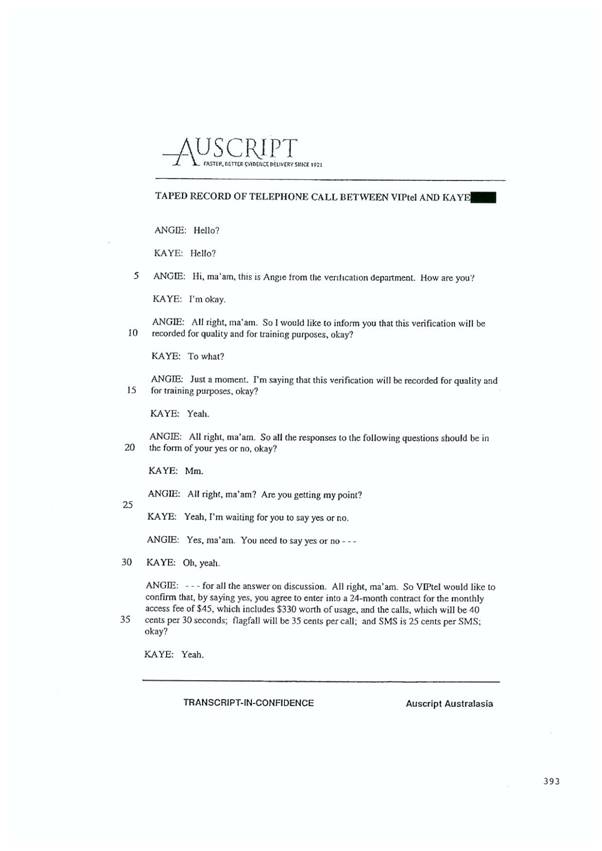
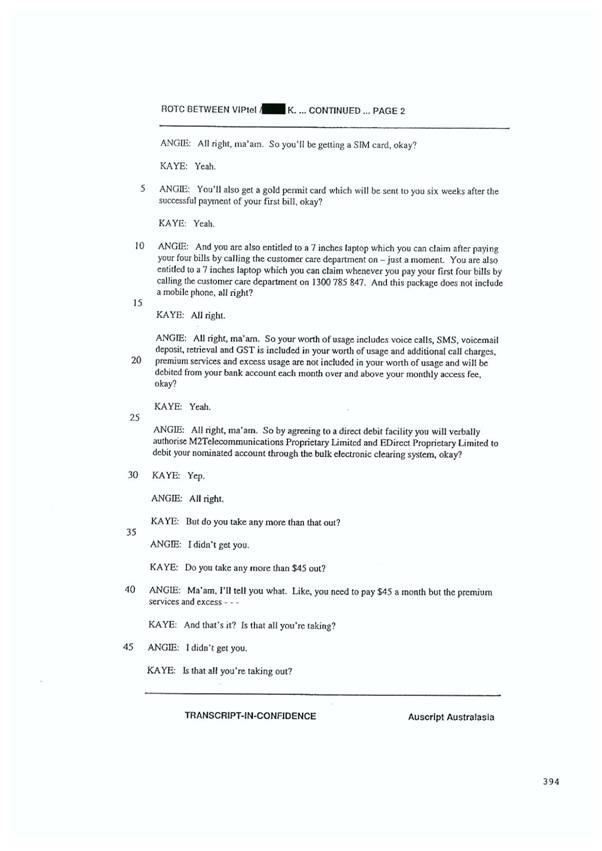
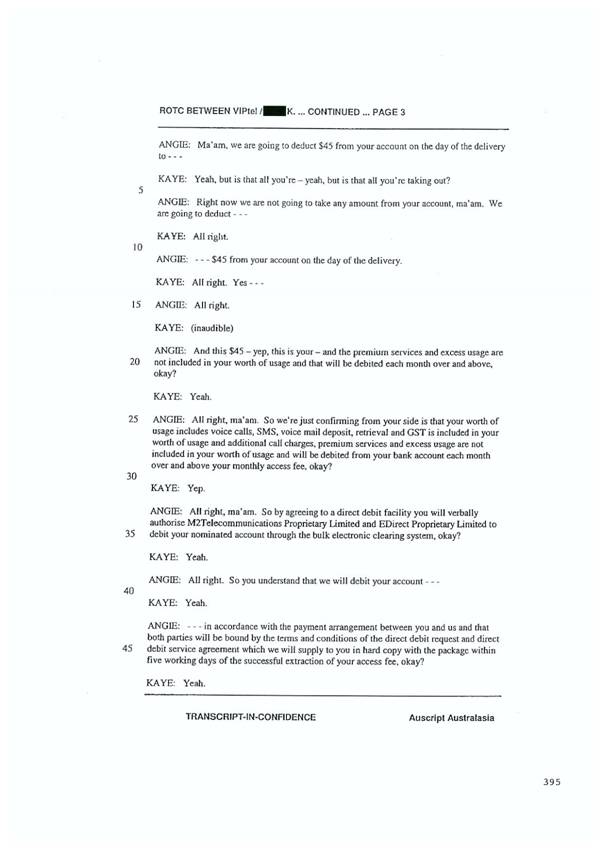
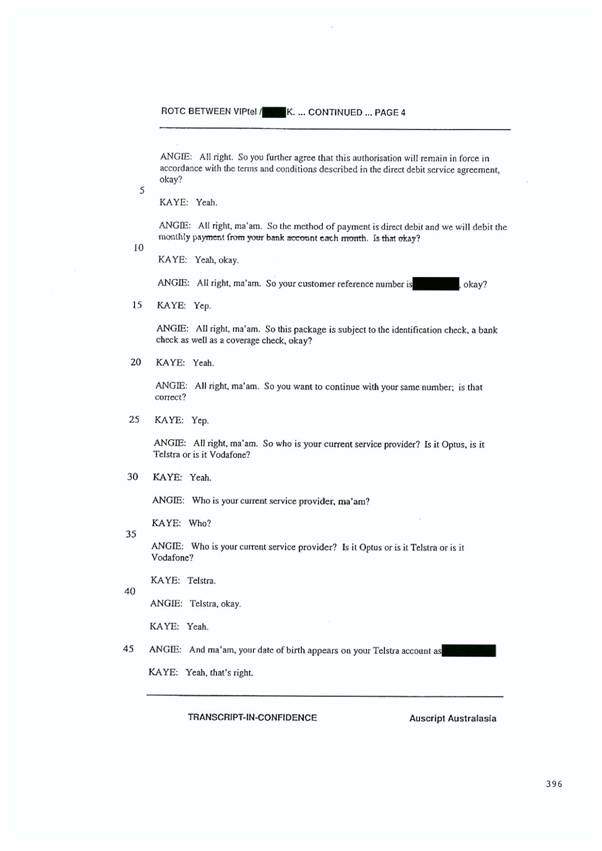
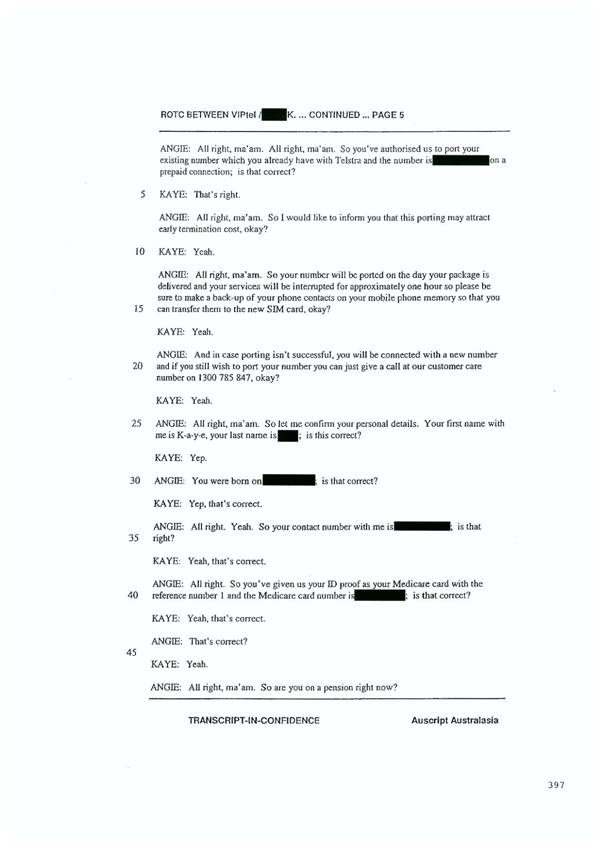
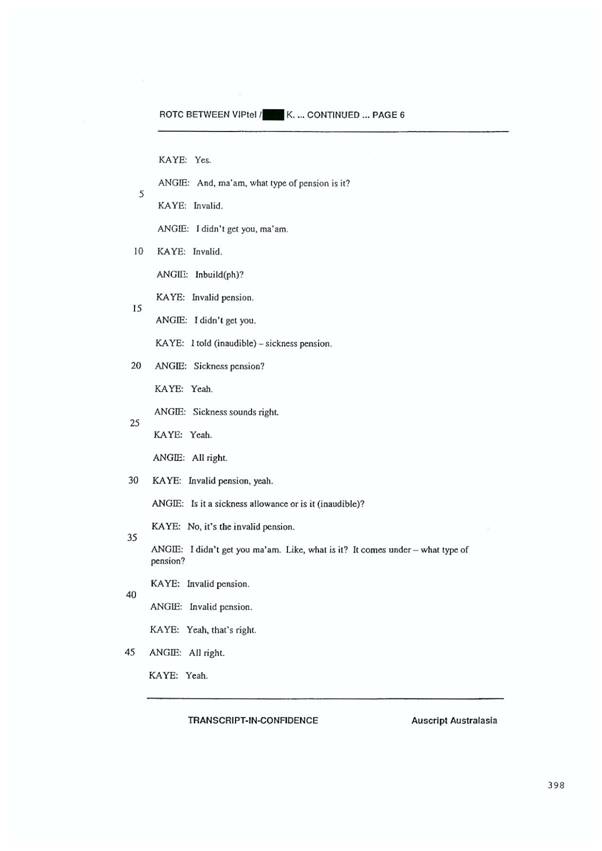
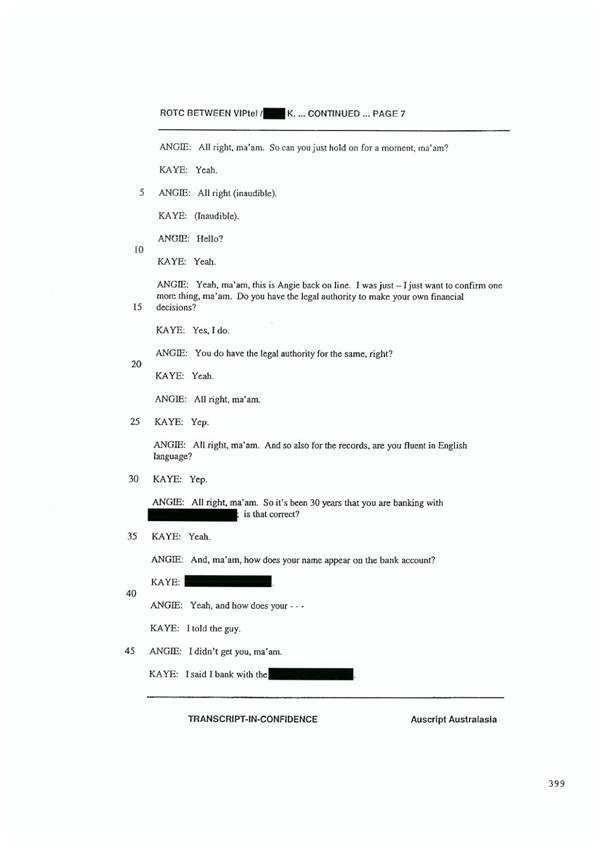
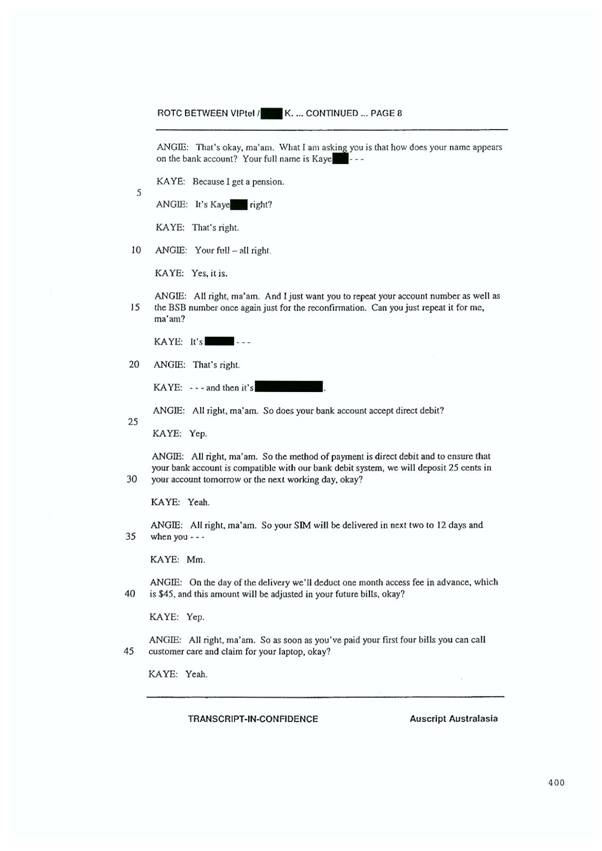
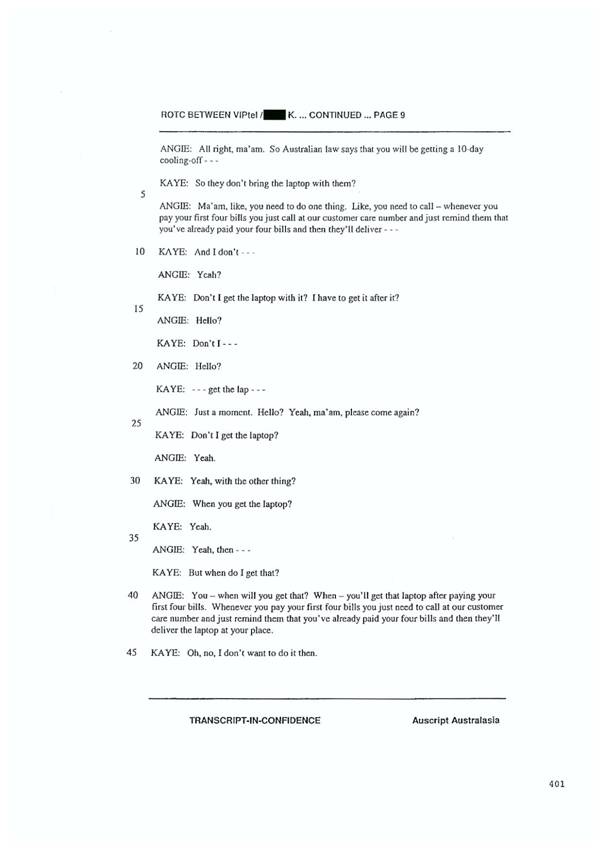
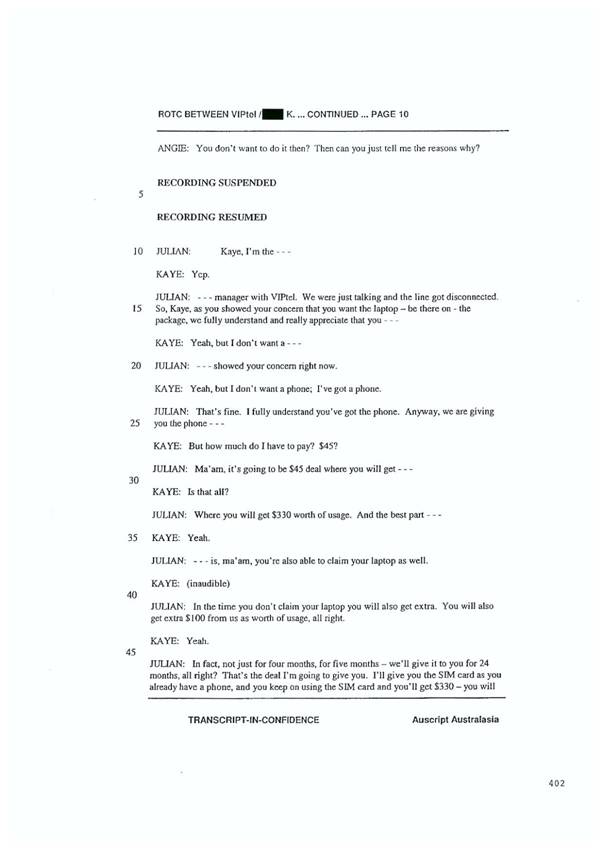
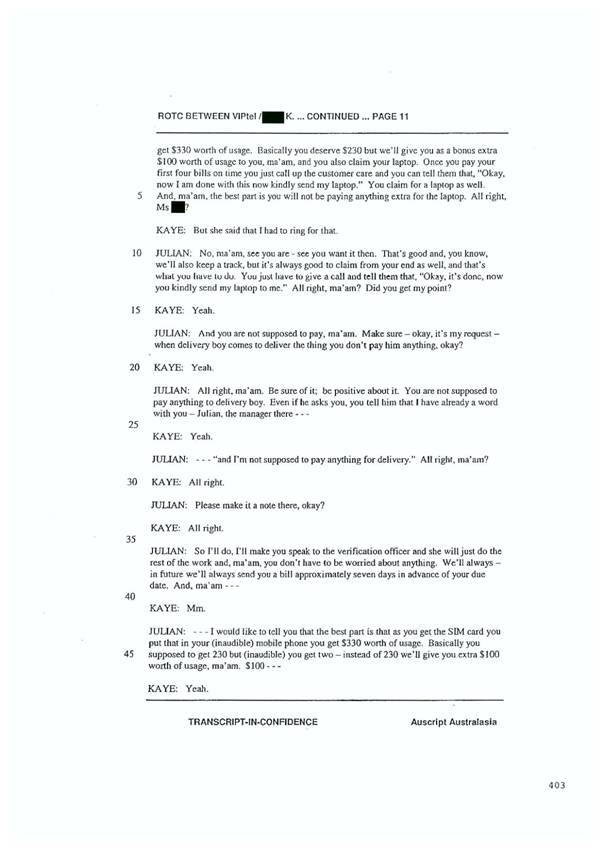
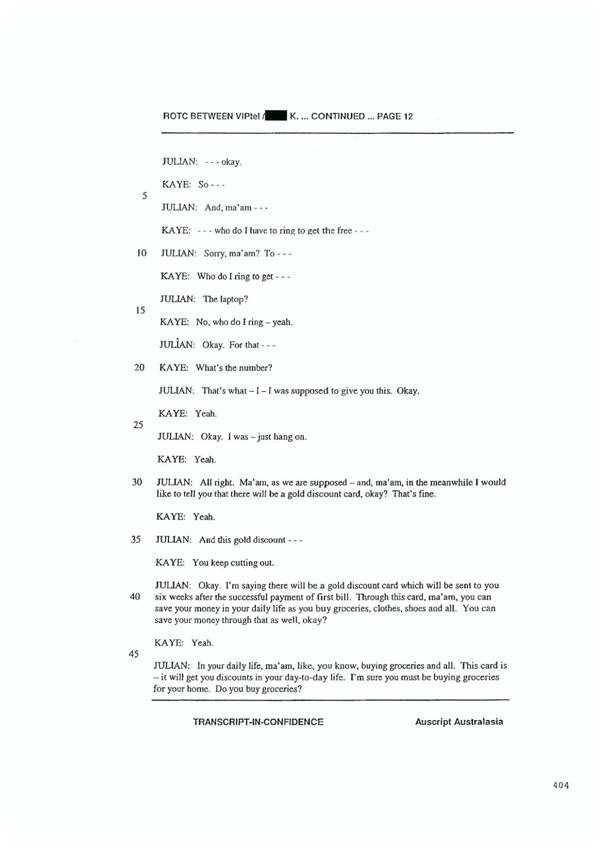
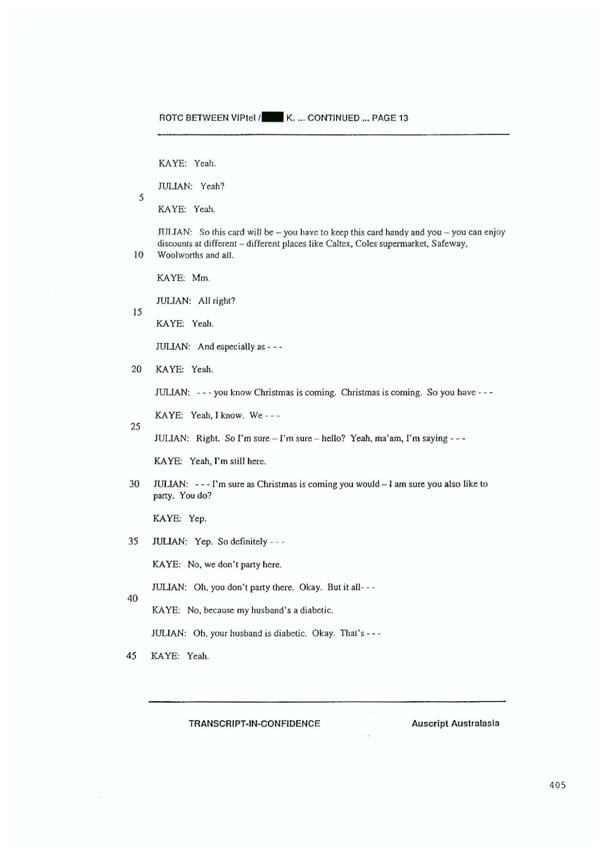
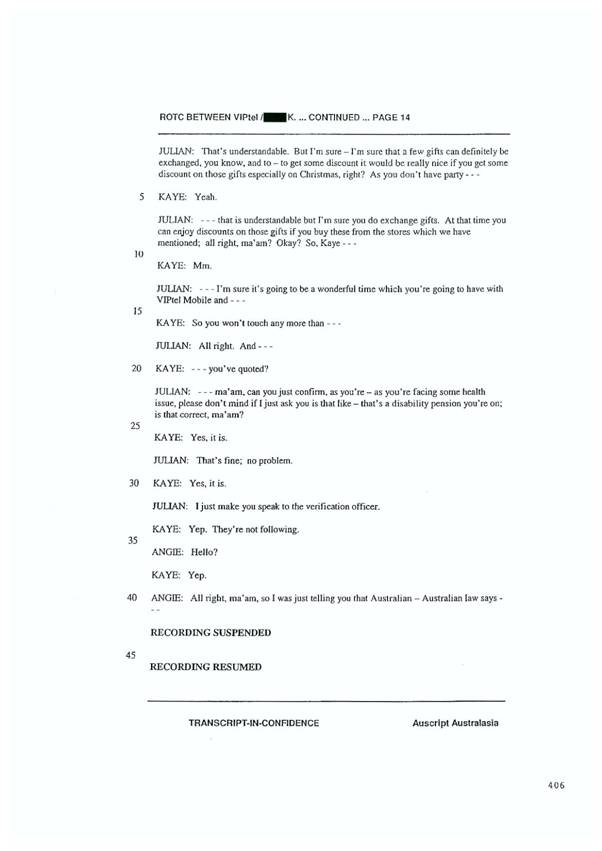
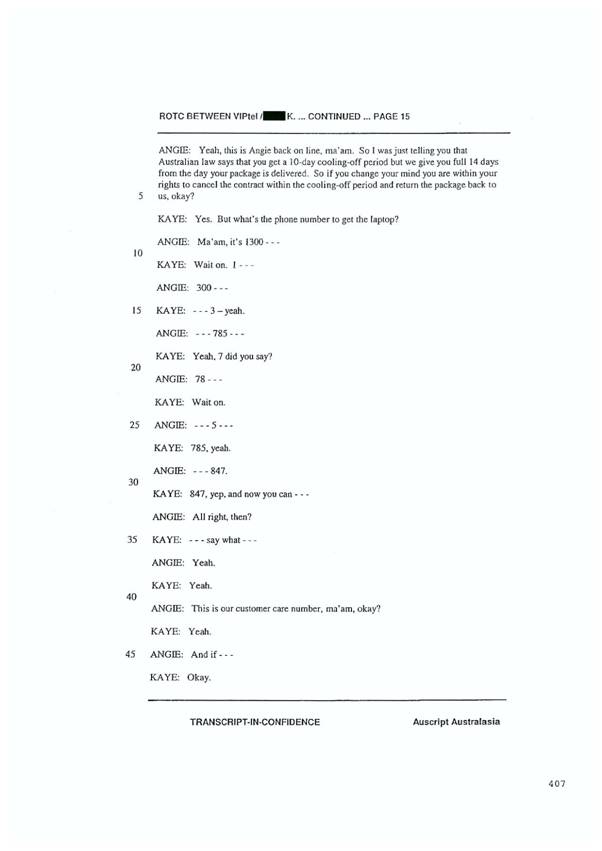
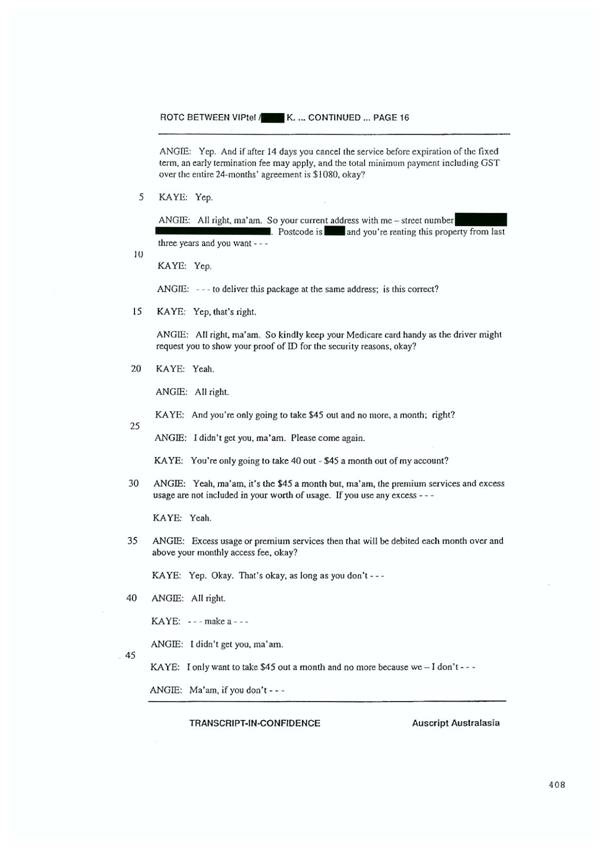
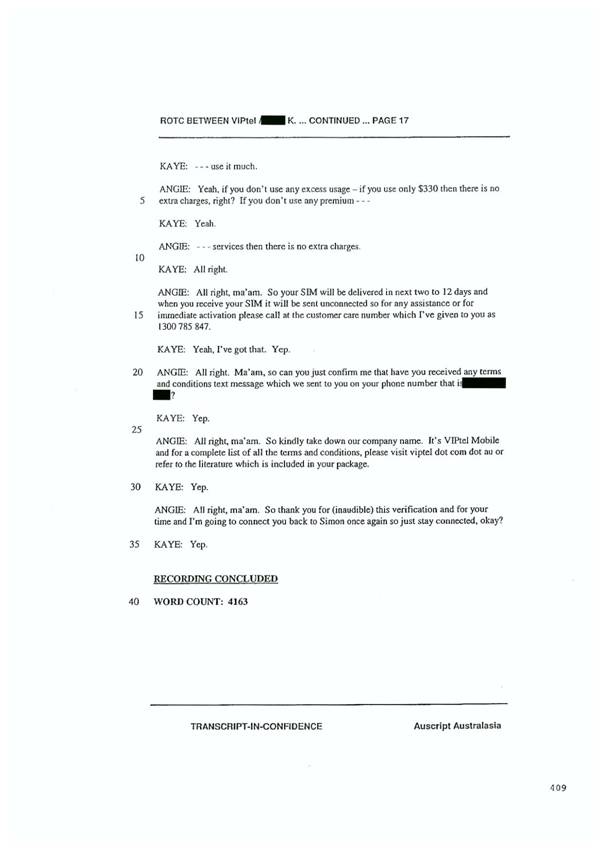
Schedule B
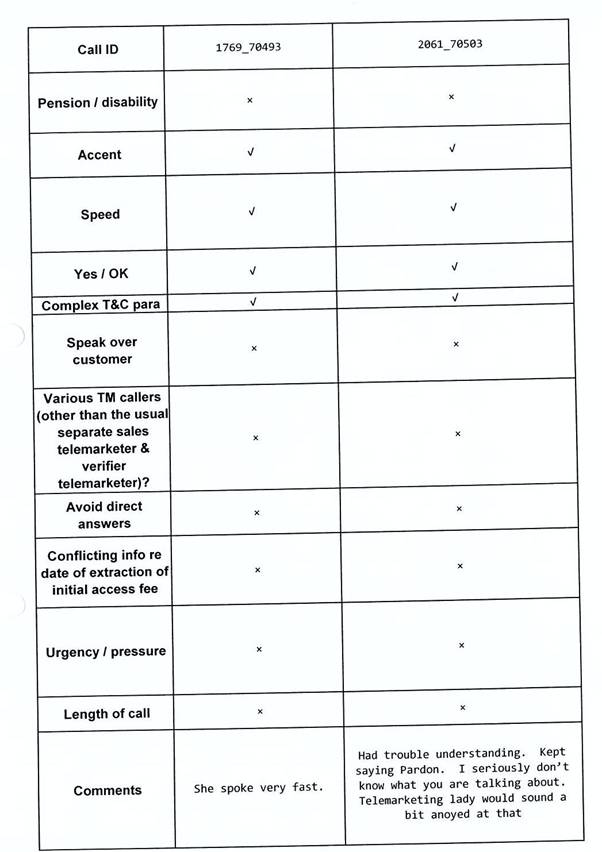
Schedule C