

FEDERAL COURT OF AUSTRALIA
Inkamala v Northern Territory of Australia [2012] FCA 1044
IN THE FEDERAL COURT OF AUSTRALIA | |
DATE OF ORDER: | 25 September 2012 |
WHERE MADE: | hermannsburg |
THE COURT NOTES THAT:
A. The applicant in this proceeding has made a native title determination application (“the application”) that relates to an area of land and waters which is the subject of a proposed determination of native title (“the determination”).
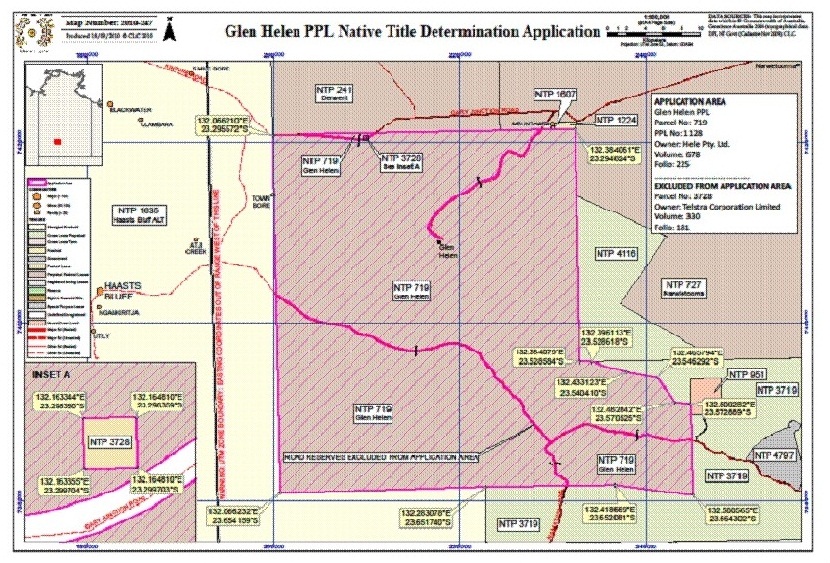
B. The applicant, the Northern Territory of Australia, and the second and third respondents (“the parties”) have reached agreement in writing as to the terms of the determination which is to be made in relation to the land and waters covered by the application (“the determination area”). The external boundaries of the determination area are described in Schedule A and depicted on the map at Schedule B of the determination.
C. Pursuant to s 87(1)(a)(i) and s 87(1)(b) of the Native Title Act 1993 (Cth) (“the Act”) the parties have filed their agreement in this Court.
D. Pursuant to s 87 and s 94A of the Act the terms of the parties’ agreement involve the making of consent orders for a determination that native title exists in relation to the determination area as provided by the determination.
E. The parties acknowledge that the effect of the making of the determination is that the members of the native title claim group, in accordance with the traditional laws acknowledged and the traditional customs observed by them, should be recognised as the native title holders for the determination area as provided by the determination.
F. The parties have requested that the Court hear and determine this proceeding in accordance with their agreement.
BEING SATISFIED that a determination of native title in the terms of the determination in respect of this proceeding would be within the power of the Court and, it appearing to the Court appropriate to do so, pursuant to s 87 of the Act and by the consent of the parties:
THE COURT ORDERS THAT:
1. There be a determination of native title in terms of the determination set out below.
2. The native title is not to be held on trust.
3. Pmarra Tjurritja Alturla Aboriginal Corporation is:
(a) to be the prescribed body corporate for the purposes of s 57(2) of the Act;
(b) to perform the functions outlined in s 57(3) of the Act after becoming a registered native title body corporate.
4. The parties have liberty to apply for the following purposes:
(a) to establish the precise location and boundaries of any public works and adjacent land and waters identified or otherwise referred to in Schedule C of the determination;
(b) to establish the precise location of the boundaries of land on which the pastoral improvements referred to in Schedule C of the determination have been constructed and any adjacent land or waters the exclusive use of which is necessary for the enjoyment of the improvements; and
(c) to establish whether any pastoral improvements referred to in Schedule C of the determination have been constructed unlawfully.
5. There be no order as to costs.
THE COURT DETERMINES THAT:
The determination area
1. The determination area comprises NT Portion 719 being the land and waters more particularly described in Schedule A and depicted on the map comprising Schedule B.
2. Native title exists in the determination area.
3. Native title does not exist in those parts of the determination area described in Schedule C.
The native title holders
4. The determination area comprises six estate areas associated with the Imperlkgne, Urlatherrke, Pmerketerenye, Yaperlpe, Lthalaltweme and Merina landholding groups.
5. The persons who hold the common or group rights comprising the native title are the Aboriginal persons who are:
(a) members of one or more of the landholding groups referred to in paragraph 4 by virtue of descent (including adoption) through father’s father, father’s mother, mother’s father and mother’s mother;
(b) accepted as members of one or more of the landholding groups referred to in paragraph 4 by senior members of a landholding group, referred to in subparagraph (a), by virtue of non-descent connections to an estate.
Native title rights and interests
6. The native title rights and interests of the native title holders are the rights possessed under and exercisable in accordance with their traditional laws and customs, including the right to conduct activities necessary to give effect to them, being:
(a) the right to access and travel over any part of the land and waters;
(b) the right to live on the land, and for that purpose, to camp, erect shelters and other structures;
(c) the right to hunt, gather and fish on the land and waters;
(d) the right to take and use the natural resources of the land and waters;
(e) the right to access, take and use natural water on or in the land, except water captured by the holders of Perpetual Pastoral Lease 1128;
(f) the right to light fires for domestic purposes, but not for the clearance of vegetation;
(g) the right to access and to maintain and protect sites and places on or in the land and waters that are important under traditional laws and customs;
(h) the right to conduct and participate in the following activities on the land and waters:
(i) cultural activities;
(ii) ceremonies;
(iii) meetings;
(iv) cultural practices relating to birth and death including burial rites;
(v) teaching the physical and spiritual attributes of sites and places on the land and waters that are important under traditional laws and customs,
and, subject to the rights of any person arising under the laws in force in the Northern Territory to be present on the land, the right to privacy in the exercise and enjoyment of those activities;
(i) the right to speak for and make decisions about the use and enjoyment of the land and waters by Aboriginal people who recognise themselves to be governed by the traditional laws and customs acknowledged by the native title holders;
(j) the right to share or exchange natural resources obtained on or from the land and waters, including traditional items made from the natural resources;
(k) the right to be accompanied on the land and waters by persons who, though not native title holders, are:
(i) people required by traditional law and custom for the performance of ceremonies or cultural activities on the land and waters;
(ii) people who have rights in relation to the land and waters according to the traditional laws and customs acknowledged by the native title holders;
(iii) people required by the native title holders to assist in, observe, or record traditional activities on the areas.
7. The native title rights and interests referred to in paragraph 6 do not confer possession, occupation, use and enjoyment of the land and waters on the native title holders to the exclusion of all others.
8. The native title rights and interests referred to in sub-paragraphs 6(c), (d), (e) and (j) are for the personal or communal needs of the native title holders which are of a domestic or subsistence nature and not for any commercial or business purpose.
9. The native title rights and interests referred to in paragraph 6 are subject to and exercisable in accordance with:
(a) the valid laws of the Northern Territory of Australia and the Commonwealth of Australia;
(b) the traditional laws acknowledged and traditional customs observed by the native title holders.
Other rights and interests
10. The nature and extent of the other interests in the determination area are:
(a) in relation to NT Portion 719 - the interest of the pastoral lease holder under Perpetual Pastoral Lease No 1128;
(b) the interest of the Northern Territory of Australia under energy supply easement, registered dealing no. 190837;
(c) the rights and interests of APT Pipelines (NT) Pty Ltd:
(i) as the beneficiary of the rights and interests under energy supply easement, registered dealing no. 190837 granted to the Northern Territory of Australia for the purpose of the construction, operation and maintenance of the Amadeus Basin to Darwin gas pipeline and infrastructure; and
(ii) as the holder of Pipeline Licence No. 4 granted under the Energy Pipelines Act (NT).
(d) in relation to EL 27542 the interest of Universal Splendour Investments Pty Ltd;
(e) in relation to EL 27371 the interest of Universal Splendour Investments Pty Ltd;
(f) in relation to EL 27283 the interest of Crossland Nickel Pty Ltd;
(g) in relation to EL 28225 the interest of Crossland Nickel Pty Ltd;
(h) in relation to EL 25794 the interest of Legend International Investment Pty Ltd;
(i) in relation to EL 24438 the interest of Imperial Granite & Minerals Pty Ltd;
(j) in relation to EL 24948 the interest of Northern Mining Limited;
(k) in relation to NT Portion 719 the rights of Aboriginal persons (whether or not native title holders) pursuant to the reservation in favour of Aboriginal people contained in pastoral leases set out in s 38(2) to (6) of the Pastoral Land Act 1992 (NT);
(l) the rights of Aboriginal persons (whether or not native title holders) by virtue of the Northern Territory Aboriginal Sacred Sites Act 1989 (NT);
(m) rights of access by an employee, servant, agent or instrumentality of the Northern Territory, Commonwealth or other statutory authority as required in the performance of his or her statutory duties;
(n) the interests of persons to whom valid or validated rights and interests have been:
(i) granted by the Crown pursuant to statute or otherwise in the exercise of its executive power; or
(ii) conferred by statute.
Relationship between rights and interests
11. To the extent that the continued existence, enjoyment or exercise of the native title rights and interests referred to in paragraph 6 is inconsistent with the existence, enjoyment or exercise of the other rights and interests referred to in paragraph 10, the other rights and interests and the doing of any activity required or permitted to be done by or under the other interests, prevail over, but do not extinguish, the native title rights and interests.
Other matters
12. There are no native title rights and interests in:
(a) minerals (as defined in s 2 of the Minerals Acquisition Act 1953 (NT));
(b) petroleum (as defined in s 5 of the Petroleum Act (NT));
(c) prescribed substances (as defined in s 5 of the Atomic Energy Act 1953 (Cth) and s 3 of the Atomic Energy (Control of Materials) Act 1946 (Cth)).
13. In this determination the term:
(a) “natural resources” means:
(i) animals ferae naturae, birds, fish and plants, including timber, wax, resin and gum; and
(ii) surface soils, clays, stone, rocks and ochre,
but does not include minerals, petroleum and prescribed substances;
(b) “natural waters” includes springs and rockholes.
14. Unless the contrary intention appears, a word or expression used in the Act has the same meaning in this determination as it has in the Act.
Schedule A
1. The determination area comprises the following areas of land:
(a) NT Portion 719 comprising an area of 1,421 square kilometres held under Perpetual Pastoral Lease 1128.
2. The following areas within the external boundaries of the determination area are not included in the determination area:
(a) NT Portion 3728;
(b) The following roads 100 metres
(i) Namatjira Drive;
(ii) Kintore Road;
(iii) Glen Helen Station Road;
(iv) Namatjira-Kintore link road.
Schedule B – Map of Determination Area
Schedule C
Areas where native title does not exist
Native title rights and interests have been wholly extinguished in the following areas of land and waters:
Pastoral improvements
Those parts of the determination area being:
(a) a homestead, house, sheds and other buildings;
(b) a constructed airstrip;
(c) bores, turkey nests, squatters’ tanks, constructed dams or other constructed stock watering points;
(d) stockyards and trapyards.
The areas described in (a) to (d) comprise the land on which the improvements were constructed prior to the date of this determination and any adjacent land or waters the exclusive use of which is necessary for the enjoyment of the improvements.
Public works
Those parts of the determination area being covered by public works as defined in s 253 of the Act that were constructed or established before 23 December 1996 or commenced to be constructed or established on or before that date (including land and waters within the meaning of s 251D of the Act) including:
(a) public roads, namely, rural public roads (50m either side of the centre line), rural arterial roads and national highways;
(b) gravel and fill pits established to maintain the roads referred to in (a) above;
(c) government bores and associated works;
(d) transmission water pipes (adjacent area 5m either side of the centre line);
(e) distribution water pipes measuring 150mm diameter or less (adjacent area of 1.5m either side of the centre line) and/or greater than 150mm diameter (adjacent area 5m either side of the centre line);
(f) sewer pipes measuring 150mm diameter or less (adjacent area 1.5m either side of the centre line) and/or greater than 1500mm or greater (adjacent area 5m either side of the centre line);
(g) bores, sewer pump stations, and overhead power lines.
NORTHERN TERRITORY DISTRICT REGISTRY | |
GENERAL DIVISION | NTD 34 of 2010 |
BETWEEN: | CARL INKAMALA, TRUDY INKAMALA, LOFTY KATAKARINJA, PETER MOKETARINJA, AND BAYDON WILLIAMS (ON BEHALF OF THE IMPERLKGNE GROUP, THE URLATHERRKE GROUP, THE PMERKETERENYE GROUP, THE YAPERLPE GROUP, THE LTHALALTWEME GROUP AND THE MERINA GROUP) Applicant
|
AND: | NORTHERN TERRITORY OF AUSTRALIA First Respondent HELE PTY LTD Second Respondent NT GAS PTY LTD Third Respondent
|
JUDGE: | LANDER J |
DATE: | 25 SEPTEMBER 2012 |
PLACE: | hermannsburg |
REASONS FOR JUDGMENT
1 This application was filed on 27 October 2010 by the applicant seeking recognition of native title rights and interests over the land and waters within the bounds of the Glen Helen Pastoral Lease (Perpetual Pastoral Lease 1128) in the Northern Territory (“the application”).
2 The application is brought on behalf of the members of land holding groups associated with six estate groups: the Imperlkgne group, the Urlatherrke group, the Pmerketerenye group, the Yaperlpe group, the Lthalaltweme group and the Merina group.
3 The second respondent is the holder of the pastoral lease over which the claim is made.
4 On 6 September 2012, the applicant filed a Minute of Proposed Consent Determination pursuant to s 87 of the Native Title Act 1993 (Cth) (“the Act”). That Minute is supported by the parties’ Joint Submissions and a Statement of Agreed Facts also filed on that day. Given that one of the objectives of the Act is resolution of claims by agreement, it is appropriate that this application and those related to it have arisen out of negotiations between the parties and have resulted in the parties agreeing to the terms of a determination of native title.
5 Section 87 of the Act relevantly provides as follows:
Application
(1) This section applies if, at any stage of proceedings after the end of the period specified in the notice given under section 66:
(a) agreement is reached between the parties on the terms of an order of the Federal Court in relation to:
(i) the proceedings; or
(ii) a part of the proceedings; or
(iii) a matter arising out of the proceedings; and
(b) the terms of the agreement, in writing signed by or on behalf of the parties, are filed with the Court; and
(c) the Court is satisfied that an order in, or consistent with, those terms would be within the power of the Court.
…
Agreement as to order
(2) If the agreement is on the terms of an order of the Court in relation to the proceedings, the Court may make an order in, or consistent with, those terms without holding a hearing or, if a hearing has started, without completing the hearing.
Note: If the application involves making a determination of native title, the Court’s order would need to comply with section 94A (which deals with the requirements of native title determination orders).
Agreement as to part of proceedings
(3) If the agreement relates to a part of the proceedings or a matter arising out of the proceedings, the Court may in its order give effect to the terms of the agreement without, if it has not already done so, dealing at the hearing with the part of the proceedings or the matter arising out of the proceedings, as the case may be, to which the agreement relates.
…
(5) Without limiting subsection (2) or (3), if the order under that subsection involves the Court making a determination of native title, the Court may also make an order under this subsection that gives effect to terms of the agreement that involve matters other than native title.
6 The criteria identified in s 87 were summarised by Reeves J in Jungarrayi on behalf of the Mirtartu, Warupunju, Arrawajin and Tijampara Landholding Groups v Northern Territory of Australia [2011] FCA 766 at [4]:
The provisions of s 87 of the Act allow the Court to make a determination of native title by consent over an area of land and waters covered by a native title determination application without holding a hearing where certain conditions are met. These conditions are:
1. the period specified in the notice given under s 66 of the Act has expired (s 87(1));
2. the parties have reached agreement on the terms of an order of the Court in relation to the proceedings (s 87(1)(a)(i));
3. the terms of that agreement are in writing and are signed by or on behalf of the parties and filed with the Court (s 87(1)(b));
4. the Court is satisfied that an order in, or consistent with, those terms would be within its power (s 87(1)(c)); and
5. it appears to the Court to be appropriate to make the order sought (ss 87(1) and 87(2)).
7 What the Court is required to focus upon, therefore, is the process of the making of the agreement between the parties and whether the orders sought are appropriate. North J said in Lovett on behalf of the Gunditjmara People v State of Victoria [2007] FCA 474 at [36]-[37]:
The Act is designed to encourage parties to take responsibility for resolving proceeding without the need for litigation. Section 87 must be construed in this context. The power must be exercised flexibly and with regard to the purpose for which the section is designed.
In this context, when the court is examining the appropriateness of an agreement, it is not required to examine whether the agreement is grounded on a factual basis which would satisfy the Court at a hearing of the application. The primary consideration of the Court is to determine whether there is an agreement and whether it was freely entered into on an informed basis: Nangkiriny v State of Western Australia (2002) 117 FCR 6; [2002] FCA 660, Ward v State of Western Australia [2006] FCA 1848. Insofar as this latter consideration applies to a State party, it will require the Court to be satisfied that the State party has taken steps to satisfy itself that there is a credible basis for an application: Munn v Queensland (2001) 115 FCR 109; [2001] FCA 1229.
8 It is not necessary for the Court to embark upon its own inquiry as to the merits of the claims made in the application for it to be satisfied that the orders sought are supportable according to law: Cox on behalf of the Yungngora People v State of Western Australia [2007] FCA 588 at [3] per French J; Wavehill on behalf of the Ngapurrpinkakuyarra Group v Northern Territory of Australia [2011] FCA 581 at [10] per Mansfield J.
9 That does not mean that the Court will not look at the evidence before it to satisfy itself that the parties, particularly the Northern Territory on behalf of the community, is acting in good faith and rationally: Munn on behalf of the Gunggari People v Queensland (2001) 115 FCR 109 at [30] per Emmett J; Roberts on behalf of the Najig and the Guyanggan Nganwirdbird Groups v Northern Territory of Australia [2012] FCA 223 at [6] per Finn J.
10 In the end result the Court must be satisfied for the purpose of exercising its jurisdiction under the Act that an order in the terms proposed by all the parties to the proceedings would be within the power of the Court: s 87(1)(c).
11 The conditions of s 87 of the Act have been satisfied in this case. In particular:
1. the period specified in the notice under s 66 ended on 11 April 2011;
2. the parties have reached agreement as to the terms of a determination;
3. the Minute of Proposed Consent Determination records those agreed terms;
4. an order consistent with the terms of the Minute would be within the power of the Court because:
(a) the application is valid and made in accordance with s 61 of the Act;
(b) the application is for a determination of native title over an area for which there is no approved determination of native title (s 13(1)(a)); and
(c) the terms of the Minute comply with sections 94A and 225 of the Act.
5. It is appropriate that the Court make the orders sought because:
(i) the parties are legally represented;
(ii) the Northern Territory as first respondent obtained searches of land and mining tenure and other relevant interests to determine the extent of “other interests” within the proposed determination area and made those available to all parties;
(iii) the parties have agreed the nature and extent of other interests in relation to the determination area and those interests are described in paragraph 9 and Schedule C of the Minute;
(iv) there are no other proceedings before the Court relating to native title determination applications that cover any part of the area the subject of the Application which would otherwise require orders to be made under s 67(1) of the Act;
(v) the Northern Territory as first respondent has played an active role in the negotiation of the consent determination. In doing so, the Northern Territory, acting on behalf of the community generally, having had regard to the requirements of the Act and having conducted a thorough assessment process, is satisfied that the determination is justified in all the circumstances; and
(vi) based on this and the terms of the proposed order, it is apparent that there is a free and informed agreement between the parties.
12 In relation to the assessment process, I note that:
1. On 10 December 2010 the applicant served the first respondent with an Anthropology Report prepared by Dr Anna Kenny dated February 2010 and native title holder genealogies for review by the consultant anthropologist (“Connection Material”).
2. The Connection Material was considered by the first respondent. The first respondent sought advice about the Connection Material from consultant anthropologist Emeritus Professor Basil Sansom. The first respondent raised various issues about the Connection Material with the applicant.
3. Further material was requested by the first respondent and provided to Professor Sansom for consideration.
4. Ultimately, the applicant and the first respondent reached agreement that the Connection Material provided a proper basis for the first respondent to enter into a consent determination in settlement of the claim, subject to issues of tenure and extinguishment being resolved.
5. The second and third respondents do not dispute the claim of the applicant as to which persons hold the claimed native title rights and interests in the determination area.
13 In relation to issues of extinguishment of native title, I note that:
1. On 23 May 2012, the first respondent provided the applicant with information regarding extinguishment of native title in the determination area based upon the grant of tenure and the construction or establishment of public works.
2. The applicant provided the first respondent with a draft consent determination on 28 May 2012.
3. The applicant and the first respondent subsequently exchanged correspondence in relation to form of the draft determination.
4. Ultimately, the parties reached agreement as to those parts of the determination area in which native title does and does not exist.
14 Finally, I note that for the purposes of s 56 of the Act, the native title is not to be held on trust and that the consent orders provide appropriately for a prescribed body corporate to be nominated for the purposes of sections 57(2) and (3) of the Act.
Conclusion
15 The co-operative approach of the parties and their legal practitioners has culminated in this consent determination. It is important to note that the orders sought and being made are not orders granting native title rights and interests to the applicants, but recognising the native title holders status as such. The recognition of what is an ancient connection with the land the subject of this determination is a very significant matter and the parties and their legal advisors are to be congratulated on working co-operatively to bring it about.
I certify that the preceding fifteen (15) numbered paragraphs are a true copy of the Reasons for Judgment herein of the Honourable Justice Lander. |
Associate:


