

FEDERAL COURT OF AUSTRALIA
Millennium & Copthorne International Limited v Kingsgate Hotel Group Pty Ltd [2012] FCA 1022
|
IN THE FEDERAL COURT OF AUSTRALIA |
|
ON APPEAL FROM A DECISION OF A DELEGATE OF THE REGISTRAR OF TRADE MARKS
|
MILLENNIUM & COPTHORNE INTERNATIONAL LIMITED Applicant | |
|
AND: |
KINGSGATE HOTEL GROUP PTY LTD (CAN 108 292 995) Respondent |
|
DATE OF ORDER: |
|
|
WHERE MADE: |
THE COURT ORDERS THAT:
1. The appeal from the decision of the Delegate be allowed.
2. The decision of the Delegate dated 1 August 2011 be set aside.
3. The applicant’s trade mark Application No 1114029 proceed to registration.
4. The respondent’s opposition to the abovementioned trade mark application be refused.
Note: Entry of orders is dealt with in Rule 39.32 of the Federal Court Rules 2011.
|
NEW SOUTH WALES DISTRICT REGISTRY |
|
|
GENERAL DIVISION |
NSD 1397 of 2011 |
ON APPEAL FROM A DECISION OF A DELEGATE OF THE REGISTRAR OF TRADE MARKS
|
BETWEEN: |
MILLENNIUM & COPTHORNE INTERNATIONAL LIMITED Applicant |
|
AND: |
KINGSGATE HOTEL GROUP PTY LTD (CAN 108 292 995) Respondent |
|
JUDGE: |
JACOBSON J |
|
DATE: |
19 September 2012 |
|
PLACE: |
SYDNEY |
REASONS FOR JUDGMENT
Introduction:
1 The applicant, Millennium & Copthorne International Ltd (MCIL), is an applicant for Australian trade mark number 1114029 for a composite trade mark comprising services in classes 35 and 43. The services include, but are not limited to, management of hotels and motels, temporary accommodation services and reservation of temporary accommodation.
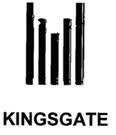
2 MCIL’s trade mark application comprises an image or device made up of five vertical bars or stripes, apparently representing tall buildings and the letter “M” with the word “Kingsgate” appearing immediately below it. The trade mark which is the subject of the application is as follows:
3 The priority date for MCIL’s trade mark application is 11 May 2006.
4 The respondent, Kingsgate Hotel Group Pty Ltd (KHG) is the registered owner of Australian trade mark number 994620 for services in class 43. The services include the operation of hotels, hotel management and reservation services.
5 The priority date of KHG’s trade mark is 24 March 2004. It is therefore earlier in point of time to the priority date of MCIL’s trade mark application.
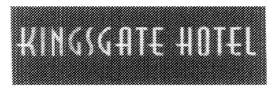
6 The form and appearance of the KHG trade mark is different from that which is the subject of MCIL’s application. It is described as a “fancy mark” and consists of the words “Kingsgate Hotel” in stylised lettering inside a dark shaded box as follows:
7 MCIL’s application was accepted by the Registrar of Trade Marks with an endorsement under s 44(4) of the Trade Marks Act 1995 (Cth) (the Act) citing the earlier registration of the KHG trade mark.
8 Section 44(4) of the Act operates as an exception to the provisions of ss 44(1) and (2). Under ss 44(1) and (2) the Registrar must reject an application for registration of a trade mark if the applicant’s trade mark is substantially identical with, or deceptively similar to, an earlier registered trade mark in respect of similar or closely related services.
9 The effect of s 44(4) is that the Registrar may not reject the application because of the existence of the earlier registered trade mark if the Registrar is satisfied that the applicant (and its predecessor in title) have continuously used the applicant’s trade mark for a period beginning before the priority date of the registered trade mark and ending on the priority date of the applicant’s mark. The use must be, relevantly, in respect of similar, or closely related, services.
10 Where a trade mark is accepted for registration with an endorsement under s 44(4), a person may oppose the registration of the mark under s 58A of the Act on the ground that the owner of the earlier mark (described in the subsection as the similar trade mark) first used the similar trade mark in respect of similar or closely related services before the owner of the trade mark endorsed under s 44(4), or its predecessor in title. The owner of the prior registered mark must have used the similar trade mark continuously since its first use.
11 KHG filed a Notice of Opposition to the registration of MCIL’s trade mark. The Notice of Opposition relied on the ground stated in s 58A and certain other grounds of opposition under the Act.
12 On 1 August 2011, a Delegate of the Registrar of Trade Marks upheld KHG’s objection. The Delegate did so only upon the s 58A ground, without determining any of the other grounds of opposition.
13 MCIL appeals against the Delegate’s decision under s 56 of the Act. Although MCIL’s Notice of Appeal and Points of Claim are limited to the issues raised by s 58A of the Act, KHG has filed a Notice of Contention under which KHG contends that the Delegate ought to have refused to register MCIL’s trade mark by reason of s 60 of the Act. An additional ground under s 43 was not pursued at the hearing.
14 The principal question which arises on the appeal is whether MCIL's trade mark is substantially identical with, or deceptively similar to, KHG’s trade mark. If it is not, the other issues raised in the appeal fall away. The other issues turn largely upon questions of fact which involve a determination of whether MCIL, or a predecessor in title, or KHG, had earlier use of the same or similar trade mark and whether either of them had acquired a reputation in Australia in respect of that mark.
15 MCIL raises one additional ground in its Notice of Appeal, namely “honest concurrent use” under s 44(3) of the Act. It did not raise that issue before the Delegate.
Factual Overview
16 The Millennium & Copthorne Group of companies (the M & C Group) is a large multinational group of companies that owns, manages and runs substantial hotel chains internationally.
17 MCIL’s full name, Millennium & Copthorne International Limited, suggests that it is a part of the M & C Group. MCIL adduced evidence as to its membership of that group of companies. However, the precise corporate structure of the M & C Group, and MCIL’s position within that structure, were very much in dispute in the present case.
18 The reason why the dispute about the M & C Group’s corporate structure is relevant to the present case is that, for reasons which I will explain more fully below, it directly affects the question of whether MCIL was a prior user of a similar trade mark to that which is the subject of the present application.
19 The M & C Group does not own or operate any hotels in Australia but MCIL relies upon what it claims to be the prior use of a similar mark in Australia by itself, or by companies related to it through the M & C Group. The prior use which is asserted by MCIL comes about in a number of different ways, over a lengthy period of time. Three principal types of use are relied upon.
20 The first is that from about 1972 to 1995, a company called Kingsgate Investments Pty Ltd (“Kingsgate Investments”), which is said to have been a member of the M & C Group, either by itself or through a company which MCIL claims to have been a predecessor in title, owned a hotel called the Hyatt Kingsgate Hotel at 82–94 Darlinghurst Road, Kings Cross 2011.
21 The second is through sales, and offers for sales, made in Australia for hotel services provided by the M & C Group in New Zealand under the “Kingsgate” brand. That brand is one of three brands under which the M & C Group provides hotel services internationally. The other brands are “Millennium” which are 5 star hotels, and “Copthorne” which are 4 star hotels.
22 The “Kingsgate” brand of hotels are a 3 star chain operating primarily in New Zealand. MCIL relies in particular upon sales made by Kingsgate Investments from its sales office which is maintained at Kings Cross within the site that formerly housed the Hyatt Kingsgate Hotel (“the Sydney Sales Office”). The Sydney Sales Office has been maintained by Kingsgate Investments Pty Limited since 1994, but the evidence of sales relates mainly to the period from about 2005.
23 The third way in which MCIL claims to have used a similar mark in Australia is by promotion and sale of the Kingsgate brand of hotels, through travel agencies and over the internet, as well as through a worldwide reservation telephone number maintained by the M & C Group which enables reservations to be made for all of its hotels.
24 KHG’s claim of prior use was based upon its ownership and operation of a hotel called the “Kingsgate Hotel” located on King Street in Melbourne. KHG purchased the hotel in 2000 but it had operated under that name since 1978. There was evidence as to KHG’s promotion and marketing of the hotel from 2000, in particular via the internet.
The nature of the appeal and the standard of proof
25 The appeal is by way of a hearing de novo. There is no presumption that the Delegate’s decision is correct but I may have regard to it as the opinion of a person skilled in the field: see Sports Warehouse Inc v Fry Consulting Services Pty Ltd (2010) 186 FCR 519 at [24], and the authorities cited in that paragraph by Kenny J.
26 KHG bears the onus of establishing the grounds of opposition but the standard of proof has been the subject of debate in the Court. The authorities are collected and comprehensively considered by Kenny J in Sports Warehouse at [29] – [38]. The debate is between the balance of probabilities standard and the higher “should clearly not be registered” standard.
27 I do not consider it necessary to express a view on that question and will decide the appeal having regard to both possible standards.
The Delegate’s decision
28 The Delegate referred to the definition of “deceptively similar” in s 10 of the Act and to well-established authorities on its application. Her conclusions on that question are set out at [33] – [34] of her reasons as follows:
33. A consideration of the applicant’s trade mark shows that it consists of a five bar graphic device above the sole word KINGSGATE. The opponent’s trade mark essentially consists of the words ‘KINGSGATE HOTEL’. Mr Bevan argued that it is not credible to dismiss the word HOTEL in the opponent’s trade mark and that the five bar device in the applicant’s trade mark is ‘highly distinctive and is in a position of prominence in the trade mark’. He claimed that these features sufficiently differentiate the trade marks from each other and that there could be no possibility of deception or confusion arising from the applicant’s use of the opposed trade mark. I disagree.
34. The word “HOTEL” in the opponent’s trade mark does not sufficiently differentiate the two marks as it would still be viewed by the consumer as a descriptive term in relation to the ‘operation of hotels and restaurants, accommodation services, hotel management and reservation services’ for which the opponent’s trade mark is registered. The presence of the device in the applicant’s trade mark does add some differentiation, but it is more than likely that the marks will be referred to by their word elements. There is accordingly a ‘finite and non-trivial probability’, in my view, that the average consumer would see these trade marks as being related to each other, or at the very least “be caused to wonder if this might not be the case”. The overall impression is one of similarity and as a result, I find that the trade marks are deceptively similar.
29 The Delegate then considered the question of prior use in relation to conflicting services. She was satisfied that KHG had used its Kingsgate Hotel trade mark for hotel services since at least 26 December 2001.
30 In respect of the use of the word “Kingsgate” by MCIL in connection with the ownership or operation of the Hyatt Kingsgate Hotel, the Delegate was not satisfied that the evidence was sufficient to establish trade mark use. She went on to say that, in any event, the most striking and memorable feature of the name Hyatt Kingsgate Hotel (or Hyatt Kingsgate Sydney as it was otherwise known) was the name “Hyatt”. The effect of this was that MCIL failed to establish any reputation in the name “Kingsgate” in connection with the relevant hotel in Kings Cross.
31 The Delegate also noted that there was evidence of the use of the name Kingsgate by companies related to MCIL in relation to the conduct of a shopping centre in Australia (which was at the site formerly occupied by the Hyatt Kingsgate Hotel). However, she was not satisfied that this demonstrated use of the MCIL trade mark for the relevant services because MCIL does not claim shopping centre services in the present application.
32 The Delegate’s conclusion at [41] was as follows:
The opponent’s evidence clearly shows continuous use from December 2001 until at least the filing date of the applicant’s trade mark. I have previously decided that the two trade marks under consideration are deceptively similar, therefore fitting the requirement that they be “similar trade marks”. The information I have before me satisfies me that the provisions of section 58A are met and that the opponent has established this ground of opposition.
Deceptively Similar: The principles
33 It is not necessary to engage in an extensive discussion of the principles. The relevant principles were succinctly summarised by French J (with whom Tamberlin J agreed) in Registrar of Trade Marks v Woolworths Ltd (1999) 93 FCR 365 at [49] – [50].
34 The authorities were also comprehensively considered and reviewed by a Full Court in Crazy Ron’s Communications Pty Ltd v Mobileworld Pty Ltd (2004) 209 ALR 1. Although their Honours were in that case concerned with a claim for trade mark infringement, their Honours elaborate and detailed discussion of the principles is equally applicable to the issue which arises in the present case.
35 French J observed in Woolworths at [49] that the question is one of fact which “is not susceptible of much discussion” (citing Australian Woollen Mills Ltd v FS Walton & Co Ltd (1937) 58 CLR 641 at 659 per Dixon & McTiernan JJ). Nevertheless, as his Honour pointed out at [50], five propositions drawn from the judgment of Kitto J in Southern Cross Refrigerating Co v Toowoomba Foundry Pty Ltd (1954) 91 CLR 592 at 594 – 595 are established by the authorities.
36 I do not understand the Full Court in Crazy Ron’s to have departed from the propositions stated by Kitto J in Southern Cross Refrigerating and restated by French J in Woolworths, although in Crazy Ron’s their Honours engaged in a far more detailed analysis of the principles.
37 Without seeking to reformulate the various statements of principle stated in the Full Court authorities, it is sufficient for present purposes to identify the critical elements which seem to me to inform the issue of deceptive similarity in the present case. There are nine elements.
38 First, the judgment of likelihood of deception is a practical one. It requires an assessment of the effect of the challenged mark on the minds of potential customers: Woolworths at [49]; Australian Woollen Mills at 658.
39 Second, the question of deceptive similarity is not to be decided by a side-by-side comparison. It is to be determined by a comparison of the impression based on recollection of the opponent’s mark that persons of ordinary intelligence and memory would have, and the impression that those persons would get from the opposed trade mark: Crazy Ron’s at [73]; Shell Company of Australia Ltd v Esso Standard Oil (Australia) Ltd (1963) 109 CLR 407 at 415 per Windeyer J.
40 Third, allowance must be made for imperfect recollection: Crazy Ron’s at [74].
41 Fourth, the effect of the spoken description must be considered: Woolworths at [49]; Crazy Ron’s at [75]; Australian Woollen Mills at 658.
42 Fifth, it is necessary to show a real tangible danger of deception or confusion: Woolworths at [43] and [50]; Crazy Ron’s at [76]; Southern Cross Refrigerating at 594 – 595.
43 Sixth, a trade mark is likely to “cause confusion” if the result of its use will be that a number of persons are “caused to wonder” whether the two products come from the same source: Woolworths at [50]; Southern Cross Refrigerating Co at 595. This test sets a lower threshold than that which is required to establish that conduct is likely to mislead or deceive under s 18 of Schedule 2 of the Competition and Consumer Act 2010 (Cth): see McWilliam's Wines Pty Ltd v McDonald's System of Australia Pty Ltd (1980) 33 ALR 394 at 398 per Smithers J.
44 Seventh, all surrounding circumstances must be taken into consideration. The circumstances include those in which the marks will be used, and in which the goods or services will be bought and sold, as well as the character of the probable acquirers of the goods and services: Woolworths at [50]; Crazy Ron’s at [86] – [89]; Southern Cross Refrigerating at 595.
45 Eighth, the question of whether there is a likelihood of confusion is not to be answered by reference to the manner in which a party has used the mark, but by reference to what an applicant can do. That is to say, the use to which it can properly put the mark if registration is obtained: Woolworths at [50]; Berlei Hestia Industries Ltd v The Bali Company Inc (1973) 129 CLR 353 at 362 per Mason J.
46 Ninth, if a registered trade mark includes words which can be regarded as an “essential feature” of the mark, another mark that incorporates those words may cause a tangible danger of deception or confusion by reason of consumers retaining an imperfect recollection of those words: Crazy Ron’s at [79]. However, care must be taken to not too readily characterise words in a composite trade mark as an “essential feature” because to do so may effectively convert a composite mark into something different: Crazy Ron’s at [100].
Whether MCIL’s trade mark is deceptively similar to KHG’s
47 If the question were limited to a side-by-side comparison, KHG’s opposition would fail. This is because the physical appearance of the two marks is quite different. KHG’s mark is a “fancy mark” in which the words “Kingsgate Hotel” appear in a stylised font on a shaded box which has the appearance of a tablet or panel such as one would expect to see displayed outside a particular hotel.
48 By contrast, MCIL’s composite mark consists of its 5 bar logo representing the letter “M” and the word “Kingsgate” in black letters immediately below the logo.
49 However, Senior Counsel for KHG, Mr McGowan SC, submitted that the dominant and most memorable element of each of the marks is the word “Kingsgate”. He added to this the proposition that the relevant circumstances include the way in which the hotel services will be acquired, in particular by telephone bookings for a “Kingsgate Hotel” and, even more significantly, through bookings made as a result of searches on the internet.
50 Thus, Mr McGowan emphasised that neither of these means of acquiring hotel services use the device element of MCIL’s trade mark and so the aural and oral similarities in the marks are important.
51 There is some force in these submissions but it seems to me that there are a number of answers to them which must be taken into account in applying the principles which I have endeavoured to summarise above.
52 First, as the Full Court said in Crazy Ron’s at [100], caution needs to be exercised before characterising words in a composite mark as an essential feature so as to avoid converting such a mark into something different. It is true that Mr McGowan did not describe the word “Kingsgate” in MCIL’s trade mark as an essential part of it. Rather he described it as the dominant element. Nevertheless, the device or logo in MCIL’s trade mark is a prominent part of the mark and it cannot be eliminated from the exercise of practical judgment in determining whether MCIL’s trade mark is deceptively similar to KHG’s.
53 Second, the proposition that hotel bookings over the telephone and searches on the internet will be made by using the name “Kingsgate”, seems to me to fail to take into account all the relevant circumstances. In particular, it overlooks the way in which the marks will be used to indicate the badge of origin (or more appropriately in the case of a service mark, the source of the services to be supplied). The circumstances in which the marks will be used underpins the way in which the hotel services will be acquired, whether over the telephone or via the internet.
54 In most instances, the preliminary steps to the booking will include a search for the telephone number or the website. In either instance, the person making the search is likely to see the mark displayed. Where bookings are made by travel agents, they may be expected to recognise the difference between the two marks, even if they do not make internet searches before making bookings. If both MCIL and KHG were to conduct hotels in a particular region sought by a customer, the usual differences between the marks would be readily apparent to ordinary persons.
55 I do not consider that anything turns on the fact that KHG’s trade mark incorporates the word “Hotel”. I agree with the Delegate that this does not of itself differentiate the two marks because it would be viewed by consumers as a descriptive term in relation to the various types of services within class 43.
56 Whilst I accept that the marks will be referred to by their word elements, it seems to me that this must be considered in light of all the relevant circumstances which take into account the presence of the 5 bar “M” device in MCIL’s trade mark.
57 It follows that, in my opinion, even allowing for some instances of imperfect recollection, KHG has failed to demonstrate, on the balance of probabilities that there exists a real tangible danger of confusion or deception arising from the registration of MCIL’s trade mark.
58 If the higher, “should clearly not be registered” standard of proof applies, KHG’s opposition would be bound to fail because I cannot be satisfied that there is any more than a trivial risk that persons would be confused by reason of the registration of MCIL’s mark.
Other questions arising under s 58A of the Act
59 I have decided the threshold question under s 58A of the Act, namely deceptive similarity, adversely to KHG. However, if I am wrong in that conclusion, the remaining questions which arise under s 58A(2) are:
whether KHG (or MCIL), or their predecessors in title, first used the “similar trade mark” in respect of similar or closely related services; and
whether the first user has continuously used the similar trade mark in respect of those services since that date.
60 Section 58A is a relatively new ground of opposition. The Explanatory Memorandum to the Trade Marks Amendment Bill 2006 (Cth) stated that the new s 58A was needed to enable the owner of a trade mark that is deceptively similar to another trade mark to oppose its registration on the basis of “absolute first use”: see Davidson, M et al, Shanahan’s Australian Law of Trade Marks and Passing Off (4th Ed, Lawbook Co, 2008) at [50.2215], p 379.
61 The Explanatory Memorandum went on to say that, as the law stood before the amendment, the owner of the earlier registered trade mark had no basis upon which to oppose registration of a mark accepted under s 44(4) even where the earlier registered owner’s use pre-dated that of the accepted application.
62 The object of s 58A therefore appears to be to overcome the effect of the principle that states that in a case of disputed claims to proprietorship nothing less than substantial identity between the two marks will suffice: see Carnival Cruise Lines Inc v Sitmar Cruises Ltd (1994) 120 ALR 495 at 513 per Gummow J.
63 It may be that if use by KHG can be shown to have occurred before the date on which MCIL filed its application for registration, the onus shifts to MCIL to show use of the mark prior to that of KHG: see Shanahan’s Australian Law of Trade Marks and Passing Off (4th Ed) at [50.2220], p 380. However, in the present case, I do not consider that the question of prior use turns on who has the onus.
64 KHG submitted that its evidence clearly demonstrated continuous use from at least 2001. MCIL submitted that the evidence demonstrated use of the mark from at least 1973 in respect of the Hyatt Kingsgate in Kings Cross, or alternatively from 1994 in respect of bookings made through the Sydney Sales Office for the M & C Group’s Kingsgate Hotels in New Zealand.
65 However, there are serious evidentiary gaps in the evidence of both parties. These gaps bear upon the question of whether KHG or its predecessor in title used the mark from the date for which it contends. Similarly, the gaps in MCIL’s evidence affect the question of whether use from the asserted date was the use by a predecessor in title, and whether there was continuous use as required by s 58A.
Use by KHG or its predecessor
66 KHG was not incorporated until 16 March 2004. KHG therefore can not have used the KHG trade mark before that date.
67 Nevertheless, KHG submits that a company called Kildair Hotels (Kingsgate) Pty Ltd (Kildair) was its predecessor in title and, accordingly, that the relevant date from which KHG’s use of the mark is to be calculated is the date on which Kildair commenced to use the mark.
68 KHG is a wholly owned subsidiary of Kildair which owns all of the 12 issued shares in KHG. One of the directors of KHG and Kildair, Mr Geoffrey Burchell Simmons, gave evidence in the proceeding.
69 Mr Simmons’ evidence establishes that Kildair purchased the freehold title of the Kingsgate Hotel in King Street, Melbourne on or about 12 May 2000. At the same time, Kildair also purchased the assets of the business of the Hotel, including the intellectual property rights owned by the vendor necessary for the conduct of the business, including the business name, the domain name and the website for the Kingsgate Hotel.
70 There was evidence of the history of the Kingsgate Hotel in Melbourne dating back to 1978 and beyond. KHG apparently asserts that the previous owners, dating back to October 1978, were its predecessors in title. However, that submission does not seem to have been pressed in Mr McGowan’s closing submissions and there are real difficulties with it.
71 The essential question seems to me to be whether Kildair was the predecessor in title of KHG. I accept Mr Simmons’ evidence that Kildair has continuously operated the Kingsgate Hotel in Melbourne ever since Kildair purchased it in May 2000. I do not consider that this evidence was disturbed in cross-examination. It follows that if Kildair was the predecessor in title of KHG, the date from which KHG’s use of the KHG trade mark (or a mark substantially similar to it) commenced in May 2000.
72 The term “predecessor in title” was used in the Trade Marks Act 1955 (Cth) (the 1955 Act) in a different context to that in which the term is used in s 58A of the Act. In the 1955 Act the term appeared in s 82(2)(a) which imposed a restriction on the assignment of a registered trade mark without goodwill.
73 It seems to me that the term “predecessor in title” in s 58A of the Act may be more readily traced to the provisions of s 34(2) of the 1955 Act, although that provision used slightly different terminology, namely “predecessors in business”.
74 Section 34(2) of the 1955 Act precluded the Registrar from refusing to register a trade mark by reason of the registration of another mark where there had been prior continuous use by the applicant “or his predecessors” in business. The construction and application of that subsection are discussed in Shanahan, D, Shanahan’s Australian Law of Trade Marks and Passing Off (1st Ed, The Law Book Company Ltd, 1982) at pp 170-172.
75 Under the 1955 Act, it was not possible to rely on prior use, even by a predecessor in title, without a transfer of the goodwill of the business with a transfer of the mark: Smith Bartlet & Co v British Pure Oil Grease and Carbide Co Ltd (1934) 51 RPC 157 at 163; Shanahan’s Australian Law of Trade Marks and Passing Off (1st Ed) at p 172.
76 It seems to me that the effect of the few relevant authorities is that a transfer of the goodwill of the business is no longer required but what must be established is that there has been a transfer of the mark itself.
77 Authority for this proposition can be found in the observations of Tamberlin J in Canon Kabushiki Kaisha v Brook (1996) 69 FCR 401 at 411. His Honour was there concerned with the question of prior continuous user under s 34(2) of the 1955 Act. He observed that the term “predecessors in business” is wider than the term “predecessor in title” and that, to be a predecessor in business:
… it is not essential to establish the precise devolution of a chain of title to the mark.
78 This suggests that what is necessary under s 58A of the Act to prove that a person or entity is a predecessor in title, is proof of the complete chain of title consisting of a transfer or transfers of the relevant mark.
79 That approach is consistent with the observations made in Blanco, T and Jacob, R Kerly’s Law of Trade Marks and Trade Names (12th Ed, Sweet & Maxwell, 1986) at [15-30], p 305. The learned authors there state that the expression “predecessor in title” (which appears in s 7 of the Trade Marks Act 1938 UK) presupposes a valid transfer of the mark from the previous user. They go on to observe that the expression “predecessor in business” presupposes a transfer of the goodwill in that part of the business which is relevant to the use of the mark.
80 Ms Goddard SC, who appeared for MCIL, referred to the decision of Aickin J in Pioneer Kabushiki Kaisha v Registrar of Trade Marks (1977) 137 CLR 670. It seems to me that the case is not concerned with the present question. Rather, it emphasises the essential requirement for maintenance of the validity of a trade mark, namely that it must indicate a connection in the course of trade with the registered proprietor of the mark and that the use of the mark does not become otherwise deceptive: see Pioneer Kabushiki Kaisha at 683.
81 It follows in my opinion that KHG has failed to demonstrate that Kildair was its predecessor in title. This is because there is no evidence to the effect that Kildair transferred the mark to KHG.
82 Even if it were sufficient that there be a licence from the previous user to the opponent, that is to say from Kildair to KHG, no such licence or authorisation can be made out for the period prior to KHG’s incorporation in March 2004.
83 I therefore reject the submission that Kildair is the predecessor in title of KHG. It follows that the period of KHG’s use of the mark commenced no earlier than 16 March 2004.
84 The evidence may have been sufficient to demonstrate a transfer of title from the persons or entities who conducted and operated the Kingsgate Hotel from 1978 until its purchase by Kildair in 2000. The sale agreement apparently provided that “intellectual property rights” were transferred to Kildair by the vendors of the business. But even if the vendors to Kildair were its predecessor in title, the chain of title to KHG was broken because, for reasons stated above, Kildair has not been shown to be the predecessor in title of KHG.
85 The Delegate was satisfied that KHG had used its Kingsgate Hotel trade mark for hotel services since at least 26 December 2001. However, for reasons referred to above, I do not consider that the use during the period from 2001 to March 2004 was by KHG. The Delegate’s reasons do not address the question of the use of the mark by a predecessor in title of KHG.
Use by MCIL or its predecessor in title: the Kingsgate Hotel in Kings Cross
86 The effect of MCIL’s submissions as to its use of the mark from about 1973 is that the hotel which operated at the Darlinghurst Road site was known not only as the Hyatt Kingsgate Hotel but also as the Kingsgate Hotel.
87 There was evidence to this effect from Mr Joaquin Hernandez, the son of the original owner of Hernandez CafÉ, which has operated in Kings Cross at locations near the hotel since 1972. His evidence was supported to some extent by evidence of magazine articles and other contemporaneous pieces including a scrapbook reference to the Cat Stevens tour of Australia in 1972 which refers to a press conference held at the “Kingsgate Hotel”.
88 This evidence was called to supplement the material put before the delegate apparently with a view to establishing use of the trade mark “Kingsgate Hotel” from 1973. However, even if I were to come to a different conclusion from that of the Delegate on the question of the reputation of the name of the hotel, I do not consider that the voluminous evidence called on this question establishes use of the name Kingsgate by a predecessor in title of MCIL.
89 MCIL was not incorporated until 16 January 1996. The evidence as to who owned and operated the hotel at Kings Cross from 1973 is not entirely clear. It seems to have been acquired by a company called Summit Properties Pty Ltd (Summit) in about June 1973.
90 Ms Muragasu conceded in her evidence that Summit is not part of the M & C Group. The effect of her evidence is that a company called Kingsgate Management Services Pty Limited, which was not part of the M & C Group, managed the hotel on behalf of Summit and that in about 1980, Kingsgate Investments acquired the Hotel.
91 Ms Muragasu produced a chart of the complex web of companies which are said to be members of the M & C Group. Kingsgate Investments is recorded in the chart but one of the companies interposed between it and the ultimate parent is KIN Holdings Ltd. That company was not incorporated until 25 March 2004.
92 Ms Muragasu was not able to prove any assignment of goodwill from Summit to Kingsgate Investments when it purchased the Hotel. In my view, that is sufficient to defeat MCIL’s claim that Kingsgate Investments was its predecessor in title. This is because an unregistered trade mark is not capable of transfer independently of a transfer of the goodwill: see Federal Commissioner of Taxation v Just Jeans Pty Ltd (1987) 16 FCR 110 at 122.
93 Moreover, it is not clear to me that Kingsgate Investments used the Kingsgate Hotel mark during the period which MCIL relies upon. As Ms Muragasu conceded in cross-examination, for so long as the hotel bore the Hyatt name, it was managed by the Hyatt Group of companies. And when the arrangements with Hyatt (the details of which were never established) came to an end in about 1995 the Kingsgate name ceased to be associated with the hotel.
94 Thus, it is plain that MCIL cannot maintain its assertion of prior use in respect of the operation of the Hyatt Kingsgate Hotel (or the Kingsgate Hotel) at Kings Cross because on any view, the use which it asserts has not been continuous.
95 Continuous use of the similar trade mark is, quite clearly, a requirement of ss 44(4) and 58A(2). Both of those subsections state, in express terms, that prior use of the mark must be by the owner or its predecessor in title and that the use must be continuous.
96 The word “continuous” may not be capable of strict definition but there must be more than an occasional user. It is possible that the use of a mark may be continuous even though it was not used for a brief period: Smith Bartlet v British Pure Oil at 163; Canon v Brook at 411; Shanahan’s Australian Law of Trade Marks and Passing Off (1st Ed) at p 171; Shanahan’s Australian Law of Trade Marks and Passing Off (4th Ed) at [40.3015], p 335-336; Kerly’s Law of Trade Marks and Trade Names at [15-29], p 304.
97 However, it seems to me that those authorities establish, beyond any argument, that a break of 17 years is inconsistent with the concept of continuous use.
98 The commercial operations on the Kings Cross site after the hotel was closed are, with one exception, irrelevant to the assertion of prior use of the mark. This is because from about 1995 to 2004, Kingsgate Investments owned and operated a shopping centre on the site. Although the site was known as the Kingsgate Shopping Centre, the services in question are not the same as, or of the same description as the services which are the subject of this appeal. The evidence before me does not rise above that to which the Delegate referred at [40] in rejecting any claim that the use of the term Kingsgate in relation to the shopping centre constituted prior use for the purposes of s 58A.
99 The exception, with respect to the commercial operations in Kings Cross, concerns the question of bookings in Australia for the Kingsgate Hotels in New Zealand. MCIL contends that some of those bookings were apparently made through the Sydney sales office.
The New Zealand Kingsgate Hotel
100 There are a number of factual difficulties in MCIL’s claim of prior use of “the similar mark” in Australia through sales and promotion here of the New Zealand branded Kingsgate Hotels.
101 The first is as to the date on which any member of the M & C Group commenced its efforts to promote and sell hotel services in Australia in respect of the Kingsgate Hotels in New Zealand.
102 The second (which is related to the first) is that the evidence of any actual sales in Australia during the critical period is slight.
103 The third is whether the evidence establishes use of the composite mark, rather than the word “Kingsgate”.
104 The fourth is the difficulty to which I have previously adverted, namely the question of who actually used the mark, that is to say, which member of the M & C Group and what its relationship with MCIL at the critical time.
105 The fifth is, how can it be said that any such use was by a predecessor in title of MCIL.
106 Much of the difficulty comes about because no Australian employee of the M & C Group was called to give evidence. Instead, MCIL relied upon the evidence of Ms Muragasu who is the Group Legal Counsel of Hong Leong Management Services Pte Ltd, a company based in Singapore which is a service provider to some (or perhaps all) of the M & C Group Companies and Mr Takeshi Ito, the Group Company Secretary and Legal Counsel for Millennium & Copthorne Hotels New Zealand Ltd (MCNZ).
107 MCIL also relied on certain documentary evidence to which I will refer later. But that evidence also raises each of the five difficulties mentioned above, in particular as to the date of any relevant activities and as to whether any actual use of the mark took place in Australia.
108 Mr Ito has held his position with MCNZ since July 2004. This is after the critical period which arises for consideration of the present issue. The critical period is the period before KHG’s priority date of 24 March 2004.
109 It is not seriously in dispute that MCNZ (or perhaps another member of the M & C Group) operated a number of hotels in New Zealand under the Kingsgate brand name from about the early 1980s.
110 However, from 1993 to “around 2003” MCNZ held the franchise in New Zealand for the “Quality” brand of hotels. It is plain in my view that during the period when the Quality brand franchise was on foot, the M & C Group’s New Zealand hotels were not promoted under the Kingsgate brand and, indeed, that the Kingsgate mark, whether as a word mark or as a composite mark was not used by the M & C Group in relation to the New Zealand hotels.
111 A critical question which then arises is, when did MCNZ begin to use the Kingsgate mark in the operation of the business of the New Zealand hotels. Mr Ito was not able to specify the precise date but there are some documents which throw light on the question.
112 One such document is the Annual Report of CDL Hotels New Zealand Ltd (CDL Hotels) dated 18 February 2004. CDL Hotels was the former name of MCNZ. The Annual Report of CDL Hotels was a report for the year ending 31 December 2003. It contained the following statement under the heading “Significant Events 2003” on page 3 of the Report:
Company successfully re-launches the Kingsgate Hotels & Resorts brand into New Zealand.
113 It is clear from this that the rebranding in New Zealand took place during the year ending 31 December 2003 and KHG accepts that the rebranding had occurred by then. In the absence of any oral or documentary evidence to establish the precise date, it seems to me to be a fair inference that the rebranding exercise took a little time to carry out and that it was completed toward the end of the year.
114 I am also prepared to accept that the rebranding was part of an international exercise within the M & C Group. Mr Ito says that CDL Hotels was looking to align its New Zealand hotel portfolio with that of its parent company but the best he was able to say was that this occurred in or around 2003 or “roughly” that time.
115 This evidence makes it difficult to determine when steps took place to promote the New Zealand Kingsgate hotels in Australia or to take bookings for them in Australia under the Kingsgate brand.
116 Ms Muragasu’s affidavit of 8 March 2012 addresses the question of marketing of the New Zealand Kingsgate hotels in Australia in very general terms without specifying when the marketing of the “rebranded” Kingsgate hotels commenced in Australia.
117 Although Ms Muragasu annexed to her affidavit a number of brochures for the New Zealand Kingsgate hotels, the evidence does not enable me to find that the brochures were circulated in Australia before the priority date for KHG’s trade mark. The statement at paragraph 103 of her affidavit that a brochure was published in 2000 is a typographical error because the annexed document bears the date 2009.
118 It may be accepted that a domain name and a listing in a telephone directory may constitute trade mark use: see Sports Warehouse at [145] – [146]. However, Ms Muragasu’s evidence on these matters was too general for me to find that any relevant use occurred before the priority date.
119 Mr Ito annexed a number of brochures to his third affidavit but the evidence does not establish that any of them were circulated in Australia before 24 March 2004.
120 There was some evidence in Ms Muragasu’s affidavit of 8 March 2012 and Mr Ito’s second and third affidavits which endeavoured to establish that guests from Australia stayed in the rebranded Kingsgate Hotels in New Zealand in the period from 1 September 2003.
121 There were a number of difficulties with this evidence. Insofar as it relied upon revenue figures derived from MCNZ’s records, Mr Ito could not determine how much of it was generated before 24 March 2004.
122 But ultimately, Mr Ito’s evidence was reduced to four individuals who were said to have placed bookings from Australia before the critical priority date. Although the evidence is not entirely clear, I am prepared to accept that the bookings were made in Australia by Australian residents.
123 However, Mr Ito conceded in cross-examination that the bookings were made through the agency of Grand Pacific Tours, a company that specialises in Australian and New Zealand bus tours, and which has a presence in both countries.
124 The effect of KHG’s submission therefore was that MCIL had not established that the bookings were made in Australia. Nevertheless, I think it is more likely than not that Australian residents who book bus tours in New Zealand do so from Australia.
125 Although the evidence is unclear as to whether the bookings were made for the relevant hotels under the rebranded “Kingsgate” name, I am prepared to draw an inference that the bookings were made in that name. This is because it seems to me that the rebranding exercise was sufficiently advanced by the time of the bookings to warrant that inference.
126 It follows that I find that there was some use, albeit slight, of the “Kingsgate” name in Australia before 24 March 2004. In my opinion, the use of that name was sufficient to amount to use as a trade mark. The analysis of the authorities by Finkelstein J in Malibu Boats West Inc v Catanese (2000) 51 IPR 134 at [27] – [28], although in a different context, indicates that a small amount of use of a mark in Australia by an overseas proprietor is sufficient to establish use of the trade mark in Australia.
127 The evidence does not clearly establish use of the composite 5 bar “M” trade mark in Australia in respect of the bookings to which I have referred. However, I am prepared to infer that the bookings were made upon the basis of the rebranded names for the New Zealand hotels. This was part of the realignment within the M & C Group to which Mr Ito referred. Thus, although not without some hesitation, I am prepared to infer that there was some slight trade mark use in Australia of a similar mark to MCIL’s trade mark before the priority date of KHG’s trade mark.
128 The real difficulty which then arises is, who used the similar mark and was that entity a predecessor in title of MCIL.
129 It seems to me that the entity which used the similar mark in Australia in the period before 24 March 2004 was MCNZ. It was the proprietor in New Zealand of the composite mark which was used in Australia to obtain bookings here for hotels in New Zealand.
130 Although the Sydney Sales office was in operation at that time, the evidence is in my opinion too vague to draw an inference that the bookings in question emanated from that office. Even if it were open to me to infer that the Sydney Sales Office was involved in the bookings and that it used that mark, the relevant user would have been Kingsgate Investments whose place in the M & C Group at the relevant time is not established by the evidence. The same gap exists to that which I pointed when dealing with the Hyatt Kingsgate Hotel in Kings Cross, namely that Kingsgate Investments’ holding company, KIN Holdings was not incorporated until 25 March 2004. That was one day after KHG’s priority date and the evidence does not establish where Kingsgate Investments stood in the M & C Group corporate structure prior to 24 March 2004.
131 Although Ms Muragasu asserts that various Australian entities which she calls “the Australian Kingsgate Entities” are licensed by MCIL to provide hotel services, apparently under the MCIL trade mark, no such licences were proved.
132 Nor was there any evidence to establish the precise devolution of the chain of title from the user of the mark in Australia before 24 March 2004 to MCIL so as to establish use by a predecessor in title: see Canon v Brook at 411.
133 The real difficulty with which MCIL’s evidence does not grapple is one which often arises in company law. As Mason J said in Walker v Wimborne (1976) 137 CLR 1 at 6, to speak of companies as being members of a group is something of a misnomer. This is because it tends to elide the difference between different corporate entities in circumstances when it is essential to focus upon the identify of a particular corporation and its place in the transaction in question.
134 Here, it is necessary to determine who used the mark and what steps were taken to establish the chain of title from that company to MCIL. I do not consider that this was established by the evidence.
135 What seems to me to underlie the need to establish the chain of title is the fundamental requirement of trade mark law that for a mark to be valid it must indicate a connection in the course of trade with the registered proprietor: Pioneer Kabushiki Kaisha at 683. I do not see that this principle is satisfied by demonstrating a connection with the amorphous concept of a corporate group.G’s submit
Honest concurrent use: s 44(3)
136 Section 44(3) of the Act permits registration where there has been honest concurrent use of the two trade marks, or because of other circumstances it is proper to do so, subject to any conditions or limitations which it may be fit to impose.
137 The authorities establish five criteria for determining whether registration should be permitted under this subsection, They are largely drawn from Lord Tomlin’s speech in Re Alex Pirie & Sons Ltd’s Application (1932) 49 RPC 195 and were listed by Kenny J in McCormick & Co Inc v McCormick (2000) 51 IPR 102 at [30] as follows:
the honesty of the concurrent use;
the extent of the use in terms of time, geographic area and volume of sales;
the degree of confusion likely to ensue between the two marks;
whether any instances of confusion have been proved; and
the relevant inconvenience that would ensue to the parties if registration were to be permitted.
138 The rights of the parties are to be determined as at the date of MCIL’s application for registration on 11 May 2006: McCormick at [31].
139 There is authority for the proposition that the most important factor is the honesty of concurrent use: see PB Foods Ltd v Malanda Dairy Foods Ltd (1999) 47 IPR 47 at [43]; Chris-Telle Pty Limited v Australian Swimming Inc (2004) 64 IPR 110 at 119; Shanahan’s Australian Law of Trade Marks and Passing Off (4th Ed) at [40.2015], p 323.
140 Use may be honest even though it is carried out with knowledge of the present registered mark; McCormick at [33]; Shanahan’s Australian Law of Trade Marks and Passing Off (4th Ed) at [40.2015], p 323, citing the decision in Alex Pirie.
141 Ms Muragasu accepted in cross-examination that she was aware of KHG’s trade mark and its hotel in Melbourne before MCIL’s application was filed. However, I reject any suggestion made by KHG that MCIL’s use of the MCIL trade mark was not honest within the meaning of the section.
142 The use by or on behalf of MCIL of its mark before the application date, and the application itself, were merely an extension of the use of a mark that was in use internationally, into Australia. It was not copied from KHG’s trade mark and it was not introduced into Australia and used in any underhanded way.
143 Moreover, MCIL’s conduct of the case before me was conducted frankly and honestly. Ms Muragasu and Mr Ito were honest and fair witnesses, notwithstanding the gaps in their knowledge in a number of important areas to which I have referred.
144 It seems to me that the period of use of MCIL’s trade mark in Australia can be traced back to at least the early part of 2004 when the rebranding exercise of the New Zealand hotels had been completed. The sales figures prepared under Mr Ito’s direction for the period September 2003 to 31 December 2005 were not broken down so as to be of utility on the question of prior use (that is prior to 24 March 2004) but they are sufficient to establish a reasonable volume of business generated from Australia over a period from at least the end of March 2004 to 31 December 2005.
145 Although the evidence is not particularly clear, it seems to me not unreasonable to infer that at least some part of that business must have been generated through the Sydney Sales Office.
146 There is no requirement in s 44(3) that the use be that of a predecessor in title of the applicant. The difficulties to which I referred in that respect in considering ss 44(4) and 58A do not therefore arise. However, the question of who actually used the mark in Australia seems to me to be relevant to the next factor, namely the degree of confusion that is likely to arise from concurrent registration.
147 The discussion of the authorities under the 1955 Act by the High Court in Campomar Sociedad Limitada v Nike International Ltd (2000) 202 CLR 45 at [50]ff makes it clear that, as their Honours said at [50]:
The 1955 Act established a system which, in various respects, involved a prospect of deception and confusion. Those provisions dealing with licensing and assignments “in gross” and honest concurrent user are examples.
148 Reference was also made in Nike at [52], with apparent approval, to the explanation of the origins of s 34 of the 1955 Act (which is the predecessor of s 44(3) of the Act) given by Bowen CJ in Riv-Oland Marble Co (Vic) Pty Ltd v Settef Sp A (1988) 19 FCR 569 at 573. His Honour there said:
No doubt this provision had its origin in the situation that traders in different parts of the country might be circulating goods within their particular region under marks which were similar and doing so quite honestly. In such circumstances expansion of the respective markets might tend to bring the likelihood of deception or confusion. Notwithstanding this the policy of the legislation was to enable honest concurrent users to register their marks.
149 In McCormick at [93] – [94], Kenny J pointed to the differences in structure between the 1955 Act and the relevant provisions of the present Act. However, it seems to me that, notwithstanding the provisions of s 60 of the Act, to which I will refer later, the proper construction of s 44(3) is to confer a discretion to permit registration in the case of honest concurrent use, and the likelihood of deception or confusion is merely a factor that affects the exercise of the discretion: see, eg PB Foods at [47]; Shanahan’s Australian Law of Trade Marks and Passing Off (4th Ed) and [40.1520], p 320.
150 In my opinion, the rationale for the honest concurrent use provision to which Bowen CJ referred in Riv-Oland suggests that, in a global market, the expansion of the market from different parts of the world into Australia ought, in an appropriate case, to be accommodated under s 44(3) of the Act. That seems to me to be an important factor in the present case to be weighed in MCIL’s favour in the exercise of the discretion.
151 Here, even if I am wrong in what I said above about the threshold question of the likelihood of deception and confusion, I do not consider that the degree of confusion is so great as to weigh against the exercise of the discretion under s 44(3). This is because of what I have already said about the differences between MCIL’s composite mark and KHG’s “fancy mark”.
152 No instances of confusion were adduced in the present case and that is a further guiding factor to weigh in MCIL’s favour in the exercise of the discretion.
153 Finally, in my opinion, the relative inconvenience factor also weighs in MCIL’s favour. This is because of the global nature of the business conducted by the relevant company in Australia which carries on the business here as part of the M & C Group.
154 It is no answer to this to say that it would be open to MCIL (or the other relevant companies) to simply rebrand the hotels as they have already done in the past. Here, I accept that the adoption of the Kingsgate brand was part of a realignment of business within the M & C Group. That was carried out in New Zealand in relation to the Kingsgate Hotels in 2003. It would, in my opinion, be quite inconvenient for MCIL to depart from that approach in Australia.
155 Moreover, notwithstanding Mr Simmons’ stated desires to expand the operations of his Kingsgate Hotel from Melbourne to other parts of Australia, that step has not (apart from one exception) been undertaken in the 12 years since the Hotel was acquired. The only evidence of expansion on the part of KHG was a franchise arrangement with the M & C Group in New Zealand in 2007.
156 In my opinion, the relative inconvenience to KHG if concurrent registration is permitted is slight and weighs in favour of MCIL.
157 It follows in my opinion that even if I am wrong on the threshold question of deceptive similarity, I would exercise the discretion in MCIL’s favour under s 44(3). I would not impose any conditions or limitations on registration.
Reputation in Australia: s 60
158 In McCormick at [93] and [96], Kenny J expressed the view that s 44(3) of the Act does not provide an exception to s 60 so that even if there is honest concurrent use, s 60 affords an additional ground of opposition. I will therefore address this ground even though I have come to the view that it would be proper to exercise the discretion under s 44(3) in MCIL’s favour.
159 Section 60 was succinctly explained by Kenny J in McCormick at [94]. It requires a comparison between the accepted mark (that is to say, in the present case, MCIL’s trade mark) and a mark that, before the priority date for the accepted mark, has acquired a reputation in Australia. Her Honour continued at [94]:
If the marks are deceptively similar, then the question is whether the use of the mark, which has been accepted, would be likely to deceive or cause confusion, because of that reputation. Under s 60, the new inquiry centres on the reputation of the earlier mark. That reputation is critical to the opposition under s 60…
160 Here, there was “another trade mark”, namely the KHG trade mark which had, in my opinion, acquired a reputation before the priority date for registration of MCIL’s trade mark. The reputation was established in accordance with the principles explained by Kenny J in McCormick at [81] – [86].
161 I am satisfied that KHG’s reputation was established by the various matters referred to by Mr Simmons in his affidavit. These matters included expenditure on sales and marketing since 2000, an award granted to the Kingsgate Hotel in Melbourne by the Australian Hotels Association in 2001 and the various brochures and promotional material referred to in Mr Simmons’ affidavit.
162 Although the reputation of the Kingsgate Hotel in Melbourne as a budget or 3 star hotel may be thought to be largely local in nature, there was some evidence of a wider geographic location. Thus, for example, in 2001 negotiations were concluded with Qantas to accept the Kingsgate Hotel as a price leader in Australian and international programs.
163 Also, there was evidence of marketing of the Kingsgate Hotel in Melbourne via the internet with a large number of bookings apparently made in the period from 2000 to 2008. Although the criticism which KHG levelled at MCIL as to the failure to break down the figures to the relevant period is equally applicable, I am prepared to accept that a substantial number of bookings were made over the internet prior to MCIL’s priority date in May 2006.
164 However, for reasons given earlier, I do not consider that there is a real or tangible possibility of deception or confusion notwithstanding the reputation of KHG’s trade mark. It follows in my opinion that whether one applies the balance of probabilities test or the “should clearly not be registered” standard, the opposition under s 60 fails.
Conclusion and Orders
165 It follows for the reasons set out above that I would allow the appeal. I will therefore make the following orders:
1. The appeal from the decision of the Delegate be allowed.
2. The decision of the Delegate dated 1 August 2011 be set aside.
3. The applicant’s trade mark Application No 1114029 proceed to registration.
4. The respondent’s opposition to the abovementioned trade mark application be refused.
166 I will hear the parties briefly on the question of costs. My preliminary view is that costs should not follow the event and that a special order for costs should be made. This is because a substantial part of the hearing was taken up dealing with issues on which MCIL failed. I have not reached a view as to an appropriate percentage of MCIL’s costs to be paid by KHG.
|
I certify that the preceding one hundred and sixty-six (166) numbered paragraphs are a true copy of the Reasons for Judgment herein of the Honourable Justice Jacobson. |
Associate:


