FEDERAL COURT OF AUSTRALIA
Minister for Sustainability, Environment, Water, Population and Communities v Woodley [2012] FCA 957
IN THE FEDERAL COURT OF AUSTRALIA | |
MINISTER FOR SUSTAINABILITY, ENVIRONMENT, WATER, POPULATION AND COMMUNITIES Applicant | |
AND: | First Respondent VENTURE FISHING PTY LTD (ACN 114 710 084) Second Respondent |
DATE OF ORDER: | |
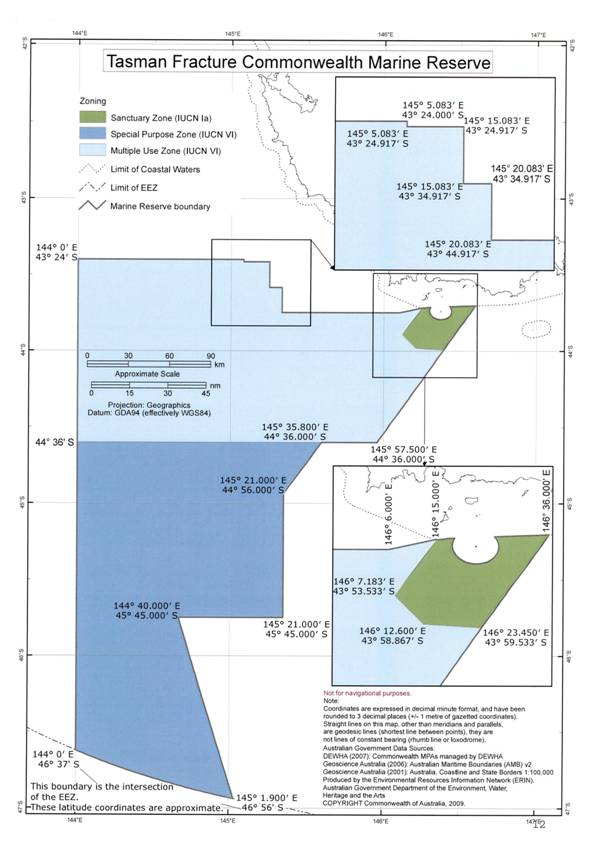
WHERE MADE: |
THE COURT DECLARES THAT:
1. On or about 22 January 2011, the first respondent contravened s 354(1)(f) of the Environment Protection and Biodiversity Conservation Act 1999 (Cth) (the EPBC Act) by engaging in commercial rock lobster fishing activities within the Tasman Fracture Commonwealth Marine Reserve.
2. On or about 22 January 2011, the second respondent contravened s 354(1)(f) of the EPBC Act by reason of the fact that the first respondent’s commercial rock lobster fishing activities within the Tasman Fracture Commonwealth Marine Reserve were undertaken on behalf of the second respondent.
THE COURT ORDERS THAT:
3. Pursuant to s 481 of the EPBC Act, for the contravention described in par 1 above, the first respondent pay to the Commonwealth of Australia a pecuniary penalty of $13,000.00.
4. Pursuant to s 481 of the EPBC Act, for the contravention described in par 2 above, the second respondent pay to the Commonwealth of Australia a pecuniary penalty of $65,000.00.
5. The first respondent pay part of the applicant’s costs of and incidental to this proceeding such part agreed at $17,000.00.
6. The second respondent pay part of the applicant’s costs of and incidental to this proceeding such part agreed at $28,000.00.
Note: Entry of orders is dealt with in Rule 39.32 of the Federal Court Rules 2011.
AUSTRALIAN CAPITAL TERRITORY DISTRICT REGISTRY | |
GENERAL DIVISION | ACD 35 of 2012 |
BETWEEN: | MINISTER FOR SUSTAINABILITY, ENVIRONMENT, WATER, POPULATION AND COMMUNITIES Applicant
|
AND: | DESMOND JOHN WOODLEY First Respondent VENTURE FISHING PTY LTD (ACN 114 710 084) Second Respondent
|
JUDGE: | FOSTER J |
DATE: | 4 SEPTEMBER 2012 |
PLACE: | SYDNEY (HEARD IN CANBERRA) |
REASONS FOR JUDGMENT
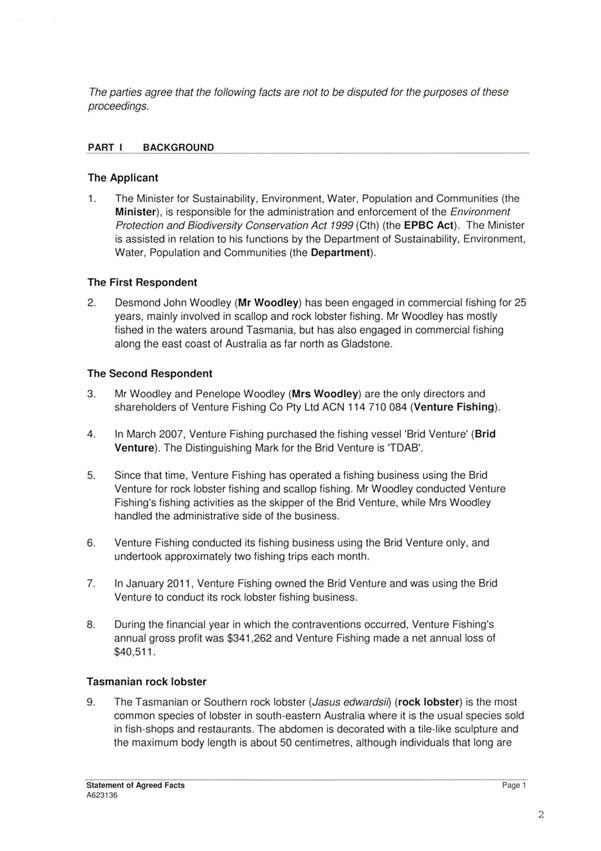
1 The applicant (the Minister) has the responsibility of administering the Environment Protection and Biodiversity Conservation Act 1999 (Cth) (the EPBC Act). Desmond John Woodley, who is the first respondent, and his wife, Penelope Woodley, are the only directors and shareholders of Venture Fishing Co Pty Ltd (Venture) which is the second respondent. Venture is, in every sense, a Woodley family company.
2 By his Originating Application, the Minister seeks declarations and pecuniary penalties pursuant to s 481 of the EPBC Act against Mr Woodley and Venture for a contravention of s 354(1)(f) of the EPBC Act. Mr Woodley and Venture are alleged to have contravened that section by engaging in commercial rock lobster fishing activities within the Tasman Fracture Commonwealth Marine Reserve (the Reserve) in January 2011.
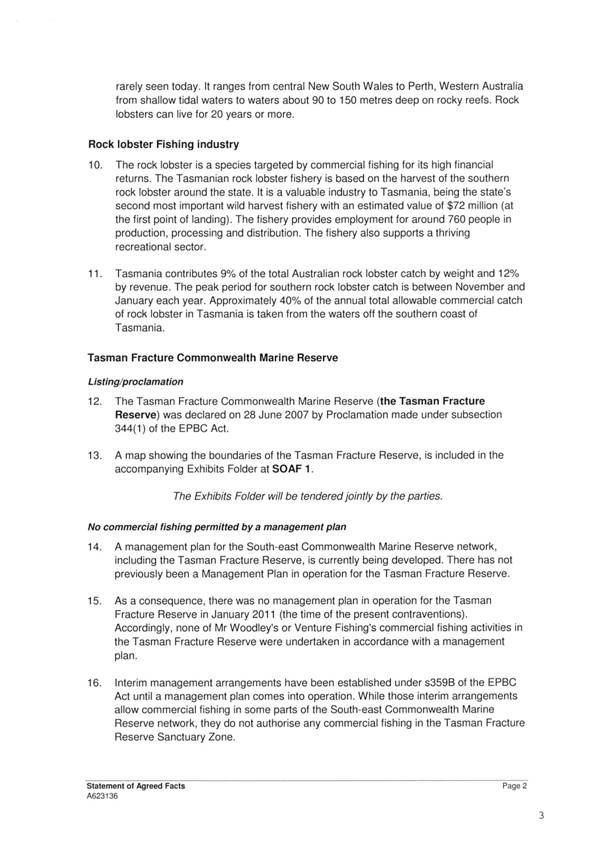
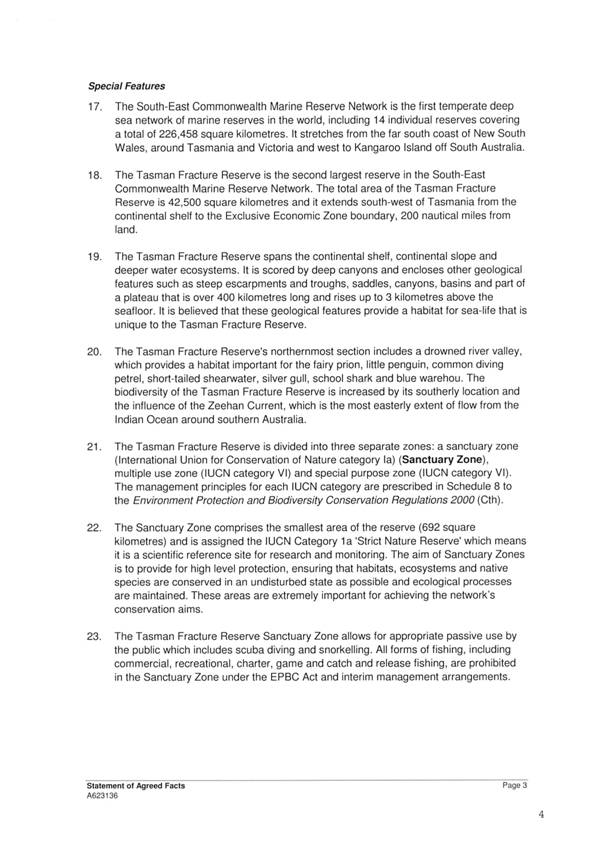
3 Both Mr Woodley and Venture have admitted the contravention. Indeed, the parties formally agreed on a Statement of Agreed Facts (Ex A). A copy of Ex A is attached to these Reasons as Attachment 1.
4 The Minister seeks a pecuniary penalty against Mr Woodley in the range of $10,000 to $15,000. He seeks a pecuniary penalty against Venture in the range of $50,000 to $75,000.
The Relevant Legislative Provisions
5 Section 354(1) of the EPBC Act is, and was as at January 2011, in the following terms:
354 Activities that may be carried on only under management plan
(1) A person must not do one of the following acts in a Commonwealth reserve except in accordance with a management plan in operation for the reserve:
(a) kill, injure, take, trade, keep or move a member of a native species; or
(b) damage heritage; or
(c) carry on an excavation; or
(d) erect a building or other structure; or
(e) carry out works; or
(f) take an action for commercial purposes.
Civil penalty:
(a) for an individual—500 penalty units;
(b) for a body corporate—5,000 penalty units.
6 As at January 2011, there was no “management plan” in operation for the Reserve, within the meaning of s 354(1). As at January 2011, interim arrangements pursuant to s 359B of the EPBC Act for the management of the South-East Commonwealth Marine Reserve Network (which includes the Reserve) had been put in place. Those arrangements did not authorise commercial fishing in the Tasman Fracture Reserve Sanctuary Zone (the Sanctuary Zone). The Sanctuary Zone is located within the Reserve. As at January 2011, the Reserve was a “reserve” within the meaning of s 354(1). On 28 June 2007, the Reserve was declared under Div 4 of Pt 15 of the EPBC Act and thus became a “Commonwealth reserve” within the meaning of that expression in s 354(1) (see the definition of “Commonwealth reserve” in s 528 of the EPBC Act). Commercial fishing is “an action for commercial purposes” within the meaning of s 354(1).
7 Section 481 of the EPBC Act is in the following terms:
481 Federal Court may order person to pay pecuniary penalty for contravening civil penalty provision
Application for order
(1) Within 6 years of a person (the wrongdoer) contravening a civil penalty provision, the Minister may apply on behalf of the Commonwealth to the Federal Court for an order that the wrongdoer pay the Commonwealth a pecuniary penalty.
Court may order wrongdoer to pay pecuniary penalty
(2) If the Court is satisfied that the wrongdoer has contravened a civil penalty provision, the Court may order the wrongdoer to pay to the Commonwealth for each contravention the pecuniary penalty that the Court determines is appropriate (but not more than the relevant amount specified for the provision).
Determining amount of pecuniary penalty
(3) In determining the pecuniary penalty, the Court must have regard to all relevant matters, including:
(a) the nature and extent of the contravention; and
(b) the nature and extent of any loss or damage suffered as a result of the contravention; and
(c) the circumstances in which the contravention took place; and
(d) whether the person has previously been found by the Court in proceedings under this Act to have engaged in any similar conduct.
Conduct contravening more than one civil penalty provision
(4) If conduct constitutes a contravention of 2 or more civil penalty provisions, proceedings may be instituted under this Act against a person in relation to the contravention of any one or more of those provisions. However, the person is not liable to more than one pecuniary penalty under this section in respect of the same conduct.
8 In s 481(3)(a) to (d), the legislature has specified four matters which are required to be taken into account by the Court in determining an appropriate pecuniary penalty as part of the concept of “… all relevant matters”.
The Relevant Facts
9 The agreed facts are specified in the Statement of Agreed Facts. In this section of these reasons, I will set out the most important of them. However, it should be noted that, in coming to my decision in this matter, I have considered and taken into account all of the facts and matters specified in the Statement of Agreed Facts.
10 Mr Woodley is a very experienced commercial fisherman, having been engaged as such for 25 years. He has mostly fished in waters around Tasmania. He has focussed most of his activities on scallop and rock lobster fishing.
11 In March 2007, Venture purchased the fishing vessel “Brid Venture”. The distinguishing mark for the Brid Venture is “TDAB”. Since 2007, Venture has conducted its business using the Brid Venture. Mr Woodley acts as the skipper of that vessel. Mrs Woodley looks after the administration of Venture’s business.
12 During the 2010–2011 Financial Year, Venture’s gross profit was $341,262. It made a net loss during that year of $40,511.
13 Commercial fishermen target rock lobster because of its capacity to deliver high financial returns. The Tasmanian rock lobster fishery is valuable to Tasmania and to Australia.
14 The Sanctuary Zone is the smallest part of the Reserve (692 sq km). It has been assigned the IUCN Category 1a “Strict Nature Reserve”. The effect of that categorisation is that the Sanctuary Zone is a scientific reference site for research and monitoring. Sanctuary zones are to be afforded a very high level of protection.
15 The Sanctuary Zone may be used for passive activities such as scuba diving and snorkelling. All forms of fishing are prohibited in the Sanctuary Zone. That was also the position in January 2011.
16 Under their commercial and licence arrangements with Craig Mostyn & Co Pty Ltd and Badenach Enterprises Pty Ltd, Venture and Mr Woodley were only permitted to fish in State waters. Neither Venture nor Mr Woodley were authorised to fish in Commonwealth waters.
17 Paragraphs 26 to 31 of the Statement of Agreed Facts are in the following terms:
26. In January 2011, Mr Woodley took the Brid Venture out to sea to undertake commercial rock lobster fishing in the waters south of Tasmania. At all times during the rock lobster fishing trip, Mr Woodley was the skipper of the Brid Venture and in charge of the other crew member on board the Brid Venture.
27. On 22 January 2011, Mr Woodley was fishing at a small island named Pedra Branca. Mr Woodley then headed the Brid Venture to the north-west towards Mewstone island (the Mewstone), where he planned to undertake rock lobster fishing activities. In taking this course, Mr Woodley took the Brid Venture through the Sanctuary Zone of the Tasman Fracture Reserve.
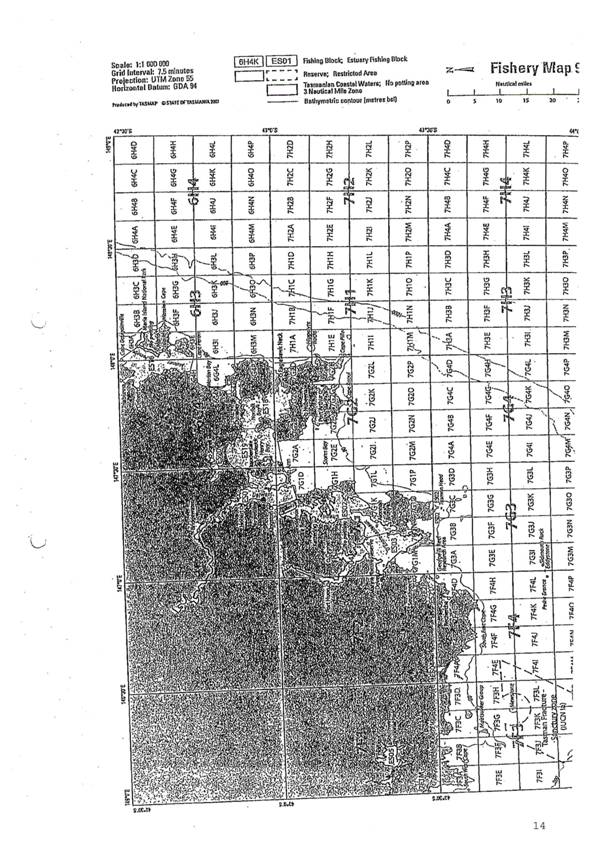
28. In the course of his fishing activities, Mr Woodley had regard to Fishery Map 9 which divided the fishing area into grid references. Mr Woodley was required to mark the location of all rock lobster caught on a Rock Lobster Catch Record using grid references on Fishery Map 9. As such, Mr Woodley was familiar with Fishery Map 9 and it was in constant use, including during the present fishing trip. The Tasman Fracture Reserve is clearly marked on Fishery Map 9.
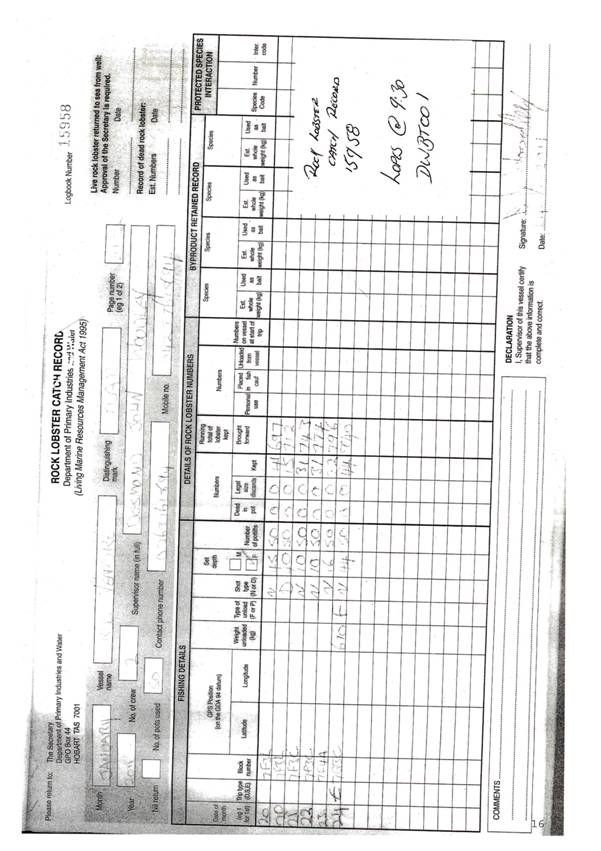
29. A copy of Fishery Map 9 is included as SOAF 2. A copy of the rock lobster Catch Record for 20 to 24 January 2011 that was completed by Mr Woodley is included as SOAF 3.
30. Mr Woodley had initially planned to continue to the south of the Mewstone, where he believed the better rock lobster fishing grounds are found – close to the Mewstone itself. However, Mr Woodley changed his mind when he noticed a lot of yachts heading for the same area. Mr Woodley believed that the yachts were racing around the Mewstone and he wanted to keep his rock lobster fishing gear out of the way. Mr Woodley then set a rock lobster pot at each of the following locations:
30.1. 43.44.980S and 146.27.570E;
30.2. 43.45.020S and 146.27.477E;
30.3. 43.45.006S and 146.28.397E; and
30.4. 43.45.060S and 146.28.514E.
31. All of the rock lobster pots were located between 0.83 nautical miles to 1.52 nautical miles (approximately 1.5 to 2.8 kilometres) inside the boundaries of the Sanctuary Zone of the Tasman Fracture Commonwealth Marine Reserve, at a depth of about 120 to 130 metres.
18 It is apparent from the Brid Venture’s rock lobster catch record that, on 20 and 21 January 2011, the vessel spent some time fishing in and near grid reference 7F3L. Almost all of the area covered by that grid reference is within the Sanctuary Zone.
19 The Brid Venture was detected in the Sanctuary Zone by the Tasmanian Police vessel “Vigilant” and intercepted.
20 Mr Woodley had set four lobster pots in the Sanctuary Zone. They remained there for approximately four hours. No lobsters from the Reserve were caught by Mr Woodley on this occasion.
21 Commercial rock lobster fishing has a range of potentially harmful impacts upon the Reserve.
22 At the hearing, by consent, par 50 of the Statement of Agreed Facts was amended so as to read:
Mr Woodley intends to file a debtor’s petition.
The Supplementary Defence
23 On 20 July 2012, Mr Woodley filed his Defence. That pleading was in the following terms:
The first respondent admits paragraphs 1 to 26 of the Statement of Claim [in] ACD 35/2012.
24 On the same day, a second Defence was filed. That document was signed by both Mr and Mrs Woodley. In that document, the following was said:
The first respondent and another [referring to Venture] admits paragraphs 1 to 26 of the Statement of Claim [in] ACD 35 of 2012.
25 Prior to the hearing, I had given Mr Woodley leave to appear on behalf of Venture and to represent it in this proceeding.
26 The circumstance that both Mr Woodley and Venture had formally admitted all of the allegations made by the Minister in his Statement of Claim led to the preparation of the Statement of Agreed Facts.
27 Several documents were attached to the Defence signed by Mr and Mrs Woodley. One of those documents was a handwritten Statement signed by Mr Woodley. The following matters can be gleaned from those documents:
(i) As at 4 June 2012, Venture owed $855,261.54 to National Australia Bank Limited in respect of its acquisition of the Brid Venture. The loan was called up on 4 June 2012.
(ii) As at July 2012, Venture was in default under other facilities with the NAB.
(iii) As at 20 July 2012, the Brid Venture had been repossessed by the NAB or its agent.
28 On 8 August 2012, the Minister filed and served upon Mr Woodley and Venture a Written Submission dated that day. The parties had filed the Statement of Agreed Facts on 2 August 2012.
29 On 9 August 2012 (which was the day before the hearing), Mr Woodley filed in the Registry of the Court a document entitled “Defence”. There is no text in the formal part of that document. However, there is attached to that document a two-page handwritten statement signed by Mr Woodley. At the hearing, I marked these documents as Ex 1.
30 In his handwritten statement, Mr Woodley complained that the penalties that were being sought by the Minister were too severe. After again expressing remorse and emphasising that the contravention was not deliberate, Mr Woodley went on to say:
While working the Vessel Brid Venture for seven years, I always had on a VMS—Vessel Monitoring System which can detect the vessel at all times day & night—from Canberra. It is not compulsory to have one fitted while crayfishing—but I never turned it off—so it would be foolish of me to do any thing wrong deliberately.
31 He concluded his statement by saying that he was not in a position to pay a large fine.
32 At the hearing, I treated Mr Woodley’s handwritten statement in Ex 1 as evidence and admitted it on the question of penalty only. In light of that decision, I then allowed the Minister to read and to rely upon the affidavit of Mark Lockerbie affirmed on 10 August 2012. In that affidavit, Mr Lockerbie said:
1. I am a Fisheries Officer, National Compliance Operations (Canberra), within AFMA. I am responsible for administering compliance and breaches of the Fisheries Management Act 1991 (Cth).
2. Commercial fishing in Commonwealth waters is regulated through the use of designated fisheries which describe the types and locations of various fishing activities. In order to ensure efficient management and ecologically sustainable use of fishing resources, AFMA controls and limits commercial fishing in Commonwealth fisheries through a permit system.
3. The position of commercial fishing vessels is automatically recorded by AFMA using a Vessel Monitoring System (VMS) which regularly relays information on vessel position, course and speed to AFMA head office in Canberra. The ‘polling track’ of a vessel is the course of the vessel plotted from the information recorded by the VMS.
4. On 9 and 10 August 2012, 1 received emails from the Marine Division of the Department of Sustainability, Environment, Water, Population and Communities requesting the following information:
4.1. Whether the Brid Venture has a VMS fitted;
4.2. The Brid Venture’s polling track on 22 January 2011.
5. I have performed a search of the records held by AFMA. The vessel Brid Venture, did not poll on AFMA’s VMS for the entire month of January 2011. Screenshots of the search I performed is Annexed and marked Annexure ML1.
6. A temporary switch off has been issued to the Brid Venture. A temporary switch off is applied for by vessels who are not fishing, and they are in effect whilst the vessel is in port. When they are going to leave port whether it be to fish on a State licence or on their Commonwealth Concession it is a condition of their temporary switch off that they must call AFMA, tell AFMA they are going out to sea, and switch on the VMS.
7. From the absence of polling from the vessel’s VMS system I can say that:
7.1. the vessel was not being used in January 2011; or
7.2. if the vessel was being used in January 2011, the VMS was switched off, or otherwise not functioning, at that time.
33 Mr Woodley’s handwritten statement forming part of Ex 1 is directed to the question of whether the contravention was deliberate (in the sense of “intentional”). Mr Woodley suggested that the fact that the Brid Venture’s movements were constantly being monitored by AFMA (the Australian Fisheries Management Authority) meant that, were the vessel to enter the Sanctuary Zone, it would have been easily detected and identified as having done so. Mr Woodley then contended that, knowing this, he would have been incredibly stupid to have intentionally caused the vessel to enter that zone because he almost certainly would have been caught. He submitted that, for these reasons, the Court should hold that the contravention was not deliberate. It was the perceived need to answer this ultimate contention made by Mr Woodley that led the Minister to obtain and rely upon Mr Lockerbie’s affidavit. Mr Lockerbie testified that the VMS fitted to the Brid Venture was either switched off, or otherwise not functioning, for the whole of January 2011.
34 When faced with Mr Lockerbie’s evidence, Mr Woodley said that he had experienced some difficulties with the VMS fitted to the Brid Venture in early 2011. He accepted that the VMS may have been malfunctioning at that time.
35 I do not need to decide whether the VMS fitted to the Brid Venture was switched off or whether it was malfunctioning in January 2011. It is clear that it was not operational for the whole of that month, for whatever reason.
36 Whether the VMS was working or not does not matter for present purposes. This is because the parties have agreed that the admitted contraventions were not intentional (or “deliberate”, to use Mr Woodley’s term). I will proceed to impose penalties on the basis of that agreement.
Consideration
37 This proceeding concerns a single contravention of s 354(1)(f) of the EPBC Act by Mr Woodley and Venture. Both Mr Woodley and Venture admit the contraventions alleged against them.
38 The detailed facts giving rise to those contraventions are set out in the Statement of Claim and in the Statement of Agreed Facts. In those circumstances, evidence is not required to prove the existence of the agreed facts and evidence may not be adduced to contradict or qualify any of the agreed facts unless the Court gives leave to a party so to do (see s 191(2) of the Evidence Act 1995 (Cth) and Minister for Environment, Heritage and the Arts v PGP Developments Pty Ltd (2010) 183 FCR 10 at [30]–[37]).
39 The maximum penalty for a contravention of s 354(1)(f) of the EPBC Act is $55,000 for an individual and $550,000 for a body corporate. Section 354A of the EPBC Act creates certain cognate criminal offences and provides for severe maximum penalties for those offences. These circumstances indicate that the protection of the environment is considered by the legislature to be a matter of high importance.
40 At [31] (p 372) in Markarian v The Queen (2005) 228 CLR 357, Gleeson CJ, Gummow, Hayne and Callinan JJ said:
31. It follows that careful attention to maximum penalties will almost always be required, first because the legislature has legislated for them; secondly, because they invite comparison between the worst possible case and the case before the court at the time; and thirdly, because in that regard they do provide, taken and balanced with all of the other relevant factors, a yardstick. That having been said, in our opinion, it will rarely be, and was not appropriate for Hulme J here to look first to a maximum penalty (The maximum selected by his Honour was not, as will appear, the maximum available in respect of the principal offence) and to proceed by making a proportional deduction from it. That was to use a prescribed maximum erroneously, as neither a yardstick, nor as a basis for comparison of this case with the worst possible case.
41 In this Court, these remarks by the High Court in Markarian have been held to apply to the imposition of civil penalties (see Australian Ophthalmic Supplies Pty Ltd v McAlary-Smith (2008) 165 FCR 560 at [108] (p 584) and Secretary, Department of Health and Ageing v Export Corp (Australia) Pty Ltd (2012) 288 ALR 702 at [49]–[50] (p 714) and at [67] (p 718)).
42 The penalties sought by the Minister in the present case are towards the low end of the available range set by the legislature (18%–27% of the maximum for Mr Woodley and 9%–13% of the maximum for Venture).
43 In his Defence, Mr Woodley submitted that the contravention was not intentional, that he and Venture both had unblemished records in respect of environmental matters, that he had co-operated with the authorities in the conduct of the litigation, that he was truly sorry for what he had done and that he had “… learnt his lesson …”. To this list of factors which count in favour of Mr Woodley and Venture must be added the following additional matters, namely:
(a) Both respondents admitted the contraventions in full. That conduct led to the production of the Agreed Statement of Facts. This co-operation on the part of Mr Woodley and Venture saved the Minister a great deal of time, effort and expense. It has also meant that there has been a considerable saving of the Court’s time.
(b) There was only one contravention. It appears to have been a “one-off” event.
(c) No lobsters were actually caught by Mr Woodley in the Sanctuary Zone or in the Reserve on the occasion in question.
(d) Both Mr Woodley and Venture are experiencing financial difficulties at the present time. The precise detail of those difficulties was not the subject of evidence beyond the documents attached to the second Defence referred to at [27] above.
44 The matters listed at [43] above were identified by Counsel for the Minister as being relevant in determining penalty and in favour of Mr Woodley and Venture. Those matters were accepted by him as being relevant to the determination of penalty.
45 In determining the appropriate penalties in this case, I intend to take into account all of the matters listed at [43] above in favour of Mr Woodley and Venture.
46 Counsel for the Minister submitted that, in addition to the four matters specified in s 481(3) of the EPBC Act, the Court has held on previous occasions that, in matters such as those with which I am presently dealing, it is appropriate to have regard to:
(a) The contravenor’s co-operation during investigations and subsequent Court proceedings;
(b) Any relevant prior “record” on the part of the contravening party;
(c) The contravenor’s business arrangements and financial circumstances; and
(d) Any remorse or contrition shown by the contravenor.
47 Counsel for the Minister emphasised that the principal object of civil penalty provisions is to ensure deterrence. In Trade Practices Commission v CSR Ltd [1991] ATPR 41-076, which was a case dealing with s 76 of the Trade Practices Act 1974 (Cth), French J said (at p 52,152):
The principal, and I think probably the only, object of the penalties imposed by s 76 is to attempt to put a price on contravention that is sufficiently high to deter repetition by the contravenor and by others who might be tempted to contravene the Act.
48 It was submitted on behalf of the Minister that the dictum of French J in Trade Practices Commission v CSR Ltd has been applied not only in the Trade Practices context but in a wide variety of other regulatory regimes. In particular, it was submitted that the need for a penalty to have a proper deterrent effect had been emphasised in the context of the EPBC Act in a number of cases (Minister for Sustainability, Environment, Water, Population and Communities v De Bono [2012] FCA 643 at [49] and [54]; Minister for Environment, Heritage and the Arts v PGP Developments Pty Ltd at [16]; Minister for Environment, Heritage and the Arts v Rocky Lamattina & Sons Pty Ltd (2009) 258 ALR 107, (2009) 167 LGERA 219 at [46]–[47]; Minister for Environment and Heritage v Warne [2007] FCA 599 at [15]–[16]; Minister for the Environment and Heritage v Wilson [2004] FCA 6 at [7]; and Minister for the Environment and Heritage v Greentree (No 3) (2004) 136 LGERA 89 at [69]–[70] and [81]).
49 Counsel for the Minister submitted that I should approach the determination of the penalties in the present case by applying the process commonly called “instinctive synthesis”. He submitted that this process was described in Markarian as having the following attributes:
(a) There must be a weighing of all relevant factors, rather than starting from some pre-determined figure and making incremental additions or subtractions for each separate factor (Markarian at [36]–[39] (pp 373–375) (per Gleeson CJ, Gummow, Hayne and Callinan JJ) and at [69]–[73] (pp 385–387) (per McHugh J)); and
(b) It is critical that the reasoning process involved in synthesising the penalty be transparent (Markarian at [36]–[39] (pp 373–375) (per the plurality) and at [84] (p 390) (per McHugh J)).
50 I think that the submissions made on behalf of the Minister which I have summarised at [46]–[49] above are correct and I accept them. I shall approach the imposition of penalties in the present case with those submissions firmly in mind.
51 I now turn to address the factors which operate against Mr Woodley and Venture and which suggest that penalties in the range sought by the Minister are appropriate.
52 Mr Woodley is likely to continue working for some time in the future as a commercial fisherman. Whilst he has co-operated in the swift determination of this proceeding and declared his genuine remorse, the penalty imposed nonetheless should be such as to ensure that he does not repeat the contravening conduct. There is an element of special deterrence that needs to be reflected in the penalties imposed.
53 As is usually the case in matters such as this, I should reflect the need for general deterrence in the penalties which I impose.
54 The provisions of Pt 15 of the EPBC Act are designed to ensure that areas of international and/or national environmental significance are protected and managed consistently with the natural values of the area and Australia’s international environmental responsibilities. By the various mechanisms adopted in the legislation, the objects of the Act set out in s 3(1) are advanced.
55 Non-compliance with Pt 15 of the EPBC Act is likely to:
(a) Directly cause harm to the environment;
(b) Undermine the objects of the EPBC Act;
(c) Create or increase environmental risks;
(d) Reduce public confidence in the effective protection of the environment under the EPBC Act; and
(e) Discourage other persons from incurring costs associated with taking steps necessary to comply with the EPBC Act.
56 The consequences to which I have referred at [55] above are all very serious.
57 In addition, there are other matters to be considered under the heading of general deterrence:
(a) The marine areas off the south coast of Tasmania are subject to significant levels of commercial rock lobster fishing, which is a major and valuable commercial activity.
(b) The detection of illegal rock lobster fishing is extremely difficult. This is because:
(i) There are large areas of Commonwealth marine reserves protected under the EPBC Act;
(ii) Rock lobster fishing pots are not readily observed unless seen from quite close;
(iii) Rock lobster pots can be easily and swiftly placed and just as easily and swiftly removed, making such fishing a mobile and transitory affair; and
(iv) Access to legitimate commercial markets to dispose of rock lobsters that are illegally caught is easy. When lobsters are ultimately sold, it is not possible from their appearance or otherwise to determine precisely where they have been caught.
58 In addition, there are significant commercial gains to be achieved by fishing in protected areas for rock lobster because the sale of rock lobster is a very profitable activity.
59 In a nutshell, those who may be tempted to fish in protected areas may think that the risk is worth taking because of the potential for significant financial gain and the low level of risk of detection.
60 The Sanctuary Zone is a highly protected area. No fishing whatsoever is permitted there.
61 Whilst it is true that no lobsters were caught by Mr Woodley in the Sanctuary Zone on the occasion in question, that is more perhaps the result of the early but coincidental detection of the Brid Venture in the prohibited area by the Tasmanian Police vessel Vigilant than anything else.
62 If those who contravene s 354(1) of the EPBC Act receive relatively small penalties when apprehended, there is every chance that commercial fishermen will conclude that the benefits of fishing in protected areas (given its potential for deriving significant financial rewards) far outweigh the risk of being caught committing a contravention because the risk of detection is low and the financial penalties relatively insignificant. If such conduct is undertaken, the harm to the environment is likely to be significant.
63 In the present case, although the contravention was not intentional, it was certainly reckless. Mr Woodley was aware of the existence and location of the Reserve and the Sanctuary Zone and was well aware that it was illegal to set lobster pots within the Reserve. At all times whilst engaged in rock lobster fishing in January 2011, Mr Woodley had access to Fishery Map 9. That map clearly showed the boundaries of the Sanctuary Zone. Mr Woodley had used Fishery Map 9 on a daily basis in the period towards the end of January 2011. Just before committing the contravention, he had set 100 lobster pots very close to the boundary of the Sanctuary Zone. Despite all this, Mr Woodley said that he did not turn his mind to the question of whether he was setting his pots in the prohibited Zone.
64 Whilst the Minister accepts that Mr Woodley and Venture are both in financial difficulties, the Minister submitted that this factor should be given little weight, given the importance of the other factors to which I have referred at [46]–[63] above. The Minister also submitted that, had Mr Woodley wished the financial position of him and Venture to be taken into account in a more significant way, it was incumbent upon him to place detailed evidence before the Court directed to establishing the financial position of each of the contravenors. This he did not do.
65 Finally, the Minister submitted that Mr Woodley had not offered co-operation of any moment during the course of the investigation. Rather, he had left his co-operation to the point in time when it was inevitable that the contraventions would be established.
66 Whilst Mr Woodley is clearly the controlling mind of Venture, that fact does not mean that only one penalty is appropriate or that a purely nominal penalty should be imposed upon one or other of the respondents. This is particularly the case where, as here, much greater maximum penalties are applicable to corporations than to individuals (see Fair Work Ombudsman v Ramsey Food Processing Pty Ltd (No 2) [2012] FCA 408 at [8] (per Buchanan J)). Venture was, after all, the trading vehicle for the commercial fishing activities conducted by Mr Woodley. It would have been the repository of the financial rewards from the contravention, had any lobsters actually been caught in the Reserve.
67 I think that I should give significant weight to the need for general deterrence in the present case bearing in mind that the contraventions of the type with which I am dealing are extremely difficult to detect. Although the mitigating factors in favour of Mr Woodley and Venture mean that the present case is not at the worst end of the spectrum, nonetheless the high importance attached to the protection of the environment in the respects specified in the EPBC Act, coupled with the other matters to which I have referred at [46]–[66] above, suggest that a penalty in the range submitted by the Minister for each of the contravenors is appropriate. I have decided to impose a penalty on Mr Woodley at a point in the range submitted by the Minister which is just above the mid point of that range. I accept the Minister’s submission that Venture should receive a penalty of five times that which is imposed upon Mr Woodley.
68 I propose to impose a penalty of $13,000 on Mr Woodley and a penalty of $65,000 on Venture. I also propose to make the declarations sought by the Minister. Costs should follow the event.
69 Earlier today, I was informed by the solicitor for the Minister that the parties had agreed on the terms of the appropriate orders for costs. The agreement is that:
(a) The first respondent should be ordered to pay $17,000.00 towards the Minister’s costs; and
(b) The second respondent should be ordered to pay $28,000.00 towards those costs.
70 I will reflect the terms of that agreement in the costs orders which I shall make.
71 There will be orders accordingly.
I certify that the preceding seventy-one (71) numbered paragraphs are a true copy of the Reasons for Judgment herein of the Honourable Justice Foster. |
Associate:
Attachment 1