

FEDERAL COURT OF AUSTRALIA
ACP Machinery Australia Pty Ltd v Aerospace Technologies of Australia Pty Ltd (No 2) [2012] FCA 949
IN THE FEDERAL COURT OF AUSTRALIA | |
DATE OF ORDER: | |
WHERE MADE: |
THE COURT ORDERS THAT:
1. The Applicant has leave to file and serve a third further amended statement of claim in the form proposed.
2. The Respondents file and serve a defence to the third further amended statement of claim by 3 September 2012.
3. The Applicant pay the Respondents’ costs thrown away by reason of the amendment to the statement of claim, including costs thrown away by reason of the abandonment of the DLL file claim (if any).
4. The Respondents file and serve by 14 December 2012 any affidavits in answer to:
(a) the affidavit of Dr Bruce Field dated 24 July 2012; and
(b) issues arising out of the third further amended statement of claim.
5. The Applicant file and serve any affidavit in reply to such affidavits in answer by 25 February 2013.
6. The Applicant provide additional security of $80,000 within 14 days in respect of the Respondents’ costs up to and including 13 August 2012.
7. The Applicant pay the Respondents’ costs of their interlocutory application dated 13 August 2012.
8. The Respondents’ interlocutory application dated 13 August 2012 otherwise be dismissed.
9. The hearing be adjourned to 22 April 2013, with a revised estimate of 15 days.
10. The costs of the adjournment be reserved.
11. The Applicant file and serve 21 days prior to trial a supplementary court book folder containing any additional material relied on by the parties.
12. The parties file and serve any objections as to admissibility of any further evidence 21 days prior to trial.
13. The Applicant file and serve an outline of opening submissions (not to exceed 15 pages) 14 days prior to trial.
14. The Respondents file and serve an outline of opening submissions (not to exceed 15 pages) 7 days prior to trial.
15. Orders 9, 10, 11 and 12 of the Orders made on 1 December 2011 are vacated.
16. Liberty to apply.
Note: Entry of orders is dealt with in Rule 39.32 of the Federal Court Rules 2011
VICTORIA DISTRICT REGISTRY | |
GENERAL DIVISION | VID 765 of 2010 |
BETWEEN: | ACP MACHINERY AUSTRALIA PTY LTD (ACN 066 485 925) Applicant
|
AND: | AEROSPACE TECHNOLOGIES OF AUSTRALIA PTY LTD (ACN 008 622 008) First Respondent BOEING AEROSTRUCTURES AUSTRALIA PTY LTD (ACN 103 165 466) Second Respondent
|
JUDGE: | DODDS-STREETON J |
DATE: | 20 AUGUST 2012 |
PLACE: | MELBOURNE |
REASONS FOR JUDGMENT
INTRODUCTION
1 On 20 August 2012, I made the orders set out above for the reasons that follow.
2 By an interlocutory application dated 14 August 2012, the respondents, Aerospace Technologies of Australia Pty Ltd (“Aerospace”) and Boeing Aerostructures Australia Pty Ltd (“Boeing”) sought that the applicant, ACP Machinery Australia Pty Ltd (“ACP”), give security for costs. The respondents also sought that the applicant be precluded from relying on the affidavit of Bruce William Field sworn on 24 July 2012 (“the Field affidavit”), or alternatively, that the respondents have four months to respond to the Field affidavit and that the trial date, which was fixed for 3 September 2012, be adjourned accordingly.
3 The respondents’ application was supported by:
1. the affidavit of Christopher Round affirmed on 13 August 2012; and
2. written submissions dated 16 August 2012.
4 The application was opposed. The affidavit of Andrew Goatcher sworn on 17 August 2012 and written submissions dated 17 August 2012 were filed in opposition.
5 At the hearing of the respondents’ application, the applicant, ACP, sought leave to amend its second further amended statement of claim in the form exhibited to Mr Goatcher’s affidavit.
Application for leave to amend second further amended statement of claim
6 The principal amendments for which the applicant sought leave were as follows:
3A The Contract is binding on Boeing.
5B ACP developed, or in the alternative ACP developed jointly with CI Technology Pty Ltd Elmeq Nederland BV, a software module (the DLL File) for use in conjunction with the software supplied by CI Technology Pty Ltd software improvements and enhancements for the user interface software for the UHF, including the screen layout designs (the CITEC Software), which was fixed in tangible form and made available by ACP to Aerospace.
5E In about December 2005 Aerospace or alternatively Boeing provided the CITEC Software, including the DLL File, to Marand.
Particulars
The provision of the CITEC Software, including the DLL File, was either as an attachment to an email dated 15 December 2005 from Peter Steele to Nicholas Pratt (Respondents’ discovered document numbers ASTA.010.002.0369, ASTA.010.002.0407) or was otherwise supplied by Boeing to Marand around that time. (Respondents’ discovered document numbered ASTA 010.002.0372). The screen layout designs were also provided. Annexures PNS22, Confidential PNS23, Confidential CS27 and Confidential CS29.
5F In breach of the clause alleged at paragraph 4 above, without obtaining approval from ACP, Aerospace used, or alternatively Boeing used, or alternatively Aerospace did not ensure that Boeing did not use, the CITEC Software, including the DLL File, for a future project.
Particulars
ACP refers to and repeats the matters alleged at paragraph 5E above. Further particulars will be provided on completion of supplementary discovery by the Respondents.
8 By reason of each of the breaches alleged at each of paragraphs 5D, 5F, 5I, 6 and 7 above, ACP has suffered loss and damage.
Particulars
ACP has lost the opportunity to bargain with Aerospace or Boeing to negotiate a payment for a licence for the use of the Technical Data, the CAD Drawings and/or the DLL File CITECT Software. ACP has lost the opportunity to itself supply fixtures or alternatively actuators meeting the requirements of Aerospace or Boeing, including as set out in the statements of work and/or as supplied by Marand.
7 The respondents opposed a grant of leave, principally on the basis that rather than simply abandoning a claim confined to the DLL File, which they had prepared to meet, the proposed amendments introduced substantive allegations (about software improvements and enhancements for the user interface software for the UHF including the screen layout designs (“the CITEC Software”) and Boeing’s provision of the CITEC Software) at a late stage prior to the scheduled trial.
8 The applicant contended that the proposed amendments were simply to achieve conformity between the pleading and the evidence now filed. Further, the applicant submitted that the issues should have been apparent to the respondents from the applicant’s evidence, to which the respondents’ affidavits had partly responded.
9 The applicant submitted that the lateness of the proposed amendments was principally because it had only recently obtained access to the confidential documents which enabled it accurately to define the issues.
10 While the lateness of the proposed amendment was to some extent due to matters beyond the applicant’s control, the relevant documents were those of a third party for which confidentiality was validly claimed. The proposed amendments raised issues of originality, authorship, and the definition of the CITEC Software, while suggesting an unidentified foundation for the improvements or enhancements. Those issues, while touched upon by filed evidence, were not hitherto obviously a part of the applicant’s case and the respondents could not address them in the short time remaining prior to the scheduled trial.
11 I considered that if the scheduled trial date were maintained, leave to amend should be refused on the basis that the proposed amendments were too late. As it was necessary to adjourn the trial for other reasons (discussed below) I granted leave to file and serve the third further amended statement of claim.
Security for costs
12 The respondents initially sought security for costs totalling $415,000, comprising:
1. $230,000 for costs already incurred; and
2. $260,000 for costs up to and including the trial,
less $75,000 already provided.
13 Before me, the applicant agreed to give security for the respondents’ costs up to and including the trial. The dispute therefore narrowed to whether the applicant should give security, and if so in what quantum, for costs already incurred.
14 In support of the application for security, Mr Round, of the solicitors for the respondents, deposed to a company search of the applicant undertaken on 21 February 2011, which disclosed that:
1. Since 28 December 2006, the applicant’s sole director and secretary was Alexander Ponfoort, who owned 90% of the shares, while a limited liability company incorporated in the Netherlands owned the remaining 10%.
2. The applicant was, since 19 June 2007, subject to a fixed and floating charge in favour of Westpac.
3. The applicant had an issued and paid up share capital of only $10 and was not the registered owner of any property in Victoria or New South Wales.
15 Further, Mr Round deposed that in about February 2011, Mr Goatcher, of the applicant’s solicitors, informed him that Mr Ponfoort resided in Singapore.
16 Mr Round deposed to his correspondence with the applicant’s solicitors in February 2011, in which he expressed concern that the applicant lacked the means to meet a costs order against it should the respondents successfully defend the claim and that enforcement would, in any event, be impossible, as the applicant effectively operated from Singapore and had no tangible assets in Australia. Mr Round therefore sought access to the applicant’s financial statements, and security for costs of $75,000 based on a conservative estimate of the respondents’ taxed costs up to the commencement of trial (excluding past costs). In his letter, Mr Round also stated that the respondents reserved the right to review the estimate of their costs should it prove inadequate. He estimated that the respondents’ costs would exceed $300,000 should the matter proceed to trial.
17 By a letter dated 1 March 2011, the solicitors for the applicant advised that the applicant would not provide its financial records, but offered security of $75,000 in the form of a payment into their trust account, to be released only on specified conditions. The letter expressly stated that the applicant did not concede that the respondents were entitled to security.
18 Mr Round deposed to a number of developments after the provision of the security in March 2011, by reason of which the sum of $75,000 proved to be a significant underestimate of the respondents’ costs, as follows:
1. extensive correspondence between the parties’ solicitors about the ethics investigation by one of Boeing’s employees;
2. Boeing’s agreement to accept liability for contracts entered into by ASTA;
3. provision of extensive, larger than anticipated discovery in tranches; and
4. resolution of confidentiality issues.
19 As Mr Round deposed, the applicant also twice further amended its statement of claim, by order made on 22 June 2011 after a contested hearing and by an order on 21 July 2011 made by consent, which expanded the applicant’s case.
20 The further amended statements of claim added allegations of breach of contract and copyright by misuse of Technical Data, CAD drawings and software in connection with a 2005 universal holding fixture (“UHF”) supplied to the respondents by Marand Pty Ltd (“Marand”).
21 The second further amended statement of claim added further allegations that the respondents infringed copyright in CAD drawings in connection with the supply of the 2005 UHF by Marand.
22 Discovery in relation to the issues arising from the amended pleadings took place in August 2011 and on 1 September 2011, and the applicant filed evidence by six deponents.
23 In March 2012, the respondents filed and served affidavits by nine deponents and in April 2012 issued subpoenas to two witnesses and filed and served a further affidavit.
24 Mr Round deposed that the respondents experienced difficulties in preparing answering evidence, as the allegations related to manufacture of UHFs during three different periods going back to 2001 involving different personnel or other witnesses, many of whom were no longer employed or were difficult to locate, reluctant to give evidence or unable to access their files.
25 Further, the subject matter was highly complex and technical and the respondents spent much time amending their own pleadings and addressing the new issues raised by the applicant’s amendments.
26 Mr Round deposed that he realised the extent of the underestimate of costs only in about April 2012. On 11 May 2012, he sought further security for costs to the commencement to trial of $225,000, made up as follows:
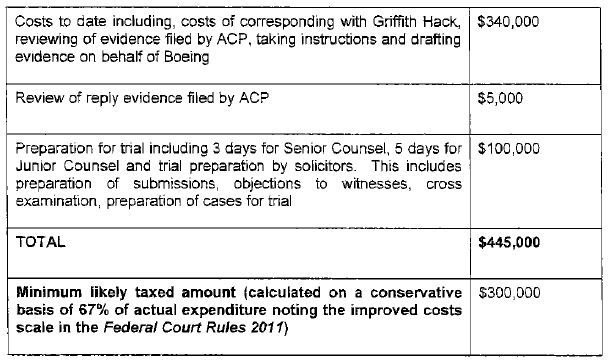
27 On 21 May 2012, the applicant declined to provide the further security, but offered (if Boeing paid a disputed claim of $306,480 it allegedly owed the applicant in respect of an invoice dated 11 November 2010) to hold $225,000 of that sum as security.
28 By a letter dated 3 August 2012, the respondents’ solicitors reiterated the request for further security, failing which they would make an application.
29 Mr Round deposed that Dr Field’s affidavit and the application to amend the second further amended statement of claim, foreshadowed on 10 August 2012, discussed below, would further impact on the costs.
30 Mr Round, a solicitor extensively experienced in intellectual property litigation, deposed to his analysis of the respondents’ costs. On the basis that they would, conservatively, be taxed at 67%, he estimated the respondents’ taxed costs to the date of his affidavit at $230,000.
31 Mr Round exhibited the confidential expert report of a costs consultant, Jenny Young, which estimated the respondents’ taxed costs to date of judgment at $442,091.49 and taxed costs incurred between 23 February 2011 and 7 August 2012 at $157,246.50.
32 When the sum of $75,000 already provided as security was subtracted, on the basis of the expert’s estimate, the respondents’ taxed costs incurred between March 2011 and August 2012 were approximately $157,000.
33 Mr Round deposed to updated searches of the applicant and deposed:
61 Having regard to:
(a) the searches annexed as CJR-12, CJR-13 and CJR-14 to this affidavit;
(b) the refusal of ACP to provide particulars evidencing its financial viability;
(c) the demand by ACP to pay the Alleged Debt as a precondition to providing security for costs; and
(d) the estimated costs likely to be awarded to Boeing in the event that ACP was unsuccessful at trial,
I consider that there is reason to believe that ACP would be unable to pay Boeing’s costs if so ordered.
34 Mr Goatcher, of the solicitors for the applicant, denied that he informed Mr Round that Mr Ponfoort, although he worked in Singapore from time to time, resided there. Mr Goatcher did not, however, dispute Mr Round’s account of the correspondence between the parties, the estimated quantum of costs or the assertion that the respondents would be unable readily to enforce a costs order.
35 Mr Goatcher nevertheless deposed that until May 2012, the applicant had assumed, on the basis of the correspondence, that only $75,000 would be required as security for costs up to trial, and further, that the respondents had accepted its refusal on 21 May 2012 to provide further security.
36 The applicant submitted that it was entitled to assume, and had prosecuted the proceeding on the basis, that security for the relevant period was limited to $75,000. The applicant submitted that security for costs already incurred should be ordered only in rare or exceptional circumstances.
37 The applicant further submitted that the matters on which the respondents relied to explain the delay were in fact entirely predictable, and the delay in seeking the significantly increased estimate in May 2012 was significant and not adequately explained.
38 Section 56 of the Federal Court of Australia Act 1976 (Cth) provides:
(1) The Court or a Judge may order an applicant in a proceeding in the Court, or an appellant in an appeal under Division 2 of Part III, to give security for the payment of costs that may be awarded against him or her.
(2) The security shall be of such amount, and given at such time and in such manner and form, as the Court or Judge directs.
(3) The Court or a Judge may reduce or increase the amount of security ordered to be given and may vary the time at which, or manner or form in which, the security is to be given.
(4) If security, or further security, is not given in accordance with an order under this section, the Court or a Judge may order that the proceeding or appeal be dismissed.
(5) This section does not affect the operation of any provision made by or under any other Act or by the Rules of Court for or in relation to the furnishing of security.
39 The Federal Court Rules 2011 (Cth) provide:
19.01 Application for an order for security for costs
(1) A respondent may apply to the Court for an order:
(a) that an applicant give security for costs and for the manner, time and terms for the giving of the security; and
(b) that the applicant’s proceeding be stayed until security is given; and
(c) that if the applicant fails to comply with the order to provide security within the time specified in the order, the proceeding be stayed or dismissed.
(2) An application under subrule (1) must be accompanied by an affidavit stating the facts on which the order for security for costs is sought.
19.02 Matters to be addressed by the respondent
The respondent’s affidavit should state the following:
(a) whether there is reason to believe that the applicant will be unable to pay the respondent’s costs if so ordered;
(b) whether the applicant is ordinarily resident outside Australia;
(c) whether the applicant is suing for someone else’s benefit;
(d) whether the applicant is impecunious;
(e) any other relevant matter.
40 Section 1335 of the Corporations Act 2001 (Cth) provides:
(1) Where a corporation is plaintiff in any action or other legal proceeding, the court having jurisdiction in the matter may, if it appears by credible testimony that there is reason to believe that the corporation will be unable to pay the costs of the defendant if successful in his, her or its defence, require sufficient security to be given for those costs and stay all proceedings until the security is given.
(1A) Subsection (1) does not apply to a corporation that is an Aboriginal and Torres Strait Islander corporation.
(2) The costs of any proceeding before a court under this Act are to be borne by such party to the proceeding as the court, in its discretion, directs.
41 In Baygol Pty Ltd v Huntsman Chemical Co Australia Pty Ltd [2004] FCA 1248, Tamberlin J stated at [9]-[11]:
It is common ground that the Court’s discretion is broad and unfettered and that the Court must have regard to all the circumstances of each particular case. The discretion must be exercised judicially. An order for security for costs is interlocutory in nature and the rules of Court do not delimit the Court’s discretion. The purpose of an order for costs in a case such as the present is to ensure the effective enforcement of any order the Court may make in favour of a successful respondent in circumstances where the applicant company is without any substantial assets to meet such order.
Some of the principles often applied by the Court when considering security for cost issues have been collected and stated by Beazley J in KP Cable Investments Pty Ltd v Meltglow Pty Ltd (1995) 56 FCR 189 at 196–198. These principles have been approved and applied in subsequent decisions of this Court: see Olbers Co Ltd v Commonwealth of Australia [2002] FCA 1269; Gartner v Ernst & Young (No 3) [2003] FCA 1437.
These principles in relation to security for costs applications can be summarised into the following considerations:
• whether the application was brought promptly;
• the strength and bona fides of the applicant’s case;
• whether the applicant’s impecuniosity was caused by the respondent’s conduct which is the subject of the claim;
• whether the respondent’s application for security is oppressive, in the sense that it is being used merely to deny an impecunious applicant a right to litigate;
• whether there are any persons standing behind the company who are likely to benefit from the litigation and are willing to provide the necessary security,
• whether persons standing behind the company have offered any personal undertaking to be liable for costs, and if so the form of any such undertaking;
• whether the party against whom the security for costs order is sought is a plaintiff.
42 In Sylverton Pty Ltd v Minter Ellison [2011] FCA 1072, Kenny J recently considered significant factors relevant to the exercise of the discretion at [18] and [19], as follows:
There are numerous factors that may be relevant to the Court’s exercise of discretion, including the nature of the risk that Sylverton will not be able to satisfy a costs order if made against it and in the respondent’s favour. Other factors may also be relevant such as the nature of the applicant’s claim, including the chances of success, whether an order for the giving of security would operate to prevent the applicant from pursuing the claim, and whether the applicant’s impecuniosity arises from the conduct the subject of the proceeding. This list of factors is not exhaustive, and there may be other discretionary factors, some of which are mentioned in KP Cable Investments Pty Ltd v Meltglow Pty Ltd (1995) 56 FCR 189 at 197-198 and Gartner v Ernst & Young (No 3) [2003] FCA 1437 at [10].
…
Security must be sufficient in the circumstances disclosed – an approach that requires consideration of the whole of the case. The principles are well-known. As Heerey J said in Farmitalia Carlo Erba SrL v Delta West Pty Ltd (1994) 28 IPR 336 at 342, the fixing of quantum is a discretionary exercise in which, besides any expert opinion evidence as to estimated costs, factors falling for consideration may include the chance of the case not proceeding to trial; the chances of success, if discernible; and the undesirability of stifling the proceeding, if such a risk exists. Here, as noted, there is no evidence about the financial position of those who would benefit from success in this proceeding and the chances of success are not presently discernible.
43 In Strategic Financial and Project Services Pty Ltd v Bank of China [2012] FCA 445 (“Strategic Financial”), on which the respondents relied, Robertson J applied “a broad-brush approach” (at [61]) in ordering security for costs. In Strategic Financial, a substantial part of a claim for increased security related to past costs, the application was made only four months prior to trial and there had been some delay in taking advantage of the reserved right to seek further security. Nevertheless, his Honour ordered further security in a quantum which incorporated a substantial proportion of the costs already incurred (at [59]-[62]).
44 In this case, all principal factors worked in favour of an order for additional security, save for the delay. There was quite a lengthy hiatus between the first and second requests for security. The request in May 2011 was for a substantially increased amount, the greatest part of which, however, was incurred not long before the second request. The increase was due in large part to the applicant’s successive amendments which expanded the scope of its case. The delay was largely, if not wholly, explained by the matters to which Mr Round deposed. While the applicant asserted its assumption that only $75,000 would be required, the respondents had, from the outset, reserved their right to seek an increase. Further, the applicant proffered no evidence of any conduct in reliance on that assumption or any specific prejudice. There was no suggestion that the applicant was unable to furnish the security or that it would stifle the claim.
45 While circumspection is required when ordering security for costs already incurred, and delay may be a basis for refusing to do so, it is but one of a number of relevant factors. I considered that in this case, the respondents were, in all the circumstances, entitled to further security in a quantum of $80,000, which represented about half the estimated taxed costs for the relevant period.
Affidavit of Dr Field
46 The respondents contended that Dr Field’s evidence was, in essence, evidence-in-chief, which therefore should have been filed and served by 1 September 2011 (about a year ago) but was in fact served only recently in unsworn form on 19 July 2012 and in final form on 24 July 2012 (that is, about a month prior to the scheduled date of trial).
47 The respondents submitted that Dr Field’s evidence should be excluded under the general power of the Court to make orders for the conduct of matters, as applied in cases such as Dura (Australia) Constructions Pty Ltd v Hue Boutique Living Pty Ltd (No 2) [2011] VSC 518 and Consolidated Credit Network v Illawarra Retirement Trust [2005] NSWSC 1004.
48 Alternatively, the respondents sought that the trial be adjourned for four months to enable them to respond. They submitted that considerable time was required to locate, in the relatively narrow field in Australia, an appropriate independent expert witness (who required experience in tooling and automated manufacturing process) to respond to Dr Field’s evidence. Mr Round deposed that it had not been possible to begin that process while preparing for trial and the present application.
49 The applicant contended that Dr Field’s evidence was properly evidence in reply but, in any event, was provided about six weeks prior to trial, which should have been sufficient time in which to respond. The respondents had, however, made no effort to commence the process. Further, as Dr Field was a mechanical engineer, a responsive expert witness in that field was appropriate and four months was an arbitrarily selected, “luxurious” period in which to respond.
50 The applicant also submitted that Dr Field’s evidence, whatever its character, could have been answered without adjourning the trial if the respondents had not sought successive lengthy extensions for filing and serving their affidavits.
51 In order to characterise the evidence of Dr Field, it is necessary to consider the current pleadings.
The current pleadings
Second further amended statement of claim
52 The second further amended statement of claim dated 22 July 2011 pleads a contract between ACP and Aerospace dated 10 August 2001, pursuant to which ACP would supply Aerospace with a UHF.
53 The applicant pleads that the contract included a term that Aerospace would not (without written consent) use, and would ensure that Boeing and other corporate group members would not use, Technical Data, drawings, designs, software and software improvements and enhancements fixed in tangible form, and developed in connection with the supply of the UHF and made available to ACP.
54 The term is allegedly constituted by cl 1 and cl 32 of the contract and implied by the need to give business efficacy.
55 ACP further alleges that:
1. ACP developed (or jointly with Elmeq Nederland BV (“Elmeq”)) and made available to Aerospace:
1.1 Technical Data (as specified); and
1.2 CAD Drawings as specified (jointly developed with Cannon Industrial Design Services Pty Ltd) of the UHF software (being a module (the DLL File)) for use in conjunction with software supplied by CI Technology Pty Ltd (the CITEC Software).
2. On or after 30 May 2005, Aerospace or Boeing, in breach of contract, provided some or all of the CAD Drawings to Marand without approval and Boeing used them, or Aerospace did not ensure that Boeing did not use them.
3. In about December 2005, Aerospace or Boeing provided the CITEC Software to Marand and this too was used in breach of contract.
4. On or after 30 May 2005, Boeing provided some or all of the Technical Data to Marand.
5. During the second half of 2005, Aerospace or Boeing provided to Marand some or all of the Technical Data and the actuators (to which the Technical Data related) that ACP had supplied, and in about February 2006, Aerospace or Boeing used the Technical Data to prepare a document, SOW No.4403, Issue: 1 – 01-02-2006, (“the 2006 Document”) which it also supplied to third party tenderers.
6. In about January 2009, Aerospace or Boeing used the Technical Data to prepare a document EE-SP08-0013 Rev 1 (“the 2009 Document”) which it also supplied to third party tenderers.
56 ACP alleges that by reason of the breaches, it suffered loss and damage, being loss of opportunity to bargain with Aerospace/Boeing for payment of a licence to use the Technical Data, CAD Drawings and/or DLL File, and the opportunity to itself supply fixtures or actuators to Aerospace or Boeing, as supplied by Marand.
57 ACP also alleges that it owned copyright in:
1. the July 2001 Quotation;
2. the document marked Attachment 1 attached to the contract;
3. the Manual;
4. the CAD Drawings; and
5. the Preliminary Drawings,
on various bases, including that ACP’s employee, Mark Wingrove, was the author of the July 2001 Quotation, the Attachment 1 document, the Manual and the Preliminary Drawings (which were the basis of the CAD Drawings, the copyright in which Cannon orally assigned to ACP in August 2001, confirmed in writing by deed dated 7 July 2011; or alternatively ACP and Cannon were co-owners of the copyright in the CAD Drawings).
58 ACP alleges that Aerospace/Boeing reproduced the above copyright works without licence.
Further amended defence dated 2 August 2011
59 The respondents allege that from 1 November 2003 (when Aerospace sold its business, with some exceptions) Boeing carried on the business Aerospace had operated in Australia. The respondents admit the alleged contract, but deny the alleged term, on various bases.
60 The respondents deny the allegation about the development and making available of Technical Data. They say that Aerospace provided the Technical Data (which was in the public domain anyway) to ACP.
61 The respondents do not admit the allegations regarding the development and making available of CAD Drawings and Software.
62 The respondents do not admit the allegation that ACP developed (or jointly with Elmeq) the DLL File and made it available to Aerospace.
63 The respondents admit that they provided the CAD Drawings to Marand on or after 30 May 2005, but deny that the CAD Drawings were used by Marand to create drawings for a machine to be supplied to Boeing, and deny breach of the contract.
64 The respondents admit that they provided the CITEC Software, including the DLL File, to Marand, but deny that they used it in breach of contract, as there was, on a proper construction, no restraint on use.
65 The respondents deny that on or after 30 May 2005, they provided some or all Technical Data to Marand, but admit they provided Actuators which ACP had supplied to Marand in the second half of 2005. They deny that they used Technical Data in breach of contract, as the contract did not restrict use.
66 The respondents deny that Aerospace prepared and issued the 2006 Document to third party tenderers. They say that Boeing (which was not party to the contract) prepared and issued it. Further, the 2006 Document did not involve a use of the Technical Data and no contractual provisions concerned the use of the Technical Data by third parties for the benefit of the respondents.
67 The respondents make the same response to the allegations involving the 2009 Document.
68 In response to the alleged breach of contract, the respondents do not admit that ACP owned copyright in the specified works and specifically deny the subsistence of copyright in the Technical Data they allegedly reproduced.
69 The respondents do not admit that ACP was co-owner with Cannon of copyright in the CAD Drawings.
70 The respondents admit that the CAD Drawings carried a copyright notice claiming that ACP owned the copyright, but otherwise deny allegations that they knew that ACP was the owner of copyright in the specified items.
71 The respondents deny that ACP has suffered loss and damage.
72 The respondents allege laches, estoppel, acquiescence or waiver, because in 2005, Marand communicated directly with a team from ACP about supplying an Elmeq Actuator for Marand to use in supplying a UHF. Marand considered that the item was too expensive and used another source, but no one advised that ACP objected to use of the Technical Data. Further, ACP participated in a tender process, including the 2009 Document, but only issued this proceeding after it was unsuccessful.
Further amended reply dated 12 August 2012
73 By its reply, ACP says that cl 32 of the contract excludes cl 20. ACP denies acquiescence and delay. It says that it did not become aware of the 2006 Document until 2010 and did raise concerns about breach of contract by the 2009 Document.
Whether Field affidavit should be excluded as evidence-in-chief
74 In my opinion, Dr Field’s evidence was more properly characterised as evidence-in-chief, going to primary allegations which the applicant must prove.
75 The applicant alleges that it (by itself or jointly with Elmeq) developed the Technical Data fixed in tangible form and that on or after 30 May 2005, Aerospace, or alternatively Boeing, provided some or all of the Technical Data to Marand.
76 The provision of Technical Data is said to depend on an inference arising from nominated discovered documents and from the alleged making available to Marand of the Actuators, which is also particularised as a matter of inference from nominated discovered documents.
77 In paragraph 5I of the second further amended statement of claim, the applicant alleges that Aerospace or Boeing used the Technical Data without approval, in reliance on the same particulars.
78 In paragraph 6, the applicant alleges that in about February 2006, Aerospace or Boeing used the Technical Data to prepare the 2006 Statement of Works, which it also provided to third parties.
79 Paragraph 7 contains a like allegation in relation to the January 2009 Statement of Works.
80 The applicant contended that Dr Field’s evidence was responsive to evidence in the respondents’ witnesses’ affidavits that “information” used by the respondents without approval was of no utility. The applicant submitted that utility was not a necessary part of its case. Nevertheless, whether the items described as Technical Data are within the scope of cl 32 of the contract, the provision to Marand and the use of the Technical Data are, by inference, central elements of the applicant’s case, which Dr Field’s evidence appeared principally to address.
81 Further, as the respondents submitted, Dr Field was not, apparently, provided with any of their affidavits, or instructed on the respondents’ case about use or the evidence on which they relied to exclude use of the Technical Data in the sense alleged. Nor was Dr Field given information about the respondents’ evidence on the specific requirements of the UHF, the state of technology as at 2005/2006 or the participants in the 2005-2006 project, but rather, was asked to address whether particular material would have been of assistance in designing the UHF, without regard to the respondents’ evidence.
82 The Court has a discretion to preclude reliance on late served evidence or to grant an adjournment to permit the other party to respond to it. The underlying subject matter of this case is highly technical and the history of the pleadings and interlocutory steps has been complicated and long drawn out.
83 While its characterisation was not a clear cut process, I was persuaded that Dr Field’s affidavit was evidence-in-chief and thus late served. If the applicant were permitted to rely on it, fairness required that the respondents be given the opportunity to respond. I considered that the trial should be adjourned and the respondents should have the time they sought to file and serve evidence in response to Dr Field’s affidavit. The applicant’s application to amend its statement of claim also necessitated an adjournment of the trial.
84 I considered that the costs of the adjournment of the trial should be reserved. Despite the nature of Dr Field’s evidence, the applicant, as it submitted, was not solely responsible for the need to adjourn the trial. If the respondents had complied with the ordered timetable and had not sought successive extensions, the applicant’s evidence in reply would have been prepared by January 2012, and an adjournment would not have been necessary.
Costs of the interlocutory hearing
85 As the respondents were largely successful in their application, they were entitled to their costs of the hearing.
I certify that the preceding eighty-five (85) numbered paragraphs are a true copy of the Reasons for Judgment herein of the Honourable Justice Dodds-Streeton. |
Associate:


