

Bradken Resources Pty Ltd v Lynx Engineering Consultants Pty Ltd [2012] FCA 944
IN THE FEDERAL COURT OF AUSTRALIA | |
ON APPEAL AND CROSS-APPEAL FROM A DELEGATE OF THE COMMISSIONER OF PATENTS
BRADKEN RESOURCES PTY LIMITED (ACN 098 300 988) Applicant/Cross-Respondent | |
AND: | LYNX ENGINEERING CONSULTANTS PTY LIMITED (ACN 059 949 469) Respondent/Cross-Appellant |
DATE OF ORDER: | |
WHERE MADE: |
1. The respondent/cross-appellant file any submissions as to the appropriate disposition of the appeal/cross-appeal and costs within 21 days.
2. The applicant/cross-respondent file any submissions in response within a further 21 days.
3. The respondent/cross-appellant file any submissions in reply within 7 days.
4. Any further orders in relation to the matters the subject of orders 1, 2 and 3 be dealt with on the papers unless otherwise ordered.
5. The time for the institution of any appeal will not run until final orders disposing of the appeal/cross-appeal and costs are made.
Note: Entry of orders is dealt with in Rule 39.32 of the Federal Court Rules 2011.
IN THE FEDERAL COURT OF AUSTRALIA | |
WESTERN AUSTRALIA DISTRICT REGISTRY | |
GENERAL DIVISION | WAD 212 of 2009 |
ON APPEAL AND CROSS-APPEAL FROM A DELEGATE OF THE COMMISSIONER OF PATENTS
BETWEEN: | BRADKEN RESOURCES PTY LIMITED (ACN 098 300 988) Applicant/Cross-Respondent |
AND: | LYNX ENGINEERING CONSULTANTS PTY LIMITED (ACN 059 949 469) Respondent/Cross-Appellant |
JUDGE: | MCKERRACHER J |
DATE OF ORDER: | 31 AUGUST 2012 |
WHERE MADE: | PERTH |
THE COURT ORDERS THAT:
1. The respondent/cross-appellant file any submissions as to the appropriate disposition of the appeal/cross-appeal and costs within 21 days.
2. The applicant/cross-respondent file any submissions in response within a further 21 days.
3. The respondent/cross-appellant file any submissions in reply within 7 days.
4. Any further orders in relation to the matters the subject of orders 1, 2 and 3 be dealt with on the papers unless otherwise ordered.
5. The time for the institution of any appeal will not run until final orders disposing of the appeal/cross-appeal and costs are made.
Note: Entry of orders is dealt with in Rule 39.32 of the Federal Court Rules 2011.
WESTERN AUSTRALIA DISTRICT REGISTRY | |
GENERAL DIVISION | NSD 439 of 2007 |
ON APPEAL AND CROSS-APPEAL FROM A DELEGATE OF THE COMMISSIONER OF PATENTS
BETWEEN: | BRADKEN RESOURCES PTY LIMITED (ACN 098 300 988) Applicant/Cross-Respondent
| |
AND: | LYNX ENGINEERING CONSULTANTS PTY LIMITED (ACN 059 949 469) Respondent/Cross-Appellant
| |
IN THE FEDERAL COURT OF AUSTRALIA | ||
WESTERN AUSTRALIA DISTRICT REGISTRY | ||
GENERAL DIVISION | WAD 212 of 2009 | |
ON APPEAL AND CROSS-APPEAL FROM A DELEGATE OF THE COMMISSIONER OF PATENTS
BETWEEN: | BRADKEN RESOURCES PTY LIMITED (ACN 098 300 988) Applicant/Cross-Respondent
|
AND: | LYNX ENGINEERING CONSULTANTS PTY LIMITED (ACN 059 949 469) Respondent/Cross-Appellant
|
JUDGE: | MCKERRACHER J |
DATE: | 31 AUGUST 2012 |
PLACE: | PERTH |
TABLE OF CONTENTS
[1] | |
[1] | |
[6] | |
[16] | |
[17] | |
[17] | |
[22] | |
[22] | |
[23] | |
[25] | |
[27] | |
[28] | |
[30] | |
[30] | |
[31] | |
[36] | |
[45] | |
[46] | |
[49] | |
[51] | |
[51] | |
[54] | |
[64] | |
[65] | |
[100] | |
[200] | |
[203] | |
[203] | |
[204] | |
[206] | |
[215] | |
[219] | |
[223] | |
8.4 Conclusion on novelty – the Lynx Complete Specification was not anticipated | [227] |
[253] | |
[295] | |
11 IF THE CORRECT PRIORITY DATE WAS NOT 30 MARCH 1998 BUT 30 MARCH 1999, WAS THERE A SECRET USE OF THE INVENTION BEFORE THE DEFERRED PRIORITY DATE? | [313] |
[367] | |
[370] | |
[371] | |
[372] |
1 In the north-west of Australia there are valuable and plentiful mineral resources. The value of them depends in part on the efficiency with which they can be transported from the mine site to the port. One such mineral is iron ore which is railed from the interior to coastal ports.
2 Over ten years ago, the respondent (Lynx) designed bulk material containers capable of being used as rail wagons. They were intended to be a significant improvement on then available wagons for carrying iron ore in such locations. The Lynx containers were patented. The expectation was that they would be lighter, more aerodynamic, stronger, cheaper to manufacture and able to carry heavier loads while still operating within the same rail infrastructure.
3 The Lynx bulk material containers which I will refer to as wagons are by no means confined in their use to the mining industry. However that usage has been the main topic of focus in the course of this proceeding. The applicant (Bradken) has challenged the entitlement of Lynx to have its ‘invention’ patented. Bradken says in short that there is nothing new in the Lynx wagon such that there was a lack of novelty and no inventive step entitling a patent. In addition, Bradken contends that Lynx is not entitled to have the standard twenty year patent conferring upon it a statutory monopoly in respect of this invention because it made secret commercial use of the invention before the priority date. This contention depends on a further argument for Bradken that the true priority date was a year later than the date on which Lynx initially obtained its provisional patent.
4 As should be apparent from the analysis which follows, I have concluded that each party, as might be expected, has somewhat overstated aspects of its case. The conclusion I have reached is that Bradken’s attacks based on lack of novelty and lack of an inventive step cannot succeed but equally Lynx’s contention that all of the aspects of the final specification were apparent from the Lynx Provisional Specification, filed on 30 March 1998, suffers from the same defects of attempting to read too much into the documents upon which reliance is placed.
5 That gives rise to the challenging question which is whether or not the secret use argument advanced by Bradken can succeed. There is also a preliminary question as to whether it can be advanced. It is a defence to a secret use argument if the nature of the use is essentially experimental only. Although this aspect of the case is, in my view, more finely balanced, I consider that the defence to ‘secret use’ has been established.
1.2 The avenue to this judgment
6 There are two proceedings heard together. They are two appeals from decisions of the Delegate of the Commissioner of Patents (the Delegate) made on 13 March 2007 and 13 November 2009 in relation to an opposition proceeding conducted pursuant to s 59 of the Patents Act 1990 (Cth) (Patents Act). It is common ground the appeals are hearings de novo, being the first judicial determination of the proceedings: New England Biolabs Inc v F Hoffman-La Roche AG (2004) 141 FCR 1 (at [44]). However, as will be seen, there is a dispute between the parties as to what a hearing de novo means in this context.
7 As noted in Bradken Resources Pty Ltd v Lynx Engineering Consultants Pty Ltd (2010) 187 FCR 476 (Bradken No 1), the Lynx Patent Application No. 749848 is for the invention entitled ‘Side Reinforced Bulk Material Transport Container’ (Patent Application). The Patent Application was filed on 30 March 1999. It claims an earlier priority date of 30 March 1998. This was the filing date of the Provisional Application.
8 The Patent Application became open to public inspection on 16 December 1999, and was accepted by the Commissioner of Patents on 4 July 2002 (the Lynx Complete Specification).
9 The first appeal (Federal Court proceeding No. NSD 439 of 2007) (First Appeal) concerns the form of the Patent Application as at the date of filing (30 March 1999) (Original Application) and the decision of the Delegate made on 13 March 2007 to disallow some, but allow other, claims of the Original Application to proceed to grant (First Decision).
10 After the First Decision, Lynx made amendments to the Original Application. Those amendments were also opposed but subsequently allowed by a Delegate (Amendment Decision). The Patent Application reverted to the Delegate for determination of whether the application as amended (Amended Application) overcame relevant grounds of objection to the claims (Second Decision). The second appeal (Federal Court proceeding WAD 212 of 2009) (Second Appeal) concerns the Delegate’s decision dated 13 November 2009 to allow the Patent Application as amended to proceed to grant.
11 Bradken has at all times since the Amendment Decision contended that it is only the claims of the Amended Application (Amended Claims) which are relevant and properly before the Court. This is because the effect of the Delegate’s allowance of the amendment in the Amendment Decision is that ‘the amendment is taken to have been made’: s 104(6). The claims of the Original Application (Original Claims) no longer form part of the application. This point was raised before the Court by notice of motion, but not required to be determined in Bradken No 1.
12 At the commencement of this hearing, Lynx informed the Court that it did not pursue the grant of the Patent Application in the form of the Original Claims. The hearing was conducted on the basis that only the Amended Application (including the Amended Claims) was to be the subject of determination in this proceeding (subject, Bradken says, to its costs thrown away).
13 At the commencement of the hearing, Bradken was granted leave to file a Further Amended Consolidated Points of Claim (FACPC). The FACPC substantially reduced certain issues. On 28 February 2012, Bradken was also granted leave to file its Second Further Amended Consolidated Points of Claim (SFACPC), which further narrowed the issues in this Appeal. The question of costs in relation to the filing of Bradken’s FACPC and SFACPC has been reserved, although I indicated that I was favourably disposed to Lynx’s contention that it should have its costs thrown away by reason of the amendment.
14 Lynx has not formally pleaded in response to the SFACPC. However the final hearing was conducted on the basis that Lynx opposed the matters and contentions advanced in the SFACPC.
15 Further, I required the parties to commit to a list of agreed issues from the pleadings, to which oral and written argument on the evidence and the law was to be based. Their assistance in doing so has been valuable. Written submissions were extensive. I have adopted substantial parts of them at times. I have identified the party advancing any significant submission without repeating such attribution on every occasion when material is uncontentious.
16 For ease of reference, the following dictionary is provided for terms used throughout these reasons:
1946 Cyclopedia | 1946 Car Builders’ Cyclopedia of American Practice (17th ed, Association of American Railroads – Mechanical Division, Simmons-Boardman Publishing Corporation, New York, USA) |
1984 Cyclopedia | The Car and Locomotive Cyclopedia of American Practices (5th ed, 1989) |
Amended Application | Lynx’s Patent Application following the Delegate of the Commissioner of Patents’ decision on 18 August 2009 which permitted Lynx to make amendments to its Original Application |
Amended Claims | The claims of the Lynx Patent Application following the decision of the Delegate of the Commissioner of Patents on 18 August 2009 |
Amendment Decision | Decision of the Delegate of the Commissioner of Patents made on 18 August 2009 which permitted Lynx to make amendments to its Original Application |
BHP | BHP Billiton Iron Ore Pty Ltd |
Bradken | The applicant/cross-respondent in both appeals |
Bradken No 1 | Bradken Resources Pty Ltd v Lynx Engineering Consultants Pty Ltd (2010) 187 FCR 476 |
Conformance Report | A report prepared by Lynx for BHP in March 1999 entitled ‘Golynx Car Body Conformance Documentation for BHP Iron Ore’ |
Delegate | Delegate of the Commissioner of Patents |
Dial-A-Dump | Dial-A-Dump Pty Ltd |
Evidence Act | Evidence Act 1995 (Cth) |
FACPC | Bradken’s Further Amended Consolidated Points of Claim filed in Court on 27 February 2012 |
First Appeal | Federal Court proceeding NSD 439 of 2007 |
First Decision | The Delegate’s decision of 13 March 2007 to disallow some, but allow other, claims of the Original Application to proceed to grant |
Fyansford Quarry Railway article | ‘The Fyansford Quarry Railway’ by WA Pearce in Industrial Railway Record (No 56, October 1974, Industrial Railway Society) |
Gilpin | United States Patent Specification 2,054,784 and entitled ‘Railway car structure’ by Mr Garth G Gilpin, having a priority date of 8 June 1935 and published on 15 September 1936 |
Golynx Wagons | The prototype wagons designed by Lynx and manufactured by Goninan for testing at BHP’s facilities in Port Hedland |
Goninan | A. Goninan & Co Ltd |
Lynx | The respondent/cross-appellant in both appeals |
Lynx Complete Specification | Complete Specification AU199931293 (Patent No. 749848) filed on 27 August 2007 incorporating amendments made on 11 May 2007 and 27 August 2007 |
Original Application | The form of Lynx’s Patent Application No. 749848 for the invention entitled ‘Side Reinforced Bulk Material Transport Container’ as at the date of filing of 30 March 1999 |
Original Claims | The claims in the Original Application as at 30 March 1999 |
Original Specification | The specification in the Original Application as at 30 March 1999 |
Patents Act | Patents Act 1990 (Cth) |
Patent Application | Lynx’s Patent’s Application No. 749848 for the invention entitled ‘Side Reinforced Bulk Material Transport Container’ field on 30 March 1999 |
Patents Regulations | Patents Regulations 1991 (Cth) |
Provisional Application | Application PP2677 for a patent for ‘Bulk Material Transport Containers’ by Lynx filed on 30 March 1998 |
Lynx Provisional Specification | Provisional Specification PP2677 filed on 30 March 1998 by Lynx for ‘Bulk Material Transport Containers’ |
R and D | research and development |
Second Appeal | Federal Court proceeding WAD 212 of 2009 |
Second Decision | Decision of the Delegate made on 13 November 2009 to allow the Patent Application as amended to proceed to grant |
SFACPC | Bradken’s Second Further Amended Consolidated Points of Claim filed in Court on 28 February 2012 |
Trough Train | An aluminium hopper carriage developed for transporting coal. It is discussed in an article entitled ‘The Trough Train’, Railnews (Issue 399, February 1997, Pasadena, California, USA) |
USFTA | US Free Trade Agreement Implementation Act 2004 |
17 As noted in the Introduction, Bradken now relies on the following grounds of opposition to the grant of the Amended Application:
(a) lack of novelty;
(b) lack of inventive step; and
(c) secret use.
18 The lack of novelty arises because what the inventors assert was new was said to be disclosed to the public before the earliest priority date of the Patent Application (30 March 1998). Prior publication of a claim may be in a document anywhere in the world. If the information, whether in documentary form or in the form of the invention being used, has been communicated to a single member of the public ‘who [is] free in law or equity to use it as he or she pleases’, that sufficies to making it available to the public: Humpherson v Syer [1887] 4 RPC 407 per Bowen LJ (at 413); see also Merck & Co Inc v Arrow Pharmaceuticals Ltd (2006) 154 FCR 31 per Heerey, Kiefel and Dowsett JJ (at [98]) affirming Arrow Pharmaceuticals Ltd v Merck & Co Inc (2004) 63 IPR 85.
19 Bradken now relies on one prior publication only: United States Patent Specification 2,054,784. It is entitled ‘Railway car structure’, written by Mr Garth G Gilpin and has a priority date of 8 June 1935 (Gilpin). Gilpin was published on 15 September 1936.
20 A complete copy of Gilpin (taken from Court Book, i.e., CB vol 3 Part D, pp 613-618) appears at Annexure B to these reasons.
21 Consideration of each of the grounds of invalidity necessarily requires an understanding of the invention as described and claimed in the Patent Application.
3.2.1 Competency of the Second Appeal
22 Lynx originally objected to the competency of the second appeal but did not, as I apprehend it, by the position it adopted at the hearing, appear to maintain that objection. Nevertheless, for completeness, I accept Bradken’s submission that the appeal from the Second Decision is competent for the reasons it advances, namely:
(a) Lynx contends in its Notice of Objection to Competency that the Second Appeal is not an appeal from a decision of the Commissioner within s 60(4) of the Patents Act. Nonetheless the Delegate wrote to the parties on 29 September 2009 confirming that the Second Decision was one to which ss 59 and 60 applied.
(b) I consider that a decision such as the First Decision is an ‘interim decision’ which does not finally dispose of an opposition proceeding. If amendments under s 104 are sought and subsequently allowed to a patent specification following a decision, then the opposition to the grant of the patent application resumes and is ‘finally determined’: Airsense Technology Ltd v Vision Systems Ltd (2007) 73 IPR 65 (at [5]).
(c) At the resumed hearing, the Delegate is required to address those issues arising out of specific deficiencies found in the earlier decision as well as anything consequential upon the amendments to correct those deficiencies. It is the decision following such a resumed hearing which is the ‘final hearing’ in relation to the opposition proceeding. A ‘final decision’ (such as the Second Decision) is one which is separately and properly appellable under s 60(4) of the Patents Act: eg. Iluka Midwest Ltd v Technological Resources Pty Ltd (2002) 116 FCR 218 (at [30]-[32]). It is a decision which is equally appellable under that section as the First Decision (the ‘interim decision’) because it has not sought to re-decide a matter previously determined by the Delegate.
(d) The Second Decision is therefore appellable under s 60(4) of the Patents Act and properly instituted under s 60(4) of the Patents Act.
23 Lynx also contends that certain particulars of grounds of appeal (notably, Gilpin as relevant prior art for novelty purposes and the ground of secret use) should not be considered by the Court because they were not argued before the Delegate. Bradken submits that this contention fails properly to identify the subject matter of the appeal, which is the opposition to the grant of the Patent Application pursuant to the available grounds under s 59 of the Patents Act. The Appeal is the first judicial determination of that subject matter and the Court, hearing the matter de novo, is confined to in the grounds within s 59 upon which the matter is argued, or on the evidence which is adduced.
24 I prefer Bradken’s submissions on Gilpin for the following reasons. (I will deal with secret use separately.) An ‘appeal’ under s 60(4) of the Patents Act, is a hearing de novo. The ‘subject matter’ of the appeal is whether the Patent Application should proceed to grant within the requirements of the Patents Act (s 59) and the Patents Regulations 1991 (Cth) (Patents Regulations). In New England Biolabs the Full Court (Kiefel, Allsop and Crennan JJ) said (at [49]-[50]):
49 The subject matter of any appeal against a decision of the Commissioner is limited by the Act and Regulations as is also the decision or function that was previously before the Commissioner (the “decision” against which the appeal is sought). This is not to give any restricted or restrictive interpretation to otherwise ample powers in s 106 of the Act or ss 19, 22 and 23 of the Federal Court of Australia Act: … Rather, it is to recognise that the provision for an appeal to the Court against a decision of an administrator in this statutory context is to confer judicial power on the Court to hear and decide the same subject matter as was before the administrator, such subject matter having the same boundaries and limits as existed under the statute before the administrator. One boundary of the subject matter for decision was that the opponent (the appellant) was restricted to opposing amendments sought under s 104(1) to grounds found in s 102 …
50 … That the Court relies on evidence different from the material before the Commissioner is only to be expected as a consequence of the judicial power being exercised. ... The raising of fresh grounds (within the statutory limits of the subject matter of the decision) merely reflects the original nature of the jurisdiction in the Court and the fact that the subject matter is being litigated for the first time in the exercise of judicial power. … (emphasis added and citations omitted)
3.2.3 Onus and standard of proof
25 The onus of proof borne by Bradken is the same as that in the Opposition before the Delegate, namely, to establish that it is clear that the patent, if granted, would not be valid: F Hoffman-La Roche AG v New England Biolabs Inc (2000) 99 FCR 56 (at [67]) per Emmett J:
The language employed in the cases to which I have referred suggests that it should appear clear to the Court that no patent granted in respect of the specification would be valid. I consider that, before the Court would uphold an opposition to the grant of a patent, the Court should be clearly satisfied that the patent, if granted, would not be valid. … (emphasis added)
26 The Court must be satisfied to the civil standard, on the balance of probabilities: Re Dunlop Holdings Ltd's Application [1979] 96 RPC 523 (at 543). Accordingly, the primary facts are to be established on the balance of probabilities: Aspirating IP Ltd v Vision Systems Ltd (2010) 88 IPR 52 (at [35]). Lynx makes reference in its submissions to the ‘practically certain’ test but this test is directed to acceptance of a Patent Application in contrast to the present case which concerns a patent opposition. That distinction was also emphasised in New England Biolabs.
27 The Patents Act has been amended several times since 1990, particularly at 1 April 2002. However, the amendments as set out in the Patents Amendment Act 2001 (Cth) do not apply to complete applications for patents filed before 1 April 2002 (being the date of proclamation): see Sch 1, Pt 1, item 13 of the Patents Amendment Act 2001 (Cth). The version applicable to this appeal is that which stood as at the date of filing of the Complete Specification for the Original Application (i.e. 30 March 1999). The key sections of the Patents Act relevant to consideration of the arguments on the appeals are ss 7, 9, 18, 40, 43, 59, and 60. The sections were in the same form as at the date of filing the Lynx Provisional Specification (30 March 1998) and were and are, relevantly, as follows:
7 Novelty and inventive step
(1) For the purposes of this Act, an invention is to be taken to be novel when compared with the prior art base unless it is not novel in the light of any one of the following kinds of information, each of which must be considered separately:
(a) prior art information (other than that mentioned in paragraph (c)) made publicly available in a single document or through doing a single act;
(b) prior art information (other than that mentioned in paragraph (c)) made publicly available in 2 or more related documents, or through doing 2 or more related acts, if the relationship between the documents or acts is such that a person skilled in the relevant art in the patent area would treat them as a single source of that information;
(c) prior art information contained in a single specification of the kind mentioned in subparagraph (b)(ii) of the definition of prior art base in Schedule 1.
(2) For the purposes of this Act, an invention is to be taken to involve an inventive step when compared with the prior art base unless the invention would have been obvious to a person skilled in the relevant art in the light of the common general knowledge as it existed in the patent area before the priority date of the relevant claim, whether that knowledge is considered separately or together with either of the kinds of information mentioned in subsection (3), each of which must be considered separately.
(3) For the purposes of subsection (2), the kinds of information are:
(a) prior art information made publicly available in a single document or through doing a single act; and
(b) prior art information made publicly available in 2 or more related documents, or through doing 2 or more related acts, if the relationship between the documents or acts is such that a person skilled in the relevant art in the patent area would treat them as a single source of that information;
being information that the skilled person mentioned in subsection (2) could, before the priority date of the relevant claim, be reasonably expected to have ascertained, understood and regarded as relevant to work in the relevant art in the patent area. (emphasis added)
9 Secret use
For the purposes of this Act, the following acts are not to be taken to be secret use of an invention in the patent area:
(a) any use of the invention by or on behalf of, or with the authority of, the patentee or nominated person, or his or her predecessor in title to the invention, for the purpose of reasonable trial or experiment only;
…
(emphasis added)
18 Patentable inventions
(1) Subject to subsection (2), a patentable invention is an invention that, so far as claimed in any claim:
(a) is a manner of manufacture within the meaning of section 6 of the Statute of Monopolies; and
(b) when compared with the prior art base as it existed before the priority date of that claim:
(i) is novel; and
(ii) involves an inventive step; and
(c) is useful; and
(d) was not secretly used in the patent area before the priority date of that claim by, or on behalf of, or with the authority of, the patentee or nominated person or the patentee’s or nominated person’s predecessor in title to the invention.
...
(emphasis added)
40 Specifications
(1) A provisional specification must describe the invention.
(2) A complete specification must:
(a) describe the invention fully, including the best method known to the applicant of performing the invention; and
(b) where it relates to an application for a standard patent—end with a claim or claims defining the invention; and
…
(3) The claim or claims must be clear and succinct and fairly based on the matter described in the specification.
(4) The claim or claims must relate to one invention only.
59 Opposition to grant of standard patent
The Minister or any other person may, in accordance with the regulations, oppose the grant of a standard patent on one or more of the following grounds, but on no other ground:
…
(b) that the invention is not a patentable invention because it does not comply with paragraph 18(1)(a) or (b);
…
60 Hearing and decision by Commissioner
(1) Where the grant of a standard patent is opposed, the Commissioner must decide the case in accordance with the regulations.
(2) The Commissioner must give the applicant and the opponent a reasonable opportunity to be heard before deciding a case.
(3) The Commissioner may, in deciding a case, take into account any ground on which the grant of a standard patent may be opposed, whether relied upon by the opponent or not.
(4) The applicant, and any opponent, may appeal to the Federal Court against a decision of the Commissioner under this section.
Section 3 In this Act, unless the contrary ‘intention appears’:
Prior art base means:
(a) in relation to deciding whether an invention does or does not involve an inventive step:
(i) information in a document, being a document publicly available anywhere in the patent area; and
(ii) information made publicly available through doing an act anywhere in the patent area; and
(iii) where the invention is the subject of a standard patent or an application for a standard patent—information in a document publicly available outside the patent area; and
(b) in relation to deciding whether an invention is or is not novel:
(i) information of a kind mentioned in paragraph (a); and
(ii) information contained in a published specification filed in respect of a complete application where:
(A) if the information is, or were to be, the subject of a claim of the specification, the claim has, or would have, a priority date earlier than that of the claim under consideration; and
(B) the specification was published after the priority date of the claim under consideration; and
(C) the information was contained in the specification on its filing date and when it was published. (emphasis added)
5. THE APPROACH TO PATENT CONSTRUCTION
28 Both Bradken and Lynx rely on the High Court’s decision in Welch Perrin & Co Pty Ltd v Worrel (1961) 106 CLR 588 (at 609-610) from which it is established that:
(a) the main requirements for the specification are that it fully describes the invention and the manner in which it is to be performed;
(b) the specification shall end with a claim or claims, the function of which is to define the invention;
(c) the specification is to be construed in the light of the common knowledge in the art before the priority date;
(d) the specification is not a written instrument operating inter partes but a public instrument which must, if it is to be valid, define a monopoly in such a way that it is not reasonably capable of being misunderstood;
(e) the specification must be read as a whole, but is has several parts, which have different functions. It is not legitimate to narrow or expand the boundaries of a monopoly as fixed by the words of a claim by adding to those words glosses drawn from the other parts of the specification.
(f) similarly, if a claim is clear, it is not to be made obscure simply because obscurities can be found in particular sentences in other parts of the specification.
29 The parties are agreed that the test for construing the patent and the claims requires observance of the following principles:
(a) ‘Provision for [a patent] is made in legislation permitting a special monopoly, and the English predecessor to the present standard patent, the issue of which is provided for in Pt VI of the Patent Act, was Letters Patent issued by the Crown. The granting of the modern standard patent is an activity not contractual but quasi-legislative in character’: Prestige Group (Australia) Pty Ltd v Dart Industries Inc (1990) 26 FCR 197 (at 211) per Gummow J.
(b) ‘The complete specification must not be read in the abstract but in the light of common knowledge in the art before the priority date, bearing in mind that what is being construed is a public instrument which must, if it is to be valid, define a monopoly in such a way that it is not reasonably capable of being misunderstood … The essential features of the product or process for which it claims a monopoly are to be determined not as a matter of abstract uninformed construction but by a common sense assessment of what the words used convey in the context of the then-existing published knowledge’: Populin v HB Nominees Pty Ltd (1982) 41 ALR 471 per Bowen CJ, Deane and Ellicott JJ (citations omitted) (at 476).
(c) ‘A patent is a public instrument which grants the right to protection of a defined monopoly, for the consideration of the disclosure of the invention to the general knowledge base of society. It is the need for balance between these symbiotic, yet competing interests which underscores the rules of patent construction’: Flexible Steel Lacing Co v Beltreco Ltd (2000) 49 IPR 331 per Hely J (at [70]).
(d) ‘Plain language must be given its plain meaning, and clear words in a claim must not be tortured into an unnatural meaning by importing passages from the body of the specification’: Martin v Scribal Pty Ltd (1954) 92 CLR 17 per Taylor J (at 97).
30 The Abstract to the patent reads:
A container for transporting bulk material including two side walls, two end walls, and a base; the side walls including a plurality of vertical reinforcing members spaced along the length of the side wall, wherein the side wall between at least one adjacent pair of the reinforcing members includes at least one internal ridge running therebetween.
6.2 The Lynx Complete Specification
31 To facilitate a convenient point of access, the Lynx Complete Specification in its entirety is annexed to these reasons at Annexure A (taken from CB vol 3, Part D, pp 528-553).
32 Breaking down its integers, the Lynx Complete Specification is entitled ‘Side reinforced bulk material transport container’. The abstract and the first line of the Lynx Complete Specification emphasise that the invention relates to ‘bulk transport containers’. Particular reference is made to containers used in road and rail transportation. It is clear, however, as Bradken correctly contends, that the invention is not limited to containers for any particular form of transportation.
33 There is also a ‘consistory clause’, which is a general description of what the invention is said to consist of: Lockwood Security Products Pty Ltd v Doric Products Pty Ltd (2004) 217 CLR 274 (at [10]). The consistory clause (p 1 lines 20-25) reveals:
…the present invention provides a container for transporting bulk material including two side walls, two end walls and a base, wherein at least one said side wall includes at least one ridge running along said at least one side wall between said end walls, and wherein said ridge is integrally formed within said at least one side wall and the distance from which said ridge projects from said side wall is greater than the thickness of said side wall. (emphasis added)
34 The Lynx Complete Specification contains references to an embodiment (i.e. a non-limiting example) by reference to figures 2–8. Several aspects of the invention claimed in the claims are explained in more detail in the Lynx Complete Specification. The purpose of such a description is generally to comply with s 40(2) and (3) of the Patents Act by describing sufficiently what it is that the patentee says is the invention to enable a person skilled in the art to read it and ‘carry out’ the invention at the end of the term of the monopoly: Kimberly-Clark Australia Pty Ltd v Arico Trading International Pty Ltd (2001) 207 CLR 1 (at [25]).
35 The following points are particularly identified in this description:
(a) detail is given about the integrally formed ridge to take into account the ‘angle of repose’ (emphasis added) of the bulk material to be transported during unloading (p 4 line 26 – p 5 line 30).
(b) detail is given of the extra reinforcing to the internal ridge that may be added (p 4 lines 19–25; figures 2a, 3a.
(c) the internal ridge is described to act as a ‘built-in longitudinal structural stiffener’ (p 6 lines 29 – p 7 line 2); the effect of this ridge is to add structural strength so that fewer ribs and welds are required with less stress concentration (p 9 lines 1-6).
36 The specific claims defining the invention, the subject of the Lynx Complete Specification, are set out in Annexure A to these reasons.
37 The Lynx Complete Specification consists of 26 claims. Claim 1 (reproduced and annotated below) is an independent claim. Claims 2–25 are dependent claims (excluding claim 23). The dependent claims all depend for some of their content on claim 1. In order to anticipate a dependent claim, a container must have present all of the features of claim 1 plus the additional feature of the particular dependent claim.
38 Claim 1 of the Amended Claims (broken into integers, for convenience) is:
(a) A container for transporting bulk material;
(b) for rotary or tipping unloading;
(c) the container including two side walls, two end walls, and a base;
(d) said side walls including a plurality of vertical reinforcing members spaced along the length of each said side wall;
(e) wherein a section of said side wall between at least one adjacent pair of said reinforcing members includes at least one internal ridge running therebetween;
(f) the said at least one internal ridge including a first wall portion angled towards an interior of said container;
(g) wherein the angle is in the direction of flow of the material during said rotary or tipping unloading;
(h) wherein said at least one internal ridge is integrally formed within said side wall; and
(i) said at least one internal ridge has a depth greater than the thickness of said side wall.
39 Bradken observes the following points:
(a) as noted previously, the claim is not limited to rail, air, sea or road containers;
(b) the claimed invention is for a container of no particular construction (for instance, the height, depth or length of the walls are not specified, nor are aspects of the shape determined, or the number of any vertical reinforcing ribs and so on);
(c) the claim contains no requirement that the resulting container be ‘aerodynamic’ or ‘light’ or ‘utilise fewer vertical ribs’ or carry more load than a conventional wagon. None of these are a necessary consequence of the invention as claimed;
(d) the only features identified in claim 1 that may be said to distinguish the container of the invention from that of the conventional container depicted in figure 1 (which is accepted as part of the common general knowledge) is the ‘internal ridge’ that is angled in the direction of flow of the unloading and which must be ‘integrally formed within the said side wall’ and have a ‘depth greater than the thickness of the side wall’.
40 Bradken argues that the claims of the Patent Application do little to confine the nature of the ‘internal ridge’ save to say that it should be ‘integrally formed’ within the side wall. Its purpose is not defined. There is no requirement that it have a structural effect on the wall. It can be of any length, so long as it is between an adjacent pair of reinforcing members (claim 1), and there is no upper or lower limitation on the number of ridges, except that there must be at least one.
41 Lynx says the features of the invention claimed in Claim 1 (upon which each of claims 2 to 22, 24 and 25 and the additional feature in each are cumulative and directly or indirectly dependent) are more appropriately set out as follows with three fewer integers:
Claim 1:
(a) A container for transporting bulk material and for rotary or tipping unloading
(b) The container including two side walls, two end walls, and a base
(c) Said side walls (a) including a plurality of vertical reinforcing members spaced along the length of each said side wall, (b) wherein a section of said side wall between at least one adjacent pair of said reinforcing members includes at least one internal ridge running there between
(d) The said at least one internal ridge including a first wall portion angled towards an interior of said container
(e) Wherein the angle is in the direction of flow of the material during said rotary tipping or unloading, and
(f) Wherein said at least one internal ridge is integrally formed within said side wall and said at least one internal ridge has a depth greater than the thickness of said side wall. (emphasis added)
42 It does not appear that a great deal turns simply on whether claim 1 is broken into 9 integers as Bradken does or 6 as Lynx does. However, Lynx does repeatedly stress that each integer must be seen in context of the others so that the combination of them is considered rather than viewing the various components on an isolated basis. It seems to me this submission is correct on the authorities but what impact, if any, that approach will have is another question. The claims for a combination patent are to be read and understood as forming part of the specification, which should be read as a whole: Welch Perrin (at 610) per Dixon CJ, Kitto and Windeyer JJ. In a combination patent, the most important function of the body of the specification is to show what are the mechanical means which, operating together, produce the result claimed and how they so operate: Welch Perrin (at 612).
43 In British Celanese Ltd v Courtaulds Ltd [1935] 52 RPC 171 Lord Tomlin said (at 193):
It is accepted as sound law that a mere placing side by side of old integers so that each performs its own proper function independently of any of the others is not a patentable combination, but that where the old integers when placed together have some working inter-relation producing a new or improved result then there is a patentable subject-matter in the idea of the working inter-relation brought about by the collocation of the integers.
44 In Willmann v Petersen (1904) 2 CLR 1 Griffith CJ said (at 21):
These cases in our opinion establish the following proposition … A combination of two or more known mechanical appliances the result of which is to effect a new purpose, or to effect an old purpose with greater efficiency or economy, may be the subject-matter of a patent, if it involves some substantial exercise of the inventive faculty …
6.3.1 A combination of integers
45 On this topic, Lynx stresses that its patent discloses, teaches and claims an inventive combination. Bradken disagrees. Lynx submits that the individual integers have been caused to act on, or with, each other in such a way as to produce a new product. The Lynx Complete Specification draws together some known features, with new features (in particular in claim 1 the ‘internal ridge including a first wall portion angled towards an interior of said container wherein the angle is in the direction of flow of the material during said rotary tipping or unloading’), combining and co-operating together to produce an improved wagon. This is examined in greater detail below.
46 To foreshadow one of the areas of debate, Lynx contends that ‘integrally formed’ in relation to the internal ridge of the Lynx Complete Specification means that the ridge is formed to be an integral part of the side wall and therefore part of the structure of the side wall and of the container, not just an optional or add-on strengthening member. The integrally formed ridge can be achieved by bending or pressing the plate into the required side wall silhouette, or by fabricating the ridge, for example, by welding individual plates to construct the side wall to achieve this silhouette.
47 Bradken, however, says that ‘integrally formed’ in a general engineering context means formed from a single piece of material.
48 Lynx contends there is no requirement in the Lynx Complete Specification that the ridge be formed from a single piece of material together with the wall. The Lynx Complete Specification is not limited to only one specific way of manufacture (various manufacturing technologies are available to achieve the same final result) and allows for structural and geometrical interpretation. Lynx says the term ‘integrally formed’ simply means that the ridge formed within the side wall becomes an integral part of it by providing not only a strengthening effect but also by providing a means of retaining bulk material inside the container. From this it follows that in some instances the side wall could be manufactured from a single piece of material, in which case the internal ridge will be formed from the same piece of material. In most cases this is not possible, because of various technological restraints or design requirements. For example, if the required width or length of the material for the wall sheet is not available, or if the equipment and technologies used in manufacturing cannot process the entire width of side wall sheet, then the wall sheet will need to be manufactured in sections and joined together during assembly. It may be that in other cases, design restrictions may require stronger material for the bottom portion of the side wall where the pressure exerted by the bulk material is higher. In this case, material of different thicknesses and/or material with different mechanical properties would need to be used for different parts of the side wall.
6.3.3 Avoiding ‘hang up’ and the angle of repose
49 Bradken contends that the question of ‘hang up’ is relevant to all of the claims of the Patent Application. ‘Hang up’ refers to the proportion of bulk material remaining in a container after unloading when the material is caught on internal construction and/or strengthening members. This was explained in the first affidavit of Dr Vladimir Mazur for Lynx.
50 Bradken explains that although Lynx’s case appears to be that the claims require that hang up be avoided, that is not the case. Claim 1 only requires that the internal ridge have a first wall portion ‘angled towards an interior of said container…in the direction of flow of the material’; claim 6 requires that the angle progressively increase relative to the intersection of the side wall and the base; claims 7 and 8 require that the first wall portion be calculated in accordance with the formula set out in each.
7.1 Objections to the evidence
51 Both parties produced schedules of objections to the affidavit evidence led by the other. The affidavit evidence stood as the evidence in chief subject to these objections. It was agreed that the evidence be taken subject to the objections on the basis that, to the extent necessary, I would rule on the objections in these reasons. As is frequently the case, while on the one hand the parties have been cautious not to allow in possibly inadmissible evidence from the other which might be damaging to their case in an unanticipated manner, it was quite clear from the closing submissions that the parties argued the case on the premise that, notwithstanding objections, most of the evidence would be taken in subject to the question of weight.
52 Again, which is not unusual, determination of very few of the objections has had any significant effect on the outcome of the case. Particularly in a case such as the present, the evidence of the witnesses, most of whom were experts to some degree or another and with different degrees of independence from the issues, was very thoroughly tested on cross-examination regardless of the fact that objections had been taken. Accordingly, to the extent that witnesses (or those who drew their statements) may have overstepped the mark at a technical level, it was very much a question of weight.
53 I have ruled on objections by means of category. Those rulings appear in Annexure C to these reasons.
7.2 The competing expert evidence
54 Bradken submits that Dr Mazur’s evidence going to the issue of inventive step must be totally or considerably discounted because of his intimate involvement in the Patent Application, his role as a director of Lynx, his involvement as an inventor and his ‘plain inability’ to dissociate himself as a senior executive of Lynx for the purpose of giving expert opinion evidence. Bradken argues that his evidence should be given little weight where it purports to contradict that of Mr Ivo Anic. In this regard Bradken relies on the following matters.
55 First, both Dr Mazur and Mr Kris Kilian are the named inventors in respect of the Patent Application. They are both directors and shareholders of Lynx. They each have a clear interest in the outcome of the proceedings. Bradken contends that they both clearly lack the independence brought by Mr Anic to the task of assessing obviousness, as well as the other grounds of invalidity. They are also led as witnesses of fact – for example, in relation to Lynx’s defence of Bradken’s contentions in respect of ‘secret use’ relating to the prototype Golynx Wagons in 1998/1999.
56 Secondly, Dr Mazur concedes that the starting point for his consideration of matters relating to validity, and the expression of his ‘expert’ opinions in relation to them, is that he has already formed the view that the Patent Application is valid. He acknowledges that he has held this view for some years, having previously expressed his views in evidence given by statutory declaration in the opposition proceedings.
57 Thirdly, Bradken submits, many of Dr Mazur’s opinions are ‘infected’ by their failure to distinguish between the design for the Golynx Wagon (the embodiment of which is in fig 2a of the Patent Application) and the invention the subject of the claims.
58 Fourthly, Dr Mazur’s written evidence in many respects differs ‘significantly’ from the oral evidence given during the course of cross-examination. This, it is said, is particularly apparent when one considers his strident written arguments put forward to defend the novelty attack on the basis of Gilpin, many of which ‘evaporated’ when his attention was drawn in detail to the wording of the claims of the Patent Application or Gilpin: see Dr Mazur’s first affidavit sworn on 23 December 2010 (at [173]-[174]) where he denies that geometric stiffening in the form of an internal ridge was well known at the priority date but resiled from this position in cross-examination.
59 Bradken contends that Dr Mazur and Mr Kilian’s clear lack of independence is a significant matter which bears on the weight to be attributed to their opinions on inventive step, as well as the other grounds of invalidity: see The Wellcome Foundation Ltd v VR Laboratories Pty Ltd (1981) 148 CLR 262 (at 287); see also Termite Tite (NZ) No 2 Ltd v Term-Seal (Aust) Pty Ltd (2007) 74 IPR 16 per Besanko J (at [116]):
As to the other point raised by the applicants, unless it is a particularly serious case of bias which might enliven the discretion to exclude, the fact that Dr Franklin is a party goes to the weight to be accorded to his evidence, not the admissibility of the evidence: J D Heydon, Cross on Evidence (7th Australian ed, 2004) (at [29080]) and cases cited therein; Ian Freckelton and Hugh Selby, Expert Evidence (3rd ed, 2005) (at 26 and 315-16) and cases cited therein.
60 However, this very passage (with which I respectfully concur) underscores the fact that the presumed bias should be taken into account but accorded such weight as all the circumstances suggest. One such circumstance is that in an appropriate case, commonsense might displace expert evidence. This is not a totally foreign forensic concept.
61 Bradken submits that where there is a difference of opinion between the views expressed by Mr Anic on the one hand and Dr Mazur and Mr Kilian on the other in relation to matters relevant to validity, Mr Anic’s opinion is to be preferred. As I have indicated elsewhere in these reasons, it appears to me, with respect, that the complaints made by senior counsel for both parties about the witnesses for the opposing party were not particularly compelling. I fully accept that it would be unwise not to take into account the fact that Dr Mazur and Mr Kilian are not independent experts and that Mr Anic is an independent expert. I have taken that factor into account. I consider that it may have influenced the content of the written evidence and the willingness with which Dr Mazur was prepared to accede to propositions put to him in cross-examination. That said, I find no reason to conclude that Dr Mazur gave other than truthful evidence. Experts in a field, whether independent or not, may arrive at a point of view after a great deal of consideration and struggle to depart from that point of view. I observe that Mr Anic suffered from the same hesitation in assisting the cross-examiner as that described above, although that feature of his evidence would not be attributed to lack of independence.
62 I consider that Mr Anic was an entirely truthful witness but equally there were occasions in cross-examination, at least to the extent, if not more than Dr Mazur, in which he was reluctant to accede to propositions which appeared to me to be fairly straightforward. I observe elsewhere in these reasons that there are occasions on which the language used by lawyers and judges alike while entirely appropriate for the courtroom is simply not the language or the way of thinking of scientific experts. My view is that some of the hesitation of the expert witnesses was attributable to this factor.
63 Finally, and perhaps most importantly, having indicated that I form no adverse view on the credibility of any witness, I nevertheless prefer at an intellectual level the explanations and views given by Dr Mazur to those expressed by Mr Anic on most topics, particularly in relation to novelty and inventiveness. The detail of that appears in the analysis which follows.
7.3 The key witnesses in some detail
64 In discussing the evidence of the key witnesses, I will summarise the evidence in chief of each and then make reference to key aspects of the evidence in chief and the cross-examination by reference to the agreed issues.
65 Bradken’s expert, Mr Anic, is a mechanical engineer with over 20 years experience in rail engineering projects in Australia. No issue arises as to whether he is an appropriate person skilled in the relevant art as at the priority date, whether that be 30 March 1998 or 30 March 1999. Indeed, Dr Mazur accepted in cross-examination that Mr Anic is a person possessing appropriate expertise to express opinions relevant to the matters in issue.
66 Mr Anic’s first affidavit makes the point that geometric stiffening to strengthen the side walls of rail wagons was well known in the industry prior to 1998. He draws attention to the difference between an internal ridge and a partial internal ridge. The formulae in the Lynx Complete Specification, he says, are no more than a simple statement of the well known facts that the angle of repose in the material and the cohesion of the material are to be taken into account when designing any container suitable for either rotary discharge or bottom discharge. It is, he says, no more than the application of simple geometry for the former. He discusses his understanding of the expression ‘internal ridge’ in the claim. He says claim 6 adds nothing to the features disclosed in the earlier claims. Claims 7 and 8 simply replicate a well known formula.
67 Mr Anic was initially provided with a selection of prior art documents including various US patent specifications and one Canadian patent specification. He initially considered that the disclosures made in each of the prior art documents disclosed the same matters as disclosed in the Lynx Complete Specification.
68 He now considers that Gilpin clearly discloses all the features of claims 1, 2, 4, 5, 6, 7, 8, 9, 17, 19, 21, 23, 25 and 26 of the Lynx Complete Specification. He focuses predominantly on the reinforcing aspects. He refers to the statement in the Lynx Complete Specification that at least one internal ridge must have a depth greater than the thickness of the side wall and says that it is clear from figures 1 and 2 of Gilpin that the depth of the corrugation at reference point 13 is greater than the thickness of the side wall at 8. He does not accept an interpretation which would have the internal ridge consisting of a first wall portion alone not connected to a second wall portion. He says this would be artificial.
69 As to concessions on Gilpin, Mr Anic appears to acknowledge.
(a) In relation to claim 10, namely, a container as claimed in any one of claims 5, 6 or 9 wherein said second wall portion is convex or concave, that this is not shown in Gilpin as the sloping upper walls are shown as straight sections. It does not, therefore, explicitly expose a second wall portion which is convex or concave.
(b) Nor does Gilpin explicitly disclose the equivalent of a ‘third wall portion’ (claim 13/claim 11).
(c) Nor does Gilpin explicitly disclose the equivalent of a ‘third wall portion’ for claim 14/claim 13 or claim 15/claim 13 or claim 16/claims 11-15.
(d) Gilpin does not disclose a strengthening member which is integrally formed within the side wall (claim 20).
(e) As to claim 22, although Gilpin discloses corrugations in the floors of railway cars, it does not explicitly disclose the position of corrugations with respect to the wheel or track positions (claim 22).
70 Mr Anic also discusses an article entitled ‘The Trough Train’ in Railnews (Issue 399, February 1997, Pasadena, California, USA). This is an aluminium hopper carriage developed for transporting coal (Trough Train). The Trough Train is intended for bottom discharge and not for rotary or tipping unloading. It is relied on by Bradken and Mr Anic only in relation to the structural integrity issue.
71 As to common general knowledge, he describes the qualifications of the relevantly skilled person as having a good understanding and proven ability to use computer design techniques such as computer aided design packages and finite element structural analysis software. The person would have had a detailed understanding of manufacturing processes and methods available in the rail industry and well developed knowledge of existing rolling stock designs in use in Australia and elsewhere.
72 In relation to inventive step and common general knowledge alone, by reference to certain prior art, Mr Anic notes features including side walls including a plurality of vertical reinforcing members spaced along the length of each side wall and the need for the side walls to be at minimal thickness for efficient rail transport thus to be reinforced by vertical reinforcing members. He deposes that this was common feature at the time. As to the aspect that a section of the side wall between at least one adjacent pair of reinforcing members included at least one internal ridge running there between, this was evident from the article ‘The Fyansford Quarry Railway’ by WA Pearce in Industrial Railway Record (No 56, October 1974, Industrial Railway Society) (the Fyansford Quarry Railway article). As to being set at least one internal ridge including a first wall portion angle towards an anterior of said container, he says that this would have been obvious to the skilled person. He concludes that all the claims have been obvious.
73 In relation to the Golynx Wagon (which, as mentioned, is embodied in figure 2a of the Patent Application), Mr Anic examines a confidential engineering diagram of the Golynx Wagon bearing an issued for construction date of 19 October 1998 and observes there would be no discernable differences in the matters considered between 30 March 1998 and 30 March 1999. In general terms, the Golynx Wagon is an open top rail container wagon suitable for transporting bulk materials. It is described as being an ‘ore car’. It discloses all the features of the claims and the Lynx Complete Specification. On the priority date argument, he notes there were two key differences between the two specifications. The first was that the Lynx Complete Specification contained an extra paragraph at p 1, line 26 referring to ‘rotary or side tip unloading’ and, second, it also contained an extra paragraph at p 2a, line 1 to line 11 including reference to ‘rotary or tipping unloading’ not present in the original specification the subject of the Original Application (the Original Specification).
74 In relation to the remainder of the prior art documents considered in the first affidavit, Mr Anic’s views are the same, that is to say, the features were available in the earlier material but he indicates that each of those documents did not disclose each of the features in any of the claims 1-31 of the Original Specification.
75 On inventive step and common general knowledge, Mr Anic was asked to consider what would constitute improvements in the prevailing designs as at March 1998 and whether his response would have been any different in March 1999. He says that his comments and observations apply equally at March 1999. Mr Anic draws attention to the first Australian National rail car which he refers to as the ‘open type rail car coal transport’ design showing a large arrow on it ensuring that the wagon is orientated in the right direction for the ‘tippler’ unloading system. The design also shows side sheet stiffeners located on the outside and ‘hungry boards’ added for increased capacity. Mr Anic also draws attention to another typical conventional wagon used in Australia at March 1998 which he refers to as the ‘open type rail car general traffic’ design. He says the major difference between the latter design on the one hand and the design in figure 1 of the Original Specification was that the design had heavy double doors, two per side designed into the side walls. That reflected its application to the general transportation of goods wrapped, bundled and stacked together and the need to manually off-load general goods through the doors, for example, by means of a forklift truck.
76 Mr Anic identifies four main design criteria for the making of an improved wagon as at 1998. There would need to be advances in:
(a) capacity;
(b) tare weight reduction, that is, the capacity to carry more with less dead weight;
(c) unloading efficiency, that is, to ensure that all bulk product was unloaded with no residue; and
(d) cost-effectiveness whilst bearing in mind aerodynamic requirements.
77 He describes steps he would have taken at 1998/1999 to achieve those objectives and then basically examines the Original Specification to see what it had achieved in that regard. He considers that its major focus was the design of the side walls so as to maximise the width internally between the side walls while still adhering to the restrictions on the external dimensions of the wagons. That, he says, is the only way of providing any substantial wagon capacity increase as the length and the height of the wagon is set and any variation in the wagon shape is limited to the variation in the shape of the side walls.
78 Mr Anic deposes that because wagons are usually designed for an operational life of 20 or 30 years, it can be many years before the next cycle of investment actually results in a new wagon being designed. The long life cycle of the rail wagon in the iron ore transportation industry is, in Mr Anic’s view, the main reason why the shape of the side walls in the prevailing wagon design has not been redesigned in the 20 years or so prior to March 1998. In that period, the industry used wagons which had been made at least one or two decades earlier and which continued to operate with efficiencies acceptable to the industry up to that point in time. It was very clear that the only commercially feasible way of providing the required capacity increase and improvement to structural strength of the side walls was to redesign the shape of the side walls in such a way that utilised the maximum allowable width as restricted by the outer surfaces of the vertical ribs. That is all that is done by the invention. In Mr Anic’s opinion, that would have been obvious in March 1998.
79 In his third affidavit, Mr Anic points to the fact that no claim in the Lynx Complete Specification (or in the Original Specification) contains any feature that directs how to construct the wagon or any features of it other than the feature that the ridge must be integrally formed.
80 He refers to statements by Dr Mazur that the unloading procedure in an ‘unloading machine’ at the time of filing of Gilpin was very different to that of a modern rotary dumper, especially in relation to the angle of rotation. As to this, the point Dr Mazur was making was that if the wagon described in Gilpin were put into practice in a modern dumper, it would fail to unload fully because the modern dumpers in the absence of decoupling do not permit the wagon to be turned upside down. However, Mr Anic says that due to the differences in technology in rotary unloading in the rail industry today, from rotary unloading in the rail industry at the time of Gilpin, the term ‘rotary unloading’ in the context of each of the Lynx Complete Specification and the Original Specification would be understood by the person skilled in the field of railway wagon design as at the priority date as being limited to meaning that rotary unloading requires the F-type rotary coupler, not rotary unloading using other means of technology that existed in 1935.
81 Mr Anic notes that F-type rotary couplers are not and never have been used for unloading in any industry other than rail transportation. In those other industries, rotary unloading is achieved using other technology. In dump trucks, for example, rotary unloading is and was at the priority date typically achieved using hydraulic hoist systems whereby the hydraulic hoist system lifts the bulk material container and rotates it. There is no reason to limit the meaning of ‘rotary unloading’ in the Lynx Complete Specification to rotary unloading using a piece of technology used only in rail but not road transportation. There is no reason to limit the expression ‘rotary or tipping unloading’ where used in the Lynx Complete Specification to be understood to mean anything other than any form of rotary or tipping unloading in respect of transport by road or by rail.
82 On the topic of inventive concept, Mr Anic notes that Mr Kilian said that the distinctive feature of the design was, amongst other things, the fact that it had original ridges projecting towards the interior of the wagon which were intended to allow unobstructed flow of material during unloading while increasing the strength of the side wagon walls and also allowing increase in volume without increasing the dimensions of the wagon body. He also notes that Dr Mazur said that the new design could transport more ore and would cost less to operate (with reduced maintenance costs and more fuel efficient design). It would be cheaper to manufacture than conventional containers and the Lynx wagon design had side walls that were shaped in such a way that there were horizontal ridges (protrusions) extending towards the interior of the containers (when seen in cross section). The shape provided for strengthening, allowed the materials to discharge cleanly and maximised the interior volume of the container without having to exceed the dimensional restrictions imposed by a rail road operator. Mr Anic considers that Mr Kilian and Dr Mazur approached the matter on the basis the inventive concept was in the shape of the side walls of the container rather than the container or wagon as a whole but that a wagon consists of many sub-assemblies including bogies, couplers, draft gear, braking system and underframe with the side wall being only a small part of a complete wagon.
83 As to inventive step, Mr Anic rejects Lynx’s contention that he had not considered a combination of various ideas. He accepts that an internal ridge as disclosed in the specifications had not been used to a great extent in the bulk material container transportation industry as at the priority date due to the fact that generally wagon designs are dictated by the specific operational requirements of the end user. The end user almost always provides technical specifications setting out future operational requirements. Essentially, operational efficiency requirements dictate the evolution of wagon design. For example, although both Hamersley Iron and BHP Billiton Iron Ore Pty Ltd (BHP) are iron ore operators, the factors driving their operational requirements differ. Whereas BHP had a need to lift its axle load to 40 tonnes, Hamersley Iron was predominantly focused on maximising capacity with a new lower density ores without increasing axle load. An increase in maximum load is not always the driving factor in operational efficiency. For example, introduction of the F-type coupler in the 1950s resulted in operational efficiency gains in unloading rather than increased capacity.
84 As a general comment, Mr Anic observes that the designs of railway wagons used in Australia before the priority date were from time to time modified in order to overcome problems related to wear or corrosion due to their extensive use or were modified so they could be used to transport product or material for which they had not been previously designed. The key to any efficient rail operation transporting freight is to optimise wagon fleet utilisation. One way of facilitating that is to modify the wagon design to ensure that the wagons are always available for rail operation. For example, if a railway wagon is to be used for transporting material which is heavier than the material it had been transporting up to that point in time, the design might need to be modified by strengthening the undercarriage in order to carry the heavier material.
85 Mr Anic deposes that he was regularly involved in that kind of design required to maintain familiarity with the resources. In his expert opinion, the design process steps undertaken by Mr Kilian and Dr Mazur were simply routine steps that any skilled wagon designer would have taken at the priority date. When redesigning an existing wagon, Mr Anic understands that Mr Kilian and Dr Mazur undertook the following steps:
(a) being familiar with the existing technology and noting where there was room for improvement over existing technology in the industry;
(b) recognising the limitations or the parameters that could be changed in any design that would address these errors and for potential improvement, that is any wagon designed would have to have been compatible with certain BHP technology;
(c) attempting to design a wagon in the areas in which it was identified that potential improvement could be attained;
(d) setting objectives for the design of the wagon;
(e) brainstorming and producing preliminary sketches and design concepts.
86 On the priority date point, which is discussed in greater detail below, Mr Anic also disagrees with Dr Mazur. The only figure in the Lynx Complete Specification disclosing the thickness of the internal ridge as being greater than the thickness of the side wall is figure 2b in section 8.A. That part of figure 2b is not present in the Lynx Provisional Specification. In contrast, says Mr Anic, it is clear from figures 1 and 2 of Gilpin that the corrugation has a greater depth in the thickness of the side wall as these diagrams clearly show the thickness of the side wall relative to the thickness of the corrugation. The diagrams of the Lynx Provisional Specification, however, are sketches that do not detail the depth of the side wall when showing the depth of the internal ridge making it impossible to draw any correlation between the two. Mr Anic says that the depth of the internal ridge relative to the side wall thickness is essential to the working of the internal ridge in providing structural strength to the side wall. If the depth of the internal ridge is not greater than the thickness of the side wall, the effect of the ridge would be merely as a retaining rather than a strengthening structure. It would not provide any noticeable improvement to the strength of the side walls. As a result, a greater number of vertical stiffening members would need to be used to strengthen the side wall.
87 Lynx contends that the manner in which Mr Anic’s evidence was obtained, and the expression of his opinions affect the weight, and perhaps the admissibility of substantial portions of his evidence, in the light of the principles discussed by the Full Court in Minnesota Mining & Manufacturing Co v Tyco Electronics Pty Ltd (2002) 56 IPR 248 (at [46] to [50]).
88 Section 76(1) of the Evidence Act 1995 (Cth) (the Evidence Act) provides that evidence of an opinion is not admissible to prove the existence of a fact about the existence of which the opinion is expressed. That rule, defined for the purposes of the Evidence Act as ‘the opinion rule’, is qualified by s 79. Under s 79, the opinion rule does not apply to opinion evidence of a person where:
(a) the person has specialised knowledge that is based on the person's training, study or experience, and
(b) the opinion is wholly or substantially based on that specialised knowledge.
89 Further, under s 80 of the Evidence Act, evidence of an opinion is not inadmissible only because it is about a fact in issue or an ultimate issue. Thus, if evidence of an opinion is otherwise admissible, the opinion may be about a fact an issue or an ultimate issue.
90 As the Full Court stated in Minnesota Mining & Manufacturing Co (at [50]):
Questions of obviousness and inventive step are ultimately for the court to determine, irrespective of the opinion expressed by any number of experts. Evidence by an expert as to whether a claimed invention was obvious or did not involve an inventive step will of necessity be essentially argumentative …
91 In the present case, Lynx argues that Mr Anic was provided with the Lynx Complete Specification before he was asked to express an opinion on novelty. He was provided with all the prior art originally pleaded in the Consolidated Points of Claim. He did not obtain any of it for himself. Nor had he heard of any item of the prior art before he was provided with it. He was not provided with guidance. Rather, he was asked to assume relevant principles of patent law when determining ‘the invention’ of the Lynx Complete Specification whether as disclosed or claimed as well as the principles relating to a patentable combination for the purposes of determining novelty and obviousness. Lynx submits that Mr Anic was merely left to compare ‘feature’ in the Lynx Complete Specification with ‘feature’ in the prior art. Nor was he instructed to construe items of prior art as they would have been construed at their date of publication.
92 Lynx argues that Mr Anic did not consider whether the invention disclosed and claimed in the Lynx Complete Specification was a combination, and what features were the features of the combination, in his discussion and analysis of the Lynx Complete Specification. Unlike the letter of instructions provided to Dr Mazur, Mr Anic was not apparently provided with any formal letter of instructions so it is difficult to know how far discussions subsequent to instructions contributed to his opinions.
93 Lynx points out that before Mr Anic gave any evidence on obviousness (and for that matter novelty) he was provided with the Lynx Complete Specification and knew the problem sought to be solved and the solution.
94 Lynx contends that Crennan J emphasised the importance of construing the importance of items of prior art at the date of their publication in JMVB Enterprises Pty Ltd v Camoflag Pty Ltd (2005) 67 IPR 68 (at [55]):
A disclosure must be full and meaningful: ... When determining the degree of disclosure required one must construe the document as at the date of its publication: ... In order to anticipate a claim, the prior art document must contain sufficient disclosure to enable a person skilled in the relevant art to perform the invention: ... The person skilled in the art must be able to perceive, understand and be able to practically apply the discovery without inventive ingenuity or further experimentation: ... Therefore, any specific details necessary for the practical working and utility of the invention must be found substantially in the prior art document: ... (citations omitted)
95 Lynx contends that Mr Anic frequently avoided answering questions directly and had to be ‘forced’ into giving a direct answer, and appeared to be endeavouring to make a case based not on the documents he was asked to consider but on his apparent endeavour to reach a conclusion based on argument and inference going beyond the reasonable construction of the documents before him.
96 I do not accept that any adverse credit conclusion is open concerning Mr Anic. I do accept that there were a handful of examples in which it took a little time to arrive at his ultimate evidence on a topic. This can be explained by differences in communication styles between counsel and scientific experts. It may also be explained by a genuinely held point of view that differs from that advanced by counsel for his client. In the present case the same observations may be made in relation to all the experts. While there were some delays in responses, I consider that all evidence was given honestly.
97 Ultimately, to the extent that expert witnesses assisted, I found the explanations by Dr Mazur more convincing even after taking into account his lack of independence. However, this preference was on an intellectual basis. I stress, again, that nothing turned on the credibility of any witness.
98 Lynx says that a further important matter which casts doubt on Bradken’s case and Mr Anic’s evidence is the abandonment shortly before the trial of all but one of the sixteen items of prior art which were particularised in relation to novelty and obviousness. Of those sixteen, seven specifications were not commented on by Mr Anic and of all the remaining nine items of prior art, only Gilpin was retained in relation to novelty alone.
99 Lynx says that this abandonment amounts to a concession by Bradken that only Gilpin is arguably relevant to novelty and that the remainder of the particularised items cannot invalidate the Lynx Complete Specification for want of novelty or as forming part of common general knowledge. The abandonment corroborates the opinions of Dr Mazur on the abandoned items, as set out in his first affidavit. On this submission, I do not consider that a refinement by reduction of the case close to or at trial is unusual. In the context of this refinement, I am not prepared to draw adverse inferences against Bradken or Mr Anic because certain items of prior art or claims were abandoned shortly before the hearing. In any event, in light of the conclusion I have reached, it is quite unnecessary to do so.
100 Dr Mazur gave factual, historical and expert evidence. Initially, objection to Dr Mazur giving expert evidence was foreshadowed by Bradken on the basis that Dr Mazur could not satisfy any test as to independence. However, I was satisfied that it was entirely competent for Dr Mazur to give evidence but clearly there would be a question as to weight to be attached, on the one hand, to a totally independent expert and, on the other, to one who is a director of the company and who had a significant financial interest at stake in the outcome.
101 Dr Mazur explains that Lynx was established in Perth in 1993 by Mr Kilian, the other director and shareholder who also gave evidence. Dr Mazur has been with Lynx since 1994 and gives detailed evidence as to his engineering background and qualifications. He explains that in his current position as Manager of WA operations of Lynx, his duties involve the design of rolling stock, analysis and structural audits of mining plant machinery and rolling stock including locomotives and wagons and the development of advanced methods for condition monitoring research and development (R and D) projects of rail vehicles based on machine vision inspection systems. His duties at Lynx have also included monitoring systems for vibration measurements, development of various instruments to measure residual stresses and ferrous material, ultrasonic load sensor for a breaking system and the development of proprietary software using the latest numerical methods and signal process and techniques. In this capacity, he provides his engineering experience and technical knowledge with programming skills.
102 Dr Mazur deposes that Lynx specialises in advanced methods for condition monitoring of railway vehicles, railroad related apparatus, wagon and container designs, the design and condition monitoring of mining plant and machinery in offshore and onshore structures.
103 He and Mr Kilian jointly supervise development teams of Lynx employees, consultants and contractors. They have worked out of Lynx’s offices in Perth and on site at relevant locations including, for example, BHP’s railway network in Port Hedland.
104 Dr Mazur’s extensive experience in railroad related projects is outlined at considerable length in his affidavit.
105 He agrees with Mr Anic that persons skilled in the art would keep up to date with rail industry developments from journals and papers and through talking to suppliers, perhaps visiting overseas manufacturers and attendances at conferences and seminars. Dr Mazur also agrees that such a person would also have access to certain of the types of documents to which Mr Anic refers, namely, the various Rail Standards. However, the Australian National rolling stock outline book, the Australian National Document archive database and the Australian National Technical Library are all private sources, access to which was controlled by the owner, the Australian National Railways. Access is and would be, in his experience, restricted to authorised people, such as employees.
106 Dr Mazur does not consider that the common general knowledge of a person skilled in the art would have differed at March 1998, March 1999 or 18 October 1999. Accordingly, his references to 30 March 1998, being the date of filing of the Lynx Provisional Specification apply equally to the other two dates when the Lynx Complete Specification became open for public inspection in the Australian Patents Office.
107 As at those dates, he says the basic conventional design of wagons, including those suitable for unloading in a rotary dumper, had been adopted since about the mid-1950s or slightly earlier. He refers to several examples to make his point. No significant design changes were made to such containers prior to 1998 before the Lynx wagon was created. As at that date, for persons skilled in the art of considering bulk material containers, commonsense required that such containers typically had two side walls, two end walls, a floor and flat interior walls with no elements protruding towards the interior of the container that could prevent the smooth flow of material during unloading. A person skilled in the art as at that stage would have been aware of the fact that a container would have side posts and/or horizontal stiffeners attached to the side walls on the outside of the container, rather than on the inside. In some case, vertical side posts would be attached to the inside of the side wall. A few examples of this type of arrangement are set out in the 1946 Car Builders’ Cyclopedia of American Practice (the 1946 Cyclopedia) where hopper-type wagons designed for bottom discharge are shown. The side posts of those wagons run in a vertical direction and in which case they would not be considered to stem the flow of material when discharged through the bottom gates.
108 Dr Mazur deposes that as at March 1998, there were certain regulatory requirements limiting the axle loads for rail containers as well as the outer dimensions of the cross-section of the container. Limitations were also placed on the length of the container. There were known problems amongst those concerned with designing bulk material containers including metal fatigue, corrosion and cracking. There were no known operational problems with unloading of the conventional bulk material containers. However, the containers had volume limitations because they had to be able to fit existing infrastructure such as unloading facilities. That meant that the container could not exceed specified dimensions.
109 Furthermore, because the side walls needed to be reinforced by side posts and/or horizontal stiffeners attached to the exterior side walls to the container, they could not be moved outward to increase the volume since the protruding side posts already brought the container to its maximum allowable dimensions. In addition, the horizontal structural stiffeners at the top rim of the container also protruded outwards. The accepted method of constructing or reinforcing side walls of bulk material containers was to construct flat side walls, that is, walls that had a flat interior service. They were reinforced by either vertical side posts or horizontal stiffeners attached to the outside of the container or both. Those posts and stiffeners were attached to the outside so that the interior of the side walls remained flat to enable smooth material flow and discharge of material during unloading. It was generally accepted that any physical protrusions on the interior side walls would obstruct the flow of bulk material. Since the side walls required reinforcement with side posts and/or stiffeners, they were attached to the outside so that the interior walls could remain flat. Conventional thinking was to have flat internal side walls to avoid hang up during unloading operations.
110 Dr Mazur takes issue with a number of Mr Anic’s observations. Generally speaking, he does not accept that the photographs relied upon by Mr Anic to make certain points, particularly concerning stiffening and strengthening of the structure, established the points to which Mr Anic alluded. For example, Mr Anic’s first affidavit refers to ‘flat vertical side sheet sub-assemblies (with no curvature) being reinforced prior to 30 March 1998 by welding on vertical stiffeners’ as illustrated in figure 2. Dr Mazur says that the figure does not illustrate that at all and is not an example of ‘stiffening ribs welded internally’ for an articulated container carrier car. Dr Mazur deposes that the car, as was evident from Mr Anic’s own description, is not intended to function as a bulk material container and has no relation to a bulk material container. It is designed to carry sea containers. The vertical stiffening ridge, therefore, has a different structural purpose and is designed to withstand completely different loading scenarios than vertical reinforcing ribs in a bulk material container. The vertical stiffening ridge shown in figure 2 is designed to prevent buckling of the wagon inside walls and during the operation is not subjected to the forces associated with bulk material pressure.
111 Dr Mazur rejects Mr Anic’s reference to a passenger wagon in relation to geometric stiffening. Dr Mazur describes this as being far removed from the bulk material container. An example of ‘cold-rolling’ with the passenger wagon cited by Mr Anic is not related to the design of a bulk material container because it is not a suitable stiffening technique. Cold-rolling is the manufacturing process used for forming thin sheet material. For bulk material containers to withstand bulk material pressure, Dr Mazur explains, wall and floor sheets need to be significantly thicker with thickness varying between 4 mm and 6 mm. In addition, the size of the corrugations and their depths in comparison with those figured in Mr Anic’s passenger car or wagon would need to be significantly bigger to provide sufficient strength to withstand bulk material pressure.
112 Dr Mazur’s view is that since the late 1960s when large scale iron ore production began in the Pilbara in Western Australia, all rail wagons were based on an American design that was developed during about the mid-1950s. At the beginning of its production, BHP purchased a set of wagons and a rotary dumper which had been used between 1961 and 1968 for the construction of the Oroville Dam in California in the United States. That played a key role in shaping all future designs for BHP wagons by restricting the wagons’ external dimensions to fit into the existing car dumper.
113 In about 1986, BHP started to consider increasing its capacity for exporting iron ore. Rather than running extremely long trains with then typical wagons, it wanted to increase the loading capacity for each wagon. It therefore needed a new design that could achieve this objective. Increased axle loads could not be achieved with typical containers because their loading capacity was not large enough. In addition, their tare weight was heavy.
114 Dr Mazur cites BHP’s Rolling Stock Handbook of March 1993 depicting wagons which formed part of BHP’s then existing fleet. Some of these had been in service since about the late 1960s. In the period from 1994 to 1998, Lynx completed several railway related projects for or involving BHP’s rolling stock. Mr Kilian and Dr Mazur carried out those projects with the assistance of various engineers, technicians, consultants and contractors engaged by Lynx. In about 1997, in the course of carrying out the projects, it was decided that the best way forward was to develop a design concept which became the Lynx wagon design which did not have the manufacturing and design problems of the wagons that had been previously used. The new design concept involved what Dr Mazur describes as a new concept for side walls for bulk material containers that could transport more ore, cost less to operate and be manufactured more cheaply than conventional containers.
115 Dr Mazur deposes that he and Mr Kilian came up with the idea of a side wall stiffening technique which would allow an increase in volume without causing severe hang up problems. This was developed during about July 1997 after a series of lengthy discussions and meetings during which they discussed, amongst other things, the wagons that they had worked on during the course of the project and how they could be improved. Early in the initial design phase of the Lynx wagon design, they decided to depart from the design concept of wagons with traditional flat side walls, with external stiffeners. In contrast, they developed the ideas for the design features which Dr Mazur says are reflected in the following passages of the Lynx Provisional Specification:
(a) A container for transporting bulk materials having two side walls, two end walls, and a base; the side walls having a plurality of vertical reinforcing members spaced along the length of the side wall, wherein the wide wall between at least one adjacent pair of reinforcing members includes at least one internal ridge running there between.
(b) Preferably, at least one internal ridge between each of the reinforcing members.
(c) Preferably, at least one internal ridge between and end wall and a first reinforcing means.
(d) Ideally, the internal ridge includes a first wall portion angled from the wall towards the interior of the container, and a second wall portion rejoining the first wall portion to the wall.
(e) The angle of the first wall portion is in the direction of flow during unloading of the material to be transported.
(f) Alternatively, the internal ridge includes a first wall portion deflected inwardly a progressively increased degree relative to the intersection of the side wall and the base, and a second wall portion extending from the first wall portion and being deflected outwardly a progressively decreased degree relative to the intersection of the side wall and the base.
(g) The angle of the first wall portion may be determined by subtracting the natural angle of repose of the transported product, from the angle the container is rotated during unloading. Whilst the first and second wall portions may be symmetrical, they may also be of uneven length.
(h) The examples of calculations in the Provisional Specification.
(i) A container that fits into the prescribed parameters, such as the maximum dimensional requirements, but still allows for an increased payload capacity without sacrificing structural strength. The more efficient structural design means that the container is lighter and more aerodynamic. Furthermore, the shape of the container is such that the product unloads easily and no product is left in the container after unloading.
116 As the design they were working on was intended for BHP, it was necessary to work within the restraints imposed by BHP dumping cells and the fact that BHP wanted wagons that would be fully compatible with its existing rolling stock. One objective was therefore to design a wagon that would be fully interchangeable. There was, therefore, a departure from existing wagon designs because the objectives of achieving a more cost effective, lighter and increased capacity wagon could not be achieved by applying traditional design methodologies. Once Dr Mazur and Mr Kilian were happy with the design and decided that the concept was likely to be patentable (‘as it was very different from all wagon designs of which we were aware’) and they ‘agreed to instruct patent attorneys to apply for a patent on behalf of [Lynx]’.
117 As a result, in about October 1996, Lynx engaged Mr Paul Fong of Watermark Patent and Trade Mark Attorneys, to prepare a specification for a patent for the Lynx wagon design. It was completed in about March 1998 and, as previously indicated, the Lynx Provisional Specification was lodged on 30 March 1998.
118 The Lynx wagon design is in, Dr Mazur’s opinion, a new design for a container that is different from all those in use around the world for transport of bulk materials. This is principally because it does not have flat side walls in the interior of the containers and has side walls with horizontal ridges projecting inside the wagon with particular features. Dr Mazur expresses the view that a person concerned with wagon design endeavouring to achieve the significant benefits and novel design features of the Lynx wagon design could not, in March 1998, March 1999 or October 1999 do so merely by trial and error or routine investigation and design. In Dr Mazur’s opinion, while a routine modification might have been to attach side posts to the interior rather than the exterior such that the side walls are at or near the maximum ‘dimensional envelope’, it was not possible to achieve the Lynx wagon because the side wall involves a way of thinking about side wall design reinforcement and the flow of material during unloading which was ‘very different from conventional wagon design practice at the time’.
119 Before addressing some of the more technical issues, it is convenient to touch on the evidence of Dr Mazur concerning the practical application of the Lynx Complete Specification in manufacture of prototypes, prior to commercial production. Dr Mazur refers to the trial process when three fully operational prototypes of the Lynx wagon design were delivered to BHP between late December 1998 and mid-January 1999 for trial and testing under operating conditions. The prototypes were put to service for prototype testing. They were instrumented with strain gauges, accelerometers, speedometers, displacement transducers and other electronic instruments.
120 Lynx performed extensive data acquisition on the fully instrumented prototypes. The instruments recorded the following:
(a) Dynamic performance of the wagons;
(b) Stress levels on critical components during loading;
(c) Stress levels in critical components during travel;
(d) Accelerations and stress experienced to in train forces; and
(e) Stress levels in critical components during unloading.
121 Lynx prepared a report for BHP entitled ‘Golynx Car Body Conformance Documentation for BHP Iron Ore’ (Conformance Report). It was dated March 1999. It contained the results of the testing conducted on the prototypes and documentation verifying that the prototypes conformed with BHP’s performance criteria and which Lynx provided to BHP whilst Lynx continued to test the prototypes and collect data. This process lasted for six months between about late-December 1998 and May 1999. During that period almost every trip that the prototypes made was recorded and the data was sent to Lynx’s Perth office for analysis. Lynx developed specialised software for that purpose.
122 The prototypes were weighed to certify their weight. Unloading tests were also carried out during which the prototypes were extensively tested in BHP’s dumper cells to ensure the product would discharge cleanly with no hang ups of ore.
123 Full scale tests were conducted to compare the aerodynamic performance of the prototypes with the existing wagons. This was a very large undertaking as the prototypes were put through stringent tests for strains, weight checks, volume loading and unloading, dynamic stability along with other tests.
124 The cost to manufacture wagons constructed according to the Lynx wagon design (the Golynx Wagons) was approximately $59,732 in the mass production environment for a wagon body alone without any associated running equipment. This was lower than that of typical wagons. BHP evaluated the three prototypes and conducted an extensive cost-benefit analysis before deciding to purchase the prototypes as part of the first 109 wagons ordered in or about June 1999.
125 In addition, Dr Mazur points to the fact that the design achieved a 40 tonne axle load which was the heaviest in the world. This meant that the wagons could carry 140 tonnes of iron ore whilst weighing only 21.5 tonnes which equals a gross weight of 160 tonnes and equates to a 40 tonne axle load. In addition, they were 20% cheaper to manufacture than a conventional wagon. Lynx was able to achieve this because the body of the wagons was 30% lighter than existing wagons which resulted in the use of less material when manufacturing the wagons. The design also meant fewer structural components with only four vertical reinforcement members in each side of the wagon in comparison to the six reinforcement members on the then current Comeng Ore Car. The wagon body was 30% lighter than conventional containers that are manufactured from corrosion resistant material to extend wagon life. They reduced aerodynamic drag by 20%. They reduced fuel consumption of the car by at least 10-15%. They increased the carrying capacity without changing the external container dimensions. They reduced or had minimal maintenance costs. They were seen as seamlessly integrated into the BHP operations so that no new infrastructure or mechanical equipment was required. They discharged product cleanly during unloading. Consequently, after completion of the testing of the prototypes, BHP placed orders and Lynx enjoyed commercial success and recognition, including winning three Engineering Excellence Awards.
126 The contractual arrangements were dealt with directly between BHP and A. Goninan & Co Ltd (Goninan). Goninan manufactured the wagons on behalf of Lynx pursuant to a technology licence and a royalty payment agreement. The licence being dated 30 June 1999 and the royalty payment agreement being 16 October 1998. Pursuant to these, Lynx receives a licence fee.
127 To date, about 3,850 wagons constructed according to the Lynx wagon design have been sold to BHP. BHP presently has approximately 6,000 wagons in service.
128 Dr Mazur expresses the view that the features of the invention as claimed in claim 1 (upon which each of claims 2 to 22, 24 and 25 and the additional feature in each are cumulative and directly or indirectly dependent) are appropriately set out as follows:
Claim 1:
(1) a container for transporting bulk material and for rotary and or tipping unloading;
(2) the container including two side walls, two end walls, and a base;
(3) said side walls (a) including a plurality of vertical reinforcing members spaced along the length of each said side wall, (b) where in a section of said side wall between at least one adjacent pair of said reinforcing members includes at least one internal ridge running there between;
(4) the said at least one internal ridge including a first wall portion angled towards an interior of said container;
(5) wherein the angle is in the direction of flow of the material during said rotary tipping or unloading; and
(6) wherein said at least one internal ridge is integrally formed within said side wall and said at least one internal ridge has a depth greater than the thickness of said side wall.
129 Dr Mazur considers the features which are claimed initially and cumulatively in the claims of the Lynx Complete Specification cooperate and combine in the respective claims to produce a new and improved wagon for the transport of bulk material by rail or road. He stresses that in his view Mr Anic does not consider whether the invention disclosed and claimed is a combination and what features are the features of the combination in his discussion or analysis of the Lynx Complete Specification.
130 He considers the following definitions or meanings apply where used in the Lynx Complete Specification and in the common general knowledge of a person skilled in the art:
(a) Bulk material is material consisting of large quantities of loose particles or granules that need to be contained in a container for transportation. It includes but is not limited to sand, crushed rocks, soil, gravel, cement, grain briquettes, iron ore, coal and similar materials.
(b) The internal ridge of the Lynx Complete Specification is the element that extends towards the inside of the wagon and runs along the side wall horizontally. It is an integral part of the side wall in the sense that it not only provides structural strength to the side wall but also keeps/contains bulk material inside the container. It is part of the side wall. Its removal would not only weaken the side wall but would also allow bulk material to spill outside the container’s original silhouette. The functions of the internal ridge in the Lynx Complete Specification are to strengthen the side wall, to contain bulk material inside the container, to provide clean discharge of the material and to increase the volume of the container. Dr Mazur comments on the evidence of Mr Anic in relation to ‘partial internal ridge’ where Mr Anic says that the partial internal ridge may extend along the top edge rim of the side walls. Such a partial internal ridge ‘may consist of the first wall portion of the internal ridge’. As a result of that citation Mr Anic concludes that in his understanding the internal ridge differs from the partial ridge in that, in addition to having a first wall portion, it also includes a second wall portion. Dr Mazur says this interpretation is incorrect because the citation is taken out of context and should be read as follows:
A partial internal ridge may extend along the top edge or rim of the side wall. Such partial internal ridge may consist of the first wall portion of the internal ridge. In this case an additional strengthening member along the edge or rim of the side wall would be included. (emphasis added)
Dr Mazur says that it is quite clear from this citation when provided in context that the role of the second wall portion in partial internal ridge is that of an additional strengthening member along the edge of the side wall. That is specifically mentioned when describing the figures attached to the Lynx Complete Specification. The Lynx Complete Specification states (at p 7, lines 17-19) that ‘rim 11 effectively compensates for the emission of the second wall of the internal ridge, thereby insuring that structural strength is sufficient’. Basically the difference between the complete internal ridge and the partial internal ridge is not in the number of wall portions, but in the position which a respective ridge takes within the side wall and its functionality.
The internal ridge has both the first wall portion and the second wall portion performing reinforcing and retaining functions as an integral part of a side wall. In the partial internal ridge only a first wall portion performs both strengthening and retaining functions and a second wall portion or its equivalent serves a mostly strengthening role because it normally does not come in contact with bulk material.
(c) Integrally formed in relation to the internal ridge of the Lynx Complete Specification means that the ridge is formed to be an integral part of a side wall and therefore part of the structure of the side wall and of the container not just an optional or add-on strengthening member. The integrally formed ridge can be achieved by bending or pressing the plate into the required side wall silhouette or by fabricating the ridge, for example, by welding individual plates to construct the side wall to achieve this silhouette. In relation to ‘integrally formed’, Mr Anic makes the point that in the engineering context, integrally formed means formed from a single piece of material which was consistent with understanding of the use of the term in the Lynx Complete Specification to mean physically formed from the same material as opposed to being formed from a separate material and subsequently joined together by welding or some other process. Dr Mazur also disagrees with this expression of opinion by Mr Anic. There is no requirement in the Lynx Complete Specification that the ridge be formed from a single piece of material together with the wall. It is not limited to only one specific way of manufacture. Various manufacturing technologies are available to achieve the same final result. They may all allow for structural and geometrical interpretation. In Dr Mazur’s opinion, the term integrally formed means that the ridge formed within the side wall becomes an integral part of it by providing not only a strengthening effect but also by providing a means of retaining bulk material inside the container.
131 Although Mr Anic’s understanding of the term ‘internal ridge’ in Dr Mazur’s view is generally correct, his statement that use of geometric stiffening to strengthen the side walls of rail wagons was known and used in the industry prior to 30 March 1998 was said to be ‘not correct’. The example Mr Anic refers to is a passenger wagon which is far removed from a bulk material transport wagon. Dr Mazur repeats there are no relevant examples of geometric stiffening of bulk material transport wagons.
132 Dr Mazur considers all of the items of prior art on which Bradken had previously relied. When Bradken’s case on this issue was reduced at trial to Gilpin, Dr Mazur’s evidence focussed only on that patent. I will only refer to his evidence in relation to Gilpin, apart from initial reference to some general matters.
133 The first general matter is that Dr Mazur does not accept that any item was published or available in Australia except to the extent he expressly indicates.
134 Dr Mazur deposes that for bulk containers one of the most important technologies affecting the design is the practice of handling the bulk material, especially loading and unloading procedures. The mid-1950s were an important milestone in the history of bulk material handling practices especially in the field of railway wagon unloading. During that period, the F-type rotary coupler was introduced. It is the component which connects one wagon to another wagon or to a locomotive. Each wagon or locomotive usually has two couplers, one at each end. The F-type rotary coupler allows the wagons to be unloaded in a rotary dumper without the wagons being disconnected from each other. Before that wagons needed to be decoupled from the rest of the train before being capable of being unloaded in a rotary dumper. During uncoupling, the airbrake hoses also needed to be disconnected. The risk of injury to railroad personnel was high during this operation. It was dangerous and time consuming and one that needed to be done very carefully to make sure that no dirt entered the braking system which could potentially lead to braking system failures and cause an accident.
135 Once uncoupled, the wagon would be emptied very quickly by rotating it upside down. Since the wagon was disconnected from the rest of the train, rotation was completely unrestricted. Unrestricted rotation, the process of turning the wagon completely upside down for unloading is specifically mentioned in several prior art items including by another Gilpin patent in 1943.
136 In those circumstances, if a wagon has protrusions inside its walls such as corrugations, reinforcement ribs or stiffeners, rotating it upside down helps to overcome material hang up problems that would be caused by those protrusions. However, when the rotary coupler was introduced in the mid-1950s wagons no longer needed to be separated from the train and the speed of the unloading process increased dramatically. Soon the entire unloading cycle became automated because no human involvement was required to disconnect and reconnect the wagons. In addition, the significant delays in train operations because of the requirement to check the braking system after reconnecting the wagons were eliminated. This further improved efficiency of operation. With the rotary dumper, instead of needing to be disconnected, the brake hoses were allowed to wrap around the coupler during the wagon rotation. To avoid hose damage or forced disconnection during the dumping cycle, the angle of rotation of the wagon needed to be restricted.
137 Dr Mazur explains that another important reason for setting limits to the angle of rotation is that it helps to shorten the dumping cycle which further improves the efficiency of operation. As such, it takes the same amount of time to rotate six wagons by 150˚ as it does five wagons by 180˚. As a result 130 to 150˚ limits for angles of rotation became the standard for rotary dumper design.
138 The use of F-type rotary couplers resulted in a change in the design of bulk material contains unloaded by rotary dumping. All internal protrusions were removed from the design of rail wagons because they caused material hang ups. The side walls were designed to be flat and clear. All wagons designed at or before 1984 being the date of The Car and Locomotive Cyclopedia of American Practices (5th ed, 1989) (the 1984 Cyclopedia) for use in rotary dumpers has smooth internal walls and only external stiffening.
139 According to Dr Mazur, especially telling, is the comment in the 1984 Cyclopedia which states ‘with the addition of rotary couplers these versatile hoppers may be put in either rotary dump or trestle unloading service. The clean interior surfaces hasten complete unloading by the method’ (emphasis added). In examining Gilpin, which Bradken relies on for prior art, Dr Mazur notes that it is entitled ‘wall panel for railway cars’ and describes side wall plans with pockets or domes manufactured with ‘small outwardly projecting corrugations’ to protect the panel from being scratched by clamping during unloading operations. He expresses the view that the internal ridges of the Lynx Complete Specification are not disclosed in Gilpin. Gilpin does not disclose rotary or tipping unloading as understood since the introduction of the F-type coupler as those terms are used in the Lynx Complete Specification.
140 Further, Dr Mazur opines that Gilpin does not disclose the ridge of the Lynx Complete Specification in the side wall of the container and the direction of the flow of the material. Indeed, Gilpin leads away from disclosing such a ridge as it discloses to the contrary flat wall sheets with proper tall domes with claimed ‘substantially vertical’ corrugations.
141 Dr Mazur points out that Gilpin describes the construction of the side wall for open top railway wagons, such as hopper and gondola type wagons, and further states that the design can be used not only for side walls of open top railway wagons but also for constructing end walls, floors and even roofs of the wagon including box cars, refrigerator cars and suchlike. Apart from that very general statement, no further explanation or illustration is given on the wagon structure. In fact, only a small portion of the side wall is shown to illustrate various embodiments of the invention.
142 Dr Mazur expresses the view that Gilpin teaches and discloses a railway wagon wall construction with a major part of the wall sheet stiffened by, and in plane with the posts supported by, one or more corrugations protruding inside or outside the wagon wall. In his view, it does not teach or disclose a container for rotary or tipping unloading with the internal ridge with an angled first wall portion, let alone the internal ridge with a second or third wall portion of the Lynx Complete Specification. According to Gilpin, the side wall is constructed as a frame consisting of a top frame member, a bottom frame member and vertical posts connecting the top and bottom frame members and forming truss or girder-like structure. Spaces between these frame members are filled with wall sheets formed in such a way that when welded to the frame members, they provide some support and prevent lateral deflection of the vertical posts.
143 Gilpin also teaches ‘to form at least part of each wall sheet with corrugations, or other sinuous configurations, and to associate the vertical edges of such corrugated part of the sheet with the posts to prevent torque or twisting of such posts when under load’ (emphasis added). Dr Mazur makes the point that from this statement it is clear that the main purpose of the corrugations is to reinforce the thin vertical posts. It also gives instructions on how to form these corrugations in a sine wave pattern. However, Dr Mazur stresses that the corrugations, as disclosed and described in Gilpin, do not form an internal ridge as disclosed and claimed in the Lynx Complete Specification for the following reasons. First, they are not confined to a container for transporting bulk material and for rotary or tipping unloading. Second, the Gilpin corrugations are constructed and shaped differently from the Lynx internal ridge; they do not have what can be described as a ‘first wall portion’ which must have an angle in the direction of the flow of bulk material during rotary or tipping unloading as required and claimed by the Lynx Complete Specification. Third, they do not have a first wall portion distinguishable from a separately identifiable second wall portion, being claim 5 of the Lynx Complete Specification rejoining the separately identifiable first wall portion to the side of the container and a separately identifiable third wall portion joining the first and second wall portions. Fourth, the corrugations in Gilpin are not themselves defined or described. They may be single or they may be multiple. They may be sinuous, they may project inside or outside the wagon wall. While they may preferably have sloping upper and lower walls so as to not interfere with discharge of the lading through bottom hoppers, or through the top of the wagon in an unloading machine, there is no teaching that the angle of any part of the corrugation should be related to the direction of flow of bulk material during rotary or tipping unloading.
144 Due to the shape of the horizontal corrugations shown on figures 1-10 in Gilpin, being much steeper than the internal ridges described in the Lynx Complete Specification, these corrugations will not allow full discharge of bulk material from the container in the modern rotary dumper. In Dr Mazur’s opinion, where Gilpin refers to discharge ‘through the top of the car in an unloading machine’, it will be understood by a person skilled in the art as referring to the car when uncoupled (prior to the time of the F-type coupler) being turned upside down about 180˚. Further, the purpose of the corrugations described and disclosed in Gilpin and the object of the invention described and claimed in Gilpin is to provide stiffening for the side walls and support for the posts or stakes of the car. Thus, Dr Mazur concludes, Gilpin is simply not directed to the invention or objects of the invention of the Lynx Complete Specification.
145 Further differences include the fact that in addition to corrugations, the wall sheets in Gilpin also contain a top wall portion which is ‘sloping inwardly’ and is located in approximately the same part of the side wall (along the top or rim of the side wall) as the partial ridge described in claims 17 to 20 of the Lynx Complete Specification. Unlike the Lynx Complete Specification, which gives precise instructions about how to design the ‘partial ridge’, including accurate mathematical expressions on how to derive the angle at which it is ‘slopping inwardly’ (by reference to claim 7 and claim 8 of the Lynx Complete Specification), Gilpin does not give any further description of this part of the side wall. Therefore, the feature as described in Gilpin does not disclose claims 17 – 20 of the Lynx Complete Specification.
146 Mr Anic concedes that the additional features claimed in claims 3, 10-16, 18, 22 and 24 of the Lynx Complete Specification are not expressly disclosed in Gilpin. In Dr Mazur’s opinion, Gilpin does not disclose the invention of a Lynx Complete Specification as claimed in claim 1 and, in particular, lacks the following features (the features and the parts of features which are not disclosed being emphasised in bold print):
(1) A container for transporting bulk material and for rotary or tipping unloading.
(2) The container includes two side walls, two end walls and a base.
(3) Said side walls (a) including a plurality of vertical reinforcing members spaced along the length of each said side wall, (b) wherein a section of said side wall between at least one adjacent pair of said reinforcing members includes at least one internal ridge running there between.
(4) The said at least one internal ridge including a first wall portion angled towards and interior of said container.
(5) Wherein the angle is in the direction of flow of the material during the rotary tipping or unloading.
(6) Wherein said at least one internal ridge is integrally formed within the said side wall and said at least one internal ridge has a depth greater than the thickness of said side wall. Wherein said at least one internal ridge is integrally formed within the said side wall and said at least one internal ridge has a depth greater than the thickness of said side wall. Wherein said at least one internal ridge is integrally formed within the said side wall and said at least one internal ridge has a depth greater than the thickness of said side wall.
147 It follows, says Dr Mazur, that Gilpin does not disclose the invention of the Lynx Complete Specification as claimed in claim 1 together with any of the additional or further features of the subsequent claims. As an example, Dr Mazur says that a person would not know from Gilpin whether the corrugations should protrude into or outside the wagon wall, or whether the angle of any portion of the corrugations should be in the direction of flow of bulk material during any specific time and operation, for example, during rotary unloading or tipping of bulk material. In Dr Mazur’s view, Gilpin does not contain clear and unmistakable directions to produce what would constitute a reverse infringement of the Lynx Complete Specification.
148 In the context of considering the views expressed by Mr Anic concerning the features of the claims of the Lynx Complete Specification, once again, Dr Mazur expresses the general complaint that Mr Anic discretely isolates each of the claims without necessarily relating them to other parts of the claim which qualify them and as such, no opinion has been provided by Mr Anic in relation to the totality of the invention as claimed. Further, Dr Mazur disagrees with the division of the features of the claims as articulated by Mr Anic.
149 Notwithstanding these disagreements, he makes the following observations about Mr Anic’s evidence. Dr Mazur agrees with Mr Anic that Gilpin is exclusively for the transportation of bulk material, which he says receives only a passing mention. While it might be used for that purpose, it is not specifically directed to that purpose as is the Lynx claim. As to claim 1(b), for rotary or tipping unloading, Dr Mazur stresses (again) that the context in which the Gilpin claim would be understood would be very different from the way in which the Lynx Complete Specification would be understood because an ‘unloading machine’ at the time of filing Gilpin in the mid-1930s was very different to that of a modern rotary dumper, particularly in relation to the angle of rotation. If the wagon described in Gilpin were put into practice into a modern dumper, it would fail to fully unload. Modern dumpers do not permit the wagon to be turned upside down as there is no decoupling.
150 As to claim 1(d), namely, that said side walls including any plurality of vertical reinforcing members spaced along the length of each side wall, Dr Mazur agrees that this part of claim 1 of the Lynx Complete Specification considered separately is disclosed in the Gilpin but only taken in isolation.
151 As to claim 1(e), namely, wherein a section of said side wall between at least one adjacent pair of said reinforcing members includes at least one internal ridge running there between, he disagrees with the observations of Mr Anic that there is any internal ridge in Gilpin in the sense of a ridge as described and claimed in the Lynx Complete Specification. In Gilpin, (as discussed above at [143]-[144]) there are corrugations disclosed which have a different shape and serve a different purpose to the ridge in the Lynx Complete Specification and claims. This internal ridge aspect of the Lynx Complete Specification is, therefore, not disclosed by Gilpin.
152 As to claim 1(f), namely, that the said at least one internal ridge including a first wall portion angled towards an interior of said container, Dr Mazur disagrees Mr Anic’s conclusion that such an internal ridge is evident in Gilpin.
153 As to claim 1(g), namely, wherein the angle is in the direction of flow of the material during said rotary or tipping unloading, Dr Mazur disagrees with Mr Anic’s conclusion which is to the effect that during rotary unloading the payload will be discharged through the top of the container described in Gilpin. In this sense, the sloping lower wall is in the direction of flow as it slopes towards the top of the container. The reason Dr Mazur disagrees with the conclusion based on that comment by Mr Anic is that if a corrugation is designed according to Gilpin, then it will stop bulk material from unloading unless the wagon is completely inverted upside down and instead of ‘flowing towards the top of the container’ some of the bulk material will be retained by corrugation inside the container. By contrast, if a wagon is built according to the Lynx Complete Specification, the ridge will be specifically shaped so that the first wall portion is angled such that sufficient strength is given to the side wall but the flow of bulk material is not restricted during unloading in a modern rotary dumper without the need for the wagon to be turned completely upside down. In any event, Dr Mazur notes, is not possible in modern practice with the F-type rotary couplers and the wagons remaining coupled. Therefore, at the end of the unloading cycle when the wagon is rotated at any suitable angle, bulk material adjacent to the first wall portion which was not in motion before will be mobilised and will start flowing along the first wall portion until the wagon is empty. In contrast, in the case of Gilpin, due to the shape of the corrugation, bulk material adjacent to corrugations could only be mobilised if the car was completely inverted in an unloading machine as would have been the case in 1935. In that event, the bulk material adjacent to the corrugation would flow over the corrugation. If the car were equipped with a rotary coupler to enable it to go through a modern car dumper, then the bulk material adjacent to the corrugation would not be mobilised during unloading and would stay in the car causing material hang ups.
154 As to claim 1(h), namely, wherein said at least one internal ridge is integrally formed within the said side wall, while Dr Mazur agrees with Mr Anic that the corrugations described in Gilpin are integrally formed within the said side wall, they are not, in his opinion, ‘ridges’ as disclosed in the claim of the Lynx Complete Specification. They have a different shape and serve a different purpose than the internal ridge disclosed in the Lynx Complete Specification.
155 As to claim 1(i), namely, and said at least one internal ridge has a depth greater than the thickness of the said side wall, Dr Mazur disagrees with Mr Anic that figures 1 and 2 in Gilpin clearly show that the depth of the corrugation is greater than the thickness of the side wall. In any event, his view is that this ‘feature’ should be read with Mr Anic’s features claims 1(g) and 1(h) as a total feature of the Lynx Complete Specification. Claim 1(i) is not disclosed because the internal ridge in the sense of an internal ridge described in the Lynx Complete Specification is not present in Gilpin for reasons set out above. There is no description in Gilpin of the particular geometric relationship between the corrugation’s depth and side sheet thickness and the picture only shows that the depth of the corrugation is greater than the wall thickness.
156 In relation to claim 2(i), namely, a container as claimed in claim 1 further including at least one internal ridge between each of said reinforcing members. Dr Mazur disagrees with Mr Anic’s conclusion because claim 2, which is in fact a dependent claim, is approached as if in isolation and has not been considered by Mr Anic in conjunction with all of the features of claim 1.
157 In relation to claim 3(k), namely, a container as claimed in claim 1 or 2 including additional reinforcement aligned along said internal ridge between each of said reinforcing members, Dr Mazur agrees with Mr Anic that Gilpin does not disclose the invention of the Lynx Complete Specification as claimed in claim 3.
158 In relation to claim 4(l), namely, container as claimed in any of the claims 1–3, further including at least one internal ridge between one said wall and a first reinforcing member, Dr Mazur disagrees with Mr Anic’s conclusions. There is no teaching description, direction or illustration in Gilpin about how a side wall interfaces with an end wall. Therefore Dr Mazur suggests it is simply speculation for Mr Anic to conclude that because the wall sheet in Gilpin must have at least one corrugation, it is inevitable that the wall sheet between the first post and the end wall in Gilpin will include an internal ridge between one end wall and a first reinforcing member as claim 4 of the Lynx Complete Specification requires. Further, Dr Mazur says that Mr Anic in his reasoning merely adds on the additional feature of claims 4 to claims 1-3 without explaining how he does this or how the features and construction of those claims or the Lynx Complete Specification makes it ‘inevitable’ in the way he has said. As claim 4 is a dependent claim, it must be considered in conjunction with all of the features of claim 1.
159 Dr Mazur takes issue with Mr Anic’s conclusion in relation to claims 5(m), 6(m), 6(n) and 6(o) for the same reason as set out above.
160 As to claims 7 and 8(p), namely, a container as claimed in any one of claims 1-6, ‘wherein said first wall portion extends from said side wall at an angle Ø1, wherein: Ø1 < Ø2 - Ø3 – Ø4 - 90˚’ or in the case of claim 8:
8. A container as claimed in any one of claims 1 to 6 wherein said first wall portion extends from said side wall at an angle Ø1, wherein:
Ø1 < Ø2 – Ø3 – Ø4 -90˚
where:
Ø1 – is the angle between said side wall and said first wall portion,
Ø2 – is the angle said container is rotated during unloading of said container,
Ø3 – is the natural angle of repose of material to be transported in said container, and
Ø4 – is the cohesion of said material to be transported when wet.
161 Dr Mazur disagrees with Mr Anic’s conclusion because there is no teaching or disclosure or mention of any angles in relation to the construction of the corrugations to the wall or container. In fact, there is no specific information at all regarding the geometric relationship of the corrugation and the wall. In Gilpin, all that is said is that the ‘corrugations are preferably formed with sloping upper walls and sloping lower walls or surfaces so as not to interfere with the discharge of the loading’. This citation does not give accurate or precise instructions. Further, the statement should be read in the light of wagon unloading practices that were in use in 1935. Information available from prior art suggest that wagons in 1935 would be inverted as discussed above. The only guidance on the shape of the corrugations in Gilpin suggests that they should be shaped in a sine wave pattern without any recommendations about how to derive their width and depth. Unlike Gilpin, which has no instructions on how to construct the corrugations, the equations in claims 7 and 8 of the Lynx Complete Specification disclose specific forms of the ridge feature (said first wall portion) dictated by specific characteristics of a bulk material to be transported and the perimeters of the relevant unloading machine (rotary dumper) which is also presented in a form of precise mathematical expressions. Gilpin does not disclose claim 7 and/or claim 8 of the Lynx Complete Specification.
162 In any event, Dr Mazur disagrees with Mr Anic’s conclusion that claims 7 and 8 are disclosed in Gilpin in any way. He suggests that Mr Anic takes one of his parts of claim 1 (the angle of the first wall portion) of the Lynx Complete Specification treating it as a separate feature and merely adds on the additional features of claims 7-8 and claim 8 to part of claim 1. For the usual reasons, Dr Mazur disagrees with that approach.
163 As to claim 9(g), namely, a container as claimed in any one of claims 5-6, wherein said first and second wall portions are symmetrical, Dr Mazur disagrees with Mr Anic’s conclusion that this is disclosed in Gilpin. He explains that the corrugations in Gilpin are formed in a sine wave pattern and are therefore symmetrical. Because the sine wave form of the corrugation is a continuous smooth feature, it means that the ridge does not have a clearly distinguishable ‘first wall portion’ and ‘second wall portion’. In addition, Dr Mazur raises the usual complaints about this aspect being treated in isolation.
164 As to claim 10(r), namely, a container as claimed in any one of claims 5, 6 or 9 where in said second wall portion is convex or concave, Dr Mazur agrees that this claim is not disclosed by Gilpin.
165 As to claim 11(s), namely, a container as claimed in any one of claims 5, 6, 10 or 11, wherein said ridge further includes a third wall portion between the said first wall portion and said second wall portion, Dr Mazur notes that claim 11 should be read as being dependent on claims 9 or 10 not claims 10 or 11 which would be readily understood from the subsequent wording and features in claim 11. He agrees with Mr Anic that it is not disclosed in Gilpin. Also undisclosed in Gilpin is claim 12(t), namely, a container claimed in claim 11 wherein said third wall portion is concave.
166 A similar joint position is reached in relation to claim 13(u), namely, a container as claimed in claim 11 wherein said third wall portion is flat or straight.
167 In relation to claim 14(v), namely, a container as claimed in claim 13 wherein said third wall portion is parallel to said side wall, the same position is reached between both experts as it is also in relation to claim 15(w) and claim 16(x), namely and respectively, a container as claimed in claim 13 wherein said third wall portion is angled relative to said side wall and, in the case of claim 16(x), a container as claimed in any one of claims 11-15 wherein said first wall portion is equal to or longer than the said third wall portion.
168 As to claims 17(y), namely, a container as claimed in any of claims 1-16 wherein at least one said side wall further includes a partial ridge along the top or rim of said at least one side wall, and (z) said partial ridge being formed by the fourth wall portion, said fourth wall portion being equivalent to the said first wall portion, Dr Mazur disagrees with Mr Anic. Dr Mazur expresses the view that the wall sheets in Gilpin have a top wall portion which is ‘sloping inwardly’ but there is no instruction on how this part is constructed and used.
169 Further, in relation to claim 17, this should be considered in conjunction with the preceding claims upon which it is dependent and especially in conjunction with claims 1, 7 and 8. Thus the term ‘fourth wall portion being equivalent to said first wall portion’ means that only the fourth wall portion should be constructed using formulae and design principles described in claims 1, 7 and 8. This is further confirmed, he says, by the Lynx Complete Specification (at p 5, lines 11-25) which refers to the partial internal ridge at the top of the container. Dr Mazur says Mr Anic interprets that term incorrectly because he reduces the meaning of the term to simply mean that the ‘fourth wall portion as with the first wall portion, is angled towards the interior of the container’. Mr Anic appears to take, Dr Mazur concludes, the feature of the partial ridge in claim 17 of the Lynx Complete Specification in isolation and fails to consider the required features of the preceding claims on which it is dependent. Claim 17 is dependent on each of claims 1-16, as such, it needs to be considered in conjunction and not in isolation.
170 Dr Mazur also agrees with Mr Anic in relation to claim 18(aa), namely, that a container as claimed in claim 17 wherein said fourth wall portion is a vehicle length to said first wall portion is not disclosed by Gilpin.
171 As to claim 19(ab), namely, a container as claimed in claims 17-18 wherein said partial ridge further includes a strengthening member along the periphery of said fourth wall and claim 19(ac), namely, said strengthening member forming the rim of the container, Dr Mazur disagrees with Mr Anic that the Gilpin specification mentions the strengthening member. This is again on the usual basis that claim 19 cannot be considered in isolation but rather is dependent on all the preceding claims and, therefore, it is all aspects which must be disclosed in Gilpin for the prior art claim to be made good. In Dr Mazur’s opinion, Mr Anic’s analysis does not do this. For example, Mr Anic and Dr Mazur agree that the requirements of claim 18 of the Lynx Complete Specification are not disclosed by Gilpin.
172 As to claim 20(ad), namely, a container as claimed in claim 19 wherein the said strengthening member was integrally formed within the said at least one side wall, each of the experts agree that Gilpin does not disclose this.
173 As to claim 21(ae), namely, a container as claimed in any one of the claims 1-9 or any claim 17-20, wherein said base of said container includes at least one ridge extending substantially along the length of said base, Dr Mazur disagrees with Mr Anic’s conclusion. He relies upon the words in Gilpin that the subject of the invention is ‘also adaptable for use in roofs, floors, hopper doors and side doors for railway cars’ (emphasis added). The word ‘adaptable’ in this context means, according to Dr Mazur, that the arrangement needs to be modified to fit the purpose and as a consequence not all elements of the design shown in figures 1-10 of Gilpin will necessarily be used in the form they are depicted; some of the elements may change shape or disappear from the final design.
174 Dr Mazur notes that there is no picture illustrating any other portion of the railway vehicle structure in Gilpin; only a small portion of the side wall is shown which is not sufficient to depict the entire side wall structure. In addition, no other elements of the wagon are disclosed. The absence of any teaching or instruction or description of graphical illustration in this item of prior art means that it could not be used to devise a procedure for adapting the invention of Gilpin ‘for use in floors for railway cars’. This makes Mr Anic’s conclusion incorrect. The usual complaint about taking the features in isolation is also repeated.
175 Each of the experts agree that claim 22(af), namely, a container as claimed in claim 21 wherein said at least one ridge along said base is located about wheel or track positions of a support for said container, is not disclosed by Gilpin. As to claim 23(ag), namely, a container substantially as herein before described with reference to figures 2a, 2b, 3a, 3b, 4b, 5 or 8, Dr Mazur disagrees with Mr Anic’s conclusion that all of the important features of claim 23 are described in Gilpin. Dr Mazur says that the container shown in the figures of the Lynx Complete Specification is a very different container to that described in Gilpin. The limited figures of wagon walls in Gilpin are not detailed enough to allow comparison to be made with the figures described under claim 23(ag). Gilpin does not teach, describe or disclose and there is no clear directions for making any particular wagon or container which is an embodiment of the Lynx Complete Specification as shown in the figures therein.
176 In relation to claim 24(ah), the experts agree this is not disclosed in Gilpin. As to claim 25(ai), namely, a container as claimed in any preceding claim for use in transportation of bulk material by rail, Dr Mazur disagrees with Mr Anic’s conclusion that this is disclosed in Gilpin for the usual reasons. Claim 25 is dependent upon each of the preceding claims. It has been taken in isolation. Instead, it must be considered in conjunction with all of the features of all the respective claims. As to claim 26(aj), namely, a container as claimed in claim 1 and substantially shown in any one of figures 2a, 2b, 3a, 3b, 4b, 5 or 8, Dr Mazur disagrees for the same reasons as expressed in relation to claim 23(ag).
177 On the topic of inventive step, Dr Mazur was given certain assumptions to follow as to the common general knowledge of a person skilled in the art. (He does not, of course, consider that Mr Anic has correctly nor, indeed at all, identified or described the invention as described in the Lynx Complete Specification). Dr Mazur says that as a matter of language he understands the features of the claim in the Lynx Complete Specification in claim 1 to combine and cooperate to produce a new and improved container for transporting bulk material and for rotary or tipping unloading. The features of each of claims 2-26, all of which except for claims 23 and 26 are directly or indirectly dependent on claim 1 of the Lynx Complete Specification combine and cooperate to produce a new and improved wagon for transporting bulk material and for rotary or tipping unloading.
178 In particular, the common general knowledge and state of the art as at 30 March 1998 concerning rotary or tipping unloading of the bulk material containers were facilitated and limited by the F-type coupler and no decoupling. Wagon design as at March 1998 therefore favoured smooth internal sides and pointed away from any internal horizontal ridges. The design and invention of the wagon was not and could not have been achieved as a matter of routine.
179 Lynx’s US patent 6,877,440 was granted in 2005 by the United States Patent Office without citing the majority of the prior art initially claimed by Bradken including Gilpin. Despite his experience and knowledge, Dr Mazur deposes that he was unaware of, and his co-director Mr Kilian never mentioned to him, any of the items of Bradken’s prior art until they were cited as prior art in the opposition proceedings from which these appeals are brought or for the first time (as with Gilpin) on the appeal.
180 There is no evidence of any wagon ever having been manufactured or used that contains corrugations such as those disclosed in Gilpin. In response to Mr Anic’s views on the obviousness of the Lynx Complete Specification, Dr Mazur repeats his contention that the design and invention of the wagon disclosed and claimed in the Lynx Complete Specification met with considerable commercial success and recognition.
181 Dr Mazur says that the Fyansford Quarry Railway article would not have formed part of the common general knowledge of a person skilled in the art in Australia as at March 1998 or March 1999 or October 1999. In relation to the types of rail wagons illustrated in the 1946 Cyclopedia, Dr Mazur agrees with Mr Anic that those wagons were widely used throughout the rail industry in Australia for many decades and the design and construction techniques used in those wagons were in general terms part of the common general knowledge of the skilled rail wagon designer prior to March 1998. However, none of those wagons show any relevant examples of a wagon designed or used for rotary unloading as understood today and as at March 1998 after the introduction of the F-type rotary coupler. Additionally, the Fyansford Quarry Railway article shows the wagons which appear to have external horizontal stiffeners on the side doors. This is not an example of ‘geometric stiffening’ as Mr Anic insists but a simple piece of hot rolled angle welded to the side door sheet externally. Dr Mazur says that it is a good example of an external horizontal stiffener and not an internal ridge.
182 Thus, Dr Mazur concludes, none of the documents referred to by Mr Anic, even if they were part of the common generally knowledge would have assisted a person skilled in the art and making use of common general knowledge to make the invention described and claimed in the Lynx Complete Specification.
183 He then translates those general observations to the specific claims. He discusses the specific examples Mr Anic draws upon in support of the common general knowledge assertion. In relation to claim 2(j), namely, a container as claimed in claim 1, further including at least one internal ridge between each of said reinforcing members, Dr Mazur specifically disagrees with Mr Anic’s conclusion that in order to maximise volumetric capacity gains and stiffness, it would have been obvious to the skilled person before 30 March 1998 that the ridge or geometric profile had to be designed to span across the full length of the side sheet. Dr Mazur’s disagreement is based on several reasons. First, claim 2 of the Lynx Complete Specification specifically refers to an ‘internal ridge’ which was not an obvious choice for design engineers before 30 March 1998 for reasons discussed. Secondly, even when designing side sheet reinforcements using external horizontal stiffeners, design engineers prefer to use them only on those wall panels or sections that have long spans and where they are really required, that is, they do not run along the entire wall. He draws on examples to illustrate that point.
184 Insofar as claims 7 and 8 dealing with the angle of repose are concerned, a point of some significance in these appeals, Dr Mazur disagrees with Mr Anic’s conclusion that:
… [I]t is inconceivable that a skilled wagon designer would include an internal feature in a bulk container that would prevent of (sic) otherwise hinder being carried and in particular this will have been obvious in relation to any container design with the features set out in claim 1’.
The reasons for disagreeing have already been canvassed but, specifically, Dr Mazur disagrees with Mr Anic’s conclusion that designing in accordance with the angle prescribed by claims 7 and 8 was just a ‘simple statement of the well known principle’.
185 Dr Mazur emphasises the angle of repose should not be taken out of context since every type of bulk material has a unique angle or repose when loaded into a wagon. The angles of repose are given for the purposes of showing how to establish the correct geometry of the internal ridges for unloading when using the wagon design according to the Lynx Complete Specification.
186 One of the key factors is that when designed according to those formulae, the Lynx container ensures that the wagons are rotated only to the required angle, thereby minimising dumping cycle time and wear to the wagon components. Once engineering formulae and graphical representations of the solution are available to a skilled rail wagon designer, the designer will usually understand the principle. It ‘does not mean that any designer would be able to come up with the idea himself or herself in the first place’ especially when the final result, that is, the manufactured wagon is not available. Dr Mazur says this is proved by the need for considerable experimentation in the design of the high capacity wagon by BHP and Comeng from which it was evident that a team of very experienced engineers were unable to overcome the problem.
187 For similar reasons, Dr Mazur disagrees with Mr Anic’s conclusions concerning the so-called obviousness of various geometrical and technical arrangements of the first, second and third wall portions of the internal ridge of claim 1 of the Lynx Complete Specification as they appear in claims 9-16. He accepts that when taken in isolation and out of context, those features might be considered obvious and part of common general knowledge but the invention as claimed in claim 1 including the concept of the ‘internal ridge’ itself was not obvious before 30 March 1998 and with the additional features discussed in the entirety of the claims was not obvious to the skilled person.
188 In relation to claim 17(y), namely, a container as claimed in any one of claims 1-16 wherein at least one said side wall further includes a partial ridge along the top or rim of said at least one side wall and claim 17(z), namely, said partial ridge being formed by a fourth wall portion said fourth wall portion being equivalent to said first wall portion, Dr Mazur disagrees with Mr Anic’s observation that partial internal ridges within the meaning of the Lynx Complete Specification have been widely used in bulk containers through the rail industry including in Australia for many decades.
189 Dr Mazur contends that none of the examples relied upon by Mr Anic show a wagon designed and/or used for rotary unloading as it is understood today. Only the inward-facing ‘lip’ element can be found at the top of some of the hopper-type wagon side walls. This lip is designed for the purpose of strengthening the top portion of the side walls against lateral deformation during operation. When wagons designed with that lip were used in rotary unloading facilities, the lip caused hang up of bulk material and this design was subsequently abandoned. Thereafter, wagons that were unloaded in rotary dumpers were fitted with flat side walls without the inward-facing lip.
190 A wagon with this inward-facing lip can be fully unloaded in a rotary facility only if it is rotated almost ‘upside down’ but this is technically and commercially impractical because of the longer cycle time, subjecting the car to extra wear and extra rotation being sometimes technically impossible because of the structure of the rotary dumper. The reason that the lip is no longer used is that the technology does not work satisfactorily.
191 In relation to common general knowledge and Gilpin, the point while not specifically made by Dr Mazur was made for Lynx that Bradken has only identified Gilpin after what were clearly very extensive searches to establish either prior art or common general knowledge or both. In fact, insofar as common general knowledge is concerned, there is no evidence that Gilpin was known to Mr Anic (indeed, Mr Anic accepts the position is to the contrary) prior to 30 March 1998 or to any person skilled in the art at that date.
192 Dr Mazur points out that Bradken did not cite or rely upon Gilpin as prior art in the opposition proceedings from which these appeals are brought, nor did it do so until November 2009. It was not cited as a prior reference in the US Patent Office during the examination process or otherwise before the US Patent Office which led to the grant of the Lynx’s US patent. Neither Dr Mazur nor Mr Kilian were aware of Gilpin before it was particularised in this proceeding and there is no evidence that it was known to anyone skilled in the art as at 30 March 1998. Even if it were, it would not establish the features of the Lynx Complete Specification which would be obvious to a person skilled in the art in Australia as at March 1998, March 1999 or October 1999.
193 In relation to the Golynx Wagons, which was the subject of the testing by Lynx at BHP’s Port Hedland site, Dr Mazur makes the point that the engineering diagram dated 19 October 1998 was prepared by Mr Kilian and Dr Mazur at Lynx’s offices in Perth during the period between May 1998 and October 1998 for the manufacture of the prototype. The drawing was prepared for the purpose of that manufacture only and was disclosed to Goninan by Lynx at the time when the prototypes were being manufactured pursuant to confidentiality arrangements between Lynx and Goninan. It was not available in the public domain at that time or at all. The diagram did not disclose or describe the invention disclosed, described and claimed in the Lynx Complete Specification, nor did it contain instructions to put the invention into effect in respect of the following matters:
(a) The drawing does not contain any formulae for the construction of the invention; and
(b) The drawing does not contain sufficient details apart from some general dimensions, for the construction of the invention and, specifically, information about dimensions of internal ridges.
194 The diagram may or may not enable a person skilled in the art to produce an embodiment of the invention disclosed, described and claimed in the Lynx Complete Specification but that would be as a result of trial and error in respect of the following matters:
(a) The shape of the internal ridge; and
(b) The shape of the partial internal ridge.
195 In relation to the Lynx Provisional Specification and the priority date, Dr Mazur disagrees with the evidence of Mr Anic who cannot identify in the Lynx Provisional Specification certain features that appear in the Lynx Complete Specification. The first of those is the internal ridge having a depth greater than the thickness of the said side wall. Dr Mazur says the invention as disclosed in the Lynx Provisional Specification clearly discloses and requires that the internal ridge have a thickness greater than the thickness of the side wall as this is demonstrated by all the figures which accompany it. He also explains that the Lynx Provisional Specification and figures expressly require an internal ridge that is projecting into the interior of the container, with a first wall portion angled in the direction or flow of the material and, further, a second wall portion and a third wall portion and a partial wall portion where the second wall portion is replaced by a rim. Notionally if the ridge is not greater than the thickness of the wall, it would have to be formed as an internal ridge by being recessed or cut into the thickness of the wall, in which case, the initial recess or cut would be the first wall portion but not one in the direction of the flow during unloading of the material to be transported which would be the second wall portion, the portion angled in the direction of flow during unloading of the material to be transported. Dr Mazur says this is quite contrary to the description of the invention in figures 2-8. In any event, practically, it is impossible, considering existing equipment and manufacturing processes. Dr Mazur explains that if the ridge is not greater than the thickness of the wall, the ridge also would not provide adequate stiffness to reinforce the wall in the case of a bulk material container. That is contrary to the description of the invention. Dr Mazur, in any event, points out that when looking at Gilpin, in the absence of any description in Gilpin of any particular geometric proportions between the corrugation depth and the side sheet thickness, Mr Anic was able to conclude based on diagrams alone that the corrugation had a depth greater than the thickness of the side wall. However, when faced with a similar task regarding the features in the Lynx Provisional Specification, he was unable to do so. Dr Mazur observes that the figures in the Lynx Provisional Specification are the same as the figures in the Lynx Complete Specification in all material respects.
196 The experts agree that the additional reinforcement of the internal ridge would be a matter of common general knowledge of a person skilled in the art who would read the Lynx Provisional Specification.
197 As to the fourth wall portion being of equal length as the first wall portion, Dr Mazur says this feature is specifically mentioned several times in the Lynx Provisional Specification. As an example, he refers to the following statement on p 2, lines 15-17:
[A] partial internal ridge may extend along the top edge or rim of the side walls. Such a partial internal ridge may consist of the first wall portion of the internal ridge.
198 This means, he says, that the fourth wall portion may simply be a copy of the first wall portion of the internal ridge and have the same geometry including length.
199 As to the existence or otherwise of the reference to a strengthening member along the periphery of the fourth wall portion being integrally formed within the said wall, he says this is ‘clearly shown in figures 2b and 3b of the [Lynx Provisional Specification]’.
200 As established by Dr Mazur’s evidence above, Mr Kilian is a director of and shareholder in Lynx. Mr Kilian established the company in Perth in 1993. He is the other expert witness that Lynx relies upon. He holds advanced diplomas and degrees in engineering from the Technical University of Warsaw and the University of Western Australia respectively. He has undertaken studies towards a PhD at the University of Western Australia. He is a chartered engineer and member of the Institute of Engineers in Australia and the American Society of Engineers. Mr Kilian’s first affidavit sworn on 17 January 2011 outlines his extensive work experience with railroad related design and development projects, including in a managerial capacity.
201 Mr Kilian rejects Bradken’s prior art argument and explains his reason for doing so. Essentially, and perhaps unsurprisingly, he concurs with Dr Mazur’s evidence. Dr Mazur’s evidence is substantially more detailed on the technical aspects, these being his main area of interest.
202 Mr Kilian stresses that Lynx was only a designer and not a manufacturer; it has never had the facilities to manufacture or conduct testing of its designs. It could not manufacture and sell the Golynx Wagons without first manufacturing and testing a prototype of the design in full operation and, if necessary, making required modifications to the design to ensure optimum performance and also to satisfy, in this case, BHP’s conformance criteria.
203 Bradken called evidence from Mr Malouf, managing director and proprietor of Dial-A-Dump Pty Ltd (Dial-A-Dump). Dial-A-Dump specialises in equipment hire, waste removal and recycling. It has been in business since 1984, principally in New South Wales. Dial-A-Dump supplies lifting and plant equipment of many types and also hires bins to customers. Mr Malouf deposes that Dial-A-Dump’s larger waste bins were first designed by him and constructed under contract by others in 1986. He has progressively added bins of various sizes to the suite of bins available for hire but the same general design that was developed in 1986 is still in use. He deposes that he was assisted by a company called Supa Transport in the design of some of the bins. Consultant engineers produced plans for one of the bins in April 1988. Each of the bins has the feature of at least one horizontal V-shaped corrugation integrally formed in the side walls and at the tailgates. Each corrugation is pressed-formed into the side walls and extends into the interior of the bins once constructed. Each corrugation extends along the full length of the sides and ends, and is parallel with the top and bottom edge of the side end walls. Photographs of the side walls of some of the bins were produced. The V-shaped corrugation was incorporated in the design by Mr Malouf to add extra strength to the walls to resist and restrict the outward buckling of the walls. The side and end walls of the bins also have several vertical support bars spaced along the walls extending between the top and bottom edge of the side and end walls. Those vertical bars also, in Mr Malouf’s opinion, add extra strength to the walls to resist the outward buckling of the walls when the bin is loaded. The thickness of the steel sheet making up the side and end walls of the bins measures approximately three to four millimetres. An additional round bar is welded onto an exterior face of the vertical support bars on some of the bins. This bar extends along the full length of the side walls of the bins. It is arranged generally parallel with the top and bottom edge of the side and end walls and with the side wall corrugations. It can act as a bumper bar to prevent damage to the side walls but its core role is as a tie down for tarpaulin ropes etc. There is also an additional ridge welded onto the base of each of the bins which runs along the entire length of the base.
204 The significance of Mr Owen’s evidence is discussed elsewhere in these reasons (dealing with ‘secret use’). Essentially his evidence goes to the nature of the relationship and the work being carried out in trialling the prototype Golynx Wagons.
205 Mr Owen deposes that until he retired from BHP in 2003, he was involved in the procurement of new iron ore wagons for BHP’s Western Australian Pilbara operations as a contracts officer. His role was to coordinate and liaise with suppliers such as Goninan in relation to new equipment such as locomotives and wagons. By the late 1990s the company’s existing fleet of approximately 2,000 wagons running between Port Hedland, Newman and Yandi was around 20 years old and was in need of refurbishment or replacement. Mr Owen was involved in the process leading to replacement of BHP’s existing fleet of wagons. The total weight and overall external dimensions of any new wagons had to be consistent with that of the existing fleet. BHP was looking at options for a replacement wagon with a reduced unladen weight which would enable more payload to be carried for the same overall total weight. BHP put out to tender the contract to supply new wagons in 1998. Tender responses were received from Goninan, Bradken and the Commonwealth Engineering Company Ltd. A tender was also received from a fourth party whose identity he could not recall. In response to the tender, Goninan put forward a proposal to build and supply Golynx Wagons. Goninan advanced a proposal for the manufacture and supply of three prototype Golynx hoppers for trial and evaluation. The proposal related only to the ore car hopper, that is the payload carrying container on the wagons. The remainder of the wagon including the bogies, brake equipment, draft gear and couplers would be repaired and reissued by BHP from its existing wagons. Mr Owen’s affidavit discusses the terms and effect of a number of documents contained in a confidential bundle. I accept that his evidence can be no more than an expression of his understanding of the terms and effect of that documentation which must speak for itself. I do not propose to descend to the minute detail of this documentation as it is quite unnecessarily in order to evaluate the parties’ competing arguments. In short, Mr Owen confirms that the first of the three Golynx Wagons was delivered to BHP at Port Hedland on 17 December 1998, following which an extensive period of testing occurred between December 1998 and February 1999. The nature of this testing is also discussed by other witnesses. The three prototype wagons were expected to be operational on arrival and capable of being added to a train of in excess of 50 other existing wagons. Ultimately, despite some modifications being required, the specifications were met as other witnesses have indicated and on completion of that testing period, negotiations ensued and orders were placed.
8. DOES THE LYNX COMPLETE SPECIFICATION LACK NOVELTY?
206 Bradken identifies that the exchanged evidence and arguments reveal that the terms of the claims of the Patent Application the construction of which is in dispute are:
(a) ‘internal ridge’, and also ‘internal ridge is integrally formed within said side wall’;
(b) ‘integrally formed’;
(c) ‘partial ridge’ and ‘partial internal ridge’; and
(d) ‘rotary or tipping unloading’.
207 Bradken has compiled dictionary definitions of a number of terms used in the claims of the Patent Application. Various relevant dictionary definitions are set out below with emphasis added by Bradken:
Ordinary English Language Definitions
Word | Macquarie Definition available at http/www.macquariedictionary.com.au) | Oxford Definition (Concise Oxford Dictionary (10th ed) 1999 J Pearsall |
Rotary | adjective 1. turning round as on an axis, as an object. 2. taking place round an axis, as motion. 3. having a part or parts that rotate, as a machine. 4. of or relating to a rotary engine. 5. Agriculture denoting various implements having rotating blades, scrapers, or the like: rotary hoe. | adjective. revolving around a centre or axis; rotational. – acting by means of rotation; having a rotating part or parts: a rotary mower. -noun (pl. –ies) 1. a rotary machine or device. 2. N. Amer. a traffic roundabout |
Plurality | noun (plural pluralities)1. more than half of the whole; the majority. 2. → majority (def. 3). 3. a number greater than unity. 4. the fact of being numerous. 5. a large number, or a multitude. 6. the state or fact of being plural. 7. → pluralism (def. 3). 8. any of the offices or benefices held under a system of pluralism (def. 3). | noun. (pl. –ies) 1. the fact or state of being plural. 2. a large number of people or things. |
Integral | adjective 1. of or relating to a whole; belonging as a part of the whole; constituent or component: the integral parts of the human body. 2. necessary to the completeness of the whole. 3. made up of parts which together constitute a whole. 4. Rare entire or complete: his integral love. 5. Arithmetic relating to or being an integer; not fractional. 6. Mathematics relating to or involving integrals. –noun 7. an integral whole. 8. Mathematics the result of integration (def. 4); an expression from which a given function, equation, or system of equations is derived by differentiation. –integrally, adverb | adjective 1. necessary to make a whole complete; fundamental. – included as part of a whole. – having all the parts necessary to be complete. 2. Mathematics of or denoted by an integer or integers. noun. Mathematics a function of which a given function is the derivative, and which may express the area under the curve of a graph of the function. –integrally, adverb |
Sinuous | adjective 1. having many curves, bends, or turns; winding. 2. indirect; devious. [Latin sinuōsus] –sinuousness, noun –sinuously, adverb | adjective 1. having many curves and turns. 2. lithe and supple. -sinuousness, noun -sinuously, adverb -sinuousness, noun |
Word | Dictionary of Mechanical Engineering McGraw-Hill Dictionary of Engineering (Sixth Edition), 1997, Sybil P. Parker (Editor in Chief) | McGraw-Hill Dictionary of Engineering Dictionary of Mechanical Engineering (Fourth Edition), 1996, G.H.F. Nayler |
Forming | When two or more bends are made simultaneously the bending operation by plastic deformation of a metal sheet is called forming. A forming tool is usually for each particular job. A combined blanking and forming tool is illustrated in Figure T.10. | [MECHANICAL ENGINEERING] A process for shaping or molding sheets, rods or other pieces of hot glass, ceramic ware, plastic or metal by the application of pressure. |
Forming | Metals Handbook (Desk Edition—2nd Edition), December 1998, ed: J. R Davis | |
(1) Making a change, with the exception of shearing or blanking, in the shape or contour of a metal part without intentionally altering its thickness. (2) The plastic deformation of a billet or a blanked sheet between tools (dies) to obtain the final configuration. Metalforming processes are typically classified as bulk forming and sheet forming. Also referred to as metalworking. bulk forming. Forming processes, such as extrusion, forging, rolling, and drawing, in which the input material is in billet, rod, or slab form and a considerable increase in surface-to-volume ratio in the formed part occurs under the action of largely compressive loading. Compare with sheet forming. sheet forming. The plastic deformation of a piece of sheet metal by tensile loads into a three-dimensional shape, often without significant changes in sheet thickness or surface characteristics. Compare with bulk forming. | ||
Forming | Manufacturing Processes (Sixth Edition), 1968, M.L. Begeman, B.H. Amstead | |
Bending and forming: Bending and forming may be performed on the same equipment as that used for shearing, namely, crank, eccentric, and cam-operated presses. Where bending is involved, the metal is stressed in both tension and compression at values below the ultimate strength of the material without appreciable change in its thickness. As in a press brake, simple bending implies a straight bend across the sheet of metal. Other bending operations such as curling, seaming, and folding are similar, though the process is slightly more involved. | ||
208 Bradken contends that as at 30 March 1998, the essential integers of each of the claims of the Patent Application are anticipated by Gilpin. It relies on s 7(1) of the Patents Act and the ‘reverse infringement’ test as outlined in Meyers Taylor Pty Ltd v Vicarr Industries Ltd (1977) 137 CLR 228; Nicaro Holdings Pty Ltd v Martin Engineering Co (1990) 16 IPR 545 (at 549); H Lundbeck A/S v Alphapharm Pty Ltd (2009) 177 FCR 151 (at 188). As noted by the High Court, ‘the basic test for anticipation or want of novelty is the same as that for infringement’, i.e., ‘whether the alleged anticipation would, if the patent were valid, constitute an infringement’: Meyers Taylor Pty Ltd per Aickin J (at 235).
209 Recently in H Lundbeck A/S, the Full Court (per Bennett J, with Middleton J agreeing), in resolving the question as to whether disclosure was enough or whether an ‘enabling’ disclosure was required, said:
[178] Care must be taken to distinguish between the tests for novelty and want of inventive step, in particular when looking to see what the prior art “teaches”. The concept of novelty in Australia involves a comparison between the invention as claimed in the claims of the patent and prior art information. Often, this must be determined by looking to prior publications which are to be read by the skilled addressee to determine what they disclose. Generally speaking, the consideration of what a prior publication “teaches”, especially when one talks of “teaching away” from the claimed invention, tends to be relevant to questions of obviousness and inventive step.
…
[181] Where the prior publication discloses exactly what is claimed, there is anticipation. This can be objectively determined and, apart from an understanding of terms of art, the evidence of the skilled addressee is not likely to be of much further assistance. However, this does not always occur and many of the authorities contain discussions of the extent to which a disclosure less than the entirety of the claim constitutes an anticipation of a product or a process to deprive the claimed invention of novelty.
[182] If the prior art discloses some but not all integers of a claimed patent to a product, such as a combination, there is anticipation if the skilled addressee would add the missing information as a matter of course and without the application of inventive ingenuity or undue experimentation: Nicaro 91 ALR 530-1. (emphasis added)
210 Lynx contends that Gilpin ought be construed in light of the common general knowledge as at the date of its publication, being in 1936.
211 To the extent it is relevant, which Bradken contends it is not, there are divergent authorities as to the appropriate date at which a prior art patent specification is to be construed. The debate has largely centred around whether the appropriate date is the priority date claimed or the date of publication of the specification. The question was considered in General Tire & Rubber Co v Firestone Tyre & Rubber Co Ltd [1972] 89 RPC 457 (at 485) and in ICI Chemicals & Polymers Ltd v Lubrizol Corporation Inc (1999) 45 IPR 577 by Emmett J. On appeal to the Full Court in ICI Chemicals & Polymers Ltd v The Lubrizol Corporation Inc (2000) 106 FCR 214 (at [40]-[46])), the Court held (obiter) that the relevant date was the date of publication. However, in Ramset Fasteners (Aust) Pty Ltd v Advanced Building Systems Pty Ltd (1999) 44 IPR 481 (at 489-490) and Nicaro Holdings (amongst others), the Court found that it is the priority date at which the claims of a prior art patent specification should be construed. In EI Dupont de Nemours & Co v Imperial Chemical Industries plc (2002) 54 IPR 304 Branson J noted (at [62]):
Understandably, counsel in these proceedings appear to have acted on the assumption that prior art is to be considered at the priority date of the patent the claims of which are under challenge. In the circumstances I shall proceed on that basis. I note, however, that in Ore Concentration Co Ltd v Suphide Corp Ltd the Privy Council expressed the firm view that prior art is to be construed as at the date its publication. It seems to me that the issue awaits authoritative determination in Australia.
212 In the passage in ICI Chemicals 106 FCR 214, the Full Court (Lee, Heerey and Lehane JJ) said (at [44]-[46]):
44 To that question the English Court of Appeal gave what appeared to be a clear answer in General Tire & Rubber Co v Firestone Tyre & Rubber Co Ltd [1972] RPC 457 at 485:
"The earlier publication and the patentee's claim must each be construed as they would be at the respective relevant dates by a reader skilled in the art to which they relate having regard to the state of knowledge in such art at the relevant date. The construction of these documents is a function of the court, being a matter of law, but, since documents of this nature are almost certain to contain technical material, the court must, by evidence, be put in the position of a person of the kind to whom the document is addressed, that is to say, a person skilled in the relevant art at the relevant date."
45 That statement of principle was quoted with approval by Gummow J, with whom Jenkinson J agreed, in Nicaro at 523-524. The context makes clear, however, that Gummow J was not there concerned particularly with identifying the "relevant date". Later in his Honour's judgment, in dealing with a particular claimed anticipation, his Honour referred, again with evident approval, to a passage in the speech of Lord Reid in C Van der Lely NV v Bamfords Ltd [1963] RPC 61 at 71:
" ... the judge ought not, in my opinion, to attempt to read or construe the photograph himself; he looks at the photograph in determining which of the explanations given by the witnesses appears to be most worthy of acceptance. The photograph must be looked at through the eyes of the typical addressee of the appellants' specification — the kind of person who would be expected to make a machine of this kind."
The photograph referred to was, of course, part of the alleged anticipation; the appellants' specification was the specification of the patent in suit. Again, plainly enough, neither Lord Reid nor Gummow J should be taken to have been directing his attention particularly to the question whether what is disclosed to the skilled addressee is to be judged as at the priority date of the patent in suit or at an earlier date. Probably, on the facts of C Van der Lely, it did not matter. But the assumption appears to be that made by the Full Court in Ramset. The same assumption seems to us to underlie what was said by Lord Dunedin (with whom Lord Sumner and Lord Blanesburgh agreed) in a case to which senior counsel for Lubrizol referred us, British Thomson-Houston Co Ltd v Metropolitan-Vickers Electrical Co Ltd (1928) 45 RPC 1. Lord Dunedin construed the claim in question and proceeded to consider the Tesla Patent, the alleged anticipation (at 22):
"Now that being my view of the Claim, I turn to Tesla, and what I have to ask myself is this — Would a man who was grappling with Rosenberg's problem, without having seen Rosenberg's Patent, and who had Tesla's Specification in his hand, have said: "That gives me what I wish?" I do not think he would. I do not think it would have occurred to him that Tesla had actually solved a problem which was not before him by one of his arrangements used in a particular way — for that must be done, the switches must be operated in a certain procession — in a machine which was intended to solve another problem altogether."
46 If it is true that the skilled addressee is taken to consider the alleged anticipation at the priority date — and, as will appear, it is not necessary for us to decide that issue — the question would be whether the skilled reader would in 1989 (when a switch to ozone friendly refrigerants was required, and there was a need to find a compatible lubricant) have noticed what might have escaped that reader's counterpart in 1957: that among the refrigerants which the Williamitis patent, at least by cross-reference, disclosed were a number of HFCs, including R-134a. To treat that as a relevant question would not, we think, be to engage in mosaic-making.
213 Bradken submits that the proper construction of Gilpin must involve consideration of what a person skilled in the art, as at the priority date of the Lynx Complete Specification would understand to be disclosed by the specification. To construe Gilpin through the eyes of the inventor or a person skilled in the art solely as at the date of publication (15 September 1936), Bradken says, is inconsistent with the ordinary principles of claim construction that the words utilised are to be given their ordinary English meaning unless they are otherwise terms of art. That approach, Bradken claims, is supported by s 18(1)(b) of the Patents Act which provides that a patentable invention is an invention that, so far as claimed in any claim, when compared with the prior art base as it existed before the priority date of that claim. is novel (emphasis added).
214 Although the authorities on this point seem to be divided, I consider that the reasoning of the Full Court (and Emmett J at first instance) in ICI Chemicals has force. Further, for the reasons outlined at [219] by reference to Crennan J’s decision in JMVB, I consider that the prior art should be construed at the date of its publication, not at the priority date. It is conceivable that the division in the authorities is driven by the fact that there should not be a hard and fast rule and that it will depend on the circumstances of each case. In this case, the construction should be in the context of 1936, not 60 years later.
8.1 Bradken’s argument as to the key differences
215 According to Bradken, the main points of initial disagreement between the evidence of Mr Anic and Dr Mazur reveal that:
(a) Dr Mazur was instructed that in order to disclose the claimed invention, Gilpin must ‘teach’ a particular invention. Bradken asserts that the requirement of the test is that of ‘disclosure’ not of ‘teach’ or ‘encourage’ or ‘enable’; see above per the Full Court in H Lundbeck A/S. In my view, Bradken is correct in relation to this distinction but on the conclusions I reach, in the end, little turns on the distinction.
(b) Dr Mazur appeared to believe that the prior art document will not ‘disclose’ a feature if it is a part of the disclosure rather than the sole part of it. As an example, Dr Mazur initially denied that integer (a) (‘a container for transporting bulk material’) was present in Gilpin. This is not an appropriate view of construction. Disclosure of several items (freight cars, hoppers and gondolas, to give a relevant example) is disclosure of each of those items, not disclosure of none. Dr Mazur’s view was apparently that whilst the disclosure included containers for transporting bulk material, it was only one of the possible applications and accordingly not a relevant disclosure.
(c) Dr Mazur’s initial position was that Gilpin did not disclose a container for ‘rotary or tipping unloading’. That view was based on his opinion that the 1935 rotary dumpers were ‘very different’ to modern rotary dumpers (because of the later introduction of the F-type couplers). However, Bradken argues that once one accepts that ‘rotary’ means ‘turning around as on an axis’ as Dr Mazur did, the distinction between the different type of unloading mechanism retreats to irrelevance, as undoubtedly the 1935 style dumpers were rotary. This was a point of significance in the respective positions of the parties. As indicated below, I firmly prefer the view contended for by Lynx on this issue.
(d) Gilpin discloses a container with two side walls, two end walls and a base. Dr Mazur’s approach was to say that there was ‘no specific information’ in Gilpin about this. However, he later accepted that a gondola that had been used for top unloading would have a base. That accords with Mr Anic’s opinion, which Bradken submits is correct.
(e) The evidence discloses no relevant dispute about the presence of integer (d), namely, plurality of vertical reinforcing members.
(f) In relation to integer (e), namely, section of side wall between adjacent reinforcing members includes at least one internal ridge, Dr Mazur’s position is that there is no such ridge disclosed in Gilpin. The Gilpin ridge is of ‘a different shape and serves a different purpose to the ridge of the Lynx Complete Specification and claims’. Bradken argues that this demonstrates Dr Mazur’s incorrect approach to the construction of the claims, most of which (except for claims 9 and 10) specify no particular shape and provide no purpose for the ridge element. Bradken asserts that in cross-examination Dr Mazur eventually accepted that the corrugation disclosed in Gilpin represented an internal ridge. I disagree with Bradken’s contentions on that point also for reasons which follow.
(g) Integers (f) and (g), namely, internal ridge including first wall portion angled towards an interior of said container; angle in direction of unloading, are disclosed in Gilpin when one considers the disclosure of column 2, p 62 and the reference to that disclosure to figure 1 item 21. Dr Mazur’s written evidence argues that as the corrugation is in a sine wave, there is no ‘angle’ but a series of angles but that approach fails to recognise, that the only requirement of the claim is that the first wall portion has to be ‘angled towards an interior’ – there is no requirement that it be a specific angle and secondly, that the description in Gilpin discloses that the corrugations are to be ‘preferably formed with sloping upper walls 20 and sloping lower walls 21 so as not to interfere with the discharge of the lading…’. In my view, as will be seen, Bradken’s submission on this key topic is, with respect, quite unrealistic, albeit creative.
(h) Dr Mazur accepts that the corrugation protrudes in a direction towards the interior of the container In my view, this submission is an incomplete analysis of Dr Mazur’s evidence.
(i) Bradken relies on the fact that in cross-examination Dr Mazur was asked to draw a diagram of the direction of flow in what he understood to be the disclosure of Gilpin. The diagram shows the direction of flow of material during unloading (‘A’). Dr Mazur accepts that the disclosure in Gilpin that the corrugation is formed so as not to interfere with the discharge of the lading is an instruction that the corrugation is shaped to avoid hang up during unloading. This requires that the direction of flow of the material, corresponding with integer ‘C’ drawn on the diagram, to follow the contour of a portion of the corrugation that corresponds to the sloping lower wall portion 21 on fig 1 of the Gilpin disclosure. Bradken submits that the first wall portion corresponds with the wall portion 21 of the Gilpin disclosure. The wall portion 21 is angled towards the interior of the container and is plainly in an angle in the direction of flow of material during unloading within integer (g). I make the same observation as made in subpara (g).
(j) Integer (h) requires that the internal ridge be integrally formed within the side wall. Bradken says the presence of this integer was not disputed.
(k) Integer (i) (said ridge has a depth greater than the thickness of said side wall) was also not disputed on the evidence according to Bradken. This topic was more problematic. I will return to it.
216 Bradken say that they have shown that Gilpin anticipates claims 1, 2, 4-9, 10, 17, 19, 21, 23, 25 and 26 of the Lynx Complete Specification.
217 Claims 7 and 8, on which there was much focus, introduce requirements that the invention include angles for the first wall portion that are at least less than a certain amount calculated by reference to a formula that requires a maximum angle that is ‘less than or equal to’ the angle of repose. On this topic Bradken say that the instruction in Gilpin to arrange the corrugation so that it will not ‘interfere with the discharge of the lading’ corresponds, in Mr Anic’s opinion, to an instruction to a person skilled in the art to ensure that there is no hang up. Dr Mazur in his written evidence resists that proposition on the basis that Gilpin discloses no specific angles. However, in cross-examination he accepted that:
(a) the words in the text of Gilpin (Col 2 lines 48-55) give an instruction to ensure that the corrugations are placed at an angle to avoid hang up;
(b) the calculation to avoid hang up would involve applying knowledge of ‘something like’ the angle of repose;
(c) a skilled engineer in 1935 would know how to design a container that avoided hang up; and
(d) the theory relevant to angle of repose had been around since the 1800s, which would be part of the basic knowledge of someone dealing with bulk materials and that an experienced engineer in 1935 would probably know how to avoid hang up.
218 Bradken submits that the effect of Dr Mazur and Mr Anic’s evidence indicates that a person skilled in the art reading and applying the disclosure in Gilpin would know to angle the integrally formed ridge in such a way as to avoid hang up. As a result of the underlying principle behind the calculation of the angle of repose, avoiding hang up on the ridge must inevitably result in a construction that is ‘equal to or less than’ the angle of repose. Accordingly Bradken argues that Gilpin anticipates claims 7 and 8.
8.2 Construction of Gilpin in 1936
219 In my view, Gilpin must be construed at the time of its publication, in 1936, in light of the common general knowledge then relevant. The importance of construction of items of prior art at the date of their publication was emphasised by Crennan J in JMVB (at [55]):
A disclosure must be full and meaningful: Hill v Evans at LJ Ch 463; IPR 6-7 per Lord Westbury. When determining the degree of disclosure required one must construe the document as at the date of its publication: General Tire at RPC 485; IPR 137-8. In order to anticipate a claim, the prior art document must contain sufficient disclosure to enable a person skilled in the relevant art to perform the invention: Stanway Oyster Cylinders at FCR 581; ALR 630-1; IPR 74-5. The person skilled in the art must be able to perceive, understand and be able to practically apply the discovery without inventive ingenuity or further experimentation: Bristol-Myers at [63]. Therefore, any specific details necessary for the practical working and utility of the invention must be found substantially in the prior art document: Hill v Evans at LJ Ch 463; IPR 7. (emphasis added)
220 I also accept the submission from Lynx that the patentee’s claim is also to be construed as at the date of its publication and is to be read in the light of the common general knowledge at that time. If the earlier publication so construed discloses the patentee's invention as claimed, the patentee's claim is anticipated. Otherwise it is not. A complete specification is not to be read in the abstract, but must be construed in the light of the common general knowledge and the art before the priority date. In other words, the Court is to place itself in the position of some person acquainted with the surrounding circumstances as to the state of the art and manufacture at the time: Kimberly-Clark Australia Pty Ltd per Gleeson CJ, McHugh, Gummow, Hayne and Callinan JJ (at [24]) (citations omitted).
221 The first time Mr Anic, an experienced railway wagon designer, had heard of Gilpin was when it was presented to him as a possible item of prior art.
222 Mr Anic accepts that he focused principally on the features of Gilpin and not the knowledge of a skilled addressee. He was not personally aware of Gilpin having been put into practice anywhere. While this is not, alone, a determinative factor, it may be a relevant consideration.
223 I consider that in relation to the construction both of the Lynx Complete Specification and Bradken’s items of documentary prior art, they must be construed in the light of the invention of the F-type Coupler now universally in use, but not invented or in use at the date of Gilpin.
224 Dr Mazur gave evidence as outlined above (at [134]-[139]), which I accept, of the significance of the F-type coupler in relation to the true construction of both the Lynx Complete Specification and Bradken’s items of prior art.
225 I accept Dr Mazur’s evidence and Lynx’s submission that the introduction of the F-type rotary coupler in the mid 1950s had a significant and dramatic effect on the design approach for bulk material wagons and containers that were to be unloaded in a rotary dumper and, in particular on the design of the side walls. Technical literature and patent specifications before that time should, where necessary, be understood in the light of the unloading requirements and technology before the introduction of the F-type rotary coupler.
226 Mr Anic does not dispute these matters as matters of history. However, he does not agree with their significance as to construction of the Lynx Complete Specification or as to the construction of prior art.
8.4 Conclusion on novelty – the Lynx Complete Specification was not anticipated
227 Viewed in isolation some of the claims in Gilpin disclose parts of the claims in the Lynx Complete Specification in a similar manner. Taken as a totality, however, what is disclosed in Gilpin bears little resemblance to what is disclosed in the Lynx Complete Specification. That is a conclusion I reach on an objective comparison. As has been noted in a number of the cases, on novelty, expert evidence of the skilled addressee is not always necessary or beneficial: see H Lundbeck A/S (at [180]).
228 Nevertheless, for completeness, I will comment on the comparative positions taken by the key witnesses on this topic.
229 On the question of whether Gilpin discloses a container for transporting bulk material, I accept Dr Mazur’s evidence that it is true that Gilpin discloses a container used in some instances to transport bulk material. Gilpin uses the expression ‘a plastic load’. Both the experts seem to agree that hoppers are used to carry bulk material but gondolas are not generally used for transporting bulk material. Gilpin relates to both hoppers and gondolas (that is, open topped rail cars). They might carry items such as timber which are removed vertically by crane.
230 As to the question of whether the container disclosed in Gilpin is for rotary or tipping unloading, Mr Anic believes that this was disclosed. The invention related to gondola cars as well as hoppers. Gondola cars were typically discharged using rotary dumping by way of tipping. Dr Mazur initially disagreed with this for the reason that the unloading machine in use in 1935 was very different to that of a modern rotary dumper, especially in relation to the angle of rotation. Mr Anic accepts that gondola cars in 1935 were not typically unloaded in rotary dumpers. Dr Mazur accepts that in some instances the unloading could be by rotary machine but in some instances by tipper.
231 As to Gilpin disclosing a container which includes two side walls, two end walls and a base, Mr Anic says that open topped railway cars are essentially open top boxes having side walls, end walls and a base but Dr Mazur makes the point that there is no specific information in Gilpin about the wagon’s construction apart from some drawings showing a small portion of the wagon side wall. Lynx stresses that the process of analysis by Mr Anic involved the individual segregation of various items in the claim without regard to the other. On this topic, Dr Mazur points out that it is not possible to say that Gilpin shows railway cars having two side walls, two end walls and a base because Gilpin does not show a complete railway car, just a section of the wall. Railway freight cars do not always have that configuration because tippers have gates, tailgates or side gates and chutes on the bottom or the base can include gates with side gates instead of a side wall. Even a gondola car does not always haves two side walls, two end walls and a base. The difference between the experts is that the railway car might have gates rather than walls.
232 On the issue of whether Gilpin discloses a side wall or section of side wall of the container having an internal ridge, the parties are also opposed. Mr Anic says the side walls in the container described in Gilpin are formed by wall sheets which extend between and are secured to adjacent stake posts. The wall sheet in figure 1 is formed with a structure referred to as a single corrugation within it. That single corrugation described in Gilpin is in Mr Anic’s view an ‘internal ridge’ within the meaning of the Lynx Complete Specification. Dr Mazur disagrees. What is disclosed in Gilpin are corrugations or a corrugation which have different shapes and serve different purposes to the ridge of the Lynx claim. Looking at a corrugation in isolation completely ignores the surrounding discussion of the nature and role of the internal ridge in the Lynx Complete Specification. Mr Anic says to this that from the Lynx Complete Specification the internal ridge may have a whole range of shapes and any specific shape of the internal ridge is not specified. However, in cross-examination when pressed, he was only prepared to say that technically it discloses an internal ridge. Dr Mazur was insistent and I accept that Gilpin puts a completely different purpose for the corrugation.
233 As to the fifth item, whether in Gilpin, the internal ridge includes a first wall portion angled towards an interior of the container, Mr Anic contends that it does because, in his opinion, the sloping lower walls of each single corrugation corresponds to the ‘first wall portion’ of the internal ridge described in the Lynx Complete Specification. Dr Mazur points to the fact that Gilpin gives no clear instruction as to how to form the corrugations in it or a single corrugation. A sine wave pattern does not have ‘the first wall portion’ clearly distinguishable from the rest of the corrugation. He says it is not clear where it starts or ends. It has a continuous sine wave pattern or sinuous shape instead. It would be impossible for a person skilled in the art to establish the configuration. Mr Anic, however, insists that the sloping lower walls of the corrugations were the corresponding feature of the first wall portion. Mr Anic accepts that it is impossible to say that the sloping upper wall or sloping lower wall are angled at any particular angle from the text of Gilpin. Dr Mazur, entirely correctly in my view, rejects the suggestion that the corrugation is ‘angled towards the interior of’ the said container because there are no angles but rather a continuous sine wave. He does accept that the corrugation is protruding inside the container. He also accepts that the slope of the upper part (10) are arranged so as to not interfere with the unloading of the material in a bulk haulage context.
234 The sixth issue is whether the angle of the first wall portion and the direction of the flow of the material during said rotary or tipping unloading is disclosed in Gilpin. Mr Anic says it is. The sloping lower wall is in the direction of the flow as it slopes towards the top of the container. Gilpin states (at p 62, col 2, lines 50-55) that the sloping lower wall should be formed so as to not interfere with the discharge of the payload. Dr Mazur, however, says that if a corrugation was designed according to Gilpin, it would stop bulk material from unloading unless the wagon was turned completely upside down. Instead of ‘flowing towards the top of the container’ some of the bulk material would be retained by corrugation inside the container. In contrast to that, if a wagon were to be built according to the Lynx Complete Specification, the ridge would be specifically shaped so that the ‘first wall portion’ was angled such that sufficient strength is given to the side wall but the flow of bulk material is not restricted during unloading in the modern rotary dumper without the need for the wagon to be turned completely upside down. In any event, doing so is not possible in modern practice with F-type rotary couplers and the wagons remain uncoupled. While there were debates about angles of rotation, in my view, the evidence of Dr Mazur on this topic was to be accepted. I do accept it. Gilpin has to be understood in the context of practice at the time whereas the significant revolution in practice achieved by the F-type coupler meant that an entirely different meaning could be given to the flow to be achieved on a lesser angle rather than turning the wagon or container completely upside down.
235 As to the seventh issue, namely, whether at least one side wall of the container disclosed in Gilpin includes at least one internal ridge running along the side wall between the end walls, the experts are again at odds. In my view, the debate about this issue is similar to the debate about the internal ridge. A corrugation is not the internal ridge disclosed in the Lynx Complete Specification. It is unnecessary to examine all the evidence on this topic as Mr Anic’s evidence turns on the proposition that a corrugation is such an internal ridge as described in the Lynx Complete Specification. I do not agree. I prefer the view of Dr Mazur on this issue.
236 The eighth issue is whether the container disclosed in Gilpin includes at least one internal ridge between one end wall and a first reinforcing member. The experts are, again, at odds. Once again, this turns on the construction Mr Anic places on the corrugation being an internal ridge in the manner described in the Lynx Complete Specification. In my view, it is not. In addition, Dr Mazur observes that there is no teaching description, direction or graphical illustration in Gilpin about how a side wall interfaces with an end wall in which case it is simply speculation to conclude that because the wall sheet in Gilpin must have at least one corrugation, that it is inevitable that the requirement in claim 4 of the Lynx Complete Specification is met. Mr Anic accepts that this is a deduction he makes as an engineer and the fact that without the corrugation or corrugations the side sheets will not be strong enough to carry a plastic (i.e. bulk) load. There is nothing expressed in Gilpin to that effect. Dr Mazur also accepts the need for a continuous truss for integral formation of the car but that is as far as his concession goes in favour of Bradken and, in my view, his initial evidence on the corrugation is correct.
237 As to the ninth issue of whether Gilpin discloses a first wall portion extending from ‘said side wall at an angle Ø1, wherein: Ø1 < Ø2 - Ø3 [- Ø4] - 90˚’, Mr Anic considers this to be nothing more than a simple statement of the well known principle that the angle of any feature of an internal side wall should not be arranged so as to interfere with the discharge of the payload. In a similar way, Gilpin says the corrugations are preferably formed with ‘sloping upper walls and sloping lower walls or surfaces so as to not interfere with the discharge of the loading when moving through the lower hoppers or when discharging through the top of the car in an unloading machine’. He says that Gilpin ‘clearly discloses the substance of claims 7 and 8 of the Lynx Complete Specification. I disagree with Mr Anic on this topic. I accept the opposing evidence of Dr Mazur. There is no disclosure or mention of any angles in relation to the construction of the corrugations on the wall of the container, in fact, there is no specific information at all regarding the geometric relationship of the corrugation and the wall. The statement should be read and understood in light of wagon unloading practices that were used in 1935 as discussed above. The wagons would be turned ‘upside down’ during unloading. The only information on the shape of the corrugation provided in Gilpin suggests that they should be shaped in a sine wave pattern without any recommendations as to how to derive their width and depth. In contrast, in Lynx the equations in claims 7 and 8 disclose specific forms of a ridge feature the said first wall portion dictated by specific characteristics of a bulk material to be transported and perimeters of the relevant unloading machine, the rotary dumper which is also presented in the form of precise mathematical expression. Mr Anic insists that the equations are simply mathematical notations for the principle that the angle of any internal side wall should not be arranged so as to interfere with the discharge of the payload. For the reasons given by Dr Mazur, I prefer his evidence on this point.
238 As to the tenth issue raised by Bradken, namely, whether one side wall of a container disclosed in Gilpin includes a partial ridge along the tip or rim of the side wall, the partial ridge being formed by a fourth wall portion, the fourth wall portion being equivalent to the first wall portion, the experts are again in disagreement. I accept Dr Mazur’s evidence that the wall sheets in Gilpin have a top wall portion which is ‘sloping inwardly’ but there is no instruction on how this part is constructed and used. Dr Mazur suggests that if claim 17 in the Lynx Complete Specification is considered in conjunction with the preceding claims upon which it is dependent and especially in conjunction with claims 1, 7 and 8 as discussed, the meaning of the term ‘fourth wall portion being equivalent to said first wall portion’ (emphasis added) is clear, namely, that the fourth wall portion should be constructed using formulas and design principles as described in claims 1, 7 and 8 which is not information disclosed in Gilpin. Mr Anic reads the Lynx Complete Specification differently. The evidence on this topic is not entirely clear but I am not persuaded that Bradken has discharged its onus of proof in relation to this aspect of the claim.
239 The eleventh issue is whether the base of the container disclosed in Gilpin includes at least one ridge extending substantially along the length of the base. The experts adhere to their same positions. Mr Anic draws his conclusion on the basis of Gilpin referring to the construction the subject of the invention also being ‘adaptable for use on roofs, floors, hopper doors and side doors for railway cars’. Mr Anic understands this as being a disclosure that the corrugations as described in Gilpin running along the length of the container in the context of side walls can also be used in the construction of floors of railway cars. Therefore, he considers that Gilpin discloses the corrugation running along the length of the floor of the container. I prefer Dr Mazur’s construction of these words which, in particular, emphasise the word ‘adaptable’ which in this context means that the arrangement needs to be modified to fit the purpose and as a consequence, not all elements of the design shown in figures 1-10 of Gilpin will necessarily be used in the form they are depicted as some of the elements may change shape or disappear in the final design. Dr Mazur points, correctly in my opinion, to the fact that there is no picture illustrating any other portion of the railway vehicle structure in the patent. Only a small portion of a side wall is shown which is not sufficient to depict the entire side wall structure not to mention any other elements of the wagon.
240 The twelfth issue identified by Bradken is whether Gilpin discloses all of the features of claim 23 of the Lynx Complete Specification. To this, Mr Anic says that while in general terms on the first impression, the container shown in the Lynx Complete Specification looks different from that shown in the figures in Gilpin, the complete container described in Gilpin and the container described in the Lynx Complete Specification share many important features including at least the following:
(a) A plurality of reinforcing members;
(b) Integrally formed internal ridges between adjacent reinforcing members;
(c) Internal ridges having first wall portions angled towards the inside of the container and second wall portions rejoining the first wall portion to the container walls;
(d) The angle of the fourth wall portion of the internal ridge being arranged such that it does not interfere with the discharge of the payload;
(e) The internal ridge having a greater depth than the thickness of the side wall;
(f) A partial ridge along the type of the side wall arranged such that it does not interfere with the discharge of the payload; and
(g) A strengthening member forming the rim.
On this basis Mr Anic considers that Gilpin discloses all of the important features of the container described.
241 I prefer the evidence of Dr Mazur on this topic. Most of the items identified by Mr Anic have already been rejected as being disclosed in Gilpin. What Dr Mazur does agree with is the observation, which I certainly accept, that the containers look very different between the Lynx Complete Specification and the Gilpin figures. Gilpin does not disclose and there is no clear direction for making any particular wagon or container which would be an embodiment of the invention of the Lynx Complete Specification.
242 As to the thirteenth issue addressed by Bradken, namely, whether Gilpin discloses a container as claimed in claim 1 of the Lynx Complete Specification and substantially as shown in any of figures 2a, 2b, 3a, 3b, 4b, 5a or 8, the answer to this depends on previous answers and in relation to those answers. I prefer Dr Mazur’s evidence.
243 For a prior publication to constitute an anticipation, it must disclose all the essential features of the patent under challenge. In this case Gilpin must disclose all the essential features of the inventive combination claimed in the Lynx Complete Specification.
244 Gilpin does not do this. In summary, I accept Lynx’s submission that Gilpin does not disclose the following highlighted portions of claim 1 of the Lynx Complete Specification:
Claim 1:
(1) A container for transporting bulk material and for rotary or tipping unloading.
(2) The container including two side walls, two end walls, and a base
(3) Said side walls (a) including a plurality of vertical reinforcing members spaced along the length of each said side wall, (b) wherein a section of said side wall between at least one adjacent pair of said reinforcing members includes at least one internal ridge running therebetween
(4) The said at least one internal ridge including a first wall portion angled towards an interior of said container,
(5) Wherein the angle is in the direction of flow of the material during said rotary tipping or unloading, and
(6) Wherein said at least one internal ridge is integrally formed within said side wall and said at least one internal ridge has a depth greater than the thickness of said side wall.
(Claims 2 to 22, 24 and 25 and the additional feature in each are cumulative and directly or indirectly dependent on claim 1).
245 I accept the Lynx submission that Gilpin does not, especially at its date of publication, but also as at the priority date, give any direction or teach all the essential features of the Lynx Complete Specification and claims, and in particular an internal ridge with a first wall portion angled in the direction of flow of the material during rotary tipping or unloading integrally formed with a depth greater than the thickness of the wall, and such features being used in the manner claimed by the combination of the invention in the Lynx Complete Specification.
246 Reliance by Mr Anic and Bradken only on the corrugation or corrugations and the discharge of materials of the corrugation or corrugations to discover a ridge with a first wall portion angled towards an interior of the container in the direction of flow of material during rotary or tipping unloading to find the angled ridge of the Lynx Complete Specification and claims is particularly tenuous in my respectful view. In cross-examination, Mr Anic made it clear that this was based on the speculative creation of a notional flat first wall portion notionally angled from the wall plate of the Gilpin wagon which with an angle found somehow on the corrugation at some stage during unloading. I am mindful of and recall Bennett J’s comments in H Lundbeck (at [178]-[182]) and accept Lynx’s submission that it is straining credulity to find this disclosure in Gilpin. The fact that the angle defined by the Lynx Complete Specification might coincidentally occur at some finite point along the 180˚ sine curve is to grasp at straws. The two designs are conspicuously different.
247 Using the basic reverse infringement test, Gilpin does not deprive the Lynx Complete Specification of novelty.
248 To anticipate a later invention, a publication must contain clear and unmistakable instructions to do something which falls within the invention as claimed. It must contain instructions to do something which would, if done after a patent was granted, infringe the claims. A mere ‘signpost’ on the way to the invention as claimed is not enough to constitute anticipation: General Tire (at 485-486).
249 This analysis which precedes the following remaining four paragraphs in this section is sufficient to dispose of this issue. However, for completeness, I should also record that I accept the submissions for Lynx set out as follows:
(a) Gilpin describes the construction of the side wall for open top railway cars such as hopper and gondola type wagons, and further states that the design can be used not only for side walls of open top railway cars but also for constructing end walls, floors and even roofs of the wagon including box cars, refrigerator cars and suchlike. Apart from that very general statement no further explanation or illustration is given on the wagon structure. In fact, only a small portion of the side wall is shown to illustrate various embodiments of the invention in figures 1 to 10;
(b) Gilpin discloses a railway car wall construction with a major part of the wall sheet stiffened by, and in plane with posts supported by, one or more corrugations protruding inside or outside the car wall. It does not disclose a container for rotary or tipping unloading with the internal ridge with an angled first wall portion, let alone the internal ridge with a second or third wall portion, of the Lynx Complete Specification;
(c) According to Gilpin, the side wall is constructed as a frame consisting of a top frame member, a bottom frame member and vertical posts connecting the top and bottom frame members and a forming truss or girder-like structure. Spaces between these frame members are filled with wall sheets formed in such a way that when welded to the frame members they provide some support and prevent lateral deflection of the vertical posts. The Lynx Complete Specification also teaches ‘to form at least part of each wall sheet with corrugations, or other sinuous configurations, and to associate the vertical edges of such corrugated part of the sheet with the posts to prevent torque or twisting of such posts when under load’. From this statement it is clear that the main purpose of the corrugations is to support the thin vertical posts (reinforce them) to prevent them from twisting and lateral deflection. It also gives instructions on how to form these corrugations in a sine wave pattern which can be clearly observed in figures 1 to 10 accordingly;
(d) The corrugations disclosed and described in Gilpin do not form an internal ridge as disclosed and claimed in the Lynx Complete Specification:
(i) The Gilpin corrugations are not confined to a container for transporting bulk material and for rotary or tipping unloading.
(ii) The Gilpin corrugations are constructed and shaped differently.
(iii) They do not have what can be described as a ‘first wall portion’ which must have an angle in the direction of the flow of bulk material during rotary or tipping unloading as required and claimed by Lynx.
(iv) They do not have a ‘first wall portion’ distinguishable from a separately identifiable ‘second wall portion’ (claim 5 Lynx) rejoining the separately identifiable first wall portion to the side of the container and a separately identifiable ‘third wall portion’ joining the first and second wall portions (claim 11 Lynx).
(v) The corrugations of Gilpin are not themselves defined or described: they may be single or multiple, they may be sinuous. While they may preferably have sloping upper and lower walls so as not to interfere with discharge of the lading through bottom hoppers or through the top of the car in an unloading machine, there is no teaching that the angle of any part of the corrugation should be related to the direction of flow of bulk material during rotary or tipping unloading.
(vi) Due to the shape of the horizontal corrugations shown in figures 1 to 10 of Gilpin (they are steeper than the internal ridges described in the Lynx), these corrugations will not allow full discharge of bulk material from the container in the modern rotary dumper. Gilpin when referring to discharge ‘through the top of the car in an unloading machine’ would be understood by a person skilled in the art, as at that date, as referring to the car, when uncoupled, being turned about 180.
(vii) The purpose of the corrugations described and disclosed in Gilpin, and the object of the invention described and claimed in Gilpin, is to provide stiffening for the side walls and support for the posts or stakes of the car. Gilpin is simply not directed to the invention or the objects of the invention of the Lynx Complete Specification. This is especially so when regard is had to the requirement of a combination, as the invention of the Lynx Complete Specification.
250 Lynx contends that, in addition to corrugations, the wall sheets in Gilpin also contain a top wall portion which is ‘sloping inwardly’ and is located in approximately the same part of the side wall (along the top or rim of a side wall) as the partial ridge described in claims 17 to 20 of Lynx Complete Specification. Unlike the Lynx Complete Specification, which gives precise instructions about how to design the ‘partial ridge’, including accurate mathematical expressions on how to derive the angle at which it is ‘sloping inwardly’ (see claims 7 and 8 of the Lynx Complete Specification), Gilpin does not give any further description of this part of the side wall. The feature as described in Gilpin does not disclose claims 17 to 20 of the Lynx Complete Specification, especially as in a combination.
251 The internal ridge of the Lynx Complete Specification must be understood from the perspective of serving two purposes, namely:
(a) to strengthen the side wall of the container side wall (with the consequent reduction in overall weight, increase in volumetric capacity, and aerodynamic improvement); and
(b) to facilitate unloading of the container by basing the profile of the internal ridge on the so-called ‘angle of repose’ of the bulk material to be transported.
252 Consequently Gilpin does not anticipate the Lynx Complete Specification and deprive it of novelty.
9. WAS THERE LACK OF AN INVENTIVE STEP – WAS IT OBVIOUS?
253 Bradken contends that the ‘alleged’ invention the subject of the Lynx Complete Specification was, in light of the common general knowledge alone, obvious to a person skilled in the art as at the earliest priority date: s 7(2) of the Patents Act.
254 Bradken correctly stresses that there is a major divergence between its case and the case put forward by Lynx. That divergence is that the claims are not for a railway wagon corresponding to the Golynx Wagon, or indeed for a wagon as depicted in figures 2 or 3 of the Lynx Complete Specification, or any wagon. Rather, Bradken emphasises that the invention is for a conceptualised container for transporting bulk material and for rotary or tipping unloading that has fairly basic aspects to it:
The only limitations are that it have two side walls, two end walls and a base (commonsense), plural vertical reinforcing members (commonplace in the art), a side wall with an integrally formed internal ridge (horizontal stiffening members were commonplace) with a first wall portion angled towards an interior of the container, with the angle in the direction of flow of material during unloading, where the internal ridge has a depth greater than the thickness of the side wall.
255 Bradken, correctly, in my view, argues that contrary to Lynx’s evidence and submissions, the invention as claimed contains no limitations that would ensure that a container within the claims would benefit from the many touted advantages of lightness, aerodynamic efficiency, greater volumetric capacity, reduced price or fuel efficiency. Indeed, the ‘invention’ advanced as inventive by Lynx is of the conventional container (figure 1) with the external ribs moved to the interior of the container (the evidence uncontroversially demonstrates that moving the ribs to the interior was a routine step) and to add an internal horizontal ridge as a stiffening member, in lieu of an external member, to ensure that the volume of the container was increased.
256 Bradken’s position is that the consequence of moving the horizontal integral ridge to the interior of the container is that accommodation has to be made to ensure that there is no hang up. This is conventionally dealt with in the art.
257 The second part of Bradken’s argument on ‘obviousness’ is that it is necessary to consider what was the common general knowledge in the art before the priority date. As to ‘longitudinal stiffening’ and ‘angle of repose’, before the priority date the person skilled in the art was very familiar with the essential tools of integrally formed deformations in side walls to strengthen those walls. The person skilled in the art was very familiar with the means of avoiding hang up for making calculations based on the angle of repose of the bulk material to be carried. Such knowledge formed part of the common general knowledge.
258 Thirdly, Bradken says, the ‘jury question’ for the Court is whether, in the light of the common general knowledge, it would have been obvious for a person skilled in the art to move from the common general knowledge to the invention without the exercise of inventive ingenuity. That question might be adapted from the test set out by the Full Court in PAC Mining Pty Ltd v Esco Corporation (2009) 80 IPR 1 (at [79]):
…whether the notional [railway design] engineer, at the priority date, in all the circumstances … would directly be led as a matter of course to try [a container] of the kind described in the claims in suit, in the expectation that it might well produce an improvement in the [capacity of the containers] previously employed.
259 Bradken submits that the evidence establishes that the notional engineer would have acted in accordance with that test, with the resultant consequence that the claimed invention is obvious.
260 In ascertaining what the ‘invention’ is, it is first necessary to have regard to what is disclosed in the specification as a whole. The claims must relate to one ‘invention’ only: s 40(4) of the Patents Act. This invention is ‘the embodiment which is described and around which the claims are drawn’: Kimberly-Clark Australia Pty Ltd (at [21]).
261 The question of whether an invention is obvious is a question of fact. It is what has been described as a ‘jury question’: Aktiebolaget Hassle v Alphapharm Pty Ltd (2002) 212 CLR 411 (at [79]); see also Lockwood Security Products Pty Ltd v Doric Products Pty Ltd (No 2) (2007) 235 CLR 173 (at [51]). The correct approach in assessing obviousness is to identify the invention as claimed and then to identify the person who could be said to be skilled in the art but non-inventive person in his or her field. The ‘field’ will be the ‘art’ to which the invention as claimed relates: Gambro Pty Ltd v Fresenius Medical Care South East Asia Pty Ltd (2004) 61 IPR 442 per Allsop J (at [349]).
262 As discussed above, the notional person construing the patent is referred to as the ‘person skilled in the art’. He or she is a person with a practical interest in the subject matter of the patent: Catnic Components Ltd v Hill & Smith Ltd [1982] 99 RPC 183 (at 243). The identity of the person skilled in the art is a skilled but unimaginative person wishing to construct a device for the purposes disclosed in the patent. In The Wellcome Foundation Ltd (at 270), Aickin J said that the question was ‘whether the invention would have been obvious to a non-inventive worker in the field, equipped with the common general knowledge in that particular field as at the priority date’: see also Minnesota Mining & Manufacturing Co 56 IPR 248 (at [38]) which refers to ‘a non-inventive skilled worker in the field’.
263 ‘Common general knowledge’ is ‘the background knowledge and experience which is available to all in the trade in considering the making of new products, or the making of improvements in old’: Minnesota Mining and Manufacturing Co v Beiersdorf (Aust) Ltd (1980) 144 CLR 253 per Aickin J (at 292). It is ‘part of the mental equipment of those concerned in the art under consideration’: Lektophone Corporation v SG Brown Ltd [1929] 46 RPC 203 per Tomlin J (at 225). The ‘common general knowledge’ in the field is the background against which the patent is construed. The specification is understood by the Court in the light of the general knowledge at the priority date.
264 In determining whether an inventive step is present, the High Court has approved the ‘problem and solution’ approach: Lockwood Security Products Pty Ltd (No 2) (at [59]-[65] and in particular at [65]); followed in Apotex Pty Ltd v Sanofi-Aventis (2009) 82 IPR 416 (at [146] and [159]) (per Bennett and Middleton JJ).
265 In Aktiebolaget Hassle (at 433) the High Court held that the relevant question involves asking:
Were the experiments ‘part of’ that inventive step claimed in the Patent or were they ‘of a routine character’ to be tried ‘as a matter of course’? If the latter be attributable to the hypothetical addressee of the Patent, such a finding would support a holding of obviousness.
266 It is important to recall, as Lynx reminds me, that the threshold for inventiveness has been described as a ‘scintilla of invention’: Woolworths Ltd v WB Davis & Son Ltd Inc (1942) 16 ALJ 57 per Williams J (at 59), cited and followed by the High Court in Lockwood Security Products Pty Ltd (No 2) (at [52]). In Lockwood Security Products Pty Ltd (No 2), the High Court also approved the statement by Lockhart J in R D Werner & Co Inc v Bailey Aluminium Products Pty Ltd (1989) 25 FCR 565 (at 574) that there must be ‘some difficulty overcome, some barrier crossed’. That approach is consistent with the remarks of Cotton LJ in Britain v Hirsch [1888] 5 RPC 226 (at 232):
I do not agree with the view … that when anything is done which has not been done before, that is sufficient to justify a patent being obtained for it. In my opinion, it must be a question of whether there is sufficient invention to justify a monopoly being granted by the Crown for the particular thing. …
267 The field of the invention is described in the title and in the Patent Application as the field of designing a bulk material transport container. Bradken therefore submits, and I accept, that the hypothetical non-inventive worker in the field is a person who has a practical involvement in the design of bulk transport containers including particularly, but not exclusively, designers of such containers.
268 Bradken submits that several aspects of the common general knowledge were accepted by the two inventors (Dr Mazur and Mr Kilian), most relevantly, common general knowledge that:
(a) a container would have side posts and/or horizontal stiffeners attached to the side walls on the outside of the container, and having the configuration set out in figure 1 of the Patent Application;
(b) vertical side posts were attached to the inside of the side wall;
(c) there were regulatory requirements that limited the axle loads for rail containers, as well as the outer dimensions of the cross section of the container or rolling stock envelope (that is, the width and height of the container). Limitations were also placed on the length of the container.
(d) known problems with bulk material containers included metal fatigue, corrosion and cracking;
(e) containers had volume limitations because they had to be able to fit existing infrastructure, such as unloading facilities;
(f) because side walls needed to be reinforced by side posts and/or horizontal stiffeners attached to the exterior side walls of the container, they could not be moved outward to increase the volume, since the protruding side posts already brought the container to its maximum allowable dimensions;
(g) a method of constructing or reinforcing side walls of bulk material containers was to construct flat side walls (walls that had a flat interior surface) that were reinforced by either vertical side posts or horizontal stiffeners attached to the exterior of the container, or both;
(h) any physical protrusions on the interior of the side walls could obstruct the flow of bulk material, thus making unloading difficult;
(i) flat internal side walls avoided ‘hang up’ during unloading operations.
269 Bradken then moves on to contend that examples of the use of an integrally formed ridge for stiffening are present in many documents in evidence, some of which are:
(a) Gilpin;
(b) The Trough Train;
(c) The Dial-A-Dump example given by Mr Malouf;
(d) The Fyansford Quarry carriage.
270 Bradken argues, in short, that when the invention is taken as claimed (and the specific design of the Golynx Wagon is removed because it is irrelevant), the container claimed is no more than an ordinary re-arrangement of existing structural elements to produce a bulk material container.
271 Bradken says that the Patent Application discloses the ‘problem’ as designing an improved bulk container with increased carrying capacity. A question to ask is whether a person skilled in the art, faced with the problem of wishing to design a container for carriage by rail (and with all of the limitations that were known to exist for such containers, such as gauge size, tunnel and fixture limitations, regulatory standards railway unloading constraints) would have been led, as a matter of routine, to try a wagon using internal or geometric stiffening techniques including one or more integrally formed ridges. If so, would the choice of such internal protrusions have led to adjusting internal angles to avoid hang up?
272 Mr Anic outlines the steps that he would have taken as a matter of routine to arrive at a solution to the problem identified in the patent. First, if asked to design an improved carrier, Mr Anic would turn his mind to the following design criteria:
(a) maximum width and height;
(b) length constraint with reference to the size of available loading and discharge infrastructure;
(c) optimal volumetric capacity;
(d) minimum tare weight;
(e) structural considerations such as minimising weight of various structural components; and
(f) the natural angle of repose.
273 Secondly, he would consider the significant limits set by the track infrastructure. This view is shared by Dr Mazur. Thirdly, and in order to gain capacity, Mr Anic would adopt the technique of pushing the side walls out to the extreme allowable width. Dr Mazur also considers that a person skilled in the art would seek to expand the capacity of the container by pushing the walls out to the extreme allowable width and drawing the stiffening members into the container. Fourthly, Mr Anic would use thinner steel to improve the tare weight. Dr Mazur, by contrast, considers that the person skilled in the art would expand the side walls and place the vertical ribs on the interior. Fifthly, Mr Anic considers that if the width is expanded and tare weight decreased by making the walls thinner, the walls may lose structural integrity, which would lead to the need to improve the structural integrity of the walls by using one of the known methods of structural stiffening. This would include the use of internal stiffening ribs (geometric stiffening). That the use of such a stiffening technique was well known was said by Bradken to be evidenced by Mr Malouf’s evidence that in 1985 he devised (with the assistance of an engineer) a dump bin with an internal geometric ridge integrally formed along each side wall in order to strengthen the walls. Dr Mazur considers that stiffening for the increased volume container would be achieved by placing the external vertical ribs on the interior of the container.
274 Dr Mazur contends that an integrally formed ridge would not have been considered by an unimaginative person skilled in the art. However, Bradken says that no rational basis has been advanced on behalf of Lynx as to why the hypothetical person in the art would not apply his or her skills to devise an internal ridge. According to Bradken, once Dr Mazur’s evidence as to moving the ribs from outside to the interior of the container is accepted, one asks why it would not be routine for the person skilled in the art to choose a configuration of vertical and horizontal elements that reflects a simple design choice to obtain the configuration most likely to be resilient and strong. Bradken repeats its arguments (as it must) that there can be no realistic suggestion that the decision to angle the integrally formed ridge in the direction of the flow of the material during unloading (claims 1–6 and dependent claims) or to ensure that the internal ridge(s) adopted an angle no greater than the angle of repose (claims 7 and 8 and dependent claims) involved ‘anything other than a routine step’.
275 After reviewing the whole of the Patent Application, Mr Anic identifies the shape of the side wall as the essence of the inventive concept claimed by the inventors, and that the use of an internal ridge as a form of geometric stiffening was well known and used in the field at 30 March 1998. Mr Anic considers in detail the obviousness of each feature of each claim in the Patent Application as at the priority date, and the combination of such features. In each case he concludes that there is nothing inventive in the combination.
276 Mr Kilian and Dr Mazur contend that the inventive concept resides in the ‘combination’ of features selected for the bulk material transporter. However, Bradken submits that the error made by such evidence (and in the related opinions expressed by both Mr Kilian and Dr Mazur), and ‘which fatally infects the probative value of such evidence’, is that it does not accord with the disclosure contained in the Patent Application. The Lynx Complete Specification clearly identifies that it is the ‘integrally formed ridge’ and its alleged attendant benefits which constitute the alleged inventive concept.
277 Although Lynx adduces evidence that the invention the subject of the claims has had commercial success and has received multiple design awards, Bradken says that is irrelevant. Whilst the Golynx design falls within the scope of the claims, there is nothing in the claims that requires any of the advantages touted by Lynx to be present from a construction that falls within the claims, those advantages being tied to the aerodynamic efficiency, fuel efficiency, low cost and so forth of the Golynx Wagon. Dr Mazur made clear that the advantages he had set out were the advantages that he said were achieved by the Golynx Wagon design.
278 Bradken says that:
(a) the design for the Golynx Wagon has received an industry design award cannot assist the Court as an indicator of inventiveness. It is likely that design factors beyond the invention as claimed prompted the award. Without further evidence on the subject, the fact can be of no assistance.
(b) Secondly, the assertions of the commercial success of the invention are equally flawed, as there is no explicit correlation drawn by Lynx between the success of the invention as claimed and the sales achieved of the Golynx Wagon.
(c) Thirdly, evidence advanced by Dr Mazur that he and Mr Kilian spent hundreds of hours working on the invention cannot on the present evidence be disentangled from the time spent (hundreds of hours) spent in designing specific features of the Golynx Wagon.
279 In summary, Bradken argues that when consideration is given to the invention as claimed, and one takes into account the large measure of agreement on the evidence as to the state of the common general knowledge, it is apparent that there is no aspect of the invention that an unimaginative person skilled in the art would not have developed as part of a routine exercise to solve the problem facing the patentee. Accordingly, the invention as claimed in claim 1 lacks an inventive step. No differentiating factor in any of the claims subsequent to claim 1 emerges that would confer inventiveness on later claims, once it is found that the combination of claim 1 lacks an inventive step.
280 Once again, however, I prefer the evidence and arguments for Lynx on this topic for the following reasons.
281 Bradken relies as direct evidence of part of the common general knowledge at the priority date on only three or four independent items. There is also evidence of Mr Anic and the cross-examination of Dr Mazur. Those items are:
(a) Gilpin;
(b) The Trough Train article;
(c) The Dial-A-Dump waste bin; and
(d) The Fyansford Quarry Railway article;
282 Lynx submits, and I accept, that none of these items have been proven to be part of the common general knowledge of the skilled addressee of the Lynx Complete Specification. They were not, for example, known to Mr Anic, Bradken’s sole expert, before they were given to him by Bradken’s solicitors.
283 The fundamental position for Lynx on Dial-A-Dump is that the internal ridge, as defined by claims 1 and 2 of the Lynx Complete Specification, is ‘fundamentally different in character from the features’ of the Dial-A-Dump waste container in these respects:
(a) the internal ridge in the Lynx Complete Specification as defined by the claims, in both amended and unamended form, serve two principal purposes, namely to strengthen the side wall of the container side wall, and also, importantly, to facilitate unloading of the container by basing the profile of the internal ridge by reference to the angle of repose of the bulk material to be transported;
(b) the use to which the ridge inserted into the waste bin, as in use since 1986, are limited to merely resisting outward deformation of the walls of the bin, when under heavy load, according to Mr Malouf;
(c) a feature central to the invention of the Lynx Complete Specification is the function of being designed to permit either bottom discharge, or rotary discharge; such function is not contemplated, or in any way intended by the waste bin, as evident from its lack of capacity to achieve such functions. The emptying of the contents of the waste bin is through one end of the waste bin, into which a door is inserted, integral to the structure of the waste bin, such that the contents are able to be emptied only by means involving lifting up of the opposite end wall; this means of operation reflects the limitation on the design and purpose of the waste bin, and, again in contrast, the material difference in both design and function of the Lynx Complete Specification;
(d) the design, specification and requirement for safe operation and regulation in a railroad environment as rolling stock, is met by the design of the Lynx Complete Specification. The waste bin does not seek to and does not meet any of the requirements in this regard;
(e) the design of the waste bin is consistent with only one function, that being evident by reason of its use since 1986, namely an end unloading transport container, operated on roadways; this is to be contrasted with the purpose and object of the Lynx Complete Specification, as covered by the claims both of the application in unamended form, as well as in amended form, namely, a means of bulk transport specifically orientated towards conveying bulk material in a railroad environment, as rolling stock.
284 In my view, these submissions by Lynx must be accepted in each instance. Mr Malouf, who described the Dial-A-Dump container, its design and use, made clear that the design was a rectangular or square metal container for the disposal of waste and other materials. This container could be either carried on a truck or left on the ground to be collected by mechanical means when full. Rear end loading was the means of emptying the contents. The ridge as it appears in the internal aspect of the Dial-A-Dump bins which do have such a ridge (not all do) does not angle in a direction consistent with the flow of the material. Rather it is diametrically opposed to such direction of flow of material. The purpose and object of the ridge is solely for strengthening. There is no relationship whatsoever to the angle of repose of the material carried, as described in the Lynx Complete Specification. Dial-A-Dump was not raised in the cross-examination of Dr Mazur or Mr Kilian.
285 As a separate consideration on this topic, Lynx submits, correctly, that it is not permissible to make a ‘mosaic’ of various items of prior art to establish common general knowledge. Reading documents together and combining them, often referred to as ‘mosaicing’:
has the effect of raising the level of inventiveness required before a patent will be granted because the skilled person working in the field is assumed to have an understanding of the individual pieces of information and the sum total of them, always of course assuming that a skilled person of the requisite level of inventiveness would have combined the pieces of information.
See Lahore J.W., et al Patents, Trade Marks and Related Rights (2006), Lexis Nexis Butterworths (at [12,888]).
286 In Minnesota Mining and Manufacturing Company 144 CLR 253, Aickin J was critical of the use of 'mosaics’, saying (at 393):
So to proceed is to mistake the nature of an invention and the nature of the objection of obviousness. The question is, is the invention itself obvious, not whether a diligent searcher might find pieces from which there might have been selected the elements which make up the patent. If this were not so, there could never be a valid patent for a new combination of old integers. The proper question is not whether it would have been obvious to the hypothetical addressee who was presented with an ex post facto selection of prior specifications that elements from them could be combined to produce a new product or process. It is rather whether it would have been obvious to a non-inventive skilled worker in the field to select from a possibly very large range of publications the particular combination subsequently chosen by the opponent in the glare of hindsight and also whether it would have been obvious to that worker to select the particular combination of integers from those selected publications. In the case of a combination patent the invention will lie in the selection of integers, a process which will necessarily involve rejection of other possible integers. The prior existence of publications revealing those integers, as separate items, and other possible integers does not of itself make an alleged invention obvious. It is the selection of the integers out of, perhaps many possibilities, which must be shown to be obvious. (emphasis added)
287 His Honour commented further that ‘it is in relation to the process of recreating the prior art that the misuse of hindsight is most common’. Once a novel idea, object, process or combination has been published it will often be possible to work backwards to identify the integers which comprise the claimed invention scattered among the prior documents held in the Patent Office or public libraries. Such a process does not, however, demonstrate the lack of inventiveness. As his Honour concluded eloquently (at 293), ‘the opening of a safe is easy once the combination has been provided’.
288 Mr Anic, in cross-examination, appeared to accept (ultimately) that there was no example of the Lynx Complete Specification in the prior art; what it achieved was a significant departure from the prior art and had required a lot of thought.
289 He accepted that the Lynx Complete Specification turned out to be a ‘very effective solution’ and was a departure from what was on the market. Mr Anic agreed there was an economic imperative to go from a 33 tonne load to a 40 tonne load. That was the driver of the design as it was reflected in the Golynx Wagons.
290 Further Mr Anic in cross-examination also conceded that he or the hypothetical notional skilled addressee of the patent would not necessarily have arrived at the invention of the Lynx Complete Specification, but the design arrived at could be similar. Mr Anic notes:
If two engineers were given the same technical specification with the same objective, you will find that at the end of the day they will come up with very similar designs … [However] there’s a big difference between the same and being similar. (emphasis added)
291 In my view, the evidence establishes:
(a) The common general knowledge and state of the art as at 30 March 1998 or 1999 involved rotary or tipping unloading of bulk material containers by the F-coupler with no de-coupling. Container and wagon design consequently favoured smooth internal sides and pointed away from internal horizontal ridges.
(b) Nothing pointed to in the evidence discloses, teaches or claims as features in combination:
(i) the container disclosed and claimed in the Lynx Complete Specification;
(ii) the internal ridge of the Lynx Complete Specification, with a wall section with a first portion angled in the direction of the flow of material during rotary or tipping unloading; or
(iii) the calculation of such an angle by reference to the angle of repose of the material to be unloaded, and the degree of rotation of the container during unloading.
(c) There is no evidence that any wagon or container has been manufactured or in use containing corrugations such as those disclosed in Gilpin.
(d) The design and invention of the container disclosed and claimed in the Lynx Complete Specification achieved significant benefits in performance and has met with considerable commercial success and industry recognition.
(e) The design and invention of the container disclosed and claimed in the Lynx Complete Specification, was not and could not have been achieved as a matter of routine.
292 While the inventor need only show a modicum of inventiveness, an invention will not be patentable unless it demonstrates some ‘inventiveness’. As noted above (at [266], the degree of inventiveness required need only be a modicum, or a ‘scintilla’, but it must also be shown that ‘there must be some difficulty overcome, some barrier crossed’: per Lockhart J in R D Werner (at 524); and Lahore, Patents, Trade Marks and Related Rights (at [12,896]).
293 Dr Mazur indentified the difficulties which were overcome in his evidence as discussed above at [115]-[122]. I accept this evidence.
294 Bradken has not discharged its onus of proof to establish that there was no inventiveness (let alone a ‘scintilla’ of inventiveness) in the invention. Its ground of objection on obviousness must fail.
10. WHAT IS THE CORRECT PRIORITY DATE?
295 On this point, in my view, Bradken does succeed. Bradken contends that the Patent Application is not entitled to claim as its priority date the date of the filing of the Lynx Provisional Specification. This has the effect that the priority date is not 30 March 1998 (as Lynx claims) but 30 March 1999. The question of the priority date in this context is of particular importance when it comes to consideration of Bradken’s secret use argument. An invention claimed will not be patentable if the invention was secretly used, as that expression is understood in the statute, before the priority date of the claim: s 18(1)(d). That topic is considered in the next section of these reasons.
296 Section 43 of the Patents Act and the Patents Regulations determine the priority date for a particular claim. The priority date of a claim is either the date of filing the specification (s 43(1)), which in the present case is 30 March 1999, or where the Patents Regulations provide for the determination of a different priority date: s 43(2)(b).
297 The relevant regulation is 3.12(1)(b) which provides that the priority date of the specification is the date of filing the priority document in which the matter was first disclosed if the claim is fairly based on matter disclosed in one or more priority documents.
298 The test is whether the claims of the Amended Application are fairly based on the disclosure of the Lynx Provisional Specification. The test for fair basis was set out by the High Court in Lockwood Security Products Pty Ltd (at [69]). It is whether there is a ‘real and reasonably clear disclosure in the body of the [provisional] specification of what is then claimed [in the Amended Application]’. The test accordingly calls for a comparison between the claims of the Lynx Complete Specification (as amended) with the disclosure of the Lynx Provisional Specification.
299 All of the claims of the Lynx Complete Specification include the following integer as a part of the invention:
… and said at least one internal ridge has a depth greater than the thickness of said side wall.
300 The Delegate (at [154]) said:
An analysis of the specification filed in respect of provisional application PP2677 reveals that there is not even a hint, let alone a real and reasonably clear disclosure, of an internal ridge having a depth that is greater than the side wall thickness. Thus the earliest priority date that can be accorded to claims 1 and 2 is the international filing date of the application itself, namely, 30 March 1999 (section 88(3) and (4) and regulation 3.12(1)(a)).
301 The Delegate (at [155]) drew attention to the fact that there was no written disclosure in either the Lynx Provisional Specification or the Lynx Complete Specification (as filed on 30 March 1999) of the claimed relationship between the depth of the internal ridge and the thickness of the container side wall. In doing so the Delegate acknowledged that a drawing could, of itself, provide the necessary fair basis for a feature of a claim, but that it was only the inclusion of the drawing labelled Section A.A in the Lynx Complete Specification which provided a real and reasonably clear disclosure of the feature in issue.
302 Bradken submits, and I agree, that this conclusion was correct. The effect is that all claims must have the deferred priority date of 30 March 1999. Lynx says that the Delegate was wrong on this point.
303 Lynx submits that it is clear on the evidence that the priority date of the claims of the Lynx Complete Specification is 30 March 1998 because the claims are fairly based on the disclosure in the Lynx Provisional Specification. Lynx relies in particular on the following passage of cross-examination of Mr Anic. When cross-examined directly on the Lynx Provisional Specification, first as to the effect of the formulae in the Lynx Provisional Specification, and secondly, in the light of the text:
The – and the formulae to determine the angle of the first portion 8A, the mathematical formula, that would, to your knowledge, result in relation to bulk material, of a – an angle extending towards the interior with the end of the portion 8A being far more than five millimetres from the wall? - Depending on the angle that it comes out to be at, that would be the case, yes.
Yes, but you wouldn’t realistically expect the ridge formed by 8A extending into the interior of the container to be less than five millimetres from the wall, would you?---Probably not. Probably not.
…
And what I’m putting to you is that in the light of that passage, going back to the provisional, taking account that figure 2A in the provisional is the same as 2A in the opposed specification, doesn’t figure 2A in the provisional indicate to you a ridge depth of greater than five millimetres?---No, it doesn’t.
But you agreed with me, I think, that the body of the specification – the provisional specification that I took you to with the angles would probably result in a ridge depth of greater than five millimetres in respect of bulk product. Do you remember agreeing with that?---Reading figure 2A, that wouldn’t be the case. It doesn’t show that.
No, but reading the text you agreed it would probably be the case?---It – it may – it may indicate that it
Probably would, wouldn’t it?---It may indicate that it is greater than – the depth is greater than the thickness of material, yes.
Probably would indicate that, would it now?---It may indicate from the words, yes.
Well, we’ve had your earlier answer and we will compare it with what you intend to say now?---I do agree that based on that opposed specification in section AA that the depth of the internal ridge is greater than thickness ..... based on section AA.
And I suggest to you that a reading of the provisional specification, which gives a ridge depth of less than five millimetres, is quite unrealistic for an engineer considering that provisional specification?---I accept your argument. (with emphasis added by Lynx)
304 Lynx argues that the Delegate’s reasoning is inconsistent with his earlier treatment in paras 113, 114, 137 and 149 of the disclosures in the Lynx Complete Specification in its unamended form (the figures in which except for Section A.A) and much of the text of which correspond with the figures in the Lynx Provisional Specification. In [112] and [113] the Delegate said:
112. The description of the preferred embodiments of the invention confirms this to be so. Here the internal ridge is specified as comprising a first portion which extends from the sidewall, and a second portion which extends from the free end of the first portion to rejoin the side wall. The internal ridge may further include a third portion extending between the first and second portions. In either case, it is apparent that the body of the specification explicitly contemplates the formation of a continuous structure between the side wall and the internal ridge.
113. This construction is entirely consistent with the requirement in claims 1 and 2 for the internal ridge to “project from” the side wall. The Macquarie Dictionary defines “ridge” as including “an elongated wedge”. In turn, “wedge” is defined as “a device consisting of a piece of hard material with two principal faces meeting in a sharply acute angle”. It is therefore self-evident that although integrated with the container side wall in the sense discussed above, the faces (or, in the language of the body of the specification, the first and second portions) of the internal ridge, being angled, would extend away from the general plane of the side wall.
… (emphasis added)
305 Lynx submits that the figures of the Lynx Provisional Specification ‘clearly disclose an internal ridge having a depth greater than the side wall thickness’, especially 2a, 2b, 3a, 3b, and especially 8 clearly demonstrate this. The insertion of Section AA in figure 2b of the Lynx Complete Specification does not detract from the relevant disclosure in the Lynx Provisional Specification.
306 The difference between the views of Mr Anic and Dr Mazur on the question of whether the Lynx Provisional Specification discloses the claimed relationship between the depth of the internal ridge and the thickness of the container side wall rests in the drawings accompanying the Lynx Provisional Specification. In particular, Dr Mazur places emphasis on figures 2a, 2b and 8. The figures are central to this question since there is no written disclosure of the feature in either the Lynx Provisional Specification or the Lynx Complete Specification. On this occasion I prefer the evidence of Mr Anic.
307 Dr Mazur draws attention to the following passages in the Lynx Provisional Specification as providing a basis for the disclosure of the missing feature:
(a) p5 line 31 to p6 line 4:
The length and shape of the internal ridge 8, will depend on the structural requirements of the side walls 5 and the base 6. It will also depend on the spacing between supporting frame members 9, and the natural angle of repose of the material. As the distance or spacing between the supporting frame members 9 increases, it will be necessary to increase the depth 16 of the internal ridge 8, to ensure the necessary structural strength.
(b) p7 lines 1-3:
It will be understood that finite element analysis or other structural analysis can be used to determine the depth of the internal ridge and the thickness of the material to be used for the side wall of the container.
308 However, Bradken submits, and I accept, that those extracts do not inform the reader of the Lynx Provisional Specification in any meaningful way as to the claimed relationship between the depth of the internal ridge and the thickness of the container side wall. It is not for the Court to construe the Lynx Provisional Specification in hindsight, endeavouring to find a disclosure on the assumption that it is known to be present.
309 When Mr Anic answered ‘probably not’ in the transcript excerpt above, his answer depended on a series of assumptions and inferences to be made in order to make out the disclosure required. As Bradken submits, the onus lies on the inventor to describe the invention: s 40 of the Patents Act. Although that description might be pictorial the description must still be clear: Leonardis v Sartas No 1 Pty Ltd (1996) 67 FCR 126 (at 137) and CCOM Pty Ltd v Jiejing Pty Ltd (1994) 51 FCR 260 (at 280). None of the drawings in the figures accompanying the Lynx Provisional Specification provide a real and reasonably clear disclosure of the relationship between the depth of the internal ridge and the thickness of the container side wall. The drawings are not to scale. They are indicative sketches only of the general features of one preferred embodiment of the invention as claimed.
310 I accept Bradken’s submission that Dr Mazur’s approach involves an attempt to remedy the deficiencies in the disclosure within the drawings by resort to what he considers a skilled reader would implicitly understand the drawings to disclose. Such an approach involves supposition of technical matters relating to wall construction. This travels beyond the task of construing the drawings on their face. His approach turns drawings of a very general descriptive nature into highly technical and precise engineering drawings, which they clearly are not.
311 By contrast, Section A.A in the Lynx Complete Specification, which was introduced by later amendment, provides the requisite information to a skilled reader to enable an understanding of the relationship between the depth of the internal ridge and the thickness of the container side wall. To that extent it introduces new matter into the Lynx Complete Specification which was not disclosed in the Lynx Provisional Specification as filed on 30 March 1998.
312 In my view, the Delegate was correct in reaching the conclusion that the feature disclosed in Section A.A of the Lynx Complete Specification was not disclosed in the Lynx Provisional Specification. Accordingly, the claims of the Lynx Complete Specification are not entitled to a priority date earlier than 30 March 1999.
11. IF THE CORRECT PRIORITY DATE WAS NOT 30 MARCH 1998 BUT 30 MARCH 1999, WAS THERE A SECRET USE OF THE INVENTION BEFORE THE DEFERRED PRIORITY DATE?
313 Bradken advances the ‘secret use’ opposition ground so far as it relates to the use before 30 March 1999 of the Golynx Wagons. The ground only arises because I have found that the priority date for the alleged invention is deferred to 30 March 1999.
314 Section 18(1)(d) relevantly provides that an invention so far as claimed is a patentable invention if it was not secretly used in the patent area before the priority date of that claim by, or on behalf of, or with the authority of, the patentee. In Azuko Pty Ltd v Old Digger Pty Ltd (2001) 52 IPR 75 (at [72] and [181]), the Full Court confirmed that a patentee will engage in secret use if, by such use, he or she has gained a de facto extension of the patent term and achieved a commercial reward or benefit from engaging in such conduct before the priority date. The onus is on the party seeking to revoke the patent to satisfy the Court that there has been secret use. Bradken contends that by entering into the commercial arrangements with Goninan and BHP prior to 30 March 1999, Lynx engaged in conduct which constituted secret use.
315 The evidence is clear that at all times in its dealings with Goninan and BHP regarding the use of the three prototype Golynx Wagons, such dealings were under a cloak of confidentiality. However, as I have concluded that the priority date of the claims is deferred, the question arises as to whether (presently leaving aside Lynx’s defences) the invention was secretly used by the entry of Lynx into an arrangement with Goninan for the manufacture of the Golynx Wagons, and the agreement between BHP and Goninan (with Lynx’s approval) for the sale of the prototype Golynx Wagons to BHP.
316 In this respect, Bradken relies on the evidence of Mr Owen, who, it will be recalled, until his retirement in October 2003, worked as a contracts officer in the Supply Department of BHP which was responsible for procuring equipment for BHP including rail wagons. He describes the circumstances in which Goninan supplied three prototype Golynx Wagons to BHP at Port Hedland as and from 17 December 1998 for the purpose of conducting pre-operational checks and test runs. The terms of the supply of the Golynx Wagons included terms stipulating that if the outcome of the trial operations were to BHP’s commercial satisfaction then BHP would pay for the three wagons.
317 Dr Mazur accepts that the prototype Golynx Wagons were an embodiment of the invention.
318 Lynx contends as a preliminary point that the secret use ground cannot be raised because it was not an opposition ground available in the opposition before the Delegate. Lynx argues that Bradken is not entitled to raise or rely on secret use in the Patent Appeal to invalidate the Lynx Complete Specification as that ground only became available in opposition proceedings after assent was given in 2004 to the US Free Trade Agreement Implementation Act 2004 (Cth) (USFTA). Schedule 8 of that Act amended s 59 of the Patents Act to permit opposition on the ground of secret use (Patents Act ss 9, 18 and 59 before and after amendment in 2004). Lynx submits that Bradken did not give the required notice to amend or seek to amend its statement under reg 5.4 of the Patents Regulations within the time required by reg 5.9A. Therefore, secret use was not and could not be considered in any of the opposition hearings, and was not the subject for determination in proceedings before the Commissioner which could not, in turn, be the subject of appeal to this Court. The relevant Patents Regulations provide:
PATENTS REGULATIONS 1991 - REG 5.4
An opponent (except an opponent under section 101M of the Act) must:
(a) within 3 months of filing the notice of opposition, serve on the applicant a copy of a statement that sets out the grounds of opposition, and the particulars relating to each ground; and
(b) as soon as practicable after the copy of the statement has been served on the applicant, file the statement.
PATENTS REGULATIONS 1991 - REG 5.9A
Amendment of statement: additional ground as a result of amendments of the Act by the US Free Trade Agreement Implementation Act 2004
(1) This regulation applies to a statement mentioned in regulation 5.4, a copy of which is served on an applicant before the end of the period ending 3 months after the commencement of Schedule 8 to the US Free Trade Agreement Implementation Act 2004.
(2) Subject to subregulation (3), the Commissioner on the written request of an opponent must amend a statement to add:
(a) a ground that the invention is not a patentable invention because it does not comply with paragraph 18 (1) (c) or (d) of the Act; and
(b) the particulars relating to the ground.
(3) The Commissioner must not amend a statement under subregulation (2) unless the opponent has:
(a) filed a written request to amend the statement by the earlier of:
(i) the end of the period ending 3 months after the commencement of Schedule 8 to the US Free Trade Agreement Implementation Act 2004; and
(ii) the date on which a patent whose grant is being opposed, and to which the written request relates, is sealed under section 61 of the Act; and
(b) at the same time as the written request is filed:
(i) applied to the Commissioner in writing, under subregulation 5.10 (4), for permission to serve a copy of further evidence (if any) on which the opponent intends to rely in support of an additional ground mentioned in subparagraph (2) (a); or
(ii) given to the Commissioner a statement that the opponent does not intend to rely on any further evidence in relation to the additional ground.
(4) The Commissioner must give the applicant a copy of the statement as amended under subregulation (2).
319 Lynx submits that the de novo nature of the appeal from the Delegate’s decision is not unrestricted in that Bradken is not entitled to go beyond the subject matter of the determination under appeal. The approach concerning the subject matter needing to be consistent, is supported by New England Biolabs Inc (at [43]-[50]), as cited with approval and applied in Bradken No 1 (at [41]-[51]).
320 In response, Bradken says that by reason of the USFTA the secret use ground is available against the Patent Application which was filed as a complete application on 30 March 1999. Item 3(b) of Sch 8 of the USFTA permits the ground to be relied upon in relation to a patent application for a standard patent (which has not been granted) made before the commencement of Sch 8 being 16 August 2004.
321 The analysis by the Full Court in New England Biolabs has been discussed above (at [24]). The Full Court in that case was dealing with the question of whether an amendment which it was not open under the Act for the delegate to permit, could nonetheless be granted by the Court given the wide powers open to it on the hearing de novo. It was an amendment of some substance. The Full Court (and the primary judge) concluded that it would not be open to consider that amendment as it was not part of the subject matter as limited by the Act and Patents Regulations. Judicial power was conferred on the Court to hear and decide the same subject matter as was before the administrator, such subject matter having the same boundaries and limits as existed under the statute before the administrator.
322 However, the Full Court went on to recognise (at [50]), that the Court may rely on evidence and grounds different from those before the delegate to the Commissioner. I have relied on this passage for my ruling in relation to Bradken relying on Gilpin for the first time. The Full Court said such reliance on fresh evidence and grounds is only to be expected as a consequence of the judicial power being exercised:
The raising of fresh grounds (within the statutory limits of the subject matter of the decision) merely reflects the original nature of the jurisdiction in the Court and the fact that the subject matter is being litigated for the first time in the exercise of judicial power.
323 Reliance on secret use would not have been permitted under regulations controlling the objection proceedings, without notice first having been given. The Patents Act (s 59) requires compliance with the regulations. Notice was not given and the issue was not raised. The question appears to me to be whether such reliance in these appeals would be a matter that is not within the statutory limits of the subject matter of the decision, despite the fact that the Patents Act expressly provides for the secret use defence. Moreover, the only purpose of the regulation is to give notice of the ground, not to preclude it from being raised. On the appeal there has been ample notice that the ground was to be raised. It is a directly relevant ground permitted by statute but was not raised before the Delegate. It appears that the only way to reconcile ‘reliance on … fresh grounds’ in New England Biolabs as being permitted is if they are grounds that would have been permitted under the statute even if they were not raised.
324 In terms of purpose this is difficult to accommodate as the only purpose of the regulation is to give notice. Ample notice has been given in these appeals. However like Jessup J in Airsense Technology Ltd, it does not appear to me that I have discretion in this area, a discretion which I would have exercised in favour of permitting the ground to be raised for the same reasons as permitting reliance on Gilpin. In that case, again dealing with amendment but otherwise having similarities, his Honour said (at [15]-[16]):
15 Although New England Biolabs was directly concerned with an appeal under s 104(7) of the Act, their Honours on the Full Court discussed the content and history of relevant provisions of the Act in terms which make it clear that, under s 60(4) no less than under s 104(7), the subject matter of the appeal is the same subject matter as was before the original decision maker. Their conclusion in that regard expressly took account of the different kinds of powers exercised by each (first executive, then judicial) and of the nature of such an appeal (by way of hearing de novo). It follows that, under s 60(4), an appeal is limited to the subject matter which was before the delegate under s 60(1). In the present case, I consider that the effect of granting the applicant’s motion would involve a change of subject matter, and would introduce claims in relation to which the proceeding could not be considered to be an "appeal" in the sense explained in New England Biolabs.
16 For the foregoing reasons I propose to dismiss the motion. As will be clear, I do so because of my understanding of the nature of an appeal under s 60(4) of the Act, and not in the exercise of a discretion. However, I would add that, had some discretionary element been involved in the decision I am required to make, I would have been disposed to accept the broad thrust of the respondent’s case that it would be antithetical to the achievement of the objects of Ch 5 of the Act that appellate proceedings under s 60(4) should be used as the vehicle for the primary testing of substantive claims against such legitimate grounds of opposition as there may be, without those claims first having been dealt with by the Commissioner or her delegate. The significance of that consideration is in no sense diminished by the undoubted fact that an appeal must proceed as a hearing de novo. Even in such a case, I would have considerable reservations about an approach which had the practical effect of collapsing the distinction, well-recognised in the Act, between the role of the primary decision maker and the appellate role of the court. It is not for me to opine that that is a useful distinction: the fact is that it is one which has been made by the legislation, and must be respected. Neither should I assume, in the present case, that the resumed hearing before the delegate under s 60(1) of the Act would be tokenistic. To the contrary, I am bound to treat such a hearing as the primary means established by the legislation for resolving such grounds of opposition as are raised.
325 It follows that I do not consider it is open for Bradken to now rely upon secret use when it was not and could not (by force of regulation adopted by statute) be raised before the Delegate.
326 Notwithstanding that conclusion, and lest the somewhat reluctant position I arrive at is thought to be incorrect, I propose to examine the merits of Bradken’s secret use argument.
327 It is well recognised that the historical basis for ‘secret use’ as a ground of revocation is to prevent a patentee from gaining a longer monopoly than the statutory period by enjoying a period of de facto monopoly through the secret use before the priority date, without meeting the corresponding obligation attaching to such a monopoly, namely, the public disclosure of the invention: Azuko (at [180]).
328 Section 9 of the Patents Act sets out certain matters which do not constitute ‘secret use’ within the meaning of s 18(1)(d). Section 9 is relevantly in the following terms:
For the purposes of this Act, the following acts are not to be taken to be secret use of an invention in the patent area:
(a) any use of the invention by or on behalf of, or with the authority of, the patentee or nominated person, or his or her predecessor in title to the invention, for the purpose of reasonable trial or experiment only;
(b) any use of the invention by or on behalf of, or with the authority of, the patentee or nominated person, or his or her predecessor in title to the invention, being use occurring solely in the course of a confidential disclosure of the invention by or on behalf of, or with the authority of, the patentee, nominated person, or predecessor in title;
(c) any other use of the invention by or on behalf of, or with the authority of, the patentee or nominated person, or his or her predecessor in title to the invention, for any purpose other than the purpose of trade or commerce;
(d) any use of the invention by or on behalf of the Commonwealth, a State, or a Territory where the patentee or nominated person, or his or her predecessor in title to the invention, has disclosed the invention, so far as claimed, to the Commonwealth, State or Territory.
329 Subsection 9(b) and subs 9(c) do not arise in the present proceedings. However, a question arises as to whether, on the facts, Lynx’s conduct falls within s 9(a) of the Patents Act.
330 In relation to the ‘reasonable trial or experiment’ defence, whether or not a particular use is for the purpose of reasonable trial or experiment is a question of fact and degree in each case and depends on all the circumstances including the nature of the invention, the tasks for which it is designed and the conditions under which it is to be used: Grove Hill Pty Ltd v Great Western Corporation Pty Ltd (2002) 55 IPR 257.
331 The case Bradken advances in support of the allegation of secret use is largely based on documentary records relating to the use of three prototype Golynx Wagons in the course of trials conducted by BHP of the wagons in the course of commercial operations.
332 I find that as at February 1998, the Golynx Wagon design was completed by Mr Kilian and Dr Mazur. Lynx entered into a confidentiality agreement with Goninan on 6 February 1998 with a view to discussing the manufacture of the Golynx Wagon. A little under a month later a memorandum of understanding was completed between Goninan and Lynx. Thereafter, on 4 June 1998, Goninan wrote to BHP with a proposal to supply three Golynx Wagons for trial and evaluation. On 20 July 1998 the design drawings were sent to Goninan and on 24 August 1998 BHP accepted Goninan’s proposal. On 4 September 1998, Goninan entered into a contract with BHP. It would appear that only part of the terms of this contract were known to Lynx. On 16 October 1998, Lynx and Goninan entered into a royalty payment agreement and between 17 December 1998 and 17 January 1999, three fully operational prototype Golynx Wagons were delivered. During this time there was great secrecy. The wagons were literally shrouded in tarpaulin coverings while being transported from Goninan’s workshop to BHP in Port Hedland. There was also much experimentation. At the end of the testing period, BHP was satisfied that the prototype Golynx Wagons satisfied its requirements. Goninan proposed the sale of 109 wagons to BHP and in July 1999, BHP purchased 109 Golynx Wagons from Goninan as well as the three prototypes.
333 As outlined above (at [316]), Mr Owen was a contracts officer at BHP at the time of the trials. He deposes that the trials conducted by BHP during the course of ordinary commercial operations were intended to determine whether the three prototype Golynx Wagons met BHP’s ‘conformance criteria’. BHP wanted to be satisfied that the Golynx Wagons could be easily substituted for the aging wagons in the existing fleet.
334 Mr Kilian provides details of the types of testing conducted on the prototype Golynx Wagons in the course of their use in BHP’s commercial operations. For example, Mr Kilian gave evidence that aerodynamic testing was undertaken, as was stress and load testing. Mr Kilian identifies that Lynx ‘modified the following aspects of the Golynx Car Design’ in the course of the ‘trials’ at BHP:
(a) reinforcement of side wall panel which buckled during unloading by adding an additional external stiffener in the middle of the side walls;
(b) hand brake assembly (removed from side wall to end wall);
(c) lifting hook was redesigned and embedded into the clamping sills;
(d) step ladder configuration;
(e) some brackets on the car body for the supporting of the brake pipes that would be transferred from the existing decommissioned ore car bodies;
(f) draft stops geometry;
(g) relocation of coupler release mechanism;
(h) routing of the brake release valve to ensure the proper operation; and
(i) other minor modifications to mechanical component supports on the car body.
335 Bradken submits that none of these modifications constitute any change or alteration to the overall design of the Golynx Wagon as an embodiment of the invention as claimed in the Patent Application. For example, the claims of the Patent Application do not contain any feature relating to ‘step ladder configuration’ or ‘draft stops geometry’. In my opinion, this is not relevant to the correct characterisation of the testing. It was still, on any view, a testing of the invention. The fact that, as it transpired, the modifications made in this period included modifications to features not directly referable to the patent’s final specification, does not mean that the testing or experimentation was not directed to the Lynx Complete Specification.
336 Further, Bradken contends that given the statutory requirement that the use be for ‘the purpose of reasonable trial and experiment only’, Lynx cannot satisfy this test. The test of purpose must be one regarded objectively. It can be determined having regard to the documentary evidence that discloses the course of conduct by the parties. Bradken contends that Lynx’s evidence does not support any contention (if it is made by Lynx) that the ‘trials’ resulted in any change to the design of the alleged invention as claimed in the Patent Application. At the time of the trials Lynx had already filed its Provisional Application. Therefore, Bradken submits, the invention had already ‘crystallised’ and the transactions with Goninan and BHP were commercial in nature. Bradken also says that there is no suggestion in Lynx’s evidence that the final or end design of the alleged invention as claimed in the Patent Application was the result of, or a consequence of, the ‘trials’ conducted for BHP. The present case is therefore said to be, says Bradken, in stark contrast to the facts in Perrard Engineering Ltd (Hubbard’s) Application [1976] 93 RPC 363 where Russell LJ found (at 373) that the modified device comprised the invention as claimed.
337 Bradken argues it is apparent that Lynx sought to derive a commercial benefit from the provision of the three prototype Golynx Wagons to BHP in the period between February 1998 and 30 March 1999. The provision of the wagons was with a clear commercial purpose in mind; to satisfy BHP that the Golynx Wagons were a suitable replacement for the aging fleet of cars used by BHP in its commercial operations. The fact that the trials may ultimately have been at no cost to BHP (in the event that the Golynx Wagons did not meet the performance criteria, then BHP was under no obligation to buy any Golynx Wagons), does not deprive the transaction of its commercial nature. The absence of consideration is not a matter which renders the transaction uncommercial. Bradken submits that the use of the three prototype Golynx Wagons as part of an evaluation of the suitability of the wagon as a replacement for BHP’s fleet comprised ‘secret use’ within the meaning of s 18(1)(d) of the Patents Act, which renders the Patent Application liable to be refused.
338 I consider that the position is not as clear as Bradken suggests. In the present situation, there was a trial period after the Lynx Provisional Specification was lodged but just before March 1999.
339 There was no guaranteed income from the trial. As stated above, if the three Golynx Wagons which were supplied (amongst the five being tested in all) did not meet BHP’s conformance criteria, then there would be no receipts whatsoever. In addition, one wagon had to be replaced at the beginning of the trial period due to a problem.
340 Lynx or more accurately the manufacturer, Goninan, would receive payment for the two wagons if they satisfied BHP’s conformance criteria but BHP may not have wished for whatever reason, to proceed with the acquisition of the wagons even if they did satisfy BHP’s specifications. It was not obliged to do so. The third possibility was that BHP would order more Golynx Wagons. This is what occurred and the result was significant commercial success.
341 The defence in s 9(a) depends upon the testing being for experimental purposes only. ‘Only’ is to be given meaning. All words in legislation must prima facie be given some meaning and effect as discussed by DC Pearce and RS Geddes in Statutory Interpretation in Australia (2011, 7th ed) (at [226]). The test is usually whether the patentee has reaped a commercial benefit according to Gyles J, with Beaumont J concurring, in Azuko (at [181]); see also International Paint Company Ltd's Application [1982] 99 RPC 247 (at 274). In Azuko, Gyles J concluded that the manufacture of some drill bit assemblies before the date of the patent but sold after the date did not lead to a de facto extension of the patent term. It was not a ‘use’ within the meaning of s 18(1)(d) even though the making of an article for ultimate sale had a commercial aspect. Gyles J declined to follow the dicta of Jenkins LJ in Fomento Industrial SA v Mentmore Manufacturing Co Ltd [1956] 73 RPC 87 (at 115) which was applied by Heerey J in his dissenting judgment. The effect of that dicta was that mere manufacture of a patent article constituted a use of an invention. Gyles J also concurred with von Doussa J at first instance that the receipt before the date of the patent of an unsolicited order for the goods did not constitute a ‘use’ of the invention (see [177]).
342 By comparison, in Re Wheatley's Patent Application (1984) 2 IPR 450, there was a patent application under which certain ‘pull keys’ were claimed for conveyor belts. The patent applicant had demonstrated the keys under an agreement of confidentiality to an employee of the National Coal Board who then placed an order for ten of them. The order was accepted and manufacture was commenced but delivery had not taken place until the day on which the patent application was filed. In the Court of Appeal, Lawton LJ, with whom Oliver and Dillon LJJ concurred, held that by agreeing to sell, the patent applicant had used his invention before the relevant date. Lawton LJ also appeared to be of the view (at 252) that simply demonstrating an invention for the purpose of soliciting a sale would have been a use. It does not seem to me that mere demonstration would satisfy the test as applied in Australia.
343 On the other hand, it was held in Innovative Agriculture Products Pty Ltd v Cranshaw (1996) 35 IPR 643 (at 657, 658) (see also Vax Appliances Ltd v Hoover plc [1991] 18 FSR 307 (at 317) that an agreement by a patent applicant to obtain an input of capital from a co-venturer and to share the profits from the commercial exploitation of the invention was not a ‘use’ of the invention. Also, an advertisement in a magazine published in America was not an offer for sale in England: Cincinnati Grinders Inc v BSA Tools Ltd [1931] 48 RPC 33 (at 51). Distribution of samples to potential customers has been held to be a use: WL Gore and Associates Inc v Kimal Scientific Products Ltd [1988] 105 RPC 137 (at 147) per Whitford J.
344 In Vax it was held that it will not be a use of the invention to demonstrate a prototype article which embodies the invention to a prospective licensee before the relevant priority date for the purpose of encouraging the prospective licensee to enter a licence agreement: Vax (at 316-317). Bodkin expresses the view (at [3900]) that it appears that ‘the position may have been different if a licence agreement had actually been signed before the relevant priority date’. This case appears to be most closely aligned to the present, subject to the question of whether the agreement in terms I’ve described and depending on the actual date of payment have a bearing on the situation.
345 For the use to be ‘secret’, there must be deliberate concealment as a necessary element of the process. In Wheatley’s case, the use by the patent applicant was held not to have been secret notwithstanding that the demonstration of the invention (pull keys) had been secret. In Melbourne v Terry Fluid Controls Pty Ltd (1993) 26 IPR 292 (at 302) Jenkinson J held that goods supplied by a party to a potential buyer may be under a secret use if, first, the supplier intends that knowledge of the design of the goods be restricted to those of the potential buyer’s employees who need to trial the goods and, second, if the supplier has reasonable grounds to believe that this intention is known to or assumed by the participants in the trial. The High Court in Longworth v Emerton (1951) 83 CLR 539 provides examples of inventions whose nature may require working in public for trial purposes. That is no longer directly relevant because Bradken no longer presses a public use argument. However it does shed light on the phrase ‘reasonable trial or experiment’. In Longworth (at 550-551) it was held that ‘reasonable trial or experiment’ for the purpose of developing a suitable invention for a patent application requires some deliberate intention to use the invention with a view to making definite improvements, experiments of a specific character or developing the actual invention. It is insufficient to have some vague sense of dissatisfaction that the machine’s qualities have not been fully tested or uncertainty as to whether some further improvements might increase efficiency. Wide and unguarded use of the invention with no specific purpose for testing or experiment will fail the test: Longworth (at 50-51). In contrast, the delivery and use of a prototype of a machine that does not initially function before a period during which numerous changes are made may be trial or experimental use: Costa v GR & IE Daking Pty Ltd (1994) 29 IPR 241 (at 250).
346 In Andrew Master Hones Ltd v Cruikshank and Fairweather [1981] 98 RPC 389, Buckley LJ commented (at [251]) that the following peripheral factors are of some relevance:
• the deposit was received on 5 July — a date sufficiently far removed from 25 June to preclude me drawing an inference that commercial use necessarily commenced before 25 June.
• the provisional application was made some 6 weeks after the machine was delivered to Gerardis, a period which is not manifestly inconsistent with that required for a reasonable trial of the machine.
347 In Grove Hill Pty Ltd the Full Court (French, Dowsett and Gyles JJ) noted (see Dowsett J at [231]-[233]):
231 It is also relevant for present purposes that in Longworth the Court was considering only the question of experiment whereas par 9(a) speaks of both trial and experiment. The structured and specific research processes often adopted in experimentation will not necessarily be relevant in trials. The latter process may simply involve "seeing how it goes", when the invention is employed in the field. In such a situation adjustment and fine tuning may not be recorded as would be the results of laboratory experiments.
232 In assessing what might be reasonable for present purposes, it is necessary to keep in mind the nature of the equipment in question, the tasks for which it was designed, and the conditions under which it is to be used. Clearly, a row cultivator or a tool for a row cultivator will have to be very robust to enable it to resist the rough nature of its likely employment. It will be expected to perform in a wide variety of conditions, both of weather and terrain. It is easy to accept that such a piece of equipment could not be subjected to in anything less than a year, particularly given the seasonal nature of its employment.
233 If, as I have concluded, the onus of excluding and experiment was upon the appellant, then there can be no basis for challenging the inference drawn by her Honour that such burden was not discharged. However, even if the burden lay upon the respondent to prove the reasonableness of the trials and that the use was only for the purpose of such trials, I see no reason to reject Mr Mansur's evidence. Clearly, her Honour did not do so. That being the only evidence directly bearing upon the matter, and there being nothing improbable about it, any such onus was discharged. The appellant must fail on this ground.
348 Against the preceding analysis in the cases, and as discussed at [332], I have found that between 17 December 1998 and 17 January 1999 three fully operational prototypes were delivered to BHP at Port Hedland. Following delivery of the prototypes, I accept Dr Mazur’s evidence (as outlined above at [119] – [123]) that extensive data was collected and analysed by Lynx. Various tests were also carried out.
349 Lynx stresses, and I accept, that:
(a) The Golynx Wagon design was unconventional (i.e. it was much lighter than other wagons on the market and included an internal ridge, a novel concept). These elements needed to be tested in the environment in which it was expected that they would be used to confer the alleged benefits of the conventional design.
(b) Lynx and Goninan incurred all costs (and would have had to) for the fabrication and testing of the prototypes, regardless of whether BHP or any other operator would in due course order these wagons.
(c) The testing was necessary to confirm Lynx’s mathematical and economic models.
(d) Lynx tested the prototypes at BHP because Lynx knew BHP was looking for new wagons and because BHP allowed Lynx to use its facilities to do so. Neither Lynx nor Goninan had the necessary facilities to test the prototypes in real life operation.
(e) Without testing and consequently modifying the prototypes, Lynx could not have used the unmodified prototypes in operation for any client i.e. BHP or any other iron ore operator.
(f) BHP subsequently purchased the modified prototypes in July 1999 for use in its operation for a fraction of the cost incurred to build and test the prototypes.
(g) Lynx was not directly involved in the discussions with BHP concerning BHP’s acquisition of the prototypes. Any discussions were between Goninan and BHP.
350 As discussed, I have found that Lynx considered the design of the prototype Golynx Wagons to be confidential and required Goninan and BHP to maintain the confidentiality of the design. Further, the prototype wagons were shrouded for delivery to BHP for testing. I also accept that Lynx, through Mr Kilian in particular, was directly involved in the testing of the prototypes as test coordinator and provided Performance Criteria Compliance Certificates.
351 The main point of departure between Bradken and Lynx is Lynx’s submission that a use for a commercial purpose does not necessarily prevent that use being for the purposes of reasonable trial or, to put it another way, the mere fact that the use amounts to ‘commercial working’ of the invention does not necessarily make such use other than by way of ‘reasonable trial’: see Re Newall & Elliot & Glass (1858) 4 CBNS 269 (at 295); Perrard Engineering Ltd. One key distinction appears to be whether the working is in fact a trial or test of the invention and not merely a demonstration of the invention to secure orders: Austoft Industries Ltd v Cameco Industries Inc (No 2) (1995) 33 IPR 251 (at 259-260); Innovative Agriculture Products Pty Limited (at 659-660).
352 Dr Mazur explains in his evidence that the idea for the Lynx wagon design, involved several hundred hours of sketching, calculating and brainstorming, and, eventually, proof concept testing. When regard is had to the Conformance Report prepared by Lynx for BHP in March 1999, it is clear the results of the testing conducted on the prototype Golynx Wagons, together with documentation verifying the performance, were matters which related to and were controlled through the criteria set by BHP. Those relevant facts included:
(a) the offer from BHP to trial the Golynx Wagons from Goninan and Lynx expressly required three wagons to be provided with the trial being conducted over a period of two months;
(b) the terms and conditions for the trial were expressly predicated on the basis that unless and until a successful trial occurred, Lynx had no contractual certainty as to whether BHP would make a decision to purchase additional Golynx Wagons;
(c) in the event that the Golynx Wagons did not meet the agreed performance criteria (unsuccessful trial) the terms and conditions require the wagons to be returned to Goninan and no payment would be made;
(d) during the first round of dumping cycles (unloading testing) the side wall of a prototype wagon buckled due to excessive dynamic loading;
(e) design modifications were then required to be made to the prototype Golynx Wagon, with the problem being overcome by including an extra external stiffener in the middle of the side walls (on the longest sidewall section);
(f) the process of evaluation and testing resulted in Lynx modifying various aspects of the Golynx Wagon design, additional to reinforcement of sidewall panel which buckled during unloading; and
(g) the prototype testing was conducted at no cost to BHP.
353 Mr Owen’s evidence corroborates the background facts to the prototype testing arrangements.
354 At the time of the prototype testing arrangements being made, Lynx had taken advice from Watermark, Patent and Trade Mark Attorneys and had been cautioned as to the need to ensure confidentiality arrangements were in place.
355 The Golynx Wagon was experimental. Importantly both for the issue of experimental use as well as secret use, the prototype wagon was just that, a prototype, in the sense that its features were still in the process of design and development. This is reflected by the fact that modifications were necessary, following a buckling of a side wall of the first prototype that was tested in BHP’s rotary unloading facility at Port Hedland. Lynx had designed the side walls of the container to accommodate the force vectors consistent with a 47 second turning cycle, not a faster 27 second cycle. As referred to above by Dr Mazur, various other changes were made during the course of the trial and testing period. Accordingly, it was not until the trial period had been concluded that the design features for the prototype were resolved.
356 In Hudson, Scott & Sons Ltd v Barringer Wallis & Manners Ltd [1906] 23 RPC 79, Kekewich J said (at 87):
No man can draw up a Specification, which will have the slightest chance of holding water, without testing the results which he is going to state in that Specification, and he is entitled to make experiments; and so far as Mr Thomson’s experiments are concerned I see no reason for doubting that secrecy was observed, and that he and his employees kept the results of those experiments… to themselves.
357 Relevant to the High Court’s consideration in Longworth (at 550) as to when the exception of reasonable trial and experiment will not constitute a public use was based on:
(a) where an experiment that was required to be conducted in specific physical location and conditions, which were necessary to determine the sufficiency or utility of the invention;
(b) that to perform it, the disclosure was unavoidable;
(c) that any profit or advantage was an accidental though necessary concomitant; and
(d) the use was in fact experimental.
(emphasis added)
358 In Innovative Agriculture Products Pty Ltd v Cranshaw, Lee J was satisfied that the use of the subject of the patent in suit, being for a computerised animal feeder, was not a prior use of the invention when the system embodying the invention, was installed in a privately owned and operated dairy. The prototype system was installed as part of a commercial operation and formed part of the equipment operated by the business. The system was installed at no cost to the owners of the dairy and was in use for a period of 14 months. During this period the system was open for inspection by any visitor to the dairy. The issue in the case was whether the use of the feeder system was a reasonable trial and whether it was reasonably necessary to conduct the trial in public. The Court, in determining that use of the system on terms of confidentiality and with limited public access was a reasonable compromise by the patentee between the need to protect against disclosure of the invention and to trial the embodiment of invention, reflected on the nature of the invention. Lee J held (at 659) that the trial was required in order to determine the usefulness of the invention and its suitability for a patent.
359 ‘Only’ where it appears in s 9(a) of the Patents Act cannot exclude as a defence a circumstance in which some commercial benefit inures. That must be so because any experimentation in advance of the priority date whether it be to refine with precision the language of the specification and claims in the patent or whether it be to ensure that the invention actually works may well have a commercial benefit, but, like this situation, the commercial benefit may not be guaranteed.
360 Given that ‘only’ where it is used in s 9(a) of the Patents Act on any logical analysis does not mean with no ultimate or potential commercial benefit whatsoever, is a question of evaluating all of the circumstances as established by the evidence in order to determine whether the testing carried out falls within the defence in s 9(a). Lynx would emphasise that it had incurred all of the expense and time in creating the invention including most of the expenses involved in the testing period. Mr Kilian stated that the testing of the prototype Golynx Wagons was conducted at no cost to BHP. Goninan paid for the fabrication of prototypes and the cost of implementing the required modifications. Lynx incurred the expenses of designing and testing the prototypes. The effect of the agreements was that if the Golynx Wagons did not meet BHP’s conformance criteria, then Lynx would be paid nothing. Secondly, if the Golynx Wagons met the conformance criteria but BHP still did not wish to acquire any further wagons, then the only obligation on BHP was to pay Goninan and, therefore, Lynx indirectly via the licence agreement, a sum of money in respect of the three Golynx Wagons provided which met the conformance criteria but not so as to attract BHP to contract further. Thirdly, the agreement provided a price schedule which would apply if BHP did wish to proceed. This third scenario, in fact, was the ultimate reality.
361 Although what was done by way of trial and experiment certainly had an eye to a commercial prospect, there was no guarantee at any time of a commercial return although there was a guarantee of some reimbursement towards manufacturing costs if the conformance criteria were met but BHP did not place orders. The observations made by Gyles J in Azuko are, with respect, helpful in my view. In looking at the practical question of whether what has occurred amounts to a de facto extension of the patent term, the answer, as his Honour said, will usually depend upon whether the patentee reaped a commercial benefit from what was done before the priority date. The cases seem to focus more upon deriving concrete commercial benefit prior to the priority date rather than confidentially testing and experimenting with a view to possible sales. In Azuko Gyles J held (at [183]) that to secretly use the process or method to make goods for sale can readily be seen as a secret commercial use of the invention which would extend the patent if done prior to the priority date. His Honour said:
To make an article for ultimate sale has, no doubt, a commercial aspect, but it does not amount to use of the product made and does not involve any de facto extension of the term of a patent claiming the product. The manufacturing of goods is not, in my opinion, commercial use of those goods.
362 There is no evidence of the manufacture of any wagons prior to the priority date other than the modified prototypes.
363 Indeed (at [184]) Gyles J referred to Bramah v Hardcastle (1789) 1 Carp Pat Cas 168 in which there was evidence that the patentee had made two or three of the machines claimed before he obtained his patent. In that case the patentee’s counsel accepted that mere manufacture prior to claiming the patent does not disqualify it. No authority since has shown that concession to be wrong.
364 This was not a circumstance in which Lynx understood that it was deliberately and secretly deriving commercial benefit from secret use prior to the priority date as discussed in some of the cases. As far as it was concerned, the priority date was the date of filing the Lynx Provisional Specification, the position which it has always maintained. It was always possible, of course, that the provisional patent may require amendment or refinement (which did indeed occur) which was just one reason for maintaining confidentiality in the experimentation. But this is not a case in which a patentee deliberately and secretly sold an invention or products based on the invention in advance of the priority date in order to extend the period of monopoly conferred by the legislation. If the testing did not succeed, Lynx received nothing and would be out of pocket. I do not consider this to be commercial ‘exploitation’ of the invention. Rather, it has all the hallmarks of testing and experimentation, albeit with some assurance of financial contribution only if the tests were successful. But no ongoing sales were guaranteed at any time. No sales or income were secured prior to the actual priority date. No manufacture occurred prior to that date. There was no other use of the invention prior to that date. All of this was done in extreme confidence and at a point in time, deliberately, when it was thought that the priority date for the Lynx Complete Specification had passed on lodgement of the Lynx Provisional Specification. For rather technical reasons that was not so.
365 These circumstances may be close to the boundaries of the exception or defence to ‘secret use’ but in my view, there has not been a ‘secret use’.
366 In summary, in my view, Bradken had the onus of proving its secret use claim. While it refers to an affirmative defence raised by Lynx, Lynx does no more than rely upon the definition of secret use contained in the Patents Act which, as noted in Azuko (at [175]), excepts certain uses including those uses as described in s 9(a) of the Patents Act. Regardless of onus and, in any event, while this case may be more finely balanced than some, in my view, the evidence shows that the secret use is properly described as one for the purpose of reasonable trial or experiment only. ‘Only’ cannot be given an absolute meaning and must permit of some commercial content otherwise there would almost never be an exception available under the Patents Act making the defence pointless.
367 From what I have said it follows that despite presenting its case most helpfully, Bradken has not succeeded on any ground other than the priority date and its entitlement to rely on Gilpin although raised for the first time on appeal.
368 The parties are agreed that my reasons should be delivered before they have the opportunity to make further submissions on the question of what relief should flow from the reasons. That course is entirely conventional and acceptable and has been followed.
369 The following orders are made in both proceedings:
1. The respondent/cross-appellant file any submissions as to the appropriate disposition of the appeal/cross-appeal and costs within 21 days.
2. The applicant/cross-respondent file any submissions in response within a further 21 days.
3. The respondent/cross-appellant file any submissions in reply within 7 days.
4. Any further orders in relation to the matters the subject of orders 1, 2 and 3 be dealt with on the papers unless otherwise ordered.
5. The time for the institution of any appeal will not run until final orders disposing of the appeal/cross-appeal and costs are made.
I certify that the preceding three hundred-sixty nine (369) numbered paragraphs are a true copy of the Reasons for Judgment herein of the Honourable Justice McKerracher. |
Associate:
ANNEXURE A – LYNX COMPLETE SPECIFICATION
370 The Lynx Complete Specification:
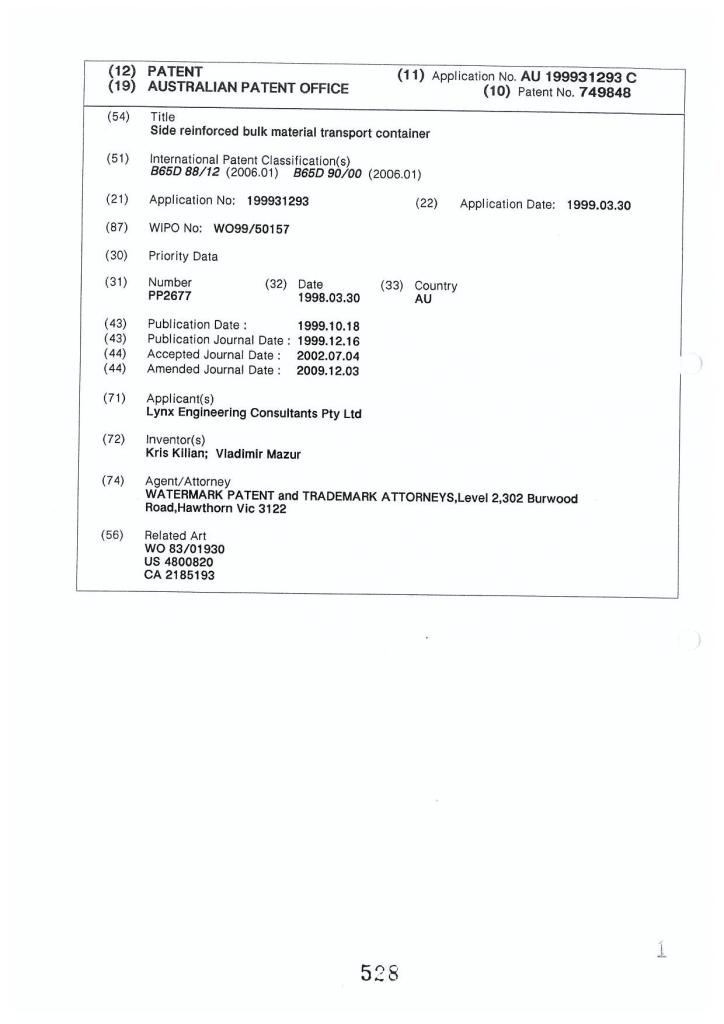
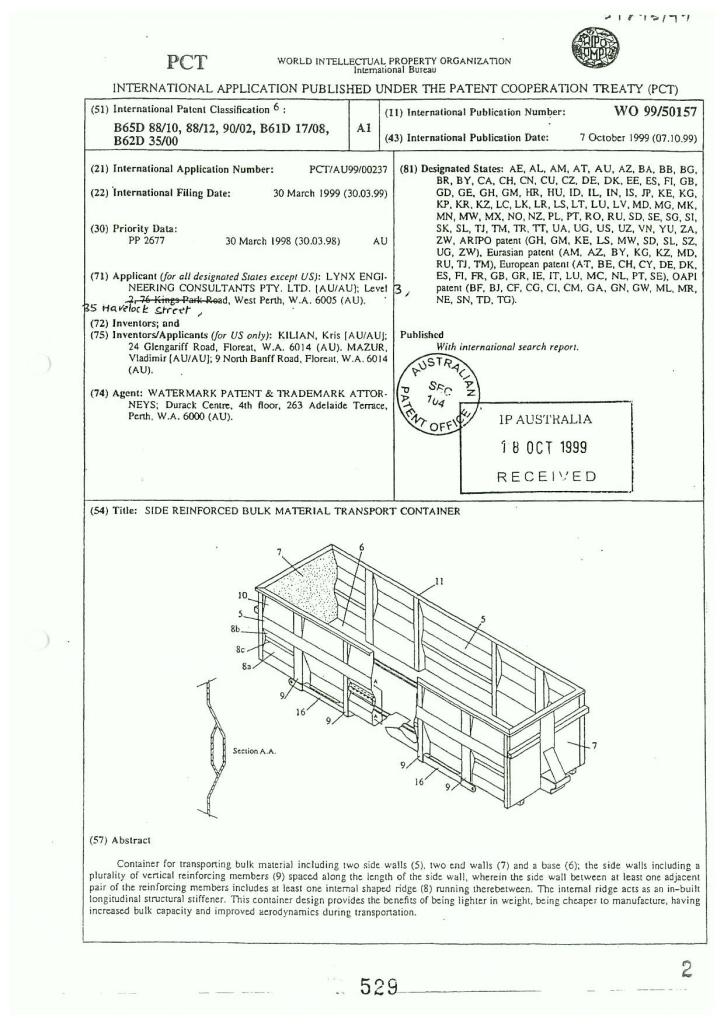
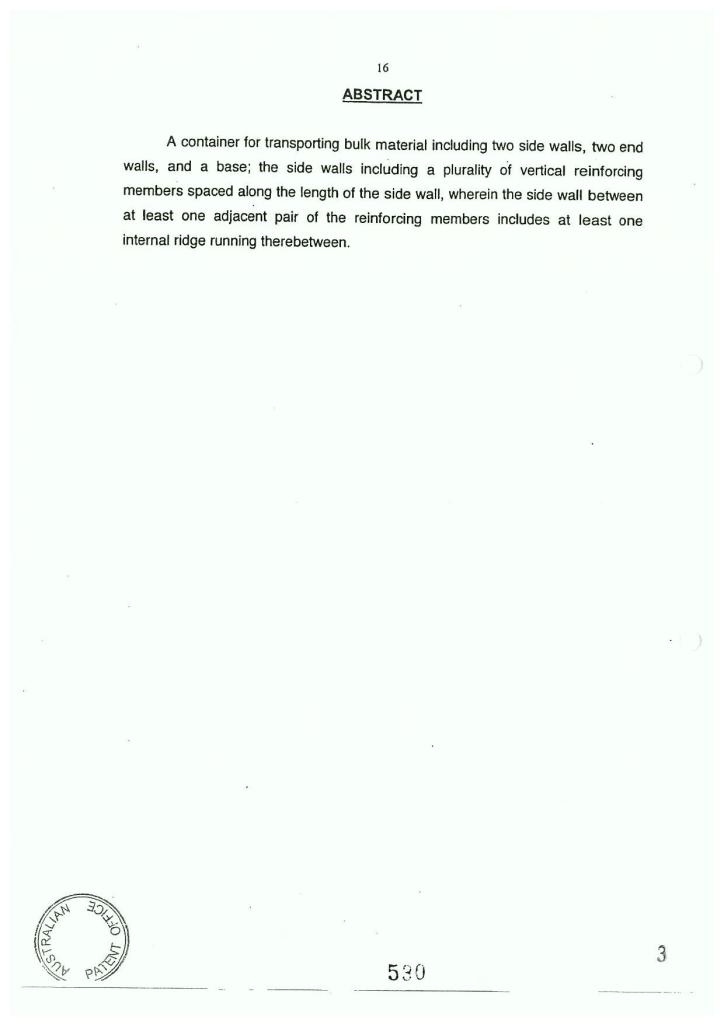
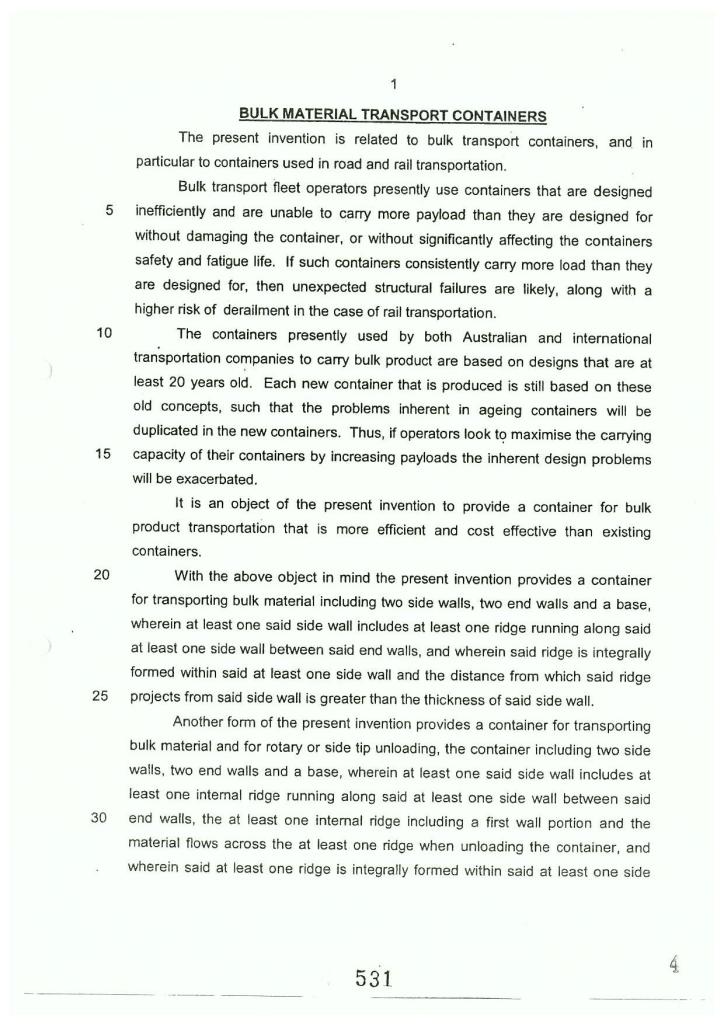
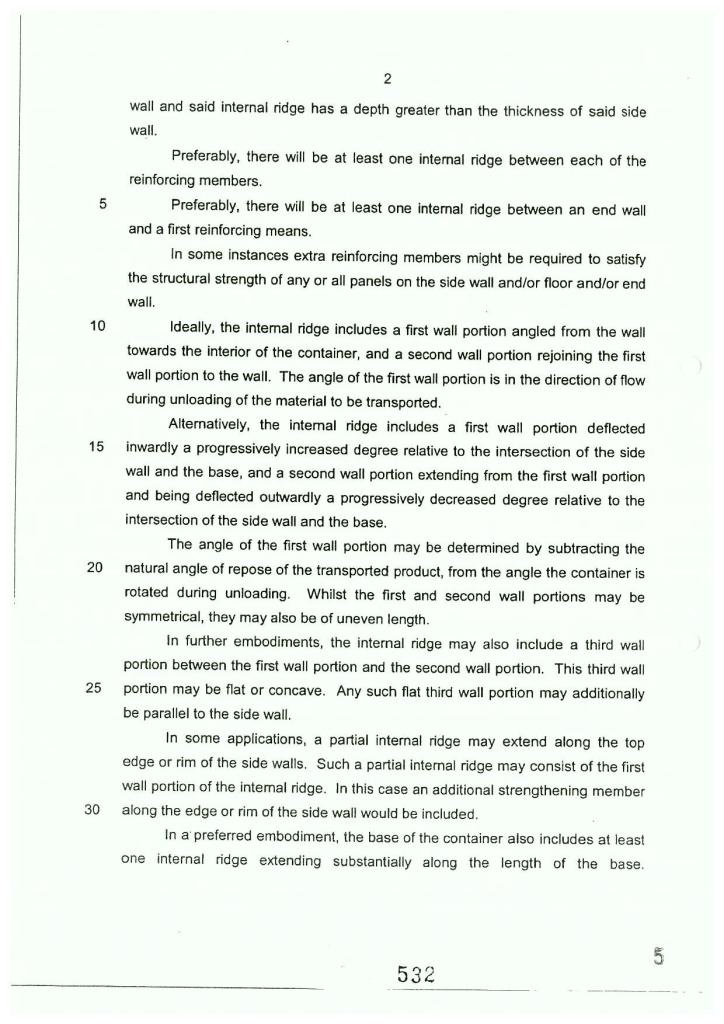
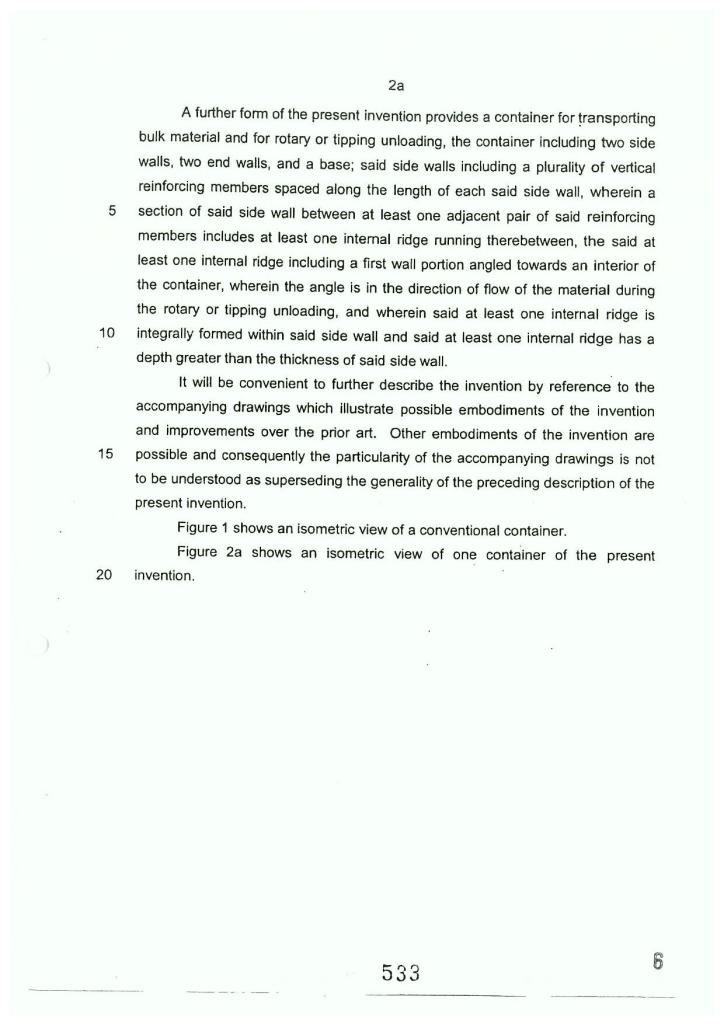
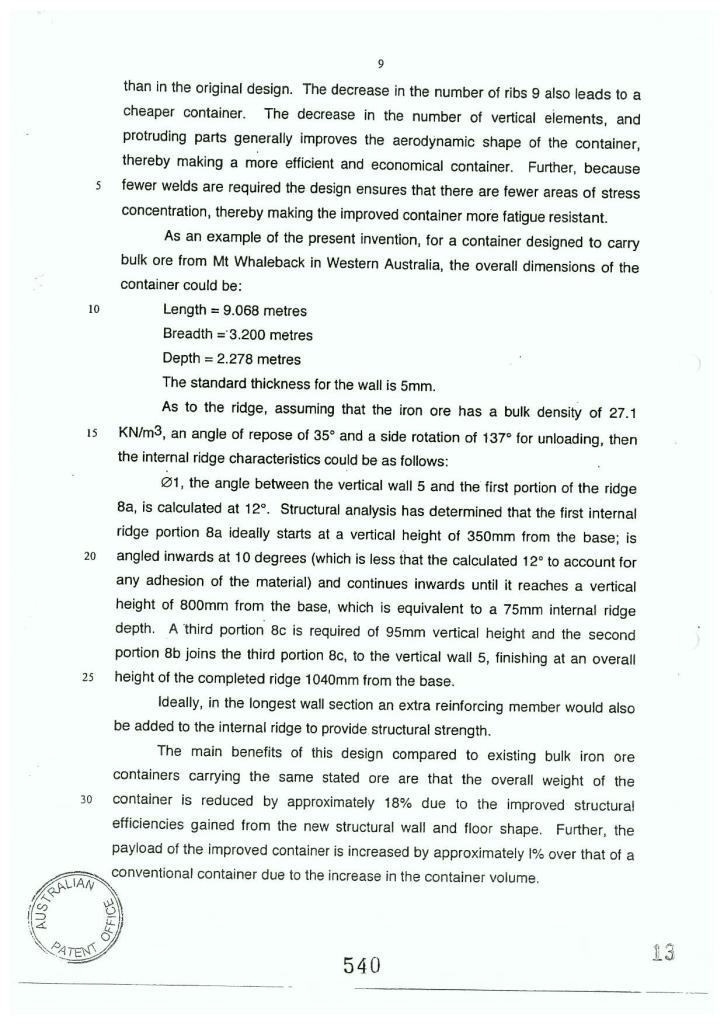
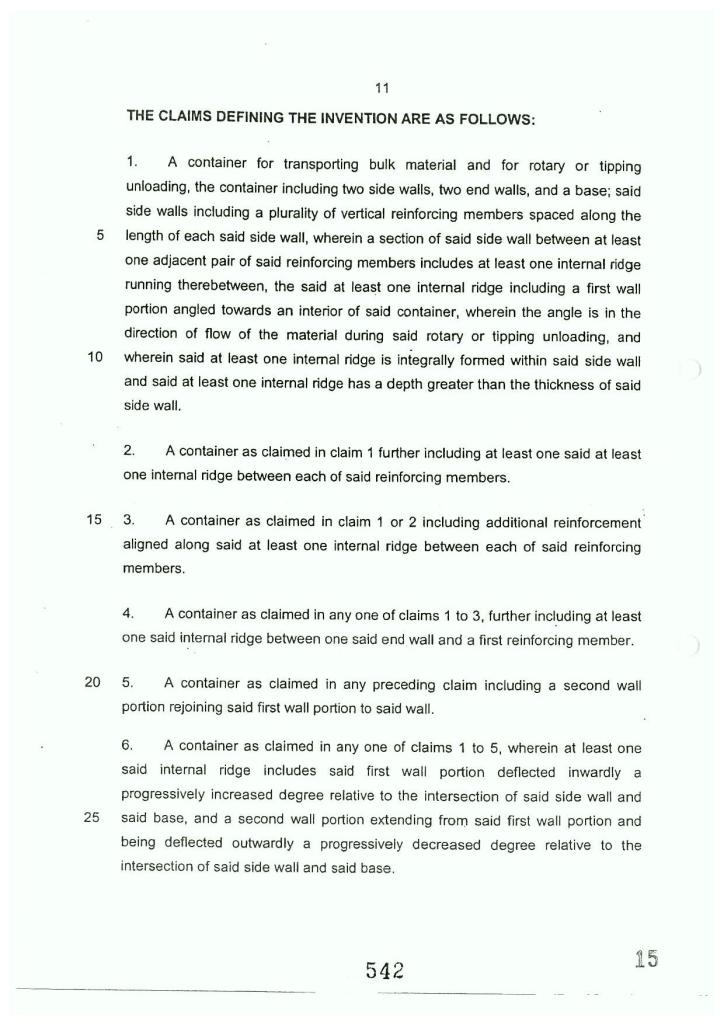
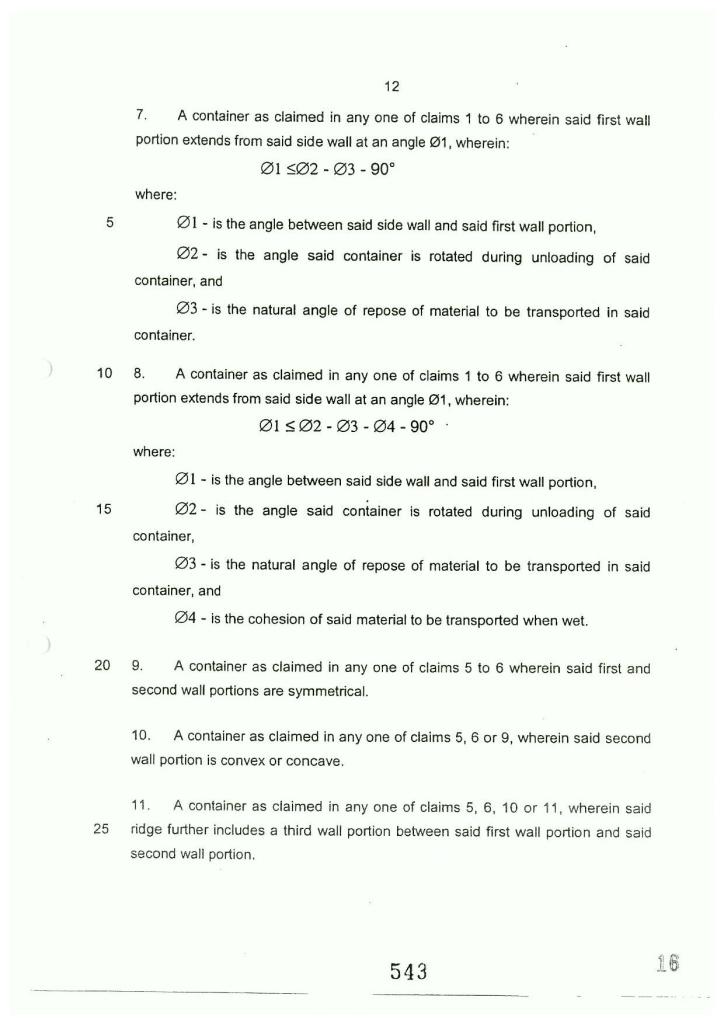
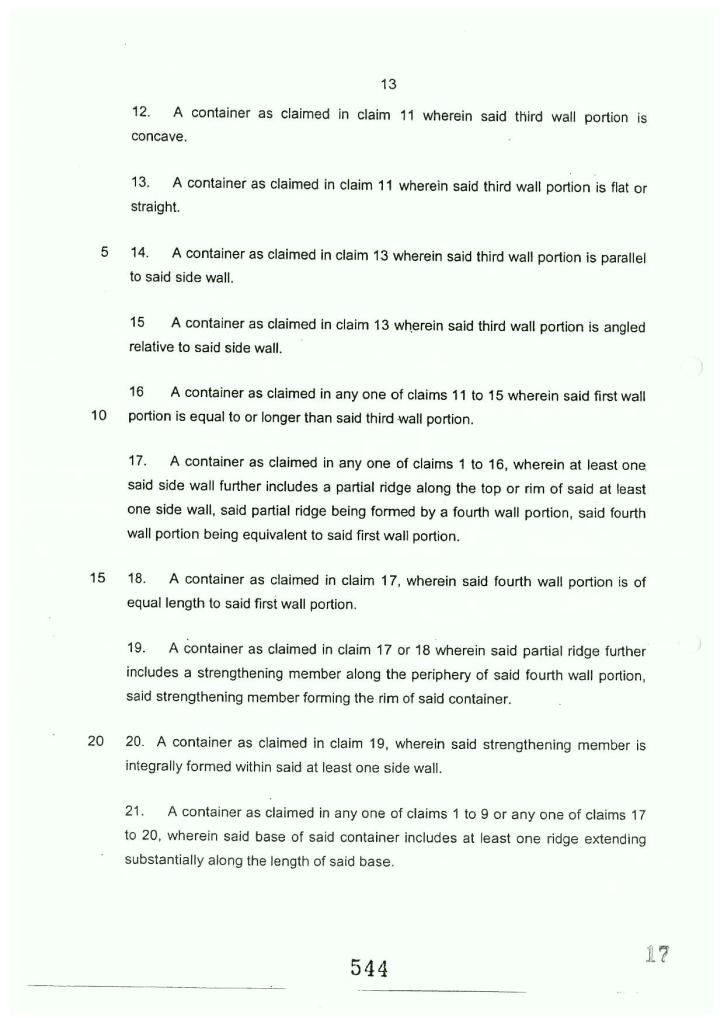
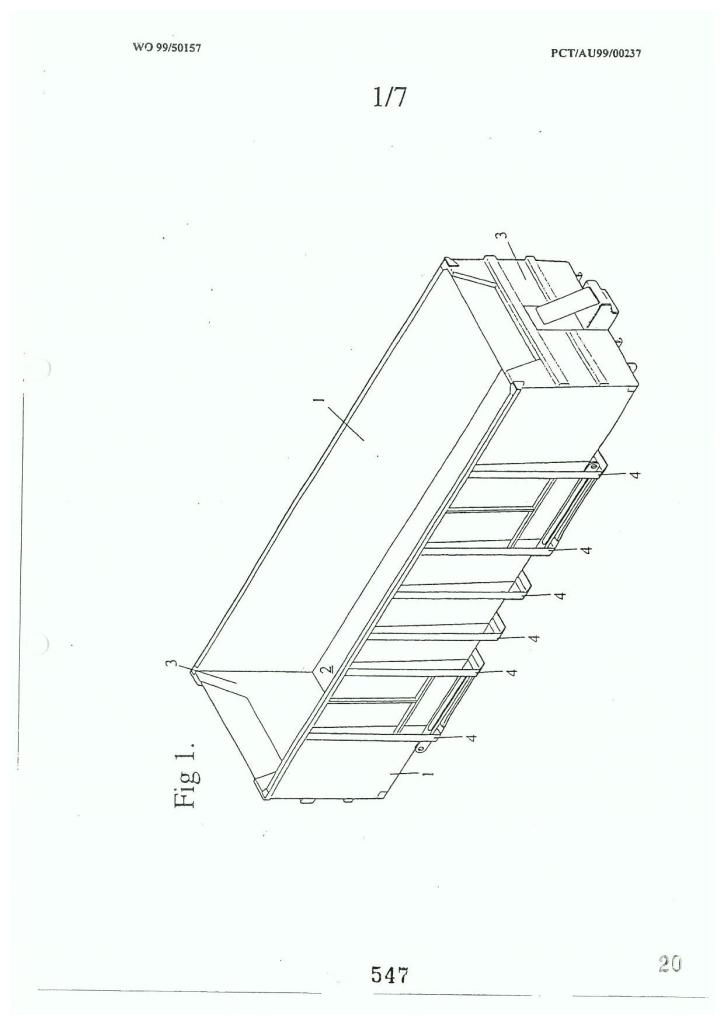
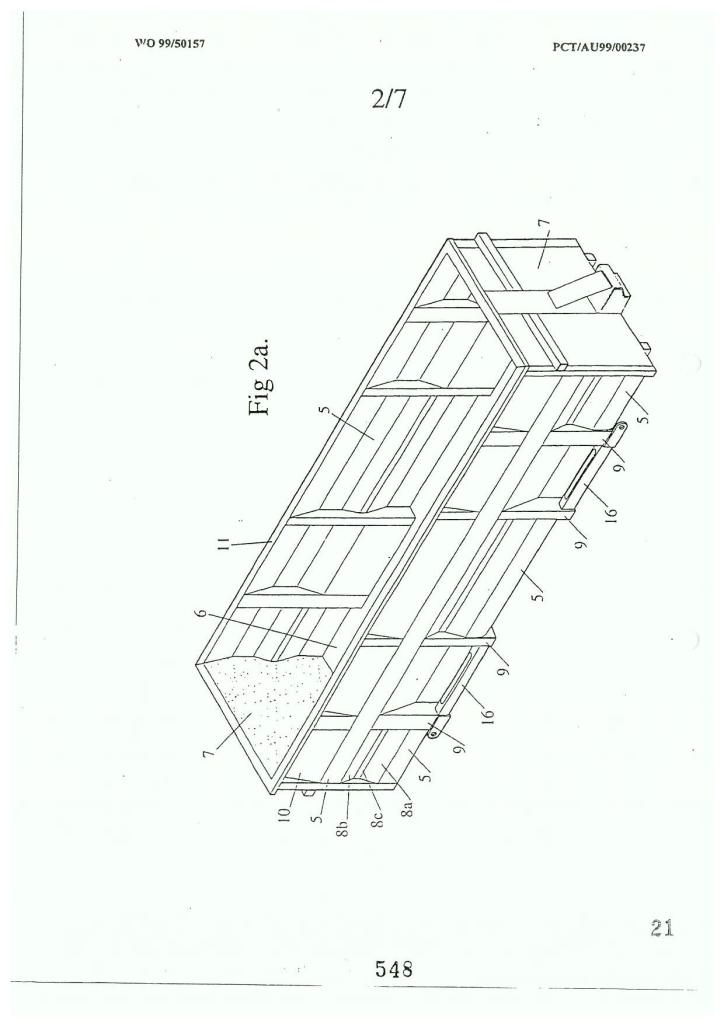
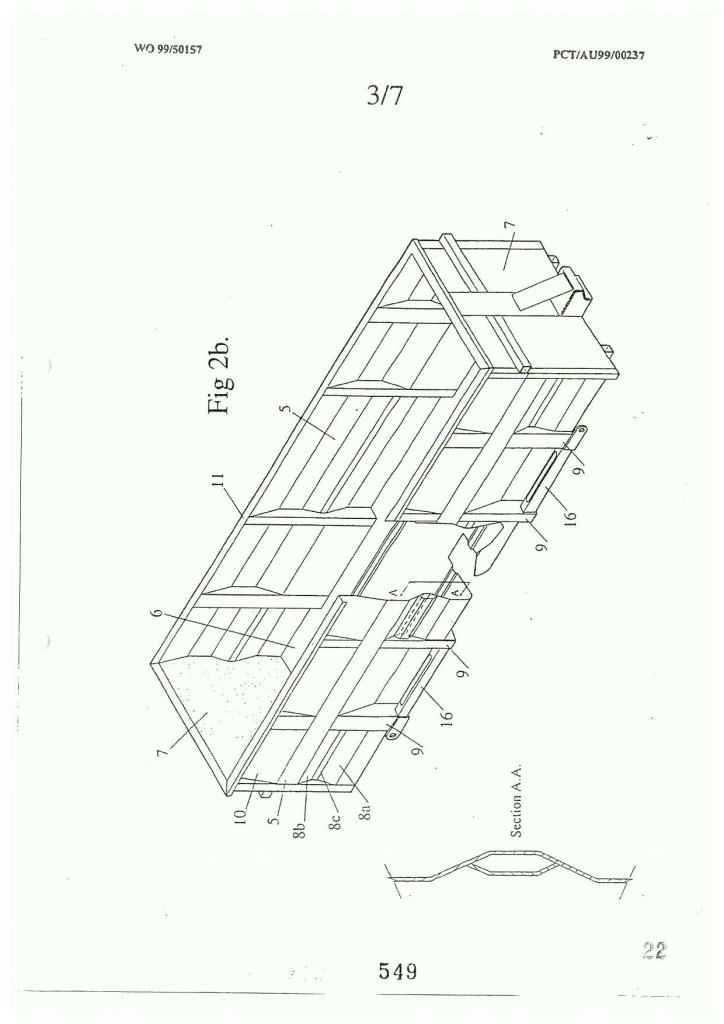
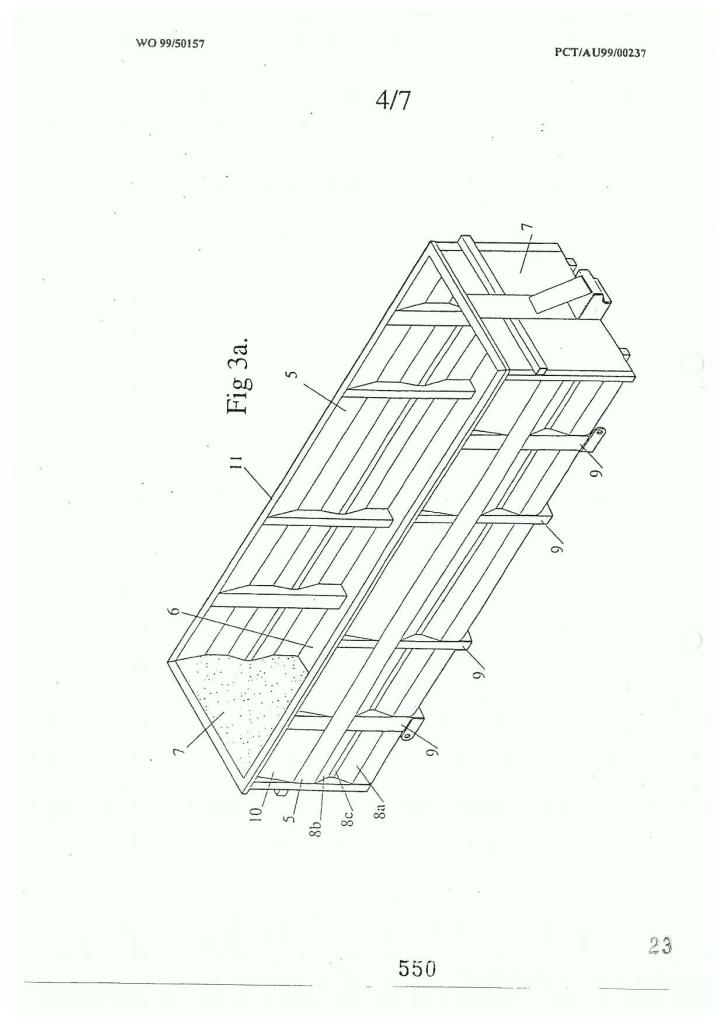
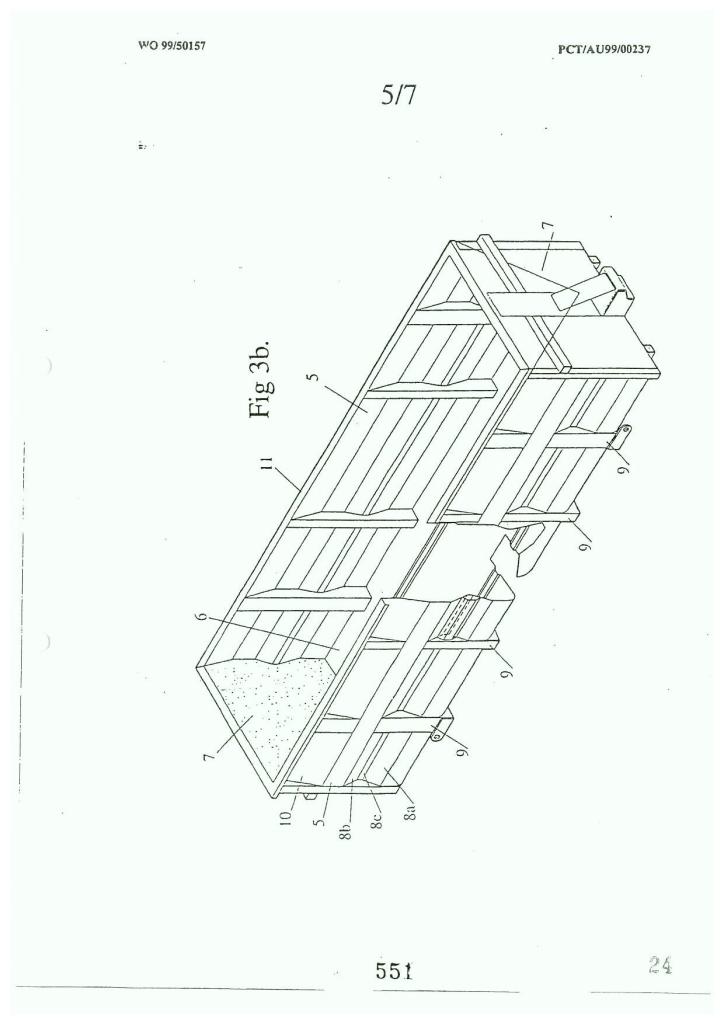
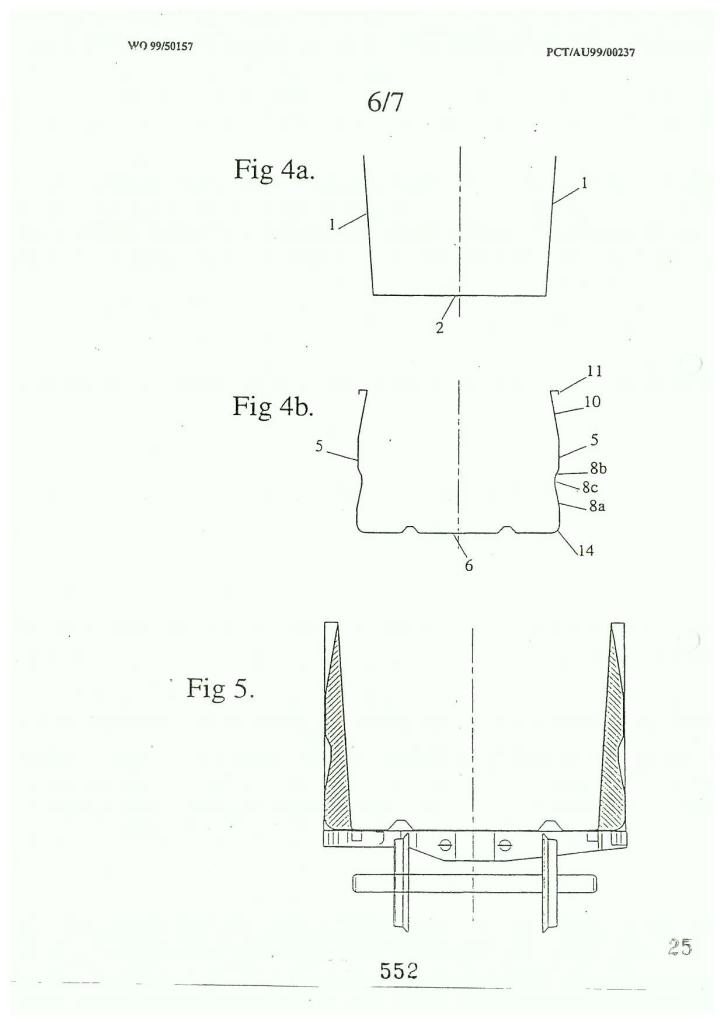
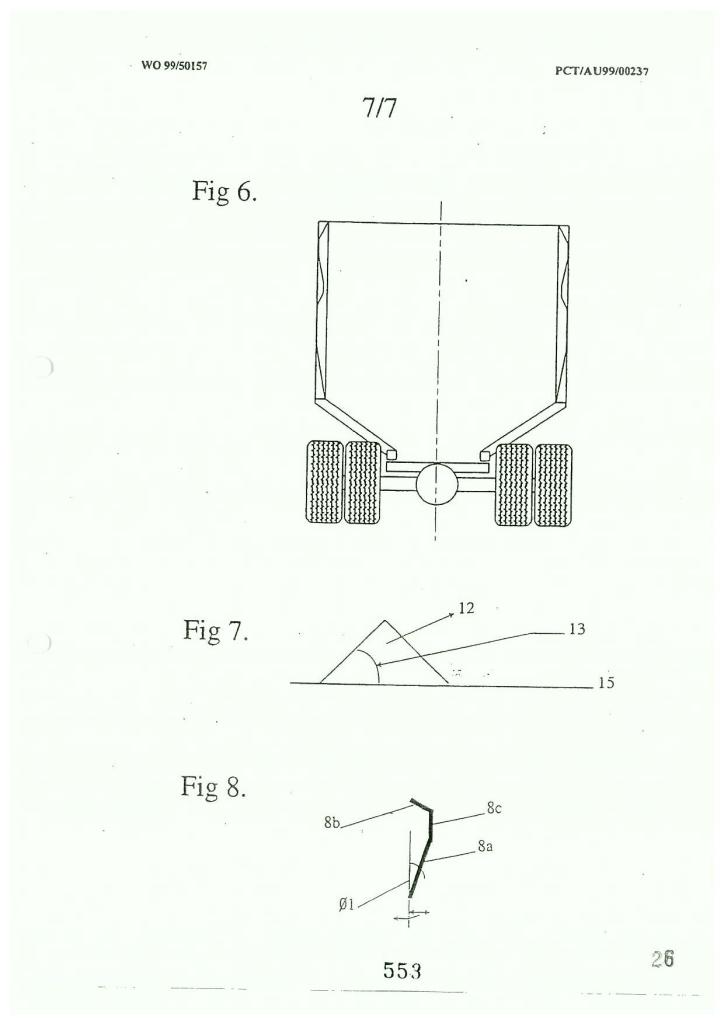
371 Gilpin:
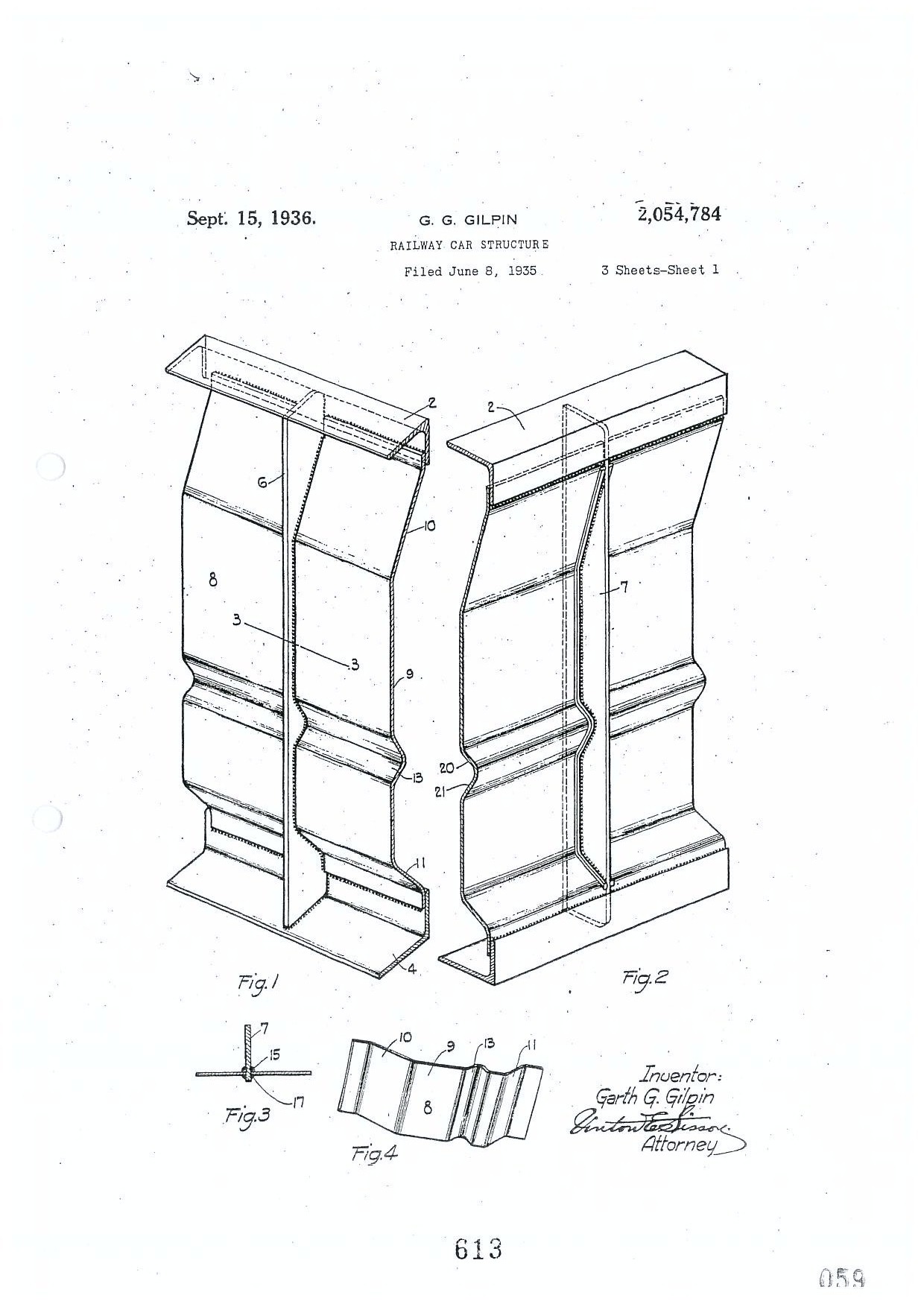
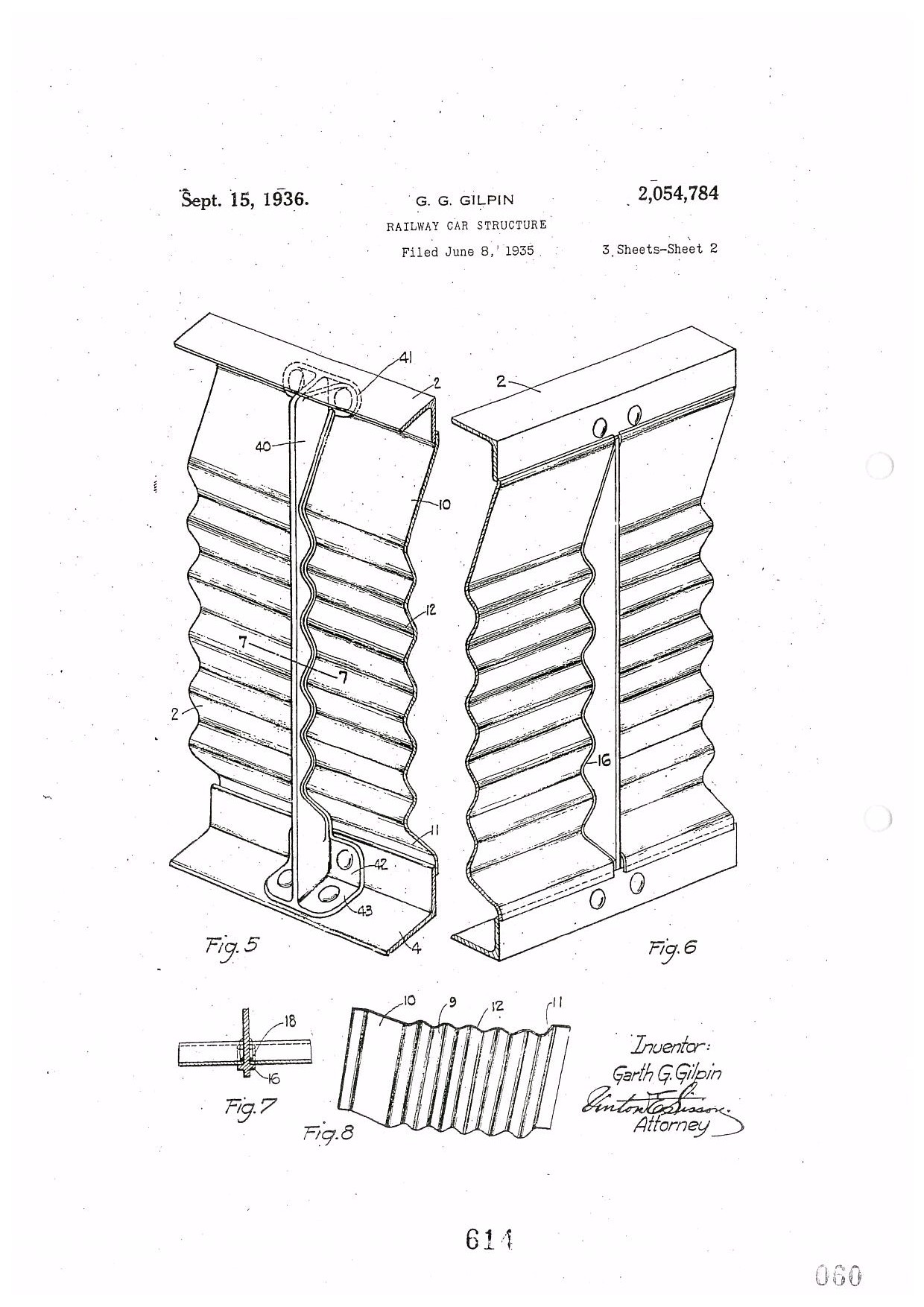
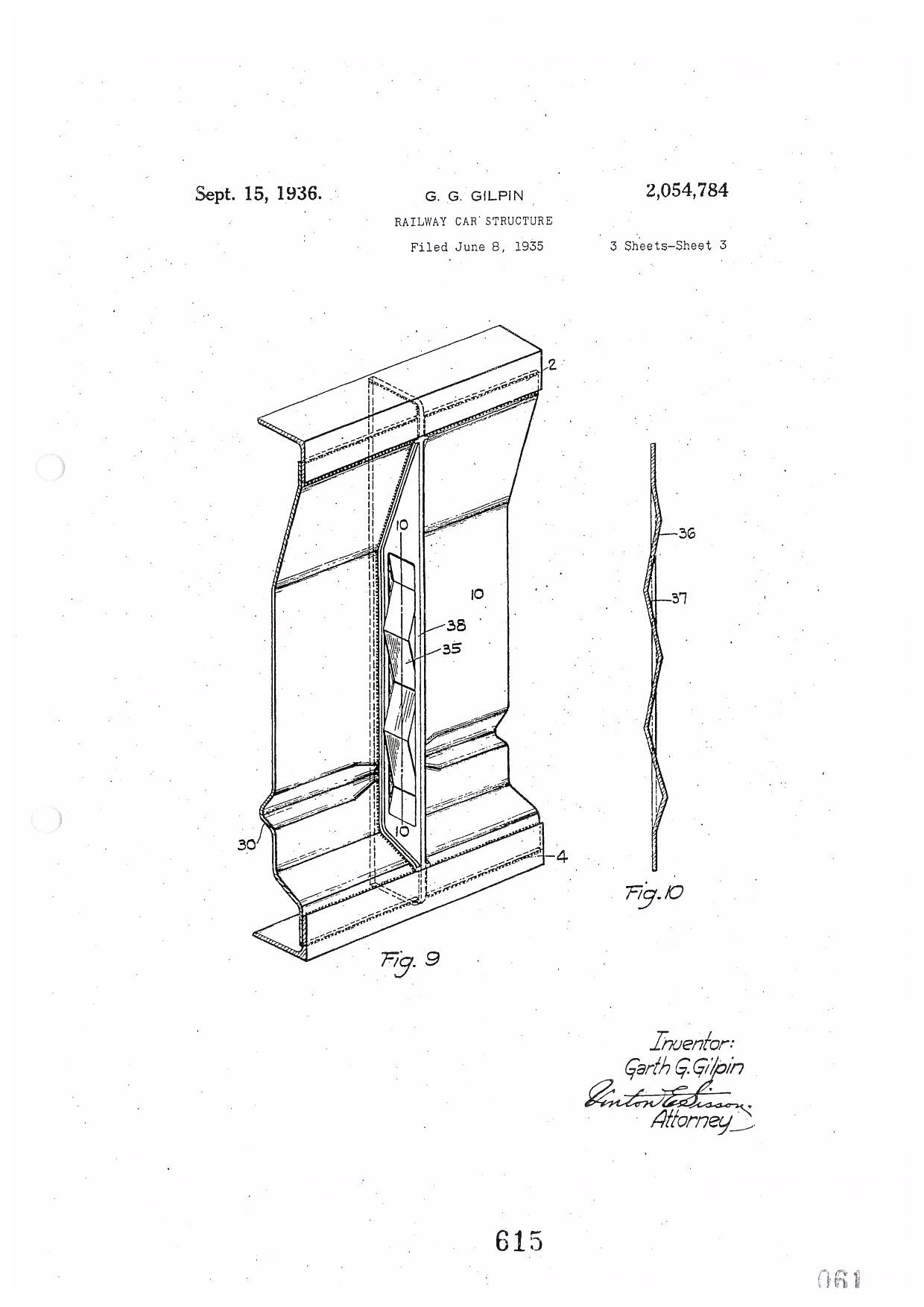
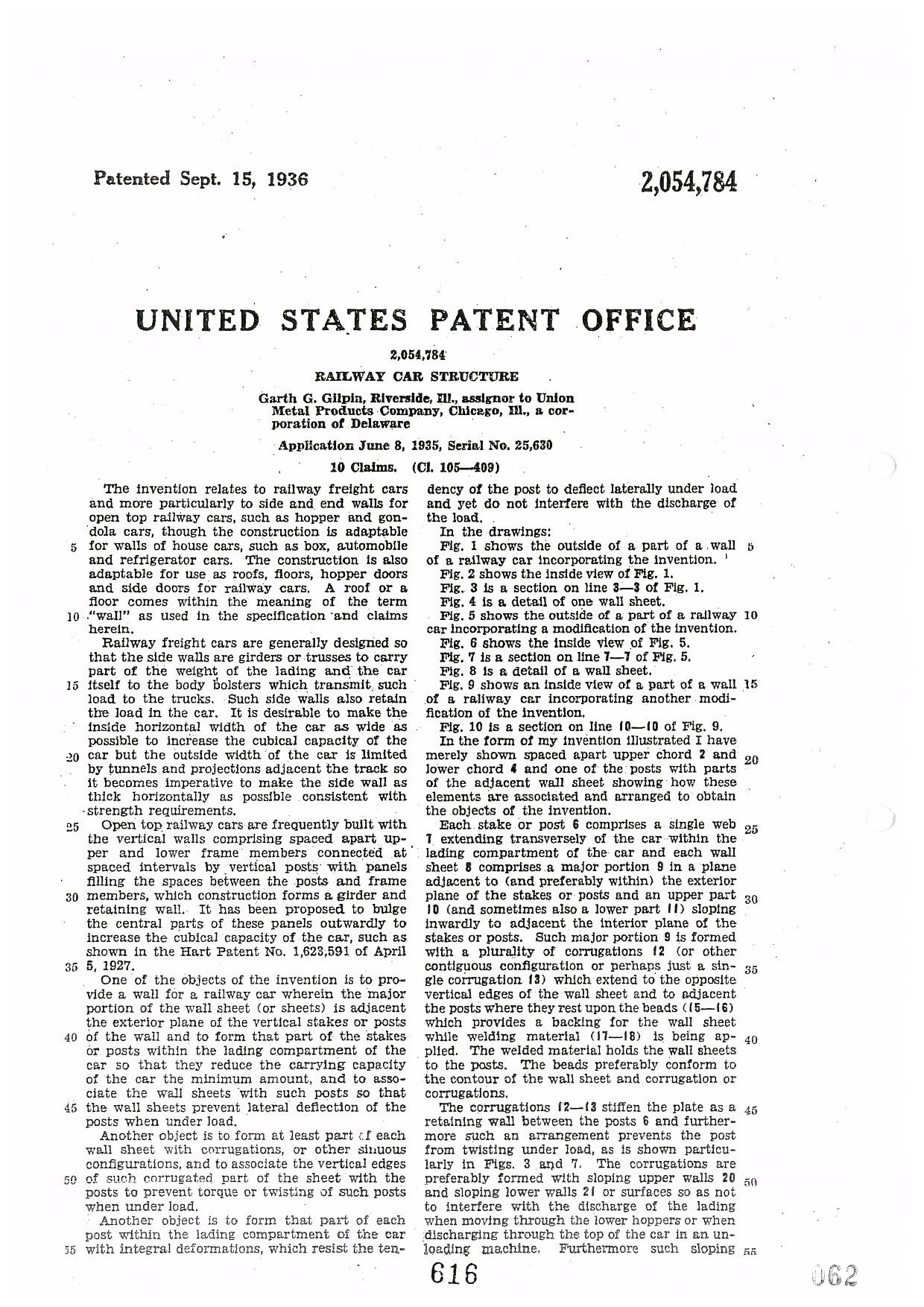
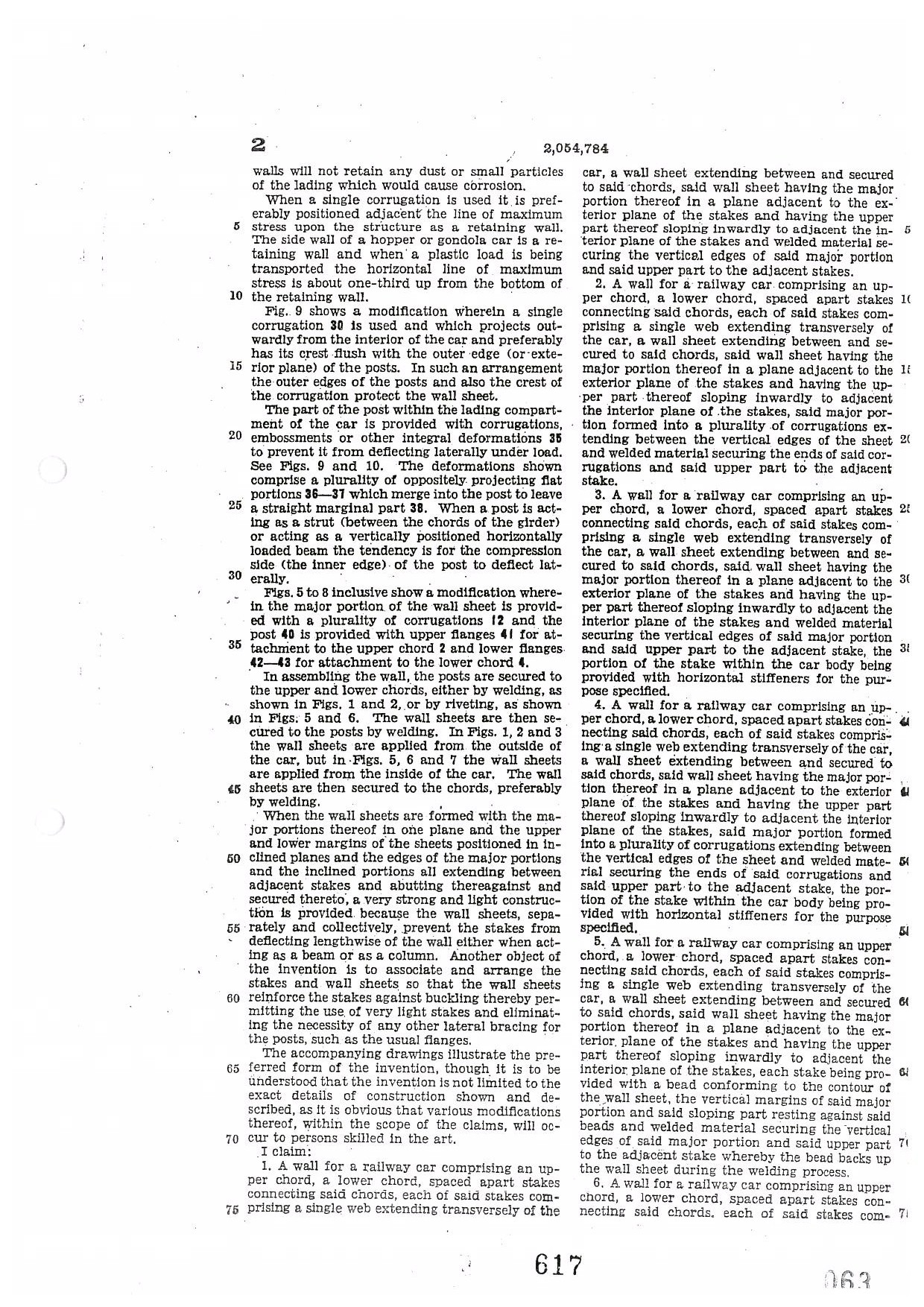
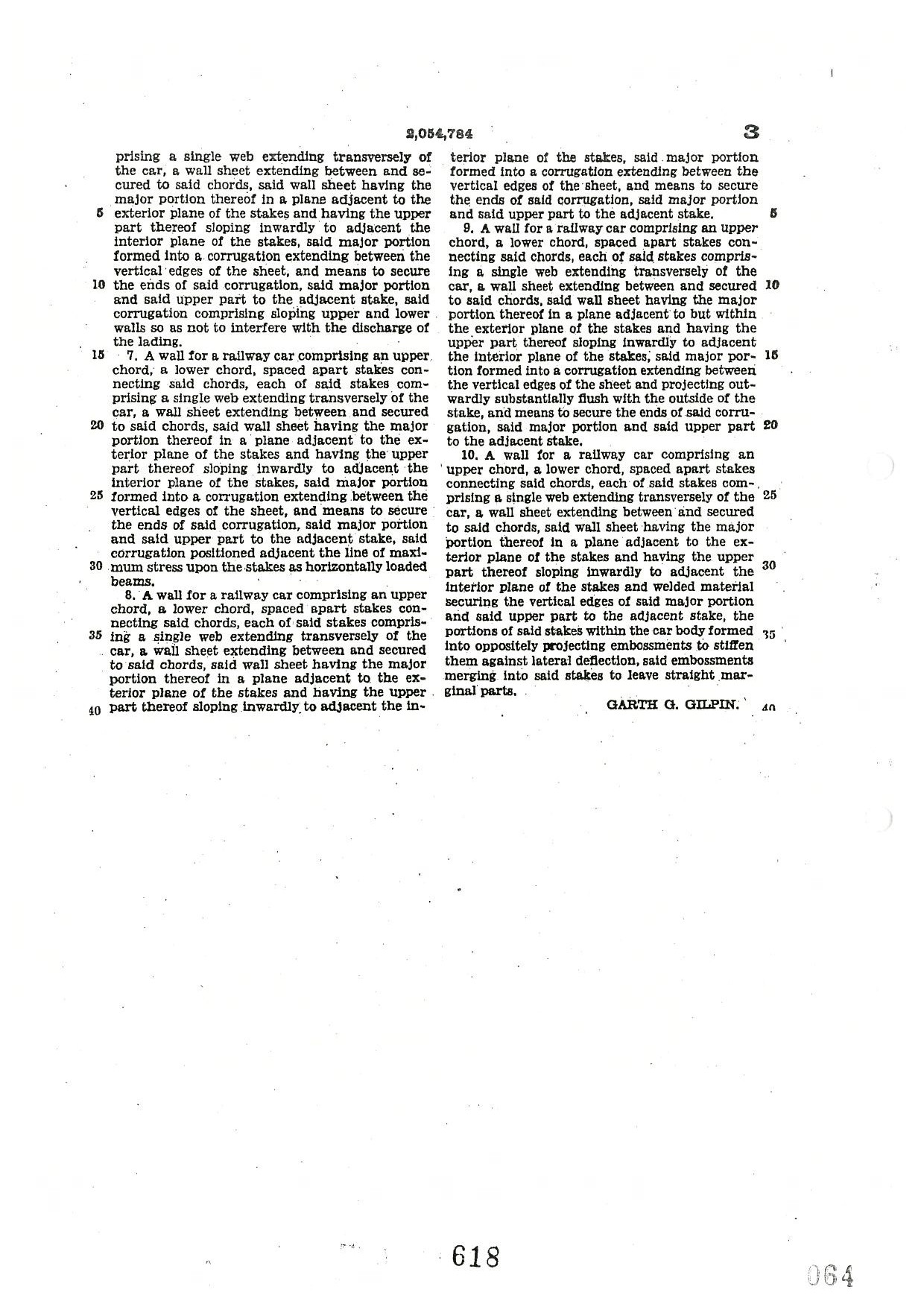
ANNEXURE C – RULINGS BY CATEGORIES OF OBJECTION
372 The rulings are as follows:
1. The first broad category has been touched upon in the substantive reasons. Bradken objects generally to the evidence of Dr Mazur and Mr Kilian. Bradken argues pursuant to s 135(c) of the Evidence Act that to the extent that the witness purports to give expert opinions on matters in issue, including but not limited to novelty and inventive step, it ought to be refused admission into evidence on the basis that the witness is not independent. Dr Mazur is a director of Lynx and a person directly interested in the proceedings. As I indicated both before and during the hearing, in my view, this objection goes only to weight. It is an objection which is repeated on a number of occasions. I do take into account that Dr Mazur and Mr Kilian are not entirely independent. Clearly they would hold subjective views on the topic but there has been wide ranging and probing cross-examination on all of their evidence including their opinions that cross-examination has thrown up any internal inconsistencies and inconsistencies with other evidence. There is no reason given that the expertise of each of the witnesses having otherwise very clearly been demonstrated to preclude admission of the evidence altogether.
2. On a number of occasions, objection was taken to the evidence of Dr Mazur and Mr Kilian on the basis that views expressed were unsubstantiated opinion, with no foundation being given for assertions raised. I consider that taking the affidavits as a whole of each of the respective witnesses, it is quite possible to understand the foundation for the opinion expressed in each instance.
3. In other instances, objections were taken on expression of opinion as it was unclear whether the content constituted expressions of the witnesses’ belief or a fact. In most instances, I have taken it as expressions of the witnesses’ belief on the basis of the surrounding foundational material.
4. Objection was taken to relevance of evidence concerning what persons skilled in the art did not know as distinct from what they did know. While it may be accepted that publication anywhere in the world of prior art may satisfy the requirements of, in relation to novelty, the ignorance of persons skilled in the art may be capable of being relevant in relation to what was common general knowledge for the purpose of the inventiveness issue.
5. Objection was also taken to Dr Mazur expressing his views as to how the Lynx Complete Specification should be construed. It may be accepted that this is ultimately a matter for the Court but there is no principle which would preclude the admission of the expression of opinion by an expert in the field on this topic.
6. Similar objections were taken in relation to expressions of opinion which were said to constitute submissions. Again, I would receive submissions only as evidence from an expert as to his opinion.
7. There was objection taken to the authenticity of a drawing which I did not take to be pursued in the course of the trial.
8. In relation to Bradken’s witnesses, objection was taken to the state of knowledge based on a document published in parts of the world other than Australia. As with the Bradken objections to the Lynx evidence, the evidence of Bradken in relation to Gilpin, for example, and a variety of documents which were either foreign or not shown to be readily available in Australia, is capable of being relevant to prior art (only to the extent of Gilpin) and, to the extent established at trial of availability of the document in Australia, common knowledge. Evidence was adduced at trial in relation to the availability in Australia of certain publications and they, accordingly, are admissible as to common general knowledge.
9. There were general objections taken by Lynx as to the expressions of opinion by Mr Anic in circumstances where the absence of reasoning was not disclosed and the foundation for the opinion was not indicated. I take the same approach in relation to the evidence of Mr Anic as I took in relation to the objection on this ground in relation to the evidence of Dr Mazur. I am satisfied that there is in each instance adequacy of reasoning and foundation material.
10. The ‘publication in Australia’ objection was widely repeated and also applied in entirety to the affidavits of the librarian and the solicitor, Ms Pettit-Young and Dr Baigent respectively, in relation to availability of published material. The material in these affidavits was ultimately not relied upon other than to the extent of establishing that Gilpin was published in the United States on 15 September 1936. Other than that, the material was not relied upon in Bradken’s case and in light of the admissions made together with the tendering of these two affidavits, the objections fall away. The admissions as outlined in Exhibit A7 (exhibited on 1 March 2012) were these:
[Bradken] admits that Dr Baigent does not know of any inspections of the Canadian specifications referred to in his affidavit by any person, corporation, entity or institution, whether in Australia or otherwise.
Bradken also admits that the librarian Ms Pettit Young does not know of any inter-library loan made to any person, corporation, entity or institution in Australia of the following publications:
- The Trough Train article
- ‘Tiazheloe Masinostroenie’ no 1 of 1998 – article ‘New freight cars issued by Russian plants’ by NI Mironov et el
- The Car and Locomotive Cyclopedia of American Practices (6th ed, 1997 by Simmons-Boardman Books Inc, Omaha, USA)
- The Fyansford quarry railway article.
11. Finally, in relation to the evidence of Mr Owen, formerly of BHP, Lynx took objection as to the form of the affidavit at two levels. First, objection was taken to this particular witness expressing the opinion of BHP. As I understand it, the evidence was ultimately pressed only on the basis that Mr Owen was expressing his personal understanding as the company officer directly involved in negotiations concerning Golynx Wagons, as to the company’s intentions and opinion. On that basis and with very limited weight being attached to that part of the evidence, the objection falls away. The second objection was as to the form of evidence where the witness spoke to the contents and effect of documents which should speak for themselves. I am content, once again, to treat any remark about a document in Mr Owen’s evidence as simply being his understanding of its terms and effect. He was cross-examined and evidence was also adduced in considerable detail on the topic of the relationship between BHP and Goninan and Lynx. Nothing Mr Owen said about the terms or effect of a document would outweigh the legal force and effect of such a document on its face, whether it be a letter or similar communication or an agreement.


