

FEDERAL COURT OF AUSTRALIA
Aqua-Marine Marketing Pty Ltd v Pacific Reef Fisheries (Australia) Pty Ltd (No 5) [2012] FCA 908
IN THE FEDERAL COURT OF AUSTRALIA | |
AQUA-MARINE MARKETING PTY LTD (ACN 089 242 937) Applicant | |
AND: | PACIFIC REEF FISHERIES (AUSTRALIA) PTY LTD (ACN 084 456 931) Respondent |
DATE OF ORDER: | |
WHERE MADE: |
THE COURT DECLARES THAT:
1. On the application filed 3 June 2010 the respondent is liable to the applicant in the sum of $323,421.93 together with interest pursuant to s 51A of the Federal Court of Australia Act 1976 (Cth).
2. On the cross-claim filed 17 March 2011 the cross-respondent is liable to the cross-claimant in the sum of $2,290.00 together with interest pursuant to s 51A of the Federal Court of Australia Act 1976 (Cth).
THE COURT ORDERS THAT:
3. The amount payable under declaration 2 be set off against the amount payable under declaration 1 and judgment be entered in favour of the applicant/cross-respondent for the balance.
4. The matter be set down to a date to be fixed for hearing in respect of costs.
Note: Entry of orders is dealt with in Rule 39.32 of the Federal Court Rules 2011.
QUEENSLAND DISTRICT REGISTRY | |
GENERAL DIVISION | QUD 195 of 2010 |
BETWEEN: | AQUA-MARINE MARKETING PTY LTD (ACN 089 242 937) Applicant
|
AND: | PACIFIC REEF FISHERIES (AUSTRALIA) PTY LTD (ACN 084 456 931) Respondent
|
JUDGE: | COLLIER J |
DATE: | 24 AUGUST 2012 |
PLACE: | BRISBANE |
REASONS FOR JUDGMENT
1 This case arises out of an agreement for the sale of farmed black tiger prawns by the respondent to the applicant. In summary, the applicant claims that prawns did not comply with the terms of the agreement, and/or that the respondent misrepresented that the prawns complied with certain specifications. The applicant also claims that the prawns did not comply with terms implied into the agreement by the Sale of Goods Act 1896 (Qld) (“Sale of Goods Act”). In the application the applicant sought from the respondent:
damages for breach of contract in the sum of $328,421.93; or
in the alternative, loss and damage under s 82 of the Trade Practices Act 1974 (Cth) in the sum of $328,421.93; and
interest pursuant to s 51A of the Federal Court of Australia Act 1976 (Cth) (“Trade Practices Act”); and
costs.
At the conclusion of the trial the applicant reduced its substantive claim to $323,421.93, being the amount originally claimed less a marketing fee (now abandoned).
2 During the course of the trial the respondent filed a Further Amended Defence and Cross-Claim. The respondent disputes the applicant’s claims, and by cross-claim contends that the applicant has refused and/or failed to pay the respondent for prawns supplied pursuant to the agreement between the parties and identified in a particular invoice (Invoice 10515) in the amount of $2,290.00. The respondent seeks that sum as well as interest and costs.
3 In brief, the applicant agreed in November 2007 to purchase approximately 70 tonnes of black tiger prawns (also known as Australian Tiger Prawns or “Aussie Tiger” prawns) from the respondent. Specifically, the prawns the subject of the agreement between the parties were:
approximately 50 tonnes of frozen cooked medium black tiger prawns (size 21/30);
approximately 14.2 tonnes of frozen cooked large black tiger prawns (size 10/15); and
approximately 5 tonnes of fresh black tiger prawns of various sizes.
4 The total amount paid by the applicant for the prawns was in excess of $1 million. In respect of the 50 tonnes of frozen cooked medium black tiger prawns supplied by the respondent, the applicant paid the respondent $691,701.96.
5 There had been no previous contractual arrangement between the parties.
6 All of the prawns purchased by the applicant from the respondent were onsold by the applicant to Woolworths. It is common ground that the respondent knew that the applicant intended to onsell all the prawns purchased to Woolworths. A key issue in the case was whether the specific requirements of Woolworths in respect of cooked frozen prawns – “the Woolworths Specifications” – were incorporated into the agreement between the parties, or alternatively whether the respondent represented that the prawns complied with the Woolworths Specifications.
7 The claim of the applicant against the respondent is only in relation to frozen cooked medium black tiger prawns (“the relevant prawns”). It is common ground that the relevant prawns were harvested in the respondent’s 2006/2007 harvest season (“the relevant harvest”).
8 Woolworths rejected approximately 35 tonnes of the relevant prawns. The applicant refunded the monies paid by Woolworths in respect of those 35 tonnes of rejected prawns. The applicant resold the rejected prawns to a seafood distributor, Casa Iberica, for a lower price than that paid by Woolworths and now seeks to recover the difference from the respondent.
9 The pleadings give rise to four key questions for decision in this case. They are:
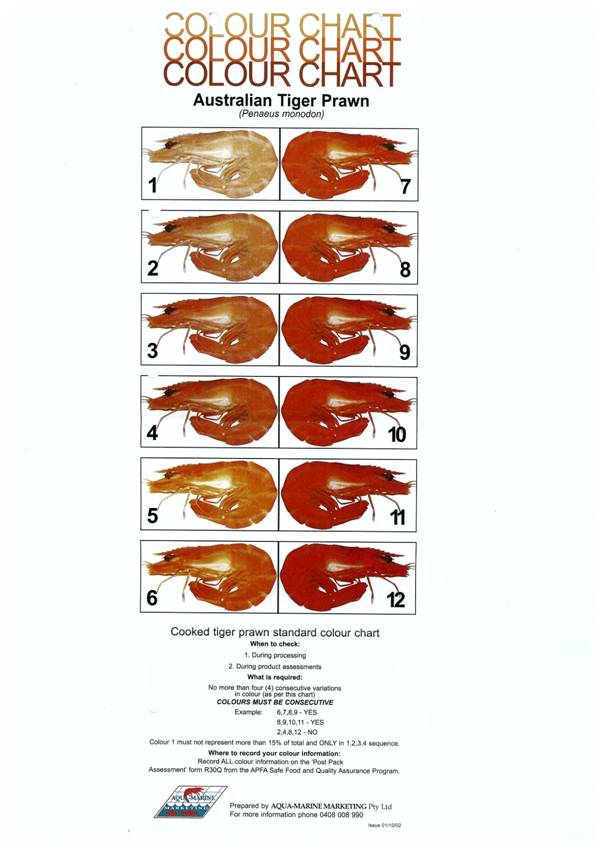
1. Whether the Woolworths Specifications were incorporated into the agreement between the parties.
2. Alternatively, whether the respondent represented that the relevant prawns complied with the Woolworths Specifications.
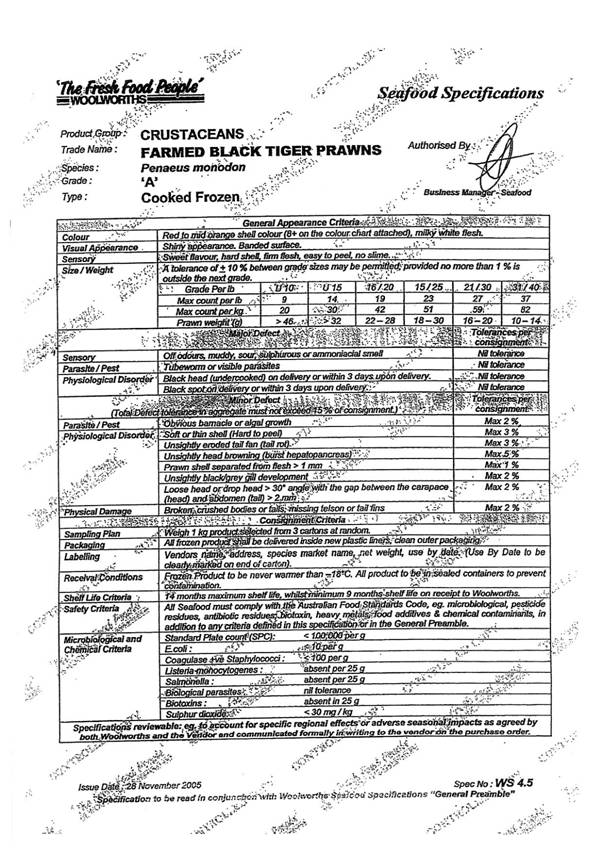
3. If the answer to either of questions 1 or 2 is affirmative – whether the relevant prawns failed to comply with the Woolworths Specifications at the time of supply by the respondent to the applicant.
4. In any event – whether the condition of the relevant prawns was such that they failed to satisfy terms implied into the agreement by the Sale of Goods Act.
10 In my view the applicant’s claims are substantiated and it is entitled to the relief it has sought. The respondent’s cross-claim is also upheld.
11 My reasons for so finding are explained below.
Background Facts
The parties
The applicant
12 The applicant is a company of which the sole director, secretary and shareholder is Mr Warren Lewis. Mr Lewis has worked with the prawn industry and its farmers, in particular in respect of farmed black tiger prawns, since the early 1990s.
13 Until around 2006 the applicant carried on a business as a broker between prawn farms and major retailers in Australia, in particular Woolworths. It appears from the evidence before the Court that Woolworths is (and, at all material times, has been) the major customer of the applicant. In 2006 Woolworths changed its purchasing policies in respect of prawns, causing the applicant to change the manner in which it carried on its own business. The applicant subsequently became a prawn wholesaler. Its business model in respect of Woolworths became (and, at all material times, was) as follows:
Woolworths would place an order with the applicant for the required quantity of prawns;
the applicant would purchase the prawns from prawn farms; and
the applicant would then onsell the prawns to Woolworths.
14 It was clear from the evidence before the Court that at all material times Woolworths was a very important customer of the applicant.
15 Prawn farming is a method of growing and harvesting prawns in a controlled environment, in contrast with catching wild prawns in the open sea. There was evidence before the Court that the farmed prawn industry commenced in Australia around the mid-1980s using technology originating from Taiwan. According to undisputed evidence of Mr Lewis, the Aussie Tiger prawn farming industry in Australia is currently spread across approximately 20 operational farms located between Yamba in northern New South Wales and Mossman in north Queensland.
16 Mr Lewis deposes that prior to 2002 there were no common standards in the Australian farmed prawn industry in relation to grading quality, colour, packaging, marketing and selling of farmed prawns. He further deposes that he was instrumental in implementing Quality Assurance (QA) specifications in the industry, in particular written specifications and colour charts as to the quality of whole cooked prawns. This evidence is not disputed.
17 The farmed prawn industry in Australia appears to be a niche industry. This became evident during the course of the trial. Indeed, as was clear from the manner in which the trial proceeded, there is a dearth of independent experts available to give an opinion in this area, because persons with expertise tend to be employed in the industry itself (including by the parties to these proceedings).
18 Mr Lewis claimed that over the past decade the applicant has marketed for the bulk of the Aussie Tiger prawn farms in the industry. At various times the applicant has represented as many as 24 prawn farms, out of the 30 or 32 prawn farms operating at any point. As at the end of 2010, Mr Lewis said that the applicant was marketing for 13 of the 20 tiger prawn farms operating in Australia.
The respondent
19 The respondent is the owner and operator of a prawn farm situated near Ayr, Queensland, although its head office is located in Victoria.
20 The respondent has conducted a prawn farming facility near Ayr since 1998. The respondent’s prawn farming operation consists of prawn farming ponds and a processing facility, and involves the farming and harvesting of prawns. The farm at Ayr is substantial, with 96 ponds covering an area of 68 hectares. Approximately 49 of the ponds were in operation for the relevant harvest.
21 The main customer of the respondent is, and for some years has been, Coles Supermarkets. The respondent has generally been responsible for its own marketing and affairs.
22 The sole director of the respondent is Mr Nick Mitris, although evidence before the Court indicates that it was Mr Nick Mitris’ son, Mr Con Mitris, who, on behalf of the respondent, negotiated an agreement for the sale of prawns to the applicant. Mr Con Mitris was employed by the respondent from 1998 until late 2009. He was involved in the processing of prawns at the respondent’s farm until approximately 2005, and in 2006/2007 oversaw day to day issues in respect of the respondent’s business including the sale and supply of prawns.
23 The current General Manager of the respondent is Mr Alistair Dick, who has held that position since 2009. The previous holders of the position were Mr Rob McPherson, who was employed by the respondent from September 2007 until February 2009, and Dr Trevor Anderson, who was employed by the respondent from October 2004 until August 2007.
Events leading up to the sale agreement
24 The events leading up to the sale agreement between the applicant and the respondent, whereby the respondent sold the relevant prawns to the applicant, were, so far as relevant, as follows:
In or about June 2007, Mr Con Mitris contacted Mr Lewis and informed him that the respondent had approximately 50 tonnes of frozen medium prawns for sale. At that time, Mr Lewis was not interested in purchasing medium prawns.
In around September 2007, Mr Lewis indicated to Mr Con Mitris that he would be interested in a long-term relationship between the applicant and the respondent for the supply of prawns.
In a conversation around September 2007 Mr Lewis informed Mr Con Mitris that he (Mr Lewis) was not interested in buying anything other than “A grade prawns”.
In mid to late October 2007 Mr Donald Keith, the business manager of seafood for Woolworths, contacted Mr Lewis advising that a shortfall of approximately 50 tonnes of prawns for the Christmas period was likely, which Woolworths Quality Assured (“WQA”) farms were not able to supply.
Mr Lewis knew that the respondent did not operate a WQA farm, although he also knew that the respondent supplied prawns to Coles Supermarkets.
In late October/early November 2007 Mr Lewis took steps to arrange for the respondent’s operations to become WQA approved, including:
speaking with Mr Keith by telephone and at a meeting on 30 October 2007;
arranging for originals of the colour chart and the Woolworths specifications to be posted to the respondent; and
arranging for completion of the necessary forms for the respondent to become WQA approved.
On 9 November 2007 Mr Lewis and his wife visited the respondent’s farm at Ayr and had discussions with Mr McPherson in relation to the relevant prawns and the supply of those prawns to the applicant. (I note that the events which took place during this visit are in dispute.)
On 10 November 2007 a telephone conference call took place between Mr Con Mitris, Mr Nick Mitris and Mr Lewis. It appears that the sale agreement for the relevant prawns was concluded during this conversation, although it also appears that the discussions between Mr Lewis and Mr McPherson on 9 November 2007 were additional context for the conclusion of the agreement. I note that there is some dispute as to statements made by the respective parties during that telephone conference call.
25 On 12 November 2007 there was an exchange of emails between Woolworths and the respondent, during which the respondent completed the WQA registration form signifying its intention to proceed through the quality assurance requirements for Woolworths.
Transportation of the prawns from the respondent’s processing facility
26 between 4 December 2007 and 12 December 2007 the prawns were transported in seven consignments from the respondent’s processing facility. They were delivered to Woolworths at the storage facilities of VersaCold Sydney and VersaCold Melbourne whence they could be distributed directly to Woolworths stores on demand.
27 It is common ground that VersaCold is a large national cold storage facility operator which provides services for, inter alia, Woolworths.
28 Mr Keith gave evidence that these events were not unusual, and that usually when Woolworths purchases prawns from prawn farms the prawns are delivered directly from the farm to centralised cold storage facilities on behalf of Woolworths, such as those maintained by VersaCold.
Events leading to the rejection of the relevant prawns by Woolworths
29 Around February 2008 some of the stock of relevant prawns was distributed from the VersaCold facilities to Woolworths stores. Mr Keith gave evidence that he received complaints from a number of Woolworths stores some time in early 2008 concerning the quality of the relevant prawns which had been distributed to those stores. Mr Keith said that the number of complaints he received in relation to the relevant prawns had escalated to such a degree that, by June 2008, he arranged a meeting at some of those Woolworths stores with Mr Con Alex, an employee of the respondent. It does not appear to be in dispute that Mr Alex agreed that the quality of the relevant prawns at those Woolworths stores was poor.
30 Mr Keith had further meetings in June 2008, primarily by telephone, with Mr Lewis and Mr Con Mitris, in order to identify an approach which could be adopted by all parties in respect of the relevant prawns. On 26 June 2008 and 27 June 2008 Mr Keith met Mr Lewis at the VersaCold facility at Arndell Park, New South Wales, to inspect relevant prawns which were stored there prior to distribution to Woolworths stores. Mr Keith’s evidence was that, based on that inspection, he concluded that approximately one-third of the batches were completely unsaleable as an “A” grade product, but perhaps two-thirds could be satisfactory and could be released to the Woolworths stores for sale. The defects with the relevant prawns identified by Mr Keith included difficulty in peeling, poor taste, gaps between the shell and the meat, and failure to meet the colour chart specifications.
31 Following transportation of some of the relevant prawns from the VersaCold facility at Laverton, Victoria, to the VersaCold facility at Arndell Park, Mr Keith conducted another inspection of relevant prawns on 9 and 10 July 2008, and reached the same conclusion in respect of the saleability of the relevant prawns as he had in June 2008. He decided to release some of the acceptable stock for sale to customers through Woolworths stores. However it appears that, within days, Mr Keith received a very large number of complaints from those Woolworths stores to which relevant prawns had been distributed about their quality (or lack thereof).
32 On 12 August 2008 Mr Keith decided to cease selling the relevant prawns, and to place on hold all relevant prawns remaining in the VersaCold facility. It is not in dispute that the stock of relevant prawns which had been distributed to the stores was subsequently dumped by the stores, and claims were made by Woolworths against the applicant for a refund of the purchase price for the store dumps. It is also not in dispute that, shortly thereafter, Woolworths rejected the entire stock of the relevant prawns and made a claim against the applicant. The claim against the applicant by Woolworths was resolved between those parties.
The Pleaded Cases
The claim
33 The case of the applicant as found in its Statement of Claim is relatively simple. Pertinently, the applicant claims:
By mid to late February 2007 the respondent became aware that many prawns being harvested were affected by protozoan growth on their shells, visibly apparent as a type of “fur”, up to several millimetres thick, covering part of the shell of the prawn (para 9).
By late February 2007 the respondent had adopted a procedure of washing the protozoan affected prawns in acid, prior to the grading process, so as to remove the fur and improve the appearance of the prawns (“the Acid Bath Process”) (para 10).
Despite washing the protozoan affected prawns in acid, the prawns, once cooked, remained difficult to peel, which characteristic was not obvious unless the cooked and frozen prawns were thawed and an attempt made to peel them (para 11).
By washing the protozoan affected prawns in acid, the prawns died, sometimes causing the liver of the prawn to burst and thereby causing darkening behind the head of each such prawn (para 12).
Approximately 250 tonnes of the 340 tonne annual production for the 2006/2007 processing season was affected by the protozoan growth and subjected to the Acid Bath Process (para 13).
In or about May 2007, the respondent was aware that:
a significant proportion (approximately 250 tonnes) of the 340 tonne annual production had been affected by protozoan growth;
many if not most of those prawns would be difficult to peel; and
problems such as tail rot and burst liver affected many prawns and there was no grading process for them to be separated from other better quality prawns.
Mr Lewis explained to both Mr McPherson (at a meeting on 9 November 2007) and Mr Nick Mitris (during a telephone call on 9 November 2007) that the respondent’s prawns would need to satisfy the requirements of Woolworths (para 18).
34 Further, and importantly, the applicant claims that the parties agreed that the respondent would supply the applicant with fresh and frozen prawns for onsale by the applicant to Woolworths, subject to the following terms and conditions (Statement of Claim para 20):
(a) that all prawns to be supplied would comply with the Woolworths Specifications;
(b) the respondent would have available for supply to the applicant, for onsale to Woolworths, ten metric tonnes or half of the fresh prawns in December 2007, prior to Christmas 2007;
(c) the applicant would purchase from the respondent up to 50 tonnes of frozen 21/30 size prawns for onsale by the applicant to Woolworths;
(d) orders within the Supply Agreement would be sent by facsimile to the respondent for specific quantities of prawns to be delivered under the Supply Agreement; and
(e) the prawns would be reasonably fit for the purpose of being onsold to Woolworths and would conform with the Woolworths Specifications.
35 The applicant claims that the relevant prawns did not meet the Woolworths Specifications, in that those prawns were difficult or impossible to peel and did not have a sweet flavour (Statement of Claim paras 26, 27).
36 Accordingly, the applicant claims that:
by reason of the respondent’s breach of contract, the applicant has suffered loss and damage in the sum of $323,421.93;
alternatively, by reason of the respondent’s breach of s 53 of the Trade Practices Act, the applicant has suffered loss and damage in the sum of $323,421.93.
The defence and cross-claim
37 In its Further Amended Defence and Cross-Claim, the respondent contends, in summary and so far as material, that:
many of the 2006/2007 prawns were not affected by protozoan growth (paras 9 and 10) and the respondent did not adopt the Acid Bath Process claimed by the applicant (para 10(b));
during the early part of 2007 and in accordance with standard industry practice, the respondent washed a limited number of prawns affected by protozoan growth in a citric acid mix but this did not negatively affect the condition of the prawns (para 10(c)); and
the relevant prawns did not have burst livers (para 12(b)).
38 The respondent also did not admit that the prawns were difficult to peel because of protozoan growth (para 11).
39 The respondent clearly was aware that the applicant intended to supply the relevant prawns to Woolworths, however in summary the respondent contends that:
it knew Mr Lewis would speak with Woolworths about accepting the stock despite the fact that the respondent was not an accredited supplier of prawns to Woolworths (para 18(b)(iv)).
At the meeting on 9 November 2007 between Mr Lewis and Mr McPherson, Mr Lewis provided Mr McPherson with a copy of an Australian Tiger Prawn Colour Chart the applicant had produced, but no discussion occurred in relation to the requirements of Woolworths (para 18(b)(v)b).
The prawns were not supplied to the applicant by the respondent pursuant to any Woolworths Specifications (para 18(b)(xii)). Although the respondent emailed a completed copy of the Woolworths Quality Assurance registration on 12 November 2007, the prawns sold to the applicant by the respondent had been processed prior to any certification being given (para 18(b)(xiv) and (xv)).
Mr Lewis inspected approximately 48 cartons and multiple batch codes of prawn product that the applicant wished to purchase (para 18(b)(v)c).
It was a term of the purchase agreement that unless the applicant notified the respondent to the contrary on the day of delivery of the goods and such notification was confirmed in writing within two days, the prawns would be deemed to have been accepted by the applicant as being in good condition (para 18(b)(vii)). The applicant did not provide this notification.
The respondent did not give any warranty that the prawns supplied pursuant to the purchase agreement were fit for any particular purpose (para 18(b)(ix)).
Having regard to the experience, skill and judgment of Mr Lewis in relation to the assessment and purchase of prawns, the applicant did not rely upon the respondent’s skill or judgment in purchasing the prawns. Accordingly no condition was implied into the purchase agreement by s 17 of the Sale of Goods Act.
The respondent did not represent to the applicant that the prawns complied with the Woolworths Specifications (para 18(b)(xvi)).
In any event, the prawns supplied by the respondent to the applicant pursuant to the purchase agreement were in good condition and were of a quality acceptable by the general market (para 18(d)(i)). Any characteristics in the prawns which affected the quality of the prawns or deterioration of the prawns occurred while the prawns were in the possession of the applicant or its agents or third parties, after the prawns had left the possession and/or control of the respondent, as a result of:
inappropriate handling and/or storage of the prawns; and/or
the applicant’s delay in onselling the prawns to third parties and/or delays on the part of third parties in selling the prawns to consumers (para 18(d)(ii)).
40 The respondent also seeks by way of cross-claim the sum of $2,290.00 in respect of prawns for which it claims payment is outstanding.
Prawn Industry Specifications
41 Evidence before the Court demonstrates that the different species of prawns sold at retail level in Australia are variously categorised as wild-caught or farmed, cooked or raw, fresh or frozen. In particular, farmed Aussie Tiger prawns are also differentiated by:
colour, as identified by a Colour Chart developed by Mr Lewis and adopted by the Australian Prawn Farmers Association; and
written specifications for quality assurance (“QA”) adopted by the Australian Prawn Farmers Association, which incorporate, and are used in conjunction with, the Colour Chart. These specifications are designed to achieve an “A grade” quality for prawns acceptable to the market (as distinct from a “B grade”).
42 Written industry specifications in respect of farmed prawns include reference to size. As Mr Lewis explains at paragraph 19 of his witness statement:
So far as size specifications are concerned, the sizing of prawns in the prawn farm industry has always been measured in “prawns per pound”. For example, a size of “6” means that 6 prawns of that size would comprise a pound, and “21/30” means between 21 and 30 prawns of that size would comprise a pound. Accordingly, the higher the number of the prawn size the smaller the size of the prawn. There are 6 gradations being “Under 8” (also referred to since 2010 as “Giant”), “Under 10” (also referred to as “Jumbo”), “10/15” (also referred to as “Extra Large”), “16/20” (referred to as “Large”), “21/30 (referred to as “Medium”) and “31/40” (referred to as “Small”)… Despite some subsequent attempts to make the sizes referable to a metric measurement, the Australian industry has continued the use of this imperial measurement of “prawns per pound” for the size grading standard.
What are the Woolworths Specifications?
43 The Woolworths Specifications the applicant claims were incorporated into its contract with the respondent are seafood specifications issued by Woolworths on 28 November 2005. There are different specifications for cooked frozen prawns and cooked fresh prawns. Both sets of specifications refer to a colour chart which was prepared by Mr Lewis.
44 The relevant specifications for cooked frozen prawns are as follows:
Question 1: Were the Woolworths Specifications incorporated into the contract between the parties?
45 The applicant claims that the Woolworths Specifications, as provided by Mr Lewis to Mr Con Mitris on an unidentified date and by Mr Lewis to Mr McPherson on 9 November 2007, constituted express written terms of the contract between the applicant and the respondent. These claims can be seen in paragraphs 18 and 20 of the Statement of Claim.
46 Materially, at paragraph 20 of the Statement of Claim the applicant pleaded:
There were terms and conditions of the Supply agreement as follows:
(a) That all prawns to be supplied would comply with the Specifications;
(b) …
(c) …
(d) …
(e) The prawns would be reasonably fit for the purpose of being on sold to Woolworths and in conformity with the Specifications
…
47 In summary, the case of the respondent is that the Woolworths Specifications were never incorporated into the contract between the parties.
48 In respect of the question of incorporation into the contract between the parties of the Woolworths Specifications, the respondent in its submissions raised the following threshold issues:
1. The Woolworths Specifications document requires that the specifications are to be read in conjunction with the Woolworths Seafood Specifications “General Preamble”, which was neither tendered by the applicant at trial, nor claimed by the applicant to have been provided by it to the respondent.
2. The Woolworths Specifications, on their face, are reviewable, and there was no evidence that the applicant sought such a review.
49 During cross-examination Mr Drew for the respondent put to Mr Lewis that the “General Preamble” to the Woolworths Specifications had not been provided to the respondent. In summary, Mr Lewis’ response was that the preamble contained no material related to the quality of the prawns that were supplied.
50 In my view the fact that the General Preamble was not tendered at trial nor (allegedly) provided to the respondent is not material to the facts in issue before me. Similarly any issue of review of the Woolworths Specifications is not relevant.
Relevant principles in respect of incorporation
51 It is common ground that there was no formal written contract between the parties. The case of the applicant is that the contract was partly written, partly oral, and partly implied. There is extensive authority as to implication of terms into written contracts. However as Deane J observed in Hawkins v Clayton (1988) 164 CLR 539 at 571:
Care must be taken to avoid an automatic or rigid application of the ordinary cumulative criteria for determining whether a term should be implied in a written contract to a case where the contract is oral or partly oral or where it is apparent that the parties have never attempted to reduce their agreement to complete written form: cf. Hospital Products Ltd. v. United States Surgical Corporation [(1984) 156 C.L.R. 41, at p. 121]. The cases in which those criteria were laid down or accepted as the cumulative ingredients of an overall test were concerned with the question whether a term should be implied in a formal contract which was complete upon its face: see, in particular, B.P. Refinery (Westernport) Pty. Ltd. v. Hastings Shire Council [(1977) 52 A.L.J.R. 20, at p. 26; 16 A.L.R. 363, at p. 376]; Secured Income Real Estate (Australia) Ltd. v. St. Martins Investments Pty. Ltd. [(1979) 144 C.L.R. 596]; Codelfa Construction Pty. Ltd. v. State Rail Authority of N.S.W. [(1982) 149 C.L.R. 337].
52 His Honour continued at 573:
The most that can be said consistently with the need for some degree of flexibility is that, in a case where it is apparent that the parties have not attempted to spell out the full terms of their contract, a court should imply a term by reference to the imputed intention of the parties if, but only if, it can be seen that the implication of the particular term is necessary for the reasonable or effective operation of a contract of that nature in the circumstances of the case. That general statement of principle is subject to the qualification that a term may be implied in a contract by established mercantile usage or professional practice or by a past course of dealing between the parties.
(Emphasis added.)
53 In Byrne v Australian Airlines Limited (1995) 185 CLR 410 Brennan CJ, Dawson and Toohey JJ observed at 422:
The implication which the appellants seek to make is based upon the presumed or imputed intention of the parties. In that context, the remarks of the majority in the Privy Council in BP Refinery (Westernport) Pty Ltd v Shire of Hastings (65) are frequently called in aid: “(1) [the implication] must be reasonable and equitable; (2) it must be necessary to give business efficacy to the contract, so that no term will be implied if the contract is effective without it; (3) it must be so obvious that ‘it goes without saying’; (4) it must be capable of clear expression; (5) it must not contradict any express term of the contract.” In laying down those criteria, it was recognised that there was a degree of overlap. Further, as Deane J has observed [in Hospital Products Ltd v United States Surgical Corporation (1984) 156 CLR 41 at 121], the cases in which the criteria in BP Refinery (Westernport) Pty Ltd v Shire of Hastings have been applied in this Court are cases in which there was a formal contract, complete on its face. He pointed out that a rigid approach should be avoided in cases, such as the present, where there is no formal contract. In those cases the actual terms of the contract must first be inferred before any question of implication arises. That is to say, it is necessary to arrive at some conclusion as to the actual intention of the parties before considering any presumed or imputed intention. And the test to be then applied was in a later case formulated by Deane J in these terms [in Hawkins v Clayton (1988) 164 CLR 539 at 573]:
“The most that can be said consistently with the need for some degree of flexibility is that, in a case where it is apparent that the parties have not attempted to spell out the full terms of their contract, a court should imply a term by reference to the imputed intention of the parties if, but only if, it can be seen that the implication of the particular term is necessary for the reasonable or effective operation of a contract of that nature in the circumstances of the case. That general statement of principle is subject to the qualification that a term may be implied in a contract by established mercantile usage or professional practice or by a past course of dealing between the parties.”
That is, we think, the appropriate test to apply in this case …
54 Similarly at 442 in Byrne, McHugh and Gummow JJ said:
Secondly, where the contract is not in writing and is oral or partly oral or it appears that the parties themselves did not reduce their agreement to a complete written form, caution is required against an automatic or rigid application of the cumulative criteria identified in BP. We should proceed on the footing that the present case is to be approached in this way.
In such situations, the first task is to consider the evidence and find the relevant express terms. Some terms may be inferred from the evidence of a course of dealing between the parties. It may be apparent that the parties have not spelled out all the terms of their contract, but have left some or most of them to be inferred or implied. Some terms may be implied by established custom or usage, as described above. Other terms may satisfy the criterion of being so obvious that they go without saying, in the sense that if the subject had been raised the parties to the contract would have replied “of course” (129). If the contract has not been reduced to complete written form, the question is whether the implication of the particular term is necessary for the reasonable or effective operation of the contract in the circumstances of the case; only where this can be seen to be true will the term be implied (130).
(Footnotes omitted.)
(cf Gaudron, McHugh, Gummow and Hayne JJ in Associated Alloys Pty Limited v ACN 001 452 106 Pty Limited (in liquidation) (2000) 202 CLR 588 at [46] and see the discussion in Carter JW, Carter on Contract (Butterworths, subscription service) at [11-100] (service 22).)
Evidence as to incorporation
55 No express written terms of the agreement between the parties were settled and, as I have already noted, there was no previous course of dealing between the parties such that, as a result, terms could be implied. There also does not appear to be any custom or usage which could assist the Court in identifying the terms of the agreement. In the circumstances of this case the determination of the question whether the incorporation of the Woolworths Specifications was necessary for the reasonable or effective operation of the agreement of the parties depends on an evaluation of the evidence given by Mr Lewis on behalf of the applicant, and evidence of the respondent’s witnesses, in particular Mr Nick Mitris, Mr Con Mitris and Mr McPherson.
56 In summary, Mr Lewis gave evidence as follows:
In late October/early November 2007 Mr Lewis took steps to arrange for the respondent to become approved as a WQA farm.
The purpose of Mr Lewis’ visit to the respondent’s farm on 9 November 2007 was for him to conduct an initial assessment of the respondent’s suitability to supply prawns to Woolworths and for him to take representatives of the respondent through Woolworths’ Specifications and Woolworths’ packing/stacking requirements.
At some time prior to Mr Lewis’ visit to the respondent’s farm on 9 November 2007 Mr Lewis had arranged for colour copies of the Woolworths Specifications and accompanying colour chart to be posted to the respondent in Ayr. At the meeting on 9 November 2007 Mr McPherson informed Mr Lewis that the Woolworths Specifications and colour chart had not been received by the respondent.
Mr Lewis (and also Mrs Lewis) endeavoured to contact Mr Darren Bull at the applicant’s offices numerous times on 9 November 2007 to request a copy of the Woolworths Specifications be faxed to Mr Lewis at the respondent’s farm.
The Woolworths Specifications were faxed by the applicant to the respondent at 2.45 pm on 9 November 2007, and handed by an employee of the respondent to Mr McPherson in Mr Lewis’ presence. Mr Lewis then went through the Woolworths Specifications with Mr McPherson.
Mr Lewis also discussed with Mr McPherson other Woolworths requirements for the supply to it of farmed tiger prawns.
Mr Lewis and Mr McPherson never discussed use-by dates or best-before dates in respect of prawns to be supplied by the respondent (transcript 15 March 2011 p 76 ll 10-11).
If Mr Lewis had been told by anyone from the respondent that its product would not comply with Woolworths Specifications he would not have purchased product from them (transcript 16 March 2011 p 73 ll 40-43).
57 On behalf of the respondent, the following material evidence was given:
Mr Nick Mitris deposed that he did not discuss the Woolworths Specifications with Mr Lewis.
In his witness statement Mr Con Mitris deposed that at an unidentified date in September or October 2007 he had told Mr Lewis that the respondent was not “Woolworths specified”, and that Mr Lewis told him that he would send Mr Mitris a copy of the Woolworths Specifications.
Mr Con Mitris deposed that he believed that Mr Lewis had provided him with a copy of the Woolworths Specifications but could not recall the method of delivery.
Mr Con Mitris gave evidence that he had told Mr Lewis that the frozen produce would not meet the Woolworths Specifications as the product had been processed with a use-by date of two years (witness statement of Con Mitris paras 66-68).
Mr Con Mitris deposed that he had said to Mr Lewis words to the effect of “how is this going to work?” and Mr Lewis had said words to the effect of “I’ve done this before” and said that he would speak to Woolworths and get back to Mr Mitris (witness statement of Con Mitris para 70).
Mr Con Mitris deposed that in May 2008 he had told Mr Keith of Woolworths that the relevant prawns had never met the Woolworths Specifications because they were processed with a use-by date unacceptable to Woolworths (witness statement of Con Mitris paras 141, 144).
Mr McPherson deposed that he did not receive a copy of the Woolworths Specifications by facsimile as alleged by Mr Lewis to have occurred on 9 November 2007, that the Woolworths Specifications were not discussed by Mr Lewis and Mr McPherson on that date, and referred to an email he had received from Mr Warren Corbett where Mr Corbett said that no mention had been made of the Woolworths Specifications by Mr Lewis in a meeting between Mr Lewis and Mr Corbett in November 2007.
58 I note that, in his written statement, Mr Corbett deposed that he had not seen the Woolworths Specifications until the respondent prepared the “Christmas pack out” around December 2007.
Findings
59 In my view the applicant and the respondent intended that the Woolworths Specifications be incorporated as terms of the agreement for supply of the relevant prawns by the respondent to the applicant. The Woolworths Specifications were an integral part of the agreement between the parties, as contemplated by Deane J in Hawkins, and the Woolworths Specifications were incorporated into that agreement. I take this view for the following reasons.
Not processed in accordance with the Woolworths Specifications
60 In disputing the incorporation of the Woolworths Specifications into the agreement between the parties, the respondent submits that the relevant prawns were not processed in accordance with the Woolworths Specifications. However in my view the fact that the relevant prawns were not processed in that manner is irrelevant. The clear background to the arrangement between the parties concluded on 10 November 2007 was that:
the respondent was not an accredited supplier of prawns to Woolworths at the time of the agreement, although it was known by both parties that it was an accredited supplier of prawns to Coles Supermarkets.
in the circumstances neither party contemplated that any such prawns supplied by the respondent would have been originally processed in accordance with the Woolworths Specifications.
61 Both parties were aware that the applicant sought to purchase existing prawns already processed by the respondent for onsale to Woolworths, to fill an existing need of Woolworths. It is clear that, in light of the importance of Woolworths as a customer to the applicant and the particular requirements of Woolworths as a retailer of prawns to consumers, the applicant would never have been party to the agreement with the respondent had the applicant not been satisfied, from discussions with the respondent, that the relevant prawns complied with the Woolworths Specifications. Critically, I consider the evidence supports the finding that the applicant, through Mr Lewis, made this known to the respondents, and that the respondents supplied the relevant prawns to the applicant on this basis.
62 The respondent submits that the only way of ensuring that the relevant prawns complied with the Woolworths Specifications was to ensure that they were produced strictly in accordance with the Woolworths Specifications, and for Mr Lewis to have rigorously insisted on such a term was pointless and an exercise in artificiality. However in my view that is simply not the case. Materially, the Woolworths Specifications prescribed certain standards of quality, in particular in respect of maximum tolerances for defects in prawns supplied. In particular, in respect of prawns the subject of the Woolworths Specifications the total of minor defects was to be no greater than 15%, prawns with “soft or thin” shell defect being no greater than 3%, prawns with burst liver being no greater than 5%, and the general criteria being that the prawns have a “sweet flavour, hard shell, firm flesh, easy to peel, and no slime”. In this case:
the respondent was already a commercial supplier of fresh and frozen cooked prawns to Coles Supermarkets and was clearly aware of the importance of prawns being of a high standard for supply through supermarkets to consumers;
the respondent understood the concept of “A” grade prawns, and endeavoured to produce them (evidence of Dr Anderson, transcript 16 March 2011 p 87 ll 4-38);
notwithstanding that the respondent was not Woolworths quality assured, as was clear from evidence of Mr McPherson (transcript 18 May 2011 p 284 ll 41-47), the respondent had in place a manual which contemplated the supply of prawns to Coles Supermarkets and Woolworths Supermarkets, and to that extent the respondent appeared to strive to produce prawns of supermarket quality;
the respondent had processes in place to record prawn quality and to deal with defective prawns in processing its farmed prawns;
the respondent was aware that the applicant specifically intended to onsell all the relevant prawns to Woolworths Supermarkets; and
the monetary value and size of the order the subject of the contract were significant, suggesting that only prawns of high standard were contemplated by the agreement.
63 In my view, in light of these factors, it was in no way “artificial or pointless” for the applicant to require adherence to the Woolworths Specifications as submitted by the respondent.
Relevant discussions
64 The material before the Court indicates that discussions in respect of the supply of prawns by the respondent to the applicant took place between:
Mr Lewis and Mr Nick Mitris (on the telephone on or about 10 November 2007);
Mr Lewis and Mr Con Mitris (on the telephone on or about 10 November 2007, at the same time as the conversation between Mr Lewis and Mr Nick Mitris). Mr Con Mitris also gave evidence that he had seen Mr Lewis at the respondent’s farm on 9 November 2007, whereas Mr Lewis’ evidence was that they had a discussion by telephone on that day as well. It was common ground that Mr Con Mitris stated that his father needed to be party to the discussions; and
Mr Lewis and Mr McPherson, at the respondent’s farm on 9 November 2007.
65 It does not appear to be in dispute that the conversation between Mr Lewis and Mr Nick Mitris was no more than a brief introduction or greeting. The evidence of Mr Nick Mitris – which I accept – is that other than a brief contribution to the phone conversation, Mr Nick Mitris then left the conversation and delegated the completion of the agreement on the respondent’s behalf to Mr Con Mitris.
66 Importantly, however, it appears that while Mr Con Mitris spoke with Mr Lewis in relation to the broader arrangement to sell Mr Lewis prawns and the price the respondent would accept for the prawns supplied, neither Mr Nick Mitris nor Mr Con Mitris during that conversation engaged in the detail of the terms on which the prawns were to be supplied by the respondent to Mr Lewis. Evidence of Mr Con Mitris was that he had earlier told Mr Lewis to liaise with Mr McPherson to inspect the prawns at the respondent’s farm. To that extent, it does not appear to be in dispute that Mr McPherson was empowered to agree to specific terms of supply of the relevant prawns on the respondent’s behalf. Accordingly, I consider that any terms agreed by Mr McPherson with Mr Lewis in relation to the prawns were also binding on the respondent.
Events at the respondent’s farm on 9 November 2007
67 In my view the evidence supports findings that, at the meeting on 9 November 2007 between Mr Lewis and Mr McPherson:
Mr Lewis made it clear to Mr McPherson that any prawns supplied by the respondent needed to satisfy the Woolworths Specifications; and
Mr McPherson on behalf of the respondent accepted that this was the case.
68 I draw this inference from the following:
Mr Lewis clearly communicated to Mr McPherson (and, before then, to Mr Con Mitris) that the prawns were to be resupplied by the applicant to Woolworths. That the respondent knew at all material times that the prawns were to be supplied by the applicant to Woolworths is not in dispute.
I am satisfied that Mr Lewis did show the Woolworths Specifications to Mr McPherson at the meeting of 9 November 2007 and that they discussed the Woolworths Specifications. Notwithstanding Mr McPherson’s lack of recollection of Mr Lewis so doing, I accept the evidence of Mr Lewis that he and Mr McPherson discussed the Woolworths Specifications because:
the respondent does not dispute that Mr Lewis provided Mr McPherson with a copy of the colour chart relating to the Woolworths Specifications, which Mr Lewis brought with him to the respondent’s farm on 9 November 2007;
Mr Lewis deposed that he arranged for a copy of the Woolworths Specifications to be faxed by the applicant to the respondent on 9 November 2007. The telephone records of the applicant, annexed to Mr Lewis’ witness statement, demonstrate a short telephone call made by the applicant to the respondent at 2.45 pm on that day, which is consistent with facsimile transmission of a short document by the applicant to the respondent at that time; and
in light of the importance which Mr Lewis clearly placed upon the maintenance of his relationship with Woolworths, and the importance of prawns supplied by a new prawn farm being satisfactory to Woolworths, I accept the evidence given by Mr Lewis in relation to his efforts to arrange for a copy of the Woolworths Specifications to be sent on 9 November 2007 to the respondent, and that he discussed the Woolworths Specifications with Mr McPherson that afternoon.
69 While Mr McPherson denied being shown the Woolworths Specifications on 9 November 2007 and any knowledge of them, in my view this reflects Mr McPherson’s inability to recall the discussion rather than the absence of such discussion taking place. Moreover, I consider that Mr McPherson’s inability to recall the discussion with Mr Lewis was indicative of Mr McPherson’s lack of interest in the detail of the specifications which the relevant prawns were to required to satisfy (despite the fact that it appears Mr McPherson’s role was to discuss the finer points of the sales deal with Mr Lewis). I form this view because:
Mr McPherson clearly assumed that the prawns were produced in accordance with “the specifications as set out in the quality manual that Pacific Reef Fisheries was operating under” (transcript 18 May 2011 p 284 ll 14-16);
Mr McPherson understood that the manual reflected, to some extent, the requirements of both Woolworths and Coles (transcript 18 May 2011 p 284 ll 28-30); and
importantly – notwithstanding that Coles Supermarkets was an important customer of the respondent (as noted, for example, from evidence of Mr McPherson at transcript 18 May 2011 p 285 ll 16-17), Mr McPherson had no particular awareness of the specific requirements of Coles Supermarkets at the time (transcript 18 May 2011 p 284 ll 4-5).
70 In my view, a proper inference to draw from this evidence is that while Mr McPherson had a general awareness of the need for prawns produced by the respondent to be of good quality, he had no real appreciation of or interest in the detail of the standards of quality the prawns were required to satisfy even for existing customers of the respondent such as Coles, much less new customers such as the applicant (and, potentially, Woolworths).
71 Accordingly, I consider the evidence of Mr Lewis in respect of his discussions with Mr McPherson on 9 November 2007 is to be preferred to that of Mr McPherson, and that, as claimed by Mr Lewis, on 9 November 2007 Mr McPherson affirmed Mr Lewis’ requirement that the relevant prawns complied with the Woolworths Specifications.
Telephone conversation between Mr Lewis, Mr Nick Mitris and Mr Con Mitris
72 Evidence as to matters discussed during the telephone conversation between Mr Lewis, Mr Nick Mitris and Mr Con Mitris on 10 November 2007 was given by all three witnesses. I am satisfied that Mr Lewis did raise the Woolworths Specifications during the conversation, however I draw the inference that the Woolworths Specifications were mentioned briefly on the basis that the relevant prawns satisfied those specifications. I do not accept that, during negotiations in respect of the supply of the relevant prawns by the respondent to the applicant, Mr Con Mitris told Mr Lewis that the relevant prawns could not satisfy the Woolworths Specifications because they had been processed with a use-by date of two years and that, notwithstanding, Mr Lewis agreed to accept supply of the relevant prawns. I draw these inferences from the following:
In my view, the recollection of Mr Lewis as to the events which took place is to be preferred to that of Mr Con Mitris. Although the profitable disposal of the relevant prawns to the applicant was a matter of importance to the respondent, I consider that it was of greater importance to Mr Lewis because he was endeavouring to fill a specific need for his most important customer.
Further, the recollection of Mr Con Mitris as to the sequence of events at that time is somewhat confused and, to that extent, unreliable. So, for example, Mr Con Mitris deposed that he had seen Mr Lewis at the farm on 9 November 2007 after the inspection of the prawns by Mr Lewis, and that this was after the telephone conversation between Mr Lewis, Mr Con Mitris and Mr Nick Mitris. However:
other than this statement, there is no evidence that Mr Con Mitris was physically present at the respondent’s farm on 9 November 2007;
it is not in dispute that Mr Con Mitris was in Melbourne with his father on 10 November 2007;
Mr Lewis gave evidence that he spoke with Mr Con Mitris and Mr Nick Mitris on the telephone after inspecting the prawns with Mr McPherson, which I consider a more credible explanation of events; and
in any event, under cross-examination Mr Con Mitris conceded that he had not been at the farm on 9 November 2007 or at any time when Mr Lewis was there (transcript 22 June 2011 p 9 ll 1-37).
Mr Con Mitris gave evidence that he had told Mr Lewis to liaise with Mr McPherson in relation to the supply of the relevant prawns by the respondent. The facts support a finding that Mr Con Mitris had left the negotiations on the respondent’s behalf in respect of the finer detail to Mr McPherson, leaving Mr Nick Mitris and Mr Con Mitris to formally “close the deal” on the respondent’s behalf on the telephone on 10 November 2007. To that extent I consider that, to the extent that Mr Nick Mitris and Mr Con Mitris were required to adopt any terms agreed by Mr McPherson at his meeting with Mr Lewis on 9 November 2007, they did so. As I have already indicated, in my view those terms included that the relevant prawns satisfied the Woolworths Specifications.
Mr Con Mitris gave evidence that Mr Lewis had supplied him with a copy of the Woolworths Specifications, but could not recall when or where. I consider it extremely unlikely that Mr Con Mitris had specific regard to the particular Woolworths Specifications one way or the other in concluding the agreement with Mr Lewis. In my view, the Mr Con Mitris simply wanted to conclude the agreement and sell the prawns, and assumed that the prawns satisfied whatever requirements Mr Lewis had.
Mr Lewis’ evidence was that, during his visit to the respondent’s farm, because he knew that the relevant prawns were stock from only the previous season, he assumed that they had a use-by date within the parameters of Woolworths Specifications, and accordingly he did not check the cartons for any use-by date (transcript 15 March 2011 p 68). There is ample evidence before the Court that the respondent certified that the best-before date in respect of the relevant prawns was May 2009. I note in particular evidence of Mr Con Mitris (transcript 22 June 2011 p 64 l 15) and of Mr Craig Winkel (transcript 23 June 2011 p 112 and p 175 l 1). The Woolworths Specifications do not specifically nominate a use-by date although they require the use-by date to be clearly marked on the end of each carton of prawns. However, the Woolworths Specifications provide for “shelf life criteria”, namely “14 months maximum shelf life, whilst minimum 9 months shelf life on receipt to Woolworths”. In that light, and more specifically, I am not satisfied that Mr Con Mitris informed Mr Lewis that the prawns could not satisfy the Woolworths Specifications because of the use-by date restrictions because, on the facts, the relevant prawns were well within the requirements of the Woolworths Specifications at the time of the agreement between the parties.
During cross-examination Mr Con Mitris emphasised that, in respect of the relevant prawns, he:
never sold them as Woolworths specified prawns, and because I never sold them as Woolworths specified prawns – and I have always stated that my prawns are not Woolworths specified because of the two year expiry date.
(transcript p 66 ll 28-31)
Mr Con Mitris later said:
I never agreed that my prawns met Woolworths specifications apart from the two year expiry date. I just said, “I’m not Woolworths specified because I don’t meet Woolworths specifications”.
(transcript p 66 ll 36-38)
In my view, this evidence indicates a confusion in the mind of Mr Con Mitris in respect of the questions:
whether the respondent was a Woolworths quality assured farm; and
whether the relevant prawns satisfied the Woolworths Specifications.
It is not in dispute that the respondent was not “Woolworths quality assured” – this is a completely different question however to whether the relevant prawns satisfied the Woolworths Specifications as required by the agreement between the applicant and the respondent.
Email from Mr Corbett to Mr McPherson
73 I do not consider the email from Mr Corbett to Mr McPherson dated 23 June 2008, to which Mr McPherson refers in his witness statement at paragraph 23, to be of any weight in determining whether the Woolworths Specifications were incorporated into the agreement between the parties. In that email, Mr Corbett said that during his discussion with Mr Lewis at the respondent’s farm in November 2007:
at this stage there was no mention of specific Woolworths specifications.
74 On the material before the Court I see no reason why Mr Lewis would necessarily have discussed the Woolworths Specifications with Mr Corbett. The negotiation of the terms of the agreement between the applicant and the respondent was conducted between Mr Lewis on the one hand, and Mr Con Mitris, Mr Nick Mitris and Mr McPherson on the other hand. I do not consider Mr Corbett’s email to be material.
Summary
75 In summary, I consider that the evidence supports a finding that the Woolworths Specifications were incorporated into the contract between the parties.
Question 2: did the respondent represent that the relevant prawns complied with the Woolworths Specifications?
76 Materially, at paragraph 23 of the Statement of Claim the applicant pleaded:
In the premises of paragraphs 18 to 21 above, the Respondent:
(a) represented, by the words in paragraph 18 above and by its conduct in offering up its prawns for sale in accordance with the Specifications, (“Representations”) that:
(i) the Frozen Prawns complied with the Specifications;
(ii) the Frozen Prawns were fit for the purpose of being sold to Woolworths and for on-sale to consumers; and
(iii) the Frozen Prawns would be saleable by Woolworths to consumers; and
(b) made the Representations in connection with the supply of the Frozen Prawns.
77 So far as material in the circumstances of this case, s 53 of the Trade Practices Act provides:
A corporation shall not, in trade or commerce, in connexion with the supply or possible supply of goods or services or in connexion with the promotion by any means of the supply or use of goods or services:
(a) falsely represent that goods are of a particular standard, quality, value, grade, composition, style or model or have had a particular history or particular previous use.
78 In respect of this provision it is clear that:
“Falsely represent” does not necessarily connote a deliberate untruth. If a representation is in fact not correct, it comes within the words of the section, even if it is not false to the knowledge of the person making the representation (Given v C V Holland (Holdings) Pty Ltd (1977) 15 ALR 439 at 443; Sternberg v R (1953) 88 CLR 646 at 653; Davidson v Watson (1953) 28 ALJR 63 at 64).
A representation is a statement made by a representor to a representee and relating by way of affirmation, denial, description or otherwise to a matter of fact. The statement may be oral or in writing, or arise by implication from words or conduct. (Given v Pryor (1979) 24 ALR 442 at 446; cf Thompson v Riley Mckay Pty Ltd (1980) 29 ALR 267.)
79 In my view the respondent did represent, within the meaning of s 53, that the relevant prawns complied with the Woolworths Specifications, that the relevant prawns were fit for the purpose of being sold to Woolworths and for onsale to consumers, and that the relevant prawns would be saleable by Woolworths to consumers. I take this view in light of the conduct of the respondent I have already examined in detail in considering Question 1 and for the reasons I have already given.
Question 3: did the relevant prawns satisfy the Woolworths Specifications?
80 As I have already observed, the terms of the Woolworths Specifications include maximum tolerances for defects in relation to the quality criteria of prawns sold, in particular:
the total of minor defects to be no greater than 15%;
prawns with “soft or thin” shell defect to be no greater than 3%;
prawns with burst liver to be no greater than 5%; and
the prawns to have a “sweet flavour, hard shell, firm flesh, easy to peel, and no slime”.
81 Further, at paragraph 30 of the Statement of Claim, the applicant pleads as follows:
On 3-4 September 2008, the Applicant conducted tests of the remaining stock of the Frozen Prawns and determined as was the fact:
(a) many, if not most, of the prawns were difficult or impossible to peel;
(b) many prawns had fin or tail rot;
(c) many of the prawns had unsightly head browning; and
(d) many of the prawn shells were separated from the flesh by greater than one millimetre.
82 I have already dealt with the respondent’s contentions that the Woolworths Specifications were not incorporated into the contract between the parties, and that no such representation was made by the respondent, and have found in the applicant’s favour. Relevantly, material before the Court suggests a concession by the respondent that the relevant prawns failed to comply with the Woolworths Specifications. I note in particular the repeated statement of Mr Con Mitris that the prawns “did not meet the Woolworths Specifications” because they had been processed with a use-by date of two years (witness statement of Con Mitris paras 68, 141, 144, 152, 153). However, and in any event, the respondent in paragraph 18(d) of the Further Amended Defence and Cross-Claim also pleads as follows:
(d) further, the Respondent says:
(i) the prawns supplied by the Respondent to the Applicant pursuant to the purchase agreement were in good condition and were of a quality acceptable by the general market;
(ii) any characteristics in the prawns which affected the quality of the prawns (which characteristics are not admitted by the Respondent) or deterioration of the prawns occurred whilst the prawns were in the Applicant’s possession and/or the possession of the Applicant’s agent and/or representative and/or third parties after the prawns had left the possession and/or control of the Respondent as a result of:
a. inappropriate handling and/or storage of the prawns by the Applicant and/or the Applicant’s agents and/or third parties who had possession of the prawns; and/or
b. the applicant’s delay in on-selling the prawns to third parties and/or delays on the part of third parties in selling the prawns to consumers.
83 In my view the relevant prawns did not comply with the Woolworths Specifications at the time they left the respondent’s Ayr farm. I am not satisfied that they were in some way damaged or spoilt by freezer storage, or by any delay in sale. Further, I am not satisfied that there is any practical manner in which Mr Lewis could have detected the defects in the relevant prawns prior to them being thawed for sale by Woolworths.
84 I form this view for the following reasons.
State of the prawns when thawed
85 First it is clear, on the evidence before the Court, that at the time the relevant prawns were thawed a significant proportion of them were in poor condition and not of “A” grade quality. Evidence of Mr Keith, who at all material times was employed by Woolworths as Business Manager of Seafood/Team Leader, was that in respect of the relevant prawns he received many complaints from both Woolworths staff and customers, including:
poor appearance;
difficulty in peeling;
poor taste;
gaps between shell and meat; and
not meeting colour chart specifications.
86 Undisputed evidence of Mr Keith was that a representative of the respondent, Mr Alex, also inspected relevant prawns in the company of Mr Keith at a number of Woolworths supermarkets, and agreed with Mr Keith that the quality of the prawns was poor.
87 Other defects in respect of the relevant prawns, as observed by expert witness Mr Martin Perkins for the applicant, included:
fin rot;
scarring;
black spots on the body;
bad/salty taste;
rough shell;
second skin; and
prawn flesh retracted from shell.
88 I note that Mr Perkins personally examined relevant prawns from 31 cartons of the prawns.
89 Expert evidence was also given by Mr Winkel for the respondent, although this evidence was of necessity qualified because, as appears from Mr Winkel’s report, he did not personally see or examine the relevant prawns at any stage other than in photographs, and therefore could not comment in respect of such matters as taste and smell. Nonetheless Mr Winkel’s evidence was that some of the relevant prawns suffered from fin rot and scarring.
90 I am satisfied that, at the time of thawing, the relevant prawns did not satisfy the Woolworths Specifications.
Ability of Mr Lewis to identify defects in the prawns at the respondent’s Ayr facility
91 Second, in my view it was not possible for Mr Lewis to effectively examine the relevant prawns and identify any latent defects at the only time he attended the respondent’s Ayr facility prior to conclusion of the contract, namely on 9 November 2007.
92 The evidence shows that, at the conclusion of processing at the respondent’s facility, individually frozen prawns were placed into cardboard boxes lined with a thick plastic liner bag, and placed in deep storage at the farm. The relevant prawns constituted 50 tonnes of frozen medium sized prawns, packed in individual 5 kilo boxes, which were transported to VersaCold in seven separate consignments.
93 Mr Lewis attended the respondent’s farm on 9 November 2007. In his witness statement at paragraph 52(h) he states:
So as to make use of the time until the Specifications came through to PRF’s farm’s office, I went into PRF’s storage freezer with Warren Corbett to look at some of the frozen prawn stock and have a viewing of PRF’s freezer storage so I could get a basic overview of the product appearance, packaging and general factory layout. During this time, and with Warren Corbett’s assistance, I opened 12 or so of PRF’s 5kg cartons of medium sized frozen prawns. I then thawed under running water three prawns from one carton, and they peeled and tasted okay. I took photos during this viewing, which includes a photo taken at 1.40pm with the colour chart on the veranda of PRF’s office with one of PRF’s medium sized frozen prawns. At page 41 of the Bundle are copies of the photos I took from that time in the day, including this photo.
94 Subsequently at paragraph 53(a) of the witness statement Mr Lewis said:
During the viewing, I selected cartons from different areas of the freezer. I viewed only 12 or so of PRF’s 5 kg boxes, out of the 10,000 odd 5 kilo boxes of PRF’s Frozen Prawns that PRF was wanting to sell. The 12 or so boxes were taken outside and I opened the boxes and looked at the prawns in the boxes. To my naked eye they appeared okay. I was not carrying out the viewing for the purpose of checking all of the stock, but rather just to ascertain, on a small sample, basis, where there was an obvious issue with the stock, such as freezer burn or poor colour. I thawed only 3 prawns from the one box, by water thawing the 3 prawns under running water. I peeled and tasted the prawns and they peeled okay and tasted okay.
95 At paragraph 53(b) he continued:
… my viewings at PRF’s farm were minimal as I had no intention of ordering anything but an “A” grade product nor taking on the responsibility for the product, and the viewing was but a part of my visit to get a general feel for whether or (sic) PRF could be a supplier to Woolworths.
96 There is no material before me to suggest that Mr Lewis inspected the relevant prawns otherwise than as he described. And, indeed, it is difficult to see how Mr Lewis, as the applicant’s representative, could have comprehensively inspected 50 tonnes of processed, packed, frozen prawns to evaluate their quality without thawing a substantial number of them (and, as a result, ruining them for onsale to Woolworths). I am not satisfied that Mr Lewis (or the applicant through him) conducted any meaningful inspection of the relevant prawns or satisfied himself that the prawns were of acceptable quality on the basis of his viewing and tasting of prawns on 9 November 2007.
Processing of the relevant prawns by the respondent
97 Third, it is clear on the evidence that a significant proportion of the relevant prawns were visibly in poor condition at the time they were processed at the respondent’s facility.
98 Detailed evidence was given by Mr Dick in respect of records kept of the 2006/2007 harvest. In particular, annexed to Mr Dick’s witness statement are copies of the following records produced by the respondent during that harvest period:
A harvest summary sheet made for each day of the harvest season, recording the pond number or numbers harvested that day and the green and cooked and frozen weights of the different sized prawns harvested that day. This summary sheet also included a total of soft and broken prawns for that day.
Daily harvest notes for the period between 19 February 2007 and 12 April 2007.
Forms entitled “PRF01 – Product Receival” for each processing day ranging from 12 February 2007 to 2 May 2007. These forms appear to record such details as the visual appearance of prawns from a particular pond, bin numbers, time received into the processing facility and the time the processing commenced.
Forms headed “Pacific Reef Fisheries – QA testing” for each production day at the farm from 23 February 2007 until 16 April 2007, recording Ms Julianne Morris as the assessor for quality control. These forms recorded details in respect of the quality of prawns harvested on each of those days, including:
the grade of prawns produced on that day;
the time of processing;
the number of prawns identified with defects and the nature of the defect;
the weight of the processed prawns, both frozen and drained;
appearance, colour and taste; and
comments recorded by the assessor.
99 From these records it is clear that a significant proportion of the processed prawns which were assessed by Ms Morris had defects. So, to take examples from the recorded harvest notes on a weekly basis throughout the season:
On 23 February 2007:
of 54 prawns assessed in one batch, 8 bore signs of scarring, burst livers or soft and broken shell. This constituted approximately 15% of the batch;
of 52 prawns assessed in another batch, 18 bore signs of scarring, burst livers or soft and broken shell. This constituted approximately 35% of the batch; and
of 37 prawns assessed in a third batch, 10 bore signs of scarring, burst livers or soft and broken shell. This constituted approximately 27% of the batch.
On 1 March 2007:
of 42 prawns assessed in one batch, 15 bore signs of burst livers or soft and broken shell. This constituted approximately 36% of the batch;
of 58 prawns assessed in another batch, 19 bore signs of scarring, burst livers or soft and broken shell. This constituted approximately 33% of the batch; and
of 29 prawns assessed in a third batch, 13 bore signs of burst livers or soft and broken shell. This constituted approximately 45% of the batch.
On 6 March 2007:
of 38 prawns assessed in one batch, 18 bore signs of scarring, burst livers or soft and broken shell. This constituted approximately 47% of the batch;
of 52 prawns assessed in another batch, 25 bore signs of burst liver or soft and broken shell. This constituted approximately 48% of the batch; and
of 39 prawns assessed in a third batch, 12 bore signs of burst liver or soft and broken shell. This constituted approximately 31% of the batch.
On 13 March 2007:
of 39 prawns assessed in one batch, 5 bore signs of burst liver. This constituted approximately 13% of the batch;
of 51 prawns assessed in another batch, 8 bore signs of scarring, burst livers or soft and broken shell. This constituted approximately 16% of the batch; and
of 38 prawns assessed in a third batch, 9 bore signs of scarring, burst livers or soft and broken shell. This constituted approximately 24% of the batch.
On 20 March 2007:
of 37 prawns assessed in one batch, 6 bore signs of burst livers or soft and broken shell. This constituted approximately 16% of the batch;
of 40 prawns assessed in another batch, 12 bore signs of burst livers or soft and broken shell. This constituted 30% of the batch; and
of 51 prawns assessed in a third batch, 10 bore signs of burst livers or soft and broken shell. This constituted approximately 20% of the batch.
On 27 March 2007:
of 38 prawns assessed in one batch, 11 bore signs of scarring, burst livers or soft and broken shell. This constituted approximately 29% of the batch;
of 57 prawns assessed in another batch, 21 bore signs of scarring, burst livers or soft and broken shell. This constituted approximately 37% of the batch; and
of 51 prawns assessed in a third batch, 24 bore signs of burst livers or soft and broken shell. This constituted approximately 47% of the batch.
On 2 April 2007:
of 54 prawns assessed in one batch, 24 bore signs of scarring, burst livers or soft and broken shell. This constituted approximately 44% of the batch;
of 50 prawns assessed in another batch, 16 bore signs of burst livers or soft and broken shell. This constituted 32% of the batch; and
of 25 prawns assessed in a third batch, 15 bore signs of burst livers or soft and broken shell. This constituted 60% of the batch.
On 11 April 2007:
of 38 prawns assessed in one batch, 14 bore signs of scarring, burst livers or soft and broken shell. This constituted approximately 37% of the batch;
of 38 prawns assessed in another batch, 13 bore signs of scarring, burst livers or soft and broken shell. This constituted approximately 34% of the batch; and
of 46 prawns assessed in a third batch, 14 bore signs of scarring, burst livers or soft and broken shell. This constituted approximately 30% of the batch.
On 16 April 2007:
of 31 prawns assessed in one batch, 16 bore signs of burst livers or soft and broken shell. This constituted approximately 52% of the batch;
of 31 prawns assessed in another batch, 18 bore signs of scarring, burst livers or soft and broken shell. This constituted approximately 58% of the batch; and
of 52 prawns assessed in a third batch, 23 bore signs of burst livers or soft and broken shell. This constituted approximately 44% of the batch.
100 I have not set out additional data from the records because, having reviewed data from intervening days of the harvest, in my view it adds little to the material I have just extrapolated. The position clearly presented from the respondent’s own quality assurance records at the time of processing the 2006/2007 harvest demonstrates a harvest of poor quality with a high proportion of defects in the harvested prawns, in particular scarring, burst liver, and soft and broken shell.
101 I note that the General Tolerances, Freshness Criteria as set out in the respondent’s own Food Safety and Quality Management System Section 2.3 contemplates, for “A” grade prawns, less than 10% damaged and less than 5% soft shell. In almost all of the instances I have extrapolated the proportion of prawns bearing damage of one form or another exceeded 10% (sometimes by a considerable percentage). Certainly, the proportion of prawns damaged in one manner or another in each of the batches I have described exceeded, in most instances, the aggregate total defect tolerance of no more than 15% of the consignment as stated in the Woolworths Specifications.
Evidence as to diseases and defects afflicting farmed prawns
102 Fourth, there is clear evidence before the Court as to common diseases and associated defects afflicting farmed prawns. It is, in my view, clear that the relevant prawns were afflicted by these diseases and a number of associated defects.
103 The general approach to the farming of prawns at the respondent’s Ayr facility at the material time does not appear to be in dispute. In summary:
The ponds used by the respondent are, in effect, dams, fed by pipes with salt water from a nearby creek.
The ponds are stocked with prawn larvae between August and October in any one year, depending on the temperature at the particular time.
The harvest of the grown prawns commences from December/January and concludes by May/June. It follows that prawns harvested in December are smaller, and those harvested later are larger in size.
Prawns are harvested by net from the ponds gradually over the course of the harvest season to maintain a constant biomass of prawns in the water.
The farm is then prepared for the next harvest, including draining of ponds and collection of all remaining prawns. Ponds are again stocked in approximately September/October of that year to be harvested the following year.
104 It is common ground that, because of the intensity of farming large numbers of prawns in enclosed ponds, farmed prawns can suffer diseases which may not (or less commonly) affect wild caught prawns. Diseases particularly identified in evidence before the Court are gill associated virus (GAV) and protozoan growth.
105 Mr Corbett, the respondent’s processing/production manager from December 2006 to June 2008, gave undisputed evidence that prawns at the respondent’s farm were gradually extracted over the course of the harvest season to maintain a constant biomass of prawns in the water, and that this approach assisted in minimising prawn diseases including GAV and protozoan growth (witness statement of Warren Corbett dated 19 November 2010). Similar evidence was given by Dr Anderson in his witness statement dated 21 January 2011. Mr Corbett’s evidence was that such diseases can flourish where prawn biomass in ponds – that is, the amount of prawns measured by grams per square metre of pond space – approaches critical levels.
106 Mr Corbett also gave evidence that the respondent’s ponds had been affected at different times by GAV and protozoan growth on the prawns (witness statement of Warren Corbett dated 17 December 2010).
107 Dr Anderson gave evidence that GAV causes a slow to moderate mortality in the ponds, and that while it does not affect the product quality or the health status of the animal, it does reduce yields. The result of GAV in ponds is that the prawns will die if left in the ponds (transcript 17 May 2011 p 191).
108 In relation to protozoan growth, Dr Anderson gave the following evidence:
The protozoan is an external parasite of the prawn. It initially settles in the gills of the prawn and can extend through the legs. On occasions, it will cause erosion of the tail. It is unsightly – it causes an unsightly prawn because, if it gets to the extent that the tails are eroded, then they – the customers tend to reject them. The blackening around the legs is a darkening the legs and, again, is considered to be unsightly. When it occurs in the gills, it’s less of a problem, from a marketing point of view, but it does cause issues with survivorship and health of the prawn in the pond. (transcript 17 May 2011 p 121)
(This evidence was consistent with evidence given by Dr Anderson in his witness statement dated 21 January 2011.)
109 It is also clear from material before the Court that protozoan growth affects the moulting cycle of a prawn. In summary, prawns moult generally on a fortnightly basis in accordance with the moon cycle (that is, on the new moon and the full moon). Dr Anderson gave evidence, which I accept, that:
the moulting cycle of prawns begins when the current shell on the prawns softens over a period of approximately 24 hours as the prawn re-absorbs the calcium from its shell.
the prawn will then discard its shell and over the next 24 hours the prawn will develop a new hard shell.
110 Further:
while the normal grooming and moulting cycle of a healthy prawn is usually effective to remove any visible protozoan growth,
if a prawn is stressed (because, for example, the biomass of prawns in a pond is reaching critical levels) the prawn is less likely to groom itself effectively and less likely to undergo a normal moulting cycle. In such circumstances, the protozoan can grow on the prawn to such an extent that it stresses the prawn, and as the prawn becomes stressed its ability to groom and moult effectively is further reduced.
111 It is not in dispute that, even if prawns are unable to moult effectively, they will nonetheless begin to grow a second shell. As a result, the prawn can have two shells at the one time: the outer shell which has not been properly moulted, and the softer shell underneath which in the normal course of events would replace the moulted outer shell. One consequence of this condition is that, in a cooked prawn, the prawn is difficult to peel.
112 Defects which can afflict farmed prawns include:
burst liver, manifested as a darkening of the flesh in the head of a prawn;
scarring of the prawn’s body, manifesting itself as dark marks on the body of a prawn;
fin or tail rot, manifesting itself as a shortening of the prawn’s tail with black rot marks on the remaining stump of the prawn’s tail;
soft shell or broken prawns; and
light or excessively dark colour.
113 Evidence before the Court demonstrates that the relevant prawns exhibited all of these defects to varying degrees.
114 The processing of prawns at the respondent’s farm is described in detail by Mr Corbett. The process does not appear to be in dispute. It may be summarised as follows:
Because the processing facility can process only a certain amount or tonnage of prawns every day, the harvesting of prawns must be staggered so that the production process is not overwhelmed.
Prawns are collected from the pond by the use of trawler nets, and placed into bins. They are forthwith delivered alive to the processing plant.
Before processing, a quality check is conducted on prawns in the bins by the removal from the bin and visual inspection of a representative sample of approximately 100 prawns. The sample prawns are placed on trays, graded, and then checked by scales, size and quality. A written record is made of those prawns including date, pond number and grade break-up.
The remaining prawns are scooped out of the bins and placed on to conveyor belts. The prawns on the conveyor belts are mechanically and visually inspected (depending on the grader used), and any foreign matter (including fish or crabs) removed, with a view to leaving only whole and unbroken prawns on the belts. Rejected prawns are placed into baskets, and cooked separately.
The acceptable prawns are delivered via the conveyor belts directly into large cooking pots. After a short cooking time, the prawns are removed from the cooking pots and placed into cold water, where they remain for between 15 and 30 minutes.
The prawns are removed from the cold water and placed in bulk into a refrigerated brine solution of 3% salt. The prawns remain in the brine solution for anywhere from three to six hours.
Following storage in the brine solution the prawns are removed into the independent quick freeze system (“IQF”). The IQF is a large vat of very high salinity solution of 23% salt, cooled to approximately -18 degrees Celsius. A conveyor belt transports the prawns through the IQF for approximately 30 seconds, and the prawns are then briefly placed into fresh water to create a fresh water icy glaze around each prawn. The prawns are then individually packed into 5 kilogram boxes and placed in deep freezer storage.
Three or four times a day a random box is taken of the frozen cooked prawns and an assessment done of the prawns in that box, including in relation to size and taste of individual prawns.
115 Evidence was also given by Mr Corbett as to a procedure adopted by the respondent to treat protozoan growth on affected prawns in the 2006/2007 harvest season, namely a citric acid bath of the prawns before grading. In particular in his witness statement dated 2 December 2010, Mr Corbett said that, in addition to the 2006/2007 harvest being afflicted with GAV:
92. Another issue that I recall from the 2006/2007 season harvest was protozoan. Again, as I will detail below, I am no scientific expert in prawn biology, but I do recall that these protozoan affected prawns physically looked different to other prawns, in that they had what looked like fur on the outside of the prawn shells. The fur was up to several millimetres thick. The protozoan affected prawns were physically able to be detected. There was however a solution for this. I was informed that prior to my arrival this had been treated by the addition of a citric acid into the brine tanks, after cooking. The citric acid basically peeled the fur off the cooked prawn and made the prawn look more presentable.
116 Later in his witness statement Mr Corbett said:
94. Rather than treat the prawns after cooking in this way, I devised a way of washing the protozoan affected prawns in citric acid before they went through the grading process, whilst they were still green. Whilst it had the side effect of killing the prawns, it got rid of the fur. One consequential side effect of this early mortality is the livers of the prawns burst, causing blackening around the back of the prawn head. This has no impact or effect on the taste of the prawn, but does impact adversely on the presentation. Nevertheless, it was one solution to getting rid of the protozoan effects of the prawns.
95. Whilst I didn’t keep accurate statistics, I estimate, on my recollection, that I would have treated approximately 250 tonnes out of the 340 tonne annual production of the 2006/2007 season for the protozoan effects. So far as I was concerned this was an excessive amount that had to be treated. Not all of the prawns were affected as badly as the others. Some were particularly ‘wooly’ but they ranged from barely noticeable to extreme.
117 I accept the evidence of Mr Corbett that a significant percentage of the prawns from the 2006/2007 harvest suffered from protozoan growth and GAV, and that the respondent treated prawns visibly suffering the effects of protozoan growth with a citric acid solution prior to cooking. I also draw the inference from Mr Corbett’s evidence that prawns so treated may suffer burst livers, thus affecting their appearance.
Freezing
118 Fifth, I am not satisfied that the defects afflicting the relevant prawns were caused by the time spent in freezer storage.
Visible defects
119 I am satisfied that the defects in the relevant prawns identified in the recorded harvest notes – namely scarring, burst liver and soft and broken shell – would not have been caused by freezing those same prawns. This was conceded by Dr Anderson during cross-examination on 17 May 2011:
And just clarify for me as well – if a batch of prawns has a soft and broken shell at this stage, it doesn’t get worse with extended freezer time, does it?---Which particular characteristic of soft prawns are you referring to?
On this one, page 285. 20 out of the 50 prawns had a soft and broken shell immediately after they were processed and immediately after they were frozen. Now, those same prawns, 18 months later, wouldn’t get better, would they?---No.
They wouldn’t improve?---No.
No. So the defects as they went in would still appear as defects 18 months later?---Those defects would, yes.
And similarly with burst liver, the livers don’t burst once the prawns have been frozen, do they?---They don’t reform, no.
No. And similarly with scarring. Scarring doesn’t occur once the prawns have been frozen?---That’s correct.
So the scars – sorry, the defects that are identified on these forms would all be defects that – once they go in - - -?---Would continue.
- - - would continue?---Yes.
So if, 18 months later, hypothetically, a batch – this box of prawns that was from this batch on this day, which is page 285, manifested itself in a Woolworths store in Sydney with scarring, one could, as it were, draw the line, as it were, right back to when the prawns were processed?---One could. One could.
And you wouldn’t say that the existence of scarring, then, was something that occurred during the freezer processes?---The scarring that’s apparent in this test, no.
No. Well, once the prawns are dead, they’re not going to scar each other, are they?---That’s correct.
(transcript 17 May 2011 p 167 ll 4-38)
Freezer conditions
120 In summary, the respondent contends that defects afflicting the prawns were caused by improper freezer conditions in the facilities of VersaCold. In particular, the unpalatable saltiness and muddy taste of a significant number of the relevant prawns was, in the respondent’s submission, caused by these conditions.
121 It is not in dispute that an unidentified number of the relevant prawns were of unpalatable saltiness. In his expert report Mr Perkins, who personally inspected the relevant prawns, said that a number of prawns in over 50% of the cartons he inspected (17 out of 31 cartons) “were either so bad tasting or so extremely salty they were unable to be consumed”. This evidence is not rebutted by the respondents.
122 The respondent contends that the applicant did not plead the saltiness of the relevant prawns. I do not accept this proposition. At paragraphs 26 and 27 the applicant pleads that the relevant prawns did not have a sweet flavour and (at para 27) that this was one of the reasons for rejection of the prawns by Woolworths.
123 To the extent that the respondent accepts that some of the relevant prawns were of unpalatable saltiness, its case relied upon the evidence of Mr Winkel and Dr Anderson. In summary, this case was:
If there had been a “second skin” in respect of relevant prawns at the time or processing, this would have been identified by Mr Lewis when he visited the respondent’s farm on 9 November 2007.
Extended freezer storage of 14-18 months would result in the presence of a “second skin” in respect of prawns that were individually quick frozen, and difficulty in peeling them.
As explained by Mr Winkel, as flesh denaturisation occurs over time in frozen storage, water is lost from the flesh commencing from the outside moving inwards towards the centre of the prawn. The flesh retracts or shrinks and the prawn becomes harder to peel, developing what appears to be a “second skin”.
Dr Anderson gave evidence that frozen prawns must be stored at a consistent temperature of between -18ºC and -25ºC. His evidence was, in summary, that:
even slight fluctuations of one or two degrees in temperature can negatively affect the quality of frozen prawns in a number of ways;
one impact of fluctuations in temperature on the prawns is to cause sublimation of the glaze, allowing the prawns to oxidise and cause the prawn to darken, particularly around the gills and legs; and
another impact of fluctuations in temperature is to cause the prawn cartilage to toughen underneath the outside shell, making the prawn difficult to peel once thawed (and creating the “second skin”).
Although Mr Eric Dixon, the National Facilities and Engineering Manager for VersaCold, gave evidence that records for the VersaCold facilities do not show significant fluctuations in temperature:
Mr Dixon accepted that the product could be harmed if there was an extensive fluctuation of temperature of the actual product;
there is no evidence of the actual product temperature, only the temperature within the storage facility; and
there is no first-hand evidence as to where the relevant prawns were located in the VersaCold storage freezers.
It is not in dispute that the large/jumbo prawns produced at the same time as the relevant prawns were easy to peel.
124 The applicant presented an alternative explanation to account for the saltiness of the relevant prawns, based on evidence of its expert Mr Perkins. Mr Perkins’ opinion as to the cause of the extreme saltiness (as set out on pp 16-17 of his expert report) was as follows:
The extreme saltiness was caused by the prawns having 2 shells and brine had got between the shells during the brine freezing process and was not washed off or out of the flesh during the thawing process.
The ability to peel the prawns in all of the boxes ranged from extremely difficult to difficult. The samples tested in all cases were the prawns that were not classified as rejects in that box. The soft prawns, the rough skinned and the red shell prawns were extremely difficult to peel as most of them had 2 shells… Some rough shelled prawns were easy to remove the outer shell – but had a second shell under that was ‘welded’ to the flesh and impossible to remove. These prawns were also characterised by very high salt content – the brine from the brine freezing process may have got between the shells and been absorbed into the flesh.
125 In my view the case put by the applicant is substantiated by the material before the Court. I form this view for the following reasons.
126 First, there is ample evidence before the Court that significant numbers of the relevant prawns were defective at the time of processing at the respondent’s farm. In particular:
The respondent’s recorded harvest notes, some of which I have extrapolated earlier in this judgment, indicate extensive scarring, burst livers and soft and broken shells in prawns at the time of processing.
The diseases commonly afflicting farmed prawns are not in dispute.
There is evidence of Mr Corbett as to the “furriness” of significant numbers of prawns harvested during that season because of protozoan growth affecting them, and the need for those prawns to be treated with a citric acid bath to remove such growth (potentially causing burst livers in such prawns).
There is no evidence before the Court to support a finding that the citric acid bath, used by the respondent to remove the “furriness” associated with protozoan growth, would in any way have alleviated or affected the existence of any “second skin” created by the inability of prawns to successfully moult their outer shell.
127 Second, and in light of this evidence, the explanation of Mr Perkins for the excessive saltiness and the “second skin”, namely that those prawns with excessive saltiness had been unable to successfully moult their shell, is completely plausible.
128 Third, the respondent’s claim that Mr Lewis would indubitably have been able to detect the “second skin” in respect of the relevant prawns on 9 November 2007 does not stand up to scrutiny in light of the facts that:
Mr Lewis’s inspection on that date was, as the evidence demonstrates, superficial; and
importantly, the applicant does not claim that all the relevant prawns were afflicted by a “second skin” resulting in inability to peel, or unpalatability in taste. The applicant claims that the relevant prawns did not comply with the Woolworths Specifications because, in summary, tolerance levels in respect of defects were breached. This claim is consistent with the evidence before the Court that some of the relevant prawns were edible/acceptable. It is also consistent with the inference that may be drawn from the evidence before the Court from, for example, Mr Corbett’s evidence, that not all processed prawns were afflicted by conditions such as protozoan growth.
129 Fourth, I am not satisfied that the prawns were frozen for an excessive length of time thus causing denaturisation of prawn flesh and a “second skin”. In this respect I give greater credence to the opinion of Mr Perkins in respect of the relevant prawns than that of Mr Winkel and Dr Anderson. I form this view because:
In my view the manner in which Mr Perkins inspected the prawns, namely by examining one carton from each batch code, being in total 31 cartons, was an acceptable approach to inspection. This is particularly so given both the volume of prawns involved, and the fact that inspecting the prawns invariably necessitated thawing and eating them, rendering prawns subject to such assessment commercially valueless.
It appears that not all the relevant prawns had the so-called “second skin”. If the explanation proffered by Mr Winkel and Dr Anderson for the existence of this second skin, namely the “denaturisation process”, was valid, it might be expected that all the relevant prawns would have been so affected. Indeed, this appeared to be an assumption forming the basis of Mr Winkel’s opinion, as became evident during cross-examination, but which was a false assumption (transcript 23 June 2011 p 173 ll 3-18).
Mr Perkins actually personally examined the relevant prawns. To that extent, I consider his opinion as to the condition of the relevant prawns has greater weight than the opinion of experts who have only viewed photographs of the relevant prawns, and read third party descriptions of their condition.
Because Mr Perkins personally examined the relevant prawns, he was also able to comment on the taste and odour of the prawns. In particular, Mr Perkins noted in his report that:
The boxes of frozen prawns appear to have been kept under excellent refrigeration conditions as the smell of the frozen prawns while they were in the plastic liner bags was characteristic of ‘freshly’ frozen prawns. This is an industry accepted indicator of the refrigeration being up to standard. If the refrigeration was not excellent, rather than the smell of the prawns in the cartons being of ‘freshly’ frozen prawns, the smell would have been old seaweed (on the border of rotting or very stale bread) smell (where mould has started). It is my opinion that the thick liner bags and the consistent freezer temperatures, being excellent refrigeration conditions, have maintained the prawns in the same condition that they were in when they were packed – there was a characteristic frozen prawn smell with no stale or freezer odours.
Importantly, Mr Perkins noted in his report that the prawns with “bad taste” had “an odour the same as other prawns”.
Further, Mr Perkins noted from his personal observations of the relevant prawns:
Further, there was no sign of dehydration or freezer burn in any of the cartons.
Mr Winkel conceded that Mr Perkins’ explanation for the “second skin” on the relevant prawns was “acceptable”, although he preferred his own explanation.
The fact that cooked prawns could be frozen for two years without spoilage was not disputed by expert witnesses for either party. I note evidence to this effect from Dr Anderson (for example, transcript 16 May 2011 p 70 ll 6-21).
130 Fifth, I am not satisfied that the VersaCold freezer storage facilities in which the relevant prawns were stored were in any way defective. Indeed, in my view the submissions of the respondent to this effect were, to coin a cliché, clutching at straws.
131 Those submissions were based on evidence of Dr Anderson in his Witness Statement dated 24 January 2011 and his Supplementary Witness Statement dated 9 March 2011. In summary, Dr Anderson opined that the VersaCold records appeared to show some fluctuations in temperatures on a number of days during storage of the relevant prawns, which fluctuations would be sufficient to negatively affect the quality of frozen prawns including:
sublimation of the glaze, allowing the prawn to oxidise and cause darkening (especially around the gills and legs); and
toughening of the outside shell and creation of a “second skin”.
132 In my view this opinion was satisfactorily rebutted by evidence of Mr Dixon, an experienced freezer engineer who was the National Facilities and Engineering Manager for VersaCold Logistics. This evidence demonstrated that:
the VersaCold freezing facilities are large, commercial and sophisticated;
VersaCold had records of precisely where the relevant prawns were stored in its facilities;
thermometers are located in the facilities at certain points in the storage rooms, including several metres above the highest storage racks for frozen goods;
any warm air in the facilities rises, with the result that the temperature at the top of a storage room would be warmer than at floor level, although “warmth” in these storage facilities is relative;
if a person were to open a door to the storage room, warmer air would enter and be reflected in the readings of the thermometers at the top of the storage room;
according to Mr Dixon, there were no issues with the effectiveness of the VersaCold freezing facilities during the time the relevant prawns were stored there; and
the relevant prawns were kept in the lower parts of the freezers, which were colder than at ceiling height.
133 From this evidence I am satisfied that, in fact, any fluctuations in temperature were inconsequential, were in areas of the freezing facilities which were removed from the location of the relevant prawns, and in fact did not affect the relevant prawns. I am not otherwise persuaded by the opinions of Dr Anderson, which were clearly expressed in the absence of awareness of the evidence of Mr Dixon in relation to the features of the VersaCold facilities and the manner in which those facilities operated (cf transcript 23 June 2011 p 175 l 35 – p 176 l 2).
Conclusion
134 The applicant’s claim that the relevant prawns did not satisfy the Woolworths Specifications is substantiated. It similarly follows that the respondent’s representation that the relevant prawns complied with the Woolworths Specifications was false within the meaning of s 53 of the Trade Practices Act.
Question 4: was there a breach of terms implied by the Sale of Goods Act?
135 At paragraph 20 of the Statement of Claim the applicant pleads, materially:
There were terms and conditions of the Supply Agreement as follows:
…
…
…
…
(e) the prawns would be reasonably fit for the purpose of being on sold to Woolworths and in conformity with the Specifications;
Particulars
The terms are partly written and partly verbal and partly implied. To the extent that they are in writing they are contained in the Specifications and the WQA Registration Form executed by the Respondent on 12 November 2007. To the extent they are verbal, they reflect the discussions set out in paragraph 18 above. To the extent they are implied, they are implied by operation of section 17 of the Sale of Goods Act 1896 (QLD).
136 Further, at paragraph 31 of the Statement of Claim the applicant pleads:
In the premises, the Respondent breached the Supply Agreement in that:
(a) the Frozen Prawns did not satisfy the requirements of the Specifications;
(b) the Frozen Prawns were not fit for the purpose of being sold; and
(c) the Frozen Prawns were unsaleable.
137 In paragraph 18(b)(ix) of the Further Amended Defence and Cross-Claim the respondent pleads as follows:
(ix) the Respondent did not give any warranty that the prawns supplied pursuant to the purchase agreement were fit for any particular purpose and, further, in the premises set forth in paragraph 18(b)(v)c. herein and having regard to the experience, skill and judgment of Mr Lewis in relation to the assessment and purchase of prawns, the Applicant did not rely upon the Respondent’s skill or judgment in purchasing the prawns whereby there was no condition implied into the purchase agreement by section 17 of the Sale of Goods Act 1896 (Qld).
138 Further, in paragraph 18(d) of the Further Amended Defence and Cross-Claim the respondent pleads:
(d) further, the Respondent says:
(i) the prawns supplied by the Respondent to the Applicant pursuant to the purchase agreement were in good condition and were of a quality acceptable by the general market;
(ii) any characteristics in the prawns which affected the quality of the prawns (which characteristics are not admitted by the Respondent) or deterioration of the prawns occurred whilst the prawns were in the Applicant’s possession and/or the possession of the Applicant’s agent and/or representative and/or third parties after the prawns had left the possession and/or control of the Respondent as a result of:
a. inappropriate handling and/or storage of the prawns by the Applicant and/or the Applicant’s agents and/or third parties who had possession of the prawns; and/or
b. the Applicant’s delay in on-selling the prawns to third parties and/or delays on the part of third parties in selling the prawns to consumers.
139 During the course of the trial and in written submissions the applicant claimed that it relied on two terms implied by s 17 of the Sale of Goods Act, namely terms implied by s 17(a) and s 17(c). So far as material, s 17 reads as follows:
Subject to the provisions of this Act and of any statute in that behalf, there is no implied warranty or condition as to the quality or fitness for any particular purpose of goods supplied under a contract of sale, except as follows--
(a) when the buyer, expressly or by implication, makes known to the seller the particular purpose for which the goods are required, so as to show that the buyer relies on the seller's skill or judgment, and the goods are of a description which it is in the course of the seller's business to supply (whether the seller is the manufacturer or not), there is an implied condition that the goods shall be reasonably fit for such purpose;
(b) …
(c) when goods are bought by description from a seller who deals in goods of that description (whether the seller is the manufacturer or not) there is an implied condition that the goods shall be of merchantable quality;
(d) however, if the buyer has examined the goods, there is no implied condition as regards defects which such examination ought to have revealed.
140 In paragraph 18(b)(ix) of the Further Amended Defence and Cross-Claim the respondent clearly invokes the exclusion contemplated by s 17(a) in relation to circumstances where the buyer does not rely on the skill or judgment of the seller.
Was “merchantable quality” pleaded?
141 Although the respondent accepts that it is required to meet a case referable to s 17(a) of the Sale of Goods Act, it nonetheless also contends strongly that:
the applicant has not pleaded breach of an implied term of merchantable quality pursuant to s 17(c) of the Sale of Goods Act;
there was not sufficient notice to alert the respondent to the need to meet a case based on implication of this term; and
it is not required to meet such a case.
142 Indeed, the respondent objected to consideration by the Court of a case referable to whether the relevant prawns were of merchantable quality (transcript 26 July 2011 p 96 ll 31-32), and has made no written submissions addressing such a case.
143 Mr Drew for the respondent submitted that the words “merchantable quality” do not appear in the Statement of Claim (transcript 26 July 2011 p 3 ll 17-18). This is correct. The applicant however submits that s 17(c) is invoked in paragraph 31 of the Statement of Claim where the applicant pleads that “the Frozen Prawns were unsaleable”.
144 It is a trite, but true, point that the purpose of pleadings is to clarify the case to be met by parties to litigation. As observed by Mason CJ and Gaudron J in Banque Commerciale S.A., en liquidation v Akhil Holdings Limited (1990) 169 CLR 279 at p 286:
The function of pleadings is to state with sufficient clarity the case that must be met: Gould and Birbeck and Bacon v. Mount Oxide Mines Ltd. (In liq.) [(1916) 22 C.L.R. 490, at p. 517] per Isaacs and Rich JJ. In this way, pleadings serve to ensure the basic requirement of procedural fairness that a party should have the opportunity of meeting the case against him or her and, incidentally, to define the issues for decision. The rule that, in general, relief is confined to that available on the pleadings secures a party’s right to this basic requirement of procedural fairness.
(cf Ingot Capital Investments Pty Ltd v Macquarie Equity Capital Markets Ltd (2008) 73 NSWLR 653 at [420]-[424]; State of New South Wales v Thomas [2004] NSWCA 52 at [31]; Nescor Industries Group Pty Ltd v Miba Pty Ltd (1997) 150 ALR 633 at 639.) However, as was also observed by Davies J (Tamberlin J agreeing) in Nescor Industries at 639-640:
…(P)leadings are not always well-drafted and expressed with clarity and, however expressed, they cannot require a judge to decide a case otherwise than in accordance with the law. If the pleadings proceed on a misapprehension of law, the judge should, as the trial Judge did in this case, make it clear to the parties what is the correct approach and should proceed accordingly. When that happens, as it did in the present case, then the case must proceed otherwise than in accordance with a strict reading of the words of the pleading.
In the present case, no amendment to the statement of claim was sought. However, failure to amend is not necessarily decisive. In Water Board v Moustakas (1988) 180 CLR 491; 77 ALR 193, Mason CJ, Wilson, Brennan and Dawson JJ said (at CLR 497; ALR 197):
In deciding whether or not a point was raised at trial no narrow or technical view should be taken. Ordinarily the pleadings will be of assistance for it is one of their functions to define the issues so that each party knows the case which he is to meet. In cases where the breach of a duty of care is alleged, the particulars should mark out the area of dispute. The particulars may not be decisive if the evidence has been allowed to travel beyond them, although where this happens and fresh issues are raised, the particulars should be amended to reflect the actual conduct of the proceedings. Nevertheless, failure to amend will not necessarily preclude a verdict upon the facts as they have emerged: see Dare v. Pulham (1982) 148 CLR 658; 44 ALR 117. In Leotta v Public Transport Commission (NSW) (1976) 9 ALR 437 at 446; 50 ALJR 666 at 668, a case having been submitted to the jury which was factually different from that alleged in the pleadings and particulars, Stephen, Mason and Jacobs JJ observed that the pleadings should have been amended in order to make the facts alleged and the particulars of negligence precisely conform to the evidence. The failure to apply for the amendment in that case was held not to be fatal. But in Maloney v Commissioner for Railways (NSW) (1978) 18 ALR 147 at 151-152; 52 ALJR 291 at 294, Jacobs J, with whom the other members of the Court agreed, pointed out that the conclusion in Leotta was reached only upon the presupposition that the new issue or new way of particularising the existing issue had emerged at the trial and had been litigated.
It is necessary to look to the actual conduct of the proceedings to see whether a point was or was not taken at trial, especially where a particular is equivocal.
145 In my view both the pleadings and the conduct of the trial support the contention of the applicant that a case of breach of s 17(c) of the Sale of Goods Act is before the Court for determination. I form this view for three reasons.
146 First, while “unsaleable” is not a term found in s 17(c), nonetheless on a plain reading, and in the context of this case, I consider that paragraph 31 of the Statement of Claim does plead a claim of breach of an implied term of merchantable quality in respect of the relevant prawns. This is because:
a key issue in this litigation has been whether the relevant prawns were defective at the time of sale by the respondent to the applicant, such that they were not of the quality contemplated by the agreement between the parties.
the history of this litigation demonstrates that its origin was the rejection of thawed relevant prawns by Woolworths as “unsaleable” to its customers (in circumstances where the respondent knew that the relevant prawns were to be sold by the applicant to Woolworths and then on to consumers), and the subsequent endeavours by the applicant to attribute liability for the unsatisfactory state of the relevant prawns to the respondent.
importantly, while the term “merchantable quality” is not defined in the Sale of Goods Act, nonetheless there is authority at the highest level as to its meaning, and the “saleability” or otherwise of the goods is a relevant factor in considering whether goods are of merchantable quality. So, for example, in George Wills and Company Limited v Davids Proprietary Limited (1957) 98 CLR 77 the High Court, after examining Cammell Laird & Co Ltd v Manganese Bronze & Brass Co Ltd (1934) AC 402 and Grant v Australian Knitting Mills Limited (1935) 54 CLR 49, observed at page 89:
The expression “merchantable quality”, in relation to goods the subject of a contract of sale, must, obviously, constitute a reference to their condition or quality. Consequently, goods are said to be of merchantable quality “if they are of such a quality and in such a condition that a reasonable man, acting reasonably, would, after a full examination, accept them under the circumstances of the case in performance of his offer to buy them, whether he buys them for his own use or to sell again”. (Benjamin on Sale, 8th ed. (1950), p. 645, and cases there cited.)
Similarly the Judicial Committee of the Privy Council in Grant v Australian Knitting Mills Limited observed (at 60-61):
whatever else merchantable may mean, it does mean that the article sold, if only meant for one particular use in ordinary course, is fit for that use; merchantable does not mean that the thing is saleable in the market simply because it looks all right... The appellant was satisfied by the appearance of the underpants; he could not detect and had no reason to suspect the hidden presence of the sulphites: the garments were saleable in the sense that the appellant or any one similarly situated and who did not know of their defect, would readily buy them: but they were not merchantable in the statutory sense because their defect rendered them unfit to be worn next the skin…
(Emphasis added.)
Indeed as early as Gardiner v Gray (1815) 4 Campbell 144, 171 ER 46 in considering whether a term of merchantable quality was implied into a contract for the sale of wasted silk, Lord Ellenborough said at 4 Campbell 145:
I am of opinion, however, that under such circumstances, the purchaser has a right to expect a saleable article answering the description in the contract. Without any particular warranty, this is an implied term in every such contract. Where there is no opportunity to inspect the commodity, the maxim of caveat emptor does not apply. He cannot without a warranty insist that it shall be of any particular quality or fineness, but the intention of both parties must be taken to be, that it shall be saleable in the market under the demonination mentioned in the contract between them.
(emphasis added.)
147 The crux of this case concerns the quality of the relevant prawns. While perhaps paragraph 31 of the Statement of Claim could have been more unambiguously expressed, I am satisfied from use of the term “saleable” in paragraph 31 that the applicant claims breach of a term implied into the agreement by s 17(c) of the Sale of Goods Act.
148 Second, in paragraph 31 of the Statement of Claim there is a marked delineation between the applicant’s claim in paragraph 31(b) that the relevant prawns were not fit for the purpose of being sold – which is referable to the term implied by s 17(a) – and the applicant’s claim in paragraph 31(c) that the relevant prawns were unsaleable – which relates to the condition of quality of the relevant prawns and is referable to the term implied by s 17(c). Again, while perhaps paragraph 31 could have been clearer, it is nonetheless in my view apparent that the applicant is pleading separate claims in respect of the condition of the relevant prawns (and one of those claims concerns the merchantable quality of those prawns).
149 Third, and importantly, the fact that the applicant relied on s 17(c) as well as s 17(a) was made clear during examination of the first witness on the third day of the trial. I note, for example, transcript 16 March 2011 p 24 ll 1-2, p 31 ll 1-5 and pp 36-37. I consider that reliance on s 17(c) was plainly raised during the trial, and that the respondent was aware that the applicant sought to rely on an implied term of merchantable quality in relation to the relevant prawns.
150 Accordingly, I now turn to whether the facts before me support a finding of breach of terms implied by s 17(a) and s 17(c).
Section 17(a) Sale of Goods Act: Fitness for Purpose
151 There are five elements to s 17(a):
1. The buyer must make known to the seller expressly or by implication the purpose for which the goods are required.
2. The purpose must be a particular purpose.
3. The purpose must be made known in a manner to show that the buyer is relying on the seller’s skill or judgment.
4. The goods must be of a description which it is in the course of the seller’s business to supply (whether the seller is the manufacturer or not).
5. The goods shall be reasonably fit for such purpose.
152 In summary, the applicant claims that the agreement between the parties contained an implied term that the relevant prawns would be reasonably fit for the purpose of being onsold to Woolworths and would conform with the Woolworths Specifications. I have already found that the parties agreed that the relevant prawns would conform with the Woolworths Specifications and that the respondent represented that they did. But in any event, even if I am wrong in so finding, the evidence is clear that both parties also contemplated that the relevant prawns would be “A” grade and, as such, suitable for onsale to Woolworths as a retailer of such prawns. This is because:
It is not in dispute that respondent knew that the applicant intended to onsell any prawns it purchased to Woolworths.
The applicant did not purchase prawns other than “A” grade for resale to its customers (transcript 14 March 2011 p 41 ll 21-24) and indeed Mr Lewis had so informed Mr Con Mitris during discussions in 2007.
In the course of its business the respondent already sold frozen cooked prawns to Coles Supermarkets and knew the standard of prawns required by Mr Lewis for onsale to Woolworths.
In summary - the respondent did not anticipate selling anything other than “A” grade prawns to the applicant. This is clear from the evidence of Dr Anderson as to the type of prawns sold by the respondent to customers, namely prawns of good colour, not too salty, and which were not soft or broken (transcript 16 May 2011 p 87 ll 4-38, cf evidence of Mr Winkel transcript 23 June 2011 p 117 ll 11-14).
153 Further, it appears from the submissions of the respondent that the respondent does not dispute the first, second or fourth elements of s 17(a). Indeed, I consider it clear that the applicant has established these elements, in that:
as I noted earlier in this judgment, it is not in dispute that the applicant, through Mr Lewis, made known to the respondent that it required the prawns for the purpose of onsale to Woolworths as a retailer;
the particular purpose was clear; and
it was clearly in the course of the respondent’s business to supply the relevant prawns.
154 The fundamental basis upon which the respondent disputes the applicant’s claim under s 17(a) is that, in the respondent’s submission, the applicant relied on Mr Lewis’ skill and extensive judgment, and did not rely the respondent’s skill and judgment in assessing whether the relevant prawns were fit for the purpose required by the applicant.
155 The law in relation to reliance within the meaning of s 17(a) is well-settled.
156 The leading case is Grant v Australian Knitting Mills Limited. As the Judicial Committee there observed (at p 60):
It is clear that the reliance must be brought home to the mind of the seller, expressly or by implication. The reliance will seldom be express: it will usually arise by implication from the circumstances: thus to take a case like that in question, of a purchase from a retailer, the reliance will be in general inferred from the fact that a buyer goes to the shop in the confidence that the tradesman has selected his stock with skill and judgment: the retailer need know nothing about the process of manufacture: it is immaterial whether he be manufacturer or not: the main inducement to deal with a good retail shop is the expectation that the tradesman will have bought the right goods of a good make…
(emphasis added.)
157 As explained by Professor Sutton in his leading text in this area of law (Sutton KCT, Sales and Consumer Law (4th ed, LBC Information Services, 1995) at p 243), whether in fact there has been reliance is a question of fact to be answered by examining all that was said and done with regard to the proposed transaction from its first inception to the conclusion of the agreement (cf the commentary in Kellam J and Nottage L, Australian Sales & Fair Trading Law Reporter (CCH, subscription service) at [6-250]). In this respect I also note comments of the Judicial Committee of the Privy Council in Council of the Shire of Ashford v Dependable Motors Proprietary Limited (1960) 104 CLR 139 at p 147:
There is no doubt that the making known to the seller of the buyer’s particular purpose may take place during negotiations which precede the making of the contract of sale and that there need be no reference to this in the contract itself. What is necessary is that the buyer shall contract in reliance on what took place during the negotiations, and that his reliance at the time when the contract is made “is a matter of reasonable inference to the seller and to the court” (per Lord Sumner in Manchester Liners Ltd. v. Rea Ltd.).
(footnote omitted.)
158 Although the question whether reliance on the skill and judgment of the seller has been established is always a question of fact in the circumstances of a particular case, reliance for the purposes of s 17(a) may not be so readily implied in circumstances where commercial parties are transacting, for example traders in an established market (cf Henry Kendall & Sons (A Firm) v William Lillico & Sons Ltd [1969] 2 AC 31 at pp 84, 106-107).
159 However, it is well-settled that the facts may demonstrate partial reliance by a buyer on the skill and judgment of a seller, such that a term implied by s 17(a) is enlivened: Ashington Piggeries Ltd v Christopher Hill Ltd [1972] AC 441.
160 In this proceeding the respondent contends that:
The course of dealings between the parties shows that Mr Lewis, a pioneer of the prawn farming industry, relied on his own skill and judgment.
There had clearly been an inspection of the prawns by Mr Lewis, who controlled the manner of the inspection.
It was not in dispute that Mr Lewis had more than sufficient experience, skill and judgment in relation to the assessment and purchase of the prawns.
It was not in dispute that Mr Lewis satisfied himself that the relevant prawns complied with the Woolworths Specifications and that the relevant prawns were “A Grade”.
161 However in my view these submissions do not overcome the fact that the applicant, through Mr Lewis, not only relied on the respondent’s skill and judgment that the relevant prawns were reasonably fit for the purpose of being onsold to Woolworths, but practically had no real choice but to so rely. I consider that the applicant had no real choice but to rely on the respondent’s skill and judgment because:
Although the applicant was a commercial purchaser of the relevant prawns and Mr Lewis an experienced and knowledgeable person in respect of the industry and its practices, the sheer volume of the relevant prawns – namely, 50 tonnes of product – rendered impossible for Mr Lewis the task of testing the relevant prawns in any meaningful way to identify whether they were suitable for onsale to Woolworths.
Further, the nature of the relevant prawns – that is, frozen, perishable food – meant that there was a limit to the extent to which Mr Lewis could test them without spoiling them for onsale.
162 The evidence is that Mr Lewis, during the course of his visit on 9 November 2007, photographed some of the relevant prawns and tasted a number of the relevant prawns. However in the circumstances of this case to suggest that, as a result of conducting this superficial assessment, Mr Lewis or the applicant therefore did not rely on the respondent’s skill and judgment in identifying the relevant prawns as suitable for onsale to Woolworths, is in my view ludicrous. I do not consider this case comparable with, for example, the thorough testing conducted over several days in respect of the suitability of timber for piano manufacture in H Beecham & Co Pty Ltd v Francis Howard & Co Pty Ltd [1921] VLR 428. I am not satisfied that, by examining a small number of the relevant prawns from a number of cartons, Mr Lewis satisfied himself, to the exclusion of any reliance on the skill and judgment of the respondent in assessing the relevant prawns, that the prawns were in fact fit for the purpose of onsale to Woolworths. Indeed, it was perfectly reasonable for the applicant to rely on the skill and judgment of the respondent in this regard – as in my view it did – because:
The applicant, through Mr Lewis, knew that a major customer of the respondent for its frozen cooked prawns was Coles Supermarkets, which (like Woolworths) would only accept “A” grade product suitable for resale to consumers.
During earlier discussions with Mr Con Mitris, Mr Lewis had informed him of the type of product he required for resale to Woolworths.
Most importantly – from his knowledge of the prawn farming industry, and more specifically from his visit to the respondent’s facilities on 9 November 2007, Mr Lewis knew that the respondent had a sophisticated processing facility with a professionally established production line, capable of enabling prawns to be sorted, graded and processed to the relevant standard.
163 I am satisfied that the applicant, through Mr Lewis, expressly made known to the respondent that it was relying on the respondent’s skill and judgment in selecting the relevant prawns, and that the applicant so relied.
164 I am also satisfied, for reasons I have given earlier in this judgment, that the relevant prawns were not reasonably fit for the purpose communicated by the applicant to the respondent, namely onsale to Woolworths, and that the defects in the relevant prawns existed at the time they were processed by the respondent.
165 Accordingly, I find that there has been a breach of a term implied by s 17(a) of the Sale of Goods Act.
Section 17(c) Sale of Goods Act: Merchantable Quality
166 Satisfaction of the term implied by s 17(c) entails four elements:
1. the goods are bought by description.
2. the seller deals in goods of that description.
3. the goods must be of merchantable quality.
4. as imported by the proviso in s 17(d) – if the buyer has examined the goods, there is no implied condition as regards defects which such examination ought to have revealed.
167 In the circumstances of this case I am satisfied that the respondent has breached a term implied by s 17(c) of the Sale of Goods Act. I form this view for the following reasons.
168 First, in my view it is uncontroversial that the goods the subject of the agreement between the parties were bought by description, namely “frozen cooked medium prawns”.
169 Second, it is also uncontroversial that the respondent deals in goods of that description.
170 Third, it is common ground that the relevant prawns were sold to the applicant on the basis that the applicant would onsell them to Woolworths for retail sale to consumers. The respondent considered the relevant prawns to be “A” grade prawns, suitable for onsale to Woolworths and subsequent retail sale to consumers, and sold them to the applicant as such. It is clear on the evidence before the Court, for reasons I have already given, that the relevant prawns were not suitable for retail sale. That they were suitable for sale as “B” grade prawns to the seafood distributor Casa Iberica, as subsequently occurred, does not make them of merchantable quality in the context of this agreement. By way of comparison, I note findings of Mann J in H Beecham & Co Pty Ltd where his Honour held that spruce timber suitable for making boxes could not be said to be of merchantable quality for the purpose of manufacturing pianos.
171 Finally, I have already noted that photographing the contents of a number of cartons of prawns, and the thawing and tasting of a number of prawns, by Mr Lewis on 9 November 2007 was a superficial inspection of the relevant prawns. I am not satisfied that this superficial inspection could have revealed the fact that a significant proportion of the relevant prawns were not suitable for onsale to Woolworths. It is clear on the evidence before the Court that not all the relevant prawns were afflicted by defects including difficulty in peeling, second skin, burst liver, poor taste and scarring. Out of 50 tonnes of frozen cooked medium prawns, I do not consider the thawing and tasting of three prawns (as stated by Mr Lewis) and the photographing of frozen prawns in their boxes would have revealed the latent defects in those prawns.
172 Accordingly, I find that there has been a breach of a term implied by s 17(c) of the Sale of Goods Act.
Conclusion
173 The applicant in the Statement of Claim pleads mitigation of its loss by sale of approximately 30 tonnes of the relevant prawns to seafood distributor Casa Iberica for a total of $150,450.00. Further, in paragraphs 35 and 36, the applicant pleads as follows:
35. By reason of the Respondent’s breach of contract, the Applicant has suffered loss and damage in the sum of $328,421.93.
Particulars
(a) The Applicant has paid the Respondent the sum $691,701.96 for the Frozen Prawns as pleaded in paragraph 24 above.
(b) The Applicant has received from Woolworths the sum of $724,285.40 for the Frozen Prawns as pleaded in paragraph 24 above.
(c) The Applicant has paid Woolworths the sum of $503,142.44 for the Frozen Prawns as pleaded in paragraphs 28 and 29 above.
(d) The Applicant has received the sum of $150,450 from Casa Iberica as pleaded in paragraph 33 above.
(e) The Applicant has incurred expenses in the sum of $8,312.93 as pleaded in paragraph 34 above.
36. Further and alternatively, by reason of the Respondent’s breach of s.53 of the Trade Practices Act 1974, the Applicant has suffered loss and damage in the sum of $328,421.93.
Particulars
The Applicant repeats and relies on the particulars in paragraph 35 above.
174 In my view, for the reasons I have given in this judgment, the applicant has substantiated its claim for the sum of $323,421.93 (being the sum originally claimed, less the marketing fee of $5,000.00), and is entitled to the monetary relief it seeks as well as interest.
Cross-Claim
175 No written or oral submissions were made in respect of the respondent’s cross-claim in the sum of $2,290.00.
176 In the Reply and Defence to the Cross-Claim filed by the applicant on 18 August 2010 the applicant:
denies that the purchase price for the prawns the subject of invoice no. 10515 was $2,290.00, and claims that rather it was $2,186.96;
admits that it has not paid the sum claimed by the respondent under the cross-claim; and
claims an entitlement to set off the sum of $2,290.00 against the respondent’s liability to the applicant.
177 In the absence of submissions, I find that:
the respondent has substantiated its claim for $2,290.00 plus interest; however
the applicant is entitled to set off that sum against the amount of $323,421.93 for which the respondent is liable to the applicant.
I will invite the applicant to submit a minute of order in which the net amount payable by the respondent to the applicant (including interest) is calculated.
Costs
178 I note that costs are reserved from interlocutory applications determined on 7 February 2011 and 16 May 2011. While ordinarily costs follow the event, in my view it is appropriate to hear the parties separately on costs.
I certify that the preceding one hundred and seventy-eight (178) numbered paragraphs are a true copy of the Reasons for Judgment herein of the Honourable Justice Collier. |
Associate:


