

FEDERAL COURT OF AUSTRALIA
Apotex Pty Ltd v Les Laboratoires Servier (No 2) [2012] FCA 748
IN THE FEDERAL COURT OF AUSTRALIA | |
DATE OF ORDER: | |
WHERE MADE: |
THE COURT ORDERS THAT:
1. These reasons be kept confidential to the legal advisers for the parties until further order.
2. Counsel consult as to matters within these reasons for which confidentiality has been ordered and notify my Associate of proposed redactions on or before 20 July 2012.
3. The interlocutory application dated 15 March 2012 be dismissed.
4. The cross-claimants pay the first cross-respondent’s costs of the application.
Note: Entry of orders is dealt with in Rule 39.32 of the Federal Court Rules 2011. The text of entered orders can be located using Federal Law Search on the Court’s website.
NEW SOUTH WALES DISTRICT REGISTRY | |
GENERAL DIVISION | NSD 51 of 2012 |
BETWEEN: | APOTEX PTY LTD ACN 096 916 148 Applicant LES LABORATOIRES SERVIER First Cross-Claimant SERVIER LABORATORIES (AUST) PTY LTD ACN 004 838 500 Second Cross-Claimant
|
AND: | LES LABORATOIRES SERVIER Respondent APOTEX PTY LTD First Cross-Respondent SYMBION PTY LTD ACN 000 875 034 Second Cross-Respondent
|
JUDGE: | BENNETT J |
DATE: | 13 July 2012 |
PLACE: | SYDNEY |
REASONS FOR JUDGMENT
1 The respondents (together Servier) are the patentee and exclusive licensee of Australian Patent No 2003200700 (the Patent). Section 13 of the Patents Act 1990 (Cth) (the Act) gives the patentee the exclusive right, during the term of the patent, to exploit the invention and to authorise another person to exploit the invention in the patent area. “Exploit” in relation to an invention that is a product includes, relevantly, to make, sell and to offer to make, sell or import the product (Schedule 1 of the Act). Apotex Pty Ltd (Apotex P/L) commenced proceedings seeking a declaration that Claims 1 to 11 of the Patent are invalid. The Patent is relevantly for the arginine salt of perindopril (perindopril arginine).
2 Servier has cross-claimed, seeking declarations and injunctions against Apotex P/L, Symbion Pty Ltd (Symbion) and certain overseas companies, being the third to sixth cross-respondents, (together the overseas cross-respondents). The injunctions sought would restrain the overseas cross-respondents from infringing the Patent and, in particular, from exploiting the Patent, authorising other people to exploit the Patent, participating in a common design, or authorising any person to exploit the Patent. The alleged infringement arises from the proposed sale in Australia of generic perindopril arginine.
3 Apotex P/L had indicated that it intended to import and keep for sale a generic perindopril arginine (the Apotex Product) in Australia. It is not in dispute that this generic version of perindopril arginine would infringe the claims of the Patent. Apotex P/L has consented to an injunction restraining it from importing or selling the Apotex Product in Australia pending the outcome of the proceedings.
4 Servier applies under Division 10.4 of the Federal Court Rules 2011 (the Rules) to serve the overseas cross-respondents outside of Australia, in Canada XXXXXXXXXX. It is this application that is the subject of these reasons.
5 The structure of these reasons is as follows:
[6] | |
Servier’s application to serve the overseas cross-respondents outside Australia | [14] |
[18] | |
[21] | |
[22] | |
[27] | |
[31] | |
[34] | |
[41] | |
[43] | |
[46] | |
[58] | |
The evidence in support of a prima facie case against each of the overseas cross-respondents | [67] |
[68] | |
[71] | |
[84] | |
[88] | |
[89] | |
[94] | |
XXXXXXXXXXXX and XXXXXXXXX | [101] |
[105] | |
[107] | |
[111] | |
[115] | |
[116] | |
[127] |
6 Servier pleads in its cross-claim that:
Apotex P/L carries on business as an importer and distributor of pharmaceutical products for sale and use in Australia.
The third cross-respondent (Apotex Inc), a Canadian company, carries on business as a manufacturer, supplier and importer of pharmaceutical products for sale and use in Australia.
The fourth, fifth and sixth cross-respondents (Apotex Pharmachem, XXXXXXXXXXXXXXXXXXXXXXXXXXX respectively) each carry on business as a manufacturer and supplier of pharmaceutical products for sale and use in Australia.
Each of Apotex P/L and the overseas cross-respondents is a member of the Apotex corporate group.
7 The second cross-respondent, not a member of the Apotex corporate group, is not subject to this application.
8 Servier relies on evidence, which is not presently disputed, that the Apotex corporate group operates as an integrated corporate group or as a single worldwide organisation, including in relation to the exploitation of generic forms of perindopril arginine worldwide.
9 Servier submits that Apotex Inc exercises worldwide control over the testing and product standards of Apotex products sold worldwide, including the Apotex Product in Australia. Servier alleges, but Apotex P/L does not accept, that Apotex Inc is the “ultimate holding company” of Apotex P/L and has and continues to exercise control over Apotex P/L in relation to the exploitation in Australia of the Apotex Product.
10 Servier contends that Apotex Pharmachem exercises worldwide control over the regulation and process by which marketing approval is obtained, and over the manufacture of products including the Apotex Product, for sale in Australia.
11 Servier alleges that each of the overseas cross-respondents manufactures a generic version of perindopril arginine in, and exports it from, a third country. It is worth noting that “manufacture”, in the context of a drug for marketing in Australia is not coextensive with “make” (see [73] below).
12 Servier’s case for infringement for the purposes of this application is made on the bases that each of the overseas cross-respondents are, or have threatened to be, joint tortfeasors by common design with Apotex P/L to infringe the Patent, or have infringed or threaten to infringe the Patent by authorising Apotex P/L to supply or threaten to supply the Apotex Product in Australia. There is no evidence in support of this application that any of the overseas cross-respondents have engaged in any direct act of exploitation in the patent area. There is, therefore, no basis for an allegation of direct infringement by any of those parties. Servier has pleaded supply to Apotex P/L, which is a direct infringement and mentioned in its written submissions that it has a case for direct infringement, but presently relies upon authorisation and joint tortfeasorship by common design.
13 The parties accept that, presently, the identities of the overseas cross-respondents and their locations are confidential. It is unavoidable in these reasons to ensure that no reference is made to matters which will enable identification. Accordingly, I will refer to names and locations of the overseas cross-respondents, but I will not publish these reasons until the parties have had the opportunity to consider them and to propose any redactions prior to publication.
Servier’s application to serve the overseas cross-respondents outside Australia
14 Servier applies under r 10.43(2) of the Rules for leave to serve the overseas cross-respondents outside of Australia. It is not in dispute that the proceeding is based on a cause of action arising in Australia (r 10.42 item 1) and on a tort committed in Australia (r 10.42 item 4). It is not in dispute that service would be in accordance with the Hague Convention (r 10.43(2)). There is no dispute that the Court has jurisdiction in the proceeding (r 10.43(4)(a)) or that the proceeding is of a kind mentioned in r 10.42 (r 10.43(4)(b)).
15 There does not seem to be a dispute for the purposes of this application that communications from overseas corporations, although initiated outside Australia, were received in Australia, or that conduct engaged in Australia on behalf of an ultimate parent is relevantly conduct in Australia (Bray v F Hoffman-La Roche (2002) 118 FCR 1 per Merkel J at 46).
16 It is not presently in issue that a party infringes a patent if it authorises infringement, whether or not it has knowledge of the fact that the product infringes. Nor is it presently in issue that express or formal permission is not essential (Inverness Medical Switzerland GMBH v MPS Diagnostics Pty Ltd (2010) 85 IPR 525 at 570), or that the agreement which is the basis of a common design to infringe in Australia may have taken place overseas (Morton-Norwich Products Inc v Intercen Limited [1978] RPC 501 at 505).
17 There are three disputed issues. These are:
Whether Servier has established a prima facie case against each of the overseas cross-respondents (r 10.43(4)(c) of the Rules).
Whether, if Servier establishes that it has a prima facie case, there is an available discretion that the Court may exercise to grant or refuse leave under r 10.43(1)(a) to serve each of the overseas cross-respondents outside Australia.
If there is such a discretion, how it should be exercised in respect of any or all of the overseas cross-respondents.
18 The principles to be applied in determining whether Servier has made out a prima facie case are not in dispute and are conveniently stated by the Full Court in Ho v Akai Pty Ltd (in liq) (2006) 24 ACLC 1526; [2006] FCAFC 159 at [10]. The determination does not call for a substantial inquiry and is met before the advantages of discovery, if ordered, and other procedural aids. The parties’ contentions are based on the available facts and inferences that may be drawn. A prima facie case is made out, generally, if on the material before the Court, inferences are open which, if translated into findings of fact, would support the relief claimed. This test was described by Collier J in Bell v Steele (2011) 198 FCR 291 at 295 at [21] as a ‘relatively low’ threshold. I would add that an available inference, to be open, should be made on the basis of evidence of facts; an inference should be clearly and properly drawn (Unilever PLC v Chefaro Proprietaries Ltd [1994] FSR 135 at 141 per Glidewell LJ), not on the basis of mere speculation.
19 The question, as stated by Lee J in Century Insurance (in provisional liquidation) v New Zealand Guardian Trust [1996] FCA 376 and adopted by the Full Court in Ho v Akai, is whether the material presented warrants the use of the Court’s processes to resolve it and whether causing a proposed respondent to be involved in litigation in the Court in Australia is justified (see the discussion in Ho v Akai at [10] per Finn, Weinberg and Rares JJ).
20 In considering whether Servier has established a prima facie case for relief against the overseas cross-respondents, I will structure my reasons as follows:
First, I will consider the principles that apply generally to the causes of action that Servier has relied upon, being common design and authorisation.
Secondly, I will consider whether there is a prima facie case for relief on the basis of a present infringement.
Thirdly, I will consider whether there is a prima facie case for quia timet relief on the basis of a threatened infringement.
Fourthly, I will consider the evidence that has been relied upon by Servier to establish that there are acts on the part of the overseas cross-respondents that could constitute common design or authorisation.
Fifthly, I will discuss my overall conclusions, integrating the quia timet principles and the evidence against the overseas cross-respondents.
21 Servier relies on its pleaded case and evidence in support of joint tortfeasorship by reason of acting pursuant to a common design and authorisation.
The principles of joint tortfeasorship by common design
22 It is not in dispute for present purposes that the common law concept of joint tortfeasor liability applies to patent infringements, or that the principles in that regard as expressed in Morton-Norwich apply.
23 To establish joint tortfeasance, it must be found that one party acted with another in an enterprise pursuant to a common design in the course of which a patent infringement is committed. The parties must agree on a common action and the act of infringement must be in furtherance of that agreement (Morton-Norwich at 512). To show infringement by common design, it is necessary to demonstrate some act in furtherance of the common design. One way would be to show that one company has procured or assisted the other to infringe a patent (Unilever v Chefaro at 138). This involves demonstrating a good arguable case that there are facts from which an inference could clearly and properly be drawn (Unilever v Chefaro at 141). Servier’s submissions also refer to matters such as ‘directs or procures another to infringe a patent’, citing Dow Chemical AG v Spence Bryson & Co Ltd [1982] FSR 397.
24 Both parties refer to Morton-Norwich, where Graham J was considering patent infringement in the UK and the liability of non-UK companies. Justice Graham referred at 512 to the commission of a tort where the party ‘knew quite well what was going on and intended to assist in its commission by supplying the necessary infringing material … for payment’ and where there was a ‘concerted design’ to sell goods which infringe. Justice Graham stated his understanding that ‘persons whose respective shares in the commission of a tortious act are done in furtherance of a common design are properly regarded as joint tortfeasors … two persons who agree on common action in the course of and to further which one of them commits a tort in this country are joint tortfeasors’ (at 512). He said (at 515) that if there were a concerted design to sell goods which infringe an English patent and provided that such a tort is in fact committed in the United Kingdom, then the parties who have such design are joint tortfeasors and both infringe the patent, irrespective of where the agreement that is the basis of the common design was made or whether the person sued has not himself done any act within the jurisdiction which itself amounted to infringement.
25 However, Justice Graham in that case continued, in a passage relied on by Apotex P/L, to point out that in a tort, in contrast to a common design to commit a crime, damage is the gist of the right to bring a private action; there is no right of action, even where there is a common design, unless there is injury or damage. Similarly, in Williams v Hursey (1959) 103 CLR 30 at 122, Menzies J said that, generally, in the carrying out of an agreement to effect an unlawful purpose, if damage is caused to another, then those that have agreed are parties to a tortious conspiracy. Apotex P/L submits that as there is no damage, there is no completed tort.
26 A close relationship between two companies is not, of itself sufficient, even if there were overall control, both financial and voting and the companies regarded themselves as a single economic unit (Mead per Laddie J at 490). There must be some evidence of actual involvement in the furthering of the common design. The fact that the Apotex companies regard themselves as vertically integrated is not sufficient, of itself, to establish joint tortfeasorship by common design. The fact that two parties form part of the same global group of companies and that a manufacturer and distributor relationship exists between them is not, alone, sufficient to support an arguable case (c.f. Apotex (No 4) at [41]). However, these may be factors that, together with other factors, are relevant.
The principles of authorisation
27 There cannot be an act of authorisation without an act of primary infringement (RCA Corporation v John Fairfax Sons [1981] 1 NSWLR 251 at 257). A secondary infringement is completed only when the primary infringement has taken place (Roadshow Films Pty Ltd v iiNet Pty Ltd (2012) 286 ALR 466 at [94] per French CJ, Crennan and Kiefel JJ). In iiNet at [68]–[70], French CJ, Crennan and Kiefel JJ discussed aspects of “authorisation” of breach of copyright. iiNet, an internet service provider, had no direct power to prevent the primary infringements and could only ensure that result indirectly by terminating the contractual relationship it had with its customers. Their Honours expressed the view that while “countenancing” may encompass inactivity, support and encouragement, it is not enough to make the party a secondary infringer for authorisation of the conduct. An alleged infringer must, their Honours said, have a power to prevent the primary infringements. This was said in the context of the express requirement in s 101(1A) of the Copyright Act 1968 (Cth) that certain matters must be taken into account in determining authorisation, including the extent of the power to prevent the doing of the act, the relationship between the parties and any reasonable steps taken to prevent or avoid the doing of the act.
28 Apotex P/L emphasises that ‘control is a significant element in a finding of authorisation’ and refers to Gummow and Hayne JJ’s comments that iiNet only had an indirect and “attenuated” power to control the primary infringements (at [146]). On the other hand, as Servier says, control is not a necessary element of authorisation. Servier points out that Gummow and Hayne JJ, in their Honours’ discussion of authorisation in iiNet at [122], do so in terms of ‘clothe with authority, particularly legal authority, thereby giving a right to act’ and not in terms of “control”. This definition of “authorise” was a ‘matter of ordinary usage’ and was ‘without the subsequent accumulation of case law’ (at [122]). However, their Honours declined to accept that indifference or countenancing amounted to authorisation.
29 Inactivity is not enough to constitute authorisation without a clear power, more than an indirect or attenuated power, to prevent the primary infringements (iiNet at [69] and [143]). Neither mere facilitation nor mere indifference may be sufficient to constitute authorisation (Australasian Performing Right Association Ltd v Metro on George (2004) 210 ALR 244 at [18]–[19]; Nationwide News Pty Ltd v Copyright Agency Ltd (1996) 65 FCR 399 at 422). Knowledge that infringement is likely to occur does not necessarily amount to authorisation (c.f. copyright: Nationwide News at [424A]).
30 Although a secondary infringement is completed only when the primary infringement has taken place, in an appropriate case, injunctive relief can be granted where there is an alleged authorisation of a primary infringement that has not yet occurred and the infringement is apprehended quia timet (iiNet at [94] and WEA International v Hanimex Corp Ltd (1987) 17 FCR 274 at 288). However, generally, as set out above, there can be no authorisation without a primary infringement.
The present circumstances and the interim injunction
31 I now turn to consider whether Servier has established a prima facie case against each of the overseas cross-respondents for present authorisation of infringements of the Patent and for a present common design to infringe the Patent.
32 As previously stated, the present circumstances are that Apotex P/L has consented to an injunction restraining it from making, importing or selling the Apotex Product in Australia pending the outcome of the proceedings. There is no evidence to indicate other than that this injunction will remain in place until the determination of the validity of the Patent.
33 Apotex P/L emphasises that:
because of the injunction restraining the sale, or other exploitation by it, of the Apotex Product, there is no tort being committed;
there is no question of damage presently arising or likely to arise;
infringement is not in issue;
if the Patent is valid, there will be no relevant exploitation by Apotex P/L in Australia; and
if the Patent is invalid, there will be no damage suffered by Servier if Apotex P/L then sells the Apotex Product.
34 In Apotex (No 4), I considered whether parties could be joined to the proceeding if they were considered joint tortfeasors by common design and authorisation. In that case, the accumulation of evidence was held sufficient to support a case of common design and an order for joinder of the overseas company Apotex Pharmachem. This evidence included:
the existence of a vertically integrated group of companies, including Apotex P/L and Apotex Pharmachem;
manufacture of the active pharmaceutical ingredient (API) of the Australian product by Apotex Pharmachem;
the sale of the allegedly infringing product in Australia by Apotex P/L;
Apotex Pharmachem provided information and played an active role in obtaining approval for the Australian product under the Therapeutic Goods Act 1989 (Cth) (TG Act); and
Apotex Pharmachem manufactured the API in circumstances where it knew of the patent that was in dispute in that proceeding.
35 There are differences between the present circumstances and those that existed in Apotex (No 4), including:
the allegedly infringing products were being sold in Australia and this conduct was not the subject of an interim injunction;
Apotex Pharmachem’s manufacture of the API and its role in obtaining and maintaining Therapeutic Goods Administration (TGA) approval was in that context; and
infringement was in issue and joinder was pressed in part to obtain information from Apotex Pharmachem, as the manufacturer of the API, said to be necessary for Servier’s case on infringement.
36 Servier relies on the decision in Unilever PLC v Gillette (UK) Ltd [1989] RPC 583. In that case, the plaintiffs referred to a number of factors said to found an inference that an overseas parent company was involved in a common design with the local UK company. The factors were that the overseas parent company:
1. wholly owned Gillette UK (through another subsidiary);
2. sold the allegedly infringing product to Gillette UK;
3. was aware of the patent at the time of sale;
4. was party to a know-how agreement with Gillette UK;
5. exercised a worldwide right to veto products intended to be marketed by the Gillette group; and
6. benefited financially from sales both through direct profits and royalties payable under the know-how and licence agreement.
37 The majority of the Court in that case found that although there were strong arguments both ways, the factors established a “good arguable case” for common design, sufficient to grant leave to join the overseas parent company to the proceedings. However, as in the comparison with Apotex (No 4) above, there are differences between the present circumstances and those that existed in Unilever v Gillette.
38 In order to establish a prima facie case, Servier requires evidence, by facts and/or inferences drawn from facts, of an active role in an actual or threatened infringement.
39 The prima facie case advanced by Servier is of direct infringement by Apotex P/L, and indirect infringement by the overseas cross-respondents by reason of joint tortfeasorship as infringers by common design with Apotex P/L and authorisation of Apotex P/L by each of the overseas cross-respondents. There is no evidence of direct infringement by the overseas cross-respondents. Indeed, Servier’s evidence is directed to its case of indirect infringement.
40 Authorisation requires authorisation of something, relevantly, a primary infringement. There is no present actual primary infringement. Similarly, joint tortfeasorship by common design requires actual infringement by reason of the actions of Apotex P/L and an overseas cross-respondent. In the circumstances of the present injunction against Apotex P/L, there is no actual infringement; that factor is absent.
41 Since there is no actual infringement, Servier maintains that the evidence of threatened infringement is sufficient to ground a prima facie case for a quia timet injunction against the overseas cross-respondents.
42 A quia timet injunction may be granted if the applicant can show that what the respondent is threatening and intending to do will cause imminent and substantial damage to the applicant. The degree of probability of future injury to the applicant is not an absolute standard. The likelihood of the conduct occurring must be weighed against the degree of seriousness of the injury, the inconvenience to the respondent and the requirements of justice between the parties. However, it must be shown that there is some likelihood that the conduct will occur (see generally Magic Menu Systems Pty Ltd v AFA Facilitation Pty Ltd (1997) 72 FCR 261 at 269–271 and CSL Ltd v Glaxosmithkline (2006) 70 IPR 128 at 143–144).
Submissions on quia timet relief
43 Servier says that it is entitled to quia timet relief against the overseas cross-respondents and that equity can award a quia timet injunction. Servier says that even though Apotex P/L has agreed to an interim injunction, this is no answer as there are many cases in which a party’s previous threat is sufficient for a final order. Servier also says that it would be entitled to a permanent injunction against the overseas cross-respondents if they are engaged as joint tortfeasors in a common design with Apotex P/L or are authorising infringements by Apotex P/L. It follows, Servier says, that they are entitled to a quia timet injunction against those parties.
44 Apotex P/L’s primary position is that there is no present infringement and no threatened infringement, because the interim injunction is presently in force and continuing. While Apotex P/L emphasises that there is no act of primary infringement, and that there cannot be one by reason of the injunction, it accepts that the Court may enjoin a defendant in respect of authorisation where the commission of the primary infringement is apprehended quia timet. However, it points out that there is no relevant threat because Apotex P/L has agreed to be enjoined until a determination of its entitlement to sell the Apotex Product.
45 Servier submits that the question of whether an injunction may be granted against the party to be served is to be considered on any application to set service aside and that it is more appropriate to consider it at the final hearing itself (referring to Humane Society International Inc v Kyodo Senpaku Kaisha Ltd (2006) 154 FCR at [14] per Black CJ and Finkelstein J). However, in the absence of any current infringement or threat of infringement and in the absence of any present damage, it is the asserted right to quia timet injunctive relief, in the event that the Patent withstands Apotex P/L’s attack on validity, that forms the very basis of the prima facie case asserted. Servier maintains that it will be entitled to final relief against each of the overseas cross-respondents if it is successful in upholding the validity of the Patent, on the basis of its pleaded case in joint tortfeasorship and common design, each with or through Apotex P/L. In those circumstances, it is appropriate to consider whether Servier has made out a prima facie case for a quia timet injunction.
General principles for the grant of a quia timet injunction
46 The following principles generally apply to the grant of a quia timet injunction:
A quia timet injunction is granted to prevent a threatened infringement of the rights of the applicant. The applicant must show that what the respondent is threatening and intending to do will cause imminent and substantial damage to the applicant (Royal Insurance v Midland Insurance (1908) 26 RPC 95 at 97; followed in Bendigo and Country Districts Trustees and Executors Co Ltd v Sandhurst and Northern District Agency Co Ltd (1909) 9 CLR 474 at 478).
The word “imminent” means that the injunction must not be granted prematurely. The degree of probability of future injury is not an absolute standard. What is to be aimed at is justice between the parties, having regard to all the relevant circumstances (Hooper v Rogers [1975] Ch 43 at 50). However, this is not to be taken as conveying that future injury need not be shown to be likely at all (Magic Menu Systems at 270).
Quia timet injunctions are not to be granted unless the imminence of the act to be prohibited is sufficiently clearly established to justify the Court’s intervention. (I C F Spry ‘The Principle of Equitable Remedies: Specific Performance, Injunctions, Rectification and Equitable Damages (8th ed, Law Book Co, NSW, 2010) (Spry), referred to and adopted by Weinberg J in CSL v Glaxosmithkline at [94].)
In deciding whether to grant a quia timet injunction, the Court will have regard to the degree of probability of the apprehended injury, the degree of seriousness of the injury and the requirements of justice between the parties (Hurst v State of Queensland (No 2) [2006] FCAFC 151 at [21]).
47 As previously stated, in an appropriate case, a quia timet injunction can be granted where the commission of the primary infringement is apprehended (WEA International). In that case, all that the applicants could show was that the respondent had taken steps towards the commission of the wrong of authorisation, without the final integer of primary infringement. Justice Gummow found that there were no grounds for quia timet injunctive relief. His Honour’s reasoning rested upon the view that the authorisation of copyright infringement is not complete until the person authorised has acted upon the authority conferred; otherwise, a defendant would be liable in damages for authorising a primary infringement which never took place.
48 Servier points to orders that have been made by the Court in other cases, such as Universal Music Australia Pty Ltd v Sharman License Holdings Ltd (2005) IPR 289, in which declarations have been made that a respondent threatens to infringe copyright by authorising the doing of an act and by entering into a common design with other respondents to carry out, procure or direct that authorisation. In Sharman it is apparent from [517] that Wilcox J found primary infringements by authorisation and a common design to carry out procure or direct that authorisation; his Honour made orders extending to future infringements. In that case, each of the respondents had been found liable for authorising past primary infringements.
49 Servier points to Sigma Pharmaceuticals (Australia) Pty Ltd v Wyeth (2010) 88 IPR 459, where Jagot J held that infringement arose by reason of authorisation and joint tortfeasorship in circumstances where primary infringement, by supply and the application of s 117 of the Act, had been established. In that case, there was in place an interlocutory injunction, pending the final hearing. Her Honour made orders for final relief, including declarations that there had been threatened infringement and included orders restraining the authorisation of a person to exploit the product or by joining in a common design with a person to exploit the product. In reasons given in relation to the orders, her Honour said that she could see no reason why a final injunction should not extend to a common design (Sigma Pharmaceuticals (Australia) Pty Ltd v Wyeth (2010) 88 IPR 633 at [39]).
50 Servier submits that proof of existing damage is not necessary, as future or apprehended damage may be sufficient for a quia timet injunction. Servier submits that damage is not essential to a quia timet injunction, referring to [2–160] of Meagher, Heydon and Leeming Equity: Doctrines and Remedies (4th ed, Lexis Nexis Butterworths, NSW, 2002). However, the discussion in [2–160] was in the context of a passing off action, incomplete until the representation had been made.
51 In Magic Menu Systems, the Full Court said that there is no fixed or absolute standard of proof for quia timet injunctions. Much will depend upon the circumstances of the case (at 269–270). However, proof of damage is not an irrelevant consideration and the primary judge in that case was held not to have erred in refusing relief where the evidence did not disclose that any significant damage was likely to result (at 270–271).
52 Spry, cited in Magic Menu Systems at 270 and CSL v Glaxosmithkline at [94], discusses factors relevant to quia timet relief and sufficient risk of injury (at 378–381 and 394–396), including:
The fact that there has been no existing infringement is not irrelevant. This may make it more difficult, as a matter of evidence, to establish that there is a sufficient risk of a future injury to justify the immediate grant of an injunction.
If, in all the circumstances, the likelihood that an injury will take place is not sufficiently high, quia timet relief will be refused. The applicant will be left to other remedies or a renewal of the application if the likelihood should become higher.
The applicant must show a substantial risk of a breach of rights, being more than an insignificant or illusory risk.
The greater the prejudice or inconvenience that may be caused by the apprehended injury, the more readily the Court will intervene despite uncertainties and deficiencies in proof.
The applicant must satisfy the Court that there is sufficient risk that the acts will take place to render it just, in all the circumstances, that an injunction should be granted.
The decision of the Court is discretionary and does not rely on proof of imminence of the material acts on the balance of probabilities. The probability must be weighed with the gravity of the acts, the degree of damage or inconvenience to the applicant should they take place, the degree of hardship that might be caused to the respondent if the injunction was granted and any inequitable conduct on the part of the applicant.
Evidence of intention to commit the acts is of evidentiary value, showing a sufficient or an insufficient risk of injury. Other evidentiary factors may be of equal or greater weight.
A stated intention to do an act, or an existing infringement, may make it easier, as a matter of evidence, to establish a sufficient risk of future injury. However, the weight given to a statement of intention or to previous breaches may vary depending on the circumstances of the case.
The proof of actual breach may give rise to an apprehension that similar breaches will subsequently follow or that a statement of intention should be accorded weight. In the absence of previous breaches or an express statement of intention, the actions of the respondent may give a sufficiently clear indication.
53 To elaborate on some of these observations, in Kestrel Coal Pty Ltd v Construction, Forestry, Mining and Energy Union [2001] Qd R 634, Chesterman J said (at [28]) that:
… Whether the court should apprehend future conduct depends upon whether the plaintiff shows a sufficient need for the protection of an injunction. The degree of likelihood that the conduct will occur is obviously very relevant but no fixed degree of persuasion that the conduct will occur is necessary. The decision whether or not to restrain the commission of future acts will depend upon an amalgam of factors which have to be considered and weighed. These include as well as the likelihood of the conduct occurring, the damage the plaintiff will suffer if it does occur and the hardship or inconvenience the defendant will suffer if the injunction is granted. A lesser likelihood of the conduct’s occurrence will justify the grant of an injunction where the plaintiff will suffer great loss if the conduct does occur and the defendant will not be put out by the injunction.
54 This passage from Kestrel was cited with approval by Nicholson J in United Group Infrastructure Pty Ltd v Automotive, Food, Metals, Engineering, Printing and Kindred Industries Union (2005) 148 IR 399.
55 As was said by McLelland J in Copyright Agency Ltd v Haines [1982] 1 NSWLR 182 at 192:
There is no universally applicable criterion as to the degree of probability of apprehended injury to the rights of a plaintiff, or as to the degree of seriousness of such injury, which it is necessary to establish to found quia timet relief. Specific statements as to these matters which are to be found in some of the cases must in my opinion be treated as giving guidance only in analogous cases. The court's general discretionary power under the Supreme Court Act, 1970, s 66(1), to grant quia timet relief should not be regarded as being fettered by rigid or special rules unrelated to the requirements of justice in the particular case.
56 In Ryan v Electricity Networks Corporation (2009) 185 IR 201, Siopis J noted the observations of Isaacs J in Bendigo and Country Districts Trustees and Executors Co Ltd v Sandhurst and Northern District Trustees, Executors, and Agency Co Ltd (1909) 9 CLR 474 at 485:
… in a quia timet action you have to satisfy the Court that what the defendant is doing will prove an imminent and substantial damage to the plaintiff’s property or business whatever it may be. “The Court,” says the Master of the Rolls, has to draw an inference from all the circumstances of the case; ex hypothesi you cannot prove actual damage, but the plaintiff takes upon himself the burden of proving that it is reasonably certain that what the defendant is threatening and intending to do will cause imminent and substantial damage to the plaintiff.
[footnotes omitted]
57 In John Holland Pty Ltd v Construction, Forestry, Mining and Energy Union (2005) 144 IR 418, Le Miere J referred to a number of the principles in [46] to [54] above and noted that:
Courts have always adopted a cautious approach when asked to award an injunction for the purpose of preventing a threatened unlawful interference with the exercise of the plaintiff’s rights prior to actual harm being suffered.
Consideration
58 Since there is no actual primary infringement, as discussed above, the quia timet threat can be characterised in a number of ways. Servier may have an apprehension of:
(a) A present authorisation by the overseas cross-respondents of Apotex P/L’s threatened primary infringement;
(b) A present common design between the overseas cross-respondents and Apotex P/L to commit a threatened primary infringement.
(c) A threat of authorisation by the overseas cross-respondents of Apotex P/L’s threatened primary infringement.
(d) A threat of common design between the overseas cross-respondents and Apotex P/L to commit a threatened primary infringement.
59 Servier also submits that if it succeeds in upholding validity, Servier would be entitled to seek a quia timet injunction against both Apotex P/L and the overseas cross-respondents. This could be characterised as a future apprehension of the threats characterised above.
60 The problem for Servier for each of characterisations above is that there is no present actual or threatened primary infringement. If the Patent is valid, it is admitted by Apotex that the sale of Apotex P/L’s perindopril arginine is an infringing product. The only conduit for its sale, on the evidence, is Apotex P/L. Apotex P/L is subject to an interim injunction which will be made permanent if the Patent is valid. If the Patent is invalid, there is no question of infringement.
61 If Apotex P/L is not infringing and there is no present threat by Apotex P/L to infringe, there is no present basis for an injunction against the overseas cross-respondents to restrain any presently occurring act; there is no present infringement and no present threat to infringe.
62 Servier suggests that it could be the case that the overseas cross-respondents could produce a new product or enter into a common design with another Australian company to infringe the claims. Apart from a hypothetical suggestion made by Servier’s counsel, there is no factual basis for such a threat or such an apprehension.
63 In the present case, the threat is not imminent. There is no demonstrated real risk of wrongful conduct which would cause injury. In Alcoa of Australia Ltd (ACN 004 879 298) v Australian Workers’ Union (2010) 196 IR 103 at [43], Barker J declined quia timet relief where his Honour could not anticipate what particular form of industrial action would be taken and what action the respondent might take in the future. His Honour stated that to grant an injunction would be to act prematurely, and would be to assume information not in evidence and require the Court to speculate about the future. His Honour continued, ‘[t]he damage or loss with which the applicant might be threatened as a result of some hypothetical notice are, on the evidence before me, neither clear nor imminent’ (at [43]). Although that case threatened concerned industrial action, his Honour’s comments apply to the current circumstances.
64 This case is distinguishable from the cases referred to by Servier, including Sharman and Sigma v Wyeth, on the basis that neither the overseas cross-respondents nor Apotex P/L have been found to have authorised any primary infringements. As indicated by Spry, this makes it more difficult for Servier, as a matter of evidence, to establish that there is a sufficient risk of future injury to justify a quia timet injunction. In addition, the existence of an interim injunction that will be made permanent if the patent is valid, makes it difficult to say that there is any risk of future injury. Although, if Apotex P/L were to infringe the Patent, the injury to Servier would likely be serious, Servier has not, to use the terminology of Magic Menu Systems, shown an injury “to be likely at all”.
65 It follows that, in my view, in the absence of a present infringement and damage and of evidence of an imminent or likely threat, it is not appropriate to grant quia timet relief.
66 Although I have found that, in the circumstances of the current injunction, Servier is generally unable to obtain a quia timet injunction, I will nonetheless consider the evidence advanced by Servier in support of a prima facie case of authorisation of infringement or of a common design to infringe the Patent by each overseas cross-respondent.
The evidence in support of a prima facie case against each of the overseas cross-respondents
67 Servier pleads that each of the overseas cross-respondents manufactures and supplies pharmaceutical products for sale and use in Australia, and that Apotex Inc also imports pharmaceutical products for sale and use in Australia.
68 Servier states that Apotex is a vertically integrated corporate group or a single worldwide organisation, relying on extracts from the Apotex Worldwide website. The organisational structure, by reason of shareholding, is not in dispute. Both parties accept the corporate structure that reflects the shareholding is as follows:
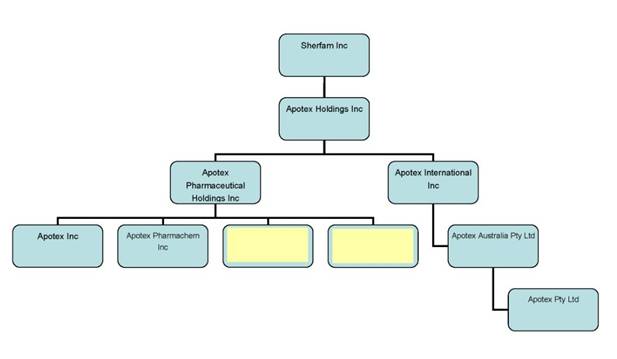
69 Servier relies on an affidavit sworn in March 2007 in Federal Court Proceeding NSD 208 of 2007 by Mr Millichamp, the managing director of what was then called GenRx Pty Ltd (GenRx) (now Apotex P/L). He said that GenRx was a wholly owned subsidiary of Apotex Australia Pty Ltd which was a wholly owned subsidiary of Apotex Inc. Servier contends that, despite the corporate structure, as a matter of reality Apotex P/L functions as a wholly owned subsidiary of Apotex Inc. Servier submits that this is sufficient to establish that fact at the level of a prima facie case. Apotex P/L says that the asserted fact is incorrect. It notified Servier of the mistake by letter in June 2010, asserting that Apotex P/L is not and never has been a subsidiary, direct or indirect, of Apotex Pharmachem or of Apotex Inc. With reference to the latter, the letter stated that it is not clear how this ‘error in our client’s understanding arose’.
70 I accept Apotex P/L’s explanation that the Mr Millichamp was in error in his earlier affidavit and that the corporate structure is as depicted in the diagram. That is, there is no direct control of Apotex P/L by Apotex Pharmachem or Apotex Inc. I reject the inference sought to be drawn by Servier that, despite the explanation provided by Apotex in correspondence soon after the filing of the affidavit that it was a mistake in the accepted corporate structure; Apotex Inc was, in reality and practice somehow controlling Apotex P/L. The evidence does not support that fact or inference, even at a prima facie level.
71 Servier relies on the information from the TGA Drug Master File (DMF) submitted by Apotex P/L for the Apotex Product. The drug product sponsor is Apotex P/L.
72 Information from the TGA website provides instructions as to the content of a DMF. The drug product sponsor must have the written permission of the drug substance manufacturer who submitted the DMF. The letter of access to the TGA must indicate, inter alia, the product sponsor and provide ‘certain other information and assurances required by the TGA’. An overseas manufacturer may submit all necessary documentation on behalf of multiple sponsors. It is the sponsor that is responsible for the quality of the product and the raw materials used to manufacture it. The sponsor provides written assurance that there is a formal agreement between the manufacturer of the API and the sponsor designed to ensure that information will be communicated by the manufacturer to the sponsor and the TGA before any significant change is made to the drug substance. The manufacturer provides the DMF and must complete the pro forma letter of access to it available from the TGA website. A separate application is required for each sponsor and each manufacturing site.
73 The TGA Australian Regulatory Guidelines Good Manufacturing Practice Clearance for Overseas Manufacturers (17th ed) glossary of terms defines “manufacture” by referring to s 3(1) of the TG Act and includes any step in the manufacture of therapeutic goods, including production, labelling, packaging, sterilisation, quality control, release, storage and distribution of medicinal products and the related controls. Section 3(1) of the TG Act defines manufacture (in relation to therapeutic goods that are not medical devices) to mean: to produce or to engage in any part of the process of producing the goods, or bringing the goods to their final state, including not only processing, assembling, packaging, labelling, storage and sterilising, but also testing or releasing for supply of the goods or of any component or ingredient of the goods as part of that process. It does not extend to sale. A manufacturer, as set out in the TGA glossary of terms includes a person who produces the product or engages in any part of the process of producing the product or bringing it to its final state by the manufacturing steps identical to those listed in s 3(1) of the TG Act.
74 That is, the process for manufacture of the Apotex Product, under the TGA definition of “manufacture”, involves, at least:
(a) manufacture of the API (including any intermediate);
(b) formulation, which involves combining the API with excipients to form the final product, for example, tablets or capsules;
(c) testing the products (including final products and any intermediates);
(d) packaging the final products; and
(e) releasing the packaged product for supply, including exportation, importation and distribution.
75 This extends beyond actions that would constitute exploitation or infringement of a patent.
76 Servier relies on documentary material produced by Apotex P/L and the facts stated in that material. The material includes the application to the TGA for the Apotex Product and information as stated on the website <Apotex.com>. Those facts are not in dispute. What is in dispute are the inferences that can be drawn from them.
77 Apotex Pharmachem granted access to the TGA to the DMF ‘in the evaluation of applications and notifications relating to the registration’ of named products submitted by the sponsor Apotex P/L, including the Apotex Product. In the letter of access, XXXXXX XXXXXXXXXXXXXXXXXXXXXXXXXXXXXXXXXXXXXXXXXXXXXXXXXXXX XXXXXX.
78 Servier relies on a table provided to the TGA providing ‘the names, addresses and responsibilities for each manufacturer, site or facility involved in the manufacture, packaging, testing, storage and release’ of Apotex P/L’s perindopril arginine tablets. This information provided to the TGA can be taken, prima facie, to relate to the Apotex Product. The Table lists the facilities involved in ‘various activities pertaining to Perindopril Arginine Tablets’, in 3 different dosages:
Manufacturer’s Name & Address | Responsibility Steps in Manufacture |
| XXXXXXXXXXXX … | • XXXXXXXXXXXX |
| XXXXXXXXXXXX … | • XXXXXXXXXXXX |
| XXXXXXXXXXXX .… | • XXXXXXXXXXXX |
| XXXXXXXXXXXX .… | • XXXXXXXXXXXX |
| XXXXXXXXXXXX .… | • XXXXXXXXXXXX |
79 It is apparent from the form of the table as produced by Apotex P/L and the redactions to it that other manufacturers, not being the overseas cross-respondents, have listed responsibility in steps in the manufacture of the Apotex Product. It is to be recalled that “manufacture” as used in this document may include all steps provided for in the definition of that word in the TG Act. Accordingly, the table can list multiple potential and possibly alternative manufacturers.
80 Bearing in mind the various steps included in the definition of manufacture, the information provided in the table relates the different steps, from API to finished product. References to quality control and release for supply, in my view, refer to any specified stage in the manufacture. The reference to quality control not linked to a specific step suggests some overview or setting of broad standards in the total process. While XXXXXXXXXX is listed has having responsibility for quality control generally and specifically for packaging and labelling, it can be seen that different sites are listed, apparently with responsibility for different stages. The conclusion could be drawn that “release for supply” is a release to the next stage of the process from manufacture of the API to the release of packaging and labelling of the finished product. That does not mean a release for supply to the Australian market and could take place outside Australia.
81 The responsibility and involvement of Apotex Inc would also be limited by an injunction that is currently in place preventing it from manufacturing perindopril products in Canada.
82 XXXXXXXXXXXXX is not a listed manufacturer. XXXXXXXXXXXXX is listed as the manufacturer of the dosage form, that is, the tablet form.
83 Apotex P/L also emphasises that this information is as to a proposed product and proposed manufacture, so that the provision of information does not mean that the actions are currently being carried out for supply in Australia. There is no evidence to the contrary. There has not yet been supply of the Apotex Product in Australia.
84 The relevant evidence is:
Apotex Inc is the registered proprietor of the trade marks APO and APOTEX. Apotex P/L is the licensee of those trade marks. Servier contends that to ensure the validity of a registered Australian trade mark, a proprietor will ensure that use of the trade mark is under controls and standards set by the proprietor, including controls as to the quality of the product. As the user maintains the connection of the registered proprietor with the goods, this necessarily imports control of Apotex P/L by Apotex Inc in the sense in which a parent company controls a subsidiary. Servier cites observations by Aickin J in Pioneer Electronic Corporation v Registrar of Trade Marks (1977) 137 CLR 670 at 683. However, Aickin J did not there say that such control was a necessary part of a licence of a trade mark; he said that to maintain the validity of a trade mark, there must be a connection maintained with the registered proprietor, even though the connection may be slight or may involve greater control, as by a parent.
The <Apotex.com> website refers generally to “Apotex” and also to the “Apotex group”.
Reference is made to eleven facilities at “our Headquarters” and then to such facilities in Canada.
Separate reference is made to ApoPharma or ApoPharma Inc, the “innovative research arm” and a subsidiary of Apotex Inc, and to “Apotex PharmaChem” in Ontario, the latter said to manufacture chemical requirements for ‘the Apotex group of companies’. Research is said to be carried out by ApoPharma Inc. Another company supplying fine chemicals to the group is Apotex Fermentation in Winnipeg. Another company mentioned is Cangene, which focuses on biotechnology.
The information on the <Apotex.com> website relates largely to Canada and to the position of Apotex in that country. On that website, it is stated that:
Apotex Inc is the largest Canadian owned pharmaceutical company in Canada which has done business in Canada for over 35 years. Apotex Inc in Canada is the site of the Global Head Office.
“Apotex” produces over 300 prescription medicines.
Apotex Inc exports to over 115 countries.
“Apotex” has established a presence through subsidiaries, joint ventures or licensing agreements in Australia and other countries.
“Apotex” has built a worldwide pharmaceutical company with a strategy of vertical integration.
‘We are a vertically integrated company. Our preference is to develop, manufacture and market our own products – from API to finished dosage form to marketing and distribution’.
‘We have built a global network in over one hundred and fifteen countries’ consisting of distributors and subsidiaries in, inter alia, Australasia.
Apotex Inc tests its pharmaceuticals to meet rigorous requirements of the Canadian Regulatory Agency.
The Canadian company has a number 1 ranking in Canada in terms of prescriptions filled and a top 10 position in the USA.
Australia is listed as an international market of interest to Apotex for in-licensing. Neither Canada nor the USA is in that list.
Apotex Inc offers a package of services ‘as the licensee/marketer of your product’. This is in the context of in-licensing.
Apotex offers a variety of products ‘to our international partners’ in the context of out-licensing and refers to ‘our facilities’ in Canada XXXXXXXX as well as experience with registration in most European countries.
Readers are invited to ‘submit your opportunity’ to Apotex in respect to product acquisition, co-development, in-licensing, out-licensing (North America) and other partnerships.
85 These last three matters are clearly directed to outside companies, not to companies within the Apotex group.
86 In summary, in addition to the corporate structure and TGA approval that I have already considered, Servier relies on the following facts and inferences drawn from the evidence as to Apotex Inc:
It exercises worldwide control over testing and product standards of the Apotex group of companies.
It is the registered proprietor of the trade marks APO and APOTEX and thus controls the standards of the quality of the product sold under the trade marks.
It is aware of the Patent by reason of its knowledge of the corresponding US patent.
87 As to Apotex Inc, Apotex P/L says that:
The statements on the Apotex website do not support the conclusion that Apotex Inc exercises worldwide control over testing and product standards. The website simply states that Apotex products must generally meet testing standards in Canada.
An assertion that the Australian market is of interest does not demonstrate or amount to evidence of control over Apotex.
The seeking or obtaining of regulatory approval does not constitute patent infringement (citing Apotex (No 4) at [49]).
Apotex Inc was, with Apotex Pharmachem, a defendant and subject to an injunction in proceedings brought in 2008 by a number of plaintiffs, including Servier, in Canada concerning perindopril containing products. They were restrained from manufacturing, selling or other dealing in those products in Canada.
Apotex Inc is not the holder of the DMF and is only included as a possible future manufacturer, which cannot be a present situation, due to the Canadian injunction.
This possible future manufacture does not support a prima facie case of authorisation or common design (Apotex (No 4)).
Consideration
88 Apotex Inc is not a holding company of Apotex P/L. From the organisational structure, it does not exercise control over Apotex P/L. From the evidence, Apotex Inc is a Canadian company. While it may control standards as to Apotex products, including for the purpose of ownership of Apotex trade marks, there is no sufficient evidence to establish a prima facie case that Apotex Inc has authorised or will authorise Apotex P/L to infringe the Patent. There is no sufficient evidence to establish a prima facie case of joint tortfeasance by common design to infringe.
89 The relevant evidence is:
On the Apotex website, it is stated that Apotex Pharmachem researches and develops fine chemicals “to meet our objective to be vertically integrated” and that ‘this ability to manufacture our own active ingredients when required is a key strength for Apotex’.
Apotex Pharmachem’s website states that its mandate is to meet customer needs by developing and manufacturing a wide range of APIs and by offering ‘custom services’.
It engages in research and development.
Its product list does not include perindopril arginine but does include perindopril erbumine.
The Apotex Pharmachem website states that Apotex Pharmachem has manufacturing partnerships, listing facilities in Canada, Mexico, India and China but not Australia.
XXXXXXXXXXXX XXXXXXXXXXXXX XXXXXXXXXXXXX XXXXXXXXXXXXX
A number of selected molecular targets and synthesis methodologies are described on Apotex Pharmachem’s website, broad ranging and not obviously linked to perindopril arginine.
Apotex Pharmachem’s website states that a total of over 500 DMFs have been prepared by Apotex Pharmachem’s Regulatory Affairs team. DMF submissions have been made in over 40 countries, including the United States, Europe, Canada, Australia and Japan: ‘Customer filings for marketing authorizations of pharmaceutical dosage forms have been supported in virtually every market in the world’ and Apotex Pharmachem’s employees have “guided the company” (apparently referring to Apotex Pharmachem) through the TGA process.
Apotex Pharmachem is the assignee of a US patent for an amorphous form of perindopril arginine. The correspondence address on the patent is that of Apotex Inc.
90 In summary, Servier relies on the following facts and inferences as to Apotex Pharmachem:
It is a part of the vertically integrated Apotex group of companies.
It operates a single worldwide research and development program in Canada.
It directs and controls the manufacture of products supplied by the members of the Apotex group of companies.
It is described in its website as having facilities in XXXXXXXXXXXXX
It is identified as directing and controlling the manufacture conducted by XXXXXXXXXXXX and XXXXXXXXXXXX The former has been certified by the TGA and the latter is listed as a manufacturer of the Apotex Product for Australia on the DMF.
XXXXXXXXXXXXXX is a manufacturer of intermediates and APIs and is identified as a manufacturer and exporter of perindopril arginine.
XXXXXXXXXXXXX is a manufacturer of medicines in capsule and tablet form.
Apotex Pharmachem is aware of the Patent, as the assignee of the corresponding US patent.
In information given to the TGA it is stated that the DMF Holder for perindopril arginine, proposed to be registered by Apotex P/L, is Apotex Pharmachem.
Apotex Pharmachem provided a letter of access to the TGA granting access by the TGA to its DMF for perindopril arginine for the purposes of the registration in Australia of products submitted to the TGA by Apotex P/L.
XXXXXXXXXXXXXXXXXXXXXXXXXXXXXXXXXXXXXXXXXXXXX.
Information given by Apotex Pharmachem to the TGA XXXXXXXXXXXXX XXXXXXXXXXXXX XXXXXXXXXXXXX XXXXXXXXXXXXX
Apotex Pharmachem was involved in the application for registration of the Apotex Product.
91 What additional matters available from the evidence, are relied on by Servier? Really, it is that Apotex P/L and Apotex Pharmachem are part of the same corporate group in which Apotex Pharmachem’s role is that of manufacturer and certifier for regulatory approval in countries including Australia.
92 As to Apotex Pharmachem, Apotex says that:
The Apotex website only says that this company has a ‘manufacturing partnership’ with facilities in XXXXXXXX and that a site in XXXXXXXX is an affiliated R & D site, not that the partnership is one of direction or control.
There is no direct relationship as shown in the corporate structure between Apotex Pharmachem and Apotex P/L or XXXXXXXXXXXXX
Apotex Pharmachem was, with Apotex Inc, a defendant and subject to an injunction in proceedings brought in 2008 by a number of plaintiffs, including Servier, in Canada concerning perindopril containing products. They were restrained from manufacturing, selling or other dealing in those products in Canada.
There is no evidence that Apotex Pharmachem has manufactured or supplied finished perindopril arginine products for Australia. As a result of the Canadian injunction and the fact that it does not produce finished product, the evidence is to the contrary.
93 As to the involvement of Apotex Pharmachem in the application to the TGA, Apotex P/L again says that the seeking or obtaining of regulatory approval does not constitute patent infringement. As to the fact that this company holds the DMF and is a possible future manufacturer as listed in the TGA application, Apotex P/L relies on the absence of direct infringement in Australia, the fact that Apotex Pharmachem does not produce finished product and the Canadian injunction.
Consideration
94 The fact that Apotex Pharmachem is itself the manufacturer, or directs the manufacture of the API, or provides information to the TGA, for the Apotex Product is not sufficient to make out a prima facie case of authorisation of infringement or of joint tortfeasance by common design to infringe (Apotex (No 4)).
95 In Apotex (No 4), I gave reasons for the joinder of Apotex Pharmachem to those proceedings in respect of a different patent. Apotex Inc had consented to joinder. Servier had alleged joint tortfeasance by common design with Apotex P/L and authorisation of infringement by Apotex P/L. Apotex P/L accepted that Apotex Pharmachem manufactured the API of its product but relied on evidence of manufacture of the finished product by Apotex Inc.
96 In that case, as here, there was insufficient evidence that Apotex Pharmachem exercised relevant control over Apotex P/L. Mere knowledge that an infringement is likely to occur is insufficient to amount to authorisation. Mere facilitation of infringing conduct is insufficient to constitute authorisation (Apotex (No 4) at [31]–[32]). As discussed in Apotex (No 4) at [33]–[35] and [43]–[44], the evidence in that case did not establish authorisation at a prima facie level. The evidence in the present case does not even rise as high as the evidence in Apotex (No 4). Servier has not made out a prima facie case of authorisation of Apotex P/L by Apotex Pharmachem.
97 In Apotex (No 4), I accepted that, on the totality of the evidence, there was an arguable case against Apotex Pharmachem for having acted in common design with Apotex P/L and Apotex Inc to infringe a different Servier patent with a different product. That was on the basis of a differently proposed corporate structure. In particular, in that structure, Apotex P/L was a subsidiary of Apotex Inc, a related company of Apotex Pharmachem.
98 Each of the matters referred to above is not, alone, sufficient to make out a prima facie case of common design to infringe the Patent. However, cumulatively and in circumstances that involve complex relationships and questions of fact and law, I do not accept Apotex P/L’s submission that Servier has failed to demonstrate a prima facie case of generally having a common design with Apotex P/L by parity of the reasoning in Apotex (No 4).
99 However, the next question is: a common design to do what? Unlike the circumstances in Apotex (No 4), where the product was imported into and sold in Australia, no tort has here been committed. No damage has been suffered by Servier. Indeed, by reason of the injunction, no tort can presently be committed. Submission to that restraint was proffered by Apotex P/L.
100 It follows that there is no prima facie case supporting a completed cause of action. As to an apprehended infringement, if the Patent is valid, the injunction against Apotex P/L will be made permanent. On the evidence, that is the only conduit used by Apotex Pharmachem in Australia. It follows that there is no threat that a tort will be committed, no threat that damage will be suffered by Servier and no completed cause of action.
XXXXXXXXXXXXX and XXXXXXXXXXXXX
101 The relevant evidence is:
XXXXXXXXXXXXX and XXXXXXXXXXXXX have different addresses but are in the same Industrial Area.
XXXXXXXXXXXXX is described on the Apotex Pharmachem website as ‘an associated company of’ Apotex Pharmachem.
XXXXXXXXXXXXX XXXXXXXXXXXXX XXXXXXXXXXXXX XXXXXXXXXXXXX XXXXXXXXXXXXX XXXXXXXXXXXXX XXXXXXXXXXXXXX
XXXXXXXXXXXXX manufacturing site has been certified by the US Food and Drug Administration and the TGA of Australia.
XXXXXXXXXXXXXXXXXXXXXXXXXXXXXXXXXXXXXXXXXXXXXXXXXXXX XXXXXXXXXXXXX XXXXXXXXXXXXX
102 In summary, Servier relies on the following facts and inferences as to XXXXXXXXXXXXX
It manufactures intermediates and APIs ‘consistent with the notion of there not being a single manufacturer of the Apotex Arginine Products’.
It is part of the vertically integrated Apotex group of companies, which operates a single worldwide research and development program in Canada.
The Apotex group cannot exploit perindopril in Canada, but is not prevented from manufacturing it in the country where XXXXXXXXXXXXX is located.
Its manufacturing site has been certified by regulatory agencies that include the TGA.
This leads to the inference that when Apotex Pharmachem is named as the manufacturer, the manufacture is actually carried out by XXXXXXXXXXXXX
It has been identified as a manufacturer and exporter of perindopril arginine.
It is aware of the Patent by reason of its relationship with other companies in the Apotex group.
The inference is available that it ‘was involved’ in the application for registration of the Apotex arginine products.
103 In summary, Servier relies on the following facts and inferences as to XXXXXXXXXXXXX
It manufactures medicines in capsule and tablet form ‘consistent with the notion of there not being a single manufacturer of the Apotex Arginine Products’.
It has Apotex listed as a ‘major customer’.
Two of its suppliers are Apotex Pharmachem and XXXXXXXXXXXXX
The Apotex group cannot exploit perindopril in Canada but is not prevented from manufacturing it in the country where XXXXXXXXXXXXX is located.
It is part of the vertically integrated Apotex corporate group.
As a member of the Apotex corporate group, it is aware of the Patent.
The inference is available that it ‘was involved’ in the application for registration of the Apotex Product.
104 As to XXXXXXXXXXXXX and XXXXXXXXXXXXX, Apotex says that:
No direct relationship exists by way of the corporate relationships, other than to demonstrate that they are each part of the same global group of companies as Apotex P/L. The fact that they have a similar address is irrelevant.
There is no evidence that:
(a) either Apotex Pharmachem or XXXXXXXXXXXXX has supplied any perindopril arginine API to XXXXXXXXXXXXX
(b) Apotex P/L has purchased any perindopril arginine from XXXXXXXXXXXXX or
(c) XXXXXXXXXXXXX does supply or will supply the API which will be converted into finished perindopril arginine products and supplied in Australia.
Knowledge of one member of the corporate group of the US patent does not extend, without evidence, to knowledge by other members of the group.
Neither of these XXXXXXXXXXXXX companies is the holder of the DMF. XXXXXXXXXXXXX is listed in the TGA application, but only as a possible future manufacturer. In any event, a mere manufacturer, for example of packaging, cannot be held a joint tortfeasor for the purposes of infringement of the Patent. XXXXXXXXXXXXX is not listed as a possible future manufacturer in the Apotex P/L application to the TGA.
Consideration
105 The evidence rises no higher than a prima facie case that XXXXXXXXXXXXX is involved in some stage of the manufacturing process of the Apotex Product. That manufacturing process includes, for example, packaging and labelling. There is no evidence that this proposed cross-respondent has any connection directly with Apotex P/L, other than, perhaps, as a supplier. This is not sufficient to establish a prima facie case of joint tortfeasance, common design or authorisation of any actual or potential infringement of the Patent in Australia.
106 The case against XXXXXXXXXXXXX does not even rise to that made out against XXXXXXXXXXXXX. The same weaknesses are evident. The only link with a proposed sale of the Apotex Product in Australia is that XXXXXXXXXXXXX is responsible for the manufacture of the dosage form and packaging of the Apotex Product for Australia, for example in a tablet form. No prima facie case is made as against XXXXXXXXXXXXX for the relief sought.
Consideration and conclusion on prima facie case
107 I do not accept that Servier has established, by fact or by inference drawn from the facts, a prima facie case that any of the overseas cross-respondents has the power or requisite degree of control to prevent a primary threat by Apotex P/L to infringe the Patent. Apotex Inc has not been shown relevantly to control Apotex P/L. Servier seems to suggest that the remaining overseas cross-respondents could prevent any infringement by refusing to supply product or labelling or dosage forms to Apotex P/L. That is not relevant where there is no primary infringement and no apprehended primary infringement by Apotex P/L in circumstances where it volunteered an admission of an infringing product and consented to an injunction pending the determination of validity of the Patent.
108 As to indirect infringement generally, there is no evidence of any supply of perindopril arginine in Australia, so there is no act of infringement for the purposes of common design or authorisation; there is no “act” in which one of the overseas cross-respondents took part.
109 The facts of this case are not apposite to those discussed by Merkel J in Bray v F Hoffman-La Roche. There, the acts were those of a parent company taking place in Australia through the acts of its subsidiary company on behalf of the parent. These acts were in the context of an alleged cartel agreement operating worldwide, including Australia and his Honour was concerned with the characterisation of communications from overseas parents to officers of the Australian subsidiary.
110 The only claim of direct infringement asserted against the overseas cross-respondents is that each “supplied” the Apotex Product to Apotex P/L in the Patent Area. This was not addressed by Servier in its submissions as a basis for the prima facie case against any of the overseas cross-respondents. I have therefore not addressed it in these reasons. In any event, I consider that Servier would have been unable to establish a prima facie case for direct infringement. As Apotex P/L points out:
There is no evidence of any supply by Apotex P/L or by any of the overseas cross-respondents of perindopril arginine in Australia.
Neither Apotex Inc not Apotex Pharmachem can currently manufacture or supply any form of perindopril because of an injunction in Canada.
Apotex Pharmachem and XXXXXXXXXXXXX only manufacture APIs and not finished products. On that basis neither could be suppliers of finished perindopril arginine products to Apotex P/L in Australia.
111 There is no present infringement of the Patent and there is no present threat of an infringement of the Patent in circumstances where:
Apotex P/L has proffered consent to an injunction;
Apotex P/L has admitted that the Apotex Product is within the scope of the claims of the Patent;
there is no present issue of infringement;
the question for determination is the validity of the Patent;
if the Patent is determined to be invalid, there can be no infringement;
if the Patent is valid, Apotex P/L would be subject to a permanent injunction restraining exploitation of the Apotex Product;
the evidence relied upon by Servier is directed to the Apotex Product;
there is no evidence that Apotex P/L would sell or attempt to sell the Apotex Product if the Patent were held to be valid; and
there is no evidence that Apotex P/L will sell or attempt to sell the Apotex Product pending the determination of the validity of the Patent.
112 There is no basis for a threatened infringement of the Patent by way of joint tortfeasorship for common design or authorisation of a product other than the Apotex Product or through a conduit other than Apotex P/L:
There is no sufficient evidence that any of the overseas cross-respondents has an intention to or has threatened to participate in another infringing act.
The only primary infringement that could be said to be threatened is of the sale in Australia of the Apotex Product by Apotex P/L and that threat is not current or reasonably apprehended.
There is no actual or apprehended primary infringement and there is no other party to the joint tortfeasance by common design or an infringement, actual or apprehended to be authorised.
There is no past infringement or previous unlawful action.
113 Servier has not demonstrated a present intention on the part of the overseas cross-respondents to do an act not authorised by law (see Halsbury’s Laws of Australia at [185–1560] and Spry at 381). An injunction must be of some practical utility and the Court should not enjoin conduct that in all probability will not occur. There is no present basis sufficient for a quia timet injunction.
114 If a change occurs and Apotex P/L seeks to vary or discharge the interlocutory injunction, that may well merit reconsideration of Servier’s application.
115 Although I have found that Servier has not made out a prima facie case for relief against any of the overseas cross-respondents, I will consider whether, if a case had been made out, an order to serve that party out of the jurisdiction would follow.
Is there an available discretion?
116 Servier maintains that the Court has no discretion whether or not to make an order granting leave to serve the overseas cross-respondents out of Australia if a prima facie case is made out.
117 Servier relies on the fact that r 10.43 of the Rules simply provides that the moving party must satisfy the Court as to prescribed criteria, such as those referred to above and points out that there is no express statement in Division 10.43 reserving to the Court a discretion. By contrast, in the previous rules, such a discretion was expressly included in the relevant rule, O 8 r 3(2):
… the Court may give leave to a party to serve an originating process on a person in a foreign country … on such terms and conditions as it considers appropriate, if the Court is satisfied that…
118 Section 37M of the Federal Court of Australia Act 1976 (Cth) provides:
The overarching purpose of civil practice and procedure provisions
(1) The overarching purpose of the civil practice and procedure provisions is to facilitate the just resolution of disputes:
(a) according to law; and
(b) as quickly, inexpensively and efficiently as possible.
(2) Without limiting the generality of subsection (1), the overarching purpose includes the following objectives:
(a) the just determination of all proceedings before the Court;
(b) the efficient use of the judicial and administrative resources available for the purposes of the Court;
(c) the efficient disposal of the Court's overall caseload;
(d) the disposal of all proceedings in a timely manner;
(e) the resolution of disputes at a cost that is proportionate to the importance and complexity of the matters in dispute.
(3) The civil practice and procedure provisions must be interpreted and applied, and any power conferred or duty imposed by them (including the power to make Rules of Court) must be exercised or carried out, in the way that best promotes the overarching purpose.
(4) The civil practice and procedure provisions are the following, so far as they apply in relation to civil proceedings:
(a) the Rules of Court made under this Act;
(b) any other provision made by or under this Act or any other Act with respect to the practice and procedure of the Court.
[emphasis original]
119 Divisions 1.2 and 1.3 of the Rules provide:
Division 1.2 Application about procedures
1.21 Application for orders about procedures
A person who wants to start a proceeding, or take a step in a proceeding, may apply to the Court for an order about the procedure to be followed if:
(a) the procedure is not prescribed by the Act, these Rules or by or under any other Act; or
(b) the person is in doubt about the procedure.
Rules 1.22–1.30 left blank
Division 1.3 General powers of the Court
1.31 Orders to have regard to nature and complexity of proceeding
(1) The Court may in making any order in the proceeding have regard to the nature and complexity of the proceeding.
(2) The Court may deal with the proceeding in a manner that is proportionate to the nature and complexity of that proceeding.
1.32 Court may make any order it considers appropriate in the interests of justice
The Court may make any order that the Court considers appropriate in the interests of justice.
Note See sections 23 and 28 of the Act.
1.33 Orders may be subject to conditions
The Court may make an order subject to any conditions the Court considers appropriate.
1.34 Dispensing with compliance with Rules
The Court may dispense with compliance with any of these Rules, either before or after the occasion for compliance arises.
120 I do not accept that the Court has no discretion under the Rules whether or not to make an order granting leave to Servier to serve the notice of cross-claim outside Australia. The general powers of the Court with respect to the Rules are set out in Division 1.3 and apply to all of the Rules. The power to make any order that the Court considers appropriate in the interests of justice (r 1.32) includes the power not to make an order. In deciding whether to make any order in a proceeding, the Court may have regard to the nature and complexity of the proceeding and decide not to make the order applied for (r 1.31(1)).
121 Servier says that a discretion applies only on an application to set aside the service and that this suggests that there is no discretion at this stage. Servier relies on the use of “mandatory language” in r 10.43.
122 I do not accept Servier’s submissions. First, the Rules provide for a discretion as to whether or not to order service. Secondly, it is a waste of time and money to order service if an application to set that service aside would be successful. Thirdly, the mandatory language applies to the matters that must be established by the moving party: ‘the party must satisfy the Court’. It does not apply to the Court. The language of the Rule simply sets out what Servier must establish. There is no express requirement that, if Servier satisfies the Court as to the required three limbs of the r 10.43(4) of the Rules, the Court must grant leave.
123 Fourthly, Servier must establish a prima facie case for the relief sought. In the absence of a primary infringement, that requires a consideration of whether Servier has established a prima facie case for a quia timet injunction. This is not a case raising difficulties of enforcement or other extraneous considerations (cf Humane Society International Inc v Kyodo Senpaku Kaisha Ltd (2006) 154 FCR 425).
124 Servier also maintains that even if a residual discretion does exist as to whether to order service out of the jurisdiction, the way in which such discretion has been referred to in other cases (Suzlon Energy Ltd v Bangad (No 3) [2012] FCA 123 and Perdaman Chemicals and Fertilisers v Griffin Coal Mining Co Pty Ltd [2011] FCA 1425) means that the discretion is not at large but is restricted to consideration of forum non conveniens.
125 This submission is answered by r 1.31(1) and by r 1.3 (2), as well as by r 1.32. Such a limitation is not required by the Rules. The fact that forum non conveniens has been considered in the exercise of the Court’s discretion in previous cases does not mean that this is the only discretionary factor which may be taken into account.
126 In Perdaman Chemicals, Siopis J found that a prima facie case for leave to serve outside the jurisdiction was made out and his Honour then turned to the exercise of discretion under the Division 10.4 of the Rules. The existence of such discretion was not challenged.
127 The admission by Apotex that the Apotex Product will infringe the Patent means that the nature of the Apotex Product is not in issue. The issue is the validity of the patent, which does not involve the overseas cross-respondents.
128 As stated at [63] above, in the present case, the threat is not imminent. The matters raised in that paragraph are relevant to the exercise of the Court’s discretion.
129 There is no specific evidence of inconvenience or hardship that would be suffered by any of the overseas cross-respondents were service permitted. However, I adopt what Laddie J said in Mead Corporation at 490: ‘The court must be satisfied that there are proper grounds before it allows foreign parties to be exposed to the expense and inconvenience of joinder in proceedings here’.
130 Further, complex factual and legal issues of relationships between Apotex P/L and various of the overseas cross-respondents would become issues for determination but are not necessary or relevant for the purpose of the determination of the validity of the Patent, the present issue in the proceeding.
131 Servier has not demonstrated that it will suffer any damage pending the outcome of the proceedings, as no product will be sold in Australia. The remedies potentially available to Servier will be an injunction and declarations. Accordingly, the overseas cross-respondents can only be relevant to a hypothetical argument regarding common design and/or authorisation, in circumstances where no act of infringement is involved. This does not warrant costly and time-consuming evidence and possibly discovery without apparent benefit. Service of the overseas cross-respondents is not proportionate to the nature and complexity of the proceedings. Accepting that Servier will be entitled to a final injunction if the validity of the Patent is upheld, Apotex P/L points to the absence of sufficient explanation as to why relief against the overseas cross-respondents is necessary: Apotex P/L is enjoined and will be enjoined if Servier is successful, and the only claimed common design or authorisation concerns Apotex P/L in Australia.
132 If I were satisfied that a prima facie case had been made out against one or more of the overseas cross-respondents, for direct infringement, indirect infringement or for quia timet relief, I would presently decline to make an order for service out of the jurisdiction.
I certify that the preceding one hundred and thirty-two (132) numbered paragraphs are a true copy of the Reasons for Judgment herein of the Honourable Justice Bennett. |
Associate:


