

FEDERAL COURT OF AUSTRALIA
Apotex Pty Ltd v Les Laboratoires Servier (No 6) [2012] FCA 745
IN THE FEDERAL COURT OF AUSTRALIA | |
DATE OF ORDER: | |
WHERE MADE: |
THE COURT ORDERS THAT:
1. The interlocutory application dated 4 May 2012 be dismissed with costs.
Note: Entry of orders is dealt with in Rule 39.32 of the Federal Court Rules 2011. The text of entered orders can be located using Federal Law Search on the Court’s website.
NEW SOUTH WALES DISTRICT REGISTRY | |
GENERAL DIVISION | NSD 657 of 2008 |
BETWEEN: | APOTEX PTY LTD ACN 096 916 148 Applicant LES LABORATOIRES SERVIER First Cross-Claimant SERVIER LABORATORIES (AUST) PTY LTD ACN 004 838 500 Second Cross-Claimant
|
AND: | LES LABORATOIRES SERVIER Respondent SERVIER LABORATORIES (AUST) PTY LTD ACN 004 838 500 Second Respondent APOTEX PTY LTD ACN 096 916 148 First Cross-Respondent SYMBION PHARMACY SERVICES PTY LTD ACN 000 875 034 Second Cross-Respondent CHEM MART PTY LTD ACN 001 235 374 Third Cross-Respondent ASCENT PHARMACEUTICALS LTD ACN 003 854 626 Fifth Cross-Respondent ASPEN PHARMA PTY LTD Sixth Cross-Respondent APOTEX INC Seventh Cross-Respondent APOTEX PHARMACHEM INC Eighth Cross-Respondent
|
JUDGE: | BENNETT J |
DATE: | 12 July 2012 |
PLACE: | SYDNEY |
REASONS FOR JUDGMENT
1 Apotex Pty Ltd (Apotex) is the moving party in this proceeding seeking revocation of Australian Patent No 2001276418 (the AC Patent) of which the first respondent is the patentee and the second respondent the exclusive licensee in Australia (together Servier). Broadly speaking, the subject of the AC Patent is a crystalline form of perindopril tert-butylamine salt (perindopril erbumine). Servier has cross-claimed for infringement by Apotex of the AC Patent.
2 Servier is also the owner of pending divisional Application Number 2007203451 (the Divisional). The Divisional is derived from the AC Patent. It is the subject of a notice of opposition filed by Apotex in the Patent Office. No other notices of opposition have been filed. If, and as soon as, the Divisional proceeds to grant, Servier proposes to sue on that patent (the Divisional Patent) to enjoin Apotex’s exploitation of the perindopril erbumine.
3 By an interlocutory application filed on 4 May 2012, Servier seeks the following order:
Federal Court of Australia Proceeding No. NSD 657 of 2008 be stayed until the Australian Patent Office grants or refuses Patent Application Number 2007203451.
(the Stay Application)
4 It is accepted by both parties that it should be assumed that, whatever the decision in the Patent Office, an appeal from that decision would be filed with the Federal Court. As developed during the hearing, of the Stay Application, Servier’s proposal involves the proceeding being stayed until the determination by the Patent Office of Apotex’s opposition to the Divisional and any appeals therefrom. Apotex opposes the grant of a stay.
5 The proceeding is set down for a three week hearing commencing 15 October 2012, that date having been allocated by the Court on 11 October 2011. On that occasion, Servier informed the Court that it had applied for the Divisional and that the determination of that application was before the Patent Office. At that time, Apotex’s evidence in support of the opposition had yet to be filed. Although no formal application was made by Servier on that occasion, Servier stated that its position was that, when the Divisional was determined in the Patent Office, any appeal from that determination could be heard together with the hearing on the AC Patent. Due in part to the uncertainty of the timing of any grant of the Divisional, the proceeding concerning the AC Patent was fixed for hearing.
General principles applicable to a stay of proceedings
6 Both parties invoke s 37M of the Federal Court of Australia Act 1976 (Cth) (the FC Act) which provides:
37M The overarching purpose of civil practice and procedure provisions
(1) The overarching purpose of the civil practice and procedure provisions is to facilitate the just resolution of disputes:
(a) according to law; and
(b) as quickly, inexpensively and efficiently as possible.
(2) Without limiting the generality of subsection (1), the overarching purpose includes the following objectives:
(a) the just determination of all proceedings before the Court;
(b) the efficient use of the judicial and administrative resources available for the purposes of the Court;
(c) the efficient disposal of the Court’s overall caseload;
(d) the disposal of all proceedings in a timely manner;
(e) the resolution of disputes at a cost that is proportionate to the importance and complexity of the matters in dispute.
(3) The civil practice and procedure provisions must be interpreted and applied, and any power conferred or duty imposed by them (including the power to make Rules of Court) must be exercised or carried out, in the way that best promotes the overarching purpose.
(4) The civil practice and procedure provisions are the following, so far as they apply in relation to civil proceedings:
(a) the Rules of Court made under this Act;
(b) any other provision made by or under this Act or any other Act with respect to the practice and procedure of the Court.
(emphasis original)
7 Each of Apotex and Servier submits that its position, in opposition to or in support of the application for a stay of this proceeding respectively, is in accordance with the purpose of civil practice and procedure as set out in s 37M of the FC Act.
8 As Dodds-Streeton J pointed out in Websyte Corporation Pty Limited v Alexander (No 2) [2012] FCA 562 at [53]:
It is well established that this court has an extensive jurisdiction to stay proceedings in the interest of justice and that the “matter is one of judicial discretion” (See Rochfort v John Fairfax & Sons Ltd [1972] 1 NSWLR 16 at [19] and [21] per Sugerman ACJ (with whom Holmes and Mason JJA agreed)).
9 Websyte concerned an application for a stay of civil proceedings pending the determination of criminal proceedings. At [62] Dodds-Streeton J cited certain guidelines set out by Wootten J in McMahon v Gould (1982) 7 ACLR 202 at 206. Some of those guidelines specifically concerned an application to stay civil proceedings pending criminal proceedings but others are apposite generally, including:
a. Prima facie a plaintiff is entitled to have his action tried in the ordinary course of the procedure and business of the Court (Rochfort at 19).
b. It is a grave matter to interfere with this entitlement by a stay of proceedings, which requires justification of proper grounds (Rochfort at 19).
c. The burden is on the defendant in a civil action to show that it is just and convenient that the plaintiff’s ordinary rights should be interfered with (Jefferson Ltd v Bhetcha [1979] 2 All ER 1108 at 1113).
d. The Court’s task is one of ‘the balancing of justice between the parties’, taking account of all relevant factors (Jefferson at 1113).
e. Each case must be judged on its own merits, and it would be wrong and undesirable to attempt to define in the abstract what are the relevant factors (Jefferson at [905]).
10 As stated succinctly by Sundberg J in Clorox Australia Pty Ltd v International Consolidated Business Pty Ltd (2005) 66 IPR 506 at [5], ‘to obtain a stay, an applicant must show that the interest of justice would be best served by its grant’ and the grant of a stay is a discretionary order. Justice Sundberg noted that one example of a circumstance where a stay would be appropriate was where two separate actions are pending in the same court, involving the same parties and the same subject matter, and where the hearing of the first will effectively dispose of the need for the hearing of the second (citing Lidden v Composite Buyers Ltd (1996) 139 ALR 549 per Finn J at 559). His Honour granted the stay even though there was no precise identity of the parties in the two proceedings.
11 In Commonwealth Bank of Australia v Finance Sector Union of Australia (2003) 124 IR 453, the Full Court upheld a decision of Moore J to reject an application for a stay. In that case, a stay was sought in the Court because of a hearing before the Australian Industrial Relations Commission (the Commission). Apotex relies upon some of the matters cited by Moore J that it says are relevant to the present application, including:
The Court has a duty to determine the application.
It is not appropriate to refrain from exercising a duty simply because one party wishes to take steps, potentially, to alter the rights and liabilities of the parties.
12 Apotex also seems to rely upon an analogy between the facts in Commonwealth Bank and the present application, where the stay is being sought because of proceedings in the Patent Office. That aspect of the Commonwealth Bank decision is not apposite. As Marshall J pointed out in the Full Court decision at 457, the task of the Court and the Commission is significantly different. In the present case, the task of the Patent Office is to determine whether the Divisional should proceed to grant and the available grounds of opposition largely mirror available grounds of revocation.
13 I have been informed that the grounds raised by Apotex in the opposition to the Divisional include the grounds of lack of novelty and lack of utility, in addition to the grounds available under s 40 of the Patents Act 1990 (Cth) (the Act): fair basis, lack of clarity, failure to disclose best method and insufficiency of description. The pleaded grounds of revocation in this proceeding are lack of novelty and lack of utility, fair basis, lack of clarity, failure to disclose best method and insufficiency of description, as well as manner of manufacture, lack of inventive step, secret use, and false suggestion.
14 There is, however, a difference in the degree of satisfaction necessary in the Patent Office and in the Court. In a revocation action, an applicant must establish invalidity on the balance of probabilities. At the stage of a pre-grant opposition, it is necessary for an opponent to demonstrate that it is ‘practically certain’ that the patent to be granted in the specification would have been invalid (Genetics Institute Inc v Kirin-Amgen Inc (1999) 92 FCR 106 at [17] per Black CJ, Merkel and Goldberg JJ) or ‘clearly satisfied that the patent, if granted, would not be valid’ (F Hoffman-La Roche AG v New England Biolabs Inc (2000) 99 FCR 56 at [67] per Emmett J).
15 In FA Faulding & Co Ltd v Bristol-Myers Squibb Co (1997) 40 IPR 511, Heerey J considered an application for a stay by the party seeking revocation of a petty patent on the basis of an application by the patentee for a divisional of the petty patent, in the Patent Office. That is, the application for the stay was made by the party in the position of Apotex, not the patentee. That party sought an order that the proceedings for revocation be stayed, or in the alternative be adjourned, until the pending patent application was granted or refused. His Honour noted the principle ‘that someone who brings a legitimate, genuinely arguable claim to the court is entitled to have that claim heard as soon as the court can conveniently arrange it, consistently with the demands of other litigants’ (at 512). The revocation case had not yet been set down for hearing, but was ready for trial. As his Honour observed, what was being sought was ‘an indefinite postponement of the trial to await hypothetical litigation, which may or may not be brought, in relation to a hypothetical standard patent, which may or may not be granted’ (at 512). Justice Heerey declined to grant the stay, partly because of the ‘substantial assumptions’ as to the outcome of the application in the Patent Office, including the assumption that the Commissioner of Patents would in fact accept the patent. Many of those assumptions do not apply to the present stay application. It was also a matter of concern to his Honour that the subject matter was a petty patent. However, Heerey J took into account that, if the Commissioner were to refuse grant, there would be an appeal to the Court as a separate proceeding.
16 There is no need to analyse these cases, or other cases, fully. It is quite clear that in exercising the available discretion, each case turns on its own facts. Accordingly, little direct assistance is gained other than to observe that some general principles apply when two proceedings form the bases for an application for a stay of one of them, including the right of an applicant to have its proceedings determined. The Court has a general power to control its own proceedings, which extends to an order that proceedings be stayed. In exercising a discretion and looking to the factors that, generally, balance the advantages and disadvantages to each party and to the Court, I do not accept Apotex’s submission that it is necessary for Servier to demonstrate exceptional circumstances in order to succeed in its application. In Hughes Motor Services Pty Ltd v Wang Computer Pty Ltd (1978) 35 FLR 346 at 351–353, Bowen CJ said that the Court can usefully look for assistance to the principles discussed in relation to lis alibi pendens: broadly speaking, the Court would balance any advantage to the plaintiff against any disadvantage to the defendant in exercising its discretion, although other matters as relevant to the case should be taken into consideration including:
whether different jurisdictions were involved;
whether issues of fact and relief were the same;
the work necessarily done in preparing two separate matters or saved if only one matter were to be determined;
circumstances relating to witnesses; and
the public interest.
Chronology and delay
17 The relevant factual background against which the application is to be considered can be conveniently stated by way of an undisputed chronology:
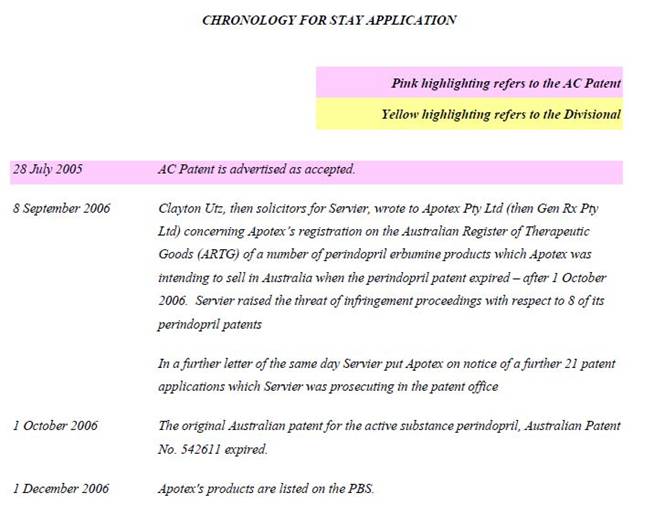
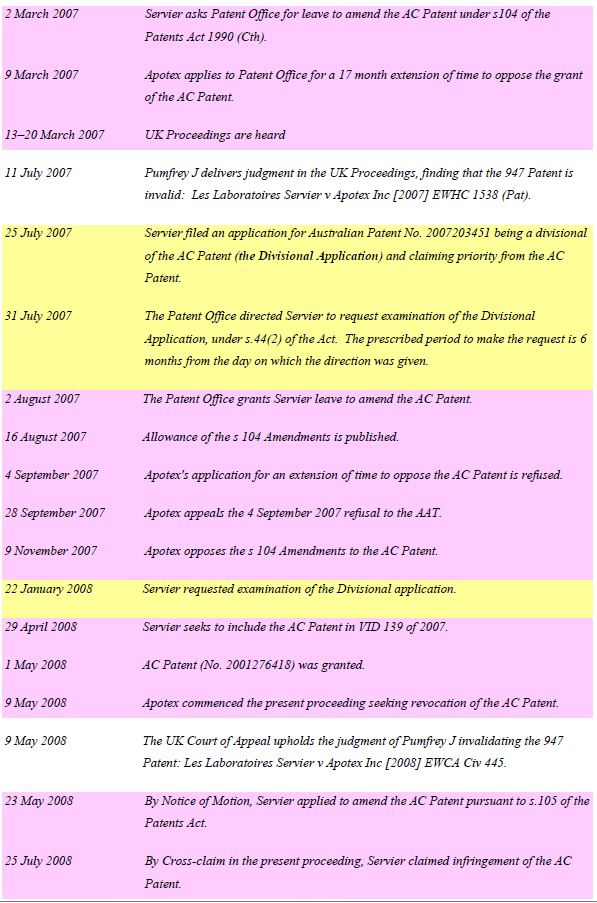
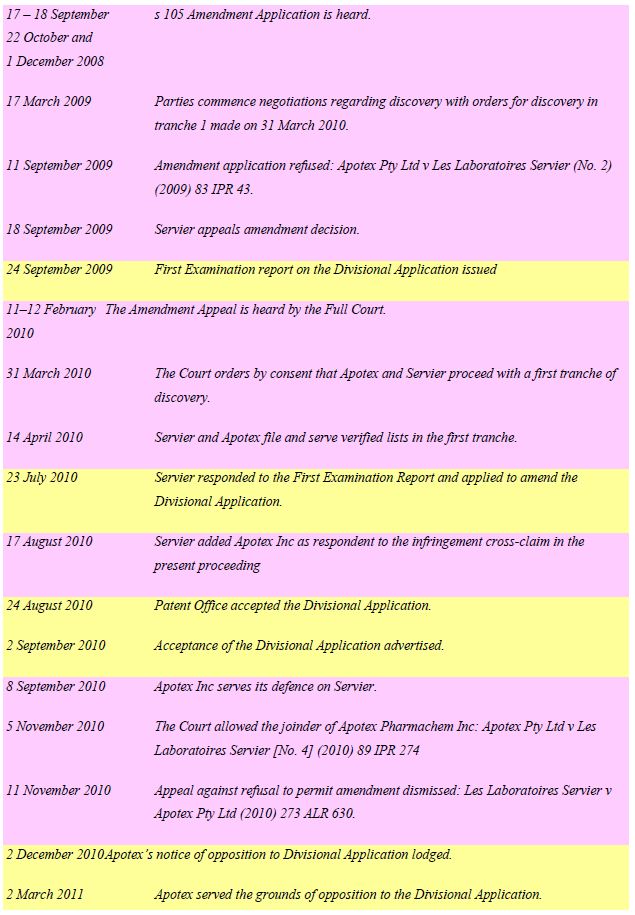
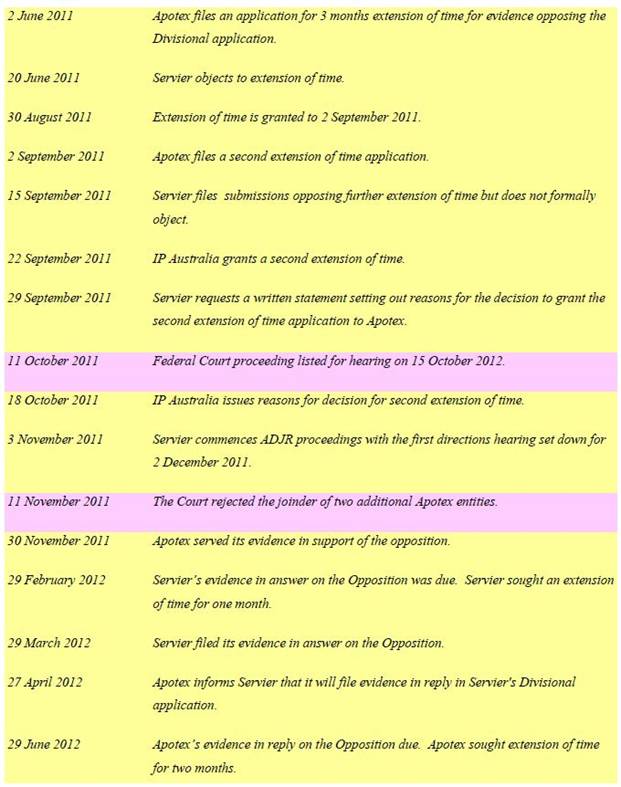
18 The parties proceed on the basis that the likely period for a stay in order to determine the Divisional to the stage of a decision of a judge of the Court is, at least, in the order of 18 months to 2 years.
19 Apotex submits that it is appropriate for the Court, in exercising its discretion, to have regard to the substantial delay that has occurred since this proceeding commenced, arising out of two actions taken by Servier:
After Servier’s proposed amendments were refused under s 104 of the Act, its decision in 2008 to permit the AC Patent to proceed to be sealed without the amendment and then to apply to the Court under s 105 of the Act for leave to make those amendments. That decision resulted in an opposed application for amendment which was not finally resolved until a determination by the Full Court in November 2010 in Les Laboratoires Servier v Apotex Pty Ltd (2010) 273 ALR 630. The application was refused.
The decision by Servier to file the Divisional, with those same amendments, which has not yet been determined in the Patent Office.
20 Apotex placed some emphasis on what it said were delays on the part of Servier in the conduct of this proceeding and of the Divisional in the Patent Office.
21 I accept that there have been lengthy delays resulting from those activities and decisions, in particular arising from the application to amend the AC Patent under s 105 of the Act. However, I am satisfied that those decisions, which were available under the Act, were made by Servier at the relevant time for a good reason. I do not accept that Servier’s application should be refused because of the delays resulting from those decisions. The chronology is a matter of objective fact. The delays have occurred but are not to be laid at the door of either of the parties for the purposes of this application.
22 Servier says that the extent of delay from the current date is in Apotex’s hands because, Servier asserts, the Divisional will proceed to grant and Apotex can choose not to appeal that decision. Apart from this outcome being speculative, Apotex is entitled to appeal an unfavourable decision in the Patent Office by way of re-hearing to the Court. In my opinion that factor does not assist in the determination of this application.
Servier’s submissions
23 To summarise Servier’s submissions, the principal bases upon which it relies in support of a stay are:
The overlap in the matters that are likely to be in issue in the opposition to the Divisional and the revocation case concerning the AC Patent. This extends to an overlap in evidence and documentation. Servier accepts that there will be some additional issues relating to the addition of integers in the claims of the Divisional but says that these are likely to be confined.
The field of technology is very similar and the specifications are the same in substance, being virtually identical, save for the claim language, the incremental integers and the consistory clauses that support the “needles claim”.
On the other hand, Servier does not accept that the issues in the cases concerning the Divisional and the AC Patent are co-extensive, pointing out that the proposed amended claims add an integer which affects, at the least, the novelty of those claims.
The necessity to call witnesses, including independent expert witnesses, on two separate occasions.
Servier’s estimated costs of conducting a final hearing on the AC Patent are not less than $1.5 million. Servier says that these costs would in effect be thrown away or rendered unnecessary if the application for a stay is granted. Apotex did not dispute this estimate.
The dispute concerning the AC Patent should be heard together with the dispute concerning the Divisional, this being a course that will avoid duplication, wasted costs and the inefficient use of court resources.
The objective of the resolution of disputes inexpensively and efficiently, including the efficient use of the administrative resources available to the Court, as provided in s 37M, of the FC Act would be met.
Apotex will suffer no prejudice if the stay is granted because Apotex is not restrained from selling the product that is allegedly within the scope of the AC Patent.
24 A further basis for Servier’s application, which was first raised in oral submissions, is that if the AC Patent proceeding is stayed, Servier will proffer undertakings to the Court that preclude a duplication of hearings. In substance, Servier will undertake that, on the grant of the Divisional, it will surrender the AC Patent and substitute the Divisional Patent for the AC Patent in this proceeding. This will result in duplication and interlocutory processes being minimised. Servier will also undertake to prosecute that amended proceeding expeditiously and to pay Apotex’s costs thrown away by reason of the amendment of the proceeding. In addition, to forestall Apotex’s submission that the delay in determination of what Apotex asserts is an invalid AC Patent will affect the rights of third parties to sell the product the subject of the claims of the AC Patent, Servier says that if a stay is granted, it will give an undertaking not to commence proceedings asserting infringement of the AC Patent against any third party without leave of the Court for the duration of such a stay.
25 It follows, Servier says, that wastage of costs and court resources will be minimised with no interim “mischief”. That is, there will be no commercial prejudice to either Apotex or third parties. Servier says that there will be no detriment to the public interest. Indeed, it submits that the freeing of Court time benefits the public interest.
26 Servier says that it is unlikely in an appeal from an opposition hearing that there would be an application made, or a successful application, under s 158(2) of the Act to a Full Court, for the reasons set out by the Full Court in Kirin-Amgen.
Apotex’s submissions
27 To summarise, the principal bases upon which Apotex opposes the stay are:
Apotex emphasises its right to have the proceeding that it commenced determined.
This is not, Apotex emphasises, an application simply for an adjournment, but an application to stay the proceeding in circumstances where there is no suggestion that the parties are not ready for the impending trial.
Apotex is entitled to findings that will, at the least, ‘clear the way’ so far as the issues exist between the parties, not only with regard to the AC Patent but also the Divisional.
The costs that are of concern to Servier are, to put it simply, just the costs of litigation.
As to Servier’s contention that there is an absence of detriment to Apotex, Apotex points out that while the AC Patent remains on the register, even though Apotex is selling its product, there is present a threat of damages.
The issues that would arise in the current proceeding and in a Divisional proceeding are different. To the extent that common issues arise, there would be little duplication, as there would be an issue estoppel between the proceedings.
28 As to the practicalities, Apotex points out that there are four possible outcomes of the AC Patent hearing:
1. If the AC Patent is valid and infringed, Servier would not proceed on the Divisional because the latter claims are narrower and, accordingly, would be infringed as well. There would be no need for a second hearing.
2. If the AC Patent is valid and not infringed, Apotex would not infringe the narrower Divisional claims and there would be no need for a second hearing.
3. If the AC Patent were invalid and not infringed, Apotex would not infringe the narrower Divisional claims and there would be no need for a second hearing.
4. If the AC Patent were invalid but infringed, Servier would need to proceed to determine the validity of the Divisional in order to prevent Apotex from selling its product.
That is, if the AC Patent is valid, as Servier asserts, the Divisional is not relevant. If that were the case, there would be no duplication of proceedings. The only outcome on which a hearing on the Divisional Patent might arise would be the fourth outcome above. Indeed, Apotex submits there is a greater efficiency in disposing of the validity and infringement of the AC Patent, as on three of the four outcomes described above, a Divisional hearing may then be unnecessary. Apotex says that its evidence in relation to the AC Patent has already been prepared, without reference to the additional integer of the claims of the Divisional. Apotex points out that its costs, which Servier accepts would be approximately of the same order as those estimated for Servier, have already been expended and committed. Even upon the undertaking proposed by Servier, Apotex would not be in a position to recover costs for an extended period of time.
Consideration
29 I accept that Apotex has a right to have this proceeding determined. This proceeding, seeking revocation of the AC Patent, was commenced by Apotex on 9 May 2008. It has now been set down for hearing and time for that hearing has been allocated by the Court. The period of the stay if Servier’s application were successful is uncertain, but it is substantial. It is unlikely that a later hearing on either the AC Patent, the opposition to the grant of the Divisional, the Divisional Patent or the two together, would be less than 18 months and it would likely be longer.
30 I am not certain that there are efficiencies in the two hearings taking place together. At the least, there is a different onus of proof, different claims and additional questions would arise, at least as to the novelty of claims with the additional “needles” integer and, most likely, as to questions of utility and infringements. While there may be some efficiencies in having any cases heard together, there is equally likely to be more complication.
31 I accept if that the Divisional proceeds to grant and successfully withstands an appeal from the decision of the Commissioner, Servier would surrender the AC Patent so that there would not be a need to hear those two proceedings concurrently. However, Apotex is entitled to have the issues on the AC Patent determined. It is likely that the resolution of those issues will, in turn, narrow the issues necessary for determination in the hearings on the Divisional.
32 While there has been general reference to the convenience of witnesses, no specifics have been advanced as to the availability or lack of availability for a later hearing on Divisional Patent, or particular difficulties arising in cross-examination, apart from a general comment on possible issues of credit.
33 I appreciate that patent litigation generally, and in this proceeding specifically, involves the expenditure of large amounts of money on costs. That is partly due to the complexity inherent in patent litigation. However, the proceeding on the AC Patent is ready for hearing. Following from Servier’s undertaking, if the Divisional proceeds to grant there may be no necessity for the issues concerning the AC Patent to be resolved and therefore no necessity for the further expenditure of costs in relation to this proceeding. That factor is balanced, in my view, by the unpredictability as to timing with regard to the Divisional and the fact that I am not satisfied that it will be more efficient to stay this proceeding and await the outcome of the Divisional. As Apotex has pointed out, the determination of this proceeding may obviate the need for the opposition in the Patent Office and a further appeal to this Court to be determined.
34 It follows that Servier’s application for a stay of the proceeding should be refused with costs.
I certify that the preceding thirty-four (34) numbered paragraphs are a true copy of the Reasons for Judgment herein of the Honourable Justice Bennett. |
Associate:


