

FEDERAL COURT OF AUSTRALIA
Hunter v State of Western Australia [2012] FCA 690
FEDERAL COURT OF AUSTRALIA
Hunter v State of Western Australia [2012] FCA 690
CORRIGENDUM
1. In paragraph 3 of the Reasons for Judgment, in the first sentence, the word “west” should read “east”.
I certify that the preceding one (1) numbered paragraph is a true copy of the Corrigendum to the Reasons for Judgment herein of the Honourable Justice North. |
Associate:
Dated: 5 July 2012
IN THE FEDERAL COURT OF AUSTRALIA | |
WAD 280 of 2008
BETWEEN: | SP (DECEASED) CELIA BENNETT, HARRY WATSON, JOSEPH MUNRO, JOSEPH EDGAR, JOHN WATSON, GORDON MARSHALL, DONALD GREY, REGINA GREY, WITTIDONG MULARDY, JOHN HOPIGA, LENNY HOPIGA, MERVYN MULARDY JNR, AND ANTHONY WATSON OTHERS ON BEHALF OF THE KARAJARRI PEOPLE Applicant |
AND: | STATE OF WESTERN AUSTRALIA, TELSTRA CORPORATION LIMITED, THE COMMONWEALTH OF AUSTRALIA, MANDORA PTY LTD, WESTERN AUSTRALIAN FISHING INDUSTRY COUNCIL (INC), ANNA PLAINS CATTLE CO P/L DARCY HUNTER, WINNIE COPPIN, WD (DECEASED) ALMA GRAY AND ADA STEWART Respondent |
DATE OF ORDER: | |
WHERE MADE: |
THE COURT ORDERS THAT:
Note: Entry of orders is dealt with in Rule 39.32 of the Federal Court Rules 2011.
WESTERN AUSTRALIA DISTRICT REGISTRY | |
GENERAL DIVISION | WAD 6281 of 1998 |
BETWEEN: | DARCY HUNTER, WINNIE COPPIN, WD (DECEASED) ALMA GRAY AND ADA STEWART ON BEHALF OF THE NYANGUMARTA PEOPLE Applicant |
AND: | STATE OF WESTERN AUSTRALIA, TELSTRA CORPORATION LIMITED, THE COMMONWEALTH OF AUSTRALIA, MANDORA PTY LTD, WESTERN AUSTRALIAN FISHING INDUSTRY COUNCIL (INC), AND ANNA PLAINS CATTLE CO P/L Respondent
|
WAD 280 of 2008 | |
BETWEEN: | SP (DECEASED) CELIA BENNETT, HARRY WATSON, JOSEPH MUNRO, JOSEPH EDGAR, JOHN WATSON, GORDON MARSHALL, DONALD GREY, REGINA GREY, WITTIDONG MULARDY, JOHN HOPIGA, LENNY HOPIGA, MERVYN MULARDY JNR, AND ANTHONY WATSON OTHERS ON BEHALF OF THE KARAJARRI PEOPLE Applicant |
AND: | STATE OF WESTERN AUSTRALIA, TELSTRA CORPORATION LIMITED, THE COMMONWEALTH OF AUSTRALIA, MANDORA PTY LTD, WESTERN AUSTRALIAN FISHING INDUSTRY COUNCIL (INC), ANNA PLAINS CATTLE CO P/L DARCY HUNTER, WINNIE COPPIN, WD (DECEASED) ALMA GRAY AND ADA STEWART Respondent |
JUDGE: | NORTH J |
DATE: | 25 MAY 2012 |
PLACE: | ANNA PLAINS |
REASONS FOR JUDGMENT
introduction
1 The Court sits today at Talgarno in Western Australia to consider two applications for determinations of native title.
2 The land is in the south west Kimberley region and covers approximately 1995 square kilometres. It is located approximately half way between Bidyadanga and Sandfire. Most of the area falls within the Anna Plains pastoral lease.
3 Immediately to the north and west of the land in question in the present applications is land in which the Court determined (Nangkiriny v State of Western Australia [2002] FCA 660 (Nangkiriny)) that the Karajarri have native title rights and interests (the Karajarri land). Immediately to the south of the land in question in the present applications is land in which the Court determined (Hunter v State of Western Australia [2009] FCA 654 (Hunter)) that the Nyangumarta people have native title rights and interest (the Nyangumarta land). The land in question in the present applications is country shared by the Nyangumarta people and the Karajarri people (the shared country).
4 The present applications over the shared country arose in the following way.
the shared country applications
5 On 29 September 1998, application WAD 6281 of 1998 for determination of native title was filed by the Nyangumarta people. On 23 November 2007, a further application for determination of native title, WAD 234 of 2007, was filed by the Nyangumarta people. These applications included but extended beyond the shared country. The applicants are Darcy Hunter, WD (deceased), Ada Stewart, Winnie Coppin and Alma Gray on behalf of the Nyangumarta people. The Nyangumarta people are those persons who are descended from 12 sets of apical ancestors, who self-identify as Nyangumarta and who are accepted by other members of the community as Nyangumarta in accordance with traditional law and custom.
6 On 3 December 2008, application WAD 280 of 2008 for determination of native title was filed by the Karajarri people. It covered the shared country only. The applicants are SP (deceased), John Hopiga, Lenny Hopiga, Mervyn Mulardy Jnr, Joseph Edgar, Joseph Munro, Harry Watson, Mr Watson, Gordon Marshall, Donald Grey, Wittidong Mulardy, Celia Bennett, Regina Grey and Anthony Watson on behalf of the Karajarri people. The Karajarri people are those persons who are descended from 6 apical ancestors, who self-identify as Karajarri and who are accepted by other members of the community as Karajarri in accordance with traditional law and custom.
7 The non-indigenous respondents to all the applications are the State of Western Australia (the State), the Commonwealth of Australia, the Western Australian Fishing Industry Council (Inc), Anna Plains Cattle Co Pty Ltd, Mandora Pty Ltd and Telstra Corporation Pty Ltd.
8 The land covered by the Nyangumarta applications was divided into Part A and Part B areas. The Part A area covered the land subject to the original application, save for the shared country, and the land the subject of the further application. The Part B area was the shared country.
9 On 11 June 2009, the Court determined that the Nyangumarta people held native title rights and interests in the Part A area, and adjourned consideration of the application concerning the Part B area.
10 Consequently, the applications which cover the shared country are the Part B area application brought by the Nyangumarta people, and the shared country application brought by the Karajarri people.
11 As both applications cover the same area, on 12 December 2008, the Court ordered, pursuant to s 67(1) of the Native Title Act 1993 (Cth) (the Act) that both applications would be dealt with in the same proceeding, to be known as the Nyangumarta-Karajarri (Yawinya) Overlap Proceeding.
the agreement
12 The parties to the applications have now reached agreement as to the outcome of the applications. The Court has power to make orders consistent with such agreement without holding a hearing (whether under s 87 and/or s 87A of the Act).
13 In order to make such orders the terms of the agreement or determination must be filed with the Court, the Court must be satisfied that orders consistent with the terms of the agreement or determination are within the power of the Court, and it is appropriate to make such orders or determination (ss 87(1)(c), (1A) and (2) and 87A(4)).
14 The orders sought by the parties and the proposed determination have been signed by all the parties and filed with the Court. Thus, the first requirement has been satisfied.
Are the orders within the power of the Court?
15 In broad terms the proposed determination recognises exclusive native title rights and interests over a 40 metre wide strip of land along part of the 80 Mile Beach between the border of the Anna Plains pastoral lease and the landward side of the intertidal zone (schedule 3). A corridor of non-exclusive native title rights and interests through this strip of land is agreed in order to provide access to the 80 Mile Beach. Further non-exclusive native title rights and interests are agreed over most of the determination area which is comprised by the Anna Plains pastoral lease. Small areas of non-exclusive native title rights and interests are agreed over part of the Mandora pastoral lease, reserves for watering places and a reserve for the Kimberley De Grey Stock Route (schedule 4). Non-exclusive native title rights and interests are agreed over the intertidal area (schedule 5).
16 The proposed determination sets out the persons or each group of persons holding the common or group rights comprising native title, the nature and extent of the native title rights and interests in relation to the determination area, the nature and extent of any other interests in relation to the determination area, the relationship between the native title rights and interests and the other interests in relation to the determination area and to the extent that the land or waters in the determination area are not covered by a non-exclusive agricultural lease or non-exclusive pastoral lease, whether the native title rights and interests confer possession, occupation, use and enjoyment of that land or waters on the native title holders to the exclusion of all others. The proposed determination therefore includes the matters which are required by s 225 of the Act and hence the orders comply with s 94A of the Act which provides that such orders must set out the details of the matters mentioned in s 225 of the Act. As a result, I find that the orders and determination are within the power of the Court as required by ss 87(1)(c) and 87A(4)(a).
Is it appropriate to make the orders?
17 The remaining question is whether it is appropriate for the Court to make the orders and determination (ss 87(1A) and (2) and s 87A(4)(b)). The proper approach for the Court to take when considering whether it is appropriate to make orders consistent with the agreement of the parties without a hearing was explained in Lovett on behalf of the Gunditjmara People v State of Victoria [2007] FCA 474 as follows:
36 The focus of the section is on the making of an agreement by the parties. This reflects the importance placed by the Act on mediation as the primary means of resolving native title applications. Indeed, Parliament has established the National Native Title Tribunal with the function of conducting mediations in such cases. The Act is designed to encourage parties to take responsibility for resolving proceedings without the need for litigation. Section 87 must be construed in this context. The power must be exercised flexibly and with regard to the purpose for which the section is designed.
37 In this context, when the Court is examining the appropriateness of an agreement, it is not required to examine whether the agreement is grounded on a factual basis which would satisfy the Court at a hearing of the application. The primary consideration of the Court is to determine whether there is an agreement and whether it was freely entered into on an informed basis: Nangkiriny v State of Western Australia (2002) 117 FCR 6; [2002] FCA 660, Ward v State of Western Australia [2006] FCA 1848. Insofar as this latter consideration applies to a State party, it will require the Court to be satisfied that the State party has taken steps to satisfy itself that there is a credible basis for an application: Munn v Queensland (2001) 115 FCR 109; [2001] FCA 1229. There is a question as to how far a State party is required to investigate in order to satisfy itself of a credible basis for an application. One reason for the often inordinate time taken to resolve some of these cases is the overly demanding nature of the investigation conducted by State parties. The scope of these investigations demanded by some States is reflected in the complex connection guidelines published by some States.
38 The power conferred by the Act on the Court to approve agreements is given in order to avoid lengthy hearings before the Court. The Act does not intend to substitute a trial, in effect, conducted by State parties for a trial before the Court. Thus, something significantly less than the material necessary to justify a judicial determination is sufficient to satisfy a State party of a credible basis for an application. The Act contemplates a more flexible process than is often undertaken in some cases. These comments relate to the requirements of s 87, and are not intended to reflect on the conduct of the State in this case.
18 The Court is entitled to act on an agreed statement of facts if the conditions prescribed by the Act have been met (ss 87(8)-(11) and 87A(9)-(12)). These provisions were among measures introduced in 2009 which were intended to improve the operation of the native title system by encouraging and facilitating more negotiated settlements to native title claims and allowing for greater efficiency in the process overall. The statement of facts must, as a minimum, be agreed by the applicant and the principal government respondent at the time the agreement is reached. In considering whether to accept an agreed statement of facts, the Court must take into account any objections that are made by the other parties.
19 In the present proceedings, on 21 May 2012, the parties filed an agreed statement of facts which explains the process by which agreement was reached. No objections were filed. The Court has also been assisted by written submissions filed by the applicants and by the State, and by oral submissions. The following account of the agreement making process is largely taken from the agreed statement of facts.
20 In the course of mediation, in February 2010, the applicants engaged an independent expert to give an opinion about the nature of the applicants’ interests in the proposed determination area. The respondents were advised of this proposal.
21 On 24 March 2010, the Court ordered, on the recommendation of the National Native Title Tribunal, that mediation cease, and that the proceeding be referred to a case management conference before a registrar of the Court.
22 On 30 September 2010, the independent expert, Dr Alan Rumsey, provided his report.
23 On 14 and 15 February 2011, the applicants advised the Court and the respondents that they would seek a joint determination of native title.
24 On 21 February 2011, a copy of Dr Rumsey’s report was provided to the State so that it could give consideration to the evidence relied upon by the applicants in support of their application for a joint determination of native title. Dr Rumsey’s report included and referred to relevant portions of evidence led by Karajarri and Nyangumarta people in Nangkiriny and connection material provided to the State by the Nyangumarta people in Hunter. A partially redacted copy of Dr Rumsey’s report was provided to other respondents on 8 July 2011 so that they could form their own view as to the connection of the applicants to the area.
25 Also on 21 February 2011, the Court referred the proceedings back to mediation by the Tribunal.
26 Between 14 March 2011 and 9 March 2012, the parties remained in active mediation overseen by the Tribunal. The parties considered and resolved the nature and constitution of the Prescribed Body Corporate to hold the applicants’ native title rights and interests, the manner in which rights of access by the applicants to the land subject to the Anna Plains and Mandora pastoral leases within the proposed determination area would be enjoyed, and whether exclusive native title rights could be recognised to an area within the 40 metre strip of unallocated Crown land that lies between the boundary of the Anna Plains pastoral lease and the high water mark, pursuant to s 47B of the Act. A particular concern of the respondents was the ability to deal in the future with one body corporate representing the joint holders of native title over this area, and continued access to 80 Mile Beach by government agencies, the fishing, pearling and specimen shell industries and the public at large. These concerns have been accommodated in the proposed constitution of the Prescribed Body Corporate, and in the drafting of the proposed consent determination of native title, which preserves continued access to 80 Mile Beach via a corridor of land where non-exclusive rights will continue to exist, through the exclusive rights area which, in effect, is a continuation of Road 12638 from the boundary of the pastoral lease to the beach.
27 On 9 March 2012, after these issues were resolved, the State advised the applicants of an agreement in principle to the proposal for the application of s 47B to the 4 km area, in the vicinity known as Jangyjartiny, on the basis that there will be an approximately 20 metre wide corridor of non-exclusive rights recognised through this 4 km area which is the same width as, and effectively a continuation of, Road 12638 so as to allow government officers and members of the public continued access to 80 Mile Beach, and agreement in principle to the provisions in the draft rule book of the Nyangumarta Karajarri Aboriginal Corporation.
28 The agreed statement of facts demonstrates that the parties have arrived at a genuine agreement on an informed basis. The applicants sought independent anthropological expert advice relating to the requirements of the Act to establish native title rights and interests. That advice was that both the Nyangumarta and Karajarri peoples hold native title rights and interests in the shared country under laws and customs recognised by both groups. The State, acting on behalf of the public, has examined that material independently and arrived at the conclusion that there is a proper basis for a determination of native title.
29 It is not necessary when the Court acts under ss 87 or 87A that it be satisfied separately from the agreement of the parties that there exists a proper basis for the determination of native title rights and interests in favour of the native title parties. However, quite often there will be a basis for the Court to support its satisfaction as to the appropriateness of the agreement by reference to evidence called in early evidence or preservation proceedings (Mullet on behalf of the Gunai/Kurnai People v State of Victoria [2010] FCA 1144 and Hayes on behalf of the Thalanyji People v State of Western Australia [2008] FCA 1487) or to evidence lead in a trial which was not completed because an agreement was reached between the parties (Nangkiriny).
30 The present case is another and different example of circumstances in which the Court may obtain extra assurance of the appropriateness of the agreement from the record of other proceedings.
31 The determination in respect of the Karajarri land was made by consent but only after very extensive evidence had been called. The course of the hearing was described in Nangkiriny as follows:
4 The hearing of this application commenced, as many of you here will know, in the Broome Courthouse on 20 June 2000. It proceeded until 22 July 2000. In all, the case occupied twenty-seven sitting days. Most of the hearing took place on country, first at Bidyadanga just over the way from where we are now sitting and then at a number of coastal sites which the Court visited with the claimants, lawyers and other representatives in a four wheel drive convoy. Those sittings were held under canvas or in the open.
5 Then between 19 and 22 July 2000 the Court, the parties and their representatives were taken east into the Great Sandy Desert into the unallocated Crown Land where the Court sat at a number of memorable places including Munro Springs, Kurriji Pa Yajula, Pirrijiti, Jawani Jawani and Yilpi.
6 The Court heard evidence from about forty witnesses. The evidence occupies over 2400 pages of transcript. Most of the witnesses were Karajarri people and Aboriginal people from neighbouring areas. The evidence of all of these people was central to the applicants' case. Of particular importance was the evidence of John Dudu Nangkiriny, [SP], Mervyn Mulardy Senior, Norman Munro, Donald Grey, Edna Hopiga, Patrick Dodson, Peter Clancy and Mervyn Mulardy Junior.
7 The Court also heard evidence from anthropologists, historians, linguists, hydrogeologists and several other people. Again, without seeking to minimise the evidence of any of those witnesses, special acknowledgment should be directed to the great assistance given by the evidence of the anthropologists, Doctor Bagshaw, Mrs Yu and Professor Maddock.
32 I was privileged to be the trial judge in that case. The evidence amply established that the Karajarri people constituted a society bound together by laws and custom which related to the land and that society had retained its connection with the land through those laws and customs since sovereignty in accordance with the requirements in Members of the Yorta Yorta Aboriginal Community v Victoria (2002) 214 CLR 422; [2002] HCA 58.
33 Although the Court did not directly hear evidence in relation to the determination made in respect of the Nyangumarta land, it was given a detailed account of the basis upon which the State had been persuaded of the connection of the Nyangumarta people to the land such that they were entitled to a determination of native title. That material was described in Hunter as follows:
18 … In relation to the consideration given by the State of Western Australia to the application, Mr Hamley, who is the Executive Director of the Office of Native Title (ONT) in the Western Australian Department of Treasury and Finance, explained the process which led to the agreement of the State of Western Australia. The process is laid down in the State’s Guidelines for the Provision of Information and Support of Applications for a Determination of Native Title dated October 2004 (the Guidelines). First, the applicants were required to provide evidence of connection. In response they provided a Connection Report dated April 2006 from Dr Nicholas Smith, the Senior Anthropologist with the Pilbara Native Title Service. The report came with a DVD showing a number of the Nyangumarta People explaining their connection with country, and also with genealogies and genealogical sources. In accordance with the Guidelines this material was reviewed internally by Ms Debbie Fletcher, the Director of Research. On the basis of this internal review the ONT advised the then Deputy Premier that the State should enter into negotiations toward an agreed determination of native title. Mr Hamley explained the basis upon which this advice was given. He said:
…In particular, ONT was satisfied that the connection material supports the existence of a body of traditional laws and customs under which the claimants hold rights and interests within the area covered by the application. This was on the basis that:
(a) the Nyangumarta claimants are a clearly defined group of people who acknowledge and observe a shared set of normative rules for determining group membership and are descended from Nyangumarta ancestors who were present in the claim area at the time of settlement;
(b) there is evidence of continuity of acknowledgement and observance of traditional laws and customs in relation to the claim area by the claimants and transmission of these laws and customs to younger members of the claim group; and
(c) the continued connection of the Nyangumarta people to the claim area has been underpinned by acknowledgement and observance of a normative system of law and custom.
19 During its assessment process, the State of Western Australia engaged an independent expert anthropologist to assess the connection material. In the meantime further material was provided by the applicants from October 2006 until December 2008.
20 The affidavit of Mr Mathews filed on behalf of the applicants exhibited the report of Dr Smith with certain deletions designed to protect confidentiality. This was only part of the connection material provided by the applicants to the State of Western Australia. Excluding the seven appendices the report ran to 240 pages. It is a comprehensive discussion of each of the elements together with supporting evidence which the applicants would need to prove at a trial to secure a native title determination.
21 The affidavit material amply demonstrates not only that the State of Western Australia gave detailed and comprehensive consideration to the applicants’ case, but also that the applicants have a strong basis for the determination of native title sought.
34 The evidence of the connection of both the Karajarri and the Nyangumarta peoples to the shared country was addressed in the applications made for determinations of native title in the adjoining country. That evidence provides a solid basis for the Court to be satisfied that the elements necessary to establish native title have been made out by both peoples in relation to the shared country.
the requirements of sections 55 and 56 – prescribed body corporate
35 Where the Court proposes to make a determination that native title exists it must determine whether the native title is to be held in trust and if so by whom (ss 55 and 56(1)). The Nyangumarta people and the Karajarri people have each given to the Court a nomination in writing dated 21 May 2012 and 18 May 2012 respectively that the Nyangumarta Karajarri Aboriginal Corporation (the Corporation) is to hold the rights and interests comprising the native title in trust for the common law holders (s 56(2)(a)). The Corporation is a body corporate which may be determined by the Court under s 56 to hold the rights and interests in trust for the common law holders (s 59 and reg 4 of the Native Title (Prescribed Bodies Corporate) Regulations 1999 (Cth)). The Corporation has filed a written consent dated 14 May 2012 to act in that capacity.
36 Although each of the Nyangumarta people and the Karajarri people have existing prescribed bodies corporate which hold native title rights and interests in respect of their own country, they have registered a new prescribed body corporate to hold the rights and interests in the shared country. Membership of the new prescribed body corporate is controlled by the existing prescribed bodies corporate so that a Nyangumarta member of the new prescribed body corporate must be nominated by the existing Nyangumarta prescribed body corporate and a Karajarri member of the new prescribed body corporate must be nominated by the existing Karajarri prescribed body corporate (r 5.8). Further, there are six directors of the new prescribed body corporate, three appointed by the Nyangumarta members and three by the Karajarri members (r 7.1). Through these provisions the parties devised a single channel for communication with the joint native title holders. This addressed one of the particular concerns of the respondents. The arrangement reflects the evolving sophistication of solutions to issues which arise in the formulation of native title determinations.
37 For the reasons explained I find that it is appropriate to make the orders including the determination sought by the parties and that the Nyangumarta Karajarri Aboriginal Corporation be determined to be the prescribed body corporate which is to hold the rights and interests comprising the native title in trust for the common law holders.
conclusion
38 In the non-Indigenous community, contention between neighbours is a type of disputation often dealt with by the legal system. It is no surprise that the same dynamics give rise to contention in the indigenous community. The applicants are to be congratulated on finding a way to resolve the question between them concerning the shared country at the boundary of land in which each group has already been found by the Court to hold native title rights and interests. The applicants have adopted an innovative procedure by engaging Dr Rumsey to provide an expert opinion to them as to the historical rights and interests in the shared country. They have been assisted by Mr O’Dea, a member of the Tribunal, and by Registrar Eaton of the Federal Court.
39 They have also utilised the provisions of the Act concerning prescribed bodies corporate in an imaginative way to answer the concerns of the respondents over having native title rights and interests held by two native title holding groups. The respondents have cooperated to reach this welcome outcome.
40 These features indicate the evolution of practice in native title and the growing options provided through the process of agreement making which is facilitating solutions to difficult problems.
41 Some would say that this is not before time. Indeed, this year marks the 20th anniversary of the High Court’s judgment in Mabo v Queensland (No 2) (1992) 175 CLR 1; [1992] HCA 23 which was the genesis of the system of native title which we see in action here today.
a personal note
42 I end on a personal note. It is almost twelve years since the Karajarri applications for determination of native title commenced in the Broome courthouse on 20 June 2000. I have presided over the determinations of native title in the Karajarri land and the Nyangumarta land, and now over the shared country. It has been a great privilege to hear the evidence of many old people concerning their laws and customs which have their roots in antiquity. It has been very moving to witness the joy of the Nyangumarta people and the Karajarri people achieving recognition by their fellow Australians of their rights and interests in their country. It has also been heartening to witness the practical way in which the respondents have addressed the wrongs of historical dispossession through the process of agreement making.
43 Finally, I have seen the sad passing of the senior law people whose commitment inspired the commencement of the native title applications and who gave evidence all those years ago. But I now see the new generation of Nyangumarta and Karajarri leaders continuing with the same pride in their indigenous heritage and their unswerving commitment to their country.
44 The making of this determination of native title represents a continuation of the efforts of the old people to achieve land justice and to have past wrongs redressed.
45 The orders of the Court recognise the rights and interests of the Nyangumarta people and the Karajarri people in the shared country. Those orders speak for all Australians because the Court applies the law of Australia. By this recognition, the day of a reconciled Australia is brought a little bit closer.
I certify that the preceding forty-five (45) numbered paragraphs are a true copy of the Reasons for Judgment herein of the Honourable Justice North. |
Associate:
Attachment A
THE COURT NOTES THAT:
A. Pursuant to s 87(1) of the Native Title Act 1993 (Cth) the parties have filed with the Court the attached Minute of Consent Determination of Native Title (“A”) which reflects the terms of an agreement reached by the parties in relation to an area covered by the entirety of the application WAD 280 of 2008 and the balance of the application WAD 6281 of 1998.
B. The terms of the agreement involve the making of consent orders for a determination of native title in relation to the balance of the land and waters the subject of proceedings numbered WAD 6281 of 1998 and the whole of the area subject to proceedings numbered WAD 280 of 2008 pursuant to s 87(2) and s 94A of the Native Title Act 1993 (Cth).
C. The persons who are the First and Second Applicants have indicated that they intend to have the native title rights and interests held in trust and they have nominated the Nyangumarta Karajarri Aboriginal Corporation as the prescribed body corporate to be the trustee of their shared native title rights and interests.
D. The Nyangumarta Karajarri Aboriginal Corporation has consented in writing to hold the rights and interests comprising the native title in trust for the common law holders and to perform the functions given to it as a registered native title body corporate under the Native Title Act 1993 (Cth).
IN THESE CIRCUMSTANCES, AND WITH THE CONSENT OF THE PARTIES, THE COURT DETERMINES, DECLARES AND ORDERS THAT:
1. It is satisfied that an order in the terms proposed in the attached Minute of Consent Determination of Native Title (“A”) is within the power of the Court and is appropriate to be made pursuant to s 87(2) and s 94A of the Native Title Act 1993 (Cth).
2. There be a determination of native title in the terms of the attached Minute of Consent Determination of Native Title (“A”).
3. The Nyangumarta Karajarri Aboriginal Corporation is determined to be the prescribed body corporate which is to hold the rights and interests comprising the native title in trust for the common law holders.
4. There be no order as to costs.
“A”
DETERMINATION
BEING SATISFIED that a determination in the terms sought by the parties is within the power of the Court, and it appearing to the Court appropriate to do so and by the consent of the parties:
THE COURT ORDERS, DECLARES AND DETERMINES THAT:
Existence of native title (s 225)
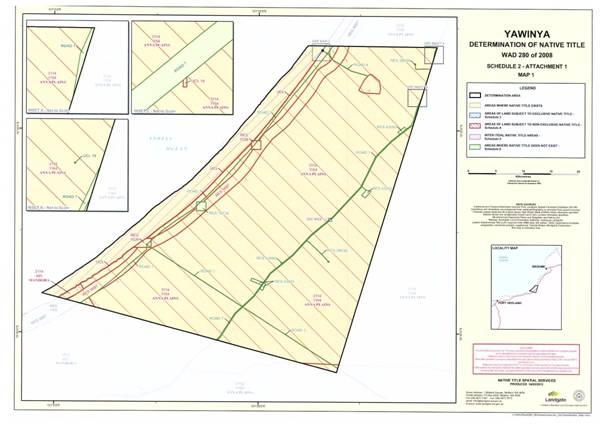
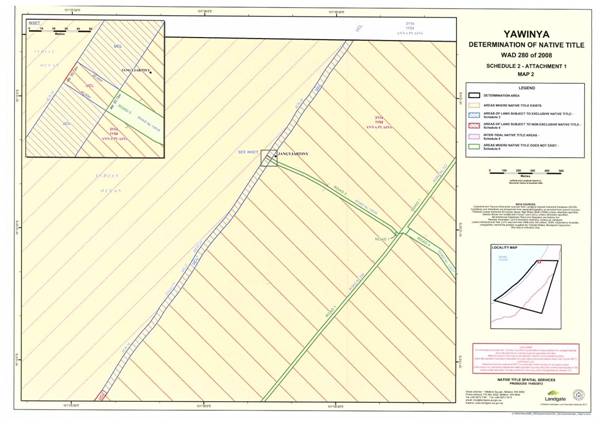
1. The Determination Area is the land and waters described in Schedule 1 and depicted on the maps comprising Schedule 2.
2. Native title exists in those parts of the Determination Area identified in Schedules 3, 4 and 5 (Native Title Area).
3. Native title does not exist in those parts of the Determination Area identified in Schedule 6.
Native title holders (s 225(a))
4. The native title in the Determination Area is jointly held by the Nyangumarta People and by the Karajarri People. The Nyangumarta People and the Karajarri People are the people referred to in Schedule 7.
The nature and extent of native title rights and interests (s 225(b)) and exclusiveness of native title (s 225(e))
Exclusive rights and interests
5. Subject to paragraphs 9, 10 and 11, the nature and extent of the native title rights and interests in relation to each part of the Determination Area referred to in Schedule 3 (being areas where there has been no extinguishment of native title or areas where any extinguishment must be disregarded) are:
(a) except in relation to flowing and underground waters, an entitlement as against the whole world to possession, occupation, use and enjoyment of the land and waters of that part to the exclusion of all others; and
(b) in relation to flowing and underground waters, the right to use and enjoy the flowing and underground waters, including:
(i) the right to hunt on and gather and fish from the flowing and underground waters for personal, domestic or non-commercial communal needs; and
(ii) the right to take and use the flowing and underground waters for personal, domestic or non-commercial communal needs.
Non-exclusive rights and interests
6. Subject to paragraphs 9, 10 and 11 the nature and extent of the native title rights and interests in relation to each part of the Determination Area referred to in Schedule 4 (being areas where there has been a partial extinguishment of native title, where any extinguishment is not required to be disregarded and that are not inter-tidal or sea areas) are that they confer the following non-exclusive rights on the Native Title Holders, including the right to conduct activities necessary to give effect to them:
(a) the right to access and move freely through and within each part of the Determination Area referred to in Schedule 4;
(b) the right to live, being to enter and remain on the land, to camp and erect shelters and other structures for that purpose;
(c) the right to do the following activities:
(i) hunt, fish and gather for personal, domestic and non-commercial communal needs;
(ii) take flora and fauna;
(iii) take, share and exchange natural resources of each part of the Determination Area referred to in Schedule 4 including soil, sand, clay, gravel, ochre, timber and stone for personal, domestic and non-commercial communal needs;
(iv) engage in cultural activities in the area, including the transmission of cultural heritage knowledge;
(v) conduct ceremonies;
(vi) conduct burials and burial rites;
(vii) hold meetings;
(viii) visit, maintain and protect from physical harm, places, sites and areas of significance in each part of the Determination Area referred to in Schedule 4;
(ix) access and take water for personal, domestic or non-commercial communal purposes, and for the sake of clarity and the avoidance of doubt, this right does not include the right to take or use water lawfully captured or controlled by the holders of pastoral leases numbered 3114/485 (Mandora) and 3114/1154 (Anna Plains).
(d) the right to be accompanied onto each part of the Determination Area referred to in Schedule 4 by those people who, though not native title holders and who (for the avoidance of doubt) cannot themselves exercise any native title right set out in this determination, are:
(i) spouses, parents, children of native title holders, or
(ii) people required by traditional law and customs for the performance of ceremonies or cultural activities on any part of the Determination Area referred to in Schedule 4; or
(iii) people who have rights in relation to any part of the Determination Area referred to in Schedule 4 according to the traditional laws and customs acknowledged by the native title holders.
7. Subject to paragraphs 9, 10 and 11 the nature and extent of the native title rights and interests in relation to each part of the Determination Area referred to in Schedule 5 (being intertidal areas) are that they confer the following non-exclusive rights on the Native Title Holders, including the right to conduct activities necessary to give effect to them:
(a) the right to access, remain within, and move freely through and within each part of the Determination Area referred to in Schedule 5;
(b) the right to do the following activities:
(i) fish and hunt fish for personal, domestic and non-commercial communal needs;
(ii) take flora and fauna;
(iii) take the traditional resources of each part of the Determination Area referred to in Schedule 5 including shells for personal, domestic or non-commercial communal needs;
(iv) take, share and exchange the natural resources of each part of the Determination Area referred to in Schedule 5 including, soil, sand, clay, gravel, ochre, timber and stone for personal, domestic or non-commercial communal needs;
(v) engage in cultural activities in the area, including the transmission of cultural heritage knowledge;
(vi) conduct ceremonies;
(vii) hold meetings;
(viii) visit, maintain, and protect from physical harm, places, sites and areas of significance in each part of the Determination Area referred to in Schedule 5; and
8. Notwithstanding the general description of native title rights to take and use natural resources set out in paragraphs 6 and 7, and subject always to paragraph 9, the nature and extent of the native title rights and interests held by the native title holders in relation to Pinctada maxima pearl oyster (P. maxima) are as follows:
(a) the right to take live adult P. maxima for the purpose of:
(i) sustenance; and
(ii) using its shell for the ceremonial activities of the Native Title Holders, including the ceremonial exchange of goods (including items made from P. maxima shell), to the extent that such exchange is effected in accordance with a traditional ceremony.
(b) the right to take shell of dead P. maxima for the purpose of using its shell for the ceremonial activities of the Native Title Holders including the ceremonial exchange of goods (including items made from P. maxima shell), to the extent that such exchange is effected in accordance with a traditional ceremony.
PROVIDED THAT the native title rights and interests to take adult P. maxima (including shell of live or dead P. maxima) in accordance with the preceding parts of this paragraph:
(c) does not include the taking of it while using artificial breathing apparatus, such as but not limited to SCUBA or hookah apparatus (surface supplied compressed air) but not including apparatus such as snorkels;
(d) for the avoidance of doubt, do not include any right to use P. maxima (including shell of live or dead P. maxima) for sale, barter or exchange, other than exchanges made in accordance with traditional ceremonies conforming with paragraphs 8(a) and 8(b) above.
9. The native title rights and interests referred to in paragraphs 5(b), 6 and 7 do not confer:
(a) possession, occupation, use and enjoyment on the Native Title Holders to the exclusion of all others, nor
(b) a right to control the access of others to the land or waters of those parts of the Determination Area referred to in paragraphs 5(b), 6 and 7.
10. Notwithstanding anything in this Determination the native title rights and interests include the right to take and use ochre to the extent that ochre is not a mineral pursuant to the Mining Act 1904 (WA), but do not include other minerals and petroleum and geothermal energy resources as defined in the Mining Act 1904 (WA), the Mining Act 1978 (WA) as in force at the date of this determination, the Petroleum Act 1936 (WA) and the Petroleum and Geothermal Energy Resources Act 1967 (WA) as in force at the date of this determination.
11. The native title rights and interests are subject to and exercisable in accordance with:
(a) the laws of the State and the Commonwealth, including the common law; and
(b) the traditional laws and customs of the Native Title Holders for personal, domestic and non-commercial communal purposes (including social, cultural, religious, spiritual and ceremonial purposes).
Areas to which s 47B of the Native Title Act 1993 applies
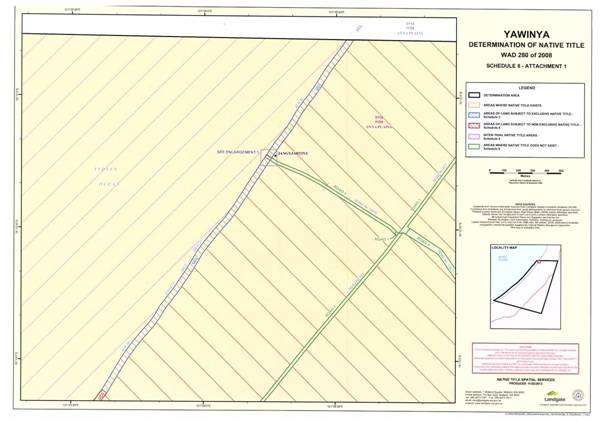
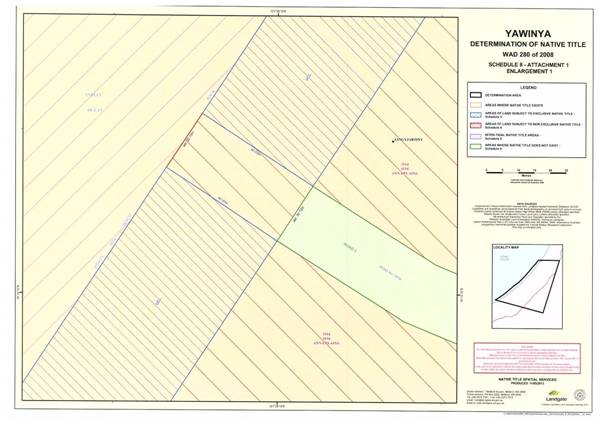
12. Section 47B of the Native Title Act applies to disregard any prior extinguishment in relation to those areas described in Schedule 8.
The nature and extent of any other interests
13. The nature and extent of other rights and interests in relation to the Determination Area are those set out in Schedule 9.
Relationship between native title rights and other interests
14. The relationship between the native title rights and interests described in paragraphs 5, 6 and 7 and the other rights and interests referred to in paragraph 13 is that:
(a) to the extent that any of the other rights and interests are inconsistent with the continued existence, enjoyment or exercise of the native title rights and interests, the native title rights and interests continue to exist in their entirety, but the native title rights and interests have no effect in relation to the other rights and interests to the extent of the inconsistency during the currency of the other rights and interests; and otherwise,
(b) the existence and exercise of the native title rights and interests do not prevent the doing of any activity required or permitted to be done by or under the other rights and interests, and the other rights and interests, and the doing of any activity required or permitted to be done by or under the other rights and interests, prevail over the native title rights and interests and any exercise of the native title rights and interests, but do not extinguish them.
Definitions and interpretation
15. In this Determination, unless the contrary intention appears:
“Determination Area” means the land and waters described in Schedule 1 and depicted on the maps at Schedule 2;
"high water mark" means the mean high water mark.
"intertidal area" includes:
(a) the shore, or subsoil under or airspace over the shore between lowest astronomical tide and high water mark, which area is described in Schedule 5; and
(b) any intertidal or navigable waters landward of the lowest astronomical tide;
“land” has the same meaning as in the Native Title Act, and includes those parts of islands which are above the high water mark;
“Native Title Act” means the Native Title Act 1993 (Cth);
“Native Title Holders” means the persons described in paragraph 4;
“waters” has the same meaning as in the Native Title Act; and includes flowing and underground water;
16. In the event of any inconsistency between the written description of an area in Schedule 1 or Schedules 3 to 5 and the area as depicted on the maps at Schedule 2, the written description prevails.
SCHEDULE 1
DETERMINATION AREA
The Determination Area, generally shown as bordered in black on the maps at Schedule 2, comprises all that land and waters bounded by the following description:
All that land and water commencing at the southernmost southwestern corner of Native Title Determination WAD6100/98 Karajarri People (Area B) (WC00/002) and extending northwesterly to the Lowest Astronomical Tide at Longitude 120.980063 East; Then generally northeasterly along that Lowest Astronomical Tide to Latitude 19.196054 South, again being a point on the present boundary of Native Title Determination WAD6100/98 Karajarri People (Area B) (WC00/002); then generally easterly along southern boundaries of that determination and Native Title Determination WAD6100/98 Karajarri People (Area A) (WC00/002) and onwards to Latitude 19.197809 South, Longitude 121.625577 East; Then southwesterly along boundaries of Native Title Determination WAD6100/98 Karajarri People (Area B) (WC00/002) back to the commencement point.
Note: Geographic Coordinates provided in Decimal Degrees.
Cadastral boundaries sourced from Landgate’s Spatial Cadastral Database dated February 2012.
Lowest Astronomical Tide sourced from AMB data, 6th edition, 2006, Geoscience Australia.
Native Title Determination WAD6100/98 Karajarri People (Area A), as determined by the Federal Court 12 February 2002 and Native Title Determination WAD6100/98 Karajarri People (Area B), as determined by the Federal Court 8 September 2004.
Datum: Geocentric Datum of Australia 1994 (GDA94)
Prepared By: Native Title Spatial Services (Landgate) 27 April 2012
Use of Coordinates:
Where coordinates are used within the description to represent cadastral or topographical boundaries or the intersection with such, they are intended as a guide only. As an outcome to the custodians of cadastral and topographic data continuously recalculating the geographic position of their data based on improved survey and data maintenance procedures, it is not possible to accurately define such a position other than by detailed ground survey.
SCHEDULE 2
MAPS OF THE DETERMINATION AREA
 SCHEDULE 3
EXCLUSIVE NATIVE TITLE AREAS
Areas where native title comprises the rights set out in paragraph 5(a)
Those portions of the 40 metre wide strip of Unallocated Crown Land, landward of the High Water Mark, described as being:
Part 1
All that land commencing from the intersection of the northernmost northwestern corner of Road Number 12638, as shown on Deposited Plan 168341, with a western boundary of Pastoral Lease 3114/1154 (Anna Plains) and extending generally northeasterly along boundaries of that pastoral lease to a southern boundary of Native Title Determination WAD6100/98 Karajarri People (Area A) (WC00/002); Then westerly along the southern boundary of that native title application to the High Water Mark; Then generally southwesterly along that water mark to the prolongation northwesterly of the northern side of Road Number 12638, as shown on Deposited Plan 168341 and then southeasterly along that prolongation back to the commencement point.
Part 2
All that land commencing from the intersection of the westernmost southwestern corner of Road Number 12638, as shown on Deposited Plan 168341, with a western boundary of Pastoral Lease 3114/1154 (Anna Plains) and extending generally southwesterly along boundaries of that pastoral lease to intersect with a line being the 2 kilometre radius from Latitude 19.203733 South, Longitude 121.437825 East (Jangyjartiny); Then northwesterly to the intersection of the High Water Mark with a line being the 2 kilometre radius from Latitude 19.203733 South, Longitude 121.437825 East (Jangyjartiny); Then generally northeasterly along that water mark to the prolongation northwesterly of the southern side of Road Number 12638, as shown on Deposited Plan 168341 and then southeasterly along that prolongation back to the commencement point.
For the avoidance of doubt, the area excludes that portion of the 40 metre wide strip of Unallocated Crown Land described as being:
All that land commencing from the westernmost southwestern corner of Road Number 12638, as shown on Deposited Plan 168341, and extending northwesterly along the prolongation northwesterly of the southern side of that road to the High Water Mark; Then generally northeasterly along that water mark to the prolongation northwesterly of the northern side of Road Number 12638, as shown on Deposited Plan 168341; Then southeasterly along that prolongation to the northernmost northwestern corner of Road Number 12638, as shown on Deposited Plan 168341 and then southwesterly along the western boundary of that road back to the commencement point.
Note: Geographic Coordinates provided in Decimal Degrees.
Cadastral boundaries sourced from Landgate’s Spatial Cadastral Database dated February 2012.
All referenced Deposited Plans and Diagrams are held by the Western Australian Land Information Authority, trading as Landgate.
Native Title Determination WAD6100/98 Karajarri People (Area A), as determined by the Federal Court 12 February 2002.
Datum: Geocentric Datum of Australia 1994 (GDA94)
Prepared By: Native Title Spatial Services (Landgate) 27 April 2012
Use of Coordinates:
Where coordinates are used within the description to represent cadastral or topographical boundaries or the intersection with such, they are intended as a guide only. As an outcome to the custodians of cadastral and topographic data continuously recalculating the geographic position of their data based on improved survey and data maintenance procedures, it is not possible to accurately define such a position other than by detailed ground survey.
SCHEDULE 4
NON-EXCLUSIVE NATIVE TITLE AREAS
Areas where native title comprises the rights set out in paragraph 6
The following land and waters (generally shown as hachured red on the maps at Schedule 2):
Pastoral Leases:
Portion of Pastoral Lease 3114/485, Mandora falling within the Determination Area
Portion of Pastoral Lease 3114/1154, Anna Plains falling within the Determination Area
Reserves
Reserve 1528 for the purposes of Watering Place
Reserve 1529 for the purpose of Watering Place
Reserve 9697 Kimberley De Grey Stock Route
Areas of Unallocated Crown Land
UCL 18 being a small area off Road 7 within Anna Plains Pastoral Lease formerly subject to Pastoral Lease 3114/1082 granted 23 July 1975.
All those portions of the 40 metre wide strip of Unallocated Crown Land, landward of the High Water Mark, excluding the following areas:
Part 1
All that land commencing from the intersection of the northernmost northwestern corner of Road Number 12638, as shown on Deposited Plan 168341, with a western boundary of Pastoral Lease 3114/1154 (Anna Plains) and extending generally northeasterly along boundaries of that pastoral lease to a southern boundary of Native Title Determination WAD6100/98 Karajarri People (Area A) (WC00/002); Then westerly along the southern boundary of that native title application to the High Water Mark; Then generally southwesterly along that water mark to the prolongation northwesterly of the northern side of Road Number 12638, as shown on Deposited Plan 168341 and then southeasterly along that prolongation back to the commencement point.
Part 2
All that land commencing from the intersection of the westernmost southwestern corner of Road Number 12638, as shown on Deposited Plan 168341, with a western boundary of Pastoral Lease 3114/1154 (Anna Plains) and extending generally southwesterly along boundaries of that pastoral lease to intersect with a line being the 2 kilometre radius from Latitude 19.203733 South, Longitude 121.437825 East (Jangyjartiny); Then northwesterly to the intersection of the High Water Mark with a line being the 2 kilometre radius from Latitude 19.203733 South, Longitude 121.437825 East (Jangyjartiny); Then generally northeasterly along that water mark to the prolongation northwesterly of the southern side of Road Number 12638, as shown on Deposited Plan 168341 and then southeasterly along that prolongation back to the commencement point.
Note: Geographic Coordinates provided in Decimal Degrees.
Cadastral boundaries sourced from Landgate’s Spatial Cadastral Database dated February 2012.
All referenced Deposited Plans and Diagrams are held by the Western Australian Land Information Authority, trading as Landgate.
Native Title Determination WAD6100/98 Karajarri People (Area A), as determined by the Federal Court 12 February 2002.
Datum: Geocentric Datum of Australia 1994 (GDA94)
Prepared By: Native Title Spatial Services (Landgate) 27 April 2012
Use of Coordinates:
Where coordinates are used within the description to represent cadastral or topographical boundaries or the intersection with such, they are intended as a guide only. As an outcome to the custodians of cadastral and topographic data continuously recalculating the geographic position of their data based on improved survey and data maintenance procedures, it is not possible to accurately define such a position other than by detailed ground survey.
SCHEDULE 5
INTERTIDAL NATIVE TITLE AREAS
Areas where native title comprises the rights set out in paragraph 7
All that land and water commencing at the intersection of the Lowest Astronomical Tide with the northernmost corner of Native Title Determination WAD6281/1998 Nyangumarta People (Part A) (WC98/65) at Longitude 120.980063 East and extending generally northeasterly along that Lowest Astronomical Tide to Latitude 19.196054 South, being a point on the present boundary of Native Title Determination WAD6100/98 Karajarri People (Area B) (WC00/002); then generally easterly along the southern boundary of that determination to the High Water Mark; Then generally southwesterly along that high water mark to a northern boundary of Native Title Determination WAD6281/1998 Nyangumarta People (Part A) (WC98/65) and then northwesterly along that determination boundary back to the commencement point.
Note: Geographic Coordinates provided in Decimal Degrees.
Cadastral boundaries sourced from Landgate’s Spatial Cadastral Database dated February 2012.
Lowest Astronomical Tide sourced from AMB data, 6th edition, 2006, Geoscience Australia.
Native Title Determination WAD6100/98 Karajarri People (Area B), as determined by the Federal Court 8 September 2004.
Native Title Determination WAD6281/1998 Nyangumarta People (Part A), as determined by the Federal Court 11 June 2009.
Datum: Geocentric Datum of Australia 1994 (GDA94)
Prepared By: Native Title Spatial Services (Landgate) 27 April 2012
Use of Coordinates:
Where coordinates are used within the description to represent cadastral or topographical boundaries or the intersection with such, they are intended as a guide only. As an outcome to the custodians of cadastral and topographic data continuously recalculating the geographic position of their data based on improved survey and data maintenance procedures, it is not possible to accurately define such a position other than by detailed ground survey.
SCHEDULE 6
AREAS WHERE NATIVE TITLE DOES NOT EXIST
Native title does not exist in the following land and waters. With the exception of those public works which are captured by the definition at paragraphs 3.2 of this Schedule, all of the following areas are generally shown as shaded in green on the maps at Schedule 2:
1. Vested Reserves:
Reserve 16734 for the purpose of water vested in Water & Rivers Commission
Reserve 38936 for the purpose of Microwave Translator Site vested in Telstra
Reserve 38938 for the purpose of Microwave Translator Site vested in Telstra
Reserve 43090 for the purpose of Water Bore vested in Commissioner of Main Roads
Reserve 43091 for the purpose of Water Bore vested in Commissioner of Main Roads
Reserve 43092 for the purpose of Water Bore vested in Commissioner of Main Roads
Reserve 43093 for the purpose of Water Bore vested in Commissioner of Main Roads
2. UCL 19 being very small area in the NE corner of Anna Plains Station formerly subject to freehold CT 508/23A to Commonwealth granted on 11 May 1971 and cancelled on 18 April 1986
3. The areas the subject of the following works:
3.1 Roads:
Road Number | Location |
1 | "Main Road from Yeeda Station to the boundary of the Kimberley District … along the lines of wells already sunk. |
3 | Road No 3658 – running NE/SW through Anna Plains Station to Eighty Mile Beach |
4 | Road No 12637 - leaving south eastern side of Great Northern Highway and extending southeastwards through Anna Plains Station |
5 | Road No 12638 - leaving north western side of Great Northern Highway and extending north-westwards through Anna Plains Station to Eighty Mile Beach |
7 | Great Northern Highway (excluding those areas adjacent to the Great Northern Highway that were subject to Taking Order J 150599 YA dated 29 December 2004 that was stated to preserve any native title rights and interests). |
3.2 Any other public work
Any other public works as that expression is defined in the Native Title Act and the Titles (Validation) and Native Title (Effect of Past Acts) Act 1995 (WA) and to which s 12J of the Titles (Validation) and Native Title (Effect of Past Acts) Act 1995 (WA) or s 23C(2) of the Native Title Act applies, within the external boundary of the Determination Area including the land and waters defined in s 251D of the Native Title Act.
SCHEDULE 7 – Part A and B
DESCRIPTION OF THE NATIVE TITLE HOLDERS
A. NYANGUMARTA PEOPLE
Nyangumarta People (referred to in paragraph 3) are:
(a) descendants of the following sets of apical ancestors:
1. Karrar, Purtita, Pinganiny and Ngajularti;
Kararr’s English name was Charlie and his section was Parrjarri. His wives were Purtita, Pingananiny, Ngajularti and Jujukujarra.
Purtita’s English name was Bridget and her section was Karrimarra.
Pingananiny’s section was Purungu.
Ngajularti’s English name was Kitty and her section was Parrjarri.
2. Warrakampanya, Karikaniny;
Warrakampanya’s wives were Kartikaniny, Yurryurr/Pilpurr and Nyula. His section was Panaka.
Kartikaniny’s section was Purungu.
3. Yakutartu;
Yakutartu’s English name was Lucy. Her husband was Wupiyala. Yakutartu’s section was Parrjarri/Milangka.
4. Pilypakurru and Minyawi;
Pilypakurru’s English name was Old Charlie. His wives were Puji, Yajiki, Latara and Minyawi. His section was Purungu/Karimarra
Minyawi’s English name was Pussycat. Her section was Parrjarri/Milangka.
5. Latara;
Latara’s husbands were Pilypakurru and Papalyala. Her section was Parrjarri/Milangka.
6. Jawayipala;
Jawayipala’s wife was Julungu. His section was Panaka.
7. Walypijina;
Walypijina’s English name was Ruby. Her husband was Wantipina and her section was Milangka/Parrjarri.
8. Kanykurr and Yirangkamantakarri;
Kanykurr’s English names were Sam and Tom. His wife was Yirangamantakarri and his section was Panaka.
Yirangamantakarri’s English names were Polly and Annie. Her section was Purungu.
(b) Aboriginal persons who:
(i) self-identify as Nyangumarta in preference to any other group; and
(ii) are generally accepted by other members of the Nyangumarta community as Nyangumarta under traditional law and custom.
Nothing in this definition excludes persons from being included as a member of the native title holding group who are or may be identified as other than Nyangumarta in accordance with traditional laws and customs of a group other than the Nyangumarta community.
DESCRIPTION OF THE NATIVE TITLE HOLDERS
B. KARAJARRI PEOPLE
Karajarri People (referred to in paragraph 3) are:
(a) descendants of the following apical ancestors:
Nganara;
Minyirr;
Palajangka;
Ingala [2];
Parawarrakara-ayiti; and
Yamadu “Mutpi”.
(b) Aboriginal persons who:
(i) self-identify as Karajarri in preference to any other group; and
(ii) are generally accepted by other members of the Karajarri community as Karajarri under traditional law and custom.
Nothing in this definition excludes persons from being included as a member of the native title holding group who are or may be identified as other than Karajarri in accordance with traditional laws and customs of a group other than the Karajarri community.
SCHEDULE 8
AREA TO WHICH SECTION 47B OF THE NATIVE TITLE ACT 1993 (CTH) APPLIES
Those portions of the 40 metre wide strip of Unallocated Crown Land, landward of the High Water Mark, described as being:
Part 1
All that land commencing from the intersection of the northernmost northwestern corner of Road Number 12638, as shown on Deposited Plan 168341, with a western boundary of Pastoral Lease 3114/1154 (Anna Plains) and extending generally northeasterly along boundaries of that pastoral lease to the northern boundary of Native Title Application WAD280/2008 Yawinya (W08/4); Then westerly along the northern boundary of that native title application to the High Water Mark; Then generally southwesterly along that water mark to the prolongation northwesterly of the northern side of Road Number 12638, as shown on Deposited Plan 168341 and then southeasterly along that prolongation back to the commencement point.
Part 2
All that land commencing from the intersection of the westernmost southwestern corner of Road Number 12638, as shown on Deposited Plan 168341, with a western boundary of Pastoral Lease 3114/1154 (Anna Plains) and extending generally southwesterly along boundaries of that pastoral lease to intersect with a line being the 2 kilometre radius from Latitude 19.203733 South, Longitude 121.437825 East (Jangyjartiny); Then northwesterly to the intersection of the High Water Mark with a line being the 2 kilometre radius from Latitude 19.203733 South, Longitude 121.437825 East (Jangyjartiny); Then generally northeasterly along that water mark to the prolongation northwesterly of the southern side of Road Number 12638, as shown on Deposited Plan 168341 and then southeasterly along that prolongation back to the commencement point.
For the avoidance of doubt, the area excludes that portion of the 40 metre wide strip of Unallocated Crown Land being a continuation of Road 12638 to the High Water Mark, a corridor of approximately 20.12 m, described as being:
All that land commencing from the westernmost southwestern corner of Road Number 12638, as shown on Deposited Plan 168341, and extending northwesterly along the prolongation northwesterly of the southern side of that road to the High Water Mark; Then generally northeasterly along that water mark to the prolongation northwesterly of the northern side of Road Number 12638, as shown on Deposited Plan 168341; Then southeasterly along that prolongation to the northernmost northwestern corner of Road Number 12638, as shown on Deposited Plan 168341 and then southwesterly along the western boundary of that road back to the commencement point.
Note: Geographic Coordinates provided in Decimal Degrees.
Cadastral boundaries sourced from Landgate’s Spatial Cadastral Database dated February 2012.
All referenced Deposited Plans and Diagrams are held by the Western Australian Land Information Authority, trading as Landgate.
Native Title Determination Application WAD280/2008 Yawinya (W08/4) as Filed in the Federal Court 3 December 2008.
Datum: Geocentric Datum of Australia 1994 (GDA94)
Prepared By: Native Title Spatial Services (Landgate) 16 April 2012
Use of Coordinates:
Where coordinates are used within the description to represent cadastral or topographical boundaries or the intersection with such, they are intended as a guide only. As an outcome to the custodians of cadastral and topographic data continuously recalculating the geographic position of their data based on improved survey and data maintenance procedures, it is not possible to accurately define such a position other than by detailed ground survey.
SCHEDULE 9
OTHER INTERESTS
1. Pastoral Leases
Pastoral Lease 3114/485, Mandora
Pastoral Lease 3114/1154, Anna Plains
2. Reserves
The interests of persons who have the care, control and management of the following reserves, and the interests of persons entitled to access and use these reserves for the respective purposes for which they are reserved, subject to any statutory limitations upon those rights:
Reserve 1528 - Watering Place
Reserve 1529 - Watering Place
Reserve 9697 - Kimberley De Grey Stock Route
3. The interests of persons holding leases over areas of the reserves identified in paragraph 2 above.
4. Existing petroleum interests under the Petroleum and Geothermal Energy Resources Act 1967 (WA)
Nature and number of interest | Grantee | Date of grant and term |
Exploration Permit 448 | Gulliver Productions Pty Ltd, Indigo Oil Pty Ltd, United Orogen Ltd | 16 June 2006 – 6 years (1 year extension granted) |
Exploration Permit 465 | Australian Zhongfu Oil Gas Resources Pty Ltd | 28 July 2009 – 6 years (16 month extension granted) |
5. Other Rights and Interests
(a) Rights and interests, including licences and permits, granted by the Crown in right of the Commonwealth or the State pursuant to statute or otherwise in the exercise of its executive power, including but not limited to the interests of the holders of statutory fishing and pearling interests granted under the Fish Resources Management Act 1994 (WA), the Pearling Act 1990 (WA), and the Fisheries Management Act 1991 (Cth) and any regulations made pursuant to such legislation.
(b) Rights or interests held by reason of the force and operation of the laws of the State or of the Commonwealth including the force and operation of the Rights in Water and Irrigation Act 1914 (WA);
(c) Rights and interests of members of the public arising under the common law, including but not limited to the public right to fish and the public right to navigate;
(d) The right to access land by:
(i) an employee or agent or instrumentality of the State;
(ii) an employee or agent or instrumentality of the Commonwealth;
(iii) an employee or agent or instrumentality of any local Government authority;
as required in the performance of his or her statutory or common law duties where such access would be permitted to private land.
(e) Rights of any person to access and enjoy (subject to the laws of the State):
(i) any roads within the Determination Area existing as at the date of this determination where members of the public have access to such roads according to the common law;
(ii) the Kimberley De Grey Stock Route.
(f)
(i) Without limiting the operation of any other paragraph in the Ninth Schedule, but subject to paragraph (f)(ii), rights of the holders from time to time of petroleum interests under the Petroleum and Geothermal Energy Resources Act 1967 (WA), petroleum pipelines under the Petroleum Pipelines Act 1969 (WA) and mining tenements under the Mining Act 1978 (WA) to use (including by servants, agents and contractors) the roads and tracks in the Determination Area existing as at the date of this determination, in order to have access to such petroleum, pipeline and mineral interests:
(ii) Nothing in paragraph (f)(i) above allows any upgrade, extension, widening or other improvement to the road or track other than work done to maintain such road or track in reasonable repair.
(g) So far as confirmed pursuant to section 14 of the Titles (Validation) and Native Title (Effect of Past Acts) Act 1995 (WA) as at the date of this determination, any existing public access to and enjoyment of:
(i) waterways; or
(ii) the beds and banks or foreshores of waterways;
(iii) coastal waters; or
(iv) beaches; or
(v) stock routes; or
(vi) areas that were public places at the end of 31 December 1993.
(h) Any other:
(i) legal or equitable estate or interest in the land or waters; or
(ii) any other right (including a right under an option and a right of redemption), charge, power or privilege over, or in connection with:
(A) the land or waters; or
(B) an estate or interest in the land or waters; or
(iii) restriction on the use of the land or waters, whether or not annexed to other land or waters
(i) The rights and interests of Telstra Corporation Limited:
(i) As the owner or operator of telecommunications facilities within the Determination Area;
(ii) As the holder of a carrier licence under the Telecommunications Act 1997 (Cth);
(iii) Created pursuant to the Post and Telegraph Act 1901 (Cth), the Telecommunications Act 1975 (Cth), the Australian Telecommunications Corporation Act 1989 (Cth), the Telecommunications Act 1991 (Cth) and the Telecommunications Act 1997 (Cth) including:
(a) the right to establish a telecommunications facility on, and remain in occupation of UCL 18 (Pardu Location 67); and
(b) the right to install cabling, customer terminal facilities and ancillary facilities; and
(iv) For its employees, agents or contractors to enter the Determination Area to access its facilities in and in the vicinity of the Determination Area.
(j) The rights and interests of the Executive Director of the Department of Environment and Conservation pursuant to the Deed of Agreement made between the Executive Director of the Department of Conservation and Land Management (as it then was) and Anna Plains Cattle Co. Pty Ltd under s 16A of the Conservation and Land Management Act 1984, which was stamped on 24 June 2003.


