

FEDERAL COURT OF AUSTRALIA
Minister for Sustainability, Environment, Water, Population and Communities v De Bono [2012] FCA 643
|
IN THE FEDERAL COURT OF AUSTRALIA |
|
|
MINISTER FOR SUSTAINABILITY, ENVIRONMENT, WATER, POPULATION AND COMMUNITIES Applicant | |
|
AND: |
Respondent |
|
DATE OF ORDER: |
|
|
WHERE MADE: |
THE COURT DECLARES THAT:
1. In the period between 1 April 2010 and 23 December 2010, the respondent contravened s 18(6) of the Environment Protection and Biodiversity Conservation Act 1999 (the Act) in that:
1.1 the respondent was the owner of Lots 6 and 7 LP5327 Melton, Victoria, known as 500 Parwan-Exford Road, Parwan, Victoria (the ‘property’);
1.2 the property contained the threatened ecological community known as ‘Grey Box (Eucalyptus macrocarpa) Grassy Woodlands and Derived Native Grasslands of South-eastern Australia’ (the ‘ecological community’), being a community included in the endangered category of the list of threatened ecological communities made under s 181 of the Act;
1.3 the respondent undertook activities in the western paddock of the property, including ploughing, rock removal and vegetation clearing (the ‘activities’), and
1.4 the activities had and will have a significant impact on the ecological community.
THE COURT ORDERS THAT:
2. In respect of the contravention described in order 1, within six months of the date of these orders, the respondent pay a pecuniary penalty to the Commonwealth of Australia in the sum of $150,000, pursuant to s 481(2) of the Act.
3. Within six weeks from the date of these orders, the respondent shall engage at his own cost an appropriately qualified ecological expert agreed to by the Department of Sustainability, Environment, Water, Population and Communities (the ‘Department’), acting reasonably, to prepare a five year management plan (‘the management plan’) agreed to by the Department, acting reasonably, with respect to the part of the property labelled ‘Remediation Area’ in the plan attached as annexure A to these orders.
4. The management plan shall include a requirement that the respondent undertake (either himself or through an agent or agents) weed control measures designed to facilitate the natural regeneration of the ecological community in the Remediation Area.
5. The respondent shall ensure that the management plan is completed and ready for implementation within 12 weeks from the date of these orders.
6. The respondent shall implement at his own cost the management plan for a period of five consecutive years, starting on the date on which the management plan is completed pursuant to order 5.
7. For a period of five years from the date of these orders, the respondent by himself, his servants and agents be restrained from taking, permitting, or being in any way involved in any of the following activities namely:
7.1 ploughing;
7.2 land clearing;
7.3 digging, blasting, moving or removing rock(s)
in the part of the property labelled ‘Remediation Area’ in the plan attached as annexure A to these orders.
8. Within three months of the date of these orders, the respondent pay the applicant’s costs in the fixed sum of $40,000.
ANNEXURE A
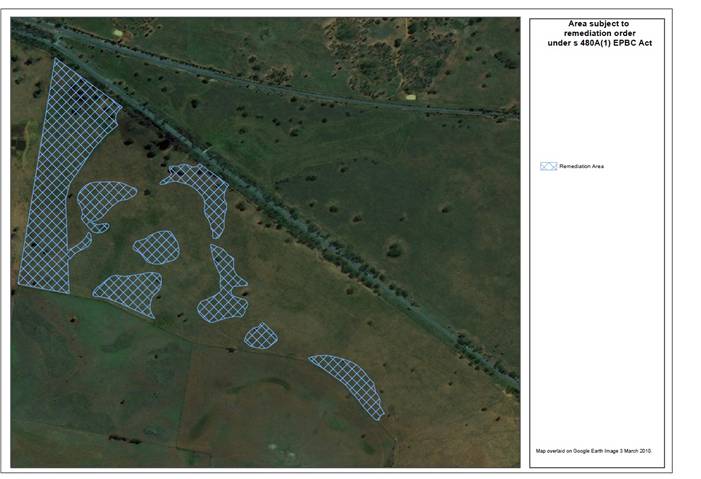
Note: Entry of orders is dealt with in Rule 39.32 of the Federal Court Rules 2011.
|
AUSTRALIAN CAPITAL TERRITORY DISTRICT REGISTRY |
|
|
GENERAL DIVISION |
ACD 49 of 2010 |
|
BETWEEN: |
MINISTER FOR SUSTAINABILITY, ENVIRONMENT, WATER, POPULATION AND COMMUNITIES Applicant |
|
AND: |
JOHN DE BONO Respondent |
|
JUDGE: |
NORTH J |
|
DATE: |
25 JUNE 2012 |
|
PLACE: |
MELBOURNE |
REASONS FOR JUDGMENT
introduction
1 The applicant, the Minister for Sustainability, Environment, Water, Population and Communities (the minister), is responsible for the administration of the Environment Protection and Biodiversity Conservation Act 1999 (Cth) (the Act). In this proceeding he seeks remedies against the respondent, John De Bono, for contravention of s 18(6) of the Act. That section provides:
A person must not take an action that:
(a) has or will have a significant impact on a listed threatened ecological community included in the endangered category; or
(b) is likely to have a significant impact on a listed threatened ecological community included in the endangered category.
2 The respondent is the joint proprietor of a property of about 213 hectares at 500 Parwan-Exford Road, Parwan, Victoria. The proceeding concerns the western paddock of that property which covers about 69 hectares.
3 The minister amended the list of threatened ecological communities under the Act to include the Threatened Grey Box Grassy Woodlands and Derived Native Grasslands of South-eastern Australia (the ecological community) in the endangered category with effect from 1 April 2010. The ecological community was present in the western paddock of the respondent’s property. Between April and late December 2010, the respondent ploughed and cleared parts of the western paddock. These actions resulted in significant damage and destruction to the ecological community. By undertaking those actions in the western paddock, the respondent contravened s 18(6) of the Act.
the first day of hearing
4 The hearing commenced on 25 April 2012. A large measure of agreement had been reached between the parties by then. They had filed a statement of agreed facts and had agreed on the remedies of declaration, injunction, remediation and costs orders.
5 They also agreed that the respondent should pay a pecuniary penalty. However, there was disagreement on the amount of such penalty. The minister proposed the sum of $255,000 and the respondent proposed the sum of $56,000.
6 In the course of the submissions concerning the appropriateness of the various suggested amounts of pecuniary penalty I raised for consideration whether additional evidence was necessary to allow a proper consideration of the issue. It seemed desirable that the minister provide some further evidence about the nature of the ecological community to allow the Court to establish the level of seriousness of the respondent’s conduct in the range of conduct addressed by the relevant section of the Act. It also seemed desirable that the respondent himself directly address whether he had any contrition for his conduct. Further, although less importantly, it seemed desirable to hear something more about the respondent’s financial position, and to hear about it from him directly rather than from his accountant alone as was the state of the evidence at that point.
7 Counsel for the minister responded to these observations by tendering the advice given to the minister by the Threatened Species Scientific Committee (the committee) concerning the amendment to include the ecological community in the list of threatened ecological communities under the Act. Counsel for the respondent accepted the suggestion made by the Court by calling the respondent to give evidence. The effect of the additional evidence from each party will be considered later in these reasons.
8 In the course of the submissions I also indicated a preliminary view that the amount of pecuniary penalty proposed by the minister was arguably outside the range of appropriate penalties, and I encouraged the parties to discuss a possible alternative figure.
the second day of hearing
9 By the second day of hearing on 2 May 2012, the parties had agreed that $150,000 would be an appropriate pecuniary penalty. That meant that all matters were then agreed by the parties and proposed consent orders were submitted by counsel on their behalf.
the consent orders
10 The proposed consent orders invoke the Court’s discretionary power to make declarations under s 21 of the Federal Court Act (Cth).
11 The proposed consent orders then invoke the Court’s power under the Act to order the respondent to pay a pecuniary penalty (s 481(2)). The factors relevant to the exercise of this power are set out at [16] and considered in these reasons in [18] to [45].
12 Next the parties invoke the Court’s power to make a remediation order under s 480A. Section 480A(1) allows the Court to make a remediation order requiring a person who has engaged or is engaging in contravening conduct to take action to repair or mitigate damage that may or will be, or has been caused to the environment by that conduct. The factors relevant to the exercise of this power, which are set out in s 480A(2), in large part mirror those factors set out in s 481(3), with the additional factor of the cost to the person taking remediation action. The form of such an order may generally require the person to take whatever action is necessary to repair or mitigate the damage or specify the particular action to be taken (s 480(3)).
13 Finally, the proposed orders invoke the Court’s power to grant an injunction under s 475 of the Act. Section 475(2) provides:
If a person has engaged, is engaging or is proposing to engage in conduct constituting an offence or other contravention of this Act or the regulations, the Court may grant an injunction restraining the person from engaging in the conduct.
The Court may grant such an injunction irrespective of whether or not the person intends to continue the contravening conduct, whether or not they have previously engaged in such conduct and whether or not there is a risk of injury or damage to people or the environment if they continue to act in contravention of the Act (s 479(1)).
14 In this case, the proposed consent orders are as follows:
Declaration pursuant to section 21 of the Federal Court of Australia Act 1976
1. In the period between 1 April 2010 and 23 December 2010, the respondent contravened subsection 18(6) of the Environment Protection and Biodiversity Conservation Act 1999 (the ‘EPBC Act’) in that:
1.1 the respondent was the owner of Lots 6 and 7 LP5327 Melton, Victoria, known as 500 Parwan-Exford Road, Parwan, Victoria (the ‘Property’);
1.2 the Property contained the threatened ecological community known as ‘Grey Box (Eucalyptus macrocarpa) Grassy Woodlands and Derived Native Grasslands of South-Eastern Australia’ (the ‘Threatened Grey Box Grasslands Community’), being a community included in the endangered category of the list of threatened ecological communities made under section 181 of the EPBC Act;
1.3 the respondent undertook activities in the western paddock of the Property, including ploughing, rock removal and vegetation clearing (the ‘Activities’); and
1.4 the Activities had and will have a significant impact on the Threatened Grey Box Grasslands Community.
Pecuniary penalty pursuant to section 481 of the EPBC Act
2. In respect of the contravention described in order 1, within 6 months of the date of these orders, the respondent pay a pecuniary penalty to the Commonwealth of Australia in the sum of $150,000, pursuant to subsection 481(2) of the EPBC Act.
Remediation order pursuant to section 480A of the EPBC Act
3. Within 6 weeks from the date of these orders, the respondent shall engage at his own cost an appropriately qualified ecological expert agreed to by the Department of Sustainability, Environment, Water, Population and Communities (the ‘Department’), acting reasonably, to prepare a 5 year management plan (‘the management plan’) agreed to by the Department. acting reasonably, with respect to the part of the Property labelled ‘Remediation Area’ in the plan attached to this order.
4. The management plan shall include a requirement that the respondent undertake (either himself or through an agent or agents) weed control measures designed to facilitate the natural regeneration of the Threatened Grey Box Grasslands Community in the Remediation Area.
5. The respondent shall ensure that the management plan is completed and ready for implementation within 12 weeks from the date of these orders.
6. The respondent shall implement at his own costs the management plan for a period of 5 consecutive years, starting on the date on which the management plan is completed pursuant to order 5.
Injunction pursuant to section 475 of the EPBC Act
7. For a period of 5 years from the date of these orders, the respondent by himself, his servants and agents be restrained from taking, permitting, or being in any way involved in any of the following activities namely:
7.1 ploughing;
7.2 land clearing;
7.3 digging, blasting, moving or removing rock(s)
in the part of the Property labelled “Remediation Area’ in the plan attached to this order.
Costs order pursuant to section 43 of the Federal Court of Australia Act 1976
8. Within 3 months of the date of these orders, the respondent pay the applicant’s costs in the fixed sum of $40,000.
the role of the court
15 Where parties have come to an agreement over civil pecuniary penalties and other orders the Court will accept the agreement provided that the outcome is within the range of outcomes reasonably open on the material before the Court. It is not the role of the Court to determine whether it would have come to the same conclusions as the parties. This approach, with its inbuilt flexibility, is designed to encourage parties to negotiate reasonable solutions and avoid complex and protracted litigation. There is a consequent benefit to the public in conserving the time and resources of the Courts and regulatory bodies that are charged with investigating suspected contraventions. The agreement of the parties in this case is therefore examined with this approach in mind.
consideration
16 In determining the appropriate amount of pecuniary penalty s 481(3) of the Act requires the Court to have regard to all relevant matters including:
(a) the nature and extent of the contravention; and
(b) the nature and extent of any loss or damage suffered as a result of the contravention; and
(c) the circumstances in which the contravention took place; and
(d) whether the person has previously been found by the Court in proceedings under this Act to have engaged in any similar conduct.
17 These matters will be addressed in the following discussion.
The nature and extent of the contravention
18 Between 6 May and 22 July 2010, the respondent ploughed an area of about 44 hectares of the western paddock. The major areas ploughed were at each end of the paddock. This action did not disturb embedded rocks.
19 But between 22 July and 14 December 2010, over about 31 hectares of the western paddock roughly at the southern end, the respondent pulled most of the rocks at or near the surface out of the ground and pushed them into 33 large piles. Over a further approximately 12 hectares in the western paddock most of the rocks at or near the surface were pulled out but not pushed into piles.
20 Then between 14 December and 23 December 2010, over about 16 hectares of the western paddock, roughly in the centre of the area, the respondent removed further rocks and pushed them into a further 22 piles. Additionally, the respondent created another five piles of rock in roughly the area disturbed between 22 July and 14 December 2010.
21 In each of the activities set out in [19] and [20] the respondent used bobcats, a tractor and a tip truck to pull out and move the rocks.
The nature and extent of the damage resulting from the contravention
22 Photos of the western paddock show that the surface vegetation of parts of the paddock was removed by the conduct of the respondent. The top soil was laid bare. It is accepted that the rock removal and piling had, and will have, significant effects on the ecological community. There has been an immediate decrease in the extent and quality of the community. Apart from the direct loss of native flora species, there is a fragmentation of a previously consolidated area of the ecological community. This produces an increase in the edge effects on the remaining isolated smaller patches of the remnant ecological community, that is to say, the ecological changes which occur at the boundaries where undisturbed communities adjoin disturbed areas. The open spaces with bare soil created by the actions of the respondent will allow the establishment and spread of invasive exotic weed species. The agreed facts also outline the loss of micro-climate for flora and the loss of protective habitat for flora and fauna resulting from the rock removal.
23 The agreed facts describe the major disruptions to the site structure as follows:
35. Vehicle and machinery movements across the Western Paddock have caused major disruptions to the surface of the site, altered rock distribution and disrupted soil structure and soil compaction. This has caused longer-term loss of biological diversity within the Threatened Grey Box Grasslands Community. These disruptions affect how water infiltrates into the soil and also the ability of seeds to germinate and establish in that soil. These disruptions will impede the regeneration of sensitive species within the ecological community.
24 There has been some rejuvenation of the native grasses but it is unlikely that the complex ecological community as a whole, particularly the non-grass species, will regenerate. Overall, it is very unlikely that the ecological community on the western paddock will ever recover to its pre-disturbed state.
The advice of the committee
25 As explained earlier, it was a matter of concern to the Court that the agreed facts, which have largely been described in the previous paragraphs, gave limited guidance to determining the level of seriousness of the contravention within the range of seriousness contemplated by the relevant section of the Act. However, the additional evidence submitted by the minister of the advice he received from the committee has provided some necessary further assistance. To appreciate the significance of that advice it is necessary to consider some aspects of the operation of the Act.
26 The minister is obliged to establish a list of threatened ecological communities divided into categories of critically endangered, endangered, and vulnerable (s 181(1)). An ecological community is eligible to be included in the critically endangered category if it is facing an extremely high risk of extinction in the wild in the immediate future (s 182(1)). An ecological community is eligible to be included in the endangered category if it is facing a very high risk of extinction in the wild in the near future (s 182(2)). An ecological community is eligible to be included in the vulnerable category if it is facing a high risk of extinction in the wild in the medium-term future (s 182(3)).
27 The minister is empowered to amend the list (s 184). There is an elaborate process leading to the inclusion of an ecological community on the list of threatened ecological communities. The process commences with an invitation by the minister to the public to nominate an ecological community for inclusion (ss 194A – 194T). In considering whether to amend the list of the threatened ecological communities the minister must obtain and consider advice from the committee on the proposed amendment (s 189(1)). The committee is established, inter alia, to advise the minister on the amendment of the list of the threatened ecological communities (ss 502, 503(b) and 528).
28 Finally, a person may seek approval under s 130 do an act which would otherwise contravene s 18. If approval is granted, the act does not contravene s 18.
29 The advice of the committee described the ecological community as one which predominantly exists on the drier edge of temperate grassy eucalypt woodlands which were formerly widespread on the lower slopes and plains of mainland eastern Australia, inland of the Great Dividing Range from southern Queensland through to eastern South Australia. The committee distinguished between grasslands with a tree canopy dominated by Grey Box, on the one hand, and derived grasslands where the tree canopy and mid layer has been reduced to less than 10% crown cover but where the native ground layer remains largely intact, on the other hand. The ecological community in the western paddock was a derived grassland.
30 The advice explains that in Victoria, primarily as a result of land clearing, the decline in the ecological community from pre-European times has been about 87%, with 200,000 hectares remaining. The advice also explains that the major threat to the ecological community is from clearing which results in weed invasion and fragmentation. As to the effects of fragmentation, the committee states:
Fragmentation also places the ecological community under many additional pressures, particularly if remnants are isolated by a surrounding matrix of agricultural or peri-urban/infrastructural land uses. These include edge effects, degradation of habitat for many species, altered fire regimes, reduced pollination opportunities and dispersal of plant propagules. The major threat to the viability of small isolated fragments occurs via the exposed edges of the fragment. If the edges (perimeter) of the fragment are large relative to its area, then greater opportunity exists for disturbances from the surrounding modified landscape to influence the core of the fragment.
31 As a result of the threat to the ecological community the committee advised that the ecological community should be placed on the list of threatened ecological communities in the endangered category.
32 The advice has two aspects which are significant for this case. First, it specifically identifies the area around Melton and Sunbury, west of Melbourne, as a disjunct patch of the main ecological community. This is the area in which the western paddock is found. Second, the committee included areas within the ecological community by using a system of condition thresholds. Areas which satisfy the condition threshold retain sufficient conservation value to qualify as the most valuable elements of Australia’s natural environment. The condition threshold which stipulates the minimum size of an area of derived grassland which will fall within the listed endangered category of this ecological community is 0.5 of a hectare.
33 It is, thus, significant that the ecological community is found in an area expressly recognised as a part of this type of community, and that the area was appreciably larger than the condition threshold of 0.5 of a hectare. These factors give some context to the nature and extent of the damage suffered as a result of the contravention.
Circumstances in which the contravention took place
34 At the same time that the respondent was engaged in ploughing, pulling out rocks and heaping them into piles in the western paddock the minister’s department (the department) was in communication with him.
35 On about 15 March 2010, the department wrote to the respondent indicating that the clearing of vegetation and rock removal on the property was likely to have significantly impacted on an endangered ecological community and was not permitted under the Act. The department sought the respondent’s assurance that he would take no further action which would contravene the Act. The respondent did not reply to this letter.
36 On 6 May 2010, officers from the department met the respondent on the property and told him that they would be engaging an independent expert to advise whether the clearing of vegetation on the property had had a significant impact on any ecological communities listed under the Act. The respondent indicated that he would not do any more clearing on the property.
37 On 22 July 2010, the ecology expert, Mr Tomlinson, and Mr McLean, an officer of the department, met with the respondent and inspected the property. Then, on the following day, Mr McLean spoke with the respondent on the phone and indicated that Mr Tomlinson had said that it was likely that the property contained a listed ecological community. Mr McLean indicated that he had observed that further ploughing had been undertaken in the western paddock since the inspection on 6 May 2010. He told the respondent that an expert report would be provided in a month or two and that no further work should be undertaken on the property.
38 On about 26 July 2010, the department wrote to the respondent indicating that the preliminary expert advice was that there was a high likelihood that the property contained at least one ecological community protected under the Act. It strongly suggested that no further clearing or ploughing of native vegetation be undertaken at that time. The respondent did not reply to that letter.
39 On 6 September 2010, the respondent called the department and was told by Mr McLean that the department had been advised by the expert that the ecological community existed on the respondent’s property. Mr McLean told the respondent that the department would send him a copy of the expert report.
40 On about 12 October 2010, the department wrote to the respondent enclosing a copy of the expert report, noting that the department considered that ploughing the land was in breach of the Act and inviting the respondent to provide comment on the expert report.
41 On about 26 October 2010, the respondent sent a hostile letter to the department complaining that he had been singled out for doing things which neighbours had done with impunity, indicating that he would take the matter to the media, alleging that the department was wasting taxpayers’ money by pursuing him, challenging the department to charge him with an offence if he had broken the law, and denying the department any further access to the property. The department responded by a letter dated 8 November 2010 asking the respondent to reconsider his response. The respondent did not reply to this letter.
42 On 14 December 2010, officers from the department entered and inspected the property pursuant to a monitoring warrant.
43 On 23 December 2010, the minister obtained an injunction prohibiting the respondent from undertaking further activities in the western paddock. This was obtained ex parte and served on the respondent on the same day. Also on the same day officers from the department inspected the property pursuant to a monitoring warrant.
Personal considerations relating to the respondent
History of offending
44 The respondent has not previously been found to have contravened the Act.
45 However, on 8 July 2011, he pleaded guilty in the Magistrates Court to an offence under s 126 of the Planning and Environment Act 1987 (Vic) which arose from clearing native vegetation in the eastern paddock without a permit. The respondent was fined $2000 and no conviction was recorded. The offence occurred before the listing of the ecological community under the Act on 1 April 2010.
Financial Issues
46 As to the respondent’s major assets he, jointly with his wife, owns 25 acres in Taylors Road which he estimates is worth about $2 million, 70 acres in Sinclairs Road, Rockbank, which he estimates is worth about $1 million, 50 acres in Neale Road, Rockbank which he estimates is worth between $700,000 and $800,000 and the property in question in this case which he estimates is worth about $2 million. In addition he owns a half share with his son in a property of 240 acres at Murphys Road in Exford which he estimates is worth $700,000. All of these properties are unencumbered.
47 The evidence in relation to the respondent’s income is not entirely clear. He operates a rock blasting business in partnership with his wife and latterly through a family trust. The net income before tax from that business is shown in tax returns as approximately $129,000 for the financial year ending 30 June 2008, approximately $118,000 for the financial year ending 30 June 2009, approximately $99,000 for the financial year ending 30 June 2010, and approximately $42,000 for the financial year ending 30 June 2011. The respondent claimed that he had engaged in cropping and grazing on some of his properties over some of these years although no income is shown in the tax returns from these activities.
48 Those financial affairs of the respondent which are documented satisfactorily before the Court demonstrate that the proposed pecuniary penalty together with the costs associated with the other orders agreed between the parties would not be crushing. It may be that the respondent will have to sell some property in order to fund the payment of the pecuniary penalty and associated orders, but it is not suggested that any hardship will be occasioned by the amount of the pecuniary penalty and associated orders.
Specific deterrence
49 One important purpose to be served by the imposition of a pecuniary penalty is to ensure that the respondent will not be tempted to contravene the Act again. Whilst payment of a pecuniary penalty in the sum of $150,000 will not create undue hardship to the respondent given his financial situation, the sum is sufficiently high to serve as a significant deterrent to him and a strong incentive to avoid any contravening conduct in the future.
50 Further, he gave evidence that the pending case had caused a high level of stress and a level of anxiety amongst his family members. He said that the concern of the litigation affected his ability to continue his rock blasting business at the same level as before. It was clear from the way he gave his evidence that the experience had been upsetting to him. The amount of the agreed penalty together with the experience of the prosecution makes it likely that the respondent will not contravene the Act in the future.
Contrition
51 For reasons which have just been explained, the respondent regrets that his actions have caught him up in the legal system. He is clearly sorry that the events have happened.
52 On the other hand, although given the opportunity in the witness box, the respondent did not express contrition for having damaged the ecological community. The respondent is a man of limited education who has worked hard to build up a sizable asset base which he has used to support his family. He said that he wanted to clear the land in order to prepare it for cropping because he believes that he could produce a greater return from cropping than from grazing which he previously conducted on the land. This then is not a case in which the respondent is sorry for the destruction which the Act seeks to avoid. However, as his counsel rightly observed, the respondent’s regret at the trouble which his conduct has caused him suggests that the experience will deter him from any further contravention.
Cooperation
53 The original defence filed by the respondent on 16 May 2011 denied the contravention. However, by 12 October 2011, when the respondent cooperated with the minister in filing the statement of agreed facts, the contraventions were admitted. Thereafter, there were discussions as to the appropriate penalty and orders, and ultimately all of those matters have been agreed. The cooperation of the respondent has assisted the course of justice and saved the minister resources which otherwise would have been required for a fully contested case.
General deterrence
54 Another central purpose of the provisions for imposition of pecuniary penalty is to deter others from engaging in conduct in contravention of the Act. The proposed penalty is large enough to deter most people from the type of conduct engaged in by the respondent. To the extent that the rock removal was designed to allow the respondent to use the western paddock for cropping, the size of the proposed penalty acts as a strong disincentive because it significantly reduces, and possibly denies, any commercial return from the exercise.
The statutory scheme for punishment for contravening conduct
55 There are two relevant features of the Act which should be taken into account in assessing the proper level of the pecuniary penalty.
56 First, the maximum penalty for a contravention of s 18(6) by an individual is 500 penalty points which equates to $550,000. The maximum prescribed penalty is a significant factor because it provides a benchmark for the worst possible case against which the contravening conduct under consideration is to be evaluated.
57 That consideration then gives rise to the second factor, namely, that the Act provides for criminal liability for a person who takes action that results in a significant impact on the threatened ecological community in the endangered category (s 18A(1)). That offence is punishable by up to seven years imprisonment and/or a fine of up to 420 penalty points (s 18A(3)). The provision of criminal liability for the same conduct which attracts a civil penalty suggests that the worst case is to be dealt with as a criminal offence and that lesser conduct might still attract a penalty at the top end of the civil penalty range.
Costs
58 The relevance of costs in the assessment of penalty was the subject of some disagreement at the hearing. Counsel for the respondent contended that it was appropriate for the Court to consider costs in determining whether an agreed penalty was within the permissible range. Reliance was placed on the Full Court’s decision in Australian Competition and Consumer Commission v Dataline.Net.Au Pty Ltd (2007) 161 FCR 513 (Dataline).
59 Dataline involved a challenge by the Australian Competition and Consumer Commission (ACCC) to orders made by the Court at first instance requiring, inter alia, that the third respondent pay a pecuniary penalty of $5000 for contraventions of the Trade Practices Act 1974 (Cth). The ACCC argued that the Court below erred in finding that the third respondent was in a parlous financial position, in finding that this was in part brought about by the costs of the proceedings, and in halving a proposed penalty of $10,000 as a result of these considerations. The Full Court, dismissing the appeal, found that these considerations were open to the primary judge and at [82] concluded:
…The exercise of the discretion required the primary judge to determine an appropriate penalty having regard to all relevant matters. The matters taken into account by her Honour are plainly relevant and informed her Honour’s discretion as to the appropriate pecuniary penalty in all the circumstances. There is no demonstrated error.
60 Whilst counsel for the minister accepted that it may be appropriate in some cases to have regard to costs, he argued that costs were not relevant to the assessment exercise presently before the Court. First, counsel drew the Court’s attention to the recent decision in Secretary, Department of Health and Ageing v Export Corporation (Australia) Pty Ltd [2012] FCA 42 (Export Corporation), where Perram J said:
Whilst there may be cases where it is appropriate to take costs into account, generally such an approach may provide an economic incentive to resist in civil penalty proceedings which would undermine the policy sought to be served by giving a discount for cooperation; put another way, it would not be wise to create a regime which ultimately engenders an expectation that increased expenditure on defence costs might result ultimately in a decreased penalty.
Second, counsel sought to distinguish the circumstances in Dataline from those in this case where the financial position of the respondent is not precarious. Finally, it was submitted that the agreed sum of $40,000 already involved a significant concession by the minister. For those reasons, the Court was urged not to place weight on the agreed costs order, nor question the appropriateness of the agreed penalty of $150,000 in view of it.
conclusion
61 Having identified the factors relevant to the assessment of penalty, it is necessary for the Court to consider the factors together. The process of synthesis requires the Court to balance all of these relevant factors against each other. The result of the process of synthesis will position the conduct in the particular case at a point in the spectrum of cases to which the penalty provisions are directed.
62 A number of factors militate towards a penalty at the higher end of the spectrum. One factor is the structure of the Act and the quantum of the maximum penalty provided. By providing for criminal and civil liability for the same conduct, the Act indicates that the upper amounts of civil penalty are not restricted to the worst cases of offending such as repeat offending, very widespread destruction, or the pursuit of commercial interests and high financial returns. Further, the Act provides a very high monetary maximum of $550,000 for the civil penalty for a contravention by an individual.
63 The amount of the maximum penalty reflects a further factor, namely, the inherent seriousness of contravening conduct. Where an ecological community is in the endangered category it is, by definition, facing a very high risk of extinction in the wild in the near future. The provisions of the Act demonstrate that parliament views very seriously conduct which has a significant effect on a threatened ecological community.
64 Then, in this case, the ploughing, rock removal and piling destroyed the ecological community. The damage done was extreme. Viewed in the context of the condition threshold of 0.5 of a hectare, the damage occurred over a reasonably sized area.
65 However, the matter which most elevates the seriousness of the conduct in the present case is the open defiance of the law with which the actions were taken by the respondent. Major damage was done between 14 and 23 December 2010 after the respondent had been given Mr Tomlinson’s report, had been told that such action would be in contravention of the Act, and had been visited by departmental officers pursuant to a monitoring warrant. Indeed, apart from the departmental visit pursuant to the monitoring warrant, the same position obtained from at least early October. The respondent’s evidence provides no credible explanation for his defiant behaviour. This is a puzzling feature of the circumstances of the case. It is hard to understand why the respondent behaved as he did in defiance of the law and, as I find, knowing that he would be liable to a penalty if he proceeded. One reason given was that the respondent wanted to crop in the western paddock because it would be more profitable than grazing as had been undertaken previously. However, there was no evidence of the likely return from the change in use. The respondent had engaged in cropping on other land, but had shown no financial return in his recent tax records. I am not able to find that the change in use provided a strong financial reason to behave in the way the respondent behaved.
66 The respondent’s financial circumstances provide no reason to moderate the penalty. The proposed amount is not crushing to the respondent nor will it impose undue hardship on him. He can afford to pay the sum.
67 Nor do the respondent’s expressions of regret provide a reason to moderate the penalty. I am not satisfied that he regrets the damage he has done to the ecological community. Rather, he regrets the distress caused to himself and his family as a result of the legal action brought against him.
68 To this point it might be thought that most of the relevant considerations point to a penalty at the higher end of the scale. However, there are several other factors which, in the balance, persuade me that the proposed figure is within the range of appropriate penalties.
69 I am satisfied that the respondent has learnt his lesson and his defiance will not be repeated. In this regard it is significant that he has agreed to be bound by an injunction not to engage in such conduct in the next five years. The amount of agreed pecuniary penalty serves a very important purpose of specific deterrence. Whilst the respondent can afford the agreed sum, it is in an amount which causes him a reasonable level of financial discomfort.
70 Due allowance must also be given to the level of cooperation provided by the respondent in the conduct of this proceeding.
71 It is also particularly important that the level of the pecuniary penalty operates as a general deterrent against such conduct. The amount proposed is sufficiently high in relation to the conduct in question that people in the respondent’s position will be dissuaded by the risk of such a penalty from engaging in similar conduct.
72 Another factor in the respondent’s favour is that he has not previously been found by a court to have contravened the Act. The minister does not rely on the respondent’s contravention of State legislation because it occurred before the ecological community was placed on the list of threatened ecological communities.
73 The agreed costs order should also be taken into account. Whether a pecuniary penalty is within the permissible range depends on all the relevant circumstances in a particular case. The rationale for not taking costs into account which was identified by Perram J in Export Corporation will in some circumstances be influential. However, where there has been a legitimate contest as to the quantum of penalty, that rationale does not apply. In this case the respondent was justified in contesting the penalty initially claimed by the minister. His agreement to pay $40,000 of the minister’s costs is significant in the context of an agreed penalty of $150,000. These costs contribute to the financial discomfort that has been occasioned to the respondent as a result of his contravention. Had he not agreed to pay these costs a higher penalty might have been warranted.
74 There would also be justification for a higher penalty if the respondent had not agreed to a remediation plan. Whilst it is not clear on the evidence how much the plan will cost the respondent, the important element is that the plan will restore the ecological community as far as is possible. The restoration is unlikely to be complete, but at least some of the damage will be redressed. This is a critical outcome. The purpose of the Act relevant to this case is to ensure the protection of threatened ecological communities. Whilst the imposition of a pecuniary penalty will assist this purpose by deterring the respondent and others in the future from such conduct, the imposition of a pecuniary penalty alone will not heal the damage done by the respondent to the western paddock. The remediation program, however, will do that as far as possible.
75 The parties sought to refer to some other instances of penalties imposed by the Court under the Act. In the end the assessment of an individual case is so fact specific that no real assistance is to be found in cases involving materially different fact situations. For the same reason, I have resisted the temptation to formulate a checklist of relevant factors applicable to cases alleging contraventions of the Act.
76 It follows from these reasons that the Court accepts the agreement of the parties as to the appropriate orders to be made.
|
I certify that the preceding seventy-six (76) numbered paragraphs are a true copy of the Reasons for Judgment herein of the Honourable Justice North. |
Associate:


