

FEDERAL COURT OF AUSTRALIA
Australian Health & Nutrition Association Limited trading as Sanitarium Health Food Company v Irrewarra Estate Pty Limited trading as Irrewarra Sourdough [2012] FCA 592
IN THE FEDERAL COURT OF AUSTRALIA | |
AUSTRALIAN HEALTH & NUTRITION ASSOCIATION LIMITED ACN 096 452 872 T/AS SANITARIUM HEALTH FOOD COMPANY Applicant |
DATE OF ORDER: | 8 june 2012 |
WHERE MADE: |
THE COURT ORDERS THAT:
1. The application be dismissed.
2. The applicant pay the costs of the first to third respondents as agreed or taxed.
Note: Entry of orders is dealt with in Rule 39.32 of the Federal Court Rules 2011.
NEW SOUTH WALES DISTRICT REGISTRY | |
GENERAL DIVISION | NSD 1077 of 2010 |
BETWEEN: | AUSTRALIAN HEALTH & NUTRITION ASSOCIATION LIMITED ACN 096 452 872 T/AS SANITARIUM HEALTH FOOD COMPANY Applicant |
AND: | IRREWARRA ESTATE PTY LIMITED ACN 090 419 355 T/AS IRREWARRA SOURDOUGH First Respondent BRONWYNNE FAY CALVERT Second Respondent JOHN CALVERT Third Respondent AUSTRALASIAN CONFERENCE ASSOCIATION LIMITED ACN 000 003 930 Fourth Respondent |
JUDGE: | JAGOT J |
DATE: | 8 june 2012 |
PLACE: | SYDNEY |
REASONS FOR JUDGMENT
1 From the perspective of the applicant and the fourth respondent this is a case about GRANOLA, a trademark registered in Australia. From the perspective of the first, second and third respondents this is a case about granola, a breakfast food made from oats, wheat, nuts and dried fruits, mixed with oil and toasted.
2 The fourth respondent, Australasian Conference Association Limited, is the registered proprietor of trade mark 32227 “GRANOLA”, registered in respect of goods in class 30 which includes preparations made from cereals, and has been since 17 December 1921. The applicant, Australian Health and Nutrition Association Limited trading as Sanitarium Health Food Company (Sanitarium), is an authorised user of the GRANOLA mark. The first respondent, Irrewarra Estate Pty Ltd trading as Irrewarra Sourdough (Irrewarra), manufactures and distributes as a wholesaler breads and baked goods, including a cereal product which Sanitarium contends infringes the GRANOLA trademark. The second and third respondent, Bronwynne Calvert and John Calvert, are the directors of Irrewarra.
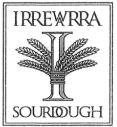
3 Irrewarra is the registered proprietor of its own trademark 1381773 in respect of bread, bread buns, bread mixes, bread rolls, toasted bread products, muffins, and crumpets. The Irrewarra trademark as registered is as follows:
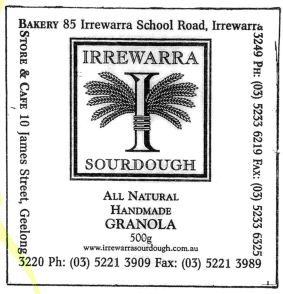
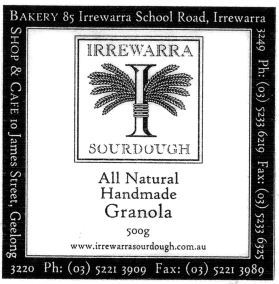
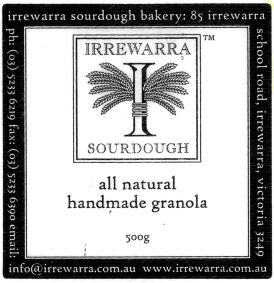
4 Since 2004 Irrewarra has manufactured and distributed a cereal product. The product is in a clear plastic bag. The bag has a label on the front and the rear. The front label has taken three forms since 2004: the first for the period August 2004 to September 2006, the second for the period September 2006 to October 2007 and the third for the period from October 2007 onwards. The front labels appear as follows, ordered from the earliest to the latest:
5 The rear label contains information including the ingredients (rolled oats, sunflower seeds, pumpkin seeds, almonds, walnuts, sesame seeds, raisins, currants, coconut, honey, canola oil, spice) and nutritional information. It also identifies the product as made in Australia at Irrewarra Sourdough Bakery from local and imported ingredients.
6 The bag is sealed by another clear label showing the same symbol (the “I” with wheat sheafs) as appears in the Irrewarra trade mark.
7 As the bag is made from clear plastic the product can be seen. It looks much like toasted muesli, although perhaps clumpier.
8 Sanitarium contends that since August 2004 Irrewarra has used the GRANOLA trade mark in respect of which Sanitarium has exclusive rights in contravention of s 120(1) of the Trade Marks Act 1995 (Cth) (Trade Marks Act) which provides that:
A person infringes a registered trade mark if the person uses as a trade mark a sign that is substantially identical with, or deceptively similar to, the trade mark in relation to goods or services in respect of which the trade mark is registered.
9 Irrewarra contends that it has not used the words “GRANOLA” and “Granola” (as it appears on the first two labels respectively) or “granola” (as it appears on the third label) as a trade mark in the sense of a word distinguishing the goods from the goods of other traders in the course of trade. According to Irrewarra its use of the word is purely descriptive and, in the context of the impugned use (the label on the packaging), does nothing more than describe the contents of the package.
10 In addition to this dispute between the parties there is the question of the liability of Mr and Mrs Calvert as directors of Irrewarra as alleged joint tortfeasors. Their liability depends on the primary liability of Irrewarra itself. There are also subsidiary issues which arose in the course of the hearing, particularly: – (i) whether it is open to Irrewarra also to contend that the sign on its packaging “all natural handmade granola” (or the earlier variants of it) is not substantially identical with, or deceptively similar to, the trade mark GRANOLA, (ii) whether the documentary and oral evidence Irrewarra sought to adduce about the use of the word granola in a descriptive sense in Australia is relevant to the facts in issue, and (iii) whether the evidence Sanitarium sought to adduce of Mrs Calvert’s knowledge of the GRANOLA trade mark, her intentions and responses she took to communications by Sanitarium about the alleged infringement (in effect, changing the label on the Irrewarra product as disclosed above) is relevant to the facts in issue. These issues are subsidiary because the essential question remains whether Irrewarra has used as a trade mark on its labels anything other than the Irrewarra trade mark.
PRINCIPLES
11 In respect of the essential question at least there was no real dispute about the applicable principles.
12 Section 6(1) of the Trade Marks Act includes the following definitions:
"sign" includes the following or any combination of the following, namely, any letter, word, name, signature, numeral, device, brand, heading, label, ticket, aspect of packaging, shape, colour, sound or scent.
"trade mark" has the meaning given by section 17.
"use of a trade mark" has a meaning affected by subsections 7(1), (2) and (3).
"use of a trade mark in relation to goods" has the meaning given by subsection 7(4).
13 Section 17 provides that:
A trade mark is a sign used, or intended to be used, to distinguish goods or services dealt with or provided in the course of trade by a person from goods or services so dealt with or provided by any other person.
14 Insofar as relevant s 7 is in these terms:
(1) If the Registrar or a prescribed court, having regard to the circumstances of a particular case, thinks fit, the Registrar or the court may decide that a person has used a trade mark if it is established that the person has used the trade mark with additions or alterations that do not substantially affect the identity of the trade mark.
…
(4) In this Act:
"use of a trade mark in relation to goods" means use of the trade mark upon, or in physical or other relation to, the goods (including second-hand goods).
15 In Mothercare UK Ltd v Penguin Books Ltd [1988] RPC 113 at 118-119 Dillon LJ said:
Indeed it stands to reason that a Trade Marks Act would only be concerned to restrict the use of a mark as a trademark or in a trademark sense, and should be construed accordingly. If descriptive words are legitimately registered in Part A of the register, there is still no reason why other people should not be free to use the words in a descriptive sense, and not in any trademark sense.
16 In Aldi Stores Ltd Partnership v Frito-Lay Trading Co GmbH (2001) 190 ALR 185; [2001] FCA 1874 (Frito-Lay) Hill J at [22] and [23] explained that:
[22] It is familiar law that a mark or sign (in this case the words "Cheezy Twists") will be used as a trade mark if the use is such as to distinguish the goods of the person who uses it from those of other traders, so that it is a "badge of origin" of the goods. It will be so used if it indicates a connection in the course of trade between the goods and the person who applies it to the goods: Shell Co of Australia Ltd v Esso Standard Oil (Australia) Ltd (1963) 109 CLR 407 per Kitto J at 422-425, Mark Foy's Ltd v Davies Coop & Co Ltd (the Tub Happy case) (1956) 95 CLR 190 at 198-200 per Williams J, Johnson & Johnson Australia Pty Ltd v Sterling Pharmaceuticals Pty Ltd (1991) 30 FCR 326 at 335 per Lockhart J, 342 per Burchett J and 347-348 per Gummow J and Koninklijke Philips Electronics NV v Remington Products Australia Pty Ltd (2000) 48 IPR 257 at 265-6. In determining whether the mark is a badge of origin, as Kitto J said in Shell at 422 (and as the case itself illustrates) context will be all important. That context includes a consideration of the way in which the word is displayed in relation to the goods or in advertisements of which complaint is made: see Mars GB Ltd v Cadbury Ltd [1987] RPC 387 at 402 per Whitford J and Johnson & Johnson at 347 per Gummow J.
[23] Where the sign or mark is an invented word or invented combination of words, it will usually be easy to conclude that use on packaging or on the goods themselves is a trade mark use, although as the Johnson & Johnson case demonstrates some invented words might (while not yet having entered into the English language) themselves suggest a meaning, so that a particular use may not be a trade mark use. Where the word has or a combination of words have a clear meaning in ordinary use, the question will be much more difficult as the word or combination of words may either have taken on a secondary meaning indicating the origin of the goods or may simply convey an ordinary meaning (ie some message other than the trade origin of the goods): see Top Heavy Pty Ltd v Killin (1996) 34 IPR 282 at 286. It is well established that there is not a true dichotomy between words capable of being used as a badge of trade origin and words that are descriptive: see Johnson & Johnson at 347 per Gummow J and at 339 per Lockhart J.
17 Adapting the question which Gummow J posed in Johnson & Johnson Australia Pty Ltd v Sterling Pharmaceuticals Pty Ltd (1991) 30 FCR 326 at 351 (the Caplets case), as Hill J did in Frito-Lay at [25], to the present case involves asking the following:
Whether, in the setting on the package on which the words “GRANOLA”, “Granola” or “granola” appear, those words possess the character of words which Irrewarra is using in relation to its cereal food product, for the purpose of indicating or so as to indicate a connection in the course of trade between Irrewarra and the contents of the package. Do the words GRANOLA”, “Granola” or “granola” appear as a mark for distinguishing an Irrewarra product from other cereal food products in the course of trade?
18 At [30] in Frito-Lay Hill J also said:
In most, if not all cases, the question whether there has been use as a trade mark will be determined by an objective examination of the use in the context in which it appears.
19 At [56] in Frito-Lay Lindgren J noted that:
…prominence is one factor which has been regarded as suggesting trade mark use: cf James Watt Constructions Pty Ltd v Circle-E Pty Ltd [1970] 3 NSWR 481 (Hope J) ("Barrier Beam"); Berzins Specialty Bakeries Pty Ltd v Monty's Continental Bakery (Vic) Pty Ltd (1987) 15 FCR 402 (Jenkinson J) ("Pritikin") esp at 407.
20 Lindgren J also said at [60] in Frito-Lay:
… it is well established that words which, devoid of any context or which in one particular context may be understood to be descriptive, may nonetheless be used as a trade mark: JB Stone & Co Ltd v Steelace Manufacturing Co Ltd (1929) 46 RPC 406 (CA); Bass, Ratcliff & Gretton Ltd v Nicholson & Sons Ltd (1932) 49 RPC 88 (HL) at 109 per Lord Macmillan; Picot Ltd v Goya Ltd [1967] RPC 573 at 578; James Watt Constructions Pty Ltd v Circle-E Pty Ltd [1970] 3 NSWR 481 (Hope J); Kolotex Glo Australia Pty Ltd v Sara Lee Personal Products (Australia) Pty Ltd (t/a Hilton Hosiery) (1993) 26 IPR 1 per Wilcox J.
21 Hence, at [62] Lindgren J, in reiterating the importance of context, said:
…the fact that for registration purposes a descriptive word can acquire a secondary meaning, namely, the denotation of a particular source, also signifies that a descriptive word can be used as a trade mark for infringement purposes.
22 And at [76] Lindgren J posed the relevant issue in these terms:
Whether Aldi used the words "CHEEZY TWISTS" as a trade mark, that is to say, by way of distinguishing its goods from the goods of others, raises the objective test whether they would be likely to be understood to do so by relevant readers and hearers in the circumstances in which the words were likely to be read and heard: cf Wrigley's (A'asia) Ltd v Lifesavers (A'asia) Ltd (1936) 37 SR (NSW) 9 at 16 per Nicholas J; The Shell Co of Australia Ltd v Esso Standard Oil (Aust) Ltd (1963) 109 CLR 407 at 425 per Kitto J; Johnson & Johnson Australia Pty Ltd v Sterling Pharmaceuticals Pty Ltd (1991) 30 FCR 326 (FC) at 351 per Gummow J; Pepsico Australia Pty Ltd v Kettle Chip Co Pty Ltd (1996) 33 IPR 161 at 182, 187; Sports Break Travel Pty Ltd v P & O Holidays Ltd (2001) 50 IPR 51 at [14] per Burchett J.
23 In Global Brand Marketing Inc v YD Pty Ltd (2008) 76 IPR 161; [2008] FCA 605 Sundberg J analysed the decision of the Full Court in Coca-Cola Company v All-Fect Distributors Ltd (1999) 96 FCR 107 (All-Fect), including the court’s statement at [31] that “the question at this stage is not whether the respondent has used a sign so as to indicate a connection between it and the appellant. It is whether the use indicates a connection between the confectionary and the respondent. So it does not assist the respondent to demonstrate by reference to the packaging that the suggested connection is with Efruti rather than Coca-Cola”. At [49] Sundberg J explained that:
These passages reflect High Court authority that a trade mark is a sign used to indicate origin of the goods in the user of that sign. Therefore, in the ordinary case, a court must first examine the use of the impugned mark and whether such use is trade mark use for the purposes of the Act. In cases such as the present this threshold issue should be determined before the court considers whether the two marks are substantially identical or deceptively similar. The threshold issue only examines the impugned mark; not the registered trade mark. As was said in All-Fect at [32], “At this stage the hypothesis is not that the appellant is trying to tell the consumer that the goods emanate from it, but that the respondent is trying to tell the consumer that the goods emanate from the respondent”. [emphasis in original]
24 Sundberg J continued at [51] to [52] in these terms:
[51] The existence of striking features that were not descriptive of the confectionary was enough to indicate that it was used as a trade mark. Features that made the goods more arresting of appearance and more attractive had the capacity to distinguish the respondent’s goods from those of others.
[52] At [35] the Court said that whether the respondent had used features of the confectionary as a trade mark was a matter for the court, and was not governed by the absence of evidence that shopkeepers or customers concluded that the confectionary had a trade mark origin.
25 In Nature's Blend Pty Ltd v Nestle Australia Ltd (2010) 272 ALR 487; [2010] FCAFC 117 at [19] (Nature's Blend) the Full Court conveniently summarised the relevant principles as follows:
1. Use as a trade mark is use of the mark as a “badge of origin”, a sign used to distinguish goods dealt with in the course of trade by a person from goods so dealt with by someone else: Coca-Cola Co v All-Fect Distributors Ltd (1999) 96 FCR 107 at [19]; E & J Gallo Winery v Lion Nathan Australia Pty Ltd (2010) 265 ALR 645 at [43].
2. A mark may contain descriptive elements but still be a “badge of origin”: Johnson & Johnson Australia Pty Ltd v Sterling Pharmaceuticals Pty Ltd (1991) 30 FCR 326 at 347–348; Pepsico Australia Pty Ltd v Kettle Chip Co Pty Ltd (1996) 135 ALR 192; Aldi Stores Ltd Partnership v Frito-Lay Trading GmbH (2001) 54 IPR 344 at [60].
3. The appropriate question to ask is whether the impugned words would appear to consumers as possessing the character of the brand: Shell Company of Australia Ltd v Esso Standard Oil (Australia) Ltd (1963) 109 CLR 407 at 422.
4. The purpose and nature of the impugned use is the relevant inquiry in answering the question whether the use complained of is use “as a trade mark”: Johnson & Johnson at 347 per Gummow J; Shell Company at 422.
5. Consideration of the totality of the packaging, including the way in which the words are displayed in relation to the goods and the existence of a label of a clear and dominant brand, are relevant in determining the purpose and nature (or “context”) of the impugned words: Johnson & Johnson at 347; Anheuser-Busch, Inc v Budějovicky Budvar, Národní Podnik (2002) 56 IPR 182.
6. In determining the nature and purpose of the impugned words, the court must ask what a person looking at the label would see and take from it: Anheuser-Busch at [186] and the authorities there cited.
SANITARIUM’S CASE
26 Leaving aside the subsidiary disputes Sanitarium’s case can be summarised as follows:
(1) GRANOLA is an invented word and thus its use may more readily be seen as a badge of origin. In this regard, there is no dispute that the word GRANOLA was invented in 1876 in the USA to refer to a wheat and oat breakfast cereal ground into granules and baked, its derivation being “GRAN” (referring to grain) and the suffix “OLA” (said by the Oxford Dictionary Online to be “[u]sed to form nouns denoting commercial products (as Editola n., moviola n., Victrola n.)”), also sounding like the adjective “granular”.
(2) Cases in which invented words function other than as a badge of origin appear to be confined to a narrow set of circumstances in which the invented word is inherently suggestive of meaning, such as caplets (Johnson & Johnson) and luscious lips (Nature's Blend). GRANOLA is not such a word.
(3) GRANOLA may well have a commonly understood meaning in the USA but it does not have so in Australia other than, perhaps, what might be described as a “boutique” use. Even if the word has attracted some descriptive meaning in some parts of Australia as observed in Mark Foy’s Ltd v Davies Coop & Co Ltd (1956) 95 CLR 190 at 194 (Tub Happy case) language is not always used to convey a single idea and a word may have a descriptive element but still be used as a badge of origin.
(4) On the labels in issue the word “GRANOLA” is “quite plainly the second most prominent feature aside from the” Irrewarra trade mark. As to the Irrewarra trade mark as Gummow J said in the Caplets case at 349:
Accordingly, there may be a trade mark use and thus infringement in a
case where the defendant adds words to indicate that it, rather than the
plaintiff, is the trade origin of the goods or services in question: see
Caterpillar Loader Hire (Holdings) Pty Ltd v Caterpillar Tractor Co (1983) 77
FLR 139 at 141-142, per Franki J. The addition of such words might
negative the risk of passing-off. But this is one distinction which marks off an
infringement action from a passing-off suit: see LSK Microwave Advance
Technology Pty Ltd v Rylead Pty Ltd [1989] ATPR 50,450 at 50,456, per
Burchett J. Further, there may still be a trade mark use in a given case (such
as the phrase in the Tub Happy case, "Exacto Cotton Garments - Tub
Happy Cotton Fresh Budget Wise"), although another trade mark also is
used by the defendant in the same packaging or advertisement. See also
Wrigley's (Australasia) Ltd v Life Savers (Australasia) Ltd (1936) 37 SR
(NSW) 9 at 16, per Nicholas J.
(5) Evidence of trade usage, such as there is in the present case, is of little or no utility. There is no evidence that manufacturers of cereals use the word GRANOLA as part of the trade. It should be inferred they do not. In any event, it is the impression of the potential consumer and not the trade that is the relevant consideration (Pepsico Australia Pty Ltd v Kettle Chip Co Pty Ltd (1996) 135 ALR 192 at 196 (the Kettle Chip case), where the relevant question was “what do the words ``Kettle Cooked'’ convey in those circumstances to ordinary persons likely to be purchasers of the chips”?)
(6) Irrewarra has not applied to expunge the trade mark “GRANOLA” but has sought to run a case under s 24 of the Trade Marks Act in disguise (s 24 applies “if a registered trade mark consists of, or contains, a sign that, after the date of registration of the trade mark, becomes generally accepted within the relevant trade as the sign that describes or is the name of an article, substance or service”, in which event exclusive rights to use the mark are lost). The evidence would not come close to satisfying a case under s 24 yet Irrewarra’s defence, in substance, is to the same effect.
(7) There is evidence that Mrs Calvert, as at December 2005, knew that Sanitarium had the exclusive right to use the trade mark GRANOLA and yet decided to continue to use the word in any event. Mrs Calvert should be inferred to have had the same knowledge when Irrewarra began manufacturing its product. There is also evidence that in response to Sanitarium’s initial and subsequent communications to Irrewarra about the infringement of its trade mark Mrs Calvert arranged for the labels to be changed in an attempt to reduce the prominence of the word GRANOLA. These attempts should not distract attention from Irrewarra’s use of the mark as at August 2004 and as shown on the first label.
DISCUSSION
27 The problem for Sanitarium is that even if its case is taken at its highest it does not confront the purpose and nature of the impugned use by reference to the whole context. Even if it be assumed that the inquiry must focus only upon the first label and that Mrs Calvert knew that Sanitarium had the exclusive rights to use the trade mark GRANOLA as at August 2004 (neither of which I accept) when Irrewarra introduced this product to its line of goods, it is necessary to consider the totality of the packaging. Once this is done a number of factors become apparent.
28 First, the word granola, at least as it appears in the context of the packaging in the present case, is inherently suggestive of meaning. Although an invented word it is not nonsensical. The “gran” part, taken together with the “ola” and the aural similarity to “granular”, is suggestive of a grain product. In the context of the clear packaging in the present case and the size of the package (500g) it is and would be obvious to the consumer that the “all natural handmade granola” refers to the contents of the package which consists of grains, fruits and nuts apparently baked or toasted into clumps. This conclusion should be reached irrespective of the evidence on which Irrewarra relied and which Sanitarium submitted was irrelevant about recipes for a homemade breakfast food called granola, appearances of such a breakfast food in various cafes and restaurants, and manufacture and sale of boutique-style packets of such a breakfast food in Australia from the 1970s onwards.
29 Second, the word GRANOLA does not appear in isolation on the package. It appears as part of the phrase “ALL NATURAL HANDMADE GRANOLA”. The words “all natural handmade” are plainly descriptive of the product. In context, the word “granola” also reads as part of the product description.
30 Third, although, at least on the first two labels, the word “granola” appears in larger font than the words “all natural handmade”, in the context of the package as a whole, that word does not have the prominence Sanitarium wishes to assign to it. The label is black and white. In all three versions the label has two highly distinctive features: – (i) a version of the Irrewarra trade mark in the double-outlined box, and (ii) the information framing the label as a whole which appears as a large box within which the double-outlined box sits. The framing information refers to the details of the Irrewarra Bakery, Store and Café, its location and contact details. While “there may be a trade mark use and thus infringement in a case where the defendant adds words to indicate that it, rather than the plaintiff, is the trade origin of the goods or services in question” (the Caplets case at 349) it is also the case that the use of Irrewarra’s own trade mark in such a prominent way “has a bearing on whether” the word “granola” has been used to “show the commercial origin” of the cereal of “some other purpose and effect” (the Kettle Chip case at 213 and Nature’s Blend at [46]-[48]). The reference to Irrewarra Sourdough and column-like symbol of the “I” with wheat sheafs is highly stylised in all three versions of the label. The Irrewarra Sourdough mark is in the centre of double-lined inner box in the uppermost position within the outer box containing the details of the Bakery, Store and Café at Irrewarra Road, Irrewarra. In contrast, the reference to the “all natural handmade granola” in all three versions of the label is located below the inner box, is not within a border and is in a relatively plain font style. Even in the first version, although the word GRANOLA is in larger font than ALL NATURAL HANDMADE, the difference in font size is not particularly noticeable when compared to the overall prominence of the Irrewarra Sourdough mark. A consumer who turned the packet over would see no reference to the word granola on the rear of the package but would see the column-like symbol of the “I” with wheat sheafs used as the label to seal the package.
31 Sanitarium’s case, on analysis, appeared to reduce to the proposition that any use of the word granola on a cereal product must be a trade mark use. This approach would be contrary to authority which emphasises the importance of context in determining whether the use of a word is use as a trade mark. As I have said, taking Sanitarium’s case at its highest, I am not persuaded that the impugned use in this case is use to distinguish Irrewarra’s goods from those of any other person in the course of trade. The word granola as it appears on the labels affixed to the packages in question does not indicate any connection between the goods and Irrewarra. In the context in which it appears (even if not otherwise) the word granola suggests a meaning (grainy foodstuff) descriptive of the contents of the package. Considered objectively, in the whole context in which the word would be seen, the use would not denote the source of the product in any way. The word is not a badge of origin but a description of the contents of the package. This is not a case in which two badges of origin appear – both Irrewarra Sourdough and granola. There is a single use as a trade mark on these packages, the use being of the Irrewarra Sourdough mark only.
32 This conclusion is sufficient to dispose of the proceeding by dismissal of Sanitarium’s application. Insofar as it might be necessary to say so the disputed issues of fact and principle (such as they are), if resolved, do not assist Sanitarium.
33 There was no evidence that Mrs Calvert knew that the word GRANOLA was a trade mark as at August 2004 when Irrewarra began manufacturing its product. Such evidence as there was related to December 2005. In circumstances where Mrs Calvert was cross-examined on her evidence, including her state of knowledge as at December 2005, no inference should be drawn that she had the same knowledge as at August 2004. This proposition was not put to her despite the opportunity to do so. Even if such knowledge could be imputed to her the knowledge was merely that Sanitarium had the exclusive right to use GRANOLA as a trade mark. Mrs Calvert’s evidence was clear. If her intention could be relevant (which it could not to the question of use as a trade mark – see Frito-Lay) it was only to use granola as a description of the product.
34 Sanitarium’s case about the word granola having a meaning only in the USA suffers from an air of unreality. Again, leaving aside the evidence on which Irrewarra relied about recipes for a homemade breakfast food called granola, appearances of such a breakfast food in various cafes and restaurants, and manufacture and sale of boutique-style packets of such a breakfast food in Australia from the 1970s onwards, the modern world is characterised by rapid communication and extensive cultural exchanges particularly from the USA in the form of films, television programs, music, books and travel. In these circumstances Sanitarium’s attempts to rely on the notes in various dictionaries as indicating a usage exclusive to North America were unpersuasive. It may be accepted that many of the dictionary entries indicate the word as used in North America, the USA and Canada. This is not the same as the word having no meaning or only having a meaning to a select few in Australia. Australians who watch American films and television programs, listen to American music, read American books and/or travel to America will undoubtedly be routinely exposed to many words which are commonplace in the USA and infrequently or less used in Australia. That does not mean the words have no meaning in Australia. The fact is that the word granola has appeared in Australian dictionaries since at least 2004 and, since its invention in the late 1800s, has had more than a century of usage in the USA to percolate into the consciousness of Australians. The schedule prepared by Irrewarra in this regard is instructive and is reproduced below (excluding the references to the tender bundle).
Source | Published | Meaning |
The Oxford English Dictionary Second Edition | 1989 | Granola (græˈnəʊlə). Chiefly N. Amer. [Cancelled trade-mark: see GRAIN sb.1, GRANULAR a., and -OLA; the earlier Granŭla (registered 1876 as ‘cooked granulated wheat’ by Austin Jackson & Co., Dansville, NY), is a different product.] +a. With capital initial. Formerly, a proprietary name for a breakfast cereal devised by W.K. Kellogg, consisting of wheat, oats and cornmeal baked and ground into granules Obs. 1886 Trade Marks Jrnl. 24 Mar. 275 Granola, …A product for food. 1928 Official Gaz. (U.S. Patent Office) 8 Nov. 288 The Battle Creek Food Company, Battle Creek, Mich… Granola. b. A mixture of rolled oats, wholewheat flour or wheatgerm, nuts, dried fruits, oils, and other ‘natural’ ingredients toasted and sold as a breakfast cereal, biscuit-like snack, etc. (Not proprietary in this sense.) 1970 Time 16 Nov. 63/1 Rows of unfamiliar foodstuffs are appearing in middle-class cupboards: brown rice by the bucketful, as well as packages of ad[z]uki, granola, gomasio, ginseng and miso. 1974 Daily Colonist (Victoria, B.C.) 16 July 17/1 Increasingly, consumers are becoming aware of the low nutritional value of traditional breakfast cereals, and more and more they are turning to the granola products which offer more in the way of grain cereals combined with nutritious products such as raisins, nuts and seeds. 1976 C. BONINGTON Everest Hard Way 213 Doug Scott revealed his cravings for granola and French nougat. 1977 Time 9 May 62/3 Williams’ happier ending is blended for the granola ‘70s. 1984 S. BELLOW Him with his Foot in his Mouth 89 Katrina woke the girls and told them to dress and come downstairs for their granola. 1985 New Yorker 3 June 73/1 She drank the juice and ate a granola bar. |
The Australian Oxford Dictionary Second Edition | 2004 | granola/ gre’noula/ n. US 1 of a kind of breakfast cereal resembling muesli. 2 (attrib.) colloq. chiefly derog. Denoting people with liberal or Green political views, typified as eating health foods. [ORIGIN: from gran- (representing GRANULAR or GRAIN) + -ola (suffix chiefly in US usage).] |
Australian Concise Oxford Dictionary, Fifth Edition | 2009 | granola/ gr?’noʊ?/ n. US 1 a kind of breakfast cereal resembling muesli. 2 (as adj.) colloq. Chiefly derog. Denoting people with liberal or green political views, typified as eating health foods. [from gran- (representing GRANULAR or GRAIN) + -ola (suffix chiefly in US usage)] |
Collins Australian Dictionary, Tenth Edition | 2009 | (gr?’noʊ/?) nUS and Canadian a mixture of rolled oats, brown sugar, nuts, fruit, etc, eaten with milk ETYMOLOGY C20: originally Granola a trademark |
Macquarie Dictionary Online | Retrieved 6 December 2010 | noun a breakfast food made predominantly from rolled oats combined with other ingredients such as wheatgerm, nuts and dried fruit, often mixed with oil and toasted. [originally US tradename, from GRAN(ULAR) + -ola suffix used in commercial names, ? from Italian –ola diminutive suffix] |
Macquarie Dictionary Online | Retrieved 28 May 2012 | / gr?’noʊ/?)/ (say gruh/nohluh) noun a breakfast food made predominantly from rolled oats combined with other ingredients such as wheatgerm, nuts and dried fruit, often mixed with oil and toasted. [trademark; from GRAN(ULAR) + -ola suffix used in commercial names, ? from Italian –ola diminutive suffix] |
35 It may be accepted that the evidence of Jillian Dupleix, the author of sixteen cookbooks and a well-known food writer who was once the Cookery Editor for The Times in London (2000-2006) and is currently a developer of recipes working on a new cookery book as well as being a food writer for the Sydney Morning Herald, The Age and Delicious magazine, mainly comprised her own observations of granola recipes and products in Australia (which involved no application of expertise) and provided a compilation of other references to granola including in the 1995 edition of Rosemary Stanton’s Complete Book of Food and Nutrition. According to Ms Dupleix this book is widely used by food writers, nutritionists, chefs, health specialists, and food professionals. In total, Irrewarra identified 47 retail products, 89 recipes and 80 menu items relating to granola products either produced or imported into Australia. While Sanitarium dismissed these references as irrelevant to the question which involves an objective assessment of how the word would be read and heard in context by the consumer or, alternatively, indicative of at best a very limited use of the word in Australia by some people and not by the major cereal manufacturers, the evidence at least undermined Sanitarium’s unrealistic submission that the word has no meaning whatsoever to Australians and (apparently) would have no meaning even if seen in the context of the impugned use. To that extent at least the evidence is relevant, albeit not in my view essential to Irrewarra’s defence of the case against it.
36 I also do not accept Sanitarium’s case insofar as it submitted that it was not open to Irrewarra on the pleadings to put substantial identity and deceptive similarity in issue. At best, Sanitarium may have assumed that those matters were not in issue but, on a fair reading of the pleadings, the contrary is apparent. In any event, it was plain from the outset of the hearing that these matters were in issue if Sanitarium established Irrewarra had used the word granola as a trade mark (which it has not).
37 The fact that Irrewarra has not applied to have the GRANOLA trade mark removed cannot be used to bolster Sanitarium’s case. It is not permissible to speculate on the reasons for any party’s forensic decisions. The case brought by Sanitarium depends on it establishing that by reason of the impugned labels Irrewarra has used the word granola as a trade mark. In my view, this is not established when the context of the use as a whole is considered.
38 If it were necessary to decide the issues of substantial identity and deceptive similarity I would be unpersuaded by Sanitarium’s case. The sign used on Irrewarra’s product is “all natural handmade granola”. The sign includes the word GRANOLA which is the subject of Sanitarium’s trade mark. Section 7(1) of the Trade Marks Act (which provides that if the Registrar or a prescribed court, having regard to the circumstances of a particular case, thinks fit, the Registrar or the court may decide that a person has used a trade mark if it is established that the person has used the trade mark with additions or alterations that do not substantially affect the identity of the trade mark) does not determine substantial identity or deceptive similarity. Irrewarra’s sign is not substantially identical with Sanitarium’s trade mark. Nor in my view is it deceptively similar to that trade mark. The sign on Irrewarra’s product “all natural handmade granola” does not so nearly resemble the trade mark GRANOLA so as to be likely to deceive or cause confusion (Frito-Lay at [148]-[150]). If, but only if, the relevant sign on the Irrewarra product is the word “granola” alone would there be substantial identity between the sign and the trade mark It is not apparent why the relevant sign should be so confined.
39 In any event, and for the reasons given, I am satisfied that Irrewarra is not using the word granola as a trade mark on its products. As such, Sanitarium has not established any infringement and Mr and Mrs Calvert cannot be liable as joint tortfeasors. The proceedings should be dismissed with costs.
I certify that the preceding thirty-nine (39) numbered paragraphs are a true copy of the Reasons for Judgment herein of the Honourable Justice Jagot. |
Associate:


