FEDERAL COURT OF AUSTRALIA
Lonsdale Australia Limited v Paul’s Retail Pty Ltd [2012] FCA 584
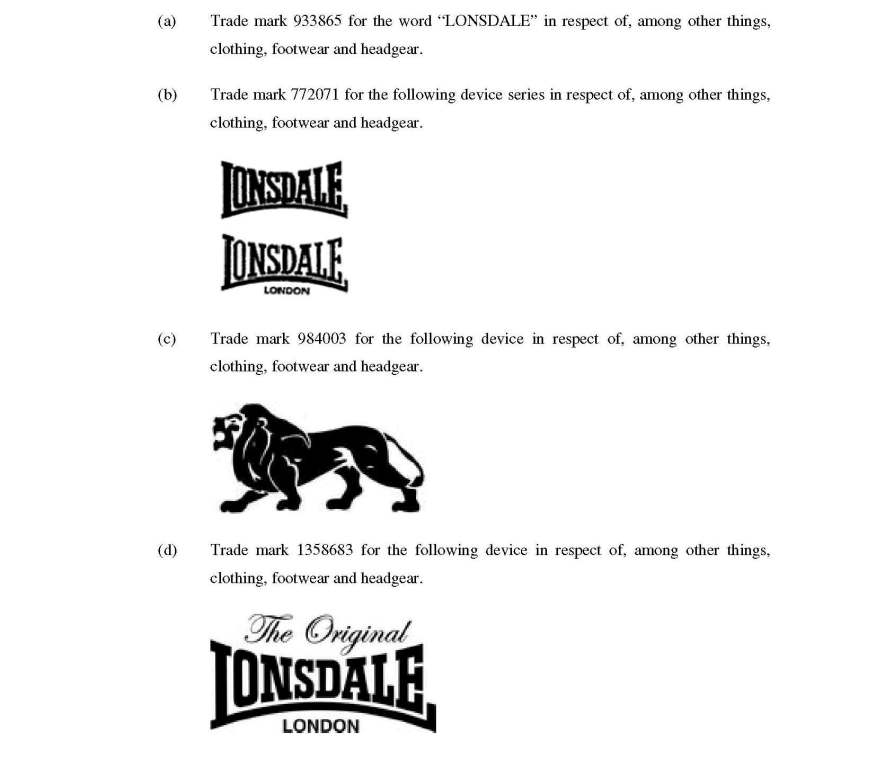
IN THE FEDERAL COURT OF AUSTRALIA | |
| Applicant | |
AND: | PAUL’S RETAIL PTY LTD (ACN 114 419 242) First Respondent PW INVENTORY PTY LTD (ACN 128 572 341) Second Respondent |
DATE OF ORDER: | |
WHERE MADE: |
THE COURT ORDERS THAT:
1. By 12:00pm on 8 June 2012, the parties are directed to bring in final orders to give effect to these reasons for decision and for the future conduct of the trial.
Note: Entry of orders is dealt with in Rule 39.32 of the Federal Court Rules 2011 (Cth).
VICTORIA DISTRICT REGISTRY | |
GENERAL DIVISION | VID 364 of 2012 |
BETWEEN: | LONSDALE AUSTRALIA LIMITED Applicant
|
AND: | PAUL’S RETAIL PTY LTD (ACN 114 419 242) First Respondent PW INVENTORY PTY LTD (ACN 128 572 341) Second Respondent
|
JUDGE: | GORDON J |
DATE: | 5 JUNE 2012 |
PLACE: | MELBOURNE |
REASONS FOR JUDGMENT
INTRODUCTION
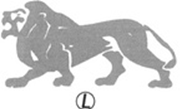
1 Lonsdale Sports Limited (LSL), as the registered owner of the trade marks in Annexure A, assigned those trade marks to the applicant (Lonsdale Australia) on 11 June 2011: s 106 of the Trade Marks Act 1995 (Cth) (the TM Act). Lonsdale Australia then became, and remains, the registered owner in Australia of those trade marks (the Lonsdale Australia Trade Marks). Lonsdale Australia then granted VAG Group Pty Ltd (VAG) an exclusive licence in Australia to promote, distribute and sell products bearing certain of the Lonsdale Australia Trade Marks: see Annexure B.
2 Punch GmbH (Punch) is licensed by LSL to promote, distribute and sell, in Europe, clothing (excluding certain specified goods) bearing the trade marks in Annexure C (the Punch Marks) (pursuant to the Punch Licence). Punch entered into a Sales Agreement with Unicell Ltd (Unicell) (the Sales Agreement), a Cyprus company, pursuant to which Unicell placed orders for 293,329 Lonsdale branded products (the Unicell Orders). Punch affixed to those goods unique holographic labels.
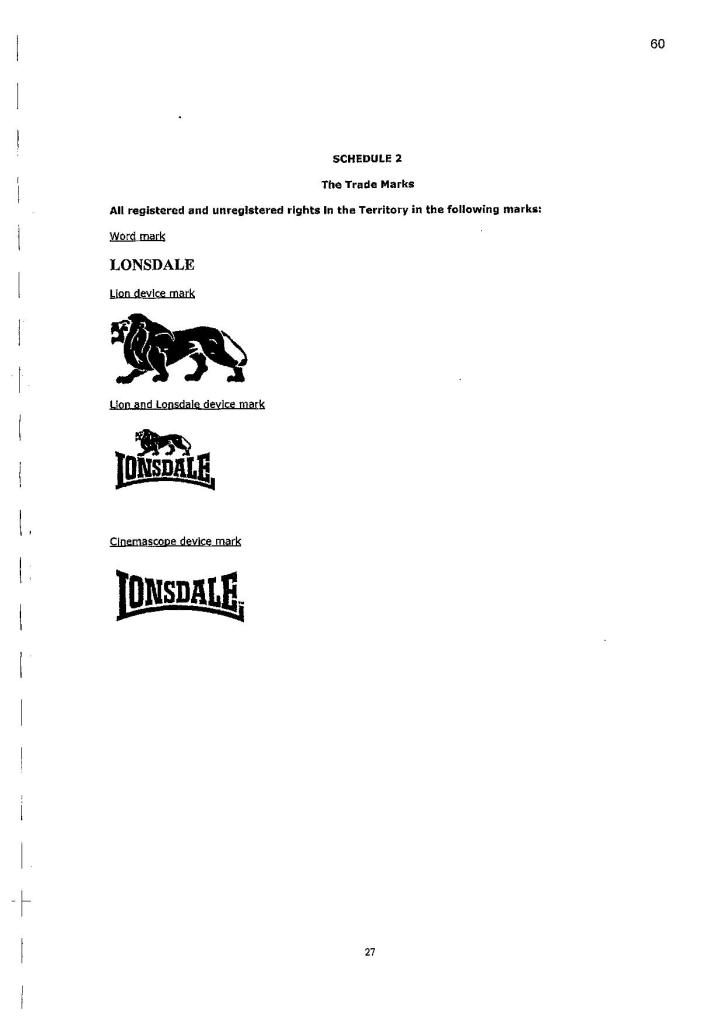
3 The Second Respondent, PW Inventory Pty Ltd (PW), purchased and imported 293,329 products from a US-based company, TMS LLC (TMS) (the Paul’s Goods). The Paul’s Goods bore one or more of the trade marks in Annexure D and the same holographic labels which Punch had had affixed to the goods it supplied pursuant to the Unicell Orders.
4 The First Respondent, Paul’s Retail Pty Ltd (Paul’s), sold, offered for sale or exposed for sale the Paul’s Goods. The evidence was that, of the 293,329 products comprising the Paul’s Goods, as at 22 May 2012:
1. 81,107 units (with a “supplier cost value” of $954,927.46) had cleared the Australian Customs and Border Protection Service (Customs) and been shipped to Paul’s stores;
2. 9,620 of those 81,107 units had already been sold for $344,838.50 (excluding GST);
3. 126,671 units (with a “supplier cost value” of $1,736,613) were being held by Customs; and
4. 83,551 units were being held in an overseas warehouse.
5 On 23 May 2012, Lonsdale Australia obtained an interim injunction restraining PW and Paul’s from:
… importing, promoting, distributing, offering for sale or selling all clothing and footwear that bears the sign “LONSDALE” and has a style number that is identified in Annexure C to the letter from Norton Rose Australia to W Lawyers dated 2 May 2012 …
The interim injunction was granted, in part, on the basis that any goods held by Customs would be released no earlier than on 11 June 2012 and that the hearing of the trial and the publication of these reasons would occur before that date.
6 At the hearing, on 31 May 2012, Lonsdale Australia informed the Court that a further container or containers of goods similar to the Paul’s Goods had arrived and was being held by Customs. It was common ground these later importations should suffer the same fate as the Paul’s Goods.
7 The question to be resolved is whether the conduct of PW or Paul’s (or both) in importing, promoting, distributing, offering for sale or selling the Paul’s Goods was in breach of s 120 of the TM Act? For the reasons that follow, the answer is yes. Each respondent imported, promoted, distributed, offered for sale or sold the Paul’s Goods, which bear:
1. one or more of the Lonsdale Australia Trade Marks; or
2. one or more trade marks substantially identical with or deceptively similar to one or more of the Lonsdale Australia Trade Marks,
and which are goods in respect of which each trade mark is registered (see ss 7(4) and 120 of the TM Act) and each respondent did so without the consent of Lonsdale Australia, the registered owner of the Lonsdale Australia Trade Marks: s 123 of the TM Act.
THE FACTS
8 In addition to the facts set out above (see [1]-[5] above), the facts which give rise to the current dispute were largely not in dispute and may be summarised as follows:
1. Paul’s had previously acquired products bearing some of the Lonsdale Australia Trade Marks from VAG but VAG had ceased supplying Paul’s in or around April 2011.
2. Punch and Unicell entered into the Sales Agreement on 12 August 2011. Punch received a series of orders for individual products or ranges of products from Unicell. Punch provided Unicell with various samples and Unicell made various changes to the order quantities.
3. Pursuant to the Sales Agreement between Punch and Unicell:
3.1 Unicell was to deposit by telegraphic transfer 15% upon receipt of a detailed proforma invoice acceptable to Unicell and upon execution of the Sales Agreement;
3.2 Unicell was to deposit by telegraphic transfer 85% “after inspection in China and before transferring title to [Unicell]”; and
3.3 after receipt of payment, Unicell agreed to move the goods from Punch’s facility in China within a reasonable time. Punch was obliged to insure and safeguard the goods while they remained at Punch’s contracted manufacturer or warehouse for up to 30 days after Unicell paid for the goods.
4. Paul’s had an existing relationship with TMS. In or around August 2011, Paul Dwyer, a director and shareholder of Paul’s, became aware that TMS was offering Lonsdale branded products for sale. Mr Dwyer gave Harish Chatlani, an employee of TMS, a list of products that Paul’s was interested in acquiring and that list included Lonsdale branded products.
5. Also in or around August 2011, Mr Dwyer instructed Lisa Manu, an employee of Paul’s, to place an order for Lonsdale branded products with TMS. For example, a TMS invoice dated 31 August 2011 records an order for 7,698 Lonsdale branded products. That invoice was issued to PW. Ms Manu placed four more orders in September 2011.
6. Throughout the second half of September, TMS sought and obtained Paul’s approval of pre-production samples of the Paul’s Goods.
7. On 23 November 2011, Unicell notified Punch that it would prefer that the Paul’s Goods be shipped to Colombo, Sri Lanka.
8. On 29 November 2011, TMS sought and obtained Paul’s approval of the bar codes to be affixed to the Paul’s Goods. In particular, TMS sought confirmation that the additional bar codes provided by TMS scanned to Paul’s system.
9. In December 2011 and January 2012, Punch issued invoices to Unicell. On 13 January 2012 TMS issued invoices totalling USD3,664,524.83 to Hambantota Trading Company (PVT) (Hambantota), a Sri Lankan company, to enable the goods to be received and cleared in Colombo. Paul’s paid each of the invoices issued by TMS by wire transfers throughout December 2011, January, February, March and April 2012. The total of those wire transfers was USD3,461,777.26.
10. On 20 January 2012, Punch issued bills of lading to Unicell, which specified the port of discharge as Colombo. On the bills of lading, Punch was specified as the “shipper”, while Unicell was listed as the consignee. Hambantota was listed as the “notify party”.
11. The Paul’s Goods were shipped to Colombo to enable certain “pre-retailing” activities (such as splitting, tagging and pricing) to be carried out. Once those activities were complete, in March and April 2012, the Paul’s Goods were reloaded and shipped to Sydney via Singapore. The bills of lading for the voyage to Sydney list Andys Private Limited as the “shipper” and PW as the consignee.
12. On 11 April 2012, the first shipment of the Paul’s Goods cleared Customs. Consignments of those goods were delivered to Paul’s stores in Sydney on 12 April 2012, in Canberra and Sunshine on 13 April 2012 and in Hobart on 3 May 2012. Two further container loads cleared Customs on 21 May 2011 and were delivered to Paul’s stores within similar timeframes.
9 It was suggested that this case concerned parallel or “grey” importing. As these reasons for decision demonstrate, it did not. It is important to focus upon the trade marks registered in Australia, the identity of the parties involved and the transactions preceding the arrival of the goods bearing the allegedly infringing marks. Each case will likely be different in one or more of those respects, leading to a different result.
THE TM ACT
10 Before turning to s 120 of the TM Act, other sections of the Act must be noted.
11 Section 7, entitled “Use of a trade mark”, relevantly provides that an authorised use of a trade mark is use by an owner: s 7(3). “Use of a trade mark in relation to goods” means the use of the trade mark upon, or in physical or other relation to, the goods: s 7(4).
12 It is also necessary to consider s 8. In E & J Gallo Winery v Lion Nathan Australia Pty Ltd (2010) 241 CLR 144 at [21] French CJ, Gummow, Crennan and Bell JJ (with whom Heydon J agreed on this issue) described it as follows:
Authorised use is defined in s 8. A person is an “authorised user” of a trade mark if the person uses the trade mark in relation to goods or services “under the control of the owner of the trade mark” (s 8(1)). Such control can take the form of “quality control over goods” (s 8(3)). An authorised user may use the trade mark in relation to the goods in respect of which the trade mark is registered (s 26(1)(a)) and may bring an infringement action in certain circumstances (s 26(1)(b)). An authorised user may also give (or revoke) a notice under s 136 objecting to the importation of goods that infringe the mark.
13 Part 3 of the TM Act is entitled “Trade marks and trade mark rights”. The principal provision, s 17, defines a trade mark as a “sign used, or intended to be used, to distinguish goods … dealt with or provided in the course of trade by a person from goods … so dealt with or provided by any other person”. In Gallo 241 CLR 144, the majority emphasised the role played by s 17, stating at [42]:
Whilst that definition contains no express reference to the requirement, to be found in s 6(1) of the Trade Marks Act 1955 (Cth), that a trade mark indicate “a connexion in the course of trade” between the goods and the owner, the requirement that a trade mark “distinguish” goods encompasses the orthodox understanding that one function of a trade mark is to indicate the origin of “goods to which the mark is applied”. Distinguishing goods of a registered owner from the goods of others and indicating a connection in the course of trade between the goods and the registered owner are essential characteristics of a trade mark. There is nothing in the relevant Explanatory Memorandum to suggest that s 17 was to effect any change in the orthodox understanding of the function or essential characteristics of a trade mark.
(Emphasis added and citations omitted.)
See also Coca Cola Co v All-Fect Distributors Ltd (1996) 96 FCR 107 at [19].
14 A registered owner of a trade mark has an exclusive right to use the trade mark: s 20(1)(a). As the Court noted in Transport Tyre Sales Pty Ltd v Montana Tyres and Rims Pty Ltd (1999) 93 FCR 421 at [78], that right has some territorial limitation as it would not be competent for the Parliament of Australia to provide for an exclusive right to use a trade mark in relation to goods throughout the world. Of course, a sign may be applied (within the meaning of s 9) to goods or in relation to goods any where in the world and still constitute a trade mark under the TM Act: Transport Tyre Sales 93 FCR 421 at [79].
15 Part 12 of the TM Act is entitled “Infringement of Trade Marks”. Section 120 is the principal section. Section 120(1) of the TM Act provides that:
A person infringes a registered trade mark if the person uses as a trade mark a sign that is substantially identical with, or deceptively similar to, the trade mark in relation to goods or services in respect of which the trade mark is registered.
It is to s 120(1) that I now turn.
ANALYSIS
“Registered trade mark”
16 It is necessary to identify the “registered trade mark” referred to in s 120 of the TM Act. In the present case, the registered trade marks referred to in s 120 are the Lonsdale Australia Trade Marks. Put another way, the relevant marks are those marks whose particulars are entered in the Register of Trade Marks kept under s 207 of the TM Act: see s 6 (definition of “Register” and “Registered Trade Mark”). Here, Lonsdale Australia is the registered owner of the marks listed in Annexure A in relation to identified classes of goods.
17 The respondents proceeded on an erroneous basis which infected the entirety of their submissions. The error was to assert that the registered trade marks to be considered were the Punch Marks. They were not. As noted above, it would not be competent for the Parliament of Australia to provide for an exclusive right to use a trade mark in relation to goods throughout the world. The respondents sought to draw support for their position from the proposition in Transport Tyre Sales 93 FCR 421 that a registered trade mark, within the meaning of s 120 of the TM Act, may be applied anywhere in the world: at [79]. However, with respect, that proposition does not assist the respondents. That “a sign may be applied, within the meaning of s 9 [of the TM Act], to goods or in relation to goods or services in any part of the world” says nothing about the meaning of a “registered trade mark” in s 120. Given the competency of Parliament, the respondents’ submission must be rejected.
18 The issue for this Court was whether Lonsdale Australia’s exclusive rights given to it by registration of the Lonsdale Australia Trade Marks had been infringed. The issue was not whether the Paul’s Goods bore one or more of the Punch Marks. As is readily apparent, identification of the relevant issue is critical. If you ask the wrong question, you get the wrong answer.
A sign “that is substantially identical with … the trade mark in relation to goods or services in respect of which the trade mark is registered”
19 There is infringement of s 120 only if a person uses a sign as a trade mark in relation to goods. As noted at [11] above, use of a trade mark, or a sign as a trade mark, in relation to goods means use of the registered trade mark “upon, or in physical or other relation to, the goods”: s 7(4). As the Court stated in Transport Tyre Sales 93 FCR 421 at [81], “[t]here will only be infringement within s 120 where the conduct said to constitute infringement is inconsistent with the rights conferred by s 20”.
20 It is common ground that the marks affixed to the Paul’s Goods were substantially identical with and/or deceptively similar to the Lonsdale Australia Trade Marks. The following table identifies the marks on the Paul’s Goods and the relevant Lonsdale Australia Trade Marks which are infringed.
Mark on the Paul’s Goods (See Annexure D) | Regd Mark No | Trade Mark | Registered Owner |
Stylised Lion
| 1057970, classes 3, 9, 14, 16, 18, 21, 24, 26, 28 and 35 |
| Lonsdale Australia |
Stylised Lion
| 984003, classes 18, 25 and 28 |
| Lonsdale Australia |
Stylised Lion
| 1033405, classes 5, 30 and 32 |
| Lonsdale Australia |
Stylised Lion
| 1033409, classes 3, 5, 9, 14, 16, 18, 21, 24, 25, 26, 28, 30, 32, 35 and 41 |
| Lonsdale Australia |
Stylised “Lonsdale London”
| 675172, class 25 |
| Lonsdale Australia |
Stylised “Lonsdale London”
| 772070, class 28 |
| Lonsdale Australia |
Stylised “Lonsdale London”
| 772071, class 25 |
| Lonsdale Australia |
Stylised ‘Original Lonsdale London’
| 1358683, classes 18, 25, 28 |
| Lonsdale Australia |







21 Before leaving this issue, a careful reader of the Annexures to these reasons for decision will have noted that the second and third of the marks on the Paul’s Goods, the stylised ‘Lonsdale London’ and the stylised ‘Original Lonsdale London’ marks are not included among the Punch Marks. The relevance of this is discussed further below.
“Use”
22 Lonsdale Australia submitted that the importation, promotion and sale of the Paul’s Goods by one or more of PW and Paul’s involved the use as a trade mark of the signs in Annexure D in relation to the Paul’s Goods and that each of the activities was in contravention of s 120. That is, there was a use within Australia which was inconsistent with the rights conferred on Lonsdale Australia by s 20 of the TM Act. I agree.
23 What then was the respondents’ position? They submitted that there was no “use” of the Lonsdale Australia Trade Marks in contravention of s 120 of the TM Act. The respondents contended that because the trade marks in Annexure D were legitimately applied by Punch and then continued to be used by Punch after PW’s importation of the Paul’s Goods and during Paul’s sale of the Paul’s Goods, there could be no infringing use by PW or Paul’s. In other words, the respondents contended that there can be no infringing use where the goods are “genuine goods”, a proposition which was referred to as the “Champagne Heidsieck principle”: see Champagne Heidsieck et Cie Monopole Societe Anonyme v Buxton [1930] 1 Ch 330.
24 For the reasons which follow, the respondents’ contention must be rejected. In summary:
1. the respondents’ submission was, in an important respect, factually inaccurate;
2. even if the respondents’ position was factually accurate, the Champagne Heidsieck principle would not support them; and
3. even if the respondents’ position was factually accurate and the principle applied, subsequent Australian authorities indicate that the Champagne Heidsieck principle is not relevant to the proper construction of s 120 of the TM Act.
The Champagne Heidsieck principle
25 First, a statement of the principle. In Champagne Heidsieck the plaintiff made champagne in France which it offered for sale in France and in England. The champagne offered in each market was different. In France, the champagne was called “Brut” and possessed a slightly sweeter flavour. The defendant, no doubt keen to exploit the English taste for everything French, imported the plaintiff’s Brut champagne into England. It was sold in competition with the plaintiff’s own English brand and the plaintiff alleged that confusion in the market was the result. The plaintiff commenced an action to restrain the defendant’s conduct alleging passing off and infringement of its trade mark. In relation to the alleged trade mark infringement, the plaintiff in effect submitted that, by codifying the common law “legal right … to have a particular trade mark to designate a commodity” in s 3 of the Trade Marks Registration Act 1875 (UK) and later in s 9 of the Trade Marks Act 1905 (UK), the legislature gave the registered proprietor exclusivity of control, in addition to use: at 338-9 (citations omitted). Justice Clauson rejected this construction and held at 339-341 that:
… the exclusive right to use the mark conferred on the registered proprietor … is the right to use the mark as a trade mark — ie, as indicating that the goods upon which it is placed are his goods and to exclude others from selling under the mark wares which are not his.
…
The question is whether the language used in s 3 of the Act of 1875, and in corresponding sections of subsequent Acts, operated to extend the rights of the proprietor of a trade mark from a right to prevent deception as to the origin of the goods into a right to control dealings with the goods.
…
I prefer to adopt with approval, subject to a slight verbal amendment, a statement of the law in a well known textbook, Kerly on Trade Marks, and to hold that the use of a mark by the defendant which is relied on as an infringement must be a use upon goods which are not the genuine goods, ie, those upon which the plaintiffs’ mark is properly used, for any one may use the plaintiffs’ mark on the plaintiffs’ goods, since that cannot cause the deception which is the test of infringement.
(Emphasis added and citations omitted.)
26 In Gallo 241 CLR 144 at [34], the majority stated the Champagne Heidsieck principle in the following terms:
… a trade mark is not infringed by a third party importing, offering for sale and selling, without the owner’s consent, goods to which the registered owner (or its licensee) has affixed the mark.
(Emphasis added.)
Respondents’ submission relied upon factual inaccuracies
27 The respondents’ contention is that the trade marks in Annexure D were legitimately applied by Punch. They were not. One only has to compare the marks in Annexures C and D. At its highest, one of the marks is the same. There is no evidence to suggest that Punch was licensed to apply the first and third marks in Annexure D to any good. Put another way, any goods manufactured by or at the direction of Punch bearing the first and third marks in Annexure D are, so far as the evidence discloses, counterfeit goods. The respondents’ submission, in relation to two out of the three marks in Annexure D, thus fails at the outset.
28 Further, there was some debate between the parties as to whether Punch knew that the Paul’s Goods were to be sold outside the territory. Lonsdale Australia argued that, consistent with Nicholson J’s finding in Sporte Leisure Pty Ltd v Paul’s International Pty Ltd (No 3) (2010) 275 ALR 258; [2010] FCA 1162 at [78], the Court should find that LSL did not authorise the application of the Lonsdale Australia Trade Marks to the Paul’s Goods because Punch knew at the time the marks were applied that those goods were to be sold outside of the territory. Given the proper construction of the reference to “registered trade mark” in s 120 of the TM Act, it is not necessary to resolve this question. Even if Punch knew the Paul’s Goods were to be sold outside the territory, resulting in an alleged breach of the Punch Licence, any such breach would pertain only to the Punch Marks, not the Lonsdale Australia Trade Marks. Nevertheless, it is necessary to consider the Champagne Heidsieck principle in greater detail.
Principle not analogous to present facts
29 The respondents face a number of further difficulties in relying upon the Champagne Heidsieck principle. First, Champagne Heidsieck dealt with a substantially different legislative scheme. Secondly, in its terms, the principle does not address the factual situation in the present case. Here, Lonsdale Australia (being the registered owner of the Lonsdale Australia Trade Marks) did not affix any mark to the Paul’s Goods.
30 First, the different legislative scheme. The provisions are different. Champagne Heidsieck was concerned with the English law of infringement which was then enacted. There was no legislative definition of infringement. As the passage extracted at [25] reveals, the focus of the English authorities was on whether consumers were confused by the sale of parallel imports: Davison M, ‘Parallel Importing: Who’s Using What and When and What Happens Where?’ (2009) 20 AIPJ 71 at 71-2. That is not the question posed by the TM Act. Moreover, Champagne Heidsieck precedes the enactment of s 123 of the TM Act: see [37]-[45] below. For that reason, the respondents’ submission that the reference to “registered owner” in the statement of the principle referred to at [26] above should be understood as a reference to LSL, not Lonsdale Australia, should be rejected. It is contrary to the words of the Act.
31 Secondly, the facts. The respondents submitted that, given that LSL consented to Punch’s application of the Punch Marks, the Champagne Heidsieck principle applied and no infringing use had occurred. The respondents referred to Smithers J’s application of the Champagne Heidsieck principle in Atari Inc v Fairstar Electronics Pty Ltd (1982) 50 ALR 274; [1983] FCA 2 at 277:
[O]nce a manufacturer puts a trade mark on his goods and sends them into the course of trade on the billowing ocean of trade, wherever people bona fide deal with those goods under that name and by reference to that trade mark, not telling any lies or misleading anyone in any way at all, they are simply not infringing the trade mark. They are not ‘using’ the mark in the relevant sense.
32 There are three complete answers to this submission. First, for the reasons stated at [16]-[18] above, this construction of the Champagne Heidsieck principle should not be accepted. The reference to “registered owner” in the High Court’s statement of the principle should be understood to mean the registered owner of the Australian registered trade marks in question, consistently with the proper construction of the TM Act. Accordingly, the principle will only assist the respondents if they can show that Lonsdale Australia consented to the application of the Lonsdale Australia Trade Marks. Secondly, Lonsdale Australia (being the registered owner of the Lonsdale Australia Trade Marks) did not affix any mark to the Paul’s Goods. Thirdly, as stated at [27] above, it cannot be said that “a manufacturer [has put] a trade mark on his goods and [sent] them into the course of trade on the billowing ocean of trade … not telling any lies or misleading anyone in any way at all”: cf Atari 50 ALR 274 at 277. Here, the “manufacturer” of the goods (Punch) did not legitimately apply at least two of the three marks to the Paul’s Goods.
Champagne Heidsieck not relevant to s 120
33 In any event, even if the relevant registered marks were the Punch Marks and not the Lonsdale Australia Trade Marks (a view I reject), a review of the authorities establishes that the Champagne Heidsieck principle does not apply to s 120 of the TM Act. It is to those authorities that I now turn.
34 The respondents placed considerable reliance on R & A Bailey & Co Ltd v Boccaccio Pty Ltd (1986) 4 NSWLR 701 as authority for the adoption of the Champagne Heidsieck principle in Australia. In that case, the plaintiff was the registered proprietor of the Baileys Original Irish Cream mark in Australia. The plaintiff entered into an exclusive distribution agreement with Swift & Moore Pty Ltd (Swift). The plaintiff supplied particular bottles of Baileys Original Irish Cream to Swift for distribution in Australia. The defendant imported and sold genuine bottles of Baileys Original Irish Cream from Holland. The plaintiff alleged that the defendant’s conduct constituted an infringement of its trade mark.
35 Young J noted at 706 that the issue of parallel or “grey” imports was squarely in issue. The defendant argued that the plaintiff could not object to the defendant’s sale of goods bearing the plaintiff’s own mark. The plaintiff submitted that its trade mark use in respect of the goods acquired from Holland was exhausted once those goods were sold in Holland and that, thereafter, any use of those goods in Australia would not be a use by the plaintiff because its trade mark use had ceased. The defendant submitted that if the plaintiff’s argument succeeded, then the plaintiff “would be able to use its trade mark as a device to control the buying and selling of the liqueur and that to permit it to do so would run contrary to respectable authority which holds that a trade mark is a badge of origin not a badge of control”: at 706. The dispute thus centred on the very nature of trade mark rights and the definition of use.
36 Young J undertook a detailed review of the relevant texts and authorities. His Honour declined to overturn the “line of authority based on the Champagne Heidsieck case” and held at 709-710 that:
… the right of exclusive use conferred by the Trade Marks Act 1955 (Cth), s 58, upon the registered proprietor to the exclusive use for the trade mark in relation to goods only operates to prevent the sale in Australia of goods which are not the proprietor’s but which are marked with the proprietor’s mark.
(Emphasis added.)
In other words, parallel importation did not constitute use as a trade mark by an importer.
37 What have the courts done since R & A Bailey & Co Ltd 4 NSWLR 701 in relation to the Champagne Heidsieck principle? There have been two important developments; the courts now have adopted the view that parallel importing can constitute trade mark use by an importer and, with the introduction of s 123 of the TM Act, the operation of Champagne Heidsieck has been restricted to that provision.
38 First, Transport Tyre Sales 93 FCR 421. The tyres had been marked overseas by the owner of the Australian trade mark. The Australian trade mark owner did not intend to sell the tyres in Australia. A parallel importer imported the tyres into Australia without the consent of the Australian trade mark owner. The Full Court of the Federal Court found at [94] that “[t]he mere sale of the tyres in question would involve a use of the Trade Marks because of the moulding of the Trade Marks on the tyres” but that the use was excused under s 123 of the TM Act because the Australian trade mark owner had applied the marks to the tyres. The chain of supply could be traced back from the retailer of the goods to the Australian registered owner of the trade marks applied to the tyres. The Australian trade mark owner’s consent for the purpose of s 123 was necessarily implied.
39 Next, E & J Gallo Winery v Lion Nathan Australia Ltd (2009) 175 FCR 386. This case was unusual. The parallel importer’s conduct was not the subject of challenge. The Australian trade mark owner sought to rely upon the conduct of the parallel importer to resist an application for removal of its trade mark for non-use. The Full Court of the Federal Court (at [58]) rejected the submission that Champagne Heidsieck was authority for the proposition that a trade mark owner continues to use the goods wherever they end up in world trade and hence a parallel importer does not use the mark because only the original proprietor continues to use the mark. The Full Court concluded (at [58]) that the importer had used the trade mark and stated:
… it is reasonably argued that the philosophical basis for the rule in Champagne is that the registered owner consents to the use of its trade mark in those circumstances. That is entirely consistent with the introduction in the 1995 Act of s 123. … That is to say, it is a statutory recognition that absent s 123 the mere sale by an importer of goods already marked would be an infringing use of the mark by the importer.
40 While the Full Court’s decision in E & J Gallo Winery 175 FCR 386 was overturned on appeal, the High Court in E & J Gallo Winery v Lion Nathan Australia Pty Ltd (2010) 241 CLR 144 did not disturb the finding by the Full Court that the parallel importer had used the trade mark. Indeed, in a joint judgment, French CJ, Gummow, Crennan and Bell JJ (with whom Heydon J agreed on this issue) held at [53] that “[i]t is not necessary to decide whether by importation and sale [the importer] has also used the mark (as was found by the Full Court) because the only relevant question is whether the registered owner used the mark” (citations omitted).
41 As to the Full Court’s rejection of the line of argument based on Champagne Heidsieck, the High Court said no more on the issue other than to point out at [34] fn 48 that:
Section 123 of the Trade Marks Act, which provides that it is not an infringement of a trade mark if a trade mark in respect of goods has been applied with the consent of the registered owner, reflects the principle established by Champagne Heidsieck.
The application of s 123 is considered below.
42 Finally, the decision in Sporte Leisure 275 ALR 258. The second applicant (GWS) was the registered proprietor of two trade marks in Australia – one for the words “Greg Norman” and the other for a device in the form of a stylised depiction of a shark (the Greg Norman Marks). The allegation was that companies associated with Mr Dwyer, including Paul’s, had imported from India goods which bore the Greg Norman Marks resulting in a breach of s 120 of the TM Act. The trial judge found that the garments the subject of the proceedings were manufactured by a company called BTB, which was the licensed manufacturer of Greg Norman branded goods in India, and that BTB manufactured the goods to fulfil a purchase order for the supply of goods outside of India. The garments were ultimately purchased by Paul’s (and its associated entities) and sold in Australia. Paul’s and its associated entities raised s 123 of the TM Act as a defence on the basis that they did not infringe the Greg Norman Marks because BTB applied the marks to the goods with the consent of GWS through its head licensor (GNC). The trial judge rejected the defence. His Honour stated (at [78]):
Where a registered owner consents to another person applying the registered mark to goods on condition that the goods must not to be supplied outside a designated territory, the registered owner would not usually be regarded as having consented to the application of the mark to goods which the other person knows at the time he or she applies the mark are to be supplied by him or her outside the territory.
43 On appeal, in Paul’s Retail Pty Ltd v Sporte Leisure Pty Ltd [2012] FCAFC 51, Paul’s submitted that the Champagne Heidsieck principle applied to s 120 so that there can be no infringement of a registered trade mark in respect of the importation or supply of “genuine goods” (namely, those upon which the registered trade mark is properly used) irrespective of s 123 of the TM Act or the fact that the Champagne Heidsieck principle is reflected in s 123 of the TM Act which creates “a true exception” to infringement under s 120 of the TM Act.
44 A principal focus of the decision of the Full Court was whether Paul’s should have leave to withdraw a concession made at trial about s 120 of the TM Act. In the context of that discussion, the Full Court stated at [70] and [71]:
The primary judge found at [80] that the goods supplied by BTB to Sunsports were specifically manufactured by BTB for supply by it to Sunsports outside India and that this was forbidden by the terms of the licence agreement. It follows that the goods were not “genuine goods” within the Champagne Heidsieck principle because they were not goods “upon which the plaintiffs’ marks were properly used”. In this particular circumstance BTB stood in no different position to a third party applying the Greg Norman marks who had no licence agreement with GWS or its licensees.
Moreover, we doubt whether the Champagne Heidsieck principle has any application to s 120 beyond the operation of s 123 of the Act. The High Court in Gallo noted (at [34]) that s 123 reflects the Champagne Heidsieck principle. … By using the prefatory phrase “In spite of section 120...”, s 123 marks out an exception to what would otherwise be the operation of the infringement provisions of the Act. That being so, it is most unlikely, to say the least, that, as a matter of ordinary construction, the Act would leave open the application of the Champagne Heidsieck principle beyond its specific enshrinement in s 123 and its consequent operation upon s 120 by that means. However, for the reasons we have given, it is not necessary for us to express a final view on that question.
45 The Full Court then turned to consider s 123 of the TM Act. Their Honours stated that what is required is consent by the owner to the application of the mark: see [2012] FCAFC 51 at [79]. It is to that issue that I now turn.
SECTION 123(1) – TRADE MARK APPLIED WITH CONSENT OF THE REGISTERED OWNER
46 Section 123(1) of the TM Act provides that:
In spite of section 120, a person who uses a registered trade mark in relation to goods that are similar to goods in respect of which the trade mark is registered does not infringe the trade mark if the trade mark has been applied to, or in relation to, the goods by, or with the consent of, the registered owner of the trade mark.
(Emphasis added.)
47 As considered above, in my view, each reference to “registered trade mark” or “trade mark” in s 123(1) should be understood as a reference to the Lonsdale Australia Trade Marks. Lonsdale Australia, the owner of the Lonsdale Australia Trade Marks, did not apply any of the marks to the Paul’s Goods. As has been stated on more than one occasion, the “critical issue in the context of the defence under s 123 of the Act … is whether the registered owner in Australia has consented to the application of the trade mark to the goods”? (emphasis added): Brother Industries Ltd v Dynamic Supplies Pty Ltd (2007) 163 FCR 530 at [74] citing Davison, Johnston and Kennedy, Shanahan’s Australian Law of Trade Marks & Passing Off (3rd ed, Lawbook Co, 2003) at [19.40]. In other words, did Lonsdale Australia consent, expressly or impliedly, to the application of the Lonsdale Australia Trade Marks in relation to goods that are similar to goods in respect of which the trade mark is registered? The answer is no.
48 The respondents properly conceded that they bore the onus of establish the relevant consent (the consent of the registered owner) to the use of the registered trade mark: ss 120 and 123 of the TM Act and see also Brother 163 FCR 530 at [74]-[75] and [78]-[79]. The respondents failed to establish the relevant consent.
49 The authorities reveal three ways in which consent under s 123 might be established – chain of title or supply chain, related entities within the same corporate group and other conduct. Those categories are not closed.
50 Unlike previous cases, proof of the chain of title to, or the supply chain of, the Paul’s Goods does not, and cannot establish, the relevant consent: cf Transport Tyres Sales 93 FCR 421 at [94]. There is no evidence to suggest, let alone establish, that Lonsdale Australia (as the registered owner of the Lonsdale Australia Trade Marks) played any role in the application of a mark to or in relation to any of the Paul’s Goods. The evidence disclosed that Lonsdale Australia designed and arranged for the manufacture of goods that bore the Lonsdale Australia Trade Marks but which were said to be different in terms of design, composition and quality.
51 Next, related entities within the same corporate group and other conduct. In the present case, the respondents face a further difficulty – the corporation that applied the trade marks to the goods (Punch) is not a member of the same corporate group as Lonsdale Australia: Brother 163 FCR 530 at [74] and [78]-[79]. Indeed, in the present case, there is both separate ownership of the marks in Australia and Europe and separate manufacture (under licence) of goods to which the relevant registered marks in each jurisdiction are applied: see [1]-[3] above. In any event, the principal authority regarding implied consent in the case where the registered owner and the entity applying the mark are in the same corporate group, Revlon Inc v Cripps and Lee Ltd [1980] FSR 85, has not been definitively accepted within Australia on this point: see further Brother 163 FCR 530 at [79]; Davison et al (2003) at [19.25]-[19.40].
52 Finally, there is no evidence to suggest, let alone establish, that Lonsdale Australia took any step, or failed to take any step, that could be considered consent by it to the application of the Lonsdale Australia Trade Marks to the Paul’s Goods or any of the marks in Annexure D to the Paul’s Goods.
53 It is necessary to address, in some detail, what the respondents submitted constituted the relevant consent. The respondents relied upon the following matters as constituting that consent of Lonsdale Australia:
(a) The conduct of Unicell was not in breach of the Punch Licence (Confidential WPW-05).
(b) Consistently with the Punch Licence, Lonsdale Sports authorised Chinese companies to manufacture clothing bearing the Lonsdale marks and to export products bearing the marks into the EU (WPW-07).
(c) Also consistently with the Punch Licence, Punch agreed to sell Lonsdale-branded goods to Unicell, a Cyprus-based company (WPW 13). Cyprus is included with the definition of “Territory” for the purposes of the Punch licence. As Chinese companies were manufacturing the goods for Punch, the Punch/Unicell Sales agreement provided for purchase by Unicell on an “Ex-Wharehouse” China basis. Deliveries from China to Malaysia (WPW 12), or Sri Lanka (WPW 19), are not inconsistent with the sale of Lonsdale-marked goods to the EU.
(d) Punch paid royalties under the Punch Licence in respect of its sales to Unicell.
(e) The Punch/Unicell Sales Agreement provided no inhibition on Unicell about the places to which Unicell could on-sell the Lonsdale-branded goods. Mr Wood states “ …our licensees cannot stop a buyer transporting Lonsdale Brand products outside of their licensed territory …” (para [50]). Yet in effect this is precisely what the applicant seeks to now stop the respondents from doing, ie to stop them receiving goods from lawful purchasers from the trade mark proprietor, or its licensees.
(f) Mr Wood, on behalf of IBML, takes the view that, “From a commercial perspective”, the manufacture and supply by Punch of the Unicell orders was contrary to the Punch licence (para [60]). The respondents submit that there was no such breach by Punch of its licence with Lonsdale Sports. Rather, sales to Unicell under the Punch/Unicell sales agreement were authorised sales. That involved the authorised application of the marks to the goods in the course of manufacture, as confirmed by the Manufacturing Letters of Authorisation (WPW-07).
(g) It is significant that there is no direct evidence from Punch. Mr Wood complains of Punch’s conduct, but Lonsdale apparently only instructed Punch not to deal with Unicell (para [60]). The supposed “wrongdoer”, Punch, is not admonished much less did Lonsdale Sports terminate its licence with Punch. Mr Wood does not tell the Court when IBML, and hence Lonsdale, knew of the para [59] matters now complained of as against Punch. The respondents submit that there was no wrongdoing by Punch.
(h) The current position is to be distinguished from that which applied in Paul’s Retail Pty Ltd v Sporte Leisure Pty Ltd [2012] FCAFC 51, where the person who applied the mark did so on condition that the goods must not be supplied outside a designated territory, but acted contrary to the licence granted (see paras [6], [23]-[31], [49]-[53], [72]-[81]). Here, Punch was licensed to sell to Unicell. The Chinese manufacturers of the goods sold to Unicell applied to Lonsdale marks with the consent of the trademark proprietor. Unicell was entitled under the Punch/Unicell sales agreement to sell wherever it chose to. That was not inconsistent with the Punch licence.
54 None of these matters taken singularly or collectively establish the relevant consent. Under the Punch Licence, Punch was authorised to manufacture clothing bearing the Punch Marks: cl 2.1.2 of the Punch Licence. Chinese manufacturers were authorised to produce that clothing. Punch was authorised to sell that clothing in certain European territory (ie Balkan States not included): cl 2.1.1 of the Punch Licence. It was also authorised to accept unsolicited orders for the products outside of the Territory but within the European Economic Area: cl 2.5 of the Punch Licence. LSL gave no warranty to Punch that the sale of the products outside of the Territory but within the EEA would not infringe third party rights and, in fact, Punch indemnified LSL against all liabilities which LSL incurred in connection with any acts or omissions of Punch outside of the Territory but within the EEA. Here, contrary to the terms of the Punch Licence, Punch had manufactured in China goods which bore signs which it was not licensed to apply. The respondents submitted that the Sales Agreement provided no inhibition on Unicell as to the places to which Unicell could on-sell the Lonsdale branded goods. This supposed “omission” from the Sales Agreement was said to evidence some express or implied consent by LSL (and therefore Lonsdale Australia) to the sale of the Paul’s Goods in Australia. One only has to state the proposition to identify the difficulties with it. Neither LSL nor Lonsdale Australia were a party to the Sales Agreement. Unicell is a company incorporated in Cyprus, a country within the EEA.
55 The respondents sought to “fill” the gap in the evidence by inviting the Court to draw a Jones v Dunkel inference that Lonsdale Australia “impliedly consented to the conduct of Lonsdale Sports which was conduct … that involved consensual application of the Australian marks”: see Jones v Dunkel (1959) 101 CLR 298. That invitation is rejected. The rule in Jones v Dunkel cannot be employed to fill gaps in evidence, or to convert conjecture and suspicion into evidence: Heydon, the Honourable Justice J D, Cross on Evidence (7th ed, Lexis Nexis, 2004) at [1215] fn 244. The respondents conceded they bore the onus of establishing consent. They did not discharge that onus: see [48] above.
56 As is well established, no inference can be drawn unless evidence is given of facts requiring an answer: Cross on Evidence at [1215] fn 248. Lonsdale Australia was not required to explain or contradict anything. The respondents adduced no evidence in the case concerning Lonsdale Australia’s consent which required an answer by Lonsdale Australia. The fact that Lonsdale Australia adduced some evidence of what LSL said it knew is not sufficient. The respondents did not object to the evidence being adduced in the form it was tendered by Lonsdale Australia and did not seek to cross examine any of Lonsdale Australia’s witnesses. It was for the respondents to adduce evidence of consent.
57 For those reasons, the respondents do not have a defence under s 123 of the TM Act.
I certify that the preceding fifty-seven (57) numbered paragraphs are a true copy of the Reasons for Judgment herein of the Honourable Justice Gordon. |
Associate:
ANNEXURE A – THE LONSDALE AUSTRALIA TRADE MARKS
Australian Registration Number | International Registration Number (where applicable) | Trade Mark | Class(es) |
675172 | n/a |
| 25 |
772070 | n/a |
| 28 |
772071 | n/a |
| 25 |
899771 | International Registration: 770999A |
| 9, 16, 18, 24, 25, 28 |
899772 | International Registration: 771001A |
| 9, 16, 18, 24, 28 |
899784 | International Registration: 771106A |
| 9, 16, 18, 24, 28 |
933865 | n/a |
| 3, 9, 14, 16, 18, 25, 28 |
984003 | International Registration: 815064 |
| 18, 25, 28 |
1033405 | n/a |
| 5, 30, 32 |
1033407 | n/a |
| 5, 30, 32 |
1033409 | n/a |
| 3, 5, 9, 14, 16, 18, 21, 24, 25, 26, 28, 30, 32, 35, 41 |
1057969 | International Registration: 848407 |
| 3, 9, 14, 16, 18, 21, 24, 25, 26, 28, 35, 41 |
1057970 | International Registration: 848408 |
| 3, 9, 14, 16, 18, 21, 24, 26, 28, 35 |
1165671 | n/a |
| 14, 18, 25 |
1358679 | n/a |
| 18, 25, 28 |
1358683 | n/a |
| 18, 25, 28 |















ANNEXURE B – MARKS THE SUBJECT OF THE VAG LICENCE
ANNEXURE C – THE PUNCH MARKS
ANNEXURE D - THE MARKS ON THE PAUL’S GOODS
Stylised ‘Lonsdale’

Stylised Lion

Stylised ‘Original Lonsdale London’