

FEDERAL COURT OF AUSTRALIA
NBMT v Minister for Immigration and Citizenship [2012] FCA 508
IN THE FEDERAL COURT OF AUSTRALIA | |
| Applicant | |
AND: | MINISTER FOR IMMIGRATION AND CITIZENSHIP Respondent |
DATE OF ORDER: | |
WHERE MADE: |
THE COURT ORDERS THAT:
1. The application be dismissed with costs.
Note: Entry of orders is dealt with in Order 39.32 of the Federal Court Rules 2011. The text of entered orders can be located using Federal Law Search on the Court’s website.
NEW SOUTH WALES DISTRICT REGISTRY | |
GENERAL DIVISION | NSD 2177 of 2011 |
BETWEEN: | NBMT Applicant
|
AND: | MINISTER FOR IMMIGRATION AND CITIZENSHIP Respondent
|
JUDGE: | BENNETT J |
DATE: | 18 May 2012 |
PLACE: | SYDNEY |
REASONS FOR JUDGMENT
1 This proceeding was commenced by an application filed on 5 December 2011 for a review of a migration decision pursuant to s 476A(1)(c) of the Migration Act 1958 (Cth) (the Act). The applicant challenges the validity of the decision made personally by the Minister for Immigration and Citizenship (the Minister) on 31 October 2011 to cancel the applicant’s Class XA subclass 866 (Protection) visa under s 501(2) of the Act. The ground for the cancellation of the applicant’s visa was that the applicant had a substantial criminal record as defined by s 501(7)(c) of the Act. The Minister’s decision under challenge is not subject to merits review by the Administrative Appeals Tribunal (s 500).
2 The applicant contends that the Minister’s decision is infected by jurisdictional error, on the basis that the applicant was not afforded procedural fairness in connection with the cancellation of his visa. He seeks an order for a writ of certiorari to bring the Minister’s decision into the Court to be quashed. He seeks a writ of prohibition restraining the Minister and/or his agents from acting on or giving effect to the decision. The order originally sought, for a writ of mandamus directing the Minister to consider the case according to law, is not pressed.
3 The first basis on which the applicant contends that he was not afforded procedural fairness relates to the content of the submissions paper, headed ‘Consideration of Cancellation of Applicant’s Visa Under Subsection 501(2)’ which attached an Issues Paper (together, the Submission). The Submission was considered by the Minister for the purpose of the exercise of his discretion to cancel the applicant’s visa. The applicant contends that the contents of the Submission and the circumstances in which the Minister received the Submission were such that the applicant was denied procedural fairness in connection with the cancellation of his visa. This is said to have occurred in three ways:
The Minister did not read the attachments to the Submission, designated A to X (the Attachments). The attachments were either not before the Minister or, in the alternative, they were before the Minister but he did not read them.
The summary in the Submission of the ‘International Obligations and Humanitarian Assessment’ that addressed the assessment of humanitarian concerns by the Department, prepared by Onshore Protection Victoria (the Humanitarian Assessment), was not obviously open or was not one that could have been reasonably expected.
The applicant’s submissions that were made in the response by his solicitor to the Humanitarian Assessment (the Response) were not fairly represented in the Submission, such that he was not “heard” in respect of them.
4 The second basis on which the applicant contends that he was not afforded procedural fairness is that the Minister had regard to the applicant’s traffic record in circumstances where the applicant had not been provided with a copy of the traffic record and had not been put on notice that the Minister might rely on it.
5 The applicant submits that the seriousness of the consequences to him of his removal to Iraq and the absence of the ability to apply for merits review “heighten” the obligation to accord procedural fairness. In my view, the question raised is whether the applicant establishes that procedural fairness was not afforded to him, rather than being a question of the degree of such an obligation.
BACKGROUND
6 The background has been agreed in a statement of agreed facts:
1. The applicant is a citizen of Iraq who was born on 1 July 1954.
2. The applicant arrived in Australia on 11 October 1999.
3. On 16 February 2000 and 13 February 2003, the applicant was granted a Class XA (or XC) Subclass 785 Temporary (Protection) visas. It was a requirement for the grant of those visas that the applicant was found to be, at the time of the decision granting it, a person to whom Australia owed protection obligations under the Refugees Convention.
4. On 22 October 2004, the applicant was granted a Class XA Subclass 866 (Protection) visa which permitted him to remain in Australian indefinitely. It was a requirement for the grant of that visa that the applicant was found to be, at the time of the decision, a person to whom Australia owed protection obligations under the Refugees Convention.
5. Since 11 October 1999, the applicant has continuously resided in Australia, apart from travel overseas from 15 January 2005 until 12 February 2005 and from 13 June 2005 until 22 July 2005.
6. On 24 April 2007, the applicant was convicted of two counts of sexual intercourse without consent and, on 15 June 2007, was sentenced to a term of imprisonment of 7 years with a non parole period of 4.5 years for each offence. These sentences were to be served as a total sentence of 7.5 years with a non parole period of 5 years.
7. A Notice of Intention to Consider Cancellation of the applicant’s visa under s 501(2) of the Act was sent by letter dated 6 July 2009 to the applicant’s then solicitor (Notice of Intention).
8. By way of submissions dated 2 September 2009 from his then solicitor, the applicant claimed to be a refugee under the Refugees Convention to whom Australia owed protection obligations.
9. The applicant’s wife and four children are Australian citizens.
10. On 9 September 2011, the Humanitarian Assessment was sent to the applicant’s solicitor.
11. On 19 October 2011, the applicant’s solicitor sent the Response to the Minister.
12. On 28 October 2011, the Minister received the Submission. The Submission was accompanied by the Attachments and a draft statement of reasons for a decision (the Draft Reasons). I note that the Draft Reasons proffered alternative decisions.
13. On 31 October 2011, the Minister made a decision to cancel the applicant’s visa under s 501(2) of the Act. On 31 October 2011, the Minister signed the Draft Reasons that had been prepared for him prior to when he made his decision (the Reasons). The Minister did not alter the prepared Draft Reasons.
14. On 7 November 2011, a delegate of the Minister sent a letter to the applicant’s solicitor informing the applicant that his visa had been personally cancelled by the Minister under s 501(2) of the Act. This letter enclosed a copy of the Reasons and a copy of the Submission, on which the Minister indicated his decision. This letter also enclosed copies of the Attachments.
7 Although not part of the agreed facts, it is not in dispute that in the applicant’s submission of 2 September 2009, the applicant accepted that he did not pass the character test as defined in s 501(6) of the Act. However, he contended that the Minister’s discretion under s 501(2) of the Act should be exercised and that the applicant’s visa should not be cancelled. The response further stated that the applicant:
… maintains a well founded fear of persecution within the meaning of Article 1A(2) of the Refugees Convention by reason of his political opinion and social group membership. He is a person to whom Australia has international protection obligations.
THE DOCUMENTS BEFORE THE MINISTER
8 The applicant’s case is, first, based on the proposition that the Attachments were not in fact forwarded to the Minister for his consideration and, in the alternative, if they were forwarded, that the Minister did not read them or consider them. He says that the failure by the Minister to consider the Attachments, which included the Response, constituted jurisdictional error as a failure to consider the evidence and representations made, citing NAIS v Minister for Immigration and Multicultural and Indigenous Affairs (2005) 228 CLR 460 at [104] per Kirby J and at [172] per Callinan and Heydon JJ.
Were the Attachments forwarded to the Minister?
9 The applicant has not adduced any evidence to demonstrate positively that the Attachments were not forwarded to the Minister. The applicant relies on an inference that the system that was in place in the Department of Immigration and Citizenship (the Department) was not complied with.
10 The Minister has adduced evidence of the system in place in the Department from Mr Saville, one of the two Team Leaders in the Issues Paper section in the National Character Consideration Centre and from Ms Tatam, the Director of Parliamentary Coordination and Submissions Section.
11 Mr Saville explains the system that was in place to produce a submission, including the documents used in its preparation and attached to it, and a draft statement of reasons, to be presented to the Minister. In cross-examination, Mr Saville confirms that the Submission and Draft Reasons followed a template, with information and specific text peculiar to the particular applicant inserted. He says that he assumed that the decision maker would read the material, including the attachments and denies that detailed submissions were produced in his section to obviate the need for the Minister to read the attachments to the submission.
12 Mr Saville’s evidence makes it clear that, in the ordinary course, care is taken to ensure that all documents, including attachments to a submission, are attached to that submission. This includes placing them together with the submission in a hole-punched folder and sending them to the Minister.
13 The record of the passage of the documents in this matter indicates that the Submission and Draft Reasons were dispatched to the National Office on 26 October 2011. Mr Saville was responsible for the dispatch of the complete Submission. He says that he has not seen anything to suggest positively that the system he describes was not followed in the applicant’s case.
14 Ms Tatam manages the flow of documents to and from the Minster’s office. She gives evidence of the system whereby documents are received and delivered to the Minister’s office. That includes the receipt of a submission and secured attachments together in one envelope. She says that her section does not interfere with the organisation of documents prior to them being delivered to the Minister’s office by departmental courier. In cross-examination, Ms Tatum agrees that, at any given time, there would be a lot of documentation to be read by the Minister.
Consideration
15 The applicant has not adduced any evidence to suggest that the system described by Mr Saville and Ms Tatam was not followed or that the Attachments were not received by the Minister, together with the Submission and the Draft Reasons.
16 I am not prepared to draw the inference that the Attachments were not forwarded to, and received by, the Minister. There is simply no sufficient basis advanced by the applicant that permits this inference to be drawn.
Did the Minister read the Attachments?
17 In the alternative, the applicant asks the Court to draw the inference that the Minister did not read the Attachments. The applicant points out that there was no reference in the Reasons to the information in the Attachments that was not otherwise in the Submission or the Draft Reasons and that the attachments were over 200 pages in total. The applicant also relies on the evidence of Mr Saville, that the Submission and the Draft Reasons followed a template.
18 In asking the Court to draw this inference, the applicant also relies on the time during which the documents were before the Minister and the Minister’s involvement in House of Representatives (House) business.
19 The electronic record of the documents shows that they were sent to the Minister’s office at around 10:30 am on 28 October 2011, a Friday. It is accepted that the Minister signed the Reasons on 31 October 2011, a Monday. The applicant has established that the Minister was present in the House on Monday 31 October 2011 at 8:05 pm and at a time soon after 10 pm. There is no evidence that the Minister was in the House prior to 8 pm. The applicant seeks to draw from that evidence the inference that the Minister was actively engaged in the business of the House for the whole of that Monday, from 10 am, and was focussed on that business, such that even if he read the materials forwarded to him in relation to the applicant on that day, he did not read the Attachments. Implicit in the purpose of this inference is the additional inference sought to be drawn that the Minister did not look at or read the materials, specifically the Attachments, from the time that he received them on the Friday until the Monday when he signed the Reasons.
20 The evidence of the Respondent regarding the system in place at the Department establishes that, in the ordinary course, the Submission with the Attachments were placed before the Minister and that he had them for a three day period before he signed the Reasons.
Consideration
21 The summary as set out in the Submission contained references to the Attachments from which the summary material was drawn. The Submission referred to written submissions received from the applicant, including the Response which was an Attachment. The Draft and signed Reasons included the statement: ‘having found that [the applicant] does not pass the character test and assessed the information set out in the Issues Paper and attachments, I considered whether to exercise my discretion to cancel [the applicant’s] visa’. The Draft and signed Reasons stated that the Minister took into account the comments in the Humanitarian Assessment and in the Response, ‘regarding doubts concerning the ability of the state to protect its citizens, including those of the Shia Muslim religious belief, from the activities of non-state extremist elements in Iraqi society’. The Draft and signed Reasons also referred to concerns raised by the applicant regarding the inability of his family to visit him in Iraq because of security concerns, as well as claims by him as to the difficulties and risk that he would experience if forced to return there. The conclusion part of the Reasons stated that the Minister has considered all relevant matters including the assessment against the character test as defined by s 501(6) of the Act and ‘all other evidence available to me, including evidence provided by, or on behalf of’ the applicant.
22 The fact that the Minister did not add material to the Draft Reasons from the Attachments does not mean that he did not read the Attachments. This is not sufficient to draw the inference for which the applicant contends. Additionally, this fact does not mean that the Minister did not consider the Submission, the Draft Reasons and the Attachments. It is apparent from the Submission and the Draft Reasons that, even if they did follow a general template, the information in them, taken from and referring to the Attachments, was detailed and specific to the applicant.
23 Despite the evidence of Mr Saville and Ms Tatam as to the system for preparing and sending documents to the Minister, and the fact that the record shows that the Minister received the documents on Friday and signed the Reasons on Monday, the applicant submits that I should find that the statements in the Reasons regarding the matters the Minister considered and took into account are false and that the Minister did not in fact read or have regard to the Humanitarian Assessment or the Response.
24 Other than what amounts to a submission that it is not likely that he did so, no basis is advanced by the applicant as to why I should find that, despite the contents of the Reasons signed by the Minister personally, those statements are false. I am not prepared to draw such an inference or to make such a finding.
THE SUBMISSION’S SUMMARY OF THE HUMANITARIAN ASSESSMENT
25 The applicant maintains that the Submission was not an accurate summary of the Humanitarian Assessment or the Response, in particular, in respect of the Australia’s international and Refugees Convention obligations. The applicant contends that the summary was not obviously open or not one that could have been reasonably expected. He also says that he should have been given the opportunity to address that summary.
26 The applicant contends that there has been a lack of procedural fairness because the Submission did not contain an accurate summary of three particularised aspects of the Humanitarian Assessment as follows:
The Submission failed to deal with a new assessment or finding in the Humanitarian Assessment of the applicant’s current refugee status (the Refugee Status Question).
The Submission failed to deal with an acknowledgment that the applicant continued to hold refugee status, and that to send him back to Iraq would breach Australia’s non-refoulement obligations under the Refugees Convention (the Non-Refoulement Question).
The Submission did not refer to the advice of the United Nations High Commissioner for Refugees (UNHCR) not to return people to Iraq or to its repeated criticism of countries that have done so (the UNHCR Advice).
The contents of the Submission and the Minister’s Reasons
27 The Submission contained a heading “Obligations Under the Refugees Convention and other relevant international obligations”. It referred to the Humanitarian Assessment, which was Attachment K to the Submission. The Submission also referred to Direction [no.41] – Visa Refusal and cancellation under s 501 (Direction 41), which was Attachment D to the Submission. Direction 41 applies to decision-makers performing functions or exercising powers under s 501 of the Act to refuse to grant a visa or to cancel a visa of a person who does not pass the character test. Non-refoulement obligations under the Refugees Convention are specifically cited in Direction 41.
28 The Submission noted that in the Humanitarian Assessment it was stated that:
The risk of adverse treatment from the former Ba’ath regime in Iraq, the basis for the applicant’s original claim for protection under the Refugees Convention, was no longer evident.
However, the applicant may face other more general security risks.
In particular, the applicant is a Shia Muslim and ‘country information casts doubts on the ability of the state to protect its citizens from religious and sectarian violence and criminal or persecutory activity by extremists’.
29 The Submission also stated that according to the Humanitarian Assessment ‘there was no evidence to indicate that [the applicant] would be targeted by the state authorities if he were to return to Iraq’ and that, if he were to be so returned, Australia would not be in breach of any of its non-refoulement obligations under the Convention Against Torture (CAT), the International Covenant on Civil and Political Rights (ICCPR) or the Convention on the Rights of the Child (CROC).
30 Also included in the Submission were notations that:
Other obligations under the ICCPR, such as those in relation to family, may be breached by a decision to return the applicant to Iraq.
There was doubt about the ability of the state to offer the applicant meaningful protection from non-state extremists.
The Humanitarian Assessment also raised concerns of a more general humanitarian nature.
31 It is to be recalled that the Humanitarian Assessment was sent to the applicant’s solicitor for comment and submission, which resulted in the Response. The Submission made specific reference to the applicant’s response submissions on the consequences of the applicant’s return to Iraq and asserted international obligations in that regard. These references were as follows:
The fact that the applicant is of Kurdish ethnicity and is a Shia Muslim are distinguishing features of the applicant’s background that may result in adverse attention upon his return to Iraq.
While the Humanitarian Assessment indicated that there is insufficient evidence to suggest that the applicant would be particularly targeted for his race or ethnicity, the Humanitarian Assessment also concluded that, as a Shia Muslim, the country information casts doubt on the ability of the state to protect the applicant from non-state extremists.
There were two “critical” findings in the Humanitarian Assessment: namely, that there is no area of Iraq to which the applicant would be returned without engaging Australia’s non-refoulement obligations and that there is no third country to which the applicant could be removed without risk of subsequent refoulement.
Even on the Humanitarian Assessment, it ‘must be accepted that there is a “real chance” that the applicant will continue to face persecution in Iraq if he is forced to return’.
32 Having accepted in the Reasons that it was in the best interests of the applicant’s minor son that the applicant’s visa not be cancelled (and in the context of CROC), the Minister noted other matters relevant to international obligations:
the applicant’s claim that despite significant changes in the political situation in Iraq since his departure, the preconditions for cessation of his refugee status do not exist. ‘[I]n particular’ the applicant’s concerns over the security situation in his homeland and the inability of the state to offer Shia Muslims any meaningful protection;
the Humanitarian Assessment indicated that the applicant would not be targeted by the state authorities if he were return to Iraq; and
comments made in the Humanitarian Assessment and in the Response regarding doubts concerning the ability of the state to protect its citizens, including those of Shia Muslim religious belief, from the activities of non-state extremists in Iraqi society.
The Refugee Status Question
33 The applicant says that the Submission did not deal with the specific finding made in the Humanitarian Assessment to the effect that the applicant was still a refugee and that to send him back to Iraq would be in breach of Australia’s international obligations.
34 The applicant’s submission, as it was clarified in oral submissions, depends on the contention that the Humanitarian Assessment made a new finding or assessment of the applicant’s current status as a refugee. It will be convenient to first deal with whether that contention is correct.
35 The applicant says that this finding or assessment of his continued status as a refugee was made clear in the Humanitarian Assessment under the heading: “International Obligations and Humanitarian Concerns and Assessment; Part C: Non-refoulement Obligations” and, in particular, in the use of the expressions “refoulement” and “non-refoulement” in questions 21 and 22 and the elaboration of the answers thereto. In context, those questions were:
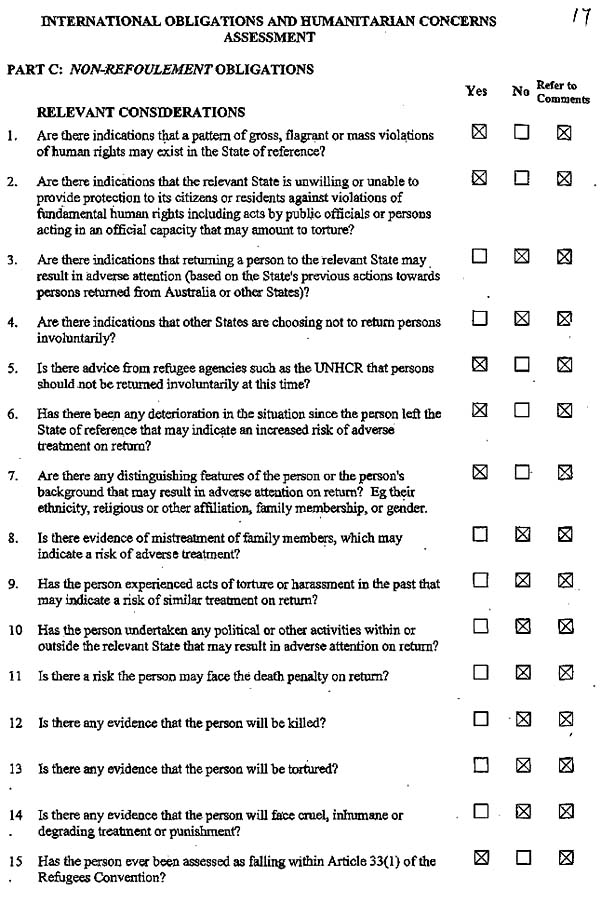
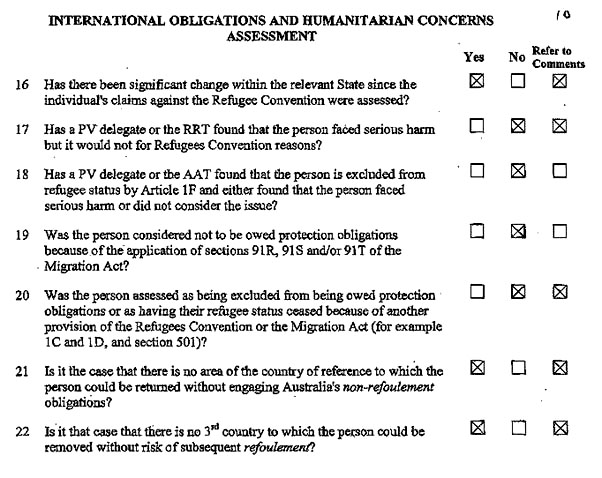
36 It can be seen that in nearly every question, the “refer to comments” box was completed. Both questions 21 and 22, relating to non-refoulement obligations, were answered in the affirmative.
37 Relevantly to the applicant’s submissions on his refugee status, Question 15, ‘has the person ever been assessed as falling within Article 33(1) of the Refugees Convention?’, was answered “yes”. The next question was whether there had been change within the relevant State since the claims were assessed and that question was also answered “yes”. Other questions and answers highlight current dangers in Iraq.
38 Turning to the comments in the Humanitarian Assessment, there was extensive discussion of the current, unsafe situation in Iraq. There was a note that ‘[w]hile the risk of adverse treatment from the former Ba’ath regime is no longer evident, it would appear that [the applicant] may face other more general security risks’. There was a discussion about the fact that the applicant is a Faili Kurd, who may be targeted by Sunni militias as a Shia Muslim and may struggle to reclaim property taken from him.
39 The Humanitarian Assessment referred to the applicant’s current risk of harm by reason of membership of a group that has been imputed with hostile political opinion by armed Islamic groups because of his association with the multinational forces, having lived in Australia for so long.
40 As already set out, the Humanitarian Assessment stated (as part of the comment on question 21) that there was insufficient evidence to indicate that the applicant would be particularly targeted for his race or ethnicity as a Faili Kurd and noted that the applicant is a Shia Muslim, and that country information casts doubt on the ability of the state to protect citizens from religious and sectarian violence, or criminal or persecutory activity by extremists.
41 In the comment on Question 22, under the heading “Non-refoulement obligations assessment”, further questions were directed to CAT, ICCPR and CROC. Each question as to the existence of risk relevant to that treaty or convention was answered “no”. There was no reference to the Refugees Convention.
42 The applicant contends that the crossing of “yes” to Question 21 of the Humanitarian Assessment constituted a current finding or assessment that the applicant is currently still a refugee. He says that the use of the words “refoulement” and “non-refoulement” in Question 21 and the comment to Question 21 are only relevant if it was accepted in the Assessment that he is still a refugee to whom Australia owes obligations under the Refugees Convention and therefore that Question 21 must necessarily refer to non-refoulement under the Refugees Convention.
Consideration
43 In context, Question 21 and the comment on Question 21 did not amount to a new finding that the applicant is still a refugee. Rather, it is apparent from the Humanitarian Assessment, considered as a whole, that the use of the expressions “refoulement” and “non-refoulement” were not there limited to the obligations under the Refugees Convention, but were used in relation to Australia’s obligations under a number of international treaties and conventions with respect to the return of a person to a country of reference. The use of these words does not amount to a new finding or assessment that the applicant is currently a refugee. I also note that in the Response, an assertion was made that the applicant’s refugee status had not ceased. That is, the applicant’s solicitor, in his response to the Humanitarian Assessment, did not understand it to involve a re-determination of the applicant’s refugee status.
44 The Humanitarian Assessment did not constitute a new assessment or finding of the applicant’s refugee status. There is therefore no need to decide whether the new finding or acknowledgement was accurately summarised in the Submission or whether this affected the non-refoulement obligations under the Refugees Convention, which are discussed below.
The Non-Refoulement Question
45 The applicant says that the reference in the Submission to the Humanitarian Assessment and the risks that he faces on return to Iraq made no reference to the fact that he continues to be a refugee or to Australia’s non-refoulement obligations under the Refugees Convention. He says that the Humanitarian Assessment reaffirmed his present status as a refugee, whereas the Submission referred to the Humanitarian Assessment so as to convey the fact that he was no longer a refugee. The applicant says that this was conveyed by the statement that the applicant had ‘previously been assessed as falling within Article 33(1) of the Refugee Convention’.
46 The applicant points out that the Submission expressly mentioned that there were no refoulement obligations under the CAT, ICCPR and CROC but omitted mention of refoulement obligations under the Refugees Convention. This was not the subject of comment in the Response. The Refugees Convention was not referred to in the Reasons.
47 The applicant accepts that the Submission stated that ‘country information casts doubt on the ability of the state to protect its citizens from religious and sectarian violence and criminal or persecutory activity by extremists’. However, he says that this, and his recorded concerns, were provided in a false context: in particular, questions of his return to Iraq had to be considered in the context of Australia’s non-refoulement obligations under the Refugees Convention.
48 The applicant submits that the omission of non-refoulement obligations under the Refugees Convention went to one of the matters which was identified as a primary consideration in Direction 41. The applicant accepts that Direction 41 does not bind the Minister personally, but submits that while the Minister was not bound by Direction 41, the Minister was told by the Department that a decision-maker must follow it. The applicant therefore submits that in those circumstances, the fact that the Submission misrepresented the Humanitarian Assessment’s consideration of the non-refoulement obligations was a matter that was not obviously open on the material, such that there was a failure to afford the applicant natural justice. In support of this contention, the applicant refers to Navarette v Minister for Immigration and Multicultural and Indigenous Affairs [2004] FCA 1723.
49 The applicant says that the Humanitarian Assessment was, in this respect, unfairly summarised in the Submission, rather than asserting that the Humanitarian Assessment was itself incomplete.
Consideration
The applicant’s continued refugee status
50 The first question to consider is whether the Humanitarian Assessment contained an acknowledgment that applicant continued to hold refugee status (in contrast to a new finding of refugee status). The applicant relies on Question 21. As I have already found above, the use of the words “refoulement” and “non-refoulement” as used in the Humanitarian Assessment were not limited to the obligations under the Refugees Convention.
51 Neither the applicant nor the Minister drew my attention to Question 20 or the comment on Question 20. The comment states that ‘[u]nder Articles 1C and 1D of the [Refugees] Convention, [the applicant] has not been assessed as being excluded from being owed protection obligations or as having their (sic) refugee status ceased’. Article 1C of the Refugee Convention provides the criteria for the cessation of refugee status. Thus, the Humanitarian Assessment would seem to have acknowledged that the applicant’s status as a refugee had not ceased.
52 The first paragraph of the Issues Paper in the Submission stated:
… On 16 February 2000 [The applicant] was granted a Class XA Subclass 785 Temporary (Protection) Visa. On 13 February 2003 [the applicant] was granted a Class XC Subclass 785 Temporary (Protection) Visa, which allows him to remain in Australia indefinitely. …
53 It is agreed that the applicant could only have been granted those classes of temporary protection visas if he was a refugee at the time of the decision. His current visa allows him to remain in Australia indefinitely.
54 Therefore, it is clear that the Submission did acknowledge that the applicant’s refugee status was continuing. Further, the Reasons noted the applicant’s submission in the Response that the preconditions for the cessation of his refugee status do not exist.
The summary of the non-refoulement obligation
55 The next question to consider is whether the Submission failed to deal with the Humanitarian Assessment’s summary of Australia’s non-refoulement obligations under the Refugee Convention. As stated above, the applicant contends that the Submission failed to deal with the acknowledgment that to send him back to Iraq would breach Australia’s non-refoulement obligations under the Refugees Convention.
56 I note that even if the Humanitarian Assessment had stated explicitly that the applicant was presently a person to whom Australia had obligations under the Refugees Convention, the Minister was entitled to return the applicant to Iraq upon considering Australia’s non-refoulement obligations under that Convention.
57 The contents of the Submission, the Reasons, the Humanitarian Assessment and the Response have been summarised at [27]-[32] and [36]-[41] above and are relevant to this issue. In considering whether the Submission failed to deal with the non-refoulement obligations, it is necessary to repeat, in summary form, a number of matters already referred to in those paragraphs. The Submission and the Reasons referred to the Humanitarian Assessment and the Response, both of which were attached. The Submission and the Reasons noted the security concerns, that were raised in the Humanitarian Assessment and the Response, if the applicant were to be returned to Iraq, including the lack of state protection for Shia Muslims. The Submission and the Reasons noted the applicant’s claim that his refugee status had not ceased. The Submission referred to Direction 41 and to Australia’s non-refoulement obligations under CAT, ICCPR and CROC.
58 It is clear from the Reasons that the Minister considered Australia’s non-refoulement obligations. The Minister was conscious of the applicant’s expressed concerns at the consequences of return and the fact that Australia had to consider its international obligations in that regard. It is also clear that the nature of the risk to the applicant was fairly summarised in the Submission. The applicant had the opportunity to comment on this risk in his Response to the Humanitarian Assessment, both of which formed part of the material before the Minister.
59 Although the Minister considered the issues that are relevant to Australia’s non-refoulement obligations under various international obligations together, this does not mean that the Minister failed to consider non-refoulement obligations under the Refugee Convention. The applicant has not demonstrated what different considerations would have applied. The Humanitarian Assessment, the Submission and the Reasons referred to and accepted that the applicant was at risk of harm from non-state extremists for Convention reasons and the nature of that risk was taken into account by the Minister.
60 The applicant has not shown that the Submission failed to deal with Australia’s non-refoulement obligations, including under the Refugee Convention.
61 Even if the Submission had failed to deal completely with Australia’s non-refoulement obligations under the Refugee Convention, the applicant’s submission that this would result in procedural unfairness has less force if it is accepted that the Minister, as he stated in the Reasons, considered the Attachments and, in particular, the Humanitarian Assessment and the Response. The applicant’s solicitor was given the opportunity to respond to the Humanitarian Assessment and did so in the Response. The solicitor made a number of submissions under a heading the topic “Non-Refoulement Obligations”. The solicitor submitted:
… even on the face of the Assessment itself, it must be accepted that there is a “real chance” that [the applicant] will continue to face persecution in Iraq if he is forced to return.
62 The Humanitarian Assessment was repeatedly referred to in the Submission and it was made clear that the Submission drew on parts of that Humanitarian Assessment, which was attached to it. The Reasons specifically stated that the Minister assessed the information set out in the Submission and the Attachments in considering whether to exercise the discretion to cancel the applicant’s visa. Under the heading “Other International Obligations”, the Reasons specifically referred to the Humanitarian Assessment.
63 It cannot be concluded that the Minister failed to note that section in the Humanitarian Assessment referring to the considerations relevant to Australia’s non-refoulement obligations. Procedural fairness does not require a decision-maker to disclose his or her thinking process or proposed conclusions (Commissioner for Australian Capital Territory Revenue v Alphaone Pty Ltd (1994) 49 FCR 576 at 591-592). The Submission was an integral part of the decision-making process itself. It is not to be equated with information from a third party about the applicant which is required to be disclosed to him in accordance with ordinary principles.
64 The Submission did not contain material which had not been disclosed to the applicant. It included material from the Humanitarian Assessment, including an issue which, in his Response, had been identified by the applicant as a critical issue. The material put to the Minister in the Submission and the Draft Reasons did not introduce new or distorted facts, or a new consideration or approach that was not obviously open or was not reasonably expected, based on the Humanitarian Assessment (cf Navarette at [34]–[35] and [53]). The “omissions” relied upon by the applicant were otherwise found in the material before the Minister (cf Le v Minister for Immigration and Multicultural and Indigenous Affairs (2005) 215 ALR 521 at [125]).
65 There has been no denial of procedural fairness by reason of the summary in the Submission of Australia’s non-refoulement obligations.
The UNHCR Advice
66 As previously stated, the applicant says that the Submission did not refer to the UNHCR Advice. This omission, the applicant says, has resulted in a lack of procedural fairness.
67 The Humanitarian Assessment described in some detail the UNHCR Advice’s comments on the involuntary returning of persons to Iraq and referred to the criticism by that body of countries that have been deporting and returning people to Iraq. The UNHCR Advice was also referred to in the Response, but was not specifically adverted to in the Submission or the Reasons.
68 The same considerations of procedural fairness apply to the UNHCR omission as were discussed above at [61]-[64] in relation to the alleged failure to deal with the applicant’s non-refoulement obligations under the Refugee Convention.
69 The Submission made clear reference to the Humanitarian Assessment; it was not necessary to repeat every statement in it. It cannot be concluded that, because the Submission did not repeat each and every matter in the Humanitarian Assessment that the Minister did not take those matters into account. The Humanitarian Assessment and the Response were repeatedly referred to in the Submission. They were before the Minister as Attachments to the Submission. The applicant has not succeeded in his argument that the Minister did not read the Attachments.
70 I do not accept that there was a denial of procedural fairness by reason of the fact that the Submission did not refer to the UNHCR matters.
THE APPLICANT’S RESPONSE
71 The applicant contends that there has been a lack of procedural fairness because the Submission misstated the applicant’s Response by including statements that:
The applicant accepted that the Humanitarian Assessment overall was balanced and fair; and
The applicant’s comments in relation to non-refoulement were raised in the context of his previous assessment under the Refugees Convention.
In considering these contentions, it will be necessary to repeat a number of matters already referred to.
72 The applicant complains of the statement in the Submission that the applicant’s solicitor had said in the Response that ‘the [Humanitarian] A]ssessment overall was balanced and fair, but indicates some concerns in relation to [the applicant’s] possible return to Iraq’. The applicant contends that, in fact, the comment in the Response was limited to one aspect of the Humanitarian Assessment, which was that the consideration of the compassionate features of the case was balanced and fair. The applicant points out that the Response continued: ‘However, there are significant issues which arise from the Assessment as far as its consideration of the prospect of [the applicant’s] possible return to Iraq’. The solicitor then provided submissions as to those issues, including as to the applicant’s membership of a particular social group and other considerations for the purpose of Australia’s non-refoulement obligations.
73 Emphasis was placed in the Response on country information which ‘casts doubt on the ability of the Iraqi State to protect him from religious and sectarian violence, criminal or persecutory activity by extremists’ (the protection factor). The applicant then places emphasis on ‘the two critical findings’ in the Assessment’s conclusion as previously mentioned at [31] above: the inability to return the applicant to another area of Iraq without engaging Australia’s non-refoulement obligations, and the inability to return the applicant to a third country without the risk of subsequent refoulement (the refoulement factor).
74 The applicant accepts, and relies on, the fact that the protection factor and the refoulement factor were included in the Humanitarian Assessment.
75 The Submission cites the comments in the Response on the “critical” findings in the Assessment with respect to the refoulement factor. However, the applicant points out that the Submission continues:
These issues are raised in the context of [the applicant] having been previously assessed as falling within Article 33(1) of the Refugees Convention.
76 The applicant submits that this is a misleading statement as the two factors were not raised by him in the context of the Refugees Convention but in the context of the Humanitarian Assessment, for the purposes of the present decision by the Minister.
77 The applicant submits that:
The right to a “hearing” necessarily implies some consideration of the submissions presented. Thus, a failure to respond to a substantial, clearly articulated argument relying on established facts is a denial of procedural fairness: Dranichnikov v Minister for Immigration and Multicultural Affairs (2003) 197 ALR 398 at [24]. When the applicant was given the opportunity to make written submissions in respect of material he was told might be considered by the decision-maker, that opportunity required the decision-maker to take into account the submissions actually made. However, by relying on a misrepresentation of what those submissions were, the Minister did not in fact consider the submissions and so denied the applicant procedural fairness.
Consideration
78 When regard is had to the whole of the Submission, it cannot be concluded that there was a misrepresentation of the Response. First, the Response was itself attached. Secondly, the Submission made particular reference, and in some detail, to the issues that were raised in the Response concerning the applicant’s return to Iraq, specifically the non-compassionate matters. Thirdly, the paragraph that preceded the Submission’s assertion that the applicant’s solicitor considered the “assessment overall” as “balanced and fair” referred to the concerns raised by the Humanitarian Assessment of the instability and lack of security within Iraq and the consequences of the applicant being a Shia Muslim of Kurdish ethnicity. These were the very additional matters to which the Response referred. Fourthly, even if there were a misstatement of the applicant’s position in the Response as to the Humanitarian Assessment, the matters raised in the Response were brought to the Minister’s attention and considered. There was no material factual matter or issue concerning the applicant’s return to Iraq added or omitted.
79 It was made clear in the Submission read as a whole that the applicant’s concerns raised in the Response were relevant to the current situation in Iraq and the security concerns that may arise from his ethnicity and religious affiliation if he were to return to Iraq. The Submission noted that notwithstanding the major political and security changes in Iraq, the present security situation was of concern to the applicant. It cannot, in my view, be said that the Submission, as a whole, misrepresented the applicant’s position as set out in the Response to the Humanitarian Assessment.
80 In any event, it is apparent that, in weighing all the factors, including those set out in Direction 41, the Minister’s decision to cancel the applicant’s visa took into account ‘the risks that the applicant might face upon return to Iraq, including that the state might not be able to afford him protection form non-state extremists’ but concluded that the other factors, including the ‘exceptionally serious’ nature of the offences and the risk to the Australian community, outweighed those risks. It is not apparent that the alleged misstatement, even if it was present, would have had any effect on the Minister’s decision.
81 There has been no denial of procedural fairness in this regard.
THE TRAFFIC RECORD
82 The applicant raises an additional ground on which he says that he was not afforded procedural fairness. That is that, in making the decision, the Minister had regard to the applicant’s traffic record in circumstances where the applicant had not been provided with a copy of the traffic record and had not been put on notice that the Minister might rely on it.
83 As noted, the ground for the cancellation of the applicant’s visa was that he had a substantial criminal record as defined by s 501(7)(c) of the Act. The Submission made reference to the applicant’s conviction and the imposed term of imprisonment, seven years for each offence. The judgment of the District Court of New South Wales was attached. There was then some detail provided of the circumstances of the acts of non-consensual intercourse and some of the comments of the judge on sentencing were referred to. The Submission then stated that Direction 41 advises that ‘[d]ue regard must be given to the extent of the person’s criminal record’, including the number and nature of offences. It was then stated:
[The applicant] does not have any other criminal matters on his record in Australia. He does however, have a number of traffic infringements between 2001 until 2007, which have attracted fines and associated demerit points (Attachment X) (the Statement).
84 In the Reasons, the references to the conviction and traffic infringements included the following:
9. I took into account that during his trial the judge stated that [the applicant’s] behaviour was completely intolerable and totally unacceptable in the community.
10. I noted [the applicant] does not have any other serious convictions, and the only other matters on his record in Australia are a number of traffic infringements between 2001 until 2007, which have attracted fines and associated demerit points.
…
11. I have noted that [the applicant] does not have any other criminal convictions in Australia, or any history of breaching court orders.
85 The traffic record was included in the document that set out the applicant’s criminal history, which was Attachment X to the Submission. That history also listed the convictions for sexual intercourse without consent.
86 In the Notice of Intention, the applicant was informed that the Minister may use information including his conviction, sentences and appeals and his criminal history when making his decision. However, the applicant says that this was not notification of his traffic record, because a traffic record is not part of a criminal history. In the first response from his solicitor, the applicant said that he had no criminal history prior to the matters for which he was convicted. That was reflected in paragraph 11 of the Reasons.
87 The applicant submits that his traffic record was taken into account in an adverse manner and that, accordingly, the failure to provide him with an opportunity to respond to it constituted a denial of procedural fairness. He submits that the traffic record constitutes a new consideration that was adverse to him, such that the Minister was obliged to give him the opportunity to be heard in relation to it. It was, he says, “credible, relevant and significant” to the decision to be made (VEAL v Minister for Immigration and Multicultural and Indigenous Affairs (2005) 225 CLR 88 at [17]).
88 It is accepted by the Respondent that the applicant’s traffic record was not provided to him. This was, apparently, because the view was taken at the time, that the applicant’s criminal record, of which his traffic record formed a part, was a criminal history protected by s 503A of the Act, that it was not clear if redacted copies could be served and that the Australian Federal Police did not have the power to waive s 503A. That view as to the traffic record, it is now accepted, was incorrect.
89 The applicant submits that if the traffic infringements were to be taken into account by the Minister in an adverse manner, he had to have been given the opportunity to respond. It is not relevant, he says, whether the material did impact on the decision; there was practical injustice by reason of the fact that he was not informed (Dagli v Minister for Immigration and Multicultural and Indigenous Affairs (2003) 133 FCR 541 at [91]).
Consideration
90 It is necessary to consider the way in which the traffic record was referred to in the Reasons and the Submission. As was noted by Allsop J in Navarette at [49], context is all important in understanding the significance of a part of a Governmental submission and draft reasons.
91 The Submission described the applicant’s conviction and contained a short summary of the facts behind it. It then stated, without qualification, that the applicant ‘does not have any other criminal matters on his record in Australia’. Similarly, the Reasons state without qualification that the applicant ‘does not have any other criminal convictions in Australia’. It is apparent from the context of the reference to the traffic infringements in the Submission and in the Reasons that the fact of their existence was not adverse but was, in effect, exculpatory, stating that the applicant had no other serious convictions. Reference was made to the traffic infringements because they were included in the criminal history report. It was made clear that reference to the traffic offences in the Reasons was made in the context of being “only” traffic infringements attracting fines and demerit points, rather than as a history of offences similar to the very serious offences for which the applicant was convicted. That is, the reference to the traffic infringements in both the Submission and Reasons was more in the nature of an affirmation that there were no other criminal matters in the applicant’s record, and was not adverse information. There was no suggestion that the applicant is a threat to the Australian community by reason of his driving record or that he is somehow a menace on the roads.
92 The Submission repeated the fact that the District Court judge had noted that the applicant had no prior convictions and that Attachment X, the criminal history, also recorded that he did not have any history of breaching judicial orders. That is, information drawn from the attachment was used to establish a negative, to the applicant’s benefit. There was no indication in the Submission or in the Reasons that any significance should be attached to the traffic infringements, or that his traffic record had at any time been treated as credible, relevant or significant adverse material.
93 It is the case that the Submission, under the heading “Seriousness and nature of conduct” made the Statement, quoted above at [83], that the traffic record was attached. This Statement occurred after a detailed description of the applicant’s crime: rape of a physically frail and essentially defenceless victim who had previously suffered a stroke, in circumstances described in the sentencing judge’s reasons as set out in the Submission, and for which the applicant was imprisoned for seven years for each offence.
94 It is clear that reference was made to the applicant’s driving record for the sake of completeness and in the context of the absence of any other criminal matters on his record. In the Reasons, it is stated that the Minister’s decision took into account ‘the serious and abhorrent nature of [the applicant’s] offences’. In context, the traffic offences do not come within this description and were not relevant or significant as adverse material. I do not accept that the Minister had regard to the traffic record, to which he made no adverse reference in the Reasons, in coming to his decision.
95 Since the traffic record in context was not “adverse material”, there is no need to consider the applicant’s submission referred to at [89] above.
96 There has been no denial of procedural fairness on this ground.
Disposition
97 The applicant has not established that the Minister’s decision to cancel his visa under s 501(2) of the Act is infected by jurisdictional error. It follows that the application should be dismissed with costs.
I certify that the preceding ninety-seven (97) numbered paragraphs are a true copy of the Reasons for Judgment herein of the Honourable Justice Bennett. |
Associate:


