

FEDERAL COURT OF AUSTRALIA
Wyman on behalf of the Bidjara People v State of Queensland [2012] FCA 397
| IN THE FEDERAL COURT OF AUSTRALIA | |
| BRENDAN WYMAN & ORS ON BEHALF OF THE BIDJARA PEOPLE Applicant | |
| AND: | Respondent |
| DATE OF ORDER: | |
| WHERE MADE: |
THE COURT ORDERS THAT:
1. Paragraph 2(c) of the interlocutory application filed on 21 March 2012 be dismissed.
Note: Entry of orders is dealt with in Rule 39.32 of the Federal Court Rules 2011.
| QUEENSLAND DISTRICT REGISTRY | |
| GENERAL DIVISION | QUD 216 of 2008 |
| BETWEEN: | brendan wyman & ors on behalf of the bidjara people Applicant |
| AND: | STATE OF QUEENSLAND Respondent |
| JUDGE: | REEVES J |
| DATE: | 19 APRIL 2012 |
| PLACE: | Alice Springs (Heard in BRISBANE) |
REASONS FOR JUDGMENT
Interlocutory injunction sought
1 By an application filed on 21 March 2012, Mr Brendan Wyman and Ors on behalf of the Bidjara People applied for a number of interlocutory orders, including interlocutory injunctions, against various people in the following terms:
(a) Dr.Lee Sackett from providing any confidential or privileged information of the Applicant to any Respondent,or other party;
(b) Dr.Lee Sackett from disclosing any confidential or privileged information obtained from QSNTS or the Bidjara People to any other party except the Applicant;
(c) Charles Stapleton & Ors on behalf of the Brown River People from disclosing any confidential information or any information obtained in breach of legal professional privilege obtained by them from QSNTS and/or Dr.Lee Sackett;
(d) QSNTS from disclosing confidential or privileged information to anyone other than the Applicant;
(Errors in original)
2 The applications for the injunctions sought in paras (a), (b) and (d) (above) were dismissed on 3 April 2012 because there was no evidence before me that either Dr Sackett or Queensland South Native Title Services (QSNTS) had been served with the application, or its supporting material. This was despite the fact that, by that stage, the application had been on foot for about three and a half weeks and I had earlier made directions that the parties were to file any material upon which they wished to rely by 4.00 pm on 28 March 2012.
3 However, because Charles Stapleton & Ors on behalf of the Brown River People are respondent parties to these proceedings, they had received notice of the application for the interlocutory injunction affecting them, viz that sought in para (c) above. Accordingly, I heard submissions from the counsel for the various parties and I reserved my decision on that application. In my view, it must also be dismissed. Before stating my reasons for this conclusion, it is convenient to briefly essay some of the background history to this application and these proceedings more generally.
The relevant factual context
4 These proceedings involve three overlapping native title determination applications over a large area of land and waters in south west Queensland. In broad terms, the three claim groups concerned are: the Bidjara People; the Karingbul People; and the Brown River People.
5 In September 2011, the trial of three overlapping proceedings was set down to commence on 6 August 2012.
6 QSNTS is the native title representative body with responsibilities under the Native Title Act 1993 (Cth) (the Act) for the area of land and waters covered by these three overlapping claims. In that capacity, QSNTS had, in the past, been called on to consider an application made to it by the Bidjara People for funding to assist it to pursue its native title determination application in these proceedings. In order to assess that funding application, QSNTS obtained a report from Dr Lee Sackett, an anthropologist. That report is central to this application.
7 In one of his affidavits in support of the present application, Mr Hauff, the current solicitor for the Bidjara People, confirmed the background history to the production of the Sackett Report set out above. He then described the consequences that flowed from its production and the confidential nature of it, in the following terms (at paras 4 and 5 of Mr Hauff’s affidavit filed 9 March 2012):
4. Dr Lee Sackett was instructed by Queensland South Native Title Services (“QSNTS”) to prepare an anthropologist report for the Bidjara People for the purposes of determining a funding application.As a result of the Dr.Lee Sackett Report (“Sackett Report”) funding to the Bidjara People was terminated.
5. The Sackett Report was done on a confidential basis for the purposes of litigation .The report sates quite clearly on the face of the document headed
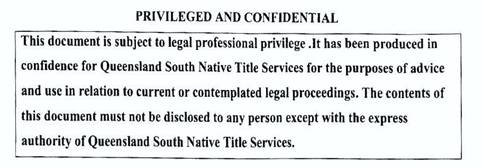
Attached hereto and marked Annexure “TH1” is a true copy of the face sheet of the Sackett Report.
(Errors in original)
8 As Mr Hauff’s evidence implies, the relationship between QSNTS and the Bidjara People came to an end shortly after the Sackett Report was provided. Furthermore, at about that time, the Bidjara People applied to the Court for orders to restrain QSNTS from, among other things, using any material it held on behalf of the Bidjara People.
9 That application was resolved on 22 July 2011 when QSNTS consented to a number of orders, the relevant parts of which were as follows:
UPON THE UNDERTAKING OF QUEENSLAND SOUTH NATIVE TITLE SERVICES LIMITED (“QSNTS”) BY ITS CHIEF EXECUTIVE OFFICER, KEVIN SMITH, AND UPON THE UNDERTAKING OF THE PRINCIPAL LEGAL OFFICER OF QSNTS, SHAHZAD RIND, THAT THEY WILL NOT ACT AS LAWYERS FOR THE KARINGBAL PEOPLE OR THE BROWN RIVER PEOPLE IN PROCEEDINGS QUD216/2008, THE COURT ORDERS BY CONSENT THAT:
1. QSNTS will deliver a CD containing an index of all documents on the files it holds for the Bidjara People, whether such documents are in hardcopy or held electronically, within ten (10) business days of today’s date.
2. Within ten (10) business days of any written request by the solicitors for the Bidjara People for a copy of any documents listed in the index referred to in Order 1, QSNTS will provide a copy of the requested documents to those solicitors.
3. QSNTS will store the files it holds for the Bidjara People in a secure manner such that those files may only be accessed by the Chief Executive Officer and systems administrator of QSNTS.
4. QSNTS will not examine the files it holds for the Bidjara People without first notifying the solicitors for the Bidjara People in writing.
5. Within ten (10) business days of today’s date, QSNTS will provide the solicitors for the Bidjara People the parts of QSNTS’ applications for funding and acquittals of that funding, provided to the Department of Families, Housing, Community Services and Indigenous Affairs (“FaHCSIA”) that deal with the Bidjara Peoples’ native title claim.
10 It can be seen from these orders that they do not specifically mention the Sackett Report. Nonetheless, the existence of that Report came to the fore again in these proceedings at a pre-trial directions hearing that was conducted on 24 February 2012. At that directions hearing, Ms Jowett appeared for the Brown River People. During a discussion about the service of experts’ reports in preparation for a conference of experts to be held in the proceedings, Ms Jowett indicated that she wished to apply to amend the pre-trial programming orders to allow the Brown River People to serve a report from Dr Sackett and have him attend the conference of experts on their behalf. A little earlier in the transcript, Ms Jowett had introduced that issue by making the following statements:
We also know from the affidavit of Mr Hardy [sic] dated 2 June 2011 that there has also been a report prepared by senior anthropologist Dr Lee Sackett for the Bidjara People. There is [are] numerous anthropologists who have worked with this group and they have been doing it for years. There’s a report from Dr Sackett that has not been filed in compliance with the orders on 27 January.
11 Later, Ms Jowett made the following statements about the use the Brown River People proposed to make of Dr Sackett’s services as an anthropologist:
Your Honour, I just have to raise something now which is relevant to this proceeding. My instructor has an interlocutory application with an affidavit in support that he was going to file today after these proceedings in relation to amending the orders, varying the orders to include a report from Dr Sackett, who as I just mentioned, has previously done a report in Bidjara, and to attend the expert conference on 27 April. … I will envisage now that we will file that application to call Dr Sackett for that conference and also that he put on a very short report in a small compass by 5 April as well in relation to Bidjara occupation and use of the overlap area, and he attend that conference, I think, most importantly to narrow the issues for the court.
12 And further:
I know it’s diversionary and I don’t need to, but I think it’s very important that the court know about this because I consider that Dr Sackett could be of great assistance being a very senior anthropologist, one of the most senior anthropologists who works in native title today and has extensive experience in native title matters throughout Australia, who has already done a massive amount of research and work in central Queensland.
13 In partial response to these statements, Mr Hauff, who appeared for the Bidjara People at that hearing, made the following statements:
… your Honour, I understand the Dr Sackett report was in fact brought about as a result of a funding application through QSNTS in relation to funding in this matter. It was a confidential report, nominated as such and has no particular bearing on this case.
14 Shortly thereafter, Ms Jowett clarified what use the Brown River People proposed to make of Dr Sackett’s services in the following terms:
Well, we are again before your Honour on 9 March. I was envisaging that we would file this today but that might be an appropriate time. Could I just say for the record that I think Mr Hauff sounded a little confused about we propose to do. We do not propose to seek the report of Dr Sackett or file that in any way, that would be inappropriate. That is his client’s privileged document.
15 As foreshadowed by Ms Jowett, the three proceedings were next mentioned at a callover of the matters in my native title list on 9 March 2012. By that time, the Brown River People had filed their application to amend the pre-trial programming orders to allow them to rely upon a report from Dr Sackett and to have him attend the expert conference on their behalf. Further, at that callover, Mr Stephens, who appeared for the Bidjara People, sought leave to file a number of applications on behalf of the Bidjara People, including the present application. Because there was insufficient time to deal with either set of applications at that callover, the Bidjara People proceeded to file their application in the ordinary course later that day. The only other matter of relevance to the present application at that callover was a statement made by Ms Jowett to the following effect:
Dr Sackett, on the other hand, is still compiling his report and is available to finish that by 5 April, but we seek leave to be able to do that because it is late under the orders. I think there has been some confusion, about it, your Honour. My learned friend’s client has put on an injunctive proceedings against Dr Sackett. I think in the mistaken belief that I’m seeking to file Dr Sackett’s report that was provided to the Bidjara applicants some time ago in their matter. I’m not seeking to do that; I’m seeking that Dr Sackett provide a new report for my clients in the progress.
16 This statement appears to have been directed (at least in part) to the following paragraphs of Mr Hauff’s first affidavit in support of this application (sworn 8 March 2012):
6. I was in Court at the interlocutory hearing on the 24th February 2012, when Counsel for the Brown River People (“BRP”) sought an application for the witness Dr.Lee Sackett to be able to give evidence in the proceedings and took great pains to explain to the Court that the Applicant’s representative Mr,Hauff had misunderstood the application as meaning that the Sackett Report was being sought when it was not being sought, and only the availability of Dr.Lee Sackett to give evidence was being sought on the basis that no one owns a witness.
7. At the hearing Counsel for the BRP made it very clear to the Court that the Sackett Report was not being sought and acknowledged and admitted that the Sackett Report was the subject of legal professional privilege.
8. In a complete contradiction of what was told to the Court and all present the Application now specifically asks for the Sackett Report to be produced .
(Errors in original)
17 About two weeks later, I arranged to conduct a hearing of the two sets of applications, viz those filed by the Brown River People after the hearing on 24 February 2012, and those filed by the Bidjara People immediately after the hearing on 9 March 2012. Unfortunately, time did not permit me to complete the hearing of all the applications on that date and they were further adjourned to be heard on 3 April 2012. On that date, Mr Waters appeared for the Brown River People in the place of Ms Jowett. In the meantime, Mr Hauff had filed a second affidavit in support of this application. In that affidavit, Mr Hauff said (at [13]–[14]):
13. I was in Court [on 24 February 2012] when the Brown River People legal representative indicated they would seek the advice and report of Dr. Lee Sackett which had been done at the request of QSNTS.I have sworn an affidavit on the 8th March 2012 in relation to this matter.
14. From the nature of the applications made by the Brown River People and the requests made to the Registrar to allow Dr.Lee Sackett to be present at the Case Management Conference it would appear as if the legal representative have a copy of the Dr.Lee Sackett report or have spoken to Dr.Lee Sackett or both.Attached hereto and marked “TGH4” are copies of emails requesting Dr.Lee Sackett to be present at the Case Management Conference.The Dr.Lee Sackett report and other related material is the subject of legal professional privilege and confidentiality. see my affidavit sworn on the 8th March 2012.
(Errors in original)
It should be noted that the original copy of this affidavit filed in the Court does not have attached to it an annexure marked “TGH4” comprising the “copies of emails requesting Dr.Lee Sackett to be present at the Case Management Conference”.
18 Because of the confusion that still appeared to exist about the true intentions of the Brown River People, at an early stage of the hearing on 3 April 2012, I asked Mr Waters whether the Brown River People were seeking to use the Sackett Report that QSNTS had obtained. He responded as follows:
Not at this stage, no.
…
I say that because it’s not apparent to us yet whether experts for my friend’s client have had access to that material, and if they have then, for totally different reasons, we may at a later stage say that that shouldn’t see the light of day. But we are not seeking access to the report of which that first page forms part [reproduced at [7] above]. We are seeking to engage Dr Sackett, and we have engaged him to prepare a fresh report based on his lifelong experience as an anthropologist.
19 I took this to mean that, subject to any question of waiver that might emerge in the future, the intentions of the Brown River People as outlined by Ms Jowett on 24 February and 9 March 2012 (see [14] and [15] above, respectively) had not changed. As will emerge below, this reassurance did not dissuade those advising the Bidjara People from continuing with this application.
The contentions of the Bidjara People
20 In his written submissions in support of this application (filed on 30 March 2012), Mr Stephens pursued a similar theme to that pursued in Mr Hauff’s two affidavits (above), as follows (at [29]–[31] and [36]):
29. Dr Lee Sackett prepared an anthropologist report at the direction of Queensland South Native Title Services (“QSNTS”) on a strictly confidential basis and he was given access to confidential information and people he would not otherwise have available to him. This information was strictly confidential and is so noted on his report.
30. This report was done at that time for funding purposes as an application for funding had been made to QSNTS for lodgement with Department of Families, Housing, Community Services and Indigenous Affairs (“FaHCSIA”).
31. The injunction we seek will prevent Dr.Sackett firstly from disclosing the contents of the confidential report and secondly prevent him from using the confidential information derived from the Bidjara People not otherwise available to him in his fiduciary capacity as the anthropologist for the Bidjara People in circumstances where if he was allowed to firstly provide evidence for the BRP as a witness and secondly attend at any Case Management Conference organized by the Court.
…
36. In summary the information obtained by Dr.Lee Sackett and QSNTS and possibly the BRP is confidential and the subject to [sic] legal professional privilege and we require injunctions to prevent disclosure of it to any party except the Applicant.
21 However, in his oral submissions on 3 April 2012 (perhaps as a consequence of the reassurance given by Mr Waters: see [18] above), Mr Stephens focused far more on the information Dr Sackett had obtained in order to prepare the Sackett Report, rather than the contents of the Sackett Report itself. The following is a representative excerpt taken from Mr Stephens’ submissions:
Dr Lee Sackett was engaged by us for the purpose of preparation of a connection report, which he did prepare. That connection report involved vast amounts of information that he obtained from my clients in order to prepare that report. The Brown River people are being sought to be restrained from using that information that they get from Queensland South and Dr Sackett because, as our solicitors and our expert, they, by providing Brown River with that information, are acting in breach of confidence … They’re obtaining information and advice that was given to us [sic: them] from Queensland South and from Dr Sackett, and in those circumstances – Dr Sackett would have to be cognisant [that] the statements that he has obtained are from a number of my clients.
… [He is] the person who has been involved in obtaining statements from witnesses who are to give evidence in relation to connection. … [How] can he express any views that are independent of the fact that he has collected a large amount of evidence on our behalf? The reason why we haven’t descended into detail is because then my friend would say, “Aha, he has mentioned the report, therefore it’s no longer privileged”. We are left, as – we are left between the devil and a deep blue sea; if we go into too much detail, we have, by that fact, waived privilege. So your Honour, the simple fact of the matter is that in the attaining of a connection report, … Dr Lee Sackett must have obtained information statements from all of our lay witnesses, and in those circumstances, is affected by the confidence which he claims for the report. I don’t think I can take it any further, your Honour.
22 While Mr Stephens’ written submissions were primarily directed to the correlated injunction applications against Dr Sackett and QSNTS, and those applications had already been dismissed by the time this application came to be considered, he did not resile from any of those written submissions insofar as they applied to this application. So, from the written and oral submissions summarised above, it appears that the Bidjara People put this injunction application against the Brown River People on two bases: that they should be prevented from obtaining the Sackett Report, or any of its contents; and that they should be prevented from obtaining and using any confidential information derived by Dr Sackett (and, through him, by QSNTS) from the Bidjara People, in aid of the Brown River People’s claim. I will consider each of these bases in turn.
Consideration
23 The history I have recorded above shows that the first leg of the first basis, viz obtaining the Sackett Report, is based on a misunderstanding on the part of the Bidjara People and their legal advisers. Clearly, the Brown River People do not wish to obtain the Sackett Report. Ms Jowett made that quite clear on at least two occasions. First, she clearly stated that at the 24 February 2012 directions hearing when she acknowledged the Sackett Report was privileged and it would be “inappropriate” for the Brown River People to seek to obtain a copy of it, or to rely upon it. Secondly, she confirmed that position at the callover on 9 March 2012. Further, with the stated reservation about any subsequent issue of waiver that might arise, Mr Waters reconfirmed that position at the hearing on 3 April 2012. On each of these occasions counsel made it quite clear that the Brown River People were seeking to engage Dr Sackett to prepare a “fresh” report based on his experience as an anthropologist with the Bidjara People. I obviously accept what both counsel told me about these matters. For these reasons, I do not consider the Bidjara People have made out the first leg of the first basis upon which they put this injunction application.
24 The second leg of the first basis concerns the Brown River People obtaining any of the contents of the Sackett Report. Consistent with the position they have taken on the first leg, there is no direct evidence before me that the Brown River People, or their legal advisers, have obtained a copy of the Sackett Report or some, or all, of its contents. Nor is there any evidence upon which I could draw an inference to that effect. On this aspect, I reject the suggestion (faint as it is) in Mr Hauff’s second affidavit (see above at [17]) that this might be inferred from the request the Brown River People’s legal advisers have made of Dr Sackett that he provide a “fresh” report and that he be available to attend the experts’ conference in these proceedings. Self-evidently, in this context, a “fresh” report does not mean, or refer to, the existing Sackett Report or its contents. Nor does their proposal that Dr Sackett attend the experts’ conference on their behalf support an inference that they (or he) intend to use the contents of the existing Sackett Report in that process. Indeed, to draw such an inference would involve rejecting the statements of counsel I have expressly accepted above (see at [23]). That particularly applies Ms Jowett’s statement that the Sackett Report is privileged and it is, therefore, not open to the Brown River People to obtain a copy of it, or rely upon its contents. As I have observed below (at [28]–[29]), there is likely to be an amount of information obtained by Dr Sackett that he may quite properly make available to the Brown River People. For these reasons, I do not consider the second leg of the first basis for this application has been made out.
25 It follows that the Bidjara People have failed to make out either leg of the first basis for this injunction application.
26 The second basis, viz obtaining and using confidential information derived by Dr Sackett from the Bidjara People, raises somewhat different issues. To begin with, it is convenient to mention the obvious overlap between the information represented by the contents of the Sackett Report that is protected by legal professional privilege and “confidential information derived by Dr Sackett from the Bidjara People” for the purposes of conducting these proceedings. Self-evidently, these are two different ways of describing the same confidential information, viz that protected by legal professional privilege. As I have already noted above, it is not in dispute that the Sackett Report and its contents are subject to legal professional privilege. That being so, that privilege will extend to any confidential information that was communicated by a member of the Bidjara People to its legal advisers for the dominant purpose of conducting these proceedings: see Esso Australia Resources Limited v Commissioner of Taxation of the Commonwealth of Australia (1999) 201 CLR 49; [1999] HCA 67. This privilege will also extend to confidential communications passing between the legal advisers to the Bidjara People and Dr Sackett, or between members of the Bidjara People and Dr Sackett, provided that they are undertaken for the dominant purpose of conducting these proceedings: see Australian Competition & Consumer Commission v FFE Building Services Limited [2003] FCA 1181 at [48] per Wilcox J and Meteyard v Love (as Receivers and Managers of Southland Coal Pty Ltd) (2005) 65 NSWLR 36; [2005] NSWCA 444 at [121]–[122].
27 Aside from legal professional privilege, there may exist a separate basis upon which confidential information of the kind under consideration here could be protected. That is, if members of the Bidjara People have communicated confidential information about their beliefs, customs and traditions to Dr Sackett in good faith on the condition that that information was to be kept confidential: see Foster v Mountford and Rigby Ltd (1976) 14 ALR 71 at 74–5 per Muirhead J, Breen v Williams (1996) 186 CLR 71 at 128 per Gummow J and The State of Western Australia v Ward (2002) 213 CLR 1; [2002] HCA 28 at [61].
28 Apart from any confidential information that is protected by one or both of these two principles, given the apparently lengthy involvement Dr Sackett has had with the Bidjara People, it would appear to be quite likely that during his work as an anthropologist Dr Sackett has obtained a large amount of information that was not obtained for the dominant purpose of conducting these proceedings, or that was not confidential at all, or, if it was, it was not imparted in good faith to him on the condition that that information would be kept confidential. In other words, neither of those two principles would throw a protective cover over every communication that has occurred between members of the Bidjara People and Dr Sackett during his professional life as an anthropologist.
29 It would appear to be this third category of information that the Brown River People wish to take advantage of. Provided that none of the information in this category falls into one or both of the first two categories described above, and subject to any other restrictions that may apply, eg a statutory provision or a contractual condition, there would appear to be no obvious legal impediment to the Brown River People obtaining and using it. This would extend to any confidential information Dr Sackett has obtained from any member of the Bidjara People that was either not obtained for the dominant purpose of conducting these proceedings, or was not imparted to him in good faith on the condition that that information was to be kept confidential.
30 It follows from this analysis that I do not consider the Bidjara People can validly obtain an injunction order against the Brown River People expressed in such broad terms as: “obtaining and using confidential information derived by Dr Sackett from the Bidjara People”. Put inversely, the Bidjara People could only possibly obtain a restraining order insofar as they were able to establish that the confidential information concerned fell into one or both of the first two categories described above.
31 This conclusion does not prevent the Bidjara People obtaining an injunction order in relation to any confidential information derived by Dr Sackett from the Bidjara People that is covered by legal professional privilege. As I have already noted above, it is not in dispute that legal professional privilege applies to the Sackett Report and its contents. Further, as also noted above (at [26]), that privilege extends to any confidential communications that occurred between Dr Sackett and any members of the Bidjara People for the purposes of preparing that Report.
32 However, there is a number of other reasons why I do not consider it is necessary or appropriate to make the orders sought by the Bidjara People in relation to that confidential information. The first is that, in the absence of a dispute about the existence of the legal professional privilege attaching to that information, and in the absence of any evidence of a past or threatened breach of that privilege (see above at [23]–[24] and below at [33]) such an order is quite unnecessary. The second reason stems from the first. It is that, insofar as that confidential information has been derived via QSNTS, or Dr Sackett, from a member or members of the Bidjara People for the purpose of conducting these proceedings, as well as being covered by legal professional privilege, that information would also appear to fall within the terms of the consent orders made on 22 July 2011 (see at [9] above). While those consent orders do not expressly provide that such information will be kept confidential, I consider that obligation is a necessary concomitant of the relationship of solicitor (the Principal Legal Officer at QSNTS, Mr S Rind) and client (the Bidjara People) that underpins those orders and the legal professional privilege referred to above.
33 The third reason arises from the terms of the injunction order sought: see at [1](c) above. Insofar as it is proposed to apply to any information covered by legal professional privilege, it provides that the Brown River People should be restrained from obtaining or using “any information obtained in breach of legal professional privilege … from QSNTS and/or Dr Lee Sackett”. At least two things may be said about this terminology. First, consistent with the observations I have already made from the perspective of the Brown River People and their legal advisers, there is no evidence before me that either QSNTS, or Dr Sackett, has provided any such information to the Brown River People, or intends to do so. In the absence of such evidence, there is no basis upon which I can conclude that QSNTS, or Dr Sackett, has, or will, behave in that manner. To the contrary, I consider I should confidently proceed on the assumption that the relevant lawyer at QSNTS and Dr Sackett are well aware of their professional obligations to the Bidjara People and they will proceed to discharge those obligations diligently and ethically.
34 The second thing that can be said about the terms of the proposed orders is that they are directed to information that is obtained “in breach” of legal professional privilege. Expressed in that way, the information concerned would only fall within the terms of such a restraining order once it was established that the “breach” concerned had occurred. Apart from the complete absence of any evidence to support any past or threatened breach, given the contentious circumstances in which this issue arises, the only conclusive and certain means of establishing that pre-condition in relation to any future breach would be to obtain a court order to that effect. In other words, until such time as the “breach” had been established by such an order, the information enjoined by the proposed orders would not be known with any certainty.
35 Taking into account these matters, the proposed orders constitute the kind of ambiguous, imprecise and uncertain orders that Callinan J warned against in Members of the Yorta Yorta Aboriginal Community v State of Victoria (2002) 214 CLR 422; [2002] HCA 58 as follows (at [176]):
Orders of courts, whether made in equity or in common law, to be enforceable need to be framed with clarity. Parties placed under curial obligations to do, or abstain from doing acts need to know with certainty what their obligations are. … Furthermore, a defendant will ordinarily not be in contempt for failure to comply with an ambiguous and imprecise undertaking, and by analogy, order.
(Footnotes and case references omitted)
36 One of the footnotes to these observations is also worth mentioning. It is (at fn 86):
For instance, equity will not provide injunctive relief in cases where it would be impossible to comply with the order sought, or where compliance, if possible, would be futile … Further, if the granting of injunctive relief would result in uncertainty as to what conduct would be prohibited, ordinarily no relief will flow.
(Case references omitted)
37 For these reasons, I do not consider it is necessary or appropriate to make the proposed orders insofar as they apply to any of the confidential information concerned that is accepted to be covered by legal professional privilege.
38 Finally, for completeness, I should address the separate principle which may protect confidential information imparted by members of the Bidjara People to Dr Sackett (see at [27] above). Mr Stephens did not mention this principle in his submissions, but I will briefly deal with it, accepting that it has not been developed in the submissions made by the parties. I do not consider the Bidjara People can rely upon this principle in this application. That is so because there is no evidence before me that any such confidential information has ever been imparted by any member of the Bidjara People to Dr Sackett on the basis that it was given to him in confidence. Mr Hauff’s two affidavits are solely directed to the information obtained for the purposes of the Sackett Report: see at [7] above. I have already dealt with this confidential information in considering the legal professional privilege issue above. And, even if I were prepared to treat the statements made by Mr Stephens in his submissions as evidence (see at [20]–[21]), all of those statements are also directed to the same issue and they therefore fall into the same category as Mr Hauff’s evidence above. In the absence of any such evidence, this principle does not arise in this application.
Conclusion
39 For these reasons, the Bidjara People have not made out either of the bases upon which they have sought this interlocutory injunction against the Brown River People. It follows that the application made by para (c) of the application filed on 21 March 2012 should be dismissed.
| I certify that the preceding thirty-nine (39) numbered paragraphs are a true copy of the Reasons for Judgment herein of the Honourable Justice Reeves. |
Associate:


