FEDERAL COURT OF AUSTRALIA
Samootin v Official Trustee in Bankruptcy (No. 2) [2012] FCA 316
Counsel for the Respondent: | Mr S Golledge |
Solicitor for the Respondent: | Sally Nash & Co |
IN THE FEDERAL COURT OF AUSTRALIA | |
| Applicant | |
AND: | OFFICIAL TRUSTEE IN BANKRUPTCY Respondent |
KATZMANN J | |
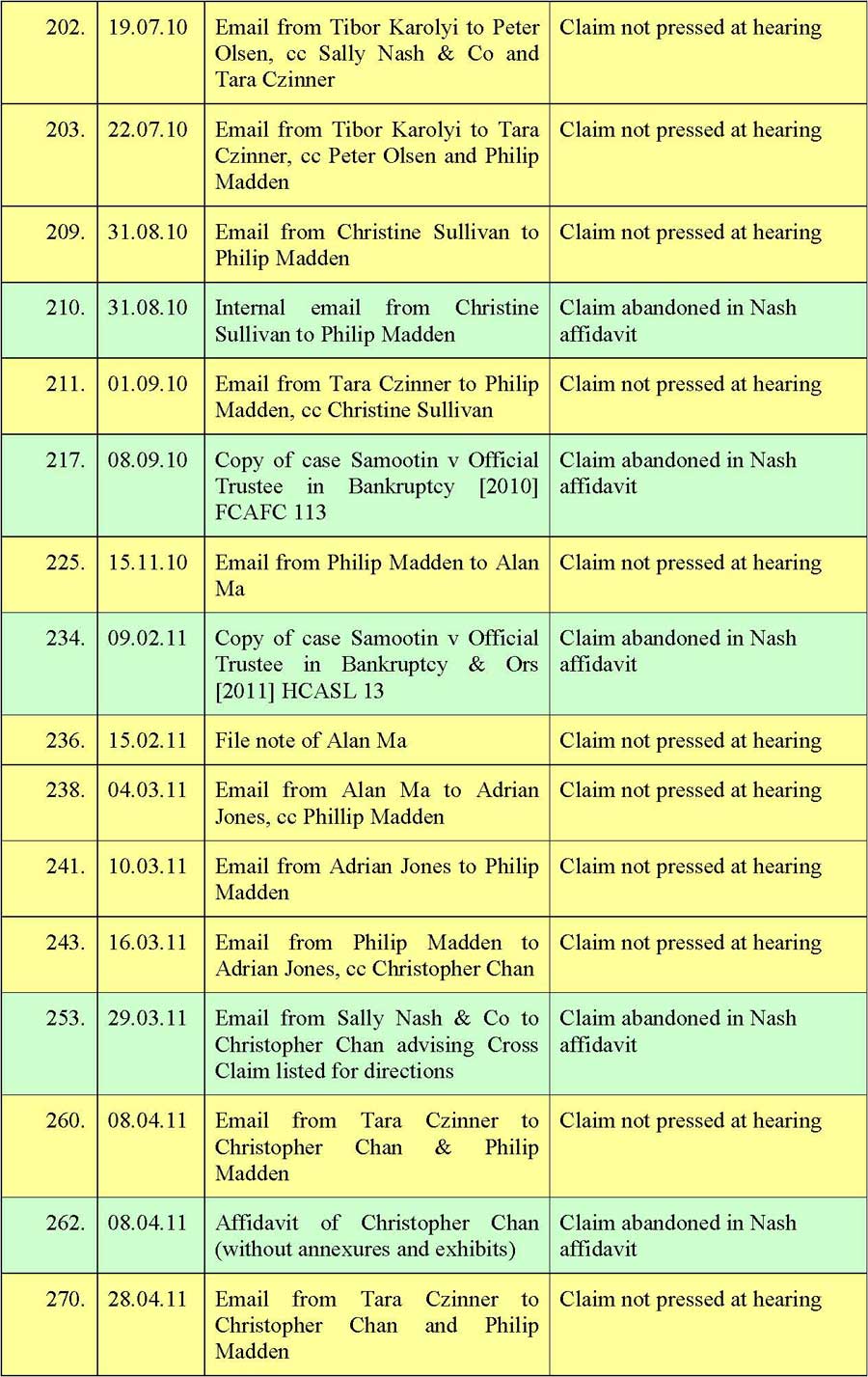
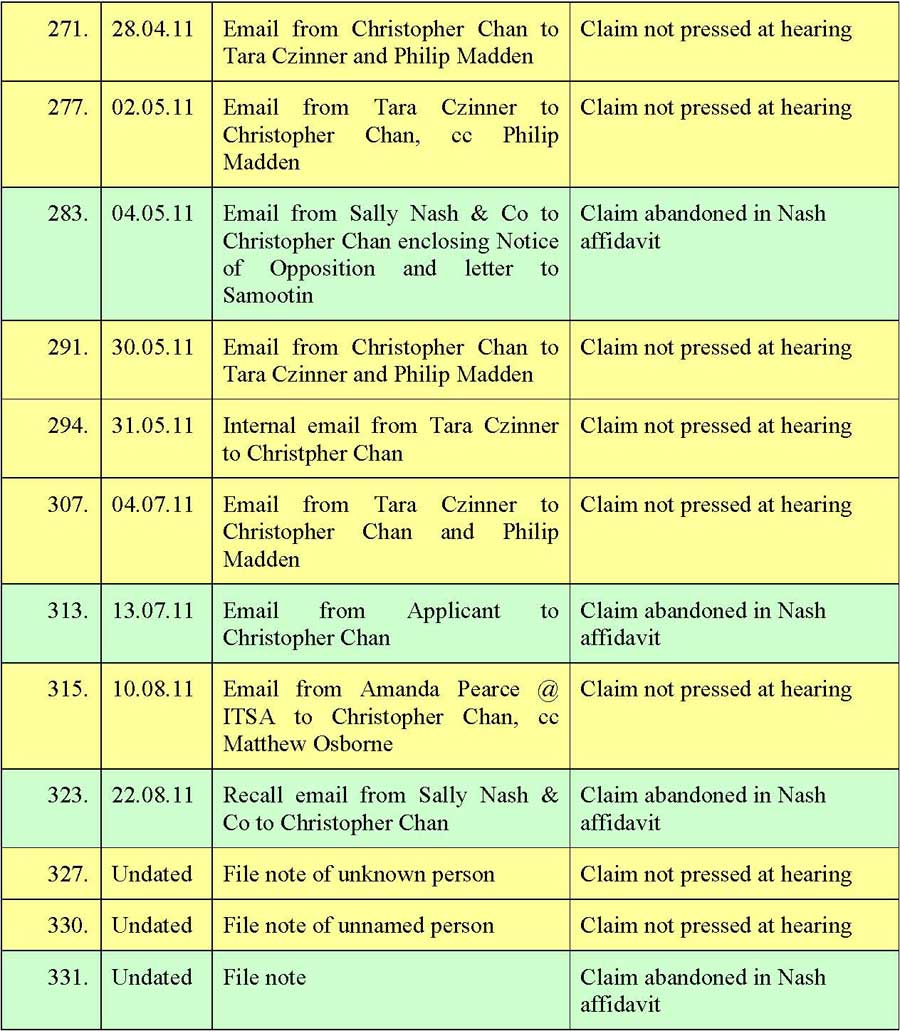
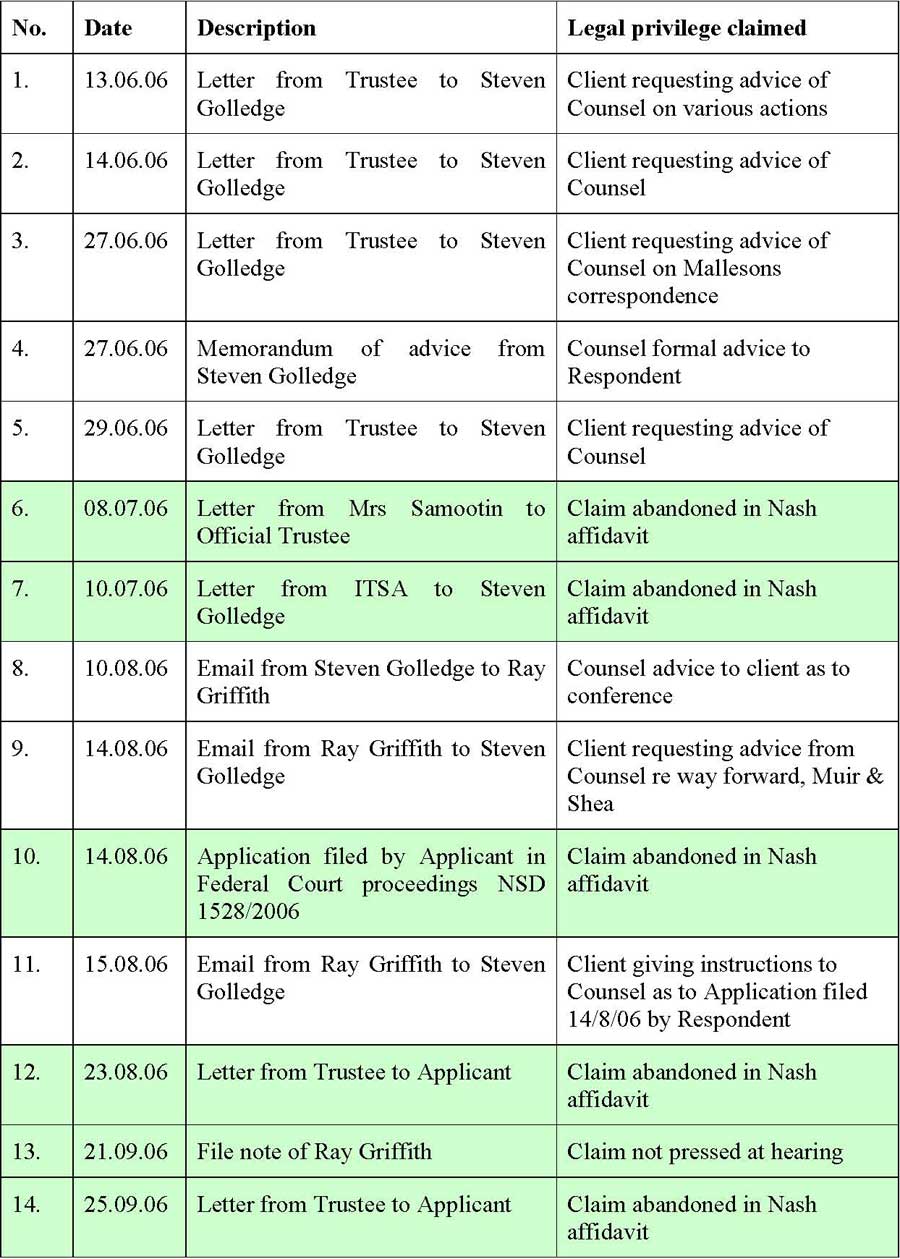
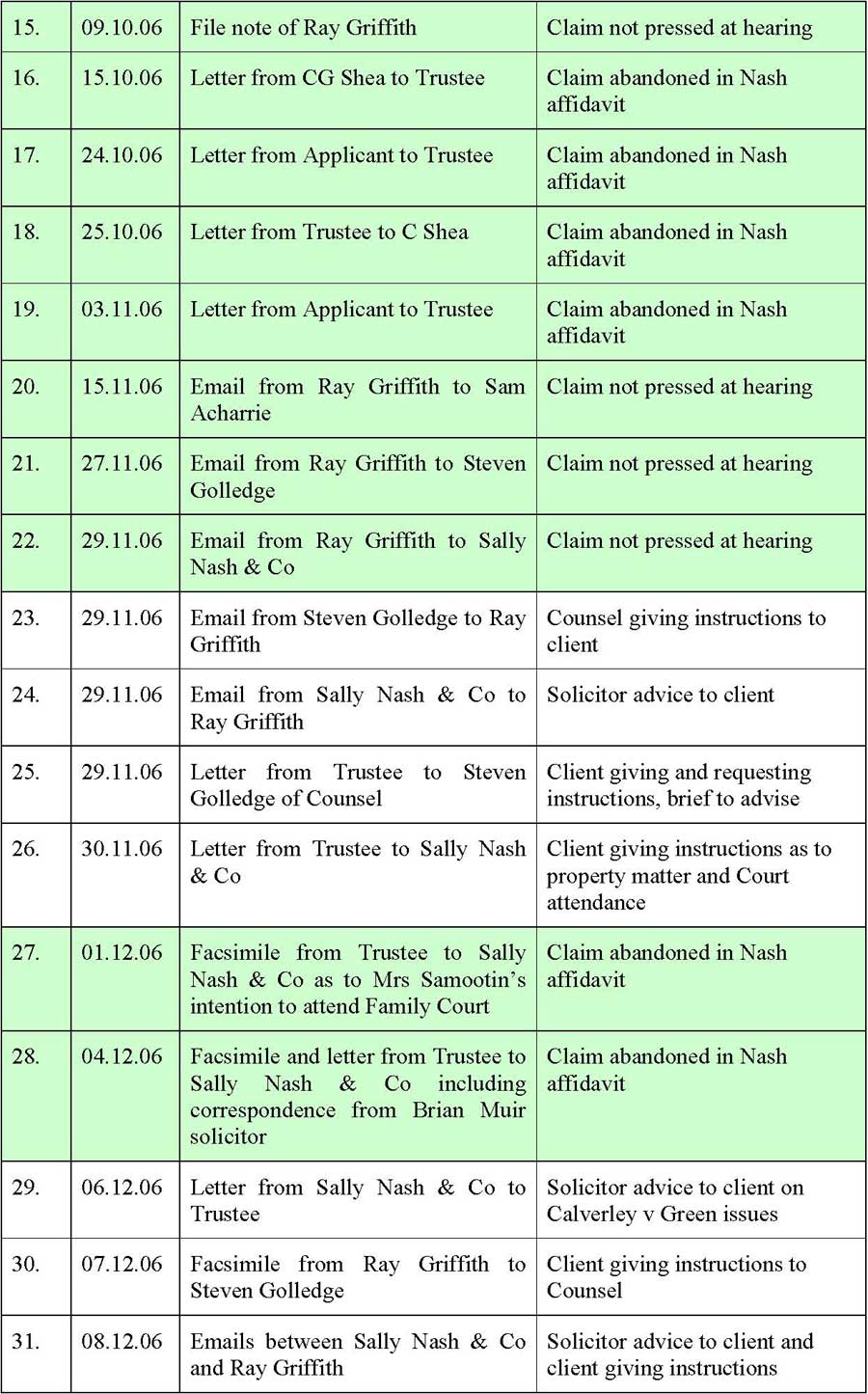
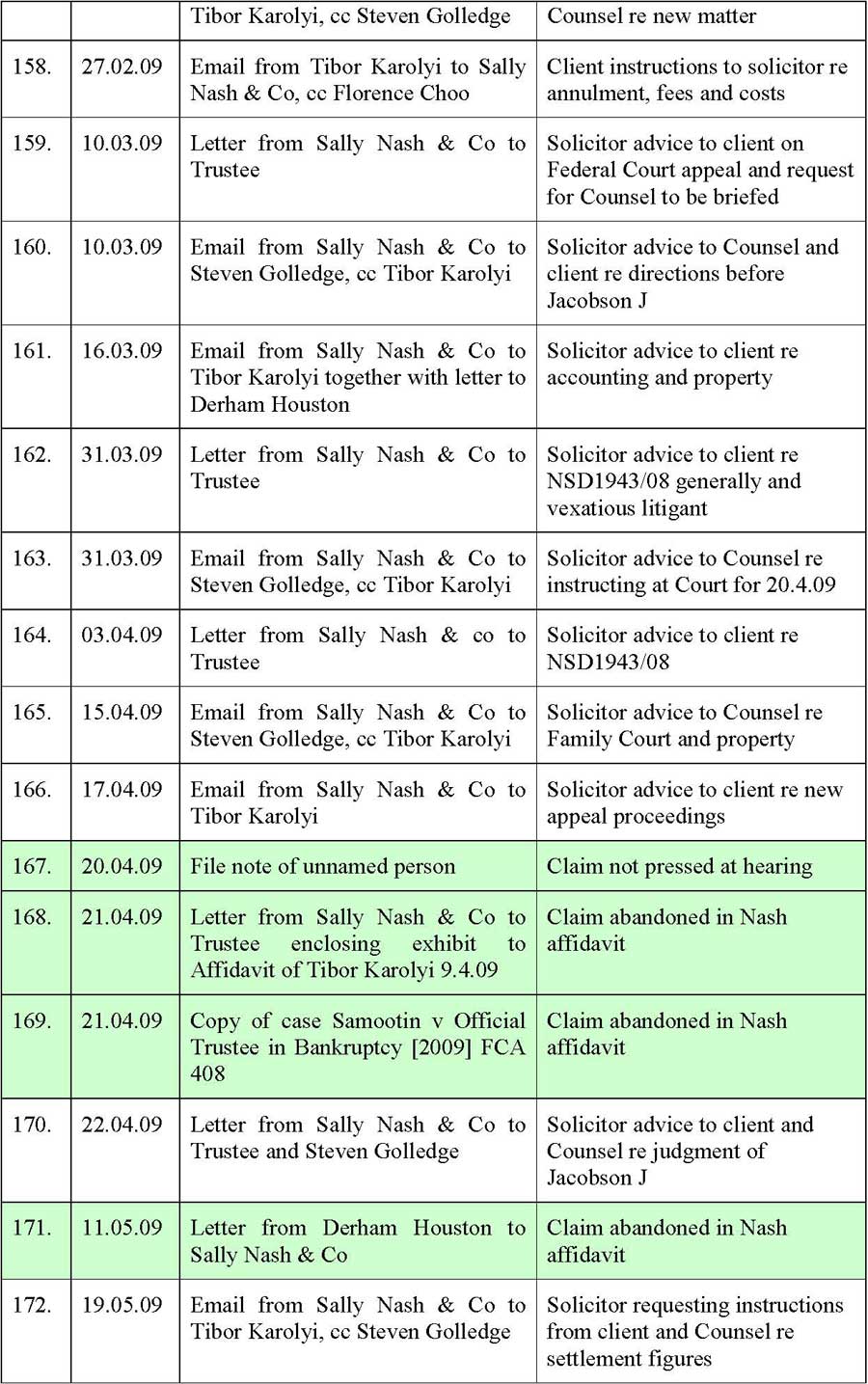
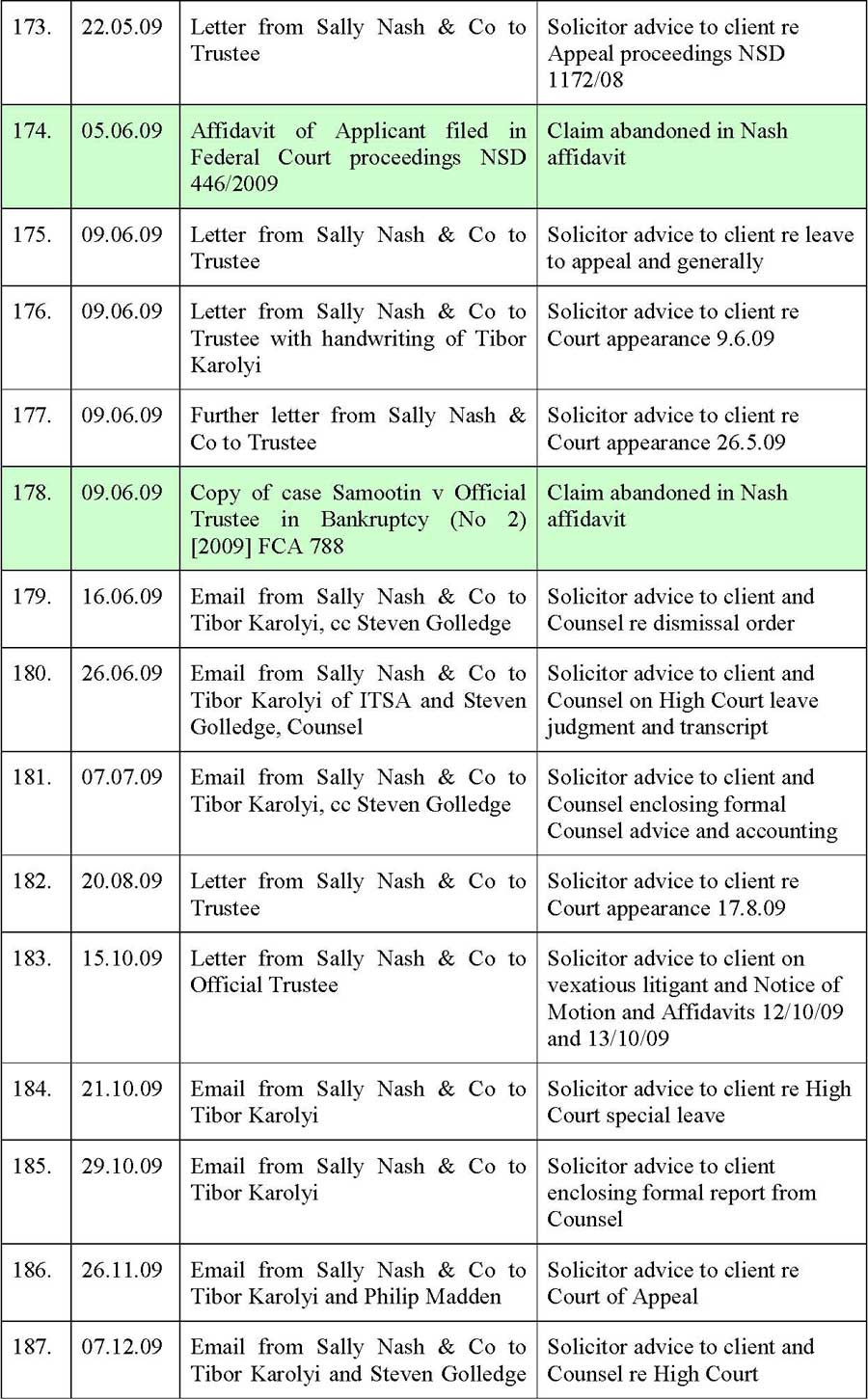
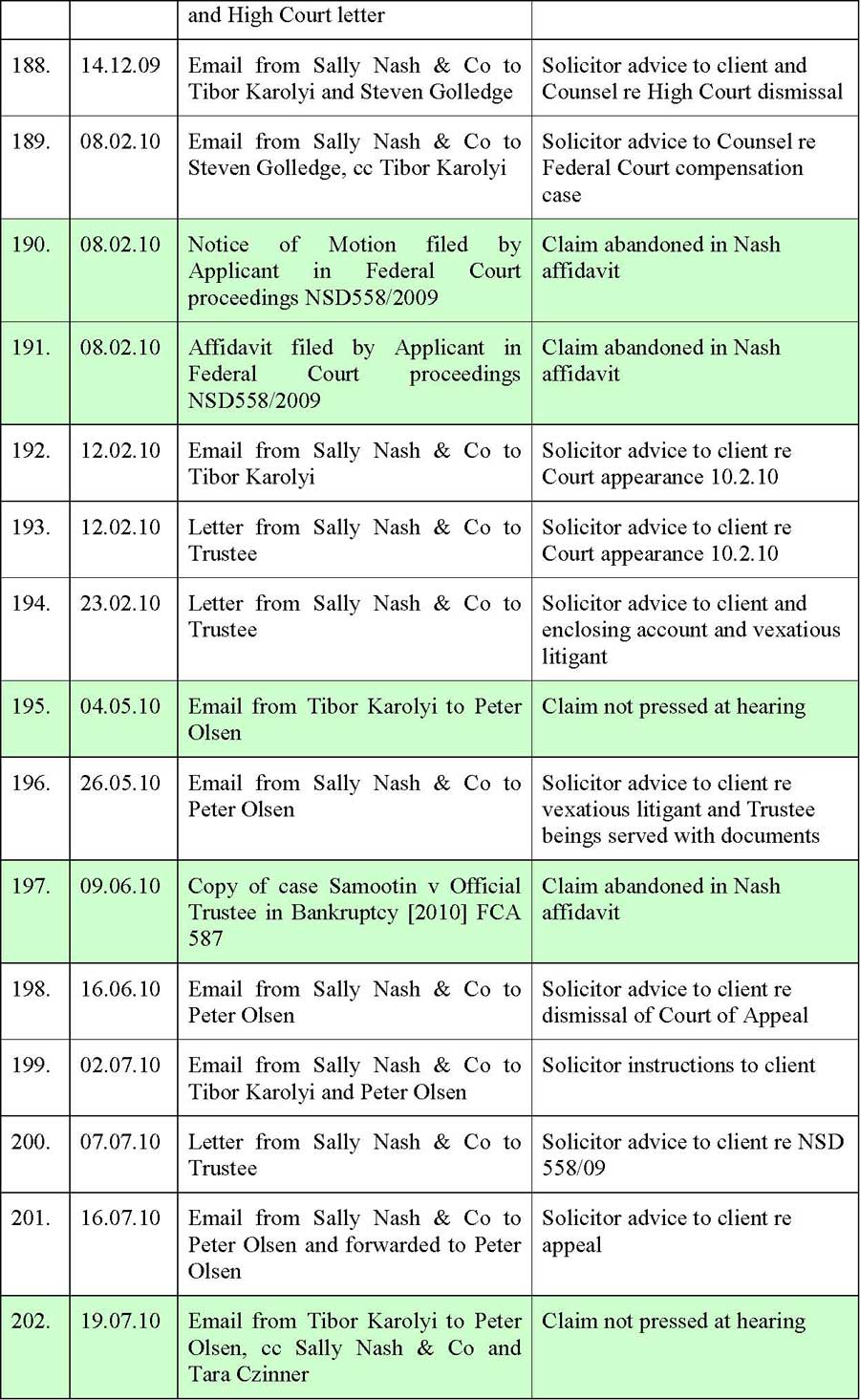
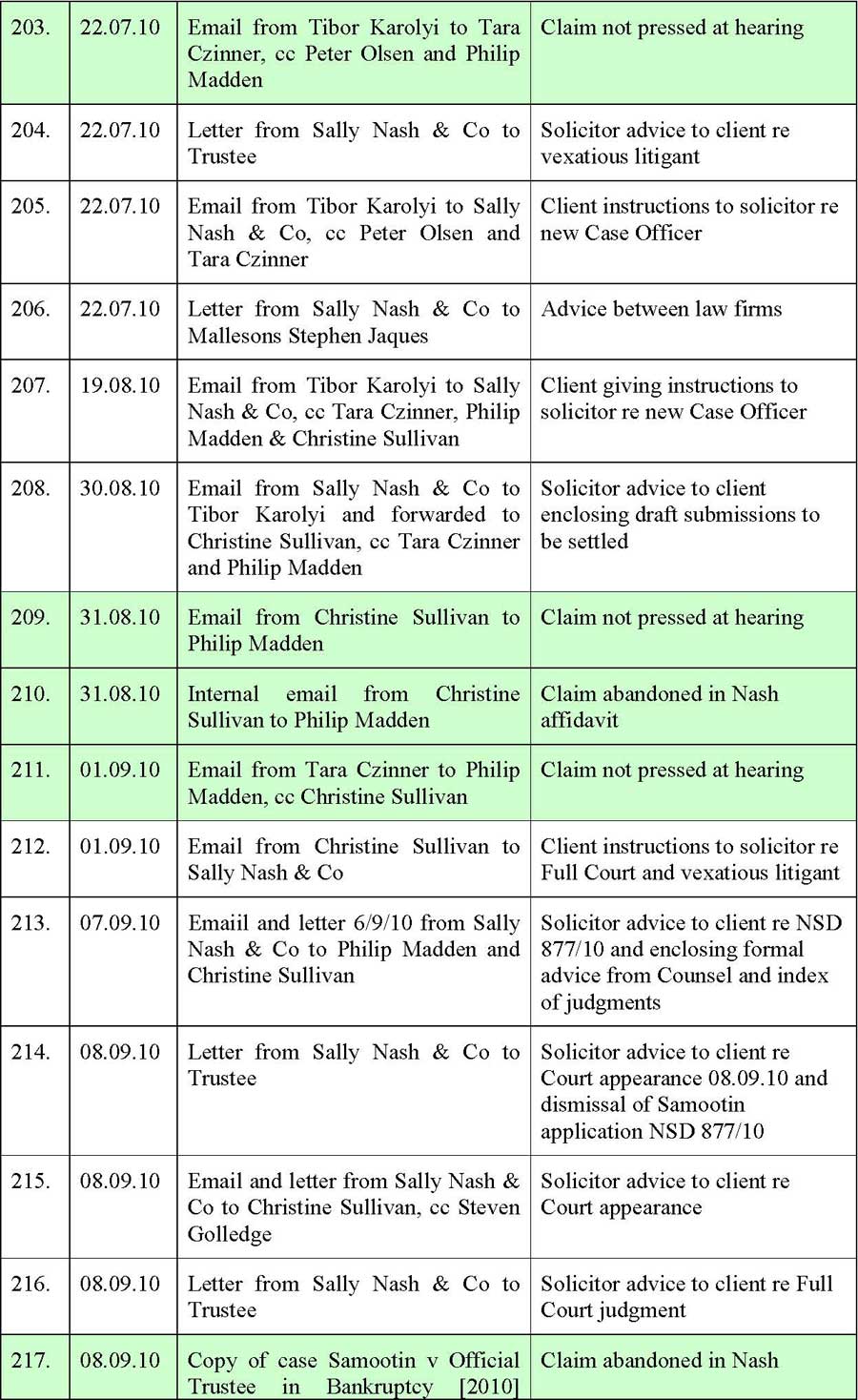
DATE OF ORDER: | |
WHERE MADE: |
THE COURT ORDERS THAT:
1. Order 2 of the orders made by Registrar Hedge on 14 September 2011 be varied to the extent that access (including photocopy access) be granted to the applicant to the documents described in Schedule 1 to these orders.
2. The applicant pay 75% of the respondent’s costs of the application for access to the documents over which the respondent claimed privilege.
Note: Entry of orders is dealt with in Rule 39.32 of the Federal Court Rules 2011.
NEW SOUTH WALES DISTRICT REGISTRY | |
GENERAL DIVISION | NSD 164 of 2011 |
BETWEEN: | ALEXANDRA SAMOOTIN Applicant |
AND: | OFFICIAL TRUSTEE IN BANKRUPTCY Respondent |
JUDGE: | Katzmann j |
DATE: | 28 MARCH 2012 |
PLACE: | SYDNEY |
REASONS FOR JUDGMENT
1 Alexandra Samootin was made bankrupt after failing to pay costs pursuant to a court order. By force of law her estate then vested in the Official Trustee in Bankruptcy (“the Official Trustee”) under s 58 of the Bankruptcy Act 1966 (Cth) (“the Act”) (although in the present proceeding she relies on the Convention on the Elimination of all Forms of Discrimination against Women [1983] ATS 9 to avoid the effects of the section). In the principal proceeding Ms Samootin seeks orders against the Official Trustee pursuant to s 178 of the Act, amongst other things, to force the Official Trustee to release her bankrupt estate to her. The background is long and complicated. For present purposes it is unnecessary to explore it in any detail. It is sufficient to note a couple of matters. The sequestration order was made on 24 May 2006. Ms Samootin maintains it should never have been made, but, despite several attempts, she has failed to have it set aside: Samootin v Wagner [2005] FMCA 1512; Samootin v Wagner [2008] FCA 1066 (affirmed Samootin v Wagner [2009] FCAFC 77; special leave refused Samootin v Wagner [2009] HCASL 267); Samootin v Official Trustee in Bankruptcy [2010] FCA 587 (affirmed Samootin v Official Trustee in Bankruptcy [2010] FCAFC 113; special leave to appeal refused [2011] HCASL 13). On 16 March 2009 Ms Samootin filed an application for certain other orders requiring the Official Trustee to do various things. That application was refused: Samootin v Official Trustee in Bankruptcy [2009] FCA 408 (leave to appeal refused: Samootin v Official Trustee in Bankruptcy (No 2) [2009] FCA 788). Ms Samootin was discharged from bankruptcy pursuant to s 149 of the Act on 22 June 2009.
2 This judgment is concerned only with an interlocutory application Ms Samootin filed on 29 September 2011. At the hearing of a separate application on 7 October 2011, with the consent of the parties I dealt with paragraphs 1–8 of the 29 September application. Paragraph 9 (which is an application that all affidavits filed by Mrs Samootin “stand as is”) requires no order. The remaining paragraphs (10–13) are the subject of this judgment.
3 Paragraphs 10–12 are concerned with an order made by Registrar Hedge on 14 September 2011. On that day Registrar Hedge made orders granting the parties access to a number of documents and preventing access to others. Order 2 was in the following terms:
Notwithstanding any other order made today, the documents produced in accordance with the Notice to Produce addressed to the Respondent, the Official Trustee in Bankruptcy and that are contained in the box marked "privileged" may not be inspected, copied or uplifted, until further order.
4 In paragraph 10 Ms Samootin asks for the leave of the Court to set aside this order. She challenges the Official Trustee’s claim for privilege over the contents of the box (“the allegedly privileged documents”). In paragraph 11 Ms Samootin seeks leave to view the privileged documents, and implicitly also seeks leave to copy them. For convenience I will refer to both these requests as the application for access to the allegedly privileged documents.
5 In paragraph 12 Ms Samootin seeks leave to issue a subpoena to the Official Trustee to appear in person in the final hearing “pursuant to Convention on the Elimination of all Forms of Discrimination against Women, Article 15(1)”. This is an anticipatory request which depends on the outcome of both inspection of the documents the subject of the privilege claim and the hearing of a preliminary question. Accordingly, it is premature to consider it.
6 In paragraph 13, Ms Samootin seeks an order that the costs of her application be costs of (sic) the proceedings.
The application for access to the allegedly privileged documents
7 The Official Trustee relied on an affidavit from its solicitor, Sally Nash. Ms Samootin filed an affidavit of her own consisting largely of submissions which she supplemented by further submissions properly so-called. After the Registrar’s order Ms Samootin served a notice to produce on the Official Trustee. Ms Nash’s affidavit also claims privilege over documents caught by that notice. It is convenient to deal with that claim at the same time.
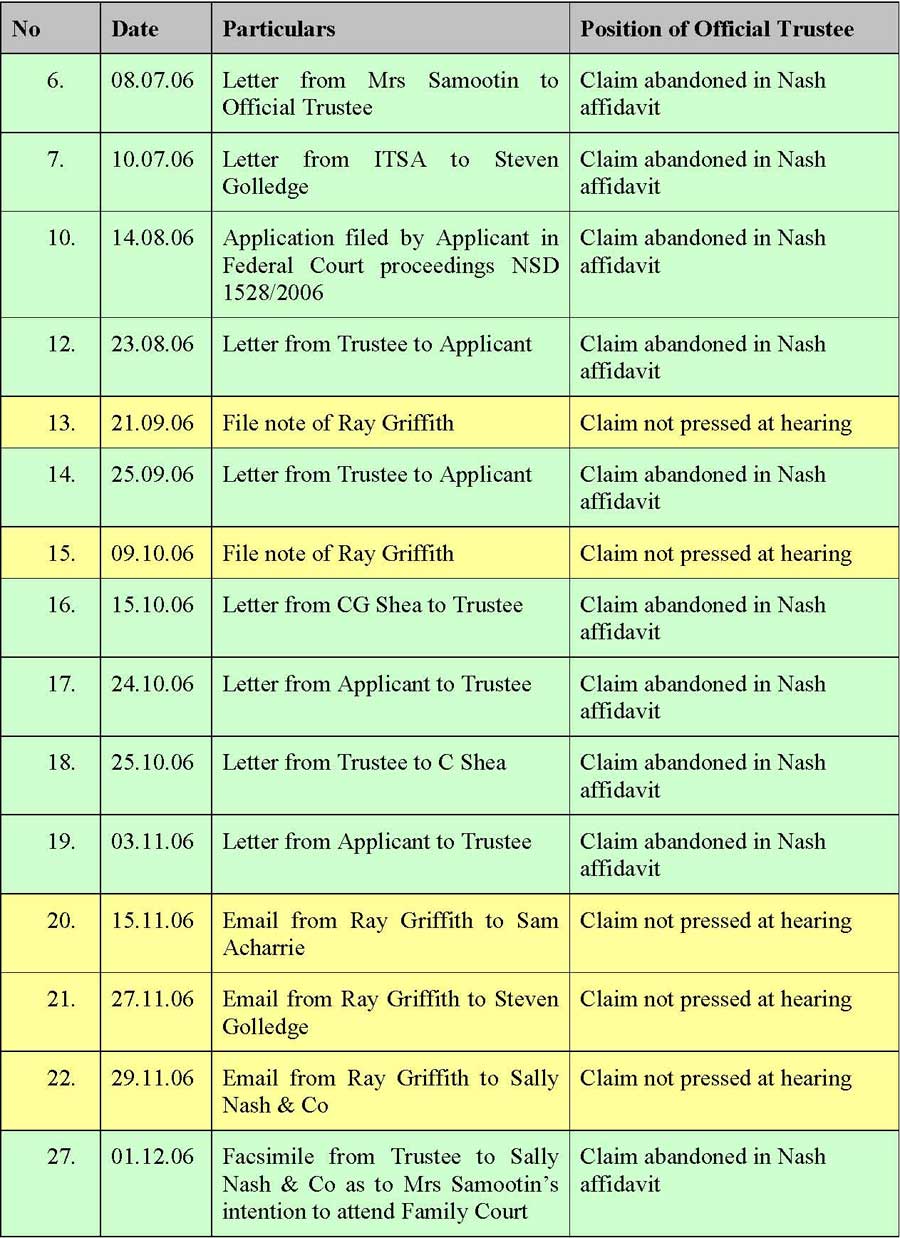
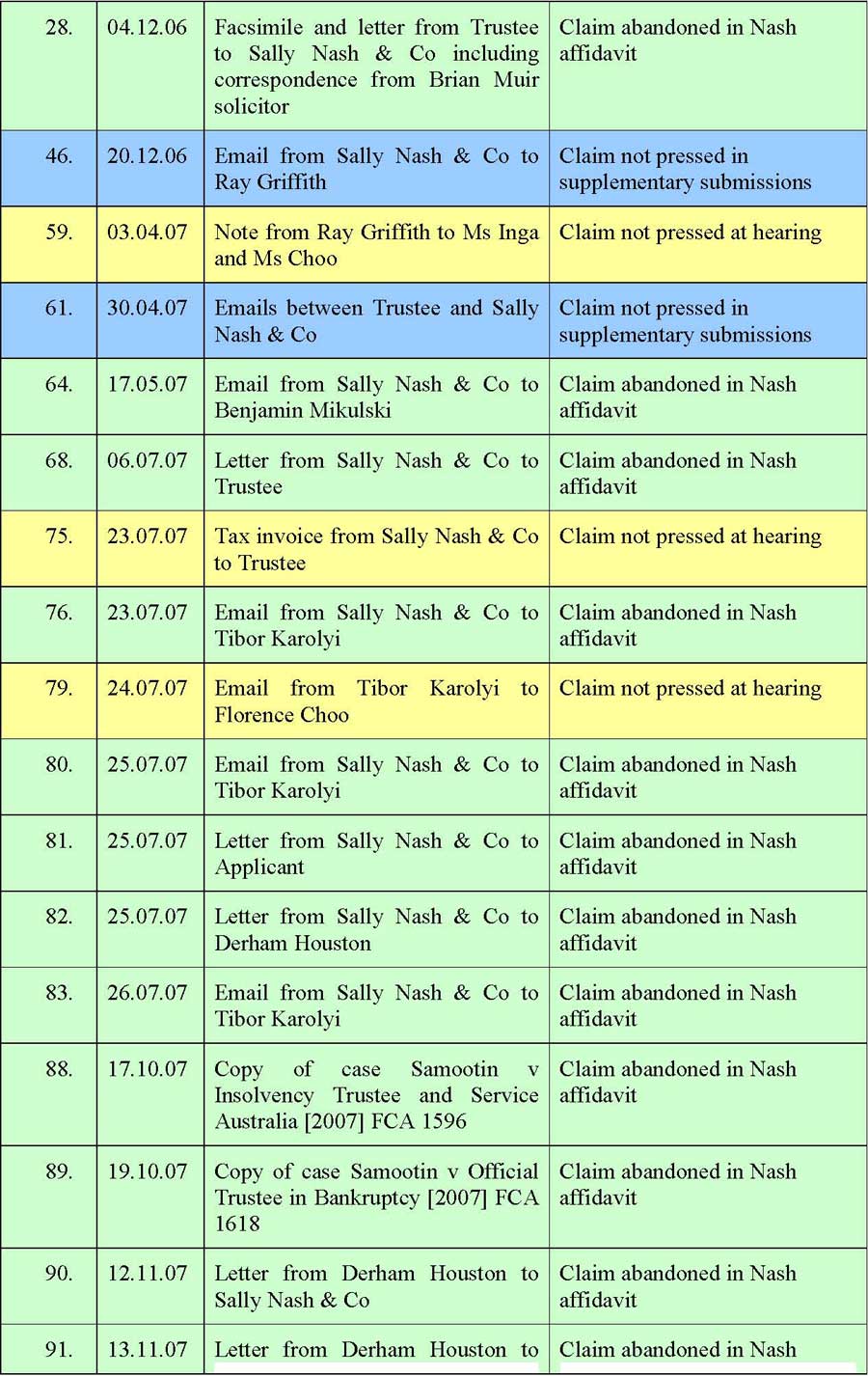
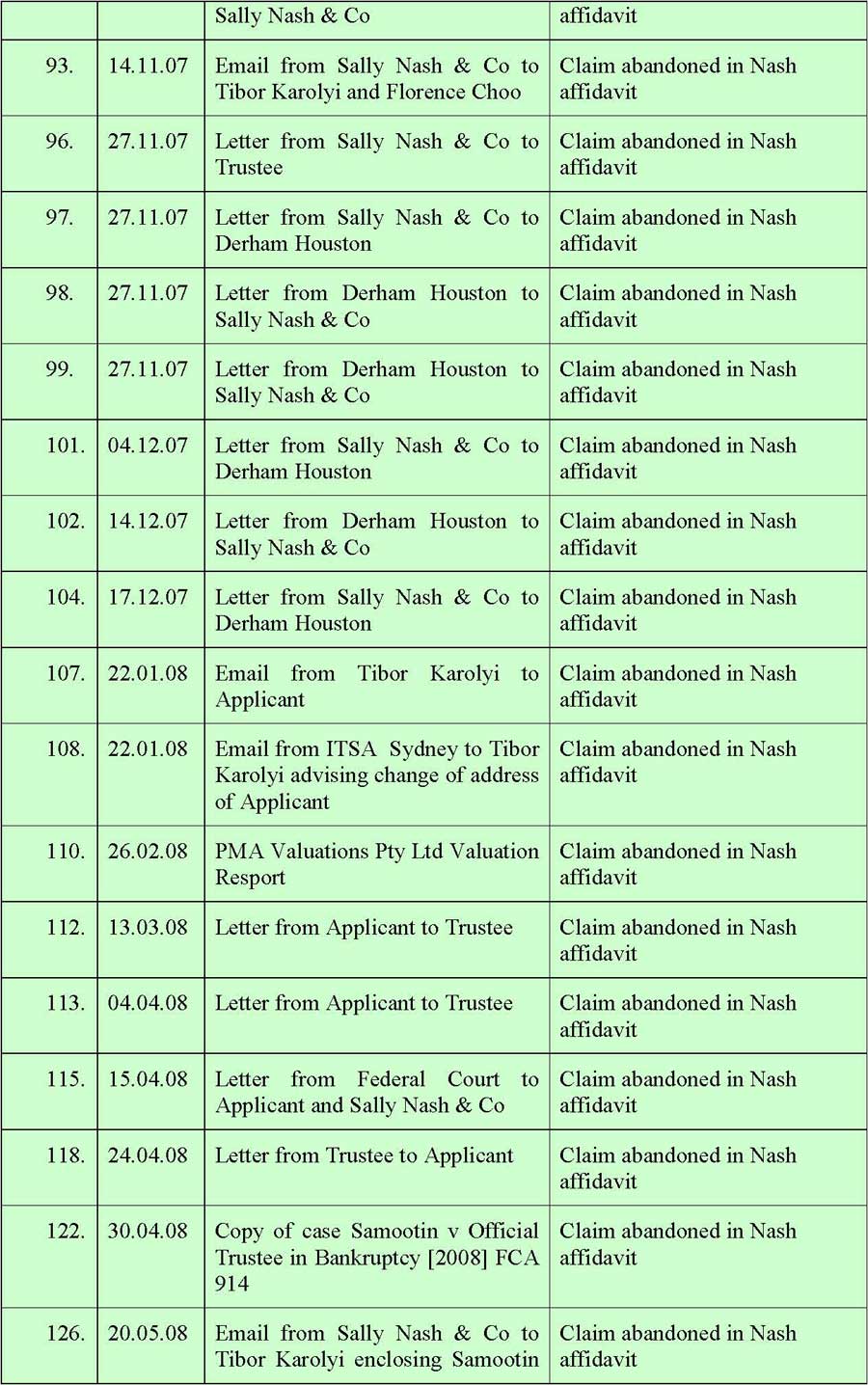
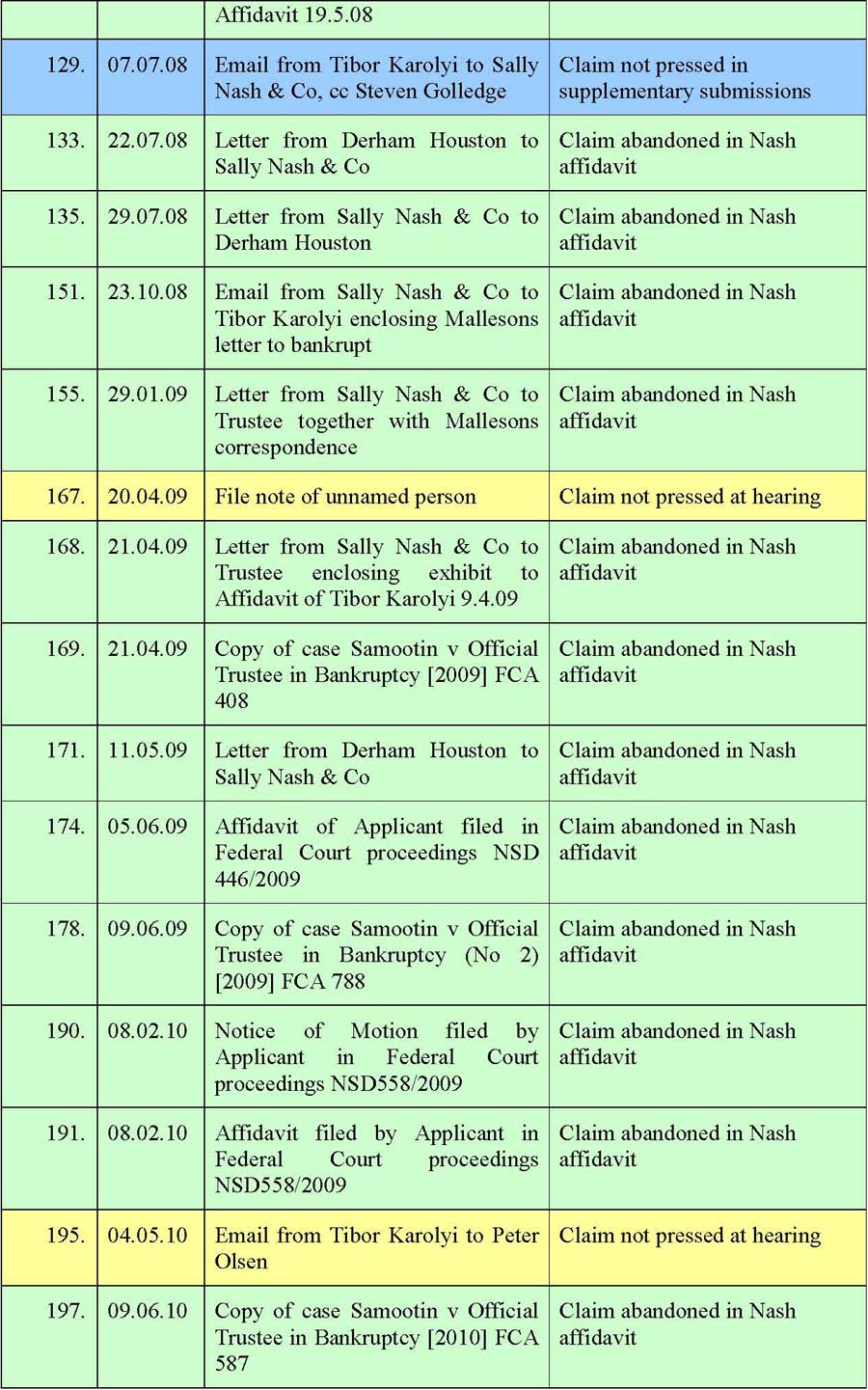
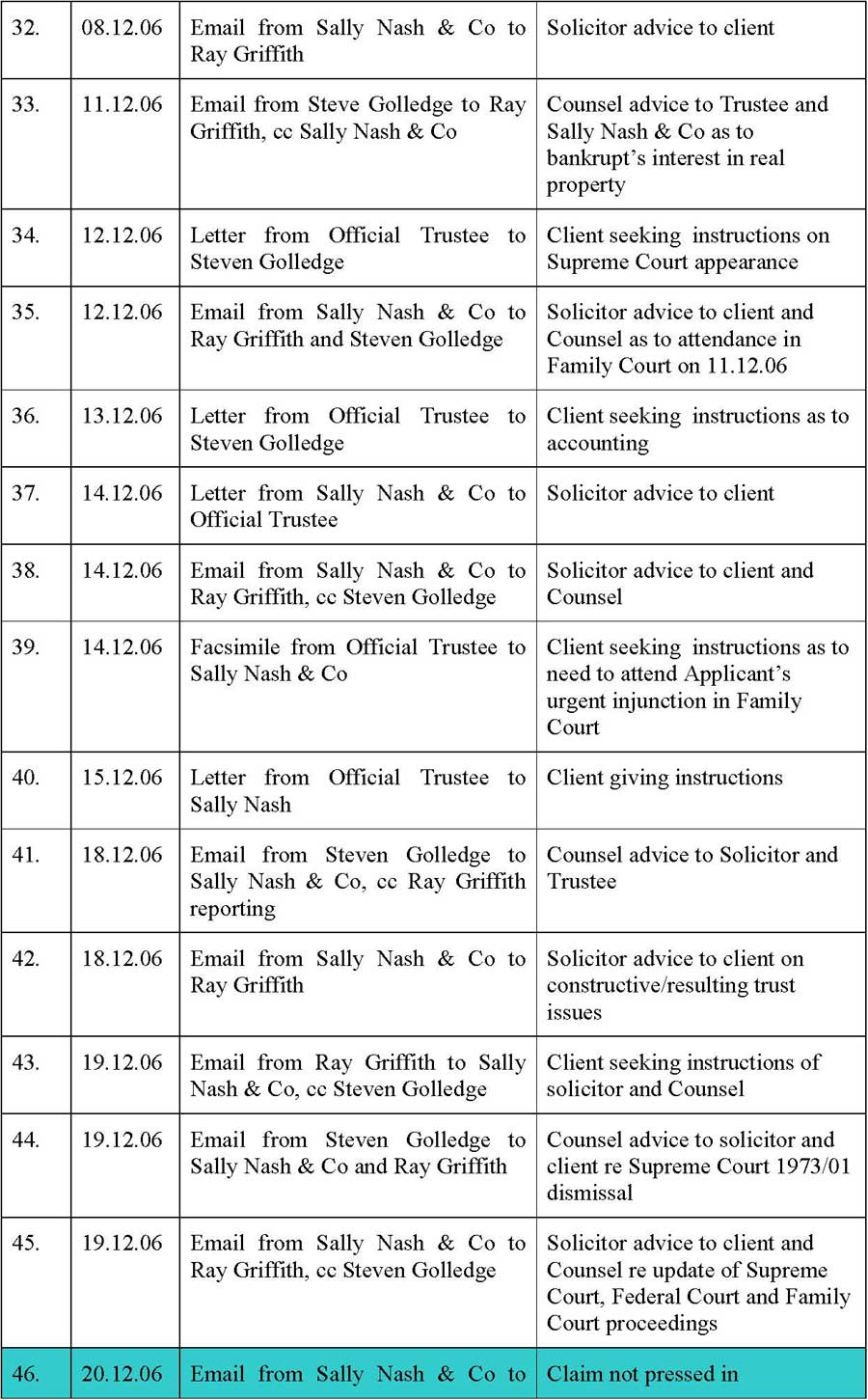
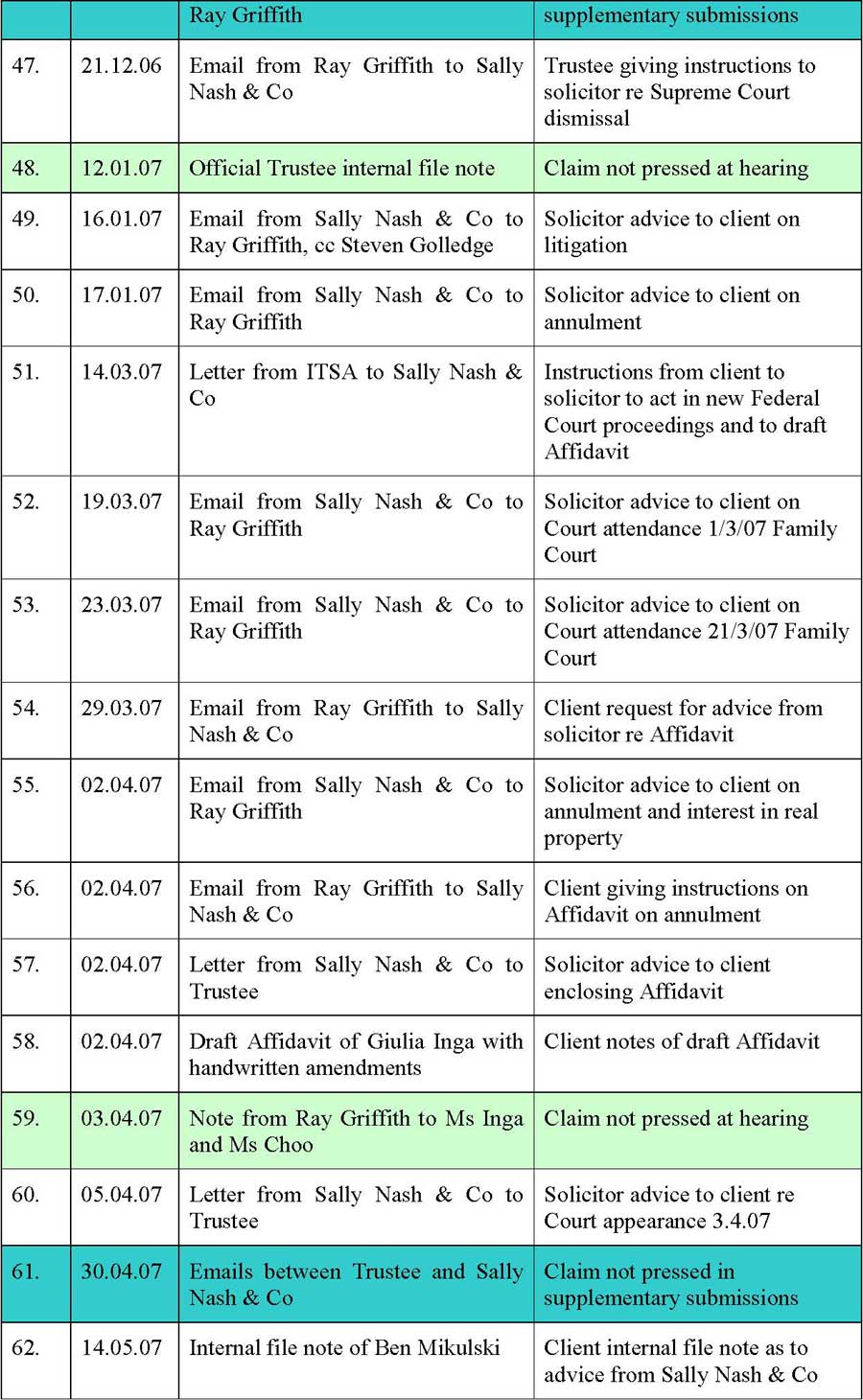
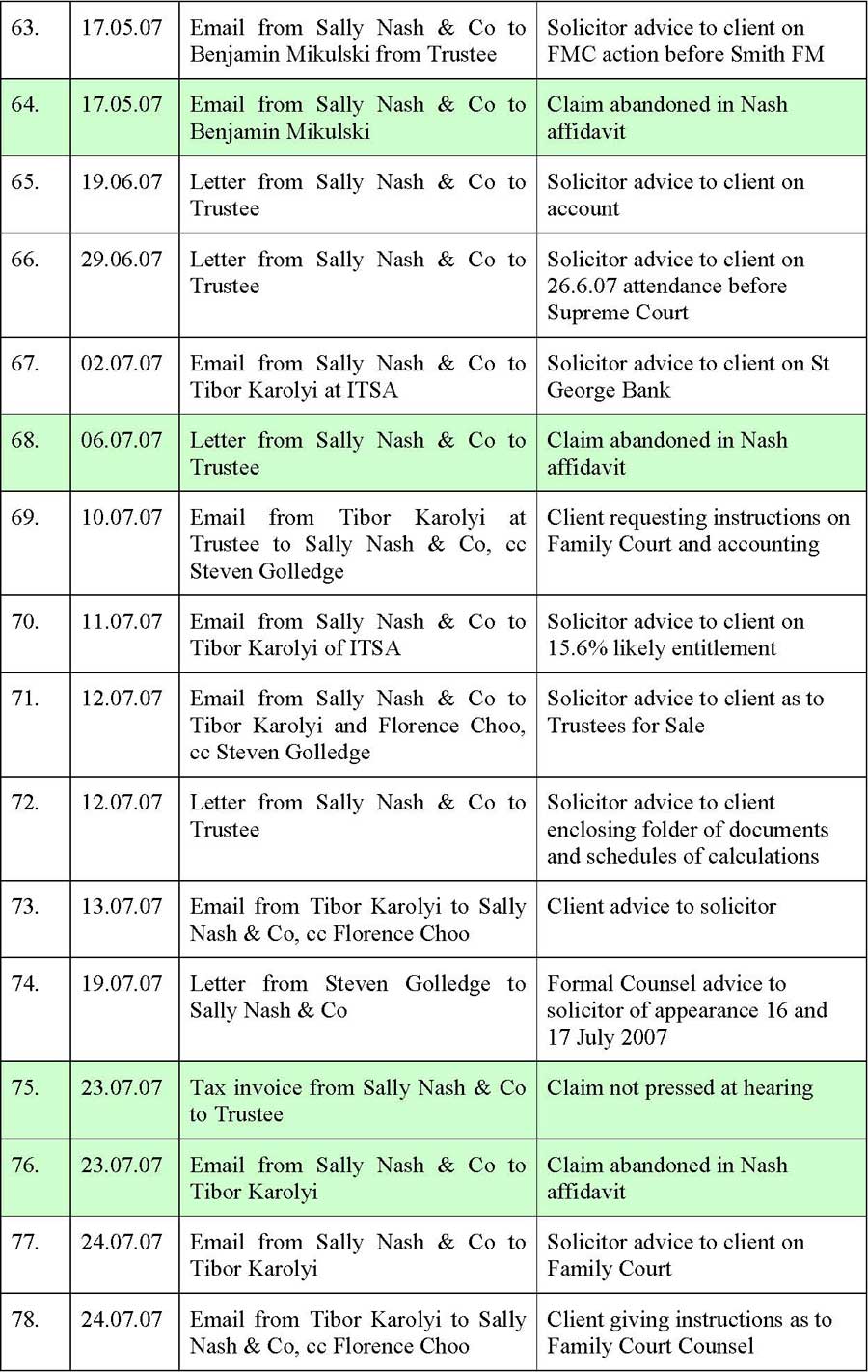
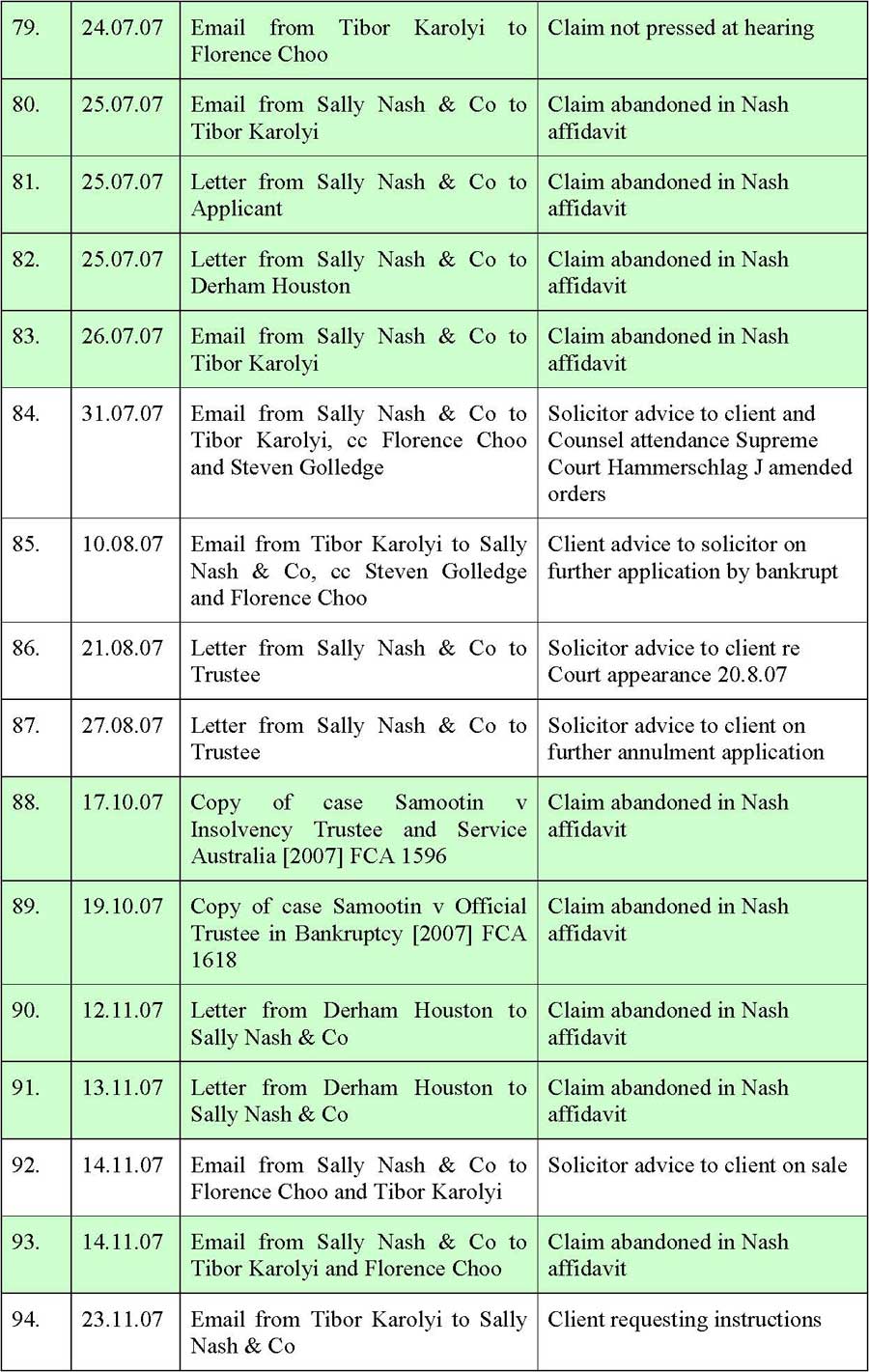
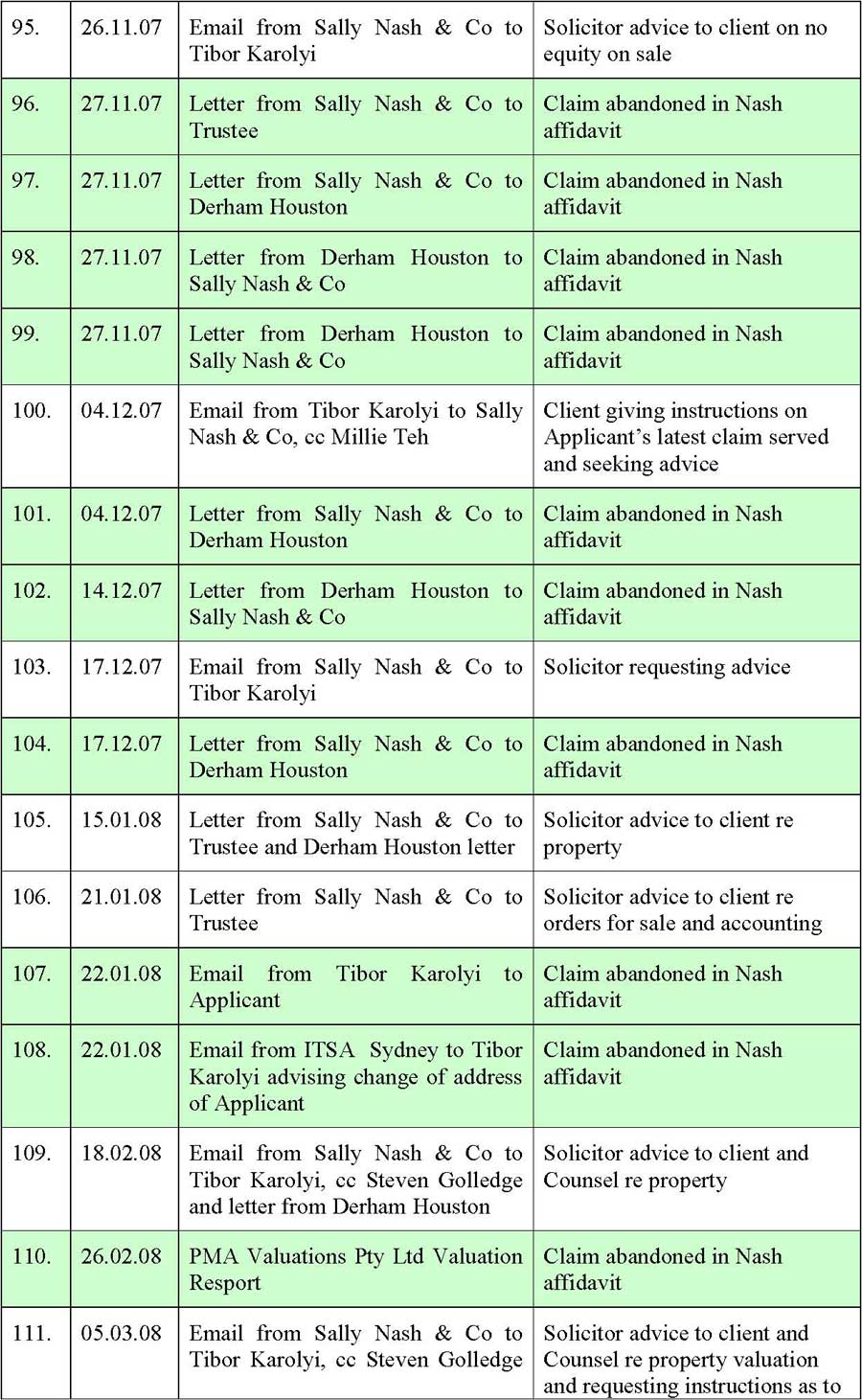
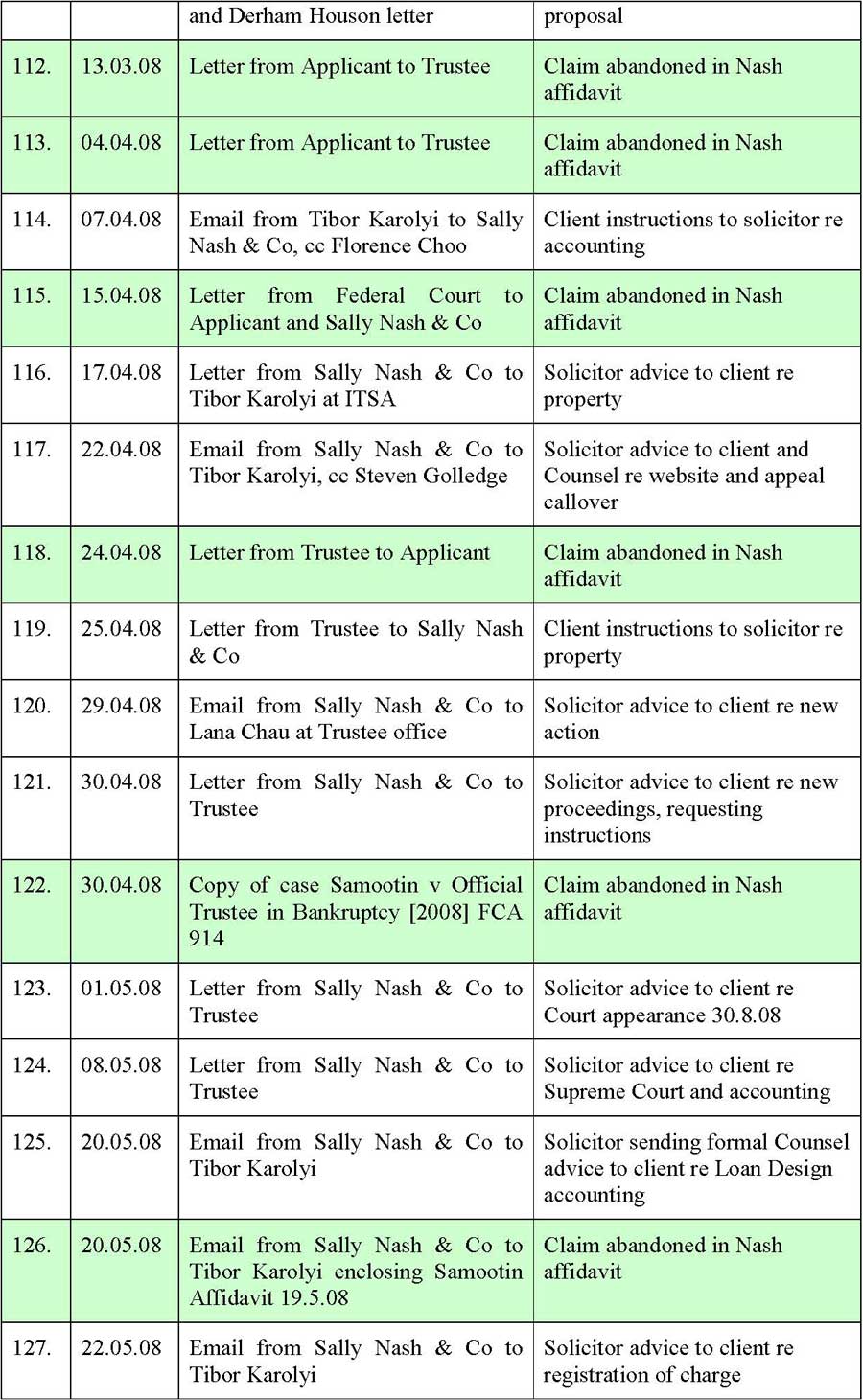
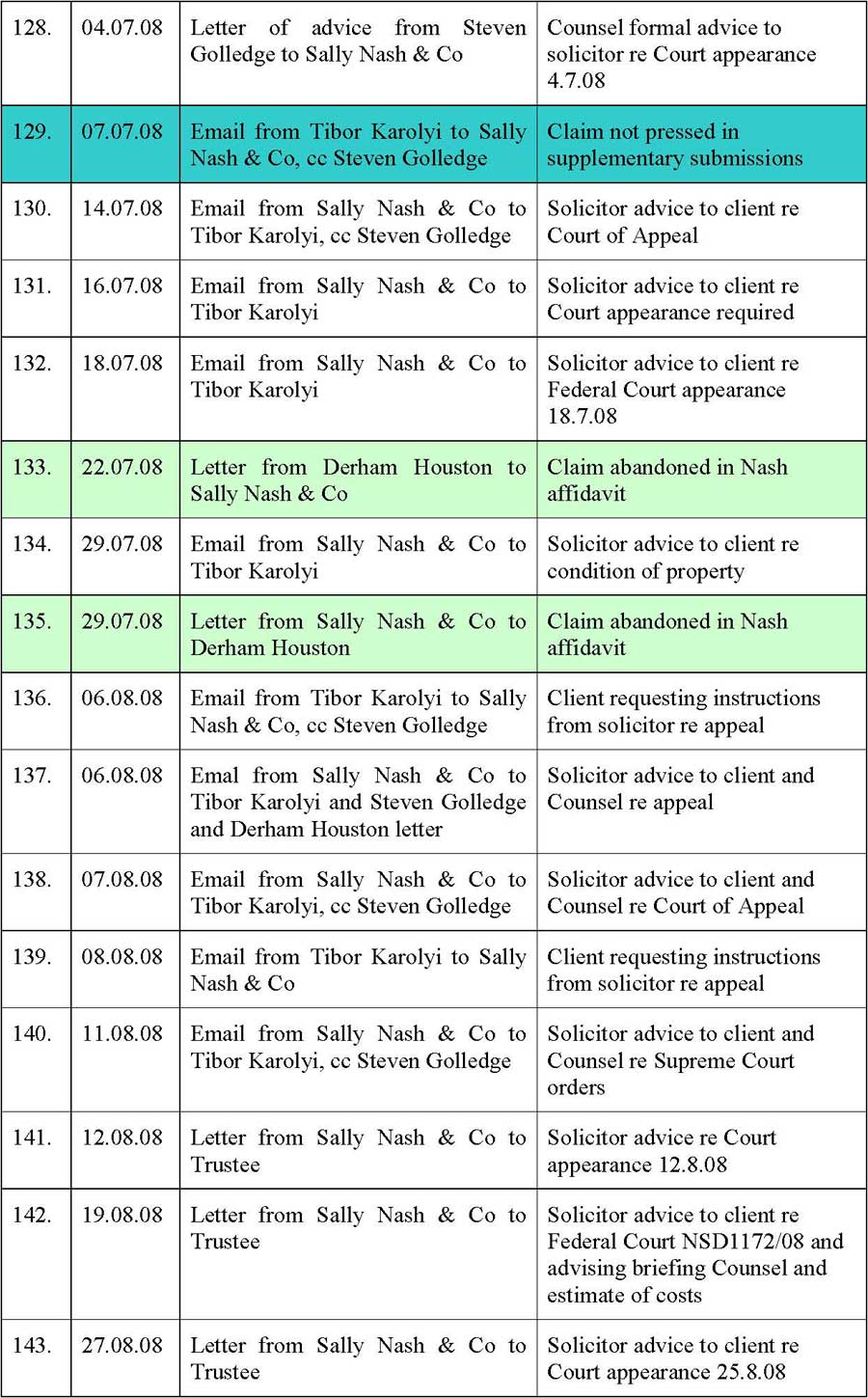
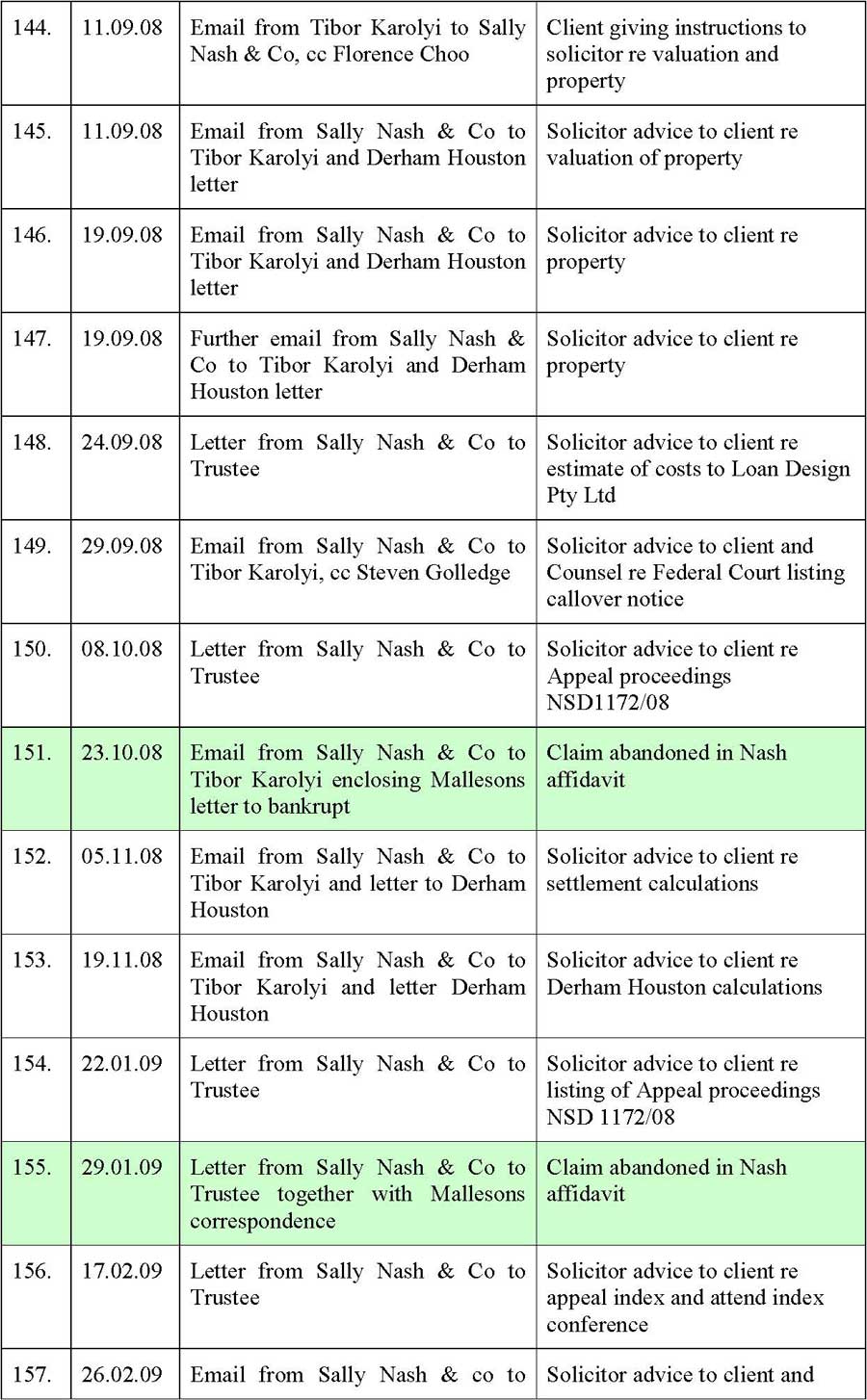
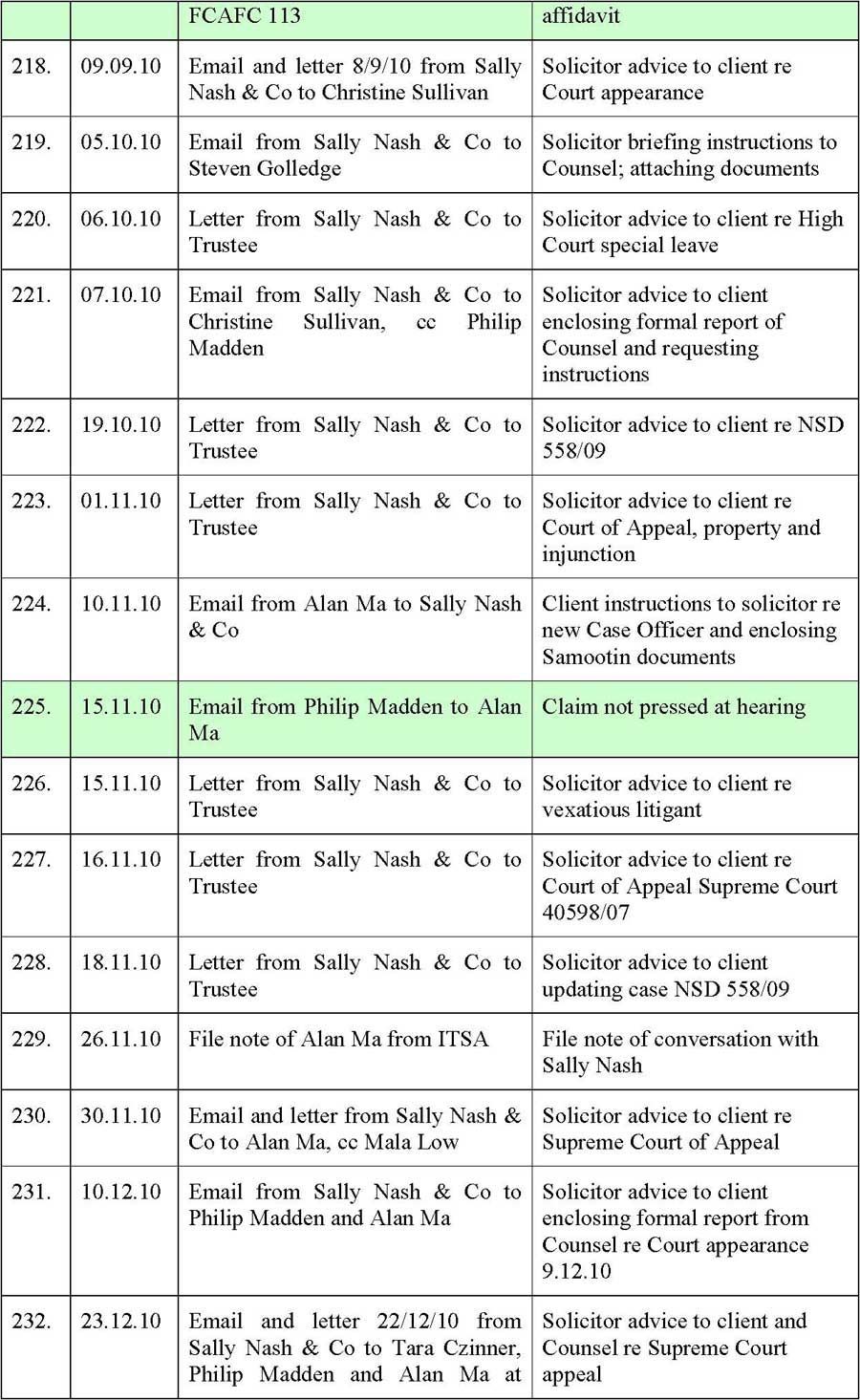
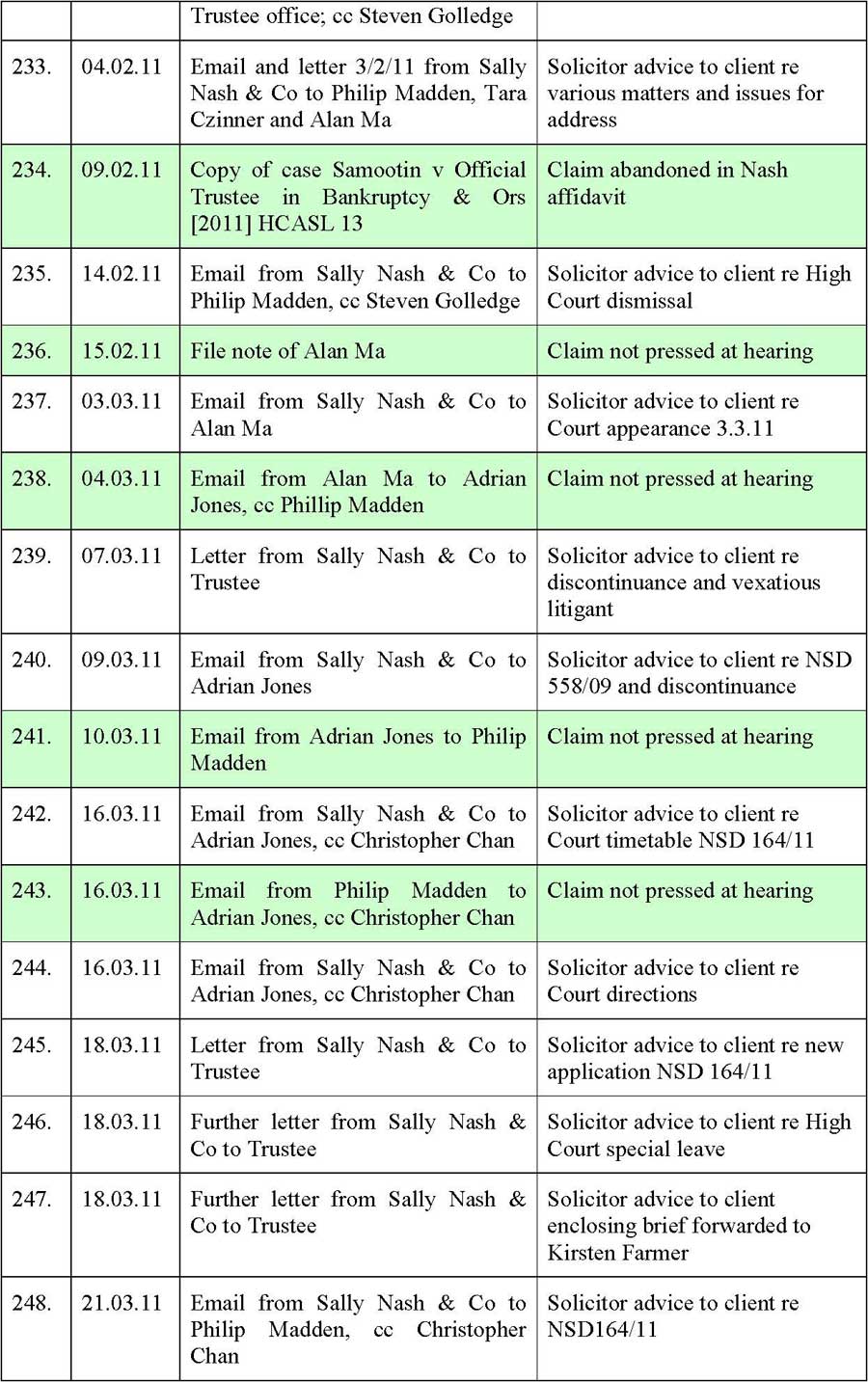
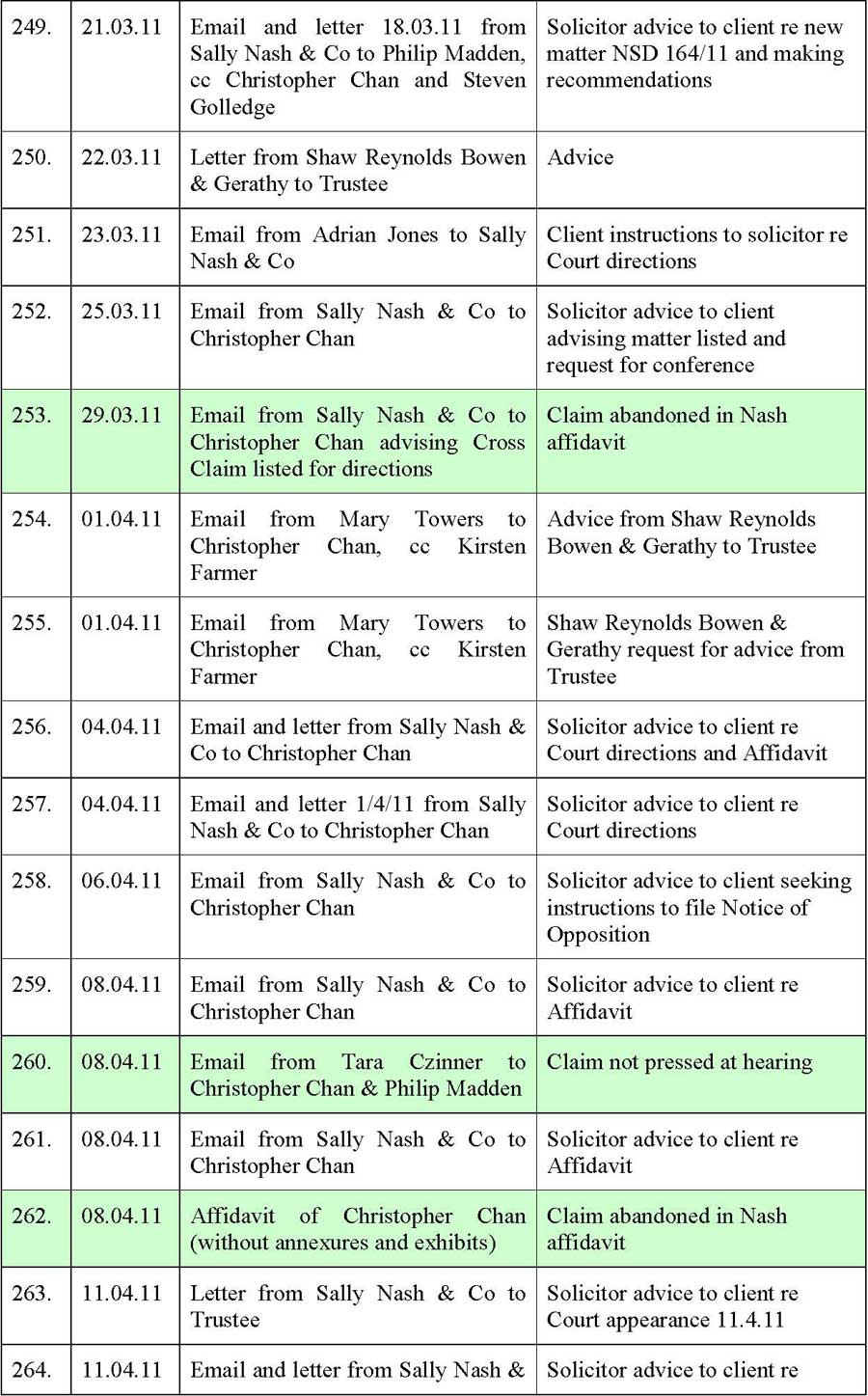
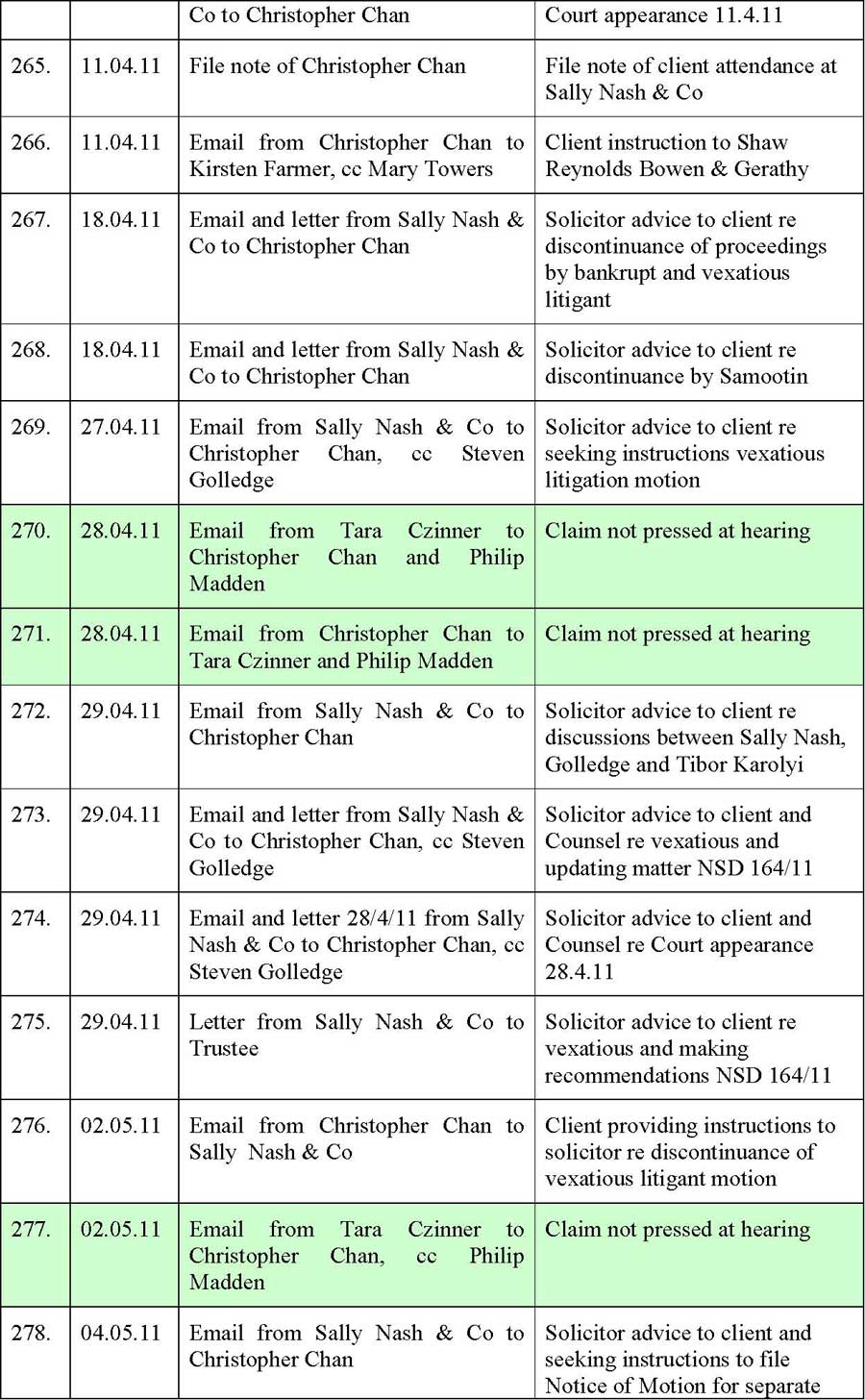
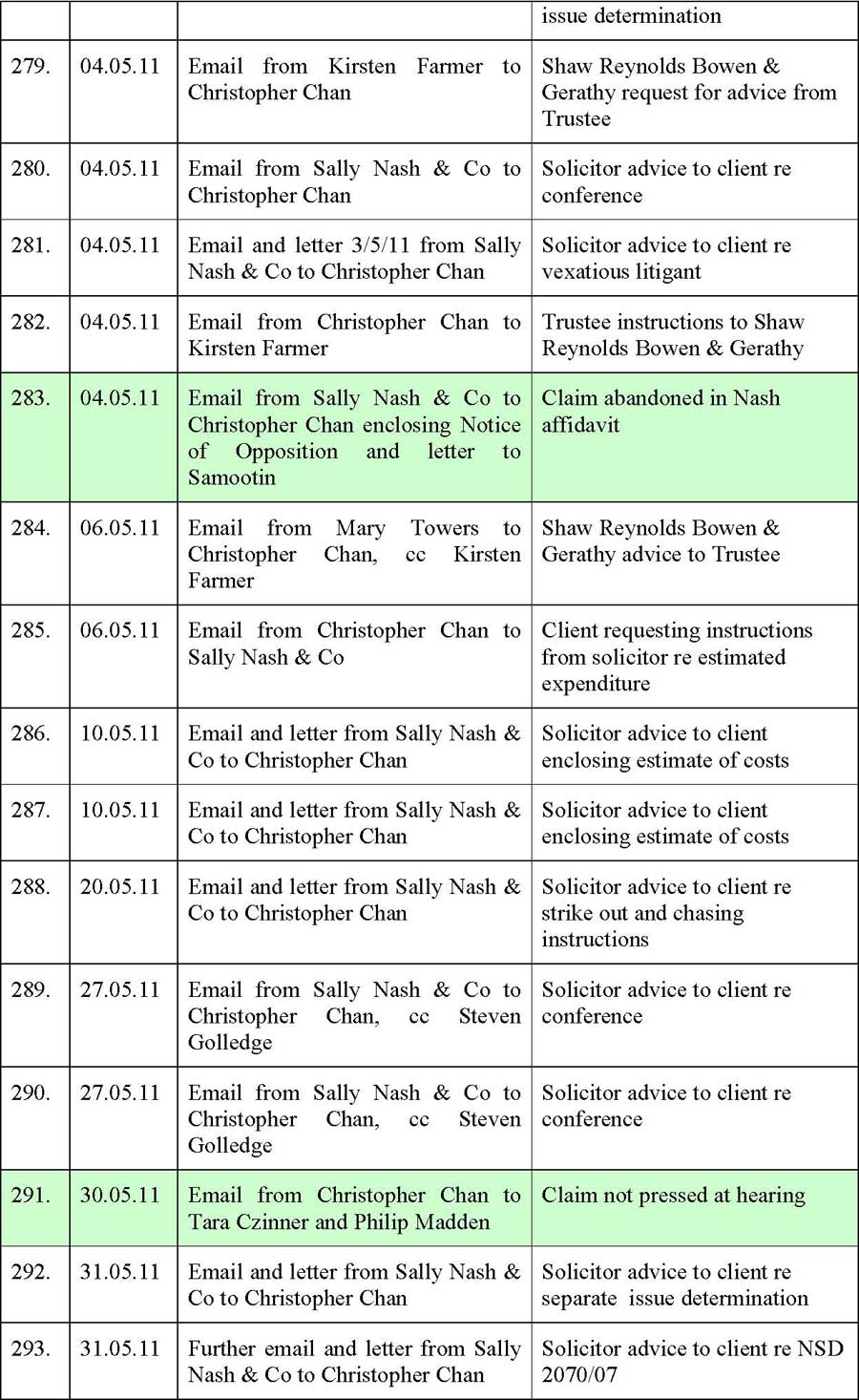
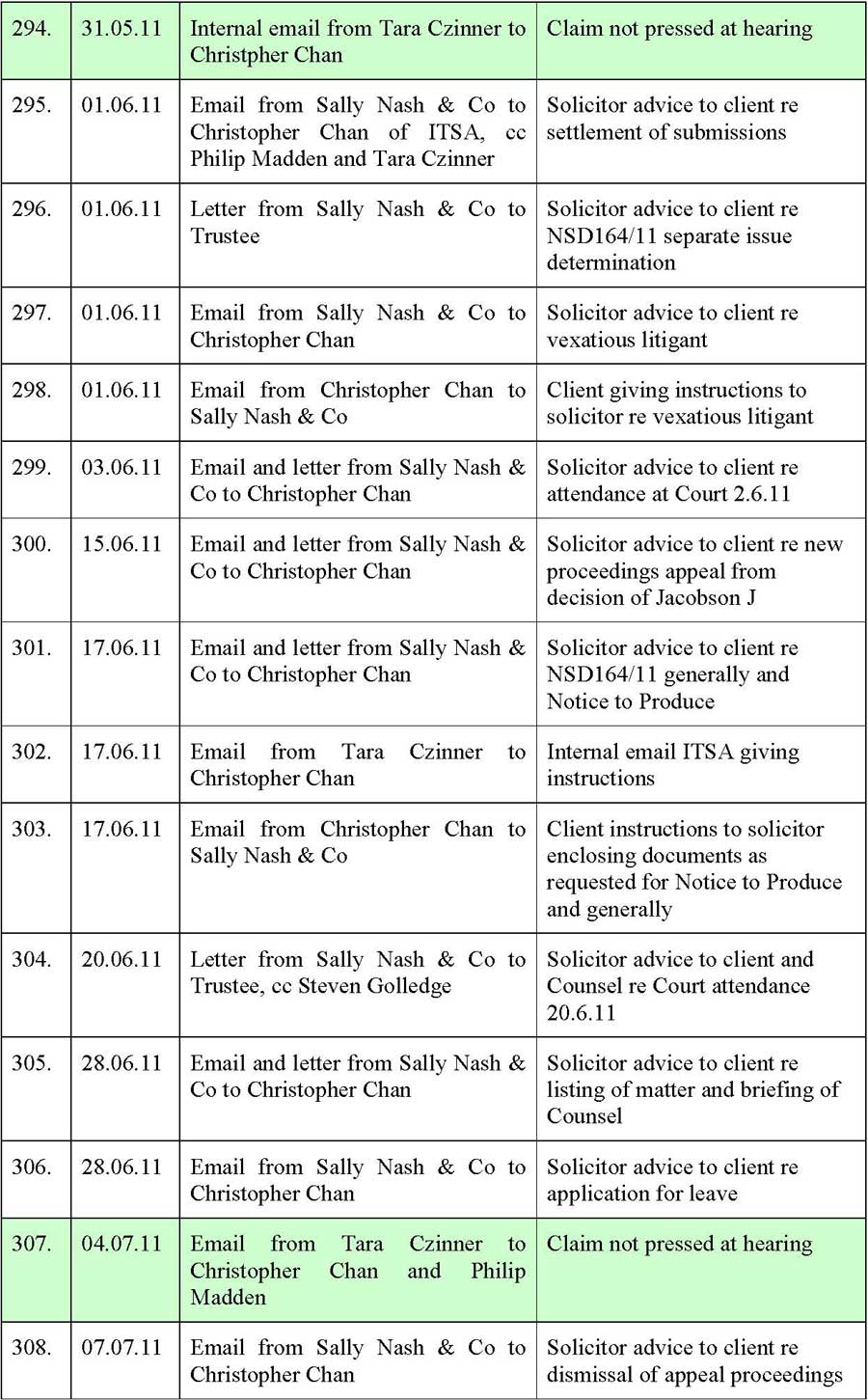
8 There are 331 documents in total. In her affidavit Ms Nash did not maintain the claim of privilege over 60 of them. During the course of oral argument, counsel for the Official Trustee, Mr Golledge, did not press claims over another 29 documents. In its supplementary submissions dated 24 November 2011 the Official Trustee abandoned claims over another three documents. Those 92 documents are listed in Schedule 1 to this judgment. A table of all 331 documents and the corresponding legal privilege claims appears in Schedule 2 to this judgment.
9 During the hearing, I ruled that document 302 attracts legal professional privilege. 238 documents remain to be dealt with.
10 Ms Samootin does not dispute that the documents over which the claim was made were prima facie the subject of legal professional privilege. She contends, however, that privilege “should be waived”. In substance she claims that the Official Trustee is her alter ego (or as she put it, it “metamorphosed into [her] legal persona”) and therefore the documents in question are her documents and she is entitled to waive the privilege. Alternatively, she claims the legal privilege is “a joint one”. Ms Samootin submits she was a “client” of the Official Trustee, who “stepped into her shoes” and “represented” her in certain proceedings in the NSW Supreme Court.
11 To give context to this application it is necessary to explain in more detail the factual background.
The factual background
12 On 29 March 2001 Ms Samootin commenced proceedings in the Equity Division of the NSW Supreme Court (“the Equity Division proceedings”) seeking to recover her interest in properties at 24 and 26 Oxford Falls Road, Beacon Hill (“the Beacon Hill properties”) which were registered in the name of a company (later known as “Loan Design Pty Ltd” and to recover “marital monies”. Loan Design Pty Ltd, its director Peter Deans, Ms Samootin’s ex-husband Christopher Shea, Giselle Wagner (a conveyancing solicitor) and Adrian Holmes were the defendants in the Equity Division proceedings.
13 On 1 August 2003 Palmer J dismissed the applicant’s claim against Ms Wagner and Mr Holmes with costs: Samootin v Shea and Ors (No. 2) [2003] NSWSC 695. (Mr Wagner and Mr Holmes later petitioned for Ms Samootin’s bankruptcy after she failed to pay the costs, resulting in the sequestration order.)
14 On 28 June 2004, before the sequestration order was made, Palmer J made orders declaring that Loan Design held the Beacon Hill properties upon trust for Ms Samootin, Mr Shea and Loan Design with their respective interests being in proportion to the equity contributions made by them or on their behalf to the acquisition costs of the properties. His Honour referred the matter to the Master in Equity to enquire what the respective equity contributions and respective proportionate interests of the parties were.
15 Ms Samootin disclosed her interest in the Beacon Hill properties in her statement of affairs filed 21 June 2006. Evidently, it was the only interest she disclosed in that statement of affairs.
16 The inquiry Palmer J ordered had not begun by the date of Ms Samootin’s bankruptcy. It took place on 16 and 17 July 2007 before Hammerschlag J, and the Official Trustee appeared as a party to the account seeking to realise assets in the bankrupt estate for the benefit of creditors. Ms Samootin was also a party to that proceeding as a cross-defendant to a claim by Loan Design Pty Ltd for possession of one of the two properties. Ms Nash appeared at the hearing of the inquiry on behalf of the Official Trustee. The principal application in this Court seeks an inquiry into the Official Trustee’s conduct of the hearing before Hammerschlag J.
Waiver
17 Waiver arises where a party entitled to the privilege engages in conduct which is expressly or impliedly inconsistent with the maintenance of the confidentiality of the communication: Mann v Carnell (1999) 201 CLR 1 at [28]–[29]. The onus of establishing waiver rests with the party arguing for it: New South Wales v Betfair Pty Ltd (2009) 180 FCR 543 at [54].
18 There is no evidence that privilege has been waived and no basis in law or fact to support the conclusion that the privilege is Ms Samootin’s to waive. I therefore reject the contention that Ms Samootin is entitled to see the documents on this basis.
19 There is no evidence to suggest that the Official Trustee has acted in a way that is inconsistent with the maintenance of the confidentiality of its communications. Nor is the Official Trustee Ms Samootin’s alter ego. As Mr Golledge submitted, s 58 does not effect any metaphysical alteration of the bankrupt’s legal personality. The Official Trustee is a body corporate exercising statutory responsibilities conferred upon it by the Act. It conducts legal proceedings in relation to the bankrupt’s claims, because the legal proceedings are choses in action which are part of the bankrupt estate that vests in it upon bankruptcy: Official Receiver in Bankruptcy v Schultz (1990) 170 CLR 306 at 314. Its concern in the Equity Division proceeding was to enable the creditors of the bankrupt estate to be paid. It did not represent her. It is this circumstance which is also fatal to Ms Samootin’s alternative submission.
Joint Privilege
20 The relevant principles have been set out in a number of cases. In Farrow Mortgage Services Pty Ltd (in liq) v Webb (1996) 39 NSWLR 601 at 611G–612C (“Farrow Mortgage Services”), Sheller JA (with whom Waddell AJA agreed) cited with approval the following statement of Giles J in Network Ten Ltd v Capital Television Holdings Ltd (1995) 36 NSWLR 275 at 279G–280C:
If two parties with a common interest exchange information and advice relating to that interest, the documents or copy documents containing that information will be privileged from production in the hands of each; thus, if one of the parties obtains a letter of advice attracting legal professional privilege and provides it to the other, the other can also claim legal professional privilege. Some remarks in the earlier English cases suggested that the parties must have a common solicitor, but I do not think that is necessary (apart from my view expressed in Bulk Materials (Coal Handling) Services Pty Ltd v Coal & Allied Operations Pty Ltd; see also Bank of Nova Scotia v Hellenic Mutual War Risks Association (Bermuda) Ltd (“The Good Luck”) and Rank Film Distributors Ltd v ENT Ltd). ...
Examples of interest sufficient for common interest privilege can be seen in the cases, but the concept is not rigidly defined and it is a question of fact in each case.
21 A mere common interest in the outcome of litigation will suffice: Farrow Mortgage Services at 609B.
22 Importantly, however, two persons interested in a particular question will not have the necessary identity of interest if their individual interests in the question are selfish and potentially adverse to each other: Ampolex Ltd v Perpetual Trustee Co (Canberra) Ltd (1995) 37 NSWLR 405 at 410A, approved in Farrow Mortgage Services at 612D per Sheller JA, Waddell AJA agreeing.
23 A joint privilege will arise where the parties are trustee and beneficiary, although it does not extend to communications in relation to litigation between trustee and beneficiary. The position in those cases was summarised in Schreuder v Murray (No 2) (2009) 41 WAR 169, which concerned an application by a beneficiary of a testamentary trust to inspect documents the trustee claimed were subject to legal professional privilege.
24 This, however, is not a relationship of trustee and beneficiary. Significantly, the bankrupt has no vested interest in the trust fund. On bankruptcy both the legal and beneficial title in the bankrupt’s property vests in the Official Trustee. A trustee in bankruptcy is not simply the trustee of property for the benefit of the beneficiaries of the trust.
25 The relationship between bankrupt and trustee in bankruptcy is a creature of statute: cf. Registrar of the Accident Compensation Tribunal v Federal Commissioner of Taxation (1993) 178 CLR 145 at 175. A trustee in bankruptcy performs a dual function: to administer the estate in the interests of creditors and the bankrupt, and to exercise its powers and duties under the Act as a public duty and for the public welfare: Adsett v Berlouis (1992) 37 FCR 201 at 208. The statutory duties of the Official Trustee (set out in s 19 of the Act) include administering the estate in the interests of creditors and, in the event of there being a surplus, the bankrupt.
26 Unlike the trustee/beneficiary relationship there is no identity of interest between the bankruptcy trustee and the bankrupt in all aspects of the administration of the bankrupt estate. In the trustee/beneficiary relationship, every step the trustee takes must be in furtherance of the beneficiary’s interest; it is that identity of interest upon which the joint privilege is based. In contrast, the Official Trustee acts in furtherance of its statutory duties, which may not always coincide with the interests of the bankrupt. In this particular case, the individual interests of the Official Trustee and Ms Samootin were potentially adverse to each other.
27 It follows that the claim of joint or common interest privilege must fail.
28 If Ms Samootin were legally represented, that would be sufficient to dispose of her application for access to the documents in question, but, as she is not, I consider it desirable that the Court independently satisfy itself that the documents are, indeed, privileged from production.
Does legal professional privilege apply to the documents?
29 The questions fall to be determined by application of the common law principles relating to legal professional privilege: Esso Australia Resources Ltd v Federal Commissioner of Taxation (1999) 201 CLR 49. As Gleeson CJ, Gaudron and Gummow JJ explained in that case (at [35]) legal professional privilege protects the confidentiality of certain communications made in connection with giving or receiving legal advice or legal services, including representation in court proceedings. The privilege exists to serve the public interest in the administration of justice by encouraging full and frank disclosure by clients to their lawyers. It will arise whenever the dominant purpose of the communication is to enable the lawyer to give or the client to receive legal advice or for use in existing or anticipated litigation. In Trade Practices Commission v Sterling (1978) 36 FLR 244, Lockhart J identified seven categories of documents which will attract the privilege (“the Sterling categories”). They are:
(a) Communications between a party and his or her professional legal adviser if confidential and made to or by the professional adviser in his or her professional capacity and with a view to obtaining or giving legal advice or assistance, notwithstanding that the communications are made through agents of the party and the solicitor or the agent of either of them;
(b) Documents prepared with a view to being used as a communication of the first class, although not in fact so used;
(c) Documents between the various legal advisers of the client, for example, documents between the solicitor and the solicitor’s partner or city agent with a view to the client obtaining legal advice or assistance;
(d) Notes, memoranda, minutes or other documents made by the client or officers of the client or the legal adviser of the client of communications which are themselves privileged, or containing a record of those communications, or relate to information sought by the client’s legal adviser to enable him to advise the client or to conduct litigation on the client’s behalf;
(e) Communications and documents passing between the party’s solicitor and a third party if they are made or prepared when litigation is anticipated or commenced, for the purposes of the litigation, with a view to obtaining advice as to it or evidence to be used in it or information which may result in the obtaining of such evidence;
(f) Communications passing between the party and a third person (who is not the agent of the solicitor to receive the communication from the party) if they are made with reference to litigation either anticipated or commenced, and at the request or suggestion of the party’s solicitor, or, even without it, they are made for the purpose of being put before the solicitor with the object of obtaining the solicitor’s advice or enabling him or her to prosecute or defend an action; and
(g) Knowledge, information or belief of the client derived from privileged communications made to him or her by his or her solicitor or the agent of the solicitor.
30 Ms Nash describes the various documents over which the claim for legal professional privilege is maintained as follows:
(a) Solicitor giving advice to client with respect to pending litigation;
(b) Solicitor giving advice to client on legal issues;
(c) Counsel giving advice to client and solicitor;
(d) Other legal advice;
(e) Client giving instructions to solicitor and/or counsel;
(f) Officer of client requesting instructions from another officer of the client
(g) Internal communications within the office of the client with respect to pending litigation;
(h) Other internal communications between officers of the client;
(i) File notes made by officers of the client of conferences with solicitor and counsel and/or advice; and
(j) Client seeking instructions, by which I was given to understand she meant seeking legal advice or information about existing or anticipated legal proceedings.
(See column 4 of Schedule 2 to this judgment).
31 Insofar as the claims concerned internal communications between officers of the client, with one exception they were either abandoned or not pressed. The exception is document 302 which I ruled during argument to be privileged.
32 Although Ms Nash’s affidavit was sparse, all documents post-date the first legal challenge to the sequestration orders, which was made on 31 May 2006. I note the view expressed by Black CJ and Emmett J in Kennedy v Wallace (2004) 142 FCR 185 at [27]:
…in the ordinary case of a client consulting a lawyer about a legal problem in uncontroversial circumstances, proof of those facts alone will provide a sufficient basis for a conclusion that legitimate legal advice is being sought and is being given, irrespective of the particular ethical and legal obligations applicable to an Australian lawyer.
33 The proper inference to be drawn from Ms Nash’s affidavit is that the advice that was given by the lawyers or sought by the client was legal advice given or sought for the dominant, if not the sole, purpose of pending or anticipated legal proceedings or with respect to legal issues. The documents that fall within these descriptions therefore come within Sterling category (a), (c) or (d). The only documents that did not appear to fall into any of these categories are documents 328 and 329. For this reason I took the precaution of inspecting them. Having done so, I am satisfied that the documents contain a record of communications from the client (the Official Trustee) to the lawyer (Ms Nash). Otherwise they consist of notes made by Ms Nash of her legal opinion, which, I infer, had already been communicated to the Official Trustee or she intended to convey to it. In the circumstances, I conclude that these documents are also privileged as they fall within Sterling category (d).
Conclusion
34 Access should formally be granted to the 92 documents in Schedule 1 and refused in the case of the remaining documents in Schedule 2. It follows that Ms Samootin has been largely unsuccessful. The costs order that Ms Samootin sought (in effect, that costs be costs in the cause) is inappropriate in the circumstances. The Official Trustee should recover its costs, but not all of them as the claim was not maintained over about a little over a quarter of the total number of documents, it seems, only after and as a result of Ms Samootin’s application. I would therefore order that Ms Samootin pay 75% of the Official Trustee’s costs.
I certify that the preceding thirty-four (34) numbered paragraphs are a true copy of the Reasons for Judgment herein of the Honourable Justice Katzmann. |
Associate:
Schedule 1
Documents over which privilege is no longer claimed