FEDERAL COURT OF AUSTRALIA
Chippendale on behalf of the Wuthathi People #2 v State of Queensland [2012] FCA 310
IN THE FEDERAL COURT OF AUSTRALIA | |
JOHNSON CHIPPENDALE & ORS ON BEHALF OF THE WUTHATHI PEOPLE #2 Applicant |
AND: | Respondent |
DATE OF ORDER: | |
WHERE MADE: |
THE COURT ORDERS THAT:
1. Meun Lifu, George Pausa and Isaac Savage be joined as respondent parties to the principal proceedings.
2. The parties are directed to confer with a view to submitting to the Court within one month proposed directions for the future conduct of the matter.
Note: Entry of order is dealt with in Rule 39.32 of the Federal Court Rules 2011
QUEENSLAND DISTRICT REGISTRY | |
GENERAL DIVISION | QUD 6022 of 2002 |
BETWEEN: | JOHNSON CHIPPENDALE & ORS ON BEHALF OF THE WUTHATHI PEOPLE #2 Applicant |
AND: | STATE OF QUEENSLAND & ORS Respondent |
JUDGE: | GREENWOOD J |
DATE: | 27 MARCH 2012 |
PLACE: | BRISBANE |
REASONS FOR JUDGMENT
Background
1 These proceedings concern an application by an Amended Notice of Motion for the joinder under s 84(5) of the Native Title Act 1993 (Cth) (the “Act”) of Meun Lifu, George Pausa and Isaac Savage both on their own behalf and on behalf of the Gudang Yadhaykenu people as parties to the principal proceedings, that is to say, as respondents in the proceedings.
2 The principal proceedings concern a Native Title Determination application under s 61 of the Act by the claimants on their own behalf and on behalf of the Wuthathi people. The Gudang Yadhaykenu (“GY”) people say that the Wuthathi application claims native title rights over some traditional country of the GY people and thus each of the three applicants for joinder assert an interest in the Wuthathi claim. They do so, however, not only on their own behalf as persons asserting an interest that may be affected by the Wuthathi determination for the purposes of s 84(5) of the Act, but also in a representative capacity on behalf of the GY people, all of whom, it is said, have in common with the joinder applicants, the same affected interest.
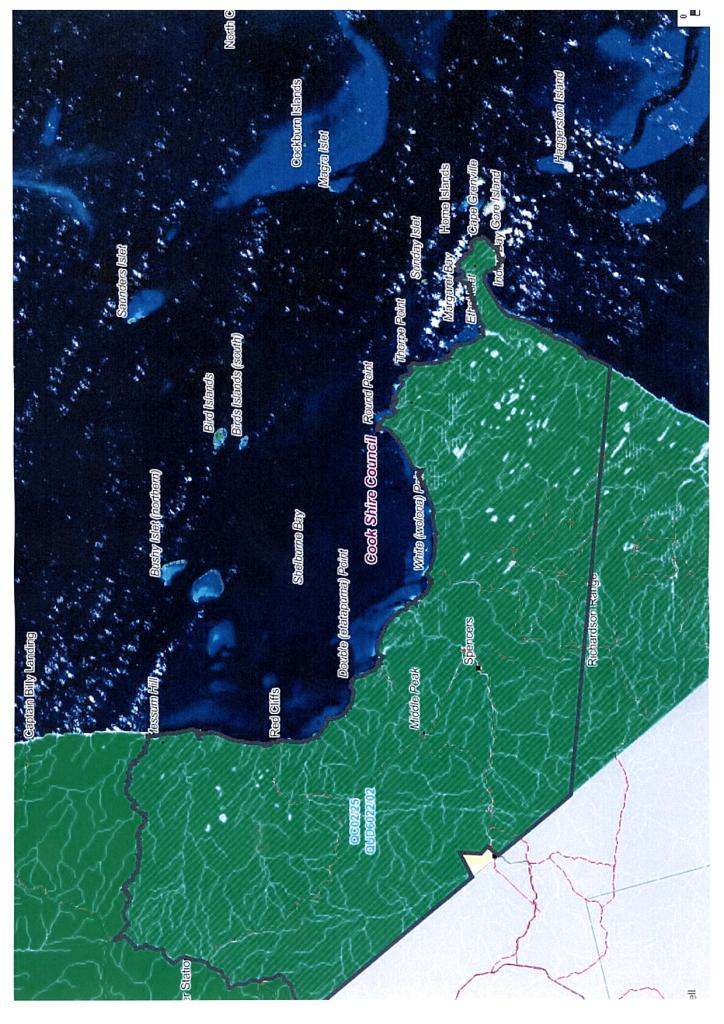
3 The Wuthathi application concerns an area of land comprising a former pastoral holding known as the Shelburne Lease. The boundaries of the application reflect the boundaries of the former pastoral holding. Put simply, the area the subject of the claim concerns an area of land in and around Shelburne Bay on the east coast of Cape York Peninsula. A map depicting the area of the claim is attached as Schedule 1. The southern boundary of the claim is just north of the Olive River. The western boundary extends to the Northern Peninsula Road. The northern boundary of the claim abuts the Heathlands Resources Reserve (at its southern boundary), just north of an area called Messum Hill.
4 The GY people assert that the Wuthathi application covers some of their traditional country and that members of the GY people were not consulted about the Wuthathi application. Mr Meun Lifu says that in March 2009 he wrote to the Cape York Land Council (CYLC) on behalf of the GY people raising his concerns. At the request of the CYLC, Mr David Thompson who has undertaken research in relation to the Wuthathi application, investigated the concerns raised in Mr Lifu’s letter. Mr Thompson’s findings arising out of those investigations are set out in two reports entitled Anthropologist’s Report regarding [GY] claims to interest in the Wuthathi #2 Native Title Application (May 2009) and A Response to Fiona Powell’s [GY] Report (September 2009).
5 The CYLC also asked Dr Fiona Powell to research matters raised in Mr Lifu’s letter. A report arising out of that research was submitted to the CYLC on 14 September 2009.
6 The CYLC also arranged for the GY people to be provided with independent legal advice concerning the matters raised by Mr Lifu. Mr Michael Neal and Ms Clare Farley of p&e Law provided that advice. In November 2009, the National Native Title Tribunal convened meetings between David Thompson and Dr Powell, and meetings between representatives of the Wuthathi and GY peoples in December 2009.
7 No agreement was reached between the Wuthathi and GY peoples concerning the various matters in issue.
8 Mr Lifu, Mr Pausa and Mr Savage have now brought this application on their own behalf and as representatives of the GY people.
9 The application was adjourned in late 2010 with directions orders being made for the filing of affidavits in support of the application, affidavits in response from those respondents electing to put on material, and affidavits in reply on behalf of the applicants. A number of affidavits were filed on 8 November 2010 including an affidavit of Isaac Savage; an affidavit of Thomas Savage; an affidavit of Allan Savage; an affidavit of Justin Edwards and an affidavit of Dr Powell annexing an extensive report entitled Gudang Yadhaykenu Rights and Interests in the Area covered by Wuthathi #2 QC02/25, QUD6022/02. Affidavits had previously been filed by Mr Lifu. He also filed on 8 November 2010.
10 Although the matter was set down for hearing on 1 December 2010, the Chairman of the Wuthathi Aboriginal Corporation, Mr Wallis, sought an adjournment of the application in order to seek legal representation. The matter was adjourned to 23 March 2011 and on the application of the applicants for joinder, the matter was further adjourned to be heard in Cairns on 1 April 2011. On that day Mr Wallis appeared. Mr Matthew Moharich appeared as amicus on behalf of CYLC to advise the Court of the steps taken in an attempt to resolve the matter.
11 The State of Queensland, the Cook Shire Council and the parties representing the fishing interests had previously indicated that they would oppose any joinder of the GY people on the basis that the Wuthathi claim has been on foot since 10 October 1997 and no assertion has previously been made by or on behalf of the GY people of an interest in the Determination Application brought by the Wuthathi people. Moreover, the respondents expressed concern that they had reached the point of a consent determination after the State had accepted the evidence of connection put on by the Wuthathi people.
12 However, the essential position of those parties is that they abide by any determination of the application and neither consent nor actively oppose the application.
The Application
13 Section 84(5) of the Act is well known.
14 It provides that the Federal Court may at any time join any person as a party to the proceedings, if the Court is satisfied that the person’s interests may be affected by a determination in the proceedings, and it is in the interests of justice to do so. The notion of “interests” for the purposes of s 84(5) is a broad conception, not confined to the statutory understanding of the term “interest” in s 253 as that term applies in relation to land or waters. The interests asserted by an applicant for joinder need not be proprietary, legal or equitable in nature; must rise above an interest that an ordinary member of the public might hold; must be genuine; must reflect an affect upon the person’s interests beyond a mere emotional, conscientious or intellectual interest; and, must not lack substance: Byron Environment Centre Inc v Arakwal People (1997) 78 FCR 1; Woodridge on behalf of the Gomilaroi People v Minister for Land & Water Conservation for New South Wales (2003) 108 FCR 527; Dann (on behalf of the Amangu People) v Western Australia [2006] FCA 1249.
15 Apart from these principles, it is well accepted that a person who claims to hold a native title right or interest in relation to the land or waters the subject of a Determination Application, has a sufficient interest for the purposes of s 84(5), on the footing that a final determination of the claimant application will, plainly enough, affect the interests of any person who asserts an interest in the relevant land or waters as the determination operates by force of s 225 of the Act as a judgment in rem, or at least “in a sense” operates as a determination in rem (Munn (for and on behalf of the Gunggari People) v State of Queensland [2002] FCA 486 at [7] and [8]): Kokatha Native Title Claim v South Australia (2005) 143 FCR 444; at [22], [24] and [25]; Holborow v State of Western Australia [2009] FCA 1200 at [4] and [5] and Munn at [7] and [8]. By force of s 68 of the Act, there can only be one approved determination of native title in relation to a particular area.
16 In determining whether the applicants for joinder have demonstrated to the satisfaction of the Court, on the facts, that their interests may be affected by a determination in the proceedings, the Court does not embark upon an assessment of contested questions of fact or otherwise seek to determine where the merits ultimately lie. The question is simply whether, having regard to the assertions of fact, the Court can be satisfied that the person’s interests may be affected by a determination of native title in favour of the applicants in the principal proceeding. In that sense the question is an analogue of whether there is a serious question of affectation of the person’s interests, to be determined. There must be some factual foundation asserted in support of the affected interest. These principles are consistent with Isaacs (Turrbal People) v Queensland (No 2) [2011] FCA 942.
17 In this application the applicants on the motion rely upon the factual assertions set out in the affidavits earlier mentioned.
18 The applicants for joinder rely upon the extensive report of Dr Powell. In that report, Dr Powell examines the nature and composition of the group of people generally known as the GY people; the relationship of the GY people to the pre-sovereignty population associated with the area claimed by the Wuthathi people in their determination application; the traditional laws and customs acknowledged and observed by the GY people which give rise to rights and interests in the claim area said to be exercisable by the GY people; the content of the rights and interests of the GY people in the area of the Wuthathi claim; and, the connection of the GY people to the claim area under those laws and customs.
19 Dr Powell sets out in her report the methodology adopted in examining those matters and the range of primary and secondary source material considered. Although Dr Powell observes that the research she was able to undertake in order to complete the report was limited and further research is necessary in order to address the wider question of connection, Dr Powell concludes that the nature of the interest asserted by the GY people in the area covered by the Wuthathi application “is a native title interest”, having regard to her assessment of the matters described at [18] of these reasons.
20 Dr Powell notes that the extent of the territorial interests of the GY people needs further work and clarification, especially the southern boundary of that interest. One view is that the point known as “Captain Billy” marked the southern extent of the interests of the GY people. A second view is that those interests extended south at least as far as a point known as “Red Cliffs”. A third view is that GY country extends to a place called “Whitesand”. Another view is that GY people are east coast people associated with an area from “Temple Bay” to “Cairncross”. In undertaking this research for the joinder application, Dr Powell notes that Whitesand includes Shelburne Bay, according to Elizabeth Pausa; Kingcross extends from the tip of Cape York down to Shelburne Bay; Wuthathi share the country at Whitesand with GY people, according to Mr Lifu; GY people assert interests from Cape York to Shelburne Bay according to Mr Allan Savage, and GY country extends from the tip of Cape York to Margaret Bay and to the Olive River, according to Mr Allan Savage.
21 These views of Dr Powell described at [18], [19] and [20] are all in contest on the facts and in the light of other extensive anthropological reports.
22 Irrespective of the merits of these claims, I am satisfied that each of the three applicants on the motion for joinder have demonstrated, on the material, interests which may be affected by a determination of native title in the principal proceedings in favour of the applicants on their own behalf and on behalf of the Wuthathi people.
23 The interests that might be affected are native title interests. Although the holder of a native title interest has a sufficient interest to warrant participation in the proceeding in question and thus joinder as a respondent so as to resist a determination in favour of the Wuthathi applicants (that is to say an interest asserted in a defensive way), the Court cannot make a determination of native title in favour of the GY people arising out of an examination of a defensive assertion of a native title interest by the joined respondents. If the GY people, as a people, wish to make (by claimant individuals properly authorised on their behalf in accordance with the Act (s 251B)) a native title determination application, they must do so in accordance with s 13(1) and s 61 and Pt 4 of the Act: Commonwealth of Australia v Clifton [2007] FCAFC 190. The Court will not make a determination of native title in favour of the GY people simply by means of a declaration under the Federal Court of Australia Act 1976 (Cth) arising out of an examination of a factual contest as to the rights and interests of the respondents in answer to the Wuthathi claim.
24 In these proceedings, the joinder applicants seek to be joined on their own behalf so as to agitate the affect upon their contended native title interests as individual GY people and also in a representative capacity on behalf of all GY people. They do so on the footing that all members of the GY people share a common interest and a common affectation upon those interests by reason of the Wuthathi claim. To the extent that the joined respondents resist the Wuthathi Native Title Determination Application by demonstrating that they enjoy native title in relation to parts or all of the Wuthathi claim area (in common with the Wuthathi people or otherwise), all members of the GY people (as that descent group might define themselves) would be likely to enjoy the same interests and the same affect upon those interests as the joined respondents.
25 In that sense, there is likely to be a common interest to be agitated.
26 Nevertheless, a claim by the GY people for a determination of native title over some or all of the area claimed on behalf of the Wuthathi people must be made in accordance with the Act under s 13(1), by a s 61 application, by persons authorised by the native title claim group (the GY people) according to their traditional laws and customs or by an agreed process of decision-making adopted for so authorising persons to make such a claim (s 251B(a) or (b)).
27 I am satisfied that the three individual applicants ought to be joined as respondents in the proceeding. Under s 84(3), a person who claims to hold native title in relation to land or waters in the area covered by an application is, by operation of the Act, a party to the proceeding if the person has notified the Court in writing within three months of the notification day (s 66(10)(c)) that he or she wants to be a party to the proceeding. Section 84(5) provides for joinder at any time of any person whose interests (including a claim to hold native title in relation to a particular area covered by an application) may be affected by a determination in the relevant proceedings and it is in the interests of justice to do so. Section 70 of the Act provides that an application (the Wuthathi application) must comply with the Rules of the Federal Court about “any .. matter relating to the application” (s 70(1)(d) of the Act). Rule 9.21(1) of the Federal Court Rules 2011 seems to contemplate that a proceeding may be continued against one or more persons who have the same interest in the proceeding, “as representing all or some of the persons who have the same interest and could have been parties to the proceeding”. The Rules seem to contemplate representative respondents who share a common interest in a proceeding and such a rule seems to apply to a proceeding concerning a native title determination application under the Act.
28 Although the applicants for joinder assert that they share a common interest with the GY people, the material does not demonstrate that any process whether by means of the traditional laws and customs of the GY people or by some other decision-making process adopted by the GY people, has been engaged which has enabled the GY people to say or resolve that they accept that the applicants for joinder represent their common interest or have their approval to represent their interests.
29 Accordingly, it seems to me that the proper course is to join the three individuals as respondents in the proceeding simply in their own individual capacities. It may be that a process will be adopted which makes plain that the GY people accept that the applicants for joinder share a common interest with the GY people and that the joinder applicants have standing to represent that common interest for and on behalf of all members of the group (appropriately defined, assuming no differences emerge about the definition of the descent group comprising the GY people). It may also emerge that the GY people authorise for the purposes of s 251B of the Act the applicants to maintain a native title determination application in relation to a part or the whole of the Wuthathi claim area.
30 Although it is suggested that there have been substantial delays on the part of the applicants for joinder asserting an affect upon their interests by reason of the Wuthathi claim, I am satisfied having regard to the affidavit material that any delay ought not to prejudice or defeat the joinder of the applicants so as to enable those individuals to demonstrate the contended affect upon their interests should a native title determination be made in favour of the Wuthathi people.
31 I propose to call upon the parties to suggest directions orders that might be made to address the future conduct of the matter consequent upon the joinder of the three individuals. I propose to call upon the parties to show why these issues ought not be further mediated in a process controlled by or under the direction of the Federal Court.
32 Mr Neal appeared pro-bono on behalf of the applicants on the motion. On 26 March 2012 the Court sought advice from Mr Neal as to whether he had been advised whether the applicants for joinder had appointed lawyers, since the conclusion of the application, to act on their behalf. Mr Neal advised the Court that no notice of appointment of new solicitors has been given to him. Accordingly, the Court will give notice of the publication of this judgment to the former lawyers, p&e Law, for the applicants on the motion.
I certify that the preceding thirty-two (32) numbered paragraphs are a true copy of the Reasons for Judgment herein of the Honourable Justice Greenwood. |
Associate:
SCHEDULE 1