

FEDERAL COURT OF AUSTRALIA
Edgetec International Pty Ltd v Zippykerb (NSW) Pty Ltd [2012] FCA 281
IN THE FEDERAL COURT OF AUSTRALIA | |
EDGETEC INTERNATIONAL PTY LTD ACN 010 728 784 Applicant | |
AND: | ZIPPYKERB (NSW) PTY LTD ACN 109 959 337 First Respondent |
GEORGE MAY Second Respondent |
DATE OF ORDER: | |
WHERE MADE: |
THE COURT ORDERS THAT:
1. Within seven days, the parties bring in orders to reflect the conclusions reached in the reasons for decision published on 23 March 2012.
Note: Entry of orders is dealt with in Rule 39.32 of the Federal Court Rules 2011.
QUEENSLAND DISTRICT REGISTRY | |
GENERAL DIVISION | QUD 55 of 2011 |
BETWEEN: | EDGETEC INTERNATIONAL PTY LTD ACN 010 728 784 Applicant
|
AND: | ZIPPYKERB (NSW) PTY LTD ACN 109 959 337 First Respondent GEORGE MAY Second Respondent
|
JUDGE: | REEVES J |
DATE: | 23 MARCH 2012 |
PLACE: | BRISBANE |
REASONS FOR JUDGMENT
Claims of trade mark infringement
1 Edgetec International Pty Ltd (Edgetec) and Zippykerb (NSW) Pty Ltd (Zippykerb) are competitors in the concrete edging business in Australia. Edgetec sells franchises for concrete edging businesses and trades under the name Kwik Kerb. Zippykerb sells equipment, training and marketing materials to concrete edging businesses and trades under the name Zippykerb. Mr George May, the second respondent, is the main individual behind Zippykerb.
2 Edgetec is the registered owner of five trade marks which it uses in connection with its concrete edging business. Two of those trade marks are word marks and the other three are stylised marks. It is the two word marks that are central to these proceedings. Their details are as follows:
a. Trade Mark No: 620691
Trade mark: Kwik Kerb
Lodgement Date: 18.01.1994
Class: 7 – Concrete edging machines;
b. Trade Mark No: 620692
Trade mark: Kwik Kerb
Lodgement Date: 18.01.1994
Class: 37 – Construction and repair services pertaining to kerbing, channelling, edging and paving …
3 Edgetec claims that Zippykerb and Mr May have together used these two registered trade marks, as trade marks, in two ways.
4 First, in a number of internet domain names that Mr May has registered with the company that is responsible for granting domain name licenses in Australia: .au Domain Administration Ltd. The domain names that Mr May has registered include the following:
www.kwikcurb.net; and
It is the use of the words “Kwik Kerb” in the first three domain names listed above, that is at the heart of this complaint.
5 Secondly, Edgetec complains that all of the above domain names are linked to a single website: www.zippykerb.com. And, when one opens that website, the words “Kwik Kerb” appear numerous times in different contexts on the web pages located on that site. Some of the pertinent parts of the first web page are set out hereunder.
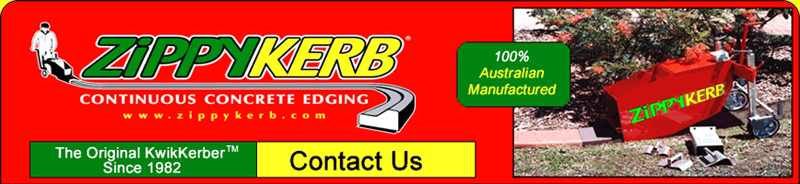
Why we are so much cheaper than our competition >>
ZIPPYKERB - Kwik KerberTM business opportunity is now only $7,420 plus GST Superb Value for a business that can earn over $1,500+ a day.
ZippyKerb KwikKerber™ is NOT A FRANCHISE every cent you earn is yours! No ongoing fees of any kind – Ever!
Thank you for visiting ZIPPYKERB - We are the original inventors of the worldwide "ZIPPYKERB Kwik Kerber Continuous Concrete Edging”
Developing the first Zippykerb Kwik Kerber in Newcastle, Australia in1982, with our first patent applied for in 1983.
…
Our full price is just $7,420 plus gst with no ongoing royalties, fees or costs of any kind. Included is the new look, faster ZIPPYKERB - Kwik Kerber with 4 different profile moulds, the hand tools for the moulds, training and marketing manuals as well as specialised stamping process to create our exclusive KwikBrik™.
…
George May: Managing Director
Tel: 0408 143 484 contact@zippykerb.com
PLEASE! Don’t buy a Kwik KerbTM business until you know the FACTS!
[Emphasis in original]
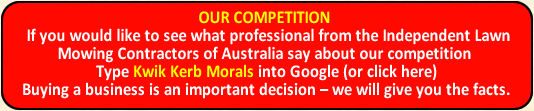
6 On the remainder of the web pages, the words “Zippykerb – Kwik Kerber” or the words “Zippykerb – Kwib Kerb er” appear numerous times. Near the end of the website a box under the heading “Our Competition” appears as follows:
The relevant legislative provisions
7 Edgetec claims that the majority of these uses of its registered trade marks “Kwik Kerb” are in breach of s 120(1) of the Trade Marks Act 1995 (Cth) (the Act). It seeks a permanent injunction against Zippykerb under s 126(a) of the Act. Section 120(1) relevantly provides:
A person infringes a registered trade mark if the person uses as a trade mark a sign that is substantially identical with, or deceptively similar to, the trade mark in relation to goods or services in respect of which the trade mark is registered.
8 There are three elements specified for a trade mark infringement under this section. They are that the offending sign or words must be:
(a) substantially identical with, or deceptively similar to, the trade mark;
(b) used as a trade mark; and
(c) used in relation to goods or services in respect of which the trade mark is registered.
To meet the first element (in (a) above), either one is sufficient.
9 Two other provisions of the Act are worthy of note. Section 6 provides that a “registered trade mark” is one whose particulars have been entered in the Register under the Act. Section 17 provides that:
A trade mark is a sign used, or intended to be used, to distinguish goods or services dealt with or provided in the course of trade by a person from goods or services so dealt with or provided by any other person.
[Emphasis in original]
Zippykerb defends its uses of “Kwik Kerb”
10 Zippykerb and Mr May do not dispute that: they hold the licences for the domain names described above; they maintain the Zippykerb website also described above; and that the domain names and the website are used to sell the goods or services in respect of which the “Kwik Kerb” trade marks are registered. It follows from this last concession that there is no dispute about the third element in s 120(1): see [8](c) above. However, Zippykerb defends its various uses of the words “Kwik Kerb” on the following grounds.
11 As to the use of the words “Zippykerb Kwik Kerber Continuous Concrete Kerbing” on its website, it says that use does not infringe Edgetec’s registered trade marks because:
i. the trade mark is not substantially identical with or deceptively similar to the Applicant’s Australian Registered Trade Marks;
ii. the words “Kwik Kerber Continuous Concrete Kerbing” are words used to describe the goods and services being offered by the Respondents;
iii. the Respondents would obtain registration of the trade mark “Zippykerb Kwik Kerber Continuous Concrete Kerbing” should the Respondents apply for such registration.
12 As to the use of the words “Kwik Kerber” on its website, it says that use does not constitute an infringement of Edgetec’s registered trade marks because:
i. the words are not substantially identical with or deceptively similar to the Applicant’s Australian Registered Trade Marks;
ii. the work “Kwik” is a word used in everyday English language as being synonymous with the English word “Quick”;
iii. the word “Kerber” is a word used in everyday English language;
iv. the words are used to describe the goods and services being offered by the Respondents.
v. the manner of the Respondents’ only use of the words on its websites www.zippykerb.com and www.zippykerb.com.au is not likely to deceive or cause confusion that the goods and services being offered by the Respondents are those of the Applicant as the Respondents’ (sic) state directly that it is not “Kwik Kerb” and it clearly distinguishes in a comparative manner its goods and services from those of “Kwik Kerb”.
13 Finally, as to the use of the domain names www.kwikkerbing.com, www.kwikkerber.com.au and www.kwikkerber.com, it says these uses do not infringe Edgetec’s registered trade marks because:
i. the words are not substantially identical with or deceptively similar to the Applicant’s Australian Registered Trade Marks;
ii. the word “Kwik” is a word used in everyday English language as being synonymous with the English word “Quick”;
iii. the word “Kerbing” is a word used in everyday English language;
iv. the words are used to describe the goods and services being offered by the Respondents;
v. the manner of the Respondents’ use of the website www.kwikkerbing.com is only for the purpose of redirecting users to the Respondents’ website www.zippykerb.com where that website is not likely to deceive or cause confusion that the goods and services being offered by the Respondents are those of the Applicant as the Respondents’ (sic) state directly on the website that it is not “Kwik Kerb” and it clearly distinguishes in a comparative manner its goods and services from those of “Kwik Kerb”.
14 These defences variously correspond to the first and second elements in s 120(1): see [8](a) and (b) above. I will deal with them in that order.
Substantially identical with
15 The first defence raised by Zippykerb (see [11](i), [12](i) and [13](i) above) is that the words used in the domain names and on the website are “not substantially identical with, or deceptively similar to” the trade marks. The test as to whether a trade mark and a sign are substantially identical requires a side-by-side comparison of the two. That test was expressed by Windeyer J in Shell Company of Australia Limited v Esso Standard Oil (Australia) Limited (1963) 109 CLR 407 at 414 as follows:
In considering whether marks are substantially identical they should, I think, be compared side by side, their similarities and differences noted and the importance of these assessed having regard to the essential features of the registered mark and the total impression of resemblance or dissimilarity that emerges from the comparison.
16 On this issue, Edgetec specifically relied upon the decision of Bennett J in Wellness Pty Limited v Pro Bio Living Waters Pty Limited [2004] FCA 438. In that case, the registered trade mark used the words “Living Water” and the alleged infringing sign used the words “Living Waters”. In finding that the two were substantially identical, her Honour said (at [35]):
When LIVING WATER and LIVING WATERS are compared side by side it is clear that there is a total impression of resemblance notwithstanding the presence of the “s” in the latter, making “waters” plural. That is of minor significance and does not derogate from the fact that the essential features of the mark are present.
17 Applying these principles in this case, I consider that on a side-by-side comparison, the signs or words “Kwik Kerber”, “Kwik Kerb er” and “Kwik Kerbing” are all substantially identical to Edgetec’s registered trade marks “Kwik Kerb”. Dealing first with the essential features of the registered trade marks, they both begin with the coined word “Kwik” and that word is then immediately followed by (but separately from) the English word “Kerb”. Further, aside from their use in the domain names, to which I will return shortly, the letter “k” at the beginning of each word is capitalised. It is to be noted that capitals are generally used to make a word or words specific in their reference: see The Oxford Guide to Style (2nd ed, Ritter R, Oxford University Press, 2002) at [4.1.4].
18 Then, turning to the signs or words used by Zippykerb on its website, it is apparent, in my view, that all of these essential features are present in all of them. Indeed, the appearance and separation of the first two words in both, including the capitalisation of the letters “k”, is identical. The only differences are that Zippykerb has added the letters “er” (sometimes with a space) or “ing” after the word “Kerb”. However, taking into account that the first eight letters are identical in all respects, I do not consider the addition of the two letters “er”, nor the three letters “ing”, at the end, significantly affects the total impression of resemblance between the two. In the words of Bennett J, they do not “derogate from the fact that the essential features of the mark are present”. It follows that I consider that the signs or words used by Zippykerb on its website (at [17] above) are substantially identical to Edgetec’s registered trade marks.
19 However, as alluded to above, this conclusion is not quite so clear in relation to Zippykerb’s use of the signs or words in the three domain names. This is so because two of the features mentioned above are absent. First, the capitalisation of the letter “k” at the beginning of each word, and secondly, the fact that the two words are combined, not separate. While the first two words are not identical – as they are with the words used on the website – nonetheless, I still consider that the combined use of the coined word “kwik” with the English word “kerb” conveys the same overall impression of resemblance such that Zippykerb’s usage of those words in its three domain names is substantially identical to Edgetec’s registered trade marks.
20 Having reached this conclusion, it is unnecessary to consider whether the trade marks and Zippykerb’s signs or words are also deceptively similar. This conclusion also disposes of Zippykerb’s defence that it would obtain registration of a trade mark using the words “Kwik Kerber” (see [11](iii) above).
Use as a trade mark
21 The remainder of the matters raised by Zippykerb essentially relate to the second element in s 120(1) (see [8](b) above): whether Zippykerb has used the substantially identical signs or words (above) as a trade mark. Zippykerb has expressed this defence in various ways: that the words are used to describe the goods and services being offered by it (see [11](ii), [12](iv) and [13](iv) above), that the words used are everyday English words (see [12](ii) and (iii) and [13](ii) and (iii) above) and that the words are used to redirect internet users to Zippykerb’s website where it is made clear that Zippykerb is not Kwik Kerb and its goods and services are clearly distinguished from and compared with those of Kwik Kerb (see [13](v) above).
22 In Mantra Group Pty Ltd v Tailly Pty Ltd (No 2) (2010) 183 FCR 450; [2010] FCA 291 (Mantra Group), I set out a summary of the legal principle’s bearing on whether a person has used a mark as a trade mark (at [50]). It is convenient to repeat that summary here:
(a) Use as a trade mark is use of the mark as a “badge of origin” in the sense that it indicates a connection in the course of trade between goods or services and the person who applies the mark to those goods or services. It has been described as “planting a flag to identify the fact you are in a particular trader’s territory”: see Johnson & Johnson Australia Pty Limited v Sterling Pharmaceuticals Pty Limited (1991) 30 FCR 326 (“Johnson & Johnson”) at 342 per Burchett J and 347 per Gummow J, Coca Cola 96 FCR 107 at [19] and Global Brand Marketing Inc v YD Pty Ltd (2008) 76 IPR 161 (“Global Brand”) at [45] per Sundberg J;
(b) In determining whether a sign is used as a trade mark, one does not ask whether the sign indicates a connection between the alleged infringer’s services and those of the registered owner. Instead, one asks whether the alleged infringer has used the sign so as to indicate that the origin of the services was in itself: see Coca Cola 96 FCR 107 at [20], [28] and Global Brand 76 IPR 161 at [47];
(c) The latter question is the question that has to be determined at this threshold stage: see Coca Cola 96 FCR 107 at [30]. The determination of this threshold question only involves an examination of the impugned mark, not the registered trade mark: Global Brand 76 IPR 161 at [49];
(d) In assessing whether the alleged use is use as a trade mark, the Court is required to examine the purpose and nature of the use in its context. This includes factors such as the positioning of the sign, the type of font used, the size of the words or letters, and the colours which are used, as well as how the sign is applied to the advertising material in question: see Shell Company of Australia Ltd v Esso Standard Oil (Australia) Ltd (1963) 109 CLR 407 (“Shell Company”) at 422 per Kitto J; Johnson & Johnson 30 FCR at 347 per Gummow J; Sports Break Travel Pty Ltd v P & O Holidays Ltd (2000) 50 IPR 51 (“Sports Break”) at [14] per Burchett J; Christodoulou v Disney Enterprises Inc (2005) 156 FCR 344 at [35] per Crennan J; and Anakin Pty Ltd v Chatswood BBQ King Pty Ltd (2008) 250 ALR 620 at [60]–[61] per Branson J;
(e) This assessment of the purpose and nature of the use of the sign is objective, ie by reference to what a member of the public could be expected to understand by its use: see Shell Company 109 CLR at 425 per Kitto J; Sports Break 50 IPR 1 at [14] per Burchett J and Aldi Stores Ltd Partnership v Frito-Lay Trading Company GmbH (2001) 190 ALR 185 (“Aldi”) at [76] per Lindgren J;
(f) The words (of a mark) may be used to describe the goods or services concerned, but still serve as a badge of trade origin: see Johnson & Johnson at 343, 347 and Coca Cola 96 FCR 107 at [26]. The question is whether consumers are being invited to purchase the services on the basis that they are to be distinguished from that of other providers of those services partly because they are described by the words used: see Johnson & Johnson 30 FCR at 347–348 per Gummow J, Coca Cola 96 FCR 107 at [26]; and cf Aldi 190 ALR 185 at [23] per Hill J and [60] per Lindgren J;
…
[Emphasis in original]
23 Drawing from those principles, the question here is: did Zippykerb use the substantially identical signs or words (at [17] above) as a “badge of origin” to indicate that it was the origin of the goods and services represented by those words? In answering that question one must make an objective assessment from the perspective of an ordinary member of the public, of the understanding of the purpose and nature of their use, in context. That assessment will include the positioning, size, frequency and font involved in their use, together with the way in which they are used to refer to Zippykerb’s goods and services.
24 It is convenient to begin this assessment by dealing with the last of Zippykerb’s propositions (see at [21] above). If, as it says it did (see at [13](v) above), Zippykerb used the substantially identical signs or words in a domain name to redirect internet users to its website and that website displays, as it plainly does (see at [5] above), the goods and service being offered by Zippykerb, I consider this is trade mark use of those signs or words. That is so because this use of a domain name to redirect potential customers to a website displaying one’s goods and services is analogous to using those words as a sign on the front of a shop to indicate the goods or services that are sold within: see Solarhart Industries Pty Ltd v Solar Shop Pty Ltd (2011) 281 ALR 544; [2011] FCA 700 at [50] per Perram J; Sports Warehouse Inc v Fry Consulting Pty Ltd (2010) 186 FCR 519, [2010] FCA 664 at [153] per Kenny J and Mantra Group at [53]. Furthermore, once this trade mark use has been made of those words, it is immaterial, in my view, whether there are statements on the website (or inside the shop in the analogy above) stating that the goods and services offered are not those of the holder of the registered trade mark. If anything, this confirms the original trade mark use of those words in the domain name.
25 The balance of Zippykerb’s propositions (see at [21] above) are essentially to the same effect: that Zippykerb used the substantially identical words – “Zippykerb Kwik Kerber Continuous Concrete Kerbing”, “Kwik Kerber” or “Kwik Kerb er” on its website and “kwikkerber” or “kwikkerbing” in the domain names – as everyday English words to describe the goods and services it was offering. To support its claim that these words are everyday English words, Zippykerb has produced evidence of various Google searches it has undertaken to attempt to show that the words “Kwik” and “Kerber” are in everyday use on the worldwide web.
26 It is well-established that this kind of descriptive use, viz using everyday English words to describe the goods and services a trader is offering, is not trade mark use. In Mark Foy’s Limited v Davies Coop & Company Limited (1956) 95 CLR 190 (Mark Foy’s), Williams J outlined why that is so (at 199) by reference to the speech of Lord Herschell in Eastman Photographic Materials Co. Ltd. v Comptroller-General of Patents, Designs and Trade Marks (1898) AC 571 as follows:
[A]ny word in the English language may serve as a trade-mark––the commonest word in the language might be employed. In these circumstances it would obviously have been out of the question to permit a person by registering a trade-mark in respect of a particular class of goods to obtain a monopoly of the use of a word having reference to the character or quality of those goods. The vocabulary of the English language is common property: it belongs alike to all; and no one ought to be permitted to prevent the other members of the community from using for purposes of description a word which has reference to the character or quality of goods.
27 Later, referring to the words “Tub Happy” which were at the centre of the dispute in that case, Williams J said (at (202)):
There is nothing in the registration of these words to prevent the defendants describing their cotton goods as having the qualities of washability, freshness and cheapness, and in particular the first of these qualities. The whole English language is open to them, even the most up to date English, if the defendants wish to refer to these qualities “in a modern descriptive sense”.
28 The apparent dichotomy between trade mark use and descriptive use was addressed by Hill J in Aldi Stores Ltd Partnership v Frito-Lay Trading Company GmbH (2001) 190 ALR 185; [2001] FCA 1874 (Aldi) at [23], as follows:
Where the sign or mark is an invented word or invented combination of words, it will usually be easy to conclude that use on packaging or on the goods themselves is a trade mark use, although as the Johnson & Johnson case demonstrates some invented words might (while not yet having entered into the English language) themselves suggest a meaning, so that a particular use may not be a trade mark use. Where the word has or a combination of words have a clear meaning in ordinary use, the question will be much more difficult as the word or combination of words may either have taken on a secondary meaning indicating the origin of the goods or may simply convey an ordinary meaning (that is, some message other than the trade origin of the goods) …. It is well established that there is not a true dichotomy between words capable of being used as a badge of trade origin and words that are descriptive….
[Case references omitted]
29 It follows from these decisions that, while the vocabulary of the English language is common property available for use by all traders to describe their goods and services, words or expressions that have been coined or invented and used as such to signify a particular trader’s goods and services are generally not. So in Mark Foy’s, the defendant had available to it “the whole English language … even the most up to date English” to describe its goods and services, but it could not resort to this “common property” principle to justify its use of the expression “Tub Happy” because that expression had been coined by the plaintiff and used as a badge of origin for its goods and services.
30 Nonetheless, as Hill J noted in Aldi, some coined or invented words can concurrently: have acquired a descriptive meaning; not have entered everyday usage in the sense that they are not known to recognised dictionaries; and yet not have acquired a secondary and distinctive meaning indicative of the origin of particular goods and services. That was the situation in Johnson & Johnson Australia Pty Limited v Sterling Pharmaceuticals Pty Limited (1991) 30 FCR 326 (Johnson & Johnson) in relation to the word “caplets”. However, to reach that conclusion in that case, the Court had before it “a considerable body of evidence” about the descriptive meaning that word had acquired in the pharmaceutical context with respect to humans and veterinary products (see at 336–8) and a corresponding lack of evidence that the word had acquired a secondary and distinctive trade mark meaning (see at 339).
31 I do not consider Zippykerb has adduced evidence that would allow that conclusion to be drawn in this case. There is little doubt that the words “Kwik” and “Kerber” are coined or invented words and neither of them appears in either the Macquarie Dictionary or the Oxford Dictionary, which are the commonly accepted reference points for English usage in Australia. However, apart from the results of Google searches that simply show how many times those words appear on the web pages accessed by the Google search engine, Zippykerb has not produced any evidence that they have acquired a distinctive meaning indicative of the origin of particular goods and services in the concrete edging business, or any similar relevant context.
32 This would be sufficient to dispose of Zippykerb’s propositions that it has used these coined or invented words descriptively. However, since the determination of trade mark cases inexorably depends on the particular facts and circumstances of each case (see Johnson & Johnson at 341), it is appropriate to consider the facts and circumstances of this case because I consider that they provide additional support for the conclusion that Zippykerb has used the words (at [25] above) as trade marks, rather than any descriptive manner.
33 That requires a closer examination of Zippykerb’s website.
34 The masthead and some of the pertinent parts of the first page of its website are set out at [5] above. A closer examination of that and the subsequent pages reveals the following aspects: the signs or words “Kwik Kerber” are used 23 times in all, on some occasions with the letters “TM” following. The first use is in the heading: “The Original KwikKerberTM Since October 1982”. Then the other 22 uses all involve the composite signs or words “Zippykerb Kwik Kerber”, or “Zippykerb Kwik Kerb er”, some with a hyphen between the words “Zippykerb” and “Kwik Kerb” and some followed by the letters “TM”. In addition to the examples set out at [5] above, those 22 usages include the following:
“ZIPPYKERB - Kwik Kerberproduces high quality continuous concrete edging in a variety of shapes and designs it is the fastest and easiest continuous edging machine to use and operate”
…
“The ExclusiveZIPPYKERB- Kwik Kerber Training Manuals”
…
“Since developing Zippykerb - Kwik Kerb er in 1982 we have gone on to develop a number of very successful local and international businesses:” …
…
“The experience and success we have to pass on in all aspects of Business, Training and the Internet is a major positive to consider becoming aZIPPYKERB - Kwik Kerb erowner.”
35 In all but the first usage of these words (as to which see [36] below), Zippykerb has simply added the words “Kwik Kerber” or one of the variations thereof (above) after its trading name “Zippykerb”. All of these uses are, in my view, trade mark uses of those words. That is, they are used as a badge of origin for the goods and services of Zippykerb as described in [23] above. Conversely, there is no attempt to use those words descriptively in relation to Zippykerb’s goods and services. For example, Zippykerb has not used them to tell potential customers its Zippykerb product is a quick (or even a kwik) means of creating concrete kerbing. Instead, it has plainly used them to signify it is the origin of the goods and services of the sign “Kwik Kerb”. It has therefore acted in a similar way to the defendant in Mark Foy’s by adding the sign “Tub Happy” after its mark “Exacto cotton garments”.
36 In relation to the first usage, Zippykerb has used the sign “Kwik Kerber” to imply that it is the origin of the original product represented by the words “Kwik Kerb”. This, too, is, in my view, trade mark use. Further, the addition of the letters “TM” in the second (and one other) statement: “ZippyKerb KwikKerber™ is NOT A FRANCHISE every cent you earn is yours! No ongoing fees of any kind – Ever!” (see at [5] above) rather confirms the trade mark usage of the sign “Kwik Kerb”. It certainly does nothing to alter either the immediately preceding, or any of the 20 odd succeeding, trade mark uses of those words.
37 Finally, I do not consider this conclusion is affected by the attempts Zippykerb has made elsewhere on its website to distinguish itself from those associated with the mark “Kwik Kerb”, or to make competitive comparisons with the goods and services represented by that mark.
38 On this point, it is to be noted that the mark “Kwik Kerb”, sometimes with a lower case “k” and sometimes with the letters “TM” or the symbol “®” following, appears elsewhere on the Zippykerb website on 11 occasions. The first usage occurs just below the heading as shown in [5] above. The second occurs at the bottom of the first page – it is also shown in [5] above. Apart from the final usage which appears in the box near the end of the site (see [6] above), the other eight uses appear in two boxes at the bottom right hand corner of the first page and the top right hand corner of the second page. Those boxes appear as follows:
Don’t pay many $1000’s of dollars for next to nothing! Zippykerb Owners Agree: Zippykerb is far better value for money than our competitor Kwik Kerb® To see what professionals from the Independent Lawn Mowing Contractors of Australia say about our competitor. Click Here Buying any business is an important decision Zippykerb is GENUINE value for money. |
TO BE CLEAR: We are NOT KwikKerb™ We do not want to be associated with Kwik Kerb in any way. We Began business in 1982 many years before KwikKerb™. Kwik Kerb is charging what we consider to be ridiculous prices for their business opportunity. You can save many $1,000’s on the asking price of a KwikKerb Business with our Zippykerb Package and purchase a new or used mixer and trailer (or Ute) locally. You will find that Zippykerb offers REAL value for money as a proven full or part time business. We are the original inventors of the Zippykerb Continuous Concrete Edging. Zippykerb is a better deal than Kwik Kerb in HUGE cost advantage, in the quality of the Zippykerb Machine, our training manuals, our lead generation web sites and our ongoing support from over 30 years’ experience. ZippyKerb (the Original) is NOT KwikKerb™ George MayManaging Director SydneyMay 2011 |
[Emphasis in original]
39 In each of these eight uses, the “Kwik Kerb” mark has been used to attempt to distinguish Zippykerb from Kwik Kerb, or to compare the price of Zippykerb’s product with the product associated with the “Kwik Kerb” mark. It may be accepted that none of these particular uses is a trade mark use. Nonetheless, they do not, in my view, act to reverse or ameliorate the trade mark usage of the “Kwik Kerb” mark that has occurred elsewhere on Zippykerb’s website: see Johnson & Johnson at 349 and Mantra Group at [50(f)] (set out at [22] above) and [67]–[68].
40 For these reasons, I consider Edgetec has established that Zippykerb used, as a trade mark, signs that are substantially identical to its registered trade marks “Kwik Kerb” and thereby infringed those trade marks, in breach of s 120(1) of the Act. Accordingly, I propose to grant the permanent injunction sought by Edgetec. I will hear the parties on the terms of the orders and on costs.
I certify that the preceding forty (40) numbered paragraphs are a true copy of the Reasons for Judgment herein of the Honourable Justice Reeves. |
Associate:


