FEDERAL COURT OF AUSTRALIA
Tricarico v Dunn Bay Holdings Pty Ltd [2012] FCA 271
IN THE FEDERAL COURT OF AUSTRALIA | |
| Applicant | |
AND: | DUNN BAY HOLDINGS PTY LTD (ACN 114 541 230) First Respondent REGISTRAR OF TRADE MARKS Second Respondent |
DATE OF ORDER: | |
WHERE MADE: |
THE COURT ORDERS THAT:
1. The decision of the delegate of the Registrar of Trade Marks made on 2 November 2010 to allow Trade Mark application number 1282656 to proceed to registration be set aside.
2. Unless the applicant files submissions on costs within seven days, in which case the respondents will have seven days to reply, there be no orders as to costs.
3. Any further determination on costs be on the papers.
Note: Entry of orders is dealt with in Rule 39.32 of the Federal Court Rules 2011.
WESTERN AUSTRALIA DISTRICT REGISTRY | |
GENERAL DIVISION | WAD 361 of 2010 |
BETWEEN: | ANTONIO TRICARICO Applicant
|
AND: | DUNN BAY HOLDINGS PTY LTD (ACN 114 541 230) First Respondent REGISTRAR OF TRADE MARKS Second Respondent
|
JUDGE: | MCKERRACHER J |
DATE: | 23 MARCH 2012 |
PLACE: | PERTH |
REASONS FOR JUDGMENT
INTRODUCTION
1 This is an appeal from a decision of a delegate of the Registrar of Trade Marks to register a Trade Mark. The Trade Mark applied for and granted was MALTMARKET BAR & KITCHEN in class 43 in respect of ‘taverns’. The applicant and successful registrant was the first respondent (Dunn Bay). The unsuccessful opponent who now appeals was the applicant (Mr Tricarico).
2 As between the parties, the matters, the subject of this appeal, have been substantially resolved. Insofar as the appeal itself is concerned, while Mr Tricarico appeared by counsel, Dunn Bay did not appear at all and did not oppose the orders sought and I was informed, consented to the appeal being allowed.
3 The second respondent (the Registrar) who was also joined in the appeal was prepared to abide the decision of the Court but was not willing to consent to orders allowing the appeal. No submissions were made as to whether or not the Registrar accepted that Mr Tricarico’s grounds or submissions were correct. I was given to understand that given the possible novelty of some of the issues concerned, the parties would see some merit in those issues being resolved.
4 The arguments upon which these reasons are based did not have the benefit of a contradictor. I emphasise this lest there are errors or omissions which I have not detected.
5 The other point to stress is that as this appeal is a hearing de novo, there has been evidence before me which was not available to the Delegate when she made her decision. Some aspects of that new evidence (not before the Delegate) are central to my conclusion. In allowing the appeal there is no criticism at all of the Delegate’s reasoning which I have found to be persuasive on the information then before her.
6 Finally, by way of introduction, I observe that although the appeal was unopposed by one party and regardless of whether novel questions are raised, it is a requirement of the judicial function that the Court itself be satisfied, one way or another, as to the disposition of the ‘matter’. I consider that there is a ‘matter’ in the constitutional sense as the Registrar will not remove the Trade Mark unless directed to do so by the Court. Insofar as the merits of the appeal are concerned, it is not a proper exercise of judicial power to simply make the order that Mr Tricarico seeks unless I am satisfied that such an order is warranted by provisions of the ‘written’ and ‘unwritten law’. That is particularly so in circumstances where the effect of the appeal succeeding will be to make an order to the Registrar but also because nothing is known of the commercial circumstances as they affect the parties beyond that which appears in the reasons. While not suggesting it is this case, the concept is not unknown of a well funded litigant being able to overbear another litigant for whom the cost and risk of the dispute is not worth the subject matter at stake. I stress that I have no basis for forming any view that this is such a case but in circumstances where an appeal or other proceeding is conceded, it is not appropriate for the Court to exercise the power urged upon it unless it is satisfied that the administration of justice properly requires that course to be taken.
THE APPEAL PROCESS
7 The appeal (de novo) to this Court is under s 56 of the Trade Marks Act 1995 (Cth) (TMA). The power of the Court on the appeal is wide: see s 197(d) and s 197(e) TMA
8 As recently noted by Stone J in Allergan Inc v Di Giacomo [2011] FCA 1540 (at [9]-[10]):
9 An appeal from a decision of the Registrar of Trade Marks or the Registrar’s delegate is by way of a hearing de novo. In New England Biolabs Inc v F Hoffman-La-Roche AG (2004) 141 FCR 1 at [44] the Full Federal Court, referring to an appeal under s 104 of the Patents Act 1990 (Cth) from the decision of the Commissioner of Patents said:
The use of the word “appeal” by Parliament does not confer appellate jurisdiction. There is no doubt that the nature of the appeal provided for in s 104(7) of the Act is one such as to confer original jurisdiction upon the Court. The Court approaches the matter for the first time exercising the judicial power of the Commonwealth, not in order to decide whether the executive decision maker was right or wrong, or otherwise to correct error in the executive decision, but to deal with a subject matter, a controversy, for the first time: Jafferjee v Scarlett (1937) 57 CLR 115, at 119-120, 126; the Bayer case; and Kaiser Aluminium & Chemical Corporation v Reynolds Metal Co (1969) 120 CLR 136 at 142.
10 The same approach has been adopted in relation to appeals from decisions of the Registrar of Trade Marks. In Pfizer Products Inc v Karam (2006) 237 ALR 787 at [5], Gyles J observed that the Court stands “in the shoes of the registrar but decides the issue judicially”: see also Registrar of Trade Marks v Woolworths Ltd (1999) 93 FCR 365 at [32] per French J, Tamberlin J agreeing.
9 Her Honour also went on to consider the standard of proof required of an appellant, a consideration not unimportant in this appeal. Her Honour, with whom I respectfully agree, followed Gyles J in concluding that the ordinary balance of probabilities is the appropriate standard, saying (at [11]-[12]):
11 The applicant bears the onus of proof in establishing the ground or grounds of opposition. The standard of proof has been the subject of considerable discussion in the cases and the issue was discussed at length by Gyles J in Pfizer Products at [6]-[26]. It was there submitted by the applicant for registration that the presumption of registrability implied by s 33 of the Act also implied that a ground of opposition to registration must “be clearly established”, that is to a standard beyond the balance of probabilities. After a detailed examination of the authorities Gyles J rejected this submission as inconsistent with the language of s 55 which directs that in deciding whether to accept or reject a trade mark for registration the Registrar must have regard “to the extent (if any) to which any ground on which the application was opposed has been established”. His Honour concluded at [21] and [26]:
Whether a ground of opposition has been ‘established’ is a conventional concept requiring no particular elucidation. In my opinion, there is no basis upon which the section can be read as ‘the extent (if any) to which any ground on which the application was opposed has been clearly established’, particularly where that implication changes the practical operation of the section by imposing a special high onus of proof. … I cannot find anything in the structure or content of other provisions of the 1995 Act that would point to reading s 55 other than according to its ordinary meaning.
…
I am faced with the clear words of the statute, on one hand, and the opinions of various judges, on the other. There is no binding Full Court authority. I cannot find any instance where a single judge has actually applied the higher standard. In my opinion, in this case, comity does not demand that I depart from my view as to the meaning of the statute. ‘The fundamental responsibility of a court when it interprets a statute is to give effect to the legislative intention as it is expressed in the statute’ per Mason J in Babaniaris v Lutony Fashions Pty Ltd (1987) 163 CLR 1; cited with approval by Mason CJ, Wilson, Dawson, Toohey and Gaudron JJ in John v Federal Commissioner of Taxation (1989) 166 CLR 417 at 439. I will, therefore, approach the matter on the basis that the opponent has to establish a ground of opposition, although not clearly establish such a ground, whether in a summary fashion or otherwise.
12 I respectfully agree with Gyles J’s analysis. As the applicant pointed out his Honour’s view has been accepted in a number of first instance decisions: Kimberly-Clark Worldwide, Inc v Goulimis (2008) 253 ALR 76 at [8(2)] per Jagot J; Television Food Network, GP v Food Channel Network Pty Ltd (No 2) (2009) 80 IPR 314 at [36]-[37] per Collier J; Chocolaterie Guylian NV v Registrar of Trade Marks (2009) 180 FCR 60 at [26] per Sundberg J: Sports Warehouse Inc v Fry Consulting Pty Ltd (2010) 186 FCR 519 at [39] per Kenny J. I am also persuaded by the argument put in the applicant’s written submissions that other first instance decisions which have applied the higher standard of proof appear to have been the result of “misplaced deference” to dicta in Lomas v Winton Shire Council (2003) AIPC 91-839 where the Full Federal Court said that “on one view” an opposition should only be upheld if the trade mark should clearly not be registered. In the face of the Full Court’s express application of the ordinary balance of probabilities standard at [45] of the Court’s reasons, the comment was clearly obiter. In my view the ordinary balance of probabilities standard is the standard according to which grounds of opposition must be established.
10 In my respectful view, her Honour was correct in this assessment.
THE DELEGATE’S REASONS
11 The Trade Mark being opposed was the following:
Registration number: 1282656
Owner: Dunn Bay Holdings Pty Ltd
Lodgement Date: 9 February 2009
Accepted: 25 February 2009
Services: Class 43: Arranging for the provision of food; arranging for the provision of drink; bar services; services for providing drinks; night club services (drinks); provision of a venue for events and functions; taverns; cafe services; cafes; cocktail lounge services; club services for the provision of food and drink; night club services (provision of accommodation), night club services (provision of food); restaurant services; wine bar services
Trade mark: MALTMARKET BAR & KITCHEN
12 As noted in the Delegate’s reasons, the notice of opposition raised two grounds, being those under s 41 and s 44 TMA. The Delegate received evidence in support of the opposition noting that Emerald Lane Pty Ltd (Emerald Lane), controlled by Mr Tricarico, owned the Trade Mark MALT LOUNGE. In its opposition, Mr Tricarico provided information about the intention of Emerald Lane to use the Trade Mark, MALT LOUNGE in respect of a licensed lounge bar business. The business had not then commenced trading (in December 2009) as certain approvals and permissions from various regulatory authorities had not yet then been provided.
13 The Delegate noted that MALTMARKET BAR & KITCHEN was a tavern located in Dunsborough, a country town approximately 250 kilometres south of Perth in or near the Margaret River tourist region of Western Australia. Dunn Bay had indicated that the Trade Mark was first used in August 2009 in respect of ‘tavern services’ – that is, the sale of food and drink, especially a range of beers. The advertising figures included in Dunn Bay’s evidence showed relatively modest marketing expenses according to the Delegate and also demonstrated that Dunn Bay was advertising its business mainly in local newspapers and publications.
14 Noting that the onus was on the opponent (Mr Tricarico) to establish a ground of opposition in order to succeed, the Delegate considered the position under s 41 TMA and, in particular, the requirement that an application for the registration of a trade mark must be rejected if the trade mark is not capable of distinguishing the applicant’s goods or services from the goods or services of other persons. The Delegate noted the evidence and submissions for Mr Tricarico in respect of s 41 as being to the effect that Dunn Bay’s Mark was not inherently capable of distinguishing Dunn Bay’s venue because it was so similar to the MALT LOUNGE Trade Marks that consumers would not be able to distinguish the services of Dunn Bay from the services of Emerald Lane. The Delegate noted Mr Tricarico’s argument that the word ‘Malt’ was the essential component of the Emerald Lane Trade Mark. The endings of all the Trade Marks being the words market, bar and kitchen, lounge and supper club, Mr Tricarico contended they were merely descriptions of the nature of each establishment. The Delegate took that argument to suggest that Mr Tricarico was contending that those descriptive components should be substantially, if not completely, discounted when considering the application for the purposes of s 41 TMA.
15 As to s 41, the Delegate noted that in deciding whether a trade mark was capable of distinguishing an applicant’s services, the Registrar must first take into account the extent to which the trade mark is inherently adapted to distinguish the relevant services from those of other traders (s 41(3)).
16 The Delegate continued (at [17]-[22]) (footnotes omitted):
17. Inherent adaptation to distinguish is a quality within the trade mark itself, and is not something which can be acquired through use or any other circumstances. In the Whopper case, Gibbs J said of the concept of inherent adaptation to distinguish:
Inherent adaptability is something which depends on the nature of the trade mark itself - see Clark Equipment Co v Registrar of Trade Marks [(1964) 111 CLR 511 at 515 - the Michigan case] - and therefore is not something that can be acquired; the inherent nature of the trade mark itself cannot be changed by use or otherwise.
18. Considering ‘the nature of the trade mark itself’ means considering the trade mark as a whole when deciding on its level of inherent adaptation to distinguish. The trade mark applied for may include descriptive material as well as inherently distinctive material. It is the combination of all its features into the trade mark subject of the application which determines exactly what must be considered when looking into its nature.
19. In this case, the trade mark consists of the words ‘Maltmarket Bar & Kitchen’. I have been unable to find a definition of the word ‘maltmarket’ in either the Oxford or Macquarie dictionaries. A Google® search for the term in an effort to find a definition was likewise unsuccessful, though it did reveal the applicant’s website.
20. However, via the Google® search I was successful in finding a definition for the expression ‘MaltMarket’. This expression generally refers to the commodity market for malted grains, mainly barley, designed for use in the brewing, distilling or vinegar-making industries. This expression, however, is not the exact word appearing in the applicant’s trade mark and when considering its dictionary meaning in relation to the services claimed, it is not a term that other traders are likely to desire to use.
21. The standard test for determining whether a trade mark is adapted to distinguish is set out at length in the words of Kitto J in the Michigan case from which the following words are taken:
[T]he question whether a mark is adapted to distinguish [must] be tested by reference to the likelihood that other persons, trading in goods of the relevant kind and being actuated only by proper motives - in the exercise, that is to say, of the common right of the public to make honest use of words forming part of the common heritage, for the sake of the signification which they ordinarily possess - will think of the word and want to use it in connection with similar goods in any manner which would infringe a registered trade mark granted in respect of it.
22. I am satisfied that the applicant’s trade mark, when viewed as a whole and considered under the usual tests for adaptation to distinguish, is inherently adapted to distinguish the applicant’s services from those of other traders. I am satisfied that other traders do not have any legitimate need to refer to their tavern services, or to services which are the same as or similar to tavern services, by use of the words “Maltmarket Bar & Kitchen”. The ground of opposition under the provisions of section 41 has not been established.
17 Having concluded that the ground of opposition under the provisions of s 41 TMA had not been established, the Delegate went on to consider the position under s 44 TMA. The Delegate applied s 44 TMA by comparing the newly registered trade mark with the trade marks which had earlier priority dates and which were either registered or pending registration. The Delegate noted that if an application is to offend under the provisions of s 44 TMA, it must be ‘substantially identical’ with or ‘deceptively similar’ to a trade mark owned by another party which has both an earlier priority date and is claiming the same or similar services. As the Delegate noted, all those requirements must be met. If any are not met, then the provisions of s 44 TMA will not apply.
18 After discussing the accepted test for substantial identity in The Shell Company of Australia Ltd v Esso Standard Oil (Australia) Ltd (1963) 109 CLR 407 per Windeyer J (at 414-415), the Delegate noted that on a side by side comparison, there were some similarities between the trade marks but the overall impression was one of difference rather than similarity such that the trade marks were not substantially identical.
19 The Delegate also had regard to the definition of deceptive similarity in s 10 TMA as being a mark so nearly resembling the other mark that it is likely to deceive or cause confusion. That test for deceptive similarity which was a different test from the test for substantial identity was also set out in the Shell decision to which the Delegate referred as well as the observations of French J (as his Honour then was) in Registrar of Trade Marks v Woolworths Ltd (1999) 93 FCR 365 (at [43]) who in turn quoted Kitto J in Southern Cross Refrigerating Co v Toowoomba Foundry Pty Ltd (1954) 91 CLR 92 (at 594-595).
20 The Delegate concluded by noting that the portion of the Trade Marks which was held in common and which Mr Tricarico submitted was likely to cause confusion was the word ‘MALT’. The Delegate observed (at [31]) that the word was one with a very relevant meaning in the fields of beers and whiskeys and that both Dunn Bay and Mr Tricarico ran businesses selling beers and the word ‘malt’ was thus a relevant and an easily understood reference to those goods.
21 However, the Delegate continued (at [32]) to observe that in Dunn Bay’s Trade Mark the word ‘malt’ formed a relatively small portion of the Trade Mark as a whole. It appears as the first part of the word ‘maltmarket’ not as a word on its own. The relevance in respect of beer or malt spirits was somewhat reduced because of the way it was used within the Trade Mark. Similarly, the Delegate concluded that the likelihood of any connection being assumed between the two Trade Marks was also reduced by the inherent difference in the appearance and meanings of the word ‘malt’ and ‘maltmarket’. The Delegate was of the view that it was unlikely to be seen as connected in any way with trade marks such as ‘Malt Lounge’ or ‘Malt Supper Club’.
22 On that basis, the Delegate considered that she was not satisfied that there was a real tangible danger of confusion between the two Marks, a requirement before the Trade Marks could be seen as deceptively similar. She was also satisfied that the Trade Marks were not deceptively similar and that Mr Tricarico had not established the ground of opposition in respect of s 44 TMA. The Trade Mark application was, therefore, to proceed to registration after one month from the date of the Delegate’s decision, subject to appeal.
THE GROUNDS OF APPEAL
23 The grounds of appeal are that:
a. pursuant to Section 59, [Dunn Bay] does not intend to use or authorise the use of the opposed mark within Australia or to assign the opposed mark to a Body Corporate within Australia in relation to the specified goods and services;
b. pursuant to Section 41, the opposed mark is not capable of distinguishing [Dunn Bay]’s goods and services, in respect of which the opposed mark is sought to be registered, from the goods and services of [Mr Tricarico];
c. pursuant to Section 43, the opposed mark is deceptively similar to [Mr Tricarico]’s Trade Mark Registration Nos. 1218229 and 1284893 registered in respect of similar goods and services;
d. pursuant to Section 44 the opposed mark is substantially identical with or deceptively similar to [Mr Tricarico]’s Trade Mark Registration number 1218229 which has a priority date which is earlier than the priority date of the Trade Mark Application;
e. pursuant to Section 42 the use of the opposed mark would be contrary to law in that it will amount to a contravention of the Trade Practices Act 1974 and also amount to passing off; and
f. pursuant to Section 62A the Trade Mark Application was made in bad faith.
24 The grounds of appeal also contended:
2. The Delegate erred in finding that the opposed mark is inherently adapted to distinguish [Dunn Bay]’s goods and services from the goods and services of other traders, including [Mr Tricarico].
3. The Delegate erred in finding that the use of the opposed mark was not substantially identical with or substantially similar to [Mr Tricarico]’s Trade Mark Registration number 1218229.
4. The Delegate should have found that:
a. the opposed mark is not capable of distinguishing [Dunn Bay]’s goods; and/or
b. the opposed mark is substantially identical with or deceptively similar to [Mr Tricarico]’s Trade Mark Registration number 1218229.
EVIDENTIARY FOUNDATION FOR APPEAL
25 The affidavit material reveals that on or about 7 January 2008, Silver Field applied to register the Malt Lounge Trade Mark in respect of services in class 35, class 41 and class 43. That Trade Mark was entered on to the Register on or about 18 August 2008.
26 A little over a year later, 9 February 2009, Dunn Bay filed the MaltMarket application which sought to register the MaltMarket Trade Mark in class 43 in respect of taverns. As noted, the Registrar accepted the MaltMarket application, advertised the acceptance in the journal and Mr Tricarico filed notice of opposition. The decision of the Delegate as discussed above was given.
27 Mr Tricarico explained that in or about July 2008 he had purchased ‘through Emerald Lane’ the Seven Seas Bar and Restaurant (Seven Seas) from its then proprietors. The purchase included the liquor licence for the premises. Emerald Lane was the owner of the Malt Supper Club. He purchased Seven Seas with the intention of converting it into a late night bar and restaurant to be called Malt Supper Club as an ‘upmarket formal establishment … targeting mature and sophisticated clientele’.
28 On 12 February 2009, Emerald Lane registered the Trade Mark MALT SUPPER CLUB. On 8 May 2008, Silver Field assigned the Malt Lounge Trade Mark to Emerald Lane by deed of assignment. Emerald Lane also registered the business names in Western Australia of Malt Supper Club, Malt Lounge, Malt Room, Malt Supper-Bar. In addition, Emerald Lane has registered domain names of maltsupperclub.net.au, maltsupperclub.com.au and maltlounge.net.au.
29 As soon as Emerald Lane purchased the Seven Seas, Mr Tricarico commenced converting it into the Malt Supper Club. In about July 2008, Emerald Lane engaged a hospitality consultant, Hospitality Total Services Pty Ltd, to advise on and assist with developing Malt Supper Club. The Seven Seas required significant alteration to give Malt Supper Club the particular fit-out that was desired. At about July 2008, Emerald Lane engaged design consultants to create architectural drawings for Malt Supper Club’s refurbishment. Some $2 million was spent fitting-out Malt Supper Club. In October 2008, Emerald Lane engaged a graphic designer to create a logo for Malt Supper Club. There were fees involved with this exercise.
30 For a year from January 2009 there were serious disputes in relation to the City of Stirling’s attempt to convert the Malt Supper Club’s liquor licence into a restaurant licence. The contest required the engaging of solicitors and appealing the City’s decision to the State Administrative Tribunal (SAT).
31 In about January 2010, before the matter was heard before SAT, Emerald Lane settled the dispute with the City who agreed not to change the liquor licence. Emerald Lane had spent approximately $180,000 in legal fees contesting the City of Stirling’s plan to amend the liquor licence. The dispute with the City of Stirling regarding Malt Supper Club’s liquor licence delayed the opening by approximately 18 months. Otherwise it would have commenced trading in December 2008 but, rather, was forced to commence as late as November 2010.
32 Nevertheless, Mr Tricarico submits that the Malt Supper Club and the Malt Trade Marks developed substantial brand, goodwill and reputation throughout Western Australia before it commenced trading. In or about December 2009, Mr Tricarico erected a large billboard on one of Malt Supper Club’s exterior walls facing Beaufort Street to promote the venue which contained the words ‘MALT SUPPER CLUB - COMING SOON’. Beaufort Street is one of Perth’s major arterial roads in a particularly social area. Some $50,000 was spent in promoting Malt Supper Club before it commenced trading in magazines, sponsorship of balls etc. The website became available for public viewing and the most prominent newspaper in Western Australia published on its front page an article regarding Malt Supper Club, then imminent opening. The prominence of the opening was enhanced by the fact that the well known former captain of the Australian Football League football team, the Fremantle Dockers was described as being the business partner of Mr Tricarico.
33 Since Malt Supper Club commenced trading, an average of 1800 patrons have attended each week. It has turned over approximately $60,000 weekly and Emerald Lane has spent a further $40,000 promoting the Malt Supper Club.
34 Expert evidence was also relied upon from Mr Christopher Arrell, a Victorian consultant who is managing director of Hospitality Total Services Pty Ltd. He explained the rationale for Emerald Lane’s expenditure and promotional strategy by reference to comparative ventures in Victoria, New South Wales and Western Australia. He expressed the opinion that it would be natural and an understandable desire for Mr Tricarico to seek to extend the brand of ‘Malt Supper Club’ and ‘Malt Lounge Bar’ into the Margaret River region and thus emulate the success of two other Western Australian businesses and capitalise upon goodwill it either has or will develop through the Malt Supper Club/Malt Lounge Bar brands. He also expressed the opinion that it would be natural for consumers to think that ‘MALT MARKET BAR & KITCHEN’, especially as actually used by Dunn Bay, was a brand extension of ‘Malt Supper Club’ or ‘Malt Lounge’ just as consumers know that ‘Hugos Lounge’ and ‘Hugos BarPizza’ is associated with Hugos Manly.
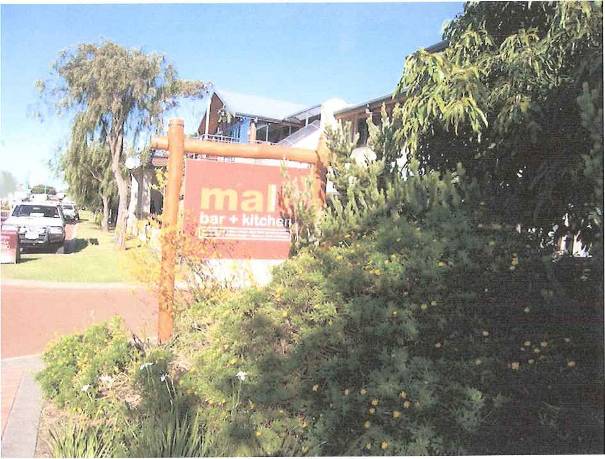
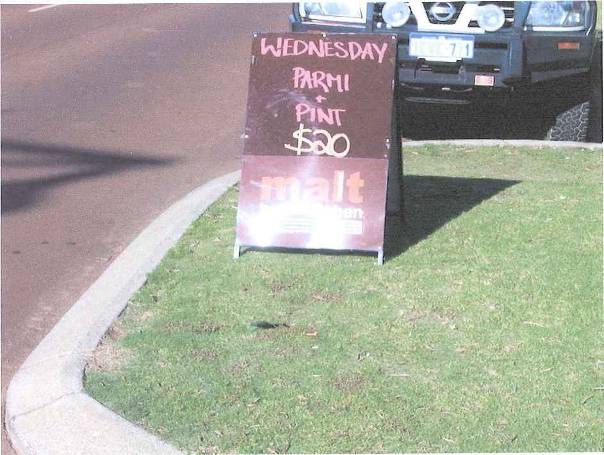
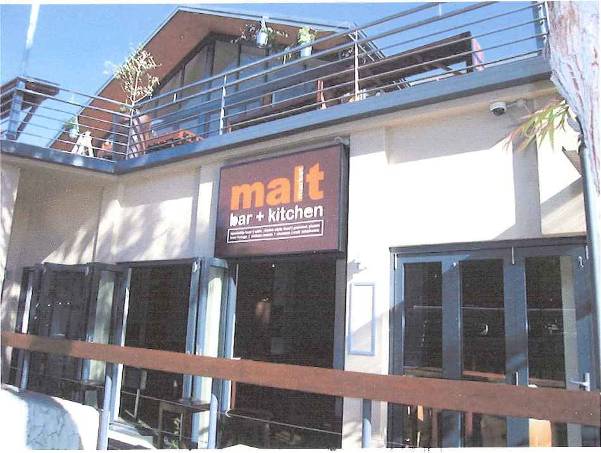
35 In relation to usage of the Trade Mark ‘MALT MARKET BAR AND KITCHEN’ by Dunn Bay, Mr Tricarico relies upon evidence from Mr Henry Hoofta who attended Dunn Bay’s business premises. Mr Hoofta observed outside those premises:
(a) A freestanding sign attached to wooden posts, a copy of which is annexed to these reasons (Annexure A);
(b) An A framed sandwich board, a photograph of which is also annexed to these reasons(Annexure B);
(c) A sign located above the entrance to Dunn Bay’s premises, a photo of which is also annexed to these reasons (Annexure C); and
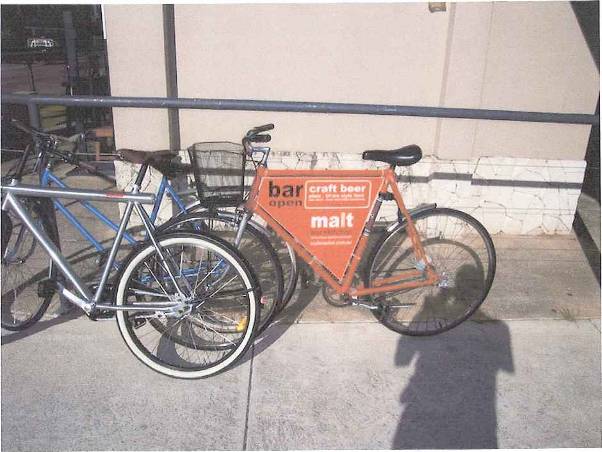
(d) A sign on a bicycle located outside Dunn Bay’s premises (the first MaltMarket Logo) is also annexed (Annexure D).
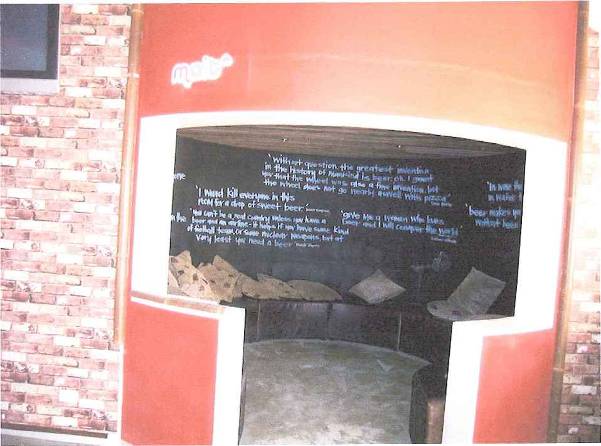
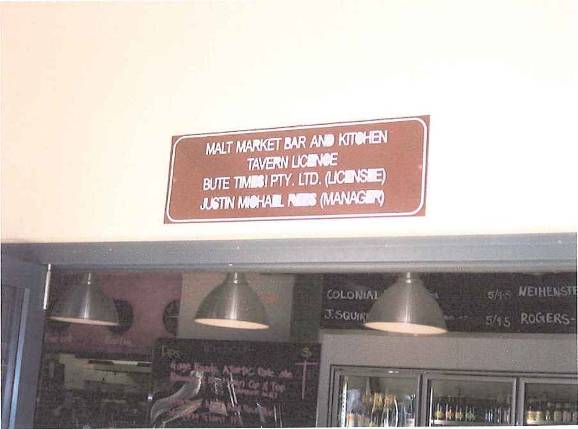
36 There was also a sign at the Dunn Bay premises in plain upper case lettering associated with the licensing requirements (Annexure E) and a sign on an interior wall of the Dunn Bay premises with a logo consistent with the word ‘malt’ in which the word ‘market’ written vertically inside the letter ‘l’ of the word ‘malt’. The photograph of that logo (the second MaltMarket Logo) is also annexed to these reasons (Annexure F). In addition, the logo appeared elsewhere on a menu and on a business card. The business card contained the phrases ‘malt lounge’ and ‘malt takehome’. Also appearing were references to the email address ‘maltmarket@westnet.com.au’ and a website ‘www.maltmarket.com.au’.
37 In short and as a key issue on this appeal, there has been no occasion on which Dunn Bay has used the Trade Mark ‘MALTMARKET BAR & KITCHEN’ in the manner it appears in the Trade Mark or, in my view, even closely approximating that manner. The logos in which similar words are used, particularly the word ‘malt’, have a completely different getup, design and appearance. This material was not before the Delegate when the opposition was heard. Dunn Bay uses the MaltMarket Trade Mark predominantly in the form of the first MaltMarket Logo. It has placed the second MaltMarket Logo on one of its interior walls. It is true that Dunn Bay uses the MaltMarket Trade Mark in plain text. It uses the MaltMarket Trade Mark in plain text on its liquor licence sign but that is not use as a ‘sign’ within the meaning of s 9 TMA. Rather, it is use which is necessary to comply with Dunn Bay’s obligations under the Liquor Control Act 1988 (WA), s 116(4).
Dunn Bay not intending to use trade mark
38 The first and new ground of appeal is based on s 59 TMA. Mr Tricarico contends that the MaltMarket application should be rejected because Dunn Bay did not intend to use the MaltMarket Trade Mark. Section 59 TMA provides as follows:
59 Applicant not intending to use trade mark
The registration of a trade mark may be opposed on the ground that the applicant does not intend:
(a) to use, or authorise the use of, the trade mark in Australia; or
(b) to assign the trade mark to a body corporate for use by the body corporate in Australia;
in relation to the goods and/or services specified in the application.
39 There is no evidence that Dunn Bay intended to assign the MaltMarket Trade Mark to any body corporate and s 59(a) alone is, therefore, relevant for present purposes.
40 Pursuant to s 7(1) TMA, if the Registrar or a prescribed court, having regard to the circumstances of a particular case thinks fit, it may decide that a person has used a trade mark if it is established that the person has used the trade mark with additions or alterations that do not substantially affect the identity of the trade mark.
41 Mr Tricarico contends that Dunn Bay uses the MaltMarket Trade Mark as MaltMarket Logos rather than as the trade mark ‘MaltMarket Bar & Kitchen’. The styling of both Logos substantially affects the MaltMarket Trade Mark’s identity such that use of the MaltMarket Logo does not constitute use of the MaltMarket Trade Mark.
42 Mr Tricarico argues that the styling of both Logos substantially affects the MaltMarket Trade Mark’s identify such that the use of the MaltMarket Logos does not constitute use of the MaltMarket Trade Mark.
43 An alternative argument presented by Mr Tricarico proceeds on the basis that use of a stylised version of the MaltMarket Trade Mark is capable of constituting use of the MaltMarket Trade Mark, notwithstanding that the MaltMarket Trade Mark is not represented in block capitals in the MaltMarket application. Regardless of this, it is argued the MaltMarket Logos ‘substantially affect the identity of the MaltMarket Trade Mark’ contrary to s 7(1) TMA. The MaltMarket Logos obscure the word ‘MARKET’ by placing it in very small lettering within the stem of the letter ‘L’ of the word ‘MALT’. The colouration of the word ‘MARKET’ being white text set against the orange of the letter ‘L’, a combination which is said to be and difficult to read further obscures the word ‘MARKET’ from the view of consumers. Accordingly, it is argued the MaltMarket Logos do not set out all the words of the MaltMarket Trade Mark in clearly legible form as anticipated by Re Morny Ltd’s Trade Marks [1951] 68 RPC 131 (at 149-150).
44 By obscuring the word ‘MARKET’, the MaltMarket Logos effectively transform the MaltMarket Trade Mark from ‘MALTMARKET BAR & KITCHEN’ to ‘MALT BAR & KITCHEN’. It is contended that the visual configuration of the MaltMarket Logos effectively loses the word ‘MARKET’ within the word ‘MALT’.
45 While use of a trade mark registered in block capitals may include use of the trade mark in a stylised form, Mr Tricarico points out that the MaltMarket application represents the MaltMarket Trade Mark in sentence case, not block capitals. Accordingly, only use of the MaltMarket Trade Mark in the particular sentence case style will constitute use of the actual trade mark as represented in the MaltMarket application. The MaltMarket Logos are not the same style as that set out in the MaltMarket application and so substantially affect the identity of the MaltMarket Trade Mark within the meaning of s 7(1) TMA.
CONSIDERATION
46 From a general perspective, as the learned authors (Dufty, A, Dwyer, JW, and Lahore, J) of LaHore Patents, Trade Marks & Related Rights (2006) observe (at [50,080]):
Whether an addition or alternation substantially affects the identity of a mark is often a moot point and each decision is necessarily a decision on its particular facts. That there are few decisions providing guidance on what might be a change which substantially affects the identity of the mark (emphasis added).
47 One example is The Privileges Card Pty Ltd v SPHC (IP) Pty Ltd [2001] ATMO 81 discussed in LaHore Patents, Trade Marks & Related Rights. As the authors note, most of the other authorities considering the application of the words ‘substantially affects the identity of the mark’ have been decided in the context of alterations or amendments or, as in this case, non-use proceedings. The authors note that the cases suggest that, at least in the context of alterations or amendments, a very strict approach will be adopted by the decision-makers, thus the owner of the trade mark Otrivin was not permitted to alter the mark to Otrivine because the proposed change altered the appearance and pronunciation of a word (“Otrivin” Trade Mark [1967] 84 RPC 613, Brandella Pty Ltd, Re (1987) 9 IPR 315.
48 Some other examples illustrate that a strict approach is taken in proceeding such as the present. In British Hoist & Crane Co Ltd’s Trade Mark [1955] 72 RPC 66, Lloyd-Jacob J dismissed an appeal from a decision of the Registrar’s delegate disallowing the registered proprietors of the trade mark ‘British Hoist & Crane Company Ltd Slough’ from amending the mark to ‘British Hoist & Crane Company Ltd Compton’. His Honour reasoned that because ‘Compton’ was a common surname as well as the name of a borough in Berkshire, the requested amendment would substantially affect the identity of the mark. Lloyd-Jacob J was, however, prepared to amend the trade mark to ‘British Hoist & Crane Company Ltd Compton, Berk’ in order to clarify that Compton referred to the new geographic location of the business.
49 The authors of LaHore Patents, Trade Marks & Related Rights (at [50,080]) suggest that an equally strict approach will be adopted where the ownership of a trade mark is in dispute and observed that the prior use of a mark which differs even slightly from the mark in question is unlikely to allow the prior user to claim priority. This said, however, the authors note in a footnote that a more generous interpretation may be given where the trade mark owner opposes (unlike this case) an application to remove a mark from the Register on the ground that there has been use of a mark with additions or alterations which do not substantially affect its identity. The authors refer to Re Morny Ltd’s Trade Marks [1951] 68 RPC 55 in which the omission of an ‘immaterial embellishment’ did not substantially affect the identity of the mark. In that case Lloyd-Jacob J refused an application to remove two of Morny Ltd’s trade marks from the Register of Trade Marks on grounds of non-use. The applicant argued that the first of Morny Ltd’s trade marks was not used in the way it appeared on the Register as at 1920, where the word ‘Morny’ was accompanied by a reference to London and Paris and contained within a French scroll. Lloyd-Jacob J held (at 57) that:
With the passage of the years and… with the change in the fashion in the advertising art, the precise get-up of the label appears to have changed but… in my view those are alterations in a non-substantial portion of the label themselves… [and do not substantially affect] the identity of the trade mark.
In other words, because the French scroll embellishment was of a ‘conventional form’, its omission did not substantially affect the identity of the mark.
50 His Honour then went on to find that the second trade mark ‘MORNY’ was not limited to form in which it appeared on the Register – namely, in capital letters. He reasoned (at 58):
[I]t has for years been appreciated that as some representation has to appear in the Register, that representation in the form of block capitals is to be regarded as a representation of a mark not intended to be limited by the precise script in which it was written.
51 In Re Application by Sony Kabushiki Kaisha (1987) 9 IPR 466 the Chief Assistant Registrar refused to grant an application by Sony to register the trade mark ‘BETAMOVIE’ on grounds that it was a simple combination of two generic words and lacked inherent distinctiveness. The Registrar also considered a proposal by Sony to substitute the word beta for the Greek symbol β. However the Registrar rejected this proposal (at 468) on grounds that the amendment would not meet the requirement in sections 42 and 127 of the Trade Marks Act 1955 that amendments must not substantially affect the identity of the mark.
52 In Re Pelican Trade Mark [1978] 95 RPC 424 the Board of Trade allowed an appeal by a German company from a decision of the Registrar’s delegate to refuse an application made under s 35(1) of the Trade Marks Act 1938 (UK) for leave to amended its registered trade mark. The trademark in question was the word ‘Pelican’ which appeared in italicised font. The applicant sought leave to amend the trade mark to the word ‘Pelikan’. The Registrar declined to grant the company leave to amend its trade mark because he considered that the proposed alteration would, first, change the visual appearance of the mark and, second, change the trade mark from a well-known English word for a particular type of bird to a word that some people might recognise as the German word for a type of bird but others would not. Together, he concluded, these factors substantially affected the identity of the mark.
53 However, on appeal, the Board of Trade granted leave to amend the trade mark because, first, the visual appearance was not substantially changed as the trade mark remained in italicised lower case font and the letter ‘k’ merely substituted the letter ‘c’ in the middle of the word and, two, the meaning was not substantially changed because even if English people did not know that the amended trade mark was the German word for pelican, the trade mark would appear to them as a mere misspelling of the English word. The Board of Trade distinguished Otrivin Trade Mark [1967] 84 RPC 613, in which the applicants were not permitted to change the trademark OTRIVIN to OTRIVINE, because that trade mark was an invented word.
54 As may be noted from these cases, a change may substantially affect a trade mark’s identity if either the pronunciation or the appearance of the mark is altered. In the present debate, the word ‘MARKET’ is effectively deleted. This clearly affects the pronunciation and appearance of the word ‘MALTMAKET’ which is a distinctive aspect of MaltMarket Trade Mark.
55 The deletion of a component of a trade mark was held in SwanFu Trading v Beyer Electrical (1992) 25 IPR 215 (at 230) to substantially affect the identity of a trade mark. There, the use of ‘ALOHA’ was held to not constitute use of the registered trade mark ‘ALOHA SWANFU’. Rubin JC upheld the application for the removal of the trade mark ‘ALOHA SWANFU’ from the Trade Mark Register of Singapore because the respondents could not establish bone fide use of the mark in the previous five year period. Rubin JC described the omission of the word ‘SWANFU’, as it appeared on gas cookers sold by the respondent during the five year period, as ‘striking’ (at 230) because it was an invented word that was ‘an essential part of the registered trade mark’ and ‘not just an immaterial embellishment’ (at 229).
56 In Express Newspapers v Star Newspaper [1984] IPD 7090 the hearing officer found that the use of newspaper title ‘The Star’ in italic font was not a sufficient use of the trade mark ‘The Star’ registered in Gothic font with a picture of a man standing within an 8-pointed star between the words ‘The’ and ‘Star’. The hearing officer distinguished Re Morny Ltd’s Trade Marks [1951] 68 RPC 55 in the following way (at 7090):
[I]f registration of a name or word or other mark takes a particular form, then it is to be inferred that it is intended to confine the mark and its use to that form. If not registered in a particular form, then a mark may be safeguarded by use in some different form, provided that its name or other significance comes shining through. This leaves the unresolved question: “what constitutes a particular form?” In a certain sense, every mark registered may be said to have a particular form, that is the form in which it was registered. But what it seems to me that the Master of the Rolls was saying was that “particular form” means out of the ordinary. Thus “MORNY” in plain block capitals is not a registration in an out of the ordinary form and may be used as a trade mark with various elements provided “Morny” remains discernable as the essential feature. In the case in suit, by way of contrast, “The Star” does seem to me to be registered in a particular or “out of the ordinary” form.
57 There are cases where contrary conclusions have been reached. In QH Tours Ltd v Mark Travel Corporation (1999) 45 IPR 553, it was held (at 559-560) that omitting the word ‘SERVICE’ from the trade mark ‘FUNJET-SERVICE’ did not substantially affect the registered trade mark’s identity because the trade mark was registered in respect of services so that ‘SERVICE’ was simply a descriptive element. In that case the Mark Travel Corporation filed an application to remove the registered trade mark ‘FUNJET-SERVICE’ for non-use. After considering the use of the altered trade mark in various travel brochures that advertised holiday packages, the hearing officer declined to strike the trade mark from the register on grounds on non-use. The hearing officer went on (at 559) to examine the three factors to be considered by the registrar in exercising his or her discretion to allow trade marks to remain on the register, as set out in Paragon Shoes Pty Ltd v Paragini Distributors (NSW) Pty Ltd (1988) 13 IPR 233 (at 324):
• whether anyone has been or is likely to be deceived if the mark remains on the register;
• the significance of the continued use of the mark in good faith by the person entitled to it; and
• if the public interest is not adversely affected and such title and use are shown, then technicalities or defects and legal formalities may be overlooked.
58 Applying the factors, the hearing officer (at 559) reasoned that given the recent use of the ‘FUNJET’ trade mark by Mark Travel, there was the potential for ‘significant confusion or deception’ if the trade mark was to be removed from the register and that the public interest would be better served by allowing the mark to remain.
59 In this case, the word ‘MARKET’ comprises half of the MaltMarket Trade Mark’s sole non-descriptive element in the word ‘MALTMARKET’. Unlike, ‘MALTMARKET’ the words ‘BAR & KITCHEN’ are descriptive of ‘tavern’ services. ‘Market’ is, therefore, an integral component of the word ‘MALTMARKET’ and, in turn, the MaltMarket Trade Mark. In my view, obscuring ‘MARKET’ in actual use to the point of difficulty in detection substantially affects the MaltMarket Trade Mark’s identity.
60 Dunn Bay has used the MaltMarket Trade Mark solely in plain words only where it is obliged to do so either at law on the licensing sign and/or for practical reasons in the email and electronic formats which require plain words rather than logos. The usage of MaltMarket has been only incidental to the use of the MaltMarket Logos and ‘inconsequential’ as that term is used by Shaw LJ in Imperial Group Ltd v Phillip Morris & Co Ltd [1982] 8 FSR 72 (at 83) part of Dunn Bay’s trading activities, not use as a trade mark within the meaning of the TMA. His Lordship said:
… I am satisfied that when the application to register “Nerit” was made, Imperial did not intend to use that mark for the purpose of indication a connection in the course of trade between them and cigarettes sold under that name. The sales which ensued were inconsequential as part of Imperial’s trading. Their true and only function was to bolster a projected use by Imperial of the ordinary word “Merit”, and in effect to arrogate to themselves an exclusive right to the use of that word as a brand name for cigarettes. This is not merely outside the scope of the Trade Marks Act 1938, but directly contrary to its spirit and intent.
61 On that basis, while there is no allegation of any improper conduct, the MaltMarket application was incorrectly filed because it did not reflect actual use or intended use and, therefore, it should not be registered.
62 The Delegate did not have the benefit of evidence of Dunn Bay’s actual use of the MaltMarket Logos but rather simply had the representation as it appears in the MaltMarket application. There was no obligation on Dunn Bay to produce evidence of usage in the original application. Equally, Mr Tricarico only became aware of the actual use by Dunn Bay of the MaltMarket Logos after delivery of the decision of the Delegate.
63 In my view, this is significant new material which was not before the Delegate. It is also relevant that Dunn Bay does not oppose, consents to and does not wish to be heard in relation to Mr Tricarico’s appeal. While, of course, this may be driven by costs considerations, it is clear that on the one hand, a considerable financial investment has been made by Emerald Lane with a view to potential expansion using the ‘MALT’ house brand whereas the usage of the MaltMarket Logos appears to have been very much different and arguably not by way of a trade mark at all. Certainly the usage has been quite different from a substantially altered MaltMarket Trade Mark.
64 That is sufficient to dispose of the appeal. Although Mr Tricarico advances very detailed additional submissions as to why the appeal should be allowed on the arguments advanced pursuant to s 42 and s 44 TMA, it is both unnecessary to consider those submissions and also better that those arguments await another day when there is an opponent to test them.
COSTS
65 As noted at [7], the Court’s powers on hearing an appeal against a decision of the Registrar are wide. Sub-section 197(e) and subs (f) TMA provide that the Court may make any order that, in all the circumstances, it thinks fit and may order a party to pay the costs of another party. The applicant has made no oral or written submissions on the question of costs. Unless the applicant files supplementary written submissions within seven days (in which case the respondents will have seven days to respond), no order will be made as to costs.
ORDERS
66 As Mr Tricarico has succeeded on his application, I will make the following orders:
1. The decision of the delegate of the Registrar of Trade Marks made on 2 November 2010 to allow Trade Mark application number 1282656 to proceed to registration be set aside.
2. Unless the applicant files submissions on costs within seven days, in which case the respondents will have seven days to reply, there be no orders as to costs.
3. Any further determination on costs be on the papers.
I certify that the preceding sixty-six (66) numbered paragraphs are a true copy of the Reasons for Judgment herein of the Honourable Justice McKerracher. |
Associate:
Annexure A
Annexure B
Annexure C
Annexure D
Annexure E
Annexure F